
Practice Biology questions for Induction day test 2016
|
|
|
- Todd Waters
- 9 years ago
- Views:
Transcription
1 Practice Biology questions for Induction day test 206 Q. The drawing shows an animal cell, seen at a very high magnification using an electron microscope. (a) (i) Label a mitochondrion [plural = mitochondria]. () What happens in the mitochondria?.. () (b) (i) Name and label the structure where you would find chromosomes. () What are chromosomes made of?.. () (c) What controls the rate of chemical reactions in the cytoplasm?... () (Total 5 marks) Page
2 Q2.A student uses a microscope to look at a section through part of a leaf. The diagram shows the student s drawing. (a) (i) Name tissues A and B. A B (2) The part of the leaf labelled C contains two different tissues that transport substances to and from the leaf. Name the two tissues found in part C. 2 (2) (b) The lower leaf surface has thousands of pores. The pores in the leaf surface allow the diffusion of gases between tissue B and the atmosphere. When the leaf is photosynthesising quickly the diffusion of gases through the pores is much faster than when the leaf is photosynthesising slowly. Explain why. Page 2
3 (2) (Total 6 marks) Q3. (a) Complete the equation for photosynthesis. lightenergy oxygen (2) (b) Scientists investigated how temperature affects the rate of photosynthesis. The scientists grew some orange trees in a greenhouse. They used discs cut from the leaves of the young orange trees. The scientists used the rate of oxygen production by the leaf discs to show the rate of photosynthesis. (i) The leaf discs did not produce any oxygen in the dark. Why? () The leaf discs took in oxygen in the dark. Explain why. (2) Page 3

4 (c) In their investigation, the scientists measured the rate of oxygen release by the leaf discs in the light. The scientists then measured the rate of oxygen uptake by the leaf discs in the dark. The graph shows the effect of temperature on oxygen production in the light oxygen production in the light added to oxygen uptake in the dark. Use the information from the graph to answer each of the following questions. (i) Describe the effect of temperature on oxygen production in the light. (2) Page 4
5 Explain the effect of temperature on oxygen production in the light when the temperature is increased: from 25 C to 35 C from 40 C to 50 C. (2) (d) A farmer in the UK wants to grow orange trees in a greenhouse. He wants to sell the oranges he produces at a local market. He decides to heat the greenhouse to 35 C. Explain why he should not heat the greenhouse to a temperature higher than 35 C. Use information from the graph in your answer. (3) (Total 2 marks) Q4. Fresh milk is a mixture of compounds including fat, protein and about 5 % lactose sugar. Lactose must be digested by the enzyme lactase, before the products can be absorbed. Lactase can be added to fresh milk to pre-digest the lactose. This makes lactose-free milk, which is suitable for people who do not produce enough lactase of their own. A student investigated the effect of changing ph and temperature on the digestion of lactose in milk. Page 5
6 The results are shown in Tables and 2. Table Effect of ph Table 2 Effect of temperature ph Time taken to digest lactose in minutes Temperature in C Time taken to digest lactose in minutes (a) The label on a carton of lactose-free milk states: Lactase is normally produced in the stomach of mammals. The results in Table show that this statement is unlikely to be true. Explain how. (2) (b) Explain as fully as you can the results shown in Table 2. Page 6 (3)
7 (c) Bile is produced in the liver and is released into the small intestine. Explain how bile helps the digestion of milk. (2) (Total 7 marks) Q5. (a) Respiration is a process which takes place in living cells. What is the purpose of respiration? () (b) (i) Balance the equation for the process of respiration when oxygen is available. C6H2O6 + O2 CO2 + H2O () What is the name of the substance in the equation with the formula C6H2O6?.. () (c) Oxygen is absorbed through the alveoli in the lungs. (i) How are the alveoli adapted for this function? Name the gas which is excreted through the alveoli... (2) () Page 7
8 (d) (i) What is the name of the process of respiration when oxygen is not available?.. () Describe the process of respiration which takes place in human beings when oxygen is not available and give an effect (3) (Total 0 marks) Q6.Some molecules can move into and out of cells across the cell membrane. (a) Dissolved substances move into and out of cells. Name this process. () (b) Diagram shows a model of a cell surrounded by water. The model cell contains a solution of two molecules, A and B. In the diagram, the circles represent molecules of A and B. The cell membrane contains small holes that allow molecules to pass through. Page 8
9 Diagram (i) Describe what will happen to the number of molecules of A and of B in the cell and in the water, in the next few hours. (3) Explain the reasons for your answer to part (b)(i). (2) Page 9
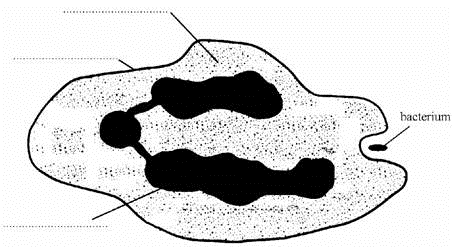
10 (c) Oxygen can pass through membranes into cells. Oxygen passes from the lungs into the blood. Diagram 2 shows a blood vessel and cells at the surface of the lung. Diagram 2 (i) Why do cells need oxygen? () Blood moves along the blood vessel all the time. In terms of oxygen passing into the blood from the lungs, why is the movement of blood important? (2) (Total 9 marks) Q7. The drawing shows a white blood cell ingesting a bacterium. Label the parts of the white blood cell. (Total 3 marks) Page 0
11 Q8.Phenylketonuria (PKU) is an inherited condition. PKU makes people ill. (a) PKU is caused by a recessive allele. (i) What is an allele? What is meant by recessive? () () (b) The diagram below shows the inheritance of PKU in one family. (i) Give one piece of evidence from the diagram that PKU is caused by a recessive allele. () Persons 6 and 7 are planning to have another child. Use a genetic diagram to find the probability that the new child will have PKU. Use the following symbols in your answer: N = the dominant allele for not having PKU n = the recessive allele for PKU. Probability =... (4) Page
12 (c) Persons 6 and 7 wish to avoid having another child with PKU. A genetic counsellor advises that they could produce several embryos by IVF treatment. (i) During IVF treatment, each fertilised egg cell forms an embryo by cell division. Name this type of cell division. () An embryo screening technique could be used to find the genotype of each embryo. An unaffected embryo could then be placed in person 7 s uterus. The screening technique is carried out on a cell from an embryo after just three cell divisions of the fertilised egg. How many cells will there be in an embryo after the fertilised egg has divided three times? () (iii) During embryo screening, a technician tests the genetic material of the embryo to find out which alleles are present. The genetic material is made up of large molecules of a chemical substance. Name this chemical substance. () (d) Some people have ethical objections to embryo screening. (i) Give one ethical objection to embryo screening. () Give one reason in favour of embryo screening. () (Total 2 marks) Page 2
13 Q9. (a) How do fossils provide evidence that species alive today have evolved from simpler organisms? (3) (b) The photographs show two species of gull. Herring gull (Larus argentatus) Lesser black-backed gull (Larus fuscus) By Ken Billington (Own work) [CC-BY-SA-3.0],via Wikimedia Commons By Andreas Trepte (Own work) [CC-BY-SA-2.5],via Wikimedia Commons Both species are now found in the UK but the two species cannot interbreed with each other. Scientists believe that these two species have evolved from a common ancestor. Page 3
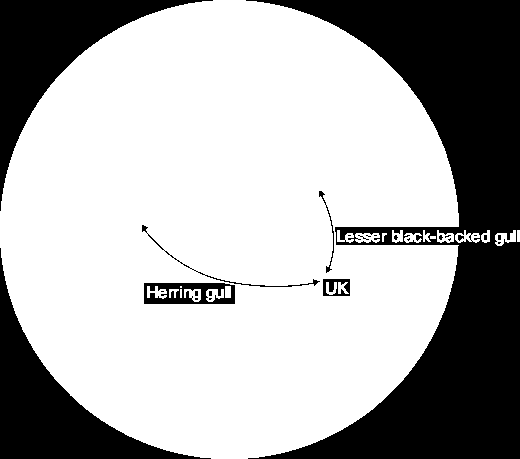
14 The map on the next page shows a view of the Earth from above the North Pole. The map also shows where these two species are found. Suggest an explanation for the development of these different species. (6) (Total 9 marks) Page 4
15 Markscheme M. (a) (i) award mark for any of the mitochondria correctly labelled if a number are labelled and one is incorrect award 0 marks respiration or the release or transfer of energy or it contains the enzymes for respiration do not accept energy produced (b) (i) nucleus (named and correctly labelled) arrow or line must touch or go inside the nuclear membrane DNA or genes or nucleic acids Page 5
16 accept protein or histones or nucleotides or ATGC (c) enzymes or nucleus do not accept factors that affect the rate rather than control it eg ph or temperature [5] M2.(a) (i) A = epidermis allow epidermal ignore upper B = mesophyll allow palisade and spongy mesophyll xylem either order phloem accept phonetic spellings (b) either oxygen produced faster allow more oxygen produced / released or Page 6
17 carbon dioxide used faster allow more carbon dioxide used / taken in / needed increases diffusion gradient allow increases difference in concentration (between inside and outside) allow more oxygen in the leaf compared to outside or less carbon dioxide in leaf compared to outside the leaf [6] M3. (a) LHS: carbon dioxide AND water in either order accept CO2 and H2O allow CO2 and H2O if names given ignore symbols do not accept CO 2 / H 2 O / Co / CO ignore balancing RHS: sugar(s) / glucose / starch / carbohydrate(s) accept C6H2O6 allow C6H2O6 do not accept C 6 H 2 O 6 (b) (i) light is needed for photosynthesis or no photosynthesis occurred (so no oxygen produced) oxygen is needed / used for (aerobic) respiration full statement respiration occurs or oxygen is needed for anaerobic respiration gains mark 2 (c) (i) (with increasing temperature) rise then fall in rate Page 7
18 use of figures, ie max. production at 40 C or maximum rate of 37.5 to C either faster movement of particles / molecules / more collisions or particles have more energy / enzymes have more energy or temperature is a limiting factor over this range C denaturation of proteins / enzymes ignore denaturation of cells ignore stomata (d) above 35 C (to 40 C) little increase in rate or > 40 C causes decrease in rate so waste of money or less profit / expensive because respiration rate is higher at > 35 C or respiration reduces the effect of photosynthesis [2] M4. (a) stomach is acidic / has low ph allow any ph below 7 ignore stomach is not alkaline Page 8
19 lactase works best / well in alkali / high ph / neutral / non-acidic conditions allow any ph of 7 and above accept works slowly in acid conditions allow figures from table with a comparison ignore reference to temperature (b) any three from (below 45( C)) increase in temperature increases rate / speed of reaction reference to molecules moving faster / colliding faster / harder / more collisions optimum / best at 45( C) allow value(s) in range 4-49 high temps / above 45( C) (rate slows due to) denaturation of enzyme /lactase allow synonyms of denaturation but not killed denaturation at high and low temperature does not gain this mark ignore body temperature ignore references to time / ph 3 (c) any two from acid neutralised or conditions made neutral / alkali accept bile is alkaline (allow) emulsification / greater surface area of fat / lipid allow description of emulsification eg fat is broken down / broken up into droplets enzymes (in small intestine) work (more effectively / better) allow better for enzymes 2 [7] M5. (a) to transfer / provide / give release energy or production of ATP / adenosine triphosphate (molecules) Page 9
20 accept to give heat (b) (i) C6H2O6 + 6O2 6CO2 + 6H2O accept any other n : 6n : 6n : 6n ratio do not credit if any other changes have been made glucose do not credit sugar / sucrose (c) (i) any two from large surface thin (surface) moist (surface) (with a good) blood supply carbon dioxide accept water vapour do not credit just water 2 (d) (i) anaerobic (respiration) any three from in mitochondria glucose decomposes / breaks down / reacts or glucose lactic acid for (2) marks to give lactic acid or breathing hard or lactic acid CO2 + water causing pain (leaving an) oxygen debt (quick) source of energy (but) less efficient than aerobic respiration accept less efficient than with oxygen Page 20 3 [0]
21 M6.(a) diffusion ignore absorption (b) (i) any three from max 2 marks for A or B only (the number of) A decreases in the cell (the number of) A increases in the water if neither of first two bullet points given allow mark for A moves out of cell / membrane or A moves into water until (number of) A is equal inside and outside cell or until (number of) A is half what it was at beginning (in cell) accept the idea that the concentrations of A in the cell and in the water will become (close to) equal (the number of) B stays the same in the cell there are no (molecules of) B in the water if neither bullet point 4 nor 5 is given allow mark for B does not move out of cell or B does not move into the water 3 (molecules of) A small enough to pass through holes / membrane allow membrane permeable to A or membrane not permeable to B or (molecules of) B too large to pass through holes / membrane allow reference to size of holes (in membrane) being too small for B or large enough for A, to pass through once concentration of molecules of A is the same inside and outside cell there will be no (net) movement Page 2
22 allow this idea in terms of numbers of molecules or A moves from high concentration (in cell) to low concentration (in water) (c) (i) for (aerobic) respiration ignore references to energy or uses of energy eg contraction or to respire do not accept anaerobic respiration any two from: removes oxygen that has diffused / passed into blood keeps difference (in concentration) between lungs and blood high accept idea of maintaining diffusion / concentration gradient increases speed of diffusion / passage of oxygen into blood if no other mark given allow mark for so oxygen can reach the cells / (named) parts of the body 2 [9] M7. cytoplasm reject protoplasm (cell) membrane nucleus all correctly labelled each for mark [3] M8.(a) (i) one form of a / one gene do not allow a type of gene allow a mutation of a gene Page 22
23 not expressed if dominant / other allele is present / if heterozygous or only expressed if dominant allele not present / or no other allele present allow need two copies to be expressed / not expressed if only one copy / only expressed if homozygous (b) (i) two parents without PKU produce a child with PKU / 6 and 7 0 allow it skips a generation genetic diagram including: accept alternative symbols if defined Parental gametes: 6: N and n and 7: N and n derivation of offspring genotypes: NN Nn Nn nn allow genotypes correctly derived from student s parental gametes identification: NN and Nn as non-pku OR nn as PKU allow correct identification of student s offspring genotypes correct probability only: 0.25 / ¼ / in 4 / 25% / : 3 do not allow 3 : / : 4 do not allow if extra incorrect probabilities given (c) (i) mitosis correct spelling only Page 23
24 8 (iii) DNA allow deoxyribonucleic acid do not allow RNA / ribonucleic acid (d) (i) may lead to damage to embryo / may destroy embryos / embryo cannot give consent allow avoid abortion allow emotive terms eg murder religious argument must be qualified allow ref to miscarriage allow idea of avoiding prejudice against disabled people allow idea of not producing designer babies any one from: prevent having child with the disorder / prevent future suffering / reduce incidence of the disease ignore ref to having a healthy child ignore ref to selection of gender embryo cells could be used in stem cell treatment allow ref to long term cost of treating a child (with a disorder) allow ref to time for parents to become prepared [2] M9. (a) fossil is (remains / impression of) organism that lived a long time ago if numbers, 000s years fossils show changes over time or older fossils simpler or fossils simpler than present-day species fossils have similar features to present-day species allow fossils allow us to compare old species with present-day species Page 24
25 (b) isolation / separation / splitting by geographical barrier / sea ignore other examples there was variation (in these isolated populations) / different alleles accept mutation different environmental conditions or example eg climate / predators / food natural selection acted on the isolated populations accept became adapted in each area OR only certain allele(s) passed on to offspring / different alleles passed on in different environments allow genes so differences lead to inability to interbreed allow differences described eg mismatch of genitalia / different courtship displays / different breeding seasons [9] Page 25
B2 1 Cells, Tissues and Organs
 B2 Cells, Tissues and Organs 5 minutes 5 marks Page of 7 Q. The diagram shows a bacterium. On the drawing, name the structures labelled A, B, C and D. (Total 4 marks) Q2. (a) The diagrams show cells containing
B2 Revision. Subject Module Date Biology B2 13 TH May (am)
 B2 Revision Subject Module Date Biology B2 13 TH May (am) Useful websites www.aqa.org.uk This website contains the specifications that we follow and also has a large number of past papers and mark schemes
Additional Science. Biology BL2FP. (Jun15BL2FP01) General Certificate of Secondary Education Foundation Tier June 2015.
 Centre Number Surname Candidate Number For Examiner s Use Other Names Candidate Signature Examiner s Initials Question Mark Additional Science Unit Biology B2 Biology Unit Biology B2 General Certificate
Topic 3: Nutrition, Photosynthesis, and Respiration
 1. Base your answer to the following question on the chemical reaction represented below and on your knowledge of biology. If this reaction takes place in an organism that requires sunlight to produce
Mark Scheme. Additional Science 4408 / Biology 4401. General Certificate of Secondary Education. BL2HP Unit Biology 2. 2012 examination June series
 Version : 0/08/202 General Certificate of Secondary Education Additional Science 4408 / Biology 440 Unit Biology 2 Mark Scheme 202 examination June series Mark schemes are prepared by the Principal Examiner
The chemical reactions inside cells are controlled by enzymes. Cells may be specialised to carry out a particular function.
 12.1 What are animals and plants built from? All living things are made up of cells. The structures of different types of cells are related to their functions. to relate the structure of different types
Cells, tissues and organs
 Chapter 8: Cells, tissues and organs Cells: building blocks of life Living things are made of cells. Many of the chemical reactions that keep organisms alive (metabolic functions) take place in cells.
Respiration occurs in the mitochondria in cells.
 B3 Question Which process occurs in the mitochondria in cells? Why do the liver and muscle cells have large number of mitochondria? What is the function of the ribosomes? Answer Respiration occurs in the
Investigating cells. Cells are the basic units of living things (this means that all living things are made up of one or more cells).
 SG Biology Summary notes Investigating cells Sub-topic a: Investigating living cells Cells are the basic units of living things (this means that all living things are made up of one or more cells). Cells
hij GCSE Additional Science Biology 2 Higher Tier Biology 2H SPECIMEN MARK SCHEME Version 1.0
 hij GCSE Additional Science Biology 2 Higher Tier Biology 2H SPECIMEN MARK SCHEME Version.0 Copyright 20 AQA and its licensors. All rights reserved. The Assessment and Qualifications Alliance (AQA) is
B2 H Mock Exam October 2014
 B2 H Mock Exam October 204 B2. - B2.6 64 minutes 64 marks 5x 4x2 2x3 Page of 34 Q. The diagram shows a cell. (a) (i) Use words from the box to name the structures labelled A and B. cell membrane chloroplast
Photosynthesis. Chemical Energy (e.g. glucose) - They are the ultimate source of chemical energy for all living organisms: directly or indirectly.
 Photosynthesis Light Energy transduction Chemical Energy (e.g. glucose) - Only photosynthetic organisms can do this (e.g. plants) - They are the ultimate source of chemical energy for all living organisms:
Draw one line from each structure in List A to the correct information about the structure in List B.
 Q. The drawing shows the cell of a bacterium. (a) List A gives the four structures labelled on the diagram. List B includes information about each structure. Draw one line from each structure in List A
Keystone Review Practice Test Module A Cells and Cell Processes. 1. Which characteristic is shared by all prokaryotes and eukaryotes?
 Keystone Review Practice Test Module A Cells and Cell Processes 1. Which characteristic is shared by all prokaryotes and eukaryotes? a. Ability to store hereditary information b. Use of organelles to control
Unit 5 Photosynthesis and Cellular Respiration
 Unit 5 Photosynthesis and Cellular Respiration Advanced Concepts What is the abbreviated name of this molecule? What is its purpose? What are the three parts of this molecule? Label each part with the
Cells & Cell Organelles
 Cells & Cell Organelles The Building Blocks of Life H Biology Types of cells bacteria cells Prokaryote - no organelles Eukaryotes - organelles animal cells plant cells Cell size comparison Animal cell
Section A: Organisms and Life Processes
 Section A: Organisms and Life Processes The cells of all living organisms have common features, and the organisms themselves share common processes. In this chapter you will read about these features and
CELERY LAB - Structure and Function of a Plant
 CELERY LAB - Structure and Function of a Plant READ ALL INSTRUCTIONS BEFORE BEGINNING! YOU MAY WORK WITH A PARTNER ON THIS ACTIVITY, BUT YOU MUST COMPLETE YOUR OWN LAB SHEET! Look at the back of this paper
BIOLOGY HIGHER LEVEL
 2008. M44 Write your Examination Number here Coimisiún na Scrúduithe Stáit State Examinations Commission LEAVING CERTIFICATE EXAMINATION, 2008 BIOLOGY HIGHER LEVEL THURSDAY, 12 JUNE MORNING, 9.30 TO 12.30
Get It Right. Answers. Chapter 1: The Science of Life. A biologist studies all living things.
 Discover Biology 'N' Level Science Chapter 1 Chapter 1: The Science of Life A biologist studies all living things. In order to carry out the scientific method, we need to ask questions. Discover Biology
MCAS Biology. Review Packet
 MCAS Biology Review Packet 1 Name Class Date 1. Define organic. THE CHEMISTRY OF LIFE 2. All living things are made up of 6 essential elements: SPONCH. Name the six elements of life. S N P C O H 3. Elements
PHOTOSYNTHESIS AND CELLULAR RESPIRATION
 reflect Wind turbines shown in the photo on the right are large structures with blades that move in response to air movement. When the wind blows, the blades rotate. This motion generates energy that is
Final. Mark Scheme. Additional Science / Biology BL2FP. (Specification 4408 / 4401) Unit: Biology 2
 Version.0 General Certificate of Secondary Education January 203 Additional Science / Biology (Specification 4408 / 440) Unit: Biology 2 Final Mark Scheme Mark schemes are prepared by the Principal Examiner
Chapter 2. The Chemistry of Life Worksheets
 Chapter 2 The Chemistry of Life Worksheets (Opening image courtesy of David Iberri, http://en.wikipedia.org/wiki/file:camkii.png, and under the Creative Commons license CC-BY-SA 3.0.) Lesson 2.1: Matter
Name Date Period. Keystone Review Enzymes
 Name Date Period Keystone Review Enzymes 1. In order for cells to function properly, the enzymes that they contain must also function properly. What can be inferred using the above information? A. Cells
Unit I: Introduction To Scientific Processes
 Unit I: Introduction To Scientific Processes This unit is an introduction to the scientific process. This unit consists of a laboratory exercise where students go through the QPOE2 process step by step
Enzymes. A. a lipid B. a protein C. a carbohydrate D. a mineral
 Enzymes 1. All cells in multicellular organisms contain thousands of different kinds of enzymes that are specialized to catalyze different chemical reactions. Given this information, which of the following
GCSE Additional Science Biology Contents Guide
 GCSE Additional Science Contents Guide Copyright Boardworks Ltd 2007 Boardworks Ltd The Gallery 54 Marston Street Oxford OX4 1LF 08703 50 55 60 [email protected] www.boardworks.co.uk 04-07 contains
Cell Unit Practice Test #1
 ell Unit Practice Test #1 Name: ate: 1. Which organelle is primarily concerned with the conversion of potential energy of organic compounds into suitable form for immediate use by the cell?. mitochondria.
PRESTWICK ACADEMY NATIONAL 5 BIOLOGY CELL BIOLOGY SUMMARY
 Name PRESTWICK ACADEMY NATIONAL 5 BIOLOGY CELL BIOLOGY SUMMARY Cell Structure Identify animal, plant, fungal and bacterial cell ultrastructure and know the structures functions. Plant cell Animal cell
Reproductive System & Development: Practice Questions #1
 Reproductive System & Development: Practice Questions #1 1. Which two glands in the diagram produce gametes? A. glands A and B B. glands B and E C. glands C and F D. glands E and F 2. Base your answer
1. The diagram below represents a biological process
 1. The diagram below represents a biological process 5. The chart below indicates the elements contained in four different molecules and the number of atoms of each element in those molecules. Which set
2. Which type of macromolecule contains high-energy bonds and is used for long-term energy storage?
 Energy Transport Study Island 1. During the process of photosynthesis, plants use energy from the Sun to convert carbon dioxide and water into glucose and oxygen. These products are, in turn, used by the
Cellular Energy. 1. Photosynthesis is carried out by which of the following?
 Cellular Energy 1. Photosynthesis is carried out by which of the following? A. plants, but not animals B. animals, but not plants C. bacteria, but neither animals nor plants D. all living organisms 2.
Cellular Respiration: Practice Questions #1
 Cellular Respiration: Practice Questions #1 1. Which statement best describes one of the events taking place in the chemical reaction? A. Energy is being stored as a result of aerobic respiration. B. Fermentation
THE LIVING CELL. Cells also have variety of shapes. Plant cells are often rectangular or polygonal, while egg cells are usually spherical.
 THE LIVING CELL A Tour of the cell The cell is the smallest and the basic unit of structure of all organisms. There are two main types or categories of cells: prokaryotic cells and eukaryotic cells. Prokaryotic
H.W. 1 Bio 101 Prof. Fournier
 H.W. 1 Bio 101 Prof. Fournier 1. What is a similarity between all bacteria and plants? A) They both have a nucleus B) They are both composed of cells C) They both have chloroplasts D) They both lack a
Anatomy and Physiology of Leaves
 I. Leaf Structure and Anatomy Anatomy and Physiology of Leaves A. Structural Features of the Leaf Question: How do plants respire? Plants must take in CO 2 from the atmosphere in order to photosynthesize.
Photosynthesis: Harvesting Light Energy
 Photosynthesis: Harvesting Light Energy Importance of Photosynthesis A. Ultimate source of energy for all life on Earth 1. All producers are photosynthesizers 2. All consumers and decomposers are dependent
0610 BIOLOGY. Mark schemes should be read in conjunction with the question paper and the Principal Examiner Report for Teachers.
 CAMBRIDGE INTERNATIONAL EXAMINATIONS International General Certificate of Secondary Education MARK SCHEME for the May/June 2014 series 0610 BIOLOGY 0610/32 Paper 3 (Extended), maximum raw mark 80 This
How To Understand The Human Body
 Introduction to Biology and Chemistry Outline I. Introduction to biology A. Definition of biology - Biology is the study of life. B. Characteristics of Life 1. Form and size are characteristic. e.g. A
Mark Scheme (Results) Summer 2012. GCSE Biology 5BI2H/01
 Mark Scheme (Results) Summer 2012 GCSE Biology 5BI2H/01 Edexcel and BTEC Qualifications Edexcel and BTEC qualifications come from Pearson, the world s leading learning company. We provide a wide range
CELERY LAB - Structure and Function of a Plant
 CELERY LAB - Structure and Function of a Plant READ ALL INSTRUCTIONS BEFORE BEGINNING! YOU MAY WORK WITH A PARTNER ON THIS ACTIVITY, BUT YOU MUST COMPLETE YOUR OWN LAB SHEET! Plants are incredible organisms!
XII. Biology, Grade 10
 XII. Biology, Grade 10 Grade 10 Biology Pilot Test The spring 2004 Grade 10 MCAS Biology Test was based on learning standards in the Biology content strand of the Massachusetts Science and Technology/Engineering
PLANT AND ANIMAL CELL ORGANELLES
 reflect The heart is an example of an organ. Think for a minute about your body. It s organized into parts that perform specific functions. For example, your heart functions to help transport materials
Mark Scheme (Results) November 2011. GCSE Biology 5BI1H/01
 Mark Scheme (Results) November 2011 GCSE Biology 5BI1H/01 Edexcel is one of the leading examining and awarding bodies in the UK and throughout the world. We provide a wide range of qualifications including
Chapter 1: Life Processes
 The human body is composed of countless millions of units called cells. In an animal like a human there are many different types of cells, with different structures. They are specialised so that they can
pathway that involves taking in heat from the environment at each step. C.
 Study Island Cell Energy Keystone Review 1. Cells obtain energy by either capturing light energy through photosynthesis or by breaking down carbohydrates through cellular respiration. In both photosynthesis
MARK SCHEME for the May/June 2012 question paper for the guidance of teachers 5090 BIOLOGY. 5090/22 Paper 2 (Theory), maximum raw mark 80
 www.xtremepapers.com UNIVERSITY OF CAMBRIDGE INTERNATIONAL EXAMINATIONS GCE Ordinary Level MARK SCHEME for the May/June 2012 question paper for the guidance of teachers 5090 BIOLOGY 5090/22 Paper 2 (Theory),
B2.1-B2.2 Cells, tissues and organs
 B.-B. Cells, tissues and organs The diagram shows a plant cell. a Identify the structures listed. Choose the correct letter A, B, C, D or E for each structure. i nucleus () ii chloroplast () iii cell wall
The chemical energy used for most cell processes is carried by ATP.
 4.1 CHEMICAL ENERGY AND ATP Study Guide KEY CONCEPT All cells need chemical energy. VOCABULARY ATP ADP chemosynthesis MAIN IDEA: The chemical energy used for most cell processes is carried by ATP. 1. What
Chapter 9 Cellular Respiration
 Chapter 9 Cellular Respiration Electrons carried in NADH Mitochondrion Glucose Glycolysis Pyruvic acid Krebs Cycle Electrons carried in NADH and FADH 2 Electron Transport Chain Cytoplasm Mitochondrion
Todays Outline. Metabolism. Why do cells need energy? How do cells acquire energy? Metabolism. Concepts & Processes. The cells capacity to:
 and Work Metabolic Pathways Enzymes Features Factors Affecting Enzyme Activity Membrane Transport Diffusion Osmosis Passive Transport Active Transport Bulk Transport Todays Outline -Releasing Pathways
10B Plant Systems Guided Practice
 10B Plant Systems Guided Practice Reproduction Station 1 1. Observe Plant A. Locate the following parts of the flower: stamen, stigma, style, ovary. 2. Draw and label the parts of a flower (listed above)
WHAT ARE THE DIFFERENCES BETWEEN VASCULAR AND NON- VASCULAR PLANTS?
 WHAT ARE THE DIFFERENCES BETWEEN VASCULAR AND NON- VASCULAR PLANTS? Let s take a closer look. What makes them different on the outside and inside? Learning Intentions To understand how vascular plant cells
Cell and Membrane Practice. A. chromosome B. gene C. mitochondrion D. vacuole
 Name: ate: 1. Which structure is outside the nucleus of a cell and contains N?. chromosome. gene. mitochondrion. vacuole 2. potato core was placed in a beaker of water as shown in the figure below. Which
Essentials of Human Anatomy & Physiology 11 th Edition, 2015 Marieb
 A Correlation of Essentials of Human Anatomy Marieb To the Next Generation Science Standards Life A Correlation of, HS-LS1 From Molecules to Organisms: Structures and Processes HS-LS1-1. Construct an explanation
tissues are made of cells that work together, organs are )
 Study Guide Cells Unit Test Matching. Write the letter of the correct response on the line. You may use the responses more than once. A. proteins B. simple carbohydrates C. complex carbohydrates D. lipids
Introduction to the Cell: Plant and Animal Cells
 Introduction to the Cell: Plant and Animal Cells Tissues, Organs, and Systems of Living Things Cells, Cell Division, and Animal Systems and Plant Systems Cell Specialization Human Systems All organisms
Enzymes. Chapter 3. 3.1 Enzymes and catalysts. Vital mistake. What is an enzyme?
 Chapter 3 Enzymes Vital mistake We may not be able to see them, but enzymes are absolutely crucial to the lives of ourselves and all other living organisms. The Quarter Horse (Figure 3.1) is a breed of
3120-1 - Page 1. Name:
 Name: 1) Which series is arranged in correct order according to decreasing size of structures? A) DNA, nucleus, chromosome, nucleotide, nitrogenous base B) chromosome, nucleus, nitrogenous base, nucleotide,
The correct answer is d C. Answer c is incorrect. Reliance on the energy produced by others is a characteristic of heterotrophs.
 1. An autotroph is an organism that a. extracts energy from organic sources b. converts energy from sunlight into chemical energy c. relies on the energy produced by other organisms as an energy source
Anatomy and Physiology Placement Exam 2 Practice with Answers at End!
 Anatomy and Physiology Placement Exam 2 Practice with Answers at End! General Chemical Principles 1. bonds are characterized by the sharing of electrons between the participating atoms. a. hydrogen b.
Organic Compounds. Essential Questions: What is Organic? What are the 4 major Organic Compounds? How are they made? What are they used for?
 Organic Compounds Essential Questions: What is Organic? What are the 4 major Organic Compounds? How are they made? What are they used for? Aristotle: Francesco Redi: What do we already know? Spontaneous
AS Biology Unit 2 Key Terms and Definitions. Make sure you use these terms when answering exam questions!
 AS Biology Unit 2 Key Terms and Definitions Make sure you use these terms when answering exam questions! Chapter 7 Variation 7.1 Random Sampling Sampling a population to eliminate bias e.g. grid square
Biology for Science Majors
 Biology for Science Majors Lab 10 AP BIOLOGY Concepts covered Respirometers Metabolism Glycolysis Respiration Anaerobic vs. aerobic respiration Fermentation Lab 5: Cellular Respiration ATP is the energy
Figure 1. Basic structure of the leaf, with a close up of the leaf surface showing Stomata and Guard cells.
 BIOL100 Laboratory Assignment 3: Analysis of Stomata Name: Stomata (singular=stoma) are the respiratory control structures in plants (see Figure 1 below). They are essentially small holes in the surface
10.1 The function of Digestion pg. 402
 10.1 The function of Digestion pg. 402 Macromolecules and Living Systems The body is made up of more than 60 % water. The water is found in the cells cytoplasm, the interstitial fluid and the blood (5
The Excretory and Digestive Systems
 The Excretory and Digestive Systems 38.2 The Process of Digestion Organs of the Digestive System The digestive system includes the: Mouth Pharynx Esophagus Stomach Small and large intestine. Other structures
pencil. Vocabulary: 1. Reactant 2. Product 3. Activation energy 4. Catalyst 5. substrate 6. Chemical reaction Keep your textbooks when you are done
 Objectives Students will explore the importance of chemical reactions in biology Students will discuss the role of enzymes as catalysts in biological reactions. Students will analyze graphs showing how
Enzymes: Practice Questions #1
 Enzymes: Practice Questions #1 1. Compound X increases the rate of the reaction below. Compound X is most likely A. an enzyme B. a lipid molecule C. an indicator D. an ADP molecule 2. The equation below
Topic 4: Digestion and Nutrition
 Topic 4: Digestion and Nutrition THE CONTENTS OF FOOD Food contains nutrients: Nutrients include: 1. 2. 3. 4. 5. Nutrients must be small enough to enter our cells. If they are too large they must be digested
Name Date Class. energy phosphate adenine charged ATP chemical bonds work ribose
 Energy in a Cell Reinforcement and Study Guide Section.1 The Need for Energy In your textbook, read about cell energy. Use each of the terms below just once to complete the passage. energy phosphate adenine
Biology 12 June 2003 Provincial Examination
 Biology 12 June 2003 rovincial Examination ANWER KEY / CORING GUIDE CURRICULUM: Organizers 1. Cell Biology 2. Cell rocesses and Applications 3. Human Biology ub-organizers A, B, C, D E, F, G, H I, J, K,
Biology 20 Cellular Respiration Review NG Know the process of Cellular Respiration (use this picture if it helps):
 Biology 20 Cellular Respiration Review NG Know the process of Cellular Respiration (use this picture if it helps): 1) How many ATP molecules are produced for each glucose molecule used in fermentation?
Photo Cell Resp Practice. A. ATP B. oxygen C. DNA D. water. The following equation represents the process of photosynthesis in green plants.
 Name: ate: 1. Which molecule supplies the energy for cellular functions?. TP. oxygen. N. water 2. Photosynthesis The following equation represents the process of photosynthesis in green plants. What happens
The content assessed by the examination papers and the type of questions are unchanged.
 www.xtremepapers.com Location Entry Codes From the June 2007 session, as part of CIE s continual commitment to maintaining best practice in assessment, CIE has begun to use different variants of some question
Given these characteristics of life, which of the following objects is considered a living organism? W. X. Y. Z.
 Cell Structure and Organization 1. All living things must possess certain characteristics. They are all composed of one or more cells. They can grow, reproduce, and pass their genes on to their offspring.
2. What kind of energy is stored in food? A. chemical energy B. heat energy C. kinetic energy D. light energy
 Assessment Bank Matter and Energy in Living Things SC.8.L.18.4 1. What is energy? A. anything that takes up space B. anything that has mass C. the ability to conduct current D. the ability to do work 2.
Photosynthesis (CO 2 + H 2 O C 6 H 12 O 6 + O 2 )
 The vital role of A This is the energy-rich compound that is the source of energy for all living things. It is a nucleotide, comprising a 5C sugar (ribose); an organic base (adenosine); and 3 phosphate
the!sun!to!sugars.!this!is!called!! photosynthesis.!the!byproduct!of!those! Nucleus! sugars!is!our!oxygen.!
 Cytoplasm ANIMAL CELL Vacuoles Mitochondria Chromosomes GolgiApparatus Chloroplast+ TheChloroplastiswhatmakesthefood inthecell.they reonlyfoundinplant cellsandsomeprotists.everygreen plantyouseeisconvertingenergyfrom
Which of the following can be determined based on this model? The atmosphere is the only reservoir on Earth that can store carbon in any form. A.
 Earth s Cycles 1. Models are often used to explain scientific knowledge or experimental results. A model of the carbon cycle is shown below. Which of the following can be determined based on this model?
Examination Feedback Summary GCSE Science June 2014 Series
 Examination Feedback Summary GCSE Science June 2014 Series This examination feedback summary refers to GCSE Biology, Chemistry and Physics. It provides a summary of the common issues identified in student
12.1 The Role of DNA in Heredity
 12.1 The Role of DNA in Heredity Only in the last 50 years have scientists understood the role of DNA in heredity. That understanding began with the discovery of DNA s structure. In 1952, Rosalind Franklin
A Correlation of Pearson Miller & Levine Biology 2014 To the Utah Core State Standards for Biology Grades 9-12
 A Correlation of Pearson To the Utah Core State Standards Resource Title: Publisher: Pearson Education publishing as Prentice Hall ISBN (10 or 13 digit unique identifier is required): SE: 9780133242003
Bio 101 Section 001: Practice Questions for First Exam
 Do the Practice Exam under exam conditions. Time yourself! MULTIPLE CHOICE: 1. The substrate fits in the of an enzyme: (A) allosteric site (B) active site (C) reaction groove (D) Golgi body (E) inhibitor
Biology Chapter 7 Practice Test
 Biology Chapter 7 Practice Test Multiple Choice Write the letter that best answers the question or completes the statement on the line provided. 1. The work of Schleiden and Schwann can be summarized by
Respiration Worksheet. Respiration is the controlled release of energy from food. Types of Respiration. Aerobic Respiration
 Respiration Worksheet Respiration is the controlled release of energy from food The food involved in respiration is usually Internal respiration is controlled by which allow energy to be released in The
Metabolism: Cellular Respiration, Fermentation and Photosynthesis
 Metabolism: Cellular Respiration, Fermentation and Photosynthesis Introduction: All organisms require a supply of energy and matter to build themselves and to continue to function. To get that supply of
Cellular Respiration
 Cellular Respiration Cellular Respiration Text, Diagrams, Assessments, and Link to Standards Focus Questions 1) What is cellular respiration? 2) How is cellular respiration connected to breathing? 3) If
7. A selectively permeable membrane only allows certain molecules to pass through.
 CHAPTER 2 GETTING IN & OUT OF CELLS PASSIVE TRANSPORT Cell membranes help organisms maintain homeostasis by controlling what substances may enter or leave cells. Some substances can cross the cell membrane
Cellular Respiration An Overview
 Why? Cellular Respiration An Overview What are the phases of cellular respiration? All cells need energy all the time, and their primary source of energy is ATP. The methods cells use to make ATP vary
Membrane Structure and Function
 Membrane Structure and Function Part A Multiple Choice 1. The fluid mosaic model describes membranes as having A. a set of protein channels separated by phospholipids. B. a bilayer of phospholipids in
GCSE Biology. BL3HP Report on the Examination. 4401 June 2014. Version: 1.0
 GCSE Biology BL3HP Report on the Examination 4401 June 2014 Version: 1.0 Further copies of this Report are available from aqa.org.uk Copyright 2014 AQA and its licensors. All rights reserved. AQA retains
Process 3.5. A Pour it down the sink. B Pour it back into its original container. C Dispose of it as directed by his teacher.
 Process 3.5 Biology EOI sample test questions Objective numbers correspond to the State Priority Academic Student Skills (PASS) standards and objectives. This number is also referenced with the local objective
Multiple Choice Questions
 Chapter 5 THE FUNDAMENTAL UNIT OF LIFE Multiple Choice Questions 1. Which of the following can be made into crystal? (a) A Bacterium (b) An Amoeba (c) A Virus (d) A Sperm 2. A cell will swell up if (a)
North Bergen School District Benchmarks
 Grade: 10,11, and 12 Subject: Anatomy and Physiology First Marking Period Define anatomy and physiology, and describe various subspecialties of each discipline. Describe the five basic functions of living
Cambridge International Examinations Cambridge International General Certificate of Secondary Education
 *1981377663* ambridge International Examinations ambridge International General ertificate of Secondary Education IOLOGY 0610/11 Paper 1 Multiple hoice May/June 2014 dditional Materials: Multiple hoice
The Living Cell from the Biology: The Science of Life Series. Pre-Test
 1 Pre-Test Directions: Answer each question TRUE OR FALSE. 1. The instructions for making proteins are stored in molecules of DNA. 2. Proteins are made in the nucleus. 3. All cells are surrounded by a
1.1.2. thebiotutor. AS Biology OCR. Unit F211: Cells, Exchange & Transport. Module 1.2 Cell Membranes. Notes & Questions.
 thebiotutor AS Biology OCR Unit F211: Cells, Exchange & Transport Module 1.2 Cell Membranes Notes & Questions Andy Todd 1 Outline the roles of membranes within cells and at the surface of cells. The main