
NEW adder cells are useful for designing larger circuits despite increase in transistor count by four per cell.
|
|
|
- Emory Long
- 9 years ago
- Views:
Transcription
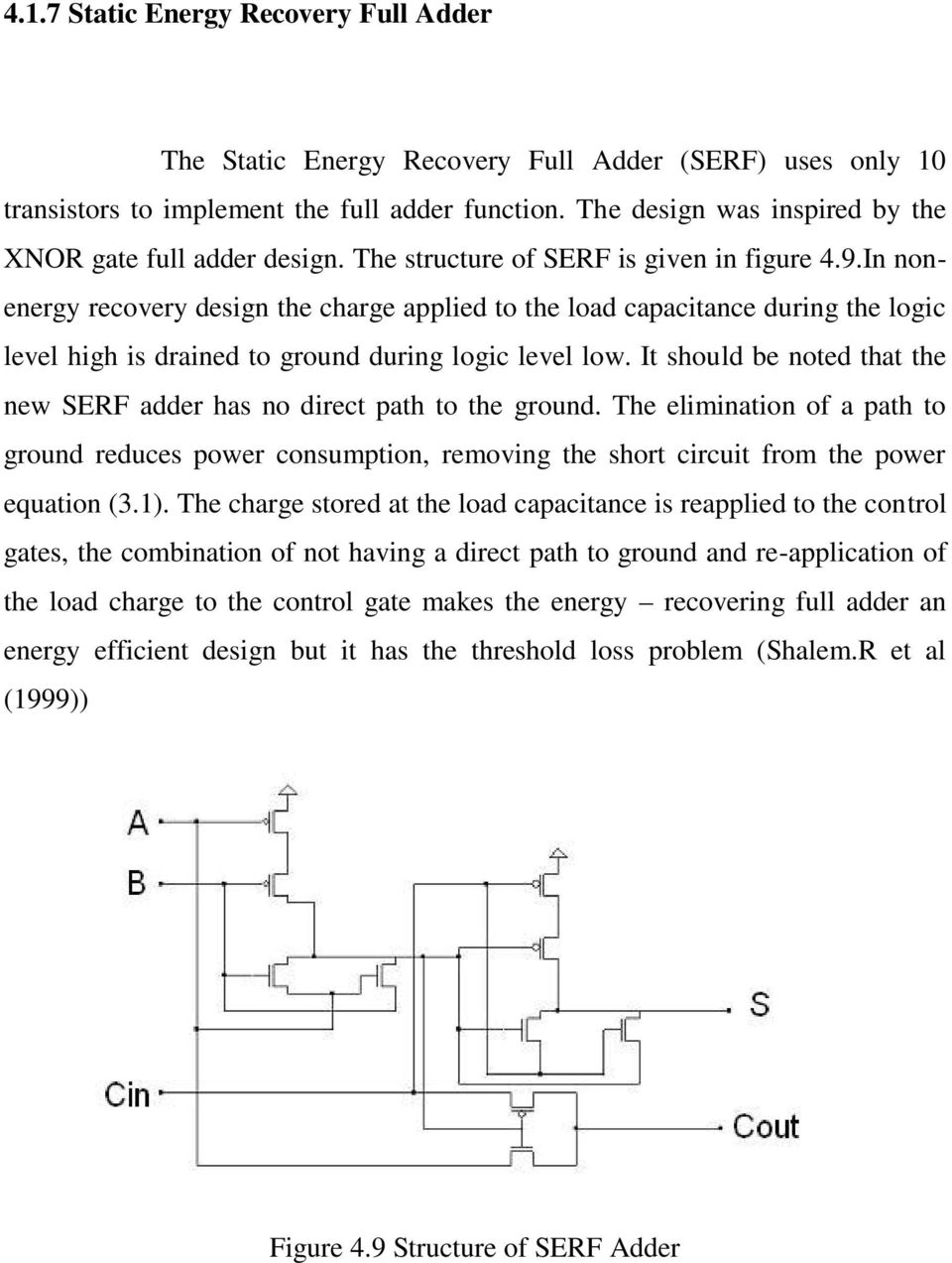
1 CHAPTER 4 THE ADDER The adder is one of the most critical components of a processor, as it is used in the Arithmetic Logic Unit (ALU), in the floating-point unit and for address generation in case of cache or memory access (John Rabaey (2003)).Increasing demand for mobile electronic devices such as cellular phones and laptop computers requires the use of power efficient VLSI circuits. The power consumption of a CMOS digital circuit is given in equation (3.1). A new full adder called Static Energy Recovery Full(SERF) adder uses only 10 transistors shown in figure 4.9 which has the least number of transistors and is reported to be the best in power consumption (Shalem.R et al (1999)).Many low power adders using various pass transistors, such as the SERF(Shalem.R et al (1999)) when compared to the complementary static CMOS adders, have the problem of threshold loss,i.e., the logic value 1 is not the value of V dd and the logic value 0 may not be the value of 0.This kind of threshold loss logic gates may not be used as widely as the complementary static CMOS gates.however,they are certainly useful in building up larger circuits such as multiple-bit input adders and multipliers. Since the aim of this research work is to reduce the threshold loss problem which exists in earlier designs, a new approach to designing many 14 transistor full adders is proposed. However, the proposed

2 NEW adder cells are useful for designing larger circuits despite increase in transistor count by four per cell. 4.1 THE BINARY ADDER The full adder operation can be stated as follows: Given the three 1- bit inputs A, B, and Cin, it is desired to calculate the two 1-bit outputs Sum and Carry, where Sum = (A xor B) xor Cin (4.1) Carry = A and B + Cin (A xor B) (4.2) Table 4.1. Adder Truth Table INPUT OUTPUT CIN A B SUM CARRY In this research work, the following 8 different adders are designed Transistor Full Adder Transistor Full Adder

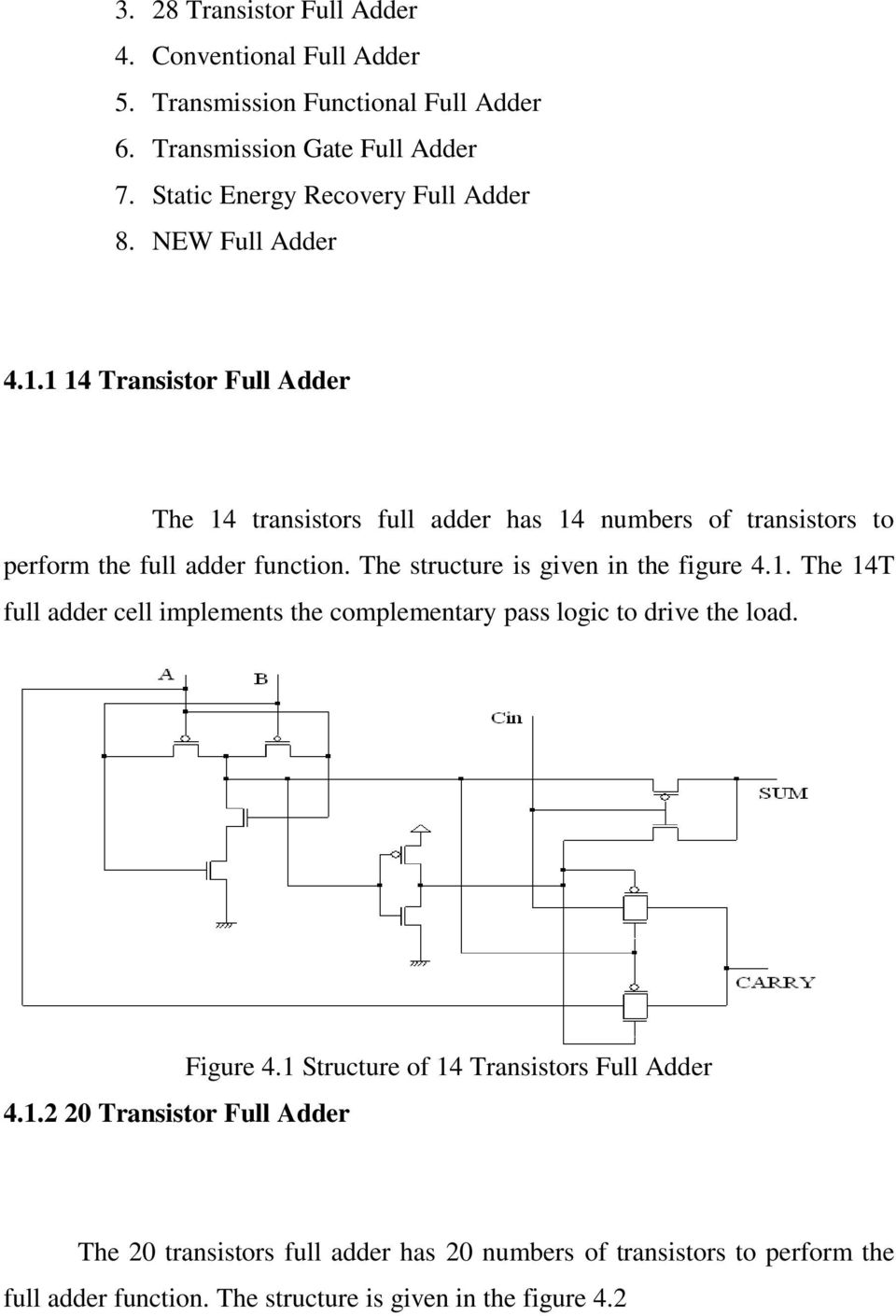
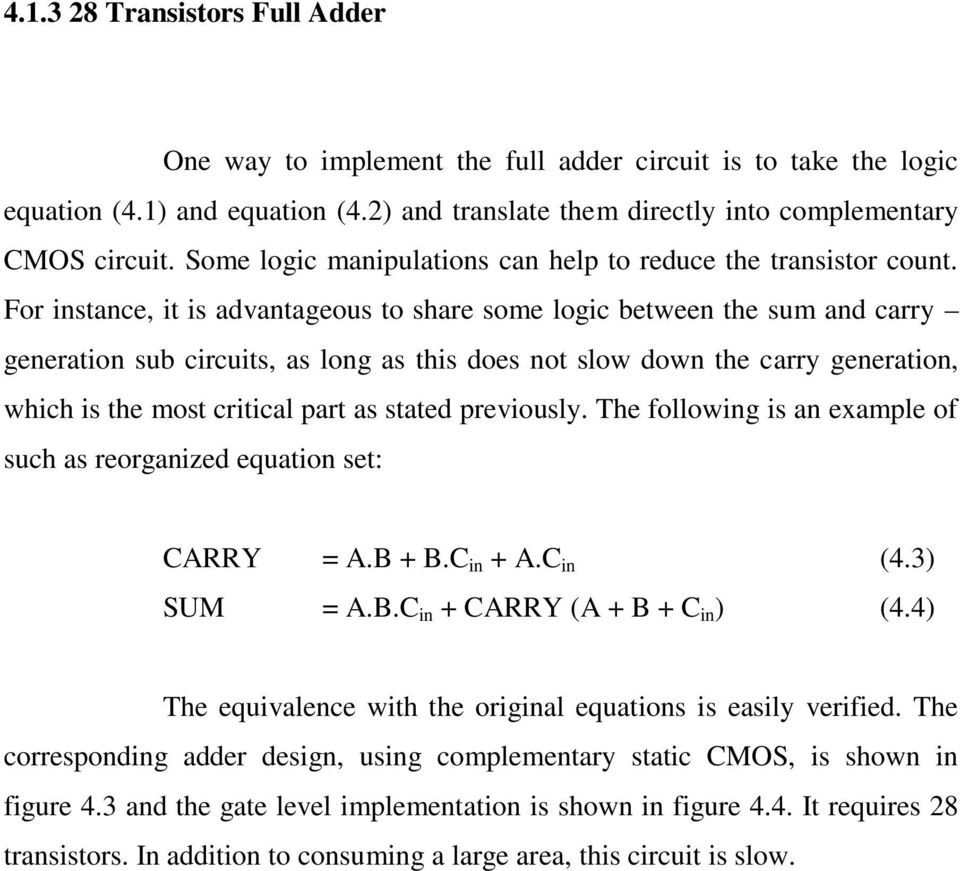
3 3. 28 Transistor Full Adder 4. Conventional Full Adder 5. Transmission Functional Full Adder 6. Transmission Gate Full Adder 7. Static Energy Recovery Full Adder 8. NEW Full Adder Transistor Full Adder The 14 transistors full adder has 14 numbers of transistors to perform the full adder function. The structure is given in the figure 4.1. The 14T full adder cell implements the complementary pass logic to drive the load Transistor Full Adder Figure 4.1 Structure of 14 Transistors Full Adder The 20 transistors full adder has 20 numbers of transistors to perform the full adder function. The structure is given in the figure 4.2
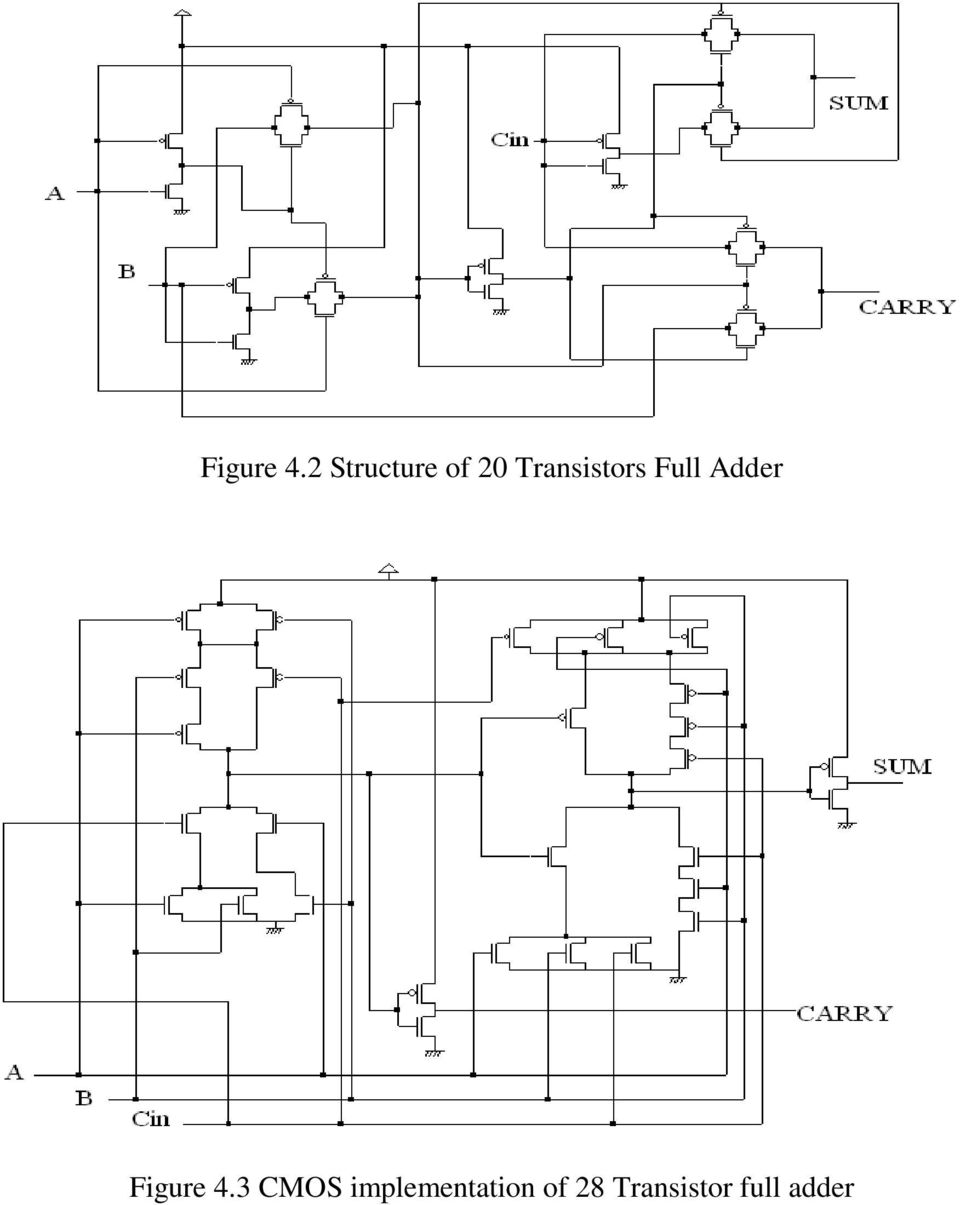
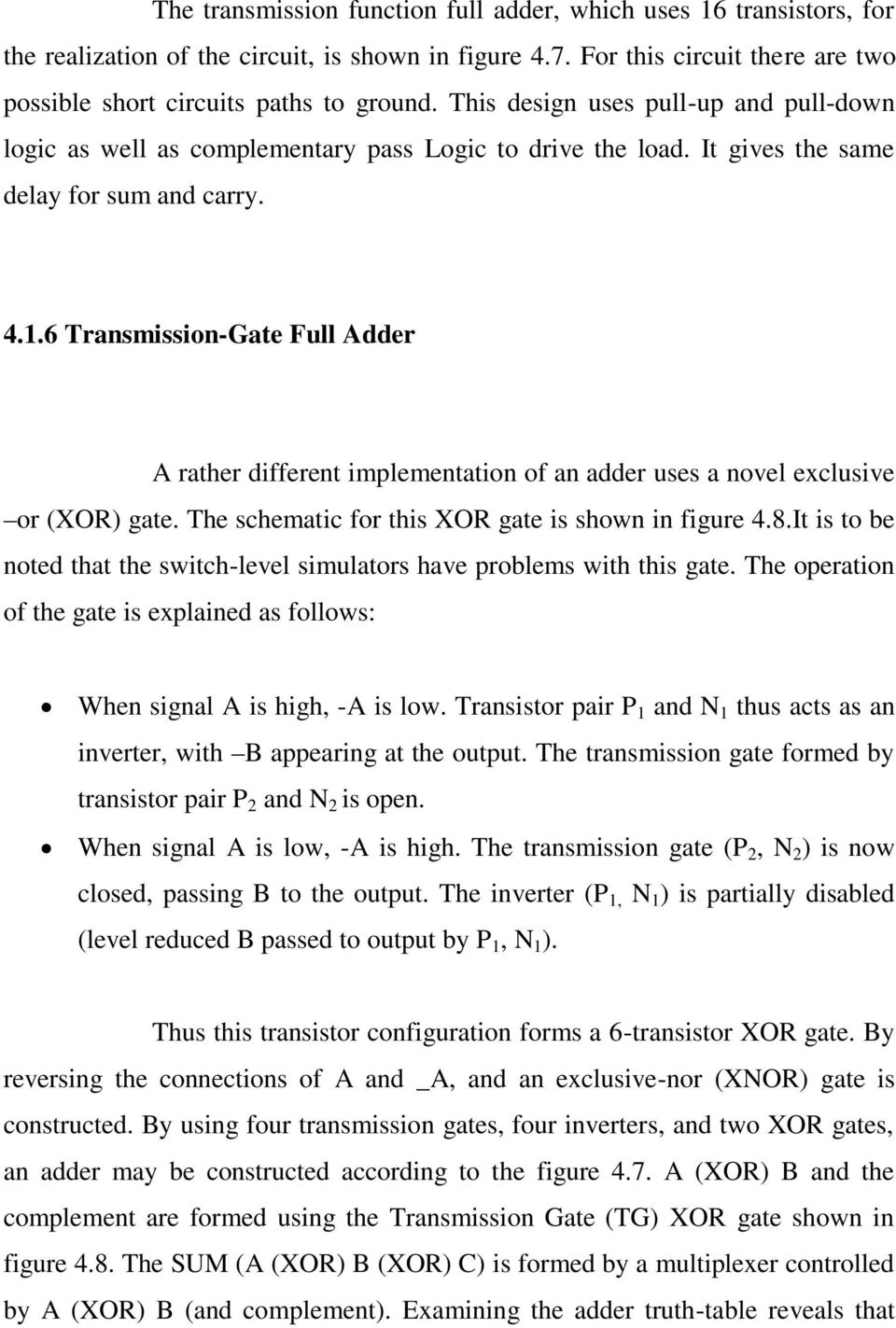
4 Transistors Full Adder One way to implement the full adder circuit is to take the logic equation (4.1) and equation (4.2) and translate them directly into complementary CMOS circuit. Some logic manipulations can help to reduce the transistor count. For instance, it is advantageous to share some logic between the sum and carry generation sub circuits, as long as this does not slow down the carry generation, which is the most critical part as stated previously. The following is an example of such as reorganized equation set: CARRY = A.B + B.C in + A.C in (4.3) SUM = A.B.C in + CARRY (A + B + C in ) (4.4) The equivalence with the original equations is easily verified. The corresponding adder design, using complementary static CMOS, is shown in figure 4.3 and the gate level implementation is shown in figure 4.4. It requires 28 transistors. In addition to consuming a large area, this circuit is slow.
5 Figure 4.2 Structure of 20 Transistors Full Adder Figure 4.3 CMOS implementation of 28 Transistor full adder
6 Figure 4.4 Gate level implementation of 28 Transistor full adder Conventional Full Adder Probably the simplest approach to designing an adder is to implement gates to yield the required majority logic functions. From the table [Table 2.1] these are: SUM = A.B.C in + A.B.C in + A.B.C in + A.B.C in (4.5) Equation (2.3) may be factored as follows: SUM = C in (A.B+A.B) + C in (A.B+A.B) (4.6) = A (XOR) B (XOR) C in (4.7) CARRY = A.B + A. C in + B. C in (4.8) Equation (4.6) may be factored as follows: CARRY = A.B + C in (A+B) (4.9) The gate schematic for the direct implementation of equation (4.7) and equation (4.9) is shown in figure 4.5. This implementation uses a 3-input XOR
![From the table [Table 2.1] these are: SUM = A.B.C in + A.B.C in + A.B.C in + A.B.C in (4.5) Equation (2.3) may be factored as follows: SUM = C in (A.B+A.B) + C in (A.B+A.B) (4.](/docs-images/47/21053990/images/page_6.jpg "6) = A (XOR) B (XOR) C in (4.7) CARRY = A.B + A. C in + B. C in (4.8) Equation (4.6) may be factored as follows: CARRY = A.B + C in (A+B) (4.")
7 gate. A transistor level implementation is shown in figure 4.6. This uses a total of 32 transistors. Figure 4.5 Gate schematic for conventional full adder Fig ure 4.6 Tr ans ist or lev el sch em ati c for co nv entional full adder Transmission-Functional Full Adder

8 The transmission function full adder, which uses 16 transistors, for the realization of the circuit, is shown in figure 4.7. For this circuit there are two possible short circuits paths to ground. This design uses pull-up and pull-down logic as well as complementary pass Logic to drive the load. It gives the same delay for sum and carry Transmission-Gate Full Adder A rather different implementation of an adder uses a novel exclusive or (XOR) gate. The schematic for this XOR gate is shown in figure 4.8.It is to be noted that the switch-level simulators have problems with this gate. The operation of the gate is explained as follows: When signal A is high, -A is low. Transistor pair P 1 and N 1 thus acts as an inverter, with B appearing at the output. The transmission gate formed by transistor pair P 2 and N 2 is open. When signal A is low, -A is high. The transmission gate (P 2, N 2 ) is now closed, passing B to the output. The inverter (P 1, N 1 ) is partially disabled (level reduced B passed to output by P 1, N 1 ). Thus this transistor configuration forms a 6-transistor XOR gate. By reversing the connections of A and _A, and an exclusive-nor (XNOR) gate is constructed. By using four transmission gates, four inverters, and two XOR gates, an adder may be constructed according to the figure 4.7. A (XOR) B and the complement are formed using the Transmission Gate (TG) XOR gate shown in figure 4.8. The SUM (A (XOR) B (XOR) C) is formed by a multiplexer controlled by A (XOR) B (and complement). Examining the adder truth-table reveals that
9 CARRY= C when A (XOR) B is true. When A (XOR) B is false, CARRY=A (or B). This adder has 24 transistors. Figure 4.7 Structure of Transmission Functional Full Adder Figure 4.8 Structure of Transmission Gate Full Adder

10 4.1.7 Static Energy Recovery Full Adder The Static Energy Recovery Full Adder (SERF) uses only 10 transistors to implement the full adder function. The design was inspired by the XNOR gate full adder design. The structure of SERF is given in figure 4.9.In nonenergy recovery design the charge applied to the load capacitance during the logic level high is drained to ground during logic level low. It should be noted that the new SERF adder has no direct path to the ground. The elimination of a path to ground reduces power consumption, removing the short circuit from the power equation (3.1). The charge stored at the load capacitance is reapplied to the control gates, the combination of not having a direct path to ground and re-application of the load charge to the control gate makes the energy recovering full adder an energy efficient design but it has the threshold loss problem (Shalem.R et al (1999)) Figure 4.9 Structure of SERF Adder
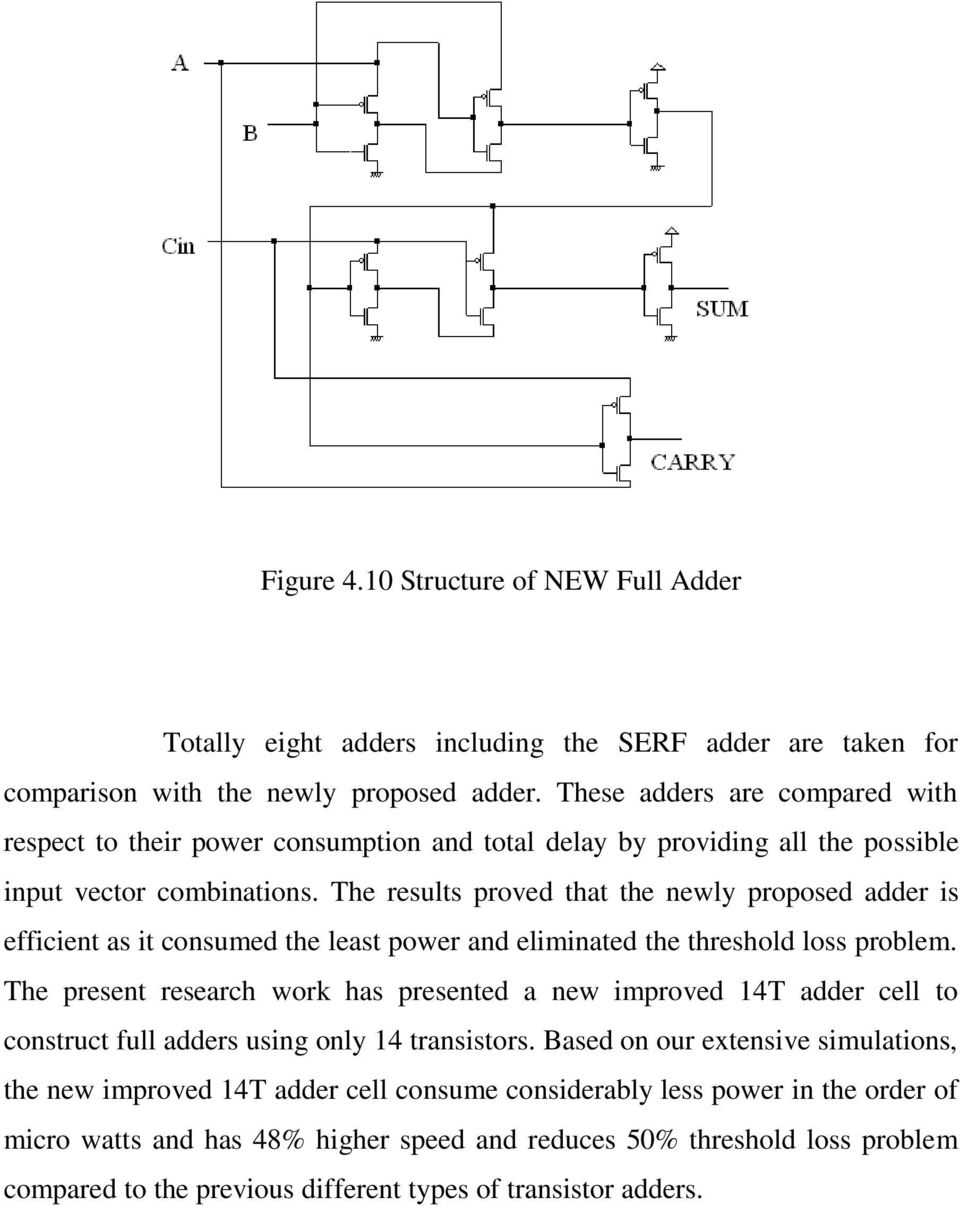
11 4.1.8 NEW Full Adder The new improved 14T adder cell requires only 14 transistors to realize the adder function shown in figure It produces the better result in threshold loss, speed and power by sacrificing four extra transistors per adder cell. Even though the transistor count increases by four per adder cell, it reduces the threshold loss problem, which exists in the SERF by inserting the inverter between XOR Gate outputs to form XNOR gate. The newly proposed adder implement the Sum using XNOR-XNOR and Cout using PMOS NMOS We can also build to produce Cout using NMOS- NMOS and PMOS-PMOS. But the delay and power dissipation of PMOS-NMOS is better than other two kinds of producing Cout.The proposed XNOR gate is designed by putting inverter at the output of the XOR gate in order to improve the threshold loss problem, which exists in the SERF adder. Out of the three methods, PMOS-NMOS based Cout gives the better result in power, speed and threshold loss problem.

12 Figure 4.10 Structure of NEW Full Adder Totally eight adders including the SERF adder are taken for comparison with the newly proposed adder. These adders are compared with respect to their power consumption and total delay by providing all the possible input vector combinations. The results proved that the newly proposed adder is efficient as it consumed the least power and eliminated the threshold loss problem. The present research work has presented a new improved 14T adder cell to construct full adders using only 14 transistors. Based on our extensive simulations, the new improved 14T adder cell consume considerably less power in the order of micro watts and has 48% higher speed and reduces 50% threshold loss problem compared to the previous different types of transistor adders.
A Novel Low Power, High Speed 14 Transistor CMOS Full Adder Cell with 50% Improvement in Threshold Loss Problem
 A Novel Low Power, High Speed 4 Transistor CMOS Full Adder Cell with 5% Improvement in Threshold Loss Problem T. Vigneswaran, B. Mukundhan, and P. Subbarami Reddy Abstract Full adders are important components
Sequential 4-bit Adder Design Report
 UNIVERSITY OF WATERLOO Faculty of Engineering E&CE 438: Digital Integrated Circuits Sequential 4-bit Adder Design Report Prepared by: Ian Hung (ixxxxxx), 99XXXXXX Annette Lo (axxxxxx), 99XXXXXX Pamela
1. True or False? A voltage level in the range 0 to 2 volts is interpreted as a binary 1.
 File: chap04, Chapter 04 1. True or False? A voltage level in the range 0 to 2 volts is interpreted as a binary 1. 2. True or False? A gate is a device that accepts a single input signal and produces one
Module 4 : Propagation Delays in MOS Lecture 22 : Logical Effort Calculation of few Basic Logic Circuits
 Module 4 : Propagation Delays in MOS Lecture 22 : Logical Effort Calculation of few Basic Logic Circuits Objectives In this lecture you will learn the following Introduction Logical Effort of an Inverter
LFSR BASED COUNTERS AVINASH AJANE, B.E. A technical report submitted to the Graduate School. in partial fulfillment of the requirements
 LFSR BASED COUNTERS BY AVINASH AJANE, B.E A technical report submitted to the Graduate School in partial fulfillment of the requirements for the degree Master of Science in Electrical Engineering New Mexico
CMOS Binary Full Adder
 CMOS Binary Full Adder A Survey of Possible Implementations Group : Eren Turgay Aaron Daniels Michael Bacelieri William Berry - - Table of Contents Key Terminology...- - Introduction...- 3 - Design Architectures...-
Let s put together a Manual Processor
 Lecture 14 Let s put together a Manual Processor Hardware Lecture 14 Slide 1 The processor Inside every computer there is at least one processor which can take an instruction, some operands and produce
Design of Low Power One-Bit Hybrid-CMOS Full Adder Cells
 Design of Low Power One-Bit Hybrid-CMOS Full Adder Cells Sushil B. Bhaisare 1, Sonalee P. Suryawanshi 2, Sagar P. Soitkar 3 1 Lecturer in Electronics Department, Nagpur University, G.H.R.I.E.T.W. Nagpur,
International Journal of Electronics and Computer Science Engineering 1482
 International Journal of Electronics and Computer Science Engineering 1482 Available Online at www.ijecse.org ISSN- 2277-1956 Behavioral Analysis of Different ALU Architectures G.V.V.S.R.Krishna Assistant
Gates, Circuits, and Boolean Algebra
 Gates, Circuits, and Boolean Algebra Computers and Electricity A gate is a device that performs a basic operation on electrical signals Gates are combined into circuits to perform more complicated tasks
Chapter 4 Register Transfer and Microoperations. Section 4.1 Register Transfer Language
 Chapter 4 Register Transfer and Microoperations Section 4.1 Register Transfer Language Digital systems are composed of modules that are constructed from digital components, such as registers, decoders,
Chapter 10 Advanced CMOS Circuits
 Transmission Gates Chapter 10 Advanced CMOS Circuits NMOS Transmission Gate The active pull-up inverter circuit leads one to thinking about alternate uses of NMOS devices. Consider the circuit shown in
Optimization and Comparison of 4-Stage Inverter, 2-i/p NAND Gate, 2-i/p NOR Gate Driving Standard Load By Using Logical Effort
 Optimization and Comparison of -Stage, -i/p NND Gate, -i/p NOR Gate Driving Standard Load By Using Logical Effort Satyajit nand *, and P.K.Ghosh ** * Mody Institute of Technology & Science/ECE, Lakshmangarh,
HIGH SPEED AREA EFFICIENT 1-BIT HYBRID FULL ADDER
 HIGH SPEED AREA EFFICIENT 1-BIT HYBRID FULL ADDER Sachin Kumar *1, Aman Kumar #2, Puneet Bansal #3 * Department of Electronic Science, Kurukshetra University, Kurukshetra, Haryana, India # University Institute
Gates & Boolean Algebra. Boolean Operators. Combinational Logic. Introduction
 Introduction Gates & Boolean lgebra Boolean algebra: named after mathematician George Boole (85 864). 2-valued algebra. digital circuit can have one of 2 values. Signal between and volt =, between 4 and
Lecture 5: Gate Logic Logic Optimization
 Lecture 5: Gate Logic Logic Optimization MAH, AEN EE271 Lecture 5 1 Overview Reading McCluskey, Logic Design Principles- or any text in boolean algebra Introduction We could design at the level of irsim
ECE410 Design Project Spring 2008 Design and Characterization of a CMOS 8-bit Microprocessor Data Path
 ECE410 Design Project Spring 2008 Design and Characterization of a CMOS 8-bit Microprocessor Data Path Project Summary This project involves the schematic and layout design of an 8-bit microprocessor data
A New Low Power Dynamic Full Adder Cell Based on Majority Function
 World Applied Sciences Journal 4 (1): 133-141, 2008 ISSN 1818-4952 IDOSI Publications, 2008 A New Low Power Dynamic Full Adder Cell Based on Majority Function 1 Vahid Foroutan, 2 Keivan Navi and 1 Majid
Digital Logic Design. Basics Combinational Circuits Sequential Circuits. Pu-Jen Cheng
 Digital Logic Design Basics Combinational Circuits Sequential Circuits Pu-Jen Cheng Adapted from the slides prepared by S. Dandamudi for the book, Fundamentals of Computer Organization and Design. Introduction
Here we introduced (1) basic circuit for logic and (2)recent nano-devices, and presented (3) some practical issues on nano-devices.
 Outline Here we introduced () basic circuit for logic and (2)recent nano-devices, and presented (3) some practical issues on nano-devices. Circuit Logic Gate A logic gate is an elemantary building block
Design of Energy Efficient Low Power Full Adder using Supply Voltage Gating
 Design of Energy Efficient Low Power Full Adder using Supply Voltage Gating S.Nandhini 1, T.G.Dhaarani 2, P.Kokila 3, P.Premkumar 4 Assistant Professor, Dept. of ECE, Nandha Engineering College, Erode,
exclusive-or and Binary Adder R eouven Elbaz [email protected] Office room: DC3576
 exclusive-or and Binary Adder R eouven Elbaz [email protected] Office room: DC3576 Outline exclusive OR gate (XOR) Definition Properties Examples of Applications Odd Function Parity Generation and Checking
High Speed Gate Level Synchronous Full Adder Designs
 High Speed Gate Level Synchronous Full Adder Designs PADMANABHAN BALASUBRAMANIAN and NIKOS E. MASTORAKIS School of Computer Science, The University of Manchester, Oxford Road, Manchester M13 9PL, UNITED
Sistemas Digitais I LESI - 2º ano
 Sistemas Digitais I LESI - 2º ano Lesson 6 - Combinational Design Practices Prof. João Miguel Fernandes ([email protected]) Dept. Informática UNIVERSIDADE DO MINHO ESCOLA DE ENGENHARIA - PLDs (1) - The
COMBINATIONAL CIRCUITS
 COMBINATIONAL CIRCUITS http://www.tutorialspoint.com/computer_logical_organization/combinational_circuits.htm Copyright tutorialspoint.com Combinational circuit is a circuit in which we combine the different
Efficient Interconnect Design with Novel Repeater Insertion for Low Power Applications
 Efficient Interconnect Design with Novel Repeater Insertion for Low Power Applications TRIPTI SHARMA, K. G. SHARMA, B. P. SINGH, NEHA ARORA Electronics & Communication Department MITS Deemed University,
CHAPTER 3 Boolean Algebra and Digital Logic
 CHAPTER 3 Boolean Algebra and Digital Logic 3.1 Introduction 121 3.2 Boolean Algebra 122 3.2.1 Boolean Expressions 123 3.2.2 Boolean Identities 124 3.2.3 Simplification of Boolean Expressions 126 3.2.4
Binary Adders: Half Adders and Full Adders
 Binary Adders: Half Adders and Full Adders In this set of slides, we present the two basic types of adders: 1. Half adders, and 2. Full adders. Each type of adder functions to add two binary bits. In order
AN IMPROVED DESIGN OF REVERSIBLE BINARY TO BINARY CODED DECIMAL CONVERTER FOR BINARY CODED DECIMAL MULTIPLICATION
 American Journal of Applied Sciences 11 (1): 69-73, 2014 ISSN: 1546-9239 2014 Science Publication doi:10.3844/ajassp.2014.69.73 Published Online 11 (1) 2014 (http://www.thescipub.com/ajas.toc) AN IMPROVED
Chapter 2 Logic Gates and Introduction to Computer Architecture
 Chapter 2 Logic Gates and Introduction to Computer Architecture 2.1 Introduction The basic components of an Integrated Circuit (IC) is logic gates which made of transistors, in digital system there are
earlier in the semester: The Full adder above adds two bits and the output is at the end. So if we do this eight times, we would have an 8-bit adder.
 The circuit created is an 8-bit adder. The 8-bit adder adds two 8-bit binary inputs and the result is produced in the output. In order to create a Full 8-bit adder, I could use eight Full -bit adders and
LOW POWER MULTIPLEXER BASED FULL ADDER USING PASS TRANSISTOR LOGIC
 LOW POWER MULTIPLEXER BASED FULL ADDER USING PASS TRANSISTOR LOGIC B. Dilli kumar 1, K. Charan kumar 1, M. Bharathi 2 Abstract- The efficiency of a system mainly depends on the performance of the internal
ELEC 2210 - EXPERIMENT 1 Basic Digital Logic Circuits
 Objectives ELEC - EXPERIMENT Basic Digital Logic Circuits The experiments in this laboratory exercise will provide an introduction to digital electronic circuits. You will learn how to use the IDL-00 Bit
Understanding Logic Design
 Understanding Logic Design ppendix of your Textbook does not have the needed background information. This document supplements it. When you write add DD R0, R1, R2, you imagine something like this: R1
CSE140: Components and Design Techniques for Digital Systems
 CSE4: Components and Design Techniques for Digital Systems Tajana Simunic Rosing What we covered thus far: Number representations Logic gates Boolean algebra Introduction to CMOS HW#2 due, HW#3 assigned
A high Speed 8 Transistor Full Adder Design using Novel 3 Transistor XOR Gates
 A high Speed 8 Transistor Full Adder Design using Novel 3 Transistor XOR Gates Shubhajit Roy Chowdhury, Aritra Banerjee, Aniruddha Roy, Hiranmay Saha Abstract The paper proposes the novel design of a 3T
Basic Logic Gates Richard E. Haskell
 BASIC LOGIC GATES 1 E Basic Logic Gates Richard E. Haskell All digital systems are made from a few basic digital circuits that we call logic gates. These circuits perform the basic logic functions that
A New Reversible TSG Gate and Its Application For Designing Efficient Adder Circuits
 A New Reversible TSG Gate and Its Application For Designing Efficient Adder s Himanshu Thapliyal Center for VLSI and Embedded System Technologies International Institute of Information Technology Hyderabad-500019,
ECE124 Digital Circuits and Systems Page 1
 ECE124 Digital Circuits and Systems Page 1 Chip level timing Have discussed some issues related to timing analysis. Talked briefly about longest combinational path for a combinational circuit. Talked briefly
United States Naval Academy Electrical and Computer Engineering Department. EC262 Exam 1
 United States Naval Academy Electrical and Computer Engineering Department EC262 Exam 29 September 2. Do a page check now. You should have pages (cover & questions). 2. Read all problems in their entirety.
Karnaugh Maps & Combinational Logic Design. ECE 152A Winter 2012
 Karnaugh Maps & Combinational Logic Design ECE 52A Winter 22 Reading Assignment Brown and Vranesic 4 Optimized Implementation of Logic Functions 4. Karnaugh Map 4.2 Strategy for Minimization 4.2. Terminology
CSE140 Homework #7 - Solution
 CSE140 Spring2013 CSE140 Homework #7 - Solution You must SHOW ALL STEPS for obtaining the solution. Reporting the correct answer, without showing the work performed at each step will result in getting
A single register, called the accumulator, stores the. operand before the operation, and stores the result. Add y # add y from memory to the acc
 Other architectures Example. Accumulator-based machines A single register, called the accumulator, stores the operand before the operation, and stores the result after the operation. Load x # into acc
INTEGRATED CIRCUITS. For a complete data sheet, please also download:
 INTEGRATED CIRCUITS DATA SHEET For a complete data sheet, please also download: The IC06 74HC/HCT/HCU/HCMOS Logic Family Specifications The IC06 74HC/HCT/HCU/HCMOS Logic Package Information The IC06 74HC/HCT/HCU/HCMOS
Flip-Flops, Registers, Counters, and a Simple Processor
 June 8, 22 5:56 vra235_ch7 Sheet number Page number 349 black chapter 7 Flip-Flops, Registers, Counters, and a Simple Processor 7. Ng f3, h7 h6 349 June 8, 22 5:56 vra235_ch7 Sheet number 2 Page number
Adder.PPT(10/1/2009) 5.1. Lecture 13. Adder Circuits
 Adder.T(//29) 5. Lecture 3 Adder ircuits Objectives Understand how to add both signed and unsigned numbers Appreciate how the delay of an adder circuit depends on the data values that are being added together
True Single Phase Clocking Flip-Flop Design using Multi Threshold CMOS Technique
 True Single Phase Clocking Flip-Flop Design using Multi Threshold CMOS Technique Priyanka Sharma ME (ECE) Student NITTTR Chandigarh Rajesh Mehra Associate Professor Department of ECE NITTTR Chandigarh
3.Basic Gate Combinations
 3.Basic Gate Combinations 3.1 TTL NAND Gate In logic circuits transistors play the role of switches. For those in the TTL gate the conducting state (on) occurs when the baseemmiter signal is high, and
(Refer Slide Time: 00:01:16 min)
 Digital Computer Organization Prof. P. K. Biswas Department of Electronic & Electrical Communication Engineering Indian Institute of Technology, Kharagpur Lecture No. # 04 CPU Design: Tirning & Control
Lab 1: Full Adder 0.0
 Lab 1: Full Adder 0.0 Introduction In this lab you will design a simple digital circuit called a full adder. You will then use logic gates to draw a schematic for the circuit. Finally, you will verify
Sequential Logic: Clocks, Registers, etc.
 ENEE 245: igital Circuits & Systems Lab Lab 2 : Clocks, Registers, etc. ENEE 245: igital Circuits and Systems Laboratory Lab 2 Objectives The objectives of this laboratory are the following: To design
Figure 8-1 Four Possible Results of Adding Two Bits
 CHPTER EIGHT Combinational Logic pplications Thus far, our discussion has focused on the theoretical design issues of computer systems. We have not yet addressed any of the actual hardware you might find
ERROR DETECTION AND CORRECTION
 Supplement to Logic and Computer Design Fundamentals 3rd Edition 1 ERROR DETECTION AND CORRECTION Selected topics not covered in the third edition of Logic and Computer Design Fundamentals are provided
Pass Gate Logic An alternative to implementing complex logic is to realize it using a logic network of pass transistors (switches).
 Pass Gate Logic n alternative to implementing complex logic is to realize it using a logic network of pass transistors (switches). Switch Network Regeneration is performed via a buffer. We have already
e.g. τ = 12 ps in 180nm, 40 ps in 0.6 µm Delay has two components where, f = Effort Delay (stage effort)= gh p =Parasitic Delay
 Logic Gate Delay Chip designers need to choose: What is the best circuit topology for a function? How many stages of logic produce least delay? How wide transistors should be? Logical Effort Helps make
DEPARTMENT OF INFORMATION TECHNLOGY
 DRONACHARYA GROUP OF INSTITUTIONS, GREATER NOIDA Affiliated to Mahamaya Technical University, Noida Approved by AICTE DEPARTMENT OF INFORMATION TECHNLOGY Lab Manual for Computer Organization Lab ECS-453
Two's Complement Adder/Subtractor Lab L03
 Two's Complement Adder/Subtractor Lab L03 Introduction Computers are usually designed to perform indirect subtraction instead of direct subtraction. Adding -B to A is equivalent to subtracting B from A,
FORDHAM UNIVERSITY CISC 3593. Dept. of Computer and Info. Science Spring, 2011. The Binary Adder
 FORDHAM UNIVERITY CIC 3593 Fordham College Lincoln Center Computer Organization Dept. of Computer and Info. cience pring, 2011 1 Introduction The Binar Adder The binar adder circuit is an important building
INSTITUTE OF AERONAUTICAL ENGINEERING Dundigal, Hyderabad - 500 043
 INSTITUTE OF AERONAUTICAL ENGINEERING Dundigal, Hyderabad - 500 043 ELECTRONICS AND COMMUNICATION ENGINEERING Course Title VLSI DESIGN Course Code 57035 Regulation R09 COURSE DESCRIPTION Course Structure
An Extension to DNA Based Fredkin Gate Circuits: Design of Reversible Sequential Circuits using Fredkin Gates
 An Extension to DNA Based Fredkin Gate Circuits: Design of Reversible Sequential Circuits using Fredkin Gates Himanshu Thapliyal and M.B Srinivas ([email protected], [email protected]) Center
10 BIT s Current Mode Pipelined ADC
 10 BIT s Current Mode Pipelined ADC K.BHARANI VLSI DEPARTMENT VIT UNIVERSITY VELLORE, INDIA [email protected] P.JAYAKRISHNAN VLSI DEPARTMENT VIT UNIVERSITY VELLORE, INDIA [email protected]
Design Verification and Test of Digital VLSI Circuits NPTEL Video Course. Module-VII Lecture-I Introduction to Digital VLSI Testing
 Design Verification and Test of Digital VLSI Circuits NPTEL Video Course Module-VII Lecture-I Introduction to Digital VLSI Testing VLSI Design, Verification and Test Flow Customer's Requirements Specifications
Elementary Logic Gates
 Elementary Logic Gates Name Symbol Inverter (NOT Gate) ND Gate OR Gate Truth Table Logic Equation = = = = = + C. E. Stroud Combinational Logic Design (/6) Other Elementary Logic Gates NND Gate NOR Gate
Chapter 1: Digital Systems and Binary Numbers
 Chapter 1: Digital Systems and Binary Numbers Digital age and information age Digital computers general purposes many scientific, industrial and commercial applications Digital systems telephone switching
System on Chip Design. Michael Nydegger
 Short Questions, 26. February 2015 What is meant by the term n-well process? What does this mean for the n-type MOSFETs in your design? What is the meaning of the threshold voltage (practically)? What
Implementation of Modified Booth Algorithm (Radix 4) and its Comparison with Booth Algorithm (Radix-2)
 Advance in Electronic and Electric Engineering. ISSN 2231-1297, Volume 3, Number 6 (2013), pp. 683-690 Research India Publications http://www.ripublication.com/aeee.htm Implementation of Modified Booth
COMBINATIONAL and SEQUENTIAL LOGIC CIRCUITS Hardware implementation and software design
 PH-315 COMINATIONAL and SEUENTIAL LOGIC CIRCUITS Hardware implementation and software design A La Rosa I PURPOSE: To familiarize with combinational and sequential logic circuits Combinational circuits
List of Experiment. 8. To study and verify the BCD to Seven Segments DECODER.(IC-7447).
 G. H. RAISONI COLLEGE OF ENGINEERING, NAGPUR Department of Electronics & Communication Engineering Branch:-4 th Semester[Electronics] Subject: - Digital Circuits List of Experiment Sr. Name Of Experiment
S. Venkatesh, Mrs. T. Gowri, Department of ECE, GIT, GITAM University, Vishakhapatnam, India
 Power reduction on clock-tree using Energy recovery and clock gating technique S. Venkatesh, Mrs. T. Gowri, Department of ECE, GIT, GITAM University, Vishakhapatnam, India Abstract Power consumption of
PLL frequency synthesizer
 ANALOG & TELECOMMUNICATION ELECTRONICS LABORATORY EXERCISE 4 Lab 4: PLL frequency synthesizer 1.1 Goal The goals of this lab exercise are: - Verify the behavior of a and of a complete PLL - Find capture
Unit 3 Boolean Algebra (Continued)
 Unit 3 Boolean Algebra (Continued) 1. Exclusive-OR Operation 2. Consensus Theorem Department of Communication Engineering, NCTU 1 3.1 Multiplying Out and Factoring Expressions Department of Communication
CS101 Lecture 26: Low Level Programming. John Magee 30 July 2013 Some material copyright Jones and Bartlett. Overview/Questions
 CS101 Lecture 26: Low Level Programming John Magee 30 July 2013 Some material copyright Jones and Bartlett 1 Overview/Questions What did we do last time? How can we control the computer s circuits? How
CMOS Logic Integrated Circuits
 CMOS Logic Integrated Circuits Introduction CMOS Inverter Parameters of CMOS circuits Circuits for protection Output stage for CMOS circuits Buffering circuits Introduction Symetrical and complementary
The components. E3: Digital electronics. Goals:
 E3: Digital electronics Goals: Basic understanding of logic circuits. Become familiar with the most common digital components and their use. Equipment: 1 st. LED bridge 1 st. 7-segment display. 2 st. IC
RAM & ROM Based Digital Design. ECE 152A Winter 2012
 RAM & ROM Based Digital Design ECE 152A Winter 212 Reading Assignment Brown and Vranesic 1 Digital System Design 1.1 Building Block Circuits 1.1.3 Static Random Access Memory (SRAM) 1.1.4 SRAM Blocks in
Digital Electronics Detailed Outline
 Digital Electronics Detailed Outline Unit 1: Fundamentals of Analog and Digital Electronics (32 Total Days) Lesson 1.1: Foundations and the Board Game Counter (9 days) 1. Safety is an important concept
Lecture 5: Logical Effort
 Introduction to CMOS VLSI Design Lecture 5: Logical Effort David Harris Harvey Mudd College Spring 2004 Outline Introduction Delay in a Logic Gate Multistage Logic Networks Choosing the Best Number of
Application Note AN-940
 Application Note AN-940 How P-Channel MOSFETs Can Simplify Your Circuit Table of Contents Page 1. Basic Characteristics of P-Channel HEXFET Power MOSFETs...1 2. Grounded Loads...1 3. Totem Pole Switching
Gates. J. Robert Jump Department of Electrical And Computer Engineering Rice University Houston, TX 77251
 Gates J. Robert Jump Department of Electrical And Computer Engineering Rice University Houston, T 77251 1. The Evolution of Electronic Digital Devices...1 2. Logical Operations and the Behavior of Gates...2
An Effective Deterministic BIST Scheme for Shifter/Accumulator Pairs in Datapaths
 An Effective Deterministic BIST Scheme for Shifter/Accumulator Pairs in Datapaths N. KRANITIS M. PSARAKIS D. GIZOPOULOS 2 A. PASCHALIS 3 Y. ZORIAN 4 Institute of Informatics & Telecommunications, NCSR
POWER COMPARISON OF CMOS AND ADIABATIC FULL ADDER CIRCUITS
 POWER COMPARISON OF CMOS AND ADIABATIC FULL ADDER CIRCUITS Y. Sunil Gavaskar Reddy 1 and V.V.G.S.Rajendra Prasad 2 1 Department of Electronics &Communication Engineering, Anurag Engineering College, JNTUniversity,
High Speed and Efficient 4-Tap FIR Filter Design Using Modified ETA and Multipliers
 High Speed and Efficient 4-Tap FIR Filter Design Using Modified ETA and Multipliers Mehta Shantanu Sheetal #1, Vigneswaran T. #2 # School of Electronics Engineering, VIT University Chennai, Tamil Nadu,
Chapter 2 Basic Structure of Computers. Jin-Fu Li Department of Electrical Engineering National Central University Jungli, Taiwan
 Chapter 2 Basic Structure of Computers Jin-Fu Li Department of Electrical Engineering National Central University Jungli, Taiwan Outline Functional Units Basic Operational Concepts Bus Structures Software
VENDING MACHINE. ECE261 Project Proposal Presentaion. Members: ZHANG,Yulin CHEN, Zhe ZHANG,Yanni ZHANG,Yayuan
 VENDING MACHINE ECE261 Project Proposal Presentaion Members: ZHANG,Yulin CHEN, Zhe ZHANG,Yanni ZHANG,Yayuan Abstract This project will design and implement a coin operated vending machine controller The
Counters are sequential circuits which "count" through a specific state sequence.
 Counters Counters are sequential circuits which "count" through a specific state sequence. They can count up, count down, or count through other fixed sequences. Two distinct types are in common usage:
ANALOG & DIGITAL ELECTRONICS
 ANALOG & DIGITAL ELECTRONICS Course Instructor: Course No: PH-218 3-1-0-8 Dr. A.P. Vajpeyi E-mail: [email protected] Room No: #305 Department of Physics, Indian Institute of Technology Guwahati,
Introduction to CMOS VLSI Design
 Introduction to CMOS VLSI esign Slides adapted from: N. Weste,. Harris, CMOS VLSI esign, Addison-Wesley, 3/e, 24 Introduction Integrated Circuits: many transistors on one chip Very Large Scale Integration
CSE140: Components and Design Techniques for Digital Systems. Introduction. Prof. Tajana Simunic Rosing
 CSE4: Components and Design Techniques for Digital Systems Introduction Prof. Tajana Simunic Rosing Welcome to CSE 4! Instructor: Tajana Simunic Rosing Email: [email protected]; please put CSE4 in the subject
ISSCC 2003 / SESSION 13 / 40Gb/s COMMUNICATION ICS / PAPER 13.7
 ISSCC 2003 / SESSION 13 / 40Gb/s COMMUNICATION ICS / PAPER 13.7 13.7 A 40Gb/s Clock and Data Recovery Circuit in 0.18µm CMOS Technology Jri Lee, Behzad Razavi University of California, Los Angeles, CA
Content Map For Career & Technology
 Content Strand: Applied Academics CT-ET1-1 analysis of electronic A. Fractions and decimals B. Powers of 10 and engineering notation C. Formula based problem solutions D. Powers and roots E. Linear equations
Multiplexers Two Types + Verilog
 Multiplexers Two Types + Verilog ENEE 245: Digital Circuits and ystems Laboratory Lab 7 Objectives The objectives of this laboratory are the following: To become familiar with continuous ments and procedural
BOOLEAN ALGEBRA & LOGIC GATES
 BOOLEAN ALGEBRA & LOGIC GATES Logic gates are electronic circuits that can be used to implement the most elementary logic expressions, also known as Boolean expressions. The logic gate is the most basic
Gate Delay Model. Estimating Delays. Effort Delay. Gate Delay. Computing Logical Effort. Logical Effort
 Estimating Delays Would be nice to have a back of the envelope method for sizing gates for speed Logical Effort Book by Sutherland, Sproull, Harris Chapter 1 is on our web page Also Chapter 4 in our textbook
LOW POWER DESIGN OF DIGITAL SYSTEMS USING ENERGY RECOVERY CLOCKING AND CLOCK GATING
 LOW POWER DESIGN OF DIGITAL SYSTEMS USING ENERGY RECOVERY CLOCKING AND CLOCK GATING A thesis work submitted to the faculty of San Francisco State University In partial fulfillment of the requirements for
An Efficient RNS to Binary Converter Using the Moduli Set {2n + 1, 2n, 2n 1}
 An Efficient RNS to Binary Converter Using the oduli Set {n + 1, n, n 1} Kazeem Alagbe Gbolagade 1,, ember, IEEE and Sorin Dan Cotofana 1, Senior ember IEEE, 1. Computer Engineering Laboratory, Delft University
Analog & Digital Electronics Course No: PH-218
 Analog & Digital Electronics Course No: PH-218 Lec-28: Logic Gates & Family Course Instructor: Dr. A. P. VAJPEYI Department of Physics, Indian Institute of Technology Guwahati, India 1 Digital Logic Gates
CHAPTER 16 MEMORY CIRCUITS
 CHPTER 6 MEMORY CIRCUITS Chapter Outline 6. atches and Flip-Flops 6. Semiconductor Memories: Types and rchitectures 6.3 Random-ccess Memory RM Cells 6.4 Sense-mplifier and ddress Decoders 6.5 Read-Only
CS 61C: Great Ideas in Computer Architecture Finite State Machines. Machine Interpreta4on
 CS 61C: Great Ideas in Computer Architecture Finite State Machines Instructors: Krste Asanovic & Vladimir Stojanovic hbp://inst.eecs.berkeley.edu/~cs61c/sp15 1 Levels of RepresentaKon/ InterpretaKon High
Memory Systems. Static Random Access Memory (SRAM) Cell
 Memory Systems This chapter begins the discussion of memory systems from the implementation of a single bit. The architecture of memory chips is then constructed using arrays of bit implementations coupled
Three-Phase Dual-Rail Pre-Charge Logic
 Infineon Page 1 CHES 2006 - Yokohama Three-Phase Dual-Rail Pre-Charge Logic L. Giancane, R. Luzzi, A. Trifiletti {marco.bucci, raimondo.luzzi}@infineon.com {giancane, trifiletti}@die.mail.uniroma1.it Summary