
LOW POWER MULTIPLEXER BASED FULL ADDER USING PASS TRANSISTOR LOGIC
|
|
|
- Merryl Mills
- 9 years ago
- Views:
Transcription
1 LOW POWER MULTIPLEXER BASED FULL ADDER USING PASS TRANSISTOR LOGIC B. Dilli kumar 1, K. Charan kumar 1, M. Bharathi 2 Abstract- The efficiency of a system mainly depends on the performance of the internal components present in the system. So, the internal components must be designed in such a way that they should consume less power with increase in speed. Full adder is one of the major components in the design of many sophisticated hardware circuits. Perhaps it is one of the essential components in the design of a wide variety of processors also. In this paper several multiplexer based pass transistor full adder topologies are presented. The main idea is to introduce the design of high performance and low power mutiplexer based pass transistor full adders which acquires less area and transistor count.. The high performance multiplexer based pass transistor low power full adder circuit is designed and the simulation has been carried out on Mentor Graphics tool. The result shows that the proposed full adder is an efficient full adder cell with least MOS transistor count that reduces the high power consumption and increases the speed. can be implemented with the help of XOR gate, AND gates and OR gates. The logic for sum requires XOR gate while the logic for carry requires requires AND and OR gates. The basic equations for sum and carry of a full adder are Sum = AӨBӨC (1) Carry = AB + BC + CA (2) The basic logic diagram for full adder using its boolean equations with basic gates can be represented as shown below Keywords- Full adder, nmos, pmos, cmos, speed, low power, delay, less transistor count, efficiency. I. INTRODUCTION Full adder is one of the basic building blocks of many of the digital VLSI circuits. Several refinements has been made regarding its structure since its invention. The main aim of those modifications is to reduce the number of transistors to be used to perform the required logic, reduce the power consumption and increase the speed of operation. One of the major advantages in reducing the number of transistors is to put more devices on a single silicon chip there by reducing the total area. In the recent days the use of portable electronic devices like cellular devices, laptops has been increased exponentially. The main requirement of these portable devices is reduced power consumption, small area and high speed of operation. To achieve these requirements research efforts in the field of low power VLSI (very large scale integration) have increased many folds. As the number of transistors on a single silicon chip increases, the package density also increases. With the rise in chip density, power consumption of VLSI systems is also increasing and this further, adds to reliability and packaging problems. Packaging and cooling cost of VLSI systems also goes up with high power dissipation. So, the low power consumption along with minimum delay and area requirements is one of important design consideration for IC designers in designing portable electronic devices and many sophisticated hardware circuits. A basic full adder has three inputs and two outputs which are sum and carry. The logic circuit of this full adder Figure 1: Logic circuit for Full Adder The XOR gate is the basic building block of the full adder circuit. The performance of the full adder can be improved by enhancing the performance of the XOR gate. Several refinements has been made in its structure in terms of transistors to increase the performance of full adder. The early designs of XOR gates were based on eight transistors or six transistors that are conventionally used in most designs. The main intention of reducing this transistor count is to reduce the size of XOR gate so that large number of devices can be configured on a single silicon chip thereby reducing the area and delay. In the proposed work the XOR gate is implemented with only two transistors which reduces the area to a large extent and power consumption. The full adder design in static CMOS using complementary pull up pmos network and pull down 291

2 nmos network is the most conventional one, and it also has the advantage of very low power consumption. However, it has as many as 28transistors and thus requires considerable chip area for its implementation. The full adder design based on CMOS transmission gates and CMOS inverters uses 20 transistors. The circuit can operate with full output voltage swing. The designs were further reduced to only 16 transistors while maintaining the full output voltage swing operation. To further minimize the number of transistors, pass transistor logic can be used in lieu of transmission gate. Pass transistor logic based XOR and XNOR circuits were used and as a result the full adder design consists of only 14transistors. In this design, an inverter is employed to generate the function AӨB. The full adder can be implemented in terms of two half adders. It can be represented in the form of modules as The same happens when a PMOS transistor is being considered. In this case the 0 input logic value when transmitted is not totally propagated, and a Vth voltage remains stored in the output capacitance. In the present paper, the logic for multiplexer is realized using pass transistor logic. The number of transistor count can be decreased by implementing pass transistor logic in the multiplexers. Further, the pass transistor logic is implemented in multiplexer for pmos, nmos and cmos transistors separately. Figure 3: Block diagram of Sum using pass transistor logic based multiplexer. Figure 2: Structure of full adder In the present paper the full adder is implemented by using multipler based pass transistor logic that uses MOSFETs as its basic components. Further the logic is implemented seperately for pmos transistors, nmos transistors and cmos transistors. II. IMPLEMENTATION OF PASS TRANSISTOR BASED MULTIPLEXER The figure shows the logic for generating sum in the full adder circuit using multiplexers with pass transistor logic as its basic building logic. The logic is implemented using three 2x1 multiplexers which has two inputs and one output for each multiplexer with a selecet line in its structure. The output is generated depending on the selection line only. B bar can be implemented by basic using inverter circuit. It can be generated either by using NMOS or PMOS transistors. Pass transistor logic is used to improve the performance of arithmetic and logic circuits. This logic can be used to reduce the power dissipation in the system and to increase the speed of operation of the processor. By using pass transistor logic the number of transistor count can also be reduced when compared to static CMOS design in realizing th complex systems. When the number of transistor are decreased the area of the chip decreases in parallel.when the number of transistors is reduced, we can decrease the number of layout elements and parasitic capacitances. Several parasitic capacitances are charging and discharging during signal propagation, and some current is consumed. Therefore, PTL design can be used to remove some transistors, and, it may be important to reduce the current consumption. However, some electrical problems must be addressed. There are situations in which the input signal of a PTL gate is passed to the output node, but the output signal sometimes can be degraded. For instance, the 1 input logic value when transmitted through a NMOS transistor cannot charge the output parasitic capacitance to Vdd level. The maximum voltage stored by the output capacitance is Vdd- Vth. Vth is the threshold voltage of thenmos transistor. B Figure 4: Block diagram of Carry using pass transistor logic based multiplexer. The figure shows the logic for generating carry in the full adder circuit using multiplexers with pass transistor logic as its basic building logic. The logic is implemented using four 2x1 multiplexers which has two inputs and one 292


3 output for each multiplexer with a selecet line in its structure. The output is generated depending on the selection line only. When compared to sum circuit, it requires one extra multiplexer. It can be generated either by using PMOS transistors or NMOs transistors. Figure 6: Design of sum using PMOS transistors The figure shows the circuit for the generation of sum in the full adder circuit using PMOS transistors only. It uses a maximum of ten PMOS transistors in its construction. Figure 5: Block diagram of full adder using pass transistor logic based multiplexer. The figure shows the block diagram for the design of full adder using multiplexers that uses pass transistor logic as its basic building logic. The logic is implemented using six 2x1 multiplexers which has two inputs and one output for each multiplexer with a selecet line in its structure. The output is generated depending on the selection line only. These multiplexers can be designed with the help of pass transistor logic that uses both PMOS and NMOS transistors. III. PROPOSED PMOS BASED FULL ADDER In the proposed logic the multiplexer based full adder is implemented using PMOS transistors only. For the design of full adder, the logic for both sum and carry is realized seperately. The PMOS transistor enters into ON state when its gate input is logic 0, and it enters into OFF sate when its gate input is logic 1, i.e., for a PMOS transistor, the output is logic HIGH for a logic 0 input and logic LOW for a logic 1 input. By using PMOS transistors only, the power dissipation is reduced to a great extent. The power dissipation in carry generation is less than the power dissipation in sum generation. Because of this feature it ca be used in many of the low power applications. The circuits for sum and carry of full adder are Figure 7: Design of carry using PMOS transistors The figure shows the circuit for the generation of carry in the full adder circuit using PMOS transistors only. It uses a maximum of twelve PMOS transistors which uses two extra transistors compared to sum circuit. IV. PROPOSED NMOS BASED FULL ADDER In the proposed logic the multiplexer based full adder is implemented using NMOS transistors only. For the design of full adder, the logic for both sum and carry is realized seperately. The NMOS transistor enters into ON state when its gate input is logic 1, and it enters into OFF sate when its gate input is logic 0, i.e., for an NMOS transistor, the output is logic HIGH for a logic 1 input and logic LOW for a logic 0 input. By using PMOS transistors only, the power dissipation is reduced to a great extent. The power dissipation is approximately same for both carry and sum generations. Because of this feature it ca be used in many of the low power and high speed applications. The circuits for sum and carry of full adder are 293

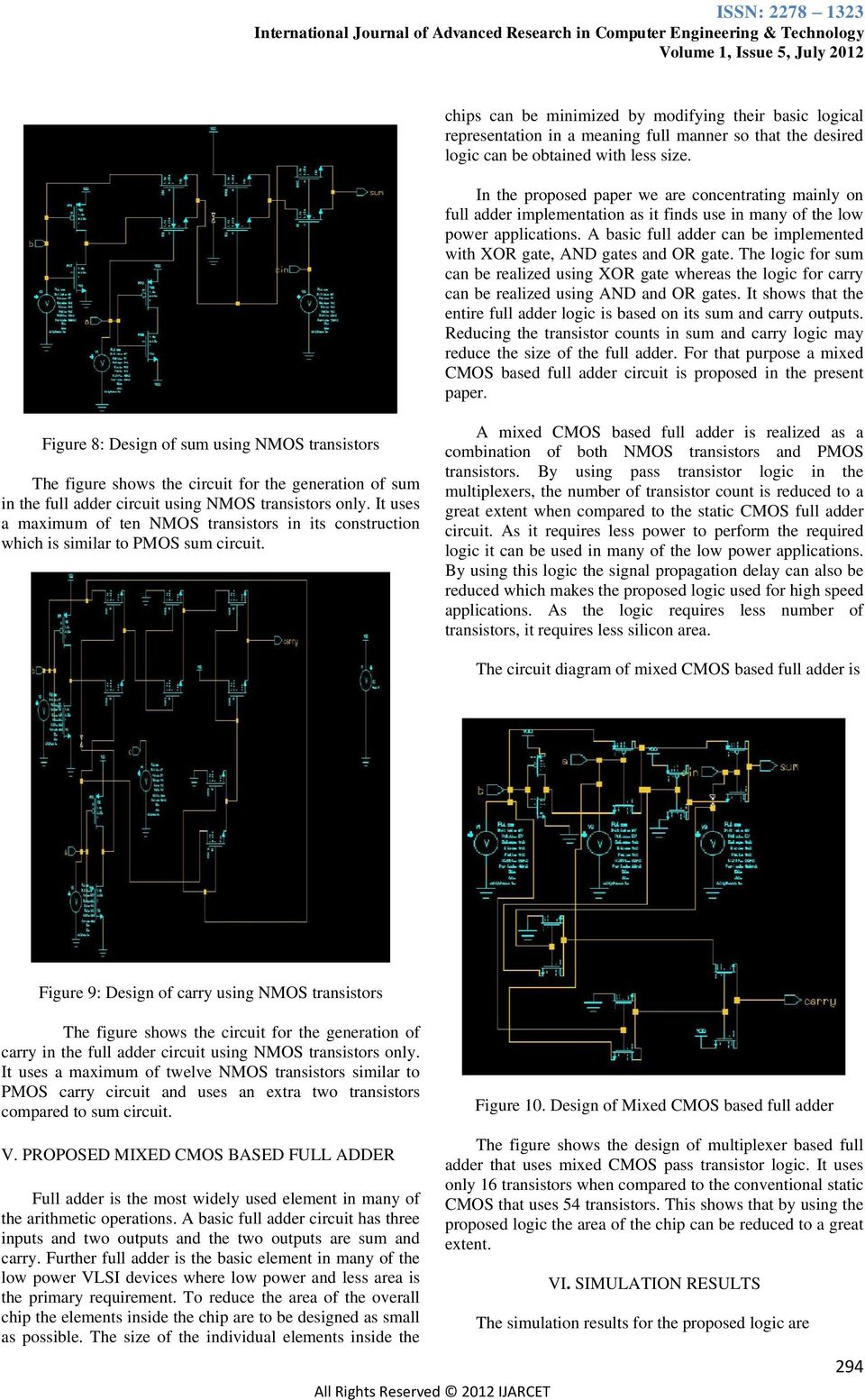
4 chips can be minimized by modifying their basic logical representation in a meaning full manner so that the desired logic can be obtained with less size. In the proposed paper we are concentrating mainly on full adder implementation as it finds use in many of the low power applications. A basic full adder can be implemented with XOR gate, AND gates and OR gate. The logic for sum can be realized using XOR gate whereas the logic for carry can be realized using AND and OR gates. It shows that the entire full adder logic is based on its sum and carry outputs. Reducing the transistor counts in sum and carry logic may reduce the size of the full adder. For that purpose a mixed CMOS based full adder circuit is proposed in the present paper. Figure 8: Design of sum using NMOS transistors The figure shows the circuit for the generation of sum in the full adder circuit using NMOS transistors only. It uses a maximum of ten NMOS transistors in its construction which is similar to PMOS sum circuit. A mixed CMOS based full adder is realized as a combination of both NMOS transistors and PMOS transistors. By using pass transistor logic in the multiplexers, the number of transistor count is reduced to a great extent when compared to the static CMOS full adder circuit. As it requires less power to perform the required logic it can be used in many of the low power applications. By using this logic the signal propagation delay can also be reduced which makes the proposed logic used for high speed applications. As the logic requires less number of transistors, it requires less silicon area. The circuit diagram of mixed CMOS based full adder is Figure 9: Design of carry using NMOS transistors The figure shows the circuit for the generation of carry in the full adder circuit using NMOS transistors only. It uses a maximum of twelve NMOS transistors similar to PMOS carry circuit and uses an extra two transistors compared to sum circuit. Figure 10. Design of Mixed CMOS based full adder V. PROPOSED MIXED CMOS BASED FULL ADDER Full adder is the most widely used element in many of the arithmetic operations. A basic full adder circuit has three inputs and two outputs and the two outputs are sum and carry. Further full adder is the basic element in many of the low power VLSI devices where low power and less area is the primary requirement. To reduce the area of the overall chip the elements inside the chip are to be designed as small as possible. The size of the individual elements inside the The figure shows the design of multiplexer based full adder that uses mixed CMOS pass transistor logic. It uses only 16 transistors when compared to the conventional static CMOS that uses 54 transistors. This shows that by using the proposed logic the area of the chip can be reduced to a great extent. VI. SIMULATION RESULTS The simulation results for the proposed logic are 294

5 may occur in the output waveforms which may be reduced completely by careful designing of interconnection between the Mos devices. The results were simulated using Mentor Graphics tool. Figure 11. Simulation results for the generation of sum using PMOS transistors Figure 14: Simulation results for the generation of carry using NMOS transistors Figure 12: Simulation results for the generation of carry using PMOS transistors Figure 15: Simulation results for the proposed mixed CMOS based full adder The following table shows the comparison of performance parameters of different designs for the proposed full adder. Table 1: Performance parameters of proposed full adders Figure 13: Simulation results for the genaration of sum using NMOS transistors The above figures shows the simulation results for the proposed design of full adder. The post layout simulation of proposed full adder has been carried out with all combinations of inputs. Each circuit is simulated with the same testing conditions. Since a circuit responds differently to different input combinations, so the output is verified for all eight possible input combinations. Some degradations 295

6 From table 1, it can be observed that the power dissipation of mixed CMOS full adder is less comared to PMOS full adder and NMOS full adder circuits. Because of these advantages it can be used in many of the low power applications which is considered to be an important feature in portable devices. VII. CONCLUSION In the present work, the full adder design is realized in three different ways with the help of PMOS, NMOS and CMOS transistors. Further the design is implemented by using pass transistor logic in 2x1 multiplexers. The number of transistors required for realizing mixed CMOS design of full adeer is less than the number of transistors required in realizing the design of full adder using PMOS and NMOS transistors independently. So, the required logic can be realized within a small area when compared to the conventional static CMOS ull adder design. Simulation result shows that this proposed full adder achieves better power reduction when compared with other commonly used full adders. REFERENCES [1] M. Hosseinzadeh, S.J. Jassbi, and Keivan Navi, A Novel Multiple Valued Logic OHRNS Modulo rn Adder Circuit, International Journalof Electronics, Circuits and Systems, Vol. 1, No. 4, Fall 2007, pp [2] D. Radhakrishnan, Low-voltage low-power CMOS full adder, in Proc.IEE Circuits Devices Syst., vol. 148, Feb. 2001, pp [3] Y. Leblebici, S.M. Kang, CMOS Digital Digital Integrated Circuits, Singapore: Mc Graw Hill, 2nd edition, 1999, Ch. 7. [4] J. Wang, S. Fang, and W. Feng, New efficient designs for XOR andxnor functions on the transistor level, IEEE J. Solid-State Circuits,vol. 29, no. 7, Jul. 1994, pp [5] H. T. Bui, A. K. Al-Sheraidah, and Y.Wang, New 4-transistor XOR andxnor designs, in Proc. 2nd IEEE Asia Pacific Conf. ASICs, 2000, pp [6] H.T. Bui, Y. Wang, Y. Jiang, Design and analysis of 10- transistor fulla dders using novel XOR XNOR gates, in Proc. 5th Int. Conf. SignalProcess., vol. 1, Aug , 2000, pp [7] H. T. Bui, Y. Wang, and Y. Jiang, Design and analysis of lowpower 10-transistor full adders using XOR-XNOR gates, IEEE Trans. CircuitsSyst. II, Analog Digit. Signal Process., vol. 49, no. 1, Jan. 2002, pp [8] A. M. Shams, T. K. Darwish, and M. A. Bayoumi, Performance analysis of low-power 1-bit CMOS full adder cells, IEEE Trans. VeryLarge Scale Integr. (VLSI) Syst., vol. 10, no. 1, Feb. 2002, pp [9] K.-H. Cheng and C.-S. Huang, The novel efficient design of XOR/XNOR function for adder applications, in Proc. IEEE Int. Conf.Elect., Circuits Syst., vol. 1, Sep. 5 8, 1999, pp [10] H. Lee and G. E. Sobelman, New low-voltage circuits for XOR and XNOR, in Proc. IEEE Southeastcon, Apr , 1997, pp [11] M. Vesterbacka, A 14-transistor CMOS full adder with full voltage swing nodes, in Proc. IEEE Worksh. Signal Process. Syst., Oct ,1999, pp [12] G.A. Ruiz, M. Granda, An area-efficient static CMOS Carry select adder based on a compact carry look-ahead unit, Microelectronics Journal, Vol. 35, No. 12, 2004, pp [13] B. Dilli Kumar, M. Bharathi, A high speed and efficient design for binary number squaring using Dwandwa Yoga, in IJARCET, june. 2012, volume 1.issule 4,pp [14] Ko, U., P. Balsara and W. Lee, Low- power design techniques for high performance CMOS adders, IEEE Trans. Very Large Scale Integer.(VLSI) Syst., 3(2): [15] Haghparast, M. and K. Navi, A Novel Reversible Full Adder Circuit for Nanotechnology Based Systems, Journal of Applied Sciences,7(24): [16] Kwon, O., K. Nowka and E. Swartzlander, A 16x16 bit MAC design using fast 5:2compressor, Proc. IEEE Int. Conf. Application Specific System, Architecture and Processors, pp: [17] Navi, K., O. Kavehei, M. Rouholamini, A. Sahafi,S. Mehrabi and N. Dadkhani, Low-Power and High-Performance 1-bit CMOS Full Adder Cell, Journal of Computers, (In Press). [18] Shams, A., T. Darwish and M. Bayoumi, Performance analysis of low Power 1-bit CMOS full adder cells, IEEE Trans. Very Large Scale Integer. (VLSI) Syst., 10(1): [19] Song, P.J. and G. De Micheli, Circuit and architecture tradeoffs for high speed multiplication, IEEE J. Solid-Sate Circuit, 26(9): [20] Kuroda, T. and M. Hamada, Low power CMOS digital design with dual embedded adaptive power supplies, IEEE J. Solid-State Circuits,35(4): Usami, K. and M. Horowitz, Clustered voltage scaling technique for low power design,proc. Int. Symp. Low Power Design, pp: 3-8. [20] Goel, S., A. Kumar and M.A. Bayoumi, Design of Robust, Energy-Efficient Full Adders for Deep-Sub micrometer Design Using Hybrid-CMOS Logic Style, IEEE Trans.Very Large Scale Inetgr. (VLSI) Syst, 14(12). [21] Zimmermann, R. and W. Fichtner, Low power logic styles: CMOS versus pass transistor logic, IEEE J. Solid-State Circuits, 32(7): Author Profile: Mr. B. Dilli kumar, Student, is currently Pursuing his M.Tech VLSI., in ECE department of Sree Vidyanikethan Engineering College, Tirupati. He has completed B.Tech in Electronics and Communication Engineering, in Jawaharlal Nehru Technological University, Anantapur. His research areas are VLSI, Digital IC Design, VLSI and Signal processing, Testing and Testability. [email protected] Mr. K. Charan kumar, Student, is currently Pursuing his M.Tech VLSI., in ECE department of Sree Vidyanikethan Engineering College, Tirupati. He has completed B.Tech in Electronics and Communication Engineering, in Jawaharlal Nehru Technological University, Anantapur. His research areas are VLSI, Digital IC Design, Testing and Testability. [email protected] M. Bharathi, Assistant Professor, Department of ECE, Sree VidyanikethanEngineering College (Autonomous), Tirupati, India. She has completed M.Tech in VLSI Design, in Satyabhama University. Her research areas are Digital System Design, VLSI Signal Processing [email protected] 296

A New Low Power Dynamic Full Adder Cell Based on Majority Function
 World Applied Sciences Journal 4 (1): 133-141, 2008 ISSN 1818-4952 IDOSI Publications, 2008 A New Low Power Dynamic Full Adder Cell Based on Majority Function 1 Vahid Foroutan, 2 Keivan Navi and 1 Majid
A high Speed 8 Transistor Full Adder Design using Novel 3 Transistor XOR Gates
 A high Speed 8 Transistor Full Adder Design using Novel 3 Transistor XOR Gates Shubhajit Roy Chowdhury, Aritra Banerjee, Aniruddha Roy, Hiranmay Saha Abstract The paper proposes the novel design of a 3T
HIGH SPEED AREA EFFICIENT 1-BIT HYBRID FULL ADDER
 HIGH SPEED AREA EFFICIENT 1-BIT HYBRID FULL ADDER Sachin Kumar *1, Aman Kumar #2, Puneet Bansal #3 * Department of Electronic Science, Kurukshetra University, Kurukshetra, Haryana, India # University Institute
Design of Low Power One-Bit Hybrid-CMOS Full Adder Cells
 Design of Low Power One-Bit Hybrid-CMOS Full Adder Cells Sushil B. Bhaisare 1, Sonalee P. Suryawanshi 2, Sagar P. Soitkar 3 1 Lecturer in Electronics Department, Nagpur University, G.H.R.I.E.T.W. Nagpur,
Design of Energy Efficient Low Power Full Adder using Supply Voltage Gating
 Design of Energy Efficient Low Power Full Adder using Supply Voltage Gating S.Nandhini 1, T.G.Dhaarani 2, P.Kokila 3, P.Premkumar 4 Assistant Professor, Dept. of ECE, Nandha Engineering College, Erode,
NEW adder cells are useful for designing larger circuits despite increase in transistor count by four per cell.
 CHAPTER 4 THE ADDER The adder is one of the most critical components of a processor, as it is used in the Arithmetic Logic Unit (ALU), in the floating-point unit and for address generation in case of cache
A Novel Low Power, High Speed 14 Transistor CMOS Full Adder Cell with 50% Improvement in Threshold Loss Problem
 A Novel Low Power, High Speed 4 Transistor CMOS Full Adder Cell with 5% Improvement in Threshold Loss Problem T. Vigneswaran, B. Mukundhan, and P. Subbarami Reddy Abstract Full adders are important components
Design and analysis of flip flops for low power clocking system
 Design and analysis of flip flops for low power clocking system Gabariyala sabadini.c PG Scholar, VLSI design, Department of ECE,PSNA college of Engg and Tech, Dindigul,India. Jeya priyanka.p PG Scholar,
Efficient Interconnect Design with Novel Repeater Insertion for Low Power Applications
 Efficient Interconnect Design with Novel Repeater Insertion for Low Power Applications TRIPTI SHARMA, K. G. SHARMA, B. P. SINGH, NEHA ARORA Electronics & Communication Department MITS Deemed University,
High Speed Gate Level Synchronous Full Adder Designs
 High Speed Gate Level Synchronous Full Adder Designs PADMANABHAN BALASUBRAMANIAN and NIKOS E. MASTORAKIS School of Computer Science, The University of Manchester, Oxford Road, Manchester M13 9PL, UNITED
International Journal of Electronics and Computer Science Engineering 1482
 International Journal of Electronics and Computer Science Engineering 1482 Available Online at www.ijecse.org ISSN- 2277-1956 Behavioral Analysis of Different ALU Architectures G.V.V.S.R.Krishna Assistant
LOW POWER CMOS FULL ADDER DESIGN WITH 12 TRANSISTORS
 LOW POWER CMOS FULL ADDER DESIGN WITH 12 TRANSISTORS Manoj Kumar 1, Sandeep K. Arya 1, Sujata Pandey 2 1 Department of Electronics & Communication Engineering Guru Jambheshwar University of Science & Technology,
Optimization and Comparison of 4-Stage Inverter, 2-i/p NAND Gate, 2-i/p NOR Gate Driving Standard Load By Using Logical Effort
 Optimization and Comparison of -Stage, -i/p NND Gate, -i/p NOR Gate Driving Standard Load By Using Logical Effort Satyajit nand *, and P.K.Ghosh ** * Mody Institute of Technology & Science/ECE, Lakshmangarh,
1. True or False? A voltage level in the range 0 to 2 volts is interpreted as a binary 1.
 File: chap04, Chapter 04 1. True or False? A voltage level in the range 0 to 2 volts is interpreted as a binary 1. 2. True or False? A gate is a device that accepts a single input signal and produces one
Chapter 10 Advanced CMOS Circuits
 Transmission Gates Chapter 10 Advanced CMOS Circuits NMOS Transmission Gate The active pull-up inverter circuit leads one to thinking about alternate uses of NMOS devices. Consider the circuit shown in
ISSCC 2003 / SESSION 13 / 40Gb/s COMMUNICATION ICS / PAPER 13.7
 ISSCC 2003 / SESSION 13 / 40Gb/s COMMUNICATION ICS / PAPER 13.7 13.7 A 40Gb/s Clock and Data Recovery Circuit in 0.18µm CMOS Technology Jri Lee, Behzad Razavi University of California, Los Angeles, CA
Sequential 4-bit Adder Design Report
 UNIVERSITY OF WATERLOO Faculty of Engineering E&CE 438: Digital Integrated Circuits Sequential 4-bit Adder Design Report Prepared by: Ian Hung (ixxxxxx), 99XXXXXX Annette Lo (axxxxxx), 99XXXXXX Pamela
CMOS Binary Full Adder
 CMOS Binary Full Adder A Survey of Possible Implementations Group : Eren Turgay Aaron Daniels Michael Bacelieri William Berry - - Table of Contents Key Terminology...- - Introduction...- 3 - Design Architectures...-
Module 4 : Propagation Delays in MOS Lecture 22 : Logical Effort Calculation of few Basic Logic Circuits
 Module 4 : Propagation Delays in MOS Lecture 22 : Logical Effort Calculation of few Basic Logic Circuits Objectives In this lecture you will learn the following Introduction Logical Effort of an Inverter
A Survey on Sequential Elements for Low Power Clocking System
 Journal of Computer Applications ISSN: 0974 1925, Volume-5, Issue EICA2012-3, February 10, 2012 A Survey on Sequential Elements for Low Power Clocking System Bhuvana S ECE Department, Avinashilingam University
AN IMPROVED DESIGN OF REVERSIBLE BINARY TO BINARY CODED DECIMAL CONVERTER FOR BINARY CODED DECIMAL MULTIPLICATION
 American Journal of Applied Sciences 11 (1): 69-73, 2014 ISSN: 1546-9239 2014 Science Publication doi:10.3844/ajassp.2014.69.73 Published Online 11 (1) 2014 (http://www.thescipub.com/ajas.toc) AN IMPROVED
Static-Noise-Margin Analysis of Conventional 6T SRAM Cell at 45nm Technology
 Static-Noise-Margin Analysis of Conventional 6T SRAM Cell at 45nm Technology Nahid Rahman Department of electronics and communication FET-MITS (Deemed university), Lakshmangarh, India B. P. Singh Department
TRUE SINGLE PHASE CLOCKING BASED FLIP-FLOP DESIGN
 TRUE SINGLE PHASE CLOCKING BASED FLIP-FLOP DESIGN USING DIFFERENT FOUNDRIES Priyanka Sharma 1 and Rajesh Mehra 2 1 ME student, Department of E.C.E, NITTTR, Chandigarh, India 2 Associate Professor, Department
Floating Point Fused Add-Subtract and Fused Dot-Product Units
 Floating Point Fused Add-Subtract and Fused Dot-Product Units S. Kishor [1], S. P. Prakash [2] PG Scholar (VLSI DESIGN), Department of ECE Bannari Amman Institute of Technology, Sathyamangalam, Tamil Nadu,
Gates, Circuits, and Boolean Algebra
 Gates, Circuits, and Boolean Algebra Computers and Electricity A gate is a device that performs a basic operation on electrical signals Gates are combined into circuits to perform more complicated tasks
Introduction to Digital System Design
 Introduction to Digital System Design Chapter 1 1 Outline 1. Why Digital? 2. Device Technologies 3. System Representation 4. Abstraction 5. Development Tasks 6. Development Flow Chapter 1 2 1. Why Digital
INSTITUTE OF AERONAUTICAL ENGINEERING Dundigal, Hyderabad - 500 043
 INSTITUTE OF AERONAUTICAL ENGINEERING Dundigal, Hyderabad - 500 043 ELECTRONICS AND COMMUNICATION ENGINEERING Course Title VLSI DESIGN Course Code 57035 Regulation R09 COURSE DESCRIPTION Course Structure
Implementation of Modified Booth Algorithm (Radix 4) and its Comparison with Booth Algorithm (Radix-2)
 Advance in Electronic and Electric Engineering. ISSN 2231-1297, Volume 3, Number 6 (2013), pp. 683-690 Research India Publications http://www.ripublication.com/aeee.htm Implementation of Modified Booth
A CDMA Based Scalable Hierarchical Architecture for Network- On-Chip
 www.ijcsi.org 241 A CDMA Based Scalable Hierarchical Architecture for Network- On-Chip Ahmed A. El Badry 1 and Mohamed A. Abd El Ghany 2 1 Communications Engineering Dept., German University in Cairo,
LOW POWER DUAL EDGE - TRIGGERED STATIC D FLIP-FLOP
 LOW POWER DUAL EDGE - TRIGGERED STATIC D FLIP-FLOP Anurag #1, Gurmohan Singh #2, V. Sulochana #3 # Centre for Development of Advanced Computing, Mohali, India 1 [email protected] 2 [email protected]
Here we introduced (1) basic circuit for logic and (2)recent nano-devices, and presented (3) some practical issues on nano-devices.
 Outline Here we introduced () basic circuit for logic and (2)recent nano-devices, and presented (3) some practical issues on nano-devices. Circuit Logic Gate A logic gate is an elemantary building block
S. Venkatesh, Mrs. T. Gowri, Department of ECE, GIT, GITAM University, Vishakhapatnam, India
 Power reduction on clock-tree using Energy recovery and clock gating technique S. Venkatesh, Mrs. T. Gowri, Department of ECE, GIT, GITAM University, Vishakhapatnam, India Abstract Power consumption of
DESIGN CHALLENGES OF TECHNOLOGY SCALING
 DESIGN CHALLENGES OF TECHNOLOGY SCALING IS PROCESS TECHNOLOGY MEETING THE GOALS PREDICTED BY SCALING THEORY? AN ANALYSIS OF MICROPROCESSOR PERFORMANCE, TRANSISTOR DENSITY, AND POWER TRENDS THROUGH SUCCESSIVE
ON SUITABILITY OF FPGA BASED EVOLVABLE HARDWARE SYSTEMS TO INTEGRATE RECONFIGURABLE CIRCUITS WITH HOST PROCESSING UNIT
 216 ON SUITABILITY OF FPGA BASED EVOLVABLE HARDWARE SYSTEMS TO INTEGRATE RECONFIGURABLE CIRCUITS WITH HOST PROCESSING UNIT *P.Nirmalkumar, **J.Raja Paul Perinbam, @S.Ravi and #B.Rajan *Research Scholar,
10 BIT s Current Mode Pipelined ADC
 10 BIT s Current Mode Pipelined ADC K.BHARANI VLSI DEPARTMENT VIT UNIVERSITY VELLORE, INDIA [email protected] P.JAYAKRISHNAN VLSI DEPARTMENT VIT UNIVERSITY VELLORE, INDIA [email protected]
Performance Comparison of an Algorithmic Current- Mode ADC Implemented using Different Current Comparators
 Performance Comparison of an Algorithmic Current- Mode ADC Implemented using Different Current Comparators Veepsa Bhatia Indira Gandhi Delhi Technical University for Women Delhi, India Neeta Pandey Delhi
Read-only memory Implementing logic with ROM Programmable logic devices Implementing logic with PLDs Static hazards
 Points ddressed in this Lecture Lecture 8: ROM Programmable Logic Devices Professor Peter Cheung Department of EEE, Imperial College London Read-only memory Implementing logic with ROM Programmable logic
Let s put together a Manual Processor
 Lecture 14 Let s put together a Manual Processor Hardware Lecture 14 Slide 1 The processor Inside every computer there is at least one processor which can take an instruction, some operands and produce
FPGA Implementation of an Advanced Traffic Light Controller using Verilog HDL
 FPGA Implementation of an Advanced Traffic Light Controller using Verilog HDL B. Dilip, Y. Alekhya, P. Divya Bharathi Abstract Traffic lights are the signaling devices used to manage traffic on multi-way
LFSR BASED COUNTERS AVINASH AJANE, B.E. A technical report submitted to the Graduate School. in partial fulfillment of the requirements
 LFSR BASED COUNTERS BY AVINASH AJANE, B.E A technical report submitted to the Graduate School in partial fulfillment of the requirements for the degree Master of Science in Electrical Engineering New Mexico
CHARGE pumps are the circuits that used to generate dc
 INTERNATIONAL JOURNAL OF DESIGN, ANALYSIS AND TOOLS FOR CIRCUITS AND SYSTEMS, VOL. 1, NO. 1, JUNE 2011 27 A Charge Pump Circuit by using Voltage-Doubler as Clock Scheme Wen Chang Huang, Jin Chang Cheng,
True Single Phase Clocking Flip-Flop Design using Multi Threshold CMOS Technique
 True Single Phase Clocking Flip-Flop Design using Multi Threshold CMOS Technique Priyanka Sharma ME (ECE) Student NITTTR Chandigarh Rajesh Mehra Associate Professor Department of ECE NITTTR Chandigarh
e.g. τ = 12 ps in 180nm, 40 ps in 0.6 µm Delay has two components where, f = Effort Delay (stage effort)= gh p =Parasitic Delay
 Logic Gate Delay Chip designers need to choose: What is the best circuit topology for a function? How many stages of logic produce least delay? How wide transistors should be? Logical Effort Helps make
Curriculum for a Master s Degree in ECE with focus on Mixed Signal SOC Design
 Curriculum for a Master s Degree in ECE with focus on Mixed Signal SOC Design Department of Electrical and Computer Engineering Overview The VLSI Design program is part of two tracks in the department:
exclusive-or and Binary Adder R eouven Elbaz [email protected] Office room: DC3576
 exclusive-or and Binary Adder R eouven Elbaz [email protected] Office room: DC3576 Outline exclusive OR gate (XOR) Definition Properties Examples of Applications Odd Function Parity Generation and Checking
High Speed and Efficient 4-Tap FIR Filter Design Using Modified ETA and Multipliers
 High Speed and Efficient 4-Tap FIR Filter Design Using Modified ETA and Multipliers Mehta Shantanu Sheetal #1, Vigneswaran T. #2 # School of Electronics Engineering, VIT University Chennai, Tamil Nadu,
An Efficient RNS to Binary Converter Using the Moduli Set {2n + 1, 2n, 2n 1}
 An Efficient RNS to Binary Converter Using the oduli Set {n + 1, n, n 1} Kazeem Alagbe Gbolagade 1,, ember, IEEE and Sorin Dan Cotofana 1, Senior ember IEEE, 1. Computer Engineering Laboratory, Delft University
Design Verification and Test of Digital VLSI Circuits NPTEL Video Course. Module-VII Lecture-I Introduction to Digital VLSI Testing
 Design Verification and Test of Digital VLSI Circuits NPTEL Video Course Module-VII Lecture-I Introduction to Digital VLSI Testing VLSI Design, Verification and Test Flow Customer's Requirements Specifications
Module 7 : I/O PADs Lecture 33 : I/O PADs
 Module 7 : I/O PADs Lecture 33 : I/O PADs Objectives In this lecture you will learn the following Introduction Electrostatic Discharge Output Buffer Tri-state Output Circuit Latch-Up Prevention of Latch-Up
數 位 積 體 電 路 Digital Integrated Circuits
 IEE5049 - Spring 2012 數 位 積 體 電 路 Digital Integrated Circuits Course Overview Professor Wei Hwang 黃 威 教 授 Department of Electronics Engineering National Chiao Tung University [email protected] Wei
Lecture 5: Gate Logic Logic Optimization
 Lecture 5: Gate Logic Logic Optimization MAH, AEN EE271 Lecture 5 1 Overview Reading McCluskey, Logic Design Principles- or any text in boolean algebra Introduction We could design at the level of irsim
Gates & Boolean Algebra. Boolean Operators. Combinational Logic. Introduction
 Introduction Gates & Boolean lgebra Boolean algebra: named after mathematician George Boole (85 864). 2-valued algebra. digital circuit can have one of 2 values. Signal between and volt =, between 4 and
Leakage Power Reduction Using Sleepy Stack Power Gating Technique
 Leakage Power Reduction Using Sleepy Stack Power Gating Technique M.Lavanya, P.Anitha M.E Student [Applied Electronics], Dept. of ECE, Kingston Engineering College, Vellore, Tamil Nadu, India Assistant
Binary Adders: Half Adders and Full Adders
 Binary Adders: Half Adders and Full Adders In this set of slides, we present the two basic types of adders: 1. Half adders, and 2. Full adders. Each type of adder functions to add two binary bits. In order
ECE124 Digital Circuits and Systems Page 1
 ECE124 Digital Circuits and Systems Page 1 Chip level timing Have discussed some issues related to timing analysis. Talked briefly about longest combinational path for a combinational circuit. Talked briefly
Analog & Digital Electronics Course No: PH-218
 Analog & Digital Electronics Course No: PH-218 Lec-28: Logic Gates & Family Course Instructor: Dr. A. P. VAJPEYI Department of Physics, Indian Institute of Technology Guwahati, India 1 Digital Logic Gates
Parametric variation analysis of CUK converter for constant voltage applications
 ISSN (Print) : 232 3765 (An ISO 3297: 27 Certified Organization) Vol. 3, Issue 2, February 214 Parametric variation analysis of CUK converter for constant voltage applications Rheesabh Dwivedi 1, Vinay
INTEGRATED CIRCUITS. For a complete data sheet, please also download:
 INTEGRATED CIRCUITS DATA SHEET For a complete data sheet, please also download: The IC06 74HC/HCT/HCU/HCMOS Logic Family Specifications The IC06 74HC/HCT/HCU/HCMOS Logic Package Information The IC06 74HC/HCT/HCU/HCMOS
Digital Logic Design. Basics Combinational Circuits Sequential Circuits. Pu-Jen Cheng
 Digital Logic Design Basics Combinational Circuits Sequential Circuits Pu-Jen Cheng Adapted from the slides prepared by S. Dandamudi for the book, Fundamentals of Computer Organization and Design. Introduction
Digital Integrated Circuit (IC) Layout and Design
 Digital Integrated Circuit (IC) Layout and Design! EE 134 Winter 05 " Lecture Tu & Thurs. 9:40 11am ENGR2 142 " 2 Lab sections M 2:10pm 5pm ENGR2 128 F 11:10am 2pm ENGR2 128 " NO LAB THIS WEEK " FIRST
Three-Phase Dual-Rail Pre-Charge Logic
 Infineon Page 1 CHES 2006 - Yokohama Three-Phase Dual-Rail Pre-Charge Logic L. Giancane, R. Luzzi, A. Trifiletti {marco.bucci, raimondo.luzzi}@infineon.com {giancane, trifiletti}@die.mail.uniroma1.it Summary
POWER COMPARISON OF CMOS AND ADIABATIC FULL ADDER CIRCUITS
 POWER COMPARISON OF CMOS AND ADIABATIC FULL ADDER CIRCUITS Y. Sunil Gavaskar Reddy 1 and V.V.G.S.Rajendra Prasad 2 1 Department of Electronics &Communication Engineering, Anurag Engineering College, JNTUniversity,
Study on Differential Protection of Transmission Line Using Wireless Communication
 Study on Differential Protection of Transmission Line Using Wireless Communication George John.P 1, Agna Prince 2, Akhila.K.K 3, Guy Marcel 4, Harikrishnan.P 5 Professor, Dept. of EEE, MA Engineering College,
COMPARATIVE ANALYSIS OF 4-BIT AND 8-BIT REVERSIBLE BARREL SHIFTER DESIGNS USING REVKIT
 COMPARATIVE ANALYSIS OF 4-BIT AND 8-BIT REVERSIBLE BARREL SHIFTER DESIGNS USING REVKIT Hariprasad R. 1, Ganesh R. 1, Ravi S. 2, Marimuthu R. 1 and Balamurugan S. 1 1 School of Electrical Engineering, VIT
Performance of Flip-Flop Using 22nm CMOS Technology
 Performance of Flip-Flop Using 22nm CMOS Technology K.Rajasri 1, A.Bharathi 2, M.Manikandan 3 M.E, Applied Electronics, IFET College of Engineering, Villupuram, India 1, 2 Assistant Professor, Department
Understanding Logic Design
 Understanding Logic Design ppendix of your Textbook does not have the needed background information. This document supplements it. When you write add DD R0, R1, R2, you imagine something like this: R1
ELEC 2210 - EXPERIMENT 1 Basic Digital Logic Circuits
 Objectives ELEC - EXPERIMENT Basic Digital Logic Circuits The experiments in this laboratory exercise will provide an introduction to digital electronic circuits. You will learn how to use the IDL-00 Bit
SIMULATION OF CLOSED LOOP CONTROLLED BRIDGELESS PFC BOOST CONVERTER
 SIMULATION OF CLOSED LOOP CONTROLLED BRIDGELESS PFC BOOST CONVERTER 1M.Gopinath, 2S.Ramareddy Research Scholar, Bharath University, Chennai, India. Professor, Jerusalem college of Engg Chennai, India.
A MULTILEVEL INVERTER FOR SYNCHRONIZING THE GRID WITH RENEWABLE ENERGY SOURCES BY IMPLEMENTING BATTERY CUM DC-DC CONERTER
 A MULTILEVEL INVERTER FOR SYNCHRONIZING THE GRID WITH RENEWABLE ENERGY SOURCES BY IMPLEMENTING BATTERY CUM DC-DC CONERTER 1 KARUNYA CHRISTOBAL LYDIA. S, 2 SHANMUGASUNDARI. A, 3 ANANDHI.Y 1,2,3 Electrical
BURST-MODE communication relies on very fast acquisition
 IEEE TRANSACTIONS ON CIRCUITS AND SYSTEMS II: EXPRESS BRIEFS, VOL. 52, NO. 8, AUGUST 2005 437 Instantaneous Clockless Data Recovery and Demultiplexing Behnam Analui and Ali Hajimiri Abstract An alternative
Model-Based Synthesis of High- Speed Serial-Link Transmitter Designs
 Model-Based Synthesis of High- Speed Serial-Link Transmitter Designs Ikchan Jang 1, Soyeon Joo 1, SoYoung Kim 1, Jintae Kim 2, 1 College of Information and Communication Engineering, Sungkyunkwan University,
Architectural Level Power Consumption of Network on Chip. Presenter: YUAN Zheng
 Architectural Level Power Consumption of Network Presenter: YUAN Zheng Why Architectural Low Power Design? High-speed and large volume communication among different parts on a chip Problem: Power consumption
ECE410 Design Project Spring 2008 Design and Characterization of a CMOS 8-bit Microprocessor Data Path
 ECE410 Design Project Spring 2008 Design and Characterization of a CMOS 8-bit Microprocessor Data Path Project Summary This project involves the schematic and layout design of an 8-bit microprocessor data
Design and Analysis of Parallel AES Encryption and Decryption Algorithm for Multi Processor Arrays
 IOSR Journal of VLSI and Signal Processing (IOSR-JVSP) Volume 5, Issue, Ver. III (Jan - Feb. 205), PP 0- e-issn: 239 4200, p-issn No. : 239 497 www.iosrjournals.org Design and Analysis of Parallel AES
Automated Switching Mechanism for Multi-Standard RFID Transponder
 Automated Switching Mechanism for Multi-Standard RFID Transponder Teh Kim Ting and Khaw Mei Kum Faculty of Engineering Multimedia University Cyberjaya, Malaysia [email protected] Abstract This paper presents
DESIGN OF AN ERROR DETECTION AND DATA RECOVERY ARCHITECTURE FOR MOTION ESTIMATION TESTING APPLICATIONS
 DESIGN OF AN ERROR DETECTION AND DATA RECOVERY ARCHITECTURE FOR MOTION ESTIMATION TESTING APPLICATIONS V. SWARNA LATHA 1 & K. SRINIVASA RAO 2 1 VLSI System Design A.I.T.S, Rajampet Kadapa (Dt), A.P., India
Application Note 83 Fundamentals of RS 232 Serial Communications
 Application Note 83 Fundamentals of Serial Communications Due to it s relative simplicity and low hardware overhead (as compared to parallel interfacing), serial communications is used extensively within
A 1-GSPS CMOS Flash A/D Converter for System-on-Chip Applications
 A -GSPS CMOS Flash A/D Converter for System-on-Chip Applications Jincheol Yoo, Kyusun Choi, and Ali Tangel Department of Computer Science & Department of Computer & Engineering Communications Engineering
Design and Development of Virtual Instrument (VI) Modules for an Introductory Digital Logic Course
 Session ENG 206-6 Design and Development of Virtual Instrument (VI) Modules for an Introductory Digital Logic Course Nikunja Swain, Ph.D., PE South Carolina State University [email protected] Raghu Korrapati,
Low leakage and high speed BCD adder using clock gating technique
 Low leakage and high speed BCD adder using clock gating technique Mr. Suri shiva 1 Mr K.R.Anudeep Laxmikanth 2 Mr. Naveen Kumar.Ch 3 Abstract The growing market of mobile, battery powered electronic systems
Title : Analog Circuit for Sound Localization Applications
 Title : Analog Circuit for Sound Localization Applications Author s Name : Saurabh Kumar Tiwary Brett Diamond Andrea Okerholm Contact Author : Saurabh Kumar Tiwary A-51 Amberson Plaza 5030 Center Avenue
Figure 8-1 Four Possible Results of Adding Two Bits
 CHPTER EIGHT Combinational Logic pplications Thus far, our discussion has focused on the theoretical design issues of computer systems. We have not yet addressed any of the actual hardware you might find
Lecture 10: Latch and Flip-Flop Design. Outline
 Lecture 1: Latch and Flip-Flop esign Slides orginally from: Vladimir Stojanovic Computer Systems Laboratory Stanford University [email protected] 1 Outline Recent interest in latches and flip-flops
AN EFFICIENT STRATEGY OF AGGREGATE SECURE DATA TRANSMISSION
 INTERNATIONAL JOURNAL OF REVIEWS ON RECENT ELECTRONICS AND COMPUTER SCIENCE AN EFFICIENT STRATEGY OF AGGREGATE SECURE DATA TRANSMISSION K.Anusha 1, K.Sudha 2 1 M.Tech Student, Dept of CSE, Aurora's Technological
Chapter 4 Register Transfer and Microoperations. Section 4.1 Register Transfer Language
 Chapter 4 Register Transfer and Microoperations Section 4.1 Register Transfer Language Digital systems are composed of modules that are constructed from digital components, such as registers, decoders,
A New Reversible TSG Gate and Its Application For Designing Efficient Adder Circuits
 A New Reversible TSG Gate and Its Application For Designing Efficient Adder s Himanshu Thapliyal Center for VLSI and Embedded System Technologies International Institute of Information Technology Hyderabad-500019,
Innovative improvement of fundamental metrics including power dissipation and efficiency of the ALU system
 Innovative improvement of fundamental metrics including power dissipation and efficiency of the ALU system Joseph LaBauve Department of Electrical and Computer Engineering University of Central Florida
An Effective Deterministic BIST Scheme for Shifter/Accumulator Pairs in Datapaths
 An Effective Deterministic BIST Scheme for Shifter/Accumulator Pairs in Datapaths N. KRANITIS M. PSARAKIS D. GIZOPOULOS 2 A. PASCHALIS 3 Y. ZORIAN 4 Institute of Informatics & Telecommunications, NCSR
Low Power AMD Athlon 64 and AMD Opteron Processors
 Low Power AMD Athlon 64 and AMD Opteron Processors Hot Chips 2004 Presenter: Marius Evers Block Diagram of AMD Athlon 64 and AMD Opteron Based on AMD s 8 th generation architecture AMD Athlon 64 and AMD
COMBINATIONAL and SEQUENTIAL LOGIC CIRCUITS Hardware implementation and software design
 PH-315 COMINATIONAL and SEUENTIAL LOGIC CIRCUITS Hardware implementation and software design A La Rosa I PURPOSE: To familiarize with combinational and sequential logic circuits Combinational circuits
Lecture 5: Logical Effort
 Introduction to CMOS VLSI Design Lecture 5: Logical Effort David Harris Harvey Mudd College Spring 2004 Outline Introduction Delay in a Logic Gate Multistage Logic Networks Choosing the Best Number of
Design, Analysis, and Implementation of Solar Power Optimizer for DC Distribution System
 Design, Analysis, and Implementation of Solar Power Optimizer for DC Distribution System Thatipamula Venkatesh M.Tech, Power System Control and Automation, Department of Electrical & Electronics Engineering,
MAXIMIZING RESTORABLE THROUGHPUT IN MPLS NETWORKS
 MAXIMIZING RESTORABLE THROUGHPUT IN MPLS NETWORKS 1 M.LAKSHMI, 2 N.LAKSHMI 1 Assitant Professor, Dept.of.Computer science, MCC college.pattukottai. 2 Research Scholar, Dept.of.Computer science, MCC college.pattukottai.
RAM & ROM Based Digital Design. ECE 152A Winter 2012
 RAM & ROM Based Digital Design ECE 152A Winter 212 Reading Assignment Brown and Vranesic 1 Digital System Design 1.1 Building Block Circuits 1.1.3 Static Random Access Memory (SRAM) 1.1.4 SRAM Blocks in
High Intensify Interleaved Converter for Renewable Energy Resources
 High Intensify Interleaved Converter for Renewable Energy Resources K. Muthiah 1, S.Manivel 2, Gowthaman.N 3 1 PG Scholar, Jay Shriram Group of Institutions,Tirupur 2 Assistant Professor, Jay Shriram Group
ISSN: 2319-5967 ISO 9001:2008 Certified International Journal of Engineering Science and Innovative Technology (IJESIT) Volume 2, Issue 3, May 2013
 Transistor Level Fault Finding in VLSI Circuits using Genetic Algorithm Lalit A. Patel, Sarman K. Hadia CSPIT, CHARUSAT, Changa., CSPIT, CHARUSAT, Changa Abstract This paper presents, genetic based algorithm
CHAPTER 3 Boolean Algebra and Digital Logic
 CHAPTER 3 Boolean Algebra and Digital Logic 3.1 Introduction 121 3.2 Boolean Algebra 122 3.2.1 Boolean Expressions 123 3.2.2 Boolean Identities 124 3.2.3 Simplification of Boolean Expressions 126 3.2.4