
COMBINATIONAL CIRCUITS
|
|
|
- Arabella Dorsey
- 9 years ago
- Views:
Transcription
1 COMBINATIONAL CIRCUITS Copyright tutorialspoint.com Combinational circuit is a circuit in which we combine the different gates in the circuit, for example encoder, decoder, multiplexer and demultiplexer. Some of the characteristics of combinational circuits are following The output of combinational circuit at any instant of time, depends only on the levels present at input terminals. The combinational circuit do not use any memory. The previous state of input does not have any effect on the present state of the circuit. A combinational circuit can have an n number of inputs and m number of outputs. We're going to elaborate few important combinational circuits as follows. Half Adder Half adder is a combinational logic circuit with two inputs and two outputs. The half adder circuit is designed to add two single bit binary number A and B. It is the basic building block for addition of two single bit numbers. This circuit has two outputs carry and sum.

2 Circuit Diagram Full Adder Full adder is developed to overcome the drawback of Half Adder circuit. It can add two one-bit numbers A and B, and carry c. The full adder is a three input and two output combinational circuit. Circuit Diagram

3 N-Bit Parallel Adder The Full Adder is capable of adding only two single digit binary number along with a carry input. But in practical we need to add binary numbers which are much longer than just one bit. To add two n-bit binary numbers we need to use the n-bit parallel adder. It uses a number of full adders in cascade. The carry output of the previous full adder is connected to carry input of the next full adder. 4 Bit Parallel Adder In the block diagram, A 0 and B 0 represent the LSB of the four bit words A and B. Hence Full Adder- 0 is the lowest stage. Hence its C in has been permanently made 0. The rest of the connections are exactly same as those of n-bit parallel adder is shown in fig. The four bit parallel adder is a very common logic circuit. N-Bit Parallel Subtractor The subtraction can be carried out by taking the 1's or 2's complement of the number to be subtracted. For example we can perform the subtraction A B by adding either 1's or 2's complement of B to A. That means we can use a binary adder to perform the binary subtraction. 4 Bit Parallel Subtractor The number to be subtracted B is first passed through inverters to obtain its 1's complement. The 4-bit adder then adds A and 2's complement of B to produce the subtraction. S 3 S 2 S 1 S 0 represents the result of binary subtraction A B and carry output C out represents the polarity of the result. If A > B then Cout = 0 and the result of binary form A B then C out = 1 and the result is in the 2's complement form.

4 Half Subtractors Half subtractor is a combination circuit with two inputs and two outputs differenceandborrow. It produces the difference between the two binary bits at the input and also produces an output Borrow to indicate if a 1 has been borrowed. In the subtraction A B, A is called as Minuend bit and B is called as Subtrahend bit. Circuit Diagram Full Subtractors The disadvantage of a half subtractor is overcome by full subtractor. The full subtractor is a combinational circuit with three inputs A,B,C and two output D and C'. A is the 'minuend', B is 'subtrahend', C is the 'borrow' produced by the previous stage, D is the difference output and C' is the borrow output.
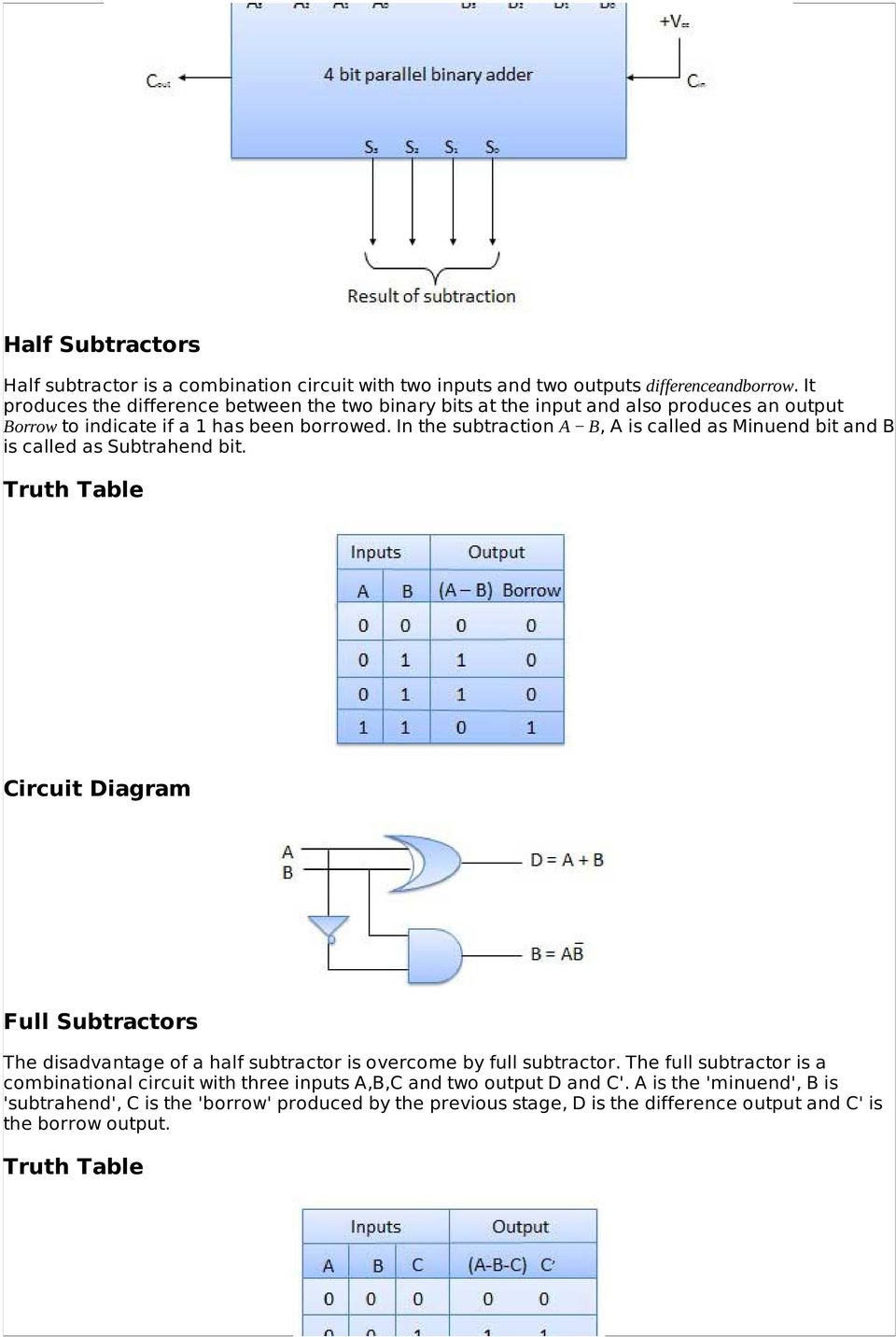
5 Circuit Diagram Multiplexers Multiplexer is a special type of combinational circuit. There are n-data inputs, one output and m select inputs with 2m = n. It is a digital circuit which selects one of the n data inputs and routes it to the output. The selection of one of the n inputs is done by the selected inputs. Depending on the digital code applied at the selected inputs, one out of n data sources is selected and transmitted to the single output Y. E is called the strobe or enable input which is useful for the cascading. It is generally an active low terminal that means it will perform the required operation when it is low.

6 Multiplexers come in multiple variations 2 : 1 multiplexer 4 : 1 multiplexer 16 : 1 multiplexer 32 : 1 multiplexer Block Diagram Demultiplexers A demultiplexer performs the reverse operation of a multiplexer i.e. it receives one input and distributes it over several outputs. It has only one input, n outputs, m select input. At a time only one output line is selected by the select lines and the input is transmitted to the selected output line. A de-multiplexer is equivalent to a single pole multiple way switch as shown in fig. Demultiplexers comes in multiple variations. 1 : 2 demultiplexer 1 : 4 demultiplexer 1 : 16 demultiplexer 1 : 32 demultiplexer

7 Decoder A decoder is a combinational circuit. It has n input and to a maximum m = 2n outputs. Decoder is identical to a demultiplexer without any data input. It performs operations which are exactly opposite to those of an encoder. Examples of Decoders are following. Code converters BCD to seven segment decoders Nixie tube decoders Relay actuator 2 to 4 Line Decoder The block diagram of 2 to 4 line decoder is shown in the fig. A and B are the two inputs where D through D are the four outputs. Truth table explains the operations of a decoder. It shows that each output is 1 for only a specific combination of inputs.

8 Logic Circuit Encoder Encoder is a combinational circuit which is designed to perform the inverse operation of the decoder. An encoder has n number of input lines and m number of output lines. An encoder produces an m bit binary code corresponding to the digital input number. The encoder accepts an n input digital word and converts it into an m bit another digital word. Examples of Encoders are following. Priority encoders

9 Decimal to BCD encoder Octal to binary encoder Hexadecimal to binary encoder Priority Encoder This is a special type of encoder. Priority is given to the input lines. If two or more input line are 1 at the same time, then the input line with highest priority will be considered. There are four input D 0, D 1, D 2, D 3 and two output Y 0, Y 1. Out of the four input D 3 has the highest priority and D 0 has the lowest priority. That means if D 3 = 1 then Y 1 Y 1 = 11 irrespective of the other inputs. Similarly if D 3 = 0 and D 2 = 1 then Y 1 Y 0 = 10 irrespective of the other inputs. Logic Circuit

10 Loading [MathJax]/jax/output/HTML-CSS/jax.js

Sistemas Digitais I LESI - 2º ano
 Sistemas Digitais I LESI - 2º ano Lesson 6 - Combinational Design Practices Prof. João Miguel Fernandes ([email protected]) Dept. Informática UNIVERSIDADE DO MINHO ESCOLA DE ENGENHARIA - PLDs (1) - The
BINARY CODED DECIMAL: B.C.D.
 BINARY CODED DECIMAL: B.C.D. ANOTHER METHOD TO REPRESENT DECIMAL NUMBERS USEFUL BECAUSE MANY DIGITAL DEVICES PROCESS + DISPLAY NUMBERS IN TENS IN BCD EACH NUMBER IS DEFINED BY A BINARY CODE OF 4 BITS.
DEPARTMENT OF INFORMATION TECHNLOGY
 DRONACHARYA GROUP OF INSTITUTIONS, GREATER NOIDA Affiliated to Mahamaya Technical University, Noida Approved by AICTE DEPARTMENT OF INFORMATION TECHNLOGY Lab Manual for Computer Organization Lab ECS-453
DIGITAL COUNTERS. Q B Q A = 00 initially. Q B Q A = 01 after the first clock pulse.
 DIGITAL COUNTERS http://www.tutorialspoint.com/computer_logical_organization/digital_counters.htm Copyright tutorialspoint.com Counter is a sequential circuit. A digital circuit which is used for a counting
SEQUENTIAL CIRCUITS. Block diagram. Flip Flop. S-R Flip Flop. Block Diagram. Circuit Diagram
 SEQUENTIAL CIRCUITS http://www.tutorialspoint.com/computer_logical_organization/sequential_circuits.htm Copyright tutorialspoint.com The combinational circuit does not use any memory. Hence the previous
Combinational Logic Design
 Chapter 4 Combinational Logic Design The foundations for the design of digital logic circuits were established in the preceding chapters. The elements of Boolean algebra (two-element switching algebra
5 Combinatorial Components. 5.0 Full adder. Full subtractor
 5 Combatorial Components Use for data transformation, manipulation, terconnection, and for control: arithmetic operations - addition, subtraction, multiplication and division. logic operations - AND, OR,
List of Experiment. 8. To study and verify the BCD to Seven Segments DECODER.(IC-7447).
 G. H. RAISONI COLLEGE OF ENGINEERING, NAGPUR Department of Electronics & Communication Engineering Branch:-4 th Semester[Electronics] Subject: - Digital Circuits List of Experiment Sr. Name Of Experiment
Understanding Logic Design
 Understanding Logic Design ppendix of your Textbook does not have the needed background information. This document supplements it. When you write add DD R0, R1, R2, you imagine something like this: R1
Binary Adders: Half Adders and Full Adders
 Binary Adders: Half Adders and Full Adders In this set of slides, we present the two basic types of adders: 1. Half adders, and 2. Full adders. Each type of adder functions to add two binary bits. In order
1. True or False? A voltage level in the range 0 to 2 volts is interpreted as a binary 1.
 File: chap04, Chapter 04 1. True or False? A voltage level in the range 0 to 2 volts is interpreted as a binary 1. 2. True or False? A gate is a device that accepts a single input signal and produces one
Digital Design. Assoc. Prof. Dr. Berna Örs Yalçın
 Digital Design Assoc. Prof. Dr. Berna Örs Yalçın Istanbul Technical University Faculty of Electrical and Electronics Engineering Office Number: 2318 E-mail: [email protected] Grading 1st Midterm -
United States Naval Academy Electrical and Computer Engineering Department. EC262 Exam 1
 United States Naval Academy Electrical and Computer Engineering Department EC262 Exam 29 September 2. Do a page check now. You should have pages (cover & questions). 2. Read all problems in their entirety.
2011, The McGraw-Hill Companies, Inc. Chapter 3
 Chapter 3 3.1 Decimal System The radix or base of a number system determines the total number of different symbols or digits used by that system. The decimal system has a base of 10 with the digits 0 through
Gates, Circuits, and Boolean Algebra
 Gates, Circuits, and Boolean Algebra Computers and Electricity A gate is a device that performs a basic operation on electrical signals Gates are combined into circuits to perform more complicated tasks
EE 261 Introduction to Logic Circuits. Module #2 Number Systems
 EE 261 Introduction to Logic Circuits Module #2 Number Systems Topics A. Number System Formation B. Base Conversions C. Binary Arithmetic D. Signed Numbers E. Signed Arithmetic F. Binary Codes Textbook
Number and codes in digital systems
 Number and codes in digital systems Decimal Numbers You are familiar with the decimal number system because you use them everyday. But their weighted structure is not understood. In the decimal number
The string of digits 101101 in the binary number system represents the quantity
 Data Representation Section 3.1 Data Types Registers contain either data or control information Control information is a bit or group of bits used to specify the sequence of command signals needed for
CDA 3200 Digital Systems. Instructor: Dr. Janusz Zalewski Developed by: Dr. Dahai Guo Spring 2012
 CDA 3200 Digital Systems Instructor: Dr. Janusz Zalewski Developed by: Dr. Dahai Guo Spring 2012 Outline Data Representation Binary Codes Why 6-3-1-1 and Excess-3? Data Representation (1/2) Each numbering
SECTION C [short essay] [Not to exceed 120 words, Answer any SIX questions. Each question carries FOUR marks] 6 x 4=24 marks
![SECTION C [short essay] [Not to exceed 120 words, Answer any SIX questions. Each question carries FOUR marks] 6 x 4=24 marks](/thumbs/35/17285180.jpg "SECTION C [short essay] [Not to exceed 120 words, Answer any SIX questions. Each question carries FOUR marks] 6 x 4=24 marks") UNIVERSITY OF KERALA First Degree Programme in Computer Applications Model Question Paper Semester I Course Code- CP 1121 Introduction to Computer Science TIME : 3 hrs Maximum Mark: 80 SECTION A [Very
UNIVERSITY OF KERALA First Degree Programme in Computer Applications Model Question Paper Semester I Course Code- CP 1121 Introduction to Computer Science TIME : 3 hrs Maximum Mark: 80 SECTION A [Very
Lecture 12: More on Registers, Multiplexers, Decoders, Comparators and Wot- Nots
 Lecture 12: More on Registers, Multiplexers, Decoders, Comparators and Wot- Nots Registers As you probably know (if you don t then you should consider changing your course), data processing is usually
Module 3: Floyd, Digital Fundamental
 Module 3: Lecturer : Yongsheng Gao Room : Tech - 3.25 Email : [email protected] Structure : 6 lectures 1 Tutorial Assessment: 1 Laboratory (5%) 1 Test (20%) Textbook : Floyd, Digital Fundamental
Oct: 50 8 = 6 (r = 2) 6 8 = 0 (r = 6) Writing the remainders in reverse order we get: (50) 10 = (62) 8
 ECE Department Summer LECTURE #5: Number Systems EEL : Digital Logic and Computer Systems Based on lecture notes by Dr. Eric M. Schwartz Decimal Number System: -Our standard number system is base, also
Operating Manual Ver.1.1
 4 Bit Binary Ripple Counter (Up-Down Counter) Operating Manual Ver.1.1 An ISO 9001 : 2000 company 94-101, Electronic Complex Pardesipura, Indore- 452010, India Tel : 91-731- 2570301/02, 4211100 Fax: 91-731-
Chapter 4 Register Transfer and Microoperations. Section 4.1 Register Transfer Language
 Chapter 4 Register Transfer and Microoperations Section 4.1 Register Transfer Language Digital systems are composed of modules that are constructed from digital components, such as registers, decoders,
earlier in the semester: The Full adder above adds two bits and the output is at the end. So if we do this eight times, we would have an 8-bit adder.
 The circuit created is an 8-bit adder. The 8-bit adder adds two 8-bit binary inputs and the result is produced in the output. In order to create a Full 8-bit adder, I could use eight Full -bit adders and
Chapter 1: Digital Systems and Binary Numbers
 Chapter 1: Digital Systems and Binary Numbers Digital age and information age Digital computers general purposes many scientific, industrial and commercial applications Digital systems telephone switching
Counters and Decoders
 Physics 3330 Experiment #10 Fall 1999 Purpose Counters and Decoders In this experiment, you will design and construct a 4-bit ripple-through decade counter with a decimal read-out display. Such a counter
Combinational circuits
 Combinational circuits Combinational circuits are stateless The outputs are functions only of the inputs Inputs Combinational circuit Outputs 3 Thursday, September 2, 3 Enabler Circuit (High-level view)
NUMBER SYSTEMS. 1.1 Introduction
 NUMBER SYSTEMS 1.1 Introduction There are several number systems which we normally use, such as decimal, binary, octal, hexadecimal, etc. Amongst them we are most familiar with the decimal number system.
Let s put together a Manual Processor
 Lecture 14 Let s put together a Manual Processor Hardware Lecture 14 Slide 1 The processor Inside every computer there is at least one processor which can take an instruction, some operands and produce
plc numbers - 13.1 Encoded values; BCD and ASCII Error detection; parity, gray code and checksums
 plc numbers - 3. Topics: Number bases; binary, octal, decimal, hexadecimal Binary calculations; s compliments, addition, subtraction and Boolean operations Encoded values; BCD and ASCII Error detection;
3.Basic Gate Combinations
 3.Basic Gate Combinations 3.1 TTL NAND Gate In logic circuits transistors play the role of switches. For those in the TTL gate the conducting state (on) occurs when the baseemmiter signal is high, and
Copyright Peter R. Rony 2009. All rights reserved.
 Experiment No. 1. THE DIGI DESIGNER Experiment 1-1. Socket Connections on the Digi Designer Experiment No. 2. LOGIC LEVELS AND THE 7400 QUADRUPLE 2-INPUT POSITIVE NAND GATE Experiment 2-1. Truth Table
Digital Logic Design. Basics Combinational Circuits Sequential Circuits. Pu-Jen Cheng
 Digital Logic Design Basics Combinational Circuits Sequential Circuits Pu-Jen Cheng Adapted from the slides prepared by S. Dandamudi for the book, Fundamentals of Computer Organization and Design. Introduction
Figure 8-1 Four Possible Results of Adding Two Bits
 CHPTER EIGHT Combinational Logic pplications Thus far, our discussion has focused on the theoretical design issues of computer systems. We have not yet addressed any of the actual hardware you might find
Digital System Design Prof. D Roychoudhry Department of Computer Science and Engineering Indian Institute of Technology, Kharagpur
 Digital System Design Prof. D Roychoudhry Department of Computer Science and Engineering Indian Institute of Technology, Kharagpur Lecture - 04 Digital Logic II May, I before starting the today s lecture
PROGRAMMABLE LOGIC CONTROLLERS Unit code: A/601/1625 QCF level: 4 Credit value: 15 TUTORIAL OUTCOME 2 Part 1
 UNIT 22: PROGRAMMABLE LOGIC CONTROLLERS Unit code: A/601/1625 QCF level: 4 Credit value: 15 TUTORIAL OUTCOME 2 Part 1 This work covers part of outcome 2 of the Edexcel standard module. The material is
Contents COUNTER. Unit III- Counters
 COUNTER Contents COUNTER...1 Frequency Division...2 Divide-by-2 Counter... 3 Toggle Flip-Flop...3 Frequency Division using Toggle Flip-flops...5 Truth Table for a 3-bit Asynchronous Up Counter...6 Modulo
Design Example: Counters. Design Example: Counters. 3-Bit Binary Counter. 3-Bit Binary Counter. Other useful counters:
 Design Eample: ers er: a sequential circuit that repeats a specified sequence of output upon clock pulses. A,B,C,, Z. G, O, T, E, R, P, S,!.,,,,,,,7. 7,,,,,,,.,,,,,,,,,,,. Binary counter: follows the binary
DIGITAL TECHNICS II. Dr. Bálint Pődör. Óbuda University, Microelectronics and Technology Institute. 2nd (Spring) term 2012/2013
 DIGITAL TECHNICS II Dr. Bálint Pődör Óbuda University, Microelectronics and Technology Institute 4. LECTURE: COUNTERS AND RELATED 2nd (Spring) term 2012/2013 1 4. LECTURE: COUNTERS AND RELATED 1. Counters,
ETEC 2301 Programmable Logic Devices. Chapter 10 Counters. Shawnee State University Department of Industrial and Engineering Technologies
 ETEC 2301 Programmable Logic Devices Chapter 10 Counters Shawnee State University Department of Industrial and Engineering Technologies Copyright 2007 by Janna B. Gallaher Asynchronous Counter Operation
Digital Electronics Detailed Outline
 Digital Electronics Detailed Outline Unit 1: Fundamentals of Analog and Digital Electronics (32 Total Days) Lesson 1.1: Foundations and the Board Game Counter (9 days) 1. Safety is an important concept
Gates, Plexers, Decoders, Registers, Addition and Comparison
 Introduction to Digital Logic Autumn 2008 Gates, Plexers, Decoders, Registers, Addition and Comparison [email protected] ...open up a command shell and type logisim and press enter to start Logisim.
DB19. 4-Bit Parallel Adder/ Subtractor. Digital Lab Experiment Board Ver. 1.0
 4-Bit Parallel Adder/ Subtractor Digital Lab Experiment Board Ver. 1.0 QUALITY POLICY To be a Global Leader of Innovative, Competitive and Eco friendly Electronic Equipment, Software Products and Turn-key
Upon completion of unit 1.1, students will be able to
 Upon completion of unit 1.1, students will be able to 1. Demonstrate safety of the individual, class, and overall environment of the classroom/laboratory, and understand that electricity, even at the nominal
COMBINATIONAL and SEQUENTIAL LOGIC CIRCUITS Hardware implementation and software design
 PH-315 COMINATIONAL and SEUENTIAL LOGIC CIRCUITS Hardware implementation and software design A La Rosa I PURPOSE: To familiarize with combinational and sequential logic circuits Combinational circuits
Two-level logic using NAND gates
 CSE140: Components and Design Techniques for Digital Systems Two and Multilevel logic implementation Tajana Simunic Rosing 1 Two-level logic using NND gates Replace minterm ND gates with NND gates Place
(Refer Slide Time: 00:01:16 min)
 Digital Computer Organization Prof. P. K. Biswas Department of Electronic & Electrical Communication Engineering Indian Institute of Technology, Kharagpur Lecture No. # 04 CPU Design: Tirning & Control
Chapter 2 Logic Gates and Introduction to Computer Architecture
 Chapter 2 Logic Gates and Introduction to Computer Architecture 2.1 Introduction The basic components of an Integrated Circuit (IC) is logic gates which made of transistors, in digital system there are
RAM & ROM Based Digital Design. ECE 152A Winter 2012
 RAM & ROM Based Digital Design ECE 152A Winter 212 Reading Assignment Brown and Vranesic 1 Digital System Design 1.1 Building Block Circuits 1.1.3 Static Random Access Memory (SRAM) 1.1.4 SRAM Blocks in
Take-Home Exercise. z y x. Erik Jonsson School of Engineering and Computer Science. The University of Texas at Dallas
 Take-Home Exercise Assume you want the counter below to count mod-6 backward. That is, it would count 0-5-4-3-2-1-0, etc. Assume it is reset on startup, and design the wiring to make the counter count
Having read this workbook you should be able to: recognise the arrangement of NAND gates used to form an S-R flip-flop.
 Objectives Having read this workbook you should be able to: recognise the arrangement of NAND gates used to form an S-R flip-flop. describe how such a flip-flop can be SET and RESET. describe the disadvantage
Content Map For Career & Technology
 Content Strand: Applied Academics CT-ET1-1 analysis of electronic A. Fractions and decimals B. Powers of 10 and engineering notation C. Formula based problem solutions D. Powers and roots E. Linear equations
EXPERIMENT 4. Parallel Adders, Subtractors, and Complementors
 EXPERIMENT 4. Parallel Adders, Subtractors, and Complementors I. Introduction I.a. Objectives In this experiment, parallel adders, subtractors and complementors will be designed and investigated. In the
CPEN 214 - Digital Logic Design Binary Systems
 CPEN 4 - Digital Logic Design Binary Systems C. Gerousis Digital Design 3 rd Ed., Mano Prentice Hall Digital vs. Analog An analog system has continuous range of values A mercury thermometer Vinyl records
INTEGRATED CIRCUITS. For a complete data sheet, please also download:
 INTEGRATED CIRCUITS DATA SHEET For a complete data sheet, please also download: The IC06 74HC/HCT/HCU/HCMOS Logic Family Specifications The IC06 74HC/HCT/HCU/HCMOS Logic Package Information The IC06 74HC/HCT/HCU/HCMOS
NEW adder cells are useful for designing larger circuits despite increase in transistor count by four per cell.
 CHAPTER 4 THE ADDER The adder is one of the most critical components of a processor, as it is used in the Arithmetic Logic Unit (ALU), in the floating-point unit and for address generation in case of cache
Lab 1: Study of Gates & Flip-flops
 1.1 Aim Lab 1: Study of Gates & Flip-flops To familiarize with circuit implementations using ICs and test the behavior of different logic gates and Flip-flops. 1.2 Hardware Requirement a. Equipments -
ANALOG & DIGITAL ELECTRONICS
 ANALOG & DIGITAL ELECTRONICS Course Instructor: Course No: PH-218 3-1-0-8 Dr. A.P. Vajpeyi E-mail: [email protected] Room No: #305 Department of Physics, Indian Institute of Technology Guwahati,
DIGITAL-TO-ANALOGUE AND ANALOGUE-TO-DIGITAL CONVERSION
 DIGITAL-TO-ANALOGUE AND ANALOGUE-TO-DIGITAL CONVERSION Introduction The outputs from sensors and communications receivers are analogue signals that have continuously varying amplitudes. In many systems
Two's Complement Adder/Subtractor Lab L03
 Two's Complement Adder/Subtractor Lab L03 Introduction Computers are usually designed to perform indirect subtraction instead of direct subtraction. Adding -B to A is equivalent to subtracting B from A,
FORDHAM UNIVERSITY CISC 3593. Dept. of Computer and Info. Science Spring, 2011. Lab 2. The Full-Adder
 FORDHAM UNIVERSITY CISC 3593 Fordham College Lincoln Center Computer Organization Dept. of Computer and Info. Science Spring, 2011 Lab 2 The Full-Adder 1 Introduction In this lab, the student will construct
Standart TTL, Serie 74... Art.Gruppe 13.15. 1...
 Standart TTL, Serie 74... Art.Gruppe 13.15. 1... Standart TTL, Serie 74... 7400 Quad 2-Input Nand Gate (TP) DIL14 7402 Quad 2 Input Nor Gate (TP) DIL14 7403 Quad 2 Input Nand Gate (OC) DIL14 7404 Hex Inverter
Systems I: Computer Organization and Architecture
 Systems I: omputer Organization and Architecture Lecture 8: Registers and ounters Registers A register is a group of flip-flops. Each flip-flop stores one bit of data; n flip-flops are required to store
DM9368 7-Segment Decoder/Driver/Latch with Constant Current Source Outputs
 DM9368 7-Segment Decoder/Driver/Latch with Constant Current Source Outputs General Description The DM9368 is a 7-segment decoder driver incorporating input latches and constant current output circuits
Systems I: Computer Organization and Architecture
 Systems I: Computer Organization and Architecture Lecture 9 - Register Transfer and Microoperations Microoperations Digital systems are modular in nature, with modules containing registers, decoders, arithmetic
exclusive-or and Binary Adder R eouven Elbaz [email protected] Office room: DC3576
 exclusive-or and Binary Adder R eouven Elbaz [email protected] Office room: DC3576 Outline exclusive OR gate (XOR) Definition Properties Examples of Applications Odd Function Parity Generation and Checking
The components. E3: Digital electronics. Goals:
 E3: Digital electronics Goals: Basic understanding of logic circuits. Become familiar with the most common digital components and their use. Equipment: 1 st. LED bridge 1 st. 7-segment display. 2 st. IC
HCF4028B BCD TO DECIMAL DECODER
 BCD TO DECIMAL DECODER BCD TO DECIMAL DECODING OR BINARY TO OCTAL DECODING HIGH DECODED OUTPUT DRIVE CAPABILITY "POSITIVE LOGIC" INPUTS AND OUTPUTS: DECODED OUTPUTS GO HIGH ON SELECTION MEDIUM SPEED OPERATION
Read-only memory Implementing logic with ROM Programmable logic devices Implementing logic with PLDs Static hazards
 Points ddressed in this Lecture Lecture 8: ROM Programmable Logic Devices Professor Peter Cheung Department of EEE, Imperial College London Read-only memory Implementing logic with ROM Programmable logic
Experiment # 9. Clock generator circuits & Counters. Eng. Waleed Y. Mousa
 Experiment # 9 Clock generator circuits & Counters Eng. Waleed Y. Mousa 1. Objectives: 1. Understanding the principles and construction of Clock generator. 2. To be familiar with clock pulse generation
DATA SHEETS DE COMPONENTES DA FAMÍLIA LÓGICA TTL GATES AND INVERTERS POSITIVES NAND GATES AND INVERTERS DESCRIÇÃO
 GATES AND INVERTERS POSITIVES NAND GATES AND INVERTERS Hex Invertes 74LS04 Quadruple 2 Inputs Gates 74LS00 Triple 3 Inputs Gates 74LS10 Dual 4 Inputs Gates 74LS20 8 Inputs Gates 74LS30 13 Inputs Gates
LOGICOS SERIE 4000. Precios sujetos a variación. Ref. Part # Descripción Precio Foto Ref. Quad 2-Input NOR Buffered B Series Gate / PDIP-14
 LOGICOS SERIE 4000 Precios sujetos a variación Ref. Part # Descripción Precio Foto Ref. A-6-1 CD4001 Quad 2-Input NOR Buffered B Series Gate / PDIP-14 $ 290 A-6-2 CD4001BCM Quad 2-Input NOR Buffered B
Binary Numbers. Binary Octal Hexadecimal
 Binary Numbers Binary Octal Hexadecimal Binary Numbers COUNTING SYSTEMS UNLIMITED... Since you have been using the 10 different digits 0, 1, 2, 3, 4, 5, 6, 7, 8, and 9 all your life, you may wonder how
Number Conversions Dr. Sarita Agarwal (Acharya Narendra Dev College,University of Delhi)
 Conversions Dr. Sarita Agarwal (Acharya Narendra Dev College,University of Delhi) INTRODUCTION System- A number system defines a set of values to represent quantity. We talk about the number of people
Digital circuits make up all computers and computer systems. The operation of digital circuits is based on
 Digital Logic Circuits Digital circuits make up all computers and computer systems. The operation of digital circuits is based on Boolean algebra, the mathematics of binary numbers. Boolean algebra is
Binary, Hexadecimal, Octal, and BCD Numbers
 23CH_PHCalter_TMSETE_949118 23/2/2007 1:37 PM Page 1 Binary, Hexadecimal, Octal, and BCD Numbers OBJECTIVES When you have completed this chapter, you should be able to: Convert between binary and decimal
CSE140: Components and Design Techniques for Digital Systems
 CSE4: Components and Design Techniques for Digital Systems Tajana Simunic Rosing What we covered thus far: Number representations Logic gates Boolean algebra Introduction to CMOS HW#2 due, HW#3 assigned
3. Convert a number from one number system to another
 3. Convert a number from one number system to another Conversion between number bases: Hexa (16) Decimal (10) Binary (2) Octal (8) More Interest Way we need conversion? We need decimal system for real
Today s topics. Digital Computers. More on binary. Binary Digits (Bits)
 Today s topics! Binary Numbers! Brookshear.-.! Slides from Prof. Marti Hearst of UC Berkeley SIMS! Upcoming! Networks Interactive Introduction to Graph Theory http://www.utm.edu/cgi-bin/caldwell/tutor/departments/math/graph/intro
Flip-Flops, Registers, Counters, and a Simple Processor
 June 8, 22 5:56 vra235_ch7 Sheet number Page number 349 black chapter 7 Flip-Flops, Registers, Counters, and a Simple Processor 7. Ng f3, h7 h6 349 June 8, 22 5:56 vra235_ch7 Sheet number 2 Page number
Binary Representation. Number Systems. Base 10, Base 2, Base 16. Positional Notation. Conversion of Any Base to Decimal.
 Binary Representation The basis of all digital data is binary representation. Binary - means two 1, 0 True, False Hot, Cold On, Off We must be able to handle more than just values for real world problems
Binary Numbering Systems
 Binary Numbering Systems April 1997, ver. 1 Application Note 83 Introduction Binary numbering systems are used in virtually all digital systems, including digital signal processing (DSP), networking, and
Base Conversion written by Cathy Saxton
 Base Conversion written by Cathy Saxton 1. Base 10 In base 10, the digits, from right to left, specify the 1 s, 10 s, 100 s, 1000 s, etc. These are powers of 10 (10 x ): 10 0 = 1, 10 1 = 10, 10 2 = 100,
CSI 333 Lecture 1 Number Systems
 CSI 333 Lecture 1 Number Systems 1 1 / 23 Basics of Number Systems Ref: Appendix C of Deitel & Deitel. Weighted Positional Notation: 192 = 2 10 0 + 9 10 1 + 1 10 2 General: Digit sequence : d n 1 d n 2...
Digital Fundamentals. Lab 8 Asynchronous Counter Applications
 Richland College Engineering Technology Rev. 0 B. Donham Rev. 1 (7/2003). Horne Rev. 2 (1/2008). Bradbury Digital Fundamentals CETT 1425 Lab 8 Asynchronous Counter Applications Name: Date: Objectives:
Today. Binary addition Representing negative numbers. Andrew H. Fagg: Embedded Real- Time Systems: Binary Arithmetic
 Today Binary addition Representing negative numbers 2 Binary Addition Consider the following binary numbers: 0 0 1 0 0 1 1 0 0 0 1 0 1 0 1 1 How do we add these numbers? 3 Binary Addition 0 0 1 0 0 1 1
C H A P T E R. Logic Circuits
 C H A P T E R Logic Circuits Many important functions are naturally computed with straight-line programs, programs without loops or branches. Such computations are conveniently described with circuits,
Asynchronous counters, except for the first block, work independently from a system clock.
 Counters Some digital circuits are designed for the purpose of counting and this is when counters become useful. Counters are made with flip-flops, they can be asynchronous or synchronous and they can
6 3 4 9 = 6 10 + 3 10 + 4 10 + 9 10
 Lesson The Binary Number System. Why Binary? The number system that you are familiar with, that you use every day, is the decimal number system, also commonly referred to as the base- system. When you
A single register, called the accumulator, stores the. operand before the operation, and stores the result. Add y # add y from memory to the acc
 Other architectures Example. Accumulator-based machines A single register, called the accumulator, stores the operand before the operation, and stores the result after the operation. Load x # into acc
10 BIT s Current Mode Pipelined ADC
 10 BIT s Current Mode Pipelined ADC K.BHARANI VLSI DEPARTMENT VIT UNIVERSITY VELLORE, INDIA [email protected] P.JAYAKRISHNAN VLSI DEPARTMENT VIT UNIVERSITY VELLORE, INDIA [email protected]
Levent EREN [email protected] A-306 Office Phone:488-9882 INTRODUCTION TO DIGITAL LOGIC
 Levent EREN [email protected] A-306 Office Phone:488-9882 1 Number Systems Representation Positive radix, positional number systems A number with radix r is represented by a string of digits: A n
Lecture 2. Binary and Hexadecimal Numbers
 Lecture 2 Binary and Hexadecimal Numbers Purpose: Review binary and hexadecimal number representations Convert directly from one base to another base Review addition and subtraction in binary representations
Sequential Logic. (Materials taken from: Principles of Computer Hardware by Alan Clements )
 Sequential Logic (Materials taken from: Principles of Computer Hardware by Alan Clements ) Sequential vs. Combinational Circuits Combinatorial circuits: their outputs are computed entirely from their present
COMPSCI 210. Binary Fractions. Agenda & Reading
 COMPSCI 21 Binary Fractions Agenda & Reading Topics: Fractions Binary Octal Hexadecimal Binary -> Octal, Hex Octal -> Binary, Hex Decimal -> Octal, Hex Hex -> Binary, Octal Animation: BinFrac.htm Example
(1) /30 (2) /30 (3) /40 TOTAL /100
 Your Name: SI Number: UNIVERSITY OF CALIFORNIA AT BERKELEY BERKELEY AVIS IRVINE LOS ANGELES RIVERSIE SAN IEGO SAN FRANCISCO epartment of Electrical Engineering and Computer Sciences SANTA BARBARA SANTA