
CDA 3200 Digital Systems. Instructor: Dr. Janusz Zalewski Developed by: Dr. Dahai Guo Spring 2012
|
|
|
- Carmel Shepherd
- 9 years ago
- Views:
Transcription
1 CDA 3200 Digital Systems Instructor: Dr. Janusz Zalewski Developed by: Dr. Dahai Guo Spring 2012

2 Outline SR Latch D Latch Edge-Triggered D Flip-Flop (FF) S-R Flip-Flop (FF) J-K Flip-Flop (FF) T Flip-Flop (FF) Flip-Flops (FFs) with Additional Inputs

3 SR Latch (1/17) Combinational circuits Outputs depend on present inputs Sequential circuits Outputs depend on both present and the past sequence of inputs. Have memory.

4 SR Latch (2/17) Input Combinational Circuit Output Input Set 1 Output Set 1 Input Set 2 Sequential Circuit Output Set 2

5 SR Latch (3/17) X Y NOR The circuit can assume an initial and stable state: SR/PQ=00/10.

6 SR Latch (4/17) X Y NOR SR/PQ=10/01 is also stable.

7 SR Latch (5/17) X Y NOR SR/PQ=00/01 is also stable.

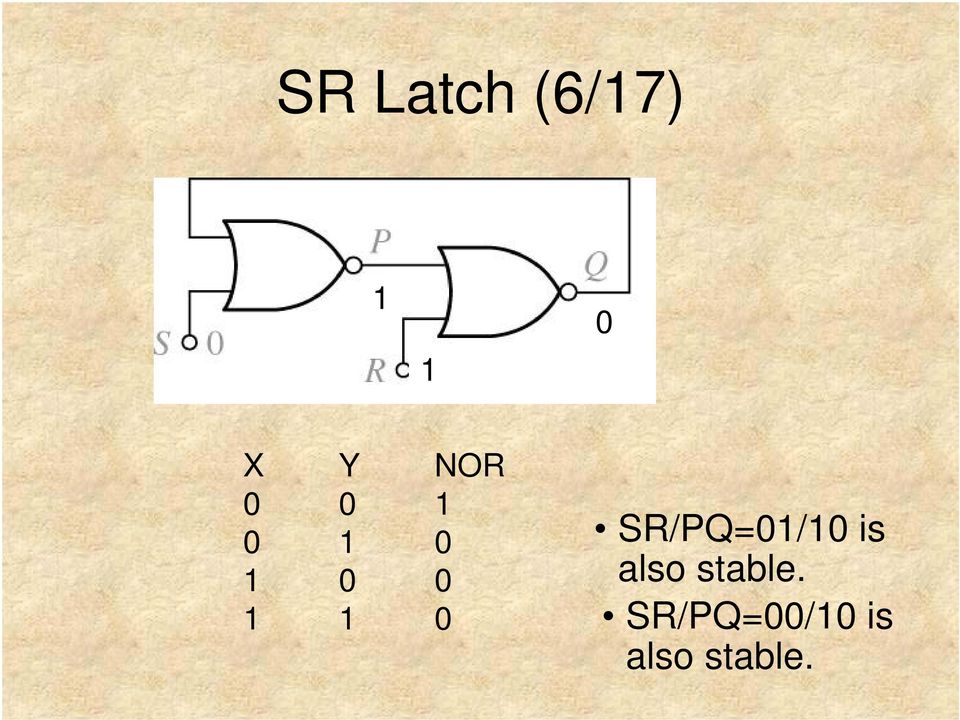
8 SR Latch (6/17) X Y NOR SR/PQ=01/10 is also stable. SR/PQ=00/10 is also stable.
9 SR Latch (7/17) X Y NOR

10 SR Latch (8/17) X Y NOR
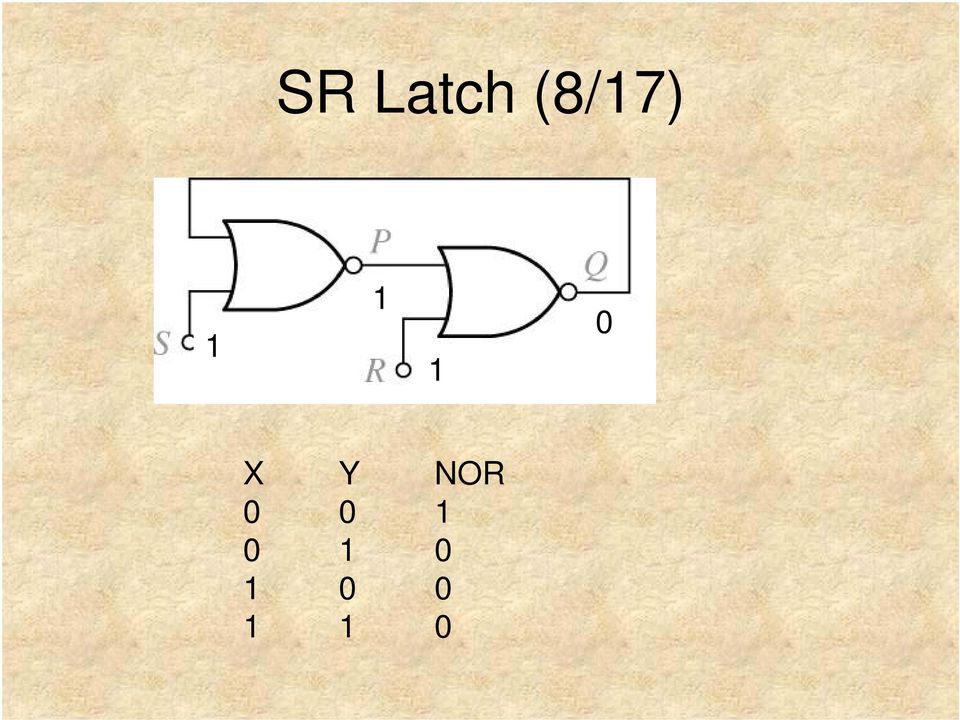
11 SR Latch (9/17) PQ=01 SR=00 PQ=10 PQ=01 PQ=01 PQ=10 SR=10 SR=01 PQ=10 The change between any two of 00, 10, 01 will reach a stable state.

12 SR Latch (10/17) X Y NOR What is PQ when the circuit is stable?

13 SR Latch (11/17) SR=11 is restricted in SR latch. PQ cannot be both 1.

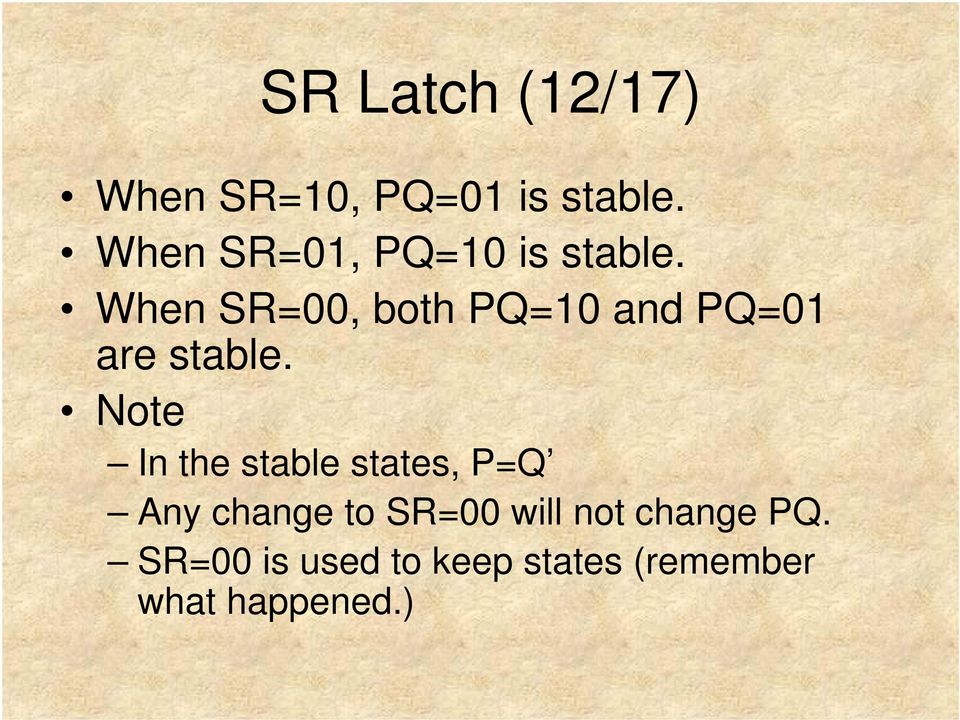
14 SR Latch (12/17) When SR=10, PQ=01 is stable. When SR=01, PQ=10 is stable. When SR=00, both PQ=10 and PQ=01 are stable. Note In the stable states, P=Q Any change to SR=00 will not change PQ. SR=00 is used to keep states (remember what happened.)
15 S: Set Q R: Reset Q SR Latch (13/17)

16 SR Latch (14/17) How to draw a truth table for an SR latch? Input? Output?

17 S R Q Q X X SR Latch (15/17)

18 SR Latch (16/17) Alternatively, an SR latch can be realized using NAND gates.

19 SR Latch (17/17) Alternatively, an SR latch can be realized using NAND gates. S-bar R-bar Q Q X X

20 Gated D Latch (1/3) Q + What are S and R when G=0? G=0 keeps states: Q + =D. Can SR=11 ever occur? Q + =D when G=1.

21 Gated D Latch (2/3) No do not care terms.
22 Gated D Latch (3/3) if(g==1){ Q + = D; }else{ Q + = Q; }
23 Edge-Triggered D Flip-Flop (FF) (1/3) If the G signal in the D latch is connected to a clock input, the output changes only in response to the clock, not to a change in D. And we call this latch a D Flip-Flop (FF). Q + =D
24 Edge-Triggered D Flip-Flop (FF) (2/3)
25 Edge-Triggered D Flip-Flop (FF) (3/3) Note Q does not change during Ck=0. Timing for D Flip-Flops (FF) (Falling-Edge Trigger)
26 S-R Flip-Flop (FF) (1/3) Q + changes in response to the clock signal.
27 S-R Flip-Flop (FF) (2/3) CLK When CLK=0 P + =S 1 +R 1 P When CLK=1 Q + =P
28 S-R Flip-Flop (FF) (3/3) Why master-slave Flip-Flops (FFs)? The master Flip-Flop (FF) holds the output for in the first half clock cycle. When the slave Flip-Flop (FF) updates and outputs, the master is closed. This mechanism guarantees that the final output changes only once in a clock cycle.
29 JK Flip-Flop (FF) (1/2) An extended version of the SR Flip-Flop (FF) J corresponds to S K corresponds to R J K Q Q JK can be 11. This configuration changes the state of Q.
30 JK Flip-Flop (FF) (2/2) S1=J * Q * CLK R1=K * Q * CLK S1 and R1 cannot be 1 at the same time.
31 T Flip-Flop (FF) (1/2) T=0 no state change T=1 state changes TQ Q Q + =T xor Q
32 T Flip-Flop (FF) (2/2)
33 Summary (1/8) All the Flip-Flops (FFs) and D latch are based on SR latch. SRlatch can be described using Q + =S+R Q S=1 sets Q R=1 resets Q SR=00 keeps states (Q does not change.)
34 Summary (2/8) Q + =S+R Q Gated D latch S=DG R=D G When G=0, SR==00 state kept. When G=1, Q=D When D=0, SR=01 reset Q Q=0 When D=1, SR=10 set Q Q=1
35 Summary (3/8) Q + =S+R Q When G is a clock signal, two gated D latches comprise an edge-triggered D Flip-Flop (FF) D CLK Q if(clk is low) Q does not change else Q becomes D shortly after the rising edge Note Q s waveform is not exactly the same with D s.
36 Summary (4/8) Q + =S+R Q SR Flip-Flop (FF) Master and slave When the master receives the input and updates, the slave is close. When the slave outputs, the master does not respond to any input change.
37 Summary (5/8) Q + =S+R Q SR Flip-Flop (FF) (cont) When CLK is low, S 1 R 1 =SR P + = S+R P, master is updated S 2 R 2 =00 Q does not change
38 Summary (6/8) Q + =S+R Q SR Flip-Flop (FF) (cont) When CLK is high, S 1 R 1 =00 P does not change master does not respond to inputs S 2 R 2 =PP Q + =P+(P ) Q=P
39 Summary (7/8) Q + =S+R Q SR Flip-Flop (FF) (cont) SR P Master CLK Q low high low high low high Slave The final output, Q, was not affected by 01.
40 Summary (8/8) Q + =S+R Q JK Flip-Flop (FF) Very similar to SR master-slave Flip-Flop (FF) Except JK=11 inverts the output T Flip-Flop (FF) T=1 inverts the output T=0 keeps the same output
41 Flip-Flops (FFs) with Additional Inputs (1/3) Clear and Preset signals are two asynchronous signals and do not depend on CLK.
42 Flip-Flops (FFs) with Additional Inputs (2/3)
43 Flip-Flops (FFs) with Additional Clock enable signal Inputs (3/3)
CHAPTER 11 LATCHES AND FLIP-FLOPS
 CHAPTER 11 LATCHES AND FLIP-FLOPS This chapter in the book includes: Objectives Study Guide 11.1 Introduction 11.2 Set-Reset Latch 11.3 Gated D Latch 11.4 Edge-Triggered D Flip-Flop 11.5 S-R Flip-Flop
ECE380 Digital Logic
 ECE38 igital Logic Flip-Flops, Registers and Counters: Flip-Flops r.. J. Jackson Lecture 25- Flip-flops The gated latch circuits presented are level sensitive and can change states more than once during
Latches, the D Flip-Flop & Counter Design. ECE 152A Winter 2012
 Latches, the D Flip-Flop & Counter Design ECE 52A Winter 22 Reading Assignment Brown and Vranesic 7 Flip-Flops, Registers, Counters and a Simple Processor 7. Basic Latch 7.2 Gated SR Latch 7.2. Gated SR
Engr354: Digital Logic Circuits
 Engr354: igital Circuits Chapter 7 Sequential Elements r. Curtis Nelson Sequential Elements In this chapter you will learn about: circuits that can store information; Basic cells, latches, and flip-flops;
Sequential Logic. (Materials taken from: Principles of Computer Hardware by Alan Clements )
 Sequential Logic (Materials taken from: Principles of Computer Hardware by Alan Clements ) Sequential vs. Combinational Circuits Combinatorial circuits: their outputs are computed entirely from their present
SEQUENTIAL CIRCUITS. Block diagram. Flip Flop. S-R Flip Flop. Block Diagram. Circuit Diagram
 SEQUENTIAL CIRCUITS http://www.tutorialspoint.com/computer_logical_organization/sequential_circuits.htm Copyright tutorialspoint.com The combinational circuit does not use any memory. Hence the previous
Master/Slave Flip Flops
 Master/Slave Flip Flops Page 1 A Master/Slave Flip Flop ( Type) Gated latch(master) Gated latch (slave) 1 Gate Gate GATE Either: The master is loading (the master in on) or The slave is loading (the slave
Flip-Flops and Sequential Circuit Design. ECE 152A Winter 2012
 Flip-Flops and Sequential Circuit Design ECE 52 Winter 22 Reading ssignment Brown and Vranesic 7 Flip-Flops, Registers, Counters and a Simple Processor 7.5 T Flip-Flop 7.5. Configurable Flip-Flops 7.6
Flip-Flops and Sequential Circuit Design
 Flip-Flops and Sequential Circuit Design ECE 52 Winter 22 Reading ssignment Brown and Vranesic 7 Flip-Flops, Registers, Counters and a Simple Processor 7.5 T Flip-Flop 7.5. Configurable Flip-Flops 7.6
Lesson 12 Sequential Circuits: Flip-Flops
 Lesson 12 Sequential Circuits: Flip-Flops 1. Overview of a Synchronous Sequential Circuit We saw from last lesson that the level sensitive latches could cause instability in a sequential system. This instability
Module 3: Floyd, Digital Fundamental
 Module 3: Lecturer : Yongsheng Gao Room : Tech - 3.25 Email : [email protected] Structure : 6 lectures 1 Tutorial Assessment: 1 Laboratory (5%) 1 Test (20%) Textbook : Floyd, Digital Fundamental
Theory of Logic Circuits. Laboratory manual. Exercise 3
 Zakład Mikroinformatyki i Teorii Automatów yfrowych Theory of Logic ircuits Laboratory manual Exercise 3 Bistable devices 2008 Krzysztof yran, Piotr zekalski (edt.) 1. lassification of bistable devices
DIGITAL TECHNICS II. Dr. Bálint Pődör. Óbuda University, Microelectronics and Technology Institute
 DIGITAL TECHNICS II Dr. Bálint Pődör Óbuda University, Microelectronics and Technology Institute 2. LECTURE: ELEMENTARY SEUENTIAL CIRCUITS: FLIP-FLOPS 1st year BSc course 2nd (Spring) term 2012/2013 1
L4: Sequential Building Blocks (Flip-flops, Latches and Registers)
 L4: Sequential Building Blocks (Flip-flops, Latches and Registers) Acknowledgements: Materials in this lecture are courtesy of the following sources and are used with permission. Prof. Randy Katz (Unified
Having read this workbook you should be able to: recognise the arrangement of NAND gates used to form an S-R flip-flop.
 Objectives Having read this workbook you should be able to: recognise the arrangement of NAND gates used to form an S-R flip-flop. describe how such a flip-flop can be SET and RESET. describe the disadvantage
Memory Elements. Combinational logic cannot remember
 Memory Elements Combinational logic cannot remember Output logic values are function of inputs only Feedback is needed to be able to remember a logic value Memory elements are needed in most digital logic
To design digital counter circuits using JK-Flip-Flop. To implement counter using 74LS193 IC.
 8.1 Objectives To design digital counter circuits using JK-Flip-Flop. To implement counter using 74LS193 IC. 8.2 Introduction Circuits for counting events are frequently used in computers and other digital
CS311 Lecture: Sequential Circuits
 CS311 Lecture: Sequential Circuits Last revised 8/15/2007 Objectives: 1. To introduce asynchronous and synchronous flip-flops (latches and pulsetriggered, plus asynchronous preset/clear) 2. To introduce
Flip-Flops, Registers, Counters, and a Simple Processor
 June 8, 22 5:56 vra235_ch7 Sheet number Page number 349 black chapter 7 Flip-Flops, Registers, Counters, and a Simple Processor 7. Ng f3, h7 h6 349 June 8, 22 5:56 vra235_ch7 Sheet number 2 Page number
Chapter 5. Sequential Logic
 Chapter 5 Sequential Logic Sequential Circuits (/2) Combinational circuits: a. contain no memory elements b. the outputs depends on the current inputs Sequential circuits: a feedback path outputs depends
Modeling Latches and Flip-flops
 Lab Workbook Introduction Sequential circuits are digital circuits in which the output depends not only on the present input (like combinatorial circuits), but also on the past sequence of inputs. In effect,
Lecture 8: Synchronous Digital Systems
 Lecture 8: Synchronous Digital Systems The distinguishing feature of a synchronous digital system is that the circuit only changes in response to a system clock. For example, consider the edge triggered
Contents COUNTER. Unit III- Counters
 COUNTER Contents COUNTER...1 Frequency Division...2 Divide-by-2 Counter... 3 Toggle Flip-Flop...3 Frequency Division using Toggle Flip-flops...5 Truth Table for a 3-bit Asynchronous Up Counter...6 Modulo
Experiment # 9. Clock generator circuits & Counters. Eng. Waleed Y. Mousa
 Experiment # 9 Clock generator circuits & Counters Eng. Waleed Y. Mousa 1. Objectives: 1. Understanding the principles and construction of Clock generator. 2. To be familiar with clock pulse generation
Sequential Logic Design Principles.Latches and Flip-Flops
 Sequential Logic Design Principles.Latches and Flip-Flops Doru Todinca Department of Computers Politehnica University of Timisoara Outline Introduction Bistable Elements Latches and Flip-Flops S-R Latch
Chapter 9 Latches, Flip-Flops, and Timers
 ETEC 23 Programmable Logic Devices Chapter 9 Latches, Flip-Flops, and Timers Shawnee State University Department of Industrial and Engineering Technologies Copyright 27 by Janna B. Gallaher Latches A temporary
CSE140: Components and Design Techniques for Digital Systems
 CE4: Components and esign Techniques for igital ystems Tajana imunic osing ources: Where we are now What we ve covered so far (Chap -5, App. A& B) Number representations Boolean algebra OP and PO Logic
DIGITAL COUNTERS. Q B Q A = 00 initially. Q B Q A = 01 after the first clock pulse.
 DIGITAL COUNTERS http://www.tutorialspoint.com/computer_logical_organization/digital_counters.htm Copyright tutorialspoint.com Counter is a sequential circuit. A digital circuit which is used for a counting
7. Latches and Flip-Flops
 Chapter 7 Latches and Flip-Flops Page 1 of 18 7. Latches and Flip-Flops Latches and flip-flops are the basic elements for storing information. One latch or flip-flop can store one bit of information. The
Chapter 8. Sequential Circuits for Registers and Counters
 Chapter 8 Sequential Circuits for Registers and Counters Lesson 3 COUNTERS Ch16L3- "Digital Principles and Design", Raj Kamal, Pearson Education, 2006 2 Outline Counters T-FF Basic Counting element State
Modeling Sequential Elements with Verilog. Prof. Chien-Nan Liu TEL: 03-4227151 ext:34534 Email: [email protected]. Sequential Circuit
 Modeling Sequential Elements with Verilog Prof. Chien-Nan Liu TEL: 03-4227151 ext:34534 Email: [email protected] 4-1 Sequential Circuit Outputs are functions of inputs and present states of storage elements
BINARY CODED DECIMAL: B.C.D.
 BINARY CODED DECIMAL: B.C.D. ANOTHER METHOD TO REPRESENT DECIMAL NUMBERS USEFUL BECAUSE MANY DIGITAL DEVICES PROCESS + DISPLAY NUMBERS IN TENS IN BCD EACH NUMBER IS DEFINED BY A BINARY CODE OF 4 BITS.
Set-Reset (SR) Latch
 et-eset () Latch Asynchronous Level sensitive cross-coupled Nor gates active high inputs (only one can be active) + + Function 0 0 0 1 0 1 eset 1 0 1 0 et 1 1 0-? 0-? Indeterminate cross-coupled Nand gates
Sequential Logic: Clocks, Registers, etc.
 ENEE 245: igital Circuits & Systems Lab Lab 2 : Clocks, Registers, etc. ENEE 245: igital Circuits and Systems Laboratory Lab 2 Objectives The objectives of this laboratory are the following: To design
WEEK 8.1 Registers and Counters. ECE124 Digital Circuits and Systems Page 1
 WEEK 8.1 egisters and Counters ECE124 igital Circuits and Systems Page 1 Additional schematic FF symbols Active low set and reset signals. S Active high set and reset signals. S ECE124 igital Circuits
Asynchronous Counters. Asynchronous Counters
 Counters and State Machine Design November 25 Asynchronous Counters ENGI 25 ELEC 24 Asynchronous Counters The term Asynchronous refers to events that do not occur at the same time With respect to counter
LAB #4 Sequential Logic, Latches, Flip-Flops, Shift Registers, and Counters
 LAB #4 Sequential Logic, Latches, Flip-Flops, Shift Registers, and Counters LAB OBJECTIVES 1. Introduction to latches and the D type flip-flop 2. Use of actual flip-flops to help you understand sequential
So far we have investigated combinational logic for which the output of the logic devices/circuits depends only on the present state of the inputs.
 equential Logic o far we have investigated combinational logic for which the output of the logic devices/circuits depends only on the present state of the inputs. In sequential logic the output of the
EE 42/100 Lecture 24: Latches and Flip Flops. Rev B 4/21/2010 (2:04 PM) Prof. Ali M. Niknejad
 A. M. Niknejad University of California, Berkeley EE 100 / 42 Lecture 24 p. 1/20 EE 42/100 Lecture 24: Latches and Flip Flops ELECTRONICS Rev B 4/21/2010 (2:04 PM) Prof. Ali M. Niknejad University of California,
Digital Logic Design. Basics Combinational Circuits Sequential Circuits. Pu-Jen Cheng
 Digital Logic Design Basics Combinational Circuits Sequential Circuits Pu-Jen Cheng Adapted from the slides prepared by S. Dandamudi for the book, Fundamentals of Computer Organization and Design. Introduction
Counters and Decoders
 Physics 3330 Experiment #10 Fall 1999 Purpose Counters and Decoders In this experiment, you will design and construct a 4-bit ripple-through decade counter with a decimal read-out display. Such a counter
Upon completion of unit 1.1, students will be able to
 Upon completion of unit 1.1, students will be able to 1. Demonstrate safety of the individual, class, and overall environment of the classroom/laboratory, and understand that electricity, even at the nominal
IE1204 Digital Design F12: Asynchronous Sequential Circuits (Part 1)
 IE1204 Digital Design F12: Asynchronous Sequential Circuits (Part 1) Elena Dubrova KTH / ICT / ES [email protected] BV pp. 584-640 This lecture IE1204 Digital Design, HT14 2 Asynchronous Sequential Machines
DIGITAL ELECTRONICS. Counters. By: Electrical Engineering Department
 Counters By: Electrical Engineering Department 1 Counters Upon completion of the chapter, students should be able to:.1 Understand the basic concepts of asynchronous counter and synchronous counters, and
Combinational Logic Design Process
 Combinational Logic Design Process Create truth table from specification Generate K-maps & obtain logic equations Draw logic diagram (sharing common gates) Simulate circuit for design verification Debug
ENEE 244 (01**). Spring 2006. Homework 5. Due back in class on Friday, April 28.
 ENEE 244 (01**). Spring 2006 Homework 5 Due back in class on Friday, April 28. 1. Fill up the function table (truth table) for the following latch. How is this latch related to those described in the lectures
The components. E3: Digital electronics. Goals:
 E3: Digital electronics Goals: Basic understanding of logic circuits. Become familiar with the most common digital components and their use. Equipment: 1 st. LED bridge 1 st. 7-segment display. 2 st. IC
Lecture 10: Sequential Circuits
 Introduction to CMOS VLSI esign Lecture 10: Sequential Circuits avid Harris Harvey Mudd College Spring 2004 Outline q Sequencing q Sequencing Element esign q Max and Min-elay q Clock Skew q Time Borrowing
Topics of Chapter 5 Sequential Machines. Memory elements. Memory element terminology. Clock terminology
 Topics of Chapter 5 Sequential Machines Memory elements Memory elements. Basics of sequential machines. Clocking issues. Two-phase clocking. Testing of combinational (Chapter 4) and sequential (Chapter
DIGITAL TECHNICS II. Dr. Bálint Pődör. Óbuda University, Microelectronics and Technology Institute 5. LECTURE: REGISTERS AND RELATED
 DIGITAL TECHNICS II Dr. Bálint Pődör Óbuda University, Microelectronics and Technology Institute 5. LECTURE: REGISTERS AND RELATED 2nd (Spring) term 22/23 5. LECTURE: REGISTERS. Storage registers 2. Shift
Lecture 10 Sequential Circuit Design Zhuo Feng. Z. Feng MTU EE4800 CMOS Digital IC Design & Analysis 2010
 EE4800 CMOS igital IC esign & Analysis Lecture 10 Sequential Circuit esign Zhuo Feng 10.1 Z. Feng MTU EE4800 CMOS igital IC esign & Analysis 2010 Sequencing Outline Sequencing Element esign Max and Min-elay
Digital Fundamentals
 igital Fundamentals with PL Programming Floyd Chapter 9 Floyd, igital Fundamentals, 10 th ed, Upper Saddle River, NJ 07458. All Rights Reserved Summary Latches (biestables) A latch is a temporary storage
CDA 3200 Digital Systems. Instructor: Dr. Janusz Zalewski Developed by: Dr. Dahai Guo Spring 2012
 CDA 3200 Digital Systems Instructor: Dr. Janusz Zalewski Developed by: Dr. Dahai Guo Spring 2012 Outline Multi-Level Gate Circuits NAND and NOR Gates Design of Two-Level Circuits Using NAND and NOR Gates
Digital Systems Based on Principles and Applications of Electrical Engineering/Rizzoni (McGraw Hill
 Digital Systems Based on Principles and Applications of Electrical Engineering/Rizzoni (McGraw Hill Objectives: Analyze the operation of sequential logic circuits. Understand the operation of digital counters.
Fig1-1 2-bit asynchronous counter
 Digital electronics 1-Sequential circuit counters Such a group of flip- flops is a counter. The number of flip-flops used and the way in which they are connected determine the number of states and also
COMBINATIONAL and SEQUENTIAL LOGIC CIRCUITS Hardware implementation and software design
 PH-315 COMINATIONAL and SEUENTIAL LOGIC CIRCUITS Hardware implementation and software design A La Rosa I PURPOSE: To familiarize with combinational and sequential logic circuits Combinational circuits
Timing Methodologies (cont d) Registers. Typical timing specifications. Synchronous System Model. Short Paths. System Clock Frequency
 Registers Timing Methodologies (cont d) Sample data using clock Hold data between clock cycles Computation (and delay) occurs between registers efinition of terms setup time: minimum time before the clocking
Counters. Present State Next State A B A B 0 0 0 1 0 1 1 0 1 0 1 1 1 1 0 0
 ounter ounters ounters are a specific type of sequential circuit. Like registers, the state, or the flip-flop values themselves, serves as the output. The output value increases by one on each clock cycle.
Lecture-3 MEMORY: Development of Memory:
 Lecture-3 MEMORY: It is a storage device. It stores program data and the results. There are two kind of memories; semiconductor memories & magnetic memories. Semiconductor memories are faster, smaller,
Lecture 11: Sequential Circuit Design
 Lecture 11: Sequential Circuit esign Outline Sequencing Sequencing Element esign Max and Min-elay Clock Skew Time Borrowing Two-Phase Clocking 2 Sequencing Combinational logic output depends on current
Copyright Peter R. Rony 2009. All rights reserved.
 Experiment No. 1. THE DIGI DESIGNER Experiment 1-1. Socket Connections on the Digi Designer Experiment No. 2. LOGIC LEVELS AND THE 7400 QUADRUPLE 2-INPUT POSITIVE NAND GATE Experiment 2-1. Truth Table
Digital Logic Design Sequential circuits
 Digital Logic Design Sequential circuits Dr. Eng. Ahmed H. Madian E-mail: [email protected] Dr. Eng. Rania.Swief E-mail: [email protected] Dr. Eng. Ahmed H. Madian Registers An n-bit register
Counters & Shift Registers Chapter 8 of R.P Jain
 Chapter 3 Counters & Shift Registers Chapter 8 of R.P Jain Counters & Shift Registers Counters, Syllabus Design of Modulo-N ripple counter, Up-Down counter, design of synchronous counters with and without
Design Verification & Testing Design for Testability and Scan
 Overview esign for testability (FT) makes it possible to: Assure the detection of all faults in a circuit Reduce the cost and time associated with test development Reduce the execution time of performing
Sequential Circuit Design
 Sequential Circuit Design Lan-Da Van ( 倫 ), Ph. D. Department of Computer Science National Chiao Tung University Taiwan, R.O.C. Fall, 2009 [email protected] http://www.cs.nctu.edu.tw/~ldvan/ Outlines
Sequential Circuits. Combinational Circuits Outputs depend on the current inputs
 Principles of VLSI esign Sequential Circuits Sequential Circuits Combinational Circuits Outputs depend on the current inputs Sequential Circuits Outputs depend on current and previous inputs Requires separating
Digital Electronics Part I Combinational and Sequential Logic. Dr. I. J. Wassell
 Digital Electronics Part I Combinational and Sequential Logic Dr. I. J. Wassell Introduction Aims To familiarise students with Combinational logic circuits Sequential logic circuits How digital logic gates
ASYNCHRONOUS COUNTERS
 LB no.. SYNCHONOUS COUNTES. Introduction Counters are sequential logic circuits that counts the pulses applied at their clock input. They usually have 4 bits, delivering at the outputs the corresponding
ETEC 2301 Programmable Logic Devices. Chapter 10 Counters. Shawnee State University Department of Industrial and Engineering Technologies
 ETEC 2301 Programmable Logic Devices Chapter 10 Counters Shawnee State University Department of Industrial and Engineering Technologies Copyright 2007 by Janna B. Gallaher Asynchronous Counter Operation
Design: a mod-8 Counter
 Design: a mod-8 Counter A mod-8 counter stores a integer value, and increments that value (say) on each clock tick, and wraps around to 0 if the previous stored value was 7. So, the stored value follows
1.1 The 7493 consists of 4 flip-flops with J-K inputs unconnected. In a TTL chip, unconnected inputs
 CALIFORNIA STATE UNIVERSITY LOS ANGELES Department of Electrical and Computer Engineering EE-246 Digital Logic Lab EXPERIMENT 1 COUNTERS AND WAVEFORMS Text: Mano, Digital Design, 3rd & 4th Editions, Sec.
Registers & Counters
 Objectives This section deals with some simple and useful sequential circuits. Its objectives are to: Introduce registers as multi-bit storage devices. Introduce counters by adding logic to registers implementing
Design Example: Counters. Design Example: Counters. 3-Bit Binary Counter. 3-Bit Binary Counter. Other useful counters:
 Design Eample: ers er: a sequential circuit that repeats a specified sequence of output upon clock pulses. A,B,C,, Z. G, O, T, E, R, P, S,!.,,,,,,,7. 7,,,,,,,.,,,,,,,,,,,. Binary counter: follows the binary
NTE2053 Integrated Circuit 8 Bit MPU Compatible A/D Converter
 NTE2053 Integrated Circuit 8 Bit MPU Compatible A/D Converter Description: The NTE2053 is a CMOS 8 bit successive approximation Analog to Digital converter in a 20 Lead DIP type package which uses a differential
DIGITAL TECHNICS II. Dr. Bálint Pődör. Óbuda University, Microelectronics and Technology Institute. 2nd (Spring) term 2012/2013
 DIGITAL TECHNICS II Dr. Bálint Pődör Óbuda University, Microelectronics and Technology Institute 4. LECTURE: COUNTERS AND RELATED 2nd (Spring) term 2012/2013 1 4. LECTURE: COUNTERS AND RELATED 1. Counters,
CHAPTER 3 Boolean Algebra and Digital Logic
 CHAPTER 3 Boolean Algebra and Digital Logic 3.1 Introduction 121 3.2 Boolean Algebra 122 3.2.1 Boolean Expressions 123 3.2.2 Boolean Identities 124 3.2.3 Simplification of Boolean Expressions 126 3.2.4
Digital Controller for Pedestrian Crossing and Traffic Lights
 Project Objective: - To design and simulate, a digital controller for traffic and pedestrian lights at a pedestrian crossing using Microsim Pspice The controller must be based on next-state techniques
Decimal Number (base 10) Binary Number (base 2)
 LECTURE 5. BINARY COUNTER Before starting with counters there is some vital information that needs to be understood. The most important is the fact that since the outputs of a digital chip can only be
Digital Electronics Detailed Outline
 Digital Electronics Detailed Outline Unit 1: Fundamentals of Analog and Digital Electronics (32 Total Days) Lesson 1.1: Foundations and the Board Game Counter (9 days) 1. Safety is an important concept
CDA 3200 Digital Systems. Instructor: Dr. Janusz Zalewski Developed by: Dr. Dahai Guo Spring 2012
 CDA 3200 Digital Systems Instructor: Dr. Janusz Zalewski Developed by: Dr. Dahai Guo Spring 2012 Outline Data Representation Binary Codes Why 6-3-1-1 and Excess-3? Data Representation (1/2) Each numbering
DEPARTMENT OF INFORMATION TECHNLOGY
 DRONACHARYA GROUP OF INSTITUTIONS, GREATER NOIDA Affiliated to Mahamaya Technical University, Noida Approved by AICTE DEPARTMENT OF INFORMATION TECHNLOGY Lab Manual for Computer Organization Lab ECS-453
CHAPTER 11: Flip Flops
 CHAPTER 11: Flip Flops In this chapter, you will be building the part of the circuit that controls the command sequencing. The required circuit must operate the counter and the memory chip. When the teach
Layout of Multiple Cells
 Layout of Multiple Cells Beyond the primitive tier primitives add instances of primitives add additional transistors if necessary add substrate/well contacts (plugs) add additional polygons where needed
Standart TTL, Serie 74... Art.Gruppe 13.15. 1...
 Standart TTL, Serie 74... Art.Gruppe 13.15. 1... Standart TTL, Serie 74... 7400 Quad 2-Input Nand Gate (TP) DIL14 7402 Quad 2 Input Nor Gate (TP) DIL14 7403 Quad 2 Input Nand Gate (OC) DIL14 7404 Hex Inverter
Counters are sequential circuits which "count" through a specific state sequence.
 Counters Counters are sequential circuits which "count" through a specific state sequence. They can count up, count down, or count through other fixed sequences. Two distinct types are in common usage:
EXPERIMENT 8. Flip-Flops and Sequential Circuits
 EXPERIMENT 8. Flip-Flops and Sequential Circuits I. Introduction I.a. Objectives The objective of this experiment is to become familiar with the basic operational principles of flip-flops and counters.
Gates, Circuits, and Boolean Algebra
 Gates, Circuits, and Boolean Algebra Computers and Electricity A gate is a device that performs a basic operation on electrical signals Gates are combined into circuits to perform more complicated tasks
Introduction to CMOS VLSI Design (E158) Lecture 8: Clocking of VLSI Systems
 Harris Introduction to CMOS VLSI Design (E158) Lecture 8: Clocking of VLSI Systems David Harris Harvey Mudd College [email protected] Based on EE271 developed by Mark Horowitz, Stanford University MAH
DATA SHEETS DE COMPONENTES DA FAMÍLIA LÓGICA TTL GATES AND INVERTERS POSITIVES NAND GATES AND INVERTERS DESCRIÇÃO
 GATES AND INVERTERS POSITIVES NAND GATES AND INVERTERS Hex Invertes 74LS04 Quadruple 2 Inputs Gates 74LS00 Triple 3 Inputs Gates 74LS10 Dual 4 Inputs Gates 74LS20 8 Inputs Gates 74LS30 13 Inputs Gates
ECE124 Digital Circuits and Systems Page 1
 ECE124 Digital Circuits and Systems Page 1 Chip level timing Have discussed some issues related to timing analysis. Talked briefly about longest combinational path for a combinational circuit. Talked briefly
1. True or False? A voltage level in the range 0 to 2 volts is interpreted as a binary 1.
 File: chap04, Chapter 04 1. True or False? A voltage level in the range 0 to 2 volts is interpreted as a binary 1. 2. True or False? A gate is a device that accepts a single input signal and produces one
Napier University. School of Engineering. Electronic Engineering A Module: SE42205 Digital Design
 Napier University School of Engineering Digital Design Clock + U1 out 5V "1" "2" "4" JK-FF D JK-FF C JK-FF B U8 SN7408 signal U4 SN74107 U5 SN74107 U6 SN74107 U3 SN7408 U2 J Q J Q & J Q & K CQ K CQ K CQ
DM74LS112A Dual Negative-Edge-Triggered Master-Slave J-K Flip-Flop with Preset, Clear, and Complementary Outputs
 August 1986 Revised March 2000 DM74LS112A Dual Negative-Edge-Triggered Master-Slave J-K Flip-Flop with Preset, Clear, and Complementary General Description This device contains two independent negative-edge-triggered
150127-Microprocessor & Assembly Language
 Chapter 3 Z80 Microprocessor Architecture The Z 80 is one of the most talented 8 bit microprocessors, and many microprocessor-based systems are designed around the Z80. The Z80 microprocessor needs an
PROGETTO DI SISTEMI ELETTRONICI DIGITALI. Digital Systems Design. Digital Circuits Advanced Topics
 PROGETTO DI SISTEMI ELETTRONICI DIGITALI Digital Systems Design Digital Circuits Advanced Topics 1 Sequential circuit and metastability 2 Sequential circuit - FSM A Sequential circuit contains: Storage
2 : BISTABLES. In this Chapter, you will find out about bistables which are the fundamental building blocks of electronic counting circuits.
 2 : BITABLE In this Chapter, you will find out about bistables which are the fundamental building blos of electronic counting circuits. et-reset bistable A bistable circuit, also called a latch, or flip-flop,
Clocking. Figure by MIT OCW. 6.884 - Spring 2005 2/18/05 L06 Clocks 1
 ing Figure by MIT OCW. 6.884 - Spring 2005 2/18/05 L06 s 1 Why s and Storage Elements? Inputs Combinational Logic Outputs Want to reuse combinational logic from cycle to cycle 6.884 - Spring 2005 2/18/05
Latch Timing Parameters. Flip-flop Timing Parameters. Typical Clock System. Clocking Overhead
 Clock - key to synchronous systems Topic 7 Clocking Strategies in VLSI Systems Peter Cheung Department of Electrical & Electronic Engineering Imperial College London Clocks help the design of FSM where