
Dimensional Analysis
|
|
|
- Eleanor Robertson
- 9 years ago
- Views:
Transcription
1 Dimensional Analysis An Important Example from Fluid Mechanics: Viscous Shear Forces V d t / / / / / / / / / / / / / / / / / / / / / / / / / / / / / / / / / Ƭ = F/A = μ V/d

2 More generally, the viscous shear stress may be written in terms of the local velocity gradient as, Ƭyx = μ du/dy (shear force in the x-direction, acting on a plane normal to the y-direction) The viscosity μ is often called the absolute or dynamic viscosity to distinguish it from the kinematic viscosity ʋ = μ/ρ, where ρ is the fluid density (g/cm 3 ). The cgs unit of viscosity, called the poise, is 1 g/(cm s); the mks unit is the stoke 1 kg/(m s)

3 The Reynolds number an important dimensionless parameter The Reynolds number is a qualitative expression of the ratio of inertial to viscous forces The mass flow rate per unit area (g cm -2 s -1 ) is the product of the fluid density ρ (g/cm 3 ) and the fluid velocity V (cm/s) The momentum flux is the product of the mass flow rate per unit area, ρv, and the fluid velocity V The momentum flux (inertial force per unit area) = ρv 2 The viscous force per unit area is Ƭyx = μ du/dy = μv/d The Reynolds number is ρv 2 /(μv/d) = ρvd/μ
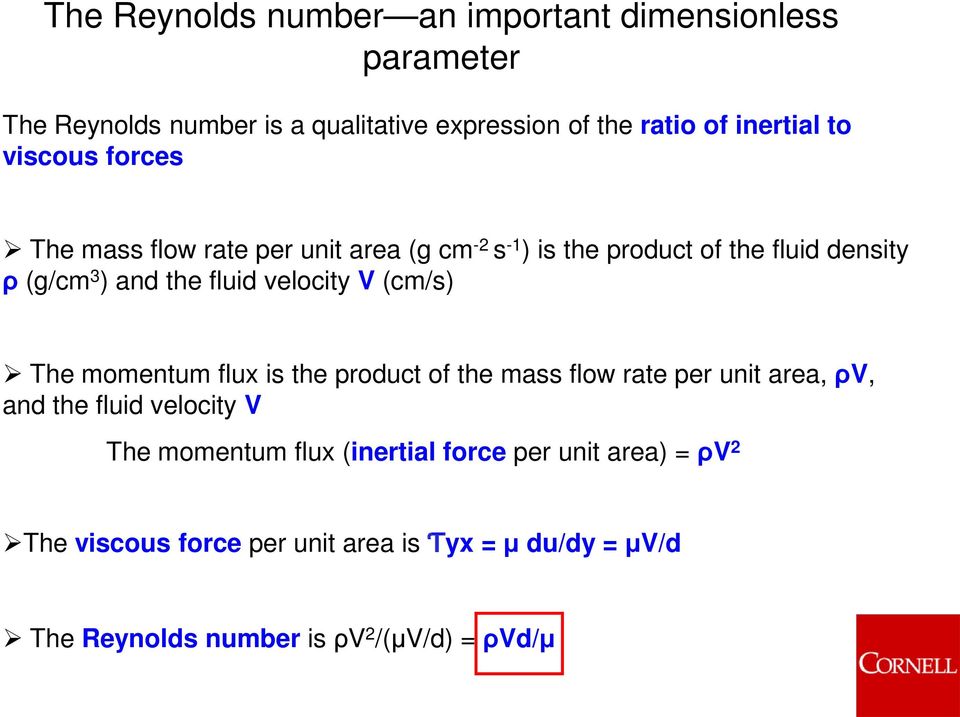
4 Flow direction Uniform flow past a circular cylinder at Re=ρVd/μ=0.16. In the limit as Re 0 (purely viscous flow) the flow has fore-and-aft symmetry.

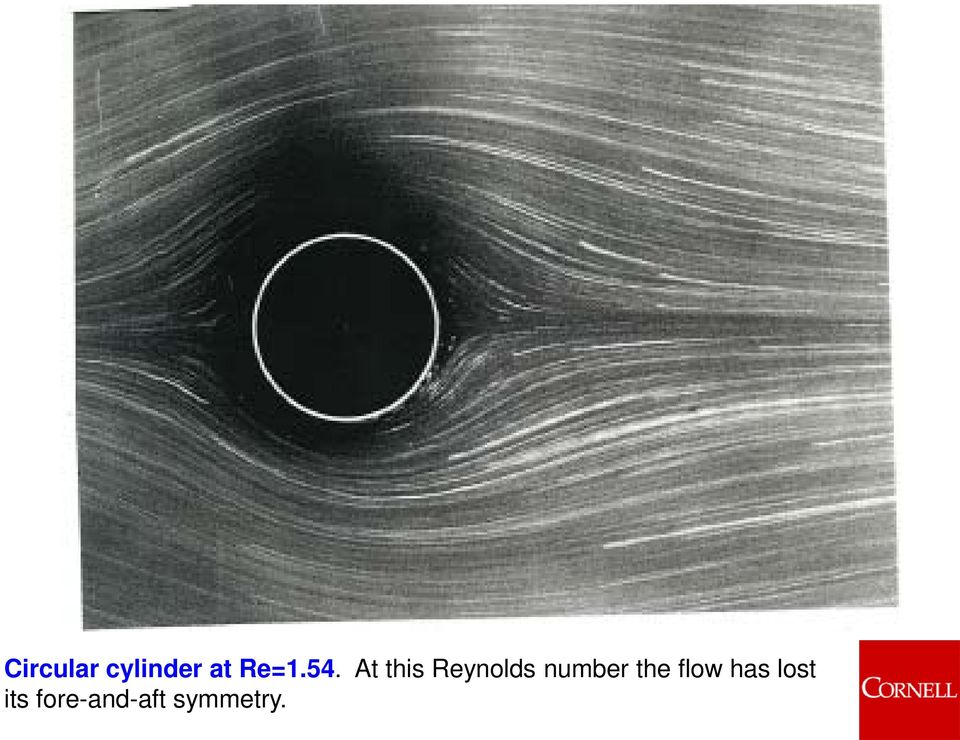
5 Circular cylinder at Re=1.54. At this Reynolds number the flow has lost its fore-and-aft symmetry.
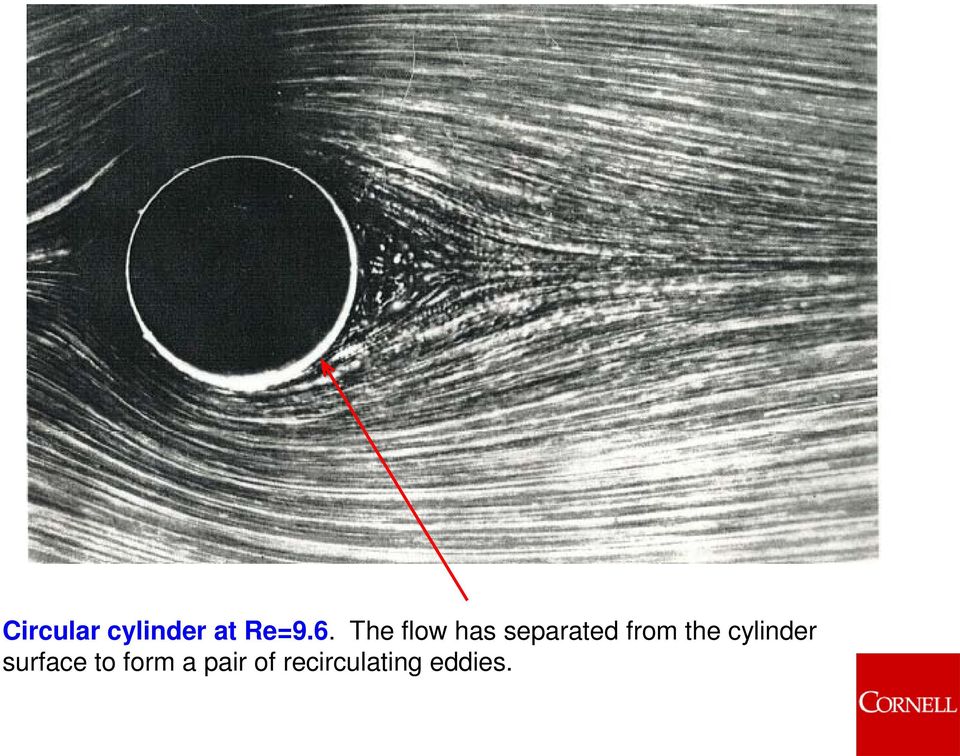
6 Circular cylinder at Re=9.6. The flow has separated from the cylinder surface to form a pair of recirculating eddies.
7 Circular cylinder at Re=13.1. The standing eddies become elongated along the flow direction as the Reynolds number increases.

8 Circular cylinder at Re=26.

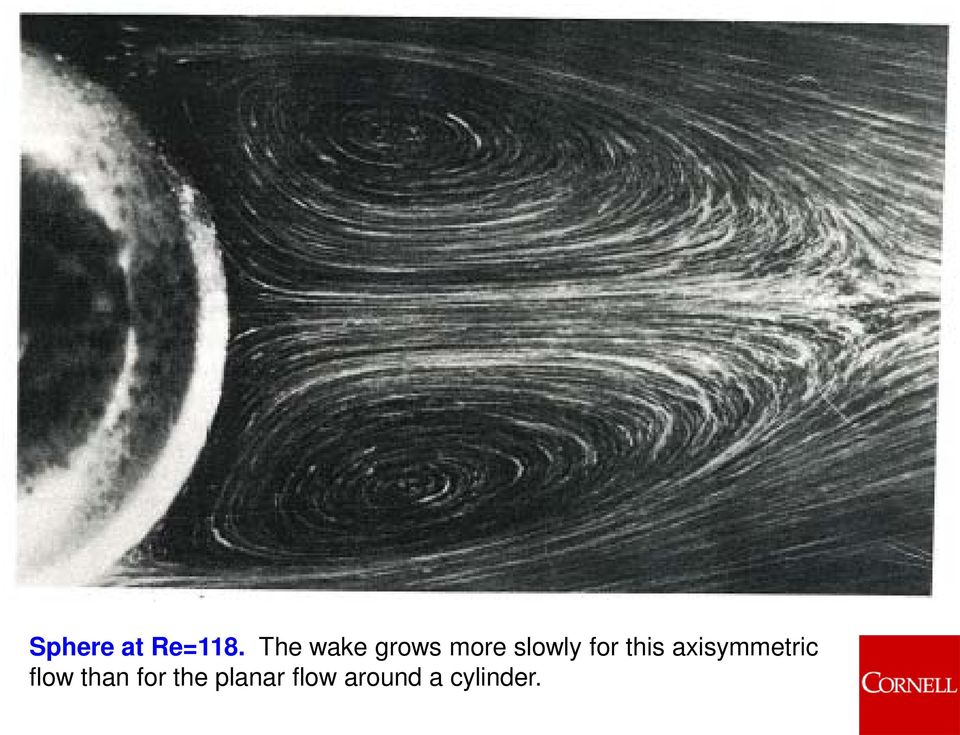
9 Sphere at Re=118. The wake grows more slowly for this axisymmetric flow than for the planar flow around a cylinder.
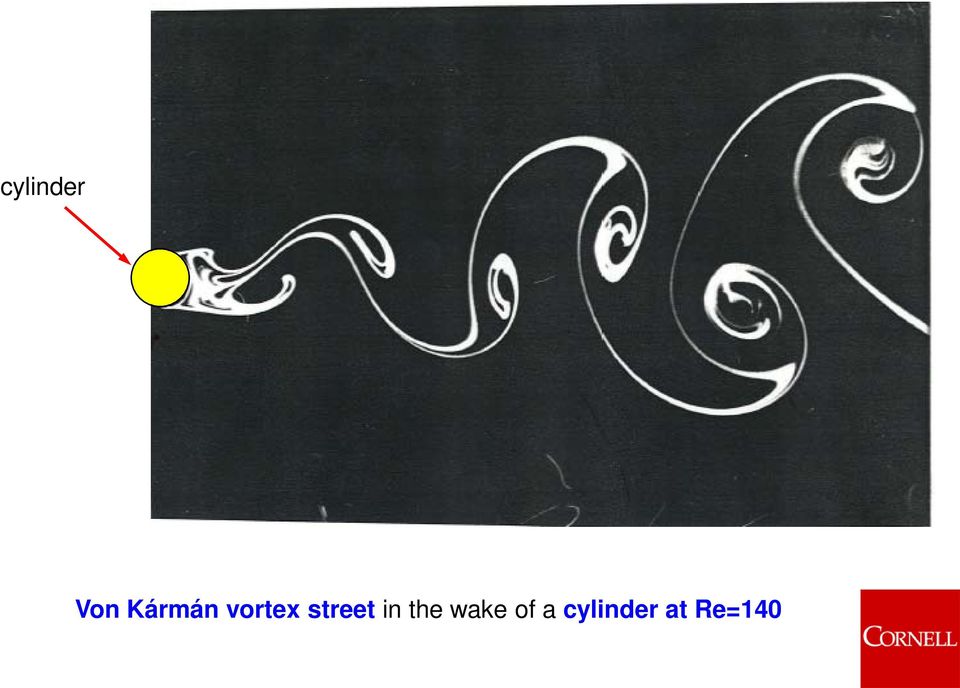
10 cylinder Von Kármán vortex street in the wake of a cylinder at Re=140

11 cylinder Von Kármán vortex street in the wake of a cylinder at Re=140
12 Circular cylinder at Re=2000. At this Reynolds number a thin boundary layer is well-defined. The boundary layer is laminar over the front, separates and breaks up into a turbulent wake.

13 The Boundary Layer The effects of viscosity are largely confined to a thin layer extending along the cylinder surfaces from the upstream stagnation point to the points of flow separation. This thin surface layer of slowly moving fluid is known as the boundary layer, a concept originating with the studies of Prandtl in the early 1900s. Viscosity also plays a role in a detailed description of the motion of the fluid within the recirculating wake region.
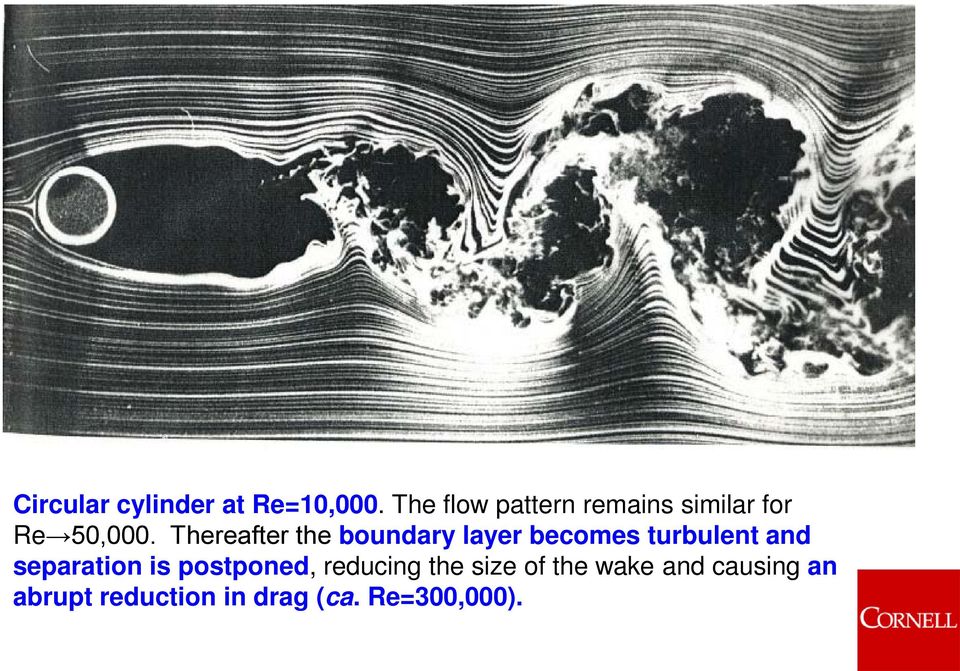
14 Circular cylinder at Re=10,000. The flow pattern remains similar for Re 50,000. Thereafter the boundary layer becomes turbulent and separation is postponed, reducing the size of the wake and causing an abrupt reduction in drag (ca. Re=300,000).
15 Dimensional Analysis Four Physical parameters: a) The viscosity μ, with the dimensions g/(cm s) b) The free-stream fluid velocity V (cm/s) c) The flow has a characteristic length scale provided by the diameter d of the cylinder or sphere d) It is also clear that another parameter containing a mass must be involved; this is the density ρ (g/cm 3 ) of the fluid. From these four physical parameters, containing among them the three dimensions M, L, T, we can form the dimensionless Reynolds number. Red = ρvd/μ

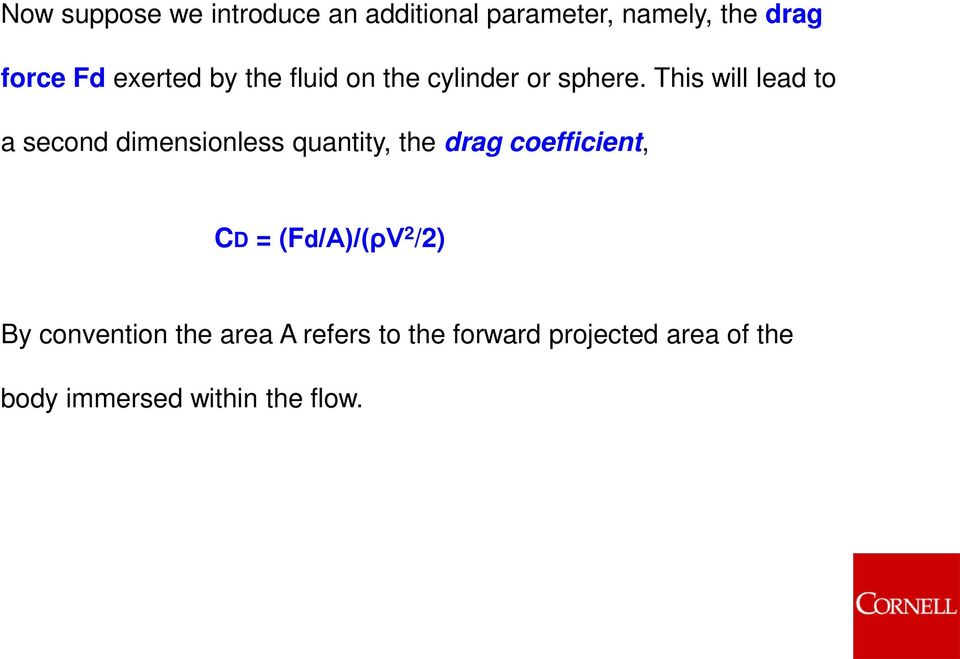
16 Now suppose we introduce an additional parameter, namely, the drag force Fd exerted by the fluid on the cylinder or sphere. This will lead to a second dimensionless quantity, the drag coefficient, CD = (Fd/A)/(ρV 2 /2) By convention the area A refers to the forward projected area of the body immersed within the flow.
17 In general, if a problem depends on N parameters containing M dimensions, then there are N-M independent dimensionless ratios linked by a unique functional relationship. In the present case, the N parameters are ρ, V, d, μ, and Fd, which contain among them the three dimensions mass, length, and time. We desire the functional relationship that links two dimensionless ratios CD and Red, i.e., CD = CD(Red) Once this relationship is known then we may calculate the drag force Fd by computing CD for any desired Reynolds number, Red.

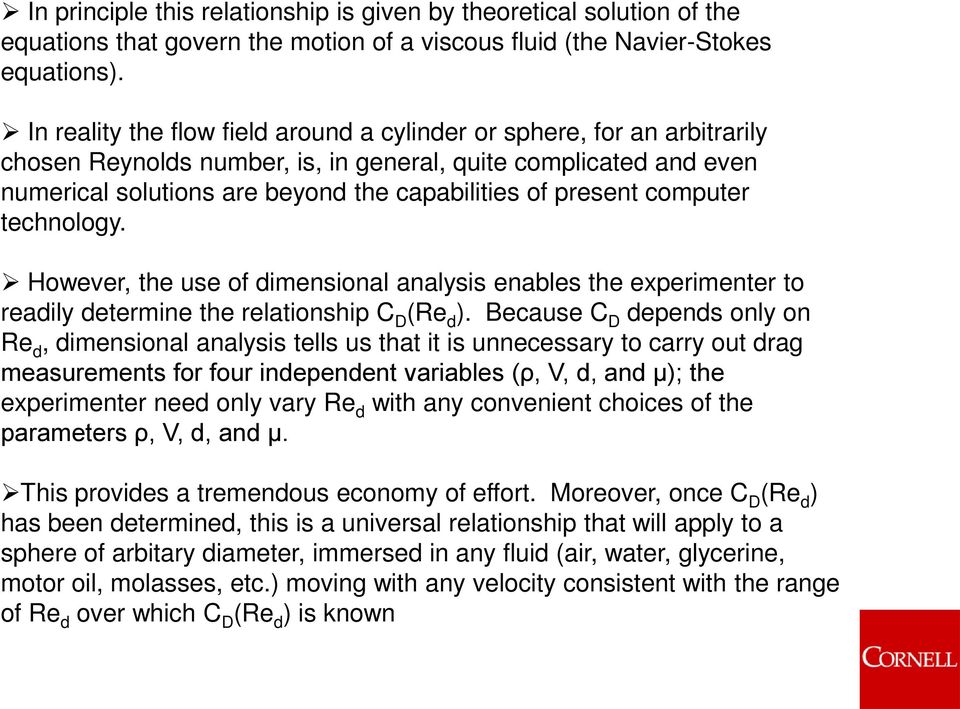
18 In principle this relationship is given by theoretical solution of the equations that govern the motion of a viscous fluid (the Navier-Stokes equations). In reality the flow field around a cylinder or sphere, for an arbitrarily chosen Reynolds number, is, in general, quite complicated and even numerical solutions are beyond the capabilities of present computer technology. However, the use of dimensional analysis enables the experimenter to readily determine the relationship C D (Re d ). Because C D depends only on Re d, dimensional analysis tells us that it is unnecessary to carry out drag measurements for four independent variables (ρ, V, d, and μ); the experimenter need only vary Re d with any convenient choices of the parameters ρ, V, d, and μ. This provides a tremendous economy of effort. Moreover, once C D (Re d ) has been determined, this is a universal relationship that will apply to a sphere of arbitary diameter, immersed in any fluid (air, water, glycerine, motor oil, molasses, etc.) moving with any velocity consistent with the range of Re d over which C D (Re d ) is known
19

20 For Stokes flow Fd = 3πμVd
21 Dimensionless Quantities (set = to unity to define length and energy scales)
22 (length scale) we set this quantity equal to unity. Then the energy scale
23 Radiation from an Accelerating Charge
24
25 Vortex Shedding; the Tacoma Narrows Bridge Disaster of 1940
26 Consider the shedding of vortices in the wake of a cylinder of diameter d. Assume the physical quantities responsible for the shedding are: d, V, μ, ρ, and ω. V is the wind velocity, μ and ρ are the viscosity and density of air and ω is the vortex shedding frequency. The five physical quantities contain among them the 3 dimensions, M, L, T. The number of independent dimensionless groups is therefore 5-3=2. Two independent groups are ρvd/μ and ωd/v, the Reynolds and Strouhal numbers, respectively. The dependence of the Strouhal number on the Reynolds number would be established by choosing parameters in any convenient manner such that each number is varied over a wide range. An approach, suited for measurements in a given fluid with fixed values for ρ and μ, would be to vary both the Reynolds and Strouhal numbers by varying V and d while observing changes in ω.
27 Capillary Waves
28 Spherical Blast Wave
29 Poiseuille s Law
30 Hull Speed
31
XI / PHYSICS FLUIDS IN MOTION 11/PA
 Viscosity It is the property of a liquid due to which it flows in the form of layers and each layer opposes the motion of its adjacent layer. Cause of viscosity Consider two neighboring liquid layers A
Lecture 11 Boundary Layers and Separation. Applied Computational Fluid Dynamics
 Lecture 11 Boundary Layers and Separation Applied Computational Fluid Dynamics Instructor: André Bakker http://www.bakker.org André Bakker (2002-2006) Fluent Inc. (2002) 1 Overview Drag. The boundary-layer
CE 6303 MECHANICS OF FLUIDS L T P C QUESTION BANK PART - A
 CE 6303 MECHANICS OF FLUIDS L T P C QUESTION BANK 3 0 0 3 UNIT I FLUID PROPERTIES AND FLUID STATICS PART - A 1. Define fluid and fluid mechanics. 2. Define real and ideal fluids. 3. Define mass density
Basic Equations, Boundary Conditions and Dimensionless Parameters
 Chapter 2 Basic Equations, Boundary Conditions and Dimensionless Parameters In the foregoing chapter, many basic concepts related to the present investigation and the associated literature survey were
Fluids and Solids: Fundamentals
 Fluids and Solids: Fundamentals We normally recognize three states of matter: solid; liquid and gas. However, liquid and gas are both fluids: in contrast to solids they lack the ability to resist deformation.
Basic Principles in Microfluidics
 Basic Principles in Microfluidics 1 Newton s Second Law for Fluidics Newton s 2 nd Law (F= ma) : Time rate of change of momentum of a system equal to net force acting on system!f = dp dt Sum of forces
OUTCOME 3 TUTORIAL 5 DIMENSIONAL ANALYSIS
 Unit 41: Fluid Mechanics Unit code: T/601/1445 QCF Level: 4 Credit value: 15 OUTCOME 3 TUTORIAL 5 DIMENSIONAL ANALYSIS 3 Be able to determine the behavioural characteristics and parameters of real fluid
FLUID FLOW STREAMLINE LAMINAR FLOW TURBULENT FLOW REYNOLDS NUMBER
 VISUAL PHYSICS School of Physics University of Sydney Australia FLUID FLOW STREAMLINE LAMINAR FLOW TURBULENT FLOW REYNOLDS NUMBER? What type of fluid flow is observed? The above pictures show how the effect
1. Fluids Mechanics and Fluid Properties. 1.1 Objectives of this section. 1.2 Fluids
 1. Fluids Mechanics and Fluid Properties What is fluid mechanics? As its name suggests it is the branch of applied mechanics concerned with the statics and dynamics of fluids - both liquids and gases.
Fluid Mechanics: Static s Kinematics Dynamics Fluid
 Fluid Mechanics: Fluid mechanics may be defined as that branch of engineering science that deals with the behavior of fluid under the condition of rest and motion Fluid mechanics may be divided into three
Abaqus/CFD Sample Problems. Abaqus 6.10
 Abaqus/CFD Sample Problems Abaqus 6.10 Contents 1. Oscillatory Laminar Plane Poiseuille Flow 2. Flow in Shear Driven Cavities 3. Buoyancy Driven Flow in Cavities 4. Turbulent Flow in a Rectangular Channel
FLUID DYNAMICS. Intrinsic properties of fluids. Fluids behavior under various conditions
 FLUID DYNAMICS Intrinsic properties of fluids Fluids behavior under various conditions Methods by which we can manipulate and utilize the fluids to produce desired results TYPES OF FLUID FLOW Laminar or
VISCOSITY OF A LIQUID. To determine the viscosity of a lubricating oil. Time permitting, the temperature variation of viscosity can also be studied.
 VISCOSITY OF A LIQUID August 19, 004 OBJECTIVE: EQUIPMENT: To determine the viscosity of a lubricating oil. Time permitting, the temperature variation of viscosity can also be studied. Viscosity apparatus
The Viscosity of Fluids
 Experiment #11 The Viscosity of Fluids References: 1. Your first year physics textbook. 2. D. Tabor, Gases, Liquids and Solids: and Other States of Matter (Cambridge Press, 1991). 3. J.R. Van Wazer et
A fundamental study of the flow past a circular cylinder using Abaqus/CFD
 A fundamental study of the flow past a circular cylinder using Abaqus/CFD Masami Sato, and Takaya Kobayashi Mechanical Design & Analysis Corporation Abstract: The latest release of Abaqus version 6.10
Distinguished Professor George Washington University. Graw Hill
 Mechanics of Fluids Fourth Edition Irving H. Shames Distinguished Professor George Washington University Graw Hill Boston Burr Ridge, IL Dubuque, IA Madison, Wl New York San Francisco St. Louis Bangkok
NUMERICAL ANALYSIS OF THE EFFECTS OF WIND ON BUILDING STRUCTURES
 Vol. XX 2012 No. 4 28 34 J. ŠIMIČEK O. HUBOVÁ NUMERICAL ANALYSIS OF THE EFFECTS OF WIND ON BUILDING STRUCTURES Jozef ŠIMIČEK email: [email protected] Research field: Statics and Dynamics Fluids mechanics
Practice Problems on Boundary Layers. Answer(s): D = 107 N D = 152 N. C. Wassgren, Purdue University Page 1 of 17 Last Updated: 2010 Nov 22
 BL_01 A thin flat plate 55 by 110 cm is immersed in a 6 m/s stream of SAE 10 oil at 20 C. Compute the total skin friction drag if the stream is parallel to (a) the long side and (b) the short side. D =
INTRODUCTION TO FLUID MECHANICS
 INTRODUCTION TO FLUID MECHANICS SIXTH EDITION ROBERT W. FOX Purdue University ALAN T. MCDONALD Purdue University PHILIP J. PRITCHARD Manhattan College JOHN WILEY & SONS, INC. CONTENTS CHAPTER 1 INTRODUCTION
Dimensional analysis is a method for reducing the number and complexity of experimental variables that affect a given physical phenomena.
 Dimensional Analysis and Similarity Dimensional analysis is very useful for planning, presentation, and interpretation of experimental data. As discussed previously, most practical fluid mechanics problems
Diffusion and Fluid Flow
 Diffusion and Fluid Flow What determines the diffusion coefficient? What determines fluid flow? 1. Diffusion: Diffusion refers to the transport of substance against a concentration gradient. ΔS>0 Mass
Lecture 8 - Turbulence. Applied Computational Fluid Dynamics
 Lecture 8 - Turbulence Applied Computational Fluid Dynamics Instructor: André Bakker http://www.bakker.org André Bakker (2002-2006) Fluent Inc. (2002) 1 Turbulence What is turbulence? Effect of turbulence
11 Navier-Stokes equations and turbulence
 11 Navier-Stokes equations and turbulence So far, we have considered ideal gas dynamics governed by the Euler equations, where internal friction in the gas is assumed to be absent. Real fluids have internal
HEAT TRANSFER ANALYSIS IN A 3D SQUARE CHANNEL LAMINAR FLOW WITH USING BAFFLES 1 Vikram Bishnoi
 HEAT TRANSFER ANALYSIS IN A 3D SQUARE CHANNEL LAMINAR FLOW WITH USING BAFFLES 1 Vikram Bishnoi 2 Rajesh Dudi 1 Scholar and 2 Assistant Professor,Department of Mechanical Engineering, OITM, Hisar (Haryana)
Fundamentals of Fluid Mechanics
 Sixth Edition. Fundamentals of Fluid Mechanics International Student Version BRUCE R. MUNSON DONALD F. YOUNG Department of Aerospace Engineering and Engineering Mechanics THEODORE H. OKIISHI Department
CE 3500 Fluid Mechanics / Fall 2014 / City College of New York
 1 Drag Coefficient The force ( F ) of the wind blowing against a building is given by F=C D ρu 2 A/2, where U is the wind speed, ρ is density of the air, A the cross-sectional area of the building, and
Lecture 6 - Boundary Conditions. Applied Computational Fluid Dynamics
 Lecture 6 - Boundary Conditions Applied Computational Fluid Dynamics Instructor: André Bakker http://www.bakker.org André Bakker (2002-2006) Fluent Inc. (2002) 1 Outline Overview. Inlet and outlet boundaries.
Contents. Microfluidics - Jens Ducrée Physics: Fluid Dynamics 1
 Contents 1. Introduction 2. Fluids 3. Physics of Microfluidic Systems 4. Microfabrication Technologies 5. Flow Control 6. Micropumps 7. Sensors 8. Ink-Jet Technology 9. Liquid Handling 10.Microarrays 11.Microreactors
Introduction to Microfluidics. Date: 2013/04/26. Dr. Yi-Chung Tung. Outline
 Introduction to Microfluidics Date: 2013/04/26 Dr. Yi-Chung Tung Outline Introduction to Microfluidics Basic Fluid Mechanics Concepts Equivalent Fluidic Circuit Model Conclusion What is Microfluidics Microfluidics
Aerodynamics of Rotating Discs
 Proceedings of ICFD 10: Tenth International Congress of FluidofDynamics Proceedings ICFD 10: December 16-19, 2010, Stella Di MareTenth Sea Club Hotel, Ain Soukhna, Egypt International Congress of Red FluidSea,
CFD and EXPERIMENTAL ANALYSIS of VORTEX SHEDDING BEHIND D-SHAPED CYLINDER
 CFD and EXPERIMENTAL ANALYSIS of VORTEX SHEDDING BEHIND D-SHAPED CYLINDER Chandrakant D. Mhalungekar Department of Mechanical Engineering, MIT College of Engineering, Pune 411038, Pune University, India.
1 The basic equations of fluid dynamics
 1 The basic equations of fluid dynamics The main task in fluid dynamics is to find the velocity field describing the flow in a given domain. To do this, one uses the basic equations of fluid flow, which
Teil I. Student Laboratory Manuals
 Teil I Student Laboratory Manuals 1 IR1 5. Fluid friction in liquids 5.1 Introduction Generally the term fluid is understood to be matter either in the gaseous or liquid state. The physics involved on
The ratio of inertial to viscous forces is commonly used to scale fluid flow, and is called the Reynolds number, given as:
 12.001 LAB 3C: STOKES FLOW DUE: WEDNESDAY, MARCH 9 Lab Overview and Background The viscosity of a fluid describes its resistance to deformation. Water has a very low viscosity; the force of gravity causes
4 Microscopic dynamics
 4 Microscopic dynamics In this section we will look at the first model that people came up with when they started to model polymers from the microscopic level. It s called the Oldroyd B model. We will
CBE 6333, R. Levicky 1 Review of Fluid Mechanics Terminology
 CBE 6333, R. Levicky 1 Review of Fluid Mechanics Terminology The Continuum Hypothesis: We will regard macroscopic behavior of fluids as if the fluids are perfectly continuous in structure. In reality,
CE 204 FLUID MECHANICS
 CE 204 FLUID MECHANICS Onur AKAY Assistant Professor Okan University Department of Civil Engineering Akfırat Campus 34959 Tuzla-Istanbul/TURKEY Phone: +90-216-677-1630 ext.1974 Fax: +90-216-677-1486 E-mail:
Chapter 10. Flow Rate. Flow Rate. Flow Measurements. The velocity of the flow is described at any
 Chapter 10 Flow Measurements Material from Theory and Design for Mechanical Measurements; Figliola, Third Edition Flow Rate Flow rate can be expressed in terms of volume flow rate (volume/time) or mass
How To Understand Fluid Mechanics
 Module : Review of Fluid Mechanics Basic Principles for Water Resources Engineering Robert Pitt University of Alabama and Shirley Clark Penn State - Harrisburg Mass quantity of matter that a substance
Differential Relations for Fluid Flow. Acceleration field of a fluid. The differential equation of mass conservation
 Differential Relations for Fluid Flow In this approach, we apply our four basic conservation laws to an infinitesimally small control volume. The differential approach provides point by point details of
ME 305 Fluid Mechanics I. Part 8 Viscous Flow in Pipes and Ducts
 ME 305 Fluid Mechanics I Part 8 Viscous Flow in Pipes and Ducts These presentations are prepared by Dr. Cüneyt Sert Mechanical Engineering Department Middle East Technical University Ankara, Turkey [email protected]
Dimensional Analysis, hydraulic similitude and model investigation. Dr. Sanghamitra Kundu
 Dimensional Analysis, hydraulic similitude and model investigation Dr. Sanghamitra Kundu Introduction Although many practical engineering problems involving fluid mechanics can be solved by using the equations
Aids needed for demonstrations: viscous fluid (water), tubes (pipes), injections, paper, stopwatches, vessels,, weights
 1 Viscous and turbulent flow Level: high school (16-17 years) hours (2 hours class teaching, 2 hours practical excercises) Content: 1. Viscous flow 2. Poiseuille s law 3. Passing from laminar to turbulent
Viscous flow in pipe
 Viscous flow in pipe Henryk Kudela Contents 1 Laminar or turbulent flow 1 2 Balance of Momentum - Navier-Stokes Equation 2 3 Laminar flow in pipe 2 3.1 Friction factor for laminar flow...........................
Heat Transfer Prof. Dr. Ale Kumar Ghosal Department of Chemical Engineering Indian Institute of Technology, Guwahati
 Heat Transfer Prof. Dr. Ale Kumar Ghosal Department of Chemical Engineering Indian Institute of Technology, Guwahati Module No. # 04 Convective Heat Transfer Lecture No. # 03 Heat Transfer Correlation
Lecture 5 Hemodynamics. Description of fluid flow. The equation of continuity
 1 Lecture 5 Hemodynamics Description of fluid flow Hydrodynamics is the part of physics, which studies the motion of fluids. It is based on the laws of mechanics. Hemodynamics studies the motion of blood
HEAVY OIL FLOW MEASUREMENT CHALLENGES
 HEAVY OIL FLOW MEASUREMENT CHALLENGES 1 INTRODUCTION The vast majority of the world s remaining oil reserves are categorised as heavy / unconventional oils (high viscosity). Due to diminishing conventional
Open channel flow Basic principle
 Open channel flow Basic principle INTRODUCTION Flow in rivers, irrigation canals, drainage ditches and aqueducts are some examples for open channel flow. These flows occur with a free surface and the pressure
Lecture 24 - Surface tension, viscous flow, thermodynamics
 Lecture 24 - Surface tension, viscous flow, thermodynamics Surface tension, surface energy The atoms at the surface of a solid or liquid are not happy. Their bonding is less ideal than the bonding of atoms
Natural Convection. Buoyancy force
 Natural Convection In natural convection, the fluid motion occurs by natural means such as buoyancy. Since the fluid velocity associated with natural convection is relatively low, the heat transfer coefficient
4.What is the appropriate dimensionless parameter to use in comparing flow types? YOUR ANSWER: The Reynolds Number, Re.
 CHAPTER 08 1. What is most likely to be the main driving force in pipe flow? A. Gravity B. A pressure gradient C. Vacuum 2.What is a general description of the flow rate in laminar flow? A. Small B. Large
The Viscosity of Fluids
 Experiment #11 The Viscosity of Fluids References: 1. Your first year physics textbook. 2. D. Tabor, Gases, Liquids and Solids: and Other States of Matter (Cambridge Press, 1991). 3. J.R. Van Wazer et
FLUID MECHANICS IM0235 DIFFERENTIAL EQUATIONS - CB0235 2014_1
 COURSE CODE INTENSITY PRE-REQUISITE CO-REQUISITE CREDITS ACTUALIZATION DATE FLUID MECHANICS IM0235 3 LECTURE HOURS PER WEEK 48 HOURS CLASSROOM ON 16 WEEKS, 32 HOURS LABORATORY, 112 HOURS OF INDEPENDENT
For Water to Move a driving force is needed
 RECALL FIRST CLASS: Q K Head Difference Area Distance between Heads Q 0.01 cm 0.19 m 6cm 0.75cm 1 liter 86400sec 1.17 liter ~ 1 liter sec 0.63 m 1000cm 3 day day day constant head 0.4 m 0.1 m FINE SAND
Journal bearings/sliding bearings
 Journal bearings/sliding bearings Operating conditions: Advantages: - Vibration damping, impact damping, noise damping - not sensitive for vibrations, low operating noise level - dust tight (if lubricated
How To Model A Horseshoe Vortex
 Comparison of CFD models for multiphase flow evolution in bridge scour processes A. Bayón-Barrachina, D. Valero, F.J. Vallès Morán, P. A. López-Jiménez Dept. of Hydraulic and Environmental Engineering
Backwater Rise and Drag Characteristics of Bridge Piers under Subcritical
 European Water 36: 7-35, 11. 11 E.W. Publications Backwater Rise and Drag Characteristics of Bridge Piers under Subcritical Flow Conditions C.R. Suribabu *, R.M. Sabarish, R. Narasimhan and A.R. Chandhru
Experiment 3 Pipe Friction
 EML 316L Experiment 3 Pipe Friction Laboratory Manual Mechanical and Materials Engineering Department College of Engineering FLORIDA INTERNATIONAL UNIVERSITY Nomenclature Symbol Description Unit A cross-sectional
CHAPTER 4 FLOW IN CHANNELS
 CHAPTER 4 FLOW IN CHANNELS INTRODUCTION 1 Flows in conduits or channels are of interest in science, engineering, and everyday life. Flows in closed conduits or channels, like pipes or air ducts, are entirely
1.Name the four types of motion that a fluid element can experience. YOUR ANSWER: Translation, linear deformation, rotation, angular deformation.
 CHAPTER 06 1.Name the four types of motion that a fluid element can experience. YOUR ANSWER: Translation, linear deformation, rotation, angular deformation. 2.How is the acceleration of a particle described?
A Comparison of Analytical and Finite Element Solutions for Laminar Flow Conditions Near Gaussian Constrictions
 A Comparison of Analytical and Finite Element Solutions for Laminar Flow Conditions Near Gaussian Constrictions by Laura Noelle Race An Engineering Project Submitted to the Graduate Faculty of Rensselaer
High Speed Aerodynamics Prof. K. P. Sinhamahapatra Department of Aerospace Engineering Indian Institute of Technology, Kharagpur
 High Speed Aerodynamics Prof. K. P. Sinhamahapatra Department of Aerospace Engineering Indian Institute of Technology, Kharagpur Module No. # 01 Lecture No. # 06 One-dimensional Gas Dynamics (Contd.) We
Heat Transfer From A Heated Vertical Plate
 Heat Transfer From A Heated Vertical Plate Mechanical and Environmental Engineering Laboratory Department of Mechanical and Aerospace Engineering University of California at San Diego La Jolla, California
Chapter 4. Dimensionless expressions. 4.1 Dimensional analysis
 Chapter 4 Dimensionless expressions Dimensionless numbers occur in several contexts. Without the need for dynamical equations, one can draw a list (real or tentative) of physically relevant parameters,
Notes on Polymer Rheology Outline
 1 Why is rheology important? Examples of its importance Summary of important variables Description of the flow equations Flow regimes - laminar vs. turbulent - Reynolds number - definition of viscosity
FLUID FLOW Introduction General Description
 FLUID FLOW Introduction Fluid flow is an important part of many processes, including transporting materials from one point to another, mixing of materials, and chemical reactions. In this experiment, you
Physics of the Atmosphere I
 Physics of the Atmosphere I WS 2008/09 Ulrich Platt Institut f. Umweltphysik R. 424 [email protected] heidelberg.de Last week The conservation of mass implies the continuity equation:
Lecture 4 Classification of Flows. Applied Computational Fluid Dynamics
 Lecture 4 Classification of Flows Applied Computational Fluid Dynamics Instructor: André Bakker http://www.bakker.org André Bakker (00-006) Fluent Inc. (00) 1 Classification: fluid flow vs. granular flow
Fluid Dynamics Viscosity. Dave Foster Department of Chemical Engineering University of Rochester Email: dafoster@che
 Fluid Dynamics Viscosity Dave Foster Department of Chemical Engineering University of Rochester Email: dafoster@che che.rochester.eduedu 1 Chemical Engineering What do Chemical Engineers Do? Manufacturing
CFD SUPPORTED EXAMINATION OF BUOY DESIGN FOR WAVE ENERGY CONVERSION
 CFD SUPPORTED EXAMINATION OF BUOY DESIGN FOR WAVE ENERGY CONVERSION Nadir Yilmaz, Geoffrey E. Trapp, Scott M. Gagan, Timothy R. Emmerich Department of Mechanical Engineering, New Mexico Institute of Mining
Viscosity. Desmond Schipper Andrew R. Barron. 1 Introduction
 OpenStax-CNX module: m50215 1 Viscosity Desmond Schipper Andrew R. Barron This work is produced by OpenStax-CNX and licensed under the Creative Commons Attribution License 4.0 Abstract This module discusses
NUMERICAL STUDY OF FLOW AND TURBULENCE THROUGH SUBMERGED VEGETATION
 NUMERICAL STUDY OF FLOW AND TURBULENCE THROUGH SUBMERGED VEGETATION HYUNG SUK KIM (1), MOONHYEONG PARK (2), MOHAMED NABI (3) & ICHIRO KIMURA (4) (1) Korea Institute of Civil Engineering and Building Technology,
Lecture 3. Turbulent fluxes and TKE budgets (Garratt, Ch 2)
 Lecture 3. Turbulent fluxes and TKE budgets (Garratt, Ch 2) In this lecture How does turbulence affect the ensemble-mean equations of fluid motion/transport? Force balance in a quasi-steady turbulent boundary
Vatten(byggnad) VVR145 Vatten. 2. Vätskors egenskaper (1.1, 4.1 och 2.8) (Föreläsningsanteckningar)
 Vatten(byggnad) Vätskors egenskaper (1) Hydrostatik (3) Grundläggande ekvationer (5) Rörströmning (4) 2. Vätskors egenskaper (1.1, 4.1 och 2.8) (Föreläsningsanteckningar) Vätska som kontinuerligt medium
Chapter 8: Flow in Pipes
 Objectives 1. Have a deeper understanding of laminar and turbulent flow in pipes and the analysis of fully developed flow 2. Calculate the major and minor losses associated with pipe flow in piping networks
01 The Nature of Fluids
 01 The Nature of Fluids WRI 1/17 01 The Nature of Fluids (Water Resources I) Dave Morgan Prepared using Lyx, and the Beamer class in L A TEX 2ε, on September 12, 2007 Recommended Text 01 The Nature of
Microfluidic Principles Part 1
 Introduction to BioMEMS & Medical Microdevices Microfluidic Principles Part 1 Companion lecture to the textbook: Fundamentals of BioMEMS and Medical Microdevices, by Dr. Steven S. Saliterman www.tc.umn.edu/~drsteve
Laminar and Turbulent flow. Flow Sensors. Reynolds Number. Thermal flow Sensor. Flow and Flow rate. R = Mass Flow controllers
 Flow and Flow rate. Laminar and Turbulent flow Laminar flow: smooth, orderly and regular Mechanical sensors have inertia, which can integrate out small variations due to turbulence Turbulent flow: chaotic
Ch 2 Properties of Fluids - II. Ideal Fluids. Real Fluids. Viscosity (1) Viscosity (3) Viscosity (2)
 Ch 2 Properties of Fluids - II Ideal Fluids 1 Prepared for CEE 3500 CEE Fluid Mechanics by Gilberto E. Urroz, August 2005 2 Ideal fluid: a fluid with no friction Also referred to as an inviscid (zero viscosity)
Swissmetro travels at high speeds through a tunnel at low pressure. It will therefore undergo friction that can be due to:
 I. OBJECTIVE OF THE EXPERIMENT. Swissmetro travels at high speeds through a tunnel at low pressure. It will therefore undergo friction that can be due to: 1) Viscosity of gas (cf. "Viscosity of gas" experiment)
Measurement of the viscosities of He, Ne and Ar for the determination of their gas kinetic diameters.
 American Journal of Engineering Research (AJER) e-issn: 2320-0847 p-issn : 2320-0936 Volume-4, Issue-11, pp-57-62 www.ajer.org Research Paper Measurement of the viscosities of He, Ne and Ar for the determination
SIZE OF A MOLECULE FROM A VISCOSITY MEASUREMENT
 Experiment 8, page 1 Version of April 25, 216 Experiment 446.8 SIZE OF A MOLECULE FROM A VISCOSITY MEASUREMENT Theory Viscous Flow. Fluids attempt to minimize flow gradients by exerting a frictional force,
EXAMPLE: Water Flow in a Pipe
 EXAMPLE: Water Flow in a Pipe P 1 > P 2 Velocity profile is parabolic (we will learn why it is parabolic later, but since friction comes from walls the shape is intuitive) The pressure drops linearly along
Appendix 4-C. Open Channel Theory
 4-C-1 Appendix 4-C Open Channel Theory 4-C-2 Appendix 4.C - Table of Contents 4.C.1 Open Channel Flow Theory 4-C-3 4.C.2 Concepts 4-C-3 4.C.2.1 Specific Energy 4-C-3 4.C.2.2 Velocity Distribution Coefficient
Chapter 2. Derivation of the Equations of Open Channel Flow. 2.1 General Considerations
 Chapter 2. Derivation of the Equations of Open Channel Flow 2.1 General Considerations Of interest is water flowing in a channel with a free surface, which is usually referred to as open channel flow.
Urban Hydraulics. 2.1 Basic Fluid Mechanics
 Urban Hydraulics Learning objectives: After completing this section, the student should understand basic concepts of fluid flow and how to analyze conduit flows and free surface flows. They should be able
Steady Flow: Laminar and Turbulent in an S-Bend
 STAR-CCM+ User Guide 6663 Steady Flow: Laminar and Turbulent in an S-Bend This tutorial demonstrates the flow of an incompressible gas through an s-bend of constant diameter (2 cm), for both laminar and
Contents. Microfluidics - Jens Ducrée Physics: Navier-Stokes Equation 1
 Contents 1. Introduction 2. Fluids 3. Physics of Microfluidic Systems 4. Microfabrication Technologies 5. Flow Control 6. Micropumps 7. Sensors 8. Ink-Jet Technology 9. Liquid Handling 10.Microarrays 11.Microreactors
Scalars, Vectors and Tensors
 Scalars, Vectors and Tensors A scalar is a physical quantity that it represented by a dimensional number at a particular point in space and time. Examples are hydrostatic pressure and temperature. A vector
The Influence of Aerodynamics on the Design of High-Performance Road Vehicles
 The Influence of Aerodynamics on the Design of High-Performance Road Vehicles Guido Buresti Department of Aerospace Engineering University of Pisa (Italy) 1 CONTENTS ELEMENTS OF AERODYNAMICS AERODYNAMICS
Contamination Transport from Wafer to Lens
 Contamination Transport from Wafer to Lens Immersion Lithography Symposium August 4, 2004 Greg Nellis, Roxann Engelstad, Edward Lovell, Alex Wei, Mohamed El-Morsi Computational Mechanics Center, University
Keywords: Heat transfer enhancement; staggered arrangement; Triangular Prism, Reynolds Number. 1. Introduction
 Heat transfer augmentation in rectangular channel using four triangular prisms arrange in staggered manner Manoj Kumar 1, Sunil Dhingra 2, Gurjeet Singh 3 1 Student, 2,3 Assistant Professor 1.2 Department
PHYSICAL QUANTITIES AND UNITS
 1 PHYSICAL QUANTITIES AND UNITS Introduction Physics is the study of matter, its motion and the interaction between matter. Physics involves analysis of physical quantities, the interaction between them
Comparison of flow regime transitions with interfacial wave transitions
 Comparison of flow regime transitions with interfacial wave transitions M. J. McCready & M. R. King Chemical Engineering University of Notre Dame Flow geometry of interest Two-fluid stratified flow gas
INVESTIGATION OF FALLING BALL VISCOMETRY AND ITS ACCURACY GROUP R1 Evelyn Chou, Julia Glaser, Bella Goyal, Sherri Wykosky
 INVESTIGATION OF FALLING BALL VISCOMETRY AND ITS ACCURACY GROUP R1 Evelyn Chou, Julia Glaser, Bella Goyal, Sherri Wykosky ABSTRACT: A falling ball viscometer and its associated equations were studied in
VISUAL PHYSICS School of Physics University of Sydney Australia. Why do cars need different oils in hot and cold countries?
 VISUAL PHYSICS School of Physics University of Sydney Australia FLUID FLOW VISCOSITY POISEUILLE'S LAW? Why do cars need different oils in hot and cold countries? Why does the engine runs more freely as