
CE 204 FLUID MECHANICS
|
|
|
- Andrea Horn
- 10 years ago
- Views:
Transcription
1 CE 204 FLUID MECHANICS Onur AKAY Assistant Professor Okan University Department of Civil Engineering Akfırat Campus Tuzla-Istanbul/TURKEY Phone: ext.1974 Fax: Onur Akay, Ph.D. CE 204 Fluid Mechanics 1
2 A fluid has certain characteristics by which its physical condition may be described. These are called properties of the fluid. Mass Density, ρ: Defined as the ratio of mass to volume at a point Mass density has units of kilograms per cubic meter (kg/m 3 ). Mass density of water at 277 K (4 o C) is 1000 kg/m 3, and it decreases slightly with increasing temperature. The mass density of air at 293 K (20 o C) and standard atmospheric pressure is 1.2 kg/m 3, and it changes significantly with temperature and pressure. The densities of common fluids are given in Tables A.2 and A.5. Onur Akay, Ph.D. CE 204 Fluid Mechanics 2

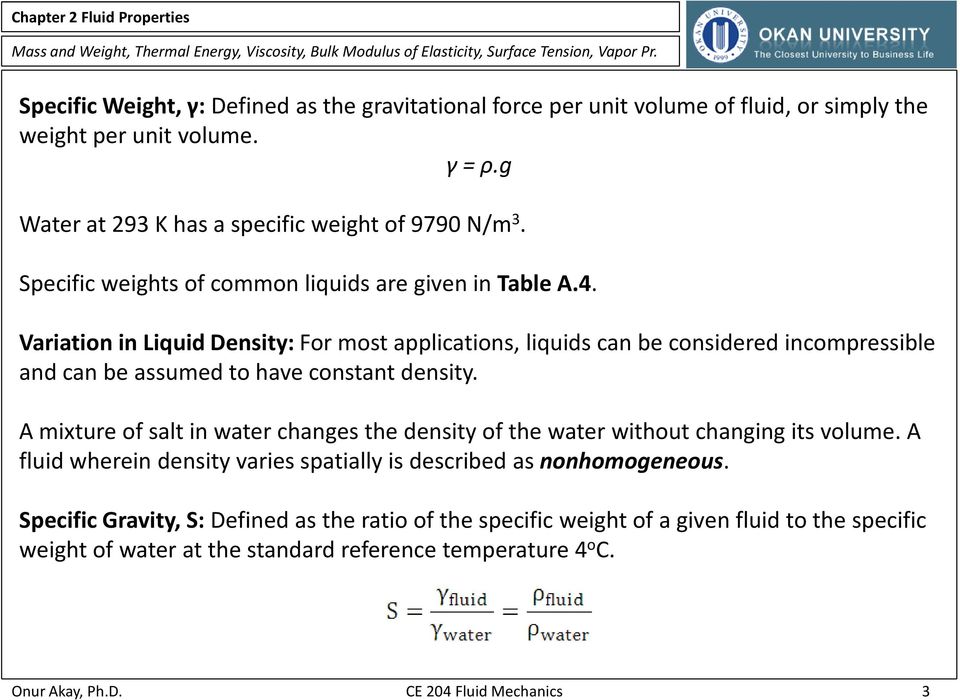
3 Specific Weight, γ: Defined as the gravitational force per unit volume of fluid, or simply the weight per unit volume. γ= ρ.g Water at 293 K has a specific weight of 9790 N/m 3. Specific weights of common liquids are given in Table A.4. Variation in Liquid Density: For most applications, liquids can be considered incompressible and can be assumed to have constant density. A mixture of salt in water changes the density of the water without changing its volume. A fluid wherein density varies spatially is described as nonhomogeneous. Specific Gravity, S:Defined as the ratio of the specific weight of a given fluid to the specific weight of water at the standard reference temperature 4 o C. Onur Akay, Ph.D. CE 204 Fluid Mechanics 3
4 Thermal Energy Specific Heat, c: The property that describes the capacity of a substance to store thermal energy. It is the amount of thermal energy that must be transferred to a unit mass of substance to raise its temperature by one degree (J/(kg K)). c v = Specific volume vof the gas (v = 1/ρ) remains constant c p = Pressure of the gas remains constant Table A.2 Internal Energy: The energy that a substance possesses because of the state of the molecular activity. In the SI system, the specific internal energy, u, is given in J/kg. Enthalpy: The combination u + p/ρ(specific enthalpy) Onur Akay, Ph.D. CE 204 Fluid Mechanics 4
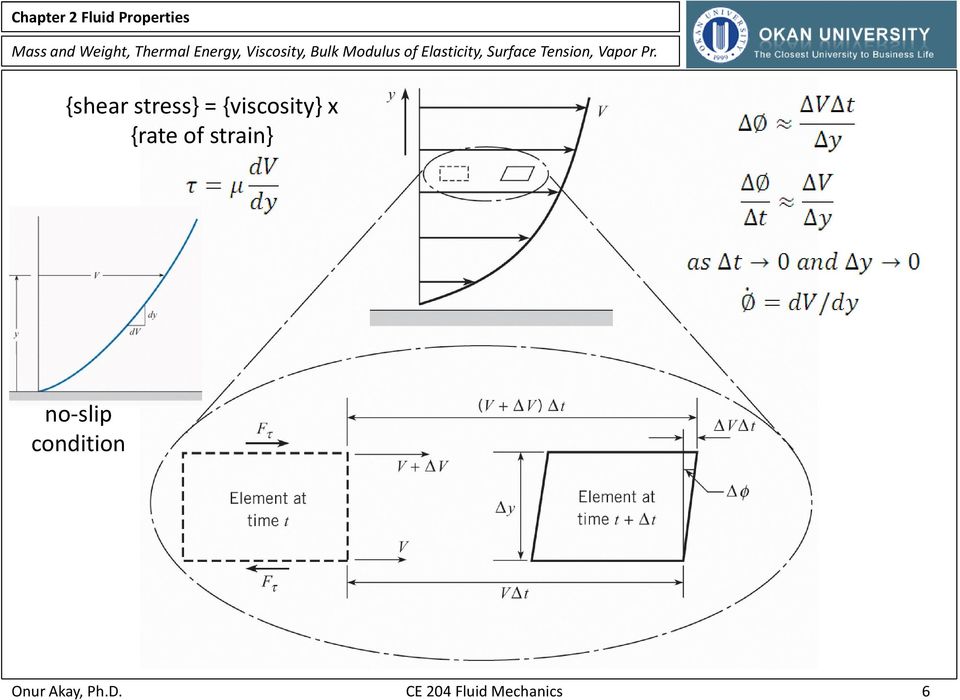
5 Viscosity, μ: (Also called dynamic viscosity, or absolute viscosity) is a measure of a fluid s resistance to deformation under shear stress. For example, crude oil has a higher resistance to shear than does water. Movie {shear stress} = {viscosity} x {rate of strain} Onur Akay, Ph.D. CE 204 Fluid Mechanics 5

6 {shear stress} = {viscosity} x {rate of strain} no-slip condition Onur Akay, Ph.D. CE 204 Fluid Mechanics 6
7 The viscosity of water at 293 K is 10-3 N.s/m 2. The unit of viscosity in the SI system is Pa.s. Kinematic Viscosity, ν: Many equations of fluid mechanics include the ratio μ/ρ. The kinematic viscosity of water at 293 K is 10-6 m 2 /s. Temperature Dependency As the temperature increases the viscosity of Liquids: Decreases Gases: Increases Onur Akay, Ph.D. CE 204 Fluid Mechanics 7
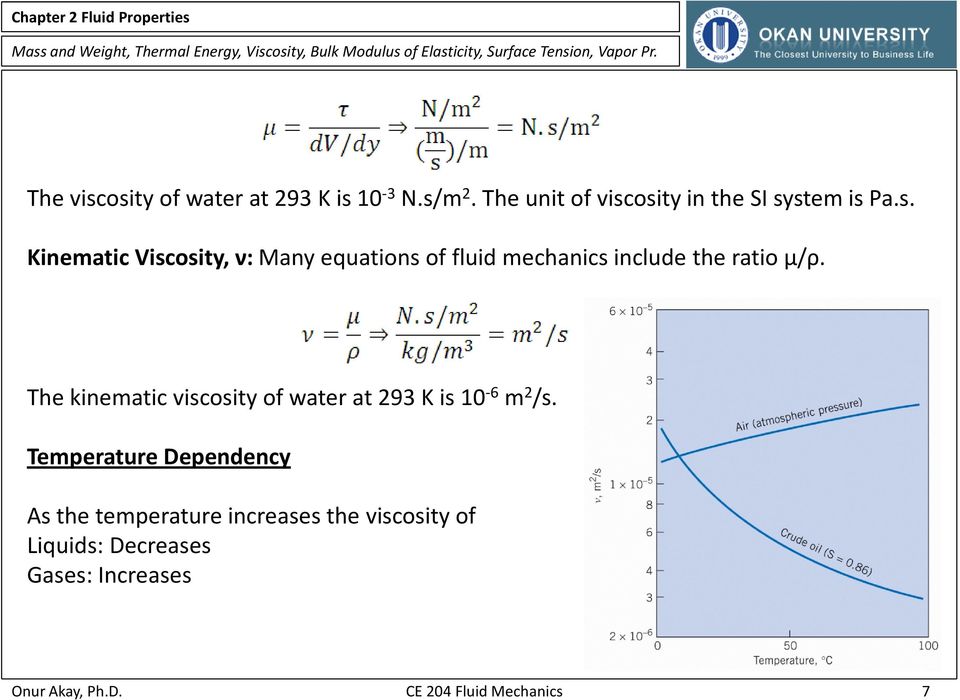
8 Important Implications: 1. The nonappearance of pressure shows that both τ and μ are independent of pressure. - Fluid friction is different from that between moving solids. 2.Any shear stress τ, will cause flow because applied tangential forces must produce a velocity gradient. 3.The shearing stress in viscous fluids at rest will be zero. 4. The velocity profile cannot be tangent to a solid boundary. 5. The equation is limited to laminar fluid motion, in which viscous action is strong. 6. The velocity at a solid boundary is zero (no-slip condition). Onur Akay, Ph.D. CE 204 Fluid Mechanics 8
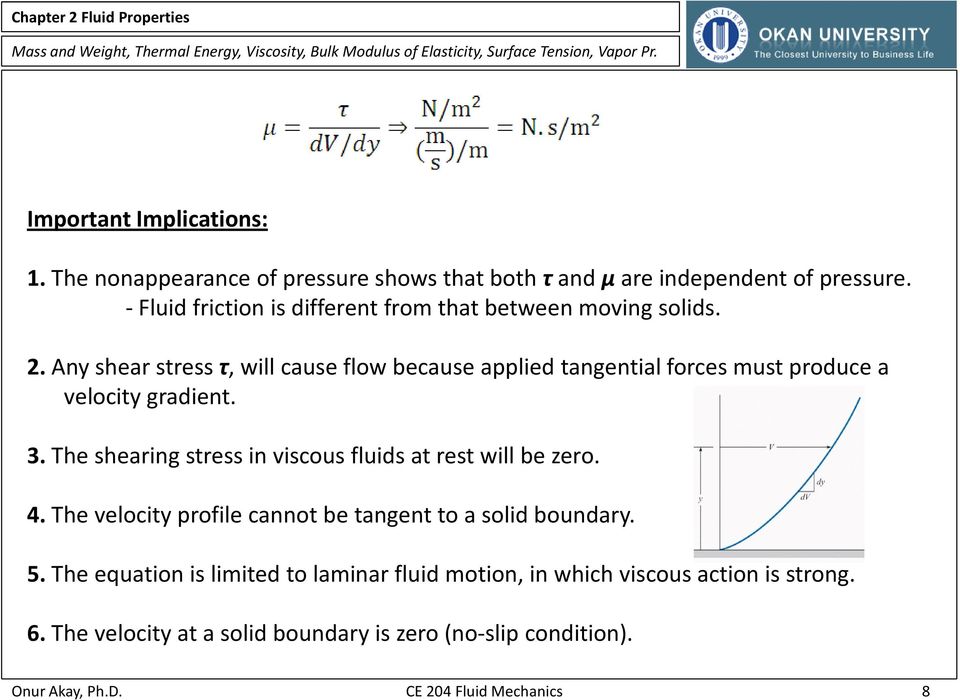
9 Onur Akay, Ph.D. CE 204 Fluid Mechanics 9
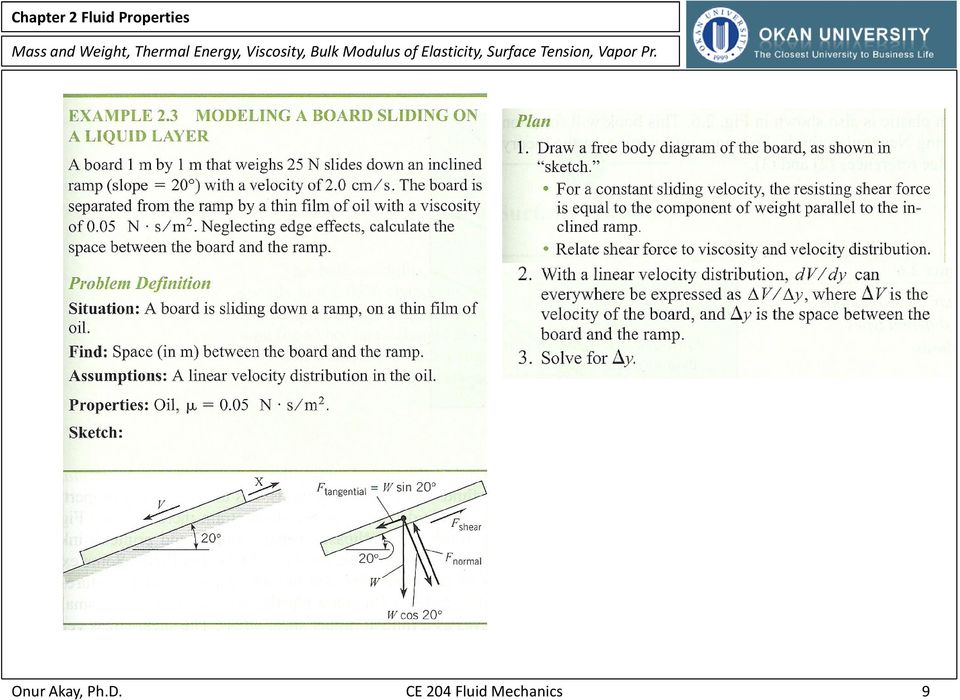
10 Newtonian versus Non-Newtonian Fluids: Fluids for which the shear stress is directly proportional to the rate of strain are called Newtonian fluids. Shear-thinning fluids/ pseudoplastic : Toothpaste, paints, printer s ink Pseudoplasticity can be demonstrated by the manner in which shaking a bottle of ketchup causes the contents to undergo an unpredictable change in viscosity. The force causes it to go from being thick like honey to flowing like water. Shear-thickening fluids: mixtures of glass particles in water, traction control, body armor Onur Akay, Ph.D. CE 204 Fluid Mechanics 10

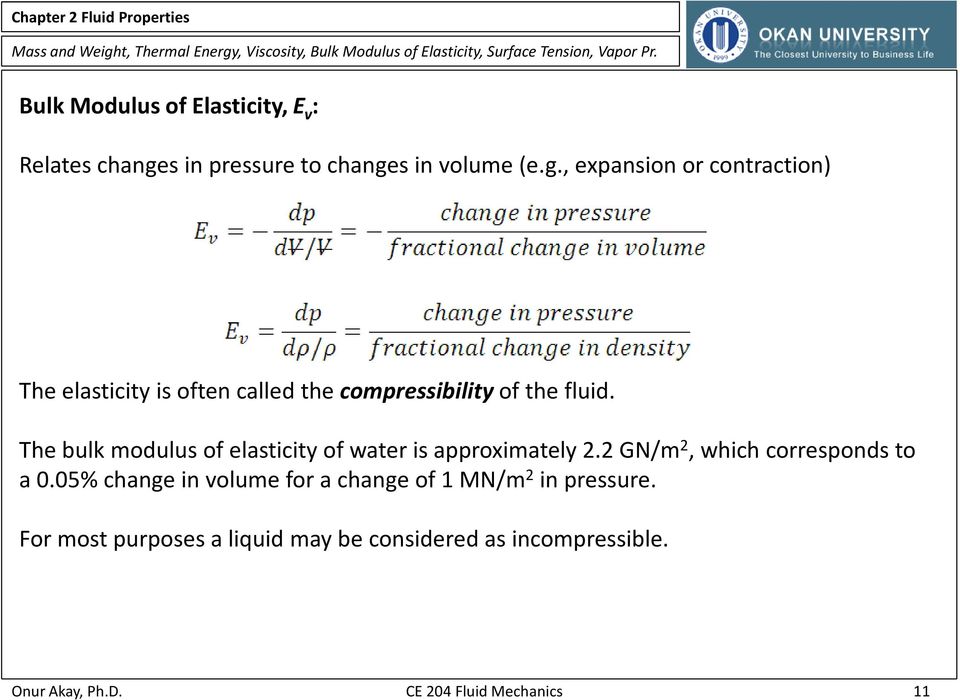
11 Bulk Modulus of Elasticity, E v : Relates changes in pressure to changes in volume (e.g., expansion or contraction) The elasticity is often called the compressibility of the fluid. The bulk modulus of elasticity of water is approximately 2.2 GN/m 2, which corresponds to a 0.05% change in volume for a change of 1 MN/m 2 in pressure. For most purposes a liquid may be considered as incompressible. Onur Akay, Ph.D. CE 204 Fluid Mechanics 11
12 Surface Tension, σ: A material property whereby a liquid at a material interface, exerts a force per unit length along the surface. Membrane effect:molecules near the surface have a greater attraction for each other than they do for molecules below the surface because of the presence of a different substance above the surface. Because of the membrane effect, each portion of the liquid surface exerts tension on objects that are in contact with the liquid surface. Surface tension for a water-air surface is N/m (at room temperature). Surface tension decreases with increasing temperature. Onur Akay, Ph.D. CE 204 Fluid Mechanics 12
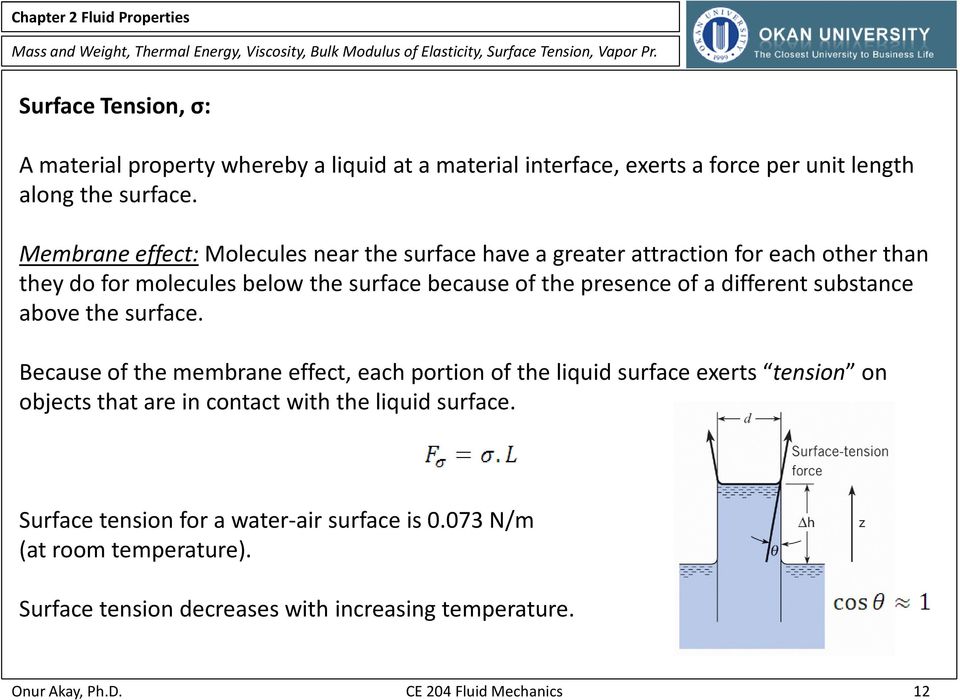
13 Chapter 2 Fluid Properties Capillary Action: Rise above a static water level at atmospheric pressure. Onur Akay, Ph.D. CE 204 Fluid Mechanics 13

14 Cases where surface tension force is balanced by the internal pressure: Onur Akay, Ph.D. CE 204 Fluid Mechanics 14

15 Vapor Pressure: The pressure at which a liquid will vaporize, or boil, at a given temperature, is called its vapor pressure. -Boiling occurs whenever the local pressure equals the vapor pressure. -Vapor pressure increases with temperature. There are two ways to boil a liquid: 1. Raise the temperature, assuming that the temperature is fixed (For water at kpa, the boiling temperature is 373 K). 2. Reduce the pressure in liquid to its vapor pressure (If the pressure in water at 323 K (10 o C)is reduced to 1.23 kpa, the water boils). Boiling can occur in localized low-pressure zones of flowing liquids. They can then collapse in regions of high pressure. This phenomenon, which is called cavitation, can cause extensive damage to fluid systems. Onur Akay, Ph.D. CE 204 Fluid Mechanics 15
16 Cavitation Movie Onur Akay, Ph.D. CE 204 Fluid Mechanics 16

1. Fluids Mechanics and Fluid Properties. 1.1 Objectives of this section. 1.2 Fluids
 1. Fluids Mechanics and Fluid Properties What is fluid mechanics? As its name suggests it is the branch of applied mechanics concerned with the statics and dynamics of fluids - both liquids and gases.
Fluids and Solids: Fundamentals
 Fluids and Solids: Fundamentals We normally recognize three states of matter: solid; liquid and gas. However, liquid and gas are both fluids: in contrast to solids they lack the ability to resist deformation.
Fluid Mechanics: Static s Kinematics Dynamics Fluid
 Fluid Mechanics: Fluid mechanics may be defined as that branch of engineering science that deals with the behavior of fluid under the condition of rest and motion Fluid mechanics may be divided into three
Ch 2 Properties of Fluids - II. Ideal Fluids. Real Fluids. Viscosity (1) Viscosity (3) Viscosity (2)
 Ch 2 Properties of Fluids - II Ideal Fluids 1 Prepared for CEE 3500 CEE Fluid Mechanics by Gilberto E. Urroz, August 2005 2 Ideal fluid: a fluid with no friction Also referred to as an inviscid (zero viscosity)
A drop forms when liquid is forced out of a small tube. The shape of the drop is determined by a balance of pressure, gravity, and surface tension
 A drop forms when liquid is forced out of a small tube. The shape of the drop is determined by a balance of pressure, gravity, and surface tension forces. 2 Objectives Have a working knowledge of the basic
CBE 6333, R. Levicky 1 Review of Fluid Mechanics Terminology
 CBE 6333, R. Levicky 1 Review of Fluid Mechanics Terminology The Continuum Hypothesis: We will regard macroscopic behavior of fluids as if the fluids are perfectly continuous in structure. In reality,
Notes on Polymer Rheology Outline
 1 Why is rheology important? Examples of its importance Summary of important variables Description of the flow equations Flow regimes - laminar vs. turbulent - Reynolds number - definition of viscosity
Fluid Dynamics Viscosity. Dave Foster Department of Chemical Engineering University of Rochester Email: dafoster@che
 Fluid Dynamics Viscosity Dave Foster Department of Chemical Engineering University of Rochester Email: dafoster@che che.rochester.eduedu 1 Chemical Engineering What do Chemical Engineers Do? Manufacturing
Vatten(byggnad) VVR145 Vatten. 2. Vätskors egenskaper (1.1, 4.1 och 2.8) (Föreläsningsanteckningar)
 Vatten(byggnad) Vätskors egenskaper (1) Hydrostatik (3) Grundläggande ekvationer (5) Rörströmning (4) 2. Vätskors egenskaper (1.1, 4.1 och 2.8) (Föreläsningsanteckningar) Vätska som kontinuerligt medium
FLUID DYNAMICS. Intrinsic properties of fluids. Fluids behavior under various conditions
 FLUID DYNAMICS Intrinsic properties of fluids Fluids behavior under various conditions Methods by which we can manipulate and utilize the fluids to produce desired results TYPES OF FLUID FLOW Laminar or
Rheological Properties of Topical Formulations
 Rheological Properties of Topical Formulations Hemi Nae, PhD Hydan Technologies, Inc. Key Words Complex Modulus, Creep/Recovery, Dilatant Flow, Dynamic Viscosity, Flow, Flow Curve, Flow Models, Frequency
Viscosity. Desmond Schipper Andrew R. Barron. 1 Introduction
 OpenStax-CNX module: m50215 1 Viscosity Desmond Schipper Andrew R. Barron This work is produced by OpenStax-CNX and licensed under the Creative Commons Attribution License 4.0 Abstract This module discusses
Unit 1 INTRODUCTION 1.1.Introduction 1.2.Objectives
 Structure 1.1.Introduction 1.2.Objectives 1.3.Properties of Fluids 1.4.Viscosity 1.5.Types of Fluids. 1.6.Thermodynamic Properties 1.7.Compressibility 1.8.Surface Tension and Capillarity 1.9.Capillarity
VISUAL PHYSICS School of Physics University of Sydney Australia. Why do cars need different oils in hot and cold countries?
 VISUAL PHYSICS School of Physics University of Sydney Australia FLUID FLOW VISCOSITY POISEUILLE'S LAW? Why do cars need different oils in hot and cold countries? Why does the engine runs more freely as
Lecture 24 - Surface tension, viscous flow, thermodynamics
 Lecture 24 - Surface tension, viscous flow, thermodynamics Surface tension, surface energy The atoms at the surface of a solid or liquid are not happy. Their bonding is less ideal than the bonding of atoms
INTRODUCTION TO FLUID MECHANICS
 INTRODUCTION TO FLUID MECHANICS SIXTH EDITION ROBERT W. FOX Purdue University ALAN T. MCDONALD Purdue University PHILIP J. PRITCHARD Manhattan College JOHN WILEY & SONS, INC. CONTENTS CHAPTER 1 INTRODUCTION
CE 6303 MECHANICS OF FLUIDS L T P C QUESTION BANK PART - A
 CE 6303 MECHANICS OF FLUIDS L T P C QUESTION BANK 3 0 0 3 UNIT I FLUID PROPERTIES AND FLUID STATICS PART - A 1. Define fluid and fluid mechanics. 2. Define real and ideal fluids. 3. Define mass density
XI / PHYSICS FLUIDS IN MOTION 11/PA
 Viscosity It is the property of a liquid due to which it flows in the form of layers and each layer opposes the motion of its adjacent layer. Cause of viscosity Consider two neighboring liquid layers A
PHYSICS FUNDAMENTALS-Viscosity and flow
 PHYSICS FUNDAMENTALS-Viscosity and flow The origin of viscosity When a force is applied to a solid, it will yield slightly, and then resist further movement. However, when we apply force to a fluid, it
Fundamental Concepts in Fluid Mechanics
 A significant portion of these notes summarizes various sections of Massey, but additional material from other sources is also included. Note that the notes are incomplete; they will be completed during
01 The Nature of Fluids
 01 The Nature of Fluids WRI 1/17 01 The Nature of Fluids (Water Resources I) Dave Morgan Prepared using Lyx, and the Beamer class in L A TEX 2ε, on September 12, 2007 Recommended Text 01 The Nature of
Scalars, Vectors and Tensors
 Scalars, Vectors and Tensors A scalar is a physical quantity that it represented by a dimensional number at a particular point in space and time. Examples are hydrostatic pressure and temperature. A vector
 RHEOLOGY RHEOLOGY Science describing the flow and deformation of matter under stress. Rheo = the flow Viscosity (η) is the resistance of a fluid material to flow under stress. The higher the viscosity,
Lecture 5 Hemodynamics. Description of fluid flow. The equation of continuity
 1 Lecture 5 Hemodynamics Description of fluid flow Hydrodynamics is the part of physics, which studies the motion of fluids. It is based on the laws of mechanics. Hemodynamics studies the motion of blood
Chemistry 13: States of Matter
 Chemistry 13: States of Matter Name: Period: Date: Chemistry Content Standard: Gases and Their Properties The kinetic molecular theory describes the motion of atoms and molecules and explains the properties
KINETIC MOLECULAR THEORY OF MATTER
 KINETIC MOLECULAR THEORY OF MATTER The kinetic-molecular theory is based on the idea that particles of matter are always in motion. The theory can be used to explain the properties of solids, liquids,
Properties of Fluids
 CHAPTER Properties of Fluids 1 1.1 INTRODUCTION A fluid can be defined as a substance which deforms or yields continuously when shear stress is applied to it, no matter how small it is. Fluids can be subdivided
Natural Convection. Buoyancy force
 Natural Convection In natural convection, the fluid motion occurs by natural means such as buoyancy. Since the fluid velocity associated with natural convection is relatively low, the heat transfer coefficient
How To Understand Fluid Mechanics
 Module : Review of Fluid Mechanics Basic Principles for Water Resources Engineering Robert Pitt University of Alabama and Shirley Clark Penn State - Harrisburg Mass quantity of matter that a substance
Lecture 6 - Boundary Conditions. Applied Computational Fluid Dynamics
 Lecture 6 - Boundary Conditions Applied Computational Fluid Dynamics Instructor: André Bakker http://www.bakker.org André Bakker (2002-2006) Fluent Inc. (2002) 1 Outline Overview. Inlet and outlet boundaries.
VAPORIZATION IN MORE DETAIL. Energy needed to escape into gas phase GAS LIQUID. Kinetic energy. Average kinetic energy
 30 VAPORIZATION IN MORE DETAIL GAS Energy needed to escape into gas phase LIQUID Kinetic energy Average kinetic energy - For a molecule to move from the liquid phase to the gas phase, it must acquire enough
Fluid Mechanic & Fluid Machine
 Fluid Mechanic & Fluid Machine Contents Chapter Topic Page Chapter-1 Chapter-2 Chapter-3 s s s Problems Pressure and Its Measurements s s s Hydrostatic Forces on Surfaces s s s No 7 8 15 15 20 22 22 24
Basic Principles in Microfluidics
 Basic Principles in Microfluidics 1 Newton s Second Law for Fluidics Newton s 2 nd Law (F= ma) : Time rate of change of momentum of a system equal to net force acting on system!f = dp dt Sum of forces
HEAT UNIT 1.1 KINETIC THEORY OF GASES. 1.1.1 Introduction. 1.1.2 Postulates of Kinetic Theory of Gases
 UNIT HEAT. KINETIC THEORY OF GASES.. Introduction Molecules have a diameter of the order of Å and the distance between them in a gas is 0 Å while the interaction distance in solids is very small. R. Clausius
Basic Equations, Boundary Conditions and Dimensionless Parameters
 Chapter 2 Basic Equations, Boundary Conditions and Dimensionless Parameters In the foregoing chapter, many basic concepts related to the present investigation and the associated literature survey were
CHAPTER 2: LIQUID VISCOSITY MEASUREMENT
 CHAPTER 2: LIQUID VISCOSITY MEASUREMENT Objective Calculate viscosity (dynamic or absolute, and kinematic) and determine how this property varies with changes in temperature for a constant-composition
Lecture 3 Fluid Dynamics and Balance Equa6ons for Reac6ng Flows
 Lecture 3 Fluid Dynamics and Balance Equa6ons for Reac6ng Flows 3.- 1 Basics: equations of continuum mechanics - balance equations for mass and momentum - balance equations for the energy and the chemical
Name Class Date. In the space provided, write the letter of the term or phrase that best completes each statement or best answers each question.
 Assessment Chapter Test A Chapter: States of Matter In the space provided, write the letter of the term or phrase that best completes each statement or best answers each question. 1. The kinetic-molecular
NUMERICAL ANALYSIS OF THE EFFECTS OF WIND ON BUILDING STRUCTURES
 Vol. XX 2012 No. 4 28 34 J. ŠIMIČEK O. HUBOVÁ NUMERICAL ANALYSIS OF THE EFFECTS OF WIND ON BUILDING STRUCTURES Jozef ŠIMIČEK email: [email protected] Research field: Statics and Dynamics Fluids mechanics
Introduction to Microfluidics. Date: 2013/04/26. Dr. Yi-Chung Tung. Outline
 Introduction to Microfluidics Date: 2013/04/26 Dr. Yi-Chung Tung Outline Introduction to Microfluidics Basic Fluid Mechanics Concepts Equivalent Fluidic Circuit Model Conclusion What is Microfluidics Microfluidics
Current Staff Course Unit/ Length. Basic Outline/ Structure. Unit Objectives/ Big Ideas. Properties of Waves A simple wave has a PH: Sound and Light
 Current Staff Course Unit/ Length August August September September October Unit Objectives/ Big Ideas Basic Outline/ Structure PS4- Types of Waves Because light can travel through space, it cannot be
FLUID FLOW STREAMLINE LAMINAR FLOW TURBULENT FLOW REYNOLDS NUMBER
 VISUAL PHYSICS School of Physics University of Sydney Australia FLUID FLOW STREAMLINE LAMINAR FLOW TURBULENT FLOW REYNOLDS NUMBER? What type of fluid flow is observed? The above pictures show how the effect
Dimensional Analysis
 Dimensional Analysis An Important Example from Fluid Mechanics: Viscous Shear Forces V d t / / / / / / / / / / / / / / / / / / / / / / / / / / / / / / / / / Ƭ = F/A = μ V/d More generally, the viscous
Modern Construction Materials Prof. Ravindra Gettu Department of Civil Engineering Indian Institute of Technology, Madras
 Modern Construction Materials Prof. Ravindra Gettu Department of Civil Engineering Indian Institute of Technology, Madras Module - 2 Lecture - 2 Part 2 of 2 Review of Atomic Bonding II We will continue
Lecture 2 PROPERTIES OF FLUID
 Lecture 2 PROPERTIES OF FLUID Learning Objectives Upon completion of this chapter, the student should be able to: Define three states of matter: Solid, liquid and gas. Define mass density, specific weight
Teil I. Student Laboratory Manuals
 Teil I Student Laboratory Manuals 1 IR1 5. Fluid friction in liquids 5.1 Introduction Generally the term fluid is understood to be matter either in the gaseous or liquid state. The physics involved on
Mathematical Model of Blood Flow in Carotid Bifurcation. Phd student: Eng. Emanuel Muraca. 16/10/09 Milan
 Presented at the COMSOL Conference 2009 Milan Mathematical Model of Blood Flow in Carotid Bifurcation Phd student: Eng. Emanuel Muraca 16/10/09 Milan 1 Research s s goal The goal of this research is to
Aids needed for demonstrations: viscous fluid (water), tubes (pipes), injections, paper, stopwatches, vessels,, weights
 1 Viscous and turbulent flow Level: high school (16-17 years) hours (2 hours class teaching, 2 hours practical excercises) Content: 1. Viscous flow 2. Poiseuille s law 3. Passing from laminar to turbulent
4.What is the appropriate dimensionless parameter to use in comparing flow types? YOUR ANSWER: The Reynolds Number, Re.
 CHAPTER 08 1. What is most likely to be the main driving force in pipe flow? A. Gravity B. A pressure gradient C. Vacuum 2.What is a general description of the flow rate in laminar flow? A. Small B. Large
Solution for Homework #1
 Solution for Homework #1 Chapter 2: Multiple Choice Questions (2.5, 2.6, 2.8, 2.11) 2.5 Which of the following bond types are classified as primary bonds (more than one)? (a) covalent bonding, (b) hydrogen
Pump Formulas Imperial and SI Units
 Pump Formulas Imperial and Pressure to Head H = head, ft P = pressure, psi H = head, m P = pressure, bar Mass Flow to Volumetric Flow ṁ = mass flow, lbm/h ρ = fluid density, lbm/ft 3 ṁ = mass flow, kg/h
Differential Relations for Fluid Flow. Acceleration field of a fluid. The differential equation of mass conservation
 Differential Relations for Fluid Flow In this approach, we apply our four basic conservation laws to an infinitesimally small control volume. The differential approach provides point by point details of
Diffusion and Fluid Flow
 Diffusion and Fluid Flow What determines the diffusion coefficient? What determines fluid flow? 1. Diffusion: Diffusion refers to the transport of substance against a concentration gradient. ΔS>0 Mass
du u U 0 U dy y b 0 b
 BASIC CONCEPTS/DEFINITIONS OF FLUID MECHANICS (by Marios M. Fyrillas) 1. Density (πυκνότητα) Symbol: 3 Units of measure: kg / m Equation: m ( m mass, V volume) V. Pressure (πίεση) Alternative definition:
Chapter 27 Static Fluids
 Chapter 27 Static Fluids 27.1 Introduction... 1 27.2 Density... 1 27.3 Pressure in a Fluid... 2 27.4 Pascal s Law: Pressure as a Function of Depth in a Fluid of Uniform Density in a Uniform Gravitational
02/21/2006 10:13 AM. Viscosity. The Physics Hypertextbook 1998-2005 by Glenn Elert All Rights Reserved -- Fair Use Encouraged.
 Viscosity The Physics Hypertextbook 1998-2005 by Glenn Elert All Rights Reserved -- Fair Use Encouraged prev up next Discussion definitions Informally, viscosity is the quantity that describes a fluid's
Urban Hydraulics. 2.1 Basic Fluid Mechanics
 Urban Hydraulics Learning objectives: After completing this section, the student should understand basic concepts of fluid flow and how to analyze conduit flows and free surface flows. They should be able
FUNDAMENTALS OF ENGINEERING THERMODYNAMICS
 FUNDAMENTALS OF ENGINEERING THERMODYNAMICS System: Quantity of matter (constant mass) or region in space (constant volume) chosen for study. Closed system: Can exchange energy but not mass; mass is constant
OUTCOME 3 TUTORIAL 5 DIMENSIONAL ANALYSIS
 Unit 41: Fluid Mechanics Unit code: T/601/1445 QCF Level: 4 Credit value: 15 OUTCOME 3 TUTORIAL 5 DIMENSIONAL ANALYSIS 3 Be able to determine the behavioural characteristics and parameters of real fluid
Chapter 2. Derivation of the Equations of Open Channel Flow. 2.1 General Considerations
 Chapter 2. Derivation of the Equations of Open Channel Flow 2.1 General Considerations Of interest is water flowing in a channel with a free surface, which is usually referred to as open channel flow.
Viscosity experiments: physical controls and implications for volcanic hazards. Ben Edwards Dept of Geology, Dickinson College
 Viscosity experiments: physical controls and implications for volcanic hazards Student Name: Ben Edwards Dept of Geology, Dickinson College OBJECTIVES OF LAB Learn about the rheological property called
Surface Tension. the surface tension of a liquid is the energy required to increase the surface area a given amount
 Tro, Chemistry: A Molecular Approach 1 Surface Tension surface tension is a property of liquids that results from the tendency of liquids to minimize their surface area in order to minimize their surface
The ratio of inertial to viscous forces is commonly used to scale fluid flow, and is called the Reynolds number, given as:
 12.001 LAB 3C: STOKES FLOW DUE: WEDNESDAY, MARCH 9 Lab Overview and Background The viscosity of a fluid describes its resistance to deformation. Water has a very low viscosity; the force of gravity causes
When the fluid velocity is zero, called the hydrostatic condition, the pressure variation is due only to the weight of the fluid.
 Fluid Statics When the fluid velocity is zero, called the hydrostatic condition, the pressure variation is due only to the weight of the fluid. Consider a small wedge of fluid at rest of size Δx, Δz, Δs
Gas Laws. The kinetic theory of matter states that particles which make up all types of matter are in constant motion.
 Name Period Gas Laws Kinetic energy is the energy of motion of molecules. Gas state of matter made up of tiny particles (atoms or molecules). Each atom or molecule is very far from other atoms or molecules.
Introduction to COMSOL. The Navier-Stokes Equations
 Flow Between Parallel Plates Modified from the COMSOL ChE Library module rev 10/13/08 Modified by Robert P. Hesketh, Chemical Engineering, Rowan University Fall 2008 Introduction to COMSOL The following
Chapter Test A. States of Matter MULTIPLE CHOICE. a fixed amount of STAs2 a. a solid. b. a liquid. c. a gas. d. any type of matter.
 Assessment Chapter Test A States of Matter MULTIPLE CHOICE Write the letter of the correct answer in the space provided. 1. Boyle s law explains the relationship between volume and pressure for a fixed
For Water to Move a driving force is needed
 RECALL FIRST CLASS: Q K Head Difference Area Distance between Heads Q 0.01 cm 0.19 m 6cm 0.75cm 1 liter 86400sec 1.17 liter ~ 1 liter sec 0.63 m 1000cm 3 day day day constant head 0.4 m 0.1 m FINE SAND
Fundamentals of THERMAL-FLUID SCIENCES
 Fundamentals of THERMAL-FLUID SCIENCES THIRD EDITION YUNUS A. CENGEL ROBERT H. TURNER Department of Mechanical JOHN M. CIMBALA Me Graw Hill Higher Education Boston Burr Ridge, IL Dubuque, IA Madison, Wl
Chapter 12 - Liquids and Solids
 Chapter 12 - Liquids and Solids 12-1 Liquids I. Properties of Liquids and the Kinetic Molecular Theory A. Fluids 1. Substances that can flow and therefore take the shape of their container B. Relative
Viscous flow in pipe
 Viscous flow in pipe Henryk Kudela Contents 1 Laminar or turbulent flow 1 2 Balance of Momentum - Navier-Stokes Equation 2 3 Laminar flow in pipe 2 3.1 Friction factor for laminar flow...........................
Battery Thermal Management System Design Modeling
 Battery Thermal Management System Design Modeling Gi-Heon Kim, Ph.D Ahmad Pesaran, Ph.D ([email protected]) National Renewable Energy Laboratory, Golden, Colorado, U.S.A. EVS October -8, 8, 006 Yokohama,
Improved fluid control by proper non-newtonian flow modeling
 Tekna Flow Assurance 2015, Larvik Improved fluid control by proper non-newtonian flow modeling Stein Tore Johansen, SINTEF Sjur Mo, SINTEF A general wall friction model for a non-newtonian fluid has been
STATICS. Introduction VECTOR MECHANICS FOR ENGINEERS: Eighth Edition CHAPTER. Ferdinand P. Beer E. Russell Johnston, Jr.
 Eighth E CHAPTER VECTOR MECHANICS FOR ENGINEERS: STATICS Ferdinand P. Beer E. Russell Johnston, Jr. Introduction Lecture Notes: J. Walt Oler Texas Tech University Contents What is Mechanics? Fundamental
Contents. Microfluidics - Jens Ducrée Physics: Navier-Stokes Equation 1
 Contents 1. Introduction 2. Fluids 3. Physics of Microfluidic Systems 4. Microfabrication Technologies 5. Flow Control 6. Micropumps 7. Sensors 8. Ink-Jet Technology 9. Liquid Handling 10.Microarrays 11.Microreactors
Laminar and Turbulent flow. Flow Sensors. Reynolds Number. Thermal flow Sensor. Flow and Flow rate. R = Mass Flow controllers
 Flow and Flow rate. Laminar and Turbulent flow Laminar flow: smooth, orderly and regular Mechanical sensors have inertia, which can integrate out small variations due to turbulence Turbulent flow: chaotic
The Viscosity of Fluids
 Experiment #11 The Viscosity of Fluids References: 1. Your first year physics textbook. 2. D. Tabor, Gases, Liquids and Solids: and Other States of Matter (Cambridge Press, 1991). 3. J.R. Van Wazer et
Chapter 10. Flow Rate. Flow Rate. Flow Measurements. The velocity of the flow is described at any
 Chapter 10 Flow Measurements Material from Theory and Design for Mechanical Measurements; Figliola, Third Edition Flow Rate Flow rate can be expressed in terms of volume flow rate (volume/time) or mass
Turbulence, Heat and Mass Transfer (THMT 09) Poiseuille flow of liquid methane in nanoscopic graphite channels by molecular dynamics simulation
 Turbulence, Heat and Mass Transfer (THMT 09) Poiseuille flow of liquid methane in nanoscopic graphite channels by molecular dynamics simulation Sapienza Università di Roma, September 14, 2009 M. T. HORSCH,
10.1 Powder mechanics
 Fluid and Particulate systems 424514 /2014 POWDER MECHANICS & POWDER FLOW TESTING 10 Ron Zevenhoven ÅA Thermal and Flow Engineering [email protected] 10.1 Powder mechanics RoNz 2/38 Types of flow of
An Introduction to Fluid Mechanics
 0. Contents of the Course Notes For the First Year Lecture Course: An Introduction to Fluid Mechanics School of Civil Engineering, University of Leeds. CIVE1400 FLUID MECHANICS Dr Andrew Sleigh January
VISCOSITY OF A LIQUID. To determine the viscosity of a lubricating oil. Time permitting, the temperature variation of viscosity can also be studied.
 VISCOSITY OF A LIQUID August 19, 004 OBJECTIVE: EQUIPMENT: To determine the viscosity of a lubricating oil. Time permitting, the temperature variation of viscosity can also be studied. Viscosity apparatus
= 800 kg/m 3 (note that old units cancel out) 4.184 J 1000 g = 4184 J/kg o C
 Units and Dimensions Basic properties such as length, mass, time and temperature that can be measured are called dimensions. Any quantity that can be measured has a value and a unit associated with it.
Microfluidic Principles Part 1
 Introduction to BioMEMS & Medical Microdevices Microfluidic Principles Part 1 Companion lecture to the textbook: Fundamentals of BioMEMS and Medical Microdevices, by Dr. Steven S. Saliterman www.tc.umn.edu/~drsteve
CHAPTER ONE Fluid Fundamentals
 CHPTER ONE Fluid Fundamentals 1.1 FLUID PROPERTIES 1.1.1 Mass and Weight Mass, m, is a property that describes the amount of matter in an object or fluid. Typical units are slugs in U.S. customary units,
Chapter 13 - LIQUIDS AND SOLIDS
 Chapter 13 - LIQUIDS AND SOLIDS Problems to try at end of chapter: Answers in Appendix I: 1,3,5,7b,9b,15,17,23,25,29,31,33,45,49,51,53,61 13.1 Properties of Liquids 1. Liquids take the shape of their container,
Practice Test. 4) The planet Earth loses heat mainly by A) conduction. B) convection. C) radiation. D) all of these Answer: C
 Practice Test 1) Increase the pressure in a container of oxygen gas while keeping the temperature constant and you increase the A) molecular speed. B) molecular kinetic energy. C) Choice A and choice B
Free Convection Film Flows and Heat Transfer
 Deyi Shang Free Convection Film Flows and Heat Transfer With 109 Figures and 69 Tables < J Springer Contents 1 Introduction 1 1.1 Scope 1 1.2 Application Backgrounds 1 1.3 Previous Developments 2 1.3.1
Science Tutorial TEK 6.9C: Energy Forms & Conversions
 Name: Teacher: Pd. Date: Science Tutorial TEK 6.9C: Energy Forms & Conversions TEK 6.9C: Demonstrate energy transformations such as energy in a flashlight battery changes from chemical energy to electrical
CHAPTER 12. Gases and the Kinetic-Molecular Theory
 CHAPTER 12 Gases and the Kinetic-Molecular Theory 1 Gases vs. Liquids & Solids Gases Weak interactions between molecules Molecules move rapidly Fast diffusion rates Low densities Easy to compress Liquids
Energy Transport. Focus on heat transfer. Heat Transfer Mechanisms: Conduction Radiation Convection (mass movement of fluids)
 Energy Transport Focus on heat transfer Heat Transfer Mechanisms: Conduction Radiation Convection (mass movement of fluids) Conduction Conduction heat transfer occurs only when there is physical contact
FLUID MECHANICS FOR CIVIL ENGINEERS
 FLUID MECHANICS FOR CIVIL ENGINEERS Bruce Hunt Department of Civil Engineering University Of Canterbury Christchurch, New Zealand? Bruce Hunt, 1995 Table of Contents Chapter 1 Introduction... 1.1 Fluid
Viscosity (VIS) Topic: Mechanics. Laminar and turbulent flow, Reynolds number, Hagen-Poiseuille s law, Stokes law
 Seite 1 Viscosity Topic: Mechanics 1 Key words Laminar and turbulent flow, Reynolds number, Hagen-Poiseuille s law, Stokes law 2 Literatur L. Bergmann, C. Schäfer, Lehrbuch der Experimentalphysik, Band
A LAMINAR FLOW ELEMENT WITH A LINEAR PRESSURE DROP VERSUS VOLUMETRIC FLOW. 1998 ASME Fluids Engineering Division Summer Meeting
 TELEDYNE HASTINGS TECHNICAL PAPERS INSTRUMENTS A LAMINAR FLOW ELEMENT WITH A LINEAR PRESSURE DROP VERSUS VOLUMETRIC FLOW Proceedings of FEDSM 98: June -5, 998, Washington, DC FEDSM98 49 ABSTRACT The pressure
Heat Transfer From A Heated Vertical Plate
 Heat Transfer From A Heated Vertical Plate Mechanical and Environmental Engineering Laboratory Department of Mechanical and Aerospace Engineering University of California at San Diego La Jolla, California
Rusty Walker, Corporate Trainer Hill PHOENIX
 Refrigeration 101 Rusty Walker, Corporate Trainer Hill PHOENIX Compressor Basic Refrigeration Cycle Evaporator Condenser / Receiver Expansion Device Vapor Compression Cycle Cooling by the removal of heat