
Diffusion and Fluid Flow
|
|
|
- Ethelbert Ford
- 10 years ago
- Views:
Transcription
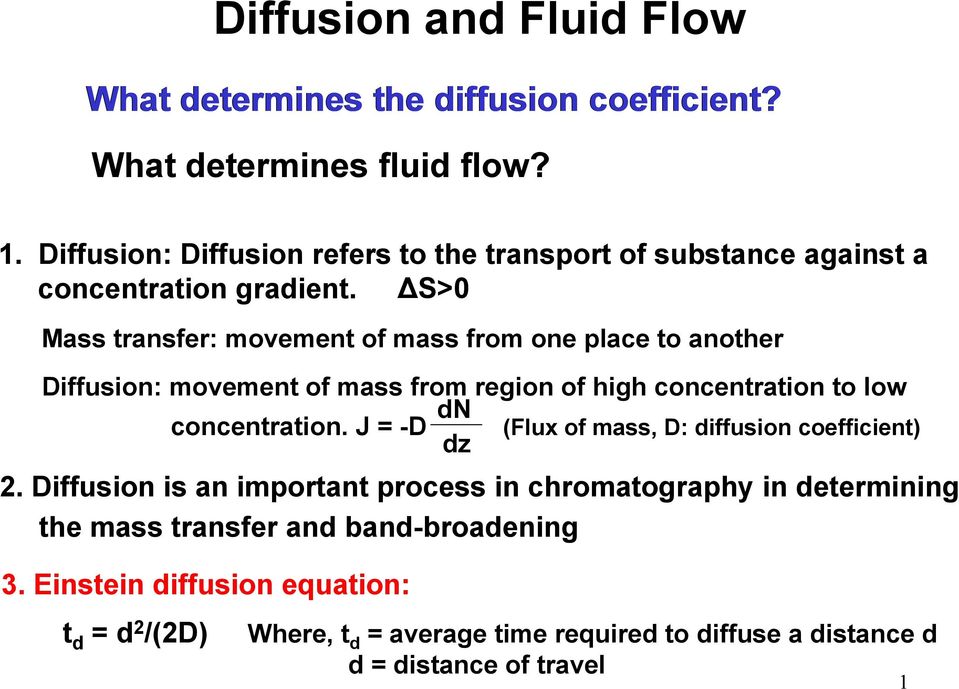
1 Diffusion and Fluid Flow What determines the diffusion coefficient? What determines fluid flow? 1. Diffusion: Diffusion refers to the transport of substance against a concentration gradient. ΔS>0 Mass transfer: movement of mass from one place to another Diffusion: movement of mass from region of high concentration to low dn concentration. J = -D (Flux of mass, D: diffusion coefficient) dz 2. Diffusion is an important process in chromatography in determining the mass transfer and band-broadening 3. Einstein diffusion equation: t d = d 2 /(2D) Where, t d = average time required to diffuse a distance d d = distance of travel 1
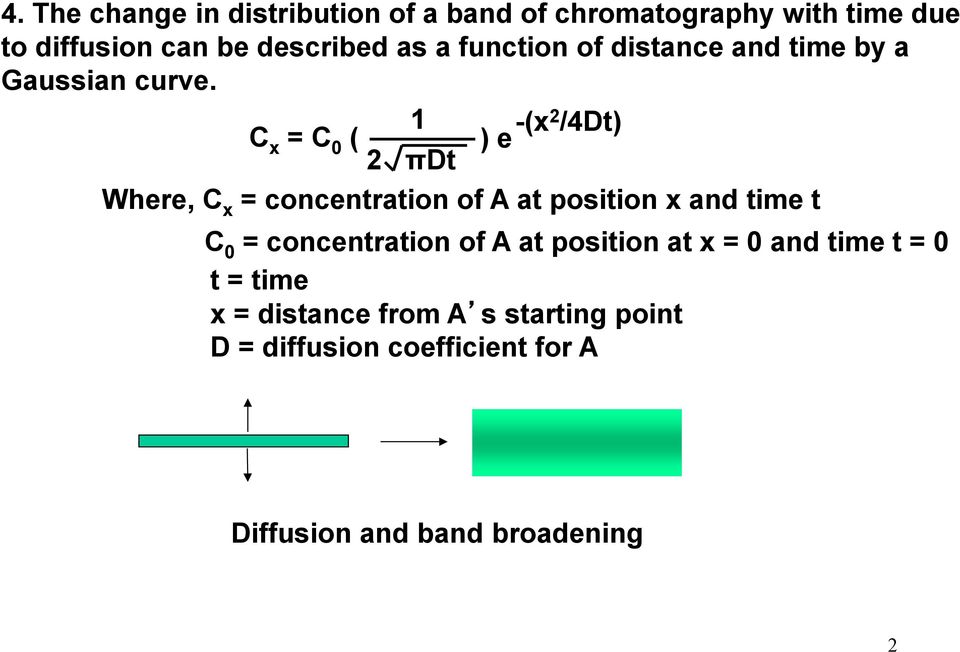
2 4. The change in distribution of a band of chromatography with time due to diffusion can be described as a function of distance and time by a Gaussian curve. 1 C x = C 0 ( 2 πdt -(x 2 /4Dt) ) e Where, C x = concentration of A at position x and time t C 0 = concentration of A at position at x = 0 and time t = 0 t = time x = distance from A s starting point D = diffusion coefficient for A Diffusion and band broadening 2
3 What determines the diffusion coefficient? A. Diffusion in an open system 1. The value of D may vary over many orders of magnitude depending on the solute, solvent and temperature of the system of interest 2. Diffusion in gases: (a) For solute in gases, diffusion is a rapid process due to the low density of the solvent. (b) Typical value of D for solute in gas rang from 1 to 0.1 cm 2 /sec at 1 atm pressure. (c) Examples of diffusion coefficients for various solutes in gases: Solute Solvent T (k) D AB (cm 2 /sec) water Hydrogen water Air Benzene Air

4 (d) The value of the diffusion coefficient for a solute A in a gas B depends on the temperature, pressure, and molecular weight or sizes of the solute and solvent. The D can be estimated by using the following formula. D AB = 1.00 x 10⁻³ T 1.75 P[(sum v i ) 1/2 A + (sum v i ) 1/2 B ] ( 1 1 ) MW A MW B Where: T = absolute temperature P = absolute pressure MW x : molecular weight for A and B (sum v i ) x = sum of the diffusion volumes of all atoms in the molecule (i.e., a measure of A and B s size) Question: The diffusion coefficient of water molecules in hydrogen (the carrier gas) at 307 k and 1 atm is 1 cm 2 /sec. What is the average time that the water molecules to travel a distance of 1 mm in the gas chromatographic system? Assuming there no interactions between water and the system. 4
![75 P[(sum v i ) 1/2 A + (sum v i ) 1/2 B ] ( 1 1 ) MW A MW B Where: T = absolute temperature P = absolute pressure MW x : molecular weight for A and B (sum v i ) x = sum of the diffusion volumes of](/docs-images/40/14958547/images/page_4.jpg "all atoms in the molecule (i.e., a measure of A and B s size) Question: The diffusion coefficient of water molecules in hydrogen (the carrier gas) at 307 k and 1 atm is 1 cm 2 /sec.")
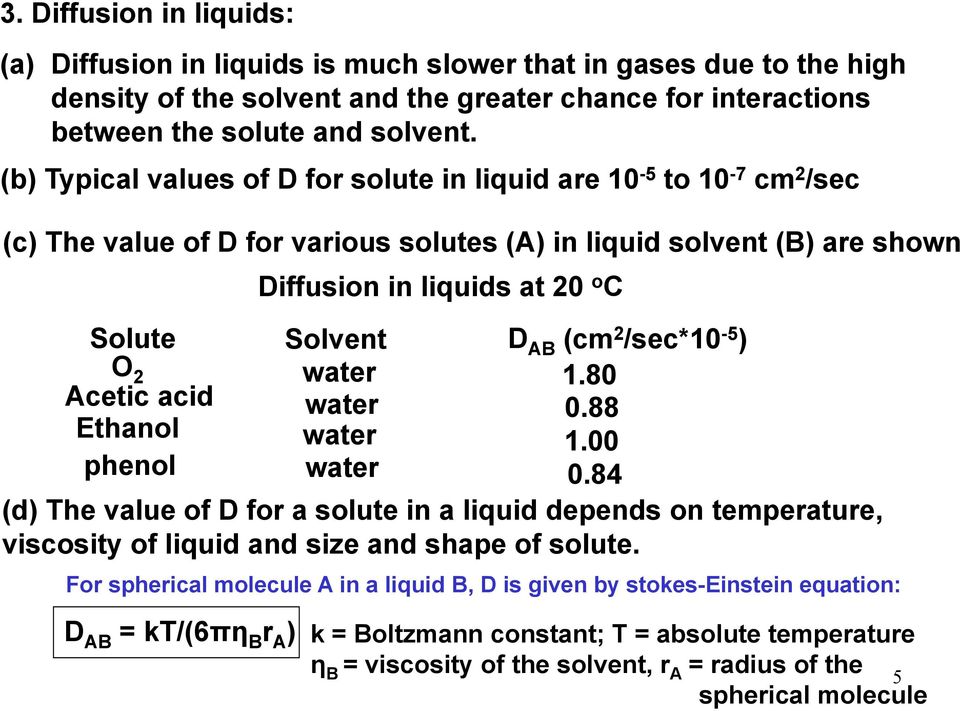
5 3. Diffusion in liquids: (a) Diffusion in liquids is much slower that in gases due to the high density of the solvent and the greater chance for interactions between the solute and solvent. (b) Typical values of D for solute in liquid are 10-5 to 10-7 cm 2 /sec (c) The value of D for various solutes (A) in liquid solvent (B) are shown Diffusion in liquids at 20 o C Solute Solvent D AB (cm 2 /sec*10-5 ) O 2 water 1.80 Acetic acid water 0.88 Ethanol water 1.00 phenol water 0.84 (d) The value of D for a solute in a liquid depends on temperature, viscosity of liquid and size and shape of solute. For spherical molecule A in a liquid B, D is given by stokes-einstein equation: D AB = kt/(6πη B r A ) k = Boltzmann constant; T = absolute temperature η B = viscosity of the solvent, r A = radius of the 5 spherical molecule
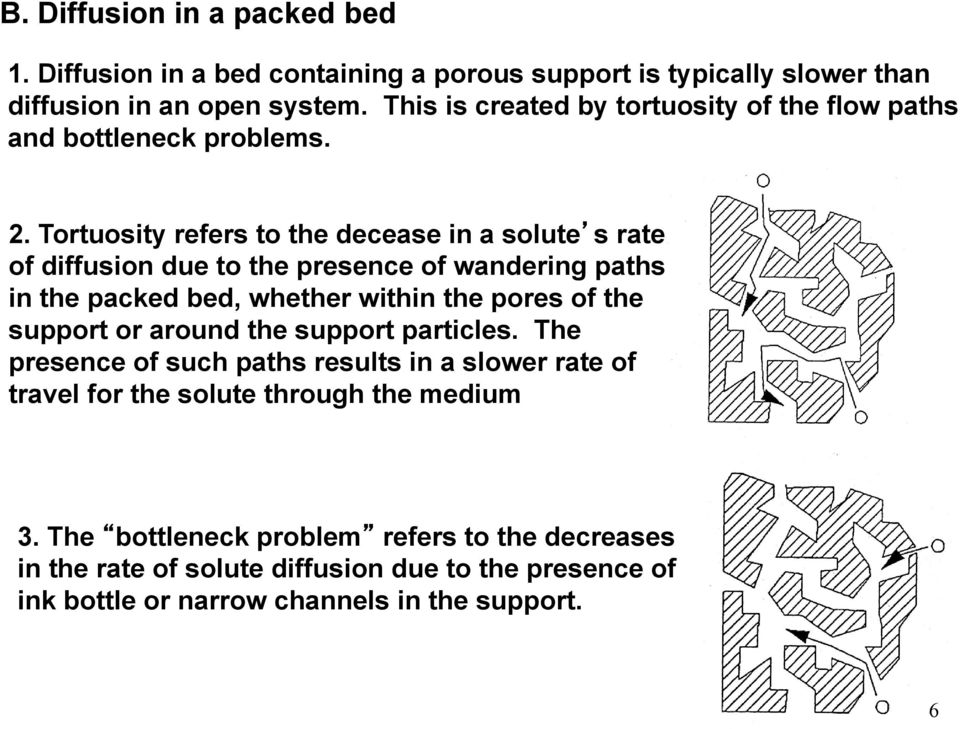
6 B. Diffusion in a packed bed 1. Diffusion in a bed containing a porous support is typically slower than diffusion in an open system. This is created by tortuosity of the flow paths and bottleneck problems. 2. Tortuosity refers to the decease in a solute s rate of diffusion due to the presence of wandering paths in the packed bed, whether within the pores of the support or around the support particles. The presence of such paths results in a slower rate of travel for the solute through the medium 3. The bottleneck problem refers to the decreases in the rate of solute diffusion due to the presence of ink bottle or narrow channels in the support. 6
7 What determines the diffusion coefficient? What determines fluid flow? 7
8 What determines fluid flow? A definition: 1. Fluid flow, or convective mass transfer, refers to the transport of solute through a system as they are being carried by the solvent. 2. Fluid flow is an essential part of chromatographic separation. B. Measures of fluid flow: 1. Flowrate (F): the volume of the solvent traveling through the column per unit time (units: ml/min, L/hr ). 2. Linear velocity (u): The distance of a solute or solvent travels in the column per unit time (units: cm/sec, cm/min). 3. The relationship between u and F is shown below: (a) for mobile phase flowing through the column: u mp = F (L/V m ) = L/t m V m = column void volume; L = column length; and t m = column void time 8

9 (b) for a solute flowing through the column phase flowing through the column u solute = F(L/V R ) = L/t R u solute = solute s linear velocity through the column, t R = solute s the retention time, V R = solute s retention volume. C. Fluid flow in open tubes: 1. Flow of a solvent through a circular tube can be one of three types (a) plug flow, (b) turbulent flow, or (c) laminar flow. 2. The type of flow expected in a given system can be determined by using the Reynolds number (R e ): the ratio of inertial force and viscous force R e = ρ u d p /η Where: ρ = solvent density (g/cm 3 ) u = solvent linear velocity (cm/sec) d p = tube diameter (cm) η = solvent viscosity (poise) 9 Newtonian fluid: Inertial force and viscous force
10 3. Types of Fluid Flow: (a) Plug or ideal Flow (R e = infinity) R e = ρ u d p /η Inertial force and viscous force i. This is the best type of flow in theory since all solute travel at the same speed through the flow-stream. As a result, they all reach the end of the tube at the same time and no addition band-broadening results. ii. However, this type of flow is not obtainable in practice and is used only as a model system to help understand factors that affect fluid flow. 10

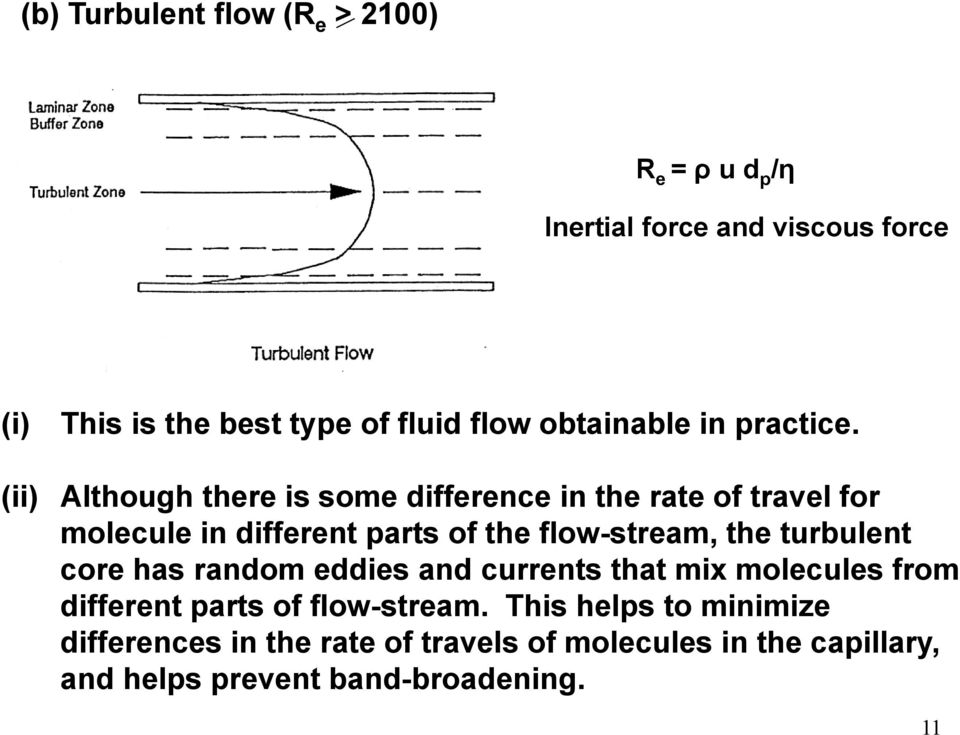
11 (b) Turbulent flow (R e > 2100) R e = ρ u d p /η Inertial force and viscous force (i) This is the best type of fluid flow obtainable in practice. (ii) Although there is some difference in the rate of travel for molecule in different parts of the flow-stream, the turbulent core has random eddies and currents that mix molecules from different parts of flow-stream. This helps to minimize differences in the rate of travels of molecules in the capillary, and helps prevent band-broadening. 11
12 (c) Laminar (parabolic) Flow (R e < 2100) R e = ρ u d p /η Inertial force and viscous force (i) (ii) This is the most common type of fluid flow and is that which is usually seen in chromatography. Fluid is this type of flow has a well-characterized profile in the tube that can described by a parabolic curve. The equation relating the speed at with a molecule travels to its position in the flowstream is as follows. u x = u max (1-x 2 /r 2 ) Where: r = radius of tube; x = distance of the molecule from the center of tube; u max = Maximum linear velocity of a solute in the flow profile; u x = linear velocity of a molecule at distance x. 12
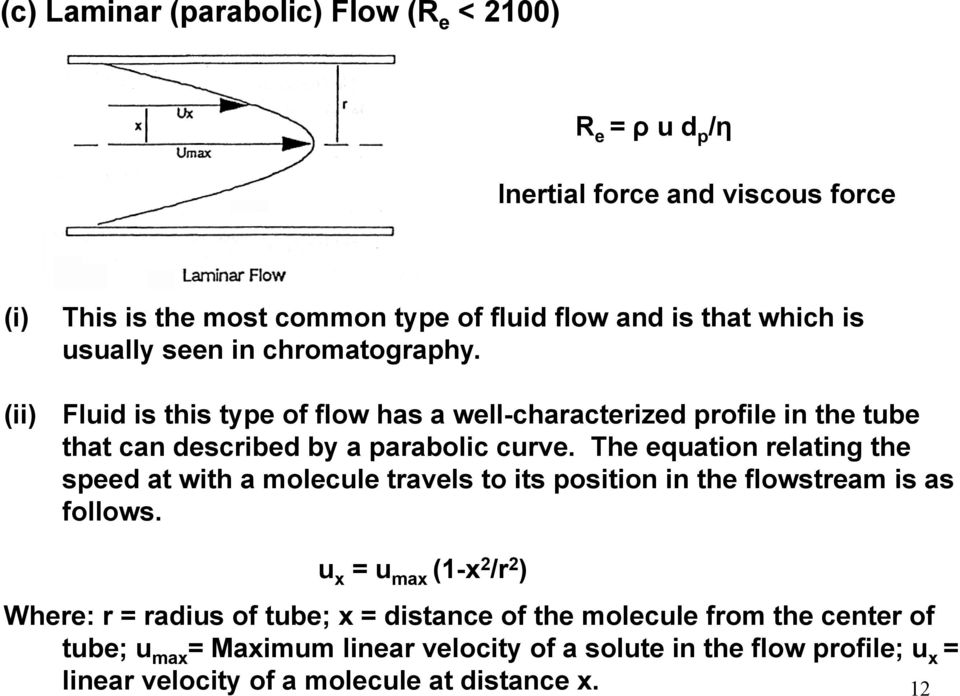
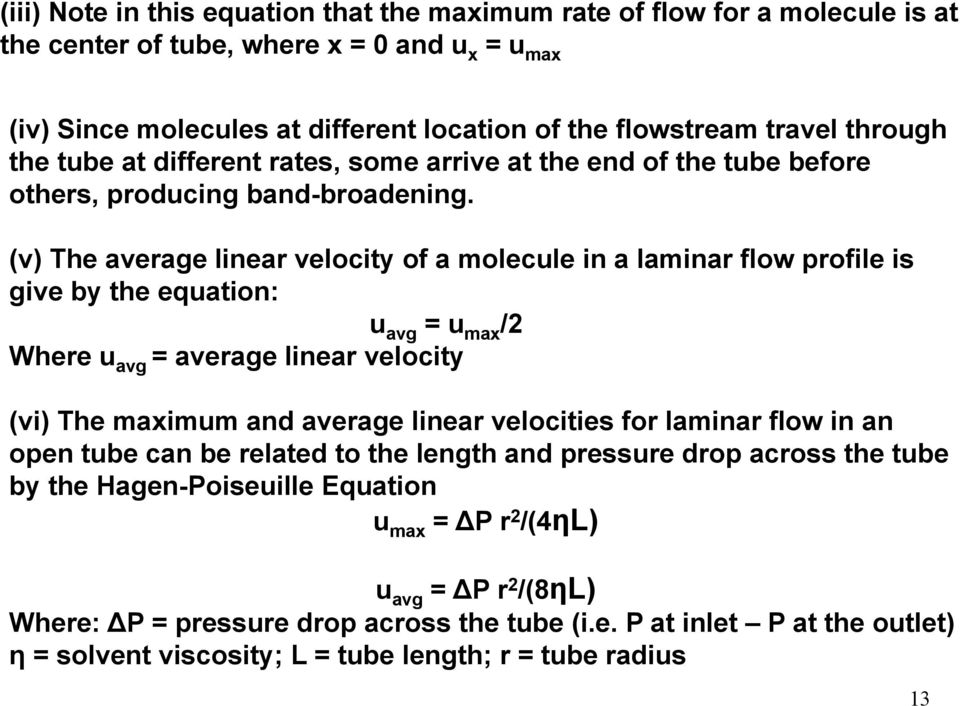
13 (iii) Note in this equation that the maximum rate of flow for a molecule is at the center of tube, where x = 0 and u x = u max (iv) Since molecules at different location of the flowstream travel through the tube at different rates, some arrive at the end of the tube before others, producing band-broadening. (v) The average linear velocity of a molecule in a laminar flow profile is give by the equation: u avg = u max /2 Where u avg = average linear velocity (vi) The maximum and average linear velocities for laminar flow in an open tube can be related to the length and pressure drop across the tube by the Hagen-Poiseuille Equation u max = ΔP r 2 /(4ηL) u avg = ΔP r 2 /(8ηL) Where: ΔP = pressure drop across the tube (i.e. P at inlet P at the outlet) η = solvent viscosity; L = tube length; r = tube radius 13
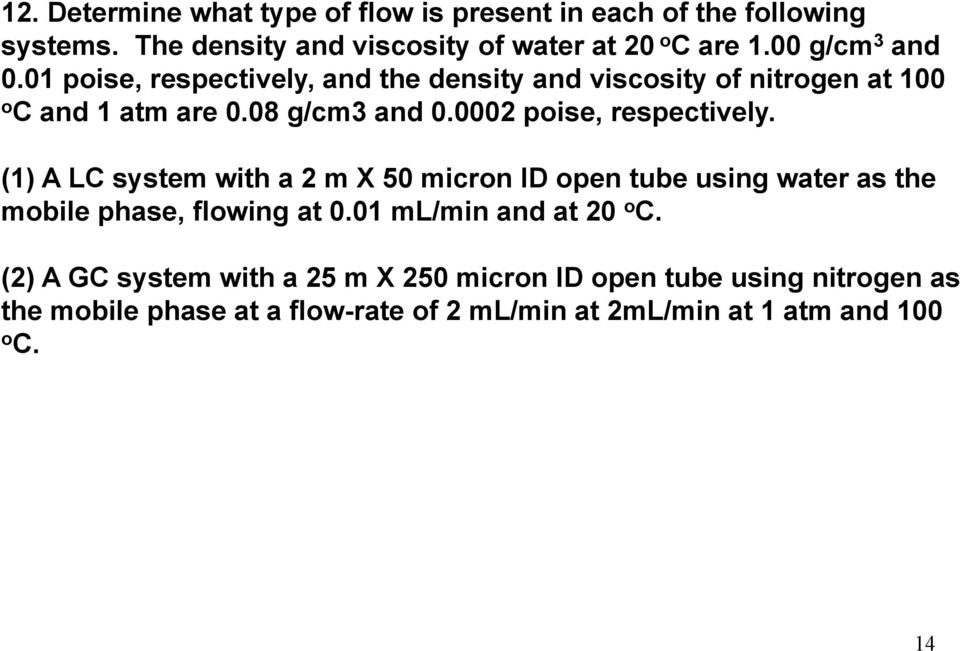
14 12. Determine what type of flow is present in each of the following systems. The density and viscosity of water at 20 o C are 1.00 g/cm 3 and 0.01 poise, respectively, and the density and viscosity of nitrogen at 100 o C and 1 atm are 0.08 g/cm3 and poise, respectively. (1) A LC system with a 2 m X 50 micron ID open tube using water as the mobile phase, flowing at 0.01 ml/min and at 20 o C. (2) A GC system with a 25 m X 250 micron ID open tube using nitrogen as the mobile phase at a flow-rate of 2 ml/min at 2mL/min at 1 atm and 100 o C. 14
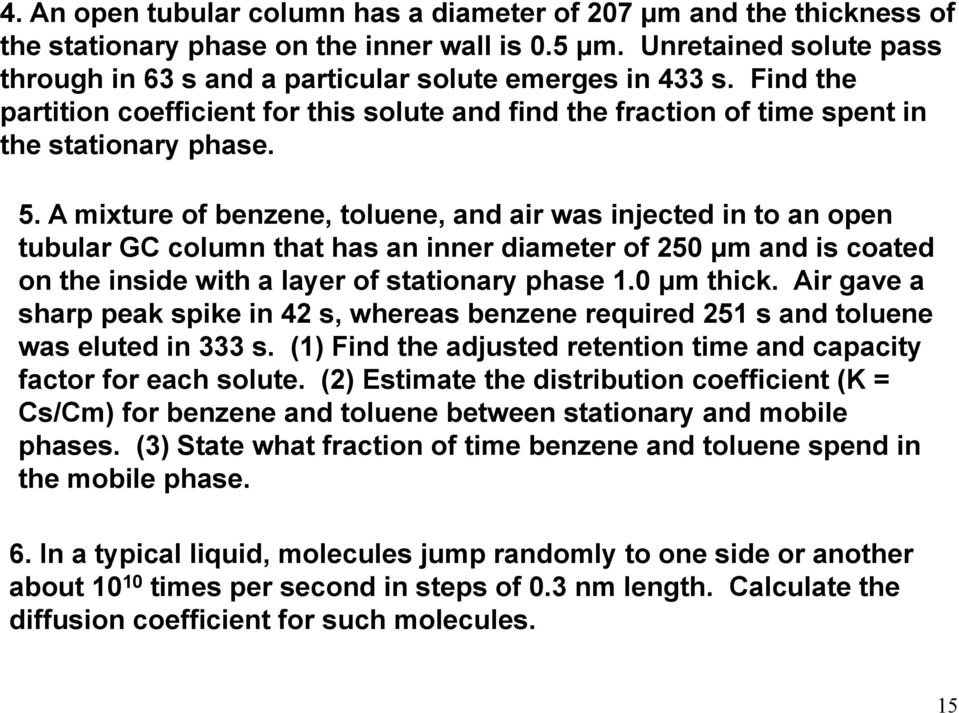
15 4. An open tubular column has a diameter of 207 μm and the thickness of the stationary phase on the inner wall is 0.5 μm. Unretained solute pass through in 63 s and a particular solute emerges in 433 s. Find the partition coefficient for this solute and find the fraction of time spent in the stationary phase. 5. A mixture of benzene, toluene, and air was injected in to an open tubular GC column that has an inner diameter of 250 μm and is coated on the inside with a layer of stationary phase 1.0 μm thick. Air gave a sharp peak spike in 42 s, whereas benzene required 251 s and toluene was eluted in 333 s. (1) Find the adjusted retention time and capacity factor for each solute. (2) Estimate the distribution coefficient (K = Cs/Cm) for benzene and toluene between stationary and mobile phases. (3) State what fraction of time benzene and toluene spend in the mobile phase. 6. In a typical liquid, molecules jump randomly to one side or another about times per second in steps of 0.3 nm length. Calculate the diffusion coefficient for such molecules. 15
XI / PHYSICS FLUIDS IN MOTION 11/PA
 Viscosity It is the property of a liquid due to which it flows in the form of layers and each layer opposes the motion of its adjacent layer. Cause of viscosity Consider two neighboring liquid layers A
FLUID DYNAMICS. Intrinsic properties of fluids. Fluids behavior under various conditions
 FLUID DYNAMICS Intrinsic properties of fluids Fluids behavior under various conditions Methods by which we can manipulate and utilize the fluids to produce desired results TYPES OF FLUID FLOW Laminar or
Gas Chromatography. Let s begin with an example problem: SPME head space analysis of pesticides in tea and follow-up analysis by high speed GC.
 Gas Chromatography Let s begin with an example problem: SPME head space analysis of pesticides in tea and follow-up analysis by high speed GC. Samples in 10mL sealed glass vials were placed in the MPS-2
Basic Principles in Microfluidics
 Basic Principles in Microfluidics 1 Newton s Second Law for Fluidics Newton s 2 nd Law (F= ma) : Time rate of change of momentum of a system equal to net force acting on system!f = dp dt Sum of forces
VISUAL PHYSICS School of Physics University of Sydney Australia. Why do cars need different oils in hot and cold countries?
 VISUAL PHYSICS School of Physics University of Sydney Australia FLUID FLOW VISCOSITY POISEUILLE'S LAW? Why do cars need different oils in hot and cold countries? Why does the engine runs more freely as
Aids needed for demonstrations: viscous fluid (water), tubes (pipes), injections, paper, stopwatches, vessels,, weights
 1 Viscous and turbulent flow Level: high school (16-17 years) hours (2 hours class teaching, 2 hours practical excercises) Content: 1. Viscous flow 2. Poiseuille s law 3. Passing from laminar to turbulent
CBE 6333, R. Levicky 1 Review of Fluid Mechanics Terminology
 CBE 6333, R. Levicky 1 Review of Fluid Mechanics Terminology The Continuum Hypothesis: We will regard macroscopic behavior of fluids as if the fluids are perfectly continuous in structure. In reality,
Notes on Polymer Rheology Outline
 1 Why is rheology important? Examples of its importance Summary of important variables Description of the flow equations Flow regimes - laminar vs. turbulent - Reynolds number - definition of viscosity
Lecture Chromo-3: Gas Chromatography. CHEM 5181 Fall 2004 Mass Spectrometry & Chromatography. Jessica Gilman and Prof. Jose-Luis Jimenez CU-Boulder
 Lecture Chromo-3: Gas Chromatography CHEM 5181 Fall 2004 Mass Spectrometry & Chromatography Jessica Gilman and Prof. Jose-Luis Jimenez CU-Boulder Outline Introduction Instrument overview Carrier gas Sample
A LAMINAR FLOW ELEMENT WITH A LINEAR PRESSURE DROP VERSUS VOLUMETRIC FLOW. 1998 ASME Fluids Engineering Division Summer Meeting
 TELEDYNE HASTINGS TECHNICAL PAPERS INSTRUMENTS A LAMINAR FLOW ELEMENT WITH A LINEAR PRESSURE DROP VERSUS VOLUMETRIC FLOW Proceedings of FEDSM 98: June -5, 998, Washington, DC FEDSM98 49 ABSTRACT The pressure
Lecture 5 Hemodynamics. Description of fluid flow. The equation of continuity
 1 Lecture 5 Hemodynamics Description of fluid flow Hydrodynamics is the part of physics, which studies the motion of fluids. It is based on the laws of mechanics. Hemodynamics studies the motion of blood
Lecture 24 - Surface tension, viscous flow, thermodynamics
 Lecture 24 - Surface tension, viscous flow, thermodynamics Surface tension, surface energy The atoms at the surface of a solid or liquid are not happy. Their bonding is less ideal than the bonding of atoms
Teil I. Student Laboratory Manuals
 Teil I Student Laboratory Manuals 1 IR1 5. Fluid friction in liquids 5.1 Introduction Generally the term fluid is understood to be matter either in the gaseous or liquid state. The physics involved on
Vacuum Technology. Kinetic Theory of Gas. Dr. Philip D. Rack
 Kinetic Theory of Gas Assistant Professor Department of Materials Science and Engineering University of Tennessee 603 Dougherty Engineering Building Knoxville, TN 3793-00 Phone: (865) 974-5344 Fax (865)
Dimensional Analysis
 Dimensional Analysis An Important Example from Fluid Mechanics: Viscous Shear Forces V d t / / / / / / / / / / / / / / / / / / / / / / / / / / / / / / / / / Ƭ = F/A = μ V/d More generally, the viscous
Fluid Mechanics: Static s Kinematics Dynamics Fluid
 Fluid Mechanics: Fluid mechanics may be defined as that branch of engineering science that deals with the behavior of fluid under the condition of rest and motion Fluid mechanics may be divided into three
The Viscosity of Fluids
 Experiment #11 The Viscosity of Fluids References: 1. Your first year physics textbook. 2. D. Tabor, Gases, Liquids and Solids: and Other States of Matter (Cambridge Press, 1991). 3. J.R. Van Wazer et
SIZE OF A MOLECULE FROM A VISCOSITY MEASUREMENT
 Experiment 8, page 1 Version of April 25, 216 Experiment 446.8 SIZE OF A MOLECULE FROM A VISCOSITY MEASUREMENT Theory Viscous Flow. Fluids attempt to minimize flow gradients by exerting a frictional force,
Dynamics in nanoworlds
 Dynamics in nanoworlds Interplay of energy, diffusion and friction in (sub)cellular world 1 NB Queste diapositive sono state preparate per il corso di Biofisica tenuto dal Dr. Attilio V. Vargiu presso
Energy Transport. Focus on heat transfer. Heat Transfer Mechanisms: Conduction Radiation Convection (mass movement of fluids)
 Energy Transport Focus on heat transfer Heat Transfer Mechanisms: Conduction Radiation Convection (mass movement of fluids) Conduction Conduction heat transfer occurs only when there is physical contact
ME 305 Fluid Mechanics I. Part 8 Viscous Flow in Pipes and Ducts
 ME 305 Fluid Mechanics I Part 8 Viscous Flow in Pipes and Ducts These presentations are prepared by Dr. Cüneyt Sert Mechanical Engineering Department Middle East Technical University Ankara, Turkey [email protected]
ME 538: Experiment # 1 Flow measurement and particle generation instruments
 ME 538: Experiment # 1 Flow measurement and particle generation instruments Suresh Dhaniyala Mechanical and Aeronautical Engineering Clarkson University Flow rate measurement Various types of flowmeters
Battery Thermal Management System Design Modeling
 Battery Thermal Management System Design Modeling Gi-Heon Kim, Ph.D Ahmad Pesaran, Ph.D ([email protected]) National Renewable Energy Laboratory, Golden, Colorado, U.S.A. EVS October -8, 8, 006 Yokohama,
DIFFUSION IN SOLIDS. Materials often heat treated to improve properties. Atomic diffusion occurs during heat treatment
 DIFFUSION IN SOLIDS WHY STUDY DIFFUSION? Materials often heat treated to improve properties Atomic diffusion occurs during heat treatment Depending on situation higher or lower diffusion rates desired
10.7 Kinetic Molecular Theory. 10.7 Kinetic Molecular Theory. Kinetic Molecular Theory. Kinetic Molecular Theory. Kinetic Molecular Theory
 The first scheduled quiz will be given next Tuesday during Lecture. It will last 5 minutes. Bring pencil, calculator, and your book. The coverage will be pp 364-44, i.e. Sections 0.0 through.4. 0.7 Theory
A Comparison of Analytical and Finite Element Solutions for Laminar Flow Conditions Near Gaussian Constrictions
 A Comparison of Analytical and Finite Element Solutions for Laminar Flow Conditions Near Gaussian Constrictions by Laura Noelle Race An Engineering Project Submitted to the Graduate Faculty of Rensselaer
Fluids and Solids: Fundamentals
 Fluids and Solids: Fundamentals We normally recognize three states of matter: solid; liquid and gas. However, liquid and gas are both fluids: in contrast to solids they lack the ability to resist deformation.
Basic Equations, Boundary Conditions and Dimensionless Parameters
 Chapter 2 Basic Equations, Boundary Conditions and Dimensionless Parameters In the foregoing chapter, many basic concepts related to the present investigation and the associated literature survey were
Measurement of the viscosities of He, Ne and Ar for the determination of their gas kinetic diameters.
 American Journal of Engineering Research (AJER) e-issn: 2320-0847 p-issn : 2320-0936 Volume-4, Issue-11, pp-57-62 www.ajer.org Research Paper Measurement of the viscosities of He, Ne and Ar for the determination
VISCOSITY OF A LIQUID. To determine the viscosity of a lubricating oil. Time permitting, the temperature variation of viscosity can also be studied.
 VISCOSITY OF A LIQUID August 19, 004 OBJECTIVE: EQUIPMENT: To determine the viscosity of a lubricating oil. Time permitting, the temperature variation of viscosity can also be studied. Viscosity apparatus
For Water to Move a driving force is needed
 RECALL FIRST CLASS: Q K Head Difference Area Distance between Heads Q 0.01 cm 0.19 m 6cm 0.75cm 1 liter 86400sec 1.17 liter ~ 1 liter sec 0.63 m 1000cm 3 day day day constant head 0.4 m 0.1 m FINE SAND
Heat Transfer Prof. Dr. Ale Kumar Ghosal Department of Chemical Engineering Indian Institute of Technology, Guwahati
 Heat Transfer Prof. Dr. Ale Kumar Ghosal Department of Chemical Engineering Indian Institute of Technology, Guwahati Module No. # 04 Convective Heat Transfer Lecture No. # 03 Heat Transfer Correlation
Lecture 6 - Boundary Conditions. Applied Computational Fluid Dynamics
 Lecture 6 - Boundary Conditions Applied Computational Fluid Dynamics Instructor: André Bakker http://www.bakker.org André Bakker (2002-2006) Fluent Inc. (2002) 1 Outline Overview. Inlet and outlet boundaries.
CE 204 FLUID MECHANICS
 CE 204 FLUID MECHANICS Onur AKAY Assistant Professor Okan University Department of Civil Engineering Akfırat Campus 34959 Tuzla-Istanbul/TURKEY Phone: +90-216-677-1630 ext.1974 Fax: +90-216-677-1486 E-mail:
FLUID FLOW STREAMLINE LAMINAR FLOW TURBULENT FLOW REYNOLDS NUMBER
 VISUAL PHYSICS School of Physics University of Sydney Australia FLUID FLOW STREAMLINE LAMINAR FLOW TURBULENT FLOW REYNOLDS NUMBER? What type of fluid flow is observed? The above pictures show how the effect
Chapter 10. Flow Rate. Flow Rate. Flow Measurements. The velocity of the flow is described at any
 Chapter 10 Flow Measurements Material from Theory and Design for Mechanical Measurements; Figliola, Third Edition Flow Rate Flow rate can be expressed in terms of volume flow rate (volume/time) or mass
Ferda ORHUN Mineral Research and Exploration Institute of Turkey
 GAS CHROMATOGRAPHY, EXPERIMENTAL STUDIES ON THE FLOW RATE EFFECTS OF CARRIER GAS AND APPLICATION OF THE METHOD TO HYDROCARBON ANALYSIS OF SOME NATURAL GASES IN TURKEY Ferda ORHUN Mineral Research and Exploration
Separation of Amino Acids by Paper Chromatography
 Separation of Amino Acids by Paper Chromatography Chromatography is a common technique for separating chemical substances. The prefix chroma, which suggests color, comes from the fact that some of the
Paul Clements, SpR in Anaesthetics, Hope Hospital, Salford, UK. Carl Gwinnutt, Consultant Anaesthetist, Hope Hospital, Salford, UK.
 The Physics of Flow Paul Clements, SpR in Anaesthetics, Hope Hospital, Salford, UK. Carl Gwinnutt, Consultant Anaesthetist, Hope Hospital, Salford, UK. Introduction Flow is defined as the quantity of fluid
Introduction to Microfluidics. Date: 2013/04/26. Dr. Yi-Chung Tung. Outline
 Introduction to Microfluidics Date: 2013/04/26 Dr. Yi-Chung Tung Outline Introduction to Microfluidics Basic Fluid Mechanics Concepts Equivalent Fluidic Circuit Model Conclusion What is Microfluidics Microfluidics
1. Fluids Mechanics and Fluid Properties. 1.1 Objectives of this section. 1.2 Fluids
 1. Fluids Mechanics and Fluid Properties What is fluid mechanics? As its name suggests it is the branch of applied mechanics concerned with the statics and dynamics of fluids - both liquids and gases.
The ratio of inertial to viscous forces is commonly used to scale fluid flow, and is called the Reynolds number, given as:
 12.001 LAB 3C: STOKES FLOW DUE: WEDNESDAY, MARCH 9 Lab Overview and Background The viscosity of a fluid describes its resistance to deformation. Water has a very low viscosity; the force of gravity causes
EXPERIMENT 10 CONSTANT HEAD METHOD
 EXPERIMENT 10 PERMEABILITY (HYDRAULIC CONDUCTIVITY) TEST CONSTANT HEAD METHOD 106 Purpose: The purpose of this test is to determine the permeability (hydraulic conductivity) of a sandy soil by the constant
Ch 2 Properties of Fluids - II. Ideal Fluids. Real Fluids. Viscosity (1) Viscosity (3) Viscosity (2)
 Ch 2 Properties of Fluids - II Ideal Fluids 1 Prepared for CEE 3500 CEE Fluid Mechanics by Gilberto E. Urroz, August 2005 2 Ideal fluid: a fluid with no friction Also referred to as an inviscid (zero viscosity)
Gas Chromatography Liner Selection Guide
 Gas Chromatography Liner Selection Guide Peter Morgan, Thermo Fisher Scientific, Runcorn, Cheshire, UK Technical Note 20551 Key Words Liner, focus Abstract The liner serves an important function in allowing
PLOT Columns. Top: Bob Langford, GC Column Manufacturing Technician Bottom: Stephanie Sunner, Customer Service Representative
 PLOT Columns Top: Bob Langford, GC Column Manufacturing Technician Bottom: Stephanie Sunner, Customer Service Representative PLOT Column Selection 93 Features & Benefits of Restek PLOT Columns Features
The Theory of HPLC. Gradient HPLC
 The Theory of HPLC Gradient HPLC i Wherever you see this symbol, it is important to access the on-line course as there is interactive material that cannot be fully shown in this reference manual. Aims
Viscosity (VIS) Topic: Mechanics. Laminar and turbulent flow, Reynolds number, Hagen-Poiseuille s law, Stokes law
 Seite 1 Viscosity Topic: Mechanics 1 Key words Laminar and turbulent flow, Reynolds number, Hagen-Poiseuille s law, Stokes law 2 Literatur L. Bergmann, C. Schäfer, Lehrbuch der Experimentalphysik, Band
1.1 This test method covers the qualitative and quantitative determination of the content of benzene and toluene in hydrocarbon wax.
 Standard Method for Analysis of Benzene and Toluene Content in Hydrocarbon Waxes by Headspace Gas Chromatography EWF METHOD 002/03 (Version 1 Reviewed 2015) 1 Scope 1.1 This test method covers the qualitative
Kinetic Theory of Gases. Chapter 33. Kinetic Theory of Gases
 Kinetic Theory of Gases Kinetic Theory of Gases Chapter 33 Kinetic theory of gases envisions gases as a collection of atoms or molecules. Atoms or molecules are considered as particles. This is based on
Natural Convection. Buoyancy force
 Natural Convection In natural convection, the fluid motion occurs by natural means such as buoyancy. Since the fluid velocity associated with natural convection is relatively low, the heat transfer coefficient
NUMERICAL ANALYSIS OF THE EFFECTS OF WIND ON BUILDING STRUCTURES
 Vol. XX 2012 No. 4 28 34 J. ŠIMIČEK O. HUBOVÁ NUMERICAL ANALYSIS OF THE EFFECTS OF WIND ON BUILDING STRUCTURES Jozef ŠIMIČEK email: [email protected] Research field: Statics and Dynamics Fluids mechanics
Differential Relations for Fluid Flow. Acceleration field of a fluid. The differential equation of mass conservation
 Differential Relations for Fluid Flow In this approach, we apply our four basic conservation laws to an infinitesimally small control volume. The differential approach provides point by point details of
2.2.1 Pressure and flow rate along a pipe: a few fundamental concepts
 1.1 INTRODUCTION Single-cell organisms live in direct contact with the environment from where they derive nutrients and into where they dispose of their waste. For living systems containing multiple cells,
Fractional Distillation and Gas Chromatography
 Fractional Distillation and Gas Chromatography Background Distillation The previous lab used distillation to separate a mixture of hexane and toluene based on a difference in boiling points. Hexane boils
Chapter 8: Flow in Pipes
 Objectives 1. Have a deeper understanding of laminar and turbulent flow in pipes and the analysis of fully developed flow 2. Calculate the major and minor losses associated with pipe flow in piping networks
9.2.3.7 Retention Parameters in Column Chromatography
 9.2.3.7 Retention Parameters in Column Chromatography Retention parameters may be measured in terms of chart distances or times, as well as mobile phase volumes; e.g., t R ' (time) is analogous to V R
SUCRALOSE. White to off-white, practically odourless crystalline powder
 SUCRALOSE Prepared at the 41st JECFA (1993), published in FNP 52 Add 2 (1993). Metals and arsenic specifications revised at the 63rd JECFA (2004). An ADI of 0-15 mg/kg bw was established at the 37th JECFA
Microfluidic Principles Part 1
 Introduction to BioMEMS & Medical Microdevices Microfluidic Principles Part 1 Companion lecture to the textbook: Fundamentals of BioMEMS and Medical Microdevices, by Dr. Steven S. Saliterman www.tc.umn.edu/~drsteve
Evaluating System Suitability CE, GC, LC and A/D ChemStation Revisions: A.03.0x- A.08.0x
 CE, GC, LC and A/D ChemStation Revisions: A.03.0x- A.08.0x This document is believed to be accurate and up-to-date. However, Agilent Technologies, Inc. cannot assume responsibility for the use of this
The Viscosity of Fluids
 Experiment #11 The Viscosity of Fluids References: 1. Your first year physics textbook. 2. D. Tabor, Gases, Liquids and Solids: and Other States of Matter (Cambridge Press, 1991). 3. J.R. Van Wazer et
Name Class Date. In the space provided, write the letter of the term or phrase that best completes each statement or best answers each question.
 Assessment Chapter Test A Chapter: States of Matter In the space provided, write the letter of the term or phrase that best completes each statement or best answers each question. 1. The kinetic-molecular
EXAMPLE: Water Flow in a Pipe
 EXAMPLE: Water Flow in a Pipe P 1 > P 2 Velocity profile is parabolic (we will learn why it is parabolic later, but since friction comes from walls the shape is intuitive) The pressure drops linearly along
AS1 MOLES. oxygen molecules have the formula O 2 the relative mass will be 2 x 16 = 32 so the molar mass will be 32g mol -1
 Moles 1 MOLES The mole the standard unit of amount of a substance the number of particles in a mole is known as Avogadro s constant (L) Avogadro s constant has a value of 6.023 x 10 23 mol -1. Example
Abaqus/CFD Sample Problems. Abaqus 6.10
 Abaqus/CFD Sample Problems Abaqus 6.10 Contents 1. Oscillatory Laminar Plane Poiseuille Flow 2. Flow in Shear Driven Cavities 3. Buoyancy Driven Flow in Cavities 4. Turbulent Flow in a Rectangular Channel
Chapter 21 Principles of Chromatography and Mass Spectrometry Problems 1,2,3,4,8,9,11,13
 Chapter 21 Principles of Chromatography and Mass Spectrometry Problems 1,2,3,4,8,9,11,13 21-1 What is Chromatography Process to separate and purify compounds in a mixture by passing them trough a material
THERMAL DESORPTION. Introduction and Principles. Focusing on Volatiles
 THERMAL DESORPTION Introduction and Principles Thermal Desorption Thermal desorption is a simple extension of the technique of gas chromatography (GC) It involves the use of heat and a flow of inert gas
Rheological Properties of Topical Formulations
 Rheological Properties of Topical Formulations Hemi Nae, PhD Hydan Technologies, Inc. Key Words Complex Modulus, Creep/Recovery, Dilatant Flow, Dynamic Viscosity, Flow, Flow Curve, Flow Models, Frequency
A drop forms when liquid is forced out of a small tube. The shape of the drop is determined by a balance of pressure, gravity, and surface tension
 A drop forms when liquid is forced out of a small tube. The shape of the drop is determined by a balance of pressure, gravity, and surface tension forces. 2 Objectives Have a working knowledge of the basic
F321 MOLES. Example If 1 atom has a mass of 1.241 x 10⁻²³ g 1 mole of atoms will have a mass of 1.241 x 10-23 g x 6.02 x 10 23 = 7.
 Moles 1 MOLES The mole the standard unit of amount of a substance (mol) the number of particles in a mole is known as Avogadro s constant (N A ) Avogadro s constant has a value of 6.02 x 10 23 mol -1.
Viscoelasticity of Polymer Fluids.
 Viscoelasticity of Polymer Fluids. Main Properties of Polymer Fluids. Entangled polymer fluids are polymer melts and concentrated or semidilute (above the concentration c) solutions. In these systems polymer
A New Technique Provides Faster Particle Size Analysis at a Lower Cost Compared to Conventional Methods
 A New Technique Provides Faster Particle Size Analysis at a Lower Cost Compared to Conventional Methods Howard Sanders and Akshaya Jena Porous Material Inc. Ithaca, NY The technique described here calculates
A. Kinetic Molecular Theory (KMT) = the idea that particles of matter are always in motion and that this motion has consequences.
 I. MOLECULES IN MOTION: A. Kinetic Molecular Theory (KMT) = the idea that particles of matter are always in motion and that this motion has consequences. 1) theory developed in the late 19 th century to
= 1.038 atm. 760 mm Hg. = 0.989 atm. d. 767 torr = 767 mm Hg. = 1.01 atm
 Chapter 13 Gases 1. Solids and liquids have essentially fixed volumes and are not able to be compressed easily. Gases have volumes that depend on their conditions, and can be compressed or expanded by
Contents. Microfluidics - Jens Ducrée Physics: Navier-Stokes Equation 1
 Contents 1. Introduction 2. Fluids 3. Physics of Microfluidic Systems 4. Microfabrication Technologies 5. Flow Control 6. Micropumps 7. Sensors 8. Ink-Jet Technology 9. Liquid Handling 10.Microarrays 11.Microreactors
AgoraLink Agora for Life Science Technologies Linköpings Universitet Kurs i Fysiologisk mätteknik Biofluidflöden
 AgoraLink Agora for Life Science Technologies Linköpings Universitet Kurs i Fysiologisk mätteknik Biofluidflöden Fysiologisk mätteknik Anatomy of the heart The complex myocardium structure right ventricle
Contents. Microfluidics - Jens Ducrée Physics: Fluid Dynamics 1
 Contents 1. Introduction 2. Fluids 3. Physics of Microfluidic Systems 4. Microfabrication Technologies 5. Flow Control 6. Micropumps 7. Sensors 8. Ink-Jet Technology 9. Liquid Handling 10.Microarrays 11.Microreactors
Fluid Dynamics Viscosity. Dave Foster Department of Chemical Engineering University of Rochester Email: dafoster@che
 Fluid Dynamics Viscosity Dave Foster Department of Chemical Engineering University of Rochester Email: dafoster@che che.rochester.eduedu 1 Chemical Engineering What do Chemical Engineers Do? Manufacturing
The Use of Hydrogen Carrier Gas for GC/MS
 Technical Note The Use of Hydrogen Carrier Gas for GC/MS Gas Chromatography/ Mass Spectrometry Highlights Guidelines that can mitigate dangers and leverage benefits of using hydrogen Key safety factors
Pipe Flow-Friction Factor Calculations with Excel
 Pipe Flow-Friction Factor Calculations with Excel Course No: C03-022 Credit: 3 PDH Harlan H. Bengtson, PhD, P.E. Continuing Education and Development, Inc. 9 Greyridge Farm Court Stony Point, NY 10980
INSTRUCTIONS 56-1190-98. Edition AC
 Sephacryl S-100 High Resolution Sephacryl S-200 High Resolution Sephacryl S-300 High Resolution Sephacryl S-400 High Resolution Sephacryl S-500 High Resolution INSTRUCTIONS Sephacryl High Resolution chromatography
An Advanced Base Deactivated Capillary Column for analysis of Volatile amines Ammonia and Alcohols.
 An Advanced Base Deactivated Capillary Column for analysis of Volatile amines Ammonia and Alcohols. Jaap de Zeeuw, Ron Stricek and Gary Stidsen Restek Corp Bellefonte, USA To analyze basic compounds at
Thermodynamics AP Physics B. Multiple Choice Questions
 Thermodynamics AP Physics B Name Multiple Choice Questions 1. What is the name of the following statement: When two systems are in thermal equilibrium with a third system, then they are in thermal equilibrium
Steady Flow: Laminar and Turbulent in an S-Bend
 STAR-CCM+ User Guide 6663 Steady Flow: Laminar and Turbulent in an S-Bend This tutorial demonstrates the flow of an incompressible gas through an s-bend of constant diameter (2 cm), for both laminar and
AN INTRODUCTION TO HEADSPACE SAMPLING IN GAS CHROMATOGRAPHY FUNDAMENTALS AND THEORY. Andrew Tipler
 AN INTRODUCTION TO HEADSPACE SAMPLING IN GAS CHROMATOGRAPHY FUNDAMENTALS AND THEORY Andrew Tipler Chromatography Research and Technology Manager PerkinElmer, Inc. Table of Contents Introduction 3 Fundamental
Viscous flow in pipe
 Viscous flow in pipe Henryk Kudela Contents 1 Laminar or turbulent flow 1 2 Balance of Momentum - Navier-Stokes Equation 2 3 Laminar flow in pipe 2 3.1 Friction factor for laminar flow...........................
Purification of reaction mixtures using flash chromatography.
 Purification of reaction mixtures using flash chromatography. This technical note details the use of ISOLUTE Flash chromatography columns for the purification of reaction mixtures. What is flash chromatography?
Addressing the World Helium Shortage For Gas Chromatography
 Addressing the World Helium Shortage For Gas Chromatography Helium Conservation and Converting GC Methods to Nitrogen and Hydrogen Carrier Gas James D. McCurry, Ph.D. Senior Scientist Agilent Technologies
RECITATION NOTES FOR EXPERIMENT # 5 A&B THIN LAYER CHROMATOGRAPHY
 RECITATION NOTES FOR EXPERIMENT # 5 A&B THIN LAYER CHROMATOGRAPHY Have your lab textbook available for quick reference to specific pages, indicated in red. BASIC PRINCIPLES OF CHROMATOGRAPHY Chromatography
Experiment (13): Flow channel
 Introduction: An open channel is a duct in which the liquid flows with a free surface exposed to atmospheric pressure. Along the length of the duct, the pressure at the surface is therefore constant and
Lecture 9, Thermal Notes, 3.054
 Lecture 9, Thermal Notes, 3.054 Thermal Properties of Foams Closed cell foams widely used for thermal insulation Only materials with lower conductivity are aerogels (tend to be brittle and weak) and vacuum
CHEMISTRY GAS LAW S WORKSHEET
 Boyle s Law Charles Law Guy-Lassac's Law Combined Gas Law For a given mass of gas at constant temperature, the volume of a gas varies inversely with pressure PV = k The volume of a fixed mass of gas is
Theory and Instrumentation of GC Introduction
 Theory and Instrumentation of GC Introduction i Wherever you see this symbol, it is important to access the on-line course as there is interactive material that cannot be fully shown in this reference
Free Convection Film Flows and Heat Transfer
 Deyi Shang Free Convection Film Flows and Heat Transfer With 109 Figures and 69 Tables < J Springer Contents 1 Introduction 1 1.1 Scope 1 1.2 Application Backgrounds 1 1.3 Previous Developments 2 1.3.1
Gases. States of Matter. Molecular Arrangement Solid Small Small Ordered Liquid Unity Unity Local Order Gas High Large Chaotic (random)
 Gases States of Matter States of Matter Kinetic E (motion) Potential E(interaction) Distance Between (size) Molecular Arrangement Solid Small Small Ordered Liquid Unity Unity Local Order Gas High Large
CONSTANT HEAD AND FALLING HEAD PERMEABILITY TEST
 CONSTANT HEAD AND FALLING HEAD PERMEABILITY TEST 1 Permeability is a measure of the ease in which water can flow through a soil volume. It is one of the most important geotechnical parameters. However,
CHAPTER: 6 FLOW OF WATER THROUGH SOILS
 CHAPTER: 6 FLOW OF WATER THROUGH SOILS CONTENTS: Introduction, hydraulic head and water flow, Darcy s equation, laboratory determination of coefficient of permeability, field determination of coefficient
ß-CYCLODEXTRIN SYNONYMS
 ß-CYCLODEXTRIN Prepared at the 44th JECFA (1995), published in FNP 52 Add 3 (1995) superseding specifications prepared at the 41st JECFA (1993), published in FNP 52 Add 2 (1993). Metals and arsenic specifications