
DESIGN AND BUILD YOUR OWN AUDIO AMPLIFIER
|
|
|
- Sherman Hines
- 9 years ago
- Views:
Transcription
1 DESIGN AND BUILD YOUR OWN AUDIO AMPLIFIER Reshed Hussein Kevin Wade Final Report ENEE 47-5 University of College Park

2 Introduction The purpose of this project was to design and build your own audio amplifier from scratch. Good audio amplifiers take a small input signal and magnify it several times, without distorting it, so that it can be heard at the speakers. In order to design our audio amplifier we used the scheme provided by professor Yang as a starting point, and made a few changes in order to meet the required specifications of high input impedance, low output impedance, and a gain of about. The project was very instructive because it not only helped us solidify our theoretical knowledge acquired in Microelectronics classes, but it also gave us an insight into the procedures an engineer must take from a design on paper to a final working product. Another benefit of this project is the satisfaction that is gained after completing such a challenging task. Even though our design satisfies all requirements there are many other ways to design a good audio amplifier; either by using op-amps or JFET instead of the BJT used in our design. The design of our audio amplifier was done on PSPICE, where we made sure that all requirements were met. After completing the design we built the circuit on the bread board and compared the observed DC voltages and currents with the ones obtained in PSPICE. We then designed a PCB layout on Microsoft Paint and built the PCB board. Few changes were made from the initial design in order to improve the performance of our circuit. This report contains all design schematics and measurements, as well as observed measurements done on the PCB board. Circuit design Our audio amplifier consists of two parts: a differential stage built using 2 BJTs and an emitter follower. The differential pair is used to amplify the input signal while the 2
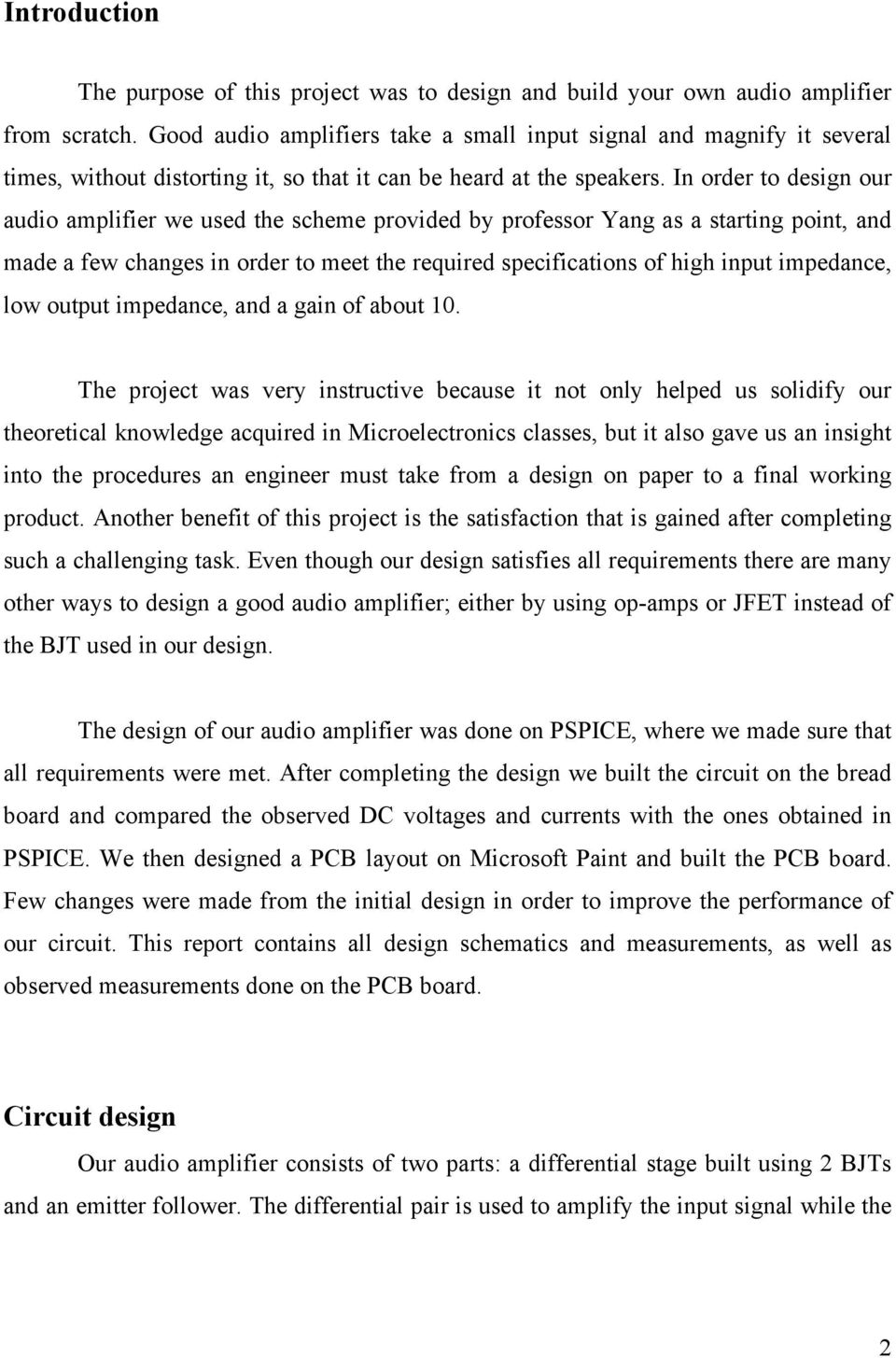
3 emitter follower is used as a power amp stage providing the necessary current to the load. Figure below shows the circuit built in PSPICE. Figure : Final Audio Amplifier Schematic 3

4 Figure 2: DC Voltages in PSPICE Figure 3: DC Currents in PSPICE. 4
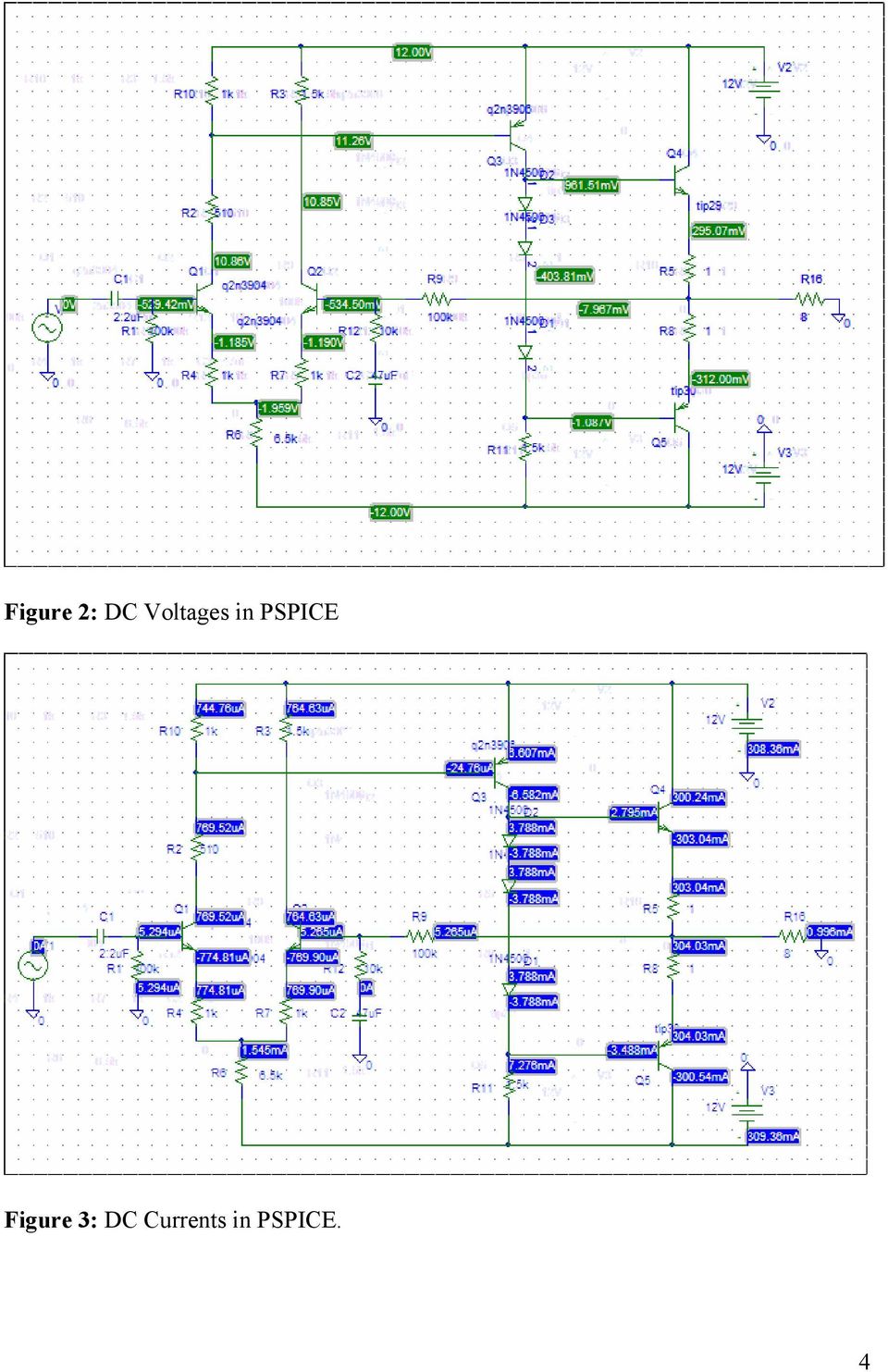
5 Figure 2 and 3 above, show the various DC voltages and currents that were obtained in PSPICE. Figure 4 below shows the voltage gain as a function of frequency. From the figure we can see that the gain is approximately across the audio range (from Hz to 2 KHz)...Hz Hz Hz.KHz KHz KHz V(Vout)/ V(Vin:+) Frequency Figure 4: Voltage Gain as a function of Frequency 6d 4d 2d d -2d.Hz Hz Hz.KHz KHz KHz.MHz P(V(Vout)/V(Vin:+)) Frequency Figure 5: Phase as a function of Frequency 5

6 As it can be seen from Figure 6 below the input impedance in the audible frequency range is approximately KΩ. In the ideal case the input impedance would be infinite, but since our circuit is far from being ideal KΩ is an acceptable value..m K K.Hz Hz Hz.KHz KHz KHz.MHz ABS(V(V5:+)/I(V5)) Frequency Figure 6: Input Impedance vs. Frequency (Amplitude) 8d 7d 6d 5d 4d.Hz Hz Hz.KHz KHz KHz.MHz P(V(V5:+)/I(V5)) Frequency Figure 7: Input Impedance vs. Frequency (Phase) As it can be seen from the figure below the output impedance is approximately zero, which is the desired value. 6

7 9.e-3 7.e-3 5.e-3 3.e-3.e-3.Hz Hz Hz.KHz KHz KHz ABS(V(V6:+)/ I(V6)) Frequency Figure 8: Output impedance vs. Frequency (Amplitude).ud.5ud d -.5ud -.ud.hz Hz Hz.KHz KHz KHz P(V(V6:+)/I(V6)) Frequency Figure 9: Output impedance vs. Frequency (Phase) Figure shows the input vs. the output as simulated in PSPICE. 7

8 V V -V s.5ms.ms.5ms 2.ms 2.5ms 3.ms 3.5ms 4.ms V(Vout) V(V8:+) Time Figure : Input vs. Output Figure below shows the PCB layout for our circuit. Figure : PCB layout 8

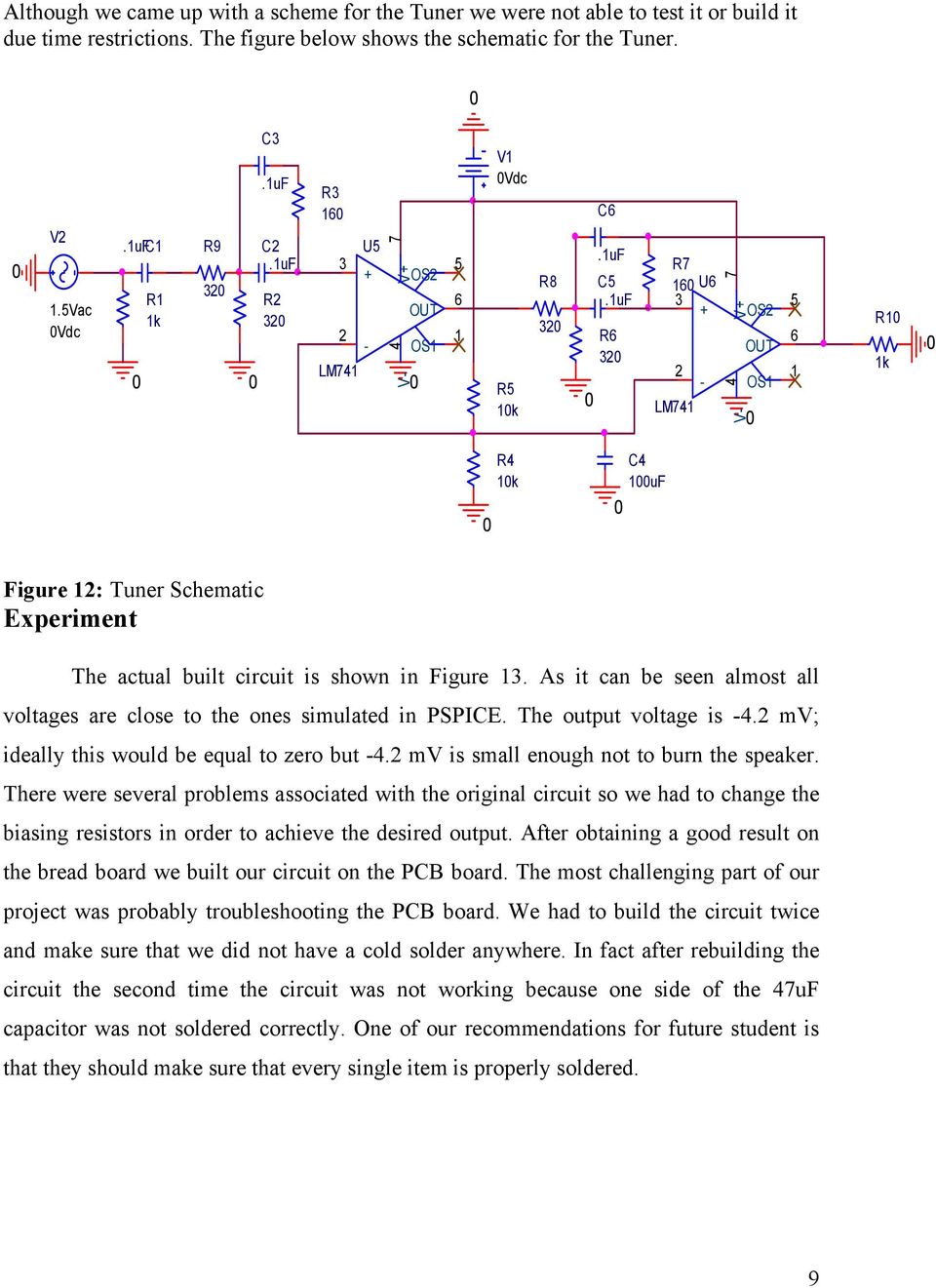
9 Although we came up with a scheme for the Tuner we were not able to test it or build it due time restrictions. The figure below shows the schematic for the Tuner. V2.5Vac Vdc.uFC R k R9 32 C3.uF C2.uF R2 32 R LM74 U V+ 4 V- OS2 OUT OS 5 6 V Vdc R5 k R8 32 C6.uF C5.uF R6 32 R7 6 U LM74 7 V+ 4 V- OS2 OUT OS 5 6 R k R4 k C4 uf Figure 2: Tuner Schematic Experiment The actual built circuit is shown in Figure 3. As it can be seen almost all voltages are close to the ones simulated in PSPICE. The output voltage is -4.2 mv; ideally this would be equal to zero but -4.2 mv is small enough not to burn the speaker. There were several problems associated with the original circuit so we had to change the biasing resistors in order to achieve the desired output. After obtaining a good result on the bread board we built our circuit on the PCB board. The most challenging part of our project was probably troubleshooting the PCB board. We had to build the circuit twice and make sure that we did not have a cold solder anywhere. In fact after rebuilding the circuit the second time the circuit was not working because one side of the 47uF capacitor was not soldered correctly. One of our recommendations for future student is that they should make sure that every single item is properly soldered. 9
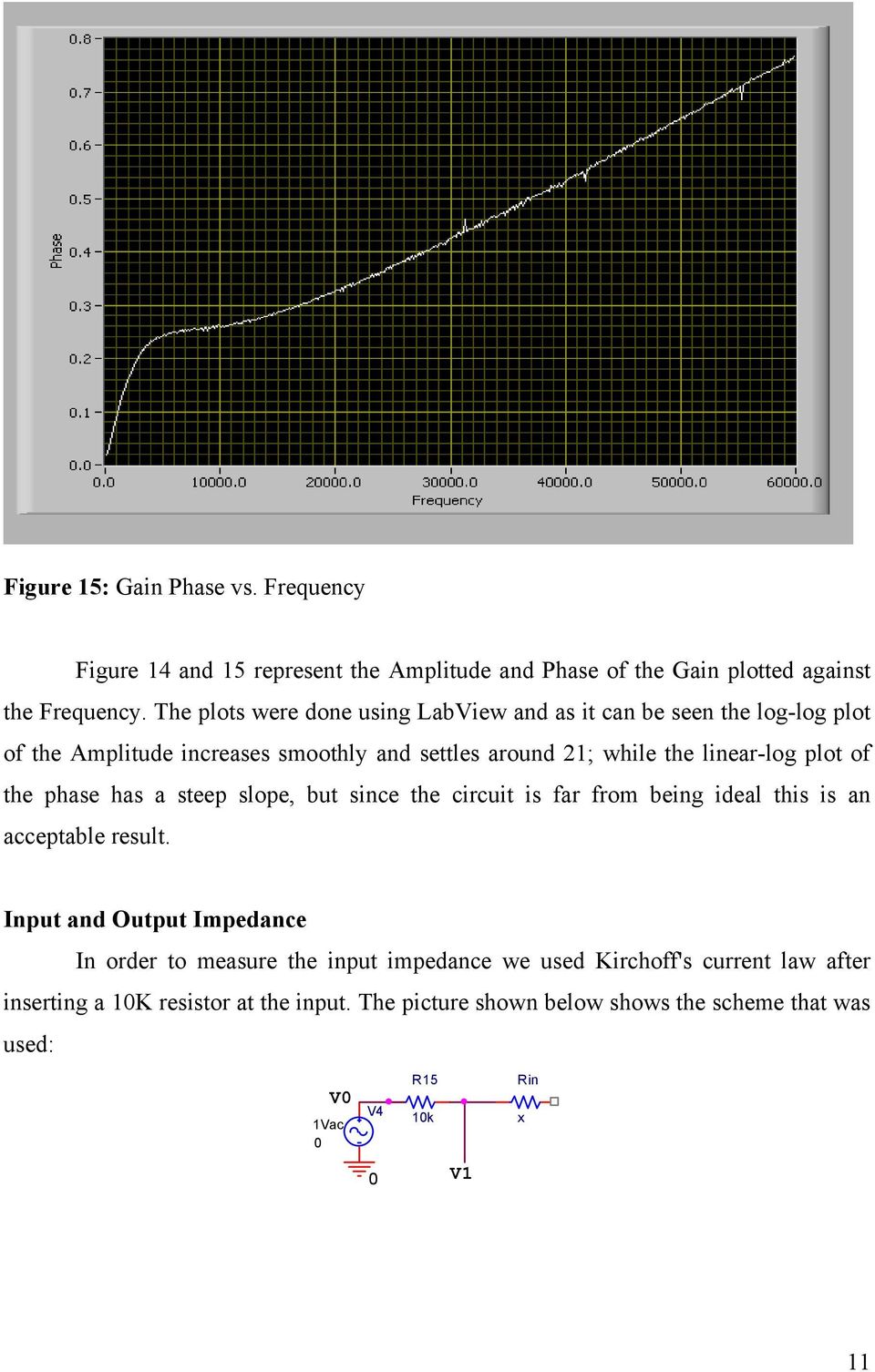
10 2 V 2V V.85V R6 k R5 5 R7.5k.6 V.24 V Q3 2 Q2N mv D N45 3 mv Q4 TIP29 28 mv R2 C -28 mv Q Q2N394 D2 Q2 N45-3 mv R9-4.2 mv 2 R4 V3 2.2uF VOFF = VAMPL = V FREQ = Hz R4 k -95 mv R k Q2N V R2 k R8 k C2 47uF k 2-29 mv D3 N45-92 mv R -29 mv TIP V R3 k SET = 6.5k R k Q5 2V V2-2 V Figure 3: Actual DC Voltages. Figure 4: Gain Amplitude vs. Frequency.

11 Figure 5: Gain Phase vs. Frequency Figure 4 and 5 represent the Amplitude and Phase of the Gain plotted against the Frequency. The plots were done using LabView and as it can be seen the log-log plot of the Amplitude increases smoothly and settles around 2; while the linear-log plot of the phase has a steep slope, but since the circuit is far from being ideal this is an acceptable result. Input and Output Impedance In order to measure the input impedance we used Kirchoff's current law after inserting a K resistor at the input. The picture shown below shows the scheme that was used: V Vac V4 R5 k Rin x V
12 The procedure we followed was to measure the V and V shown in the picture and use the following equation to solve for Rin: (V V) / K = V / Rin Rin = (V*K) / (V V) For input amplitude of 2mV and frequency of Hz the input impedance we obtained was: Rin = (58 mv * K) / (63 mv 58 mv) = 6 KΩ. This value is very close to the one obtained using PSPICE which was KΩ. The following table list input impedances measured at different frequencies. Frequency (Hz) Input Impedance (KΩ) Table : Input Impedance as a function of Frequency The Output Impedance was measured using a similar scheme as the one used to measure the input impedance. The pictures shown below show the scheme that was used: V Rout R V Rout R2 x y x y V V2 By measuring V and V2 and using known resistor values R and R2, we plugged the values in the following equations and solved them for Rout:. (V V) / Rout = V / R 2. (V V2) / Rout = V2 / R2 After equating equation and 2, we solved them for Rout. The result we obtained is the following: Rout = (V- V2) / [(V2/R2) (V/R)] 2

13 Table 2 shows the Output Impedance for several values of input Frequency: Freq (KHz) R(Ω) V(mV) R2(Ω) V2(mV) Rout(Ω) Table 2: Output Impedance as a function of Frequency As it can be seen from the table above all Output Impedance values are very close to zero as desired. The following are pictures of the PCB circuit that we built. Figure 6: Actual Audio Amplifier (top view) 3
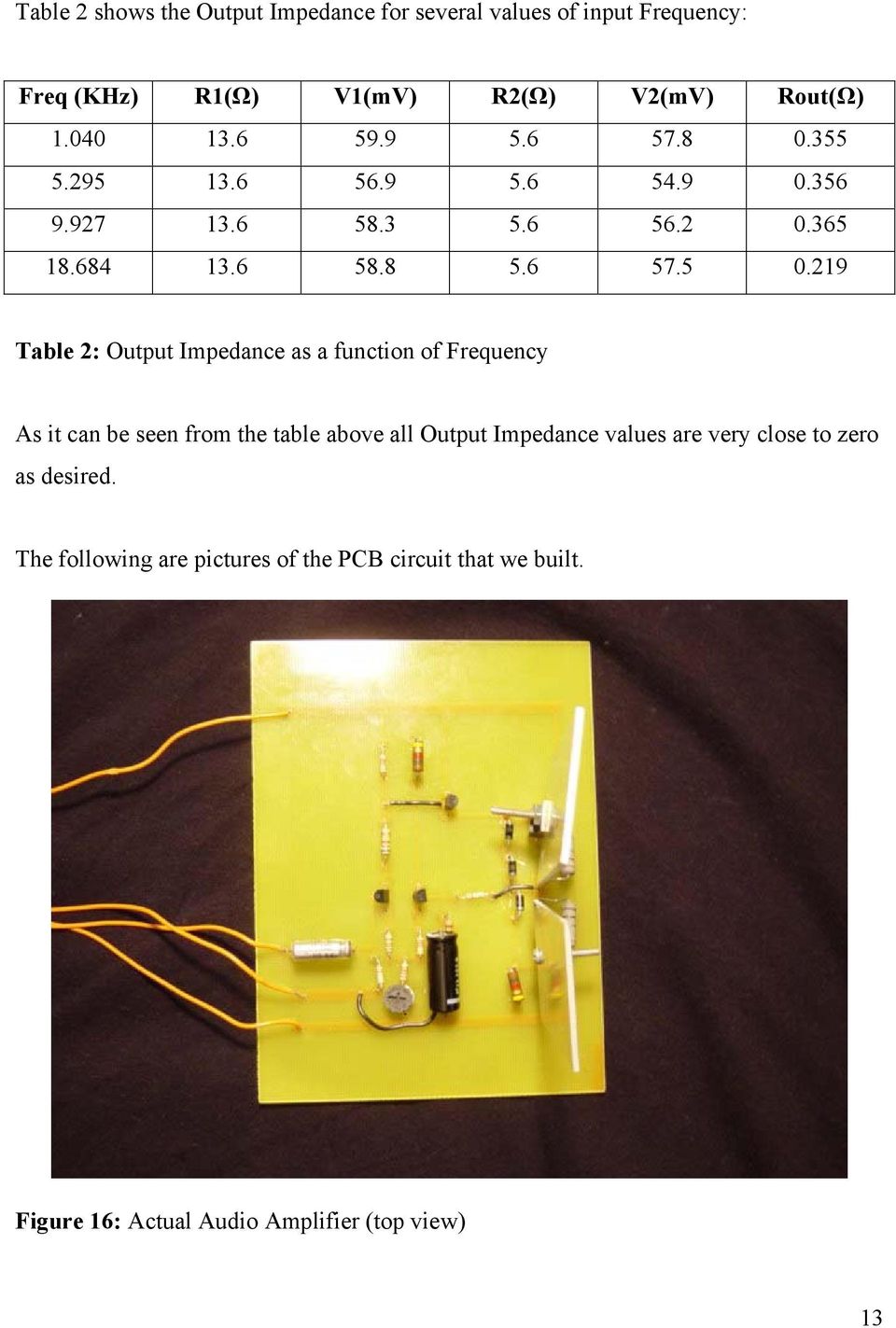
14 Figure 7: Actual Audio Amplifier (side view) Discussions The main obstacle that we encountered with our circuit was not with the design but with its real world application. We found that PSPICE can really only be a guide or reference tool used to give the general expected results. When the design gives the desired results in PSPICE, the challenge is achieving those results on the breadboard. Once we built our circuit on the breadboard we spent a considerable amount of time tweaking our design to get the desired gain at the output. Most of our problems rooted in voltage and current biasing problems. We went through a series of labs testing a seemingly infinite amount of resistor value configurations until we achieved a functional output. The only remaining problem lied in an output voltage that was too large. We remedied this problem by placing a potentiometer before the emitters in our differential amp stage which made the granular adjustment needed to correct our circuits biasing currents. 4
15 With pleasing breadboard results, we moved on to building our PC board. After constructing a malfunctioning channel in route to our final working board, the main thing we learned was that the physical quality of the board is what characterizes your results. It is of optimal concern to draw a layout that allows clean copper paths followed by solid solder connections in order to attain the breadboard results. Overall, this lab gave us a real opportunity to experience what it is like to design and build a real world circuit. It gave us the necessary benefit of realizing the circuits we have been studying only in textbooks in previous classes at the University. Future projects may have involved building amplifiers of different classes or selective tuners like those used in AM/FM radios. 5

Electronics. Discrete assembly of an operational amplifier as a transistor circuit. LD Physics Leaflets P4.2.1.1
 Electronics Operational Amplifier Internal design of an operational amplifier LD Physics Leaflets Discrete assembly of an operational amplifier as a transistor circuit P4.2.1.1 Objects of the experiment
Lab #9: AC Steady State Analysis
 Theory & Introduction Lab #9: AC Steady State Analysis Goals for Lab #9 The main goal for lab 9 is to make the students familar with AC steady state analysis, db scale and the NI ELVIS frequency analyzer.
EE 242 EXPERIMENT 5: COMPUTER SIMULATION OF THREE-PHASE CIRCUITS USING PSPICE SCHEMATICS 1
 EE 242 EXPERIMENT 5: COMPUTER SIMULATION OF THREE-PHASE CIRCUITS USING PSPICE SCHEMATICS 1 Objective: To build, simulate, and analyze three-phase circuits using OrCAD Capture Pspice Schematics under balanced
LABORATORY 2 THE DIFFERENTIAL AMPLIFIER
 LABORATORY 2 THE DIFFERENTIAL AMPLIFIER OBJECTIVES 1. To understand how to amplify weak (small) signals in the presence of noise. 1. To understand how a differential amplifier rejects noise and common
11: AUDIO AMPLIFIER I. INTRODUCTION
 11: AUDIO AMPLIFIER I. INTRODUCTION The properties of an amplifying circuit using an op-amp depend primarily on the characteristics of the feedback network rather than on those of the op-amp itself. A
Objectives The purpose of this lab is build and analyze Differential amplifiers based on NPN transistors (or NMOS transistors).
 1 Lab 03: Differential Amplifiers (BJT) (20 points) NOTE: 1) Please use the basic current mirror from Lab01 for the second part of the lab (Fig. 3). 2) You can use the same chip as the basic current mirror;
OPERATIONAL AMPLIFIERS
 INTRODUCTION OPERATIONAL AMPLIFIERS The student will be introduced to the application and analysis of operational amplifiers in this laboratory experiment. The student will apply circuit analysis techniques
LM1036 Dual DC Operated Tone/Volume/Balance Circuit
 LM1036 Dual DC Operated Tone/Volume/Balance Circuit General Description The LM1036 is a DC controlled tone (bass/treble), volume and balance circuit for stereo applications in car radio, TV and audio systems.
Laboratory 4: Feedback and Compensation
 Laboratory 4: Feedback and Compensation To be performed during Week 9 (Oct. 20-24) and Week 10 (Oct. 27-31) Due Week 11 (Nov. 3-7) 1 Pre-Lab This Pre-Lab should be completed before attending your regular
LM 358 Op Amp. If you have small signals and need a more useful reading we could amplify it using the op amp, this is commonly used in sensors.
 LM 358 Op Amp S k i l l L e v e l : I n t e r m e d i a t e OVERVIEW The LM 358 is a duel single supply operational amplifier. As it is a single supply it eliminates the need for a duel power supply, thus
Frequency Response of Filters
 School of Engineering Department of Electrical and Computer Engineering 332:224 Principles of Electrical Engineering II Laboratory Experiment 2 Frequency Response of Filters 1 Introduction Objectives To
Lab 7: Operational Amplifiers Part I
 Lab 7: Operational Amplifiers Part I Objectives The objective of this lab is to study operational amplifier (op amp) and its applications. We will be simulating and building some basic op amp circuits,
School of Engineering Department of Electrical and Computer Engineering
 1 School of Engineering Department of Electrical and Computer Engineering 332:223 Principles of Electrical Engineering I Laboratory Experiment #4 Title: Operational Amplifiers 1 Introduction Objectives
Common Base BJT Amplifier Common Collector BJT Amplifier
 Common Base BJT Amplifier Common Collector BJT Amplifier Common Collector (Emitter Follower) Configuration Common Base Configuration Small Signal Analysis Design Example Amplifier Input and Output Impedances
ENEE 307 Electronic Circuit Design Laboratory Spring 2012. A. Iliadis Electrical Engineering Department University of Maryland College Park MD 20742
 1.1. Differential Amplifiers ENEE 307 Electronic Circuit Design Laboratory Spring 2012 A. Iliadis Electrical Engineering Department University of Maryland College Park MD 20742 Differential Amplifiers
Voltage/current converter opamp circuits
 Voltage/current converter opamp circuits This worksheet and all related files are licensed under the Creative Commons Attribution License, version 1.0. To view a copy of this license, visit http://creativecommons.org/licenses/by/1.0/,
Operational Amplifier - IC 741
 Operational Amplifier - IC 741 Tabish December 2005 Aim: To study the working of an 741 operational amplifier by conducting the following experiments: (a) Input bias current measurement (b) Input offset
FREQUENCY RESPONSE OF AN AUDIO AMPLIFIER
 2014 Amplifier - 1 FREQUENCY RESPONSE OF AN AUDIO AMPLIFIER The objectives of this experiment are: To understand the concept of HI-FI audio equipment To generate a frequency response curve for an audio
Pulse Width Modulation (PWM) LED Dimmer Circuit. Using a 555 Timer Chip
 Pulse Width Modulation (PWM) LED Dimmer Circuit Using a 555 Timer Chip Goals of Experiment Demonstrate the operation of a simple PWM circuit that can be used to adjust the intensity of a green LED by varying
TUBE-TECH HLT 2A Stereo High- and Low shelving, T- filter & Low- and High cut
 TUBE-TECH HLT 2A Stereo High- and Low shelving, T- filter & Low- and High cut Description: The TUBE-TECH HLT 2A is a stereo unit, featuring low and high cut filters, low and high shelving filters and a
Reading: HH Sections 4.11 4.13, 4.19 4.20 (pgs. 189-212, 222 224)
 6 OP AMPS II 6 Op Amps II In the previous lab, you explored several applications of op amps. In this exercise, you will look at some of their limitations. You will also examine the op amp integrator and
Lab 5 Operational Amplifiers
 Lab 5 Operational Amplifiers By: Gary A. Ybarra Christopher E. Cramer Duke University Department of Electrical and Computer Engineering Durham, NC. Purpose The purpose of this lab is to examine the properties
AM Receiver. Prelab. baseband
 AM Receiver Prelab In this experiment you will use what you learned in your previous lab sessions to make an AM receiver circuit. You will construct an envelope detector AM receiver. P1) Introduction One
Step Response of RC Circuits
 Step Response of RC Circuits 1. OBJECTIVES...2 2. REFERENCE...2 3. CIRCUITS...2 4. COMPONENTS AND SPECIFICATIONS...3 QUANTITY...3 DESCRIPTION...3 COMMENTS...3 5. DISCUSSION...3 5.1 SOURCE RESISTANCE...3
Inductors in AC Circuits
 Inductors in AC Circuits Name Section Resistors, inductors, and capacitors all have the effect of modifying the size of the current in an AC circuit and the time at which the current reaches its maximum
Germanium Diode AM Radio
 Germanium Diode AM Radio LAB 3 3.1 Introduction In this laboratory exercise you will build a germanium diode based AM (Medium Wave) radio. Earliest radios used simple diode detector circuits. The diodes
BJT AC Analysis 1 of 38. The r e Transistor model. Remind Q-poiint re = 26mv/IE
 BJT AC Analysis 1 of 38 The r e Transistor model Remind Q-poiint re = 26mv/IE BJT AC Analysis 2 of 38 Three amplifier configurations, Common Emitter Common Collector (Emitter Follower) Common Base BJT
Chapter 19 Operational Amplifiers
 Chapter 19 Operational Amplifiers The operational amplifier, or op-amp, is a basic building block of modern electronics. Op-amps date back to the early days of vacuum tubes, but they only became common
CTCSS REJECT HIGH PASS FILTERS IN FM RADIO COMMUNICATIONS AN EVALUATION. Virgil Leenerts WØINK 8 June 2008
 CTCSS REJECT HIGH PASS FILTERS IN FM RADIO COMMUNICATIONS AN EVALUATION Virgil Leenerts WØINK 8 June 28 The response of the audio voice band high pass filter is evaluated in conjunction with the rejection
Service Manual. (9 Inch) LCD Color Monitor & DVD Player & DVB-T&ATV. mp-man PDV-TY995
 Service Manual (9 Inch) LCD Color Monitor & DVD Player & DVB-T&ATV mp-man PDV-TY995 Specification........ 2 Block Diagram........ 4 General Alignment Instruction...... 5 Troubleshooting...... 8 Printed
Selected Filter Circuits Dr. Lynn Fuller
 ROCHESTER INSTITUTE OF TECHNOLOGY MICROELECTRONIC ENGINEERING Selected Filter Circuits Dr. Lynn Fuller Webpage: http://people.rit.edu/lffeee 82 Lomb Memorial Drive Rochester, NY 146235604 Tel (585) 4752035
Kit 27. 1W TDA7052 POWER AMPLIFIER
 Kit 27. 1W TDA7052 POWER AMPLIFIER This is a 1 watt mono amplifier Kit module using the TDA7052 from Philips. (Note, no suffix.) It is designed to be used as a building block in other projects where a
AC 2012-3923: MEASUREMENT OF OP-AMP PARAMETERS USING VEC- TOR SIGNAL ANALYZERS IN UNDERGRADUATE LINEAR CIRCUITS LABORATORY
 AC 212-3923: MEASUREMENT OF OP-AMP PARAMETERS USING VEC- TOR SIGNAL ANALYZERS IN UNDERGRADUATE LINEAR CIRCUITS LABORATORY Dr. Tooran Emami, U.S. Coast Guard Academy Tooran Emami received her M.S. and Ph.D.
Lecture 24. Inductance and Switching Power Supplies (how your solar charger voltage converter works)
 Lecture 24 Inductance and Switching Power Supplies (how your solar charger voltage converter works) Copyright 2014 by Mark Horowitz 1 Roadmap: How Does This Work? 2 Processor Board 3 More Detailed Roadmap
OrCAD Capture with PSpice and Allegro DE CIS with AMS Simulator. Describes how to create a PSpice Archive File with Capture
 Title: Product: Summary: Creating a Project Archive OrCAD Capture with PSpice and Allegro DE CIS with AMS Simulator Describes how to create a PSpice Archive File with Capture Author/Date: Wei Ling / 03.08.2009
What you will do. Build a 3-band equalizer. Connect to a music source (mp3 player) Low pass filter High pass filter Band pass filter
 Audio Filters What you will do Build a 3-band equalizer Low pass filter High pass filter Band pass filter Connect to a music source (mp3 player) Adjust the strength of low, high, and middle frequencies
A Versatile Audio Amplifier
 A Versatile Audio Amplifier...built around the TBA 810 Integrated Circuit You can build a versatile audio amplifier for your workbench or for any other of your audio projects...with the TBA 810 IC (Integrated
Building the AMP Amplifier
 Building the AMP Amplifier Introduction For about 80 years it has been possible to amplify voltage differences and to increase the associated power, first with vacuum tubes using electrons from a hot filament;
Op-Amp Simulation EE/CS 5720/6720. Read Chapter 5 in Johns & Martin before you begin this assignment.
 Op-Amp Simulation EE/CS 5720/6720 Read Chapter 5 in Johns & Martin before you begin this assignment. This assignment will take you through the simulation and basic characterization of a simple operational
Common-Emitter Amplifier
 Common-Emitter Amplifier A. Before We Start As the title of this lab says, this lab is about designing a Common-Emitter Amplifier, and this in this stage of the lab course is premature, in my opinion,
MAS.836 HOW TO BIAS AN OP-AMP
 MAS.836 HOW TO BIAS AN OP-AMP Op-Amp Circuits: Bias, in an electronic circuit, describes the steady state operating characteristics with no signal being applied. In an op-amp circuit, the operating characteristic
6.101 Final Project Report Class G Audio Amplifier
 6.101 Final Project Report Class G Audio Amplifier Mark Spatz 4/3/2014 1 1 Introduction For my final project, I designed and built a 150 Watt audio amplifier to replace the underpowered and unreliable
Massachusetts Institute of Technology Department of Electrical Engineering and Computer Science. 6.002 Electronic Circuits Spring 2007
 Massachusetts Institute of Technology Department of Electrical Engineering and Computer Science 6.002 Electronic Circuits Spring 2007 Lab 4: Audio Playback System Introduction In this lab, you will construct,
6.101 Final Project Proposal Class G Audio Amplifier. Mark Spatz
 6.101 Final Project Proposal Class G Audio Amplifier Mark Spatz 1 1 Introduction For my final project, I will be constructing a 30V audio amplifier capable of delivering about 150 watts into a network
Physics 623 Transistor Characteristics and Single Transistor Amplifier Sept. 13, 2006
 Physics 623 Transistor Characteristics and Single Transistor Amplifier Sept. 13, 2006 1 Purpose To measure and understand the common emitter transistor characteristic curves. To use the base current gain
How To Calculate The Power Gain Of An Opamp
 A. M. Niknejad University of California, Berkeley EE 100 / 42 Lecture 8 p. 1/23 EE 42/100 Lecture 8: Op-Amps ELECTRONICS Rev C 2/8/2012 (9:54 AM) Prof. Ali M. Niknejad University of California, Berkeley
Understanding Power Impedance Supply for Optimum Decoupling
 Introduction Noise in power supplies is not only caused by the power supply itself, but also the load s interaction with the power supply (i.e. dynamic loads, switching, etc.). To lower load induced noise,
TDA2040. 20W Hi-Fi AUDIO POWER AMPLIFIER
 20W Hi-Fi AUDIO POWER AMPLIFIER DESCRIPTION The TDA2040 is a monolithic integrated circuit in Pentawatt package, intended for use as an audio class AB amplifier. Typically it provides 22W output power
Routinely DIYers opt to make themselves a passive preamp - just an input selector and a volume control.
 The First Watt B1 Buffer Preamp Nelson Pass, June 2008 Side A So here we are in the New Millennium, and thanks to Tom Holman and THX we ve got lots of gain in our electronics. More gain than some of us
LM386 Low Voltage Audio Power Amplifier
 Low Voltage Audio Power Amplifier General Description The LM386 is a power amplifier designed for use in low voltage consumer applications. The gain is internally set to 20 to keep external part count
Transistor Characteristics and Single Transistor Amplifier Sept. 8, 1997
 Physics 623 Transistor Characteristics and Single Transistor Amplifier Sept. 8, 1997 1 Purpose To measure and understand the common emitter transistor characteristic curves. To use the base current gain
DATA SHEET. TDA1510AQ 24 W BTL or 2 x 12 W stereo car radio power amplifier INTEGRATED CIRCUITS
 INTEGRATED CIRCUITS DATA SHEET 24 W BTL or 2 x 12 W stereo car radio File under Integrated Circuits, IC01 January 1992 GENERAL DESCRIPTION The is a class-b integrated output amplifier encapsulated in a
Programmable Single-/Dual-/Triple- Tone Gong SAE 800
 Programmable Single-/Dual-/Triple- Tone Gong Preliminary Data SAE 800 Bipolar IC Features Supply voltage range 2.8 V to 18 V Few external components (no electrolytic capacitor) 1 tone, 2 tones, 3 tones
Making Accurate Voltage Noise and Current Noise Measurements on Operational Amplifiers Down to 0.1Hz
 Author: Don LaFontaine Making Accurate Voltage Noise and Current Noise Measurements on Operational Amplifiers Down to 0.1Hz Abstract Making accurate voltage and current noise measurements on op amps in
Audio Tone Control Using The TLC074 Operational Amplifier
 Application Report SLOA42 - JANUARY Audio Tone Control Using The TLC74 Operational Amplifier Dee Harris Mixed-Signal Products ABSTRACT This application report describes the design and function of a stereo
3. On the top menu bar, click on File > New > Project as shown in Fig. 2 below: Figure 2 Window for Orcad Capture CIS
 Department of Electrical Engineering University of North Texas Denton, TX. 76207 EENG 2920 Quickstart PSpice Tutorial Tutorial Prepared by Oluwayomi Adamo 1. To run the PSpice program, click on Start >
Physics 120 Lab 6: Field Effect Transistors - Ohmic region
 Physics 120 Lab 6: Field Effect Transistors - Ohmic region The FET can be used in two extreme ways. One is as a voltage controlled resistance, in the so called "Ohmic" region, for which V DS < V GS - V
The 2N3393 Bipolar Junction Transistor
 The 2N3393 Bipolar Junction Transistor Common-Emitter Amplifier Aaron Prust Abstract The bipolar junction transistor (BJT) is a non-linear electronic device which can be used for amplification and switching.
TS34119 Low Power Audio Amplifier
 SOP-8 DIP-8 Pin assignment: 1. CD 8. VO2 2. FC2 7. Gnd 3. FC1 6. Vcc 4. Vin 5. VO1 General Description The TS34119 is a low power audio amplifier, it integrated circuit intended (primarily) for telephone
Common Emitter BJT Amplifier Design Current Mirror Design
 Common Emitter BJT Amplifier Design Current Mirror Design 1 Some Random Observations Conditions for stabilized voltage source biasing Emitter resistance, R E, is needed. Base voltage source will have finite
Analog Sound From A Digital Delay
 Analog Sound From A Digital Delay The PT-80 Digital Delay By Scott Swartz Copyright 2002, All Rights Reserved Introduction This article will describe a digital delay pedal that is designed to capture the
Chapter 12: The Operational Amplifier
 Chapter 12: The Operational Amplifier 12.1: Introduction to Operational Amplifier (Op-Amp) Operational amplifiers (op-amps) are very high gain dc coupled amplifiers with differential inputs; they are used
The Phase Modulator In NBFM Voice Communication Systems
 The Phase Modulator In NBFM Voice Communication Systems Virgil Leenerts 8 March 5 The phase modulator has been a point of discussion as to why it is used and not a frequency modulator in what are called
SIMPLE HEART RATE MONITOR FOR ANALOG ENTHUSIASTS
 SIMPLE HEART RATE MONITOR FOR ANALOG ENTHUSIASTS Jelimo B Maswan, Abigail C Rice 6.101: Final Project Report Date: 5/15/2014 1 Project Motivation Heart Rate Monitors are quickly becoming ubiquitous in
The Critical Length of a Transmission Line
 Page 1 of 9 The Critical Length of a Transmission Line Dr. Eric Bogatin President, Bogatin Enterprises Oct 1, 2004 Abstract A transmission line is always a transmission line. However, if it is physically
SUPER SNOOPER BIG EAR
 AA-1D Super Snooper Big Ear SPECIFICATIONS Operates on 5 to 9v DC Will drive a small speaker Provides up to 1 watt of audio power Distortion > 0.2% Voltage Gain up to 46 db Size: 1 x 1.95 Rainbowkits.com
Department of Engineering. A Pulse Induction Metal Detector. ENGN3227 Analogue Electronics. Dr Salman Durrani. Group TA5
 Department of Engineering A Pulse Induction Metal Detector ENGN3227 Analogue Electronics Dr Salman Durrani Group TA5 James Boxall u2553319 Stephen Purvis u2560946 Garrick Madge u3545631 Tathagat Banerjee
TDA2040. 20W Hi-Fi AUDIO POWER AMPLIFIER
 20W Hi-Fi AUDIO POWER AMPLIFIER DESCRIPTION The TDA2040 is a monolithic integrated circuit in Pentawatt package, intended for use as an audio class AB amplifier. Typically it provides 22W output power
www.jameco.com 1-800-831-4242
 Distributed by: www.jameco.com 1-800-831-4242 The content and copyrights of the attached material are the property of its owner. LF411 Low Offset, Low Drift JFET Input Operational Amplifier General Description
Experiment #11: LRC Circuit (Power Amplifier, Voltage Sensor)
 Experiment #11: LRC Circuit (Power Amplifier, Voltage Sensor) Concept: circuits Time: 30 m SW Interface: 750 Windows file: RLC.SWS EQUIPMENT NEEDED Science Workshop Interface Power Amplifier (2) Voltage
Experiment # (4) AM Demodulator
 Islamic University of Gaza Faculty of Engineering Electrical Department Experiment # (4) AM Demodulator Communications Engineering I (Lab.) Prepared by: Eng. Omar A. Qarmout Eng. Mohammed K. Abu Foul Experiment
Lab 1: Introduction to PSpice
 Lab 1: Introduction to PSpice Objectives A primary purpose of this lab is for you to become familiar with the use of PSpice and to learn to use it to assist you in the analysis of circuits. The software
Brio-Rmanual:Cursamanual.qxd 08/04/2011 09:25 Page1
 - Brio-Rmanual:Cursamanual.qxd 08/04/2011 09:25 Page1 Brio-Rmanual:Cursamanual.qxd 08/04/2011 09:25 Page2 CONTENTS INTRODUCTION, FEATURES AND TECHNOLOGY 1-3 INSTALLATION 3 CONNECTIVITY 4-6 LOUDSPEAKER
Class D Audio Amplifier
 Class D Audio Amplifier The design of a live audio Class D audio amplifier with greater than 90% efficiency and less than 1% distortion. A Major Qualifying Project Submitted to the Faculty of the WORCESTER
F(t) Forssell Technologies Inc
 F(t) Forssell Technologies Inc SMP-2Aa Microphone Preamplifier User Manual Forssell Technologies Inc Sandpoint Idaho USA (208) 263-0286 Introduction The Forssell Technologies Inc SMP-2A is a 2 channel,
Redesigned by Laurier Gendron (Aug 2006 ) Download this project in PDF. Horn circuit. Train Circuitry
 Redesigned by Laurier Gendron (Aug 2006 ) Download this project in PDF Train Circuitry Horn circuit New Design After many comments by interested hobbyists not being able to obtain parts like the LM566
AN-837 APPLICATION NOTE
 APPLICATION NOTE One Technology Way P.O. Box 916 Norwood, MA 262-916, U.S.A. Tel: 781.329.47 Fax: 781.461.3113 www.analog.com DDS-Based Clock Jitter Performance vs. DAC Reconstruction Filter Performance
DATA SHEET. TDA1518BQ 24 W BTL or 2 x 12 watt stereo car radio power amplifier INTEGRATED CIRCUITS
 INTEGRATED CIRCUITS DATA SHEET File under Integrated Circuits, IC01 July 1994 GENERAL DESCRIPTION The is an integrated class-b output amplifier in a 13-lead single-in-line (SIL) plastic power package.
Chapter 8 Differential and Multistage Amplifiers. EE 3120 Microelectronics II
 1 Chapter 8 Differential and Multistage Amplifiers Operational Amplifier Circuit Components 2 1. Ch 7: Current Mirrors and Biasing 2. Ch 9: Frequency Response 3. Ch 8: Active-Loaded Differential Pair 4.
Bipolar Transistor Amplifiers
 Physics 3330 Experiment #7 Fall 2005 Bipolar Transistor Amplifiers Purpose The aim of this experiment is to construct a bipolar transistor amplifier with a voltage gain of minus 25. The amplifier must
Electrical Resonance
 Electrical Resonance (R-L-C series circuit) APPARATUS 1. R-L-C Circuit board 2. Signal generator 3. Oscilloscope Tektronix TDS1002 with two sets of leads (see Introduction to the Oscilloscope ) INTRODUCTION
Laboratory 2. Exercise 2. Exercise 2. PCB Design
 Exercise 2. PCB Design Aim of the measurement Introducing to the PCB design Creating a schematic of an analog circuit, making simulations on it and designing a Printed circuit board for it. Keywords Printed
Fully Differential CMOS Amplifier
 ECE 511 Analog Electronics Term Project Fully Differential CMOS Amplifier Saket Vora 6 December 2006 Dr. Kevin Gard NC State University 1 Introduction In this project, a fully differential CMOS operational
RC & RL Transient Response
 EE 2006 University of Minnesota Duluth ab 8 1. Introduction R & R Transient Response The student will analyze series R and R circuits. A step input will excite these respective circuits, producing a transient
Oscilloscope, Function Generator, and Voltage Division
 1. Introduction Oscilloscope, Function Generator, and Voltage Division In this lab the student will learn to use the oscilloscope and function generator. The student will also verify the concept of voltage
ENGR-4300 Electronic Instrumentation Quiz 4 Spring 2011 Name Section
 ENGR-4300 Electronic Instrumentation Quiz 4 Spring 2011 Name Section Question I (20 points) Question II (20 points) Question III (20 points) Question IV (20 points) Question V (20 points) Total (100 points)
Series AMLDL-Z Up to 1000mA LED Driver
 FEATURES: Click on Series name for product info on aimtec.com Series Up to ma LED Driver Models Single output Model Input Voltage (V) Step Down DC/DC LED driver Operating Temperature range 4ºC to 85ºC
Voltage Divider Bias
 Voltage Divider Bias ENGI 242 ELEC 222 BJT Biasing 3 For the Voltage Divider Bias Configurations Draw Equivalent Input circuit Draw Equivalent Output circuit Write necessary KVL and KCL Equations Determine
Content Map For Career & Technology
 Content Strand: Applied Academics CT-ET1-1 analysis of electronic A. Fractions and decimals B. Powers of 10 and engineering notation C. Formula based problem solutions D. Powers and roots E. Linear equations
Application Note. Line Card Redundancy Design With the XRT83SL38 T1/E1 SH/LH LIU ICs
 Application Note Design With the XRT83SL38 T1/E1 SH/LH LIU ICs Revision 1.3 1 REDUNDANCY APPLICATIONS INTRODUCTION Telecommunication system design requires signal integrity and reliability. When a T1/E1
Precision Diode Rectifiers
 by Kenneth A. Kuhn March 21, 2013 Precision half-wave rectifiers An operational amplifier can be used to linearize a non-linear function such as the transfer function of a semiconductor diode. The classic
Transistor Amplifiers
 Physics 3330 Experiment #7 Fall 1999 Transistor Amplifiers Purpose The aim of this experiment is to develop a bipolar transistor amplifier with a voltage gain of minus 25. The amplifier must accept input
Kit 106. 50 Watt Audio Amplifier
 Kit 106 50 Watt Audio Amplifier T his kit is based on an amazing IC amplifier module from ST Electronics, the TDA7294 It is intended for use as a high quality audio class AB amplifier in hi-fi applications
Output Ripple and Noise Measurement Methods for Ericsson Power Modules
 Output Ripple and Noise Measurement Methods for Ericsson Power Modules Design Note 022 Ericsson Power Modules Ripple and Noise Abstract There is no industry-wide standard for measuring output ripple and
TL074 TL074A - TL074B
 A B LOW NOISE JFET QUAD OPERATIONAL AMPLIFIERS WIDE COMMONMODE (UP TO V + CC ) AND DIFFERENTIAL VOLTAGE RANGE LOW INPUT BIAS AND OFFSET CURRENT LOW NOISE e n = 15nV/ Hz (typ) OUTPUT SHORTCIRCUIT PROTECTION
A Digital Timer Implementation using 7 Segment Displays
 A Digital Timer Implementation using 7 Segment Displays Group Members: Tiffany Sham u2548168 Michael Couchman u4111670 Simon Oseineks u2566139 Caitlyn Young u4233209 Subject: ENGN3227 - Analogue Electronics
DATA SHEET. TDA8560Q 2 40 W/2 Ω stereo BTL car radio power amplifier with diagnostic facility INTEGRATED CIRCUITS. 1996 Jan 08
 INTEGRATED CIRCUITS DATA SHEET power amplifier with diagnostic facility Supersedes data of March 1994 File under Integrated Circuits, IC01 1996 Jan 08 FEATURES Requires very few external components High
Experiment 8 : Pulse Width Modulation
 Name/NetID: Teammate/NetID: Experiment 8 : Pulse Width Modulation Laboratory Outline In experiment 5 we learned how to control the speed of a DC motor using a variable resistor. This week, we will learn
phonostage RIP YOUR VINYL TO BITS, WITH A USB Design
 RIP YOUR VINYL TO BITS, WITH A USB phonostage So what do you do with that collection of LPs you have? Sure, they sound great and are fun to listen to, but let s face it, they re not exactly portable. Wouldn
INTRODUCTION. Please read this manual carefully for a through explanation of the Decimator ProRackG and its functions.
 INTRODUCTION The Decimator ProRackG guitar noise reduction system defines a new standard for excellence in real time noise reduction performance. The Decimator ProRackG was designed to provide the maximum