
Muriel Syacumpi. Printed August 2006
|
|
|
- Hugo Lindsey
- 10 years ago
- Views:
Transcription
1 Preservice and Pst-Basic Nursing Training Curricula fr Registered Nurses in Zambia: Curriculum Review and Expert Interviews t Assess Antimicrbial Use and Antimicrbial Resistance Cntent, March 2006 Muriel Syacumpi Printed August 2006 Advcacy Wrking Grup Ratinal Pharmaceutical Management Plus Center fr Pharmaceutical Management Management Sciences fr Health 4301 N. Fairfax Drive, Suite 400 Arlingtn, VA USA Phne: Fax: [email protected] Strategic Objective 5

2 Preservice and Pst-Basic Nursing Training Curricula in Zambia: Curriculum Review and Expert Interviews t Assess AMU and AMR Cntent, March 2006 This reprt was made pssible thrugh supprt prvided by the U.S. Agency fr Internatinal Develpment, under the terms f cperative agreement number HRN-A The pinins expressed herein are thse f the authr(s) and d nt necessarily reflect the views f the U.S. Agency fr Internatinal Develpment. Abut RPM Plus RPM Plus wrks in mre than 20 develping and transitinal cuntries t prvide technical assistance t strengthen drug and health cmmdity management systems. The prgram ffers technical guidance and assists in strategy develpment and prgram implementatin bth in imprving the availability f health cmmdities pharmaceuticals, vaccines, supplies, and basic medical equipment f assured quality fr maternal and child health, HIV/AIDS, infectius diseases, and family planning and in prmting the apprpriate use f health cmmdities in the public and private sectrs. Recmmended Citatin This reprt may be reprduced if credit is given t RPM Plus. Please use the fllwing citatin. Syacumpi, M Preservice and Pst-Basic Nursing Training Curricula fr Registered Nurses in Zambia: Curriculum Review and Expert Interviews t Assess Antimicrbial Use and Antimicrbial Resistance Cntent, March Submitted t the U.S. Agency fr Internatinal Develpment by the Ratinal Pharmaceutical Management Plus Prgram. Arlingtn, VA: Management Sciences fr Health. Ratinal Pharmaceutical Management Plus Center fr Pharmaceutical Management Management Sciences fr Health 4301 Nrth Fairfax Drive, Suite 400 Arlingtn, VA USA Telephne: Fax: [email protected] Web: ii

3 CONTENTS ACRONYMS... v EXECUTIVE SUMMARY... 1 Antimicrbial Use and Antimicrbial Resistance... 2 Ratinal Use f Medicines... 2 Infectin Preventin... 3 Antimicrbial Resistance... 3 Patient Educatin... 3 Recmmendatins... 4 BACKGROUND INFORMATION... 5 Cntext... 5 Scpe f Wrk fr the Cnsultancy... 7 Assessment Methdlgy... 7 FINDINGS... 9 Registered Nursing Curriculum (Preservice Nursing Prgram)... 9 Pst-Basic Nursing Curriculum (Graduate Nursing Prgram) Teaching and Learning Methds Respndents Views n AMU, AMR, and Cntainment f AMR DISCUSSION AND RECOMMENDATIONS Preservice Nursing Prgram Pst-Basic Prgram Patient Educatin Antimicrbial Use Ratinal Use f Medicines Infectin Preventin Recmmendatins REFERENCES ANNEX 1. INTERVIEW TRANSCRIPTS Heads f Institutins, Lecturers, Tutrs in Public and Private Schls, Guest Lecturers Graduate Interns, UTH Third-Year Student Nurses, UTH Schl f Nursing Regulatry Bdies and Senir Gvernment Officials ANNEX 2. CURRICULA FOR THE TWO NURSING PROGRAMS ANNEX 3. GAPS IDENTIFIED IN THE BSC NURSING PROGRAM ANNEX 4. KEY INFORMANTS ANNEX 5. STRATEGIES FOR CURRICULUM REVIEW AND INTERVIEWS iii

4 Preservice and Pst-Basic Nursing Training Curricula in Zambia: Curriculum Review and Expert Interviews t Assess AMU and AMR Cntent, March 2006 ANNEX 6. SCOPE OF WORK iv

5 ACRONYMS AIDS AMU AMR ARV BSc CBOH GNC HIV MH PBL PRA RN RUM STGs TB UNZA UTH WHO acquired immundeficiency syndrme antimicrbial use antimicrbial resistance antiretrviral bachelr f science Central Bard f Health General Nursing Cuncil [Zambia] human immundeficiency virus Ministry f Health prblem-based learning Pharmaceutical Regulatry Authrity Registered Nurse ratinal use f medicines standard treatment guidelines tuberculsis University f Zambia University teaching hspital Wrld Health Organizatin v
![[Zambia] human immundeficiency virus Ministry f Health prblem-based learning Pharmaceutical Regulatry Authrity Registered](/docs-images/42/1802334/images/page_5.jpg "Nurse ratinal use f medicines standard treatment guidelines tuberculsis University f Zambia University teaching hspital Wrld")
6 Preservice and Pst-Basic Nursing Training Curricula in Zambia: Curriculum Review and Expert Interviews t Assess AMU and AMR Cntent, March 2006 vi
7 EXECUTIVE SUMMARY Despite the significant strides in fighting disease and infectin brught abut by the discvery f antibitics, sme bacteria have develped ways in which t utwit the effects f antibitics. Widespread use f antibitics is thught t have spurred evlutinary changes in bacteria that allw them t survive these pwerful drugs. Antibitic resistance presents tw big prblems: it makes it mre difficult fr the bdy t purge itself f infectins, and it heightens the risk f acquiring infectins in a hspital. It is in this vein that antimicrbial resistance (AMR) becmes f utmst imprtance in the medical field. Zambia is ne f the cuntries cncerned with the high levels f AMR, ratinal use f antimicrbials, and the issue f cntainment f AMR. With the emergence f newer medicines n the market and easy unregulated access t sme f these medicines by varius individuals in the cmmunities, the need fr the educatin f health prviders t help with the cntainment f the prblem cannt be veremphasized. The cmmissining f this study t assess the status f AMR/antimicrbial use (AMU) training in schls is therefre imprtant as a starting pint. A review f the curricula fr the graduate nursing prgram at the University f Zambia, Department f Pst-Basic Nursing, and the curricula fr Registered Nurse (RN) training prgrams in Zambia was undertaken t assess hw tpics n AMU and AMR were addressed in thse curricula. The review prcess was als aimed at identifying gaps in the curricula based n the cverage and prgramming f the AMR/AMU tpics in the training plans. The first phase f the study cnsisted f a desk review f the curricula, identifying curses within which antimicrbial tpics are integrated, the perids when the tpics are taught, the amunt f time allcated, and whether students are examined n the tpics. The secnd phase invlved cnducting in-depth interviews with key fficials with links t the teaching prgrams in the nursing schls. That grup included thse persns invlved in training, thse respnsible fr the regulatin f training institutins, and thse respnsible fr plicy frmulatin. The persns interviewed were fficials frm the General Nursing Cuncil (GNC), which regulates training, certificatin, and registratin f all nurses t practice and had recently guided the review and revisin f curricula fr all nurse training prgrams in Zambia; the Chief Nurse in the Ministry f Health (MH) in rder t btain the gvernment s stand n the issue f AMR/AMU; tutrs in gvernmental nurse training institutins; tutrs frm the newly pened private nurse training schls; guest lecturers in micrbilgy and pharmaclgy; three recent nursing graduates; and three senir student nurses. These in-depth interviews were a vital surce f infrmatin relevant t this study. The interviews further slicited infrmatin n hw the subjects wanted related training t be dne better r imprved. Annexes 1 and 2 shw the curriculum curse cntent fr the three-year training fr the preservice and pst-basic graduate prgrams. Sme key literature was als reviewed t help put the issues f AMR and AMU int the cntext f this study (References). The Pst-Basic curriculum was reviewed t prvide insight n hw well prepared the graduates frm the prgram were t be able t teach in the nursing schls, especially teaching AMR/AMU, infectin preventin, and ther related tpics. The findings shw that very little 1

8 Preservice and Pst-Basic Nursing Training Curricula in Zambia: Curriculum Review and Expert Interviews t Assess AMU and AMR Cntent, March 2006 time was devted t AMR and AMU, with the Pst-Basic training prgram allcating nly 13 hurs in a semester t teach micrbilgy, within which tpics f AMR/AMU and ther related tpics are taught. Althugh the curriculum indicates 6 hurs f lecture cntact per week as an ideal situatin, that is nt the case. The tw brad areas that were reviewed at bth pst-basic and preservice levels in this study were AMU and AMR and related tpics, such as infectin preventin, patient educatin, and ratinal use f medicines (RUM). Antimicrbial Use and Antimicrbial Resistance The tw curricula reviewed and the ensuing interviews shw that antimicrbials have been adequately cvered in different curses and applicatin f such knwledge is guaranteed because students are nrmally examined as is the case in the preservice prgrams where examinatins are cncerned with applicatin f all knwledge acquired during the three-year perid. The student is therefre expected t have knwledge n antimicrbials and an understanding f when, hw, and why these apply in patient care. Hwever, their indiscriminate prescriptin has had an adverse effect n use because f the many resistant strains being seen tday. The curricula talk abut drugs f chice but d nt adequately teach the prcess f prescribing effectively. Students are taught prescribing principles, drug interactins, and adverse drug reactins and effects. Antimicrbial resistance is mentined, but the teaching prgrams have nt been clear in ensuring the subject adequately addresses hw t find further ways f cntaining the prblem. Ratinal Use f Medicines Respndents als expressed cncerns n the variatins in the levels f detail being taught t students in schls. The University Teaching Hspital (UTH) has specialists that participate in teaching in the nurse training, and their understanding is at a different level. In ther hspitals, hwever, thse experts are nt available, thus resulting in the nurse tutrs having t cver the tpics. RUM is being cmprmised because nurse tutrs may nly discuss issues pertaining t AMU superficially, especially thse cming frm hspitals where interactin with specialists is minimal. Mst respndents bserved that the situatin has resulted in nurses nt challenging sme f the dctrs prescriptins. The GNC initiative in develping a guide t prescribing fr the nurse is an effrt that will need t be supprted. Having said this, the curricula fr bth prgrams talked abut RUM, but the tpic des nt stand ut separately and is nt adequately cvered. The discussins n different disease cnditins d talk abut the drugs f chice (althugh nnavailability r pr supply f medicines des affect what the drug f chice may be), the mechanism f actin, side effects, and length f use. 2

9 Executive Summary Infectin Preventin The preservice nursing curriculum is strng in the area f infectins and infectin preventin. The tpics are discussed in such curses as medicine, surgery, pediatrics, bstetrics and gyneclgy, public health, and the related nursing interventins. The tpic is discussed at different levels f training, and the daily practices in patient care always emphasize hand washing befre and after every prcedure. This als emphasizes in many prcedures the imprtance f aseptic techniques, and prmtes them as ways t prevent the spread f infectins. Students are cmprehensively expsed t related clinical practice; hwever, the practice f infectin preventin is crippled by lack f essential supplies. Tpics n immunizatin are als a strng cmpnent f the curriculum. Fr bth prgrams, students are prvided with pprtunities t wrk in the cmmunities where they reinfrce what has been taught in class. The pst-basic prgram is very weak in the teaching f infectin preventin. The level f effrt in teaching the tpic varies and is mstly dependent n the lecturer s interest and prir rientatin. Antimicrbial Resistance This area had been identified during the assessment as an area f greater cncern. The curriculum review and in-depth discussins revealed that the schls d appreciate the dangers f such resistance and expressed the need fr schls t urgently address the resistance prblems, but n clear strategy existed n hw the issue culd be addressed. The tpic is cvered when teaching related subjects but nt in greater detail. It is mentined as ne f the negative effects f antimicrbial treatment. The tw prgrams are very weak in the area f AMR. Patient Educatin Respndents were als in agreement n the imprtance f teaching patients abut the need fr adherence t prescribed medicines. The curriculum emphasizes the imprtance f patient educatin as a cmmunity apprach t reducing AMR. Patients need t knw the imprtance f cmpleting treatment, f taking medicines as instructed by the health prviders, f nt sharing medicines, f string medicines safely, and f discuraging self-medicatin. Frm the freging, the review has been able t establish the emphatic need t refcus effrt in addressing AMR issues in bth the preservice and pst-basic nursing prgrams. The study has further established the need t address ther factrs dictating the current situatin, such as lack f labratry facilities and inadequately trained tutrs. All stakehlders shuld agree n ways and means f dealing with AMU and AMR. 3

10 Preservice and Pst-Basic Nursing Training Curricula in Zambia: Curriculum Review and Expert Interviews t Assess AMU and AMR Cntent, March 2006 Recmmendatins The curriculum fr nurses in bth prgrams shuld be reviewed, including tpics n AMR. Related cmpnents f the tw curricula shuld be revised t clearly state what needs t be taught s that anyne teaching the subject prvides the same infrmatin. Funding shuld be made available fr the GNC t initiate training f nurses in prescribing skills and t take the pprtunity t teach tpics n AMU, AMR, and AMR cntainment. The lecturers wh teach and supervise student nurses in the clinical areas need t be riented t AMU and AMR, injectin safety, and infectin preventin s that they can prepare the learners better. Practical classes shuld be prvided during training. Standard treatment guidelines (STGs) and the Essential Drug List shuld be made available t all student nurses, qualified nurses, and ther cncerned health prviders. Essential medicine security shuld be imprved and safeguarded against stck-ut f medicines. Mre labratry assistants shuld be trained and made available t cnduct investigative tests, and the required labratry resurces shuld be made available. 4

11 BACKGROUND INFORMATION Cntext The Wrld Health Organizatin (WHO) fact sheet Use f Antimicrbials Outside Human Medicine and Resultant Antimicrbial Resistance in Humans (WHO 2002) describes antimicrbials as natural r synthetic medicines that inhibit r kill bacteria. This capability makes antimicrbials unique fr the cntrl f deadly infectius diseases caused by a large variety f pathgenic bacteria. The discvery f antibitics r antimicrbials fr human medicine in the 1940s prvided a psitive develpment and change t management and treatment f different cnditins and infectius diseases [antibitics] transfrmed medical care and dramatically reduced illness and death frm infectius diseases. 1 Tday, hwever, this picture has changed because mst bacterial infectins are becming resistant t antimicrbials, a factr that is nw psing a danger t the lives f thse having a need fr the antimicrbials. Mst f the rising AMR prblem in human medicine is caused by the veruse and misuse f antimicrbials by dctrs, ther health persnnel, and patients. It is a fact that the cntinued use f antibitics withut apprpriate mnitring will result in the develpment f antibitic-resistant strains f bacteria. Apprpriate mnitring includes accurate diagnsis and crrect use f apprpriate antimicrbials. Thse are sme f the psitive factrs that will cntribute t the reductin f AMR. Hwever, t reduce AMR, the envirnment within which clients/patients are being managed needs t be carefully reviewed. The emergence f resistance strains f micrrganisms like the human immundeficiency virus (HIV), Mycbacterium tuberculsis (TB), and Streptcccus pneumnia has created challenges t antimicrbial use in hspitals and cmmunities. Bacterial resistance means that the antimicrbials have n effect n the bacterium r it is resistant t the antibitic. When AMR ccurs in the cmmunity it becmes a public health cncern, because the illness and resulting suffering are prlnged. Accrding t the Natinal Institute f Allergy and Infectius Diseases fact sheet, The Prblem f Antibitic Resistance (NIAID 2004), Tuberculsis, malaria, gnrrhea and childhd ear infectins are mre difficult t treat tday than they were a decade ag. Drug resistance is an especially difficult prblem fr hspitals because they harbr critically ill patients wh are vulnerable t nscmial infectins. Heavy use f antibitics in these patients hastens the mutatins in the bacteria that bring abut drug resistance. The issues in AMR that urgently need t be addressed tday include training f health prviders, patient educatin, availability f resurces fr labratry analyses, cnstant and sustained availability f medicines, and prescribing patterns. T strengthen interventins aimed at patients and the general cmmunity and thse that are t be carried ut by the prescribers, the WHO Glbal Strategy fr Cntainment f Antimicrbial Resistance (2001, 6) recmmends the fllwing interventins 1 Centers fr Disease Cntrl and Preventin (CDC) Abut Antibitic Resistance. < (accessed Aug. 25, 2006). 5

12 Preservice and Pst-Basic Nursing Training Curricula in Zambia: Curriculum Review and Expert Interviews t Assess AMU and AMR Cntent, March 2006 Patients and the General Cmmunity Educatin Educate patients and the general cmmunity n apprpriate use f antimicrbials. Educate patients n the imprtance f measures t prevent infectins, such as immunizatin, vectr cntrl, use f bednets, etc. Educate patients n simple measures that may reduce transmissin f infectin in the husehld and cmmunity, such as handwashing and fd hygiene, etc. Encurage apprpriate and infrmed health care seeking behavir. Educate patients n suitable alternatives t antimicrbials fr relief f symptms and discurage patient self-initiatin f treatment, except in specific circumstances. Prescribers and Dispensers Educatin Educate all grups f prescribers and dispensers (including drug sellers) n the imprtance f apprpriate antimicrbial use and cntainment f antimicrbial resistance. Educate all grups f prescribers n disease preventin (including immunizatin) and infectin cntrl issues. Prmte targeted undergraduate and pstgraduate educatinal prgrams n the accurate diagnsis and management f cmmn infectins fr all health care wrkers, veterinarians, prescribers and dispensers. Encurage prescribers and dispensers t educate patients n antimicrbial use and the imprtance f adherence t prescribed treatments. Educate all grups f prescribers and dispensers n factrs that may strngly influence their prescribing habits, such as ecnmic incentives, prmtinal activities, and inducements by the pharmaceutical industry. Zambia tday faces a critical shrtage f prescribers f medicines. Health facilities are being manned by varius categries f staff with n r inadequate knwledge and skills t prescribe and dispense medicines simply because they are fund in that health facility. T cmpund the situatin, mst f these health facilities d nt have adequate equipment, reagents, and ther resurces t carry ut labratry tests t determine the apprpriate antimicrbials t use. The Natinal Drug Plicy (MH 1999) states its bjective as being t eradicate unnecessary and inapprpriate drug use at all levels f sciety, and as such, prescribing and dispensing were t be aggressively cntrlled. It further adds that drugs n the Natinal Essential Drug List were t be allcated t certain levels f use, such as primary health care, first-level referral, and s n. This plicy wuld further encurage practitiners t handle nly a small number f medicines in whse use they culd gain a lt f knwledge and expertise. Furthermre, The reslutin by the Wrld Health Assembly fr member cuntries t encurage apprpriate and effective use f antimicrbials, t prhibit the dispensing f antimicrbials withut the prescriptin f a qualified 6
13 Backgrund Infrmatin health prfessinal, t imprve practices t prevent the spread f infectin and thereby the spread f resistant pathgens, t strengthen legislatin t prevent the manufacture, sale and distributin f cunterfeit antimicrbials and the sale f antimicrbials n the infrmal market, and t reduce the use f antimicrbials in fd-animal prductin (WHO 2002, 24) is a very imprtant develpment in guiding medical practice t address issues relating t AMR/AMU and AMR cntainment. The findings and recmmendatins f this curriculum review will prvide the avenue by which the gvernment f Zambia thrugh the MH can address the prblems f AMR. Scpe f Wrk fr the Cnsultancy Antimicrbial resistance has been and cntinues t be a majr area f cncern in the medical field. Gvernments and their cperating partners have been wrking n ways t cntain this prblem. Varius appraches are being taken t cntain AMR. In Zambia, the U.S. Agency fr Internatinal Develpment is supprting the develpment and implementatin f a cuntry-level apprach tward building lcal advcacy, a calitin, and a package f activities t cmbat the grwing prblem f AMR. Althugh advcacy is the main thrust f the Zambian prgram, educatin, regulatin, surveillance, and research are the fur majr interventin areas identified t supprt cntainment f AMR. As part f the verall AMR cntainment initiative in Zambia, this cnsultancy reviewed the undergraduate curriculum fr nurses at the preservice and pst-basic levels. The inclusin f the pst-basic prgram in the review prcess was aimed at prviding infrmatin n the preparatin f nurses wh are invlved in the nurse training prgrams at the preservice levels. The review f training curricula fr undergraduate/preservice health prfessinals will generate infrmatin n what and hw much f AMR-related tpics are being addressed in the preservice training. Such an assessment will identify any gaps that need t be filled and assist in the subsequent prcess f develping recmmendatins n suitable mdificatins and additins required in the Zambian cntext t ensure adequate cverage f these tpics during the training. Assessment Methdlgy The assessment was cnducted in tw phases, first a review f the curricula fr bth the pstbasic nursing prgram f the University f Zambia (UNZA) and the preservice curricula fr registered nurses. Other relevant dcuments that have bearing n the training f nurses in the preservice prgram were als reviewed. The dcuments included the RN curriculum and schl f medicine reference bk, the Nurses and Midwives Act, the scpe f practice fr nurses, and the training learning guides. Secnd, in-depth interviews were cnducted with heads f institutins, lecturers, tutrs in public and private schls, guest lecturers, regulatry bdies, and senir gvernment fficials. Fcus grup discussins with recent graduates (interns) and senir students in the preservice prgram were als held in tw separate sessins. The entry levels f the preservice and pst-basic prgrams differ, and the AMR-related cntent f the curricula must reflect the differences. 7

14 Preservice and Pst-Basic Nursing Training Curricula in Zambia: Curriculum Review and Expert Interviews t Assess AMU and AMR Cntent, March
15 FINDINGS Registered Nursing Curriculum (Preservice Nursing Prgram) Students entering the preservice nursing prgram have a minimum f five O-level qualificatins, and the prgram runs fr three years. The training prgram allws students t be expsed t bth thery and practical experiences in a phased manner. It is arranged in a blck system that ensures that at every stage f training, the student is given an pprtunity t practice in the clinical areas and in the cmmunity, where knwledge gained frm the thery classes and practical sessins is put int practice. The student frm this prgram qualifies as an RN with key skills t prvide health care and als manage health facilities. In accrdance with the RN curriculum, the aim f the prgram is t train a nurse wh will be self-directed, analytical, knwledgeable, skillful, and able t respnd t changing and emerging diseases and cntribute tward imprving the quality f care. The prgram bjectives state that the graduate nurse shall be able t Assess health needs f individuals, families, grups, and cmmunities, using varius nursing mdels Apply knwledge frm basic sciences (behaviral and bilgical) in the management f patients and clients Initiate and cnduct peratinal research Develp a multidisciplinary and team apprach in his r her wrk Wrk in partnership with grups and cmmunities in the assessment, planning, and implementatin f and evaluatin f health care Recgnize and accept the needs fr self-directin, prfessinal awareness, and cntinued prfessinal grwth Apply varius innvative methds f learning and educatin in rder t be self-directed in addressing different health care issues Apply knwledge n infrmatin technlgy in day-t-day wrk Serve as a rle mdel in the nursing prfessin The three-year prgram f study is arranged in a blck system where the student systematically builds n the knwledge previusly gained. There are tw lecture perids in each f the first tw years, and ne in the third year. Students attend thery classes and are then expsed t clinical practice in the apprpriate hspital departments r health facilities r in the cmmunity fr applicatin f thery t practice (Table 1). 9
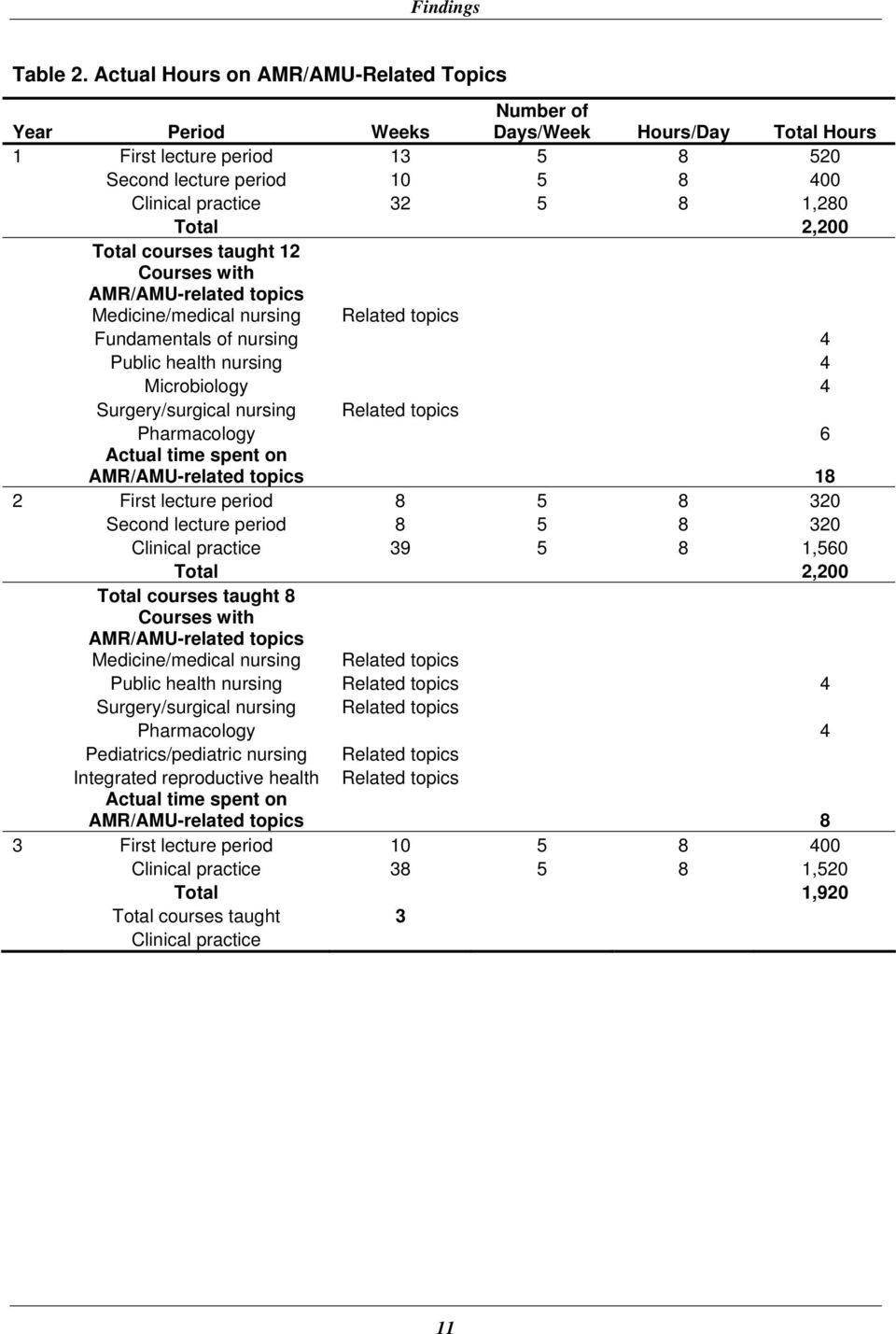
16 Preservice and Pst-Basic Nursing Training Curricula in Zambia: Curriculum Review and Expert Interviews t Assess AMU and AMR Cntent, March 2006 During the fundatin perid, students learn abut infectin preventin and related tpics. These tpics are taught in different curses like Fundamentals f Nursing and Public Health Nursing I and II. In micrbilgy, tpics n types f micrrganisms, micrscpic examinatin, cultivatin and identificatin f micrrganisms, antimicrbial susceptibility, nscmial infectins and pprtunistic infectins, sterilizatin, and disinfectin are taught. In Pharmaclgy I and II, Surgery and Surgical Nursing, and Pediatrics and Pediatric Nursing, AMR/AMU-related tpics are clearly stated; hwever, in ther curses such as Medicine and Medical Nursing and Integrated Reprductive Health, the tpics relating t AMR and AMU are nt categrically mentined r stated in the curriculum, but it is assumed the tutr r lecturer will make reference t r discuss thse issues. Infectin preventin-related tpics appear t be mentined frequently in the different curses. Determining the actual number f hurs spent n these tpics was difficult. The curriculum states the ttal number f hurs fr each subject and the cntact hurs per curse per week (Table 2); hwever, the actual r minimum amunt f time allcated t each cmpnent is nt stated because tpics are part f the ttal number f hurs allcated t the curse. In additin, the tpics are gruped and taught as a whle. As the student prgresses thrugh the training, the time allcated t clinical practice increases while that allcated t thery classes decreases. Determinatin f the actual time spent n AMR/AMU-related tpics in each lecture blck was nt pssible. Discussins during the lectures always make reference t AMR/AMU because infrmatin n AMU is applied when discussing management f different cnditins. Table 1. Three-Year RN Prgramming Perid Prgram Length f Time Year 1 First lecture blck 13 weeks Clinical practice* 13 weeks Secnd lecture blck 10 weeks Clinical practice 12 weeks Year 2 First lecture blck 8 weeks Clinical practice 21 weeks Secnd lecture blck 8 weeks Clinical practice 12 weeks Year 3 First lecture blck 8 weeks Clinical practice 38 weeks Revisin blck 2 weeks Surce: GNC Nte: Examinatin and vacatin perids are nt included. * The clinical practice is dne n rtatin basis t all medical, surgical, and specialized departments, including fieldwrk in urban and rural cmmunities. 10

17 Findings Table 2. Actual Hurs n AMR/AMU-Related Tpics Year Perid Weeks Number f Days/Week Hurs/Day Ttal Hurs 1 First lecture perid Secnd lecture perid Clinical practice ,280 Ttal 2,200 Ttal curses taught 12 Curses with AMR/AMU-related tpics Medicine/medical nursing Related tpics Fundamentals f nursing 4 Public health nursing 4 Micrbilgy 4 Surgery/surgical nursing Related tpics Pharmaclgy 6 Actual time spent n AMR/AMU-related tpics 18 2 First lecture perid Secnd lecture perid Clinical practice ,560 Ttal 2,200 Ttal curses taught 8 Curses with AMR/AMU-related tpics Medicine/medical nursing Related tpics Public health nursing Related tpics 4 Surgery/surgical nursing Related tpics Pharmaclgy 4 Pediatrics/pediatric nursing Related tpics Integrated reprductive health Related tpics Actual time spent n AMR/AMU-related tpics 8 3 First lecture perid Clinical practice ,520 Ttal 1,920 Ttal curses taught 3 Clinical practice 11
18 Preservice and Pst-Basic Nursing Training Curricula in Zambia: Curriculum Review and Expert Interviews t Assess AMU and AMR Cntent, March 2006 Pst-Basic Nursing Curriculum (Graduate Nursing Prgram) Students wh enter int this prgram are qualified RNs wh pssess O-level qualificatins. Because they are already qualified nurses, they are exempted frm the first year and enter the university in the secnd year, ging n t study fr three years. Upn cmpletin, the nurse graduates with a Bachelr f Science in nursing degree and is ready t wrk in any health care setting. The majrity f such graduates, hwever, have gne t teach in the nursing schls. A review f the UNZA Schl f Medicine Reference Bk (2000) shws that 32 curses are ffered t students in the secnd (12 curses), third (13 curses), and furth (8 curses) years. The training perids d nt indicate the number f hurs spent n each f the tpics; hwever, it des state the fllwing cntact hurs per week f each semester (6 lectures, 1 tutrial, and 2 practicals), and a semester is abut 13 weeks. Fr each curse listed in the Reference Bk, the aim, bjectives, curse cntent, teaching methds, cntact hurs, curse assessments and examinatins, lists f prescribed textbks, and recmmended textbks are indicated. The review f the curriculum shws that in the third year, students are taught tpics in Bacterilgy, which is a cmpnent f Systemic Pathlgy fr nurses. Tpics cvered in Bacterilgy include Intrductin t Medical Micrbilgy, Classificatins f Micrrganisms, Grwth and Nutritin f Micrrganisms, Antimicrbial Agents, Resistance, Sterilizatin and Disinfectin, Cmmn Infectins, Nscmial Infectins and their cntrl. Students are expsed t lectures in this curse nce per week in a semester. Hwever, as expressed by the lecturers and graduates frm the prgram, the cntent and length f expsure t practical teaching in the labratry is nt adequate fr nurses wh are expected upn graduatin t teach in the nursing schls. The curriculum als revealed that during Cmmunity Health Nursing, students are taught preventin and cntrl f cmmunicable diseases, including universal child immunizatin, imprtance f health educatin in preventin and cntrl f diseases, and the rle f essential medicines prgram in preventin and cntrl f diseases. The lecturer teaching Cmmunity Health Nursing has t use his r her wn initiative t include tpics related t infectin preventin practices because this subject is nt categrically expressed in the curriculum. Therefre, the strength f this teaching will depend n the rientatin f the lecturer. Teaching and Learning Methds The nursing department f the university uses lecture presentatins, tutrials, clinical practices, and case studies. Students are given pprtunities t wrk in the clinical areas f the different branches f medicine fr practical experiences. During the time in the clinical areas, the student is expsed t different cnditins and als given the pprtunity t wrk n case studies in the areas f practical allcatin. The preservice prgram als uses teaching/learning situatins, including demnstratins and tutrials by the lecturer, fllwed by return demnstratins by students. The teaching schls 12

19 Findings have a cach, r a clinical instructr wh has the respnsibility f reinfrcing whatever thery is taught in class and further intrduces students t practical applicatins f prcedures n patients. Sme schls (preservice) are using a prblem-based learning (PBL) apprach, allwing students t cnduct their wn search fr infrmatin, write case studies based n the assigned tpics, and make presentatins t the class with guidance frm the tutrs (GNC 2004a, 39). When discussing micrbilgy and pharmaclgy, students in the preservice nursing prgrams were fund t have little cntact with the labratry the labratry visit was intended t intrduce students t sme f the equipment, ccasinally allw them t view micrscpic presentatins f red bld cells r sme parasites, and the like. Thse in the undergraduate prgram, hwever, were expected t have sme practical experience in the labratry, a prcess that has nt been happening adequately. The hurs spent in teaching the related tpics r curses that deal with AMR r cntainment f AMR are nt clearly stated and the time spent n the tpics depends n the interest f the persn teaching and the level f understanding. Respndents Views n AMU, AMR, and Cntainment f AMR The majrity f key respndents in this review were generally f the view that AMR, cntainment f AMR, and AMU were critical issues that needed t be addressed by the Gvernment f Zambia. Mst respndents indicated that AMU was nt being adequately addressed. In Zambia, different categries f unrecgnized and unlicensed prescribers and dispensers exist. Fr example, a qualified RN r even an Enrlled Nurse smetimes has t screen a patient and prescribe medicatins because n dctr r clinical fficer is available. In mst cases, the cmmunity expects that whever is wrking at the health facility is adequately trained t prescribe. Furthermre, the lack f adequate equipment, pr labratry infrastructure, lack f reagents, and staff shrtages have cntributed t inadequacy f AMR cntainment prgrams in the cuntry. Where dctrs are available t prescribe, a nurse will in mst cases carry ut the dctr s rders withut questin because she r he is nt adequately prepared t understand medicine use, especially antimicrbials. Members f the cmmunity believe that treatment is adequate when they are given antimicrbials and thus d nt accept ther medicines and smetimes will even ask fr antimicrbials. The bserved practice f prescribing relates t past experiences where certain antimicrbials were used and prvided psitive results in patient health. Respndents cited examples f health prviders prescribing specific antimicrbials fr patients wh shwed similar symptms t anther wh may have respnded t treatment withut carrying ut any labratry tests t determine the causative rganism(s) and the antimicrbial f chice. The practice f sharing medicines is quite cmmn in cmmunities, as is self-prescribing f antimicrbials withut seeking medical attentin. Respndents expressed lack f clear understanding f the subject f AMR and cntainment f AMR; hence, the subject has nt received prnunced attentin in the preservice prgrams and the pst-basic curricula. The MH has made effrts t develp treatment guidelines and prtcls, but the reality is that thse dcuments rarely reach thse they are intended fr and end up n the shelves in higher ffices. 13
20 Preservice and Pst-Basic Nursing Training Curricula in Zambia: Curriculum Review and Expert Interviews t Assess AMU and AMR Cntent, March 2006 The GNC recently revised the scpe f practice fr nurses. The Nurses and Midwives Act, N. 31 (1997) has, amng ther prvisins, a new prescribing rle fr the nurse. The act states Part VI: Nursing and midwifery scpe f practice Prfessinal Practice f Nurses and Midwives 2) A nurse, midwife r specialist referred t in subsectin (1) shall in administering nursing care Prescribe relevant drugs and ther pharmaceutical preparatins frm a list defined by the natinal drug Frmulary Cmmittee cnstituted under the Pharmacy and Pisns Act The GNC develped the Drugs and Prescriptins fr Nurses and Midwives Guideline in July This natinal dcument was well intended. Amng ther gals, it was t cntribute t making prescribers available as clse t the family as pssible and t reducing indiscriminate prescribing by nurses and midwives. The guidelines clearly state that nurses will prescribe medicines based n clinical symptms, labratry findings, r prtcls. Hwever, since the dcument was develped, the GNC has had n resurces t cnduct training fr nurses, and nurses in practice cntinue t prescribe. During training, nurses are taught pharmaclgy during years ne and tw. Pharmaclgy, which is a full curse, is allcated nly 45 hurs fr each year, cmpared t a curse like Medicine and Medical Nursing, which is als a full curse and is allcated 310 and 315 hurs in years ne and tw, respectively. Mst respndents were f the view that tutrs shuld teach the details n medicine use during discussins n management f related cnditins. This time was felt t be when issues pertaining t AMR culd be explained and strategies t cntain AMR culd be discussed. The academic staff believe that if AMR and AMU are t be addressed adequately, pharmaclgy and micrbilgy curses need t be reviewed and a system f retraining tutrs and lecturers in the tw areas f specialty has t be instituted. Because thse teaching pharmaclgy are guest lecturers, the depth f the cntent t be taught shuld be discussed fully with the schl management and agreed n fr critical areas like AMR and AMU. The current situatin is pen t sme kind f neglect because different peple teach at different times, and the identity f the persn teaching always will depend n availability. The curriculum des cntain tpics in prescribing antibitics under classificatin f medicines and issues f antimicrbial use, antimicrbial resistance, and cntainment f AMR culd be adequately addressed under thse tpics. 14

21 Findings Table 3. Summary f Identified Gaps: Preservice Nursing Prgram* Discipline Tpics Cvered Identified Gaps Micrbilgy Pharmaclgy Medicine and Medical Nursing Pediatrics Obstetrics and Gyneclgy Surgery and Surgical Nursing Science f micrbes Infectins, sterilizatin, disinfectin Antimicrbial resistance Antimicrbials and use Antimicrbial resistance taught at randm fr individual antimicrbials Infectins Treatment f infectins Drug resistance Patient educatin Cverage f ratinal medicine use and antimicrbial resistance at randm Infectins, vaccinatins, treatment f infectins Drug resistance (randm) Ratinal medicine use, infectin preventin Patient/parent educatin Infectins, vaccinatins, treatment f infectins Drug resistance (randm) Ratinal medicine use Infectin preventin Infectins, infectin preventin (randm) Treatment f infectins Drug resistance (randm) Ratinal medicine use Ratinal medicine use AMR surveillance Infectin preventin Patient educatin Systematic cverage f antimicrbial resistance, fr example, the scpe f prblem, mechanism f resistance Ratinal medicine use Infectin preventin Rle f inducement frm pharmaceutical firms and cunterfeit drugs n AMR AMR surveillance Rle f inducement frm pharmaceutical firms and cunterfeit drugs n AMR AMR surveillance Systematic cverage f ratinal medicine use and antimicrbial resistance Patient educatin Rle f inducement frm pharmaceutical firms and cunterfeit drugs n AMR AMR surveillance Systematic cverage f ratinal medicine use and antimicrbial resistance Patient educatin Rle f inducement frm pharmaceutical firms and cunterfeit drugs n AMR AMR surveillance * The prgram des nt require the student t be examined in AMU/AMR, but students are expected t apply AMU/AMR knwledge t management f different disease cnditins. A student wh may nt have an accurate understanding may get away with limited infrmatin because the grading f marks is based n the ttal picture f patient care. This is a majr gap in the prgram. 15
22 Preservice and Pst-Basic Nursing Training Curricula in Zambia: Curriculum Review and Expert Interviews t Assess AMU and AMR Cntent, March 2006 Table 4. Summary f Identified Gaps: Pst-Basic Nursing Prgram* Discipline Tpics Cvered Identified Gaps Medical Micrbilgy Cmmunity Health Nursing I, II, III Maternal and Child Health Medical and Surgical Nursing Science f micrbes Infectins Antimicrbial agents Antimicrbial resistance Sterilizatin and disinfectin Nscmial infectins Preventin and cntrl f cmmunicable diseases TB/Leprsy AIDS and sexually transmitted diseases Malaria Rle f essential drugs prgram in preventin and cntrl f diseases Imprtance f health educatin in preventin and cntrl f diseases Infectins and nutritin Maternal and child health services Malaria Infectins, treatment f sme infectins Rle f the nurse in patient care, Nursing a patient with urinary tract infectins and ther medical and surgical cnditins and cmmunicable diseases, Antimicrbial resistance, Patient educatin Ratinal use f antibitics Mnitring efficacy AMR surveillance Dangers f indiscriminate AMU Practical demnstratins Antibitic plicy Infectin preventin AMR surveillance AMR and the scpe f the prblem Patient educatin in AMU Ratinal medicine use Infectin preventin Rle f inducement frm pharmaceutical firms and cunterfeit drugs n AMR Infectin preventin Immunizatins Systematic cverage f ratinal medicine use and antimicrbial resistance patient educatin AMR surveillance Pharmaclgy Infectin preventin Systematic cverage f prescribing and ratinal medicine use Rle f inducement frm pharmaceutical firms and cunterfeit drugs n AMR AMU and AMR surveillance * The prgram des nt require the student t be examined in AMU/AMR, but students are expected t apply AMU/AMR knwledge t management f different disease cnditins. A student wh may nt have an accurate understanding may get away with limited infrmatin because the grading f marks is based n the ttal picture f patient care. This is a majr gap in the prgram. The findings frm the interviews and review f the curriculum reveal that in mst cases the lecturer decides n the cntent f the tpic; accrdingly, cntent depended n the level f knwledge and skill that the lecturer has. 16
23 DISCUSSION AND RECOMMENDATIONS It became clear frm the in-depth interviews that all respndents were cncerned with the issue f AMR and AMU. This cncern has generally been cmpunded by the mushrming f drug stres in the cmmunities, by the different new medicines n the market, and by the lack f medicines in health facilities where patients are expected t buy thse medicines. The critical shrtages f staff in the health facilities and the general disappearance f persns charged with the respnsibilities f prescribing medicines have cntributed t irratinal medicine use and pssibly t AMR. As a general bservatin, prescribers d nt cnduct prper investigatins befre deciding what medicine t use fr treatment. Medicines are smetimes prescribed fr patients fr diseases withut knwing the causative rganisms, and smetimes patients are nt asked whether they have used the medicine befre r are n any similar medicines. The apparent recgnitin by the nursing fraternity that nurses were nt adequately prepared t talk abut AMR means that their ability t take measures t cntain the situatin is weakened. Preservice Nursing Prgram Althugh the preservice curriculum des cver a wide area f tpics related t AMU and mentins AMR, gaps have been identified and will need t be addressed. Because tpics in micrbilgy are presented by guest lecturer, the depth f cverage f the materials will always vary depending n the cnsistency f thse wh teach. Schls situated in hspitals that have specialists t teach such subjects are at an advantage because the tpics shuld be adequately cvered. Thse in schls attached t hspitals that are nt teaching hspitals may have difficulties in having lecturers teach in the schls. When that happens, nurse tutrs are expected t teach thse tpics. Withut special rientatin fr the tutrs, the tpics may nt be adequately cvered. Thus, the tutrs wh in the graduate prgram did nt receive adequate infrmatin give superficial infrmatin n micrbilgy, pharmaclgy, and ther related curses. Hwever, the nursing prgram has been very strng in preparing nurses t prevent the ccurrence f infectins in different situatins. The prgram f training has prvided curses t prepare the nurse and has included at different stages f training infrmatin that will equip nurses with abilities t intervene in situatins where infectins may have pprtunities t thrive. The issue f AMU has been f greater cncern even t the GNC, resulting in the develpment f guidelines that will gvern the prescribing f medicines fr patients. The curriculum specifically requires that students be given the pprtunity t practice in the labratry, but that des nt happen even at university level. If the university cannt adequately expse students t practical experience in the labratry, then thse same students cannt teach similar cntent in the preservice prgram fr nurses, thereby creating a learning gap that has been perpetuated ver the years. 17
24 Preservice and Pst-Basic Nursing Training Curricula in Zambia: Curriculum Review and Expert Interviews t Assess AMU and AMR Cntent, March 2006 Frtunately, the preservice prgram is strng n infectin preventin, because the same is nt prvided in the university prgram fr nurses. In the latter, the lecturer will discuss the tpic nly when making reference t issues pertaining t infectin preventin and related t the tpic f discussin. The cmpnent f immunizatins is very strng in bth curricula, and especially in the preservice prgram students have adequate thery and practical expsure. These tpics are cvered in pediatrics and als in public health nursing Pst-Basic Prgram The expsure f students t AMU and AMR appears t be weak. Because these are the same graduates wh teach in the preservice prgrams, it is critical that the AMR curriculum cntent is enugh t give this grup sund AMR/AMU knwledge. This review has established the need t revise the expsure time fr the related tpics and curses t allw fr mre expsure in the practical areas. Nurses need t be adequately prepared t be able t challenge irratinal prescribing by dctrs, thereby reducing AMR. The gaps identified in the pst-basic curriculum need t be addressed s that the pst-basic prgram graduates wh g n t teach can imprve the cmpetencies f the graduates frm the preservice prgram. Patient Educatin Respndents were in agreement abut the imprtance f teaching patients abut the rle f adherence in taking prescribed medicines. The curriculum has emphasized the imprtance f patient educatin as a cmmunity apprach t reducing AMR. Patients need t knw the imprtance f cmpleting treatment, f taking medicines as instructed by the health prviders, f nt sharing medicines with thers in the cmmunity, f safely string medicines, and f discuraging self-medicatin. Antimicrbial Use Althugh the curriculum des nt talk abut AMU and AMR, the curse cntent des discuss the different aspects f causative rganisms, hw t manage cnditins resulting frm such diseases/infectins, hw antimicrbials wrk, and hw t arrive at a medicine f chice. In practice, hwever, mst hspital staff members prescribe withut carrying ut any labratry investigatins. The excuse f having labratries that are nt adequately equipped has encuraged this lapse in the expected prfessinal prcess f making prescriptins. The practice in the hspitals and health facilities f prescribing withut prper investigatins and subsequent prescribing f antimicrbials has cntributed t the increase in AMR in the cuntry tday. Ratinal Use f Medicines Respndents als expressed cncerns n the variatins in the depth f subject matter detail being taught t students in schls. The University Teaching Hspital has specialists wh participate in 18
25 Discussin and Recmmendatins teaching RUM in the nurse training, and their teaching is at a higher level than that in ther lcatins. Fr example, in sme hspitals, these experts are nt available, thus resulting in the nurse tutrs having t cver the tpics. The issue f RUM is in this event being cmprmised because nurse tutrs may discuss issues pertaining t AMU nly superficially, especially thse cming frm hspitals where interactin with specialists is minimal. The situatin as bserved by mst respndents has resulted in nurses nt challenging sme f the prescriptins. The GNC initiative in develping a guide t prescribing fr the nurse is a gd effrt. Having said this, the curricula fr bth prgrams mentin RUM. Althugh it des nt stand ut as separate tpic, it is adequately cvered. The discussins n different disease cnditins talk abut the medicines f chice (nnavailability r pr supply f medicines des affect what the medicine f chice may be), the mechanism f actin, side effects, and duratin f treatment. Infectin Preventin The nursing curriculum is strng in the area f infectins and infectin preventin. The tpic is discussed in curses such as medicine, surgery, pediatrics, bstetrics and gyneclgy, public health, and the related nursing interventins. The tpic is discussed at different levels f training, and the daily practices in patient care always emphasize hand washing befre and after every prcedure. The imprtance f aseptic techniques during the many prcedures and prmtin f ways f preventing the spread f infectins are als emphasized when students are cmprehensively expsed t related clinical practice. Hwever, the practice f infectin preventin is crippled by lack f essential supplies fr practice. In additin, immunizatin is a strng cmpnent f the curriculum. Fr bth prgrams, students are prvided with pprtunities t wrk in the cmmunities where they reinfrce what has been taught in class. The curriculum review prcess and the interviews f key infrmants in this study were able t establish the need t refcus effrt in addressing AMR issues in bth the preservice and pstbasic nursing prgrams. Furthermre, the prcess has established that the teaching envirnment will require calculated adjustments t ensure that ther factrs, such as lack f labratry facilities and inadequately trained tutrs, which dictate the current situatin, will need t be addressed. The recgnitin f a majr prblem by the different segments f the health prfessin shuld lead t a cncerted effrt by all cncerned t devise ways and means f cming t cnsensus n dealing with the issues f AMU and subsequent AMR. Recmmendatins The curriculum fr nurses in bth prgrams shuld be reviewed, including tpics n AMR. The tpics shuld be taught early during the first year f training, as students are learning pharmaclgy and micrbilgy. Furthermre, this cmpnent shuld be strengthened when discussing related disease cnditins by discussing the rles f patients, cmmunities, and health prviders in AMR and AMU. The GNC recently revised the curriculum in preservice nursing prgrams. Specialists frm the nursing schls, including pst-basic prgram, micrbilgy, and pharmacy shuld nw agree n the cntent f the revised curriculum in 19
26 Preservice and Pst-Basic Nursing Training Curricula in Zambia: Curriculum Review and Expert Interviews t Assess AMU and AMR Cntent, March 2006 terms f the depth f teaching and cntact time. The team shuld have regular meetings t review the prcesses. The related cmpnents f the tw curricula shuld be revised t clearly state what needs t be taught s that anyne teaching the subject prvides the same infrmatin. Funding shuld be made available fr the GNC t initiate training f nurses in prescribing skills and t take the pprtunity t teach tpics n AMU, AMR, and AMR cntainment. The lecturers wh teach and supervise learners in the clinical areas need t be riented t AMR and AMU, injectin safety, and infectin preventin s that they can prepare the learners better. Practical classes, which are a requirement during the tw training prgrams, shuld be prvided during training, and a mechanism shuld exist f ensuring that all students have participated and have attained sme level f cmpetence. STGs and the Essential Drug List shuld be made available t all nurses in schls and wrk sites. The guidelines shuld clearly state the levels f staff wh can prescribe and what punitive measures shuld be taken when a health wrker des nt fllw prcedures when prescribing and managing clients n antimicrbials. Essential medicine security shuld be imprved and safeguarded against stck-uts f medicines. The training f lab assistants shuld be reintrduced s that mre staff members are available t carry ut labratry investigative tests and t take advantage f the current funding in the health sectr t equip and make available resurces required t carry ut labratry investigatins. 20
27 REFERENCES GNC (General Nursing Cuncil). 2004a. Learning Guide fr Students in Registered Nursing Prgram. General Nursing Cuncil f Zambia. GNC. 2004b. Nurses Drug Frmulary. General Nursing Cuncil f Zambia. GNC Registered Nursing Curriculum. General Nursing Cuncil f Zambia. Gvernment f the Republic f Zambia The Nurses and Midwives Act, N. 31 f Hazemba, O Prmting Ratinal Use f Drugs: Develpment f Treatment Guidelines and Strategies fr Cntaining Antimicrbial Resistance Part I: Drug Supply and Use Reprt in Lusaka Urban District. Submitted t the U.S. Agency fr Internatinal Develpment by the Ratinal Pharmaceutical Management Plus Prgram. Arlingtn, VA: Management Sciences fr Health. MH (Ministry f Health). February Natinal Drug Plicy. Lusaka: Gvernment f the Republic f Zambia. NIAID (Natinal Institute f Allergy and Infectius Diseases) The Prblem f Antibitic Resistance. < (accessed Aug. 24, 2006). UNZA (University f Zambia) Reference Bk Lusaka: University f Zambia Schl f Medicine. WHO (Wrld Health Organizatin) WHO Glbal Strategy fr Cntainment f Antimicrbial Resistance. WHO/CDS/CSR/ Geneva: WHO. WHO Use f Antimicrbials Outside Human Medicine and Resultant Antimicrbial Resistance in Humans. Fact sheet n Geneva: WHO. < (accessed Aug. 24, 2006). 21
28 Preservice and Pst-Basic Nursing Training Curricula in Zambia: Curriculum Review and Expert Interviews t Assess AMU and AMR Cntent, March
29 ANNEX 1. INTERVIEW TRANSCRIPTS Heads f Institutins, Lecturers, Tutrs in Public and Private Schls, Guest Lecturers Mr. Dnald Kall, Stres Pharmacist Curriculum cntent in relatin t AMU, AMR, cntainment f AMR The curriculum fr nurses just utlines the tpics t be taught in pharmaclgy and des nt prvide the in-depth infrmatin n hw much details need t be taught. It is nt that clear as t what the nurse is expected t walk away with after training. It is nt well defined by schl n what kind f cmprehensin f pharmaclgy the nurse will be expected t have. It is my strng belief that the nurse must be an active team player in health care, and as such she shuld nt accept withut questin the prescriptin prvided by the dctr. Anyway, if she des nt understand issues related t AMR, then she will just dispense the medicatins withut understanding the whys and the hw f drug interactins. I have seen nurses just taking rders frm dctrs withut questining, even when they see the patient is nt respnding accrdingly t treatment. Prgramming f tpics related t AMR and related cntainment, AMU, and teaching/learning methdlgy Nurses are nt expsed t the linkage between pharmacy and ther departments Need t be expsed t what is happening in pharmacy. Need t have mre interactin with the nursing fraternity the interactin shuld be beynd the hspital cnfines. Need t teach beynd what is in the curriculum t-day. The Nurses and Midwives Act nw allws nurses t prescribe, the questin is What is the legality f the prescriptin? Des the nurse understand the relatinship between diagnsis and prescriptin? Hence clinical experience in pharmacy is a must fr the student nurse. I als feel that even at degree level, there is [a] need t lk at what nurses are actually ding. Nurses are dispensing: D they knw the interactins f the drugs, diagnsis using labratry investigatin up t when yu are able t prescribe? 23
30 Preservice and Pst-Basic Nursing Training Curricula in Zambia: Curriculum Review and Expert Interviews t Assess AMU and AMR Cntent, March 2006 The why in the use f the particular treatment in the cnditin shuld be a must fr all nurses. Fr example, in the use f antimicrbials, ne needs t ask Why are penicillins used? When are they used? Hw d yu substitute? When can yu never use the penicillin? Using lab results, what micrrganisms are being destryed by the chsen antimicrbials? Need fr nurses t have cmprehensive apprach t care f patients. Multidisciplinary invlvement is very imprtant where the nurses, dctrs, pharmacy, [and] bimedical sciences wrk tgether, fr example, in addressing issues f infectin preventin n the wards. These tpics shuld be taught in classrm situatins and nt in wrkshp but as part f the curriculum. There shuld be clear guidance n the depth f the subject matter t be taught, nt just a listing f tpics. Cntact time with students shuld nt just be cnfined t the ward but be extended t the department f pharmacy. Need fr treatment guides fr nurses especially nw that we are mving int ARVs [antiretrvirals], where resistance and issues f adherence are being discussed. Standard bks fr practice fr nurses shuld be made available, e.g., the Essential Drug List, which is discussed in the classrm, [but] the dcument is rarely fund in the clinical areas and thus nt available t the nurse. The nurse has n necessary tl fr quick reference. D they knw what ratinal drug use is? D the nurses have guidelines fr malaria, TB, ARV adult and children, pregnant wmen? Curriculum is superficial in the fllwing tpics: Bichemistry, Pharmackinetics. Preparatin f prtcls and guidelines, standard treatment guidelines shuld invlve nurses, thereby prviding an in-depth preparatin fr the nurses t make cntributins t the develpment f guidelines. Infectin preventin and immunizatin Nurses can be taught hw t make a simple slutin f alchl and glycerin in their effrt t prevent the spread f infectin. There are a number f preventive actins that can be taken. When using disinfectants, nurses shuld be able t knw hw they are calculated and understand the cncentratin, and the pharmacy can help in [making] the training f nurses be practical and in learning hw t make slutins fr infectin preventin in an emergency. Fr example, d nurses scrape the flr and take a swab t the labs s that ne knws what micrrganisms are arund in the envirnment? Fr example, chlrine is used frm January t December and des ne check whether the chlrine is still effective r nt? Nurses shuld be able t determine cntaminants, e.g., in a vaccine, and ask questins abut the efficacy f that vaccine. 24
31 Annex 1. Interview Transcripts Recmmendatins fr additins, mdificatins t the curriculum Cmputer skills are a must fr nurses s that they are able t brwse the Internet and get t knw ther infrmatin n AMR that may nt be available in the curriculum. Multidisciplinary team t address issues n resistance, different departments can wrk as a team in the effrts t cntain the AMR and have input int hw the prcess f resistance happens s that there is accurate understanding f issues f resistance and strategize n hw t deal with AMR. The GNC recently revised the curriculum. Schls shuld nw put a team f specialists frm the schl, micrbilgy, pharmacy t agree n the cntent f the revised curriculum in terms f the depth f teaching and learning. Mr. Jhn Mwabam, Bimedical Scientist Curriculum cntent in relatin t AMU, AMR, cntainment f AMR What is in the curriculum nw? Mechanism f actin, Mechanism f resistance, General principles f the use f antibitics. These tpics are under Antimicrbial Chemtherapy and are nt enugh. Sme nurses will be hlding higher psitins that require decisin making and may sit n cmmittees, e.g., infectin preventin cmmittee, [and] their accurate understanding f infectin preventin is very imprtant. Tpics in micrbilgy at university level are taught nce per week, which is very inadequate. Antimicrbial chemtherapy, Mde f actin f antimicrbial drugs, General principles f the use f antimicrbial drugs, Resistance t antimicrbials are taught. The emergency f antibitic resistance is a majr cncern. The chice f antimicrbials t use is f special imprtance, as [the] nurse must understand and interpret the sensitivity testing, e.g., the use f penicillin n Staphylcccus aureus, [rather] than using ther drugs like claxacillin, using drugs that are expensive instead f nalidixic acid,fr example, which is cheaper, all these factrs need t be included in the curriculum. The teaching invlves mstly lecture methd. Students are nt expsed t any practical sessins. Recmmendatins fr additins, mdificatins t the curriculum Nurses shuld als participate in clinical meetings fr these meetings are infrmative as issues relating t management f patients and AMR are als discussed. Sme drugs shuld nt be prescribed withut authrity frm the cnsultant. 25
32 Preservice and Pst-Basic Nursing Training Curricula in Zambia: Curriculum Review and Expert Interviews t Assess AMU and AMR Cntent, March 2006 Mrs. Fridah Zulu, Nurse Educatin Manager Curriculum cntent in relatin t AMU, AMR, cntainment f AMR Preservice prgram arrangement: When nurses cme int the prgram in the first year, basic curses are taught that are aimed at building the nurses understanding f basic knwledge n kinds f diseases, medicine and surgery, pharmaclgy intrduced t knw hw medicines are used perid f applicatin f knwledge n disease, fundamentals f nursing, and ther related basic curses. The tpics related t AMU are cvered in micrbilgy when they are taught abut infectins, immunity, defense mechanism, types f micrrganism des nt specially say antimicrbial resistance, but is included in the teaching: the lecturer ges int detail f the specific tpic. The cntent detail als depends n the level f training f the student. Prgramming f tpics related t AMR and related cntainment, AMU, and teaching/learning methdlgy Students are nt prepared in culture and sensitivity t help them determine the type f micrrganism. Students visit the labratry t have an pprtunity t lk thrugh a micrscpe and view micrrganisms, e.g., malaria parasite, r view the shape f red bld cells. In pharmaclgy will learn hw t prescribe as they learn the different diseases. Prescribing fr nurses is new in the nursing prfessin in UTH it is rare fr nurses t prescribe. Micrbilgy nly taught in the first year with 90 hurs f thery; [students] visit the labratry within the 90 hurs. Pharmaclgy is taught during the same perid as they are learning medicine, surgery in the first and secnd year. Ratinal prescribing and ratinal use f drugs are taught by the pharmacist r tutr. In terms f the depth, it is based n already acquired infrmatin in the first year. Students are nt examined in AMR per se, but the questins asked in the examinatins are phrased in such a way that student will discuss the management f patients with different cnditins. [In t]heir tests (2/3) in the examinatin it is integrated in the ther subjects in a cnditin. Main expectatins are that nurses must be aware f antimicrbials, resistance issues, hw t prescribe, and hw t have an input int the cntainment prgrams. In UTH students are given pprtunity t have rural experience, in urban and rural clinics, and during this perid are able t learn abut prescribing because these are sme health facilities where there is n dctr r clinical fficer. 26
33 Annex 1. Interview Transcripts Infectin preventin and immunizatin Immunizatin is taught in public health nursing in the first year, and students have practical experiences in the clinics/health centers. Tpics in first year include micrbilgy in public health; during this perid they are expsed t situatin f meeting thse that are nt sick and prmte health living habits, including infectin preventin. Recmmendatins fr additins, mdificatins t the curriculum There is need fr special prgram a package specially designed fr nurses. Althugh the curriculum is already full, maybe make time between secnd and third years r sme time created fr nurses t be intrduced t AMR, AMU, and cntainment f AMR. Pharmaclgy curse cmes t late secnd year culd cme earlier. Need fr linkages with different departments in the hspital in planning what is t be taught t nurses. Training f tutrs fr the varius related tpics/subjects as nt all hspitals have pharmacist r micrbilgist t assist in the teaching f nurses. We can have Nurse Tutrs specialized in different tpics. Mrs. Salme Zulu, Principal Tutr, RN Training Schl, UTH Mrs. Mukma, Nurse Tutr The Registered Nurse curriculum prepares the 21st-century nurse with the knwledge, skills, and attitude that will enable the nurse t respnd t the changing disease burden, health care needs and demands. HIV/AIDS and the increasing chrnic diseases are amng these trends. Stage f training at which the tpics are taught and participants in the teaching/learning prcess The curriculum includes the fllwing tpics n antimicrbials. Antimicrbials are intrduced at first-year level and run thrugh the three years training. At the end f each lecture, the learner is able t calculate and administer drugs. Experience is gained thrugh practice under strict supervisin f the Clinical Teacher and the Ward Sister. The antimicrbials are cvered accrding t classificatin and the system they act n. The pharmacist participates in teaching; while the lecturer gives tutrials n hw t calculate and administer the drug, the clinical teachers and the sisters in charge supervise the practice in the clinical area. The methds used fr teaching are lectures, demnstratins, return demnstratins, prblem slving where students are given calculatins t d individually, and practice in grups. 27
34 Preservice and Pst-Basic Nursing Training Curricula in Zambia: Curriculum Review and Expert Interviews t Assess AMU and AMR Cntent, March 2006 The tpics cvered Prescribing principles, ratinal use f drugs; drug interactins and adverse drug reactins; legal, ethical, and cultural aspects f pharmaclgy; drugs acting n the cardivascular, respiratry, and gastrintestinal systems; and drugs used in bstetrics. Learner assessment in AMR and AMU The learner s assessment is thrugh cntinuus practical assessments using the evaluatin manuals and written examinatins. Preparatin fr immunizatin Immunizatin is intrduced at secnd-year level. This tpic is cvered in Pediatric Nursing under Expanded Prgramme in Immunizatin; the learners get their experience during Primary Health Care experience at the urban health center and rural area (Rural District) fr practice. During the third year Integrated Management f Childhd Illness is taught. Immunizatins are als cvered at this stage. Preparatins learners receive in related patient educatin regarding Patient adherence The learners are well prepared fr this rle. They are prepared t give health infrmatin, educatin, and cmmunicatin t patients. The rle f the nurse in the cmmunity is emphasized. Cunseling f clients and netwrking with ther stakehlders in the cmmunity are als cvered, which prepares the learner t deal with issues f patient adherence. Infectin preventin, hygiene, including hand washing Hand washing, disinfectin, and waste management are cvered in almst all curses. It is practice t wash hands befre and after every prcedure. Hwever, prper hand washing is taught [and] learners [are] bserved and assessed n these prcedures t emphasize the imprtance f hand washing. Recmmendatins Althugh cvered in the curriculum, AMR and AMU d nt cme ut clearly. In pharmaclgy, there is a tpic n drug resistance that cvers the dangers f drug abuse and verprescribing f antibitics. There is a need t make adjustments t the curriculum in rder t develp skills and knwledge required fr the graduates t be cmpetent practitiners. The lecturers wh teach [and thse wh] supervise learners n the clinical areas need t be riented t AMR and AMU, injectin safety, and infectin preventin s that they can prepare the learners better. 28
35 Annex 1. Interview Transcripts Elenia Temb, Nurse Tutr Curriculum cntent in relatin t AMU, AMR, cntainment f AMR It is nt particularly spelled ut as antimicrbial, but the curse is expected t cver this tpic. In fundamentals f nursing, the tpic is taught under infectin preventin. Antimicrbial use is taught under pharmaclgy; in term f resistance, this is nt taught. The questin is when a patient is nt respnding t treatment the nurse wuld nt make decisin as t whether t take a swab and assess why the patient was nt respnding. At hspital level, in invasive surgery a patient is always started n antimicrbial due t research finding where resistance t antimicrbial is always cmmn s instead f ampicillin, t which mst clients are resistant, gentamycin, crystalline penicillin, Flagyl are prescribed. Graduate nurses are expected t prescribe; hwever, they d nt d s because they are nt taught hw t determine the drug f chice and hw t calculate dses. The tutrs are nt prepared n hw t teach prescribing. Prgramming f tpics related t AMR and related cntainment, AMU, and teaching/learning methdlgy Students are expsed t thery but nt practical; hwever, the students will visit the labratry t bserve what was happening and be allwed t lk thrugh the micrscpe t bserve, e.g., the nrmal cell, micrbes, and bacteria. Als visit the Central Sterile Supply t see the prcess f sterilizing hspital equipment and materials. The dctrs will always rder end f treatment test t ensure that the medicatins had wrked. Recmmendatins fr additins, mdificatins t the curriculum When dealing with micrbilgy and pharmaclgy, there shuld be deliberate inclusin f the antimicrbial cntent and strengthen[ing f] the tw curses. The tutrs shuld be adequately trained t teach the subject. Antimicrbial use shuld be related t labratry test results s that yu knw the apprpriate antimicrbials t use. 29
36 Preservice and Pst-Basic Nursing Training Curricula in Zambia: Curriculum Review and Expert Interviews t Assess AMU and AMR Cntent, March 2006 Ms. Elizabeth Kalunga, Educatin Manager, Ndla Schl f Nursing (Telephne Interview) Curriculum cntent in relatin t AMU, AMR, cntainment f AMR The schl des teach students in antimicrbial use, and these [tpics] are taught when discussing different diseases, while antimicrbial resistance is just mentined when ne is teaching medicine and medical nursing and des nt feature prminently in the curriculum. When teaching tpics relating t TB, HIV and AIDS, and ther infectius diseases, then antimicrbial resistance is mentined. Students als learn abut patient adherence and the imprtance in medical care. Prgramming f tpics related t AMR and related cntainment, AMU, and teaching/learning methdlgy Mstly tutrs use lecture methds, demnstratins, visits t the labratry when tpics in micrbilgy are being taught. The number f hurs f expsure t AMR, AMU, RDU [ratinal drug use] is nt specific. Students are nt specifically examined in these tpics, but thse that appear in the examinatin are part f the main questin n patient management. Infectin preventin and immunizatin During the first year, students start learning abut infectin preventin, but mstly in Public health nursing, when they are als taught abut Immunizatins and g ut t wrk in the health centers where they will practice immunizatins as part f the health center MCH [maternal and child health] practical experience. Very few staff (tw tutrs) in the schl have been trained in IP [infectin preventin]. Recmmendatins fr additins, mdificatins t the curriculum Train mre tutrs in AMR, AMU, and infectin preventin. Ms. Harriet Mulnda, Nurse Educatin Manager, Livingstne Schl f Nursing (Telephne Interview) Curriculum cntent in relatin t AMU, AMR, cntainment f AMR Antimicrbial resistance was nt in the curriculum. But we d teach antimicrbial use in Micrbilgy classes. We use lecture, discussin methd f teaching. Students visit the labratry fr ne day just t view micrrganisms in the micrscpe. 30
37 Annex 1. Interview Transcripts Prgramming f tpics related t AMR and related cntainment, AMU, and teaching/learning methdlgy Teaching f micrbilgy is facilitated by thse frm the labratry wh are nt trained tutrs, s the way they handle classes is nt that adequate. UNZA training des expse the nurse tutrs t thery and practical, but the time spent n thse subjects is nt adequate. Infectin preventin and immunizatin These are adequately cvered. Recmmendatins fr additins, mdificatins t the curriculum There is an urgent need t equip tutrs with knwledge n AMR, AMU, and RDU [ratinal drug use], and the issue f adherence must be strengthened in the schl teaching learning prgram. Mr. Chela Brightn, Directr, Lusaka Nursing Institute, Bimedical Scientist Curriculum cntent in relatin t AMU, AMR, cntainment f AMR Accrding t the GNC July versin f the RN curriculum, tpics n page 55, including antimicrbial susceptibility, will be redne. Nscmial Infectin: This including pprtunistic infectin are wide subjects and are taught in details t equip nurses with skills in hw t deal with such situatins. The expert r cnsultant teaches and the nurse tutrs will tackle issues that relate t infectin preventin at ward level. The curriculum cntains tpic n antimicrbial susceptibility the tpic has t be understd in depth s that the nurse will understand the prescriptin by the dctr. The part that deals with medicine will train the nurses hw t prescribe: They are taught t base their prescriptin n histry, diagnsis by examining the patient, and decide what drugs t give. Will teach n labratry investigatin, e.g., hw t d a malaria parasite, take bld. Natures f the disease and infectin and after the necessary tests, then antimicrbials are given accrdingly. As a cmmn practice, prescriptin is mstly based n clinical diagnsis and nt n lab diagnsis/findings. There are very few health centers with wrking labratries and this has highly cntributed t AMR. Inadequate chemicals fr labratry use have als cntributed t prescribing withut prper investigatins, a cmmn feature in a number f district hspitals. Prgramming f tpics related t AMR and related cntainment, AMU, and teaching/learning methdlgy Accrding t GNC curriculum, the tpics are taught in the first lecture blck, but when they learn medicine reference is made t what was taught in the first lecture blck. 31
38 Preservice and Pst-Basic Nursing Training Curricula in Zambia: Curriculum Review and Expert Interviews t Assess AMU and AMR Cntent, March 2006 Als PBL, lecture methd, demnstratins, the schl has an arrangement with Chainama cllege s labratry where students g t bserve labratry tests being dne and als lk thrugh a micrscpe t identify sme micrrganisms. The schl als fllws PBL apprach t teaching, allwing students t research a tpic in the library, then [make] case presentatins with guidance frm the nurse tutr. Schl has assigned the afternn fr practical and the ther teaching/learning discussin. A minimum f 40 hurs is allcated t teach micrbilgy. Yes, they are examined in AMR and antimicrbial use in related subjects. Micrbilgy is advanced, thus the key step is t prvide infrmatin s they understand results. The way the curriculum is presented is kay and makes sense. Infectin preventin and immunizatin During the secnd lecture blck is when students are taught the immunizatin and als [during] practical in the health centers. The practical experience is thrugh rtatin prcess and is effected after thery perid. The student is taught the imprtance f patients cmpleting taking medicatins. Infectin preventin under this curse, tpics like glving, hand washing, and mre especially, aviding nscmial infectin, are taught. Thse that have adverse effect n the cmmunity, e.g., malaria, HIV/AIDS, TB, pneumnia. Observatin f patient n AMU is very imprtant and needs t receive greater attentin. AMR and antimicrbial use are very imprtant, there is need t understand what antimicrbials are fr nurses t be able t prescribe. The drug kit system des nt allw, e.g., the C/O [clinical fficer] t prescribe the antimicrbials in the kit, but nurses will be prescribing in the near future. Recmmendatins fr additins, mdificatins t the curriculum There is need t intrduce mre labratries with qualified persnnel. The situatin right nw is critical. The training f lab assistants shuld nt have been phased ut; these shuld be reintrduced s that there is mre staff t carry ut sensitivity tests. The three-year prgram fr nurses is already packed; nevertheless, we need t train nurses t have accurate understanding, maybe need t add mre years, and all curses need t be reviewed and this needs t be brught t the attentin f GNC. When they learn medicine, the tpic dealing with antimicrbials shuld be emphasized t shw the imprtance f antimicrbials in health care. 32
39 Annex 1. Interview Transcripts Ms. Mercy Mbewe, Directr f Nursing, UTH Curriculum cntent in relatin t AMU, AMR, cntainment f AMR Micrbilgy is a cmpnent f the first year. Medicines, Pharmaclgy, Public health are als taught in the first year. During pharmaclgy classes, tpic n classificatin f drugs is taught. Hwever, AMR is a big issue because nurses are nt explring the drug histries f patients. Histries shuld include questins like: what drugs the patient has been taking then r befre; the nurse must prbe mre abut drug histry. The curriculum des nt have a tpic n antimicrbial resistance but des have tpics n antimicrbial use. The Nurses Drug Frmulary cntains antimicrbials t be prescribed by the nurse; hwever, nurses shuld be wary f what the patients respnse shuld be like. The graduate nurse shuld elicit frm the clients the effect f the drug, be aware hw t stre the drug which may affect the ptency if prly stred. The tpic n adherence is strnger when discussing ARVs, thugh adherence shuld be discussed when teaching abut all drugs and shuld be taught frm the prvider perspective and the client perspective. Prgramming f tpics related t AMR and related cntainment, AMU, and teaching/learning methdlgy Lecture methd is used, althugh wuld lve t have a mre interactive sessins and students need t be given pprtunity t visit the pharmacy. Each curse taught by a specialist frm the hspital has a tutr assigned t teach the nursing aspect f the cnditin. Student nurses have quite gd expsure in antimicrbials but inadequate in AMR. Infectin preventin and immunizatin Places where patients are cared fr shuld be the safest place. In the first year, student nurses are taught abut safe envirnment, including infectin preventin, mde f infectins, hand washing, calculatin f disinfectants. Tpic n nscmial infectins is fund in the curriculum but des nt specifically state the rle f the nurse in preventin f nscmial infectins; hw des the nurse prepare t reduce crss infectins. Patients are in clsed units where infectins are cmmn; hw ften d they take swabs t examine the envirnment? Sme nurses with lng nails, what is the hand-washing practice? Immunizatins are taught in the first year in public health, pediatrics, and pharmaclgy and receive practical learning experiences during public health field wrk. Discussin n infectin preventin is very gd; tpics n hygiene are als taught but there are n resurces t help prmte hygiene. Recmmendatins fr additins, mdificatins t the curriculum T include AMR as a tpic in the first year f training in micrbilgy. AMR and antimicrbial use shuld be adpted in the curriculum and strengthen the rle f the nurse. 33
40 Preservice and Pst-Basic Nursing Training Curricula in Zambia: Curriculum Review and Expert Interviews t Assess AMU and AMR Cntent, March 2006 Essential drug list be made available t all nurses in schls and wrk sites and make it userfriendly. All related guidelines must be made available. Nurses shuld be well infrmed abut all antimicrbials and articulate issues relating t AMR, AMU and argue issues relating t prescriptins. Althugh nurses are prescribing, they have nt been trained as the GNC has yet t find funding t train nurses. Mrs. Catherine Ngma, Head f Department, Pst-Basic Nursing Department BSc, University f Zambia Schl f Medicine This is a pst-basic nursing prgram that ffers an undergraduate curse leading t a bachelr f science (BSc) in nursing. Candidates t this prgram are required t have cmpleted a three-year basic nursing prgram and are exempt frm the first-year curses at the UNZA. Under the curse: Cmmunity Health Nursing 11: CHN 322, the curse builds n what was taught in Cmmunity Health Nursing 1: CHN 321 the fllwing related t AMR and antimicrbial use curses are cvered; althugh accrding t ne f the lecturers is nt in detail as the cmpnent is expected t be cvered during specific curses in medical surgical nursing. The tpics in infectin preventin are cvered, but it is up t the lecturer t decide the cntent and depth f the materials t be cvered. During Cmmunity health nursing sme aspects f AMU/AMR are taught, the tpics presented are discussed. UNIT IV, Preventin and cntrl f cmmunicable diseases Universal Child Immunizatin AIDS and STD UNIT V, Preventin and cntrl f nncmmunicable diseases Malaria cntrl Imprtance f health educatin in preventin and cntrl f diseases Rle f essential drug prgram in preventin and cntrl f diseases Under Medical Micrbilgy, the fllwing tpics are als cvered Antimicrbial chemtherapy Mde f actin f antimicrbial drugs General principles f use f antimicrbial drugs Resistance t antimicrbial drugs Nscmial infectins Surces and spread f nscmial infectins Cntrl f nscmial infectins 34
41 Annex 1. Interview Transcripts Graduate Interns, UTH Cllins Sakala, Sebyi Kalumiana, Chibale Zulu Curriculum cntent in relatin t AMU, AMR, cntainment f AMR Yes, we were taught abut antimicrbial use and the tpics included grups f antimicrbials, mechanism f actin, dsages, rutes, side effects, and cntraindicatins. Nursing implicatin f giving antimicrbials like crystalline penicillin where a patient has t be asked whether the patient has received the drug befre; therwise a test dse shuld be given. It is very imprtant t islate the micrrganism causing the disease befre treatment is initiated. There is n adequate system t mnitr patients n antimicrbials, especially thse that get discharged. Therefre educatin befre discharge is imprtant. AMR is nt a tpic taught during training. But students wh happen t attend Thursday clinical meeting have heard f AMR, and these meetings are nt a must fr nurses. Student nurses have used wn initiative t attend clinical meetings and nrmally use wn time as the system des nt expressly permit them. Prgramming f tpics related t AMR and related cntainment, AMU, and teaching/learning methdlgy Nt applicable. Infectin preventin and immunizatin Yes, we are expsed t lectures in infectin preventin, and als g fr practical experience in health centers fr Public Health experience where we practice giving ut immunizatins, cnduct health educatin activities, and als g int cmmunities and discuss hygiene and health in general. Recmmendatins fr additins, mdificatins t the curriculum Intensify tpics in micrbilgy, especially the investigative cmpnent s that nurses can prescribe, if pssible, based n labratry findings. Supplies t the hspitals and health facilities can be imprved upn by als being cnsistent s that pharmacies d nt run ut f drugs as the clients in mst instances have n mney t purchase the prescribed drugs. Third-Year Student Nurses, UTH Schl f Nursing Nellie Zulu, Sapa Nyirenda, Rbby Chungu Curriculum cntent in relatin t AMU, AMR, cntainment f AMR Antimicrbial use is nly mentined in pharmaclgy and medicine curses. They are taught that antimicrbials are t be used fr a specific perid f time, but yu find in practice dctrs extend 35
42 Preservice and Pst-Basic Nursing Training Curricula in Zambia: Curriculum Review and Expert Interviews t Assess AMU and AMR Cntent, March 2006 the perid f use. At times patients d nt cmplete the full curse because the have felt better. Patient educatin is very imprtant. Nurses need t have infrmatin t educate patients n medicatins when t stp the drug r/and when t cntinue and explain the benefit f fllwing such instructins. Prgramming f tpics related t AMR and related cntainment, AMU, and teaching/learning methdlgy Micrbilgy is taught in the first year, while Pharmaclgy is taught in first and secnd years f training. In micrbilgy we learn abut disease-causing micrrganisms, their characteristics. These curses are mstly thery classes with n practical experiences. Infectin preventin and immunizatin Hand washing t prevent the spread f infectins, use f antiseptics, als hand washing is taught t students fr them t teach patients. Nscmial infectins are taught in micrbilgy, and in fundamentals f nursing students are taught hw t prevent these during bed-making. Recmmendatins fr additins, mdificatins t the curriculum Teaching f drugs in Pharmaclgy shuld be in detail s that there is in-depth understanding by the nurses. Practical experiences in micrbilgy shuld be intrduced. Regulatry Bdies and Senir Gvernment Officials Mrs. Drica S. Mwewa, MH Plicy Analyst fr the Nursing Prfessin What natinal plicies r guidelines exist in the cuntry n ratinal use f (a) antimicrbial agents, (b) antimicrbial quality, (c) essential drugs, (d) standard treatment guidelines? Different hspitals have develped treatment guidelines fllwing the set guidelines frm Central Bard f Health (CBOH). The MH develps plicies, CBOH develps guidelines, and the hspitals will develp prtcls fr service delivery. The Nurses and Midwives Act, N. 31 f 1997, has allwed nurses t prescribe medicines and drugs. The list f drugs t be prescribed by nurses and midwives is cntained in the GNC Nurses Drug Frmulary. The GNC will cnduct in-service training fr nurses befre they start t prescribe, and nly thse certified will be registered t prescribe. Plicy analyst fr nursing, the GNC, and the Pharmaceutical Regulatry Bard wrked tgether in cming up with the guidelines fr nurses. Des the nursing prfessin als have standard treatment guidelines r prtcls fr all nurses? Wh is respnsible fr prducing the guidelines/prtcls? As mentined abve; hwever, the nursing practice guidelines are develped by the GNC, and nurses, midwives, nurse tutrs, and ther key prfessinals participate in the prcess. 36
43 Annex 1. Interview Transcripts Culd yu recmmend any additins t the current curriculum in relatin t antimicrbial use? The current curse dealing with pharmaclgy will need t be revised. What mdificatins wuld yu recmmend shuld be made t the current curriculum t the fllwing: (a) AMR, (b) antimicrbial use? In the act it specified that nurses will diagnse. There is need, therefre, t strengthen the curriculum in micrbilgy, s that nurses will be able t carry ut sme labratry tests. AMR is as a result f ver- r underprescribing. Issues f adherence, ratinal use f drugs must all be strengthened in the curriculum. Persns dispensing drugs shuld take time t explain t patients the crrect ways f taking drugs and t fllw instructins crrectly. Hwever, with the current shrtage f staff, different cadres f staff are getting invlved in dispensing and it is such peple withut knwledge wh will als nt be able t explain t patients abut adherence and cmpliance issues. Need t train mre pharmacists and technlgists. General Nursing Cuncil f Zambia Ms. Bertha Chipep, Educatin and Training Manager Ms. Drcas Phiri, Standards and Cmpliance Manager Ms. Tabitha Ndele, Reprductive Health Specialist and Acting Examinatin Specialist Curriculum cntent in relatin t AMU, AMR, cntainment f AMR Antimicrbials and [their] use have been a cncern t the GNC. Nurses must cntinue t emphasize issues f adherence and AMR as has been the case in the treatment f malaria. Cunseling fr cntinuity f treatment as is [given] with antiretrviral therapy. Sme tutrs have been trained in adherence issues and the prgram has cvered all schls with at least ne tutr trained. All prvinces have trained tutrs, and the training prgram cntinues. The nurse is nw allwed t prescribe but, althugh the guidelines are available, the training has nt yet happened, and the guidelines are nt yet distributed. The system fr intrducing the guidelines has nt yet been develped, training manual nt in place. Befre the guidelines are even peratinal, there has been bserved new drugs like ARVs that need t be included in the guidelines. Nurses were already prescribing antimicrbials, especially where there are n dctrs. Nurses situatin, especially in rural areas, is very difficult and cannt base treatment n labratry investigatins because f inadequate labratry resurces in the health facilities, s clinical picture is fllwed. In sme instances client will g away withut being tested (investigated) if the test requires payment. 37
44 Preservice and Pst-Basic Nursing Training Curricula in Zambia: Curriculum Review and Expert Interviews t Assess AMU and AMR Cntent, March 2006 There are situatins when patients are reviewed by the dctr wh will write, Cntinue same treatment, r CST. A nurse shuld be able t cautin the dctr, especially when the time specified t use the drug has elapsed. This cntributes t misuse f drugs. Recmmendatins fr additins, mdificatins t the curriculum Strengthening teaching skills t include skills t read labratry results. The training f nurses shuld allw fr a nurse t questin a dctr when treatment is nt apprpriate; there the training prgram must prepare a nurse wh is able t d s. The relatinships between dctr and nurse will need t be imprved s that they cmplement each ther. Different training prgrams when cmbined, e.g., in training in AMR, AMU, and cntainment f AMR will learn t appreciate each ther s rles. Nurses als need t be trained in culture and sensitivity t enable them t translate the finding accurately t diagnse and prescribe apprpriately. Labratry facilities shuld be made available at different levels f health care delivery. Treatment prtcls will have t be disseminated widely in schls, hspitals fr all nurses t have access. The GNC des nt yet have a mnitring and evaluatin system t mnitr usage f antimicrbials and this has t be develped. Ms. Mwape, Acting Directr, Pharmaceutical Regulatry Authrity (PRA) The new Pharmacy and Pisns Act will review the categries f thse wh can prescribe and what they will prescribe, e.g., antimicrbials are under the Prescriptin Only Medicines schedule and these will nly be prescribed by medical practitiners. PRA will als review the cmpetencies f thse prescribing; unfrtunately, thse in the public sectr will nt be affected, nly thse in the private sectr. The intrductin f nurses t prescribing will cmplicate the picture. Ratinal use f antimicrbials will have t be addressed aggressively. Standard Treatment Guidelines are available; unfrtunately, nly a few access them. Essential drug list fr rdering drugs fr health facilities is there, but nly a few knw the list. There is n clear system t mnitr the quality f antimicrbials cming int the cuntry; hwever, the new act will demand that. Althugh all drugs that cme int the cuntry g thrugh a registratin prcess, pst-market survey is nt dne, and fears are that this may r has cntributed t antimicrbial resistance. PRA has viewed AMR as a critical prblem but has n data n AMR. It is recmmended that PRA cllect data n AMR and this will help mnitr drugs cming int the cuntry. The situatin needs immediate attentin and the regulatry rle f the authrity will need t be invigrated. 38
45 Annex 1. Interview Transcripts Need fr public educatin in cmmunities abut purchasing f antimicrbials and use frm drug stres r individuals. Reinfrce the regulatin gverning unlicensed drug stres that have mushrmed in the cmmunities. Strengthen the inspectrate unit f PRA t carry ut its activities. PRA needs t wrk tgether with the nursing prfessin in cntrlling antimicrbial use. (The current cllabratin just initiated needs t be strengthened.) 39
46 Preservice and Pst-Basic Nursing Training Curricula in Zambia: Curriculum Review and Expert Interviews t Assess AMU and AMR Cntent, March
47 ANNEX 2. CURRICULA FOR THE TWO NURSING PROGRAMS Preservice Nursing (Three-Year Prgram) Year Curse Number f Hurs Thery Practical Ttal Fundamentals f Nursing (Full) Anatmy and Physilgy (Full) Public Health I (Full) Scilgy (Half) Psychlgy (Half) Prfessinal Practice (Half) Nutritin (Half) Micrbilgy (Half) Medicine and Medical Nursing I (Full) Surgery and Surgical Nursing I (Full) Pharmaclgy I (Full) Year 1 Basic Cmputer Skills Ttal 1,700 Medicine and Medical Nursing II (Full) Surgery and Surgical Nursing II (Full), including Orthpedic and Operating Theater/Anesthesia Integrated Reprductive Health Nursing Research Public Health II (Full) Pharmaclgy II (Full) Pediatrics and Pediatric Nursing (Full) Year 2 Mental Health Nursing and Psychiatry (Full) Ttal ,550 Leadership and Management (Full) *** Nursing Research (prject) (Half) Year 3 HIV/AIDS ARVs, OIs, PMTCT Ttal 279 * Indicates the weakness r strength f the AMR/antimicrbial-related cntent f the curriculum (* frm weakness number f asterisks increases with strength). The schls have included research in the curriculum but have nt yet allcated hurs t the curse; hwever, the tpic is currently being taught in sme ther curses. 41
48 Preservice and Pst-Basic Nursing Training Curricula in Zambia: Curriculum Review and Expert Interviews t Assess AMU and AMR Cntent, March 2006 Three-Year Pst-Basic BSc Nursing Prgram Year Curses Cntact Hurs per Week Year 2 Semester I: 13-week perid Lectures Tutrials Clinical AMR/Antimicrbial- Related Scilgy f Educatin Nursing in Sciety Nursing Physilgical Sciences and Anatmy I ***** General Pathlgy fr Nurses ***** Intrductin t Scilgy I 3 1 NA Research Methds in Scial Sciences Semester II Educatinal Psychlgy fr BSc Nursing 3 NA NA Nursing in Sciety 4 NA 2 Year 3 Nursing Physilgical Sciences and Anatmy II Systemic Pathlgy fr Nursing ***** Intrductin t Scilgy II 3 1 NA Statistical Methd in Scial Sciences NA NA NA Semester I Cmmunity Health Nursing I 2 NA 4 **** Maternal and Child Health II 2 NA 4 Medical-Surgical Nursing I 2 NA 4 ** Nursing Educatin I 3 1 Mental Health and Psychiatric Nursing I Human Resurces Management 3 1 NA Semester II Cmmunity Health Nursing II 2 NA 4 ** Maternal and Child Health II 2 NA 4 ** Medical-Surgical Nursing 2 NA 4 ** Nursing Educatin 3 1 NA Mental Health and Psychiatric Nursing II Nursing in Sciety 4 NA 2 Cmmunity Field wrk: Dne during vacatin **** 42
49 Annex 2. Curricula fr the Tw Nursing Prgrams Year 4 Semester I Nursing Management I NA Intrductin t Research in Nursing? Cmmunity Health Nursing III 2 NA 4 ** Medical-Surgical Nursing III *** Semester II Nursing Management II Intrductin t Research in Nursing? Cmmunity Health Nursing IV 2 NA 4 ** Medical-Surgical Nursing IV ** * Indicates the weakness r strength f the AMR/AM-related cntent f the curriculum (* frm weakness number f asterisks increases with strength). NA indicates that the Reference Bk 2000 des nt indicate the number f hurs allcated t the curse, althugh the subject is taught. 43
50 Preservice and Pst-Basic Nursing Training Curricula in Zambia: Curriculum Review and Expert Interviews t Assess AMU and AMR Cntent, March
51 ANNEX 3. GAPS IDENTIFIED IN THE BSC NURSING PROGRAM Antimicrbial Chemtherapy 1. Ratinal Use f Antibitics Emergence f antibitic resistance Hspital settings Cmmunity settings Adverse side effects Use f mre txic antimicrbials Increased health csts Prlnged hspitalizatins Use f newer generatin antibitics Use f cmbinatin f antibitics Parenteral rute f administratin 2. Mnitring Efficacy Early review f clinical respnses See whether signs and symptms have subsided Decide t cntinue present regimen, increase level f treatment, decrease r stp antibitic Nnrespnses and causes Wrng diagnsis Incrrect chice, dsage, rute, and duratin f antibitic Antibitic cannt reach site f infectin Lcal cmplicatins, such as pus, freign bdy Nncmpliance f hst 3. Dangers f Indiscriminate Use Widespread sensitizatin resulting in hypersensitivity reactin, e.g., rash, fever, anaphylaxis Changes in nrmal flra f the bdy leads t Super infectin Selectin f drug-resistant strains Masking serius infectins withut eradicatin Suppress symptms but nt disease prcess Direct drug txicity E.g., chlramphenicl causes aplastic anemia, renal damage Develpment f drug resistance in micrbial ppulatin 45
52 Preservice and Pst-Basic Nursing Training Curricula in Zambia: Curriculum Review and Expert Interviews t Assess AMU and AMR Cntent, March Antibitic Plicy Educatin Cntinuusly infrming dctrs regarding the use f antibitics and any new agents Resistance patterns Clinical meetings, lectures Prescribing strategies Designed t limit inapprpriate use Restrict drug list The need f authrizatin by cnsultants Restrictin f reprting f antibitic susceptibility results Antibitic audit Regularly dne Pr cmpliance, find ut why? Review f plicy if necessary 5. Practical Demnstratins Methds f susceptibility testing Interpretatin f results Under Medical Micrbilgy, the fllwing tpics are als cvered Antimicrbial chemtherapy Mde f actin f antimicrbial drugs General principles f use f antimicrbial drugs Resistance t antimicrbial drugs Nscmial infectins Surces and spread f nscmial infectins Cntrl f nscmial infectins 46
53 ANNEX 4. KEY INFORMANTS Name Institutin Department Designatin University Teaching Hspital (UTH) Pharmacy, Stres Department Mr. Dnald Klala Stres Pharmacist Nursing Educatin Ms. Fridah Zulu UTH Schls f Nursing Manager Ms. Salme Zulu UTH Schls f Nursing Principal Tutr Ms. Justina Mukma UTH Schl f Nursing Nurse Tutr Ms. Mercy Mbewe UTH Hspital Services Area Directr f Nursing Mr. Jhn Mwaba UTH Micrbilgy/UNZA Bimedical Scientist Chief Nursing Plicy Ms. Drica Mwewa MH Plicy Develpment Analyst Pharmacy Regulatry Ms. Esnart Mwape Authrity Secretariat Acting Registrar Mr. Cllins Sakala UTH Nursing Intern Graduate Nurse Ms. Sabyi Kalumyana UTH Nursing Intern Graduate Nurse Ms. Chibale Zulu UTH Nursing Intern Graduate Nurse Ms. Catherine Ngma Ms. Drthy Chanda Ms. Elizabeth Kalunga Ms. Harriet Mulnda UNZA Schl f Medicine Pst-Basic Nursing Head f Department UNZA Schl f Medicine Pst-Basic Nursing Lecturer Ndla Central Hspital Livingstne General Hspital Ndla Schl f Nursing Livingstne Schl f Nursing Ms. Bertha Chipep GNC f Zambia Educatin Ms. Drcas Phiri GNC f Zambia M&E Ms. Tabitha Ndele GNC f Zambia Reprductive health Ms. Nellie Zulu UTH Schl f Nursing Ms. Sapa Nyirenda UTH Schl f Nursing Mr. Rbby Chungu UTH Schl f Nursing Mr. Brightn Chela Nurse Educatin Manager Nurse Tutr Educatin and Training Manager Standards and Cmpliance Manager Reprductive health Specialist and Acting Examinatin Specialist Preservice graduate student Preservice graduate student Preservice graduate student Lusaka Nursing Institute Administratin Directr Ms. Elenia Temb Prgrams Nurse Tutr 47
54 Preservice and Pst-Basic Nursing Training Curricula in Zambia: Curriculum Review and Expert Interviews t Assess AMU and AMR Cntent, March
55 ANNEX 5. STRATEGIES FOR CURRICULUM REVIEW AND INTERVIEWS Strategies fr the Implementatin f Registered Nurses and Enrlled Nurses Curriculum Reviews The curricula review strategy will invlve Review f nurse training guidance dcuments frm the General Nursing Cuncil f Zambia and schls f nursing t prvide infrmatin n hw much the training schls are preparing students t understand AMU and AMR. Als prvide the regulatry issues pertaining t the use f antimicrbials and AMR, fr example, the Nurses and Midwives Act 1997, cnsider and frm pinin f what the act stipulates regarding nurses, prescribing, and antimicrbials. Fr this review prcess, we shall lk at the fllwing curricula and training guides Registered Nurse training curriculum Registered Nurse training learning manuals t include: Learning guide fr RN, Evaluatin manual, Prcedure manual Tutr s Training Guide The Nurse training prgrams include: Training fr Registered Nurses (RN) and Enrlled nurses (EN) (preservice), Registered Midwives (RM) and Enrlled Midwives (EM) (inservice), Training fr Registered Mental Nurses (preservice), at the university level: Bachelrs in Nursing and Masters in Nursing (in-service). Please nte that different schls ffer different prgrams. It is in the mandate f the GNC f Zambia t set guidelines fr training, examining, licensing f nurses in Zambia and further mnitr nursing practice in all health institutins. Hwever, my review will invlve visiting Lusaka Schl f Nursing at the University Teaching Hspital fr the RN and Midwifery. I will als visit ne missin-aided training schl in Mazabuka and review the EN and EM practical allcatins f students. Review f training mdules frm the nursing schls t determine the actual time spent n teaching and learning the related AMU and AMR tpics. Thery and Practical rtatins will prvide us with kind f preparatin f nurses in readiness fr actual prfessinal wrk after training; als will shw the kind f practical wrk that students g thrugh. The GNC in the recent past allwed nurses t pen private clinics/health facilities and training schls. We shall find ut hw they will be handling issues related t and prcedures fr prescriptins and handling f antimicrbials and AMR. The review will seek t establish what practical experiences they are expsed t as these relate t infectin preventin practices, prescribing trends, mnitring f uptake f antimicrbials, and interventins carried ut in the event f resistance. 49
56 Preservice and Pst-Basic Nursing Training Curricula in Zambia: Curriculum Review and Expert Interviews t Assess AMU and AMR Cntent, March 2006 Review f prescribed textbks will als prvide us with the in-depth infrmatin n the expsure f nurses t antimicrbials. The review will bring ut infrmatin frm the prescribed bks and hw they relate t the curricular needs and jb requirements. Visits t ne r tw selected training schls (t include the ne new training institutin in Lusaka) ffering different prgrams and thse in areas where there are specialists t determine hw the tpics are taught, wh teaches them, what are the learning experiences ffered. In-depth interviews with GNC staff, lecturers in the nursing schls, Labratry department, Pharmacy department, General Medicine, sme departments in the hspitals. These discussins will further prvide the review prcess with critical infrmatin n hw the different departments wuld like t see hw the Antimicrbials and AMR wuld be strengthened in the nurses curricula. Als interview selected faculty members in the first tw privately wned and als recently pened nursing schls. Cnduct interviews with student representatives f bth RN and EN schls, and recently graduated nurses frm bth prgrams. Cnducting a ne-day cnsensus meeting with key staff frm the schls and key infrmants: Thse t be invited will include staff frm the GNC wh are respnsible fr setting standards fr nursing practice, Nurse tutrs frm bth RN and EN schls. The lecturers wh participate in the training f nurses, especially thse that teach micrbilgy, Pharmaclgy, and Medicine. Head f nursing practice in the UTH, sme members f the faculty frm the University f Zambia wh were respnsible fr preparing staff t teach in the Nursing schls, staff frm the Pharmaceutical Regulatry Authrity. During this meeting, there will be a presentatin f the majr findings, and have input int the input int the curricula. Hw the key issues in antimicrbials will t be incrprated int the curricula. What preparatin the lecturers will require t teach the new related materials. Plan fr develpment f new materials fr the nurses curricula and plan fr the training and rientatin f teaching staff n hw t use the materials. (This did nt happen due t ther factrs but can happen as a next stage f addressing AMU/AMR.) Data analysis will include Analysis and cnslidatin f data frm the teaching staff frm the nursing schls, including thse that prvide services as guest lecturers Cnslidatin and analysis f infrmatin frm the key dcuments reviewed Descriptin f the training requirement as stipulated by the GNC 50
57 Annex 5. Strategies fr Curriculum Review and Interview f Experts Descriptin f what was current in the different nurse training prgrams and analysis will als be based n whether there is cnfrmance with the GNC guidelines Recmmendatins fr actin Interview guide fr key infrmants Des the curriculum include tpics n antimicrbial resistance? Are tpics n nscmial infectin included in the curriculum, and are nurses taught hw t prevent r cntain the spread f resistant micrbes in a health facility, t what details is the tpic taught? Des the curriculum include tpics n and antimicrbial use? What is/are the expectatin(s) f the graduate nurse in the use f antimicrbials use? At what stage f training are the tpics taught, and wh participates in the teaching/learning prcess? What methdlgies are used fr the teaching/ learning prcess? What tpics are cvered and hw many hurs fr each tpic? Are students assessed and examined in AMR and antimicrbial use? What in yur pinin is the adequacy f the current expsure f students n AMR, AMU? At what stage f training are students prepared in immunizatin and hw des the student receive the practical experience? What preparatins d students receive in related patient educatin regarding Patient adherence? Infectin preventin? Hygiene including hand washing? Culd yu recmmend any additins t the current curriculum in relatin t AMR? Culd yu recmmend any additins t the current curriculum in relatin t AMU? What mdificatins wuld yu recmmend shuld be made t the current curriculum t the fllwing AMR Antimicrbial use Hygiene, including hand washing 51
58 Preservice and Pst-Basic Nursing Training Curricula in Zambia: Curriculum Review and Expert Interviews t Assess AMU and AMR Cntent, March 2006 What natinal plicies r guidelines exist in the cuntry n ratinal use f Antimicrbial agents Antimicrbial quality Essential drugs Standard treatment guidelines Des the nursing prfessin als have Standard Treatment Guidelines r prtcls fr all nurses? Wh is respnsible fr prducing the guidelines/prtcls? 52
59 ANNEX 6. SCOPE OF WORK Scpe f Wrk fr Cnsultant t Cnduct Curriculum Review and Interview f Experts t Identify Tpics Included n Antimicrbial Use and AMR in Undergraduate Nursing Training Prgrams in Zambia Backgrund U.S. Agency fr Internatinal Develpment is supprting the develpment and implementatin f a cuntry-level apprach twards building lcal advcacy, calitin, and packages f activities t cmbat the grwing prblem f antimicrbial resistance (AMR). This apprach is underging pilt test in Zambia. Althugh advcacy is the main thrust f the Zambia prgram, pprtunities are als being explred t identify and carry ut relevant and suitable interventins. Educatin, regulatin, surveillance, and research are the fur majr interventin areas identified t supprt cntainment f antimicrbial resistance (AMR). Educatin invlves bth preservice and inservice cmpnents. Adequate, up-t-date, and lcally relevant preservice training is critical t develp the knwledge and skills required t be develp apprpriate prfessinal cmpetence. As part f the verall AMR cntainment initiative in Zambia, undergraduate curriculum review and develpment f apprpriate preservice training package n ratinal antimicrbial use and AMR was identified as an imprtant interventin t pursue during the AMR Advcacy Wrking Grup (AWG) meeting held in Lusaka n the 16th f Nvember In a mre recent AWG meeting held n the 30 th f June 2005, the AWG cnsidered hiring lcal cnsultants t review undergraduate health prfessinals training curricula t generate infrmatin n what and hw much f AMR- and ratinal antimicrbial use-related tpics are being addressed in preservice training. Such an assessment will identify any gaps that need t be filled and assist in the subsequent prcess f develping recmmendatins n suitable mdificatins/additins required in the Zambian cntext t ensure adequate cverage f these tpics during the training. T assist in this prcess, RPM Plus plans t hire lcal cnsultants t review different health prfessinals curricula currently in use in the training institutins f Zambia. Scpe f Wrk fr the Cnsultant The scpe f wrk (SOW) fr the cnsultant will include tw cmpnents review f the undergraduate nursing curriculum and interview f relevant experts. As decided in the June 30 th 2005 AWG meeting, review f the curriculum f each health discipline will be carried ut by a cnsultant related t that discipline. 53
60 Preservice and Pst-Basic Nursing Training Curricula in Zambia: Curriculum Review and Expert Interviews t Assess AMU and AMR Cntent, March 2006 Specific activities will include: Develp a curriculum review strategy fr detailed analysis f the curriculum(s) t identify what is included n AMR and antimicrbial use. (If mre than ne curriculum exists that are being fllwed by different universities r institutes t teach the curse, then all f them will be reviewed.) Illustrative infrmatin t be included is detailed inventry f all the tpics cvered related in these areas; hurs f expsure fr each area r tpic; methdlgy f teaching-learning. The review shuld include analysis f nt nly purely pharmaclgical and bimedical cntents related t AMR and antibitics, but als ther real life applicatin issues such as the current glbal and lcal prblem f AMR; ways t deal with AMR; irratinal and ratinal use f antimicrbial agents; antimicrbial quality; essential drugs; standard treatment guidelines, etc. These are illustrative tpics; it is expected that the cnsultant will expand n these. Develp a strategy fr interview f relevant experts t identify what is actually being taught currently n AMR and antimicrbial use (cmpared t what is advised in the curriculum regarding the tpics, hurs f expsure, and teaching-learning methdlgies). Infrmatin will als be btained during the interview abut which f the tpics is included in student assessment and examinatins. This task will be dne after the curriculum review is ver in rder t facilitate fcused and infrmed interview f the experts. Develp an inventry f the experts t be interviewed and als develp a detailed interview guideline t btain relevant infrmatin frm the experts. Recmmended experts t be interviewed include, but nt necessarily limited t, the teaching faculty members (frm pharmaclgy, micrbilgy, medicine, therapeutics, surgery, pediatrics, bstetrics/gyneclgy, etc depending n which subjects these tpics are taught in) and ther relevant fficials such as thse in the Ministry f Health and the Prfessinal Assciatin and Cuncil. During interview, the cnsultant shuld als ask the expert respndent t prvide his/her pinin abut the adequacy f the current expsure f students n AMR and antimicrbial use tpics and t recmmend any mdificatins/additins. Send the detailed strategies (fr task # 1 and 2 abve) t RPM Plus fr feedback and incrprate them t finalize the tls fr curriculum review and interview f experts. Cnduct the curriculum review and interview f experts ensuring adequate dcumentatin, analyze and interpret the results, and write a detailed draft reprt with backgrund, assessment methdlgy, findings, and recmmendatins. Finalize the reprt based n RPM Plus feedback n the draft. 54
61 Annex 6. Scpe f Wrk Deliverables Electrnic cpy f detailed draft strategies fr curriculum review and expert interview (including interview guideline) as utlined in task # 1 and 2 abve fr review and feedback by RPM Plus Electrnic cpy f the detailed draft reprt f the assessment fr review and feedback by RPM Plus. Electrnic and hard cpies f the final reprt incrprating any cmments/suggestins RPM Plus may have. Hard cpies f the raw data captured in the interview guidelines during interview with each f the experts Timeline Ttal 20 days service by the cnsultant: 3 days fr develpment fr assessment strategy, inventry f key infrmants, and interview guidelines. 3 days fr curriculum review and 6 days fr interview f experts. 3 days fr data analysis and synthesis f different pieces f findings. 4 days fr reprt writing. 1 day fr reprt finalizatin based n the feedback RPM Plus may have n the draft. Wrk t start frm Nvember 30, 2005 and t finish nt later than January 16, The cnsultant will prvide services fr a perid nt exceeding 20 days during this verall cntract perid. Charge Cde: A1WW04AMR 60F1F4 55
62 Preservice and Pst-Basic Nursing Training Curricula in Zambia: Curriculum Review and Expert Interviews t Assess AMU and AMR Cntent, March
ITIL V3 Planning, Protection and Optimization (PPO) Certification Program - 5 Days
 ITIL V3 Planning, Prtectin and Optimizatin (PPO) Certificatin Prgram - 5 Days Prgram Overview The ITIL Intermediate Qualificatin: Planning, Prtectin and Optimizatin (PPO) Certificate is a free-standing
Succession Planning & Leadership Development: Your Utility s Bridge to the Future
 Successin Planning & Leadership Develpment: Yur Utility s Bridge t the Future Richard L. Gerstberger, P.E. TAP Resurce Develpment Grup, Inc. 4625 West 32 nd Ave Denver, CO 80212 ABSTRACT A few years ag,
ITIL Service Offerings & Agreement (SOA) Certification Program - 5 Days
 ITIL Service Offerings & Agreement (SOA) Certificatin Prgram - 5 Days Prgram Overview ITIL is a set f best practices guidance that has becme a wrldwide-adpted framewrk fr Infrmatin Technlgy Services Management
Application for Inclusion of a Developed Practice Area in Professional Psychology for Purposes of Doctoral and Internship Program Accreditation
 Applicatin fr Inclusin f a Develped Practice Area in Prfessinal Psychlgy fr Purpses f Dctral and Internship Prgram Accreditatin Cmmittee n Accreditatin c/ Office f Prgram Cnsultatin and Accreditatin Educatin
Health and Safety Training and Supervision
 Intrductin: Health and Safety Training and Supervisin University f Nttingham is cmmitted t maintaining and develping standards f excellence in all aspects f its business. T that end, the University aspires
TERM OF REFERENCE. for the English Based Curriculum Development (Primary) for Westline Education Group
 TABLE OF CONTENT TERM OF REFERENCE fr the English Based Curriculum Develpment (Primary) fr Westline Educatin Grup 1- Cmpany Backgrund. 2 2- Strategic Challenges. 2 3- Cnsultancy Objectives. 2 4- Purpse
ITIL Release Control & Validation (RCV) Certification Program - 5 Days
 ITIL Release Cntrl & Validatin (RCV) Certificatin Prgram - 5 Days Prgram Overview ITIL is a set f best practices guidance that has becme a wrldwide-adpted framewrk fr Infrmatin Technlgy Services Management
ITIL V3 Service Offerings and Agreements (SOA) Certification Program - 5 Days
 ITIL V3 Service Offerings and Agreements (SOA) Certificatin Prgram - 5 Days Prgram Overview The ITIL Intermediate Qualificatin: Service Offerings and Agreements (SOA) Certificate, althugh a stand alne
CASSOWARY COAST REGIONAL COUNCIL POLICY ENTERPRISE RISK MANAGEMENT
 CASSOWARY COAST REGIONAL COUNCIL POLICY ENTERPRISE RISK MANAGEMENT Plicy Number: 2.20 1. Authrity Lcal Gvernment Act 2009 Lcal Gvernment Regulatin 2012 AS/NZS ISO 31000-2009 Risk Management Principles
PBS TeacherLine Course Syllabus
 1 Title Fstering Cperative Learning, Discussin, and Critical Thinking in Elementary Math (Grades 1-5) Target Audience This curse is intended fr pre-service and in-service grades 1-5 teachers. Curse Descriptin
Fact sheet and frequently asked questions
 Fact sheet and frequently asked questins 25 August 2011 Registratin standard n English language skills Backgrund Since 1 July 2010, applicants applying fr registratin as a nurse and/r midwife fr the first
MA Social Work. When does it start? The next intake is September 2014. How long is the course? Two years (full-time)
 MA Scial Wrk Des successful cmpletin f the curse result in a scial wrk qualificatin recgnised by Health and Care Prfessins Cuncil (HCPC)? Yes. It is imprtant t pint ut that successful cmpletin f the award
Personal Data Security Breach Management Policy
 Persnal Data Security Breach Management Plicy 1.0 Purpse The Data Prtectin Acts 1988 and 2003 impse bligatins n data cntrllers in Western Care Assciatin t prcess persnal data entrusted t them in a manner
Junior Medical Officer. Supervision Guideline SAMPLE ONLY
 Junir Medical Officer Supervisin Guideline SAMPLE ONLY Versin 1.0 February 2011 The Junir Dctr Supervisin Guideline has been develped by SA IMET t prvide facilities with a plicy guideline. Facilities may
Change Management Process
 Change Management Prcess B1.10 Change Management Prcess 1. Intrductin This plicy utlines [Yur Cmpany] s apprach t managing change within the rganisatin. All changes in strategy, activities and prcesses
Phi Kappa Sigma International Fraternity Insurance Billing Methodology
 Phi Kappa Sigma Internatinal Fraternity Insurance Billing Methdlgy The Phi Kappa Sigma Internatinal Fraternity Executive Bard implres each chapter t thrughly review the attached methdlgy and plan nw t
STUDENTS Policv 2750. Student Welfare. Wellness
 STUDENTS Plicv 2750 Student Welfare Wellness The District prmtes healthy schls, by supprting wellness, gd nutritin, and regular physical activity as part f the ttal learning envirnment. The District supprts
Psychiatric/Mental Health Nurse Practitioner Preceptor Manual
 Visin INSPIRE INNOVATE EXCEL Missin T imprve the health f the cmmunity by inspiring change in health care thrugh innvatin and excellence in nursing educatin, schlarship, practice, and service. COLLEGE
Serving ELLs with Disabilities: Perspectives of Illinois Educators. Rita Brusca-Vega. Purdue University Calumet. Cristina Sanchez-Lopez
 Serving ELLs with Disabilities: Perspectives f Illinis Educatrs Rita Brusca-Vega Purdue University Calumet Cristina Sanchez-Lpez Illinis Resurce Center Cntact Inf: Rita Brusca-Vega, Ed.D. Schl f Educatin
High Level Meeting on National Drought Policy (HMNDP) CICG, Geneva 11-15 March 2013
 High Level Meeting n Natinal Drught Plicy (HMNDP) CICG, Geneva 11-15 March 2013 Plicy Dcument: Natinal Drught Management Plicy United Natins Cnventin t Cmbat Desertificatin (UNCCD) Fd and Agriculture Organizatin
Corporate Standards for data quality and the collation of data for external presentation
 The University f Kent Crprate Standards fr data quality and the cllatin f data fr external presentatin This paper intrduces a set f standards with the aim f safeguarding the University s psitin in published
Qualification Specification Level 3 Award in Effective Auditing and Inspection Skills
 www.highfieldabc.cm Qualificatin Specificatin Level 3 Award in Effective Auditing and Inspectin Skills Highfield Place Unit 15 Shaw Wd Business Park Shaw Wd Way Wheatley Hills Dncaster Suth Yrkshire DN2
THE FACULTY OF LAW AND SOCIAL SCIENCES. Department of Economics and Department of Development Studies
 Appendix G REC 25 May 2011 THE FACULTY OF LAW AND SOCIAL SCIENCES Department f Ecnmics and Department f Develpment Studies PROGRAMME SPECIFICATIONS FOR THE DEGREES OF MPHIL AND PHD IN INTERNATIONAL DEVELOPMENT
UNIVERSITY OF CALIFORNIA MERCED PERFORMANCE MANAGEMENT GUIDELINES
 UNIVERSITY OF CALIFORNIA MERCED PERFORMANCE MANAGEMENT GUIDELINES REFERENCES AND RELATED POLICIES A. UC PPSM 2 -Definitin f Terms B. UC PPSM 12 -Nndiscriminatin in Emplyment C. UC PPSM 14 -Affirmative
Course Syllabus PADM 6510 - Management of Health Care Agencies College of Public Service and Urban Affairs Tennessee State University
 Curse Syllabus PADM 6510 - Management f Health Care Agencies Cllege f Public Service and Urban Affairs Tennessee State University Chester A. Rbinsn, D.P.A. Spring, 2008 Office (615) 963-7242 Tuesdays,
Malpractice and Maladministration Policy
 TR340 Malpractice and Maladministratin Plicy This plicy aims t: Define malpractice and maladministratin in the cntext f CIM/CAM studying members, Accredited study centres (ASCs), examinatin centres, invigilatrs
Business Continuity Management Systems Foundation Training Course
 Certificatin criteria fr Business Cntinuity Management Systems Fundatin Training Curse CONTENTS 1. INTRODUCTION 2. LEARNING OBJECTIVES 3. ENABLING OBJECTIVES KNOWLEDGE & SKILLS 4. TRAINING METHODS 5. COURSE
Key Steps for Organizations in Responding to Privacy Breaches
 Key Steps fr Organizatins in Respnding t Privacy Breaches Purpse The purpse f this dcument is t prvide guidance t private sectr rganizatins, bth small and large, when a privacy breach ccurs. Organizatins
MASTER OF ADVANCED STUDIES IN CLINICAL MEDICINE SPECIALIZATION INFECTIOUS DISEASES AND PREVENTION AND CONTROL OF INFECTION
 MASTER OF ADVANCED STUDIES IN CLINICAL MEDICINE SPECIALIZATION INFECTIOUS DISEASES AND PREVENTION AND CONTROL OF INFECTION 1. Overall Objectives The Master f Advanced Studies (MAS) in Clinical Medicine,
Duration of job. Context and environment: (e.g. dept description, region description, organogram)
 Rle Prfile Jb Descriptin Jb Title Ref n: Prgramme Manager, Services fr Internatinal Educatin Marketing Directrate r Regin East Asia Department/Cuntry Indnesia Lcatin f pst Jakarta Pay Band G Reprts t Senir
Licensed Practical Nurse (LPN) Role and Scope Course
 Licensed Practical Nurse (LPN) Rle and Scpe Curse LPN Rle and Scpe 7/11/2014 1 Intrductin This mdule was develped t implement the educatinal prvisins in R4-19-301, which requires candidates wh are graduates
Developing Expertise as Coaches of Teachers
 Develping Expertise as Caches f Teachers Presented by: Elaine M. Bukwiecki, Ed.D. Assciate Prfessr f Literacy Educatin Presented at: 11 th Internatinal Writing Acrss the Curriculum Cnference Savannah,
ATLAS on substance use (2010) Resources for the prevention and treatment of substance use disorders
 INTRODUCTION Dimensins f psychactive substance use and dependence The use f alchl and ther psychactive substances alters bth the functin and, ultimately, the structure f the brain by the altered stimulatin
Care Plan Oversight. Home Health Certification. July 23, 2014. Agenda
 Care Plan Oversight Hme Health Certificatin July 23, 2014 Agenda Care Plan Oversight Why We Are Prviding the Educatin Prcedure cdes Descriptin f Services Wh Can Perfrm Frequency f Services Face-t-Face
E-Business Strategies For a Cmpany s Bard
 DATATEC LIMITED BOARD CHARTER / TERMS OF REFERENCE 1. CONSTITUTION The primary bjective f the Cmpany s Bard Charter is t set ut the rle and respnsibilities f the Bard f Directrs ( the Bard ) as well as
Master s Degree Program
 Master s Degree Prgram The Schl f Business and Infrmatin Technlgy ffers ne master s degree prgram: Master f Business Administratin (MBA). Objective The bjective f the master s degree prgrams is t prvide
CONTENTS UNDERSTANDING PPACA. Implications of PPACA Relative to Student Athletes. Institution Level Discussion/Decisions.
 This dcument is intended t prvide NCAA member institutins with an infrmatinal guide regarding the ptential implicatins f the Patient Prtectin and Affrdable Care Act f 2010 (PPACA) when fully implemented
Counseling Concentrations: Community, Rehabilitation, and School Counseling and School Counseling Certification
 GRADUATE FACULTY COUNCIL DOC. NO. 1067 Apprved May 14, 2007 RECOMMENDATION OF THE GRADUATE CURRICULUM COMMITTEE, THE FACULTY OF THE SCHOOL OF EDUCATION, AND THE FACULTY OF THE DEPARTMENT OF EDUCATIONAL
Internal Audit Charter and operating standards
 Internal Audit Charter and perating standards 2 1 verview This dcument sets ut the basis fr internal audit: (i) the Internal Audit charter, which establishes the framewrk fr Internal Audit; and (ii) hw
Army DCIPS Employee Self-Report of Accomplishments Overview Revised July 2012
 Army DCIPS Emplyee Self-Reprt f Accmplishments Overview Revised July 2012 Table f Cntents Self-Reprt f Accmplishments Overview... 3 Understanding the Emplyee Self-Reprt f Accmplishments... 3 Thinking Abut
Johnston Public Schools Special Education Procedural Manual. IEP Overview
 Jhnstn Public Schls Special Educatin Prcedural Manual IEP Overview Definitin The Individualized Educatin Prgram (IEP) is a written plan fr the apprpriate educatin f students with disabilities. It is a
Audit Committee Charter
 Audit Cmmittee Charter Membership The Audit Cmmittee (the "Cmmittee") f the Bard f Directrs (the "Bard") f Philip Mrris Internatinal Inc. (the "Cmpany") shall cnsist f at least three directrs all f whm
COE: Hybrid Course Request for Proposals. The goals of the College of Education Hybrid Course Funding Program are:
 COE: Hybrid Curse Request fr Prpsals The gals f the Cllege f Educatin Hybrid Curse Funding Prgram are: T supprt the develpment f effective, high-quality instructin that meets the needs and expectatins
Recognition of Prior Learning (RPL) TAE40110 Certificate IV in Training and Assessment
 Recgnitin f Prir Learning (RPL) TAE40110 Certificate IV in Training and Assessment What is RPL? RPL recgnises that yu may already have the skills and knwledge needed t meet natinal cmpetency standards.
7/25/14 FAIRFAX COUNTY PUBLIC SCHOOLS SUPPORT EMPLOYEE PERFORMANCE ASSESSMENT HANDBOOK
 7/25/14 FAIRFAX COUNTY PUBLIC SCHOOLS SUPPORT EMPLOYEE PERFORMANCE ASSESSMENT HANDBOOK A Resurce Fr Supprt Emplyees Cpyright 2014, Fairfax Cunty Public Schls http://www.fcps.edu/hr/epd/evaluatins/supprt.shtml
GUIDELINE INFORMATION MANAGEMENT (IM) PROGRAM PLAN
 Gvernment f Newfundland and Labradr Office f the Chief Infrmatin Officer Infrmatin Management Branch GUIDELINE INFORMATION MANAGEMENT (IM) PROGRAM PLAN Guideline (Definitin): OCIO Guidelines derive frm
THIRD PARTY PROCUREMENT PROCEDURES
 ADDENDUM #1 THIRD PARTY PROCUREMENT PROCEDURES NORTH CENTRAL TEXAS COUNCIL OF GOVERNMENTS TRANSPORTATION DEPARTMENT JUNE 2011 OVERVIEW These prcedures establish standards and guidelines fr the Nrth Central
MANITOBA SECURITIES COMMISSION STRATEGIC PLAN 2013-2016
 MANITOBA SECURITIES COMMISSION STRATEGIC PLAN 2013-2016 The Manitba Securities Cmmissin (the Cmmissin) is a divisin f the Manitba Financial Services Agency (MFSA). The ther divisin is the Financial Institutins
International University of Japan 2015 IUJ Scholarship Guidelines: PhD Programs For Non-Japanese Applicants
 Internatinal University f Japan 2015 IUJ Schlarship Guidelines: PhD Prgrams Fr n-japanese Applicants In This Guide... List f Available Schlarships thrugh IUJ and Other Institutins, and Hw t Apply Categry
Aim The aim of a communication plan states the overall goal of the communication effort.
 Develping a Cmmunicatin Plan- Aim Aim The aim f a cmmunicatin plan states the verall gal f the cmmunicatin effrt. Determining the Aim Ask yurself r yur team what the verall gal f the cmmunicatin plan is.
TAKING OWNERSHIP OF HEALTH CARE
 TAKING OWNERSHIP OF HEALTH CARE TIPS FOR PARENTS AND CAREGIVERS Are yu ready fr the day when yu take yur sn r yur daughter fr a medical appintment and the dctr r medical staff says t yu, as the parent
Required Articles Cervone, H. F. (2004). How not to run a digital library project. OCLC Systems & Services, OCLC Syst. Serv. (UK), 20(4), 162-6.
 Curse Syllabus Curse Title Prject Management fr LIS Semester Summer 2009 Curse Number LIS 590MGL Instructr Kevin Trainr Catalg Descriptin Prject management skills are essential fr LIS practitiners wh want
Principles of Engagement with Universities providing accredited Actuarial Science programmes
 The Actuarial Prfessin Principles f Engagement with Universities prviding accredited Actuarial Science prgrammes 1. What is an accredited actuarial science prgramme? Accreditatin f university prgrammes
Oregon Registry. Overview. Infant Toddler Professional Credential. Oregon Center for Career Development in Childhood Care and Education
 Oregn Registry Infant Tddler Prfessinal Credential Overview Oregn Center fr Career Develpment in Childhd Care and Educatin June 2015 Oregn Center fr Career Develpment in Childhd Care and Educatin SETTING
POLISH STANDARDS ON HEALTH AND SAFETY AS A TOOL FOR IMPLEMENTING REQUIREMENTS OF THE EUROPEAN DIRECTIVES INTO THE PRACTICE OF ENTERPRISES
 POLISH STANDARDS ON HEALTH AND SAFETY AS A TOOL FOR IMPLEMENTING REQUIREMENTS OF THE EUROPEAN DIRECTIVES INTO THE PRACTICE OF ENTERPRISES M. PĘCIŁŁO Central Institute fr Labur Prtectin ul. Czerniakwska
Standards and Procedures for Approved Master's Seminar Paper or Educational Project University of Wisconsin-Platteville Requirements
 Standards and Prcedures fr Apprved Master's Seminar Paper r Educatinal Prject University f Wiscnsin-Platteville Requirements Guidelines Apprved by the Graduate Cuncil University f Wiscnsin-Platteville
Satisfactory Academic Progress Policy
 Satisfactry Academic Prgress Plicy Lakeview Cllege f Nursing (LCN) awards the Bachelr f Science in Nursing degree upn recmmendatin by the faculty and presentatin t the Bard f Directrs after the student
Disaster Management Training Design for NSS Key Functionaries and Program Officers
 Ver. 10-05-05 5:51 PM Tripurainf Disaster Management Training Design fr NSS Key Functinaries and Prgram Officers 1. CLIENT The clientele fr this training mdule are Key Functinaries and Prgram Officers
Watlington and Chalgrove GP Practice - Patient Satisfaction Survey 2011
 Watlingtn and Chalgrve GP - Patient Satisfactin Survey 2011 Backgrund During ne week in Nvember last year patients attending either the Chalgrve r the Watlingtn surgeries were asked t cmplete a survey
Northern Illinois University McHenry County College Transfer Guide Early Childhood Education (2015-2016 Catalog)
 Nrthern Illinis University Transfer Guide Early Childhd Educatin (2015-2016 Catalg) Department f Special & Early Childhd Educatin Schl f Family, Cnsumer, and Nutritin Sciences Nrthern Illinis University
CTF-ENDORSED NF CLINICS: PRINCIPLES OF OPERATION
 Pilt Guidelines 2006 CTF-ENDORSED NF CLINICS: PRINCIPLES OF OPERATION Backgrund Children s Tumr Fundatin supprts research directed tward finding treatments fr neurfibrmatsis (NF) as well as effrts fcused
Statewide Strategic Plan for Global Learning in Minnesota. Global Learning Advisory Board. 2013-2018 Five Year Plan
 1 Statewide Strategic Plan fr Glbal Learning in Minnesta Glbal Learning Advisry Bard 2013-2018 Five Year Plan Ratinale Students in Minnesta are grwing up in cmmunities that reflect the cultures f the wrld.
The Importance of Market Research
 The Imprtance f Market Research 1. What is market research? Successful businesses have extensive knwledge f their custmers and their cmpetitrs. Market research is the prcess f gathering infrmatin which
Audit Committee Charter. St Andrew s Insurance (Australia) Pty Ltd St Andrew s Life Insurance Pty Ltd St Andrew s Australia Services Pty Ltd
 Audit Cmmittee Charter St Andrew s Insurance (Australia) Pty Ltd St Andrew s Life Insurance Pty Ltd St Andrew s Australia Services Pty Ltd Versin 2.0, 22 February 2016 Apprver Bard f Directrs St Andrew
Revised October 27, 2011 Page 1 of 6
 Keystne STARS Accreditatin Applicatin Philsphy The Keystne STARS prgram is Pennsylvania s QRIS which began in 2002. There are fur quality levels frm STAR 1 t STAR 4, each level building n the prir levels;
MASTER OF SCIENCE IN EDUCATION IN VISUAL ARTS EDUCATION (050A)
 The Graduate Schl MASTER OF SCIENCE IN EDUCATION IN VISUAL ARTS EDUCATION (050A) Prgram Crdinatr: Dr. Beth Thmas Office: Smiley Art Building, Rm 112 Phne: 845-257-2641 Email: [email protected] The graduate
FINANCE SCRUTINY SUB-COMMITTEE
 REPORT FOR: PERFORMANCE AND FINANCE SCRUTINY SUB-COMMITTEE Date f Meeting: 6 January 2015 Subject: Staff Survey and Sickness Absence Mnitring Results and Actin plans Respnsible Officer: Scrutiny Lead Member
Request for Resume (RFR) CATS II Master Contract. All Master Contract Provisions Apply
 Sectin 1 General Infrmatin RFR Number: (Reference BPO Number) Functinal Area (Enter One Only) F50B3400026 7 Infrmatin System Security Labr Categry A single supprt resurce may be engaged fr a perid nt t
SECTION J QUALITY ASSURANCE AND IMPROVEMENT PROGRAM
 Audit Manual Sectin J SECTION J QUALITY ASSURANCE AND IMPROVEMENT PROGRAM Ref. Plicy and Practice Requirements IIA Standards and Other references J 1 Plicy: The Head f Internal Audit shall develp and maintain
FEEDBACK FROM THE VICTORIA QUALITY COUNCIL INTERHOSPITAL PATIENT TRANSFER WORKSHOP
 FEEDBACK FROM THE VICTORIA QUALITY COUNCIL INTERHOSPITAL PATIENT TRANSFER WORKSHOP Results arising frm the survey f Participants at the Victrian Quality Cuncil (VQC) Interhspital Patient Transfer Wrkshp
Equal Pay Audit 2014 Summary
 Equal Pay Audit 2014 Summary Abut the dcument The fllwing summary is an abridged versin f Ofcm s equal pay audit 2014. In the full versin f the reprt we set ut ur key findings, cmment n any issues arising
For both options: Please consult the Unisa website for admission requirements
 The Department f Industrial and Organisatinal Psychlgy ffers prspective master s students tw ptins twards btaining a master s degree in Industrial and Organisatinal Psychlgy, namely, a cursewrk ptin and
Graduate Faculty Committee Doc. No. 1127 Approved January 26, 2009
 Graduate Faculty Cmmittee Dc. N. 1127 Apprved January 26, 2009 RECOMMENDATION OF THE SUBCOMMITTEE ON GRADUATE COURSE AND CURRICULUM AND THE FACULTY OF THE SCHOOL OF EDUCATION FOR AN ENTITLEMENT TO PLAN
ISO Management Systems. Guidance on understanding the benefits of an ISO Management System
 ISO Management Systems Guidance n understanding the benefits f an ISO Management System Welcme & Intrductins 4031 University Drive, 206, Fairfax, VA 22030 3 Grant Square, 243, Hinsdale, IL 60521 www.radiancmpliance.cm
UNIVERSITY OF LETHBRIDGE. Mgt 4390 Z Leading Organizational Change. Course Outline
 UNIVERSITY OF LETHBRIDGE Mgt 4390 Z Leading Organizatinal Change Instructr: Rb Gawreluck, PhD. Term: Spring, 2012 Class hurs` 9:00 11:50 Classrm 1301 Office Hurs: By appintment Telephne: 780-907-7294 Email:
Proposal: Tourism and Hospitality Certificate Program
 Prpsal: Turism and Hspitality Certificate Prgram Department f Recreatin, Parks and Turism Sciences Texas A&M University T address the significant and grwing demand fr management prfessinals in the fields
Training and Assessment Strategy
 HLTAID001 Prvide Cardipulmnary Resuscitatin (CPR) PROVIDER INFORMATION Name f RTO KMR SAFETY FIRST Pty Ltd RTO Number 22485 Phne Number 03 9718 1733 Web Site Email www.safetyfirst.cm.au [email protected]
Nebraska Parenting Act Divorce and Separation Parenting Education Provider Information 2015 Application
 Nebraska Parenting Act Divrce and Separatin Parenting Educatin Prvider Infrmatin 2015 Applicatin A. Apprval Prcess: Please submit the fllwing in the rder listed: 1. Prvider infrmatin sheet: Please cmplete
SALARY CONSIDERATIONS FOR CANCER REGISTRARS
 SALARY CONSIDERATIONS FOR CANCER REGISTRARS UPDATED 2012 SURVEY DATA SALARY CONSIDERATIONS FOR CANCER REGISTRARS UPDATED 2012 SURVEY DATA Natinal Cancer Registrars Assciatin 1340 Braddck Place, Suite 203
Research Findings from the West Virginia Virtual School Spanish Program
 Research Findings frm the West Virginia Virtual Schl Spanish Prgram Funded by the U.S. Department f Educatin Cnducted by R0cKMAN ETAL San Francisc, CA, Chicag, IL, and Blmingtn, IN Octber 4, 2006 R0cKMAN
Research Report. Abstract: The Emerging Intersection Between Big Data and Security Analytics. November 2012
 Research Reprt Abstract: The Emerging Intersectin Between Big Data and Security Analytics By Jn Oltsik, Senir Principal Analyst With Jennifer Gahm Nvember 2012 2012 by The Enterprise Strategy Grup, Inc.
Policy on Free and Open-source Software. Government Policy of Iceland
 Plicy n Free and Open-surce Sftware Gvernment Plicy f Iceland Prime Minister s Office December 2007 Intrductin Free and pen-surce sftware is sftware based n a surce cde which the authrs chse t make public
COMPREHENSIVE SAFETY ASSESSMENT INSTRUCTIONS for STUDY ABROAD PROGRAMS
 COMPREHENSIVE SAFETY ASSESSMENT INSTRUCTIONS fr STUDY ABROAD PROGRAMS Belw is a list f items t address and questins that need t be addressed in the cmprehensive safety assessment. In additin t the safety
WEB APPLICATION SECURITY TESTING
 WEB APPLICATION SECURITY TESTING Cpyright 2012 ps_testware 1/7 Intrductin Nwadays every rganizatin faces the threat f attacks n web applicatins. Research shws that mre than half f all data breaches are
Job Classification Details Department Job Function Job Family Job Title Job Code Salary Level
 Jb Classificatin Details Department Jb Functin Jb Family Jb Title Jb Cde Salary Level Chief Diversity Office Marketing, Cmmunicatins, & Outreach Cmmunicatin/Cnstituent Relatins Cmmunicatins Crdinatr PMP1
Hybrid Course Design and Instruction Guidelines
 Hybrid Curse Design and Instructin Guidelines Terminlgy There are n standard definitins fr what cnstitutes a hybrid curse, but sme generally accepted descriptins fllw. In nline learning literature (and
Scope of Work and Partnership Requirements Save the Children Subgrant Agreement
 Prgram Descriptin Save the Children Afterschl Prgram Cmpnent Literacy, Healthy Chices, Emergency Preparedness, and Family Engagement Save the Children s afterschl prgram has fur cmpnents: literacy, Healthy
ONGOING FEEDBACK AND PERFORMANCE MANAGEMENT. A. Principles and Benefits of Ongoing Feedback
 ONGOING FEEDBACK AND PERFORMANCE MANAGEMENT A. Principles and Benefits f Onging Feedback While it may seem like an added respnsibility t managers already "full plate," managers that prvide nging feedback
ICD-10 Frequently Asked Questions: (resource CMS website)
 ICD-10 Frequently Asked Questins: (resurce CMS website) 1. Will ICD-9-CM cdes be accepted n claims with FROM dates f service r dates f discharge/through dates n r after Octber 1, 2015? N. ICD-9-CM cdes