
MOS 2013 Study Guide. Microsoft Excel EXAM Microsoft IT Academy
|
|
|
- Helen Griffith
- 10 years ago
- Views:
Transcription
1 MOS 2013 Study Guide EXAM Microsoft Exce Microsoft IT Academy

2 Lambert Note This content aso pubished as MOS 2013 Study Guide for Exce spine =.39 Avaiabe at your favorite bookseers ISBN MOS ft Office Speciaist (MOS) on vaidates your proficiency osoft Office programs, ating you can meet gobay d performance standards. experience with the techrequired to successfuy pass Certification exams. etais at:.com/earning/certification e Fies at:.ms/mosword2013/fies ting 30 Years! MOS 2013 Study Guide Microsoft Word Exam MOS 2013 Study Guide Joan Lambert EXAM Microsoft Exce See a our tites at: microsoftpressstore.com

3 PUBLISHED BY Microsoft Press A Division of Microsoft Corporation One Microsoft Way Redmond, Washington Copyright 2013 by Joan Lambert A rights reserved. No part of the contents of this book may be reproduced or transmitted in any form or by any means without the written permission of the pubisher. Library of Congress Contro Number: ISBN: Printed and bound in the United States of America. First Printing Microsoft Press books are avaiabe through bookseers and distributors wordwide. If you need support reated to this book, emai Microsoft Press Book Support at [email protected]. Pease te us what you think of this book at Microsoft and the trademarks isted at en-us.aspx are trademarks of the Microsoft group of companies. A other marks are property of their respective owners. The exampe companies, organizations, products, domain names, emai addresses, ogos, peope, paces, and events depicted herein are fictitious. No association with any rea company, organization, product, domain name, emai address, ogo, person, pace, or event is intended or shoud be inferred. This book expresses the author s views and opinions. The information contained in this book is provided without any express, statutory, or impied warranties. Neither the authors, Microsoft Corporation, nor its reseers, or distributors wi be hed iabe for any damages caused or aeged to be caused either directy or indirecty by this book. Acquisitions Editor: Rosemary Caperton Editoria Production: Onine Training Soutions, Inc. (OTSI) Technica Reviewer: Rob Carr (OTSI) Copyeditor: Jaime Ode (OTSI) Indexer: Krista Wa (OTSI) Cover: Microsoft Press Brand Team

4 Microsoft IT Academy (ITA) E-Book License Agreement Microsoft Corporation grants to Microsoft IT Academy (ITA) teachers and students the non-excusive right to downoad, view, and use, this e-book at no additiona charge in connection with an ITA cass. ITA teachers may aso dispay and/or make digita copies of this e-book soey for distribution to ITA students currenty enroed in their cass. ITA teachers and students may ony print imited sections of the e-book (but not the entire e-book) for reference purposes ony. To obtain a compete print version of this e-book, pease purchase the book from an avaiabe retaier or from Other than as stated in this E-Book Agreement, you may not copy, print, modify, remove, deete, augment, add to, pubish, transmit, se, rese, icense, create derivative works from, or in any way expoit any of the e-book s content, in whoe or in part, in print or eectronic form, and you may not aid or permit others to do so. A other rights are reserved.

5 Contents Introduction...vii Who this book is for...vii How this book is organized...viii Downoad the practice fies...viii Sidebar: Adapting exercise steps...x Ebook edition....xi Get support and give feedback...xi Errata xi We want to hear from you...xii Stay in touch....xii Taking a Microsoft Office Speciaist exam...xiii Microsoft Office Speciaist certification...xiii Seecting a certification path....xiii Test-taking tips....xiv Certification benefits....xv For more information... xvi Exam Microsoft Exce 2013 Prerequisites...1 Managing worksheets....2 Managing worksheet content...2 Managing Exce tabes...3 Managing data entries...3 What do you think of this book? We want to hear from you! Microsoft is interested in hearing your feedback so we can continuay improve our books and earning resources for you. To participate in a brief onine survey, pease visit: microsoft.com/earning/booksurvey iii
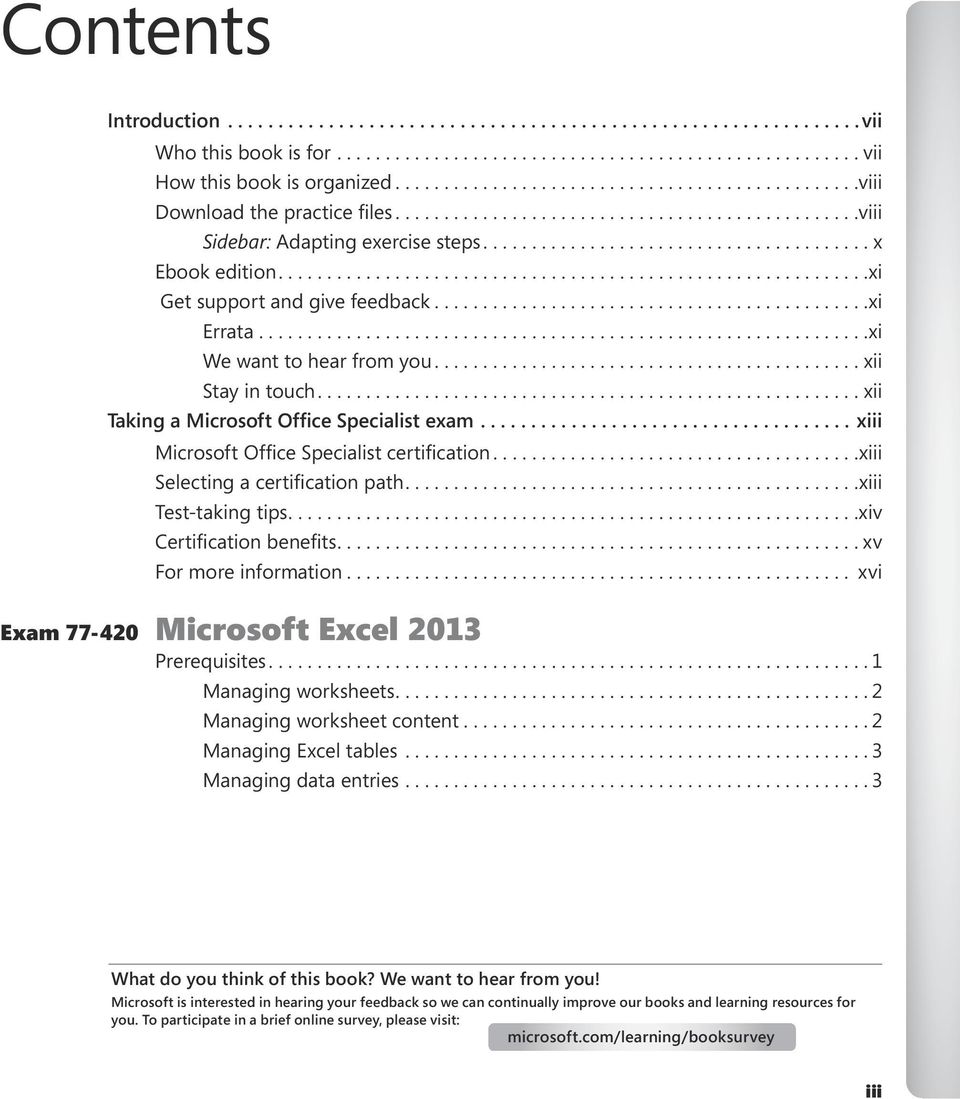
6 iv Contents 1 Create and manage workbooks and worksheets Create workbooks and worksheets...6 Creating new workbooks and worksheets....6 Reusing existing content...7 Practice tasks Navigate through worksheets and workbooks Locating data and worksheet eements Inserting hyperinks Practice tasks Format worksheets and workbooks...16 Modifying page setup Inserting page eements Changing workbook themes and coors...21 Modifying rows and coumns...23 Configuring data vaidation...25 Practice tasks Customize options and views for worksheets and workbooks Dispaying different views of worksheets...29 Dispaying mutipe parts of a workbook Hiding and dispaying workbook content...33 Customizing the Quick Access Toobar...35 Customizing the ribbon...37 Working with macros...39 Modifying workbook properties Practice tasks Configure worksheets and workbooks to print or save Printing workbook content...44 Saving workbooks...46 Practice tasks...52 Objective review Manage ces and ranges Insert data in ces and ranges...54 Creating data...54 Reusing data Practice tasks...63
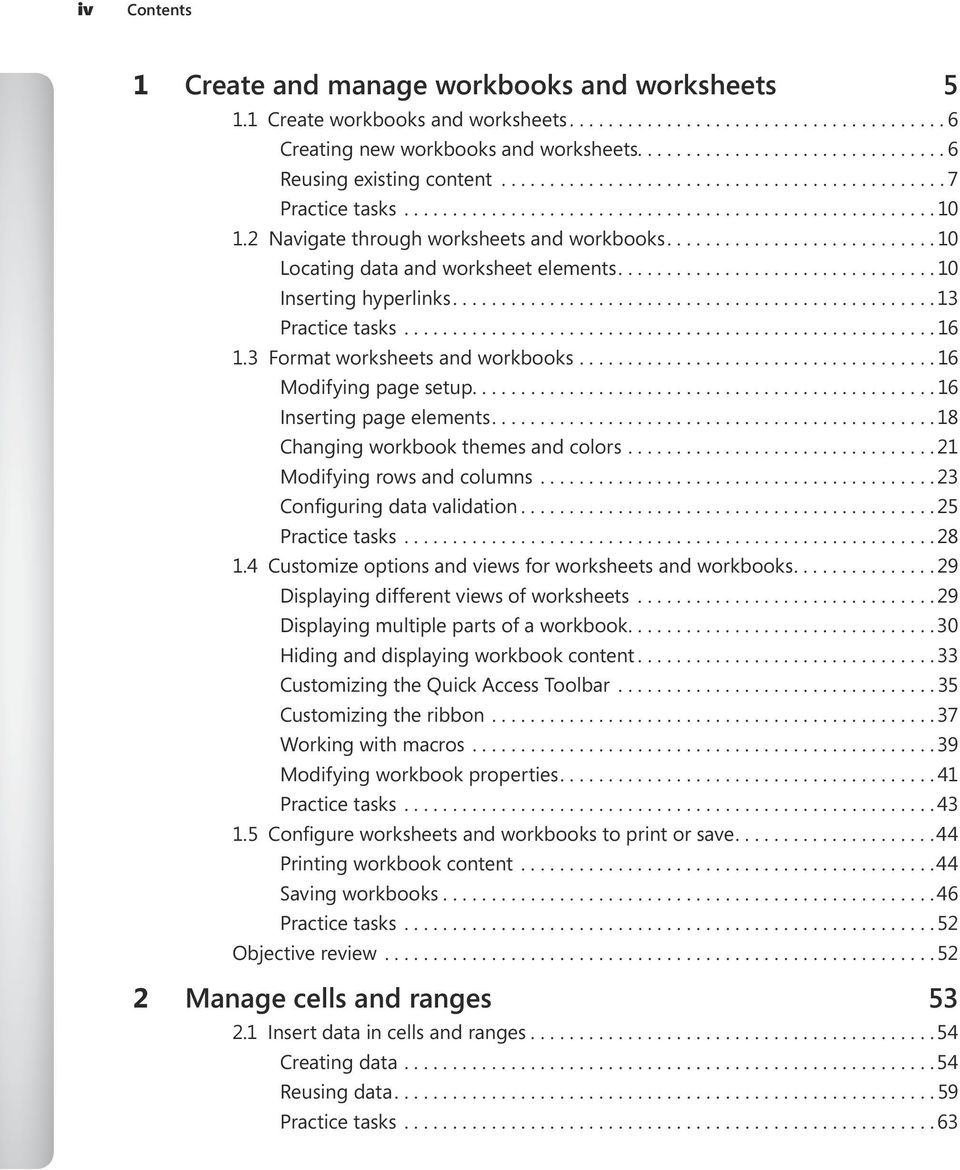
7 Contents v 2.2 Format ces and ranges...64 Formatting ce structure...64 Formatting ce content...66 Appying number formats...69 Copying formatting Practice tasks Order and group ces and ranges Modeing data...74 Creating named ranges...79 Working with data groups and summaries...81 Practice tasks...84 Objective review Manage tabes Create tabes...88 Practice tasks Modify tabes...93 Practice tasks Fiter and sort tabes...96 Practice tasks...99 Objective review Appy formuas and functions Utiize ce ranges and references in formuas and functions Referencing ces and ce ranges in formuas Defining order of operations Practice tasks Summarize data by using functions Practice tasks Utiize conditiona ogic in functions Practice tasks Format and modify text by using functions Practice tasks Objective review...120

8 vi Contents 5 Create charts and objects Create charts Practice tasks Format charts Practice tasks Insert and format objects Adding pictures to sheets Adding text boxes to sheets Adding SmartArt graphics to sheets Practice tasks Objective review Index About the author Survey page What do you think of this book? We want to hear from you! Microsoft is interested in hearing your feedback so we can continuay improve our books and earning resources for you. To participate in a brief onine survey, pease visit: microsoft.com/earning/booksurvey

9 Introduction The Microsoft Office Speciaist (MOS) certification program has been designed to vaidate your knowedge of and abiity to use programs in the Microsoft Office 2013 suite of programs, Microsoft Office 365, and Microsoft SharePoint. This book has been designed to guide you in studying the types of tasks you are ikey to be required to demonstrate in Exam : Microsoft Exce See Aso For information about the tasks you are ikey to be required to demonstrate in Exams and : Microsoft Exce 2013 Expert, see MOS 2013 Study Guide for Microsoft Exce Expert by Mark Dodge (Microsoft Press, 2013). Who this book is for MOS 2013 Study Guide for Microsoft Exce is designed for experienced computer users seeking Microsoft Office Speciaist certification in Exce MOS exams for individua programs are practica rather than theoretica. You must demonstrate that you can compete certain tasks or projects rather than simpy answering questions about program features. The successfu MOS certification candidate wi have at east six months of experience using a aspects of the appication on a reguar basis; for exampe, using Exce at work or schoo to create and manage workbooks and worksheets, modify and format ce content, present data in tabes and charts, perform cacuations on data, and insert and format objects in a worksheet. As a certification candidate, you probaby have a ot of experience with the program you want to become certified in. Many of the procedures described in this book wi be famiiar to you; others might not be. Read through each study section and ensure that you are famiiar with not ony the procedures incuded in the section, but aso the concepts and toos discussed in the review information. In some cases, graphics depict the toos you wi use to perform procedures reated to the ski set. Study the graphics and ensure that you are famiiar with a the options avaiabe for each too. vii

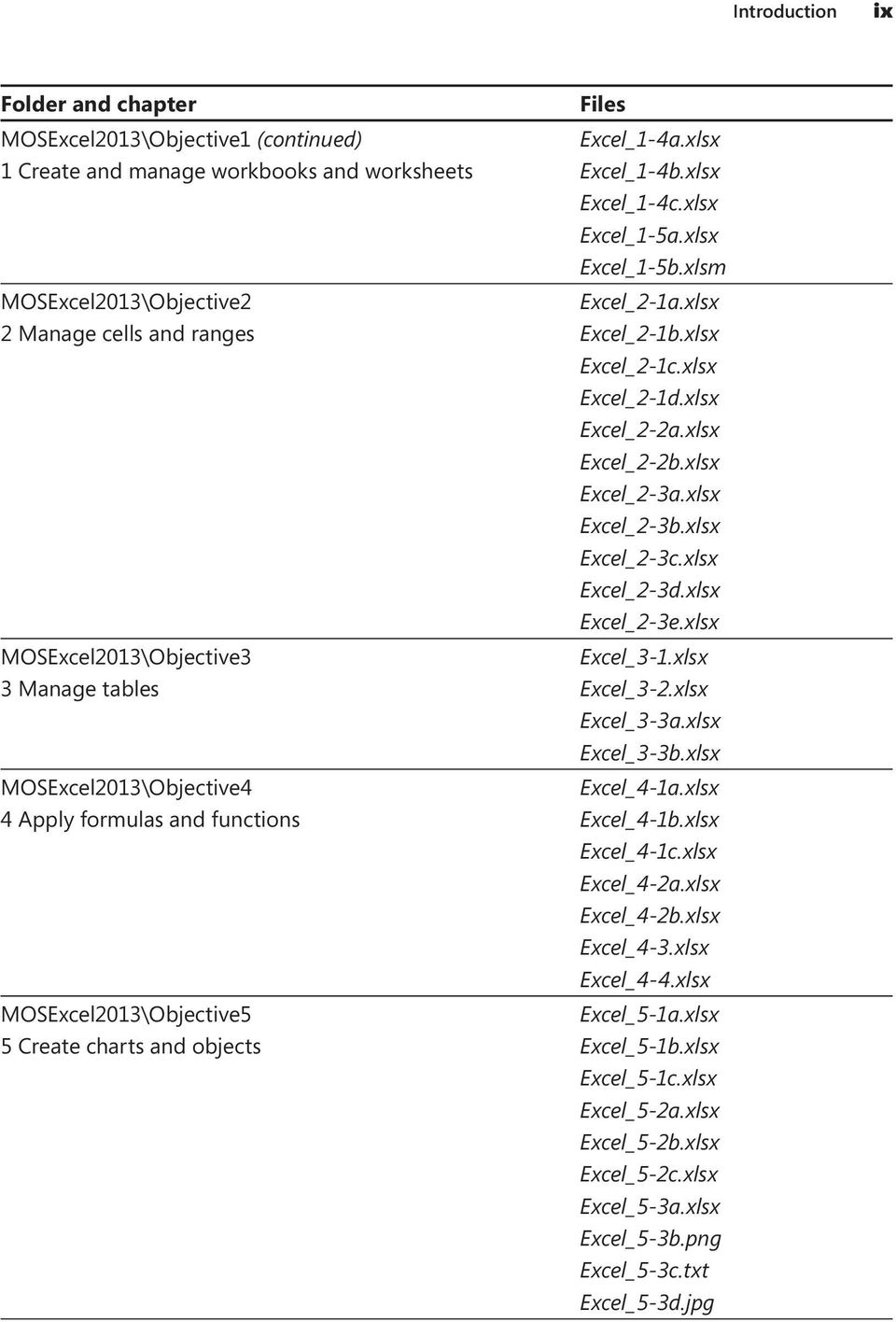
10 viii Introduction How this book is organized The exam coverage is divided into chapters representing broad ski sets that correate to the functiona groups covered by the exam, and each chapter is divided into sections addressing groups of reated skis that correate to the exam objectives. Each section incudes review information, generic procedures, and practice tasks you can compete on your own whie studying. When necessary, we provide practice fies you can use to work through the practice tasks. You can practice the procedures in this book by using the practice fies suppied or by using your own fies. Throughout this book, you wi find Strategy tips that present information about the scope of study that is necessary to ensure that you achieve mastery of a ski set and are successfu in your certification effort. Downoad the practice fies Before you can compete the practice tasks in this book, you need to downoad the book s practice fies to your computer. These practice fies can be downoaded from the foowing page: Important The Exce 2013 program is not avaiabe from this website. You shoud purchase and insta that program before using this book. If you woud ike to be abe to refer to the competed versions of practice fies at a ater time, you can save the practice fies that you modify whie working through the exercises in this book. If you save your changes and ater want to repeat the exercise, you can downoad the origina practice fies again. The foowing tabe ists the practice fies for this book. Foder and chapter MOSExce2013\Objective1 1 Create and manage workbooks and worksheets Fies Exce_1-1.xsx Exce_1-2a.xsx Exce_1-2b.xsx Exce_1-3a.xsx Exce_1-3b.xsx Exce_1-3c.xsx Exce_1-3d.xsx

11 Introduction ix Foder and chapter MOSExce2013\Objective1 (continued) 1 Create and manage workbooks and worksheets MOSExce2013\Objective2 2 Manage ces and ranges MOSExce2013\Objective3 3 Manage tabes MOSExce2013\Objective4 4 Appy formuas and functions MOSExce2013\Objective5 5 Create charts and objects Fies Exce_1-4a.xsx Exce_1-4b.xsx Exce_1-4c.xsx Exce_1-5a.xsx Exce_1-5b.xsm Exce_2-1a.xsx Exce_2-1b.xsx Exce_2-1c.xsx Exce_2-1d.xsx Exce_2-2a.xsx Exce_2-2b.xsx Exce_2-3a.xsx Exce_2-3b.xsx Exce_2-3c.xsx Exce_2-3d.xsx Exce_2-3e.xsx Exce_3-1.xsx Exce_3-2.xsx Exce_3-3a.xsx Exce_3-3b.xsx Exce_4-1a.xsx Exce_4-1b.xsx Exce_4-1c.xsx Exce_4-2a.xsx Exce_4-2b.xsx Exce_4-3.xsx Exce_4-4.xsx Exce_5-1a.xsx Exce_5-1b.xsx Exce_5-1c.xsx Exce_5-2a.xsx Exce_5-2b.xsx Exce_5-2c.xsx Exce_5-3a.xsx Exce_5-3b.png Exce_5-3c.txt Exce_5-3d.jpg
12 x Introduction Adapting exercise steps The screen images shown in this book were captured at a screen resoution of , at 100 percent magnification. If your settings are different, the ribbon on your screen might not ook the same as the one shown in this book. For exampe, you might have more or fewer buttons in each of the groups, the buttons you have might be represented by arger or smaer icons than those shown, or the group might be represented by a button that you cick to dispay the group s commands. As a resut, exercise instructions that invove the ribbon might require a itte adaptation. Our instructions use this format: On the Insert tab, in the Iustrations group, cick the Chart button. If the command is in a ist or on a menu, our instructions use this format: On the Home tab, in the Editing group, cick the Find arrow and then, on the Find menu, cick Advanced Find. Tip On subsequent instances of instructions ocated on the same tab or in the same group, the instructions are simpified to refect that we ve aready estabished the working ocation. If differences between your dispay settings and ours cause a button to appear differenty on your screen than it does in this book, you can easiy adapt the steps to ocate the command. First cick the specified tab, and then ocate the specified group. If a group has been coapsed into a group ist or under a group button, cick the ist or button to dispay the group s commands. If you can t immediatey identify the button you want, point to ikey candidates to dispay their names in ScreenTips. If you prefer not to have to adapt the steps, set up your screen to match ours whie you read and work through the exercises in this book. In this book, we provide instructions based on the traditiona keyboard and mouse input methods. If you re using the program on a touch-enabed device, you might be giving commands by tapping with a styus or your finger. If so, substitute a tapping action any time we instruct you to cick a user interface eement. Aso note that when we te you to enter information, you can do so by typing on a keyboard, tapping an on-screen keyboard, or even speaking aoud, depending on your computer setup and your persona preferences.

13 Introduction xi Ebook edition If you re reading the ebook edition of this book, you can do the foowing: Search the fu text Print Copy and paste You can purchase and downoad the ebook edition from our Microsoft Press site at oreiy.com, which you can find at: Get support and give feedback The foowing sections provide information about getting hep with this book and contacting us to provide feedback or report errors. Errata We ve made every effort to ensure the accuracy of this book and its companion content. Any errors that have been reported since this book was pubished are isted on our Microsoft Press site at oreiy.com, which you can find at: If you find an error that is not aready isted, you can report it to us through the same page. If you need additiona support, send an emai message to Microsoft Press Book Support at: Pease note that product support for Microsoft software is not offered through the preceding addresses.

14 xii Introduction We want to hear from you At Microsoft Press, your satisfaction is our top priority, and your feedback our most vauabe asset. Pease te us what you think of this book at: The survey is short, and we read every one of your comments and ideas. Thanks in advance for your input! Stay in touch Let s keep the conversation going! We re on Twitter at:

15 Taking a Microsoft Office Speciaist exam Desktop computing proficiency is increasingy important in today s business word. When screening, hiring, and training empoyees, empoyers can fee reassured by reying on the objectivity and consistency of technoogy certification to ensure the competence of their workforce. As an empoyee or job seeker, you can use technoogy certification to prove that you aready have the skis you need to succeed, saving current and future empoyers the time and expense of training you. Microsoft Office Speciaist certification Microsoft Office Speciaist certification is designed to assist empoyees in vaidating their skis with Office programs. The foowing certification paths are avaiabe: A Microsoft Office Speciaist (MOS) is an individua who has demonstrated proficiency by passing a certification exam in one or more Office programs, incuding Microsoft Word, Exce, PowerPoint, Outook, Access, OneNote, or SharePoint. A Microsoft Office Speciaist Expert (MOS Expert) is an individua who has taken his or her knowedge of Office to the next eve and has demonstrated by passing a certification exam that he or she has mastered the more advanced features of Word or Exce. Seecting a certification path When deciding which certifications you woud ike to pursue, you shoud assess the foowing: The program and program version(s) with which you are famiiar The ength of time you have used the program and how frequenty you use it Whether you have had forma or informa training in the use of that program Whether you use most or a of the avaiabe program features Whether you are considered a go-to resource by business associates, friends, and famiy members who have difficuty with the program xiii

16 xiv Taking a Microsoft Office Speciaist exam Candidates for MOS-eve certification are expected to successfuy compete a wide range of standard business tasks, such as formatting a document or worksheet and its content; creating and formatting visua content; or working with SharePoint ists, ibraries, Web Parts, and dashboards. Successfu candidates generay have six or more months of experience with the specific Office program, incuding either forma, instructor-ed training or sef-study using MOS-approved books, guides, or interactive computer-based materias. Candidates for MOS Expert eve certification are expected to successfuy compete more compex tasks that invove using the advanced functionaity of the program. Successfu candidates generay have at east six months, and might have severa years, of experience with the programs, incuding forma, instructor-ed training or sef-study using MOS-approved materias. Test-taking tips Every MOS certification exam is deveoped from a set of exam ski standards (referred to as the objective domain) that are derived from studies of how the Office programs are used in the workpace. Because these ski standards dictate the scope of each exam, they provide critica information about how to prepare for certification. This book foows the structure of the pubished exam objectives; see How this book is organized in the Introduction for more information. The MOS certification exams are performance based and require you to compete businessreated tasks or projects in the program for which you are seeking certification. For exampe, you might be presented with a fie and tod to do something specific with it, or presented with a sampe document and tod to create it by using resources provided for that purpose. Your score on the exam refects how we you perform the requested tasks or compete the project within the aotted time. Here is some hepfu information about taking the exam: Keep track of the time. Your exam time does not officiay begin unti after you finish reading the instructions provided at the beginning of the exam. During the exam, the amount of time remaining is shown at the bottom of the exam interface. You can t pause the exam after you start it. Pace yoursef. At the beginning of the exam, you wi receive information about the questions or projects that are incuded in the exam. Some questions wi require that you compete more than one task. Each project wi require that you compete mutipe tasks. During the exam, the amount of time remaining to compete the questions or project, and the number of competed and remaining questions if appicabe, is shown at the bottom of the exam interface.
17 Taking a Microsoft Office Speciaist exam xv Read the exam instructions carefuy before beginning. Foow a the instructions provided competey and accuratey. Enter requested information as it appears in the instructions, but without dupicating the formatting uness you are specificay instructed to do so. For exampe, the text and vaues you are asked to enter might appear in the instructions in bod and underined text, but you shoud enter the information without appying these formats. Cose a diaog boxes before proceeding to the next exam question uness you are specificay instructed not to do so. Don t cose task panes before proceeding to the next exam question uness you are specificay instructed to do so. If you are asked to print a document, worksheet, chart, report, or side, perform the task, but be aware that nothing wi actuay be printed. When performing tasks to compete a project-based exam, save your work frequenty. Don t worry about extra keystrokes or mouse cicks. Your work is scored based on its resut, not on the method you use to achieve that resut (uness a specific method is indicated in the instructions). If a computer probem occurs during the exam (for exampe, if the exam does not respond or the mouse no onger functions) or if a power outage occurs, contact a testing center administrator immediatey. The administrator wi restart the computer and return the exam to the point where the interruption occurred, with your score intact. Strategy This book incudes specia tips for effectivey studying for the Microsoft Office Speciaist exams in Strategy paragraphs such as this one. Certification benefits At the concusion of the exam, you wi receive a score report, indicating whether you passed the exam. If your score meets or exceeds the passing standard (the minimum required score), you wi be contacted by emai by the Microsoft Certification Program team. The emai message you receive wi incude your Microsoft Certification ID and inks to onine resources, incuding the Microsoft Certified Professiona site. On this site, you can downoad or order a printed certificate, create a virtua business card, order an ID card, view and share your certification transcript, access the Logo Buider, and access other usefu and interesting resources, incuding specia offers from Microsoft and affiiated companies.
18 xvi Taking a Microsoft Office Speciaist exam Depending on the eve of certification you achieve, you wi quaify to dispay one of three ogos on your business card and other persona promotiona materias. These ogos attest to the fact that you are proficient in the appications or cross-appication skis neces sary to achieve the certification. Using the Logo Buider, you can create a personaized certification ogo that incudes the MOS ogo and the specific programs in which you have achieved certification. If you achieve MOS certification in mutipe programs, you can incude mutipe certifications in one ogo. For more information To earn more about the Microsoft Office Speciaist exams and reated courseware, visit:

19 Exam Microsoft Exce 2013 This book covers the skis you need to have for certification as a Microsoft Office Speciaist in Microsoft Exce Specificay, you wi need to be abe to compete tasks that demonstrate the foowing skis: 1 Create and manage workbooks and worksheets 2 Manage ces and ranges 3 Create tabes 4 Appy formuas and functions 5 Create charts and objects With these skis, you can create, popuate, format, and manage the types of workbooks and workbook content most commony used in a business environment. Prerequisites We assume that you have been working with Exce 2013 for at east six months and that you know how to carry out fundamenta tasks that are not specificay mentioned in the objectives for this Microsoft Office Speciaist exam. Before you begin studying for this exam, you might want to make sure you are famiiar with the information in this section. 1
20 2 Exam Microsoft Exce 2013 Managing worksheets To deete a worksheet Right-cick the worksheet tab, and then cick Deete. With the worksheet active, on the Home tab, in the Ces group, cick the Deete arrow, and then cick Deete Sheet. To rename a worksheet Doube-cick the worksheet tab, enter the new worksheet name, and then press Enter. 1. Right-cick the worksheet tab, and then cick Rename. Or On the Home tab, in the Ces group, cick Format, and then in the Organize Sheets section, cick Rename Sheet. 2. Enter the new worksheet name, and then press Enter. Managing worksheet content To seect a the content in a worksheet At the junction of the row and coumn headings (above row 1 and to the eft of coumn A), cick the Seect A button. To seect an individua coumn or row Cick the coumn heading (abeed with the coumn etter) or the row heading (abeed with the row number).

21 Exam Microsoft Exce Managing Exce tabes To seect data in a tabe, tabe coumn, or tabe row Point to the upper-eft corner of the tabe. When the pointer changes to a diagona arrow, cick once to seect ony the data, or twice to seect the data and headers. Tip This method works ony with tabes, not with data ranges. Point to the top edge of the tabe coumn. When the pointer changes to a downward-pointing arrow, cick once to seect ony the data, or twice to seect the data and header. Tip You must point to the edge of the tabe, not to the coumn heading or row heading. Point to the eft edge of the tabe row. When the pointer changes to a right-pointing arrow, cick once to seect the data. Managing data entries You enter text or a number in a ce simpy by cicking the ce and entering the content. When entering content, a Cance button (an X) and an Enter button (a check mark) are ocated between the formua bar and Name box, and the indicator at the eft end of the status bar changes from Ready to Enter. Exce aows a ong text entry to overfow into an adjacent empty ce and truncates the entry ony if the adjacent ce aso contains an entry. However, uness you te it otherwise, Exce dispays ong numbers in their simpest form, as foows: If you enter a number with fewer than 12 digits in a standard-width ce (which hods 8.43 characters), Exce adjusts the width of the coumn to accommodate the entry. If you enter a number with 12 or more digits, Exce dispays it in scientific notation. For exampe, if you enter in a standard-width ce, Exce dispays E+13 ( times 10 to the 13th power). If you enter a vaue with many decima paces, Exce might round it. For exampe, if you enter in a standard-width ce, Exce dispays If you manuay set the width of a coumn and then enter a numeric vaue that is too arge to be dispayed in its entirety, Exce dispays pound signs (#) instead of the vaue.
22 4 Exam Microsoft Exce 2013 To compete a data entry Cick the Enter button (the check mark) on the formua bar to compete the entry and stay in the same ce. Press Enter or the Down Arrow key to compete the entry and move down to the next ce in the same coumn. Press the Tab key or the Right Arrow key to compete the entry and move (to the right) to the next ce in the same row, or to the next ce in the tabe (which might be the first ce of the next row). Press Shift+Enter or the Up Arrow key to compete the entry and move up to the previous ce in the same coumn. Press Shift+Tab or the Left Arrow key to compete the entry and move (to the eft) to the previous ce in the same row.
23 1 Create and manage workbooks and worksheets The skis tested in this section of the Microsoft Office Speciaist exam for Microsoft Exce 2013 reate to creating and managing workbooks and worksheets. Specificay, the foowing objectives are associated with this set of skis: 1.1 Create workbooks and worksheets 1.2 Navigate through worksheets and workbooks 1.3 Format worksheets and workbooks 1.4 Customize options and views for worksheets and workbooks 1.5 Configure worksheets and workbooks to print or save An Exce workbook contains one or more worksheets. The data on a worksheet can be reated to data in other areas of the workbook or in other workbooks. A singe workbook can contain a vast amount of raw and cacuated data. You can structure and format workbook content so that key information can be easiy identified and so that data is presented correcty on the screen and when printed. You can ocate information within a workbook by searching vaues, formua eements, or named objects. There are many ways of optimizing the appearance and functionaity of Exce for the processes you perform most frequenty and to suit your individua preferences. This chapter guides you in studying ways of creating, navigating through, formatting, printing, and saving the workbooks and worksheets in which you store information in Exce, and customizing eements of the Exce environment. Practice Fies To compete the practice tasks in this chapter, you need the practice fies contained in the MOSExce2013\Objective1 practice fie foder. For more information, see Downoad the practice fies in this book s Introduction. 5
24 6 Chapter 1 Create and manage workbooks and worksheets 1.1 Create workbooks and worksheets Creating new workbooks and worksheets One of the ways in which Exce 2013 operates more efficienty than previous versions of Exce is by creating ony necessary workbooks and worksheets. Instead of creating a workbook each time you start the program, Exce dispays a start screen from which you can open an existing workbook or create a new workbook. When Exce is running, you can create a bank or prepopuated workbook from the New page of the Backstage view. By defaut, a new workbook incudes ony one worksheet. You can add bank worksheets to the workbook or copy or move worksheets from another workbook. Tip When you create Exce objects such as charts, PivotTabes, and PivotCharts, you can insert them on the worksheet that contains the data or on sheets that are dedicated to the new object.
25 1.1 Create workbooks and worksheets 7 To create a bank workbook Start Exce. On the Start screen, press Esc or cick Bank Workbook. On the New page of the Backstage view, cick Bank Workbook. From the program window, press Ctr+N. To create a workbook from a tempate On the Start screen or on the New page of the Backstage view, do one of the foowing: m Cick a featured tempate. m Enter a tempate type or subject in the Search box, and then press Enter or cick the Search button. Cick a tempate thumbnai to preview its contents and then create a workbook by cicking Create in the preview window; or doube-cick the tempate thumbnai to create a workbook without first previewing it. m Cick the Persona heading, and then doube-cick a custom or downoaded workbook tempate. To insert a new worksheet Cick the New sheet button at the right end of the worksheet tab section. On the Home tab, in the Ces group, cick the Insert arrow, and then cick Insert Sheet. Or 1. Right-cick the worksheet tab before which you want to insert a new worksheet, and then cick Insert. 2. On the Genera page of the Insert diaog box, cick Worksheet, and then cick OK. Reusing existing content You can add a worksheet from another workbook by moving or copying it from the origina (source) workbook. If the content you want to use exists in another format, such as in a deimited text fie, you can import the fie contents into a worksheet in Exce. Aternativey, you can open the fie in Exce and copy ony the data you want from the fie.
26 8 Chapter 1 Create and manage workbooks and worksheets Tip Importing a fie disconnects the contents from the source fie, whereas opening the fie permits you to edit the fie contents in Exce. To move or copy a worksheet On the tab bar, drag the worksheet tab to the new position to move it. Press Ctr and drag the worksheet tab to the new position to copy it. Or 1. Right-cick the worksheet tab, and then cick Move or Copy. Or On the Home tab, in the Ces group, cick Format, and then in the Organize Sheets section, cick Move or Copy Sheet. 2. In the Move or Copy diaog box, do one of the foowing, and then cick OK: Or m To move the worksheet within the same workbook, in the Before sheet box, cick the worksheet before which you want to insert the worksheet. m To move the worksheet to another open workbook, cick the destination workbook in the To book ist. Then in the Before sheet box, cick the worksheet before which you want to insert the worksheet. m To move the worksheet to a new workbook, cick (New book) in the To book ist.
27 1.1 Create workbooks and worksheets 9 In the Move or Copy diaog box, seect the Create a copy check box, do one of the foowing, and then cick OK: m To create a copy within the same workbook, in the Before sheet box, cick the worksheet before which you want to insert the copy. m To create a copy in another open workbook, cick the destination workbook in the To book ist. Then in the Before sheet box, cick the worksheet before which you want to insert the copy. m To create a copy in a new workbook, cick (New book) in the To book ist. Tip You can move or copy a worksheet to an existing workbook ony if that workbook is open. To import the contents of a text fie 1. On the Data tab, in the Get Externa Data group, cick From Text. 2. In the Import Text Fie diaog box, browse to and seect the text fie you want to import, and then cick Import. 3. On the Step 1 page of the Text Import Wizard, cick Deimited or Fixed width to indicate the way that data in the text fie is separated. Specify the first row of data you want to import (this wi amost aways be 1), and seect the My data has headers check box if appicabe. Then cick Next. Tip The preview at the bottom of the page dispays the data being imported. 4. On the Step 2 page of the Text Import Wizard, seect the character or characters that separate the fied content within the text fie, and then cick Next. 5. On the Step 3 page of the Text Import Wizard, do the foowing, and then cick Finish: m For each coumn of numeric data in the preview that requires specific number formatting, cick the coumn and then specify the number format. m For each coumn you want to excude from the import operation, cick the coumn and then cick Do not import coumn (skip). 6. In the Import Data diaog box, cick the ocation to which you want to import the data, and then cick OK.
28 10 Chapter 1 Create and manage workbooks and worksheets To open a non-native fie in Exce 1. On the Open page of the Backstage view, seect the storage ocation from which you want to open the fie, and then cick Browse. 2. In the Open diaog box, in the ist of fie types, cick A Fies (*.*) or cick the specific type of fie you want to open. 3. Browse to and seect the fie you want to open, and then cick Open. Practice tasks The practice fie for these tasks is ocated in the MOSExce2013\Objective1 practice fie foder. Save the resuts of the tasks in the same foder. Create a workbook based on a saes report tempate of your choice, and save it as Saes Data. Leave the workbook open. Open the Exce_1-1 workbook, and compete the foowing tasks: m Move the Source Data worksheet so it is the ast worksheet in the workbook. m Make a copy of the Source Data worksheet as the ast worksheet in the Saes Data workbook. 1.2 Navigate through worksheets and workbooks Locating data and worksheet eements You can easiy ocate specific vaues, formua content, comment text, and formatting anywhere within a workbook. Using the Find operation, you can search the entire workbook or a specific worksheet for text and formatting in formuas, cacuated vaues, or comments.
29 1.2 Navigate through worksheets and workbooks 11 If you re ooking for a specific eement or type of eement, you can ocate it by using the Go To and Go To Specia commands. From the Go To diaog box, you can ocate any named eement (such as a ce, ce range, named range, tabe, or chart). From the Go To Specia diaog box, you can ocate comments, formuas or specific formua eements, bank ces, objects, row or coumn differences, precedents and dependents, conditiona formatting, data vaidation, and more.
30 12 Chapter 1 Create and manage workbooks and worksheets To search for text 1. On the Home tab, in the Editing group, dispay the Find & Seect ist, and then cick Find (or press Ctr+F). 2. On the Find page of the Find and Repace diaog box, enter the text you want to ocate, and if necessary, cick Options to dispay the search parameters. 3. Specify the foowing search parameters: m In the Within ist, cick Sheet or Workbook. m In the Search ist, cick By Rows or By Coumns. m In the Look in ist, cick Formuas, Vaues, or Comments. 4. Seect the Match case or Match entire ce contents check boxes to further restrict your search. 5. Cick Find Next. To search for formatting 1. On the Find page of the Find and Repace diaog box, cick the Format button. 2. In the Find Format diaog box, specify the number, aignment, font, border, fi, or protection formatting you want to find. Then cick OK. 3. In the Find and Repace diaog box, cick Find Next. To search for matching formatting 1. On the Find page of the Find and Repace diaog box, cick the Format arrow, and then cick Choose Format From Ce. 2. When the pointer changes to an eyedropper, seect the ce on which you want to base your search. 3. In the Find and Repace diaog box, cick Find Next. To move to a named ce, range, or workbook eement On the formua bar, cick the Name box arrow, and then seect the named eement. Or 1. In the Find & Seect ist, cick Go To (or press Ctr+G). 2. In the Go To diaog box, cick a named eement in the Go to ist, and then cick OK.
31 1.2 Navigate through worksheets and workbooks 13 To move to a ocation that has a specific property 1. In the Find & Seect ist, cick Go To Specia (or cick Specia in the Go To diaog box). 2. In the Go To Specia diaog box, cick the property for which you want to search, and then cick OK. Inserting hyperinks Exce worksheets can incude hyperinks that provide a quick way to connect to reated information or to create a pre-addressed emai message. You can create a hyperink from any ce content to any of the hyperink ocations supported by the Office 2013 programs another ocation on the worksheet, in the workbook, in an externa document, or on the web. By defaut, hyperinks are formatted as underined, coored text. (The active and foowed hyperink coors are specified by the theme.) Cicking the hyperink text in the ce that contains the hyperink dispays the hyperink target. Tip To seect a ce that contains a hyperink, cick part of the ce away from the hyperink or cick and hod down the mouse button unti the pointer changes to a pus sign.
32 14 Chapter 1 Create and manage workbooks and worksheets To create a hyperink to a webpage Enter a URL in the ce, and then press Enter. Or 1. Seect the ce or eement from which you want to ink. 2. On the Insert tab, in the Links group, cick the Hyperink button (or press Ctr+K). 3. In the Insert Hyperink diaog box, in the Link to ist, cick Existing Fie or Web Page. 4. In the Address box, enter the URL of the webpage you want to ink to. Or Cick the Browse the Web button (the button abeed with a gobe and magnifying gass). In the web browser window that opens (not a previousy open window), dispay the webpage you want to ink to, and cick the Insert Hyperink diaog box to copy the webpage address from the browser address bar to the Address box of the diaog box. Then minimize or cose the browser window. Tip If the webpage address doesn t copy to the Address box in a vaid format for exampe if the webpage is on a Microsoft SharePoint site manuay copy the address from the browser address bar to the Address box of the Insert Hyperink diaog box. 5. If you want to dispay text other than the target when a user points to the hyperink, cick the ScreenTip button, enter the ScreenTip text, and then cick OK. Tip When inserting a hyperink from a ce that contains text (not numeric data), the Text To Dispay box is active. You can change the text in the ce by entering aternative text in the Text To Dispay box. 6. In the Insert Hyperink diaog box, cick OK. To create a hyperink to an existing fie 1. Seect the ce or eement from which you want to ink. Then cick the Hyperink button (or press Ctr+K). 2. In the Insert Hyperink diaog box, in the Link to ist, cick Existing Fie or Web Page. 3. In the Look in area, browse to the fie you want to ink to. 4. In the Insert Hyperink diaog box, cick OK.
33 1.2 Navigate through worksheets and workbooks 15 To create an Exce workbook and a hyperink to it 1. Seect the ce or eement from which you want to ink. Then cick the Hyperink button (or press Ctr+K). 2. In the Insert Hyperink diaog box, in the Link to ist, cick Create New Document. 3. In the Name of new document box, enter a name for the workbook. Tip Do not enter the fie extension. The Create New Document hyperink in an Exce workbook automaticay creates an Exce workbook. 4. To create the document in a foder other than your Documents foder, cick the Change button. Then, in the Create New Document diaog box, browse to the foder in which you want to save the fie, and cick OK. 5. In the When to edit area, do one of the foowing: m Cick Edit the new document ater to create a bank workbook. m Cick Edit the new document now to create a workbook and open it in Exce. 6. In the Insert Hyperink diaog box, cick OK. To create a hyperink to a worksheet or named range within the workbook 1. Seect the ce or eement from which you want to ink. Then cick the Hyperink button (or press Ctr+K). 2. In the Insert Hyperink diaog box, in the Link to ist, cick Pace in This Document. 3. In the Or seect a pace in this document box, cick the heading or bookmark you want to ink to. 4. In the Insert Hyperink diaog box, cick OK. To create a hyperink that creates a pre-addressed emai message 1. Seect the ce or eement from which you want to ink. Then cick the Hyperink button (or press Ctr+K). 2. In the Insert Hyperink diaog box, in the Link to ist, cick E-mai Address. 3. In the E-mai address box, enter the emai address of the message recipient. 4. In the Subject box, enter the message subject. 5. In the Insert Hyperink diaog box, cick OK.
34 16 Chapter 1 Create and manage workbooks and worksheets Practice tasks The practice fies for these tasks are ocated in the MOSExce2013\Objective1 practice fie foder. Save the resuts of the tasks in the same foder. Open the Exce_1-2a workbook, and compete the foowing tasks on the Product List worksheet by using the techniques described in this section: m Move to the first ce that contains a comment. m Move to the ce range named Berry_bushes. m Move to ce F13. m Create a hyperink from ce F13 to the ce range named Berry_bushes. m Move to the ce at the intersection of the ast active row and coumn in the worksheet. Open the Exce_1-2b workbook, and compete the foowing tasks on the Empoyees worksheet: m In ce C12, enter a hyperink to the website ocated at m Edit the hyperink so that the ce dispays Pease visit our website instead of the URL. 1.3 Format worksheets and workbooks Modifying page setup You can contro the basic footprint of printed worksheets by defining the paper size and orientation, changing the page margins, and changing the space aocated to the header and footer. By configuring these page setup options, you define the space that is avaiabe for the content on an individua page when it is printed or dispayed in Print Layout view. Tip If your content doesn t fit within the aocated area, you can adjust the way it fits on the page by scaing it, either from the Page Setup tab or from the Print page. For more information, see section 1.5, Configuring worksheets and workbooks to print or save.
35 1.3 Format worksheets and workbooks 17 To change the page margins 1. On the Page Layout tab, in the Page Setup group, cick the Margins button. 2. On the Margins menu, do one of the foowing: m Cick the standard margin setting you want. m Cick the Custom Margins command. Then on the Margins page of the Page Setup diaog box, specify the Top, Bottom, Left, and Right margins, and cick OK. To change the page orientation On the Page Layout tab, in the Page Setup group, cick the Orientation button, and then cick Portrait or Landscape. To set a standard paper size On the Page Layout tab, in the Page Setup group, cick the Size button, and then cick the paper size you want. To set a custom paper size 1. On the Page Layout tab, in the Page Setup group, cick the Size button, and then cick More Paper Sizes. 2. On the Page page of the Page Setup diaog box, cick Options. 3. On the Paper/Quaity page of the Printer Properties diaog box, in the Paper Options area, cick Custom. 4. In the Custom Paper Size diaog box, enter a name for the custom size, enter the width and ength of the paper, specify the units of measurement, cick Save, and then cick Cose. 5. Cick OK in each of the open diaog boxes. Tip The avaiabe print settings depend on the currenty seected printer.
36 18 Chapter 1 Create and manage workbooks and worksheets Inserting page eements You can dispay information on every page of a printed worksheet, and aso in Page Layout view, by inserting it in the page headers and footers. You can have a different header and footer on the first page or different headers and footers on odd and even pages. When you create a header or footer, Exce dispays the workbook in a view that is simiar to Page Layout view, and the Design too tab appears on the ribbon. An active header or footer is divided into three sections in which you can enter information either manuay or from the Design too tab. (The commands on the Insert tab are not avaiabe whie the header or footer is active for editing.) You can enter document information and properties such as the current or tota page number, current date or time, fie path, fie name, or sheet name from the Design too tab, or you can enter and format text the same way you woud in the worksheet body. You can aso insert an image, such as a company ogo. If you want to dispay and print an image or text on a worksheet, for exampe to denote draft or confidentia information or to indicate copyright ownership, you can simuate a watermark in the foowing ways: Insert a graphic in the header or footer. The advantages of this method are that the graphic appears on a printed pages, and you can easiy appy a wash out effect so that it ooks ike a true watermark. A possibe disadvantage is that the graphic is anchored in the header or footer rather than centered on the page. Important If you anchor the graphic in the footer, you must incude some content in the header, or the graphic wi not be visibe in the content area. Insert a background image on the worksheet. The advantage of this method is that the image appears on a printed pages. The disadvantage is that Exce ties background images, so you must either choose a page-sized image or an image that repeats gracefuy. You must aso manuay appy any washout effects before seecting the image. Insert a WordArt object on the worksheet. The advantages of this method are that it provides a simpe way of creating and formatting text that is appropriate for a watermark, you can position it anywhere on the page, and you can rotate the WordArt object however you want. A possibe disadvantage is that you must pace the WordArt object on each page on which you want it to appear.
37 1.3 Format worksheets and workbooks 19 To insert content in the page header and footer 1. On the Insert tab, in the Text group, cick Header & Footer, or in Page Layout view, cick Cick to add header. 2. Cick the eft, center, or right header section. Then do any of the foowing: m To insert a document property in the active header section, seect document information from the Header ist in the Header & Footer group on the Design too tab, or cick a button in the Header & Footer Eements group. m in the Header & Footer Eements group, cick Picture, and then browse to the oca or onine picture you want to dispay in the active header section. m Manuay enter information in the active header section. 3. To dispay different headers on the first and foowing pages, or on odd and even pages, seect the corresponding check box in the Options group, and then insert the header information you want for each set of pages.
38 20 Chapter 1 Create and manage workbooks and worksheets 4. To move to the footer, cick Cick to add footer on any page, or on the Design too tab, in the Navigation group, cick the Go to Footer button. 5. To cose the header and footer areas, cick in the workbook body. Tip If you decide to insert a header or footer just before printing, you can do so from the Header/Footer page of the Page Setup diaog box, which is accessibe from the Print page of the Backstage view. To edit the header or footer Activate the header or footer, and then make your changes. To simuate a picture watermark by adding a picture to the header or footer 1. Activate the header or footer and cick the eft, center, or right section in which you want to anchor the watermark. 2. On the Design too tab, in the Header & Footer Eements group, cick Picture, and then browse to the oca or onine picture you want to dispay as a watermark. 3. With &[Picture] seected in the header or footer, in the Header & Footer Eements group, cick Format Picture. 4. On the Size page of the Format Picture diaog box, set the height and width of the picture so that it is approximatey the size of the page (or the size you want it to extend from the anchor ocation). 5. On the Picture page of the Format Picture diaog box, in the Image contro area, cick Washout in the Coor ist. Make any other coor adjustments you want, and then cick OK. To simuate a picture watermark by adding a background picture 1. On the Page Layout tab, in the Page Setup group, cick the Background button. 2. From the Insert Picture diaog box, ocate and insert the picture fie you want to use as the background. (Use standard techniques to ocate a fie on your computer or onine.) To simuate a text watermark 1. On the Insert tab, in the Text group, cick the WordArt button. 2. In the WordArt gaery, cick a transparent text stye. 3. Enter the text of the watermark. 4. Adjust the rotation, size, and ocation of the WordArt object as necessary.
39 1.3 Format worksheets and workbooks 21 Changing workbook themes and coors You can enhance the ook of an entire workbook by appying a predefined theme a combination of coors, fonts, and effects. In the Themes gaery, you can point to a theme to dispay a ive preview of its effect on the workbook eements before you appy it. If you ike certain aspects of different themes (for exampe, the coors of one theme and the fonts of another), you can mix and match theme eements. If you create a combination of theme eements that you woud ike to use with other worksheets, you can save the combination as a new theme. After you save a theme in the defaut Document Themes foder, the theme is avaiabe in the Custom section of the Themes gaery. To appy formatting to severa worksheets at once, group the worksheets, and then perform the formatting operation. To appy a theme to a worksheet 1. On the Page Layout tab, in the Themes group, cick the Themes button. 2. In the Themes gaery, cick the theme you want.
40 22 Chapter 1 Create and manage workbooks and worksheets To modify a theme 1. In the Themes group, cick the Coors, Fonts, or Effects button. 2. In the gaery, cick the theme eement you want. To save a customized theme 1. In the Themes gaery, cick Save Current Theme. 2. In the Save Current Theme diaog box, enter a name for the theme in the Fie name box, and then cick Save. To group worksheets To group a worksheets, right-cick any worksheet tab, and then cick Seect A Sheets. To group adjacent worksheets, cick the tab of the eftmost worksheet you want to group, press Shift, and then cick the tab of the rightmost worksheet you want to group. To group nonadjacent worksheets, cick any worksheet tab, press Ctr, and then cick each additiona worksheet tab. Tip When worksheets are grouped, Exce dispays [Group] after the workbook name in the tite bar. Many commands are not avaiabe when worksheets are grouped. To ungroup worksheets Cick the tab of any worksheet. Right-cick the tab of any worksheet that is not grouped. Right-cick the tab of any grouped worksheet, and then cick Ungroup Sheets. Tip When a workbook contains severa worksheets, it can be hepfu to assign different coors to the tabs to categorize them or to make them easiy distinguishabe. To change the coor of a worksheet tab, right-cick the tab, cick Tab Coor, and then cick the coor you want.
41 1.3 Format worksheets and workbooks 23 Modifying rows and coumns Inserting and deeting rows and coumns is a natura part of worksheet deveopment, and in Exce 2013, it coudn t be easier. You can insert an entire row above the seected ce or an entire coumn to the eft of it. If you want to insert a ce instead of a row or coumn, you are given the option of making room by moving ces down or to the right. Simiary, you can deete a seected row or coumn, or you can deete ony the seected ces, optionay specifying how the remaining ces shoud fi the space. In addition to inserting empty rows, coumns, or ces, you can insert cut or copied ce contents directy into an existing tabe or data range with one command. When you insert a range of ces rather than an entire row or coumn, Exce requests instructions for making room before inserting a simiary shaped range. Tip Aways seect a singe ce when inserting cut or copied ces. If you seect a range that is a different size and shape from the one you want to insert, you wi get an error message. By defaut, worksheet rows have a standard height of 15 points, or 0.21 inches, and their height increases and decreases to accommodate the number of ines in their ongest entry. You can manuay change the height of a row, but it is best to eave the row height dynamic to accommodate future changes, uness you have a good reason to specify a height. For exampe, you might want to specify a narrow row to create a visua break between bocks of data. (You can restore dynamic height adjustment if you need to.) Worksheet coumns have a standard width of 8.43 characters (in the defaut font), or 0.72 inches, and their width is not dynamic. You are more ikey to want to change coumn width than row height, usuay to accommodate ong ce entries. You can have Exce adjust a coumn to fit its ongest entry, or you can adjust it manuay to up to 255 characters. In conjunction with text wrapping, adjusting coumn widths is a key technique for making as much data as possibe visibe on the screen or page. Tip When the ruer is hidden, row heights are specified in points and coumn widths in characters. When the ruer is dispayed, row heights and coumn widths are specified in inches.
42 24 Chapter 1 Create and manage workbooks and worksheets For the purposes of height and width adjustments, seecting a singe ce in a row or coumn is the same as seecting the entire row or coumn. You can change the height or width of mutipe rows or coumns at the same time by seecting them and then performing the resizing operation. To insert rows or coumns 1. Seect the number of rows you want to insert, starting with the row above which you want the inserted rows to appear, or seect the number of coumns you want to insert, starting with the coumn to the eft of which you want the inserted coumns to appear. 2. On the Home tab, in the Ces group, cick the Insert button. Or Right-cick the seection, and then cick Insert. To deete seected rows or coumns On the Home tab, in the Ces group, cick the Deete button. To change the height of a seected row Drag the bottom border of the row seector up or down. Tip As you drag the border, a ScreenTip dispays the current row height in either points or inches and in pixes. Or 1. On the Home tab, in the Ces group, dispay the Format ist, and then cick Row Height. 2. In the Row Height diaog box, specify the height you want, and then cick OK. To change the width of a seected coumn Drag the right border of the coumn seector to the eft or right. Tip As you drag the border, a ScreenTip dispays the current coumn width in either characters or inches and in pixes. Or
43 1.3 Format worksheets and workbooks On the Home tab, in the Ces group, dispay the Format ist, and then cick Coumn Width. 2. In the Coumn Width diaog box, specify the width you want, and then cick OK. To size a coumn or row to fit its contents Doube-cick the right border of the coumn heading or the bottom border of the row heading. On the Home tab, in the Ces group, dispay the Format ist, and then cick AutoFit Coumn Width. On the Home tab, in the Ces group, dispay the Format ist, and then cick AutoFit Row Height. Tip You can adjust the width of a the coumns in a worksheet at the same time. Cick the worksheet seector to seect the entire worksheet, and then doube-cick the border between any two coumns. Every popuated coumn resizes to fit its contents. Empty coumns remain unchanged. Configuring data vaidation A simpe way to ensure that worksheets produce the expected resuts is to take measures to ensure that the data being entered meets necessary criteria. This is especiay important in workbooks that you wi be distributing for other peope to popuate with data. You can do this in two ways: By imiting entries to those the user chooses from a ist that you provide. By checking the data against specific criteria as it is entered. This is referred to as vaidating the data. You can vaidate data in severa ways. For any numeric, date, or time vaidation check, you can specify whether you want to aow the entry to be between two vaues, not between two vaues, greater than, ess than, equa to, or not equa to a vaue. Each of the vaues to be used for vaidation can be a specific vaue, a reference to a ce on the worksheet or a ce on another worksheet, or cacuated with a formua referencing ces. With this, very compex vaidation rues can be created. For exampe, you coud create a rue in a budget worksheet specifying that the budget item for charitabe contributions shoud be at east as arge as the previous year, but no more than 10 percent of the net pretax profit.
44 26 Chapter 1 Create and manage workbooks and worksheets You can restrict ce content to the foowing data types: Any vaue This is the defaut vaue. Whoe number An integer, either positive or negative. Decima Any type of number, whoe or otherwise, positive or negative. List An input ist from which the user can seect ony a specific vaue. Date Any recognized date format. You can specify an aowabe range of dates. Time Any recognized time format. You can specify an aowabe range of times. Text ength A maximum number of characters. Custom Any vaid Exce formua that equates to True or Fase. To vaidate the vaue that is being entered, reference the ce in the formua. For exampe, to check whether the vaue in C3 contains text, use the formua =ISTEXT(C3). When the data entered in a ce doesn t meet the data vaidation criteria, Exce dispays an error message. You can aso have Exce dispay instructions to guide the user in inserting the correct type of data in the ce. The input message resembes a comment, and is visibe ony when the ce is active. To restrict entries to a specific ist of options 1. On the worksheet on which you wi create the input ist, enter the items you want to make avaiabe from the ist into a range of ces. Choose a ocation that wi not interfere with data entry. Or On a worksheet other than the one on which you wi create the input ist, enter the ist items in a range of ces. 2. Seect the ce or range of ces for which you want to create the input ist. 3. On the Data tab, in the Data Toos group, cick the Data Vaidation button. 4. On the Settings tab of the Data Vaidation diaog box, in the Aow ist, cick List. 5. Position the cursor in the Source box, then seect or enter the ce range containing the ist items you created in step In the Data Vaidation diaog box, cick OK. To restrict entries to those meeting specific criteria 1. Seect the ce or range of ces for which you want to enforce data vaidation criteria.
45 1.3 Format worksheets and workbooks On the Data tab, in the Data Toos group, cick the Data Vaidation button. 3. On the Settings tab of the Data Vaidation diaog box, cick the Aow arrow, and then in the ist, cick the type of data you want to aow. 4. In the data type specific criteria boxes that appear, seect or enter the criteria that data in the seected ces must meet. Then cick OK. Tip Take care when setting up data vaidation checks that you don t inadvertenty disaow vaid data. Test your data vaidation criteria by entering both vaid and invaid data and verifying that you get the expected resuts. To configure an input message to support data vaidation 1. On the Input Message page of the Data Vaidation diaog box, seect the Show input message when ce is seected check box. 2. In the Tite box, enter the text you want to appear in bod font at the beginning of the input message. 3. In the Input message box, enter the text you want to appear in reguar font after the input message tite. 4. Cick OK. To modify the standard error message 1. On the Error Aert page of the Data Vaidation diaog box, seect the Show error aert after invaid data is entered check box. 2. In the Stye ist, cick the type of icon you want to dispay in the error message: Stop to dispay a white X in a red circe, Warning to dispay a back excamation point in a yeow triange, or Information to dispay a white owercase etter i in a bue circe. 3. In the Tite box, enter the text you want to appear in the tite bar of the error message diaog box. 4. In the Error message box, enter the text you want to appear in the body of the error message diaog box. 5. Cick OK. To ocate worksheet ces that have data vaidation configured On the Home tab, in the Editing group, cick Find & Seect, and then in the ist, cick Data Vaidation.
46 28 Chapter 1 Create and manage workbooks and worksheets To cance data vaidation 1. Seect one or more ces from which you want to remove data vaidation. 2. To cance a instances of the seected data vaidation criteria in the worksheet, seect the Appy these changes to a other ces with the same settings check box on the Settings page of the Data Vaidation diaog box. 3. On any page of the diaog box, cick Cear A, and then cick OK. Practice tasks The practice fies for these tasks are ocated in the MOSExce2013\Objective1 practice fie foder. Save the resuts of the tasks in the same foder. Open the Exce_1-3a workbook, and compete the foowing tasks: m Change each of the visibe worksheet tabs to a different coor. m Configure the JanFeb worksheet to print horizontay on two pages of etter-size paper. m Configure the MarApr worksheet to print on two pages of A5-size paper. m Configure the MayJun worksheet to print at 50 percent of its actua size. Open the Exce_1-3b workbook, and compete the foowing tasks on the Orders worksheet: m Create a header that wi print on a the pages of the worksheet except the first page. On the eft side of the header, enter today s date; in the center section, enter the name of the workbook; and on the right side, enter the page number. m In Norma view, change the center section of the header to refect the name of the worksheet instead of the workbook. m Remove the page numbers from the header, and then add page numbers that print at the bottom of each page. In the Exce_1-3c workbook, on the Order Detais worksheet, add a data vaidation check to the Discount coumn to ensure that the vaue is between 0 and.2 (in other words, that the discount does not exceed 20 percent). Incude an input message and dispay a warning if an incorrect vaue is entered. In the Exce_1-3d workbook, dispay the By Product-Customer worksheet and ensure that at east one outine section is expanded. Then group a the worksheets and appy the Austin theme to the worksheet group.
47 1.4 Customize options and views for worksheets and workbooks Customize options and views for worksheets and workbooks Dispaying different views of worksheets From the View toobar at the bottom of the program window, or from the View tab, you can switch among three views of a worksheet: Norma The worksheet is dispayed in the window at 100 percent magnification or at whatever zoom eve you seect. Page breaks are indicated by back dashed ines. Page Layout Each worksheet page appears as it wi when printed, with space between the individua pages. A ruer appears at the eft edge of the window next to the optiona row headings. The page header and footer are visibe and you can seect them for editing. Page Break Preview The entire worksheet is dispayed in the window, with page breaks indicated by bod bue dashed ines and page numbers dispayed in the center of each page. You can change the page breaks by dragging the bue ines. To maximize your work area, you can dispay a worksheet in fu-screen mode, so that ony the tite bar is visibe. To increase the vertica space of the work area but sti have easy access to commands, you can hide the ribbon so that ony its tabs are visibe, and hide the formua bar. The View Shortcuts toobar incudes buttons for changing the view of the document window. From the Zoom toobar at the bottom of the program window, or from the Zoom group on the View tab, you can change the zoom eve of a worksheet in any range from 10 percent to 400 percent. You can zoom the entire worksheet or seect a range of ces and have Exce determine the zoom eve necessary to fit the seection in the window. To dispay a standard worksheet view On the View Shortcuts toobar near the right end of the status bar, cick the Norma, Page Layout, or Page Break Preview button. On the View tab, in the Workbook Views group, cick the Norma, Page Layout, or Page Break Preview button.
48 30 Chapter 1 Create and manage workbooks and worksheets To zoom in or out in 10-percent increments On the status bar, cick the Zoom In (+) or Zoom Out (-) button. To change the zoom eve dynamicay Drag the Zoom sider to the eft to zoom out or to the right to zoom in. To zoom to a specific magnification 1. On the View tab, in the Zoom group, cick the Zoom button. Or On the status bar, cick the Zoom eve button. 2. In the Zoom diaog box, cick a specific magnification eve, or cick Custom and then enter a vaue from 10 to 400. Then cick OK. To zoom in on seected ces 1. Seect the ce or ce range you want to zoom in on. 2. Open the Zoom diaog box, cick Fit seection, and then cick OK. Dispaying mutipe parts of a workbook It can be cumbersome to work in a worksheet that is too ong or wide to dispay egiby in the program window, to scro up and down or back and forth to view data esewhere in the worksheet, or to switch back and forth between mutipe worksheets in the same workbook if you frequenty need to access information in both of them. You can view mutipe parts of a worksheet at one time by freezing rows or coumns so they stay in view whie you scro the rest of the worksheet, by spitting the window so you can independenty scro and work in two or four views of the worksheet within the same program window, or by dispaying mutipe instances of the workbook in separate program windows. Regardess of the technique you use, changes you make to the workbook content in any one view are immediatey refected in the others. Tip Another way to dispay disparate rows or coumns together on one screen is to hide the rows or coumns between them.
49 1.4 Customize options and views for worksheets and workbooks 31 To freeze the first row or coumn of a worksheet On the View tab, in the Window group, cick the Freeze Panes button, and then cick Freeze Top Row or Freeze First Coumn. To freeze mutipe rows or coumns 1. Seect the row beow or coumn to the right of those you want to freeze, by cicking the row seector or coumn seector. 2. On the View tab, in the Window group, cick the Freeze Panes button, and then cick Freeze Panes. To simutaneousy freeze coumns and rows 1. Seect the ce that is beow and to the right of the intersection of the row and coumn you want to freeze. 2. On the View tab, in the Window group, cick the Freeze Panes button, and then cick Freeze Panes. Tip You can freeze as many coumns and rows as you ike depending on what ce is seected when you invoke the Freeze Panes command. Seecting a ce in row 1 freezes the coumns to the eft of that ce. Seecting a ce in coumn A freezes the rows above that ce. Seecting ce A1 freezes the panes at the midpoint of the current window (the top haf of the rows and the eft haf of the coumns). Seecting a ce other than those in row 1 and coumn A freezes the rows above and coumns to the eft of the ce.
50 32 Chapter 1 Create and manage workbooks and worksheets To unfreeze a rows and coumns On the View tab, in the Window group, cick the Freeze Panes button, and then cick Unfreeze Panes. To dispay mutipe views of a workbook in the same program window 1. To spit the window into two parts, cick a ce in row 1 or coumn A. Or To spit the window into four parts, cick the ce above and to the eft of where you want to spit the panes. 2. On the View tab, in the Window group, cick Spit. To modify the spit between windows Drag the vertica or horizonta spit bar to the row or coumn where you want to spit the window. To remove a spit from a program window Doube-cick the spit bar that divides the pane. Drag the vertica spit bar to the top of the scro bar. Drag the horizonta spit bar to the right end of the scro bar. To dispay mutipe views of a workbook in separate program windows 1. On the View tab, in the Window group, cick the New Window button to open another instance of the workbook. Tip You can open severa instances of the workbook; Exce dispays the instance number after the workbook name in the program window tite bar. 2. Arrange the workbook windows as you want, or cick the Arrange A button and then in the Arrange Windows diaog box, cick Tied, Horizonta, Vertica, or Cascade. To arrange ony the instances of the active workbook, seect the Windows of active workbook check box. Then cick OK. 3. Dispay the worksheet, worksheet section, or workbook eement you want in each workbook window. 4. To return to a singe program window, cose the others. It is not necessary to save changes in any but the ast open instance of the workbook.
51 1.4 Customize options and views for worksheets and workbooks 33 Hiding and dispaying workbook content A workbook, particuary one that contains data cacuations, PivotTabes, or PivotCharts, might contain reference data that isn t otherwise required. You can hide rows, coumns, or entire worksheets of data you don t need to use or don t want other peope to see. When you hide rows or coumns, anyone who notices that coumn etters or row numbers are missing can unhide the information uness you protect the workbook. If you don t want to go to the troube of enforcing protection, you can hide the row and coumn headings so that the hidden information is not as obvious. This eaves ony a sma gap in pace of any hidden rows or coumns. To entirey mask the rows and coumns, you can aso hide the gridines. Tip Many worksheets contain formuas for the purpose of cacuating data. A formua is visibe in the formua bar when you cick the ce that contains it, but its resuting vaue is visibe in the ce. You can dispay formuas in the worksheet by cicking the Show Formuas button in the Formua Auditing group on the Formuas tab, or by pressing Ctr+. To hide a worksheet Right-cick the worksheet tab, and then cick Hide. To dispay a hidden worksheet 1. Right-cick the worksheet tab, and then cick Unhide. 2. In the Unhide diaog box, seect the worksheet you want to dispay, and then cick OK.
52 34 Chapter 1 Create and manage workbooks and worksheets To hide seected rows or coumns Right-cick the seection, and then cick Hide. Or 1. On the Home tab, in the Ces group, dispay the Format ist. 2. In the Visibiity section of the Format ist, point to Hide & Unhide, and then cick Hide Rows to hide the seected row(s) or Hide Coumns to hide the seected coumn(s). To hide row and coumn headings On the View tab, in the Show group, cear the Headings check box. To hide gridines On the View tab, in the Show group, cear the Gridines check box. To unhide rows or coumns 1. Seect the coumns or rows on both sides of the hidden coumn(s) or row(s). 2. Right-cick the seection, and then cick Unhide. Or 1. Seect the rows or coumns on both sides of the hidden rows or coumns. 2. On the Home tab, in the Ces group, dispay the Format ist. 3. In the Visibiity section of the Format ist, point to Hide & Unhide, and then cick Unhide Rows to dispay the seected row(s) or Unhide Coumns to dispay the seected coumn(s). To unhide the first row or coumn of a worksheet 1. In the Name box to the eft of the formua bar, enter A1, and then press Enter. 2. On the Home tab, in the Ces group, dispay the Format ist. 3. In the Visibiity section of the Format ist, point to Hide & Unhide, and then cick Unhide Rows to dispay row 1, or Unhide Coumns to dispay coumn A. Tip To find hidden ces in a worksheet, cick the Find & Seect button, cick Go To Specia, seect Visibe Ces Ony, and then cick OK. Ces adjacent to hidden ces are identified by a white border.
53 1.4 Customize options and views for worksheets and workbooks 35 Customizing the Quick Access Toobar By defaut, buttons representing the Save, Undo, and Redo commands (and the Touch/ Mouse Mode command, when you re working on a touchscreen device) appear on the Quick Access Toobar in the Exce program window. If you reguary use a few commands that are scattered on various tabs of the ribbon and you don t want to switch between tabs to access the commands, you can add them to the Quick Access Toobar so that they re aways avaiabe to you. You can add commands to the Quick Access Toobar from the Customize Quick Access Toobar menu (which incudes 8 additiona common commands), from the ribbon, or from the Exce Options diaog box. You can add any type of command to the Quick Access Toobar, even a drop-down ist of options or gaery of thumbnais. You save time by pacing frequenty used commands on the Quick Access Toobar. To save even more time, you can move the Quick Access Toobar from its defaut position above the ribbon to beow the ribbon, so your mouse has ess distance to trave from the content you re working with to the command you want to invoke. If you add a the buttons you use most often to the Quick Access Toobar, you can hide the ribbon to gain screen space. You can modify the Quick Access Toobar by adding, moving, separating, or removing commands. You can add commands in severa ways, but you can modify and separate commands ony from the Exce Options diaog box. From that diaog box, you can modify the Quick Access Toobar that appears in the program window or create a custom Quick Access Toobar that appears ony in the currenty active workbook. To add commands to the Quick Access Toobar At the right end of the Quick Access Toobar, cick the Customize Quick Access Toobar button (the arrow), and then cick one of the common commands dispayed on the menu. Right-cick a command on the ribbon, and then cick Add to Quick Access Toobar. Or 1. Dispay the Quick Access Toobar page of the Exce Options diaog box. 2. In the Choose commands from ist, cick the group of commands from which you want to seect. 3. In the Choose commands pane, ocate the command you want to add. Then cick the Add button.
54 36 Chapter 1 Create and manage workbooks and worksheets To remove a command from the Quick Access Toobar Right-cick the command on the Quick Access Toobar, and then cick Remove from Quick Access Toobar. On the Customize Quick Access Toobar menu, cick any active command (indicated by a check mark) to remove it. On the Quick Access Toobar page of the Exce Options diaog box, in the Customize Quick Access Toobar pane, cick the command. Then cick the Remove button. To change the order of commands on the Quick Access Toobar On the Quick Access Toobar page of the Exce Options diaog box, in the Customize Quick Access Toobar pane, cick the command you want to move. Then cick Move Up to move the command to the eft or Move Down to move it to the right.
55 1.4 Customize options and views for worksheets and workbooks 37 To separate commands on the Quick Access Toobar In the Customize Quick Access Toobar pane, cick the command after which you want to insert a separator. At the top of the Choose commands pane, cick <Separator>. Then cick Add. To create a Quick Access Toobar that is specific to the current workbook On the Quick Access Toobar page of the Exce Options diaog box, in the Customize Quick Access Toobar ist, cick For document name. Then add buttons to the toobar as usua. To change the ocation of the Quick Access Toobar On the Customize Quick Access Toobar menu, cick Show Beow the Ribbon or Show Above the Ribbon. Right-cick the Quick Access Toobar, and then cick Show Quick Access Toobar Beow the Ribbon or Show Quick Access Toobar Above the Ribbon. On the Quick Access Toobar page of the Exce Options diaog box, seect or cear the Show Quick Access Toobar beow the Ribbon check box. To reset the Quick Access Toobar to its defaut content On the Quick Access Toobar page of the Exce Options diaog box, cick the Reset button, and then cick Reset ony Quick Access Toobar or Reset a customizations. Tip Resetting the Quick Access Toobar doesn t change its ocation. Customizing the ribbon Experienced users who upgrade to Exce 2013 might identify a few commands that no onger seem to be avaiabe. Lesser-used commands do not appear on the ribbon; instead, they are hidden in diaog boxes or panes, or not avaiabe at a from the standard user interface. You can make any of these commands easiy accessibe by adding it to the Quick Access Toobar or to the ribbon. You can customize the ribbon to dispay more or fewer tabs and groups of commands. You can choose from among a commands that are avaiabe in the program to create custom tabs and groups of commands.
56 38 Chapter 1 Create and manage workbooks and worksheets Whie working in the program window, you can minimize the ribbon to increase the avaiabe working space. The minimized ribbon dispays ony the tab names. To modify the ribbon tabs and groups 1. Dispay the Customize Ribbon page of the Exce Options diaog box. 2. In the Customize the Ribbon ist, cick the group of tabs on which you want to modify content. 3. In the Customize the Ribbon pane, do any of the foowing: m To prevent a tab from appearing on the ribbon, cear the check box that precedes the tab name. m To aow a tab to appear on the ribbon, seect the check box that precedes the tab name. m To remove a group from a tab, cick the Expand button that precedes the tab name to dispay its groups, cick a group name, and then cick the Remove button. Tip The group is removed ony from the tab, not from the program. m To change the dispay name of a buit-in tab or group, cick the tab name or group name, and then cick the Rename button. In the Rename diaog box, enter the name you want in the Dispay name box, and then cick OK. m To move a group of commands to another tab, expand the source and destination tabs, and cick the group you want to move. Then drag the group to its new ocation or cick the Move Up or Move Down button unti the group is where you want it. To add a custom tab to the ribbon 1. On the Customize Ribbon page of the Exce Options diaog box, in the Customize the Ribbon pane, seect the tab after which you want the new tab to appear. Then cick the New Tab button. 2. Cick New Tab (Custom), and then cick the Rename button. 3. In the Rename diaog box, enter the name you want to assign to the custom tab in the Dispay name box, and then cick OK. Tip Buit-in tab names appear in uppercase etters, but you can use uppercase and owercase etters when naming custom tabs and groups. You might want to use capitaized names to differentiate custom tabs from buit-in tabs.
57 1.4 Customize options and views for worksheets and workbooks 39 To add a custom group to a tab 1. In the Customize the Ribbon pane, seect the tab on which you want the group to appear, and then cick the New Group button. 2. Cick New Group (Custom), and then cick the Rename button. 3. In the Rename diaog box, cick the icon that you want to appear when the custom group is condensed. In the Dispay name box, enter the name you want to assign to the custom group. Then cick OK. To add a command to a custom group 1. In the Customize the Ribbon pane, cick the custom group to which you want to add the command. 2. In the Choose commands from ist, cick the group of commands from which you want to seect. 3. In the Choose commands pane, ocate the command you want to add, and then cick the Add button. Tip You can add commands to and remove commands from custom groups but not from predefined groups. To remove a command from a custom group In the Customize the Ribbon pane, cick the command. Then cick the Remove button. To reset a tab or the ribbon to its defaut content and configuration On the Customize Ribbon page of the Exce Options diaog box, cick the Reset button, and then cick Reset ony seected Ribbon tab or Reset a customizations. Working with macros Macros are usefu for competing repetitive tasks or tasks that you perform frequenty. You can record a series of simpe actions that you perform in Exce and save the recorded actions as a macro. If you want to automate a more advanced task and have some basic coding skis, you can record the basic actions and then modify the code in the rec orded macro to meet your needs.
58 40 Chapter 1 Create and manage workbooks and worksheets Macros can be saved in macro-enabed workbooks and macro-enabed tempates. They cannot be saved in standard Exce workbooks or tempates. You can contro the way Exce handes macros from the Macro Settings page of the Trust Center. To record a macro 1. On the View tab, cick the Macros arrow, and then cick Record Macro. 2. In the Record Macro diaog box, enter a name for the macro in the Macro name box (the name cannot incude spaces) and a description of its actions in the Description box. 3. In the Store macro in ist, cick the tempate or workbook in which you want to save the macro. 4. If you want to assign the macro to a keyboard shortcut, enter any one etter (uppercase or owercase) in the box after Ctr+ in the Shortcut key area.
59 1.4 Customize options and views for worksheets and workbooks Cick OK, and then perform each step of the task you want to record as a macro. A white square near the eft end of the status bar indicates that Exce is recording. Tip You can perform the task by cicking commands or by pressing buttons. 6. When you compete the task, cick the status bar indicator to stop recording, or cick the Macros arrow, and then cick Stop Recording. To modify a macro 1. On the View tab, cick the Macros button (or press At+F8). 2. In the Macros diaog box, cick the name of the macro you want to modify, and then cick Edit. 3. In the Microsoft Visua Basic for Appications window, seect the macro you want to modify, and then edit the code. Modifying workbook properties Before distributing a workbook, you might want to attach properties to it so that the fie is readiy identifiabe in the Detais view of any browsing diaog box, such as the Open diaog box. In Exce 2013, workbook properties are easiy accessibe from the Info page of the Backstage view. You can view and modify some properties directy on the Info page, or you can work in the Document Pane or Properties diaog box. To set or change a basic property On the Info page of the Backstage view, cick the property to activate it, and then add or change information. To dispay additiona common properties On the Info page of the Backstage view, cick Show A Properties. To dispay a properties in the Properties diaog box On the Info page of the Backstage view, cick Properties, and then cick Advanced Properties. In Fie Exporer, right-cick the fie, and then cick Properties. Tip In Windows 8, Fie Exporer repaced Windows Exporer. Throughout this book, we refer to this utiity by its Windows 8 name. If your computer is running Windows 7 or an earier version of Windows, use Windows Exporer instead.
60 42 Chapter 1 Create and manage workbooks and worksheets To dispay properties in the Document Pane 1. On the Info page of the Backstage view, cick Properties, and then cick Show Document Pane. 2. In the Document Information Pane, cick the Property Views and Options button, and then cick Document Properties Server to dispay properties associated with a server version of the document (for exampe, properties used in a document workspace), Document Properties to dispay the common properties stored with the document, or Advanced Properties to dispay the Properties diaog box. Tip In the Document Pane, fieds marked with a red asterisk are required. Required fieds are usuay associated with the requirements of a Microsoft SharePoint document ibrary in which the workbook is saved.
61 1.4 Customize options and views for worksheets and workbooks 43 Practice tasks The practice fies for these tasks are ocated in the MOSExce2013\Objective1 practice fie foder. Save the resuts of the tasks in the same foder. Open the Exce_1-4a workbook, and compete the foowing tasks: m Hide the coumn containing the Inventory ID, and the row containing the data s source notes. Then unhide the row but not the coumn. m Add the Cacuator button (which is not avaiabe on any ribbon tab) to the Quick Access Toobar, make it the eftmost button, and visuay separate it from the other buttons. m Create a Quick Access Toobar for ony the current workbook that contains buttons for inserting pictures, charts, and tabes. Then dispay the Quick Access Toobar beow the ribbon. m Reset the Quick Access Toobar to its defaut content, and dispay it above the ribbon. Open the Exce_1-4b workbook, and compete the foowing tasks: m On the Persona Monthy Budget worksheet, freeze rows 1 through 9 so that when you scro the rest of the workbook, those rows are aways visibe. Then unfreeze the panes. m Spit the Persona Monthy Budget worksheet verticay so that you can dispay rows 1 through 9 in the top window and scro the budget data in the bottom window. m Attach the keywords spending and saving to the workbook. m Dispay the Persona Monthy Budget worksheet in Page Layout view, and then zoom out so you can see the entire first page. m Seect the Projected Monthy Income section of the worksheet, and zoom in to dispay ony the seected ces. In the Exce_1-4c workbook, hide the By Product-Customer Fitered worksheet.
62 44 Chapter 1 Create and manage workbooks and worksheets 1.5 Configure worksheets and workbooks to print or save Printing workbook content An Exce workbook can contain many separate worksheets of data. You can print part or a of an individua worksheet, a seected worksheet, or a the worksheets that contain content at one time. By defaut, Exce prints ony the currenty active worksheet or worksheet group. If you want to print ony part of a worksheet, you can do so from the Print page of the Backstage view or, if you wi often print the same portion of a worksheet, you can define that portion as the print area. After defining the print area of a workbook, you can add seected ranges to it. A range that is contiguous to the origina range becomes part of the origina print area definition; a range that is noncontiguous or a different shape becomes a separate print area and is printed on a separate page. You can aso remove ranges from the print area. If you don t want to imit printing to the print area, you can permanenty cear the print area or temporariy ignore it by seecting an option on the Print page of the Backstage view. If your worksheet content doesn t fit naturay within the space aocated to it on the page, you can scae the content for the purpose of printing, instead of modifying the content to make it fit. You can scae the worksheet manuay or aow Exce to scae it for you by specifying the number of pages you want the printed worksheet to be. To print a popuated worksheets in a workbook On the Print page of the Backstage view, in the first ist in the Settings area, cick Print Entire Workbook. To print a singe worksheet 1. Dispay the worksheet you want to print. 2. On the Print page of the Backstage view, in the Settings area, cick Print Active Sheets in the first ist. To print specific worksheets 1. Group the worksheets that you want to print.
63 1.5 Configure worksheets and workbooks to print or save On the Print page of the Backstage view, in the Settings area, cick Print Active Sheets in the first ist. To print a portion of a worksheet without defining a print area 1. On the worksheet, seect the range of ces you want to print. 2. On the Print page of the Backstage view, in the Settings area, cick Print Seection in the first ist. To define a seected range as the print area On the Page Layout tab, in the Page Setup group, cick the Print Area button, and then cick Set Print Area. To add a seected range to a defined print area On the Page Layout tab, in the Page Setup group, cick the Print Area button, and then cick Add to Print Area. Tip The Add To Print Area option wi not dispay if the area of the worksheet designated as the print area is currenty seected. To remove a range from the print area 1. On the Page Layout tab, cick the Page Setup diaog box auncher. 2. On the Sheet page of the Page Setup diaog box, change the range reference in the Print area box, and then cick OK. To cear the print area On the Page Layout tab, in the Page Setup group, cick the Print Area button, and then cick Cear Print Area. To ignore the print area On the Print page of the Backstage view, in the Settings area, cick Ignore Print Area in the first ist. Tip The Ignore Print Area setting remains active (indicated by a check mark) unti you turn it off by cicking it again.
64 46 Chapter 1 Create and manage workbooks and worksheets To scae the worksheet when printing On the Print page of the Backstage view, in the Settings area, cick No Scaing, and then cick Fit Sheet on One Page, Fit A Coumns on One Page, or Fit A Rows on One Page. Or 1. On the Print page of the Backstage view, in the Settings area, cick No Scaing, and then cick Custom Scaing Options. 2. On the Page page of the Page Setup diaog box, do one of the foowing: m In the Scaing area, cick Adjust to, and then set the % norma size to any number from 10 to 95 percent (in five percent increments). m In the Scaing area, cick Fit to. Then specify the number of pages horizontay and verticay across which you want to print the worksheet. 3. In the Page Setup diaog box, cick OK. Saving workbooks You can save a workbook in mutipe ocations and in mutipe formats. Where once it was common ony to save a fie ocay on your computer, many peope now save fies to shared ocations such as SharePoint sites, Microsoft SkyDrive foders, and corporate SkyDrive Pro foders for the purpose of coaborating with other peope or accessing the fies from mutipe computers and devices. You can save a workbook to disk (to your oca computer, a network ocation, or writabe media), to an Internet ocation (a SkyDrive foder or corporate SkyDrive Pro foder), or to a SharePoint site. Tip With a free SkyDrive account, you can store and share 7 GB (or more) of fies, such as photos and Office documents, on the Internet. To create a SkyDrive foder, visit skydrive.ive.com, and sign in with your Microsoft account.
65 1.5 Configure worksheets and workbooks to print or save 47 The 2007 Microsoft Office system introduced a new set of fie formats based on XML, caed Microsoft Office Open XML Formats. By defaut, Exce 2013 workbooks are saved in the.xsx format, which is an Exce-specific Open XML format. The.xsx format provides the foowing benefits: Fie sizes are smaer than with previous fie formats. It is simper to recover damaged content because XML fies can be opened in a variety of text editors. Security is greater because.xsx fies cannot contain macros, and persona data can easiy be identified and removed from fies. Other Exce-specific Open XML formats incude.xsm for macro-enabed workbooks and.xsb for binary workbooks. Workbooks saved in the.xsx format can be opened by Exce 2013, Exce 2010, and Exce Users of earier versions of Exce can downoad a converter that they can use to open an.xsx fie in their version of Exce.
66 48 Chapter 1 Create and manage workbooks and worksheets In addition to saving a workbook for use with Exce 2013, you can save it in other formats, incuding the foowing: Exce Macro-Enabed Workbook To be abe to store VBA macro code or Exce 4.0 macro sheets, use the XML-based.xsm format. Exce To share an Exce workbook with users of an earier version of Exce, you can save it in the.xs fie format. Singe Fie Web Page or Web Page You can convert a workbook into HTML so that it can be viewed in a web browser. Saving a workbook in the Singe Fie Web Page format creates one.mht or.mhtm fie that contains the content and supporting information, whereas saving a workbook in the Web Page format creates one.htm or.htm fie that sets up the dispay structure and a foder that contains separate content and supporting information fies. Exce Tempate To be abe to use a workbook as the starting point for other workbooks, you can save the fie as a tempate. Text (Tab deimited) or CSV (Comma deimited) If you don t know what program wi be used to open the fie, you can save it as a deimited text fie that can be opened by many programs. Tip When you save a workbook in one of the text formats, you ose a formatting. If you intend to share an Exce workbook specificay with users of Exce 2003 or earier, you can save it in the.xs fie format used by those versions of the program. Users of Exce 2013, Exce 2010, and Exce 2007 can open an.xs fie in Compatibiity Mode. Compatibiity Mode turns off advanced program features. These features can be re-enabed by saving the fie in one of the current fie formats. If you want to ensure that the appearance of the fie content is the same no matter what computer or device it is dispayed on, you can save it in one of the foowing formats: Portabe Document Format (PDF) A fixed-ayout document format created by Adobe Systems. A PDF fie incudes the text, fonts, images, and vector graphics that compose the document. The Adobe Reader or Adobe Acrobat software is required to view a PDF document. XML Paper Specification (XPS) document format A fixed-ayout document format created by Microsoft. The XPS document format consists of structured XML markup that defines the ayout of a document and the visua appearance of each page, aong with rendering rues for distributing, archiving, rendering, processing, and printing the documents.
67 1.5 Configure worksheets and workbooks to print or save 49 Each of these formats dispays content in a device-independent manner. When saving a workbook in one of these formats, you can specify the content that you want to incude in the fie. Strategy Ensure that you are famiiar with the types of fie formats in which you can save Exce workbooks and when it is appropriate to use each one. To save a document to a remote ocation 1. On the Save As page of the Backstage view, cick the type of remote ocation in which you want to save the fie. 2. In the remote ocation ist, cick the foder in which you want to save the fie, or cick Browse and then enter your credentias for the remote ocation. 3. In the Save As diaog box, navigate to an existing foder or create a new foder, modify the name in the Fie name box if necessary, and then cick Save. Tip You can share a fie with other peope whie saving it to a shared remote ocation by seecting options on the Share page of the Backstage view.
68 50 Chapter 1 Create and manage workbooks and worksheets To add a SharePoint site that is not associated with Office 365 to your Web Locations ist 1. On the Save As page of the Backstage view, cick Other Web Locations, and then cick Browse. 2. In the Save As diaog box, enter the URL of the SharePoint site in the Address bar, and then cick the Go to button. 3. Enter your user credentias for the SharePoint site, and then cick OK. To add an Office 365 SharePoint site or SkyDrive to your Save As ocations 1. On the Save As page of the Backstage view, cick Add a Pace. 2. In the Add a Pace ist, cick Office 365 SharePoint or SkyDrive. 3. In the Add a service window, enter the emai address with which you sign in to the SharePoint site or SkyDrive, and then cick Next. 4. In the Sign In window, enter your user credentias for the SharePoint site or SkyDrive, and then cick Sign in. To set browser view options when saving a workbook to a SharePoint site 1. In the Save As diaog box, browse to the document ibrary in which you want to save the fie. Enter a fie name and seect a fie format. 2. To specify the workbook content that wi be dispayed when the workbook is viewed in the browser, cick Browser View Options. 3. On the Show page of the Browser View Options diaog box, in the ist, do one of the foowing, and then cick OK: m Cick Entire Workbook to make a sheets and objects avaiabe for dispay in the browser. m Cick Sheets, and then seect the check boxes of the worksheets or object sheets you want to make avaiabe for dispay. m Cick Items in the Workbook, and then dispay the check boxes of the workbook objects you want to make avaiabe for dispay. 4. In the Save As diaog box, cick Save.
69 1.5 Configure worksheets and workbooks to print or save 51 To save a workbook in a specific format 1. From the Save As page of the Backstage view, seect the ocation in which you want to save the workbook. 2. In the Save As diaog box, enter a fie name and seect a fie format, and then cick Save. Or 1. On the Export page of the Backstage view, cick Create PDF/XPS Document in the eft pane, and then cick Create PDF/XPS in the right pane. 2. In the Pubish as PDF or XPS diaog box, browse to the foder in which you want to save the workbook, and enter a fie name. 3. In the Optimize for area, cick Standard to generate a arger, higher-quaity fie or Minimum size to generate a smaer, ower-quaity fie. Then cick Options. 4. In the Options diaog box, seect the workbook content you want to incude in the fie, and then cick OK. 5. In the Pubish as PDF or XPS diaog box, cick Pubish. Or 1. On the Export page of the Backstage view, cick Change Fie Type, and cick the fie format in which you want to save the workbook. Then cick the Save As button. 2. In the Save As diaog box, browse to the foder in which you want to save the workbook. Enter a fie name, and then cick Save.
70 52 Chapter 1 Create and manage workbooks and worksheets Practice tasks The practice fies for these tasks are ocated in the MOSExce2013\Objective1 practice fie foder. Save the resuts of the tasks in the same foder. Open the Exce_1-5a workbook, and configure the worksheet so that printing with the defaut settings prints ony coumns B and C, and the worksheet gridines print. Open the Exce_1-5b macro-enabed workbook, and save it with the fie name MOS-Compatibe in a fie format that can be viewed and worked on by a coeague who is using Exce Save the MOS-Compatibe workbook with the fie name MOS-Tempate in a fie format that can be used as the basis for other simiar workbooks in the future. Save the MOS-Tempate workbook with the fie name MOS-Macro in a fie format that permits users to run the macro that is saved in the workbook. Objective review Before finishing this chapter, ensure that you have mastered the foowing skis: 1.1 Create workbooks and worksheets 1.2 Navigate through worksheets and workbooks 1.3 Format worksheets and workbooks 1.4 Customize options and views for worksheets and workbooks 1.5 Configure worksheets and workbooks to print or save
71 2 Manage ces and ranges The skis tested in this section of the Microsoft Office Speciaist exam for Microsoft Exce 2013 reate to managing ces and ce ranges in worksheets and workbooks. Specificay, the foowing objectives are associated with this set of skis: 2.1 Insert data in ces and ranges 2.2 Format ces and ranges 2.3 Order and group ces and ranges Exce stores data in individua ces of the worksheets within a workbook. You can process or reference the data in each ce in many ways; either individuay or in ogica groups. An organized set of contiguous data is a data range. A data range can be as sma as a ist of dates, or as arge as a muticoumn tabe that has thousands of rows of data. If you appy an Exce tabe format to a data range, it then becomes a tabe, which has additiona functionaity beyond that of a data range. We discuss tabes in Chapter 3, Manage tabes. The functionaity in this chapter expicity pertains to data ranges that are not formatted as Exce tabes. You might popuate a worksheet from scratch or by creating, reusing, or cacuating data from other sources. You can perform various operations on data when pasting it into a worksheet, either to maintain the origina state of the data or to change it. When creating data from scratch, you can quicky enter arge amounts of data that foows a pattern by fiing a numeric or aphanumeric data series. You can fi any of the defaut series that come with Exce or create a custom data series. This chapter guides you in studying ways of working with the content, appearance, and functionaity of ces and data ranges. Practice Fies To compete the practice tasks in this chapter, you need the practice fies contained in the MOSExce2013\Objective2 practice fie foder. For more information, see Downoad the practice fies in this book s Introduction. 53
72 54 Chapter 2 Manage ces and ranges 2.1 Insert data in ces and ranges Creating data The most basic method of inserting data in ces is by entering it manuay. When you create the structure of a data range, or a series of formuas, you can automate the process of competing data patterns (such as January, February, March) or copying cacuations from one row or coumn to those adjacent. Automation saves time and can hep prevent human errors. You can quicky fi adjacent ces with data that continues a formua or a series of numbers, days, or dates, either manuay from the Fi menu, or automaticay by dragging the fi hande. When copying or fiing data by using the Fi menu commands, you can set specific options in the Series diaog box for the pattern of the data sequence you want to create. When creating a series based on one or more seected ces (caed fiing a series), you can seect from the foowing series types: Linear Exce cacuates the series vaues by adding the vaue you enter in the Step Vaue box to each ce in the series. Growth Exce cacuates the series vaues by mutipying each ce in the series by the step vaue.
73 2.1 Insert data in ces and ranges 55 Date Exce cacuates the series vaues by incrementing each ce in the series of dates, designated by the Date Unit you seect, by the step vaue. AutoFi This option creates a series that produces the same resuts as dragging the fi hande. When using the AutoFi feature, either from the Fi menu or by dragging the fi hande, the Auto Fi Options button appears in the ower-right corner of the fi range. Cicking the button dispays a menu of fi options. The fi options vary based on the type of content being fied. Tip The Auto Fi Options button does not appear when copying data to adjacent ces. You can use the AutoFi feature to create sequences of numbers, days, and dates; to appy formatting from one ce to adjacent ces; or, if you use Exce for more sophisticated purposes, to create sequences of data generated by formuas, or custom sequences based on information you specify. If you want to fi a series of information that does not match the avaiabe series type or unit, you can create a custom fi series consisting of a specific ist of data you want your series to conform to. For exampe, this coud be a ist of names, regions, or industryspecific reference points. You can aso use the fi functionaity to copy text or numeric data within the coumn or row.
74 56 Chapter 2 Manage ces and ranges To fi a simpe numeric, day, or date series 1. In the upper-eft ce of the range you want to fi, enter the first number, day, or date of the series you want to create. Or To create a series in which numbers or dates increment by more than one, enter the first two or more vaues of the series in the first ces of the range you want to fi. Tip Enter as many numbers or dates as are necessary to estabish the series. 2. Seect the ce or ces that define the series. 3. Drag the fi hande down or to the right to create an increasing series. Or Drag the fi hande up or to the eft to create a decreasing series. Tip When using the fi hande, you can drag in ony one direction at a time; to fi a range of mutipe coumns and rows, first drag in one direction, then reease the mouse button and drag the new fi hande in the other direction. The defaut fi series vaue is indicated in a tootip as you drag.
75 2.1 Insert data in ces and ranges 57 To fi a seective day or date series 1. Fi the series. Immediatey after you reease the mouse button, cick the Auto Fi Options button that appears in the ower-right corner of the ce range. 2. On the Auto Fi Options menu, cick Fi Days, Fi Weekdays, Fi Months, or Fi Years. To fi a formatted numeric series 1. Enter the amount or amounts beginning the series. 2. On the Home tab, use the commands in the Number group to format the amount or amounts as currency, percentage, fraction, or whatever number format you want. 3. Seect the ce or ces beginning the series. 4. Drag the fi hande down or to the right to create an increasing series, or up or to the eft to create a decreasing series. 5. Cick the Auto Fi Options button and then, on the Auto Fi Options menu, cick Fi Series. To set advanced options for a numeric, day, or date series 1. Enter the number or date beginning the series, and then seect the ce range you want to fi. 2. On the Home tab, in the Editing group, in the Fi ist, cick Series. 3. In the Series diaog box, seect the options you want, and then cick OK. To excude formatting when fiing a series 1. Fi the series, and then cick the Auto Fi Options button. 2. On the Auto Fi Options menu, cick Fi Without Formatting. To create a custom fi series 1. On the Advanced page of the Exce Options diaog box, in the Genera area, cick the Edit Custom Lists button. 2. In the Custom Lists diaog box, enter the fi series eements in the List entries box, pressing Enter after each. Tip If the fi series eements are aready entered on a worksheet, cick the worksheet icon in the Import List From Ces box, seect the fi series eements, cick the icon again, and then cick Import to add them to the List Entries box. 3. In the List entries ist, verify or edit the entries. Cick Add, and then cick OK in each of the open diaog boxes.
76 58 Chapter 2 Manage ces and ranges To appy a custom fi series Seect a ce containing any entry from the custom ist, and then drag the fi hande to create a series. Tip Exce fis the series with either owercase or capitaized entries to match the ce you start with. To copy text or currency amounts to adjacent ces 1. In the upper-eft ce of the range you want to fi, enter the text or currency amount (formatted as currency) you want to dupicate, and then seect the ce. 2. Drag the fi hande up, down, to the eft, or to the right to encompass the ce range you want to fi. To copy numeric data to adjacent ces 1. In the upper-eft ce of the range you want to fi, enter the vaue you want to dupicate, and then seect the ce. 2. Drag the fi hande up, down, to the eft, or to the right to encompass the ce range you want to fi. Or 1. In the upper-eft ce of the range you want to fi, enter the vaue you want to dupicate. 2. Seect the entire ce range you want to dupicate the vaue into. 3. On the Home tab, in the Editing group, cick the Fi button, and then in the ist, cick the first direction in which you want to dupicate the vaue (Down or Right). 4. To fi a ce range that incudes mutipe rows and coumns, repeat steps 2 and 3, seecting the other direction. Tip You can aso fi a ce range up or to the eft; if you do so, make sure that the vaue you want to dupicate is in the ower-right ce of the range you want to fi. To excude formatting when fiing or copying data Drag the fi hande to fi the series or copy the data, and then on the Auto Fi Options menu, cick Fi Without Formatting.
77 2.1 Insert data in ces and ranges 59 Reusing data If the content you want to work with in Exce aready exists esewhere in another worksheet, a document, a database tabe, or dispayed on the screen within a report or webpage you can cut or copy the data from the source ocation to the Microsoft Office Cipboard and then paste it into the worksheet. When pasting data, you have severa options for inserting vaues, formuas, formatting, or inks to the origina source data into the new ocation. Tip The avaiabe paste options vary based on the content being pasted. Exce aso offers some advanced pasting techniques you can use to modify data whie pasting it into a worksheet. Using the Paste Specia feature, you can perform mathematica operations when you paste data over existing data, you can transpose coumns to rows and rows to coumns, and you can be seective about what you want to paste from the source ces. You have the option to paste ony vaues, formuas, formatting, data vaidation, comments, or coumn widths. You can choose to excude borders when you paste. You can aso ink to data rather than inserting it, so that if the source data changes, the copied data wi aso change.
78 60 Chapter 2 Manage ces and ranges You can insert cut or copied ce contents into empty ces, or directy into an existing tabe or data range. When you insert a range of ces rather than an entire row or coumn, you must aso specify where Exce shoud move the existing content to make room for the new ces. Tip Aways seect a singe ce when inserting cut or copied ces. If you seect a range that is a different size and shape from the one you want to insert, you wi get an error message. Section 1.2, Navigate through worksheets and workbooks, described methods of ocating data and worksheet eements within a workbook. You can use simiar methods to repace data within a worksheet. For exampe, you might reuse existing content by making a copy of a worksheet and updating the year within the worksheet formuas. You can repace content within the sheet or workbook in a singe operation.
79 2.1 Insert data in ces and ranges 61 Unike the Find operation, which permits you to search formuas, vaues, or comments, the Repace operation ooks ony in formuas. It doesn t repace search strings in comments or in cacuated vaues. See Aso For information about formuas, see Chapter 4, Appy formuas and functions. To add ces from the Cipboard to a data range 1. Seect the upper-eft ce of the area into which you want to insert the cut or copied ces. 2. On the Home tab, in the Ces group, cick the Insert arrow, and then cick Insert Ces. 3. In the Insert Paste diaog box, cick Shift ces right, Shift ces down to move the existing data. Then cick OK. To paste ces from the Cipboard over existing data 1. Seect the upper-eft ce of the area into which you want to insert the cut or copied ces. 2. On the Home tab, in the Cipboard group, cick Paste (or press Ctr+V). To paste formua resuts from one ce range to another 1. Seect and copy the ce range containing the formuas you want to copy the vaues from. 2. Seect the ce into which you want to copy the first vaue. 3. On the Home tab, in the Cipboard group, dispay the Paste ist and then, in the Paste Vaues section, cick the Vaues button.
80 62 Chapter 2 Manage ces and ranges To transpose rows and coumns 1. Seect the data range you want to transpose. 2. On the Home tab, in the Cipboard group, cick the Copy button. 3. Seect the ce into which you want to copy the first vaue of the transposed data. 4. On the Home tab, in the Cipboard group, dispay the Paste ist and then, in the Paste section, cick the Transpose button. Tip Transposing data retains its formatting. To repace data 1. On the Home tab, in the Editing group, dispay the Find & Seect ist, and then cick Repace (or press Ctr+H). 2. On the Repace page of the Find and Repace diaog box, enter the data you want to ocate in the Find what box, and the repacement data in the Repace with box. 3. In the Within ist, cick Workbook or Sheet to set the scope of the operation. 4. Seect the Match case or Match entire ce contents check boxes if necessary to further refine the search term. 5. Cick Repace A, or cick Find Next and then cick Repace or Find Next for each instance of the search term that is ocated.
81 2.1 Insert data in ces and ranges 63 Practice tasks The practice fies for these tasks are ocated in the MOSExce2013\Objective2 practice fie foder. Save the resuts of the tasks in the same foder. Open the Exce_2-1a workbook, and compete the foowing tasks by using the data in ces B4:G9 of the Ad Buy Constraints worksheet: m Paste ony the vaues and formatting into the range beginning at B18. m Paste ony the formuas into the range beginning at B25. m Paste ony the formatting (but not the content) into the range beginning at B32. m Deete rows to move the headings to row 1. Deete coumns to move the Magazine coumn to coumn A. Cut the data from the Mag3 row (B4:F4) and insert it into the Mag2 row (B3:F3). Move the Cost Per Ad data to the eft of the Tota Cost ces. Finay, insert two ces in positions B8:B9, shifting any existing data down. m Transpose the names in the Magazine coumn (ces A1:A6) to the first row of a new worksheet. Open the Exce_2-1b workbook, and compete the foowing tasks on the Price List worksheet: m Using the fi hande, fi ces A2:A21 with Item 1, Item 2, Item 3, and so on through Item 20. m Fi ces B2:B21 with 10, 20, 30, and so on through 200. m Then fi ces C2:C21 with $3.00, $2.95, $2.90, and so on through $2.05. m Copy the background and font formatting from ce A1 to ces A2:A21. Then deete the contents of ce A1 (but not the ce). Open the Exce_2-1c workbook, and compete the foowing tasks on the Duty Roster worksheet: m Fi ces B1:K1 with the days Monday through Friday, repeated twice. m Create a custom series that uses the names entered in ces B2:B7. Fi the series in each row to create a rotating duty roster for the two weeks. In the Exce_2-1d workbook, on the Term Schedue worksheet, seect ces A3:F14. Use the fi functionaity to dupicate the seected term schedue and foowing empty row immediatey beow the origina (through ce F25). Seect the correct AutoFi option to ensure that the Period coumn in the copy of the schedue dispays periods 1 through 8.
82 64 Chapter 2 Manage ces and ranges 2.2 Format ces and ranges Formatting ce structure Ce formatting can be appied to a ce, a row, a coumn, or the entire worksheet. However, some kinds of formatting can detract from the readabiity of a worksheet if they are appied haphazardy. The formatting you might typicay appy to a row or coumn incude the foowing: Text wrapping By defaut, Exce does not wrap text in a ce. Instead, it aows the entry to overfow into the surrounding ces (to the right from a eft-aigned ce, to the eft from a right-aigned ce, and to both sides from a center-aigned ce) if those ces are empty, or hides the part that won t fit if the ces contains content. To make the entire entry visibe, you can aow the ce entry to wrap to mutipe ines. Tip Increasing the height of one ce increases the height of the entire row. Aignment By defaut, text is eft aigned and numbers are right aigned. You can specify a particuar horizonta aignment, and you can specify whether mutiine entries shoud start at the top of their ces and go down, be centered, or start at the bottom of their ces and go up. Orientation By defaut, entries are horizonta and read from eft to right. You can rotate entries for specia effect or to aow you to dispay more information on the screen or a printed page. This capabiity is particuary usefu when you have ong coumn headings above coumns of short entries.
83 2.2 Format ces and ranges 65 Worksheets that invove data at mutipe hierarchica eves often use horizonta and vertica merged ces to ceary deineate reationships. With Exce, you have the foowing three merge options: Merge & Center This option merges the ces across the seected rows and coumns, and centers the data from the first seected ce in the merged ce. Merge Across This option creates a separate merged ce for each row in the seection area, and maintains defaut aignment for the data type of the first ce of each row of the merged ces. Merge Ces This option merges the ces across the seected rows and coumns, and maintains defaut aignment for the data type of the first ce of the merged ces. In the case of Merge & Center and Merge Ces, data in seected ces other than the first is deeted. In the case of Merge Across, data in seected ces other than the first ce of each row is deeted. You can use the fi functionaity to copy text data, numeric data, or ce formatting (such as text coor, background coor, and aignment) to adjacent ces. Tip By defaut, row height is dynamic and increases to fit the text in its ces. If you manuay change the height of a row and then change the size or amount of content in that row, you might have to set or reset the row height. For more information about adjusting row height, see Modifying rows and coumns in section 1.3, Format worksheets and workbooks.
84 66 Chapter 2 Manage ces and ranges To aow the entries in a seected coumn to wrap On the Home tab, in the Aignment group, cick the Wrap Text button. To aign the entries of a seected coumn On the Home tab, in the Aignment group, cick the Aign Left, Center, or Aign Right button to specify horizonta aignment, or cick the Top Aign, Midde Aign, or Bottom Aign button to specify vertica aignment. To change the orientation of a seected row of headings On the Home tab, in the Aignment group, cick the Orientation button, and then cick the ange you want in the ist. Tip You can change the text aignment, text contro, text direction, and text orientation settings on the Aignment page of the Format Ces diaog box. To merge seected ces On the Home tab, in the Aignment group, cick the Merge & Center button to center and bottom-aign the entry from the first ce. On the Home tab, in the Aignment group, dispay the Merge & Center ist, and then cick Merge Across to create a separate merged ce on each seected row, maintaining the horizonta aignment of the data type in the first ce of each row. On the Home tab, in the Aignment group, dispay the Merge & Center ist, and then cick Merge Ces to merge the entire seection, maintaining the horizonta aignment of the data type in the first ce. Formatting ce content By defaut, the font used for text in a new Exce worksheet is 11-point Caibri, but you can use the same techniques you woud use in any Office 2013 program to change the font and the foowing font attributes: Size Stye Coor Underine You can change individua attributes from the Font group on the Home tab or from the Mini Toobar. You can change severa attributes at once in the Format Ces diaog box.
85 2.2 Format ces and ranges 67 You don t have to appy ce formats one at a time. You can quicky appy severa formats at once by cicking a stye in the Ce Styes gaery. Some of the categories of styes in this gaery are static, whereas others are dynamic and change according to the theme appied to the worksheet.
86 68 Chapter 2 Manage ces and ranges If you need a stye that is not aready defined, you can manuay format a ce and then save the combination of formatting as a ce stye that you can easiy appy esewhere. To appy a stye to a seected ce 1. On the Home tab, in the Styes group, cick the Ce Styes button. 2. In the Ce Styes gaery, cick the stye you want. To create a ce stye based on a formatted ce 1. Seect a ce that has the combination of formatting you want to save as a stye. 2. In the Ce Styes gaery, cick New Ce Stye. 3. In the Stye diaog box, name the stye, cear the check boxes of any eements you don t want to incude in the stye, and then cick OK. To create a ce stye from scratch 1. In the Ce Styes gaery, cick New Ce Stye. 2. In the Stye diaog box, enter a name for the stye in the Stye name box. 3. Cick Format. In the Format Ces diaog box, on the Number, Aignment, Font, Border, Fi, and Protection pages, specify the properties of the custom ce stye. 4. Cick OK in each of the open diaog boxes.
87 2.2 Format ces and ranges 69 Appying number formats By defaut, a the ces in a new worksheet are assigned the Genera format. When setting up a worksheet, you assign to ces the format that is most appropriate for the type of information you expect them to contain. The format determines not ony how the information ooks but aso how Exce can work with it. Strategy Knowing which number formats are appropriate for different types of data is important for efficient worksheet construction. Take the time to expore the formats so that you understand the avaiabe options. You can assign the format before or after you type an entry in the ce. You can aso just start typing and have Exce intuit the format from what you type. If you choose the format from the ist or aow Exce to assign it for you, the format is appied with its defaut settings. For number and currency formats, you can change those settings in imited ways by cicking buttons on the Home tab. For a formats, you can change them in more precise ways in the Format Ces diaog box. If none of the number formats is exacty what you want, you can modify an existing format to define your own. Your format then appears in a ist of custom formats so that you can reuse it esewhere in the workbook.
88 70 Chapter 2 Manage ces and ranges Tip A custom format is saved in the workbook in which it is created and is not avaiabe for other workbooks uness you save the workbook containing the custom format as an Exce tempate. Strategy The rues for constructing custom formats are compex. For the exam, you might be asked to modify a format in simpe ways, so be sure you are famiiar with the characters used in a format and how to represent different types of data and coor. A number format can incude up to four sections that correspond to positive numbers, negative numbers, zero vaues, and text, separated by semicoons, such as the foowing: <POSITIVE>;<NEGATIVE>;<ZERO>;<TEXT> You don t have to incude a the sections in the format, but you must incude semicoons if you eave a section bank. For exampe, you coud configure the foowing custom formatting: [Bue]#,##0.00_);[Red](#,##0.00);0.00; This woud resut in the dispay shown in the foowing tabe, based on the vaue entered. Vaue entered Vaue dispayed 123 (positive) (bue text, right aigned, moved one space eft) -123 (negative) (123.00) (red text, right aigned) 0 (zero) 0.00 (defaut font coor, right aigned) One (text) Test One (defaut font coor, eft aigned) See Aso For a fu ist of characters that are vaid in a custom number format, see the Exce Hep topic Create or deete a custom number format.
89 2.2 Format ces and ranges 71 To appy a defaut number format to seected ces On the Home tab, in the Number group, dispay the Number Format ist, and then cick a format. Tip If you want a number to be treated as text, appy the text format. To refine a number or currency format On the Home tab, in the Number group, cick buttons to add a currency symbo, percent sign, or comma; or to increase or decrease the number of decima paces. Or 1. On the Home tab, cick the Number diaog box auncher. 2. On the Number page of the Format Ces diaog box, with the format seected in the Category ist, adjust the settings, and then cick OK.
90 72 Chapter 2 Manage ces and ranges To appy a custom number format to seected ces 1. On the Number page of the Format Ces diaog box, in the Category ist, cick Custom. 2. In the Type ist, seect a format that is cose to the one you want, and then in the Type box, modify the format to meet your needs. Then cick OK. To deete a custom format 1. On the Number page of the Format Ces diaog box, in the Category ist, cick Custom. 2. In the Type ist, seect the custom format, and then cick Deete. Then cick OK. Tip You cannot deete a buit-in format from the Type ist. Copying formatting You can use the Format Painter too to copy ce formatting (such as text coor, background coor, and aignment) to other ces, or the fi functionaity to copy formatting to adjacent ces. To copy formatting to other ces 1. Seect the ce or ces from which you want to copy formatting. 2. On the Home tab, in the Cipboard group, cick the Format Painter button to store the formatting of the seected ce for a singe use. Or In the Cipboard group, doube-cick the Format Painter button to store the formatting of the seected ce for mutipe uses. 3. Drag the paintbrush-shaped cursor across the ce or ces to which you want to appy the stored formatting. 4. If necessary, cick the Format Painter button or press Esc to turn off the Format Painter too. To copy formatting to adjacent ces 1. Seect the ce that has the formatting you want to copy. 2. Drag the fi hande up, down, to the eft, or to the right to encompass the ces you want to format. 3. On the Auto Fi Options menu, cick Fi Formatting Ony.
91 2.2 Format ces and ranges 73 Practice tasks The practice fies for these tasks are ocated in the MOSExce2013\Objective2 practice fie foder. Save the resuts of the tasks in the same foder. In the Exce_2-2a workbook, on the Empoyees worksheet, merge ces A13:C14 so that the hyperink is centered in a doube-height ce across the three coumns. Open the Exce_2-2b workbook, and compete the foowing tasks on the Expense worksheet: m Format the entire worksheet so that a entries wrap in their ces. m Right-aign the entries in coumn A, and bottom-aign the headings in row 9. m Turn off text wrapping in rows 4, 5, and 9. m Aign the headings in row 9 at a countercockwise ange. m Format ce K10 to dispay its contents in any one of the number formats (Number, Currency, or Accounting) with no decima paces. Then appy the same formatting to ces K11: K23. m Appy custom number formatting to the TOTAL vaue in ce K23 (2,643) that wi cause it to be dispayed in green if it is a positive number or in red if it is a negative number. Do not add formatting for zero or text vaues. Pace a vaue of 3,000 into the Advances fied (ce K22) to verify the formatting of negative numbers. m Appy the 20% - Accent2 ce stye to ces A9:K9. m Change the font stye and size of the ce stye appied to ces A9:K9, and then save the formatting combination as a new ce stye named MyStye.
92 74 Chapter 2 Manage ces and ranges 2.3 Order and group ces and ranges Modeing data Exce worksheets frequenty contain vast quantities of numeric data that can be difficut to interpret. Exce provides two usefu toos for adding visua keys to data that provide the user with information about how each entry within a data range reates to those around it: conditiona formatting and sparkines. You can make worksheet data easier to interpret by using conditiona formatting to format ces based on their vaues. If a vaue meets a particuar condition, Exce appies the formatting; if it doesn t, the formatting is not appied. You set up conditiona formatting by specifying the condition, which is caed a formatting rue. You can seect from the foowing types of rues: Highight ces Appy formatting to ces that contain data within a specified numeric range, contain specific text, or contain dupicate vaues. Top/bottom Appy formatting to ces that contain the highest or owest vaues in a range. Data bars Fi a portion of each ce corresponding to the reationship of the ce s data to the rest of the data in the seected range. Coor scaes Fi each ce with a coor point from a two-coor or three-coor gradient that corresponds to the reationship of the ce s data to the rest of the data in the seected range. Icon sets Insert an icon from a seected set that corresponds to the reationship of the ce s data to the rest of the data in the seected range.
93 2.3 Order and group ces and ranges 75 If a predefined formatting rue doesn t meet your needs, you can define a custom rue based on the standard rues, or based on a formua. This provides virtuay unimited opportunities to precisey define conditiona formatting. You can define mutipe conditions for the same range of ces or tabe. Strategy Famiiarize yoursef with a the types of rues and their variations so that you know how to quicky appy any condition that might be requested on the exam. A the rues you create are isted in the Conditiona Formatting Rues Manager, in which you can do the foowing: Create, edit, and deete formatting rues. Specify the order in which Exce processes formatting rues. Specify whether Exce shoud process additiona rues after a ce meets the conditions of a rue.
94 76 Chapter 2 Manage ces and ranges Sparkines are miniature charts that summarize worksheet data in a singe ce. Exce 2013 incudes three types of sparkines: Line, Coumn, and Win/Loss. Line and Coumn sparkines resembe charts of the same types. A Win/Loss sparkine indicates whether each data point is positive, zero, or negative. A sparkine consists of a series of markers. Depending on the sparkine type, you can choose to accentuate the first or ast point in the data series, the high or ow vaue, or the negative vaues, by dispaying a marker of a different coor. You can appy styes and other formatting to sparkines in the same way that you do to other graphic eements.
95 2.3 Order and group ces and ranges 77 To quicky appy the defaut vaue of a conditiona formatting rue 1. Seect the data range you want to format. 2. Cick the Quick Anaysis button that appears in the ower-right corner (or press Ctr+Q) and then cick Data Bars, Coor Scae, Icon Set, Greater Than, or Top 10% to appy the defaut rue and formatting. To format font coor and ce fi in the seected data range based on a specified condition 1. On the Home tab, in the Styes group, cick the Conditiona Formatting button. 2. In the Conditiona Formatting ist, point to Highight Ce Rues or Top/Bottom Rues, and then cick the type of condition you want to specify. 3. In the diaog box, specify the parameters of the condition, cick the formatting combination you want, and then cick OK. Tip You can cick Custom Format and then specify a combination of number, font, border, and fi formatting. To appy formatting based on the reationship of vaues in the seected data range In the Conditiona Formatting ist, point to Data Bars, Coor Scaes, or Icon Sets, and then cick the formatting option you want. Tip You can cick More Rues and then specify custom configurations of two-coor scaes, three-coor scaes, data bars, or icon sets. To create a rue from scratch 1. In the Conditiona Formatting ist, cick New Rue. 2. In the New Formatting Rue diaog box, in the Seect a Rue Type ist, cick the type you want. 3. In the Edit the Rue Description area, specify the condition. 4. If the seected conditiona formatting rue incudes formatting options, cick the Format button. Then in the Format Ces diaog box, specify the number, font, border, and fi formatting to appy if the condition is met, and cick OK. 5. In the New Formatting Rue diaog box, cick OK.
96 78 Chapter 2 Manage ces and ranges To modify the conditiona format appied to seected ces 1. In the Conditiona Formatting ist, cick Manage Rues. 2. In the Conditiona Formatting Rues Manager diaog box, cick the rue you want to change, and then cick Edit Rue. 3. In the Edit Formatting Rue diaog box, make your changes, and then cick OK. To stop testing the ce for subsequent rues if a rue is met Open the Conditiona Formatting Rues Manager diaog box, cick the rue, seect the Stop If True check box, and then cick OK. To deete the conditiona format appied to seected ces In the Conditiona Formatting ist, point to Cear Rues, and then cick Cear Rues from Seected Ces or Cear Rues from Entire Sheet. Open the Conditiona Formatting Rues Manager diaog box, cick the rue, cick Deete Rue, and then cick OK. To create a sparkine or sparkines 1. Seect the data you want to summarize, or cick the ce in which you want to insert the sparkine. 2. On the Insert tab, in the Sparkines group, cick Line, Coumn, or Win/Loss to specify the type of sparkine you want to create. 3. In the Create Sparkines diaog box, seect, enter, or verify the data range and the ocation range. Then cick OK. To enhance a sparkine On the Design too tab, do any of the foowing: m In the Show group, seect the check boxes for the data markers you want to show, and cear the check boxes for the data markers you want to hide. m In the Stye gaery, cick the buit-in stye you want to appy. m In the Stye group, in the Sparkine Coor gaery, cick the coor you want. m In the Stye group, in the Marker Coor ist, in the Negative Points, Markers, High Point, Low Point, First Point, and Last Point gaeries, cick the coors you want.
97 2.3 Order and group ces and ranges 79 To change the type of a seected sparkine or sparkine group On the Design too tab, in the Type group, cick the sparkine type you want. To deete a sparkine or sparkine group Seect the sparkine you want to deete. On the Design too tab, in the Group group, cick the Cear Seected Sparkines button. Seect one or more sparkines in the sparkine group you want to deete. On the Design too tab, in the Group group, cick the Cear Seected Sparkines arrow, and then cick Cear Seected Sparkines Group. Creating named ranges To simpify the process of creating formuas that refer to a specific range of data, and to make your formuas easier to read and create, you can refer to a ce or range of ces by a name that you define. For exampe, you might name a ce containing an interest rate Interest, or a range of ces containing nonwork days Hoidays. In a formua, you can refer to a named range by name. Thus you might end up with a formua ike this: =WORKDAY(StartDate,WorkingDays,Hoidays) A formua using named ranges is simper to understand than its standard equivaent, which coud ook ike this: =WORKDAY(B2,B$3,Data!B2:B16) Each named range has a scope, which is the context in which the name is recognized. The scope can be the entire workbook or a specific worksheet. This aows you to use the same name on mutipe worksheets. You can incude a comment with each name to provide more information about the range. (The comment is visibe ony in the Name Manager.)
98 80 Chapter 2 Manage ces and ranges After defining a named range, you can change the range name or the ces incuded in the named range. You can deete a range name definition from the Name Manager. Note that deeting a ce from a worksheet does not deete any associated range name. Invaid range names are indicated in the Name Manager by #REF! in the Vaue coumn. To define a seected ce or range of ces as a named range In the Name box at the eft end of the Formua Bar, enter the range name, and then press Enter. Or 1. On the Formuas tab, in the Defined Names group, cick the Define Name button. 2. In the New Name diaog box, enter the range name in the Name box. Tip The New Name diaog box does not indicate any named ranges that the seected ce or ces are aready part of. 3. In the Scope ist, cick Workbook to define the named range for the entire workbook, or cick a specific worksheet name. 4. In the Comment box, enter any notes you want to make for your own reference. 5. Verify that the ce or range of ces in the Refers to box is correct, and then cick OK. Tip If a ce is part of mutipe named ranges, ony the first name is shown in the Name box. The Name box dispays the name of a mutipe-ce named range ony when a ces in the range are seected.
99 2.3 Order and group ces and ranges 81 To redefine the ces in a named range 1. On the Formuas tab, in the Defined Names group, cick the Name Manager button. 2. In the Name Manager window, cick the named range you want to change, and then cick Edit. 3. In the Edit Name diaog box, do one of the foowing, and then cick OK. m In the Refers to box, enter the ce range to which you want the name to refer. m If necessary, cick the Minimize button at the right end of the Refers to box to expose the worksheet area. Then on the worksheet, drag to seect the ces that you want to incude in the named range. To change the name of the ces in a named range 1. In the Name Manager window, cick the named range you want to change, and then cick Edit. 2. In the Edit Name diaog box, change the range name in the Name box, and then cick OK. To deete a named range definition In the Name Manager window, cick the named range you want to deete, and cick Deete. Then cick OK to confirm the deetion. Working with data groups and summaries You can designate specific rows or coumns of data within a data range as groups. When you do so, Exce inserts a contro, to the eft of the row headings or above the coumn headings, with which you can contract and expand the data group. You can have coumn groups and row groups on the same worksheet; you cannot have two consecutive groups of rows or coumns, they must be separated by one row (the row can contain data). The grouping feature is particuary usefu when you re working with a data range or tabe that is arger than your dispay because it aows you to easiy dispay and hide groups of coumns and rows. If your data range contains groups of data that are summarized or subtotaed, you can te Exce to group the data into a maximum of eight eves. In effect, Exce outines the data, making it possibe to hide or dispay as much detai as you want. After grouping or outining data, you can expand and coapse groups or eves.
100 82 Chapter 2 Manage ces and ranges Tip To outine by rows, each coumn must have a heading in the first row. To outine by coumns, each row must have a heading in the first coumn. In either case, no row or coumn shoud be bank. If your worksheet does not aready have summary rows or coumns, you can have Exce cacuate the summary rows and outine the data in one operation, by using the Subtota feature. The data range must incude headers that identify data subsets, and must be sorted by at east one coumn that you want to use in the summary. You specify the way the data shoud be summarized in the Subtota diaog box. You can use the SUM, COUNT, AVERAGE, MAX, MIN, PRODUCT, COUNT NUMBERS, STDDEV, STDDEVP, VAR, or VARP function to summarize the data of each subset of ces.
101 2.3 Order and group ces and ranges 83 After creating subtotas, you can use the contros that appear in the bar to the eft of the row headings to coapse and expand subsets of data. To create subtotas within a data range 1. Seect the data range and sort it by the coumn containing the category of data you want to base the subset on. 2. On the Data tab, in the Outine group, cick the Subtota button. 3. In the Subtota diaog box, verify that the correct subtota category is shown in the At each change in ist. 4. In the Use function ist, cick the summary function you want to use. 5. In the Add subtota to box, seect the check box of each coumn you want to add subtotas to. 6. Seect the check boxes to repace current subtotas, present each data subset on its own page, or summarize the subtotas, and then cick OK. To group worksheet data that contains summary rows or coumns Cick any ce in the data. Then on the Data tab, in the Outine group, cick Auto Outine in the Group ist. Or 1. Cick any ce in the subset of data you want to group, and on the Data tab, in the Outine group, cick Group. 2. In the Group diaog box, cick Rows or Coumns, and then cick OK. To hide or dispay grouped data In the headings area, cick the button representing the outine eve you want to dispay. Tip Each button dispays that eve and a those above it. Cick a visibe group s Hide Detai button to hide its rows or coumns. Cick a hidden group s Show Detai button to redispay its rows or coumns. On the Data tab, in the Outine group, cick the Hide Detai or Show Detai button.
102 84 Chapter 2 Manage ces and ranges To ungroup worksheet data To ungroup a specific group, cick any ce in the group, and then on the Data tab, in the Outine group, cick the Ungroup button. To ungroup a groups but eave Exce-generated summary rows intact, cick any ce in the outine, and then on the Data tab, in the Outine group, cick Cear Outine in the Ungroup ist. Or 1. To ungroup a groups and remove Exce-generated summary rows, cick any ce in the outine, and then on the Data tab, in the Outine group, cick the Subtota button. 2. In the Subtota diaog box, cick Remove A. Practice tasks The practice fies for these tasks are ocated in the MOSExce2013\Objective2 practice fie foder. Save the resuts of the tasks in the same foder. Open the Exce_2-3a workbook, and compete the foowing tasks by using conditiona formatting: m On the Orders worksheet, format Seatte in the City coumn with red text. m For a the vaues in the Extended Price coumn of the Detais worksheet, dispay the Three Arrows (Coored) icon set. Add bue data bars to the coumn. Then fi a ces in the coumn that contain vaues of more than $100 with bright yeow. m Configure Exce to first process the rue that fis the ces with yeow, and to not process any more rues for ces that meet this condition. Open the Exce_2-3b workbook, and compete the foowing tasks: m On the JanFeb worksheet, insert a row beow the times, and then summarize the data for each day of January by using a Coumn sparkine in that row. Appy the Sparkine Stye Coorfu #4 stye, and then accentuate the First Point and Last Point data markers. m Copy the formatted sparkine from January to February.
103 Objective review 85 m On the MarApr worksheet, insert a coumn to the right of the dates, and then summarize the data for each hour by using a Line sparkine in that coumn. Appy the Sparkine Stye Accent 6, Darker 25% stye, and then dispay a the data markers without pacing emphasis on any specific type of data marker. m Copy the formatted sparkine from March to Apri and ensure that it appears ony for the days of the month. In the Exce_2-3c workbook, on the Resuts worksheet, define ces A1:T1 as a range named FirstRow, and ces A1:A20 as a range named CoumnA. Then change the formuas in ces B2:T20 to reference the named ranges. Open the Exce_2-3d workbook, and compete the foowing tasks on the Saes By Category worksheet: m Have Exce create an outine of the data by adding summary rows that cacuate tota product saes by category. m Add a grouping to hide coumn A. Then hide a rows other than those containing subtotas. m Remove the outine without removing the summary rows. Open the Exce_2-3e workbook, and compete the foowing tasks on the Saes By Region worksheet: m Create subtotas of saes amounts first by period and then by region. m Find the average saes by period and then by region. m Find the maximum and minimum saes by period and region. Objective review Before finishing this chapter, ensure that you have mastered the foowing skis: 2.1 Insert data in ces and ranges 2.2 Format ces and ranges 2.3 Order and group ces and ranges
104
105 3 Manage tabes The skis tested in this section of the Microsoft Office Speciaist exam for Microsoft Exce 2013 reate to creating tabes. Specificay, the foowing objectives are associated with this set of skis: 3.1 Create tabes 3.2 Modify tabes 3.3 Fiter and sort tabes Data stored in an Exce worksheet is organized in rows and coumns of ces. Data in a contiguous range of ces is referred to as a data range. Simiary, an Exce tabe is a series of contiguous ces that have been formatted as a named Exce object that has functionaity beyond that of a simpe data range. Some tabe functionaity, such as the abiity to sort and fiter on coumns, is aso avaiabe for data ranges. Usefu tabe functionaity that is not avaiabe for data ranges incudes the automatic appication of formatting, the automatic copying of formuas, the abiity to perform the foowing actions: Quicky insert coumn totas or other mathematica resuts Search for the named tabe object Expose the named tabe object in a web view Reference the tabe or any tabe fied by name in a formua This chapter guides you in studying methods for creating and modifying tabes. It aso covers how to fiter and sort data that is stored in tabes. Practice Fies To compete the practice tasks in this chapter, you need the practice fies contained in the MOSExce2013\Objective3 practice fie foder. For more information, see Downoad the practice fies in this book s Introduction. 87
106 88 Chapter 3 Manage tabes 3.1 Create tabes The simpest way to create a tabe is by converting an existing data range. When you do so, you can retain the existing formatting or appy thematic formatting. You can aso create a bank tabe and then add data to it. (Adding data to a tabe is often referred to as popuating the tabe). When you create a tabe, Exce evauates the tabe content to identify the ces that are incuded in the tabe and define functiona tabe eements (header rows and tota rows) and formatting (emphasized coumns and banding). Exce assigns a name to the tabe based on its order of creation in the workbook (Tabe1, Tabe2, and so on). You can change the tabe name to one that makes it more easiy identifiabe (such as 2014Saes, Students, or Products). When you assign the name, you can aso identify the scope whether you want to reference the tabe by that name in the entire workbook or ony in the current worksheet. Inserting, deeting, or moving rows or coumns in the tabe automaticay updates the tabe formatting to gracefuy incude the new content. For exampe, adding a coumn to
107 3.1 Create tabes 89 the right end of a tabe extends the formatting to that coumn, and inserting a row in the midde of a tabe that has banded rows updates the banding. You can modify the tabe eement seections at any time. If you want to remove the tabe functionaity from a tabe for exampe, so you can work with the functionaity that is avaiabe ony for data ranges and not for tabes you can easiy convert a tabe to text. Simpy converting the tabe doesn t remove any tabe formatting from the tabe. You can retain the formatting or cear it. See Aso For information about header rows, tota rows, emphasized coumns, and banding, see section 3.2, Modify tabes. For information about functionaity that is specific to data ranges, see Chapter 2, Manage ces and ranges. To convert a data range to an unformatted tabe 1. Cick anywhere in the data range. 2. On the Insert tab, in the Tabes group, cick Tabe. 3. In the Create Tabe diaog box, do the foowing, and then cick OK: m Verify that the correct data range is dispayed in the diaog box (seected in the worksheet). m Verify that the My tabe incudes headers check box is seected if the data range incudes headers. To convert a data range to a formatted tabe 1. Cick anywhere in the data range. 2. On the Home tab, in the Styes group, cick Format as Tabe, and then cick the formatting you want. 3. In the Format As Tabe diaog box, do the foowing, and then cick OK: m Verify that the correct data range is dispayed in the diaog box (seected in the worksheet). m Verify that the My tabe incudes headers check box is seected if the data range incudes headers. To change the name of a tabe Cick any ce in the tabe. On the Design too tab, in the Properties group, cick the tabe name to seect it, and then enter the name you want to assign to the tabe. Or
108 90 Chapter 3 Manage tabes 1. Seect the tabe by using one of the foowing methods: m At the eft end of the formua bar, cick the Name arrow, and then cick the tabe name. m In the worksheet, drag to seect a ces of the tabe. 2. In the Name box on the formua bar or in the Properties group on the Design too tab, cick the tabe name to seect it. Then enter the name you want to assign to the tabe. Or 1. On the Formuas tab, in the Defined Names group, cick Name Manager. 2. In the Name Manager window, cick the tabe, and then cick Edit. 3. In the Edit Name diaog box, seect and repace the tabe name, and then cick OK. To insert tabe rows and coumns To add a coumn to the right end of a tabe, cick in the ce to the right of the ast header ce, enter a header for the new coumn, and then press Enter. To insert a singe coumn within a tabe, cick a ce to the eft of which you want to add a coumn. On the Home tab, in the Ces group, cick the Insert arrow, and then cick Insert Tabe Coumns to the Left. Or Seect a tabe coumn to the eft of which you want to insert a coumn, and then in the Ces group, cick the Insert button. To add mutipe coumns within a tabe, seect the number of coumns that you want to insert, and then in the Ces group, cick the Insert button. To add a row at the bottom of the tabe, cick in any ce in the row beow the ast tabe row, enter the text for that tabe ce, and then press Tab. To add a row within the tabe, cick a ce above which you want to add a row. On the Home tab, in the Ces group, cick the Insert arrow, and then cick Insert Tabe Rows Above. Or Seect a tabe row above which you want to insert a coumn, and then in the Ces group, cick the Insert button. To add mutipe rows to a tabe, seect the number of rows that you want to insert, and then in the Ces group, cick the Insert button.
109 3.1 Create tabes 91 To move rows within a tabe 1. Seect the tabe row or rows you want to move, and then do one of the foowing to cut the seection to the Microsoft Office Cipboard: m Press Ctr+X. m Right-cick the seection, and then cick Cut. m Cick Cut in the Cipboard group on the Home tab. 2. Seect the tabe row above which you want to move the cut row or rows. 3. On the Home tab, in the Ces group, cick the Insert arrow, and then cick Insert Cut Ces. Or 1. Seect the worksheet row or rows containing the tabe row or rows you want to move, and then cut the seection to the Cipboard. 2. Seect the worksheet row above which you want to move the cut row or rows. 3. On the Home tab, in the Ces group, cick the Insert arrow, and then cick Insert Cut Ces. To move coumns within a tabe Point to the top edge of the coumn you want to move. When the cursor changes to a four-headed arrow, drag the coumn to the new ocation (indicated by a thick vertica insertion bar). Or 1. Seect the worksheet coumn or coumns containing the tabe coumn or coumns you want to move, and then cut the seection to the Cipboard. 2. Seect the worksheet coumn to the eft of which you want to move the cut coumn or coumns. 3. On the Home tab, in the Ces group, cick the Insert arrow, and then cick Insert Cut Ces. To deete tabe rows and coumns Seect at east one ce in each row or coumn you want to deete. On the Home tab, in the Ces group, cick the Deete arrow, and then cick Deete Tabe Rows or Deete Tabe Coumns. Right-cick a ce in the row or coumn you want to deete, cick Deete, and then cick Tabe Coumns or Tabe Rows.
110 92 Chapter 3 Manage tabes To convert a tabe to a data range Right-cick the tabe, cick Tabe, and then cick Convert to Range. Cick anywhere in the tabe. Then on the Design too tab, in the Toos group, cick Convert to Range, and then in the Microsoft Exce diaog box, cick Yes. Practice tasks The practice fie for these tasks is ocated in the MOSExce2013\Objective3 practice fie foder. Save the resuts of the tasks in the same foder. Open the Exce_3-1 workbook, and compete the foowing tasks on the Saes worksheet: m Convert the data range A2:M23 to a tabe that incudes a header row. (Retain the existing formatting.) m Assign the name Toys2013 to the tabe. m Move the Juy coumn so that it is between the June and August coumns. m Move the Linda, Max, and Nancy rows at one time so that they are between the Kay and Oivia rows. m Add a row to the tabe for a saesperson named Raina, between the Quentin and Steve rows. m Add a row to the end of the tabe for a saesperson named Wiiam. m Add a coumn named December to the right end of the tabe.
111 3.2 Modify tabes Modify tabes When you create a tabe, you can appy a combination of formatting eements caed a tabe stye. The tabe stye incudes fonts, borders, and fis that are coordinated to provide a professiona appearance. The avaiabe tabe styes are based on the worksheet theme coors. You can change the tabe stye by choosing another from the Tabe Styes gaery. Tip If you want to create the tabe and appy a specific tabe stye at the same time, seect the range containing the data, cick Format As Tabe in the Styes group on the Home tab, and then cick a stye.
112 94 Chapter 3 Manage tabes The tabe stye governs the appearance of standard ces, specia eements, and functiona tabe eements, incuding the foowing: Header row These ces across the top of the tabe are formatted to contrast with the tabe content, require an entry, and ook ike coumn tites, but are aso used to reference fieds in formuas. Tota row These ces across the bottom of the tabe are formatted to contrast with the tabe content. They do not require an entry, but cicking in any ce dispays a ist of functions for processing the numeric contents of the tabe coumn. These incude Average, Count, Count Numbers, Max, Min, Sum, StdDev, and Var, and a ink to the Insert Function diaog box from which any function can be inserted in the ce. Tabe eement formatting is designed to make tabe entries or fieds easier to differentiate, and incude an emphasized first coumn, emphasized ast coumn, banded rows, and banded coumns. To appy a tabe stye to a seected tabe 1. On the Design too tab, in the Tabe Styes group, cick the More button (if your screen resoution aows for partia dispay of the Tabe Styes gaery), or cick the Quick Styes button. 2. In the Tabe Styes gaery, cick the stye you want.
113 3.2 Modify tabes 95 To modify functiona tabe eements On the Design too tab, in the Tabe Stye Options group, seect or cear the Header Row, Tota Row, or Fiter Button check boxes. To appy contrasting formatting to specific tabe eements On the Design too tab, in the Tabe Stye Options group, seect the Banded Rows, First Coumn, Last Coumn, or Banded Coumns check box. To cear formatting from a tabe Seect any ce in the tabe. Then on the Design too tab, on the Tabe Styes menu, cick Cear. To cear formatting from a data range Seect the entire data range. On the Home tab, in the Editing group, cick Cear, and then cick Cear Formats. Practice tasks The practice fie for these tasks is ocated in the MOSExce2013\Objective3 practice fie foder. Save the resuts of the tasks in the same foder. Open the Exce_3-2 workbook, and compete the foowing tasks on the Saes worksheet: m Change the tabe stye to a Medium tabe stye of your choice, and then appy banded rows. m Configure the tabe stye options to emphasize the first and ast coumns of the tabe. m Add a tota row to the tabe and change the row name to Average. Remove the tota from the Year coumn. For each month, insert the average saes for that month in the row. On the Bonuses worksheet, remove the formatting from the ToyBonus tabe.
114 96 Chapter 3 Manage tabes 3.3 Fiter and sort tabes You can easiy sort and fiter content in an Exce tabe by using the fiter buttons ocated at the top of each coumn. If you prefer to hide the fiter button, you can do so. You can sort the vaues in one or more coumns in a worksheet or tabe in either ascending or descending order. To sort on mutipe coumns, you specify in the Sort diaog box the order in which you want them to be sorted. By defaut, Exce assumes that the first row in the worksheet contains coumn headings and does not incude it in the sort. It aso assumes that you want to sort by the vaues in the tabe ces. Standard sort orders are from A to Z for text, from smaest to argest for numbers, and from odest to newest for dates. You can optionay sort by other features of the data range, incuding ce coor, font coor, and ce icon. These options are particuary usefu in conjunction with conditiona formatting. You can aso specify whether entries starting with uppercase and owercase etters shoud be sorted separatey and the orientation of the sort (whether you want to sort coumns or rows). Tip You can sort a tabe by the content of hidden coumns within that tabe.
115 3.3 Fiter and sort tabes 97 You can sort a data range, but not a tabe, by rows rather than coumns by seecting the Sort Left To Right option. This option is avaiabe ony when the data range you re sorting contains data that coud be sorted in either direction. To successfuy sort data from eft to right, seect a data range that incudes ony data, and not headers. When simpifying a tabe that contains many entries, or when compiing data from mutipe sources, you might find that a tabe contains mutipe matching entries. You can easiy remove dupicate data from a tabe by using the Remove Dupicates feature. Tip Use conditiona formatting to ocate dupicates so you can review them before permanenty deeting them by using the Remove Dupicates feature. If you are uncertain about deeting the dupicate data, copy the origina data to another worksheet as a backup.
116 98 Chapter 3 Manage tabes To fiter data in an Exce tabe 1. Cick the fiter button in the header of the coumn you want to fiter. 2. At the top of the ist of coumn entries, cear the (Seect A) check box, and then seect the check boxes of the items you want to dispay. Then cick OK. Tip You can enarge the menu to dispay more options by dragging the hande in the ower-right corner of the menu. To remove a fiter Cick the fiter button, and then cick Cear Fiter From Coumn. To sort a tabe by mutipe coumns 1. Cick any ce in the range to be sorted. Then on the Home tab, in the Editing group, cick the Sort & Fiter button, and cick Custom Sort. Or Cick any ce in the range to be sorted, and then on the Data tab, in the Sort & Fiter group, cick the Sort button. 2. In the Sort diaog box, cick the first coumn you want in the Sort by ist. Then cick the criteria by which you want to sort in the Sort on ist. Finay, cick the order you want in the Order ist. Tip The options in the Sort diaog box change if you cick Ce Coor, Font Coor, or Ce Icon in the Sort On ist. 3. Cick Add Leve, and repeat step 2 for the second coumn. Repeat this step for additiona coumns. 4. Cick OK.
117 3.3 Fiter and sort tabes 99 To sort a data range by rows In the Sort diaog box, cick Options. In the Sort Option diaog box, cick Sort eft to right, and then cick OK. To remove dupicate rows from a tabe 1. On the Data tab, in the Data Toos group, cick Remove Dupicates. 2. In the Remove Dupicates diaog box, seect the coumns from which you want to remove dupicate entries. Then cick OK. Tip Remove any outines or subtotas from your data before trying to remove dupicates. Practice tasks The practice fies for these tasks are ocated in the MOSExce2013\Objective3 practice fie foder. Save the resuts of the tasks in the same foder. In the Exce_3-3a workbook, on the Bonuses worksheet, appy a fiter to dispay ony the bonuses that were ess than $2, Open the Exce_3-3b workbook, and compete the foowing tasks on the Saes worksheet: m Sort the data in ascending order by category and by unit price. m Sort the data in descending order by category and aphabeticay by name. m Remove dupicates so that there is ony one entry for each suppier.
118 100 Chapter 3 Manage tabes Objective review Before finishing this chapter, ensure that you have mastered the foowing skis: 3.1 Create tabes 3.2 Modify tabes 3.3 Fiter and sort tabes
119 4 Appy formuas and functions The skis tested in this section of the Microsoft Office Speciaist exam for Microsoft Exce 2013 reate to the appication of functions and formuas. Specificay, the foowing objectives are associated with this set of skis: 4.1 Utiize ce ranges and references in formuas and functions 4.2 Summarize data by using functions 4.3 Utiize conditiona ogic in functions 4.4 Format and modify text by using functions Simpe formuas and more compex functions provide the means to interpret raw data stored in a workbook in meaningfu ways. They aso provide a usefu structure for processing information. You can increase the consistency and reiabiity of information by using formuas to cacuate, evauate, and express data. You can cacuate the data on a worksheet based on data in other areas of the workbook and in other workbooks. Exce maintains referentia reationships when you move data or modify the data storage structure. This chapter guides you in studying ways of referencing ces and ranges of ces both absoutey and reativey in formuas, and using formuas to sum and average ce vaues and count ces. It aso guides you in processing data that meets specific conditions, and in manipuating text by using formuas. Practice Fies To compete the practice tasks in this chapter, you need the practice fies contained in the MOSExce2013\Objective4 practice fie foder. For more information, see Downoad the practice fies in this book s Introduction. 101
120 102 Chapter 4 Appy formuas and functions 4.1 Utiize ce ranges and references in formuas and functions Referencing ces and ce ranges in formuas Formuas in an Exce worksheet usuay invove functions performed on the vaues contained in one or more other ces on the worksheet (or on another worksheet). A reference that you make in a formua to the contents of a worksheet ce is either a reative reference, an absoute reference, or a mixed reference. It is important to understand the difference and know which to use when creating a formua. A reative reference to a ce takes the form A1. When you copy or fi a formua from the origina ce to other ces, a reative reference changes to maintain the reationship between the ce containing the formua and the referenced ce. For exampe, copying a formua that refers to ce A1 one row down changes the A1 reference to A2; copying the formua one coumn to the right changes the A1 reference to B1. An absoute reference takes the form $A$1; the doar sign indicates the absoute reference to coumn A and an absoute reference to row 1. When you copy or fi a formua from the origina ce to other ces, an absoute reference wi not change regardess of the reationship to the referenced ce, the reference stays the same.
121 4.1 Utiize ce ranges and references in formuas and functions 103 A mixed reference refers absoutey to either the coumn or row and reativey to the other. The mixed reference A$1 aways refers to row 1, and $A1 aways refers to coumn A. You can reference ces in other worksheets within the workbook. For exampe, you might prepare a Summary worksheet that dispays resuts based on data tracked on other worksheets. References to ces on other worksheets can be reative, absoute, or mixed. Tip You can reference a worksheet by whatever name appears on the worksheet tab. You can aso reference ces in other workbooks. For exampe, you might prepare a report that coates data from workbooks submitted by mutipe regiona managers. When referencing a workbook ocated in a foder other than the one your active workbook is in, enter the path to the fie aong with the fie name. If the path incudes a non-aphabetica character (such as the backsash in C:\) in the fie name, encose the path in singe quotation marks. You can refer to the content of a range of adjacent ces. For exampe, you might use a formua to return the maximum vaue of a the ces in a row. When referencing a range of ces in a formua, the ce references can be reative, absoute, or mixed.
122 104 Chapter 4 Appy formuas and functions To reativey reference the contents of a ce Enter the coumn etter foowed by the row number, ike this: A1 To reativey reference the contents of a range of ces Enter the upper-eft ce of the range and the ower-right ce of the range, separated by a coon, ike this: A1:B3 To insert a reative reference to a range of ces in a formua 1. Position the cursor in the ocation within the formua in which you want to insert the ce range reference. 2. Drag to seect the ce range and insert the ce range reference. To absoutey reference the contents of a ce Precede the coumn etter and row number by doar signs, ike this: $A$1 To absoutey reference the contents of a range of ces Enter the upper-eft ce of the range and the ower-right ce of the range, separated by a coon, ike this: $A$1:$B$3 To reference a ce on a different worksheet in the same workbook Enter the worksheet name and ce reference, separated by an excamation point, ike this: Data!C2 Or 1. Cick the worksheet tab of the worksheet containing the ce you want to reference. 2. Cick the ce or seect the ce range you want to reference, and then press Enter to enter the ce reference into the formua and return to the origina worksheet. To reference a ce in another workbook If the workbook is in the same foder, enter the workbook name in square brackets foowed by the worksheet name and ce reference, separated by an excamation point, ike this: [Saes.xsx]Data!C2
123 4.1 Utiize ce ranges and references in formuas and functions 105 If the workbook is in a different foder, enter the path to the workbook, the workbook name in square brackets, and the worksheet name; encose a of this in singe quotes. Then enter an excamation point foowed by the ce reference, ike this: = C:\PROJECTS\MOS2010\Exce Fies\[test.xsx]Sheet1!$A$1 Or 1. Open the workbook that contains the ce you want to reference, and then switch to the workbook you want to create the formua in. 2. With the cursor active where you want to insert the reference, switch to the second workbook, cick the worksheet containing the ce you want to reference, cick the ce or seect the range you want to reference, and then press Enter. Defining order of operations A formua can invove mutipe types of cacuations. Uness you specify another order of precedence, Exce evauates formua content and process cacuations in the foowing order: 1. Reference operators The coon (:), space ( ), and comma (,) symbos 2. Negation The negative ( ) symbo in phrases such as 1 3. Percentage The percent (%) symbo 4. Exponentiation The raising to a power (^) symbo 5. Mutipication and division The mutipy (*) and divide (/) symbos 6. Addition and subtraction The pus (+) and minus (-) symbos 7. Concatenation The ampersand (&) symbo connecting two strings of text 8. Comparison The equa (=), ess than (<), and greater than (>) symbos and any combination thereof If mutipe cacuations within a formua have the same precedence, Exce processes them in order from eft to right. You can change the order in which Exce processes the cacuations within a formua by encosing the cacuations you want to perform first in parentheses. Simiary, when you use mutipe cacuations to represent one vaue in a formua, you can instruct Exce to process the cacuations as a unit before incorporating the resuts of the cacuation in the formua, by encosing the cacuations in parentheses.
124 106 Chapter 4 Appy formuas and functions The foowing tabe iustrates the effect of changing precedence within a simpe formua. Formua Resut = =(1+2)-(3+4)-(5+6) 15 =1+(2-3)+4-(5+6) 7 To change the order of cacuation within a formua Encose the cacuations you want to perform first within parentheses. Arrange cacuations that have the same precedence in the order you want to perform them, from eft to right. Practice tasks The practice fies for these tasks are ocated in the MOSExce2013\Objective4 practice fie foder. Save the resuts of the tasks in the same foder. Create a new workbook named MyReferences, and compete the foowing tasks on Sheet 1: m In ce A1, enter the formua =5x m Copy the formua from ce A1 to ces A2:A5. Edit each of the copied formuas, pacing parentheses around different groupings to view the effect. In the Exce_4-1a workbook, on the Practice worksheet, create a formua in ces B2:T20 to compete the mutipication tabe of the numbers 1 through 20. (Chaenge: Create the tabe in six or fewer steps.) Compare the formuas in your mutipication tabe to those on the Resuts worksheet. In the Exce_4-1b workbook, on the Summary worksheet, dispay the tota saes for each period in ces B2:B5 by referencing the corresponding worksheets. In the Exce_4-1c workbook, on the Saes By Category worksheet, compete the foowing tasks: m In ces C95, C101, and C104, cacuate the saes tota for each category by using a reative ce range reference. m In ce C86, cacuate the Cacti saes tota, using an absoute ce range reference.
125 4.2 Summarize data by using functions Summarize data by using functions Formuas in Exce can be made up of vaues that you enter, vaues that you reference (ce references, named ranges, named objects), mathematica operators, and the functions that utimatey structure and contro the formua. A function can be thought of as a service provided by Exce to do a specific task. That task might be to perform a mathematica operation, to make a decision based on specific factors, or to perform an action on some text. A function is aways indicated by the function name foowed by a set of parentheses. (For exampe, the SUM() function.) For most functions, arguments (variabes) inside the parentheses either te the function what to do or identify vaues for the function to work with. An argument can be a vaue that you enter, a ce reference, a range reference, a named range, a named object, or even another function. The number and type of arguments vary depending on which function you re using. It is important to understand the syntax of common functions and be abe to correcty enter the function arguments. Fortunatey, you don t have to memorize anything; the Formua AutoCompete feature eads you through the process of seecting the correct function name and entering the required arguments in the correct syntax. Probaby the most common formua used in Exce, and certainy the simpest to understand, is the SUM() function. The SUM() function returns the tota vaue of a set of numbers. Rather than individuay adding the vaues of a the ces you want to tota, you can use the SUM function to perform this task. The foowing tabe describes the purpose of each of the functions that you can use to summarize data from a set of ces, and the types of arguments the functions accept. Function Purpose Arguments SUM() COUNT() COUNTA() AVERAGE() MIN() MAX() Returns the tota vaue of the ces Returns the number of ces that contain numeric vaues Returns the number of ces that contain any content (are not empty) Returns the average of the ce vaues Returns the minimum vaue within the set Returns the maximum vaue within the set Number1,Number2,,Number255 Vaue1,Vaue2,,Vaue255 Vaue1,Vaue2,,Vaue255 Number1,Number2,,Number255 Number1,Number2,,Number255 Number1,Number2,,Number255
126 108 Chapter 4 Appy formuas and functions Tip The resuts of the AVERAGE, COUNT, and SUM functions appear by defaut on the status bar when you seect mutipe ces (contiguous or separate) that contain numeric vaues. You can optionay dispay the Numeric Count, Minimum, and Maximum vaues. Each of these functions takes up to 255 arguments, either numbers or vaues, as foows: An argument specified as a number can be a number that is entered directy in the formua, a text representation of a number (a number inside of quotation marks), a ce reference, a range reference, or a named reference. The function ignores any ces that contain text that can t be transated to a number, that are empty, or that contain an error. An argument specified as a vaue can be any type of vaue. For exampe, the COUNT() function wi evauate any type of vaue and return the count of ony those that it identifies as numbers, whereas the COUNTA() function wi evauate any type of vaue and return the count of a those that are not bank. You can enter arguments directy in the formua structure, through a diaog box interface, by cicking to seect ces, or by dragging to seect ranges.
127 4.2 Summarize data by using functions 109 To sum vaues In the ce or formua bar, enter the foowing formua, incuding up to 255 numbers, which can be in the form of ce references or specific numbers: =SUM(number1,[number2],[number3] ) On the Formuas tab, in the Function Library group, cick the AutoSum arrow (not the button), and then cick Sum. Seect or enter the numeric arguments you want to sum, and then press Enter. In the Function Library group, cick the AutoSum button (not the arrow) and press Enter to accept the ogica range of vaues seected by Exce (the range immediatey above or to the eft of the active ce). Cick the AutoSum button. Cick or drag to seect the input vaues you want (press and hod Ctr to seect mutipe ces and ranges). Then press Enter. Or 1. On the Formuas tab, in the Function Library group, cick Math & Trig, and then cick SUM. 2. In the Function Arguments diaog box, do the foowing, and then cick OK: m In the Number1 box, enter or seect the first number. m In the Number2 box and each subsequent box, enter or seect the additiona numbers up to a tota of 255 arguments. To count ces containing numeric vaues In the ce or formua bar, enter the foowing formua, incuding up to 255 ce references or data ranges: =COUNT(vaue1,[vaue2],[vaue3] ) In the Function Library group, cick the AutoSum arrow, and then cick Count Numbers. Seect or enter the ces you want to count, and then press Enter. Or 1. In the Function Library group, cick More Functions, cick Statistica, and then cick COUNT. 2. In the Function Arguments box, do the foowing, and then cick OK. m In the Vaue1 box, enter or seect the first data range. m In the Vaue2 box and each subsequent box, enter or seect additiona data ranges up to a tota of 255 arguments.
128 110 Chapter 4 Appy formuas and functions To count non-empty ces In the ce or formua bar, enter the foowing formua, incuding up to 255 ce references or data ranges: =COUNTA(vaue1,[vaue2],[vaue3] ) Or 1. In the Function Library group, cick More Functions, cick Statistica, and then cick COUNTA. 2. In the Function Arguments box, do the foowing, and then cick OK. m In the Vaue1 box, enter or seect the first data range. m In the Vaue2 box and each subsequent box, enter or seect additiona data ranges up to a tota of 255 arguments. To average vaues in a data range In the ce or formua bar, enter the foowing formua, incuding up to 255 ce references or data ranges: =AVERAGE(number1,[number2],[number3] ) In the Function Library group, cick the AutoSum arrow, and then cick Average. Seect or enter the ces you want to average, and then press Enter. Or 1. In the Function Library group, cick More Functions, cick Statistica, and then cick AVERAGE. 2. In the Function Arguments diaog box, do the foowing, and then cick OK: m In the Number1 box, enter or seect the first data range. m In the Number2 box and each subsequent box, enter or seect additiona data ranges up to a tota of 255 arguments.
129 4.2 Summarize data by using functions 111 To return the owest vaue in a data range In the ce or formua bar, enter the foowing formua, incuding up to 255 ce references or data ranges: =MIN(number1,[number2],[number3] ) In the Function Library group, cick the AutoSum arrow, and then cick Min. Seect or enter the ces you want to evauate, and then press Enter. Or 1. In the Function Library group, cick More Functions, cick Statistica, and then cick MIN. 2. In the Function Arguments diaog box, do the foowing, and then cick OK: m In the Number1 box, enter or seect the first data range. m In the Number2 box and each subsequent box, enter or seect additiona data ranges up to a tota of 255 arguments. To return the highest vaue in a data range In the ce or formua bar, enter the foowing formua, incuding up to 255 ce references or data ranges: =MAX(number1,[number2],[number3] ) In the Function Library group, cick the AutoSum arrow, and then cick Max. Seect or enter the ces you want to evauate, and then press Enter. Or 1. In the Function Library group, cick More Functions, cick Statistica, and then cick MAX. 2. In the Function Arguments diaog box, do the foowing, and then cick OK: m In the Number1 box, enter or seect the first data range. m In the Number2 box and each subsequent box, enter or seect additiona data ranges up to a tota of 255 arguments.
130 112 Chapter 4 Appy formuas and functions Practice tasks The practice fies for these tasks are ocated in the MOSExce2013\Objective4 practice fie foder. Save the resuts of the tasks in the same foder. In the Exce_4-2a workbook, compete the foowing tasks on the Summary worksheet: m In ce B18, create a formua that returns the number of non-empty ces in the Period range. m In ce C18, create a formua that returns the average vaue in the Saes range. m In ce D5, create a formua that returns the owest Saes vaue for the Fa period. In the Exce_4-2b workbook, compete the foowing tasks on the Saes By Region worksheet: m Create subtotas of saes amounts first by Period and then by Region. m Find the average saes by Period and then by Region. m Find the maximum and minimum vaues by Period and then by Region. 4.3 Utiize conditiona ogic in functions You can use a formua to dispay specific resuts when certain conditions are met. To do so, you create a formua that uses conditiona ogic; specificay the IF() function or one of its variations shown in the foowing tabe. Function SUMIF() SUMIFS() COUNTIF() COUNTIFS AVERAGEIF() AVERAGEIFS() Description Returns the sum of vaues in a range that meet one or more criteria Returns the number of ces in a range that meet one or more criteria Returns the average of vaues in a range that meet one or more criteria A formua that uses conditiona ogic evauates a specific condition and then returns one of two resuts based on whether the ogica test evauates as TRUE or FALSE.
131 4.3 Utiize conditiona ogic in functions 113 The correct syntax for the IF() function is as foows: =IF(ogica_test,vaue_if_true,vaue_if_fase) Tip The IF() function in Exce is equivaent to an IF THEN ELSE function in a computer program. The ogica test and the resuts can incude text strings or cacuations. Encose text strings within the formua in quotation marks. Do not encose numeric vaues or cacuations in quotation marks. The syntax for the SUMIF function is SUMIF(range,criteria,sum_range). The syntax for the COUNTIF function is COUNTIF(range,criteria). For exampe, the foowing formua returns the number of students within a tabe who are in grade 5: =COUNTIF(AGirs[[#A],[Grade]], 5 ) The syntax for the AVERAGEIF function is AVERAGEIF(range,criteria,average_range). The criteria is a condition or criteria in the form of a number, expression, or text that defines which ces wi be incuded in the cacuation. Tip You can nest mutipe functions so that Exce evauates mutipe conditions before returning a resut. You can add ogica tests to a conditiona formua by using the AND(), OR(), and NOT() functions.
132 114 Chapter 4 Appy formuas and functions Strategy Nested functions, the mutipe-condition formuas SUMIFS(), COUNTIFS(), and AVERAGEIFS(), and custom conditiona formats are part of the objective domain for Microsoft Office Speciaist Exams and , Microsoft Exce Expert. To sum vaues in a data range that meet a condition In the ce or formua bar, enter the foowing formua, where range is the data range you want to evauate, criteria is the condition that defines which ces wi be summed, and sum_range is the data range within which ces wi be summed: =SUMIF(range,criteria,sum_range) Or 1. On the Formuas tab, in the Function Library group, cick Math & Trig, and then cick SUMIF. 2. In the Function Arguments diaog box, do the foowing, and then cick OK: m In the Range box, enter or seect the data range you want to evauate. m In the Criteria box, enter the condition, in the form of a number, expression, or text, that defines the ces that wi be summed. m In the Sum_range box, enter or seect the data range within which you want to sum quaifying ce vaues. If eft bank, the formua sums ces within the data range in the Range box. To count ces in a data range that meet a condition In the ce or formua bar, enter the foowing formua, where range is the data range you want to evauate and count, and criteria is the condition that defines which ces wi be counted: =COUNTIF(range,criteria) Or 1. On the Formuas tab, in the Function Library group, cick More Functions, cick Statistica, and then cick COUNTIF. 2. In the Function Arguments diaog box, do the foowing, and then cick OK: m In the Range box, enter or seect the data range you want to evauate. m In the Criteria box, enter the condition, in the form of a number, expression, or text, that defines the ces that wi be counted.
133 4.3 Utiize conditiona ogic in functions 115 To average vaues in a data range that meet a condition In the ce or formua bar, enter the foowing formua, where range is the data range you want to evauate, criteria is the condition that defines which ces wi be averaged, and average_range is the data range within which ces wi be averaged: =AVERAGEIF(range,criteria,average_range) Or 1. On the Formuas tab, in the Function Library group, cick More Functions, cick Statistica, and then cick AVERAGEIF. 2. In the Function Arguments diaog box, do the foowing, and then cick OK: m In the Range box, enter or seect the data range you want to evauate. m In the Criteria box, enter the condition, in the form of a number, expression, or text, that defines the ces that wi be averaged. m In the Average_range box, enter or seect the data range within which you want to average quaifying ce vaues. If eft bank, the formua averages ces within the data range in the Range box. Practice tasks The practice fie for these tasks is ocated in the MOSExce2013\Objective4 practice fie foder. Save the resuts of the tasks in the same foder. In the Exce_4-3 workbook, compete the foowing tasks on the Expense Statement worksheet: m In ce C25, use the AND function to determine whether the Entertainment tota is ess than $ and the Misc. tota is ess than $ m In ce C26, use the OR function to determine whether the Entertainment tota is more than $ or the Misc. tota is more than $ m In ce C27, use the IF function to dispay the text Expenses are okay if the function in C25 evauates to TRUE and Expenses are too high if it evauates to FALSE. m In ce C28, use the IF function to dispay the text Expenses are okay if the function in C26 evauates to NOT TRUE and Expenses are too high if it evauates to NOT FALSE. m Add to either the Entertainment coumn or the Misc. coumn to check your work.
134 116 Chapter 4 Appy formuas and functions 4.4 Format and modify text by using functions You can use the formuas shown in the foowing tabe to dispay text within a ce. Function LEFT() MID() RIGHT() TRIM() UPPER() LOWER() CONCATENATE() Description Returns the eftmost character or characters of a text string Returns a specific number of characters from a text string, starting at the position you specify Returns the rightmost character or characters of a text string Removes a spaces from text except for singe spaces between words Converts text to uppercase Converts text to owercase Concatenates up to 255 text components into one string The LEFT(), MID(), and RIGHT() functions count each character in the specified text string The LEFT() and RIGHT() functions take the foowing arguments: text (required) The text string to be evauated by the formua. num_chars (optiona) The number of characters to be returned. If num_chars is not specified, the function returns one character. The syntax for the LEFT() and RIGHT() functions is: LEFT(text,num_chars) RIGHT(text,num_chars) For exampe, the formua =LEFT(Students[@[Last Name]],1) returns the first etter of the student s ast name. The MID() function takes the foowing arguments: text (required) The text string to be evauated by the formua. start_num (required) The position from the eft of the first character you want to extract. If start_num is greater than the number of characters in the text string, the function returns an empty string. num_chars (required) The number of characters to be returned. If num_chars is not specified, the function returns one character. The syntax for the MID() function is: MID(text,start_num,num_chars)
135 4.4 Format and modify text by using functions 117 The TRIM(), UPPER(), and LOWER() functions each take ony one argument: the text string to be processed. The syntax of the functions is: TRIM(text) UPPER(text) LOWER(text) The CONCATENATE() function can be very usefu. Using this function, you can merge existing content from ces in addition to content that you enter in the formua. The syntax for the CONCATENATE() function is: CONCATENATE(text1, [text2],...) For exampe, this formua returns a resut such as Smith, John: Grade 5. =CONCATENATE(Tabe1[@[Last Name]],,,Tabe1[@[First Name]], : Grade,Tabe1[@ Grade]) Tip You can use the ampersand (&) operator to perform the same process as the CONCATENATE() function. For exampe, =A1&B1 returns the same vaue as =CONCATENATE(A1,B1). The Fash Fi feature performs a simiar function. Strategy Using formuas to format ces is part of the objective domain for Microsoft Office Speciaist Exams and , Microsoft Exce Expert.
136 118 Chapter 4 Appy formuas and functions To return one or more characters from the eft end of a text string In the ce or formua bar, enter the foowing formua, where text is the source text and num_chars is the number of characters you want to return: =LEFT(text,num_chars) Or 1. On the Formuas tab, in the Function Library group, cick Text, and then cick LEFT. 2. In the Function Arguments diaog box, do the foowing, and then cick OK: m In the Text box, enter or seect the source text. m In the Num_chars box, enter the number of characters you want to return. To return one or more characters from within a text string In the ce or formua bar, enter the foowing formua, where text is the source text, start_num is the character from which you want to begin returning characters, and num_chars is the number of characters you want to return: =MID(text,start_num,num_chars) Or 1. On the Formuas tab, in the Function Library group, cick Text, and then cick MID. 2. In the Function Arguments diaog box, do the foowing, and then cick OK: m In the Text box, enter or seect the source text. m In the Start_num box, enter the character from which you want to begin returning characters. m In the Num_chars box, enter the number of characters you want to return. To return one or more characters from the right end of a text string In the ce or formua bar, enter the foowing formua, where text is the source text and num_chars is the number of characters you want to return: =RIGHT(text,num_chars) Or 1. On the Formuas tab, in the Function Library group, cick Text, and then cick RIGHT. 2. In the Function Arguments diaog box, do the foowing, and then cick OK: m In the Text box, enter or seect the source text. m In the Num_chars box, enter the number of characters you want to return.
137 4.4 Format and modify text by using functions 119 To convert mutipe spaces in a text string to singe spaces In the ce or formua bar, enter the foowing formua, where text is the source text: =TRIM(text) Or 1. On the Formuas tab, in the Function Library group, cick Text, and then cick TRIM. 2. In the Function Arguments diaog box, enter or seect the source text from which you want to remove extra spaces, and then cick OK. To convert a text string to uppercase In the ce or formua bar, enter the foowing formua, where text is the source text: =UPPER(text) Or 1. On the Formuas tab, in the Function Library group, cick Text, and then cick UPPER. 2. In the Function Arguments diaog box, enter or seect the source text that you want to convert to uppercase, and then cick OK. To convert a text string to owercase In the ce or formua bar, enter the foowing formua, where text is the source text: =LOWER(text) Or 1. On the Formuas tab, in the Function Library group, cick Text, and then cick LOWER. 2. In the Function Arguments diaog box, enter or seect the source text that you want to convert to owercase, and then cick OK. To join mutipe text strings into one ce In the ce or formua bar, enter the foowing formua, incuding up to 255 text strings, which can be in the form of ce references or specific text encosed in quotation marks: =CONCATENATE(text1,[text2],[text3] ) Or
138 120 Chapter 4 Appy formuas and functions 1. On the Formuas tab, in the Function Library group, cick Text, and then cick CONCATENATE. 2. In the Function Arguments diaog box, do the foowing, and then cick OK: m In the Text1 box, enter or seect the first source text. m In the Text2 box and each subsequent box, enter the additiona source text. Practice tasks The practice fie for these tasks is ocated in the MOSExce2013\Objective4 practice fie foder. Save the resuts of the tasks in the same foder. Open the Exce_4-4 workbook, and compete the foowing tasks on the Book List worksheet: m In the Fie By coumn, insert the first etter of the author s ast name. m In the Locator coumn, insert the author s area code. m In the Biography coumn, use the CONCATENATE() function to insert text in the form Joan Lambert is the author of Microsoft Word 2013 Step by Step, which was pubished by Microsoft Press in (incuding the period). Objective review Before finishing this chapter, ensure that you have mastered the foowing skis: 4.1 Utiize ce ranges and references in formuas and functions 4.2 Summarize data by using functions 4.3 Utiize conditiona ogic in functions 4.4 Format and modify text by using functions
139 5 Create charts and objects The skis tested in this section of the Microsoft Office Speciaist exam for Microsoft Exce 2013 reate to creating charts and objects. Specificay, the foowing objectives are associated with this set of skis: 5.1 Create charts 5.2 Format charts 5.3 Insert and format objects You can store a arge amount of data in an Exce workbook. When you want to present that data to other peope, you might choose to incude additiona information to hep viewers interpret the information. Chapter 2, Manage ces and ranges, discusses methods for visuay interpreting data within the context of a data range or tabe. You can take that interpretation a step farther by presenting the data in the form of a chart. Using Exce 2013, you can create many types of charts from data stored on one or more worksheets. To simpify the process of choosing a chart type, the Quick Anaysis too recommends charts that are most appropriate for the data you re working with. To aid viewers in interpreting the chart data, you can configure a chart to incude identifying eements such as a tite, egend, and data markers. Section 1.3, Format worksheets and workbooks, discussed methods of inserting graphics in worksheet headers and as backgrounds. You can aso enhance the information you present in a workbook by incuding images such as company ogos directy on worksheets, dispaying text and graphics in SmartArt business diagrams, and dispaying text independent of the worksheet or chart sheet structure within text boxes. This chapter guides you in studying ways of presenting data in charts and enhancing worksheets by incuding images, business diagrams, and text boxes. Practice Fies To compete the practice tasks in this chapter, you need the practice fies contained in the MOSExce2013\Objective5 practice fie foder. For more information, see Downoad the practice fies in this book s Introduction. 121
140 122 Chapter 5 Create charts and objects 5.1 Create charts Charts (aso referred to as graphs) are created by potting data points onto a two-dimensiona or three-dimensiona axis to assist in data anaysis and are therefore a common component of certain types of workbooks. Presenting data in the form of a chart can make it easy to identify trends and reationships that might not be obvious from the data itsef. Different types of charts are best suited for different types of data. The foowing tabe shows the avaiabe chart types and the data they are particuary usefu for potting. Chart type Area Bar Bubbe Coumn Doughnut Line Pie Radar Stock Surface X Y (Scatter) Typicay used to show Mutipe data series as cumuative ayers showing change over time Variations in vaue over time or the comparative vaues of severa items at a singe point in time Correations between three or more independent items Variations in vaue over time or comparisons Percentages assigned to different components of more than one item Mutipe data trends over eveny spaced intervas Percentages assigned to different components of a singe item (nonnegative, nonzero, no more than seven vaues) Percentages assigned to different components of an item, radiating from a center point Stock market or simiar activity Trends in vaues across two different dimensions in a continuous curve, such as a topographic map Correations between independent items You can aso create combo charts that overay different data charts in one space. To pot data as a chart, a you have to do is seect the data and specify the chart type. You can seect any type of chart from the Charts group on the Insert tab. You can aso find recommendations based on the seected content either on the Charts page of the Quick Anaysis too or on the Recommended Charts page of the Insert Chart diaog box.
141 5.1 Create charts 123 Tip The Quick Anaysis too provides access to formatting options that pertain to the currenty seected data. From the pages of the Quick Anaysis too, you can appy conditiona formatting, perform mathematica operations, create tabes and PivotTabes, and insert sparkines. Like the Mini Toobar, the Paste Options menu, and other contextspecific toos, the Quick Anaysis too makes existing functionaity avaiabe in a centra ocation. The reason this is a too rather than simpy a toobar or menu is that the options shown in the too for exampe, the charts shown on the Charts page are seected as appropriate for the current data. If the type of chart you initiay seect doesn t depict your data the way you want, you can change the type at any time. Most chart types have two-dimensiona and threedimensiona variations, and you can customize each aspect of each variation.
142 124 Chapter 5 Create charts and objects Before seecting the data you want to present as a chart, ensure that it is correcty set up for the type of chart you want to create. For exampe, a pie chart can dispay ony one data series. Seect ony the data you want to appear in the chart. If the data is not in a contiguous range of rows or coumns, either rearrange the data or hod down the Ctr key whie you seect noncontiguous ranges. A chart is inked to its worksheet data, so any changes you make to the potted data are immediatey refected in the chart. If you want to add or deete vaues in a data series or add or remove an entire series, you need to increase or decrease the range of the potted data in the worksheet. Sometimes a chart does not produce the resuts you expect because the data series are potted against the wrong axes; that is, Exce is potting the data by row when it shoud be potting by coumn, or vice versa. You can quicky switch the rows and coumns to see whether that produces the desired effect. To see what Exce is doing behind the scenes, you can open the Seect Data Source diaog box, in which you can contro exacty what is potted on each axis. Strategy Practice potting the same data in different ways. In particuar, understand the effects of potting data by coumn or by row.
143 5.1 Create charts 125 To pot seected data as a chart on the worksheet On the Insert tab, in the Charts group, cick the genera chart type you want, and then on the menu, cick the specific chart you want to create. Tip Pointing to a chart type on the menu dispays a ive preview of the seected data potted as that chart type. On the Insert tab, in the Charts group, cick Recommended Charts. Preview the recommended charts by cicking the thumbnais in the eft pane. Then cick the chart type you want, and cick OK. Cick the Quick Anaysis button that appears in the ower-right corner of the seection, cick Charts, and then cick the chart type you want to create. To change the type of a seected chart 1. On the Design too tab, in the Type group, cick Change Chart Type. 2. In the Change Chart Type diaog box, cick a new type and sub-type, and then cick OK. To modify the data points in a chart In the inked Exce worksheet, change the potted vaues.
144 126 Chapter 5 Create charts and objects To change the range of potted data in a seected chart In the inked Exce worksheet, drag the corner handes of the series seectors unti they encose the series you want to pot. Or 1. On the Design too tab, in the Data group, cick Seect Data. Or Right-cick the chart border or data area, and then cick Seect Data. 2. In the Seect Data Source diaog box, do any of the foowing, and then cick OK: m Cick the worksheet icon at the right end of the Chart data range box, and then drag to seect the fu range of data you want to have avaiabe. m In the Legend Entries (Series) ist and Horizonta (Category) Axis Labes boxes, seect the check boxes of the rows and coumns of data you want to pot. To pot additiona data series in a seected chart 1. On the Design too tab, in the Data group, cick Seect Data. Or Right-cick the chart border or data area, and then cick Seect Data. 2. In the Seect Data Source diaog box, at the top of the Legend Entries (Series) ist, cick Add. 3. In the Edit Series diaog box, in the Series name box, enter or seect the additiona series. If necessary, enter or seect the series vaues. Then cick OK. 4. In the Seect Data Source diaog box, cick OK. To switch the dispay of a data series in a seected chart between the series axis and the category axis On the Design too tab, in the Data group, cick the Switch Row/Coumn button. Or 1. On the Design too tab, in the Data group, cick Seect Data. Or Right-cick the chart border or data area, and then cick Seect Data. 2. In the Seect Data Source diaog box, cick Switch Row/Coumn, and then cick OK.
145 5.2 Format charts 127 Practice tasks The practice fies for these tasks are ocated in the MOSExce2013\Objective5 practice fie foder. Save the resuts of the tasks in the same foder. In the Exce_5-1a workbook, use the data on the Seatte worksheet to pot a simpe pie chart. In the Exce_5-1b workbook, on the Saes worksheet, pot the data as a simpe two-dimensiona coumn chart. Then switch the rows and coumns. In the Exce_5-1c workbook, on the Saes worksheet, change the October saes amount for the Fowers category to Then add the November data series to the chart, and change the way the data is potted so that you can compare saes for the two months. 5.2 Format charts A chart incudes many eements; some required and some optiona. The chart content can be identified by a chart tite. Each data series is represented in the chart by a unique coor. A egend that defines the coors is created by defaut, but is optiona. Each data point is represented in the chart by a data marker, and can aso be represented by a data abe that specifies the data point vaue. The data is potted against an x-axis (or category axis) and a y-axis (or vaue axis). Three-dimensiona charts aso have a z-axis (or series axis). The axes can have tites, and gridines can more precisey indicate the axis measurements. To augment the usefuness or the attractiveness of a chart, you can add eements. You can adjust each eement in appropriate ways, in addition to adjusting the pot area (the area defined by the axes) and the chart area (the entire chart object). You can move and format most chart eements, and easiy add or remove them from the chart. Tip Data abes can cutter up a but the simpest charts. If you need to show the data for a chart on a separate chart sheet, consider using a data tabe instead.
146 128 Chapter 5 Create charts and objects You can add and remove chart eements from the Chart Eements pane or from the Design too tab. Strategy You can taior the eements of charts in too many ways for us to cover them in detai here. In addition to choosing options from gaeries, you can open a Format diaog box for each type of eement. Make sure you are famiiar with the chart eements and how to use them to enhance a chart.
147 5.2 Format charts 129 By defaut, Exce creates charts on the same worksheet as the source data. You can move or size a chart on the worksheet by dragging the chart or its handes, or by specifying a precise position or dimensions. If you prefer to dispay a chart on its own sheet, you can move it to another worksheet in the workbook, or to a dedicated chart sheet. You can appy predefined combinations of ayouts and styes to quicky format a chart. You can aso appy a shape stye to the chart area to set it off from the rest of the sheet.
148 130 Chapter 5 Create charts and objects To dispay and hide chart eements Cick the chart, and then cick the Chart Eements button (abeed with a pus sign) that appears in the upper-right corner of the chart. In the Chart Eements pane, seect the check boxes of the eements you want to dispay, and cear the check boxes of the eements you want to hide. On the Design too tab, in the Chart Layouts group, cick Add Chart Eement, cick the eement type, and then cick the specific eement you want to dispay or hide. On the Design too tab, in the Chart Layouts group, cick Quick Layout, and then cick the combination of eements you want to dispay. To resize a chart Seect the chart, and then drag the sizing handes. On the Format too tab, in the Size group, enter the Height and Width dimensions. On the Format too tab, cick the Size diaog box auncher, and enter the Height and Width dimensions or Scae Height and Scae Width percentages on the Size & Properties page of the Format Chart Area pane. To move a seected chart Drag the chart to another ocation on the worksheet. Or 1. On the Design too tab, in the Location group, cick Move Chart. 2. In the Move Chart diaog box, seect a ocation and cick OK. To change the ayout of a seected chart On the Design too tab, in the Type group, cick Change Chart Type, and then cick the ayout you want. To appy a stye to a seected chart On the Design too tab, in the Chart Styes gaery, cick the stye you want. Cick the Chart Styes button (abeed with a paintbrush) that appears in the upperright corner of the chart. On the Stye page of the Chart Styes pane, cick the stye you want.
149 5.2 Format charts 131 To appy a shape stye to a seected chart On the Format too tab, in the Shape Styes gaery, cick the stye you want. To change the coor scheme of a seected chart On the Design too tab, in the Chart Styes group, cick Change Coors, and then cick the coor scheme you want. Cick the Chart Styes button that appears in the upper-right corner of the chart. On the Coor page of the Chart Styes pane, cick the coor scheme you want. Appy a different theme to the worksheet. See Aso For information about appying themes, see section 1.3, Format worksheets and workbooks. Practice tasks The practice fies for these tasks are ocated in the MOSExce2013\Objective5 practice fie foder. Save the resuts of the tasks in the same foder. In the Exce_5-2a workbook, on the Saes worksheet, change the pie chart to a 3-D Custered Coumn chart. Then appy Layout 1, Stye 7, and the Subte Effect Accent 3 shape stye. In the Exce_5-2b workbook, on the Saes worksheet, increase the size of the chart unti it occupies ces A1:L23. Then move it to a new chart sheet named Saes Chart. In the Exce_5-2c workbook, on the Seatte worksheet, add the tite Air Quaity Index Report to the chart. Then add data abes that show the percentage of the whoe that is represented by each data marker. Ensure that the percentages are expressed as whoe numbers, with no decima paces.
150 132 Chapter 5 Create charts and objects 5.3 Insert and format objects Athough not frequenty associated with the storage of data within Exce workbooks, it is worthwhie to note that when preparing to present data, you can incorporate amost a of the graphic eements avaiabe in Microsoft Word and PowerPoint into an Exce workbook. This can be particuary usefu when creating summary pages or when a workbook must provide a stand-aone information source for text content in addition to data. Tip You use the same methods to insert and format graphic objects in Exce as you do in other Microsoft Office programs. As an experienced Exce user, you are ikey famiiar with the methods for inserting, creating, and configuring graphic objects in other programs. Adding pictures to sheets The simpest method of enhancing standard workbook content is to add an image, perhaps a company ogo, a product image, or an image that represents the concept you want to convey to the workbook viewer. After you insert an image in a document, you can modify it in many ways. For exampe, you can crop or resize a picture, change the picture s brightness and contrast, recoor it, appy artistic effects to it, and compress it to reduce the size of the document containing it. You can appy a wide range of preformatted styes to a picture to change its shape and orientation, in addition to adding borders and picture effects. To insert a picture on a worksheet 1. On the Insert tab, in the Iustrations group, cick the Pictures button. 2. In the Insert Picture diaog box, browse to and cick the fie you want. Then do one of the foowing: m Cick Insert to insert the picture into the worksheet. m In the Insert ist, cick Link to Fie to insert a picture that wi update automaticay if the picture fie changes. m In the Insert ist, cick Insert and Link to insert a picture that you can manuay update if the picture fie changes. To appy artistic effects to a seected picture on a worksheet On the Format too tab, in the Adjust group, cick Artistic Effects, and then in the gaery, cick the effect you want to appy.
151 5.3 Insert and format objects 133 To appy a stye to a seected picture on a worksheet On the Format too tab, in the Picture Styes group, expand the Quick Styes gaery, and then cick the stye you want to appy. Or 1. On the Format too tab, cick the Picture Styes diaog box auncher. 2. In the Format Picture pane, on the Fi & Line and Effects pages, choose the options that you want to appy. To change the size and/or shape of a seected picture on a worksheet Drag its sizing handes. On the Format too tab, in the Size group, change the Height and Width settings. On the Format too tab, cick the Size diaog box auncher. Then on the Size & Properties page of the Format Picture pane, change the Height, Width, and Scae settings. To move a picture on a worksheet Drag the picture to a new ocation. To copy a picture to a new ocation on a worksheet Hod down the Ctr key and drag the picture to the second ocation. To format a seected picture Use the commands in the Adjust group on the Format too tab to remove the picture background; adjust the sharpness, brightness, and contrast; appy artistic effects; and compress the picture to minimize the fie size. Use the commands in the Picture Styes group on the Format too tab to appy preconfigured combinations of effects or to appy a border, shadow, refection, gow, soft edge, beveed edge, or three-dimensiona effect. Use the commands in the Arrange group on the Format too tab to contro the reationship of the picture to the sheet and to other pictures on the sheet, and to rotate or fip the picture. Use the commands in the Size group on the Format too tab to change the picture height and width and to crop the picture manuay, to a specific aspect ratio, to a shape, or to fi or fit a specific space.
152 134 Chapter 5 Create charts and objects Adding text boxes to sheets To convey information more succincty, you can add text. When you add text directy to a worksheet, you are restricted by the width and height of the worksheet ces in which you must insert the text. To bypass that restriction, you can insert the text in a text box and position the text box wherever you want it. To insert a text box on a worksheet 1. On the Insert tab, in the Text group, cick Text Box. 2. In the worksheet, cick to insert a standard-sized text box or drag to draw the text box the size that you want. 3. Enter or paste the text you want to dispay in the text box. To format a seected text box To change the shape, on the Format too tab, in the Insert Shapes group, cick Edit Shape, cick Change Shape, and then cick the shape you want. To change the shape fi, outine, or effects, on the Format too tab, use the formatting options in the Shape Styes group. To rotate the shape, on the Format too tab, in the Arrange group, cick Rotate Objects, and then cick the rotation option you want. To change the size of the shape, on the Format too tab, in the Size group, modify the height and width, or cick the Size diaog box auncher and then configure settings in the Format Shape pane. To format text in a text box Seect the text box. On the Format too tab, use the formatting options in the WordArt Styes group. Seect the text, and then use the formatting options on the Mini Toobar or in the Font group on the Home tab.
153 5.3 Insert and format objects 135 Adding SmartArt graphics to sheets To present more compicated information, you can use SmartArt to create a professiona business diagram that refects the thematic eements of your workbook and by doing so, bends in with the rest of the workbook content. For exampe, when a worksheet incudes detais of a process such as a project schedue, you might want to create an accompanying diagram to iustrate the process visuay. You can create professiona-ooking business diagrams by using the SmartArt graphics feature. By using predefined sets of formatting, you can easiy create the type of diagram best suited to the worksheet s information. After seecting the type of diagram you want and inserting it into the document, you add text either directy in the diagram s shapes or from its text pane. SmartArt diagrams can consist of ony text, or of text and pictures. To create a business diagram 1. On the Insert tab, in the Iustrations group, cick the SmartArt button. 2. In the eft pane of the Choose a SmartArt Graphic diaog box, cick the type of diagram you want. 3. In the center pane, cick the ayout you want, and then cick OK.
154 136 Chapter 5 Create charts and objects To appy a stye to a seected diagram On the Design too tab, in the SmartArt Styes gaery, cick the stye you want to appy. To appy a stye to a seected diagram shape On the Format too tab, in the Shape Styes gaery, cick the stye you want to appy. Or 1. On the Format too tab, cick the Shape Styes diaog box auncher. 2. In the Format Shape pane, on the Fi & Line and Effects pages, choose the options that you want to appy. To change the coor scheme of a seected diagram On the Design too tab, in the SmartArt Styes group, cick the Change Coors button, and then cick the coor scheme you want.
155 5.3 Insert and format objects 137 Practice tasks The practice fie for these tasks is ocated in the MOSExce2013\Objective5 practice fie foder. Save the resuts of the tasks in the same foder. Open the Exce_5-3a workbook, and compete the foowing tasks: m On the Summary sheet, insert the Exce_5-3b ogo in the upper-eft corner. m On the Summary sheet, insert a text box on the sheet. Configure the text box to be three inches wide and three inches high, and aign it beow the heading Our Prediction. Insert the content of the Exce_5-3c text fie in the text box. Format the text in 20-point orange Candara font, and center it in the text box. m On the Saes worksheet, insert the Exce_5-3d product image in ce A1, and configure the content so the product image appears neaty in the space to the eft of the saes data. m On the Overview worksheet, create a SmartArt graphic of the type Vertica Chevron List that depicts the promotiona activity that accompanied each month of saes: Month November December January February March Activity Pre-aunch marketing Launch Standard marketing Partner promotions Partner promotions m Appy a coor set and stye to the SmartArt graphic.
156 138 Chapter 5 Create charts and objects Objective review Before finishing this chapter, ensure that you have mastered the foowing skis: 5.1 Create charts 5.2 Format charts 5.3 Insert and format objects
157 Index Symbos & (ampersand) operator, concatenating with, 117 (quotation marks), in ogica tests, 113 A absoute references, 102, 104 addition order of operations and, 105 SUM() function, 107, 109 vaues in a data range that meet a condition, 114 aignment, specifying, 64 ampersand (&) operator, concatenating and, 117 anchoring graphics in headers and footers, 18 AND() function, 113 appying number formats, 69, 72 styes to ces, 68 themes to worksheets, 21 area charts, 122 arguments entering, 108 LEFT() function, 116 imit on amount per function, 108 LOWER() function, 117 MID() function, 116 overview, 107 RIGHT() function, 116 TRIM() function, 117 UPPER() function, 117 artistic effects, appying to pictures, 132 attributes, of fonts, 66 AutoFi series type, 55 automating data entry, 54 automation. See macros AVERAGE() function purpose and syntax, 107 resuts, dispaying, 108 AVERAGEIF() function defined, 112 entering formuas incuding, 115 syntax, 113 averaging vaues in a data range, 110 vaues in a data range that meet a condition, 115 B background images, inserting, 18 bar charts, 122 binary workbooks (.xsb), 47 bank workbooks, 7 browser view options for SharePoint sites, 50 bubbe charts, 122 C category axis, in charts, 127 ce ranges, 23, 104. See aso conditiona formatting ce styes, 68 Ce Styes gaery, 67 ces adding to data ranges, 61 configured with data vaidation, finding, 27 copying formatting, 72 deeting, 23 entering content in, 3 formatting, 64, 66 height, 23, 64 hidden, finding, 34 merging, 66 overview, 53 charts changing type of, 125, 130 coor scheme, changing, 131 editing, 123, 125 eements, 127, 130 formatting, 127, 129, 131 egends, 127 moving, 129, 130 overview, 121, 122 pot area, 127 recommended, 122 resizing, 129 seecting data, 124, 125 shape styes, 131 styes, 129, 130 switching rows and coumns, 126 tites, 127 types, 122 cearing fiters from tabes, 98 cearing print area,
158 140 coor scaes formatting rue coor scaes formatting rue, 74 coor schemes for charts, 131 for diagrams, 136 coumn charts, 122 coumns adjusting width, 24 aigning, 66 deeting, 23, 24 deeting from tabes, 91 freezing, 30, 31 hiding, 33, 34 inserting, 23, 24 inserting in tabes, 90 moving within tabes, 91 resizing, 24 seecting, 2 sizing to fit contents, 25 sorting tabes by, 96, 98 transposing with rows, 62 unfreezing, 32 unhiding, 33, 34 width, 25 comma deimited fie format, 48 commands Quick Access Toobar, adding to, 35 removing from custom groups, 39 comparison, order of operations and, 105 Compatibiity Mode, opening earier versions of fies in, 48 CONCATENATE() function defined, 116 entering formuas incuding, 119 purpose and syntax, 117 concatenation CONCATENATE() function and, 116, 119 order of operations and, 105 conditiona formatting appying, 77 ce fi, 77 coor scaes, 74, 77 custom, 75, 77 data bars, 74, 77 deeting, 78 font coor, 77 highight ces, 74, 77 icon sets, 74, 77 modifying, 78 overview, 74 rue types, 74 sorting and, 96 Stop If True option, 78 top/bottom, 74 conditiona ogic, 112, 113 converting data ranges to tabes, 88, 89, 92 earier versions of fies, 47, 48 tabes to text, 89 text to owercase, 116, 119 text to uppercase, 116, 119 copying ce formatting, 72 currency amounts to adjacent ces, 58 data from other fies, 7, 59 formatting to other ces, 72 numeric data to adjacent ces, 58 pictures in a worksheet, 133 text to adjacent ces, 58 worksheets, 7, 9 COUNT() function entering formuas incuding, 109 purpose and syntax, 107 resuts, dispaying, 108 COUNTA() function entering formuas incuding, 110 purpose and syntax, 107 COUNTIF() function defined, 112 entering formuas incuding, 114 syntax, 113 COUNTIFS() function, 112 counting ces containing numeric vaues, 109 in data ranges that meet specific conditions, 114 non-empty, 110 CSV (comma deimited fie format), 48 currency amounts, copying to adjacent ces, 58 custom fi series, 55, 57, 58 formatting rues, 75, 77 number formats, 69, 70 themes, 22 customizing options, 29 Quick Access Toobar, 35 ribbon, 37 views, 29 D data copying to adjacent ces, 58 dupicates, removing, 97, 99 fitering, in tabes, 96, 98 groups. See data groups importing, 8 modeing, 74
159 fies, non-native, opening 141 outining, 81 overview, 53 pasting over existing, 61 reationships, 5 repacing, 60, 62 reusing, 59 seecting for charts, 124, 125, 126 series, 54, 55 subsets, 82 subtotaing, 82, 83 summarizing, 82 data bars formatting rue, 74 data entry managing, 4 restricting, 26 data groups dispaying, 83 hiding, 83 eves, 81 outining, 83 overview, 81 ungrouping, 84 data abes, for charts, 127 data ranges defined, 53, 87 adding ces to, 61 averaging vaues, 110 averaging vaues that meet a condition, 115 cearing formatting from, 95 converting to tabes, 88, 89, 92 counting ces that meet a condition, 114 groups, designating as, 81 highest vaue in, returning, 111 owest vaue in, returning, 111 named ranges. See named ranges sorting by rows, 97, 99 subtotaing, 82, 83 summing vaues that meet a condition, 114 vs. tabes, 87 data series, 54, 55 data types, ce restrictions, 26 data vaidation canceing, 28 error messages, 26, 27 finding ces with, 27 input messages, 27 overview, 25 date data series type, 55 deeting ces, 23 coumns, 23, 24 conditiona formatting, 78 custom number formats, 72 named ranges, 80, 81 rows, 23, 24 sparkines, 79 tabe rows and coumns, 91 deimited formats tab, 48 text, 7, 9 diagrams, 135, 136 dispaying content in device-independent manner, 49 data groups, 83 formuas, 33 groups of coumns and rows, 81 header and footer, 29 mutipe parts of a workbook, 30 numbers, 3 properties, for workbooks, 41, 42 workbooks, in browsers, 50 worksheets, 29 division, order of operations and, 105 doughnut charts, 122 dupicate data, removing, 97, 99 E emai messages, hyperinks to pre-addressed, 15 evauating mutipe conditions before returning a resut, 113 exponentiation, order of operations and, 105 F fie formats defined, 48 comma deimited, 48 converting earier versions of, 47 fixed, 48.htm, 48 macro-enabed, 48.mht, 48.mhtm, 48 PDF (Portabe Document Format), 48 saving workbooks in specific, 51 Singe Fie Web Page, 48 tab deimited, 48 tempate, 48 text, 7, 9 Web Page, 48.xs, 48.xsb, 47.xsm, 47, 48 XPS (XML Paper Specification), 48.xsx, 47 fie names in references, 103 fies, non-native, opening, 10
160 142 fi hande fi hande, 56 fiing a series advanced options, 57 AutoFi, 55 custom, 55, 57, 58 excuding formatting, 57 importing ist from ces, 57 numeric, 57 series types, 54, 55 simpe, 56 fitering tabes, 96, 98 finding ces configured with data vaidation, 27 data and worksheet eements, 10 formatting, 12 hidden ces, 34 highest or owest vaue in a data range, 111 named eements, 12 specific properties, 13 text, 12 worksheet eements, 11 fonts attributes, 66 conditiona formatting, appying, 77 defaut, 66 footers, 18, 19, 20 Format Painter, 72 formatting aigning coumns, 64, 66 background images, 18, 20 ces, 64, 66 charts, 127, 129 cearing from data ranges, 95 cearing from tabes, 95 coumns, 23, 24 conditiona, 74 copying, 72 data vaidation. See data vaidation excuding when fiing a series, 57, 58 fonts, 66, 77 headers and footers, 18, 19, 20 manuay, 68 margins, 17 merging, 65 merging ces, 66 numbers, 69 page orientation, 17 paper size, 17 pictures, 132, 133 rotating headings, 64, 66 rows, 23, 24 rues. See formatting rues searching for, 12 sparkines, 78 styes. See styes tabes, 88, 93, 94, 95 text, 134 text boxes, 134 text wrapping, 64, 66 themes, 21 watermarks, 18, 19, 20 formatting rues appying, 77 ce fi, 77 coor scaes, 74, 77 custom, 75, 77 data bars, 74, 77 deeting, 78 font coor, 77 highight ces, 74, 77 icon sets, 74, 77 modifying, 78 overview, 74 Stop If True option, 78 top/bottom, 74 types, 74 formuas defaut order of operations, 105 dispaying, 33 named ranges in, 79 overview, 101 pasting resuts from one ce range to another, 61 references in, 102 freezing coumns and rows, 30, 31 fu-screen mode, 29 functiona tabe eements, 94, 95 functions arguments and, 107, 108 AVERAGE(), 107, 108, 110 AVERAGEIF(), 112, 113, 115 AVERAGEIFS(), 112 CONCATENATE(), 116, 119 COUNT(), 107, 109 COUNTA(), 107, 110 COUNTIF(), 112, 113, 114 COUNTIFS(), 112 formuas and, 107 LEFT(), 116, 118 LOWER(), 116 MAX(), 107, 111 MID(), 116, 118 MIN(), 107 nesting mutipe, 113 overview, 107 RIGHT(), 116, 118 SUM(), 107, 109 SUMIF(), 113, 114 SUMIFS(), 112 TRIM(), 116, 119 UPPER(), 116, 119 fundamenta tasks not covered in this book, 1
161 Microsoft Office Open XML Formats 143 G Go To command, 11 Go To Specia command, 11, 13 graphics. See pictures graphs. See charts gridines, hiding, 33, 34 grouping data, 81, 83 worksheets, 22 groups, 39, 81 growth data series type, 54 H headers content, inserting into, 19 editing, 20 graphics, inserting into, 18 inserting, 20 overview, 18 properties, 18 headings, 33, 66 height ces, 64 rows, 23, 24, 65 hidden ces, finding, 34 hiding coumns and rows, 34 data groups, 83 gridines, 33, 34 headings, 33 workbook content, 33 worksheets, 33 highest vaue in a data range, finding, 111 highight ces formatting rue, 74.htm fie format, 48 HTML Singe Fie Web Page format, 48 hyperinks, 13, 14, 15 I icon sets formatting rue, 74 IF() function, 113 ignoring print area, 45 images. See pictures importing data in other formats, 7, 8 from text fies, 9 inserting charts, 125 coumns, 23, 24 cut or copied ce contents, 23 diagrams, 135 graphic objects, 132 graphics in headers and footers, 18 hyperinks, 14 objects, 6 rows, 23, 24 sparkines, 78 tabe rows and coumns, 90 text boxes, 134 WordArt objects, 18 worksheets, 7 invaid range names, 80 L andscape orientation, 17 ayout. See page ayout LEFT() function defined, 116 entering formuas incuding, 118 syntax, 116 egends, for charts, 127 ine charts, 122 inear data series type, 54 ocating. See finding ogica tests, 112, 113 owercase, converting text to, 116, 119 LOWER() function defined, 116 entering formuas incuding, 119 syntax, 117 owest vaue in a data range, finding, 111 M macro-enabed workbooks fie formats, 47 purpose, 48 macros modifying, 41 overview, 39 recording, 40 saving, 40 margins, setting, 17 MAX() function entering formuas incuding, 111 purpose and syntax, 107 merging ces, 65, 66.mht fie format, 48.mhtm fie format, 48 Microsoft Office Open XML Formats, 47
162 144 MID() function MID() function defined, 116 entering formuas incuding, 118 syntax, 116 MIN() function entering formuas incuding, 111 purpose and syntax, 107 mixed references, 103 modeing data, 74 mutipe-condition formuas, 112 mutipication, order of operations and, 105 N Name Manager, 79, 80 named ranges creating, 79 defining, 80 deeting, 80, 81 editing, 81 in formuas, 79 hyperinks to, 15 invaid, 80 renaming, 81 scope, 79 naming tabes, 89 navigating. See hyperinks; finding negation, order of operations and, 105 nesting mutipe functions, 113 non-empty ces, counting, 110 non-native fies, opening in Exce, 10 NOT() function, 113 number formats custom, 69, 70, 72 defaut, 3, 71 overview, 69 numeric data, copying to adjacent ces, 58 series, fiing, 57 vaues, adding, 109 vaues, counting, 109 O Office 365 SharePoint sites, adding to Save As ocations, 50 order of operations, 105, 106 OR() function, 113 orientation rotating entries, 64 setting, 17 outining data groups, 81, 83 P page breaks, previewing, 29 page ayout headers and footers, 18, 20 margins, 17 orientation, 17 overview, 16 paper size, setting, 17 scaing content to fit, 16 paper size, setting, 17 Paste Specia, 59 pasting data, 59 formua resuts, 61 options, 58 over existing data, 61 paths to other workbooks, 105 PDF (Portabe Document Format), 48 percentages, order of operations and, 105 pictures background images, inserting in, 18 changing shape of, 133 copying, 133 formatting, 133 headers and footers, inserting in, 18 inserting and formatting, 132 moving, 133 resizing, 133 worksheets, inserting in, 132 pie charts, 122 potting chart data. See charts popuating tabes. See tabes Portabe Document Format (PDF), 48 portrait orientation, 17 precedence, order of cacuations, 105, 106 prerequisite skis and experience for this exam, 1 previewing page breaks, 29 print area, 44, 45 printing scaing content to fit page, 16, 44, 46 settings for, 17 workbooks, 44 worksheets, 44, 45 properties for workbooks, 41, 42 Q Quick Access Toobar, 35, 36, 37 Quick Anaysis too, 122, 123 quotation marks ( ), in ogica tests, 113
163 sparkines 145 R radar charts, 122 ranges. See ce ranges; data ranges readabiity of worksheets, 64 recording macros, 40 reference operators, order of operations and, 105 references absoute, 102, 104 fie names in, 103, 105 mixed, 103 ranges, to ces in, 103, 104 reative, 102, 104 types, 102 workbooks, to ces in other, 103 worksheets, to ces in other, 103, 104 reative references, 102, 104 removing dupicates from tabes, 97 renaming worksheets, 2 repacing data, 60, 62 resetting interface to defaut, 39 resizing a coumns in a worksheet, 25 charts, 129, 130 coumns, 24, 25 pictures, 133 rows, 24, 25 restricting data entry to specific options, 26 reusing data, 59 reusing worksheets from other workbooks, 7 ribbon, customizing, 37, 38 RIGHT() function entering formuas incuding, 118 purpose and syntax, 116 rotating headings, 66 rows adjusting height, 24 deeting, 23, 24 deeting from tabes, 91 freezing, 30, 31 headings, hiding, 34 hiding, 33, 34 inserting, 23, 24 inserting in tabes, 90 moving within tabes, 91 resizing, 24 seecting, 2 sizing to fit contents, 25 sorting data ranges by, 97, 99 transposing with coumns, 62 unfreezing, 32 unhiding, 34 ruer, 23 S saving See aso fie formats earier versions, for use in, 48 to remote ocations, 49 to SharePoint sites, 50 in specific formats, 47, 51 workbooks, 46 scaing contents to fit, 16, 44, 46 scatter charts, 122 scope of named ranges, 79 searching. See finding seecting a content in worksheets, 2 chart data, 124, 125 coumns, 2 data in tabes, 3, 126 hyperinks, 13 rows, 2 series advanced options, 57 custom, 55, 57, 58 date, 55 fiing. See fiing a series formatting, excuding, 57, 58 growth, 54 importing ist eements from ces, 57 inear, 54 numeric, 57 simpe, 56 shape styes for charts, 131 for diagrams, 136 SharePoint, 50 sharing fies saved to remote ocations, 49 fies with users of Exce 2003 or earier, 48 skis and experience, assumed for this exam, 1 SkyDrive adding to Save As ocations, 50 creating a foder, 46 SmartArt graphics, 135 sorting conditiona formatting and, 96 data ranges, by rows, 97, 99 standard sort order, 96 tabes, by coumns, 98 tabes, overview, 96 spaces, removing from text, 116 sparkines deeting, 79 formatting, 78 inserting, 78
164 146 spitting windows sparkines (continued) overview, 76 types, 76, 79 spitting windows, 30, 32 stock charts, 122 styes appying to ces, 68 charts, 129, 130 creating from formatted ces, 68 defining new, 68 diagrams, 136 subsets of data, 82 subtotaing, 82, 83 subtraction, order of operations and, 105 SUM() function entering formuas incuding, 109 purpose and syntax, 107 resuts, dispaying, 108 SUMIF() function defined, 112 entering formuas incuding, 114 syntax, 113 SUMIFS() function, 112 summarizing data, 82, 83 surface charts, 122 syntax AVERAGEIF() funtion, 113 CONCATENATE() function, 117 COUNTIF() function, 113 IF() function, 113 LEFT() function, 116 LOWER() function, 117 MID() function, 116 number formats, custom, 70 RIGHT() function, 116 SUMIF() function, 113 TRIM() function, 117 UPPER() function, 117 T tab deimited fie format, 48 tabe eement formatting, 88, 94, 95 tabe styes, 93, 94 tabes defined, 87 cearing fiters from, 98 cearing formatting from, 95, 98 coumns, deeting, 91 converting from data ranges, 89, 92 converting to text, 89 creating, 88 vs. data ranges, 87 deeting rows and coumns, 91 dupicates, removing, 97, 99 formatting, 88, 93, 94 functionaity, 87 inserting rows and coumns, 90 moving coumns within, 91 moving rows within, 91 naming, 88, 89 seecting data in, 3 sorting by coumns, 98 tabs adding custom groups to, 39 adding custom to ribbon, 38 changing coor of worksheets, 22 resetting to defaut, 39 tempates creating new workbook from, 7 fie format, 48 text converting to owercase with LOWER() function, 116, 119 converting to uppercase with UPPER() function, 116 copying to adjacent ces, 58 fie format, 48 finding, 12 removing spaces from with TRIM() function, 116, 119 watermarks, 20 wrapping, 64, 66 text boxes, 134 text fies, importing from, 7, 9 themes, 21, 22 top/bottom formatting rue, 74 transposing rows and coumns, 62 TRIM() function defined, 116 entering formuas incuding, 119 syntax, 117 U unfreezing coumns and rows, 32 ungrouping data, 84 worksheets, 22 unhiding coumns, 33, 34 rows, 33, 34 worksheets, 33 UPPER() function defined, 116 entering formuas incuding, 119 syntax, 117 uppercase, converting text to, 116, 119 URLs, inserting hyperinks to, 14
165 zoom eve 147 V vaidating data. See data vaidation vaue axis, in charts, 127 variabes. See arguments views, of worksheets, 29 W watermarks, 18, 20 Web Locations ist, adding SharePoint sites to, 50 webpages, inserting hyperinks to, 14 width of coumns, adjusting, 24, 25 WordArt objects, inserting in worksheets, 18 workbooks adding worksheets, 6, 7 creating bank, 7 creating from tempate, 7 defaut worksheets, 6 hyperinks to, 15 opening earier versions of fies, 47 overview, 5 printing, 44 properties, 41, 42 references to ces in other, 104 saving, 46 saving in specific formats, 51 tempates, saving as, 48 worksheets adding to workbooks, 7 appying themes, 21 copying from other workbooks, 7 creating new, 7 defining print area, 44, 45 deeting, 2 grouping, 22 hiding, 33 hyperinks to, 15 importing data, 7, 9 inserting objects, 6 named eements, finding in, 11 overview, 5 printing, 44, 45 readabiity, 64 references to ces in other, 104 renaming, 2 scaing content to fit page, 16, 44, 46 seecting a content, 2 tabs, changing coor of, 22 ungrouping, 22 unhiding, 33 views, 29, 32 zoom eve, 29, 30 wrapping text, 64, 66 X x-axis, in charts, 127.xs fie format, 48.xsb fie format, 47.xsm fie format, 47, 48.xsx fie format, 47 XML fie format, 47 XPS (XML Paper Specification) document format, 48 Y y-axis, in charts, 127 Z zoom eve, 29, 30
166
167 About the author Joan Lambert has worked cosey with Microsoft technoogies since 1986, and in the training and certification industry since As President of Onine Training Soutions, Inc. (OTSI), Joan is responsibe for guiding the transation of technica information and requirements into usefu, reevant, and measurabe training and certification toos. Joan is a Microsoft Certified Trainer, Microsoft Office Master, Microsoft Certified Technoogy Speciaist, Microsoft Technoogy Associate, and the author of more than two dozen books about Windows and Office (for Windows and Mac). Joan enthusiasticay shares her ove of technoogy through her participation in the creation of books, earning materias, and certification exams. She greaty enjoys communicating the benefits of new technoogies by deivering training and faciitating Microsoft Experience Center events. Joan currenty ives in a sma town in Texas with her simpy divine daughter, Trinity, two sighty naughty dogs, a naturay superior cat, a vast assortment of fish, and the super-automatic espresso machine that runs the house. Onine Training Soutions, Inc. (OTSI) OTSI speciaizes in the design, creation, and production of Microsoft Office, SharePoint, and Windows training products for information workers and home computer users. For more information about OTSI, visit The team This book woud not exist without the support of these hard-working members of the OTSI pubishing team: Denise Bankaitis Jeanne Craver Jaime Ode Rob Carr Kathy Krause Victoria Thuman Susie Carr Marene Lambert Jean Trenary Joyce Cox Barb Levy Krista Wa We are especiay thankfu to the support staff at home who make it possibe for our team members to devote their time and attention to these projects. Rosemary Caperton and Vaerie Wooey provided invauabe support on behaf of Microsoft Press.
168 Now that you ve read the book... Te us what you think! Was it usefu? Did it teach you what you wanted to earn? Was there room for improvement? Let us know at Your feedback goes directy to the staff at Microsoft Press, and we read every one of your responses. Thanks in advance!
NCH Software Express Accounts Accounting Software
 NCH Software Express Accounts Accounting Software This user guide has been created for use with Express Accounts Accounting Software Version 5.xx NCH Software Technica Support If you have difficuties using
NCH Software MoneyLine
 NCH Software MoneyLine This user guide has been created for use with MoneyLine Version 2.xx NCH Software Technica Support If you have difficuties using MoneyLine pease read the appicabe topic before requesting
NCH Software FlexiServer
 NCH Software FexiServer This user guide has been created for use with FexiServer Version 1.xx NCH Software Technica Support If you have difficuties using FexiServer pease read the appicabe topic before
NCH Software Warp Speed PC Tune-up Software
 NCH Software Warp Speed PC Tune-up Software This user guide has been created for use with Warp Speed PC Tune-up Software Version 1.xx NCH Software Technica Support If you have difficuties using Warp Speed
NCH Software PlayPad Media Player
 NCH Software PayPad Media Payer This user guide has been created for use with PayPad Media Payer Version 2.xx NCH Software Technica Support If you have difficuties using PayPad Media Payer pease read the
NCH Software BroadCam Video Streaming Server
 NCH Software BroadCam Video Streaming Server This user guide has been created for use with BroadCam Video Streaming Server Version 2.xx NCH Software Technica Support If you have difficuties using BroadCam
Teach yourself Android application development - Part I: Creating Android products
 Teach yoursef Android appication deveopment - Part I: Creating Android products Page 1 of 7 Part of the EE Times Network A Artices Products Course TechPaper Webinars Login Register Wecome, Guest HOME DESIGN
NUANCE The experience speaks for itself
 NUANCE The experience speaks for itsef PDF Soutions Comparison Professiona* Professiona 8 Compatibiity Features Compatibe with Microsoft Windows XP (32-bit), Vista (32- and 64-bit), Windows 7 (32- and
Setting Up Your Internet Connection
 4 CONNECTING TO CHANCES ARE, you aready have Internet access and are using the Web or sending emai. If you downoaded your instaation fies or instaed esigna from the web, you can be sure that you re set
NUANCE The experience speaks for itself
 NUANCE The experience speaks for itsef COMPARISON CHART PDF Soution Famiy Comparison Executive Summary 8 Professiona 8 MSRP $49.99 $49.99 $99.99 $149.99 Compatibiity Features Compatibe with (But Does Not
NCH Software Copper Point of Sale Software
 NCH Software Copper Point of Sae Software This user guide has been created for use with Copper Point of Sae Software Version 1.xx NCH Software Technica Support If you have difficuties using Copper Point
Lexmark ESF Applications Guide
 Lexmark ESF Appications Guide Hep your customers bring out the fu potentia of their Lexmark soutions-enabed singe-function and mutifunction printers Lexmark Appications have been designed to hep businesses
Avaya Remote Feature Activation (RFA) User Guide
 Avaya Remote Feature Activation (RFA) User Guide 03-300149 Issue 5.0 September 2007 2007 Avaya Inc. A Rights Reserved. Notice Whie reasonabe efforts were made to ensure that the information in this document
NCH Software Crescendo Music Notation Editor
 NCH Software Crescendo Music Notation Editor This user guide has been created for use with Crescendo Music Notation Editor Version 1.xx NCH Software Technica Support If you have difficuties using Crescendo
NCH Software Bolt PDF Printer
 NCH Software Bot PDF Printer This user guide has been created for use with Bot PDF Printer Version 1.xx NCH Software Technica Support If you have difficuties using Bot PDF Printer pease read the appicabe
Chapter 3: JavaScript in Action Page 1 of 10. How to practice reading and writing JavaScript on a Web page
 Chapter 3: JavaScript in Action Page 1 of 10 Chapter 3: JavaScript in Action In this chapter, you get your first opportunity to write JavaScript! This chapter introduces you to JavaScript propery. In addition,
NUANCE The experience speaks for itself
 NUANCE The experience speaks for itsef PDF Soutions Comparison Professiona Compatibiity Features Compatibe with Microsoft Windows XP (32-bit), Vista (32- and 64-bit) and Windows 7 (32- and 64-bit) Compatibe
DISPLAYING NASDAQ LEVEL II DATA
 14 NASDAQ LEVEL II windows et you view Leve II data for NAS- DAQ stocks. Figure 14-1 is an exampe of a NASDAQ Leve II window. Figure 14-1. NASDAQ Leve II Window Exampe Information in Leve II windows is
NUANCE The experience speaks for itself
 NUANCE The experience speaks for itsef PDF Soutions Comparison Professiona* Compatibiity Features Compatibe with Microsoft Windows XP (32-bit), Vista (32- and 64-bit), Windows 7 (32- and 64-bit) and Windows
Human Capital & Human Resources Certificate Programs
 MANAGEMENT CONCEPTS Human Capita & Human Resources Certificate Programs Programs to deveop functiona and strategic skis in: Human Capita // Human Resources ENROLL TODAY! Contract Hoder Contract GS-02F-0010J
We are XMA and Viglen.
 alearn with Microsoft 16pp 21.07_Layout 1 22/12/2014 10:49 Page 1 FRONT COVER alearn with Microsoft We are XMA and Vigen. Ca us now on 0115 846 4900 Visit www.xma.co.uk/aearn Emai [email protected] Foow
Advanced ColdFusion 4.0 Application Development - 3 - Server Clustering Using Bright Tiger
 Advanced CodFusion 4.0 Appication Deveopment - CH 3 - Server Custering Using Bri.. Page 1 of 7 [Figures are not incuded in this sampe chapter] Advanced CodFusion 4.0 Appication Deveopment - 3 - Server
LADDER SAFETY Table of Contents
 Tabe of Contents SECTION 1. TRAINING PROGRAM INTRODUCTION..................3 Training Objectives...........................................3 Rationae for Training.........................................3
How To Get Acedo With Microsoft.Com
 alearn with Microsoft We are XMA. Ca us now on 0115 846 4900 Visit www.xma.co.uk/aearn Emai [email protected] Foow us @WeareXMA Introduction Use our 'steps to alearn' framework to ensure you cover a bases...
NUANCE. PDF Solution Comparison. The experience speaks for itself. Adobe Acrobat 9 Professional. ecopy PDF Pro Office. Adobe Acrobat 9 Standard
 NUANCE The experience speaks for itsef Professiona MSRP $299.99 $449.99 $179.99 $179.99 Footprint (required hard disk space) 985MB 2.13GB 500MB 500MB Compatibe with (But Does Not Require) Acrobat or Acrobat
SNMP Reference Guide for Avaya Communication Manager
 SNMP Reference Guide for Avaya Communication Manager 03-602013 Issue 1.0 Feburary 2007 2006 Avaya Inc. A Rights Reserved. Notice Whie reasonabe efforts were made to ensure that the information in this
Leadership & Management Certificate Programs
 MANAGEMENT CONCEPTS Leadership & Management Certificate Programs Programs to deveop expertise in: Anaytics // Leadership // Professiona Skis // Supervision ENROLL TODAY! Contract oder Contract GS-02F-0010J
Pay-on-delivery investing
 Pay-on-deivery investing EVOLVE INVESTment range 1 EVOLVE INVESTMENT RANGE EVOLVE INVESTMENT RANGE 2 Picture a word where you ony pay a company once they have deivered Imagine striking oi first, before
How To Make An Audio Fie On Mixpad
 NCH Software MixPad Mutitrack Recording Software This user guide has been created for use with MixPad Mutitrack Recording Software Version 3.xx NCH Software Technica Support If you have difficuties using
WHITE PAPER BEsT PRAcTIcEs: PusHIng ExcEl BEyond ITs limits WITH InfoRmATIon optimization
 Best Practices: Pushing Exce Beyond Its Limits with Information Optimization WHITE Best Practices: Pushing Exce Beyond Its Limits with Information Optimization Executive Overview Microsoft Exce is the
Introduction to XSL. Max Froumentin - W3C
 Introduction to XSL Max Froumentin - W3C Introduction to XSL XML Documents Stying XML Documents XSL Exampe I: Hamet Exampe II: Mixed Writing Modes Exampe III: database Other Exampes How do they do that?
Hyperion Enterprise. Installation Guide RELEASE 6.5.1.1.000
 Hyperion Enterprise Instaation Guide RELEASE 6.5.1.1.000 Hyperion Enterprise Instaation Guide, 6.5.1.1.000 Copyright 1991, 2012, Orace and/or its affiiates. A rights reserved. Authors: EPM Information
Business Banking. A guide for franchises
 Business Banking A guide for franchises Hep with your franchise business, right on your doorstep A true understanding of the needs of your business: that s what makes RBS the right choice for financia
The experience speaks for itself. PDF Solution Comparison Executive Summary. PDF Converter Professional 6.0 Enterprise Edition
 The experience speaks for itsef PDF Soution Comparison Executive Summary Professiona Professiona 6.0 KEY FEATURES Support for XML Forms Architecture (XFA) Forms Support for PDF Portfoios OCR to Searchabe
Oracle Hyperion Planning. User's Guide Release 11.1.2.2.300 Updated: May 2013
 Orace Hyperion Panning User's Guide Reease 11.1.2.2.300 Updated: May 2013 Panning User's Guide, 11.1.2.2.300 Copyright 2000, 2013, Orace and/or its affiiates. A rights reserved. Authors: EPM Information
Chapter 3: e-business Integration Patterns
 Chapter 3: e-business Integration Patterns Page 1 of 9 Chapter 3: e-business Integration Patterns "Consistency is the ast refuge of the unimaginative." Oscar Wide In This Chapter What Are Integration Patterns?
The experience speaks for itself. PDF Solution Comparison Executive Summary
 The experience speaks for itsef PDF Soution Comparison Executive Summary Professiona MSRP $449.00 149.99 Footprint (Required hard disk space) 2.13GB HD Space 500MB HD space COMPATIBILITY FEATURES Compatibe
Example of Credit Card Agreement for Bank of America Visa Signature and World MasterCard accounts
 Exampe of Credit Card Agreement for Bank of America Visa Signature and Word MasterCard accounts PRICING INFORMATION Actua pricing wi vary from one cardhoder to another Annua Percentage Rates for Purchases
Oracle Project Financial Planning. User's Guide Release 11.1.2.2
 Orace Project Financia Panning User's Guide Reease 11.1.2.2 Project Financia Panning User's Guide, 11.1.2.2 Copyright 2012, Orace and/or its affiiates. A rights reserved. Authors: EPM Information Deveopment
A Description of the California Partnership for Long-Term Care Prepared by the California Department of Health Care Services
 2012 Before You Buy A Description of the Caifornia Partnership for Long-Term Care Prepared by the Caifornia Department of Heath Care Services Page 1 of 13 Ony ong-term care insurance poicies bearing any
Federal Financial Management Certificate Program
 MANAGEMENT CONCEPTS Federa Financia Management Certificate Program Training to hep you achieve the highest eve performance in: Accounting // Auditing // Budgeting // Financia Management ENROLL TODAY! Contract
Key Features of Life Insurance
 Key Features of Life Insurance Life Insurance Key Features The Financia Conduct Authority is a financia services reguator. It requires us, Aviva, to give you this important information to hep you to decide
ADVANCED ACCOUNTING SOFTWARE FOR GROWING BUSINESSES
 ADVANCED ACCOUNTING SOFTWARE FOR GROWING BUSINESSES Product Features 1. System 2. Saes Ledger Unimited companies with password protection User security Muti-user system: 1 user comes as standard, up to
DigitalKitbag. Email marketing
 Emai marketing Who are Digita Kitbag? We re your business marketing team Digita Kitbag is owned and operated by Johnston Press, one of the argest regiona media pubishers in the UK and Ireand. We have a
Australian Bureau of Statistics Management of Business Providers
 Purpose Austraian Bureau of Statistics Management of Business Providers 1 The principa objective of the Austraian Bureau of Statistics (ABS) in respect of business providers is to impose the owest oad
WHITE PAPER UndERsTAndIng THE VAlUE of VIsUAl data discovery A guide To VIsUAlIzATIons
 Understanding the Vaue of Visua Data Discovery A Guide to Visuaizations WHITE Tabe of Contents Executive Summary... 3 Chapter 1 - Datawatch Visuaizations... 4 Chapter 2 - Snapshot Visuaizations... 5 Bar
Teamwork. Abstract. 2.1 Overview
 2 Teamwork Abstract This chapter presents one of the basic eements of software projects teamwork. It addresses how to buid teams in a way that promotes team members accountabiity and responsibiity, and
Advertising opportunities with the Irish National Teachers Organisation (INTO)
 Advertising opportunities with the Irish Nationa Teachers Organisation (INTO) 1. InTouch Magazine 2. Website 3. E Newsetter 4. INTO Members Diary: Advertising and sponsorship opportunities 5. Tips for
l l ll l l Exploding the Myths about DETC Accreditation A Primer for Students
 Expoding the Myths about DETC Accreditation A Primer for Students Distance Education and Training Counci Expoding the Myths about DETC Accreditation: A Primer for Students Prospective distance education
Let s get usable! Usability studies for indexes. Susan C. Olason. Study plan
 Let s get usabe! Usabiity studies for indexes Susan C. Oason The artice discusses a series of usabiity studies on indexes from a systems engineering and human factors perspective. The purpose of these
Oracle Hyperion Tax Provision. User's Guide Release 11.1.2.2
 Orace Hyperion Tax Provision User's Guide Reease 11.1.2.2 Tax Provision User's Guide, 11.1.2.2 Copyright 2013, Orace and/or its affiiates. A rights reserved. Authors: EPM Information Deveopment Team Orace
MOS 2010 Study Guide for Microsoft Word, Excel, PowerPoint, and Outlook. Joan Lambert Joyce Cox
 MOS 2010 Study Guide for Microsoft Word, Excel, PowerPoint, and Outlook Joan Lambert Joyce Cox PUBLISHED BY Microsoft Press A Division of Microsoft Corporation One Microsoft Way Redmond, Washington 98052-6399
Early access to FAS payments for members in poor health
 Financia Assistance Scheme Eary access to FAS payments for members in poor heath Pension Protection Fund Protecting Peope s Futures The Financia Assistance Scheme is administered by the Pension Protection
READING A CREDIT REPORT
 Name Date CHAPTER 6 STUDENT ACTIVITY SHEET READING A CREDIT REPORT Review the sampe credit report. Then search for a sampe credit report onine, print it off, and answer the questions beow. This activity
SABRe B2.1: Design & Development. Supplier Briefing Pack.
 SABRe B2.1: Design & Deveopment. Suppier Briefing Pack. 2013 Ros-Royce pc The information in this document is the property of Ros-Royce pc and may not be copied or communicated to a third party, or used
Niagara Catholic. District School Board. High Performance. Support Program. Academic
 Niagara Cathoic District Schoo Board High Performance Academic Support Program The Niagara Cathoic District Schoo Board, through the charisms of faith, socia justice, support and eadership, nurtures an
Preschool Services Under IDEA
 Preschoo Services Under IDEA W e don t usuay think of Specific Learning Disabiities in connection with chidren beow schoo age. When we think about chidren age birth to six, we think first of their earning
CUSTOM. Putting Your Benefits to Work. COMMUNICATIONS. Employee Communications Benefits Administration Benefits Outsourcing
 CUSTOM COMMUNICATIONS Putting Your Benefits to Work. Empoyee Communications Benefits Administration Benefits Outsourcing Recruiting and retaining top taent is a major chaenge facing HR departments today.
Business schools are the academic setting where. The current crisis has highlighted the need to redefine the role of senior managers in organizations.
 c r o s os r oi a d s REDISCOVERING THE ROLE OF BUSINESS SCHOOLS The current crisis has highighted the need to redefine the roe of senior managers in organizations. JORDI CANALS Professor and Dean, IESE
Enhanced Formatting and Document Management. Word 2010. Unit 3 Module 3. Diocese of St. Petersburg Office of Training Training@dosp.
 Enhanced Formatting and Document Management Word 2010 Unit 3 Module 3 Diocese of St. Petersburg Office of Training [email protected] This Page Left Intentionally Blank Diocese of St. Petersburg 9/5/2014
How to deal with personal financial problems
 How to dea with persona financia probems D I S P U T E R E S O L U T I O N Introduction Heping you face the future with confidence In 2014, the eve of consumer debt in the UK grew to reach a seven-year
Art of Java Web Development By Neal Ford 624 pages US$44.95 Manning Publications, 2004 ISBN: 1-932394-06-0
 IEEE DISTRIBUTED SYSTEMS ONLINE 1541-4922 2005 Pubished by the IEEE Computer Society Vo. 6, No. 5; May 2005 Editor: Marcin Paprzycki, http://www.cs.okstate.edu/%7emarcin/ Book Reviews: Java Toos and Frameworks
Best Practices for Push & Pull Using Oracle Inventory Stock Locators. Introduction to Master Data and Master Data Management (MDM): Part 1
 SPECIAL CONFERENCE ISSUE THE OFFICIAL PUBLICATION OF THE Orace Appications USERS GROUP spring 2012 Introduction to Master Data and Master Data Management (MDM): Part 1 Utiizing Orace Upgrade Advisor for
Order-to-Cash Processes
 TMI170 ING info pat 2:Info pat.qxt 01/12/2008 09:25 Page 1 Section Two: Order-to-Cash Processes Gregory Cronie, Head Saes, Payments and Cash Management, ING O rder-to-cash and purchase-topay processes
MOS 2013 Study Guide. Microsoft PowerPoint EXAM 77-422. Joan Lambert
 MOS 2013 Study Guide Joan Lambert EXAM 77-422 Microsoft PowerPoint MOS 2013 Study Guide for Microsoft PowerPoint Joan Lambert PUBLISHED BY Microsoft Press A Division of Microsoft Corporation One Microsoft
Income Protection Options
 Income Protection Options Poicy Conditions Introduction These poicy conditions are written confirmation of your contract with Aviva Life & Pensions UK Limited. It is important that you read them carefuy
Normalization of Database Tables. Functional Dependency. Examples of Functional Dependencies: So Now what is Normalization? Transitive Dependencies
 ISM 602 Dr. Hamid Nemati Objectives The idea Dependencies Attributes and Design Understand concepts normaization (Higher-Leve Norma Forms) Learn how to normaize tabes Understand normaization and database
NCH Software WavePad Sound Editor
 NCH Software WavePad Sound Editor This user guide has been created for use with WavePad Sound Editor Version 6.xx NCH Software Technica Support If you have difficuties using WavePad Sound Editor pease
DOING BUSINESS WITH THE REGION OF PEEL A GUIDE FOR NEW AND CURRENT VENDORS
 DOING BUSINESS WITH THE REGION OF PEEL A GUIDE FOR NEW AND CURRENT VENDORS TABLE OF CONTENTS INTRODUCTION... 1 GOVERNANCE... 1 COMMONLY PURCHASED GOODS AND SERVICES... 1 HOW TO REGISTER YOUR COMPANY...
Enhanced continuous, real-time detection, alarming and analysis of partial discharge events
 DMS PDMG-RH DMS PDMG-RH Partia discharge monitor for GIS Partia discharge monitor for GIS Enhanced continuous, rea-time detection, aarming and anaysis of partia discharge events Unrivaed PDM feature set
Budgeting Loans from the Social Fund
 Budgeting Loans from the Socia Fund tes sheet Pease read these notes carefuy. They expain the circumstances when a budgeting oan can be paid. Budgeting Loans You may be abe to get a Budgeting Loan if:
S E C U R I T Y A D M I N I S T R A T I O N G U I D E
 H Y P E R I O N R E L E A S E 9. 3. 1 S E C U R I T Y A D M I N I S T R A T I O N G U I D E P / N : D H 0 9 9 9 3 0 1 A Hyperion Shared Services Security Administration Guide, 9.3.1 Copyright 2006, 2009,
APIS Software Training /Consulting
 APIS Software Training /Consuting IQ-Software Services APIS Informationstechnoogien GmbH The information contained in this document is subject to change without prior notice. It does not represent any
NUANCE. OCR Solution Comparison Chart. OmniPage 18. OmniPage Professional 18. The experience speaks for itself. Ease of Use
 NUANCE The experience speaks for itsef OCR Soution Comparison Chart Ease of Use Professiona Start Page provides cear options, guidance and news How-to-Guides teaches you the key steps to use Image Capture
Nordic Ecolabelling of Copy and printing paper - supplementary module
 rdic Ecoabeing of Copy and printing paper - suppementary modue Version 4.1 22 June 2011 30 June 2016 rdic Ecoabeing Content What is rdic Ecoabeed copy and printing paper? 3 Why choose the rdic Ecoabe?
The guaranteed selection. For certainty in uncertain times
 The guaranteed seection For certainty in uncertain times Making the right investment choice If you can t afford to take a ot of risk with your money it can be hard to find the right investment, especiay
MICROSOFT DYNAMICS CRM
 biztech TM MICROSOFT DYNAMICS CRM Experienced professionas, proven toos and methodoogies, tempates, acceerators and vertica specific soutions maximizing the vaue of your Customer Reationships Competency
Income Protection Solutions. Policy Wording
 Income Protection Soutions Poicy Wording Wecome to Aviva This booket tes you a you need to know about your poicy, incuding: what to do if you need to caim what s covered, and expanations of some of the
Eaton Intelligent Power Protector (IPP) Quick Start Installation Manual
 Eaton Inteigent Power Protector (IPP) Quick Start Instaation Manua Eaton is a registered trademarks of Eaton Corporation or its subsidiaries and affiiates. Googe Chrome is a trademark of Googe, Inc. HyperTermina
Qualifications, professional development and probation
 UCU Continuing Professiona Deveopment Quaifications, professiona deveopment and probation Initia training and further education teaching quaifications Since September 2007 a newy appointed FE ecturers,
Software Solutions to help you Analyze, Take Control and Succeed
 Software Soutions to hep you Anayze, Take Contro and Succeed & Innovation + Integration www.technoogy4retaiers.com Free Onine Demo Tri-Technica Systems offers a wide range of software soutions for the
INDUSTRIAL AND COMMERCIAL
 Finance TM NEW YORK CITY DEPARTMENT OF FINANCE TAX & PARKING PROGRAM OPERATIONS DIVISION INDUSTRIAL AND COMMERCIAL ABATEMENT PROGRAM PRELIMINARY APPLICATION AND INSTRUCTIONS Mai to: NYC Department of Finance,
Health Savings Account 2013 2014 reference guide
 Heath Savings Account 2013 2014 reference guide Information at your fingertips This ist of chapters and page numbers wi hep you find the information you need quicky. A detaied ist of sections and topics
professional indemnity insurance proposal form
 professiona indemnity insurance proposa form Important Facts Reating To This Proposa Form You shoud read the foowing advice before proceeding to compete this proposa form. Duty of Discosure Before you
Health Savings Account 2014-2015 reference guide
 Heath Savings Account 2014-2015 reference guide www.seectaccount.com Information at your fingertips This ist of chapters and page numbers wi hep you find the information you need quicky. A detaied ist
I m pretty lucky as far as teen librarians
 feature Hot Spot: Teen Tech Week Onine Marketing Strategies for Reaching Today s Teens By Laura Peowski Horn I m pretty ucky as far as teen ibrarians go. The ibrary I work at is right next to the ony high
AA Fixed Rate ISA Savings
 AA Fixed Rate ISA Savings For the road ahead The Financia Services Authority is the independent financia services reguator. It requires us to give you this important information to hep you to decide whether
Lucent Technologies Bell Labs Innovations. PARTNER II Communications System PARTNER Plus Communications System Release 4.1.
 Lucent Technoogies Be Labs Innovations PARTNER II Communications System PARTNER Pus Communications System Reease 4.1 System Panner 518-455-338 Issue 2 August 1996 Copyright 1996 Lucent Technoogies A Rights