
Electrical Installation Calculations: Advanced
|
|
|
- Gerard Webb
- 10 years ago
- Views:
Transcription
1

2 Electrical Installation Calculations: Advanced

3 This page intentionally left blank

4 Electrical Installation Calculations: Advanced FOR TECHNICAL CERTIFICATE AND NVQ LEVEL 3 SEVENTH EDITION A. J. WATKINS CHRIS KITCHER AMSTERDAM BOSTON HEIDELBERG LONDON NEW YORK OXFORD PARIS SAN DIEGO SAN FRANCISCO SINGAPORE SYDNEY TOKYO Newnes is an imprint of Elsevier

5 Newnes is an imprint of Elsevier Linacre House, Jordan Hill, Oxford OX2 8DP 30 Corporate Drive, Burlington MA First edition 1957 Fifth edition 1999 Reprinted 2001, 2002, 2003, 2004 Sixth edition 2006 Seventh edition 2009 Copyright 2009, Chris Kitcher and Russell K. Parton. All rights reserved The right of Chris Kitcher and Russell K. Parton to be identified as the authors of this work has been asserted in accordance with the Copyright, Designs and Patents Act 1988 No part of this publication may be reproduced, stored in a retrieval system or transmitted in any form or by any means electronic, mechanical, photocopying, recording or otherwise without the prior written permission of the publisher Permissions may be sought directly from Elsevier s Science & Technology Rights Department in Oxford, UK: phone (+44) (0) ; fax (+44) (0) ; [email protected]. Alternatively you can submit your request online by visiting the Elsevier website at and selecting Obtaining permission to use Elsevier material Notice No responsibility is assumed by the publisher for any injury and/or damage to persons or property as a matter of products liability, negligence or otherwise, or from any use or operation of any methods, products, instructions or ideas contained in the material herein. Because of rapid advances in the medical sciences, in particular, independent verification of diagnoses and drug dosages should be made British Library Cataloguing in Publication Data A catalogue record for this book is available from the British Library Library of Congress Cataloging-in-Publication Data A catalog record for this book is available from the Library of Congress ISBN For information on all Newnes publications visit our website at Printed and bound in Italy

6 Malestrom Contents Preface vii Use of calculators 1 Simple transposition of formulae 3 SI units 5 Conductor colour identification 8 Alternating current circuit calculations 9 Impedance 9 Inductive reactance 13 Capacitive reactance 16 Impedance in series circuits 20 Impedance triangles and power triangles 29 a.c. waveform and phasor representation 43 Alternating e.m.f. and current 43 Phasors 48 Parallel circuits involving resistance, inductance and capacitance 56 Power factor improvement 64 Calculation without p.f. correction 66 Calculation with p.f. correction 66 Three-phase circuit calculations 70 Star-connected motors 70 Delta-connected motors (mesh) 72 Resistance and inductance in three-phase circuits 74 Three-phase circuits 78 Three-phase power 80 Voltage drop in three-phase circuits 85
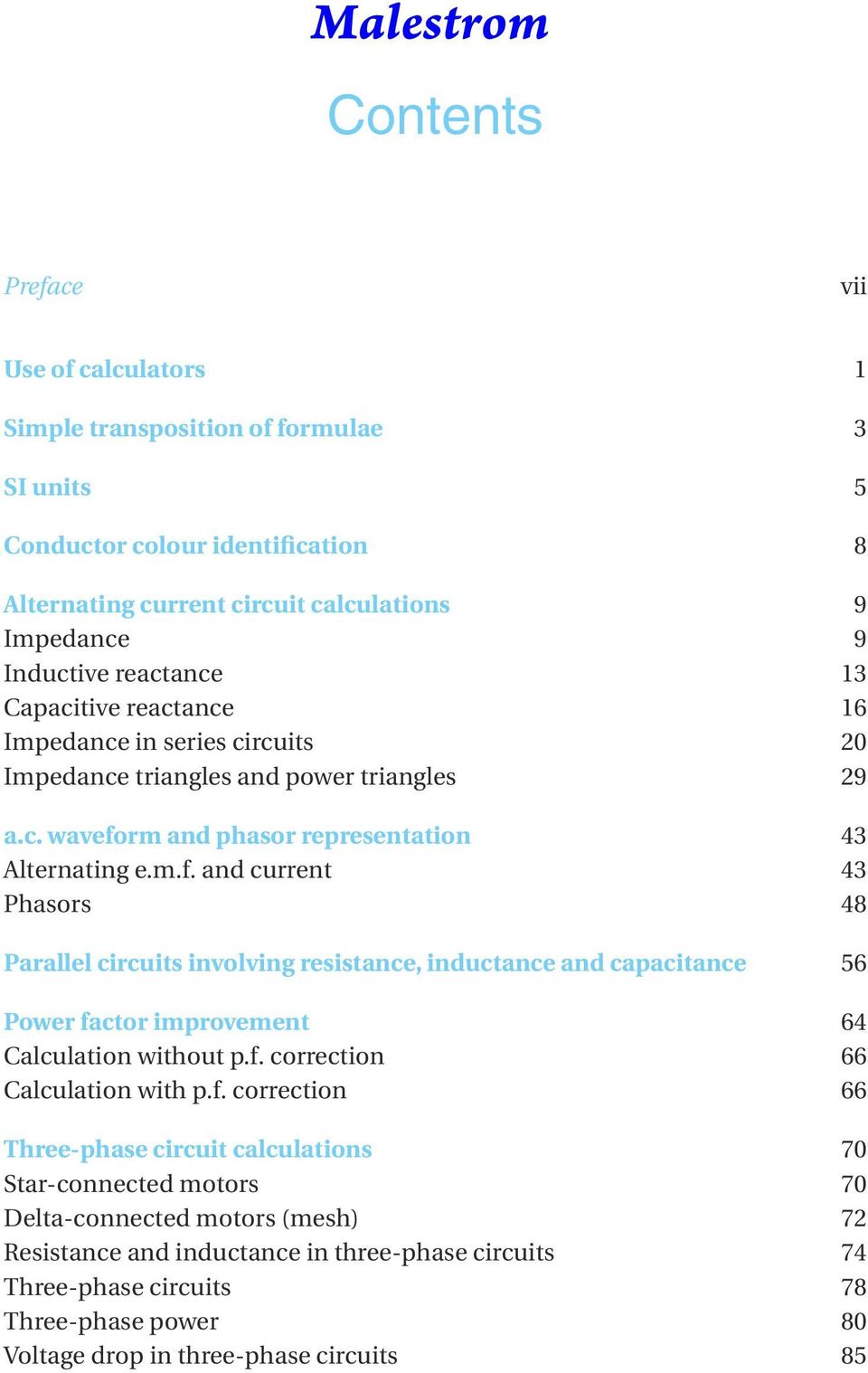
7 Contents Voltmeters and ammeters: changing the use and extending the range 103 Voltmeters 103 Ammeters 105 Alternating current motors 109 Application of diversity factors 116 Cable selection 122 Earthing conductor calculation 122 Voltage drop and cable selection calculations 126 Earth leakage protection calculations 140 Lighting calculations 147 Units and quantities 147 Inverse square law 147 Cosine law 149 Mechanics 154 Moment of force 154 Torque 154 Power 155 Surface speed, pulley diameter and speed ratios 157 Miscellaneous examples 162 d.c. generators 162 d.c. motors 163 Alternators and synchronous motors 164 Induction motors 165 Insulation resistance 166 Formulae 170 Glossary 176 Answers to exercises 180 General questions 192 Additional questions 200 vi

8 Preface Mathematics forms the essential foundation of electrical installation work. Without applying mathematical functions we would be unable to work out the size of a room which needs lighting or heating, the size and/or the number of the lights or heaters themselves, the number and/or the strength of the fixings required, or the size of the cables supplying them. We would be unable to accurately establish the rating of the fuse or circuit breaker needed to protect the circuits, or predict the necessary test results when testing the installation. Like it or not you will need to be able to carry out mathematics if you want to be an efficient and skilled electrician. This book will show you how to perform the maths you will need to be a proficient electrician. It concentrates on the electronic calculator methods you would use in class and in the workplace. The book does not require you to have a deep understanding of how the mathematical calculations are performed; you are taken through each topic step by step, then you are given the opportunity yourself to carry out exercises at the end of each chapter. Throughout the book useful references are made to the 17th edition BS 7671: 2008 Requirements for Electrical Regulations and the IEE On-Site Guide. Electrical Installation Calculations : Advanced originally written by A. J. Watkins and R. K. Parton has been the preferred book for many students looking to improve their mathematical understanding of the subject for many years. This edition has been newly updated to the 17th edition IEE Wiring Regulations, not only to include modern methods, but also to cover all aspects of the new City and Guilds 2330 Certificate in Electrotechnical Technology. This second volume includes advanced calculations, in particular those involving cable selection. It will be of considerable use to those already involved in electrical installation work, as well as being invaluable to students studying the City and Guilds , 202, 203, and 205 but in particular the 302, and 303. It will be particularly useful to those studying for the City and Guilds Inspection and test Design and verification, as well as the th edition wiring regulation exams. The book also contains a variety of questions and answers to help students with the City & Guilds 2330 GOLA exams. Chris Kitcher

9 Use of calculators Throughout the Basic and Advanced books, the use of a calculator is encouraged. Your calculator is a tool, and like any tool practice is required to perfect its use. A scientific calculator will be required, and although they differ in the way the functions are carried out, the end result is the same. The examples are given using a Casio fx-83ms. The figures printed on the button is the function performed when the button is pressed. To use the function in small letters above any button the shift button must be used. Practice is important Syntax error x 2 x 3 3 x 1 Appears when the figures are entered in the wrong order. Multiplies a number by itself, i.e. 6 6 = 36. On the calculator this would be 6x 2 = 36. When a number is multiplied by itself it is said to be squared. Multiplies a number by itself and then the total by itself again, i.e. when we enter 4 on calculator x 3 = 64. When a number is multiplied in this way it is said to be cubed. Gives the number which achieves the total by being multiplied by itself, i.e. 36 = 6. This is said to be the square root of a number and is the opposite of squared. Gives you the number which when multiplied by itself three times will be the total = 4 this is said to be the cube root. 1 Divides 1 by a number, i.e. 4 = This is the reciprocal button and is useful in this book for finding the resistance of resistors in parallel and capacitors in series. 1

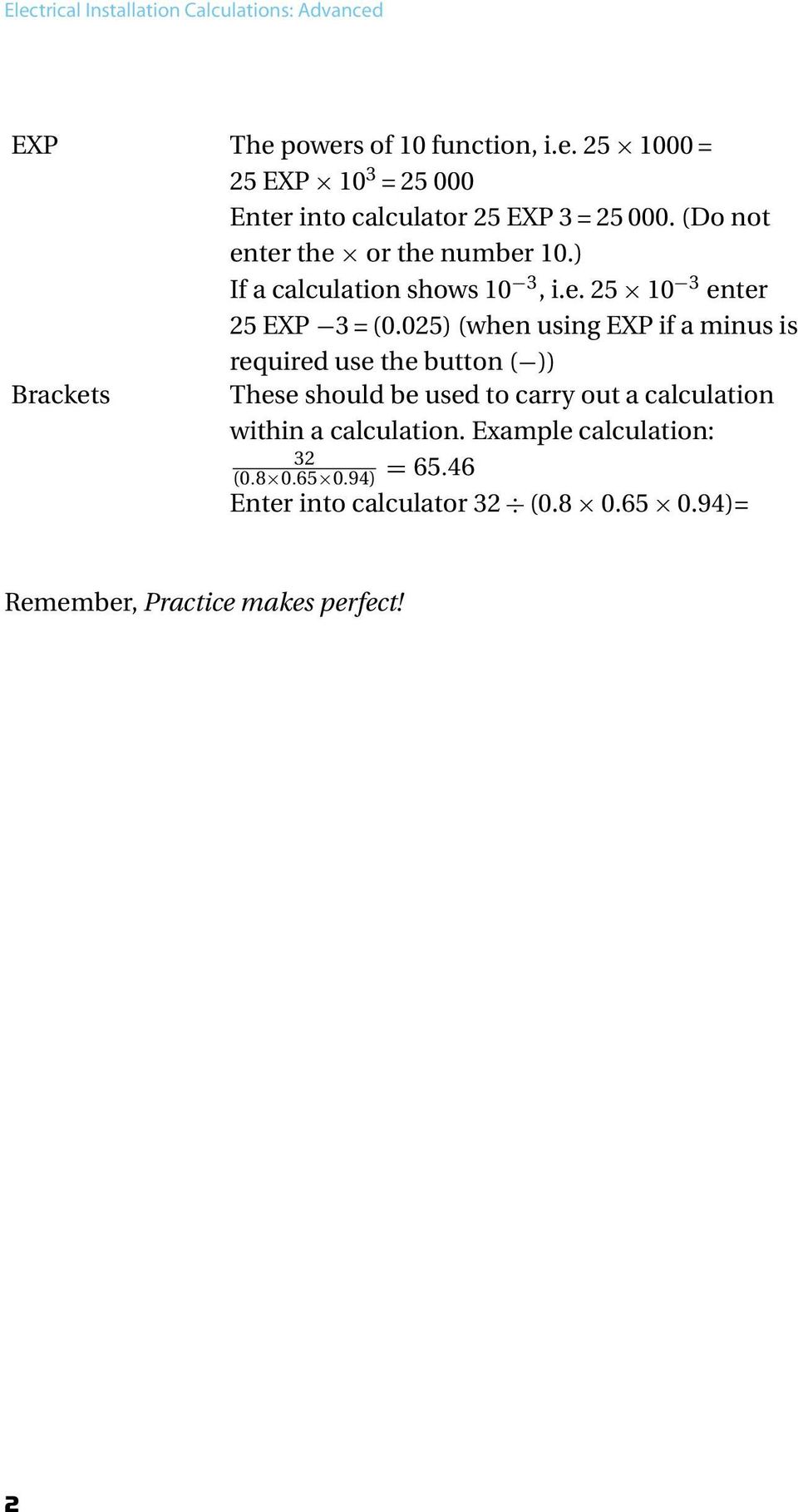
10 Electrical Installation Calculations: Advanced EXP The powers of 10 function, i.e = 25 EXP 10 3 = Enter into calculator 25 EXP 3 = (Do not enter the or the number 10.) If a calculation shows 10 3, i.e enter 25 EXP 3 = (0.025) (when using EXP if a minus is required use the button ( )) Brackets These should be used to carry out a calculation within a calculation. Example calculation: 32 ( ) = Enter into calculator 32 ( )= Remember, Practice makes perfect! 2
11 Simple transposition of formulae To find an unknown value: The subject must be on the top line and must be on its own. The answer will always be on the top line. To get the subject on its own, values must be moved. Any value that moves across the = sign must move from above the line to below line or from below the line to above the line. Example = = 2? Transpose to find? = 6 Example 2 2 6? = 4 Step = 4? Step =? 3

12 Electrical Installation Calculations: Advanced Answer = 3 Example = 3 20? Step 1: move 3 20 away from the unknown value, as the known values move across the = sign they must move to the bottom of the equation =? Step 2: Carry out the calculation Therefore or = = = = =

13 SI units In Europe and the UK, the units for measuring different properties are known as SI units. SI stands for Système Internationale. All units are derived from seven base units. Base quantity Base unit Symbol Time Second s Electrical current Ampere A Length Metre m Mass Kilogram kg Temperature Kelvin K Luminous intensity Candela cd Amount of substance Mole mol SI-derived units Derived quantity Name Symbol Frequency Hertz Hz Force Newton N Energy, work, quantity of heat Joule J Electric charge, quantity of Coulomb C electricity Power Watt W Potential difference, electromotive force Volt VorU 5

14 Electrical Installation Calculations: Advanced Capacitance Farad F Electrical resistance Ohm Magnetic flux Weber Wb Magnetic flux density Tesla T Inductance Henry H Luminous flux Lumen cd Area Square metre m 2 Volume Cubic metre m 3 Velocity, speed Metre per second m/s Mass density Kilogram per kg/m 3 cubic metre Luminance Candela per square metre cd/m 2 SI-Unit prefixes Name Multiplier Prefix Power of 10 Tera T Giga G Mega M Kilo 1000 k Unit 1 Milli m Micro Nano Pico Examples ma km v GW kw Milliamp = one thousandth of an ampere Kilometre = one thousand metres Microvolt = one millionth of a volt Gigawatt = one thousand million watts Kilowatt = one thousand watts 6

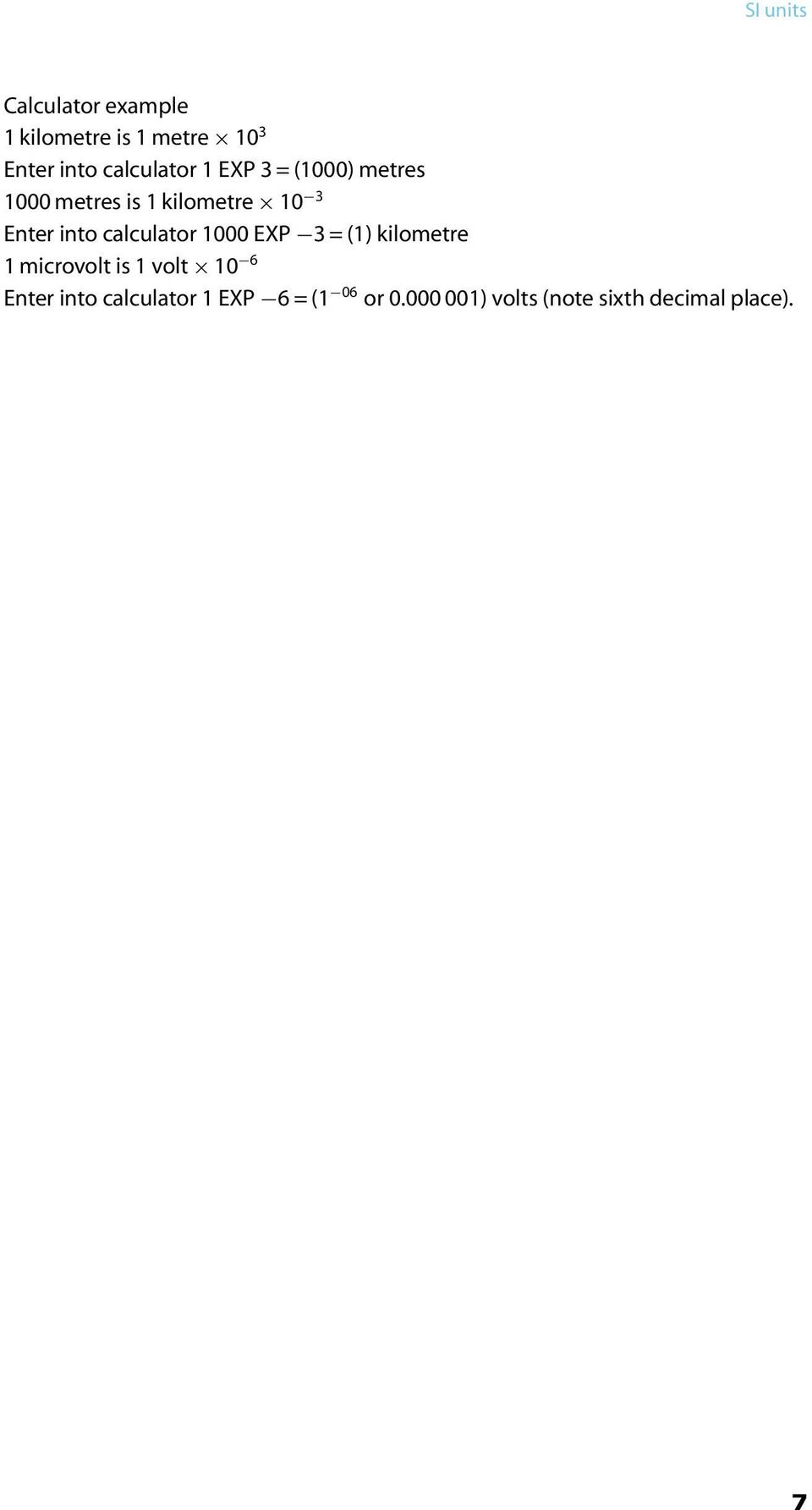
15 SI units Calculator example 1 kilometre is 1 metre 10 3 Enter into calculator 1 EXP 3 = (1000) metres 1000 metres is 1 kilometre 10 3 Enter into calculator 1000 EXP 3 = (1) kilometre 1 microvolt is 1 volt 10 6 Enter into calculator 1 EXP 6=(1 06 or ) volts (note sixth decimal place). 7
16 Conductor colour identification Old colour New colour Marking Phase 1 of a.c. Red Brown L1 Phase 2 of a.c. Yellow Black L2 Phase 3 of a.c. Blue Grey L3 Neutral of a.c. Black Blue N Note: great care must be taken when working on installations containing old and new colours. 8

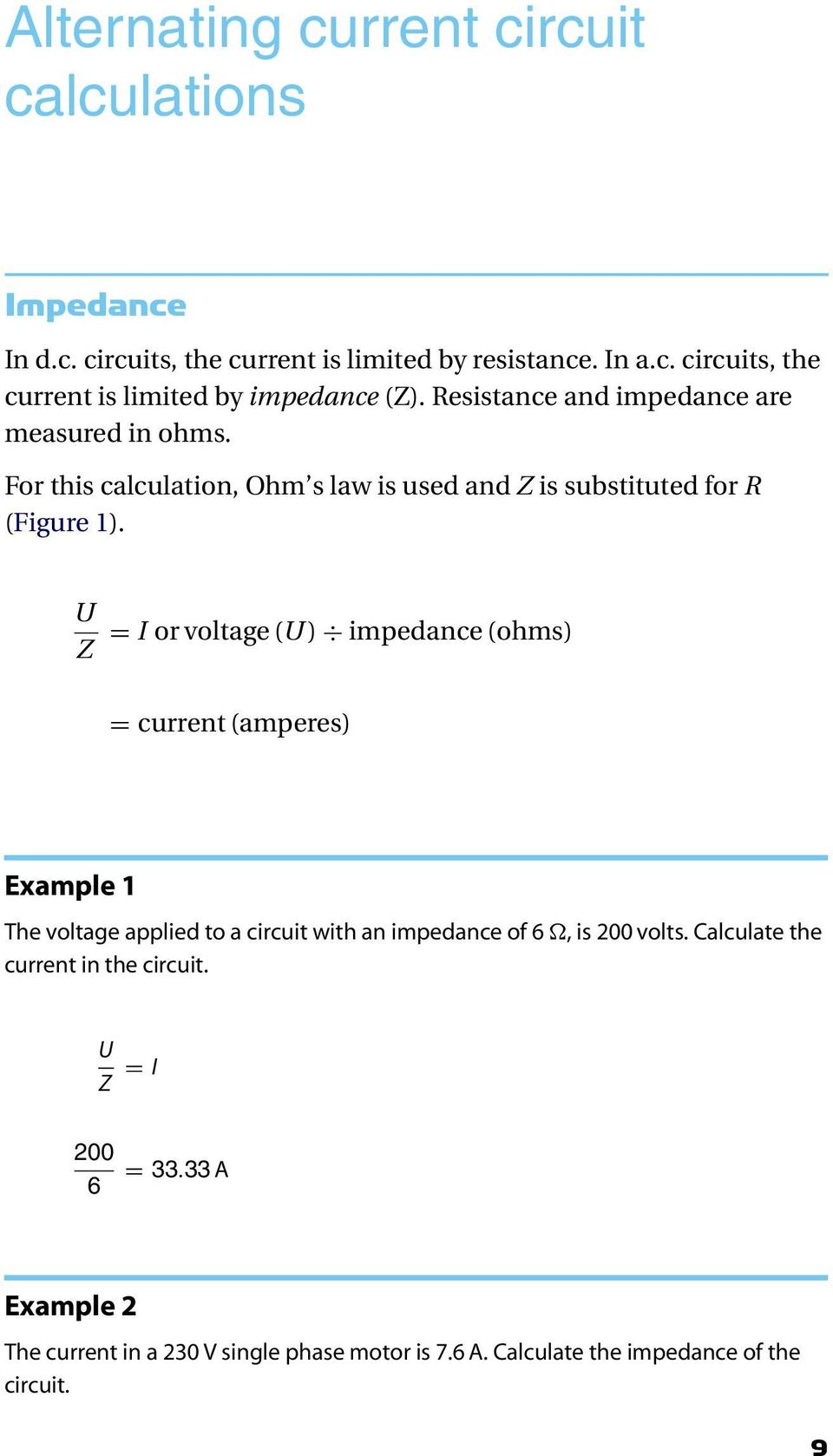
17 Alternating current circuit calculations Impedance In d.c. circuits, the current is limited by resistance. In a.c. circuits, the current is limited by impedance (Z). Resistance and impedance are measured in ohms. For this calculation, Ohm s law is used and Z is substituted for R (Figure 1). U Z = I or voltage (U) impedance (ohms) = current (amperes) Example 1 The voltage applied to a circuit with an impedance of 6, is 200 volts. Calculate the current in the circuit. U Z = I = A Example 2 The current in a 230 V single phase motor is 7.6 A. Calculate the impedance of the circuit. 9
18 Electrical Installation Calculations: Advanced V I Z Figure 1 Volt drop U I = Z = Example 3 A discharge lamp has an impedance of 265 and the current drawn by the lamp is 0.4 A. Calculate the voltage. Z I = = U 106 volts Example 4 The current through an impedance of 32 is 8 A. Calculate the voltage drop across the impedance. U = I Z = 8 32 = 256 V 10
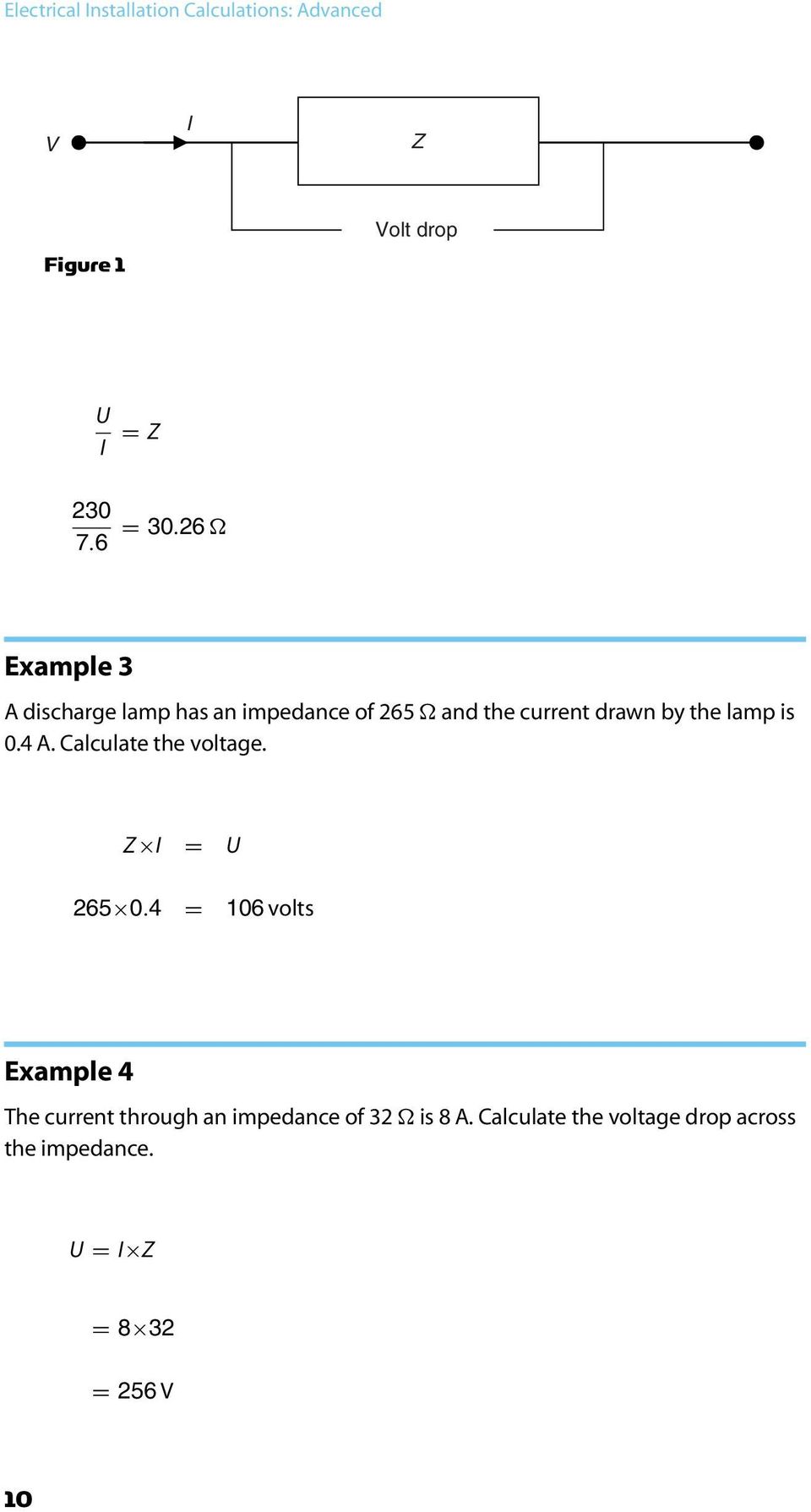
19 Alternating current circuit calculations Example 5 The current through an electric motor is 6.8 A at 230 V. Calculate the impedance of the motor. U = I Z (Transpose for Z) Z = U I = = Example 6 An a.c. coil has an impedance of 430. Calculate the voltage if the coil draws a current of 0.93 A. U U = = = = I Z I Z V Exercise 1 1. Complete the following table: Volts (a.c.) Current (A) Impedance () Complete the following table: Current (A) Volts (a.c.) Impedance ()
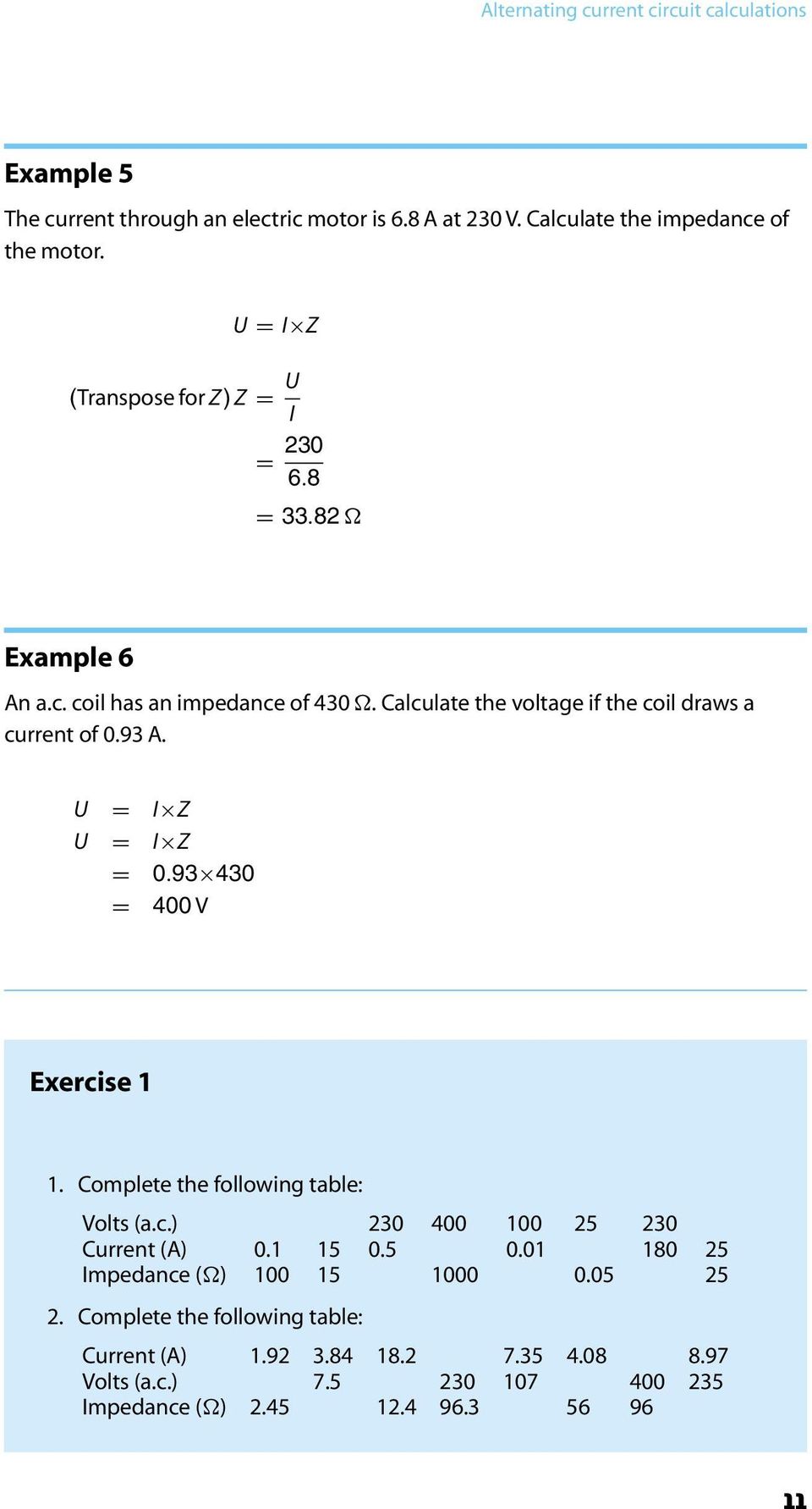
20 Electrical Installation Calculations: Advanced 3. Complete the following table: Impedance () Volts (a.c.) Current (A) A mercury vapour lamp takes 2.34 A when the mains voltage is 237 V Calculate the impedance of the lamp circuit. 5. An inductor has an impedance of 365. How much current will flow when it is connected to a 400 V a.c. supply? 6. A coil of wire passes a current of 55 A when connected to a 120 V d.c. supply but only 24.5 A when connected to a 110 V a.c. supply. Calculate (a) the resistance of the coil, (b) its impedance. 7. Tests to measure the impedance of an earth fault loop were made in accordance with BS 7671 and the results for five different installations are given below. For each case, calculate the value of the loop impedance. Test voltage, a.c. (V) Current (A) (a) (b) (c) (d) (e) The choke in a certain fluorescent-luminaire fitting causes a voltage drop of 150 V when the current through it is 1.78 A. Calculate the impedance of the choke. 9. Complete the following table: Volts (a.c.) Current (A) Impedance () Plot a graph showing the relationship between current and voltage. From the graph, state the value of the current when the voltage is 240 V. 10. The alternating voltage applied to a circuit is 230 V and the current flowing is A. The impedance of the circuit is (a) 5.4 (b) 1840 (c) 3.5 (d) An alternating current of 2.4 A flowing in a circuit of impedance 0.18 produces a voltage drop of (a) V (b) 13.3 V (c) V (d) 4.32 V 12

21 Alternating current circuit calculations 12. When an alternating e.m.f. of 150 V is applied to a circuit of impedance 265, the current is (a) A (b) 1.77 A (c) 5.66 A (d) A Inductive reactance When an a.c. current is passed through a conductor, a magnetic field is created around the conductor. If the conductor is wound into a coil the magnetic field is increased. Where there are significant magnetic fields in a circuit there is opposition to the flow of current, this opposition is called inductive reactance. The opposition caused by inductive reactance is in addition to the opposition caused by the resistance caused by the wires. In this section, we will assume that the resistance of the circuits is so low that it may be ignored and that the only opposition to the flow of current is that caused by the inductive reactance. The formula for inductive reactance is X L = 2fL (answer in ohms). Where L is the inductance of the circuit or coil of wire and is stated in henrys (H), f is the frequency of the supply in hertz (Hz) (Figure 2). H I Figure 2 13
22 Electrical Installation Calculations: Advanced Example 1 Calculate the inductive reactance of a coil which has an inductance of 0.03 henrys when connected to a 50 Hz supply. X L = 2fL = = 9.42 Example 2 Calculate the inductive reactance of the coil in Example 1 when connected to a 60 Hz supply. X L = 2fL = = It can be seen from this calculation that if the frequency increases the inductive reactance will also increase. Example 3 An inductor is required to cause a voltage drop of 180 volts when a current of 1.5 A is passed through it at a frequency of 50 Hz. Calculate the value of the inductor: U L = I X L (this is Ohm s law with inductive reactance instead of resistance) 14
23 Alternating current circuit calculations Transposed U I = X L Transpose = 120 X L = 2fL 120 = L 120 ( ) = H On calculator enter 120 (2 50) = (answer H) Exercise 2 1. Calculate the inductive reactance of a coil having an inductance of H when a 50 Hz current flows in it. 2. A coil is required to have an inductive reactance of 150 ona50hz supply. Determine its inductance. 3. Complete the following table: Inductance (H) Frequency (Hz) Reactance () A coil of negligible resistance causes a voltage drop of 98 V when the current through it is 2.4 A at 50 Hz. Calculate (a) the reactance of the coil, (b) its inductance. 5. A reactor allows a current of 15 A to flow from a 230 V 50 Hz supply. Determine the current which will flow at the same voltage if the frequency changes to (a) 45 Hz, (b) 55 Hz. Ignore the resistance. 15
24 Electrical Installation Calculations: Advanced 6. Calculate the inductive reactance of coils having the following values of inductance when the supply frequency is 50 Hz. (a) H (b) H (c) 0.45 mh (d) 350 H (e) H 7. Determine the inductances of the coils which will have the following reactance to a 50 Hz supply: (a) 300 (b) 25 (c) 14.5 (d) 125 (e) 5 8. The inductance of a coil can be varied from 0.15 H to 0.06 H. Plot a graph to show how the inductive reactance varies with changes in inductance. Assume a constant frequency of 50 Hz. 9. A reactor has a constant inductance of 0.5 H and it is connected to a supply of constant voltage 100 V but whose frequency varies from 25 to 50 Hz. Plot a graph to show how the current through the coil changes according to the frequency. Ignore the resistance of the coil. 10. Calculate the voltage drop across a 0.24 H inductor of negligible resistance when it carries 5.5 A at 48 Hz. 11. An inductor of H is connected to an a.c. supply at 50 Hz. Its inductive reactance is (a) 39.3 (b) 0.79 (c) (d) The value in henrys of an inductor which has an inductive reactance of 500 when connected in an a.c. circuit at frequency 450 Hz is (a) 1.77 H (c) H (b) H (d) H Capacitive reactance When a capacitor is connected to an a.c. supply, the current flow is limited by the reactance of the capacitor (X C ). Formula for capacitive reactance X C = 106 2fC where C is the capacitance of the capacitor measured in microfarads (F) and f is the frequency of the supply in hertz (Hz). (It should be 16
25 Alternating current circuit calculations C I Hz Figure 3 noted that d.c. current will not flow with a capacitor in the circuit it will simply charge and then stop.) (Figure 3) Example 1 Calculate the reactance of a 70 F capacitor to a 50 Hz supply: X C = 106 2fC = Enter on calculator EXP 6 ( ) = (answer 45.47). Example 2 A power factor improvement capacitor is required to take a current of 7.5 A from a 230 volt 50 Hz supply. Determine the value of the capacitor. For this calculation, Ohm s law is used and R is substituted by X C. Step 1 U C = I X C 230 = 7.5 X C 17
26 Electrical Installation Calculations: Advanced Transpose for X C = X C = 30.6 Step2tofindC X C = 106 2fC Transpose C = f X C C = 10 6 ( ) = 104 answer in microfarads (F) (Note simply change places of X C and C) Enter on calculator EXP 6 ( ) or EXP 6 ( ) Exercise 3 1. Determine the reactance of each of the following capacitors to a 50 Hz supply. (Values are all in microfarads.) (a) 60 (d) 150 (g) 250 (j) 75 (b) 25 (e) 8 (h) 95 (c) 40 (f) 12 (i) Calculate the value of capacitors which have the following reactances at 50 Hz. (Values are all in ohms). (a) 240 (d) 4.5 (g) 45 (j) 72 (b) 75 (e) 36 (h) 400 (c) 12 (f) 16 (i) 30 18
27 Alternating current circuit calculations 3. Calculate the value of a capacitor which will take a current of 25 A from a 230 V 50 Hz supply. 4. A capacitor in a certain circuit is passing a current of 0.2 A and the voltage drop across it is 100 V. Determine its value in microfarads. The frequency is 50 Hz. 5. A 20 F capacitor is connected to an alternator whose output voltage remains constant at 150 V but whose frequency can be varied from 25 to 60 Hz. Draw a graph to show the variation in current through the capacitor as the frequency changes over this range. 6. Calculate the voltage drop across a 5 F capacitor when a current of 0.25 A at 50 Hz flows through it. 7. In order to improve the power factor of a certain installation, a capacitor which will take 15 A from the 230 V supply is required. The frequency is 50 Hz. Calculate the value of the capacitor. 8. In one type of twin-tube fluorescent fitting, a capacitor is connected in serieswithoneofthetubes.ifthevalueofthecapacitoris7f, the current through it is 0.8 A, and the supply is at 50 Hz, determine the voltage across the capacitor. 9. A machine designed to work on a frequency of 60 Hz has a power-factor-improvement capacitor which takes 12 A from a 110 V supply. Calculate the current the capacitor will take from the 110 V 50 Hz supply. 10. A capacitor takes a current of 16 A from a 400 V supply at 50 Hz. What current will it take if the voltage falls to 380 V at the same frequency? 11. A 22 F capacitor is connected in an a.c. circuit at 50 Hz. Its reactance is (a) (c) (b) 6912 (d) The value in microfarads of a capacitor which has a capacitive reactance of 100 when connected to a circuit at 50 Hz is (a) 31.8 F (c) F (b) 318 F (d) F 19
28 Electrical Installation Calculations: Advanced H R I Hz Figure 4 Impedance in series circuits When resistance (R) is in a circuit with reactance (X L or X C ), the combined effect is called Impedance (Z), this is measured in ohms. For series circuits, the calculation for impedance (Z) is Z 2 = R 2 + X 2 or Z = R 2 + X 2 In this calculation X is for X C or X L. Where the circuit contains inductive reactance (X C ) and capacitive reactance (X L ). X = X C X L or X L X C X will be the largest reactance minus the smallest reactance. An inductor coil will always possess both inductance (the magnetic part of the circuit) and resistance (the resistance of the wire), together they produce impedance. Although inductance and impedance cannot be physically separated, it is convenient for the purpose of calculation to show them separately in a circuit diagram (Figure 4). Example 1 A coil has a resistance of 6 and an inductance of 0.09 H. Calculate its impedance to a 50 Hz supply. Step 1 Inductive reactance X L =2fL 20
29 Alternating current circuit calculations 2 f = (Note: a common error is to add the resistance and inductance treating it as a d.c. circuit.) Step 2 Z 2 = R 2 + X 2 L or Z = Z = R 2 + X = Enter into calculator 6X X 2 = = (answer 28.9 ). Example 2 A coil passes a current of 23 A when connected to a 230 V d.c. supply, but only 8 A when connected to a 230 V a.c. supply. When connected to a d.c. circuit the coil s resistance is only that of the wire in the coil, this can be calculated using Ohm s law. On d.c. U = I R U I = R = 10 (resistance) On an a.c. circuit, reactance will be produced, as this is an inductive circuit it will be inductive reactance (X L ). The combined effect of the resistance and reactance of the coil is the impedance (Z). Step 1 On a.c.u = I Z 230 = 8 Z 21
30 Electrical Installation Calculations: Advanced Transpose = impedance (Z). Step 2 To find the inductance of the coil. Z 2 = R 2 + X 2 L X 2 L = Z2 R 2 X L = X L = Enter on calculator 28.7X = = (answer ) Step 3 X L = 2fL = L Transpose ( ) = L = H Enter on calculator ( ) = (answer) Example 3 A70 resistor is wired in series with a capacitor of an unknown value to a 230 volt 50 Hz supply. Calculate the value of the capacitor in microfarads if a current of 1.3 A flows. First find impedance of circuit (Z) 22
31 Alternating current circuit calculations C μf? 70 Ω 1.3 A 230 V 50 Hz Figure 5 Step 1(Figure 5) U = I Z 230 = 1.3 Z Z = Z = Step 2 Next find capacitive reactance X C Z = = R 2 + X 2 C XC 2 Transpose for X C X C = X C = Now find capacitance Step 3 X C = 106 2fC 23
32 Electrical Installation Calculations: Advanced 0.09H 70 μf 18Ω 230 V 50 Hz Figure 6 Transpose for C C = 106 2f X L C = F is the capacitor value On calculator enter EXP 6 ( ) = (answer) Example 4 A coil of inductance of 0.09 H and a resistance of 18 is wired in series with a 70 F capacitor to a 230 volt 50 Hz supply. Calculate the current which flows and the voltage drop across the capacitor (Figure 6). Step 1 Calculate inductive and capacitive reactance. Inductive reactance 24 X L = 2fL = = 28.27
33 Alternating current circuit calculations Capacitive reactance X C = 106 2fC = = Enter on calculator EXP 6 ( ) = (answer) Step 2 Find the actual reactance for circuit which is the largest reactance minus the smallest reactance For this circuit X = X C X L = = (this is X C as the capacitive reactance is larger than the inductive reactance) Step 3 Calculate the impedance for the circuit (Z) Impedance Z is found Z 2 = R 2 + X 2 Z 2 = Z = Enter on calculator 18X X 2 = = (answer) Z = Step 4 Calculate current (I) U = I Z 230 = I
34 Electrical Installation Calculations: Advanced V r V c Figure 7 V s 230 Transpose for I = 9.24 A As this current is common to the whole circuit, the voltage across the capacitor and the inductor can be calculated. If a phasor is required the current is the reference conductor (Figure 7). Voltage across capacitor U C = I X C = = 420 volts Voltage across inductor U I = I X L = = volts (Note both voltages are higher than the 230 V supply. This often happens in a.c. circuits. The voltages do not add up as in d.c. circuits.) 26
35 Alternating current circuit calculations Exercise 4 1. Complete the following table: R R Complete the following table: X X A coil of wire has resistance of 8 and inductance of 0.04 H. It is connected to a supply of 100 V at 50 Hz. Calculate the current which flows. 4. An inductor of inductance H and resistance 12 is connected to a 230 V supply at 50 Hz. Calculate the current which flows. 5. Complete the following table: R () X () Z () A capacitor of 16 F and a resistor of 120 are connected in series. Calculate the impedance of the circuit. 7. A resistor of 200 and a capacitor of unknown value are connected to a 230 V supply at 50 Hz and a current of 0.85 A flows. Calculate the value of the capacitor in microfarads. 8. When a certain coil is connected to a 110 V d.c. supply, a current of 6.5 A flows. When the coil is connected to a 110 V 50 Hz a.c. supply, only 1.5 A flows. Calculate (a) the resistance of the coil, (b) its impedance, and (c) its reactance. 9. The inductor connected in series with a mercury vapour lamp has resistance of 2.4 and impedance of 41. Calculate the inductance of the inductor and the voltage drop across it when the total current in the circuit is 2.8 A. (Assume the supply frequency is 50 Hz.) 10. An inductor takes 8 A when connected to a d.c. supply at 230 V. If the inductor is connected to an a.c. supply at 230 V 50 Hz, the current is 4.8 A. Calculate (a) the resistance, (b) the inductance, and (c) the impedance of the inductor. 11. What is the function of an inductor in an alternating-current circuit? When a d.c. supply at 230 V is applied to the ends of a certain inductor coil, the current in the coil is 20 A. If an a.c. supply at 230 V 50 Hz is applied to the coil, the current in the coil is A. 27
36 Electrical Installation Calculations: Advanced Calculate the impedance, reactance, inductance, and resistance of the coil. What would be the general effect on the current if the frequency of the a.c. supply were increased? 12. A coil having constant inductance of 0.12 H and resistance of 18 is connected to an alternator which delivers 100 V a.c. at frequencies ranging from 28 to 55 Hz. Calculate the impedance of the coil when the frequency is 30, 35, 40, 45 and 50 Hz and plot a graph showing how the current through the coil varies according to the frequency. 13. The inductor in a discharge lighting circuit causes a voltage drop of 120 V when the current through it is 2.6 A. Determine the size in microfarads of a capacitor which will produce the same voltage drop at the same current value. (Neglect the resistance of the inductor. Assume the supply frequency is 50 Hz.) 14. A circuit is made up of an inductor, a resistor and a capacitor all wired in series. When the circuit is connected to a 50 Hz a.c. supply, a current of 2.2 A flows. A voltmeter connected to each of the components in turn indicates 220 V across the inductor, 200 V across the resistor, and 180 V across the capacitor. Calculate the inductance of the inductor and the capacitance of the capacitor. At what frequency would these two components have the same reactance value? (Neglect the resistance of the inductor.) 15. What are meant by the following terms used in connection with alternating current: resistance, impedance and reactance? A voltage of 230 V, at a frequency of 50 Hz, is applied to the ends of a circuit containing a resistor of 5, an inductor of 0.02 H, and a capacitor of 150 F, all in series. Calculate the current in the circuit. 16. A coil of resistance 20 and inductance 0.08 H is connected to a supply at 240 V 50 Hz. Calculate (a) the current in the circuit, (b) the value of a capacitor to be put in series with the coil so that the current shall be 12 A (CGLI) (Figure 8) X L = 24Ω X C = 20Ω 2 A Figure 8 R = 3Ω U ~ 17. For the circuit shown in Figure 8, the voltage V is (a) 94 V (b) 14 V (c) 10 V (d) V 28
37 Alternating current circuit calculations 18. An inductor has inductance 0.12 H and resistance 100. When it is connected to a 100 V supply at 150 Hz, the current through it is (a) 1.51 A (b) 0.47 A (c) 0.66 A (d) A Impedance triangles and power triangles For a right-angled triangle (Figure 9), the theorem of Pythagoras states that a 2 = b 2 + c 2 As the relationship between impedance, resistance and reactance in a series circuit is given by an equation of a similar form, Z 2 = R 2 + X 2, conditions in such circuits can conveniently be represented by right-angled triangles. In Figure 10, Z 2 = R 2 + X 2 where X = X L (Figure 10(a)) or X C (Figure 10(b)) and = the phase angle of the circuit sin = X Z cos = R Z and tan = X R cos is the power factor of the circuit (Figure 10). A right-angled triangle is also used to represent the apparent power in a circuit and its active and reactive components (Figure 11). AB is the product of voltage and current in the circuit (VA). AC is the true power the working component (W). BC is the reactive or wattless component (VAr). a b c Figure 9 29
38 Electrical Installation Calculations: Advanced Impedance Inductive Z reactance X L f Resistance R (a) Inductive reactance Figure 10 Resistance R f Capacitive reactance Impedance X C Z (b) Capacitive reactance A f Figure 11 VA W B A VAr (leading) C f W VA C VAr (lagging) B VAr VA = sin VAr = VA sin W VA W = cos = VA cos and cos ϕ is the power factor (p.f.). In power circuits, the following multiples of units are used: kva kw and kvar. Example 1 Find Z in Figure
39 Alternating current circuit calculations Z X L = 78 Ω R = 56 Ω Figure 12 Z 2 = R 2 + X 2 L = = = 9220 Z = 9220 = = 96 (correct to three significant figures) Example 2 Find X C in Figure 13. R = 67.6 Ω Z = 125 Ω X C Figure 13 31
40 Electrical Installation Calculations: Advanced Z 2 = R 2 + X 2 C = X 2 C X 2 C = = = X C = = 105 Alternatively, Z 2 = R 2 + X 2 C = X 2 C X 2 C = = ( )( ) = = X C = = 105 Example 3 Find in Figure 14. Z X L = 15 Ω f Figure 14 R = 20 Ω 32
41 Alternating current circuit calculations tan = X L R = = 0.75 = Example 4 Find X C in Figure 15. X C/Z = sin X C 90 = sin 48 = X C = = 66.9(to three significant figures) Example 5 Find the kva and kvar in Figure 16. R f = 48 Z = 90 Ω X C Figure 15 33
42 Electrical Installation Calculations: Advanced kva f = kw Figure 16 kvar kw kva = cos 15 kva = cos 42 = KVA 15 = kva = = 20.2 kvar kw = tan kvar 15 = tan 42 = kvar = = 13.5 Example 6 A coil of 0.2 H inductance and negligible resistance is connected in series with a 50 resistor to the 230 V 50 Hz mains (Figure 17). Calculate (a) the current which L 0.2 H R 50 Ω U 230V 50Hz Figure 17 34
43 Alternating current circuit calculations Z X L f R Impedance triangle Figure 18 flows, (b) the power factor, (c) the phase angle between the current and the applied voltage. Coil reactance X L = 2fL = = = 62.8 To find the impedance (Figure 18) Z 2 = R 2 + X 2 L = = = 6444 Z = 6444 = (a) To find the current, U = I Z 230 = I I = = 2.86 A 35
44 Electrical Installation Calculations: Advanced (b) Power factor = cos = R Z = = lag (c) The phase angle is the angle whose cosine is 0.623, = Exercise 5 1. Find Z in Figure 19 Z X L = 40 Ω R = 30 Ω Figure Find Z in Figure 20 R = 25 Ω Z X C = 31.4 Ω Figure
45 Alternating current circuit calculations 3. Find R in Figure 21 Z = 130 Ω X L = 120 Ω R Figure Find X C in Figure 22 R = 135 Ω Z = 240 Ω X C Figure Find R in Figure 23 Z = 60.5 Ω X L = 39 Ω R Figure Find Z in Figure 24 R = 175 Ω Z X C = 150 Ω Figure Find R in Figure 25 Z = 31.3 Ω X L = Ω R Figure
46 Electrical Installation Calculations: Advanced 8. Find X L in Figure 26 Z = Ω X L R = Ω Figure Find Z in Figure 27 Z X C = 354 Ω Figure Find X L in Figure 28 Z = 753 Ω X L R = 50 Ω Figure Find R in Figure 29 R Z = 2620 Ω X C = 2600 Ω Figure Consider the answers to questions 9 to 11 and then write down the approximate impedance of a coil which has resistance 32 and reactance
47 Alternating current circuit calculations 13. Complete the following table: Angle sin cos tan 14. Complete the following table: Angle sin cos tan 15. Complete the following table: Angle sin cos tan Complete the following table: Angle sin cos tan Find R and X L in Figure 30 Z = 29.2 Ω X L f = R Figure Find R and X C in Figure 31 R f = Z = 7.29 Ω X C Figure
48 Electrical Installation Calculations: Advanced 19. Find in Figure 32 X L = 18.4 Ω f R = 29.7 Ω Figure Calculate Z and X L in Figure 33 Z X L f = 59 6 R = 46.7 Ω Figure Find W and VAr in Figure 34 W f = VA = 250 VAr Figure Find and X L in Figure 35 Z = 238 Ω X L f R = 200 Ω Figure Find in Figure 36 kw = 4.9 f kvar kva = 5.6 Figure
49 Alternating current circuit calculations 24. Calculate R in Figure 37 R f = 78 5 X C = 314 Ω Figure Find OX in Figure 38 O X OY = 74.6 Y Figure Find OX in Figure 39 O OY = 50 X Y Figure Complete the following table then plot a graph of power factor (cos )toa base of phase angle (): Phase angle Power factor cos A coil has inductance 0.18 H and resistance 35. It is connected to a 100 V 50 Hz supply. Calculate (a) the impedance of the coil, (b) the current which flows, (c) the power factor, (d) the power absorbed by the coil. 41
50 Electrical Installation Calculations: Advanced 29. Define the term power factor and state how it affects cable size. An inductor of resistance 8 and of inductance H is connected to an alternating-current supply at 230 V, single-phase, 50 Hz. Calculate (a) the current from the supply, (b) the power in the circuit, (c) the power factor. 30. A single-phase alternating-current supply at 230 V 50 Hz is applied to a series circuit consisting of an inductive coil of negligible resistance and a non-inductive resistance coil of 15. When a voltmeter is applied to the ends of each coil in turn, the potential differences are found to be V across the inductive coil, 203 V across the resistance. Calculate (a) the impedance of the circuit, (b) the inductance of the coil, (c) the current in the circuit, and (d) the power factor. (CGLI) 31. On what factors do the resistance, reactance and impedance of an alternating-current circuit depend, and how are these quantities related? The current in a single-phase circuit lags behind the voltage by 60.The power in the circuit is 3600 W and the voltage is 240 V. Calculate the value in ohms of the resistance, the reactance and the impedance. (CGLI) 42
51 a.c. waveform and phasor representation Alternating E.M.F. and current The value and direction of the e.m.f. induced in a conductor rotating at constant speed in a uniform magnetic field, Figure 40(a) vary according to the position of the conductor. The e.m.f. can be represented by the displacement QP of the point P above the axis XOX, Figure 40(b). OP is a line which is rotating about the point O at the same speed as the conductor is rotating in the magnetic field. The length of OP represents the maximum value of the induced voltage. OP is called a phasor. A graph, Figure 40(c), of the displacement of the point P plotted against the angle (the angle through which the conductor has moved from the position of zero induced e.m.f.) is called a sine wave, since the PQ is proportional to the sine angle. One complete revolution of OP is called a cycle. Example 1 An alternating voltage has a maximum value of 200 V. Assuming that it is sinusoidal in nature (i.e. it varies according to a sine wave), plot a graph to show the variations in this voltage over a complete cycle. Method (Figure 41) Choose a reasonable scale for OP; for instance, 10mm=100V. Draw a circle of radius 20 mm at the left-hand side of a piece of graph paper to represent the rotation of OP. One complete revolution of OP sweeps out 360. Divide the circle into any number of equal portions, say 12. Each portion will then cover 30. Construct the axes of the graph, drawing the horizontal axis OX (the x-axis) on a line through the centre of the circle. This x-axis should now be marked off in steps of 30 up to 360. If desired, perpendicular lines can be drawn through these points. Such lines are called ordinates. 43
52 Electrical Installation Calculations: Advanced N 1 cycle P + q X O q Q X e.m.f. S q (degrees) (a) (b) (c) Figure 40 Figure 41 The points on the graph are obtained by projecting from the various positions of P to the coordinate corresponding to the angle at that position. Remember that when =0 and 180 the generated e.m.f. is zero, and when =90 and 270 the generated e.m.f. has its maximum value. Example 2 Two alternating voltages act in a circuit. One (A) has an r.m.s. value of 90 V and the other (B) has an r.m.s. value of 40 V, and A leads B by 80. Assuming that both voltages are sinusoidal, plot graphs to show their variations over a complete cycle. By adding their instantaneous values together, derive a graph of the resultant voltage. Give the r.m.s. value of this resultant. First find the maximum values of the voltages given: 44 U r.m.s = U max 90 = U max U max = = 127 V
53 a.c. waveform and phasor representation Y + Resultant A B O A O Figure 42 Y Similarly, if U r.m.s. = 40 U max = = 56.6 V Choose a suitable scale, say 20 mm = 100 V. Draw two circles with the same centre, one having a radius of 25.4 mm (127 V), the other a radius of mm (56.6 V). Draw phasors to represent the voltages: OA horizontal and OB, which represents the lower voltage, lagging 80 behind OA (anticlockwise rotation is always used) see Figure 42. Mark off the circumference of the larger circle in steps of 30, using OA as the reference line. Mark off the smaller circle in steps of 30, using OB as the reference line. Set off the axes of the graph alongside as in the previous example. Plot the sine wave of voltage A as before. Plot the sine wave of voltage B in exactly the same way, projecting the first point from B to the y-axis YOY and from each succeeding 30 point to the appropriate 30 point on the horizontal axis of the graph. Points on the resultant graph are plotted by combining the ordinates of A and B at each 30 point. If the graphs lie on the same side of the x-axis, the ordinates are added. If the graphs lie on opposite sides of the axis, the smaller is subtracted from the larger (measurements upwards from the x-axis are positive, measurements downwards are negative). 45
54 Electrical Installation Calculations: Advanced The resultant curve is shown by the dotted line in Figure 42 and its maximum value is approximately 150 V. Its r.m.s. value is = 106 V Example 3 A current of 15 A flows from the 230 V mains at a power factor of 0.76 lagging. Assuming that both current and voltage are sinusoidal, plot graphs to represent them over one cycle. Plot also on the same axes a graph showing the variation in power supplied over one cycle. The procedure for plotting the current and voltage sine waves is the same as that adopted in the previous example. The phase angle between current and voltage is found from the power factor as follows: power factor = cos where is the angle of phase difference cos = 0.76 = U max = = V I max = = A Scales of 20 mm = 200 V and 20 mm = 20 A will be suitable. To obtain the graph of the power supplied, the ordinates of current and voltage are multiplied together (Figure 43). It is convenient to do this every 30 as before. Remember the rules for multiplying positive and negative numbers. Where the resulting graph is negative, additional points are helpful in obtaining a smooth curve. That portion of the power curve lying above the x-axis represents the power supplied to the circuit. That portion lying below the x-axis represents the power returned to the mains from the circuit. 46
55 a.c. waveform and phasor representation + V P = U I U O f = I I Figure 43 Exercise 6 1. Plot a sine wave, over one complete cycle, of an alternating voltage having a maximum value of 325 V. Determine the r.m.s. value of this voltage. 2. An alternating current has the following value taken at intervals of 30 over one half cycle: Angle Current (A) Determine the average and r.m.s. values of this current. 3. Plot a graph over one complete cycle of a sinusoidal alternating voltage having an r.m.s. value of 200 V. 4. Two sinusoidal voltages act in a circuit. Their r.m.s. values are 110 V and 80 V and they are out of phase by 75, the lower voltage lagging. Plot sine waves on the same axes to represent these voltages. Plot a graph of the resultant voltage by adding together the ordinates of the two waves. Give the r.m.s. value of the resultant voltage and state approximately the phase angle between this resultant and the lower voltage. 5. Two alternating currents are led into the same conductor. They are sinusoidal and have r.m.s. values of 4 A and 1 A. The smaller current leads by 120. Plot out the sine waves of these two currents and add the ordinates to obtain the sine wave of the resultant current. Calculate the r.m.s. value of the resultant. 6. The current taken by an immersion heater from the 250 V a.c. mains is 12.5 A. Current and voltage are in phase and are sinusoidal. Plot graphs on the same axes to show the variations in current and voltage over one complete cycle. 47
56 Electrical Installation Calculations: Advanced 7. A 10 F capacitor is connected to a 240 V supply at 50 Hz. The current leads the voltage by 90, and both may be assumed to be sinusoidal. Plot the sine waves of the current and voltage over one complete cycle. 8. A fluorescent lamp takes a current of 1.2 A from a 230 V supply at a power factor of Assuming that both current and voltage are sinusoidal, plot graphs to show how they vary over a complete cycle. 9. The current in a circuit is 25 A and the supply voltage is 220 V. The power factor is 0.6 lagging. Plot sine waves to represent current and voltage over one cycle. Multiply the instantaneous values of current and voltage together to obtain a graph representing the power in the circuit. 10. An inductor of 0.1 H is connected to a 100 V supply at 50 Hz. Neglecting the resistance of the winding, calculate the current which flows. Plot sine waves to represent the current and voltage, assuming that the voltage leads the current by 90. Multiply the ordinates of the waves together to obtain a graph representing the power supplied to the circuit. Phasors Conditions is alternating-current circuits can be represented by means of phasor diagrams. In Figure 44, U is a voltage and I is a current, is the angle of phase difference, and cos is the power factor. Example 1 The current in a circuit is 5 A, the supply voltage is 230 V, and the power factor is 0.8 lagging. Represent these conditions by means of a phasor diagram drawn to scale. f U Lead Lead I I Lag f Lag U (a) Lagging power factor Figure 44 (b) Leading power factor 48
57 a.c. waveform and phasor representation O f = U = 230 V Figure 45 I = 5 A R C U R = 150 V Figure 46 U ~ U C = 200 V Choose a suitable scale (see Figure 45). Power factor = 0.8 = cos cos = 0.8 = Normally the r.m.s. values are used when drawing phasor diagrams. Note that the most accurate construction is obtained by setting off two lines at the required angle and then marking the lines to the appropriate lengths from the point of intersection with compasses which have been set to the respective measurement. Example 2 A resistor and a capacitor are wired in series to an a.c. supply (Figure 46). When a voltmeter is connected across the resistor it reads 150 V. When it is connected to the capacitor terminals it indicates 200 V. Draw the phasor diagram for this circuit to scale and thus determine the supply voltage. As the value of current is not given, it will not be possible to draw its phasor to scale. The current is the same throughout a series circuit and so the current phasor is used as a reference. Draw OI any length to represent the current (Figure 47). 49
58 Electrical Installation Calculations: Advanced O f A U R = 150V I B U C = 200V U = 250V C Figure 47 R L U R U L Figure 48 U = 230 V ~ Equivalent circuit diagram From point O, draw thin lines parallel to and at right angles to OI (capacitor voltage lags behind the current). Choose a suitable scale and use compasses set to the required measurement to mark off OA = U R, the resistor voltage drop in phase with the current and OB = U C, the capacitor voltage drop. With centre A and compasses set to length OB, strike an arc. With centre B and compasses set to OA, strike another arc. These arcs intersect at point C. OC is the resultant voltage, which is equal to the supply voltage. By measurement of OC, the supply voltage is found to be 250 V. Example 3 An inductor takes a current of 5 A from a 230 V supply at a power factor of 0.4 lagging. Construct the phasor diagram accurately to scale and estimate from the diagram the resistance and reactance of the coil. As already explained, although resistance and reactance cannot be separated, it is convenient to draw them apart in an equivalent circuit diagram (Figure 48). The total voltage drop in this case the supply voltage will then be seen to be made up of a resistance voltage drop and a reactance voltage drop. 50
59 a.c. waveform and phasor representation Y P R B U L C Q O U f = U R A I Figure 49 Since, again, we are considering a series circuit in which the current is the same throughout, it is not necessary to draw the current phasor to scale. Power factor = cos where is the angle of phase difference between current and supply voltage and cos = 0.4 = Draw OI any length to represent the current (Figure 49). Choose a suitable scale and set off OC at from OI and of length to represent the supply voltage. Draw OY at right angles to the current phasor and from C draw perpendiculars to cut the current phasor at A and OY at B. The perpendiculars are constructed as follows: (i) Set the compasses to any radius and with centre C draw arcs which cut OY at P and Q. (ii) With the compasses again set to any radius and with centres P and Q strike two more arcs to cut in R. CR is then perpendicular to OY. A similar method is employed in drawing CA. 51
60 Electrical Installation Calculations: Advanced Appliance I = 32 A C I R I C = 8.9 A By measurement, Figure 50 U 250V ~ U R = 93 V U L = 209 V Now U R = I R 93 = 5 R R = 93 5 and = 18.6 U L = I X L (X L is the inductive reactance) 209 = 5 X L X L = = 41.8 Example 4 An appliance takes a single-phase current of 32 A at 0.6 p.f. lagging from a 250 V a.c. supply. A capacitor which takes 8.9 A is wired in parallel with this appliance (Figure 50). Determine graphically the total supply current. As this is a parallel circuit, the voltage is common to both branches and is thus used as the reference phasor. It need not be drawn to scale. Choose a suitable scale. p.f. = cos = 0.6 = 53 8 Draw the voltage phasor (Figure 51) and set off the appliance-current phasor at 53 8 lagging (OA). The capacitor current, 8.9 A, leads on the voltage by 90 and is drawn next (OB). 52
61 a.c. waveform and phasor representation B I C O f = 53 8 U = 250 V (not to scale) I R I C Figure 51 A O kw f = B X kva = 15 kvar A Figure 52 The resultant of these two phasors is found as follows: (i) With compasses set to OA and centre B, strike an arc. (ii) With centre A and compasses set to OB, strike another arc cutting the first in C. OC is the resultant current. By measurement of OC, the resultant current is 25.5 A. Example 5 A consumer s load is 15 kva single-phase a.c. at 0.8 power factor lagging. By graphical construction, estimate the active and reactive components of this load. p.f. = cos = 0.8 = Choose a suitable scale. Draw a thin horizontal line OX (Figure 52). Set off OA to represent 15 kva at an angle of from OX. 53
62 Electrical Installation Calculations: Advanced From A, draw a perpendicular to cut line OX at B. OB is then the working or active component and AB is the reactive or wattless component. By measurement of OB the true power is 12 kw, and by measurement of AB the wattless component is 9 kvar. Exercise 7 1. An a.c. circuit takes a current of 15 A at a power factor of 0.75 lagging from the 230 V mains. Construct, to scale, the phasor diagram for this circuit. 2. A power-factor-improvement capacitor takes a current of 1.6 A from a 230 V supply. Draw the phasor diagram to scale. 3. A single-phase a.c. motor takes a current of 2.75 A at a power factor of 0.18 lagging when it is running on no load. On full load it takes 4.3 A at a power factor of 0.48 lagging. The supply voltage is in each case 230 V Draw a phasor diagram to represent the no-load and full-load circuit conditions. 4. A mercury-vapour-lamp circuit takes a current of 2.8 A at a power factor of 0.45 lagging if it is used without its p.f. improvement capacitor. When the p.f. improvement capacitor is connected, the current falls to 1.8 A at 0.7p.f. lagging. Construct the phasor diagram to scale. 5. A capacitor is wired in series with a resistor to an a.c. supply. When a voltmeter is connected to the capacitor terminals it indicates 180 V. When it is connected across the resistor it reads 170 V. Construct the phasor diagram for this circuit accurately to scale and from it determine the supply voltage. 6. An inductor has resistance 10 and when it is connected to a 240 V a.c. supply a current of 12 A flows. Draw the phasor diagram to scale. 7. A contactor coil takes a current of A from a 250 V supply at a power factor of 0.35 lagging. Draw the phasor diagram accurately to scale and use it to determine the resistance and reactance of the coil. 8. A single-phase transformer supplies 10 kva at 0.7p.f. lagging. Determine by graphical construction the active and reactive components of this load. 9. The true power input to a single-phase motor is 1150 W and the power factor is 0.54 lagging. Determine graphically the apparent power input to the machine. 10. A fluorescent-lamp circuit takes a current of 1.2 A at 0.65 p.f. lagging from the 230 V a.c. mains. Determine graphically the true power input to the circuit. 54
63 a.c. waveform and phasor representation 11. A single-phase motor takes 8.5 A from a 230 V supply at 0.4 p.f. lagging. A capacitor which takes 4 A is connected in parallel with the motor. From a phasor diagram drawn accurately to scale, determine the resultant supply current. 12. A discharge lighting fitting takes a current of 5.2 A at 0.46 p.f. lagging when it is used without its power-factor- improvement capacitor. When this capacitor is connected the current falls to 3.2 A, the supply voltage remaining constant at 240 V. Draw the phasor diagram to represent the conditions with and without the capacitor and from it determine the current taken by the capacitor. (Remember that the working component of the supply current is constant.) 13. A series circuit is made up of a resistor, an inductor of negligible resistance, and a capacitor. The circuit is connected to a source of alternating current, and a voltmeter connected to the terminals of each component in turn indicates 180 V, 225 V and 146 V, respectively. Construct the phasor diagram for this circuit accurately to scale and hence determine the supply voltage. 55
64 Parallel circuits involving resistance, inductance and capacitance Consider a circuit with inductance and capacitance in parallel (Figure 53). where L is pure inductance (henry) and C is pure capacitance (microfarad). In a parallel circuit the voltage is common to each branch of the circuit. The current through the inductive branch is I L = U X L where X L = 2fL. This current lags the voltage by 90. The current through the capacitive branch is I C = U X C where X C = 106 2fC the current leads the voltage by 90. Voltage is the reference and a current phasor is needed. 56
65 Parallel circuits involving resistance, inductance and capacitance H C Figure 53 I c V Capacitive, leading V I L Figure 54 Inductive, lagging Example 1 Calculate the current drawn from the supply when an inductor with a reactance of 83 and a capacitor of 125 are connected in parallel to a 110 V supply. Capacitor current I C = U X C = = 0.8 A 57
66 Electrical Installation Calculations: Advanced Inductor current I L = U X L = = 1.2 A Because inductor current is larger overall, the circuit is a lagging one. The supply current is calculated I L I C = = 0.4A Lagging the voltage by 90 Example 2 Calculate the current drawn from the supply when a capacitor of 75 F is connected in parallel with a resistor of 70 to a 110 volt 50 Hz supply. 110 V50 Hz 75 μf 70 Ω Figure 55 58
67 Parallel circuits involving resistance, inductance and capacitance Draw a phasor diagram and determine the phase relationship between the supply voltage and the current drawn from the supply. X C = 106 2fC 10 6 = = Enter into calculator EXP 6 (2 shift 50 75) = (answer) I C = = 2.59 A IR = = 1.57 A I C 2.59 A 3.02 A f Figure A I R V 59
68 Electrical Installation Calculations: Advanced Find supply current by calculation I 2 S = I2 C + I2 R = I S = I C + I R = = 3.02 A Enter into calculator 2.59X X 2 = = (answer) To find phase angle by calculation = I R I S = = 0.52 = 58.7 Enter into calculator = shift cos = (answer) The current is leading the supply voltage by Example 3 A coil has a resistance of 25 and an inductive reactance of 20. It is connected in parallel with a capacitor of 40 reactance to a 230 volt supply. Calculate the supply current and the overall power factor. The coil impedance Z L is Z L = R 2 + XL 2 Coil current = = I L = U Z L = = A
69 Parallel circuits involving resistance, inductance and capacitance Capacitor current I C = U X C = = 5.75 A Phase angle may be calculated cos = R Z L = = 0.78 cos = 0.78 This is the power factor of the coil alone and is lagging. To find phase angle, enter into calculator: shift cos 0.78 = (answer 38.7 ) Horizontal component of the coil current is I L cos Vertical component of coil = = = = A Enter on calculator = =(answer) Vertical component of capacitor current = 5.75 A Total vertical current I S = = = = = capacitor current coil current A A 61
70 Electrical Installation Calculations: Advanced θ θ 35 kw 38.8 kva kvar kva 50 Figure 57 Exercise 8 1. Determine the current I in Figure 58 and state whether it leads or lags the voltage U A L 0.15 A C I Figure 58 U ~ 2. Determine the resultant current I and its phase relationship with the supply voltage U in Figure 59. What is the power factor of the circuit? R = 50 Ω L = 0.3 H I Figure 59 U 150 V 50 Hz 3. A capacitor of 15 F is connected in parallel with a coil of inductance 0.3 H and negligible resistance to a sinusoidal supply of 240 V 50 Hz. Calculate the 62
71 Parallel circuits involving resistance, inductance and capacitance resultant current and state whether the phase angle is a leading or lagging one. 4. Calculate the resulting supply current and the overall power factor when a resistor of 100, is connected in parallel with the circuit of Question A coil of reactance 30 and resistance 40 is connected in parallel with a capacitor of reactance 200, and the circuit is supplied at 200 V. Calculate the resultant current and power factor. Check the results by constructing the phasor diagram accurately to scale. 6. A coil has resistance 150 and inductance H. Calculate the value of a capacitor which when connected in parallel with this coil to a 50 Hz supply will cause the resultant supply current to be in phase with the voltage. 7. An inductor coil of resistance 50 takes a current of 1 A when connected in series with a capacitor of 31.8 F to a 240 V 50 Hz supply. Calculate the resultant supply current when the capacitor is connected in parallel with the coil to the same supply. 8. The resultant current I in Figure 60 is C = 8 μf L = 0.95 H I U 100 V 50 Hz Figure 60 (a) A (b) A (c) 11.2 A (d) 171 A 9. The resultant current I in Figure 61 is I R = 2.5 A R I C = 1.5 A C I ~ U Figure 61 (a) 4 A (b) 8.5 A (c) 2.92 A (d) 9.22 A 63
72 Power factor improvement Example 1 A consumer takes a load of 50 kva at 0.7 power factor lagging. Calculate (a) the active and reactive components of the load, (b) the leading kvar taken from a capacitor to improve the power factor to 0.9 lagging. (a) Active component (true power) kw kva = pf Transposed to find kw kw 0.7 = 35 kw Reactive component kw 2 or kvar = = = = kva 2 kvar 2 kw 2 kva kvar (b) Leading kvar required kw kva = pf Transposed for kva kw 0.9 = 38.8 = = 38.8 kvar = = kvar 64
73 Power factor improvement Lagging kvar leading kvar = kvar taken by capacitor = = kvar f 2 O kw A f 1 kva = 50 C Figure 62 B Example 2 A test on an 80 W fluorescent lamp circuit gave the following results when connected to a 50 Hz mains supply. Figure 63 Without power factor improvement capacitor Volts 232 Amperes 1.13 Watts 122 With power factor correction capacitor Volts 232 Amperes 0.68 Watts 122 Calculate the value of the power factor correction capacitor in microfarads (F). 65
74 Electrical Installation Calculations: Advanced The in phase current of the circuit is calculated I = P U = = A This current is common to both cases since watts are the same. f 2 O A U = 232V f 1 I C 2 = 0.68 A Figure 64 B I 1 = 1.13 A Calculation without P.F. correction Current drawn from supply = 1.13 A Wattless current in the reactive component = = 1A Enter into calculator 1.132X X 2 = = (answer) Calculation with P.F. correction Current drawn from supply = 0.68 A. 66
75 Power factor improvement Wattless current in reactive component = = A Difference between wattless current in circuit without capacitor and circuit with power factor correction capacitor: = 1A A = A Calculate reactance of capacitor U = I X C 232 = X C Transpose for X C = 408 X C = 408 For capacitance in microfarads X C = 106 2fC Transpose for C C = 106 2f X C = Enter into calculator EXP 6 (2 shift ) = (answer) = 7.8 F 67
76 Electrical Installation Calculations: Advanced Exercise 9 1. The nameplate of a single-phase transformer gives its rating as 5 kva at 230 V. What is the full-load current that this transformer can supply and what is its power output when the load power factor is (a) 0.8, (b) 0.6? 2. (a) What is meant by power factor? (b) The installation in a factory carries the following loads: lighting 50 kw, heating 30 kw, and power W. Assuming that the lighting and heating loads are non-inductive, and the power has an overall efficiency of 87% at a power factor of 0.7 lagging, calculate (i) the total loading in kw, (ii) the kva demand at full load. (CGLI) 3. The current taken by a 230 V 50 Hz, single-phase induction motor running at full load is 39 A at 0.75 power factor lagging. Calculate the intake taken from the supply (a) in kw, (b) in kva. Find what size capacitor connected across the motor terminals would cause the intake in kva to be equal to the power in kw. (CGLI) 4. A group of single-phase motors takes 50 A at 0.4 power factor lagging from a 230 V supply. Calculate the apparent power and the true power input to the motors. Determine also the leading kvar to be taken by a capacitor in order to improve the power factor to 0.8 lagging. 5. A welding set takes 60 A from a 230 V a.c. supply at 0.5 p.f. lagging. Calculate its input in (a) kva, (b) kw. Determine the kvar rating of a capacitor which will improve the power factor to 0.9 lagging. What total current will now flow? 6. Explain with the aid of a phasor diagram the meaning of power factor in the alternating-current circuit. Why is a low power factor undesirable? A single-phase load of 20 kw at a power factor of 0.72 is supplied at 240 V a.c. Calculate the decrease in current if the power factor is changed to 0.95 with the same kw loading. (CGLI) 7. An induction motor takes 13 A from the 240 V single-phase 50 Hz a.c. mains at 0.35 p.f. lagging. Determine the value of the capacitor in microfarads which, when connected in parallel with the motor, will improve the power factor to 0.85 lagging. Find also the supply current at the new power factor. 8. A consumer s load is 100 kva at 0.6 p.f. lagging from a 240 V 50 Hz supply. Calculate the value of capacitance required to improve the power factor as shown in the table below: Power factor Capacitance required (F) 68
77 Power factor improvement 9. An appliance takes a current of 45 A at 0.2 power factor lagging. Determine the current to be taken by a bank of capacitors in order to improve the power factor to 0.6 lagging. Calculate the value of the capacitors in microfarads if they are supplied at (a) 240 V, (b) 415 V, and the supply frequency is 50 Hz. 10. A test on a mercury vapour lamp gave the following results: Without power-factor-improvement capacitor: volts 230 amperes 2.22 watts 260 With power-factor-improvement capacitor: volts 230 amperes 1.4 watts 260 The supply frequency was 50 Hz. Calculate the value of the capacitor in microfarads. 11. A transformer is rated at 10 kva 230 V. The greatest current it can supply at 0.8 p.f. is (a) 43.3 A (b) 34.8 A (c) 23 A (d) 230 A 12. The power output of the transformer of question 11 at 0.8 p.f. is (a) 8 kw (b) 12.5 kw (c) 19.2 kw (d) 3 kw 13. A single-phase circuit supplies a load of 20 kva at 0.8 p.f. lagging. The kvar rating of a capacitor to improve the power factor to unity is (a) 16 (b) 12 (c) 25 (d) In order to improve the power factor, a circuit requires a capacitor to provide 6 kvar at 230 V 50 Hz. Its value in microfarads is (a) 1430 F (c) 346 F (b) 143 F (d) 3460 F 69
78 Three-phase circuit calculations Star-connected motors Three-phase supplies to an installation are normally in star formation with an earthed star point. The earthed star point provides a zero potential within the system to give a single-phase facility, as shown in Figure 65. The colour code and sequence for phases is L1 brown, L2 black, L3 grey. On a standard installation, the voltage between any two phases is 400 volts, this is called the line voltage U L, and between any phase and neutral the voltage will be 231 volts. Calculation is U P = U L 3 = = 231 volts The phasor for a balanced three-phase system is as Figure 66(b). The current in a three-phase star-connected system is I L = I P. As shown in Figure 65. I L is the current in any line and I P is the current phase or load. If the currents on a star-connected supply are the same on each phase, the system is said to be balanced. Under these circumstances, the current in the neutral is zero. The power per phase is P P = U P I P The total power is the sum of the power in each phase. The total power in a balanced circuit can be calculated: 70 P = 3U L I L
79 Three-phase circuit calculations I L I P V P V L V L I P V P I L I P I L V P V L Figure 65 0V I P I L 10Ω I L1 10Ω 10Ω I P I P I L I L3 I L2 I L Figure 66 (a) (b) Example A three-phase balanced load is connected in star, each phase of the load has an impedance of 10. The supply is 400 V 50 Hz. Calculate the current in each phase (I P ): U P I P = Z = = 23 amperes per phase (in star I P = I L ). 71
80 Electrical Installation Calculations: Advanced Calculate the total power in one phase: P = U P I P = = 5313 watts Total power in all three phases = watts. Total power in all three phases can also be calculated. P = U L I L 3 = = watts (15.9 kw). Delta-Connected Motors (MESH) For delta-connected loads (Figure 67) the voltage across the load will be the line voltage U L, and the line current, I L, will be the phase current I P times 3. As a calculation I L = I P 3 The total power under these conditions is P = 3U L I L. I P I P I L V L VP I P I P I P I P I L I L VL Figure 67 72
81 Three-phase circuit calculations Example (Using the same values as were used for star connection) A three-phase balanced load is connected in delta, each phase of the load has an impedance of 10 and the supply is 400 V 50 Hz. I P I P I L 10Ω 10Ω V L V P I P I P I P 10Ω I P I L I L V L Figure 68 Calculate the phase current and the load current: I P = U L Z = I P = 40 A I L = I P 3 = = A The total power can be calculated P = 3 U L I L = = watts (47.8 kw). It can be seen that the power dissipated in a delta-connected load is three times that of the star-connected load. The same applies to the current drawn from the supply. 73
82 Electrical Installation Calculations: Advanced Resistance and inductance in three-phase circuits In many three-phase loads such as motors, inductance as well as resistance will need to be taken into account. Example 1 Three coils are connected in star formation to a 400 volt 50 Hz supply, each coil has a resistance of 35 and an inductance of 0.07 H. Calculate (a) the line current I L and (b) the total power dissipated. Step 1 Calculate inductive reactance X L = 2fL = = 22 An impedance triangle could be drawn if required as follows: Draw to scale a line representing resistance on the horizontal (opposite), at right angles to line R. Draw a line representing inductive reactance (adjacent). The length of the hypotenuse will represent the impedance Z. X L 22Ω Z 41.34Ω Figure 69 R 35Ω Z 2 = X 2 L + R2 Z 2 = By calculation Impedance (Z) is per phase. Z = =
83 Three-phase circuit calculations Because the circuit has inductive reactance and resistance, the load will have a power factor, this must now be calculated: Power factor = R Z = = 0.84 Line current can now be calculated I L = U L Z 3 (U L is line voltage) 400 = = 6.65 A (in star I L = I P. Remember this is the current per phase) Power can now be calculated P = 3 U L I L cos = = 3870 watts (3.87 kw) Example 2 Using the coils in the previous example connected in delta, calculate the line current and total power dissipated. In delta U L I P = Z cos = I P = 9.68 A I L = I P 3 = I L = A (Note: three times the current as in star) 75
84 Electrical Installation Calculations: Advanced Power can now be calculated P = 3 U L I L pf = = 9753 watts (9.75 kw)(note: three times the power as in star) 76 Exercise Three equal coils of inductive reactance 30 and resistance 40 are connected in-star to a three-phase supply with a line voltage of 400 V. Calculate (a) the line current and (b) the total power. 2. The load connected between each line and neutral of a 400 V 50 Hz three-phase circuit consists of a capacitor of 31.8 F in series with a resistor of 100. Calculate (a) the current in each line and (b) the total power. 3. The load connected between each line and the neutral of a 400 V three-phase supply consists of: (a) Between L1 and N, a non inductive resistance of 25 (b) Between L2 and N, an inductive reactance of 12 in series with a resistance of 5 (c) Between L3 and N, a capacitive reactance of 17.3 in series with a resistance of 10. Calculate the current in each phase. 4. Three resistors each of 30 are connected in-star to a 400 V three-phase supply. Connected in-star to the same supply are three capacitors each with a reactance of 40. Calculate (a) the resultant current in each line and (b) the total power. 5. Three capacitors, each with a reactance of 10 are to be connected to a three-phase 400 V supply for power factor improvement. Calculate the current in each line if they are connected (a) in-star, (b) in-mesh. 6. A 440 V, three-phase, four-wire system supplies a balanced load of 10 kw. Three single-phase resistive loads are added between lines and neutrals as follows: (a) L1-N 2 kw, (b) L2-N 4 kw, (c) L3-N 3 kw. Calculate the current in each line 7. Three 30 resistors are connected (a) in-star, (b) in-delta to a 400 V three-phase system. Calculate the current in each resistor, the line currents and the total power for each connection.
85 Three-phase circuit calculations 8. Each branch of a mesh-connected load consists of a resistance of 20 in series with an inductive reactance of 30. The line voltage is 400 V. Calculate (a) the line currents and (b) total power. 9. Three coils each with a resistance of 45 and an inductance of 0.2 H, are connected to a 400 V three-phase supply at 50 Hz, (a) in-mesh (b) in-star. Calculate (i) the current in each coil and (ii) the total power in the circuit. 10. A three-phase load consists of three similar inductive coils, each with a resistance of 50 and an inductance of 0.3 H. The supply is 400 V 50 Hz. Calculate (i) the current in each line, (ii) the power factor, (iii) the total power, when the load is (a) star-connected, (b) delta-connected. 11. Three equal resistors are required to absorb a total of 24 kw from a 400 V three-phase system. Calculate the value of each resistor when they are connected (a) in-star, (b) in-mesh. 12. To improve the power factor, a certain installation requires a total of 48 kvar equally distributed over the three phases of a 415 V 50 Hz system. Calculate the values of the capacitors required (microfarads) when the capacitors are connected (a) in-star (b) in-delta. 13. The following loads are connected to a three-phase 400 V 50 Hz supply. A non inductive resistance of 60 is connected between L1 and L2, an inductive reactance of 30 is connected between L2 and L3, and a capacitor of 100 F is connected between L1 and L3. Calculate the total power and the current through each load. 14. A motor generator set consists of a d.c. generator driven by a three-phase a.c. motor. The generator is 65% efficient and delivers 18 A at 220 V. The motor is 75% efficient and operates at 0.5 p.f. lagging from a 415 V supply. Calculate (a) the power output of the driving motor, (b) the line current taken by the motor. 15. A conveyor raises 1600 kg of goods through a vertical distance of 5 m in 20 s. It is driven by a gear which is 55% efficient. Calculate the power output of the motor required for this work. If a three-phase 400 V motor with an efficiency of 78% is fitted, calculate the line current assuming a power factor of A 415 V three-phase star-connected alternator supplies a delta-connected induction motor of full load efficiency 87% and a power factor of 0.8. The motor delivers W. Calculate (a) the current in each motor winding, (b) the current in each alternator winding, (c) the power developed by the engine driving the alternator, assuming that the alternator is 82% efficient. 77
86 Electrical Installation Calculations: Advanced 17. A three-phase transformer supplies a block of flats at 230 V line to neutral. The load is balanced and totals 285 kw at 0.95 power factor. The turns ratio of the transformer, primary to secondary is 44:1 and the primary side of the transformer is connected in mesh. Calculate the primary line voltage. Draw a diagram and mark the values of the phase and line currents in both windings. Three-phase circuits In a balanced three-phase circuit no current will flow in the neutral. In an unbalanced three-phase circuit, some current will flow in the neutral, this current can be calculated by using four different methods. Example 1 A sub-main supplying an unbalanced three-phase and neutral distribution board has currents of 75 A in L1 (brown), 55 A in L2 (black) and 40 A in L3 (grey). Calculate the current in the neutral. Draw L1, L2 and L3 to scale at 120 to each other. Now draw a vertical line from the end of L2 the same length as L1. Then join the tops of L1 and L2. Draw a line between the shortest angles of the parallelogram. Now draw a line the same length and parallel with L3 from the top left angle. Join the ends of L3 and the line parallel to it. Measure the gap between the shortest angle and, if the phasor is drawn to scale, this will be the current flowing in the neutral. 75 N Figure 70 78
87 Three-phase circuit calculations Example 2 Using a triangle, draw a horizontal line to scale to represent L N Figure From the right-hand side of this line, draw a line at 120 to it to scale to represent L2. Now draw a line from the end of L2 at 120 to it to represent L3 to scale. Measure the gap between the open ends of L1 and L3, this will be the current flowing in the neutral. Example 3 Using a simpler phasor diagram and a simple calculation. Take the smallest current from the other two currents. In this example L3 (40 A) is the smallest current. (L1)75A 40 A = 35 A (L2) 55 A 40 A = 15 A Draw a vertical line to scale to represent corrected L1. 35 N 15 Figure 72 Now draw a line to scale at 120 to it to represent corrected L2. Draw a line vertically from the end of L2 the same length as L1, join open ends. Measure between the shortest angles and this will be the current in the neutral. 79
88 Electrical Installation Calculations: Advanced Example 4 By calculation only: subtract the smallest current from the other two. (L1) 75 A (L3) 40 A = 35 A (L2) 55 A (L3)40 A = 15 A Current in the neutral can now be calculated (this will not be exact but very close): = Exercise Three separate single-phase loads are to be connected to a three-phase and neutral supply, the currents in the loads are as follows: L1 = 32 A, L2 = 24 A and L3 = 30 A. Calculate the current flowing in the neutral. 2. A sub-main is to be installed to supply the following loads. L1 is a lighting load of 3.2 kw, L2 is a cooker load of 7 kw, L3 is supplying a 20 A power load. The supply voltage is 230 V 50 Hz. 3. Calculate the current flowing in the neutral conductor of a supply cable when the following currents are flowing in the phase conductors: L1 = 10 A, L2=30A,L3=20A. Three-phase power The chapter entitled Power factor in Book 1 explains leading and lagging power factor. In this chapter, we will take power factor a step further and see how it affects three-phase circuits. It is often simpler to draw a power triangle showing: Active power or true power in watts (W) or kw. Apparent power in volt amps (VA) or kva. Reactive power in VAr or kvar. 80
89 Three-phase circuit calculations Power factor cos is found kw kvar kvar kva leading kw φ Figure 73 Leading power factor kw φ kvar kva lagging Figure 74 Lagging power factor To find the true power, apparent power and the reactive power we must first calculate as follows: Example 1 A three-phase motor with an output of 2.8 kw and a power factor of 0.89 (p.f.) is connected to a 400 V 50 Hz supply. Calculate: (a) the power drawn from the supply 81
90 Electrical Installation Calculations: Advanced (b) the reactive power (c) the line current (a) p.f. = kw kva Transposed kva = kw p.f. = = 3.14 kva (power drawn from supply is greater than the power delivered by the motor) (b) kvar 2 = kva 2 kw 2 or kvar = kva 2 kw 2 = = 1.42 kvar Enter into calculator 3.14X 2 2.8X 2 = = (answer) (c) Line current calculation P = 3U L I L cos = W 3 UL cos Transposed = = 4.54 A 82
91 Three-phase circuit calculations Example 2 A commercial building is supplied by a three-phase, four-wire 400 V 50 Hz supply and the phases are loaded as follows: L1 is taking 35 kw at unity power factor L2 is taking 40 kva at 0.8 lagging power factor L3 is taking 60 kva at 0.7 leading power factor Calculate the power factor for the system. Phase L1 is unity power factor p.f. = Transposed kw true power kva apparent power kva = kw p.f. = 35 1 = 35 kvw This phase has no reactive power. The circuit is purely resistive and can be shown by phasor as I V Figure 75 Phase L2 has a power factor of 0.8 lagging. Using formula p.f. = kw kva Transposed to find kw = p.f. kva = = 32 kw Reactive (kvar) power can be calculated kvar = kva 2 kw 2 = = 24 kvar. 83
92 Electrical Installation Calculations: Advanced The circuit is inductive (lagging) and can be shown by phasor as: V I Figure 76 Phase L3 has a power factor of 0.7 leading. Using the same formula reactive power for phase L3 p.f. kw = = 42 kw kvar = = kvar leading. This capacitive circuit can now be shown as a phasor. I V Figure 77 This circuit is capacitive and is a leading circuit. We must now decide if the system is lagging or leading. As the lagging component of the system is greater than the leading, it will be a lagging system. The total kvar will be the difference between the leading and lagging component. Lagging 24 kvar Leading kvar = kvar. Total power is calculated by adding the power L1 + L2 + L3 84
93 Three-phase circuit calculations L1 = 35 kw L2 = 32 kw (40 A 0.8) L3 = 42 kw (60 A 0.7) Total power 109 kw. Total reactive component kvar (leading). kva can now be calculated = kva Power factor can now be calculated p.f. = kw kva = = 0.98 Voltage drop in three-phase circuits The method explained here is not a rigid treatment of three-phase voltage drop, but will provide a result which will be sufficient for most purposes (reactance is not taken into account). BS 7671 allows a maximum voltage drop in an installation of 5% for all circuits other than lighting. This is to be measured at the furthest point of the circuit. In most installations the line voltage (U L )ofa three-phase supply is 400 volts 5% of 400 = 20 volts. If the three-phase circuit is not a balanced load, each phase should be calculated as a single-phase circuit 4% of 230 = 9.2 volts. 85
94 Electrical Installation Calculations: Advanced Example 1 A three-phase balanced load of 15 A per phase is supplied by a steel wire armoured cable with a c.s.a. of 2.5 mm 2. The volt drop for this cable is 15 mv/a/m and the circuit is 30 m long. Calculate (a) the voltage drop in the cable and (b) determine if it complies with the voltage drop requirements of BS (a) Volt drop = mv I L 1000 = = 9 V per phase The equivalent voltage drop in line voltage is = 3 9 = volts (b) This complies as it is less than 20 V. Example 2 A three-phase 10 kw motor operates on full load with efficiency 80% and power factor It is supplied from a switchboard through a cable each core of which has resistance 0.2. Calculate the voltage necessary at the supply end in order that the voltage at the load end terminals shall be 400 V. The full load current of the motor is I = = A The voltage drop per core of the cable 86 = = 4.8 V
95 Three-phase circuit calculations The equivalent reduction in the line voltage = = 8.31 V The required voltage at the switchboard = = V This is not a rigid treatment of the problem but the method gives a result sufficiently accurate for most practical purposes. Example 3 The estimated load in a factory extension is 50 kw balanced at 0.8 p.f. The supply point is 120 metres away and the supply voltage is 400 V. Calculate the cross-sectional area of the cable in order that the total voltage drop shall not exceed 2.5% of the supply voltage. Take the resistivity of copper as m. The line current I = = A Allowable reduction in line voltage = 2.5% 400 = 10 V Equivalent reduction in phase voltage = 10 3 = 5.77 V 87
96 Electrical Installation Calculations: Advanced Resistance per core of the cable = = The resistance of a cable is given by R = l A where is the resistivity (m) l is the length (m) A is the cross-sectional area (m 2 ) so that A = l R A = 1.78 m 120 m = m2 = 0.33 [ ] 16 6 mm m2 m 2 = 33 mm 2 Example 4 A p.v.c. trunking is to be used to enclose single-core p.v.c.-insulated distribution cables (copper conductors) for a distance of 30 m from the main switchgear of an office building to supply a new 400 V T.P. and N distribution fuseboard. The balanced load consists of 24 kw of discharge lighting. The fuses at the main switch-fuse and at the distribution board are to BS 88 part 2. The voltage drop in the cables must not exceed 6 V. The ambient temperature is anticipated to be 35 C. The declared value of I p is 20 ka and that of Z e is Assume that the requirements of BS are satisfied by the use of BS 88 fuses. 88 (a) For the distribution cables, establish the: (i) design current (I b ) (ii) minimum rating of fuse in the main switch-fuse (I n )
97 Three-phase circuit calculations (iii) maximum mv/a/m value (iv) minimum current rating (I t ) (v) minimum cross-sectional area of the live conductors (vi) actual voltage drop in the cables. (b) It is proposed to install a 2.5 mm 2 protective conductor within the p.v.c. trunking. Verify that this meets shock protection requirements. (C & G) (a) (i) Design current I b = = A (1.8 factor for discharge lighting) (ii) Minimum BS 88 fuse rating (I n )is63a. (iii) Maximum mv/a/m value = = 3.2 mv/a/m (iv) Minimum current rating (I t ) = 63 (temperature correction 0.94 factor C a for 35 C) = A (v) Minimum c.s.a. of cable is 16 mm 2 (68 A 2.4 mv/a/m). (vi) Actual voltage drop in 30 m = = 4.49 V (b) Check compliance with Table 41D (BS 7671) using IEE On-Site Guide. From Table 9A, R 1 + R 2 for 16 mm 2 /2.5 mm 2 = m/m. From Table 9C, factor of 1.20 must be applied. Now Z s = Z e + R 1 + R 2 30 ( ) 1.20 R 1 + R 2 = 1000 = Z s = Z s = This satisfies Table 41D as the maximum Z s for a 63 A fuse is
98 Electrical Installation Calculations: Advanced Example 5 It is proposed to install a new 230 V 50 Hz distribution board in a factory kitchen some 40 m distant from the supplier s intake position. It is to be supplied by two 25 mm 2 p.v.c. insulated (copper conductors) single-core cables in steel conduit. Protection at origin of the cables is to be by BS 88 fuses rated at 80 A. It is necessary for contractual purposes to establish: (a) the prospective short circuit current (p.s.c.c.) at the distribution board, and (b) that the proposed distribution cables will comply with BS 7671 requirements A test conducted at the intake position between phase and neutral to determine the external impedance of the supplier s system indicates a value of (a) The resistance of distribution cables from intake to distribution board From Table 9A (IEE On-Site Guide), R 1 /R 2 for 25 mm 2 /25 mm 2 cables = mv/m. From Table 9C a multiplier of 1.20 is necessary using the Table 6A figures as R 1 /R 2 = = (regard this as impedance) So total short circuit fault impedance = = 0.19 Thus I f = p.s.c.c. = 1210 A From Appendix 3, Figure 3.3A, the BS 88 fuse clearance time is approximately 0.1s. (b) From Requirement , t= k2 S 2 limiting time for conductors (t) I 2 = = 5.74 s The cables are disconnected well before the 25 mm 2 cable conductors reach their limiting temperature, thus they are protected thermally. 90
99 Three-phase circuit calculations Example 6 Two 25 mm 2 single-core p.v.c.-insulated cables (copper conductors) are drawn into p.v.c. conduit along with a 10 mm 2 protective conductor to feed a 230 V industrial heater. The following details are relevant: Protection at the origin is by 80 A BS 88 fuses. The tested value of Z e at the cables origin is The length of cables run is 55 m. (a) Establish the: (i) value of R 1 +R 2 of the cables (ii) prospective earth fault loop current (I ef ) (iii) the disconnection time of the fuse. (b) Does the clearance time comply with BS 7671? (a) (i) Using the IEE On-Site Guide From Table 9A R 1 + R 2 for 25 mm 2 /10 mm 2 cables = m 2 /m. From Table 9C apply the factor 1.20 Thus R 1 + R 2 = = So Z s at distribution board = = (ii) Prospective earth fault current (I ef ) = = 443 A (iii) Using BS 7671, Appendix 3, Table 3.3A, disconnection time is 3.8s. (b) The clearance time complies with BS 7671 Requirement which specifies a maximum disconnection time of 5 s. 91
100 Electrical Installation Calculations: Advanced Example 7 It is necessary to confirm that the cross-sectional area of the protective conductor in a previously installed 400/230 V distribution circuit complies with BS 7671 requirement The phase conductors are 10 mm 2 and the circuit-protective conductor is 2.5 mm 2. The length of the cables run in plastic conduit is 85 m. Protection by 32 A, BS 88 fuses and the value of Z e is 0.4. Using the IEE On-Site Guide From Table 9A R 1 + R 2 for 10 mm 2 /2.5 mm 2 cables = m/m From Table 9C apply the factor ( ) 1.20 Thus R 1 + R 2 = 1000 = So Z s at distribution board = = Prospective earth fault loop current (I ef ) = = 171 A Using BS 7671 From Appendix 3 Table 3.3A, the fuse clearance time is 0.9 s. From BS 7671 requirement I2 t s = (k is 115 Table 54C) k = 115 = 1.41 mm 2 This confirms that a 2.5 mm 2 protective conductor is acceptable. Example 8 The declared value of I p at the origin of a 230 V 50 Hz installation is 1.5 ka. The length of 25 mm 2 p.v.c./p.v.c. metre tails is 2 m; at this point a switch-fuse containing 100 A BS 88 Part 2 fuses is to be installed to provide control and protection for a new installation. A 20 m length of 16 mm 2 heavy duty mineral insulated cable (exposed to touch), (copper conductors and sheath) is to be run from the switch-fuse to a new distribution board. 92
101 Three-phase circuit calculations (a) Establish that the mineral cable complies with BS 7671 requirement (b) How could you ensure that the requirements of BS , etc. and Chapter 7 are satisfied? (a) Resistance of 2 m of 25 mm 2 metre tails using mv/a/m value from Table 9D1A as ohms per metre at 70 C R mt = = Resistance of 20 m of 16 mm 2 twin m.i.c.c. cable using mv/a/m values from Table 4JB as ohms per metre at 70 C R mi = = Impedance of supply = = Thus total impedance from source to distribution board = = Prospective short circuit fault current I p = = 1103 A Disconnection time from BS 7671 Table 3.3B is 0.3 s Now using the adiabatic equation t = k2 S 2 I 2 = = 3.8 s Thus 16 mm 2 cable is protected against the thermal deterioration. (b) As no details are available in BS 7671 in relation to the resistance/impedance of the m.i.c.c. sheath, the prospective value of Z s could not be established, but the actual value must be tested when the installation is commissioned and the value recorded in the Electrical Installation Certificate referred to in requirement
102 Electrical Installation Calculations: Advanced Example 9 A 230 V, 50 Hz, 5 kw electric motor is fed from a distribution board containing BS 88 Part 2 fuses. The wiring between the d.f.b. and the motor starter which is 20 m distant is p.v.c.-insulated single-core cables drawn into steel conduit. Assume that the: (i) starter affords overload protection; (ii) motor has a power factor of 0.75 and an efficiency of 80%; (iii) ambient temperature is 40 C; (iv) fuse in the d.f.b. may have a rating up to twice the rating of the circuit cables; (v) volts drop in the motor circuit cables must not exceed 6 V; (vi) resistance of metal conduit is 0.1, per metre; (vii) worst conduit run is 8 m with two 90 bends; (viii) I p at d.f.b. is 2 ka; (ix) value of Z e is Establish the: (a) design current (I b ); (b) rating of circuit fuse; (c) minimum cable rating (I n ) between d.f.b. and starter; (d) minimum cable cross-sectional area; (e) actual voltage drop in cables; (f) prospective short circuit current; (g) short circuit disconnection time; (h) whether BS 7671 requirement 434.5, etc. is satisfied; 94
103 Three-phase circuit calculations (i) whether BS 7671 requirement , etc. is satisfied; (j) minimum conduit size. (a) Design current (I b ) = = 36.2 A (b) Rating of circuit fuse may be 80 A. (c) Minimum cable rating may be 40 A. (d) Minimum cable c.s.a. = = 46 A from Table 4D1A select 10 mm2 cable (57A). (e) Actual voltage drop: from Table 4D1BmV/A/m value for 10 mm 2 is 4.4 thus volts drop = = 3.19 V (f) Impedance of supply cables to d.f.b. = = Using BS 7671 Tables 9A and 9C, resistance of circuit cables = = 0.09 thus total circuit impedance = = Prospective short circuit current = = 1122 A 95
104 Electrical Installation Calculations: Advanced (g) Disconnection time from Figure 3.3A is 0.1 s (h) Cable thermal capacity t = k2 S 2 I 2 = = 1.05 s Thus 10 mm 2 cables are thermally safe. (i) Now Z s =Z e + R 1 + R 2 Using BS 7671 Tables 9A and 9C, Resistance of R 1 = = Resistance of conduit R 2 = = 0.2 Thus Z s = = I ef = = 539 A From BS 7671, Figure 3.3A, disconnection time is 1.4 s; this being less than 5 s, protection is satisfactory, (j) From Table 5C, cable factor for 2 10 mm 2 cables = = 210 From Table 5D select 25 mm conduit (factor 292). Exercise A balanced load of 30 A is supplied through a cable each core of which has resistance The line voltage at the supply end is 400 V. Calculate the voltage at the load end, the percentage total voltage drop and the power wasted in the cable. 2. Each core of a three-core cable, 164 m long, has a cross-sectional area of 35 mm 2. The cable supplies power to a 30 kw, 400 V, three-phase motor working at full load with 87% efficiency and power factor 0.72 lagging. Calculate: 96
105 Three-phase circuit calculations (a) the voltage required at the supply end of the cable; (b) the power loss in the cable. The resistivity of copper may be taken as m and the reactance of the cable may be neglected. 3. A 40 kw, 400 V, three-phase motor, running at full load, has efficiency 86% and power factor 0.75 lagging. The three-core cable connecting the motor to the switchboard is 110 m long and its conductors are of copper 25 mm 2 in cross-section. Calculate the total voltage drop in the cable, neglecting reactance. If the cable runs underground for most of its length, choose a suitable type of cable for the purpose and give a descriptive sketch of the system of laying it. The resistivity of copper may be taken as m. 4. The estimated load in a factory extension is 200 kw at 0.85p.f. (balanced). The supply point is 75 m away where the line voltage is 400 V. Choose the most suitable size of cable from those given below in order that the total voltage drop shall not exceed 2.5% of supply voltage. Cross-sectional areas of available conductors (mm 2 ) (Resistivity of conductor is m.) 5. A motor taking 200 kw at 0.76 p.f. is supplied at 400 V three-phase by means of a three-core copper cable 200 m long. (a) Calculate the minimum cable cross-sectional area if the voltage drop is not to exceed 5 V. (b) If the cable size calculated is non-standard, select from the table a suitable standard cable and calculate the actual voltage drop using that cable. Standard cross-sectional areas of cable conductors (mm 2 ) (Resistivity of copper 1.78 x 10 8 m.) 6. A three-phase current of 35 A is supplied to a point 75 m away by a cable which produces a voltage drop of 2.2 mv per ampere per metre. Calculate the total voltage drop. The following question should be answered by reference to the appropriate tables in BS 7671 and/or in the IEE On-Site Guide to BS
106 Electrical Installation Calculations: Advanced 7. A balanced load of 85 A is required at a point 250 m distant from a 400 V supply position. Choose a suitable cable (clipped direct) from Tables 4E4A and 4E4B in order that the total voltage drop shall be within the BS 7671 specified limit (ambient temperature 30 C). 8. A 25 kw, 400 V three-phase motor having full load efficiency and power factor 80% and 0.85 respectively is supplied from a point 160 m away from the main switchboard. It is intended to employ a surface-run, multicore p.v.c.-insulated cable, non-armoured (copper conductors). The ambient temperature is 30 C and BS 88 fuses are to be employed at the main switchboard. Select a cable to satisfy the BS 7671 requirements. 9. The total load on a factory sub-distribution board consists of: 10 kw lighting balanced over three phases, unity power factor; 50 kw heating balanced over three phases, unity power factor and 30 kw motor load having an efficiency 80%, power factor 0.8. The line voltage is 400 V and the supply point is 130 m distant. Protection at the origin of the cable (clipped direct) is by BS 88 fuses. The ambient temperature is 30 C. Select a suitable cable from Tables 4D2A and 4D2B, in order that the voltage drop shall not exceed 3% of the supply voltage. 10. Calculate the additional load in amperes which could be supplied by the cable chosen for Question 9 with the voltage drop remaining within the specified limits. 11. A 12 kw, 400 V three-phase industrial heater is to be wired using single-core p.v.c.-insulated cables (copper conductors) 30 m in length drawn into a steel conduit. The following details may be relevant to your calculation. Ambient temperature 40 C Protection by BS 3036 (semi-enclosed) fuses. Voltage drop in the cables must not exceed 10 V. 98 The contract document calls for a 2.5 mm 2 conductor to be drawn into the conduit as a supplementary protective conductor. The worst section of the conduit run involves two right-angle bends in 7 m. Establish the: (a) design current (I b ); (b) minimum fuse rating (I n ); (c) maximum mv/a/m value; (d) minimum live cable rating (I t );
107 Three-phase circuit calculations (e) minimum live cable c.s.a.; (f) actual voltage drop; (g) minimum conduit size. 12. The external live conductor impedance and external earth fault loop impedance are tested at the intake of a 230 V single-phase installation and show values of 0.41 and 0.28, respectively. A p.v.c. trunking runs from the intake position to a distribution board 40 m distant and contains 35 mm 2 live conductors and a 10 mm 2 protective conductor. (a) Estimate the: (i) prospective short circuit current (p.s.c.c.) at the distribution board; (ii) p.s.c.c. clearance time of the 100 A BS 88 fuse at the origin of the cable; (iii) value of the earth fault loop impedance (Z s ) at the distribution board; (iv) prospective earth fault loop current; (v) earth fault clearance time of the BS 88 fuse at the origin of the cable. (b) State the maximum permitted value of Z s under these conditions. 13. A p.v.c. trunking containing single-core p.v.c.-insulated distribution cables (copper conductors) is to be run 30 m from the 400/230 V main switchgear of an office building to supply a new T.P. and N. distribution fuseboard. The balanced load consists of 24 kw of discharge lighting. The fuses at the main switch-fuse and at the distribution board are to BS 88 part 2. The voltage drop in the distribution cables must not exceed 6 V and the ambient temperature is anticipated to be 35 C. The declared value of I p is 20 ka and that of Z e is 0.3. Assume that the requirements of BS are satisfied. (a) For the distribution cables, establish and state the (i) design current; (ii) minimum rating of fuse in the main switch fuse; (iii) maximum mv/a/m value; (iv) minimum current rating; 99
108 Electrical Installation Calculations: Advanced (v) minimum cross-sectional area of the live conductors; (vi) actual voltage drop in the cable. (b) It is proposed to install a 4 mm 2 protective conductor within the p.v.c. trunking. (i) State the value of Z s. (ii) Verify that this meets BS 7671 shock protection requirements. 14. A security building is to be built at the entrance to a factory. This new building is to be provided with a 230 V single-phase supply and is to be situated 20 m from the main switchroom. A 30 m twin p.v.c.-insulated armoured underground cable (copper conductors) supplies the new building, which allows 5 m at each end for runs within the main switchroom and security buildings. The connected load in the security building comprises one 3 kw convector heater two 1 kw radiators two 1.5 kw water heaters (instantaneous type) one 6 kw cooker six 13 A socket outlets (ring circuit) a 2 kw lighting load. Diversity may be applied (business premises). Establish: (a) the prospective maximum demand; (b) minimum current rating of the switch-fuse in the switchroom at the origin of the underground cable. (c) Determine (i) the minimum current rating of p.v.c.-insulated twin armoured (copper conductor) underground cable, assuming an ambient temperature of 25 C and protection to be by BS 88 part 2 devices; (ii) the minimum size of cable, assuming the voltage drop is limited to 2 V; (iii) the actual voltage drop in the cable. (C & G) 100
109 Three-phase circuit calculations 15. It is proposed to install a p.v.c.-insulated armoured cable to feed a 25 kw, 400 V, three-phases 50 Hz resistive element type of furnace. The cable is to be surface run along a brick wall of a factory and has a total length of 95 m. The protection at the origin of the circuit is to be by BS 88 fuses. The cable armour may be relied upon as the circuit protective conductor. The ambient temperature in the factory will not exceed 35 C and the voltage drop must not exceed 10 V. Determine and state the: (a) design current; (b) fuse rating; (c) minimum cable current rating; (d) maximum mv/a/m value; (e) minimum cross-sectional area of the live conductors; (f) actual voltage drop in the cable. (C & G) 16. A pipeline pump is connected to a 400/230 V three-phase supply. It is wired in 1.5 mm 2 p.v.c.-insulated cables drawn into 25 mm steel conduit running 30 m from a distribution board containing BS 88 part 2 fuses (10 A fuses protect the pump). It is now necessary to add alongside the pump a 12 kw 400/230 V heater and it is proposed to draw the p.v.c.-insulated cables into the existing 25 mm pump circuit conduit and insert suitable fuses into the distribution board which has vacant ways. The following assumptions may be made: (i) an ambient temperature of 35 C; (ii) the maximum distance between draw in boxes is 9.5 m with two right-angle bends; (iii) the maximum voltage drop in the heater circuit is 5 V; (iv) a 2.5 mm 2 protective conductor is installed in the steel conduit to satisfy a clause in the electrical specifications. Determine for the heater circuit the: (a) design current I b ; (b) suitable fuse rating I n ; (c) maximum mv/a/m value; 101
110 Electrical Installation Calculations: Advanced (d) minimum cable current rating I t ; (e) minimum cable c.s.a.; (f) actual voltage drop. For the existing pump circuit establish whether the: (g) pump circuit cable current rating is still adequate; (h) 25 mm conduit is suitable for the additional cables. 102
111 Voltmeters and ammeters: changing the use and extending the range Voltmeters The voltmeter is a high-resistance instrument and its essential electrical features may be represented by the equivalent circuit of Figure 78. R i is the internal resistance of the movement, i.e. the resistance of the moving coil or the resistance of the fixed coil in the case of a moving-iron instrument. Independently of its resistance, the movement will require a certain current to deflect the pointer across the full extent of the scale against the effect of the controlling springs. This is the current required for full-scale deflection (f.s.d.). The range of voltage which the instrument can indicate is governed by the total resistance R as measured between the terminals A and B, and R = R i + R s If I f.s.d. is the current required to produce full-scale deflection and R is the total resistance between A and B, the voltage between A and B at full-scale deflection is U = R I f.s.d. I f.s.d. is fixed by the mechanical and electrical characteristics of the instrument and is not normally variable. The resistance R, however, can be fixed at any convenient value by adding the additional series resistance (R s ) as required. 103
112 Electrical Installation Calculations: Advanced A Movement R i Electrical resistance of movement R s Additional series resistance as required B Figure 78 Example An instrument has internal resistance 20 and gives f.s.d. with a current of 1 ma. Calculate the additional series resistance required to give f.s.d. at a voltage of 100 V. U = R I f.s.d. 100 = R 1 (note the conversion of milliamperes to amperes) 1000 R = = But the instrument has internal resistance of 20 ; thus the additional resistance required is R s = R R i = = (Note that this is a somewhat unrealistic value in terms of what it is economically practical to manufacture. In practice, the additional resistance would be constructed to the nominal value of (100 k) and slight adjustments would be made as necessary at the calibration stage to obtain f.s.d. with an applied 100 V.) Any applied voltage less than 100 V of course produces a corresponding lower reading on the instrument. The additional series resistor R s is also known as a multiplier. 104
113 Voltmeters and ammeters: changing the use and extending the range Movement R i R p I (the current to be measured) Figure 79 I Ammeters The ammeter is a low-resistance instrument, and its equivalent electrical circuit is shown in Figure 79. The resistor R p connected in parallel is the shunt through which most of the current to be measured flows. Its value will be low compared with the internal resistance of the movement R i. The calculation of R p proceeds as follows. Knowing R i and the current required to give f.s.d., determine the voltage required to produce f.s.d. of the movement. For example, using the information of the previous example (I f.s.d. =1mAand R i =20), p.d. required for f.s.d. = U f.s.d. = I f.s.d. R i = = V and this is the voltage drop which must be produced across the shunt resistor R p. The current which flows through R p is the current to be measured minus the current which flows through the movement. If the greatest value of current to be measured is 20 A, the current which flows through R p is I =20A 1 ma = A. The voltage across R p is then 105
114 Electrical Installation Calculations: Advanced V f.s.d. = (20/1000) V, R p = U f.s.d. I = 20/ = In fact, no significant difference is made if the 1 ma of total current which flows through the movement and not through the shunt is ignored in the calculation of R p. Again, it is usual to manufacture the shunt to the nominal value calculated above and then to make slight adjustments at the calibration stage to obtain the desired full-scale deflection. Example A moving-coil instrument gives full-scale deflection with a current of 1.2 ma, and its coil has resistance 40. Determine (a) the value of the multiplier required to produce a voltmeter reading up to 50 V, (b) the value of the shunt required to convert the instrument to an ammeter reading up to 10 A. (a) Total resistance required to restrict the current to 1.2 ma from a 50 V supply is R = 50 V (1.2/1000) A = (note the conversion to amperes) The accurate value of additional series resistance required is 106 R s = =
115 Voltmeters and ammeters: changing the use and extending the range (b) Voltage required to produce f.s.d. = = V Then 4.8 V 1000 = R p (10 A A) R p = = Again, the 1.2 ma of current which flows through the instrument could have been neglected in calculating R p. Exercise The coil of a moving-coil instrument has resistance 50, and a current of 0.8 ma is required to produce full-scale deflection. Calculate the voltage required to produce full-scale deflection. 2. A moving-coil instrument movement was tested without either shunt or multiplier fitted and it was found that at full-scale deflection the current through the coil was 1.15 ma and the voltage across it was 52 mv. Determine the resistance of the coil. 3. A moving-coil instrument gives full-scale deflection with a current of 1.5 ma and has resistance (without shunt or multiplier) of 25. Determine the value of additional series resistance (the multiplier) required to produce a voltmeter capable of measuring up to 150 V. 4. Using the instrument movement of Question 3, modify the metre to measure currents up to 25 A by calculating the value of a suitable shunt resistor. 5. Given an instrument movement of resistance 40 and requiring a current of 1 ma to produce f.s.d., determine the values of the various resistors required to produce a multi-range instrument having the following ranges: Voltage: Current: 0 10V, V, V 0 1 A, 0 10 A 107
116 Electrical Installation Calculations: Advanced 6. A moving-coil instrument requires 0.75 ma of current to produce f.s.d. at a voltage of 50 mv. The resistance of the coil is (a) (b) (c) 66.7 (d) The coil of a moving-coil instrument has resistance 45 and requires a current of 1.15 ma to produce f.s.d. The p.d. required to produce f.s.d. is (a) 51.8 V (b)39 V (c) V (d) 51.8 V 8. The value of the multiplier required to convert the instrument of Question 7 to a voltmeter to measure up to 250 V is approximately (a) 217 k (b) 6.25 (c)217 (d) 288 k 9. The approximate value of the shunt required to convert the instrument of Question 6 to an ammeter to measure up to 25 A is (a) 2 (b) (c) (d)
117 Alternating current motors For a single phase motor: Power = voltage current power factor P = U I p.f. For a three-phase motor: Power = 3 line voltage line current power factor P = 3 U L I L p.f. Example 1 Calculate the current taken by a 1.7 kw 230 V single-phase motor working at full load with a power factor of 0.8 and an efficiency of 75%. It should be noted that when a motor power rating is given, it is the output power unless otherwise stated. Output is 1.7 kw or 1700 W. Calculation for current drawn is P = U I p.f. I = P U p.f. I = Output 100 U p.f. efficiency 109
118 Electrical Installation Calculations: Advanced It is an easier calculation if the efficiency is shown as a decimal and put on the bottom line: I = I = Output U p.f. efficiency Enter into calculator 1700 ( ) = (answer) = A. Example 2 A three-phase 400 V induction motor with an output of 12.4 kw is to be installed to drive a conveyor belt. The motor has a power factor of 0.85 and an efficiency of 78%. It is to be protected by a BS EN mcb type C. Calculate the current drawn per phase and the size of the protective device. P = 3U L I L p.f. I L = P 3 UL p.f. eff = (Note 78% changed to 0.78 and put on bottom) Enter into calculator ( ) = (answer) (note the change of % to a decimal) = A. Remember : The protective device must be equal to or greater than the design current (current drawn per phase). Table 41.3 in Chapter 41 of BS 7671 lists the sizes of protective devices. In this case, a 32 A device should be used. 110
119 Alternating current motors Example 3 A three-phase 400 V induction motor connected in star has an output of 18 kw and a power factor of The motor circuit is to be protected by a BS 88 fuse. Calculate (a) the design current (the current drawn from the supply), and (b) the correct rating of the protective device for this circuit. (a) Design current I L = P 3 UL p.f. = I L = A (b) Protective device is 32 A (if unsure of the ratings of fuses, Table 41D in BS 7671 can be used for fuses). Example 4 The same motor as in Example 3 is connected in delta. Calculate (a) design current, (b) the output power, and (c) the correct size of protected device. Remember, the output of the motor will increase if it is connected in delta. (a) Design current I L in delta = 91.7 A (3 current in-star) (b) Output power P = 3 U L I L p.f. = Output power = watts or 54 kw (3 output in-star) (c) Protective device = 100 A. 111
120 Electrical Installation Calculations: Advanced Examples 3 and 4 show by calculation that more current will be drawn from the supply when connected in delta. This is the reason why it is common for three-phase motors to be started in star and then changed to delta. The starting current for motors is considerably greater than their running current, between 5 and 10 times depending on the load being driven. It can be seen that in delta, the start current for the motor will be at least: 30 5 = 150 A when started in star = 265 A when started in delta. This is why particular care should be taken when selecting protective devices. It is important that a device which can handle medium to high in-rush currents is selected. Example 5 A 400 V three-phase motor with a power factor of 0.7 has an output of 3.2 kw. Calculate (a) the line current, (b) the power input of motor (kva) and (c) the reactive component of motor kvar. P = 3U L I L p.f. Transpose (a) = 6.6 A (b) p.f. = output kw or input kva Transpose for power factor kva = kw p.f. = kva = 4571 VA or kva 112
121 Alternating current motors (c) kvar 2 = kva 2 kw 2 = = kvar = 3.26 kva 2 kw kva kvar 3.26 φ0.7 Figure 80 kw 3.2 Example 6 A load of 300 kg is to be raised through a vertical distance of 12 m in 50 seconds by an electric hoist with an efficiency of 80%. Calculate the output required by a motor to perform this task. The force required to lift a mass or load of 1 kg against the force of gravity is 9.81 N. Work on load = force distance = Newton metres 1 Nm = 1 Joule. Therefore, work required to be done to lift the load is Joules. 113
122 Electrical Installation Calculations: Advanced Output required by motors = energy in joules time in second = (efficiency of hoist used as a decimal, always under to increase output) = watts or joules per second. Example 7 The motor selected for use in Example 5 is a single-phase 230 V induction motor with an output of 1 kw and a power factor of Calculate (a) the current drawn from the supply and (b) the correct size of BS EN type C protective device. (a) P = UI p.f. P I L = U L p.f. = = 5.43 A (b) Protective device chosen would be a 6 A type C BS EN Exercise Calculate the full-load current of each of the motors to which the following particulars refer: Power output (kw) Phase Voltage Efficiency (%) Power factor (a) (b) (c) (d) (e) (f ) (g) (h)
123 Alternating current motors 2. You are required to record the input to a single-phase a.c. motor in kw and in kva. Make a connection diagram showing the instruments you would use. A 30 kw single-phase motor delivers full-load output at 0.75 power factor. If the input is 47.6 kva, calculate the efficiency of the motor. 3. A single-phase motor develops 15 kw. The input to the motor is recorded by instruments with readings as follows: 230 V, 100 A and W. Calculate the efficiency of the motor and its power factor. Draw a diagram of the connections of the instruments. Account for the energy lost in the motor. 4. Make a diagram showing the connections of a voltmeter, an ammeter and a wattmeter, in a single-phase a.c. circuit supplying power to a motor. The following values were recorded in a load test of a single-phase motor. Calculate the efficiency of the motor and its power factor: Voltmeter reading 230 V Ammeter reading 75 A Wattmeter reading 13 kw Mechanical output 10 kw 5. (a) What is power factor? (b) Why is a.c. plant rated in kva? Illustrate your answer by comparing the load on circuit cables of (i) a 10 kw d.c. motor and (ii) a 10 kw single-phase a.c. motor at the same supply, operating at a power factor of A single-phase motor drives a pump which raises 500 kg of water per minute to the top of a building 12 m high. The combined efficiency of the pump and motor is 52%, the supply voltage is 230 V and the power factor is Calculate the supply current. 7. The output of a motor is 75 kw; the input is 100 kw. The efficiency of the motor is (a) 13.3% (b) 7.5% (c) 1.33% (d) 75% 8. The efficiency of a motor is 80%. The input power when its output is 24 kw is (a) 30 Kw (b) 19.2 kw (c) 192 kw (d) 300 kw 115
124 Application of diversity factors In the majority of installations, if the rating (I N ) of the protective devices contained within the distribution board were added together, the total current would, in most cases, exceed the rating of the supply fuse often quite considerably. Surprisingly the main fuse very rarely blows. If we consider a typical installation it is quite easy to see why this scenario exists. It is very unusual in a domestic situation for all of the installed loads to be in use continuously. To minimize the size of cables and other equipment, we may apply diversity factors to certain circuits to obtain an assumed maximum demand for an installation. Appendix 1 of the On-Site Guide gives information on the calculation of assumed current demand and allowances for final circuit diversity. It should be remembered that diversity is not a precise calculation and in many instances experience and knowledge could be used instead of the tables which are a good guide only. Example 1 A domestic premises with a 230 V 50 Hz supply protected by a 100 amp BS 1361 supply fuse has the following loads. Shower 10 kw protected by 45 A device Cooker 12 kw (13A socket outlet in control unit) 45 A device 2 32 amp ring final circuits 1 20 amp radial circuit serving socket outlets 1 16 amp immersion heater circuit 2 lighting circuits, each with 10 outlets (min 100 W per lamp Table 1A On-Site Guide) 2 kw protected by 2 No. 6 A devices. 116
125 Application of diversity factors If we total up the current rating of the protective devices it can be seen that we have a potential current of: = 202 A If we use Table 1B from the On-Site Guide to apply diversity factors we can find the assumed current. Shower: no diversity Row 5 of table = A Cooker: row 3 of table = 52 A From Table 1B, use first 10 A and 30% of remainder 42 30% = 12.6 A Enter on calculator = 12.6 Total of = 22 Add 5 A for socket outlet = 27 A Power circuits: row 9 of table 2 32 A and 1 20 standard arrangement circuit. 32 A plus 40% of 52 A (52 40% = 20.8 A) Total = 52.8 A Immersion heater: row 6 of table No diversity = 16 A Lighting: row 1 of table = % = 5.73 A Enter on calculator = Total assumed demand is now: = 143 A In this case as in many other cases, the assumed maximum demand is still greater than the supply fuse.you will find that the supply fuse has been in place for many years and never been a problem and should not give rise for concern. This is because the diversity allowed is usually quite a conservative figure. The greatest problem with this situation is that the switched disconnector is usually 100 A. In these cases consideration should be given to using a split load board with possibly the power circuits on an RCD protected side of the board. 117
126 Electrical Installation Calculations: Advanced Example 2 A retail jewellers has the following connected load supplied at 230 V 50 Hz: Direct heaters 2 2kW,3 1.5 kw, kw Cooker 5 kw (cooker unit has socket outlet) Water heating (thermostatic) 3 kw Socket outlets 30 A ring circuit Shop and window lighting 2.5 kw total. Determine the assumed maximum demand. Assumed maximum demand (A.M.D.) using IEE On-Site Guide Table 1B (small shop premises): Heaters 2 2 kw = = 8.7 A A = A Cooker = 21.7 A Socket at cooker control 5 A Water heaters = Socket outlets 30 A Lighting = A (no diversity) = = 9.8 A Assumed maximum demand = = A In this case there may be separate main control for associated circuits. Heating and shop window lighting may be on time switch/contactor controls with individual distribution boards and switch-disconnectors. 118
127 Application of diversity factors Example 3 A small hotel supplied at 400/230 V 50 Hz has the following connected load: 100 lighting outlets A socket outlets on 6 30 A ring circuits 30 1 kw convection heaters on coin-operated meters 16 kw thermal storage central heating boiler Cooking equipment 2 14 kw cookers, 1 4 kw hot cupboard, 3 2 kw fryers, W microwave ovens plus 5kW machines. Determine the assumed maximum demand. Using Tables 1A and 1B in the IEE On-Site Guide: 100 lighting points = W=10kW so A.M.D. = 6 30 A ring circuits: = 32.6 A A.M.D. is 30 A kw convection heater: A.M.D. is kw thermal storage: = 105 A A.M.D. is = A (no diversity) 230 Cooking equipment = 60.9 A A A = 155 A Assumed maximum demand = 4.35 A + 63 A = A = 32.6 A A A A A = A 119
128 Electrical Installation Calculations: Advanced Assuming that load is balanced over the three-phase supply then load would be approximately 143 A per phase. Exercise A bungalow is supplied at 230 V 50 Hz and has the following connected load: 18 ceiling mounted lighting outlets 12 2 A socket outlets for local luminaires 3 30 A socket outlet ring circuits 1 10 kw cooker (control unit without socket outlet) kw hob unit 10 kw of thermal storage space heating 1 3 kw immersion heater (thermostat controlled) 1 8 kw shower unit. Determine the assumed maximum demand, and comment upon the magnitude of this. 2. A ladies hairdressing salon is supplied at 230 V 50 Hz and has the following connected load: 4 kw thermal storage space heating 6 3 kw under-sink instantaneous water heater 2 30 A socket outlet ring circuits 2 kw of shop lighting W tungsten-halogen shop front luminaires. Determine the assumed maximum demand and comment upon its magnitude. 3. A country hotel is at present supplied at 230 V 50 Hz and is to be rewired employing the following installation circuits: Lighting: four floors each having 1000 W loading Heating: three upper floors each having 6 1 kw convection heaters; ground floor 3 3 kw and 3 2 kw convection heaters 120
129 Application of diversity factors Socket outlets: 4 30 A ring circuits Cooking appliances: 1 10 kw cooker, 1 6 kw hob unit, 4 kw of assorted appliances (cooker control without socket outlet) Outside lighting W tungsten halogen floodlights. Determine the assumed maximum demand and comment upon its magnitude. 4. An insurance office is supplied at 400/230 V 50 Hz and has the following connected load: 4 30 A socket outlet circuits for computer use 1 30 A socket outlet circuit for general use 1.5 kw of fluorescent lighting 1.0 kw of tungsten lighting 1 6kWcooker W microwave cookers 2 3 kw instantaneous type hand washers 2 2 kw hand dryers. Determine the assumed maximum demand. 121
130 Cable selection Earthing conductor calculation Table 54G in BS 7671 gives the minimum size for circuit protective conductors. This is a simple table to use, however, it is often useful to use a smaller c.p.c. than that required by Table On larger cables, cost is a major factor as is space. If it is required to select a size of conductor smaller than is given in the table, a calculation must be carried out to ensure the conductor temperature will not rise above its final limiting temperature under fault conditions, this is called the adiabatic equation. (Final limiting temperature for conductors can be found in Table 43A.) The phase and c.p.c. must also meet Z s requirements for the circuit. Example 1 The design current (I b ) for a circuit is 38 A. The current carrying capacity of cable has been calculated and the circuit is to be wired in 70 C thermoplastic singles, 6 mm 2 live conductors and 1.5 mm 2 c.p.c. it is protected by a BS A type B circuit breaker. Supply is 230 V TNS with a Z e of 0.38, circuit is 28 m long. Calculate Z s and requirements and thermal constraint. The resistance of the phase and c.p.c. for this circuit must now be calculated and then compared with the values given in Table 41.3 in BS From Table 9A On-Site Guide, it will be seen that the r 1 + r 2 for 6 mm 2 /1.5 2 copper is 15.2 m per metre at a temperature of 20 C. The cable resistance given in Table 9A is at 20 C and the Z s for protective devices given in the tables in BS 7671 is for cables at their operating temperature of 70 C. The cable resistance must be adjusted by calculation to allow for the increase in resistance due to the rise in temperature. The resistance of the copper conductor will increase 2% for each 5 C rise in temperature. If a cable temperature alters from 20 Cto70 C, the resistance will rise by 20%. Table 9C from the On-Site Guide gives multipliers to correct the resistance of conductors at the maximum operating temperature depending on the type of cable 122
131 Cable selection insulation and how the c.p.c. is installed. For 70 C, thermoplastic (p.v.c.) multicore cable it can be seen that a multiplier of 1.20 must be used (if you multiply by 1.20 a value will increase by 20%). m L 1.2 = R 1 + R = Z s = Z e (R 1 + R 2 ) (two decimal palces Z s = = 0.89 is acceptable) Z s = 0.89 Compare this with the maximum value given for Z s in Table The calculated value must be less than the tabulated value. Max Z s for 40 A type B mcb is Therefore our circuit Z s at 0.89 is acceptable. Now the prospective earth fault current must be calculated, it is important that the open circuit voltage of supply U Oc is used. The calculation is U Oc = I f Z s = A Prospective earth fault current is A (0.258 ka). The calculation for thermal constraint should now be carried out. From Figure 3.4 in appendix 3 of BS 7671, the disconnection time for a 40 A BS type B device can be found. From the chart on the top right of the page, it can be seen that for a 40 A device to operate within 0.1 seconds a minimum current of 200 A is required. Regulation gives the formula that must be used for thermal constraint. I2 t Adiabatic equation is S = k S is the minimum permissible size of c.p.c. I is the earth fault current t is the time in seconds k is the value given from Table 54C for 70 C cable = 0.71 mm
132 Electrical Installation Calculations: Advanced Enter into calculator = = 115 = (answer)(0.71) The minimum size c.p.c. that may be used is 0.73 mm 2. Therefore 1.5 mm 2 cable is acceptable. Example 2 A single phase 230 V circuit is to be wired in 10 mm 2 phase with 1.5 mm 2 c.p.c. thermoplastic 70 C copper singles cable. The protective device is a 63 amp BS 88 general purpose fuse. Z e for the circuit is The circuit is 36 m long and has a maximum of 5 seconds disconnection time. Calculate to find actual Z s and for thermal constraints. From Table 9A On-Site Guide 10 mm 2 (r 1 ) has a resistance of 1.83 m/m and 1.5 mm 2 (r 2 ) has a resistance of m/m. Resistance of cable is = m per metre. Therefore, 36 metres will have resistance of: Calculate actual Z s. Z s = Z e + (R 1 + R 2 ) = 0.83 Z s = 0.83 = 0.6 (remember multiplier 1.2 for temperature correction) Compare this value with maximum permissible Z s from Table 41D in BS Maximum permissible Z s for a 63 A BS 88 is This will be fine as the calculated Z s is Now we must calculate maximum earth fault current: u o Z s = I f = A Now use I f to calculate disconnection time using Figure 3.3B in BS 7671 as follows. Along the bottom line move to the right until vertical line matching a current of 277A is found, follow the line up vertically until it crosses the thick black line for the 63A fuse, in line with this junction move across to the left-hand side to find the disconnection time, it will be 5 seconds. Now look in Table 54.3 of BS 7361 to find the value K for the protective conductor. A70 0c thermoplastic cable with a copper conductor hasakvalue of 115 Now carry out the adiabatic equation to ensure that c.p.c. is large enough. 124
133 Cable selection On calculator enter X 2 x4= = 115 = (4.81) I2 t 115 = s = 4.81 mm This shows that the c.p.c. is too small The same calculation should now be carried out using 2.5 mm 2 c.p.c. From Table 9A in the On-Site Guide, 2.5 mm 2 has a resistance of 7.41 m/m. 10 mm 2 /2.5 mm 2 has a resistance of = 9.24 m/m I f = = = A Now check disconnection time in Fig 3.3B Appendix 3 BS 7671 Disconnection time is now between 0.2 and 0.3 seconds. We must use the worst case. Use adiabatic equation = 2.74 mm This proves 2.5 mm 2 c.p.c. is just too small Now try for yourself using 10 mm 2 /4 mm 2 and you will see that 4 mm 2 will be suitable. Exercise Calculate the R 1 + R 2 of 23 m of the copper conductors in a 2.5 mm 2 /1.5 mm 2 thermoplastic twin and c.p.c. cable at 20 C. 2. Calculate the resistance of the conductors in Question 1, at their operating temperature of 70 C. 3. A circuit is to be wired in 70 C thermoplastic 6 mm 2 /2.5 mm 2 copper cable and is 18 m long, the Z e for the circuit is 0.8. Calculate the Z s for the circuit at its maximum operating temperature. 125
134 Electrical Installation Calculations: Advanced 4. The circuit above is protected by a BS 3036 semi-enclosed fuse with a disconnection time of 5 seconds. Will the circuit comply with the requirements of BS A circuit is wired in thermoplastic copper 4 mm 2 phase with a 1.5 mm 2 c.p.c. it has a calculated Z s of 1.14.at70 C. The circuit is protected by a 30 A BS 1361 fuse with a maximum disconnection time of 0.4 seconds. Will this cable comply with the requirements for the required (a) disconnection time and (b) thermal constraints? 6. If a circuit was wired in 90 C thermosetting cable with copper conductors, and had a calculated fault current of 645 A with a disconnection time of 1.5 seconds, calculate using the adiabatic equation the smallest permissible size c.p.c. 7. A circuit is required to supply a 60 A load, it is to be installed in trunking using 70 C thermoplastic (p.v.c.) singles cables with copper conductors. The circuit will be protected by a BS 88 fuse, the trunking will contain two other circuits and will be fixed using saddles to a brick wall in an ambient temperature of 35 C. Maximum permissible voltage drop for this circuit is 6 V. The circuit is 27 m long, supply is 230 V TNC-S with a Z e of Disconnection time is 5 seconds maximum. Calculate (a) the minimum size phase and (b) c.p.c. conductors required. Voltage drop and cable selection calculations These calculations are fully explained in Volume 1, these are additional questions for revision. Voltage drop calculations The voltage drop in cable conductor(s) is directly proportional to the circuit current and the length of cable run. Voltage drop = current(a) length of run (m) millivolt drop per A/m 1000 (Note division by 1000 to convert millivolts to volts.) Note BS 7671 Requirement limits the voltage drop permitted between the origin of the supply and the load to 3% for lighting and 126
135 Cable selection 5% for all other circuits. For a 230 volt single phase supply this is 6.9 V for lighting and 11.5 V for other circuits. Example 1 A 3 kw 230 V 50 Hz single-phase motor has an efficiency of 70% and works at a power factor of 0.6. It is connected to its starter by single-core p.v.c.-insulated cables (copper conductors) drawn into steel conduit (method 3); the length of run is 25 m. The voltage drop in the cables must not exceed 6 V. Assume an ambient temperature of 35 C and protection by BS 88 fuses. Circuit details: Motor circuit, starter will offer overload protection. Ambient temperature 35 C so C a is Using BS 88 (Gm) fuses so C r is 1. Output = 3 kw Input = = W P = U I p.f = 230 I 0.6 I b = = 31.1 A Minimum BS 88 fuse rating (I n ) say 40 A (allows for moderate overcurrent at starting). Starter will offer overload protection (see BS 7671 requirements and ). Correction factors applying: C a is a 0.94 (35 C) C r is 1(BS 88 fuses) 127
136 Electrical Installation Calculations: Advanced Thus minimum current rating: (I t ) = = A Using BS 7671 Table 4D1A or IEE On-Site Guide Table 6D1, from column 4 select 10 mm 2 cables (57 A) and using BS 7671 Table 4D1B or IEE On-Site Guide Table 6D2, column 3, read mv/a/m value for 10 mm 2 cables as 4.4 mv/a/m Volts drop in 25 m = = 3.42 V Thus 10 mm 2 cables will be suitable. Example 2 (a) An industrial process heater of rating 16 kw is fed at 400 V 50 Hz. Three-phase four-wire is to be installed in a factory using a p.v.c.-insulated, non-armoured, copper conductors multicore cable. Length of run is 25 m clipped direct to a wall; assume a maximum ambient temperature of 35 C and protection by BS 3036 fuses. (b) If the BS 3036 fuses were replaced by BS 88 (Gg) fuses what would be the effect on cable current rating? Circuit details: As it is a heater p.f. is unity. Ambient temperature 35 CsoC a is Using BS 3036 fuses so C c is Current demand I b = = 23.1 A 128
137 Cable selection (a) Select as I n 30 A BS 3036 fuses. Thus minimum current rating is I t = = 44 A Using BS 7671 Table 4D2A or IEE On-Site Guide Table 6E1, from column 7 select 10 mm 2 cables (57 A) and using BS 7671 Table 4D2B or IEE On-Site Guide Table 6E2, column 4, read mv/a/m value for 10 mm 2 cables as 3.8 mv/a/m. Volts drop in 25 m = = 2.19 V Thus 10 mm 2 cables will be suitable. (b) Select as I n 25 A BS 88 fuses. In this case C c is 1. Thus minimum current rating is I t = = 26.6 A Using BS 7671 Table 4D2A or IEE On-Site Guide Table 6E1, from column 7 select 4mm 2 cables (32 A) and using BS 7671 Table 4D2B or IEEE On-Site Guide Table 6E2, column 4, read mv/a/m value for 4 mm 2 cables as 9.5 mv/a/m. Volts drop in 25 m = = 5.49 V Thus 4 mm 2 cables will be suitable. Example 3 A p.v.c. trunking containing single-core p.v.c.-insulated distribution cables (copper conductors) is to be run 30 m from the main switchgear of an office building to 129
138 Electrical Installation Calculations: Advanced supply a new 400/230 V T.P. & N. distribution fuseboard. The balanced load consists of 18 kw of discharge lighting. The main and local distribution boards employ fuses to BS 88 (Gg) Part 2. The voltage drop in the distribution cables must not exceed 6 V and the ambient temperature is anticipated to be 30 C. For the distribution cables, establish and state the (i) design current I b (ii) minimum rating of fuse in the main switch fuse I n (iii) maximum mv/a/m value (iv) minimum current rating I t (v) minimum cross-sectional area of the live conductors (vi) actual voltage drop in the cable (C&G) Circuit details: Discharge lighting circuit requires a multiplier of 1.8 (IEE On-Site Guide, Appendix 1.) Ambient temperature 30 CsoC a is1. Using BS 88 fuses so C c is 1. Cable voltage drop limitation of 6 V. Cables in trunking to method B. (i) Design current I b = = A 130 (ii) Minimum BS 88 fuse rating is 50 A.
139 Cable selection (iii) Maximum mv/a/m value = = 4.28 mv/a/m (iv) Minimum current rating = 50 1 (v) From BS 7671 Tables 4D1A and 4D1B or IEE On-Site Guide Table 6D1 (column 5) and Table 6D2 (column 6), minimum c.s.a. of cable is 16 mm 2 (68 A/2.4 mv/a/m). (vi) Actual voltage drop in 30 m cable = = 3.7 V Example 4 A 400 V 50 Hz three-phase extractor fan has a rating of 15 kw at 0.8 p.f. lagging and is supplied from a BS 88 (Gg) Part 2 type distribution board 40 m distant. The cables are to be single-core, p.v.c.-insulated, run in steel trunking with three similar circuits. Assume an ambient temperature of 35 C and that the voltage drop in the cables is limited to 2.5% of the line voltage. Establish the: (i) full load current of the motor I L (ii) rating of the fuses I n (iii) minimum current rating of cables (iv) minimum cable c.s.a. (v) actual voltage drop in cables 131
140 Electrical Installation Calculations: Advanced Circuit details: Extract fan circuit: low starting current. Four sets of circuit cables: C g is Ambient temperature: 35 CsoC a is Using BS 88 fuses, so C c is 1. Cable voltage drop limitation of 2.5% of 400, i.e. 10 V. Cables in trunking to method B. (i) As P = 3U L I L cos = I L 0.8 I L = = 27 A (ii) Select 32 A BS 88 fuses (allowing for low starting current). (iii) Minimum current rating of cable = = 52.4 A (iv) From BS 7671 Tables 4D1A and 4D1B or IEE On-Site Guide Table 6D1 (column 5) and Table 6D2 (column 6) select 16 mm 2 (68 A/2.4 mv/a/m). (v) Voltage drop in 40 m = = 2.6 V 132
141 Cable selection As volts drop limitation is 4% of 400 V, i.e. 16 V, 16 mm 2 cable is satisfactory. The final example illustrates the effect on the required tabulated cable rating of combined rating factors. Example 5 A twin and earth p.v.c.-insulated (copper conductors) cable runs between a 230 V distribution board at the origin of an installation and a 10 kw heater. The cable passes through the following environmental conditions: (a) on its own in a switchroom with an ambient temperature of 35 C; (b) on its own in an outdoor area with an ambient temperature of 25 C; (c) bunched with three other cables on a wall surface in an area with an ambient temperature of 40 C; (d) finally on its own passing through a thermally insulated wall section for a distance of 2 m, in an ambient temperature of 30 C. Protection is by BS 3036 fuses, length of run is 60 m and the voltage drop is limited to 5.5 V. Calculate the minimum cable rating and select suitable cable for voltage drop limitation. Circuit details: Heater circuit so no special restrictions. Protection by BS 3036 fuses so C c is Voltage drop limitation is 5.5 V. Area (a) 35 C C a is Area(b) 25 C C a is Area(c) 40 C C a is 0.87, C g is Area (d) 30 C C a is 1, C i is 0.5. Now overall rating factors are as follows: Area (a) =
142 Electrical Installation Calculations: Advanced Area (b) = Area (c) = 0.41 Area (d) = 0.36 (worst area) Design current I b = = 43.5 A Nearest BS 3036 fuse element is 45 A (BS 7671 Table 52.2A). Select worst area (d): C i is 0.5. Minimum cable rating = = 125 A From BS 7671 Table 4D2A or IEE On-Site Guide Table 6E1 and from BS 7671 Table 4D2B or IEE On-Site Guide Table 6E2 select 70 mm 2 (139 A) and 0.63 mv/a/m. Volts drop in 60 m = = 1.64 V So 70 mm 2 cable is satisfactory. Obviously one should avoid running cables in hostile environments wherever possible, in this case avoiding thermal insulation and not using BS 3036 protection. Assuming that the cable grouping was unavoidable we could now use area (c) as the worst environment and in this case: Revised circuit details: Heater circuit so no special restrictions. Protection by BS 88 fuses so C c is 1. Voltage drop limitation is 5.5 V. Area (c) = Voltage drop limitation 5.5 V. 134
143 Cable selection Minimum cable rating = = 79.6 A From BS 7671 Table 4D2A or IEE On-Site Guide Table 6E1 and from BS 7671 Table 4D2B or IEE On-Site Guide Table 6E2 select 25 mm 2 (90 A) and 1.75 mv/a/m. Volts drop in 60 m = = 4.57 V So 25 mm 2 cable is satisfactory and cheaper to install than 70 mm 2 cable. Exercise Establish the current-carrying capacity (I z ) of a cable with a tabulated current rating (I t ) of 17.5 A when it is grouped in conduit with two other circuits in an ambient temperature of 35 C; protection is by BS 3036 fuses. 2. Calculate the actual voltage drop and the power wasted in a 25 mm 2 cable, 10 m long, when it carries 70 A. The listed mv/a/m for the cable is 1.8 mv. 3. The design current of a single-phase circuit is 35 A. The single-core p.v.c.-insulated cables run alone in p.v.c. conduit for a distance of 50 m through an area having an ambient temperature of 35 C (100 mm of the conduit passes through thermal insulation). The voltage drop in the circuit must not exceed 5 V. Protection is by a BS 1361 fuse. Determine the: (a) fuse rating (b) minimum cable current rating (c) minimum cable c.s.a. (d) voltage drop in the cables. 4. A supply is required to a 3 kw heater which is 25 m from a local BS 1361 distribution board. The building is fed at 230 V 50 Hz single-phase. It is proposed to employ a 2.5 mm 2 two-core and earth p.v.c.-insulated (copper conductors) cable for this circuit installed as method 1. Allowing for a 2 V 135
144 Electrical Installation Calculations: Advanced drop in the cables feeding the distribution board, determine the: (a) design current (b) maximum volts drop permitted (c) volts drop in the cable (d) actual voltage at the heater. 5. A 10 kw motor having an efficiency of 60% is fed from a 220 V d.c. supply through cables 20 m long and having a listed voltage drop figure of 1.3 mv/a/m. Determine the: (a) design current (b) volts drop in the cables when the motor is fully loaded. 6. After the application of correction factors, a pair of single-core p.v.c.-insulated cables in conduit are required to carry 25 A from a distribution board to a load 90 m away. The voltage drop in the cables should not exceed 5 V. Using BS 7671 documents: (a) calculate the maximum mv/a/m value (b) select a suitable cable c.s.a. (c) calculate the voltage drop in the cables. 7. A 12 kw load is to be supplied from a 230 V main switch-fuse 65 m distant. The voltage drop is to be limited to 2.5% of the supply voltage. Overload protection is to be provided by a BS 3036 semi-enclosed fuse. The single-core p.v.c.-insulated cables run in conduit with one other single-phase circuit. Assuming an ambient temperature of 25 C, determine with the aid of BS 7671 documents: (a) the design current (b) the fuse rating (c) the minimum cable current rating (d) the maximum mv/a/m value (e) the selection of a suitable cable c.s.a. (f) the voltage drop in the circuit A single-phase load of 10 kw is to be supplied from a 230 V distribution board 120 m distant. Overload protection is to be by BS 88 (Gg) Part 2
145 Cable selection fuses. The twin with earth, p.v.c.-insulated cable is clipped with three similar cables as BS 7671 method 1 in an ambient temperature of 25 C. Voltage drop in the cables should not exceed 5 V. Determine with the aid of BS 7671 documents the: (a) design current (b) fuse rating (c) minimum cable current rating (d) maximum mv/a/m value (e) minimum cable c.s.a. (f) voltage drop in the cables. 9. A 400/230 V 50 Hz T.P. & N. distribution board is to be installed in a factory to feed 11 kw of mercury vapour lighting. Due to the adverse environmental conditions, it is intended to use p.v.c. conduit to contain the single-core p.v.c.-insulated cables (copper conductors). The total length of the run from the main switchboard is 50 m. To provide earthing protection it is intended to draw a 4 mm 2 single-core p.v.c.-insulated cable (copper conductors) into the conduit. The following details apply to the installation: (i) an ambient temperature of 35 C (ii) BS 88 (Gg) Part 2 fuse protection throughout (iii) voltage drop in the cables must not exceed 8.5 V (iv) the BS 88 fuses satisfy the requirements of BS 7671 Requirement Establish the: (a) design current (b) rating of fuses in the main switchboard (c) minimum current rating of live conductors (d) maximum mv/a/m value of live conductors (e) minimum cross-sectional area of live conductors (f) actual voltage drop in submain cables (g) size of p.v.c. conduit to be used, assuming that one section of the run involves one right-angle bend in 8 m. (C&G) 137
146 Electrical Installation Calculations: Advanced 10. A single steel trunking is to be run from a 400/230 V 50 Hz main switchboard to feed three S.P. & N. lighting distribution boards containing Type 2 BS 3871 miniature circuit breakers, sited at 5, 12 and 20 m distances. Each distribution board feeds 5 kw of mercury vapour lighting. The following details apply to the installation: (i) ambient temperature in the area is 25 C (ii) protection at the main switchboard is by BS 88 fuses (iii) single-core p.v.c.-insulated (copper conductors) cables are to be employed (iv) voltage drop in the distribution cables must not be greater than 3.5 V. Establish the: (a) design current (b) maximum mv/a/m value permitted (c) fuse rating at the main switchboard (d) minimum cable current rating (e) minimum cross-sectional area of the distribution cables (f) voltage at each distribution board. (C&G) 11. A 12 m length of two-core and earth, p.v.c.-insulated cable is clipped to a surface as BS 7671 method 1. The cable feeds a load of 4 kw at 230 V 50 Hz a.c. The following details apply to the installation: (i) power factor of the load is 0.8 lagging (ii) ambient temperature of 20 C (iii) protection by a BS 88 (Gg) Part 2 fuse (iv) cable voltage drop not to exceed 5 V. Determine the: (a) design current (b) rating of the fuse (c) minimum cable current rating (d) maximum mv/a/m value 138
147 Cable selection (e) minimum cable cross-sectional area (f) actual voltage drop in the cable at full load. 12. A 4.5 kw single-phase load in a factory is to be supplied from the 400/230 V 50 Hz suppliers main switchboard 40 m distant, using two-core and earth, p.v.c.-insulated cable. The power factor of the load is 0.7 lagging and the cable route is through an ambient temperature of 30 C. Protection is by BS 88 (Gg) Part 2 fuses. Determine the: (a) design current (b) permissible voltage drop in circuit (c) minimum fuse rating (d) minimum cable current rating (e) maximum mv/a/m value (f) minimum cable cross-sectional area (g) actual voltage drop in the cable at full load. 13. A 230 V 50 Hz 8 kw electric shower unit is to be installed in an industrial premises using a two-core and earth, p.v.c.-insulated cable, 20 m in length. The ambient temperature is 30 C. Protection is by a BS 1361 fuse in a distribution board, the cable volts drop should not exceed 2 V. Determine the: (a) design current I b (b) fuse rating I n (c) required cable current rating I t (d) required cable c.s.a. (e) actual volts drop in the cable. 14. A 25 kw 400 V 50 Hz three-phase motor operates at 0.85 p.f. lagging on full load. The p.v.c.-insulated single-core cables run together for a distance of 10 m with two similar circuits through a trunking to a circuit breaker distribution board. Assume that the circuit breaker is selected to have an operating value of not less than 1.5 times the motor full-load current, the ambient temperature is 35 C and the voltage drop in the cables should not exceed 10 V. 139
148 Electrical Installation Calculations: Advanced Determine the: (a) design current (b) setting of circuit breaker (c) minimum cable current rating (d) maximum mv/a/m value (e) minimum cable c.s.a. (f) actual volts drop in the cable. 15. The voltage-drop figure for a certain cable is 2.8 mv/a/m. The actual drop is 50 m run of this cable when carrying 45 A is: (a) 1.2 V (b) 6.3 V (c) 0.1 V (d) 10 V 16. The voltage drop allowed in a certain circuit is 6 V. The length of run is 35 m. The cable used has a voltage-drop figure of 7.3 mv/a/m. Ignoring any correction factors, the maximum current which the cable can carry is: (a) 15 A (b) 23.5 A (c) 41 A (d) 43.8 A 17. A circuit is given overload protection by a 30 A BS 3036 fuse. The grouping factor C g is 0.65 and the ambient temperature factor is The minimum current-carrying capacity of the cable should be: (a) 73.2 A (b) 53 A (c) 30 A (d) 41.3 A 18. A 10 kw 230 V a.c. motor operates at 0.75 lagging. The starter offering overload protection is set at 1.5 times the F.L.C. of the motor. Ignoring any correction factors, the minimum current-carrying capacity of the cable to the motor required is: (a) 43.5 A (b) 58 A (c) 87 A (d) A 19. A certain cable having a tabulated current rating (I t ) of 18 A has correction factors of 1.04, 0.79 and applied to compensate for its operating conditions. The operational current rating (I z ) for the cable is: (a) A (b) A (c) A (d) A Earth leakage protection calculations To prevent danger to persons, livestock and property every installation must be protected against the persistence of earth leakage currents. This is generally achieved by providing a 140
149 Cable selection low-impedance earth-current leakage path from the installation to the source of supply, i.e. the local distribution transformer. The leakage path must have a low enough impedance (Z s ) to allow adequate earth leakage current to flow to blow the circuit fuse or operate the circuit breaker and isolate the faulty circuit within a specified time, usually either 5 seconds or 0.4 seconds. BS 7671 gives guidance to the permissible earth-loop impedance values to meet the disconnection times and that document and the IEE On-Site Guide contain tables which list types of protective device and specify the maximum measured earth fault loop impedance in ohms for each rating of the specific device. Where precise disconnection times are demanded then BS 7671 Appendix 3 contains characteristic curves for fuses and circuit breakers. Part of the earth leakage path is outside the control of an electricity consumer and its impedance (Z e ) contributes to the total value of earth loop impedance. The value of this external impedance is generally declared by the supplier and is used in the calculation of the prospective Z s. The declared value of Z e, however, can never be a precise value because of the supplier s service conditions at the moment of earth fault; thus the actual value of Z s must always be measured by earth loop impedance test instruments at various points within an installation when the particular circuit is energized and is under test-load conditions. For the estimation of prospective earth-loop impedance values we may however regard Z e as an empirical or estimated value when assessing the permitted value of the installation s internal cable impedance (or resistance) value. The internal cable impedance will be determined by the cross-sectional area and resistance (R 1 ) of the circuit s phase conductor and that of the circuit s protective conductor (R 2 )fromthe origin of the installation to the point of connection to current-using equipment when the circuit is energized and the cables are working in their maximum operating temperature. To predict the actual disconnection time for an earth leakage fault condition we may employ characteristic curves of the protective 141
150 Electrical Installation Calculations: Advanced devices, i.e. fuses and circuit breakers. Appendix 3 of BS 7671 gives specimens of such curves. Note For all the following examples and exercises p.v.c.-insulated copper conductors are to be employed. Example 1 An installation is being carried out and it is necessary to estimate the prospective total earth loop impedance of circuits. In order to arrive at a typical value, a lighting circuit is chosen as that is likely to have a fairly high impedance value. The circuit is to be wired in 1.5 mm 2 twin and earth cable (assume a 1.0 mm 2 protective conductor); the length of cable is 18 m. The declared value of Z e is Circuit protection at the origin of the installation (consumer unit) is by a BS A fuse. (a) Establish conformity with BS 7671 requirements. (b) Establish from BS 7671 Appendix 3, the actual disconnection time. This is a fixed-equipment circuit; this circuit must disconnect within 0.4 seconds. From Tables 9A and 9C (IEE On-Site Guide) R 1 + R 2 of 1.5 mm 2 /1.0 mm 2 conductors is 30.2 m/m Thus R 1 + R 2 of 1.5 mm 2 /1.0 mm 2 conductors 18 m long will be = 0.65 and Z s = = (a) From Tables 2C and 2E (IEE On-Site Guide) maximum measured earth fault loop impedance is , i.e. 14.5, thus the estimated value of the earth fault loop impedance for this circuit is acceptable. (b) Actual disconnection time
151 Cable selection Prospective earth fault current = = 230 A From Appendix 3, Table 3.1, the circuit disconnects in less than 0.1 second; we may say that the fuse operates instantaneously. Example 2 A commercial cooker circuit is fed by 16 mm 2 single-core p.v.c.-insulated cable with a6mm 2 single-core p.v.c.-insulated protective conductor cable from a BS 88 (Gg) Part 2 type fuseboard (40 A fuse) at the origin of the installation; length of cables within p.v.c. conduit is 35 m. Assume a tested Z e value of 0.7 (a) Establish conformity with BS 7671 requirements regarding the value of Z s. (b) Establish from BS 7671 Appendix 3 the actual disconnection time. (a) This is a fixed-equipment circuit; five-second disconnection time. From Tables 9A and 9B (IEE On-Site Guide) R 1 + R 2 of 16 mm 2 /6 mm 2 conductors is 4.23 m/m Thus R 1 + R 2 of 16 mm 2 /6 mm 2 conductors 15 m long will be and Z s = = = From Tables 2B and 2E (IEE On-Site Guide) maximum measured earth fault loop impedance is , i.e. 1.2, thus the estimated value of the earth fault loop impedance for this circuit is acceptable. (b) Actual disconnection time Prospective earth fault current = = 261 A 143
152 Electrical Installation Calculations: Advanced From Appendix 3, Table 3.3B, the circuit disconnects in 0.6 seconds. Example 3 A cable feeds a single-phase electric pump and lighting point in an external building of a factory, the total length of the twin with earth 4 mm 2 /2.5 mm 2 p.v.c.-insulated cable is 30 m, protection is by a BS 3871, type 3, 30 A mcb in a distribution board at the suppliers intake position. The tested value of Z s at the intake position is This is a fixed-equipment circuit but is in adverse conditions, thus this circuit must disconnect within 0.4 seconds. (BS 7671 requirement ). From Tables 9A and 9B (IEE On-Site Guide) R 1 + R 2 of 4 mm 2 /2.5 mm 2 conductors is m/m Thus R 1 + R 2 of 4 mm 2 /2.5 mm 2 conductors 30 m long will be and Z s = = 0.78 = 0.43 From Tables 2D and 2E (IEE On-Site Guide) maximum measured earth fault loop impedance is , i.e. 0.67, thus the estimated value of the earth fault loop impedance for this circuit is not acceptable. A residual current device in the supply to the external building will be necessary. 144 Exercise 18 Note Assume that copper conductor cables are used for all questions. 1. A single-phase process heater circuit is wired in p.v.c. trunking and is to employ 6 mm 2 single-core p.v.c.-insulated live conductors and a 2.5 mm 2 protective conductor. The distance from the BS 88 (Gg) Part 2 distribution fuseboard at the main switchgear is 33 m, rating of fuse is 40 A and ambient temperature is 25 C. The tested Z e value at the main switchgear is 0.3.
153 Cable selection (a) Estimate the prospective value of Z s. (b) State the maximum permissible measured Z s value. 2. A single-phase lighting circuit in a commercial premises is wired in p.v.c. conduit employing 1.5 mm 2 live conductors and a 1.5 mm 2 protective conductor. The distance from the BS 1361 distribution fuseboard at the main switchgear is 20 m, rating of the fuse is 15 A and ambient temperature is 30 C. The tested Z e value at the main switchgear is (a) Estimate the prospective value of Z s. (b) State the maximum permissible measured Z s value. 3. A three-phase electric motor circuit is to be wired in steel trunking and is to employ 4 mm 2 live conductors and the client demands that an independent 2.5 mm 2 protective conductor is used. The distance from the BS 88 (Gm) Part 2, distribution fuseboard at the main switchgear is 10 m, and the rating of the fuse is 10 A. The testing Z s value at the distribution board is 0.45, and the ambient temperature is 25 C. (a) Estimate the prospective value of Z s at the motor starter. (b) State the maximum permissible measured Z s value. 4. A 400/230 V 50 Hz three-phase milling machine is to be wired in p.v.c. trunking and is to employ 6 mm 2 live conductors and the designer specifies that an independent 4 mm 2 protective conductor is to be used. The distance from the BS 88 (Gm) Part 2, distribution fuseboard at the main factory switchgear is 18 m, and the rating of the fuse is 50 A. The tested Z s value at the distribution board is 0.4, and the ambient temperature is 20 C. (a) Estimate the value of Z s at the machine s starter isolator. (b) Assuming that the actual value of Z s is as estimated, what earth fault current will flow in the event of a direct to earth fault at the isolator? (c) What will be the approximate disconnection time? 5. An earth fault current of 250 A occurs in a circuit protected by a BS 88 (Gg) Part 2 32 A fuse. The disconnection time will be approximately: (a) 0.1 s (b) 0.2 s (c) 0.25 s (d) 3 s 145
154 Electrical Installation Calculations: Advanced 6. An earth fault current of 130 A occurs in a circuit protected by a BS A fuse. The disconnection time will be approximately: (a) 0.8 s (b) 0.13 s (c) 1 s (d) 8 s 7. An earth fault current of 300 A occurs in a circuit protected by a BS A fuse. The disconnection time will be approximately: (a) 0.18 s (b) 1.8 s (c) 0.3 s (d) 0.9 s 146
155 Lighting calculations Units and quantities Luminous intensity is the power of light from the source measured in candela Illuminance is a measure of the density of luminous flux at a surface measured in lux (lumens per square metre) Luminous flux is the light emitted by a source and is measured in lumens Luminance is a measure of the light reflected from a surface measured in candela per m 2 Luminous efficacy is the ratio of the luminous flux emitted by a lamp to the power the lamp consumes this is measured in lumens per watt Quantity Quantity symbol Unit Unit Symbol Luminous intensity I Candela cd Luminous flux Lumens l m Illuminance E Lux lx Luminance L Candela square metre cd/m 2 Luminous efficacy Lumens per watt l m/w Inverse square law When using the inverse square law, the distance used in the measurement is from the light source to a point directly below it. When a lamp is suspended above a surface, the illuminance at a point below the lamp can be calculated: Illuminance E = (I) candela distance 2 lux = I d 2 147
156 Electrical Installation Calculations: Advanced Example 1 A luminaire producing a luminous intensity of 1500 candela in all directions below the horizontal, is suspended 4 m above a surface. Calculate the illuminance produced on the surface immediately below the luminaire CD D 4m E Figure 81 E = I d 2 = = lux Example 2 If the luminaire in Example 1 is raised by 1 m, what would the new illuminance be at the point immediately below the surface? E = 1500 (4 + 1) 2 = = 60 lux 148
157 Lighting calculations Cosine law When using the cosine law, the distance used is from the light source measured at an angle to the point at which the lux value is required. When a lamp is suspended above a horizontal surface, the illuminance (E) at any point below the surface can be calculated. E = I h 2 cos CD D h X Figure 82 To calculate h 2 (distance from lamp) h 2 = d 2 + x 2 To calculate cos cos = d h Example 1 A light source producing 1500 candela is suspended 2.2 m above a horizontal surface. Calculate the illumination produced on the surface 2.5 m away (Q) Calculate h 2 using pythagoras. 149
158 Electrical Installation Calculations: Advanced h 2 = d 2 + x 2 = h 2 = Calculate h = h 2 = 3.33 Calculate cos using pythagoras = d h = = 0.66 E Q = = lux CD Figure
159 Lighting calculations A 350 cd B 350 cd d = 3.5 m q h h h q d Q P A x = 5 m x = 5 m P B Figure 84 Example 2 Two lamps are suspended 10 m apart and at a height of 3.5 m above a surface (Figure 84). Each lamp emits 350 cd. Calculate. (a) the illuminance on the surface midway between the lamps, (b) the illuminance on the surface immediately below each of the lamps. (a) For one lamp, the illuminance at Q is E Q = = = I h 2 cos ( ) = = lx The illuminance from two lamps is double that due to one lamp, since the conditions for both lamps are identical. Thus total illuminance at Q = = lx 151
160 Electrical Installation Calculations: Advanced (b) At P A below lamp A, the illuminance due to lamp A is E PA = I d 2 = = lx In calculating the illuminance at P A due to lamp B, we have a new distance h, a new distance x, and a new angle to consider. x = 2x = 10 (h ) 2 = = (h ) = cos = d h = = illuminance at P A due to lamp B is E PB = = Total illuminance at P A = = lx and, as the conditions at P B are the same as those at P A, this will also be the illuminance below lamp B. 152
161 Lighting calculations Exercise A lamp emitting 250 cd in all directions below the horizontal is fixed 4 m above a horizontal surface. Calculate the illuminance at (a) a point P on the surface vertically beneath the lamp, (b) a point Q 3 m away from P. 2. Two luminaires illuminate a passageway. The luminaires are 12 m apart. Each emits 240 cd and is 3 m above the floor. Calculate the illuminance at a point on the floor midway between the luminaires. 3. Determine the illuminance at a point vertically beneath one of the luminaires in Question An incandescent filament luminaire is suspended 2 m above a level work bench. The luminous intensity in all directions below the horizontal is 400 candelas. Calculate the illuminance at a point A on the surface of the bench immediately below the luminaire, and at other bench positions 1 m, 2 m and 3 m from A in a straight line. Show the values on a suitable diagram. (CGLI) 5. Two incandescent filament luminaires are suspended 2 m apart and 2.5 m above a level work bench. The luminaires give a luminous intensity of 200 candelas in all directions below the horizontal. Calculate the total illuminance at bench level, immediately below each luminaire and midway between them. 6. A work bench is illuminated by a luminaire emitting 350 cd in all directions below the horizontal and mounted 2.5 m above the working surface. (a) Calculate the illuminance immediately below the luminaire. (b) It is desired to increase the illuminance by 10%. Determine two methods of achieving this, giving calculated values in each case. 7. A lamp emitting 450 cd in all directions is suspended 3 m above the floor. The illuminance on the floor immediately below the lamp is (a) 150 lx (b) 1350 lx (c) 50 lx (d) 0.02 lx 8. If the lamp of Question 7 is reduced in height by 0.5 m, the illuminance produced immediately below it is (a) 72 lx (b) 36.7 lx (c) 129 lx (d) 180 lx 153
162 Mechanics Moment of force The moment of force about a point is found by multiplying together the force and the perpendicular distance between the point and the line of action of the force. Consider an arm attached to a shaft as in Figure 85. The moment acting on the shaft tending to turn it clockwise is 2N 0.5m= 1Nm Torque If in Figure 85 a turning effect is applied to the shaft in the opposite direction so that the arm is maintained in a horizontal position, then the torque exerted at the shaft is 1 Nm. Consider now an electric motor fitted with a pulley 0.25 m in diameter over which a belt passes to drive a machine (Figure 86). If the pull on the tight side of the belt is 60 N when the motor is running, then a continuous torque of 60 N 0.25 m 2 = 7.5 Nm is present This ignores any pull on the slack side of the belt, and this must usually be taken into account. Thus, if the tension in the slack side of the belt is say 10 N, then the net torque exerted by the motor is (60 10) N 0.25 m 2 = Nm 2 = 6.25 Nm 154
163 Mechanics 0.5 m Figure 85 2 N 0.25m 60N Figure 86 In general the torque exerted is T = (F 1 F 2 ) r Nm where F 1 is the tension in the tight side, F 2 is the tension in the slack side (in newtons), and r is the pulley radius (in metres). Power P = 2nT watts where T is the torque in newton metres and n is the speed of the pulley in revolutions per second. Example 1 If the pulley previously considered is running at 16 rev/s, calculate the power output of the motor. 155
164 Electrical Installation Calculations: Advanced P = 2nT = = 629 W Example 2 Calculate the full-load torque of a 3 kw motor running at 1200 rev/min rev/min = = 20 rev/s P = 2nT = 2 20 T (note conversion of kw to W) T = = 23.9 Nm Example 3 During a turning operation, a lathe tool exerts a tangential force of 700 N on the 100 mm diameter workpiece. (a) Calculate the power involved when the work is rotating at 80 rev/min. (b) Calculate the current taken by the 230 V single-phase a.c. motor, assuming that the lathe gear is 60% efficient, the motor is 75% efficient, and its power factor is 0.7. The arrangement is shown infigure
165 Mechanics I 230 V Motor Gear Tool 100 mm dia Figure N (a) The torque exerted in rotating the work against the tool is T = 700 N 0.05 m (note: radius is 50 mm = 0.05 m) = 35 Nm P = 2nT = = 293 W (note: conversion of rev/min to rev/s) (b) Motor output = = 488 W Motor input = = W P = V I p.f = 230 I 0.7 motor current I = = 4.04 A Surface speed, pulley diameter and speed ratios Example 1 When turning a piece of low-carbon steel, it should be rotated so that the speed of its surface in relation to the tool is about 0.35 m/s. Determine the speed at which a 157
166 Electrical Installation Calculations: Advanced D Figure 88 bar 120 mm in diameter should be rotated in order to achieve this surface speed. Consider a point on the surface of the steel (Figure 88). In one revolution, this point moves through a distance equal to the circumference of the bar. i.e. distance moved in one revolution = D = = m Numbers of revolutions required for 0.35 m = = speed of rotation = rev/s Example 2 A machine is driven at 6 rev/s by a belt from a standard motor running at 24 rev/s. The motor is fitted with a 200 mm diameter pulley. Find the size of the machine pulley. The speeds at which the pulleys rotate are inversely proportional to their diameters. Thus, if the pulley having a diameter of D 1 rotates at n 1 rev/min and the pulley having a diameter of D 2 rotates at n 2 rev/min (Figure 89), then n 1 n 2 = D 2 D 1 158
167 Mechanics n 1 n 2 D 1 D 2 Figure 89 In this case, 24 6 = D D 2 = = 800 mm Exercise A motor drives a machine by means of a belt. The tension in the tight side of the belt is 100 N, that in the slack side is 40 N, and the pulley is 200 mm in diameter. Calculate the total torque exerted by the motor. 2. A test on an induction motor fitted with a prony brake yielded the following results: Tension in tight side of belt (N) Tension in slack side of belt (N) Speed (rev/min) Calculate the torque and power corresponding to each set of readings. Take the pulley radius as being 100 mm. 3. A 10 kw motor fitted with a 250 mm diameter pulley runs at 16 rev/s. Calculate the tension in the tight side of the belt. Ignore any tension in the slack side. 4. A 4kW motor fitted with a 150 mm diameter pulley runs at 24 rev/s. The tension in the tight side of the belt may be assumed to be equal to three times the tension in the slack side. Determine the tension in each side of the belt at full load. 159
168 Electrical Installation Calculations: Advanced 5. Calculate the full-load torque of each of the motors to which the following particulars refer: Rated power (kw) Normal speed (rev/min) (a) (b) (c) (d) (e) A motor exerts a torque of 25 Nm at 16 rev/s. Assuming that it is 72% efficient, calculate the current it takes from a 440 V d.c. supply. 7. A brake test on a small d.c. motor, pulley diameter 75 mm, gave the following results: Net brake tension (N) Speed (rev/min) Current (A) Supply voltage (V) For each set of values, calculate the power output and the efficiency. Plot a graph of efficiency against power. 8. The chuck of a lathe is driven at 2 rev/s through a gear which is 60% efficient from a 240 V d.c. motor. During the turning operation on a 75 mm diameter workpiece, the force on the tool is 300 N. Calculate the current taken by the motor, assuming its efficiency is 70%. 9. Calculate the speed at the circumference of a 250 mm diameter pulley when it is rotating at 11 rev/s. 10. A motor drives a machine through a vee belt. The motor pulley is 120 mm in diameter. Calculate the speed at which the belt travels when the motor runs at 24 rev/s. 11. The recommended surface speed for a certain type of grinding wheel is about 20 m/s. Determine the speed at which a 250 mm diameter wheel must rotate in order to reach this speed. 12. For a certain type of metal, a cutting speed of 0.6 m/s is found to be suitable. Calculate the most suitable speed, in revolutions per minute, at which to rotate bars of the metal having the following diameters in order to achieve this surface speed: (a) 50 mm, (b) 125 mm, (c) 150 mm, (d) 200 mm, (e) 75 mm. 13. A circular saw is to be driven at 60 rev/s. The motor is a standard one which runs at 1420 rev/min and is fitted with a 200 mm diameter pulley. Determine the most suitable size pulley for driving the saw. 160
169 Mechanics 14. (a) Calculate the speed of the smaller pulley in Figure 90(a). 9 rev/s 300 mm 200 mm (a) 225 mm 125 mm 1350 rev/min Figure 90 (b) (b) Determine the speed, in rev/min, of the larger pulley in Figure 90(b). 15. Calculate the diameter of the larger pulley in Figure 91(a) and (b). 16 rev/s 200mm D =? 11 rev/s (a) 140 rev/min D =? 75mm 3500 rev/min Figure 91 (b) 16. A cutting tool exerts a tangential force of 300 N on a steel bar 100 mm in diameter which is rotating at 160 rev/min in a lathe. The efficiency of the lathe gearing is 62% and that of the 240 V a.c. driving motor is 78%. Calculate the current taken by the motor if its power factor is 0.6. The pulley on the lathe which takes the drive from the motor is 225 mm in diameter and rotates at 600 rev/min. The motor runs at 1420 rev/min. What is the diameter of the motor pulley? 161
170 Miscellaneous examples D.C. generators where U = E I a R a U is the terminal voltage, E is the generated e.m.f., I a is the armature current, and R a is the armature resistance. Example Calculate the e.m.f. generated by a shunt generator which is delivering 15 A at a terminal voltage of 440V. The armature circuit resistance is 0.15, the resistance of the shunt field is 300, and a voltage drop of 2 V occurs at the brushes. The circuit is shown in Figure 92. To find the shunt field current, where U = I s R s I s is shunt field current, and R s is shunt field resistance = I s 300 I s = = 1.47 A
171 Miscellaneous examples I s 15 A R s = 300 Ω R o = 0.15 Ω I o U = 440 V Figure 92 Total armature current = = A Neglecting the voltage drop at the brushes, U = E I a R a 440 = E = E = E E = V Allowing for the voltage drop at the brushes, generated e.m.f. = = = 444 V D.C. motors U = E + I a R a 163
172 Electrical Installation Calculations: Advanced where U is the terminal voltage, E is the back e.m.f., I a is the armature current, and R a is the circuit resistance. Example Calculate the back e.m.f. of a d.c. motor which is taking an armature current of 25 A from a 220 V supply. The resistance of its armature is 0.2. U = E + I a R a 220 = E = E = E E = 215 V Alternators and synchronous motors f = n p where f is the frequency in hertz, n is the speed in revolutions per second, and p is the number of pairs of poles. 164
173 Miscellaneous examples Example 1 Calculate the number of poles in an alternator which generates 60 Hz at a speed of 5 rev/s. f = n p 60 = 5 p p = 60 5 = 12 the machine has 2 p = 24 poles Example 2 Calculate the speed at which a four-pole synchronous motor will run from a 50 Hz supply. f = n p 50 = n 2(4poles gives 2 pairs) n = 50 2 = 25 rev/s Induction motors where percentage slip = n s n r n s 100% n s is the synchronous speed, and n r is the actual speed of the rotor. 165
174 Electrical Installation Calculations: Advanced The synchronous speed n s can be determined from the relationship f = n s p as in the case of the synchronous motor. Example Calculate the actual speed of a six-pole cage-induction motor operating from a 50 Hz supply with 7% slip. f = n s p 50 = n s 3 n s = 50 3 = 16.7 rev/s Percentage slip = n s n r n s = 16.7 n r = 16.7 n r = 16.7 n r n r = = 15.5 rev/s Insulation resistance The insulation resistance of a cable is inversely proportional to its length. Example 1 The insulation resistance measured between the cores of a certain twin cable 100 m long is 1000 M. Calculate the insulation resistance of 35 m of the same cable. 166
175 Miscellaneous examples Tester Figure m 100 m Core Insulation Core Tester Core Insulation 850 MΩ 850 MΩ Core (a) Cables in series Core Core Tester Core Figure 94 Core (b) Cables in parallel The shorter length will have a higher value of insulation resistance because the path for the leakage current has less cross-sectional area (Figure 93). Insulation resistance of 100 m = 1000 M 100 (larger) insulation resistance of 35 m = (smaller) = 2857 Example 2 The insulation resistance measured between the cores of a certain twin cable is 850 M. Calculate the insulation resistance obtained when two such cables are connected (a) in series, (b) in parallel. It is seen from Figure 94 that the effect in both cases is the same, i.e. to increase the c.s.a. of the leakage-current path through the insulation. The insulation resistance in 167
176 Electrical Installation Calculations: Advanced either case is thus 850 M 2 = 425 M Exercise What is meant by the expression back e.m.f. of a direct-current motor? In what way does the back e.m.f. affect the starting of a direct-current motor? A direct-current motor connected to a 460 V supply takes an armature current of 120 A on full load. If the armature circuit has a resistance of 0.25, calculate the value of the back e.m.f. at this load. (CGLI) 2. A d.c. machine has an armature resistance of 8. Calculate (a) the back e.m.f. when it is operating from a 110 V supply and taking an armature current of 2.5 A; (b) the e.m.f. generated when the machine is running as a generator and delivering 2 A at a terminal voltage of 110 V. (Neglect the field current.) 3. A d.c. motor connected to a 460 V supply has armature resistance of Calculate (a) the value of the back e.m.f. when the armature current is 120 A, (b) the value of the armature current when the back e.m.f. is V (CGLI) 4. Explain briefly, with the aid of diagrams, the differences between series, shunt, and compound d.c. generators. A d.c. shunt generator delivers a current of 96 A at 240 V. The armature resistance is 0.15, and the field winding has a resistance of 60. Assuming a brush contact drop of 2 V, calculate (a) the current in the armature, (b) the generated e.m.f. (CGLI) 5. Calculate the speed at which an eight-pole alternator must be driven in order to generate 50 Hz. 6. Calculate the frequency of the voltage generated by a four-pole alternator when it is running at (a) 16 rev/s, (b) 12 rev/s. 7. Determine the speed at which a six-pole synchronous motor will run from the 50 Hz mains. 8. The synchronous speed of an induction motor is 750 rev/min. The motor actually runs at 715 rev/min. Calculate the percentage slip. 168
177 Miscellaneous examples 9. A four-pole induction motor is operating at 24 rev/s from a 50 Hz supply. Calculate the percentage slip. 10. A cage-induction motor having six poles operates with a 4.5% slip from a 50 Hz supply. Calculate the actual rotor speed. 11. Calculate the full-load torque of a 30 kw six-pole 50 Hz induction motor, assuming that the slip at full load amounts to 5%. 12. Explain the term insulation resistance. Describe, with wiring diagram, a suitable instrument for measuring insulation resistance. Calculate the insulation resistance of a 100 m coil of insulated cable. The insulation resistance of 1 km of the same cable is given as 2500 M. 13. The insulation resistance of 1000 m of two-core cable is 1500 M. Calculate the insulation resistance of (a) 100 m (b) 200 m (c) 400 m (d) 600 m (e) 800 m and plot a graph showing the relationship between cable length and insulation resistance. 14. Explain the term insulation resistance of an installation. Describe, with connection diagram, the working of an instrument suitable for measuring insulation resistance. Three separate circuits are disconnected from a distribution board and tested for insulation resistance to earth. The respective values are 40 M, 60 M, and 300 M. What is the combined insulation resistance to earth? (CGLI) 15. The insulation resistance measured between the cores of a certain twin cable is 950. Calculate the insulation resistance of three identical cables connected in parallel. 16. The resistance of an armature circuit of a motor is 1.2. The current through it is 15 A and the terminal voltage is 200 V. The generated e.m.f. is (a) 218V (b) 182V (c) 13.3V (d) 125V 17. An alternator generates 400 Hz at a speed of 500 rev/min. The number of pairs of poles is (a) 12 (b) 48 (c) 6 (d) The insulation resistance measured between the cores of a cable is 900 M for a 500 m length. The insulation resistance for 350 m of this cable would be: (a) M (b) 630 M (c) M (d) M 169
178 Formulae Voltage Current Resistance Power Power loss Current Voltage Resistors in parallel Area of a circle (mm 2 or m 2 ) Circumference of a circle (mm or m) Area of triangle (mm 2 or m 2 ) Resistance of a copper conductor () Resistance of an aluminium conductor () Transformer calculation Transformer efficiency U = I R I = U R R = U I P = U I P = I 2 R I = P U U = P I 1 R R R 3 = 1 R R d 2 4 = c.s.a. d = C 1 2 base height L c.s.a = R (where c.s.a. is in mm 2 ) L c.s.a = R (where c.s.a. is in mm 2 ) U p U s = N p N s power out power in = I s I p = per unit 100 (for %) 170
179 Formulae Work W = f d Work in N/m = force in Newtons distance in mm orm1kg = 9.81 Newtons P = W t or Work done (Nm) Time (secs) = Power in watts J = W t or Energy (joules) = Watts time in seconds E = Output 100 Efficiency in % Input Capacitance Charge of a capacitor is in coulombs Q = CU Total charge of more than one capacitor Q = Q 1 + Q 2 + Q 3 etc. or capacitance is Q U Farads Total capacitance of series connected 1 C C C 3 etc. = 1 C T Total capacitance of parallel connected C 1 + C 2 +C 3 etc. = C Energy stored in a capacitive circuit Energy W = 1 2 CV2 Joules Energy stored in an inductive circuit Energy W = 1 2 LI2 Joules (where L is in henrys) = C 171
180 Electrical Installation Calculations: Advanced Three-phase calculations I p I L = phase current = line current U L = line voltage U P = phase voltage In star (only one current) I P = I L U P = U L 3 U L = U P 3 P = 3 U L I L P I L = 3 UL In circuits with power factor P = 3 U L I L cos I L = P 3 UL cos 172
181 Formulae In delta (only one voltage) U L I P I L P = = = = U P I L 3 I P 3 3 UL I L In circuits with power factor P = 3 U L I L cos I L = P 3 UL cos Power factor cos = True power Apparent power = Watts Volt amps Pythagoras-type calculations Z 2 = R 2 + X 2 or Z = R 2 + X 2 R 2 = Z 2 X 2 or R = Z 2 X 2 X 2 = Z 2 R 2 or X = Z 2 R 2 KVA 2 = kw 2 + kvar 2 or kva = kw 2 + kvar 2 kw 2 = kva 2 kvar 2 or kw = kva 2 kvar 2 kvar 2 = kva 2 kw 2 or kvar = kva 2 kw 2 173
182 Electrical Installation Calculations: Advanced Capacitive reactance X C = C = or 6 2fC 10 2fC or 6 2fX 10 2fX Inductive reactance X L L = = 2fL X L 2f Synchronous speed and slip calculations N S is synchronous speed in revs/sec or 60 for revs/min N r is speed of rotor in revs/sec or 60 for revs/min f is frequency of supply P is pairs of poles Unit slip is shown as a decimal Percentage slip is shown as % Synchronous speed N S = f in revs per sec 60 for rpm P 174
183 Formulae Rotor speed N S N R N S = unit slip 100 for % Calculations associated with cable selection I t I N Correction factors Cable resistance at 20 C R = r 1 + r 2 length in m 1000 Volt drop in cable mv amperes length 1000 Earth fault loop impedance Z s = Z e + (R 1 + R 2 ) 175
184 Glossary a.c.: Alternating current Area: Extent of a surface BS 7671: British Standard for electrical wiring regulations Capacitive reactance: The effect on a current flow due to the reactance of a capacitor Circle: Perfectly round figure Circuit breaker: A device installed into a circuit to automatically break a circuit in the event of a fault or overload and which can be reset Circuit: Assembly of electrical equipment which is supplied from the same origin and protected from overcurrent by a protective device Circumference: Distance around a circle Conductor: Material used for carrying current Coulomb: Quantity of electrons Correction factor: A factor used to allow for different environmental conditions of installed cables C.S.A.: Cross-sectional area Current: Flow of electrons Cycle: Passage of an a.c. waveform through 360 Cylinder: Solid or hollow, roller-shaped body d.c.: Direct current Dimension: Measurement Earth fault current: The current which flows between the earth conductor and live conductors in a circuit Earth fault loop impedance: Resistance of the conductors in which the current will flow in the event of an earth fault. This value 176
185 Glossary includes the supply cable, supply transformer and the circuit cable up to the point of the fault Efficiency: The ratio of output and input power Energy: The ability to do work E.M.F.: Electromotive force in volts Frequency: Number of complete cycles per second of an alternating wave form Fuse: A device installed in a circuit which melts to break the flow of current in a circuit Force: Pull of gravity acting on a mass Hertz: Measurement of frequency Impedance: Resistance to the flow of current in an a.c. circuit Impedance triangle: Drawing used to calculate impedance in an a.c. circuit Internal resistance: Resistance within a cell or cells Kilogram: unit of mass kw: True power ( 1000) kva: Apparent power ( 1000) kvar: Reactive power ( 1000) Load: Object to be moved Load: The current drawn by electrical equipment connected to an electrical circuit Mutual induction: Effect of the magnetic field around a conductor on another conductor Magnetic flux: Quantity of magnetism measured in Webers Magnetic flux density: Is the density of flux measured in Webers per metre squared or Tesla Newton: Pull of gravity (measurement of force) 177
186 Electrical Installation Calculations: Advanced On-Site Guide: Publication by the IEE containing information on electrical installation Ohm: Unit of resistance Overload current: An overcurrent flowing in a circuit which is electrically sound Percentage efficiency: The ratio of input and output power multiplied by 100 Power: Energy used doing work Pressure: Continuous force Primary winding: Winding of transformer which is connected to a supply Perimeter: Outer edge Potential difference: Voltage difference between conductive parts Prospective short circuit current: The maximum current which could flow between live conductors Prospective fault current: The highest current which could flow in a circuit due to a fault Protective device: A device inserted into a circuit to protect the cables from overcurrent or fault currents Resistor: Component which resists the flow of electricity Resistance: Opposition to the flow of current Resistivity: Property of a material which affects its ability to conduct Rectangle: Four-sided figure with right angles Space factor: Amount of usable space in an enclosure Secondary winding: Winding of transformer which is connected to a load Self-induction: Effect of a magnetic field in a conductor Series: Connected end to end 178
187 Glossary Thermoplastic: Cable insulation which becomes soft when heated and remains flexible when cooled down Transpose: Change order to calculate a value Triangle: Three-sided object Thermosetting: Cable insulation which becomes soft when heated and is rigid when cooled down Transformer: A device which uses electromagnetism to convert a.c. current from one voltage to another Voltage drop: Amount of voltage lost due to a resistance Volume: Space occupied by a mass Wattmeter: Instrument used to measure true power Waveform: The shape of an electrical signal Work: Energy used moving a load (given in Newton metres or joules) Phasor: Drawing used to calculate electrical values 179
188 Answers to exercises Exercise 1 1. Volts V (a.c.) Current (A) Impedance () Current (A) Volts V (a.c.) Impedance () Impedance () Volts V (a.c.) Current (A) A 6. (a) 2.18, (b) (a) 0.472, (b) 3.83, (c) 0.321, (d) 13, (e) Volts V (a.c.) Current (A) Impedance () (b) 11. (c) 12. (d) Exercise H 3. Inductance (H) Frequency (Hz) Reactance ()
189 Answers to exercises , (b) 0.13 H A, (b) A , (b) 2.2, (c) 0.141, (d) 0.11, (e) H, (b) H, (c) H, (d) H, (e) H V 11. (a) 12. (c) Exercise 3 1. (a) 53, (b) 127, (c) 79.6, (d) 21.2, (e) 397, (f) 265, (g) 12.7, (h) 33.5, (i) 199, (j) (a) 13.3 F, (b) 42.4 F, (c) 265 F, (d) 703 F, (e) 88.4 F, (f) 199 F, (g) 70.8 F, (h) 7.96 F, (i) 106 F, (j) 44.2 F F F V F V A A 11. (d) 12. (a) Exercise 4 1. R R X X
190 Electrical Installation Calculations: Advanced A A 5. R () X () Z () F 8. (a) 16.9, (b) 73.3, (c) H, 115 V 10. (a) 28.75, (b) H, (c) , 15.04, H, f H, 38.9 F, 45.3 Hz A 16. (a) 7.47 A, (b) 127 F 17. (c) 18. (c) Exercise
191 Answers to exercises Approx Angle sin cos tan Angle sin cos tan Angle sin cos tan Angle l 27 sin cos tan , , , W, 162 VAr , Phase angle Power factor cos (a) 66.5, (b) 1.5 A, (c) 0.526, (d) 79.1 W 29. (a) A, (b) 5700 W, (c) (a) 17.8, (b) 0.03 H, (c) A, (d) , 6.928,8 183
192 Electrical Installation Calculations: Advanced Exercise V A, 14.1 A V, A Exercise V , kw, 7.14 kva VA W A A V Exercise A (lead) A, (lag), 0.88 (lag), A (lag) A, 0.86 (lag) A, 0.92 (lag) F A 8. (b) 9. (c) 184
193 Answers to exercises Exercise A, (a) 4 kw, (b) 3 kw kw, 141 kva kw, 8.97 kva, 356 F kva, 4.6 kw, 7.09 kvar kva, 6.9 kw, 8.6 kvar, A A F, 5.35 A 8. Power factor Capacitance required F A; (a) 414 F, (b) 239 F 10. Approx. 15 F 11. (b) 12. (a) 13. (b) 14. (c) Exercise 10 1 (a) 4.62 A, (b) 2561 W 2 (a) 1.63 A, (b) 1129 W 3 (a) L 1 = 9.2 A, (b) L 2 = A, (c) L 3 = A 4 (a) 4.6 A, (b) 3186 W 5 (a) A, (b) A 6 (a) L A, (b) L A, (c) L A 7 (a) 7.66 A, 7.66 A, 5.3 kw, (b) 3.33 A, A, 15.9 kw 8 (a) A, (b) 13.3 kw 185
194 Electrical Installation Calculations: Advanced 9 (a) 5.17 A, 6.2 kw, (b) 2.97 A, 2.06 kw 10 (a) 2.16 A, Lag, 1.5 kw, (b) 6.49 A, Lag, 4.5 kw 11 (a) 6.64, (b) (a) 884 F, (b) 295 F 13 L 1 L 2 = 6.66 A, L 2 L 3 =8A,L 1 L 3 = 12.6 A, 14.1 kw 14 (a) 6.09 kw, (b) 22.6 A 15 (a) 7.1 kw, (b) A 16 (a) A, (b) A, (c) kw 17 (a) 17.6 kv, (b) in delta V L = 9.84 A,V P = 5.7 A, in star V L and V P = A Exercise A A A Exercise V, 3.6%, 756 W 2. (a) 410 V, (b) 1160 W V mm mm 2, 500 mm 2, 4.61 V V mm mm mm A 11. (a) A, (b) 20 A, (c) 19.2 mv/a/m, (d) A, (e) 6 mm 2, (f) 3.79 V, (g) 25 mm 186
195 Answers to exercises 12. (a) (i) 1210 A, (ii) 0.25 s, (iii) W, (iv) A, (v) 3 s; (b) (a) (i) A, (ii) 63 A, (iii) 3.2 mv/a/m, (iv) A, (v) 16 mm 2, (vi) 4.49 V, (b) (i) 0.51, (ii) 0.86 (Table 41D) 14. (a) A, (b) 100 A, (c) (i) A, (ii) 70 mm 2, (iii) 1.82 V 15. (a) A, (b) 40 A, (c) A, (d) 2.92 mv/a/m, (e) 16 mm 2, (f) 8.22 V 16. (a) A, (b) 20 A, (c) 9.6 mv/a/m, (d) 21.3 A, (e) 4 mm 2, (f) 4.94 V, (g) 13.3 A (satisfactory), (h) Table 5C factor = 225, Table 5D factor = 260, satisfactory Exercise mv , , ; , (c) 7. (d) 8. (a) 9. (b) Exercise (a) A, (b) 35.3 A, (c) 36.1 A, (d) 66 A, (e) 79.3 A, (f) 8.05 A, (g) 20.9 A, (h) 59.1 A 2. 84% %, %, A 7. (d) 8. (a) 187
196 Electrical Installation Calculations: Advanced Exercise A. Thermal storage is probably on its own installation, if the shower could be on its own control, then normal 100 A consumer unit can be used A. Propose that the under sink heaters be on their own consumer unit A. See paragraph 2 of IEE On-Site Guide. This is a single-phase supply at present; consultation with the supplier would be essential. Perhaps a poly-phase supply would be available but could incur additional service cable costs A (approx. 60 A per phase) Exercise Yes 5. (a) Yes, (b) Yes (6 mm 2 ) 7. (a) Phase 25 mm 2, (b) C.P.C. 1.5 mm 2 Exercise A 2. (a) 1.26 V, (b) W 3. (a) 45 A, (b) 55.6 A, (c) 4.9 V 4. (a) A, (b) 7.2 V, (c) 5.86 V, (d) V 5. (a) A, (b) 1.96 V 188
197 Answers to exercises 6. (a) 2.22 mv, (b) 25 mm 2, (c) 4.05 V 7. (a) A, (b) 63 A, (c) A, (d) 1.45 mv/a/m, (e) 35 mm 2, (f) 5.14 V 8. (a) 43.5 A, (b) 50 A, (c) A, (d) 0.96 mv/a/m, (e) 50 mm 2, (f) 4.85 V 9. (a) A, (b) 32 A, (c) 34 A, (d) 5.95 mv/a/m, (e) 16 mm 2, (f) 4 V, (g) 32 mm conduit 10. (a) A, (b) 4.47 mv/a/m, (c) 40 A, (d) A, (e) 10 mm 2, (f) V, V, V 11. (a) A, (b) 25 A, (c) 25 A, (d) 19.2 mv/a/m, (e) 4.0 mm 2, (f) 4.18 V 12. (a) A, (b) 9.2 V, (c) 30 A, (d) 30 A, (e) 8.22 mv/a/m, (f) 8.16 V 13. (a) A, (b) 40 A, (c) 40 A, (d) 6.0 mm 2, (e) 4.44 V 14. (a) A, (b) 63.7 A, (c) 96.8 A, (d) 10 mv/a/m, (e) 50 mm 2, (f) 3.01 V 15. (b) 16. (b) 17. (a) 18. (c) 19. (d) Exercise (a) 0.715, (b) (a) 1.0, (b) (a) 0.594, (b) (a) 0.566, (b) 0.84, (c) 0.3 s 5. (c) 6. (c) 7. (b) 189
198 Electrical Installation Calculations: Advanced Exercise (a) 15.6 lx, (b) 8 lx lx lx lx, 71.6 lx, 35.4 lx, 17.1 lx lx, 51.2 lx 6. (a) 56 lx, (b) new lamp of 385 cd or same lamp, new height 2.38 m 7. (c) 8. (a) Exercise Nm 2. Torque (Nm) Power (W) N N, 177 N 5. (a) 112 Nm, (b) 13 Nm, (c) 229 Nm, (d) 1.61 Nm, (e) 31.8 Nm A 7. Po(W) n (%) A m/s m/s rev/s 12. (a) 229 rev/min, (b) 91.7 rev/min, (c) 76.4 rev/min, (d) 57.3 rev/min, (e) 153 rev/min mm 14. (a) 13.5 rev/s, (b) 750 rev/min
199 Answers to exercises 15. (a) 291 mm, (b) 181 mm A, 95 mm Exercise V 2. (a) 90 V, (b) 126 V 3. (a) 442 V, (b) 84 A 4. (a) 100 A, (b) 257 V rev/s 6. (a) 32 Hz, (b) 24 Hz rev/s % 9. 4% rev/s Nm M 13. (a) M, (b) 7500 M, (c) 3750 M, (d) 2500 M, (e) 1875 M M (b) 17. (b) 18. (b) 191
200 General questions Answers on p The prospective short circuit current at the origin of the consumer s installation must be taken into account when a Estimating the external earth loop impedance b Calculating the maximum demand c Selecting the system of earthing for the supply d Selecting the type of overcurrent protective device to be installed 2. Design calculations involving conductors and an overcurrent protection device is most likely satisfied when a I b is greater than I z b I n is greater than I z c I z is lower than I n d In is not less than the design current Ib 3. If the cable is totally enclosed in Thermal Insulation for a distance of 2 m, the rating factor (C i ) will be a 0.5 b 0.55 c 0.68 d
201 General questions 4. An arrow appearing through an electronic symbol means the value of the device is a Preset b Light emitting c Variable d Fixed 5. A 12V battery is connected across a set of resistors in series, values being, 60,30, 100 and 45. The current flowing in the circuit is a 0.51 ma b 5.1 A c 51A d 51mA 6. Where motor isolators are remote from the motor they must be a Capable of being locked off b Be seen from the motor area c Painted red d 18 mm from ground level 7. The purpose of an installation specification is to inform the a Contractor of the client s requirements b Electrician on health and safety matters c Client on how to use the installation d Main contractor on which equipment to use 193
202 Electrical Installation Calculations: Advanced 8. An RCBO is a device which is used as a A voltage reduction sensor b An overload protection device only c Both an overcurrent and residual current protection device d A short circuit protection device only 9. The legal requirement for electrical equipment to be maintained in good order is laid down in the a Management of Health and Safety at Work Regulations 1999 b Health and Safety at Work Act 1974 c Provision and Use of Work Equipment Regulations 1998 d Electricity at Work Regulations M is the abbreviation used for a microhms b milli-ohms c megohms d megaohms 11. Warning signs with a blue background are a Safety signs b Prohibitive signs c Mandatory signs d Explanation signs 194
203 General questions 12. A length of copper wire has a resistance of 8. What would be the resistance if the length of wire were halved and the cross-sectional area doubled a 2 b 4 c 8 d Which of the following does not determine the frequency of the Periodic Inspection and Testing of an installation a The competence of the tester b Frequency of maintenance c External influences to which the installation is subjected d The type of installation 14. DC motors create a constant, stationary, magnetic field in the conductors attached to the a Stator b Yoke c Shaft d Armature 15. The type of fault which occurs when a phase conductor comes in contact with a neutral conductor is called a An earth loop fault b A short circuit fault c A catastrophic fault d An overload fault 195
204 Electrical Installation Calculations: Advanced 16. The IEE Regulations are designed to provide a Safety from fire, shock and burns b Instruction on electrical equipment c A detailed specification of a system d Instructions for every circumstance in an installation 17. The maximum earth fault loop impedance, permitted by BS 7671: 2008, on a TN system for a ring final circuit protected by a 30 A BS 1361 fuse is a 1.14 b 1.15 c 1.92 d The minimum depth through which a sheathed cable can pass through a joist is a 20mm b 30mm c 40mm d 50mm 19. A black label on a fire extinguisher indicates the extinguisher contains 196 a Foam b Carbon dioxide c Dry powder d Water
205 General questions 20. If two equal wattage lamps were connected in series the volt drop across each of them would a Be the same b Equal the supply voltage c Be greater across the first lamp d Equal the current flowing 21. A STAR connected system has a line voltage of 1000 V, what is the phase voltage a 1732 V b 577 V c 1000 V d 400 V 22. Protection against objects greater than 1 mm diameter has an IP classification of a IP6X b IP4X c IP3X d IP2X 23. A three-phase cage rotor induction motor is required to operate on a 50 Hz supply and run at a speed of approximately 750 rpm. The number of pole pairs required will be a 2 b 4 c 6 d 8 197
206 Electrical Installation Calculations: Advanced 24. Instrument test leads should comply with a BS 7671 b HSE Guidance Note GS 55 c HSE Guidance Note GS 38 d BS The insulation resistance of two circuits is of 40 M and 36 M respectively. When tested together what is the total insulation resistance a 76M b 4M c 22M d 19M 26. Which of the following type of fire extinguisher would you not use on an electrical equipment fire a Carbon dioxide b Extinguishers with black labels c Foam extinguishers d Dry powder 27. An overload current is 198 a A current arising from an earth fault b Occurring after faulty installation c Due to an open circuit d An overcurrent occurring in a circuit which is electrically sound
207 General questions 28. If the plates of a parallel plate capacitor are increased in area, the capacitance will a Not change b Increase c Decrease d Reduce to zero 29. Electrical equipment users should be a Capable of inspecting equipment for obvious defects b Able to test equipment c An electrically competent person d An electrician 30. If a cable run measured on a drawing with a scale of 1:25 is 65 cm, what is the actual length of the cable run a m b m c m d m ANSWERS 1d 2d 3a 4c 5d 6a 7a 8c 9d 10c 11c 12a 13c 14b 15b 16a 17b 18d 19b 20a 21b 22b 23b 24c 25d 26c 27d 28b 29a 30c 199
208 Additional questions Answers on p ISO 9000 is the standard 200 a To ensure safe working standards b To ensure quality control c For manufacturing cables d For working above 950 mm 2. CDM regulations apply to construction work that a Does not last for more than 30 days b Lasts for more than 30 days c Is carried out in a domestic environment d Maintenance of boilers and fires 3. COSHH is an abbreviation for a Control of substances helpful to health b Carrying out some heavy hacking c Control of substances hazardous to health d Coming off site happy and healthy 4. RIDDOR is an abbreviation for a Risk of injuries or dangerous diseases occurring at random b Referring to inspectors doing damage over the road c Referring to injuries or dangerous diseases occurring regularly
209 Additional questions d Reporting of injuries and diseases and dangerous occurrence regulations 5. A mandatory sign is a Square with a blue background b Round with a blue background c Square with a red background d Round with a red background 6. When working in the electrical industry it is not necessary to have a Changeable and flexible working skills b Flexible working hours c Management skills d Transferable skills 7. An advantage of education and training is a You will reach the top of your pay scale quickly b You will be suitable for a management position c It will enable you to work efficiently and lead your colleagues d You will be better equipped and suited for promotion 8. An HSE inspector can a Provide advice only b Enter a premises by appointment only c Can enter a premises at any time and force work to cease d Issue permits to work 201
210 Electrical Installation Calculations: Advanced 9. After receiving an electric shock a person is found to not have a pulse, the immediate action is to a Carry out CPR b Carry out mouth to mouth resuscitation c Put the person in the recovery position d Go for help 10. In a factory the first aid room should be in a location that is a Off site in a clean area b Central to the work areas c At the entrance to the factory d Convenient for ambulance access 11. In the event of a death or serious injury on site it should normally be reported within a 36 hours b In writing within 24 hours c Immediately d By phone within seven days 12. The Environmental Protection Act a Prohibits all discharges to the environment b Prevents pollution c Controls discharges to the environment d Ensures all drains are cleaned regularly 202
211 Additional questions 13. ACOPS is an abbreviation for a Approved control of polluting substances b Approvals corresponding to polluting substances c Approved codes of practice d Another collapsed police station 14. A risk is a Anything that can cause harm b A chance that somebody may be harmed by a hazard c A hazard d Working at height 15. After an accident a person is found not to be breathing. The immediate action is to a Carry out CPR b Carry out mouth to mouth resuscitation c Put the person in the recovery position d Go for help 16. A fire triangle includes Heat, Oxygen and a Gas b Air c Matches d Fuel 203
212 Electrical Installation Calculations: Advanced 17. A fire extinguisher with blue indication on it contains a Water b Foam c Carbon Dioxide d Dry Powder 18. The most suitable fire extinguisher for tackling a small fire involving electrical equipment is a A water fire extinguisher b ACO 2 fire extinguisher c A foam fire extinguisher d A halon gas fire extinguisher 19. When a ladder is used as access to a working platform it must extend above the platform by at least a 3 rungs b 1.5 metres c 1.2 metres d 5 Rungs 20. When an extension ladder is used the ladders must overlap by at least a 5 rungs b 1 metre c 1.2 metres d 3 rungs 204
213 Additional questions 21. The earth for an 11 kv to 400 V star delta transformer is formed by a Connecting the core of the transformer to earth b Connecting a primary winding to earth c Connecting the primary and secondary star points together d Connecting the star point to earth 22. Purely resistive power can be calculated by using the formula a P = VI b P = V I cos c P = VI sin d P = V I 23. A Residual Current Device (RCD) will a Operate if a short occurs between phase and neutral b Operate if a small overload occurs c Reconnect if the fault clears d Operate if phase and neutral are out of balance 24. On a TT system an acceptable earth path can be obtained by connecting the main earth terminal to a Underground structural steel work b Gas service pipe c Water service pipe d Telecom service cable 205
214 Electrical Installation Calculations: Advanced 25. A pure capacitor of 100 uf is connected to a 230 V 50 Hz supply. The power dissipated will be a 7.2 W b 32W c 2300 W d 0W 26. The resistance of a material at a constant temperature can be found by use of the formula a R = la b R = a l c R = l a d R = la 27. The force on a conductor placed in a magnetic field can be found by use of the formula a F = B Il b F = BIl c F = BI l d F = Bl I 28. Self starting single-phase induction motors are referred to as a Two-phase b Dual-phase c Split-phase d Shift-phase 206
215 Additional questions 29. A 4 pole three-phase cage induction motor is connected to a 400 V 50 Hz supply, its speed will be a 12.5 rps b 25 rps c 50 rps d 100 rps 30. A large three-phase cage rotor induction motor is most commonly started by means of a A rotor resistance starter b A direct on line starter c A star delta starter d A faceplate starter 31. An isolator in a three-phase four-wire system must disconnect a The three phases and the neutral b The three phases only c The three phases, the neutral and the earth d The neutral only 32. A component consisting of rolled conductive plates with a dielectric of aluminium oxide is a a Polyester capacitor b Paper capacitor c Air dielectric capacitor d Electrolytic capacitor 207
216 Electrical Installation Calculations: Advanced 33. If a single loop of wire is rotated in a magnetic field and its output is taken via slip rings and brushes, its output will be a Unidirectional b d.c. c Intermittent d a.c. 34. The starting torque of a three-phase wound rotor induction motor can be increased by a Adding resistance to the rotor windings b Open circuiting the rotor windings c Short circuiting the rotor windings d Connecting a capacitor to the rotor windings 35. A workshop measuring 10 m 12 m needs to be lit to 500 lux. What would be the required lumen output if the light loss factor was 0.65 and the utilization factor was 0.75 a lumens b 492 lumens c lumens d lumens 36. Which cable would be most appropriate for wiring the critical signal circuits for a fire alarm system? 208 a FP200 b LSF
217 Additional questions c PVC/SWA d Flat PVC/PVC 37. A single-phase series motor has similar torque/speed characteristics to a a Capacitor start motor b d.c. shunt motor c d.c. series motor d Cage rotor motor 38. The effect made use of in a transformer, whereby two coils are in a single magnetic field is known as a Capacitive reactance b Mutual conductance c Mutual inductance d Mutual impedance 39. The speed of a wound rotor induction motor is determined by a The number of stator windings b The voltage of the stator windings c The inductance of the rotor windings d The resistance in the rotor windings 40. A three-phase star connected motor is supplied by a 400 V 50 Hz supply. The current drawn from the supply is 50 amps per phase and the power factor is 0.8. The power dissipated is a 16kW b 20kW 209
218 Electrical Installation Calculations: Advanced c 27.7kW d 34.6 kw ANSWERS 1b 2b 3c 4d 5b 6c 7c 8c 9d 10b 11b 12c 13c 14b 15d 16d 17d 18b 19d 20d 21d 22a 23d 24a 25d 26c 27b 28c 29b 30c 31b 32d 33d 34a 35a 36a 37b 38c 39d 40c 210
Malestrom. Electrical Installation Calculations: Basic
 Electrical Installation Calculations: Basic This page intentionally left blank Electrical Installation Calculations: Basic FOR TECHNICAL CERTIFICATE LEVEL 2 EIGHTH EDITION A. J. WATKINS CHRIS KITCHER AMSTERDAM
EDEXCEL NATIONAL CERTIFICATE/DIPLOMA UNIT 5 - ELECTRICAL AND ELECTRONIC PRINCIPLES NQF LEVEL 3 OUTCOME 4 - ALTERNATING CURRENT
 EDEXCEL NATIONAL CERTIFICATE/DIPLOMA UNIT 5 - ELECTRICAL AND ELECTRONIC PRINCIPLES NQF LEVEL 3 OUTCOME 4 - ALTERNATING CURRENT 4 Understand single-phase alternating current (ac) theory Single phase AC
Three phase circuits
 Three phase circuits THREE PHASE CIRCUITS THREE-PHASE ADVANTAGES 1. The horsepower rating of three-phase motors and the kva rating of three-phase transformers are 150% greater than single-phase motors
DOE FUNDAMENTALS HANDBOOK ELECTRICAL SCIENCE Volume 3 of 4
 DOE-HDBK-1011/3-92 JUNE 1992 DOE FUNDAMENTALS HANDBOOK ELECTRICAL SCIENCE Volume 3 of 4 U.S. Department of Energy Washington, D.C. 20585 FSC-6910 Distribution Statement A. Approved for public release;
AC Generators. Basic Generator
 AC Generators Basic Generator A basic generator consists of a magnetic field, an armature, slip rings, brushes and a resistive load. The magnetic field is usually an electromagnet. An armature is any number
2. A conductor of length 2m moves at 4m/s at 30 to a uniform magnetic field of 0.1T. Which one of the following gives the e.m.f. generated?
 Extra Questions - 2 1. A straight length of wire moves through a uniform magnetic field. The e.m.f. produced across the ends of the wire will be maximum if it moves: a) along the lines of magnetic flux
W03 Analysis of DC Circuits. Yrd. Doç. Dr. Aytaç Gören
 W03 Analysis of DC Circuits Yrd. Doç. Dr. Aytaç Gören ELK 2018 - Contents W01 Basic Concepts in Electronics W02 AC to DC Conversion W03 Analysis of DC Circuits (self and condenser) W04 Transistors and
Aircraft Electrical System
 Chapter 9 Aircraft Electrical System Introduction The satisfactory performance of any modern aircraft depends to a very great degree on the continuing reliability of electrical systems and subsystems.
BASIC ELECTRONICS AC CIRCUIT ANALYSIS. December 2011
 AM 5-202 BASIC ELECTRONICS AC CIRCUIT ANALYSIS December 2011 DISTRIBUTION RESTRICTION: Approved for Pubic Release. Distribution is unlimited. DEPARTMENT OF THE ARMY MILITARY AUXILIARY RADIO SYSTEM FORT
How To Understand And Understand The Theory Of Electricity
 DIRECT CURRENT AND ALTERNATING CURRENT SYSTEMS N. Rajkumar, Research Fellow, Energy Systems Group, City University Northampton Square, London EC1V 0HB, UK Keywords: Electrical energy, direct current, alternating
Basic Electrical Technology Dr. L. Umanand Department of Electrical Engineering Indian Institute of Science, Bangalore. Lecture - 33 3 phase System 4
 Basic Electrical Technology Dr. L. Umanand Department of Electrical Engineering Indian Institute of Science, Bangalore Lecture - 33 3 phase System 4 Hello everybody. So, in the last class we have been
Inductors in AC Circuits
 Inductors in AC Circuits Name Section Resistors, inductors, and capacitors all have the effect of modifying the size of the current in an AC circuit and the time at which the current reaches its maximum
Understanding Power Factor and How it Affects Your Electric Bill. Presented by Scott Peele PE
 Understanding Power Factor and How it Affects Your Electric Bill Presented by Scott Peele PE Understanding Power Factor Definitions kva, kvar, kw, Apparent Power vs. True Power Calculations Measurements
Lesson 3 DIRECT AND ALTERNATING CURRENTS. Task. The skills and knowledge taught in this lesson are common to all missile repairer tasks.
 Lesson 3 DIRECT AND ALTERNATING CURRENTS Task. The skills and knowledge taught in this lesson are common to all missile repairer tasks. Objectives. When you have completed this lesson, you should be able
ANALYTICAL METHODS FOR ENGINEERS
 UNIT 1: Unit code: QCF Level: 4 Credit value: 15 ANALYTICAL METHODS FOR ENGINEERS A/601/1401 OUTCOME - TRIGONOMETRIC METHODS TUTORIAL 1 SINUSOIDAL FUNCTION Be able to analyse and model engineering situations
1. The diagram below represents magnetic lines of force within a region of space.
 1. The diagram below represents magnetic lines of force within a region of space. 4. In which diagram below is the magnetic flux density at point P greatest? (1) (3) (2) (4) The magnetic field is strongest
Chapter 24. Three-Phase Voltage Generation
 Chapter 24 Three-Phase Systems Three-Phase Voltage Generation Three-phase generators Three sets of windings and produce three ac voltages Windings are placed 120 apart Voltages are three identical sinusoidal
Lecture Notes: ECS 203 Basic Electrical Engineering Semester 1/2010. Dr.Prapun Suksompong 1 June 16, 2010
 Sirindhorn International Institute of Technology Thammasat University School of Information, Computer and Communication Technology Lecture Notes: ECS 203 Basic Electrical Engineering Semester 1/2010 Dr.Prapun
Objectives. Capacitors 262 CHAPTER 5 ENERGY
 Objectives Describe a capacitor. Explain how a capacitor stores energy. Define capacitance. Calculate the electrical energy stored in a capacitor. Describe an inductor. Explain how an inductor stores energy.
Diodes have an arrow showing the direction of the flow.
 The Big Idea Modern circuitry depends on much more than just resistors and capacitors. The circuits in your computer, cell phone, Ipod depend on circuit elements called diodes, inductors, transistors,
Chapter 12: Three Phase Circuits
 Chapter 12: Three Phase Circuits 12.1 What Is a Three Phase Circuit? 12.2 Balance Three Phase Voltages 12.3 Balance Three Phase Y to Y Connection 12.4 Other Balance Three Phase Connections 12.5 Power in
45. The peak value of an alternating current in a 1500-W device is 5.4 A. What is the rms voltage across?
 PHYS Practice Problems hapters 8- hapter 8. 45. The peak value of an alternating current in a 5-W device is 5.4 A. What is the rms voltage across? The power and current can be used to find the peak voltage,
Science and Reactor Fundamentals Electrical CNSC Technical Training Group. Table of Contents
 Electrical Science and Reactor Fundamentals Electrical i Table of Contents 1 Objectives... 1 1.1 BASIC ELECTRICAL THEORY... 1 1.2 TRANSFORMERS... 1 1.3 GENERATORS... 2 1.4 PROTECTION... 3 2 BASIC ELECTRICAL
Critical thin-film processes such as deposition and etching take place in a vacuum
 WHITEPAPER INTRODUCING POWER SUPPLIES AND PLASMA Critical thin-film processes such as deposition and etching take place in a vacuum SYSTEMS chamber in the presence of a plasma. A plasma is an electrically
Electricity for the Entertainment Electrician Ef Technician
 Electricity for the Entertainment Electrician Ef Technician Richard Cadena ЩШ ' AMSTERDAM BOSTON HEIDELBERG LONDON NEW YORK JPPwlffl OXFORD PARIS SAN DIEGO SAN FRANCISCO л»еж SINGAPORE SYDNEY TOKYO ELSEVIER
Circuits with inductors and alternating currents. Chapter 20 #45, 46, 47, 49
 Circuits with inductors and alternating currents Chapter 20 #45, 46, 47, 49 RL circuits Ch. 20 (last section) Symbol for inductor looks like a spring. An inductor is a circuit element that has a large
Induced voltages and Inductance Faraday s Law
 Induced voltages and Inductance Faraday s Law concept #1, 4, 5, 8, 13 Problem # 1, 3, 4, 5, 6, 9, 10, 13, 15, 24, 23, 25, 31, 32a, 34, 37, 41, 43, 51, 61 Last chapter we saw that a current produces a magnetic
Physical Quantities, Symbols and Units
 Table 1 below indicates the physical quantities required for numerical calculations that are included in the Access 3 Physics units and the Intermediate 1 Physics units and course together with the SI
Using a Scientific Calculator for Electronics Calculations Version 2.0 www.learnabout-electronics.org
 Learnabout Electronics Maths Tips Using a Scientific Calculator for Electronics Calculations Version 2.0 www.learnabout-electronics.org This booklet will explain Contents Things to look for when buying
Power measurement in balanced 3 phase circuits and power factor improvement. 1 Power in Single Phase Circuits. Experiment no 1
 Experiment no 1 Power measurement in balanced 3 phase circuits and power factor improvement 1 Power in Single Phase Circuits Let v = m cos(ωt) = cos(ωt) is the voltage applied to a R-L circuit and i =
First Year (Electrical & Electronics Engineering)
 Z PRACTICAL WORK BOOK For The Course EE-113 Basic Electrical Engineering For First Year (Electrical & Electronics Engineering) Name of Student: Class: Batch : Discipline: Class Roll No.: Examination Seat
104 Practice Exam 2-3/21/02
 104 Practice Exam 2-3/21/02 1. Two electrons are located in a region of space where the magnetic field is zero. Electron A is at rest; and electron B is moving westward with a constant velocity. A non-zero
The Basics of Digital Multimeters
 IDEAL INDUSTRIES INC. The Basics of Digital Multimeters A guide to help you understand the basic Features and Functions of a Digital Multimeter. Author: Patrick C Elliott Field Sales Engineer IDEAL Industries,
Power Factor Correction for Power Systems First Semester Report Spring Semester 2007
 Power Factor Correction for Power Systems First Semester Report Spring Semester 2007 by Pamela Ackerman Prepared to partially fulfill the requirements for EE401 Department of Electrical and Computer Engineering
Power factor correction. An introduction to technology and techniques
 Power factor correction An introduction to technology and techniques 2 Contents Understanding power factor 03 Power factor correction 05 Implementing power factor correction techniques 06 Glossary 07 Further
Electronics. Basic Concepts. Yrd. Doç. Dr. Aytaç GÖREN Yrd. Doç. Dr. Levent ÇETİN
 Electronics Basic Concepts Electric charge Ordinary matter is made up of atoms which have positively charged nuclei and negatively charged electrons surrounding them. Charge is quantized as the subtraction
Solution Derivations for Capa #11
 Solution Derivations for Capa #11 Caution: The symbol E is used interchangeably for energy and EMF. 1) DATA: V b = 5.0 V, = 155 Ω, L = 8.400 10 2 H. In the diagram above, what is the voltage across the
Physics 6C, Summer 2006 Homework 2 Solutions
 Physics 6C, Summer 006 Homework Solutions All problems are from the nd edition of Walker. Numerical values are different for each student. Chapter 3 Problems. Figure 3-30 below shows a circuit containing
Alternating Current Circuits and Electromagnetic Waves
 Arecibo, a large radio telescope in Puerto Rico, gathers electromagnetic radiation in the form of radio waves. These long wavelengths pass through obscuring dust clouds, allowing astronomers to create
Eðlisfræði 2, vor 2007
 [ Assignment View ] [ Print ] Eðlisfræði 2, vor 2007 30. Inductance Assignment is due at 2:00am on Wednesday, March 14, 2007 Credit for problems submitted late will decrease to 0% after the deadline has
7. Reactive energy compensation
 593 7. Reactive energy compensation 594 7. REACTIVE ENERGY COMPENSATION Reactive energy compensation is an important element for reducing the electricity bill and improving the quality of the electrical
Chapter 11. Inductors ISU EE. C.Y. Lee
 Chapter 11 Inductors Objectives Describe the basic structure and characteristics of an inductor Discuss various types of inductors Analyze series inductors Analyze parallel inductors Analyze inductive
SYNCHRONOUS MACHINES
 SYNCHRONOUS MACHINES The geometry of a synchronous machine is quite similar to that of the induction machine. The stator core and windings of a three-phase synchronous machine are practically identical
SOLID MECHANICS TUTORIAL MECHANISMS KINEMATICS - VELOCITY AND ACCELERATION DIAGRAMS
 SOLID MECHANICS TUTORIAL MECHANISMS KINEMATICS - VELOCITY AND ACCELERATION DIAGRAMS This work covers elements of the syllabus for the Engineering Council exams C105 Mechanical and Structural Engineering
3-Phase AC Calculations Revisited
 AN110 Dataforth Corporation Page 1 of 6 DID YOU KNOW? Nikola Tesla (1856-1943) came to the United States in 1884 from Yugosiavia. He arrived during the battle of the currents between Thomas Edison, who
PHASOR DIAGRAMS HANDS-ON RELAY SCHOOL WSU PULLMAN, WA. RON ALEXANDER - BPA
 PHASOR DIAGRAMS HANDS-ON RELAY SCHOOL WSU PULLMAN, WA. RON ALEXANDER - BPA What are phasors??? In normal practice, the phasor represents the rms maximum value of the positive half cycle of the sinusoid
Homework #11 203-1-1721 Physics 2 for Students of Mechanical Engineering
 Homework #11 203-1-1721 Physics 2 for Students of Mechanical Engineering 2. A circular coil has a 10.3 cm radius and consists of 34 closely wound turns of wire. An externally produced magnetic field of
Line Reactors and AC Drives
 Line Reactors and AC Drives Rockwell Automation Mequon Wisconsin Quite often, line and load reactors are installed on AC drives without a solid understanding of why or what the positive and negative consequences
VOLTAGE REGULATOR AND PARALLEL OPERATION
 VOLTAGE REGULATOR AND PARALLEL OPERATION Generator sets are operated in parallel to improve fuel economy and reliability of the power supply. Economy is improved with multiple paralleled generators by
Table of Contents 1. Introduction 2. Electrical Fundamentals Electron Theory Matter 4 MOLECULE
 Table of Contents 1. Introduction 3 2. Electrical Fundamentals 4 Electron Theory 4 Matter 4 MOLECULE 5 The atom 6 Atom construction 7 Electrical charges 11 Balanced atoms 12 Ions 13 Electron orbits 15
7. What is the current in a circuit if 15 coulombs of electric charge move past a given point in 3 seconds? (1) 5 A (3) 18 A (2) 12 A (4) 45 A
 1. Compared to the number of free electrons in a conductor, the number of free electrons in an insulator of the same volume is less the same greater 2. Most metals are good electrical conductors because
Electrician s Math and Basic Electrical Formulas
 UNIT 1 Electrician s Math and Basic Electrical Formulas INTRODUCTION TO UNIT 1 ELECTRICIAN S MATH AND BASIC ELECTRICAL FORMULAS In order to construct a building that will last into the future, a strong
Impedance Matching. Using transformers Using matching networks
 Impedance Matching The plasma industry uses process power over a wide range of frequencies: from DC to several gigahertz. A variety of methods are used to couple the process power into the plasma load,
How To Understand And Understand The Electrical Power System
 DOE-HDBK-1011/4-92 JUNE 1992 DOE FUNDAMENTALS HANDBOOK ELECTRICAL SCIENCE Volume 4 of 4 U.S. Department of Energy Washington, D.C. 20585 FSC-6910 Distribution Statement A. Approved for public release;
Three-phase AC circuits
 Three-phase AC circuits This worksheet and all related files are licensed under the Creative Commons Attribution License, version 1.0. To view a copy of this license, visit http://creativecommons.org/licenses/by/1.0/,
Lecture Notes ELE A6
 ecture Notes EE A6 Ramadan El-Shatshat Three Phase circuits 9/12/2006 EE A6 Three-phase Circuits 1 Three-phase Circuits 9/12/2006 EE A6 Three-phase Circuits 2 Advantages of Three-phase Circuits Smooth
PHYS 222 Spring 2012 Final Exam. Closed books, notes, etc. No electronic device except a calculator.
 PHYS 222 Spring 2012 Final Exam Closed books, notes, etc. No electronic device except a calculator. NAME: (all questions with equal weight) 1. If the distance between two point charges is tripled, the
Apprentice Telecommunications Technician Test (CTT) Study Guide
 Apprentice Telecommunications Technician Test (CTT) Study Guide 1 05/2014 Study Guide for Pacific Gas & Electric Company Apprentice Telecommunications Technician Qualifying Test (CTT) About the Test The
Review Questions PHYS 2426 Exam 2
 Review Questions PHYS 2426 Exam 2 1. If 4.7 x 10 16 electrons pass a particular point in a wire every second, what is the current in the wire? A) 4.7 ma B) 7.5 A C) 2.9 A D) 7.5 ma E) 0.29 A Ans: D 2.
Series and Parallel Circuits
 Series and Parallel Circuits Components in a circuit can be connected in series or parallel. A series arrangement of components is where they are inline with each other, i.e. connected end-to-end. A parallel
13 ELECTRIC MOTORS. 13.1 Basic Relations
 13 ELECTRIC MOTORS Modern underwater vehicles and surface vessels are making increased use of electrical actuators, for all range of tasks including weaponry, control surfaces, and main propulsion. This
Edmund Li. Where is defined as the mutual inductance between and and has the SI units of Henries (H).
 INDUCTANCE MUTUAL INDUCTANCE If we consider two neighbouring closed loops and with bounding surfaces respectively then a current through will create a magnetic field which will link with as the flux passes
Equipment: Power Supply, DAI, Variable resistance (8311), Variable inductance (8321)
 Lab 4: 3-phase circuits. Objective: to study voltage-current relationships in 3-phase circuits; to learn to make delta and Y connections; to calculate and measure real, apparent, and reactive powers. Equipment:
Table of Contents. The Basics of Electricity 2. Using a Digital Multimeter 4. Testing Voltage 8. Testing Current 10. Testing Resistance 12
 Table of Contents The Basics of Electricity 2 Using a Digital Multimeter 4 IDEAL Digital Multimeters An Introduction The Basics of Digital Multimeters is designed to give you a fundamental knowledge of
Chapter 35 Alternating Current Circuits
 hapter 35 Alternating urrent ircuits ac-ircuits Phasor Diagrams Resistors, apacitors and nductors in ac-ircuits R ac-ircuits ac-ircuit power. Resonance Transformers ac ircuits Alternating currents and
Inductors & Inductance. Electronic Components
 Electronic Components Induction In 1824, Oersted discovered that current passing though a coil created a magnetic field capable of shifting a compass needle. Seven years later, Faraday and Henry discovered
The generation and supply of electricity within the U.K is achieved through the use of a 3-phase system.
 Three Phase Electricity Supplies and Systems The generation and supply of electricity within the U.K is achieved through the use of a 3-phase system. This consists of 3 separate phase conductors along
GENERATOR SELECTION. a. Three phase - 120/208V, 3 phase, 4W wye; 277/408, 3 phase, 4W wye; * 120/240V 3 phase, 4W Delta
 GENERATOR SELECTION Generators must be sized to handle their load based on the continuous KW, kilowatt load, and KVA, kilovoltamp load, and the worst case starting load KW + KVA. They must be derated for
DHANALAKSHMI COLLEGE OF ENGINEERING DEPARTMENT OF ELECTRICAL AND ELECTRONICS ENGINEERING EE2302 - ELECTRICAL MACHINES II UNIT-I SYNCHRONOUS GENERATOR
 1 DHANALAKSHMI COLLEGE OF ENGINEERING DEPARTMENT OF ELECTRICAL AND ELECTRONICS ENGINEERING Constructional details Types of rotors EE2302 - ELECTRICAL MACHINES II UNIT-I SYNCHRONOUS GENERATOR PART A 1.
PHYSICAL QUANTITIES AND UNITS
 1 PHYSICAL QUANTITIES AND UNITS Introduction Physics is the study of matter, its motion and the interaction between matter. Physics involves analysis of physical quantities, the interaction between them
Objectives. Electric Current
 Objectives Define electrical current as a rate. Describe what is measured by ammeters and voltmeters. Explain how to connect an ammeter and a voltmeter in an electrical circuit. Explain why electrons travel
(3 )Three Phase Alternating Voltage and Current
 EEE 2015 EECTRCS (3) Monophase 1 Three phase Three phase electric power is a common method of alternating current electric power generation, transmission, and distribution. t is a type of polyphase system
NO LOAD & BLOCK ROTOR TEST ON THREE PHASE INDUCTION MOTOR
 INDEX NO. : M-142 TECHNICAL MANUAL FOR NO LOAD & BLOCK ROTOR TEST ON THREE PHASE INDUCTION MOTOR Manufactured by : PREMIER TRADING CORPORATION (An ISO 9001:2000 Certified Company) 212/1, Mansarover Civil
EE 1202 Experiment #4 Capacitors, Inductors, and Transient Circuits
 EE 1202 Experiment #4 Capacitors, Inductors, and Transient Circuits 1. Introduction and Goal: Exploring transient behavior due to inductors and capacitors in DC circuits; gaining experience with lab instruments.
Energy in Electrical Systems. Overview
 Energy in Electrical Systems Overview How can Potential Energy be stored in electrical systems? Battery Stored as chemical energy then transformed to electrical energy on usage Water behind a dam Water
Application Guide. Power Factor Correction (PFC) Basics
 Power Factor Correction (PFC) Basics Introduction Power Factor, in simple terms, is a number between zero and one that represents the ratio of the real power to apparent power. Real power (P), measured
Application Note. So You Need to Measure Some Inductors?
 So You Need to Measure Some nductors? Take a look at the 1910 nductance Analyzer. Although specifically designed for production testing of inductors and coils, in addition to measuring inductance (L),
People s Physics Book
 The Big Ideas: The name electric current is given to the phenomenon that occurs when an electric field moves down a wire at close to the speed of light. Voltage is the electrical energy density (energy
AC Power. by Prof. Dr. Osman SEVAİOĞLU Electrical and Electronics Engineering Department
 by Prof. Dr. Osman SEVAİOĞLU Electrical and Electronics Engineering Department EE 209 Fundamentals of Electrical and Electronics Engineering, Prof. Dr. O. SEVAİOĞLU, Page 1 Voltage Waveform Consider the
Measurement of Capacitance
 Measurement of Capacitance Pre-Lab Questions Page Name: Class: Roster Number: Instructor:. A capacitor is used to store. 2. What is the SI unit for capacitance? 3. A capacitor basically consists of two
SERIES-PARALLEL DC CIRCUITS
 Name: Date: Course and Section: Instructor: EXPERIMENT 1 SERIES-PARALLEL DC CIRCUITS OBJECTIVES 1. Test the theoretical analysis of series-parallel networks through direct measurements. 2. Improve skills
Electromagnetism Laws and Equations
 Electromagnetism Laws and Equations Andrew McHutchon Michaelmas 203 Contents Electrostatics. Electric E- and D-fields............................................. Electrostatic Force............................................2
Chapter 25 Alternating Currents
 Physics Including Human Applications 554 Chapter 25 Alternating Currents GOALS When you have mastered the contents of this chapter, you will be able to achieve the following goals: Definitions Define each
Induction Motor Theory
 PDHonline Course E176 (3 PDH) Induction Motor Theory Instructor: Jerry R. Bednarczyk, P.E. 2012 PDH Online PDH Center 5272 Meadow Estates Drive Fairfax, VA 22030-6658 Phone & Fax: 703-988-0088 www.pdhonline.org
Module Title: Electrotechnology for Mech L7
 CORK INSTITUTE OF TECHNOLOGY INSTITIÚID TEICNEOLAÍOCHTA CHORCAÍ Autumn Examinations 2012 Module Title: Electrotechnology for Mech L7 Module Code: ELEC7007 School: School of Mechanical, Electrical and Process
The Importance of the X/R Ratio in Low-Voltage Short Circuit Studies
 The Importance of the X/R Ratio in Low-Voltage Short Circuit Studies DATE: November 17, 1999 REVISION: AUTHOR: John Merrell Introduction In some short circuit studies, the X/R ratio is ignored when comparing
ES250: Electrical Science. HW7: Energy Storage Elements
 ES250: Electrical Science HW7: Energy Storage Elements Introduction This chapter introduces two more circuit elements, the capacitor and the inductor whose elements laws involve integration or differentiation;
Single and Three Phase Transformer Testing Using Static Motor Circuit Analysis Techniques
 Single and Three Phase Transformer Testing Using Static Motor Circuit Analysis Techniques Howard W. Penrose, Ph.D On behalf of ALL-TEST Pro, LLC Old Saybrook, CT Introduction Field and shop testing of
PHY114 S11 Term Exam 3
 PHY4 S Term Exam S. G. Rajeev Mar 2 20 2:0 pm to :45 pm PLEASE write your workshop number and your workshop leader s name at the top of your book, so that you can collect your graded exams at the workshop.
ε: Voltage output of Signal Generator (also called the Source voltage or Applied
 Experiment #10: LR & RC Circuits Frequency Response EQUIPMENT NEEDED Science Workshop Interface Power Amplifier (2) Voltage Sensor graph paper (optional) (3) Patch Cords Decade resistor, capacitor, and
1Physical quantities and units
 1Physical quantities and units By the end of this chapter you should be able to: explain what is meant by a in physics; state the five fundamental quantities recognised and used in physics; explain the
101 BASICS SERIES LEARNING MODULE 2: FUNDAMENTALS OF ELECTRICITY. Cutler-Hammer
 101 BASICS SERIES LEARNING MODULE 2: FUNDAMENTALS OF ELECTRICITY Cutler-Hammer WELCOME Welcome to Module 2, Fundamentals of Electricity. This module will cover the fundamentals of electricity in a practical
NATIONAL CERTIFICATE (VOCATIONAL)
 NATIONAL CERTIFICATE (VOCATIONAL) SUBJECT GUIDELINES ELECTRICAL PRINCIPLES AND PRACTICE NQF Level 4 September 2007 ELECTRICAL PRINCIPLES AND PRACTICE LEVEL 4 CONTENTS INTRODUCTION 1 DURATION AND TUITION
AS COMPETITION PAPER 2007 SOLUTIONS
 AS COMPETITION PAPER 2007 Total Mark/50 SOLUTIONS Section A: Multiple Choice 1. C 2. D 3. B 4. B 5. B 6. A 7. A 8. C 1 Section B: Written Answer Question 9. A mass M is attached to the end of a horizontal
How To Wire A Three Phase, Single Phase, Wye Transformer
 Three-Phase Transformers When more power is needed - three transformers can be tied together. This is called three-phase. Here s a simple way of comparing single-phase to threephase power. Single-Phase
3 Work, Power and Energy
 3 Work, Power and Energy At the end of this section you should be able to: a. describe potential energy as energy due to position and derive potential energy as mgh b. describe kinetic energy as energy
REPORT ON CANDIDATES WORK IN THE CARIBBEAN ADVANCED PROFICIENCY EXAMINATION MAY/JUNE 2008 ELECTRICAL AND ELECTRONIC TECHNOLOGY (TRINIDAD AND TOBAGO)
 CARIBBEAN EXAMINATIONS COUNCIL REPORT ON CANDIDATES WORK IN THE CARIBBEAN ADVANCED PROFICIENCY EXAMINATION MAY/JUNE 2008 ELECTRICAL AND ELECTRONIC TECHNOLOGY (TRINIDAD AND TOBAGO) Copyright 2008 Caribbean
Prepared By: Sheilani Binti Shaari Department of Electrical Engineering/PKB
 Prepared By: Sheilani Binti Shaari Department of Electrical Engineering/ Course Learning Outcome (CLO) Upon completion of this course, students should be able to: Apply the principles of three phase systems,
Inductors. AC Theory. Module 3
 Module 3 AC Theory What you ll learn in Module 3. Section 3.1 Electromagnetic Induction. Magnetic Fields around Conductors. The Solenoid. Section 3.2 Inductance & Back e.m.f. The Unit of Inductance. Factors