
Cables, Cable Laying & Accessories Manual
|
|
|
- Gertrude Kelley
- 10 years ago
- Views:
Transcription
1 Distribution Business Cables, Cable Laying & Accessories Manual Database ref: File Ref: Title Page & Revision Log For Cables & Access v4 - Nov 2003.doc Manual Name: Cables & Accessories Manual Version Prepared by Approved by Issue Date 5 Tony Haggis Andy Land 10-Nov-04

2 Central Networks Revision Log Cables, Cable Laying & Accessories Manual Revision Log For Cables, Cable Laying & Accessories Manual Changes made in version 1 February 2001 Documents Removed New Documents Amended Documents Amended Documents Title Section 3 Mechanical Plant for Cable Laying Section 3 Cable Laying Specification Sections 1&2. Sections 4, 5 & 6 Notes about the change Section removed, no longer appropriate. New section giving a specification for cable laying and installation. Brought up to modern format. An Under Review watermark added to documents. Changes made in version 2 May 2002 Documents removed New Documents Amended documents Title Section 3 Cable Laying Technical Requirements. Notes about the change Section 32.3 specification added to 33kV tiles. Appendix G joint hole dimensions & text amended. File Ref: Page 2 of 4 Version: 5 Title Page & Revision Log For Cables & Access v4 - Nov 2003.doc

3 Central Networks Revision Log Cables, Cable Laying & Accessories Manual Changes made in version 3 November 2002 Documents Removed Title None Notes about the change New Documents None Amended Documents Cable Laying Technical Specification Section 3 Cable Installation Paragraph 32.3 Amendments to requirements for ducts, tapes & tiles due to introduction of Electricity Safety, Quality and Continuity Regulations Appendices A,B &C Amendments to drawings showing changes as a result of Paragraph 32.3 Appendix D Changes to duct size for 70mm 2 Triplex 11kV cable. Appendix G Contractors item codes removed (no longer needed). File Ref: Page 3 of 4 Version: 5 Title Page & Revision Log For Cables & Access v4 - Nov 2003.doc

4 Central Networks Revision Log Cables, Cable Laying & Accessories Manual Changes made in version 4 November 2003 Title Notes about the change New Documents Amended Documents Cable Laying Technical Specification Documents Removed Section Cable Excavation None Guidance Document HS(G)47 "Avoiding Danger from Underground Services" text added. None Changes made in version 5 November 2004 Documents removed New Documents Amended documents Title Section 3 Cable Laying Technical Requirements. Notes about the change Document modified to reflect adoption of ducting all cables Duct cable drawings added to appendices A,B,C Appendix G added showing spacing of 11kV transformer tails File Ref: Page 4 of 4 Version: 5 Title Page & Revision Log For Cables & Access v4 - Nov 2003.doc

5 EAST MIDLANDS ELECTRICITY PLC SECTION 0 CABLES, CABLE LAYING & ACCESSORIES MANUAL INDEX Section Title 1. Introduction. 2. Cables. 3. Cable Laying Specification. 4. Link Boxes. 5. Cable Corrosion. 6. Maintenance and Faulted Cable Procedure. C:\Work For Home\Completed Manuals\Cables & Accessories\Section 0 - Feb 2001\INDEX.doc

6 SECTION 1 SUB-SECTION 1.1 EAST MIDLANDS ELECTRICITY plc CABLES AND ACCESSORIES MANUAL SECTION 1 - INTRODUCTION This manual has been produced to assist Engineers and Project Managers involved in the specification and installation of cable operating at voltages up to and including 132kV on the Company's underground system. Details of cables and accessories are specified, together with lists of approved cable installation plant. Information on cable corrosion and link boxes is also given. Reference in this Manual to a system voltage of 11kV may be taken to include a system voltage of 6.6kV. Future extensions to the 6.6kV system should use 11kV cables. H.V. and L.V. Jointing Procedures can be found in the current Jointing Codes of Practice 14 & 15. Section 2.0 lists all Company current standard cable sizes giving the description, appropriate specification and ratings tables. Sections 2.1 to 2.5 give detailed information of L.V., 11kV, 33kV, 132kV and multi-core cables, together with information of imperial size cables for commissioned non standard size cables. Sub-Section 2.6 gives a schedule indicating the current D.C. pressure test values for both new and existing cable systems between 11kV and 132kV on site commissioning. A section has also been included to cover certain aspects of maintenance of cables. C:\Work For Home\Completed Manuals\Cables & Accessories\Section 1 - Feb 2001\Introduction.doc

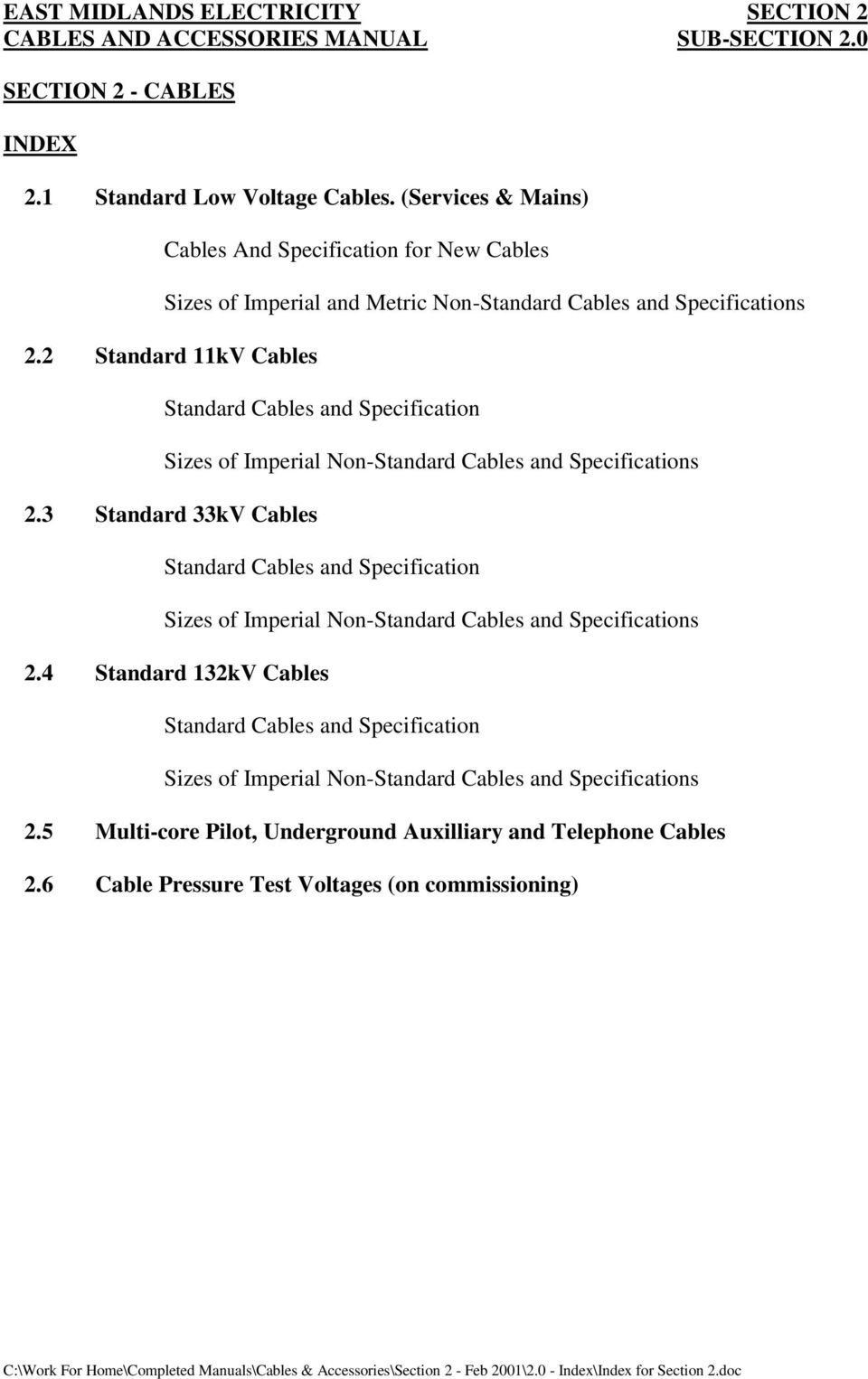
7 EAST MIDLANDS ELECTRICITY SECTION 2 CABLES AND ACCESSORIES MANUAL SUB-SECTION 2.0 SECTION 2 - CABLES INDEX 2.1 Standard Low Voltage Cables. (Services & Mains) Cables And Specification for New Cables Sizes of Imperial and Metric Non-Standard Cables and Specifications 2.2 Standard 11kV Cables Standard Cables and Specification Sizes of Imperial Non-Standard Cables and Specifications 2.3 Standard 33kV Cables Standard Cables and Specification Sizes of Imperial Non-Standard Cables and Specifications 2.4 Standard 132kV Cables Standard Cables and Specification Sizes of Imperial Non-Standard Cables and Specifications 2.5 Multi-core Pilot, Underground Auxilliary and Telephone Cables 2.6 Cable Pressure Test Voltages (on commissioning) C:\Work For Home\Completed Manuals\Cables & Accessories\Section 2 - Feb 2001\2.0 - Index\Index for Section 2.doc
8 EAST MIDLANDS ELECTRICITY SECTION 2 CABLES AND ACCESSORIES MANUAL SUB-SECTION 2.1 SCHEDULE OF TECHNICAL PARTICULARS CABLE SUB-SECTION New Cables LV single phase, solid aluminium conductor, XLPE insulated, concentric layer of bare copper wire neutrals (CNE), PVC sheathed. LV three phase, 3 core, solid aluminium conductor, XLPE insulated, rubber bedding, copper wire waveform concentric layer (CNE), PVC sheathed. LV single core, solid aluminium (sectoral conductors), XLPE insulated, aluminium wire armoured, PVC sheathed Superseded Cables 4mm² single phase, standard copper conductor, XLPE insulated, concentric layer of bare copper neutrals (CNE), PVC sheathed. 16mm² single phase, standard copper conductor, XLPE insulated, concentric layer of bare copper neutrals (CNE), PVC sheathed 25mm² & 35mm², three phase, solid aluminium conductor, XLPE insulated, aluminium wire waveform concentric layer (CNE), PVC sheathed. 70mm², 120mm², 185mm² and 300mm², three phase, solid aluminium conductor, XLPE insulated, aluminium wire waveform concentric layer (CNE), PVC sheathed. Two core, single phase, paper insulated, lead sheathed, steel tape armoured cables 1,100 volt. Four core, three phase, stranded copper conductors, paper insulated, lead sheathed, steel tape armoured cables, 1,100 volt. Four core, three phase, stranded aluminium conductors, paper insulated, lead sheathed, steel tape armoured cables, 1,100 volt C:\Work For Home\Completed Manuals\Cables & Accessories\Section 2 - Feb 2001\2.1 - LV Cables\LV Schedule of Technical Data.doc

9 THE EAST MIDLANDS ELECTRICITY SECTION 2 CABLES AND ACCESSORIES MANUAL SUB-SECTION 2.1 STANDARD CABLES LOW VOLTAGE CABLES All underground low voltage services shall be as detailed in the appropriate section and schedule and the Distribution Planning Manual. Cables shall be installed as detailed in this Code of Practice Section 3 Technical Requirements for Cable Laying. Single Phase Services XLPE Insulated, PVC Sheathed For Low Voltage Network Service Extensions and Alterations Solid aluminium conductor, single phase, XLPE insulated, concentric layer of bare copper wires forming a combined neutral earth conductor (CNE), 600/1000 volt, PVC sheathed overall to specification BS :1996, & ESI 09-7 Table 2 (XLPE variant). Two sizes will be used:- Size 25mm² Hybrid 35mm² Hybrid Use 1φ Public Lighting 1φ House Services Three Phase Services XLPE Insulated, PVC Sheathed For Low Voltage Network Service Extensions and Alterations Three phase, 3 core, solid aluminium conductor, XLPE insulated, rubber bedding, copper wire waveform concentric layer forming a combined neutral earth conductor (CNE), 600/1000 volt, PVC sheathed overall, to specification BS :1996. Four sizes will be used:- Size 35mm 2 CNE 95mm 2 CNE 185mm 2 CNE 300mm 2 CNE Use 3φ LV Service, up to 100 Amps 3φ LV Service, up to 200 Amps 3φ LV Service, up to 300 Amps 3φ LV Service, up to 400 Amps C:\Work For Home\Completed Manuals\Cables & Accessories\Section 2 - Feb 2001\2.1 - LV Cables\LV Standard Cables.doc

10 THE EAST MIDLANDS ELECTRICITY SECTION 2 CABLES AND ACCESSORIES MANUAL SUB-SECTION 2.1 Three Phase Mains For Low Voltage Network Extensions and Alterations Three phase, 3 core, solid aluminium conductor, XLPE insulated, rubber bedding copper wire waveform concentric layer, forming a combined neutral earth conductor (600/1000 volt), PVC sheathed overall, to specification BS7870. Two sizes will be used:- Size 95mm 2 CNE 185mm 2 CNE Use LV Mains up to 200 Amps LV Mains up to 300 Amps Singles Cables For Low Voltage Transformer Tails and Services to Large Industrial Customers Single core, solid aluminium (sectoral conductors), XLPE insulated, aluminium wire armoured. (600/1000V), PVC sheathed overall, to specification BS5467:1997. One size only:- Size 600mm² single core. (one per phase, one per neutral) 600mm² single core (two per phase, one per neutral) Use 315 and 500kVA transformers Transformer to LV pillar or service position 800 and 1000kVA transformers Transformer to LV pillar or service position C:\Work For Home\Completed Manuals\Cables & Accessories\Section 2 - Feb 2001\2.1 - LV Cables\LV Standard Cables.doc

11 TECHNICAL SCHEDULE SECTION 2.1 SUB-SECTION Solid Aluminium Conductor, Single Phase XLPE Insulated Concentric Layer of Bare Copper Wires forming a Combined Neutral Earth Conductor (600/1000v) PVC Sheathed to ESI 09-7 (table 2) (XLPE variant) 1. Sectional area of conductor mm² Form of phase conductor Circular Solid 2. Minimum average thickness insulation mm Minimum thickness of insulation at any point mm Concentric neutral conductor Number of wires No Nominal diameter of wires mm Minimum average thickness of PVC oversheath mm Minimum thickness of PVC oversheath at any point mm Approximate overall diameter mm Approximate weight per metre of completed cable kg Minimum radius of bend around which cable can be laid mm Maximum d.c. resistance of conductor per metre of cable at 20 o C (i) phase µω (ii) concentric neutral µω Maximum a.c. resistance of phase conductor per metre of cable at maximum conductor temperature µω Star reactance per metre of cable at 50Hz µω Maximum continuous current carrying capacity per phase conductor when laid direct in the ground, one circuit per trench g = 1.2 C m/w, tg = 15 C A Maximum continuous current carrying capacity per phase conductor (i) Drawn into ducts ground temperature = 15 C A g = 1.2 C m/w (ii) Laid in air, ambient temperature= 25 C A Maximum conductor temperature o C C:\Work For Home\Completed Manuals\Cables & Accessories\Section 2 - Feb 2001\2.1 - LV Cables\LV single phase Hybrid doc

12 TECHNICAL SCHEDULE SECTION 2.1 SUB-SECTION Three core, solid aluminium conductors, XLPE insulation, rubber bedding, copper wire waveform concentric layer, PVC oversheath, 600/1000V cable to BS Nominal area of phase conductor mm Form of phase conductor Circular Sector Shaped Aluminium 2 Minimum average thickness of insulation Minimum thickness of insulation at any point mm mm Concentric neutral/earth conductor (a) Number of wires No (b) Nominal diameter of wires mm (c) Nominal wavelength of wires mm Approximate thickness of bedding layer mm Minimum average thickness of PVC oversheath Minimum thickness of PVC oversheath at any point mm mm Approximate overall diameter of completed cable mm Approximate weight per metre of completed cable kg Minimum radius of bend around which cable can be laid (d) Pulling in (e) Adjacent to joints and terminations mm mm Nominal internal diameter of ducts mm Maximum d.c. resistance per metre of cable at 20 C (a) Phase/neutral conductors (b) Earth conductor µω µω Maximum a.c. resistance of phase conductor per metre of cable, at maximum temperature µω Equivalent star reactance per metre of cable at 50 Hz µω Maximum continuous current carrying capacity per phase conductor (a) Laid direct, ground temperature 15 C and g = 1.2K.m/W (b) Drawn into ducts, ground temperature 15 C and g = 1.2 K.m/W (c) Laid in air at 25 C ambient temp. A A A Maximum conductor temperature C < See Note > Note: The above data is based on a maximum conductor temperature of 80 0 C (as for Consac), it should however be noted that XLPE insulated cables are capable of operating at 90 C maximum conductor temperature. C:\Work For Home\Completed Manuals\Cables & Accessories\Section 2 - Feb 2001\2.1 - LV Cables\LV 3 phase Alpex Cu CNE doc

13 TECHNICAL SCHEDULE SECTION 2 SUB-SECTION Aluminium XLPE insulated PVC sheathed single core armoured cables to BS5497: 1997 Nominal cross-sectional area mm Voltage rating - 600/1000 volt Number of cores 1 Minimum average thickness of insulation mm 2.4 Nominal thickness of bedding mm 1.2 Nominal diameter of armour wires mm 2.0 Nominal thickness of oversheath. mm 2.2 Approximate diameter under amour mm 35.3 Approximate diameter overall mm 42.9 Minimum bending radius mm 350 Approximate cable weight ' kg/km 3925 Maximum pulling eye force kg 1800 Maximum d.c. resistance at 20 C Ω/km Maximum a.c. resistance at 90 C Ω/km Maximum resistance of armour at 20 C Ohms/km Ω/km 0.20 Minimum cross-sectional area of armour wires mm Approximate capacitance (conductor to armour) µf/km Approximate inductance in Trefoil mh/km Approximate 50Hz Ω/km Approximate 50Hz Ω/km Short circuit rating 1 second short circuit rating of conductor (90 to C) ka second short circuit rating of armour (90 to C) ka 13.5 Current Ratings (ERA pt V) Direct!n ground touching single phase Amps 795 Direct in ground spaced single phase Amps 736 In ducts flat and touching Amps 627 In air horizontal spaced single phase Amps 957 In air vertical spaced single phase Amps 918 Direct in ground trefoil formation three phase Amps 672 Direct in ground flat touching three phase Amps 640 Direct in ground flat spaced three phase Amps 620 In trefoil ducts three phase Amps 557 In ducts flat and touching three phase Amps 558 In air trefoil formation three phase Amps 839 In air vertical spaced three phase Amps 817 In air horizontal spaced three phase Amps 872 Approx. volt drops Single phase touching mv/a/m 0.24 Single phase spaced* mv/a/m 0.31 Three phase trefoil mv/a/m 0.2 Three phase touching mv/a/m 0.27 Three phase spaced* mv/a/m 0.35 "Note: The under armour and oversheath diameters are only approximate, If tolerances dimensions are required please specify at time of enquiry or order placement. *If the Cable Spacing is larger than 1 cable diameter, then the volt drop will be larger than those specified. If current rating in buildings is required reference should be made to BS7671 (IEE Wiring Regs.). Alternatively ratings are as BS6724 cables. C:\Work For Home\Completed Manuals\Cables & Accessories\Section 2 - Feb 2001\2.1 - LV Cables\LV single core sectoral singles doc

14 TECHNICAL SCHEDULE SECTION 2 SUB-SECTION Copper Conductor Single Phase Pvc Insulated Concentric Layer of Bare Copper Wires Forming Combined Neutral/Earth Conductor (600/1000v)PVC Sheathed to E.S.I (Table 1) 1 Sectional area of conductor mm² 4 Forms of phase conductor Circular Stranded Number of wires No 7 Normal diameter of wires mm Minimum average thickness of insulation mm 0.8 Minimum thickness of insulation at any point mm Concentric neutral conductor Number of wires No 15 Nominal diameter of wires mm Minimum average thickness of P.V.C. oversheath mm 1.4 Minimum thickness of P.V.C. oversheath at any point mm Approximate overall diameter mm Approximate weight per metre of completed cable kg Minimum radius of bend around which cable can be laid mm 75 8 Maximum d.c. resistance of conductor per metre of cable at 20 C (i) phase µω 4520 (ii) concentric neutral µω Maximum a.c. resistance of phase conductor per metre of cable at maximum conductor temperature µω Star resistance per metre of cable at 50Hz µω Maximum continuous current carrying capacity per phase conductor when laid direct in the ground, one circuit per trench g = 1.2 C m/w, tg = 15 C A Maximum continuous current carrying capacity per phase conductor (i) Drawn into ducts ground temperature = 15 C g = 1 A 44 2 C m/w (ii) Laid in air, ambient temperature = 25 C A Maximum conductor temperature o C 70 C:\Work For Home\Completed Manuals\Cables & Accessories\Section 2 - Feb 2001\2.1 - LV Cables\LV single phase 4mm doc

15 TECHNICAL SCHEDULE SECTION 2 SUB-SECTION /1000 Volts, Single Core, Plus Helical Concentric Neutral Sheath, Copper Conductors, to BS 4553 : Sectional Area of Conductor mm² 16 Form of phase conductor Circular Stranded Number of wires No. 7 Nominal diameter of wires mm Minimum average thickness of insulation mm 1.0 Minimum thickness of insulation at any point mm Concentric neutral conductor Number of wires No. 11 Nominal diameter of wires mm Concentric earth conductor Number of wires No 4 Nominal diameter of wire mm Minimum average thickness of P.V.C. oversheath mm 1.5 Minimum thickness of P.V.C. oversheath at any point mm Approximate overall diameter mm Approximate weight per metre of completed cable kg Minimum radius of bend around which cable can be laid mm Maximum d.c. resistance of conductor per metre of cable at 200C i) phase µω 1130 ii) concentric neutral µω 1200 iii) concentric earth µω Maximum a.c. resistance of phase conductor per metre of cable at maximum conductor temperature µω Star reactance per metre of cable at 50 Hz µω Maximum continuous current carrying capacity per phase conductor when laid direct in the ground, one-dircuit per trench g = 1.2 C m/w, tg = 15 C A Maximum continuous current carrying capacity per phase conductor i) Drawn into ducts ground temperature = 15 C g = A C m/w ii) Laid in air, ambient temperature = 25 C A Maximum conductor temperature C 70 C:\Work For Home\Completed Manuals\Cables & Accessories\Section 2 - Feb 2001\2.1 - LV Cables\LV single phase 16mm doc

16 SUB-SECTION Solid Aluminium Conductor, Three Phase, XLPE, Aluminium Waveform Concentric Neutral, Embedded in an Anti Corrosion Sheath (600/1000v) PVC Sheathed Overall to E.S.I. 09 (table 4) 1. Nominal area of phase conductor mm Form of phase conductor Circular solid aluminium 2. Minimum average thickness of insulation mm Minimum thickness of insulation at any point mm Concentric neutral/earth conductor Number of wires Nominal diameter of wires mm Nominal wavelength of wires mm Approximate thickness of anti-corrosion layer in which neutral/earth wires are embedded mm Minimum average thickness of PVC oversheath mm Minimum thickness of PVC oversheath at any point mm Approximate overall diameter of completed cable mm Approximate weight per metre of completed cable kg Minimum radius of bend around which cable can be laid:- (a) in pulling-in mm (b) adjacent to joints and terminations mm Nominal internal diameter of ducts mm Maximum d.c. resistance per metre of cable at 20 C Phase conductors µω Neutral conductor µω Maximum a.c. resistance of phase conductor per metre of cable, at maximum conductor temperature µω Equivalent star reactance per metre of cable at 50 Hz µω Maximum continuous current carrying capacity per phase conductor a) laid direct, ground temperature15oc and g = 1.2 o C A m/w (b) drawn into ducts, ground temperature 15oC and g A = 1.2 o C m/w (c) laid in air, ambient temperature 25 o C A Maximum conductor temperature o C See Note Note: The current ratings given above are the same as for the paper insulated cables (CONSAC), i.e. based upon 80 o C approximate maximum conductor temperature. These values are recommended as an interim measure until such time as agreement is obtained for the maximum permitted operating temperatures for the different types of insulation and cable constructions. C:\Work For Home\Completed Manuals\Cables & Accessories\Section 2 - Feb 2001\2.1 - LV Cables\LV 3 phase 25-35mm doc

17 TECHNICAL SCHEDULE SECTION 2 SUB-SECTION Solid Aluminium Conductor, Three Phase, XLPE, Aluminium Wire Wave-Form Concentric Neutral, Embedded in an Anti-Corrosion Sheath, (600/1000v) PVC Sheathed Overall to E.S.I (table 5) 1. Nominal area of phase conductor mm Form of phase conductor Sector shaped solid aluminium 2. Minimum average thickness of insulation mm Minimum thickness of insulation at any point mm Concentric neutral/earth conductor Number of wires Nominal diameter of wire mm Nominal wavelength of wires mm Approximate thickness of anti-corrosion layer in which neutral/earth wires are embedded mm Minimum average thickness of PVC oversheath mm Minimum thickness of PVC oversheath at any point mm Approximate overall diameter of completed cable mm Approximate weight per metre of completed cable kg Minimum radius of bend around which cable can be laid (a) in pulling-in mm (b) adjacent to joints and terminations mm Nominal internal diameter of ducts mm Maximum d.c. resistance per metre of cable at 20 C Phase conductors µω Neutral conductors µω Maximum a.c. resistance of phase conductor per metre of cable, at maximum temperature µω Equivalent star reactance per metre of cable at 50Hz µω Maximum continuous current carrying capacity per phase conductor (a) laid direct, ground temperature 15 o C and g = A o C m/w (b) drawn into ducts, ground temperature15 o C A and g= 1.2 o C m/w (c) laid in air ambient temperature 25 o C A Maximum conductor temperature C See Note NOTE: The current ratings given above are the same as for the paper insulated cables, (Consac), i.e. based upon 80 C approximate maximum conductor temperature. These values are recommended as an interim measure until such time as agreement is obtained for the maximum permitted operating temperature for the different types of insulation and cable construction. C:\Work For Home\Completed Manuals\Cables & Accessories\Section 2 - Feb 2001\2.1 - LV Cables\LV 3 phase Alpex Al CNE doc

18 TECHNICAL SCHEDULE SECTION 2 1,100 VOLT TWIN CABLE (table 8, BS 480 Part 1.) SUB-SECTION Sectional area of conductor. sq.in Shape of conductor Circular Shaped Shaped Shaped Shaped Shaped Shaped Shaped Shaped Shaped 2 Minimum thickness of insulation between in conductors. 3 Minimum thickness of insulation between in any conductor and sheath. 4 Minimum thickness of sheath. in Diameter over sheath: Nominal in Sheath material (as specified in BS 801) Lead Alloy E, Alloy B" 7 Armour: No. (approx) and diameter of armour No./in 33/ / / / / / / / / /.104 wires Thickness of each layer of steel tape. in Nominal external diameter of completed cable: Type P 2H 2 or P 2CH in Type P 2JWH 2 or P 2H 2WH 2 in Type P 2JTH 2 or P 2H 2TH 2 in Type CHW(FR) in Nominal weight per yard of completed cable: Type P 2H 2 or P 2CH lb Type P 2JWH 2 or P 2H 2WH 2 lb Type P 2JTH 2 or P 2H 2TH 2 lb Type CHW(FR) lb Minimum radius of bend round which mm cable can be laid 11 Nominal internal diameter of pipes or mm ducts 12 Maximum D.C. resistance of conductor Ω per 1,000 yards of cable at 20 C 13 Maximum A.C. resistance of conductor Ω per 1,000 yards of cable at maximum conductor temperature 14 Equivalent star reactance per 1,000 yards Ω of cable at 50Hz 15 Maximum continuous carrying capacity per conductor when laid direct in the ground one three-phase circuit per trench: g = 120oC.watt/cm Amps g = 90 C./watt/cm Amps * Maximum continuous current carrying capacity per conductor: Drawn into pipes or ducts, ground temperature 15 C.and g = 120 C./watt/cm Drawn into pipes or ducts, ground temperature 15 C.and g = 90 C./watt/cm Laid on racks or in air, ambient temperature 25 C. 17* Maximum conductor temperature; (a) Laid direct in ground (b) Drawn into pipes or ducts (c) Laid on racks or in air Amps Amps Amps C < > 0 C < > 0 C < > *Note - The figure given in items 15,16 and 17 (b) apply to armoured cable only. The assumed maximum conductor temperature for unarmoured cable drawn into ducts [Item 17 (b)] is 90 C. C:\Work For Home\Completed Manuals\Cables & Accessories\Section 2 - Feb 2001\2.1 - LV Cables\LV 2 core Paper STA doc

19 TECHNICAL SCHEDULE SECTION 2 SUB-SECTION ,100 volt 4 Core Cables (tables 8 and 9, BS 480 Part 1) 1 Sectional area of conductor sq.in / 0.20N / 0.20N / 0.20N / 0.20N Shape of conductor Circular Circular Shaped Shaped Shaped Shaped Shaped Shaped Shaped Shaped Shaped Shaped Shaped Shaped Shaped Shaped 2 Minimum thickness of insulation between conductors in Minimum thickness of insulation between any conductor and sheath in Minimum thickness of sheath in Diameter over sheath: Nominal in Sheath material (as specified in B.S. 801) Lead Alloy E, Alloy B 7 Armour: a) No. (approx.) and diameter of armour wires No./in. 36/ / / / / / / / / / / / / / / /.128 b) Thickness of each layer of steel tape. in Nominal external diameter of completed cable: (a) Type P2H2 or P2CH in (b) Type P2JWH2 or P2H2WH2 in (c) Type P2JTH2 or P2H2TH2 in (d) Type CHW(FR) in Nominal weight per vard of completed cable: (a) Type P2H2 or P2CH lb (b) Type P2JWH2 or P2H2WH2 lb (c) Type P2JTH2 or P2H2TH2 lb (d) Type CHW(FR) lb Minimum radius of bend round which cable can be laid mm Nominal internal diameter of pipes or duels mm Maximum D.C. resistance of conductor per 1,000 yards of cable at 20 C (a) phase Ω (b) neutral Ω Maximum A.C. resistance of conductor per 1,000 yards of cable at maximum conductor temperature: (a) phase Ω Equivalent star reactance per 1,000 yards of cable at 50Hz per second -. Ω * Maximum continuous current carrying capacity per conductor when laid direct in the ground, one threephase circuit per trench: (a) g = 120 C./watt/cm A (b) g = 90 C./watt/cm A * Maximum continuous current carrying capacity per conductor: (a) Drawn into pipes or ducts, ground temp. 15 C. (59 F.) and g = 120 C/watt/cm (b) Drawn into pipes or ducts, ground temp. 15 C and g = 90 C/watt/cm A A 45' (c) Laid on racks or in air, ambient temp. 25 C A * Maximum conductor temperature: (a) Laid direct in ground < C > (b) Drawn into pipes or ducts < C > (c) Laid on racks or in air < C > *NOTE. The figures given in Items 15, 16 and 17 (b) apply to armoured cables only. The assumed maximum conductor temperature for unarmoured cables drawn into ducts [Item 17 {b}} is 60 C. [140 F.]. C:\Work For Home\Completed Manuals\Cables & Accessories\Section 2 - Feb 2001\2.1 - LV Cables\LV 4 core PILC Stranded Cu doc

20 TECHNICAL SCHEDULE SECTION 2 SUB-SECTION ,100 volt 4 Core Cables with Aluminum Conductors (Tables 8 and 9, BS 480 Part 1) 1 Sectional area of conductor sq.in / 0.30N / 0.30N Shape of conductor Circular Circular Shaped Shaped Shaped Shaped Shaped Shaped Shaped Shaped Shaped Shaped Shaped Shaped 2 Minimum thickness of insulation between conductors in Minimum thickness of insulation between any conductor and sheath in Minimum thickness of sheath in Diameter over sheath: Nominal in Sheath material (as specified in B.S. 801) Lead, Alloy E, Alloy B 7 Armour: a) No. (approx.) and diameter of armour wires No./in. 36/ / / / / / / / / / / / / /.128 b) Thickness of each layer of steel tape. in Nominal external diameter of completed cable: (a) Type P2H2 or P2CH in (b) Type P2JWH2 or P2H2WH2 in (c) Type P2JTH2 or P2H2TH2 in (d) Type CHW(FR) in Nominal weight per vard of completed cable: (a) Type P2H2 or P2CH lb (b) Type P2JWH2 or P2H2WH2 lb (c) Type P2JTH2 or P2H2TH2 lb (d) Type CHW(FR) lb Minimum radius of bend round which cable can be laid mm Nominal internal diameter of pipes or duels mm Maximum D.C. resistance of conductor per 1,000 yards of cable at 20 C (a) phase Ω (b) neutral Ω Maximum A.C. resistance of conductor per 1,000 yards of cable at maximum conductor temperature: (a) phase Ω Equivalent star reactance per 1,000 yards of cable at 50Hz per second:-. Ω * Maximum continuous current carrying capacity per conductor when laid direct in the ground, one threephase circuit per trench: (a) g = 120 C/watt/cm A (b) g = 90 C/watt/cm A * Maximum continuous current carrying capacity per conductor: (a) Drawn into pipes or ducts, ground temp. 15 C. (59 F.) and g = 120 C/watt/cm (b) Drawn into pipes or ducts, ground temp. 15 C and g = 90 C/watt/cm A A (c) Laid on racks or in air, ambient temp. 25 C A * Maximum conductor temperature: (a) Laid direct in ground < > (b) Drawn into pipes or ducts < > (c) Laid on racks or in air < > *NOTE. The figures given in Items 15, 16 and 17 (b) apply to armoured cables only. The assumed maximum conductor temperature for unarmoured cables drawn into ducts [Item 17 {b}} is 60 C. [140 F.]. C:\Work For Home\Completed Manuals\Cables & Accessories\Section 2 - Feb 2001\2.1 - LV Cables\LV 4 core PILC Stranded Al doc

21 EAST MIDLANDS ELECTRICITY SECTION 2 CABLES AND ACCESSORIES MANUAL SUB-SECTION 2.2 SCHEDULE OF TECHNICAL PARTICULARS CABLE SUB-SECTION New Cables 11kV Single Core, SAC, XLPE Insulation, triplex kV Single Core, Stranded Copper, XLPE Insulation kV Three Core, Stranded Aluminium, Paper Insulated, with Corrugated Aluminium Sheath (PICAS) Superseded Cables 11kV Single Core, Stranded Aluminium, XLPE Insulation kV Single Core, Stranded Copper, Paper Insulated, with Lead Sheath. 11kV Three Core, Stranded Copper, Belted Cable with Paper Insulation, Lead Sheath, and Steel Wire Armour. 11kV Three Core, Stranded Copper, Screened Cable with Paper Insulation, Lead Sheath, and Steel Wire Armour. 11kV Three Core, Stranded Aluminium, Belted Cable with Paper Insulation, Lead Sheath, and Steel Wire Armour Short Circuit Ratings Short Circuit Ratings for SAC and PICAS Cables C:\Work For Home\Completed Manuals\Cables & Accessories\Section 2 - Feb 2001\2.2-11kV Cables\11kV Schedule of Technical Data.doc
22 EAST MIDLANDS ELECTRICITY SECTION 2 CABLES AND ACCESSORIES MANUAL SUB-SECTION 2.2 STANDARD CABLES 11kV CABLES All 11kV cables shall be as detailed in the appropriate section and schedules and the Distribution Planning Manual. Cables shall be installed as detailed in this Code of Practice Section 3 Technical Requirements for Cable Laying. Single Core X.L.P.E. Insulated 11kV Network Extensions and Alterations Circular solid aluminium conductor (SAC), cross linked polyethylene (XLPE) insulated, copper wire screen, medium density polyethylene (MDPE) oversheath, three single cores laid up in triplex formation to specification BS7870 (Part 4) & IEC 502. Three sizes will be used: - Size Use 70mm² SAC, 3x1 core triplex. - Main up to 200Amps. 150mm 2 SAC 3x1 core triplex* - Main up to 320 Amps. 185mm² SAC, 3x1 core triplex. - Main up to 360Amps. 300mm² SAC, 3x1 core triplex. - Interconnectors up to 600Amps between Primary Substations. - Feeders out of Primary Substations. *This will be removed from the available options as stocks diminish and are replaced by the 185mm 2 SAC 3x1 core triplex (expected to be early 2001). 11kV Transformer Tails (33/11kV transformers) Stranded copper conductors, cross-linked polyethylene (XLPE) extruded insulation, copper wire metallic screen, medium density polyethylene (MDPE) sheathed overall single core 11kV cable to specification BS7870. Two sizes will be used: - Size 400mm 2 Stranded Copper 1 core. 400mm 2 Stranded Copper 1 core. 630mm 2 Stranded Copper 1 core. Use 12 MVA 11kV Transformer Tails (1 per ph) 24 MVA 11kV Transformer Tails (2 per ph) 40 MVA 11kV Transformer Tails (2 per ph). 24MVA 6.6kV Transformer Tails (2 per ph) C:\Work For Home\Completed Manuals\Cables & Accessories\Section 2 - Feb 2001\2.2-11kV Cables\11kV Standard Cables 1.doc
23 EAST MIDLANDS ELECTRICITY SECTION 2 CABLES AND ACCESSORIES MANUAL SUB-SECTION 2.2 Three Core Paper Insulated Corrugated Aluminium Sheathed (PICAS) 11kV Network Extensions and Alterations Stranded aluminium conductors, non-draining, impregnated paper insulated belted, corrugated aluminium sheathed, 6350/11000 volt three core cable, PVC sheathed overall, to specification ESI (PICAS) Three sizes are available: - Size Use 95mm 2 PICAS 3 core Aluminium + - Main up to 175Amps. 185mm 2 PICAS 3 core Aluminium + - Main up to 250Amps. 300mm 2 PICAS 3 core Aluminium + - Main up to 345Amps + All these cables will be superseded by the XLPE triplex cables as stocks are exhausted (expected to be early 2001) C:\Work For Home\Completed Manuals\Cables & Accessories\Section 2 - Feb 2001\2.2-11kV Cables\11kV Standard Cables 1.doc
24 TECHNICAL SCHEDULE SECTION 2 SUB-SECTION Single core, circular solid aluminium conductor, extruded conductor screen, XLPE insulation, strippable semiconducting core screen, helical copper wire screen, polyethylene oversheath, TR1PLEXED, 6350/11000 cable to BS7870 Part 4-10:1999. Nominal Area of Conductor mm Conductor material aluminium Nominal diameter of conductor mm Nominal Thickness of conductor screen mm Minimum average thickness of insulation mm Minimum thickness at any point of insulation mm Nominal thickness of dielectric screen mm Nominal cross sectional area of copper wire screen mm Diameter of copper screen wires mm Number of copper wires No Minimum average thickness of oversheath mm Nominal diameter of single core mm Nominal diameter over triplexed cores mm Minimum radius of bend (1) During installation mm (2) Adjacent to joints and terminations mm Approx. weight per 1000m of triplexed cores. kg Nominal internal diameter of ducts mm Maximum d.c. resistance of conductor per 1000m of cable at 20 C Ω Maximum a.c. resistance of conductor per 1000m of cable at 90 C Ω Inductance per core per 1000m of cable mh Equivalent star reactance per 1000m of cable at 50 Hz Ω Maximum equivalent star capacitance per 1000m of cable µf Maximum continuous current rating; (1) Laid direct ground temp 15 C,g = 1.2 Km/W, depth 0.8 m (2) Drawn into ducts ground temp 15 C,g = 1.2. Km/W, depth 0.8m A A (3) Installed in air ambient air temperature 25 C A Maximum continuous conductor temperature C Maximum short circuit conductor temperature C Short circuit ratings -1.0 second duration (1) Conductor ka (2) Copper wire screen ka The above information is based on single core cables installed in trefoil formation, with screens solidly bonded. C:\Work For Home\Completed Manuals\Cables & Accessories\Section 2 - Feb 2001\2.2-11kV Cables\11kV Triplex XLPE doc
25 TECHNICAL SCHEDULE SECTION 2.2 SUB-SECTION Single core, circular stranded copper conductor, extruded conductor screen, XLPE insulation, strippable semi-conducting core screen, helical copper wire screen (35 sq.mm), MDPE oversheath 6350/11000 V cable to BS (Stranded Copper) Nominal Area of Conductor mrn Conductor material stranded copper stranded copper stranded copper stranded copper Nominal diameter of conductor mm Nominal thickness of conductor screen mm Minimum average thickness of insulation mm Minimum thickness at any point of insulation mm Nominal thickness of dielectric screen mm Diameter of copper screen wires mm Minimum average thickness of oversheath mm Nominal overall diameter mm Minimum radius of bend (1) During installation mm (2) Adjacent to joints and terminations mm Approx. weight per 1000m of cable kg Nominal internal diameter of ducts mm Maximum d.c. resistance of conductor per 1000m of cable at 20 C Maximum a.c. resistance of conductor per 1000m of cable at 90 C ohm ohm Inductance per core per 1000m of cable mh Equivalent star reactance per 1000m of cable at 50 Hz ohm Maximum equivalent star capacitance per 1000m of cable microf Maximum continuous current rating: (1) Laid direct ground temp 15 C, g = 1.2 K.m/W, depth 0.8 m (2) Drawn into ducts ground temp 15 C, g = 1.2 K.m/W, depth 0.8 m Amp Amp (3) Installed in air ambient air temperature 25 C Amp Maximum continuous conductor temperature C Maximum short circuit conductor temperature C Short circuit ratings -1.0 second duration (1) Conductor ka (2) Copper wire screen ka The above information is based on single core cables installed in trefoil formation, with screens solidly bonded C:\Work For Home\Completed Manuals\Cables & Accessories\Section 2 - Feb 2001\2.2-11kV Cables\11kV Stranded Cu Singles XLPE doc
26 TECHNICAL SCHEDULE SECTION 2.2 SUB-SECTION Current Ratings Trefoil Solidly Bonded 1c, Copper or Aluminium, XLPE, CWS (35mm), Pe, 6.35/11 kv Conductor Size (mm 2 ) Continuous Current Rating (Direct Buried) Copper Aluminium A A A A 776 Ground temperature Soil thermal resistivity Depth of laying 15 O C 1.2 K.m/W 0.8 m We know that P17 ratings are based on a ground temperature of 10 O C and TR of 0.9 K.m/W, correction factors are: Ground temp 10 O C 1.04 Soil TR 0.9 K.m/W 1.12 Additionally P17 ratings are based on a 5 day limited winter cyclic rating factor of 1.17 Adjusting the 630mm Cu rating gives: 844 x 1.04 x 1.12 x 1.17 = 1150 A P17 then has a further allowance based on the fact that the cables are only 50% utilised prior to the emergency loading. The cable makers were never involved with P17 ratings and thus always quote continuous ratings. However the REC s appear to have used P17 ratings for many years without problems. C:\Work For Home\Completed Manuals\Cables & Accessories\Section 2 - Feb 2001\2.2-11kV Cables\11kV 630 cyclic-rating doc
27 TECHNICAL SCHEDULE SECTION 2 SUB-SECTION Three core, shaped stranded aluminium conductors. paper insulated, belted, corrugated aluminium sheath, PVC sheathed, 6.35/11 kv PICAS cable to EA Nominal Area of Conductor mm Nominal diameter of conductor (depth) mm Mean thickness of paper insulation mm Nominal depth over insulation mm Nominal diameter over laid up cores mm Nominal thickness of belt insulation mm Nominal thickness of belt carbon screen mm Nominal thickness of corrugated aluminium sheath mm Nominal external root diameter mm Nominal external crest diameter mm Nominal diameter over PVC oversheath mm Minimum radius of bend 1) During installation mm ) Adjacent to joints and terminations mm Maximum d.c. resistance of conductor per 1000m of cable at ohms C 13 Maximum a.c. resistance of conductor per 1000m of cable at ohms C 14 Equivalent star reactance per 1000m of cable at 50 Hz ohms Impedance per 1000m of cable at 50Hz and 65 C ohms Maximum equivalent star capacitance per 1000m of cable uf Maximum continuous current rating at (@ 65 C conductor temperature) 1) Laid direct ground temp. 15 C, depth 1.2m and g= 0.8 Amps K.m/W 2) Drawn into ducts ground temp. 15 C, depth 1.2m and g Amps = 0.8 K.m/W 3) Installed in air ambient temp. 25 C Amps Maximum conductor temperature C Maximum short circuit conductor temperature C Maximum conductor short circuit rating capacity for 1 second (Conductor operating at 65 C at start of short circuit) ka Al. sheath fault level capacity for 1 second (Conductor operating at 65 C at start of short circuit) ka C:\Work For Home\Completed Manuals\Cables & Accessories\Section 2 - Feb 2001\2.2-11kV Cables\11kV PICAS doc
28 TECHNICAL SCHEDULE Se ct ion 2.2 Su b -Se ct io n Single core, circular stranded aluminium conductor, extruded conductor screen, XLPE insulation, strippable semi-conducting core screen, helical copper wire screen (35 sq.mm), MDPE oversheath 6350/11000 V cable to BS (Aluminium) Nominal Area of Conductor mrn Conductor material Aluminium Aluminium Aluminium Aluminium Nominal diameter of conductor mm Nominal thickness of conductor screen mm Minimum average thickness of insulation mm Minimum thickness at any point of insulation mm Nominal thickness of dielectric screen mm Diameter of copper screen wires mm Minimum average thickness of oversheath mm Nominal overall diameter mm Minimum radius of bend (1) During installation mm (2) Adjacent to joints and terminations mm Approx. weight per 1000m of cable kg Nominal internal diameter of ducts mm Maximum d.c. resistance of conductor per 1000m of cable at 20 C Maximum a.c. resistance of conductor per 1000m of cable at 90 C ohm ohm Inductance per core per 1000m of cable mh Equivalent star reactance per 1000m of cable at 50 Hz ohm Maximum equivalent star capacitance per 1000m of cable microf Maximum continuous current rating: (1) Laid direct ground temp 15 C, g = 1.2 K.m/W, depth 0.8 m (2) Drawn into ducts ground temp 15 C, g = 1.2 K.m/W, depth 0.8 m Amp Amp (3) Installed in air ambient air temperature 25 C Amp Maximum continuous conductor temperature C Maximum short circuit conductor temperature C Short circuit ratings -1.0 second duration (1) Conductor ka (2) Copper wire screen ka The above information is based on single core cables installed in trefoil formation, with screens solidly bonded C:\Work For Home\Completed Manuals\Cables & Accessories\Section 2 - Feb 2001\2.2-11kV Cables\11kV stranded Al singles XLPE doc
29 TECHNICAL PARTICULARS SECTION 2 SUB-SECTION /11000 Volt, Single Core, Paper Insulated, Lead Covered Cables Stranded Copper Conductor, to Specification BS6480 part 1 (Table 18) Nominal area of conductor mm Shape of Conductor Circular Circular 2 Minimum thickness of insulation between conductor and sheath mm Nominal thickness of sheath mm Nominal diameter over sheath mm Sheath material Alloy `E' Alloy `B' 6 Radial thickness of extruded PVC oversheath mm Nominal external diameter of completed cable mm Nominal weight per metre of completed cable kg Minimum radius of bend round which cable can be laid mm Nominal internal diameter of ducts mm Maximum d.c. resistance of conductor per metre of cable at 20 C Ω * Maximum a.c. resistance of conductor per metre of cable at µω maximum conductor temperature (70 C) 13* Equivalent star reactance per metre of cable at 50 Hz µω Maximum capacitance per metre of cable pf Maximum charging current per conductor per metre of cable at ma normal voltage & frequency 16φ Maximum continuous current carrying capacity per conductor (a) Laid direct, ground temperature 15 C and g = 1.2 C m/w A (b) Drawn into ducts, ground temperature 15 C and g = 1.2 C m/w A (c) Laid in air, ambient temperatures 25 C A Maximum conductor temperature (a) Laid direct in ground C (b) Drawn into ducts C (c) Laid in air C Sheath loss per metre of three phase circuit at normal frequency and at maximum current rating (a) Laid direct in ground W (b) Drawn into ducts W (c) Laid in air W *Cables laid in trefoil arrangement φ Cable sheaths solid bonded C:\Work For Home\Completed Manuals\Cables & Accessories\Section 2 - Feb 2001\2.2-11kV Cables\11kV Cu-Pb Paper Singles doc
30 SCHEDULE OF TECHNICAL PARTICULARS SECTION 2.2 CES-C2 (1955) PAGE 17 SUB-SECTION ,000 VOLTS 3-CORE BELTED CABLE (TABLE 13, B.S. 480 Part 1.) 1 Sectional area of conductor sq in Shape of conductor Circular Shaped Shaped Shaped Shaped Shaped Shaped Shaped Shaped Shaped 2 Minimum thickness of insulation between conductors in Minimum thickness of insulation between any conductor and sheath 4 Minimum, thickness of sheath in Nominal diameter over sheath in Sheath material (as specified in B.S. 801) Lead Alloy "E" Alloy "B" 7 Armour: (a) No. (approx.) and diameter of armour wires No./in 47/ / / / / / / / / /.128 {b) Thickness of each layer of steel tape in Nominal external diameter of completed cable: (a) Type P 2 CH in {b} Type P 2 CHWH 2 in (c) Type P 2 CHTH 2 in {d} Type CHW(FR) in Nominal weight per yard of completed cable: (a) Type P 2 CH lb (b) Type P 2 CHWH 2 lb (c) Type P 2 CHTH 2 lb {d} Type CHW/(FR) lb Minimum radius of bend round which cable can be laid mm Nominal internal diameter of pipes or ducts mm Maximum D.C. resistance of conductor per 1,000 yards of Ω cable at 20 C 13 Maximum A.C. resistance of conductor per 1,000 yards of Ω cable at maximum conductor temperature 14 Equivalent star reactance per 1,000 yards of cable at 50Hz Ω Maximum equivalent star capacitance per l,000 yards of cable µf Maximum charging current per conductor 1,000 yards of s , cable at normal voltage and frequency *17 Maximum continuous carrying capacity per conductor when laid direct in the ground one three-phase circuit per trench: (a) g = 120 o C.watt/cm s (b) g = 90 C./watt/cm s *18 Maximum continuous current carrying capacity per conductor; (a) Drawn into pipes or ducts, ground temperature s S C.and g = 120 C./watt/cm (b} Drawn into pipes or ducts, ground temperature s C.and g = 90 C./watt/cm (c) Laid on racks or in air, ambient temperature 25 C. s *19 Maximum conductor temperature: (a) Laid direct in ground 0 C < 65 > (b) Drawn into pipes or ducts 0 C < 65 > (c) Laid on racks or in air 0 C < 65 > 20 Sheath loss per 1,000 yards of three-phase circuit at normal working voltage and frequency and at maximum current rating: (a) Laid direct in ground [Current as in Item 17] kw <0.5 <0.5 <0.5 <0.5 <0.5 <0.5 < (b) Drawn into ducts [Current as in Item 18 (a)] kw <0.5 <0.5 <0.5 <0.5 <0.5 <0.5 <0.5 < (c) In air [Current as in Item 18 (b)] kw <0.5 <0.5 <0.5 <0.5 <0.5 < *NOTE. The figures given in Items 17, 18 and 19 (b) apply to armoured cables only. The assumed maximum conductor temperature for unarmourcd cables drawn into ducts [Item 19 (b)] is 50 C C:\Work For Home\Completed Manuals\Cables & Accessories\Section 2 - Feb 2001\2.2-11kV Cables\11kV 3 core PILC Cu doc
31 CES-C2 (1955) PAGE 16 SECTION 2.2 SCHEDULE OF TECHNICAL PARTICULARS SUB-SECTION ,000 VOLTS 3-CORE SCREENED CABLE (TABLE 13, B.S. 480 Part 1.) 1 Sectional area of conductor sq. in Shape of conductor Circular Shaped Shaped Shaped Shaped Shaped Shaped Shaped Shaped Shaped 2 Minimum thickness of insulation between conductor and screen in Type of screen round individual cores Metal tape or metallised paper 4 Minimum thickness of sheath in Nominal diameter over sheath in Sheath material (as specified in B.S. 801) Lead, Alloy"E", Alloy"B" 7 Armour: (a) No. (approx.) and diameter of armour wires. No./in 50/ / / / / / / / / /.128 {b) Thickness of each layer of steel tape Nominal external diameter of completed cable: (a) Type P 2 CH in (b') TypeP 2 CHWH 2 in (c) Type P 2 CHTH 2 in {d} Type CHW(FR) in Nominal weight per yard of completed cable: (a) Type P 2 CH lb (b) Type P 2 CHWH 2 lb (c) Type P 2 CHTH 2 lb {d} Type CHW/(FR) lb Minimum radius of bend round which cable can be laid mm Nominal internal diameter of pipes or ducts mm Maximum D.C. resistance of conductor per 1,000 yards of Ω cable at 20 C 13 Maximum A.C. resistance of conductor per 1,000 yards of Ω cable at maximum conductor temperature 14 Reactance per core per 1,000 yards of three-phase circuit at Ω Hz per second 15 Maximum capacitance per core per 1,000 yards of cable µf Maximum charging current per conductor per 1,000 yards of s cable at normal voltage and frequency *17 Maximum continuous current carrying capacity per conductor when laid direct in the ground. One three-phase circuit per trench; (a) g = 120 C./watt/cm s (b} g = 90 C./watt/cm s *18 Maximum continuous current carrying capacity per conductor: (a) Drawn into pipes or ducts, ground temperature s C.and g = 120 C./watt/cm (b} Drawn into pipes or ducts, ground temperature s C.and g = 90 C./watt/cm (c) Laid on racks or in air, ambient temperature 25 C. s *19 Maximum conductor temperature; (a) Laid direct in ground 0 C < > (b) Drawn into pipes or ducts 0 C < > (c) Laid on racks or in air 0 C < > 20 Sheath loss per 1,000 yards of three-phase circuit at normal working voltage and frequency and at maximum current rating: (a) Laid direct in ground [Current as in Item 17] kw <0.5 <0.5 <0.5 <0.5 <0.5 < (b) Drawn into ducts [Current as in Item 18 (a)] kw <0.5 <0.5 <0.5 <0.5 <0.5 <0.5 <0.5 < (c) In air [Current as in Item 18 (b)] kw <0.5 <0.5 <0.5 <0.5 <0.5 < *NOTE. The figures given in Items 17, 18 and 19 (b) apply to armoured cables only. The assumed maximum conductor temperature for unarmoured cables drawn into ducts [Item 19 (b)] is 50 C. C:\Work For Home\Completed Manuals\Cables & Accessories\Section 2 - Feb 2001\2.2-11kV Cables\11kV 3 core PILC Cu Screened doc
32 SCHEDULE OF TECHNICAL DETAILS SECTION 2.2 SUB-SECTION BEBS-C6 (1960) 11,000 VOLTS 3-CORE BELTED CABLE WITH ALUMINIUM CONDUCTORS (Table 13, B.S. 480 Part 1.) 1 Sectional area of conductor sq in Shape of conductor Circular Shaped Shaped Shaped Shaped Shaped Shaped Shaped Shaped Shaped 2 Minimum thickness of insulation between conductors in Minimum thickness of insulation between any conductor and sheath in Minimum, thickness of sheath in Nominal diameter over sheath in Sheath material (as specified in B.S. 801) Lead Alloy "E" Alloy "B" 7 Armour: (a) No. (approx.) and diameter of armour wires No./in 47/ / / / / / / / / /.128 {b) Thickness of each layer of steel tape in Nominal external diameter of completed cable: (a) Type P 2 CH in {b} Type P 2 CHWH 2 in (c) Type P 2 CHTH 2 in {d} Type CHW(FR) in Nominal weight per yard of completed cable: (a) Type P 2 CH lb (b) Type P 2 CHWH 2 lb (c) Type P 2 CHTH 2 lb {d} Type CHW/(FR) lb Minimum radius of bend round which cable can be laid mm Nominal internal diameter of pipes or ducts mm Maximum D.C. resistance of conductor per 1,000 yards of cable at Ω C 13 Maximum A.C. resistance of conductor per 1,000 yards of cable at Ω maximum conductor temperature 14 Equivalent star reactance per 1,000 yards of cable at 50Hz Ω Maximum equivalent star capacitance per l,000 yards of cable µf Maximum charging current per conductor 1,000 yards of cable at s normal voltage and frequency 17 Maximum continuous carrying capacity per conductor when laid direct in the ground one three-phase circuit per trench: (a) g = 120 o C.watt/cm s (b) g = 90 C./watt/cm s Maximum continuous current carrying capacity per conductor; (a) Drawn into pipes or ducts, ground temperature 15 C.and g = s C./watt/cm (b} Drawn into pipes or ducts, ground temperature 15 C.and g = s C./watt/cm (c) Laid on racks or in air, ambient temperature 25 C. s Maximum conductor temperature: (a) Laid direct in ground 0 C < 65 > (b) Drawn into pipes or ducts* 0 C < 65 > (c) Laid on racks or in air 0 C < 65 > 20 Sheath loss per 1,000 yards of three-phase circuit at normal working voltage and frequency and at maximum current rating: (a) Laid direct in ground [Current as in Item 17(a)] kw <0.5 <0.5 <0.5 <0.5 <0.5 <0.5 <0.5 <0.5 < (b) Drawn into ducts [Current as in Item 18 (a)] kw <0.5 <0.5 <0.5 <0.5 <0.5 <0.5 <0.5 <0.5 < (c) In air [Current as in Item 18 (c)] kw <0.5 <0.5 <0.5 <0.5 <0.5 < < NOTE. The assumed maximum conductor temperature for unarmoured cables drawn into ducts [Item 19 (A)] is 50 C. (122 F.). C:\Work For Home\Completed Manuals\Cables & Accessories\Section 2 - Feb 2001\2.2-11kV Cables\11kV 3 core PILC Al doc
33 Short Circuit Ratings for Cables SECTION 2 SUB-SECTION Time (sec) sq mm SAC sq mm SAC sq mm SAC sq mm PIAS (Conductor & Sheath) sq mm PIAS (Conductor & Sheath) mm sq mm PIAS (Conductor & Sheath) sq mm Cu Triplex Cable sq mm Cu Triplex Cable C:\Work For Home\Completed Manuals\Cables & Accessories\Section 2 - Feb 2001\2.2-11kV Cables\11kV Short Circuit Ratings doc
34 Short Circuit Ratings for 11kV cables sq mm SAC 185 sq mm SAC Current (Amps) sq mm SAC 300 sq mm PIAS (Conductor & Sheath) 185 sq mm PIAS (Conductor & Sheath) 95mm sq mm PIAS (Conductor & Sheath) 35 sq mm Cu Triplex Cable 25 sq mm Cu Triplex Cable Time (secs) C:\Work For Home\Completed Manuals\Cables & Accessories\Section 2 - Feb 2001\2.2-11kV Cables\11kV Short Circuit Ratings doc
35 TECHNICAL SCHEDULE SECTION 2 CABLES, CABLE LAYING & ACCESSORIES MANUAL SUB-SECTION 2.3 SCHEDULE OF TECHNICAL PARTICULARS CABLE SUB-SECTION New Cables Single Core 33kV XLPE insulated Copper Wire Screened, Stranded Copper Conductors Superseded Cables Single Core 19/33kV Paper Insulated, Lead Covered Solid Cables, Stranded Aluminium Conductor. Single Core 19/33kV Paper Insulated, Lead Covered Solid Cables, Stranded Copper Conductor. Single Core 19/33kV Paper Insulated, Lead Covered Solid Cables, Stranded Copper Conductor (with shaped conductors). Three Core 19/33kV Paper Insulated, Corrugated Aluminium Sheath, Oil Filled Cables, Copper & Aluminium Conductors. Three Core, 33kV, Mass Impregnated, Screened, Shaped or Oval Conductors, Armoured Cable. Three Core, 33kV, Mass Impregnated, Screened, Shaped or Oval Conductors, Armoured Cable Three Core 33kV Mass Impregnated, Screened S.L. Circular Conductor, Cable. (This information is missing at present). Three Core 33kV Mass Impregnated, Screened S.L. Circular Conductor, Cable. Three Core, 33kV, Compacted Oval Conductor, Corrugated Aluminium Sheath, Oil Filled Cable. Three Core, 33kV, Compacted Circular Conductor, Lead Alloy Sheathed, Oil Filled Cable. Three Core, 33kV, Compacted Oval Conductor, Lead Alloy Sheathed, Oil Filled Cable C:\Work For Home\Completed Manuals\Cables & Accessories\Section 2 - Feb 2001\2.3-33kV Cables\Schedule of Technical Data doc
36 EAST MIDLANDS ELECTRICITY CABLES AND ACCESSORIES MANUAL SECTION 2 SUB-SECTION 2.3 STANDARD CABLES 33kV CABLES All 33kV cables shall be as detailed in the appropriate section and schedule and the Transmission Planning Manual. Cables shall be installed as detailed in this Code of Practice Section 3 Technical Requirements for Cable Laying. Single Core (Solid) X.L.P.E. Insulated 33kV Network Extensions and Alterations Stranded copper conductors, cross-linked polyethylene (XLPE) extruded insulation, longitudinal moisture sealing (LW), medium density polyethylene (MDPE) sheathed overall, single core 33kV, generally to specification BS6622: Two sizes will be used: - Size 150mm 2 Stranded Copper 1 core 400mm 2 Stranded Copper 1 core Use 24 MVA 33kV Circuits 40 MVA 33kV Circuits 33kV Transformer Tails. Stranded copper conductors, cross-linked polyethylene (XLPE) extruded insulation, longitudinal moisture sealing (LW), medium density polyethylene (MDPE) sheathed overall, single core 33kV, generally to specification BS6622: Three sizes will be used: - Size 150mm 2 Stranded Copper 1 core 400mm 2 Stranded Copper 1 core 500mm 2 Stranded Copper 1 core (These will be to special order) Use 12/24 MVA 33kV Transformer Tails (1 per ph) 20/40 MVA 33kV Transformer Tails (1 per ph) 90/117 MVA 33kV Transformer Tails (2 per ph) C:\Work For Home\Completed Manuals\Cables & Accessories\Section 2 - Feb 2001\2.3-33kV Cables\33kV Standard Cables.doc
37 TECHNICAL SCHEDULE SECTION 2.3 SUB-SECTION Single Core 33kV X.L.P.E. Insulated, Copper Wire Screened Solid Cables, Stranded Copper Conductors, Generally to BS :1999. Nominal Area of Conductor mm² Conductor material Stranded Copper Nominal conductor diameter mm Approximate thickness of conductor screen mm Minimum average thickness of insulation mm Minimum thickness of insulation at any point mm Approximate thickness of insulation screen mm Approximate thickness of semi-conducting tape (where applied) mm Copper wire screen mm² Screen area Nominal wire diameter mm Number of wires Maximum conductor resistance Ω/km Approximate thickness of binder tape (where applied) mm Minimum average thickness of oversheath mm Minimum thickness of oversheath at any point mm Approximate overall diameter of finished cable (D) 12 Approximate weight per metre of finished cable mm kg Maximum DC resistance of conductor at 20 C Ω/km AC resistance of conductor at 90 c In trefoil formation Ω/km Flat with 2D between cable centres Ω/km Reactance of cable at 50Hz In trefoil formation Ω/km Flat with 2D between cable centres Ω/km Capacitance of cable per km µf Minimum installation radius During pulling in mm Adjacent to joints and terminations mm Nominal internal diameter of ducts mm Maximum short circuit conductor temperature C Maximum continuous conductor temperature C C:\Work For Home\Completed Manuals\Cables & Accessories\Section 2 - Feb 2001\2.3-33kV Cables\33kV single core Cu XLPE doc
38 TECHNICAL SCHEDULE SECTION 2.3 SUB-SECTION Nominal Area of Conductor mm² Maximum continuous current carrying capacity: Laid direct, ground temperature 15 0 C, g = 1.2Km/W, depth 0.8m (a) In trefoil - solidly bonded A single pt. bonded A (b) Flat with 2D between centres - solidly bonded A single pt. bonded A Drawn into ducts, ground temperature 15 C, g = 1.2Km/W, depth 0.8m (a) In trefoil - solidly bonded A single pt. bonded A (b) Flat with ducts touching - solidly bonded A single pt. bonded A Laid in air at 25 C trefoil formation - solidly bonded A single pt. bonded A Short circuit rating* - Copper wire screen (1 sec)** ka Conductor (1 sec) ka * Short circuit ratings are based on (i) an initial conductor temperature of 90 C and a final temperature of 250 C and (ii) an initial screen temperature of 80 C and a final temperature of 200 C. ** Copper wire screen short circuit rating is based on a through fault. CAUTIONARY NOTE:The conductor temperatures and associated current ratings quoted in items 21.1 and 21.2, do not make any allowance for the possibility of drying-out of the surrounding soil Cyclic ratings taken as 114% x continuous ratings C:\Work For Home\Completed Manuals\Cables & Accessories\Section 2 - Feb 2001\2.3-33kV Cables\33kV single core Cu XLPE doc
39 TECHNICAL SCHEDULE SECTION 2.3 SUB-SECTION /33000 Volt Single Core, Paper Insulated, Lead Covered Solid Cables, Stranded Conductor to BS6480 Part 1 (Table 26) Nominal area of Conductor mm² Conductor Material Aluminium Shape of Conductor Circular 2. Minimum thickness of insulation between conductor and mm screen 3. Type of screen metalised paper or non ferrous metal tape 4. Nominal thickness of sheath mm Nominal diameter oversheath mm Sheath material Lead Alloy 7. Radial thickness of extruded PVC oversheath mm Nominal external diameter of completed cable mm Nominal weight per metre of completed cable kg Minimum radius of bend round which cable can be laid mm Nominal internal diameter of ducts mm Maximum d.c resistance of conductor per metre of cable at µω C 13. *Maximum a.c resistance of conductor per metre of cable at µω maximum temperature (65 C) 14. *Equivalent star reactance per metre of cable at 50 Hz. µω Maximum capacitance per metre of cable pf Maximum charging current per conductor per metre of cable ma at nominal voltage and frequency. 17. *φ Maximum continuous current capacity per conductor (a) Laid direct, ground temperature 15 C & g = A C m/a (b) Drawn into ducts, ground temperature 15 C & g A = 1.2 C m/a (c) Laid in air A Maximum conductor temperature (a) Laid Direct in ground C (b) Drawn into ducts C (c) Laid in air C Maximum dielectric loss per metre of three-phase circuit W when laid direct in ground at normal working voltage and frequency and at maximum conductor temperature 20. (1) Mass-impregnated non-draining (a) At 9.5kv (b) Maximum difference in power factor between 9.5kv and 24kv kv and 38kv Sheath loss per metre of 3 phase circuit at normal frequency and at maximum current rating (a) Laid direct in ground W (b) Drawn into ducts W (c) Laid in air W * Cables laid in trefoil formation - φ Cable sheaths solid bonded C:\Work For Home\Completed Manuals\Cables & Accessories\Section 2 - Feb 2001\2.3-33kV Cables\33kV Stranded Aluminium lead sheathed DOC
40 TECHNICAL SCHEDULE SECTION 2.3 SUB-SECTION /33000 Volt Single Core, Paper Insulated, Lead Covered Solid Cables, Stranded Conductor to BS6480 Part 1 (Table 26) Nominal area of Conductor mm² Conductor Material Copper Shape of Conductor Circular 2. Minimum thickness of insulation between conductor mm and screen 3. Type of screen metalised paper or non ferrous metal tape 4. Nominal thickness of sheath mm Nominal diameter oversheath mm Sheath material Lead Alloy 7. Radial thickness of extruded PVC oversheath mm Nominal external diameter of completed cable mm Nominal weight per metre of completed cable kg Minimum radius of bend round which cable can be mm laid 11. Nominal internal diameter of ducts mm Maximum d.c resistance of conductor per metre of µω cable at 20 C 13. *Maximum a.c resistance of conductor per metre of µω cable at maximum temperature (65 C) 14. *Equivalent star reactance per metre of cable at 50 µω Hz. 15. Maximum capacitance per metre of cable pf Maximum charging current per conductor per metre ma of cable at nominal voltage and frequency. 17. *φ Maximum continuous current capacity per conductor (a) Laid direct, ground temperature 15 C & g A = 1.2 C m/a (b) Drawn into ducts, ground temperature A C & g = 1.2 C m/a (c) Laid in air A Maximum conductor temperature (a) Laid Direct in ground C (b) Drawn into ducts C (c) Laid in air C Maximum dielectric loss per metre of three-phase W circuit when laid direct in ground at normal working voltage and frequency and at maximum conductor temperature 20. (1) Mass-impregnated non-draining (a) At 9.5kv (b) Maximum difference in power factor between 9.5kv and 24kv kv and 38kv Sheath loss per metre of 3 phase circuit at normal frequency and at maximum current rating (a) Laid direct in ground W (b) Drawn into ducts W (c) Laid in air W * Cables laid in trefoil formation - φ Cable sheaths solid bonded C:\Work For Home\Completed Manuals\Cables & Accessories\Section 2 - Feb 2001\2.3-33kV Cables\33kV Stranded Copper Lead Sheathed doc
41 TECHNICAL SCHEDULE SECTION 2.3 SUB-SECTION /33000 Volt Three Core, Paper Insulated, Lead Covered Solid Cables Stranded Conductors to BS6480 Part 1 (Table 27) Nominal area of conductor mm Conductor Material Copper Shape of Conductor Shaped 2 Minimum thickness of insulation between conductor and screen mm Type of screen round individual cores Metalised Paper or non ferrous metal tape 4 Nominal thickness of sheath mm Nominal diameter over sheath mm Sheath material Lead, Alloy E, Alloy B 7 Armour Approximate number and diameter of armour wires No/mm 67/ / Nominal external diameter of completed cable Type P 2 B WH 2 mm Nominal weight per metre of completed cable Type P 2 B WH 2 kg Minimum radius of bend round which cable can be laid mm Nominal internal diameter of ducts mm Maximum d.c. resistance of conductor per meter of cable at µω C 13 *Maximum a.c. resistance of conductor per metre of cable at µω maximum conductor temperature 14 *Equivalent star reactance per metre of cable at 50 Hz µω Maximum capacitance per metre of cable pf Maximum changing current per conductor per metre of cable at ma normal voltage and frequency 17 *ΦMaximum continuous current carrying capacity per conductor (a) Laid direct, ground temp. 15 C and g = 1.2 C m/w A (b) Drawn into ducts, ground temperature 15 C and g = A C m/w (c) Laid in air, ambient temperature 25 C A Maximum conductor temperature (a) Laid direct in ground C (b) Drawn into ducts C (c) Laid in air C Maximum dielectric loss per metre of three-phase circuit when W laid direct in ground at normal working voltage and frequency and at maximum conductor temperature 20 (1) Mass-impregnated non-draining (a) at 9.5kV (b) Maximum difference in power factor between 9.5kV and 24kV kV and 38kV Sheath loss per metre of 3 phase circuit at normal frequency and at maximum current rating (a) Laid direct in ground W (b) Drawn into ducts W (c) Laid in air W *Cables laid in trefoil arrangement - ΦCable sheaths solidly bonded C:\Work For Home\Completed Manuals\Cables & Accessories\Section 2 - Feb 2001\2.3-33kV Cables\33kV Stranded Copper Lead Sheathed Solid doc
42 TECHNICAL SCHEDULE SECTION 2.3 SUB-SECTION /33000 Volt Three Core, Paper Insulated, Corrugated Aluminium Sheathed Oil Filled Cables, Stranded Conductors to EATS 09-3 Sectional area of conductor mm² Minimum radial thickness of insulation between conductor screen and mm dielectric screen Conductor Material Cu Al 2 Impregnant 2.1 Type Low Viscosity Oil 2.2 Viscosity at: 20 C cp C cp 5 90 C cp 2 3 Minimum radial thickness of aluminium sheath mm Nominal diameter over aluminium sheath mm Minimum average thickness of extruded PVC oversheath (Qx) mm Nominal overall diameter of completed cable mm Nominal weight per metre of completed cable: 7.1 Copper Conductors Kg Aluminium Conductors Kg Maximum a.c resistance of conductor per metre of cable at 90 C 8.1 Copper conductors µω Aluminium conductors µω 64 9 Equivalent star reactance per metre of three-phase circuit at 50Hz Nominal electrostatic capacitance per core per metre of cable pf Nominal charging current per conductor per metre of cable as nominal ma voltage 12. Nominal dielectric loss of cable per m of three-phase circuitry when laid W direct in the ground at nominal voltage, normal frequency and operating oil pressure at maximum conductor temperature 13 Maximum continuous current-carrying capacity per conductor when laid direct in the ground with 0.9m to top of cable at a ground temperature of 15 c, g = 1.2 c m/w ( Assumed maximum conductor temperature 90 C ) One circuit Copper conductors A 600 Aluminium conductors A Two circuits HORIZONTAL at 0.45m centres Copper conductors A 530 Aluminium conductors A Maximum continuous current-carrying capacity per conductor when drawn into pipe in the ground with 0.9m to top of pipe at a ground temperature of 15 C, g = 1.2 C m/w ( Assumed maximum conductor temperature 90 C) 14.1 One circuit Copper conductors A 530 Aluminium conductors A Two circuits HORIZONTAL at 0.45m centres Copper conductors A 480 Aluminium conductors A Maximum continuous current-carrying capacity per conductor when laid on racks in air at ambient temperature of 25 C ( Assumed maximum conductor temperature 90 C ) 15.1 One three-phase circuit Copper conductors A 735 Aluminium conductors A 775 C:\Work For Home\Completed Manuals\Cables & Accessories\Section 2 - Feb 2001\2.3-33kV Cables\33kV Stranded Conductor PICAS Oil-Filled doc
43 TECHNICAL SCHEDULE SECTION 2.3 SUB-SECTION Sectional area of conductor mm² Sheath loss of cable per metre of three-phase circuit at nominal voltage, normal frequency and operating oil pressure at maximum current rating: 16.1 Laid direct in the ground with current per conductor as stated in item 13.1 Copper conductors W 7.9 Aluminium conductors W Drawn into duct cluster with current per conductor as stated in item 14.1 Copper conductors W Aluminium conductors W Laid in racks in air with current per conductor as stated in item 15 Copper conductors W Aluminium conductors W Sheath short-circuit current-carrying capacity for one second, cable ka fully loaded before short-circuit maximum sheath temperature 250 C 18. Minimum radius of bend round which cable can be laid: 18.1 Laid direct or in air m in ducts m With cable placed in position adjacent to joints and terminals (i) Without former m (ii) With former m Nominal internal diameter of pipes or ducts mm Oil content per metre Litres C:\Work For Home\Completed Manuals\Cables & Accessories\Section 2 - Feb 2001\2.3-33kV Cables\33kV Stranded Conductor PICAS Oil-Filled doc
44 TECHNICAL SCHEDULE SECTION 2.3 SUB-SECTION kV Mass Impregnated 3-Core Screened, Shaped or Oval Conductors, Armoured Cable to B.S.480, Part 1,: 1954 (Table 15) 1 Sectional area of Conductor sq.in Minimum thickness of insulation between conductor and screen in Type of screen Metal Tape or Metallised Paper 4 Minimum thickness of sheath in Nominal diameter over sheath in Sheath material (as specified in B.S.801) Lead, Alloy, E, Alloy B 7 Approximate number and diameter of armour wires No/in 60/ / / / / / / Nominal external diameter of cable (a) P 2 CHWH 2 Finish in (b) CHW (FR) Finish in Nominal weight per yard of cable (a) P 2 CHWH 2 Finish lbs (b) CHW (FR) Finish lbs Minimum radius of bend round which cable can be laid (a) Direct or in air mm (b) In ducts mm Nominal internal diameter of pipes or mm ducts 12 Maximum D.C resistance of conductor per 1,000 yards of cable at 20 C 13 Approximate A.C resistance of conductor per 1,000 yards of cable at 60 C 14 Reactance per core per 1,000 yards of three-phase circuit at 50 cycles 15 Maximum electrostatic capacitance per core per 1,000 yards of cable 16 Maximum charging current per conductor per 1,000 yards of cable at normal voltage and frequency 17 Maximum continuous current carrying capacity per conductor when laid direct in the ground with 42in to top of cable ground temperature 15 C (50 F) Ω Ω Ω µf A g = 120 C /watt/cm g = 90 C /watt/cm (a) One 3-phase circuit per trench (b) Two 3-phase circuits per trench in horizontal formation and 18in centres (c) One 3-phase circuit per trench (d) Two 3-phase circuits per trench in horizontal formation and 18in centres A A A A
45 TECHNICAL SCHEDULE SECTION 2.3 SUB-SECTION Sectional area of Conductor sq.in Maximum continuous current carrying capacity per conductor (a) When drawn into pipes or ducts, ground A temperature 15 C and g = 120 C/watt/cm (b) When drawn into pipes or ducts, ground temperature 15 C and g = 90 C/watt/cm A (c) When laid on racks in air at ambient temperature A C 19 Assumed maximum conductor temperature (a) Laid direct in the ground C < > (b) Drawn into pipes or ducts C < > (c) Laid on racks in air C < > 20 Maximum dielectric loss of threephase circuit per 1,000 yards when laid direct in the ground at normal working voltage and frequency and at maximum conductor temperature kw (see item17(a)) 21 Maximum power factor of charging KVA of cable at normal working voltage and frequency and a conductor temperature of:- (a) 15 C < > (b) 30 C < > (c) 40 C < > (d) 50 C < > (e) 60 C < > (f) 65 C < > 22 Maximum power factor of charging KVA of cable at normal frequency and a conductor temperature of 15 C (a) 9.5 kv < > (b) 19.0 kv < > (c) 28.5 kv < > (d) 38.0 kv < > 23 Calculated sheath loss of threephase circuit per 1,000 yards at normal working voltage, frequency and at maximum current rating based on g = 120 C/watt/cm (a) Laid direct in the ground with current per conductor as specified in item 17(a) (b) Drawing into ducts with current per conductor as specified in item 18(a) (c) In air with current per conductor as specified in item 18(c) kw <0.5 <0.5 < kw <0.5 <0.5 < kw <0.5 <
46 TECHNICAL SCHEDULE SECTION 2.3 SUB-SECTION KV Mass Impregnated 3-Core Screened, Shaped or Oval Conductors, Armoured Cable (Table 15, B.S.480, Part 1, 1954) 1 Sectional area of Conductor sq.in Minimum thickness of insulation between conductor and screen in Type of screen Metal Tape or Metallised Paper 4 Minimum thickness of sheath in Nominal diameter over sheath in Sheath material (as specified in B.S.801) Lead, Alloy, E, Alloy B 7 Approximate number and diameter of armour wires No/in 60/ / / / / / / Nominal external diameter of cable (a) P 2 CHWH 2 Finish in (b) CHW (FR) Finish in Nominal weight per yard of cable (a) P 2 CHWH 2 Finish lbs (b) CHW (FR) Finish lbs Minimum radius of bend round which cable can be laid (a) Direct or in air ft 5½ 5½ 5¾ 5¾ 6 6¼ 6½ (b) In ducts ft 7¾ 8 8½ 8½ 8¾ 9½ 9¾ 11 Nominal internal diameter of pipes or ducts in Maximum D.C resistance of conductor per 1,000 yards of cable Ω at 20 C 13 Approximate A.C resistance of conductor per 1,000 yards of cable Ω at 60 C 14 Reactance per core per 1,000 yards of three-phase circuit at 50 cycles Ω Maximum electrostatic capacitance µf per core per 1,000 yards of cable 16 Maximum charging current per conductor per 1,000 yards of cable A at normal voltage and frequency 17 Maximum continuous current carrying capacity per conductor when laid direct in the ground with 42in to top of cable ground temperature 15 C (50 F) (a) One 3-phase A circuit per trench g=120 C (b) Two 3-phase C/watt/cm circuits per trench in A horizontal formation and 18in centres g=90 C C/watt/cm (c) One 3-phase circuit per trench (d) Two 3-phase circuits per trench in horizontal formation and 18in centres A A C:\Work For Home\Completed Manuals\Cables & Accessories\Section 2 - Feb 2001\2.3-33kV Cables\33kV Pre-Impreg 3 core Screened doc
47 TECHNICAL SCHEDULE SECTION 2.3 SUB-SECTION Sectional area of Conductor sq.in Maximum continuous current carrying capacity per conductor (a) When drawn into pipes or ducts, ground A temperature 15 C (59 F) and g=120 C/watt/cm (b) When drawn into pipes or ducts, ground temperature 15 C (59 F) and g=90 C/watt/cm A (c) When laid on racks in air at ambient temperature A C (77 F) 19 Assumed maximum conductor temperature (a) Laid direct in the C < > ground (b) Drawn into pipes or C < > ducts (c) Laid on racks in air C < > 20 Maximum dielectric loss of threephase circuit per 1,000 yards when laid direct in the ground at normal working voltage and frequency and at maximum conductor temperature kw (see item 17(a)) 21 Maximum power factor of charging KVA of cable at normal working voltage and frequency and a conductor temperature of (a) 15 C < > (b) 30 C < > (c) 40 C < > (d) 50 C < > (e) 60 C < > (f) 65 C < > 22 Maximum power factor of charging KVA of cable at normal frequency and a conductor temperature of 15 C (a) 9.5 kv < > (b) 19.0 kv < > (c) 28.5 kv < > (d) 38.0 kv < > 23 Calculated sheath loss of three-phase circuit per 1,000 yards at normal working voltage, frequency and at maximum current rating based on g = 120 C/watt/cm (a) Laid direct in the ground with current per conductor as specified in item 17(a) (b) Drawing into ducts with current per conductor as specified in item 18(a) (c) In air with current per conductor as specified in item 18(c) kw <0.5 <0.5 < kw <0.5 <0.5 < kw <0.5 < C:\Work For Home\Completed Manuals\Cables & Accessories\Section 2 - Feb 2001\2.3-33kV Cables\33kV Pre-Impreg 3 core Screened doc
48 TECHNICAL SCHEDULE SECTION 2.3 SUB-SECTION KV Mass Impregnated 3-Core Screened, S.L. Circular Conductors B.S.480, Part 1, 1954 (Table 15) 1 Sectional area of Conductor sq.in Diameter of conductor in Minimum thickness of insulation between conductor and screen in Type of screen Metal Tape or Metallised Paper 5 Minimum thickness of sheath in Nominal diameter over sheath in Sheath material (as specified in B.S 801) Lead, Alloy E Alloy B 8 Approximate number and diameter of armour wires No/in 65/ / / / / / / Nominal external diameter of cable (a) PCH 2 WH 2 Finish in Nominal weight per yard of cable (a) PCH 2 WH 2 Finish 1bs Minimum radius of bend round which cable can be laid (a) Direct or in air mm (b) In ducts mm Nominal internal diameter of pipes or ducts mm Maximum D.C resistance of conductor per 1,000 yards of cable at 20 C Ω Approximate A.C resistance of conductor per 1,000 yards of Ω cable at 60 C 15 Reactance per core per 1,000 yards of three-phase circuit at 50 Ω cycles 16 Maximum electrostatic capacitance per core per 1,000 µf yards of cable 17 Maximum charging current per conductor per 1,000 yards of cable at normal voltage and frequency A Maximum continuous current carrying capacity per conductor when laid direct in the ground with 1070mm to top of cable ground temperature 15 C. g=120 C C/watt/cm (a) One 3-phase circuit per trench A (b) Two 3-phase circuits per trench in horizontal formation and 18in centres A g=90 C C/watt/cm (c) One 3-phase circuit per trench A (d) Two 3-phase circuits per trench in horizontal formation and 18in centres A
49 TECHNICAL SCHEDULE SECTION 2.3 SUB-SECTION Sectional area of Conductor sq.in Maximum continuous current carrying capacity per conductor (a) When drawn into pipes or ducts, ground temperature 15 C A and g=120 C/watt/cm (b) When drawn into pipes or ducts, ground temperature 15 C A and g=90 C/watt/cm (c) When laid on racks in air at ambient temperature 25 C A Assumed maximum conductor temperature (a) Laid direct in the ground C < > (b) Drawn into pipes or C < > ducts (c) Laid on racks in air C < > 21 Maximum dielectric loss of three-phase circuit per 1,000 yards when laid direct in the ground at normal working voltage and frequency and at maximum conductor temperature (see item 18(a)) kw Maximum power factor of charging KVA of cable at normal working voltage and frequency and a conductor temperature of:- (a) 15 C < > (b) 30 C < > (c) 40 C < > (d) 50 C < > (e) 60 C < > (f) 65 C < > 23 Maximum power factor of charging KVA of cable at normal frequency and a conductor temperature of 15 C (a) 9.5 kv < > (b) 19.0 kv < > (c) 28.5 kv < > (d) 38.0 kv < > 24 Calculated sheath loss of three-phase circuit per 1,000 yards at normal working voltage, frequency and at maximum current rating based on g = 120 C/watt/cm (a) Laid direct in the ground with current per conductor as specified in item 17(a) (b) Drawing into ducts with current per conductor as specified in item 18(a) (c) In air with current per conductor as specified in item 18(c) kw <0.5 < kw <0.5 <0.5 < kw <
50 TECHNICAL SCHEDULE SECTION 2.3 SUB-SECTION Core Compacted Oval Conductor Corrugated Aluminium Sheathed 33 kv Oil Filled Cable (BEBS C4: 1966) Sectional area of conductor sq.in Minimum radial thickness of insulation between conductor and screen in Type of impregnant < Low Viscosity Mineral Oil > Viscosity 20 C Centipoise < > Viscosity 50 C Centipoise < > Viscosity 85 C Centipoise < > 3 Minimum radial thickness of aluminium sheath in Nominal diameter over aluminium sheath in Nominal composition of aluminium sheath Material VIB as specified in B.S 1474 or SIB as specified in B.S Reinforcement < None > 7 Protective outer coverings 7.1 Minimum average thickness Extruded in PVC(Q) 8 Nominal overall diameter of completed cable 8.1 Extruded PVC (Q) in Nominal weight per yard of completed cable 9.1 Copper conductors 1b Aluminium conductors 1b Maximum D.C resistance of conductor per 1,000 yards of cable at 20 C (68 F) 10.1 Copper conductors Ω Aluminium conductors Ω Maximum A.C resistance of conductor per 1,000 yards of cable at 85 C (185 F) 11.1 Copper conductors 1b Aluminium conductors 1b Equivalent star reactance per 1,000 yards of threephase Ω circuit at 50 cycles/sec 13 Maximum electrostatic capacitance per core per µf ,00 yards of cale 14 Maximum charging current per conductor per 1,000 yards of cable at nominal voltage A
51 TECHNICAL SCHEDULE SECTION 2.3 SUB-SECTION Sectional area of conductor sq.in Maximum power factor of charging KVA of cable when laid direct in the ground at nominal voltage, normal frequency and operating oil pressure, at a conductor temperature of 20 C < > 30 C < > 45 C < > 65 C < > 85 C < > 16 Maximum dielectric loss of cable per 1,000 yards kw of three-phase circuit when laid direct in the ground at nominal voltage, normal frequency and operating oil pressure at maximum conductor temperature 17 Maximum power factor of charging KVA of cable at normal frequency and operating oil pressure at a conductor temperature of 20 C 50 per cent, nominal voltage < > Nominal voltage < > 150 per cent, nominal voltage < > 200 per cent, nominal voltage < > 18 Maximum change in power factor between < > nominal voltage and 200 per cent, nominal voltage at 20 C 19 Maximum continuous current carrying capacity per conductor when laid direct in the ground with 42 in to top of uppermost cable at a ground temperature of 15 C g = 120 C cm/watt one circuit Cu conductors A Al conductors A Two circuits horizontal at 18 in centres Cu conductors A Al conductors A Three circuits horizontal at 18 in centres Cu conductors A Al conductors A
52 TECHNICAL SCHEDULE SECTION 2.3 SUB-SECTION Sectional area of conductor sq.in Three circuits tier at 18 in centres Cu conductors A Al conductors A Four circuits horizontal at 18 in centres Cu conductors A Al conductors A four circuits tier at 18 in centres Cu conductors A Al conductors A g = 90 C cm/watt One circuit Cu conductors A Al conductors A Two circuits horizontal at 18 in centres Cu conductors A Al conductors A Three circuits horizontal at 18 in centres Cu conductors A Al conductors A Three circuits tier at 18 in centres Cu conductors A Al conductors A Four circuits horizontal at 18 in centres Cu conductors A Al conductors A Four circuits tier at 18 in centres Cu conductors A Al conductors A Assumed maximum conductor temperature C Maximum continuous current carrying per conductor when drawn into pipes in the ground with 42 in to top of uppermost pipe at a ground temperature of 15 C g = 120 C cm/watt One circuit Cu conductors A Al conductors A
53 TECHNICAL SCHEDULE SECTION 2.3 SUB-SECTION Sectional area of conductor sq.in Two circuits horizontal at 18 in centres ` Cu conductors A Al conductors A Three circuits horizontal at 18 in centres Cu conductors A Al conductors A Three circuits tier at 18 in centres Cu conductors A Al conductors A Four circuits horizontal at 18 in centres Cu conductors A Al conductors A Four circuits tier at 18 in centres Cu conductors A Al conductors A g = 90 C cm/watt One circuit Cu conductors A Al conductors A Two circuits horizontal at 18 in centres Cu conductors A Al conductors A Three circuits horizontal at 18 in centres Cu conductors A Al conductors A Three circuit tier at 18 in centres Cu conductors A Al conductors A Four circuits horizontal at 18 in centres Cu conductors A Al conductors A Four circuits tier at 18 in centres Cu conductors A Al conductors A Assumed maximum temperature C < >
54 TECHNICAL SCHEDULE SECTION 2.3 SUB-SECTION Sectional area of conductor sq.in Maximum continuous current carrying capacity per conductor when laid on racks in air at ambient temperature of 25 C One three-phase circuit Cu conductors A Al conductors A Assumed maximum conductor temperature C < > 22 Sheath loss of cable per 1,000 yards of threephase circuit at nominal voltage, normal frequency and operating oil pressure, at maximum current rating Laid direct in the ground with current per conductor as stated on item Cu conductors kw Al conductors kw Drawn into duct cluster with current per conductor as stated in item Cu conductors kw Al conductors kw Laid on racks in air with current per conductor as stated in item 21.1 Cu conductors kw Al conductors kw Sheath short circuit current carrying capacity for ka one second, cable fully loaded before short circuit, maximum sheath temperature 250 C 24 Minimum radius of bend round which cable can be laid 24.1 Laid direct or in air ft 3¾ 4 4¼ 4½ 4¾ In ducts ft 5¾ 6 6½ 6¾ Nominal internal diameter of pipes or ducts in
55 TECHNICAL SCHEDULE SECTION 2.3 SUB-SECTION Sectional area of conductor sq.in Oil pressure 26.1 Minimum operating pressure Cable and joints < > Sealing ends < > Pressure tanks 1 Atmos p.s.i.g < > 1½ Atmos p.s.i.g < > 2 Atoms p.s.i.g < > 2¼ Atoms p.s.i.g < > 2½ Atoms p.s.i.g < > 3 Atoms p.s.i.g < > 26.2 Maximum operating pressure Static conditions p.s.i.g < > Cable and joints p.s.i.g < > Sealing ends p.s.i.g < > Pressure tanks 1 Atoms p.s.i.g < > 1½ Atoms p.s.i.g < > 2 Atoms p.s.i.g < > 2¼ Atoms p.s.i.g < > 2½ Atoms p.s.i.g < > 3 Atoms p.s.i.g Transient conditions Cable and joints p.s.i.g < > Sealing ends p.s.i.g < > 27 Oil content per unit length Litre/km
56 TECHNICAL SCHEDULE SECTION 2.3 SUB-SECTION Core Compacted Circular Conductor Lead Alloy Sheathed 33kV Oil Filled Cable (BEBS C4) Sectional Area of Conductor sq in Material Aluminium Nominal Internal Diameter Minimum radial thickness of insulation between conductor and in 0.13 screen 3 Type of Impregnant Low Viscosity Mineral Oil Viscosity 20 C Cp C Cp 5 85 C Cp 2 4 Minimum radial thickness of lead alloy sheath in Nominal diameter over lead alloy sheath in Nominal composition of lead alloy sheath Alloy ½B or ½C Tin 0.2 Cadmium Antimony 0.55 Lead remainder 7 Reinforcement Material 1% Tin Bronze 0.10% proof stress p.s.i 52,000 Nominal thickness mils Number of layers Maximum working stress p.s.i 26,000 8 Protective outer coverings 8.1 Nominal thickness QR2QH2 in Minimum average thickness Extruded PVC (QX) in Nominal overall diameter of completed cable QR2QH2 in Extruded PVC (QX) in
57 TECHNICAL SCHEDULE SECTION 2.3 SUB-SECTION Sectional Area of Conductor sq in Nominal weight per yard of completed cable Copper conductors lb Aluminium conductors lb Maximum D.C resistance of conductor per 1,000 yards of cable at 20 C (68 F) Copper conductors Ω Aluminium conductors Ω Maximum A.C resistance of conductor per 1,000 yards of cable at 85 C (185 F) Copper conductor Ω Aluminium conductors Ω Equivalent star reactance per 1,000 yards of three-phase circuit Ω at 50 cycles/sec 14 Maximum electrostatic capacitance per core per 1,000 yards of µf cable 15 Maximum changing current per conductor per 1,000 yards of A cable at nominal voltage 16 Maximum power factor of charging KVA of cale when laid direct in the ground at nominal voltage, normal frequency and operating oil pressure, at a conductor temperature of 20 C C C C C Maximum dielectric loss of cable per 1,000 yards of three-phase kw circuit when laid direct in the ground at nominal voltage, normal frequency and operating oil pressure at maximum conductor temperature 18 Maximum power factor of charging KVA of cable at normal frequency and operating oil pressure at a conductor temperature of 20 C 50 per cent, nominal voltage Nominal voltage per cent, nominal voltage
58 TECHNICAL SCHEDULE SECTION 2.3 SUB-SECTION Sectional Area of Conductor sq in per cent, nominal voltage Maximum change in power factor between nominal voltage and per cent, nominal voltage at 20 C 20 Maximum continuous current carrying capacity per conductor when laid direct in the ground with 42 in to top of uppermost cable at a ground temperature of 15 C g = 120 C cm/watt One circuit * Cu conductors A A1 conductors A Two circuits Horizontal at 18 in centres Cu conductors A A1 conductors A Three circuits Horizontal at 18 in centres Cu conductors A A1 conductors A Three circuits Tier at 18 in centres Cu conductors A A1 conductors A Four circuits Horizontal at 18 in centres Cu conductors A A1 conductors A Four circuits Tier at 18 in centres Cu conductors A A1 conductors A g = 90 C cm/watt One circuit Cu conductors A A1 conductors A Two circuits Horizontal at 18 in centres Cu conductors A A1 conductors A Three circuits Horizontal at 18 in centres Cu conductors A A1 conductors A
59 TECHNICAL SCHEDULE SECTION 2.3 SUB-SECTION Sectional Area of Conductor sq in Three circuits Tier at 18 in centres Cu conductors A A1 conductors A Four circuits Horizontal at 18 in centres Cu conductors A A1 conductors A Four circuits Tier at 18 in centres Cu conductors A A1 conductors A Assumed maximum conductor temperature C Maximum continuous current carrying capacity per conductor when drawn into pipes in the ground with 42 in to top of uppermost pipe at a ground temperature of 15 C g = 120 C cm/watt One circuit Φ Cu conductors A A1 conductors A Two circuits Horizontal at 18 in centres Cu conductors A A1 conductors A Three circuits Horizontal at 18 in centres Cu conductors A A1 conductors A Three Circuits Tier at 18 in centres Cu conductors A A1 conductors A Four circuits Horizontal at 18 in centres Cu conductors A A1 conductors A Four circuits Tier at 18 in centres Cu conductors A A1 conductors A
60 TECHNICAL SCHEDULE SECTION 2.3 SUB-SECTION Sectional Area of Conductor sq in g = 90 C cm/watt One circuit Cu conductors A A1 conductors A Two circuits Horizontal at 18 in centres Cu conductors A A1 conductors A Three circuits Horizontal at 18 in centres Cu conductors A A1 conductors A Three Circuits Tier at 18 in centres Cu conductors A A1 conductors A Four circuits Horizontal at 18 in centres Cu conductors A A1 conductors A Four circuits Tier at 18 in centres Cu conductors A A1 conductors A Assumed maximum conductor temperature C Maximum continuous current carrying capacity per conductor when laid on racks in air at ambient temperature of 25 C One three-phase circuit δ Cu conductors A A1 conductors A Assumed maximum conductor temperature C Sheath loss ( including reinforcement ) of cable per 1,000 yards of three-phase circuit at nominal voltage, normal frequency and operating oil pressure, at maximum current rating Laid direct in the ground with current per conductor as stated in item * Cu conductors kw A1 conductors kw
61 TECHNICAL SCHEDULE SECTION 2.3 SUB-SECTION Sectional Area of Conductor sq in Drawn into duct cluster with current per conductor as stated in item Φ Cu conductors kw A1 conductors kw Laid on racks in air with current per conductor as stated in item δ Cu conductors kw A1 conductors kw Sheath short circuit current carrying capacity for one second, ka cable fully loaded before short circuit maximum sheath temperature 250 C 25 Minimum radius of bend round which cable can be laid Laid direct or in air mm In ducts mm Nominal internal diameter of pipes or ducts mm Oil pressure Minimum operating pressure p.s.i.g Cable and joints p.s.i.g 2.5 Sealing ends p.s.i.g 2.5 Pressure tanks 1.0 Atmos p.s.i.g Atmos p.s.i.g Atmos p.s.i.g Atmos p.s.i.g Atmos p.s.i.g Atmos p.s.i.g 32.0 Maximum operating pressure Static conditions Cable and joints p.s.i.g 76 Sealing ends p.s.i.g 76 Pressure tanks 1.0 Atmos p.s.i.g Atmos p.s.i.g Atmos p.s.i.g 76
62 TECHNICAL SCHEDULE SECTION 2.3 SUB-SECTION Sectional Area of Conductor sq in Atmos p.s.i.g Atmos p.s.i.g Atmos p.s.i.g 76 Transient conditions Cable and joints p.s.i.g 115 Sealing ends p.s.i.g Oil content per unit length Litres per km
63 TECHNICAL SCHEDULE SECTION 2.3 SUB-SECTION Core Compacted Oval Conductor Lead Alloy Sheathed 33kV Oil Filled Cable to BEBS- C SECTIONAL AREA OF CONDUCTOR 1 Minimum radial thickness of insulation between conductor and screen 2 Type of impregnant Viscosity 20 C 50 C 85 C 3 Minimum radial thickness of lead alloy sheath 4 Nominal diameter over lead alloy sheath 5 Nominal composition of lead alloy sheath sq.in in Centipoise Centipoise Centipoise < > < Low Viscosity Mineral Oil > < > < > < > in in Alloy Tin Cadmium Antimony Lead per cent per cent per cent < ¼B or ½C > < > < > < > < remainder remainder > 6 Reinforcement 6.1 Material < % Tin Bronze > % proof stress p.s.i < , > 6.3 Nominal thickness mils < > 6.4 Number of layers < > 6.5 Maximum working stress p.s.i < , > 7 Protective outer coverings 7.1 Nominal thickness QR2QH2 7.2 Minimum average thickness Extruded PVC (QX) in in 8 Nominal overall diameter of completed cable 8.1 QR2QH2 in Extruded PVC (QX in Nominal weight per yard of completed cable 9.1 Copper conductors 1b Aluminium conductors 1b Maximum D.C resistance of conductor per 1,000 yards of cable at 20 C (68 F) 10.1 Copper conductors ohm Alumimum conductors ohm C:\Work For Home\Completed Manuals\Cables & Accessories\Section 2 - Feb 2001\2.3-33kV Cables\33kV 3 Core Compacted Oval Conductor Lead Alloy Sheathed Oil Filled doc
64 TECHNICAL SCHEDULE SECTION 2.3 SUB-SECTION Maximum A.C resistance of conductor per 1,000 yards of cable at 85 C (185 F) 11.1 Copper conductor ohm Alumimum conductors ohm Equivalent star reactance per 1,000 ohm yards of three-phase circuit at 50 cycles/sec 13 Maximum electrostatic capacitance mfd per core per 1,000 yards of cable 14 Maximum chaging current per conductor per 1,000 yards of cable at nominal voltage 15 Maximum power factor of charging KVA of cale when laid direct in the ground at nominal voltage, normal frequency and operating oil pressure, at a conductor temperature of 20 C 30 C 45 C 65 C 85 C 16 Maximum dielectric loss of cable per 1,000 yards of three-phase circuit when laid direct in the ground at nominal voltage, normal frequency and operating oil pressure at maximum conductor temperature 17 Maximum power factor of charging KVA of cable at normal frequency and operating oil pressure at a conductor temperature of 20 C (68 F) 50 per cent, nominal voltage Nominal voltage 150 per cent, nominal voltage 200 per cent, nominal voltage 18 Maximum change in power factor between nominal voltage and 200 per cent, nominal voltage at 20 C 19 Maximum continuous current carrying capacity per conductor when laid direct in the ground with 42 in to top of uppermost cable at a ground temperature of 15 C < > < > < > < > < > kw < > < > < > < > < > C:\Work For Home\Completed Manuals\Cables & Accessories\Section 2 - Feb 2001\2.3-33kV Cables\33kV 3 Core Compacted Oval Conductor Lead Alloy Sheathed Oil Filled doc
65 TECHNICAL SCHEDULE SECTION 2.3 SUB-SECTION g = 120 C cm/watt One circuit Cu conductors A1 conductors Two circuits Horizontal at 18 in centres Cu conductors A1 conductors Three circuits Horizontal at 18 in centres Cu conductors A1 conductors Three circuits Tier at 18 in centres Cu conductors A1 conductors Four circuits Horizontal at 18 in centres Cu conductors A1 conductors Four circuits Tier at 18 in centres Cu conductors Al conductors 19.2 g = 90 C cm/watt One circuit Cu conductors A1 conductors Two circuits Horizontal at 18 in centres Cu conductors A1 conductors Three circuits Horizontal at 18 in centres Cu conductors A1 conductors Three circuits Tier at 18 in centres Cu conductors A1 conductors Four circuits Horizontal at 18 in centres Cu conductors A1 conductors Four circuits Tier at 18 in centres C:\Work For Home\Completed Manuals\Cables & Accessories\Section 2 - Feb 2001\2.3-33kV Cables\33kV 3 Core Compacted Oval Conductor Lead Alloy Sheathed Oil Filled doc
66 TECHNICAL SCHEDULE SECTION 2.3 SUB-SECTION Cu conductors A1 conductors 19.3 Assumed maximum conductor temperature 20 Maximum continuous current carrying capacity per conductor when drawn into pipes in the ground with 42 in to top of uppermost pipe at a ground temperature of 15 C 20.1 g = 120 C cm/watt One circuit C < > Cu conductors A1 conductors Two circuits Horizontal at 18 in centres Cu conductors A1 conductors Three circuits Horizontal at 18 in centres Cu conductors A1 conductors Three circuits Tier at 18 in centres Cu conductors A1 conductors Four circuits Horizontal at 18 in centres Cu conductors A1 conductors Four circuits Tier at 18 in centres Cu conductors A1 conductors 20.2 g = 90 C cm/watt One circuit Cu conductors A1conductors Two circuits Horizontal at 18 in centres Cu conductors A1conductors Three circuits Horizontal at 18 in centres Cu conductors A1conductors C:\Work For Home\Completed Manuals\Cables & Accessories\Section 2 - Feb 2001\2.3-33kV Cables\33kV 3 Core Compacted Oval Conductor Lead Alloy Sheathed Oil Filled doc
67 TECHNICAL SCHEDULE SECTION 2.3 SUB-SECTION Three circuits Tier at 18 in centres Cu conductors A1 conductors Four circuits Horizontal at 18 in centres Cu conductors A1 conductors Four circuits Tier at 18 in centres Cu conductors A1 conductors 20.3 Assumed maximum conductor temperature 21 Maximum continuous current carrying capacity per conductor when laid o racks in air at ambient temperature of 25 C ( 77 F ) 21.1 One three-phase circuit Cu conductors A1 conductors 21.2 Assumed maximum conductor temperature 22 Sheath loss ( including reinforcement ) of cable per 1,000 yards of three-phase circuit at nominal voltage, normal frequency and operating oil pressure, at maximum current rating 22.1 Laid direct in the ground with current per conductor as stated in item Cu conductors A1 conductors 22.2 Drawn into duct cluster with current per conductor as stated in item Cu conductors A1 conductors 22.3 Laid on racks in air with current per conductor as stated in item 22.1 Cu conductors A1 conductors C < > C < > kw kw kw kw kw kw C:\Work For Home\Completed Manuals\Cables & Accessories\Section 2 - Feb 2001\2.3-33kV Cables\33kV 3 Core Compacted Oval Conductor Lead Alloy Sheathed Oil Filled doc
68 TECHNICAL SCHEDULE SECTION 2.3 SUB-SECTION Sheath short circuit current carrying capacity for one second, cable fully loaded before short circuit maximum kilo sheath temperature 250 C 24 Minimum radius of bend round which cable can be laid 24.1 Laid direct or in air ft 3¾ 4 4½ 4½ 4½ 24.2 In ducts ft 5½ 6 6¼ 6½ 6¾ 25 Nominal internal diameter of pipes in or ducts 26 Oil pressure 26.1 Minimum operating pressure Cable and joints Sealing ends Pressure tanks 1 Atoms 1½ Atoms 2 Atoms 2¼ Atoms 2½ Atoms 3 Atoms p.s.i.g p.s.i.g p.s.i.g p.s.i.g p.s.i.g p.s.i.g p.s.i.g p.s.i.g < > < > < > < > < > < > < > < > 26.2 Maximum operating pressure Static conditions Cable and joints Sealing ends Pressure tanks 1 Atoms 1½ Atoms 2 Atoms 2¼ Atoms 2½ Atoms 3 Atoms Transient conditions Cable and joints Sealing ends p.s.i.g p.s.i.g p.s.i.g p.s.i.g p.s.i.g p.s.i.g p.s.i.g p.s.i.g p.s.i.g p.s.i.g 27 Oil content per unit length litres per km < > < > < > < > < > < > < > < > < > < > SECTION 2 C:\Work For Home\Completed Manuals\Cables & Accessories\Section 2 - Feb 2001\2.3-33kV Cables\33kV 3 Core Compacted Oval Conductor Lead Alloy Sheathed Oil Filled doc
69 TECHNICAL SCHEDULE SECTION 2.3 SUB-SECTION SCHEDULE 7 (BEBS-C4 1966) SUB-SECTON 2.3 ISSUE A SCHEDULE OF TECNICAL PARTICULARS SECTION SECTIONAL AREA OF CONDUCTOR 1 Minimum radial thickness of insulation between conductor and screen 2 Type of impregnant Viscosity 20 C 50 C 85 C 3 Minimum radial thickness of lead alloy sheath 4 Nominal diameter over lead alloy sheath 5 Nominal composition of lead alloy sheath sq.in in Centipoise Centipoise Centipoise < > <----Low Viscosity Mineral Oil > < > < > < > in in Alloy Tin Cadmium Antimony Lead per cent per cent per cent < ¼B or ½C > < > < > < > < remainder remainder > 6 Reinforcement 6.1 Material < % Tin Bronze > % proof stress p.s.i < , > 6.3 Nominal thickness mils < > 6.4 Number of layers < > 6.5 Maximum working stress p.s.i < , > 7 Protective outer coverings 7.1 Nominal thickness QR2QH2 7.2 Minimum average thickness Extruded PVC (QX) in in Nominal overall diameter of completed cable 8.1 QR2QH2 in Extruded PVC (QX in Nominal weight per yard of completed cable 9.1 Copper conductors 1b Aluminium conductors 1b C:\Work For Home\Completed Manuals\Cables & Accessories\Section 2 - Feb 2001\2.3-33kV Cables\33kV 3 Core Compacted Oval Conductor Lead Alloy Sheathed Oil Filled doc
70 TECHNICAL SCHEDULE SECTION 2.3 SUB-SECTION Maximum D.C resistance of conductor per 1,000 yards of cable at 20 C (68 F) 10.1 Copper conductors ohm Aluminium conductors ohm Maximum A.C resistance of conductor per 1,000 yards of cable at 85 C (185 F) 11.1 Copper conductor ohm Aluminium conductors ohm Equivalent star reactance per 1,000 ohm yards of three-phase circuit at 50 cycles/sec 13 Maximum electrostatic capacitance mfd per core per 1,000 yards of cable 14 Maximum changing current per conductor per 1,000 yards of cable at nominal voltage 15 Maximum power factor of charging KVA of cale when laid direct in the ground at nominal voltage, normal frequency and operating oil pressure, at a conductor temperature of 20 C 30 C 45 C 65 C 85 C 16 Maximum dielectric loss of cable per 1,000 yards of three-phase circuit when laid direct in the ground at nominal voltage, normal frequency and operating oil pressure at maximum conductor temperature 17 Maximum power factor of charging KVA of cable at normal frequency and operating oil pressure at a conductor temperature of 20 C (68 F) 50 per cent, nominal voltage Nominal voltage 150 per cent, nominal voltage 200 per cent, nominal voltage 18 Maximum change in power factor between nominal voltage and 200 per cent, nominal voltage at 20 C < > < > < > < > < > kw < > < > < > < > < > C:\Work For Home\Completed Manuals\Cables & Accessories\Section 2 - Feb 2001\2.3-33kV Cables\33kV 3 Core Compacted Oval Conductor Lead Alloy Sheathed Oil Filled doc
71 TECHNICAL SCHEDULE SECTION 2.3 SUB-SECTION Maximum continuous current carrying capacity per conductor when laid direct in the ground with 42 in to top of uppermost cable at a ground temperature of 15 C 19.1 g = 120 C cm/watt One circuit Cu conductors A1 conductors Two circuits Horizontal at 18 in centres Cu conductors A1 conductors Three circuits Horizontal at 18 in centres Cu conductors A1 conductors Three circuits Tier at 18 in centres Cu conductors A1 conductors Four circuits Horizontal at 18 in centres Cu conductors A1 conductors Four circuits Tier at 18 in centres Cu conductors 19.2 g = 90 C cm/watt One circuit Al conductors Cu conductors A1 conductors Two circuits Horizontal at 18 in centres Cu conductors A1 conductors Three circuits Horizontal at 18 in centres Cu conductors A1 conductors Three circuits Tier at 18 in centres Cu conductors A1 conductors Four circuits Horizontal at 18 C:\Work For Home\Completed Manuals\Cables & Accessories\Section 2 - Feb 2001\2.3-33kV Cables\33kV 3 Core Compacted Oval Conductor Lead Alloy Sheathed Oil Filled doc
72 TECHNICAL SCHEDULE SECTION 2.3 SUB-SECTION in centres Cu conductors A1 conductors Four circuits Tier at 18 in centres Cu conductors A1 conductors 19.3 Assumed maximum conductor temperature 20 Maximum continuous current carrying capacity per conductor when drawn into pipes in the ground with 42 in to top of uppermost pipe at a ground temperature of 15 C 20.1 g = 120 C cm/watt One circuit C < > Cu conductors A1 conductors Two circuits Horizontal at 18 in centres Cu conductors A1 conductors Three circuits Horizontal at 18 in centres Cu conductors A1 conductors Three circuits Tier at 18 in centres Cu conductors A1 conductors Four circuits Horizontal at 18 in centres Cu conductors A1 conductors Four circuits Tier at 18 in centres Cu conductors A1 conductors 20.2 g = 90 C cm/watt One circuit Cu conductors A1conductors Two circuits Horizontal at 18 in centres Cu conductors C:\Work For Home\Completed Manuals\Cables & Accessories\Section 2 - Feb 2001\2.3-33kV Cables\33kV 3 Core Compacted Oval Conductor Lead Alloy Sheathed Oil Filled doc
73 TECHNICAL SCHEDULE SECTION 2.3 SUB-SECTION A1conductors Three circuits Horizontal at 18 in centres Cu conductors A1conductors Three circuits Tier at 18 in centres Cu conductors A1 conductors Four circuits Horizontal at 18 in centres Cu conductors A1 conductors Four circuits Tier at 18 in centres Cu conductors A1 conductors 20.3 Assumed maximum conductor temperature 21 Maximum continuous current carrying capacity per conductor when laid o racks in air at ambient temperature of 25 C ( 77 F ) 21.1 One three-phase circuit C < > Cu conductors A1 conductors 21.2 Assumed maximum conductor temperature 22 Sheath loss ( including reinforcement ) of cable per 1,000 yards of three-phase circuit at nominal voltage, normal frequency and operating oil pressure, at maximum current rating 22.1 Laid direct in the ground with current per conductor as stated in item Cu conductors A1 conductors 22.2 Drawn into duct cluster with current per conductor as stated in item Cu conductors A1 conductors 22.3 Laid on racks in air with current per conductor as stated in item C < > kw kw kw kw C:\Work For Home\Completed Manuals\Cables & Accessories\Section 2 - Feb 2001\2.3-33kV Cables\33kV 3 Core Compacted Oval Conductor Lead Alloy Sheathed Oil Filled doc
74 TECHNICAL SCHEDULE SECTION 2.3 SUB-SECTION Cu conductors A1 conductors kw kw Sheath short circuit current carrying capacity for one second, cable fully loaded before short circuit maximum kilo sheath temperature 250 C 24 Minimum radius of bend round which cable can be laid 24.1 Laid direct or in air ft 4¾ 4¾ 5 5½ 24.2 In ducts ft 7 7¼ 7½ 7¾ 25 Nominal internal diameter of pipes in or ducts 26 Oil pressure 26.1 Minimum operating pressure Cable and joints Sealing ends Pressure tanks 1 Atoms 1½ Atoms 2 Atoms 2¼ Atoms 2½ Atoms 3 Atoms p.s.i.g p.s.i.g p.s.i.g p.s.i.g p.s.i.g p.s.i.g p.s.i.g p.s.i.g < > < > < > < > < > < > < > < > 26.2 Maximum operating pressure Static conditions Cable and joints Sealing ends Pressure tanks 1 Atoms 1½ Atoms 2 Atoms 2¼ Atoms 2½ Atoms 3 Atoms Transient conditions Cable and joints Sealing ends p.s.i.g p.s.i.g p.s.i.g p.s.i.g p.s.i.g p.s.i.g p.s.i.g p.s.i.g p.s.i.g p.s.i.g 27 Oil content per unit length litres per km < > < > < > < > < > < > < > < > < > < > C:\Work For Home\Completed Manuals\Cables & Accessories\Section 2 - Feb 2001\2.3-33kV Cables\33kV 3 Core Compacted Oval Conductor Lead Alloy Sheathed Oil Filled doc
75 EAST MIDLANDS ELECTRICITY BOARD SECTION 2 SUB-SECTION 2.4 CABLES AND ACCESSORIES MANUAL ISSUE A 2.4 INDEX OF STANDARD CABLE AND SPECIFICATION SECTION KV CABLES SECTION DESCRIPTION OF CABLE SPECIFICATION mm² segmental copper conductor single core 12mm central oil duct, carbon paper screen, insulation designed for 12MV/m maximum working, carbon paper interlocked with metalised paper dielectric screen, corrugated aluminium sheath, PVC sheathes overall 132KV oil filled cable mm² compacted circular copper conductor single core, carbon paper conductor screen, insulation designed for 12MV/m maximum working stress, carbon paper interlocked with aluminium tape dielectric screen, loose corrugated aluminium sheath PVC sheathed overall 132KV oil filled cable mm² segmental copper conductor single core, central oil duct, segmental conductor, carbon paper conductor screen, insulation designed for 11MV/m maximum working stress, carbon paper interlock with metalised paper dielectric screen, corrugated aluminium sheath PVC sheathed overall 132kV oil filled cable mm² compacted circular copper conductor single core, extruded semi-conducting screen, XLPE insulated of 20.0mm minimum average thickness, extruded semiconducting insulation screen, corrugated aluminium sheath PVC sheathed overall 132kV solid cable mm² compacted circular copper conductor, three core, carbon paper conductor screen, insulation designed for 12MV/m maximum working stress, carbon paper interlocked with aluminium tape dielectric screen, corrugated sheath, PVC sheathed overall 132kV oil filled cable. ESI Schedule 1 ESI Schedule 2 ESI Schedule 3 ESI to be issued Schedule 4 ESI 09-4 Schedule 2
76 EAST MIDLANDS ELECTRICITY BOARD SECTION 2 SUB-SECTION 2.4 CABLES AND ACCESSORIES MANUAL ISSUE A SECTION 2.4 STANDARD CABLES 132KV CABLES All 132kv cables shall be as detailed in the appropriate section and schedule and the Transmission Planning Manual. Cable shall be installed as detailed in Code of Practice No.16 - Cable Laying. SINGLE CORE (OIL-FILLED) PAPER INSULATED, CORRUGATED ALUMINIUM SHEATHED mm²segmental copper conductor in accordance with section and Schedule 1. Suitable for 135MVA rated circuits with feeders at 600mm centres between groups of trefoil cables mm² compacted circular copper conductor in accordance with section and Schedule 2. Suitable for 132MVA rated circuits as tails into sealing ends on three core cables mm²0 segmental copper conductor in accordance with section and Schedule 3. Suitable for 270MVA rated circuits with feeders at 4 metre centres between inner phases of cable groups laid in flat formation. SINGLE CORE (SOLID) X.L.P.E. INSULATED, CORRUGATED ALUMINIUM SHEATHED mm² compacted circular copper conductors in accordance with section and Schedule 4. Suitable for 135MVA rated circuits with feeders at 600mm centres between groups of trefoil. THREE CORE (OIL-FILLED) PAPER INSULATED, CORRUGATED ALUMINIUM SHEATHED mm² compacted circular conductor in accordance with section and Schedule 2. Suitable for 135MVA rated circuits with feeders at 600mm centres between cables.
77 EAST MIDLANDS ELECTRICITY BOARD CABLES AND ACCESSORIES MANUAL SECTION 2 SUB-SECTION 2.4 ISSUE A 2.4 SIZES OF IMPERIAL NON-STANDARD CABLES AND SPECIFICATION INDEX SECTION KV CABLES SECTION DESCRIPTION OF CABLE SINGLE CORE (8mm C.O.D) STRANDED COPPER CONDUCTOR Annular conductor formed of segmental copper strips and layer(s) of rolled copper wires, impregnated paper insulation and screened. Lead alloy sheathed, impregnated cotton taped reinforced with tin bronze tapes and anti-corrosion serving overall. Feeder laid in trefoil at 450mm centres. SINGLE CORE (12mm C.O.D) STRANDED COPPER CONDUCTOR Annular conductor formed of segmental copper strips and layer(s) of rolled copper wires, impregnated paper insulation and screened. Lead alloy sheathed, impregnated cotton taped reinforced with tin bronze tapes and anti-corrosion serving overall. Feeder laid in trefoil at 450mm centres. THREE CORE STRANDED COPPER CONDUCTOR (CIRCULAR) Compact copper conductor, carbon loaded paper screen, impregnated paper insulated and screened, laid up with paper fillings and spiral oil ducting each interstice. Lapped with copper threaded tape, lead alloy sheathed, impregnated cotton taped, reinforced with tin bronze, anti-corrosion serving overall. Feeders laid at 450mm centres. SPECIFICATION BEBS C4 (1966) (SCHEDULE 1) BEBS C4 (1966) (SCHEDULE 2) BEBS C4 (1966) (SCHEDULE 3) C:\Work For Home\Completed Manuals\Cables & Accessories\Section 2 - Feb 2001\ kV Cables\132kV Non-Standard Cables Index doc
78 C:\Work For Home\Completed Manuals\Cables & Accessories\Section 2 - Feb 2001\ kV Cables\132kV Non-Standard Cables Index doc
79 SCHEDULE 1 (BEBS-C4:) SCHEDULE OF TECHNICAL PARTICULARS SECTION KV SINGLE CORE 8mm C.O.D. LEAD SHEATHED OIL FILLED CABLE SECTION 2 SUB-SECTION 2.4 ISSUE A 1 SECTIONAL AREA OF CONDUCTOR 0.10 sq.in 0.15 sq.in 0.20 sq.in 0.25 sq.in 2 Minimum thickness of insulation in Minimum Sheath thickness in Diameter oversheath in Diameter completed cable in Weight per yard 1b Max DC resistant at 20 C per 1000 yds. of cable 8 Max 50 C/S AC resistance at 85 C per 1000 yds. of cable 9 Star reactance at 50 C/S per 1000 yds. of cable 10 Maximum capacitance to neutral per 100 yds. of cable 11 Maximum charging current at 50 C/S per 1000 yds. of cable ohms ohms ohms F s Max stress at conductor kv/cm < > 13 Max continuous carrying capacity per conductor laid direct in ground. s Drawn into pipes or ducts s Laid on racks or cleats in air s Sheath loss per 1000 yds. of three phase circuit (a) Laid direct kw (b) Drawn into ducts kw (c) In air kw C:\Work For Home\Completed Manuals\Cables & Accessories\Section 2 - Feb 2001\ kV Cables\132kV Single Core 8mm Lead Sheathed Oil-Filled doc
80 SCHEDULE 1 (BEBS-C4:) SCHEDULE OF TECHNICAL PARTICULARS SECTION KV SINGLE CORE 8mm C.O.D. LEAD SHEATHED OIL FILLED CABLE SECTION 2 SUB-SECTION 2.4 ISSUE A 1 SECTIONAL AREA OF 0.30 sq.in 0.35 sq.in 0.40 sq.in 0.45 sq.in CONDUCTOR 2 Minimum thickness of in insulation 3 Minimum Sheath thickness in Diameter oversheath in Diameter completed cable in Weight per yard 1b Max DC resistant at 20 C per ohms yds. of cable 8 Max 50 C/S AC resistance at ohms C per 1000 yds. of cable 9 Star reactance at 50 C/S per ohms yds. of cable 10 Maximum capacitance to neutral F per 100 yds. of cable 11 Maximum charging current at s C/S per 1000 yds. of cable 12 Max stress at conductor kv/cm < > 13 Max continuous carrying s capacity per conductor laid direct in ground. 14 Drawn into pipes or ducts s Laid on racks or cleats in air s Sheath loss per 1000 yds. of three phase circuit (a) Laid direct kw (b) Drawn into ducts kw (c) In air kw C:\Work For Home\Completed Manuals\Cables & Accessories\Section 2 - Feb 2001\ kV Cables\132kV Single Core 8mm Lead Sheathed Oil-Filled doc
81 SCHEDULE 1 (BEBS-C4:) SCHEDULE OF TECHNICAL PARTICULARS SECTION KV SINGLE CORE 8mm C.O.D. LEAD SHEATHED OIL FILLED CABLE SECTION 2 SUB-SECTION 2.4 ISSUE A 1 SECTIONAL AREA OF CONDUCTOR 0.50 sq.in 0.55 sq.in 0.60 sq.in 0.65 sq.in 2 Minimum thickness of insulation in Minimum Sheath thickness in Diameter oversheath in Diameter completed cable in Weight per yard 1b Max DC resistant at 20 C per 1000 yds. of cable 8 Max 50 C/S AC resistance at 85 C per 1000 yds. of cable 9 Star reactance at 50 C/S per 1000 yds. of cable 10 Maximum capacitance to neutral per 100 yds. of cable 11 Maximum charging current at 50 C/S per 1000 yds. of cable ohms ohms ohms F s Max stress at conductor kv/cm < > 13 Max continuous carrying capacity per conductor laid direct in ground. s Drawn into pipes or ducts s Laid on racks or cleats in air s Sheath loss per 1000 yds. of three phase circuit (a) Laid direct kw (b) Drawn into ducts kw (c) In air kw C:\Work For Home\Completed Manuals\Cables & Accessories\Section 2 - Feb 2001\ kV Cables\132kV Single Core 8mm Lead Sheathed Oil-Filled doc
82 SECTION 2 SUB-SECTION 2.4 ISSUE A SCHEDULE 1 (BEBS-C4:) SCHEDULE OF TECHNICAL PARTICULARS SECTION KV SINGLE CORE 8mm C.O.D. LEAD SHEATHED OIL FILLED CABLE 1 SECTIONAL AREA OF CONDUCTOR 0.75 sq.in 0.85 sq.in 1.0 sq.in 2 Minimum thickness of insulation in Minimum Sheath thickness in Diameter oversheath in Diameter completed cable in Weight per yard 1b Max DC resistant at 20 C per 1000 yds. of cable ohms Max 50 C/S AC resistance at 85 C per 1000 yds. of cable ohms Star reactance at 50 C/S per 1000 yds. of cable ohms Maximum capacitance to neutral per 100 yds. of cable 11 Maximum charging current at 50 C/S per 1000 yds. of cable F s Max stress at conductor kv/cm < > 13 Max continuous carrying capacity per conductor laid direct in ground. s Drawn into pipes or ducts s Laid on racks or cleats in air s Sheath loss per 1000 yds. of three phase circuit (a) Laid direct kw (b) Drawn into ducts kw (c) In air kw C:\Work For Home\Completed Manuals\Cables & Accessories\Section 2 - Feb 2001\ kV Cables\132kV Single Core 8mm Lead Sheathed Oil-Filled doc
83 SCHEDULE 1 (BEBS-C4:) SCHEDULE OF TECHNICAL PARTICULARS SECTION KV SINGLE CORE 8mm C.O.D. LEAD SHEATHED OIL FILLED CABLE SECTION 2 SUB-SECTION 2.4 ISSUE A 1 SECTIONAL AREA OF CONDUCTOR 0.10 sq.in 0.15 sq.in 0.20 sq.in 0.25 sq.in 2 Minimum thickness of insulation in Minimum Sheath thickness in Diameter oversheath in Diameter completed cable in Weight per yard 1b Max DC resistant at 20 C per 1000 yds. of cable 8 Max 50 C/S AC resistance at 85 C per 1000 yds. of cable 9 Star reactance at 50 C/S per 1000 yds. of cable 10 Maximum capacitance to neutral per 100 yds. of cable 11 Maximum charging current at 50 C/S per 1000 yds. of cable ohms ohms ohms F s Max stress at conductor kv/cm < > 13 Max continuous carrying capacity per conductor laid direct in ground. s Drawn into pipes or ducts s Laid on racks or cleats in air s Sheath loss per 1000 yds. of three phase circuit (a) Laid direct kw (b) Drawn into ducts kw (c) In air kw C:\Work For Home\Completed Manuals\Cables & Accessories\Section 2 - Feb 2001\ kV Cables\132kV Single Core 8mm Lead Sheathed Oil-Filled doc
84 SCHEDULE 1 (BEBS-C4:) SCHEDULE OF TECHNICAL PARTICULARS SECTION KV SINGLE CORE 8mm C.O.D. LEAD SHEATHED OIL FILLED CABLE SECTION 2 SUB-SECTION 2.4 ISSUE A 1 SECTIONAL AREA OF 0.30 sq.in 0.35 sq.in 0.40 sq.in 0.45 sq.in CONDUCTOR 2 Minimum thickness of in insulation 3 Minimum Sheath thickness in Diameter oversheath in Diameter completed cable in Weight per yard 1b Max DC resistant at 20 C per ohms yds. of cable 8 Max 50 C/S AC resistance at ohms C per 1000 yds. of cable 9 Star reactance at 50 C/S per ohms yds. of cable 10 Maximum capacitance to neutral F per 100 yds. of cable 11 Maximum charging current at s C/S per 1000 yds. of cable 12 Max stress at conductor kv/cm < > 13 Max continuous carrying s capacity per conductor laid direct in ground. 14 Drawn into pipes or ducts s Laid on racks or cleats in air s Sheath loss per 1000 yds. of three phase circuit (a) Laid direct kw (b) Drawn into ducts kw (c) In air kw C:\Work For Home\Completed Manuals\Cables & Accessories\Section 2 - Feb 2001\ kV Cables\132kV Single Core 8mm Lead Sheathed Oil-Filled doc
85 SCHEDULE 1 (BEBS-C4:) SCHEDULE OF TECHNICAL PARTICULARS SECTION KV SINGLE CORE 8mm C.O.D. LEAD SHEATHED OIL FILLED CABLE SECTION 2 SUB-SECTION 2.4 ISSUE A 1 SECTIONAL AREA OF CONDUCTOR 0.50 sq.in 0.55 sq.in 0.60 sq.in 0.65 sq.in 2 Minimum thickness of insulation in Minimum Sheath thickness in Diameter oversheath in Diameter completed cable in Weight per yard 1b Max DC resistant at 20 C per 1000 yds. of cable 8 Max 50 C/S AC resistance at 85 C per 1000 yds. of cable 9 Star reactance at 50 C/S per 1000 yds. of cable 10 Maximum capacitance to neutral per 100 yds. of cable 11 Maximum charging current at 50 C/S per 1000 yds. of cable ohms ohms ohms F s Max stress at conductor kv/cm < > 13 Max continuous carrying capacity per conductor laid direct in ground. s Drawn into pipes or ducts s Laid on racks or cleats in air s Sheath loss per 1000 yds. of three phase circuit (a) Laid direct kw (b) Drawn into ducts kw (c) In air kw C:\Work For Home\Completed Manuals\Cables & Accessories\Section 2 - Feb 2001\ kV Cables\132kV Single Core 8mm Lead Sheathed Oil-Filled doc
86 SECTION 2 SUB-SECTION 2.4 ISSUE A SCHEDULE 1 (BEBS-C4:) SCHEDULE OF TECHNICAL PARTICULARS SECTION KV SINGLE CORE 8mm C.O.D. LEAD SHEATHED OIL FILLED CABLE 1 SECTIONAL AREA OF CONDUCTOR 0.75 sq.in 0.85 sq.in 1.0 sq.in 2 Minimum thickness of insulation in Minimum Sheath thickness in Diameter oversheath in Diameter completed cable in Weight per yard 1b Max DC resistant at 20 C per 1000 yds. of cable ohms Max 50 C/S AC resistance at 85 C per 1000 yds. of cable ohms Star reactance at 50 C/S per 1000 yds. of cable ohms Maximum capacitance to neutral per 100 yds. of cable 11 Maximum charging current at 50 C/S per 1000 yds. of cable F s Max stress at conductor kv/cm < > 13 Max continuous carrying capacity per conductor laid direct in ground. s Drawn into pipes or ducts s Laid on racks or cleats in air s Sheath loss per 1000 yds. of three phase circuit (a) Laid direct kw (b) Drawn into ducts kw (c) In air kw C:\Work For Home\Completed Manuals\Cables & Accessories\Section 2 - Feb 2001\ kV Cables\132kV Single Core 8mm Lead Sheathed Oil-Filled doc
87 SECTION 2 SUB-SECTION 2.4 ISSUE A SCHEDULE 1 (BEBS-C4: 1959) SCHEDULE OF TECHNICAL PARTICULARS SECTION KV THREE CORE LEAD SHEATHED OIL FILLED CABLE 1 SECTIONAL AREA OF CONDUCTOR 0.10 sq.in 0.15 sq.in 0.20 sq.in 0.25 sq.in 2 Minimum thickness of insulation in Minimum Sheath thickness in Diameter oversheath in Diameter completed cable in Weight per yard 1b Max DC resistant at 20 C per 1000 yds. of cable 8 Max 50 C/S AC resistance at 85 C per 1000 yds. of cable 9 Star reactance at 50 C/S per 1000 yds. of cable 10 Maximum capacitance to neutral per 100 yds. of cable 11 Maximum charging current at 50 C/S per 1000 yds. of cable ohms ohms ohms F s Max stress at conductor kv/cm < > 13 Max continuous carrying capacity per conductor laid direct in ground. s Drawn into pipes or ducts s Laid on racks or cleats in air s Sheath loss per 1000 yds. of three phase circuit (a) Laid direct kw (b) Drawn into ducts kw (c) In air kw C:\Work For Home\Completed Manuals\Cables & Accessories\Section 2 - Feb 2001\ kV Cables\132kV 3 Core Lead Sheathed Oil- Filled doc
88 SCHEDULE 1 (BEBS-C4: 1959) SCHEDULE OF TECHNICAL PARTICULARS SECTION KV THREE CORE LEAD SHEATHED OIL FILLED CABLE 1 SECTIONAL AREA OF CONDUCTOR 0.30 sq.in 0.35 sq.in 0.40 sq.in 2 Minimum thickness of insulation in Minimum Sheath thickness in Diameter oversheath in Diameter completed cable in Weight per yard 1b Max DC resistant at 20 C per 1000 yds. of cable ohms Max 50 C/S AC resistance at 85 C per 1000 yds. of cable ohms Star reactance at 50 C/S per 1000 yds. of cable ohms Maximum capacitance to neutral per 100 yds. of cable 11 Maximum charging current at 50 C/S per 1000 yds. of cable F s Max stress at conductor kv/cm < > 13 Max continuous carrying capacity per conductor laid direct in ground. s Drawn into pipes or ducts s Laid on racks or cleats in air s Sheath loss per 1000 yds. of three phase circuit (a) Laid direct kw (b) Drawn into ducts kw (c) In air kw C:\Work For Home\Completed Manuals\Cables & Accessories\Section 2 - Feb 2001\ kV Cables\132kV 3 Core Lead Sheathed Oil- Filled doc
89 SCHEDULE 1 (BEBS-C4: 1959) SCHEDULE OF TECHNICAL PARTICULARS SECTION KV THREE CORE LEAD SHEATHED OIL FILLED CABLE SECTION 2 SUB-SECTION 2.4 ISSUE A 1 SECTIONAL AREA OF CONDUCTOR 0.45 sq.in 0.50 sq.in 0.55 sq.in 0.60 sq.in 2 Minimum thickness of insulation in Minimum Sheath thickness in Diameter oversheath in Diameter completed cable in Weight per yard 1b Max DC resistant at 20 C per 1000 yds. of cable 8 Max 50 C/S AC resistance at 85 C per 1000 yds. of cable 9 Star reactance at 50 C/S per 1000 yds. of cable 10 Maximum capacitance to neutral per 100 yds. of cable 11 Maximum charging current at 50 C/S per 1000 yds. of cable ohms ohms ohms F s Max stress at conductor kv/cm < > 13 Max continuous carrying capacity per conductor laid direct in ground. s Drawn into pipes or ducts s Laid on racks or cleats in air s Sheath loss per 1000 yds. of three phase circuit (a) Laid direct kw (b) Drawn into ducts kw (c) In air kw C:\Work For Home\Completed Manuals\Cables & Accessories\Section 2 - Feb 2001\ kV Cables\132kV 3 Core Lead Sheathed Oil- Filled doc
90 SCHEDULE 1 SECTION 2 (E.S.I. 09-4) SUB-SECTION 2.4 DETAILS OF TECHNICAL PARTICULARS ISSUE A SECTION ,000 VOLT SINGLE CORE C.O.D. PAPER INSULATED, CORRUGATED ALUMINIUM SHEATHED OIL FILLED CABLE. ITEM 1 Voltage between phases of three-phase circuit kv Number of cores 1 3 Nominal cross sectional area of conductor(s) mm² Conductor details: 4.1 Material copper 4.2 Design type Overall dimensions mm Oil ducts: 5.1 Material copper 5.2 Nominal internal diameter mm Conductor screen: 6.1 Material Carbon paper 6.2 Diameter over conductor screen mm Maximum dielectric stress at the conductor MV/m 12.0 screen (assumed smooth) 8 Minimum radial thickness of insulation between mm 8.1 conductor screen and core screen. 9 Insulation paper: 9.1 Type Specially chemically treated woodpulp. 9.2 Nominal thickness µm 105, 135, Core screen: 10.1 Material Carbon paper interlocked with metallised paper 10.2 Nominal thickness µm 380 The key for the Conductor design Type numbers is given in Clause 4.1. of ESI standard 09-4
91 SECTION 2 SUB-SECTION 2.4 ISSUE A ITEM 11. Impregnant: 11.1 Type Alkyl Benzene 11.2 Viscosity at: 20 C cp C cp 5 90 C cp Drop Point (Gas filled cable only) C Binder over laid-up cores: 12.1 Material Nominal thickness mm Diaphragm Sheath 13.1 Composition Minimum radial thickness mm - Pressure retaining sheath: 13.3 Composition Aluminium Material EIB to BS 1474 (1969) 13.4 Minimum radial thickness mm Number and nominal dimensions of flutes (fluted -/mm - sheaths only) 15. Nominal diameter over sheath mm Control tapes over diaphragm sheath: 16.1 Material Nominal thickness mm Nominal width mm Number of tapes per layer Number of layers - 17 Bedding under reinforcement: 17.1 Material Nominal thickness mm -
92 SECTION 2 SUB-SECTION 2.4 ISSUE A ITEM 18 Reinforcement: 18.1 Material % proof stress N/mm² Nominal thickness mm Nominal width mm Number of tapes per layer Number of layers Maximum working stress N/mm² - 19 Protective outer coverings: 19.1 Material PVC 19.2 Minimum average thickness mm Nominal overall dimension(s) of completed mm 61.3 cable. 21 Skid wires (for pipe-line cables) 21.1 Material Dimensions mm Number Nominal lay length mm - 22 Nominal weight per metre of completed cable( kg 6.8 excluding pipe for pipe-line cable) 23 Pipe for pipe-line cable: 23.1 Overall diameter mm Thickness mm Nominal weight per metre kg - 24 Minimum radius of bend round which cable can be laid: 24.1 Laid direct or in air In ducts m With cables placed in position adjacent to joints and terminals (i) Without former m 1.3 (ii) With former m Nominal internal diameter of pipes or ducts for self-contained cable mm Maximum d.c resistance of conductor per metre of cable at 20 C µω 46.1
93 SECTION 2 SUB-SECTION 2.4 ISSUE A ITEM 27 Maximum a.c resistance of conductor per metre of cable at 90 C µω Equivalent star reactance per metre of three phase circuit at 50 Hz µω Maximum electrostatic capacitance per core per metre of cable µω Maximum charging current per conductor per metre of cable at nominal voltage µω Current carrying capacity (see also Item 41) A W 640 S Maximum dielectric loss angle of charging VA of cable when laid direct in the ground at nominal voltage, normal frequency and operating oil/gas pressure, at a conductor temperature of: 20 C C Maximum dielectric loss of cable per metre of W 5.4 three-phase circuit when laid direct in the ground at nominal voltage, normal frequency and operating oil/gas pressure at maximum conductor temperature 34 Maximum dielectric loss angle of charging VA of cable at normal frequency and at following oil/gas pressure, at a conductor temperature of 20 C 34.1 At factory test oil pressure (as specified in Schedule F) Nominal Voltage % nominal voltage At factory test gas pressure (as specified in Schedule F) 25% nominal voltage 50% nominal voltage
94 SECTION 2 SUB-SECTION 2.4 ISSUE A ITEM 35 Maximum change in dielectric loss angle between nominal voltage and 200% nominal voltage at 20 C 36 Sheath loss (including reinforcement) of cable per metre of three-phase circuit at nominal voltage, normal frequency and operating oil/gas pressure, at W W current rating given in Item 31. S Conductor short circuit current carrying capacity ka for 1 second, cable loaded as in Item 31 before shore circuit, and final conductor temperature 160 C 38 Oil feed pipes: 38.1 Material Please refer to 38.2 Dimensions mm Table 8 of ESI 38.3 Protective covering Gas feed pipes: 39.1 Material Dimensions mm Protective covering - 40 Oil content per metre litres Installation and operating conditions on which current carrying stated in Item 31 is based. 900mm to top of cables. The circuit consists of one trefoil of cable in a thermally independent trench with sheath bonded and earthed at both ends of the route. (W) Winter rating (S) Summer rating (W) (S) Maximum conductor temperature C Ground ambient C Thermal resistivities as follows:- Soil: Outside 50C isotherm C- m/w Inside 50C isotherm C- m/w Backfill: Inside 50C isotherm C- m/w
95 SCHEDULE 2 SECTION 2 (E.S.I 09-4) SUB-SECTION 2.4 DETAIL OF TECHNICAL PARTICULARS ISSUE A SECTIONS AND ,000 VOLT SINGLE/THREE CORE, PAPER INSULATED, CORRUGATED ALUMINIUM SHEATHED OIL FILLED CABLE ITEM 1 Voltage between phases of three-phase circuit kv Number of cores Nominal cross sectional area of conductors mm Conductor details: 4.1 Material Copper 4.2 Design type Overall dimensions mm Oil ducts: 5.1 Material Aluminium Nominal internal diameter mm Conductor screen: 6.1 Material Carbon paper 6.2 Diameter over conductor screen mm 23,6 7 Maximum dielectric stress at the conductor MV/M 11.5 screen (assumed smooth) 8 Minimum radial thickness of insulation mm 8.9 between conductor screen and core screen 9 Insulation paper; 9.1 Type Specially chemically treated wood pulp 9.2 Nominal thickness 105,135, Core screen; 10.1 Material Carbon paper interlocked with al. tape 10.2 Nominal thickness Impregnant: 11.1 Type Alkyl Benzene 11.2 Viscosity at: 20 C cp C cp 5 90 C cp Drop Point (Gas filled cable only) C - The key for the Conductor design Type numbers is given in Clause 4.1. of ESI standard 09-4 C:\Work For Home\Completed Manuals\Cables & Accessories\Section 2 - Feb 2001\ kV Cables\132kV Single or 3 core Paper Insulated CAS Oil-Filled doc
96 SECTION 2 SUB-SECTION 2.4 ISSUE A ITEM 12 Binder over laid-up cores: 12.1 Material Copper woven fabric - tape 12.2 Nominal thickness mm Diaphragm Sheath 13.1 Composition 13.2 Minimum radial thickness mm pressure retaining sheath: 13.3 Composition Aluminium, Material EIB to BS 1474 (1969) 13.4 Minimum radial thickness mm Number and nominal dimensions of flutes -/mm (fluted sheaths only) 15 Nominal diameter over sheath mm Control tapes over diaphragm sheath: 16.1 Material Nominal thickness mm Nominal width mm Number of tapes per layer Number of layers - 17 Bedding under reinforcement: 17.1 Material Nominal thickness mm - 18 Reinforcement: 18.1 Material % proof stress N/mm Nominal thickness mm Nominal width mm Number of tapes per layer Number of layers Maximum working stress N/mm - 19 Protective outer covering: 19.1 Material Extruded PVC 19.2 Minimum average thickness mm C:\Work For Home\Completed Manuals\Cables & Accessories\Section 2 - Feb 2001\ kV Cables\132kV Single or 3 core Paper Insulated CAS Oil-Filled doc
97 SECTION 2 SUB-SECTION 2..4 ISSUE A ITEM 20 Nominal overall dimensions of completed cable mm Skid wires (for pipe-line cables) 21.1 Material Dimensions mm Number Nominal lay length mm - 22 Nominal weight per metre of completed cable (Excluding pipe for pipe-line cable) kg Pipe for pipe-line cable: 23.1 Overall diameter mm Thickness mm Nominal weight per metre kg - 24 Minimum radius of bend round which cable can be laid: 24.1 Laid direct or in air In ducts m With cables placed in position adjacent to joints and terminals (i) Without former m (ii) With former m Nominal internal diameter of pipes or ducts for self-contained cable mm Maximum d.c resistance of conductor per metre of cable at 20 C µω Maximum a.c resistance of conductor per metre of cable at 90 C µω Equivalent star reactance per metre of three phase circuit at 50 Hz µω Maximum electrostatic capacitance per core per metre of cable µω Maximum charging current per conductor per metre of cable at nominal voltage µω Current carrying capacity (see also A (W) 610 at least Item 41) (S) 520 equal to rating of three core cable SECTION 2 C:\Work For Home\Completed Manuals\Cables & Accessories\Section 2 - Feb 2001\ kV Cables\132kV Single or 3 core Paper Insulated CAS Oil-Filled doc
98 SUB-SECTION 2.4 ISSUE A ITEM 32 Maximum dielectric loss angle of charging VA of cable when laid direct in the ground at nominal voltage, normal frequency and operating oil/gas pressure, at a conductor temperature of: 20 C C Maximum dielectric loss of cable per metre of three-phase circuit when laid direct in the ground at nominal voltage, normal frequency and operating oil/gas pressure at maximum conductor temperature W Maximum dielectric loss angle of charging VA of cable at normal frequency and at following oil/gas pressure, at a conductor temperature of 20 C 34.1 At factory test oil pressure (as specified in Schedule F) Nominal Voltage % nominal voltage At factory test gas pressure (as specified in Schedule F) 25% nominal voltage - 50% nominal voltage - 35 Maximum change in dielectric loss angle between nominal voltage and 200% nominal voltage at 20 C 36 Sheath loss (including reinforcement) of cable per metre of three-phase circuit at nominal voltage, normal frequency and operating oil/gas pressure, at W (W) current rating given in Item 31. (S) Conductor short circuit current carrying capacity for 1 second, cable loaded as in Item 31 before shore circuit, and final conductor temperature 160 C ka Oil feed pipes: 38.1 Material Please refer to 38.2 Dimensions mm Table 8 of ESI 38.3 Protective covering 09-4 SECTION 2 C:\Work For Home\Completed Manuals\Cables & Accessories\Section 2 - Feb 2001\ kV Cables\132kV Single or 3 core Paper Insulated CAS Oil-Filled doc
99 SUB-SECTION 2.4 ISSUE A ITEM 39 Gas feed pipes: 39.1 Material Dimensions mm Protective covering - 40 Oil content per metre litres Installation and operating conditions on which current carrying stated in Item 31 is based. 900mm to top of cables thermally independent trench. (W) Winter rating (S) Summer rating (W) (S) Maximum conductor temperature C Ground ambient C Thermal resistivities as follows:- Soil: Outside 50 C isotherm C-m/W Inside 50 C isotherm C-m/W Backfill: Inside 50 C isotherm C-m/W C:\Work For Home\Completed Manuals\Cables & Accessories\Section 2 - Feb 2001\ kV Cables\132kV Single or 3 core Paper Insulated CAS Oil-Filled doc
100 SCHEDULE 3 SECTION 2 (E.S.I. 09.4) SUB-SECTION 2.4 DETAILS OF TECHNICAL PARTICULARS ISSUE A SECTION ,000 VOLT SINGLE CORE C.O.D. PAPER INSULATED, CORRUGATED ALUMINIUM SHEATHED OIL FILLED CABLE. ITEM 1 Voltage between phases of three-phase circuit kv Number of cores 1 3 Nominal cross sectional area of conductors(s) mm² Conductor details: 4.1 Material Copper 4.2 Design type Overall dimensions mm Oil ducts: 5.1 Material Copper 5.2 Nominal internal diameter mm Conductor screen: 6.1 Material Carbon Paper 6.2 Diameter over conductor screen mm Maximum dielectric stress at the conductor screen (assumed smooth) MV/m Minimum radial thickness of insulation between conductor screen and core screen mm Insulation paper: 9.1 Type Specially chemically treated wood pulp 9.2 Nominal thickness µm 105, 135, Core Screen: 10.1 Material Carbon paper interlocked with metallised paper Nominal thickness µm 380 The key for the Conductor design Type numbers is given in Clause 4.1. of ESI standard 09-4 C:\Work For Home\Completed Manuals\Cables & Accessories\Section 2 - Feb 2001\ kV Cables\132kV Single Core Paper Insulated CAS Oil - Filled doc
101 SECTION 2 SUB-SECTION 2.4 ISSUE A ITEM 11 Impregnant: 11.1 Type Alkyl Benzene 11.2 Viscosity at: 20 C cp C cp 5 90 C cp Drop Point (Gas filled cable only) C - 12 Binder over laid-up cores: 12.1 Material Nominal thickness mm - 13 Diaphragm Sheath 13.1 Composition Minimum radial thickness mm - Pressure retaining sheath: 13.3 Composition Aluminium, Material EIB to BS (1969) 13.4 Minimum radial thickness mm Number and nominal dimensions of flutes (fluted -/mm - sheaths only) 15 Nominal diameter over sheath mm Control tapes over diaphragm sheath: 16.1 Material Nominal thickness mm Nominal width mm Number of tapes per layer Number of layers - 17 Bedding under reinforcement: 17.1 Material Nominal thickness mm - 18 Reinforcement: 18.1 Material % Proof stress N/mm² Nominal thickness mm Nominal width mm Number of tapes per layer - C:\Work For Home\Completed Manuals\Cables & Accessories\Section 2 - Feb 2001\ kV Cables\132kV Single Core Paper Insulated CAS Oil - Filled doc
102 SECTION 2 SUB-SECTION 2.4 ISSUE A ITEM 18.6 Number of layers Maximum working stress N/mm² - 19 Protective outer covering: 19.1 Material Extruded PVC 19.2 Minimum average thickness mm Nominal overall dimension(s) of completed mm 76.7 cable. 21 Skid wires (for pipe-line cables) 21.1 Material Dimensions mm Number Nominal lay length mm - 22 Nominal weight per metre of completed cable (Excluding pipe for pipe-line cable) kg Pipe for pipe-line cable: 23.1 Overall diameter mm Thickness mm Nominal weight per metre kg - 24 Minimum radius of bend round which cable can be laid: 24.1 Laid direct or in air m In ducts m With cables placed in position adjacent to joints and terminals (i) Without former m 1.6 (ii) With former m Nominal internal diameter of pipes or ducts for mm 125 self-contained cable 26 Maximum d.c resistance of conductor per m of µω 17.6 cable at 20 C 27 Maximum a.c resistance of conductor per m of µω 24.9 cable at 90 C 28 Equivalent star reactance per m of three phase µω 175 circuit at 50 Hz 29 Maximum electrostatic capacitance per core per pf 550 m of cable 30 Maximum charging current per conductor per m of cable at nominal voltage. ma 13.2 C:\Work For Home\Completed Manuals\Cables & Accessories\Section 2 - Feb 2001\ kV Cables\132kV Single Core Paper Insulated CAS Oil - Filled doc
103 SECTION 2 SUB-SECTION 2.4 ISSUE A ITEM 31 Current carrying capacity (see also item 41) A (W) 1240 (S) Maximum dielectric loss angle of charging VA of cable when laid direct in the ground at nominal voltage, normal frequency and operating oil/gas pressure, at a conductor temperature of: 20 C C Maximum dielectric loss of cable per m of threephase circuit when laid direct in the ground at nominal voltage, normal frequency and operating oil/gas pressure at maximum conductor temperature. W Maximum dielectric loss angle of charging VA of cable at normal frequency and at following oil/gas pressure, at a conductor temperature of 20C 34.1 At factory test oil pressure (as specified in Schedule F) Nominal voltage % Nominal voltage At factory test gas pressure (as specified in Schedule F) 25% Nominal voltage - 50% Nominal voltage - 35 Maximum change in dielectric loss angle between nominal voltage and 200% nominal voltage at 20 C 36 Sheath loss (including reinforcement) of cable per metre of three-phase circuit at nominal voltage, normal frequency and operating oil/gas pressure, at current rating W W 2.8 given in Item 31. S Conductor short circuit current carrying capacity for 1 second, cable loaded as in Item 31 before shore circuit, and final conductor temperature 160 C ka 103 C:\Work For Home\Completed Manuals\Cables & Accessories\Section 2 - Feb 2001\ kV Cables\132kV Single Core Paper Insulated CAS Oil - Filled doc
104 SECTION 2 SUB-SECTION 2.4 ISSUE A ITEM 38 Oil feed pipes: 38.1 Material Please refer to 38.2 Dimensions mm Table 8 of ESI 38.3 Protective covering Gas feed pipes: 39.1 Material Dimensions mm Protective covering - 40 Oil content per metre litres Installation and operating conditions on which current carrying stated in Item 31 is based. 900mm to top of cables. The circuit consists of three cables in horizontal formation at 200mm centres, with sheaths specially bonded, installed in cement-bound-sand. Thermally independent trench (W) Winter rating (S) Summer rating (W) (S) Maximum conductor temperature C Ground ambient C Environment thermal resistivity C- m/w C:\Work For Home\Completed Manuals\Cables & Accessories\Section 2 - Feb 2001\ kV Cables\132kV Single Core Paper Insulated CAS Oil - Filled doc
105 SCHEDULE 4 SECTION 2 DETAILS OF TECHNICAL PARTICULARS SUB-SECTION 2.4 SECTION ISSUE A 132,000 VOLT SINGLE CORE XLPE INSULATED CORRUGATED ALUMINIUM SHEATHED SOLID CABLE ITEM 1. Voltage between phases of three phase circuit kv Number of cores 1 3. Nominal cross sectional area of conductor mm² Conductor details: 4.1 Material Copper 4.2 Design Overall diameter mm Extruded Conductor Screen: 5.1 Material Semi-Conducting XLPE 5.2 Nominal Thickness (Minimum average) mm Minimum Thickness mm Maximum dielectric stress at nominal voltage 6.1 At conductor screen (assumed smooth) MV/m At core screen MV/m Insulation: 7.1 Material XLPE 7.2 Minimum average thickness of insulation mm 20.0 between conductor screen and core screen 7.3 Minimum thickness at a point mm Core screen: 8.1 Semi-conducting screen (a) Material Semi conducting XLPE (b) Thickness (minimum average) mm Copper screen (a) Number and diameter of wires No./mm (b) Number and thickness of counter spiral No./mm tape 8.3 Protection tape 6 crepe carbon papers C:\Work For Home\Completed Manuals\Cables & Accessories\Section 2 - Feb 2001\ kV Cables\132kV Single Core XLPE CAS doc
106 SECTION 2 SUB-SECTION 2.4 ISSUE A ITEM 9. Nominal diameter over metallic screen mm 10. Impervious metallic sheath 10.1 Material and type Aluminium material to EIB 1474 (1969) 10.2 Minimum radial thickness mm Nominal diameter over metallic sheath mm Outer Covering 12.1 Material PVC 12.2 Minimum average thickness mm Minimum at a point mm Nominal overall diameter of completed cable mm Nominal weight per metre of complete cable kg Minimum radius of bend round which cable can be laid 15.1 Laid direct or in air m In ducts m With cables place in position adjacent to m 1.9 joints and terminations 16. Nominal internal diameter of pipes or ducts mm Maximum d.c resistance of conductor per m of microhm 46.1 cable at 20 C 18. Maximum a.c resistance of conductor per m of microhm 60.5 cable at 90 C 19. Equivalent star reactance per m of three phase microhm 72 circuit at 50 Hz 20. Maximum d.c resistance of metallic screen/sheath microhm 75 per m of cable at 20 C 21. Maximum electrostatic capacity per core per metre pf 150 of cable. 22. Maximum charging current per conductor per ma 3.6 metre of cable at nominal voltage 23. Current carrying capacity (see also item 33) A (W) (S) Maximum tangent of dielectric loss angle of cable when laid direct in the ground at nominal voltage, normal frequency at a conductor temperature of: 20 C C C:\Work For Home\Completed Manuals\Cables & Accessories\Section 2 - Feb 2001\ kV Cables\132kV Single Core XLPE CAS doc
107 SECTION 2 SUB-SECTION 2.5 ISSUE B THE EAST MIDLANDS ELECTRICITY BOARD CABLES AND ACCESSORIES MANUAL SECTION MULTICORE PILOT, UNDERGROUND AUXILIARY AND TELEPHONE CABLES Pilot and Telephone Cables See Section of the Transmission Planning Manual. The following sizes and types of pilot and telephone cable should generally Business Unit used in conjunction with distribution cables up to and including 33kv. The cables should have plain annealed copper wire polythene insulated, polythene inner sheathed, steel wire armoured, P.V.C outer sheathed multipair cables for use where the induced voltage does not exceed 5kv in accordance with Table 2.8 of ESI 09.6 Issue 6. With one mains cable the size of pilot should be 7 pair 1/0.9mm.The protection circuits are provided by paralleling pairs of conductors i.e. 3 pairs provide 3 protection conductors. The Orange/White, Orange/Blue and Orange/Grey pairs have been specially designed in manufacture to limit crosstalk and attenuation on carrier and audio working and these nominated pairs should not be used for protection purposes. Generally with duplicate circuit mains cables two separate pilot cables of 7 pair 1/0.8mm should not be used. The Orange/White, Orange/Blue and Orange/Grey pairs should not be used for protection purposes Auxiliary Multicore Cables Auxiliary multicore cables should have 7/0.67 plain annealed copper wire P.V.C insulated P.V.C bedding, steel wire armoured, P.V.C outer sheathed normal duty in accordance with Table 1 of ESI 09-6 Issue 6. C:\Work For Home\Completed Manuals\Cables & Accessories\Section 2 - Feb 2001\2.5 - Pilot Cables\Multicore Pilot Auxilary and Telephone Cables doc
108 SECTION 2 SUB-SECTION 2.5 ISSUE B THE EAST MIDLANDS ELECTRICITY BOARD CABLES AND ACCESSORIES MANUAL SECTION DETAILS OF POLYTHENE INSULATED POLYTHENE INNER SHEATHED, S.W.A P.V.C OUTER SHEATHED MULTIPAIR CABLES FOR USE WHERE THE INDUCED VOLTAGE LEVEL DOES NOT EXCEED 5KV. 7 Pair 19 Pair Conductor mm 1/0.8 1/.8 Radial Thickness of Insulation mm Nominal Diameter under Inner mm Polythene Sheath. Thickness of Inner Polythene mm Sheath Nominal Diameter over Inner mm Polythene Sheath. Size of Armour Wire mm Thickness of Outer P.V.C Sheath. Nominal Minimum mm Nominal overall diameter mm Approximate weight per metre kg SECTION 2 C:\Work For Home\Completed Manuals\Cables & Accessories\Section 2 - Feb 2001\2.5 - Pilot Cables\Multicore Pilot Auxilary and Telephone Cables doc
109 SUB-SECTION 2.5 ISSUE A THE EAST MIDLANDS ELECTRICITY BOARD CABLES AND ACCESSORIES MANUAL SECTION DETAILS OF P.V.C. INSULATED POLYMER INNER SHEATHED, S.W.A P.V.C OUTER SHEATHED MULTICORE CABLES. 7 Core 19 Core Conductor mm 7/0.67 7/0.67 Radial Thickness of Insulation Min Ave mm Minimum mm mm Nominal Diameter under Polymer Sheath Thickness of Inner Polymer Sheath Nominal mm Minimum mm mm Nominal Diameter over Inner Polymer Sheath Size of Armour Wire mm Thickness of PVC oversheath Nominal mm Minimum mm Nominal overall diameter mm Approximate weight per metre kg C:\Work For Home\Completed Manuals\Cables & Accessories\Section 2 - Feb 2001\2.5 - Pilot Cables\Multicore Pilot Auxilary and Telephone Cables doc
110 SECTION 2 SUB-SECTION 2.5 ISSUE B THE EAST MIDLANDS ELECTRICITY BOARD CABLES AND ACCESSORIES MANUAL SECTION DETAILS OF POLYTHENE INSULATED POLYTHENE INNER SHEATHED, S.W.A P.V.C OUTER SHEATHED MULTIPAIR CABLES FOR USE WHERE THE INDUCED VOLTAGE LEVEL DOES NOT EXCEED 5KV. 7 Pair 19 Pair Conductor mm 1/0.8 1/.8 Radial Thickness of Insulation mm Nominal Diameter under Inner mm Polythene Sheath. Thickness of Inner Polythene mm Sheath Nominal Diameter over Inner mm Polythene Sheath. Size of Armour Wire mm Thickness of Outer P.V.C Sheath. Nominal Minimum mm Nominal overall diameter mm Approximate weight per metre kg C:\Work For Home\Completed Manuals\Cables & Accessories\Section 2 - Feb 2001\2.5 - Pilot Cables\Poly Insulated Poly Sheathed SWA PVC Multipair doc
111 SECTION 2 SUB-SECTION 2.5 ISSUE A THE EAST MIDLANDS ELECTRICITY BOARD CABLES AND ACCESSORIES MANUAL SECTION DETAILS OF P.V.C. INSULATED POLYMER INNER SHEATHED, S.W.A P.V.C OUTER SHEATHED MULTICORE CABLES. 7 Core 19 Core Conductor mm 7/0.67 7/0.67 Radial Thickness of Insulation Min Ave mm Minimum mm mm Nominal Diameter under Polymer Sheath Thickness of Inner Polymer Sheath Nominal mm Minimum mm mm Nominal Diameter over Inner Polymer Sheath Size of Armour Wire mm Thickness of PVC oversheath Nominal mm Minimum mm Nominal overall diameter mm Approximate weight per metre kg C:\Work For Home\Completed Manuals\Cables & Accessories\Section 2 - Feb 2001\2.5 - Pilot Cables\Poly Inslated Poly Sheathed SWA PVC Multicore doc
112 ITEM 25. Maximum dielectric loss of cable per metre of three-phase circuit when laid direct in the ground at nominal voltage normal frequency at maximum conductor temperature SECTION 2 SUB-SECTION 2.4 ISSUE A W Maximum valve of tangent of dielectric loss angle of cable at normal frequency at a conductor temperature of 20 C Up to 50% Nominal voltage at 100% Nominal voltage at 200% Nominal Voltage Maximum change in tangent of dielectric loss angle between 50% nominal voltage and 200% nominal voltage at 20 C 28. Metallic core screen loss of cable per metre of three-phase circuit at nominal voltage, normal frequency at current rating given in Item 23. W Metallic sheath loss of cable per metre of threephase W (W) (S) circuit at nominal voltage normal frequency at current rating given in Item Conductor short circuit current carrying capacity for one second cable loaded as Item 23, before short circuit and final conductor temperature of 250 C ka Screen short circuit current carrying capacity for 1 second cable loaded as Item 23 before short circuit and final screen temperature 250 C 32. Metallic sheath short circuit current carrying capacity for one second cable loaded as Item 23 before short circuit and final sheath temperature of 250 C ka ka Installation and operating conditions on which current carrying stated in Item 23 is based mm to top of cables. The circuit consists of one trefoil of cable in a thermally independent trench, with sheath bonded and earthed at both ends of the route. (W) Winter rating (S) Summer rating (W) (S) Maximum conductor temperature C Ground temperature C Thermal Resistivities:- Soil: Outside 50 C isotherm Inside 50 C isotherm Backfill: Inside 50 C isotherm C:\Work For Home\Completed Manuals\Cables & Accessories\Section 2 - Feb 2001\ kV Cables\132kV Single Core XLPE CAS doc
113 SECTION 2 EAST MIDLANDS ELECTRICITY plc SUBSECTION 2.6 ISSUE A EQUIPMENT POLICY AND DEVELOPMENT DEPARTMENT NETWORKS SECTION CABLE PRESSURE TEST VOLTAGES (kv) 1. SOLID PAPER, OR PRESSURE ASSISTED (OIL) CABLES NEW INSTALLATIONS EXISTING INSTALLATIONS 15 MINS. D.C. 15 MINS. D.C. SYSTEM VOLTAGE PHASE TO PHASE TO PHASE TO PHASE TO PHASE EARTH PHASE EARTH 6.6kV kv kV kV Notes: 1. For insulated metallic sheaths, apply initial l0kv dc for I min. (repeat test 5kV dc for 1 min.) 2. On cross-bonded earth systems, temporary bond earths at joints/terminations and disconnect sheath voltage limiters (SVL) 3. On very old or suspect cable systems D.C. test for 5 mins. to system voltage and leave on soak at AC system voltage for 24 hours before loading cable if practicable. 2. POLYMERIC:BABLES (XLPE OR EPR) NEW EXISTING EXISTING INSTALLATIONS INSTALLATIONS INSTALLATIONS 15 MINS. D.C YEARS OVER 10 YEARS 10 MINS. D.C. 5 MINS. D.C. PHASE PHASE PHASE PHASE PHASE PHASE SYSTEM VOLTAGE TO TO TO TO TO TO PHASE EARTH PHASE EARTH PHASE EARTH 11kv kV kV Notes: 4. Voltage levels apply equally to single and three core cables. 5. Values can apply for suspect oil-filled sealing ends. (These must be individually inspected for loss of oil and tracking). 6. On very old or suspect cable systems D.C. test for 5 mins. to system voltage and leave on soak at AC system voltage for 24 hours before loading cable if practicable.
114 Cable Laying Technical Requirements Version Prepaired by Approvded by Issue Date 5.3 T Haggis R Ferris 2 September 2005
115 Cables, Cable Laying & Accessories Manual Cable Laying Technical Requirements Revision Log for Cable Laying Technical Requirements Changes made in version 5.3 Date Section Notes about the change 2/09/ Paragraph re-worded All Central Networks cables installed in the public environment shall be laid in black rigid corrugated ducts complying with ENATS together with warning tape or tiles. Cables may be laid without ducts inside substations. Changes made in version 5 Date Section Notes about the change 18/02/ Reference included to PPG3 residential sites 32.3 Requirements for spacing between ducts for blinding / consolidation explained. Appendix A & C Appendix A changed to read Cables Laid Along Footpaths and PPG 3 Road/Footpaths Appendix C changed to read Cables Laid Across and Along Roads 10/11/2004 Section Document modified to reflect adoption of ducting all cables Duct cable drawings added to appendices A,B,C Appendix H added showing spacing of 11kV transformer tails Changes made in version 3 Date Section Notes about the change 13/11/2002 Section 3 Cable Installation Paragraph 32.3 Amendments to requirements for ducts, tapes & tiles due to introduction of Electricity Safety, Quality and Continuity Regulations Appendices A,B &C Amendments to drawings showing changes as a result of Paragraph 32.3 Appendix D Changes to duct size for 70mm 2 Triplex 11kV cable. Appendix G Contractors item codes removed (no longer needed). Version September 2005 Page 2 of 21 The offical current version of this Manual resides in the E.On UK Documentum database. CAUTION CD RoM & Printed copies may be out of date.
116 Cables, Cable Laying & Accessories Manual Cable Laying Technical Requirements 24/11/2003 Section 3 Cable Laying Technical Requirements. Section specification added to 33kV tiles. Appendix G joint hole dimensions & text amended. Version September 2005 Page 3 of 21 The offical current version of this Manual resides in the E.On UK Documentum database. CAUTION CD RoM & Printed copies may be out of date.
117 Cables, Cable Laying & Accessories Manual Cable Laying Technical Requirements CONTENTS CONTENTS INTRODUCTION EXCAVATION Signing & Guarding Excavation Reinstatement CABLE INSTALLATION Depth & Spacing Protection of cables Pulling in cables EARTHING AND BONDING OF SINGLE CORE CABLES LV Cables Three Core Cables Single Core Cables...13 APPENDIX A...14 Cables Laid Along Footpaths and PPG 3 Road/Footpaths...14 APPENDIX B...15 Cable Laid in Agricultural Land...15 APPENDIX C...16 Cables Laid Across and Along Roads...16 Version September 2005 Page 4 of 21 The offical current version of this Manual resides in the E.On UK Documentum database. CAUTION CD RoM & Printed copies may be out of date.
118 Cables, Cable Laying & Accessories Manual Cable Laying Technical Requirements APPENDIX D...17 Standard Duct Sizes...17 APPENDIX E...18 Minimum Bending Radii...18 APPENDIX F...19 Mechanical Pulling-in Tensions...19 APPENDIX G Joint Hole Dimensions APPENDIX H...21 Transformer 11kV Tails...21 Version September 2005 Page 5 of 21 The offical current version of this Manual resides in the E.On UK Documentum database. CAUTION CD RoM & Printed copies may be out of date.
119 Cables, Cable Laying & Accessories Manual Cable Laying Technical Requirements TECHNICAL REQUIREMENTS: Cable Laying 1. Introduction 11.1 This document defines the technical results to be obtained by the Service Provider together with the constraints he must operate under The Service Provider shall decide to how to achieve these results and shall provide method statements as required under his Contract Central Networks may approve or reject the Service Provider s method statements in accordance with the provisions of the Contract. 2. Excavation 21 Signing & Guarding 21.1 Public highway All Works carried out shall comply with: 1. New Roads and Street Works Act 1991 Safety at Street Works and Road Works code of practice. 2. Chapter 8 of the Traffic Signs Manual published by the Dept. of Transport Private land All works carried out shall be protected to the same degree as 21.1 unless otherwise agreed by the landowner Agricultural land In addition to 21.1 and 21.2 the Service Provider may use electric fencing to protect livestock from the Works provided that: The Service Provider obtains permission from the owner of the livestock and the landowner or tenant. The electric fencing displays warning signs at a minimum of every 2 meters. Version September 2005 Page 6 of 21 The offical current version of this Manual resides in the E.On UK Documentum database. CAUTION CD RoM & Printed copies may be out of date.
120 Cables, Cable Laying & Accessories Manual Cable Laying Technical Requirements 21.4 Courtesy Boards A the Service Provider shall provide and display a courtesy board at each Site showing: the Service Provider s name Central Networks name and 24 hour telephone number an approved apology message on behalf of Central Networks. 22 Excavation 22.1 Prior to excavation the Service Provider shall consult the plans of all utilities plant and then confirm their position by use of suitable instruments Excavation shall be carried out in accordance with the HAUC Specification for the Reinstatement of Opening in Highways document section S3 and Guidance Document HS(G)47 "Avoiding Danger from Underground Services" issued by the Health and Safety Executive 22.3 Trench dimensions are not specified but shall be sufficient to allow the Service Provider to install the ducts and cables: at the depth and spacing specified within the bending radii specified within the pulling tensions specified without damage to the cable sheaths 23 Reinstatement 23.1 Reinstatement shall be carried out in accordance with the HAUC Specification for the Reinstatement of Opening in Highways document sections S5 to S Previously excavated materials may be used as back-fill. It is the responsibility of the Service Provider to assure the suitability of the materials for re-use and this procedure shall be included in his method statement There shall be a minimum separation of 25mm between adjacent ducts and between ducts and the trench side to enable proper consolidation of blinding material around, under and between ducts. (except 33kV see section 32.2) Version September 2005 Page 7 of 21 The offical current version of this Manual resides in the E.On UK Documentum database. CAUTION CD RoM & Printed copies may be out of date.
121 Cables, Cable Laying & Accessories Manual Cable Laying Technical Requirements 3. Cable Installation 31 Depth & Spacing 31.1 Appendices A,B & C show the final physical positions of cables and ducts to be achieved in relation to finished ground level. The Service Provider shall determine the size of excavation required to achieve the result On building sites the cable route shall be: Sites with footpaths or service strips: - in accordance with NJUG recommendations. Sites without footpaths or service strips: along the combined road/footpath as agreed with the site developer. These sites are designed according to HM Government Planning Policy Guidelines 3 (Known as PPG3) In both cases the cable laying details are according to Appendix A On existing highway the route shall be agreed between the Service Provider and the Project Manager to minimise the cost to Central Networks consistent with good engineering practice Primary substation transformer tails. The ratings shown in table F of the Network Design Manual depend on the cores being laid in the correct formation and spacing. Appendix G shows the standard installations. 32 Protection of cables 32.1 Clauses 14(2) & 14(3) of the Electricity Safety, Quality and Continuity Regulations 2002 (ESQCR) require that underground cables shall be protected, marked or otherwise indicated so as to ensure, so far as is reasonably practicable, that any person excavating the land above the cable will be given sufficient warning of its presence. The Department of Trade & Industry Guidance Document lists the following methods in order of preference: (i) Cable installed in a duct with marker tape above. Version September 2005 Page 8 of 21 The offical current version of this Manual resides in the E.On UK Documentum database. CAUTION CD RoM & Printed copies may be out of date.
122 Cables, Cable Laying & Accessories Manual Cable Laying Technical Requirements (ii) Cable installed in a duct only. (iii) Cable laid direct and covered with a protective tile. (iv) Cable laid direct and covered with marker tape. (v) Some other method of mark or indication. All Central Networks cables installed in the public environment shall be laid in black rigid corrugated ducts complying with ENATS together with warning tape or tiles. Cables may be laid without ducts inside substations. Short sections may be laid direct only where ducts cannot be used such as sharp bend or at jointing positions. Warning tape or tiles shall be used in these situations. Warning tape and tiles may be omitted where trenchless excavation is used. However, the cables must be ducted. Yellow marker tape shall be used for LV Services, LV Mains and 11kV Mains and this shall be installed 240mm below the finished surface. 33kV cables shall have interlocking plastic tiles or tile-tape (to ENATS 12-23) laid 75mm above the cables/ducts on top of the blinding material. See drawings in Appendices A,B & C Laying cables direct without the protection of ducts, tape, tiles or tile-tape is expressly forbidden except within substations Blinding with fines Short sections of laid direct cable - the trench bottom shall be cleared of all sharp objects before pulling in the cable. The Service Provider shall place a 25mm layer of blinding material on the trench bottom before pulling in. The installed cable shall covered with a layer of blinding material which shall cover the cable to a depth of 75 mm. Ducts shall be consolidated into the blinding material ensuring that no voids exist under or Version September 2005 Page 9 of 21 The offical current version of this Manual resides in the E.On UK Documentum database. CAUTION CD RoM & Printed copies may be out of date.
123 Cables, Cable Laying & Accessories Manual Cable Laying Technical Requirements between ducts. The LV & 11kV duct arrangements show a spacing of 25mm between ducts to enable the voids between ducts to be filled and consolidated with fine-fill. The 33kV trefoil arrangement shows the three ducts touching. These ducts shall be fastened together with suitable plastic cable ties to prevent movement and be treated as a single duct for backfilling purposes. This is to ensure that the three single cores remain in trefoil formation at a controlled spacing which has been taken into account in the cable rating calculations. (Note if the cores are separated too far the circulating currents in the screen wires increase and cause additional heating) Blinding material LV and 11kv direct laid cables shall be blinded with a fine-fill material consisting of: excavated earth or soil which contains no stones or flints. imported excavated materials that have been screened through a 3 mm diameter mesh. or cable laying sand, i.e. stone free sand of a composition suitable for cable laying and which will resist migration. (Builders sand is expressly prohibited) 33kV direct laid cable shall be blinded with cable laying sand or other fine material as may be agreed with the Project Manager. Duct for all voltages shall be blinded with a fine-fill material consisting of: excavated earth or soil which contains no stones or flints. imported excavated materials that have been screened through a 3 mm diameter mesh Ducts across or along roads Ducts installed by open cut methods shall have the marker tape laid at a position below the road base construction directly above the ducts. Version September 2005 Page 10 of 21 The offical current version of this Manual resides in the E.On UK Documentum database. CAUTION CD RoM & Printed copies may be out of date.
124 Cables, Cable Laying & Accessories Manual Cable Laying Technical Requirements At road crossings the ends of the ducts shall extend 150mm into the footpath as measured from the footpath edge of the kerb Direction of road crossings. When installing road crossing ducts the Service Provider should be aware of the bending radii and pulling tensions of the cable concerned. The Project Manager shall normally accept proposals to install a crossing at a slight diagonal across the road to ease bending and friction where necessary Ducts installed by trenchless methods Ducts for HV cables shall be supplied by the Service Provider which shall be mechanically suitable for the installation method to be used. The ducts shall be coloured black or red and be embossed with the legend Danger Electric Cable in such a way that the marking shall not be damaged during the pulling in process The ducts sizes Appendix D shows the size of duct required for each cable size. 33 Pulling in cables 33.1 Bending radii The minimum bending radii of cables currently used by Central Networks are shown in appendix E Where cable types not shown in appendix E are to be installed the Project Manager shall give guidance to the Service Provider Pulling in tensions The maximum pulling in tensions are shown in appendix F. Any winch used shall have a dynamometer fitted which shall be calibrated at the intervals shown in the Service Provider s method statement Manhandling Where cables are to be manhandled, flaked or pulled in from moving vehicles the Service Provider shall show how this is to be done in his method statement. Version September 2005 Page 11 of 21 The offical current version of this Manual resides in the E.On UK Documentum database. CAUTION CD RoM & Printed copies may be out of date.
125 Cables, Cable Laying & Accessories Manual Cable Laying Technical Requirements In the case of flaking, the bending radii must not be less than twice the minimum shown in appendix E Sealing cut ends Cables shall be sealed by means of a mastic lined heat shrink cable cap or cold shrink cap. Single core cables laid up in triplex formation shall have a separate cap applied to each core. The Service Provider s method statement shall detail the method of application which shall include the degreasing and abrading the cable sheaths. Not sure if it s PVC or Polyethylene? Simple Test: Cut off a piece of sheath and place it in water. PVC sinks Polyethylene floats (so does XLPE) 33.5 Precautions during low temperatures PVC SHEATHED CABLES Where the ambient temperature of the Site is below zero degrees centigrade, precautions are necessary to prevent the PVC cable sheath from cracking. The Service Provider shall arrange with for any drums to be used during sub zero conditions to be maintained above zero degrees centigrade for 24 hours before pulling in takes place. The Service Provider s method statement shall show his proposed method of pre-warming cables that have to be laid at short notice or in an emergency. The following cables are PVC sheathed: Hybrid Service Cable LV CNE Cable (Alpex & Wavecon) 11kV PICAS Cable POLYETHYLENE SHEATHED CABLES Polyethylene sheathed cables can be laid at temperatures down to 20 O C below zero. The following cables are Polyethylene sheathed: 11 kv XPLE Triplex 33 kv XPLE Single Core 33.6 Single core cables Single core cables shall be arranged in trefoil formation and bound with plastic cable ties every 1.2 metres. Where cables are supplied already bundled in Version September 2005 Page 12 of 21 The offical current version of this Manual resides in the E.On UK Documentum database. CAUTION CD RoM & Printed copies may be out of date.
126 Cables, Cable Laying & Accessories Manual Cable Laying Technical Requirements triplex formation cable ties will not be required. 4. Earthing and Bonding of Single Core Cables 41 LV Cables LV cables shall be earthed and bonded in accordance with the Earthing Manual - Section E6 - Protective Multiple Earthing 42 Three Core Cables 43 Single Core Cables There are no special requirements for earthing and bonding three core cables. 11kV Triplex Cables Triplex to triplex joints. The screens of each core shall be jointed through without bonding to the other phases. Triplex to PICAS or PILSWA joints. The screens of each core shall be jointed to the cable sheath. At terminations the screens from all three cores shall be connected together and connected to the HV earth. (i.e. Solid Bonding) Transformer Singles (11kV/33kV, Primary/Grid S/S) These may be laid in trefoil or flat formation. In either case the screens shall be earthed at one end only to prevent de-rating due to circulating currents. (i.e. Single Point Bonding) 33kV Circuits Cables laid in trefoil (direct or in ducts) shall be earthed at both ends. (Solid Bonding) Cables laid in flat formation may be subject to de-rating due to screen wire circulating currents. Please refer to the Cables Engineer in Assets Management for guidance on Cross-Bonding the screens. Version September 2005 Page 13 of 21 The offical current version of this Manual resides in the E.On UK Documentum database. CAUTION CD RoM & Printed copies may be out of date.
127 Cables, Cable Laying & Accessories Manual Cable Laying Technical Requirements Appendix A Cables Laid Along Footpaths and PPG 3 Road/Footpaths Note PPG3 sites are high density residential developments without footpaths or service strips. Vehicles and pedestrians use a combined roadway/footpath. Version September 2005 Page 14 of 21 The offical current version of this Manual resides in the E.On UK Documentum database. CAUTION CD RoM & Printed copies may be out of date.
128 Appendix B Cable Laid in Agricultural Land Cables, Cable Laying & Accessories Manual Cable Laying Technical Requirements Version September 2005 Page 15 of 21 The offical current version of this Manual resides in the E.On UK Documentum database. CAUTION CD RoM & Printed copies may be out of date.
129 Appendix C Cables, Cable Laying & Accessories Manual Cable Laying Technical Requirements Cables Laid Across and Along Roads Note Does not apply to PPG 3 sites in high density residential developments. See Appendix A Version September 2005 Page 16 of 21 The offical current version of this Manual resides in the E.On UK Documentum database. CAUTION CD RoM & Printed copies may be out of date.
130 Cables, Cable Laying & Accessories Manual Cable Laying Technical Requirements Appendix D Standard Duct Sizes Cable Description Cable Diameter (mm) Duct Size (mm) (internal dia) 4 sq mm 2 1 core LV service sq mm 2 1 core LV service sq mm 2 1 core LV service sq mm 2 3 core Wavecon CNE sq mm 2 3 core Wavecon CNE sq mm 2 3 core Wavecon CNE sq mm 2 3 core Wavecon CNE sq mm 2 1 core LV sq mm 2 11 kv PICAS sq mm 2 11 kv PICAS sq mm 2 11 kv PICAS sq mm 2 11 kv XLPE Triplex 3 x 26.9 = sq mm 2 11 kv XLPE Triplex 3 x 28.6 = sq mm 2 11 kv XLPE Triplex 3 x 31.7 = sq mm 2 11 kv XLPE Triplex 3 x 33.1 = sq mm 2 11 kv XLPE Triplex 3 x 38 = sq mm 2 Cu 11 kv XLPE Triplex 3 x 39 = sq mm 2 Cu 11 kv XLPE single core x sq mm 2 Cu 11 kv XLPE single core x sq mm 2 Cu. 33 kv XLPE single core 43 3 x sq mm 2 Cu. 33 kv XLPE single core x sq mm 2 Cu. 33 kv XLPE single core 50 3 x sq mm 2 Cu. 33 kv XLPE single core x125 Version September 2005 Page 17 of 21 The offical current version of this Manual resides in the E.On UK Documentum database. CAUTION CD RoM & Printed copies may be out of date.
131 Cables, Cable Laying & Accessories Manual Cable Laying Technical Requirements Appendix E Minimum Bending Radii Cable Description Minimum radius of bend on route (Metres) at termination (Metres) 4 sq mm 2 1 core LV service sq mm 2 1 core LV service sq mm 2 1 core LV service sq mm 2 3 core Wavecon CNE sq mm 2 3 core Wavecon CNE sq mm 2 3 core Wavecon CNE sq mm 2 3 core Wavecon CNE sq mm 2 1 core LV sq mm 2 11 kv PICAS sq mm 2 11 kv PICAS sq mm 2 11 kv PICAS sq mm 2 11 kv XLPE Triplex sq mm 2 11 kv XLPE Triplex sq mm 2 11 kv XLPE Triplex sq mm 2 11 kv XLPE Triplex sq mm 2 11 kv XLPE Triplex sq mm 2 Cu. 33kV 1 core XLPE (3 in trefoil) sq mm 2 Cu. 33kV 1 core XLPE (3 in trefoil) sq mm 2 Cu. 33kV 1 core XLPE (3 in trefoil) sq mm 2 Cu. 33kV 1 core XLPE (3 in trefoil) Version September 2005 Page 18 of 21 The offical current version of this Manual resides in the E.On UK Documentum database. CAUTION CD RoM & Printed copies may be out of date.
132 Cables, Cable Laying & Accessories Manual Cable Laying Technical Requirements Appendix F Mechanical Pulling-in Tensions Cable Type Cable Size mm 2 Method to be used Maximum Tension kn kgf Wavecon CNE 95 Double eye stocking Wavecon CNE 185 Double eye stocking Wavecon CNE 300 Double eye stocking kv PICAS 95 Double eye stocking Double eye stocking & sheath pinned to cores 11kv PICAS 185 Double eye stocking Double eye stocking & sheath pinned to cores 11kv PICAS 300 Double eye stocking Double eye stocking & sheath pinned to cores kV XLPE Triplex 70 Al Double eye stocking on each core kV XLPE Triplex 95 Al Double eye stocking on each core kV XLPE Triplex 150 Al Double eye stocking on each core kV XLPE Triplex 185 Al Double eye stocking on each core kV XLPE Triplex 300 Al Double eye stocking on each core kV XLPE Triplex 300 Cu Double eye stocking on each core kV XLPE Triplex 400 Cu Double eye stocking on each core kv XLPE single core 33kv XLPE single core 33kv XLPE single core 33kv XLPE single core 150 Double eye stocking on each core 1 core only 3 cores together 240 Double eye stocking on each core 1 core only 3 cores together 300 Double eye stocking on each core 1 core only 3 cores together 400 Double eye stocking on each core 1 core only 3 cores together Version September 2005 Page 19 of 21 The offical current version of this Manual resides in the E.On UK Documentum database. CAUTION CD RoM & Printed copies may be out of date.
133 Cables, Cable Laying & Accessories Manual Cable Laying Technical Requirements Appendix G Joint Hole Dimensions These are suggested minimum joint hole dimensions. However, the actual dimensions must take into account all local site and ground conditions and be adequate to allow cable jointing to be carried out as required by the jointing specification. Joint Type Item * Length ( mm) Width (mm) Footpath, Building Sites & Unsurface d Depth (mm) Agricultural Carriag e-way LV Mains-1 ph service joint and H Service-service straight joint LV Mains-mains straight or breech joint H LV Mains stop end H kv straight H kV breech joint H? kv stop end H kv straight or trifurcating joint H Trial Hole to locate services H7 Contractor to define dimensions Launch / reception pit for trenchless H8 Contractor to define dimensions Depth Adjustment The depths shown in the table assume standard cable laying depths according to appendices A, B & C. Where the actual cable depth differs, the service provider shall increase the depth to establish a clearance of 400 mm between the cable and the hole bottom. Recommended minimum joint hole dimensions are given in Appendix G however the actual dimensions must take into account all local site and ground conditions and be adequate to allow cable jointing to be carried out as required by the jointing specification. Version September 2005 Page 20 of 21 The offical current version of this Manual resides in the E.On UK Documentum database. CAUTION CD RoM & Printed copies may be out of date.
134 Cables, Cable Laying & Accessories Manual Cable Laying Technical Requirements Appendix H Transformer 11kV Tails Formation Size Type 11kV 6.6kV A In trefoil 1 core per 400 mm 2 Cu Singles 6/12 MVA phase R YB 630 mm 2 Cu Singles B Laid singly 1 core per phase 100mm spacing between cores C Laid singly 1 core per phase - ducts touching D In trefoil 2 cores per phase - 300mm spacing R YB E Laid singly 2 cores per phase - ducts touching F In trefoil 3 cores per phase - 300mm spacing R YB G Laid singly 3 cores per phase - ducts touching R YB R YB R Y B R Y B R YB R YB R YB R YB R YB R YB 400 mm 2 Cu Singles 6/12 MVA 630 mm 2 Cu Singles 400 mm 2 Cu Singles 6/12 MVA 630 mm 2 Cu Singles 400 mm 2 Cu Singles 12/24 MVA 6/12 MVA 630 mm 2 Cu Singles 400 mm 2 Cu Singles 12/24 MVA 6/12 MVA 630 mm 2 Cu Singles 400 mm 2 Cu Singles 630 mm 2 Cu Singles 20/40MVA 12/24 MVA 400 mm 2 Cu Singles 630 mm 2 Cu Singles 20/40MVA 12/24 MVA Version September 2005 Page 21 of 21 The offical current version of this Manual resides in the E.On UK Documentum database. CAUTION CD RoM & Printed copies may be out of date.
135 SECTION 4 SUB-SECTION 4.0 ISSUE A EAST MIDLANDS ELECTRICITY BOARD CABLES AND ACCESSORIES MANUAL SECTION 4 L.V. LINK BOXES INDEX SUB-SECTION TITLE 4.1 Installation of L.V. Link Boxes and Accessories 4.2 Link Box Selection Chart 4.3 Link Box Frame and Cover Selection Chart 4.4 List of Standard Link Boxes and Accessories C:\Work For Home\Completed Manuals\Cables & Accessories\Section 4 - Feb 2001\Section 4 Contents doc
136 SECTION 4 SUB-SECTION 4.1 ISSUE A THE EAST MIDLANDS ELECTRICITY BOARD CABLES AND ACCESSORIES MANUAL 4.1 INSTALLATION OF LV LINK BOXES AND ACCESSORIES General Instructions governing the installation of new and replacement link boxes shall be in accordance with instructions given in the Distribution Planning Manual or by the Chief System Design Engineer. Generally the installation of a two-way link box is approved if used as an interconnector between substations, capable of carrying 331/3% of transformer capacity i.e. 370 s for an 800kva transformer TWO-WAY LINK BOXES When on the few occasions two-way boxes are to be connected to LV cables greater than 185mm then non-standard boxes will be required FOUR-WAY LINK BOXES Where installations of four-way boxes are required then approval from the Chief System Design Engineer must be sought before the purchase or use of any four-way boxes except for emergency fault replacement. Where a four-way box has faulted, then an emergency four-way link box stored at Hinckley Emergency Stores may be booked out FRAMES AND COVERS Pit and Pavement frame and covers are available for the Board s standard two-way link box and two other sizes of pavement frame and cover are available for other boxes. Where pavement frame and covers are used it will be necessary to construct a brick built pit if one does not already exist. C:\Work For Home\Completed Manuals\Cables & Accessories\Section 4 - Feb 2001\LV Link Boxes and Accessories 4.1.doc
137 UNDER REVIEW C:\Work For Home\Completed Manuals\Cables & Accessories\Section 4 - Feb 2001\Link Box Selection Chart 4.2.doc
138 UNDER REVIEW C:\Work For Home\Completed Manuals\Cables & Accessories\Section 4 - Feb 2001\Link Box Selection Chart 4.2.doc
139 SECTION 4 SUB-SECTION 4.4 ISSUE A EAST MIDLANDS ELECTRICITY BOARD CABLES AND ACCESSORIES MANUAL 4.4 STANDARD LINK BOXES AND ACCESSORIES ITEM Two-way 400 Link Box (185mm Cables) Commodity Code Suitable for PME and Non-PME systems Must be installed onto a Dead network. Pit Frame and Cover Commodity Code Suitable for above Pavement Frame and Cover (300mm X 450mm) Commodity Code Suitable for above Four-way 400 Link Box (185mm cables) Commodity Code Suitable for PME and Non-PME systems Must be installed onto a Dead network. Pavement Frame and Cover (660mm X 450MM) Commodity Code Suitable for 4W box above. Pavement Frame and Cover (750mm X 450MM) Commodity Code For replacements only C:\Work For Home\Completed Manuals\Cables & Accessories\Section 4 - Feb 2001\Standard Link Boxes and Accessories 4.4.doc
140 SECTION 5 SUB-SECTION 5.0 ISSUE B THE EAST MIDLANDS ELECTRICITY BOARD CABLES AND ACCESSORIES MANUAL SECTION 5 CABLE CORROSION SECTION TITLE 5.1 List of Relevant Publications 5.2 Introduction 5.3 Types of Corrosion (Exles of types of corrosion issued under separate cover, one set per group) 5.4 Reporting Procedure 5.5 Field Tests 5.6 Corrosion and Cathodic Protection Tables C:\Work For Home\Completed Manuals\Cables & Accessories\Section 5 - Feb 2001\Cable Corrosion Contents Page 5.0.doc
141 SECTION 5 SUB-SECTION 5.1 ISSUE B THE EAST MIDLANDS ELECTRICITY BOARD CABLES AND ACCESSORIES MANUAL SECTION 5.1 LIST OF RELEVANT PUBLICATIONS C46/1 Measures necessary to prevent corrosion damage to buries structures by neighbouring Cathodic Protection Installations. C:\Work For Home\Completed Manuals\Cables & Accessories\Section 5 - Feb 2001\Cable Corrosion Relevant Publications 5.1.doc
142 THE EAST MIDLANDS ELECTRICITY BOARD SECTION 5 SUB-SECTION 5.2 ISSUE B CABLES AND ACCESSORIES MANUAL SECTION 5 CABLE CORROSION 5.2 INTRODUCTION The importance of cable corrosion, as a study, is not easily appreciated by the Supply Engineer and cable corrosion faults often occur in isolated spots and are dealt with by Engineers whose prime concern is the restoration of supplies. Consequently little evidence to enable a detailed study is available. In recent years the increased use of Cathodic Protection has resulted in the Electricity Supply being more directly associated with the problem and the experience has enabled a Nationally agreed routine to be followed and has stimulated more interest in cable corrosion generally. Field experience would indicate that the hessian served, steel tape or wire armoured, lead sheathed cable, as used by Electricity Boards, is not usually prone to serious corrosion damage provided that the constituents of the soil are normal i.e. the soil is not excessively acid or alkali. However, new designs of cable utilising extruded aluminium sheaths are now being used on both M.V. and 33kv systems. Although past experience has shown that the aluminium sheathed cable can suffer from corrosion the new designs of cable have an approved type of anti-corrosion sheath of either extruded PVC or Ploythene and corrosion of the aluminium sheath should not occur provided that the anticorrosion sheath is not mechanically damaged during the laying of the cable or subsequently during digging operations by other utilities. From time to time, during jointing or fault location, corrosion may be found on cables and it is essential that the cases be reported to the Engineer as quickly as possible after discovery so that field tests can be carried out and remedial measures instituted to prevent recurrence of the corrosion. Where possible, the local ground conditions should be disturbed as little as possible before the test procedures detailed in Section 5.4 are carried out. To help in the diagnosis of the cause of the corrosion, sles of the corroded cable and surrounding soil or electrolyte should be submitted to Headquarters for laboratory analysis. Section 5.2 describes the various causes of cable corrosion and the way they affect the cable. Usually it will not be possible to make a correct diagnosis of the cause of the corrosion until the results of the field tests and laboratory analysis have been completed. C:\Work For Home\Completed Manuals\Cables & Accessories\Section 5 - Feb 2001\Cable Corrosion Introduction 5.2.doc
143 THE EAST MIDLANDS ELECTRICITY BOARD SECTION 5 SUB-SECTION 5.3 ISSUE B CABLES AND ACCESSORIES MANUAL SECTION 5 TYPES OF CABLE CORROSION 5.3 INTRODUCTION The corrosion may be defined as the destruction of a metal by its conversion into some compound by chemical of electro-chemical action. As applied to buried cables, this is generally the action of corrosive environments, aggressive soil, moisture or water and also electrolysis due to electric currents circulating from any cause whatsoever. Types of corrosion are many and varied and a multiplicity of names describing the corrosion is used, but all cases resolve into the following main groups CHEMICAL OR NON-ELECTROLYTIC CORROSION Chemical corrosion is caused by aggressive substances such as sewage and drainage water or effluent from factories being present in the soil or electrolyte surrounding the cable. The corrosion attack on the cable will proceed without stimulated by any external electric force, but nevertheless is accompanied by circulating currents in the corroding metal. The path of the circulating currents is usually very restricted and corrosion will take place at the point where the current leaves the metal. Both acids and alkalies can cause corrosion although in practice it will be found that the majority of the corrosion on cables is due to acids. Acidic soils have a ph value less than 5.5 and alkaline soils have a ph value greater than 7.5. A lead sheath that has been chemically corroded is smooth over the corrosion area with no signs of pitting or intercrystalline attack. Where the cable has been laying partially buried in water white or red corrosion products may be found on the lead sheath. C:\Work For Home\Completed Manuals\Cables & Accessories\Section 5 - Feb 2001\Cable Corrosion Types of Corrosion 5.3.doc
144 5.3.2 PHENOLIC OR WHITE LEAD CORROSION The so called phenolic corrosion may be encountered on cables installed prior to 1930 when jute impregnated with coal tar was commonly used as the bedding in the cable. It was originally thought that the corrosion was caused by carbon dioxide and moisture reacting with the coal tar impregnated jute forming acetic acid which attacks and corrodes the led sheath. Recent opinion would indicate that the formation of the acetic acid may be due to sulphate reducing bacteria in the soil which have an affinity for coal tar impregnated jute. Phenolic corrosion may be found either in the form of a flakey white corrosion product which tends to follow the line of the jute fillers or, where jute string has been used for the bedding of the cable, a succession of small cavities following the lay of the jute strings with very few armour on affected cables to suffer severe corrosion ELECTROLYTIC CORROSION Electrolytic corrosion is always accompanied by the flow of current by an ionic path to or from a cable sheath and the formation of anodes and cathodes on the surface of the sheath. The anodic area is the place where the current leaves the metal and the corrosion damage occurs. The lead sheath at these positions is generally rough with a clear evidence of inter-crystalline attack and has characteristic deep sided pitting often running along the length of the sheath. Generally electrolytic corrosion may be caused in three different ways but the corrosion pattern is similar. (a) LOCAL CELL OR NATURAL CURRENT CORROSION This corrosion is set up by circulating currents developed in the cable system itself. The origin of these currents may be differences in the cable sheathing material ( or of any material connected to it ) but is more generally due to differences in the soil through which the cable passes. The current gives rise to natural current electrolysis and the actual values are very small. This is sometimes referred to as Long Line Currents. This type of corrosion is quite often to be found where bare lead sheathed cables are laid in ducts. C:\Work For Home\Completed Manuals\Cables & Accessories\Section 5 - Feb 2001\Cable Corrosion Types of Corrosion 5.3.doc
145 (b) BI-METALLIC GALVANIC CORROSION When dis-similar metals are connected together in the presence of oxygen and/or moisture, stray direct currents will flow between the metals with corrosion occurring on the metal from which the current is flowing. Very metal has a natural electrode potential. Typical values of various metals are given in Table A. Silver is the most noble metal and magnesium the most base. Current will always flow from the base metal to the noble. The greater the potential difference between the metals the greater the risk of corrosion. The compound hessian serving of power cables gives little protection against stray current corrosion although approved types of anti-corrosion sheathing, such as PVC, are very effective. Bi-metallic corrosion can occur on cabling in substations if they are laid close to earth nests made up of coke breeze with copper, iron or steel earth electrodes. Engineering Recommendation S5/1 Earthing Installations in Substations recommends that coke should not be used for earth electrodes and all copper connections should be installed above ground where possible or wrapped. If the cables are neither provided with anti-corrosion servings nor installed in surface troughing it is necessary to maintain a esparation of at least 10 between the cables and the buried conductors to avoid the possibility of electrolytic action. Aluminium sheathed cables, because of their natural electrode potential, are particularly prone to bi-metallic corrosion if they are connected to other metals in corrosive conditions. (c) STRAY CURRENT CORROSION Severe corrosion may be caused by stray currents d.c. traction systems or cathodic protection installations which use total or partial earth return. At places where the stray current enters the cable, protection against corrosion will be afforded but where the current leaves, which is usually the closest point to the current source, severe corrosion may occur depending upon the size of the current flowing. For exle 1 direct current for one year will deposit or move 11b of lead. If all the current is concentrated at one point then the damage will be more severe it if is spread over a length of cable FATIGUE CORROSION Intercrystalline fracture or cracking due to metal fatigue is generally accepted as wholly mechanical failure and this is probably true for the majority of cases. If, however, the initial crystal separation in a fatigue metal takes place in the presence of an electrolyte, as with, say an immersed cable sheath, failure can be accelerated due to local station between the crystals. C:\Work For Home\Completed Manuals\Cables & Accessories\Section 5 - Feb 2001\Cable Corrosion Types of Corrosion 5.3.doc
146 SECTION 5 SUB-SECTION 5.4 ISSUE B THE EAST MIDLANDS ELECTRICITY BOARD CABLES AND ACCESSORIES MANUAL SECTION 5 REPORTING PROCEDURE 5.4 All incidents of corrosion resulting in cable fault or incidents necessitating remedial action should be reported to the Chief Engineer s Department. In order to obtain some of the information it may be necessary to carry out field tests. These tests should be carried out as soon as possible after the reporting of the fault and preferably before the cable or surrounding soil has been unduly disturbed. New installations of Cathodic Protection by other bodies on plant which crosses or moves close to existing cables should be referred to Head Office Equipment Policy & Development. The procedures laid down in C4611 will then be followed to ensure minimal impact on our plant. C:\Work For Home\Completed Manuals\Cables & Accessories\Section 5 - Feb 2001\Cable Corrosion Reporting Procedure 5.4.doc
147 SECTION 5 SUB-SECTION 5.5 ISSUE B THE EAST MIDLANDS ELECTRICITY BOARD CABLES AND ACCESSORIES MANUAL SECTION 5 FIELD TRIALS 5.5 INTRODUCTION It is usually impossible to come to any firm conclusions to the cause of the corrosion without the analysis of the cable and soil and without carrying out the full range of field tests described below POTENTIAL MEASUREMENT TESTS Details of the instruments and methods of carrying out the potential measurement tests are described in Appendix 4 of Engineering Recommendation C.46. Potential measurements should be taken as close as possible to the position of fault using the faulty cable as the reference connection. Where possible, the tests should be carried out with the faulty cable still connected into the main cable system using the lead sheath of the cable as reference and the half-cell buried as close as possible but without touching the cable. If the potential measurements taken near the position of fault are -500 mv or less then it may be concluded that the corrosion is of an electrolytic nature i.e. due to stray currents or local cell action. However, on order that a full picture may be obtained, further potential measurements should be made at two yard intervals along the route of the cable and away from the fault to see whether the potential is varying and if so, to locate the lowest potential position. Normally this is the position where the corrosion risk is the greatest. In carrying out the tests, whilst the most accurate measurements are obtained by putting the half-cell as close as possible to the structure under test, provided that the route of the cable is accurately determined, then it is sufficient to place the half-cell directly above the cable concerned. The potential measurement method of test is particularly useful for determining whether cables are being corroded or likely to be corroded by nearby substation earth tests SOIL RESISTIVITY TESTS It is now generally recognised that it is possible to determine whether a soil is corrosive or not by taking soil resistivity tests on the surface of the ground above the affected structure using a Bridge Megger and the Wenner four pin method of test. If the depth of the cable is known, the pins should be spaced with the equivalent distance in centimetres. The resistivity of the soil at cable C:\Work For Home\Completed Manuals\Cables & Accessories\Section 5 - Feb 2001\Cable Corrosion Field Trials 5.5.doc
148 depth in ohms per centimetres is given by 2 a R where a is the distance between the pins in centimetres and R is the resistance on ohms measured on the Bridge Megger. Bridge Meggers which measure soil resistivity normally use alternating current in order to avoid undesirable polarisation effects at the interface between the electrodes and the ground. Whilst it is not possible to give absolute guidance on the levels at which corrosion can be said to occur, resistivity figures given in Table B have been found to give a good guide. Even without testing it is possible to tell by look and feel the type of soil in which the cable or structure is buried. Tables C and D give approximate values for the types of soil which may be encountered out in the field SHEATH CURRENT MEASUREMENT British Telecom have adopted a technique of measuring sheath currents and it has been found to be very successful where corrosion due to stray currents is suspected. Briefly, the instrument consists of a Tinsley Reflecting galvanometer having a resistance of 10ohms and a deflection sensitivity of 10 micro volts per millimetre, together with an auxiliary circuit which enables a known current to be passed through the section of cable sheath under test for calibrating the galvanometer in terms of sheath current per unit deflection. The reflecting galvanometer is sufficiently dead beat to enable it to follow accurately the rapid changes of current met with in stray current systems. In use tests are at 1/4 or 1/2 minute intervals over a period of about 10 or 20 minutes and the results are recorded on a standard form LABORATORY AND FIELD TESTS ON SOIL AND CABLE Facilities are available to obtain the assistance of the Laboratories of the C.E.G.B Non Destructive Test Department in assessing cable corrosion. In such cases where assistance is required, sles of the corroded cable and surrounding soil should be sent to the Chief Engineer s Department for forwarding onto the Laboratories. The soil sles should be of not less than 250 grammes weight, sealed in a plastic bag and clearly labelled as to the sling position. Ideally a section of the faulty cable should be cut out for examination in the laboratory and care should be taken not to disturb or clean off any of the corrosion products which may be present on the cable sle, in particular scraping the affected part clean should be avoided as valuable evidence may be destroyed. When taking soil sles care should be taken to remove the soil from undisturbed earth as far as possible as this will not disturb any of the existing conditions. It is possible to carry out simple tests in the field to test the chemical reaction of soil or duct water using litmus comparative papers. The papers are available in book form to cover both coarse and fine ranges of PH values from Johnsons the photographic suppliers. C:\Work For Home\Completed Manuals\Cables & Accessories\Section 5 - Feb 2001\Cable Corrosion Field Trials 5.5.doc
149 The usual procedure for using these books is to put a drop of the duct or soil water on the underside of the paper and the colour subsequently appearing on the upper side is compared and the ph value obtained from a colour chart which is shown on the inside of the book cover. It is important to keep the papers as dry as possible before use and to avoid handling them unnecessarily. If, in order to obtain a satisfactory indication, it is necessary to d the soil, pure distilled water should be used. C:\Work For Home\Completed Manuals\Cables & Accessories\Section 5 - Feb 2001\Cable Corrosion Field Trials 5.5.doc
150 SECTION 5 SUB-SECTION 5.6 ISSUE B THE EAST MIDLANDS ELECTRICITY BOARD CABLES AND ACCESSORIES MANUAL SECTION 5 CORROSION AND CATHODIC PROTECTION TABLES TABLE A METALS NORMAL ELECTRODE POTENTIAL ( RELATIVE TO THE NORMAL HYDROGEN ELECTRODE) Noble End Volts Silver Copper Hydrogen Lead Iron Zinc Aluminium Magnesium Base End TABLE B RESISTIVITY (OHM - METRE) ASSESSMENT 23 Very Aggressive Moderately Aggressive Slightly Aggressive 100 Non-Aggressive C:\Work For Home\Completed Manuals\Cables & Accessories\Section 5 - Feb 2001\Cable Corrosion Cathodic Prot Tables 5.6.doc
151 SECTION 5 SUB-SECTION 5.6 ISSUE B THE EAST MIDLANDS ELECTRICITY BOARD CABLES AND ACCESSORIES MANUAL SECTION 5 CORROSION AND CATHODIC PROTECTION TABLES TABLE C NATURE OF SOIL RESISTIVITY (OHM - METRE) Clay in colloidal Dispersion 3-10 Lean clay or sand, finely dispersed Sand moderately dispersed Gravel and stones, coarsely dispersed TABLE D BEHAVIOUR WITH RESPECT TO IRON PH DESCRIPTION BEHAVIOUR WITH RESPECT TO LEAD Very Aggressive 4 Extremely Acid Very Aggressive Very Acid Acid Slightly Acid Aggressive Slightly Acid Slightly Aggressive Non-Aggressive Neutral Non-Aggressive Slightly Alkaline Doubtful 8.5 Very Alkaline Very Aggressive C:\Work For Home\Completed Manuals\Cables & Accessories\Section 5 - Feb 2001\Cable Corrosion Cathodic Prot Tables 5.6.doc
152 SECTION 6 SUB-SECTION 6.0 ISSUE C THE EAST MIDLANDS ELECTRICITY BOARD CABLES AND ACCESSORIES MANUAL SECTION 6 MAINTENANCE SUB-SECTION 6.1 Procedure for X-Raying Cable Joints 6.2 Preventive Maintenance on Oil Systems of Pressure Assisted Cables. 6.3 Repair to Lead/Aluminium Sheaths on Pressure Assisted Cables. 6.4 Procedure for the Inspection of Faulted Cables. 6.5 Site testing of contact pressure gauge with test valve. 6.6 Inspection and Maintenance - Underground Cables. 6.7 Strategic Consortium Stock - 25/33kv Cables and Accessories. 6.8 Compression heads and die sets for B.I.C.C. lugs, stalks and ferrules. C:\Work For Home\Completed Manuals\Cables & Accessories\Section 6 - Feb 2001\Maintenance Contents doc
153 THE EAST MIDLANDS ELECTRICITY BOARD SECTION 6 CABLES AND ACCESSORIES MANUAL SUB-SECTION 6.1 ISSUE A PROCEDURE FOR X-RAYING CABLE JOINTS The regulations governing the use of radio active substances on site including radio active sources used to take X-ray photographs are:- No. 808 The Ionising Radiation (Sealed Sources) Regulations 1969 No.1974 The Radio Active Substances (Carriage by road) (Great Britain) Regulations 1974 Radio Active Substances Act 1960 Radio Active Substances Act 1948 Other useful Government publication are:- Code of Practice for the carriage of Radio Active Materials by Road Guidance Notes for the protection of persons exposed to Ionising Radiations in Research and Teaching. The major point which comes out of the regulations is that if an ionising or radio active source is to be used on a site controlled by E.M.E.B., then the Board must appoint an 2Ionising Radiation Competent Person. The Board s Safety Officer has had training in the field and is normally appointed the Competent Person (IR). It is necessary for the competent person to be on site. The C.E.G.B. Midlands Region Non Destructive Testing Department are willing to implement X-ray work for the Board. The Engineer concerned is Mr. Fred Price and he may be contacted on Derby or Coles Hill The C.E.G.B. Non Destructive Testing Offices are situated at Castle Donington Power Station. The C.E.G.B. usually use contractors to carry out the work. The main contractor is Non Destructive Ltd., a member of the Technical Services Division of Royal Insurance. Their laboratories are located at East Midlands Airport, Castle Donington, near Derby, Telephone No The procedure is:- (a) (b) (c) (d) Contact Mr. F. Price, tell him the name of the E.M.E.B. Competent Person (IR) and fix a date to visit the site. A member of Mr. Price s staff will visit the site to assess the technical requirements. Fix a date for the X-ray. On the agreed date the C.E.G.B. and their contractors will appear on site. They will implement all safety measures, including barriers, and test radiation readings. They will take X-rays. The X-ray photographs may be viewed the next day at Non Destructive Testing Laboratories at Castle Donington Airport. C:\Work For Home\Completed Manuals\Cables & Accessories\Section 6 - Feb 2001\Maintenance X-Ray of Joints 6.1.doc
154 SECTION 6 SUB-SECTION 6.2 ISSUE A THE EAST MIDLANDS ELECTRICITY BOARD CABLES AND ACCESSORIES MANUAL PREVENTIVE MAINTENANCE ON OIL SYSTEMS OF PRESSURE ASSISTED CABLES The following makes recommendations as regards certain aspects of maintenance of oil filled cable circuits following experience on 132KV cable faults and reflects practice adopted prior to the takeover of the 132KV System by E.M.E.B. 1. OIL PIPE INSULATORS A majority of the earlier oil filled circuits were fitted with bakelite oil pipe insulators. These have been found to deteriorate with time and crack leading to oil leaks at these points. It is therefore recommended that when the opportunity arises for exle during investigations for oil leaks or cable diversions etc., where work is required on a cable joint, the oil pipe insulators shall be replaced with the epoxy resin type irrespective of whether they are leaking or not. 2. PERMANENTLY BURIES OIL TANKS For economy a number of circuits were provided with buried tank oil feed points which were not equipped with readily accessible isolating values or pumping pits. This feature unnecessarily extends fault maintenance outages and in the long term will lead to increased maintenance costs. It is therefore recommended that when the opportunity arises, for exle during investigations of oil leaks or cable diversions etc., pumping pits with isolating features shall be installed at all buried oil tank positions when this is practicable. C:\Work For Home\Completed Manuals\Cables & Accessories\Section 6 - Feb 2001\Maintenance of Oil Systems 6.2.doc
155 SECTION 6 SUB-SECTION 6.3 ISSUE A THE EAST MIDLANDS ELECTRICITY BOARD CABLES AND ACCESSORIES MANUAL REPAIR TO LEAD/ALUMINIUM SHEATHS ON PRESSURE ASSISTED CABLES In the event of either third party damage or a works fault in a localised area which requires minor remedial work to the CSA/lead sheath this is carried out using split copper sleeve. This method is only employed when in the opinion of a specialist from the Cable Manufacturer, and with the agreement of the Board, a new section of cable is not required. This usually means that the damage/works fault is only to the CSA/lead sheath and that the screening and papers are not badly torn. The cable is usually frozen on both sides of the repair position but on some oil systems the profile is such that a freeze need only be carried on the high pressure side of the repair. Copper strips and grub screws are used to seal the splits and are plumbed over. On lead sheathed cables the tin bronze reinforcing tapes would be terminated into the plumbs. As there are no standard fibre-glass boxes ( each repair merits a different diameter and length of sleeve ) the sleeve would be insulated to protect the integrity of the fully insulated cable system. A compound filled wood box is fitted over the sleeve to give some additional protection. ( Note: The clearance between the CSA/lead cable sheath and the sleeve can be as little as 12mm). C:\Work For Home\Completed Manuals\Cables & Accessories\Section 6 - Feb 2001\Maintenance Repair to Lead-Al Oil Sheaths 6.3.doc
156 SECTION 6 SUB-SECTION 6.4 ISSUE B THE EAST MIDLANDS ELECTRICITY BOARD CABLES AND ACCESSORIES MANUAL PROCEDURE FOR THE INSPECTION OF FAULTED CABLES All faulted 33kv cable and joints, other than those caused by third party damage, require detailed examination by Headquarters engineers to ascertain, if possible, the cause of the fault. 11kv cable joint faults will also be examined, if required, by Districts. The following procedure is to be followed in order that faulted cables can be examined expeditiously. 1. All relevant paperwork is to be sent to Headquarters FAO Chief Construction and Maintenance Engineer, and not attached to joints and cables. 2. Cables and joints requiring inspection should not be sent to Headquarters for forwarding to Wollaton. 3. Cables and joints requiring inspection should be delivered to the Jointing Section, Craft Training Centre, Wollaton between hours and hours. 4. The circuit details should be given on an attached label enclosed in a weather proof envelope. The label should not only give the location at which the fault occurred. 5. Faulted cable lengths and a reference piece, if possible, should not exceed one metre in length. 6. Cables and joints received, without the paperwork, will be retained for two months after which they will be scrapped. 7. Part 1 of the Condition Survey Proforma is to be completed by Groups or Districts with part 2 completed with the details of the inspection carried out by the Headquarters engineer. ( see specimen proforma). C:\Work For Home\Completed Manuals\Cables & Accessories\Section 6 - Feb 2001\Maintenance Procedure for Faulted Cables 6.4.doc
157 C:\Work For Home\Completed Manuals\Cables & Accessories\Section 6 - Feb 2001\Maintenance Procedure for Faulted Cables 6.4.doc
158 SECTION 6.5 ISSUE C SECTION 6 PRESSURISED CABLE SYSTEMS SITE TESTING OF CONTACT PRESSURE GAUGE WITH TEST VALVES 1. Equipment required is as follows: 1 - Mercury Reservoir type Manometer 1 - Oil Pressure Gun 1 - Four Way Connector 5 ft - Annealed Copper Pipe with Fittings 10 ft - Annealed Copper Pipe with End Firings 1 - Saunders 1/2 Valve 1 - Drum Tank charged with Degassed Cable Oil The general arrangement of connections is shown in Appendix A. 2. Disconnect the blank nut and nipple on the gauge test valve block, the plunger inside the test valve should spring outwards and thus cut off the oil supply from the tank to the gauge. 3. Connect the apparatus as shown in the general arrangement drawing with the valve on the drum tank closed. Make sure that the correct nipple end of the 10ft copper pipe is connected to the test valve of the contact pressure gauge. This special nipple has a large bore and will fit into the test valve without depressing the plunger. 4. Make sure that all connections are tight. 5. Release the nut at the bottom of the contact pressure gauge. 6. Turn the handle of the pressure gun in a clockwise direction to expel any air or oil from the pressure gun. During this process a small quantity of oil may be expelled through the bottom connection of the contact pressure gauge. 7. When the handle of the pressure gun is screwed in fully, open the valve on the drum tank slowly to fill the pipework with degasified oil. A small quantity of air may emerge at the bottom connection of the contact pressure gauge. When it is clear that all the air is bled out of the system, tighten the connection at the bottom of the contact pressure gauge. 8. Turn the handle at the bottom of the pressure gun in the anti-clockwise direction, this operation will enable the pressure gun to be filled with degasified oil. 9. When the handle on the pressure gun is wound our fully, close the 1/2 valve to isolate the drum tank. Now the system is filled with degasified oil ready for pressure testing. C:\Work For Home\Completed Manuals\Cables & Accessories\Section 6 - Feb 2001\Maintenance of Contact Pressure Gauge 6.5.doc
159 10. The pressure readings on the contact pressure gauge should be zero. If the pressure reading is above zero - release the bottom connection of the contact pressure gauge lose some oil thus reducing the pressure to zero. Thereafter tighten the bottom connection on the contact pressure gauge. 11. Screw in slowly the handle of the pressure gun in a clockwise direction so that the pressure in the system is increasing. Readings on the manometer should be compared with the readings on the contact pressure gauge. Allowing for the difference of height, the pressure reading must correspond. The error on a standard pressure gauge should be + 1.0% of the full scale. The maximum pressure should not exceed 35 p.s.i. as any further increase of pressure would cause the mercury in the manometer to be expelled. 12. The contact alarm if necessary can be tested on slow falling pressure. To achieve this, the handle on the pressure gun must be screwed in the anti-clockwise direction slowly to reduce the pressure. When the contact is made, the reading on the manometer and the contact pressure gauge must be noted and compared with the profile data. Three repeat tests should be made to ensure the regularity of the gauge contact. If the contact pressure differs by p.s.i. then the contact needle must be manually re-set on the correct position. 13. The maximum pressure that can be tested using a manometer is 35 p.s.i. If it is required to check the contact pressure gauge through the full range, then it is necessary to replace the pressure gauge on the gun with an accurate, full range ( equal to the range on the contact pressure gauge or more ) standard test pressure gauge. C:\Work For Home\Completed Manuals\Cables & Accessories\Section 6 - Feb 2001\Maintenance of Contact Pressure Gauge 6.5.doc
160 SECTION 6.6 ISSUE C SECTION 6 INSPECTION AND MAINTENANCE - UNDERGROUND CABLES GENERAL As the greater part of these cables is buried there is little requirement for inspection is almost entirely confined to remedial. The Board is however required to Maintain in sound condition the insulation of all electric lines and apparatus ( including service lines up to the supply terminals). It is also required to regularly inspect all street boxes i.e. underground chambers, and is responsible for all electric lines placed on a consumers premises. Exposed cables other than those in a Boards substation or those connected to an overhead line should be located and inspected as follows:- Services - Meter reading/changing visits Exposed cables on public property - Annually HV, MV, LV in other positions - Annually ( i.e. play areas, bridges, gantries, factory areas). PRESSURISED CABLE SYSTEMS A record shall be kept of all installations at the Control Centre detailing location of equipment operating pressures, alarm/trip gauge settings and action to be taken on receipt of alarm etc. or report of low pressure. Details of the facilities offered by manufacturers together with telephone numbers and addresses shall be included. Inspection/test of these systems shall be carried out by persons instructed in the operation and maintenance of the equipment and a proper record kept of all inspection/tests and maintenance of the equipment including records of make up of oil or gas. Groups shall ensure al least one engineer is fully acquainted with each of the installations in service within the Group. Group and District staff shall be adequately instructed to carry out any duties which may be required of them ( especially out of office hours ) with these installations. Cable pressure gauges shall be read and recorded at each substation inspection. Where leakage has occurred or is suspected a simple graphical record of the pressure variation shall be maintained as long as necessary. In such cases note shall be made of the ambient temperature, load and time the pressure is read. Cable pressure gauges shall be tested and the correct operation of associated alarm/trip circuits verified at intervals not exceeding two years. It should be noted that recent oil installations incorporate a Pirelli Slide Test Valve which is virtually fool proof. Older installations incorporate a number of valves and when these installations are tested it is C:\Work For Home\Completed Manuals\Cables & Accessories\Section 6 - Feb 2001\Inspection and Maintenance of UG Cables 6.6.doc
161 important to ensure the valves are left in the correct position. All installations should be locked off to prevent unauthorised interference. Oil and gas filled cables which have their sheaths covered with anti-corrosion coverings are to be subjected to a routine pressure test of 5kv DC for one minute as follows. During the takeover maintenance period every 6 months and a test shall be carried out 6 weeks before the end of the takeover maintenance period and the manufacturer advised immediately if the test is unsatisfactory. Any breakdown should be dealt with in accordance with the procedure set out in section 15.1 Part 11 of the Operations Manual. C:\Work For Home\Completed Manuals\Cables & Accessories\Section 6 - Feb 2001\Inspection and Maintenance of UG Cables 6.6.doc
162 C:\Work For Home\Completed Manuals\Cables & Accessories\Section 6 - Feb 2001\Inspection and Maintenance of UG Cables 6.6.doc
163 THE EAST MIDLANDS ELECTRICITY BOARD CABLES AND ACCESSORIES MANUAL SECTION 6 SUB-SECTION 6.7 ISSUE A STRATEGIC CONSORTIUM STOCK - 25/33KV CABLES AND ACCESSORIES A consortium has been formed with the Midlands and North Western Electricity Boards for the stocking of 25/33kV solid and pressure assisted cables and accessories for fault use. Detailed schedules of rationalised sizes of cables and accessories etc. were included in the consortium report sent to Districts on 2 March The types of cables held by the three Boards are summarised as follows:- E.M.E.B. 33kV three core and single core paper cables and accessories 33kV single core XLPE cables and accessories 25kV concentric oil filled cables and accessories M.E.B. 33kV three core and single core paper cables and accessories 33kV three core gas filled cable and accessories 25kV concentric oil filled cable accessories NORWEB 33kV three core and single core paper cable and: accessories 33kV three core and single core paper cable and accessories 33kV three core oil filled cable and accessories NOTE: 185mm.sq. (cu.) three core PLYSWS cable and accessories are held by all three Boards. Materials Withdrawal Procedure (a) (b) (c) (d) In the event of a fault all material requests and stores issue notes are still to be submitted to South Regional Stores (Hinckley) and not direct to the other consortium members. The commodity codes for cables and accessories, held by other consortium members, should be quoted to stores in the normal manner. The withdrawal of materials and rechargeable account procedures are generally as Appendix F of the consortium report and will be undertaken by South Regional Stores. Under no circumstances are materials to be-drawn other than for faults i.e. on small works except with the specific approval of the Chief Construction and Maintenance Engineer. The E.M.E.B. is responsible for issuing the quarterly print-outs of all material purchased or issued by all consortium members and this information is available at H.Q. Supplies and Administration Section. C:\Work For Home\Completed Manuals\Cables & Accessories\Section 6 - Feb 2001\Strategic Consortium Stock 25 and 33kV 6.7.doc
164 OCTOBER 1987 C:\Work For Home\Completed Manuals\Cables & Accessories\Section 6 - Feb 2001\Strategic Consortium Stock 25 and 33kV 6.7.doc
165 SECTION 6 SUB-SECTION 6.8 ISSUE A THE EAST MIDLANDS ELECTRICITY BOARD CABLES AND ACCESSORIES MANUAL B.I.C.C. COMPRESSION HEADS AND DIE SETS ETC. FOR POLYMERIC CABLES The above equipment is held at the Craft Training Centre, Wollaton. Appendix A will assist you in ascertaining your requirements for selecting dies for compressed stalks, ferrules or lugs. Equipment required for jointing will be issued to Districts, upon request, by the Craft Training Centre and the persons to contact between the hours of and Monday/Thursday and and on Friday, are Bernard Finch or Bob Bent. In an emergency, during out of hours working, the following personnel can be contacted:- 1. Mr. R. Jackson Mr. R. Palmer Mr. C. Shock Equipment will be signed for on collection or booked to the appropriate H.Q/District authorised person, if sent via the internal mail system. Replacement of damaged items will be ordered against the appropriate H.Q/District allocation by H.Q. Construction, Cables and Lines Section. H.Q/Inter-District transfer of items is strictly prohibited without prior authorisation by Craft Training Centre, Wollaton. Stripping tools will not be loaned out from Craft Training Centre. The tools can be purchased by direct order on the various Suppliers by Districts. Appendix B is a Performa for either collection of items from Wollaton or sending through the internal mail which will be returned to H.Q./Districts when the items are received back at Wollaton. Under no circumstances will equipment be issued without the completed Performa signed by an engineer. Dies or heads should not be collected weeks before planned new works as this makes equipment unavailable when urgently wanted for fault repairs. If dies etc. are not returned to Craft Training Centre, Wollaton within two weeks of the Return Date shown on appendix B new dies will be purchased and charged to the appropriate H.Q/ District allocation. Should a fault occur in another District and a loaned out compression head has not been returned, by the date stated, a unit will be hired from B.I.C.C. Components against the holding H.Q./Districts appropriate allocation. C:\Work For Home\Completed Manuals\Cables & Accessories\Section 6 - Feb 2001\Compression Heads 6.8.doc
166 SECTION 6 SUB-SECTION 6.8 ISSUE A EAST MIDLANDS ELECTRICITY BOARD CABLES AND ACCESSORIES MANUAL APPENDIX A B.I.C.C. COMPRESSION DIES HELD AT CRAFT TRAINING CENTRE, WOLLATON Conductor Size MM.SQ. CONNECTORS AND DIE SET RECOMMENDATIONS Copper Stalk Copper Ferrule Copper Lug Tin Plated Aluminium Lugs for (CU) or (AI) Cables TOSCC (K) CC2) ADD ECC4C (K) MCCU (K) CC4) BTH SPLICE MCCC(K) CC6) CAT.NO 35MTC (K)M SC (K) 400 SC (K) M SC (K) 440L RC M L RC M LRC (K) M LRC (K) M U168 U185H U168 U29 ART 150 U249 U185H U249 U30 ART 185 U251 U185H U251 U31 ART 240 U267 U300H U267 U34 ART 300 U317 U300H U317 P40 ART 400 U36 ART P400H U36 ART P40 ART 500 P40 ART * P500H P40 ART P44 ART 630 P44 ART P44 ART P44 ART BIMOLD REF ELASTIMOLD REF Elastimold Ref * Hired as required Prefix U -G10H/G14 Heads P - G14 Head Only Note: PU ADAPT - Adaptor for G10 dies into G14 head C:\Work For Home\Completed Manuals\Cables & Accessories\Section 6 - Feb 2001\Compression Heads 6.8.doc
167 SECTION 6 SUB-SECTION 6.8 ISSUE A THE EAST MIDLANDS ELECTRICITY BOARD CABLES AND ACCESSORIES MANUAL APPENDIX B PROFORMA FOR THE ISSUING AND RETURN OF COMPRESSION HEADS AND DIE SETS ETC H.Q./DISTRICT: DATE: AUTHORISING PERSON ( BLOCK LETTERS) : Would you please supply the following item (s) by... Item Descripton Return Date Issued By Received By Condition Received By Issue Return SIGNATURE: ( Authorising Person ) C:\Work For Home\Completed Manuals\Cables & Accessories\Section 6 - Feb 2001\Compression Heads 6.8.doc
EDS 02-0027 11KV TRIPLEX CABLE
 THIS IS AN UNCONTROLLED DOCUMENT, THE READER MUST CONFIRM ITS VALIDITY BEFORE USE Document Number: EDS 02-0027 ENGINEERING DESIGN STANDARD EDS 02-0027 11KV TRIPLEX CABLE Network(s): EPN, LPN, SPN Summary:
Gulf Cable & Electrical Ind. Co.
 CONTENTS INTRODUCTION PRODUCT RANGE I PRODUCT DATA TABLES XLPE INSULATED 600/1000V CABLES Two Core Cables CU/XLPE/PVC/LC/PVC/SWA/PVC 1 Three Core Cables CU/XLPE/PVC/LC/PVC/SWA/PVC 2 Four Core Cables CU/XLPE/PVC/LC/PVC/SWA/PVC
ScottishPower Distribution Cables & Equipment. Metal Theft
 ScottishPower Distribution Cables & Equipment Metal Theft April 2012 As an aid to deterring to metal theft this booklet has been put together to help identify the types of utility power cables and associated
MEDIUM VOLTAGE POWER CABLES
 MEDIUM VOLTAGE POWER CABLES CONTENTS 1 GENERAL INTRODUCTION 4 TECHNICAL INFORMATION 15 25 35 45 Single Core XLPE Insulated PVC Sheathed Cables UNARMOURED CABLES COPPER UNARMOURED CABLES ALUMINUM ALUMINUM
High Voltage Systems. Today. The history of cables
 High Voltage Cables High Voltage Systems Today Prysmian Cables and Systems B.V. is part of the Prysmian Group, a leading player in the industry of high-technology cables and systems for energy and telecommunications,
Network Standard Advice No. 1420C 9/6/2011
 Network Standard Advice No. 1420C 9/6/2011 TO: Customers, Service Providers and Ausgrid Staff. Advisory Note on Changes to the Use of 11kV Cable Types. Introduction This Network Standard Advice (NSA) provides
THE PATHWAY TO POWER HIGH-VOLTAGE CABLES
 THE PATHWAY TO POWER HIGH-VOLTAGE CABLES TABLE OF CONTENTS HIGH-VOLTAGE CABLES 3 Advantages of XLPE-insulated cable systems 3 PROPOSAL 4 Cable systems 4 Providing System Solutions 4 Continuous temperature
CONFLEX ELECTRIC CABLE
 CONFLEX ELECTRIC CABLE CONFLEX - 0.6/1kV Flexible VSD/EMC Cables Applications WW VSD/EMC cables are manufactured for use where electrical interference distorts signal transmission in electric motors. Standard
Fault location on power cables. Fault location on power cables
 Fault location on power cables Fault location on power cables Contents: 1. Introduction 2. Construction of power cables 3. Cable faults 01. Introduction Fault location on communication and power cables
XLPE Land Cable Systems User s Guide. Rev 5
 XLPE Land Cable Systems User s Guide Rev 5 CONTENT XLPE Land Cable Systems Introduction... 3 Design, installation and testing... 4 XLPE cables... 4 Cable accessories... 4 Installation of XLPE cable systems...
MV CABLE TYPE C 33-226
 MV CABLE TYPE C 33-226 Standards : CENELEC HD 620 C 33-226 Rated voltage Rated voltage : 12/20 (24) kv Design 1 Stranded aluminium, class 2 conductor 2 Extruded conducting screen on conductor 3 XLPE insulation
MEDIUM VOLTAGE CABLES Up to and including 36 KV
 MEDIUM VOLTAGE CABLES Up to and including 6 KV NOTICE As this catalogue is not intendedto cover all of LIBAN CABLES SAL possibilities in special cables manufacturing, the hereafter listing of the types
3.6/6 kv XLPE insulated cables 5. 6/10 kv XLPE insulated cables 15. 8.7/15 kv XLPE insulated cables 25. 12/20 kv XLPE insulated cables 35
 CONTENTS INTRODUCTION 1 Cable selection, cable specification, cable services CABLES Constructional data: 3.6/6 kv XLPE insulated cables 5 SECTION 1 6/10 kv XLPE insulated cables 15 SECTION 2 8.7/15 kv
Current Ratings. TABLE BEC 107. (Continued) Current ratings for 6350/11000 volts grade PILC/SWA/PVC cable to BS6480/69
 Ratings TBLE BEC 107. (Continued) ratings for 60/11000 volts grade PILC/SW/PVC cable to BS64/69 CBLES LID IN IR: The ratings given in the foregoing tables are based on an ambient of C. It is recommended
UGVCL/SP/591/11KV HT AB CABLE
 TECHNICAL SPECIFICATION FOR 11KV AERIAL BUNCHED CABLES FOR OVERHEAD LINES (CROSSED LINKED POLYTHENE DRY GAS CURED) 1. SCOPE This specification covers requirements of XLPE insulated, 11 KV Aerial Bunched
LOW VOLTAGE POWER CABLES
 LOW VOLTAGE POWER CABLES CONTENTS 1 4 GENERAL INTRODUCTION TECHNICAL BARE SOFT DRAWN STRANDED CONDUCTORS 38 39 44 48 52 53 56 59 60 63 68 72 75 76 79 82 83 INFORMATION COPPER PVC INSULATED PVC SHEATHED
4 IX D N E P P A Installation methods Current-carrying capacity and voltage drop for cables Reference method IET Wiring Matters
 8 Appendix 4 of BS 7671 by Mark Coles Appendix 4, Current-carrying capacity and voltage drop for cables and flexible cords, has seen significant changes with the publishing of BS 7671:2008. This article
HIGH VOLTAGE XLPE CABLE SYSTEMS. Technical User Guide
 HIGH VOLTAGE XLPE CABLE SYSTEMS Technical User Guide Content 1. General information on High Voltage XLPE Cable Systems 1.1. Introduction 1.2. Cable selection process 1.3. Service life 3 3 3 4 2. Cable
Contents. All Rights Reserved
 Electricity Specification 400C8 Issue 6 October 2015 LV Service Cables Contents 1 Scope 2 Definitions 3 General Requirements for Approvals and Assurance 4 Conditions of Installation 5 Conditions of Operation
KNOW YOUR OPTIONS: 230 KV POWER CABLES
 KNOW YOUR OPTIONS: 230 KV POWER CABLES 71 CONDUCTOR MATERIAL AND SIZE Conductor material is a matter of both customer preference and required current carrying capacity At 230 kv, copper is most common
KNOW YOUR OPTIONS: 69 KV XLPE POWER CABLE
 Know Your Options: 69 kv XLPE Power Cable 3 material and size material is a matter of both customer preference and required current carrying capacity Copper conductor common for larger loads When both
Removal of EP 20 10 00 02 SP High Voltage Cable
 TN 018: 2014 Technical Note For queries regarding this document [email protected] www.asa.transport.nsw.gov.au TN 018: 2014 Issued date 12 March 2014 Effective dates 12 March 2014 Subject:
Section 5 161 kv Power Cables
 Know Your Options: 161 kv Power Cable 61 material and size material is a matter of both customer preference and required current carrying capacity Copper conductor common for larger loads When both copper
6-36kV Medium Voltage Underground Power Cables. XLPE insulated cables
 6-36kV Medium Voltage Underground Power Cables XLPE insulated cables Cable solutions to ensure the reliability of your energy network 2 With energy as the basis of its development, Nexans, the worldwide
EARTHING AND BONDING AT SECONDARY SUBSTATIONS
 DISTRIBUTION CONSTRUCTION MANUAL SECTION 4 - SUBSTATIONS ISSUE B SEPT 1996 4.4.4 EARTHING AND BONDING AT SECONDARY SUBSTATIONS 1 SCOPE This section of the Distribution Construction Manual lays down the
HV Submarine Cable Systems Design, Testing and Installation
 HV Submarine Cable Systems Design, Testing and Installation CIGRE Ireland Technical Seminar 6 th October 2010 Robert Donaghy Senior Consultant Engineer, ESB International Presentation Overview Applications
Earthing Guidance Notes
 Central Networks Earthing Manual Section E2 Earthing Guidance Notes Version: 2 Date of Issue: September 2007 Author: Nigel Johnson Job Title: Earthing Specialist Approver: John Simpson Job Title: Head
CURRENT RATINGS MORE THAN A CABLE
 CURRENT RTINGS Updated for the 17th Edition of the IEE Wiring Regulations MORE THN CBLE C O M P N Y EI CBLES, DURHM ROD, BIRTLEY, CO DURHM. DH3 2R Tel: +44 (0)191 410 3111 Fax: +44 (0)191 410 8312 E-mail:
APPLICATION ORIENTED DESIGN OF CABLES
 APPLICATION ORIENTED DESIGN OF CABLES Mrs. Rohini Bhattacharyya, Dubai cables Ltd.P. O. Box 11529,Dubai. [email protected] Mr. Nawaf Ahmad Al Mohaideb Dubai Cables Ltd. P. O. Box 11529, Dubai. [email protected]
SCHEDULE ' A' TECHNICAL SPECIFICATION FOR 11/22/33KV H.T.XLPE POWER CABLE FOR DISTRIBUTION NETWORK IN MAHARASHTRA (SPECIFICATION NO.
 SCHEDULE ' A' TECHNICAL SPECIFICATION FOR 11/22/33KV H.T.XLPE POWER CABLE FOR DISTRIBUTION NETWORK IN MAHARASHTRA (SPECIFICATION NO.MM/I/HTXLPE/2006) MAHARASHTRA STATE ELECTRICITY DISTRIBUTION CO.LTD.
T A B L E T 1 T E S T S A N D I N S P E C T I O N C A B L E P C U T A N D P C U T - A
 T A B L E T 1 1 of 7 Tests & Inspection Cable PCUT & PCUT-A (Table T1) T E S T S A N D I N S P E C T I O N C A B L E P C U T A N D P C U T - A No. Test Scale MOC Requirements G 20:10:001:01 Defined Test
Airdac CNE and SNE, 600/1000V, Polyethylene Sheath, SANS 1507, NRS 063 & NRS 017
 Airdac CNE and SNE, 600/1000V, Polyethylene Sheath, SANS 1507, NRS 063 & NRS 017 Conductor: Hard Drawn Copper Conductor Class 2 Insulation: LV-XLPE Phase Color Code(SNE): Red, Black & Bare Copper Phase
INTERNATIONAL STANDARD
 INTERNATIONAL STANDARD IEC 60502-1 Second edition 2004-04 Power cables with extruded insulation and their accessories for rated voltages from 1 kv (U m = 1,2 kv) up to 30 kv (U m = 36 kv) Part 1: Cables
6 ELECTRICAL PARAMETERS
 6 ELECTRICAL PARAMETERS For power, low voltage and medium voltage cables, cross section nominal areas are calculated in taking into account several parameters as: permissible current carrying capacities
High Voltage Cable Systems
 High Voltage Cable Systems Cables and Accessories up to 550 kv Completing the picture nkt cables part of a world, counting on reliable and available electrical power Today a world without electrical power
Power and Wiring Cables
 1 Single-Core PVC 1X...................... 1: Single-Core PVC/PVC 1Y.................. 1: Flat Twin & Flat Three Core PVC /Y........ 1: Multicore XLPE/LSF/SWA/LSF BS Control Cable.............................
CHAPTER VIII LINE PLANT SYSTEM COMMUNICATION THROUGH RE CABLE
 CHAPTER VIII LINE PLANT SYSTEM COMMUNICATION THROUGH RE CABLE 8.1 SYSTEM 8.1.1 Armoured, screened underground cables are used for control communication in electrified areas to limit induction effect. 8.2
SCHEDULE ' A ' TECHNICAL SPECIFICATION FOR SINGLE CORE,UNARMOURED L.T.XLPE POWER CABLE FOR DISTRIBUTION NETWORK IN MAHARASHTRA
 SCHEDULE ' A ' TECHNICAL SPECIFICATION FOR SINGLE CORE,UNARMOURED L.T.XLPE POWER CABLE FOR DISTRIBUTION NETWORK IN MAHARASHTRA (SPECIFICATION NO.MM/I/ 1 X C-UA- LTXLPE/2006) MAHARASHTRA STATE ELECTRICITY
Document No Amendment No Approved By Approval Date Review Date NS112 DESIGN STANDARDS FOR INDUSTRIAL AND COMMERCIAL DEVELOPMENTS
 Network Standard NETWORK Document No Amendment No Approved By Approval Date Review Date : : : : : NW000-S0041 1 Chief Engineer 26/10/2015 13/04/2018 NW000-S0041 NS112 DESIGN STANDARDS FOR INDUSTRIAL AND
How To Monitor Water Penetration In A Cable Screen
 Detection and location of high voltage cable sheath damage with Water Penetration Monitoring*) Purpose of Monitoring System The expected lifetime of high voltage underground cables is more than 40 years,
IEEE POWER ENGINEERING SOCIETY CHICAGO CHAPTER THE OKONITE COMPANY WEDNESDAY JANUARY 11, 2006 JIM FITZGERALD ENGINEERING LINGO
 IEEE POWER ENGINEERING SOCIETY CHICAGO CHAPTER THE OKONITE COMPANY WEDNESDAY JANUARY 11, 2006 JIM FITZGERALD ENGINEERING LINGO WHEN YOU HEAR AN ENGINEER SAY A NUMBER OF DIFFERENT APPROACHES ARE BEING IMPLEMENTED
XLPE рower cables. 2 Modern solutions for power cables I Estralin HVC
 XLPE рower cables...2 Production technology...3 Estralin HVC a pioneer in Russia s XLPE cable production...4 Main types of products and services...5 Markings...6 XLPE cables 6-35 kv...7 Comparative characteristics
AFUMEX LSX LOW SMOKE ZERO HALOGEN SCREENED WIRING CABLES BS8436 BASEC APPROVED PRODUCT DATASHEET & APPLICATIONS GUIDE KEY BENEFITS:
 PRODUCT DATASHEET & APPLICATIONS GUIDE BASEC APPROVED AFUMEX LSX LOW SMOKE ZERO HALOGEN SCREENED WIRING CABLES BS8436 KEY BENEFITS: BASEC approved for the full size range of BS8436 (1.0mm 2 to 2.5mm 2
100% EMI Emission Containment
 100% EMI Emission Containment Designed for Longer Service Life Highly Flexible for Easier Handling and Faster Installation Authorized Distributor Industrial VFD Cables Index n Variable Frequency Drive
Handling and Installation of Cables up to and including 33kV
 1 SCOPE This document details ScottishPower EnergyNetworks (SPEN) technical requirements for the handling and installation of power cables up to onto the Company network. 2 ISSUE RECORD This is a maintained
FIRE RESISTANT CABLES FP200 GOLD
 FIRE RESISTANT CABLES FP200 GOLD FIRE RESISTANT CABLES FP200 GOLD BS7629-1:2008 Certificate No 077f Certificate No 077k FP200 GOLD The original highly durable and dressable, easy to terminate and install
ES281 COMPANY-SPECIFIC APPENDICES TO ENA ENGINEERING RECOMMENDATION G81 PART 1
 ES281 COMPANY-SPECIFIC APPENDICES TO ENA ENGINEERING RECOMMENDATION G81 PART 1 Design and Planning Specification for New Low Voltage Installations for Housing Developments 1. SCOPE This appendix to ENA
Gulf Cable & Electrical Ind. Co.
 CONTENTS INTRODUCTION PRODUCT RANGE I PRODUCT DATA TABLES Irrigation 1 Coaxial s for T.V/ Satellite Antenna etc 2 Data Transmission s - 4 pair 24 AWG 3 TELEPHONE CABLES Telephone cables CCP-LAP & CCP-LAP-SS
Cable Size Selection for Energy Efficiency
 Cable Size Selection for Energy Efficiency Introduction The traditional method for determining the appropriate cable size for a particular installation involves the selection of the smallest size conductor
VIPERFLEX ELECTRIC CABLE
 VIPERFLEX Flexible Low Voltage Electric Cable - 0.6/1kV (Rubber insulated) H07 RN-F & H07 BN-F Single Core 2-Core 2-Core and Earth 3-Core and Earth 4-Core and Earth Multi-Core and Earth H07 RCN-F & H07
AORC Technical meeting 2014
 http : //www.cigre.org B1-1055 AORC Technical meeting 2014 220 kv Long Distance Underground HVAC Cable Circuit NAVEED RAHMAN Nexans Olex Melbourne, Australia SUMMARY In 2009, the Victorian state government
EARTHING SYSTEM CALCULATION
 BAZIAN STEAL FACTORY S/S 132/11kV, 1x30/40MVA EARTHING SYSTEM CALCULATION Kurdistan Region Sulaimani May 2011 Bazian Steal Factory S/S 132/11kV, 1x30/40 MVA Contents: 1. Introduction... 3 2. List of references
Specializing in the cable business for over 38 years, PT. SUPREME CABLE
 Specializing in the cable business for over 38 years, PT. SUPREME CABLE MANUFACTURING & COMMERCE Tbk. (PT. SUCACO Tbk) has grown steadly to become a largest and leading cable manufacturer, with international
Session 14 Cable Support Systems
 Session 14 Cable Support Systems Cable Support Systems in the IEC World A new IEC Standard, IEC61537 2001 has been developed If full details of the cabling layout are available then the likely cable load
Screened cable and data cable segregation
 December 2007 Screened cable and data cable segregation Can an armoured power cable be considered a screened cable and how does this relate to power and data cable segregation? The short answer is yes;
HINDUSTAN PETROLEUM CORPORATION LIMITED ENGINEERING & PROJECTS GRESHAM ASSURANCE HOUSE, 2 ND FLOOR, A-1595(3) 1-A, SIR P M ROAD, FORT MUMBAI-400 001
 NEW POL DEPOT AT HINDUSTAN PETROLEUM CORPORATION LIMITED ENGINEERING & S GRESHAM ASSURANCE HOUSE, 2 ND FLOOR, A-1595(3) 1-A, SIR P M ROAD, FORT MUMBAI-400 001 TECHNICAL SPECIFICATION OF XLPE, FRLS LT CABLES
TECHNICAL SPECIFICATION OF 11 / 22 KV XLPE POWER CABLE FOR SUB-STATION
 GUJARAT ENERGY TRANSMISSION CORPORATION LTD. Sardar Patel Vidyut Bhavan, Race Course, Vadodara 390 007 TECHNICAL SPECIFICATION OF 11 / 22 KV XLPE POWER CABLE FOR SUB-STATION GETCO/E/TS PCBL025/RO DT.07-03-2008
FLEXIBLE INDUSTRIAL CABLES H07RN-F TENAFLEX SR
 FLEXIBLE INDUSTRIAL CABLES H07RN-F TENAFLEX SR Standards : CENELEC HD 22.4 NF C 32-102-4 DIN VDE 0282-1 and VDE 0282-4 BS 6007 and BS 6500 IEC 60245-4 Rated voltage Rated voltage: 450/750 V (Use up to
FIRE RESISTANT CABLE CONSTRUCTION OF CABLES
 FIRE RESISTANT CABLE In all fire disasters, fire smoke, heat and toxic fumes are the main obstacles to safe evacuation of a building or area. A major contribution towards overcoming these hazards is the
ECS 02-0019 INSTALLATION OF UNDERGROUND CABLES - LV TO 132KV
 THIS IS AN UNCONTROLLED DOCUMENT, THE READER MUST CONFIRM ITS VALIDITY BEFORE USE Document Number: ECS 02-0019 ENGINEERING CONSTRUCTION STANDARD ECS 02-0019 INSTALLATION OF UNDERGROUND CABLES - LV TO 132KV
Engineering Recommendation G81 - Part 1: Design and Planning
 PRODUCED BY THE ENGINEERING DIRECTORATE OF THE ENERGY NETWORKS ASSOCIATION Engineering Recommendation G81 - Part 1: Design and Planning Issue 2 Ammendment 1 January 2008 Framework for design and planning,
2 8 k V, 1 / C, T R X L P E I N S U L A T E D, F L A T S T R A P S H I E L D E D C A B L E, C O M P R E S S E D S T R A N D I N G
 Seattle Cit y Light 1 of 4 2 8 k V, 1 / C, T R X L P E I N S U L A T E D, F L A T S T R A P S H I E L D E D C A B L E, C O M P R E S S E D S T R A N D I N G 1. Scope This standard covers the detailed requirements
Sizing conductors and selecting protection devices
 Sizing conductors and selecting protection devices 04 PowEr guide 2009 / BOOk 04 INTRO Careful selection of the sizes of the conductors in wiring systems and the characteristics of protection devices will
Corporate Profile ROYAL. MODERN ROYAL ELECTRIC Ideal Power Solution MRE ELECTRICAL, INSTRUMENTATION & COMMUNICATION SYSTEMS
 Corporate Profile MODERN ROYAL ELECTRIC Ideal Power Solution ROYAL MRE ELECTRICAL, INSTRUMENTATION & COMMUNICATION SYSTEMS MAJOR STOCKIST >>> CATHODIC PROTECTION CABLES >>> LOW VOLTAGE CABLES >>> MEDIUM
www.ptranscable.com We specialize in low voltage cables including: Stranded Single Cable H07V-R Flexible Single Cable H05V-K
 P-trans, meaning power transistor, is a well known cable manufacturer based in Aan - Jordan. The production plant produces all sorts of high quality low tension cables and is a leader in the industry supplying
LT/HT Power & Control Cables
 LT/HT Power & Control s Catalogue 2014 HT Power s upto 66kV 1.1 kv Power s 1.1 kv Copper Control s ISO-9001/ 14001/18001 Certified Certification Building customer confidence by providing a wide range of
Quality Reliability Innovation. ISO 9001 : 2000 CERTIFIED BY AFAQ No. QUAL / 1997 / 7034 a COPPER TELECOMMUNICATION CABLES
 Quality Reliability Innovation ISO : CERTIFIED BY AFAQ No. QUAL / 7 / 7 a COPPER TELECOMMUNICATION CABLES COPPER TELECOMMUNICATION CABLES CONTENTS 7 NOTICE INTRODUCTION QUALITY ASSURANCE RECOMMENDED ORDERING
Cable Selection for Medium Voltage Capacitor Banks and Harmonic Filter Banks
 Cable Selection for Medium Voltage Capacitor Banks and Harmonic Filter Banks Introduction This document presents the fundamental aspects of cable and conductor selection for connecting pad mounted shunt
CLEVELAND CABLE LOCATIONS
 A WORLD POWER IN CABLE SUPPLY THE CABLE AND ACCESSORY CATALOGUE 2011 2 CLEVELAND CABLE LOCATIONS CLEVELAND CABLE LOCATIONS 3 As is illustrated within our catalogue, we stock a comprehensive range of cables
LEAD FREE FIREX. Interlock Armored Cables TECK90 and MC Industrial Cables. w w w. n e x a n s e n e r g y. c o m
 FIREX Interlock Armored Cables TECK90 and MC Industrial Cables LEAD FREE O V E R 1 8 0 Y E A R S O F E X P E R I E N C E 866-663-9267 w w w. n e x a n s e n e r g y. c o m Interlock Armored Cables Introduction....2
)454, !,5-).)5- #!",% 3(%!4(3 #/.3425#4)/. ).34!,,!4)/.!.$ 02/4%#4)/. /& #!",%3!.$ /4(%2 %,%-%.43 /& /543)$% 0,!.43. )454 Recommendation,
 INTERNATIONAL TELECOMMUNICATION UNION )454, TELECOMMUNICATION STANDARDIZATION SECTOR OF ITU #/.3425#4)/. ).34!,,!4)/.!.$ 02/4%#4)/. /& #!",%3!.$ /4(%2 %,%-%.43 /& /543)$% 0,!.43!,5-).)5- #!",% 3(%!4(3
Industrial Cable Solutions for Variable Frequency Drives
 Industrial Cable Solutions for Variable Frequency Drives Tough challenges call for innovative solutions, and General Cable is your worldwide source for new products and a wide range of industry-leading
ENERGY. TECWATER S1BN8-F 0,6/1 kv. Cable for Water Application
 ENERGY TECWATER S1BN8-F 0,6/1 kv Cable for Water Application Technical Data Electrical parameters Thermal parameters Trademark Type designation Specification Approval Application Rated voltage Maximum
International Electrotechnical Commission Standards
 International Electrotechnical Commission Standards Standard IEC 60028 IEC 60038 IEC 60050-461 IEC 60055-1 IEC 60055-2 IEC 60092-101 IEC 60092-350 IEC 60092-351 IEC 60092-352 IEC 60092-353 IEC 60092-354
PROFIBUS cable. for PROFIBUS-PA and -DP 10/63-6.46 EN
 for PROFIBUS-PA and -DP 10/63-6.46 EN CPN 080/CPE 080-Ex PROFIBUS-PA basis cable AWG 18, 0.88 mm 2 Use For fixed installation indoor and outdoor, on racks and in conduits. Application Fieldbus cable for
TS 813 GROUNDING AND BONDING TTD 813.001 TRAFFIC SIGNAL INSTALLATION AND CONTROLLER CABINET GROUNDING SYSTEM TTD 813.005 CONTROLLER CABINET GROUNDING
 TORONTO TRANSPORTATION January 2012 TS 813 GROUNDING AND BONDING TABLE OF CONTENTS 1. DRAWINGS TTD 813.001 TRAFFIC SIGNAL INSTALLATION AND CONTROLLER CABINET GROUNDING SYSTEM TTD 813.005 CONTROLLER CABINET
ELECTRICAL INSULATION TESTING OF HV EQUIPMENT UP TO 33kV
 1. SCOPE This document details PowerSystems requirements for electrical testing of HV Equipment up to and including 33kV. 2. ISSUE RECORD This is a Reference document. The current version of Controlled
Communication, Signal & Data Cables
 Communication, Signal & Data Cables Used for indoor installation and interconnection of transmission, telephone, telegraph and electronic equipment as well as media equipments www.alfanar.com Communication
EDS 06-0016 LV NETWORK EARTHING DESIGN
 THIS IS AN UNCONTROLLED DOCUMENT, THE READER MUST CONFIRM ITS VALIDITY BEFORE USE Document Number: EDS 06-0016 ENGINEERING DESIGN STANDARD EDS 06-0016 LV NETWORK EARTHING DESIGN Network(s): EPN, LPN, SPN
Direction of current flow through conductor. Fig. 1 Magnetic field generated by current flow
 ingle Conductor Cable Copper heathed Cable heath Currents ingle conductor cables present certain application considerations that do not arise in multiconductor cable installations. These considerations
Important Information: Complete Terms and Conditions are printed on sales invoices
 Important Information: Complete Terms and Conditions are printed on sales invoices Notice: L&H Group is continually working to improve and add new products to the Cable Express product range. For this
General Calculations. Excerpt from PRYSMIAN S WIRE AND CABLE ENGINEERING GUIDE
 Excerpt from PRYMIAN WIRE AND CABLE ENGINEERING GUIDE Page 1 of 0 Voltage Rating The selection of the cable insulation level to be used in a particular installation shall be made on the basis of the applicable
FOREWORD ONE OF THE WORLD S BIGGEST COMPANIES IN THE SECTOR.
 OFFSHORE CABLES FOREWORD ONE OF THE WORLD S BIGGEST COMPANIES IN THE SECTOR. General Cable Corporation is one of the world s leading cable manufacturing companies. In its work it has contributed decisively
Engineering Recommendation G81 Issue: October 2004
 Engineering Recommendation G81 Issue: Part 4 - Framework for design and planning of industrial and commercial underground connected loads up to and including 11kV 2004 Energy Networks Association All rights
Radial Distribution Test Feeders
 Radial Distribution Test Feeders Distribution System Analysis Subcommittee Report Abstract: Many computer programs are available for the analysis of radial distribution feeders. In 1992 a paper was published
Transformer Bushings for GIS
 Transformer Bushings for GIS Oil to SF6 Connections GARIP RTKG 725-55 kv SQS certified ISO 91 / ISO 141 Bushings RIP - Technology for SF6 / Oil - Bushings In modern metal enclosed switchgear SF6 -gas is
A product made in Australia. Insulated Conductor Rail ACTIV-8 PLUS
 A product made in Australia Insulated Conductor Rail ACTIV-8 PLUS ACTIV-8 PLUS The Industry Standard in Conductor Rails ACTIV-8 is the most widely used and stocked conductor rail in use in Australia. It
EEL303: Power Engineering I - Tutorial 4
 1. Determine the voltage at the generating station and the efficiency of the following system (Figure 1): Both transformers have ratio of 2kV/11kV. The resistance on LV side of both Figure 1: transformers
Comparative study for cables and busbars
 Comparative study for cables and busbars Preliminary considerations To compare the prices of two categories of product as different as traditional cables and busbars, it is necessary to make some preliminary
DOMESTIC ELECTRICAL INSTALLATION CERTIFICATE (Requirements for Electrical Installations BS 7671 IEE Wiring Regulations)
 DOMESTIC ELECTRICAL INSTALLATION CERTIFICATE (Requirements for Electrical Installations BS 7671 IEE Wiring Regulations) DETAILS OF THE CLEINT Client and address ADDRESS OF THE INSTALLATION Installation
The Quality Connection. BETAflam Fire Resistant Safety Cables
 The Quality Connection BETAflam Fire Resistant Safety Cables 2 Contact Consulting and sales Switzerland Phone +41 (0)62 288 82 82 Fax +41 (0)62 288 83 83 [email protected] www.leoni-infrastructure-datacom.com
Power Cable Catalogue
 2012 EDITION www.olex.co.nz HEAD OFFICE 69 Paraite Road Bell Block New Plymouth New Zealand PHONE 0800 OLEX NZ AUCKLAND BRANCH 105 Hugo Johnston Drive Penrose Auckland 1061 New Zealand EMAIL [email protected]
TECHNICAL SPECIFICATIONS OF 66 KV 1C 300 SQ.MM. XLPE POWER CABLE FOR UNDER GROUND LINE
 GUJARAT ENERGY TRANSMISSION CORPORATION LTD. Sardar Patel Vidyut Bhavan, Race Course, Vadodara: 390 007 TECHNICAL SPECIFICATIONS OF 66 KV 1C 300 SQ.MM. XLPE POWER CABLE FOR UNDER GROUND LINE GETCO/E /TS
TECHNICAL SPECIFICATIONS OF 66 KV 1C 630 SQ.MM. XLPE POWER CABLE FOR UNDER GROUND LINE
 GUJARAT ENERGY TRANSMISSION CORPORATION LTD. Sardar Patel Vidyut Bhavan, Race Course, Vadodara: 390 007 TECHNICAL SPECIFICATIONS OF 66 KV 1C 630 SQ.MM. XLPE POWER CABLE FOR UNDER GROUND LINE GETCO/E/TS
CABLE ACCESSORIES 110-220 kv
 CABLE ACCESSORIES 110-220 kv Termination 110 kv Technical description Termination MKB 126 / 145 with composite type insulator uses for cable line joints with other elements of power-supply systems. Termination
Hyperlinks are Inactive
 Prepared by: NIB/EOB PLANNING GUIDE FOR SINGLE CUSTOMER SUBSTATIONS SERVED FROM TRANSMISSION LINES 05503 Department: Electric T&D Section: T&D Engineering and Technical Support Approved by: G.O. Duru (GOD)
VDE Information. Degree of Pollution, Clearances and Creepage Distances and Insulating Materials
 VDE Information General Information The voltage which can be applied to a terminal depends on the relevant regulations, the installation conditions and, of course, the dimensions and insulating materials
CHAPTER 2 EXAMPLES AND TABLES
 CHAPTER 2 EXAMPLES AND TABLES COMMENTARY AT 210.20(A) EXCEPTION An overcurrent device that supplies continuous and noncontinuous loads must have a rating that is not less than the sum of 100 percent of
R=Required by Lab S=May be subcontracted IEC SYSTEM FOR CONFORMITY TESTING AND CERTIFICATION OF ELECTRICAL EQUIPMENT COMMITTEE OF TESTING LABORATORIES
 IEC SYSTEM FO CONFOMITY TESTING AND CETIFICATION OF ELECTICAL EQUIPMENT COMMITTEE OF TESTING LABOATOIES TESTING AND MEASUING EQUIPMENT/ALLOWED SUBCONTACTING Power cables with extruded insulation and their
Stephen G. Whitley, Senior Vice President & Chief Operating Officer
 Peter T. Brandien Vice President, System Operations To: Stephen G. Whitley, Senior Vice President & Chief Operating Officer From: Peter T. Brandien Re: Discussion of Cable Technologies Under Evaluation