
BroadWorks Feature Overview (Through Release 15)
|
|
|
- Chester Singleton
- 10 years ago
- Views:
Transcription
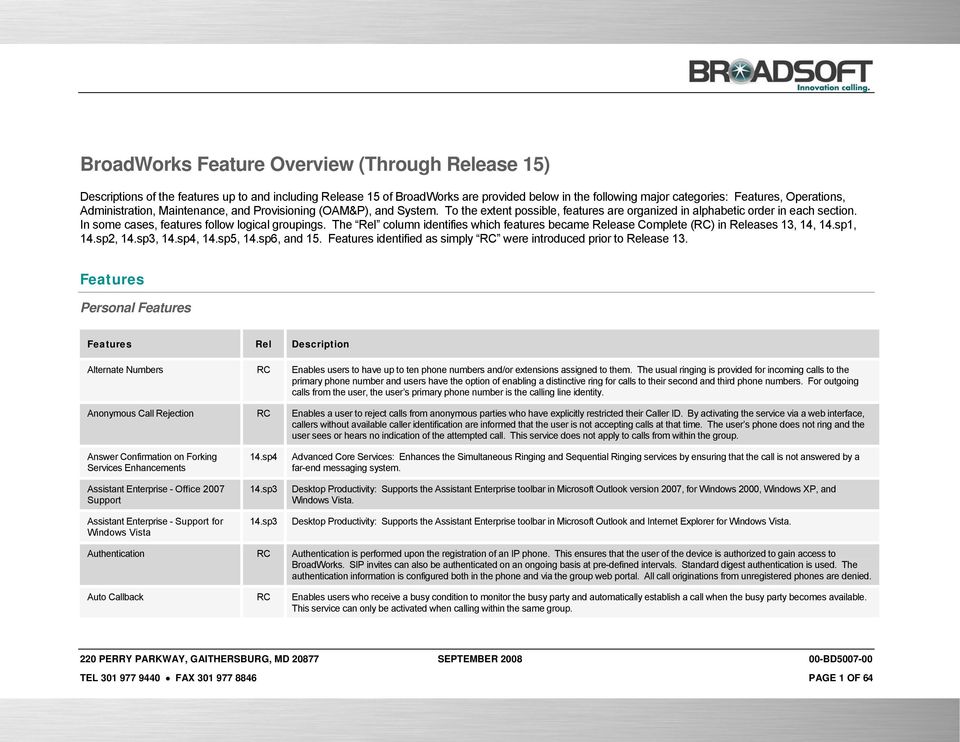
1 BroadWorks Feature Overview (Through Release 15) Descriptions of the features up to and including Release 15 of BroadWorks are provided below in the following major categories: Features, Operations, Administration, Maintenance, and Provisioning (OAM&P), and System. To the extent possible, features are organized in alphabetic order in each section. In some cases, features follow logical groupings. The Rel column identifies which features became Release Complete () in Releases 13, 14, 14.sp1, 14.sp2,, 14.sp4, 14.sp5, 14.sp6, and 15. Features identified as simply were introduced prior to Release 13. Features Personal Features Features Rel Description Alternate Numbers Enables users to have up to ten phone numbers and/or extensions assigned to them. The usual ringing is provided for incoming calls to the primary phone number and users have the option of enabling a distinctive ring for calls to their second and third phone numbers. For outgoing calls from the user, the user s primary phone number is the calling line identity. Anonymous Call Rejection Enables a user to reject calls from anonymous parties who have explicitly restricted their Caller ID. By activating the service via a web interface, callers without available caller identification are informed that the user is not accepting calls at that time. The user s phone does not ring and the user sees or hears no indication of the attempted call. This service does not apply to calls from within the group. Answer Confirmation on Forking Services Enhancements Assistant Enterprise - Office 2007 Support Assistant Enterprise - Support for Windows Vista 14.sp4 Advanced Core Services: Enhances the Simultaneous Ringing and Sequential Ringing services by ensuring that the call is not answered by a far-end messaging system. Desktop Productivity: Supports the Assistant Enterprise toolbar in Microsoft Outlook version 2007, for Windows 2000, Windows XP, and Windows Vista. Desktop Productivity: Supports the Assistant Enterprise toolbar in Microsoft Outlook and Internet Explorer for Windows Vista. Authentication Authentication is performed upon the registration of an IP phone. This ensures that the user of the device is authorized to gain access to BroadWorks. SIP invites can also be authenticated on an ongoing basis at pre-defined intervals. Standard digest authentication is used. The authentication information is configured both in the phone and via the group web portal. All call originations from unregistered phones are denied. Auto Callback Enables users who receive a busy condition to monitor the busy party and automatically establish a call when the busy party becomes available. This service can only be activated when calling within the same group. TEL FAX PAGE 1 OF 64
2 Features Rel Description Automatic Hold/Call 13 Enables users to automatically hold and retrieve incoming calls without requiring the use of feature access codes. This feature is especially useful for attendants managing a large volume of incoming calls by enabling them to hold calls by simply transferring them to dedicated parking stations. The feature is made active on that dedicated parking station. When an incoming call is directed to that station, the call is automatically put on hold and provided any media on hold. When the attendant wants to address the call, he/she simply retrieves the call from the held station. A timer exists that automatically returns the call to the attendant following expiration. This also allows for holding calls where the user customer premises equipment does not have a flash key. Barge-In Exempt Users with this service assigned cannot have their calls barged in on by other users. Blind Call Transfer Enables a user to transfer a call unattended before or after the call is answered. Users can only execute blind call transfer from the CommPilot Call Manager. BroadWorks Anywhere 14.sp4 Advanced Core Services: Facilitates the deployment of BroadWorks Anywhere in multi-vendor core networks. Busy Camp On 14.sp4 Front Office: Enhances the camp-on facility of the Receptionist client. The Busy Camp On feature is activated automatically when the transferring party transfers a call to a busy party in the group or the enterprise. Call Center - Message Waiting Indicator of ACD on Supervisor Client Call Center Client - Always on Top For Client Interface and Tabs Call Center Client - Enhanced Supervisor Team Tab Call Center Client - Keyboard Shortcuts Call Center Client - Transfer to Front and Back of Queue Call Center: Provides the Call Center Supervisor client with a message waiting indication (MWI) as well as the number of new/unread messages when a customer leaves a voice message. Call Center: Allows Call Center clients to enable the client or the presence of floating tabs on the user s desktop. Call Center: Allows supervisors to sort the Supervisor Team tab by campaign and view Calling Line ID (CLID) for an agent s active calls. The feature also provides supervisor status. Call Center: Allows Call Center clients to map client features to keyboard shortcuts. Call Center: Allows agents to transfer calls to the back of the queue (primary option) or to the front of the queue (secondary option). Call Completion Busy Subscriber (CCBS)/Automatic Callback Enhancements 15 Advanced Services: Enhances the Automatic Callback (ACB) feature so that it is compliant with the MMTEL Completion of Communications to Busy Subscribers (CCBS) service. Call Forward Not Reachable 14.sp2 Allows for configuring a location (for example, a mobile) where a call should be redirected when the main device is unreachable (for example, landline). Call Forwarding Always Enables a user to redirect all incoming calls to another phone number. Users have the option to activate and deactivate the service by dialing a feature access code or configuring the service via their web interface. If activated, a user must specify the forwarding number. A status indicator on the CommPilot Call Manager identifies whether this service is enabled. TEL FAX PAGE 2 OF 64

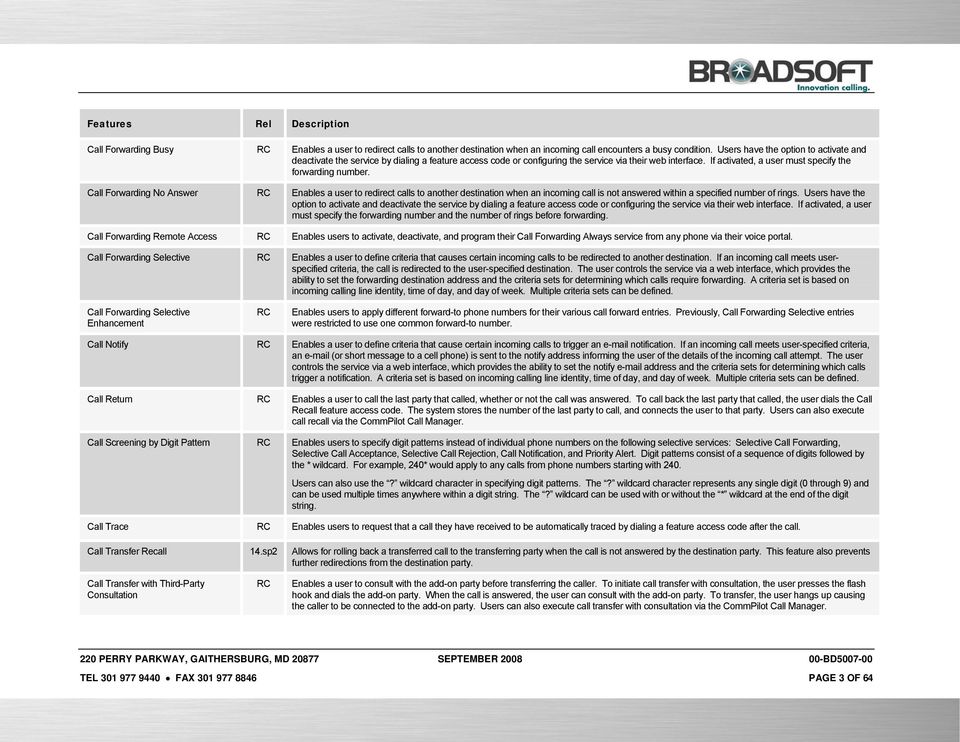
3 Features Rel Description Call Forwarding Busy Enables a user to redirect calls to another destination when an incoming call encounters a busy condition. Users have the option to activate and deactivate the service by dialing a feature access code or configuring the service via their web interface. If activated, a user must specify the forwarding number. Call Forwarding No Answer Enables a user to redirect calls to another destination when an incoming call is not answered within a specified number of rings. Users have the option to activate and deactivate the service by dialing a feature access code or configuring the service via their web interface. If activated, a user must specify the forwarding number and the number of rings before forwarding. Call Forwarding Remote Access Enables users to activate, deactivate, and program their Call Forwarding Always service from any phone via their voice portal. Call Forwarding Selective Enables a user to define criteria that causes certain incoming calls to be redirected to another destination. If an incoming call meets userspecified criteria, the call is redirected to the user-specified destination. The user controls the service via a web interface, which provides the ability to set the forwarding destination address and the criteria sets for determining which calls require forwarding. A criteria set is based on incoming calling line identity, time of day, and day of week. Multiple criteria sets can be defined. Call Forwarding Selective Enhancement Enables users to apply different forward-to phone numbers for their various call forward entries. Previously, Call Forwarding Selective entries were restricted to use one common forward-to number. Call Notify Enables a user to define criteria that cause certain incoming calls to trigger an notification. If an incoming call meets user-specified criteria, an (or short message to a cell phone) is sent to the notify address informing the user of the details of the incoming call attempt. The user controls the service via a web interface, which provides the ability to set the notify address and the criteria sets for determining which calls trigger a notification. A criteria set is based on incoming calling line identity, time of day, and day of week. Multiple criteria sets can be defined. Call Return Enables a user to call the last party that called, whether or not the call was answered. To call back the last party that called, the user dials the Call Recall feature access code. The system stores the number of the last party to call, and connects the user to that party. Users can also execute call recall via the CommPilot Call Manager. Call Screening by Digit Pattern Enables users to specify digit patterns instead of individual phone numbers on the following selective services: Selective Call Forwarding, Selective Call Acceptance, Selective Call Rejection, Call Notification, and Priority Alert. Digit patterns consist of a sequence of digits followed by the * wildcard. For example, 240* would apply to any calls from phone numbers starting with 240. Users can also use the? wildcard character in specifying digit patterns. The? wildcard character represents any single digit (0 through 9) and can be used multiple times anywhere within a digit string. The? wildcard can be used with or without the * wildcard at the end of the digit string. Call Trace Enables users to request that a call they have received to be automatically traced by dialing a feature access code after the call. Call Transfer Recall 14.sp2 Allows for rolling back a transferred call to the transferring party when the call is not answered by the destination party. This feature also prevents further redirections from the destination party. Call Transfer with Third-Party Consultation Enables a user to consult with the add-on party before transferring the caller. To initiate call transfer with consultation, the user presses the flash hook and dials the add-on party. When the call is answered, the user can consult with the add-on party. To transfer, the user hangs up causing the caller to be connected to the add-on party. Users can also execute call transfer with consultation via the CommPilot Call Manager. TEL FAX PAGE 3 OF 64
4 Features Rel Description Call Transfer with Three-Way Consultation Enables a user to make a three-way call with the caller and add-on party before transferring the caller. To initiate call transfer with three-way consultation, the user presses the flash hook and dials the add-on party. When the call is answered, the user presses the flash hook and forms a three-way call with the add-on party and caller. To transfer, the user hangs up, causing the caller to be connected to the add-on party. Users can also execute call transfer with three-way consultation via the CommPilot Call Manager. Call Waiting Enables a user to answer a call while already engaged in another call. When a second call is received while a user is engaged in a call, the user is informed via a call waiting tone. To answer the waiting call, the user presses the flash hook. The user connects with the waiting party and holds the original party. By pressing the flash hook, the user reconnects to the original party and holds the waiting party. The feature completes when any party hangs up. Users can also execute call waiting via the CommPilot Call Manager. Users can activate/deactivate the Call Waiting service for all incoming calls via their web interface. Users also have the option of canceling their Call Waiting on a per-call basis by dialing the respective feature access code for Cancel Call Waiting per Call before making the call, or after a switch-hook flash during the call. Once the call is over, Calling Waiting is restored. Call Waiting Enhancement Enables a service provider to control whether or not Call Waiting is assigned to a user, rather than being a default capability. Thus, the service provider has the option to charge for this service. Calling Line ID Blocking Enables a user to block delivery of his/her identity to the called party. The user controls the service via a web interface, which provides the ability to activate and deactivate the service. If activated, all calls made by the user have the user s identity blocked. If this service is activated, users can still choose to allow the delivery of their Calling Line ID on a specific call by entering the respective feature access code (*65 is the default) for Calling Line ID Delivery per Call. Once the call is over, Calling Line ID Blocking is restored. Calling Line ID Blocking Override Enables users with this service assigned to always receive the calling line ID if available, regardless of whether or not it is blocked by the calling party. For example, this capability could be used by law enforcement agencies in certain countries. Calling Line ID Blocking per Call Enables users to block their outgoing caller ID on a per-call basis by dialing a feature access code before making the call. Calling Line ID Delivery Enables the delivery of a caller s identity to a user via the CommPilot Call Manager and phone (if capable). Delivered information includes the caller s phone number and name. The information is delivered to the web interface and the phone (if capable) only if the information is available and has not been blocked by the caller. Calling Line ID Delivery Enhancement Enables a service provider to control whether or not the two services below are assigned to a user, rather than being a default capability. Once this service is assigned, users have the ability to enable or disable the service. Internal Calling Line ID Delivery External Calling Line ID Delivery Calling Name Delivery Provides the calling name for incoming calls by querying an external database for the information if it is not received in the call set-up messaging. Although the BroadWorks standard Calling Line ID Delivery provides the calling number and name for all calls within BroadWorks, calling name information is typically not passed with calls received from external parties (for example, PSTN-originated calls). Clear Call History 14.sp2 Improves the user experience by allowing them to delete all their call histories. TEL FAX PAGE 4 OF 64

5 Features Rel Description Client Support for User Managed Privacy Service Front Office: Allows users of this service to limit the display of their name, status, or name and status in group or enterprise directories. This feature is specific to government organizations such as the police where special undercover agents are not displayed in the directories. A special privacy icon appears in the Receptionist contact directory in this situation indicating that the user does not wish to display their Busy Lamp Field (BLF) status. CommPilot Call Manager Provides a web-based tool for users to invoke their services, as an alternative to using feature access codes or pressing the flash hook. The following features are included with the CommPilot Call Manager: Click-to-Dial enables a user to enter and dial a number, dial directly from a drop-down Phone List (Personal, Group or Call Log) or Outlook tab, or click the Redial button. Answer Call enables a user who is already engaged in a call to answer another waiting call. When available, the calling line ID is displayed with the caller s name and number. Call Hold/Retrieve enables a user to place an existing call on hold for an extended period of time, and then retrieve the call to resume conversation. While the calling party is held, the user can choose to make a consultation call to another party. Call Transfer enables user to redirect a ringing, active, or held call to another number or directly to voice mail. Before transferring the caller, the user can choose to consult with the third party first or establish a three-way consultation. Conference enables a user to establish a three-way call involving two other parties. Release Call enables a user to disconnect a call that has been answered. Configure Services buttons are provided to enable a user to turn on or off frequently used services such as Call Forwarding Always and Do Not Disturb. Alternatively, if CommPilot Express has been configured, the user can change their CommPilot Express status (for example, Available, Busy, or Unavailable) by choosing from a drop-down list. CommPilot Express Enables users to pre-configure multiple profiles for managing incoming calls differently based on the user s status: Available In the Office Available Out of the Office Busy Unavailable Each profile includes preferences for managing the relevant incoming call functions, for example, Call Forwarding (Busy, No Answer, Always, and Selective), Voice Messaging, Simultaneous Ringing, and Call Notify, which can be configured through a single easy-to-use web page. Users can also select their active profile via their CommPilot Call Manager, and/or an IVR menu. If a user elects to use CommPilot Express, it takes preference over all other service settings associated with processing incoming calls. CommPilot Personal Web portal that allows end users to activate and customize services. Configurable Time Format 14 Allows the web portal to display time values using either a 24-hour or 12-hour clock, depending on the locale setting saved for the user s account. Connected Line Presentation (COLP)/Connected Line Restriction ISDN Migration: Provides BroadWorks users with connected line information for the calling party. The called party can also block the delivery of the connected line on a per-call or permanent basis. TEL FAX PAGE 5 OF 64

6 Features Rel Description (COLR) Consultation Hold Enables a user to put the caller on hold, and make a consultation call to another party. To initiate consultation hold, the user presses the flash hook and dials the add-on party. When the call is answered, the user can consult with the add-on party. To drop the add-on party and reconnect to the original party, the user presses the flash hook twice. Users can also execute consultation hold from the CommPilot Call Manager. Custom Ringback 13 Enables a user to specify custom audio media files such as music or corporate greetings for ringback tones versus a standard system ring tone. Users can specify multiple profiles where each profile is associated with a set of incoming call criteria (that is, phone numbers, time of day, and so on) and a custom media file. If criteria are not met, then the group s custom media file is used. If the group service is not provisioned or configured, the system ringback is provided. This feature is also called color ringback in certain markets. Customer Ringback - Video 13 Enables a user to specify custom audio and video media files for ringback tones versus a standard system ring tone. Users can specify multiple profiles where each profile is associated with a set of incoming call criteria (that is, phone numbers, time of day, and so on) and a custom media (audio and video) file. If criteria are not met, then the group s custom media file is used. If the group service is not provisioned or configured, the system ringback is provided. If the caller does not have a video client or video phone, only the audio media file is played. Device Feature Key Synchronization 14.sp2 Allows users to activate BroadWorks services (for example, Do Not Disturb and Call Forwarding Always) by using device feature keys rather than using the web portal. Direct Inward/Outward Dialing Users are assigned a ten-digit directory number that can be used to place or receive calls directly to this phone, without forcing access via a central number. Incoming and outgoing calls can be placed/received via the phone or the CommPilot Call Manager (except an initial incoming call, for which the phone must be taken off hook). Directed Call Pickup Enables a user to answer a call directed to another phone in their group by dialing the respective feature access code followed by the extension of the ringing phone. Directed Call Pick-Up with Barge-In In addition to the ability to pick up a call directed to another user in the same customer group, this version of the Directed Call Pick-Up service (listed below under group services) also enables the user to barge-in on the call if already answered, thereby creating a three-way call. Administrators can configure whether or not a warning tone is played when a barge-in occurs. Distinct Call Waiting Ringback 14 Enhances the Call Waiting service to provide a distinctive ringback to the caller when the called party is busy and alerted with a call waiting tone. Different ringback audio files can be used depending on the country code of the called party. This is configured through a system-level parameter. Distinctive Alert/Ringing Provides a different call waiting tone (that is, alert) or a different ringing cadence for intra-group calls versus calls received from outside of the group. This service is provisioned as part of the Priority Alert/Ringing service, so users must choose to enable either Distinctive Alert/Ringing or Priority Alert/Ringing (different tone/ring for user-specified phone numbers) at any given time. Distinctive Alert/Ringing Enhancement This service is enhanced to also recognize calls from another group within the same multi-group enterprise as internal calls. Diversion Inhibitor 13 Provides the option to prevent calls that are redirected by a user to be redirected again by the called party to their voice mail. It is especially useful for service such as Simultaneous Ring and Sequential Ring. If Simultaneous Ring is engaged, and one of the lines has voice mail pickup set for two rings, this feature continues to ring all the lines past the two rings and not transfer the call to voice mail. TEL FAX PAGE 6 OF 64

7 Features Rel Description Do Not Disturb Allows users to set their station as unavailable so that incoming calls are given a busy treatment. Users have the option to activate and deactivate the service by dialing a feature access code or configuring the service via their web interface. A status indicator on the CommPilot Call Manager identifies whether this service is enabled. Enhanced Privacy on Hold 13 Enables users to designate a held call as privately held. A privately held call cannot be retrieved from another station. In Shared Call Appearance applications that require several steps to transfer a call, this feature keeps others in a common call group from retrieving the held call. ETSI FAC Support 14 Introduces additional feature access codes on BroadWorks to meet ETSI specifications, providing increased transparency in countries where these feature access codes are being used (for example, France). New feature access codes are introduced for sending callers to voice mail, setting the number of rings required for no-answer handling, changing the default Calling Line ID Blocking and Call Waiting settings, and accessing the voice portal. Expensive Call Notification 14.sp4 Advanced Core Services: Allows callers to choose whether or not to proceed with calls identified in the system as being expensive. Extension Dialing Enables users to dial extensions via their CommPilot Call Manager or phone to call other members of their business group. Flash Call Hold Enables users to hold a call for any length of time by flashing the switch-hook on their phone and dialing the respective feature access code. Parties are reconnected again when the switch-hook is flashed and the feature access code is dialed again. H.264 Video Support 14 Extends the Video Add-On feature to include support for the H.264 video codec. Hoteling Companies often reserve a set of cubicles and phones for mobile workers who come into the office from time to time. Hoteling enables mobile users to share office space and phones on an as-needed basis, like a hotel room. The Hoteling service supports this activity by enabling users with guest privileges to log in to a host account via their web portal or voice portal. This enables the employee to use the host phone to make and receive their calls as usual, while retaining their own BroadWorks user profile. Hoteling Guest Provisioning Enhancements 14.sp2 Enhances Hoteling Guest behavior by providing additional essential information while provisioning the feature. Hoteling Timer Enhancement 14.sp4 Advanced Core Services: Enhances the Hoteling Host and Hoteling Guest services by making the disassociation timer configurable (enabled with or without a time limit or disabled). IP Phone Support SIP-based IP phones are supported by BroadWorks, in addition to basic analog phones or soft clients. Users with IP phones and the CommPilot Call Manager can use either means of managing their calls in real time (for example, call hold, conference). Last Number Redial Enables users to redial the last number they called by clicking the Redial button on their CommPilot Call Manager or by dialing a feature access code (for example, *66). LDAP Directory Integration Enables users to access contact names and phone numbers from an external lightweight directory access protocol (LDAP) directory using an additional tab on their CommPilot Call Manager. The LDAP tab enables users to click-to-dial a contact and perform searches by contact name. This service can be integrated with an enterprise s own private directory or a public directory provided by the service provider. Multi-Path Forwarding Enables a user to have more than one forwarded call active at a time. There are no limitations on the number of simultaneous calls a user can forward. Calls are specified for forwarding via the web portal interface. TEL FAX PAGE 7 OF 64

8 Features Rel Description MWI Synchronization Enhancements 14.sp1 Restores the message waiting indicator (MWI) status of a device following a reboot. N-Way Calling 14 Allows users to add any number of other parties to a call, up to a maximum number configurable at the system level (maximum 15, including the originator). This is similar to the Three-Way Calling feature. Outlook Integration This service enables users to integrate their personal contacts in Microsoft Outlook with their CommPilot Call Manager. Using the Outlook Contacts tab in the Call Manager, users can perform a search of their personal Outlook contacts by name or company. Once the desired contact is located, users can click-to-dial one of the contact s phone numbers or the user can choose to display the contact s v-card by clicking their name. When receiving a call, the user s Microsoft Outlook contact database is searched for a match of the caller s phone number. If a number is matched, the user is given the option of clicking the icon next to the incoming calling name in their Call Manager window to open the caller s v-card. Users can also choose to have new Outlook journal entries automatically opened for incoming and/or outgoing calls. Personalized Name Recording Enables users to record their name to be played back to incoming callers in conjunction with multiple services, including Voice Messaging and Auto Attendant. A.wav file is recorded and uploaded via a phone and respective CommPilot Personal web page. Phone List Call Log The Call Log enables users to view and dial from the following lists of stored numbers: missed, received, and dialed. The call log is accessed through the CommPilot Call Manager and includes the most recent numbers registered for each category, as well as the respective call times and dates. Phone List Group This phone list enables users to dial any other member of their business group by selecting from a list of names on their CommPilot Call Manager. The list also serves as a searchable company directory, listing names, numbers, and addresses. Each user added to the group is automatically added to this list. Also included are the extensions for reaching the Auto Attendant(s), Hunt Group(s), and the voice portal, when applicable. Group administrators can add additional phone numbers to the Group Phone List by either adding them individually via their web portal or by importing them from a file. Phone List Personal Enables users to dial frequently called numbers by selecting from a searchable list of names on their CommPilot Call Manager. Each user can add, delete, edit, and re-order numbers in their Personal Phone List, which serves as a personal speed dial list. Users can add multiple numbers to this list by uploading them from a flat file. Polycom Phone Services Phone Directory Integration 14.sp6 Device Management: This feature adds a new user service to BroadWorks called Polycom Phone Services. When assigned and configured, it introduces a set of services that integrates BroadWorks services with features and capabilities on the Polycom family of phones. Specifically, it introduces the concept of a Polycom Phone Directory, which allows an end user to add, delete, and synchronize a set of contacts onto their Polycom phone. This feature will continue to be enhanced in future releases of BroadWorks to support additional levels of integration and personalization with Polycom phones. Printable Group Directory Enables users to view and print a directory listing of all the business group members and their respective contact information (for example, extension, mobile phone number, address). The information is displayed in one of two formats: summary or detailed. The Group Directory is accessible from the CommPilot group portal or via each user s CommPilot Call Manager. TEL FAX PAGE 8 OF 64

9 Features Rel Description Priority Alert/Ringing Enables a user to define criteria to have certain incoming calls trigger a different call waiting tone (that is, alert) or a different ringing cadence than normal calls. The user sets the criteria (for example, incoming calling number, time of day and day of week) for determining which calls require priority notification via their CommPilot Personal web interface. Multiple criteria sets, or profiles, can be defined. Privacy Service 14 Allows users to exclude themselves from the group and directory listings visible to other users. Push to Talk (Intercom) Enables user-to-user intercom service across an enterprise. When a user dials the respective feature access code followed by the called party s extension, the system requests that the called station answer automatically. Users and administrators can define accept and reject lists, which can include wildcards. Remote Office Enables users to access and use their BroadWorks service from any end point, on-net or off-net (for example, home office, mobile phone). This service is especially useful for teleworkers and mobile workers, as it enables them to use all of their CommPilot features while working remotely (for example, extension dialing, transfers, conference calls, Outlook integration, directories, and so on). In addition, since calls are still originated from BroadWorks, the service provides an easy mechanism for separating personal and business phone expenses, as well as keeping alternate phone numbers private. This service must be set up by the group administrator. Residential Call Restrictions 13 Enables an administrator to specify the maximum call time in minutes for answered (and unanswered) calls. Maximum call time can be specified on a system, service provider/enterprise, group, and user basis. If an answered call exceeds the maximum call time allowed, then the call is released by the system. This helps to prevent fraud and also provides a mechanism to cut off calls that have accidentally been left off-hook. Residential Voice Portal 13 Enables providers to set up a new level of voice portal than spans all groups in a service provider without requiring a public phone number for each group voice portal. In addition, a user can be configured to use the service provider voice portal or the group voice portal. If a carrier is using the service provider voice portal, a user is assigned a service provider voice mail box, which is unique for the service provider. Ring Splash Enables users to have a short ring burst played on their phone when the following services are triggered: Call Forwarding Always, Call Forwarding Selective, and Do Not Disturb. Ring Splash can be enabled for each of these services individually and serves as a reminder that the respective service is active. SCA Call Location and SCA Call Retrieve 14.sp2 Allows for migrating (retrieving) an active call from one Shared Call Appearance (SCA) location (for example, a mobile) to another (for example, landline). Selective Call Acceptance Enables a user to define criteria that causes certain incoming calls to be allowed. If an incoming call meets user-specified criteria, the call is allowed to complete to the user. All other calls are blocked and the caller is informed that the user does not wish to receive the call. The user controls the service via a web interface, which provides the ability to establish the criteria sets for determining which calls are allowed to complete. A criteria set is based on incoming calling line identity, time of day, and day of week. Multiple criteria sets can be defined. Selective Call Rejection Enables a user to define criteria that cause certain incoming calls to be blocked. If an incoming call meets user-specified criteria, the call is blocked and the caller is informed that the user is not accepting calls. The user controls the service via a web interface, which provides the ability to establish the criteria sets for determining which calls require blocking. A criteria set is based on incoming calling line identity, time of day, and day of week. Multiple criteria sets can be defined. Selective Services Enhancements 13 Enables users to specify call treatments based on the added criteria of a private or unavailable incoming calls. TEL FAX PAGE 9 OF 64

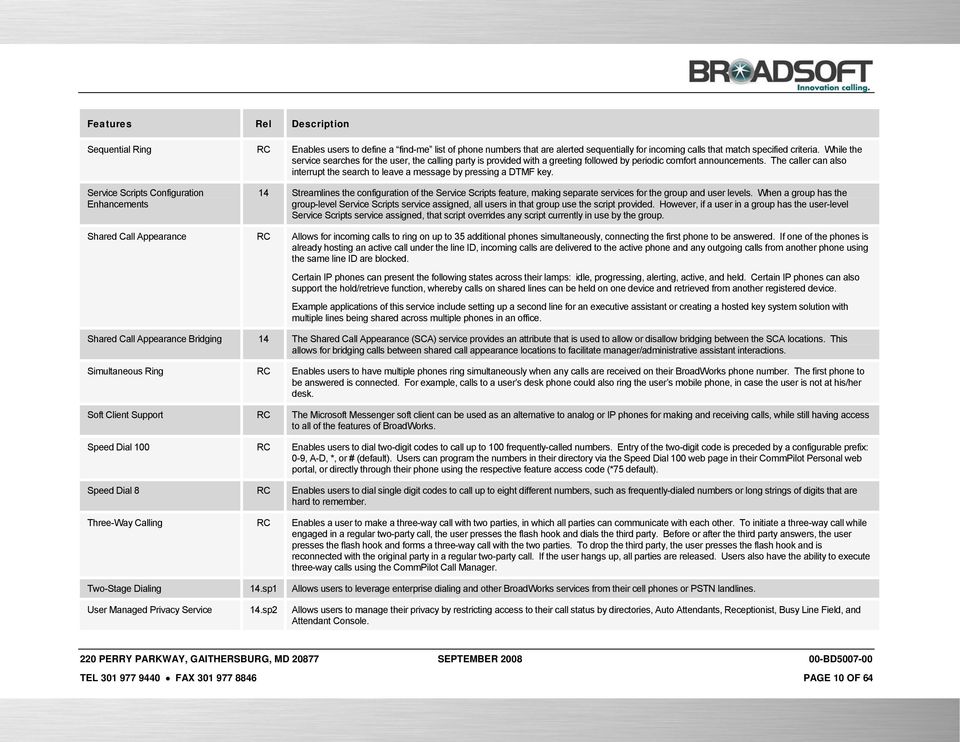
10 Features Rel Description Sequential Ring Enables users to define a find-me list of phone numbers that are alerted sequentially for incoming calls that match specified criteria. While the service searches for the user, the calling party is provided with a greeting followed by periodic comfort announcements. The caller can also interrupt the search to leave a message by pressing a DTMF key. Service Scripts Configuration Enhancements 14 Streamlines the configuration of the Service Scripts feature, making separate services for the group and user levels. When a group has the group-level Service Scripts service assigned, all users in that group use the script provided. However, if a user in a group has the user-level Service Scripts service assigned, that script overrides any script currently in use by the group. Shared Call Appearance Allows for incoming calls to ring on up to 35 additional phones simultaneously, connecting the first phone to be answered. If one of the phones is already hosting an active call under the line ID, incoming calls are delivered to the active phone and any outgoing calls from another phone using the same line ID are blocked. Certain IP phones can present the following states across their lamps: idle, progressing, alerting, active, and held. Certain IP phones can also support the hold/retrieve function, whereby calls on shared lines can be held on one device and retrieved from another registered device. Example applications of this service include setting up a second line for an executive assistant or creating a hosted key system solution with multiple lines being shared across multiple phones in an office. Shared Call Appearance Bridging 14 The Shared Call Appearance (SCA) service provides an attribute that is used to allow or disallow bridging between the SCA locations. This allows for bridging calls between shared call appearance locations to facilitate manager/administrative assistant interactions. Simultaneous Ring Enables users to have multiple phones ring simultaneously when any calls are received on their BroadWorks phone number. The first phone to be answered is connected. For example, calls to a user s desk phone could also ring the user s mobile phone, in case the user is not at his/her desk. Soft Client Support The Microsoft Messenger soft client can be used as an alternative to analog or IP phones for making and receiving calls, while still having access to all of the features of BroadWorks. Speed Dial 100 Enables users to dial two-digit codes to call up to 100 frequently-called numbers. Entry of the two-digit code is preceded by a configurable prefix: 0-9, A-D, *, or # (default). Users can program the numbers in their directory via the Speed Dial 100 web page in their CommPilot Personal web portal, or directly through their phone using the respective feature access code (*75 default). Speed Dial 8 Enables users to dial single digit codes to call up to eight different numbers, such as frequently-dialed numbers or long strings of digits that are hard to remember. Three-Way Calling Enables a user to make a three-way call with two parties, in which all parties can communicate with each other. To initiate a three-way call while engaged in a regular two-party call, the user presses the flash hook and dials the third party. Before or after the third party answers, the user presses the flash hook and forms a three-way call with the two parties. To drop the third party, the user presses the flash hook and is reconnected with the original party in a regular two-party call. If the user hangs up, all parties are released. Users also have the ability to execute three-way calls using the CommPilot Call Manager. Two-Stage Dialing 14.sp1 Allows users to leverage enterprise dialing and other BroadWorks services from their cell phones or PSTN landlines. User Managed Privacy Service 14.sp2 Allows users to manage their privacy by restricting access to their call status by directories, Auto Attendants, Receptionist, Busy Line Field, and Attendant Console. TEL FAX PAGE 10 OF 64
11 Features Rel Description Vertical Service Code (VSC) *77 and *87 for Anonymous Call Rejection (ACR) to Indicate Blocking of Caller ID 14.sp6 Business Telephony: This feature adds Vertical Service Code (also known as Feature Access Code, or FAC) support for Anonymous Call Rejection (ACR) service. A user subscribed to Anonymous Call Rejection service can activate or deactivate the service using FACs. The two new FACs are configurable on a per-group basis, with the system defaults being *77 for Anonymous Call Rejection activation and *87 for Anonymous Call Rejection deactivation. To activate Anonymous Call Rejection, the user dials the activation FAC. The Application Server then plays an announcement to inform the user that the Anonymous Call Rejection service has been successfully activated. If the Anonymous Call Rejection service was already active, the user still receives the announcement. To deactivate Anonymous Call Rejection, the user dials the deactivation FAC. The Application Server then plays an announcement to inform the user that the Anonymous Call Rejection service has been successfully deactivated, even if the Anonymous Call Rejection service was never activated in the first place. Video Add-On Enables the use of video media in conjunction with regular audio media. If a user s primary device does not support video, this service can be used to configure a video-capable device to deliver the video portion of their call. BroadWorks splits the multimedia call, directing the audio portion to the primary device and the video portion to the video add-on device. All services continue to operate as they would for a regular audio call. Voice Portal Calling Enables users to make calls from the voice portal, as if making calls from their desk. Calls are still made on the user s account but can be made from any phone. Web Portal Call Logs A page in the CommPilot Personal Portal provides users with call logs for received, missed, and placed calls. This service is deployed in conjunction with the BroadWorks Call Detail Server. Wireless and Residential Dialing 13 Enables an administrator to force all calls to query the Network Server on a system, service provider/enterprise, or group basis. With this feature engaged, all calls from a group are directed to the Network Server (usually, only inter-group calls query the Network Server). Furthermore, to support residential and enterprise users on the same system, it is important to be able to designate groups to have calling line identity restrictions enabled or disabled. For enterprise groups, they should be disabled (default) and for residential groups, they should be enabled. This feature allows an administrator to specify if calling line identity restrictions are enabled or disabled for a group on a system, service provider/enterprise, or group basis. When incoming calls are received, this feature is checked to determine if calling line identity restrictions are enforced or not. All of the configuration parameters are provided in a hierarchical manner. There are identical parameters at the system, service provider/enterprise, group and user (if applicable) layers. The user has the highest precedence, and the system has the lowest precedence. On a per-call basis, the system selects the parameter to use based on the precedence. Thus, the user parameter is used if it is configured, otherwise the group parameter is used if it is configured, otherwise the service provider/enterprise parameter is used if it is configured, and lastly the system parameter is used if all other layers are not configured. TEL FAX PAGE 11 OF 64

12 Group Features Features Rel Description Account Codes Enables the tracking of calls made to outside of the group by prompting users for an account code. This service does not validate the codes entered (see Authorization Codes), so calls are not blocked. Account codes are managed by the group administrator and can be two to 14 digits long. Note that groups cannot have this service and the Authorization Codes service enabled at the same time. Account Codes can also be implemented on a per-call basis in which users have the option to enter an account code by dialing a feature access code before the call, or by flashing the switch-hook during a call and then dialing the feature access code (for example, to register an incoming call from a client). Attendant Console The web-based Attendant Console enables a user (for example, receptionist) to monitor a configurable set of users within their business group. The Attendant Console window is also integrated with the CommPilot Call Manager, thereby enabling the attendant to perform functions such as click-to-transfer or click-to-dial. The Attendant Console graphically displays users status (busy, idle, or do not disturb), as well as detailed call information. A variety of options are provided for managing the display, including: sort list of monitored users by name, department or title; filter user list by these categories; enter multiple letters of name to be displayed via automatic scrolling; select which column should appear, and in which order (for example, name, title, department, number, extension, mobile, pager, status, ); and option to view duration of monitored users calls, as well as name and number of parties they are talking to. Authorization Codes Performs an authorization of calls made outside of the group by prompting users for an authorization code. Calls are not connected unless a valid code is entered. Authorization codes are managed by the group administrator and can be of two to 14 digits in length. Note that groups cannot have this service and the Account Codes service enabled at the same time. Auto Attendant The Auto Attendant serves as an automated receptionist that answers the phone and provides a personalized message to callers with options for connecting to the operator, dialing by name or extension, or connecting to up to nine configurable extensions (for example, 1 = Marketing, 2 = Sales, and so on). Configuration via the CommPilot group web interface also allows for hours of operation to be modified, with different options available for hours that the company is open or closed. Group administrators use their voice portal to record auto attendant greetings. For example, a message can be left remotely to indicate that the office has been closed due to inclement weather. In addition, users have the ability to record their name for playback when a caller dials by name or extension. A group can have multiple Auto Attendants configured, either individually (for example, customer service with separate business hours) or integrated into a multi-level Auto Attendant (for example, enterprise s main Auto Attendant is configured to seamlessly route to the Auto Attendant of a particular department or location). Auto Attendant Enhancements The following enhancements have been added to the Auto Attendant service: Immediate Extension Dialing enables callers to dial an extension through the first level of the Auto Attendant without having to first select the extension dialing option Dial by First Name name dialing is enhanced to consider both the first and last name, instead of only the last name Holiday Schedule enables administrators to set the after-hours menu for selected dates (for example, recurring holidays) Business Hours Support enhancement enables administrator to set different business hours for different days of the week TEL FAX PAGE 12 OF 64

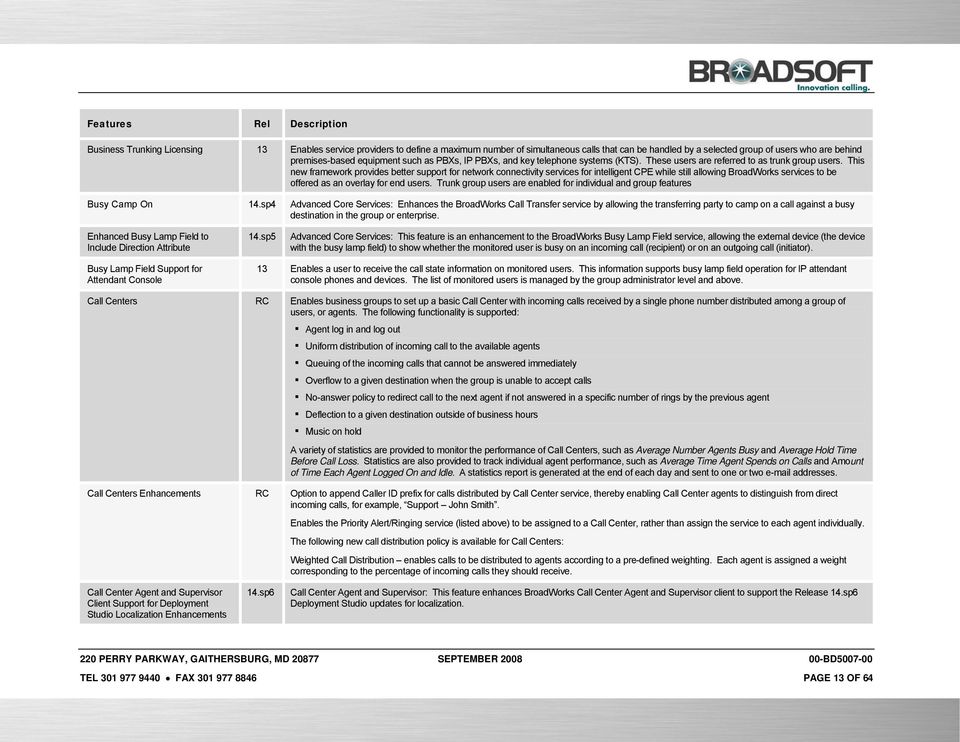
13 Features Rel Description Business Trunking Licensing 13 Enables service providers to define a maximum number of simultaneous calls that can be handled by a selected group of users who are behind premises-based equipment such as PBXs, IP PBXs, and key telephone systems (KTS). These users are referred to as trunk group users. This new framework provides better support for network connectivity services for intelligent CPE while still allowing BroadWorks services to be offered as an overlay for end users. Trunk group users are enabled for individual and group features Busy Camp On 14.sp4 Advanced Core Services: Enhances the BroadWorks Call Transfer service by allowing the transferring party to camp on a call against a busy destination in the group or enterprise. Enhanced Busy Lamp Field to Include Direction Attribute 14.sp5 Advanced Core Services: This feature is an enhancement to the BroadWorks Busy Lamp Field service, allowing the external device (the device with the busy lamp field) to show whether the monitored user is busy on an incoming call (recipient) or on an outgoing call (initiator). Busy Lamp Field Support for Attendant Console 13 Enables a user to receive the call state information on monitored users. This information supports busy lamp field operation for IP attendant console phones and devices. The list of monitored users is managed by the group administrator level and above. Call Centers Enables business groups to set up a basic Call Center with incoming calls received by a single phone number distributed among a group of users, or agents. The following functionality is supported: Agent log in and log out Uniform distribution of incoming call to the available agents Queuing of the incoming calls that cannot be answered immediately Overflow to a given destination when the group is unable to accept calls No-answer policy to redirect call to the next agent if not answered in a specific number of rings by the previous agent Deflection to a given destination outside of business hours Music on hold A variety of statistics are provided to monitor the performance of Call Centers, such as Average Number Agents Busy and Average Hold Time Before Call Loss. Statistics are also provided to track individual agent performance, such as Average Time Agent Spends on Calls and Amount of Time Each Agent Logged On and Idle. A statistics report is generated at the end of each day and sent to one or two addresses. Call Centers Enhancements Option to append Caller ID prefix for calls distributed by Call Center service, thereby enabling Call Center agents to distinguish from direct incoming calls, for example, Support John Smith. Enables the Priority Alert/Ringing service (listed above) to be assigned to a Call Center, rather than assign the service to each agent individually. The following new call distribution policy is available for Call Centers: Weighted Call Distribution enables calls to be distributed to agents according to a pre-defined weighting. Each agent is assigned a weight corresponding to the percentage of incoming calls they should receive. Call Center Agent and Supervisor Client Support for Deployment Studio Localization Enhancements 14.sp6 Call Center Agent and Supervisor: This feature enhances BroadWorks Call Center Agent and Supervisor client to support the Release 14.sp6 Deployment Studio updates for localization. TEL FAX PAGE 13 OF 64
14 Features Rel Description Call Intercept Enables group administrators to intercept calls routed to a non-working internal line with informative announcements and alternate routing options. The service can be assigned to an individual user s phone number (for example, when they have left the company) or it can be assigned to all the members of the group. Call Park Enables a user to hold a call and to retrieve it from another station within the group. To park a call, a user presses the flash hook and dials the call park feature access code. The call is parked and the caller is held. To retrieve the call, the user goes to any phone in the group and dials the call retrieve feature access code, followed by the user s extension. The call is retrieved and connected to the retrieving user. Users can also execute call park via the CommPilot Call Manager. Call Park Recall Rework 15 The current implementation of Call Park Recall relies on the parking party s call to recall the parked party, relying on an implicit connection between the two. This feature changes the behavior by initiating the recall with a new call from the parked party to the original parking party, which is consistent with recall for the features Call Transfer Recall and Automatic Hold/Retrieve Recall. An additional behavior change includes allowing recall of a parked call in the held state. Call Pickup Enables a user to answer any ringing line within their pick-up group. A pick-up group is a group administrator-defined set of users within the group, to which the Call Pickup feature applies. To pick up a ringing call, a user dials the Call Pickup feature access code. The user is then connected to the caller. If more than one line in the pick-up group is ringing, the call that has been ringing the longest is answered. Users can also execute Call Pickup via a web interface. Calling Group ID Delivery Provides the name and number of the group (or company) for outgoing calls from users in the group, rather than providing the user s own name and number. The group number can be defined on a per-user basis, which is often appropriate for multi-location groups. Calling Plan Forwarded/Transferred Enables administrators to prevent specified users from forwarding or transferring calls to certain types of numbers, such as long distance, toll, or premium numbers. This capability is especially useful for preventing fraudulent calling, such as company employees calling their office number at night or on the weekend to make personal calls to international destinations. Calling plans are configured via the CommPilot group web interface. If a profile has not been configured for a particular user, the default set of incoming call privileges for the department or group is applied. Calling Plan Incoming Enables administrators to block specified incoming calls to their company, department, and/or individual users. For example, some users can be prevented from receiving calls from outside the company, or collect calls. The Incoming Calling Plan is configured via the CommPilot group web interface. In addition to being able to configure which types of calls each user is restricted from receiving (for example, intra-group), group administrators can regulate incoming calling by restricting specific digit patterns. For example, users can be prevented from receiving calls from a competitor s number or a particular area code or country code. If a profile has not been configured for a particular user, the default set of incoming call privileges for the department or group is applied. Calling Plan Incoming Enhancements Additional call types added to Incoming Calling Plan: Calls From Within Group allows calls to be received from other users within the group Restricted Calls From Within Group similar to Calls From Within Group call type, but does not allow another user from within the group to transfer or forward a call to the user TEL FAX PAGE 14 OF 64

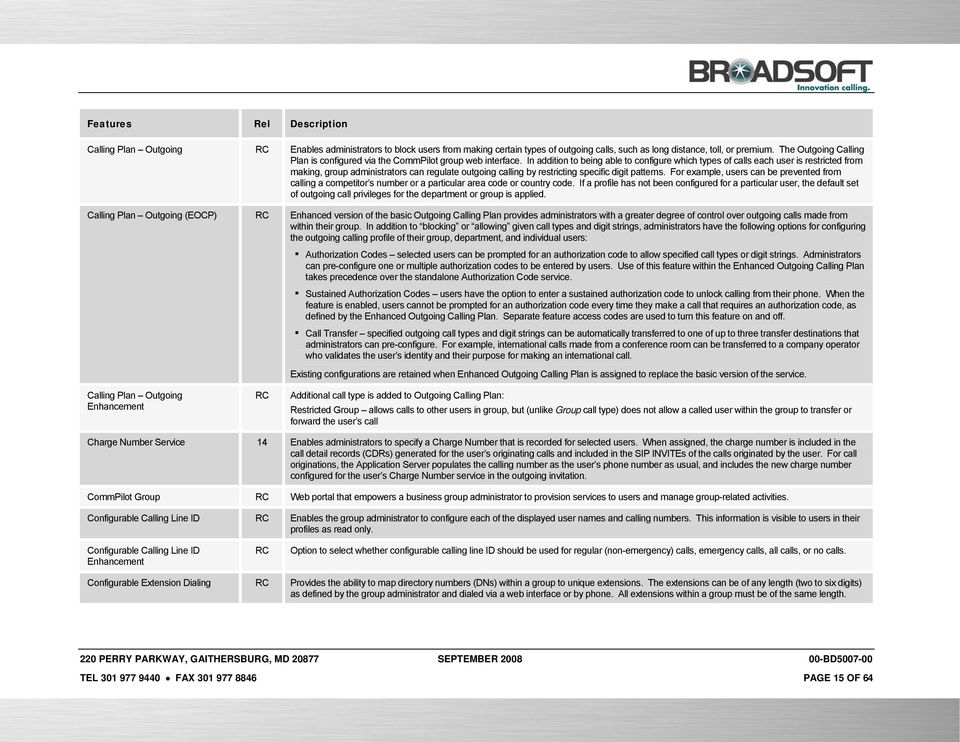
15 Features Rel Description Calling Plan Outgoing Enables administrators to block users from making certain types of outgoing calls, such as long distance, toll, or premium. The Outgoing Calling Plan is configured via the CommPilot group web interface. In addition to being able to configure which types of calls each user is restricted from making, group administrators can regulate outgoing calling by restricting specific digit patterns. For example, users can be prevented from calling a competitor s number or a particular area code or country code. If a profile has not been configured for a particular user, the default set of outgoing call privileges for the department or group is applied. Calling Plan Outgoing (EOCP) Enhanced version of the basic Outgoing Calling Plan provides administrators with a greater degree of control over outgoing calls made from within their group. In addition to blocking or allowing given call types and digit strings, administrators have the following options for configuring the outgoing calling profile of their group, department, and individual users: Authorization Codes selected users can be prompted for an authorization code to allow specified call types or digit strings. Administrators can pre-configure one or multiple authorization codes to be entered by users. Use of this feature within the Enhanced Outgoing Calling Plan takes precedence over the standalone Authorization Code service. Sustained Authorization Codes users have the option to enter a sustained authorization code to unlock calling from their phone. When the feature is enabled, users cannot be prompted for an authorization code every time they make a call that requires an authorization code, as defined by the Enhanced Outgoing Calling Plan. Separate feature access codes are used to turn this feature on and off. Call Transfer specified outgoing call types and digit strings can be automatically transferred to one of up to three transfer destinations that administrators can pre-configure. For example, international calls made from a conference room can be transferred to a company operator who validates the user s identity and their purpose for making an international call. Existing configurations are retained when Enhanced Outgoing Calling Plan is assigned to replace the basic version of the service. Calling Plan Outgoing Enhancement Additional call type is added to Outgoing Calling Plan: Restricted Group allows calls to other users in group, but (unlike Group call type) does not allow a called user within the group to transfer or forward the user s call Charge Number Service 14 Enables administrators to specify a Charge Number that is recorded for selected users. When assigned, the charge number is included in the call detail records (CDRs) generated for the user s originating calls and included in the SIP INVITEs of the calls originated by the user. For call originations, the Application Server populates the calling number as the user s phone number as usual, and includes the new charge number configured for the user s Charge Number service in the outgoing invitation. CommPilot Group Web portal that empowers a business group administrator to provision services to users and manage group-related activities. Configurable Calling Line ID Enables the group administrator to configure each of the displayed user names and calling numbers. This information is visible to users in their profiles as read only. Configurable Calling Line ID Enhancement Option to select whether configurable calling line ID should be used for regular (non-emergency) calls, emergency calls, all calls, or no calls. Configurable Extension Dialing Provides the ability to map directory numbers (DNs) within a group to unique extensions. The extensions can be of any length (two to six digits) as defined by the group administrator and dialed via a web interface or by phone. All extensions within a group must be of the same length. TEL FAX PAGE 15 OF 64
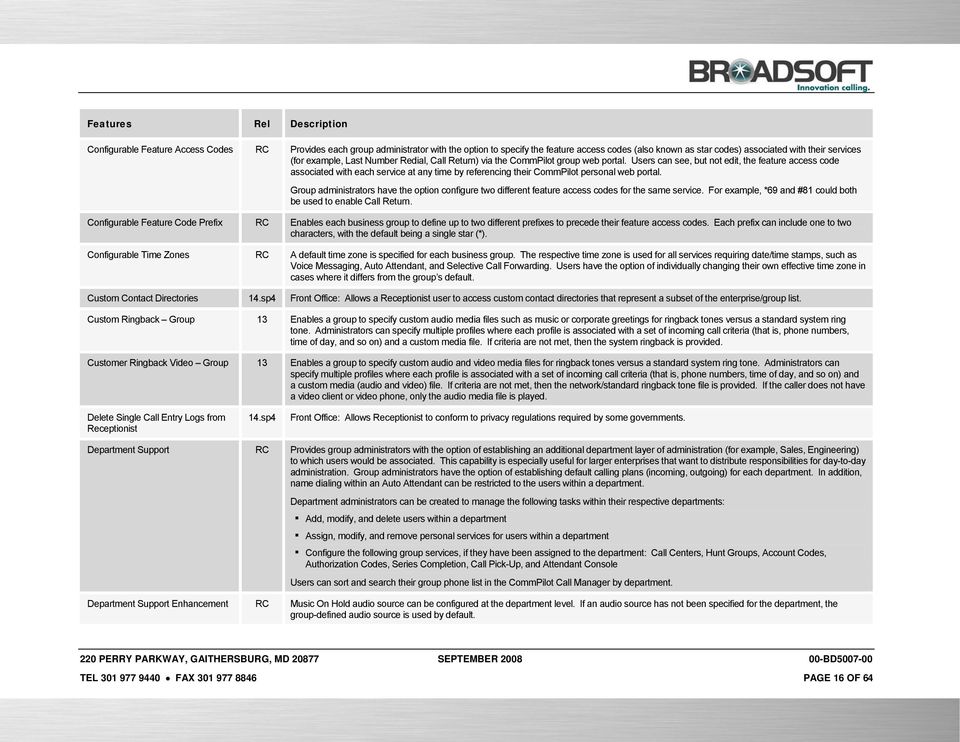
16 Features Rel Description Configurable Feature Access Codes Provides each group administrator with the option to specify the feature access codes (also known as star codes) associated with their services (for example, Last Number Redial, Call Return) via the CommPilot group web portal. Users can see, but not edit, the feature access code associated with each service at any time by referencing their CommPilot personal web portal. Group administrators have the option configure two different feature access codes for the same service. For example, *69 and #81 could both be used to enable Call Return. Configurable Feature Code Prefix Enables each business group to define up to two different prefixes to precede their feature access codes. Each prefix can include one to two characters, with the default being a single star (*). Configurable Time Zones A default time zone is specified for each business group. The respective time zone is used for all services requiring date/time stamps, such as Voice Messaging, Auto Attendant, and Selective Call Forwarding. Users have the option of individually changing their own effective time zone in cases where it differs from the group s default. Custom Contact Directories 14.sp4 Front Office: Allows a Receptionist user to access custom contact directories that represent a subset of the enterprise/group list. Custom Ringback Group 13 Enables a group to specify custom audio media files such as music or corporate greetings for ringback tones versus a standard system ring tone. Administrators can specify multiple profiles where each profile is associated with a set of incoming call criteria (that is, phone numbers, time of day, and so on) and a custom media file. If criteria are not met, then the system ringback is provided. Customer Ringback Video Group 13 Enables a group to specify custom audio and video media files for ringback tones versus a standard system ring tone. Administrators can specify multiple profiles where each profile is associated with a set of incoming call criteria (that is, phone numbers, time of day, and so on) and a custom media (audio and video) file. If criteria are not met, then the network/standard ringback tone file is provided. If the caller does not have a video client or video phone, only the audio media file is played. Delete Single Call Entry Logs from Receptionist 14.sp4 Front Office: Allows Receptionist to conform to privacy regulations required by some governments. Department Support Provides group administrators with the option of establishing an additional department layer of administration (for example, Sales, Engineering) to which users would be associated. This capability is especially useful for larger enterprises that want to distribute responsibilities for day-to-day administration. Group administrators have the option of establishing default calling plans (incoming, outgoing) for each department. In addition, name dialing within an Auto Attendant can be restricted to the users within a department. Department administrators can be created to manage the following tasks within their respective departments: Add, modify, and delete users within a department Assign, modify, and remove personal services for users within a department Configure the following group services, if they have been assigned to the department: Call Centers, Hunt Groups, Account Codes, Authorization Codes, Series Completion, Call Pick-Up, and Attendant Console Users can sort and search their group phone list in the CommPilot Call Manager by department. Department Support Enhancement Music On Hold audio source can be configured at the department level. If an audio source has not been specified for the department, the group-defined audio source is used by default. TEL FAX PAGE 16 OF 64
17 Features Rel Description Deployment Studio Localization Enhancements 14.sp6 Clients: Deployment Studio is a tool that performs customizations of several BroadWorks client applications. This feature enhances Deployment Studio to: Improve support for localization Make improvements to expose default values for settings Change the look and feel slightly Support for Vista Release 14.sp6 of Deployment Studio offers support for localization enhancements to the following client applications: Assistant Enterprise Toolbar Release 14.sp6 Receptionist Release 14.sp6 Call Center Agent/Supervisor Release 14.sp6 The Deployment Studio Image (DSI) for each supporting client supports the following pre-bundled languages: English-U.S. (Default) French German Italian Spanish (Spain) Spanish Central America and Latin America (CALA) Simplified Chinese In addition to the pre-bundled language support, the Deployment Studio Image for the supporting client application provides a custom language choice from a list of modern world languages where the network administrator must provide their own translations. Device Inventory Enables group administrators to inventory their integrated access devices (IAD), trunking gateways, and IP phones via their CommPilot group web interface. Devices can be easily added, deleted, and modified. In addition, group administrators can assign users directly to a device and/or a port on a device. The location and default aliases for a user are automatically generated. Directed Call Park Enables a user to hold a call against a specific extension and to retrieve it from another station within the group. To park a call, a user presses the flash hook and dials the directed call park feature access code followed by the extension to park against. The call is parked and the caller hears silence. To retrieve the call, the user goes to any other phone in the group and dials the call retrieve feature access code, followed by the extension to which the call was parked. The call is retrieved and connected to the retrieving user. Display Call Forwarding Always Monitoring Status in User Status Information in Receptionist 14.sp4 Front Office: Extends the states of monitored users by showing the Call Forwarding Always service state for a monitored contact. TEL FAX PAGE 17 OF 64

18 Features Rel Description Display Call Forwarding Always Monitoring Status in User Status Information in Receptionist 14.sp4 Front Office: Extends the states of monitored users by showing the Call Forwarding Always service state for a monitored contact. External Source for Music On Hold Enables enterprises to play live audio to held parties directly from an external audio source that is controlled by the enterprise and is typically located on their premises. The external audio source is comprised of a gateway with an analog audio line-in jack. A radio, CD player, or any other audio device connects into the audio line-in jack. Music from an external audio source can be used for calls that are put on hold by Call Waiting, Call Hold, or Call Park, but not calls waiting on a Call Center queue. Group Call Park 14.sp4 Front Office: Adds functionality the Call Park service for Receptionist clients. Advanced Core Services: Extends the functionality of the Call Park service. Group Resource Inventory Reporting Enables group administrators to generate reports on the resources used in their group and, if applicable, in each of their departments. Information includes phone numbers, devices, services, users, and departments. The reports are generated on a web page in the comma-separated value (CSV) format, so they can be easily imported into a spreadsheet for sorting and archiving. Hunt Groups Allows users within a group to be included in a specified sub-group to handle incoming calls received by an assigned Hunt Group s phone number. Group administrators can choose from any of the following hunt schemes, each of which rings the specified phones in a different manner: Circular sends calls in a fixed order. The call is sent to the first available person on the list, beginning where the last call left off Regular sends calls to users in the order listed by an administrator. Incoming calls go to the first available person on the list, always starting with the first person on the list Simultaneous rings all of the users in the group simultaneously; the first user to pick up the ringing phone is connected Uniform as a call is completed, the user moves to the bottom of the call queue in a shuffling fashion. The next incoming call goes to the user who has been idle the longest. If a user receives a call that was not directed to them through the Hunt Group, the call is not included in the receiving order for uniform calls Group administrators can also establish a No Answer Policy to redirect calls to the next agent if not answered in a specific number of rings by the previous agent. If all idle phones have been visited once without answer, there are two options for handling the call: forward call to an external number, or give the call a Temporarily Unavailable treatment, which can trigger a service such as voice mail. TEL FAX PAGE 18 OF 64

19 Features Rel Description Hunt Groups Enhancements Option to append caller ID prefix for calls distributed by the Hunt Group service, thereby enabling users to distinguish from direct incoming calls, for example, Support John Smith. The following services can be assigned to Hunt Groups: Priority Alert/Ringing assign service to entire Hunt Group, rather than to each individual line SMDI Message Desk send redirecting information for calls received by the Hunt Group to legacy voice mail system over an analog SMDI interface. This information (calling number, called number, redirection information) can be used by the voice mail system to redirect the calling party to the user s mailbox and provide the correct greeting The following new call distribution policy is available for Hunt Groups: Weighted Call Distribution enables calls to be distributed to agents according to a pre-defined weighting. Each agent is assigned a weight corresponding to the percentage of incoming calls they should receive Instant Group Call 13 Enables a user to call a number that provides a group of members with an instant conference bridge. When the user dials the specific group call number, the system alerts all members in the group and, as the members answer, they are joined into a multi-way conference. If the originating user uses the Push to Talk feature, then the attributes of the Push to Talk feature are used (one-way or two-way broadcast, auto-answer, access control list). This use of Push to Talk added to Instant Group Call equates to group intercom functionality. The Push to Talk or forcedoff-hook functionality is engaged are when a member receives a Push to Talk group call. An administrator defines a virtual group composed of a list of member users. These members can be part of the same group or enterprise (specified by user name, extension or location code + extension) or can be external users (specified by a phone number or SIP URI). Loudspeaker Paging Enables users to access an intercom paging system by dialing an extension within the group. The paging system is simply configured in BroadWorks as a user and interconnected via a standard two-wire interface. Multiple Call Arrangement 13 Enables a user to make and receive multiple calls simultaneously on their different shared call appearance (SCA) locations. This feature provides improved support for the manager/administrative assistant scenario by presenting incoming calls to all locations, regardless of ongoing call activity. Also, enables all end-point locations to originate a call even if another location is busy. This feature is an overlay to the Shared Call Appearance feature. Music On Hold Enables group administrators to upload an audio file (.wav file containing music, advertising, and so on) onto the system to be broadcast to held parties. This service can be used in conjunction with the following services: Call Centers, Call Hold, and Call Park. Music On Hold Dependent on whether Call is Internal or External 14.sp6 Business Telephony: This feature enhances the existing BroadWorks Music On Hold (MoH) service and Call Center Music On Hold service to allow supporting different audio sources and audio codecs for internal (intra-group or intra-enterprise) calls and external calls. The objective of this enhancement is to better manage the quality of service (QoS) and bandwidth used to provide Music On Hold to internal and external users. This is accomplished by: Allowing the system administrator to select the alternate media source and preferred codec to play back the Music On Hold service. Optionally, allowing the group administrator to select an alternate media source and codec for internal calls to play back the Music On Hold service. By default, the same Music On Hold source and audio codec are used for both internal and external calls. TEL FAX PAGE 19 OF 64

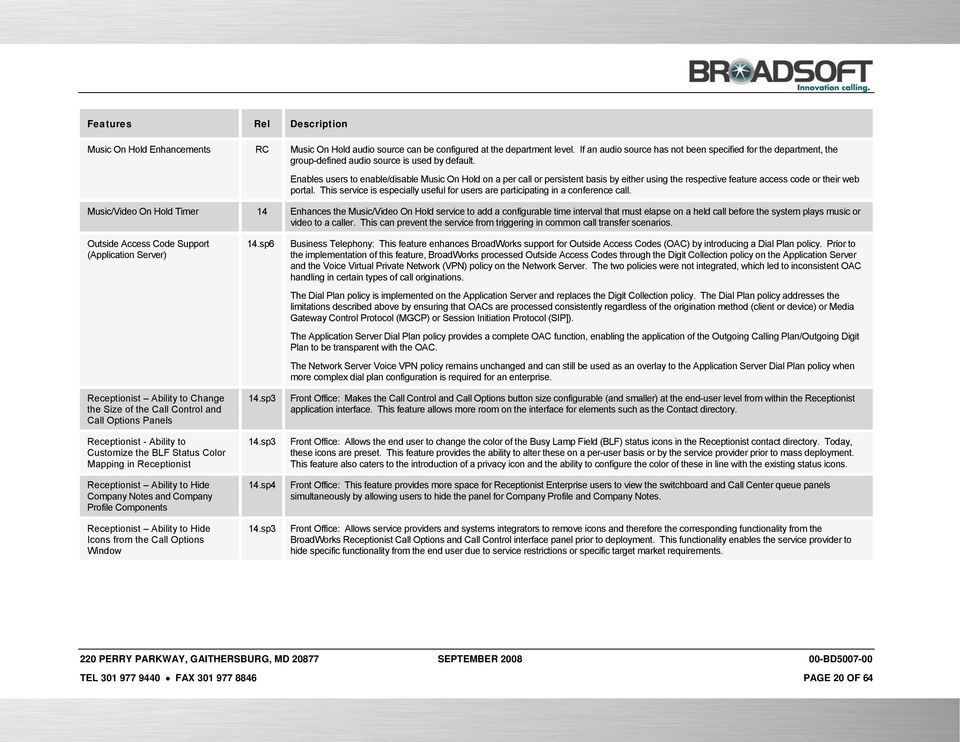
20 Features Rel Description Music On Hold Enhancements Music On Hold audio source can be configured at the department level. If an audio source has not been specified for the department, the group-defined audio source is used by default. Enables users to enable/disable Music On Hold on a per call or persistent basis by either using the respective feature access code or their web portal. This service is especially useful for users are participating in a conference call. Music/Video On Hold Timer 14 Enhances the Music/Video On Hold service to add a configurable time interval that must elapse on a held call before the system plays music or video to a caller. This can prevent the service from triggering in common call transfer scenarios. Outside Access Code Support (Application Server) Receptionist Ability to Change the Size of the Call Control and Call Options Panels Receptionist - Ability to Customize the BLF Status Color Mapping in Receptionist Receptionist Ability to Hide Company Notes and Company Profile Components Receptionist Ability to Hide Icons from the Call Options Window 14.sp6 14.sp4 Business Telephony: This feature enhances BroadWorks support for Outside Access Codes (OAC) by introducing a Dial Plan policy. Prior to the implementation of this feature, BroadWorks processed Outside Access Codes through the Digit Collection policy on the Application Server and the Voice Virtual Private Network (VPN) policy on the Network Server. The two policies were not integrated, which led to inconsistent OAC handling in certain types of call originations. The Dial Plan policy is implemented on the Application Server and replaces the Digit Collection policy. The Dial Plan policy addresses the limitations described above by ensuring that OACs are processed consistently regardless of the origination method (client or device) or Media Gateway Control Protocol (MGCP) or Session Initiation Protocol (SIP]). The Application Server Dial Plan policy provides a complete OAC function, enabling the application of the Outgoing Calling Plan/Outgoing Digit Plan to be transparent with the OAC. The Network Server Voice VPN policy remains unchanged and can still be used as an overlay to the Application Server Dial Plan policy when more complex dial plan configuration is required for an enterprise. Front Office: Makes the Call Control and Call Options button size configurable (and smaller) at the end-user level from within the Receptionist application interface. This feature allows more room on the interface for elements such as the Contact directory. Front Office: Allows the end user to change the color of the Busy Lamp Field (BLF) status icons in the Receptionist contact directory. Today, these icons are preset. This feature provides the ability to alter these on a per-user basis or by the service provider prior to mass deployment. This feature also caters to the introduction of a privacy icon and the ability to configure the color of these in line with the existing status icons. Front Office: This feature provides more space for Receptionist Enterprise users to view the switchboard and Call Center queue panels simultaneously by allowing users to hide the panel for Company Profile and Company Notes. Front Office: Allows service providers and systems integrators to remove icons and therefore the corresponding functionality from the BroadWorks Receptionist Call Options and Call Control interface panel prior to deployment. This functionality enables the service provider to hide specific functionality from the end user due to service restrictions or specific target market requirements. TEL FAX PAGE 20 OF 64
21 Features Rel Description Receptionist Accept Calls with the Space Key Receptionist Allow Blind Transfer in Conjunction with Camp On Receptionist Application Server Licenses and Lists Receptionist Automatic Linking of Any Two Calls on the Switchboard Receptionist Call Log Enhancements Receptionist Client Support for Deployment Studio Localization Enhancements Receptionist Fonts and Sizes in Receptionist Receptionist Forward Calls to Receptionist Should Display Transferred + "Weiterleitung von" Receptionist LDAP Tab in Reception Build Receptionist Outlook Integration for Receptionist 14.sp2 14.sp6 Front Office: Provides four main areas of functionality that improve the workflow so that a user can now answer a call with the space key, type the destination number, and press the Enter key to transfer the call. The ability to now accept calls with the space key. The Function keys from F1 to F10 answer the call for each respective switchboard line where F1 corresponds to the first line in the switchboard; F2 corresponds to line 2 on the switchboard and so on. The ability to use the space key as a toggle to answer the next incoming call in subsequent instances when the user presses the space key. A better customization workflow and process within Deployment Studio results in a more intuitive, dynamic selection system to make the customization process easier and simpler. The ability to transfer calls with the Enter key. Front Office: Allows the Receptionist to transfer a call to a user with Call Waiting enabled. Changes the original BroadWorks Receptionist to become BroadWorks Receptionist - Enterprise and introduces smaller scale Receptionist clients targeted at the small and medium enterprise market. Front Office: Automatically links the last incoming call with the next outgoing call when two calls are present on the Receptionist switchboard. This feature is an enhancement of an existing feature that provided the same functionality but only automatically linked the first outgoing call. This enhancement links consecutive outgoing calls if the first outgoing call is not successful. Front Office: Allows users to delete all their call history information including dialed, received, and missed calls whenever they leave their station to go on break, lunch, log in or log out, or leave for the day. This feature is intended to comply with German law and improve employee security. This feature enhances BroadWorks Receptionist client to support the Release 14.sp6 Deployment Studio updates for localization. Front Office: Allows configuration of the font size, font type, and the font color of all main interface components within the Receptionist interface. The extent of this configuration broadly incorporates the login UN and PW labels, contact directory headers, text buttons, icon labels, and panel headers. This does not include the Options dialog. Front Office: Allows the BroadWorks Receptionist to indicate when a call is transferred to the Receptionist. Today, the name and number of the transferring party as well as the transferred call is displayed to the Receptionist user. This functionality is called last redirected support. This feature clearly indicates transferred calls. The interface displays the text transferred in the Switchboard Status column for transferred calls. Front Office: Provides the configuration of the client for Lightweight Directory Access Protocol (LDAP) directories at a user level within the Receptionist application through the Options dialog as provided through the Assistant Enterprise and Call Center clients. Front Office: Allows access to the local PC Outlook directory from within the Receptionist Interface from the Contact Directory panel in the interface. TEL FAX PAGE 21 OF 64
22 Features Rel Description Receptionist 14.0 Office and SMB Clients Front Office: Provides two new versions of the Receptionist application: a small business 30-user version and an 8-user version. Revised Attendant Console 14.sp6 Provides a technical refresh of the Attendant Console end-user application. Series Completion The Series Completion service can be assigned to a selected series of lines to forward calls on a busy condition. It is a form of hunting in which the next line in the group is tried in a prearranged order, without any limit on the number of sequential forwards. This service is used to support key system functionality. Key systems typically ring all available lines in a specified order for incoming calls, regardless of the number dialed to reach the company. For example, when calling a technical support hotline, the user dials HELP. That number attempts to ring line 1 of the company. If line 1 is busy, it attempts to ring line 2. If line 2 is busy and so on. If all lines are busy, the call can be sent to Voice Messaging or another assigned service of the group. Similarly, if all lines or users of this company were assigned to a Series Completion group, BroadWorks acts just like a key system. Service Scripts Configuration Enhancements 14 Streamlines the configuration of the Service Scripts feature, making separate services for the group and user levels. When a group has the group-level Service Scripts service assigned, all users in that group use the script provided. However, if a user in a group has the user-level Service Scripts service assigned, that script overrides any script currently in use by the group. Sort Order in List View 14.sp4 Front Office: Allows all editions of Receptionist to conform to industry standards for name displays in directories by changing the sort view to last name first. Support Account and Authorization Codes for Main Trunk User Transfer Calls via Drag and Drop in Receptionist Trunk Group Allow Hosted Users to be Included in Capacity Group of a Trunk 14.sp4 14.sp4 14.sp5 Business Trunking: Enables Account/Authorization codes for the main Trunk Group virtual user. Front Office: Facilitates the ability of users to transfer calls. Business Trunking: This feature provides the capability for the Trunk Group to manage call capacity not only among the users using the Trunk Group, but also among the regular hosted users. In a typical application, a device (such as a fax machine) can be configured as a hosted user. This feature allows the hosted user to share the capacity of the Trunk Group. Trunk Group Pilot User 14.sp4 Advanced Core Services: This feature decouples the service profile for the main trunk user from the Trunk Group, allowing the main trunk user to have the same service assignment capability as any other user in the system. User Profile Enhancements 14.sp4 Advanced Core Services: Provides the user s country code and national prefix for the user s primary directory number (DN). Video Auto Attendant BroadWorks Auto Attendant can be configured to support uploading and playback of video greetings. All other functions of Auto Attendant remain the same. Video Call Center BroadWorks Call Center can be configured support uploading and playback of video to be played for greeting and queued calls. All the other functions of Call Center remain the same. Video Call Intercept BroadWorks Call Intercept (user and group) can be configured to support uploading and playback of video announcements. All the other functions of Call Center remain the same. TEL FAX PAGE 22 OF 64
23 Features Rel Description Video On Hold Enables uploading and playback of video for held and parked calls. All the other functions remain same as for Music On Hold. Voice Portal The Voice Portal provides an entry point for end users to access, use, and configure the following services via any phone interface: Voice Messaging, Call Forwarding Remote Access, CommPilot Express, and Personalized Name Recording. The Voice Portal can also be used to record Auto Attendant greetings remotely. The Voice Portal can be reached from any phone. Each party uses their own configurable passcode to access their respective menu of services. Service providers and/or group administrators can customize (or brand ) the voice portal entry greeting heard by users who are logging into the Voice Portal. When both a service provider message and a group message are provisioned, the group message is played. Business groups also have the option of enabling a Voice Portal wizard to run the first time users log in to their Voice Portal. The wizard guides users through the following steps: change default passcode to a personalized passcode, and record personalized name. Voice Portal External Routing 14 Provides an optional system configuration parameter that allows users to transfer from the voice portal to another configured external phone number. This feature is useful for integration with external voice components like text-to-speech devices. Voice Portal Support for German 14 Adds support for date format customization specific to the German language. In addition, the order in which day-month-year are voiced when playing the envelope of a voice mail is made dependant on the language selected, rather than defaulting to English. Web Conferencing Enhancement The Out Dialing capability, which enables calling of participants to be added to a conference, is added to the conferencing service: Enterprise Features Features Rel Description Additional Enterprise Administrator Policies 14 Introduces a new type of administrative account at the enterprise level, termed the customer administrator. The customer administrator has access only to group-management and user-management features. The customer administrator does not have access to any enterprise-level configuration, call capacity, or call processing features. Assistant Enterprise Toolbar Support for Deployment Studio Localization Enhancements Double Byte Language Support (OCI and Application Strings) 14.sp6 14.sp6 Assistant Enterprise: This feature enhances BroadWorks Assistant Enterprise Toolbar client to support the Release 14.sp6 Deployment Studio updates for localization. Assistant Enterprise: This feature enhances BroadWorks Assistant Enterprise to provide support for double-byte languages used in Far East Asian countries such as Chinese (Simplified), Korean, and Japanese. TEL FAX PAGE 23 OF 64
24 Features Rel Description Enterprise Layer of Administration Provides an option for additional layer of administration above the group layer to facilitate the management of large enterprises spanning multiple groups and sites. This enterprise layer is parallel to the service provider layer. Thus, system administrators have the option to create service providers and/or enterprises, each of which is administered separately. Enterprise administrators can use this administrative layer to create a private dialing plan shared across multiple groups and sites, thereby enabling users to call one another using location codes and extensions instead of full phone numbers. Enterprise List Filtering 14.sp4 Advanced Core Services: Improves the ability of customers to search large numbers of service providers or enterprises (more than 1,000). Enterprise Network Gateway Routing This policy enables enterprises to use PSTN gateways that are located on their own premises. Enterprises can use the policy to define which off-net calls should be sent to the PSTN through the enterprise-hosted network gateway for specified users. Thus, one application of this service would allow service providers to serve customers in service areas where the service provider does not have local PSTN connections. In this case, all off-net calls originating from users at such sites would be routed to the PSTN through an enterprise-based network gateway. Enterprise-Wide Department Enables departments to span across multiple groups within an enterprise to reflect the organizational structure. Enterprise-wide departments can be used for bulk provisioning of directories and enterprise-wide services, thereby streamlining the management of large volumes of users. Departments can be configured in a multi-level hierarchy (for example Engineering Montreal, Engineering Washington). Enterprise-Wide Directory Directories can be configured to span across multiple groups within an enterprise. Users would continue to access their directories via their CommPilot Call Manager or third-party client, and administrators could continue to supplement the directory with frequently dialed numbers. The web portal also includes a search mechanism that enables users and administrators to search by name. Enterprise-Wide Group Services Enables the following group-based services and policies to be deployed across multiple groups within an enterprise: Hunt Groups Call Centers Voice Portal Messaging Push to Talk Hoteling Rules for defining extension dialing, passwords, digit collection, feature access codes, LDAP configuration Enterprise-Wide Voice Portal Multi-group enterprises have the option of creating an enterprise voice portal to enable all users within their enterprise to call into a common directory number to access their voice portal. The called voice portal automatically redirects each user to the voice portal of their business group to begin the login process. Enterprise-Wide Voice Portal Enhancement Voice portal enhanced to enable users who were identified by their extension to also be identified by their location code plus extension for such activities as logging in to the voice portal. Messaging capabilities also enhanced to allow users to employ compose/forward/reply functions and distribution lists across multiple groups within their enterprise. TEL FAX PAGE 24 OF 64
25 Features Rel Description Far-End Hop-Off Enables enterprises to carry PSTN-destined calls on-net and drop them off through private gateways that are local to the call destination. For example, an enterprise with many locations throughout the country can carry originating calls over the service provider s packet telephony network to the enterprise location closest to the destination, and have the call hop-off to the PSTN from that location. As backup, the service provider s public routes are also identified, should an enterprise s private routes be unavailable. This capability enables a beneficial business arrangement between a service provider and an enterprise that shares the cost of transporting and terminating PSTN-destined calls. Feature Access Code Service Chaining 13 Enhances the validation performed on the phone number entered on the configuration page of various BroadWorks services to allow for entering feature access codes and speed codes in addition to phone numbers and extensions. For instance, this allows configuration of the Auto Attendant to go directly to a user s voice mail by prefixing the destination number by the Direct Voice Mail Transfer feature access code. Force Use of Uncompressed Codec 13 Enables an administrator to force the use of an uncompressed codec on a system, service provider/enterprise, group, or user basis. For all calls to or from a user with this feature enabled, the codec is forced to G.711, and all appropriate features are disabled. This is required for some customer premises equipment where it is not possible to configure ports to use different codecs. This feature is helpful for setting up ports for fax machines or modems that require the use of a clear channel and an uncompressed codec. PBX Dialing Transparency System providers or group administrators can enable users to dial a digit to access an outside line (for example, 9+ dialing), thereby standardizing dialing practices across a company that is using a combination of BroadWorks and a PBX. SIM Ring Sync between Portal and Toolbar Assistant (BroadWorks Assistant Enterprise) 14.sp6 Assistant Enterprise: Currently the Simultaneous Ringing (SimRing) button on the toolbar of the BroadWorks Assistant Enterprise product is not synchronized with the web portal Simultaneous Ringing Personal configuration. This feature provides the ability for BroadWorks Assistant Enterprise to support service status notifications for the SimRing feature in BroadWorks Server Release14sp5. In addition to the SimRing feature support, BroadWorks Assistant Enterprise buttons that do not receive service status notifications are hidden by default. The affected buttons are: Call Forwarding No Answer (CFNA) Call Forwarding Busy (CFB) Voice VPN Enables multi-location enterprises to configure their private dial plans for on-net call routing. Using simplified dial patterns, users within an enterprise can call each other by dialing the appropriate location code and extension. Thus, Voice VPN integrates the "islands of user groups across an enterprise into one unified private dial plan. Multi-location enterprises with non-homogeneous equipment can be easily supported, including any combination of BroadWorks Application Servers, PBXs, and even PSTN switches. Access to specified third parties (for example, partners, customers, and so on) can also be integrated within the dial plan, thereby providing an extranet type of functionality. The Voice VPN service is configured directly by the enterprise through the CommPilot enterprise web portal. TEL FAX PAGE 25 OF 64
26 Network Features Features Rel Description Access Code Header in SIP Interface 14.sp5 Advanced Core Services: The SIP Access Code header is introduced to address the issue of service interaction between Internet Protocol (IP) Centrex services and non-ip Centrex services in next generation network (NGN) deployments in China and other Asian markets. Business Trunking Enhancements 14.sp1 Enhances business trunking by temporarily allowing a higher call capacity, specifying alternate routing rules for busy or unreachable trunk groups, and sending alerts for capacity exceeded conditions and unreachable trunks groups. Business Trunking for IMS Networks 14.sp2 Allows for the bulk provisioning of ranges of numbers for a business trunk in IP Multimedia Subsystem (IMS) architecture. Call Throttling Based on Media Type 14 Extends the current call processing controls for users, groups, service providers, and enterprises to include the ability to limit the number of simultaneous calls for each user depending on the media type of the calls. Calling Line ID Rules for Intra-Enterprise Network Server Calls 14.sp4 Advanced Core Services: Enhances translation and routing by the Application Server. Centralized Translations and Routing Enables service providers to centrally manage all translations and routing within their network. This alleviates the service provider from having to manage similar data in distributed network elements. Any changes are instantly made available to all network elements requiring call routing functions. The default Network Server policy routes calls through the network elements closest to the call originator and destination. Call typing and North American screening are also performed. CIC/PIC-based Routing 14.sp2 Adds a capability to the Network Server that allows a system provider to use the sourceid (also known as Originating Trunk Group [OTG]) as a trunk group selection mechanism for equal access (EA) calls. Codec-based Routing 14 Introduces the ability for the network to route calls based on an optional list of supported codecs configured for BroadWorks routing, resource, and hosting network elements (NEs). The system dynamically assesses which NEs should be served based on the signaled media type within the body of a Session Initiation Protocol (SIP) message via the media description section of a Session Definition Protocol (SDP) message. Codec-based routing is not a routing policy; it is a utility that a policy can invoke to reorder or screen out SIP contacts. Configurable Routing Policy Precedence Configurable Support for Q.850 on Network Server 14.sp2 Allows operators to configure the precedence of their routing policies on the Network Server. Adds support for the Reason Header defined in RFC 3326 and includes the ability to accept, send, and capture Q.850 ISDN release causes in the call detail record. E911 Support Enables routing of emergency calls to the correct tandem switch based on the caller s phone number. The system ignores user disconnects and disallows features to be used when an emergency number (that is, 911) is dialed. Emergency Call Number SOAP Translation Interface 14 Enhances the Application Server emergency calling support by optionally allowing the Application Server to obtain a routable address to use for emergency calls from an emergency number server. Based on the geographical location of the caller, the emergency number server can provide the Application Server with a routing number local to the user s calling area. EMS Add Network Element 14.sp2 Enhances the Element Management System (EMS) by allowing nodes (BroadWorks network elements or NEs) to be added manually to the system. TEL FAX PAGE 26 OF 64
27 Features Rel Description EMS Maintenance Centralization 14 Centralizes the maintenance tasks for BroadWorks servers on the Element Management System (EMS). Administrators can perform maintenance tasks remotely, and automate the execution of tasks for any or all servers from the EMS, reducing administrative time and error. Enterprise and SP Migration Phase II 14.sp2 Enhances the feature Enterprise and Service Provider Migration (Feature ID 31767) by migrating additional servers. Equal Access Policy Enables service providers to determine how long distance calls are routed. After determining the type of long distance call and the caller s preferred inter-exchange carrier, this service determines, for example, whether the call is to be carried on-net through least-cost routing or if the call is to be handed off to a preferred carrier as close as possible to the originator. Equal Access Policy Enhancements Allows for the assignment of preferred inter-exchange carriers (PICs) to service providers, enterprises, groups, and users. Precedence is given to the lowest entity in the hierarchy that has a PIC assigned to it. For example, a PIC is assigned to an individual user would override PICs assigned to the group and service provider. Extended Digit Map 14 Extends the BroadWorks digit map from 256 characters to 2,048 characters, to facilitate foreign deployments and permit the handling of more complex dialing plans. Extended Maximum Directory Number Length External Emergency Routing Enhancements Forwarding and Forking Call Processing Policies Generic Conference URI for N-Way Calling IMS to PSTN Interworking 3GPP Compliance to TS sp4 14.sp1 14.sp1 14.sp4 14.sp5 System and OAM: Allows the routing of numbers of more than 15 digits at the local, national, and international levels across the Application Server. Introduces the support of SRV records on the Emergency Number Simple Object Access Protocol (SOAP) Translation Interface and provides more flexibility for the external server to modify routing parameters. Introduces new call processing policies to limit the forwarding and forking of calls to improve system robustness. Advanced Core Services: Allows customers to use a unique conference uniform resource identifier (URI) across multiple Application Server clusters. Advanced Core Services: This is an enhancement to BroadWorks ability to inter-work between IP Multimedia Subsystem (IMS) networks and the Public Switched Telephone Network (PSTN). IMS Location Server 14 Introduces the Location Server, which is essentially a Network Server without call processing capabilities, for use in IP Multimedia Subsystem (IMS) deployments. The Location Server provides Web Servers and the Element Management System (EMS) with the Application Server cluster pair associated with a given user account, and with the specific Application Server for that user. This facilitates scalability and is central to the Web Server farm concept. The Location Server also collects and provides the software version and patch level of the Web Servers and Application Servers under its monitoring scope. IMS Public Identities 14 Improves the suitability of BroadWorks for IMS deployments by introducing the concept of an identity profile that can be assigned to a user accounts. The identity profile replaces the concept of the device used in stand-alone deployments. Each user can have a SIP-URI, a TEL-URI, or both associated with his or her identity. The term line/port, which refers to the SIP-URI public user identity of the user, is renamed to public identity when using the Application Server in an IMS deployment. Incoming Trunk Group Supports the use of an enterprise ID, or incoming trunk group (ITG), to map incoming calls to an enterprise, group, or site. Use of ITG avoids having to perform phone number-based validation. TEL FAX PAGE 27 OF 64
28 Features Rel Description Inter-LATA Screening Allows service providers to restrict selected groups from making inter-lata calls. International Call Screening Enhancement Intra-enterprise Caller ID Processing with Network Server VPN Call screening decoupled from the North American model to make it entirely flexible. Enhancements include easier management of rate centers and extended capability to dial without a national prefix. Advanced Services: Allows for the consistent management of the caller ID for intra-enterprise calls while making use of the Network Server Voice VPN capabilities. IP Phone FTP Timeout 14 Adds a configurable timeout for IP phones when attempting to connect to an FTP server or when performing a file transfer, to prevent IP phone configuration threads from becoming unresponsive. Large Voice VPN Table Web Support 14.sp2 Allows the Web Portal on the Application Server to be used efficiently to view and manage Voice Virtual Private Network (VPN) routing entries. Least-Cost Routing Enables system providers to specify which routes are most advantageous to use for various types of calls. By stipulating cost and weighting factors, system providers can more accurately control routing of calls within their network. Line/Port Synchronization with the Network Server 14.sp2 Synchronizes the user line/port information on the Network Server automatically with that information on the Application Server to allow the Network Server to redirect Register methods received from session border controllers. Local Number Portability Routing policy supports the porting of users onto and out of BroadWorks. Note that this policy only supports local number portability (LNP) in markets where the SCP query method is not mandatory, because the policy does not rely on SS7 or SCP queries. Make Physical Location Enforcement Optional on Emergency Calls 14.sp1 Allows emergency calls to bypass enforcement of physical location screening. Media Server Selection Policy Enables system providers to decouple their Media Servers from specific Application Servers, thereby deploying their media resources as a large pool that can be shared among Application Servers. This practice results in improved utilization and lower deployment requirements for Media Servers. In addition, the Media Servers can be geographically deployed, which can optimize call latency and bandwidth utilization. Multi-Country Code Support per Application Server Ability to support multiple country codes simultaneously on Application Server. Thus, single Application Server pair can serve multiple countries Multimedia Class of Service 14 Extends the current call processing controls for users, groups, service providers, and enterprises to include the ability to limit the codecs allowed for users to any one of a set of predefined codec lists. The BroadWorks system administrator can create multiple codec lists, each with a unique descriptive name, that define classes of service (for example, a set defined as Mobile Media could contain the codecs H.263, H.264, and G.711 ). Administrators can then restrict users to any of these predefined lists. Network Diversion Inhibitor 14.sp1 Extends the Diversion Inhibitor service to also apply to remote parties that are not hosted on BroadWorks. Network Server Local Calling Area- Based Normalization Support 14.sp4 System and OAM: Enhances North American called number normalizations. TEL FAX PAGE 28 OF 64
29 Features Rel Description Network Translation Enhancements 14.sp2 Allows originating services such as Outgoing Calling Plan (OCP) to make use of Network Server data earlier in the call set-up process. The feature also enables new services to make use of the more accurate call typing information available from the Network Server. Network URL Dialing Allows for the routing of calls to BroadWorks subscribers using SIP URLs. All subscribers within a system provider s network can have up to three URL aliases to receive calls. OCI Reporting Enhancements for Public User Identity Details 14.sp1 Enhances the current Open Client Interface-Reporting (OCI-R) implementation by modifying the OCI-R to return all of the information associated with Public Identities (PI) that were added, deleted, or modified by an OCI request. Outgoing Trunk Group Supports the use of an enterprise ID or outgoing trunk group (OTG). The OTG is populated by BroadWorks and is based on the originator s enterprise, group, or site, and is sent to other network elements, thereby avoiding phone number-based validation. Per Enterprise Local Calling Areas Enables service providers to offer customized local calling zones to their customers by supporting multiple local calling areas (LCA) files concurrently. Physical Location Service 14 Enhances BroadWorks call routing and processing to support non-geographical phone numbers and to allow for dynamically updated user locations. These enhancements are necessary for proper support of emergency calling in countries and regions where the location of a user cannot be derived from a user s phone number. In addition, these enhancements are required so that the physical location information can be proxied for IP Multimedia Subsystem (IMS) deployments. These enhancements comprise a new attribute added to the device profile to denote the physical location of the device, a new Physical Location service added to the Application Server, and a new Physical Location Routing policy added to the Network Server. Policy-Based Routing The routing engine itself is driven through a completely flexible policy approach. Everything from dial plans, call typing, route selection, and network services implementation is policy-driven and updateable on-the-fly, including the introduction of new policies within the network. Preconditions Support for Basic Calls 14.sp2 Enhances the Application Server by allowing the proxy of the precondition option tag in the initial INVITE request and 18x responses. Pre-Typing Policy Enhanced translations provide a leading call typing policy instance that can be applied to certain translation profiles. This facilitates the adoption of call typing rules per profile and makes dial plans easier to manage and customize. Priority Header Support 14.sp1 Enhances the Application Server in IP Multimedia Subsystem (IMS) mode to proxy the Session Initiation Protocol (SIP) Priority header (and optionally add/modify it for emergency calls) in SIP INVITE messages. Query Conference URI 14.sp1 Enhances the Open Client Interface-Provisioning (OCI-P) to expose the service provider network-based conferencing Uniform Resource Identifier (URI) and the system-specified maximum number of parties allowed in an n-way network-based conference (to the user). Rate Center Routing Routing policy enables service providers to select a destination based on the call originator s rate center and call type. The rate center identification can either be based on the Telcordia NNACL file or based on zones assigned directly against national destination codes. Relative URLs in Web Server 14 Modifies the Web Server to ease the integration with a proxy by providing relative URLs to clients. It removes the protocol (HTTP or HTTPS) and the host from most of its servlets and its HTML pages, in favor of the protocol and host provided in the Apache HTTP server configuration. Service Code Support 14.sp4 Advanced Core Services: Improves translation and routing by BroadWorks. TEL FAX PAGE 29 OF 64
30 Features Rel Description Subscriber Location Overflow Routing Provides service providers with a mechanism to complete a list of contacts returned by the Network Server with overflow routes. The overflow option is configured on a per DN/URL basis and allows the Subscriber Location policy to continue processing even though a hosting NE is identified for a call. Subscriber Location Service Provides service providers with a single-point-of-contact for all subscribers in their network. Provisioning new subscribers is made easy with automatic synchronization of the group and user data between Application Servers and the Network Server. Call routing to subscribers is simplified with the Network Server serving as the central ingress point to the BroadWorks network. Support for GSM-AMR Codec on MS/MRF Support for Long Dialing Scheme in Enterprise Subscriber Location Policy 14.sp1 14.sp2 Adds support for the adaptive multi-rate (AMR) codec for Interactive Voice Response (IVR) and Conferencing services on the Media Server. Adds a mechanism to the Network Server to allow Enterprise Subscriber Location and Subscriber Location policies to bypass call routing for some specific hosting network elements. This mechanism allows carriers to route calls properly using their public translations while allowing the category to be marked as private (for intra-enterprise calls). Support for P-Early-Media Header 14.sp1 Adds a header to control the flow of media before answer. By manipulating this header, proxies are able to restrict the flow of media; the actual media blocking is delegated to a trusted network element further downstream. TDM Switch Access 14 Adds support for using a Class 5 switch as an access device for BroadWorks. The diversion header counter parameter in the terminating INVITE is set to the maximum forwarding allowed by the local exchange switch when the subscriber is assigned the new device type: Local Exchange Max Forwarding. TEL FAX PAGE 30 OF 64
31 Conferencing Feature Rel Description Web Conferencing Enables the set up, use, and monitoring of n-way conferences via a web interface. Both internal and external participants can use a conference bridge once it has been set up. The Conferencing service includes the following features: Audio and web conferencing Scheduled, recurring, reservation-less, and ad-hoc Meet-me dial-in numbers Web collaboration Share Microsoft PowerPoint, Excel, and Word files Secure SSL and password protection Web browser viewable, no client is required Moderator control Dial-out capability Mute, hold, drop, and add participants DTMF and web portal interfaces In-call functions Roll call, hand raising, optional leader PIM integration Automated invitations and Outlook calendar entries Reporting Web-based reporting Department and project codes Recording Recording and playback of individual conferences Access code generation Automatic, pre-assigned, or user-defined Accounting for Conference Recording 13 Enables the Application Server to record, in a call detail record, the total duration of a recording made during a Conferencing Server conference call. TEL FAX PAGE 31 OF 64
32 Feature Rel Description Allow Conferencing Users to Download and Save Presentation Files Administrator Restrictions for Ongoing Conferences 13 Provides the option for conference participants to download a file attached to a conference. 13 Provides new functionality on the Conferencing Server to check whether a conference is ongoing before allowing an edit. If ongoing, the conference is not allowed to be edited and an error indication is returned to the user. Auto-delete Expired Conferences 13 Provides new functionality on the Conferencing Server that allows a system-wide expiration time for conferences to be set via the Conferencing Server administrative interface. On a pre-defined interval, the system purges all expired conferences older than the specified time (for example, 30 days). Auto-delete Expired (or Aged) Recording Check Document Types Before Upload Conferencing Server Virtual Domain Aliasing Enhanced Outside Dialing from the Conferencing Application Prevent Deletion of Ongoing or Expired Conferences 13 Provides a new policy on the Conferencing Server that allows a system-wide expiration time for recording files to be set via the Conferencing Server administrative interface. On a pre-defined interval, the system purges all recording files older than this time (for example, 30 days). This feature clears old media files server storage. 13 Adds functionality to check the validity of a file extension before uploading it to the Conferencing Server for sharing or presenting. 14 Enhances the virtual domain support offered by the Web Server when accessing conference management pages on the Conferencing Server. The Web Server now derives the host address for Conferencing Server web services from the IP address (or FQDN) used to reach the Web Server when presenting the conference application URLs. It is no longer necessary to pass the publicclusterfqdn from the provisioning server to the Web Server in order to build the conference application URLs. 13 Enables a Conferencing Server cluster to act as a pooled resource for multiple Application Server pairs. With this enhancement, Conferencing Server resources are deployed more efficiently, supporting an entire BroadWorks deployment. This feature changes the Conferencing Server so that dialed digits are sent to the Application Server as is and that the Application Server does not apply any translations to the digits. 13 Provides new functionality on the Conferencing Server to check whether a conference is ongoing or already expired before deletion. If ongoing or already expired, the conference is not deleted and an error indication is returned to the user. TEL FAX PAGE 32 OF 64
33 Messaging Feature Rel Description Server Redundancy 14 Enhances the mail server redundancy scheme, adding support for SRV DNS record types to identify the list of mail servers to be used. Further, the system now honors the criteria intended for ordering records (for example, SRVs are ordered according to the priority field). A configurable timeout value controls the maximum time interval before the system stops attempting to connect to an unresponsive mail server, and moves on to the next server in the priority list. Fax Mailbox 14 Extends the BroadWorks Messaging service to offer users the ability to receive, store, review, and manage fax messages. Users are notified of new fax messages in the same way that they are notified of new voice messages. Fax messages can be retrieved by , or can be printed by sending the message to another fax number using the telephone voice portal. IMAP Mailbox Cleanup 13 This feature replaces the IMAP LOGOUT with an IMAP CLOSE and IMAP LOGOUT. This added step provides an automated mechanism to expunge messages marked for deletion. Immediate Voice Mail 13 Provides an always on voice mailbox. For the designated user account, the number of rings before greeting parameter is set to 0, immediately providing the user s no-answer greeting and the user s device is not alerted. The feature itself changes the number of rings before greeting range from 2 through 6 to 0 through 6. Increased Parameter Ranges 13 Increases the maximum message length from five minutes to 10 minutes, increases the maximum mailbox limit from 100 minutes to 900 minutes, and increases the number of distribution lists from 10 to 15. Message Configuration per Service Provider 13 Enables the from header to be configurable on a service provider basis instead of a system basis when sending an for message deposit and message notification. Message Waiting Indication Delivery to Mobile End Point Outgoing Message Waiting Indication (MWI) 14.sp2 Delivers a Message Waiting Indicator (MWI) to a mobile end point using a dedicated Short Message System (SMS) message. Enables BroadWorks to control the MWI status of users with BroadWorks voice mail who have their access lines on a PBX, a Class 5 switch, or another IP-based application server. BroadWorks supports this service through an outgoing SIP NOTIFY MWI. For legacy-based users on a PBX or Class 5 switch, an MWI converter and terminal server are required to convert the SIP NOTIFY MWI message to SMDI TCP MWI and SMDI RS-232 MWI messages, respectively. Third Party Voice Mail MWI Third-Party Voice Mail Message Waiting Indication (MWI) enables the receipt of MWI status for users whose voice mail service is hosted on a third-party system. Thus, even without using BroadWorks own integrated voice mail, users can still be notified of messages via their phone lamp and stutter dial tone. This feature supports the receipt of SMDI-based message waiting indication (MWI) from TDM-based voice mail systems (terminal server required), as well as SIP-based MWI notification from other IP-based voice mail systems (no terminal server required). Third-Party Voice Mail Support Facilitates the integration of a third-party voice mail platform with BroadWorks and its services. Busy and unanswered calls can be forwarded to a phone number or URL configured at the group level by the service provider. The number of rings before considering a call unanswered is defined at the user level. The Send to VM button on the CommPilot Call Manager is still visible and enabled for users with Third-Party Voice Mail. TEL FAX PAGE 33 OF 64
34 Feature Rel Description Third-Party Voice Mail Support Enhancement Option to deploy CommPilot Express with an external voice mail system other than BroadWorks voice mail. Video Messaging BroadWorks Messaging can support video greetings, message recording, and message playback. All the other functions of Voice Messaging remain the same. Voice Mailbox Integration Enables users to configure their single BroadWorks voice mail box to also support a secondary non-broadworks line (for example, mobile phone or PBX), in addition to their primary BroadWorks line. Thus, a BroadWorks user can eliminate the need for maintaining and possibly paying for separate voice mail service (for example, for their mobile phone) by also having those unanswered calls routed to their BroadWorks voice mailbox. To enable this service, a user must simply register their secondary phone number via the CommPilot personal web portal and configure their secondary phone service with Call Forward Busy and Call Forward No Answer to route to the respective BroadWorks voice portal. Calls received by the group voice portal from this secondary number are automatically recognized and prompted with the user s voice mailbox greeting. Voice Message Callback Enables users to automatically call back the person who left them a message by hitting an option during or after listening to the message. This feature works if the caller s line ID is available; otherwise, the call back is denied. Voice Message Callback Enhancement Enables user to revert back to voice mail menu within voice portal after calling back party who left message. Voice Message Waiting Indication A stutter tone is provided via the telephone when new messages reside in the user s voice mailbox. A visual indicator on the phone is also provided. Voice Messaging Enables users to record messages for incoming calls that are not answered within a specified number of rings, receive busy treatment, or are transferred directly to voice mail. Incoming callers are given the options to review and change their message and get a warning tone if their message is about to reach the maximum configured length. Users can configure the service via their personal web portal or by calling into their voice portal from any phone. The personal web portal enables users to control whether their voice mail messages are to be delivered to their account as.wav attachments and/or to the voice messaging system repository for retrieval from a phone. Users can also set their password and elect to give callers the option of connecting to an attendant by pressing 0. By accessing the voice portal from any phone, users can listen to, save, and delete each message, as well as move to the previous or next message. During the playback of a message, users have the option of skipping forward, skipping back, or pausing. Replies to message senders can be sent, and messages can be forwarded with an introductory message to one or more group members, or to the entire group. Messages can also be composed and sent to one or more users in the group, or the entire group. Users have the option of marking a message as urgent or confidential. Users can also pre-configure lists of users to whom voice messages can be sent. The voice portal also enables users to record their name and multiple personal greetings for busy and unavailable. Users also have the option to enter a feature access code on their phone to clear their message waiting indicator (MWI). TEL FAX PAGE 34 OF 64
35 Feature Rel Description Voice Messaging Configuration System providers have the following capabilities in configuring Voice Messaging service for individual groups: Message Aging enables service providers to set a maximum duration for the storage of saved messages by each group Multiple Mail Servers enables service providers to specify a different POP3 mail server or IMAP (including Exchange 2000) mail server for each group or user Variable Mailbox Sizes enables service providers to set a different maximum mail box size for each group or user Voice Messaging Enhancement New feature access code enables user to send incoming calls directly their mailbox or voice mail of any other user within group. Voice Messaging Notification Enables a user to be informed of new voice messages. The notification is in the form of an (or short message to a cell phone) or an indication on the user s station. The user controls the service via a web interface, which provides the ability to activate and deactivate notification as well as the notification address. Voice Messaging to Enables users to have their voice messages delivered to a specified address in the form of an message with a.wav file attachment. If available, the caller s name and number are also included in the subject line. Voice Portal Auto-login 13 Enables the user an option to auto login to voice portal if calling from the user s own phone. If set to yes then when a user calls in to the voice portal from the user s own phone, the user is not prompted for a passcode but immediately given access the voice portal menu. If set to no then the existing functionality is used and the user is prompted for the passcode. Voice Portal Customization Enables system providers to customize the keys and prompts that are used to navigate through the voice portal menus and submenus. A key is either 1 digit (0 through 9), *, or #. Administrators can choose from a list of valid keys that are free to use. If no key is chosen for an optional menu selection, the menu option is disabled. The association of keys to actions (choices of each menu) is configurable for most menus and submenus. The system introduces one announcement per menu option and one announcement per key value. Typically, prompts are automatically constructed to list the options and their matching keys. TEL FAX PAGE 35 OF 64
36 Operations, Administration, Maintenance and Provisioning (OAM&P) Accounting Management Feature Rel Description Accounting BroadWorks provides the capability to generate call detail event records to a file using XML. These records contain call-related information such as start time, stop time, duration, originator, terminator, and so on. They also contain usage information that indicates which services were invoked, in addition to any pertinent service-related information. Call Detail Records Captures accounting details into call detail records (CDRs). These records contain information about the call including the following: called party, calling party, call origination time, billable call duration, call type, dialed digits, IP address of access device, and forced release indicator. CDRs can be used to generate AMA billing records. Call Detail Record Buffer Control Enables system administrator to control the size of the internal CDR buffer to allow for generation of CDRs in real time, if required. Call Detail Record Enhancements Call detail records are enhanced to identify which feature a user invoked as a result of dialing a feature access code. Since feature access codes are configurable per group, this enhancement simplifies the billing of usage-sensitive services. Access-side correlation ID added to the CDR for the originating portion of the call to allow it to be correlated with the CDR for the terminating portion of the call in the IMS Third-Generation Partnership Project (3GPP) architecture. Call Detail Record to Reflect Route as per Last 302 Response 14.sp4 System and OAM: Allows configuration of the call detail record (CDR) route field. Call Detail Server The BroadWorks Call Detail Server (CDS) is an optional server for storing and retrieving call log information that is forwarded from the Application Server. With this server, service providers can store more call log information per phone line than is allowed by the Application Server, and for extended periods of time. The Call Detail Server also enables service providers to offer the Web Portal Call Logs service to their enterprise and residential users. This service adds a web page to users CommPilot personal portal that provides call logs for all received, missed, and placed calls. Note that the information received and stored by the Call Detail Server is only a subset of the information provided by the interface for real-time call detail records (see above). For example, there is only one record per call. Codec Change Reporting in CDR 14 Records the details of mid-call codec changes in call detail records, allowing carriers to charge appropriately for multimedia calls, even when those calls were not originated using specially charged media types. Conference Info Reporting in CDR 14 Records additional details for conference calls, such as the duration and the number of parties involved, allowing carriers more flexibility in charging conference calls. Enable CDR Schema Version 14.sp4 for Activatable Features 14.sp4 System and OAM: Controls the CDR schema for Release 14sp4. TEL FAX PAGE 36 OF 64
37 Feature Rel Description Long Duration Call Accounting Events Long Duration Call Accounting Events Service Cleanup Malicious Call Trace Accounting Enhancements 14.sp1 Provides the ability to generate a separate billing record for calls of a specified duration (for example, one day). Consolidates all long duration call accounting events (LDCAE) properties. ISDN Migration: Enhances the Customer Originated Trace and Malicious Call Trace features to report the activation explicitly in the BroadWorks call detail records (CDR). This enhancement provides compliance with the TISPAN ISDN MCID requirements. No Charge Treatments 14.sp2 Used to provide an audio treatment without answering the call (200 OK) to avoid toll charges. Packet Cable CDR Support Support of an additional CDR format that is aligned with the data contained in PacketCable accounting events. Radius Packet Queuing 14 Introduces a file-based queue for packets addressed to an unavailable Radius accounting server. The messages in the queue are processed in order when the connection to the Radius endpoint becomes available once again. Radius Server Selection 14 Allows the system to select the Radius accounting server used for a given message based on the P-Charging-Function-Addresses header received from the IMS core (RFC 3455). This feature also adds a new attribute in the BroadWorks call detail record (CDR) to record the P-Charging-Function-Addresses header. It also changes the real-time accounting method to use a pool of Radius servers, accessed using a round-robin addressing for load sharing. Real-Time Call Detail Record BroadWorks can support a Radius accounting interface to provide call detail records in real time. Multiple records are provided for each call (for example, start, answer, and stop). This capability enables service providers to support applications like prepaid, hospitality and a real-time accounting portal. Related Call ID Recording in CDR 14 Aids in correlating the CDRs generated when services create multiple call legs (and hence, multiple CDRs). New fields called relatedcallid and relatedcallidreason are added to provide the identity of the call leg responsible for or caused by the service activation, and the reason for adding the relatedcallid. In addition, a new service extension is added to the CDR to capture the activation of call transfer services. Support Core IMS Off-line Charging (Rf) Interface 15 Enhances BroadWorks accounting interfaces by adding support for the 3GPP Rf interface. It is used to provide offline charging information to the billing servers. BroadWorks implements the Rf interface as defined in specifications 3GPP TS V7.4.0 and 3GPP TS V The Rf interface is based on the Diameter protocol (RFC 3588). BroadWorks uses the Condor s Diameter protocol stack introduced in Release 14.sp4. The accounting messages carried over Diameter contain standard Diameter attribute-value pairs (AVP), 3GPP AVP, and BroadSoft vendor-specific AVP. Transaction Logging Enables service providers to record call information for calls coming into the Network Server on a per enterprise basis. TEL FAX PAGE 37 OF 64
38 Configuration Management Feature Rel Description Ability to Remove the Splash Screen for Receptionist Ability to Remove the Time Stamp on the Receptionist Interface Front Office: Enables service providers (using Deployment Studio) to remove the splash screen in the Receptionist application in Citrix environments, thus minimizing any unnecessary interface movement and conserving bandwidth. The splash screen is displayed at the startup of the application and provides version details and branding opportunities. Front Office: Enables service providers (using Deployment Studio) to remove the time stamp on the Receptionist interface in Citrix environments, thus minimizing any unnecessary interface movement and conserving bandwidth. Allow Users to be Created on Application Server with External Authentication Enabled 14 Allows administrators to create new users without set passwords. These users are allowed to log in to the web portal only when External Authentication is enabled. This feature also provides a method for individual service providers to enable External Authentication when the system-level External Authentication is turned off. If the system-level External Authentication is turned on, however, service providers cannot disable it. Blinking Cursor Customization for Citrix Environments Front Office: Enables service providers (using Deployment Studio) to make the cursor static (that is, to not blink) within any text fields in Citrix environments, thus minimizing any unnecessary interface movement and conserving bandwidth. BroadWorks Software Management for Intel Platform 13 Provides support for Linux-based operating systems. Call Capacity Management The Call Capacity Management feature enables service providers to limit the call traffic associated with individual groups by limiting the number of simultaneous calls that can be made to or from customer premises. A maximum number of simultaneous incoming/outgoing calls can be set for any specified set of users within a group. Service providers can leverage this capability as a means of achieving network engineering and/or pricing objectives. Call Capacity Management Enhancement Calling Line ID Delivery Enhancement Enhanced capability to manage incoming and outgoing calls separately, thereby providing greater granularity and better utilization of network resources. Option to include a prefix to the calling line ID to identify calls received from operators, pay phones, international callers, and transferred calls. The feature only applies to calls from outside the group and is enabled or disabled on a system-wide basis. Client Call Control Enables custom call client applications to be used through a public interface with BroadWorks. For example, an alternative Attendant Console solution from a third-party developer may be better suited to meet the needs of a particular market segment. TEL FAX PAGE 38 OF 64
39 Feature Rel Description Command Line Interface Provides a command line interface (CLI) that provides access to system provisioning and monitoring. The following functionality is accessible through the CLI: Alarms access to generated alarms and events (SNMP traps). The display is real-time Audit Trails provides access to all changes made by the service provider, including, adds, changes and deletions. Provides the ability to view and reset data Configuration provides a command line interface for configuration performed by the system provider Service Performance Measurements provides access to service-level performance measurements System Performance Measurements access to service-level performance measurements CommPilot Enhancements The various levels of the CommPilot web portals have been enhanced to improve navigation and usability. The enhancements were based on usability studies conducted by multiple large carriers. In most cases the body content has not been changed, only the appearances (for example, colors, font sizes, and so on), header content, and navigation content have been changed. Specifically, the following enhancements have been made to the CommPilot web portal: Left navigation modified to provide more intuitive navigation Error messages are more visible Web pages and menus have more text explaining use of services Read-only pages provided for assignable user services that have no configuration data (for example, Flash Call Transfer) Web pages designed to be easily modified (if necessary) to work with other browsers and content Support provided for browsers (other than Internet Explorer) Screens support 800 x 600 resolution All text has font size of at least 12 points Can use Back button on browser to navigate in the application Style sheet modified to make it easier for system or service providers to customize CommPilot Service Provider Web portal that allows a service provider access to all service provider, group, and user functions. CommPilot System Provider Web portal that allows a system provider access to all system monitoring, maintenance, and configuration functions of BroadWorks, as well access to service provider, group, and user functions. Configurable Default Feature Access Codes Enables each service provider to specify a default set of feature access codes. New groups created by the service provider start with this default set of codes. Configurable Time Zones Configurable time zones are supported for all services needing date/time stamps (such as, Voice Messaging, Auto Attendant, or Selective Call Forwarding). When a group is added to the system, the time zone is specified by the administrator. When a user is added to the group, the group time zone is the default, but the time zone can be modified. For example, a group in New York City can be added as Eastern Standard Time, but a per-user time zone can be configured to reflect a user in Los Angeles. TEL FAX PAGE 39 OF 64
40 Feature Rel Description Configurable User ID Enables service providers to change a user s identity without having to delete and then create that user on BroadWorks. Thus, the user s profile is maintained. Configuration Audit Trails Provides a log or audit trail of all changes made by the service provider, including, adds, changes, and deletions. Custom Web Content Provides a predefined link for users and group administrators to view customized web content. System providers can elect to use this capability to show the default BroadWorks tutorial, or they can choose to use content of their own. In addition to tutorials and training, this feature could also be used for the purposes of providing reference information, up selling specials, and so on. DMS Enhanced Configuration Tags 14.sp6 Device Management: This feature enhances BroadWorks IP device configuration management by adding a richer set of configuration tags and capabilities. This enhancement introduces the concept of dynamic versus static configuration tags. Dynamic tags are tags that are replaced with contextual values based on the line profiles associated with the device. Static tags are tags that are created and set to an explicit value by the administrator. Static tags make it easy to administer a set of configuration attributes that are common across two or more device types. This feature also adds the concept of a Configuration Tag Set, making it easy to group static tags together and apply them to a device. E.164 Number Support Complete E.164 support is provided on all BroadWorks servers. This provides everything required for support of international dialing plans. Emergency Intercept 14 Provides an optional system configuration setting that alters the behavior of the Intercept User service to also block emergency and repair calls made by intercepted users. Allows carriers to temporarily suspend service for users who are roaming outside of their geographical service area, as that can result in limited emergency services. Enhance the Application Server (AS) to Allow Direct Communications of DGC Calls Between Application Servers Enterprise and Service Provider Migration 14.sp6 14.sp1 Platform and System Enhancements: This feature provides the ability to configure the SIP interface address of both the local and redundant Application Servers (in a cluster of two Application Servers) to route distributed group calls (DGCs) in a non-ip Multimedia Subsystem (IMS) environment. Currently, in a non-ims environment, DGCs are routed to the Network Server to obtain the SIP signaling address of the other Application Server in redundancy mode. This has proven to be problematic for system configurations that do not have a Network Server as part of the BroadWorks deployment. In such cases, the SIP INVITE cannot be routed properly to the other Application Server in the cluster. It is important to note that this functionality is provided regardless whether or not the deployment contains a routing component (Network Server). If the configuration properties are empty, the current behavior of BroadWorks is not affected. Adds an EMS process along with tools to migrate enterprises and service providers from one Application Server cluster to another. By combining automatic steps with a small number of manual steps, this feature reduces the errors and decreases the time required for such migrations. Extended Address Support Enables BroadWorks call processing services (for example, Call Forwarding Always, Simultaneous Ring) to be configured with SIP URLs, in addition to phone numbers. Extended No-Answer Timer 14.sp2 Extends the range of the no-answer timer for several BroadWorks services to accommodate shorter ring cycles. ExtraView Document Upload from a BroadWorks Server 14.sp4 System and OAM: Allows an operator to upload a document directly from a BroadWorks server to an open ticket in ExtraView. TEL FAX PAGE 40 OF 64
41 Feature Rel Description Fade in/out After Login Must be Removed for Citrix Support Front Office: Enables service providers (using Deployment Studio) to remove the fading in and out between the login screen and the main Receptionist interface in Citrix environments, thus minimizing any unnecessary interface movement and conserving bandwidth. File System Scalability Enhancements 14 Enhances the BroadWorks file replication scheme between redundant servers to increase performance, and introduces support for remote file servers. Group or User Delete Confirmation 14.sp4 System and OAM: Prevents the deletion of groups or users by introducing a confirmation dialog for Group Delete and User Delete web provisioning commands. The purpose of the confirmation dialog is to minimize the risk of deleting these entities and associated users by mistake. Group Phone List Enhancements Provides the option to remove Group Phone List tab from the CommPilot Call Manager, thereby making it more suitable for the residential user. An additional option is to display the group tab, but have only the search field appear in the group tab. Thus, all group contact information is not retrieved every time the CommPilot Call Manager is opened, thereby improving performance for very large groups with many contacts. The group directory is also now available via the CommPilot Personal web portal. GUI-based Configuration Files Administration on EMS 14 Integrates all configuration parameters for the Element Management System into the user interface. When parameters are modified, the configuration files are updated accordingly, so that after a restart of the EMS, the latest parameter values always take effect. To propagate the parameter changes from one server to another in a redundant configuration, the configuration files are added to the file replication. Home Zones Enables service providers to configure home zones on a group basis. Each home zone is comprised of a list of acceptable IP addresses or IP address ranges from which SIP registrations and call originations are accepted. Service providers can also configure this service to only deny emergency calls made when a user is roaming outside of group s home zone, to avoid sending invalid locations to emergency response teams. An optional with detailed call information can be sent to a specified address when an emergency call is made, regardless of whether it is permitted or denied. HTTP and HTTPS Transport Support for Device Configuration 14.sp6 Device Management: This feature enhances BroadWorks device configuration management by adding native HTTP and HTTPS transport, allowing devices to download configuration firmware and other resource files directly from BroadWorks. Installation and Upgrade Improvements 14 Enhances the BroadWorks installation utility to allow patching of the installation file, validating the installation, and to provide enhanced reporting, error detection and error handling schemes. Internationalization Enables service providers to easily change the text contained in the CommPilot web portals to a non-english language. Display of double-byte language characters (for example, Japanese, Chinese) is supported. Dates and times are also displayed in the proper format corresponding with the language type. Internationalization Enhancement The BroadWorks web portal is enhanced to support languages that are written from right to left, such as Arabic and Hebrew. LDAP Enhancements LDAP interface and query capabilities enhanced to increase security, add more configuration options, extend various parameters, and support RFC Limit Number of Simultaneous Calls per User 13 Enables an administrator to specify the maximum number of simultaneous calls supported on a system, service provider/enterprise, group, and/or user basis. If a user exceeds the maximum number of simultaneous calls allowed, then the call is treated in a manner similar to the Call Capacity Management feature. This function only applies to users who are not in a trunk group. TEL FAX PAGE 41 OF 64
42 Feature Rel Description Line/Port Domain Scoping Allows the host portion of the address of record (AoR) for access-side devices to be selected from a list of available domains defined within BroadWorks. Line/ports must only be unique within a selected domain, as opposed to across an entire Application Server. For example, [email protected] and [email protected] are allowed. Make No Answer Maximum Number of Rings Configurable 15 Allows a service provider to set a system-wide maximum number of rings allowed to be configured for No-Answer functionality. This feature facilitates the interworking with an IMS infrastructure. Media Server Audio Line-in Port Allows the Media Server to act as a music-on-hold server and receive audio from the analog line-in jack available on Sun servers. Multi-language Support per Application Server Multiple BroadWorks System Administrators Allows different languages to be supported simultaneously by different users and administrators on a single Application Server pair. Thus, users and administrators can select which language they prefer and all the prompts, announcements, and language used on the web portal are presented in their preferred language. Allows multiple instances of the system administrator on the command line interface. Network Server Allows Non-numerical Characters 13 Enables the Network Server to pass non-numerical characters like * and # to the network to trigger functionality in other network elements. Network Server Disable Dynamic Routing Flag 14.sp2 Introduces a signaling attribute for routing network elements (NE) to disable dynamic routing independently of all other attributes. Network Server Routing Profile Flow-through Provisioning via the Application Server 15 System: Enhances the BroadWorks Application Server OCI-P to include the management of the Network Server routing profiles. The goal of the activity is to provide a flow-through provisioning interface through OCI-P to the Network Server (over the SyncAPI). Functions such as group and enterprise/service provider, add, get, and modify are impacted by this activity. Network Server Properties CLI Provisioning 14.sp2 Enhances the configuration of system parameters through the CLI on the Network Server. Network Server Web Portal The web portal is being enhanced to expose additional service provider pages, primarily covering the management of devices and enterprises. Network-wide Messaging 14 Provides an optional system configuration setting that allows users to compose, forward, or reply to messages across multiple Application Server clusters (subject to the scope configured for the Voice Portal service). Open Client Server/Interface This server/interface has been added to the Web Server to serve as a central proxy for third-party call clients. The BroadWorks Open Client Server (OCS) resides on the Web Server and enables a more simplified and scalable approach to support service creation by eliminating the need for third-party call clients to have their own proxy servers. The Open Client Interface (OCI) comprises two separate interfaces for call control and provisioning. The Call Control (also known as CAP) interface enables third-party applications to leverage BroadWorks call control functions (for example call transfer, call hold). The provisioning interface uses a CORBA interface to receive allocated phone numbers, allocated access resources, and authorized services from an external provisioning system. The provisioning interface also enables service providers to track user, group, and service data. SNMP event notifications are generated when users, groups, or service providers are added to the system. TEL FAX PAGE 42 OF 64
43 Feature Rel Description Open Client Server/ Interface Enhancements The Open Client Interface (OCI) is enhanced to support the following: Media File Upload third-party applications can support the uploading of media files to the system. The features that allow the use of a custom sound file are: Auto Attendant, Call Center, Intercept Group, Intercept User, Music On Hold, Voice Messaging, and User s Personalized Name Message Waiting Indicator MWI information can be sent over the OCI. Thus, third-party clients can indicate whether message(s) are waiting on BroadWorks or third-party voice messaging system Call Details redirection number, country code, name, and reason are added to the callupdate message The Open Client Server (part of the BroadWorks Web Server) and interface have been enhanced as follows: Subscriber Location OCS queries the Network Server location register to support multiple Application Servers simultaneously SOAP Interface OCS supports a HTTP/SOAP interface Additional Information OCI enhanced with additional information for third-party clients, including users mobile number and department Phone Status Monitoring Ability to monitor the phone status of users within group (for example, busy, idle, do not disturb). This capability is assignable to users independently of the BroadWorks Attendant Console and can be leveraged by third-party clients (for example, other attendant console applications). Phone Status Monitoring Enhancement Open Client Interface (OCI) enhanced to enable attendant console applications to support a query-based model, rather than pushing the state of monitored users to clients. This enhancement is especially useful in supporting large enterprises with many large corporate directories. Policy to Deny Originations from Users from a Location Different From Registered Location 13 Ensures that the location in a received call origination matches the registered location. If not then the system returns an appropriate error return code. This feature augments system functionality that denies originations from unregistered users. Portal Support Provides an API that allows the BroadWorks web interface to be integrated into a portal. Users redirected to the BroadWorks web interface do not require re-authorization. Pre-Voice Mail Announcement Optional feature enables service providers to play a pre-announcement for calls redirected to voice mail. The pre-announcement is followed by a set of tones (or grace period) to allow the caller to release the call and avoid applicable toll charges. Reseller Support Enables system providers to act as wholesalers by partitioning their BroadWorks system into multiple virtual systems. Each virtual system can be owned and managed by a separate service provider (or reseller ), with the flexibility to implement customized web branding. Resellers are able to create and manage business groups within their own virtual system via their CommPilot service provider web interface or CLI. The system provider retains a higher level of access via CommPilot system provider, which also allows them to create and manage service providers, as well as manage the overall system. System providers are able to distinguish their alarms, counters, and billing information by service provider. Restricted Administrative Access Enables system and service providers to define what level of control is granted to administrators and users through their CommPilot web portals. Access rights are defined as read only or read and write. Read-only access makes functions viewable, but not modifiable. For example, a group administrator can be created without the ability to add or remove users. TEL FAX PAGE 43 OF 64
44 Feature Rel Description Ring Period Provides a group-configurable time period to indicate how long the current localized ringback tone should be. This time is used to calculate the total ring time (for example, 4 rings x ring period = total ring time) for services that use the No Answer Timer (for example, Call Forwarding or Voice Mail). Ring Timer Provides a configurable ring timer to prevent phones from ringing continually. Upon exhaustion of the timer, call is released and user is played a treatment. Security Enhancements The following enhancements have been made: Voice Portal Passcode Rules allow service providers to configure rules to harden the passcode selected by users and administrators (for example, trivial patterns, repeated passcodes, and so on) Login Password Wizard forces users to change their password upon initial login; also forces users to change expired passwords Separate Call Restriction Rules for Forwarded and Transferred Calls 14 Provides an optional system configuration setting that allows group administrators to define different call processing policies for forwarded calls and transferred calls. Service Pack Migration Tool Provides tools to automate the process of migrating to BroadWorks service packs. Individual services can be converted to service packs for a large group of users all at once. In addition, service providers who are already using service packs can use the tool to repackage services into different service packs. Service Packs Enables service providers to create packs of user services that can be authorized and assigned according to the service provider s marketing strategy. Service packs are authorized and assigned by service providers and do not impact the manner in which system providers authorize services to service providers. Rather than assign individual services to each user, this capability provides an option to streamline the process by assigning a pack of services all at once. Service Quantities Enables system providers to set a maximum number of instances for each assigned service to be used by a particular group. Shared Device Support Enables certain devices and/or network elements to be shared across groups of users. Shared devices can be configured by the service provider and would be accessible by group administrators when service is assigned to a user. For example, a service provider can deploy a single 24-port access device in an office building to support multiple customers. In another example, if BroadWorks is being used to provide voice mail only, a service provider could configure the host system as a shared access device for the purpose of delivering MWI notifications. SSL Support Provides a secure link for login pages and password configuration pages, via SSL support on the web server. Service providers do have the option to turn this functionality off. Stale Account Warnings 14.sp1 Adds the Stale Account Monitoring policy that validates all EMS user accounts and deactivates those accounts that have not been used for a specified period. Support for Originating ID Mapping Operations, Administration, Maintenance: Allows mapping of ranges of originating phone numbers to specific identifiers that are passed to the trunking network element to select the appropriate outbound trunk, thus minimizing network provisioning. Support for Solaris Adds support for the latest version of the Solaris operating system on BroadWorks servers. TEL FAX PAGE 44 OF 64
45 Feature Rel Description Support of Destination Trunk Group for Outbound Calls System Image Dump Enhancements 14.sp1 Operations, Administration, Maintenance: Allows for mapping called NPA-NXXs to a special identifier known as a Destination Trunk Group (DTG) for selected call types. The DTG is passed to other network elements so they can use it to route calls without having to perform translations themselves, which greatly simplifies network provisioning. Enhances the asdump command so that it is equivalent to the run-time synchronization that occurs with the Network Server syncapi. Telephone Number Inventory Operations, Administration, Maintenance: Allows for pre-provisioning phone number inventories on BroadWorks while keeping them inactive, that is, unreachable from the network. This facilitates user migration from a donor system to BroadWorks by allowing the administrator to create and test BroadWorks accounts prior to cutover. Third-Party Authentication Server Support Enables BroadWorks to be integrated with an external authentication server that prompts users for their credentials and performs login authentication. Once an external server has authenticated a user, BroadWorks own internal authentication system is bypassed and the user s web session can be launched using BroadWorks. Third-Party Call Center Integration BroadWorks can integrate with third-party call center applications. External call center applications can receive calls, monitor agents, transfer calls, queue calls, track calls, and gather statistics on call center performance. Tiered System Provider Privileges Provides system providers with two levels of access privileges for different levels of service. The CommPilot provisioning administrator web interface allows access to a subset of the functionality enabled by the CommPilot system provider web interface. Specifically, the provisioning administrator level has full functionality with regard to users and groups, but does not have access to system-level service or interface parameters, profiles of other administrators, or access device or server configuration information. Unified Provisioning Interface and Reporting 13 Consolidates BroadWorks provisioning interfaces (CLI/OSS/CommPilot) into a common framework that enables reporting of all configuration and provisioning changes to an external system (for example, IMS HSS). Unregistered Endpoint Announcement Option to provide an announcement to all endpoints attempting to register against an unknown user, thereby enhancing system security. Upgrade to Times Ten Introduces support for the newest version of the BroadWorks database, improves installation performance using the built-in Times Ten installer in silent mode, and improves database import performance. TEL FAX PAGE 45 OF 64
46 Feature Rel Description Upgrade Third-party Software on All BroadWorks Servers 15 System: Upgrades the following components: Apache Tomcat TimesTen MySQL Java Freeradius Linux 5.1 For Linux 5.1, it is not a third-party upgrade but an Operating System (OS) upgrade. The extensible Markup Language (XML) bean library (jar) is also upgraded as part of this activity. User Quantities Enables system providers to set a maximum number of users that a group, or service provider, may have. Service providers also have the ability to place a limit on the number of users in each of their groups. Using REFER to Initiate Three-Way Conference 13 Extends BroadWorks support of the REFER method so it can be used to initiate a three-way conference. Virtual Domain Hosting Enables service providers to configure virtual domain names on a per-enterprise basis. This eliminates the risk of users selecting a user ID that is already being used by another enterprise within the BroadWorks system. Voice Messaging Performance Enhancements 14 Improves the performance of the BroadWorks voice messaging system by reducing the number of threads used for voice mail retrieval. This feature also introduces new performance counters and gauges for measuring the operation of the voice messaging system, and adds a new alarm and threshold reports when the configured maximum number of threads is too low to service the active requests. Voice Portal Branding Enables service providers and/or groups to customize the voice portal entry greeting heard by users who are logging into the voice portal. When both a service provider message and a group message are provisioned, the group message is played. Voice Portal Enhancement The voice portals automated prompts and announcements have been enhanced to support the Russian language. Web Branding Enables service providers (including resellers) to design their own unique web branding to create a custom look (or skin ) for their respective CommPilot web pages (for example, Personal, Group), including color schemes, corporate logos, banners, and home buttons. Each service provider can also customize headers, screen titles, and the left navigation menu. Web Conferencing Enhancements The following OAM enhancements have been made to the Web Conferencing service: Conference Management additional call control capabilities for bridge administrators and participants Accounting incorporation of conferencing-specific information in the BroadWorks call detail records Administration bridge administrators own the conferences they create and only view and modify their own conferences. Administrators can designate another bridge administrator as a delegate to view and modify their individual conferences TEL FAX PAGE 46 OF 64
47 Feature Rel Description Web Screen Pop-up Provides the capability to have a new browser window open up on the user s PC when incoming/outgoing calls are received/placed. The HTTP URL is configurable and would include the following information: user ID, user last name, user first name, group ID, user phone number, and phone number of other party. Web Server Enables system providers to use an external web server, instead of a web server co-located on the Application Server. Using an external web server for end-user and group administrator access allows security to be better managed as compared to a single, co-located web server allowing access to all administrators. Web Server Enhancements The BroadWorks Web Server has been enhanced as follows: Web Server Farm Model the Web Sever has been fully decoupled from the Application Server, thereby allowing the deployment of web server farms and providing increased scalability Web Server Partitioning Application Server partitioning has been extended to the Web Server, thereby enabling users hosted by different service providers on the same Application Server to use distinct FQDNs to navigate to their web portal Zone Calling Restrictions 15 Advanced Services: Some markets have regulations that specifically forbid toll bypass. Deploying BroadWorks in such markets requires that the system (for example, routing on the Application and Network Servers) be configured appropriately. However, appropriate routing configuration is not enough to prevent all toll bypass scenarios. This feature is introduced to cover the cases that cannot be handled by routing alone, in particular: Call Forwarding Call Transfer Conferencing Each user is assigned a home zone that corresponds to their actual location, and the above services are prevented from linking (forwarding, transferring, or bridging) a public switched telephone network (PSTN) party with a BroadWorks party from another zone. Users in an enterprise can always call each other freely regardless of zones. TEL FAX PAGE 47 OF 64
48 Fault and Performance Management Feature Rel Description Alarm Suppression and Thresholds by Type 14 Provides the ability to prevent triggered alarms of the specified types from being sent out by SNMP, while continuing to log the alarms and to make them available through the BroadWorks CLI. This feature also provides the ability to set thresholds by alarm type for alarms sent over the SNMP interface. These thresholds limit the number of alarms that can be sent within a given period of time. Application ID Enhancement 14.sp1 Improves the performance of the Open Client Server (OCS) by adding the Application ID field to all relevant Client Application Protocol (CAP) messages. Adding this field allows the Application Server or a proxy server to uniquely identify the user connection on behalf of which a CAP message is sent. Audible Alarms on Element Management System 14 Provides the ability for administrators to associate an audio file with each alarm severity level. The EMS plays the configured audio file when it receives an alarm of the selected type. Call Capture and Trace Utility Troubleshooting tool that facilitates the extraction of call-related information from log files for the purpose of providing information to the Technical Assistance Center (TAC) for the next level of debugging. The tool can be used to filter information based on a variety of variables, including from/to phone number, IP address, subscriber, time of day range, and so on. CLI Startup Time Improvement Under Heavy Load Database Performance Management Counters 14.sp1 14.sp1 Allows the command line interface (CLI) for the Application Server to be more easily usable when the interface is operating under a heavy load. Adds performance management counters to the database subsystem on the Provisioning Server, Execution Server, Application Server, and Network Server. These counters improve the diagnosis of database problems. Default-Specific Statistic Reports on the EMS 14 Automates and centralizes SNMP monitoring on the Element Management System. A default set of polling objects are provided, which administrators can add to. Each polling object comprises an SNMP node to monitor, and an interval at which to poll. Administrators can also set thresholds on polling objects, associated with a set of severity levels. When these thresholds are exceeded, alarms of the specified severity level are generated. Diagnostics Enables system administrators to diagnose system and network problems, using the following troubleshooting tools: Protocol monitor tool Query user tool Accounting record viewing tool CallP diagnostics Connectivity test for access and network devices Diagnostics Enhancement The following tool is also available: Query Service Usage Tool provides ability to dump a service from a group level and see all users that have that service assigned TEL FAX PAGE 48 OF 64
49 Feature Rel Description Element Management System The BroadWorks Element Management System (EMS) is an optional server that provides a single point of entry into BroadWorks for the system provider s OAM systems. The EMS provides visibility to all BroadWorks servers for provisioning, network management, and maintenance. The following functionality is provided: Auto discovery Administrator and password management Web cut-through to network elements Performance management reporting Alarm consolidation and reporting Command line interface (CLI) cut-through to network elements Element Management System Enhancements EMS Centralized System Data Pooling 14.sp1 The EMS is enhanced to support alarms auto-clearing/correlation, which reduces the manual intervention required for an administrator to clear alarms. This enhancement also improves the meaning of alarm flow received from the BroadWorks servers. The various tools and utilities available from the EMS have also been aligned with the tools and utilities of the other BroadWorks servers. The EMS has been enhanced as follows: Centralized Software Management images centralized on EMS; auto download to servers; remote server upgrade; and status reporting Centralized Management of Administrator Accounts allows operator to manage the following from the EMS: bwadmin account password, administrator password, and SNMP access control lists Open Client Server (OCS) Support OCS functionality ported to the EMS Increases the ability of the EMS administrator to perform continuous monitoring, prevent unexpected failures, and keep the system in a healthy state. EMS Geographic Redundancy Support 13 Enables the EMS to be deployed in a geographically redundant manner. External Systems Integration Integrates BroadWorks servers with the following third-party network management systems: Micromuse Netcool and HP OpenView. These systems collect events and alarms from a variety of components, and provide a user-friendly method of correlating and classifying network issues. Integrated Syslog Reporting on EMS 14 Provides the ability for administrators to view in the EMS interface all log messages recorded by syslog services on Solaris and Linux platforms. The EMS reads the syslog data recorded on all BroadWorks server hosts, and converts messages to EMS events. Administrators can configure what log data the EMS should make available, and how it should be mapped to events. Administrators can thereby configure the system to raise an alarm when the EMS discovers a log message of a given type or severity level. Network Server Location API Failure Alarm 14.sp2 Adds an alarm, which is generated when the locationapi requests fail. TEL FAX PAGE 49 OF 64
50 Feature Rel Description Network Server Location API Performance Monitoring 14.sp2 Adds performance monitoring counters to keep track of requests to the Network Server Location API. Overload Control Enhancements 14.sp1 Enhances the current overload control algorithm to offer further protection and enhanced performance of the Application Server while under severe load conditions. Performance Debugging Enhancements Performance Monitoring Enhancements 14.sp1 The following performance measurements have been added to help diagnose system performance: Average and maximum call setup delay Average and maximum internal cross-office delay Report system configuration (CPU, memory, swap space, drives) Memory usage Enhances BroadWorks performance monitoring capabilities by using new performance monitoring tools for the Application Server and Network Server and enhancing the CPUMon performance tool. Performance Monitoring Tool 14.sp2 Enhances Element Management System (EMS) functionality in the performance management area. Periodic Measurement Reporting over External Interface Enables system administrator to configure BroadWorks to send periodic performance reports formatted in XML to one or more external network management systems via FTP. Service Performance Measurements Provides a set of relevant measurements for each service, tracked on a system basis. Application Server performance counters can also be provided on a per-enterprise basis. SNMP Agent Enhancements 14.sp2 Improves the performance and maintainability of all BroadWorks Simple Network Management Protocol (SNMP) agents. Sun Hardware and Operating System MIB Integration Support for Sun CoolThread (Niagara) Processors 14.sp2 Integrates the existing fault management MIB with the SUN MIB. This allows an external system to monitor the Sun hardware, operating system and BroadWorks application using the same SNMP access. Allows for deploying BroadWorks on the new Sun CoolThread hardware technology. System Fault Management All BroadWorks hardware component events and alarms can be managed and monitored via SNMP traps. Using standard tools (for example, HP OpenView); all system components within the BroadWorks system can be monitored and managed. A remote BroadWorks generates alarms indicating protocol problems, system fail-over, and so on, which can be monitored on site or via paging systems. System Fault Management Enhancements The following enhancements have been made to BroadWorks: Faults Source Address Enhancements allows traps and faults to be sent out of the BroadWorks administrative interface, instead of the signaling interface, to better interwork with external network management systems Enhanced Alarm Typing introduces a new type field in the BroadWorks faults and alarms to facilitate screening and filtering by an external network management system TEL FAX PAGE 50 OF 64
51 Feature Rel Description System Performance Management System performance can be managed and monitored via SNMP MIBs. All system components within the BroadWorks system can be monitored and managed using get commands. Thresholds on external systems can be set so that BroadWorks is polled and alarms are generated based on targeted operational devices and variables for capacity status and other critical performance measurements. Service providers are also able to use the CLI to query and display reports on performance measurements. Both real time and historical (for example, last day, month, and year) reporting is available, and information can be viewed from the screen or a file. Data polling and archiving intervals can also be configured via the CLI. Unique OID for Alarm Sub-field/ Stateful Alarms 15 OAM and FCAPS: Introduces a stronger implementation of stateful alarms, in which a notification can first be sent to arm an alarm, and the same notification can be sent to disarm that same alarm. The overall solution is characterized by: Stateful notification with correlation ID Parameterization of the notification variable attributes Ongoing support of legacy notification s model for existing notifications Support of a mode in which applicable existing notifications are transformed into stateful alarms Alarm activity table visible both locally on a server and externally though Simple Network Management Protocol (SNMP). TEL FAX PAGE 51 OF 64
52 Feature Rel Description Xtended Services Interface Phase II - Xsi 14.sp6 Server (Advanced Services): The first phase of the BroadWorks Xtended Services Interface (Xsi) exposed a small set of RESTful web services. Phase II builds on the initial implementation of the Xsi by adding many new services as well as support for services operating on calls and call control data via the newly introduced Open Client Interface-Client (OCI-C) on the BroadWorks Application Server. Specific Release 14.sp6 Xsi updates include enhancements to the current overload control framework (to include Xsi-specific control available), which are configurable and can be turned on or off as desired. Service control additions*, such as: Anonymous Call Rejection Call Forwarding Busy Call Transfer Calling Line ID (CLID) Blocking BroadWorks Anywhere CommPilot Express Sequential Ringing Call List additions*, such as: Basic Call Logs BroadWorks Anywhere Portal Call Status, such as: Retrieve All Calls Retrieve Single Call Call Control Additions, such as: Dial Hold Talk Blind Transfer Transfer to Voice Mail Release * For a comprehensive listing, see the BroadWorks Xtended Services Interface documentation. Corresponding updates are made to the Xtended Services Platform (Xsp) to support updates to the Xsi. These updates are covered under feature ID TEL FAX PAGE 52 OF 64
53 Regulatory Feature Rel Description Call Park Recall Rework 15 This feature changes the behavior of automatic Call Park Recall to be more consistent with the other features with recall. The new behavior changes lawful intercept and billing. DN-based Surveillance Enhancements IP and UDP Headers Transmission to LEA Collection Function 14.sp1 14.sp2 Removes the Lawful Intercept surveillance from a user when the primary number of this user is changed. Provides T1.678 support on the Media Server. Lawful Intercept Enables the following necessary functions for lawful intercept (for example, CALEA event monitoring): Administration enables a system provider or law agency to assign and configure surveillances against particular users. Up to five surveillances can be assigned to one user Event Monitoring generates call events for users under surveillance and delivers to the law agencies requesting the surveillance Media Monitoring mixes the media of all parties of a call under surveillance and delivers to the corresponding law agencies based on the delivery IP address BroadWorks can be customized to provide a compliant solution in countries that adhere to the European Telecommunications Standards Institute (ETSI) standard. Although BroadWorks itself is not Lawful Intercept ETSI-compliant, it can be deployed in conjunction with a mediation platform to provide an ETSI-compliant solution. Lawful Intercept Enhancements The following capabilities have been added to the Lawful Intercept interface: Subject-Initiated Dialing and Signaling enhances service to report signals initiated by the user. For example, a message is sent to the law enforcement agency when a user flashes to toggle between two calls Dialed Digit Extraction enhances service to report digits dialed by user after call is connected Lawful Intercept interface has been enhanced with the following: Party Hold/Drop/Join support of party hold/join/drop punch-list item enhanced to notify the law enforcement agency (LEA) of the parties involved in a subject-initiated conference call In-Band and Out-of-Band Signaling support of in-band and out-of-band signaling punch-list item; informs LEA when a network message with call-identifying information (for example, busy, reorder, ringing, alerting, call waiting) is sent to a subject using the facilities under surveillance Address Registration/Deregistration Events ServingSystem message introduced to report changes or attempted changes in the intercept subject s addressing information for personal mobility (for example, registration or deregistration) T1.678 Standard Compliance documented compliance with the T1.678 lawful intercept standard TEL FAX PAGE 53 OF 64
54 Feature Rel Description Lawful Intercept Enhancements 14 Enhances the BroadWorks Lawful Intercept service to comply with the European Telecommunications Standards Institute (ETSI) lawful intercept regulation and the Security and Integrity section of draft standard ANSI T1.678 v2. A new type of Call Content Link (CCLink) is introduced that includes correlation information in the Call Content Channel (CCC) that allows a law enforcement agency to correlate a CCC stream to a Call Data Channel stream in compliance with ETSI regulations. In addition, an optional calling line ID (CLID) can be configured for CCLinks. This satisfies the requirement of the ANSI T1.678.v2 specification that the signaling messages that establish the link between the Delivery and Collection Functions should not contain information identifying the intercept subject. Lawful Intercept Enhancements for Intra-site Calls 13 For Lawful Intercept, this feature provides the option to disables media intercept for calls for which both parties are collocated (on the same site). Malicious Call Trace Allows a system provider to trace any call terminating to a user that has been assigned this service. Incoming calls trigger the generation of a report (or trace) that is delivered to the system provider in an SNMP trap. The report contains information about the calling party (number and name), the time and date that the call was received and other relevant information (for example, redirection information). NENA i2 Compliance 14 Introduces modifications to the To and From headers to meet National Emergency Number Association (NENA) standards for 911 calls. Russian Requirements for Lawful Interception (Phase One) 14.sp5 Russian Lawful Interception (LI) Phase One adds additional fields in the call data channel (CDC) making the BroadWorks LI compatible with Russian Lawful Intercept, also known as SORM. Specifically, it adds more fields in the CDC for Redirection, Transfer, and Three-Way/N-Way calling events. Support for T1.678v2 14.sp1 Enhances BroadWorks Lawful Intercept functionality to support the T1.678, version 2 specification, which is the most recent standard for VoIP lawful intercept. Symmetric RTP Support on Lawful Intercept and Media Server Repeaters 14.sp1 Adds symmetric real-time transport protocol (RTP) support to the Media Server repeaters to facilitate network address translation (NAT) traversal and minimize interoperability issues by providing symmetric RTP support for services such as Voice Portal Calling, Push To Talk, Group Calling, and Lawful Intercept. Service Creation Feature Rel Description Service Scripts Supports the addition of custom enhancements to the BroadWorks feature set such as enhanced call routing, screening, or notification services. Scripts are written in the call processing language (CPL) and are uploaded by BroadWorks via the CommPilot web portal. The feature is authorized and assigned like all other services. TEL FAX PAGE 54 OF 64
55 System Networking Feature Rel Description Allow Config-Network Script to Bind to Any Given Interface EMS Centralized Patching Management 14 Modifies the BroadWorks network configuration script to support servers with any number of network interfaces. 15 System: Provides centralized patching management to better integrate BroadWorks patches from the BroadSoft distribution portal, Boulevard, and the BroadWorks servers at customer sites. The aim is to allow BroadSoft customers to more easily manage their BroadWorks network elements (NEs) while providing proactive notification on the availability of critical fixes. The approach is to provide a Boulevard type of interface to operators from the BroadWorks Element Management System (EMS) where operators are provided with an integrated and centralized view between what is available on Boulevard and the patches already installed on the different nodes. High Availability Geographic Redundancy Provides a solution for automatic geographic redundancy using redundant Application Server pairs. Load sharing of users across servers is supported, so that each server can back up the other in the event of a failure. Servers can be collocated or placed in separate locations in the network. The Network Server reflects the actual location of the user at any given point in time. Managed Object Monitoring Enables operators to monitor the administrative state of all managed objects from the CLI and, when available, to control their administrative state. The administration of managed objects can be used to facilitate the installation of new software on BroadWorks servers from remote systems. National Destination Code Validation Bypass 15 System: Allows an operator to configure the Network Server to relax its directory number (DN) validation rules for the called number. The rules are impacted such that only the country-level information is used to validate a called number even if no matching national destination codes (NDCs) are defined for that country code on the Network Server. Network Device Access Control Lists Enables system providers to provision a discrete list of IP addresses via the CLI from which BroadWorks can accept network device originations. Network Server Programmatic Interface Enhancements 15 System: Provides a limited implementation of Open Client Interface-Provisioning (OCI-P) interface on the Network Server. It provides a basic set of programmatic interfaces to access the Network Server provisioning. The supported commands are defined as a subset of all currently available provisioning datasets on the Network Server. Network Traffic Security Enables system providers to separate their private access-side traffic from the public network-side traffic by assigning two IP addresses on their Application Server(s) and Media Servers, thereby improving network connectivity and security. Network Translation Verification Enhancements 14 Introduces a new utility to the BroadWorks Network Server CLI command, vtri, which takes a session initiation protocol (SIP) message as a parameter (specified as a file name or directly on the command line) and verifies its network translation. No-charge Announcements Allows for selected error treatments to be provided without incurring charges to the calling party. TEL FAX PAGE 55 OF 64
56 Feature Rel Description Open Client Server OCI Security Enhancements Save P-Access-Network-Info (PANI) in CDR 14.sp4 14.sp6 System and OAM: The feature introduces the capability to define login levels on the Open Client Server permitted to establish OCI sessions on the Application Server. Platform and System Enhancements: Prior to the implementation of this feature, if the P-Access-Network-Info (PANI) header were present in an initial INVITE for a BroadWorks user origination, then the Application Server would capture the contents of the PANI in the accessnetworkinfo field of the originating call detail record (CDR). The Application Server proxies the PANI header in an initial INVITE request and an 18x/200 OK response to a trusted device. With the addition of this feature to BroadWorks, the Application Server captures the contents of the PANI in the accessnetworkinfo field of the terminating CDR if the PANI header is present in the 18x/200 OK response for the initial INVITE. Service Provider Custom Routing Profile 14 Allows each service provider to have its own custom routing profile on the Network Server, as is the case with enterprises. Stand-alone OCS 14.sp1 Selectively disables Apache/Tomcat on the Web Server/Open Client Server (OCS) for customers who want a standalone OCS server. TEL FAX PAGE 56 OF 64
57 Protocols and Interoperability Feature Rel Description Add Media Server Support for Sun's CoolThread (Niagara) Processors 15 Media Resources: Allows the Media Server to efficiently support Sun UltraSPA T2 CoolThreads processors, and more generally to better support modern multi-cpu/multi-core architectures. With this feature, the Media Server is able to support: 4,000 concurrent sessions on AMD/Intel processors 2,000 concurrent sessions on Sun UltraSPA T2 processors Announcement Service 15 Media Resources: Introduces the Announcement service on the Media Server (MS)/Media Resource Function (MRF) in compliance with RFC 4240, section 3. This includes audio and video announcements, mandatory play parameter, and optional repeat, delay, and duration parameters. The Announcement service provides a lightweight and efficient means to play prerecorded messages to callers. Asymmetric Dynamic Payload Types Support on Media Server BCCT Replaces RMI for Web Server to Application Server Provisioning Server Communication 15 Media Resources: Introduces a Media Server/Media Resource Function (MRF) compliance with RFC 3264 to support Session Initiation Protocol (SIP) devices that use different (asymmetric) payload types in receive and transmit directions for telephone events when using RFC 2833 out-ofband dual-tone multi-frequency (DTMF) Real-Time Transport Protocol (RTP) packets. 14 Reuses existing frameworks, eliminates potential performance problems inherent in the use of RMI, and offers a more adaptable and lightweight communication layer capable of handling network link failures and necessary reconnections gracefully and quickly. BCCT Reverse Lookup Removal 14.sp2 Enhances the performance of the BroadSoft Common Communication Transport (BCCT) software. Call Center State Synchronization with the Device Call Center: Enhances the interoperability between BroadWorks and the access device by synchronizing the following Call Center Automatic Call Distribution (ACD) states between BroadWorks and the device: Sign in Sign out Available Unavailable Wrap up The user s web portal also has an option for these ACD states with appropriate licensing. Call Client Hold Integration BroadWorks can detect call holds initiated by IP phones and other intelligent devices, which enables the CommPilot Call Manager to show the hold condition. Call Control XML 14.sp2 Enhances the Media Server by making it compliant with the CCXML 1.0 draft specification dated June 2005 and with certain elements of the January 2007 draft. Call Manager Enhancements Advanced Services: Enhances the BroadWorks Call Manager by expanding its browser support. TEL FAX PAGE 57 OF 64
58 Feature Rel Description Call State Control Function Integration Enables integration with a Third-Generation Partnership Project (3GPP) Call Session Control Function (CSCF). In the 3GPP architecture, the BroadWorks Application Server is just providing support of service applications. The CSCF fronts the CPE and proxies originations/terminations to the Application Server based on profile settings of the subscriber in the CSCF. CAP Access Control List (ACL) Consistency in Command Line Interface Carrying H.264 Parameter Sets as Part of RTP Stream Instead of SIP INVITE 14 Removes the CAP access control list parameter userauthrequired, formerly used to support the Call Manager using web sessions as authorization. With the extension of the external authentication mechanism to the OCS, this parameter is no longer required, and is removed to prevent confusion. 15 Media Resources: H.264 parameter sets carry information such as picture size and other video characteristics, which apply for more than one frame. However, the information carried by H.264 parameter sets is not necessarily common among video files. RFC 3984 specifies that H.264 parameter sets can be carried in both SIP/Session Description Protocol (SDP) offer/answer signaling and/or over the Real-Time Transport Protocol (RTP) stream. If H.264 parameter sets were initially exchanged over SIP signaling, it is necessary to issue a SIP re-invite to update the current H.264 parameter sets with the remote end whenever a video file H.264 parameter set is different from the previous video file parameter sets. However, this step is not required when carrying H.264 parameter sets solely over RTP. Furthermore, there is a wider range of video phones using the RTP method of carrying H.264 parameter sets. Video phones from Polycom and video softclients such as Eyebeam carry H.264 parameter sets as part of the RTP stream instead of using SIP signaling. To provide interoperability with Polycom, Eyebeam, and other video phones, the Media Server must support the RTP method. With this feature, the Media Server stops exchanging H.264 parameter sets over SIP signaling. Configurable Tone Upon Disconnect Provides a configurable off-hook timer for MGCP devices. The timer is started when the phone goes off-hook or is in a half-released sate. When the timer expires, a configurable tone is played. Decoupled Protocol Interfaces Completely decouples the signaling interfaces (SIP and MGCP) from other BroadWorks interfaces. Enable Network Server Dip in IMS Mode System: Allows for leveraging the BroadWorks Network Server translation and routing capabilities within an IMS architecture. Enhanced Audio Conferencing on Media Server External Authentication on OCS for Third-Party Clients using Web Authentication Server 15 Media Resources: Enhances the audio mixing capabilities of the Media Server to compete with third-party Media Servers. With this feature, the Media Server is able to support: Conferences with up to 300 active participants and 400 listening participants DTMF clamping Prime-speaker conferences Sidebar conferences 14 Extends external authentication support to the Open Client Interface based on an external authentication authority. The OCS acts as an intermediate that can send a request to an external source to map customers user IDs and passwords to BroadWorks user IDs and passwords prior to performing the login to the target BroadWorks Application Server. TEL FAX PAGE 58 OF 64
59 Feature Rel Description External Authentication on OCS through ACL 14 Allows external authentication for third-party clients through the Open Client Server using an access control list (ACL). The ACL can be configured with a set of trusted sources, from which a password is not required along with the registration request. The Application Server already supports external authentication through the use of a similar ACL; therefore, the address of the OCS must be added to the Application Server ACL in order for registration requests to be completed through the OCS. External Custom Ringback Advanced Services: Provides custom ring-back through an external custom ring-back Media Server and content management system. G.729 Codec Support Support for the G.729 codec is available on the Media Server for conferencing and IVR functions. HTTPS for Communication between Access Server and Endpoint IMS ISC Interoperability Enhancements IMS ISC Interoperability Enhancements 14.sp2 14.sp2 14.sp1 Ensures the security of the information being transmitted between endpoints and the Access Server. Enhances the IP Multimedia Subsystem (IMS) Service Control (ISC) interface on the Application Server by providing additional interoperability with Serving - Call Session Control Function (S-CSCF) partners. Enhances the IP Multimedia Subsystem/IMS Service Control (IMS ISC) interface on the Application Server to provide additional interoperability with Serving-Call Session Control Function (S-CSCF) partners. INFO DTMF Enhancement 14.sp6 Platform and System Enhancements: This feature enhances the Session Initiation Protocol (SIP) proxy behavior of the Application Server by: Transparently passing the Accept and Allow header when conveying the value dtmf-relay. Only applying the transparency behavior to the initial INVITE request and its responses (18x and 200). The transparency behavior only applies to end-to-end call scenarios (for example, a SIP INVITE request is received from an access or network device and a corresponding SIP INVITE request is sent out directly to the terminating access or network device). In-Call Service Activation Advanced Services: Allows BroadWorks users hosted on a TDM switch to activate mid-call services using DTMF digits. This service complements the Two-Stage Dialing service to provide full service support to users in a TDM Overlay architecture. LCS Call Control Integration 14 Supports uacsta (Computer Supported Telecommunications Applications for SIP Phone User Agents) and CAP interworking by providing a CAP exttrackingid in the first CAP callupdate message when a click-to-dial is performed. The CAP exttrackingid in the callupdate can be used to correlate all subsequent messages associated with the call. LSSGR Line-side Compliance The MGCP line-side call processing code is enhanced to ensure that all functions comply with the guidelines set forth by the LSSGR. Functions to check include off-hook warning, disconnect timing, hook state filtering, and tone generation. Make No Answer Maximum Number of Rings Configurable 15 Advanced Services: This feature allows a service provider to set a system-wide maximum number of rings allowed to be configured for No- Answer functionality. This feature facilitates the interworking with an IMS infrastructure. MGCP DTMF Generation 14.sp4 System and OAM: Extends the MGCP interface to support out of band dual-tone multi-frequency (DTMF) tone generation for specific Media Gateway Control Protocol (MGCP) devices. TEL FAX PAGE 59 OF 64
60 Feature Rel Description MGCP DTMF Handling Enhancements 14.sp6 Platform and System Enhancements: This feature changes the behavior of dual-tone multi-frequency (DTMF) collection for D-Link 102 devices. For these devices, DTMF collection is out-of-band. BroadWorks requests notification of digit detection by the integrated access device (IAD) during normal call signaling. Once BroadWorks receives an NTFY for the detected digit, it proxies the information out-of-band to the remote endpoint. Out-of-band DTMF detection and handling is active during normal call processing and second call origination. For second call origination, the Media Server still provides dial tone; however, it receives each detected digit out-of-band in a SIP INFO message. All SIP INFO commands resulting from DTMF detection are encapsulated in a SIP message with dtmf-relay as the content type. Any negative responses to an INFO request or any other errors resulting from proxying a DTMF NTFY message from a D-Link 102 endpoint are not reported to the endpoint. MP Interface (ASR/TTS) 14.sp2 Adds a Media Resource Control Protocol (MP) interface on the BroadWorks Media Server and a Media Resource Function to allow for the creation of advanced VoiceXML-based services that make use of external Automatic Speech Recognition (ASR) and Text-to-Speech (TTS) servers. Multiple Codec Support Enables service providers to choose from multiple codecs that are supported on the BroadWorks Media Servers. Service providers can opt for lower bit-rate codecs to increase the number of simultaneous calls that can be provided on an access link to end users. NCS 1.0 Support 14 Adds support for PacketCable s NCS 1.5 specification for MGCP, through the introduction of a new device protocol associated with the new protocol header, new protocol options to characterize the protocol, and a new generic device supporting the protocol. Network Server Support of RFC Phone-context Support Enhancements System: Introduces support for RFC 3966 on the Network Server, which requires that if the phone-context is present in the Request-URI, the SIP URI should not be prepended with the country code, and the phone-context is to be proxied back out to the Call Session Control Function (CSCF). Network-side Video Offering Policy 14.sp1 Allows the resolution of potential interoperability issues with devices not tolerant of video offers in the Session Description Protocol (SDP) by preventing the sending of video towards the network. OCI-C Interface 14.sp6 Adds the Open Client Interface Call Control (OCI-C) interface to the BroadWorks Execution Server. The OCI-C interface exposes call control functions for use by applications such as the Xtended Service Interface (Xsi). OCI Directory Number Usage Reporting 14 Introduces a new OCI command, getdirectorynumberusage, which returns the status of a phone number. OCI Reporting Enhancements 14 Introduces a queue of undeliverable OCI reporting messages, which are processed in order when the remote OCI reporting endpoint becomes available again for message traffic. Also provides administrators with the ability to restrict the OCI reporting messages sent by each server host, depending on the provisioning actions performed. OCI Use on Execution Server 14 Enhances the Application Server execution server to use OCI commands to carry out provisioning tasks generated by the Voice Portal and Feature Activation Code dialing. This offers consistency with other provisioning tasks for ease of administration and consistent reporting and logging of provisioning actions. Optional BYE on Session Audit Failures and Session Timer Support System: Enhances the Session Audit service by adding a configuration option to tear down both calls when the audit fails and an option to keep the existing functionality so as not to tear down the remote call. TEL FAX PAGE 60 OF 64
61 Feature Rel Description OSS Interface Deprecation 14.sp2 Removes the operations support system (OSS) interface from the BroadWorks Application Server. Portal API on HTTP 14 Introduces an HTTP-based API to replace the previous XML interfaces over CORBA. This new interface offers the same functionality as the existing NSPORTAL XML interface over CORBA, but also makes the Application Server use the new HTTP-based NSPORTAL interface for portal queries to the Network Server, and introduces a portal access control list (ACL) on the Network Server to prevent unauthorized access. The CORBA XML interfaces continue to be supported in this release, but will be deprecated in upcoming releases. Provisioning Interface Support for EntSubLocation Private Policy 14 Enables the provisioning and configuration of policy instances for the EntSubLocation Enterprise Routing policy through the Network Server OSS interface. For that purpose, the document type definition (DTD) for the Network Server OSS XML requests and responses is expanded, and a number of OSS commands enhanced. Proxy MSRN using P-Called-Party- ID (PCPI) 14.sp6 Platform and System Enhancements: Prior to the implementation of this feature, the Application Server proxied the Proxy MSRN using P-Called- Party-ID (PCPI) header in an initial INVITE request only in Internet Protocol (IP) Multimedia Subsystem (IMS) deployments. With the addition of this feature, the following behaviors apply: BroadWorks User Termination The Application Server proxies the PCPI header in an initial INVITE in non-ims deployments if the destination is the user s primary location. It is important to note that it does not proxy the PCPI header to the user s secondary or alternate locations. BroadWorks User Origination The Application Server proxies the PCPI header in an initial INVITE in non-ims deployments. SIP Client Auto-provisioning 14.sp2 Adds configuration data to the BroadWorks Application Server to facilitate the simplified and automated provisioning of SIP desktop clients including the BroadWorks Communicator. SIP Enhancements BroadWorks SIP interface is enhanced to support new drafts, RFCs, and standards that enable new capabilities on access devices, network devices, and partner platforms. Enhancements include: RFC 3311 support Reject calls with un-decodable SDP Enhanced hold handling Registration time extension Reliable provisional response SDP management BroadWorks SIP interface is enhanced to support new applications, to better interwork with network and access devices, and to comply with the most recent standards. Enhancements include: Proxy after answer INFO messages Application Server to check diversion header Symmetrical signaling Invite without SDP TEL FAX PAGE 61 OF 64
62 Feature Rel Description SIP Enhancements 14 BroadWorks SIP interface is enhanced to support new applications, to better interwork with network and access devices, and to comply with the most recent standards. Enhancements include: IMS ISC Enhancements enhances the way the Application Server interacts with an S-CSCF in an IMS deployment using the ISC interface Media Server SIP Enhancements enhances the Media Server SIP stack to comply with IMS specifications TS and TS P-Charging Vector Enhancements provides the ability to add new BroadWorks proprietary parameters to the P-Charging-Vector in order to assist BroadSoft IMS partners IMS Sh Interface provides an interface between an IP Multimedia Subsystem (IMS) Application Server and a third-party IMS Home Subscriber Server (HSS) SIP Registration (Minimum Registration Time) allows administrators to specify a minimum SIP registration period for the system. Registrations whose expiration is less than the configured minimum value are denied SIP TCP Enhancements introduces a number of enhancements to improve SIP TCP socket management. SIP TCP connections are closed based upon expirations and reaching the maximum number of connections. Connections are also closed and prevented upon server state changes Support Offer Answer and Early Media (UPDATE Compliance) modifies the BroadWorks call model and SIP interface to improve media services, scenarios that involve early media changes, and media clipping issues SIP Interface Enhancements 14.sp2 Enhances the SIP interface configurable parameters. SIP Interface on Media Server SIP introduced as the protocol between the Application Server and Media Server. Thus, the standard, open interface enables the support of third-party media servers. SIP Protocol Support Provides the following capabilities for the SIP protocol stack: Network Route Reliability used to ensure signaling paths between network devices. A keep-alive mechanism is provided for network device connections. Each connection has a state, reflecting the current connectivity status. This connectivity state is checked before routing a call to the associated network device. The route timeout process is tightened to ensure rapid rerouting in case of a network device outage or unavailability Privacy Drafts used to properly pass calling line identity information over SIP Authentication securely authenticate identities of end users SIP Proxying Capabilities 14.sp1 Allows BroadWorks to proxy SIP messages to support QSIG tunneling and INFO messages. SIP T.38 Support T.38 is a protocol for relaying facsimile transmissions over IP. SIP carries T.38 set-up information within the SDP. Changes are made to relay the set-up information from the originating end point to the terminating end point, and vice versa. Devices supporting T.38 are validated and tested. SIP/TCP Support BroadWorks provides TCP support, thereby enabling wider interoperability and to increase RFC 3261 compliance. SNMPv3 Support Support of SNMPv3 for fault and performance management. SOA BEA Integration 14.sp2 This feature provides BroadWorks integration with the BEA WebLogic SIP Server converged Java EE-SIP-IMS Application Server. TEL FAX PAGE 62 OF 64
63 Feature Rel Description Solaris 9 Support BroadWorks can be deployed with the Solaris 9.0 operating system, as well Solaris 8 or Solaris 9. Support Core IMS Off-line Charging (Rf) Interface IMS and Protocols: Enhances BroadWorks accounting interfaces by adding support for the 3GPP Rf interface. It is used to provide offline charging information to the billing servers. BroadWorks implements the Rf interface as defined in specifications 3GPP TS V7.4.0 and 3GPP TS V The Rf interface is based on the Diameter protocol (RFC 3588). BroadWorks uses the Condor s Diameter protocol stack introduced in Release 14.sp4. The accounting messages carried over Diameter contain standard Diameter attribute-value pairs (AVP), 3GPP AVP, and BroadSoft vendor-specific AVP. Support for 503 Service Unavailable System: Enhances BroadWorks congestion control to include support for the Retry-after header in a received 503 response, and allows the Application Server to handle an overload of connected nodes on a node basis by maintaining a suspicious address list for nodes returning a 503 response with or without a Retry-after header. Support for H.264 Video Recorded using Standard.mov File Format/ Support 3GP Video Format on the Media Server 15 Media Resources: Provides the following enhancements to the Media Server Control Markup Language (MSCML) and VoiceXML capabilities of the Media Server. Records video to.3gp file and streams video from.3gp file: Cell phones with video capability typically support the.3gp file format but not the.mov file format. Video files recorded in the.mov file format cannot be viewed natively on cell phones. Supports the.3gp file format in addition to the.mov file format. Records audio to.wma file and streams audio from.wma file. The.wma file format is a media container that can handle audio encoded in various types of codecs. The sound recorder on most editions of Microsoft Windows Vista records audio in the.wma file format by default. Some cell phones that run Windows Mobile play back.wma files instead of.wav files. With this feature, the Media Server supports the.wma file format in addition to the.wav file format. Accepts H.263/H.264.mov files without hinted tracks. No third-party tools other than Apple QuickTime support.mov files with hinted tracks. Removing the requirement for hinted tracks allows use of more third-party software such as Adobe Premiere to generate.mov files. Support for MP for ASR and TTS Advanced Services: Supports the Media Resource Control Protocol (MP) protocol on the BroadWorks Media Server. This protocol extends BroadWorks VoiceXML support to make use of external Text-to-Speech and Automatic Speech Recognition engines. Support for Third Party Registration on ISC Interface Support ISDN 64 K Clear Channel Calls per RFC sp2 Enhances the BroadWorks IMS ISC interface to support Third Party Registration as defined in 3GPP TS IP Multimedia Call Control Protocol based on Session Initiation Protocol (SIP) and Session Description Protocol (SDP) version 6. ISDN Migration: Validates interoperability with access devices that allow for clear 64 K communication between endpoints. TEL FAX PAGE 63 OF 64
64 Feature Rel Description Survivability Enhancements The survivable remote capability provides an on-premises backup SIP proxy server when access to the BroadWorks system is unavailable. This enhancement provides information in the 200 OK payload that enables the session border controller to work in standalone mode in such instances (for example, WAN connectivity is lost). Transport Layer Security Support on OCS 14.sp4 System and OAM: Improves the overall BroadWorks security by adding Transport Layer Security (TLS) support on the Open Client Server (OCS). VoiceXML Toolkit 14.sp2 This feature introduces a VoiceXML interpreter and toolkit to the BroadWorks Media Server and Media Resource Function. Xtended Services Interface 14.sp5 Advanced Core Services: This feature introduces functionality required to support the new BroadWorks Xtended Services Interface, or Xsi. Specifically, this release includes: BroadWorks Xsp In Release 14.sp5, a new server is introduced, the BroadWorks Xtended Services Platform, or Xsp. The Xsp server provides a turn-key solution to deploy new BroadWorks web-based applications. Xsi The introduction of the RESTful interface for BroadWorks includes the following default capabilities: Session-less Transactions Transactions are allowed without first creating a session using standard HTTP Authentication. External Authentication Support for external authentication in addition to BroadWorks Authentication. Initially, the services provided are: Do Not Disturb Call Forwarding Always Simultaneous Ringing Personal Xtended Services Platform Enhancements 14.sp6 Introduces Xsp enhancements required by the Xtended Services Interface (Xsi) for Release 14 sp6. TEL FAX PAGE 64 OF 64
Barge-In Exempt Users with this service assigned cannot have their calls barged in on by other users.
 VoIP Glossary Personal Features Alternate Numbers Enables users to have up to ten 10 phone numbers and/or extensions assigned to them. Normal ringing is provided for incoming calls to the primary phone
BROADWORKS FEATURE OVERVIEW
 BROADWORKS FEATURE OVERVIEW Descriptions of the features up to and including Release 13 of BroadWorks are provided below in the following major categories: Features, OAM&P (Operations, Administration,
TXI Telephony Product Book 2012 2012
 TXI Telephony Product Book 2012 2012 PRICING, HOW TO This section details the common pricing scenarios for the following: Receptionist Call Centre SIP Trunking Fax to Email Messaging Receptionist: Receptionist
VIRTUAL COMMUNICATIONS EXPRESS FEATURE DESCRIPTIONS
 VIRTUAL COMMUNICATIONS EXPRESS FEATURE DESCRIPTIONS End-User Features: All end users are provided with the features described in this section. Alternate Numbers Enables users to have up to ten phone numbers
managedip Hosted TDS Table of Contents Calling Features User Guide
 Table of Contents Anonymous Call Rejection... 2 Automatic Callback... 2 Call Forwarding... 3 Call Park/Directed Call Park... 7 Call Park Retrieve... 8 Call Pickup... 8 Call Retrieve... 8 Call Return...
BROADWORKS SERVICE GUIDE
 BROADWORKS SERVICE GUIDE RELEASE 13.0 Version 8 BroadWorks Guide Copyright Notice Trademarks Copyright 2006 BroadSoft, Inc. All rights reserved. Any technical documentation that is made available by BroadSoft,
Hosted PBX Feature Matrix
 Hosted PBX Feature Matrix Personal Features Basic Seat Standard Seat Seat Account Codes Alternate Numbers Anonymous Call Rejection Authentication Authorization Codes Automatic Call Back Automatic Hold/Retrieve
VoiceManager User Guide Release 2.0
 VoiceManager User Guide Release 2.0 Table of Contents 2013 by Cox Communications. All rights reserved. No part of this document may be reproduced or transmitted in any form or by any means, electronic,
Access Cloud Hosted PBX Web Portal User Guide
 Access Cloud Hosted PBX Web Portal User Guide 820 W Jackson Blvd., Fl 6 Chicago, IL 60607 Ver. 06132014 820 W Jackson Blvd., Fl 6 Chicago, IL 60607 Ver. 06132014 Contents 1 About This Guide... 9 2 Profile...
1 P a g e. Digital Voice Services Business User Guide
 1 P a g e Digital Voice Services Business User Guide Feature Access Codes *62 Voice Portal *86 Direct Voice Mail Retrieval *77 Anonymous Call Rejection Activation *87 Anonymous Call Rejection Deactivation
Service Guide. Release 14.0 Document Version 5. 220 Perry Parkway Gaithersburg, MD USA 20877 Tel +1 301.977.9440 Fax +1 301.977.8846 WWW.BROADSOFT.
 Service Guide Release 14.0 Document Version 5 220 Perry Parkway Gaithersburg, MD USA 20877 Tel +1 301.977.9440 Fax +1 301.977.8846 WWW.BROADSOFT.COM BroadWorks Guide Copyright Notice Trademarks Copyright
Shaw Business SmartVoice Online Feature Management User Guide
 Shaw Business SmartVoice Online Feature Management User Guide Contents SmartVoice End User Portal User Guide... 3 Logging into the portal... 3 Calling Features...4 Managing incoming calls...4 Alternate
INTEGRATED COMMUNICATIONS SOLUTION USER GUIDE BUSINESS SOLUTIONS. How can we help
 INTEGRATED COMMUNICATIONS SOLUTION USER GUIDE BUSINESS SOLUTIONS How can we help you? GET THE POWER OF BUSINESS + WORKING FOR YOU. Keep this user guide handy for quick and easy reference to the many features
User Features. Hosted VoIP Services. Administrator Guide. Revision 1.2 GCI. Global House. 2 Crofton Close. Lincoln LN3 4NT. www.gcicom.
 User Features Administrator Guide Revision 1.2 GCI Global House 2 Crofton Close Lincoln LN3 4NT www.gcicom.net Copyright GCI 2012 GCI VoIP User Features Guide v1.2.doc 1 of 143 Administrator Guide Copyright
VoiceManager User Guide Release 2.0
 VoiceManager User Guide Release 2.0 Cox Communications Policies Terms and Conditions Customer Obligations/911 Disclaimer Refer to item (8) of the Cox Communications Policies, Terms and Conditions, Customer
Hosted VoIP Phone System. Admin Portal User Guide for. Call Center Administration
 Hosted VoIP Phone System Admin Portal User Guide for Call Center Administration Contents Table of Figures... 4 1 About this Guide... 6 2 Accessing the Hosted VoIP Phone System Administration Portal...
Big Sandy Res Premium Hosted VoIP Solution. Product Feature Guide
 Big Sandy Res Premium Hosted VoIP Solution Product Feature Guide January 2007 Big Sandy Res Premium Features Alternate Numbers Anonymous Call Rejection Automatic Callback (intragroup) Call Forwarding (Always,
IP Centrex User Guide Release 2.0
 IP Centrex User Guide Release 2.0 2012 by Cox Communications. All rights reserved. No part of this document may be reproduced or transmitted in any form or by any means, electronic, mechanical, photocopying,
VoiceManager IP Centrex User Guide Release 2.0
 VoiceManager IP Centrex User Guide Release 2.0 2012 by Cox Communications. All rights reserved. No part of this document may be reproduced or transmitted in any form or by any means, electronic, mechanical,
Clearspan Hosted PBX Feature Matrix
 Clearspan Hosted PBX Feature Matrix Hosted PBX FEATURE NAME PREMIUM BASIC CHARGEABLE OPTIONS Account Codes Account/Authorization Codes Alternate Numbers Alternate Numbers Anonymous Call Rejection Anonymous
How To Use A Call Center
 License Basic License Chargeable Options Hosted PBX Service Clearspan Feature Matrix Clearspan Feature Clearspan License Name Account Codes Account/Authorization Codes x Alternate Numbers Alternate Numbers
Digital Voice Services Business User Guide
 Digital Voice Services Business User Guide 2 P a g e * Feature Access Codes *11 Broadworks Anywhere (pulling call to alternate phone) *62 Access Voicemail *72 Call Forwarding Always Activation *73 Call
End-User UC PORTAL USER GUIDE
 End-User UC PORTAL USER GUIDE INTRODUCTION Introduction Guide Explanation This guide is to be used as an aid to understand the portal in order to utilize all the functionality that VoIP has to offer. This
PRIMUS HOSTED PBX CALLING FEATURES REFERENCE GUIDE
 PRIMUS HOSTED PBX CALLING FEATURES REFERENCE GUIDE Flash Calls NOTE: Flash calls are available on devices with flash functionality. Call Transfer While engaged in call to be transferred: 1. Press flash
Business Voice Feature Guide
 Business Voice Feature Guide TABLE OF CONTENTS Account / Authorization Codes 1 Advanced Hunting 2 Anonymous Call Rejection 2 Anywhere 3 Auto Attendant 4 Call Block 6 Caller ID 6 Call Forwarding 7 Call
R17 Wholesale License Packs
 PRODUCT SHEET R17 Wholesale License Packs Introduction This guide provides information about the End User Interface features, functions, and reports presented as tools to be used to solve your business
Hosted PBX Admin and End User Guide
 Hosted PBX Admin and End User Guide 3/11/15 CONTENTS Account / Authorization Codes 2 Advanced Hunting 3 Anonymous Call Rejection 3 Anywhere 4 Auto Attendant 5 Call Block 7 Caller ID 7 Call Forwarding 8
Telephony Toolbar Corporate. User Guide
 Telephony Toolbar Corporate User Guide Release 7.1 March 2011 Table of Contents 1 About This Guide...7 1.1 Open Telephony Toolbar - Corporate... 7 1.2 First Time Login... 8 1.3 Subsequent Use... 11 2 Using
Business Telephone User Guide
 Business Telephone User Guide 1 Proud to provide Conway s Electric, Water, Cable, Internet and Telephone services. Welcome to Conway Corporation Business Telephone Service We take pride in providing superior
Corporate Telephony Toolbar User Guide
 Corporate Telephony Toolbar User Guide 1 Table of Contents 1 Introduction...6 1.1 About Corporate Telephony Toolbar... 6 1.2 About This Guide... 6 1.3 Accessing The Toolbar... 6 1.4 First Time Login...
Flash Calls. Feature Access Code Calls
 QUIICK REFERENCE GUIIDE SPECIIAL CALLIING FEATURES Flash Calls NOTE: Flash calls are available on devices with flash functionality. Call Transfer While engaged in call to be transferred: 1. Press flash
Call Forwarding No Answer Interrogation 1. Lift telephone handset. Press the assigned code (ex. *61*).
 QUIICK REFERENCE GUIIDE SPECIIAL CALLIING FEATURES Flash Calls NOTE: Flash calls are available on devices with flash functionality. Call Transfer While engaged in call to be transferred: 1. Press flash
Online Control Panel User Guide. Document Version 1.0
 Online Control Panel User Guide Document Version 1.0 Table of Contents 1 About This Guide...8 2 Profile...9 2.1 Access Profile Menu... 9 2.2 Profile... 10 2.3 Addresses... 12 2.4 Passwords... 13 2.4.1
MySphere Assistant User Guide
 MySphere Assistant User Guide Release 070420 Document Version 1 TeleSphere 9237 E. Via de Ventura Blvd. 2 nd Floor Scottsdale, AZ 85258 888-MYSPHERE 480.385.7007 WWW.TELESPHERE.COM Page 1 of 44 Table of
Application Server User Web Interface
 Application Server User Web Interface Administration Guide Release 20.0 Document Version 2 9737 Washingtonian Boulevard, Suite 350 Gaithersburg, MD 20878 Tel +1 301.977.9440 WWW.BROADSOFT.COM BroadWorks
BUSINESS PHONE USER S MANUAL
 Wire your business for success Find great business services inside. BUSINESS PHONE USER S MANUAL INSIDE: - PHONE PLANS - HOW TO ACCESS YOUR FEATURES ONLINE CLICK BUSINESS.CABLEONE.NET TODAY! BUSINESS CARE
Enterprise Toolbar User s Guide. Revised March 2015
 Revised March 2015 Copyright Notice Trademarks Copyright 2007 DSCI, LLC All rights reserved. Any technical documentation that is made available by DSCI, LLC is proprietary and confidential and is considered
Assistant Enterprise. User Guide. www.lumosnetworks.com 3-27-08
 Assistant Enterprise User Guide www.lumosnetworks.com 3-27-08 Assistant Enterprise (Toolbar) Guide Copyright Notice Trademarks Copyright 2007 BroadSoft, Inc. All rights reserved. Any technical documentation
Digital Telephone User Guide
 Digital Telephone User Guide 1 Proud to provide Conway s Electric, Water, Cable, Internet and Telephone services. Welcome to Conway Corporation Digital Telephone Service We take pride in providing superior
Digital Voice Services Residential User Guide
 Digital Voice Services Residential User Guide 2 P a g e * Feature Access Codes *11 Broadworks Anywhere (pulling call to alternate phone) *62 Access Voicemail *72 Call Forwarding Always Activation *73 Call
CALLING FEATURE USER GUIDE
 CALLING FEATURE USER GUIDE 1801 N Main St, in the Palace Mall ** Mitchell, SD 57301 Phone: (605) 990-1000 Fax: (605) 990-1010 Homepage: www.mitchelltelecom.com Calling Feature User Guide Mitchell Telecom
Voice. Customer User Guide. Computing. Software. www.daisygroupplc.com. Customer Services: 0844 801 0506
 Voice Customer User Guide Computing Software Customer Services: 0844 801 0506 www.daisygroupplc.com Welcome to your new Voice Telephony Service. This guide will help you take full advantage of the many
SMALL BUSINESS USER GUIDE
 SMALL BUSINESS USER GUIDE TABLE OF CONTENTS Anonymous Call Rejection 4 Anywhere 5 Call Block 6 Call Forwarding 7 Call Logs 8 Call Return 8 Call Transfer 8 Call Waiting 9 Caller ID 9 Do Not Disturb 10 Find
Hosted Business Voice END USER PORTAL GUIDE
 Hosted Business Voice END PORTAL 13461 Sunrise Valley Drive Ste. 300 Herndon, VA 20171 800.962.9329 www.apptix.com Table of Contents Hosted Business Voice... 1 END... 1 PORTAL... 1 Table of Contents...
io COMPLETE CLOUD VOICE
 OnSite. Offstie. Traveling. Telecommuting. Desktop. Tablet. Smartphone. You want your employees to be dialed in, no matter where they are in the universe. Now, more than ever, maintaining an agile network
Hosted VoIP Phone System. Admin Portal User Guide for. Call Center Administration
 Hosted VoIP Phone System Admin Portal User Guide for Call Center Administration Contents 1 About this Guide... 4 2 Accessing the Hosted VoIP Phone System Administration Portal... 5 3 Hosted VoIP Phone
Advanced Seat Fact Sheet
 DigiDial-VoIP Advanced service makes your telephone work for you Transform your current, costly, closed and proprietary phone system into a cost-effective, IP-based communications tool for all your employees,
Digital Voice Services User Guide
 Digital Voice Services User Guide 2 P a g e * Feature Access Codes *11 Broadworks Anywhere (pulling call to alternate phone) *62 Access Voicemail *72 Call Forwarding Always Activation *73 Call Forwarding
FOCUS ON YOUR BUSINESS, NOT YOUR BUSINESS COMMUNICATIONS. Welcome to Comcast Business VoiceEdge
 FOCUS ON YOUR BUSINESS, NOT YOUR BUSINESS COMMUNICATIONS. Welcome to Comcast Business VoiceEdge Table of Contents Welcome to Comcast Business VoiceEdge... 5 Quick Start: VoiceEdge Common Basic Features...
Business Solutions. Page 1
 2012 C Page 1 Contents Getting Started emerge Dashboard Login... 3 Main Profile Screen... 5 Group Services... 5 Auto Attendant Overview... 7 Modifying Auto Attendant Settings... 7 Auto Attendant Modify
HOSTED PBX SERVICE. A Detailed Service Overview. GLOBALINX 275 Kenneth Dr., Suite 100 Rochester, NY 14623 www.globalinx.com
 HOSTED PBX SERVICE A Detailed Service Overview GLOBALINX 275 Kenneth Dr., Suite 100 Rochester, NY 14623 www.globalinx.com GLOBALINX HOSTED PBX SERVICE Service Guide GLOBALINX Hosted PBX delivers all the
Premium Digital Voice Solution. User Guide
 Premium Digital Voice Solution User Guide Table of Contents How to Log into Account Portal & Changing your Password 1 How to Download Toolbar 2 Utilizing Voice Mail 3 Feature Guide & How to Configure
How To Use Fairpoint.Com On A Cell Phone On A Pc Or Landline Phone On An Iphone Or Ipad Or Ipa Or Ipo Or Cell Phone (For A Cell) On A Landline Or Cellphone On A
 Definition FairPoint Communications Hosted PBX is easy to use and manage. Hosted PBX is packed with a wide variety of useful standard, advanced and business group calling features, including voicemail.
Hosted PBX Calling Features and Voice Mail Guide
 Definition FairPoint Communications Hosted PBX is easy to use and manage. Hosted PBX is packed with a wide variety of useful standard, advanced and business group calling features, including voicemail.
Datasharp Optimum Connect Toolbar
 Datasharp Optimum Connect Toolbar User Guide Release 17 Document Version 1 WWW.DATASHARP.CO.UK Table of Contents 1 About This Guide...6 1.1 Open Datasharp Optimum Connect Toolbar... 6 1.2 First Time Login...
Hosted VoIP Phone System. Desktop Toolbar User Guide
 Hosted VoIP Phone System Desktop Toolbar User Guide Contents 1 Introduction... 3 1.1 System Requirements... 3 2 Installing the Telesystem Hosted VoIP Toolbar... 4 3 Accessing the Hosted VoIP Toolbar...
MegaPath Call Center Agent/Supervisor
 MegaPath Call Center Agent/Supervisor User Guide Table of Contents 1 Introduction to Call Center...9 1.1 Call Center Agent... 9 1.2 Call Center Supervisor... 10 2 Getting Started... 12 2.1 Launch Call
Clear Choice Communications. Digital Voice Services User Guide
 Clear Choice Communications Digital Voice Services User Guide 2 P a g e * Feature Access Codes *62 Access Voicemail *72 Call Forwarding Always Activation *73 Call Forwarding Always Deactivation *90 Call
Time Warner Cable Business Class Phone User Guide
 Features of Business Class Phone Caller ID When you receive a call, the name and telephone number of the person calling you is shown on your Caller ID display screen. To use Caller ID: 1. When you receive
Emerge Assistant Toolbar Guide
 Emerge Assistant Toolbar Guide 031114/FT/13v1/EX Page 0 Table of Contents Table of Contents... Error! Bookmark not defined. Table of Figures... 5 Questions?... 8 1 Introduction... 9 1.1 About Emerge Assistant
RiOffice Users Manual
 RiOffice Users Manual Rio Networks 9/23/2009 Contents Available Services... 4 Core PBX Features... 4 Voicemail Features... 4 Call Center Features... 4 Call Features... 4 Using Your Phone... 5 Phone Layout...
PRIMUS CALL CENTRE: AGENTS & SUPERVISOR GUIDE
 PRIMUS CALL CENTRE: AGENTS & SUPERVISOR GUIDE PRIMUS BUSINESS SERVICES CALL CENTRE AGENT & SUPERVISOR USER GUIDE PRIMUSBUSINESS.CA 1 v1.2 20140512 TABLE OF CONTENTS 1 About This Document 6 1.1 Audience
INTRODUCING VERIZON S INTEGRATED COMMUNICATIONS PACKAGE
 INTRODUCING VERIZON S INTEGRATED COMMUNICATIONS PACKAGE END-USER FEATURES The Integrated Communications Package (ICP) enables you to manage your call control features easily from the Web or your desktop
Premium Feature Pack
 Premium Feature Pack Purpose: To provide an explanation and example of each feature and service that Bright House Networks Business Solutions offers. Each item will provide the reader with the following:
# $ %&' ( $" )% %! $" )$) %! &%& $'('!
 !!" # $ %&' ( $" )% %! $" )$) %! &%& $'('! Contents Anonymous Call Rejection 3 Call Block 3 Call Forward 4 Call Return 5 Call Waiting 5 Caller ID 6 Do Not Disturb 7 Find Me 7 Last Number Redial 8 Selective
G4 POTS LINE VOICE CLASS FEATURES
 G4 POTS LINE VOICE CLASS FEATURES FEATURE & DESCRIPTION 10-10 Restriction (SCREEN1010) This feature restricts accessing to another long distance carrier by dialing 10-10-xxx. Caller is forced to use the
Features GUIDE. Getting Started with NewWave BUSINESS ADVANTAGE. NewWave Business Solutions Center Contact us today with any questions! 1.866.460.
 Features GUIDE NewWave Business Solutions Center Contact us today with any questions! newwavebusiness.com Getting Started with NewWave BUSINESS ADVANTAGE VIRTUAL FAX To Setup Virtual Fax: 2. Click Settings
Hosted Thin Receptionist R20. Document Date: 11/06/14 Document Version: 1.0d 1-800-942-4700 masergy.com
 Hosted Thin Receptionist R20 Document Date: 11/06/14 Document Version: 1.0d Manage Calls Dial Contact 1. In the Contacts pane, click the target directory tab. 2. Click the contact and then click CALL
Office Voice User Guide. User Guide
 Office Voice User Guide User Guide Contents Anonymous Call Rejection 3 Call Block 3 Call Forward 4 Call Return 5 Call Waiting 5 Caller ID 6 Do Not Disturb 7 Find Me 7 Last Number Redial 8 Selective Call
YOUR HOME PHONE. Horry Telephone Cooperative, Inc.
 YOUR HOME PHONE Horry Telephone Cooperative, Inc. CONTENTS Calling Features Anonymous Call Rejection page 4 Automatic Busy Redial page 4 Automatic Call Return page 5 Call Forwarding page 6 Call Forwarding
XOptions Flex Features, Functions & Benefits
 Product Overview XOptions Flex Features, Functions & XOptions Flex is one simple bundle containing a complete package of communications solutions for business, including unlimited local calling, and a
Business Feature Pack
 Business Feature Pack Purpose: To provide an explanation and example of each feature and service that Bright House Networks Business Solutions offers. Each item will provide the reader with the following:
Masergy Call Center Overview
 Masergy Call Center Overview Masergy offers a single platform that supports any customer environment, from individuals and small groups who may only need simple call distribution and queuing features,
To activate Anonymous Call Rejection: 1. Lift the receiver and listen for dial tone. 2. Dial *77. 3. Listen for confirmation tone, hang up.
 Anonymous Call Rejection Anonymous Call Rejection allows a customer to deny any calls from ringing the line if the calling party has blocked the identification number. The calling party receives a message
Zed One Hosted VoIP Telephony User Guide. A document to provide end user guidance on enterprise-class Hosted VoIP Telephony solution.
 Zed One Hosted VoIP Telephony User Guide A document to provide end user guidance on enterprise-class Hosted VoIP Telephony solution. Contents Unity Desktop Client Quick Start User Guide... 3 Broadworks
Release Date Version Supersedes Description. June 2006 Initial Release Initial Release
 45p SLT User Guide Record of Revision Release Date Version Supersedes Description June 2006 Initial Release Initial Release Copyright XBLUE Networks, LLC 2006 XBLUE Networks reserves the right to make
Contents. Note: Feature commands and/or functionality may vary dependent on the telephone equipment you choose to use with this product.
 Contents Address Book 4 Anonymous Call Rejection 5 Call Block 5 Call Forward 6-7 Call Hold 7 Call Log 8 Call Return 8 Call Waiting 9 Caller ID 10 Outbound Caller ID Block 10 Outbound Caller ID Deactivation
Select the IP Telephony features that best suit you
 TELSTRA IP TELEPHONY FEATURE PACKS The Telstra IP Telephony feature packs offer a tailored solution for your business. Select the IP Telephony features that best suit you There are many ways to harness
Cisco 7941 / 7961 IP Phone User Guide
 Cisco 7941 / 7961 IP Phone User Guide Emergency To dial 911 for emergency service, you must dial the Outside Access Digit first (usually 9) + 911. Customer Service / Technical Support (919) 459-2300, option
Receptionist Console User Guide
 Receptionist Console User Guide Contents 1.0 Introduction and Purpose... 4 2.0 Common deployments of the Receptionist Console... 4 2.1 Fixed Receptionist Console... 4 2.2 Soft Receptionist Console... 4
Anonymous Call Rejection
 Contents Anonymous Call Rejection 4 Call Block 5 Call Forward 6-7 Call Return 8 Call Waiting 9 Caller ID 10-11 Do Not Disturb 12 Find Me 13 Selective Call Forwarding 14 Speed Dial 15 Three-Way Calling
IPedge Feature Desc. 12/6/12 OVERVIEW
 IPedge Feature Desc. 12/6/12 OVERVIEW Conference Call The Conference Call feature for IP5000 Series telephones enables a user to establish a conversation with two or more parties. The party that initiates
FEATURE & VOICEMAIL OVERVIEW
 FEATURE & VOICEMAIL OVERVIEW Welcome to EarthLink Business Thank you for selecting us to provide your business communications. This guide is formatted to help you get the most from the EarthLink Business
YOUR BUSINESS PHONE IS NOW A BUSINESS TOOL. Welcome to Comcast Business Class Voice
 YOUR BUSINESS PHONE IS NOW A BUSINESS TOOL. Welcome to Comcast Business Class Voice Table of Contents Welcome to Comcast Business Class Voice........................................... 4 Messages Online
OneSolutions Hosted IP PBX FEATURES AND VOICE MAIL. overview A D V A N C E D T E L E C O M M U N I C A T I O N S S O L U T I O N S
 OneSolutions Hosted IP PBX FEATURES AND VOICE MAIL overview A D V A N C E D T E L E C O M M U N I C A T I O N S S O L U T I O N S INTRODUCTION Welcome to EarthLink Business Thank you for selecting us to
Quick Reference Book. Cisco 7940 & 7960 Series IP Phones. Business Feature Set T6000 Release 6.0 SCCP Protocol
 Quick Reference Book Cisco 7940 & 7960 Series IP Phones Business Feature Set T6000 Release 6.0 SCCP Protocol 2007 Red Gap Communications, Inc. All rights reserved. Revision 20070309 Important Phone Numbers
Address Book. Store all of your contacts in your online Address Book.
 Contents Address Book 4 Anonymous Call Rejection 5 Call Block 5 Call Forward 6-7 Call Logs 7 Call Return 7 Call Waiting 8 Caller ID 9 Do Not Disturb 10 Find Me 11 Outbound Caller ID Block 9 Selective Call
Note: You will not be notified when or how many calls have been rejected.
 Anonymous Call Rejection When you ve turned this service on, any callers who have blocked their number from your Caller ID display will hear an announcement that you do not accept anonymous calls. All
Vonage Anywhere. User Guide. Document Version 1.1
 Vonage Anywhere User Guide Document Version 1.1 Table of Contents 1 Introduction... 3 1.1 About This Guide... 3 1.2 Overview... 3 2 First Time Setup... 4 2.1 Initial Setup... 4 2.2 Selective Criteria...
UNITY MOBILE FOR ANDROID END USER GUIDE
 UNITY MOBILE FOR ANDROID END USER GUIDE Contents 1. Introduction... 3 2. How It Works... 3 3. Getting Started... 4 3.1 Login... 4 3.2 Linking Unity to the Mobile Device... 4 3.3 Specifying the Outgoing
managedip Hosted TDS Table of Contents Special Calling Features
 Table of Contents Flash Hook Features... 1 Feature Access Code Calls... 1 Access Codes... 5 Additional Support... 5 Flash Hook Features Features using the flash hook are available on devices with flash
CENTREX PLUS User Guide
 CENTREX PLUS User Guide Welcome to Centrex Plus. With your new network-based system housed and maintained in a FairPoint Central Office you will be able to increase your productivity and reduce your costs.
Clear Connections in the Cloud SM. Call Center Agent and Supervisor Client Software User Guide. Revised and Effective May 6, 2014 1
 Clear Connections in the Cloud SM Call Center Agent and Supervisor Client Software User Guide Revised and Effective May 6, 2014 1 Contents Purpose... 10 Interface Overview... 11 Call Center Agent... 11
Access Cloud Call Center Features
 Access Cloud Call Center Features General Operational Features Queue Addressing/DNIS support - Assign full DN or Extension to queue - Assign multiple DNIS per Queue Assign Agents to queues - Assign to
Verizon Collaboration Plug-In for Microsoft Outlook User Guide
 Verizon Collaboration Plug-In for Microsoft Outlook User Guide Version 4.11 Last Updated: July 2011 2011 Verizon. All Rights Reserved. The Verizon and Verizon Business names and logos and all other names,
TELEPHONE BUTTONS & ICONS TOUCHSCREEN OVERVIEW
 This Telephone Guide describes the various features available to you. Telephone Buttons and Icons describe the physical buttons and keys on the phone, the Touchscreen Overview outlines basic functions,
Contents How do I gain access to the Horizon website... 2 Logging in as the End User... 2 How do I customise my Dashboard?... 2 How do I initially
 Contents How do I gain access to the Horizon website... 2 Logging in as the End User... 2 How do I customise my Dashboard?... 2 How do I initially configure my user access?... 2 The Dashboard... 3 How
Receptionist console. User guide 1.1
 Receptionist console User guide 1.1 Contents Introduction and purpose... 4 Common deployments of the receptionist console... 5 Fixed Receptionist Console... 5 Soft Receptionist Console... 5 Multiple site
Digital Voice Services User Guide
 Digital Voice Services User Guide * Feature Access Codes *72 Call Forwarding Always Activation *73 Call Forwarding Always Deactivation *90 Call Forwarding Busy Activation *91 Call Forwarding Busy Deactivation
Verizon Collaboration Plug-In for Microsoft Outlook User Guide
 Verizon Collaboration Plug-In for Microsoft Outlook User Guide Version 4.11 Last Updated: July 2011 2011 Verizon. All Rights Reserved. The Verizon and Verizon Business names and logos and all other names,