
Lecture 12: DC Analysis of BJT Circuits.
|
|
|
- Reynold Shon Carpenter
- 9 years ago
- Views:
Transcription
1 Whites, 320 Lecture 12 Page 1 of 9 Lecture 12: D Analysis of JT ircuits. n this lecture we will consider a number of JT circuits and perform the D circuit analysis. For those circuits with an active mode JT, we ll assume that V = 0.7 V (npn) or V = 0.7 V (pnp). xample N12.1 (text example 5.4). ompute the node voltages and currents in the circuit below assuming β = 100. (Fig. 5.34a) We ll assume the device is operating in the active mode, then we ll check this assumption at the end of the problem by calculating the bias of the J and J. f the JT is in the active mode, V = 0.7 V then V 3.3 V = 4 V = 3.3 V and = = = 1 3 R With = α then ma Keith W. Whites

2 Whites, 320 Lecture 12 Page 2 of 9 β = 1 ma=0.99 ma β + 1 onsequently, using KVL 3 3 V = 10 R = = 5.3 V Finally, using KL + =, or = = = 0.01 ma Now we ll check to see if these values mean the JT is in the active mode (as assumed). V = = 1.3 V. This is greater than zero, which means the J is reversed biased. V = 0.7 V. This is greater than zero, which means the J is forward biased. ecause the J is reversed biased and the J is forward biased, the JT is operating in the active mode. Note that in the text, they show a technique for analyzing such circuits right on the circuit diagram in Fig. 5.34c. Very useful. (Fig. 5.34c)

3 Whites, 320 Lecture 12 Page 3 of 9 xample N12.2 (text example 5.5). Repeat the previous example but with V = 6 V. Assuming the JT is operating in the active mode: = α = ma = 1.58 ma kω = 2.57 V = 5.3 V 5.3 V = = 1.6 ma 3.3 kω From the last calculation V = 2.57 V V = 3.43 V. onsequently, the JT is not in the active mode because the J is forward biased. A better assumption is the transistor is operating in the saturation mode. We ll talk more about this later. For now, suffice it to say that in the saturation mode V 0.2 V (see sat Section 5.3.4). Assuming this and reanalyzing the circuit:

4 Whites, 320 Lecture 12 Page 4 of 9 = =0.96 ma 4700 = = 0.64 ma V = = 5.5 V V = 0.2 V sat = 5.3 V 5.3 V = = 1.6 ma 3.3 kω Notice that 0.96 = = This ratio is often called β forced. Observe that it s not equal to 100, as this ratio would be if the transistor were operating in the active mode (see Section 5.3.4). xample N12.3 (text example 5.7). ompute the node voltages and currents in the circuit below assuming β = 100. To begin, we ll assume the pnp transistor is operating in the active mode.

5 Whites, 320 Lecture 12 Page 5 of 9 = =4.65 ma 2000 = = 0.05 ma 0.7 V ma 1 kω= 5.4 V = α = ma = 4.6 ma Now check if the JT is in the active mode: J? Forward biased. J? Reversed biased. So the JT is in the active mode, as originally assumed. xample N12.4 (text exercise D5.25). Determine the largest R that can be used in the circuit below so that the JT remains in the active mode. (This circuit is very similar to the one in the previous example.)

6 Whites, 320 Lecture 12 Page 6 of 9 = 4.65 ma 0.7 V = α = 4.6 ma We ll begin by assuming the JT is operating in the active mode. n the active mode, the J needs to be reversed biased. The lowest voltage across this junction for operation in the active mode is V = 0 V = V = 0 V. Therefore, by KVL 10 + R = 0 or R = = = 2,174 Ω This value of R and smaller is required for the JT to operate in the active mode. xample N12.5 (text example 5.10). Determine the node voltages and currents in the circuit shown below. Assume the JT is operating in the active mode with β = 100.

7 Whites, 320 Lecture 12 Page 7 of 9 First, we ll use Thévenin s theorem to simplify the base circuit 15 V 100 k R TH + 50 k V TH - The Thévenin equivalent resistance and voltage are then R TH = 100 k Ω 50 kω= kω 50 and V TH = 15 = 5 V Using this Thévenin equivalent for the base circuit, the overall circuit is then

8 Whites, 320 Lecture 12 Page 8 of 9 15 V 5 V 33.3 k 5 k V KVL V 3 k V To find the emitter current, we ll apply KVL over the loop shown giving 3 5 = ,000 The quantity of interest is. With = β and = α for a JT in the active mode, we find β β = = = α α β ( β + 1) = β + 1 or ( ) Using this in the KVL equation = ,000( β + 1) With β = 100 then solving this equation we find 12.8 = β + 1 = 1.29 ma. = μa ( ) Next, by KL = = 1.29 mα 12.8 μa= 1.28 ma The node voltages are then

9 Whites, 320 Lecture 12 Page 9 of 9 V = 15 5 kω= 8.6 V V = 3 kω= 3.87 V V = kω= 4.57 V Lastly, let s check if the JT is operating in the active mode. V = V V = = 0.7 V. This is 0.7 V originally assumed for a forward biased J. V = V V = = 4.03 V. This is less than zero, which means the J is reversed biased. Therefore the JT is operating in the active mode, as originally assumed.

Transistors. NPN Bipolar Junction Transistor
 Transistors They are unidirectional current carrying devices with capability to control the current flowing through them The switch current can be controlled by either current or voltage ipolar Junction
Lecture-7 Bipolar Junction Transistors (BJT) Part-I Continued
 1 Lecture-7 ipolar Junction Transistors (JT) Part-I ontinued 1. ommon-emitter (E) onfiguration: Most JT circuits employ the common-emitter configuration shown in Fig.1. This is due mainly to the fact that
BJT Amplifier Circuits
 JT Amplifier ircuits As we have developed different models for D signals (simple large-signal model) and A signals (small-signal model), analysis of JT circuits follows these steps: D biasing analysis:
BJT Amplifier Circuits
 JT Amplifier ircuits As we have developed different models for D signals (simple large-signal model) and A signals (small-signal model), analysis of JT circuits follows these steps: D biasing analysis:
Bipolar Junction Transistors
 Bipolar Junction Transistors Physical Structure & Symbols NPN Emitter (E) n-type Emitter region p-type Base region n-type Collector region Collector (C) B C Emitter-base junction (EBJ) Base (B) (a) Collector-base
Basic Electronics Prof. Dr. Chitralekha Mahanta Department of Electronics and Communication Engineering Indian Institute of Technology, Guwahati
 Basic Electronics Prof. Dr. Chitralekha Mahanta Department of Electronics and Communication Engineering Indian Institute of Technology, Guwahati Module: 2 Bipolar Junction Transistors Lecture-2 Transistor
AMPLIFIERS BJT BJT TRANSISTOR. Types of BJT BJT. devices that increase the voltage, current, or power level
 AMPLFERS Prepared by Engr. JP Timola Reference: Electronic Devices by Floyd devices that increase the voltage, current, or power level have at least three terminals with one controlling the flow between
Lecture 30: Biasing MOSFET Amplifiers. MOSFET Current Mirrors.
 Whites, EE 320 Lecture 30 Page 1 of 8 Lecture 30: Biasing MOSFET Amplifiers. MOSFET Current Mirrors. There are two different environments in which MOSFET amplifiers are found, (1) discrete circuits and
3 The TTL NAND Gate. Fig. 3.1 Multiple Input Emitter Structure of TTL
 3 The TTL NAND Gate 3. TTL NAND Gate Circuit Structure The circuit structure is identical to the previous TTL inverter circuit except for the multiple emitter input transistor. This is used to implement
Figure 1: Common-base amplifier.
 The Common-Base Amplifier Basic Circuit Fig. 1 shows the circuit diagram of a single stage common-base amplifier. The object is to solve for the small-signal voltage gain, input resistance, and output
The BJT Differential Amplifier. Basic Circuit. DC Solution
 c Copyright 010. W. Marshall Leach, Jr., Professor, Georgia Institute of Technology, School of Electrical and Computer Engineering. The BJT Differential Amplifier Basic Circuit Figure 1 shows the circuit
LAB VII. BIPOLAR JUNCTION TRANSISTOR CHARACTERISTICS
 LAB VII. BIPOLAR JUNCTION TRANSISTOR CHARACTERISTICS 1. OBJECTIVE In this lab, you will study the DC characteristics of a Bipolar Junction Transistor (BJT). 2. OVERVIEW You need to first identify the physical
Transistor amplifiers: Biasing and Small Signal Model
 Transistor amplifiers: iasing and Small Signal Model Transistor amplifiers utilizing JT or FT are similar in design and analysis. Accordingly we will discuss JT amplifiers thoroughly. Then, similar FT
Bipolar Junction Transistor Basics
 by Kenneth A. Kuhn Sept. 29, 2001, rev 1 Introduction A bipolar junction transistor (BJT) is a three layer semiconductor device with either NPN or PNP construction. Both constructions have the identical
Preamble. Kirchoff Voltage Law (KVL) Series Resistors. In this section of my lectures we will be. resistor arrangements; series and
 Preamble Series and Parallel Circuits Physics, 8th Edition Custom Edition Cutnell & Johnson Chapter 0.6-0.8, 0.0 Pages 60-68, 69-6 n this section of my lectures we will be developing the two common types
Lecture 3: DC Analysis of Diode Circuits.
 Whites, EE 320 Lecture 3 Page 1 of 10 Lecture 3: DC Analysis of Diode Circuits. We ll now move on to the DC analysis of diode circuits. Applications will be covered in following lectures. Let s consider
LAB VIII. BIPOLAR JUNCTION TRANSISTOR CHARACTERISTICS
 LAB VIII. BIPOLAR JUNCTION TRANSISTOR CHARACTERISTICS 1. OBJECTIVE In this lab, you will study the DC characteristics of a Bipolar Junction Transistor (BJT). 2. OVERVIEW In this lab, you will inspect the
Transistor Biasing. The basic function of transistor is to do amplification. Principles of Electronics
 192 9 Principles of Electronics Transistor Biasing 91 Faithful Amplification 92 Transistor Biasing 93 Inherent Variations of Transistor Parameters 94 Stabilisation 95 Essentials of a Transistor Biasing
VI. Transistor amplifiers: Biasing and Small Signal Model
 VI. Transistor amplifiers: iasing and Small Signal Model 6.1 Introduction Transistor amplifiers utilizing JT or FET are similar in design and analysis. Accordingly we will discuss JT amplifiers thoroughly.
Bob York. Transistor Basics - BJTs
 ob York Transistor asics - JTs ipolar Junction Transistors (JTs) Key points: JTs are current-controlled devices very JT has a base, collector, and emitter The base current controls the collector current
05 Bipolar Junction Transistors (BJTs) basics
 The first bipolar transistor was realized in 1947 by Brattain, Bardeen and Shockley. The three of them received the Nobel prize in 1956 for their invention. The bipolar transistor is composed of two PN
BIPOLAR JUNCTION TRANSISTORS
 CHAPTER 3 BIPOLAR JUNCTION TRANSISTORS A bipolar junction transistor, BJT, is a single piece of silicon with two back-to-back P-N junctions. However, it cannot be made with two independent back-to-back
BJT AC Analysis. by Kenneth A. Kuhn Oct. 20, 2001, rev Aug. 31, 2008
 by Kenneth A. Kuhn Oct. 20, 2001, rev Aug. 31, 2008 Introduction This note will discuss AC analysis using the beta, re transistor model shown in Figure 1 for the three types of amplifiers: common-emitter,
Lecture 18: Common Emitter Amplifier. Maximum Efficiency of Class A Amplifiers. Transformer Coupled Loads.
 Whites, EE 3 Lecture 18 Page 1 of 10 Lecture 18: Common Emitter Amplifier. Maximum Efficiency of Class A Amplifiers. Transformer Coupled Loads. We discussed using transistors as switches in the last lecture.
Lecture 060 Push-Pull Output Stages (1/11/04) Page 060-1. ECE 6412 - Analog Integrated Circuits and Systems II P.E. Allen - 2002
 Lecture 060 PushPull Output Stages (1/11/04) Page 0601 LECTURE 060 PUSHPULL OUTPUT STAGES (READING: GHLM 362384, AH 226229) Objective The objective of this presentation is: Show how to design stages that
Fundamentals of Microelectronics
 Fundamentals of Microelectronics H1 Why Microelectronics? H2 Basic Physics of Semiconductors H3 Diode ircuits H4 Physics of Bipolar ransistors H5 Bipolar Amplifiers H6 Physics of MOS ransistors H7 MOS
CIRCUITS LABORATORY. In this experiment, the output I-V characteristic curves, the small-signal low
 CIRCUITS LABORATORY EXPERIMENT 6 TRANSISTOR CHARACTERISTICS 6.1 ABSTRACT In this experiment, the output I-V characteristic curves, the small-signal low frequency equivalent circuit parameters, and the
Bipolar Transistor Amplifiers
 Physics 3330 Experiment #7 Fall 2005 Bipolar Transistor Amplifiers Purpose The aim of this experiment is to construct a bipolar transistor amplifier with a voltage gain of minus 25. The amplifier must
Lecture 17. Bipolar Junction Transistors (BJT): Part 1 Qualitative Understanding - How do they work? Reading: Pierret 10.1-10.6, 11.
 Lecture 17 Bipolar Junction Transistors (BJT): Part 1 Qualitative Understanding - How do they work? Reading: Pierret 10.1-10.6, 11.1 Looks sort of like two diodes back to back pnp mnemonic: Pouring N Pot
BJT Characteristics and Amplifiers
 BJT Characteristics and Amplifiers Matthew Beckler [email protected] EE2002 Lab Section 003 April 2, 2006 Abstract As a basic component in amplifier design, the properties of the Bipolar Junction Transistor
Transistor Characteristics and Single Transistor Amplifier Sept. 8, 1997
 Physics 623 Transistor Characteristics and Single Transistor Amplifier Sept. 8, 1997 1 Purpose To measure and understand the common emitter transistor characteristic curves. To use the base current gain
Transistor Amplifiers
 Physics 3330 Experiment #7 Fall 1999 Transistor Amplifiers Purpose The aim of this experiment is to develop a bipolar transistor amplifier with a voltage gain of minus 25. The amplifier must accept input
Field-Effect (FET) transistors
 Field-Effect (FET) transistors References: Hayes & Horowitz (pp 142-162 and 244-266), Rizzoni (chapters 8 & 9) In a field-effect transistor (FET), the width of a conducting channel in a semiconductor and,
120 CHAPTER 3 NODAL AND LOOP ANALYSIS TECHNIQUES SUMMARY PROBLEMS SECTION 3.1
 IRWI03_082132v3 8/26/04 9:41 AM Page 120 120 CHAPTER 3 NODAL AND LOOP ANALYSIS TECHNIQUES SUMMARY Nodal analysis for an Nnode circuit Select one node in the Nnode circuit as the reference node. Assume
The basic cascode amplifier consists of an input common-emitter (CE) configuration driving an output common-base (CB), as shown above.
 Cascode Amplifiers by Dennis L. Feucht Two-transistor combinations, such as the Darlington configuration, provide advantages over single-transistor amplifier stages. Another two-transistor combination
EDEXCEL NATIONAL CERTIFICATE/DIPLOMA UNIT 67 - FURTHER ELECTRICAL PRINCIPLES NQF LEVEL 3 OUTCOME 1 TUTORIAL 1 - DIRECT CURRENT CIRCUIT THEOREMS
 EDEXCE NATIONA CERTIFICATE/DIPOMA UNIT 67 - FURTHER EECTRICA PRINCIPES NQF EVE 3 OUTCOME 1 TUTORIA 1 - DIRECT CURRENT CIRCUIT THEOREMS Unit content 1 Be able to apply direct current (DC) circuit analysis
30. Bode Plots. Introduction
 0. Bode Plots Introduction Each of the circuits in this problem set is represented by a magnitude Bode plot. The network function provides a connection between the Bode plot and the circuit. To solve these
Lecture 21: Junction Field Effect Transistors. Source Follower Amplifier
 Whites, EE 322 Lecture 21 Page 1 of 8 Lecture 21: Junction Fiel Effect Transistors. Source Follower Amplifier As mentione in Lecture 16, there are two major families of transistors. We ve worke with BJTs
AP331A XX G - 7. Lead Free G : Green. Packaging (Note 2)
 Features General Description Wide supply Voltage range: 2.0V to 36V Single or dual supplies: ±1.0V to ±18V Very low supply current drain (0.4mA) independent of supply voltage Low input biasing current:
Physics 623 Transistor Characteristics and Single Transistor Amplifier Sept. 13, 2006
 Physics 623 Transistor Characteristics and Single Transistor Amplifier Sept. 13, 2006 1 Purpose To measure and understand the common emitter transistor characteristic curves. To use the base current gain
Series and Parallel Circuits
 Direct Current (DC) Direct current (DC) is the unidirectional flow of electric charge. The term DC is used to refer to power systems that use refer to the constant (not changing with time), mean (average)
BJT Circuit Configurations
 BJT Circuit Configurations V be ~ ~ ~ v s R L v s R L V Vcc R s cc R s v s R s R L V cc Common base Common emitter Common collector Common emitter current gain BJT Current-Voltage Characteristics V CE,
DC mesh current analysis
 DC mesh current analysis This worksheet and all related files are licensed under the Creative Commons Attribution License, version 1.0. To view a copy of this license, visit http://creativecommons.org/licenses/by/1.0/,
Objectives The purpose of this lab is build and analyze Differential amplifiers based on NPN transistors (or NMOS transistors).
 1 Lab 03: Differential Amplifiers (BJT) (20 points) NOTE: 1) Please use the basic current mirror from Lab01 for the second part of the lab (Fig. 3). 2) You can use the same chip as the basic current mirror;
Tutorial 12 Solutions
 PHYS000 Tutorial 2 solutions Tutorial 2 Solutions. Two resistors, of 00 Ω and 200 Ω, are connected in series to a 6.0 V DC power supply. (a) Draw a circuit diagram. 6 V 00 Ω 200 Ω (b) What is the total
OPERATIONAL AMPLIFIERS. o/p
 OPERATIONAL AMPLIFIERS 1. If the input to the circuit of figure is a sine wave the output will be i/p o/p a. A half wave rectified sine wave b. A fullwave rectified sine wave c. A triangular wave d. A
TRANSISTOR/DIODE TESTER
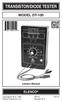 TRANSISTOR/DIODE TESTER MODEL DT-100 Lesson Manual ELENCO Copyright 2012, 1988 REV-G 753115 Elenco Electronics, Inc. Revised 2012 FEATURES Diode Mode: 1. Checks all types of diodes - germanium, silicon,
Experiment 4 ~ Resistors in Series & Parallel
 Experiment 4 ~ Resistors in Series & Parallel Objective: In this experiment you will set up three circuits: one with resistors in series, one with resistors in parallel, and one with some of each. You
Chapter 6 TRANSISTOR-TRANSISTOR LOGIC. 3-emitter transistor.
 Chapter 6 TRANSISTOR-TRANSISTOR LOGIC The evolution from DTL to TTL can be seen by observing the placement of p-n junctions. For example, the diode D2 from Figure 2 in the chapter on DTL can be replaced
High Voltage Current Shunt Monitor AD8212
 High Voltage Current Shunt Monitor AD822 FEATURES Adjustable gain High common-mode voltage range 7 V to 65 V typical 7 V to >500 V with external pass transistor Current output Integrated 5 V series regulator
Field Effect Transistors and Noise
 Physics 3330 Experiment #8 Fall 2005 Field Effect Transistors and Noise Purpose In this experiment we introduce field effect transistors. We will measure the output characteristics of a FET, and then construct
Mesh-Current Method (Loop Analysis)
 Mesh-Current Method (Loop Analysis) Nodal analysis was developed by applying KCL at each non-reference node. Mesh-Current method is developed by applying KVL around meshes in the circuit. A mesh is a loop
Current mirrors are commonly used for current sources in integrated circuit design. This section covers other current sources that are often seen.
 c Coyright 2009. W. Marshall Leach, Jr., Professor, Georgia Institute of Technology, School of Electrical and Comuter Engineering. Current Sources Current mirrors are commonly used for current sources
http://users.ece.gatech.edu/~mleach/ece3050/notes/feedback/fbexamples.pdf
 c Copyright 2009. W. Marshall Leach, Jr., Professor, Georgia Institute of Technology, School of Electrical and Computer Engineering. Feedback Amplifiers CollectionofSolvedProblems A collection of solved
Parallel and Series Resistors, Kirchoff s Law
 Experiment 2 31 Kuwait University Physics 107 Physics Department Parallel and Series Resistors, Kirchoff s Law Introduction In this experiment the relations among voltages, currents and resistances for
Common-Emitter Amplifier
 Common-Emitter Amplifier A. Before We Start As the title of this lab says, this lab is about designing a Common-Emitter Amplifier, and this in this stage of the lab course is premature, in my opinion,
Differential Amplifier Offset. Causes of dc voltage and current offset Modeling dc offset R C
 ESE39 ntroduction to Microelectronics Differential Amplifier Offset Causes of dc voltage and current offset Modeling dc offset mismatch S mismatch β mismatch transistor mismatch dc offsets in differential
Superposition Examples
 Superposition Examples The following examples illustrate the proper use of superposition of dependent sources. All superposition equations are written by inspection using voltage division, current division,
LABORATORY 2 THE DIFFERENTIAL AMPLIFIER
 LABORATORY 2 THE DIFFERENTIAL AMPLIFIER OBJECTIVES 1. To understand how to amplify weak (small) signals in the presence of noise. 1. To understand how a differential amplifier rejects noise and common
Series and Parallel Resistive Circuits
 Series and Parallel Resistive Circuits The configuration of circuit elements clearly affects the behaviour of a circuit. Resistors connected in series or in parallel are very common in a circuit and act
III. Reaction Kinetics
 III. Reaction Kinetics Lecture 13: Butler-Volmer equation Notes by ChangHoon Lim (and MZB) 1. Interfacial Equilibrium At lecture 11, the reaction rate R for the general Faradaic half-cell reaction was
3.4 - BJT DIFFERENTIAL AMPLIFIERS
 BJT Differential Amplifiers (6/4/00) Page 1 3.4 BJT DIFFERENTIAL AMPLIFIERS INTRODUCTION Objective The objective of this presentation is: 1.) Define and characterize the differential amplifier.) Show the
Example: Determine the power supplied by each of the sources, independent and dependent, in this circuit:
 Example: Determine the power supplied by each of the sources, independent and dependent, in this circuit: Solution: We ll begin by choosing the bottom node to be the reference node. Next we ll label the
Series and Parallel Circuits
 Series and Parallel Circuits Components in a circuit can be connected in series or parallel. A series arrangement of components is where they are inline with each other, i.e. connected end-to-end. A parallel
Fig6-22 CB configuration. Z i [6-54] Z o [6-55] A v [6-56] Assuming R E >> r e. A i [6-57]
![Fig6-22 CB configuration. Z i [6-54] Z o [6-55] A v [6-56] Assuming R E >> r e. A i [6-57]](/thumbs/40/21338705.jpg "Fig6-22 CB configuration. Z i [6-54] Z o [6-55] A v [6-56] Assuming R E >> r e. A i [6-57]") Common-Base Configuration (CB) The CB configuration having a low input and high output impedance and a current gain less than 1, the voltage gain can be quite large, r o in MΩ so that ignored in parallel
Common-Base Configuration (CB) The CB configuration having a low input and high output impedance and a current gain less than 1, the voltage gain can be quite large, r o in MΩ so that ignored in parallel
Module 2. DC Circuit. Version 2 EE IIT, Kharagpur
 Module DC Circuit Lesson 4 Loop Analysis of resistive circuit in the context of dc voltages and currents Objectives Meaning of circuit analysis; distinguish between the terms mesh and loop. To provide
Lecture 22: Class C Power Amplifiers
 Whites, EE 322 Lecture 22 Page 1 of 13 Lecture 22: lass Power Amplifiers We discovered in Lecture 18 (Section 9.2) that the maximum efficiency of lass A amplifiers is 25% with a resistive load and 50%
AC Transport constant current vs. low impedance modes
 Application Note 184-42 AC Transport constant current vs. low impedance modes The AC Transport option offers the user the ability to put the current source in a low output impedance mode. This mode is
Voltage Divider Bias
 Voltage Divider Bias ENGI 242 ELEC 222 BJT Biasing 3 For the Voltage Divider Bias Configurations Draw Equivalent Input circuit Draw Equivalent Output circuit Write necessary KVL and KCL Equations Determine
Unit/Standard Number. High School Graduation Years 2010, 2011 and 2012
 1 Secondary Task List 100 SAFETY 101 Demonstrate an understanding of State and School safety regulations. 102 Practice safety techniques for electronics work. 103 Demonstrate an understanding of proper
LM2576R. 3.0A, 52kHz, Step-Down Switching Regulator FEATURES. Applications DESCRIPTION TO-220 PKG TO-220V PKG TO-263 PKG ORDERING INFORMATION
 LM2576 FEATURES 3.3, 5.0, 12, 15, and Adjustable Output ersions Adjustable ersion Output oltage Range, 1.23 to 37 +/- 4% AG10Maximum Over Line and Load Conditions Guaranteed 3.0A Output Current Wide Input
Kirchhoff s Laws Physics Lab IX
 Kirchhoff s Laws Physics Lab IX Objective In the set of experiments, the theoretical relationships between the voltages and the currents in circuits containing several batteries and resistors in a network,
Diodes and Transistors
 Diodes What do we use diodes for? Diodes and Transistors protect circuits by limiting the voltage (clipping and clamping) turn AC into DC (voltage rectifier) voltage multipliers (e.g. double input voltage)
Lecture 23: Common Emitter Amplifier Frequency Response. Miller s Theorem.
 Whites, EE 320 ecture 23 Page 1 of 17 ecture 23: Common Emitter mplifier Frequency Response. Miller s Theorem. We ll use the high frequency model for the BJT we developed the previous lecture and compute
LM 358 Op Amp. If you have small signals and need a more useful reading we could amplify it using the op amp, this is commonly used in sensors.
 LM 358 Op Amp S k i l l L e v e l : I n t e r m e d i a t e OVERVIEW The LM 358 is a duel single supply operational amplifier. As it is a single supply it eliminates the need for a duel power supply, thus
13.10: How Series and Parallel Circuits Differ pg. 571
 13.10: How Series and Parallel Circuits Differ pg. 571 Key Concepts: 5. Connecting loads in series and parallel affects the current, potential difference, and total resistance. - Using your knowledge of
V out. Figure 1: A voltage divider on the left, and potentiometer on the right.
 Living with the Lab Fall 202 Voltage Dividers and Potentiometers Gerald Recktenwald v: November 26, 202 [email protected] Introduction Voltage dividers and potentiometers are passive circuit components
LM139/LM239/LM339 A Quad of Independently Functioning Comparators
 LM139/LM239/LM339 A Quad of Independently Functioning Comparators INTRODUCTION The LM139/LM239/LM339 family of devices is a monolithic quad of independently functioning comparators designed to meet the
CHAPTER 10 OPERATIONAL-AMPLIFIER CIRCUITS
 CHAPTER 10 OPERATIONAL-AMPLIFIER CIRCUITS Chapter Outline 10.1 The Two-Stage CMOS Op Amp 10.2 The Folded-Cascode CMOS Op Amp 10.3 The 741 Op-Amp Circuit 10.4 DC Analysis of the 741 10.5 Small-Signal Analysis
Lecture 17 The Bipolar Junction Transistor (I) Forward Active Regime
 Lecture 17 The Bipolar Junction Transistor (I) Forward Active Regime Outline The Bipolar Junction Transistor (BJT): structure and basic operation I-V characteristics in forward active regime Reading Assignment:
Table 1 Comparison of DC, Uni-Polar and Bi-polar Stepper Motors
 Electronics Exercise 3: Uni-Polar Stepper Motor Controller / Driver Mechatronics Instructional Laboratory Woodruff School of Mechanical Engineering Georgia Institute of Technology Lab Director: I. Charles
BJT Ebers-Moll Model and SPICE MOSFET model
 Department of Electrical and Electronic Engineering mperial College London EE 2.3: Semiconductor Modelling in SPCE Course homepage: http://www.imperial.ac.uk/people/paul.mitcheson/teaching BJT Ebers-Moll
NTE923 & NTE923D Integrated Circuit Precision Voltage Regulator
 NTE923 & NTE923D Integrated Circuit Precision Voltage Regulator Description: The NTE923 and NTE923D are voltage regulators designed primarily for series regulator applications. By themselves, these devices
Analysis of a single-loop circuit using the KVL method
 Analysis of a single-loop circuit using the KVL method Figure 1 is our circuit to analyze. We shall attempt to determine the current through each element, the voltage across each element, and the power
Diode Circuits. Operating in the Reverse Breakdown region. (Zener Diode)
 Diode Circuits Operating in the Reverse Breakdown region. (Zener Diode) In may applications, operation in the reverse breakdown region is highly desirable. The reverse breakdown voltage is relatively insensitive
300013 - ET - Electronics for Telecommunications
 Coordinating unit: Teaching unit: Academic year: Degree: ECTS credits: 2015 300 - EETAC - Castelldefels School of Telecommunications and Aerospace Engineering 710 - EEL - Department of Electronic Engineering
ENEE 307 Electronic Circuit Design Laboratory Spring 2012. A. Iliadis Electrical Engineering Department University of Maryland College Park MD 20742
 1.1. Differential Amplifiers ENEE 307 Electronic Circuit Design Laboratory Spring 2012 A. Iliadis Electrical Engineering Department University of Maryland College Park MD 20742 Differential Amplifiers
TLP504A,TLP504A 2. Programmable Controllers AC / DC Input Module Solid State Relay. Pin Configurations (top view) 2002-09-25
 TOSHIBA Photocoupler GaAs Ired & Photo Transistor TLP4A,TLP4A 2 TLP4A,TLP4A 2 Programmable Controllers AC / DC Input Module Solid State Relay Unit in mm The TOSHIBA TLP4A and TLP4A 2 consists of a photo
Electrical Fundamentals Module 3: Parallel Circuits
 Electrical Fundamentals Module 3: Parallel Circuits PREPARED BY IAT Curriculum Unit August 2008 Institute of Applied Technology, 2008 ATE310- Electrical Fundamentals 2 Module 3 Parallel Circuits Module
TS321 Low Power Single Operational Amplifier
 SOT-25 Pin Definition: 1. Input + 2. Ground 3. Input - 4. Output 5. Vcc General Description The TS321 brings performance and economy to low power systems. With high unity gain frequency and a guaranteed
The Flyback Converter
 The Flyback Converter Lecture notes ECEN4517! Derivation of the flyback converter: a transformer-isolated version of the buck-boost converter! Typical waveforms, and derivation of M(D) = V/! Flyback transformer
Circuits 1 M H Miller
 Introduction to Graph Theory Introduction These notes are primarily a digression to provide general background remarks. The subject is an efficient procedure for the determination of voltages and currents
Regulated D.C. Power Supply
 442 17 Principles of Electronics Regulated D.C. Power Supply 17.1 Ordinary D.C. Power Supply 17.2 Important Terms 17.3 Regulated Power Supply 17.4 Types of Voltage Regulators 17.5 Zener Diode Voltage Regulator
Transistor Models. ampel
 Transistor Models Review of Transistor Fundamentals Simple Current Amplifier Model Transistor Switch Example Common Emitter Amplifier Example Transistor as a Transductance Device - Ebers-Moll Model Other
Resistance, Ohm s Law, and the Temperature of a Light Bulb Filament
 Resistance, Ohm s Law, and the Temperature of a Light Bulb Filament Name Partner Date Introduction Carbon resistors are the kind typically used in wiring circuits. They are made from a small cylinder of
AND8480/D. CrM Buck LED Driver Evaluation Board APPLICATION NOTE
 CrM Buck LED Driver Evaluation Board Prepared by: Fabien Franc ON Semiconductor Introduction This document describes the CrM Buck LED driver evaluation board. This board provides a step down converter
Experiment 8 Series-Parallel Circuits
 Experiment 8 Series-Parallel Circuits EL 111 - DC Fundamentals By: Walter Banzhaf, E.K. Smith, and Winfield Young University of Hartford Ward College of Technology Objectives: 1. For the student to measure
DATA SHEET. BST50; BST51; BST52 NPN Darlington transistors DISCRETE SEMICONDUCTORS. Product specification Supersedes data of 2001 Feb 20.
 DISCRETE SEMICONDUCTORS DATA SHEET book, halfpage M3D109 Supersedes data of 2001 Feb 20 2004 Dec 09 FEATURES High current (max. 0.5 A) Low voltage (max. 80 V) Integrated diode and resistor. APPLICATIONS
MAS.836 HOW TO BIAS AN OP-AMP
 MAS.836 HOW TO BIAS AN OP-AMP Op-Amp Circuits: Bias, in an electronic circuit, describes the steady state operating characteristics with no signal being applied. In an op-amp circuit, the operating characteristic