
Voltage Divider Bias
|
|
|
- Tracy Leonard
- 10 years ago
- Views:
Transcription
1 Voltage Divider Bias ENGI 242 ELEC 222 BJT Biasing 3 For the Voltage Divider Bias Configurations Draw Equivalent Input circuit Draw Equivalent Output circuit Write necessary KVL and KCL Equations Determine the Quiescent Operating Point Graphical Solution using Load lines Computational Analysis Design and test design using a computer simulation 23 February 2005 ENGI 242/ELEC Voltage Divider Bias 1

2 Voltage-divider bias configuration 23 February 2005 ENGI 242/ELEC Voltage Divider Input Circuit Approximate Analysis This method is valid only if R2.1 β RE Under these conditions RE does not significantly load R2 and it may be ignored: I B << I 1 and I 2 and I 1 I 2 Therefore: R2 V B = VCC R+R 1 2 We may apply KVL to the input, which gives us: -VB + VBE + IE RE = 0 Solving for IE we get: I E = V B- V BE RE 23 February 2005 ENGI 242/ELEC Voltage Divider Bias 2

3 Input Circuit Exact Analysis This method is always valid must be used when R2 >.1 β RE Perform Thevenin s Theorem Open the base lead of the transistor, and the Voltage Divider bias circuit is: V TH = V CC Calculate RTH R2 R+R 1 2 We may apply KVL to the input, which gives us: -VTH + IB RTH + VBE + IE RE = 0 Since IE = (β + 1) IB RTH -V TH + I E + V BE + I E R E = 0 β + 1 Solving for I E we obtain I E = V TH - V BE RTH β R E : 23 February 2005 ENGI 242/ELEC Redrawing the input circuit for the network 23 February 2005 ENGI 242/ELEC Voltage Divider Bias 3

4 Determining VTH V TH = V CC R2 R+R February 2005 ENGI 242/ELEC Determining RTH R TH = R 1R 2 R 1+ R 2 23 February 2005 ENGI 242/ELEC Voltage Divider Bias 4

5 The Thévenin Equivalent Circuit Note that VE = VB VBE and IE = (β + 1)IB 23 February 2005 ENGI 242/ELEC Input Circuit Exact Analysis We may apply KVL to the input, which gives us: -VTH + IB RTH + VBE + IE RE = 0 Since IE = (β + 1) IB RTH -V TH + I E + V BE + I E R E = 0 β + 1 Solving for I E we obtain I E = V TH - V BE RTH β R E : 23 February 2005 ENGI 242/ELEC Voltage Divider Bias 5

6 Collector-Emitter Loop 23 February 2005 ENGI 242/ELEC Collector-Emitter (Output) Loop Applying Kirchoff s voltage law: -VCC + IC RC + VCE + IE RE = 0 Assuming that IE IC and solving for VCE: I C = V CC - V CE R C+ R E Solve for VE: Solve for VC: VE = IE RE VC = VCC -IC RC or VC = VCE + IE RE Solve for VB: VB = VCC -IB RB or VB = VBE + IE RE 23 February 2005 ENGI 242/ELEC Voltage Divider Bias 6

7 VCC = 22V R1 = 39kΩ R2 = 3.9kΩ RC = 10kΩ RE = 1.5kΩ β = 140 Voltage Divider Bias Example 1 23 February 2005 ENGI 242/ELEC VCC = 18V R1 = 39kΩ R2 = 8.2kΩ RC = 3.3kΩ RE = 1kΩ β = 120 Voltage Divider Bias Example 2 23 February 2005 ENGI 242/ELEC Voltage Divider Bias 7

8 VCC = 16V R1 = 62kΩ R2 = 9.1kΩ RC = 3.9kΩ RE =.68kΩ β = 80 Voltage Divider Bias Example 3 23 February 2005 ENGI 242/ELEC Design of CE Amplifier with Voltage Divider Bias 1. Select a value for VCC 2. Determine the value of β from spec sheet or family of curves 3. Select a value for ICQ 4. Let VCE = ½ VCC (typical operation, 0.4 VCC VC 0.6 VCC ) 5. Let VE = 0.1 VCC (for good operation, 0.1 VCC VE 0.2 VCC ) 6. Calculate RE and RC 7. Let R2 0.1 β RE (for this calculation, use low value for β) 8. Calculate R1 V CC - V B R 1= R2 VB 23 February 2005 ENGI 242/ELEC Voltage Divider Bias 8

9 CE Amplifier Design Design a Common Emitter Amplifier with Voltage Divider Bias for the following parameters: VCC = 24V IC = 5mA VE =.1VCC VC =.55VCC β = February 2005 ENGI 242/ELEC February 2005 ENGI 242/ELEC Voltage Divider Bias 9

10 CE Amplifier Design 23 February 2005 ENGI 242/ELEC CE Amplifier Design Voltage Divider Bias 23 February 2005 ENGI 242/ELEC Voltage Divider Bias 10

11 Collector Feedback Bias ENGI 242 ELEC 222 BJT Biasing 4 For the Collector Feedback Bias Configuration: Draw Equivalent Input circuit Draw Equivalent Output circuit Write necessary KVL and KCL Equations Determine the Quiescent Operating Point Graphical Solution using Loadlines Computational Analysis Design and test design using a computer simulation 23 February 2005 ENGI 242/ELEC Voltage Divider Bias 11

12 DC Bias with Collector (Voltage) Feedback Another way to improve the stability of a bias circuit is to add a feedback path from collector to base In this bias circuit the Q-point is only slightly dependent on the transistor β 23 February 2005 ENGI 242/ELEC Base Emitter Loop Solve for IB Applying Kirchoff s voltage law: -VCC + IC RC + IBRB + VBE + IERE = 0 Note: IC = IE = IC + IB Since IE = (β + 1) IB then: -VCC + (β + 1)IB RC + IBRB + VBE (β + 1)IBRE = 0 Simplifying and solving for I B : VCC - VBE I= B R+ B (β + 1) (R C + R E ) 23 February 2005 ENGI 242/ELEC Voltage Divider Bias 12

13 Base Emitter Loop Solve for IE Applying Kirchoff s voltage law: -VCC + IERC + IBRB + VBE + IERE = 0 Since IE = (β + 1) IB then: RB -V CC + I E R C + I E + V BE + IER E = 0 ( β + 1) VCC - VBE Simplifying and solving for I E : I E = R B + (R C + R E ) (β + 1) 23 February 2005 ENGI 242/ELEC Collector Emitter Loop Applying Kirchoff s voltage law: IE RE + VCE + IC RC VCC = 0 Since IC =IE and IE = (β + 1) IB: IE(RC + RE) + VCE VCC =0 Solving for VCE: VCE = VCC IE (RE + RC) 23 February 2005 ENGI 242/ELEC Voltage Divider Bias 13

14 Network Example 23 February 2005 ENGI 242/ELEC Network Example 23 February 2005 ENGI 242/ELEC Voltage Divider Bias 14

15 Collector feedback with RE = 0Ω 23 February 2005 ENGI 242/ELEC Design of CE Amplifier with Collector Feedback Bias 1. Select a value for VCC 2. Determine the value of β from spec sheet or family of curves 3. Select a value for IEQ 4. Let VCE = ½ VCC (typical operation, 0.4 VCC VC 0.6 VCC ) 5. Let VE = 0.1 VCC (for good operation, 0.1 VCC VE 0.2 VCC ) 6. Calculate RE, RC and RB V E=.1V CC V - V V -.6V I I V - I R - V - I R I β + 1 CC CQ CC CC R C = = ; E E CC E C BE E E R B = ; E R E = R C = R B =.1V IE.4V I CC CC E V CC - I E (R C + R)- E 0.7 IE β + 1 V 23 February 2005 ENGI 242/ELEC Voltage Divider Bias 15

16 Common Emitter Bias with Dual Supplies Voltage Divider Bias with Dual Power Supply 23 February 2005 ENGI 242/ELEC Voltage Divider Bias 16

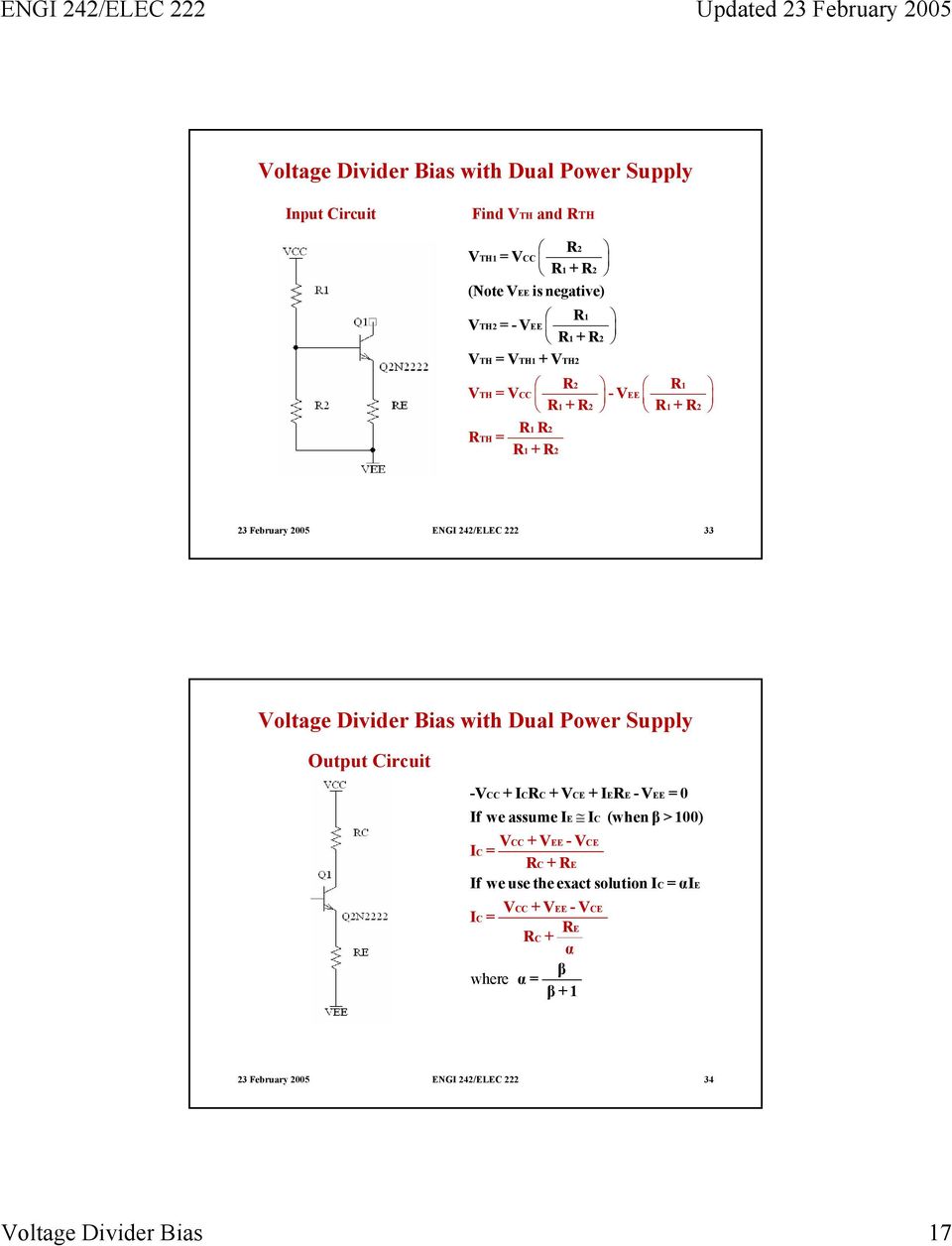
17 Voltage Divider Bias with Dual Power Supply Input Circuit Find VTH and RTH R 2 V TH1 = V CC R 1 + R 2 (Note V EE is negative) R 1 V TH2 = -V EE R + R V TH = V TH1 +V TH2 1 2 R 2 R 1 V TH = V CC - V EE R 1+ R 2 R 1+ R 2 R 1R 2 R TH = R 1 + R 2 23 February 2005 ENGI 242/ELEC Voltage Divider Bias with Dual Power Supply Output Circuit -V CC + ICR C + V CE + IER E - V EE = 0 If we assume I E I C (when β > 100) CC EE CE I C = R C+ RE If we use the exact solution I C = αi E I C = V + V - V V + V - V RE RC + α β where α = β + 1 CC EE CE 23 February 2005 ENGI 242/ELEC Voltage Divider Bias 17
18 Voltage Divider Bias with Dual Power Supply 23 February 2005 ENGI 242/ELEC PSpice Simulation Voltage Divider Bias 18

19 PSpice Bias Point Simulation 23 February 2005 ENGI 242/ELEC PSpice Simulation for DC Bias 23 February 2005 ENGI 242/ELEC Voltage Divider Bias 19

20 PSpice Simulation for DC Sweep 23 February 2005 ENGI 242/ELEC PSpice Simulation for DC Sweep The response of VC demonstrates rises rapidly towards the Q Point and then increases gradually towards a maximum value The response of VCE demonstrates that it reaches a peak value near the Q point and then decreases 23 February 2005 ENGI 242/ELEC Voltage Divider Bias 20

21 PSpice Simulation for AC Sweep 23 February 2005 ENGI 242/ELEC PSpice Simulation for AC Sweep 23 February 2005 ENGI 242/ELEC Voltage Divider Bias 21
Bipolar Junction Transistors
 Bipolar Junction Transistors Physical Structure & Symbols NPN Emitter (E) n-type Emitter region p-type Base region n-type Collector region Collector (C) B C Emitter-base junction (EBJ) Base (B) (a) Collector-base
LABORATORY 2 THE DIFFERENTIAL AMPLIFIER
 LABORATORY 2 THE DIFFERENTIAL AMPLIFIER OBJECTIVES 1. To understand how to amplify weak (small) signals in the presence of noise. 1. To understand how a differential amplifier rejects noise and common
Transistor Biasing. The basic function of transistor is to do amplification. Principles of Electronics
 192 9 Principles of Electronics Transistor Biasing 91 Faithful Amplification 92 Transistor Biasing 93 Inherent Variations of Transistor Parameters 94 Stabilisation 95 Essentials of a Transistor Biasing
Transistors. NPN Bipolar Junction Transistor
 Transistors They are unidirectional current carrying devices with capability to control the current flowing through them The switch current can be controlled by either current or voltage ipolar Junction
Physics 623 Transistor Characteristics and Single Transistor Amplifier Sept. 13, 2006
 Physics 623 Transistor Characteristics and Single Transistor Amplifier Sept. 13, 2006 1 Purpose To measure and understand the common emitter transistor characteristic curves. To use the base current gain
Common-Emitter Amplifier
 Common-Emitter Amplifier A. Before We Start As the title of this lab says, this lab is about designing a Common-Emitter Amplifier, and this in this stage of the lab course is premature, in my opinion,
Transistor Characteristics and Single Transistor Amplifier Sept. 8, 1997
 Physics 623 Transistor Characteristics and Single Transistor Amplifier Sept. 8, 1997 1 Purpose To measure and understand the common emitter transistor characteristic curves. To use the base current gain
BJT Circuit Configurations
 BJT Circuit Configurations V be ~ ~ ~ v s R L v s R L V Vcc R s cc R s v s R s R L V cc Common base Common emitter Common collector Common emitter current gain BJT Current-Voltage Characteristics V CE,
TWO PORT NETWORKS h-parameter BJT MODEL
 TWO PORT NETWORKS h-parameter BJT MODEL The circuit of the basic two port network is shown on the right. Depending on the application, it may be used in a number of different ways to develop different
BJT Characteristics and Amplifiers
 BJT Characteristics and Amplifiers Matthew Beckler [email protected] EE2002 Lab Section 003 April 2, 2006 Abstract As a basic component in amplifier design, the properties of the Bipolar Junction Transistor
BJT AC Analysis 1 of 38. The r e Transistor model. Remind Q-poiint re = 26mv/IE
 BJT AC Analysis 1 of 38 The r e Transistor model Remind Q-poiint re = 26mv/IE BJT AC Analysis 2 of 38 Three amplifier configurations, Common Emitter Common Collector (Emitter Follower) Common Base BJT
Common Base BJT Amplifier Common Collector BJT Amplifier
 Common Base BJT Amplifier Common Collector BJT Amplifier Common Collector (Emitter Follower) Configuration Common Base Configuration Small Signal Analysis Design Example Amplifier Input and Output Impedances
The 2N3393 Bipolar Junction Transistor
 The 2N3393 Bipolar Junction Transistor Common-Emitter Amplifier Aaron Prust Abstract The bipolar junction transistor (BJT) is a non-linear electronic device which can be used for amplification and switching.
Collection of Solved Feedback Amplifier Problems
 c Copyright 2009. W. Marshall Leach, Jr., Professor, Georgia Institute of Technology, School of Electrical and Computer Engineering. Collection of Solved Feedback Amplifier Problems This document contains
Figure 1: Common-base amplifier.
 The Common-Base Amplifier Basic Circuit Fig. 1 shows the circuit diagram of a single stage common-base amplifier. The object is to solve for the small-signal voltage gain, input resistance, and output
Basic Electronics Prof. Dr. Chitralekha Mahanta Department of Electronics and Communication Engineering Indian Institute of Technology, Guwahati
 Basic Electronics Prof. Dr. Chitralekha Mahanta Department of Electronics and Communication Engineering Indian Institute of Technology, Guwahati Module: 2 Bipolar Junction Transistors Lecture-2 Transistor
Bipolar Junction Transistor Basics
 by Kenneth A. Kuhn Sept. 29, 2001, rev 1 Introduction A bipolar junction transistor (BJT) is a three layer semiconductor device with either NPN or PNP construction. Both constructions have the identical
Common Emitter BJT Amplifier Design Current Mirror Design
 Common Emitter BJT Amplifier Design Current Mirror Design 1 Some Random Observations Conditions for stabilized voltage source biasing Emitter resistance, R E, is needed. Base voltage source will have finite
BJT Amplifier Circuits
 JT Amplifier ircuits As we have developed different models for D signals (simple large-signal model) and A signals (small-signal model), analysis of JT circuits follows these steps: D biasing analysis:
BJT Amplifier Circuits
 JT Amplifier ircuits As we have developed different models for D signals (simple large-signal model) and A signals (small-signal model), analysis of JT circuits follows these steps: D biasing analysis:
W04 Transistors and Applications. Yrd. Doç. Dr. Aytaç Gören
 W04 Transistors and Applications W04 Transistors and Applications ELK 2018 - Contents W01 Basic Concepts in Electronics W02 AC to DC Conversion W03 Analysis of DC Circuits (self and condenser) W04 Transistors
CIRCUITS LABORATORY. In this experiment, the output I-V characteristic curves, the small-signal low
 CIRCUITS LABORATORY EXPERIMENT 6 TRANSISTOR CHARACTERISTICS 6.1 ABSTRACT In this experiment, the output I-V characteristic curves, the small-signal low frequency equivalent circuit parameters, and the
Dependent Sources: Introduction and analysis of circuits containing dependent sources.
 Dependent Sources: Introduction and analysis of circuits containing dependent sources. So far we have explored timeindependent (resistive) elements that are also linear. We have seen that two terminal
W03 Analysis of DC Circuits. Yrd. Doç. Dr. Aytaç Gören
 W03 Analysis of DC Circuits Yrd. Doç. Dr. Aytaç Gören ELK 2018 - Contents W01 Basic Concepts in Electronics W02 AC to DC Conversion W03 Analysis of DC Circuits (self and condenser) W04 Transistors and
Lecture 23: Common Emitter Amplifier Frequency Response. Miller s Theorem.
 Whites, EE 320 ecture 23 Page 1 of 17 ecture 23: Common Emitter mplifier Frequency Response. Miller s Theorem. We ll use the high frequency model for the BJT we developed the previous lecture and compute
Electronic Devices and Circuit Theory
 Instructor s Resource Manual to accompany Electronic Devices and Circuit Theory Tenth Edition Robert L. Boylestad Louis Nashelsky Upper Saddle River, New Jersey Columbus, Ohio Copyright 2009 by Pearson
Transistor Models. ampel
 Transistor Models Review of Transistor Fundamentals Simple Current Amplifier Model Transistor Switch Example Common Emitter Amplifier Example Transistor as a Transductance Device - Ebers-Moll Model Other
Differential Amplifier Offset. Causes of dc voltage and current offset Modeling dc offset R C
 ESE39 ntroduction to Microelectronics Differential Amplifier Offset Causes of dc voltage and current offset Modeling dc offset mismatch S mismatch β mismatch transistor mismatch dc offsets in differential
Lecture 18: Common Emitter Amplifier. Maximum Efficiency of Class A Amplifiers. Transformer Coupled Loads.
 Whites, EE 3 Lecture 18 Page 1 of 10 Lecture 18: Common Emitter Amplifier. Maximum Efficiency of Class A Amplifiers. Transformer Coupled Loads. We discussed using transistors as switches in the last lecture.
The BJT Differential Amplifier. Basic Circuit. DC Solution
 c Copyright 010. W. Marshall Leach, Jr., Professor, Georgia Institute of Technology, School of Electrical and Computer Engineering. The BJT Differential Amplifier Basic Circuit Figure 1 shows the circuit
Unit/Standard Number. High School Graduation Years 2010, 2011 and 2012
 1 Secondary Task List 100 SAFETY 101 Demonstrate an understanding of State and School safety regulations. 102 Practice safety techniques for electronics work. 103 Demonstrate an understanding of proper
Basic FET Ampli ers 6.0 PREVIEW 6.1 THE MOSFET AMPLIFIER
 C H A P T E R 6 Basic FET Ampli ers 6.0 PREVIEW In the last chapter, we described the operation of the FET, in particular the MOSFET, and analyzed and designed the dc response of circuits containing these
Fig6-22 CB configuration. Z i [6-54] Z o [6-55] A v [6-56] Assuming R E >> r e. A i [6-57]
![Fig6-22 CB configuration. Z i [6-54] Z o [6-55] A v [6-56] Assuming R E >> r e. A i [6-57]](/thumbs/40/21338705.jpg "Fig6-22 CB configuration. Z i [6-54] Z o [6-55] A v [6-56] Assuming R E >> r e. A i [6-57]") Common-Base Configuration (CB) The CB configuration having a low input and high output impedance and a current gain less than 1, the voltage gain can be quite large, r o in MΩ so that ignored in parallel
Common-Base Configuration (CB) The CB configuration having a low input and high output impedance and a current gain less than 1, the voltage gain can be quite large, r o in MΩ so that ignored in parallel
Supplement Reading on Diode Circuits. http://www.inst.eecs.berkeley.edu/ edu/~ee40/fa09/handouts/ee40_mos_circuit.pdf
 EE40 Lec 18 Diode Circuits Reading: Chap. 10 of Hambley Supplement Reading on Diode Circuits http://www.inst.eecs.berkeley.edu/ edu/~ee40/fa09/handouts/ee40_mos_circuit.pdf Slide 1 Diodes Circuits Load
Lecture 060 Push-Pull Output Stages (1/11/04) Page 060-1. ECE 6412 - Analog Integrated Circuits and Systems II P.E. Allen - 2002
 Lecture 060 PushPull Output Stages (1/11/04) Page 0601 LECTURE 060 PUSHPULL OUTPUT STAGES (READING: GHLM 362384, AH 226229) Objective The objective of this presentation is: Show how to design stages that
LAB VIII. BIPOLAR JUNCTION TRANSISTOR CHARACTERISTICS
 LAB VIII. BIPOLAR JUNCTION TRANSISTOR CHARACTERISTICS 1. OBJECTIVE In this lab, you will study the DC characteristics of a Bipolar Junction Transistor (BJT). 2. OVERVIEW In this lab, you will inspect the
Application Note 82 Using the Dallas Trickle Charge Timekeeper
 www.maxim-ic.com Application Note 82 Using the Dallas Trickle Charge Timekeeper DESCRIPTION The Dallas Semiconductor/Maxim real-time clock (RTC) family contains a number of parts within an integrated trickle-charging
TOSHIBA Insulated Gate Bipolar Transistor Silicon N Channel IGBT GT60J323
 GT6J2 TOSHIBA Insulated Gate Bipolar Transistor Silicon N Channel IGBT GT6J2 Current Resonance Inverter Switching Application Unit: mm Enhancement mode type High speed : t f =.6 μs (typ.) (I C = 6A) Low
Lecture 12: DC Analysis of BJT Circuits.
 Whites, 320 Lecture 12 Page 1 of 9 Lecture 12: D Analysis of JT ircuits. n this lecture we will consider a number of JT circuits and perform the D circuit analysis. For those circuits with an active mode
Lecture 21: Junction Field Effect Transistors. Source Follower Amplifier
 Whites, EE 322 Lecture 21 Page 1 of 8 Lecture 21: Junction Fiel Effect Transistors. Source Follower Amplifier As mentione in Lecture 16, there are two major families of transistors. We ve worke with BJTs
Transistor amplifiers: Biasing and Small Signal Model
 Transistor amplifiers: iasing and Small Signal Model Transistor amplifiers utilizing JT or FT are similar in design and analysis. Accordingly we will discuss JT amplifiers thoroughly. Then, similar FT
ENEE 307 Electronic Circuit Design Laboratory Spring 2012. A. Iliadis Electrical Engineering Department University of Maryland College Park MD 20742
 1.1. Differential Amplifiers ENEE 307 Electronic Circuit Design Laboratory Spring 2012 A. Iliadis Electrical Engineering Department University of Maryland College Park MD 20742 Differential Amplifiers
PHOTOTRANSISTOR OPTOCOUPLERS
 MCT2 MCT2E MCT20 MCT27 WHITE PACKAGE (-M SUFFIX) BLACK PACKAGE (NO -M SUFFIX) DESCRIPTION The MCT2XXX series optoisolators consist of a gallium arsenide infrared emitting diode driving a silicon phototransistor
Chapter 12: The Operational Amplifier
 Chapter 12: The Operational Amplifier 12.1: Introduction to Operational Amplifier (Op-Amp) Operational amplifiers (op-amps) are very high gain dc coupled amplifiers with differential inputs; they are used
Lab 7: Operational Amplifiers Part I
 Lab 7: Operational Amplifiers Part I Objectives The objective of this lab is to study operational amplifier (op amp) and its applications. We will be simulating and building some basic op amp circuits,
3 The TTL NAND Gate. Fig. 3.1 Multiple Input Emitter Structure of TTL
 3 The TTL NAND Gate 3. TTL NAND Gate Circuit Structure The circuit structure is identical to the previous TTL inverter circuit except for the multiple emitter input transistor. This is used to implement
Programmable Single-/Dual-/Triple- Tone Gong SAE 800
 Programmable Single-/Dual-/Triple- Tone Gong Preliminary Data SAE 800 Bipolar IC Features Supply voltage range 2.8 V to 18 V Few external components (no electrolytic capacitor) 1 tone, 2 tones, 3 tones
Objectives The purpose of this lab is build and analyze Differential amplifiers based on NPN transistors (or NMOS transistors).
 1 Lab 03: Differential Amplifiers (BJT) (20 points) NOTE: 1) Please use the basic current mirror from Lab01 for the second part of the lab (Fig. 3). 2) You can use the same chip as the basic current mirror;
TOSHIBA Transistor Silicon PNP Epitaxial Type (PCT Process) 2SA1020
 2SA12 TOSHIBA Transistor Silicon PNP Epitaxial Type (PCT Process) 2SA12 Power Amplifier Applications Power Switching Applications Unit: mm Low Collector saturation voltage: V CE (sat) =.5 V (max) (I C
Transistor Amplifiers
 Physics 3330 Experiment #7 Fall 1999 Transistor Amplifiers Purpose The aim of this experiment is to develop a bipolar transistor amplifier with a voltage gain of minus 25. The amplifier must accept input
Frequency Response of the CE Amplifier
 ROCHESTER INSTITUTE OF TECHNOLOGY MICROELECTRONIC ENGINEERING Frequency Response of the CE Amplifier Dr. Lynn Fuller Webpage: http://people.rit.edu/lffeee/ 82 Lomb Memorial Drive Rochester, NY 14623-5604
Regulated D.C. Power Supply
 442 17 Principles of Electronics Regulated D.C. Power Supply 17.1 Ordinary D.C. Power Supply 17.2 Important Terms 17.3 Regulated Power Supply 17.4 Types of Voltage Regulators 17.5 Zener Diode Voltage Regulator
LAB VII. BIPOLAR JUNCTION TRANSISTOR CHARACTERISTICS
 LAB VII. BIPOLAR JUNCTION TRANSISTOR CHARACTERISTICS 1. OBJECTIVE In this lab, you will study the DC characteristics of a Bipolar Junction Transistor (BJT). 2. OVERVIEW You need to first identify the physical
2N4921G, 2N4922G, 2N4923G. Medium-Power Plastic NPN Silicon Transistors 1.0 AMPERE GENERAL PURPOSE POWER TRANSISTORS 40 80 VOLTS, 30 WATTS
 ,, Medium-Power Plastic NPN Silicon Transistors These highperformance plastic devices are designed for driver circuits, switching, and amplifier applications. Features Low Saturation Voltage Excellent
AB07 Common Collector PNP Transistor Characteristics. Analog lab Experiment board. Ver 1.0
 Common Collector PNP Transistor Characteristics Analog lab Experiment board Ver 1.0 QUALITY POLICY To be a Global Provider of Innovative and Affordable Electronic Equipments for Technology Training by
MAS.836 HOW TO BIAS AN OP-AMP
 MAS.836 HOW TO BIAS AN OP-AMP Op-Amp Circuits: Bias, in an electronic circuit, describes the steady state operating characteristics with no signal being applied. In an op-amp circuit, the operating characteristic
School of Engineering Department of Electrical and Computer Engineering
 1 School of Engineering Department of Electrical and Computer Engineering 332:223 Principles of Electrical Engineering I Laboratory Experiment #4 Title: Operational Amplifiers 1 Introduction Objectives
VI. Transistor amplifiers: Biasing and Small Signal Model
 VI. Transistor amplifiers: iasing and Small Signal Model 6.1 Introduction Transistor amplifiers utilizing JT or FET are similar in design and analysis. Accordingly we will discuss JT amplifiers thoroughly.
Chapter 8 Differential and Multistage Amplifiers. EE 3120 Microelectronics II
 1 Chapter 8 Differential and Multistage Amplifiers Operational Amplifier Circuit Components 2 1. Ch 7: Current Mirrors and Biasing 2. Ch 9: Frequency Response 3. Ch 8: Active-Loaded Differential Pair 4.
BIPOLAR JUNCTION TRANSISTORS
 CHAPTER 3 BIPOLAR JUNCTION TRANSISTORS A bipolar junction transistor, BJT, is a single piece of silicon with two back-to-back P-N junctions. However, it cannot be made with two independent back-to-back
2N6387, 2N6388. Plastic Medium-Power Silicon Transistors DARLINGTON NPN SILICON POWER TRANSISTORS 8 AND 10 AMPERES 65 WATTS, 60-80 VOLTS
 2N6388 is a Preferred Device Plastic MediumPower Silicon Transistors These devices are designed for generalpurpose amplifier and lowspeed switching applications. Features High DC Current Gain h FE = 2500
Content Map For Career & Technology
 Content Strand: Applied Academics CT-ET1-1 analysis of electronic A. Fractions and decimals B. Powers of 10 and engineering notation C. Formula based problem solutions D. Powers and roots E. Linear equations
AMPLIFIERS BJT BJT TRANSISTOR. Types of BJT BJT. devices that increase the voltage, current, or power level
 AMPLFERS Prepared by Engr. JP Timola Reference: Electronic Devices by Floyd devices that increase the voltage, current, or power level have at least three terminals with one controlling the flow between
BJT AC Analysis. by Kenneth A. Kuhn Oct. 20, 2001, rev Aug. 31, 2008
 by Kenneth A. Kuhn Oct. 20, 2001, rev Aug. 31, 2008 Introduction This note will discuss AC analysis using the beta, re transistor model shown in Figure 1 for the three types of amplifiers: common-emitter,
Thevenin Equivalent Circuits
 hevenin Equivalent Circuits Introduction In each of these problems, we are shown a circuit and its hevenin or Norton equivalent circuit. he hevenin and Norton equivalent circuits are described using three
http://users.ece.gatech.edu/~mleach/ece3050/notes/feedback/fbexamples.pdf
 c Copyright 2009. W. Marshall Leach, Jr., Professor, Georgia Institute of Technology, School of Electrical and Computer Engineering. Feedback Amplifiers CollectionofSolvedProblems A collection of solved
3.4 - BJT DIFFERENTIAL AMPLIFIERS
 BJT Differential Amplifiers (6/4/00) Page 1 3.4 BJT DIFFERENTIAL AMPLIFIERS INTRODUCTION Objective The objective of this presentation is: 1.) Define and characterize the differential amplifier.) Show the
Amplifier Teaching Aid
 Amplifier Teaching Aid Table of Contents Amplifier Teaching Aid...1 Preface...1 Introduction...1 Lesson 1 Semiconductor Review...2 Lesson Plan...2 Worksheet No. 1...7 Experiment No. 1...7 Lesson 2 Bipolar
The basic cascode amplifier consists of an input common-emitter (CE) configuration driving an output common-base (CB), as shown above.
 Cascode Amplifiers by Dennis L. Feucht Two-transistor combinations, such as the Darlington configuration, provide advantages over single-transistor amplifier stages. Another two-transistor combination
FPAB20BH60B PFC SPM 3 Series for Single-Phase Boost PFC
 FPAB20BH60B PFC SPM 3 Series for Single-Phase Boost PFC Features UL Certified No. E209204 (UL1557) 600 V - 20 A Single-Phase Boost PFC with Integral Gate Driver and Protection Very Low Thermal Resistance
BC327, BC327-16, BC327-25, BC327-40. Amplifier Transistors. PNP Silicon. These are Pb Free Devices* http://onsemi.com. Features MAXIMUM RATINGS
 BC327, BC327-16, BC327-25, BC327-4 Amplifier Transistors PNP Silicon Features These are PbFree Devices* MAXIMUM RATINGS Rating Symbol Value Unit CollectorEmitter Voltage V CEO 45 Vdc CollectorEmitter Voltage
KA7500C. SMPS Controller. Features. Description. Internal Block Diagram. www.fairchildsemi.com
 SMPS Controller www.fairchildsemi.com Features Internal Regulator Provides a Stable 5V Reference Supply Trimmed to ±1% Accuracy. Uncommitted Output TR for 200mA Sink or Source Current Output Control for
Mesh-Current Method (Loop Analysis)
 Mesh-Current Method (Loop Analysis) Nodal analysis was developed by applying KCL at each non-reference node. Mesh-Current method is developed by applying KVL around meshes in the circuit. A mesh is a loop
MC34063A MC34063E DC-DC CONVERTER CONTROL CIRCUITS
 MC34063A MC34063E DC-DC CONVERTER CONTROL CIRCUITS OUTPUT SWITCH CURRENT IN EXCESS OF 1.5A 2% REFERENCE ACCURACY LOW QUIESCENT CURRENT: 2.5mA (TYP.) OPERATING FROM 3V TO 40V FREQUENCY OPERATION TO 100KHz
SEMICONDUCTOR APPLICATION NOTE
 SEMICONDUCTOR APPLICATION NOTE Order this document by AN7A/D Prepared by: Francis Christian INTRODUCTION The optical coupler is a venerable device that offers the design engineer new freedoms in designing
Bipolar Transistor Amplifiers
 Physics 3330 Experiment #7 Fall 2005 Bipolar Transistor Amplifiers Purpose The aim of this experiment is to construct a bipolar transistor amplifier with a voltage gain of minus 25. The amplifier must
LM 358 Op Amp. If you have small signals and need a more useful reading we could amplify it using the op amp, this is commonly used in sensors.
 LM 358 Op Amp S k i l l L e v e l : I n t e r m e d i a t e OVERVIEW The LM 358 is a duel single supply operational amplifier. As it is a single supply it eliminates the need for a duel power supply, thus
OPERATIONAL AMPLIFIERS
 INTRODUCTION OPERATIONAL AMPLIFIERS The student will be introduced to the application and analysis of operational amplifiers in this laboratory experiment. The student will apply circuit analysis techniques
Differential Amplifier Common & Differential Modes
 Differential Amplifier Common & Differential Modes Common & Differential Modes BJT Differential Amplifier Diff. Amp Voltage Gain and Input Impedance Small Signal Analysis Differential Mode Small Signal
Using ADS to simulate Noise Figure
 Using ADS to simulate Noise Figure ADS can be used to design low noise amplifiers much in the same way you have already used it for MAG or MSG designs. Noise circles and available gain circles are the
Local Oscillator for FM broadcast band 88-108 MHz
 Local Oscillator for FM broadcast band 88-108 MHz Wang Luhao Yan Shubo Supervisor: Göran Jönsson Department of Electrical and Information Technology Lund University 2012.05.15 Abstract In this project
EE 330 Lecture 21. Small Signal Analysis Small Signal Analysis of BJT Amplifier
 EE 330 Lecture 21 Small Signal Analsis Small Signal Analsis of BJT Amplifier Review from Last Lecture Comparison of Gains for MOSFET and BJT Circuits IN (t) A B BJT CC 1 R EE OUT I R C 1 t If I D R =I
Diodes and Transistors
 Diodes What do we use diodes for? Diodes and Transistors protect circuits by limiting the voltage (clipping and clamping) turn AC into DC (voltage rectifier) voltage multipliers (e.g. double input voltage)
TDA2040. 20W Hi-Fi AUDIO POWER AMPLIFIER
 20W Hi-Fi AUDIO POWER AMPLIFIER DESCRIPTION The TDA2040 is a monolithic integrated circuit in Pentawatt package, intended for use as an audio class AB amplifier. Typically it provides 22W output power
TLP504A,TLP504A 2. Programmable Controllers AC / DC Input Module Solid State Relay. Pin Configurations (top view) 2002-09-25
 TOSHIBA Photocoupler GaAs Ired & Photo Transistor TLP4A,TLP4A 2 TLP4A,TLP4A 2 Programmable Controllers AC / DC Input Module Solid State Relay Unit in mm The TOSHIBA TLP4A and TLP4A 2 consists of a photo
University of California, Berkeley Department of Electrical Engineering and Computer Sciences EE 105: Microelectronic Devices and Circuits
 University of California, Berkeley Department of Electrical Engineering and Computer Sciences EE 105: Microelectronic Devices and Circuits LTSpice LTSpice is a free circuit simulator based on Berkeley
Lecture 30: Biasing MOSFET Amplifiers. MOSFET Current Mirrors.
 Whites, EE 320 Lecture 30 Page 1 of 8 Lecture 30: Biasing MOSFET Amplifiers. MOSFET Current Mirrors. There are two different environments in which MOSFET amplifiers are found, (1) discrete circuits and
POWER SUPPLY MODEL XP-15. Instruction Manual ELENCO
 POWER SUPPLY MODEL XP-15 Instruction Manual ELENCO Copyright 2013 by Elenco Electronics, Inc. REV-A 753020 All rights reserved. No part of this book shall be reproduced by any means; electronic, photocopying,
Figure 1. Diode circuit model
 Semiconductor Devices Non-linear Devices Diodes Introduction. The diode is two terminal non linear device whose I-V characteristic besides exhibiting non-linear behavior is also polarity dependent. The
CHAPTER 10 OPERATIONAL-AMPLIFIER CIRCUITS
 CHAPTER 10 OPERATIONAL-AMPLIFIER CIRCUITS Chapter Outline 10.1 The Two-Stage CMOS Op Amp 10.2 The Folded-Cascode CMOS Op Amp 10.3 The 741 Op-Amp Circuit 10.4 DC Analysis of the 741 10.5 Small-Signal Analysis
DEGREE: Bachelor in Biomedical Engineering YEAR: 2 TERM: 2 WEEKLY PLANNING
 SESSION WEEK COURSE: Electronic Technology in Biomedicine DEGREE: Bachelor in Biomedical Engineering YEAR: 2 TERM: 2 WEEKLY PLANNING DESCRIPTION GROUPS (mark X) SPECIAL ROOM FOR SESSION (Computer class
Basic Laws Circuit Theorems Methods of Network Analysis Non-Linear Devices and Simulation Models
 EE Modul 1: Electric Circuits Theory Basic Laws Circuit Theorems Methods of Network Analysis Non-Linear Devices and Simulation Models EE Modul 1: Electric Circuits Theory Current, Voltage, Impedance Ohm
2SD315AI Dual SCALE Driver Core for IGBTs and Power MOSFETs
 2SD315AI Dual SCALE Driver Core for IGBTs and Power MOSFETs Description The SCALE drivers from CONCEPT are based on a chip set that was developed specifically for the reliable driving and safe operation
Series and Parallel Resistive Circuits
 Series and Parallel Resistive Circuits The configuration of circuit elements clearly affects the behaviour of a circuit. Resistors connected in series or in parallel are very common in a circuit and act
Vdc. Vdc. Adc. W W/ C T J, T stg 65 to + 200 C
 2N6284 (NPN); 2N6286, Preferred Device Darlington Complementary Silicon Power Transistors These packages are designed for general purpose amplifier and low frequency switching applications. Features High
Superposition Examples
 Superposition Examples The following examples illustrate the proper use of superposition of dependent sources. All superposition equations are written by inspection using voltage division, current division,
Operating Manual Ver.1.1
 Class B Amplifier (Push-Pull Emitter Follower) Operating Manual Ver.1.1 An ISO 9001 : 2000 company 94-101, Electronic Complex Pardesipura, Indore- 452010, India Tel : 91-731- 2570301/02, 4211100 Fax: 91-731-
A Comparison of Various Bipolar Transistor Biasing Circuits Application Note 1293
 A omparison of Various Bipolar Transistor Biasing ircuits Application Note 1293 Introduction The bipolar junction transistor (BJT) is quite often used as a low noise amplifier in cellular, PS, and pager