
Battery Thermal Management System Design Modeling
|
|
|
- Daniel Randall
- 10 years ago
- Views:
Transcription
1 Battery Thermal Management System Design Modeling Gi-Heon Kim, Ph.D Ahmad Pesaran, Ph.D National Renewable Energy Laboratory, Golden, Colorado, U.S.A. EVS October -8, 8, 006 Yokohama, Japan NREL/PR With support from High Power Energy Storage Program (Tien Duong and Dave Howell) Office of FreedomCAR and Vehicle Technologies Energy Efficiency and Renewable Energy Office U.S. Department of Energy

2 Motivations & Objectives Motivations Battery thermal management is critical in achieving performance and extended life of batteries in electric and hybrid vehicles. Appropriate models that can predict thermal behaviors of batteries shorten the development process for improving battery system design. Objectives of this Study To investigate the impact of cooling strategies with different coolant systems; air and direct/indirect liquid cooling To evaluate system thermal responses and their sensitivities as a function of controllable system parameters To provide battery thermal management system design insight by identifying analyses and approaches that engineers should consider when they design a battery thermal management system for electric and hybrid vehicles


3 Battery Thermal Management Modeling at NREL Module Cooling Strategy Passive control with phase change Coolant type: Air/Liquid Direct Contact/Jacket Cooling Serial/Parallel Cooling Terminal/Side Cooling Module Shape/Dimensions Coolant Path inside a Module Coolant Flow Rate etc Cell Characteristics Shape: Prismatic/Cylinder/Oval etc Materials/Chemistries Size/Dimensions/Capacity Thermal/Current Paths inside a Cell Design Process D Component Analysis System Analysis Operating Conditions Vehicle Driving Cycles Control Strategy Ambient Temperature etc Battery Thermal Responses Temperature History Cells/Module/Pack Temperature Distribution in a Cell Cell-to-Cell Temperature Imbalance in a Module Battery Performance Prediction Pressure Prop and Parasitic Power etc.

4 Approach NREL has developed a -D electro-thermal model to predict thermal response of real cells focus on cell internal temperature (EVS-) In this study, focus is mostly external to cell fluid side Air cooling Liquid cooling Direct Indirect The battery management system response were evaluated using Fully developed laminar channel flow analysis Computational Fluid Dynamic (CFD) analysis The system responses oof interest were Coolant temperature change (outlet - inlet) Temperature difference between cell surface and bulk coolant Pressure drop in coolant channel (fluid power requirements) 5
5 Typical Parallel Cooling Analysis (all the cells are treated the same) T P. 0.5D h m c. Q D cell L cell x ΔT ΔT ΔP Cell Specifics Dimensions Heat Generation Heat Transfer Fluid Properties Density Specific Heat Thermal Conductivity Viscosity Control Parameters Coolant Mass-flow Rate (m c ) Coolant Channel Dimension (D h ) cell surface temperature coolant mean temperature pressure x System Responses of Interest ΔP : Channel Pressure Loss ΔT : Coolant Temperature Change ΔT : Coolant-Cell Temperature Difference 6

6 Fully Developed Laminar Flow Analysis Annular Channel Cooling If coolant channel gap is small enough compared with cell diameter, Example Study Cell Specifics Q=W D cell =5cm c f Re = Nu = 5.85 L cell =0cm Heat Transfer Fluid Specifics = VD h where, Re, ν Nu = hd h k Air Mineral Direct Oil Cooling Liquid Water/Glycol Indirect Cooling Liquid hydraulic diameter D h = A c / p where A c : area section of the channel p :perimeter of the channel mean velocity V = m& / (ρa c ) where ρ : coolant density m& : coolant mass flow rate? ρ (kg/m) c p (J/kg K) k (W/m K) ν (m/s) e e e-6 System Responses ΔP = τ o L/D h ΔT = Q/( m& c p ) ΔT = Q/(πD cell Lh) Control Parameters m& : Coolant Mass Flow Rate D h : Hydraulic Diameter of Coolant Channel 7

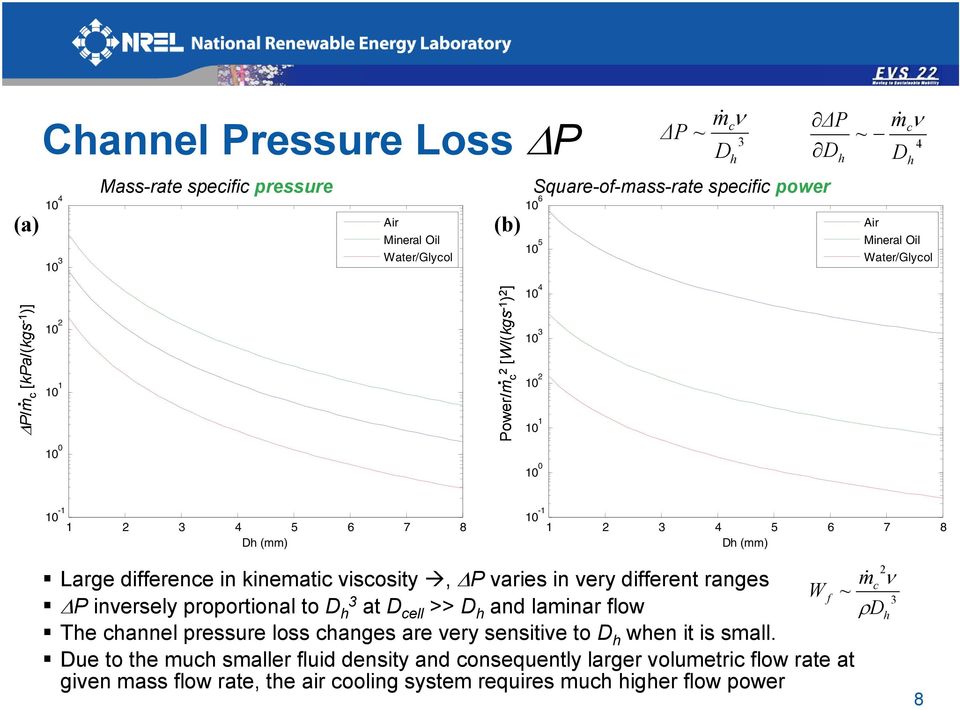
7 (a) ΔP/m c [kpa/(kgs - )]. Channel Pressure Loss ΔP Mass-rate specific pressure Air Mineral Oil Water/Glycol (b) Power/m c [W/(kgs - ) ] m& ν ΔP ~ D c h ΔP D Square-of-mass-rate specific power h m& ν ~ D c h Air Mineral Oil Water/Glycol Dh (mm) Dh (mm) Large difference in kinematic viscosity, ΔP varies in very different ranges ΔP inversely proportional to D h at D cell >> D h and laminar flow The channel pressure loss changes are very sensitive to D h when it is small. W f ~ Due to the much smaller fluid density and consequently larger volumetric flow rate at given mass flow rate, the air cooling system requires much higher flow power m& ν ρ D c h 8
8 Coolant Temperature Increase ΔT Temperature ( o C) ΔT p Mass-Flow Rate (g/s) ΔT m & c c p ΔT m& ~ ~ Air c p m& c Mineral Oil Water/Glycol To achieve the temperature uniformity over a cell, it is preferred to keep coolant temperature change in the channel as small as possible. ΔT is inversely proportional to coolant heat capacity flow rate. Therefore, increasing mass flow rate is not as effective for reducing coolant temperature change in large flow rate cooling as it is in a small flow rate cooling. A little change of flow rate can greatly affect the coolant temperature change and consequently cell temperatures at small coolant flow rate (especially for air system having small c p ). 9

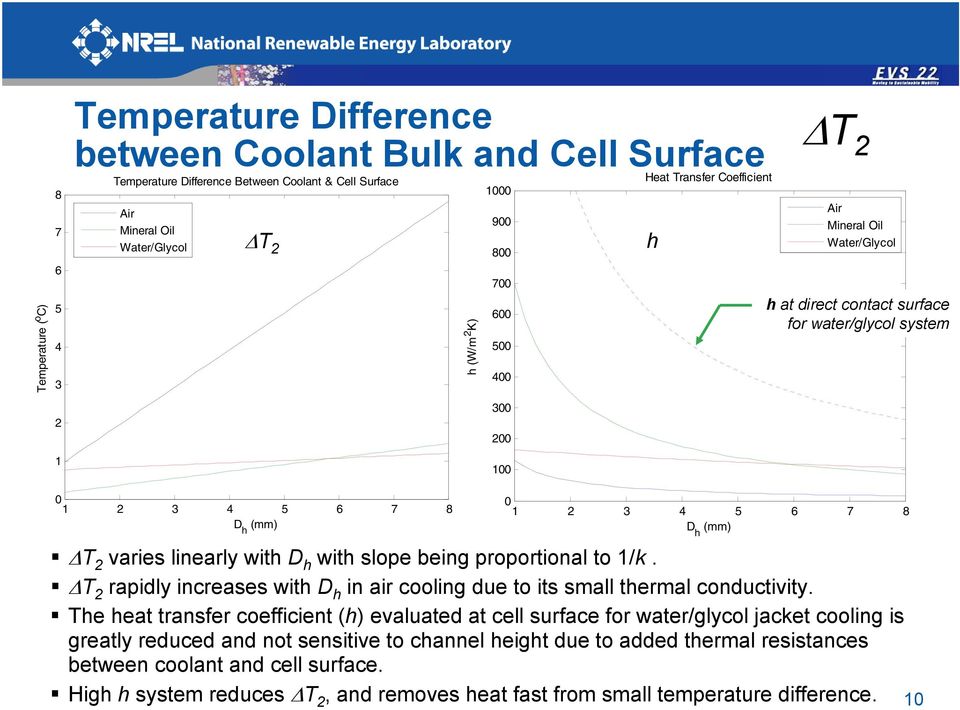
9 Temperature ( o C) Temperature Difference between Coolant Bulk and Cell Surface Temperature Difference Between Coolant & Cell Surface Air Mineral Oil Water/Glycol ΔT h (W/m K) Heat Transfer Coefficient h ΔT Air Mineral Oil Water/Glycol h at direct contact surface for water/glycol system D h (mm) D h (mm) ΔT varies linearly with D h with slope being proportional to /k. ΔT rapidly increases with D h in air cooling due to its small thermal conductivity. The heat transfer coefficient (h) evaluated at cell surface for water/glycol jacket cooling is greatly reduced and not sensitive to channel height due to added thermal resistances between coolant and cell surface. High h system reduces ΔT, and removes heat fast from small temperature difference. 0
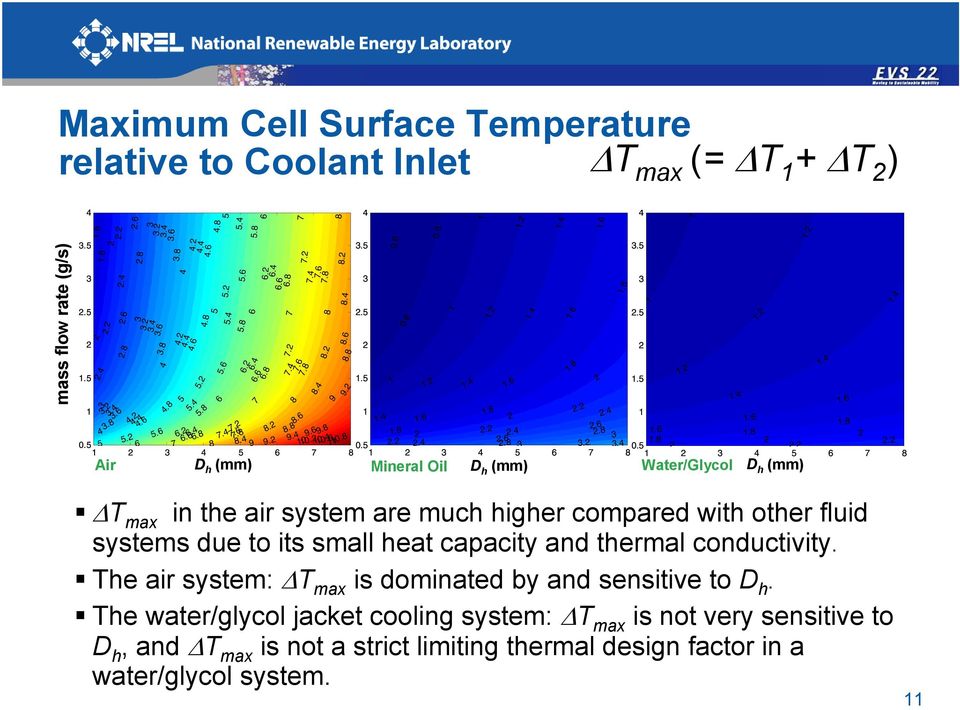
10 .. Maximum Cell Surface Temperature relative to Coolant Inlet ΔT max (= ΔT + ΔT ) DT max ( o C) mass flow rate (g/s) D h (mm) DT max ( o C) D h (mm) DT max ( o C) mass flow rate (g/s) Air D h (mm) D h (mm) Mineral Oil D h (mm) Water/Glycol D h (mm) ΔT max in the air system are much higher compared with other fluid systems due to its small heat capacity and thermal conductivity. The air system: ΔT max is dominated by and sensitive to D h. The water/glycol jacket cooling system: ΔT max is not very sensitive to D h, and ΔT max is not a strict limiting thermal design factor in a water/glycol system.
11 Optimizing Operation Parameters Δ T max =. o C - Air Cooling System Re=00 Δ T max =.5 o C Cell Specifics Q=W D cell =5cm L cell =0cm Δ P=0 Pa Δ P=7 Pa Δ T =.5 o C Confining Factors Colored Zone satisfies Re < 00 ΔP < 0 Pa ΔT + ΔT <.5 o C ΔT <.5 o C : maximum heat transfer coefficient (h) operating point : lowest max temperature (ΔT + ΔT ) operating point : minimum pressure loss (ΔP) operating point

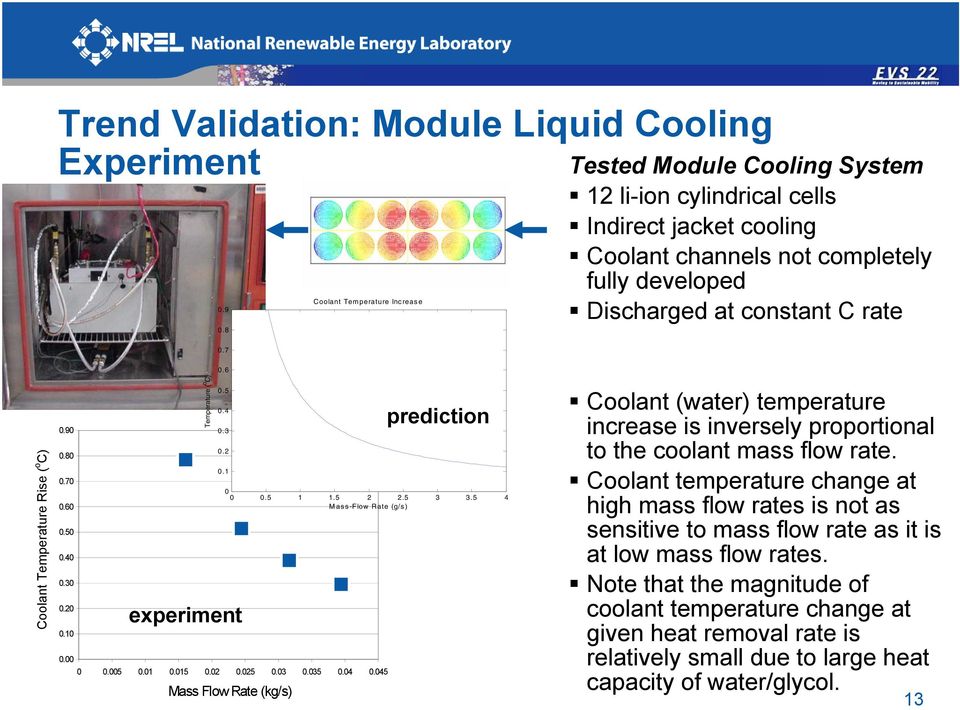
12 Trend Validation: Module Liquid Cooling Experiment Coolant Temperature Increase Tested Module Cooling System li-ion cylindrical cells Indirect jacket cooling Coolant channels not completely fully developed Discharged at constant C rate Coolant Temperature Rise ( o C) Coolant Temperature Rise ( o C) Temperature ( o C) experiment Mass-Flow Rate (g/s) Mass Flow Rate (kg/s) Mass Flow Rate (kg/s) prediction Coolant (water) temperature increase is inversely proportional to the coolant mass flow rate. Coolant temperature change at high mass flow rates is not as sensitive to mass flow rate as it is at low mass flow rates. Note that the magnitude of coolant temperature change at given heat removal rate is relatively small due to large heat capacity of water/glycol.
13 Computational Fluid Dynamic (CFD) Evaluation Direct Air Cooling Geometry & Mesh Heat Generation: W per Cell Channel Inlet Air Temperature: 5 o C Air Mass Flow Rate:. g/s per Cell Channel Gap Height:. mm (D h =. mm) Temperature Distribution Coolant Channel Can Cell Core NOTE: Radial direction length is exaggerated. Terminal Current Collector Terminal

14 Temperature ( o C) CFD CFD Predictions: Temperatures, h and Surface Heat Flux Profiles Air Mean Temperature 5.5 Cell Surface Temperature Cell Temperature at Axis Axial Distance (cm) Fully Developed Flow Relations with Constant Heat Flux ΔP [Pa] channel pressure loss 09.. ΔT max ΔT ΔT [ o C] coolant temperature change.9.50 Heat Transfer Coefficient (W/m K) Heat Flux (W/m ) A i l Di ( ) Axial Distance (cm) ΔT max [ o C] maximum cell surface temperature to inlet air.6.89 ΔT cell [ o C] maximum cell internal temperature to inlet air N/A. h Heat Flux h [W/m K] mean heat transfer coefficient ΔT max Disagreement CFD captures entrance effects. CFD model addresses battery internal heat flow and captures axially decreasing heat flux from cell to air. Internal heat flow through high conductivity material distributed inside a cell (such as container can) makes the axial gradient of cell surface temperature smaller than that of air temperature. This result strongly implies that capturing the internal heat flow paths and thermal resistances inside a cell are important for the improved prediction of cell/battery thermal behaviors. 5
![. ΔT max ΔT ΔT [ o C] coolant temperature change.9.](/docs-images/44/15163065/images/page_14.jpg "50 Heat Transfer Coefficient (W/m K) Heat Flux (W/m ) 0 00 80 60 0 0 0 0 5 6 7 8 9 0 A i l Di ( ) 50 00 50 00 50 0 0 5 6 7 8 9 0 Axial Distance (cm) ΔT max [ o C] maximum cell surface temperature to")
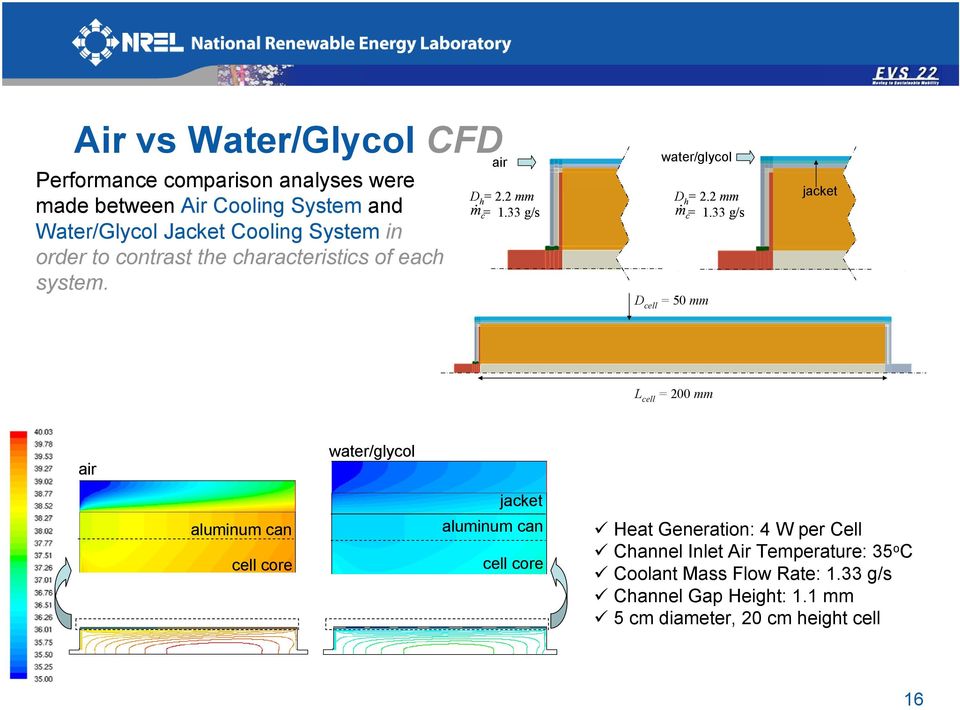
15 Air vs Water/Glycol CFD Performance comparison analyses were made between Air Cooling System and Water/Glycol Jacket Cooling System in order to contrast the characteristics of each system. air D h =. mm m& c =. g/s water/glycol D h =. mm m& c =. g/s D cell = 50 mm jacket L cell = 00 mm air water/glycol aluminum can cell core jacket aluminum can cell core Heat Generation: W per Cell Channel Inlet Air Temperature: 5 o C Coolant Mass Flow Rate:. g/s Channel Gap Height:. mm 5 cm diameter, 0 cm height cell 6
16 Concluding Remarks Air Cooling System The heat transfer coefficient (h) of an air cooling system is lower than that of liquid cooling systems. Due to the small heat capacity of air, it is difficult to accomplish temperature uniformity inside a cell or between the cells in a module. The temperature difference between coolant air and cell surface is sensitive to variations of channel height due to the small heat conductivity of air. Heat transfer coefficient is inversely proportional to D h, while friction pressure loss in channel is inversely proportional to D h. Increasing heat transfer coefficient by reducing channel thickness is limited by the required blower power. The simplicity of an air cooling system is an advantage over a liquid coolant system. Air cooling could have less mass, has no potential for leaks, needs fewer components, and could cost less. 8
17 Concluding Remarks Liquid Cooling System A water/glycol solution for a jacket cooling has much lower viscosity than dielectric mineral oil for direct cooling. Increasing the coolant flow rate in water/glycol system is not as severely restricted by the pump power as in a mineral oil system. Cell/module temperature uniformity can be effectively achieved in liquid cooling system due to the large heat capacity of liquid coolant. Water/glycol solutions generally have a higher thermal conductivity than oil. However, the effective heat transfer coefficient at the cell surface is greatly reduced due to the added jacket wall and air gap layer. Because of the added thermal resistances, h is not as sensitive to the variation of channel height in indirect liquid cooling systems. Liquid cooling systems are more effective in heat transfer and take up less volume. However, the added complexity and cost may outweigh the merits. Maintenance and repair of a liquid cooled pack is more involved and costlier. Indirect liquid cooling, with jackets, is easer to handle than direct liquid cooling. 9
18 Concluding Remarks General Selection between air or liquid cooling depends on applications. Trade-off between performance, application, and cost must be considered It is recommended in liquid cooling system to use a small gap coolant channel to reduce system weight and volume by minimizing the amount of liquid coolant in a system operated at a given coolant flow rate. Capturing the internal heat flow paths and thermal resistances inside a cell using a sophisticated three-dimensional cell model is important for the improved prediction of cell/battery thermal behaviors. With the model we can look at turbulent flows, mixed conduction/convection, and phase change materials. 0
An Approach for Designing Thermal Management Systems for EV and HEV Battery Packs
 An Approach for Designing Thermal Management Systems for EV and HEV Battery Packs 4th Vehicle Thermal Management Systems Conference London, UK May 24-27, 1999 Ahmad A. Pesaran, Ph.D. Steven D. Burch Matthew
Battery Thermal Management in EVs and HEVs: Issues and Solutions
 Battery Thermal Management in EVs and HEVs: Issues and Solutions Ahmad A. Pesaran National Renewable Energy Laboratory 1617 Cole Blvd. Golden, Colorado 80401 Advanced Automotive Battery Conference Las
Thermal Management of Batteries in Advanced Vehicles Using Phase-Change Materials
 Thermal Management of Batteries in Advanced Vehicles Using Phase-Change Materials Gi-Heon Kim: Speaker Jeff Gonder, Jason Lustbader, Ahmad Pesaran National Renewable Energy Laboratory, U.S.A. NREL/PR-540-42544
A LAMINAR FLOW ELEMENT WITH A LINEAR PRESSURE DROP VERSUS VOLUMETRIC FLOW. 1998 ASME Fluids Engineering Division Summer Meeting
 TELEDYNE HASTINGS TECHNICAL PAPERS INSTRUMENTS A LAMINAR FLOW ELEMENT WITH A LINEAR PRESSURE DROP VERSUS VOLUMETRIC FLOW Proceedings of FEDSM 98: June -5, 998, Washington, DC FEDSM98 49 ABSTRACT The pressure
Natural Convection. Buoyancy force
 Natural Convection In natural convection, the fluid motion occurs by natural means such as buoyancy. Since the fluid velocity associated with natural convection is relatively low, the heat transfer coefficient
Optimum fin spacing for fan-cooled heat sinks
 Optimum fin spacing for fan-cooled heat sinks Keywords: optimum fin spacing fan-cooled heat sink heatsink optimal fin pitch parallel plate fin array optimization forced air cooling fan curve pressure drop
Fluids and Solids: Fundamentals
 Fluids and Solids: Fundamentals We normally recognize three states of matter: solid; liquid and gas. However, liquid and gas are both fluids: in contrast to solids they lack the ability to resist deformation.
A MTR FUEL ELEMENT FLOW DISTRIBUTION MEASUREMENT PRELIMINARY RESULTS
 A MTR FUEL ELEMENT FLOW DISTRIBUTION MEASUREMENT PRELIMINARY RESULTS W. M. Torres, P. E. Umbehaun, D. A. Andrade and J. A. B. Souza Centro de Engenharia Nuclear Instituto de Pesquisas Energéticas e Nucleares
Diffusion and Fluid Flow
 Diffusion and Fluid Flow What determines the diffusion coefficient? What determines fluid flow? 1. Diffusion: Diffusion refers to the transport of substance against a concentration gradient. ΔS>0 Mass
Heat Transfer Prof. Dr. Ale Kumar Ghosal Department of Chemical Engineering Indian Institute of Technology, Guwahati
 Heat Transfer Prof. Dr. Ale Kumar Ghosal Department of Chemical Engineering Indian Institute of Technology, Guwahati Module No. # 04 Convective Heat Transfer Lecture No. # 03 Heat Transfer Correlation
Theoretical and Experimental Investigation of Heat Transfer Characteristics through a Rectangular Microchannel Heat Sink
 Theoretical and Experimental Investigation of Heat Transfer Characteristics through a Rectangular Microchannel Heat Sink Dr. B. S. Gawali 1, V. B. Swami 2, S. D. Thakre 3 Professor Dr., Department of Mechanical
International Journal of ChemTech Research CODEN (USA): IJCRGG ISSN: 0974-4290 Vol.7, No.6, pp 2580-2587, 2014-2015
 International Journal of ChemTech Research CODEN (USA): IJCRGG ISSN: 0974-4290 Vol.7, No.6, pp 2580-2587, 2014-2015 Performance Analysis of Heat Transfer and Effectiveness on Laminar Flow with Effect of
Adaptation of General Purpose CFD Code for Fusion MHD Applications*
 Adaptation of General Purpose CFD Code for Fusion MHD Applications* Andrei Khodak Princeton Plasma Physics Laboratory P.O. Box 451 Princeton, NJ, 08540 USA [email protected] Abstract Analysis of many fusion
INTERNATIONAL JOURNAL OF RESEARCH IN AERONAUTICAL AND MECHANICAL ENGINEERING
 ISSN (ONLINE): 2321-3051 INTERNATIONAL JOURNAL OF RESEARCH IN AERONAUTICAL AND MECHANICAL ENGINEERING Study of forced convection heat transfer With DAQ & ANSYS First Authors Moopanar karthikeyan 1, Raote
Problem Statement In order to satisfy production and storage requirements, small and medium-scale industrial
 Problem Statement In order to satisfy production and storage requirements, small and medium-scale industrial facilities commonly occupy spaces with ceilings ranging between twenty and thirty feet in height.
cmn_lecture.2 CAD OF DOUBLE PIPE HEAT EXCHANGERS
 cmn_lecture.2 CAD OF DOUBLE PIPE HEAT EXCHANGERS A double pipe heat exchanger, in essence, consists of two concentric pipes, one fluid flowing through the inner pipe and the outer fluid flowing countercurrently
Basic Principles in Microfluidics
 Basic Principles in Microfluidics 1 Newton s Second Law for Fluidics Newton s 2 nd Law (F= ma) : Time rate of change of momentum of a system equal to net force acting on system!f = dp dt Sum of forces
A Comparison of Analytical and Finite Element Solutions for Laminar Flow Conditions Near Gaussian Constrictions
 A Comparison of Analytical and Finite Element Solutions for Laminar Flow Conditions Near Gaussian Constrictions by Laura Noelle Race An Engineering Project Submitted to the Graduate Faculty of Rensselaer
Fluid Mechanics: Static s Kinematics Dynamics Fluid
 Fluid Mechanics: Fluid mechanics may be defined as that branch of engineering science that deals with the behavior of fluid under the condition of rest and motion Fluid mechanics may be divided into three
Lecture 6 - Boundary Conditions. Applied Computational Fluid Dynamics
 Lecture 6 - Boundary Conditions Applied Computational Fluid Dynamics Instructor: André Bakker http://www.bakker.org André Bakker (2002-2006) Fluent Inc. (2002) 1 Outline Overview. Inlet and outlet boundaries.
For Water to Move a driving force is needed
 RECALL FIRST CLASS: Q K Head Difference Area Distance between Heads Q 0.01 cm 0.19 m 6cm 0.75cm 1 liter 86400sec 1.17 liter ~ 1 liter sec 0.63 m 1000cm 3 day day day constant head 0.4 m 0.1 m FINE SAND
CFD SIMULATION OF SDHW STORAGE TANK WITH AND WITHOUT HEATER
 International Journal of Advancements in Research & Technology, Volume 1, Issue2, July-2012 1 CFD SIMULATION OF SDHW STORAGE TANK WITH AND WITHOUT HEATER ABSTRACT (1) Mr. Mainak Bhaumik M.E. (Thermal Engg.)
HEAT TRANSFER AUGMENTATION THROUGH DIFFERENT PASSIVE INTENSIFIER METHODS
 HEAT TRANSFER AUGMENTATION THROUGH DIFFERENT PASSIVE INTENSIFIER METHODS P.R.Hatwar 1, Bhojraj N. Kale 2 1, 2 Department of Mechanical Engineering Dr. Babasaheb Ambedkar College of Engineering & Research,
Lecture 9, Thermal Notes, 3.054
 Lecture 9, Thermal Notes, 3.054 Thermal Properties of Foams Closed cell foams widely used for thermal insulation Only materials with lower conductivity are aerogels (tend to be brittle and weak) and vacuum
Turbulence Modeling in CFD Simulation of Intake Manifold for a 4 Cylinder Engine
 HEFAT2012 9 th International Conference on Heat Transfer, Fluid Mechanics and Thermodynamics 16 18 July 2012 Malta Turbulence Modeling in CFD Simulation of Intake Manifold for a 4 Cylinder Engine Dr MK
Introduction to Microfluidics. Date: 2013/04/26. Dr. Yi-Chung Tung. Outline
 Introduction to Microfluidics Date: 2013/04/26 Dr. Yi-Chung Tung Outline Introduction to Microfluidics Basic Fluid Mechanics Concepts Equivalent Fluidic Circuit Model Conclusion What is Microfluidics Microfluidics
Comparison of Heat Transfer between a Helical and Straight Tube Heat Exchanger
 International Journal of Engineering Research and Technology. ISSN 0974-3154 Volume 6, Number 1 (2013), pp. 33-40 International Research Publication House http://www.irphouse.com Comparison of Heat Transfer
THERMAL STRATIFICATION IN A HOT WATER TANK ESTABLISHED BY HEAT LOSS FROM THE TANK
 THERMAL STRATIFICATION IN A HOT WATER TANK ESTABLISHED BY HEAT LOSS FROM THE TANK J. Fan and S. Furbo Abstract Department of Civil Engineering, Technical University of Denmark, Brovej, Building 118, DK-28
International Journal of Latest Research in Science and Technology Volume 4, Issue 2: Page No.161-166, March-April 2015
 International Journal of Latest Research in Science and Technology Volume 4, Issue 2: Page No.161-166, March-April 2015 http://www.mnkjournals.com/ijlrst.htm ISSN (Online):2278-5299 EXPERIMENTAL STUDY
Head Loss in Pipe Flow ME 123: Mechanical Engineering Laboratory II: Fluids
 Head Loss in Pipe Flow ME 123: Mechanical Engineering Laboratory II: Fluids Dr. J. M. Meyers Dr. D. G. Fletcher Dr. Y. Dubief 1. Introduction Last lab you investigated flow loss in a pipe due to the roughness
Engine Heat Transfer. Engine Heat Transfer
 Engine Heat Transfer 1. Impact of heat transfer on engine operation 2. Heat transfer environment 3. Energy flow in an engine 4. Engine heat transfer Fundamentals Spark-ignition engine heat transfer Diesel
XI / PHYSICS FLUIDS IN MOTION 11/PA
 Viscosity It is the property of a liquid due to which it flows in the form of layers and each layer opposes the motion of its adjacent layer. Cause of viscosity Consider two neighboring liquid layers A
DESIGN AND SIMULATION OF LITHIUM- ION BATTERY THERMAL MANAGEMENT SYSTEM FOR MILD HYBRID VEHICLE APPLICATION
 DESIGN AND SIMULATION OF LITHIUM- ION BATTERY THERMAL MANAGEMENT SYSTEM FOR MILD HYBRID VEHICLE APPLICATION Ahmed Imtiaz Uddin, Jerry Ku, Wayne State University Outline Introduction Model development Modeling
Experiment 3 Pipe Friction
 EML 316L Experiment 3 Pipe Friction Laboratory Manual Mechanical and Materials Engineering Department College of Engineering FLORIDA INTERNATIONAL UNIVERSITY Nomenclature Symbol Description Unit A cross-sectional
CE 204 FLUID MECHANICS
 CE 204 FLUID MECHANICS Onur AKAY Assistant Professor Okan University Department of Civil Engineering Akfırat Campus 34959 Tuzla-Istanbul/TURKEY Phone: +90-216-677-1630 ext.1974 Fax: +90-216-677-1486 E-mail:
Heat transfer in Rotating Fluidized Beds in a Static Geometry: A CFD study
 Heat transfer in Rotating Fluidized Beds in a Static Geometry: A CFD study Nicolas Staudt, Juray De Wilde* * Université catholique de Louvain MAPR / IMAP Réaumur, Place Sainte Barbe 2 1348 Louvain-la-Neuve
Lecture 5 Hemodynamics. Description of fluid flow. The equation of continuity
 1 Lecture 5 Hemodynamics Description of fluid flow Hydrodynamics is the part of physics, which studies the motion of fluids. It is based on the laws of mechanics. Hemodynamics studies the motion of blood
NUCLEAR ENERGY RESEARCH INITIATIVE
 NUCLEAR ENERGY RESEARCH INITIATIVE Experimental and CFD Analysis of Advanced Convective Cooling Systems PI: Victor M. Ugaz and Yassin A. Hassan, Texas Engineering Experiment Station Collaborators: None
METHOD OF TEST FOR DETERMINATION OF PERMEABILITY OF GRANULAR SOILS
 Laboratory Testing Manual Date: 99 06 21 Page 1 of 7 METHOD OF TEST FOR DETERMINATION OF PERMEABILITY OF GRANULAR SOILS 1. SCOPE 1.1 This method covers the determination of the coefficient of permeability
FREESTUDY HEAT TRANSFER TUTORIAL 3 ADVANCED STUDIES
 FREESTUDY HEAT TRANSFER TUTORIAL ADVANCED STUDIES This is the third tutorial in the series on heat transfer and covers some of the advanced theory of convection. The tutorials are designed to bring the
Pressure drop in pipes...
 Pressure drop in pipes... PRESSURE DROP CALCULATIONS Pressure drop or head loss, occurs in all piping systems because of elevation changes, turbulence caused by abrupt changes in direction, and friction
Thermal Simulation of a Power Electronics Cold Plate with a Parametric Design Study
 EVS28 KINTEX, Korea, May 3-6, 2015 Thermal Simulation of a Power Electronics Cold Plate with a Parametric Design Study Boris Marovic Mentor Graphics (Deutschland) GmbH, Germany, [email protected]
Introduction to COMSOL. The Navier-Stokes Equations
 Flow Between Parallel Plates Modified from the COMSOL ChE Library module rev 10/13/08 Modified by Robert P. Hesketh, Chemical Engineering, Rowan University Fall 2008 Introduction to COMSOL The following
Differential Relations for Fluid Flow. Acceleration field of a fluid. The differential equation of mass conservation
 Differential Relations for Fluid Flow In this approach, we apply our four basic conservation laws to an infinitesimally small control volume. The differential approach provides point by point details of
Chapter 8: Flow in Pipes
 Objectives 1. Have a deeper understanding of laminar and turbulent flow in pipes and the analysis of fully developed flow 2. Calculate the major and minor losses associated with pipe flow in piping networks
CFD ANALYSES OF FLUID FLOW AND HEAT TRANSFER IN PATTERNED ROLL-BONDED ALUMINIUM PLATE RADIATORS
 Third International Conference on CFD in the Minerals and Process Industries CSIRO, Melbourne, Australia 10-12 December 2003 CFD ANALYSES OF FLUID FLOW AND HEAT TRANSFER IN PATTERNED ROLL-BONDED ALUMINIUM
Chapter 8: Heat Exchangers
 Chapter 8: Heat Exchangers Section 8.1: Introduction to Heat Exchangers 8.1-1 (8-1 in text) Dry air at T a,in = 30 C, and atmospheric pressure is blown at V a = 1.0 m 3 /s through a cross-flow heat exchanger
EXPERIMENTAL AND CFD ANALYSIS OF A SOLAR BASED COOKING UNIT
 EXPERIMENTAL AND CFD ANALYSIS OF A SOLAR BASED COOKING UNIT I N T R O D U C T I O N Among the different energy end uses, energy for cooking is one of the basic and dominant end uses in developing countries.
Open channel flow Basic principle
 Open channel flow Basic principle INTRODUCTION Flow in rivers, irrigation canals, drainage ditches and aqueducts are some examples for open channel flow. These flows occur with a free surface and the pressure
Heat Transfer Enhancement in a Heat Exchanger using Punched and V-cut Twisted Tape Inserts
 Heat Transfer Enhancement in a Heat Exchanger using Punched and V-cut Twisted Tape Inserts Imran Quazi#1, Prof. V.R.Mohite#2 #1DPCOE-Mechanical Department, SPP University Pune, India imranqu azi198 [email protected]
2. CHRONOLOGICAL REVIEW ABOUT THE CONVECTIVE HEAT TRANSFER COEFFICIENT
 ANALYSIS OF PCM SLURRIES AND PCM EMULSIONS AS HEAT TRANSFER FLUIDS M. Delgado, J. Mazo, C. Peñalosa, J.M. Marín, B. Zalba Thermal Engineering Division. Department of Mechanical Engineering University of
Secondary Heat Transfer Systems and the Application of a New Hydrofluoroether
 Secondary Heat Transfer Systems and the Application of a New Hydrofluoroether Greg Sherwood, P.E. 3M Engineering Fluids and Systems Specialty Chemicals Division St. Paul, Minnesota A great deal of effort
Heat Exchangers - Introduction
 Heat Exchangers - Introduction Concentric Pipe Heat Exchange T h1 T c1 T c2 T h1 Energy Balance on Cold Stream (differential) dq C = wc p C dt C = C C dt C Energy Balance on Hot Stream (differential) dq
Steady Heat Conduction
 Steady Heat Conduction In thermodynamics, we considered the amount of heat transfer as a system undergoes a process from one equilibrium state to another. hermodynamics gives no indication of how long
ME 305 Fluid Mechanics I. Part 8 Viscous Flow in Pipes and Ducts
 ME 305 Fluid Mechanics I Part 8 Viscous Flow in Pipes and Ducts These presentations are prepared by Dr. Cüneyt Sert Mechanical Engineering Department Middle East Technical University Ankara, Turkey [email protected]
Using CFD to improve the design of a circulating water channel
 2-7 December 27 Using CFD to improve the design of a circulating water channel M.G. Pullinger and J.E. Sargison School of Engineering University of Tasmania, Hobart, TAS, 71 AUSTRALIA Abstract Computational
Department of Chemical Engineering, National Institute of Technology, Tiruchirappalli 620 015, Tamil Nadu, India
 Experimental Thermal and Fluid Science 32 (2007) 92 97 www.elsevier.com/locate/etfs Studies on heat transfer and friction factor characteristics of laminar flow through a circular tube fitted with right
Module 1 : Conduction. Lecture 5 : 1D conduction example problems. 2D conduction
 Module 1 : Conduction Lecture 5 : 1D conduction example problems. 2D conduction Objectives In this class: An example of optimization for insulation thickness is solved. The 1D conduction is considered
Basic Equations, Boundary Conditions and Dimensionless Parameters
 Chapter 2 Basic Equations, Boundary Conditions and Dimensionless Parameters In the foregoing chapter, many basic concepts related to the present investigation and the associated literature survey were
Numerical Investigation of Heat Transfer Characteristics in A Square Duct with Internal RIBS
 merical Investigation of Heat Transfer Characteristics in A Square Duct with Internal RIBS Abhilash Kumar 1, R. SaravanaSathiyaPrabhahar 2 Mepco Schlenk Engineering College, Sivakasi, Tamilnadu India 1,
NUMERICAL ANALYSIS OF THE EFFECTS OF WIND ON BUILDING STRUCTURES
 Vol. XX 2012 No. 4 28 34 J. ŠIMIČEK O. HUBOVÁ NUMERICAL ANALYSIS OF THE EFFECTS OF WIND ON BUILDING STRUCTURES Jozef ŠIMIČEK email: [email protected] Research field: Statics and Dynamics Fluids mechanics
Journal bearings/sliding bearings
 Journal bearings/sliding bearings Operating conditions: Advantages: - Vibration damping, impact damping, noise damping - not sensitive for vibrations, low operating noise level - dust tight (if lubricated
NATIONAL RESEARCH COUNCIL CANADA. DIVISION OF BUILn ING RESEARCH DESIGN OF EXPOSED SEWER PIPES FOR INTERMITTENT USE UNDER FREEZING CONDITIONS
 NATIONAL RESEARCH COUNCIL CANADA DIVISION OF BUILn ING RESEARCH DESIGN OF EXPOSED SEWER PIPES FOR INTERMITTENT USE UNDER FREEZING CONDITIONS D,G, by Stephenson Report No, 166 of the Division of Building
Practice Problems on Boundary Layers. Answer(s): D = 107 N D = 152 N. C. Wassgren, Purdue University Page 1 of 17 Last Updated: 2010 Nov 22
 BL_01 A thin flat plate 55 by 110 cm is immersed in a 6 m/s stream of SAE 10 oil at 20 C. Compute the total skin friction drag if the stream is parallel to (a) the long side and (b) the short side. D =
Experimental Study of Free Convection Heat Transfer From Array Of Vertical Tubes At Different Inclinations
 Experimental Study of Free Convection Heat Transfer From Array Of Vertical Tubes At Different Inclinations A.Satyanarayana.Reddy 1, Suresh Akella 2, AMK. Prasad 3 1 Associate professor, Mechanical Engineering
Experimental Evaluation Of The Frost Formation
 Purdue University Purdue e-pubs International Refrigeration and Air Conditioning Conference School of Mechanical Engineering 2014 Experimental Evaluation Of The Frost Formation Yusuke Tashiro Mitsubishi
Aids needed for demonstrations: viscous fluid (water), tubes (pipes), injections, paper, stopwatches, vessels,, weights
 1 Viscous and turbulent flow Level: high school (16-17 years) hours (2 hours class teaching, 2 hours practical excercises) Content: 1. Viscous flow 2. Poiseuille s law 3. Passing from laminar to turbulent
Coupling Forced Convection in Air Gaps with Heat and Moisture Transfer inside Constructions
 Coupling Forced Convection in Air Gaps with Heat and Moisture Transfer inside Constructions M. Bianchi Janetti 1, F. Ochs 1 and R. Pfluger 1 1 University of Innsbruck, Unit for Energy Efficient Buildings,
Enhancement of heat transfer of solar air heater roughened with circular transverse RIB
 Enhancement of heat transfer of solar air heater roughened with circular transverse RIB Gurpreet Singh 1, Dr. G. S. Sidhu 2 Lala Lajpat Rai Institute of Engineering and Technology, Moga Punjab, India 1,2
GEOMETRIC, THERMODYNAMIC AND CFD ANALYSES OF A REAL SCROLL EXPANDER FOR MICRO ORC APPLICATIONS
 2 nd International Seminar on ORC Power Systems October 7 th & 8 th, 213 De Doelen, Rotterdam, NL GEOMETRIC, THERMODYNAMIC AND CFD ANALYSES OF A REAL SCROLL EXPANDER FOR MICRO ORC APPLICATIONS M. Morini,
FLUID DYNAMICS. Intrinsic properties of fluids. Fluids behavior under various conditions
 FLUID DYNAMICS Intrinsic properties of fluids Fluids behavior under various conditions Methods by which we can manipulate and utilize the fluids to produce desired results TYPES OF FLUID FLOW Laminar or
CE 3500 Fluid Mechanics / Fall 2014 / City College of New York
 1 Drag Coefficient The force ( F ) of the wind blowing against a building is given by F=C D ρu 2 A/2, where U is the wind speed, ρ is density of the air, A the cross-sectional area of the building, and
. Address the following issues in your solution:
 CM 3110 COMSOL INSTRUCTIONS Faith Morrison and Maria Tafur Department of Chemical Engineering Michigan Technological University, Houghton, MI USA 22 November 2012 Zhichao Wang edits 21 November 2013 revised
Heat Pipe Selection Revision 12/04/2001
 Heat Pipe Selection Revision 12/04/2001 Heat pipes are being used very often in particular applications when conventional cooling methods are not suitable. Once the need for heat pipe arises, the most
Swissmetro travels at high speeds through a tunnel at low pressure. It will therefore undergo friction that can be due to:
 I. OBJECTIVE OF THE EXPERIMENT. Swissmetro travels at high speeds through a tunnel at low pressure. It will therefore undergo friction that can be due to: 1) Viscosity of gas (cf. "Viscosity of gas" experiment)
DEVELOPMENT OF HIGH SPEED RESPONSE LAMINAR FLOW METER FOR AIR CONDITIONING
 DEVELOPMENT OF HIGH SPEED RESPONSE LAMINAR FLOW METER FOR AIR CONDITIONING Toshiharu Kagawa 1, Yukako Saisu 2, Riki Nishimura 3 and Chongho Youn 4 ABSTRACT In this paper, we developed a new laminar flow
EFFECT OF OBSTRUCTION NEAR FAN INLET ON FAN HEAT SINK PERFORMANCE
 EFFECT OF OBSTRUCTION NEAR FAN INLET ON FAN HEAT SINK PERFORMANCE Vivek Khaire, Dr. Avijit Goswami Applied Thermal Technologies India 3rd Floor,C-Wing,Kapil Towers, Dr. Ambedkar Road, Pune- 411 1 Maharashtra,
NUMERICAL SIMULATION OF PULSED ELECTRIC FIELDS (PEF) PROCESSING FOR CHAMBER DESIGN AND OPTIMISATION
 Seventh International Conference on CFD in the Minerals and Process Industries CSIRO, Melbourne, Australia 9-11 December 2009 NUMERICAL SIMULATION OF PULSED ELECTRIC FIELDS (PEF) PROCESSING FOR CHAMBER
Flow distribution and turbulent heat transfer in a hexagonal rod bundle experiment
 Flow distribution and turbulent heat transfer in a hexagonal rod bundle experiment K. Litfin, A. Batta, A. G. Class,T. Wetzel, R. Stieglitz Karlsruhe Institute of Technology Institute for Nuclear and Energy
FLUID FLOW AND MIXING IN BIOREACTORS (Part 2 of 2)
 FLUID FLOW AND MIXING IN BIOREACTORS (Part 2 of 2) Overview Power requirements for mixing Newtonian and non-newtonian liquids Ungassed and gassed systems Scale-up issues, scale-down approach Adapting bioreactor
Abaqus/CFD Sample Problems. Abaqus 6.10
 Abaqus/CFD Sample Problems Abaqus 6.10 Contents 1. Oscillatory Laminar Plane Poiseuille Flow 2. Flow in Shear Driven Cavities 3. Buoyancy Driven Flow in Cavities 4. Turbulent Flow in a Rectangular Channel
Control ball valves for severe services. Author: Michele Ferrante, PARCOL S.p.A., Italy
 Control ball valves for severe services Author: Michele Ferrante, PARCOL S.p.A., Italy Control valves are primarily classified according to the type of their obturator motion which can be linear or rotary.
L r = L m /L p. L r = L p /L m
 NOTE: In the set of lectures 19/20 I defined the length ratio as L r = L m /L p The textbook by Finnermore & Franzini defines it as L r = L p /L m To avoid confusion let's keep the textbook definition,
NUMERICAL INVESTIGATIONS ON HEAT TRANSFER IN FALLING FILMS AROUND TURBULENCE WIRES
 NUMERICAL INVESTIGATIONS ON HEAT TRANSFER IN FALLING FILMS AROUND TURBULENCE WIRES Abstract H. Raach and S. Somasundaram Thermal Process Engineering, University of Paderborn, Paderborn, Germany Turbulence
Lithium-Ion Battery Safety Study Using Multi-Physics Internal Short-Circuit Model
 Lithium-Ion Battery Safety Study Using Multi-Physics Internal Short-Circuit Model The 5th Intl. Symposium on Large Lithium-Ion Battery Technology and Application in Conjunction with AABC09 June 9-10, 2009,
TWO-DIMENSIONAL FINITE ELEMENT ANALYSIS OF FORCED CONVECTION FLOW AND HEAT TRANSFER IN A LAMINAR CHANNEL FLOW
 TWO-DIMENSIONAL FINITE ELEMENT ANALYSIS OF FORCED CONVECTION FLOW AND HEAT TRANSFER IN A LAMINAR CHANNEL FLOW Rajesh Khatri 1, 1 M.Tech Scholar, Department of Mechanical Engineering, S.A.T.I., vidisha
International Journal of Heat and Mass Transfer
 International Journal of Heat and Mass Transfer 57 (2013) 190 201 Contents lists available at SciVerse ScienceDirect International Journal of Heat and Mass Transfer journal homepage: www.elsevier.com/locate/ijhmt
Exergy Analysis of a Water Heat Storage Tank
 Exergy Analysis of a Water Heat Storage Tank F. Dammel *1, J. Winterling 1, K.-J. Langeheinecke 3, and P. Stephan 1,2 1 Institute of Technical Thermodynamics, Technische Universität Darmstadt, 2 Center
Experimental Study On Heat Transfer Enhancement In A Circular Tube Fitted With U -Cut And V -Cut Twisted Tape Insert
 Experimental Study On Heat Transfer Enhancement In A Circular Tube Fitted With U -Cut And V -Cut Twisted Tape Insert Premkumar M Abstract Experimental investigation of heat transfer and Reynolds number
Chapter 10. Flow Rate. Flow Rate. Flow Measurements. The velocity of the flow is described at any
 Chapter 10 Flow Measurements Material from Theory and Design for Mechanical Measurements; Figliola, Third Edition Flow Rate Flow rate can be expressed in terms of volume flow rate (volume/time) or mass
A10VSO Nominal size 18 see RD 92712 A10VSO Nominal size 28...140 see RD 92711
 A10VO Nominal size 18 see RD 92712 A10VO Nominal size 28...140 see RD 92711 The variable displacement axial piston pump A10VO in swashplate design was designed for hydrostatic drives in open circuits.
Determination of Thermal Conductivity of Coarse and Fine Sand Soils
 Proceedings World Geothermal Congress Bali, Indonesia, - April Determination of Thermal Conductivity of Coarse and Fine Sand Soils Indra Noer Hamdhan 1 and Barry G. Clarke 2 1 Bandung National of Institute
Numerical Simulation of Thermal Stratification in Cold Legs by Using OpenFOAM
 Progress in NUCLEAR SCIENCE and TECHNOLOGY, Vol. 2, pp.107-113 (2011) ARTICLE Numerical Simulation of Thermal Stratification in Cold Legs by Using OpenFOAM Jiejin CAI *, and Tadashi WATANABE Japan Atomic
CEE 370 Fall 2015. Laboratory #3 Open Channel Flow
 CEE 70 Fall 015 Laboratory # Open Channel Flow Objective: The objective of this experiment is to measure the flow of fluid through open channels using a V-notch weir and a hydraulic jump. Introduction:
APPLICATION OF TRANSIENT WELLBORE SIMULATOR TO EVALUATE DELIVERABILITY CURVE ON HYPOTHETICAL WELL-X
 PROCEEDINGS, Thirty-Third Workshop on Geothermal Reservoir Engineering Stanford University, Stanford, California, January 8-30, 008 SGP-TR-185 APPLICATION OF TRANSIENT WELLBORE SIMULATOR TO EVALUATE DELIVERABILITY
MATLAB AS A PROTOTYPING TOOL FOR HYDRONIC NETWORKS BALANCING
 MATLAB AS A PROTOTYPING TOOL FOR HYDRONIC NETWORKS BALANCING J. Pekař, P. Trnka, V. Havlena* Abstract The objective of this note is to describe the prototyping stage of development of a system that is