
A LAMINAR FLOW ELEMENT WITH A LINEAR PRESSURE DROP VERSUS VOLUMETRIC FLOW ASME Fluids Engineering Division Summer Meeting
|
|
|
- Tyrone Pearson
- 9 years ago
- Views:
Transcription
1 TELEDYNE HASTINGS TECHNICAL PAPERS INSTRUMENTS A LAMINAR FLOW ELEMENT WITH A LINEAR PRESSURE DROP VERSUS VOLUMETRIC FLOW Proceedings of FEDSM 98: June -5, 998, Washington, DC FEDSM98 49 ABSTRACT The pressure drop across a typical laminar flow element consists of a quadratic entrance function, a linear function due to the fully developed flow and a quadratic exit function. These nonlinear terms are also functions of fluid density. If a strictly linear function is assumed then the nonlinear terms introduce an error into the flow measurement that changes with the fluid temperature, pressure and composition. This limits the accuracy of the flow reading. An annular flow passage alone or in parallel with other laminar flow passages can remove these unstable, nonlinear errors. A pressure sense point can be inserted into an annular passageway sufficiently downstream of the inlet point such that the flow is a fully developed laminar flow at this position. Another pressure sense point can be inserted downstream of the first sense point, but sufficiently far upstream of the exit point such that there will be no disturbance in the flow from the exit point. There is only fully developed laminar flow between these two points. NOMENCLATURE A cross-sectional area of passage c f friction coefficient D diameter of passage D h hydraulic L length L e = entrance length K c = compression coefficient K e = expansion coefficient P = pressure Q = volumetric flow rate r = radius Re = Reynold s number V = gas velocity P = differential pressure drop William J. Alvesteffer and Lawrence W. Eget Teledyne Brown Engineering: Hastings Instruments P.O. Box 436 Hampton Virginia 366 USA Phone (757) Fax: (757) ASME Fluids Engineering Division Summer Meeting P a = differential pressure drop due to area change r = distance from inner diameter to outer diameter of annular passage greek letters τ o = shear stress on surface µ = gas viscosity ρ = gas density Subscripts i inlet condition o outlet condition INTRODUCTION A laminar flow element is a device that will generate a differential pressure that is a mostly linear function of the volumetric flow passing through it. The laminar flow element does this by dividing the flow up into many parallel flow passages that have very small diameters. Since only a small flow passes through each passage, the Reynolds number of the flow through each passage is low enough that laminar flow is maintained throughout the measurement range. These devices can be used as a volumetric flow measurement device. This can be achieved by measuring the differential pressure across the laminar flow element generated by the flow passing through it and correcting for changes in the gas viscosity caused by temperature. This corrected differential pressure is then used as the independent variable in a polynomial fit to determine the volume of the flow passing through the midpoint of the laminar flow element. Another common use for these devices is as a flow shunt inside a thermal mass flow controller. The thermal mass flow sensor has a typical full scale range that is less than standard cm3/min. A flow shunting arrangement is used to
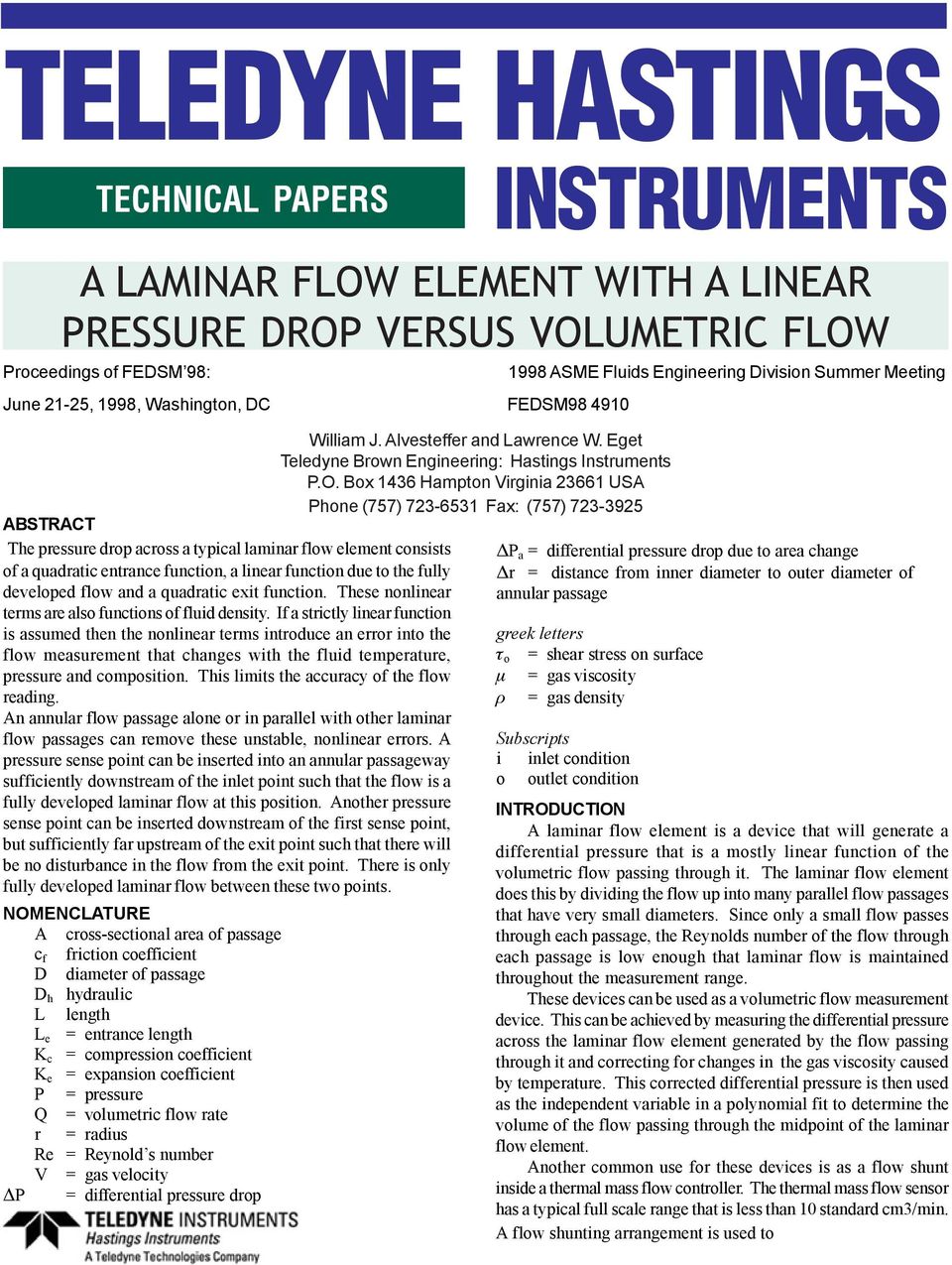
2 overcome this limitation. A flow shunt is placed in parallel with the sensor. The differential pressure created across the flow shunt provides the driving force to send a small portion of the total flow through the sensor. The sensor measures the mass flow rate of this diverted flow stream and provides an output proportional to measured mass flow. If the mass flow rate of the main flow stream is measured externally during calibration, a multiplier can be calculated from the ratio of the sensed flow and the total flow. This multiplier can then be used to calculate the total flow from the measured flow during normal operation. Ideally this flow division between the diverted flow stream and the main flow is constant. This would occur if the pressure drop versus volumetric flow rate curve of the diverted flow path has the same shape as the pressure drop versus volumetric flow rate of the main flow path; i. e. they differ only by a constant multiplier of the volumetric flow rate that is independent of temperature, pressure, or gas variations or flow rates. In practice, most of the flow shunting arrangements do not have the same pressure drop versus volumetric flow curve shape as the sensors used across them. The sensor is typically constructed from a thin capillary tube which is times longer than its diameter. This tube has a pressure drop versus volumetric flow curve that is mostly linear with a very small quadratic term from the entrance and exit effects. The shunt however, is often shorter than the sensor with larger flow paths. Often the flow paths contain sharp bends and varying flow areas. The pressure drop versus volumetric flow drop curve for these shunts is often dominated by second order terms that are functions of the gas variables. This makes the flow multiplier a function of the gas density, viscosity and flow rate. This is typically overcome by measuring the flow multiplier at several different flow rates with a gas that has a viscosity that is similar to the gas that will be measured in normal operation. A linear extrapolation is used to calculate the flow multiplier at all points between the measured flow points. THEORY A flow divider for a thermal mass flow transducer usually consists of an inlet plenum, a flow restriction and an outlet plenum. (See Figure.) Since stability of the flow multiplier is desired to ensure a stable instrument, there must be some matching between the linear volumetric flow versus pressure drop of the sensor and the shape of the volumetric flow versus pressure drop of the flow restriction. Most instruments employ Poiseuille s law and use some sort of multi-passage device that creates laminar flow between the upstream sensor inlet and the downstream outlet. This makes the volumetric flow versus pressure drop curve primarily linear, but there are other effects which introduce higher order terms. Most flow transducers are designed such that the outlet plenum has a smaller diameter than the inlet plenum. This eases the insertion and containment of the flow restriction between the sensor inlet point and the sensor outlet point. If we were to remove the flow restriction we know the energy of the gas must be conserved when passing from the inlet plenum to the outlet plenum. From Bernoulli s equation we know that sum of the kinetic energy and the pressure at each point must be a constant and since all of the pressure drops are small we can assume the flow is incompressible. Pi + ρvi = Po + ρ Vo ( ) Inlet Figure Typical Flow Divider Outlet From conservation of mass we know that: ρva = ρv A ( ) V o i i o o Combining these two equations we get: Ai = A V i o A i Pi Po = ρ V i Ao Substituting in the function of the diameters for the area of the flow passage and simplifying we have: P a 4 D i = ρ V i Do We can see that even with no effect from the flow restriction there will be a pressure drop between the sensor inlet and outlet points. This pressure drop will be a strong function of the ratio of the two diameters. Since the drop is a square function of the flow velocity the differential pressure will be non-linear with respect to flow rate. Note also that the pressure drop is a function of density. The density will vary as Bermand, Armand, 99, Vacuum engineering calculations, formulas, and solved exercises, Academic Press, San Diego
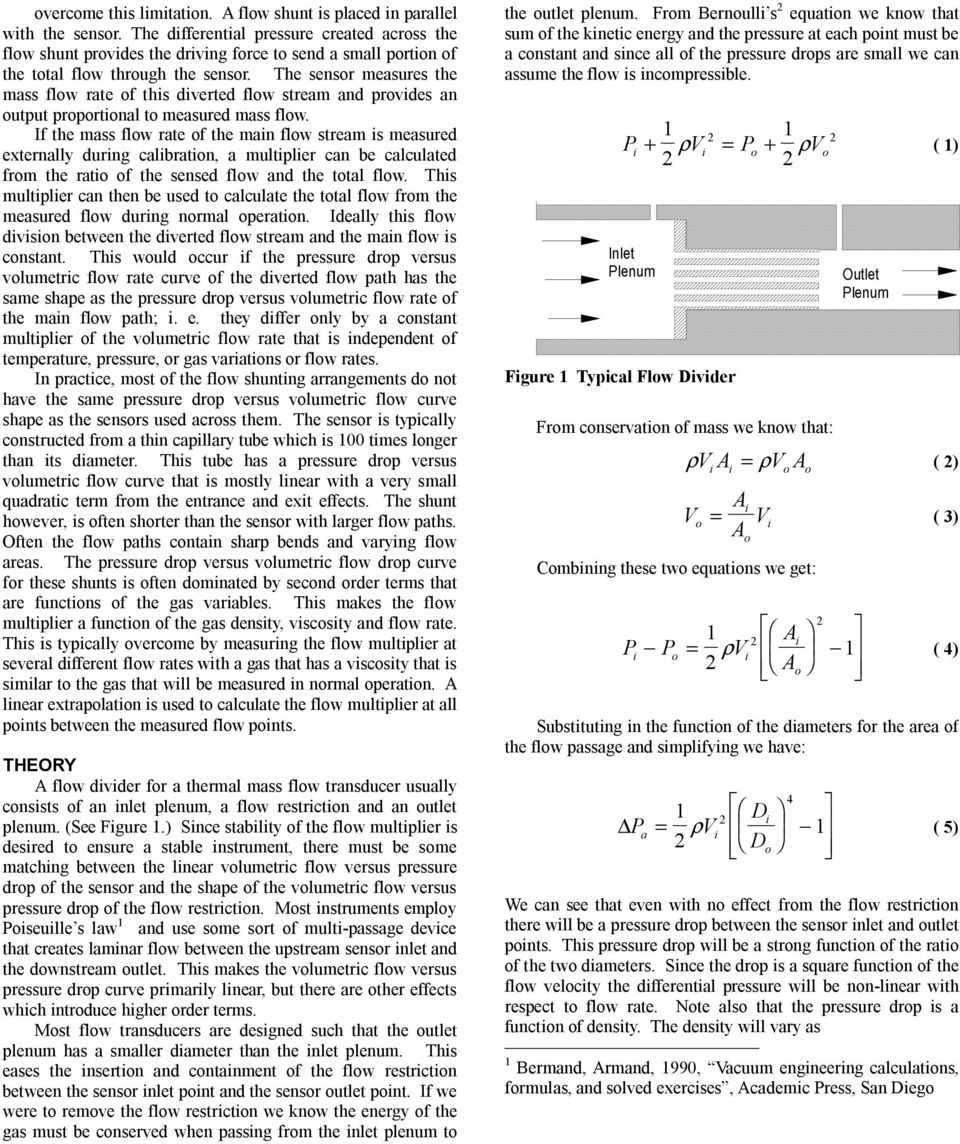
3 a function of system pressure and it will also vary when the gas composition changes. This will cause the magnitude of the pressure drop due to the area change to be a function of system pressure and gas composition. Most of the flow restrictions used contain or can be approximated by many short capillary tubes in parallel. From Rimberg we know that the equation for the pressure drop across a capillary tube contains terms that are proportional to the square of the volumetric flow rate. These terms come from the pressure drops associated with the sudden compression at the entrance and the sudden expansion at the exit of the capillary tube. The end effect terms are a function of density which will cause the quadratic term to vary with system pressure and gas composition. The absence of viscosity in the second term will cause a change in the relative magnitudes of the two terms whenever the viscosity of the flowing gas changes. 8µ LQ 8ρQ P = + D D K K 4 4 c + π π ( ) e ( ) The end effect for a typical laminar flow element in air account for approximately 4% of the total pressure drop. For hydrogen, however, which has a density that is about 4 times less than air and has a viscosity that is much greater than air, the second term is completely negligible. For the heavier gasses such as sulfur hexaflouride which has a density 5 times that of air the end effects will become % of the total. These changes make it impossible to accurately calibrate an instrument on one gas and use it for another gas. The pressure drop is linear with respect to the volumetric flow rate between a point that is downstream of the entrance area and another point further downstream but upstream of the exit region. From Kays & Crawford we know that entrance length of a capillary tube in laminar flow is a function of the Reynolds number and the tube diameter. L e = D Re ( ) L e = Qρ 5πµ For a typical flow divider tube the entry length is approximately.6 cm. From this it can be seen that if the sensor inlet pickup point could be inside of the flow divider tube but downstream of the entrance length and if the sensor outlet point were also inside the flow divider tube but upstream of the exit point then the pressure drop that drives the flow through the sensor would be linear with respect to volumetric flow rate. Since the pressure drop across the sensor now increases linearly with the main flow rate and the sensor has a linearly increasing flow with respect to pressure drop, there is now a flow through the sensor which is directly proportional to the main flow through the flow divider, without the flow division errors that are present when the sensor samples the flow completely upstream and downstream of the flow divider. Unfortunately, a typical flow divider tube has an internal diameter on the order of.3 mm. This is too small to insert tap points into the tube. Also, the sample flow through the sensor is approximately cm 3 /min while the flow through a divider tube is approximately 5 cm 3 /min. This means the sample flow would be affecting the flow it was trying to measure. If the sensor tube is made large enough, and with enough flow through it to insert the sensor taps at these positions, then the pressure drop would be too small to push the necessary flow through the sensor tube. The solution is to use a different geometry for the flow tube. It must be large enough to allow the sample points in the middle yet with passages thin enough to create the differential pressures required for the sensor. An annular passage meets these requirements. Inlet Inlet Tap Outlet Tap Outlet Where the Reynolds number for a tube is: and Therefore: Re = DVρ µ V Q Q = = 4 A πd Figure Cross sectional view of annular flow divider The basic operation is similar to the operation of the tubular flow divider but the equations for the entry length and pressure drop will be different. If we assume that the annular Rimberg, D. Pressure Drop Across Sharp-end Capillary Tubes, I&EC Fundamentals, vol.6, no. 4, November 967 Kays, W. M., Crawford M. E., 993, Convective Heat and Mass Transfer, 3 rd edition, McGraw-Hill, New York
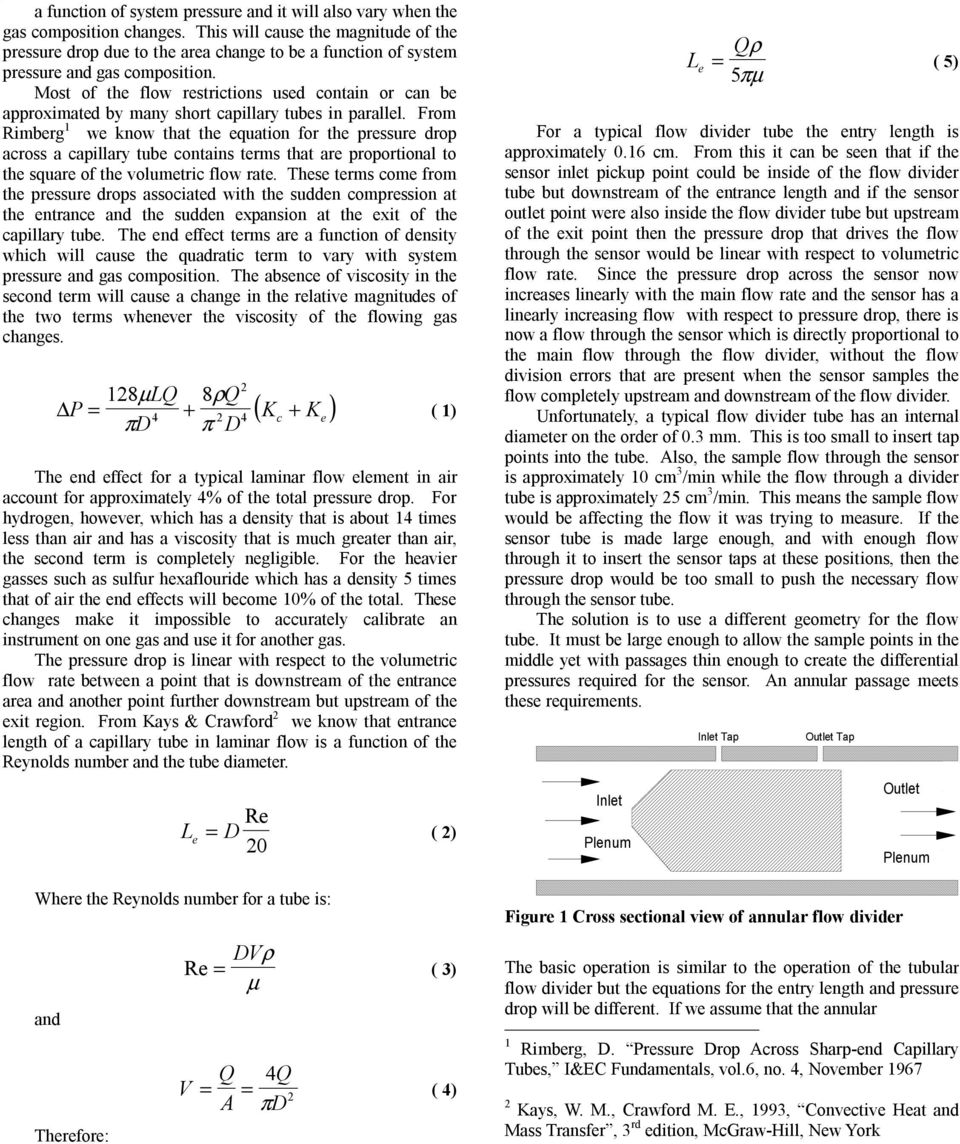
4 region is very thin, ( r << r) and the area of the region can be approximated by pr( r) then the following equations are valid: dp dx = τ ( r) ( ) area Dh = r = ( ) perimeter DV h ρ Qρ Re = = µ π rµ τ = c ρv f V = Q π r( r) From Kays and Crawford Error! Bookmark not defined. we have: Thickness (cm) Figure Thickness of the annular ring as a function of flow rate for a sensor with a 75 Pa drop and a cm spacing. Each flow divider must have a section of the annular region upstream of the upstream sensor tap to allow the flow to become fully developed before reaching the first tap. Using equation (7) we can determine the entry length for the annular passage as: c f = 4 Re Substituting in for the pressure drop we have: QL Pi Po = µ 3 πr( r) ( 6) ( 7) Q ( r) L = ρ e 4 πµ r ( 8) Below is a graph that demonstrates the entry length that would be required to design a flow divider for various full scale flows. The parameters on the sensor that the flow divider must match are the same as the ones on the previous graph. The flow divider must generate a pressure drop at the desired full scale flow drives the proper flow through the sensor tube to generate a full scale output from the sensor. Since the full scale flow of the sensor is the same for all of the different full scale flows that may pass through the flow divider, the flow divider geometry must vary for the different full scale flows in order to generate the same pressured drop for all of them. From (7) it can be seen that if the width of the annular ring is varied slightly it can correct for very large changes in the full scale flow rate (Q). Below is a graph showing how the thickness of the annular ring must be changed to create a passage that will properly divide the flow for various full scale flows. This graph is based on the 75 Pa pressure drop required to push full scale flow through a particular sensor that has cm spacing between the inlet and outlet taps. The flow divider has an outside diameter of.95 cm. centimeters Figure Entrance length as a function of flow rate for an annular ring of the size specified in figure 3. CONCLUSION By using these equations we can design a flow divider that has non-linear effects that are less than % of the total
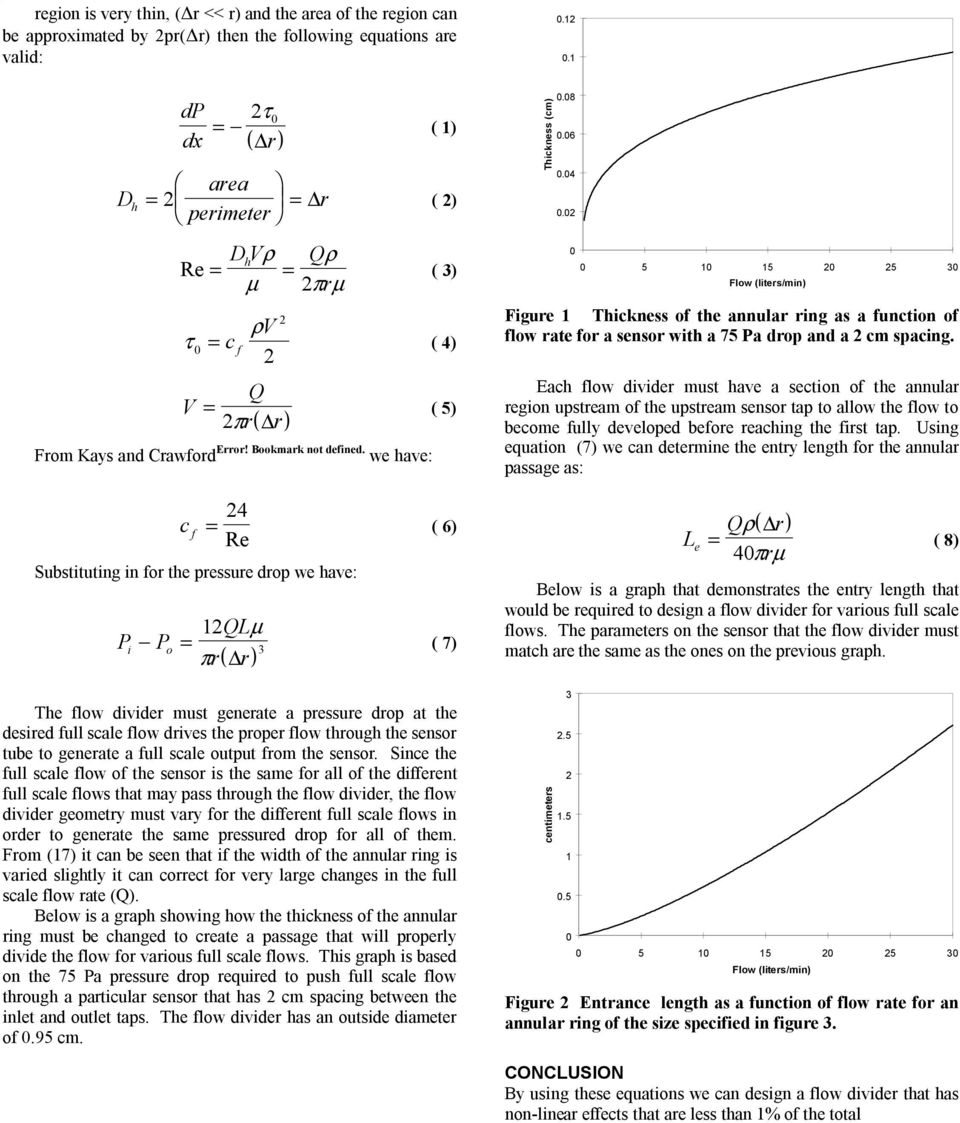
5 pressure drop at full scale flow for full scale flows up to liters/min in a cm diameter bore. Non-linearity(%FS).% -.5% -.% -.5% -.% Flow (liter/min) Annular LFE Standard LFE differential pressure (Pa) % Figure A comparison of the terminal based linearity between a multi-tube shunt with external sensor taps and an annular shunt with internal sensor taps. If flows higher than this are desired it can easily be seen that multiple annular passageways with the same flow ring thickness can be built inside of each other to create parallel passageways. These passageways will all have the same volumetric flow versus pressure drop shape as the first channel. They will differ only in the magnitude of the flow that passes through each passageway for the a given pressure drop. The magnitude of the flow is proportional to the ratio between the flow areas of the channels. Flows up to 5 liters/min can be achieved this way in the same bore size as the previous shunt. However, the flow must be fully developed in the main bore before the face of the laminar flow element is reached, otherwise the flow will not be evenly divided among the flow channels. Still higher flows can be measured by folding very thin metal foil into a cylinder containing a myriad of capillary flow channels that have approximately the same hydraulic diameter as the outer annular passageway. Laminar flow elements of this type can be used to measure flows of liters/minute with a linear pressure drop in a 4.4 cm bore. Figure Pressure drop of laminar flow element designed for a sensor with Pa drop at full scale and a cm tap spacing. ACKNOWLEDGMENTS The authors would like to thank Dr Robert Ash, Old Dominion University for his contributions to this paper. REFERENCES Bermand, Armand, 99, Vacuum engineering calculations, formulas, and solved exercises, Academic Press, San Diego Bernoulli, Daniel., Bernoulli, Johanne., 968 Hydrodynamics, Dover Publications, New York Rimberg, D. Pressure Drop Across Sharp-end Capillary Tubes, I&EC Fundamentals, vol.6, no. 4, November 967 Kays, W. M., Crawford M. E., 993, Convective Heat and Mass Transfer, 3 rd edition, McGraw-Hill, New York

Chapter 10. Flow Rate. Flow Rate. Flow Measurements. The velocity of the flow is described at any
 Chapter 10 Flow Measurements Material from Theory and Design for Mechanical Measurements; Figliola, Third Edition Flow Rate Flow rate can be expressed in terms of volume flow rate (volume/time) or mass
Heat Transfer Prof. Dr. Ale Kumar Ghosal Department of Chemical Engineering Indian Institute of Technology, Guwahati
 Heat Transfer Prof. Dr. Ale Kumar Ghosal Department of Chemical Engineering Indian Institute of Technology, Guwahati Module No. # 04 Convective Heat Transfer Lecture No. # 03 Heat Transfer Correlation
FLUID FLOW Introduction General Description
 FLUID FLOW Introduction Fluid flow is an important part of many processes, including transporting materials from one point to another, mixing of materials, and chemical reactions. In this experiment, you
DEVELOPMENT OF HIGH SPEED RESPONSE LAMINAR FLOW METER FOR AIR CONDITIONING
 DEVELOPMENT OF HIGH SPEED RESPONSE LAMINAR FLOW METER FOR AIR CONDITIONING Toshiharu Kagawa 1, Yukako Saisu 2, Riki Nishimura 3 and Chongho Youn 4 ABSTRACT In this paper, we developed a new laminar flow
Lecture 5 Hemodynamics. Description of fluid flow. The equation of continuity
 1 Lecture 5 Hemodynamics Description of fluid flow Hydrodynamics is the part of physics, which studies the motion of fluids. It is based on the laws of mechanics. Hemodynamics studies the motion of blood
Chapter 8: Flow in Pipes
 Objectives 1. Have a deeper understanding of laminar and turbulent flow in pipes and the analysis of fully developed flow 2. Calculate the major and minor losses associated with pipe flow in piping networks
Differential Relations for Fluid Flow. Acceleration field of a fluid. The differential equation of mass conservation
 Differential Relations for Fluid Flow In this approach, we apply our four basic conservation laws to an infinitesimally small control volume. The differential approach provides point by point details of
Diffusion and Fluid Flow
 Diffusion and Fluid Flow What determines the diffusion coefficient? What determines fluid flow? 1. Diffusion: Diffusion refers to the transport of substance against a concentration gradient. ΔS>0 Mass
Battery Thermal Management System Design Modeling
 Battery Thermal Management System Design Modeling Gi-Heon Kim, Ph.D Ahmad Pesaran, Ph.D ([email protected]) National Renewable Energy Laboratory, Golden, Colorado, U.S.A. EVS October -8, 8, 006 Yokohama,
Open channel flow Basic principle
 Open channel flow Basic principle INTRODUCTION Flow in rivers, irrigation canals, drainage ditches and aqueducts are some examples for open channel flow. These flows occur with a free surface and the pressure
Experiment 3 Pipe Friction
 EML 316L Experiment 3 Pipe Friction Laboratory Manual Mechanical and Materials Engineering Department College of Engineering FLORIDA INTERNATIONAL UNIVERSITY Nomenclature Symbol Description Unit A cross-sectional
Swissmetro travels at high speeds through a tunnel at low pressure. It will therefore undergo friction that can be due to:
 I. OBJECTIVE OF THE EXPERIMENT. Swissmetro travels at high speeds through a tunnel at low pressure. It will therefore undergo friction that can be due to: 1) Viscosity of gas (cf. "Viscosity of gas" experiment)
du u U 0 U dy y b 0 b
 BASIC CONCEPTS/DEFINITIONS OF FLUID MECHANICS (by Marios M. Fyrillas) 1. Density (πυκνότητα) Symbol: 3 Units of measure: kg / m Equation: m ( m mass, V volume) V. Pressure (πίεση) Alternative definition:
Navier-Stokes Equation Solved in Comsol 4.1. Copyright Bruce A. Finlayson, 2010 See also Introduction to Chemical Engineering Computing, Wiley (2006).
 Introduction to Chemical Engineering Computing Copyright, Bruce A. Finlayson, 2004 1 Navier-Stokes Equation Solved in Comsol 4.1. Copyright Bruce A. Finlayson, 2010 See also Introduction to Chemical Engineering
Michael Montgomery Marketing Product Manager Rosemount Inc. Russ Evans Manager of Engineering and Design Rosemount Inc.
 ASGMT / Averaging Pitot Tube Flow Measurement Michael Montgomery Marketing Product Manager Rosemount Inc. Russ Evans Manager of Engineering and Design Rosemount Inc. Averaging Pitot Tube Meters Introduction
Experiment (13): Flow channel
 Introduction: An open channel is a duct in which the liquid flows with a free surface exposed to atmospheric pressure. Along the length of the duct, the pressure at the surface is therefore constant and
Fluids and Solids: Fundamentals
 Fluids and Solids: Fundamentals We normally recognize three states of matter: solid; liquid and gas. However, liquid and gas are both fluids: in contrast to solids they lack the ability to resist deformation.
Notes on Polymer Rheology Outline
 1 Why is rheology important? Examples of its importance Summary of important variables Description of the flow equations Flow regimes - laminar vs. turbulent - Reynolds number - definition of viscosity
Basic Principles in Microfluidics
 Basic Principles in Microfluidics 1 Newton s Second Law for Fluidics Newton s 2 nd Law (F= ma) : Time rate of change of momentum of a system equal to net force acting on system!f = dp dt Sum of forces
Laminar and Turbulent flow. Flow Sensors. Reynolds Number. Thermal flow Sensor. Flow and Flow rate. R = Mass Flow controllers
 Flow and Flow rate. Laminar and Turbulent flow Laminar flow: smooth, orderly and regular Mechanical sensors have inertia, which can integrate out small variations due to turbulence Turbulent flow: chaotic
Optimum fin spacing for fan-cooled heat sinks
 Optimum fin spacing for fan-cooled heat sinks Keywords: optimum fin spacing fan-cooled heat sink heatsink optimal fin pitch parallel plate fin array optimization forced air cooling fan curve pressure drop
Unsteady Pressure Measurements
 Quite often the measurements of pressures has to be conducted in unsteady conditions. Typical cases are those of -the measurement of time-varying pressure (with periodic oscillations or step changes) -the
Natural Convection. Buoyancy force
 Natural Convection In natural convection, the fluid motion occurs by natural means such as buoyancy. Since the fluid velocity associated with natural convection is relatively low, the heat transfer coefficient
Lecture 6 - Boundary Conditions. Applied Computational Fluid Dynamics
 Lecture 6 - Boundary Conditions Applied Computational Fluid Dynamics Instructor: André Bakker http://www.bakker.org André Bakker (2002-2006) Fluent Inc. (2002) 1 Outline Overview. Inlet and outlet boundaries.
Head Loss in Pipe Flow ME 123: Mechanical Engineering Laboratory II: Fluids
 Head Loss in Pipe Flow ME 123: Mechanical Engineering Laboratory II: Fluids Dr. J. M. Meyers Dr. D. G. Fletcher Dr. Y. Dubief 1. Introduction Last lab you investigated flow loss in a pipe due to the roughness
Experiment # 3: Pipe Flow
 ME 05 Mechanical Engineering Lab Page ME 05 Mechanical Engineering Laboratory Spring Quarter 00 Experiment # 3: Pipe Flow Objectives: a) Calibrate a pressure transducer and two different flowmeters (paddlewheel
FREESTUDY HEAT TRANSFER TUTORIAL 3 ADVANCED STUDIES
 FREESTUDY HEAT TRANSFER TUTORIAL ADVANCED STUDIES This is the third tutorial in the series on heat transfer and covers some of the advanced theory of convection. The tutorials are designed to bring the
Precision Mass Flow Metering For CVD Applications.
 Precision Mass Flow Metering For CVD Applications. Ir. H.J. Boer Research Department of Bronkhorst High-Tech B.V. Nijverheidsstraat 1A, 7261 AK Ruurlo The Netherlands. Tel: +31 (0)573 458800 Fax: +31 (0)573
Contents. Microfluidics - Jens Ducrée Physics: Fluid Dynamics 1
 Contents 1. Introduction 2. Fluids 3. Physics of Microfluidic Systems 4. Microfabrication Technologies 5. Flow Control 6. Micropumps 7. Sensors 8. Ink-Jet Technology 9. Liquid Handling 10.Microarrays 11.Microreactors
Theory overview of flow measurement using differential pressure devices based on ISO-5167 standard.
 Theory overview of flow measurement using differential pressure devices based on ISO-567 standard. rian FL40 flow computer description. Flow Cad software users manual. Technical note, Differential pressure
Laminar Flow and Heat Transfer of Herschel-Bulkley Fluids in a Rectangular Duct; Finite-Element Analysis
 Tamkang Journal of Science and Engineering, Vol. 12, No. 1, pp. 99 107 (2009) 99 Laminar Flow and Heat Transfer of Herschel-Bulkley Fluids in a Rectangular Duct; Finite-Element Analysis M. E. Sayed-Ahmed
Chapter 5 MASS, BERNOULLI AND ENERGY EQUATIONS
 Fluid Mechanics: Fundamentals and Applications, 2nd Edition Yunus A. Cengel, John M. Cimbala McGraw-Hill, 2010 Chapter 5 MASS, BERNOULLI AND ENERGY EQUATIONS Lecture slides by Hasan Hacışevki Copyright
A MTR FUEL ELEMENT FLOW DISTRIBUTION MEASUREMENT PRELIMINARY RESULTS
 A MTR FUEL ELEMENT FLOW DISTRIBUTION MEASUREMENT PRELIMINARY RESULTS W. M. Torres, P. E. Umbehaun, D. A. Andrade and J. A. B. Souza Centro de Engenharia Nuclear Instituto de Pesquisas Energéticas e Nucleares
Module 1 : Conduction. Lecture 5 : 1D conduction example problems. 2D conduction
 Module 1 : Conduction Lecture 5 : 1D conduction example problems. 2D conduction Objectives In this class: An example of optimization for insulation thickness is solved. The 1D conduction is considered
Dimensional analysis is a method for reducing the number and complexity of experimental variables that affect a given physical phenomena.
 Dimensional Analysis and Similarity Dimensional analysis is very useful for planning, presentation, and interpretation of experimental data. As discussed previously, most practical fluid mechanics problems
Abaqus/CFD Sample Problems. Abaqus 6.10
 Abaqus/CFD Sample Problems Abaqus 6.10 Contents 1. Oscillatory Laminar Plane Poiseuille Flow 2. Flow in Shear Driven Cavities 3. Buoyancy Driven Flow in Cavities 4. Turbulent Flow in a Rectangular Channel
Chapter 28 Fluid Dynamics
 Chapter 28 Fluid Dynamics 28.1 Ideal Fluids... 1 28.2 Velocity Vector Field... 1 28.3 Mass Continuity Equation... 3 28.4 Bernoulli s Principle... 4 28.5 Worked Examples: Bernoulli s Equation... 7 Example
Tadahiro Yasuda. Introduction. Overview of Criterion D200. Feature Article
 F e a t u r e A r t i c l e Feature Article Development of a High Accuracy, Fast Response Mass Flow Module Utilizing Pressure Measurement with a Laminar Flow Element (Resistive Element) Criterion D200
High Speed Aerodynamics Prof. K. P. Sinhamahapatra Department of Aerospace Engineering Indian Institute of Technology, Kharagpur
 High Speed Aerodynamics Prof. K. P. Sinhamahapatra Department of Aerospace Engineering Indian Institute of Technology, Kharagpur Module No. # 01 Lecture No. # 06 One-dimensional Gas Dynamics (Contd.) We
For Water to Move a driving force is needed
 RECALL FIRST CLASS: Q K Head Difference Area Distance between Heads Q 0.01 cm 0.19 m 6cm 0.75cm 1 liter 86400sec 1.17 liter ~ 1 liter sec 0.63 m 1000cm 3 day day day constant head 0.4 m 0.1 m FINE SAND
Advanced Differential Pressure Flowmeter Technology V-CONE FLOW METER TECHNICAL BRIEF
 Advanced Differential Pressure Flowmeter Technology V-CONE FLOW METER TECHNICAL BRIEF Table of Contents Section 1 - General Introduction 1.1 1 Principles Of Operation 1.2 1 Reshaping The Velocity Profile
Solid shape molding is not desired in injection molding due to following reasons.
 PLASTICS PART DESIGN and MOULDABILITY Injection molding is popular manufacturing method because of its high-speed production capability. Performance of plastics part is limited by its properties which
FLUID FLOW STREAMLINE LAMINAR FLOW TURBULENT FLOW REYNOLDS NUMBER
 VISUAL PHYSICS School of Physics University of Sydney Australia FLUID FLOW STREAMLINE LAMINAR FLOW TURBULENT FLOW REYNOLDS NUMBER? What type of fluid flow is observed? The above pictures show how the effect
Appendix 4-C. Open Channel Theory
 4-C-1 Appendix 4-C Open Channel Theory 4-C-2 Appendix 4.C - Table of Contents 4.C.1 Open Channel Flow Theory 4-C-3 4.C.2 Concepts 4-C-3 4.C.2.1 Specific Energy 4-C-3 4.C.2.2 Velocity Distribution Coefficient
A Comparison of Analytical and Finite Element Solutions for Laminar Flow Conditions Near Gaussian Constrictions
 A Comparison of Analytical and Finite Element Solutions for Laminar Flow Conditions Near Gaussian Constrictions by Laura Noelle Race An Engineering Project Submitted to the Graduate Faculty of Rensselaer
Viscous flow in pipe
 Viscous flow in pipe Henryk Kudela Contents 1 Laminar or turbulent flow 1 2 Balance of Momentum - Navier-Stokes Equation 2 3 Laminar flow in pipe 2 3.1 Friction factor for laminar flow...........................
XI / PHYSICS FLUIDS IN MOTION 11/PA
 Viscosity It is the property of a liquid due to which it flows in the form of layers and each layer opposes the motion of its adjacent layer. Cause of viscosity Consider two neighboring liquid layers A
Fluid Mechanics: Static s Kinematics Dynamics Fluid
 Fluid Mechanics: Fluid mechanics may be defined as that branch of engineering science that deals with the behavior of fluid under the condition of rest and motion Fluid mechanics may be divided into three
Grant Agreement No. 228296 SFERA. Solar Facilities for the European Research Area SEVENTH FRAMEWORK PROGRAMME. Capacities Specific Programme
 Grant Agreement No. 228296 SFERA Solar Facilities for the European Research Area SEVENTH FRAMEWORK PROGRAMME Capacities Specific Programme Research Infrastructures Integrating Activity - Combination of
The Fundamentals of Gas Flow Calibration
 The Fundamentals of Gas Flow Calibration Application Note Introduction Understanding the fundamentals of gas flow calibration is essential for evaluating calibration systems, estimating the magnitude of
Chapter 2. Derivation of the Equations of Open Channel Flow. 2.1 General Considerations
 Chapter 2. Derivation of the Equations of Open Channel Flow 2.1 General Considerations Of interest is water flowing in a channel with a free surface, which is usually referred to as open channel flow.
Practice Problems on Boundary Layers. Answer(s): D = 107 N D = 152 N. C. Wassgren, Purdue University Page 1 of 17 Last Updated: 2010 Nov 22
 BL_01 A thin flat plate 55 by 110 cm is immersed in a 6 m/s stream of SAE 10 oil at 20 C. Compute the total skin friction drag if the stream is parallel to (a) the long side and (b) the short side. D =
HEAT TRANSFER ANALYSIS IN A 3D SQUARE CHANNEL LAMINAR FLOW WITH USING BAFFLES 1 Vikram Bishnoi
 HEAT TRANSFER ANALYSIS IN A 3D SQUARE CHANNEL LAMINAR FLOW WITH USING BAFFLES 1 Vikram Bishnoi 2 Rajesh Dudi 1 Scholar and 2 Assistant Professor,Department of Mechanical Engineering, OITM, Hisar (Haryana)
CEE 370 Fall 2015. Laboratory #3 Open Channel Flow
 CEE 70 Fall 015 Laboratory # Open Channel Flow Objective: The objective of this experiment is to measure the flow of fluid through open channels using a V-notch weir and a hydraulic jump. Introduction:
Fluid Flow Instrumentation
 Fluid Flow Instrumentation In the physical world, mechanical engineers are frequently required to monitor or control the flow of various fluids through pipes, ducts and assorted vessels. This fluid can
Sizing of triple concentric pipe heat exchanger
 Sizing of triple concentric pipe heat exchanger 1 Tejas M. Ghiwala, 2 Dr. V.K. Matawala 1 Post Graduate Student, 2 Head of Department 1 Thermal Engineering, SVMIT, Bharuch-392001, Gujarat, INDIA, 2 Department
Fluid Dynamics. AP Physics B
 Fluid Dynamics AP Physics B Fluid Flow Up till now, we hae pretty much focused on fluids at rest. Now let's look at fluids in motion It is important that you understand that an IDEAL FLUID: Is non iscous
Dependency of heat transfer rate on the Brinkman number in microchannels
 Dependency of heat transfer rate on the Brinkman number in microchannels Hee Sung Park Stokes Institute, University of Limerick, Limerick, Ireland Abstract Heat generation from electronics increases with
Refrigeration and Airconditioning Prof. M. Ramgopal Department of Mechanical Engineering Indian Institute of Technology, Kharagpur
 Refrigeration and Airconditioning Prof. M. Ramgopal Department of Mechanical Engineering Indian Institute of Technology, Kharagpur Lecture No. # 22 Refrigeration System Components: Compressor (Continued)
Numerical Investigation of Heat Transfer Characteristics in A Square Duct with Internal RIBS
 merical Investigation of Heat Transfer Characteristics in A Square Duct with Internal RIBS Abhilash Kumar 1, R. SaravanaSathiyaPrabhahar 2 Mepco Schlenk Engineering College, Sivakasi, Tamilnadu India 1,
Theoretical and Experimental Investigation of Heat Transfer Characteristics through a Rectangular Microchannel Heat Sink
 Theoretical and Experimental Investigation of Heat Transfer Characteristics through a Rectangular Microchannel Heat Sink Dr. B. S. Gawali 1, V. B. Swami 2, S. D. Thakre 3 Professor Dr., Department of Mechanical
Basic Equations, Boundary Conditions and Dimensionless Parameters
 Chapter 2 Basic Equations, Boundary Conditions and Dimensionless Parameters In the foregoing chapter, many basic concepts related to the present investigation and the associated literature survey were
User s Manual Laminar Flow Elements
 501:440-13 User s Manual Laminar Flow Elements 10920 Madison Avenue Cleveland, Ohio 44102 Tel: 216.281.1100 email:[email protected] Web:www.meriam.com 1 TABLE OF CONTENTS Subject Page Introduction... 3
Open Channel Flow. M. Siavashi. School of Mechanical Engineering Iran University of Science and Technology
 M. Siavashi School of Mechanical Engineering Iran University of Science and Technology W ebpage: webpages.iust.ac.ir/msiavashi Email: [email protected] Landline: +98 21 77240391 Fall 2013 Introduction
MODEL TEG-F20. Specification Sheet. TEG-F20 Specification Sheet Ver. 2011-0310. Copyright(C) 2011 Tsukasa Sokken Co., Ltd.
 Direct EGR Flow Meter MODEL TEG-F20 Specification Sheet TEG-F20 Specification Sheet Ver. 2011-0310 Copyright(C) 2011 Tsukasa Sokken Co., Ltd. 1. Overview Sokken model TEG series is an EGR Flow meter to
Homework 9. Problems: 12.31, 12.32, 14.4, 14.21
 Homework 9 Problems: 1.31, 1.3, 14.4, 14.1 Problem 1.31 Assume that if the shear stress exceeds about 4 10 N/m steel ruptures. Determine the shearing force necessary (a) to shear a steel bolt 1.00 cm in
Exergy Analysis of a Water Heat Storage Tank
 Exergy Analysis of a Water Heat Storage Tank F. Dammel *1, J. Winterling 1, K.-J. Langeheinecke 3, and P. Stephan 1,2 1 Institute of Technical Thermodynamics, Technische Universität Darmstadt, 2 Center
ME332 FLUID MECHANICS LABORATORY
 ME332 FLUID MECHANICS LABORATORY Mihir Sen Department of Aerospace and Mechanical Engineering University of Notre Dame Notre Dame, IN 46556 Contents January 8, 2003 Spring 2003 Before break: Experiments
Air Flow Optimization via a Venturi Type Air Restrictor
 , July 3-5, 013, London, U.K. Air Flow Optimization via a Venturi Type Air Restrictor Anshul Singhal, Mallika Parveen, Member, IAENG Abstract The aim of this project is to create a flow restriction device
cmn_lecture.2 CAD OF DOUBLE PIPE HEAT EXCHANGERS
 cmn_lecture.2 CAD OF DOUBLE PIPE HEAT EXCHANGERS A double pipe heat exchanger, in essence, consists of two concentric pipes, one fluid flowing through the inner pipe and the outer fluid flowing countercurrently
Air Flow Measurements
 ME-EM 30 ENERGY LABORATORY Air Flow Measurements Pitot Static Tube A slender tube aligned with the flow can measure local velocity by means of pressure differences. It has sidewall holes to measure the
EXPERIMENTAL ANALYSIS OF HEAT TRANSFER ENHANCEMENT IN A CIRCULAR TUBE WITH DIFFERENT TWIST RATIO OF TWISTED TAPE INSERTS
 INTERNATIONAL JOURNAL OF HEAT AND TECHNOLOGY Vol.33 (2015), No.3, pp.158-162 http://dx.doi.org/10.18280/ijht.330324 EXPERIMENTAL ANALYSIS OF HEAT TRANSFER ENHANCEMENT IN A CIRCULAR TUBE WITH DIFFERENT
Department of Chemical Engineering, National Institute of Technology, Tiruchirappalli 620 015, Tamil Nadu, India
 Experimental Thermal and Fluid Science 32 (2007) 92 97 www.elsevier.com/locate/etfs Studies on heat transfer and friction factor characteristics of laminar flow through a circular tube fitted with right
Structural Integrity Analysis
 Structural Integrity Analysis 1. STRESS CONCENTRATION Igor Kokcharov 1.1 STRESSES AND CONCENTRATORS 1.1.1 Stress An applied external force F causes inner forces in the carrying structure. Inner forces
Chapter 13 OPEN-CHANNEL FLOW
 Fluid Mechanics: Fundamentals and Applications, 2nd Edition Yunus A. Cengel, John M. Cimbala McGraw-Hill, 2010 Lecture slides by Mehmet Kanoglu Copyright The McGraw-Hill Companies, Inc. Permission required
CRITERIA FOR PRELOADED BOLTS
 National Aeronautics and Space Administration Lyndon B. Johnson Space Center Houston, Texas 77058 REVISION A JULY 6, 1998 REPLACES BASELINE SPACE SHUTTLE CRITERIA FOR PRELOADED BOLTS CONTENTS 1.0 INTRODUCTION..............................................
What is the most obvious difference between pipe flow and open channel flow????????????? (in terms of flow conditions and energy situation)
 OPEN CHANNEL FLOW 1 3 Question What is the most obvious difference between pipe flow and open channel flow????????????? (in terms of flow conditions and energy situation) Typical open channel shapes Figure
International Journal of Latest Research in Science and Technology Volume 4, Issue 2: Page No.161-166, March-April 2015
 International Journal of Latest Research in Science and Technology Volume 4, Issue 2: Page No.161-166, March-April 2015 http://www.mnkjournals.com/ijlrst.htm ISSN (Online):2278-5299 EXPERIMENTAL STUDY
Urban Hydraulics. 2.1 Basic Fluid Mechanics
 Urban Hydraulics Learning objectives: After completing this section, the student should understand basic concepts of fluid flow and how to analyze conduit flows and free surface flows. They should be able
Valve Sizing. Te chnic al Bulletin. Flow Calculation Principles. Scope. Sizing Valves. Safe Product Selection. www.swagelok.com
 www.swagelok.com Valve Sizing Te chnic al Bulletin Scope Valve size often is described by the nominal size of the end connections, but a more important measure is the flow that the valve can provide. And
NUMERICAL ANALYSIS OF THE EFFECTS OF WIND ON BUILDING STRUCTURES
 Vol. XX 2012 No. 4 28 34 J. ŠIMIČEK O. HUBOVÁ NUMERICAL ANALYSIS OF THE EFFECTS OF WIND ON BUILDING STRUCTURES Jozef ŠIMIČEK email: [email protected] Research field: Statics and Dynamics Fluids mechanics
Ravi Kumar Singh*, K. B. Sahu**, Thakur Debasis Mishra***
 Ravi Kumar Singh, K. B. Sahu, Thakur Debasis Mishra / International Journal of Engineering Research and Applications (IJERA) ISSN: 48-96 www.ijera.com Vol. 3, Issue 3, May-Jun 3, pp.766-77 Analysis of
CE 3500 Fluid Mechanics / Fall 2014 / City College of New York
 1 Drag Coefficient The force ( F ) of the wind blowing against a building is given by F=C D ρu 2 A/2, where U is the wind speed, ρ is density of the air, A the cross-sectional area of the building, and
Fan Performance By: Mark Stevens AMCA International Deputy Executive Director Technical Affairs
 Fan Performance By: Mark Stevens AMCA International Deputy Executive Director Technical Affairs Fan Performance (Paper I.D. 021) Mark Stevens Air Movement and Control Association International Abstract
Experimental Study On Heat Transfer Enhancement In A Circular Tube Fitted With U -Cut And V -Cut Twisted Tape Insert
 Experimental Study On Heat Transfer Enhancement In A Circular Tube Fitted With U -Cut And V -Cut Twisted Tape Insert Premkumar M Abstract Experimental investigation of heat transfer and Reynolds number
ME 305 Fluid Mechanics I. Part 8 Viscous Flow in Pipes and Ducts
 ME 305 Fluid Mechanics I Part 8 Viscous Flow in Pipes and Ducts These presentations are prepared by Dr. Cüneyt Sert Mechanical Engineering Department Middle East Technical University Ankara, Turkey [email protected]
DSRQ - DSRSQ - DSRSQ-THERM
 DSRQ - DSRSQ - DSRSQ-THERM Specification item: Variable geometry diffuser on 597x597 mm panel developed for rooms with high ceilings where a long throw and a high induction ratio are required. Made up
Aeration Air & Digester Gas Flow Metering Using Thermal Mass Technology. HWEA 2011 Conference Craig S. Johnson
 Aeration Air & Digester Gas Flow Metering Using Thermal Mass Technology HWEA 2011 Conference Craig S. Johnson Presentation Overview Introduction Aeration Air & Digester gas challenges Gas flow metering
SIZING AND CAPACITIES OF GAS PIPING
 APPENDIX A (IFGS) SIZING AND CAPACITIES OF GAS PIPING (This appendix is informative and is not part of the code.) A.1 General. To determine the size of piping used in a gas piping system, the following
CE 204 FLUID MECHANICS
 CE 204 FLUID MECHANICS Onur AKAY Assistant Professor Okan University Department of Civil Engineering Akfırat Campus 34959 Tuzla-Istanbul/TURKEY Phone: +90-216-677-1630 ext.1974 Fax: +90-216-677-1486 E-mail:
Civil Engineering Hydraulics Open Channel Flow. Adult: Where s your costume? What are you supposed to be?
 Civil Engineering Hydraulics Calvin: Trick or treat! Adult: Where s your costume? What are you supposed to be? Calvin: I m yet another resource-consuming kid in an overpopulated planet, raised to an alarming
Dynamic Process Modeling. Process Dynamics and Control
 Dynamic Process Modeling Process Dynamics and Control 1 Description of process dynamics Classes of models What do we need for control? Modeling for control Mechanical Systems Modeling Electrical circuits
POURING THE MOLTEN METAL
 HEATING AND POURING To perform a casting operation, the metal must be heated to a temperature somewhat above its melting point and then poured into the mold cavity to solidify. In this section, we consider
8.2 Elastic Strain Energy
 Section 8. 8. Elastic Strain Energy The strain energy stored in an elastic material upon deformation is calculated below for a number of different geometries and loading conditions. These expressions for
HEAT TRANSFER ENHANCEMENT ON DOUBLE PIPE HEAT EXCHANGER BY WIRE COILED AND TAPER WIRE COILED TURBULATOR INSERTS
 HEAT TRANSFER ENHANCEMENT ON DOUBLE PIPE HEAT EXCHANGER BY WIRE COILED AND TAPER WIRE COILED TURBULATOR INSERTS J.Kalil basha 1,G.Karthikeyan 2, S.Karuppusamy 3 1,2 Assistant Professor, Dhanalakshmi Srinivasan
Lecture 24 - Surface tension, viscous flow, thermodynamics
 Lecture 24 - Surface tension, viscous flow, thermodynamics Surface tension, surface energy The atoms at the surface of a solid or liquid are not happy. Their bonding is less ideal than the bonding of atoms
1. Fluids Mechanics and Fluid Properties. 1.1 Objectives of this section. 1.2 Fluids
 1. Fluids Mechanics and Fluid Properties What is fluid mechanics? As its name suggests it is the branch of applied mechanics concerned with the statics and dynamics of fluids - both liquids and gases.