
Unit 3 Solutions, Acids, and Bases
|
|
|
- Diane Griffin
- 10 years ago
- Views:
Transcription
1 Unit 3 Solutions, Acids, and Bases

2 unit 3Solutions, Acids, and Solutions, Acids, and Bases Solutions, especially of the liquid variety, are everywhere. All fresh water in streams, rivers, and lakes, salt water in the oceans, and even the rain that falls from the sky are examples of solutions. In general, what we call water is a solution that is essential to life. The characteristics of natural water can be quite complicated. Various physical, chemical, and biological factors need to be considered. For example, the colour of lakes may be due to dissolved minerals, decomposition of plant materials, and light reflected from suspended solids. In the glacial lake shown in the photograph, the colour is primarily due to the reflection of light from finely ground rock washed down in glacial streams. Once you consider manufactured solutions, there are literally countless examples of solutions. Many consumer products, such as liquid cleaners, various drinks, and antiseptics, to name a few types, are solutions. Most industries use solutions in the cleaning, preparation, or treatment of the products they produce. Generally, when we have used or finished with a manufactured solution, we either recycle or dispose of the solution. Disposal usually means putting the unwanted solution into the environment, with or without some sort of treatment, and assuming that the environment will take care of our wastes. Our view of the environment needs to change from some external entity that can be exploited, to a more holistic view in which we are part of the system. In other words, our attitudes toward the environment need to become more like the traditional attitudes of Aboriginal peoples. If you want to understand our natural environment, how we produce solutions from the water in this environment, and the effects of our disposal of solutions, then an empirical and theoretical knowledge of solutions is essential. As you progress through the unit, think about these focusing questions: ow can we describe and explain matter as solutions, acids, and bases using empirical and theoretical descriptions? Why is an understanding of acid base and solution chemistry important in our daily lives and in the environment? 186 Unit 3
3 Unit 3 GENERAL OUTCOMES In this unit, you will investigate solutions, describing their physical and chemical properties describe acid and base solutions qualitatively and quantitatively Solutions, Acids, and Bases 187
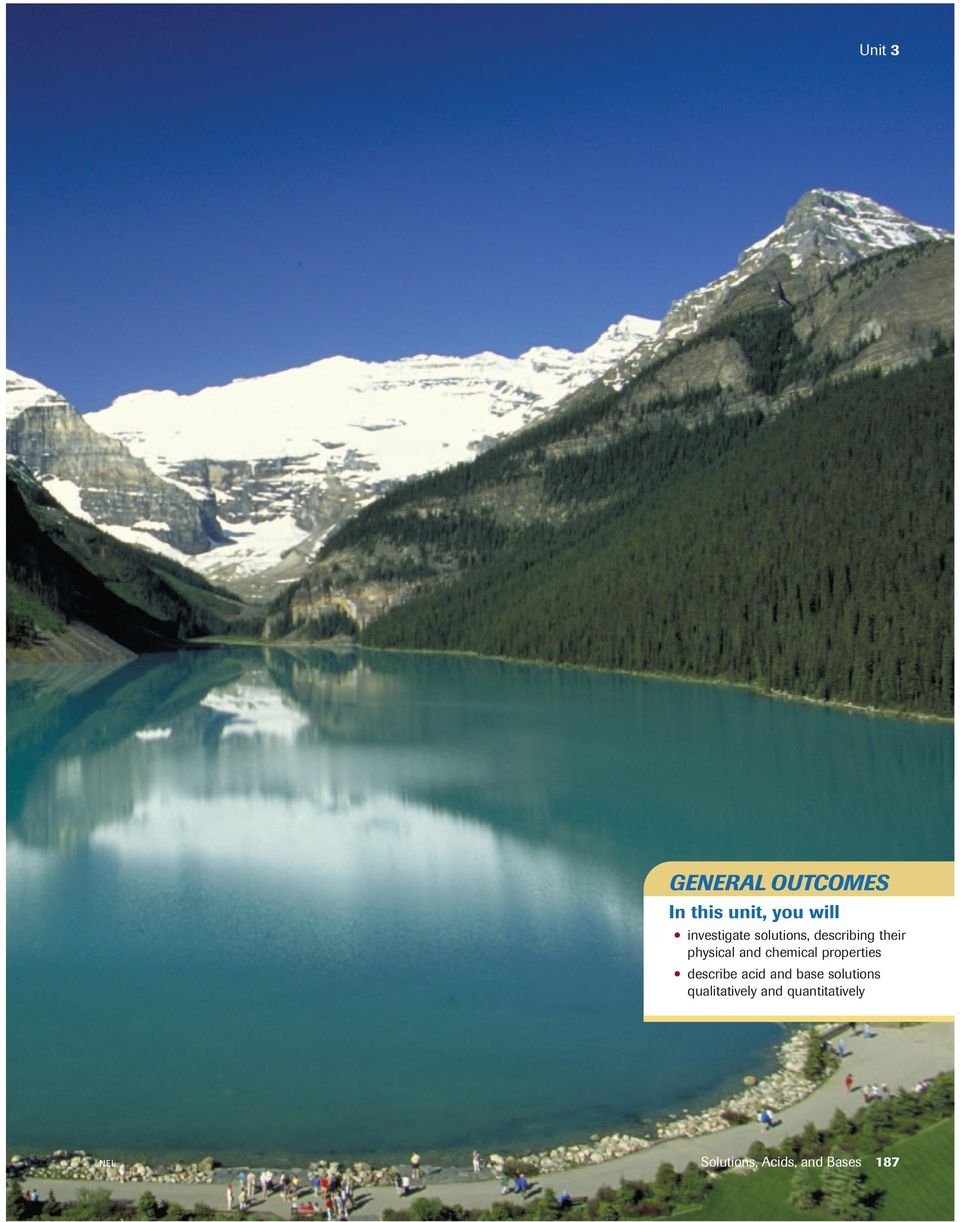
4 Unit 3 Solutions, Acids, and Bases Prerequisites Concepts classes of matter states of matter chemical and physical properties periodic table elements and compounds atomic theory ions chemical reactions chemical formulas and equations acids and bases Skills WMIS symbols laboratory safety rules scientific problem solving graphing, and solving linear and exponential equations You can review prerequisite concepts and skills on the Nelson Web site, in the Chemistry Review unit, and in the Appendices. A Unit Pre-Test is also available online. ARE YOU READY? These questions will help you find out what you already know, and what you need to review, before you continue with this unit. Knowledge C 1. Copy and complete the classification scheme in Figure 1. A pure substances Figure 1 A classification of matter elements 2. Match each of the substances in Table 1 to the classification categories illustrated in Figure Distinguish between ionic and molecular compounds based on their (a) chemical name or formula (b) empirical (observable) properties D matter 4. In Table 2, match each term in column I with its corresponding description in column II. Table 2 Definitions of Types of Matter I (a) compound (b) solution (c) element (d) heterogeneous mixture II E B homogeneous mixtures Table 1 Classification of Substances Substance A or B C or D or E or F (a) vinegar (b) pure water (c) sulfur (d) air (e) milk A. Cannot be broken down into simpler substances B. Contains two or more visible components C. Can be identified by a single chemical formula D. A mixture of two or more pure substances with a single visible component F 5. Write the missing words from the following statement in your notebook: According to modern atomic theory, an atom contains a number of positively charged, determined by the of the element, and an equal number of negatively charged. 188 Unit 3
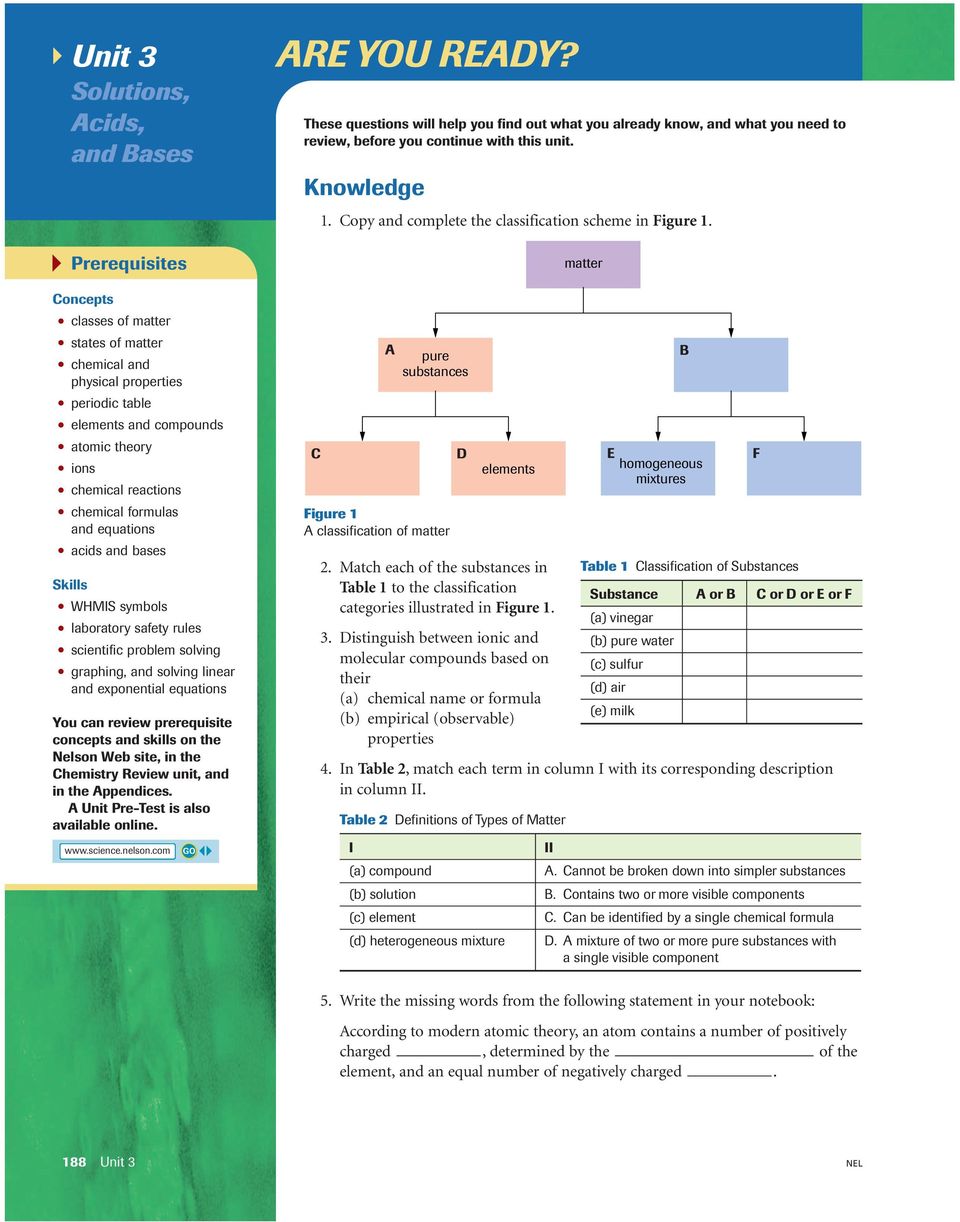
5 Unit 3 6. Atoms of the main group (representative) elements generally form predictable ions. Using calcium and fluorine as examples, draw Lewis symbols showing atoms and ions. 7. Draw a diagram to illustrate the model of a small sample (a few particles) of (a) sodium chloride (b) bromine 8. What is the type of bond between the atoms of a water molecule? What are the types of bonds between the molecules of water in a sample (Figure 2)? 9. Refer to the list of substances in Table 3 to answer the following questions. (a) Which substances have London (dispersion) forces present between the molecules? (b) Classify each substance as polar or nonpolar. (c) Which substance would be expected to have hydrogen bonding as part of the intermolecular forces between the molecules? (d) Distinguish between intermolecular and intramolecular forces. O O O O O O Figure 2 A model of a sample of liquid water O Table 3 Substances and Their Uses Substance Chemical formula Use propane C 3 8 (g) propane barbecues ethanol C 2 5 O(l) in gasohol (gasoline-alcohol fuel) dichloromethane C 2 Cl 2 (l) paint stripper 10. For each of the following pairs of reactants: write a balanced chemical equation, including states of matter at SATP, for the expected reaction translate the balanced chemical equation into an English sentence, including the coefficients and states of matter state one diagnostic test that could be used to test the predicted reaction (a) aqueous iron(iii) chloride and aqueous sodium hydroxide (b) aqueous silver nitrate and copper metal (c) sulfuric acid and aqueous potassium hydroxide (d) aqueous chlorine and aqueous sodium bromide 11. Many reactions in solution are single or double replacement reactions. (a) Write the word generalization for these two reaction types. (b) Classify each of the reactions in question 10 as a single or double replacement reaction. 12. Chemical reactions can also be classified as endothermic or exothermic. What do these terms mean? What diagnostic test would be used for this classification? Skills 13. In this unit, you will work with many different solutions. What should you do immediately if some solution is spilled on your hand? 14. State the hazard communicated by each of the following WMIS symbols. (a) (b) (c) Solutions, Acids, and Bases 189
6 chapter 5 The In this chapter Exploration: Substances in Water Demonstration Mini Investigation: Solutions and Reactions Investigation 5.1: Qualitative Chemical Analysis Lab Exercise 5.A: Identifying Solutions Mini Investigation: ot and Cold Solutions Biology Connection: Ions in Blood Lab Exercise 5.B: Qualitative Analysis Web Activity: David Schindler Biology Connection: Pollutants Case Study: ousehold Chemical Solutions Web Activity: ot Tub Safety Investigation 5.2: A Standard Solution from a Solid Investigation 5.3: A Standard Solution by Dilution Investigation 5.4: The Iodine Clock Reaction Mini Investigation: Measuring the Dissolving Process Investigation 5.5: The Solubility of Sodium Chloride in Water Lab Exercise 5.C: Solubility and Temperature Explore an Issue: Pesticides The Nature and Properties of Solutions Is there such a thing as pure, natural water? Certainly it can t be found in the oceans. Drinking the water of the sea, which is rich in dissolved solutes, can be fatal. Today, seagoing ships carry distillation equipment to convert salt water into drinking water by removing most of those solutes. Water from lakes and rivers (Figure 1), which we depend on for drinking, cooking, irrigation, electric power generation, and recreation, is also impure. Even direct from a spring, fresh water is a solution that contains dissolved minerals and gases. So many substances dissolve in water that it has been called the universal solvent. Many household products, including soft drinks, fruit juices, vinegar, cleaners, and medicines, are aqueous (water) solutions. ( Aqueous comes from the Latin aqua for water, as in aquatics.) Our blood plasma is mostly water, and many substances essential to life are dissolved in it, including glucose. The ability of so many materials to dissolve in water also has some negative implications. uman activities have introduced thousands of unwanted substances into water supplies. These substances include paints, cleaners, industrial waste, insecticides, fertilizers, salt from highways, and other contaminants. Even the atmosphere is contaminated with gases produced when fossil fuels are burned. Rain, falling through these contaminants, may become acidic. From an Aboriginal perspective, we are all connected to water. It flows through us and does not stay in us. If water is contaminated, the contaminates will also flow through us. The effects of water contamination in Walkerton, Ontario are a tragic illustration of this connection and the importance of water to our survival. Learning about aqueous solutions and the limits to purity will help you understand science-related social issues forming around the quality of our water. STARTING Points Answer these questions as best you can with your current knowledge. Then, using the concepts and skills you have learned, you will revise your answers at the end of the chapter. 1. What happens when a pure substance dissolves in water? ow is dissolving related to any subsequent chemical reactions of the solution? 2. List the different ways you can express the concentration of a solution. Are some ways more useful than others? 3. Is there a limit to how much of a substance dissolves to make a solution? Explain. Career Connections: Water and Waste Water Treatment Plant Operator; Toxicologist 190 Chapter 5

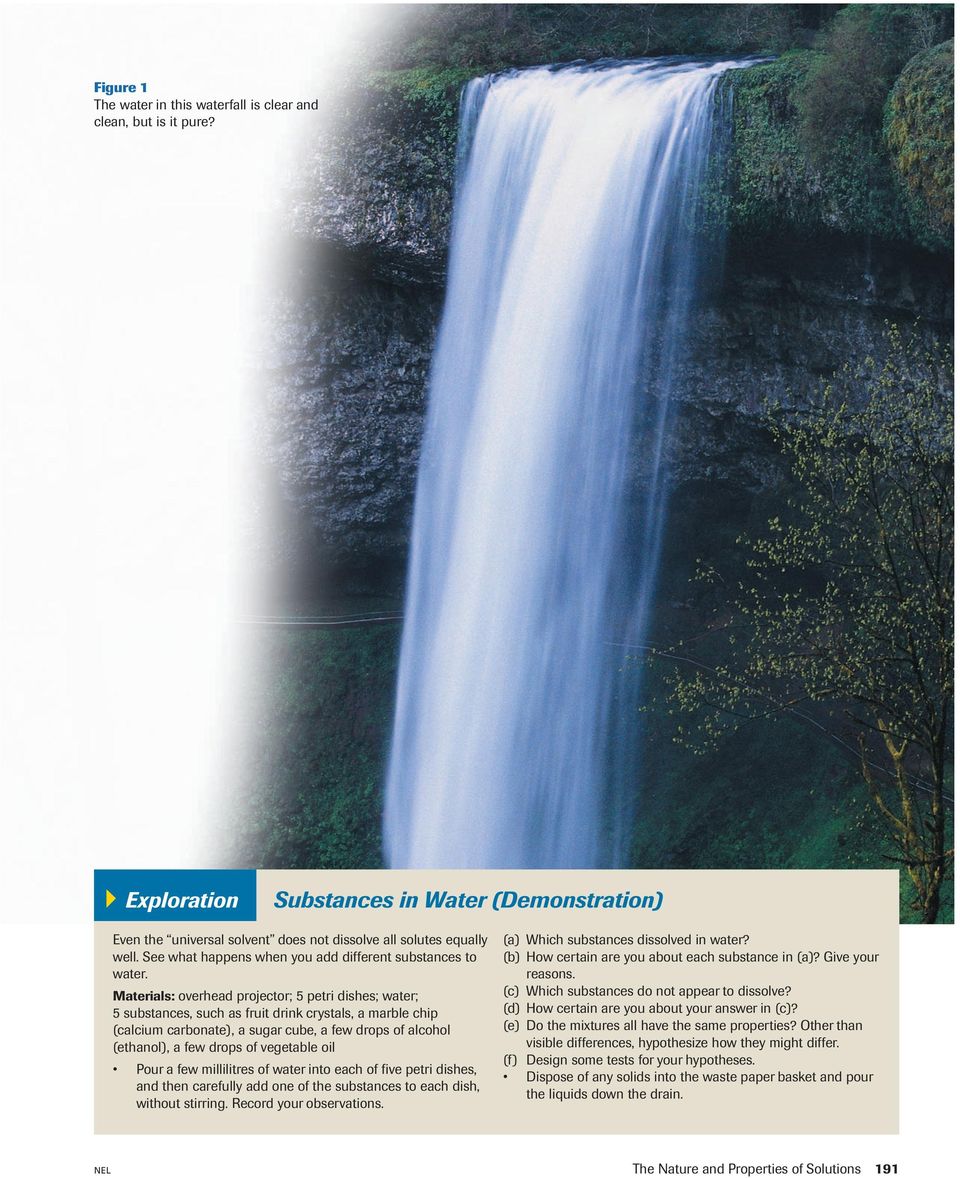
7 Figure 1 The water in this waterfall is clear and clean, but is it pure? Exploration Substances in Water (Demonstration) Even the universal solvent does not dissolve all solutes equally well. See what happens when you add different substances to water. Materials: overhead projector; 5 petri dishes; water; 5 substances, such as fruit drink crystals, a marble chip (calcium carbonate), a sugar cube, a few drops of alcohol (ethanol), a few drops of vegetable oil Pour a few millilitres of water into each of five petri dishes, and then carefully add one of the substances to each dish, without stirring. Record your observations. (a) Which substances dissolved in water? (b) ow certain are you about each substance in (a)? Give your reasons. (c) Which substances do not appear to dissolve? (d) ow certain are you about your answer in (c)? (e) Do the mixtures all have the same properties? Other than visible differences, hypothesize how they might differ. (f) Design some tests for your hypotheses. Dispose of any solids into the waste paper basket and pour the liquids down the drain. The Nature and Properties of Solutions 191
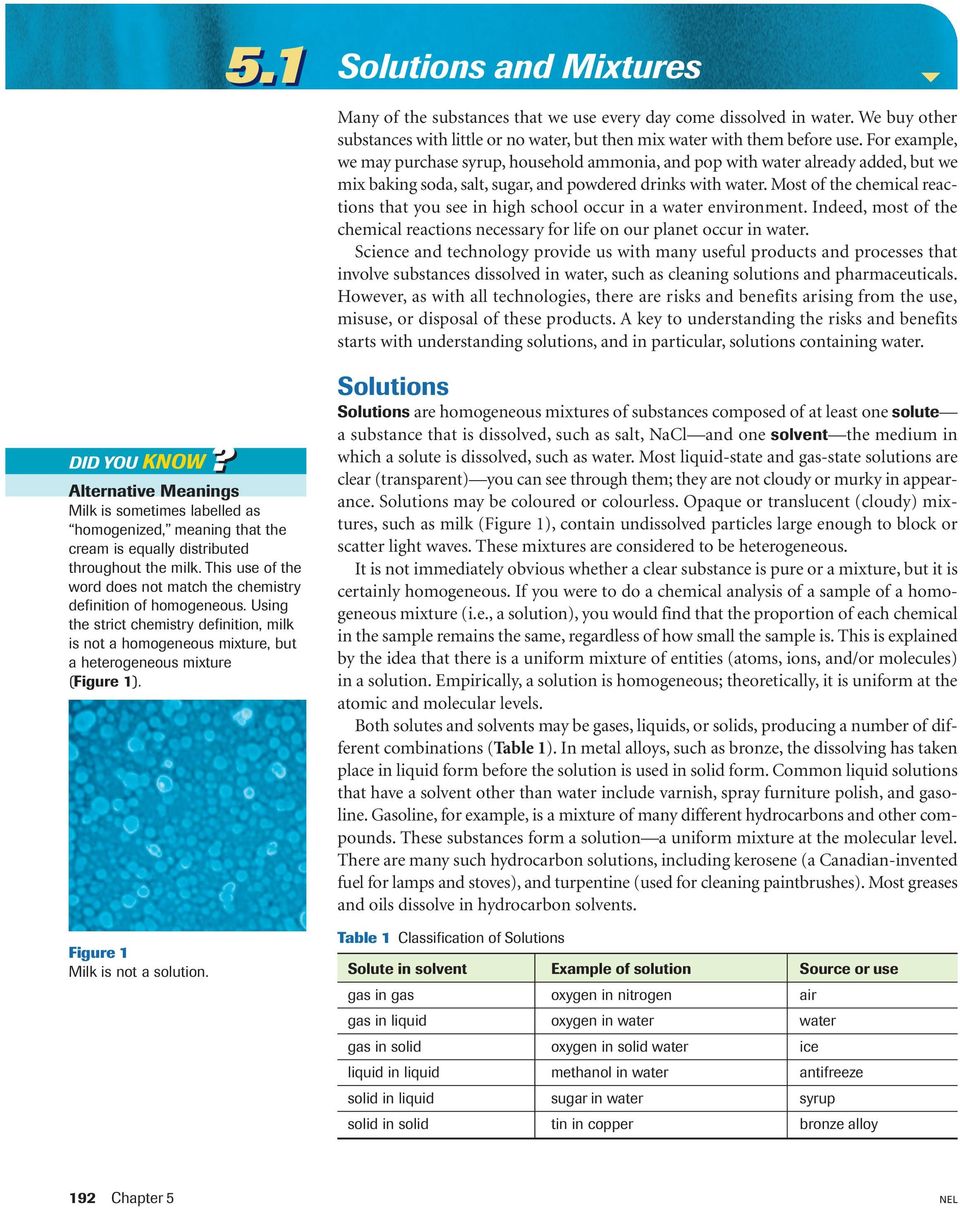
8 5.1 Solutions and Mixtures Many of the substances that we use every day come dissolved in water. We buy other substances with little or no water, but then mix water with them before use. For example, we may purchase syrup, household ammonia, and pop with water already added, but we mix baking soda, salt, sugar, and powdered drinks with water. Most of the chemical reactions that you see in high school occur in a water environment. Indeed, most of the chemical reactions necessary for life on our planet occur in water. Science and technology provide us with many useful products and processes that involve substances dissolved in water, such as cleaning solutions and pharmaceuticals. owever, as with all technologies, there are risks and benefits arising from the use, misuse, or disposal of these products. A key to understanding the risks and benefits starts with understanding solutions, and in particular, solutions containing water. DID YOU KNOW? Alternative Meanings Milk is sometimes labelled as homogenized, meaning that the cream is equally distributed throughout the milk. This use of the word does not match the chemistry definition of homogeneous. Using the strict chemistry definition, milk is not a homogeneous mixture, but a heterogeneous mixture (Figure 1). Figure 1 Milk is not a solution. Solutions Solutions are homogeneous mixtures of substances composed of at least one solute a substance that is dissolved, such as salt, NaCl and one solvent the medium in which a solute is dissolved, such as water. Most liquid-state and gas-state solutions are clear (transparent) you can see through them; they are not cloudy or murky in appearance. Solutions may be coloured or colourless. Opaque or translucent (cloudy) mixtures, such as milk (Figure 1), contain undissolved particles large enough to block or scatter light waves. These mixtures are considered to be heterogeneous. It is not immediately obvious whether a clear substance is pure or a mixture, but it is certainly homogeneous. If you were to do a chemical analysis of a sample of a homogeneous mixture (i.e., a solution), you would find that the proportion of each chemical in the sample remains the same, regardless of how small the sample is. This is explained by the idea that there is a uniform mixture of entities (atoms, ions, and/or molecules) in a solution. Empirically, a solution is homogeneous; theoretically, it is uniform at the atomic and molecular levels. Both solutes and solvents may be gases, liquids, or solids, producing a number of different combinations (Table 1). In metal alloys, such as bronze, the dissolving has taken place in liquid form before the solution is used in solid form. Common liquid solutions that have a solvent other than water include varnish, spray furniture polish, and gasoline. Gasoline, for example, is a mixture of many different hydrocarbons and other compounds. These substances form a solution a uniform mixture at the molecular level. There are many such hydrocarbon solutions, including kerosene (a Canadian-invented fuel for lamps and stoves), and turpentine (used for cleaning paintbrushes). Most greases and oils dissolve in hydrocarbon solvents. Table 1 Classification of Solutions Solute in solvent Example of solution Source or use gas in gas oxygen in nitrogen air gas in liquid oxygen in water water gas in solid oxygen in solid water ice liquid in liquid methanol in water antifreeze solid in liquid sugar in water syrup solid in solid tin in copper bronze alloy 192 Chapter 5
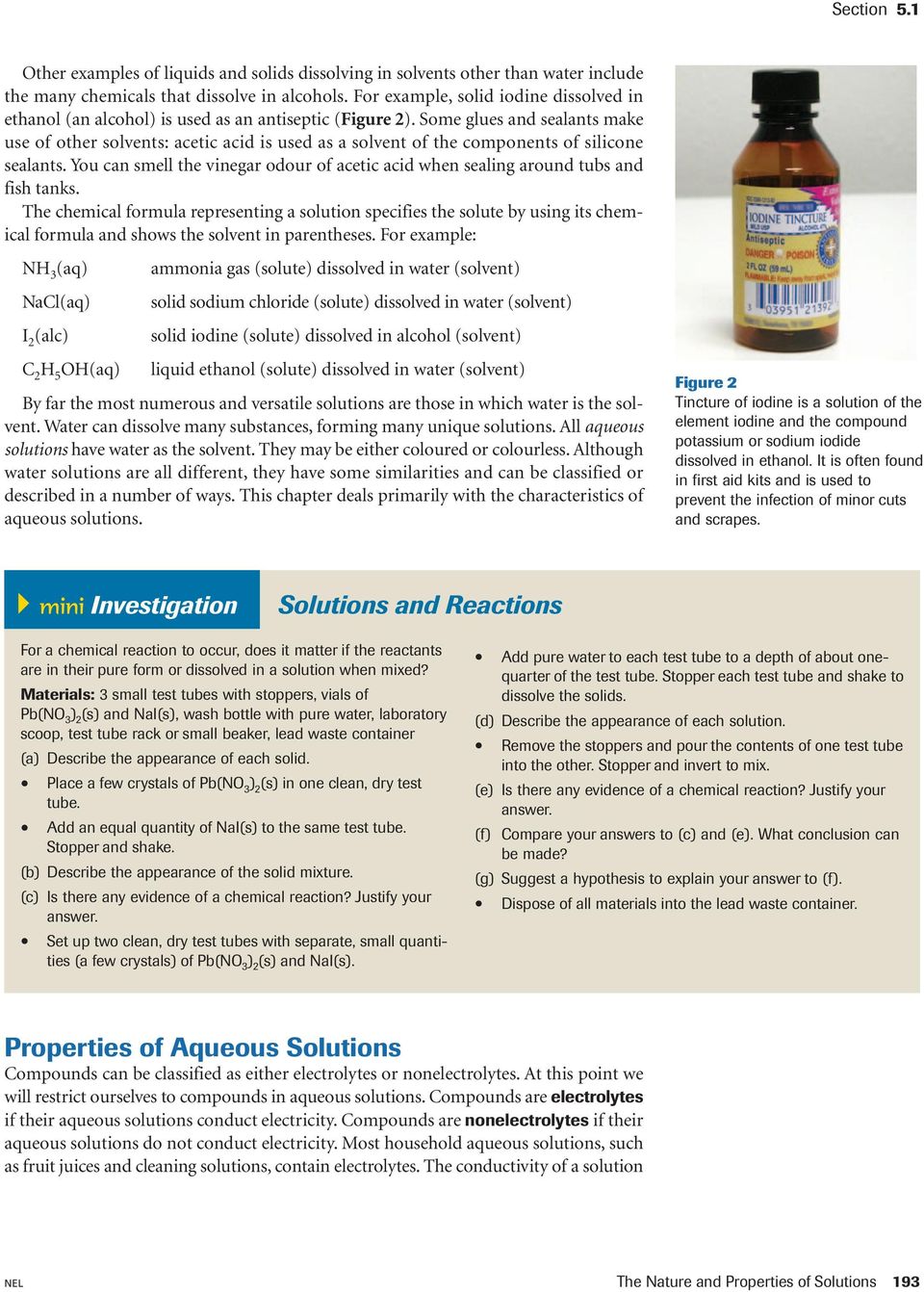
9 Section 5.1 Other examples of liquids and solids dissolving in solvents other than water include the many chemicals that dissolve in alcohols. For example, solid iodine dissolved in ethanol (an alcohol) is used as an antiseptic (Figure 2). Some glues and sealants make use of other solvents: acetic acid is used as a solvent of the components of silicone sealants. You can smell the vinegar odour of acetic acid when sealing around tubs and fish tanks. The chemical formula representing a solution specifies the solute by using its chemical formula and shows the solvent in parentheses. For example: N 3 (aq) NaCl(aq) I 2 (alc) C 2 5 O(aq) ammonia gas (solute) dissolved in water (solvent) solid sodium chloride (solute) dissolved in water (solvent) solid iodine (solute) dissolved in alcohol (solvent) liquid ethanol (solute) dissolved in water (solvent) By far the most numerous and versatile solutions are those in which water is the solvent. Water can dissolve many substances, forming many unique solutions. All aqueous solutions have water as the solvent. They may be either coloured or colourless. Although water solutions are all different, they have some similarities and can be classified or described in a number of ways. This chapter deals primarily with the characteristics of aqueous solutions. Figure 2 Tincture of iodine is a solution of the element iodine and the compound potassium or sodium iodide dissolved in ethanol. It is often found in first aid kits and is used to prevent the infection of minor cuts and scrapes. mini Investigation Solutions and Reactions For a chemical reaction to occur, does it matter if the reactants are in their pure form or dissolved in a solution when mixed? Materials: 3 small test tubes with stoppers, vials of Pb(NO 3 ) 2 (s) and NaI(s), wash bottle with pure water, laboratory scoop, test tube rack or small beaker, lead waste container (a) Describe the appearance of each solid. Place a few crystals of Pb(NO 3 ) 2 (s) in one clean, dry test tube. Add an equal quantity of NaI(s) to the same test tube. Stopper and shake. (b) Describe the appearance of the solid mixture. (c) Is there any evidence of a chemical reaction? Justify your answer. Set up two clean, dry test tubes with separate, small quantities (a few crystals) of Pb(NO 3 ) 2 (s) and NaI(s). Add pure water to each test tube to a depth of about onequarter of the test tube. Stopper each test tube and shake to dissolve the solids. (d) Describe the appearance of each solution. Remove the stoppers and pour the contents of one test tube into the other. Stopper and invert to mix. (e) Is there any evidence of a chemical reaction? Justify your answer. (f) Compare your answers to (c) and (e). What conclusion can be made? (g) Suggest a hypothesis to explain your answer to (f). Dispose of all materials into the lead waste container. Properties of Aqueous Solutions Compounds can be classified as either electrolytes or nonelectrolytes. At this point we will restrict ourselves to compounds in aqueous solutions. Compounds are electrolytes if their aqueous solutions conduct electricity. Compounds are nonelectrolytes if their aqueous solutions do not conduct electricity. Most household aqueous solutions, such as fruit juices and cleaning solutions, contain electrolytes. The conductivity of a solution The Nature and Properties of Solutions 193
10 Figure 3 The bulb in this conductivity apparatus lights up if the solute is an electrolyte. + EXTENSION Fastest Glacier Water, life s universal solvent, has a very different impact on the environment depending on whether it is in its liquid or solid form. This simple difference is one of the major concerns of environmentalists today. This video shows how the rapid melting of glaciers could have a drastic impact on the environment worldwide. is easily tested with a simple conductivity apparatus (Figure 3) or an ohmmeter. This evidence also provides a diagnostic test to determine the class of a solute electrolyte or nonelectrolyte. This very broad classification of compounds into electrolyte and nonelectrolyte categories can be related to the main types of compounds classified in Chapter 2. Electrolytes are mostly highly soluble ionic compounds (such as KBr(aq)), including bases such as ionic hydroxides (for example, sodium hydroxide, NaO(aq)). Most molecular compounds (such as ethanol, C 2 5 O(aq)) are nonelectrolytes, with the exception of acids. Acids (such as nitric acid, NO 3 (aq)) are molecular compounds in their pure form but in aqueous solution, conduct electricity. Another empirical method of classifying solutions uses litmus paper as a test to classify solutes as acids, bases,or neutral substances. Acids form acidic solutions, bases form basic solutions, and most other ionic and molecular compounds form neutral solutions (Table 2). These definitions of acids, bases, and neutral substances are empirical, based on the results of the litmus and conductivity tests. Later in this unit, you will encounter theoretical definitions. Table 2 Properties of Solutes and Their Solutions Type of solute electrolyte nonelectrolyte Type of solution acidic basic neutral Conductivity test light on conductivity apparatus glows; needle on ohmmeter moves compared to the control light on conductivity apparatus does not glow; needle on ohmmeter does not move compared to the control Litmus test blue litmus turns red red litmus turns blue no change in colour of litmus paper INVESTIGATION 5.1 Introduction Qualitative Chemical Analysis Solutions have properties determined by the solute that is present. Diagnostic tests based on characteristic properties can be used to identify substances in a qualitative analysis. Purpose The purpose of this investigation is to use known diagnostic tests to distinguish among several pure substances. Report Checklist Purpose Design Analysis Problem Materials Evaluation ypothesis Procedure Prediction Evidence Problem Which of the white solids labelled 1, 2, 3, and 4 is calcium chloride, citric acid, glucose, and calcium hydroxide? To perform this investigation, turn to page Chapter 5

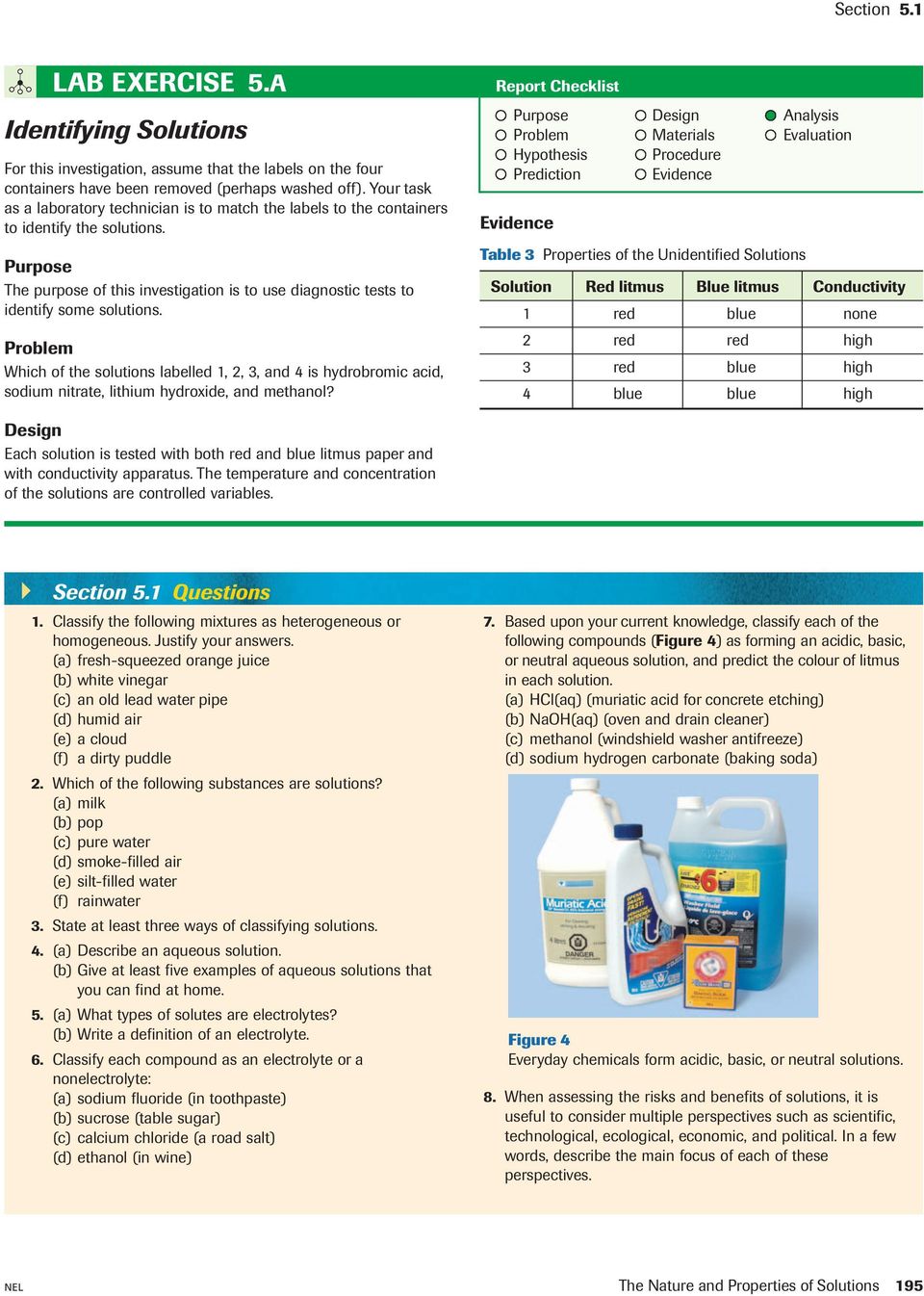
11 Section 5.1 LAB EXERCISE 5.A Identifying Solutions For this investigation, assume that the labels on the four containers have been removed (perhaps washed off). Your task as a laboratory technician is to match the labels to the containers to identify the solutions. Purpose The purpose of this investigation is to use diagnostic tests to identify some solutions. Problem Which of the solutions labelled 1, 2, 3, and 4 is hydrobromic acid, sodium nitrate, lithium hydroxide, and methanol? Report Checklist Purpose Design Analysis Problem Materials Evaluation ypothesis Procedure Prediction Evidence Evidence Table 3 Properties of the Unidentified Solutions Solution Red litmus Blue litmus Conductivity 1 red blue none 2 red red high 3 red blue high 4 blue blue high Design Each solution is tested with both red and blue litmus paper and with conductivity apparatus. The temperature and concentration of the solutions are controlled variables. Section 5.1 Questions 1. Classify the following mixtures as heterogeneous or homogeneous. Justify your answers. (a) fresh-squeezed orange juice (b) white vinegar (c) an old lead water pipe (d) humid air (e) a cloud (f) a dirty puddle 2. Which of the following substances are solutions? (a) milk (b) pop (c) pure water (d) smoke-filled air (e) silt-filled water (f) rainwater 3. State at least three ways of classifying solutions. 4. (a) Describe an aqueous solution. (b) Give at least five examples of aqueous solutions that you can find at home. 5. (a) What types of solutes are electrolytes? (b) Write a definition of an electrolyte. 6. Classify each compound as an electrolyte or a nonelectrolyte: (a) sodium fluoride (in toothpaste) (b) sucrose (table sugar) (c) calcium chloride (a road salt) (d) ethanol (in wine) 7. Based upon your current knowledge, classify each of the following compounds (Figure 4) as forming an acidic, basic, or neutral aqueous solution, and predict the colour of litmus in each solution. (a) Cl(aq) (muriatic acid for concrete etching) (b) NaO(aq) (oven and drain cleaner) (c) methanol (windshield washer antifreeze) (d) sodium hydrogen carbonate (baking soda) Figure 4 Everyday chemicals form acidic, basic, or neutral solutions. 8. When assessing the risks and benefits of solutions, it is useful to consider multiple perspectives such as scientific, technological, ecological, economic, and political. In a few words, describe the main focus of each of these perspectives. The Nature and Properties of Solutions 195
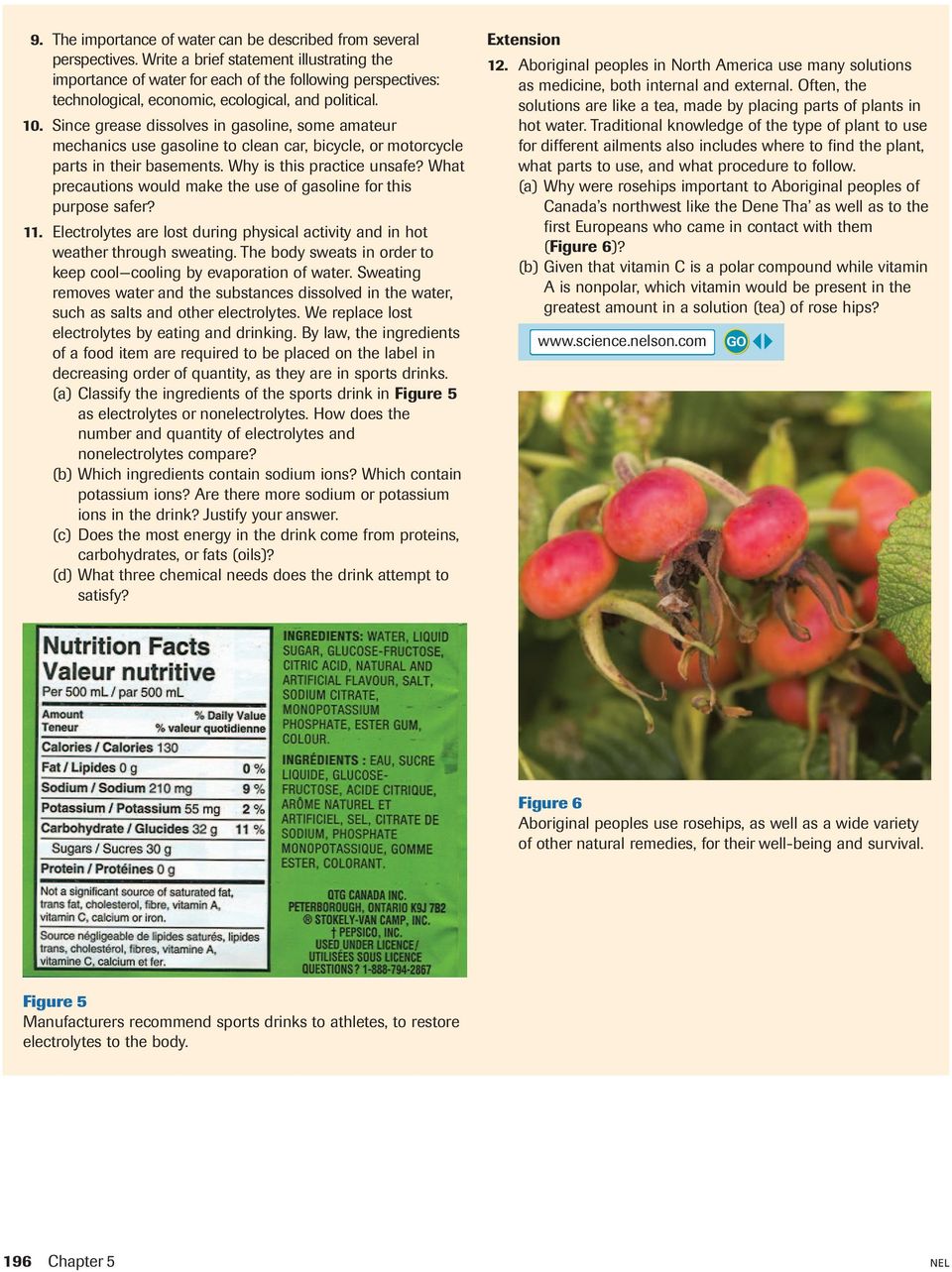
12 9. The importance of water can be described from several perspectives. Write a brief statement illustrating the importance of water for each of the following perspectives: technological, economic, ecological, and political. 10. Since grease dissolves in gasoline, some amateur mechanics use gasoline to clean car, bicycle, or motorcycle parts in their basements. Why is this practice unsafe? What precautions would make the use of gasoline for this purpose safer? 11. Electrolytes are lost during physical activity and in hot weather through sweating. The body sweats in order to keep cool cooling by evaporation of water. Sweating removes water and the substances dissolved in the water, such as salts and other electrolytes. We replace lost electrolytes by eating and drinking. By law, the ingredients of a food item are required to be placed on the label in decreasing order of quantity, as they are in sports drinks. (a) Classify the ingredients of the sports drink in Figure 5 as electrolytes or nonelectrolytes. ow does the number and quantity of electrolytes and nonelectrolytes compare? (b) Which ingredients contain sodium ions? Which contain potassium ions? Are there more sodium or potassium ions in the drink? Justify your answer. (c) Does the most energy in the drink come from proteins, carbohydrates, or fats (oils)? (d) What three chemical needs does the drink attempt to satisfy? Extension 12. Aboriginal peoples in North America use many solutions as medicine, both internal and external. Often, the solutions are like a tea, made by placing parts of plants in hot water. Traditional knowledge of the type of plant to use for different ailments also includes where to find the plant, what parts to use, and what procedure to follow. (a) Why were rosehips important to Aboriginal peoples of Canada s northwest like the Dene Tha as well as to the first Europeans who came in contact with them (Figure 6)? (b) Given that vitamin C is a polar compound while vitamin A is nonpolar, which vitamin would be present in the greatest amount in a solution (tea) of rose hips? Figure 6 Aboriginal peoples use rosehips, as well as a wide variety of other natural remedies, for their well-being and survival. Figure 5 Manufacturers recommend sports drinks to athletes, to restore electrolytes to the body. 196 Chapter 5
13 Explaining Solutions Water is the most important solvent on Earth. The oceans, lakes, rivers, and rain are aqueous solutions containing many different ionic compounds and a few molecular solutes. As you know, there are some ionic compounds that dissolve only very slightly in water, such as limestone (calcium carbonate) and various other rocks and minerals. Nevertheless, many more ionic compounds dissolve in water than in any other known solvent. Why are ionic compounds so soluble in water? The key to the explanation came from the study of electrolytes. Electrolytes were first explained by Svante Arrhenius who was born in Wijk, Sweden, in While attending the University of Uppsala, he became intrigued by the problem of how and why some aqueous solutions conduct electricity, but others do not. This problem had puzzled chemists ever since Sir umphry Davy and Michael Faraday performed experiments over half a century earlier, passing electric currents through chemical substances. Faraday believed that an electric current produces new charged particles in a solution. e called these electric particles ions (a form of the Greek word for to go ). e could not explain what ions were, or why they did not form in some solutions such as sugar or alcohol dissolved in water. In 1887, Arrhenius proposed that when a substance dissolves, particles of the substance separate from each other and disperse into the solution. Nonelectrolytes disperse electrically neutral particles throughout the solution. As Figure 1 shows, molecules of sucrose (a nonelectrolyte) separate from each other and disperse in an aqueous solution as individual molecules of sucrose surrounded by water molecules. But what about the conductivity of solutions of electrolytes? Arrhenius explanation for this observation was quite radical. e agreed with the accepted theory that electric current involves the movement of electric charge. Ionic compounds form conducting solutions. Therefore, according to Arrhenius, electrically charged particles must be present in their solutions. For example, when a compound such as table salt dissolves, it dissociates into individual aqueous ions (Figure 2). The positive ions are surrounded by the negative ends of the polar water molecules, while the negative ions are surrounded by the positive ends of the polar water molecules (Chapter 3, page 101). Dissociation is the separation of ions that occurs when an ionic compound dissolves in water. Dissociation equations, such as the following examples, show this separation of ions: NaCl(s) Na (aq) Cl (aq) (N 4 ) 2 SO 4 (s) 2 N 4 (aq) SO 4 2 (aq) Notice that the formula for the solvent, 2 O(l), does not appear as a reactant in the equation. Although water is necessary for the process of dissociation, it is not consumed and hence is not a reactant. The presence of water molecules surrounding the ions is indicated by (aq). Figure 2 This model represents the dissociation of sodium chloride into positive and negative ions. Na + Cl Na + Cl Na + Na + Cl Na + Cl NaCl(s) Na + Cl Cl O 5.2 O O C O 11 (s) O C O 11 O O O C O 11 (aq) Figure 1 This model illustrates sucrose dissolved in water. The model, showing electrically neutral particles in solution, agrees with the evidence that a sucrose solution does not conduct electricity. O + Na (aq) + Cl (aq) O O O O O Na + O O O Cl O O O O The Nature and Properties of Solutions 197

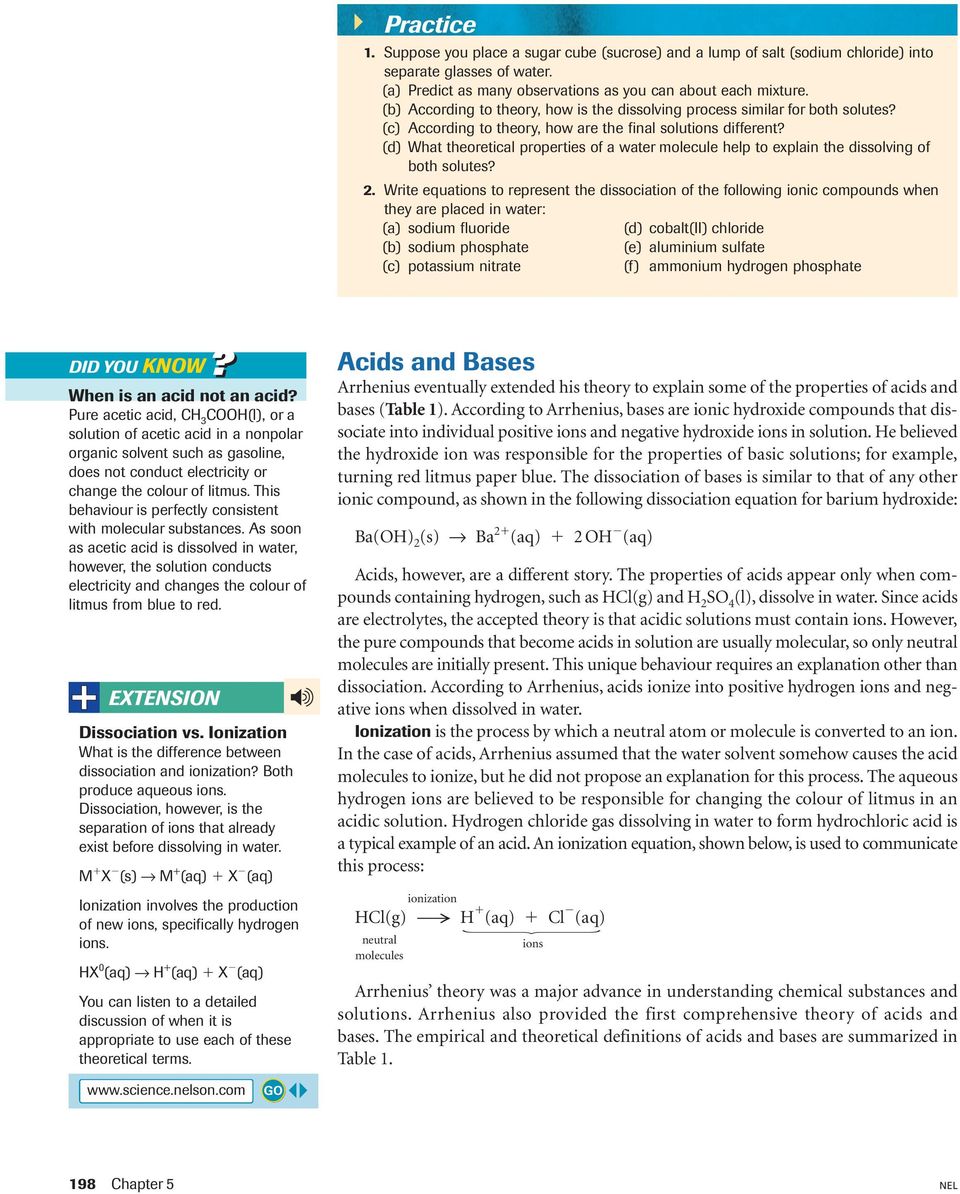
14 Practice 1. Suppose you place a sugar cube (sucrose) and a lump of salt (sodium chloride) into separate glasses of water. (a) Predict as many observations as you can about each mixture. (b) According to theory, how is the dissolving process similar for both solutes? (c) According to theory, how are the final solutions different? (d) What theoretical properties of a water molecule help to explain the dissolving of both solutes? 2. Write equations to represent the dissociation of the following ionic compounds when they are placed in water: (a) sodium fluoride (d) cobalt(ii) chloride (b) sodium phosphate (e) aluminium sulfate (c) potassium nitrate (f) ammonium hydrogen phosphate DID YOU KNOW? When is an acid not an acid? Pure acetic acid, C 3 COO(l), or a solution of acetic acid in a nonpolar organic solvent such as gasoline, does not conduct electricity or change the colour of litmus. This behaviour is perfectly consistent with molecular substances. As soon as acetic acid is dissolved in water, however, the solution conducts electricity and changes the colour of litmus from blue to red. + EXTENSION Dissociation vs. Ionization What is the difference between dissociation and ionization? Both produce aqueous ions. Dissociation, however, is the separation of ions that already exist before dissolving in water. M X (s) M + (aq) X (aq) Ionization involves the production of new ions, specifically hydrogen ions. X 0 (aq) + (aq) X (aq) You can listen to a detailed discussion of when it is appropriate to use each of these theoretical terms. Acids and Bases Arrhenius eventually extended his theory to explain some of the properties of acids and bases (Table 1). According to Arrhenius, bases are ionic hydroxide compounds that dissociate into individual positive ions and negative hydroxide ions in solution. e believed the hydroxide ion was responsible for the properties of basic solutions; for example, turning red litmus paper blue. The dissociation of bases is similar to that of any other ionic compound, as shown in the following dissociation equation for barium hydroxide: Ba(O) 2 (s) Ba 2 (aq) 2O (aq) Acids, however, are a different story. The properties of acids appear only when compounds containing hydrogen, such as Cl(g) and 2 SO 4 (l), dissolve in water. Since acids are electrolytes, the accepted theory is that acidic solutions must contain ions. owever, the pure compounds that become acids in solution are usually molecular, so only neutral molecules are initially present. This unique behaviour requires an explanation other than dissociation. According to Arrhenius, acids ionize into positive hydrogen ions and negative ions when dissolved in water. Ionization is the process by which a neutral atom or molecule is converted to an ion. In the case of acids, Arrhenius assumed that the water solvent somehow causes the acid molecules to ionize, but he did not propose an explanation for this process. The aqueous hydrogen ions are believed to be responsible for changing the colour of litmus in an acidic solution. ydrogen chloride gas dissolving in water to form hydrochloric acid is a typical example of an acid. An ionization equation, shown below, is used to communicate this process: ionization Cl(g) (aq) Cl (aq) neutral molecules ions Arrhenius theory was a major advance in understanding chemical substances and solutions. Arrhenius also provided the first comprehensive theory of acids and bases. The empirical and theoretical definitions of acids and bases are summarized in Table Chapter 5
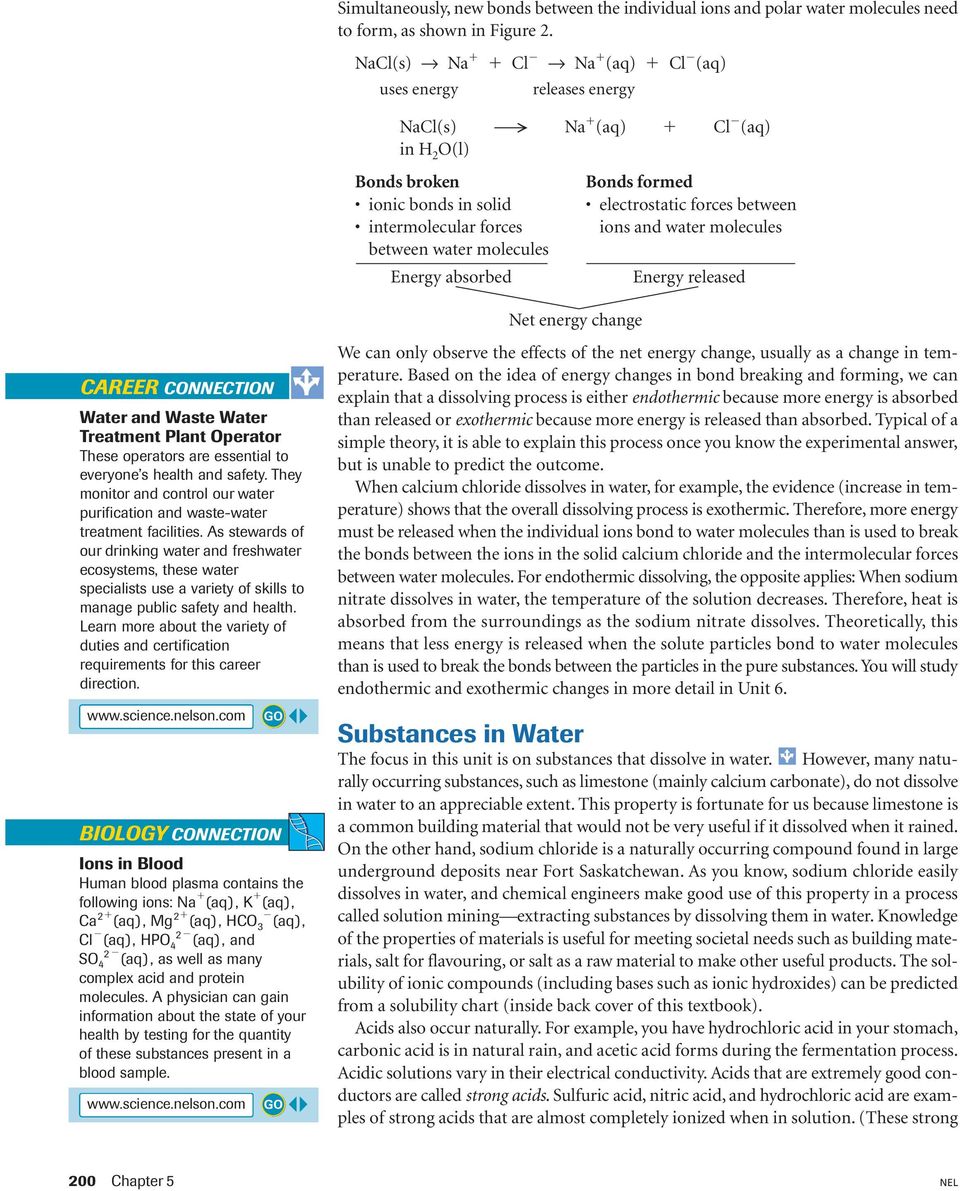
15 Section 5.2 Table 1 Acids, Bases, and Neutral Substances Type of substance Empirical definition Arrhenius theory acids Acids form solutions that turn blue litmus red some hydrogen compounds ionize and are electrolytes to produce (aq) ions neutralize bases (aq) ions react with O (aq) ions to produce water bases Bases form solutions that turn red litmus blue ionic hydroxides dissociate to and are electrolytes produce O (aq) ions neutralize acids O (aq) ions react with (aq) ions to produce water neutral substances Neutral substances form solutions that do not affect litmus no (aq) or O (aq) ions are formed some are electrolytes some are ions in solution some are nonelectrolytes some are molecules in solution Energy Changes You already know that chemical reactions can be endothermic (absorb energy from the surroundings) or exothermic (release energy to the surroundings). What about the formation of solutions? Is energy absorbed or released when a substance dissolves in water? mini Investigation ot and Cold Solutions In this short investigation, you will determine if changes are endothermic or exothermic simply by feeling the changes in the palm of your hand. Materials: small plastic bag, plastic spoon, calcium chloride solid, sodium nitrate solid, 10 ml graduated cylinder Place about one teaspoon of calcium chloride in a bottom corner of a dry plastic bag. Measure about 5 ml of tap water and place into the other corner of the bag, keeping it separate from the solid. Lift the bag by the top, shake gently to mix, and immediately place into the palm of your hand. (a) Is the dissolving of calcium chloride endothermic or exothermic? Justify your answer. Dispose of contents into the sink. Rinse and dry the inside of the bag. Repeat this procedure using sodium nitrate and dispose of the contents into a waste container. (b) Is the dissolving of sodium nitrate endothermic or exothermic? Justify your answer. (c) Suggest some practical applications of this investigation. Solids may cause irritation to the eyes, skin, and respiratory tract, and are harmful if swallowed. Wear eye protection and avoid direct contact. At this stage in your chemical education, it is difficult to predict whether the dissolving of a particular solute will be endothermic or exothermic. More extensive investigations have clearly shown that all solution formation involves some energy change. The accepted explanation depends upon two general theoretical principles: Breaking existing bonds uses energy. Forming new bonds releases energy. In the dissolving of an ionic solid such as sodium chloride (see Figure 2, page 197), the ionic bond between the positive and negative ions needs to be broken to separate the ions. Energy is also required to overcome the intermolecular forces among the water molecules. The Nature and Properties of Solutions 199

16 Simultaneously, new bonds between the individual ions and polar water molecules need to form, as shown in Figure 2. NaCl(s) Na Cl Na (aq) Cl (aq) uses energy releases energy NaCl(s) Na (aq) Cl (aq) in 2 O(l) Bonds broken ionic bonds in solid intermolecular forces between water molecules Energy absorbed Bonds formed electrostatic forces between ions and water molecules Energy released CAREER CONNECTION Water and Waste Water Treatment Plant Operator These operators are essential to everyone s health and safety. They monitor and control our water purification and waste-water treatment facilities. As stewards of our drinking water and freshwater ecosystems, these water specialists use a variety of skills to manage public safety and health. Learn more about the variety of duties and certification requirements for this career direction. BIOLOGY CONNECTION Ions in Blood uman blood plasma contains the following ions: Na (aq), K (aq), Ca 2 (aq), Mg 2 (aq), CO 3 (aq), Cl (aq), PO 4 2 (aq), and SO 4 2 (aq), as well as many complex acid and protein molecules. A physician can gain information about the state of your health by testing for the quantity of these substances present in a blood sample. Net energy change We can only observe the effects of the net energy change, usually as a change in temperature. Based on the idea of energy changes in bond breaking and forming, we can explain that a dissolving process is either endothermic because more energy is absorbed than released or exothermic because more energy is released than absorbed. Typical of a simple theory, it is able to explain this process once you know the experimental answer, but is unable to predict the outcome. When calcium chloride dissolves in water, for example, the evidence (increase in temperature) shows that the overall dissolving process is exothermic. Therefore, more energy must be released when the individual ions bond to water molecules than is used to break the bonds between the ions in the solid calcium chloride and the intermolecular forces between water molecules. For endothermic dissolving, the opposite applies: When sodium nitrate dissolves in water, the temperature of the solution decreases. Therefore, heat is absorbed from the surroundings as the sodium nitrate dissolves. Theoretically, this means that less energy is released when the solute particles bond to water molecules than is used to break the bonds between the particles in the pure substances. You will study endothermic and exothermic changes in more detail in Unit 6. Substances in Water The focus in this unit is on substances that dissolve in water. owever, many naturally occurring substances, such as limestone (mainly calcium carbonate), do not dissolve in water to an appreciable extent. This property is fortunate for us because limestone is a common building material that would not be very useful if it dissolved when it rained. On the other hand, sodium chloride is a naturally occurring compound found in large underground deposits near Fort Saskatchewan. As you know, sodium chloride easily dissolves in water, and chemical engineers make good use of this property in a process called solution mining extracting substances by dissolving them in water. Knowledge of the properties of materials is useful for meeting societal needs such as building materials, salt for flavouring, or salt as a raw material to make other useful products. The solubility of ionic compounds (including bases such as ionic hydroxides) can be predicted from a solubility chart (inside back cover of this textbook). Acids also occur naturally. For example, you have hydrochloric acid in your stomach, carbonic acid is in natural rain, and acetic acid forms during the fermentation process. Acidic solutions vary in their electrical conductivity. Acids that are extremely good conductors are called strong acids. Sulfuric acid, nitric acid, and hydrochloric acid are examples of strong acids that are almost completely ionized when in solution. (These strong 200 Chapter 5
17 Section 5.2 acids are listed on the inside back cover of this textbook under Concentrated Reagents. ) Most other common acids, such as acetic acid, are weak acids. The conductivity of acidic solutions varies a great deal. The accepted explanation, presented in more detail in Chapter 6, is that the degree of ionization of acids varies. Molecular compounds abound in nature. They include most of the compounds that make up living things, as well as fossil fuels such as oil and natural gas. Like ionic compounds, the solubility of molecular compounds in water varies tremendously, but unlike ionic compounds, there is no simple solubility chart to make specific predictions. According to theories of intermolecular bonding (Chapter 3), however, we can make some general predictions about solubility in water a polar liquid with hydrogen bonding. Nonpolar molecular compounds generally do not dissolve in water; polar compounds may be slightly soluble in water; and polar compounds with hydrogen bonding are the most likely to be very soluble in water. For efficiency in studying the examples in this textbook, you should memorize the examples in Table 2. To understand the properties of aqueous solutions and the reactions that take place in solutions, it is necessary to know the major entities present when any substance is in a water environment. Table 3 summarizes this information. The information is based on the solubility and electrical conductivity of substances as determined in the laboratory. Your initial work in chemistry will deal mainly with strong acids and other highly soluble compounds. Table 2 Solubility of Selected Molecular Compounds Solubility high low Examples ammonia, N 3 (g) hydrogen peroxide, 2 O 2 (l) methanol, C 3 O(l) ethanol, C 2 5 O(l) glucose, C 6 12 O 6 (s) sucrose, C O 11 (s) methane, C 4 (g) propane, C 3 8 (g) octane, C 8 18 (l) Table 3 Major Entities Present in a Water Environment Type of Solubility Typical pure Major entities present when substance in water substance substance is placed in water ionic high NaCl(s) Na + (aq), Cl (aq), 2 O(l) compounds low CaCO 3 (s) CaCO 3 (s), 2 O(l) bases high NaO(s) Na + (aq), O (aq), 2 O(l) low Ca(O) 2 (s) Ca(O) 2 (s), 2 O(l) molecular high C O 11 (s) C O 11 (aq), 2 O(l) substances low C 8 18 (l) C 8 18 (l), 2 O(l) strong acids high Cl(g) + (aq), Cl (aq), 2 O(l) weak acids high C 3 COO(l) C 3 COO(aq), 2 O(l) elements low Cu(s) Cu(s), 2 O(l) N 2 (g) N 2 (g), 2 O(l) SUMMARY Explaining Solutions Table 4 Arrhenius Theory of Solutions Substance Process General equation molecular disperse as individual molecules XY(s/l/g) XY(aq) ionic dissociate into individual ions MX(s) M (aq) + X (aq) base dissociate into positive ions and MO(s) M (aq) + O (aq) (ionic hydroxide) hydroxide ions acid ionize to form hydrogen ions and X(s/l/g) (aq) + X (aq) anions The Nature and Properties of Solutions 201

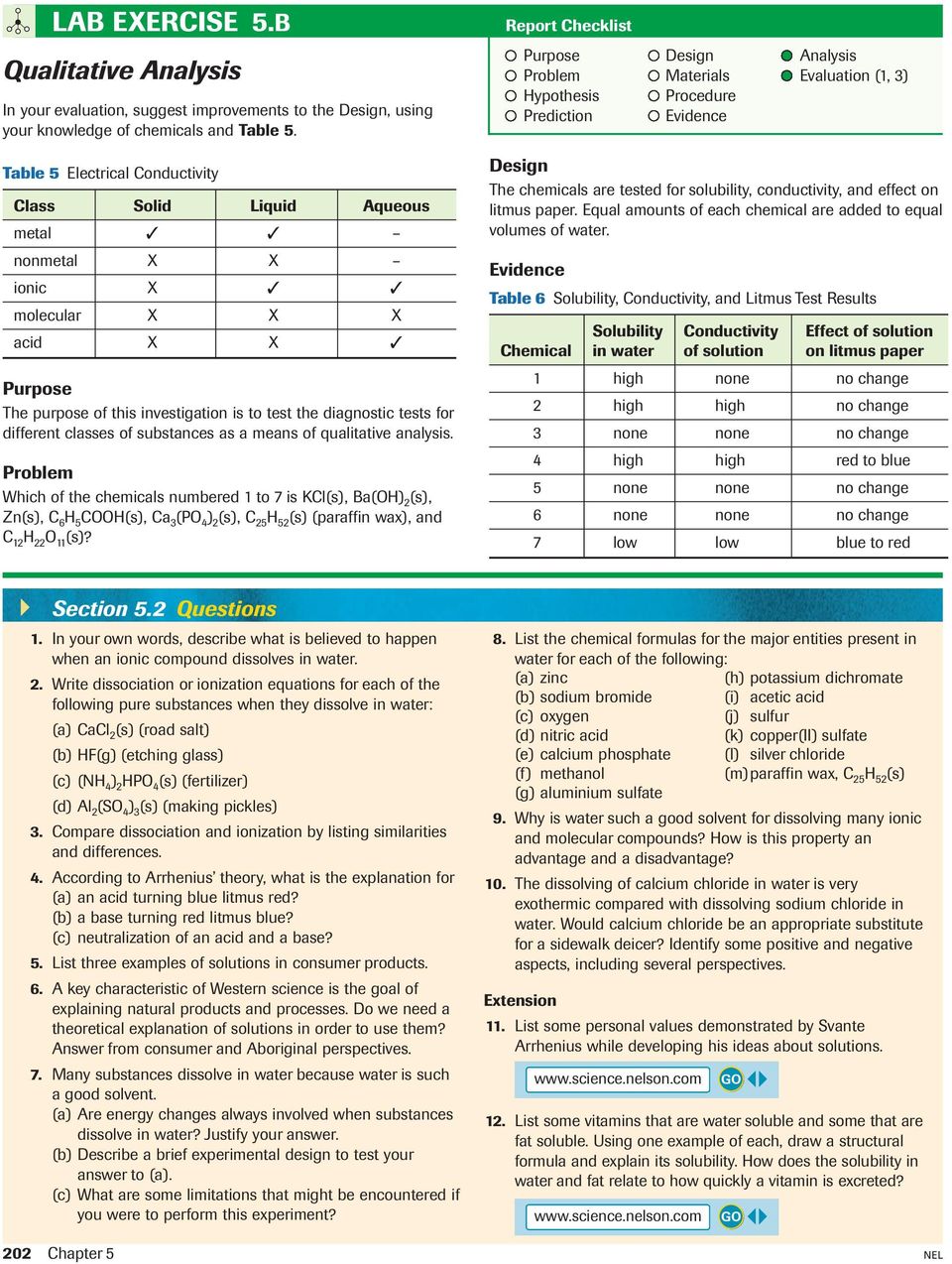
18 LAB EXERCISE 5.B Qualitative Analysis In your evaluation, suggest improvements to the Design, using your knowledge of chemicals and Table 5. Table 5 Electrical Conductivity Class Solid Liquid Aqueous metal nonmetal X X ionic X molecular X X X acid X X Purpose The purpose of this investigation is to test the diagnostic tests for different classes of substances as a means of qualitative analysis. Problem Which of the chemicals numbered 1 to 7 is KCl(s), Ba(O) 2 (s), Zn(s), C 6 5 COO(s), Ca 3 (PO 4 ) 2 (s), C (s) (paraffin wax), and C O 11 (s)? Report Checklist Purpose Design Analysis Problem Materials Evaluation (1, 3) ypothesis Procedure Prediction Evidence Design The chemicals are tested for solubility, conductivity, and effect on litmus paper. Equal amounts of each chemical are added to equal volumes of water. Evidence Table 6 Solubility, Conductivity, and Litmus Test Results Solubility Conductivity Effect of solution Chemical in water of solution on litmus paper 1 high none no change 2 high high no change 3 none none no change 4 high high red to blue 5 none none no change 6 none none no change 7 low low blue to red Section 5.2 Questions 1. In your own words, describe what is believed to happen when an ionic compound dissolves in water. 2. Write dissociation or ionization equations for each of the following pure substances when they dissolve in water: (a) CaCl 2 (s) (road salt) (b) F(g) (etching glass) (c) (N 4 ) 2 PO 4 (s) (fertilizer) (d) Al 2 (SO 4 ) 3 (s) (making pickles) 3. Compare dissociation and ionization by listing similarities and differences. 4. According to Arrhenius theory, what is the explanation for (a) an acid turning blue litmus red? (b) a base turning red litmus blue? (c) neutralization of an acid and a base? 5. List three examples of solutions in consumer products. 6. A key characteristic of Western science is the goal of explaining natural products and processes. Do we need a theoretical explanation of solutions in order to use them? Answer from consumer and Aboriginal perspectives. 7. Many substances dissolve in water because water is such a good solvent. (a) Are energy changes always involved when substances dissolve in water? Justify your answer. (b) Describe a brief experimental design to test your answer to (a). (c) What are some limitations that might be encountered if you were to perform this experiment? 8. List the chemical formulas for the major entities present in water for each of the following: (a) zinc (h) potassium dichromate (b) sodium bromide (i) acetic acid (c) oxygen (j) sulfur (d) nitric acid (k) copper(ii) sulfate (e) calcium phosphate (l) silver chloride (f) methanol (m)paraffin wax, C (s) (g) aluminium sulfate 9. Why is water such a good solvent for dissolving many ionic and molecular compounds? ow is this property an advantage and a disadvantage? 10. The dissolving of calcium chloride in water is very exothermic compared with dissolving sodium chloride in water. Would calcium chloride be an appropriate substitute for a sidewalk deicer? Identify some positive and negative aspects, including several perspectives. Extension 11. List some personal values demonstrated by Svante Arrhenius while developing his ideas about solutions. 12. List some vitamins that are water soluble and some that are fat soluble. Using one example of each, draw a structural formula and explain its solubility. ow does the solubility in water and fat relate to how quickly a vitamin is excreted? 202 Chapter 5
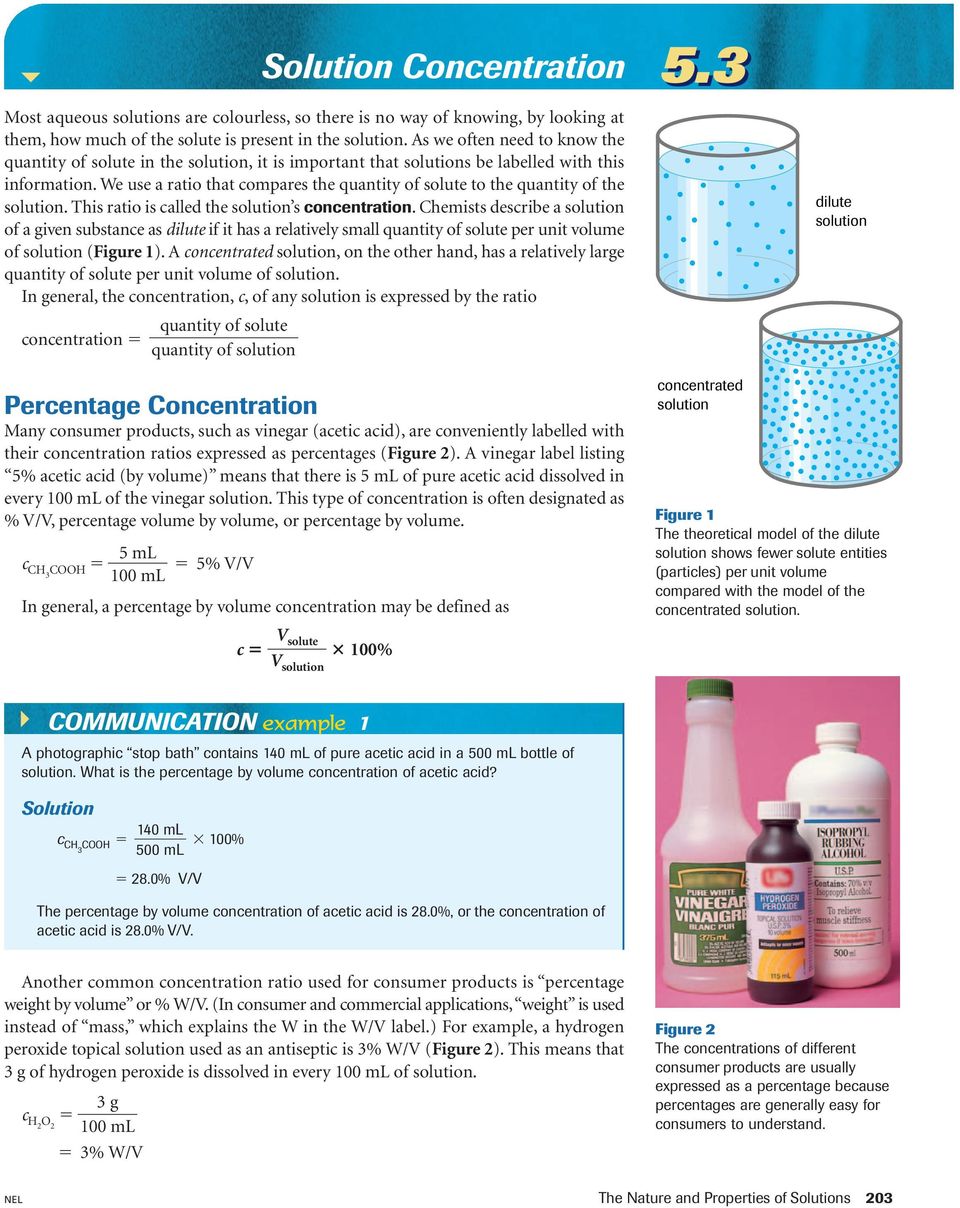
19 Solution Concentration Most aqueous solutions are colourless, so there is no way of knowing, by looking at them, how much of the solute is present in the solution. As we often need to know the quantity of solute in the solution, it is important that solutions be labelled with this information. We use a ratio that compares the quantity of solute to the quantity of the solution. This ratio is called the solution s concentration. Chemists describe a solution of a given substance as dilute if it has a relatively small quantity of solute per unit volume of solution (Figure 1). A concentrated solution, on the other hand, has a relatively large quantity of solute per unit volume of solution. In general, the concentration, c, of any solution is expressed by the ratio concentration quantity of solute quantity of solution 5.3 dilute solution Percentage Concentration Many consumer products, such as vinegar (acetic acid), are conveniently labelled with their concentration ratios expressed as percentages (Figure 2). A vinegar label listing 5% acetic acid (by volume) means that there is 5 ml of pure acetic acid dissolved in every 100 ml of the vinegar solution. This type of concentration is often designated as % V/V, percentage volume by volume, or percentage by volume. c C3 COO 5 ml 5% V/V 100 ml In general, a percentage by volume concentration may be defined as Vsolute c 100% V solution concentrated solution Figure 1 The theoretical model of the dilute solution shows fewer solute entities (particles) per unit volume compared with the model of the concentrated solution. COMMUNICATION example 1 A photographic stop bath contains 140 ml of pure acetic acid in a 500 ml bottle of solution. What is the percentage by volume concentration of acetic acid? Solution c C3 COO 140 ml 100% 500 ml 28.0% V/V The percentage by volume concentration of acetic acid is 28.0%, or the concentration of acetic acid is 28.0% V/V. Another common concentration ratio used for consumer products is percentage weight by volume or % W/V. (In consumer and commercial applications, weight is used instead of mass, which explains the W in the W/V label.) For example, a hydrogen peroxide topical solution used as an antiseptic is 3% W/V (Figure 2). This means that 3 g of hydrogen peroxide is dissolved in every 100 ml of solution. 3 g c 2 O ml 3% W/V Figure 2 The concentrations of different consumer products are usually expressed as a percentage because percentages are generally easy for consumers to understand. The Nature and Properties of Solutions 203
20 CAREER CONNECTION Toxicologist Toxicologists are investigators who specialize in detecting poisons and other harmful substances. Toxicologists can specialize in many areas, including analyzing natural substances such as venoms, testing new industrial products, or, in forensic science, testing for poisons in suspicious deaths. Learn more about possibilities of working as a toxicologist, including different specializations, education, and salary. In general, we write a percentage weight by volume concentration as msolu te c 100% V solutio n A third concentration ratio is the percentage weight by weight, or % W/W: msolute c 100% m solution COMMUNICATION example 2 A sterling silver ring has a mass of 12.0 g and contains 11.1 g of pure silver. What is the percentage weight by weight concentration of silver in the metal? Solution 11.1 g c Ag 100% 12.0 g 92.5% W/W The percentage weight by weight of silver is 92.5%, or the concentration of silver is 92.5% W/W. DID YOU KNOW? Understanding ppm A concentration of 1% W/W is equivalent to ppm. 1 ppm is approximately the concentration obtained by dissolving one grain of salt (about 0.1 mg) in a 100 ml glass of water. Parts per Million Concentration In studies of solutions in the environment, we often encounter very low concentrations. For very dilute solutions, we choose a concentration unit to give reasonable numbers for very small quantities of solute. For example, the concentration of toxic substances in the environment, of chlorine in a swimming pool, and of impurities in laboratory chemicals (Figure 3) is usually expressed as parts per million (ppm, 1:10 6 ) or even smaller ratios, such as parts per billion (ppb, 1:10 9 ) or parts per trillion (ppt, 1:10 12 ). These ratios are a special case of the weight by weight (W/W) ratio. By definition, parts per million means m solute (g) msolution (g) 10 6 owever, this calculation can be simplified by altering the units to incorporate the factor of Therefore, a concentration in parts per million (ppm) can also be expressed as c m solute (mg) msolution (kg) Figure 3 This concentrated sulfuric acid has an amount concentration of 17.8 mol/l. Note the impurities listed in units of parts per million. which means that 1 ppm 1 mg/kg. Because very dilute aqueous solutions are similar to pure water, their densities are considered to be the same: 1 g/ml. Therefore, 1 ppm of chlorine is 1 g in 10 6 g or 10 6 ml (1000 L) of pool water, which is equivalent to 1 mg of chlorine per litre of water. For aqueous solutions only, 1 ppm 1 g/10 6 ml 1 mg/l 1 mg/kg Small concentrations such as ppm, ppb, and ppt are difficult to imagine, but are very important in environmental studies and in the reporting of toxic effects (Table 1). 204 Chapter 5

21 Section 5.3 Dissolved oxygen in natural waters is an important measure of the health of the ecosystem. In a chemical analysis of 250 ml of water at SATP, 2.2 mg of oxygen was measured. What is the concentration of oxygen in parts per million? Solution 2.2 mg c O L 8.8 mg/l 8.8 ppm The concentration of dissolved oxygen is 8.8 ppm. Amount Concentration Chemistry is primarily the study of chemical reactions, which we communicate using balanced chemical equations. The coefficients in these equations represent chemical amounts in units of moles. Concentration is therefore communicated using amount concentration. Amount concentration, c, is the chemical amount of solute dissolved in one litre of solution. COMMUNICATION example 3 amount concentration chemical amount of solute (in moles) volume of solution (in litres) c V n The units of amount concentration (mol/l) come directly from this ratio. Amount concentration can also be indicated by the use of square brackets. For example, the amount concentration of sodium hydroxide in water could be represented by [NaO(aq)]. Table 1 Maximum Acceptable Concentration (MAC) of Chemicals in Canadian Drinking Water Typical MAC Substance source (ppm) cadmium batteries in landfills lead old plumbing nitrates fertilizers 45.0 cyanides mining waste 0.2 DID YOU KNOW? Amount Concentration According to IUPAC, the molar concentration of X is now officially called the amount concentration of X and is denoted by c X or [X]. Amount concentration replaces the older terms, molar concentration and molarity. Remember that in chemistry, the amount of a substance is always a quantity in units of moles. COMMUNICATION example 4 In a quantitative analysis, a stoichiometry calculation produced mol of sodium hydroxide in L of solution. Calculate the amount concentration of sodium hydroxide. Solution c NaO mol L mol/l The amount concentration of sodium hydroxide is mol/l. Practice 1. Describe the three different systems of expressing the concentration of a solution. 2. Gasohol, a solution of ethanol and gasoline, is considered to be a cleaner fuel than gasoline alone. A typical gasohol mixture available across Canada contains 4.1 L of ethanol in a 55 L tank of fuel. Calculate the percentage by volume concentration of ethanol. 3. Solder flux, available at hardware and craft stores, contains 16 g of zinc chloride in 50 ml of solution. The solvent is aqueous hydrochloric acid. What is the percentage weight by volume of zinc chloride in the solution? The Nature and Properties of Solutions 205
22 4. Brass is a copper zinc alloy. If the concentration of zinc is relatively low, the brass has a golden colour and is often used for inexpensive jewellery. If a 35.0 g pendant contains 1.7 g of zinc, what is the percentage weight by weight of zinc in this brass? 5. Formaldehyde, C 2 O(g), an indoor air pollutant that is found in synthetic materials and cigarette smoke, is a carcinogen. If an indoor air sample with a mass of 0.59 kg contained 3.2 mg of formaldehyde, this level would be considered dangerous. What would be the concentration of formaldehyde in parts per million? 6. A plastic dropper bottle for a chemical analysis contains 0.11 mol of calcium chloride in 60 ml of solution. Calculate the amount concentration of calcium chloride. WEB Activity Canadian Achievers David Schindler Dr. David Schindler (Figure 4) is a professor of ecology at the University of Alberta, where he specializes in researching land-water interactions. State three specific examples of studies Dr. Schindler has conducted that would involve concentration measurements. Identify some personal values and attitudes that make him both a renowned and a controversial scientist. Figure 4 David Schindler Learning Tip You can set up calculations involving concentrations as a proportion. For example, m C6 12 O 5.0 g ml 10 0 ml You can invert the ratios, if it is more convenient. For example, V 2 O 1 00 ml g 30.0 g In both cases, make sure the quantities in the numerator and the denominator on both sides of the equation match. Calculations Involving Concentrations Solutions are so commonly used in chemistry that calculating concentrations might be the primary reason why chemists pull out their calculators. Chemists and chemical technicians also frequently need to calculate a quantity of solute or solution. Any of these calculations may involve percentage concentrations, ppm concentrations, or amount concentrations. When we know two of these values quantity of solute, quantity of solution, and concentration of solution we can calculate the third quantity. Because concentration is a ratio, a simple procedure is to use the concentration ratio (quantity of solute/quantity of solution) as a conversion factor. This approach parallels the one you followed when using molar mass as a conversion factor. Suppose you are a nurse who needs to calculate the mass of dextrose, C 6 12 O 6 (s), present in a 1000 ml intravenous feeding of D5W, which is a solution of 5.0% W/V dextrose in water. The conversion factor you need to use is the mass/volume ratio: 5.0 g m C6 12 O ml 50 g 10 0 L m In some calculations, you may want to find the quantity of solution, in which case you will have to invert the ratio to quantity of solution/quantity of solute. This is then the appropriate conversion factor. For example, what volume of 30.0% W/V hydrogen peroxide solution can be made from 125 g of pure hydrogen peroxide? You know that the answer must be greater than 100 ml because 125 g is greater than 30.0 g (the quantity in 100 ml). Notice how the units cancel to produce the expected volume unit, millilitres, when we use the volume/mass ratio: V 2 O g 1 00 ml 417 ml 30.0 g 206 Chapter 5
23 Section 5.3 Thinking about the quantity given and the concentration ratio helps to ensure you are calculating correctly. This method also works for other concentration ratios. COMMUNICATION example 5 A box of apple juice has a fructose (sugar) concentration of 12 g/100 ml (12% W/V) (Figure 5). What mass of fructose is present in a 175 ml glass of juice? (The chemical formula for fructose is C 6 12 O 6.) Solution 12 g m C6 12 O 175 ml ml 21 g The mass of fructose present in 175 ml of apple juice is 21 g. COMMUNICATION example 6 People with diabetes have to monitor and restrict their sugar intake. What volume of apple juice could a diabetic person drink, if the person s sugar allowance for that beverage was 9.0 g? Assume that the apple juice has a sugar concentration of 12 g/100 ml (12% W/V), and that the sugar in apple juice is fructose. Solution V C6 12 O g 100 ml 12 g 75 ml The volume of apple juice allowed is 75 ml. When you are given a concentration in parts per million (ppm), it is usually easier to convert the parts per million into units of milligrams per kilogram (1 ppm 1 mg/kg) before doing your calculation. Remember that 1 ppm 1 mg/l only applies to aqueous solutions. If, for example, you are given a value of 99 ppm of DDT in a 2 kg gull, what mass of DDT is present? The concentration ratio is 99 mg/kg. Note the cancellation of kilograms. m DDT 2 kg 9 9 mg 1 g k 0.2 g (rounded from 198 mg) Figure 5 The label on a box of apple juice gives the ingredients and some nutritional information, but not the concentration of the various solutes. COMMUNICATION example 7 A sample of well water contains 0.24 ppm of iron(iii) sulfate dissolved from the surrounding rocks. What mass of iron(iii) sulfate is present in 1.2 L of water in a kettle? Solution m Fe2 (SO 4 ) L 0.29 mg 0.24 mg 1L The mass of iron(iii) sulfate in 1.2 L is 0.29 mg. BIOLOGY CONNECTION Pollutants The effects of pollutants in the environment, such as toxicity, are an important topic in biology. You will see a much more detailed discussion of this topic if you are taking a biology course. The Nature and Properties of Solutions 207
24 COMMUNICATION example 8 A sample of laboratory ammonia solution has an amount concentration of 14.8 mol/l (Figure 6). What chemical amount of ammonia is present in a 2.5 L bottle? Solution n N3 2.5 L 37 mol 14.8 mol 1L The chemical amount of ammonia in 2.5 L is 37 mol. You should always check that your answer makes sense. For example, in Communication Example 8, 14.8 mol/l means that there is 14.8 mol of ammonia in 1 L of solution. Therefore, 2.5 L, which is greater than 1 L, must contain a chemical amount greater than 14.8 mol. In some situations, you may know the amount concentration and need to find either the volume of solution or amount (in moles) of solute. In these situations, use either the volume/amount or amount/volume ratio. Notice that the units of the quantity you want to find should be the units in the numerator of the conversion factor ratio. Figure 6 Aqueous ammonia is purchased for science laboratories as a concentrated solution. COMMUNICATION example 9 What volume of a 0.25 mol/l salt solution in a laboratory contains 0.10 mol of sodium chloride? Solution 1 L V NaCl 0.10 mol mol 0.40 L The volume of salt solution is 0.40 L. Figure 7 ydrogen peroxide solutions are stored in dark bottles to keep out light, which promotes the decomposition of hydrogen peroxide to water and oxygen. Practice 7. Rubbing alcohol, C 3 7 O(l), is sold as a 70.0% V/V solution for external use only. What volume of pure C 3 7 O(l) is present in a 500 ml bottle? 8. Suppose your company makes hydrogen peroxide solution with a generic label for drugstores in your area (Figure 7). Calculate the mass of pure hydrogen peroxide needed to make 1000 bottles, each containing 250 ml of 3.0% W/V 2 O 2 (aq). 9. Seawater contains approximately mol/l of magnesium chloride. Determine the chemical amount of magnesium chloride present in 75 L of seawater. 10. A bottle of 5.0 mol/l hydrochloric acid is opened in the laboratory, and 50 ml of it is poured into a beaker. What chemical amount of acid is in the beaker? 11. A household ammonia solution (e.g., a window-cleaning solution) has an amount concentration of 1.24 mol/l. What volume of this solution would contain mol of N 3 (aq)? 12. A student needs 0.14 mol of Na 2 SO 4 (aq) to do a quantitative analysis. The amount concentration of the student s solution is 2.6 mol/l Na 2 SO 4 (aq). What volume of solution does the student need to measure? 208 Chapter 5
25 Section 5.3 Mass, Volume, and Concentration Calculations Even though the mole is a very important unit, measurements in a chemistry laboratory are usually of mass (in grams) and of volume (in millilitres). A common chemistry calculation involves the mass of a substance, the volume of a solution, and the amount concentration of that solution. This type of calculation requires the use of two conversion factors one for molar mass and one for amount concentration. Calculations using molar mass are just like the ones you did in previous units. SAMPLE problem 5.1 A chemical analysis requires 2.00 L of mol/l AgNO 3 (aq). What mass of solid silver nitrate is required to prepare this solution? First determine the chemical amount of silver nitrate needed mol n AgNO L 1L mol Then convert this amount into a mass of silver nitrate by using its molar mass, M. The molar mass of silver nitrate is g/mol g m AgNO mol 1 mol 51.0 g Learning Tip If you prefer to use mathematical formulas, for this sample problem you may use n Vc m nm If you clearly understand these two steps, you could combine them into one calculation. m AgNO L 51.0 g mol 1L g 1 mol In order to successfully combine the steps into one operation, as shown above, you need to pay particular attention to the units in the calculation. Cancelling the units will help you to check your procedure. COMMUNICATION example 10 To study part of the water treatment process in a laboratory, a student requires 1.50 L of 0.12 mol/l aluminium sulfate solution. What mass of aluminium sulfate must she measure for this solution? Solution n Al2 (SO 4 ) 1.50 L mol L or m Al2 (SO ) 1.50 L mol g L 1 mol mol 61.6 g g m Al2 (SO 4 ) mol 3 1 mol 61.6 g The mass of aluminium sulfate required is 61.6 g. Another similar calculation involves the use of a known mass and volume to calculate the amount concentration of a solution. This calculation is similar to the examples given above, using the same conversion factors. The Nature and Properties of Solutions 209
26 COMMUNICATION example 11 Sodium carbonate is a water softener that is an important part of the detergent used in a washing machine. A student dissolves 5.00 g of solid sodium carbonate to make 250 ml of a solution to study the properties of this component of detergent. What is the amount concentration of the solution? Solution n Na2 CO g mol c Na2 CO mol L mol/l 1 mol g or c Na2 CO g mol/l 1 mol g L The amount concentration of sodium carbonate is mol/l. Practice 13. A chemical technician needs 3.00 L of mol/l sodium hydroxide solution. What mass of solid sodium hydroxide must be measured? 14. Seawater is mostly a solution of sodium chloride in water. The concentration varies, but marine biologists took a sample with an amount concentration of 0.56 mol/l. Calculate the mass of sodium chloride in the biologists 5.0 L sample. 15. Acid rain may have 355 ppm of dissolved carbon dioxide. (a) What mass of carbon dioxide is present in 1.00 L of acid rain? (b) Calculate the amount concentration of carbon dioxide in the acid rain sample. 16. A brine (sodium chloride) solution used in pickling contains 235 g of pure sodium chloride dissolved in 3.00 L of solution. (a) Determine the percent concentration (% W/V) of sodium chloride. (b) What is the amount concentration of sodium chloride? Figure 8 Two moles per litre Concentration of Ions In solutions of ionic compounds and strong acids, the electrical conductivity suggests the presence of ions in the solution. When these solutes produce aqueous ions, expressing the concentration of individual ions in moles per litre (mol/l) is important. The amount concentrations of the ions in a solution depend on the relative numbers of ions making up the compound: for example, Cl ions in NaCl(aq) and CaCl 2 (aq). The dissociation or ionization equations for ionic compounds or strong acids allow you to determine the amount concentration of either the ions or the compounds in solution. The ion concentration is always equal to a whole number multiple of the compound concentration. For convenience, square brackets are commonly placed around formulas to indicate the amount concentration of the substance within the brackets. For example, [N 3 (aq)] and [ (aq)] indicate the amount concentrations of aqueous ammonia and hydrogen ions respectively. When sodium chloride dissolves in water, each mole of sodium chloride produces one mole of sodium ions and one mole of chloride ions. NaCl(aq) Na (aq) Cl (aq) 1 mol 1 mol 1 mol If [NaCl(aq)] 1 mol/l, then [Na (aq)] 1 mol/l and [Cl (aq)] 1 mol/l because the mole ratio from the dissociation equation is 1:1: Chapter 5
27 Section 5.3 Calcium chloride dissociates in water to produce individual calcium and chloride ions. Each mole of calcium chloride produces one mole of calcium ions and two moles of chloride ions. CaCl 2 (aq) Ca 2 (aq) 2 Cl (aq) 1 mol 1 mol 2 mol If [CaCl 2 (aq)] 1 mol/l, then [Ca 2 (aq)] 1 mol/l. The [Cl (aq)] 2 mol/l because the dissociation equation shows that 2 mol of chloride ions is produced from 1 mol of calcium chloride a 2:1 mole ratio. Notice that you can easily predict the individual ion concentrations from the concentration of the compound and the subscripts of the ions in the formula of the compound. Even so, it is good practice to write the dissociation or ionization equation prior to calculating concentrations. This practice will help you avoid errors and is good preparation for your later study of stoichiometry in Unit 4. COMMUNICATION example 12 What is the amount concentration of aluminium ions and sulfate ions in a 0.40 mol/l solution of Al 2 (SO 4 ) 3 (aq)? Solution Al 2 (SO 4 ) 3 (aq) 2Al 3 (aq) + 3 SO 4 2 (aq) [Al 3 (aq)] 0.40 mol/l Al 2 (SO 4 ) 3 (aq) 2 mol Al 3 (aq) 1 mol Al 2 (SO 4 ) 3 (aq) 0.80 mol/l [SO 2 3 mol SO 2 4 (aq)] 0.40 mol/l Al 2 (SO 4 ) 3 (aq) 4 (aq) 1.20 mol/l 1 mol Al 2 (SO 4 ) 3 (aq) The amount concentration of aluminium ions is 0.80 mol/l and of sulfate ions is 1.20 mol/l. Learning Tip Initially it might appear that there is a lack of conservation because the dissociation equation shows a greater amount on the product side compared to the reactant side. ere is a simple model for the dissolving of calcium chloride that may help you to understand that no rules are being broken. Cl Ca 2+ Cl Ca 2+ 1 sheet of paper cut into Although the number of pieces of paper has increased by cutting one sheet into smaller pieces, the total mass of paper has not changed. If you started with five sheets of paper (CaCl 2 ), how many pieces of paper, labelled chloride ion, would you obtain? + 3 smaller pieces Cl Cl Note that, in Communication Example 12, the chemical formula of the entity you wish to find appears in the numerator of the ratio. The formula of the known entity is in the denominator and cancels with the chemical formula of the known solution concentration. The chemical formulas are omitted from the ratios in the following examples. COMMUNICATION example 13 Determine the amount concentration of barium and hydroxide ions in a solution made by dissolving 5.48 g of barium hydroxide to make a volume of 250 ml. Solution Ba(O) 2 (aq) Ba 2 (aq) 2O (aq) 1 mol n Ba(O) g mol g [Ba(O) 2 (aq)] mol mol/l L [Ba 2 (aq)] mol/l mol/l [O (aq)] mol/l mol/l 1 The amount concentration of barium ions is mol/l and of hydroxide ions is mol/l. The Nature and Properties of Solutions 211
28 Learning Tip Notice that in this example, we are now going backwards from the ion concentration to the solute concentration. The first calculation step means that for every two moles of bromide ions, we need only one mole of magnesium bromide. COMMUNICATION example 14 What mass of magnesium bromide must be dissolved to make 1.50 L of solution with a bromide ion concentration of 0.30 mol/l? Solution MgBr 2 (aq) Mg 2 (aq) 2Br (aq) [MgBr 2 (aq)] 0.30 mol/l mol/l n MgBr L 0.15 mol 1L 0.23 mol m MgBr mol g 1 mol 41 g The mass of magnesium bromide required is 41 g. Practice 17. Find the amount concentration of each ion in the following solutions: (a) 0.41 mol/l Na 2 S(aq) (b) 1.2 mol/l Sr(NO 3 ) 2 (aq) (c) 0.13 mol/l (N 4 ) 3 PO 4 (aq) 18. A 250 ml solution is prepared by dissolving 2.01 g of iron(iii) chloride in water. What is the amount concentration of each ion in the solution? 19. In order to prepare for a chemical analysis, a lab technician requires 500 ml of each of the following solutions. Calculate the mass of solid required for each solution: (a) [Cl (aq)] mol/l from CaCl 2 (s) (b) [CO 2 3 (aq)] 0.35 mol/l from Na 2 CO 3 (s) Case Study ousehold Chemical Solutions An amazing number of solutions is available for household use at your local drugstore, hardware store, and supermarket in the form of food products, household cleaners, and health and personal care products (Figure 9). They come with a bewildering array of names, instructions, warnings, and concentration labels. For consumer convenience and safety, it is important that household chemical solutions be labelled accurately and honestly. Unfortunately, manufacturers and distributors of household cleaning products are not required by law to list ingredients on their labels. In some cases, you can find the Material Data Safety Sheet (MSDS) for the product on the manufacturer s Web site or phone to request it. Societal concerns about safety and disposal of chemicals have resulted in efforts by chemical manufacturers to promote safe and environmentally sound practices through their Responsible Care program. Being able to read information on household product labels is important for personal safety and proper disposal. azard symbols and safety warnings on labels are pointless if they go Figure 9 Corrosive substances, such as acids and bases, are found in many household products, including cleaning solutions. unnoticed, or are not understood. Every year people are injured because they are unaware that bleach (sodium hypochlorite solution) should never be mixed with acids such as vinegar. Although both solutions are effective cleaners for certain stains, when they are combined, they react to produce 212 Chapter 5
29 Section 5.3 a highly toxic gas, chlorine. Trying to use both at once for example, in cleaning a toilet has been known to transform a bathroom into a deathtrap. Concentration is another factor to consider when buying solutions. The labels on consumer products usually give concentration as a percentage, which is easier for the general public to understand than moles per litre. Some consumer products, such as insect repellant, are sold in different concentrations, so it is important to know which one is most suitable for your needs. Another household chemical, isopropyl alcohol, is sold in pure form as a disinfectant, and in 70% concentration as rubbing alcohol. Knowing the key ingredients and their concentrations is useful for safe and proper use and disposal. Case Study Questions 1. ow and why are concentrations for household chemical solutions expressed differently than for laboratory work? 2. According to ealth Canada, it is the manufacturer s responsibility to assess and report the hazards associated with a chemical product. What personal or social values would you expect a manufacturer to demonstrate? To what extent do you think these values are demonstrated? 3. Survey your home and list any household solutions you have that are commonly brought to the ousehold azardous Waste Round-Up. When is your local Round- Up? If your location is not listed, phone the local government office to ask why you are not listed and what you should do to dispose of household hazardous materials. 4. The Canadian Chemical Producers Association (CCPA) represents over 65 chemical manufacturing industries with over 200 plants across Canada. These industries collectively produce over 90% of all chemicals in Canada. CCPA is the driving force behind the Responsible Care initiative a global effort aimed at addressing public concerns about the manufacture, distribution, use, and disposal of chemicals. State their Ethic and list their six Codes of Practice. Do you feel that this program is a suitable replacement for government regulation? 5. If household products are brought into a workplace, they become restricted products and a MSDS is required. Choose one household product and record the name of one key ingredient. Find the MSDS and identify three pieces of information supplied on this sheet that you think should be on the label. WEB Activity Web Quest ot Tub Safety ot tubs are very popular in private homes, public recreation centres, and commercial hotels (Figure 10). ow are you protected from infectious diseases transmitted via hot tubs? SUMMARY Concentration of a Solution Figure 10 ow safe are hot tubs? Type Definition Units percentage by volume Vsolute c V 100% % V/V (or ml/100 ml) mass by volume by mass parts per million amount solution msolute c V 100% % W/V (or g/100 ml) solution msolute c m 100% % W/W (or g/100 g) solution msolute c m ppm (or mg/kg) c V n solution solute solution mol/l The Nature and Properties of Solutions 213
30 Section 5.3 Questions 1. What concentration ratio is often found on the labels of consumer products? Why is this unit used? 2. What concentration unit is most useful in the study of chemistry? Briefly describe why this unit is useful. 3. Bags of a D5W intravenous sugar solution used in hospitals contain 50 g of dextrose (glucose) in a 1.00 L bag. (a) Calculate the percentage weight by volume concentration of dextrose. (b) Suggest a reason why the bags are labelled D5W. 4. An Olympic-bound athlete tested positive for the anabolic steroid nandrolone. The athlete s urine test results showed 0.20 mg of nandrolone in a 10.0 ml urine sample. Convert the test result concentration to parts per million. 5. A 15 ml dose of a cough syrup contains 4.8 mmol of ammonium carbonate, (N 4 ) 2 CO 3 (aq). (a) Determine the amount concentration of ammonium carbonate. (b) What is the amount concentration of each ion in this solution? 6. The maximum concentration of salt in water at 0 C is 31.6 g/100 ml. What mass of salt can be dissolved in 250 ml of solution? 7. Bald eagle chicks raised in northern Alberta were found to contain PCBs (polychlorinated biphenyls) at an average concentration of 18.9 ppm. If a chick had a mass of 0.60 kg, predict the mass of PCBs it would contain. 8. An experiment is planned to study the chemistry of a home water-softening process. The brine (sodium chloride solution) used in this process has a concentration of 25 g in every 100 ml of solution. Calculate the amount concentration of this solution. 9. To prepare for an experiment using flame tests, a school lab technician requires 100 ml of 0.10 mol/l solutions of each of the following substances. Calculate the required mass of each solid. (a) NaCl(s) (b) KCl(s) (c) CaCl 2 (s) 10. What volume of mol/l glucose solution found in a plant contains 2.0 g of glucose, C 6 12 O 6 (aq)? 11. In an experiment, 28.6 g of aluminium chloride is dissolved in 1.50 L of solution. (a) Calculate the amount concentration of aluminium chloride. (b) Determine the amount concentration of each ion in the final solution. 12. As part of a chemical analysis, a technician requires a 0.25 mol/l bromide ion solution. What mass of magnesium bromide is required to prepare 100 ml of the required solution? 13. ow is your report card mark in a subject similar to a concentration? What other ratios have you used that are similar to concentration ratios? 14. List several examples of how solutions and solution concentration are applied in products and processes we use in daily life. 15. Identify the implications of selling medicines in much more concentrated solutions. Present points both in favour and against. 16. Science and technology have both intended and unintended consequences. Illustrate this statement using DDT as your example. Include the role of biomagnification of DDT in the environment. 17. Very low concentrations of toxic substances sometimes require the use of the parts per billion (ppb) concentration. (a) Express parts per billion as a ratio, including the appropriate power of ten. (b) ow much smaller is 1 ppb than 1 ppm? (c) Convert your answer in (a) to a concentration ratio using the appropriate SI prefixes to obtain a mass of solute per kilogram of solution. (d) Copper is an essential trace element for animal life. An average adult human requires the equivalent of a litre of water containing 30 ppb of copper a day. What is the mass of copper per kilogram of solution? Extension 18. Toxicity of substances for animals is usually expressed by a quantity designated as LD50. Use the Internet to research the use of this quantity. What does LD50 mean? What is the concentration in ppm for a substance considered extremely toxic and one considered slightly toxic? 19. Many chemicals that are potentially toxic or harmful to the environment and humans have maximum permissible concentration levels set by government legislation. Nevertheless, some people question the levels that are set and some suggest that the only safe level is zero. (a) To what extent should we trust our government agencies to set appropriate levels? (b) Outline some risks and benefits, from several perspectives, associated with the use of controversial chemicals such as pesticides. (c) What is chemical hormesis? Why might this effect have major implications for government regulatory agencies? (d) What does LC50 mean? List some advantages and disadvantages of this method of measuring toxicity. 214 Chapter 5
31 Preparation of Solutions When you prepare a jug of iced tea using a package of crystals and water, you are preparing a solution from a solid solute (actually, from several solid solutes). owever, when you prepare the tea from a container of frozen concentrate, you are preparing a solution by dilution. Scientists use both of these methods to prepare solutions. In this course you will be preparing only aqueous solutions. The knowledge and skills for preparing solutions are necessary to complete some of the more complex laboratory investigations that come later in this course. Preparation of Standard Solutions from a Solid Solutions of accurate concentration, called standard solutions, are routinely prepared for use in both scientific research laboratories and industrial processes. They are used in chemical analysis as well as for the control of chemical reactions. To prepare a standard solution, good-quality equipment is required to measure the mass of solute and volume of solution. Electronic balances are used for precise and efficient measurement of mass (Figure 1). For measuring a precise volume of the final solution, a container called a volumetric flask is used (Figure 2). 5.4 Figure 1 An electronic balance is simpler to operate and more efficient than the older mechanical balance. Electronic balances also provide the convenience of taring (Appendix C.3). Figure 2 Volumetric glassware comes in a variety of shapes and sizes. The Erlenmeyer flask on the far left has only approximate volume markings, as does the beaker. The graduated cylinders have much better precision, but for high precision, a volumetric flask (on the right) is used. The volumetric flask shown here, when filled to the line, contains ml ± 0.16 ml at 20 C. This means that a volume measured in this flask is uncertain by less than 0.2 ml at the specified temperature. INVESTIGATION 5.2 Introduction A Standard Solution from a Solid In this investigation, you will practise the skills required to prepare a standard solution from a pure solid (Appendix C.4). You will need these skills in many investigations in this course. Purpose The purpose of this investigation is to acquire the skills required to prepare a standard solution starting with a pure solid. Report Checklist Purpose Design Analysis Problem Materials Evaluation ypothesis Procedure Prediction Evidence To perform this investigation, turn to page 227. The Nature and Properties of Solutions 215
32 Figure 3 ard-water deposits such as calcium carbonate can seriously affect water flow in a pipe. Practice 1. To test the hardness of water (Figure 3), an industrial chemist performs an analysis using ml of a mol/l standard solution of ammonium oxalate. What mass of ammonium oxalate, (N 4 ) 2 C 2 O 4 (s), is needed to make the standard solution? 2. Calculate the mass of solid lye (sodium hydroxide) (Figure 4) needed to make 500 ml of a 10.0 mol/l strong cleaning solution. 3. List several examples of solutions that you prepared from solids in the last week. 4. You have been asked to prepare 2.00 L of a mol/l aqueous solution of cobalt(ii) chloride for an experiment starting with CoCl O(s). (a) Show your work for the pre-lab calculation. (b) Write a complete specific procedure for preparing this solution, as in Investigation 5.2. Be sure to include all necessary precautions. 5. (a) A technician prepares ml of a mol/l solution of potassium permanganate as part of a quality-control analysis in the manufacture of hydrogen peroxide. Calculate the mass of potassium permanganate required to prepare the solution. (b) Write a laboratory procedure for preparing the potassium permanganate solution. Follow the conventions of communication for a procedure in a laboratory report. Figure 4 Solutions of sodium hydroxide in very high concentration are sold as cleaners for clogged drains. The same solution can be made less expensively by dissolving solid lye (a commercial name for sodium hydroxide) in water. The pure chemical is very caustic and the label on the lye container recommends rubber gloves and eye protection. Preparation of Standard Solutions by Dilution A second method of preparing solutions is by dilution of an existing solution. You use this process when you add water to concentrated fruit juice, fabric softener, or a cleaning product. Many consumer and commercial products are purchased in concentrated form and then diluted before use. You can save money and help save the environment by diluting concentrated products. Doing so saves on shipping charges and reduces the size of the container, making the product less expensive and more environmentally friendly. Citizens who are comfortable with dilution techniques can live more lightly on Earth. Because dilution is a simple, quick procedure, it is common scientific practice to begin with a stock solution and to add solvent (usually water) to decrease the concentration to the desired level. A stock solution is an initial, usually concentrated, solution from which samples are taken for a dilution. For the most accurate results, the stock solution should be a standard solution. Even though there are no firm rules, we often describe solutions with an amount concentration of less than 0.1 mol/l as dilute, whereas solutions with a concentration of greater than 1 mol/l may be referred to as concentrated. Calculating the new concentration after a dilution is straightforward because the quantity of solute is not changed by adding more solvent. Therefore, the mass (or chemical amount) of solute before dilution is the same as the mass (or chemical amount) of solute after dilution. m i m f or n i n f m i initial mass of solute m f final mass of solute n i initial chemical amount of solute n f final chemical amount of solute Using the definitions of solution concentration (m Vc or n Vc), we can express the constant quantity of solute in terms of the volume and concentration of solution. V i c i V f c f 216 Chapter 5
33 Section 5.4 This equation means that the concentration is inversely related to the solution s volume. For example, if water is added to 6% hydrogen peroxide disinfectant until the total volume is doubled, the concentration becomes one-half the original value, or 3%. Any one of the variables in this dilution equation may be calculated for the dilution of a solution, provided the other three values are known. (Note that the dilution calculation for percentage weight by weight (%W/W) will be slightly different because the mass of solution is used: m solute m solution c.) COMMUNICATION example 1 Water is added to L of 2.40 mol/l N 3 (aq) cleaning solution, until the final volume is L. Find the amount concentration of the final, diluted solution. Solution V i c i V f c f i c i f c f V V L 2.40 mol/l L m ol L Learning Tip Alternatively, this problem can be solved another way: n N L mol L mol mol c N L mol/l The amount concentration of the final, diluted ammonia solution is mol/l. When diluting all concentrated reagents, especially acids, always add the concentrated reagent, with stirring, to less than the final required quantity of water (Figure 5), and then add the rest of the water. COMMUNICATION example 2 A student is instructed to dilute some concentrated Cl(aq) (36%) to make 4.00 L of 10% solution. What volume of hydrochloric acid solution should the student initially measure? Solution V i c i V f c f V i V fcf c i 4.00 L 10% 36% 1.1 L The volume of concentrated hydrochloric acid required is 1.1 L. Figure 5 andling concentrated reagents, especially acids, requires great care. Wear eye protection, a lab apron, and gloves, as shown in the photograph. You can predict answers to dilution calculations if you understand the dilution process: As the volume increases, the concentration decreases. Use this principle as a useful check on your work. In Communication Example 1, the final concentration must be less than the initial concentration because the solution is being diluted. In Communication Example 2, the initial volume of acid required must be less than the final volume after the dilution. The Nature and Properties of Solutions 217
34 (a) (b) Figure 6 A graduated pipette (a) measures a range of volumes, whereas a volumetric pipette (b) is calibrated to deliver (TD) a fixed volume. The dilution technique is especially useful when you need to decrease the concentration of a solution. For example, when doing scientific or technological research, you may want to slow down a reaction that proceeds too rapidly or too violently with a concentrated solution. You could slow down the reaction by lowering the concentration of the solution. In the medical and pharmaceutical industries, prescriptions require not only minute quantities, but also very accurate measurement. If the solutions are diluted before being sold, it is much easier for a patient to take the correct dose. For example, it s easier to accurately measure out 10 ml (two teaspoons) of a cough medicine than it is to measure one-fifth of a teaspoon, which the patient would have to do if the medicine were ten times more concentrated. The preparation of standard solutions by dilution requires a means of transferring precise and accurate volumes of solution. You know how to use graduated cylinders to measure volumes of solution, but graduated cylinders are not precise enough when working with small volumes. To deliver a precise and accurate, small volume of solution, a laboratory device called a pipette is used. A 10 ml graduated pipette has graduation marks every tenth of a millilitre (Figure 6). This type of pipette can transfer any volume from 0.1 ml to 10.0 ml. A volumetric pipette transfers only one specific volume, but has a very high precision and accuracy. For example, a 10 ml volumetric (or delivery) pipette is designed to transfer ml of solution with a precision of ± 0.02 ml. The volumetric pipette is often inscribed with TD to indicate that it is calibrated to deliver a particular volume with a specified precision. Both kinds of pipettes come in a range of sizes and are used with a pipette bulb. (See Appendix C.4.) INVESTIGATION 5.3 Introduction A Standard Solution by Dilution In this investigation, you will practise the skills required to prepare a standard solution from a more concentrated or stock solution. This laboratory procedure is very common for preparing solutions (Appendix C.4). Purpose The purpose of this investigation is to acquire the skills required to prepare a standard solution by diluting a stock solution. Report Checklist Purpose Design Analysis Problem Materials Evaluation ypothesis Procedure Prediction Evidence To perform this investigation, turn to page 228. Practice 6. Radiator antifreeze (ethylene glycol) is diluted with an appropriate quantity of water to prevent freezing of the mixture in the radiator. A 4.00 L container of 94% V/V antifreeze is diluted to 9.00 L. Calculate the concentration of the final solution. 7. Many solutions are prepared in the laboratory from purchased concentrated solutions. Calculate the volume of concentrated 17.8 mol/l stock solution of sulfuric acid a laboratory technician would need to make 2.00 L of mol/l solution by dilution of the original concentrated solution. 8. In a study of reaction rates, you need to dilute the copper(ii) sulfate solution prepared in Investigation 5.3. You take 5.00 ml of mol/l CuSO 4 (aq) and dilute it to a final volume of ml. (a) Determine the final concentration of the dilute solution. (b) What mass of CuSO 4 (s) is present in 10.0 ml of the final dilute solution? (c) Can this final dilute solution be prepared directly using the pure solid? Defend your answer. 218 Chapter 5
35 Section A student tries a reaction and finds that the volume of solution that reacts is too small to be measured with any available equipment. The student takes a ml volume of the solution with a pipette, transfers it into a clean 250 ml volumetric flask containing some pure water, adds enough pure water to increase the volume to ml, and mixes the solution thoroughly. (a) Compare the concentration of the dilute solution to that of the original solution. (b) Compare the volume that will react now to the volume that reacted initially. (c) Predict the speed or rate of the reaction using the diluted solution compared with the rate using the original solution. Explain your answer. INVESTIGATION 5.4 Introduction The Iodine Clock Reaction Technological problem solving often involves a systematic trialand-error approach that is guided by knowledge and experience. Usually one variable at a time is manipulated, while all other variables are controlled. Variables that may be manipulated include concentration, volume, and temperature. In this investigation, you will compete to see which team is the first to solve the Problem using a reliable process. Create a design to guide your work. Using this design, try several procedures to solve the Problem. The final Analysis will be the materials and procedure that best answer the Problem. Report Checklist Purpose Design Analysis Problem Materials Evaluation ypothesis Procedure Prediction Evidence Purpose The purpose of this investigation is to find a method for getting a reaction to occur in a specified time period. Problem What technological process can be employed to have solution A react with solution B in a reliable time of 20 1s? To perform this investigation, turn to page 228. Section 5.4 Questions 1. List several reasons why scientists make solutions in the course of their work. 2. (a) Briefly describe two different ways of making a solution. (b) When should you use each method? 3. In an analysis for sulfate ions in a water treatment plant, a technician needs 100 ml of mol/l barium nitrate solution. What mass of pure barium nitrate is required? 4. A 1.00 L bottle of purchased acetic acid is labelled with a concentration of 17.4 mol/l. A technician dilutes this entire bottle of concentrated acid to prepare a mol/l solution. Calculate the volume of diluted solution prepared. 5. A ml sample of a test solution is diluted in a laboratory to a final volume of ml. The concentration of the diluted solution is g/l. Determine the concentration of the original test solution. 6. A chemical analysis of silver uses 100 ml of a mol/l solution of potassium thiocyanate, KSCN(aq). Write a complete, specific procedure for preparing the solution from the solid. Include all necessary calculations and precautions. 7. A laboratory technician needs 1.00 L of mol/l sulfuric acid solution for a quantitative analysis experiment. A commercial 5.00 mol/l sulfuric acid solution is available from a chemical supply company. Write a complete, specific procedure for preparing the solution. Include all necessary calculations and safety precautions. 8. As part of a study of rates of reaction, you are to prepare two aqueous solutions of nickel(ii) chloride. (a) Calculate the mass of solid nickel(ii) chloride that you will need to prepare ml of a mol/l nickel(ii) chloride solution. (b) Calculate how to dilute this solution to make ml of a mol/l nickel(ii) chloride solution. (c) Write a list of Materials, and a Procedure for the preparation of the two solutions. Be sure to include all necessary safety precautions and disposal steps. 9. It has been suggested that it is more environmentally friendly to transport chemicals in a highly concentrated state. List arguments for and against this position, including possible intended and unintended consequences. 10. For many years the adage The solution to pollution is dilution described the views of some individuals, industries, and governments. They did not realize at that time that chemicals, diluted by water or air, could be concentrated in another system later. What is biomagnification? Describe briefly using a specific chemical as an example. What implications does this effect have for the introduction of new technologies? The Nature and Properties of Solutions 219
36 Figure 1 The low solubility of the soap deposit is overcome by a chemical reaction a good example of how science and technology provide products useful for daily life. 5.5 Solubility It is easier to handle a great many chemicals when they are in solution, particularly those that are toxic, corrosive, or gaseous. Both in homes and at worksites, transporting, loading, and storing chemicals is more convenient and efficient when the chemicals are in solution rather than in solid or gaseous states. Also, performing a reaction in solution can change the rate (speed), the extent (completeness), and the type (kind of product) of the chemical reaction. Solutions make it easy to handle chemicals a solid or gas is dissolved in water for ease of use or transportation complete reactions some chemicals do not react until in a solution where there is increased contact between the reacting entities control reactions the rate, extent, and type of reactions are much more easily controlled when one or more reactants are in solution These three points all apply to the liquid cleaning solution in Figure 1. First, the cleaning solution is easy to handle, and the fact that it is sold in a spray bottle adds to its convenience. Spraying a solution is an effective way of handling a chemical that is dissolved in water. Second, the solution allows a reaction to occur between the cleaning chemicals and the dirty deposit, whereas a pure gas or solid would not react well with a solid. Third, the manufacturer can control the rate of the reaction (and thus the safety) by choosing the ideal concentration of the cleaning solution. aving the chemical in solution rather than in its pure state increases our ability to handle and control its use. Because solutions are very useful at home, in industry, and in scientific research, it is important to consider which substances dissolve easily in solvents such as water and how much of a substance you can dissolve. mini Investigation Measuring the Dissolving Process Are there different kinds of salt? ow much salt can you dissolve in a given volume of water? What happens to the volume of a solution when a solute is added to it? This quick mini investigation will help you to think about the answers to these questions. Materials: distilled or deionized water, table salt, coarse pickling salt (pure NaCl(s)), a measuring teaspoon (5 ml), two 125 ml Erlenmeyer flasks with stoppers, one 50 ml or 100 ml graduated cylinder Place a level teaspoonful of table salt into 25 ml of pure water at room temperature in a 125 ml Erlenmeyer flask. Swirl the flask s contents thoroughly for a minute or two. Record your observations. Repeat with pickling salt, again recording your observations. (a) What does the result, with common table salt as a solute, show about the nature of the substance being used? Compare it with the solution in the second flask. (b) List the ingredients in common table salt, according to the package label, and explain your observations of the contents of the first flask. Add another teaspoon of pickling salt to the second flask, and swirl until the solid is again completely dissolved. Keeping track of how much pickling salt you add, continue to dissolve level teaspoons of salt until no amount of swirling will make all of the solid crystals disappear. (c) ow many level teaspoons of pickling salt (pure NaCl(s)) could you get to dissolve in 25 ml of 2 O(l) in the second flask? (d) What is the final volume of your NaCl(aq) solution in the second flask? (e) If you dissolve 20.0 ml of NaCl(s) in ml of liquid water, what do you suppose the volume of the solution would be? Describe a way to test your supposition. The answer is very interesting. 220 Chapter 5
37 Section 5.5 Solubility of Solids When you add a small amount of pickling salt (pure sodium chloride) to a jar of water and shake the jar, the salt dissolves and disappears completely. What happens if you continue adding salt and shaking? Eventually, some visible solid salt crystals will remain at the bottom of the jar, despite your efforts to make them dissolve. You have formed a saturated solution a solution in which no more solute will dissolve at a specified temperature. We say it is at maximum solute concentration. If the container is sealed, and the temperature stays the same, no further changes will ever occur in the concentration of this solution. The quantity (mass) of solute that remains undissolved will also stay the same. Solubility is the concentration of a saturated solution. The units for solubility are simply units of concentration, such as % W/V or mol/l. You will learn in this section that solubility depends on the temperature, so it is a particular maximum concentration value. Every solubility value must be accompanied by a temperature value. When calculating and using solubility values, we have to make one assumption: The solute is not reacting with the solvent. Every pure substance has its own unique solubility. Some references provide solubility data for substances in water using units of grams per hundred millilitres of water, not of solution. These units may be convenient for comparing solubilities, but they are not very convenient for calculations. For example, we can find from a reference source, such as the CRC andbook of Chemistry and Physics, that the solubility of sodium sulfate in water at 0 C is 4.76 g/100 ml 2 O. This means 4.76 g of solute can be dissolved in 100 ml of water not that you will have 100 ml of solution after dissolving 4.76 g of solute. If more than 4.76 g of this solute is added to 100 ml of water in the container, the excess will not dissolve under the specified conditions (Figure 2). The quickest way to see whether you have a saturated solution is to look for the presence of undissolved solids in the solution. There are several experimental designs that can be used to determine the solubility of a solid. For example, the solvent from a measured volume of saturated solution might be removed by evaporation, leaving the crystallized solid solute behind, which can then be collected and measured. Figure 2 The excess of solid solute in the mixture is visible evidence of a saturated solution. INVESTIGATION 5.5 Introduction The Solubility of Sodium Chloride in Water A significant part of the work of science is to test existing theories, laws, and generalizations. You will create a graph from the solubility data provided and use this graph to predict the solubility of sodium chloride in water at a particular temperature. You will then compare the predicted value with a value that you determine experimentally by crystallization of sodium chloride from a saturated solution. Purpose The purpose of this investigation is to test the known solubility data for a solid in water. Report Checklist Purpose Design Analysis Problem Materials Evaluation (1, 2, 3) ypothesis Procedure Prediction Evidence Problem What is the solubility of sodium chloride, in grams per 100 ml of solution, at room temperature? Design A precisely measured volume of a saturated NaCl(aq) solution at room temperature is heated to evaporate the solvent and crystallize the solute. The mass of the dry solute is measured and the concentration of the saturated solution is calculated. To perform this investigation, turn to page 229. The Nature and Properties of Solutions 221
38 DID YOU KNOW? Generalizations and Indigenous Knowledge In Western science, a generalization is a statement that summarizes a pattern of empirical properties or trends; for example, solids have a higher solubility in water at higher temperatures. Scientists rely on these generalizations to organize their knowledge and to make predictions. Even though you can find exceptions to all generalizations, they are still very useful. Aboriginal peoples developed a traditional or indigenous knowledge of their environment. The foundation of this knowledge is empirical and many Aboriginal traditions correspond to generalizations about properties and trends in the natural world. These generalizations allowed Aboriginal peoples to make predictions such as which plants to use for which ailments and weather forecasting. DID YOU KNOW? The Bends When diving underwater using air tanks, a diver breathes air at the same pressure as the surroundings. The increased pressure underwater forces more air to dissolve in the diver s bloodstream. If a diver comes up too quickly, the solubility of air (mostly nitrogen) decreases as the pressure decreases, and nitrogen bubbles form in the blood vessels. These nitrogen bubbles are the cause of a diving danger known as the bends (so named because divers typically bend over in agony as they try to relieve the pain). Nitrogen bubbles are especially dangerous if they form in the brain or spinal cord. The bends may be avoided by ascending very slowly or corrected by using a decompression chamber. Solubility in Water Generalizations Scientists have carried out a very large number of experiments as they have investigated the effects of temperature on the solubility of various solutes. From the results of their experiments, they have developed several useful generalizations about the solubility of solids, liquids, and gases in water. In all cases, we assume that the solid, liquid, or gas does not react with the solvent, water. The following list outlines how the solubility of various solutes varies with temperature. Solids Solids usually have higher solubility in water at higher temperatures. For example, sucrose has a solubility of about 180 g/100 ml at 0 C and 487 g/100 ml at 100 C. Gases Gases always have higher solubility in water at lower temperatures. The solubility of gases decreases as the temperature increases. This inverse relationship is approximately linear. Gases always have higher solubility in water at higher pressures. Liquids It is difficult to generalize about the effect of temperature on the solubility of liquids in water. owever, for polar liquids in water, the solubility usually increases with temperature. A prediction of the solubility of liquids with temperature will not be as reliable as a prediction for solids and gases. Some liquids (mostly nonpolar liquids) do not dissolve in water to any appreciable extent, but form a separate layer. Liquids that behave in this way are said to be immiscible with water. For example, benzene, gasoline, and carbon disulfide (which is used in the process of turning wood pulp into rayon or cellophane) are all virtually insoluble in water. Some liquids (such as those containing small polar molecules with hydrogen bonding) dissolve completely in water in any proportion. Liquids that behave in this way are said to be miscible with water. For example, ethanol (in alcoholic beverages), acetic acid (in vinegar), and ethylene glycol (in antifreeze) all dissolve completely in water, regardless of the quantities mixed. Elements Elements generally have low solubility in water. For example, carbon is used in many water filtration systems to remove organic compounds that cause odours. The carbon does not dissolve in the water passing through it. Although the halogens and oxygen dissolve in water to only a very tiny extent, they are so reactive that, even in tiny concentrations, they are often very important in solution reactions. Solubility Table A solubility table of ionic compounds (see the inside back cover of this textbook) is best understood by assuming that most substances dissolve in water to some extent. The solubilities of various ionic compounds range from very soluble, like table salt, to slightly soluble, like silver chloride. The classification of compounds into very soluble and slightly soluble categories allows you to predict the state of a compound formed in a reaction in aqueous solution. The cutoff point between very soluble and slightly soluble is arbitrary. A solubility of 0.1 mol/l is commonly used in chemistry as this cutoff point because most ionic compounds have solubilities significantly greater or less than this value, which is a typical 222 Chapter 5
39 Section 5.5 concentration for laboratory work. Of course, some compounds seem to be exceptions to the rule. Calcium sulfate, for example, has a solubility close to our arbitrary cutoff point and enough of it will dissolve in water that the solution noticeably conducts electricity. Practice 1. List three reasons why solutions are useful in a chemistry laboratory or industry. 2. Distinguish between solubility and a saturated solution. 3. Describe in general terms how you would make a saturated solution of a solid in water. ow would you know whether the solution is saturated or whether the solute is just very slow in dissolving? 4. For any solute, what important condition must be stated in order to report the solubility? 5. State why you think clothes might be easier to clean in hot water. 6. Sketch a solubility versus temperature graph showing two lines labelled solids and gases. Assume a straight-line relationship and show the generalization for the change in solubility of each type of substance with increasing temperature. 7. Give examples of two liquids that are immiscible and two that are miscible with water. 8. Why do carbonated beverages go flat when opened and left at room temperature and pressure? 9. Can more oxygen dissolve in a litre of water in a cold stream or a litre of water in a warm lake? Include your reasoning, according to the kinetic molecular theory. 10. (a) The solubility of oxygen in blood is much greater than its solubility in pure water. Suggest a reason for this observation. (b) If the solubility of the oxygen in blood were the same as in pure water, how would your life be different? (c) Is there an advantage for animals that are cold blooded? Explain briefly. LAB EXERCISE 5.C Solubility and Temperature Purpose The purpose of this investigation is to test the generalization about the effect of temperature on the solubility of an ionic compound. Problem ow does temperature affect the solubility of potassium nitrate? Design Solid potassium nitrate is added to four flasks of pure water until no more potassium nitrate will dissolve and there is excess solid in each beaker. Each mixture is sealed and stirred at a different temperature until no further changes occur. The same volume of each solution is removed and evaporated to crystallize the solid. The specific relationship of temperature to the solubility of potassium nitrate is determined by graphical analysis. The temperature is the manipulated variable and the solubility is the responding variable. Report Checklist Purpose Design Analysis Problem Materials Evaluation (2, 3) ypothesis Procedure Prediction Evidence Evidence Table 1 Solubility of Potassium Nitrate at Various Temperatures Volume of Mass of Mass of Temperature solution empty beaker plus ( C) (ml) beaker (g) solid (g) The Nature and Properties of Solutions 223
40 EXPLORE an issue Pesticides The tremendous advances made by science and technology have both intended and unintended consequences for humans and the environment. For example, the development of pesticides has greatly improved crop yields and human health by controlling insect populations. Pesticides are chemicals used to kill pests, including insects and plants. The downside of the use of many pesticides is that they are highly toxic and remain in the environment for years. Some of these pesticides and their residues are part of a group of chemicals known as POPs persistent organic pollutants that have the potential to harm human health and damage the ecological system on which life depends. On a more local level, many pesticides are used, particularly in urban areas, to maintain lush green lawns (Figure 3). Although these pesticides and their residues contribute slightly to the global problem, they are of more concern locally. The ability of municipalities to ban pesticide use was greatly enhanced by the June 2001 Supreme Court of Canada Ruling that upheld the 1991 pesticide ban in udson, Quebec. Since this decision, many other provinces, including Alberta, have passed legislation permitting municipalities to enact bylaws to regulate public health and safety. Issue The use of toxic chemicals for the cosmetic appearance of lawns may endanger human health. Issue Checklist Issue Design Analysis Resolution Evidence Evaluation Figure 3 Is this your lawn? Resolution All municipalities in Alberta should enact a complete ban on lawn pesticides. Design Within small groups, research the pros and cons of pesticide use on lawns. Gather information from a wide variety of perspectives. Figure 4 In a saturated solution of iodine, the concentration of the dissolved solute is constant. According to the theory of dynamic equilibrium, the rate of the dissolving process is equal to the rate of the crystallizing process. I 2 (s) 0 I 2 (aq) Explaining Saturated Solutions Most substances dissolve in a solvent to a certain extent, and then dissolving appears to stop. If the solution is in a closed system, one in which no substance can enter or leave, then observable properties become constant, or are in equilibrium (Figure 4). According to the kinetic molecular theory, particles are always moving and collisions are always occurring in a system, even if no changes are observed. The initial dissolving of sodium chloride in water is thought to be the result of collisions between water molecules and ions that make up the crystals. At equilibrium, water molecules still collide with the ions at the crystal surface. Chemists assume that dissolving of the solid sodium chloride is still occurring at equilibrium. Some of the dissolved sodium and chloride ions must, therefore, be colliding and crystallizing out of the solution to maintain a balance. If both dissolving and crystallizing take place at the same rate, no observable changes would occur in either the concentration of the solution or in the quantity of solid present. The balance that exists when two opposing processes occur at the same rate is known as dynamic equilibrium (Figure 5). 224 Chapter 5
41 Unit 3 - Ch 05 Chem20 11/2/06 9:15 AM Page 225 Section 5.5 Testing the Theory of Dynamic Equilibrium water You can try a simple experiment to illustrate dynamic equilibrium. Dissolve pickling (coarse) salt to make a saturated solution with excess solid in a small jar. Ensure that the lid is firmly in place, and then shake the jar and record the time it takes for the contents to settle so that the solution is clear. Repeat this process once a day for two weeks. Although the same quantity of undissolved salt is present each day, the settling becomes much faster over time because the solid particles in the jar become fewer in number, but larger in size. Chemists usually allow precipitates to digest for a while before filtering them, because larger particles filter more quickly. This evidence supports the idea that both dissolving and crystallizing are occurring simultaneously. The theory of dynamic equilibrium can be tested by using a saturated solution of iodine in water. Radioactive iodine is used as a marker to follow the movements of some of the molecules in the mixture. To one sample of a saturated solution containing an excess of solid normal iodine, a few crystals of radioactive iodine are added. To a similar second sample, a few millilitres of a saturated solution of radioactive iodine are added (Figure 6). The radioactive iodine emits radiation that can be detected by a Geiger counter to show the location of the radioactive iodine. After a few hours, the solution and the solid in both samples clearly show increased radioactivity over the average background readings. Assuming the radioactive iodine molecules are chemically identical to normal iodine, the experimental evidence supports the idea of simultaneous dissolving and crystallizing of iodine molecules in a saturated system. molecule portion of crystal Figure 5 In a saturated solution such as this one, with excess solute present, dissolving and crystallizing occur at the same rate. This situation is known as dynamic equilibrium. I*2(aq) I*2(s) I2(aq) I2(aq) I*2(aq) I2(aq) I2(s) I2(s) (a) (b) Radioactive iodine crystals are added to sample (a), and a saturated solution of radioactive iodine is added to sample (b). * I2(s) * I2(s) (a) (b) At first, radioactivity is confined to the solid in (a) and the solution in (b). I*2(aq) I*2(aq) I*2(s) I*2(s) (a) (b) After several hours, the radioactivity can be detected in both solutions and in both samples of solid iodine. Figure 6 Radioactive iodine (indicated with an asterisk), added to a saturated solution of normal iodine (l2), is eventually distributed throughout the mixture. A yellow outline indicates radioactivity. The Nature and Properties of Solutions 225
42 A solubility equilibrium must contain both dissolved and undissolved solute at the same time. This state can be established by starting with a solute and adding it to a solvent. Consider adding calcium sulfate to water in a large enough quantity that not all will dissolve. We say we have added excess solute. A dissociation equation can be written for a saturated solution established this way: CaSO 4 (s) 0 Ca 2 (aq) SO 4 2 (aq) Now consider a situation where two solutions, containing very high concentrations of calcium and sulfate ions respectively, are mixed. In this situation, the initial rate at which ions combine to form solid crystals is much greater than the rate at which those crystals dissolve, so we observe precipitation until the rates become equal and equilibrium is established. Ca 2 (aq) SO 4 2 (aq) 0 CaSO 4 (s) ow the equilibrium is established is not a factor. Viewed this way, most ionic compound precipitation reactions are examples of a dynamic equilibrium just like the equilibrium in a saturated solution. Section 5.5 Questions 1. Define solubility and state the main factors that affect the solubility of a substance in water. 2. Describe how the solubilities of solids and gases in water depend on temperature. Use this information to answer questions 3 to 6. In a chemical analysis experiment, a student notices that a precipitate has formed, and separates this precipitate by filtration. The collected liquid filtrate, which contains aqueous sodium bromide, is set aside in an open beaker. Several days later, some white solid is visible along the top edges of the liquid and at the bottom of the beaker. 3. What does the presence of the solid indicate about the nature of the solution? 4. What interpretation can be made about the concentration of the sodium bromide in the remaining solution? What is the term used for this concentration? 5. Write a brief theoretical explanation for this equilibrium mixture. 6. State two different ways to convert the mixture of the solid and solution into a homogeneous mixture. 7. Burping after drinking pop is common. What gas causes you to burp? Suggest a reason why burping occurs. 8. The purpose of the following investigation is to test the generalization about the effect of temperature on the solubility of an ionic compound known to be slightly soluble. Complete the Prediction and Design sections of the investigation report. Problem What is the relationship between temperature and the solubility of barium sulfate? 9. Different species of fish are adapted to live in different habitats. Some, such as carp, thrive in relatively warm, still water. Others, such as brook trout, need cold, fast-flowing streams, and will die if moved to the carp s habitat. (a) Describe and explain the oxygen conditions in the two habitats. (b) ypothesize about the oxygen requirements of the two species of fish. (c) Thermal pollution is the large input of heated water into a lake or slow-moving stream from an industrial plant such as an electric generating station. Predict the effect of thermal pollution on trout in their lakes and streams. 10. Solubility also plays a role in cooking foods. Beans and broccoli should be cooked in water to retain their flavour but asparagus should be cooked in oil (or butter) and not water to best keep its flavour (Figure 7). (a) Based on this information, classify the solubility in water of the flavour molecules in these foods. (b) What interpretations can you make about the nature of the flavour molecules in beans and broccoli versus those in asparagus? Figure 7 Fat retains the flavour of asparagus better than water does. 226 Chapter 5
43 Chapter 5 INVESTIGATIONS Unit 3 INVESTIGATION 5.1 Qualitative Chemical Analysis Solutions have properties determined by the solute that is present. Diagnostic tests based on characteristic properties can be used to identify substances in a qualitative analysis. Purpose The purpose of this investigation is to use known diagnostic tests to distinguish among several pure substances. Report Checklist Purpose Design Analysis Problem Materials Evaluation ypothesis Procedure Prediction Evidence Problem Which of the white solids labelled 1, 2, 3, and 4 is calcium chloride, citric acid, glucose, and calcium hydroxide? Calcium hydroxide is corrosive. Do not touch any of the solids. Wear eye protection, gloves, and an apron. A Standard Solution from a Solid In this investigation, you will practise the skills required to prepare a standard solution from a pure solid (Appendix C.4). You will need these skills in many investigations in this course. Purpose The purpose of this investigation is to acquire the skills required to prepare a standard solution starting with a pure solid. Materials lab apron eye protection CuSO O(s), copper(ii) sulfate water (1/5) or copper(ii) sulfate pentahydrate 150 ml beaker centigram balance laboratory scoop stirring rod wash bottle of pure water (distilled or deionized) 100 ml volumetric flask with stopper small funnel medicine dropper meniscus finder INVESTIGATION 5.2 Copper(II) sulfate is harmful if swallowed. Report Checklist Purpose Design Analysis Problem Materials Evaluation ypothesis Procedure Prediction Evidence Procedure 1. (Pre-lab) Calculate the mass of CuSO O(s) needed to prepare ml of a mol/l solution. 2. Measure the calculated mass of CuSO O(s) in a clean, dry 150 ml beaker. (See Appendix C.3 for tips on using a laboratory balance. See Appendix C.4 and the Nelson Web site for tips on preparing a standard solution from a solid reagent.) 3. Dissolve the solid in 40 ml to 50 ml of pure water. Use a stirring rod to help dissolve the solid. Be sure to rinse the stirring rod over your beaker of solution. 4. Transfer the solution into a 100 ml volumetric flask. Rinse the beaker two or three times with small quantities of pure water, transferring the rinsings into the volumetric flask. 5. Add pure water to the volumetric flask until the volume is ml. Use the dropper and meniscus finder for the final few millilitres to set the bottom of the meniscus on the calibration line. 6. Stopper the flask and mix the contents thoroughly by repeatedly inverting the flask. Note: Store your solution for the next investigation. The Nature and Properties of Solutions 227
44 INVESTIGATION 5.3 A Standard Solution by Dilution In this investigation, you will practise a very common laboratory procedure: preparing a standard solution from a more concentrated or stock solution. Purpose The purpose of this investigation is to acquire the skills required to prepare a standard solution by diluting a stock solution. Materials lab apron eye protection mol/l CuSO 4 (aq) stock solution 150 ml beaker 10 ml volumetric pipette pipette bulb wash bottle of pure water 100 ml volumetric flask with stopper small funnel medicine dropper meniscus finder Report Checklist Purpose Design Analysis Problem Materials Evaluation ypothesis Procedure Prediction Evidence C.4, and the Nelson Web site for tips on pipetting and preparing a standard solution by dilution.) 3. Transfer the required volume of the stock solution into the 100 ml volumetric flask (Figure 1(a)). 4. Add pure water until the final volume is reached (Figure 1(b)). Use the dropper and meniscus finder for the final few millilitres to set the bottom of the meniscus on the calibration line. 5. Stopper the flask and mix the solution thoroughly. Copper(II) sulfate is harmful if swallowed. Wear eye protection and a laboratory apron. Use a pipette bulb. Do not pipette by mouth. Procedure 1. (Pre-lab) Calculate the volume of a mol/l stock solution of CuSO 4 (aq) required to prepare ml of a mol/l solution. 2. Measure the required volume of the stock solution using a 10 ml pipette. (See Appendix C.3, Appendix Figure 1 (a) The appropriate volume of CuSO 4 (aq) is transferred to a volumetric flask. (b) Water is added to the flask. (c) In the final dilute solution, the initial amount of copper(ii) sulfate is still present, but it is diluted. (a) (b) (c) INVESTIGATION 5.4 The Iodine Clock Reaction Technological problem solving often involves a systematic trial-and-error approach that is guided by knowledge and experience. Usually one variable at a time is manipulated, while all other variables are controlled. Variables that may be manipulated include concentration, volume, and temperature. In this investigation, you will compete to see which team is the first to solve the Problem using a reliable process. Create a design to guide your work. Using this design, try several procedures to solve the Problem. The final Analysis will be the materials and procedure that best answer the Problem. 228 Chapter 5 Report Checklist Purpose Design Analysis Problem Materials Evaluation ypothesis Procedure Prediction Evidence Purpose The purpose of this investigation is to find a method for getting a reaction to occur in a specified time period. Problem What technological process can be employed to have solution A react with solution B in a reliable time of 20 1 s?
45 Unit 3 INVESTIGATION 5.5 The Solubility of Sodium Chloride in Water A significant part of the work of science is to test existing theories, laws, and generalizations. You will create a graph from the solubility data (Table 1) and use this graph to predict the solubility of sodium chloride in water at a particular temperature. You will then compare the predicted value with a value that you determine experimentally by crystallization of sodium chloride from a saturated solution. Table 1 Solubility of Sodium Chloride in Water Temperature ( C) Solubility (g /100 ml solution) Purpose The purpose of this investigation is to test the known solubility data for a solid in water. Problem What is the solubility of sodium chloride, in grams per 100 ml of solution, at room temperature? Design A precisely measured volume of a saturated NaCl(aq) solution at room temperature is heated to evaporate the solvent and crystallize the solute. The mass of the dry solute is measured and the concentration of the saturated solution is calculated. Materials lab apron eye protection oven mitts or heatproof gloves saturated NaCl(aq) solution laboratory burner with matches or striker, or hot plate centigram balance thermometer or temperature probe laboratory stand ring clamp wire gauze 250 ml beaker 100 ml beaker 10 ml pipette with pipette bulb Report Checklist Purpose Design Analysis Problem Materials Evaluation (1, 2, 3) ypothesis Procedure Prediction Evidence When using a laboratory burner, keep long hair tied back and loose clothing secured. If using a hot plate, take all necessary precautions. Use oven mitts or heatproof gloves to handle hot apparatus. Procedure 1. Measure and record the mass of a clean, dry 250 ml beaker. (See Appendix C.3 for tips on using a laboratory balance.) 2. Obtain about 40 ml to 50 ml of saturated NaCl(aq) in a 100 ml beaker. 3. Measure and record the temperature of the saturated solution to a precision of 0.2 C. (See Appendix F.3 for a note on precision of readings.) 4. Pipette a ml sample of the saturated solution into the 250 ml beaker. (See Appendix C.3 and the Nelson Web site for tips on pipetting.) 5. Using a laboratory burner or hot plate, heat the solution evenly in the beaker until all the water boils away, and dry, crystalline NaCl(s) remains. (See Appendix C.3 for tips on using a laboratory burner. Also, see the video on the Nelson Web site. ) 6. Shut off the burner or hot plate, and allow the beaker and contents to cool for at least 5 min. 7. Measure and record the total mass of the beaker and contents. 8. Reheat the beaker and the residue and repeat steps 6 and 7 until two consecutive measurements of the mass give the same value. Record the final mass. (If the mass remains constant, this confirms that the sample is dry.) 9. Dispose of the salt as regular solid waste. Learning Tip You will be able to improve the precision of your prediction if you start the vertical axis of your graph at 31 g/100 ml instead of the usual zero value. The Nature and Properties of Solutions 229
46 Chapter 5 SUMMARY Outcomes Knowledge explain the nature of solutions and the dissolving process (5.1, 5.2) illustrate how dissolving substances in water is often a prerequisite for chemical change (5.1, 5.2) differentiate between electrolytes and nonelectrolytes (5.1, 5.2) explain dissolving as an endothermic or an exothermic process with regard to breaking and forming of bonds (5.2) express concentration in various ways (5.3) perform calculations involving concentration, chemical amount, volume, and/or mass (5.3) use dissociation equations to calculate ion concentration (5.3) describe the procedures and calculations required for preparing solutions from a pure solid and by dilution (5.4) define solubility and identify the factors that affect it (5.5) explain a saturated solution in terms of equilibrium (5.5) STS illustrate how science and technology are developed to meet societal needs and expand human capabilities (5.1) describe interactions of science, technology, and society (5.3, 5.5) relate scientific and technological work to personal and social values such as honesty, perseverance, tolerance, open-mindedness, critical-mindedness, creativity, and curiosity (5.1, 5.3, 5.4, 5.5) illustrate how science and technology have both intended and unintended consequences (5.3, 5.5) evaluate technologies from a variety of perspectives (5.4, 5.5) Skills initiating and planning: design a procedure to identify the type of solution (5.1); design a procedure for determining the concentration of a solution containing a solid solute (5.4); describe procedures for safe handling, storing, and disposal of material used in the laboratory, with reference to WMIS and consumer product labelling information (5.1, 5.4, 5.5) performing and recording: use a conductivity apparatus to classify solutions (5.1); perform an experiment to determine the concentration of a solution (5.4, 5.5); use a balance and volumetric glassware to prepare solutions of specified concentration (5.4); perform an investigation to determine the solubility of a solute in a saturated solution (5.5) analyzing and interpreting: use experimental data to determine the concentration of a solution (5.5) communication and teamwork: compare personal concentration data with the data of other groups (5.4, 5.5) Key Terms 5.1 solution solute solvent electrolyte nonelectrolyte 5.2 dissociation ionization Key Equations Concentration Types percentage Vsolute by volume c 100% V mass by volume by mass parts per million amount Dilution V i c i V f c f MAKE a summary 5.3 concentration amount concentration 5.4 standard solution stock solution 5.5 saturated solution solubility dynamic equilibrium 1. Devise a concept map built around the subject Solutions and include all of the Key Terms listed above. 2. Refer back to your answers to the Starting Points questions at the beginning of this chapter. ow has your thinking changed? Go To solution msolute c 100% V solution msolute c 100% m solution msolute c m c V n solution solute solution The following components are available on the Nelson Web site. Follow the links for Nelson Chemistry Alberta an interactive Self Quiz for Chapter 5 additional Diploma Exam-style Review questions Illustrated Glossary additional IB-related material There is more information on the Web site wherever you see the Go icon in this chapter. % V/V (or ml/100 ml) % W/V (or g/100 ml) % W/W (or g/100 g) ppm (typically mg/kg) mol/l 230 Chapter 5
47 Chapter 5 REVIEW Chapter 5 Many of these questions are in the style of the Diploma Exam. You will find guidance for writing Diploma Exams in Appendix. Exam study tips and test-taking suggestions are on the Nelson Web site. Science Directing Words used in Diploma Exams are in bold type. DO NOT WRITE IN TIS TEXTBOOK. Part 1 1. Rusting of iron occurs extremely slowly in very dry climates. A likely reason for this observation is that A. iron is an inert material B. there is a lower concentration of oxygen in very dry climates C. dissolving substances in water is usually necessary for chemical change D. the higher temperatures prevent rusting because it is an exothermic reaction 2. Cold packs (Figure 1) contain an ionic compound such as ammonium nitrate and a separate pouch of water that is broken when the cold pack is needed. Which of the following rows indicates the type of change and the process that produces this change? Row Type of change Process A. endothermic ionization B. endothermic dissociation C. exothermic ionization D. exothermic dissociation Use this information to answer questions 4 to 7. ard water contains metal ions, most commonly calcium and magnesium ions. Some moderately hard water is found to contain 200 ppm of calcium hydrogen carbonate. 4. The dissociation equation for calcium hydrogen carbonate in water is A. CaCO 3 (s) Ca 2+ (aq) + CO 2 3 (aq) B. CaCO 3 (s) Ca 2+ (aq) + CO 3 (aq) C. Ca(CO 3 ) 2 (s) Ca 2+ (aq) (aq) + 2 CO 2 3 (aq) D. Ca(CO 3 ) 2 (s) Ca 2+ (aq) + 2 CO 3 (aq) 5. The ppm concentration of hydrogen carbonate ions in the hard water is A. 400 ppm B. 300 ppm C. 200 ppm D. 100 ppm 6. The mass of calcium hydrogen carbonate that would be found in 52.0 L of hard water in a bathtub is g. NR 7. The amount concentration of calcium hydrogen carbonate in the hard water is mmol/l. NR 8. A Web site promoting eco-friendly alternatives to commercial cleaners suggests mixing 125 ml of vinegar with enough water to make 1.0 L of cleaning solution. If the vinegar used contains 5.0% acetic acid (by volume), what is the percentage concentration of acetic acid in the cleaning solution? A % B. 0.13% C. 0.63% D. 8.0% 9. A 500 ml bottle of fireplace window cleaner contains 2.50 mol/l of potassium hydroxide. The mass of KO(s) contained in the bottle is g. NR 10. The main piece of laboratory equipment that is used in both procedures for the preparation of a standard solution, from a solid and by dilution, is a/an A. Erlenmeyer flask B. volumetric pipette C. volumetric flask D. graduated cylinder Figure 1 A cold pack 3. The maximum acceptable concentration of fluoride ions in municipal water supplies corresponds to mg of fluoride in a 250 ml glass of water. The concentration of fluoride ions, in ppm, is. NR The Nature and Properties of Solutions 231
48 Use this information to answer questions 11 to 13. The salt tank attached to a water softener contains excess sodium chloride solid, sitting in a fixed quantity of water. This mixture remains for a long period of time before it is used to regenerate the resin in the water softener. 11. The best description of the salt solution is that it is A. dilute B. saturated C. miscible D. concentrated 12. There are no observable changes in any properties of the mixture because A. the rate of dissolving equals the rate of crystallizing B. no change is occurring at the molecular level C. the rates of dissolving and dissociating are equal D. there is no more space for any more salt to dissolve 13. The concentration of the salt solution can be increased by A. stirring vigorously B. adding more water C. removing some solution D. increasing the temperature Part ow is a homogeneous mixture different from a heterogeneous mixture? Give one example of each. 15. A chemistry student was given the task of identifying four colourless solutions. Complete the Analysis of the investigation report. Problem Which of the solutions, labelled A, B, C, and D, is calcium hydroxide, glucose, potassium chloride, and sulfuric acid? Evidence Table 1 Litmus and Conductivity Tests Solution* Red litmus Blue litmus Conductivity A stays red blue to red high B stays red stays blue none C red to blue stays blue high D stays red stays blue high *same concentration and temperature 16. Scientists have developed a classification system to help organize the study of matter. Describe an empirical test that can be used to distinguish between the following classes of matter: (a) electrolytes and nonelectrolytes (b) acids, bases, and neutral compounds 17. What is a standard solution, and why is such a solution necessary? 18. Describe two methods used to prepare standard solutions. 19. Much of the food you eat is converted to glucose in your digestive tract. The glucose dissolves in the blood and circulates throughout your body. Cells use the glucose to produce energy in the process of cellular respiration. State two reasons why it is important for the glucose to be dissolved in a solution rather than remain as a solid. 20. From Mini Investigation: ot and Cold Solutions (page 199), you know that the dissolving of sodium nitrate is endothermic. What does this mean, empirically and theoretically? 21. Describe the ways in which concentrations of solutions are expressed in chemistry laboratories, household products, and environmental studies. 22. A shopper has a choice of yogurt with three different concentrations (% W/W) of milk fat: 5.9%, 2.0%, and 1.2%. If the shopper wants to limit his or her milk fat intake to 3.0 g per serving, determine the mass of the largest serving the shopper could have for each type of yogurt. 23. What volume of vinegar contains 15 ml of pure acetic acid (Figure 2)? Figure 2 The label tells us the concentration of acetic acid in vinegar. 24. Determine the amount concentration of the following solutions: (a) 0.35 mol copper(ii) nitrate is dissolved in water to make 500 ml of solution. (b) 10.0 g of sodium hydroxide is dissolved in water to make 2.00 L of solution. (c) 25 ml of 11.6 mol/l Cl(aq) is diluted to a volume of 145 ml. (d) A sample of tap water contains 16 ppm of magnesium ions. 25. Standard solutions of sodium oxalate, Na 2 C 2 O 4 (aq), are used in a variety of chemical analyses. Determine the mass of sodium oxalate required to prepare ml of a mol/l solution. 232 Chapter 5
49 Unit Phosphoric acid is the active ingredient in many commercial rust-removing solutions. Determine the volume of concentrated phosphoric acid (14.6 mol/l) that must be diluted to prepare 500 ml of a 1.25 mol/l solution. Use this information to answer questions 27 to 29. For people with diabetes, monitoring blood glucose levels is essential. There are many products available (Figure 3) that typically provide the concentration of glucose in units of millimoles per litre and use as little as 1 L of blood. Figure 3 A glucose meter 27. A glucose meter shows a normal reading of 7.8 mmol/l for an average adult, two hours after a meal. What mass of glucose is present in 4.7 L of blood of an average adult? 28. Glucose meters need to be checked periodically for DE accuracy. Checking is done using a standard glucose solution, such as one with a concentration of 3.1 mmol/l. (a) If you were to prepare ml of this standard solution, what mass of solid glucose is required? (b) List the materials required to prepare this standard solution. Specify sizes and quantities. (c) Write a complete procedure for the preparation of the standard solution. 29. ow does the glucose meter illustrate the interaction of science, technology, and society? 33. Write a dissociation equation to explain the electrical conductivity of each of the following chemicals: (a) potash: potassium chloride (b) Glauber s salt: sodium sulfate (c) TSP: trisodium phosphate 34. Determine the amount concentration of the cation and the anion in a 0.14 mol/l solution of each of the following chemicals. (a) saltpetre: KNO 3 (b) road salt: calcium chloride (c) fertilizer: ammonium phosphate Extension 35. The oil industry is an increasingly important component of DE Alberta s economy. Part of this industry involves transporting oil products in rail cars. The spill of oil products near Lake Wabamun in August 2005 is a dramatic example of the risks involved in getting products to market. Prepare a fact sheet on the transportation of oil products. Your response should include: the nature of two spilled substances, including names, uses, and properties such as solubility, density, and toxicity the risks and benefits of transporting these products, including several perspectives Use this information to answer questions 30 to 33. Acids are usually purchased in their pure or concentrated form and then diluted to the concentration required for a particular use. Concentrated 17.8 mol/l sulfuric acid mixed with water can generate localized temperatures in excess of 100 C. Sulfuric acid is a common example, but you need to be careful when diluting any acid. 30. When concentrated sulfuric acid dissolves in water, is this process endothermic or exothermic? State the evidence. 31. Describe the correct procedure for diluting concentrated reagents such as sulfuric acid. Why is it recommended that you always follow this procedure? 32. What volume of concentrated sulfuric acid would a technician require to prepare 2.00 L of mol/l solution? Figure 4 An oil-covered Western Grebe The Nature and Properties of Solutions 233
50 chapter 6 Acids In this chapter Exploration: Consumer Products Investigation 6.1: Properties of Acids and Bases Lab Exercise 6.A: The Relationship between p and ydronium Ion Concentration Biology Connection: p Dependence Web Activity: Bad air Day? Mini Investigation: p of a Solution Lab Exercise 6.B: Using Indicators to Determine p Investigation 6.2: Testing Arrhenius' Acid Base Definitions Case Study: Acid Deposition Investigation 6.3: Comparing the Properties of Acids (Demonstration) Acids and Bases To survive in nature using only natural substances requires a very practical form of knowledge. The Cree and other Aboriginal peoples knew the best locations to harvest and plant manomin (wild rice), and various Aboriginal peoples used mosses as diaper materials and animal organs for tanning hides. From a Western science perspective, these examples all depend in some way on the presence of acids and bases. Antacid remedies for indigestion, p-balanced shampoos, and acetylsalicylic acid (ASA) are just some acidic or basic products found in a drugstore. Many acids and bases are sold under common or traditional names. Concentrated hydrochloric acid is sometimes sold as muriatic acid. Sodium hydroxide, called lye as a solution, has a variety of brand names under which it is sold as a concentrated solution for cleaning plugged drains. Generic or no-name products often contain the same kind and quantity of active ingredients as brand-name products. You can save time, trouble, and money by knowing that, in some cases, the chemical names of compounds used in home products are stated on the label. Since so many technological applications involve acids and bases, it is important to understand these substances. References in the popular media offer little insight into what these substances are or what they do. Such references often emphasize one perspective, such as environmental damage caused by acid deposition or an acid spill. This can be confusing. An amateur gardener who has just read an article describing the destruction of conifer forests by acid deposition (Figure 1) may be puzzled by instructions on a package of evergreen fertilizer stating that evergreens are acid-loving plants. Understanding acids and bases gives us the background to assess the beneficial and detrimental effects of acids and bases on the environment, and to evaluate technologies that are used to combat environmental problems. STARTING Points Answer these questions as best you can with your current knowledge. Then, using the concepts and skills you have learned, you will revise your answers at the end of the chapter. 1. What is p? ow is it determined, and how does p relate to solutions encountered in everyday life? 2. ow is scientific knowledge of acids and bases applied in industrial, environmental, and consumer contexts? 3. What is the distinction between strong and weak acids or bases? Career Connections: Ecologist; Medical Laboratory Technologist 234 Chapter 6
51 Figure 1 If conifers like acidic soil, why is acid deposition believed to cause environmental problems? Exploration Consumer Products Look around at home or in a store and read the labels on a variety of consumer products, such as shampoos, soaps, and other cleaners. It is not necessary to open any containers. Find one type of product that mentions p, and investigate other brands of this product. For each brand: (a) Record the brand name and any p information (none, qualitative, or quantitative). (b) What claims are made about the product's performance, and the relationship between p and the product s performance? (c) Working within a group, consider what you would need to know to test the suggested relationship between the p and the performance of the product. List a series of questions that could be answered after doing some research. Acids and Bases 235
52 6.1 Properties of Acids and Bases Figure 1 Lichen like this is used to make litmus. istorically, only a few simple properties of acids and bases, such as their effect on the colour of litmus, were known by the middle of the 17th century (Figure 1). By the early 20th century, many other properties, such as p, were discovered and new theories about acid base reactions were created. Acids and bases are classes of compounds that have historically been distinguished by their empirical properties, primarily the behaviour of their aqueous solutions. In general, science evolves from empirical knowledge to theoretical knowledge. In other words, to understand and explain acids and bases, scientists first need to have reliable empirical information about acids and bases before theories can be developed to explain them. Technology that uses acids and bases depends on both empirical and theoretical knowledge of acids and bases for solving practical problems. The scientific knowledge of acids and bases is applied in several technological contexts: consumer (individuals), commercial (companies that use manufactured products to produce other products and processes), and industrial (large-scale companies that usually deal with raw materials and produce starting materials). Throughout this chapter, you will see examples of acids and bases used in each of these contexts. INVESTIGATION 6.1 Introduction Properties of Acids and Bases In this investigation, you will use your previous knowledge of properties of substances, and practise your problem-solving skills. You are provided with solutions of approximately equal concentrations, at the same temperature, of the following pure substances: CaCl 2 (s), C 3 4 O(COO) 3 (s), C 6 12 O 6 (s), Ca(O) 2 (s), N 3 (g), NaSO 4 (s), C 3 O(l), 2 SO 4 (l), Na 2 CO 3 (s). Remember to include variables in your Design, and safety and disposal instructions in your Procedure. Report Checklist Purpose Design Analysis Problem Materials Evaluation (1, 2, 3) ypothesis Procedure Prediction Evidence Purpose The purpose of this investigation is to test previous knowledge about the properties of acids and bases. Problem What properties are most useful for distinguishing acids and bases from other classes of compounds? To perform this investigation, turn to page 260. Learning Tip Note that the terms acid and base refer to chemical substances, whereas the terms acidic and basic refer to the properties of a solution. The Nature of Acidic and Basic Solutions As shown in Table 1, acidic and basic solutions can be readily distinguished from each other by testing with an indicator (litmus) or p paper (or meter). If you want to distinguish all four categories of solutes, a conductivity test would also be required. Table 1 Diagnostic Tests for Various Types of Solutions Type of solute Type of solution Conductivity Litmus p most molecular compounds neutral no no effect 7 most ionic compounds neutral yes no effect 7 acids acidic yes blue to red 7 bases basic yes red to blue Chapter 6
53 Section 6.1 What is it about acids and bases that causes the change in the colour of an indicator or in values on a p scale? Early attempts at a theory of acids and bases tended to focus on acids and ignore bases. Over time, several theories followed a cycle of creation, testing, acceptance, further testing, and eventual rejection. In this chapter, you will look briefly at a few early suggestions and at a more modern theory in the next chemistry course. The idea that the presence of hydrogen gave a compound acidic properties started with Sir umphry Davy in the early 1800s. A few decades later, Justus von Liebig expanded this theory to include the idea that acids are salts of hydrogen. According to his theory, acids could be thought of as ionic compounds in which hydrogen had replaced the metal ion. Liebig s theory, however, did not explain why many compounds containing hydrogen have neutral properties (such as C 4 ) or basic properties (such as N 3 ). In the late 1800s, Svante Arrhenius provided the first useful theoretical definition of acids and bases. Acids are substances that ionize in aqueous solution to form hydrogen ions, and bases are substances that dissociate to form hydroxide ions in aqueous solution. Although this theory has some drawbacks, as you will see later, it is still a widely used theory in many applications that require a simpler understanding of acids and bases. For a long time, chemists have believed that acidic properties of a solution are related to the presence of hydrogen ions, whereas basic properties are related to the presence of hydroxide ions. The specific nature of the hydrogen ion in a solution has been the subject of much debate within the scientific community. Theoretical chemists thought that it was very unlikely that a hydrogen ion, which is a tiny proton with a very high chargeto-size ratio, could exist on its own in an aqueous solution. It is likely to bond strongly to polar water molecules. The first empirical evidence for this bonding was provided in 1957 by Paul Giguère at the Université Laval, Quebec, with his discovery of the existence of hydrated protons. The simplest representation of a hydrated proton is 3 O + (aq), commonly called the hydronium ion (Figure 2). A modern view of the nature of acidic and basic solutions is that hydronium ions are responsible for acidic properties and hydroxide ions are responsible for basic properties. The acidic or basic properties of a solution are most conveniently measured using a p meter. Learning Tip Chemists have known about some acids for hundreds of years. Because these acids are commonly known by familiar names, their IUPAC names are not often used: Familiar name hydrochloric acid nitric acid sulfuric acid acetic acid IUPAC name aqueous hydrogen chloride aqueous hydrogen nitrate aqueous hydrogen sulfide ethanoic acid You should know these four acids by both names. Figure 2 The hydronium ion has a trigonal pyramidal structure. The oxygen atom is the pyramid s apex; the hydrogen atoms form its base. Section 6.1 Questions 1. In the usual progress of science, which comes first, empirical or theoretical knowledge? 2. List the three contexts that can be used to classify technological products or processes. 3. What is the most useful empirical property that can be used to distinguish acids, bases, and neutral compounds? Justify your answer. 4. ow has the explanation of acidic properties changed from the early 1800s to the present day? 5. ow is a hydronium ion different from a hydrogen ion? ow is it similar? 6. Find and examine the label of one consumer product that contains an acid and one that contains a base. For each, identify any cautions noted for handling, storing, and disposing. Include the meaning(s) of any ousehold azardous Product symbols that indicate the primary hazard and the degree of hazard. 7. Environmental scientists and technicians often determine the acidity of aquatic environments. Figure 3 Like other electronic devices, new p meters are much smaller than earlier models. This one is very easy to take anywhere. (a) Why is measuring p with a meter, like the one in Figure 3, better than using an indicator such as litmus for this task? (b) Which is the more common problem: acidic or basic aquatic environments? Briefly state your reasons for your answer. Acids and Bases 237
54 6.2 p and po Calculations Acidic and basic solutions are an important part of many technological products, such as cleaning solutions, and of manufacturing processes, such as in the pulp and paper industry. In order to develop these technologies and deal with unintended consequences such as acid or base spills, a more detailed knowledge of these solutions is necessary. At one time, the explanations of acidic and basic solutions were considered to be independent of one another acidic solutions were explained by the presence of aqueous hydrogen ions (or the more modern concept of hydronium ions), whereas basic solutions were explained by the presence of aqueous hydroxide ions. Furthermore, the greater the concentration of hydronium ions is, the more acidic a solution is. Similarly, the higher the concentration of hydroxide ions is, the more basic a solution is. You might expect that a neutral solution of pure water does not contain any hydronium or hydroxide ions. Careful testing, however, yields evidence that neutral water (p 7) always contains trace amounts of both hydronium and hydroxide ions, due to a very slight ionization. In a sample of pure water, about two out of every billion molecular collisions are successful in forming hydronium and hydroxide ions. very slight 2 2 O(l) 3 O (aq) O (aq) In pure water at SATP, the hydronium ion concentration is very low: about mol/l. This concentration is often negligible; for example, a conductivity test will show no conductivity for pure water unless the equipment is very sensitive (Figure 1). Aqueous solutions exhibit a phenomenally wide range of hydronium ion concentrations from more than 10 mol/l for a concentrated hydrochloric acid solution, to less than mol/l for a concentrated sodium hydroxide solution. Any aqueous solution can be classified as acidic, neutral, or basic, using a scale based on the hydronium ion concentration. At 25 C, aqueous solutions can be classified as follows: neutral solution: [ 3 O (aq)] mol/l acidic solution: [ 3 O (aq)] mol/l basic solution: [ 3 O (aq)] mol/l Figure 1 A sensitive multimeter shows the electrical conductivity of distilled water in a laboratory. Successive distillations to increase purity will lower, but never eliminate, the conductivity of water as measured by increasingly sensitive instruments. (See Appendix C.3 for instructions on using a multimeter.) 238 Chapter 6
55 Section 6.2 The extremely wide range of hydronium ion concentration led to a convenient shorthand method of communicating these concentrations. In 1909, Danish chemist Søren Sørensen introduced the term p or power of hydrogen. The p of a solution is defined as the negative of the exponent to the base ten of the hydronium ion concentration (expressed as moles per litre). This definition is not as complicated as it sounds. For example, a concentration of 10 7 mol/l has a p of 7 (neutral), and a p of 2 corresponds to a much greater hydronium ion concentration of 10 2 mol/l (acidic). Notice from these two examples that p has no units, and that the definition of p can be translated into the following symbols: [ 3 O (aq)] 10 p The p is often mentioned on the labels of consumer products such as shampoos (Figure 2); in water-quality tests for pools and aquariums; in environmental studies of acid rain; and in laboratory investigations of acids and bases. Since each p unit corresponds to a factor of 10 in the concentration, the huge [ 3 O (aq)] range can now be communicated by a much simpler set of positive numbers (Figure 3). Changes in p can be deceptive. For example, if you add some vinegar to pure water, the p might change from 7 to 4. This change of 3 p units does not appear very significant, but the change in hydronium ion concentration is 10 3 or 1000 times larger. Figure 2 Some shampoos are p balanced; that is, they have a p similar to the natural p of your scalp and hair (about 6.5). Do p-balanced shampoos clean your hair the same as basic shampoos do? battery acid vinegar soft drink normal rain blood sea water antacid solution household ammonia lye p [ 3 O + (aq)] increasing acidity p < 7 neutral (pure water) increasing basicity p > 7 Figure 3 The p scale is used to communicate a broad range of hydronium ion concentrations, in a wide variety of solutions. Most common acids and bases have p values between 0 and 14. Practice 1. Measurements of p can be made using p paper to provide a quick estimate of the hydronium ion concentration in an aqueous solution. What is the estimated hydronium ion concentration in each of the following solutions? (a) pure water: p 7 (b) household ammonia: p 11 (c) vinegar: p 2 (d) soda pop: p 4 (e) drain cleaner: p ydronium ion concentration is a theoretical concept used to explain the properties of acids. Express each of the following concentrations as p values: (a) grapefruit juice: [ 3 O (aq)] 10 3 mol/l (b) rainwater: [ 3 O (aq)] 10 5 mol/l (c) milk: [ 3 O (aq)] 10 7 mol/l (d) soap: [ 3 O (aq)] mol/l 3. If one water sample test shows a p of 3 and another sample shows a p of 5, by what factor do their hydronium ion concentrations differ? Justify your answer. DID YOU KNOW? The p in p p was developed only about 100 years ago, but already the origin of the term has become blurred. Some scientists associate p with power of hydrogen, ; others with potential of hydrogen. Sørensen was Danish, so perhaps the p in p comes from the Danish word potenz, meaning strength, or the French word potentiel. It is strange that we have so quickly lost the origin of such a familiar term. Acids and Bases 239
56 LAB EXERCISE 6.A The Relationship between p and ydronium Ion Concentration Understanding p and hydronium ion concentration is important in chemistry and also in the application of p to other topics, such as environmental effects of pollution and consumer products. In the Analysis, use a spreadsheet program to produce the graphs. Purpose The purpose of this investigation is to create a relationship between the magnitude changes in p and the changes in hydronium ion concentration of a solution. Problem What is the relationship between p and hydronium ion concentration? Design A stock solution of hydrochloric acid is successively diluted and the p of each diluted solution is measured using a calibrated p meter. The manipulated variable is the concentration of hydrochloric acid (which equals the hydronium ion concentration). The responding variable is the p. Some key controlled variables are temperature and type of acid used. Report Checklist Purpose Design Analysis Problem Materials Evaluation ypothesis Procedure Prediction Evidence Analysis (a) Enter the values from Table 1 into a spreadsheet. To enter scientific notation, use E to represent 10. For example, enter as 1E-1. Plot a graph of p versus [ 3 O + (aq)]. (b) In words, describe the relationship shown by this graph. (c) In a blank section of the spreadsheet, create a new table by converting [ 3 O + (aq)] to a logarithm of [ 3 O + (aq)] and keeping p the same. To enter the logarithm, use log10( ). For example, enter the data in the first row of Table 1 as log10(1e-1) and 0.9. Plot a graph of p versus log ([ 3 O + (aq)]). (d) In words, describe the relationship shown by this graph. What is unusual about this graph? (e) Alter your table of values by placing a negative sign in front of each log term. For example, enter the data in the first row of Table 1 as -log10(1e-1) and 0.9. The graph will change as you alter each number. (f) In words, describe this new graph. Why is this graph simpler and better than any of the previous graphs? Evidence Table 1 p Readings of Cl(aq) Dilutions [ 3 O (aq)] (mol/l) p CAREER CONNECTION Ecologist Ecologists conduct field research to study land, water, plant, and animal interactions, and make recommendations for environmental impact assessments. Some ecologists specialize in marine biology, microbiology, or ecosystem management, among other things. Most of us care about environmental impacts, so find out more about becoming an ecologist. p Calculations Previously, p was defined as the negative of the exponent to the base 10 of the hydronium ion concentration (expressed as moles per litre). This simplified definition is useful only if the p values are integers and the concentration values are simply powers of 10. This situation is rarely the case. When environmental scientists or ecologists measure the p of aquatic environments, they often require p measurements to one or more decimal places. The definition needs to be improved to be able to convert p values such as 5.3 to a hydronium ion concentration, and hydronium ion concentrations such as mol/l to a p. Expressed as a numerical value without units, the p of a solution is best defined as the negative of the logarithm to the base 10 of the hydronium ion concentration: p log[ 3 O (aq)] 240 Chapter 6
57 Section 6.2 SAMPLE problem 6.1 Given a hydronium ion concentration of mol/l, calculate the p. According to the definition, p log[ 3 O (aq)], the p is calculated as p log( ) Notice that the units have been dropped because a logarithm has no units. When you enter the concentration value into your calculator and press log, the number appears (some calculators may display extra digits), which means p ( ) The purpose of the negative sign in the p definition is to change the initial log value from a negative to a positive value. Now, how many of the digits displayed on the calculator are significant? The answer to this question lies in the certainty (number of significant digits) of the concentration; mol/l shows two significant digits. For the same reason that the exponent 8 in the concentration does not count as a significant digit, the integer part of the p is also not counted. The correct answer is a p of The number of digits following the decimal point in the p value is equal to the number of significant digits in the hydronium ion concentration. If you write the concentration in a nonstandard scientific notation, this rule may be clearer: [ 3 O (aq)] mol/l [two significant digits] p 7.17 COMMUNICATION example 1 [two decimal places] Communicate a hydronium ion concentration of mol/l as a p value. Solution p log[ 3 O (aq)] log( ) The p of the solution is When p is measured using a p meter or p paper in a chemical analysis, you may need to convert from p to the amount concentration of hydronium ions. This conversion is based on the mathematical concept that a base 10 logarithm represents an exponent: [ 3 O (aq)] 10 p Notice that this definition is the same as that initially given for p, but now it is more general and applies to all p values, not only integers. Using this relationship, you can convert from a p to a hydronium ion concentration. Because a p (logarithm) has no units and the definition of p includes the requirement that the concentration be in moles per litre, you will need to add the units, mol/l, to your answer. Learning Tip Numbers in scientific notation are best entered on your calculator using the exponent (EE or EXP) key; for example, 8.7 EE 9. The calculator is programmed to treat this entry as one value. The 10 x key is not recommended because you may obtain incorrect results in some situations and on some calculators. Learning Tip Use your calculator to do the calculation shown in Communication Example 1. For common graphing calculators, the sequence of keystrokes is likely as follows: (-) LOG 4 7, 2nd (-) 1 1 ENTER For scientific calculators, the number (4.7 EE 11) is entered first, followed by the function (log) and then the sign change ( / ). BIOLOGY CONNECTION p Dependence Many biological processes, such as enzyme reactions, depend on p. If you are taking a biology course, you will see several examples of p dependent processes. Acids and Bases 241
58 SAMPLE problem 6.2 A solution has a p of 5.3 (Figure 4). Calculate its hydronium ion concentration. According to the definition, [ 3 O (aq)] 10 p, the hydronium ion concentration is calculated as [ 3 O + (aq)] mol/l Note that the units have been added. Strictly speaking, this answer is mathematically correct, but it is not communicated in the usual or expected format. Your calculator will change the format of this answer into a properly expressed number. When you enter on a calculator, you will obtain E 6 or (which is ). Figure 4 A p meter measures a tiny voltage produced by a solution containing hydronium ions and converts this electrical measurement into a p reading. Learning Tip Use your calculator to do the calculation shown in Communication Example 2. For common graphing calculators, the sequence of keystrokes is likely as follows: 2nd LOG (-) ENTER For scientific calculators, the number ( 10.33) is entered first, followed by the function (10 x ). 0 Recall from Sample Problem 6.1 that the number of digits following the decimal point in the p value is equal to the number of significant digits in the hydronium ion concentration. In the case of a p equal to 5.3, one digit following the decimal point means one significant digit in the answer, mol/l. If we write the concentration in a nonstandard scientific notation, this rule may be clearer: [ 3 O + (aq)] mol/l [one significant digit] p 5.3 COMMUNICATION example 2 [one decimal place] Communicate a p of as a hydronium ion concentration. Solution [ 3 O (aq)] 10 p mol/l mol/l The hydronium concentration is mol/l. Practice 4. State the rule for relating the certainty (number of significant digits) of a hydronium ion concentration to a p measurement. 5. Knowing the p of common substances is useful to a wide variety of people such as nutritionists, medical personnel, environmentalists, and consumers. Express each of the following concentrations as p values. (a) grapefruit juice: [ 3 O (aq)] mol/l (b) rainwater: [ 3 O (aq)] mol/l (c) milk: [ 3 O (aq)] mol/l (d) soap: [ 3 O (aq)] mol/l 6. The technology of a p meter provides an efficient way to obtain a p that various people, such as chemists and biologists, often convert to a concentration. Calculate the hydronium ion concentration in each of the following household mixtures. (a) ammonia cleaner: p 11.3 (c) carbonated drink: p 4.2 (b) salad dressing: p 2.65 (d) oven cleaner: p As a result of an industrial accident, the concentration of hydronium ions in a small lake decreased one thousand times. ow did the p change? Did it increase or decrease? 8. What class of hazard and safety symbol is used on bottles of acids and bases? State the class letter and name, and describe or draw the symbol. 242 Chapter 6
59 Section 6.2 po and ydroxide Ion Concentration Although p is used more commonly, in some applications, it may be more practical or convenient to describe hydroxide ion concentrations in a similar way. The definition of po follows the same format and the same certainty rule as p. The po of a solution is the negative of the logarithm to the base 10 of the hydroxide ion concentration. Similarly, the hydroxide ion concentration is the negative of the exponent to the base 10 of the po: po log[o (aq)] and [O (aq)] 10 po COMMUNICATION example 3 The hydroxide ion concentration of a cleaning solution is determined to be 0.27 mol/l. What is its po? Solution po log[o (aq)] log(0.27) 0.57 The po of the cleaning solution is COMMUNICATION example 4 A sample of tap water has a po of 6.3. Calculate the hydroxide ion concentration. Solution [O (aq)] 10 po mol/l mol/l The hydroxide ion concentration of the tap water is mol/l. Practice 9. A 4.5 mol/l solution of sodium hydroxide is prepared to clean a clogged drain. Calculate the po of this solution. 10. Soybean curd or tofu is one of the few foods that are basic. What is the hydroxide ion concentration in tofu if its po is 6.80? 11. The term p is used in various technological contexts as well as in scientific fields of study. The term po seems to be used primarily in chemistry courses and materials. Suggest a reason for this practice. DID YOU KNOW? Other Log Scales The Richter scale for earthquakes is a log scale. An earthquake of magnitude 6 releases ten times as much energy as one of magnitude 5. Another common example of a log scale is the decibel scale for sound intensity. Every change of 10 db (decibels) corresponds to a change of 100 in the sound intensity (power per square metre), but for the average human, this difference is perceived as a change of a factor of two in the loudness. So, a rock concert measured at 120 db has a million times the intensity and sixty-four times the loudness of a normal conversation level of 64 db. WEB Activity Web Quest Bad air Day? Scientific research and technological developments are important in the development of hair products. Does p matter? Many companies would like you to believe that it does. Acids and Bases 243
60 SUMMARY p and po p log[ 3 O + (aq)] po log[o (aq)] [ 3 O + (aq)] 10 p [O (aq)] 10 po The number of digits following the decimal point in a p or po value is equal to the number of significant digits in the corresponding hydronium or hydroxide ion concentration. For both p and po, an inverse relationship exists between the ion concentration and the p or po. For example, the greater the hydronium ion concentration, the lower the p is. Section 6.2 Questions 1. Describe the main evidence that pure water contains hydronium and hydroxide ions. 2. What are some advantages of using p compared to using the hydronium ion concentration? 3. Food scientists and dieticians measure the p of foods when they devise recipes and special diets. (a) Copy and complete Table 2. (b) Based on p only, predict which of the foods would taste most sour. Table 2 Acidity of Foods Food [ 3 O (aq)] (mol/l) p oranges asparagus 8.4 olives 3.34 blackberries 4. If the p is measured to be 0.0, is the hydronium ion concentration zero? Justify your answer. 5. The usefulness of many cleaning products depends, in part, on their basic nature. (a) Copy and complete Table 3. (b) Rank the products from least to most basic. (c) What safety precautions should you follow in handling acids and bases? Table 3 Cleaning Products Cleaning Solution [O (aq)] (mol/l) po stain remover baking soda 5.0 bleach drain cleaner An acidic solution with [ 3 O (aq)] of mol/l is diluted by a factor of Determine the new p. 7. Sketch a po scale similar to the p scale (Figure 3, page 239). Label hydroxide ion concentrations in powers of 10, po, neutral point, and regions of acidic and basic solutions. (Examples are not required.) 8. If an acidic solution with a p of 4 is completely neutralized, by what factor will the hydronium ion concentration change? Will it increase or decrease? 9. Most common acids and bases have a p that falls in the range of 0 to 14. This range does not mean that other values do not exist. Calculate the p of each of the following solutions. (a) a concentrated acid that has a hydronium ion concentration of 10 mol/l (b) a concentrated base that has a hydronium ion concentration of mol/l 10. Design an experiment to determine if the vinegar from a fast-food outlet is normal household vinegar or diluted vinegar. State any controlled variables. 11. A scientist wants to determine the p of several toothpastes, but must add water to the pastes in order to measure their p with a p meter. Critique this experimental design by supporting and defending the design, and by suggesting an alternative design. 12. Provide several examples of consumer products that have a relatively low p and some that have a relatively high p. Extension 13. Research the effect of soil p on deciduous versus evergreen plants. Report this information in a short margin note for a gardening magazine. 14. What is the normal p range of human blood? If blood becomes too acidic, what symptoms appear? Can blood become too basic? If so, what happens? In both cases (when blood is too acidic or too basic), what medical technology is available to treat the problem? 244 Chapter 6
61 Acid Base Indicators A number of synthetic dyes and compounds found in plants change colour when mixed with solutions of an acid or a base (Figure 1). Substances that change colour when the acidity of the solution changes are known as acid base indicators. A very common indicator used in school laboratories is litmus, which is obtained from a lichen (see Figure 1, page 236). Litmus paper is prepared by soaking absorbent paper with litmus solution and then drying it. As you know, red and blue are the two colours of the litmus dye red for acidic solutions and blue for basic solutions. Bromothymol blue and phenolphthalein are two other commonly used indicators (Figure 2). Acid base indicators are unique chemicals because they can exist in at least two forms, each with a distinctly different colour. The form of the chemical depends on the acidity of the solution. Acid base indicators have very complicated molecular structures and formulas. Since it is inconvenient to write the actual formula, simple abbreviations are used instead. For example, litmus is abbreviated Lt, bromothymol blue is Bb, and In is a generic symbol for any indicator. The two forms of any indicator depend on whether a particular hydrogen atom is present in the indicator s molecule. In general, the lower p form of the indicator is designated as In(aq) and the higher p form as In (aq). Because the chemical structure of each indicator is different, the p at which the indicator changes from the In(aq) form, with one colour, to the In (aq) form, with another colour, is different for each indicator. Let s look more closely at litmus as an example. According to the table of acid base indicators (see the inside back cover of this textbook), litmus changes colour between a p of 6.0 and 8.0, which means that litmus is red at any p less than or equal to 6.0 and is blue at any p greater than or equal to 8.0 (Figure 3). Between 6.0 and 8.0, litmus is in the process of changing colour and you will see mixtures of red and blue. These intermediate colours are generally not useful, with the common exception of bromothymol blue, where an equal mixture of yellow and blue produces a distinct green in the middle of the p range for this indicator (Figure 2(a)). The colours and p of many other indicators have been measured and are reported in the table of acid base indicators on the inside back cover of this textbook. Acid base indicators have two primary uses. As you will see in Chapter 8, Chemical Analysis, indicators are commonly used to mark the end of a titration. The other use that you will investigate below is to estimate the p of a solution by using a number of different indicators. In this method, acid base indicators are used to replace the more expensive p meter, even though indicators are not as accurate. 6.3 Figure 1 The test tubes show the colour of purple cabbage juice in solutions with different ps, in order from left to right: 14, 9, 7, 4, and 1. (a) (b) Lt Lt p Figure 3 The colour changes of litmus are a little more complicated than what you have learned previously. There is a fuzzy region around the neutral point (p 7) where the colour is not easily distinguished. It is outside of this region where litmus is either definitely red (p 6 in acidic solutions) or definitely blue (p 8 in basic solutions). Figure 2 Colour changes of common acid base indicators (a) bromothymol blue (b) phenolphthalein Acids and Bases 245
62 CAREER CONNECTION Medical Laboratory Technologist Medical laboratory technologists assist physicians in diagnosing and treating patients. They examine body fluids and tissues for the presence of disease. They can also specialize in transfusion medicine, or the microscopic examination of other types of cells and tissues. These diagnostic specialists are essential medical professionals. Explore further to find out details on medical laboratory technologists, including where they are employed in your community and province. SAMPLE problem 6.3 Separate samples of an unknown solution were individually tested with several indicators. The solution containing methyl red turned red; the solution with thymol blue turned yellow; and the solution with methyl orange turned red. What is the most likely p of the solution? Refer to the table of acid base indicators (inside back cover of the textbook). If methyl red turned red, then the p must be 4.8. If thymol blue turned yellow, then the p must be between 2.8 and 8.0. Notice that thymol blue is unusual because it has two colour changes over the normal p range: yellow would mean a p 2.8, but 8.0. If methyl orange turned red, then the p must be 3.2. Combining these results, the p must be between 2.8 and 3.2. The hydronium ion concentration can then be calculated from your estimated p, if required. This example shows that it is relatively simple and possible to determine the p down to a small range, but this method is generally not as accurate as using a p meter. COMMUNICATION example In chemical analysis of separate samples of an unknown solution, phenolphthalein was colourless, bromothymol blue was blue, and phenol red was red. What is the estimated p and hydronium ion concentration? Solution Indicator Colour p phenolphthalein colourless 8.2 bromothymol blue blue 7.6 phenol red red 8.0 The p is likely 8.1. [ 3 O + (aq)] mol/l mol/l The hydronium ion concentration is likely mol/l. Figure 4 Comparing the colours of the test strip after dipping it into solution with the colours of the scale on the container gives an approximate p. The inexpensive p paper on the right bleeds (colour runs down the paper). p Test Strips Litmus is not the only indicator paper available. Bromothymol blue paper is sold to test aquarium water for p values between 6.0 and 7.6, to a precision of about 0.1 p unit. This precision is possible because subtle differences in colour over the range in which bromothymol blue changes can be matched to a colour comparison chart. Other test strips contain several different indicators and show different colours at different p values. These test strips give a composite colour that can measure p from 0 to 14 to within one to two p units (Figure 4). mini Investigation p of a Solution In this activity, you will design an experiment to challenge your fellow students. Imagine that you have a solution with a p known only to you. ow can you give clues about its p? Materials: index cards or paper On one side of the card, write the p of your solution. On the other side, write the names and colours (at that p) of three or four indicators. and your card, indicator side up, to another student. See how close he or she can come to determining the p of your solution without looking at the answer. 246 Chapter 6
63 Section 6.3 LAB EXERCISE 6.B Using Indicators to Determine p One Design for determining the p of a solution is testing the solution with indicators. Include a table of indicators and p as part of your Analysis. Purpose The purpose of this lab exercise is to use the concept of acid base indicators and the reference table of indicator colours to determine the p of three different solutions. Problem What is the approximate p of three solutions? Design The solutions were labelled A, B, and C. Samples of each solution were tested with different indicators. Report Checklist Purpose Design Analysis Problem Materials Evaluation ypothesis Procedure Prediction Evidence Evidence Solution A: Solution B: Solution C: After addition to samples of the solution, methyl violet was blue, methyl orange was yellow, methyl red was red, and phenolphthalein was colourless. After addition to samples of the solution, indigo carmine was blue, phenol red was yellow, bromocresol green was blue, and methyl red was yellow. After addition to samples of the solution, phenolphthalein was colourless, thymol blue was yellow, bromocresol green was yellow, and methyl orange was orange. SUMMARY Acid Base Indicators Acid base indicators are substances that change colour when the acidity of the solution changes. Acid base indicators are unique chemicals because they can exist in at least two forms, each with a distinctly different colour. In general, the lower p form of the indicator is In(aq) and the higher p form is In (aq). The p of a solution can be determined by comparing the resulting colours of several indicators in the solution with an indicator chart. Section 6.3 Questions 1. According to the table of acid base indicators on the inside back cover, what is the colour of each of the following indicators in the solutions of given p? (a) phenolphthalein in a solution with a p of 11.7 (b) bromothymol blue in a solution with a p of 2.8 (c) litmus in a solution with a p of 8.2 (d) methyl orange in a solution with a p of Complete the Analysis for each of the following diagnostic tests. If the specified indicator is added to a solution, and the solution turns the given colour, then the solution s p is. (a) methyl red (red) (b) alizarin yellow (red) (c) bromocresol green (blue) (d) bromothymol blue (green) 3. Separate samples of a solution turned methyl orange and bromothymol blue indicators yellow, and a bromocresol green indicator blue. (a) Estimate the p of the solution. (b) Calculate the approximate hydronium ion concentration of the solution. 4. Solving puzzles is a common feature of the scientific enterprise. Science and technology olympics often assign puzzles similar to this one: Design an experiment that uses indicators to identify which of three solutions, labelled X, Y, and Z, have p values of 3.5, 5.8, and 7.8. There are several acceptable designs for this problem. Extension 5. Measurement of p is used in consumer, commercial, and industrial contexts. Make a list of different examples in which p is likely used for each context. What different technologies exist for measuring p, and how would the technology change with the context? 6. Using some of the concepts from Appendix B.4, design an experiment to test the role of p in hair shampoos. Acids and Bases 247
64 Learning Tip Acids can have a variety of names, including classical and IUPAC names. For a review of acid nomenclature, see Section 1.6, in the Chemistry Review Unit. 6.4 Explaining Acids and Bases In 1887, Svante Arrhenius introduced the first comprehensive theory of aqueous solutions. You have already seen his ideas about dissociation and ionization (Chapter 5, page 197). According to Arrhenius, ionic compounds dissociate into separate cations and anions when they dissolve to form a solution: ionic compound cation anion e.g., LiCl(s) Li (aq) Cl (aq) Arrhenius proposed that bases are soluble ionic compounds that dissociate into a cation and the hydroxide ion, an anion: base cation O (aq) e.g., LiO(s) Li (aq) O (aq) Acids, according to Arrhenius, ionize in water to produce hydrogen ions plus an anion. acid (aq) anion e.g., Cl(aq) (aq) Cl (aq) Arrhenius did not know that a hydrogen ion is better described as a hydronium ion a hydrogen ion bonded to a water molecule. This discovery came much later. Nevertheless, it does not change his theory substantially because the (aq) part of (aq) can easily be interpreted to refer to some water molecule in the solvent. Scientific knowledge is always subject to change. New evidence may arise unexpectedly or from the specific testing of generalizations, laws, and theories. If the new evidence supports the generalization, law, or theory, it strengthens existing support for it. If the new evidence contradicts the generalization, law, or theory, then changes are usually required. INVESTIGATION 6.2 Introduction Testing Arrhenius Acid Base Definitions In this investigation, you will use Arrhenius acid base theory to make predictions, test these predictions using diagnostic tests, and finally, evaluate Arrhenius theory. For simplicity, assume that Arrhenius theory restricts dissociation and ionization to only two ions. In your Design, be sure to identify all variables, including any controls. Purpose The purpose of this investigation is to test Arrhenius definitions of an acid and a base. Report Checklist Purpose Design Analysis Problem Materials Evaluation (1, 2, 3) ypothesis Procedure Prediction Evidence Problem Which of the substances tested may be classified as an acid, a base, or neutral, using Arrhenius definitions? To perform this investigation, turn to page 260. A Revision of Arrhenius Definitions Evidence from Investigation 6.2 clearly indicates the limited ability of Arrhenius definitions to predict acidic or basic properties of a substance in aqueous solution. Only five predictions that can reasonably be made using Arrhenius definitions are verified: the acids are Cl(aq) and C 3 COO(aq), the bases are NaO(aq) and Ca(O) 2 (aq), and 248 Chapter 6
65 Section 6.4 the neutral solution is NaNO 3 (aq). Seven predictions were falsified. There were problems predicting the properties of solutions of compounds of polyatomic anions containing hydrogen, such as NaCO 3 (aq) and NaSO 4 (aq); solutions of oxides of metals and nonmetals, such as CaO(aq) or CO 2 (aq); basic solutions that contain neither oxides nor hydroxides, such as N 3 (aq) and Na 2 CO 3 (aq); and acidic solutions such as Al(NO 3 ) 3 (aq). Each of these substances fails to produce a neutral solution, as Arrhenius definition would predict. Therefore, the theoretical definitions of acid and base need to be revised or replaced. The ability of a theoretical concept to explain evidence is not valued as much as its ability to predict the results of new experiments. The best theories not only explain what is known, but enable correct predictions about new observations. Revising Arrhenius acid base definitions to explain the results of Investigation 6.2 involves two key ideas: (1) collisions of dissolved substances with water molecules and (2) the nature of the hydrogen ion. Because all substances tested are in aqueous solution, then particles will constantly be colliding with, and may also react with, the water molecules present. The formation of acidic solutions by Cl may now be explained as a reaction with water molecules, resulting in hydronium ions being formed (Figure 1): Cl + Cl(aq) 2 O(1) 3 O (aq) Cl (aq) The idea of particles reacting with water produces some immediate improvements to Arrhenius theory. First, Arrhenius could not explain how or why an acid molecule falls apart when it ionizes. Now, this reaction becomes like other chemical reactions a collision between particles. Second, this idea includes the modern evidence for a hydronium ion (hydrated hydrogen ion) in a logical, balanced chemical equation. Other substances whose solutions were found to be acidic can be explained in a similar way using this modified Arrhenius theory. For example, a solution of the hydrogen sulfate ion was shown to be acidic, and can be explained as a simple dissociation of sodium hydrogen sulfate into individual ions and then a reaction of the hydrogen sulfate ion with water: NaSO 4 (s) Na (aq) SO 4 (aq) SO 4 (aq) 2 O(1) 3 O (aq) SO 4 2 (aq) According to this modified Arrhenius theory, acids are substances that react with water to produce hydronium ions. Reaction with water is also necessary to explain the behaviours of most bases. The main characteristic of bases is the production of hydroxide ions in solution. According to Arrhenius original theory, bases produce hydroxide ions in solution by simple dissociation. For example: Ca(O) 2 (s) Ca 2 (aq) 2 O (aq) O In this example, there is no need to show a reaction with water because hydroxide ions are present as a result of the dissociation. As you have seen in Investigation 6.2, however, there are many other substances that are considered bases. For example, according to the evidence, ammonia and sodium carbonate form basic aqueous solutions. Arrhenius theory did not help you to predict this result; nor does it explain this evidence. The O + + Cl Figure 1 When gaseous hydrogen chloride dissolves in water, the Cl molecules are thought to collide and react with water molecules to form hydronium ions and chloride ions. Learning Tip The sodium ion is eliminated as a possible factor in acidic or basic solutions because many sodium compounds (e.g., NaCl(aq)) like all Group 1 ions form neutral (p 7) solutions. Acids and Bases 249
66 + EXTENSION Oceans and CO 2 What is the effect of the increasing concentration of atmospheric carbon dioxide on the oceans? Researchers are investigating how the changing p appears to be interfering with the growth of the shells of marine snails. DID YOU KNOW? Use of Theories Chemists do not always use the most modern theories. As long as the essential idea is the same, different levels of theories are used in different applications. For example, the behaviour of acids in solution can be explained as either an ionization to produce hydrogen ions or a reaction with water to produce hydronium ions, depending on the context and level of sophistication required. modified Arrhenius theory the reaction-with-water theory can explain the evidence, as illustrated in the chemical equations below: N 3 (aq) 2 O(l) O (aq) N 4 (aq) Ammonia is considered a base because it produces hydroxide ions in solution. Sodium carbonate is an ionic compound with high solubility that dissociates in water to provide aqueous ions of sodium and carbonate. The basic character of carbonate ion solutions can also be explained as a reaction with water to produce hydroxide ions: Na 2 CO 3 (s) 2 Na (aq) CO 3 2 (aq) CO 3 2 (aq) 2 O(l) O (aq) CO 3 (aq) According to the modified Arrhenius theory, most bases are substances that react with water to produce hydroxide ions. Of course, if the base already contains hydroxide ions, a simple dissociation produces the hydroxide ions directly, as in calcium hydroxide. SUMMARY Writing Chemical Equations Using the Modified Arrhenius Theory 1. Write the chemical formulas for the reactants: molecule or polyatomic ion water. Ignore any Group 1 and 2 cations, and Group 7 anions in the compound formula. Evidence from many compounds shows that these ions do not produce acidic or basic solutions. If the substance is a nonmetal oxide (e.g., CO 2 (g), SO 2 (g)), use two moles of water for every mole of the substance in the reactants. 2. Note the evidence provided. If the final solution is acidic, write hydronium ions as the first product. If the final solution is basic, then hydroxide ions are the first product. 3. Complete the other product by determining the combination of atoms and charge required to balance the chemical equation. The other product should be a recognizable chemical formula usually a polyatomic ion on your polyatomic ion chart (see the inside back cover). COMMUNICATION example 1 In a test of the modified Arrhenius theory, a student tested the p of a solution made by dissolving solid sodium cyanide in water, and found it to have a p greater than 7. Can the modified Arrhenius theory explain this evidence? Provide your reasoning. Solution NaCN(s) Na (aq) CN (aq) CN (aq) 2 O(l) O (aq) CN(aq) The modified Arrhenius theory can explain the basic character of a sodium cyanide solution because it is possible to write a balanced chemical equation with valid products, including the hydroxide ion. 250 Chapter 6
67 Section 6.4 COMMUNICATION example 2 Carbon dioxide is a major air pollutant from the combustion of fossil fuels. Suggest a possible chemical reaction that explains the acidity of a carbon dioxide solution. Solution CO 2 (g) 2 2 O(l) 3 O (aq) CO 3 (aq) Practice 1. Use the modified Arrhenius theory to suggest a chemical reaction equation to explain the acidic properties of each of the following solutions: (a) I(aq) (b) OCl(aq) (c) 3 PO 4 (aq) 2. Where possible, use the modified Arrhenius theory to explain the basic properties of each of the following solutions. Include appropriate chemical reaction equations: (a) Na 2 SO 4 (aq) (b) NaC 3 COO(aq) (c) Sr(O) 2 (aq) DID YOU KNOW? Nonmetal Oxides in Water Another interpretation for the production of an acidic solution by a nonmetal oxide is to consider a two-step reaction with water. For example, CO 2 (g) 2 O(l) 2 CO 3 (aq) 2 CO 3 (aq) 2 O(l) 3 O + (aq) CO 3 (aq) The solution in Communication Example 2 is the sum of these two steps. Scientists regard a theory as acceptable only if it can correctly predict results in new situations. The revisions made to Arrhenius theoretical definitions do not offer reasons for these reactions, nor do they supply predictions in many situations. In other words, once you know the answer, you can usually explain it using the modified Arrhenius theory. Predicting the correct answer is always more difficult for any theory. Consider a solution formed by dissolving sodium hydrogen phosphate in water. Na 2 PO 4 (s) 2 Na (aq) PO 2 4 (aq) Will the solution be acidic, basic, or neutral? We can write valid equations to predict that either hydronium ions or hydroxide ions will form when hydrogen phosphate ions react with water: PO 2 4 (aq) 2 O(l) 3 O (aq) PO 3 4 (aq) or PO 2 4 (aq) 2 O(l) O (aq) 2 PO 4 (aq) Nothing that you have studied so far in this textbook enables you to predict which of these equations is correct. If you know that the solution turns red litmus blue, however, then you can select one of the equations to explain the evidence. Clearly, the modified Arrhenius theory still needs some improvements. Neutralization Reaction You are familiar with the double replacement reaction generalization, which includes mostly precipitation reactions (Chapter 2, page 63). As you know, neutralization of an acid with a base is also a type of double replacement reaction. For example, Cl(aq) NaO(aq) NaCl(aq) 2 O(l) acid base salt water According to the modified Arrhenius theory, acids produce hydronium ions in solution and bases produce hydroxide ions in solution. If we mix a solution of an acid with a solution of a base, we must be mixing solutions of hydronium and hydroxide ions. Therefore, when an acid neutralizes a base, the modified Arrhenius theory predicts 3 O (aq) O (aq) 2 2 O(l) Neutralization can now be defined as the reaction between hydronium and hydroxide ions to produce water. + EXTENSION Soil Acidity and Plant Growth A fairly neutral soil p is important for plant growth. At lower p, metal ions can be released from the soil minerals. These ions can damage growing plants. Why is some soil acidic, and what can be done to reduce the ill effects? This audio clip tells you more. Acids and Bases 251
68 Case Study Acid Deposition What exactly is acid deposition, or the more common term, acid rain? Like so many other issues related to science and technology, there are many perspectives and many technological solutions with various consequences. ere is a brief outline of different perspectives to help you organize your knowledge of acid deposition. A Scientific Perspective Normal precipitation, without any pollutants from human activity or catastrophic natural events like volcanic eruptions, is slightly acidic, having a p of 5.6 or above. The acidity is the result of natural carbon dioxide dissolving in atmospheric moisture to form carbonic acid. Nitrogen oxides from lightning strikes and plant decay are other natural sources of acids in rain and other forms of precipitation. Acid deposition is caused by nonmetal oxides. The formula NO x represents several oxides of nitrogen, including N 2 O(g), NO 2 (g), and N 2 O 4 (g). Likewise, SO x represents sulfur oxides including SO 2 (g) and SO 3 (g), and CO x represents gases such as CO 2 (g) and CO(g). Acid deposition includes any form of acid precipitation (rain, snow, or hail) and condensation from acid fog, as well as acid dust from dry air. A p of less than 5.6 in the water from acid deposition is usually considered to be a potential problem. Empirical work indicates that the main causes of acid deposition in North America are sulfur dioxide and various nitrogen oxides, NO x. These compounds react with water in the atmosphere to produce various acids. Oxides of sulfur and nitrogen are combustion products from sources such as automobiles, coal-burning power plants, and smelters. According to Statistics Canada, sulfur dioxide emissions have been declining across Canada, but nitrogen oxide emissions have remained relatively unchanged in the last decade. An Ecological Perspective Scientific research has repeatedly shown that acid deposition has increased the acidity of some lakes and streams to the point where aquatic life is depleted and waterfowl populations are threatened. undreds of lakes in Eastern Canada are now devoid of aquatic plant and animal life due to the lakes high acidity from acid deposition. Some organisms are more susceptible than others to changes in acidity, but, eventually, the increased acidity (lower p) leads to the death of a lake. Acid deposition has also been linked to forest decline in Eastern Canada and other parts of the world, but there is some dispute as to whether the major cause of the problem is particulates or acid precipitation (Figure 2). If we see ourselves as an integral part of the environment, we may view environmental problems a little differently. These considerations are a feature of the Aboriginal worldview. An Economic Perspective The environmental problems described above create economic problems. Acid deposition is endangering the fishing, tourism, agriculture, and forestry industries. Use of alternative energy sources or implementation of pollutionreducing technologies means spending money that consumers and industries may feel they cannot afford. If an industry shuts down, people lose jobs, and the cost of social assistance escalates. From the same perspective, future costs of doing nothing are likely to be staggering. A Political Perspective Political pressures and opinions have resulted in legislation limiting the production of sulfur oxides and nitrogen oxides. Some people argue that there should be even stiffer legislation to regulate industries and vehicle emissions, but others argue that there should be less government interference and voluntary industry compliance. A Technological Perspective on Reducing Acid Deposition Technologies are now available for the development and use of alternative fuels, the removal of sulfur from fossil fuels, and the recovery of oxides from exhaust gases. Case Study Questions Set up a research group to study technologies for reducing the sources of acid deposition. In your group: 1. Prepare a list of possible technologies. 2. Assign one specific technological solution to each member or smaller sub-group. Using the library and the Internet, collect information about each technological solution, including its purpose, materials, processes, intended results, any information about how well it works, and any unintended consequences. Figure 2 The effect of acid deposition on deciduous trees 3. Compare the technologies. Are some technologies better than others? Why? 4. Assemble and communicate the information as directed by your teacher. 252 Chapter 6
69 Section 6.4 SUMMARY The Modified Arrhenius Theoretical Definitions Acids are substances that react with water to produce hydronium ions. Most bases are substances that react with water to produce hydroxide ions. Neutralization can be explained as the reaction between hydronium ions and hydroxide ions to produce water. Section 6.4 Questions 1. Identify two differences between the original Arrhenius definition of an acid and the modified Arrhenius definition. 2. Compare the original Arrhenius definition of a base with the modified Arrhenius definition. What is the same and what is different? 3. Evaluate the modified Arrhenius theory in terms of its ability to explain the results of Investigation 6.2. (a) Where possible, write a valid chemical equation to explain the evidence you collected. (b) Which substances can the modified Arrhenius theory not explain? Identify some questions that you would need to have answered in order to explain the evidence for these substances. (c) You know that Arrhenius original theory did not work very well. In your opinion, does the modified Arrhenius theory get a passing grade? Why? 4. Test the explanatory power of the modified Arrhenius definitions by explaining the following evidence. For each of the following compounds, write a dissociation equation where appropriate, and then write a chemical equation showing reactions with water to produce either hydronium or hydroxide ions (consistent with the evidence): (a) Br(g) in solution shows a p of 2 on p paper. (b) Na 3 PO 4 (s) forms a solution with a p of 8. (c) NaSO 3 (s) in solution turns blue litmus red. (d) Na 2 PO 4 (s) in solution turns red litmus blue. (e) Na 2 O(s) in solution turns red litmus blue. (f) SO 3 (g) in solution turns blue litmus red. (g) KO(s) yields a solution with a p of According to the modified Arrhenius theory, what is the balanced chemical equation for the reaction of aqueous nitric acid and aqueous potassium hydroxide? 6. Describe how the modified Arrhenius theory simplifies the many different examples that you have previously seen of the neutralization of an acid with a base. 7. What test do you put a theory through after testing its explanatory power? 8. Technological problems often have multiple solutions that involve different products and processes. All technological solutions or fixes have consequences. A decision to use one approach or another involves looking at the risks and benefits of each. Suppose a tanker truck, carrying a concentrated solution of sodium hydroxide destined for a pulp and paper company, crashes on the highway. Should this dangerous spill of a base be neutralized or diluted? Provide a brief list of pro and con arguments for each proposed solution. Extension 9. Compare the animal skin tanning process traditionally used by Aboriginal peoples and a current process that uses synthetic chemicals. Outline the use of acids and bases in both processes. Evaluate the two technologies in terms of quality of the product and environmental impacts. Acids and Bases 253
70 6.5 The Strength of Acids and Bases 6.5 DID YOU KNOW? The Origin of Acid The word acid comes from the Latin term acere, which means to make sour. A sour taste was likely associated with citrus fruits (citric acid) and sour wine (acetic acid). Acids and bases can be distinguished by means of a variety of properties (Table 1). Some properties of acids and bases are more useful than others to a chemist, especially those that can be used as diagnostic tests, such as the litmus or p tests. Table 1 Empirical Properties of Acids and Bases in Aqueous Solution Acids taste sour* turn blue litmus red Bases taste bitter and feel slippery* turn red litmus blue have p less than 7 have p greater than 7 neutralize bases react with active metals to produce hydrogen gas react with carbonates to produce carbon dioxide neutralize acids *For reasons of safety, it is not appropriate to use taste or touch as diagnostic tests in the laboratory. Acids are common substances. They occur naturally in many plants and animals. Technological products and processes employ acids in a wide variety of situations, from commonplace consumer products like cleaners, to large industrial processes like the fertilizer industry. Do all acids have the same properties and to the same degree? INVESTIGATION 6.3 Introduction Comparing the Properties of Acids (Demonstration) Complete the Design by specifying the controlled variables. In the Evaluation, suggest several improvements to the Design. Purpose The purpose of this demonstration is to create the concept of strengths of acids. Problem ow do the properties of two common acids compare? Report Checklist Purpose Design Analysis Problem Materials Evaluation (1, 3) ypothesis Procedure Prediction Evidence Design The properties of aqueous solutions of two acids, hydrochloric acid and acetic acid, are observed and compared. Diagnostic tests include the litmus test, conductivity test, and reaction with an active metal. Two important controlled variables are To perform this investigation, turn to page 261. Strong and Weak Acids The evidence from Investigation 6.3 clearly shows that acids with the same initial concentration can have different degrees of acidic properties. The difference in degree of acidity was shown by the conductivity measurements and the differences in the rates of reaction. Controlling variables is very important when comparing properties such as conductivity and p. For example, a very dilute solution of a strong acid could have a higher p (lower hydronium ion concentration) than a more concentrated solution of a weak acid. Therefore, when comparing acid strengths, it is important that the concentration and temperature of the acids be controlled. 254 Chapter 6
71 Section 6.5 In terms of its empirical properties, an acid is described as a weak acid if its characteristic properties under the same conditions are less than those of a common strong acid, such as hydrochloric acid. There are relatively few strong acids; hydrochloric, sulfuric, and nitric acids are the most common strong acids. Most common acids are weak acids. The concept of strong and weak acids was developed to describe and explain the differences in properties of acids. You can explain the differences in properties between strong and weak acids using the modified Arrhenius theory and the extent of reaction with water. For example, hydrochloric acid is a strong acid with a high conductivity, a high rate of reaction with active metals and carbonates, and a relatively low p. These empirical properties suggest that there are many ions present in the solution and, specifically, a high concentration of hydronium ions. This evidence would be consistent with the idea that a strong acid reacts completely (more than 99%) with water to form hydronium ions. The high concentration of 3 O (aq) ions gives the solution strong acid properties and a low p. 99% Cl(aq) 2 O(l) 3 O (aq) Cl (aq) According to this chemical equation for the reaction of hydrochloric acid with water, for each mole of hydrochloric acid that reacts with water, about one mole of hydronium ions is produced. A weak acid is an acid that has a relatively low conductivity, a lower rate of reaction with active metals and carbonates, and a relatively high p compared with strong acids. This evidence suggests the presence of fewer hydronium ions in the acidic solution. Based on this evidence, a weak acid reacts incompletely with water to form relatively few hydronium ions. Measurements of p indicate that most weak acids react much less than 50%. Acetic acid, a common weak acid, is a typical example. The relatively low concentration of hydronium ions gives the solution weaker acid properties and a p closer to 7: DID YOU KNOW? Aboriginal erbal Aspirin A Weak Acid Aboriginal peoples of North America have a rich history of herbal medicine. In fact, most of the top 10 herbs used medically today were first used by Aboriginal peoples. erbal medicine is part of their traditional knowledge empirical knowledge developed over thousands of years. For example, Aboriginal peoples traditionally used the white willow (Figure 1) to obtain a substance that relieves pain and lowers fevers. From a Western science perspective, this substance is called salicin. Salicin is converted to salicylic acid (closely related to acetylsalicylic acid, known as Aspirin) in the body. Salicylic acid is a weak acid from the same family of acids as the simpler acetic acid. 50% C 3 COO(aq) 2 O(l) 3 O (aq) C 3 COO (aq) Under the same conditions, weak acids have fewer hydronium ions and are, therefore, less acidic. For this and other reasons, weak acids are generally much safer to handle than strong acids. You can even eat and drink many of them (Figure 2)! Lactic acid is found in dairy products, butanoic acid is found in rancid butter, citric acid is found in citrus fruits, oxalic acid is found in rhubarb, and long-chain fatty acids, such as stearic acid, are found in animal fats. Most of the acids you are likely to encounter are classed as weak acids. Figure 1 A white willow Practice 1. State two diagnostic tests that can be used to distinguish between strong and weak acids. Word each test in the format, If [procedure], and [evidence], then [analysis]. (See Appendix C.4.) 2. What is the key idea used to explain the difference between strong and weak acids? 3. State three common examples of strong acids. 4. A laboratory solution of hydrochloric acid has a concentration of 0.15 mol/l. (a) Calculate the concentration of hydronium ions in this solution. (b) Calculate the p of this solution. 5. A laboratory solution of acetic acid has a concentration of 0.15 mol/l. Will the p of this solution be lower or higher than the p of the hydrochloric acid solution in the previous question? Briefly explain your answer. Figure 2 Many naturally occurring acids are weak acids. Acids and Bases 255
72 Strong and Weak Bases Evidence indicates that there are both strong bases (such as sodium hydroxide) and weak bases (such as ammonia). For equal concentrations of solutions, strong bases have high electrical conductivity and very high p ( 7); whereas weak bases have low electrical conductivity and p closer to (but greater than) 7. We can explain the behaviour of strong bases as a dissociation in an aqueous solution to increase the hydroxide ion concentration. For example, if you dissolve some solid lye (sodium hydroxide) to make a solution for cleaning a drain, the sodium hydroxide dissociates completely as it dissolves. NaO(s) Na (aq) O (aq) Figure 3 Ammonia gas is released from smelling salts such as ammonium carbonate. Ammonia irritates the nasal passages and stimulates a sharp intake of breath, rousing someone who feels faint or has fainted. From this equation, for every one mole of sodium hydroxide that dissolves, one mole of hydroxide ion is produced in the solution. This mole ratio explains why bases like sodium hydroxide have such strong basic properties. Further evidence indicates that all soluble ionic hydroxides are strong bases: 100% of dissolved ionic hydroxides dissociate to release hydroxide ions. In general, MO(aq) M (aq) O (aq) where M represents a metal ion. What about weak bases? ow can we explain their properties? The pure compounds (such as ammonia gas, N 3 (g), Figure 3) do not contain hydroxide ions, so they cannot dissociate to release hydroxide ions. Nevertheless, p measurements above 7 indicate that solutions of weak bases contain hydroxide ions in a higher concentration than in pure water. The explanation is found in the modified Arrhenius theory: a weak base reacts partially (usually much less than 50%) with water to produce relatively few hydroxide ions compared with a similar amount of a strong base, which accounts for the weaker basic properties of weak bases. Most bases, other than soluble ionic hydroxides, are weak bases. Weak bases may be either ionic or molecular compounds in their pure state. In general, 50% B(aq) 2 O(l) O (aq) balancing entity where B represents a base (molecule or ion). + EXTENSION Strong/Weak and Concentrated/Dilute Concentrated and dilute are terms used to describe solutions qualitatively. Learn more about the distinction between these terms and strong and weak. SAMPLE problem 6.4 Explain the evidence that an ammonia solution (window cleaner) is a basic aqueous solution, as demonstrated by a litmus paper test (Investigation 6.2). According to the modified Arrhenius theory, ammonia reacts with water to produce hydroxide ions, which explains the evidence that the solution is basic: N 3 (aq) 2 O(l) O (aq)? Determine the second product by balancing the atoms and charge in the chemical reaction equation. Using the generalization that only soluble ionic hydroxides are strong bases, ammonia must be a weak base. According to the modified Arrhenius theory, this means less than 50% reaction with water. The final chemical equation for the reaction of ammonia with water illustrates the theory to explain the evidence: <50% N 3 (aq) 2 O(l) O (aq) N 4 (aq) The presence of hydroxide ions explains why the solution is basic, and the less-thancomplete reaction explains the weak base properties. (Note that both atoms and charge are conserved in the balanced equation.) 256 Chapter 6
73 Section 6.5 SAMPLE problem 6.5 Explain the weak base properties of baking soda. Sodium hydrogen carbonate (baking soda, Figure 4) is an ionic compound with high solubility that dissociates in water to produce aqueous ions of sodium and hydrogen carbonate: NaCO 3 (s) Na (aq) CO 3 (aq) The sodium ion cannot be responsible for the basic properties of the solution, because many sodium compounds (such as NaCl(aq)) form neutral solutions. The basic character of hydrogen carbonate ion solutions can be explained as resulting from their reaction with water: 50% CO 3 (aq) 2 O(1) O (aq) 2 CO 3 (aq) The presence of hydroxide ions explains the basic properties of sodium hydrogen carbonate, and the incomplete reaction explains the weak base properties. Figure 4 Baking soda is a common household chemical, but it requires an uncommonly sophisticated theory to explain or predict its properties. COMMUNICATION example Solid sodium acetate is dissolved in water. The final solution is tested and found to have a p of about 8. Explain this evidence by writing balanced chemical equations. Solution NaC 3 COO(s) Na (aq) C 3 COO (aq) 50% C 3 COO (aq) 2 O(1) O (aq) C 3 COO(aq) We now have explanations for the production of hydroxide ions by bases: Strong bases (commonly ionic hydroxides) dissociate completely in solution to produce hydroxide ions; and weak bases partially react with water to increase the hydroxide ion concentration of the solution (modified Arrhenius theory). Practice 6. Suppose you had two aqueous solutions with the same solute concentration, one containing a strong base and the other a weak base. Describe several ways to distinguish between these two solutions using diagnostic tests. 7. ow would strong and weak bases be distinguished using po values? What variables would need to be controlled? 8. Describe how you can distinguish a strong base from a weak base using (a) the formula of the solute in the solution (b) the modified Arrhenius theory 9. Write balanced chemical equations to show all changes that occur when solid sodium sulfate dissolves in water to produce a solution that turns red litmus paper blue. Acids and Bases 257
74 Polyprotic Substances Some acids have only one acidic hydrogen atom in their compound formula (A) and can react only once with water to produce hydronium ions. These acids are called monoprotic acids. Most strong acids, such as Cl(aq), as well as many weak acids, such as CN(aq), are monoprotic. There are, however, some acids that contain more than one acidic hydrogen in their compound formulas ( x A) and can react more than once with water. These acids are called polyprotic acids. For example, phosphoric acid, 3 PO 4 (aq), found in cola soft drinks (Figure 5) and rust removers, initially reacts with water to produce hydronium ions: Figure 5 A common ingredient in a solution used to remove rust is phosphoric acid, which surprisingly is also a common ingredient in cola soft drinks. Learning Tip Monoprotic bases are sometimes called monobasic bases; polyprotic bases are sometimes called polybasic bases, which could mean dibasic, tribasic, etc. This nomenclature is often used on consumer or commercial products. Learning Tip A base like barium hydroxide, Ba(O) 2 (aq), is not a polyprotic base because there is no possibility of successive reactions with water. Barium hydroxide dissociates to produce hydroxide ions. It does not matter that there are two moles of hydroxide ions produced in the dissociation of one mole of barium hydroxide. When barium hydroxide reacts with a strong acid, there is only one reaction that can take place: between hydroxide and hydronium ions. 50% 3 PO 4 (aq) 2 O(l) 3 O (aq) 2 PO 4 (aq) This reaction is less than 50% complete; therefore, phosphoric acid is a weak acid. The dihydrogen phosphate ion, a product of this first reaction with water, can react with an additional water molecule to produce more hydronium ions, but this reaction is even less complete ( 1%): 1% 2 PO 4 (aq) 2 O(l) 3 O (aq) PO 4 2 (aq) Similarly, the hydrogen phosphate ion produced in this second reaction with water can in principle react again, but this reaction does not occur to any appreciable extent: ~0% PO 2 4 (aq) 2 O(l) 3 O (aq) PO 3 4 (aq) With all of these possible reactions, you might think that phosphoric acid solutions would be very acidic, but only the first reaction is significant. Phosphoric acid is a weak acid: The p of its solution is noticeably higher than the p of a strong acid at the same concentration. Based on p and other evidence, the first reaction is already incomplete and the subsequent reactions become even less complete. In general, polyprotic acids are weak acids whose reaction with water decreases with each successive step. An important exception to the rule that polyprotic acids are weak acids is sulfuric acid. It is a strong acid because the first reaction with water is essentially complete. The second reaction, however, is much less than 50% complete. The same concepts also apply to weak bases. Some bases, like C 3 COO (aq), are monoprotic bases, meaning they can react with water only once to produce hydroxide ions. Other bases, like CO 3 2 (aq), are polyprotic bases because they can react more than once with water, but all reactions with water are much less than 50%: 50% CO 3 2 (aq) 2 O(l) O (aq) CO 3 (aq) 1% CO 3 (aq) 2 O(l) O (aq) 2 CO 3 (aq) Acid Concentration p Cl(aq) 0.1 mol/l PO 4 (aq) 0.1 mol/l 1.7 Evidence shows that a carbonate ion solution is less basic than a strong base at the same concentration. In general, polyprotic bases are weak bases whose reaction with water decreases with each successive step. Base NaO(aq) Na 2 CO 3 (aq) Concentration 0.1 mol/l 0.1 mol/l p Polyprotic substances are generally weak acids and weak bases that undergo multiple reactions with water to produce hydronium ions and hydroxide ions, respectively. In all cases, the successive reactions with water are increasingly incomplete. 258 Chapter 6
75 Section 6.5 SUMMARY Strong and Weak Acids and Bases Table 2 Strong and Weak Acids and Bases in Aqueous Solution Strong acids Weak acids Strong bases Weak bases empirical very low p medium to very high p medium to properties ( 7) low p ( 7) ( 7) high p ( 7) (same c high conductivity low conductivity high conductivity low conductivity* and t) fast reaction rate slow reaction rate fast reaction rate slow reaction rate modified completely react partially react completely partially react Arrhenius with water to with water to dissociate to with water to theory form 3 O (aq) form 3 O (aq) form O (aq) form O (aq) * applies only to weak bases that are molecular Section 6.5 Questions 1. List three common examples of a strong acid and one common example of a strong base. 2. In a sentence, summarize the empirical evidence for strong and weak acids and bases. 3. According to the modified Arrhenius theory, explain the difference between (a) strong and weak acids (b) strong and weak bases 4. Acids and bases can be concentrated or dilute, and strong or weak. Illustrate the meaning of these terms by sketching a diagram for each of the following solutions. Use simple symbols to represent molecules and ions, and dots to represent water molecules. (a) a concentrated strong acid (b) a dilute strong acid (c) a concentrated weak acid (d) a dilute weak acid 5. The p values of two acids with the same concentration and temperature are 2 and 6. Which is likely the strong acid and which is likely the weak acid? Justify your answer. 6. Solid sodium fluoride dissolves in water to produce a solution with a p of 8. Write chemical equations to show the changes that have occurred. 7. Define the term polyprotic. State some examples of polyprotic acids and bases. 8. ow does the completeness of the reaction change in successive reactions of a polyprotic substance with water? 9. Write at least three diagnostic tests to determine which of two unlabelled solutions is acetic acid or hydrochloric acid. Word each test in the format, If [procedure], and [evidence], then [analysis]. (See Appendix C.4.) 10. Describe the precautions that should be taken for safe handling and disposal of acids and bases. 11. Write the Design (including variables) and the complete Analysis of the report for the following investigation: Purpose The purpose of this investigation is to compare the strengths of several acids. Problem What is the order of several common acids in terms of decreasing strength? Evidence Table 3 Acidity of 0.10 mol/l Acids Acid solution Formula p hydrochloric acid Cl(aq) 1.00 acetic (ethanoic) acid C 3 COO(aq) 2.89 hydrofluoric acid F(aq) 2.11 nitric acid NO 3 (aq) 1.00 hydrocyanic acid CN(aq) Identify the strong acids in Table 3. Justify your answer with appropriate chemical equations and calculations. 13. Many products found in our homes contain acids and bases. Find examples of these products and make a list of the acids and bases they contain. Where possible, identify the acids and bases as either strong or weak. Extension 14. Many cleaning products are often available in concentrated or dilute form. They may also contain different types of acids or bases. Using this general example, describe the importance of understanding the terms strength and concentration. Include at least two perspectives. Acids and Bases 259
76 Chapter 6 INVESTIGATIONS INVESTIGATION 6.1 Properties of Acids and Bases In this investigation, you will use your previous knowledge of properties of substances, and practise your problem-solving skills. You are provided with solutions of approximately equal concentrations, at the same temperature, of the following pure substances: CaCl 2 (s), C 3 4 O(COO) 3 (s), C 6 12 O 6 (s), Ca(O) 2 (s), N 3 (g), NaSO 4 (s), C 3 O(l), 2 SO 4 (l), Na 2 CO 3 (s). Remember to include variables in your Design, and safety and disposal instructions in your Procedure. Solutions may be toxic, irritant, or corrosive; avoid eye and skin contact. Report Checklist Purpose Design Analysis Problem Materials Evaluation (1, 2, 3) ypothesis Procedure Prediction Evidence Purpose The purpose of this investigation is to test previous knowledge about the properties of acids and bases. Problem What properties are most useful for distinguishing acids and bases from other classes of compounds? INVESTIGATION 6.2 Testing Arrhenius Acid Base Definitions In this investigation, you will use Arrhenius acid base theory to make predictions, test these predictions using diagnostic tests, and finally, evaluate Arrhenius theory. For simplicity, assume that Arrhenius theory restricts dissociation and ionization to only two ions. In your Design, be sure to identify all variables, including any controls. Purpose The purpose of this investigation is to test Arrhenius definitions of an acid and a base. Problem Which of the substances tested may be classified as an acid, a base, or neutral, using Arrhenius definitions? Materials lab apron eye protection conductivity apparatus blue litmus paper red litmus paper any other materials necessary for diagnostic tests Report Checklist Purpose Design Analysis Problem Materials Evaluation (1, 2, 3) ypothesis Procedure Prediction Evidence aqueous 0.10 mol/l solutions of: hydrogen chloride (a gas in solution) acetic acid (vinegar) sodium hydroxide (lye, caustic soda) calcium hydroxide (slaked lime) ammonia (cleaning agent) sodium carbonate (washing soda, soda ash) sodium hydrogen carbonate (baking soda) sodium hydrogen sulfate (toilet bowl cleaner) calcium oxide (lime) carbon dioxide (carbonated beverages) aluminium nitrate (salt solution) sodium nitrate (fertilizer) Solutions may be toxic, irritant, or corrosive; avoid eye and skin contact. 260 Chapter 6
77 Chapter 6 INVESTIGATION 6.3 Comparing the Properties of Acids (Demonstration) Complete the Design by specifying the controlled variables. In the Evaluation, suggest several improvements to the Design. Purpose The purpose of this demonstration is to create the concept of strengths of acids. Problem ow do the properties of two common acids compare? Design The properties of aqueous solutions of two acids, hydrochloric acid and acetic acid, are observed and compared. Diagnostic tests include the litmus test, conductivity test, and reaction with an active metal. Two important controlled variables are Materials lab apron eye protection ml beakers 2 petri dishes conductivity apparatus or probe steel wool scissors overhead projector red and blue litmus paper magnesium ribbon (about 5 cm) 100 ml of 1.0 mol/l Cl(aq) 100 ml of 1.0 mol/l C 3 COO(aq) distilled water bottle baking soda Report Checklist Purpose Design Analysis Problem Materials Evaluation (1, 3) ypothesis Procedure Prediction Evidence Solutions may be corrosive; avoid eye and skin contact. Procedure 1. Pour equal volumes of each acid into separate, clean beakers. 2. Dip a piece of red and a piece of blue litmus paper into each acid and record colour changes. 3. Rinse the conductivity probe with distilled water and insert into one acid. Record evidence of conductivity. 4. Repeat step 3 for the other acid. 5. Place two clean petri dishes on the stage of the overhead projector. 6. Carefully fill each dish about half full with each acid. 7. Clean a strip of magnesium ribbon with steel wool and cut into two equal lengths (about 2 cm each). 8. Add a piece of magnesium simultaneously to each petri dish. 9. Note and record evidence of the rate of reaction. 10. Neutralize the acids with sodium hydrogen carbonate (baking soda) and dispose of solutions into the sink with lots of running water. Acids and Bases 261
78 Chapter 6 SUMMARY Outcomes Knowledge recall the empirical definitions of acidic, basic, and neutral solutions determined by using indicators, p, and electrical conductivity (6.1) calculate 3 O (aq) and O (aq) concentrations, p, and po of acid and base solutions based on logarithmic expressions (6.2) use appropriate SI units to communicate the concentration of solutions and express p and concentration to the correct number of significant digits (6.2) compare magnitude changes in p and po with changes in concentration for acids and bases (6.2) explain how the use of indicators, p meters, or p paper can be used to measure [ 3 O (aq)] (6.3) use the modified Arrhenius theory to define acids as substances that produce 3 O (aq) in aqueous solutions and bases as substances that produce O (aq) in aqueous solutions and recognize that the definitions are limited (6.4) define neutralization as a reaction between hydronium and hydroxide ions (6.4) differentiate between strong acids and bases and weak acids and bases, qualitatively, using the modified Arrhenius (reaction with water) theory and dissociation (6.5) compare the reaction with water (ionization) of monoprotic with that of polyprotic acids and bases (6.5) STS state that the goal of technology is to provide solutions to practical problems (all sections) recognize that solutions to technological problems may have both intended and unintended consequences (all sections) Skills initiating and planning: design a procedure to determine the properties of acids and bases (6.1, 6.5); design an experiment to differentiate between weak and strong acids, and between weak and strong bases (6.1, 6.3, 6.4); describe procedures for safe handling, storing, and disposal of materials (6.1, 6.3, 6.4, 6.5) performing and recording: construct and analyze a table or graph comparing p and hydronium ion concentration (6.2) analyzing and interpreting: use a p meter (or paper) and indicators to determine acidity and p (6.1, 6.3, 6.4, 6.5) communication and teamwork: work collaboratively to assess technologies (6.4) Key Terms 6.1 hydronium ion 6.2 p po 6.3 acid base indicator 6.4 acid (modified Arrhenius) base (modified Arrhenius) neutralization Key Equations MAKE a summary 1. Create a concept map starting with Acids and Bases in the centre of a page. Include empirical and theoretical classification, all of the key terms and equations, as well as any other information you think may be useful in studying for a test on this chapter. 2. Refer back to your answers to the Starting Points questions at the beginning of this chapter. ow has your thinking changed? Go To 6.5 strong acid weak acid strong base weak base monoprotic acid polyprotic acid monoprotic base polyprotic base p log[ 3 O (aq)] [ 3 O (aq)] 10 p (6.2) po log[o (aq)] [O (aq)] 10 po (6.2) The following components are available on the Nelson Web site. Follow the links for Nelson Chemistry Alberta an interactive Self Quiz for Chapter 6 additional Diploma Exam-style Review questions Illustrated Glossary additional IB-related material There is more information on the Web site wherever you see the Go icon in this chapter. 262 Chapter 6
79 Chapter 6 REVIEW Unit 3 Many of these questions are in the style of the Diploma Exam. You will find guidance for writing Diploma Exams in Appendix. Exam study tips and test-taking suggestions are on the Nelson Web site. Science Directing Words used in Diploma Exams are in bold type. DO NOT WRITE IN TIS TEXTBOOK. Part 1 1. Which set of properties best describes an acidic solution? conductivity litmus p A. yes blue 8 B. yes red 4 C. no red 5 D. no blue 7 2. What is the modern replacement for the original concept of a hydrogen ion in an acidic solution? A. (aq) B. 2 ( aq) C. 2 O (aq) D. 3 O (aq) 3. A window cleaning solution has a hydroxide ion concentration of mol/l. The po of this solution is. NR 4. An acidic fruit juice has a hydronium ion concentration of mol/l. The correctly reported p is A. 3.8 B C D In a chemical analysis the hydronium ion concentration of a solution can be determined by all of the following except A. p paper B. a p meter C. indicators D. conductivity apparatus 6. A solution with a p of has a hydronium ion concentration of a.b 10 cd mol/l. The values of a, b, c, and d are. NR 7. If a water sample test shows a p of 5, by what factor would the hydronium ion concentration have to increase or decrease to completely neutralize the sample? A. increase by a factor of 2 B. decrease by a factor 2 C. increase by a factor of 100 D. decrease by a factor of 100 Use the following information to answer questions 8 and 9. As part of a chemical analysis, an unknown solution was tested and found to have a p of What is the colour, in order, of the following indicators in this solution? methyl red chlorophenol red bromothymol blue methyl orange NR Using the colour codes: 1 = green, 2 = red, 3 = yellow, 4 = other colour, the list of numbered colour codes, in order of indicators, is. 9. The hydronium ion concentration in this solution is A mol/l B mol/l C mol/l D mol/l 10. The theoretical property that all strong acids have in common is that they all A. form very concentrated solutions B. react partially with water to form hydronium ions C. react completely with water to form hydronium ions D. are polyprotic acids forming multiple hydronium ions 11. Solutions of four different acids with the same NR concentration at the same temperature have the following characteristics: Acid 1 p 4 Acid 2 p 1 Acid 3 [ 3 O (aq)] 10 3 mol/l Acid 4 [ 3 O (aq) ] 10 6 mol/l Part 2 When the acids are arranged, in order, from strongest acid to weakest acid, the order is. (Record all four digits.) 12. Complete the Analysis and Evaluation (design only) for the following investigation: Problem Which of the chemicals, numbered 1 to 7, is KCl (s), Ba(O) 2(s), Zn (s), C 6 5 COO (s), Ca 3 (PO 4 ) 2(s), C 25 52(s) (paraffin wax), and C O 11(s)? Design Equal amounts of each chemical are added to equal volumes of water. The mixtures are tested for their conductivity and effect on litmus paper. Acids and Bases 263
80 Evidence Table 1 States of Matter of Elements Chemical Solubility Conductivity Litmus in water of solution paper test 13. If you are given a measurement of the p of a solution, what determines the certainty (number of significant digits) of the calculated hydronium ion concentration? 14. Determine the hydronium ion concentration in each of the following solutions. (a) cleaning solution with p (b) fruit juice with p One sample of rainwater has a p of 5, while another sample has a p of 6. Compare the hydronium ion concentrations in the two samples. 16. Can a po equal zero? Justify your answer mathematically. 17. Separate samples of an unknown solution turned both methyl orange and bromothymol blue indicators to yellow, and turned bromocresol green indicator to blue. (a) (b) 1 high none no change 2 high high no change 3 none none no change 4 high high red to blue 5 none none no change 6 none none no change 7 low low blue to red Estimate the p of the unknown solution. Determine its approximate hydronium ion concentration. 18. Acids and bases may be either strong or weak. DE (a) Design an experiment to distinguish between strong and weak acids, and strong and weak bases. Include appropriate diagnostic tests and controlled variables. (b) Use the modified Arrhenius theory to explain how strong and weak acids differ, and how strong and weak bases differ. 19. Write appropriate chemical equations to explain the acidic or basic properties of each of the following substances when added to water: (a) sodium sulfide (basic) (b) hydrogen bromide (acidic) (c) potassium hydroxide (basic) (d) benzoic acid, C 6 5 COO (aq) (acidic) 20. There are many factors that determine the effectiveness of a cleaner. Considering that most food is acidic and most cleaners are basic, what is the type of possible chemical reaction? Illustrate your answer with a chemical equation. 21. Citrus fruits such as oranges, lemons and grapefruit contain DE citric acid, 3 C 6 5 O 7 (aq) which is a weak polyprotic acid. (a) Why is citric acid called a polyprotic acid? (b) Write chemical equations for all possible reactions when pure citric acid dissolves in water. (c) In general, state how the reaction with water changes with each successive step. 22. Determining the acidity of a solution is an important task in many applications such as scientific research, industrial processes, and environmental studies. What technologies are available to determine the acidity of a solution? Use at least three different criteria to compare the technologies you identified. Extension 23. Many chemicals that are potentially toxic or harmful to the environment have maximum permissible concentration levels set by government legislation. (a) If the chemical is dangerous, should the limit be zero? (b) Is a zero level theoretically possible? (c) (d) Is a zero level empirically measurable? If a non-zero limit is set, what groups should have input into this decision and how do you think this limit should be determined? 24. What is acid deposition? Your report should include the names of the acids that are typically present whether the acids are strong or weak whether it is possible to predict which acids have a greater effect in the environment, with reasons 264 Chapter 6
81 Unit 3 REVIEW Unit 3 Many of these questions are in the style of the Diploma Exam. You will find guidance for writing Diploma Exams in Appendix. Exam study tips and test-taking suggestions are on the Nelson Web site. Science Directing Words used in Diploma Exams are in bold type. DO NOT WRITE IN TIS TEXTBOOK. Part 1 1. A solution such as tap water is a A. pure substance B. compound C. homogeneous mixture D. heterogeneous mixture Use this information to answer questions 2 and 3. Iodine dissolved in alcohol is used as an external medication for its disinfecting and antibacterial properties. To study these effects, 4.52 g of pure iodine is dissolved in 150 ml of alcohol. 2. Evidence for the dissolving of iodine can be obtained from all of the following except the A. change in conductivity of the solution B change in colour of the solution C. change in density of the solution D. heat transferred during the dissolving process 3. The amount concentration of the iodine solution is mmol/l. NR 4. A sample of lake water contains 405 mg of dissolved minerals in 2.50 L of lake water. The concentration of dissolved minerals in parts per million is ppm. NR 5. Dilution of stock solutions is an essential laboratory skill. If a lab technician needs to prepare 2.00 L of 2.50 mol/l ammonia solution, what volume of 14.8 mol/l concentrated ammonia will he require? A ml B ml C. 169 ml D. 338 ml 6. In the salt tank of a water softening system, excess sodium chloride forms a layer of solid below the salt solution. According to equilibrium theory, the explanation for the constant properties of the salt solution is that A. the concentration of the salt solution has become constant B. the rate of dissolving has become equal to the rate of crystallizing C. sodium chloride can no longer dissociate because the solution is saturated D. all of the water has been used up in dissolving the salt already present in the solution Use this information to answer questions 7 and 8. In a chemical analysis, a solution was found to have a hydronium ion concentration of mol/l. 7. When this concentration is converted to a p, the p of the solution is. NR 8. Based on the p, this solution may be classified as A. acidic B. basic C. neutral D. ionic 9. A cleaning solution with a po of has a hydroxide ion concentration of a.b 10 cd mol/l. The values of a, b, c, and d are. NR 10. As part of a chemical analysis of a window cleaning solution, the following evidence was obtained by testing samples of the cleaning solution with different indicators. Phenol red turned red. Both phenolphthalein and thymolphthalein were colourless. Bromothymol blue was blue. The most likely p of the solution is A B. 9.4 C. 8.1 D If a solution of a strong acid is diluted by a factor of 10, the p of the solution A. increases by one p unit B. decreases by one p unit C. increases by a factor of 10 D. decreases by a factor of One goal of chemical technology is to A. test current scientific laws and theories B. produce new chemical theories C. explain the nature of solutions D. solve practical problems 13. According to the modified Arrhenius theory, acids A. ionize into hydrogen ions B. react with water to produce hydronium ions C. react with water to produce hydrogen ions D. cause water to dissociate into hydrogen ions Solutions, Acids, and Bases 265
82 14. A solution of sodium methanoate, NaCOO(aq), has a p of 8.3. Based on the modified Arrhenius theory, the chemical equation that explains this evidence is A. COO (aq) (aq) CO 2 (g) B. COO (aq) O (aq) CO(g) C. COO (aq) 2 O(l) 3 O (aq) COO 2 (aq) D. COO (aq) 2 O(l) O (aq) COO(aq) 15. The following evidence was collected in an experiment to NR identify solutions at the same concentration and temperature. Table 1 Experimental Evidence Solution Conductivity p 1 low low none high high high 7.0 Identify, in order, the number of the solution that likely represents a strong acid weak acid strong base weak base 16. According to the modified Arrhenius theory, a neutralization is a reaction between A. an acid and a carbonate B. an acid and an active metal C. hydrogen ions and hydroxide ions D. hydronium ions and hydroxide ions 17. When a polyprotic acid such as boric acid, 3 BO 3 (aq), reacts with water, the completeness of each successive reaction step A. increases B. decreases C. stays the same D. has no particular pattern 20. ow is a hydronium ion different from an aqueous hydrogen ion? ow is it similar? 21. Provide some examples from home or from your chemistry lab experience that illustrate the need to dissolve substances before they can react. 22. One brand of bottled water contains 150 mg of calcium in a 2.00 L bottle. Determine the concentration of calcium in (a) parts per million (b) moles per litre 23. A bottle of household vinegar is labelled 5% V/V acetic acid. Determine the minimum volume of vinegar that contains 60 ml of acetic acid. 24. Convert the following: (a) 0.35 mol of NaCl(aq) in 1.5 L of solution into an amount concentration (b) 25 ml of 0.80 mol/l Mg(NO 3 ) 2 (aq) into a chemical amount (c) mol of N 3 (aq) in a 2.40 mol/l solution into a volume of solution (d) g of CuCl 2 (s) in 1.20 L of solution into an amount concentration (e) 50.0 ml of mol/l Na 2 CO 3 (aq) into a mass of Na 2 CO 3 (s) 25. If water is added to a 25.0 ml sample of 2.70 g/l NaO(aq) until the volume becomes 4.00 L, determine the concentration of the final solution. 26. Cement floors, especially in workshops, are often protected DE with an epoxy coating. Before applying this coating, the cement floor needs to be cleaned thoroughly. One part of this procedure usually involves an acid etching of the cement using hydrochloric acid (Figure 1). (a) Determine the volume of 11.6 mol/l hydrochloric acid required to prepare 45 L of 3.5 mol/l solution. (b) The preparation of this solution is potentially dangerous. Plan a procedure, including appropriate safety instructions, for preparing this solution. Part Distinguish between the following terms: (a) homogeneous and heterogeneous mixtures (b) solute and solvent (c) electrolytes and nonelectrolytes (d) endothermic and exothermic dissolving 19. Define each of the following substances empirically: (a) acid (b) base (c) neutral ionic substance (d) neutral molecular substance Figure 1 ydrochloric acid is sold as muriatic acid. 266 Unit 3
83 Unit Write dissociation equations and calculate the amount concentration of the cations and anions in each of the following solutions: (a) 2.24 mol/l Na 2 S(aq) (b) 0.44 mol/l Fe(NO 3 ) 2 (aq) (c) mol/l K 3 PO 4 (aq) (d) 8.75 g of cobalt(iii) sulfate in L of solution 28. Compare the ways in which concentrations of solutions are expressed in chemistry laboratories, consumer products, and environmental studies. Provide at least one example for each situation and include a possible reason for this choice. 29. In your own words, describe the rule relating the number of digits of a p to the certainty (number of significant digits) of the hydronium ion concentration. 30. Determine the p of each of the following solutions: (a) lemon juice with [ 3 O (aq)] mol/l (b) [NO 3 (aq)] mol/l 31. Determine the hydronium ion concentration in each of the following solutions: (a) cleaning solution with p (b) fruit juice with p Sketch a graph showing the relationship between p and the hydronium ion concentration. Describe the relationship in a sentence. 33. State two main ways in which a theory or theoretical definition may be tested. Which method is the more stringent test? 34. ow is the knowledge of p useful in aquatic environments? ow does this knowledge relate to both natural and manufactured products? Briefly describe two examples where knowledge of p is used to solve practical problems. 35. A household cleaning solution has a p of 12 and some DE fruit juice has a p of 3. (a) What is the hydronium ion concentration in each solution? (b) Compare the concentration of hydronium ions in the fruit juice to the concentration of hydronium ions in the cleaning solution. ow many times more concentrated is the hydronium ion in the juice than in the cleaning solution? 36. Design an experiment to determine which of six acids are strong acids and which are weak acids. Assume that you have solutions of known concentration available and all common laboratory equipment. 37. ydrangeas (Figure 2) are garden shrubs that may produce blue, purple, or pink flowers. Research has indicated that their colour depends on the p of the soil: blue at p , purple at p , and pink at p What colour of flower would be produced for each of the following soil acidities? (a) [ 3 O (aq)] mol/l (b) [ 3 O (aq)] mol/l Figure 2 ydrangea flowers 38. The term weak is sometimes used in non-scientific applications to mean dilute solutions. Why do we have to be careful not to use weak in this context when referring to acids and bases? Use this information to answer questions 39 to 41. Standard solutions of potassium hydrogen tartrate, KC 4 4 O 6 (s), are used in chemical analysis to precisely determine the concentration of bases, such as sodium hydroxide. In one particular analysis, ml of a mol/l solution is required. 39. Determine the mass of potassium hydrogen tartrate that is required. 40. Plan a complete procedure for the preparation of the standard solution, including specific quantities and equipment. 41. Consult the MSDS for potassium hydrogen tartrate and sodium hydroxide and note precautions for handling these substances. 42. In a neutralization reaction of a strong acid and a strong base, how do the p and po values change from their initial to their final values? Justify your answer by including a balanced chemical equation. Solutions, Acids, and Bases 267
84 43. Laboratory safety rules require students to wear eye DE protection when handling acids, such as hydrochloric acid and sulfuric acid, yet dilute boric acid, 3 BO 3 (aq), is an ingredient in eye drops sold in drugstores (Figure 3). Although borates have been used for thousands of years in China, boric acid was not synthesized until 1702 in France. Soon after its synthesis, its mild antiseptic properties were discovered. Explain why some acids are more harmful than others. Your response should include at least two named examples of acids balanced chemical equations typical values of percent reaction with water 47. What are some negative effects of acid deposition? Provide several brief statements from a number of perspectives. Use this information to answer questions 48 to 52. Glycolic acid (hydroxyacetic acid, C 2 OCOO(s)) has many different uses, such as in household cleaning solutions (such as CLR, Figure 4), and personal care products (such as skin creams). Aboriginal peoples used natural glycolic acids found in animal parts, such as brains, to tan hides. Glycolic acid is often used where a common strong acid would not be suitable for safety reasons. A 1.00 mol/l solution of glycolic acid has a p of Figure 3 Boric acid is used in eye drops as a preservative and a buffer. Figure 4 Glycolic acid is used in many household products, such as this bottle of cleaning solution. Use this information to answer questions 44 and 45. Each of the following substances was dissolved in water to form a 0.1 mol/l solution, and then the p of each solution was measured: (a) CN(aq); p 5 (b) NO 3 (aq); p 1 (c) NaNO 2 (aq); p 8 (d) Sr(O) 2 (aq); p Using the modified Arrhenius theory, write chemical equations to explain the p evidence for each substance. 45. Identify the strong and weak acids and bases. 48. Write the procedure and list the materials required to prepare glycolic acid solution and measure its p as precisely as possible. 49. Determine the hydronium ion concentration of the solution. 50. Using the modified Arrhenius theory, write a chemical reaction equation to explain the acidity of glycolic acid. 51. If glycolic acid were a strong acid, what would its p be? Justify your answer. 52. Suggest several other reasons why glycolic acid might be preferred in its many uses to a strong acid such as hydrochloric acid. Use this information to answer questions 46 and 47. Acids, such as nitric acid and nitrous acid, formed from the reaction of nitrogen oxides with water in the atmosphere, are components of acid deposition (such as acid rain). nitric acid: NO 3 (aq) nitrous acid: NO 2 (aq) 46. Plan an experiment to compare the acidity of nitric and DE nitrous acids. Your response should include an experimental design, with variables a list of materials required for the experiment a procedure indicating all steps, plus safety and disposal instructions Use this information to answer questions 53 and 54. Baking soda is one of the most versatile chemicals known. If you were to be stranded on an isolated island, baking soda would be one useful chemical to have available. 53. The acid base properties of a baking soda solution are not easy to predict but can be explained using the modified Arrhenius theory. Knowing that a solution of baking soda turns litmus from red to blue, write chemical reaction equations, starting with solid baking soda, to explain the litmus evidence. 268 Unit 3
85 Unit In a small group and using references, brainstorm a list of uses for baking soda. Identify any uses that involve acid base reactions. 55. What are some benefits and risks of using acidic and basic solutions in your home? Try to be specific about the risks by using WMIS and ousehold azardous Product information. Illustrate your answer with some examples where you consider the benefits to exceed the risks, and other examples where you consider the risks to exceed the benefits. 56. Vinegar, a dilute solution of acetic acid, has a long history DE in human civilization. The word vinegar originates from a Latin word meaning sour wine, which also indicates how it was made. (a) Acetic acid is a common weak acid. Using the modified Arrhenius theory, write a chemical equation that explains the acidity of vinegar. (b) If the p of a sample of vinegar is 2.4, predict the hydronium ion concentration. (c) If the sample of vinegar in (b) had a solute concentration of 1 mol/l, how does your answer to (b) show that acetic acid is a weak acid? (d) Research the history of the uses of vinegar. Enumerate as many different uses as possible. 57. The goal of technology is to provide solutions to practical problems. Most people associate technology with modern times, but technology, as practical products and processes, is as old as human civilization. Use the library or the Internet to research the modern-day precursor to Aspirin the most widely used drug in the world and how it was extracted and used by Aboriginal peoples in North America. 58. Review the focusing questions on page 186. Using the knowledge you have gained from this unit, briefly outline a response to each of these questions. Extension 59. Sulfuric acid, a strong acid commonly found in car batteries, is the largest-volume industrial chemical produced worldwide. Research and report, in pairs or small groups, on sulfuric acid production in industrialized countries. Your response should include why the volume of sulfuric acid consumed used as a measure of a country s degree of industrialization the names of some of the processes and products that involve sulfuric acid 60. In the media, especially movies, acids are often portrayed DE as dangerous, with the ability to burn through or eat away almost anything. Evaluate this portrayal. Your response should include the accuracy of the typical media portrayal of acids justification of your evaluation with personal experience, examples, and explanations a list of the most dangerous acids, with reasons suggestions regarding how the media could more accurately portray the reactivity of acids 61. Many acids occur in nature. One common example is DE formic acid. Prepare a profile of formic acid. Your response should include natural occurrence in plants and animals general function in nature chemical formula safety and handling some technological applications 62. The development of new pharmaceuticals usually involves acute toxicity tests on animals. (a) Define acute toxicity. Describe the general testing procedure used. (b) Animal testing is a controversial issue. Identify some positive and negative perspectives on this issue, including Aboriginal perspectives. Solutions, Acids, and Bases 269
Science 20. Unit A: Chemical Change. Assignment Booklet A1
 Science 20 Unit A: Chemical Change Assignment Booklet A FOR TEACHER S USE ONLY Summary Teacher s Comments Chapter Assignment Total Possible Marks 79 Your Mark Science 20 Unit A: Chemical Change Assignment
5s Solubility & Conductivity
 5s Solubility & Conductivity OBJECTIVES To explore the relationship between the structures of common household substances and the kinds of solvents in which they dissolve. To demonstrate the ionic nature
ATOMS. Multiple Choice Questions
 Chapter 3 ATOMS AND MOLECULES Multiple Choice Questions 1. Which of the following correctly represents 360 g of water? (i) 2 moles of H 2 0 (ii) 20 moles of water (iii) 6.022 10 23 molecules of water (iv)
4.4 Calculations Involving the Mole Concept
 44 Section 43 Questions 1 Define Avogadro s constant, and explain its significance in quantitative analysis 2 Distinguish between the terms atomic mass and molar mass 3 Calculate the mass of a molecule
IB Chemistry. DP Chemistry Review
 DP Chemistry Review Topic 1: Quantitative chemistry 1.1 The mole concept and Avogadro s constant Assessment statement Apply the mole concept to substances. Determine the number of particles and the amount
Chapter 6. Solution, Acids and Bases
 Chapter 6 Solution, Acids and Bases Mixtures Two or more substances Heterogeneous- different from place to place Types of heterogeneous mixtures Suspensions- Large particles that eventually settle out
Chapter 16: Tests for ions and gases
 The position of hydrogen in the reactivity series Hydrogen, although not a metal, is included in the reactivity series because it, like metals, can be displaced from aqueous solution, only this time the
EXAMPLE EXERCISE 4.1 Change of Physical State
 EXAMPLE EXERCISE 4.1 Change of Physical State State the term that applies to each of the following changes of physical state: (a) Snow changes from a solid to a liquid. (b) Gasoline changes from a liquid
Chemistry 51 Chapter 8 TYPES OF SOLUTIONS. A solution is a homogeneous mixture of two substances: a solute and a solvent.
 TYPES OF SOLUTIONS A solution is a homogeneous mixture of two substances: a solute and a solvent. Solute: substance being dissolved; present in lesser amount. Solvent: substance doing the dissolving; present
Acids, Bases, and ph
 CHAPTER 9 1 SECTION Acids, Bases, and Salts Acids, Bases, and ph KEY IDEAS As you read this section, keep these questions in mind: What properties do acids have? What properties do bases have? How can
Syllabus OC18 Use litmus or a universal indicator to test a variety of solutions, and classify these as acidic, basic or neutral
 Chemistry: 9. Acids and Bases Please remember to photocopy 4 pages onto one sheet by going A3 A4 and using back to back on the photocopier Syllabus OC18 Use litmus or a universal indicator to test a variety
Acid 7 Base. 1. Describe two things hydrochloric acid does in your body system. 2. What does sodium hydrogencarbonate do in your body system?
 Acids and Bases acid: a compound that, when dissolved in water, forms a solution with a ph less than 7 base: a compound that, when dissolved in water, forms a solution with a ph greater than 7 ph: the
Unit 2: Quantities in Chemistry
 Mass, Moles, & Molar Mass Relative quantities of isotopes in a natural occurring element (%) E.g. Carbon has 2 isotopes C-12 and C-13. Of Carbon s two isotopes, there is 98.9% C-12 and 11.1% C-13. Find
Experiment 8 - Double Displacement Reactions
 Experiment 8 - Double Displacement Reactions A double displacement reaction involves two ionic compounds that are dissolved in water. In a double displacement reaction, it appears as though the ions are
SCH 4C1 Unit 2 Problem Set Questions taken from Frank Mustoe et all, "Chemistry 11", McGraw-Hill Ryerson, 2001
 SCH 4C1 Unit 2 Problem Set Questions taken from Frank Mustoe et all, "Chemistry 11", McGraw-Hill Ryerson, 2001 1. A small pin contains 0.0178 mol of iron. How many atoms of iron are in the pin? 2. A sample
Chapter 1: Moles and equations. Learning outcomes. you should be able to:
 Chapter 1: Moles and equations 1 Learning outcomes you should be able to: define and use the terms: relative atomic mass, isotopic mass and formula mass based on the 12 C scale perform calculations, including
Properties of Acids and Bases
 Lab 22 Properties of Acids and Bases TN Standard 4.2: The student will investigate the characteristics of acids and bases. Have you ever brushed your teeth and then drank a glass of orange juice? What
6.8 Measuring the Acidity of Solutions Page 160
 6.8 Measuring the Acidity of Solutions Page 160 PRESCRIBED LEARNING OUTCOMES measure substances and solutions according to ph, solubility, and concentration KNOWLEDGE ph is the measure of the tendency
Chapter 5 Student Reading
 Chapter 5 Student Reading THE POLARITY OF THE WATER MOLECULE Wonderful water Water is an amazing substance. We drink it, cook and wash with it, swim and play in it, and use it for lots of other purposes.
MOLES AND MOLE CALCULATIONS
 35 MOLES ND MOLE CLCULTIONS INTRODUCTION The purpose of this section is to present some methods for calculating both how much of each reactant is used in a chemical reaction, and how much of each product
Experiment #10: Liquids, Liquid Mixtures and Solutions
 Experiment #10: Liquids, Liquid Mixtures and Solutions Objectives: This experiment is a broad survey of the physical properties of liquids. We will investigate solvent/solute mixtures. We will study and
W1 WORKSHOP ON STOICHIOMETRY
 INTRODUCTION W1 WORKSHOP ON STOICHIOMETRY These notes and exercises are designed to introduce you to the basic concepts required to understand a chemical formula or equation. Relative atomic masses of
Balancing Chemical Equations Worksheet
 Balancing Chemical Equations Worksheet Student Instructions 1. Identify the reactants and products and write a word equation. 2. Write the correct chemical formula for each of the reactants and the products.
Solution a homogeneous mixture = A solvent + solute(s) Aqueous solution water is the solvent
 Solution a homogeneous mixture = A solvent + solute(s) Aqueous solution water is the solvent Water a polar solvent: dissolves most ionic compounds as well as many molecular compounds Aqueous solution:
IB Chemistry 1 Mole. One atom of C-12 has a mass of 12 amu. One mole of C-12 has a mass of 12 g. Grams we can use more easily.
 The Mole Atomic mass units and atoms are not convenient units to work with. The concept of the mole was invented. This was the number of atoms of carbon-12 that were needed to make 12 g of carbon. 1 mole
Experiment 16-Acids, Bases and ph
 Definitions acid-an ionic compound that releases or reacts with water to form hydrogen ion (H + ) in aqueous solution. They taste sour and turn litmus red. Acids react with certain metals such as zinc,
Teacher Demo: Turning Water into Wine into Milk into Beer
 SNC2D/2P Chemical Reactions/Chemical Reactions and their Practical Applications Teacher Demo: Turning Water into Wine into Milk into Beer Topics evidence of chemical change types of chemical reactions
Chemical Equations. Chemical Equations. Chemical reactions describe processes involving chemical change
 Chemical Reactions Chemical Equations Chemical reactions describe processes involving chemical change The chemical change involves rearranging matter Converting one or more pure substances into new pure
CHEMICAL DETERMINATION OF EVERYDAY HOUSEHOLD CHEMICALS
 CHEMICAL DETERMINATION OF EVERYDAY HOUSEHOLD CHEMICALS Purpose: It is important for chemists to be able to determine the composition of unknown chemicals. This can often be done by way of chemical tests.
experiment5 Understanding and applying the concept of limiting reagents. Learning how to perform a vacuum filtration.
 81 experiment5 LECTURE AND LAB SKILLS EMPHASIZED Synthesizing an organic substance. Understanding and applying the concept of limiting reagents. Determining percent yield. Learning how to perform a vacuum
6 Reactions in Aqueous Solutions
 6 Reactions in Aqueous Solutions Water is by far the most common medium in which chemical reactions occur naturally. It is not hard to see this: 70% of our body mass is water and about 70% of the surface
Name Lab #3: Solubility of Organic Compounds Objectives: Introduction: soluble insoluble partially soluble miscible immiscible
 Lab #3: Solubility of rganic Compounds bjectives: - Understanding the relative solubility of organic compounds in various solvents. - Exploration of the effect of polar groups on a nonpolar hydrocarbon
Name: Class: Date: 2 4 (aq)
 Name: Class: Date: Unit 4 Practice Test Multiple Choice Identify the choice that best completes the statement or answers the question. 1) The balanced molecular equation for complete neutralization of
ACIDS AND BASES SAFETY PRECAUTIONS
 ACIDS AND BASES Mild acids and bases are used in cooking (their reaction makes biscuits and bread rise). Acids such as those in our stomachs eat away at food or digest it. Strong acids and bases are used
Chapter 17. How are acids different from bases? Acid Physical properties. Base. Explaining the difference in properties of acids and bases
 Chapter 17 Acids and Bases How are acids different from bases? Acid Physical properties Base Physical properties Tastes sour Tastes bitter Feels slippery or slimy Chemical properties Chemical properties
WRITING CHEMICAL FORMULA
 WRITING CHEMICAL FORMULA For ionic compounds, the chemical formula must be worked out. You will no longer have the list of ions in the exam (like at GCSE). Instead you must learn some and work out others.
Question Bank Electrolysis
 Question Bank Electrolysis 1. (a) What do you understand by the terms (i) electrolytes (ii) non-electrolytes? (b) Arrange electrolytes and non-electrolytes from the following substances (i) sugar solution
ANSWER KEY. Acids, Bases, and Solutions. Chapter Project Worksheet 1 1. Answers will vary. Sample: cherries, blueberries,
 Chapter Project Worksheet 1 1. Answers will vary. Sample: cherries, blueberries, and grass 2. Answers will vary. Sample: Cut 5 g of cherries into small pieces and place in blender. Blend for two minutes,
Chemistry Assessment Unit AS 1
 Centre Number 71 Candidate Number ADVANCED SUBSIDIARY (AS) General Certificate of Education January 2011 Chemistry Assessment Unit AS 1 assessing Basic Concepts in Physical and Inorganic Chemistry [AC111]
Cambridge International Examinations Cambridge International General Certificate of Secondary Education
 Cambridge International Examinations Cambridge International General Certificate of Secondary Education *0123456789* CHEMISTRY 0620/03 Paper 3 Theory (Core) For Examination from 2016 SPECIMEN PAPER 1 hour
Santa Monica College Chemistry 11
 Types of Reactions Objectives The objectives of this laboratory are as follows: To perform and observe the results of a variety of chemical reactions. To become familiar with the observable signs of chemical
Concept 1. The meaning and usefulness of the mole. The mole (or mol) represents a certain number of objects.
 Chapter 3. Stoichiometry: Mole-Mass Relationships in Chemical Reactions Concept 1. The meaning and usefulness of the mole The mole (or mol) represents a certain number of objects. SI def.: the amount of
stoichiometry = the numerical relationships between chemical amounts in a reaction.
 1 REACTIONS AND YIELD ANSWERS stoichiometry = the numerical relationships between chemical amounts in a reaction. 2C 8 H 18 (l) + 25O 2 16CO 2 (g) + 18H 2 O(g) From the equation, 16 moles of CO 2 (a greenhouse
CP Chemistry Review for Stoichiometry Test
 CP Chemistry Review for Stoichiometry Test Stoichiometry Problems (one given reactant): 1. Make sure you have a balanced chemical equation 2. Convert to moles of the known substance. (Use the periodic
Chemistry Ch 15 (Solutions) Study Guide Introduction
 Chemistry Ch 15 (Solutions) Study Guide Introduction Name: Note: a word marked (?) is a vocabulary word you should know the meaning of. A homogeneous (?) mixture, or, is a mixture in which the individual
Experiment 3: Extraction: Separation of an Acidic, a Basic and a Neutral Substance
 1 Experiment 3: Extraction: Separation of an Acidic, a Basic and a Neutral Substance Read pp 142-155, 161-162, Chapter 10 and pp 163-173, Chapter 11, in LTOC. View the videos: 4.2 Extraction (Macroscale);
Lesson Plan: How Do We Know What is Healthy Water?
 Lesson Plan: How Do We Know What is Healthy Water? Estimated Time: 1-3 days ph /Chlorine / Hardness State Standards taught and addressed Grade 8: Standards Taught (and evaluated at end of lesson) Science
In the box below, draw the Lewis electron-dot structure for the compound formed from magnesium and oxygen. [Include any charges or partial charges.
 Name: 1) Which molecule is nonpolar and has a symmetrical shape? A) NH3 B) H2O C) HCl D) CH4 7222-1 - Page 1 2) When ammonium chloride crystals are dissolved in water, the temperature of the water decreases.
Q1. A student studied the reaction between dilute hydrochloric acid and an excess of calcium carbonate.
 Q. A student studied the reaction between dilute hydrochloric acid and an excess of calcium carbonate. calcium carbonate + hydrochloric acid calcium chloride + water + carbon dioxide The student measured
EXPERIMENT # 3 ELECTROLYTES AND NON-ELECTROLYTES
 EXPERIMENT # 3 ELECTROLYTES AND NON-ELECTROLYTES Purpose: 1. To investigate the phenomenon of solution conductance. 2. To distinguish between compounds that form conducting solutions and compounds that
Physical Changes and Chemical Reactions
 Physical Changes and Chemical Reactions Gezahegn Chaka, Ph.D., and Sudha Madhugiri, Ph.D., Collin College Department of Chemistry Objectives Introduction To observe physical and chemical changes. To identify
Solubility Curve of Sugar in Water
 Solubility Curve of Sugar in Water INTRODUCTION Solutions are homogeneous mixtures of solvents (the larger volume of the mixture) and solutes (the smaller volume of the mixture). For example, a hot chocolate
Physical and Chemical Changes
 Physical and Chemical Changes Jana Barrow West Point Jr. High 2775 W 550 N 801-402-8100 West Point, UT 84015 [email protected] Eighth Grade Integrated Science Standard I: Students will understand the
Unit 3 Notepack Chapter 7 Chemical Quantities Qualifier for Test
 Unit 3 Notepack Chapter 7 Chemical Quantities Qualifier for Test NAME Section 7.1 The Mole: A Measurement of Matter A. What is a mole? 1. Chemistry is a quantitative science. What does this term mean?
Experiment 5. Chemical Reactions A + X AX AX A + X A + BX AX + B AZ + BX AX + BZ
 Experiment 5 Chemical Reactions OBJECTIVES 1. To observe the various criteria that are used to indicate that a chemical reaction has occurred. 2. To convert word equations into balanced inorganic chemical
FIRST GRADE CHEMISTRY
 FIRST GRADE CHEMISTRY 1 WEEK LESSON PLANS AND ACTIVITIES ROCK CYCLE OVERVIEW OF FIRST GRADE CHEMISTRY WEEK 1. PRE: Comparing solids, gases, liquids, and plasma. LAB: Exploring how states of matter can
Wherever chemical solutions are involved, ph matters. Some
 47 Acids, Bases, and the ph Scale r e a d i n g Wherever chemical solutions are involved, ph matters. Some important chemical reactions, such as those involved in corrosion of iron or digestion of food,
CHM 130LL: ph, Buffers, and Indicators
 CHM 130LL: ph, Buffers, and Indicators Many substances can be classified as acidic or basic. Acidic substances contain hydrogen ions, H +, while basic substances contain hydroxide ions, OH. The relative
Molarity of Ions in Solution
 APPENDIX A Molarity of Ions in Solution ften it is necessary to calculate not only the concentration (in molarity) of a compound in aqueous solution but also the concentration of each ion in aqueous solution.
Coimisiún na Scrúduithe Stáit State Examinations Commission
 2015. M33 Coimisiún na Scrúduithe Stáit State Examinations Commission LEAVING CERTIFICATE EXAMINATION, 2015 CHEMISTRY ORDINARY LEVEL TUESDAY, 16 JUNE AFTERNOON 2.00 TO 5.00 400 MARKS Answer eight questions
Chapter 14 Solutions
 Chapter 14 Solutions 1 14.1 General properties of solutions solution a system in which one or more substances are homogeneously mixed or dissolved in another substance two components in a solution: solute
Separation by Solvent Extraction
 Experiment 3 Separation by Solvent Extraction Objectives To separate a mixture consisting of a carboxylic acid and a neutral compound by using solvent extraction techniques. Introduction Frequently, organic
Sample Exercise 3.1 Interpreting and Balancing Chemical Equations
 Sample Exercise 3.1 Interpreting and Balancing Chemical Equations The following diagram represents a chemical reaction in which the red spheres are oxygen atoms and the blue spheres are nitrogen atoms.
Lab: Properties of Polar and Nonpolar Substances
 Lab: Properties of Polar and Nonpolar Substances Purpose: To explain the interactions of matter in relation to polarity. Stations 1 and 2 - il and water do not mix As a metaphor, oil and water are often
20.2 Chemical Equations
 All of the chemical changes you observed in the last Investigation were the result of chemical reactions. A chemical reaction involves a rearrangement of atoms in one or more reactants to form one or more
Chapter 6 Assessment. Name: Class: Date: ID: A. Multiple Choice Identify the choice that best completes the statement or answers the question.
 Name: Class: Date: ID: A Chapter 6 Assessment Multiple Choice Identify the choice that best completes the statement or answers the question. 1. When an atom loses an electron, it forms a(n) a. anion. c.
Coimisiún na Scrúduithe Stáit State Examinations Commission
 Coimisiún na Scrúduithe Stáit State Examinations Commission LEAVING CERTIFICATE EXAMINATION, 2007 CHEMISTRY - ORDINARY LEVEL TUESDAY, 19 JUNE AFTERNOON 2.00 TO 5.00 400 MARKS Answer eight questions in
Unit 1 - Pure Substances and Mixtures Chapter 2: Solutions
 2.1 Solutes & Solvents Vocabulary: Unit 1 - Pure Substances and Mixtures Chapter 2: Solutions solvent the larger part of a solution - the part of a solution into which the solutes dissolve solute the smaller
(b) Formation of calcium chloride:
 Chapter 2: Chemical Compounds and Bonding Section 2.1: Ionic Compounds, pages 22 23 1. An ionic compound combines a metal and a non-metal joined together by an ionic bond. 2. An electrostatic force holds
EXPERIMENT 10 Chemistry 110. Solutions Part 2 ACIDS, BASES, AND ELECTROLYTES
 EXPERIMENT 10 Chemistry 110 Solutions Part 2 ACIDS, BASES, AND ELECTROLYTES PURPOSE: The purpose of this experiment is to determine the properties of solutions of acids, bases and electrolytes. Students
ph Measurements of Common Substances
 Chem 100 Section Experiment 10 Name Partner s Name Introduction ph Measurements of Common Substances The concentration of an acid or base is frequently expressed as ph. Historically, ph stands for the
Letter to the Student... 5 Test-Taking Checklist... 6 Next Generation Sunshine State Standards Correlation Chart... 7
 Table of Contents Letter to the Student..................................... 5 Test-Taking Checklist.................................... 6 Next Generation Sunshine State Standards Correlation Chart...
Experiment 1 Chemical Reactions and Net Ionic Equations
 Experiment 1 Chemical Reactions and Net Ionic Equations I. Objective: To predict the products of some displacement reactions and write net ionic equations. II. Chemical Principles: A. Reaction Types. Chemical
Candidate Style Answer
 Candidate Style Answer Chemistry A Unit F321 Atoms, Bonds and Groups High banded response This Support Material booklet is designed to accompany the OCR GCE Chemistry A Specimen Paper F321 for teaching
EXPERIMENT 12: Empirical Formula of a Compound
 EXPERIMENT 12: Empirical Formula of a Compound INTRODUCTION Chemical formulas indicate the composition of compounds. A formula that gives only the simplest ratio of the relative number of atoms in a compound
Chapter 6: Mixtures. Overall Objectives 46. 6.1 Introduction 46. Time Required: 6.2 Types of mixtures 46
 Chapter 6: Mixtures Overall Objectives 46 6.1 Introduction 46 6.2 Types of mixtures 46 6.3 Like dissolved like 46 6.4 Soap 47 6.5 Summary 47 Experiment 6: Mix it Up! 48 Review 52 Notes 52 Time Required:
Atomic mass is the mass of an atom in atomic mass units (amu)
 Micro World atoms & molecules Laboratory scale measurements Atomic mass is the mass of an atom in atomic mass units (amu) By definition: 1 atom 12 C weighs 12 amu On this scale 1 H = 1.008 amu 16 O = 16.00
CHAPTER 13: SOLUTIONS
 CHAPTER 13: SOLUTIONS Problems: 1-8, 11-15, 20-30, 37-88, 107-110, 131-132 13.2 SOLUTIONS: HOMOGENEOUS MIXTURES solution: homogeneous mixture of substances present as atoms, ions, and/or molecules solute:
Chapter 13 - Solutions
 Chapter 13 - Solutions 13-1 Types of Mixtures I. Solutions A. Soluble 1. Capable of being dissolved B. Solution 1. A homogeneous mixture of two or more substances in a single phase C. Solvent 1. The dissolving
WORKSHEET: ph and Water 23 Lab Instructor: Lab Day & Time: Student name(s): drain cleaner flat soda pop window cleaner ammonia.
 WORKSHEET: ph and Water 23 Lab Instructor: Lab Day & Time: Student name(s): DATA AND ANALYSIS ph Substance ph Value Substance ph Value Substance ph Value pure water apple juice dish soap sugar water beer
Chemistry B11 Chapter 6 Solutions and Colloids
 Chemistry B11 Chapter 6 Solutions and Colloids Solutions: solutions have some properties: 1. The distribution of particles in a solution is uniform. Every part of the solution has exactly the same composition
Neutralizing an Acid and a Base
 Balancing Act Teacher Information Objectives In this activity, students neutralize a base with an acid. Students determine the point of neutralization of an acid mixed with a base while they: Recognize
SOLUBILITY OF A SALT IN WATER AT VARIOUS TEMPERATURES LAB
 SOLUBILITY OF A SALT IN WATER AT VARIOUS TEMPERATURES LAB Purpose: Most ionic compounds are considered by chemists to be salts and many of these are water soluble. In this lab, you will determine the solubility,
Specimen Paper. Time allowed! 60 minutes
 Centre Number Surname Candidate Number Specimen Paper For Examiner s Use Other Names Candidate Signature Examiner s Initials General Certificate of Secondary Education Foundation Tier Question 1 Mark Chemistry
Formulas, Equations and Moles
 Chapter 3 Formulas, Equations and Moles Interpreting Chemical Equations You can interpret a balanced chemical equation in many ways. On a microscopic level, two molecules of H 2 react with one molecule
7.4. Using the Bohr Theory KNOW? Using the Bohr Theory to Describe Atoms and Ions
 7.4 Using the Bohr Theory LEARNING TIP Models such as Figures 1 to 4, on pages 218 and 219, help you visualize scientific explanations. As you examine Figures 1 to 4, look back and forth between the diagrams
1. Read P. 368-375, P. 382-387 & P. 429-436; P. 375 # 1-11 & P. 389 # 1,7,9,12,15; P. 436 #1, 7, 8, 11
 SCH3U- R.H.KING ACADEMY SOLUTION & ACID/BASE WORKSHEET Name: The importance of water - MAKING CONNECTION READING 1. Read P. 368-375, P. 382-387 & P. 429-436; P. 375 # 1-11 & P. 389 # 1,7,9,12,15; P. 436
Prentice Hall. Chemistry (Wilbraham) 2008, National Student Edition - South Carolina Teacher s Edition. High School. High School
 Prentice Hall Chemistry (Wilbraham) 2008, National Student Edition - South Carolina Teacher s Edition High School C O R R E L A T E D T O High School C-1.1 Apply established rules for significant digits,
Chapter 4 Chemical Reactions
 Chapter 4 Chemical Reactions I) Ions in Aqueous Solution many reactions take place in water form ions in solution aq solution = solute + solvent solute: substance being dissolved and present in lesser
Topic 4 National Chemistry Summary Notes. Formulae, Equations, Balancing Equations and The Mole
 Topic 4 National Chemistry Summary Notes Formulae, Equations, Balancing Equations and The Mole LI 1 The chemical formula of a covalent molecular compound tells us the number of atoms of each element present
Chemical Reactions in Water Ron Robertson
 Chemical Reactions in Water Ron Robertson r2 f:\files\courses\1110-20\2010 possible slides for web\waterchemtrans.doc Properties of Compounds in Water Electrolytes and nonelectrolytes Water soluble compounds
Chapter 5 Chemical Quantities and Reactions. Collection Terms. 5.1 The Mole. A Mole of a Compound. A Mole of Atoms.
 Chapter 5 Chemical Quantities and Reactions 5.1 The Mole Collection Terms A collection term states a specific number of items. 1 dozen donuts = 12 donuts 1 ream of paper = 500 sheets 1 case = 24 cans 1
Chapter 7: Chemical Reactions
 Chapter 7 Page 1 Chapter 7: Chemical Reactions A chemical reaction: a process in which at least one new substance is formed as the result of a chemical change. A + B C + D Reactants Products Evidence that
Chemistry: Chemical Equations
 Chemistry: Chemical Equations Write a balanced chemical equation for each word equation. Include the phase of each substance in the equation. Classify the reaction as synthesis, decomposition, single replacement,
General Chemistry Lab Experiment 6 Types of Chemical Reaction
 General Chemistry Lab Experiment 6 Types of Chemical Reaction Introduction Most ordinary chemical reactions can be classified as one of five basic types. The first type of reaction occurs when two or more
CHAPTER 3: MATTER. Active Learning Questions: 1-6, 9, 13-14; End-of-Chapter Questions: 1-18, 20, 24-32, 38-42, 44, 49-52, 55-56, 61-64
 CHAPTER 3: MATTER Active Learning Questions: 1-6, 9, 13-14; End-of-Chapter Questions: 1-18, 20, 24-32, 38-42, 44, 49-52, 55-56, 61-64 3.1 MATTER Matter: Anything that has mass and occupies volume We study
Chapter Outline. 3 Elements and Compounds. Elements and Atoms. Elements. Elements. Elements 9/4/2013
 3 Elements and Compounds Chapter Outline 3.1 Elements A. Distribution of Elements Foundations of College Chemistry, 14 th Ed. Morris Hein and Susan Arena Copyright This reclining Buddha in Thailand is
Chapter Test A. Elements, Compounds, and Mixtures MULTIPLE CHOICE. chemically combined? MIXs2 a. element b. compound c. mixture d.
 Assessment Chapter Test A Elements, Compounds, and Mixtures MULTIPLE CHOICE Write the letter of the correct answer in the space provided. 1. What is a pure substance made of two or more elements that are
PART I: MULTIPLE CHOICE (30 multiple choice questions. Each multiple choice question is worth 2 points)
 CHEMISTRY 123-07 Midterm #1 Answer key October 14, 2010 Statistics: Average: 74 p (74%); Highest: 97 p (95%); Lowest: 33 p (33%) Number of students performing at or above average: 67 (57%) Number of students
Chapter 1 The Atomic Nature of Matter
 Chapter 1 The Atomic Nature of Matter 6. Substances that cannot be decomposed into two or more simpler substances by chemical means are called a. pure substances. b. compounds. c. molecules. d. elements.