
Multiple Regression Analysis in Minitab 1
|
|
|
- Roderick Ross
- 9 years ago
- Views:
Transcription

1 Multiple Regression Analysis in Minitab 1 Suppose we are interested in how the exercise and body mass index affect the blood pressure. A random sample of 10 males 50 years of age is selected and their height, weight, number of hours of exercise and the blood pressure are measured. Body mass index is calculated by the following ( ) formula: ( ). Select Stat-Regression-Regression from the pull-down menu. Placing the variable we would like to predict, blood pressure, in the Response: and the variable we will use for prediction, exercise and body mass index in the Predictors: box. Click OK. This generates the following Minitab output. The regression equation is BloodPressure = Exercise BMI Predictor Coef SE Coef T P Constant Exercise BMI S = R-Sq = 80.4% R-Sq(adj) = 74.8% Analysis of Variance Source DF SS MS F P Regression Residual Error Total The interpretation of R 2 is same as before. We can see that 80.4% of the variation in Y is explained by the regression line. The fitted regression model found from the output is (Blood Pressure) = * Exercise * BMI.

2 Multiple Regression Analysis in Minitab 2 The next part of the output is the statistical analysis (ANOVA-analysis of variance) for the regression model. The ANOVA represents a hypothesis test with where the null hypothesis is H : 0 for all i (In simple regression, i = 1) o i H A : i 0 for at least 1 coefficient In this example, p-value for this overall test is.003 concluding at least one of independent variables is significantly meaningful to explain the blood pressure. The individual t-test can also be performed. In this example p-value is.171 and.021. Thus, is not significantly different from zero when 1 body mass index is in the model, and is significantly different from zero when body mass 2 index is in the model. Model assumption checking and prediction interval can be done in the similar manner as the simple regression analysis. Normal probability plot and residual plot can be obtained by clicking the Graphs button in the Regression window, then checking the Normal plot of residuals and Residuals versus fits boxes. Click OK to exit the graphs window, click OK again to run the test.
3 Multiple Regression Analysis in Minitab 3 Full and Reduced Models Sometimes in multiple regression analysis, it is useful to test whether subsets of coefficients are equal to zero. To do this a partial F test will be considered. This answers the question, Is the full model better than the reduced model at explaining variation in y? The following hypotheses are considered: Where L represents the number of variables in the reduced model and K represents the number of variables in our full model. Rejecting means the full model is preferred over the reduced model, whereas not rejecting means the reduced model is preferred.the Partial F is used to test these hypotheses and is given by ( ) ( ) Note that the denominator is the from the full model s output. The decision rule for the Partial F test is: Reject if F > F(α; K-L, n-k-1) Fail to reject if F F(α; K-L, n-k-1) In our example above we might consider comparing the full model with exercise and BMI predicting blood pressure to a reduced model of the BMI predicting blood pressure at the α=0.05 level. To calculate the partial F we will run the regression for the reduced model by clicking Stat-Regression-Regression and putting BloodPressure in as the Response: variable and BMI in as the Predictors: variable and click OK. The reduced model output reads: The regression equation is BloodPressure = BMI Predictor Coef SE Coef T P Constant BMI S = R-Sq = 73.9% R-Sq(adj) = 70.7% Analysis of Variance Source DF SS MS F P Regression Residual Error Total To calculate the partial F we will use the output for the full model found on page 1 and the reduced model output above.

4 Multiple Regression Analysis in Minitab 4 ( ) ( ) Then use an F-table to look up the value for F(α; K-L, n-k-1) = F(0.05; 1, 7) = According to our decision rule, This means we fail to reject. This means that at the α=0.05 level we have found evidence that the reduced model is more efficient at explaining the games won. Calculating Confidence Intervals and Prediction Intervals Calculating CI and PI for multiple regressions are fairly similar to simple linear regressions. For multiple regressions you can create the intervals for your model based on the predictor variables. Consider the full model from earlier in this tutorial. We can predict the CI and PI for 6 hours of exercise and a BMI of 20.1 by entering the values in as seen below after clicking Stat- Regression-Regression-Options to get to the window. Then press OK and OK to run the regression analysis. The output will now include: Predicted Values for New Observations New Obs Fit SE Fit 95% CI 95% PI (96.88, ) (80.03, ) Values of Predictors for New Observations New Obs Exercise BMI The 95% CI for this combination is (96.88, ) and the 95% PI is (80.03, ). The values entered can be seen at the bottom of the output to ensure each variable was correctly entered and not accidentally switched around or mistyped.
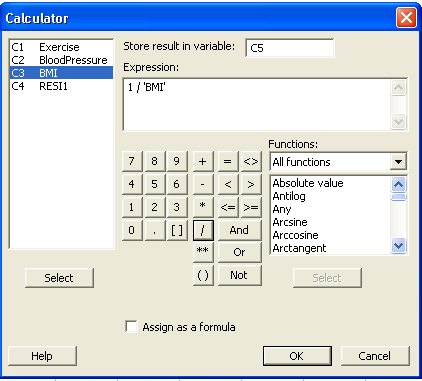
5 Multiple Regression Analysis in Minitab 5 Transformation of Variables It is not always obvious what to do when your model does not fit well. Transformations may be the easiest way to produce a better fit, especially when collecting more data is not feasible. Options to try include polynomial regression, inverse transformation, log transformation of the explanatory variable, log transformation of dependent and explanatory variable, and many more transformations. This tutorial will look at creating an inverse transformation for the model and storing this information in your Minitab sheet. Click Calc-Calculator and enter your information in the appropriate spaces in the window that pops up. Choose a column without data stored in it to store your inverse transformation. In the expression blank enter the appropriate algebra and functions for your transformation. Then press OK and your transformation will then appear in your Minitab sheet. Use this variable instead of the original variable in your regression to see if the model becomes a better fit. A Potential Problem with Multiple Regression When explanatory variables are correlated with one another, the problem of multicollinearity, or near-linear dependence among regression variables, is said to exist. When a high degree of multicollinearity exists, the variance of the regression coefficients are infalted. This can lead to small t-values and unstable regression coefficients. Multicollinearity does not affect the ability to obtain a good fit to the regression ( ) or the quality of forecasts or predictions from the regression. The way to determine if this is a problem with your model is to look at the Variance Inflation Factors (VIFs). The equation for the VIF for the jth regression coefficent can be written as, where is the coefficient of multiple determination obtained by performing the

6 Multiple Regression Analysis in Minitab 6 regression of on the remaining K-1 regressor variables. Any individual VIF larger than 10 should indiciate that multicollinearity is present. To check for VIFs in Minitab click Stat-Regression-Regression from the drop-down menu. Next click the Options button. Then check the Variance inflation factors box under Display, click OK. Then click OK again to run the test. The data created in the output will look identical to the data collected before, except the table of coefficient will contain an additional column of information: Predictor Coef SE Coef T P VIF Constant Exercise BMI Seeing the both our VIFs are below 10 we assume multicollinearity is not present in our model. Correcting Multicollinearity In order to correct for multicollinearity you need to remove the variables that are highly correlated with others. You can also try to add more data, this might break the pattern of multicollinearity. There are drawbacks to these solutions. If you remove a variable you will obtain no information on the removed variable. So choosing which correlated variable to remove can be difficult. If you add more data the multicollinearity won t always disappear, and sometimes it is impossible to add more data (due to budget restraints or lack of data beyond what is known). If a regression model is used strictly for forecasting, corrections may not be necessary.
Regression Analysis: A Complete Example
 Regression Analysis: A Complete Example This section works out an example that includes all the topics we have discussed so far in this chapter. A complete example of regression analysis. PhotoDisc, Inc./Getty
Module 5: Multiple Regression Analysis
 Using Statistical Data Using to Make Statistical Decisions: Data Multiple to Make Regression Decisions Analysis Page 1 Module 5: Multiple Regression Analysis Tom Ilvento, University of Delaware, College
Regression step-by-step using Microsoft Excel
 Step 1: Regression step-by-step using Microsoft Excel Notes prepared by Pamela Peterson Drake, James Madison University Type the data into the spreadsheet The example used throughout this How to is a regression
1. What is the critical value for this 95% confidence interval? CV = z.025 = invnorm(0.025) = 1.96
 1 Final Review 2 Review 2.1 CI 1-propZint Scenario 1 A TV manufacturer claims in its warranty brochure that in the past not more than 10 percent of its TV sets needed any repair during the first two years
Premaster Statistics Tutorial 4 Full solutions
 Premaster Statistics Tutorial 4 Full solutions Regression analysis Q1 (based on Doane & Seward, 4/E, 12.7) a. Interpret the slope of the fitted regression = 125,000 + 150. b. What is the prediction for
TRINITY COLLEGE. Faculty of Engineering, Mathematics and Science. School of Computer Science & Statistics
 UNIVERSITY OF DUBLIN TRINITY COLLEGE Faculty of Engineering, Mathematics and Science School of Computer Science & Statistics BA (Mod) Enter Course Title Trinity Term 2013 Junior/Senior Sophister ST7002
1. The parameters to be estimated in the simple linear regression model Y=α+βx+ε ε~n(0,σ) are: a) α, β, σ b) α, β, ε c) a, b, s d) ε, 0, σ
 STA 3024 Practice Problems Exam 2 NOTE: These are just Practice Problems. This is NOT meant to look just like the test, and it is NOT the only thing that you should study. Make sure you know all the material
KSTAT MINI-MANUAL. Decision Sciences 434 Kellogg Graduate School of Management
 KSTAT MINI-MANUAL Decision Sciences 434 Kellogg Graduate School of Management Kstat is a set of macros added to Excel and it will enable you to do the statistics required for this course very easily. To
Predictor Coef StDev T P Constant 970667056 616256122 1.58 0.154 X 0.00293 0.06163 0.05 0.963. S = 0.5597 R-Sq = 0.0% R-Sq(adj) = 0.
 Statistical analysis using Microsoft Excel Microsoft Excel spreadsheets have become somewhat of a standard for data storage, at least for smaller data sets. This, along with the program often being packaged
1.1. Simple Regression in Excel (Excel 2010).
 .. Simple Regression in Excel (Excel 200). To get the Data Analysis tool, first click on File > Options > Add-Ins > Go > Select Data Analysis Toolpack & Toolpack VBA. Data Analysis is now available under
Unit 31 A Hypothesis Test about Correlation and Slope in a Simple Linear Regression
 Unit 31 A Hypothesis Test about Correlation and Slope in a Simple Linear Regression Objectives: To perform a hypothesis test concerning the slope of a least squares line To recognize that testing for a
SPSS Guide: Regression Analysis
 SPSS Guide: Regression Analysis I put this together to give you a step-by-step guide for replicating what we did in the computer lab. It should help you run the tests we covered. The best way to get familiar
NCSS Statistical Software Principal Components Regression. In ordinary least squares, the regression coefficients are estimated using the formula ( )
 Chapter 340 Principal Components Regression Introduction is a technique for analyzing multiple regression data that suffer from multicollinearity. When multicollinearity occurs, least squares estimates
c 2015, Jeffrey S. Simonoff 1
 Modeling Lowe s sales Forecasting sales is obviously of crucial importance to businesses. Revenue streams are random, of course, but in some industries general economic factors would be expected to have
SPSS Explore procedure
 SPSS Explore procedure One useful function in SPSS is the Explore procedure, which will produce histograms, boxplots, stem-and-leaf plots and extensive descriptive statistics. To run the Explore procedure,
MULTIPLE REGRESSION EXAMPLE
 MULTIPLE REGRESSION EXAMPLE For a sample of n = 166 college students, the following variables were measured: Y = height X 1 = mother s height ( momheight ) X 2 = father s height ( dadheight ) X 3 = 1 if
Answer: C. The strength of a correlation does not change if units change by a linear transformation such as: Fahrenheit = 32 + (5/9) * Centigrade
 Statistics Quiz Correlation and Regression -- ANSWERS 1. Temperature and air pollution are known to be correlated. We collect data from two laboratories, in Boston and Montreal. Boston makes their measurements
2. Simple Linear Regression
 Research methods - II 3 2. Simple Linear Regression Simple linear regression is a technique in parametric statistics that is commonly used for analyzing mean response of a variable Y which changes according
17. SIMPLE LINEAR REGRESSION II
 17. SIMPLE LINEAR REGRESSION II The Model In linear regression analysis, we assume that the relationship between X and Y is linear. This does not mean, however, that Y can be perfectly predicted from X.
The Volatility Index Stefan Iacono University System of Maryland Foundation
 1 The Volatility Index Stefan Iacono University System of Maryland Foundation 28 May, 2014 Mr. Joe Rinaldi 2 The Volatility Index Introduction The CBOE s VIX, often called the market fear gauge, measures
One-Way ANOVA using SPSS 11.0. SPSS ANOVA procedures found in the Compare Means analyses. Specifically, we demonstrate
 1 One-Way ANOVA using SPSS 11.0 This section covers steps for testing the difference between three or more group means using the SPSS ANOVA procedures found in the Compare Means analyses. Specifically,
POLYNOMIAL AND MULTIPLE REGRESSION. Polynomial regression used to fit nonlinear (e.g. curvilinear) data into a least squares linear regression model.
 Polynomial Regression POLYNOMIAL AND MULTIPLE REGRESSION Polynomial regression used to fit nonlinear (e.g. curvilinear) data into a least squares linear regression model. It is a form of linear regression
Week TSX Index 1 8480 2 8470 3 8475 4 8510 5 8500 6 8480
 1) The S & P/TSX Composite Index is based on common stock prices of a group of Canadian stocks. The weekly close level of the TSX for 6 weeks are shown: Week TSX Index 1 8480 2 8470 3 8475 4 8510 5 8500
Directions for using SPSS
 Directions for using SPSS Table of Contents Connecting and Working with Files 1. Accessing SPSS... 2 2. Transferring Files to N:\drive or your computer... 3 3. Importing Data from Another File Format...
Simple linear regression
 Simple linear regression Introduction Simple linear regression is a statistical method for obtaining a formula to predict values of one variable from another where there is a causal relationship between
Chapter 13 Introduction to Linear Regression and Correlation Analysis
 Chapter 3 Student Lecture Notes 3- Chapter 3 Introduction to Linear Regression and Correlation Analsis Fall 2006 Fundamentals of Business Statistics Chapter Goals To understand the methods for displaing
Chapter 23. Inferences for Regression
 Chapter 23. Inferences for Regression Topics covered in this chapter: Simple Linear Regression Simple Linear Regression Example 23.1: Crying and IQ The Problem: Infants who cry easily may be more easily
MGT 267 PROJECT. Forecasting the United States Retail Sales of the Pharmacies and Drug Stores. Done by: Shunwei Wang & Mohammad Zainal
 MGT 267 PROJECT Forecasting the United States Retail Sales of the Pharmacies and Drug Stores Done by: Shunwei Wang & Mohammad Zainal Dec. 2002 The retail sale (Million) ABSTRACT The present study aims
MULTIPLE LINEAR REGRESSION ANALYSIS USING MICROSOFT EXCEL. by Michael L. Orlov Chemistry Department, Oregon State University (1996)
 MULTIPLE LINEAR REGRESSION ANALYSIS USING MICROSOFT EXCEL by Michael L. Orlov Chemistry Department, Oregon State University (1996) INTRODUCTION In modern science, regression analysis is a necessary part
1.5 Oneway Analysis of Variance
 Statistics: Rosie Cornish. 200. 1.5 Oneway Analysis of Variance 1 Introduction Oneway analysis of variance (ANOVA) is used to compare several means. This method is often used in scientific or medical experiments
Using R for Linear Regression
 Using R for Linear Regression In the following handout words and symbols in bold are R functions and words and symbols in italics are entries supplied by the user; underlined words and symbols are optional
SIMPLE LINEAR CORRELATION. r can range from -1 to 1, and is independent of units of measurement. Correlation can be done on two dependent variables.
 SIMPLE LINEAR CORRELATION Simple linear correlation is a measure of the degree to which two variables vary together, or a measure of the intensity of the association between two variables. Correlation
11. Analysis of Case-control Studies Logistic Regression
 Research methods II 113 11. Analysis of Case-control Studies Logistic Regression This chapter builds upon and further develops the concepts and strategies described in Ch.6 of Mother and Child Health:
Chapter Seven. Multiple regression An introduction to multiple regression Performing a multiple regression on SPSS
 Chapter Seven Multiple regression An introduction to multiple regression Performing a multiple regression on SPSS Section : An introduction to multiple regression WHAT IS MULTIPLE REGRESSION? Multiple
ANALYSIS OF TREND CHAPTER 5
 ANALYSIS OF TREND CHAPTER 5 ERSH 8310 Lecture 7 September 13, 2007 Today s Class Analysis of trends Using contrasts to do something a bit more practical. Linear trends. Quadratic trends. Trends in SPSS.
Analysing Questionnaires using Minitab (for SPSS queries contact -) [email protected]
 Analysing Questionnaires using Minitab (for SPSS queries contact -) [email protected] Structure As a starting point it is useful to consider a basic questionnaire as containing three main sections:
Linear Models in STATA and ANOVA
 Session 4 Linear Models in STATA and ANOVA Page Strengths of Linear Relationships 4-2 A Note on Non-Linear Relationships 4-4 Multiple Linear Regression 4-5 Removal of Variables 4-8 Independent Samples
Simple Linear Regression, Scatterplots, and Bivariate Correlation
 1 Simple Linear Regression, Scatterplots, and Bivariate Correlation This section covers procedures for testing the association between two continuous variables using the SPSS Regression and Correlate analyses.
August 2012 EXAMINATIONS Solution Part I
 August 01 EXAMINATIONS Solution Part I (1) In a random sample of 600 eligible voters, the probability that less than 38% will be in favour of this policy is closest to (B) () In a large random sample,
MULTIPLE REGRESSION AND ISSUES IN REGRESSION ANALYSIS
 MULTIPLE REGRESSION AND ISSUES IN REGRESSION ANALYSIS MSR = Mean Regression Sum of Squares MSE = Mean Squared Error RSS = Regression Sum of Squares SSE = Sum of Squared Errors/Residuals α = Level of Significance
Once saved, if the file was zipped you will need to unzip it. For the files that I will be posting you need to change the preferences.
 1 Commands in JMP and Statcrunch Below are a set of commands in JMP and Statcrunch which facilitate a basic statistical analysis. The first part concerns commands in JMP, the second part is for analysis
Multiple Linear Regression
 Multiple Linear Regression A regression with two or more explanatory variables is called a multiple regression. Rather than modeling the mean response as a straight line, as in simple regression, it is
EXCEL Analysis TookPak [Statistical Analysis] 1. First of all, check to make sure that the Analysis ToolPak is installed. Here is how you do it:
![EXCEL Analysis TookPak [Statistical Analysis] 1. First of all, check to make sure that the Analysis ToolPak is installed. Here is how you do it:](/thumbs/30/14272010.jpg "EXCEL Analysis TookPak [Statistical Analysis] 1. First of all, check to make sure that the Analysis ToolPak is installed. Here is how you do it:") EXCEL Analysis TookPak [Statistical Analysis] 1 First of all, check to make sure that the Analysis ToolPak is installed. Here is how you do it: a. From the Tools menu, choose Add-Ins b. Make sure Analysis
EXCEL Analysis TookPak [Statistical Analysis] 1 First of all, check to make sure that the Analysis ToolPak is installed. Here is how you do it: a. From the Tools menu, choose Add-Ins b. Make sure Analysis
Getting Started with Minitab 17
 2014 by Minitab Inc. All rights reserved. Minitab, Quality. Analysis. Results. and the Minitab logo are registered trademarks of Minitab, Inc., in the United States and other countries. Additional trademarks
Moderation. Moderation
 Stats - Moderation Moderation A moderator is a variable that specifies conditions under which a given predictor is related to an outcome. The moderator explains when a DV and IV are related. Moderation
Data Analysis Tools. Tools for Summarizing Data
 Data Analysis Tools This section of the notes is meant to introduce you to many of the tools that are provided by Excel under the Tools/Data Analysis menu item. If your computer does not have that tool
Regression III: Advanced Methods
 Lecture 16: Generalized Additive Models Regression III: Advanced Methods Bill Jacoby Michigan State University http://polisci.msu.edu/jacoby/icpsr/regress3 Goals of the Lecture Introduce Additive Models
12: Analysis of Variance. Introduction
 1: Analysis of Variance Introduction EDA Hypothesis Test Introduction In Chapter 8 and again in Chapter 11 we compared means from two independent groups. In this chapter we extend the procedure to consider
Chapter 5 Analysis of variance SPSS Analysis of variance
 Chapter 5 Analysis of variance SPSS Analysis of variance Data file used: gss.sav How to get there: Analyze Compare Means One-way ANOVA To test the null hypothesis that several population means are equal,
One-Way Analysis of Variance (ANOVA) Example Problem
 One-Way Analysis of Variance (ANOVA) Example Problem Introduction Analysis of Variance (ANOVA) is a hypothesis-testing technique used to test the equality of two or more population (or treatment) means
Chapter 7: Simple linear regression Learning Objectives
 Chapter 7: Simple linear regression Learning Objectives Reading: Section 7.1 of OpenIntro Statistics Video: Correlation vs. causation, YouTube (2:19) Video: Intro to Linear Regression, YouTube (5:18) -
HYPOTHESIS TESTING: CONFIDENCE INTERVALS, T-TESTS, ANOVAS, AND REGRESSION
 HYPOTHESIS TESTING: CONFIDENCE INTERVALS, T-TESTS, ANOVAS, AND REGRESSION HOD 2990 10 November 2010 Lecture Background This is a lightning speed summary of introductory statistical methods for senior undergraduate
This chapter will demonstrate how to perform multiple linear regression with IBM SPSS
 CHAPTER 7B Multiple Regression: Statistical Methods Using IBM SPSS This chapter will demonstrate how to perform multiple linear regression with IBM SPSS first using the standard method and then using the
Simple Linear Regression Inference
 Simple Linear Regression Inference 1 Inference requirements The Normality assumption of the stochastic term e is needed for inference even if it is not a OLS requirement. Therefore we have: Interpretation
4. Multiple Regression in Practice
 30 Multiple Regression in Practice 4. Multiple Regression in Practice The preceding chapters have helped define the broad principles on which regression analysis is based. What features one should look
Stepwise Regression. Chapter 311. Introduction. Variable Selection Procedures. Forward (Step-Up) Selection
 Chapter 311 Introduction Often, theory and experience give only general direction as to which of a pool of candidate variables (including transformed variables) should be included in the regression model.
Estimation of σ 2, the variance of ɛ
 Estimation of σ 2, the variance of ɛ The variance of the errors σ 2 indicates how much observations deviate from the fitted surface. If σ 2 is small, parameters β 0, β 1,..., β k will be reliably estimated
Difference of Means and ANOVA Problems
 Difference of Means and Problems Dr. Tom Ilvento FREC 408 Accounting Firm Study An accounting firm specializes in auditing the financial records of large firm It is interested in evaluating its fee structure,particularly
Paired 2 Sample t-test
 Variations of the t-test: Paired 2 Sample 1 Paired 2 Sample t-test Suppose we are interested in the effect of different sampling strategies on the quality of data we recover from archaeological field surveys.
Regression Analysis (Spring, 2000)
 Regression Analysis (Spring, 2000) By Wonjae Purposes: a. Explaining the relationship between Y and X variables with a model (Explain a variable Y in terms of Xs) b. Estimating and testing the intensity
Hypothesis testing - Steps
 Hypothesis testing - Steps Steps to do a two-tailed test of the hypothesis that β 1 0: 1. Set up the hypotheses: H 0 : β 1 = 0 H a : β 1 0. 2. Compute the test statistic: t = b 1 0 Std. error of b 1 =
Univariate Regression
 Univariate Regression Correlation and Regression The regression line summarizes the linear relationship between 2 variables Correlation coefficient, r, measures strength of relationship: the closer r is
Factors affecting online sales
 Factors affecting online sales Table of contents Summary... 1 Research questions... 1 The dataset... 2 Descriptive statistics: The exploratory stage... 3 Confidence intervals... 4 Hypothesis tests... 4
When to use Excel. When NOT to use Excel 9/24/2014
 Analyzing Quantitative Assessment Data with Excel October 2, 2014 Jeremy Penn, Ph.D. Director When to use Excel You want to quickly summarize or analyze your assessment data You want to create basic visual
How To Test For Significance On A Data Set
 Non-Parametric Univariate Tests: 1 Sample Sign Test 1 1 SAMPLE SIGN TEST A non-parametric equivalent of the 1 SAMPLE T-TEST. ASSUMPTIONS: Data is non-normally distributed, even after log transforming.
Statistics courses often teach the two-sample t-test, linear regression, and analysis of variance
 2 Making Connections: The Two-Sample t-test, Regression, and ANOVA In theory, there s no difference between theory and practice. In practice, there is. Yogi Berra 1 Statistics courses often teach the two-sample
INTRODUCTION TO MULTIPLE CORRELATION
 CHAPTER 13 INTRODUCTION TO MULTIPLE CORRELATION Chapter 12 introduced you to the concept of partialling and how partialling could assist you in better interpreting the relationship between two primary
2 Sample t-test (unequal sample sizes and unequal variances)
 Variations of the t-test: Sample tail Sample t-test (unequal sample sizes and unequal variances) Like the last example, below we have ceramic sherd thickness measurements (in cm) of two samples representing
January 26, 2009 The Faculty Center for Teaching and Learning
 THE BASICS OF DATA MANAGEMENT AND ANALYSIS A USER GUIDE January 26, 2009 The Faculty Center for Teaching and Learning THE BASICS OF DATA MANAGEMENT AND ANALYSIS Table of Contents Table of Contents... i
How To Run Statistical Tests in Excel
 How To Run Statistical Tests in Excel Microsoft Excel is your best tool for storing and manipulating data, calculating basic descriptive statistics such as means and standard deviations, and conducting
Multiple Regression in SPSS This example shows you how to perform multiple regression. The basic command is regression : linear.
 Multiple Regression in SPSS This example shows you how to perform multiple regression. The basic command is regression : linear. In the main dialog box, input the dependent variable and several predictors.
Using Microsoft Excel to Analyze Data from the Disk Diffusion Assay
 Using Microsoft Excel to Analyze Data from the Disk Diffusion Assay Entering and Formatting Data Open Excel. Set up the spreadsheet page (Sheet 1) so that anyone who reads it will understand the page (Figure
Chapter 7. One-way ANOVA
 Chapter 7 One-way ANOVA One-way ANOVA examines equality of population means for a quantitative outcome and a single categorical explanatory variable with any number of levels. The t-test of Chapter 6 looks
Minitab Tutorials for Design and Analysis of Experiments. Table of Contents
 Table of Contents Introduction to Minitab...2 Example 1 One-Way ANOVA...3 Determining Sample Size in One-way ANOVA...8 Example 2 Two-factor Factorial Design...9 Example 3: Randomized Complete Block Design...14
Notes on Applied Linear Regression
 Notes on Applied Linear Regression Jamie DeCoster Department of Social Psychology Free University Amsterdam Van der Boechorststraat 1 1081 BT Amsterdam The Netherlands phone: +31 (0)20 444-8935 email:
2013 MBA Jump Start Program. Statistics Module Part 3
 2013 MBA Jump Start Program Module 1: Statistics Thomas Gilbert Part 3 Statistics Module Part 3 Hypothesis Testing (Inference) Regressions 2 1 Making an Investment Decision A researcher in your firm just
Copyright 2007 by Laura Schultz. All rights reserved. Page 1 of 5
 Using Your TI-83/84 Calculator: Linear Correlation and Regression Elementary Statistics Dr. Laura Schultz This handout describes how to use your calculator for various linear correlation and regression
Section 13, Part 1 ANOVA. Analysis Of Variance
 Section 13, Part 1 ANOVA Analysis Of Variance Course Overview So far in this course we ve covered: Descriptive statistics Summary statistics Tables and Graphs Probability Probability Rules Probability
Curve Fitting. Before You Begin
 Curve Fitting Chapter 16: Curve Fitting Before You Begin Selecting the Active Data Plot When performing linear or nonlinear fitting when the graph window is active, you must make the desired data plot
(More Practice With Trend Forecasts)
 Stats for Strategy HOMEWORK 11 (Topic 11 Part 2) (revised Jan. 2016) DIRECTIONS/SUGGESTIONS You may conveniently write answers to Problems A and B within these directions. Some exercises include special
Multicollinearity Richard Williams, University of Notre Dame, http://www3.nd.edu/~rwilliam/ Last revised January 13, 2015
 Multicollinearity Richard Williams, University of Notre Dame, http://www3.nd.edu/~rwilliam/ Last revised January 13, 2015 Stata Example (See appendices for full example).. use http://www.nd.edu/~rwilliam/stats2/statafiles/multicoll.dta,
Standard errors of marginal effects in the heteroskedastic probit model
 Standard errors of marginal effects in the heteroskedastic probit model Thomas Cornelißen Discussion Paper No. 320 August 2005 ISSN: 0949 9962 Abstract In non-linear regression models, such as the heteroskedastic
Multiple Regression: What Is It?
 Multiple Regression Multiple Regression: What Is It? Multiple regression is a collection of techniques in which there are multiple predictors of varying kinds and a single outcome We are interested in
Confidence Intervals for Cp
 Chapter 296 Confidence Intervals for Cp Introduction This routine calculates the sample size needed to obtain a specified width of a Cp confidence interval at a stated confidence level. Cp is a process
Statistics 104 Final Project A Culture of Debt: A Study of Credit Card Spending in America TF: Kevin Rader Anonymous Students: LD, MH, IW, MY
 Statistics 104 Final Project A Culture of Debt: A Study of Credit Card Spending in America TF: Kevin Rader Anonymous Students: LD, MH, IW, MY ABSTRACT: This project attempted to determine the relationship
GLM I An Introduction to Generalized Linear Models
 GLM I An Introduction to Generalized Linear Models CAS Ratemaking and Product Management Seminar March 2009 Presented by: Tanya D. Havlicek, Actuarial Assistant 0 ANTITRUST Notice The Casualty Actuarial
Simple Predictive Analytics Curtis Seare
 Using Excel to Solve Business Problems: Simple Predictive Analytics Curtis Seare Copyright: Vault Analytics July 2010 Contents Section I: Background Information Why use Predictive Analytics? How to use
Using Excel for inferential statistics
 FACT SHEET Using Excel for inferential statistics Introduction When you collect data, you expect a certain amount of variation, just caused by chance. A wide variety of statistical tests can be applied
Chapter 2 Probability Topics SPSS T tests
 Chapter 2 Probability Topics SPSS T tests Data file used: gss.sav In the lecture about chapter 2, only the One-Sample T test has been explained. In this handout, we also give the SPSS methods to perform
X X X a) perfect linear correlation b) no correlation c) positive correlation (r = 1) (r = 0) (0 < r < 1)
 CORRELATION AND REGRESSION / 47 CHAPTER EIGHT CORRELATION AND REGRESSION Correlation and regression are statistical methods that are commonly used in the medical literature to compare two or more variables.
Class 19: Two Way Tables, Conditional Distributions, Chi-Square (Text: Sections 2.5; 9.1)
 Spring 204 Class 9: Two Way Tables, Conditional Distributions, Chi-Square (Text: Sections 2.5; 9.) Big Picture: More than Two Samples In Chapter 7: We looked at quantitative variables and compared the
General Regression Formulae ) (N-2) (1 - r 2 YX
 General Regression Formulae Single Predictor Standardized Parameter Model: Z Yi = β Z Xi + ε i Single Predictor Standardized Statistical Model: Z Yi = β Z Xi Estimate of Beta (Beta-hat: β = r YX (1 Standard
ABSORBENCY OF PAPER TOWELS
 ABSORBENCY OF PAPER TOWELS 15. Brief Version of the Case Study 15.1 Problem Formulation 15.2 Selection of Factors 15.3 Obtaining Random Samples of Paper Towels 15.4 How will the Absorbency be measured?
STAT 350 Practice Final Exam Solution (Spring 2015)
 PART 1: Multiple Choice Questions: 1) A study was conducted to compare five different training programs for improving endurance. Forty subjects were randomly divided into five groups of eight subjects
Confidence Intervals for Spearman s Rank Correlation
 Chapter 808 Confidence Intervals for Spearman s Rank Correlation Introduction This routine calculates the sample size needed to obtain a specified width of Spearman s rank correlation coefficient confidence
Doing Multiple Regression with SPSS. In this case, we are interested in the Analyze options so we choose that menu. If gives us a number of choices:
 Doing Multiple Regression with SPSS Multiple Regression for Data Already in Data Editor Next we want to specify a multiple regression analysis for these data. The menu bar for SPSS offers several options:
IAPRI Quantitative Analysis Capacity Building Series. Multiple regression analysis & interpreting results
 IAPRI Quantitative Analysis Capacity Building Series Multiple regression analysis & interpreting results How important is R-squared? R-squared Published in Agricultural Economics 0.45 Best article of the
DEPARTMENT OF PSYCHOLOGY UNIVERSITY OF LANCASTER MSC IN PSYCHOLOGICAL RESEARCH METHODS ANALYSING AND INTERPRETING DATA 2 PART 1 WEEK 9
 DEPARTMENT OF PSYCHOLOGY UNIVERSITY OF LANCASTER MSC IN PSYCHOLOGICAL RESEARCH METHODS ANALYSING AND INTERPRETING DATA 2 PART 1 WEEK 9 Analysis of covariance and multiple regression So far in this course,