
1 Simple Linear Regression I Least Squares Estimation
|
|
|
- Sandra Tate
- 10 years ago
- Views:
Transcription
1 Simple Linear Regression I Least Squares Estimation Textbook Sections: Previously, we have worked with a random variable x that comes from a population that is normally distributed with mean µ and variance σ 2. We have seen that we can write x in terms of µ and a random error component ε, that is, x = µ + ε. For the time being, we are going to change our notation for our random variable from x to y. So, we now write y = µ + ε. We will now find it useful to call the random variable y a dependent or response variable. Many times, the response variable of interest may be related to the value(s) of one or more known or controllable independent or predictor variables. Consider the following situations: LR A college recruiter would like to be able to predict a potential incoming student s first year GPA (y) based on known information concerning high school GPA (x ) and college entrance examination score (x 2 ). She feels that the student s first year GPA will be related to the values of these two known variables. LR2 A marketer is interested in the effect of changing shelf height (x ) and shelf width (x 2 )on the weekly sales (y) of her brand of laundry detergent in a grocery store. LR3 A psychologist is interested in testing whether the amount of time to become proficient in a foreign language (y) is related to the child s age (x). In each case we have at least one variable that is known (in some cases it is controllable), and a response variable that is a random variable. We would like to fit a model that relates the response to the known or controllable variable(s). The main reasons that scientists and social researchers use linear regression are the following:. Prediction To predict a future response based on known values of the predictor variables and past data related to the process. 2. Description To measure the effect of changing a controllable variable on the mean value of the response variable. 3. Control To confirm that a process is providing responses (results) that we expect under the present operating conditions (measured by the level(s) of the predictor variable(s)).. A Linear Deterministic Model Suppose you are a vendor who sells a product that is in high demand (e.g. cold beer on the beach, cable television in Gainesville, or life jackets on the Titanic, to name a few). If you begin your day with 00 items, have a profit of $0 per item, and an overhead of $30 per day, you know exactly how much profit you will make that day, namely 00(0)-30=$970. Similarly, if you begin the day with 50 items, you can also state your profits with certainty. In fact for any number of items you begin the day with (x), you can state what the day s profits (y) will be. That is, y =0 x 30. This is called a deterministic model. In general, we can write the equation for a straight line as y = β 0 + β x,
2 where β 0 is called the y intercept and β is called the slope. β 0 is the value of y when x =0, and β is the change in y when x increases by unit. In many real world situations, the response of interest (in this example it s profit) cannot be explained perfectly by a deterministic model. In this case, we make an adjustment for random variation in the process..2 A Linear Probabilistic Model The adjustment people make is to write the mean response as a linear function of the predictor variable. This way, we allow for variation in individual responses (y), while associating the mean linearly with the predictor x. The model we fit is as follows: and we write the individual responses as E(y x) =β 0 + β x, y = β 0 + β x + ε, We can think of y as being broken into a systematic and a random component: y = β 0 + β x } {{ } systematic + ε }{{} random where x is the level of the predictor variable corresponding to the response, β 0 and β are unknown parameters, and ε is the random error component corresponding to the response whose distribution we assume is N(0,σ), as before. Further, we assume the error terms are independent from one another, we discuss this in more detail in a later chapter. Note that β 0 can be interpreted as the mean response when x=0, and β can be interpreted as the change in the mean response when x is increased by unit. Under this model, we are saying that y x N(β 0 +β x, σ). Consider the following example. Example. Coffee Sales and Shelf Space A marketer is interested in the relation between the width of the shelf space for her brand of coffee (x) and weekly sales (y) of the product in a suburban supermarket (assume the height is always at eye level). Marketers are well aware of the concept of compulsive purchases, and know that the more shelf space their product takes up, the higher the frequency of such purchases. She believes that in the range of 3 to 9 feet, the mean weekly sales will be linearly related to the width of the shelf space. Further, among weeks with the same shelf space, she believes that sales will be normally distributed with unknown standard deviation σ (that is, σ measures how variable weekly sales are at a given amount of shelf space). Thus, she would like to fit a model relating weekly sales y to the amount of shelf space x her product receives that week. That is, she is fitting the model: y = β 0 + β x + ε, so that y x N(β 0 + β x, σ). One limitation of linear regression is that we must restrict our interpretation of the model to the range of values of the predictor variables that we observe in our data. We cannot assume this linear relation continues outside the range of our sample data. We often refer to β 0 + β x as the systematic component of y and ε as the random component. 2
3 .3 Least Squares Estimation of β 0 and β We now have the problem of using sample data to compute estimates of the parameters β 0 and β. First, we take a sample of n subjects, observing values y of the response variable and x of the predictor variable. We would like to choose as estimates for β 0 and β, the values b 0 and b that best fit the sample data. Consider the coffee example mentioned earlier. Suppose the marketer conducted the experiment over a twelve week period (4 weeks with 3 of shelf space, 4 weeks with 6, and 4 weeks with 9 ), and observed the sample data in Table. Shelf Space Weekly Sales Shelf Space Weekly Sales x y x y Table : Coffee sales data for n = 2 weeks SALES SPACE Figure : Plot of coffee sales vs amount of shelf space Now, look at Figure. Note that while there is some variation among the weekly sales at 3, 6, and 9, respectively, there is a trend for the mean sales to increase as shelf space increases. If we define the fitted equation to be an equation: ŷ = b 0 + b x, we can choose the estimates b 0 and b to be the values that minimize the distances of the data points to the fitted line. Now, for each observed response y i, with a corresponding predictor variable x i, we obtain a fitted value ŷ i = b 0 + b x i. So, we would like to minimize the sum of the squared distances of each observed response to its fitted value. That is, we want to minimize the error 3

4 sum of squares, SSE, where: SSE = n n (y i ŷ i ) 2 = (y i (b 0 + b x i )) 2. i= i= A little bit of calculus can be used to obtain the estimates: b = ni= (x i x)(y i y) ni= (x i x) 2 = SS xy SS xx, and ni= b 0 = y ˆβ y ni= i x i x = b. n n An alternative formula, but exactly the same mathematically, is to compute the sample covariance of x and y, as well as the sample variance of x, then taking the ratio. This is the the approach your book uses, but is extra work from the formula above. cov(x, y) = ni= (x i x)(y i y) n = SS xy n s 2 x = ni= (x i x) 2 n = SS xx n b = cov(x, y) s 2 x Some shortcut equations, known as the corrected sums of squares and crossproducts, that while not very intuitive are very useful in computing these and other estimates are: SS xx = n i= (x i x) 2 = n i= x 2 i ( n i= x i) 2 SS xy = n i= (x i x)(y i y) = n i= x i y i ( n i= x i)( n i= y i) n SS yy = n i= (y i y) 2 = n i= yi 2 ( n i= y i) 2 n Example. Continued Coffee Sales and Shelf Space For the coffee data, we observe the following summary statistics in Table 2. n Week Space (x) Sales (y) x 2 xy y x =72 y = 685 x 2 = 504 xy = y 2 = Table 2: Summary Calculations Coffee sales data From this, we obtain the following sums of squares and crossproducts. 4
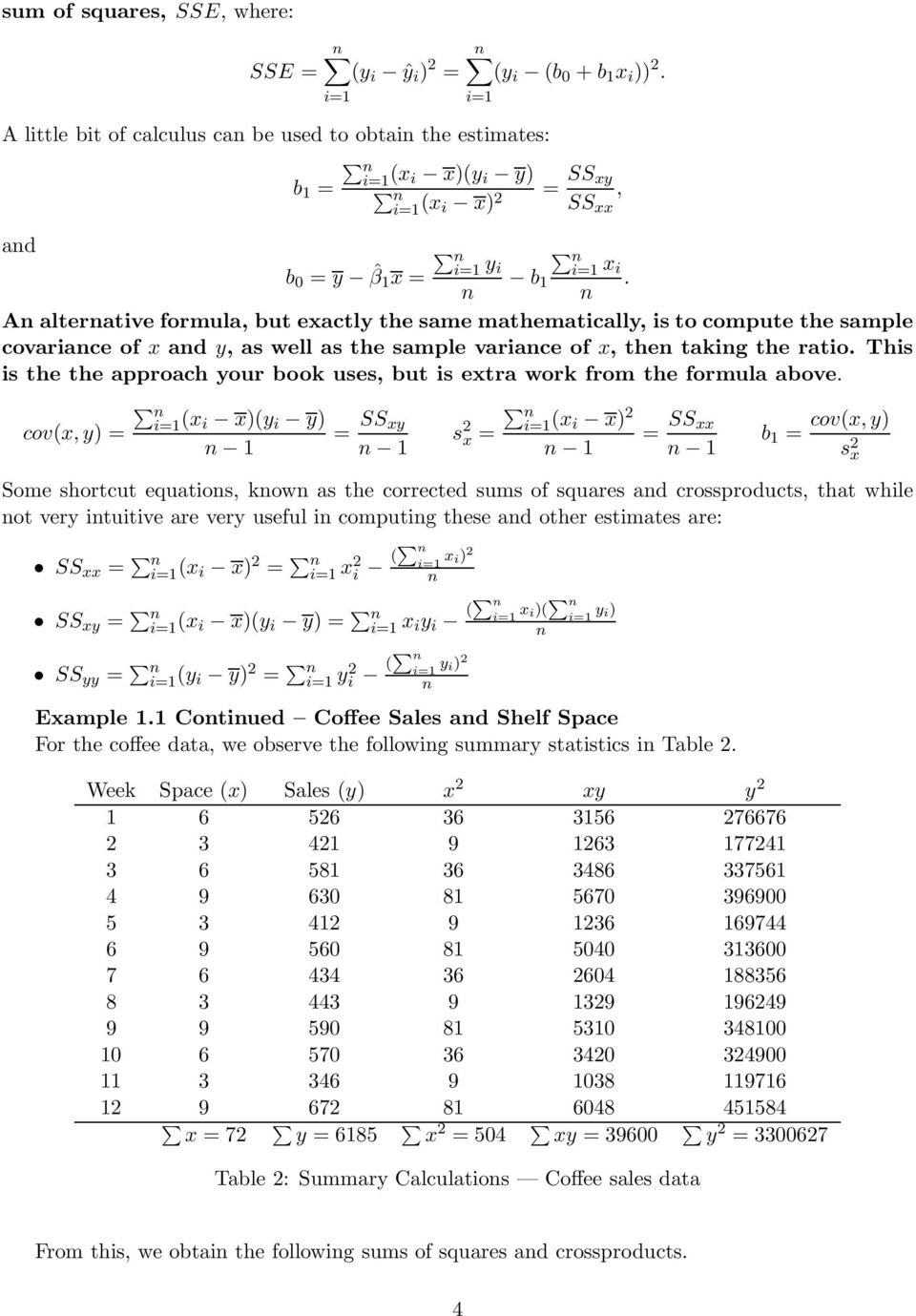
5 SS xx = (x x) 2 = x 2 ( x) 2 n = 504 (72)2 2 =72 SS xy = (x x)(y y) = xy ( x)( y) n = (72)(685) 2 = 2490 SS yy = (y y) 2 = y 2 ( y) 2 = (685)2 = n 2 From these, we obtain the least squares estimate of the true linear regression relation (β 0 +β x). b = SS xy SS xx = = b 0 = y x n b n = (72 )= = ŷ = b 0 + b x = x So the fitted equation, estimating the mean weekly sales when the product has x feet of shelf space is ŷ = ˆβ 0 + ˆβ x = x. Our interpretation for b is the estimate for the increase in mean weekly sales due to increasing shelf space by foot is bags of coffee. Note that this should only be interpreted within the range of x values that we have observed in the experiment, namely x = 3 to 9 feet. Example.2 Computation of a Stock Beta A widely used measure of a company s performance is their beta. This is a measure of the firm s stock price volatility relative to the overall market s volatility. One common use of beta is in the capital asset pricing model (CAPM) in finance, but you will hear them quoted on many business news shows as well. It is computed as (Value Line): The beta factor is derived from a least squares regression analysis between weekly percent changes in the price of a stock and weekly percent changes in the price of all stocks in the survey over a period of five years. In the case of shorter price histories, a smaller period is used, but never less than two years. In this example, we will compute the stock beta over a 28-week period for Coca-Cola and Anheuser-Busch, using the S&P500 as the market for comparison. Note that this period is only about 0% of the period used by Value Line. Note: While there are 28 weeks of data, there are only n=27 weekly changes. Table 3 provides the dates, weekly closing prices, and weekly percent changes of: the S&P500, Coca-Cola, and Anheuser-Busch. The following summary calculations are also provided, with x representing the S&P500, y C representing Coca-Cola, and y A representing Anheuser-Busch. All calculations should be based on 4 decimal places. Figure 2 gives the plot and least squares regression line for Anheuser-Busch, and Figure 3 gives the plot and least squares regression line for Coca-Cola. 5

6 x = yc = ya =2.428 x 2 = y 2 C = y 2 A = xyc = xya = a) Compute SS xx, SS xyc, and SS xya. b) Compute the stock betas for Coca-Cola and Anheuser-Busch. Closing S&P A-B C-C S&P A-B C-C Date Price Price Price % Chng % Chng % Chng 05/20/ /27/ /02/ /09/ /6/ /23/ /30/ /07/ /4/ /2/ /28/ /04/ // /8/ /25/ /0/ /08/ /5/ /22/ /29/ /06/ /3/ /20/ /27/ /03/ /0/ /7/ /24/ Table 3: Weekly closing stock prices S&P 500, Anheuser-Busch, Coca-Cola Example.3 Estimating Cost Functions of a Hosiery Mill The following (approximate) data were published by Joel Dean, in the 94 article: Statistical Cost Functions of a Hosiery Mill, (Studies in Business Administration, vol. 4, no. 3). 6

7 ya Figure 2: Plot of weekly percent stock price changes for Anheuser-Busch versus S&P 500 and least squares regression line x ya Figure 3: Plot of weekly percent stock price changes for Coca-Cola versus S&P 500 and least squares regression line x 7

8 y Monthly total production cost (in $000s). x Monthly output (in thousands of dozens produced). A sample of n = 48 months of data were used, with x i and y i being measured for each month. The parameter β represents the change in mean cost per unit increase in output (unit variable cost), and β 0 represents the true mean cost when the output is 0, without shutting plant (fixed cost). The data are given in Table.3 (the order is arbitrary as the data are printed in table form, and were obtained from visual inspection/approximation of plot). i x i y i i x i y i i x i y i Table 4: Production costs and Output Dean (94). This dataset has n = 48 observations with a mean output (in 000s of dozens) of x =3.0673, and a mean monthly cost (in $000s) of y = n n x i = x 2 i = i= i= From these quantites, we get: n i= y i = n yi 2 = n x i y i = i= i= SS xx = n i= x 2 i ( n i= x i) 2 n = (49.23)2 48 = = SS xy = n i= x i y i ( n i= x n i)( i= y i) n = (49.23)(340.78) 48 = = SS yy = n i= yi 2 ( n i= y i) 2 n = (340.78)2 48 = = b = ni= x i y i ( n i= x i)( n i= y i) n ni= x 2 i ( n i= x i) 2 n 8 = SS xy = SS xx =

9 b 0 = y b x = (2.0055)(3.0673) = ŷ i = b 0 + b x i = x i i =,...,48 e i = y i ŷ i = y i ( x i ) i =,...,48 Table.3 gives the raw data, their fitted values, and residuals. A plot of the data and regression line are given in Figure 4. cost 00 score Y=Math Score X=Tissue LSD Concentration size conc Figure 4: Estimated cost function for hosiery mill (Dean, 94) We have seen now, how to estimate β 0 and β. Now we can obtain an estimate of the variance of the responses at a given value of x. Recall from your previous statistics course, you estimated the variance by taking the average squared deviation of each measurement from the sample (estimated) n mean. That is, you calculated s 2 y = i= (y i y) 2 n. Now that we fit the regression model, we know longer use y to estimate the mean for each y i, but rather ŷ i = b 0 + b x i to estimate the mean. The estimate we use now looks similar to the previous estimate except we replace y with ŷ i and we replace n with n 2 since we have estimated 2 parameters, β 0 and β. The new estimate (which we will refer as to the estimated error variance) is: s 2 e SSE ni= = MSE = n 2 = (y i ŷ i ) n 2 = SSyy (SSxy)2 SS xx n 2 9 = ( ) ( ) n s 2 [cov(x, y)]2 y n 2 s 2 x

10 i x i y i ŷ i e i Table 5: Approximated Monthly Outputs, total costs, fitted values and residuals Dean (94). 0

11 This estimated error variance s 2 e can be thought of as the average squared distance from each observed response to the fitted line. The word average is in quotes since we divide by n 2 and not n. The closer the observed responses fall to the line, the smaller s 2 e is and the better our predicted values will be. Example. (Continued) Coffee Sales and Shelf Space For the coffee data, s 2 e = (2490) = = , and the estimated residual standard error (deviation) is S e = = We now have estimates for all of the parameters of the regression equation relating the mean weekly sales to the amount of shelf space the coffee gets in the store. Figure 5 shows the 2 observed responses and the estimated (fitted) regression equation. SALES SPACE Figure 5: Plot of coffee data and fitted equation Example 0.3 (Continued) Estimating Cost Functions of a Hosiery Mill For the cost function data: SSE = n i= (y i ŷ i ) 2 = SS yy SS2 xy SS xx = ( ) = = s 2 e = MSE = SSE n 2 = =38.88 s e = = 6.24

12 2 Simple Regression II Inferences Concerning β Textbook Section: 8.5 (and some supplementary material) Recall that in our regression model, we are stating that E(y x) =β 0 + β x. In this model, β represents the change in the mean of our response variable y, as the predictor variable x increases by unit. Note that if β = 0, we have that E(y x) =β 0 + β x = β 0 +0x = β 0, which implies the mean of our response variable is the same at all values of x. In the context of the coffee sales example, this would imply that mean sales are the same, regardless of the amount of shelf space, so a marketer has no reason to purchase extra shelf space. This is like saying that knowing the level of the predictor variable does not help us predict the response variable. Under the assumptions stated previously, namely that y N(β 0 + β x, σ), our estimator b has a sampling distribution that is normal with mean β (the true value of the parameter), and σ standard error. That is: 2 n i= (x i x) We can now make inferences concerning β. b N(β, σ SSxx ) 2. A Confidence Interval for β First, we obtain the estimated standard error of b (this is the standard deviation of its sampling distibution: s b = s e s e = SSxx (n )s 2 x The interval can be written: b ± t α/2,n 2 s b b ± t α/2,n 2. SSxx s e s Note that SSxx e is the estimated standard error of b since we use s e = MSE to estimate σ. Also, we have n 2 degrees of freedom instead of n, since the estimate s 2 e has 2 estimated paramters used in it (refer back to how we calculate it above). Example 2. Coffee Sales and Shelf Space For the coffee sales example, we have the following results: b = , SS xx =72, s e =5.63, n =2. So a 95% confidence interval for the parameter β is: ± t.025, = ± 2.228(6.085) = ± 3.557, which gives us the range (2.026, 48.40). We are 95% confident that the true mean sales increase by between and bags of coffee per week for each extra foot of shelf space the brand 2
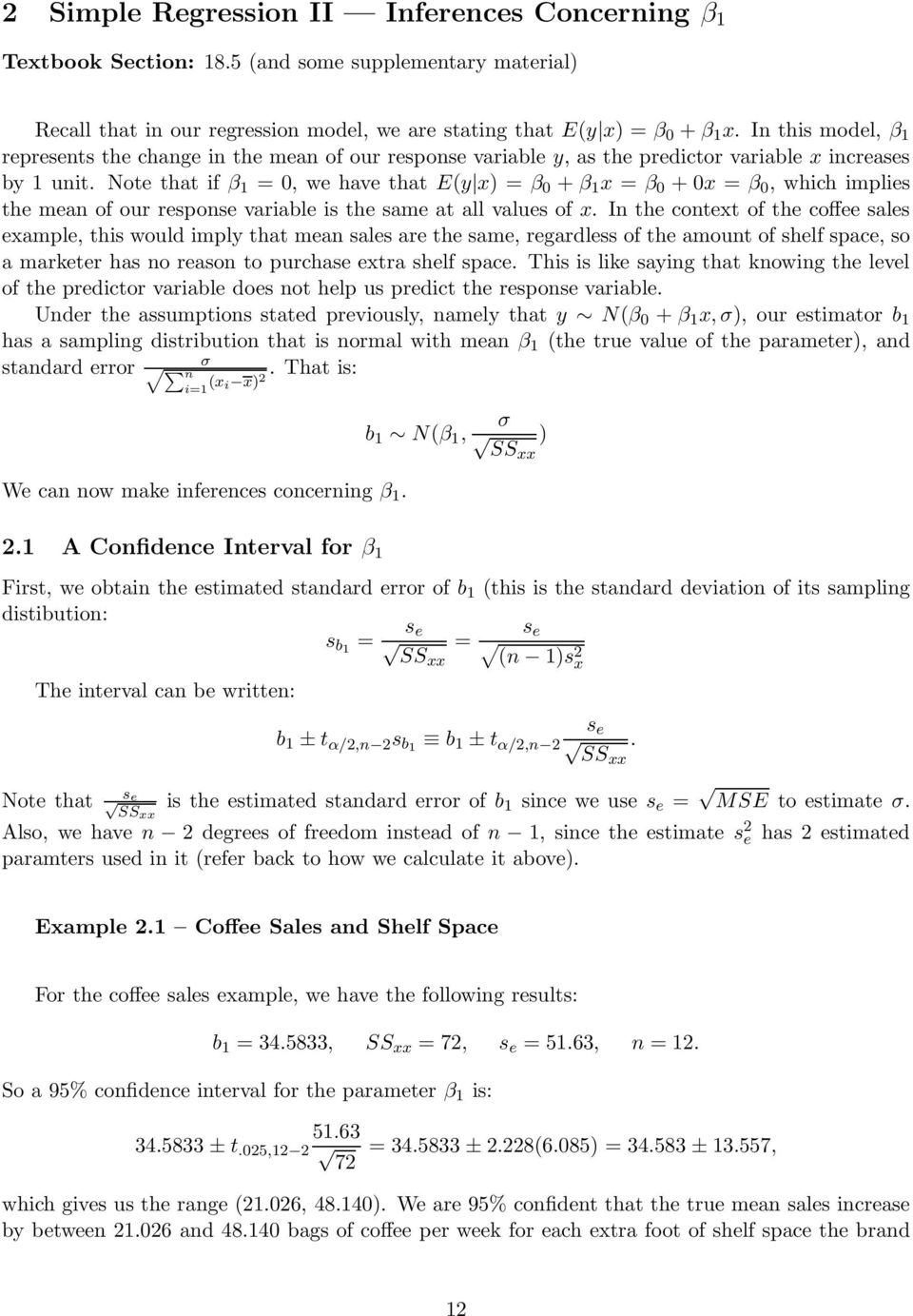
13 gets (within the range of 3 to 9 feet). Note that the entire interval is positive (above 0), so we are confident that in fact β > 0, so the marketer is justified in pursuing extra shelf space. Example 2.2 Hosiery Mill Cost Function b =2.0055, SS xx = , s e =6.24, n =48. For the hosiery mill cost function analysis, we obtain a 95% confidence interval for average unit variable costs (β ). Note that t.025,48 2 = t.025, , since t.025,40 =2.02 and t.025,60 =2.000 (we could approximate this with z.025 =.96 as well) ± t.025, = ± 2.05(.0709) = ± = (.8626, 2.484) We are 95% confident that the true average unit variable costs are between $.86 and $2.5 (this is the incremental cost of increasing production by one unit, assuming that the production process is in place. 2.2 Hypothesis Tests Concerning β Similar to the idea of the confidence interval, we can set up a test of hypothesis concerning β. Since the confidence interval gives us the range of believable values for β, it is more useful than a test of hypothesis. However, here is the procedure to test if β is equal to some value, say β 0. H 0 : β = β 0 (β0 specified, usually 0) () H a : β β 0 (2) H a : β >β 0 (3) H a : β <β 0 TS : t obs = b β 0 se = b β 0 s SSxx b () RR : t obs t α/2,n 2 (2) RR : t obs t α,n 2 (3) RR : t obs t α,n 2 () P value: 2 P (t t obs ) (2) P value: P (t t obs ) (3) P value: P (t t obs ) Using tables, we can only place bounds on these p values. Example 2. (Continued) Coffee Sales and Shelf Space Suppose in our coffee example, the marketer gets a set amount of space (say 6 ) for free, and she must pay extra for any more space. For the extra space to be profitable (over the long run), 3

14 the mean weekly sales must increase by more than 20 bags, otherwise the expense outweighs the increase in sales. She wants to test to see if it is worth it to buy more space. She works under the assumption that it is not worth it, and will only purchase more if she can show that it is worth it. She sets α =.05.. H 0 : β =20 H A : β > T.S.: t obs = = = R.R.: t obs >t.05,0 = p-value: P (T >2.397) <P(T >2.228) =.025 and P (T >2.397) >P(T >2.764) =.00, so.0 <p value <.025. So, she has concluded that β > 20, and she will purchase the shelf space. Note also that the entire confidence interval was over 20, so we already knew this. Example 2.2 (Continued) Hosiery Mill Cost Function Suppose we want to test whether average monthly production costs increase with monthly production output. This is testing whether unit variable costs are positive (α = 0.05). H 0 : β = 0 (Mean Monthly production cost is not associated with output) H A : β > 0 (Mean monthly production cost increases with output) TS : t obs = = = RR : t obs >t 0.05, (or use z 0.05 =.645) p-value: P (T >28.29) 0 We have overwhelming evidence of positive unit variable costs. 2.3 The Analysis of Variance Approach to Regression Consider the deviations of the individual responses, y i, from their overall mean y. We would like to break these deviations into two parts, the deviation of the observed value from its fitted value, ŷ i = b 0 + b x i, and the deviation of the fitted value from the overall mean. See Figure 6 corresponding to the coffee sales example. That is, we d like to write: y i y =(y i ŷ i )+(ŷ i y). Note that all we are doing is adding and subtracting the fitted value. It so happens that algebraically we can show the same equality holds once we ve squared each side of the equation and summed it over the n observed and fitted values. That is, n n n (y i y) 2 = (y i ŷ i ) 2 + (ŷ i y) 2. i= i= i= 4

15 SALES SPACE Figure 6: Plot of coffee data, fitted equation, and the line y = These three pieces are called the total, error, and model sums of squares, respectively. We denote them as SS yy, SSE, and SSR, respectively. We have already seen that SS yy represents the total variation in the observed responses, and that SSE represents the variation in the observed responses around the fitted regression equation. That leaves SSR as the amount of the total variation that is accounted for by taking into account the predictor variable X. We can use this decomposition to test the hypothesis H 0 : β =0vsH A : β 0. We will also find this decomposition useful in subsequent sections when we have more than one predictor variable. We first set up the Analysis of Variance (ANOVA) Table in Table 6. Note that we will have to make minimal calculations to set this up since we have already computed SS yy and SSE in the regression analysis. ANOVA Source of Sum of Degrees of Mean Variation Squares Freedom Square F MODEL SSR = n i= (ŷ i y) 2 MSR = SSR F = MSR MSE ERROR SSE = n i= (y i ŷ i ) 2 n 2 MSE = SSE n 2 TOTAL SS yy = n i= (y i y) 2 n Table 6: The Analysis of Variance Table for simple regression The procedure of testing for a linear association between the response and predictor variables using the analysis of variance involves using the F distribution, which is given in Table 6 (pp B- B-6) of your text book. This is the same distribution we used in the chapteron the -Way ANOVA. The testing procedure is as follows:. H 0 : β =0 H A : β 0 (This will always be a 2 sided test) 2. T.S.: F obs = MSR MSE 3. R.R.: F obs >F,n 2,α 5

16 4. p-value: P (F >F obs ) (You can only get bounds on this, but computer outputs report them exactly) Note that we already have a procedure for testing this hypothesis (see the section on Inferences Concerning β ), but this is an important lead in to multiple regression. Example 2. (Continued) Coffee Sales and Shelf Space Referring back to the coffee sales data, we have already made the following calculations: SS yy = , SSE = , n =2. We then also have that SSR = SS yy SSE = Then the Analysis of Variance is given in Table 7. ANOVA Source of Sum of Degrees of Mean Variation Squares Freedom Square F MODEL SSR = MSR = = F = ERROR SSE = =0 MSE = = TOTAL SS yy = = Table 7: The Analysis of Variance Table for the coffee data example =32.30 To test the hypothesis of no linear association between amount of shelf space and mean weekly coffee sales, we can use the F -test described above. Note that the null hypothesis is that there is no effect on mean sales from increasing the amount of shelf space. We will use α =.0.. H 0 : β =0 H A : β 0 2. T.S.: F obs = MSR MSE = = R.R.: F obs >F,n 2,α = F,0,.0 = p-value: P (F >F obs )=P (F >32.30) 0 We reject the null hypothesis, and conclude that β 0. There is an effect on mean weekly sales when we increase the shelf space. Example 2.2 (Continued) Hosiery Mill Cost Function For the hosiery mill data, the sums of squares for each source of variation in monthly production costs and their corresponding degrees of freedom are (from previous calculations): Total SS SS yy = n i= (y i y) 2 = df T otal = n =47 Error SS SSE = n i= (y i ŷ i ) 2 = df E = n 2=46 Model SS SSR = n i= (ŷ i y) 2 = SS yy SSE = = df R = 6

17 ANOVA Source of Sum of Degrees of Mean Variation Squares Freedom Square F MODEL SSR = MSR = = F = = ERROR SSE = =46 MSE = =38.88 TOTAL SS yy = =47 Table 8: The Analysis of Variance Table for the hosiery mill cost example The Analysis of Variance is given in Table 8. To test whether there is a linear association between mean monthly costs and monthly production output, we conduct the F -test (α =0.05).. H 0 : β =0 H A : β 0 2. T.S.: F obs = MSR MSE = = R.R.: F obs >F,n 2,α = F,46, p-value: P (F >F obs )=P (F >800.55) 0 We reject the null hypothesis, and conclude that β Coefficient of Determination A measure of association that has a clear physical interpretation is R 2, the coefficient of determination. This measure is always between 0 and, so it does not reflect whether y and x are positively or negatively associated, and it represents the proportion of the total variation in the response variable that is accounted for by fitting the regression on x. The formula for R 2 is: R 2 =(R) 2 = SSE SS yy = SSR SS yy = [cov(x, y)]2 s 2 xs 2. y Note that SS yy = n i= (y i y) 2 represents the total variation in the response variable, while SSE = n i= (y i ŷ i ) 2 represents the variation in the observed responses about the fitted equation (after taking into account x). This is why we sometimes say that R 2 is proportion of the variation in y that is explained by x. Example 2. (Continued) Coffee Sales and Shelf Space For the coffee data, we can calculate R 2 using the values of SS xy,ss xx,ss yy, and SSE we have previously obtained. R 2 = = =.7636 Thus, over 3/4 of the variation in sales is explained by the model using shelf space to predict sales. Example 2.2 (Continued) Hosiery Mill Cost Function 7

18 For the hosiery mill data, the model (regression) sum of squares is SSR = and the total sum of squares is SS yy = To get the coefficient of determination: R 2 = = Almost 95% of the variation in monthly production costs is explained by the monthly production output. 8

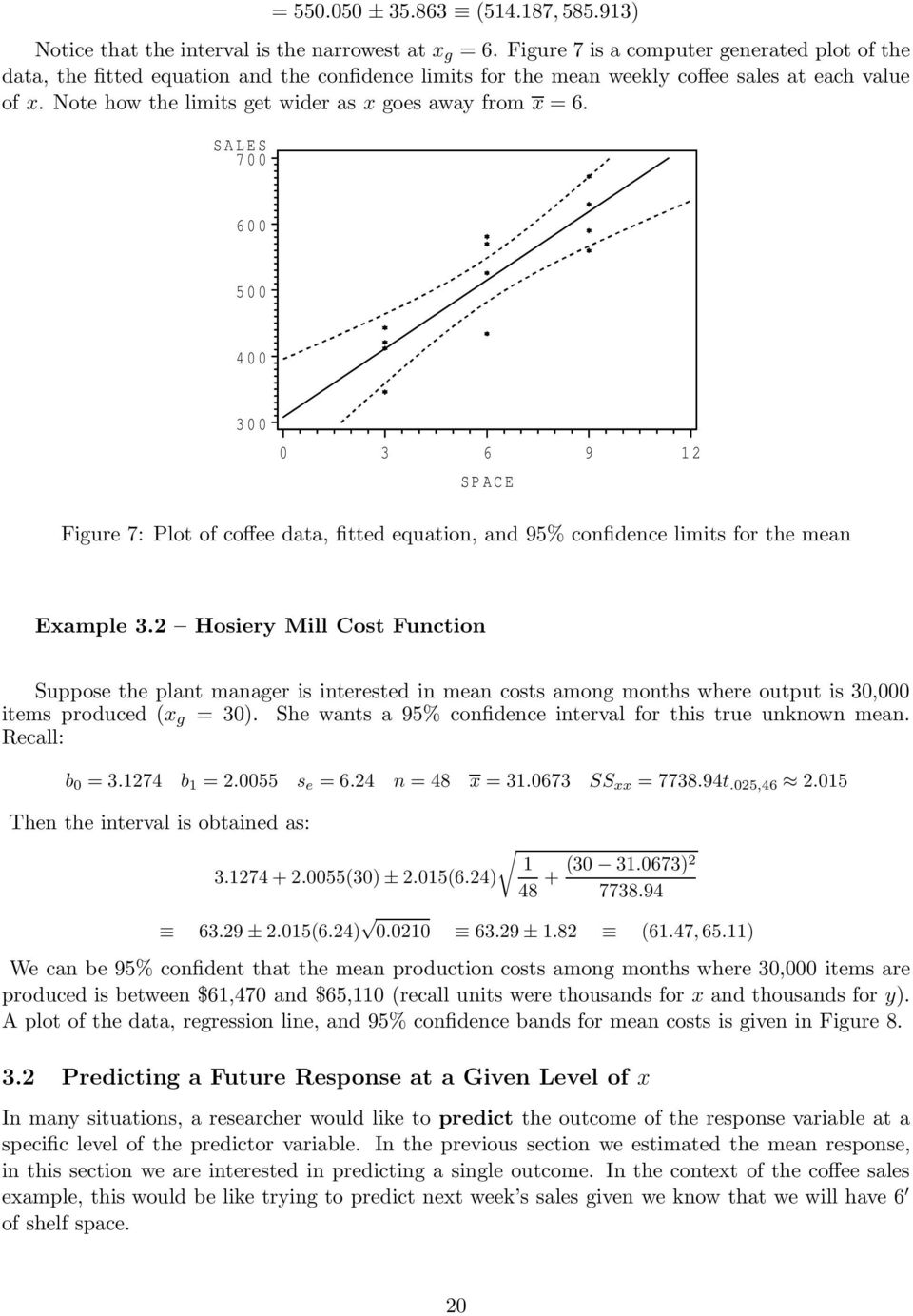
19 3 Simple Regression III Estimating the Mean and Prediction at a Particular Level of x, Correlation Textbook Sections: 8.7,8.8 We sometimes are interested in estimating the mean response at a particular level of the predictor variable, say x = x g. That is, we d like to estimate E(y x g )=β 0 + β x g. The actual estimate 9point prediction) is just ŷ = b 0 + b x g, which is simply where the fitted line crosses x = x g. Under the previously stated normality assumptions, the estimator ŷ 0 is normally distributed with mean β 0 + β x g and standard error of estimate σ n + (xg x)2 n i= (x 2. That is: i x) ŷ 0 N(β 0 + β x g, σ n + (x g x) 2 ni= (x i x) 2 ). Note that the standard error of the estimate is smallest at x g = x, that is at the mean of the sampled levels of the predictor variable. The standard error increases as the value x g goes away from this mean. For instance, our marketer may wish to estimate the mean sales when she has 6 of shelf space, or 7,or4. She may also wish to obtain a confidence interval for the mean at these levels of x. 3. A Confidence Interval for E(y x g )=β 0 + β x g Using the ideas described in the previous section, we can write out the general form for a ( α)00% confidence interval for the mean response when x g. (b 0 + b x g ) ± t α/2,n 2 S e n + (x g x) 2 SS xx Example 3. Coffee Sales and Shelf Space Suppose our marketer wants to compute 95% confidence intervals for the mean weekly sales at x=4,6, and 7 feet, respectively (these are not simultaneous confidence intervals as were computed based on Bonferroni s Method previously). Each of these intervals will depend on t α/2,n 2 = t.05,0 =2.228 and x = 6. These intervals are: (4 6)2 ( (4)) ± 2.228(5.63) + = ± = ± ( , ) (6 6)2 ( (6)) ± 2.228(5.63) + = ± = ± ( , ) (7 6)2 ( (7)) ± 2.228(5.63) + = ±

20 = ± (54.87, ) Notice that the interval is the narrowest at x g = 6. Figure 7 is a computer generated plot of the data, the fitted equation and the confidence limits for the mean weekly coffee sales at each value of x. Note how the limits get wider as x goes away from x =6. SALES SPACE Figure 7: Plot of coffee data, fitted equation, and 95% confidence limits for the mean Example 3.2 Hosiery Mill Cost Function Suppose the plant manager is interested in mean costs among months where output is 30,000 items produced (x g = 30). She wants a 95% confidence interval for this true unknown mean. Recall: b 0 =3.274 b = s e =6.24 n =48 x = SS xx = t.025, Then the interval is obtained as: (30) ± 2.05(6.24) 48 + ( ) ± 2.05(6.24) ±.82 (6.47, 65.) We can be 95% confident that the mean production costs among months where 30,000 items are produced is between $6,470 and $65,0 (recall units were thousands for x and thousands for y). A plot of the data, regression line, and 95% confidence bands for mean costs is given in Figure Predicting a Future Response at a Given Level of x In many situations, a researcher would like to predict the outcome of the response variable at a specific level of the predictor variable. In the previous section we estimated the mean response, in this section we are interested in predicting a single outcome. In the context of the coffee sales example, this would be like trying to predict next week s sales given we know that we will have 6 of shelf space. 20
21 cost size Figure 8: Plot of hosiery mill cost data, fitted equation, and 95% confidence limits for the mean 2
22 First, suppose you know the parameters β 0 and β Then you know that the response variable, for a fixed level of the predictor variable (x = x g ), is normally distributed with mean E(y x g )= β 0 + β x g and standard deviation σ. We know from previous work with the normal distribution that approximately 95% of the measurements lie within 2 standard deviations of the mean. So if we know β 0,β, and σ, we would be very confident that our response would lie between (β 0 +β x g ) 2σ and (β 0 + β x g )+2σ. Figure 9 represents this idea. F Figure 9: Distribution of response variable with known β 0,β, and σ We rarely, if ever, know these parameters, and we must estimate them as we have in previous sections. There is uncertainty in what the mean response at the specified level, x g, of the response variable. We do, however know how to obtain an interval that we are very confident contains the true mean β 0 + β x g. If we apply the method of the previous paragraph to all believable values of this mean we can obtain a prediction interval that we are very confident will contain our future response. Since σ is being estimated as well, instead of 2 standard deviations, we must use t α/2,n 2 estimated standard deviations. Figure 0 portrays this idea. F X Figure 0: Distribution of response variable with estimated β 0,β, and σ Note that all we really need are the two extreme distributions from the confidence interval for X 22
23 the mean response. If we use the method from the last paragraph on each of these two distributions, we can obtain the prediction interval by choosing the left hand point of the lower distribution and the right hand point of the upper distribution. This is displayed in Figure. F Figure : Upper and lower prediction limits when we have estimated the mean The general formula for a ( α)00% prediction interval of a future response is similar to the confidence interval for the mean at x g, except that it is wider to reflect the variation in individual responses. The formula is: (b 0 + b x g ) ± t α/2,n 2 s X + n + (x g x) 2 SS xx. Example 3. (Continued) Coffee Sales and Shelf Space For the coffee example, suppose the marketer wishes to predict next week s sales when the coffee will have 5 of shelf space. She would like to obtain a 95% prediction interval for the number of bags to be sold. First, we observe that t.025,0 =2.228, all other relevant numbers can be found in the previous example. The prediction interval is then: ( (5)) ± 2.228(5.63) + (5 6)2 + = ± = ± ( , ). This interval is relatively wide, reflecting the large variation in weekly sales at each level of x. Note that just as the width of the confidence interval for the mean response depends on the distance between x g and x, so does the width of the prediction interval. This should be of no surprise, considering the way we set up the prediction interval (see Figure 0 and Figure ). Figure 2 shows the fitted equation and 95% prediction limits for this example. It must be noted that a prediction interval for a future response is only valid if conditions are similar when the response occurs as when the data was collected. For instance, if the store is being boycotted by a bunch of animal rights activists for selling meat next week, our prediction interval will not be valid. 23
24 SALES SPACE Figure 2: Plot of coffee data, fitted equation, and 95% prediction limits for a single response Example 3.2 (Continued) Hosiery Mill Cost Function Suppose the plant manager knows based on purchase orders that this month, her plant will produce 30,000 items (x g =30.0). She would like to predict what the plant s production costs will be. She obtains a 95% prediction interval for this month s costs (30) ± 2.05(6.24) + ( ) ± 2.05(6.24) ± 2.70 (50.59, 75.99) She predicts that the costs for this month will be between $50,590 and $75,990. This interval is much wider than the interval for the mean, since it includes random variation in monthly costs around the mean. A plot of the 95% prediction bands is given in Figure Coefficient of Correlation In many situations, we would like to obtain a measure of the strength of the linear association between the variables y and x. One measure of this association that is reported in research journals from many fields is the Pearson product moment coefficient of correlation. This measure, denoted by r, is a number that can range from - to +. A value of r close to 0 implies that there is very little association between the two variables (y tends to neither increase or decrease as x increases). A positive value of r means there is a positive association between y and x (y tends to increase as x increases). Similarly, a negative value means there is a negative association (y tends to decrease as x increases). If r is either + or -, it means the data fall on a straight line (SSE = 0) that has either a positive or negative slope, depending on the sign of r. The formula for calculating r is: r = SS xy cov(x, y) =. SSxx SS yy s x s y Note that the sign of r is always the same as the sign of b. We can test whether a population coefficient of correlation is 0, but since the test is mathematically equivalent to testing whether β = 0, we won t cover this test. 24
25 cost size Figure 3: Plot of hosiery mill cost data, fitted equation, and 95% prediction limits for an individual outcome 25
26 Example 3. (Continued) Coffee Sales and Shelf Space For the coffee data, we can calculate r using the values of SS xy,ss xx,ss yy we have previously obtained r = = 2490 (72)(2772.9) =.8738 Example 3.2 (Continued) Hosiery Mill Cost Function For the hosiery mill cost function data, we have: r = ( )( ) = =
27 Computer Output for Coffee Sales Example (SAS System) Dependent Variable: SALES Analysis of Variance Sum of Mean Source DF Squares Square F Value Prob>F Model Error C Total Root MSE R-square Dep Mean Adj R-sq Parameter Estimates Parameter Standard T for H0: Variable DF Estimate Error Parameter=0 Prob > T INTERCEP SPACE Dep Var Predict Std Err Lower95% Upper95% Lower95% Obs SALES Value Predict Mean Mean Predict Upper95% Upper95% Obs Predict Residual Obs Predict Residual
28 4 Logistic Regression Often, the outcome is nominal (or binary), and we wish to relate the probability that an outcome has the characteristic of interest to an interval scale predictor variable. For instance, a local service provider may be interested in the probability that a customer will redeem a coupon that is mailed to him/her as a function of the amount of the coupon. We would expect that as the value of the coupon increases, so does the proportion of coupons redeemed. An experiment could be conducted as follows. Choose a range of reasonable coupon values (say x=$0 (flyer only), $, $2, $5, $0) Identify a sample of customers (say 200 households) Randomly assign customers to coupon values (say 40 per coupon value level) Send out coupons, and determine whether each coupon was redeemed by the expiration date (y = if yes, 0 if no) Tabulate results and fit estimated regression equation. Note that probabilities are bounded by 0 and, so we cannot fit a linear regression, since it will provide fitted values outside this range (unless b 0 is between 0 and and b is 0). We consider the following model, that does force fitted probabilities to lie between 0 and : p(x) = eβ 0+β x +e β 0+β e = x Unfortunately, unlike the case of simple linear regression, where there are close form equations for least squares estimates of β 0 and β, computer software must be used to obtain maximum likelihood estimates of β 0 and β, as well as their standard errors. Fortunately, many software packages (e.g. SAS, SPSS, Statview) offer procedures to obtain the estimates, standard errors and tests. We will give estimates and standard errors in this section, obtained from one of these packages. Once the estimates of β 0 and β are obtained, which we will label as b 0 and b respectively, we obtain the fitted equation: ˆP (x) = eb 0+b x +e b 0+b x e = Example 4. Viagra Clinical Trial In a clinical trial for Viagra, patients suffering from erectile dysfunction were randomly assigned to one of four daily doses (0mg, 25mg, 50mg, and 00mg). One measure obtained from the patients was whether the patient had improved erections after 24 weeks of treatment (y = if yes, y =0if no). Table 9 gives the number of subjects with y =any = 0 for each dose level. Source: I. Goldstein, et al, (998), Oral Sildenafil in the Treatment of Erectile Dysfunction, NEJM, 338: Based on an analysis using SAS software, we obtain the following estimates and standard errors for the logistic regression model: b 0 = 0.83 s b0 =.354 b =0.033 s b =
29 # Responding Dose (x) n y = y = Table 9: Patients showing improvement (y = ) and not showing improvement (y = 0) by Viagra dose (x) phatx dose Figure 4: Plot of estimated logistic regression equation - Viagra data 29
30 A plot of the fitted equation (line) and the sample proportions at each dose (dots) are given in Figure Testing for Association between Outcome Probabilities and x Consider the logistic regression model: p(x) = eβ 0+β x +e β 0+β x e = Note that if β = 0, then the equation becomes p(x) =e β 0 /( + e β 0 ). That is, the probability that the outcome is the characteristic of interest is not related to x, the predictor variable. In terms of the Viagra example, this would mean that the probability a patient shows improvement is independent of dose. This is what we would expect if the drug were not effective (still allowing for a placebo effect). Futher, note that if β > 0, the probability of the characteristic of interest occurring increases in x, and if β < 0, the probability decreases in x. We can test whether β = 0 as follows: H 0 : β = 0 (Probability of outcome is independent of x) H A : β 0 (Probability of outcome is associated with x) Test Statistic: X 2 obs =[b /s b ] 2 Rejection Region: X 2 obs χ2 α, (=3.84, for α =0.05). P -value: Area in χ 2 distribution above X2 obs Note that if we reject H 0, we determine direction of association (positive/negative) by the sign of b. Example 4. (Continued) Viagra Clinical Trial For this data, we can test whether the probability of showing improvement is associated with dose as follows: H 0 : β = 0 (Probability of improvement is independent of dose) H A : β 0 (Probability of improvement is associated with dose) Test Statistic: X 2 obs =[b /s b ] 2 =[.033/.0034] 2 =(9.2059) 2 =84.75 Rejection Region: X 2 obs χ2 α, (=3.84, for α =0.05). P -value: Area in χ 2 distribution above X2 obs (virtually 0) Thus, we have strong evidence of a positive association (since b > 0 and we reject H 0 ) between probability of improvement and dose. 30
31 5 Multiple Linear Regression I Textbook Sections: and Supplement In most situations, we have more than one independent variable. While the amount of math can become overwhelming and involves matrix algebra, many computer packages exist that will provide the analysis for you. In this chapter, we will analyze the data by interpreting the results of a computer program. It should be noted that simple regression is a special case of multiple regression, so most concepts we have already seen apply here. 5. The Multiple Regression Model and Least Squares Estimates In general, if we have k predictor variables, we can write our response variable as: y = β 0 + β x + + β k x k + ε. Again, x is broken into a systematic and a random component: y = β 0 + β x + + β k x } {{ k + } }{{} ε systematic random We make the same assumptions as before in terms of ε, specifically that they are independent and normally distributed with mean 0 and standard deviation σ. That is, we are assuming that y, ata given set of levels of the k independent variables (x,...,x k ) is normal with mean E[y x,...,x k ]= β 0 + β x + + β k x k and standard deviation σ. Just as before, β 0,β,...,β k, and σ are unknown parameters that must be estimated from the sample data. The parameters β i represent the change in the mean response when the i th predictor variable changes by unit and all other predictor variables are held constant. In this model: y Random outcome of the dependent variable β 0 Regression constant (E(y x = = x k = 0) if appropriate) β i Partial regression coefficient for variable x i (Change in E(y) when x i increases by unit and all other x s are held constant) ε Random error term, assumed (as before) that ε N(0,σ) k The number of independent variables By the method of least squares (choosing the b i values that minimize SSE = n i= (y i ŷ i ) 2 ), we obtain the fitted equation: Ŷ = b 0 + b x + b 2 x b k x k and our estimate of σ: (y ŷ) 2 s e = n k = SSE n k The Analysis of Variance table will be very similar to what we used previously, with the only adjustments being in the degrees of freedom. Table 0 shows the values for the general case when there are k predictor variables. We will rely on computer outputs to obtain the Analysis of Variance and the estimates b 0,b, and b k. 3
32 ANOVA Source of Sum of Degrees of Mean Variation Squares Freedom Square F MODEL SSR = n i= (ŷ i y) 2 k MSR = SSR k ERROR SSE = n i= (y i ŷ i ) 2 n k MSE = SSE n k TOTAL SS yy = n i= (y i y) 2 n Table 0: The Analysis of Variance Table for multiple regression F = MSR MSE 5.2 Testing for Association Between the Response and the Full Set of Predictor Variables To see if the set of predictor variables is useful in predicting the response variable, we will test H 0 : β = β 2 =... = β k = 0. Note that if H 0 is true, then the mean response does not depend on the levels of the predictor variables. We interpret this to mean that there is no association between the response variable and the set of predictor variables. To test this hypothesis, we use the following method:. H 0 : β = β 2 = = β k =0 2. H A : Not every β i =0 3. T.S.: F obs = MSR MSE 4. R.R.: F obs >F α,k,n k 5. p-value: P (F >F obs ) (You can only get bounds on this, but computer outputs report them exactly) The computer automatically performs this test and provides you with the p-value of the test, so in practice you really don t need to obtain the rejection region explicitly to make the appropriate conclusion. However, we will do so in this course to help reinforce the relationship between the test s decision rule and the p-value. Recall that we reject the null hypothesis if the p-value is less than α. 5.3 Testing Whether Individual Predictor Variables Help Predict the Response If we reject the previous null hypothesis and conclude that not all of the β i are zero, we may wish to test whether individual β i are zero. Note that if we fail to reject the null hypothesis that β i is zero, we can drop the predictor x i from our model, thus simplifying the model. Note that this test is testing whether x i is useful given that we are already fitting a model containing the remaining k predictor variables. That is, does this variable contribute anything once we ve taken into account the other predictor variables. These tests are t-tests, where we compute t = b i s bi just as we did in the section on making inferences concerning β in simple regression. The procedure for testing whether β i = 0 (the i th predictor variable does not contribute to predicting the response given the other k predictor variables are in the model) is as follows: H 0 : β i =0(y is not associated with x i after controlling for all other independent variables) 32
33 () H A : β i 0 (2) H A : β i > 0 (3) H A : β i < 0 T.S.: t obs = b i S bi R.R.: () t obs >t α/2,n k (2) t obs >t α,n k (3) t obs < t α,n k () p value: 2P (T > t obs ) (2) p value: P (T >t obs ) (3) p value: P (T <t obs ) Computer packages print the test statistic and the p-value based on the two-sided test, so to conduct this test is simply a matter of interpreting the results of the computer output. 5.4 Testing for an Association Between a Subset of Predictor Variables and the Response We have seen the two extreme cases of testing whether all regression coefficients are simultaneously 0 (the F -test), and the case of testing whether a single regression coefficient is 0, controlling for all other predictors (the t-test). We can also test whether a subset of the k regression coefficients are 0, controlling for all other predictors. Note that the two extreme cases can be tested using this very general procedure. To make the notation as simple as possible, suppose our model consists of k predictor variables, of which we d like to test whether q (q k) are simultaneously not associated with y, after controlling for the remaining k q predictor variables. Further assume that the k q remaining predictors are labelled x,x 2,...,x k q and that the q predictors of interest are labelled x k q+,x k q+2,...,x k. This test is of the form: H 0 : β k q+ = β k q+2 = = β k =0 H A : β k q+ 0 and/or β k q+2 0 and/or... and/or β k 0 The procedure for obtaining the numeric elements of the test is as follows:. Fit the model under the null hypothesis (β k q+ = β k q+2 = = β k = 0). It will include only the first k q predictor variables. This is referred to as the Reduced model. Obtain the error sum of squares (SSE(R)) and the error degrees of freedom df E (R) =n (k q). 2. Fit the model with all k predictors. This is referred to as the Complete or Full model (and was used for the F -test for all regression coefficients). Obtain the error sum of squares (SSE(F )) and the error degrees of freedom (df E (F )=n k ). By definition of the least squares citerion, we know that SSE(R) SSE(F ). We now obtain the test statistic: TS : F obs = SSE(R) SSE(F ) (n (k q) ) (n k ) SSE(F ) n k = (SSE(R) SSE(F ))/q MSE(F ) 33
34 and our rejection region is values of F obs F α,q,n k. Example 5. Texas Weather Data In this example, we will use regression in the context of predicting an outcome. A construction company is making a bid on a project in a remote area of Texas. A certain component of the project will take place in December, and is very sensitive to the daily high temperatures. They would like to estimate what the average high temperature will be at the location in December. They believe that temperature at a location will depend on its latitude (measure of distance from the equator) and its elevation. That is, they believe that the response variable (mean daily high temperature in December at a particular location) can be written as: y = β 0 + β x + β 2 x 2 + β 3 x 3 + ε, where x is the latitude of the location, x 2 is the longitude, and x 3 is its elevation (in feet). As before, we assume that ε N(0,σ). Note that higher latitudes mean farther north and higher longitudes mean farther west. To estimate the parameters β 0,β,β 2,β 3, and σ, they gather data for a sample of n = 6 counties and fit the model described above. The data, including one other variable are given in Table. COUNTY LATITUDE LONGITUDE ELEV TEMP INCOME HARRIS DALLAS KENNEDY MIDLAND DEAF SMITH KNOX MAVERICK NOLAN ELPASO COLLINGTON PECOS SHERMAN TRAVIS ZAPATA LASALLE CAMERON Table : Data corresponding to 6 counties in Texas The results of the Analysis of Variance are given in Table 2 and the parameter estimates, estimated standard errors, t-statistics and p-values are given in Table 3. Full computer programs and printouts are given as well. We see from the Analysis of Variance that at least one of the variables, latitude and elevation, are related to the response variable temperature. This can be seen by setting up the test H 0 : β = β 2 = β 3 = 0 as described previously. The elements of this test, provided by the computer output, are detailed below, assuming α =.05.. H 0 : β = β 2 = β 3 =0 34
35 ANOVA Source of Sum of Degrees of Mean Variation Squares Freedom Square F p-value MODEL SSR = k =3 MSR = F = ERROR SSE =7.609 n k = MSE = = 2 =0.634 TOTAL SS yy = n =5 =3.443 = Table 2: The Analysis of Variance Table for Texas data t FOR H 0 : STANDARD ERROR PARAMETER ESTIMATE β i =0 P-VALUE OF ESTIMATE INTERCEPT (β 0 ) b 0 = LATITUDE (β ) b = LONGITUDE (β 2 ) b 2 = ELEVATION (β 3 ) b 3 = Table 3: Parameter estimates and tests of hypotheses for individual parameters 2. H A : Not all β i =0 3. T.S.: F obs = MSR MSE = = R.R.: F obs >F 2,3,.05 =3.8 (This is not provided on the output, the p-value takes the place of it). 5. p-value: P (F > ) =.000 (Actually it is less than.000, but this is the smallest p-value the computer will print). We conclude that we are sure that at least one of these three variables is related to the response variable temperature. We also see from the individual t-tests that latitude is useful in predicting temperature, even after taking into account the other predictor variables. The formal test (based on α = 0.05 significance level) for determining wheteher temperature is associated with latitude after controlling for longitude and elevation is given here: H 0 : β = 0 (TEMP (y) is not associated with LAT (x ) after controlling for LONG (x 2 ) and ELEV (x 3 )) H A : β 0 (TEMP is associated with LAT after controlling for LONG and ELEV) T.S.: t obs = b S b = = 4.64 R.R.: t obs >t α/2,n k = t.025,2 =2.79 p value: 2P (T > t obs )=2P (T >4.64) <.000 Thus, we can conclude that there is an association between temperature and latitude, controlling for longitude and elevation. Note that the coeficient is negative, so we conclude that temperature decreases as latitude increases (given a level of longitude and elevation). 35
36 Note from Table 3 that neither the coefficient for LONGITUDE (X 2 ) or ELEVATION (X 3 ) are significant at the α = 0.05 significance level (p-values are.82 and.8, respectively). Recall these are testing whether each term is 0 controlling for LATITUDE and the other term. Before concluding that neither LONGITUDE (x 2 ) or ELEVATION (x 3 ) are useful predictors, controlling for LATITUDE, we will test whether they are both simultaneously 0, that is: First, note that we have: H 0 : β 2 = β 3 =0 vs H A : β 2 0 and/or β 3 0 n =6 k =3 q =2 SSE(F )=7.609 df E (F )=6 3 =2 MSE(F )=0.634 df E (R) =6 (3 2) =4 F.05,2,2 =3.89 Next, we fit the model with only LATITUDE (x ) and obtain the error sum of squares: SSE(R) = and get the following test statistic: TS : F obs = (SSE(R) SSE(F ))/q MSE(F ) = ( )/ = = Since >> 3.89, we reject H 0, and conclude that LONGITUDE (x 2 ) and/or ELEVATION (x 3 ) are associated with TEMPERATURE (y), after controlling for LATITUDE (x ). The reason we failed to reject H 0 : β 2 = 0 and H 0 : β 3 = 0 individually based on the t-tests is that ELEVATION and LONGITUDE are highly correlated (Elevations rise as you go further west in the state. So, once you control for LONGITUDE, we observe little ELEVATION effect, and vice versa. We will discuss why this is the case later. In theory, we have little reason to believe that temperatures naturally increase or decrease with LONGITUDE, but we may reasonably expect that as ELEVATION increases, TEMPERATURE decreases. We re fit the more parsimonious (simplistic) model that uses ELEVATION (x ) and LATI- TUDE (x 2 ) to predict TEMPERATURE (y). Note the new symbols for ELEVATION and LATI- TUDE. That is to show you that they are merely symbols. The results are given in Table 4 and Table 5. ANOVA Source of Sum of Degrees of Mean Variation Squares Freedom Square F p-value MODEL SSR = k =2 MSR = F = ERROR SSE =9.406 n k = MSE = = 3 =0.724 TOTAL SS yy = n =5 = = Table 4: The Analysis of Variance Table for Texas data without LONGITUDE We see this by observing that the t-statistic for testing H 0 : β = 0 (no latitude effect on temperature) is 7.65, corresponding to a p-value of.000, and the t-statistic for testing H 0 : β 2 = 0 (no elevation effect) is 8.4, also corresponding to a p-value of.000. Further note that both estimates are negative, reflecting that as elevation and latitude increase, temperature decreases. That should not come as any big surprise. 36
37 t FOR H 0 : STANDARD ERROR PARAMETER ESTIMATE β i =0 P-VALUE OF ESTIMATE INTERCEPT (β 0 ) b 0 = ELEVATION (β ) b = LATITUDE (β 2 ) b 2 = Table 5: Parameter estimates and tests of hypotheses for individual parameters without LON- GITUDE The magnitudes of the estimated coefficients are quite different, which may make you believe that one predictor variable is more important than the other. This is not necessarily true, because the ranges of their levels are quite different ( unit change in latitude represents a change of approximately 9 miles, while a unit change in elevation is foot) and recall that β i represents the change in the mean response when variable X i is increased by unit. The data corresponding to the 6 locations in the sample are plotted in Figure 5 and the fitted equation for the model that does not include LONGITUDE is plotted in Figure 6. The fitted equation is a plane in three dimensions. TEMP LAT ELEV Figure 5: Plot of temperature data in 3 dimensions Example 5.2 Mortgage Financing Cost Variation (By City) A study in the mid 960 s reported regional differences in mortgage costs for new homes. The sampling units were n = 8 metro areas (SMSA s) in the U.S. The dependent variable (y) is the average yield (in percent) on a new home mortgage for the SMSA. The independent variables (x i ) are given below. Source: Schaaf, A.H. (966), Regional Differences in Mortgage Financing Costs, Journal of Finance, 2: x Average Loan Value / Mortgage Value Ratio (Higher x means lower down payment and higher risk to lender). 37
38 YHAT LAT ELEV Figure 6: Plot of the fitted equation for temperature data x 2 x 3 x 4 Road Distance from Boston (Higher x 2 means further from Northeast, where most capital was at the time, and higher costs of capital). Savings per Annual Dwelling Unit Constructed (Higher x 3 means higher relative credit surplus, and lower costs of capital). Savings per Capita (does not adjust for new housing demand). x 5 Percent Increase in Population x 6 Percent of First Mortgage Debt Controlled by Inter-regional Banks. The data, fitted values, and residuals are given in Table 6. The Analysis of Variance is given in Table 7. The regression coefficients, test statistics, and p-values are given in Table 8. Show that the fitted value for Los Angeles is 6.9, based on the fitted equation, and that the residual is Based on the large F -statistic, and its small corresponding P -value, we conclude that this set of predictor variables is associated with the mortgage rate. That is, at least one of these independent variables is associated with y. Based on the t-tests, while none are strictly significant at the α =0.05 level, there is some evidence that x (Loan Value/Mortgage Value, P =.055), x 3 (Savings per Unit Constructed, P =.0593), and to a lesser extent, x 4 (Savings per Capita, P =.002) are helpful in predicting mortgage rates. We can fit a reduced model, with just these three predictors, and test whether we can simultaneously drop x 2, x 5, and x 6 from the model. That is: H 0 : β 2 = β 5 = β 6 =0 vs H A : β 2 0 and/or β 5 0 and/or β 6 0 First, we have the following values: n =8 k =6 q =3 SSE(F )= df E (F )=8 6 = MSE(F )= df E (R) =8 (6 3) =4 F.05,3, =
39 SMSA y x x 2 x 3 x 4 x 5 x 6 ŷ e = y ŷ Los Angeles-Long Beach Denver San Francisco-Oakland Dallas-Fort Worth Miami Atlanta Houston Seattle New York Memphis New Orleans Cleveland Chicago Detroit Minneapolis-St Paul Baltimore Philadelphia Boston Table 6: Data and fitted values for mortgage rate multiple regression example. ANOVA Source of Sum of Degrees of Mean Variation Squares Freedom Square F p-value MODEL SSR = k =6 MSR = F = =0.233 =2.33 ERROR SSE = n k = MSE = = = TOTAL SS yy = n =7 Table 7: The Analysis of Variance Table for Mortgage rate regression analysis STANDARD PARAMETER ESTIMATE ERROR t-statistic P -value INTERCEPT (β 0 ) b 0 = x (β ) b = x 2 (β 2 ) b 2 = x 3 (β 3 ) b 3 = x 4 (β 4 ) b 4 = x 5 (β 5 ) b 5 = x 6 (β 6 ) b 6 = Table 8: Parameter estimates and tests of hypotheses for individual parameters Mortgage rate regression analysis 39
40 ANOVA Source of Sum of Degrees of Mean Variation Squares Freedom Square F p-value MODEL SSR = k q =3 MSR = F = = =29.49 ERROR SSE =0.593 n (k q) = MSE = = 4 = TOTAL SS yy = n =7 Table 9: The Analysis of Variance Table for Mortgage rate regression analysis (Reduced Model) STANDARD PARAMETER ESTIMATE ERROR t-statistic P -value INTERCEPT (β 0 ) b 0 = x (β ) b = x 3 (β 3 ) b 3 = x 4 (β 4 ) b 4 = Table 20: Parameter estimates and tests of hypotheses for individual parameters Mortgage rate regression analysis (Reduced Model) Next, we fit the reduced model, with β 2 = β 5 = β 6 = 0. We get the Analysis of Variance in Table 9 and parameter estimates in Table 20. Note first, that all three regression coefficients are significant now at the α = 0.05 significance level. Also, our residual standard error, S e = MSE has also decreased ( to ). This implies we have lost very little predictive ability by dropping x 2, x 5, and x 6 from the model. Now to formally test whether these three predictor variables regression coefficients are simultaneously 0 (with α =0.05): H 0 : β 2 = β 5 = β 6 =0 H A : β 2 0 and/or β 5 0 and/or β 6 0 TS : F obs = ( )/ = =0.307 RR : F obs F 0.05,3, =3.59 We fail to reject H 0, and conclude that none of x 2, x 5,orx 6 are associated with mortgage rate, after controlling for x, x 3, and x 4. Example 5.3 Store Location Characteristics and Sales A study proposed using linear regression to describe sales at retail stores based on location characteristics. As a case study, the authors modelled sales at n = 6 liquor stores in Charlotte, N.C. Note that in North Carolina, all stores are state run, and do not practice promotion as liquor stores in Florida do. The response was SALES volume (for the individual stores) in the fiscal year 7//979-6/30/980. The independent variables were: POP (number of people living within.5 miles of store), MHI (mean household income among households within.5 miles of store), DIS, (distance to the nearest store), TFL (daily traffic volume on the street the store was located), and 40
41 EMP (the amount of employment within.5 miles of the store. The regression coefficients and standard errors are given in Table 5.4. Source: Lord, J.D. and C.D. Lynds (98), The Use of Regression Models in Store Location Research: A Review and Case Study, Akron Business and Economic Review, Summer, 3-9. Variable Estimate Std Error POP MHI DIS TFL EMP Table 2: Regression coefficients and standard errors for liquor store sales study a) Do any of these variables fail to be associated with store sales after controlling for the others? b) Consider the signs of the significant regression coefficients. What do they imply? 5.5 R 2 and Adjusted R 2 As was discussed in the previous chapter, the coefficient of multiple determination represents the proportion of the variation in the dependent variable (y) that is explained by the regression on the collection of independent variables: (x,...,x k ). R 2 is computed exactly as before: R 2 = SSR SS yy = SSE SS yy One problem with R 2 is that when we continually add independent variables to a regression model, it continually increases (or at least, never decreases), even when the new variable(s) add little or no predictive power. Since we are trying to fit the simplest (most parsimonious) model that explains the relationship between the set of independent variables and the dependent variable, we need a measure that penalizes models that contain useless or redundant independent variables. This penalization takes into account that by including useless or redundant predictors, we are decreasing error degrees of freedom (df E = n k ). A second measure, that does not carry the proportion of variation explained criteria, but is useful for comparing models of varying degrees of complexity, is Adjusted-R 2 : Adjusted R 2 = SSE/(n k ) SS yy /(n ) Example 5. (Continued) Texas Weather Data Consider the two models we have fit: Full Model I.V. s: LATITUDE, LONGITUDE, ELEVATION = n n k ( ) SSE SS yy 4
42 Reduced Model I.V. s: LATITUDE, ELEVATION For the Full Model, we have: and, we obtain R 2 F and Adj-R2 F : n =6 k =3 SSE =7.609 SS yy = R 2 F = =.008 = Adj R2 F = 5 2 For the Reduced Model, we have: and, we obtain R 2 R and Adj-R2 R : n =6 k =2 SSE =9.406 SS yy = R 2 R = =.00 = Adj R2 R = 5 3 ( ) =.25(.008) = ( ) =.5(.00) = Thus, by both measures the Full Model wins, but it should be added that both appear to fit the data very well! Example 5.2 (Continued) Mortgage Financing Costs For the mortgage data (with Total Sum of Squares SS yy = and n = 8), when we include all 6 independent variables in the full model, we obtain the following results: SSR = SSE = k =6 From this full model, we compute R 2 and Adj-R 2 : R 2 F = SSR F SS yy = = Adj R2 F = n n k ( ) SSEF SS yy = 7 ( ) = Example 5.3 (Continued) Store Location Characteristics and Sales In this study, the authors reported that R 2 =0.69. Note that although we are not given the Analysis of Variance, we can still conduct the F test for the overall model: F = MSR MSE = SSR/k SSE/(n k ) = SSR SS yy /k ( R 2 )/(n k ) SSE SS yy /(n k ) = R2 /k For the liquor store example, there were n = 6 stores and k = 5 variables in the full model. To test: H 0 : β = β 2 = β 3 = β 4 = β 5 =0 vs H A : Not all β i =0 we get the following test statistic and rejection region (α = 0.05): 0.69/5 TS : F obs = ( 0.69)/(6 5 ) = =4.45 RR : F obs F α,k,n k = F 0.05,5,0 =3.33 Thus, at least one of these variables is associated with store sales. What is Adjusted-R 2 for this analysis? 42
43 5.6 Multicollinearity Textbook: Section 9.4, Supplement Multicollinearity refers to the situation where independent variables are highly correlated among themselves. This can cause problems mathematically and creates problems in interpreting regression coefficients. Some of the problems that arise include: Difficult to interpret regression coefficient estimates Inflated std errors of estimates (and thus small t statistics) Signs of coefficients may not be what is expected. However, predicted values are not adversely affected It can be thought that the independent variables are explaining the same variation in y, and it is difficult for the model to attribute the variation explained (recall partial regression coefficients). Variance Inflation Factors provide a means of detecting whether a given independent variable is causing multicollinearity. They are calculated (for each independent variable) as: VIF i = Ri 2 where Ri 2 is the coefficient of multiple determination when x i is regressed on the k other independent variables. One rule of thumb suggests that severe multicollinearity is present if VIF i > 0 (Ri 2 >.90). Example 5. Continued First, we run a regression with ELEVATION as the dependent variable and LATITUDE and LONGITUDE as the independent variables. We then repeat the process with LATITUDE as the dependent variable, and finally with LONGITUDE as the dependent variable. Table?? gives R 2 and VIF for each model. Variable R 2 VIF ELEVATION LATITUDE LONGITUDE Table 22: Variance Inflation Factors for Texas weather data Note how large the factor is for ELEVATION. Texas elevation increases as you go West and as you go North. The Western rise is the more pronounced of the two (the simple correlation between ELEVATION and LONGITUDE is.89). Consider the effects on the coefficients in Table 23 and Table 24 (these are subsets of previously shown tables). Compare the estimate and estimated standard error for the coefficient for ELEVATION and LATITUDE for the two models. In particular, the ELEVATION coefficient doubles in absolute value and its standard error decreases by a factor of almost 3. The LATITUDE coefficient and standard error do not change very much. We choose to keep ELEVATION, as opposed to LONGI- TUDE, in the model due to theoretical considerations with respect to weather and climate. 43
44 STANDARD ERROR PARAMETER ESTIMATE OF ESTIMATE INTERCEPT (β 0 ) b 0 = LATITUDE (β ) b = LONGITUDE (β 2 ) b 2 = ELEVATION (β 3 ) b 3 = Table 23: Parameter estimates and standard errors for the full model STANDARD ERROR PARAMETER ESTIMATE OF ESTIMATE INTERCEPT (β 0 ) b 0 = ELEVATION (β ) b = LATITUDE (β 2 ) b 2 = Table 24: Parameter estimates and standard errors for the reduced model 5.7 Autocorrelation Textbook Section: 9.5 Recall a key assumption in regression: Error terms are independent. When data are collected over time, the errors are often serially correlated (Autocorrelated). Under first Order Autocorrelation, consecutive error terms are linealy related: ε t = ρε t + ν t where ρ is the correlation between consecutive error terms, and ν t is a normally distributed independent error term. When errors display a positive correlation, ρ > 0 (Consecutive error terms are associated). We can test this relation as follows, note that when ρ = 0, error terms are independent (which is the assumption in the derivation of the tests in the chapters on linear regression). Durbin Watson Test for Autocorrelation H 0 : ρ = 0 No autocorrelation H a : ρ>0 Postive Autocorrelation D = n t=2 (et e t ) 2 n t= e2 t D d U = Don t Reject H 0 D d L = Reject H 0 d L D d U = Withhold judgement Values of d L and d U (indexed by n and k (the number of predictor variables)) are given in Table (a), p. B-22. Cures for Autocorrelation: 44
45 Additional independent variable(s) A variable may be missing from the model that will eliminate the autocorrelation. Transform the variables Take first differences (y t+ y t ) and (y t+ y t ) and run regression with transformed y and x. Example 5.4 Spirits Sales and Income and Prices in Britain A study was conducted relating annual spirits (liquor) sales (y) in Britain to per capita income (x ) and prices (x 2 ), where all monetary values were in constant (adjusted for inflation) dollars for the years The following output gives the results from the regression analysis and the Durbin-Watson statistic. Note that there are n = 69 observations and k = 2 predictors, and the approximate lower and upper bounds for the rejection region are d L =.55 and d U =.67 for an α =0.05 level test. Since the test statistic is d =0.247 (see output below), we reject the null hypothesis of no autocorrelation among the residuals, and conclude that they are positively correlated. See Figure 7 for a plot of the residuals versus year. Source: Durbin J., and Watson, G.S. (950), Testing for Serial Correlation in Least Squares Regression, I, Biometrika, 37: The REG Procedure Model: MODEL Dependent Variable: consume Analysis of Variance Sum of Mean Source DF Squares Square F Value Pr > F Model <.000 Error Corrected Total Root MSE R-Square Dependent Mean Adj R-Sq Coeff Var Parameter Estimates Parameter Standard Variable DF Estimate Error t Value Pr > t Intercept <.000 income price <.000 Durbin-Watson D Number of Observations 69 st Order Autocorrelation
46 Obs consume income price yhat e
47 Residual year Figure 7: Plot of the residuals versus year for British spirits data 47
48 6 Special Cases of Multiple Regression Textbook Sections: 20.2,20.3 In this section, we will look at three special cases that are frequently used methods of multiple regression. The ideas such as the Analysis of Variance, tests of hypotheses, and parameter estimates are exactly the same as before and we will concentrate on their interpretation through specific examples. The four special cases are:. Polynomial Regression 2. Regression Models with Nominal (Dummy) Variables 3. Regression Models Containing Interaction Terms 6. Polynomial Regression While certainly not restricted to this case, it is best to describe polynomial regression in the case of a model with only one predictor variable. In many real world settings relationships will not be linear, but will demonstrate nonlinear associations. In economics, a widely described phenomenon is diminishing marginal returns. In this case, y may increase with x, but the rate of increase decreases over the range of x. By adding quadratic terms, we can test if this is the case. Other situations may show that the rate of increase in y is increasing in x. Example 6. Health Club Demand y = β 0 + β x + β 2 x 2 + ε. Again, we assume that ε N(0,σ). In this model, the number of people attending in a day when there are x machines is nomally distributed with mean β 0 + β x + β 2 x 2 and standard deviation σ. Note that we are no longer saying that the mean is linearly related to x, but rather that it is approximately quadratically related to x (curved). Suppose she leases varying numbers of machines over a period of n = 2 Wednesdays (always advertising how many machines will be there on the following Wednesday), and observes the number of people attending the club each day, and obtaining the data in Table 25. In this case, we would like to fit the multiple regression model: y = β 0 + β x + β 2 x 2 + ε, which is just like our previous model except instead of a second predictor variable x 2, we are using the variable x 2, the effect is that the fitted equation ŷ will be a curve in 2 dimensions, not a plane in 3 dimensions as we saw in the weather example. First we will run the regression on the computer, obtaining the Analysis of Variance and the parameter estimates, then plot the data and fitted equation. Table 26 gives the Analysis of Variance for this example and Table 27 gives the parameter estimates and their standard errors. Note that even though we have only one predictor variable, it is being used twice and could in effect be treated as two different predictor variables, so k =2. The first test of hypothesis is whether the attendance is associated with the number of machines. This is a test of H 0 : β = β 2 = 0. If the null hypothesis is true, that implies mean daily attendance 48
49 Week # Machines (x) Attendance (y) Table 25: Data for health club example ANOVA Source of Sum of Degrees of Mean Variation Squares Freedom Square F p-value MODEL SSR = k =2 MSR = F = ERROR SSE = n k = MSE = =2-2-=9 = TOTAL SS yy = n = = = Table 26: The Analysis of Variance Table for health club data t FOR H 0 : STANDARD ERROR PARAMETER ESTIMATE β i =0 P-VALUE OF ESTIMATE INTERCEPT (β 0 ) b 0 = MACHINES (β ) b = MACHINES SQ (β 2 ) b 2 = Table 27: Parameter estimates and tests of hypotheses for individual parameters 49
50 is unrelated to the number of machines, thus the club owner would purchase very few (if any) of the machines. As before this test is the F -test from the Analysis of Variance table, which we conduct here at α =.05.. H 0 : β = β 2 =0 2. H A : Not both β i =0 3. T.S.: F obs = MSR MSE = = R.R.: F obs >F 2,9,.05 =4.26 (This is not provided on the output, the p-value takes the place of it). 5. p-value: P (F >253.80) =.000 (Actually it is less than.000, but this is the smallest p-value the computer will print). Another test with an interesting interpretation is H 0 : β 2 = 0. This is testing the hypothesis that the mean increases linearly with x (since if β 2 = 0 this becomes the simple regression model (refer back to the coffee data example)). The t-test in Table 27 for this hypothesis has a test statistic t obs = 4.23 which corresponds to a p-value of.0022, which since it is below.05, implies we reject H 0 and conclude β 2 0. Since b 2 is is negative, we will conclude that β 2 is negative, which is in agreement with her theory that once you get to a certain number of machines, it does not help to keep adding new machines. This is the idea of diminishing returns. Figure 8 shows the actual data and the fitted equation ŷ = x 3.658x 2. YHAT X Figure 8: Plot of the data and fitted equation for health club example 6.2 Regression Models With Nominal (Dummy) Variables All of the predictor variables we have used so far were numeric or what are often called quantitative variables. Other variables also can be used that are called qualitative variables. Qualitative variables measure characteristics that cannot be described numerically, such as a person s sex, race, religion, or blood type; a city s region or mayor s political affiliation; the list of possibilities is endless. In this case, we frequently have some numeric predictor variable(s) that we believe is (are) 50
51 related to the response variable, but we believe this relationship may be different for different levels of some qualitative variable of interest. If a qualitative variable has m levels, we create m indicator or dummy variables. Consider an example where we are interested in health care expenditures as related to age for men and women, separately. In this case, the response variable is health care expenditures, one predictor variable is age, and we need to create a variable representing sex. This can be done by creating a variable x 2 that takes on a value if a person is female and 0 if the person is male. In this case we can write the mean response as before: E[y x,x 2 ]=β 0 + β x + β 2 x 2 + ε. Note that for women of age x, the mean expenditure is E[y x, ] = β 0 +β x +β 2 () = (β 0 +β 2 )+ β x, while for men of age x, the mean expenditure is E[y x, 0] = β 0 + β x + β 0 (0) = β 0 + β x. This model allows for different means for men and women, but requires they have the same slope (we will see a more general case in the next section). In this case the interpretation of β 2 =0is that the means are the same for both sexes, this is a hypothesis a health care professional may wish to test in a study. In this example the variable sex had two variables, so we had to create 2 = dummy variable, now consider a second example. Example 6.2 We would like to see if annual per capita clothing expenditures is related to annual per capita income in cities across the U.S. Further, we would like to see if there is any differences in the means across the 4 regions (Northeast, South, Midwest, and West). Since the variable region has 4 levels, we will create 3 dummy variables x 2,x 3, and x 4 as follows (we leave x to represent the predictor variable per capita income): { if region=south x 2 = 0 otherwise { if region=midwest x 3 = 0 otherwise { if region=west x 4 = 0 otherwise Note that cities in the Northeast have x 2 = x 3 = x 4 = 0, while cities in other regions will have either x 2,x 3, or x 4 being equal to. Northeast cities act like males did in the previous example. The data are given in Table 28. The Analysis of Variance is given in Table 29, and the parameter estimates and standard errors are given in Table 30. Note that we would fail to reject H 0 : β = β 2 = β 3 = β 4 =0atα =.05 significance level if we looked only at the F -statistic and it s p-value (F obs =2.93, p-value=.0562). This would lead us to conclude that there is no association between the predictor variables income and region and the response variable clothing expenditures. This is where you need to be careful when using multiple regression with many predictor variables. Look at the test of H 0 : β = 0, based on the t-test in Table 30. Here we observe t obs =3., with a p-value of.007. We thus conclude β 0, and that clothing expenditures is related to income, as we would expect. However, we do fail to reject H 0 : β 2 =0,H 0 : β 3 = 0,and H 0 : β 4 = 0, so we fail to observe any differences among the regions in terms of clothing expenditures after adjusting for the variable income. Figure 9 and Figure 20 show the original data using region as the plotting symbol and the 4 fitted equations corresponding to the 4 5
52 PER CAPITA INCOME & CLOTHING EXPENDITURES (990) Income Expenditure Metro Area Region x y x 2 x 3 x 4 New York City Northeast Philadelphia Northeast Pittsburgh Northeast Boston Northeast Buffalo Northeast Atlanta South Miami/Ft Laud South Baltimore South Houston South Dallas/Ft Worth South Chicago Midwest Detroit Midwest Cleveland Midwest Minneapolis/St Paul Midwest St Louis Midwest Seattle West Los Angeles West Portland West San Diego West San Fran/Oakland West Table 28: Clothes Expenditures and income example ANOVA Source of Sum of Degrees of Mean Variation Squares Freedom Square F p-value MODEL ERROR TOTAL Table 29: The Analysis of Variance Table for clothes expenditure data t FOR H 0 : STANDARD ERROR PARAMETER ESTIMATE β i =0 P-VALUE OF ESTIMATE INTERCEPT (β 0 ) x (β ) x 2 (β 2 ) x 3 (β 3 ) x 4 (β 4 ) Table 30: Parameter estimates and tests of hypotheses for individual parameters 52
53 regions. Recall that the fitted equation is ŷ = x x x x 4, and each of the regions has a different set of levels of variables x 2,x 3, and x 4. Y 2600 W W 2300 S M N 2000 N S M M W N S W S M M W 300 S N N X REGION N M N M N M Midwest South S W S W S W Northeast West Figure 9: Plot of clothing data, with plotting symbol region YN Figure 20: Plot of fitted equations for each region X 6.3 Regression Models With Interactions In some situations, two or more predictor variables may interact in terms of their effects on the mean response. That is, the effect on the mean response of changing the level of one predictor variable depends on the level of another predictor variable. This idea is easiest understood in the case where one of the variables is qualitative. Example 6.3 Truck and SUV Safety Ratings Several years ago, The Wall Street Journal reported safety scores on 33 models of SUV s and 53
54 trucks. Safety scores (y) were reported, as well as the vehicle s weight (x ) and and indicator of whether the vehicle has side air bags (x 2 = if it does, 0 if not). We fit a model, relating safety scores to weight, presence of side airbags, and an interaction term that allows the effect of weight to depend on whether side airbags are present: y = β 0 + β x + β 2 x 2 + β 3 x x 2 + ε. We can write the equations for the two side airbag types as follows: and Side airbags: y = β 0 + β x + β 2 () + β 3 x () + ε =(β 0 + β 2 )+(β + β 3 )x + ε, No side airbags: y = β 0 + β x + β 2 (0) + β 3 x (0) + ε = β 0 + β x + ε. The data for years the 33 models are given in Table 3. The Analysis of Variance table for this example is given in Table 32. Note that R 2 =.558. Table 33 provides the parameter estimates, standard errors, and individual t-tests. Note that the F -test for testing H 0 : β = β 2 = β 3 = 0 rejects the null hypothesis (F =.90, P -value=.000), but none of the individual t-tests are significant (all P -values exceed 0.05). This can happen due to the nature of the partial regression coefficients. It can be seen that weight is a very good predictor, and that the presence of side airbags and the interaction term do not contribute much to the model (SSE for a model containing only Weight (x ) is , use this to test H 0 : β 2 = β 3 = 0). For vehicles with side airbags the fitted equation is: ŷ airbags =(b 0 + b 2 )+(b + b 3 )x = x, while for vehicles without airbags, the fitted equation is: ŷ noairbags = b 0 + b x = x. Figure 2 shows the two fitted equations for the safety data. yhatsa Side Airbag No Side Airb weight Figure 2: Plot of fitted equations for each vehicle type 54
55 SUV/Truck Safety Ratings Make Model Safety (y) Weight (x ) Airbag (x 2 ) TOYOTA AVALON CHEVROLET IMPALA FORD RANGER BUICK LESABRE MAZDA MPV PLYMOUTH VOYAGER VOLVO S AUDI A DODGE DAKOTA ACURA RL PONTIAC TRANSPORT CHRYSLER TOWN&COUNTRY FORD F TOYOTA 4RUNNER MERCURY GRAND MARQUIS ISUZU RODEO TOYOTA SIENNA MERCURY VILLAGER LINCOLN TOWN CAR FORD F-50X FORD WINDSTAR NISSAN PATHFINDER OLDSMOBILE BRAVADO HONDA ODYSSEY MERCURY MOUNTAINEER TOYOTA TUNDRA MERCEDES-BENZ ML FORD ECONOLINE DODGE RAM LINCOLN NAVIGATOR DODGE RAM CADILLAC ESCALANTE CHEVROLET SUBURBAN Table 3: Safety ratings for trucks and SUV s ANOVA Source of Sum of Degrees of Mean Variation Squares Freedom Square F p-value MODEL ERROR TOTAL Table 32: The Analysis of Variance Table for truck/suv safety data 55
56 STANDARD ERROR t FOR H 0 : PARAMETER ESTIMATE OF ESTIMATE β i =0 P-VALUE INTERCEPT (β 0 ) x (β ) x 2 (β 2 ) x 3 (β 3 ) Table 33: Parameter estimates and tests of hypotheses for individual parameters Safety data 7 Introduction to Time Series and Forecasting Textbook Sections: In the remainder of the course, we consider data that are collected over time. Many economic and financial models are based on time series. First, we will describe means of smoothing series, then some simple ways to decompose a series, then we will describe some simple methods used to predict future outcomes based on past values. 7. Time Series Components Textbook Section: 2.2 Time series can be broken into five components: level, long-term trend, Cyclical variation, seasonal variation, and random variation. A brief description of each is given below: Level Horizontal sales history in absence of other sources of variation (long run average). Trend Continuing pattern of increasing/decreasing values in the form of a line or curve. Cyclical Wavelike patterns that represent business cycles over multiple periods such as economic expansions and recessions. Seasonal Patterns that occur over repetitive calendar periods such as quarters, months, weeks, or times of the day. Random Short term irregularities that cause variation in individual outcomes above and beyond the other sources of variation. Example 7. - U.S. Cotton Production Figure 22 represents a plot of U.S. cotton production from 978 to 200 (Source: Cotton association web site). We can see that there has been a trend to higher production over time, with cyclical patterns arising as well along the way. Since the data are annual production, we cannot observe seasonal patterns. Example Texas in-state Finance/Insurance/Real Estate Sales
57 yrkbales year Figure 22: Plot of U.S. cotton production Table 34 gives in-state gross sales for the Finance, Insurance, and Real Estate (FIRE) for the state of Texas for the 4 quarters of years in hundreds of millions of dollars (Source: State of Texas web site). A plot of the data (with vertical lines delineating years) is shown in Figure 23. There is a clear positive trend in the series, and the fourth quarter tends to have much larger sales than the other three quarters. We will use the variables in the last two columns in a subsequent section. Gross_Sales quarter Figure 23: Plot of quarterly Texas in-state FIRE gross sales Smoothing Techniques Textbook Section: 2.3 Moving Averages are averages of values at a particular time period, and values that are near it in time. We will focus on odd numbered moving averages, as they are simpler to describe and 57
58 t year quarter gross sales (y t) fitted sales (ŷ t) ratio (y t/ŷ t) Table 34: Quarterly in-state gross sales for Texas FIRE firms 58
59 implement (the textbook also covers even numbered MA s as well). A 3-period moving averge involves averaging the value directly prior to the current time point, the current value, and the value directly after the current time point. There will not be values for either the first or last periods of the series. Similarly, a 5-period moving average will include the current time point, and the two prior time points and the two subsequent time points. Example U.S. Internet Retail Sales - 999q4-2003q The data in Table 35 gives the U.S. e-commerce sales for n = 4 quarters (quarter is the 4th quarter of 999 and quarter 4 is preliminary reported sales for the st quarter of 2003) in millions of dollars (Source: U.S. Census Bureau). Quarter Sales (y t ) MA(3) ES(0.) ES(0.5) Table 35: Quarterly e-commerce sales and smoothed values for U.S. 999q4-2003q To obatain the three period moving average (MA(3)) for the second quarter, we average the first, second, and third period sales: = = We can similarly obtain the three period moving average for quarters 3-3. The data and three period moving averages are given in Figure 24. The moving average is the dashed line, while the original series is the solid line. Exponential Smoothing is an alternative means of smoothing the series. It makes use of all prior time points, with higher weights on more recent time points, and exponentially decaying weights on more distance time points. One advantage is that we have smoothed values for all time points. One drawback is that we must select a tuning parameter (although we would also have to choose the length of a moving average as well, for that method). One widely used convention is to set the first period s smoothed value to the first observation, then make subsequent smoothed values as a weighted average of the current observation and the previous value of the smoothed series. We use the notation S t for the smoothed value at time t. 59
60 sales quarter Figure 24: Plot of quarterly U.S. internet retail sales and 3-Period moving average S = y S t = wy t +( w)s t t 2 Example 7.3 (Continued) Thus, for quarter 4 of 999, we set S = y = In Table 35, we include smoothed values based on w =0. and w =0.5, respectively: w =0. : S 2 =0. y S =0.(5722) + 0.9(5393) = = w =0.5 : S 2 =0.5 y S =0.5(5722) + 0.5(5393) = = The smoothed values are given in Table 35, as well as in Figure 25. The solid line is the original series, the smoothest line is w =0., and the intermediate line is w = Estimating Trend and Seasonal Effects Textbook Section: 2.4 While the cyclical patterns are difficult to predict and estimate, we can estimate linear trend and seasonal indexes fairly simply. Further, there is no added difficulty if the trend is nonlinear (quadratic), but we will consider only the linear case here. First, we must identify seasons, these can be weeks, months, or quarters (or even times of the day or days of the week). Then we fit a linear trend for the entire series. This is followed by taking the ratio of the actual to the fitted value (from the regression equation) for each period. Next, we average these ratios for each season, and adjust so that the averages sum to.0. Example 7.2 (Continued) 60
61 sales quarter Figure 25: Plot of quarterly U.S. internet retail sales and 32 Exponentially smoothed series Consider the Texas gross (in-state) sales for the FIRE industry. The seasons are the four quarters. Fitting a simple linear regression, relating sales to time period, we get: ŷ t = b 0 + b t = t The fitted values (as well as the observed values) have been shown previously in Table 34. Also for each outcome, we obtain the ratio of the observed to fitted value, also given in the table. Consider the first and last cases: t =: y =.567 ŷ = () =.725 y =.567 ŷ.725 =0.908 y t =56: y 56 =8.522 ŷ = (56) = = ŷ =.303 Next, we take the mean of the observed-to-fitted ratio for each quarter. There are 4 years of data: Q : The means for the remaining three quarters are: Q2 : Q3 : Q4 :.398 The means sum to 4.022, and have a mean of 4.022/4= If we divide each mean by.0055, the indexes will sum to : Q : Q2 : 0.90 Q3 : Q4 :.390 The seasonally adjusted time series is given by dividing each observed value by its seasonal index. This way, we can determine when there are real changes in the series, beyond seasonal fluctuations. Table 36 contains all components as well as the seasonally adjusted values. =0.84 6
62 t year quarter gross sales (y t) fitted sales (ŷ t) ratio (y t/ŷ t) season adjusted Table 36: Quarterly in-state gross sales for Texas FIRE firms and seasonally adjusted series 62
63 7.4 Introduction to Forecasting Textbook Section: 2.5 There are unlimited number of possibilities of ways of forecasting future outcomes, so we need means of comparing the various methods. First, we introduce some notation: y t Actual (random) outcome at time t, unknown prior to t F t Forecast of y t, made prior to t e t Forecast error e t = y t F t (Book does not use this notation). Two commonly used measures of comparing forecasting methods are given below: et n Mean Absolute Deviation (MAD) MAD= number of forecasts = t= yt Ft n Sum of Square Errors (SSE) SSE= e 2 t = n t= (y t F t ) 2 When comparing forecasting methods, we wish to minimize one or both of these quantities. 7.5 Simple Forecasting Techniques Textbook Section: 2.6 and Supplement In this section, we describe some simple methods of using past data to predict future outcomes. Most forecasts you hear reported are generally complex hybrids of these techniques Moving Averages This method, which is not included in the tesxt, is a slight adjustment to the centered moving averages in the smoothing section. At time point t, we use the previous k observations to forecast y t. We use the mean of the last k observations to forecast outcome at t: F t = X t + X t X t k k Problem: How to choose k? Example Anhueser-Busch Annual Dividend Yields Table 37 gives average dividend yields for Anheuser Busch for the years (Source:Value Line), forecasts and errors based on moving averages based on lags of, 2, and 3. Note that we don t have early year forecasts, and the longer the lag, the longer we must wait until we get our first forecast. Here we compute moving averages for year=963: Year: F 963 = y 962 =3.2 2 Year: F 963 = y 962+y 96 2 = =3.0 3 Year: F 963 = y 962+y 96 +y = =3.47 Figure 26 displays raw data and moving average forecasts. 63
64 t Year y t F,t e,t F 2,t e 2,t F 3,t e 3,t Table 37: Dividend yields, Forecasts, errors, 2, and 3 year moving Averages 64
65 DIV_YLD Actual MA() MA(2) MA(3) CAL_YEAR Figure 26: Plot of the data moving average forecast for Anheuser Busch dividend data Exponential Smoothing Exponential smoothing is a method of forecasting that weights data from previous time periods with exponentially decreasing magnitudes. Forecasts can be written as follows, where the forecast for period 2 is traditionally (but not always) simply the outcome from period : where : F t+ is the forecast for period t + y t is the outcome at t F t+ = S t = wy t +( w)s t = wy t +( w)f t S t is the smoothed value for period t (S t = F t ) w is the smoothing constant (0 w ) Forecasts are smoother than the raw data and weights of previous observations decline exponentially with time. Example 7.4 (Continued) 3 smoothing constants (allowing decreasing amounts of smoothness) for illustration: w =0.2 F t+ =0.2y t +0.8S t =0.2y t +0.8F t w =0.5 F t+ =0.5y t +0.5S t =0.5y t +0.5F t w =0.8 F t+ =0.8y t +0.2S t =0.8y t +0.2F t Year 2 (953) set F 953 = X 952, then cycle from there. 65
66 t Year y t F w=.2,t e w=.2,t F w=.5,t e w=.5,t F w=.8,t e w=.8,t Table 38: Dividend yields, Forecasts, and errors based on exponential smoothing with w = 0.2, 0.5,
67 Table 38 gives average dividend yields for Anheuser Busch for the years (Source:Value Line), forecasts and errors based on exponential smoothing based on lags of, 2, and 3. Here we obtain Forecasts based on Exponential Smoothing, beginning with year 2 (953): 953: F w=.2,953 = y 952 =5.30 F w=.5,952 = y 952 =5.30 F w=.8,952 = y 952 = (w =0.2): F w=.2,954 =.2y F w=.2,953 =.2(4.20) +.8(5.30) = (w =0.5): F w=.5,954 =.5y F w=.5,953 =.5(4.20) +.5(5.30) = (w =0.8): F w=.8,954 =.8y F w=.5,953 =.8(4.20) +.2(5.30) = 4.42 Which level of w appears to be discounting more distant observations at a quicker rate? What would happen if w =? If w = 0? Figure 27 gives raw data and exponential smoothing forecasts. DIV_YLD Actual ES(a=.2) ES(a=.5) ES(a=.8) CAL_YEAR Figure 27: Plot of the data and Exponential Smoothing forecasts for Anheuser Busch dividend data Table 39 gives measures of forecast errors for three moving average, and three exponential smoothing methods. Moving Average Exponential Smoothing Measure Period 2 Period 3 Period w =0.2 w =0.5 w =0.8 MAE MSE Table 39: Relative performances of 6 forecasting methods Anheuser Busch data Note that MSE is SSE/n where n is the number of forecasts. 67
68 7.6 Forecasting with Seasonal Indexes After trend and seasonal indexes have been estimated, future outcomes can be forecast by the equation: F t =[b 0 + b t] SI t where b 0 + b t is the linear trend and SI t is the seasonal index for period t. Example 7.2 (Continued) For the Texas FIRE gross sales data, we have: b 0 =.6376 b = SI Q =.838 SI Q2 =.90 SI Q3 =.870 SI Q4 =.390 Thus for the 4 quarters of 2003 (t =57, 58, 59, 60), we have: Q :F 57 =[ (57)](.838) = Q2 :F 58 =[ (58)](.90) = Q3 :F 59 =[ (59)](.870) = 5.98 Q4 :F 60 =[ (60)](.390) = Autoregression Sometimes regression is run on past or lagged values of the dependent variable (and possibly other variables). An Autoregressive model with independent variables corresponding to k periods can be written as follows: ŷ t = b 0 + b y t + b 2 y t b k y t k Note that the regression cannot be run for the first k responses in the series. Technically forecasts can be given for only periods after the regression has been fit, since the regression model depends on all periods used to fit it. Example 7.4 (Continued) From Computer software, autoregressions based on lags of, 2, and 3 periods are fit: Period: ŷ t = y t 2 Period: ŷ t = y t 0.29y t 2 3 Period: ŷ t = y t 0.37y t y t 3 Table 40 gives raw data and forecasts based on three autoregression models. Figure 28 displays the actual outcomes and predictions. 68
69 t Year y t F AR(),t e AR(),t F AR(2),t e (AR(2),t F AR(3),t e AR(3),t Table 40: Average dividend yields and Forecasts/errors based on autoregression with lags of, 2, and 3 periods 69
70 DIV_YLD Actual AR() AR(2) AR(3) CAL_YEAR Figure 28: Plot of the data and Autoregressive forecasts for Anheuser Busch dividend data 70
Outline. Topic 4 - Analysis of Variance Approach to Regression. Partitioning Sums of Squares. Total Sum of Squares. Partitioning sums of squares
 Topic 4 - Analysis of Variance Approach to Regression Outline Partitioning sums of squares Degrees of freedom Expected mean squares General linear test - Fall 2013 R 2 and the coefficient of correlation
" Y. Notation and Equations for Regression Lecture 11/4. Notation:
 Notation: Notation and Equations for Regression Lecture 11/4 m: The number of predictor variables in a regression Xi: One of multiple predictor variables. The subscript i represents any number from 1 through
17. SIMPLE LINEAR REGRESSION II
 17. SIMPLE LINEAR REGRESSION II The Model In linear regression analysis, we assume that the relationship between X and Y is linear. This does not mean, however, that Y can be perfectly predicted from X.
2. Simple Linear Regression
 Research methods - II 3 2. Simple Linear Regression Simple linear regression is a technique in parametric statistics that is commonly used for analyzing mean response of a variable Y which changes according
1. The parameters to be estimated in the simple linear regression model Y=α+βx+ε ε~n(0,σ) are: a) α, β, σ b) α, β, ε c) a, b, s d) ε, 0, σ
 STA 3024 Practice Problems Exam 2 NOTE: These are just Practice Problems. This is NOT meant to look just like the test, and it is NOT the only thing that you should study. Make sure you know all the material
Chapter 13 Introduction to Linear Regression and Correlation Analysis
 Chapter 3 Student Lecture Notes 3- Chapter 3 Introduction to Linear Regression and Correlation Analsis Fall 2006 Fundamentals of Business Statistics Chapter Goals To understand the methods for displaing
Regression Analysis: A Complete Example
 Regression Analysis: A Complete Example This section works out an example that includes all the topics we have discussed so far in this chapter. A complete example of regression analysis. PhotoDisc, Inc./Getty
Section 1: Simple Linear Regression
 Section 1: Simple Linear Regression Carlos M. Carvalho The University of Texas McCombs School of Business http://faculty.mccombs.utexas.edu/carlos.carvalho/teaching/ 1 Regression: General Introduction
Week 5: Multiple Linear Regression
 BUS41100 Applied Regression Analysis Week 5: Multiple Linear Regression Parameter estimation and inference, forecasting, diagnostics, dummy variables Robert B. Gramacy The University of Chicago Booth School
1. What is the critical value for this 95% confidence interval? CV = z.025 = invnorm(0.025) = 1.96
 1 Final Review 2 Review 2.1 CI 1-propZint Scenario 1 A TV manufacturer claims in its warranty brochure that in the past not more than 10 percent of its TV sets needed any repair during the first two years
NCSS Statistical Software Principal Components Regression. In ordinary least squares, the regression coefficients are estimated using the formula ( )
 Chapter 340 Principal Components Regression Introduction is a technique for analyzing multiple regression data that suffer from multicollinearity. When multicollinearity occurs, least squares estimates
Simple Linear Regression Inference
 Simple Linear Regression Inference 1 Inference requirements The Normality assumption of the stochastic term e is needed for inference even if it is not a OLS requirement. Therefore we have: Interpretation
Estimation of σ 2, the variance of ɛ
 Estimation of σ 2, the variance of ɛ The variance of the errors σ 2 indicates how much observations deviate from the fitted surface. If σ 2 is small, parameters β 0, β 1,..., β k will be reliably estimated
Chicago Booth BUSINESS STATISTICS 41000 Final Exam Fall 2011
 Chicago Booth BUSINESS STATISTICS 41000 Final Exam Fall 2011 Name: Section: I pledge my honor that I have not violated the Honor Code Signature: This exam has 34 pages. You have 3 hours to complete this
Chapter 7: Simple linear regression Learning Objectives
 Chapter 7: Simple linear regression Learning Objectives Reading: Section 7.1 of OpenIntro Statistics Video: Correlation vs. causation, YouTube (2:19) Video: Intro to Linear Regression, YouTube (5:18) -
5. Linear Regression
 5. Linear Regression Outline.................................................................... 2 Simple linear regression 3 Linear model............................................................. 4
2. What is the general linear model to be used to model linear trend? (Write out the model) = + + + or
 Simple and Multiple Regression Analysis Example: Explore the relationships among Month, Adv.$ and Sales $: 1. Prepare a scatter plot of these data. The scatter plots for Adv.$ versus Sales, and Month versus
Data Mining and Data Warehousing. Henryk Maciejewski. Data Mining Predictive modelling: regression
 Data Mining and Data Warehousing Henryk Maciejewski Data Mining Predictive modelling: regression Algorithms for Predictive Modelling Contents Regression Classification Auxiliary topics: Estimation of prediction
Multiple Linear Regression
 Multiple Linear Regression A regression with two or more explanatory variables is called a multiple regression. Rather than modeling the mean response as a straight line, as in simple regression, it is
CHAPTER 13 SIMPLE LINEAR REGRESSION. Opening Example. Simple Regression. Linear Regression
 Opening Example CHAPTER 13 SIMPLE LINEAR REGREION SIMPLE LINEAR REGREION! Simple Regression! Linear Regression Simple Regression Definition A regression model is a mathematical equation that descries the
August 2012 EXAMINATIONS Solution Part I
 August 01 EXAMINATIONS Solution Part I (1) In a random sample of 600 eligible voters, the probability that less than 38% will be in favour of this policy is closest to (B) () In a large random sample,
International Statistical Institute, 56th Session, 2007: Phil Everson
 Teaching Regression using American Football Scores Everson, Phil Swarthmore College Department of Mathematics and Statistics 5 College Avenue Swarthmore, PA198, USA E-mail: [email protected] 1. Introduction
Unit 31 A Hypothesis Test about Correlation and Slope in a Simple Linear Regression
 Unit 31 A Hypothesis Test about Correlation and Slope in a Simple Linear Regression Objectives: To perform a hypothesis test concerning the slope of a least squares line To recognize that testing for a
Final Exam Practice Problem Answers
 Final Exam Practice Problem Answers The following data set consists of data gathered from 77 popular breakfast cereals. The variables in the data set are as follows: Brand: The brand name of the cereal
Simple Regression Theory II 2010 Samuel L. Baker
 SIMPLE REGRESSION THEORY II 1 Simple Regression Theory II 2010 Samuel L. Baker Assessing how good the regression equation is likely to be Assignment 1A gets into drawing inferences about how close the
HYPOTHESIS TESTING: CONFIDENCE INTERVALS, T-TESTS, ANOVAS, AND REGRESSION
 HYPOTHESIS TESTING: CONFIDENCE INTERVALS, T-TESTS, ANOVAS, AND REGRESSION HOD 2990 10 November 2010 Lecture Background This is a lightning speed summary of introductory statistical methods for senior undergraduate
Hypothesis testing - Steps
 Hypothesis testing - Steps Steps to do a two-tailed test of the hypothesis that β 1 0: 1. Set up the hypotheses: H 0 : β 1 = 0 H a : β 1 0. 2. Compute the test statistic: t = b 1 0 Std. error of b 1 =
11. Analysis of Case-control Studies Logistic Regression
 Research methods II 113 11. Analysis of Case-control Studies Logistic Regression This chapter builds upon and further develops the concepts and strategies described in Ch.6 of Mother and Child Health:
Part 2: Analysis of Relationship Between Two Variables
 Part 2: Analysis of Relationship Between Two Variables Linear Regression Linear correlation Significance Tests Multiple regression Linear Regression Y = a X + b Dependent Variable Independent Variable
Section 14 Simple Linear Regression: Introduction to Least Squares Regression
 Slide 1 Section 14 Simple Linear Regression: Introduction to Least Squares Regression There are several different measures of statistical association used for understanding the quantitative relationship
Coefficient of Determination
 Coefficient of Determination The coefficient of determination R 2 (or sometimes r 2 ) is another measure of how well the least squares equation ŷ = b 0 + b 1 x performs as a predictor of y. R 2 is computed
An analysis appropriate for a quantitative outcome and a single quantitative explanatory. 9.1 The model behind linear regression
 Chapter 9 Simple Linear Regression An analysis appropriate for a quantitative outcome and a single quantitative explanatory variable. 9.1 The model behind linear regression When we are examining the relationship
Univariate Regression
 Univariate Regression Correlation and Regression The regression line summarizes the linear relationship between 2 variables Correlation coefficient, r, measures strength of relationship: the closer r is
Simple linear regression
 Simple linear regression Introduction Simple linear regression is a statistical method for obtaining a formula to predict values of one variable from another where there is a causal relationship between
Summary of Formulas and Concepts. Descriptive Statistics (Ch. 1-4)
 Summary of Formulas and Concepts Descriptive Statistics (Ch. 1-4) Definitions Population: The complete set of numerical information on a particular quantity in which an investigator is interested. We assume
X X X a) perfect linear correlation b) no correlation c) positive correlation (r = 1) (r = 0) (0 < r < 1)
 CORRELATION AND REGRESSION / 47 CHAPTER EIGHT CORRELATION AND REGRESSION Correlation and regression are statistical methods that are commonly used in the medical literature to compare two or more variables.
Interaction between quantitative predictors
 Interaction between quantitative predictors In a first-order model like the ones we have discussed, the association between E(y) and a predictor x j does not depend on the value of the other predictors
Basic Statistics and Data Analysis for Health Researchers from Foreign Countries
 Basic Statistics and Data Analysis for Health Researchers from Foreign Countries Volkert Siersma [email protected] The Research Unit for General Practice in Copenhagen Dias 1 Content Quantifying association
Additional sources Compilation of sources: http://lrs.ed.uiuc.edu/tseportal/datacollectionmethodologies/jin-tselink/tselink.htm
 Mgt 540 Research Methods Data Analysis 1 Additional sources Compilation of sources: http://lrs.ed.uiuc.edu/tseportal/datacollectionmethodologies/jin-tselink/tselink.htm http://web.utk.edu/~dap/random/order/start.htm
Data Analysis Tools. Tools for Summarizing Data
 Data Analysis Tools This section of the notes is meant to introduce you to many of the tools that are provided by Excel under the Tools/Data Analysis menu item. If your computer does not have that tool
DATA INTERPRETATION AND STATISTICS
 PholC60 September 001 DATA INTERPRETATION AND STATISTICS Books A easy and systematic introductory text is Essentials of Medical Statistics by Betty Kirkwood, published by Blackwell at about 14. DESCRIPTIVE
Exercise 1.12 (Pg. 22-23)
 Individuals: The objects that are described by a set of data. They may be people, animals, things, etc. (Also referred to as Cases or Records) Variables: The characteristics recorded about each individual.
Statistiek II. John Nerbonne. October 1, 2010. Dept of Information Science [email protected]
 Dept of Information Science [email protected] October 1, 2010 Course outline 1 One-way ANOVA. 2 Factorial ANOVA. 3 Repeated measures ANOVA. 4 Correlation and regression. 5 Multiple regression. 6 Logistic
Introduction to Regression and Data Analysis
 Statlab Workshop Introduction to Regression and Data Analysis with Dan Campbell and Sherlock Campbell October 28, 2008 I. The basics A. Types of variables Your variables may take several forms, and it
STATISTICA Formula Guide: Logistic Regression. Table of Contents
 : Table of Contents... 1 Overview of Model... 1 Dispersion... 2 Parameterization... 3 Sigma-Restricted Model... 3 Overparameterized Model... 4 Reference Coding... 4 Model Summary (Summary Tab)... 5 Summary
Example: Credit card default, we may be more interested in predicting the probabilty of a default than classifying individuals as default or not.
 Statistical Learning: Chapter 4 Classification 4.1 Introduction Supervised learning with a categorical (Qualitative) response Notation: - Feature vector X, - qualitative response Y, taking values in C
Elementary Statistics Sample Exam #3
 Elementary Statistics Sample Exam #3 Instructions. No books or telephones. Only the supplied calculators are allowed. The exam is worth 100 points. 1. A chi square goodness of fit test is considered to
Introduction. Hypothesis Testing. Hypothesis Testing. Significance Testing
 Introduction Hypothesis Testing Mark Lunt Arthritis Research UK Centre for Ecellence in Epidemiology University of Manchester 13/10/2015 We saw last week that we can never know the population parameters
Chapter 4 and 5 solutions
 Chapter 4 and 5 solutions 4.4. Three different washing solutions are being compared to study their effectiveness in retarding bacteria growth in five gallon milk containers. The analysis is done in a laboratory,
Causal Forecasting Models
 CTL.SC1x -Supply Chain & Logistics Fundamentals Causal Forecasting Models MIT Center for Transportation & Logistics Causal Models Used when demand is correlated with some known and measurable environmental
IAPRI Quantitative Analysis Capacity Building Series. Multiple regression analysis & interpreting results
 IAPRI Quantitative Analysis Capacity Building Series Multiple regression analysis & interpreting results How important is R-squared? R-squared Published in Agricultural Economics 0.45 Best article of the
STAT 350 Practice Final Exam Solution (Spring 2015)
 PART 1: Multiple Choice Questions: 1) A study was conducted to compare five different training programs for improving endurance. Forty subjects were randomly divided into five groups of eight subjects
Using R for Linear Regression
 Using R for Linear Regression In the following handout words and symbols in bold are R functions and words and symbols in italics are entries supplied by the user; underlined words and symbols are optional
Recall this chart that showed how most of our course would be organized:
 Chapter 4 One-Way ANOVA Recall this chart that showed how most of our course would be organized: Explanatory Variable(s) Response Variable Methods Categorical Categorical Contingency Tables Categorical
Premaster Statistics Tutorial 4 Full solutions
 Premaster Statistics Tutorial 4 Full solutions Regression analysis Q1 (based on Doane & Seward, 4/E, 12.7) a. Interpret the slope of the fitted regression = 125,000 + 150. b. What is the prediction for
Confidence Intervals for the Difference Between Two Means
 Chapter 47 Confidence Intervals for the Difference Between Two Means Introduction This procedure calculates the sample size necessary to achieve a specified distance from the difference in sample means
Section 13, Part 1 ANOVA. Analysis Of Variance
 Section 13, Part 1 ANOVA Analysis Of Variance Course Overview So far in this course we ve covered: Descriptive statistics Summary statistics Tables and Graphs Probability Probability Rules Probability
One-Way Analysis of Variance
 One-Way Analysis of Variance Note: Much of the math here is tedious but straightforward. We ll skim over it in class but you should be sure to ask questions if you don t understand it. I. Overview A. We
Good luck! BUSINESS STATISTICS FINAL EXAM INSTRUCTIONS. Name:
 Glo bal Leadership M BA BUSINESS STATISTICS FINAL EXAM Name: INSTRUCTIONS 1. Do not open this exam until instructed to do so. 2. Be sure to fill in your name before starting the exam. 3. You have two hours
Simple Predictive Analytics Curtis Seare
 Using Excel to Solve Business Problems: Simple Predictive Analytics Curtis Seare Copyright: Vault Analytics July 2010 Contents Section I: Background Information Why use Predictive Analytics? How to use
A Review of Cross Sectional Regression for Financial Data You should already know this material from previous study
 A Review of Cross Sectional Regression for Financial Data You should already know this material from previous study But I will offer a review, with a focus on issues which arise in finance 1 TYPES OF FINANCIAL
Statistics and Data Analysis
 Statistics and Data Analysis In this guide I will make use of Microsoft Excel in the examples and explanations. This should not be taken as an endorsement of Microsoft or its products. In fact, there are
Factors affecting online sales
 Factors affecting online sales Table of contents Summary... 1 Research questions... 1 The dataset... 2 Descriptive statistics: The exploratory stage... 3 Confidence intervals... 4 Hypothesis tests... 4
2013 MBA Jump Start Program. Statistics Module Part 3
 2013 MBA Jump Start Program Module 1: Statistics Thomas Gilbert Part 3 Statistics Module Part 3 Hypothesis Testing (Inference) Regressions 2 1 Making an Investment Decision A researcher in your firm just
MULTIPLE REGRESSION EXAMPLE
 MULTIPLE REGRESSION EXAMPLE For a sample of n = 166 college students, the following variables were measured: Y = height X 1 = mother s height ( momheight ) X 2 = father s height ( dadheight ) X 3 = 1 if
Statistics 104: Section 6!
 Page 1 Statistics 104: Section 6! TF: Deirdre (say: Dear-dra) Bloome Email: [email protected] Section Times Thursday 2pm-3pm in SC 109, Thursday 5pm-6pm in SC 705 Office Hours: Thursday 6pm-7pm SC
1.5 Oneway Analysis of Variance
 Statistics: Rosie Cornish. 200. 1.5 Oneway Analysis of Variance 1 Introduction Oneway analysis of variance (ANOVA) is used to compare several means. This method is often used in scientific or medical experiments
Chapter 23. Inferences for Regression
 Chapter 23. Inferences for Regression Topics covered in this chapter: Simple Linear Regression Simple Linear Regression Example 23.1: Crying and IQ The Problem: Infants who cry easily may be more easily
The importance of graphing the data: Anscombe s regression examples
 The importance of graphing the data: Anscombe s regression examples Bruce Weaver Northern Health Research Conference Nipissing University, North Bay May 30-31, 2008 B. Weaver, NHRC 2008 1 The Objective
Jinadasa Gamage, Professor of Mathematics, Illinois State University, Normal, IL, e- mail: [email protected]
 Submission for ARCH, October 31, 2006 Jinadasa Gamage, Professor of Mathematics, Illinois State University, Normal, IL, e- mail: [email protected] Jed L. Linfield, FSA, MAAA, Health Actuary, Kaiser Permanente,
An analysis method for a quantitative outcome and two categorical explanatory variables.
 Chapter 11 Two-Way ANOVA An analysis method for a quantitative outcome and two categorical explanatory variables. If an experiment has a quantitative outcome and two categorical explanatory variables that
Notes on Applied Linear Regression
 Notes on Applied Linear Regression Jamie DeCoster Department of Social Psychology Free University Amsterdam Van der Boechorststraat 1 1081 BT Amsterdam The Netherlands phone: +31 (0)20 444-8935 email:
Multinomial and Ordinal Logistic Regression
 Multinomial and Ordinal Logistic Regression ME104: Linear Regression Analysis Kenneth Benoit August 22, 2012 Regression with categorical dependent variables When the dependent variable is categorical,
Please follow the directions once you locate the Stata software in your computer. Room 114 (Business Lab) has computers with Stata software
 STATA Tutorial Professor Erdinç Please follow the directions once you locate the Stata software in your computer. Room 114 (Business Lab) has computers with Stata software 1.Wald Test Wald Test is used
SPSS Guide: Regression Analysis
 SPSS Guide: Regression Analysis I put this together to give you a step-by-step guide for replicating what we did in the computer lab. It should help you run the tests we covered. The best way to get familiar
Week TSX Index 1 8480 2 8470 3 8475 4 8510 5 8500 6 8480
 1) The S & P/TSX Composite Index is based on common stock prices of a group of Canadian stocks. The weekly close level of the TSX for 6 weeks are shown: Week TSX Index 1 8480 2 8470 3 8475 4 8510 5 8500
2. Linear regression with multiple regressors
 2. Linear regression with multiple regressors Aim of this section: Introduction of the multiple regression model OLS estimation in multiple regression Measures-of-fit in multiple regression Assumptions
GLM I An Introduction to Generalized Linear Models
 GLM I An Introduction to Generalized Linear Models CAS Ratemaking and Product Management Seminar March 2009 Presented by: Tanya D. Havlicek, Actuarial Assistant 0 ANTITRUST Notice The Casualty Actuarial
Module 5: Multiple Regression Analysis
 Using Statistical Data Using to Make Statistical Decisions: Data Multiple to Make Regression Decisions Analysis Page 1 Module 5: Multiple Regression Analysis Tom Ilvento, University of Delaware, College
DEPARTMENT OF PSYCHOLOGY UNIVERSITY OF LANCASTER MSC IN PSYCHOLOGICAL RESEARCH METHODS ANALYSING AND INTERPRETING DATA 2 PART 1 WEEK 9
 DEPARTMENT OF PSYCHOLOGY UNIVERSITY OF LANCASTER MSC IN PSYCHOLOGICAL RESEARCH METHODS ANALYSING AND INTERPRETING DATA 2 PART 1 WEEK 9 Analysis of covariance and multiple regression So far in this course,
KSTAT MINI-MANUAL. Decision Sciences 434 Kellogg Graduate School of Management
 KSTAT MINI-MANUAL Decision Sciences 434 Kellogg Graduate School of Management Kstat is a set of macros added to Excel and it will enable you to do the statistics required for this course very easily. To
CHAPTER 13. Experimental Design and Analysis of Variance
 CHAPTER 13 Experimental Design and Analysis of Variance CONTENTS STATISTICS IN PRACTICE: BURKE MARKETING SERVICES, INC. 13.1 AN INTRODUCTION TO EXPERIMENTAL DESIGN AND ANALYSIS OF VARIANCE Data Collection
MULTIPLE REGRESSION AND ISSUES IN REGRESSION ANALYSIS
 MULTIPLE REGRESSION AND ISSUES IN REGRESSION ANALYSIS MSR = Mean Regression Sum of Squares MSE = Mean Squared Error RSS = Regression Sum of Squares SSE = Sum of Squared Errors/Residuals α = Level of Significance
Introduction to General and Generalized Linear Models
 Introduction to General and Generalized Linear Models General Linear Models - part I Henrik Madsen Poul Thyregod Informatics and Mathematical Modelling Technical University of Denmark DK-2800 Kgs. Lyngby
AP Physics 1 and 2 Lab Investigations
 AP Physics 1 and 2 Lab Investigations Student Guide to Data Analysis New York, NY. College Board, Advanced Placement, Advanced Placement Program, AP, AP Central, and the acorn logo are registered trademarks
Econometrics Simple Linear Regression
 Econometrics Simple Linear Regression Burcu Eke UC3M Linear equations with one variable Recall what a linear equation is: y = b 0 + b 1 x is a linear equation with one variable, or equivalently, a straight
Curve Fitting. Before You Begin
 Curve Fitting Chapter 16: Curve Fitting Before You Begin Selecting the Active Data Plot When performing linear or nonlinear fitting when the graph window is active, you must make the desired data plot
Multiple Linear Regression in Data Mining
 Multiple Linear Regression in Data Mining Contents 2.1. A Review of Multiple Linear Regression 2.2. Illustration of the Regression Process 2.3. Subset Selection in Linear Regression 1 2 Chap. 2 Multiple
12: Analysis of Variance. Introduction
 1: Analysis of Variance Introduction EDA Hypothesis Test Introduction In Chapter 8 and again in Chapter 11 we compared means from two independent groups. In this chapter we extend the procedure to consider
Testing for Lack of Fit
 Chapter 6 Testing for Lack of Fit How can we tell if a model fits the data? If the model is correct then ˆσ 2 should be an unbiased estimate of σ 2. If we have a model which is not complex enough to fit
Overview Classes. 12-3 Logistic regression (5) 19-3 Building and applying logistic regression (6) 26-3 Generalizations of logistic regression (7)
 Overview Classes 12-3 Logistic regression (5) 19-3 Building and applying logistic regression (6) 26-3 Generalizations of logistic regression (7) 2-4 Loglinear models (8) 5-4 15-17 hrs; 5B02 Building and
Stata Walkthrough 4: Regression, Prediction, and Forecasting
 Stata Walkthrough 4: Regression, Prediction, and Forecasting Over drinks the other evening, my neighbor told me about his 25-year-old nephew, who is dating a 35-year-old woman. God, I can t see them getting
One-Way Analysis of Variance: A Guide to Testing Differences Between Multiple Groups
 One-Way Analysis of Variance: A Guide to Testing Differences Between Multiple Groups In analysis of variance, the main research question is whether the sample means are from different populations. The
Regression step-by-step using Microsoft Excel
 Step 1: Regression step-by-step using Microsoft Excel Notes prepared by Pamela Peterson Drake, James Madison University Type the data into the spreadsheet The example used throughout this How to is a regression
Lesson 1: Comparison of Population Means Part c: Comparison of Two- Means
 Lesson : Comparison of Population Means Part c: Comparison of Two- Means Welcome to lesson c. This third lesson of lesson will discuss hypothesis testing for two independent means. Steps in Hypothesis
Statistical Models in R
 Statistical Models in R Some Examples Steven Buechler Department of Mathematics 276B Hurley Hall; 1-6233 Fall, 2007 Outline Statistical Models Linear Models in R Regression Regression analysis is the appropriate
Section Format Day Begin End Building Rm# Instructor. 001 Lecture Tue 6:45 PM 8:40 PM Silver 401 Ballerini
 NEW YORK UNIVERSITY ROBERT F. WAGNER GRADUATE SCHOOL OF PUBLIC SERVICE Course Syllabus Spring 2016 Statistical Methods for Public, Nonprofit, and Health Management Section Format Day Begin End Building
Module 3: Correlation and Covariance
 Using Statistical Data to Make Decisions Module 3: Correlation and Covariance Tom Ilvento Dr. Mugdim Pašiƒ University of Delaware Sarajevo Graduate School of Business O ften our interest in data analysis
Descriptive Statistics
 Descriptive Statistics Primer Descriptive statistics Central tendency Variation Relative position Relationships Calculating descriptive statistics Descriptive Statistics Purpose to describe or summarize
Getting Correct Results from PROC REG
 Getting Correct Results from PROC REG Nathaniel Derby, Statis Pro Data Analytics, Seattle, WA ABSTRACT PROC REG, SAS s implementation of linear regression, is often used to fit a line without checking