
EE-4232 Review of BJTs, JFETs and MOSFETs
|
|
|
- Caitlin Young
- 9 years ago
- Views:
Transcription
1 EE-4232 Review of BJTs, JFETs and MOSFETs 0
2 A simplified structure of the npn transistor. 1

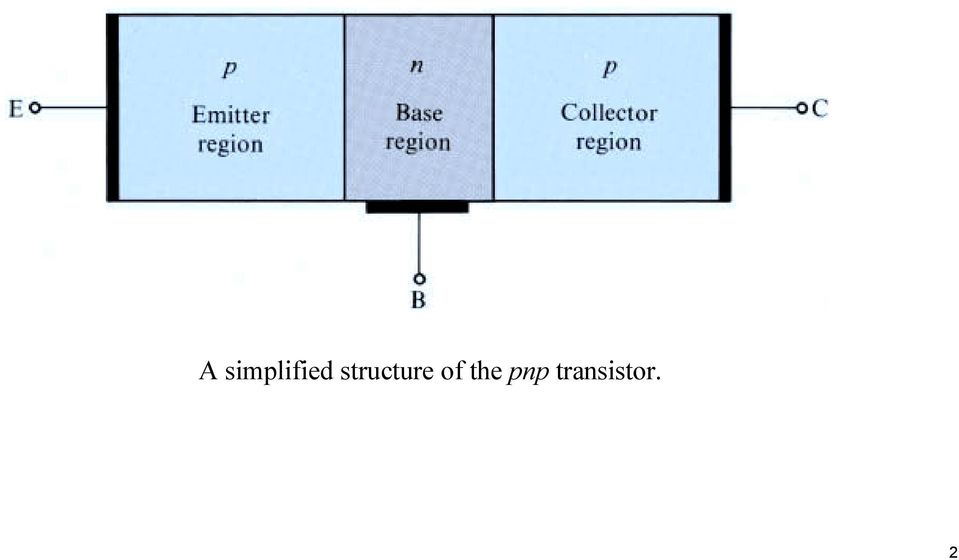
3 A simplified structure of the pnp transistor. 2
4 Current flow in an npn transistor biased to operate in the active mode, (Reverse current components due to drift of thermally generated minority carriers are not shown.) 3

5 Current flow in an pnp transistor biased to operate in the active mode. 4

6 The i C -v CB characteristics for an npn transistor in the active mode. 5

7 (a) Conceptual circuit for measuring the i C -v CE characteristics of the BJT. (b) The i C -v CE characteristics of a practical BJT. 6

8 (a) Conceptual circuit to illustrate the operation of the transistor of an amplifier. (b) The circuit of (a) with the signal source v be eliminated for dc (bias) analysis. 7

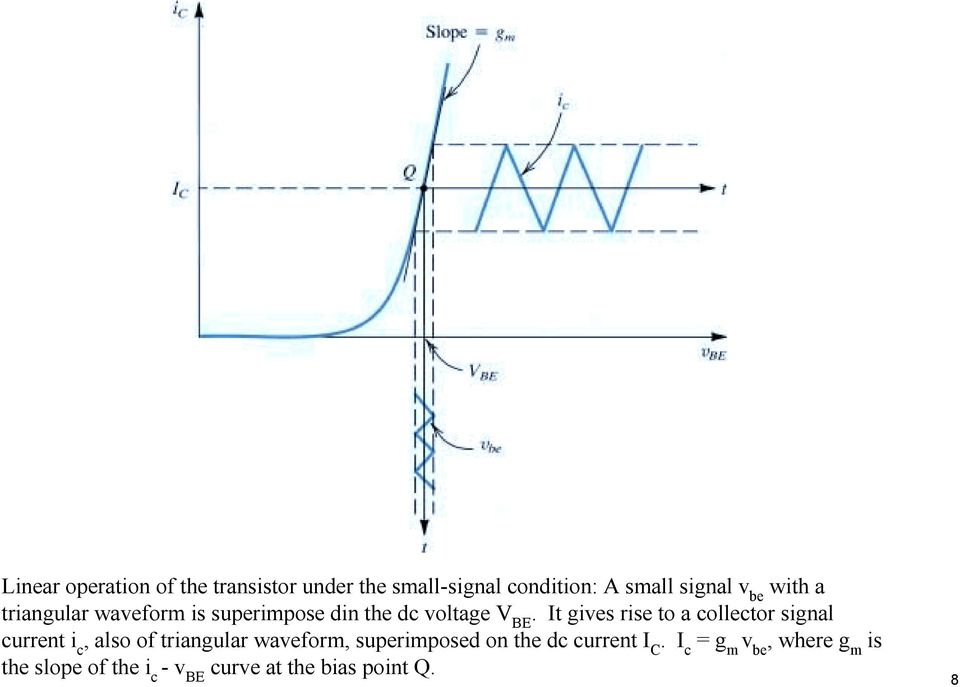
9 Linear operation of the transistor under the small-signal condition: A small signal v be with a triangular waveform is superimpose din the dc voltage V BE. It gives rise to a collector signal current i c, also of triangular waveform, superimposed on the dc current I C.I c = g m v be, where g m is the slope of the i c -v BE curve at the bias point Q. 8
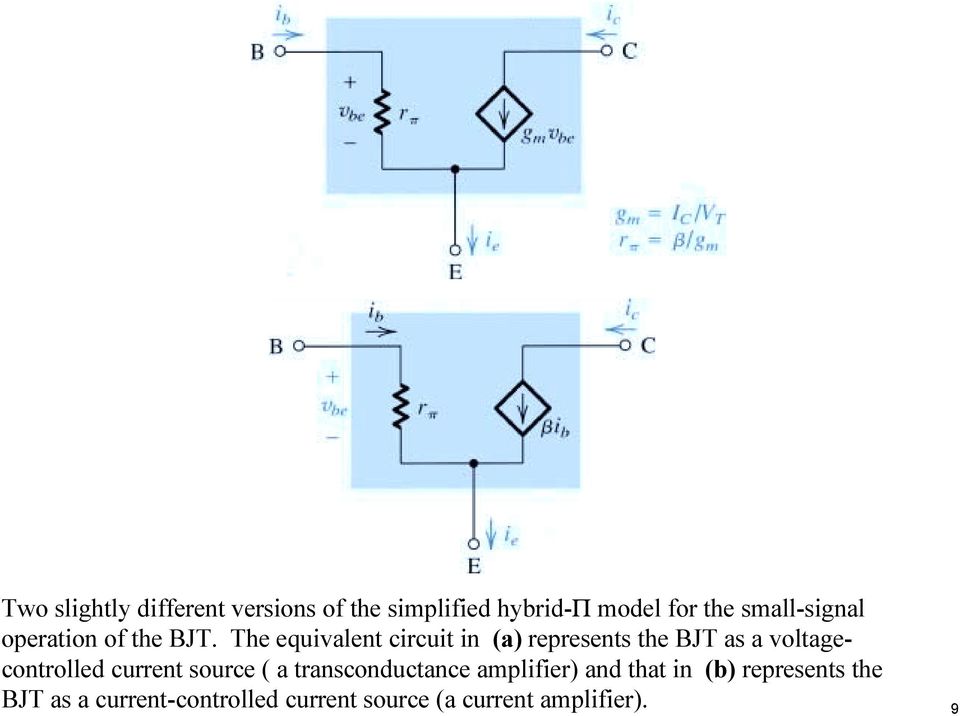
10 Two slightly different versions of the simplified hybrid-π model for the small-signal operation of the BJT. The equivalent circuit in (a) represents the BJT as a voltagecontrolled current source ( a transconductance amplifier) and that in (b) represents the BJT as a current-controlled current source (a current amplifier). 9
11 Two slightly different versions of what is known as the T model of the BJT. The circuit in (a) is a voltage-controlled current source representation and that in (b) is a currentcontrolled current source representation. These models explicitly show the emitter resistance r e rather than the base resistance r Π featured in the hybrid-π model. 10

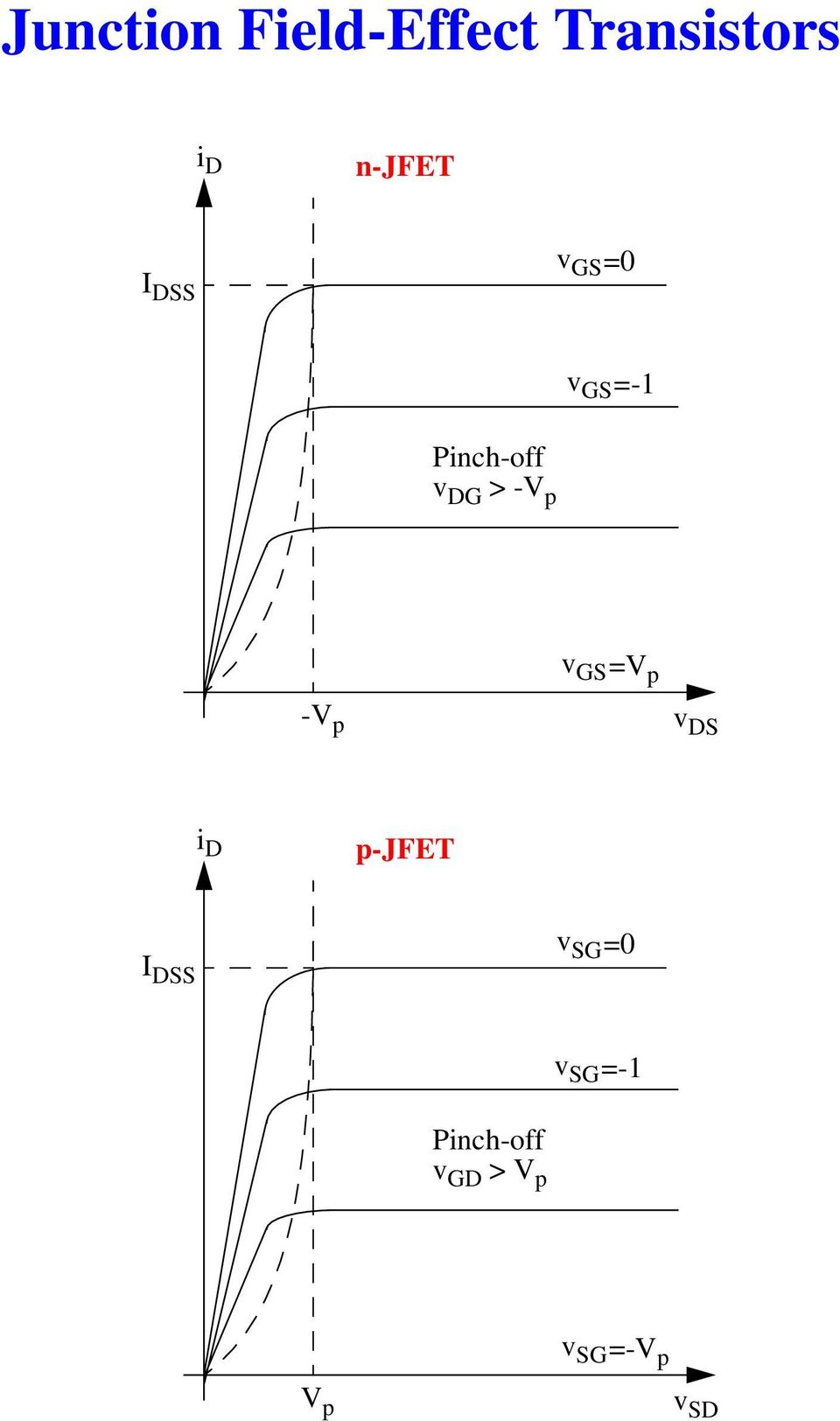
12 Junction Field-Effect Transistors i D n-jfet I DSS v GS =0 v GS =-1 Pinch-off v DG > -V p v GS =V p -V p v DS i D p-jfet I DSS v SG =0 Pinch-off v GD > V p v SG =-1 v SG =-V p V p v SD
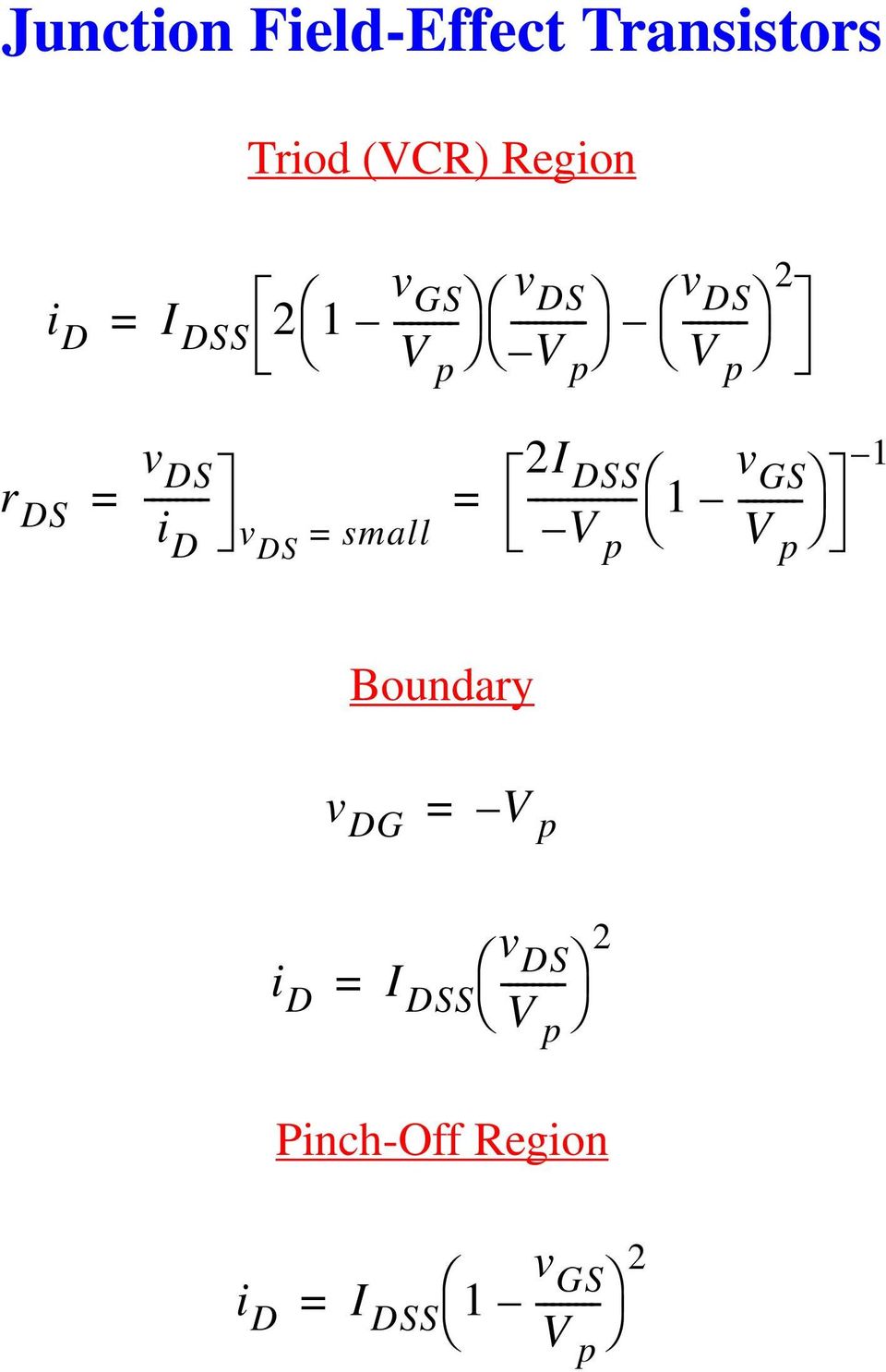
13 Junction Field-Effect Transistors Triod (VCR) Region i D = I DSS 2 1 v GS v DS V p V p v DS V p r DS v DS = = vds = small i D 2I DSS V 1 p v GS V p 1 Boundary v DG = V p i D = I v DS DSS V p Pinch-Off Region v GS i D = I DSS V p
14 MOSFETs 11
15 Physical structure of the enhancement-type NMOS transistor: (a) perspective view; (b) cross section. Typically L = 1 to 10 µm, W = 2 to 500 µm, and the thickness of the oxide layer is in the range of 0.02 to 0.1 µm. 12

16 The enhancement-type NMOS transistor with a positive voltage applied to the gate. An n channel is induced at the top of the substrate beneath the gate. 13

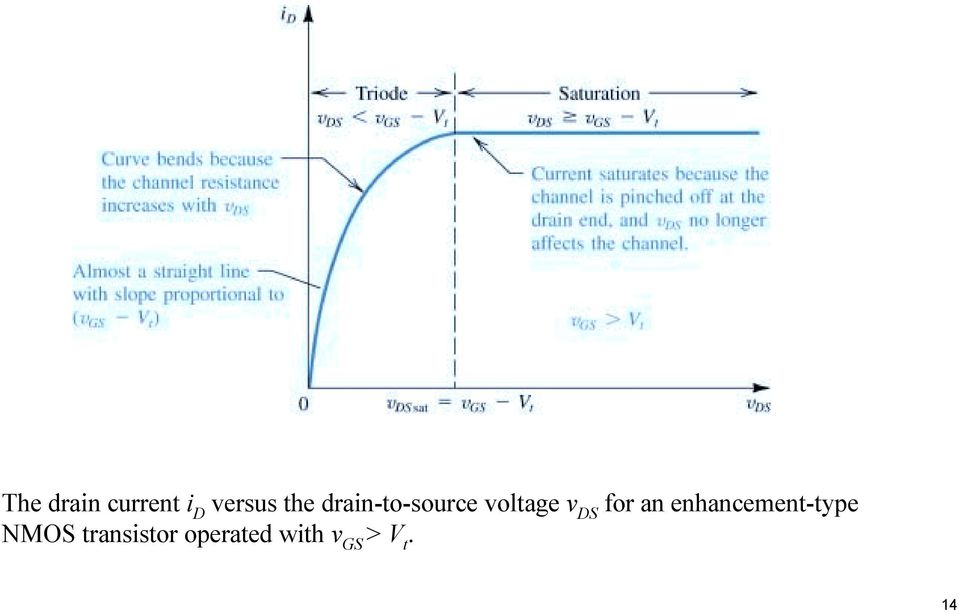
17 The drain current i D versus the drain-to-source voltage v DS for an enhancement-type NMOS transistor operated with v GS > V t. 14
18 Cross section of a CMOS integrated circuit. Note that the PMOS transistor is formed in a separate n-type region, known as an n well. Another arrangement is also possible in which an n-type body is used and the n device is formed in a p well. 15

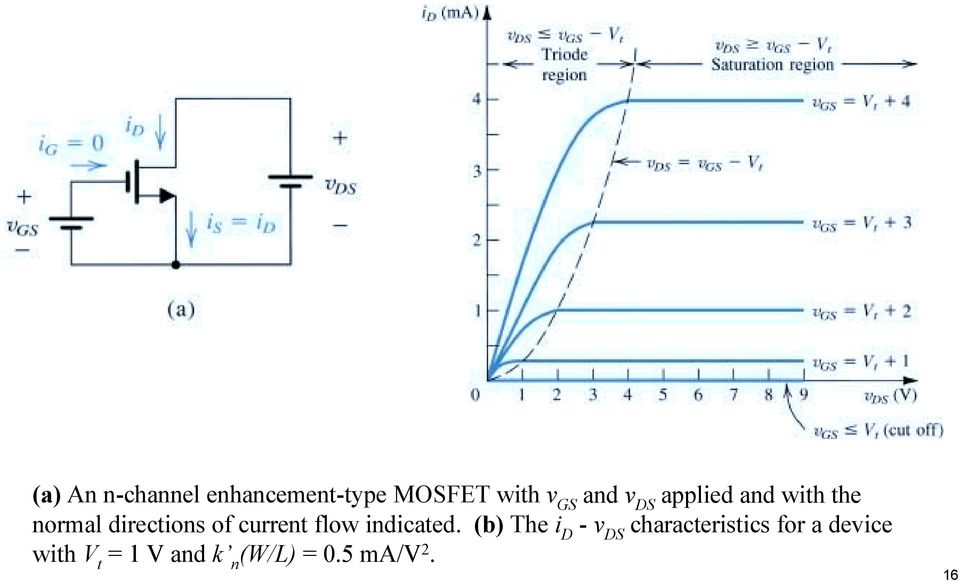
19 (a) An n-channel enhancement-type MOSFET with v GS and v DS applied and with the normal directions of current flow indicated. (b) The i D - v DS characteristics for a device with V t = 1 V and k n (W/L) = 0.5 ma/v 2. 16
20 The i D - v GS characteristic for an enhancement-type NMOS transistor in saturation (V t = 1 V and k n (W/L) = 0.5 ma/v 2 ). 17

21 Large-signal equivalent circuit model of the n-channel MOSFET in saturation, incorporating the output resistance r o. The output resistance models the linear dependence of i D on v DS and is given by r o V A/ I D. 18
22 Conceptual circuit utilized to study the operation of the MOSFET as an amplifier. 19
23 Small-signal operation of the enhancement MOSFET amplifier. 20
24 Small-signal models for the MOSFET: (a) neglecting the dependence of i D on v DS in saturation (channel-length modulation effect); and (b) including the effect of channellength modulation modeled by output resistance r o = V A / I D. 21
25 (a) The CMOS inverter. (b) Simplified circuit schematic for the inverter. 22
26 Dynamic operation of a capacitively loaded CMOS inverter: (a) circuit; (b) input and output waveforms. 23
Bob York. Transistor Basics - MOSFETs
 Bob York Transistor Basics - MOSFETs Transistors, Conceptually So far we have considered two-terminal devices that are described by a current-voltage relationship I=f(V Resistors: Capacitors: Inductors:
Transconductance. (Saturated) MOSFET Small-Signal Model. The small-signal drain current due to v gs is therefore given by
 11 (Saturated) MOSFET Small-Signal Model Transconductance Concept: find an equivalent circuit which interrelates the incremental changes in i D v GS v DS etc. for the MOSFET in saturation The small-signal
Fig6-22 CB configuration. Z i [6-54] Z o [6-55] A v [6-56] Assuming R E >> r e. A i [6-57]
![Fig6-22 CB configuration. Z i [6-54] Z o [6-55] A v [6-56] Assuming R E >> r e. A i [6-57]](/thumbs/40/21338705.jpg "Fig6-22 CB configuration. Z i [6-54] Z o [6-55] A v [6-56] Assuming R E >> r e. A i [6-57]") Common-Base Configuration (CB) The CB configuration having a low input and high output impedance and a current gain less than 1, the voltage gain can be quite large, r o in MΩ so that ignored in parallel
Common-Base Configuration (CB) The CB configuration having a low input and high output impedance and a current gain less than 1, the voltage gain can be quite large, r o in MΩ so that ignored in parallel
Field-Effect (FET) transistors
 Field-Effect (FET) transistors References: Hayes & Horowitz (pp 142-162 and 244-266), Rizzoni (chapters 8 & 9) In a field-effect transistor (FET), the width of a conducting channel in a semiconductor and,
Bipolar Junction Transistor Basics
 by Kenneth A. Kuhn Sept. 29, 2001, rev 1 Introduction A bipolar junction transistor (BJT) is a three layer semiconductor device with either NPN or PNP construction. Both constructions have the identical
Lecture 060 Push-Pull Output Stages (1/11/04) Page 060-1. ECE 6412 - Analog Integrated Circuits and Systems II P.E. Allen - 2002
 Lecture 060 PushPull Output Stages (1/11/04) Page 0601 LECTURE 060 PUSHPULL OUTPUT STAGES (READING: GHLM 362384, AH 226229) Objective The objective of this presentation is: Show how to design stages that
Notes about Small Signal Model. for EE 40 Intro to Microelectronic Circuits
 Notes about Small Signal Model for EE 40 Intro to Microelectronic Circuits 1. Model the MOSFET Transistor For a MOSFET transistor, there are NMOS and PMOS. The examples shown here would be for NMOS. Figure
CO2005: Electronics I (FET) Electronics I, Neamen 3th Ed. 1
 CO2005: Electronics I The Field-Effect Transistor (FET) Electronics I, Neamen 3th Ed. 1 MOSFET The metal-oxide-semiconductor field-effect transistor (MOSFET) becomes a practical reality in the 1970s. The
EDC Lesson 12: Transistor and FET Characteristics. 2008 EDCLesson12- ", Raj Kamal, 1
 EDC Lesson 12: Transistor and FET Characteristics Lesson-12: MOSFET (enhancement and depletion mode) Characteristics and Symbols 2008 EDCLesson12- ", Raj Kamal, 1 1. Metal Oxide Semiconductor Field Effect
COMMON-SOURCE JFET AMPLIFIER
 EXPERIMENT 04 Objectives: Theory: 1. To evaluate the common-source amplifier using the small signal equivalent model. 2. To learn what effects the voltage gain. A self-biased n-channel JFET with an AC
Chapter 10 Advanced CMOS Circuits
 Transmission Gates Chapter 10 Advanced CMOS Circuits NMOS Transmission Gate The active pull-up inverter circuit leads one to thinking about alternate uses of NMOS devices. Consider the circuit shown in
BJT Ebers-Moll Model and SPICE MOSFET model
 Department of Electrical and Electronic Engineering mperial College London EE 2.3: Semiconductor Modelling in SPCE Course homepage: http://www.imperial.ac.uk/people/paul.mitcheson/teaching BJT Ebers-Moll
W04 Transistors and Applications. Yrd. Doç. Dr. Aytaç Gören
 W04 Transistors and Applications W04 Transistors and Applications ELK 2018 - Contents W01 Basic Concepts in Electronics W02 AC to DC Conversion W03 Analysis of DC Circuits (self and condenser) W04 Transistors
Lecture 30: Biasing MOSFET Amplifiers. MOSFET Current Mirrors.
 Whites, EE 320 Lecture 30 Page 1 of 8 Lecture 30: Biasing MOSFET Amplifiers. MOSFET Current Mirrors. There are two different environments in which MOSFET amplifiers are found, (1) discrete circuits and
AN105. Introduction: The Nature of VCRs. Resistance Properties of FETs
 Introduction: The Nature of s A voltage-controlled resistor () may be defined as a three-terminal variable resistor where the resistance value between two of the terminals is controlled by a voltage potential
Bob York. Transistor Basics - BJTs
 ob York Transistor asics - JTs ipolar Junction Transistors (JTs) Key points: JTs are current-controlled devices very JT has a base, collector, and emitter The base current controls the collector current
CHAPTER 10 OPERATIONAL-AMPLIFIER CIRCUITS
 CHAPTER 10 OPERATIONAL-AMPLIFIER CIRCUITS Chapter Outline 10.1 The Two-Stage CMOS Op Amp 10.2 The Folded-Cascode CMOS Op Amp 10.3 The 741 Op-Amp Circuit 10.4 DC Analysis of the 741 10.5 Small-Signal Analysis
LAB VII. BIPOLAR JUNCTION TRANSISTOR CHARACTERISTICS
 LAB VII. BIPOLAR JUNCTION TRANSISTOR CHARACTERISTICS 1. OBJECTIVE In this lab, you will study the DC characteristics of a Bipolar Junction Transistor (BJT). 2. OVERVIEW You need to first identify the physical
Bipolar Junction Transistors
 Bipolar Junction Transistors Physical Structure & Symbols NPN Emitter (E) n-type Emitter region p-type Base region n-type Collector region Collector (C) B C Emitter-base junction (EBJ) Base (B) (a) Collector-base
Power MOSFET Basics Abdus Sattar, IXYS Corporation
 Power MOSFET Basics Abdus Sattar, IXYS Corporation Power MOSFETs have become the standard choice for the main switching devices in a broad range of power conversion applications. They are majority carrier
CHAPTER 10 Fundamentals of the Metal Oxide Semiconductor Field Effect Transistor
 CHAPTER 10 Fundamentals of the Metal Oxide Semiconductor Field Effect Transistor Study the characteristics of energy bands as a function of applied voltage in the metal oxide semiconductor structure known
Lecture 9 - MOSFET (I) MOSFET I-V Characteristics. October 6, 2005
 6.12 - Microelectronic Devices and Circuits - Fall 25 Lecture 9-1 Lecture 9 - MOSFET (I) MOSFET I-V Characteristics October 6, 25 Contents: 1. MOSFET: cross-section, layout, symbols 2. Qualitative operation
5.11 THE JUNCTION FIELD-EFFECT TRANSISTOR (JFET)
 This material is from a previous edition of Microelectronic Circuits. These sections provide valuable information, but please note that the references do not correspond to the 6th or 7th edition of the
Chapter 8 Differential and Multistage Amplifiers. EE 3120 Microelectronics II
 1 Chapter 8 Differential and Multistage Amplifiers Operational Amplifier Circuit Components 2 1. Ch 7: Current Mirrors and Biasing 2. Ch 9: Frequency Response 3. Ch 8: Active-Loaded Differential Pair 4.
Lecture 9 - MOSFET (I) MOSFET I-V Characteristics. March 6, 2003
 6.12 - Microelectronic Devices and Circuits - Spring 23 Lecture 9-1 Lecture 9 - MOSFET (I) MOSFET I-V Characteristics March 6, 23 Contents: 1. MOSFET: cross-section, layout, symbols 2. Qualitative operation
Small Signal Analysis of a PMOS transistor Consider the following PMOS transistor to be in saturation. Then, 1 2
 Small Signal Analysis of a PMOS transistor Consider the following PMOS transistor to be in saturation. Then, 1 I SD = µ pcox( VSG Vtp)^2(1 + VSDλ) 2 From this equation it is evident that I SD is a function
Field Effect Transistors and Noise
 Physics 3330 Experiment #8 Fall 2005 Field Effect Transistors and Noise Purpose In this experiment we introduce field effect transistors. We will measure the output characteristics of a FET, and then construct
Lecture 21: Junction Field Effect Transistors. Source Follower Amplifier
 Whites, EE 322 Lecture 21 Page 1 of 8 Lecture 21: Junction Fiel Effect Transistors. Source Follower Amplifier As mentione in Lecture 16, there are two major families of transistors. We ve worke with BJTs
Basic FET Ampli ers 6.0 PREVIEW 6.1 THE MOSFET AMPLIFIER
 C H A P T E R 6 Basic FET Ampli ers 6.0 PREVIEW In the last chapter, we described the operation of the FET, in particular the MOSFET, and analyzed and designed the dc response of circuits containing these
Lecture 17 The Bipolar Junction Transistor (I) Forward Active Regime
 Lecture 17 The Bipolar Junction Transistor (I) Forward Active Regime Outline The Bipolar Junction Transistor (BJT): structure and basic operation I-V characteristics in forward active regime Reading Assignment:
An FET Audio Peak Limiter
 1 An FET Audio Peak Limiter W. Marshall Leach, Jr., Professor Georgia Institute of Technology School of Electrical and Computer Engineering Atlanta, Georgia 30332-0250 USA email: [email protected] Copyright
Lecture 8 MOSFET(I) MOSFET I-V CHARACTERISTICS
 Lecture 8 MOSFET(I) MOSFET I-V CHARACTERISTICS Outline 1. MOSFET: cross-section, layout, symbols 2. Qualitative operation 3. I-V characteristics Reading Assignment: Howe and Sodini, Chapter 4, Sections
Fundamentals of Microelectronics
 Fundamentals of Microelectronics H1 Why Microelectronics? H2 Basic Physics of Semiconductors H3 Diode ircuits H4 Physics of Bipolar ransistors H5 Bipolar Amplifiers H6 Physics of MOS ransistors H7 MOS
3.4 - BJT DIFFERENTIAL AMPLIFIERS
 BJT Differential Amplifiers (6/4/00) Page 1 3.4 BJT DIFFERENTIAL AMPLIFIERS INTRODUCTION Objective The objective of this presentation is: 1.) Define and characterize the differential amplifier.) Show the
BIPOLAR JUNCTION TRANSISTORS
 CHAPTER 3 BIPOLAR JUNCTION TRANSISTORS A bipolar junction transistor, BJT, is a single piece of silicon with two back-to-back P-N junctions. However, it cannot be made with two independent back-to-back
BJT Characteristics and Amplifiers
 BJT Characteristics and Amplifiers Matthew Beckler [email protected] EE2002 Lab Section 003 April 2, 2006 Abstract As a basic component in amplifier design, the properties of the Bipolar Junction Transistor
LAB VIII. BIPOLAR JUNCTION TRANSISTOR CHARACTERISTICS
 LAB VIII. BIPOLAR JUNCTION TRANSISTOR CHARACTERISTICS 1. OBJECTIVE In this lab, you will study the DC characteristics of a Bipolar Junction Transistor (BJT). 2. OVERVIEW In this lab, you will inspect the
Application Note AN-940
 Application Note AN-940 How P-Channel MOSFETs Can Simplify Your Circuit Table of Contents Page 1. Basic Characteristics of P-Channel HEXFET Power MOSFETs...1 2. Grounded Loads...1 3. Totem Pole Switching
Lecture 090 Large Signal MOSFET Model (3/24/10) Page 090-1
 Lecture 9 Large Signal MOSFET Model (3/24/1) Page 9-1 LECTURE 9 LARGE SIGNAL MOSFET MODEL LECTURE ORGANIZATION Outline Introduction to modeling Operation of the MOS transistor Simple large signal model
Figure 1: Common-base amplifier.
 The Common-Base Amplifier Basic Circuit Fig. 1 shows the circuit diagram of a single stage common-base amplifier. The object is to solve for the small-signal voltage gain, input resistance, and output
Field Effect Transistors
 506 19 Principles of Electronics Field Effect Transistors 191 Types of Field Effect Transistors 193 Principle and Working of JFET 195 Importance of JFET 197 JFET as an Amplifier 199 Salient Features of
Current mirrors are commonly used for current sources in integrated circuit design. This section covers other current sources that are often seen.
 c Coyright 2009. W. Marshall Leach, Jr., Professor, Georgia Institute of Technology, School of Electrical and Comuter Engineering. Current Sources Current mirrors are commonly used for current sources
The MOSFET Transistor
 The MOSFET Transistor The basic active component on all silicon chips is the MOSFET Metal Oxide Semiconductor Field Effect Transistor Schematic symbol G Gate S Source D Drain The voltage on the gate controls
Basic Electronics Prof. Dr. Chitralekha Mahanta Department of Electronics and Communication Engineering Indian Institute of Technology, Guwahati
 Basic Electronics Prof. Dr. Chitralekha Mahanta Department of Electronics and Communication Engineering Indian Institute of Technology, Guwahati Module: 2 Bipolar Junction Transistors Lecture-2 Transistor
Here we introduced (1) basic circuit for logic and (2)recent nano-devices, and presented (3) some practical issues on nano-devices.
 Outline Here we introduced () basic circuit for logic and (2)recent nano-devices, and presented (3) some practical issues on nano-devices. Circuit Logic Gate A logic gate is an elemantary building block
LAB 7 MOSFET CHARACTERISTICS AND APPLICATIONS
 LAB 7 MOSFET CHARACTERISTICS AND APPLICATIONS Objective In this experiment you will study the i-v characteristics of an MOS transistor. You will use the MOSFET as a variable resistor and as a switch. BACKGROUND
OBJECTIVE QUESTIONS IN ANALOG ELECTRONICS
 1. The early effect in a bipolar junction transistor is caused by (a) fast turn-on (c) large collector-base reverse bias (b)fast turn-off (d) large emitter-base forward bias 2. MOSFET can be used as a
Junction FETs. FETs. Enhancement Not Possible. n p n p n p
 A11 An Introduction to FETs Introduction The basic principle of the field-effect transistor (FET) has been known since J. E. Lilienfeld s patent of 1925. The theoretical description of a FET made by hockley
The MOS Transistor in Weak Inversion
 MOFE Operation in eak and Moderate nversion he MO ransistor in eak nversion n this section we will lore the behavior of the MO transistor in the subthreshold regime where the channel is weakly inverted.
Features. Symbol JEDEC TO-220AB
 Data Sheet June 1999 File Number 2253.2 3A, 5V,.4 Ohm, N-Channel Power MOSFET This is an N-Channel enhancement mode silicon gate power field effect transistor designed for applications such as switching
An Introduction to the EKV Model and a Comparison of EKV to BSIM
 An Introduction to the EKV Model and a Comparison of EKV to BSIM Stephen C. Terry 2. 3.2005 Integrated Circuits & Systems Laboratory 1 Overview Characterizing MOSFET operating regions EKV model fundamentals
Digital Integrated Circuit (IC) Layout and Design - Week 3, Lecture 5
 igital Integrated Circuit (IC) Layout and esign - Week 3, Lecture 5! http://www.ee.ucr.edu/~rlake/ee134.html EE134 1 Reading and Prelab " Week 1 - Read Chapter 1 of text. " Week - Read Chapter of text.
CONTENTS. Preface. 1.1.2. Energy bands of a crystal (intuitive approach)
 CONTENTS Preface. Energy Band Theory.. Electron in a crystal... Two examples of electron behavior... Free electron...2. The particle-in-a-box approach..2. Energy bands of a crystal (intuitive approach)..3.
Transistor Models. ampel
 Transistor Models Review of Transistor Fundamentals Simple Current Amplifier Model Transistor Switch Example Common Emitter Amplifier Example Transistor as a Transductance Device - Ebers-Moll Model Other
Transistor amplifiers: Biasing and Small Signal Model
 Transistor amplifiers: iasing and Small Signal Model Transistor amplifiers utilizing JT or FT are similar in design and analysis. Accordingly we will discuss JT amplifiers thoroughly. Then, similar FT
CAR IGNITION WITH IGBTS
 APPLICATION NOTE CAR IGNITION WITH IGBTS by M. Melito ABSTRACT IGBTs are used in a variety of switching applications thanks to their attractive characteristics, particularly their peak current capability,
University of California, Berkeley Department of Electrical Engineering and Computer Sciences EE 105: Microelectronic Devices and Circuits
 University of California, Berkeley Department of Electrical Engineering and Computer Sciences EE 105: Microelectronic Devices and Circuits LTSpice LTSpice is a free circuit simulator based on Berkeley
05 Bipolar Junction Transistors (BJTs) basics
 The first bipolar transistor was realized in 1947 by Brattain, Bardeen and Shockley. The three of them received the Nobel prize in 1956 for their invention. The bipolar transistor is composed of two PN
Unit/Standard Number. High School Graduation Years 2010, 2011 and 2012
 1 Secondary Task List 100 SAFETY 101 Demonstrate an understanding of State and School safety regulations. 102 Practice safety techniques for electronics work. 103 Demonstrate an understanding of proper
AMPLIFIERS BJT BJT TRANSISTOR. Types of BJT BJT. devices that increase the voltage, current, or power level
 AMPLFERS Prepared by Engr. JP Timola Reference: Electronic Devices by Floyd devices that increase the voltage, current, or power level have at least three terminals with one controlling the flow between
CHAPTER 2 POWER AMPLIFIER
 CHATER 2 OWER AMLFER 2.0 ntroduction The main characteristics of an amplifier are Linearity, efficiency, output power, and signal gain. n general, there is a trade off between these characteristics. For
Physics 120 Lab 6: Field Effect Transistors - Ohmic region
 Physics 120 Lab 6: Field Effect Transistors - Ohmic region The FET can be used in two extreme ways. One is as a voltage controlled resistance, in the so called "Ohmic" region, for which V DS < V GS - V
Integrated Circuits & Systems
 Federal University of Santa Catarina Center for Technology Computer Science & Electronics Engineering Integrated Circuits & Systems INE 5442 Lecture 11 MOSFET part 2 [email protected] I D -V DS Characteristics
DEANSHIP OF ACADEMIC DEVELOPMENT e-learning Center GUIDELINES FOR
 DEANSHIP OF ACADEMIC DEVELOPMENT e-learning Center GUIDELINES FOR LAST REVISED: May 2005 TABLE OF CONTENTS Page 1. INTRODUCTION 1 2. ONLINE COURSES 1 3. ELIGIBLITY 2 4. SELECTION CRIERIA 3 5. CONDITIONS
Series and Parallel Circuits
 Direct Current (DC) Direct current (DC) is the unidirectional flow of electric charge. The term DC is used to refer to power systems that use refer to the constant (not changing with time), mean (average)
Transistors. NPN Bipolar Junction Transistor
 Transistors They are unidirectional current carrying devices with capability to control the current flowing through them The switch current can be controlled by either current or voltage ipolar Junction
Automotive MOSFETs in Linear Applications: Thermal Instability
 Application Note, V1.0, May 2005 Automotive MOSFETs in Linear Applications: Thermal Instability by Peter H. Wilson Automotive Power N e v e r s t o p t h i n k i n g. - 1 - Table of Content 1. Introduction...
CHAPTER 16 MEMORY CIRCUITS
 CHPTER 6 MEMORY CIRCUITS Chapter Outline 6. atches and Flip-Flops 6. Semiconductor Memories: Types and rchitectures 6.3 Random-ccess Memory RM Cells 6.4 Sense-mplifier and ddress Decoders 6.5 Read-Only
BUZ11. 30A, 50V, 0.040 Ohm, N-Channel Power MOSFET. Features. [ /Title (BUZ1 1) /Subject. (30A, 50V, 0.040 Ohm, N- Channel. Ordering Information
 Data Sheet June 1999 File Number 2253.2 [ /Title (BUZ1 1) /Subject (3A, 5V,.4 Ohm, N- Channel Power MOS- FET) /Autho r () /Keywords (Intersil Corporation, N- Channel Power MOS- FET, TO- 22AB ) /Creator
VI. Transistor amplifiers: Biasing and Small Signal Model
 VI. Transistor amplifiers: iasing and Small Signal Model 6.1 Introduction Transistor amplifiers utilizing JT or FET are similar in design and analysis. Accordingly we will discuss JT amplifiers thoroughly.
Lecture-7 Bipolar Junction Transistors (BJT) Part-I Continued
 1 Lecture-7 ipolar Junction Transistors (JT) Part-I ontinued 1. ommon-emitter (E) onfiguration: Most JT circuits employ the common-emitter configuration shown in Fig.1. This is due mainly to the fact that
Lecture 9 MOSFET(II) MOSFET I-V CHARACTERISTICS(contd.)
 Lecture 9 MOSFET(II) MOSFET I-V CHARACTERISTICS(contd.) Outline 1. The saturation regime 2. Backgate characteristics Reading Assignment: Howe and Sodini, Chapter 4, Section 4.4 Announcements: 1. Quiz#1:
The basic cascode amplifier consists of an input common-emitter (CE) configuration driving an output common-base (CB), as shown above.
 Cascode Amplifiers by Dennis L. Feucht Two-transistor combinations, such as the Darlington configuration, provide advantages over single-transistor amplifier stages. Another two-transistor combination
CIRCUITS LABORATORY. In this experiment, the output I-V characteristic curves, the small-signal low
 CIRCUITS LABORATORY EXPERIMENT 6 TRANSISTOR CHARACTERISTICS 6.1 ABSTRACT In this experiment, the output I-V characteristic curves, the small-signal low frequency equivalent circuit parameters, and the
The 2N3393 Bipolar Junction Transistor
 The 2N3393 Bipolar Junction Transistor Common-Emitter Amplifier Aaron Prust Abstract The bipolar junction transistor (BJT) is a non-linear electronic device which can be used for amplification and switching.
Bipolar Transistor Amplifiers
 Physics 3330 Experiment #7 Fall 2005 Bipolar Transistor Amplifiers Purpose The aim of this experiment is to construct a bipolar transistor amplifier with a voltage gain of minus 25. The amplifier must
The two simplest atoms. Electron shells and Orbits. Electron shells and Orbits
 EET140/ET1 Electronics Semiconductors and Diodes Electrical and Telecommunications Engineering Technology Department Prepared by textbook based on Electronics Devices by Floyd, Prentice Hall, 7 th edition.
Module 7 : I/O PADs Lecture 33 : I/O PADs
 Module 7 : I/O PADs Lecture 33 : I/O PADs Objectives In this lecture you will learn the following Introduction Electrostatic Discharge Output Buffer Tri-state Output Circuit Latch-Up Prevention of Latch-Up
Common Base BJT Amplifier Common Collector BJT Amplifier
 Common Base BJT Amplifier Common Collector BJT Amplifier Common Collector (Emitter Follower) Configuration Common Base Configuration Small Signal Analysis Design Example Amplifier Input and Output Impedances
Content Map For Career & Technology
 Content Strand: Applied Academics CT-ET1-1 analysis of electronic A. Fractions and decimals B. Powers of 10 and engineering notation C. Formula based problem solutions D. Powers and roots E. Linear equations
JFET Characteristics
 JFET Characteristics Objective Although arguably the first transistor invented the field-effect transistor did not become established as an important semiconductor device until experience with the BJT
Lecture 12: DC Analysis of BJT Circuits.
 Whites, 320 Lecture 12 Page 1 of 9 Lecture 12: D Analysis of JT ircuits. n this lecture we will consider a number of JT circuits and perform the D circuit analysis. For those circuits with an active mode
Transistor Amplifiers
 Physics 3330 Experiment #7 Fall 1999 Transistor Amplifiers Purpose The aim of this experiment is to develop a bipolar transistor amplifier with a voltage gain of minus 25. The amplifier must accept input
Biasing in MOSFET Amplifiers
 Biasing in MOSFET Amplifiers Biasing: Creating the circuit to establish the desired DC oltages and currents for the operation of the amplifier Four common ways:. Biasing by fixing GS. Biasing by fixing
Understanding Low Drop Out (LDO) Regulators
 Understanding Low Drop Out (LDO) Regulators Michael Day, Texas Instruments ABSTRACT This paper provides a basic understanding of the dropout performance of a low dropout linear regulator (LDO). It shows
STW20NM50 N-CHANNEL 550V @ Tjmax - 0.20Ω - 20ATO-247 MDmesh MOSFET
 N-CHANNEL 550V @ Tjmax - 0.20Ω - 20ATO-247 MDmesh MOSFET TYPE V DSS (@Tjmax) R DS(on) I D STW20NM50 550V < 0.25Ω 20 A TYPICAL R DS (on) = 0.20Ω HIGH dv/dt AND AVALANCHE CAPABILITIES 100% AVALANCHE TESTED
ECE124 Digital Circuits and Systems Page 1
 ECE124 Digital Circuits and Systems Page 1 Chip level timing Have discussed some issues related to timing analysis. Talked briefly about longest combinational path for a combinational circuit. Talked briefly
Design And Application Guide For High Speed MOSFET Gate Drive Circuits
 Design And Application Guide For High Speed MOSFET Gate Drive Circuits By Laszlo Balogh ABSTRACT The main purpose of this paper is to demonstrate a systematic approach to design high performance gate drive
Op-Amp Simulation EE/CS 5720/6720. Read Chapter 5 in Johns & Martin before you begin this assignment.
 Op-Amp Simulation EE/CS 5720/6720 Read Chapter 5 in Johns & Martin before you begin this assignment. This assignment will take you through the simulation and basic characterization of a simple operational
A PHYSICAL MODEL FOR MOSFET OUTPUT RESISTANCE. by J. H. Huang, 2. H. Liu, M. C. Jeng, P. K. KO, C. Hu. Memorandum No.
 A PHYSICAL MODEL FOR MOSFET OUTPUT RESISTANCE by J. H. Huang, 2. H. Liu, M. C. Jeng, P. K. KO, C. Hu Memorandum No. UCB/ERL M93/56 21 July 1993 A PHYSICAL MODEL FOR MOSFET OUTPUT RESISTANCE by J. H. Huang,
MOSFET N-channel enhancement switching transistor IMPORTANT NOTICE. http://www.philips.semiconductors.com use http://www.nxp.com
 Rev. 3 21 November 27 Product data sheet Dear customer, IMPORTANT NOTICE As from October 1st, 26 Philips Semiconductors has a new trade name - NXP Semiconductors, which will be used in future data sheets
IRF150 [REF:MIL-PRF-19500/543] 100V, N-CHANNEL. Absolute Maximum Ratings
![IRF150 [REF:MIL-PRF-19500/543] 100V, N-CHANNEL. Absolute Maximum Ratings](/thumbs/40/21333646.jpg "IRF150 [REF:MIL-PRF-19500/543] 100V, N-CHANNEL. Absolute Maximum Ratings") PD - 90337G REPETITIVE AVALANCHE AND dv/dt RATED HEXFET TRANSISTORS THRU-HOLE (TO-204AA/AE) Product Summary Part Number BVDSS RDS(on) ID IRF150 100V 0.055Ω 38A IRF150 JANTX2N6764 JANTXV2N6764 [REF:MIL-PRF-19500/543]
PD - 90337G REPETITIVE AVALANCHE AND dv/dt RATED HEXFET TRANSISTORS THRU-HOLE (TO-204AA/AE) Product Summary Part Number BVDSS RDS(on) ID IRF150 100V 0.055Ω 38A IRF150 JANTX2N6764 JANTXV2N6764 [REF:MIL-PRF-19500/543]
Power MOSFET Basics By Vrej Barkhordarian, International Rectifier, El Segundo, Ca.
 Power MOFET Basics By Vrej Barkhordarian, International Rectifier, El egundo, Ca. Breakdown Voltage... On-resistance... Transconductance... Threshold Voltage... iode Forward Voltage... Power issipation...
Oscillations and Regenerative Amplification using Negative Resistance Devices
 Oscillations and Regenerative Amplification using Negative Resistance Devices Ramon Vargas Patron [email protected] INICTEL The usual procedure for the production of sustained oscillations in tuned
SIPMOS Small-Signal-Transistor
 SIPMOS Small-Signal-Transistor Features N-channel Depletion mode dv /dt rated Product Summary V DS V R DS(on),max 3.5 Ω I DSS,min.4 A Available with V GS(th) indicator on reel Pb-free lead plating; RoHS
OptiMOS 3 Power-Transistor
 Type IPD6N3L G OptiMOS 3 Power-Transistor Features Fast switching MOSFET for SMPS Optimized technology for DC/DC converters Qualified according to JEDEC 1) for target applications Product Summary V DS
STP80NF55-08 STB80NF55-08 STB80NF55-08-1 N-CHANNEL 55V - 0.0065 Ω - 80A D2PAK/I2PAK/TO-220 STripFET II POWER MOSFET
 STP80NF55-08 STB80NF55-08 STB80NF55-08-1 N-CHANNEL 55V - 0.0065 Ω - 80A D2PAK/I2PAK/TO-220 STripFET II POWER MOSFET TYPE V DSS R DS(on) I D STB80NF55-08/-1 STP80NF55-08 55 V 55 V
Transistor Biasing. The basic function of transistor is to do amplification. Principles of Electronics
 192 9 Principles of Electronics Transistor Biasing 91 Faithful Amplification 92 Transistor Biasing 93 Inherent Variations of Transistor Parameters 94 Stabilisation 95 Essentials of a Transistor Biasing
Semiconductors, diodes, transistors
 Semiconductors, diodes, transistors (Horst Wahl, QuarkNet presentation, June 2001) Electrical conductivity! Energy bands in solids! Band structure and conductivity Semiconductors! Intrinsic semiconductors!