
Practice with Proofs
|
|
|
- Ariel Harmon
- 9 years ago
- Views:
Transcription
1 Practice with Proofs October 6, 2014 Recall the following Definition 0.1. A function f is increasing if for every x, y in the domain of f, x < y = f(x) < f(y) 1. Prove that h(x) = x 3 is increasing, using algebra. 2. Prove that g(x) = x 3 x is not increasing. 3. Suppose that f is an increasing function with domain R. Prove that f is not even. 4. Suppose that f is an increasing function. Show that for every x, y in the domain of f, x < y f(x) < f(y) 5. Write down an increasing function whose domain is R, but whose range is strictly smaller than R. 6. Prove that increasing functions are one-to-one. 7. Suppose that f is an increasing function with domain and range R. (a) What are the domain and range of f 1? (b) Show that f 1 is increasing. (c) Show that for every x, y, we have equivalences and y < f(x) f 1 (y) < x y > f(x) f 1 (y) > x. (d) Show that f is continuous. Hint: you ll need to solve for x, using f 1. f(a) ɛ < f(x) < f(a) + ɛ 8. Write down an increasing non-continuous function f whose domain is all of R. 1

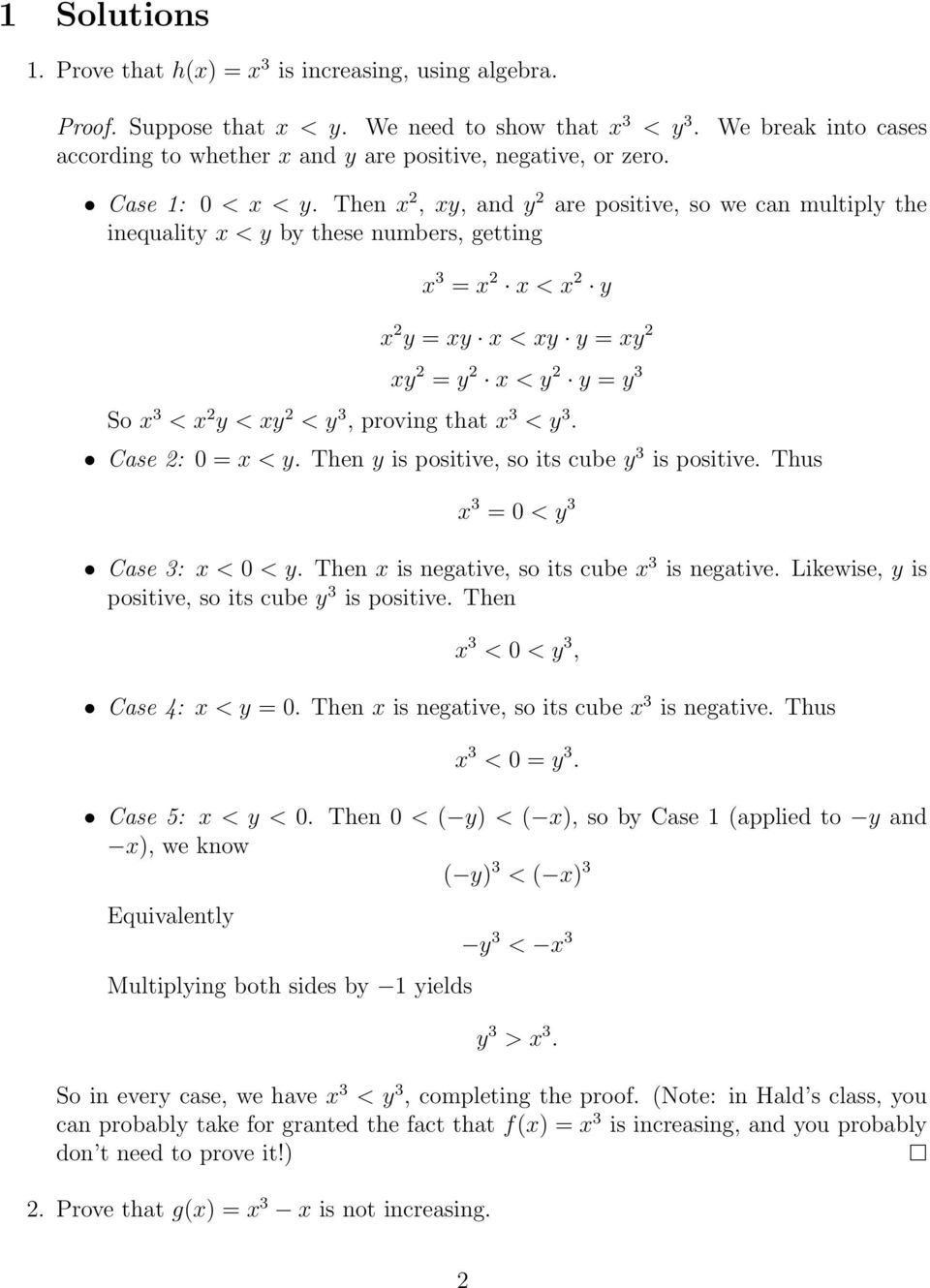
2 1 Solutions 1. Prove that h(x) = x 3 is increasing, using algebra. Proof. Suppose that x < y. We need to show that x 3 < y 3. We break into cases according to whether x and y are positive, negative, or zero. Case 1: 0 < x < y. Then x 2, xy, and y 2 are positive, so we can multiply the inequality x < y by these numbers, getting x 3 = x 2 x < x 2 y x 2 y = xy x < xy y = xy 2 xy 2 = y 2 x < y 2 y = y 3 So x 3 < x 2 y < xy 2 < y 3, proving that x 3 < y 3. Case 2: 0 = x < y. Then y is positive, so its cube y 3 is positive. Thus x 3 = 0 < y 3 Case 3: x < 0 < y. Then x is negative, so its cube x 3 is negative. Likewise, y is positive, so its cube y 3 is positive. Then x 3 < 0 < y 3, Case 4: x < y = 0. Then x is negative, so its cube x 3 is negative. Thus x 3 < 0 = y 3. Case 5: x < y < 0. Then 0 < ( y) < ( x), so by Case 1 (applied to y and x), we know ( y) 3 < ( x) 3 Equivalently Multiplying both sides by 1 yields y 3 < x 3 y 3 > x 3. So in every case, we have x 3 < y 3, completing the proof. (Note: in Hald s class, you can probably take for granted the fact that f(x) = x 3 is increasing, and you probably don t need to prove it!) 2. Prove that g(x) = x 3 x is not increasing. 2
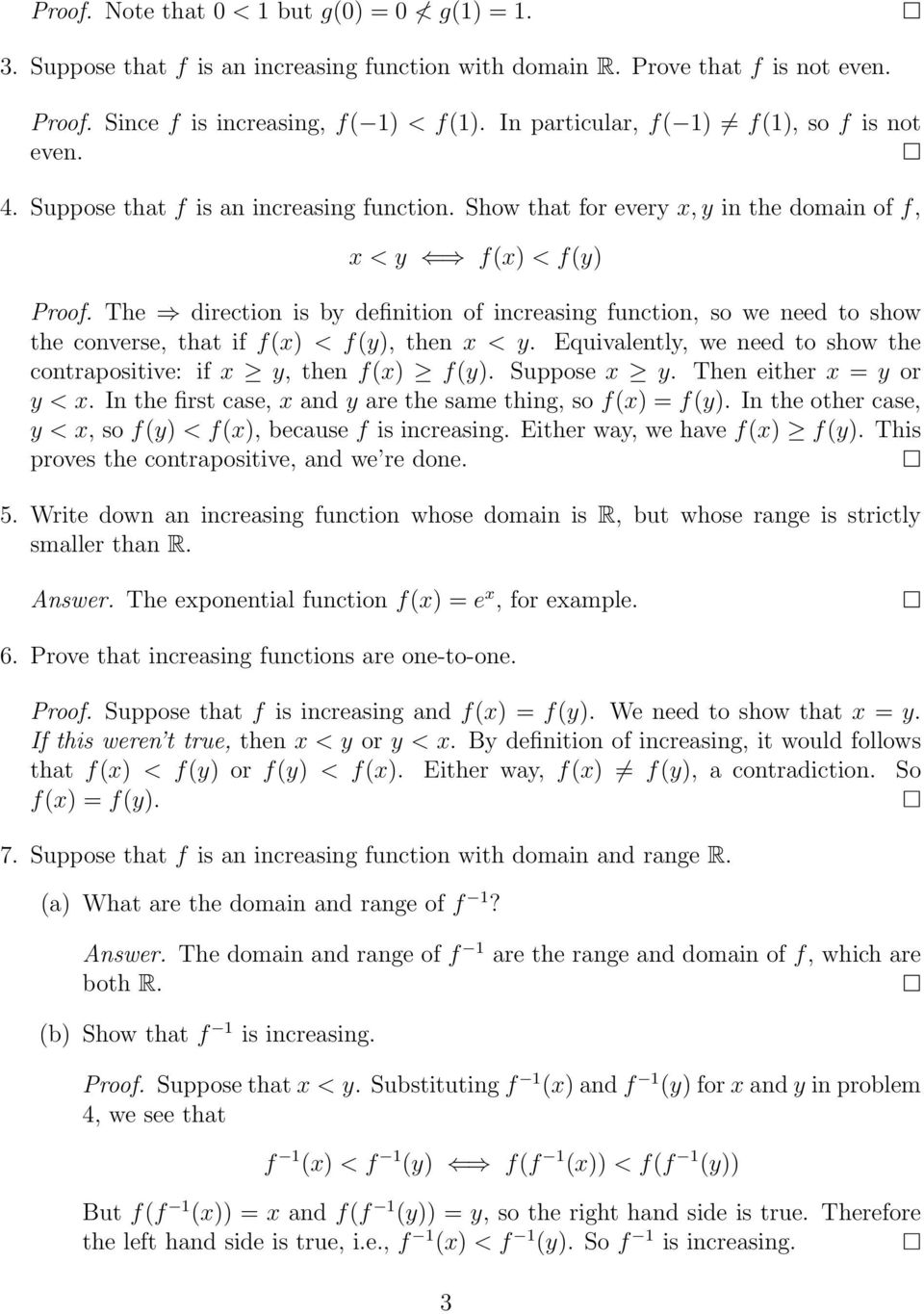
3 Proof. Note that 0 < 1 but g(0) = 0 g(1) = Suppose that f is an increasing function with domain R. Prove that f is not even. Proof. Since f is increasing, f( 1) < f(1). In particular, f( 1) f(1), so f is not even. 4. Suppose that f is an increasing function. Show that for every x, y in the domain of f, x < y f(x) < f(y) Proof. The direction is by definition of increasing function, so we need to show the converse, that if f(x) < f(y), then x < y. Equivalently, we need to show the contrapositive: if x y, then f(x) f(y). Suppose x y. Then either x = y or y < x. In the first case, x and y are the same thing, so f(x) = f(y). In the other case, y < x, so f(y) < f(x), because f is increasing. Either way, we have f(x) f(y). This proves the contrapositive, and we re done. 5. Write down an increasing function whose domain is R, but whose range is strictly smaller than R. Answer. The exponential function f(x) = e x, for example. 6. Prove that increasing functions are one-to-one. Proof. Suppose that f is increasing and f(x) = f(y). We need to show that x = y. If this weren t true, then x < y or y < x. By definition of increasing, it would follows that f(x) < f(y) or f(y) < f(x). Either way, f(x) f(y), a contradiction. So f(x) = f(y). 7. Suppose that f is an increasing function with domain and range R. (a) What are the domain and range of f 1? Answer. The domain and range of f 1 are the range and domain of f, which are both R. (b) Show that f 1 is increasing. Proof. Suppose that x < y. Substituting f 1 (x) and f 1 (y) for x and y in problem 4, we see that f 1 (x) < f 1 (y) f(f 1 (x)) < f(f 1 (y)) But f(f 1 (x)) = x and f(f 1 (y)) = y, so the right hand side is true. Therefore the left hand side is true, i.e., f 1 (x) < f 1 (y). So f 1 is increasing. 3
4 (c) Show that for every x, y, we have equivalences y < f(x) f 1 (y) < x and y > f(x) f 1 (y) > x. Proof. Since the range of f is all of R, we can write y as f(z) for some z. Then f 1 (y) = z, so the first statement says and the second says These follow from problem 4. f(z) < f(x) z < x f(z) > f(x) z > x (d) Show that f is continuous. Hint: you ll need to solve for x, using f 1. f(a) ɛ < f(x) < f(a) + ɛ Preliminary work to find δ. We need to show that lim f(x) = f(a) x a for arbitrary a. Given ɛ > 0, we need to find δ > 0 such that Now By the previous problem, x a < δ = f(x) f(a) < ɛ. f(x) f(a) < ɛ f(a) ɛ < f(x) < f(a) + ɛ. f(a) ɛ < f(x) < f(a) + ɛ f 1 (f(a) ɛ) < x < f 1 (f(a) + ɛ). So, we need to find δ such that a δ < x < a + δ = f 1 (f(a) ɛ) < x < f 1 (f(a) + ɛ), i.e., such that the open interval (a δ, a + δ) is a subset of the open interval (f 1 (f(a) ɛ), f 1 (f(a) + ɛ)). As usual, we take δ to be the smaller of the two distances from a to the endpoints of this interval: δ = min { f 1 (f(a) + ɛ) a, a f 1 (f(a) ɛ) } 4

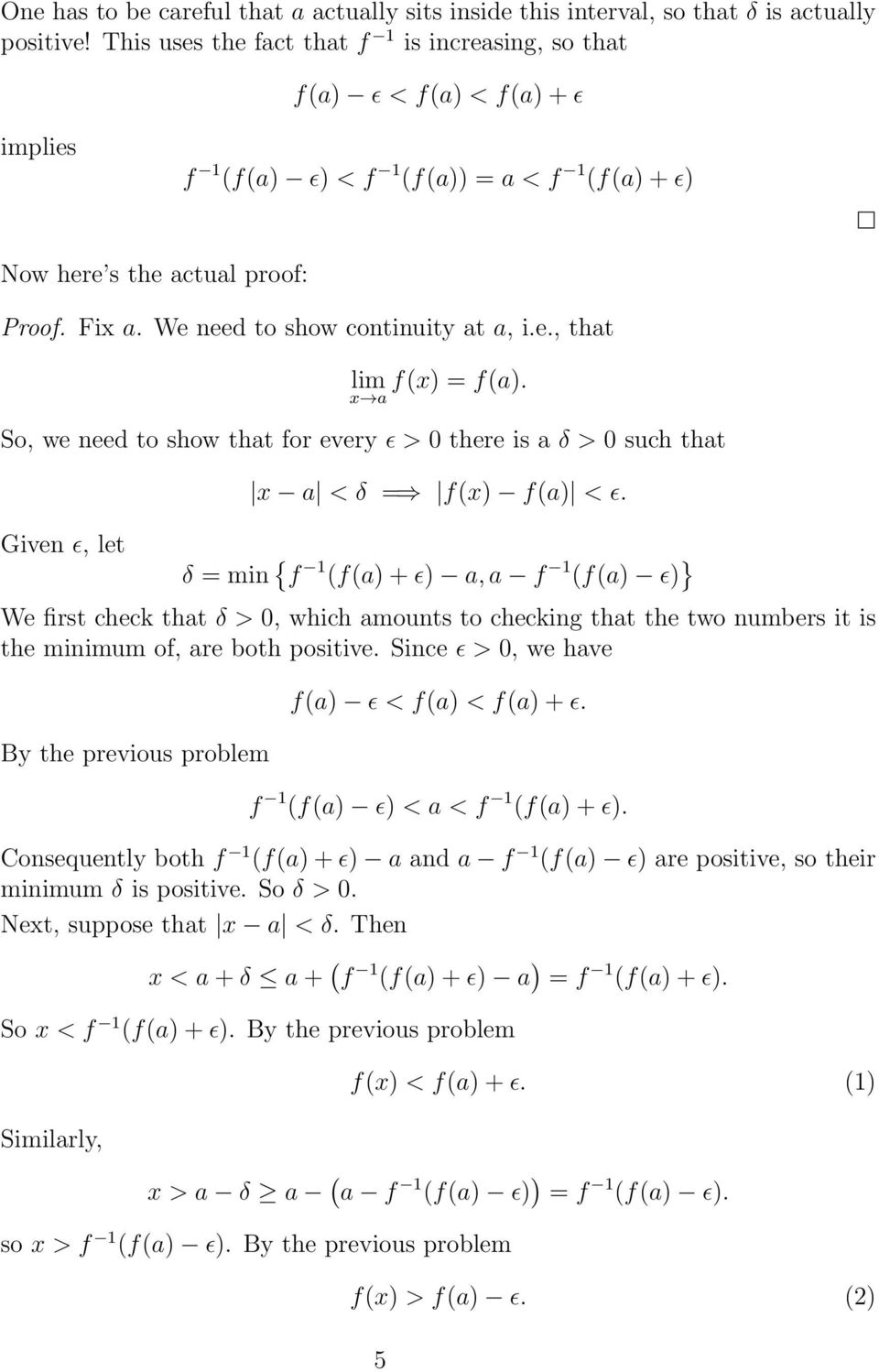
5 One has to be careful that a actually sits inside this interval, so that δ is actually positive! This uses the fact that f 1 is increasing, so that f(a) ɛ < f(a) < f(a) + ɛ implies f 1 (f(a) ɛ) < f 1 (f(a)) = a < f 1 (f(a) + ɛ) Now here s the actual proof: Proof. Fix a. We need to show continuity at a, i.e., that lim f(x) = f(a). x a So, we need to show that for every ɛ > 0 there is a δ > 0 such that Given ɛ, let x a < δ = f(x) f(a) < ɛ. δ = min { f 1 (f(a) + ɛ) a, a f 1 (f(a) ɛ) } We first check that δ > 0, which amounts to checking that the two numbers it is the minimum of, are both positive. Since ɛ > 0, we have By the previous problem f(a) ɛ < f(a) < f(a) + ɛ. f 1 (f(a) ɛ) < a < f 1 (f(a) + ɛ). Consequently both f 1 (f(a) + ɛ) a and a f 1 (f(a) ɛ) are positive, so their minimum δ is positive. So δ > 0. Next, suppose that x a < δ. Then x < a + δ a + ( f 1 (f(a) + ɛ) a ) = f 1 (f(a) + ɛ). So x < f 1 (f(a) + ɛ). By the previous problem Similarly, f(x) < f(a) + ɛ. (1) x > a δ a ( a f 1 (f(a) ɛ) ) = f 1 (f(a) ɛ). so x > f 1 (f(a) ɛ). By the previous problem f(x) > f(a) ɛ. (2) 5
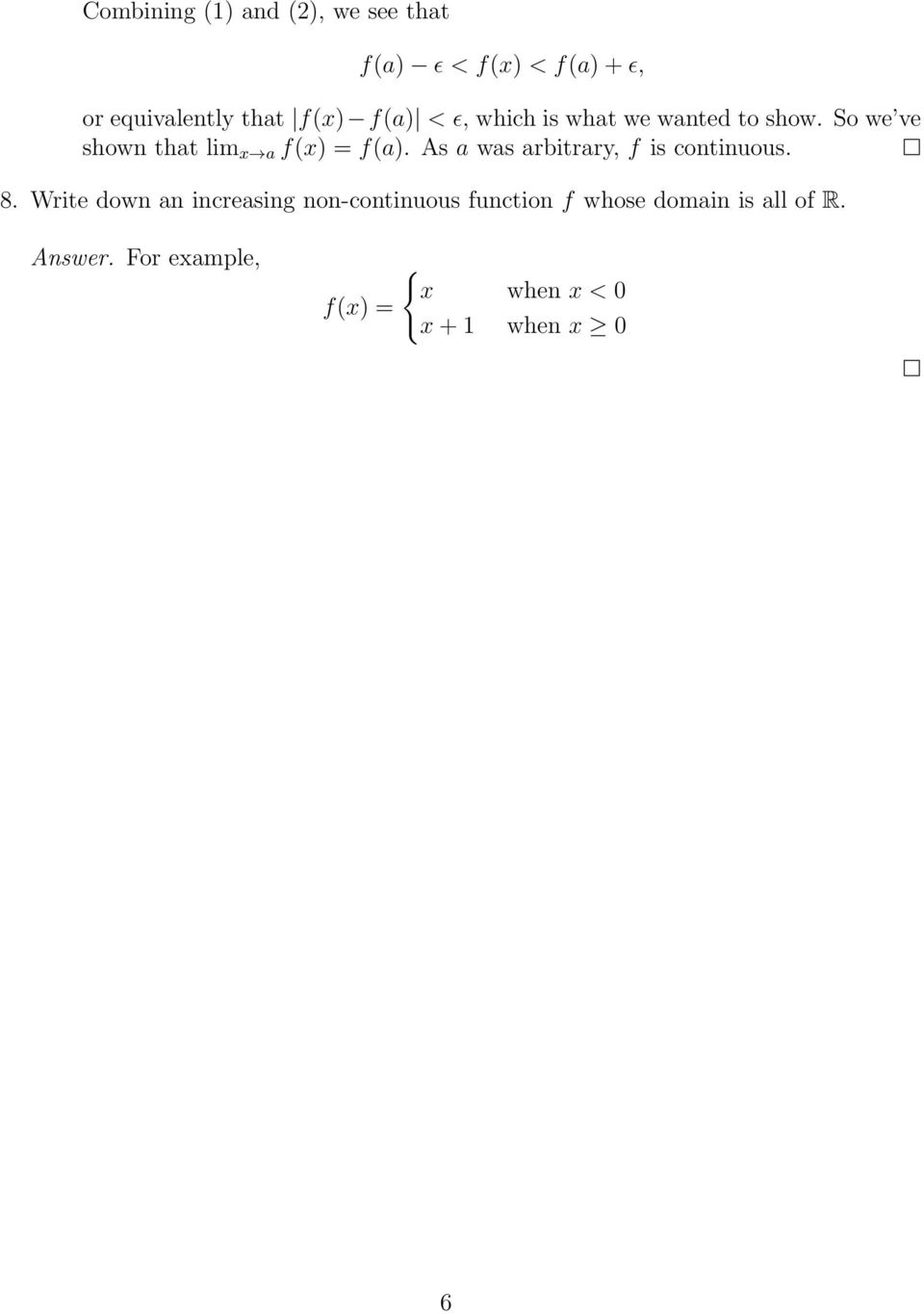
6 Combining (1) and (2), we see that f(a) ɛ < f(x) < f(a) + ɛ, or equivalently that f(x) f(a) < ɛ, which is what we wanted to show. So we ve shown that lim x a f(x) = f(a). As a was arbitrary, f is continuous. 8. Write down an increasing non-continuous function f whose domain is all of R. Answer. For example, f(x) = { x when x < 0 x + 1 when x 0 6
Homework # 3 Solutions
 Homework # 3 Solutions February, 200 Solution (2.3.5). Noting that and ( + 3 x) x 8 = + 3 x) by Equation (2.3.) x 8 x 8 = + 3 8 by Equations (2.3.7) and (2.3.0) =3 x 8 6x2 + x 3 ) = 2 + 6x 2 + x 3 x 8
0 0 such that f x L whenever x a
 Epsilon-Delta Definition of the Limit Few statements in elementary mathematics appear as cryptic as the one defining the limit of a function f() at the point = a, 0 0 such that f L whenever a Translation:
1 if 1 x 0 1 if 0 x 1
 Chapter 3 Continuity In this chapter we begin by defining the fundamental notion of continuity for real valued functions of a single real variable. When trying to decide whether a given function is or
The Mean Value Theorem
 The Mean Value Theorem THEOREM (The Extreme Value Theorem): If f is continuous on a closed interval [a, b], then f attains an absolute maximum value f(c) and an absolute minimum value f(d) at some numbers
x a x 2 (1 + x 2 ) n.
 Limits and continuity Suppose that we have a function f : R R. Let a R. We say that f(x) tends to the limit l as x tends to a; lim f(x) = l ; x a if, given any real number ɛ > 0, there exists a real number
1.7 Graphs of Functions
 64 Relations and Functions 1.7 Graphs of Functions In Section 1.4 we defined a function as a special type of relation; one in which each x-coordinate was matched with only one y-coordinate. We spent most
Real Roots of Univariate Polynomials with Real Coefficients
 Real Roots of Univariate Polynomials with Real Coefficients mostly written by Christina Hewitt March 22, 2012 1 Introduction Polynomial equations are used throughout mathematics. When solving polynomials
6.4 Logarithmic Equations and Inequalities
 6.4 Logarithmic Equations and Inequalities 459 6.4 Logarithmic Equations and Inequalities In Section 6.3 we solved equations and inequalities involving exponential functions using one of two basic strategies.
Critical points of once continuously differentiable functions are important because they are the only points that can be local maxima or minima.
 Lecture 0: Convexity and Optimization We say that if f is a once continuously differentiable function on an interval I, and x is a point in the interior of I that x is a critical point of f if f (x) =
5.1 Derivatives and Graphs
 5.1 Derivatives and Graphs What does f say about f? If f (x) > 0 on an interval, then f is INCREASING on that interval. If f (x) < 0 on an interval, then f is DECREASING on that interval. A function has
Cartesian Products and Relations
 Cartesian Products and Relations Definition (Cartesian product) If A and B are sets, the Cartesian product of A and B is the set A B = {(a, b) :(a A) and (b B)}. The following points are worth special
THE BANACH CONTRACTION PRINCIPLE. Contents
 THE BANACH CONTRACTION PRINCIPLE ALEX PONIECKI Abstract. This paper will study contractions of metric spaces. To do this, we will mainly use tools from topology. We will give some examples of contractions,
1. Prove that the empty set is a subset of every set.
 1. Prove that the empty set is a subset of every set. Basic Topology Written by Men-Gen Tsai email: [email protected] Proof: For any element x of the empty set, x is also an element of every set since
TOPIC 4: DERIVATIVES
 TOPIC 4: DERIVATIVES 1. The derivative of a function. Differentiation rules 1.1. The slope of a curve. The slope of a curve at a point P is a measure of the steepness of the curve. If Q is a point on the
DERIVATIVES AS MATRICES; CHAIN RULE
 DERIVATIVES AS MATRICES; CHAIN RULE 1. Derivatives of Real-valued Functions Let s first consider functions f : R 2 R. Recall that if the partial derivatives of f exist at the point (x 0, y 0 ), then we
Metric Spaces. Chapter 7. 7.1. Metrics
 Chapter 7 Metric Spaces A metric space is a set X that has a notion of the distance d(x, y) between every pair of points x, y X. The purpose of this chapter is to introduce metric spaces and give some
Undergraduate Notes in Mathematics. Arkansas Tech University Department of Mathematics
 Undergraduate Notes in Mathematics Arkansas Tech University Department of Mathematics An Introductory Single Variable Real Analysis: A Learning Approach through Problem Solving Marcel B. Finan c All Rights
Notes on metric spaces
 Notes on metric spaces 1 Introduction The purpose of these notes is to quickly review some of the basic concepts from Real Analysis, Metric Spaces and some related results that will be used in this course.
MA4001 Engineering Mathematics 1 Lecture 10 Limits and Continuity
 MA4001 Engineering Mathematics 1 Lecture 10 Limits and Dr. Sarah Mitchell Autumn 2014 Infinite limits If f(x) grows arbitrarily large as x a we say that f(x) has an infinite limit. Example: f(x) = 1 x
Two Fundamental Theorems about the Definite Integral
 Two Fundamental Theorems about the Definite Integral These lecture notes develop the theorem Stewart calls The Fundamental Theorem of Calculus in section 5.3. The approach I use is slightly different than
The last three chapters introduced three major proof techniques: direct,
 CHAPTER 7 Proving Non-Conditional Statements The last three chapters introduced three major proof techniques: direct, contrapositive and contradiction. These three techniques are used to prove statements
Section 1. Inequalities -5-4 -3-2 -1 0 1 2 3 4 5
 Worksheet 2.4 Introduction to Inequalities Section 1 Inequalities The sign < stands for less than. It was introduced so that we could write in shorthand things like 3 is less than 5. This becomes 3 < 5.
1. Then f has a relative maximum at x = c if f(c) f(x) for all values of x in some
 Section 3.1: First Derivative Test Definition. Let f be a function with domain D. 1. Then f has a relative maximum at x = c if f(c) f(x) for all values of x in some open interval containing c. The number
3. Mathematical Induction
 3. MATHEMATICAL INDUCTION 83 3. Mathematical Induction 3.1. First Principle of Mathematical Induction. Let P (n) be a predicate with domain of discourse (over) the natural numbers N = {0, 1,,...}. If (1)
5.3 Improper Integrals Involving Rational and Exponential Functions
 Section 5.3 Improper Integrals Involving Rational and Exponential Functions 99.. 3. 4. dθ +a cos θ =, < a
CHAPTER FIVE. Solutions for Section 5.1. Skill Refresher. Exercises
 CHAPTER FIVE 5.1 SOLUTIONS 265 Solutions for Section 5.1 Skill Refresher S1. Since 1,000,000 = 10 6, we have x = 6. S2. Since 0.01 = 10 2, we have t = 2. S3. Since e 3 = ( e 3) 1/2 = e 3/2, we have z =
Math 4310 Handout - Quotient Vector Spaces
 Math 4310 Handout - Quotient Vector Spaces Dan Collins The textbook defines a subspace of a vector space in Chapter 4, but it avoids ever discussing the notion of a quotient space. This is understandable
No: 10 04. Bilkent University. Monotonic Extension. Farhad Husseinov. Discussion Papers. Department of Economics
 No: 10 04 Bilkent University Monotonic Extension Farhad Husseinov Discussion Papers Department of Economics The Discussion Papers of the Department of Economics are intended to make the initial results
I. GROUPS: BASIC DEFINITIONS AND EXAMPLES
 I GROUPS: BASIC DEFINITIONS AND EXAMPLES Definition 1: An operation on a set G is a function : G G G Definition 2: A group is a set G which is equipped with an operation and a special element e G, called
MATH 10550, EXAM 2 SOLUTIONS. x 2 + 2xy y 2 + x = 2
 MATH 10550, EXAM SOLUTIONS (1) Find an equation for the tangent line to at the point (1, ). + y y + = Solution: The equation of a line requires a point and a slope. The problem gives us the point so we
f(x) = g(x), if x A h(x), if x B.
 1. Piecewise Functions By Bryan Carrillo, University of California, Riverside We can create more complicated functions by considering Piece-wise functions. Definition: Piecewise-function. A piecewise-function
Section 6.1 Joint Distribution Functions
 Section 6.1 Joint Distribution Functions We often care about more than one random variable at a time. DEFINITION: For any two random variables X and Y the joint cumulative probability distribution function
Section 2.7 One-to-One Functions and Their Inverses
 Section. One-to-One Functions and Their Inverses One-to-One Functions HORIZONTAL LINE TEST: A function is one-to-one if and only if no horizontal line intersects its graph more than once. EXAMPLES: 1.
Part 1 Expressions, Equations, and Inequalities: Simplifying and Solving
 Section 7 Algebraic Manipulations and Solving Part 1 Expressions, Equations, and Inequalities: Simplifying and Solving Before launching into the mathematics, let s take a moment to talk about the words
Lecture 3 : The Natural Exponential Function: f(x) = exp(x) = e x. y = exp(x) if and only if x = ln(y)
 Lecture 3 : The Natural Exponential Function: f(x) = exp(x) = Last day, we saw that the function f(x) = ln x is one-to-one, with domain (, ) and range (, ). We can conclude that f(x) has an inverse function
5.1 Radical Notation and Rational Exponents
 Section 5.1 Radical Notation and Rational Exponents 1 5.1 Radical Notation and Rational Exponents We now review how exponents can be used to describe not only powers (such as 5 2 and 2 3 ), but also roots
Inequalities - Absolute Value Inequalities
 3.3 Inequalities - Absolute Value Inequalities Objective: Solve, graph and give interval notation for the solution to inequalities with absolute values. When an inequality has an absolute value we will
2.2 Derivative as a Function
 2.2 Derivative as a Function Recall that we defined the derivative as f (a) = lim h 0 f(a + h) f(a) h But since a is really just an arbitrary number that represents an x-value, why don t we just use x
Method To Solve Linear, Polynomial, or Absolute Value Inequalities:
 Solving Inequalities An inequality is the result of replacing the = sign in an equation with ,, or. For example, 3x 2 < 7 is a linear inequality. We call it linear because if the < were replaced with
MATH 425, PRACTICE FINAL EXAM SOLUTIONS.
 MATH 45, PRACTICE FINAL EXAM SOLUTIONS. Exercise. a Is the operator L defined on smooth functions of x, y by L u := u xx + cosu linear? b Does the answer change if we replace the operator L by the operator
MATH 221 FIRST SEMESTER CALCULUS. fall 2007
 MATH 22 FIRST SEMESTER CALCULUS fall 2007 Typeset:December, 2007 2 Math 22 st Semester Calculus Lecture notes version.0 (Fall 2007) This is a self contained set of lecture notes for Math 22. The notes
Rolle s Theorem. q( x) = 1
 Lecture 1 :The Mean Value Theorem We know that constant functions have derivative zero. Is it possible for a more complicated function to have derivative zero? In this section we will answer this question
Domain of a Composition
 Domain of a Composition Definition Given the function f and g, the composition of f with g is a function defined as (f g)() f(g()). The domain of f g is the set of all real numbers in the domain of g such
2.1 Increasing, Decreasing, and Piecewise Functions; Applications
 2.1 Increasing, Decreasing, and Piecewise Functions; Applications Graph functions, looking for intervals on which the function is increasing, decreasing, or constant, and estimate relative maxima and minima.
Chapter 3. Cartesian Products and Relations. 3.1 Cartesian Products
 Chapter 3 Cartesian Products and Relations The material in this chapter is the first real encounter with abstraction. Relations are very general thing they are a special type of subset. After introducing
Differentiation and Integration
 This material is a supplement to Appendix G of Stewart. You should read the appendix, except the last section on complex exponentials, before this material. Differentiation and Integration Suppose we have
Mathematics Review for MS Finance Students
 Mathematics Review for MS Finance Students Anthony M. Marino Department of Finance and Business Economics Marshall School of Business Lecture 1: Introductory Material Sets The Real Number System Functions,
Limits and Continuity
 Math 20C Multivariable Calculus Lecture Limits and Continuity Slide Review of Limit. Side limits and squeeze theorem. Continuous functions of 2,3 variables. Review: Limits Slide 2 Definition Given a function
Economics 121b: Intermediate Microeconomics Problem Set 2 1/20/10
 Dirk Bergemann Department of Economics Yale University s by Olga Timoshenko Economics 121b: Intermediate Microeconomics Problem Set 2 1/20/10 This problem set is due on Wednesday, 1/27/10. Preliminary
This is a square root. The number under the radical is 9. (An asterisk * means multiply.)
 Page of Review of Radical Expressions and Equations Skills involving radicals can be divided into the following groups: Evaluate square roots or higher order roots. Simplify radical expressions. Rationalize
H/wk 13, Solutions to selected problems
 H/wk 13, Solutions to selected problems Ch. 4.1, Problem 5 (a) Find the number of roots of x x in Z 4, Z Z, any integral domain, Z 6. (b) Find a commutative ring in which x x has infinitely many roots.
1.4 Compound Inequalities
 Section 1.4 Compound Inequalities 53 1.4 Compound Inequalities This section discusses a technique that is used to solve compound inequalities, which is a phrase that usually refers to a pair of inequalities
Continuity. DEFINITION 1: A function f is continuous at a number a if. lim
 Continuity DEFINITION : A function f is continuous at a number a if f(x) = f(a) REMARK: It follows from the definition that f is continuous at a if and only if. f(a) is defined. 2. f(x) and +f(x) exist.
MATH PROBLEMS, WITH SOLUTIONS
 MATH PROBLEMS, WITH SOLUTIONS OVIDIU MUNTEANU These are free online notes that I wrote to assist students that wish to test their math skills with some problems that go beyond the usual curriculum. These
The Epsilon-Delta Limit Definition:
 The Epsilon-Delta Limit Definition: A Few Examples Nick Rauh 1. Prove that lim x a x 2 = a 2. (Since we leave a arbitrary, this is the same as showing x 2 is continuous.) Proof: Let > 0. We wish to find
f(x) = a x, h(5) = ( 1) 5 1 = 2 2 1
 Exponential Functions an their Derivatives Exponential functions are functions of the form f(x) = a x, where a is a positive constant referre to as the base. The functions f(x) = x, g(x) = e x, an h(x)
MATH 221 FIRST SEMESTER CALCULUS. fall 2009
 MATH 22 FIRST SEMESTER CALCULUS fall 2009 Typeset:June 8, 200 MATH 22 st SEMESTER CALCULUS LECTURE NOTES VERSION 2.0 (fall 2009) This is a self contained set of lecture notes for Math 22. The notes were
So let us begin our quest to find the holy grail of real analysis.
 1 Section 5.2 The Complete Ordered Field: Purpose of Section We present an axiomatic description of the real numbers as a complete ordered field. The axioms which describe the arithmetic of the real numbers
MATH 22. THE FUNDAMENTAL THEOREM of ARITHMETIC. Lecture R: 10/30/2003
 MATH 22 Lecture R: 10/30/2003 THE FUNDAMENTAL THEOREM of ARITHMETIC You must remember this, A kiss is still a kiss, A sigh is just a sigh; The fundamental things apply, As time goes by. Herman Hupfeld
6. Define log(z) so that π < I log(z) π. Discuss the identities e log(z) = z and log(e w ) = w.
 hapter omplex integration. omplex number quiz. Simplify 3+4i. 2. Simplify 3+4i. 3. Find the cube roots of. 4. Here are some identities for complex conjugate. Which ones need correction? z + w = z + w,
Solving DEs by Separation of Variables.
 Solving DEs by Separation of Variables. Introduction and procedure Separation of variables allows us to solve differential equations of the form The steps to solving such DEs are as follows: dx = gx).
HOMEWORK 5 SOLUTIONS. n!f n (1) lim. ln x n! + xn x. 1 = G n 1 (x). (2) k + 1 n. (n 1)!
 Math 7 Fall 205 HOMEWORK 5 SOLUTIONS Problem. 2008 B2 Let F 0 x = ln x. For n 0 and x > 0, let F n+ x = 0 F ntdt. Evaluate n!f n lim n ln n. By directly computing F n x for small n s, we obtain the following
BANACH AND HILBERT SPACE REVIEW
 BANACH AND HILBET SPACE EVIEW CHISTOPHE HEIL These notes will briefly review some basic concepts related to the theory of Banach and Hilbert spaces. We are not trying to give a complete development, but
Metric Spaces Joseph Muscat 2003 (Last revised May 2009)
 1 Distance J Muscat 1 Metric Spaces Joseph Muscat 2003 (Last revised May 2009) (A revised and expanded version of these notes are now published by Springer.) 1 Distance A metric space can be thought of
Math 120 Final Exam Practice Problems, Form: A
 Math 120 Final Exam Practice Problems, Form: A Name: While every attempt was made to be complete in the types of problems given below, we make no guarantees about the completeness of the problems. Specifically,
Nonlinear Algebraic Equations. Lectures INF2320 p. 1/88
 Nonlinear Algebraic Equations Lectures INF2320 p. 1/88 Lectures INF2320 p. 2/88 Nonlinear algebraic equations When solving the system u (t) = g(u), u(0) = u 0, (1) with an implicit Euler scheme we have
Basic Proof Techniques
 Basic Proof Techniques David Ferry [email protected] September 13, 010 1 Four Fundamental Proof Techniques When one wishes to prove the statement P Q there are four fundamental approaches. This document
Normal distribution. ) 2 /2σ. 2π σ
 Normal distribution The normal distribution is the most widely known and used of all distributions. Because the normal distribution approximates many natural phenomena so well, it has developed into a
DIFFERENTIABILITY OF COMPLEX FUNCTIONS. Contents
 DIFFERENTIABILITY OF COMPLEX FUNCTIONS Contents 1. Limit definition of a derivative 1 2. Holomorphic functions, the Cauchy-Riemann equations 3 3. Differentiability of real functions 5 4. A sufficient condition
Polynomial Invariants
 Polynomial Invariants Dylan Wilson October 9, 2014 (1) Today we will be interested in the following Question 1.1. What are all the possible polynomials in two variables f(x, y) such that f(x, y) = f(y,
Definition 8.1 Two inequalities are equivalent if they have the same solution set. Add or Subtract the same value on both sides of the inequality.
 8 Inequalities Concepts: Equivalent Inequalities Linear and Nonlinear Inequalities Absolute Value Inequalities (Sections 4.6 and 1.1) 8.1 Equivalent Inequalities Definition 8.1 Two inequalities are equivalent
Linear Programming Notes V Problem Transformations
 Linear Programming Notes V Problem Transformations 1 Introduction Any linear programming problem can be rewritten in either of two standard forms. In the first form, the objective is to maximize, the material
Chapter 7 - Roots, Radicals, and Complex Numbers
 Math 233 - Spring 2009 Chapter 7 - Roots, Radicals, and Complex Numbers 7.1 Roots and Radicals 7.1.1 Notation and Terminology In the expression x the is called the radical sign. The expression under the
FUNCTIONAL ANALYSIS LECTURE NOTES: QUOTIENT SPACES
 FUNCTIONAL ANALYSIS LECTURE NOTES: QUOTIENT SPACES CHRISTOPHER HEIL 1. Cosets and the Quotient Space Any vector space is an abelian group under the operation of vector addition. So, if you are have studied
MAT12X Intermediate Algebra
 MAT12X Intermediate Algebra Workshop I - Exponential Functions LEARNING CENTER Overview Workshop I Exponential Functions of the form y = ab x Properties of the increasing and decreasing exponential functions
MA107 Precalculus Algebra Exam 2 Review Solutions
 MA107 Precalculus Algebra Exam 2 Review Solutions February 24, 2008 1. The following demand equation models the number of units sold, x, of a product as a function of price, p. x = 4p + 200 a. Please write
Fixed Point Theorems
 Fixed Point Theorems Definition: Let X be a set and let T : X X be a function that maps X into itself. (Such a function is often called an operator, a transformation, or a transform on X, and the notation
Student Outcomes. Lesson Notes. Classwork. Discussion (10 minutes)
 NYS COMMON CORE MATHEMATICS CURRICULUM Lesson 5 8 Student Outcomes Students know the definition of a number raised to a negative exponent. Students simplify and write equivalent expressions that contain
Inverse Functions and Logarithms
 Section 3. Inverse Functions and Logarithms 1 Kiryl Tsishchanka Inverse Functions and Logarithms DEFINITION: A function f is called a one-to-one function if it never takes on the same value twice; that
https://williamshartunionca.springboardonline.org/ebook/book/27e8f1b87a1c4555a1212b...
 of 19 9/2/2014 12:09 PM Answers Teacher Copy Plan Pacing: 1 class period Chunking the Lesson Example A #1 Example B Example C #2 Check Your Understanding Lesson Practice Teach Bell-Ringer Activity Students
1 The Concept of a Mapping
 Arkansas Tech University MATH 4033: Elementary Modern Algebra Dr. Marcel B. Finan 1 The Concept of a Mapping The concept of a mapping (aka function) is important throughout mathematics. We have been dealing
Metric Spaces. Chapter 1
 Chapter 1 Metric Spaces Many of the arguments you have seen in several variable calculus are almost identical to the corresponding arguments in one variable calculus, especially arguments concerning convergence
Mathematical Methods of Engineering Analysis
 Mathematical Methods of Engineering Analysis Erhan Çinlar Robert J. Vanderbei February 2, 2000 Contents Sets and Functions 1 1 Sets................................... 1 Subsets.............................
9 More on differentiation
 Tel Aviv University, 2013 Measure and category 75 9 More on differentiation 9a Finite Taylor expansion............... 75 9b Continuous and nowhere differentiable..... 78 9c Differentiable and nowhere monotone......
1 Calculus of Several Variables
 1 Calculus of Several Variables Reading: [Simon], Chapter 14, p. 300-31. 1.1 Partial Derivatives Let f : R n R. Then for each x i at each point x 0 = (x 0 1,..., x 0 n) the ith partial derivative is defined
FINAL EXAM SECTIONS AND OBJECTIVES FOR COLLEGE ALGEBRA
 FINAL EXAM SECTIONS AND OBJECTIVES FOR COLLEGE ALGEBRA 1.1 Solve linear equations and equations that lead to linear equations. a) Solve the equation: 1 (x + 5) 4 = 1 (2x 1) 2 3 b) Solve the equation: 3x
26 Integers: Multiplication, Division, and Order
 26 Integers: Multiplication, Division, and Order Integer multiplication and division are extensions of whole number multiplication and division. In multiplying and dividing integers, the one new issue
8 Divisibility and prime numbers
 8 Divisibility and prime numbers 8.1 Divisibility In this short section we extend the concept of a multiple from the natural numbers to the integers. We also summarize several other terms that express
Math 333 - Practice Exam 2 with Some Solutions
 Math 333 - Practice Exam 2 with Some Solutions (Note that the exam will NOT be this long) Definitions (0 points) Let T : V W be a transformation Let A be a square matrix (a) Define T is linear (b) Define
Triangle deletion. Ernie Croot. February 3, 2010
 Triangle deletion Ernie Croot February 3, 2010 1 Introduction The purpose of this note is to give an intuitive outline of the triangle deletion theorem of Ruzsa and Szemerédi, which says that if G = (V,
CHAPTER 2: METHODS OF PROOF
 CHAPTER 2: METHODS OF PROOF Section 2.1: BASIC PROOFS WITH QUANTIFIERS Existence Proofs Our first goal is to prove a statement of the form ( x) P (x). There are two types of existence proofs: Constructive
Smooth functions statistics
 Smooth functions statistics V. I. rnold To describe the topological structure of a real smooth function one associates to it the graph, formed by the topological variety, whose points are the connected
Walrasian Demand. u(x) where B(p, w) = {x R n + : p x w}.
 Walrasian Demand Econ 2100 Fall 2015 Lecture 5, September 16 Outline 1 Walrasian Demand 2 Properties of Walrasian Demand 3 An Optimization Recipe 4 First and Second Order Conditions Definition Walrasian
k, then n = p2α 1 1 pα k
 Powers of Integers An integer n is a perfect square if n = m for some integer m. Taking into account the prime factorization, if m = p α 1 1 pα k k, then n = pα 1 1 p α k k. That is, n is a perfect square
36 CHAPTER 1. LIMITS AND CONTINUITY. Figure 1.17: At which points is f not continuous?
 36 CHAPTER 1. LIMITS AND CONTINUITY 1.3 Continuity Before Calculus became clearly de ned, continuity meant that one could draw the graph of a function without having to lift the pen and pencil. While this
LINEAR INEQUALITIES. less than, < 2x + 5 x 3 less than or equal to, greater than, > 3x 2 x 6 greater than or equal to,
 LINEAR INEQUALITIES When we use the equal sign in an equation we are stating that both sides of the equation are equal to each other. In an inequality, we are stating that both sides of the equation are
Calculus 1: Sample Questions, Final Exam, Solutions
 Calculus : Sample Questions, Final Exam, Solutions. Short answer. Put your answer in the blank. NO PARTIAL CREDIT! (a) (b) (c) (d) (e) e 3 e Evaluate dx. Your answer should be in the x form of an integer.
Lecture 7: Continuous Random Variables
 Lecture 7: Continuous Random Variables 21 September 2005 1 Our First Continuous Random Variable The back of the lecture hall is roughly 10 meters across. Suppose it were exactly 10 meters, and consider