
1.7 Graphs of Functions
|
|
|
- Dwain Marshall
- 9 years ago
- Views:
Transcription
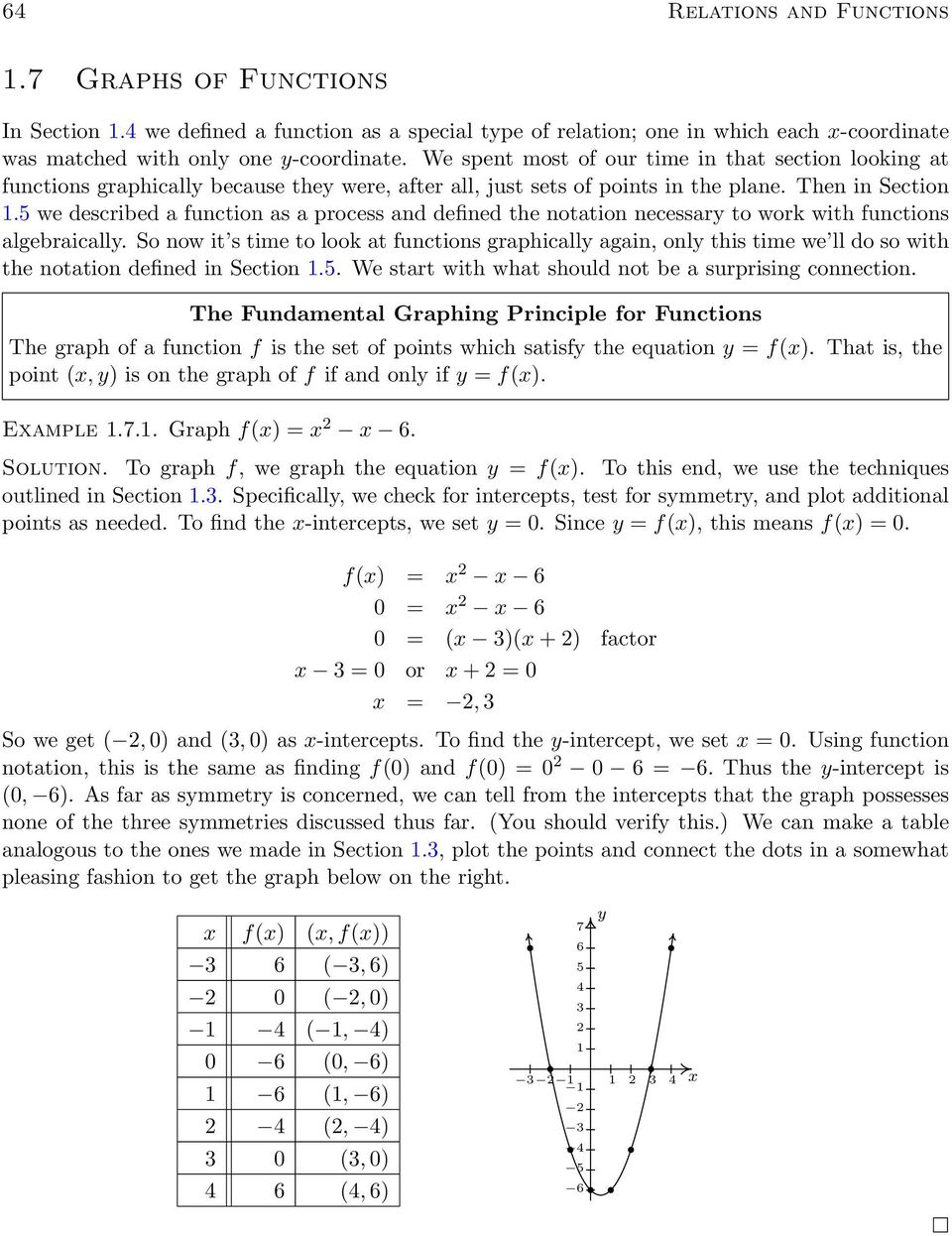
1 64 Relations and Functions 1.7 Graphs of Functions In Section 1.4 we defined a function as a special type of relation; one in which each x-coordinate was matched with only one y-coordinate. We spent most of our time in that section looking at functions graphically because they were, after all, just sets of points in the plane. Then in Section 1.5 we described a function as a process and defined the notation necessary to work with functions algebraically. So now it s time to look at functions graphically again, only this time we ll do so with the notation defined in Section 1.5. We start with what should not be a surprising connection. The Fundamental Graphing Principle for Functions The graph of a function f is the set of points which satisfy the equation y = f(x). That is, the point (x, y) is on the graph of f if and only if y = f(x). Example Graph f(x) = x 2 x 6. Solution. To graph f, we graph the equation y = f(x). To this end, we use the techniques outlined in Section 1.3. Specifically, we check for intercepts, test for symmetry, and plot additional points as needed. To find the x-intercepts, we set y = 0. Since y = f(x), this means f(x) = 0. f(x) = x 2 x 6 0 = x 2 x 6 0 = (x 3)(x + 2) factor x 3 = 0 or x + 2 = 0 x = 2, 3 So we get ( 2, 0) and (3, 0) as x-intercepts. To find the y-intercept, we set x = 0. Using function notation, this is the same as finding f(0) and f(0) = = 6. Thus the y-intercept is (0, 6). As far as symmetry is concerned, we can tell from the intercepts that the graph possesses none of the three symmetries discussed thus far. (You should verify this.) We can make a table analogous to the ones we made in Section 1.3, plot the points and connect the dots in a somewhat pleasing fashion to get the graph below on the right. x f(x) (x, f(x)) 3 6 ( 3, 6) 2 0 ( 2, 0) 1 4 ( 1, 4) 0 6 (0, 6) 1 6 (1, 6) 2 4 (2, 4) 3 0 (3, 0) 4 6 (4, 6) y x
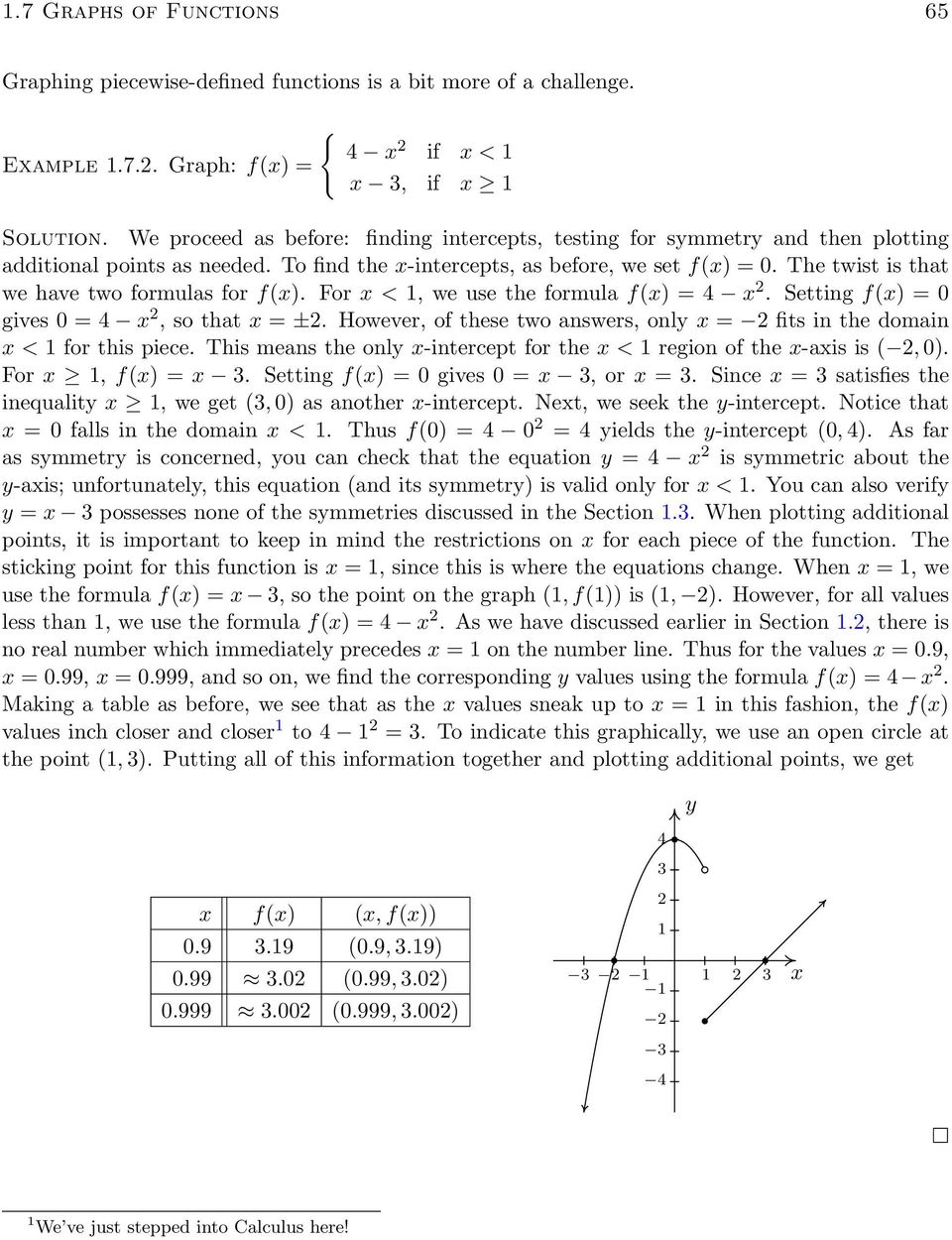
2 1.7 Graphs of Functions 65 Graphing piecewise-defined functions is a bit more of a challenge. Example Graph: f(x) = { 4 x 2 if x < 1 x 3, if x 1 Solution. We proceed as before: finding intercepts, testing for symmetry and then plotting additional points as needed. To find the x-intercepts, as before, we set f(x) = 0. The twist is that we have two formulas for f(x). For x < 1, we use the formula f(x) = 4 x 2. Setting f(x) = 0 gives 0 = 4 x 2, so that x = ±2. However, of these two answers, only x = 2 fits in the domain x < 1 for this piece. This means the only x-intercept for the x < 1 region of the x-axis is ( 2, 0). For x 1, f(x) = x 3. Setting f(x) = 0 gives 0 = x 3, or x = 3. Since x = 3 satisfies the inequality x 1, we get (3, 0) as another x-intercept. Next, we seek the y-intercept. Notice that x = 0 falls in the domain x < 1. Thus f(0) = = 4 yields the y-intercept (0, 4). As far as symmetry is concerned, you can check that the equation y = 4 x 2 is symmetric about the y-axis; unfortunately, this equation (and its symmetry) is valid only for x < 1. You can also verify y = x 3 possesses none of the symmetries discussed in the Section 1.3. When plotting additional points, it is important to keep in mind the restrictions on x for each piece of the function. The sticking point for this function is x = 1, since this is where the equations change. When x = 1, we use the formula f(x) = x 3, so the point on the graph (1, f(1)) is (1, 2). However, for all values less than 1, we use the formula f(x) = 4 x 2. As we have discussed earlier in Section 1.2, there is no real number which immediately precedes x = 1 on the number line. Thus for the values x = 0.9, x = 0.99, x = 0.999, and so on, we find the corresponding y values using the formula f(x) = 4 x 2. Making a table as before, we see that as the x values sneak up to x = 1 in this fashion, the f(x) values inch closer and closer 1 to = 3. To indicate this graphically, we use an open circle at the point (1, 3). Putting all of this information together and plotting additional points, we get 4 3 y x f(x) (x, f(x)) (0.9, 3.19) (0.99, 3.02) (0.999, 3.002) x 1 We ve just stepped into Calculus here!
3 66 Relations and Functions In the previous two examples, the x-coordinates of the x-intercepts of the graph of y = f(x) were found by solving f(x) = 0. For this reason, they are called the zeros of f. Definition 1.7. The zeros of a function f are the solutions to the equation f(x) = 0. In other words, x is a zero of f if and only if (x, 0) is an x-intercept of the graph of y = f(x). Of the three symmetries discussed in Section 1.3, only two are of significance to functions: symmetry about the y-axis and symmetry about the origin. 2 Recall that we can test whether the graph of an equation is symmetric about the y-axis by replacing x with x and checking to see if an equivalent equation results. If we are graphing the equation y = f(x), substituting x for x results in the equation y = f( x). In order for this equation to be equivalent to the original equation y = f(x) we need f( x) = f(x). In a similar fashion, we recall that to test an equation s graph for symmetry about the origin, we replace x and y with x and y, respectively. Doing this substitution in the equation y = f(x) results in y = f( x). Solving the latter equation for y gives y = f( x). In order for this equation to be equivalent to the original equation y = f(x) we need f( x) = f(x), or, equivalently, f( x) = f(x). These results are summarized below. Steps for testing if the graph of a function possesses symmetry The graph of a function f is symmetric: About the y-axis if and only if f( x) = f(x) for all x in the domain of f. About the origin if and only if f( x) = f(x) for all x in the domain of f. For reasons which won t become clear until we study polynomials, we call a function even if its graph is symmetric about the y-axis or odd if its graph is symmetric about the origin. Apart from a very specialized family of functions which are both even and odd, 3 functions fall into one of three distinct categories: even, odd, or neither even nor odd. Example Analytically determine if the following functions are even, odd, or neither even nor odd. Verify your result with a graphing calculator. 1. f(x) = 5 2. g(x) = 5x 3. h(x) = 5x 2 x 3 4. i(x) = 5x 2x x 3 5. j(x) = x 2 x Solution. The first step in all of these problems is to replace x with x and simplify. 2 Why are we so dismissive about symmetry about the x-axis for graphs of functions? 3 Any ideas?
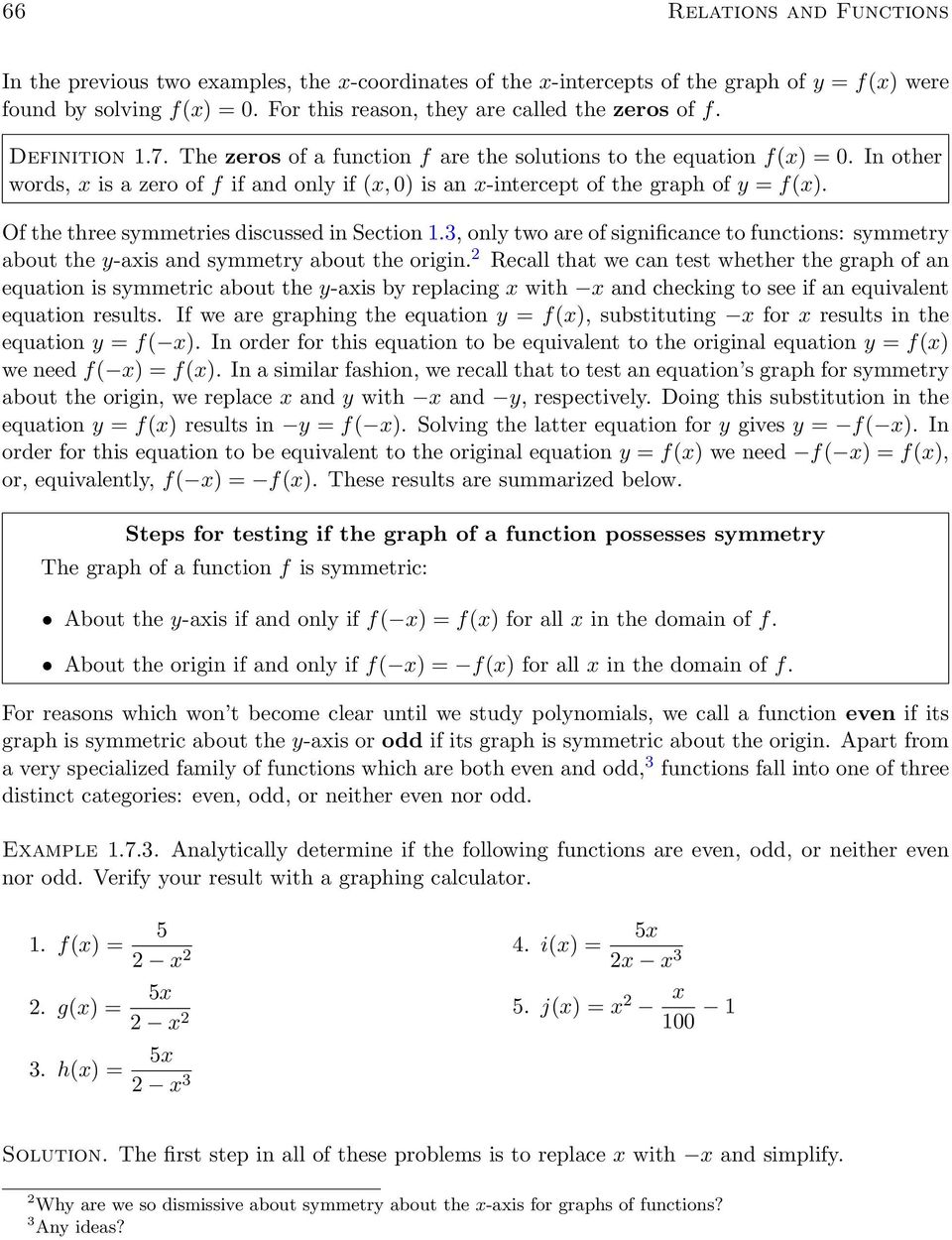
4 1.7 Graphs of Functions f(x) = f( x) = f( x) = f( x) = f(x) ( x) 2 5 Hence, f is even. The graphing calculator furnishes the following: This suggests 4 the graph of f is symmetric about the y-axis, as expected. 2. g(x) = 5x g( x) = 5( x) 2 ( x) 2 g( x) = 5x It doesn t appear that g( x) is equivalent to g(x). To prove this, we check with an x value. After some trial and error, we see that g(1) = 5 whereas g( 1) = 5. This proves that g is not even, but it doesn t rule out the possibility that g is odd. (Why not?) To check if g is odd, we compare g( x) with g(x) Hence, g is odd. Graphically, 4 Suggests is about the extent of what it can do. g(x) = 5x = 5x g(x) = g( x)

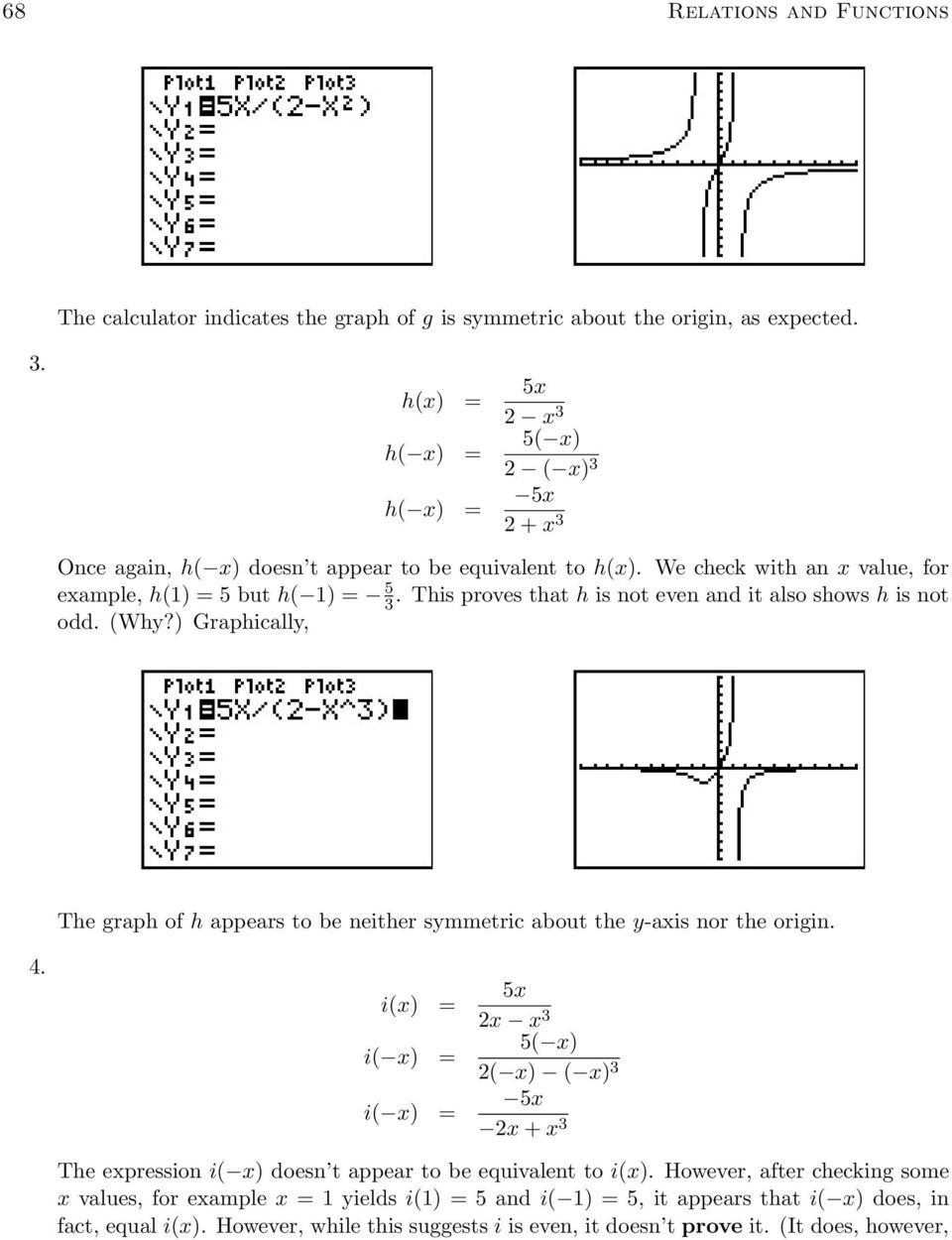
5 68 Relations and Functions The calculator indicates the graph of g is symmetric about the origin, as expected. 3. h(x) = 5x 2 x 3 h( x) = 5( x) 2 ( x) 3 h( x) = 5x 2 + x 3 Once again, h( x) doesn t appear to be equivalent to h(x). We check with an x value, for example, h(1) = 5 but h( 1) = 5 3. This proves that h is not even and it also shows h is not odd. (Why?) Graphically, The graph of h appears to be neither symmetric about the y-axis nor the origin. 4. i(x) = i( x) = i( x) = 5x 2x x 3 5( x) 2( x) ( x) 3 5x 2x + x 3 The expression i( x) doesn t appear to be equivalent to i(x). However, after checking some x values, for example x = 1 yields i(1) = 5 and i( 1) = 5, it appears that i( x) does, in fact, equal i(x). However, while this suggests i is even, it doesn t prove it. (It does, however,
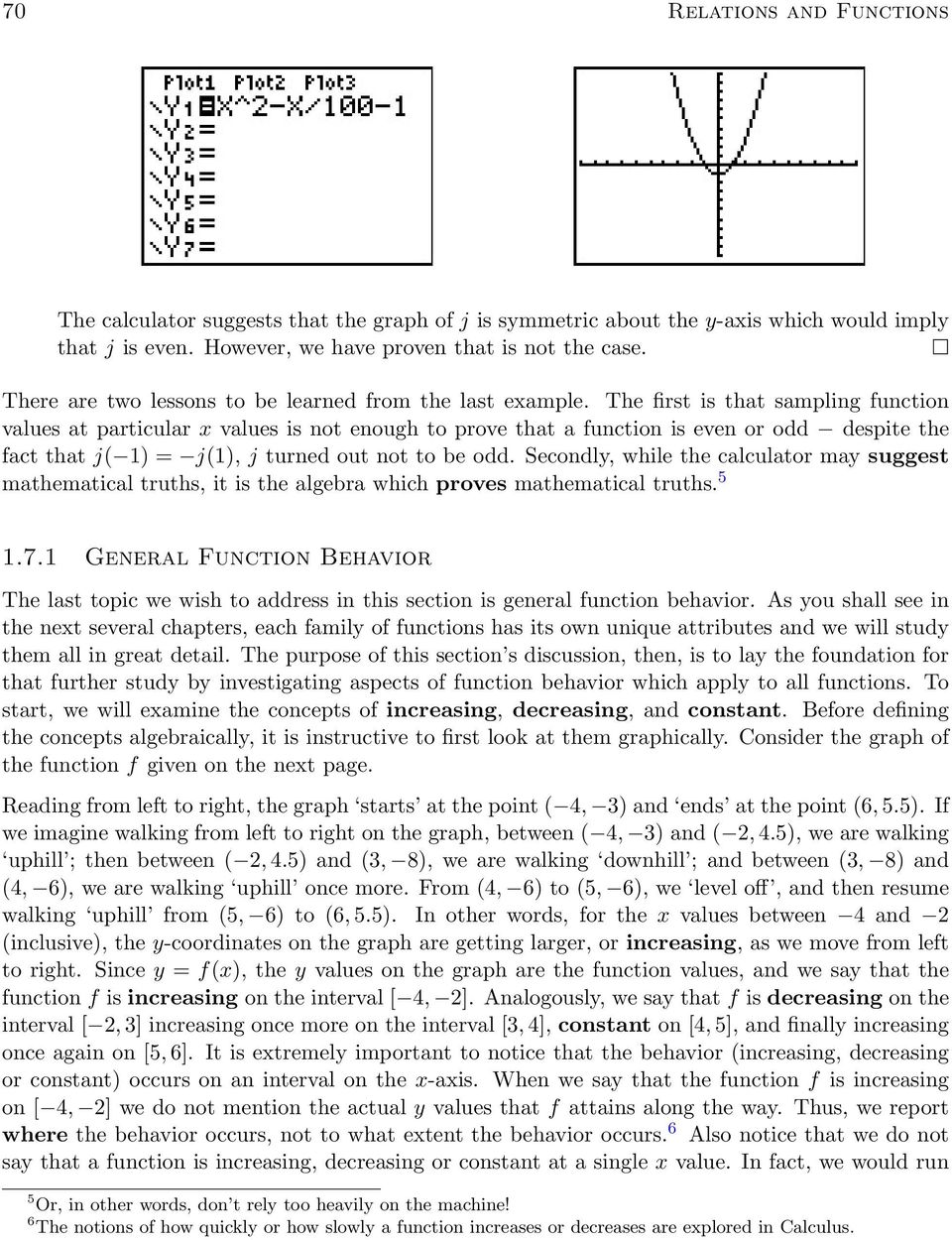
6 1.7 Graphs of Functions 69 prove i is not odd.) To prove i( x) = i(x), we need to manipulate our expressions for i(x) and i( x) and show they are equivalent. A clue as to how to proceed is in the numerators: in the formula for i(x), the numerator is 5x and in i( x) the numerator is 5x. To re-write i(x) with a numerator of 5x, we need to multiply its numerator by 1. To keep the value of the fraction the same, we need to multiply the denominator by 1 as well. Thus i(x) = = = 5x 2x x 3 ( 1)5x ( 1) (2x x 3 ) 5x 2x + x 3 Hence, i(x) = i( x), so i is even. The calculator supports our conclusion. 5. j(x) = x 2 x j( x) = ( x) 2 x j( x) = x 2 + x The expression for j( x) doesn t seem to be equivalent to j(x), so we check using x = 1 to get j(1) = and j( 1) = 100. This rules out j being even. However, it doesn t rule out j being odd. Examining j(x) gives j(x) = x 2 x ( j(x) = x 2 x ) j(x) = x 2 + x The expression j(x) doesn t seem to match j( x) either. Testing x = 2 gives j(2) = and j( 2) = , so j is not odd, either. The calculator gives:
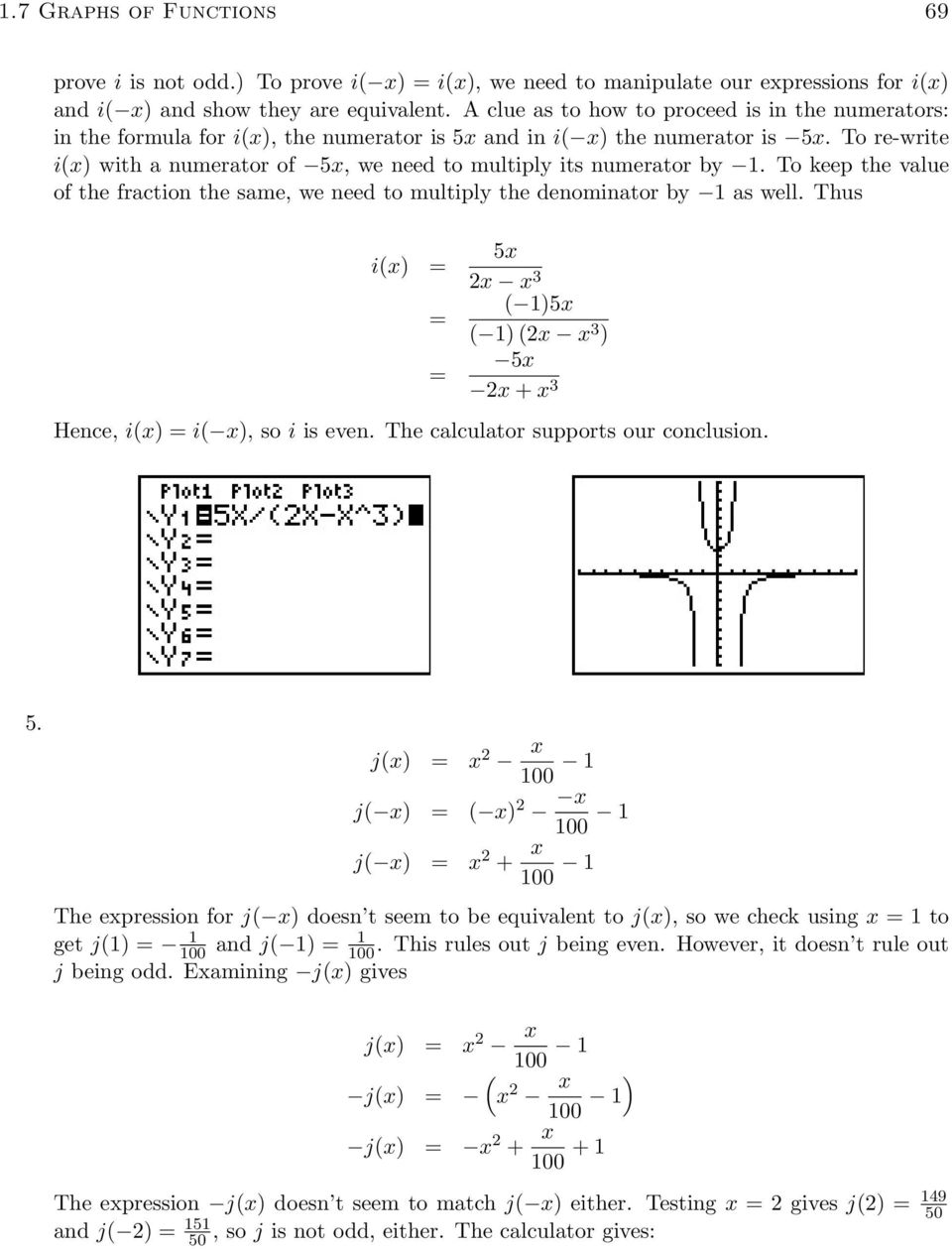
7 70 Relations and Functions The calculator suggests that the graph of j is symmetric about the y-axis which would imply that j is even. However, we have proven that is not the case. There are two lessons to be learned from the last example. The first is that sampling function values at particular x values is not enough to prove that a function is even or odd despite the fact that j( 1) = j(1), j turned out not to be odd. Secondly, while the calculator may suggest mathematical truths, it is the algebra which proves mathematical truths General Function Behavior The last topic we wish to address in this section is general function behavior. As you shall see in the next several chapters, each family of functions has its own unique attributes and we will study them all in great detail. The purpose of this section s discussion, then, is to lay the foundation for that further study by investigating aspects of function behavior which apply to all functions. To start, we will examine the concepts of increasing, decreasing, and constant. Before defining the concepts algebraically, it is instructive to first look at them graphically. Consider the graph of the function f given on the next page. Reading from left to right, the graph starts at the point ( 4, 3) and ends at the point (6, 5.5). If we imagine walking from left to right on the graph, between ( 4, 3) and ( 2, 4.5), we are walking uphill ; then between ( 2, 4.5) and (3, 8), we are walking downhill ; and between (3, 8) and (4, 6), we are walking uphill once more. From (4, 6) to (5, 6), we level off, and then resume walking uphill from (5, 6) to (6, 5.5). In other words, for the x values between 4 and 2 (inclusive), the y-coordinates on the graph are getting larger, or increasing, as we move from left to right. Since y = f(x), the y values on the graph are the function values, and we say that the function f is increasing on the interval [ 4, 2]. Analogously, we say that f is decreasing on the interval [ 2, 3] increasing once more on the interval [3, 4], constant on [4, 5], and finally increasing once again on [5, 6]. It is extremely important to notice that the behavior (increasing, decreasing or constant) occurs on an interval on the x-axis. When we say that the function f is increasing on [ 4, 2] we do not mention the actual y values that f attains along the way. Thus, we report where the behavior occurs, not to what extent the behavior occurs. 6 Also notice that we do not say that a function is increasing, decreasing or constant at a single x value. In fact, we would run 5 Or, in other words, don t rely too heavily on the machine! 6 The notions of how quickly or how slowly a function increases or decreases are explored in Calculus.
8 1.7 Graphs of Functions 71 into serious trouble in our previous example if we tried to do so because x = 2 is contained in an interval on which f was increasing and one on which it is decreasing. (There s more on this issue and many others in the exercises.) ( 2, 4.5) y (6, 5.5) ( 4, 3) 4 5 (4, 6) 6 7 (5, 6) 8 9 (3, 8) x The graph of y = f(x) We re now ready for the more formal algebraic definitions of what it means for a function to be increasing, decreasing or constant. Definition 1.8. Suppose f is a function defined on an interval I. We say f is: increasing on I if and only if f(a) < f(b) for all real numbers a, b in I with a < b. decreasing on I if and only if f(a) > f(b) for all real numbers a, b in I with a < b. constant on I if and only if f(a) = f(b) for all real numbers a, b in I. It is worth taking some time to see that the algebraic descriptions of increasing, decreasing, and constant as stated in Definition 1.8 agree with our graphical descriptions given earlier. You should look back through the examples and exercise sets in previous sections where graphs were given to see if you can determine the intervals on which the functions are increasing, decreasing or constant. Can you find an example of a function for which none of the concepts in Definition 1.8 apply? Now let s turn our attention to a few of the points on the graph. Clearly the point ( 2, 4.5) does not have the largest y value of all of the points on the graph of f indeed that honor goes to
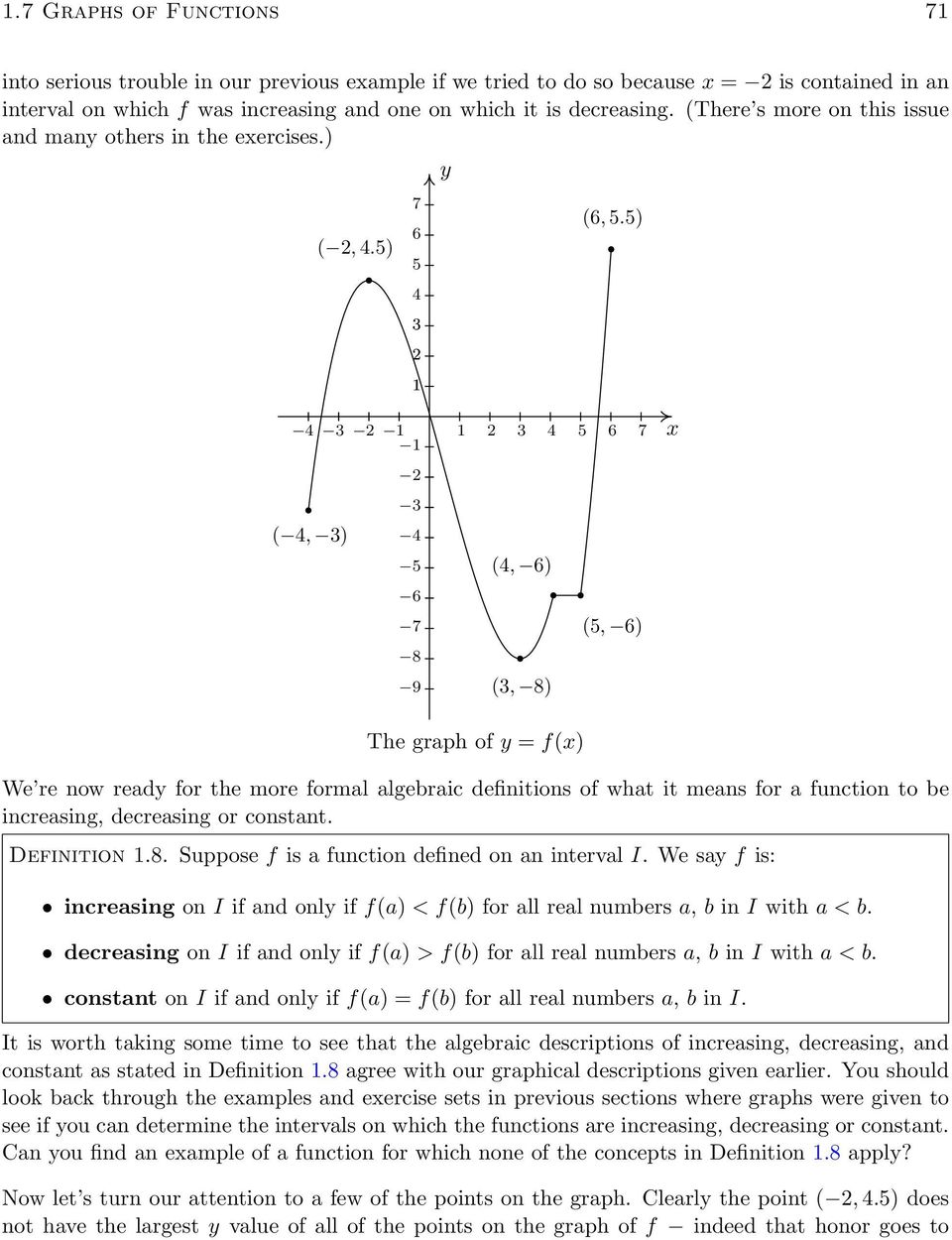
9 72 Relations and Functions (6, 5.5) but ( 2, 4.5) should get some sort of consolation prize for being the top of the hill between x = 4 and x = 3. We say that the function f has a local maximum 7 at the point ( 2, 4.5), because the y-coordinate 4.5 is the largest y-value (hence, function value) on the curve near 8 x = 2. Similarly, we say that the function f has a local minimum 9 at the point (3, 8), since the y-coordinate 8 is the smallest function value near x = 3. Although it is tempting to say that local extrema 10 occur when the function changes from increasing to decreasing or vice versa, it is not a precise enough way to define the concepts for the needs of Calculus. At the risk of being pedantic, we will present the traditional definitions and thoroughly vet the pathologies they induce in the exercises. We have one last observation to make before we proceed to the algebraic definitions and look at a fairly tame, yet helpful, example. If we look at the entire graph, we see the largest y value (hence the largest function value) is 5.5 at x = 6. In this case, we say the maximum 11 of f is 5.5; similarly, the minimum 12 of f is 8. We formalize these concepts in the following definitions. Definition 1.9. Suppose f is a function with f(a) = b. We say f has a local maximum at the point (a, b) if and only if there is an open interval I containing a for which f(a) f(x) for all x in I different than a. The value f(a) = b is called a local maximum value of f in this case. We say f has a local minimum at the point (a, b) if and only if there is an open interval I containing a for which f(a) f(x) for all x in I different than a. The value f(a) = b is called a local minimum value of f in this case. The value b is called the maximum of f if b f(x) for all x in the domain of f. The value b is called the minimum of f if b f(x) for all x in the domain of f. It s important to note that not every function will have all of these features. Indeed, it is possible to have a function with no local or absolute extrema at all! (Any ideas of what such a function s graph would have to look like?) We shall see in the exercises examples of functions which have one or two, but not all, of these features, some that have instances of each type of extremum and some functions that seem to defy common sense. In all cases, though, we shall adhere to the algebraic definitions above as we explore the wonderful diversity of graphs that functions provide to us. Here is the tame example which was promised earlier. It summarizes all of the concepts presented in this section as well as some from previous sections so you should spend some time thinking deeply about it before proceeding to the exercises. 7 Also called relative maximum. 8 We will make this more precise in a moment. 9 Also called a relative minimum. 10 Maxima is the plural of maximum and mimima is the plural of minimum. Extrema is the plural of extremum which combines maximum and minimum. 11 Sometimes called the absolute or global maximum. 12 Again, absolute or global minimum can be used.

10 1.7 Graphs of Functions 73 Example Given the graph of y = f(x) below, answer all of the following questions. y 4 3 (0, 3) 2 1 ( 2, 0) (2, 0) x ( 4, 3) (4, 3) 1. Find the domain of f. 2. Find the range of f. 3. Determine f(2). 4. List the x-intercepts, if any exist. 5. List the y-intercepts, if any exist. 6. Find the zeros of f. 7. Solve f(x) < Determine the number of solutions to the equation f(x) = List the intervals on which f is increasing. 10. List the intervals on which f is decreasing. 11. List the local maximums, if any exist. 12. List the local minimums, if any exist. 13. Find the maximum, if it exists. 14. Find the minimum, if it exists. 15. Does f appear to be even, odd, or neither? Solution. 1. To find the domain of f, we proceed as in Section 1.4. By projecting the graph to the x-axis, we see the portion of the x-axis which corresponds to a point on the graph is everything from 4 to 4, inclusive. Hence, the domain is [ 4, 4]. 2. To find the range, we project the graph to the y-axis. We see that the y values from 3 to 3, inclusive, constitute the range of f. Hence, our answer is [ 3, 3]. 3. Since the graph of f is the graph of the equation y = f(x), f(2) is the y-coordinate of the point which corresponds to x = 2. Since the point (2, 0) is on the graph, we have f(2) = 0.

11 74 Relations and Functions 4. The x-intercepts are the points on the graph with y-coordinate 0, namely ( 2, 0) and (2, 0). 5. The y-intercept is the point on the graph with x-coordinate 0, namely (0, 3). 6. The zeros of f are the x-coordinates of the x-intercepts of the graph of y = f(x) which are x = 2, To solve f(x) < 0, we look for the x values of the points on the graph where the y-coordinate is less than 0. Graphically, we are looking where the graph is below the x-axis. This happens for the x values from 4 to 2 and again from 2 to 4. So our answer is [ 4, 2) (2, 4]. 8. To find where f(x) = 1, we look for points on the graph where the y-coordinate is 1. Even though these points aren t specified, we see that the curve has two points with a y value of 1, as seen in the graph below. That means there are two solutions to f(x) = y x As we move from left to right, the graph rises from ( 4, 3) to (0, 3). This means f is increasing on the interval [ 4, 0]. (Remember, the answer here is an interval on the x-axis.) 10. As we move from left to right, the graph falls from (0, 3) to (4, 3). This means f is decreasing on the interval [0, 4]. (Remember, the answer here is an interval on the x-axis.) 11. The function has its only local maximum at (0, 3). 12. There are no local minimums. Why don t ( 4, 3) and (4, 3) count? Let s consider the point ( 4, 3) for a moment. Recall that, in the definition of local minimum, there needs to be an open interval I which contains x = 4 such that f( 4) < f(x) for all x in I different from 4. But if we put an open interval around x = 4 a portion of that interval will lie outside of the domain of f. Because we are unable to fulfill the requirements of the definition
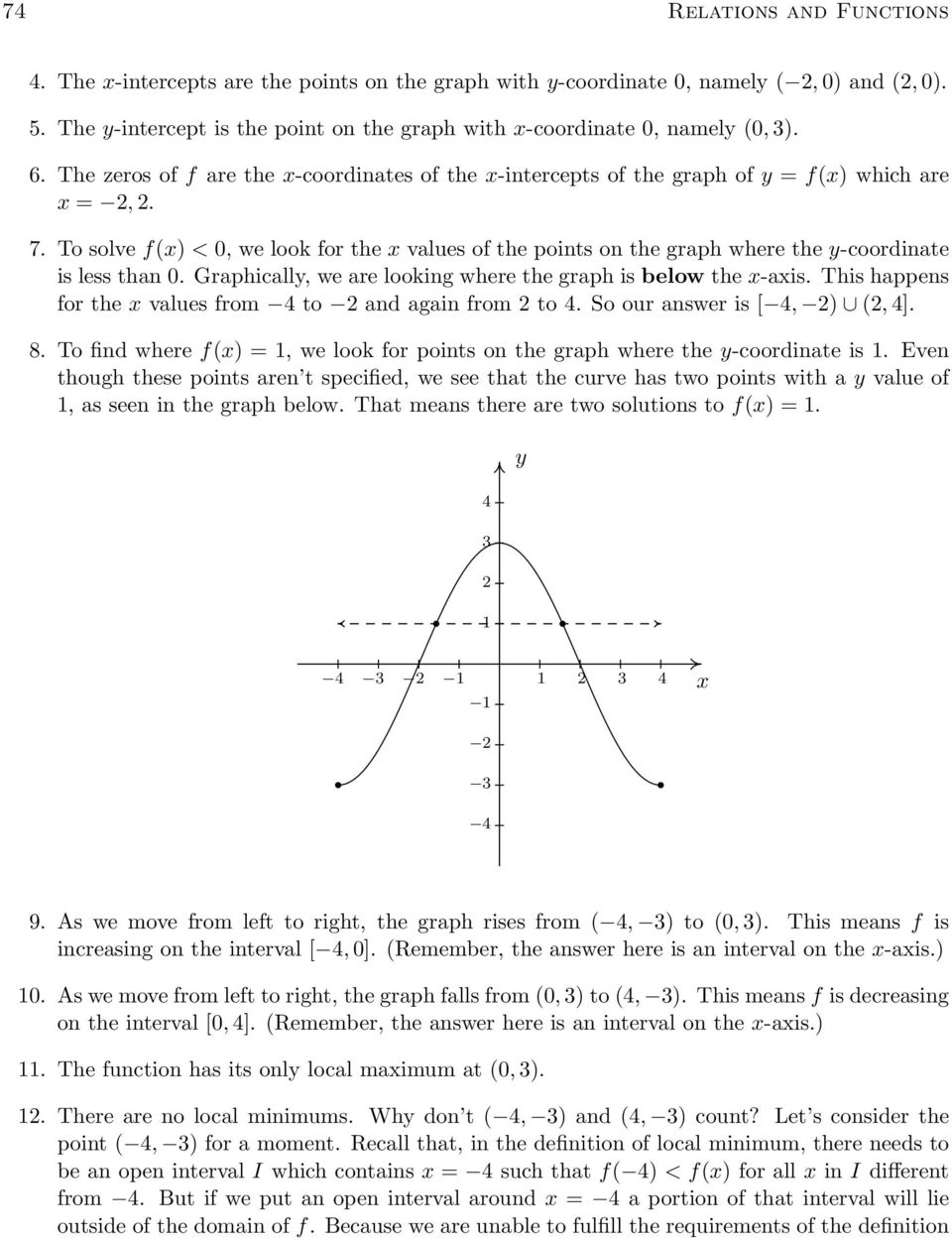
12 1.7 Graphs of Functions 75 for a local minimum, we cannot claim that f has one at ( 4, 3). The point (4, 3) fails for the same reason no open interval around x = 4 stays within the domain of f. 13. The maximum value of f is the largest y-coordinate which is The minimum value of f is the smallest y-coordinate which is The graph appears to be symmetric about the y-axis. This suggests 13 that f is even. With few exceptions, we will not develop techniques in College Algebra which allow us to determine the intervals on which a function is increasing, decreasing or constant or to find the local maximums and local minimums analytically; this is the business of Calculus. 14 When we have need to find such beasts, we will resort to the calculator. Most graphing calculators have Minimum and Maximum features which can be used to approximate these values, as demonstrated below. Example Let f(x) = 15x x 2. Use a graphing calculator to approximate the intervals on + 3 which f is increasing and those on which it is decreasing. Approximate all extrema. Solution. Entering this function into the calculator gives. Using the Minimum and Maximum features, we get 13 but does not prove 14 Although, truth be told, there is only one step of Calculus involved, followed by several pages of algebra.
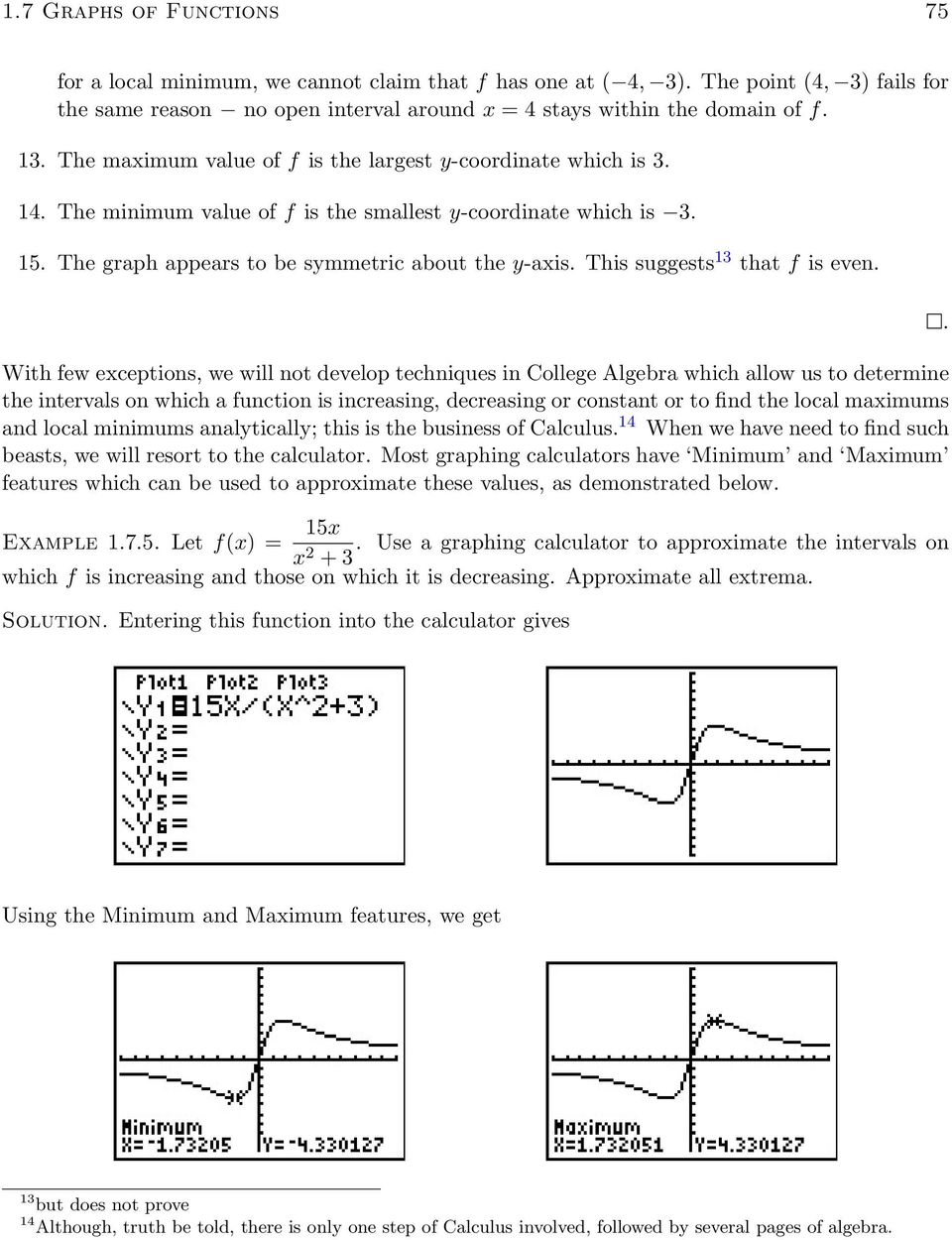
13 76 Relations and Functions To two decimal places, f appears to have its only local minimum at ( 1.73, 4.33) and its only local maximum at (1, 73, 4.33). Given the symmetry about the origin suggested by the graph, the relation between these points shouldn t be too surprising. The function appears to be increasing on [ 1.73, 1.73] and decreasing on (, 1.73] [1.73, ). This makes 4.33 the (absolute) minimum and 4.33 the (absolute) maximum. Example Find the points on the graph of y = (x 3) 2 which are closest to the origin. Round your answers to two decimal places. Solution. Suppose a point (x, y) is on the graph of y = (x 3) 2. Its distance to the origin, (0, 0), is given by d = (x 0) 2 + (y 0) 2 = x 2 + y 2 = x 2 + [(x 3) 2 ] 2 Since y = (x 3) 2 = x 2 + (x 3) 4 Given a value for x, the formula d = x 2 + (x 3) 4 is the distance from (0, 0) to the point (x, y) on the curve y = (x 3) 2. What we have defined, then, is a function d(x) which we wish to minimize over all values of x. To accomplish this task analytically would require Calculus so as we ve mentioned before, we can use a graphing calculator to find an approximate solution. Using the calculator, we enter the function d(x) as shown below and graph. Using the Minimum feature, we see above on the right that the (absolute) minimum occurs near x = 2. Rounding to two decimal places, we get that the minimum distance occurs when x = To find the y value on the parabola associated with x = 2.00, we substitute 2.00 into the equation to get y = (x 3) 2 = (2.00 3) 2 = So, our final answer is (2.00, 1.00). 15 (What does the y value listed on the calculator screen mean in this problem?) 15 It seems silly to list a final answer as (2.00, 1.00). Indeed, Calculus confirms that the exact answer to this problem is, in fact, (2, 1). As you are well aware by now, the author is a pedant, and as such, uses the decimal places to remind the reader that any result garnered from a calculator in this fashion is an approximation, and should be treated as such.
![The function appears to be increasing on [ 1.73, 1.73] and decreasing on (, 1.73] [1.73, ). This makes 4.33 the (absolute) minimum and 4.33 the (absolute) maximum. Example 1.7.6.](/docs-images/47/20872258/images/page_13.jpg "Find the points on the graph of y = (x 3) 2 which are closest to the origin. Round your answers to two decimal places. Solution. Suppose a point (x, y) is on the graph of y = (x 3) 2.")
1.2 GRAPHS OF EQUATIONS. Copyright Cengage Learning. All rights reserved.
 1.2 GRAPHS OF EQUATIONS Copyright Cengage Learning. All rights reserved. What You Should Learn Sketch graphs of equations. Find x- and y-intercepts of graphs of equations. Use symmetry to sketch graphs
1. Then f has a relative maximum at x = c if f(c) f(x) for all values of x in some
 Section 3.1: First Derivative Test Definition. Let f be a function with domain D. 1. Then f has a relative maximum at x = c if f(c) f(x) for all values of x in some open interval containing c. The number
Lecture 8 : Coordinate Geometry. The coordinate plane The points on a line can be referenced if we choose an origin and a unit of 20
 Lecture 8 : Coordinate Geometry The coordinate plane The points on a line can be referenced if we choose an origin and a unit of 0 distance on the axis and give each point an identity on the corresponding
3.3 Real Zeros of Polynomials
 3.3 Real Zeros of Polynomials 69 3.3 Real Zeros of Polynomials In Section 3., we found that we can use synthetic division to determine if a given real number is a zero of a polynomial function. This section
Section 1.1 Linear Equations: Slope and Equations of Lines
 Section. Linear Equations: Slope and Equations of Lines Slope The measure of the steepness of a line is called the slope of the line. It is the amount of change in y, the rise, divided by the amount of
Math 120 Final Exam Practice Problems, Form: A
 Math 120 Final Exam Practice Problems, Form: A Name: While every attempt was made to be complete in the types of problems given below, we make no guarantees about the completeness of the problems. Specifically,
https://williamshartunionca.springboardonline.org/ebook/book/27e8f1b87a1c4555a1212b...
 of 19 9/2/2014 12:09 PM Answers Teacher Copy Plan Pacing: 1 class period Chunking the Lesson Example A #1 Example B Example C #2 Check Your Understanding Lesson Practice Teach Bell-Ringer Activity Students
2.1 Increasing, Decreasing, and Piecewise Functions; Applications
 2.1 Increasing, Decreasing, and Piecewise Functions; Applications Graph functions, looking for intervals on which the function is increasing, decreasing, or constant, and estimate relative maxima and minima.
Practice with Proofs
 Practice with Proofs October 6, 2014 Recall the following Definition 0.1. A function f is increasing if for every x, y in the domain of f, x < y = f(x) < f(y) 1. Prove that h(x) = x 3 is increasing, using
ALGEBRA 2: 4.1 Graph Quadratic Functions in Standard Form
 ALGEBRA 2: 4.1 Graph Quadratic Functions in Standard Form Goal Graph quadratic functions. VOCABULARY Quadratic function A function that can be written in the standard form y = ax 2 + bx+ c where a 0 Parabola
A synonym is a word that has the same or almost the same definition of
 Slope-Intercept Form Determining the Rate of Change and y-intercept Learning Goals In this lesson, you will: Graph lines using the slope and y-intercept. Calculate the y-intercept of a line when given
3.2 The Factor Theorem and The Remainder Theorem
 3. The Factor Theorem and The Remainder Theorem 57 3. The Factor Theorem and The Remainder Theorem Suppose we wish to find the zeros of f(x) = x 3 + 4x 5x 4. Setting f(x) = 0 results in the polynomial
Graphing Linear Equations in Two Variables
 Math 123 Section 3.2 - Graphing Linear Equations Using Intercepts - Page 1 Graphing Linear Equations in Two Variables I. Graphing Lines A. The graph of a line is just the set of solution points of the
The degree of a polynomial function is equal to the highest exponent found on the independent variables.
 DETAILED SOLUTIONS AND CONCEPTS - POLYNOMIAL FUNCTIONS Prepared by Ingrid Stewart, Ph.D., College of Southern Nevada Please Send Questions and Comments to [email protected]. Thank you! PLEASE NOTE
7.1 Graphs of Quadratic Functions in Vertex Form
 7.1 Graphs of Quadratic Functions in Vertex Form Quadratic Function in Vertex Form A quadratic function in vertex form is a function that can be written in the form f (x) = a(x! h) 2 + k where a is called
2.2 Derivative as a Function
 2.2 Derivative as a Function Recall that we defined the derivative as f (a) = lim h 0 f(a + h) f(a) h But since a is really just an arbitrary number that represents an x-value, why don t we just use x
M 1310 4.1 Polynomial Functions 1
 M 1310 4.1 Polynomial Functions 1 Polynomial Functions and Their Graphs Definition of a Polynomial Function Let n be a nonnegative integer and let a, a,..., a, a, a n n1 2 1 0, be real numbers, with a
Simplify the rational expression. Find all numbers that must be excluded from the domain of the simplified rational expression.
 MAC 1105 Final Review Simplify the rational expression. Find all numbers that must be excluded from the domain of the simplified rational expression. 1) 8x 2-49x + 6 x - 6 A) 1, x 6 B) 8x - 1, x 6 x -
Analyzing Piecewise Functions
 Connecting Geometry to Advanced Placement* Mathematics A Resource and Strategy Guide Updated: 04/9/09 Analyzing Piecewise Functions Objective: Students will analyze attributes of a piecewise function including
1.6 A LIBRARY OF PARENT FUNCTIONS. Copyright Cengage Learning. All rights reserved.
 1.6 A LIBRARY OF PARENT FUNCTIONS Copyright Cengage Learning. All rights reserved. What You Should Learn Identify and graph linear and squaring functions. Identify and graph cubic, square root, and reciprocal
MA107 Precalculus Algebra Exam 2 Review Solutions
 MA107 Precalculus Algebra Exam 2 Review Solutions February 24, 2008 1. The following demand equation models the number of units sold, x, of a product as a function of price, p. x = 4p + 200 a. Please write
Polynomials. Dr. philippe B. laval Kennesaw State University. April 3, 2005
 Polynomials Dr. philippe B. laval Kennesaw State University April 3, 2005 Abstract Handout on polynomials. The following topics are covered: Polynomial Functions End behavior Extrema Polynomial Division
What are the place values to the left of the decimal point and their associated powers of ten?
 The verbal answers to all of the following questions should be memorized before completion of algebra. Answers that are not memorized will hinder your ability to succeed in geometry and algebra. (Everything
TI-83/84 Plus Graphing Calculator Worksheet #2
 TI-83/8 Plus Graphing Calculator Worksheet #2 The graphing calculator is set in the following, MODE, and Y, settings. Resetting your calculator brings it back to these original settings. MODE Y Note that
Algebra I Vocabulary Cards
 Algebra I Vocabulary Cards Table of Contents Expressions and Operations Natural Numbers Whole Numbers Integers Rational Numbers Irrational Numbers Real Numbers Absolute Value Order of Operations Expression
Chapter 4. Polynomial and Rational Functions. 4.1 Polynomial Functions and Their Graphs
 Chapter 4. Polynomial and Rational Functions 4.1 Polynomial Functions and Their Graphs A polynomial function of degree n is a function of the form P = a n n + a n 1 n 1 + + a 2 2 + a 1 + a 0 Where a s
EQUATIONS and INEQUALITIES
 EQUATIONS and INEQUALITIES Linear Equations and Slope 1. Slope a. Calculate the slope of a line given two points b. Calculate the slope of a line parallel to a given line. c. Calculate the slope of a line
1 Functions, Graphs and Limits
 1 Functions, Graphs and Limits 1.1 The Cartesian Plane In this course we will be dealing a lot with the Cartesian plane (also called the xy-plane), so this section should serve as a review of it and its
Linear Equations. Find the domain and the range of the following set. {(4,5), (7,8), (-1,3), (3,3), (2,-3)}
 Linear Equations Domain and Range Domain refers to the set of possible values of the x-component of a point in the form (x,y). Range refers to the set of possible values of the y-component of a point in
FINAL EXAM SECTIONS AND OBJECTIVES FOR COLLEGE ALGEBRA
 FINAL EXAM SECTIONS AND OBJECTIVES FOR COLLEGE ALGEBRA 1.1 Solve linear equations and equations that lead to linear equations. a) Solve the equation: 1 (x + 5) 4 = 1 (2x 1) 2 3 b) Solve the equation: 3x
Graphing calculators Transparencies (optional)
 What if it is in pieces? Piecewise Functions and an Intuitive Idea of Continuity Teacher Version Lesson Objective: Length of Activity: Students will: Recognize piecewise functions and the notation used
6 EXTENDING ALGEBRA. 6.0 Introduction. 6.1 The cubic equation. Objectives
 6 EXTENDING ALGEBRA Chapter 6 Extending Algebra Objectives After studying this chapter you should understand techniques whereby equations of cubic degree and higher can be solved; be able to factorise
Polynomial and Rational Functions
 Polynomial and Rational Functions Quadratic Functions Overview of Objectives, students should be able to: 1. Recognize the characteristics of parabolas. 2. Find the intercepts a. x intercepts by solving
Review of Fundamental Mathematics
 Review of Fundamental Mathematics As explained in the Preface and in Chapter 1 of your textbook, managerial economics applies microeconomic theory to business decision making. The decision-making tools
a. all of the above b. none of the above c. B, C, D, and F d. C, D, F e. C only f. C and F
 FINAL REVIEW WORKSHEET COLLEGE ALGEBRA Chapter 1. 1. Given the following equations, which are functions? (A) y 2 = 1 x 2 (B) y = 9 (C) y = x 3 5x (D) 5x + 2y = 10 (E) y = ± 1 2x (F) y = 3 x + 5 a. all
Logo Symmetry Learning Task. Unit 5
 Logo Symmetry Learning Task Unit 5 Course Mathematics I: Algebra, Geometry, Statistics Overview The Logo Symmetry Learning Task explores graph symmetry and odd and even functions. Students are asked to
Introduction to Quadratic Functions
 Introduction to Quadratic Functions The St. Louis Gateway Arch was constructed from 1963 to 1965. It cost 13 million dollars to build..1 Up and Down or Down and Up Exploring Quadratic Functions...617.2
Math 4310 Handout - Quotient Vector Spaces
 Math 4310 Handout - Quotient Vector Spaces Dan Collins The textbook defines a subspace of a vector space in Chapter 4, but it avoids ever discussing the notion of a quotient space. This is understandable
Procedure for Graphing Polynomial Functions
 Procedure for Graphing Polynomial Functions P(x) = a n x n + a n-1 x n-1 + + a 1 x + a 0 To graph P(x): As an example, we will examine the following polynomial function: P(x) = 2x 3 3x 2 23x + 12 1. Determine
1 Shapes of Cubic Functions
 MA 1165 - Lecture 05 1 1/26/09 1 Shapes of Cubic Functions A cubic function (a.k.a. a third-degree polynomial function) is one that can be written in the form f(x) = ax 3 + bx 2 + cx + d. (1) Quadratic
This unit will lay the groundwork for later units where the students will extend this knowledge to quadratic and exponential functions.
 Algebra I Overview View unit yearlong overview here Many of the concepts presented in Algebra I are progressions of concepts that were introduced in grades 6 through 8. The content presented in this course
Understanding Basic Calculus
 Understanding Basic Calculus S.K. Chung Dedicated to all the people who have helped me in my life. i Preface This book is a revised and expanded version of the lecture notes for Basic Calculus and other
MATH 60 NOTEBOOK CERTIFICATIONS
 MATH 60 NOTEBOOK CERTIFICATIONS Chapter #1: Integers and Real Numbers 1.1a 1.1b 1.2 1.3 1.4 1.8 Chapter #2: Algebraic Expressions, Linear Equations, and Applications 2.1a 2.1b 2.1c 2.2 2.3a 2.3b 2.4 2.5
12.6 Logarithmic and Exponential Equations PREPARING FOR THIS SECTION Before getting started, review the following:
 Section 1.6 Logarithmic and Exponential Equations 811 1.6 Logarithmic and Exponential Equations PREPARING FOR THIS SECTION Before getting started, review the following: Solve Quadratic Equations (Section
LINEAR EQUATIONS IN TWO VARIABLES
 66 MATHEMATICS CHAPTER 4 LINEAR EQUATIONS IN TWO VARIABLES The principal use of the Analytic Art is to bring Mathematical Problems to Equations and to exhibit those Equations in the most simple terms that
Algebra II End of Course Exam Answer Key Segment I. Scientific Calculator Only
 Algebra II End of Course Exam Answer Key Segment I Scientific Calculator Only Question 1 Reporting Category: Algebraic Concepts & Procedures Common Core Standard: A-APR.3: Identify zeros of polynomials
2.5 Transformations of Functions
 2.5 Transformations of Functions Section 2.5 Notes Page 1 We will first look at the major graphs you should know how to sketch: Square Root Function Absolute Value Function Identity Function Domain: [
Mathematics. Accelerated GSE Analytic Geometry B/Advanced Algebra Unit 7: Rational and Radical Relationships
 Georgia Standards of Excellence Frameworks Mathematics Accelerated GSE Analytic Geometry B/Advanced Algebra Unit 7: Rational and Radical Relationships These materials are for nonprofit educational purposes
5.1 Radical Notation and Rational Exponents
 Section 5.1 Radical Notation and Rational Exponents 1 5.1 Radical Notation and Rational Exponents We now review how exponents can be used to describe not only powers (such as 5 2 and 2 3 ), but also roots
Vocabulary Words and Definitions for Algebra
 Name: Period: Vocabulary Words and s for Algebra Absolute Value Additive Inverse Algebraic Expression Ascending Order Associative Property Axis of Symmetry Base Binomial Coefficient Combine Like Terms
Week 1: Functions and Equations
 Week 1: Functions and Equations Goals: Review functions Introduce modeling using linear and quadratic functions Solving equations and systems Suggested Textbook Readings: Chapter 2: 2.1-2.2, and Chapter
Write the Equation of the Line Review
 Connecting Algebra 1 to Advanced Placement* Mathematics A Resource and Strategy Guide Objective: Students will be assessed on their ability to write the equation of a line in multiple methods. Connections
5-3 Polynomial Functions. not in one variable because there are two variables, x. and y
 y. 5-3 Polynomial Functions State the degree and leading coefficient of each polynomial in one variable. If it is not a polynomial in one variable, explain why. 1. 11x 6 5x 5 + 4x 2 coefficient of the
CHAPTER FIVE. Solutions for Section 5.1. Skill Refresher. Exercises
 CHAPTER FIVE 5.1 SOLUTIONS 265 Solutions for Section 5.1 Skill Refresher S1. Since 1,000,000 = 10 6, we have x = 6. S2. Since 0.01 = 10 2, we have t = 2. S3. Since e 3 = ( e 3) 1/2 = e 3/2, we have z =
6.4 Logarithmic Equations and Inequalities
 6.4 Logarithmic Equations and Inequalities 459 6.4 Logarithmic Equations and Inequalities In Section 6.3 we solved equations and inequalities involving exponential functions using one of two basic strategies.
Section 1. Inequalities -5-4 -3-2 -1 0 1 2 3 4 5
 Worksheet 2.4 Introduction to Inequalities Section 1 Inequalities The sign < stands for less than. It was introduced so that we could write in shorthand things like 3 is less than 5. This becomes 3 < 5.
POLYNOMIAL FUNCTIONS
 POLYNOMIAL FUNCTIONS Polynomial Division.. 314 The Rational Zero Test.....317 Descarte s Rule of Signs... 319 The Remainder Theorem.....31 Finding all Zeros of a Polynomial Function.......33 Writing a
Answer Key for California State Standards: Algebra I
 Algebra I: Symbolic reasoning and calculations with symbols are central in algebra. Through the study of algebra, a student develops an understanding of the symbolic language of mathematics and the sciences.
Definition 8.1 Two inequalities are equivalent if they have the same solution set. Add or Subtract the same value on both sides of the inequality.
 8 Inequalities Concepts: Equivalent Inequalities Linear and Nonlinear Inequalities Absolute Value Inequalities (Sections 4.6 and 1.1) 8.1 Equivalent Inequalities Definition 8.1 Two inequalities are equivalent
Section 3.2 Polynomial Functions and Their Graphs
 Section 3.2 Polynomial Functions and Their Graphs EXAMPLES: P(x) = 3, Q(x) = 4x 7, R(x) = x 2 +x, S(x) = 2x 3 6x 2 10 QUESTION: Which of the following are polynomial functions? (a) f(x) = x 3 +2x+4 (b)
Equations. #1-10 Solve for the variable. Inequalities. 1. Solve the inequality: 2 5 7. 2. Solve the inequality: 4 0
 College Algebra Review Problems for Final Exam Equations #1-10 Solve for the variable 1. 2 1 4 = 0 6. 2 8 7 2. 2 5 3 7. = 3. 3 9 4 21 8. 3 6 9 18 4. 6 27 0 9. 1 + log 3 4 5. 10. 19 0 Inequalities 1. Solve
Graphing Linear Equations
 Graphing Linear Equations I. Graphing Linear Equations a. The graphs of first degree (linear) equations will always be straight lines. b. Graphs of lines can have Positive Slope Negative Slope Zero slope
MSLC Workshop Series Math 1148 1150 Workshop: Polynomial & Rational Functions
 MSLC Workshop Series Math 1148 1150 Workshop: Polynomial & Rational Functions The goal of this workshop is to familiarize you with similarities and differences in both the graphing and expression of polynomial
ALGEBRA REVIEW LEARNING SKILLS CENTER. Exponents & Radicals
 ALGEBRA REVIEW LEARNING SKILLS CENTER The "Review Series in Algebra" is taught at the beginning of each quarter by the staff of the Learning Skills Center at UC Davis. This workshop is intended to be an
Representation of functions as power series
 Representation of functions as power series Dr. Philippe B. Laval Kennesaw State University November 9, 008 Abstract This document is a summary of the theory and techniques used to represent functions
Slope & y-intercept Discovery Activity
 TI-83 Graphing Calculator Activity Slope & y-intercept Discovery Activity Justin Vallone 11/2/05 In this activity, you will use your TI-83 graphing calculator to graph equations of lines. Follow the steps
G. GRAPHING FUNCTIONS
 G. GRAPHING FUNCTIONS To get a quick insight int o how the graph of a function looks, it is very helpful to know how certain simple operations on the graph are related to the way the function epression
Domain of a Composition
 Domain of a Composition Definition Given the function f and g, the composition of f with g is a function defined as (f g)() f(g()). The domain of f g is the set of all real numbers in the domain of g such
Unit 1 Number Sense. In this unit, students will study repeating decimals, percents, fractions, decimals, and proportions.
 Unit 1 Number Sense In this unit, students will study repeating decimals, percents, fractions, decimals, and proportions. BLM Three Types of Percent Problems (p L-34) is a summary BLM for the material
0.8 Rational Expressions and Equations
 96 Prerequisites 0.8 Rational Expressions and Equations We now turn our attention to rational expressions - that is, algebraic fractions - and equations which contain them. The reader is encouraged to
MATH 10034 Fundamental Mathematics IV
 MATH 0034 Fundamental Mathematics IV http://www.math.kent.edu/ebooks/0034/funmath4.pdf Department of Mathematical Sciences Kent State University January 2, 2009 ii Contents To the Instructor v Polynomials.
x 2 + y 2 = 1 y 1 = x 2 + 2x y = x 2 + 2x + 1
 Implicit Functions Defining Implicit Functions Up until now in this course, we have only talked about functions, which assign to every real number x in their domain exactly one real number f(x). The graphs
This unit has primarily been about quadratics, and parabolas. Answer the following questions to aid yourselves in creating your own study guide.
 COLLEGE ALGEBRA UNIT 2 WRITING ASSIGNMENT This unit has primarily been about quadratics, and parabolas. Answer the following questions to aid yourselves in creating your own study guide. 1) What is the
Power functions: f(x) = x n, n is a natural number The graphs of some power functions are given below. n- even n- odd
 5.1 Polynomial Functions A polynomial unctions is a unction o the orm = a n n + a n-1 n-1 + + a 1 + a 0 Eample: = 3 3 + 5 - The domain o a polynomial unction is the set o all real numbers. The -intercepts
1.6 The Order of Operations
 1.6 The Order of Operations Contents: Operations Grouping Symbols The Order of Operations Exponents and Negative Numbers Negative Square Roots Square Root of a Negative Number Order of Operations and Negative
5.1 Derivatives and Graphs
 5.1 Derivatives and Graphs What does f say about f? If f (x) > 0 on an interval, then f is INCREASING on that interval. If f (x) < 0 on an interval, then f is DECREASING on that interval. A function has
Angles and Quadrants. Angle Relationships and Degree Measurement. Chapter 7: Trigonometry
 Chapter 7: Trigonometry Trigonometry is the study of angles and how they can be used as a means of indirect measurement, that is, the measurement of a distance where it is not practical or even possible
Part 1 Expressions, Equations, and Inequalities: Simplifying and Solving
 Section 7 Algebraic Manipulations and Solving Part 1 Expressions, Equations, and Inequalities: Simplifying and Solving Before launching into the mathematics, let s take a moment to talk about the words
36 CHAPTER 1. LIMITS AND CONTINUITY. Figure 1.17: At which points is f not continuous?
 36 CHAPTER 1. LIMITS AND CONTINUITY 1.3 Continuity Before Calculus became clearly de ned, continuity meant that one could draw the graph of a function without having to lift the pen and pencil. While this
f(x) = g(x), if x A h(x), if x B.
 1. Piecewise Functions By Bryan Carrillo, University of California, Riverside We can create more complicated functions by considering Piece-wise functions. Definition: Piecewise-function. A piecewise-function
Answer Key Building Polynomial Functions
 Answer Key Building Polynomial Functions 1. What is the equation of the linear function shown to the right? 2. How did you find it? y = ( 2/3)x + 2 or an equivalent form. Answers will vary. For example,
Algebra 2 Notes AII.7 Functions: Review, Domain/Range. Function: Domain: Range:
 Name: Date: Block: Functions: Review What is a.? Relation: Function: Domain: Range: Draw a graph of a : a) relation that is a function b) relation that is NOT a function Function Notation f(x): Names the
Polynomial Expressions and Equations
 Polynomial Expressions and Equations This is a really close-up picture of rain. Really. The picture represents falling water broken down into molecules, each with two hydrogen atoms connected to one oxygen
Chapter 3. Cartesian Products and Relations. 3.1 Cartesian Products
 Chapter 3 Cartesian Products and Relations The material in this chapter is the first real encounter with abstraction. Relations are very general thing they are a special type of subset. After introducing
3. Mathematical Induction
 3. MATHEMATICAL INDUCTION 83 3. Mathematical Induction 3.1. First Principle of Mathematical Induction. Let P (n) be a predicate with domain of discourse (over) the natural numbers N = {0, 1,,...}. If (1)
TOPIC 4: DERIVATIVES
 TOPIC 4: DERIVATIVES 1. The derivative of a function. Differentiation rules 1.1. The slope of a curve. The slope of a curve at a point P is a measure of the steepness of the curve. If Q is a point on the
Linear and quadratic Taylor polynomials for functions of several variables.
 ams/econ 11b supplementary notes ucsc Linear quadratic Taylor polynomials for functions of several variables. c 010, Yonatan Katznelson Finding the extreme (minimum or maximum) values of a function, is
Graphing Quadratic Functions
 Problem 1 The Parabola Examine the data in L 1 and L to the right. Let L 1 be the x- value and L be the y-values for a graph. 1. How are the x and y-values related? What pattern do you see? To enter the
PYTHAGOREAN TRIPLES KEITH CONRAD
 PYTHAGOREAN TRIPLES KEITH CONRAD 1. Introduction A Pythagorean triple is a triple of positive integers (a, b, c) where a + b = c. Examples include (3, 4, 5), (5, 1, 13), and (8, 15, 17). Below is an ancient
3.3. Solving Polynomial Equations. Introduction. Prerequisites. Learning Outcomes
 Solving Polynomial Equations 3.3 Introduction Linear and quadratic equations, dealt within Sections 3.1 and 3.2, are members of a class of equations, called polynomial equations. These have the general
Examples of Tasks from CCSS Edition Course 3, Unit 5
 Examples of Tasks from CCSS Edition Course 3, Unit 5 Getting Started The tasks below are selected with the intent of presenting key ideas and skills. Not every answer is complete, so that teachers can
Algebra Cheat Sheets
 Sheets Algebra Cheat Sheets provide you with a tool for teaching your students note-taking, problem-solving, and organizational skills in the context of algebra lessons. These sheets teach the concepts
What does the number m in y = mx + b measure? To find out, suppose (x 1, y 1 ) and (x 2, y 2 ) are two points on the graph of y = mx + b.
 PRIMARY CONTENT MODULE Algebra - Linear Equations & Inequalities T-37/H-37 What does the number m in y = mx + b measure? To find out, suppose (x 1, y 1 ) and (x 2, y 2 ) are two points on the graph of
Solving Rational Equations
 Lesson M Lesson : Student Outcomes Students solve rational equations, monitoring for the creation of extraneous solutions. Lesson Notes In the preceding lessons, students learned to add, subtract, multiply,
MAT12X Intermediate Algebra
 MAT12X Intermediate Algebra Workshop I - Exponential Functions LEARNING CENTER Overview Workshop I Exponential Functions of the form y = ab x Properties of the increasing and decreasing exponential functions
Let s explore the content and skills assessed by Heart of Algebra questions.
 Chapter 9 Heart of Algebra Heart of Algebra focuses on the mastery of linear equations, systems of linear equations, and linear functions. The ability to analyze and create linear equations, inequalities,
Equations, Lenses and Fractions
 46 Equations, Lenses and Fractions The study of lenses offers a good real world example of a relation with fractions we just can t avoid! Different uses of a simple lens that you may be familiar with are
More Quadratic Equations
 More Quadratic Equations Math 99 N1 Chapter 8 1 Quadratic Equations We won t discuss quadratic inequalities. Quadratic equations are equations where the unknown appears raised to second power, and, possibly
Year 9 set 1 Mathematics notes, to accompany the 9H book.
 Part 1: Year 9 set 1 Mathematics notes, to accompany the 9H book. equations 1. (p.1), 1.6 (p. 44), 4.6 (p.196) sequences 3. (p.115) Pupils use the Elmwood Press Essential Maths book by David Raymer (9H
For additional information, see the Math Notes boxes in Lesson B.1.3 and B.2.3.
 EXPONENTIAL FUNCTIONS B.1.1 B.1.6 In these sections, students generalize what they have learned about geometric sequences to investigate exponential functions. Students study exponential functions of the