
DERIVATIVES AS MATRICES; CHAIN RULE
|
|
|
- Ami Spencer
- 9 years ago
- Views:
Transcription
1 DERIVATIVES AS MATRICES; CHAIN RULE 1. Derivatives of Real-valued Functions Let s first consider functions f : R 2 R. Recall that if the partial derivatives of f exist at the point (x 0, y 0 ), then we can write down the candidate for the tangent plane: (1.1) z z 0 = f x (x 0, y 0 )(x x 0 ) + f y (x 0, y 0 )(y y 0 ). We defined f to be differentiable if this plane really is a tangent plane to the graph of f in the sense that the tangent line to every smooth curve in the graph through the point (x 0, y 0, z 0 ) lies in this plane. As mentioned in class, one can show that if the partial derivatives are continuous, then the function is differentiable. However, while we talked about differentiable functions, we never defined the actual derivative of a function from R 2 to R. Definition 1.1. If f is differentiable at (x 0, y 0 ), then we define the derivative to be f (x 0, y 0 ) = [ f x (x 0, y 0 ) f y (x 0, y 0 ) ]. (If we view this row matrix at a vector, then it is the gradient f(x 0, y 0 ).) Similarly, for a differentiable function f : R n R, the derivative is the row matrix with n entries consisting of the n partial derivatives. E.g., for a function of three variables, we have f (x 0.y 0, z 0 ) = [ f x (x 0, y 0, z 0 ) f y (x 0, y 0, z 0 ) f z (x 0, y 0, z 0 ) ] 1.2. Example. Let f(x, y) = x 2 y 3, and let (x 0, y 0 ) = (2, 1). Then f x = 2xy3 and f y = 3x2 y 2, so f f x (2, 1) = 4 and y (2, 1) = 12. Thus f (2, 1) = [ 4 12 ]. The matrix f (2, 1) defines a linear transformation: L(x, y) = [ 4 12 ] x = 4x + 12y. y Observe that the tangent line may be written as z 4 = 4(x 2) + 12(y 1) z 4 = [ 4 12 ] x 2. y 1 As in this example, for an arbitrary differentiable function f : R 2 R, the tangent plane (Equation 1.1) to the graph at (x 0, y 0, z 0 ) may be written (1.3) z z 0 = f x x0 (x 0, y 0 ) y y 0 1
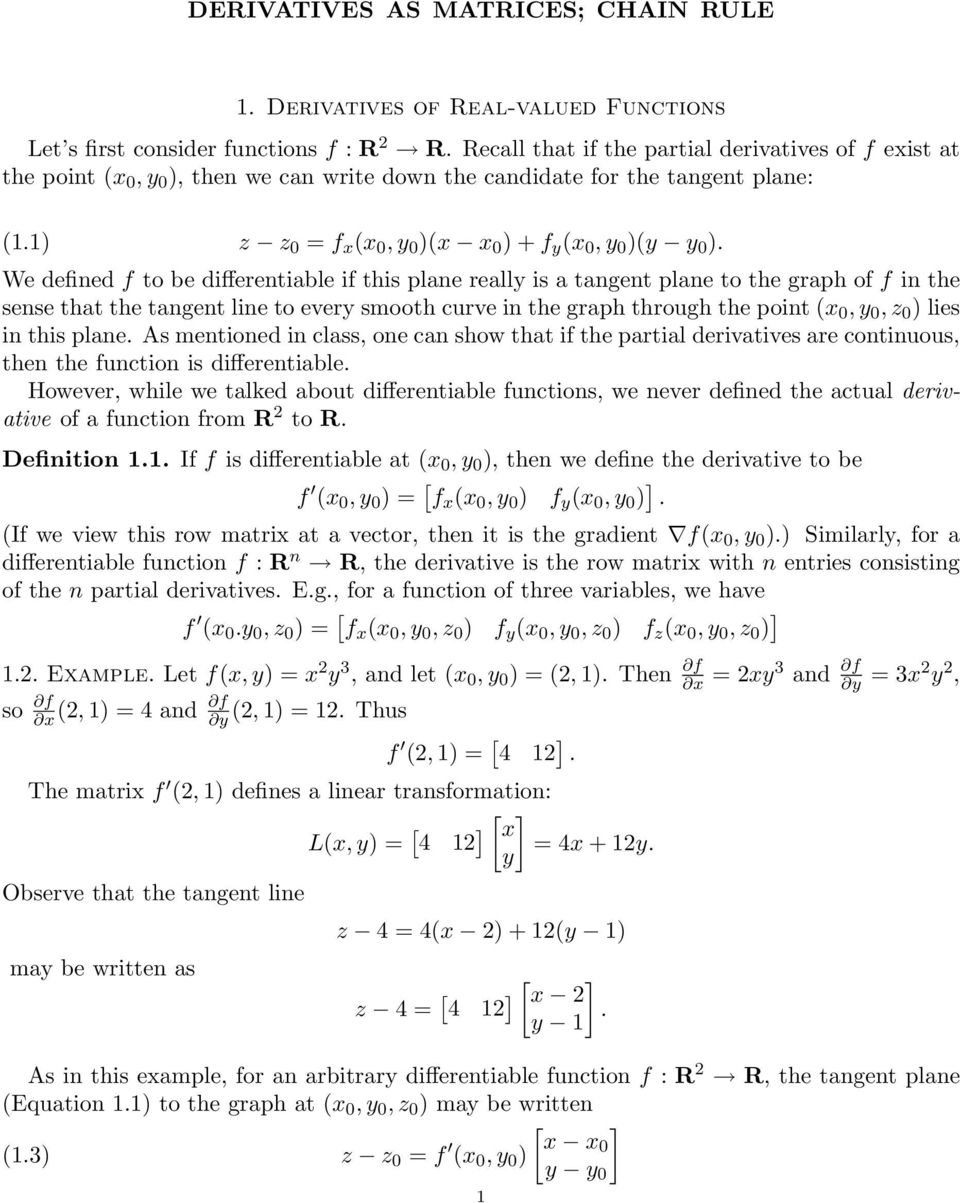
2 2 DERIVATIVES AS MATRICES; CHAIN RULE If we write then Equation 1.3 may be rewritten as [ x x = and x y] 0 = [ x0 y 0 ] (1.4) z z 0 = f (x 0, y 0 )(x x 0 ). Note the resemblance between this expression for the tangent plane to the graph of a function f : R 2 R 2 and the familiar expression for the tangent line to the graph of a real-valued function of one variable. 2. Functions for which the domain and range are both higher-dimensional. A function f : R n R m consists of m-real-valued functions on R n : f(x 1,..., x n ) = (f 1 (x 1,..., x n ),..., f m (x 1,..., x n )). The real-valued functions f 1,..., f m are called the component functions Example. Define a function f : R 2 R 3 by f(x, y) = (x 2 y, 3xy, 5x + 4y)). Then the component functions are f 1 (x, y) = x 2 y, f 2 (x, y) = 3xy, and f 3 (x, y) = 5x + 4y. Definition 2.1. We say a function f : R n R m is differentiable if each of the component functions is differentiable. In that case, the derivative at a point (a 1,..., a n ) in R n is given by the m n matrix whose ith row is the derivative of the ith component function Example. Define f as in Example 2.1. Let (a 1, a 2 ) = (1, 1). Then f 1 (x, y) = [ 2xy x 2] so f 1(1, 1) = [ 2 1 ]. Similarly and Thus f 2(1, 1) = [ 3 3 ] f 3(1, 1) = [ 5 4 ] f (1, 1) = Exercise. Find the derivatives (as matrices) of each of the following functions at the indicated point: (1) f(x, y, z) = (e 3x y z, x 2 y 2 ) at the point (1, 1, 2) (2) f(x, y) = ((x + y) 3, xsin(y)) at (2, 0). (3) f(t) = (t 2, t 3, t 4 ) at t 0 = 1. (If you view f as a parametrized curve, you have the familiar notion of the tangent vector at the point with parameter t 0 = 1. How does this compare to the derivative that you just computed?)

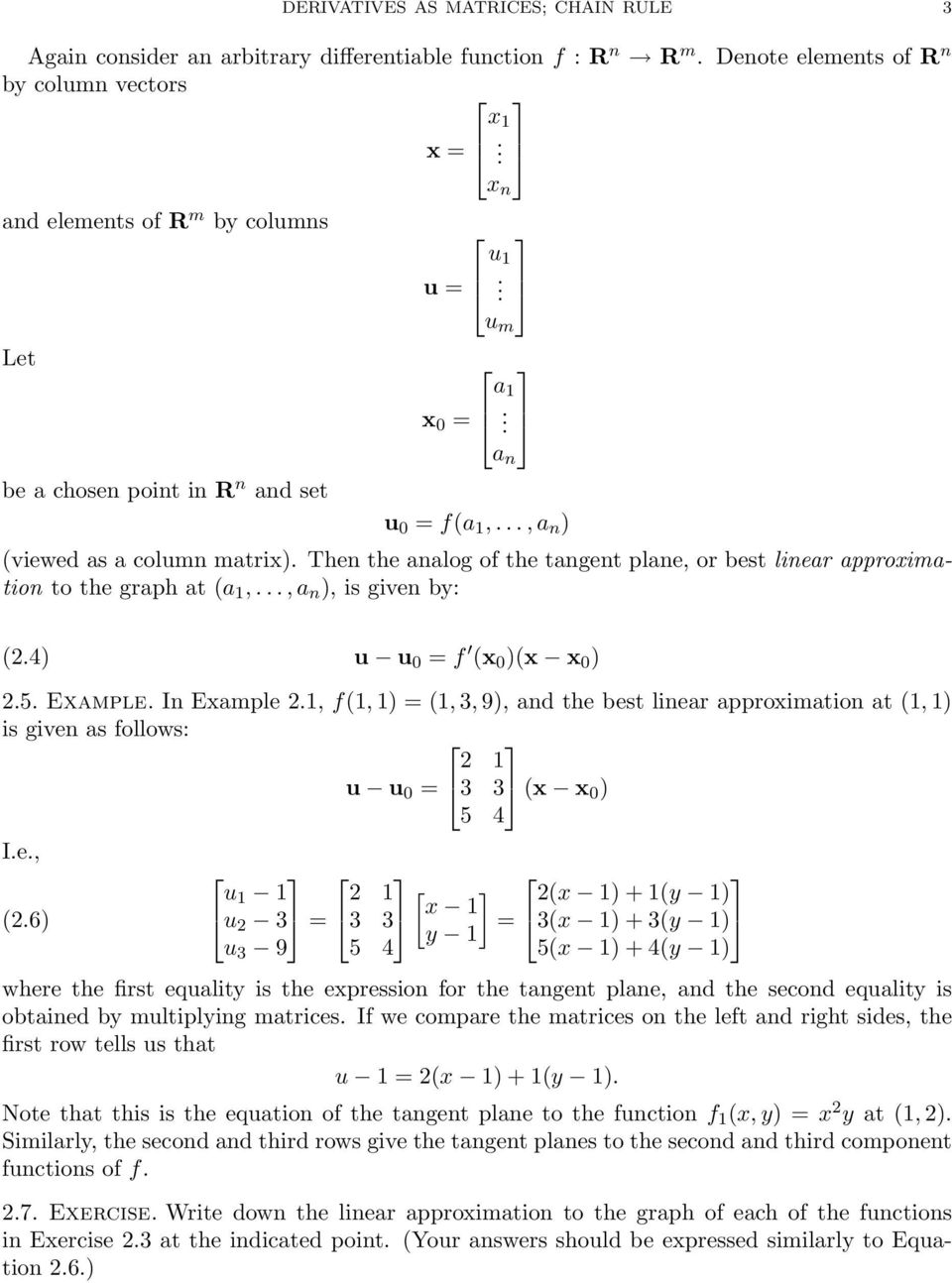
3 DERIVATIVES AS MATRICES; CHAIN RULE 3 Again consider an arbitrary differentiable function f : R n R m. Denote elements of R n by column vectors and elements of R m by columns Let be a chosen point in R n and set x 1 x =. x n u 1 u =. u m a 1 x 0 =. a n u 0 = f(a 1,..., a n ) (viewed as a column matrix). Then the analog of the tangent plane, or best linear approximation to the graph at (a 1,..., a n ), is given by: (2.4) u u 0 = f (x 0 )(x x 0 ) 2.5. Example. In Example 2.1, f(1, 1) = (1, 3, 9), and the best linear approximation at (1, 1) is given as follows: u u 0 = (x x 0 ) 5 4 I.e., (2.6) u 1 1 u 2 3 = 2 1 2(x 1) + 1(y 1) 3 3 x 1 = 3(x 1) + 3(y 1) y 1 u (x 1) + 4(y 1) where the first equality is the expression for the tangent plane, and the second equality is obtained by multiplying matrices. If we compare the matrices on the left and right sides, the first row tells us that u 1 = 2(x 1) + 1(y 1). Note that this is the equation of the tangent plane to the function f 1 (x, y) = x 2 y at (1, 2). Similarly, the second and third rows give the tangent planes to the second and third component functions of f Exercise. Write down the linear approximation to the graph of each of the functions in Exercise 2.3 at the indicated point. (Your answers should be expressed similarly to Equation 2.6.)
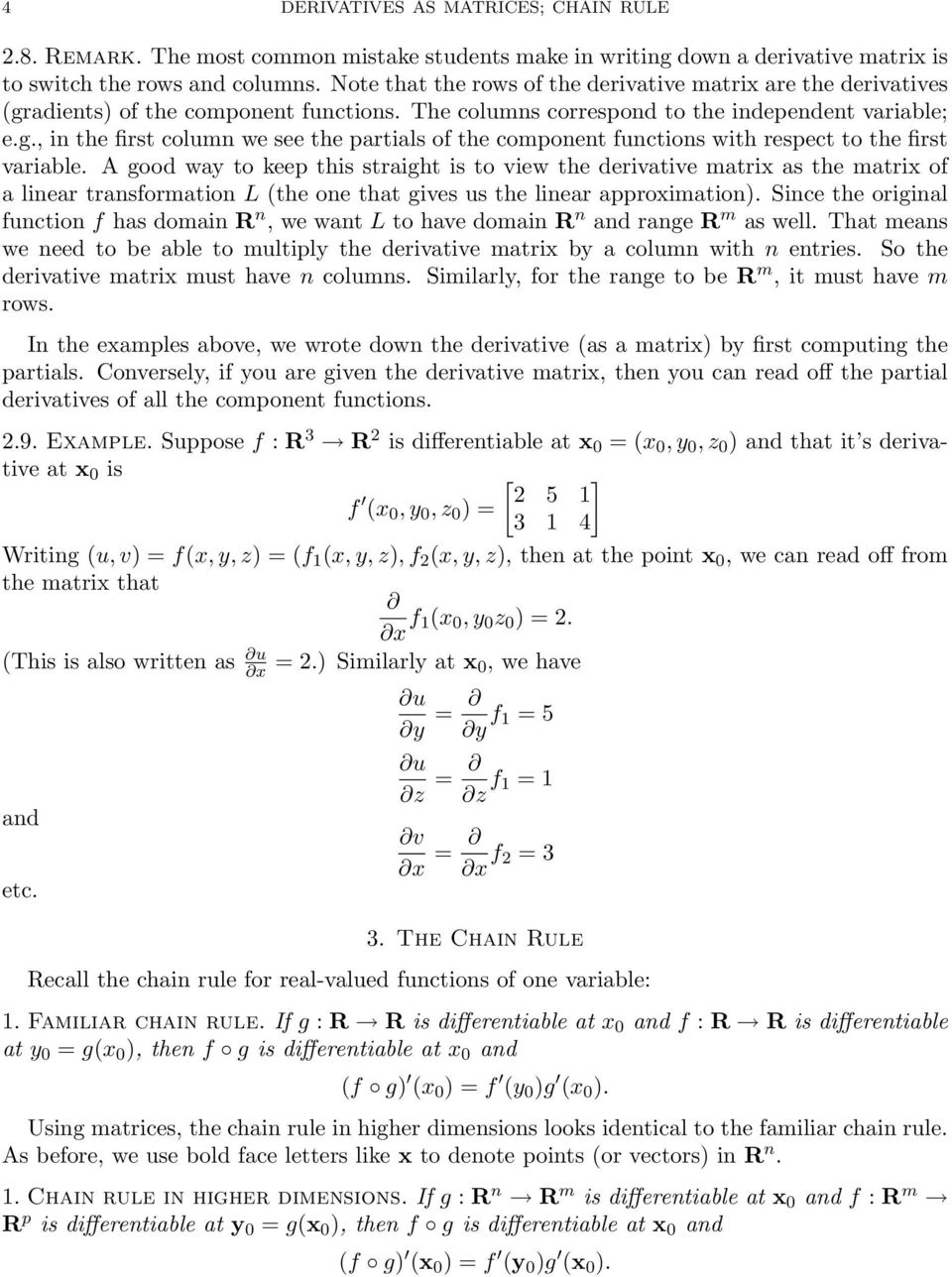
4 4 DERIVATIVES AS MATRICES; CHAIN RULE 2.8. Remark. The most common mistake students make in writing down a derivative matrix is to switch the rows and columns. Note that the rows of the derivative matrix are the derivatives (gradients) of the component functions. The columns correspond to the independent variable; e.g., in the first column we see the partials of the component functions with respect to the first variable. A good way to keep this straight is to view the derivative matrix as the matrix of a linear transformation L (the one that gives us the linear approximation). Since the original function f has domain R n, we want L to have domain R n and range R m as well. That means we need to be able to multiply the derivative matrix by a column with n entries. So the derivative matrix must have n columns. Similarly, for the range to be R m, it must have m rows. In the examples above, we wrote down the derivative (as a matrix) by first computing the partials. Conversely, if you are given the derivative matrix, then you can read off the partial derivatives of all the component functions Example. Suppose f : R 3 R 2 is differentiable at x 0 = (x 0, y 0, z 0 ) and that it s derivative at x 0 is f (x 0, y 0, z 0 ) = Writing (u, v) = f(x, y, z) = (f 1 (x, y, z), f 2 (x, y, z), then at the point x 0, we can read off from the matrix that x f 1(x 0, y 0 z 0 ) = 2. (This is also written as x = 2.) Similarly at x 0, we have y = y f 1 = 5 and etc. z = z f 1 = 1 v x = x f 2 = 3 3. The Chain Rule Recall the chain rule for real-valued functions of one variable: 1. Familiar chain rule. If g : R R is differentiable at x 0 and f : R R is differentiable at y 0 = g(x 0 ), then f g is differentiable at x 0 and (f g) (x 0 ) = f (y 0 )g (x 0 ). Using matrices, the chain rule in higher dimensions looks identical to the familiar chain rule. As before, we use bold face letters like x to denote points (or vectors) in R n. 1. Chain rule in higher dimensions. If g : R n R m is differentiable at x 0 and f : R m R p is differentiable at y 0 = g(x 0 ), then f g is differentiable at x 0 and (f g) (x 0 ) = f (y 0 )g (x 0 ).
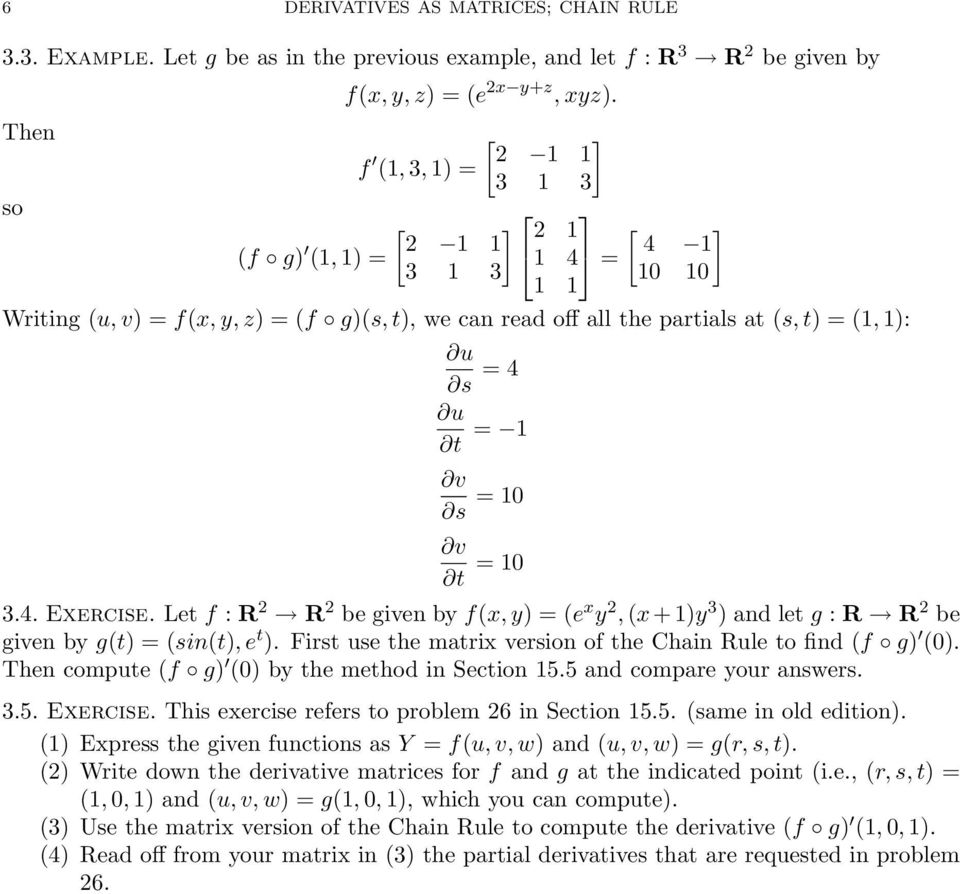
5 3.1. Example. Define g : R 2 R 3 by and define f : R 3 R by DERIVATIVES AS MATRICES; CHAIN RULE 5 g(s, t) = (s 2 t, s + 2t 2, st) f(x, y, z) = e 2x y+z. Let s compute the derivative of f g at (s 0, t 0 ) = (1, 1, ). Note that g(1, 1) = (1, 3, 1). The chain rule says that We compute: so Similarly Thus (f g) (1, 1) = f (1, 3, 1)g (1, 1). g (s, t) = 2st s2 1 4t t s g (1, 1, ) = f (1, 3, 1) = [ ] (f g) (1, 1) = [ ] = [ 4 1 ] 1 1 Writing w = f g(s, t), we can read off from this derivative matrix that at (1, 1), w s = 4 and w t = 1. Let s compare this computation with the version of the chain rule given in Section 15.5 of Stewart. Writing w = f(x, y, z) and (x, y, z) = g(s, t), the chain rule in Stewart says that At (s, t) = (1, 1) and (x, y, z) = (1, 3, 1), we get (3.2) w s = w x x s + w y y s + w x z s. w s = 2(2) + ( 1)(1) + (1)(1) = 4. This agrees with what we obtained using the matrices. Notice that the computation in Equation 3.2 is equivalent to multiplying the first (and only) row of the matrix f (1, 3, 1) by the first column of the matrix g (1, 1). Similarly, the formula in Stewart for w t corresponds to multiplying the row of f (1, 3, 1) by the second column of g (1, 1). The matrix multiplication gives us both partials at once. (If you are only interested in one of the partials, then the formula in Stewart is a bit faster. If you want all the partials, the matrix method is more convenient.)
![g (s, t) = 2st s2 1 4t t s g (1, 1, ) = 2 1 1 4 1 1 f (1, 3, 1) = [ 2 1 1 ] (f g) (1, 1) = [ 2 1 1 ] 2 1 1 4 = [ 4 1 ] 1 1 Writing w = f g(s, t), we can read off from this derivative matrix that at](/docs-images/46/21736478/images/page_5.jpg "(1, 1), w s = 4 and w t = 1. Let s compare this computation with the version of the chain rule given in Section 15.5 of Stewart.")
6 6 DERIVATIVES AS MATRICES; CHAIN RULE 3.3. Example. Let g be as in the previous example, and let f : R 3 R 2 be given by f(x, y, z) = (e 2x y+z, xyz). Then f (1, 3, 1) = so (f g) (1, 1) = = Writing (u, v) = f(x, y, z) = (f g)(s, t), we can read off all the partials at (s, t) = (1, 1): s = 4 t = 1 v s = 10 v t = Exercise. Let f : R 2 R 2 be given by f(x, y) = (e x y 2, (x + 1)y 3 ) and let g : R R 2 be given by g(t) = (sin(t), e t ). First use the matrix version of the Chain Rule to find (f g) (0). Then compute (f g) (0) by the method in Section 15.5 and compare your answers Exercise. This exercise refers to problem 26 in Section (same in old edition). (1) Express the given functions as Y = f(u, v, w) and (u, v, w) = g(r, s, t). (2) Write down the derivative matrices for f and g at the indicated point (i.e., (r, s, t) = (1, 0, 1) and (u, v, w) = g(1, 0, 1), which you can compute). (3) Use the matrix version of the Chain Rule to compute the derivative (f g) (1, 0, 1). (4) Read off from your matrix in (3) the partial derivatives that are requested in problem 26.
Section 12.6: Directional Derivatives and the Gradient Vector
 Section 26: Directional Derivatives and the Gradient Vector Recall that if f is a differentiable function of x and y and z = f(x, y), then the partial derivatives f x (x, y) and f y (x, y) give the rate
(a) We have x = 3 + 2t, y = 2 t, z = 6 so solving for t we get the symmetric equations. x 3 2. = 2 y, z = 6. t 2 2t + 1 = 0,
 Name: Solutions to Practice Final. Consider the line r(t) = 3 + t, t, 6. (a) Find symmetric equations for this line. (b) Find the point where the first line r(t) intersects the surface z = x + y. (a) We
88 CHAPTER 2. VECTOR FUNCTIONS. . First, we need to compute T (s). a By definition, r (s) T (s) = 1 a sin s a. sin s a, cos s a
 88 CHAPTER. VECTOR FUNCTIONS.4 Curvature.4.1 Definitions and Examples The notion of curvature measures how sharply a curve bends. We would expect the curvature to be 0 for a straight line, to be very small
Scalar Valued Functions of Several Variables; the Gradient Vector
 Scalar Valued Functions of Several Variables; the Gradient Vector Scalar Valued Functions vector valued function of n variables: Let us consider a scalar (i.e., numerical, rather than y = φ(x = φ(x 1,
SECOND DERIVATIVE TEST FOR CONSTRAINED EXTREMA
 SECOND DERIVATIVE TEST FOR CONSTRAINED EXTREMA This handout presents the second derivative test for a local extrema of a Lagrange multiplier problem. The Section 1 presents a geometric motivation for the
Practice with Proofs
 Practice with Proofs October 6, 2014 Recall the following Definition 0.1. A function f is increasing if for every x, y in the domain of f, x < y = f(x) < f(y) 1. Prove that h(x) = x 3 is increasing, using
( 1)2 + 2 2 + 2 2 = 9 = 3 We would like to make the length 6. The only vectors in the same direction as v are those
 1.(6pts) Which of the following vectors has the same direction as v 1,, but has length 6? (a), 4, 4 (b),, (c) 4,, 4 (d), 4, 4 (e) 0, 6, 0 The length of v is given by ( 1) + + 9 3 We would like to make
Fundamental Theorems of Vector Calculus
 Fundamental Theorems of Vector Calculus We have studied the techniques for evaluating integrals over curves and surfaces. In the case of integrating over an interval on the real line, we were able to use
Differentiation of vectors
 Chapter 4 Differentiation of vectors 4.1 Vector-valued functions In the previous chapters we have considered real functions of several (usually two) variables f : D R, where D is a subset of R n, where
Linear Algebra Notes for Marsden and Tromba Vector Calculus
 Linear Algebra Notes for Marsden and Tromba Vector Calculus n-dimensional Euclidean Space and Matrices Definition of n space As was learned in Math b, a point in Euclidean three space can be thought of
160 CHAPTER 4. VECTOR SPACES
 160 CHAPTER 4. VECTOR SPACES 4. Rank and Nullity In this section, we look at relationships between the row space, column space, null space of a matrix and its transpose. We will derive fundamental results
1 3 4 = 8i + 20j 13k. x + w. y + w
 ) Find the point of intersection of the lines x = t +, y = 3t + 4, z = 4t + 5, and x = 6s + 3, y = 5s +, z = 4s + 9, and then find the plane containing these two lines. Solution. Solve the system of equations
Question 2: How do you solve a matrix equation using the matrix inverse?
 Question : How do you solve a matrix equation using the matrix inverse? In the previous question, we wrote systems of equations as a matrix equation AX B. In this format, the matrix A contains the coefficients
A QUICK GUIDE TO THE FORMULAS OF MULTIVARIABLE CALCULUS
 A QUIK GUIDE TO THE FOMULAS OF MULTIVAIABLE ALULUS ontents 1. Analytic Geometry 2 1.1. Definition of a Vector 2 1.2. Scalar Product 2 1.3. Properties of the Scalar Product 2 1.4. Length and Unit Vectors
L 2 : x = s + 1, y = s, z = 4s + 4. 3. Suppose that C has coordinates (x, y, z). Then from the vector equality AC = BD, one has
 The line L through the points A and B is parallel to the vector AB = 3, 2, and has parametric equations x = 3t + 2, y = 2t +, z = t Therefore, the intersection point of the line with the plane should satisfy:
Mathematics Course 111: Algebra I Part IV: Vector Spaces
 Mathematics Course 111: Algebra I Part IV: Vector Spaces D. R. Wilkins Academic Year 1996-7 9 Vector Spaces A vector space over some field K is an algebraic structure consisting of a set V on which are
Microeconomic Theory: Basic Math Concepts
 Microeconomic Theory: Basic Math Concepts Matt Van Essen University of Alabama Van Essen (U of A) Basic Math Concepts 1 / 66 Basic Math Concepts In this lecture we will review some basic mathematical concepts
TOPIC 4: DERIVATIVES
 TOPIC 4: DERIVATIVES 1. The derivative of a function. Differentiation rules 1.1. The slope of a curve. The slope of a curve at a point P is a measure of the steepness of the curve. If Q is a point on the
Linear and quadratic Taylor polynomials for functions of several variables.
 ams/econ 11b supplementary notes ucsc Linear quadratic Taylor polynomials for functions of several variables. c 010, Yonatan Katznelson Finding the extreme (minimum or maximum) values of a function, is
Class Meeting # 1: Introduction to PDEs
 MATH 18.152 COURSE NOTES - CLASS MEETING # 1 18.152 Introduction to PDEs, Fall 2011 Professor: Jared Speck Class Meeting # 1: Introduction to PDEs 1. What is a PDE? We will be studying functions u = u(x
Determine If An Equation Represents a Function
 Question : What is a linear function? The term linear function consists of two parts: linear and function. To understand what these terms mean together, we must first understand what a function is. The
Objectives. Materials
 Activity 4 Objectives Understand what a slope field represents in terms of Create a slope field for a given differential equation Materials TI-84 Plus / TI-83 Plus Graph paper Introduction One of the ways
To give it a definition, an implicit function of x and y is simply any relationship that takes the form:
 2 Implicit function theorems and applications 21 Implicit functions The implicit function theorem is one of the most useful single tools you ll meet this year After a while, it will be second nature to
2.2 Derivative as a Function
 2.2 Derivative as a Function Recall that we defined the derivative as f (a) = lim h 0 f(a + h) f(a) h But since a is really just an arbitrary number that represents an x-value, why don t we just use x
1.2 Solving a System of Linear Equations
 1.. SOLVING A SYSTEM OF LINEAR EQUATIONS 1. Solving a System of Linear Equations 1..1 Simple Systems - Basic De nitions As noticed above, the general form of a linear system of m equations in n variables
Methods for Finding Bases
 Methods for Finding Bases Bases for the subspaces of a matrix Row-reduction methods can be used to find bases. Let us now look at an example illustrating how to obtain bases for the row space, null space,
Solutions for Review Problems
 olutions for Review Problems 1. Let be the triangle with vertices A (,, ), B (4,, 1) and C (,, 1). (a) Find the cosine of the angle BAC at vertex A. (b) Find the area of the triangle ABC. (c) Find a vector
Systems of Linear Equations
 Systems of Linear Equations Beifang Chen Systems of linear equations Linear systems A linear equation in variables x, x,, x n is an equation of the form a x + a x + + a n x n = b, where a, a,, a n and
Linear Algebra Notes
 Linear Algebra Notes Chapter 19 KERNEL AND IMAGE OF A MATRIX Take an n m matrix a 11 a 12 a 1m a 21 a 22 a 2m a n1 a n2 a nm and think of it as a function A : R m R n The kernel of A is defined as Note
DIFFERENTIABILITY OF COMPLEX FUNCTIONS. Contents
 DIFFERENTIABILITY OF COMPLEX FUNCTIONS Contents 1. Limit definition of a derivative 1 2. Holomorphic functions, the Cauchy-Riemann equations 3 3. Differentiability of real functions 5 4. A sufficient condition
Chapter 19. General Matrices. An n m matrix is an array. a 11 a 12 a 1m a 21 a 22 a 2m A = a n1 a n2 a nm. The matrix A has n row vectors
 Chapter 9. General Matrices An n m matrix is an array a a a m a a a m... = [a ij]. a n a n a nm The matrix A has n row vectors and m column vectors row i (A) = [a i, a i,..., a im ] R m a j a j a nj col
the points are called control points approximating curve
 Chapter 4 Spline Curves A spline curve is a mathematical representation for which it is easy to build an interface that will allow a user to design and control the shape of complex curves and surfaces.
Recall that two vectors in are perpendicular or orthogonal provided that their dot
 Orthogonal Complements and Projections Recall that two vectors in are perpendicular or orthogonal provided that their dot product vanishes That is, if and only if Example 1 The vectors in are orthogonal
x 2 + y 2 = 1 y 1 = x 2 + 2x y = x 2 + 2x + 1
 Implicit Functions Defining Implicit Functions Up until now in this course, we have only talked about functions, which assign to every real number x in their domain exactly one real number f(x). The graphs
Multi-variable Calculus and Optimization
 Multi-variable Calculus and Optimization Dudley Cooke Trinity College Dublin Dudley Cooke (Trinity College Dublin) Multi-variable Calculus and Optimization 1 / 51 EC2040 Topic 3 - Multi-variable Calculus
NOTES ON LINEAR TRANSFORMATIONS
 NOTES ON LINEAR TRANSFORMATIONS Definition 1. Let V and W be vector spaces. A function T : V W is a linear transformation from V to W if the following two properties hold. i T v + v = T v + T v for all
Section 9.5: Equations of Lines and Planes
 Lines in 3D Space Section 9.5: Equations of Lines and Planes Practice HW from Stewart Textbook (not to hand in) p. 673 # 3-5 odd, 2-37 odd, 4, 47 Consider the line L through the point P = ( x, y, ) that
MATH10212 Linear Algebra. Systems of Linear Equations. Definition. An n-dimensional vector is a row or a column of n numbers (or letters): a 1.
 MATH10212 Linear Algebra Textbook: D. Poole, Linear Algebra: A Modern Introduction. Thompson, 2006. ISBN 0-534-40596-7. Systems of Linear Equations Definition. An n-dimensional vector is a row or a column
5.1 Derivatives and Graphs
 5.1 Derivatives and Graphs What does f say about f? If f (x) > 0 on an interval, then f is INCREASING on that interval. If f (x) < 0 on an interval, then f is DECREASING on that interval. A function has
8 Square matrices continued: Determinants
 8 Square matrices continued: Determinants 8. Introduction Determinants give us important information about square matrices, and, as we ll soon see, are essential for the computation of eigenvalues. You
LECTURE 1: DIFFERENTIAL FORMS. 1. 1-forms on R n
 LECTURE 1: DIFFERENTIAL FORMS 1. 1-forms on R n In calculus, you may have seen the differential or exterior derivative df of a function f(x, y, z) defined to be df = f f f dx + dy + x y z dz. The expression
CURVE FITTING LEAST SQUARES APPROXIMATION
 CURVE FITTING LEAST SQUARES APPROXIMATION Data analysis and curve fitting: Imagine that we are studying a physical system involving two quantities: x and y Also suppose that we expect a linear relationship
Math 21a Curl and Divergence Spring, 2009. 1 Define the operator (pronounced del ) by. = i
 Math 21a url and ivergence Spring, 29 1 efine the operator (pronounced del by = i j y k z Notice that the gradient f (or also grad f is just applied to f (a We define the divergence of a vector field F,
Row Echelon Form and Reduced Row Echelon Form
 These notes closely follow the presentation of the material given in David C Lay s textbook Linear Algebra and its Applications (3rd edition) These notes are intended primarily for in-class presentation
Inner product. Definition of inner product
 Math 20F Linear Algebra Lecture 25 1 Inner product Review: Definition of inner product. Slide 1 Norm and distance. Orthogonal vectors. Orthogonal complement. Orthogonal basis. Definition of inner product
1.5 Equations of Lines and Planes in 3-D
 40 CHAPTER 1. VECTORS AND THE GEOMETRY OF SPACE Figure 1.16: Line through P 0 parallel to v 1.5 Equations of Lines and Planes in 3-D Recall that given a point P = (a, b, c), one can draw a vector from
1 2 3 1 1 2 x = + x 2 + x 4 1 0 1
 (d) If the vector b is the sum of the four columns of A, write down the complete solution to Ax = b. 1 2 3 1 1 2 x = + x 2 + x 4 1 0 0 1 0 1 2. (11 points) This problem finds the curve y = C + D 2 t which
H.Calculating Normal Vectors
 Appendix H H.Calculating Normal Vectors This appendix describes how to calculate normal vectors for surfaces. You need to define normals to use the OpenGL lighting facility, which is described in Chapter
1 Inner Products and Norms on Real Vector Spaces
 Math 373: Principles Techniques of Applied Mathematics Spring 29 The 2 Inner Product 1 Inner Products Norms on Real Vector Spaces Recall that an inner product on a real vector space V is a function from
2x + y = 3. Since the second equation is precisely the same as the first equation, it is enough to find x and y satisfying the system
 1. Systems of linear equations We are interested in the solutions to systems of linear equations. A linear equation is of the form 3x 5y + 2z + w = 3. The key thing is that we don t multiply the variables
Second Order Linear Nonhomogeneous Differential Equations; Method of Undetermined Coefficients. y + p(t) y + q(t) y = g(t), g(t) 0.
 Second Order Linear Nonhomogeneous Differential Equations; Method of Undetermined Coefficients We will now turn our attention to nonhomogeneous second order linear equations, equations with the standard
Math 241, Exam 1 Information.
 Math 241, Exam 1 Information. 9/24/12, LC 310, 11:15-12:05. Exam 1 will be based on: Sections 12.1-12.5, 14.1-14.3. The corresponding assigned homework problems (see http://www.math.sc.edu/ boylan/sccourses/241fa12/241.html)
3 Contour integrals and Cauchy s Theorem
 3 ontour integrals and auchy s Theorem 3. Line integrals of complex functions Our goal here will be to discuss integration of complex functions = u + iv, with particular regard to analytic functions. Of
MATRIX ALGEBRA AND SYSTEMS OF EQUATIONS. + + x 2. x n. a 11 a 12 a 1n b 1 a 21 a 22 a 2n b 2 a 31 a 32 a 3n b 3. a m1 a m2 a mn b m
 MATRIX ALGEBRA AND SYSTEMS OF EQUATIONS 1. SYSTEMS OF EQUATIONS AND MATRICES 1.1. Representation of a linear system. The general system of m equations in n unknowns can be written a 11 x 1 + a 12 x 2 +
Solutions to Math 51 First Exam January 29, 2015
 Solutions to Math 5 First Exam January 29, 25. ( points) (a) Complete the following sentence: A set of vectors {v,..., v k } is defined to be linearly dependent if (2 points) there exist c,... c k R, not
5.5. Solving linear systems by the elimination method
 55 Solving linear systems by the elimination method Equivalent systems The major technique of solving systems of equations is changing the original problem into another one which is of an easier to solve
Similarity and Diagonalization. Similar Matrices
 MATH022 Linear Algebra Brief lecture notes 48 Similarity and Diagonalization Similar Matrices Let A and B be n n matrices. We say that A is similar to B if there is an invertible n n matrix P such that
Average rate of change of y = f(x) with respect to x as x changes from a to a + h:
 L15-1 Lecture 15: Section 3.4 Definition of the Derivative Recall the following from Lecture 14: For function y = f(x), the average rate of change of y with respect to x as x changes from a to b (on [a,
1.7 Graphs of Functions
 64 Relations and Functions 1.7 Graphs of Functions In Section 1.4 we defined a function as a special type of relation; one in which each x-coordinate was matched with only one y-coordinate. We spent most
MATH 425, PRACTICE FINAL EXAM SOLUTIONS.
 MATH 45, PRACTICE FINAL EXAM SOLUTIONS. Exercise. a Is the operator L defined on smooth functions of x, y by L u := u xx + cosu linear? b Does the answer change if we replace the operator L by the operator
Beginner s Matlab Tutorial
 Christopher Lum [email protected] Introduction Beginner s Matlab Tutorial This document is designed to act as a tutorial for an individual who has had no prior experience with Matlab. For any questions
CHOOSING A COLLEGE. Teacher s Guide Getting Started. Nathan N. Alexander Charlotte, NC
 Teacher s Guide Getting Started Nathan N. Alexander Charlotte, NC Purpose In this two-day lesson, students determine their best-matched college. They use decision-making strategies based on their preferences
MATH 4330/5330, Fourier Analysis Section 11, The Discrete Fourier Transform
 MATH 433/533, Fourier Analysis Section 11, The Discrete Fourier Transform Now, instead of considering functions defined on a continuous domain, like the interval [, 1) or the whole real line R, we wish
v w is orthogonal to both v and w. the three vectors v, w and v w form a right-handed set of vectors.
 3. Cross product Definition 3.1. Let v and w be two vectors in R 3. The cross product of v and w, denoted v w, is the vector defined as follows: the length of v w is the area of the parallelogram with
Notes on Orthogonal and Symmetric Matrices MENU, Winter 2013
 Notes on Orthogonal and Symmetric Matrices MENU, Winter 201 These notes summarize the main properties and uses of orthogonal and symmetric matrices. We covered quite a bit of material regarding these topics,
Lecture 1: Systems of Linear Equations
 MTH Elementary Matrix Algebra Professor Chao Huang Department of Mathematics and Statistics Wright State University Lecture 1 Systems of Linear Equations ² Systems of two linear equations with two variables
Solving Systems of Linear Equations
 LECTURE 5 Solving Systems of Linear Equations Recall that we introduced the notion of matrices as a way of standardizing the expression of systems of linear equations In today s lecture I shall show how
Limits and Continuity
 Math 20C Multivariable Calculus Lecture Limits and Continuity Slide Review of Limit. Side limits and squeeze theorem. Continuous functions of 2,3 variables. Review: Limits Slide 2 Definition Given a function
α = u v. In other words, Orthogonal Projection
 Orthogonal Projection Given any nonzero vector v, it is possible to decompose an arbitrary vector u into a component that points in the direction of v and one that points in a direction orthogonal to v
Section 13.5 Equations of Lines and Planes
 Section 13.5 Equations of Lines and Planes Generalizing Linear Equations One of the main aspects of single variable calculus was approximating graphs of functions by lines - specifically, tangent lines.
2.2. Instantaneous Velocity
 2.2. Instantaneous Velocity toc Assuming that your are not familiar with the technical aspects of this section, when you think about it, your knowledge of velocity is limited. In terms of your own mathematical
Mechanics 1: Conservation of Energy and Momentum
 Mechanics : Conservation of Energy and Momentum If a certain quantity associated with a system does not change in time. We say that it is conserved, and the system possesses a conservation law. Conservation
Section 1.1 Linear Equations: Slope and Equations of Lines
 Section. Linear Equations: Slope and Equations of Lines Slope The measure of the steepness of a line is called the slope of the line. It is the amount of change in y, the rise, divided by the amount of
MATH2210 Notebook 1 Fall Semester 2016/2017. 1 MATH2210 Notebook 1 3. 1.1 Solving Systems of Linear Equations... 3
 MATH0 Notebook Fall Semester 06/07 prepared by Professor Jenny Baglivo c Copyright 009 07 by Jenny A. Baglivo. All Rights Reserved. Contents MATH0 Notebook 3. Solving Systems of Linear Equations........................
SOLUTIONS TO HOMEWORK ASSIGNMENT #4, MATH 253
 SOLUTIONS TO HOMEWORK ASSIGNMENT #4, MATH 253 1. Prove that the following differential equations are satisfied by the given functions: (a) 2 u + 2 u 2 y + 2 u 2 z =0,whereu 2 =(x2 + y 2 + z 2 ) 1/2. (b)
Rolle s Theorem. q( x) = 1
 Lecture 1 :The Mean Value Theorem We know that constant functions have derivative zero. Is it possible for a more complicated function to have derivative zero? In this section we will answer this question
Orthogonal Projections
 Orthogonal Projections and Reflections (with exercises) by D. Klain Version.. Corrections and comments are welcome! Orthogonal Projections Let X,..., X k be a family of linearly independent (column) vectors
a 11 x 1 + a 12 x 2 + + a 1n x n = b 1 a 21 x 1 + a 22 x 2 + + a 2n x n = b 2.
 Chapter 1 LINEAR EQUATIONS 1.1 Introduction to linear equations A linear equation in n unknowns x 1, x,, x n is an equation of the form a 1 x 1 + a x + + a n x n = b, where a 1, a,..., a n, b are given
This makes sense. t 2 1 + 1/t 2 dt = 1. t t 2 + 1dt = 2 du = 1 3 u3/2 u=5
 1. (Line integrals Using parametrization. Two types and the flux integral) Formulas: ds = x (t) dt, d x = x (t)dt and d x = T ds since T = x (t)/ x (t). Another one is Nds = T ds ẑ = (dx, dy) ẑ = (dy,
Linear Algebra I. Ronald van Luijk, 2012
 Linear Algebra I Ronald van Luijk, 2012 With many parts from Linear Algebra I by Michael Stoll, 2007 Contents 1. Vector spaces 3 1.1. Examples 3 1.2. Fields 4 1.3. The field of complex numbers. 6 1.4.
1.5 SOLUTION SETS OF LINEAR SYSTEMS
 1-2 CHAPTER 1 Linear Equations in Linear Algebra 1.5 SOLUTION SETS OF LINEAR SYSTEMS Many of the concepts and computations in linear algebra involve sets of vectors which are visualized geometrically as
8.2. Solution by Inverse Matrix Method. Introduction. Prerequisites. Learning Outcomes
 Solution by Inverse Matrix Method 8.2 Introduction The power of matrix algebra is seen in the representation of a system of simultaneous linear equations as a matrix equation. Matrix algebra allows us
I. GROUPS: BASIC DEFINITIONS AND EXAMPLES
 I GROUPS: BASIC DEFINITIONS AND EXAMPLES Definition 1: An operation on a set G is a function : G G G Definition 2: A group is a set G which is equipped with an operation and a special element e G, called
15. Symmetric polynomials
 15. Symmetric polynomials 15.1 The theorem 15.2 First examples 15.3 A variant: discriminants 1. The theorem Let S n be the group of permutations of {1,, n}, also called the symmetric group on n things.
Economics 121b: Intermediate Microeconomics Problem Set 2 1/20/10
 Dirk Bergemann Department of Economics Yale University s by Olga Timoshenko Economics 121b: Intermediate Microeconomics Problem Set 2 1/20/10 This problem set is due on Wednesday, 1/27/10. Preliminary
LS.6 Solution Matrices
 LS.6 Solution Matrices In the literature, solutions to linear systems often are expressed using square matrices rather than vectors. You need to get used to the terminology. As before, we state the definitions
Matrix Algebra. Some Basic Matrix Laws. Before reading the text or the following notes glance at the following list of basic matrix algebra laws.
 Matrix Algebra A. Doerr Before reading the text or the following notes glance at the following list of basic matrix algebra laws. Some Basic Matrix Laws Assume the orders of the matrices are such that
MATH 304 Linear Algebra Lecture 18: Rank and nullity of a matrix.
 MATH 304 Linear Algebra Lecture 18: Rank and nullity of a matrix. Nullspace Let A = (a ij ) be an m n matrix. Definition. The nullspace of the matrix A, denoted N(A), is the set of all n-dimensional column
5 Systems of Equations
 Systems of Equations Concepts: Solutions to Systems of Equations-Graphically and Algebraically Solving Systems - Substitution Method Solving Systems - Elimination Method Using -Dimensional Graphs to Approximate
Increasing for all. Convex for all. ( ) Increasing for all (remember that the log function is only defined for ). ( ) Concave for all.
 1. Differentiation The first derivative of a function measures by how much changes in reaction to an infinitesimal shift in its argument. The largest the derivative (in absolute value), the faster is evolving.
Chapter 7 - Roots, Radicals, and Complex Numbers
 Math 233 - Spring 2009 Chapter 7 - Roots, Radicals, and Complex Numbers 7.1 Roots and Radicals 7.1.1 Notation and Terminology In the expression x the is called the radical sign. The expression under the
University of Lille I PC first year list of exercises n 7. Review
 University of Lille I PC first year list of exercises n 7 Review Exercise Solve the following systems in 4 different ways (by substitution, by the Gauss method, by inverting the matrix of coefficients
THE DIMENSION OF A VECTOR SPACE
 THE DIMENSION OF A VECTOR SPACE KEITH CONRAD This handout is a supplementary discussion leading up to the definition of dimension and some of its basic properties. Let V be a vector space over a field
Nonlinear Algebraic Equations. Lectures INF2320 p. 1/88
 Nonlinear Algebraic Equations Lectures INF2320 p. 1/88 Lectures INF2320 p. 2/88 Nonlinear algebraic equations When solving the system u (t) = g(u), u(0) = u 0, (1) with an implicit Euler scheme we have
Week 2: Exponential Functions
 Week 2: Exponential Functions Goals: Introduce exponential functions Study the compounded interest and introduce the number e Suggested Textbook Readings: Chapter 4: 4.1, and Chapter 5: 5.1. Practice Problems:
LEARNING OBJECTIVES FOR THIS CHAPTER
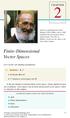 CHAPTER 2 American mathematician Paul Halmos (1916 2006), who in 1942 published the first modern linear algebra book. The title of Halmos s book was the same as the title of this chapter. Finite-Dimensional
Math 120 Final Exam Practice Problems, Form: A
 Math 120 Final Exam Practice Problems, Form: A Name: While every attempt was made to be complete in the types of problems given below, we make no guarantees about the completeness of the problems. Specifically,
Lectures notes on orthogonal matrices (with exercises) 92.222 - Linear Algebra II - Spring 2004 by D. Klain
 Lectures notes on orthogonal matrices (with exercises) 92.222 - Linear Algebra II - Spring 2004 by D. Klain 1. Orthogonal matrices and orthonormal sets An n n real-valued matrix A is said to be an orthogonal
Lecture L3 - Vectors, Matrices and Coordinate Transformations
 S. Widnall 16.07 Dynamics Fall 2009 Lecture notes based on J. Peraire Version 2.0 Lecture L3 - Vectors, Matrices and Coordinate Transformations By using vectors and defining appropriate operations between
Introduction to Matrix Algebra
 Psychology 7291: Multivariate Statistics (Carey) 8/27/98 Matrix Algebra - 1 Introduction to Matrix Algebra Definitions: A matrix is a collection of numbers ordered by rows and columns. It is customary