
f(x) = g(x), if x A h(x), if x B.
|
|
|
- Gervais Ellis
- 9 years ago
- Views:
Transcription
1 1. Piecewise Functions By Bryan Carrillo, University of California, Riverside We can create more complicated functions by considering Piece-wise functions. Definition: Piecewise-function. A piecewise-function is a function defined by multiple functions, where each function s domain is defined by some rule (such as x ( 1, 1)) that may be disjoint from the other functions rule. g(x), if x A h(x), if x B Example 1.1 The function x, if x ( 3, 0) x 2, if x [0, 3) is a piecewise function whose domain is the union of each sub-function s interval, that is ( 3, 3). The functions are x and x 2. If x ( 3, 0), then x, while if x [0, 3) then x 2. For example, f( 2) = 2 while f(0) = 0 2 = 0 and f(.5) = (.5) 2 =.25. Evaluating piecewise functions is relatively easy compared to graphing them, so let s describe a method for graphing them. However, it is very important that before we describe the method, I urge you to go back to your notes and review how to graph basic functions first! If you don t know how to graph lines, polynomials, the absolute value function, square root functions, and constant functions, then graphing piecewise functions will be hard. In addition, it is important to understand the meaning of something like (2, ) or x > 2. Review interval notation and inequality notation. Steps: Graphing a piecewise function Say we have a piecewise function given by g(x), if x A h(x), if x B. Then do the following in the order described. (1) Look at the first function, g(x) and see what is its rule, A. Typically A will be an interval or written as an inequality.there are several type of intervals we can have. (a) Closed interval, such as [a, b] or a x b in inequality form. (b) Open interval, such as (a, b) and (a, ) or a < x < b and x > a in inequality form. (c) Half-open interval, such as (a, b] and (, a] or a < x b and x a in inequality form. (2) If it is a closed interval, evaluate g at those end points, say x = a and x = b and plot those points (a, g(a)) and (b, g(b)) on a graph using filled in dots. Filled in dots indicate they are included in the graph. (3) If it is an open interval with finite end points (that is something like (a, b)), evaluate g at those end points and plot (a, g(a)) and (b, g(b)) on a graph using open circles. Open circles indicate they are not included in the graph. (4) If it is an open interval with one finite end point (say something like a > x or (a, )), evaluate g at the finite end point and plot that point (a, g(a)) on a graph using open circles. To deal with the or, you will need to draw an arrow to indicate the function continues on. (5) If it is a half-open interval, do the same thing as thing as before which is evaluate the function on the finite end points and use filled in dots or open circles depending on if the end point is included or not and use arrows to indicate the function continues on. (6) Once you take care of endpoints, you draw the rest of the function and connect the points by drawing the general shape of the function. If g(x), then connect the points by line. If g(x) = x 2, then connect the points by a curve. (7) Do the same analysis for g(x)!
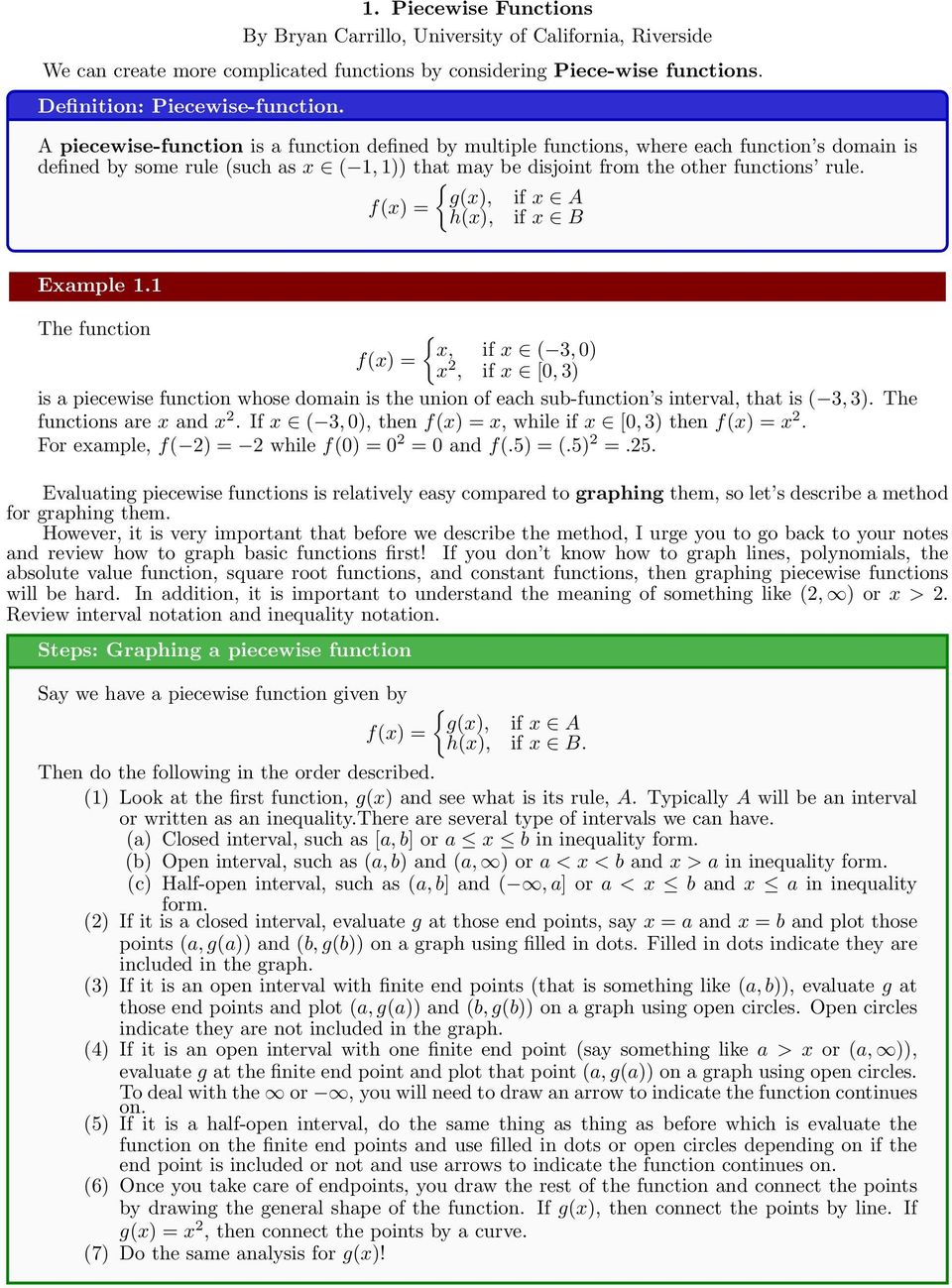
2 1. PIECEWISE FUNCTIONS 2 Example 1.2 Graph x, if 3 < x < 0 x 2, if 0 x < 3 Solution. The first function is g(x) = x whose rule is 3 < x < 0. We evalue at the end points to obtain the points ( 3, 3) and (0, 0). Now we graph them with open circles. Next, we draw the points in between. Since g(x) = x, we draw a straight line connecting the points. This finishes the first function. Now the next function is h(x) = x 2 whose rule is 0 x < 3. We evaluate at the end points to obtain (0, 0) and (3, 9). Now we plot (0, 0) with a filed in dot since x = 0 is included in 0 x < 3 while (3, 9) is plotted with an open circle since x = 3 is not included in 0 x < 3. Now we fill in the space in between the points. Since h(x) = x 2, this is going to curve as follows.
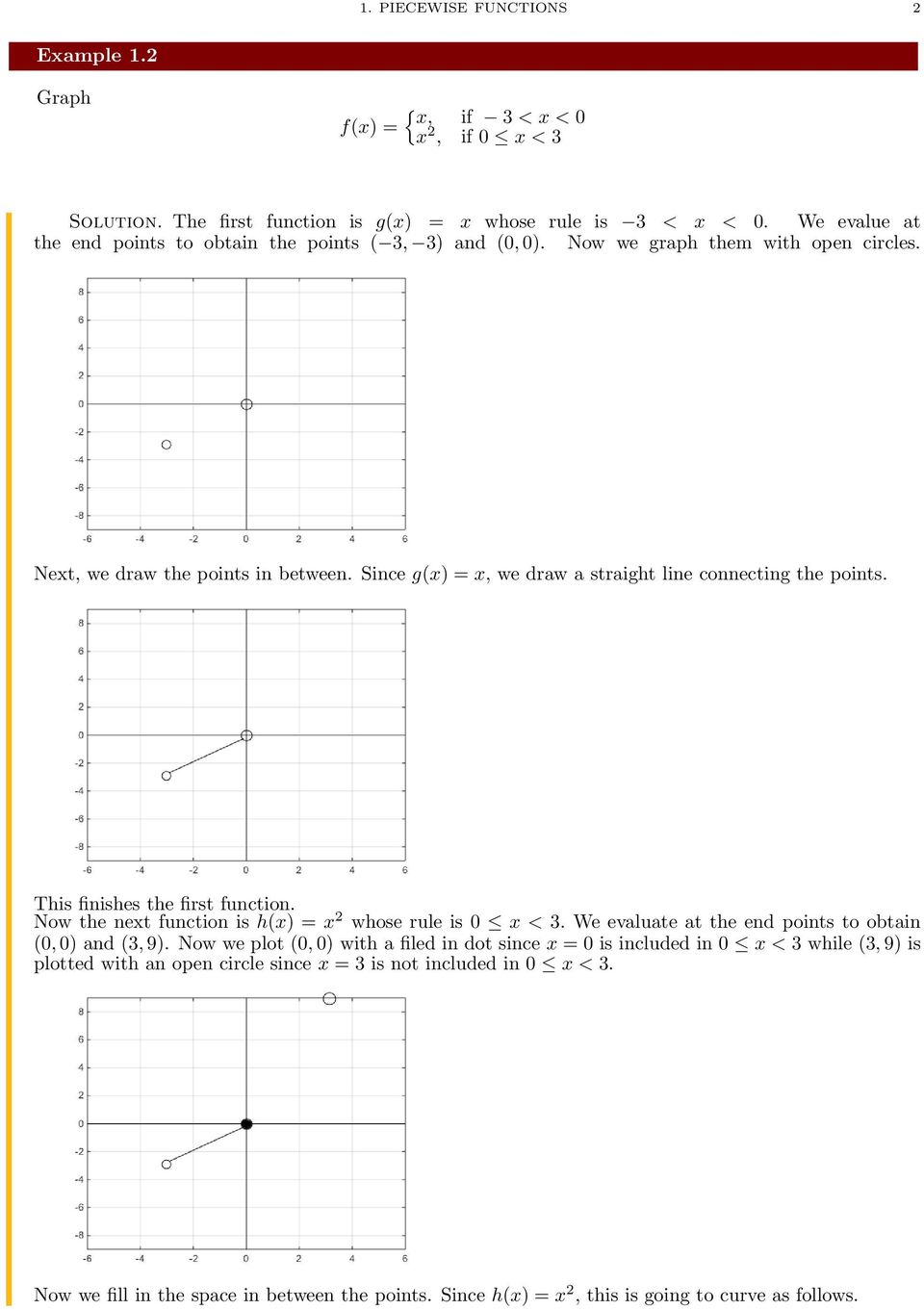
3 1. PIECEWISE FUNCTIONS 3 Thus, we have graphed f(x). Example 1.3 Graph 3, if x < 0 1 2x + 4 if 0 x 4. Solution. The first function is g(x) = 3 whose rule is x < 0 or (, 0). We evaluate at the end point x = 0 to obtain g(0) = 3, so we graph (0, 3). on the graph Now since the rule is x < 0, we will need to draw an arrow to indicate we are continuing the graph indefinitely. This is where we recommend we plot more points, say x = 1, x = 2. Then we have ( 1, 3) and ( 2, 3) so we have This finishes the first function.
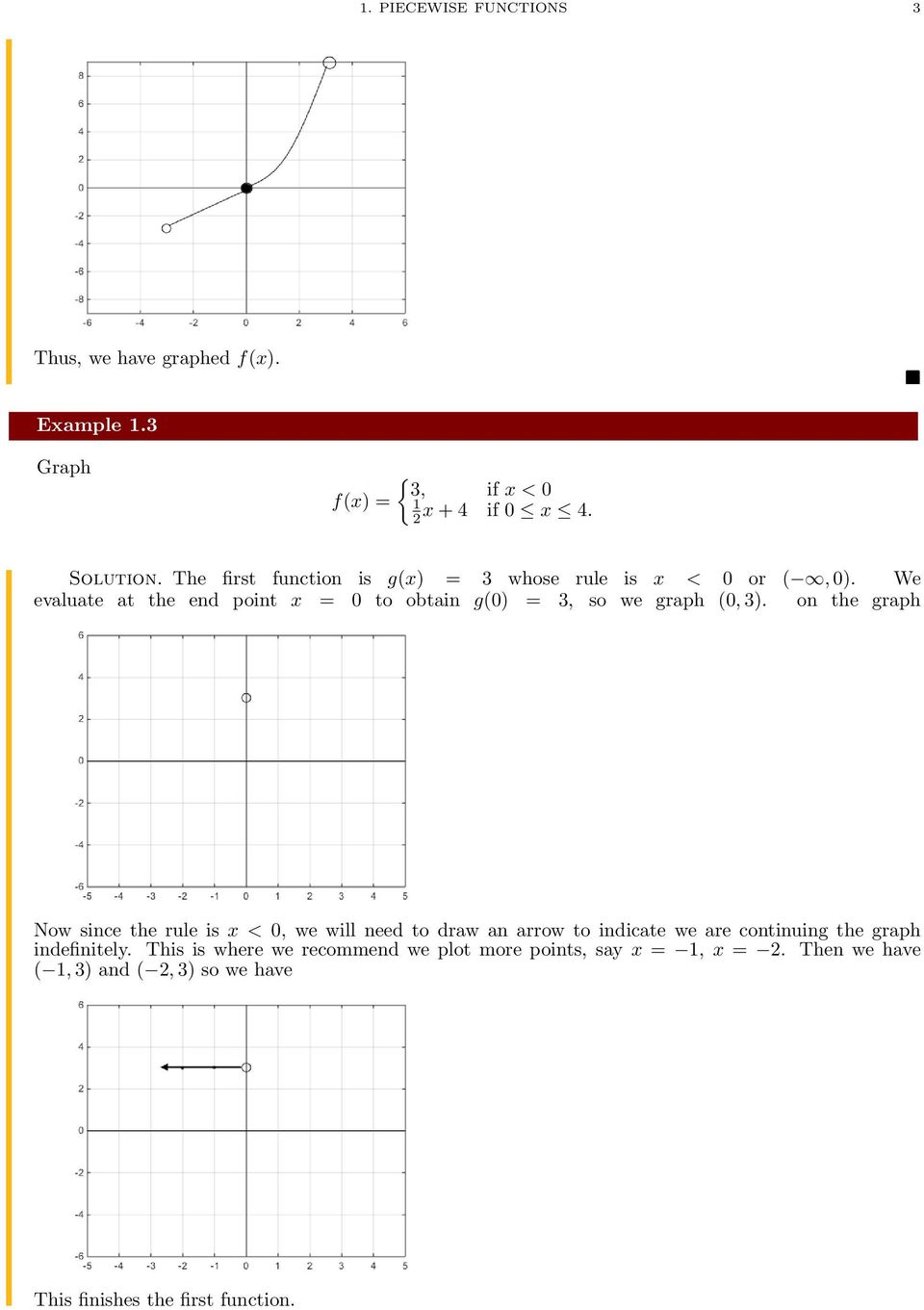
4 1. PIECEWISE FUNCTIONS 4 Now the next function is h(x) = 1 2x + 4 whose rule is 0 x 4. We evaluate at the end points to obtain (0, 4) and (4, 6). We plot both of these points with filed circles since x = 0 and x = 4 are included in 0 x 4. Now we fill in the space in between the points. Since h(x) is a line, we connect the points with a straight line. Thus, we have graphed f(x). Example 1.4 Graph 4x + 2, if 2 < x < 0 5x 1 if 0 x 5. Solution. The first function is g(x) = 4x + 2 whose rule is 2 < x < 0. We evaluate at the end points to obtain ( 2, 10) and (0, 2), which we leave as open circles
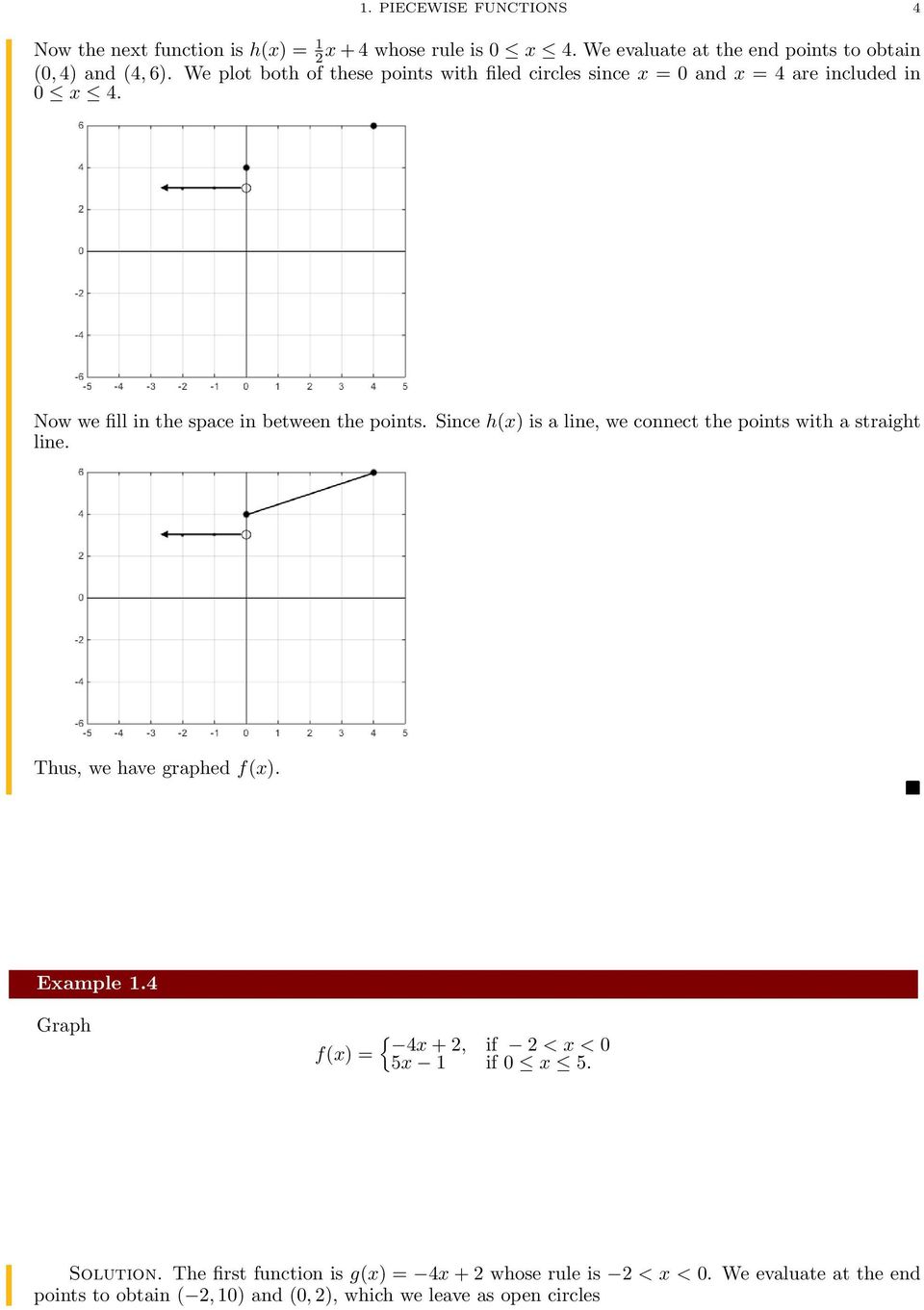
5 1. PIECEWISE FUNCTIONS 5 Now since g(x) is a line, we connect the points with a line. This finishes the first function. Now the next function is h(x) = 5x 1 whose rule is 0 x 5. We evaluate at the end points to obtain (0, 1) and (5, 9). We plot both of these points with filed circles since x = 0 and x = 5 are included in 0 x 5. Now we fill in the space in between the points. Since h(x) is a line, we connect the points with a straight line.
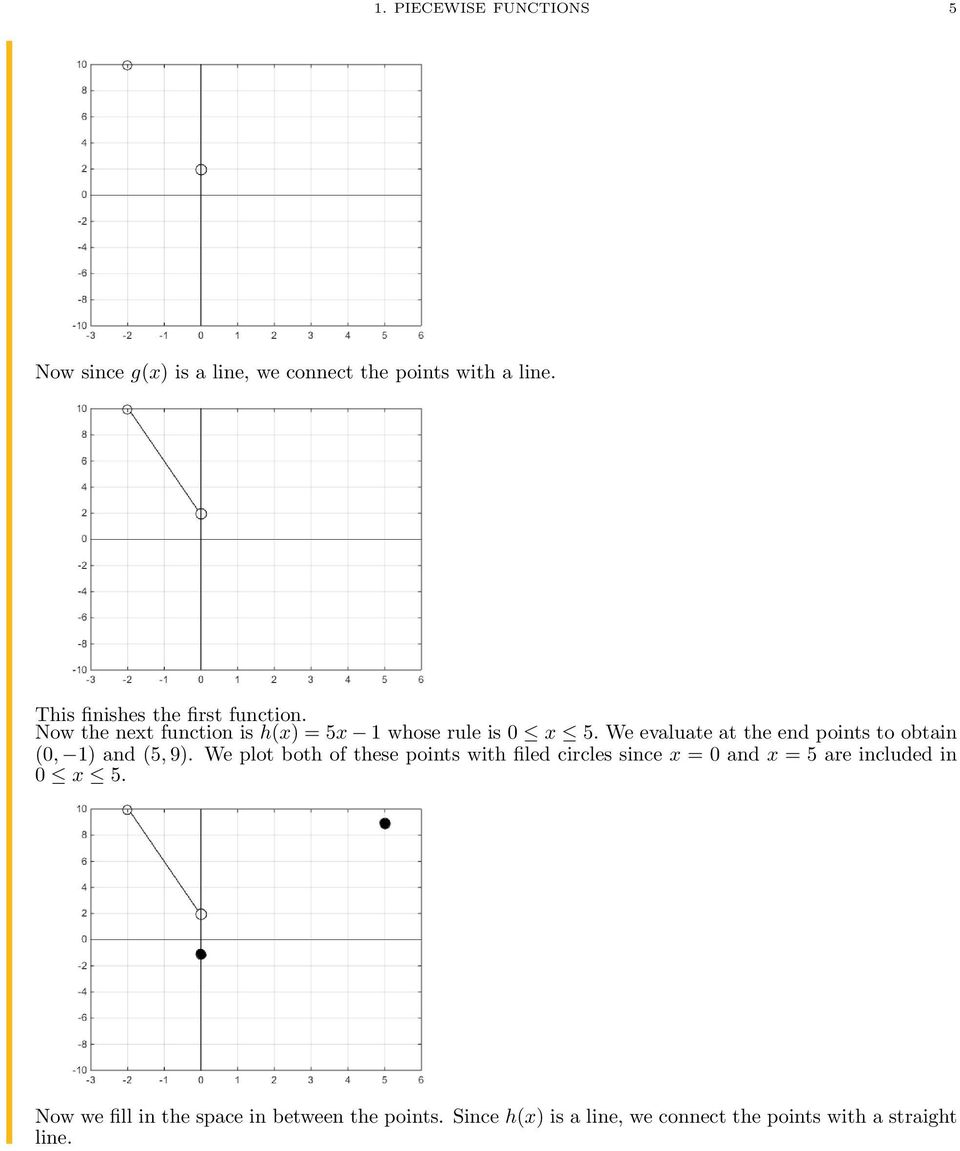
6 1. PIECEWISE FUNCTIONS 6 Thus, we have graphed f(x).

Method To Solve Linear, Polynomial, or Absolute Value Inequalities:
 Solving Inequalities An inequality is the result of replacing the = sign in an equation with ,, or. For example, 3x 2 < 7 is a linear inequality. We call it linear because if the < were replaced with
MA4001 Engineering Mathematics 1 Lecture 10 Limits and Continuity
 MA4001 Engineering Mathematics 1 Lecture 10 Limits and Dr. Sarah Mitchell Autumn 2014 Infinite limits If f(x) grows arbitrarily large as x a we say that f(x) has an infinite limit. Example: f(x) = 1 x
Simplify the rational expression. Find all numbers that must be excluded from the domain of the simplified rational expression.
 MAC 1105 Final Review Simplify the rational expression. Find all numbers that must be excluded from the domain of the simplified rational expression. 1) 8x 2-49x + 6 x - 6 A) 1, x 6 B) 8x - 1, x 6 x -
FINAL EXAM SECTIONS AND OBJECTIVES FOR COLLEGE ALGEBRA
 FINAL EXAM SECTIONS AND OBJECTIVES FOR COLLEGE ALGEBRA 1.1 Solve linear equations and equations that lead to linear equations. a) Solve the equation: 1 (x + 5) 4 = 1 (2x 1) 2 3 b) Solve the equation: 3x
The Mean Value Theorem
 The Mean Value Theorem THEOREM (The Extreme Value Theorem): If f is continuous on a closed interval [a, b], then f attains an absolute maximum value f(c) and an absolute minimum value f(d) at some numbers
Practice with Proofs
 Practice with Proofs October 6, 2014 Recall the following Definition 0.1. A function f is increasing if for every x, y in the domain of f, x < y = f(x) < f(y) 1. Prove that h(x) = x 3 is increasing, using
Continuity. DEFINITION 1: A function f is continuous at a number a if. lim
 Continuity DEFINITION : A function f is continuous at a number a if f(x) = f(a) REMARK: It follows from the definition that f is continuous at a if and only if. f(a) is defined. 2. f(x) and +f(x) exist.
https://williamshartunionca.springboardonline.org/ebook/book/27e8f1b87a1c4555a1212b...
 of 19 9/2/2014 12:09 PM Answers Teacher Copy Plan Pacing: 1 class period Chunking the Lesson Example A #1 Example B Example C #2 Check Your Understanding Lesson Practice Teach Bell-Ringer Activity Students
5.1 Derivatives and Graphs
 5.1 Derivatives and Graphs What does f say about f? If f (x) > 0 on an interval, then f is INCREASING on that interval. If f (x) < 0 on an interval, then f is DECREASING on that interval. A function has
Rolle s Theorem. q( x) = 1
 Lecture 1 :The Mean Value Theorem We know that constant functions have derivative zero. Is it possible for a more complicated function to have derivative zero? In this section we will answer this question
1. Then f has a relative maximum at x = c if f(c) f(x) for all values of x in some
 Section 3.1: First Derivative Test Definition. Let f be a function with domain D. 1. Then f has a relative maximum at x = c if f(c) f(x) for all values of x in some open interval containing c. The number
Analyzing Piecewise Functions
 Connecting Geometry to Advanced Placement* Mathematics A Resource and Strategy Guide Updated: 04/9/09 Analyzing Piecewise Functions Objective: Students will analyze attributes of a piecewise function including
1.7 Graphs of Functions
 64 Relations and Functions 1.7 Graphs of Functions In Section 1.4 we defined a function as a special type of relation; one in which each x-coordinate was matched with only one y-coordinate. We spent most
2.1 Increasing, Decreasing, and Piecewise Functions; Applications
 2.1 Increasing, Decreasing, and Piecewise Functions; Applications Graph functions, looking for intervals on which the function is increasing, decreasing, or constant, and estimate relative maxima and minima.
Graphic Designing with Transformed Functions
 Math Objectives Students will be able to identify a restricted domain interval and use function translations and dilations to choose and position a portion of the graph accurately in the plane to match
Absolute Value Equations and Inequalities
 Key Concepts: Compound Inequalities Absolute Value Equations and Inequalities Intersections and unions Suppose that A and B are two sets of numbers. The intersection of A and B is the set of all numbers
x 2 + y 2 = 1 y 1 = x 2 + 2x y = x 2 + 2x + 1
 Implicit Functions Defining Implicit Functions Up until now in this course, we have only talked about functions, which assign to every real number x in their domain exactly one real number f(x). The graphs
This unit will lay the groundwork for later units where the students will extend this knowledge to quadratic and exponential functions.
 Algebra I Overview View unit yearlong overview here Many of the concepts presented in Algebra I are progressions of concepts that were introduced in grades 6 through 8. The content presented in this course
Math Placement Test Practice Problems
 Math Placement Test Practice Problems The following problems cover material that is used on the math placement test to place students into Math 1111 College Algebra, Math 1113 Precalculus, and Math 2211
Polynomial and Rational Functions
 Polynomial and Rational Functions Quadratic Functions Overview of Objectives, students should be able to: 1. Recognize the characteristics of parabolas. 2. Find the intercepts a. x intercepts by solving
List the elements of the given set that are natural numbers, integers, rational numbers, and irrational numbers. (Enter your answers as commaseparated
 MATH 142 Review #1 (4717995) Question 1 2 3 4 5 6 7 8 9 10 11 12 13 14 15 16 17 18 19 20 21 22 23 24 25 26 27 28 29 30 31 Description This is the review for Exam #1. Please work as many problems as possible
Definition 8.1 Two inequalities are equivalent if they have the same solution set. Add or Subtract the same value on both sides of the inequality.
 8 Inequalities Concepts: Equivalent Inequalities Linear and Nonlinear Inequalities Absolute Value Inequalities (Sections 4.6 and 1.1) 8.1 Equivalent Inequalities Definition 8.1 Two inequalities are equivalent
AP CALCULUS AB 2007 SCORING GUIDELINES (Form B)
 AP CALCULUS AB 2007 SCORING GUIDELINES (Form B) Question 4 Let f be a function defined on the closed interval 5 x 5 with f ( 1) = 3. The graph of f, the derivative of f, consists of two semicircles and
2. Length and distance in hyperbolic geometry
 2. Length and distance in hyperbolic geometry 2.1 The upper half-plane There are several different ways of constructing hyperbolic geometry. These different constructions are called models. In this lecture
36 CHAPTER 1. LIMITS AND CONTINUITY. Figure 1.17: At which points is f not continuous?
 36 CHAPTER 1. LIMITS AND CONTINUITY 1.3 Continuity Before Calculus became clearly de ned, continuity meant that one could draw the graph of a function without having to lift the pen and pencil. While this
Chapter 4. Polynomial and Rational Functions. 4.1 Polynomial Functions and Their Graphs
 Chapter 4. Polynomial and Rational Functions 4.1 Polynomial Functions and Their Graphs A polynomial function of degree n is a function of the form P = a n n + a n 1 n 1 + + a 2 2 + a 1 + a 0 Where a s
Homework # 3 Solutions
 Homework # 3 Solutions February, 200 Solution (2.3.5). Noting that and ( + 3 x) x 8 = + 3 x) by Equation (2.3.) x 8 x 8 = + 3 8 by Equations (2.3.7) and (2.3.0) =3 x 8 6x2 + x 3 ) = 2 + 6x 2 + x 3 x 8
F.IF.7b: Graph Root, Piecewise, Step, & Absolute Value Functions
 F.IF.7b: Graph Root, Piecewise, Step, & Absolute Value Functions F.IF.7b: Graph Root, Piecewise, Step, & Absolute Value Functions Analyze functions using different representations. 7. Graph functions expressed
Domain of a Composition
 Domain of a Composition Definition Given the function f and g, the composition of f with g is a function defined as (f g)() f(g()). The domain of f g is the set of all real numbers in the domain of g such
Section 4.4. Using the Fundamental Theorem. Difference Equations to Differential Equations
 Difference Equations to Differential Equations Section 4.4 Using the Fundamental Theorem As we saw in Section 4.3, using the Fundamental Theorem of Integral Calculus reduces the problem of evaluating a
Section 1. Inequalities -5-4 -3-2 -1 0 1 2 3 4 5
 Worksheet 2.4 Introduction to Inequalities Section 1 Inequalities The sign < stands for less than. It was introduced so that we could write in shorthand things like 3 is less than 5. This becomes 3 < 5.
f(x) = a x, h(5) = ( 1) 5 1 = 2 2 1
 Exponential Functions an their Derivatives Exponential functions are functions of the form f(x) = a x, where a is a positive constant referre to as the base. The functions f(x) = x, g(x) = e x, an h(x)
Notes for EER #4 Graph transformations (vertical & horizontal shifts, vertical stretching & compression, and reflections) of basic functions.
 Notes for EER #4 Graph transformations (vertical & horizontal shifts, vertical stretching & compression, and reflections) of basic functions. Basic Functions In several sections you will be applying shifts
Math 120 Final Exam Practice Problems, Form: A
 Math 120 Final Exam Practice Problems, Form: A Name: While every attempt was made to be complete in the types of problems given below, we make no guarantees about the completeness of the problems. Specifically,
Graphs of Polar Equations
 Graphs of Polar Equations In the last section, we learned how to graph a point with polar coordinates (r, θ). We will now look at graphing polar equations. Just as a quick review, the polar coordinate
MATH BOOK OF PROBLEMS SERIES. New from Pearson Custom Publishing!
 MATH BOOK OF PROBLEMS SERIES New from Pearson Custom Publishing! The Math Book of Problems Series is a database of math problems for the following courses: Pre-algebra Algebra Pre-calculus Calculus Statistics
2.2 Derivative as a Function
 2.2 Derivative as a Function Recall that we defined the derivative as f (a) = lim h 0 f(a + h) f(a) h But since a is really just an arbitrary number that represents an x-value, why don t we just use x
1.6. Piecewise Functions. LEARN ABOUT the Math. Representing the problem using a graphical model
 1.6 Piecewise Functions YOU WILL NEED graph paper graphing calculator GOAL Understand, interpret, and graph situations that are described by piecewise functions. LEARN ABOUT the Math A city parking lot
1.6. Piecewise Functions. LEARN ABOUT the Math. Representing the problem using a graphical model
 1. Piecewise Functions YOU WILL NEED graph paper graphing calculator GOAL Understand, interpret, and graph situations that are described b piecewise functions. LEARN ABOUT the Math A cit parking lot uses
C3: Functions. Learning objectives
 CHAPTER C3: Functions Learning objectives After studing this chapter ou should: be familiar with the terms one-one and man-one mappings understand the terms domain and range for a mapping understand the
SOLVING TRIGONOMETRIC INEQUALITIES (CONCEPT, METHODS, AND STEPS) By Nghi H. Nguyen
 SOLVING TRIGONOMETRIC INEQUALITIES (CONCEPT, METHODS, AND STEPS) By Nghi H. Nguyen DEFINITION. A trig inequality is an inequality in standard form: R(x) > 0 (or < 0) that contains one or a few trig functions
Algebra I Vocabulary Cards
 Algebra I Vocabulary Cards Table of Contents Expressions and Operations Natural Numbers Whole Numbers Integers Rational Numbers Irrational Numbers Real Numbers Absolute Value Order of Operations Expression
TOPIC 4: DERIVATIVES
 TOPIC 4: DERIVATIVES 1. The derivative of a function. Differentiation rules 1.1. The slope of a curve. The slope of a curve at a point P is a measure of the steepness of the curve. If Q is a point on the
8 Polynomials Worksheet
 8 Polynomials Worksheet Concepts: Quadratic Functions The Definition of a Quadratic Function Graphs of Quadratic Functions - Parabolas Vertex Absolute Maximum or Absolute Minimum Transforming the Graph
ALGEBRA REVIEW LEARNING SKILLS CENTER. Exponents & Radicals
 ALGEBRA REVIEW LEARNING SKILLS CENTER The "Review Series in Algebra" is taught at the beginning of each quarter by the staff of the Learning Skills Center at UC Davis. This workshop is intended to be an
Prentice Hall Mathematics: Algebra 2 2007 Correlated to: Utah Core Curriculum for Math, Intermediate Algebra (Secondary)
 Core Standards of the Course Standard 1 Students will acquire number sense and perform operations with real and complex numbers. Objective 1.1 Compute fluently and make reasonable estimates. 1. Simplify
7 Relations and Functions
 7 Relations and Functions In this section, we introduce the concept of relations and functions. Relations A relation R from a set A to a set B is a set of ordered pairs (a, b), where a is a member of A,
Chapter 2: Linear Equations and Inequalities Lecture notes Math 1010
 Section 2.1: Linear Equations Definition of equation An equation is a statement that equates two algebraic expressions. Solving an equation involving a variable means finding all values of the variable
MEASURES OF VARIATION
 NORMAL DISTRIBTIONS MEASURES OF VARIATION In statistics, it is important to measure the spread of data. A simple way to measure spread is to find the range. But statisticians want to know if the data are
2.5 Transformations of Functions
 2.5 Transformations of Functions Section 2.5 Notes Page 1 We will first look at the major graphs you should know how to sketch: Square Root Function Absolute Value Function Identity Function Domain: [
Graphic Designing with Transformed Functions
 Name Class The teacher will display the completed example to the right as an example to re-create. Work to make the image of the letter M on your handheld. Transformations of parabolas, domain restrictions,
ALGEBRA I (Common Core)
 The University of the State of New York REGENTS HIGH SCHOOL EXAMINATION ALGEBRA I (Common Core) Wednesday, June 17, 2015 1:15 to 4:15 p.m. MODEL RESPONSE SET Table of Contents Question 25..................
Objectives. Materials
 Activity 4 Objectives Understand what a slope field represents in terms of Create a slope field for a given differential equation Materials TI-84 Plus / TI-83 Plus Graph paper Introduction One of the ways
Pre-Calculus Graphing Calculator Handbook
 Pre-Calculus Graphing Calculator Handbook I. Graphing Functions A. Button for Functions This button is used to enter any function to be graphed. You can enter up to 10 different functions at a time. Use
Calculator Notes for the TI-Nspire and TI-Nspire CAS
 CHAPTER 4 Calculator Notes for the Note 4A: Function Notation The handheld uses function notation automatically. You can define a function in the Calculator, Graphs & Geometry, and Data & Statistics applications.
Algebra II End of Course Exam Answer Key Segment I. Scientific Calculator Only
 Algebra II End of Course Exam Answer Key Segment I Scientific Calculator Only Question 1 Reporting Category: Algebraic Concepts & Procedures Common Core Standard: A-APR.3: Identify zeros of polynomials
1.1 Practice Worksheet
 Math 1 MPS Instructor: Cheryl Jaeger Balm 1 1.1 Practice Worksheet 1. Write each English phrase as a mathematical expression. (a) Three less than twice a number (b) Four more than half of a number (c)
What are the place values to the left of the decimal point and their associated powers of ten?
 The verbal answers to all of the following questions should be memorized before completion of algebra. Answers that are not memorized will hinder your ability to succeed in geometry and algebra. (Everything
Linear Equations and Inequalities
 Linear Equations and Inequalities Section 1.1 Prof. Wodarz Math 109 - Fall 2008 Contents 1 Linear Equations 2 1.1 Standard Form of a Linear Equation................ 2 1.2 Solving Linear Equations......................
Fundamental Theorems of Vector Calculus
 Fundamental Theorems of Vector Calculus We have studied the techniques for evaluating integrals over curves and surfaces. In the case of integrating over an interval on the real line, we were able to use
7. Solving Linear Inequalities and Compound Inequalities
 7. Solving Linear Inequalities and Compound Inequalities Steps for solving linear inequalities are very similar to the steps for solving linear equations. The big differences are multiplying and dividing
High School Algebra Reasoning with Equations and Inequalities Solve systems of equations.
 Performance Assessment Task Graphs (2006) Grade 9 This task challenges a student to use knowledge of graphs and their significant features to identify the linear equations for various lines. A student
2008 AP Calculus AB Multiple Choice Exam
 008 AP Multiple Choice Eam Name 008 AP Calculus AB Multiple Choice Eam Section No Calculator Active AP Calculus 008 Multiple Choice 008 AP Calculus AB Multiple Choice Eam Section Calculator Active AP Calculus
Determine If An Equation Represents a Function
 Question : What is a linear function? The term linear function consists of two parts: linear and function. To understand what these terms mean together, we must first understand what a function is. The
Algebra 1 Course Title
 Algebra 1 Course Title Course- wide 1. What patterns and methods are being used? Course- wide 1. Students will be adept at solving and graphing linear and quadratic equations 2. Students will be adept
Algebra. Exponents. Absolute Value. Simplify each of the following as much as possible. 2x y x + y y. xxx 3. x x x xx x. 1. Evaluate 5 and 123
 Algebra Eponents Simplify each of the following as much as possible. 1 4 9 4 y + y y. 1 5. 1 5 4. y + y 4 5 6 5. + 1 4 9 10 1 7 9 0 Absolute Value Evaluate 5 and 1. Eliminate the absolute value bars from
Algebra Practice Problems for Precalculus and Calculus
 Algebra Practice Problems for Precalculus and Calculus Solve the following equations for the unknown x: 1. 5 = 7x 16 2. 2x 3 = 5 x 3. 4. 1 2 (x 3) + x = 17 + 3(4 x) 5 x = 2 x 3 Multiply the indicated polynomials
LAYOUT OF THE KEYBOARD
 Dr. Charles Hofmann, LaSalle [email protected] Dr. Roseanne Hofmann, MCCC [email protected] ------------------------------------------------------------------------------------------------- DISPLAY CONTRAST
Algebra 2: Themes for the Big Final Exam
 Algebra : Themes for the Big Final Exam Final will cover the whole year, focusing on the big main ideas. Graphing: Overall: x and y intercepts, fct vs relation, fct vs inverse, x, y and origin symmetries,
Course Outlines. 1. Name of the Course: Algebra I (Standard, College Prep, Honors) Course Description: ALGEBRA I STANDARD (1 Credit)
 Course Outlines 1. Name of the Course: Algebra I (Standard, College Prep, Honors) Course Description: ALGEBRA I STANDARD (1 Credit) This course will cover Algebra I concepts such as algebra as a language,
1 = (a 0 + b 0 α) 2 + + (a m 1 + b m 1 α) 2. for certain elements a 0,..., a m 1, b 0,..., b m 1 of F. Multiplying out, we obtain
 Notes on real-closed fields These notes develop the algebraic background needed to understand the model theory of real-closed fields. To understand these notes, a standard graduate course in algebra is
DRAFT. Algebra 1 EOC Item Specifications
 DRAFT Algebra 1 EOC Item Specifications The draft Florida Standards Assessment (FSA) Test Item Specifications (Specifications) are based upon the Florida Standards and the Florida Course Descriptions as
Anchorage School District/Alaska Sr. High Math Performance Standards Algebra
 Anchorage School District/Alaska Sr. High Math Performance Standards Algebra Algebra 1 2008 STANDARDS PERFORMANCE STANDARDS A1:1 Number Sense.1 Classify numbers as Real, Irrational, Rational, Integer,
5-3 Polynomial Functions. not in one variable because there are two variables, x. and y
 y. 5-3 Polynomial Functions State the degree and leading coefficient of each polynomial in one variable. If it is not a polynomial in one variable, explain why. 1. 11x 6 5x 5 + 4x 2 coefficient of the
Graphing calculators Transparencies (optional)
 What if it is in pieces? Piecewise Functions and an Intuitive Idea of Continuity Teacher Version Lesson Objective: Length of Activity: Students will: Recognize piecewise functions and the notation used
Real Roots of Univariate Polynomials with Real Coefficients
 Real Roots of Univariate Polynomials with Real Coefficients mostly written by Christina Hewitt March 22, 2012 1 Introduction Polynomial equations are used throughout mathematics. When solving polynomials
1.6 A LIBRARY OF PARENT FUNCTIONS. Copyright Cengage Learning. All rights reserved.
 1.6 A LIBRARY OF PARENT FUNCTIONS Copyright Cengage Learning. All rights reserved. What You Should Learn Identify and graph linear and squaring functions. Identify and graph cubic, square root, and reciprocal
Power functions: f(x) = x n, n is a natural number The graphs of some power functions are given below. n- even n- odd
 5.1 Polynomial Functions A polynomial unctions is a unction o the orm = a n n + a n-1 n-1 + + a 1 + a 0 Eample: = 3 3 + 5 - The domain o a polynomial unction is the set o all real numbers. The -intercepts
Functions: Piecewise, Even and Odd.
 Functions: Piecewise, Even and Odd. MA161/MA1161: Semester 1 Calculus. Prof. Götz Pfeiffer School of Mathematics, Statistics and Applied Mathematics NUI Galway September 21-22, 2015 Tutorials, Online Homework.
Compound Inequalities. AND/OR Problems
 Compound Inequalities AND/OR Problems There are two types of compound inequalities. They are conjunction problems and disjunction problems. These compound inequalities will sometimes appear as two simple
1 The Concept of a Mapping
 Arkansas Tech University MATH 4033: Elementary Modern Algebra Dr. Marcel B. Finan 1 The Concept of a Mapping The concept of a mapping (aka function) is important throughout mathematics. We have been dealing
The degree of a polynomial function is equal to the highest exponent found on the independent variables.
 DETAILED SOLUTIONS AND CONCEPTS - POLYNOMIAL FUNCTIONS Prepared by Ingrid Stewart, Ph.D., College of Southern Nevada Please Send Questions and Comments to [email protected]. Thank you! PLEASE NOTE
1 if 1 x 0 1 if 0 x 1
 Chapter 3 Continuity In this chapter we begin by defining the fundamental notion of continuity for real valued functions of a single real variable. When trying to decide whether a given function is or
Week 2: Exponential Functions
 Week 2: Exponential Functions Goals: Introduce exponential functions Study the compounded interest and introduce the number e Suggested Textbook Readings: Chapter 4: 4.1, and Chapter 5: 5.1. Practice Problems:
Equations. #1-10 Solve for the variable. Inequalities. 1. Solve the inequality: 2 5 7. 2. Solve the inequality: 4 0
 College Algebra Review Problems for Final Exam Equations #1-10 Solve for the variable 1. 2 1 4 = 0 6. 2 8 7 2. 2 5 3 7. = 3. 3 9 4 21 8. 3 6 9 18 4. 6 27 0 9. 1 + log 3 4 5. 10. 19 0 Inequalities 1. Solve
2.5 Library of Functions; Piecewise-defined Functions
 SECTION.5 Librar of Functions; Piecewise-defined Functions 07.5 Librar of Functions; Piecewise-defined Functions PREPARING FOR THIS SECTION Before getting started, review the following: Intercepts (Section.,
Higher Education Math Placement
 Higher Education Math Placement Placement Assessment Problem Types 1. Whole Numbers, Fractions, and Decimals 1.1 Operations with Whole Numbers Addition with carry Subtraction with borrowing Multiplication
LINEAR INEQUALITIES. less than, < 2x + 5 x 3 less than or equal to, greater than, > 3x 2 x 6 greater than or equal to,
 LINEAR INEQUALITIES When we use the equal sign in an equation we are stating that both sides of the equation are equal to each other. In an inequality, we are stating that both sides of the equation are
Math Review. for the Quantitative Reasoning Measure of the GRE revised General Test
 Math Review for the Quantitative Reasoning Measure of the GRE revised General Test www.ets.org Overview This Math Review will familiarize you with the mathematical skills and concepts that are important
Chapter 7 - Roots, Radicals, and Complex Numbers
 Math 233 - Spring 2009 Chapter 7 - Roots, Radicals, and Complex Numbers 7.1 Roots and Radicals 7.1.1 Notation and Terminology In the expression x the is called the radical sign. The expression under the
Zeros of Polynomial Functions
 Zeros of Polynomial Functions The Rational Zero Theorem If f (x) = a n x n + a n-1 x n-1 + + a 1 x + a 0 has integer coefficients and p/q (where p/q is reduced) is a rational zero, then p is a factor of
CORRELATED TO THE SOUTH CAROLINA COLLEGE AND CAREER-READY FOUNDATIONS IN ALGEBRA
 We Can Early Learning Curriculum PreK Grades 8 12 INSIDE ALGEBRA, GRADES 8 12 CORRELATED TO THE SOUTH CAROLINA COLLEGE AND CAREER-READY FOUNDATIONS IN ALGEBRA April 2016 www.voyagersopris.com Mathematical
CENTRAL COLLEGE Department of Mathematics COURSE SYLLABUS
 CENTRAL COLLEGE Department of Mathematics COURSE SYLLABUS MATH 1314: College Algebra Fall 2010 / Tues-Thurs 7:30-9:00 pm / Gay Hall Rm 151 / CRN: 47664 INSTRUCTOR: CONFERENCE TIMES: CONTACT INFORMATION:
Limits and Continuity
 Math 20C Multivariable Calculus Lecture Limits and Continuity Slide Review of Limit. Side limits and squeeze theorem. Continuous functions of 2,3 variables. Review: Limits Slide 2 Definition Given a function
Creating, Solving, and Graphing Systems of Linear Equations and Linear Inequalities
 Algebra 1, Quarter 2, Unit 2.1 Creating, Solving, and Graphing Systems of Linear Equations and Linear Inequalities Overview Number of instructional days: 15 (1 day = 45 60 minutes) Content to be learned
Summary of Formulas and Concepts. Descriptive Statistics (Ch. 1-4)
 Summary of Formulas and Concepts Descriptive Statistics (Ch. 1-4) Definitions Population: The complete set of numerical information on a particular quantity in which an investigator is interested. We assume
TI-83/84 Plus Graphing Calculator Worksheet #2
 TI-83/8 Plus Graphing Calculator Worksheet #2 The graphing calculator is set in the following, MODE, and Y, settings. Resetting your calculator brings it back to these original settings. MODE Y Note that
Linear and quadratic Taylor polynomials for functions of several variables.
 ams/econ 11b supplementary notes ucsc Linear quadratic Taylor polynomials for functions of several variables. c 010, Yonatan Katznelson Finding the extreme (minimum or maximum) values of a function, is
Math 4310 Handout - Quotient Vector Spaces
 Math 4310 Handout - Quotient Vector Spaces Dan Collins The textbook defines a subspace of a vector space in Chapter 4, but it avoids ever discussing the notion of a quotient space. This is understandable