
Number Theory: A Mathemythical Approach. Student Resources. Printed Version
|
|
|
- June Fox
- 9 years ago
- Views:
Transcription
1 Number Theory: A Mathemythical Approach Student Resources Printed Version
2 ii

3 Contents 1 Appendix 1 2 Hints to Problems 3 Chapter 1 Hints Chapter 2 Hints Chapter 3 Hints Chapter 4 Hints Chapter 5 Hints Chapter 6 Hints Chapter 7 Hints Chapter 8 Hints Chapter 9 Hints Chapter 10 Hints Chapter 11 Hints Chapter 12 Hints Chapter 13 Hints Chapter 14 Hints Chapter 15 Hints Appendix Hints iii
4 iv CONTENTS

5 Chapter 1 Appendix TO BE INCLUDED 1
6 2 CHAPTER 1. APPENDIX

7 Chapter 2 Hints to Problems 3

8 4 CHAPTER 2. HINTS TO PROBLEMS Section 1.1 1a. Try a few different options. 1b. Try a few different options. 1c. Use the Pythagorean theorem and substitute a in place of b. 3. Use the relationship between m and n given in section a. Use the Pythagorean Theorem. 5b. Use the Pythagorean theorem along with the diagram of the tiles in the section. 5c. Use the Pythagorean theorem along with the diagram of the tiles in the section. 7. The dean s decree can be carried out if and only if (1 + 2)N = 2M = M N where N is the number of octagonal tiles and M is the number of triangular tiles. Show that the left hand side of the equation is not rational. 9a. Look at the geometric figures in this section to see how tirangular and square numbers are determined. 9b. Decompose two to three different square numbers into triangles to come up with a general answer. 11a. d is the hypotenuse of a right triangle. The edge of the box with length l, and the diagonal of the h x w rectangle form the other two sides of the triangle. 11ci. Let α be the factor by which you must increase the side length. Using your equation from part a, write an expression for the diagonal in terms of α and x. Set this equal to twice the diagonal length. Now solve for alpha. 11cii. Let α be the factor by which you must increase the side length. Find the volume of the cube in terms of α and x. Set this equal to twice the volume. Now solve for alpha.
9 5 Section 1.2 1a. Use the definition of i along with rules of multiplication of positive and negative numbers. 1b. Consider the general form of a complex number, a + bi. Square this number and equate to -4. Expand the square into its full form using FOIL and compare the real and imaginary parts. 1c. Use the general form of a complex number, a+bi. Square this number and equate to -4. Expand the square into its full form using FOIL and compare the real and imaginary parts. 3. use the definitions of natural numbers, integers, rational numbers, real numbers and complex numbers given earlier in the section. 5. Since 7 cannot be divided by 1, multiply by the dividend by 10 and incorporate a decimal point into the quotient. This will enable you to proceed with long division. 7. use the fact that every integer is divisible by Rewrite as ( 9 10 )( 1 10 ) + ( 9 10 )( 1 10 ) Section Consider the definition of hypothesis and conclusion given in the beginning of this section to solve each part of this question. 3. Consider the definition of hypothesis and conclusion given in the beginning of this section. 5. Use the definition of an odd integer. 7. Use the definition of an odd integer and an even integer. 9. Use the fact that n is an integer, coupled with the hint given in the question. 11a. Use the definition of a rational number. 11b. Use the definition of a rational number. 13. Use the definition of a rational number and an indirect proof. 15. Use an indirect proof. 17a. Start with x 1 = x 2. Then subsitute these into the algebraic relation given in the question and proceed.
10 6 CHAPTER 2. HINTS TO PROBLEMS 17b. Start with y 1 = y 2. Then subsitute these into the equation given in the question and use your knowledge of algebra to proceed. 19. Consider (x y) + (x + y). 21. What is the least number of friends a guest can have? What is the greatest number of friends a guest can have? Use an indirect proof. 23. Let x be an arbitrary real number. Then the reciprocal of x is 1/x. Assume that x + 1/x < 2 and find a contradiction. (This is an indirect proof). Section Try dividing both numbers by some simple fractions until you get an integer answer for both sets of quotients. 3a. Remember that 2 is irrational from Section b. Remember that 2 is irrational from Section Follow the proof of Theorem Follow the proof of Theorem As you go along you must also prove that if n 3 is even then n is even. 9. Rearrange the terms in the equation so that a and c are on one side and both terms with 2 are on the other. Use a proof by contradiction. 11. Use the definition of commensurable. 13. Use an indirect proof and the answer to exercise 7. Section 1.5 1a. Try this formula on the first few integers. 1b. Try this formula on the first few integers. 1c. Try this formula on the first few integers. 3a. Provide a counterexample. 3b. Use the properties of even numbers to determine the answer.
11 7 3c. Provide a counterexample. 3d. Provide a counterexample. 3e. Provide a counterexample. 3f. Use the properties of even numbers to determine the answer. 5. Use the technique of negation from this section. 7a. Use the definition of a positive integer. 7b. Use the definition of a negative integer. 7c. Work with n = Construct p and q using the given equations. 11. Use a proof by contradiction. 13. Provide a counterexample.
12 8 CHAPTER 2. HINTS TO PROBLEMS Section 2.1 7a. Let P (n) = n(n+1) 2. Rewrite P (k + 1) in terms of P (k). 7b. Let P (n) = n(n+1)(n+2) 6. Rewrite P (k + 1) in terms of P (k). 9. Use induction. Don t forget to use the inductive hypothesis when looking into P (k + 1). Then use algebra to get it into the form of (k + 1) (2(k + 1) + 1). 11. Use induction. Don t forget to use the inductive hypothesis when looking into P (k + 1). Then use algebra to get it into the proper form. 13. If using induction to prove, let your hypothesis be that k! k k. 15. Utilizing the result from exercise 14 along with some simple algebra, the result is easily obtained. Alternatively, induction can be used as before. 17. Play the game for the given values of n. A formula will arise fairly easily. 19. Use the formula you obtained in 17 and proved in Let P (n) = n3 n 6. Rewrite P (k + 1) in terms of P (k) and notice that k or k + 1 must be even. 23. Consider the case when k + 1 = When looking at P (k + 1), try ignoring one of the lines and then applying the inductive hypothesis. Then put the line back in, and see what you can do next. 27. Notice that a 2 k+1 2 k+1 checkerboard can be divided into four 2 k 2 k boards. Try re-orienting some of the boards after using the inductive hypothesis. Section 2.2 7c. Use strong induction and the fact that the Base Case (n = 1, 2) is given by the definition of G 1 and G Similar to Exercise 7c, it just requires more algebraic simplification after substitution. 15. By the way the game works, there will always be two heaps at the beginning of someone s turn. So you can always eat a heap. What does this imply about possible loss methods? 17. Use the fact that the sum of two odd numbers must be even. If you begin with at least 1 even heap, split this heap into two heaps both with an odd number of peanuts. If your opponent can still win, she is forced to split a heap that has an odd number of peanuts.
13 9 Section Notice that the ratio does not depend on the scale of the diagram, so you can set any part of it to any value you wish. 5. Use induction. Remember: odd + odd = even, etc. 7. Use induction. Remember: a x a y = a x+y. 11. Use induction. 13. Use induction and consider F 2 k+2 F k+1f k+3. 15a. For any real number x, if x < 1 then x n < x for n 1. 15b. Use the result from part a. Section Since ϕ is between 1 and 2, its fractional part is ϕ 1. Similarly, since ϕ is between 1 and 0, its fractional part is ϕ. 9. Use the expressions you have obtained for ϕ n and ϕ n in exercises 6d and 8a. [You will have to prove 6d is true in exercise 10. 8a can be proven in a similar manner.] 11. What happens if you square the expression?
14 10 CHAPTER 2. HINTS TO PROBLEMS Section a. False b. True c. False d. True e. True f. False g. True h. True i. False j. True k. False l. True 3. ±1, ±2, ±4, ±5, ±10, ± ±1, ±2, ±4 7. ±1, ±2, ±4 9. If c = 0, then a and b can be anything and we still have ac bc. For example, let a = 5 and b = 3. Then a b but ac = bc = 0 so ac bc. 11. If a 1, then there exists some k Z such that ak = 1. Now try looking at this with absolute values. 13. a b implies some k Z such that ak = b. What about b c? Can we put these things together? 15. If a b and b a, then there exist j, k Z such that a = bj and b = ak. Thus, a = bj = akj a = akj. This gives us two possible cases, one of which says something about the value of a and the other tells us the value of kj. 17. (a) If d x, then there exists some k Z such that dk = x. Where can we substitute this new expression for x? What will that tell us? (b) If d x and d y, then there exist j, k Z such that dj = x and dk = y. Where can we substitute these new expression? What will we be able to show from that? 19. How would you get rid of the b from (b + c)? Look at what you did; can you use the linear combination lemma along those lines? 21. Who said brute force doesn t solve things? 23. (a) What numbers above have an odd number of positive divisors? They are 1, 4, 9, 16, 25. Look familiar? (b) Divisors of positive integers tend to come in pairs. Why is this? Well, if j n, then there is some k Z such that jk = n. But that means k n as well. So how can we have an odd number of divisors if our divisors come in pairs? 25. By the problem statement, we have that 1 a + 1 b = k for some k N. What can we multiply both sides by to get rid of the fractions? By using algebra, will we be able to say anything about what a divides? what b divides? What will these facts imply? 27. (a) How can you factor x 2 + 3x + 2?

15 11 (b) Remember that you can factor out negative numbers as well. (c) Find a counter-example. (d) Every integer is even or odd. Which one is (x 2 + x)? Can we look at x? What does x 2 + x factor to? Remember that multiplying any number by an even number will make the product even. Section Look just underneath Definition (3, 5), (5, 7), (11, 13), (17, 19), and many, many more. 5. (a) 2, 3, and 47. (b) You know that b N, b = 0, or b N by trichotomy. Furthermore, b 0 since it s prime. Try tackling each case on its own and look at the relations between the old definition and the new one. Finally, note that if b is prime by the new definition, b must be as well. 7. Use the Linear Combination Lemma. 9. Think in terms of the factors that make up a and b. 11. Clearly you can make all the composite numbers since they re all already in your basket. But what would it mean if you could make a prime out of composite numbers? 13. By Goldbach s conjecture, you can make any even number. Now what are some relations between the evens and the odds. How do you make odds out of evens? 15. Factor n into the product of two polynomials. Then show that it does not meet the definition of a prime number. 17. Use prime factorization: n = p a 1 1 pam m where each p i < n. Now look at the two cases of where m 2 and m = 1 and think about how a factorial works. 19. Consider the case when n is even and when n is odd separately. In each case, find a composite integer a such that n can be written as (n a) + a. 21. (a) Factor a n 1 into the product of two polynomials. Then use the fact that a n 1 is prime. (b) Use a proof by contradiction.

16 12 CHAPTER 2. HINTS TO PROBLEMS 23. Use brute force linear combinations at first to get a feel for the problem in (a), (b), and (c). Once you get to (d) and (e) though, you ll need something more elegant. For (d), begin by writing out all the numbers that you can sum to using just 6 and 9. Then all the numbers you can sum to using exactly one 20 along with 6 s and 9 s. Continue to move your number of 20 s up until you have covered all of the numbers past a certain point. Figure out how to adapt this method for part (e). Section Follow the method given earlier in the section, and remember you only have to cross out primes below Once finished, you can check your answer by using the internet. 3. To solve this problem, you ll need to find the number of primes between and You can do this by using the approximation π(n) n log n and then looking at the difference between the two results. 5. Try looking at and Can you factor these in such a way to illustrate compositeness? 7. The first composite number is h(80). 9. For (a) and (b), it s probably easiest to choose small numbers. For part (c), use the Linear Combination Lemma. 11. (a) Let k = p 1 p n + 1. From the proof of Theorem 3.3.1, k cannot contain any prime factor p i such that i n. (b) Recall that n = 2 n+1 1. (c) Let x be an element of N. Define r = log 2 (log 2 (x)). Now consider p r. (Note that r may not be a natural number. Consider the case when r is an element of N and when r is not an element of N separately.) 13. (a) Use the fact that if an integer d divides some number n, then d cannot divide n + 1. (b) Use a proof by contradiction. Consider p n! where p n is the greatest prime. 15. Let a N and consider the expression a! + n. Under what conditions will the expression be composite (think in terms of the Linear Combination Lemma). 17. (a) Use the basic properties of exponents to rewrite F (n) 1 in terms of F (m) 1 raised to some power. Then use what you know about binomial expansions to find a contradiction. (b) Every Fermat number can be factored into primes. However, by the above, we know no factor can appear in multiple Fermat numbers. Now use the fact that there are infinitely many Fermat numbers.
17 13 Section (a) 11, (b) 7, (c) 3, (d) 99, (e) 1, (f) 2, (g) 1, (h) 11, (i) 1, (j) 3, (k) Think of the primes as building blocks. 5. Find a counter-example. 7. Use the definition of a prime number. 9. Show that a fulfills the definition of the gcd by showing that any common divisor d is less than or equal to a. 11. Let d = gcd(a, b) = lcm(a, b). Then d a and d b. Also, a d and b d. What does this tell us in terms of absolute values? 13. Use Lemma It suffices to show that S is nonempty. 17. Ah, brute force: is there anything it can t solve? 19. gcd( k, lcm(a, b) ). 21. gcd(a, b, c). 23. Let m = lcm(a, b), then ka km and kb km, so km is a common multiple of ka and kb. Now use contradiction to show that no n < km can be a common multiple. Notice that ka n implies that k n. 25. Prove by induction and use the recurrence relation of the Fibonacci numbers. Section (a) 85 = , (b) 132 = , (c) 573 = , (d) 45 = , (e) 90 = , (f) 0 = , 1, 2, 3, 4, (a) Clearly 3 and 5 are both in S. (b) 1. (c) If 1 is in the set, we can take multiples of the combination used to produce it, and make any natural number we want. (d) See (c). 7. Try a = b = x = If b < 0, then 0 r < b implies 0 < 0!
18 14 CHAPTER 2. HINTS TO PROBLEMS 11. Use transitivity of division. 13. Let x = a. 15. Divide n by 3. There are only three possibilities for the remainder: 0, 1, and 2. Work with these three cases. 17. Use the Division Theorem to divide n by Other than 2, no prime can be even. Thus, any prime must be of the form 4k + 1 or 4k + 3. For (e), compute p 2 1 for each of these two possibilities. 21. Use the result from Exercise 18e. 23. (2345) 8 = (1642) Let n = r k b k r 1 b 1 + r 0 b 0. Then n + 1 = r k b k r 1 b 1 + (r 0 + 1)b 0. There are two cases to consider: r < b and r = b. In the latter case, find the smallest r i such that r i + 1 < b. 27. I. Since a 0, either a or a is greater than 0. II. Since d S, we have d = ax + by for some x, y Z. III. Use the Division Theorem to write b = qd + r and then show that r must equal (a) Let a = 4k + 1 and b = 4j + 1. Multiply a and b, and then use algebraic manipulation. (b) Use a proof by induction. (c) Consider the set of prime factors of n = 4k + 3 and use the result from part (b). Section (a) 11, (b) 7, (c) 5 3. (a) 3, (b) lcm(50,b) 50, (c) (a) 1.3, (b) 3.8, (c) The greatest common measure of three real numbers x, y and z is the largest real number f such that x = n f, y = m f and z = q f where n, m and q are integers, (d) 3 2.
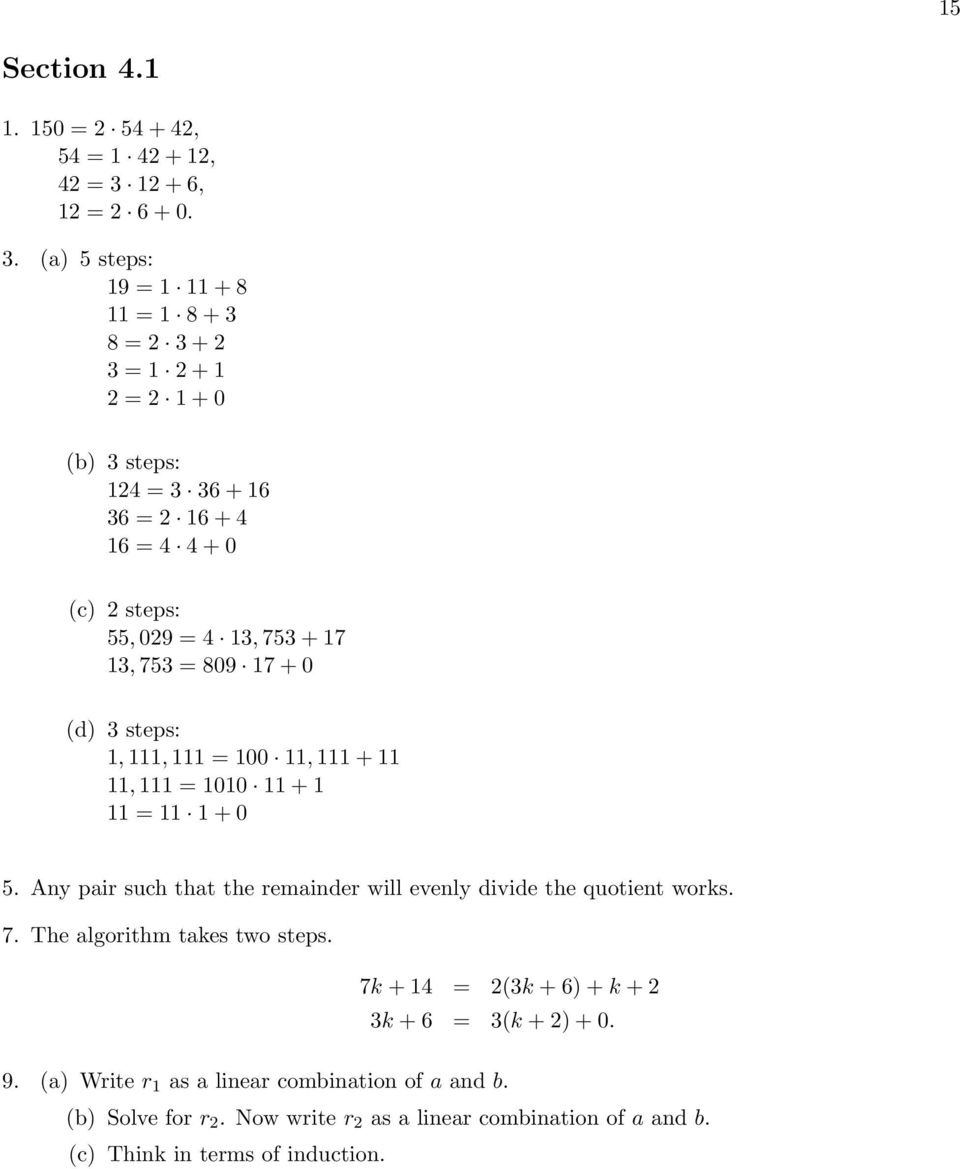
19 15 Section = , 54 = , 42 = , 12 = (a) 5 steps: 19 = = = = = (b) 3 steps: 124 = = = (c) 2 steps: 55, 029 = 4 13, , 753 = (d) 3 steps: 1, 111, 111 = , , 111 = = Any pair such that the remainder will evenly divide the quotient works. 7. The algorithm takes two steps. 7k + 14 = 2(3k + 6) + k + 2 3k + 6 = 3(k + 2) (a) Write r 1 as a linear combination of a and b. (b) Solve for r 2. Now write r 2 as a linear combination of a and b. (c) Think in terms of induction.
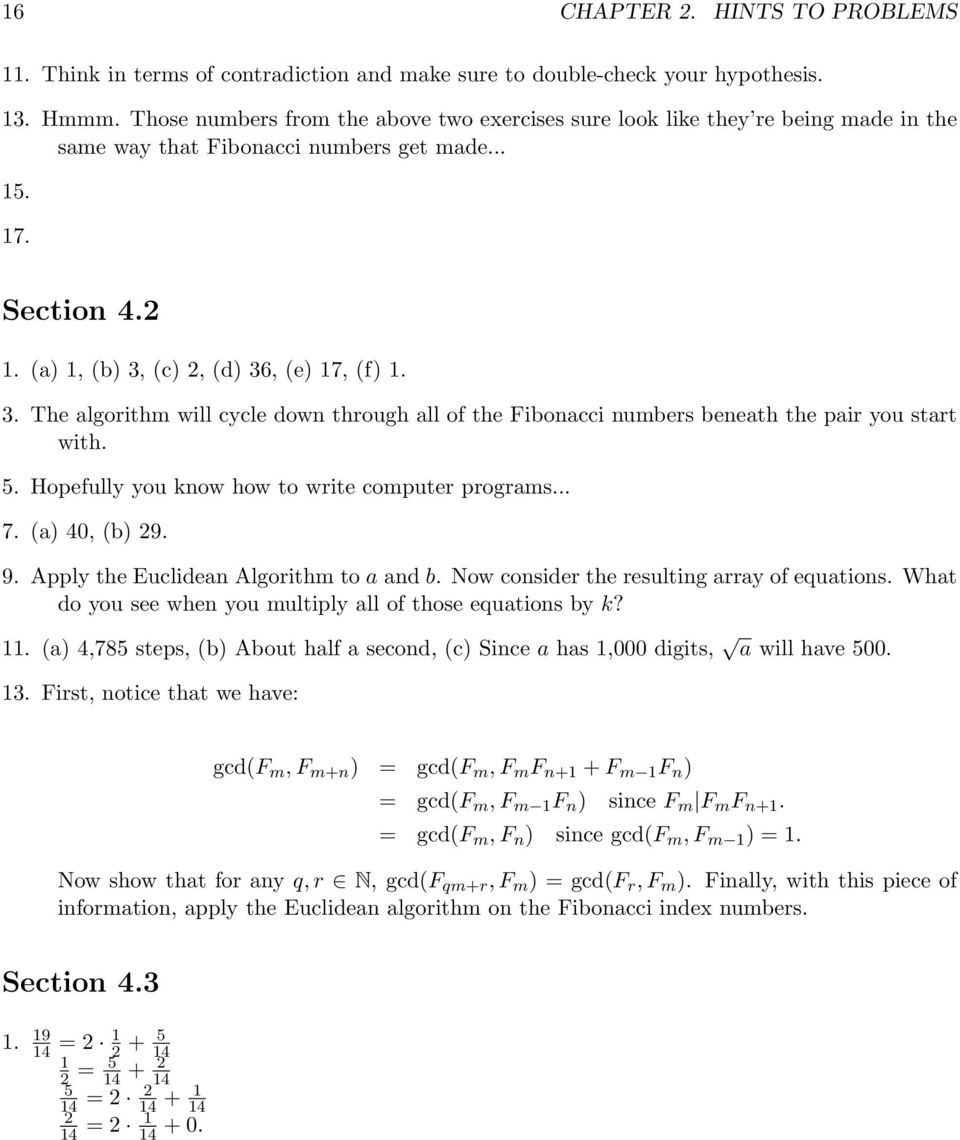
20 16 CHAPTER 2. HINTS TO PROBLEMS 11. Think in terms of contradiction and make sure to double-check your hypothesis. 13. Hmmm. Those numbers from the above two exercises sure look like they re being made in the same way that Fibonacci numbers get made Section (a) 1, (b) 3, (c) 2, (d) 36, (e) 17, (f) The algorithm will cycle down through all of the Fibonacci numbers beneath the pair you start with. 5. Hopefully you know how to write computer programs (a) 40, (b) Apply the Euclidean Algorithm to a and b. Now consider the resulting array of equations. What do you see when you multiply all of those equations by k? 11. (a) 4,785 steps, (b) About half a second, (c) Since a has 1,000 digits, a will have First, notice that we have: gcd(f m, F m+n ) = gcd(f m, F m F n+1 + F m 1 F n ) = gcd(f m, F m 1 F n ) since F m F m F n+1. = gcd(f m, F n ) since gcd(f m, F m 1 ) = 1. Now show that for any q, r N, gcd(f qm+r, F m ) = gcd(f r, F m ). Finally, with this piece of information, apply the Euclidean algorithm on the Fibonacci index numbers. Section = = = =
21 3. In general, the gcd the smallest square needed to fill the rectangle of a 10 and b 4 17 is gcd(a,b) Follow the method used for a 2 1 rectangle. Continue to compare sides until you find a pair that are similar. 7. Can you show that this rectangle is similar to one where the sides are integers? 9. Can you show that CEF is an isosceles triangle? 11. By assumption, we know that AB and AC are multiples of δ. Can you show that EF is a linear combination of those two sides? 13. Consider that s 1 = s 2 + d 2.
22 18 CHAPTER 2. HINTS TO PROBLEMS Section (a) Let x be the length of Diophantus life in years. Then from the problem we have x = x 6 + x 12 + x x (b) From (a) we can deduce that Diophantus lived until he was 84, he spent 14 years as a boy, he grew a beard at 21, he married at 33, his son was born when he was 38 and he was 80 when his son died. 3. {..., ( 11, 8), ( 4, 3), (10, 7), (17, 12),...}. In general, (3+7k, 2 5k) is an integral solution for all k Z. 5. Solutions are of the form ( 1 + 3t, 1 2t) for integers t. 7. 7X + 3Y = 1. It passes through all points of the form ( 2 + 3t, 5 + 7t). 9. Use a proof by contradiction. Follow the proof of Theorem Notice: 3 21, 3 51, and If a solution did exist, what would that imply by the Linear Combination Lemma? 13. X = 7, Y = X = 3, Y = Re-arrange to get X 2 = 2 + 5Y. Thus 2 + 5Y 0, so the right side will always end in either a 2 or a 7. Are there any perfect squares that end in a 2 or a 7? 19. Plug ax, ay and az into the Pythagorean Theorem. 21. Just use a value of n that will fail to match your examples. Section (a) ( 1, 3) is a solution, for example. (b) The given solution corresponds to a diagram with a potato and one 11 lb brick on one side of the scale, and three 4 lb bricks on the other. (c) 81 = so 4 = (d) 1 = ( 1) = ( 1)11 + 3( ) = ( 22)11 so (3, 22) is a solution to 81X + 11Y = 1. In terms of the potato problem, three 81 lb bricks balances twenty two 11 lb bricks plus a 1 lb potato.
23 = , 23 = = = Thus, 1 = 3 2 = 3 (5 3) = = 2(23 4 5) 5 = = ( ) = , so (38, 9) is a solution = , 423 = , 77 = Thus, 1 = = 77 2( ) = = 11( ) = , so (11,-13) is a solution. 7. The method gives (-2,-1) as a solution and 49 have a common factor of 7, so there is no solution. 11. Begin with the fact that 47x 0 + 6y 0 = 1, then use the substitution 6 = By Theorem 5.1.2, for the Diophantine equation to have a solution, we know gcd ( a, (a+2) ) = 1. Combine this with using the Euclidean Algorithm. 15. Notice that 0 r < b and gcd(a, b) = gcd(b, r). Section gcd(91, 21) = 7. (a) No solution. (b) Has a solution. (c) No solution. (d) Has a solution. (e) Has a solution. (f) No solution. 3. No solution since gcd(22, 111) = ( 60, 70). 7. No solution since gcd(24, 36) = (22, 11).
24 20 CHAPTER 2. HINTS TO PROBLEMS 11. Use Theorem Use Theorem (a) Use the methods previously outlined in the chapter. (b) Use the solution to the Diophantine equation 7X + 24Y = 2. (c) Use the solution to the Diophantine equation 73X + 55Y = 1. (d) Use the solution to the Diophantine equation 15X + 41Y = From Exercise 16, you can show that gcd(gcd(a, b), c) gcd(a, b, c). To show that gcd(a, b, c) gcd(gcd(a, b), c), think in terms of linear combinations and their relation to the gcd. 19. Given that gcd(63, 28) = 7, we can find the solution ( 26, 13, 1). 21. Use the result from Exercise Use the result from Exercise For the direction, suppose that there exist x, y N such that s + xa = t + yb and figure out a way to apply Theorem For the direction, suppose gcd(a, b) (t s). Apply Theorem 5.3.2, and work with what this gives you. Section a) X, Y = 4, 7 b) ( k, 7 19k) 3. a) X, Y = 964, 481 b) ( k, k) 5. gcd(1155, 29393) = 7 > 1, so there is no solution. 7. gcd(429, 242) = 11 > 1, so there is no solution. 9. a) X, Y = 23, 81 using previous Exercise. b) ( k, k) 11. a) X, Y = 40, 24. b) ( k, 24 39k) 13. a) X, Y = 5000, b) ( k, k)
25 a) X, Y = 650, 300 b) ( k, k) 17. Notice that equation (9) and equation (10) differ by k = (a) Find an answer that is not in S (b) You can t apply a theorem unless you meet its if -requirement. 21. If p is prime and p d, then p a, so p b. Thus gcd(b, d) = Since gcd(a, b) = 1, if p b, then p a. 25. Look at the set of solutions S from Theorem Same as above. 29. A solution is positive if cx bk > 0 and cy + ak > 0. Use these inequalities and the fact that c > abn to find n values of k that give a positive solution. 31. (a) = 34. (b) Use brute force. (c) 23. (d) Let k be the largest number of chicken nuggets you cannot buy. Show that k + 1, k + 2, k + 3, k + 4 and k + 5 can all be written as 5X + 7Y. Now show how any number n > k can be derived from these five consecutive numbers.
26 22 CHAPTER 2. HINTS TO PROBLEMS Section (a) (b) 7 3 (c) 2 10 (d) (e) (f) Use 2 2n 1 = (2 n 1)(2 n + 1). 5. Use p! = p(p 1)! and the definition of a prime number to show that (p 1)! does not contain any factor of p. 7. Use induction on r by setting a = a 1...a r 1, b = a r and applying proposition (a) First show that it is equal to the number of factors of 5 in 100!. Find this number by counting the numbers between 1 and 100 which are divisible by 5 and 25=5 2. (b) Follow (a). 11. Use proposition Use the fundamental theorem of arithmetic to show that b must have a factor of Use lemma For the first part, use the fact that n is not squarefree if and only if there is a prime p such that p 2 n. For the second part, use the fundamental theorem of arithmetic. 19. Use a proof by contradiction. If gcd(a 2, b 2 ) = k 1, then there is a prime p such that p a 2 and p b 2. Use exercise 11 to show gcd(a, b) Write p 2 q 2 = (p q)(p + q). Using this factorization show that p 2 q 2 is divisible by 4 and 3 hence by Show that p = 3k + 2 for some odd number k. Then p + (p + 2) = 6(k + 1) is divisible by 12.
27 23 Section (a) 8. (b) 5. (c) 6. (d) 16. (e) 9. (f) 101. (g) 130. (h) (a) (b) ,3, ,8,10. 9.(a) 91 years. (b) 119 years. (c) 1547 years. (d) 42 more years. 11. Write a = 5a 1 and b = 5b 1. Then deduce that gcd(a 1, b 1 ) = 1 and lcm(a 1, b 1 ) = a 1 b 1 = 108. Apply the FTA to find all possible pairs (a 1, b 1 ). 13. Follow the proof of proposition Follow the proof of theorem Set a = 30, c = 24 and find b. 19. Show that gcd(b, c) = 24, gcd(a, c) = 84 imply that 4 is a factor of gcd(a, b). Hence the answer is no. 21. Follow the proof of lemma
28 24 CHAPTER 2. HINTS TO PROBLEMS 23. Use the FTA and proposition Follow theorem and use exercise If x = a b ( where a, b are integers and satisfy gcd(a, b) = 1) is a solution, then an = b(c n 1 a n 1 + c n 2 a n 2 b + + c 0 b n 1 ). So b a n. Show that x must be an integer. 29. Use the fact that n is a perfect square if and only if the number of prime factors p in n is even. 31. Follow the proof of proposition abc. 35. lcm(a, b, c).
29 25 Section (a) 17 ( 163) = 4 45 (b) = 7 88 (c) 17 ( 71) = 6 9 (d) = (a) 36 = 2(13) + 10 = 10 (modulo 13). (b) 15 = 5(3) + 0 = 0 (modulo 3). (c) 5 12 = 60 = 8(7) + 4 = 4 (modulo 7). 5. The congruence classes are: {..., 4, 0, 4, 8,...}, {..., 3, 1, 5, 9,...}, {..., 2, 2, 6, 10,...}, and {..., 1, 3, 7, 11,...}. 7.(a) It is the congruence class of 15 mod 20: {..., 25, 5, 15, 35, 55, 75,...} (b) It is the congruence class of 0 mod 9: {..., 27, 18, 9, 0, 9, 18,...} (c) It is the congruence class of 37 mod 35, which is the same as the congruent class of 2 mod 35: {..., 68, 33, 2, 37, 72,...} 9.(a) 75 5 = 70, so m 70. The numbers m > 1 that divide 70 are 2, 5, 10, 7, 14, 35, and 70. (b) 100 ( 1) = 101, so m is prime, so m = 101 is the only possible modulus. (c) 15 ( 5) = 20, so m 20. The numbers m > 1 that divide 20 are 2, 4, 5, 10, and 20. (d) 46 3 = 49, so m 49. The numbers m > 1 that divide 49 are 7 and Use definition Use proposition and lemma Use proposition Use the symmetry property of theorem (a) It is an equivalence relation.
30 26 CHAPTER 2. HINTS TO PROBLEMS (b) It is not symmetric. (c) It is an equivalence relation. (d) It is not symmetric. (e) It is an equivalence relation. (f) It is an equivalence relation. (g) It does not have any properties of equivalence relations. (h) It is an equivalence relation. (i) It is not reflexive and transitive. (j) It is not transitive. (k) It is not reflexive and transitive. (l) It is an equivalence relation. 21.(a) 19 j). (b) 19 d). (c) Consider the following relation on real numbers, x y if xy 0. Show that it is both symmetric and transitive but not reflexive because 0 0 is not valid. 23. Show that if two equivalence classes have a nonempty intersection, then they are equal.
31 27 25.(a) (1, 1), (1, 3), (3, 1), (3, 3), (2, 2), (2, 4), (4, 2), (4, 4), (5, 5). (b) For example, P 1 = {1}, P 2 = {2}, P 3 = {3}, P 4 = {4}, P 5 = {5}. The ordered pairs are (1, 1), (2, 2), (3, 3), (4, 4), (5, 5). 27. R1 = {(1, 1), (2, 2), (3, 3), (1, 2), (1, 3), (2, 1), (2, 3), (3, 1), (3, 2)}, R2 = {(1, 1), (2, 2), (3, 3), (1, 2), (2, 1)}, R3 = {(1, 1), (2, 2), (3, 3), (1, 3), (3, 1)}, R4 = {(1, 1), (2, 2), (3, 3), (2, 3), (3, 2)}, R5 = {(1, 1), (2, 2), (3, 3)}. Section (a) = 7 2 (mod 7). (b) = 6. (c) = 4. (d) = 10 3 (mod 7). 3.(a) = 30 3 (mod 9). (b) = 31 4 (mod 9). (c) = 62 8 (mod 9). (d) = 65 2 (mod 9). (e) = 17 2 (mod 9). 5.(a) 6. (b) 6. (c) 6. (d) 0. (e) 7. 7.(a) 2. (b) 1. (c) 1 and 6. (d) There does not exist such a number.
32 28 CHAPTER 2. HINTS TO PROBLEMS 9. 63! = 61! (mod 71) = ( 9) ( 8) (mod 71) = 1 (mod 71). This means that 63! 61! (mod 71), because they only differ multiplicatively by Use theorem Use theorem Use theorem with r = s = Note that the last two digits of d e are zero hence it is divisible by (a) Note that multiplying a number by 10 change the last digit to zero. (b) Note that multiplying a number by 5 change the last digit to 0 or Use d = d n 1 d n 2... d 3 d 2 d 1 d 0 d 2 d 1 d 0 (mod 8). 23. Use the test for divisibility by 9(corollary ). 25. No. Use the test for divisibility by (a) Use F 80 = F 79 + F 78 and theorem (b) 1, 1, 2, 0, 2, 2, 1, 0, 1, 1,... from here it repeats. (c) 1, 1, 2, 3, 5, 1, 6, 0, 6, 6, 5, 4, 2, 6, 1, 0, 1, 1,... from here it repeats. (d) 1, 1, 2, 3, 5, 2, 1, 3, 4, 1, 5, 0, 5, 5, 4, 3, 1, 4, 5, 3, 2, 5, 1, 0, 1, 1,... from here it repeats. (e) Note that the Fibonacci sequence modulo 6 repeats after 24 terms, and the Fibonacci sequence modulo 4 repeats after 6 terms, so it will also repeat after 24 terms. Conclude that after 24 terms the Fibonacci sequence will be equal modulo 12 as well. (f) Note that if two numbers reduced modulo m repeat right next to each other then the sequence is periodic and there are only m equivalence classes. (g) Use (f) and note that if F k+2 F k+p+2 (mod m) and F k+1 F k+p+1 (mod m) then F k F k+p (mod m). 29.(a) Show that d = d m 1 d m 2... d 3 d 2 d 1 d 0 d n 1 d n 2... d 3 d 2 d 1 d 0 (mod 2 n ). Note that d d n 1 d n 2... d 3 d 2 d 1 d 0 is divisible by 10 n. (b) 2 6. (c) Show that d = d m 1 d m 2... d 3 d 2 d 1 d 0 d n 1 d n 2... d 3 d 2 d 1 d 0 (mod 5 n ). Note that d d n 1 d n 2... d 3 d 2 d 1 d 0 is divisible by 10 n.
33 Reduce 10 n modulo 13 and follow method to obtain d = d n 1... d 7 d 6 d 5 d 4 d 3 d 2 d 1 d 0 = d d d n 1 d n 1 d 0 3d 1 4d 2 d 3 + 3d 4 + 4d 5 + d 6 3d 7... (mod 13). 33. First note that 645 = Using 2 2 = 1 (mod 3), 2 2 = 1 (mod 5) and 2 7 = 1 (mod 43) show that 2 14 = 1 (mod 645). Finally since conclude that = 0 (mod 645). Section (a) 4. (b) 2. (c) 0. 3.(a) 0. (b) 4. (c) 8. 5.(a) 8. (b) 3. (c) 8. 7.(a) , for example. (b) Any transposition within the first 10 digits will produce a valid number, e.g (c) Interchanging the last digit with a different digit among the first ten will produce an invalid number, e.g Show that if the i-th digit is x originally but replaced by y by mistake then i(x y) is divisible by 11 and deduce that x = y. Section Any x 9 (mod 10) is a solution. 3. Any x 159 (mod 175) is a solution. 5. There is no solution.
34 30 CHAPTER 2. HINTS TO PROBLEMS 7.(a) We would have to solve the equation 8x 10y = 1, but 1 is not divisible by 2. (b) We would have to solve the equation 169x 325y = 40, but 40 is not divisible by (a) 8. (b) 6. (c) (a) No. For example take s = 0, t = 140. (b) Yes. Note that lcm(20, 35) = 140. (c) Yes. 13. x 8 (mod 15) is the only solution. 15. x 50 (mod 52) is the only solution. 17. There are two non-congruent solutions: x 7 (mod 30) and x 22 (mod 30). 19. Show that there if x 0 is a solution then y is a solution if and only if y x 0 is divisible by d. 21. Follow the proof of theorem and use theorem Show that among possibilities (1, 3, 4), (1, 3, 9), (1, 8, 4), (1, 8, 9), (7, 3, 4), (7, 3, 9) (7, 8, 4), (7, 8, 9), there are only six different possibilities for the value of x modulo m. 25.(a) Use theorem (b) Take k and l to be the reductions of s modulo a and b, respectively. 27. Any x 5566 (mod 10626) is a solution. 29. Show that there is no solution. 31. Note that in both cases, you need to solve a system of congruences! 33. Write the corresponding system of congruences to obtain that the number of soldiers in the company must be 2101 (mod 2310). 35. Use induction on r.
35 31 Section Monday. 3. Tuesday. 5. Sunday. 7. Tuesday. 9. Follow example Show that they have the same doomsday and are not a leap year. 17.(a) (b) 11,582 (c) Section (a) T = 3, V = 0, H = 145. (b) T = 12, V = 9, H = 109. (c) T = 4, V = 3, H = (a) 11,111. (b) 4,745. (c) Show that we need to solve x 19 (mod 20) and x 10 (mod 365) which has no solution so the date never occurs. 7. Day 6 on wheel 1, day 27 on wheel 2, and day 380 on wheel 3. 9.(a) 249, 271a + 81, 872b + 303, 366c, reduced modulo 317,254. (b) 249, , , , 073 (mod ).
36 32 CHAPTER 2. HINTS TO PROBLEMS Z Z Z a. x = 1 b. x = 2 c. x = 1
37 33 d. x = 0 e. x = 1 or 2 f. no solutions 9. a. x = 2 b. x = 3 c. x = 4 d. x = 1 e. no solutions f. x = 2 or commutativity. 13. Consider the multiplicative table of Z = {x Z x = 11k + 4 where k Z}. So 4 = {... 18, 7, 4, 15, 26,...}. 3. a. 8 = 12. b. 5 = 15. c. 2 = , 1, 3, 4, 9, 10, x = 0, 2, 3, Show that it does not contain the additive identity element. 11. Use the corresponding properties of the ring of integers, Z. 13. Use theorem Expand (a + b) 2 using ring properties of Z n. 17. If it was well-defined then 0 0 = n n which is not correct! 19. This operation is not well-defined. For example in Z 5, 1 = 6, but 3 1 = 3 and 3 6 = 4.
38 34 CHAPTER 2. HINTS TO PROBLEMS (a) 44 (b) 675 (c) Does not exist. (d) (a) x = 7 (b) x = 9 (c) x = 5 5. (a) x = 16 (b) x = (a) 1 (b) 1 (c) 0 (d) 0 9. Use theorem Use Euclid s Lemma (5.3.2). 13. (a) Multiples of the gcd(a, n). (b) Show that b appears in the row of a if and only if the Diophantine equation ax + ny = b has a solution. (c) n gcd(a,n) distinct elements. 15. The commutativity property. 17. Expand the left-hand side using ring properties of Z n The two-letter blocks I LO VE M AT H are represented by the numbers These encrypt to the ciphertext NUMBER THEORY IS USEFUL FOR ENCIPHERING MESSAGES.
39 35 5. The encrypted message is The encrypted message is The encrypted message is GEOLOGY ROCKS 5. (a) The encrypted message is (b) Use the Euclidean Algorithm to find integers x and y so that 5x y = 1. You ll find that x = 1091, so this is the inverse of 5 modulo (c) THEY KNOW TOO MUCH 7. The end of the message reads...steal AWAY TOGETHER. 9. If it is not one-to-one then two distinct letters or blocks of letters could encrypt to the same code and so there would be no way to decrypt the message.
40 36 CHAPTER 2. HINTS TO PROBLEMS Fermat s Little Theorem tells us that (mod 37) Since 43 6 (mod 37), we get (mod 37) (mod 13), so 8 4 = (2 3 ) 4 1 (mod 13). Since 98 is , (mod 13) (mod 13) (mod 13). So (mod 13) (a) 6, 12, 18. All multiples of 6 will work. (b) 1, 7, 13,.... They are all of the form 6k + 1 for some integer k. (c) 2, 8, 14. They are all of the form 6k + 2 for some integer k. 9. (a) Statement: If a b (mod p), then a m b m (mod p). To prove it use theorem (b) Statement: If m n (mod p 1), then a m a n (mod p). To prove it write m = n + k(p 1) for some integer k. 11. (a) The number 119 is not prime, so we cannot apply Fermat s Little Theorem. (b) (mod 7). (c) (mod 17). (d) Use the Chinese Remainder Theorem. 13. Use Fermat s Little Therem. 15. Consider two different cases namely p a and (p, a) = (a) Use Fermat s Little Theorem. (b) Consider two different cases namely n is odd and n is even. (c) Use Fermat s Little Theorem to reduce n 7 modulo 3. (d) Use (a),(b) and (c). 19. Use theorem Use Fermat s little theorem and exercise (a) 1, 2, 3, 4. (b) 1, 5.
41 37 (c) 1, 7, 11, 13, 17, 19, 23, (a) 656 = , so φ(656) = = 320. (b) 2905 = , so φ(2905) = = (c) = , so φ(27720) = 2 2 (2 3) = (d) = , so φ( ) = (2 99 ) ( ). 5. It seems that φ(d) = m 1. (a) 8 (b) 11 (c) 19 d m,d>0 7. (a) The general formula of φ(p a 1 1 pa k k ) is From this, we get φ(p a ) = (p 1)p a 1. (b) φ(3 4 ) = (3 1)3 4 1 = 54. (p 1 1)p a (p k 1)p a k 1 k. 9. Note that either n = 2 k or there is a prime p > 2 dividing n. Use formula in each case. 11. If φ(m) = 98, then for any prime factor p of m we have p Prove by contradiction. 13. Use definition (a) For p = 2: Reduced resides: 1, 3; φ(2 2 ) = 2 For p = 3: Reduced resides: 1, 2, 4, 5, 7, 8; φ(3 2 ) = 6 For p = 5: Reduced resides: 1, 2, 3, 4, 6, 7, 8, 9, 11, 12, 13, 14, 16, 17, 18, 19, 21, 22, 23, 24; φ(5 2 ) = 20. The formula is p(p 1). (b) Show that the only integers 0 < a < p 2 which (a, p 2 ) 1 are p, 2p, 3p,..., (p 1)p. (c) Show that the only integers 0 < a < p 2 which (a, p 2 ) 1 are p, 2p, 3p,..., (p k 1 1)p. 17. Use lemma (9.2.8) to show φ(2 2k+1 ) is a perfect square for any k. 19. Use formula and proposition (a) Consider the prime factorizations of a, m and n. (b) Show that the numbers a in the range 0,..., mn 1 such that a b (mod m) are {b, b + m,..., b + m(n 1)} which modulo n are {0, 1,..., n 1}. From this conclude that s b = φ(n). (c) Show that for any number a in the range 0,..., mn 1 such that a b (mod m), we have (a, m) 1. Use (a) to show that (a, mn) = 1 hence s b = 0. (d) Show that for any number a in the range 0,..., mn 1 such that (a, mn) = 1 there is a unique b in the range 0,..., m 1 such that a b (mod m) and then use (b). (e) Use (b),(c) and (d).
42 38 CHAPTER 2. HINTS TO PROBLEMS 23. Use Lemma to show that φ ( (p a 1 1 )(pa 2 2 )... (pa k k )) = φ(p a 1 1 ) φ ( (p a 2 2 )... (pa k k )). Then use exercise 15c to derive the formula. 25. (a) p(m φ(m)). (b) m. (c) Count the number of elements counted both in (a) and (b) to show that there are p(m φ(m)) + φ(m) numbers not relatively prime to pm. (d) Use (c) and the definition of φ(pm) φ(33) = 2 10 = (mod 33). 3. φ(13) = (mod 13). 5. φ(108) = (mod 108) φ(30) = 24. So, we need only to find 12 5 (mod 35). Using successive squaring, this is Use theorem Use (mod 10). 17. (a) Multiply the equation by the multiplicative inverse of 13 to obtain a simpler equation. (b) Multiply the equation by the multiplicative inverse of 5 to obtain a simpler equation. (c) Multiply the equation by the multiplicative inverse of 10 to obtain a simpler equation. 19. First reduce 5 64 modulo φ(12) = 4, then raise the 7 to that result. 21. Reduce 3 27 modulo , 01, 16, 28, 06, The exponents should be relatively prime to φ(p). (a) φ(2819) = 2818 = (b) φ(2729) = 2728 =
43 39 5. (a) p 1 = 2896, and gcd(2317, 2896) = 1. So it is a valid encryption scheme. (b) d = 5. (c) The deciphered message is I HAVE PLANS 7. (a) (b) We cannot find a multiplicative inverse of 18 modulo 28. (c) The encryption exponent must be relatively prime to p The encrypted message is , so the encryption scheme must not have been valid (a) n = (b) φ(n) = (c) Only exponents relatively prime to 2640 will work. Of the ones listed, these are: 7, 49, and d = n = 2881, so we encipher by raising to the 5th power modulo The ciphered message is: n = 2867, so we encipher by raising to the 7th power modulo The ciphered message is: (a) d = 11. (b) FOOD 11. (a) We need the multiplicative inverse of 7 modulo φ(pq) = It is (b) AWAY WE GO 13. (a) BROKEN (b) They would have to make it much harder to factor n into primes. Perhaps they could choose p and q to be very large. 15. Yes the algorithm would still work, assuming that all of the prime factors of the modulus are big enough that the message will be relatively prime to the it. The only difference would be the formula for φ(n).
44 40 CHAPTER 2. HINTS TO PROBLEMS Corollary tells us that any element of Z 29 have an order that divides p 1 = 28. So, the possible orders of any element of Z 29 are 1,2,4,7,14, and (a) ord 15 (4) = 2. (b) ord 15 (7) = 4. (c) ord 20 (7) = Use Euler s Theorem and proposition Use exercise 7 to show that ord(a) = φ(m). 9. (a) ord 7 (2) = 3. (b) ord 15 (2) = Show that ord(a t ) s and ord(a) ord(a t )t and conclude that ord(a t ) = s. 13. First show that ( a j) s gcd(s,j) = 1. Now suppose that k = ord(a j ) and that k < s/ gcd(s, j). Use to derive a contradiction. 15. (a) ord(8) = 12. (b) ord(32) = (a) The number of perfect inside shuffles required to return a deck with 2n cards to its original order is equal to the number of perfect outside shufflesrequired to return a deck with 2(n + 1) cards to its original order. (b) The number of inside shuffles necessary to return a deck with 2n cards to its original order is ord 2n+1 (2). 19. Completely backwards. 21. ord 13 (12) = 2, ord 13 (8) = 4, ord 13 (8 12) = ord 13 (2) = 12, ord 13 (6) = 12, ord 13 (2 6) = Observe that x 2 y 2 = (x + y)(x y) and use Euclid s Lemma (5.4.2). 27. For the first part use Exercise 11. For the second part use the definition of ord n (a). 29. We apply the proposition to get the factors gcd(a r/2 ± 1, n). 31. (a) There is only one prime factor: 3. (b) Use Proposition to show that ord r (2) p and conclude that ord r (2) = p. (c) Show that ord r (2) r 1 and use (b).
45 (a) x = 0, 2, 3, or 5. (b) x = 0, 1, 2, 3, 4 or Note that x = 3 is a solution to all of the equations. (a) x = 3 or 4. (b) x = 3, 5, or 6. (c) x = 3 or 4. (d) x = The modulus was not prime, which is a requirement of Theorem (a) Use Fermat s Little theorem to show that every reduced residue must satisfy at least one of them. Then show that no reduced residue can satisfy both equations. (b) If a 8 = 1, then ord(a) must divide 8. So it is either 1, 2, 4, or 8. (c) Show that ord(a) = 16 using the fact that ord(a) must divide (a) 4. (b) Yes, ±2 = 2, 9. (c) x = ( 8 + 2)(2) 1 = 5 6 = 8, and x = ( 8 2)(2) 1 = 1 6 = (a) 12. (b) Yes, ±5 = 5, 8. (c) x = ( 9 + 5)(2) 1 = 9 7 = 11, and x = ( 9 5)(2) 1 = 12 7 = 6. ( ) Show that we can write the equation in the form x + b 2a = b 2 4ac. Use this to show that 4a 2 there is a solution if and only if there is s such that s 2 = d and if s 2 = d solve the equation. 15. (a) x = 1, 2. (b) x = 0, 3. (c) Use the Chinese Remainder Theorem to replace the equation by the following systems of congruences: x 1 (mod 5) and x 0 (mod 7) x 1 (mod 5) and x 3 (mod 7) x 2 (mod 5) and x 0 (mod 7) x 2 (mod 5) and x 3 (mod 7) The solutions are x 7, 17, 21, or 31 (mod 35).
46 42 CHAPTER 2. HINTS TO PROBLEMS First note that (mod 7), (mod 7), and (mod 7). So we must have that ord(3) = 6 modulo 7, and 3 is a primitive root. We know then that 3 j will be a primitive root for any j such that gcd(j, 6) = 1. This gives 3 1 = 3, (mod 7). Since φ(6) = 2, we expect only two primitive roots, so this is a complete list. 3. First note that (mod 17), (mod 17), (mod 17), and (mod 17). So we must have that ord(3) = 16 modulo 17, and 3 is a primitive root. We know then that 3 j will be a primitive root for any j such that gcd(j, 16) = 1. This gives 3 1 = 3, (mod 17), (mod 17), (mod 17), (mod 17), (mod 17), (mod 17), and (mod 17). Since φ(16) = 8, we expect eight primitive roots, so this is a complete list. 5. No. Use Exercise Note that a must divide p 1, and the only number greater than p 1 2 that divides p 1 is p 1 itself. 9. Try number Show that if ord(a) < p 1 then there are at most ord(a) distinct powers of a. 13. Let a be a primitive root modulo p. Show that all elements of order d are the elements of the form a k(p 1) d where k < d is relatively prime to d which are exactly φ(d) elements. 15. (a) Note that φ(6) = 2. (b) Note that φ(10) = (a) Note that φ(15) = 8. Show that the order of any reduced residue divides 4. (b) Note that φ(8) = 4 and the reduced residues are 1, 3, 5, 7 which have orders different than (a) Note that n p k has at least one prime factor. (b) Use the Euler function and the fact that n has at least two distinct prime factor. (c) This follows from (b) similarly as in Exercise 18(a). (d) Use the Chinese Remainder Theorem. (e) Use (d). 21. (a) Use induction. The base case s = 3 was shown in Exercise 17(b). Assume the result for some arbitrary s 3. Let a Z. Then a 2s 2 1 (mod 2 s ). Hence, a 2s 2 = k2 s + 1. Using Squaring, show that a 2s 1 1 (mod 2 s+1 ). (b) Use (a).
47 (a) Since gcd(m, 2) = 1, we have φ(2m) = (2 1)φ(m) = φ(m). (b) 10 cannot be a primitive root modulo 94 since it is not a reduced residue modulo 94. (c) 57. (d) Let a be a primitive root modulo m. Then either a or a + m is odd. WLOG assume that a is odd. Prove that a is a primitive root modulo 2m (a) 4 (b) 7 3. (a) 13 (b) The key step is to find a prime of the form p = 2q + 1, with q prime. This can be done by searching for 30 digit primes r and then checking if 2r + 1 is prime and checking if (r 1)/2 is prime. One such possible combination is p = , q = Once you have primes of this form, it is easy to check for primitive roots since the order of an element modulo q must be 1, 2, p or 2p. For the primes above, a = 2 is a primitive root. 9. Using x = , the first 10 pseudorandom numbers generated are , 113, 12, 0, 0, 0, 0,... We see this as follows. (326916) 2 = (874071) 2 = (000113) 2 = = (000012) 2 = 144 = (000000) 2 = 0, and this is going to continue producing 0 s. 11. Using x = , the first 10 pseudorandom numbers generated are , ,... The period is one. 13. (a) 5, 0, 1, 3, 7, 4, 9, 8, 6, 2, 5,.... The period is 10. (b) 5, 5,... The period is 1.
48 44 CHAPTER 2. HINTS TO PROBLEMS 15. (a) Note that a r 1 (mod m). (b) Prove by contradiction. If x i x j (mod m) for i < j r, then show that ord m (a) j i < r, a contradiction. 17. Apply geometric series to.d 1 d r = d 1 d r 10 r + d 1 d r 10 2r (a) Use 9 p 1 2 = (3 2 ) p 1 2 = 3 p 1 1 (mod p) to show that 9 is only a primitive root for p = 2. (b) Given any perfect square a = b 2, use a p 1 2 = (b 2 ) p 1 2 = b p 1 1 (mod p) to show that a can only be a primitive root for p = 2. (c) Note that for any prime, p, ( 1) 2 = 1 1 (mod p) and ( 1) 1 = 1 p 1 (mod p). Conclude that 1 is a primitive root for exactly two primes, namely 2 and It is a multiple of m. 23. Letting a k = x 2 k x k 1x k+1 we find a 1 = = 33 and a 2 = 55. Conclude that m = 11 and a = To multiply 5 by 11 modulo 13 using the wheel, do the following: place the 1 of the inner wheel so it lines up with the 5 of the outer wheel. Then look on the inner wheel for the 11. The number that lines up with it will be the product. (In this case, 3.) 27. Begin by finding a primitive root of Z 17. In Example 3 of Section 10.3, we are told that 3 is a primitive root, so we will use that. Now we look at the ordered set { 3 0, 3 1, 3 2,..., 3 15 }. This equals { 1, 3, 9, 10, 13, 5, 15, 11, 16, 14, 8, 7, 4, 12, 2, 6 }. Now arrange these around an inner/outer wheel pattern and you will have a wheel for multiplication modulo 17.
49 Yes. 4 2 = , 2, 4, 8, 9, 13, 15, ( 2 7) = 1 7. ( 27 13) = 1 9. ( 2 17) = ( 11 13) = ( ) 5 13 = 1 ) 15. = 1 for p = 5, 13, 17. ( 1 p ( ) 1 p = 1 for p = 3, 7, 11, (a) ( 4 101) = 1. (b) Since a is a perfect square, ( there exists a b such that b 2 = a and p does not divide b. Then b2 = ā 0 is Z p and hence a p) = 1 by definition of the Legendre symbol. 19. Use definition of the Legendre symbol. 21. Give a proof by contradiction. Suppose that x 2 ab (mod p) and y 2 a (mod p). Let z be some multiplicative inverse of y modulo p. Then show that (zx) 2 b (mod p), a contradiction. 23. To prove it, consider the following different cases. (a) At least one of the two elements is 0. (b) Both elements are quadratic residues. (c) One element is a quadratic residue and the other is a quadratic nonresidue. (d) Both elements are quadratic residues. To prove (a), use the definition of the Legendre symbol. To prove (b) use exercise To prove (c), use exercise Finally to prove (d) use exercise Note that 59 3 (mod 4). Show that if n is a perfect square then 3 is a quadratic residue modulo 4 which is not valid, hence n is not a perfect square. 27. The values of ( p ( 5) read 1, 1, 1, 1, 1, 1. The values of 5 p) read 1, 1, 1, 1, 1, (a) There is agreement when at least one of the primes is equivalent to 1 modulo 4. Otherwise they disagree. ( ) ( ( ) (b) It turns out that p q = q p) either p 1 (mod 4) or q 1 (mod 4). Otherwise p q = ( ) q p. This will be proven later in the chapter.
50 46 CHAPTER 2. HINTS TO PROBLEMS 31. (a) The cubic residues modulo 5 are 1, 2, 3, and 4. The cubic residues modulo 7 are 1 and 6. The cubic residues modulo 11 are 1, 2, 3, 4, 5, 6, 7, 8, 9, and 10. The cubic residues modulo 13 are 1, 5, 8, and 12. (b) The number of cubic residues modulo p is p 1 3 if p 1 modulo 3. If p 2 modulo 3, then the number of cubic residues modulo p is p 1. If p 0 modulo 3, then p = 3 and it is easy to see that there are 2 cubic residues. (c) Let a be a cubic residue. Then there exists an x such that x 3 = a and there exists a unique y such that xy = 1. Thus, x 3 y 3 = ay 3 = 1. So we have that (xy) 3 = 1. Use proposition to complete the proof (a) ( ) 1 47 = 1 (b) ( 1 101) = 1 (c) ( ) = 1 (d) ( ) = 1 3. (a) ( 31 67) = 1 (b) ( ) 1 67 = 1 (c) ( ) ( = 1 ) ( ) = 1 1 = 1 5. (a) ( ) n 7 = 1 (b) ( ) n 7 = 1 7. First show that p 1 2 is odd( respectively even) if and only if p 3 (mod 4)( respectively p 1 (mod 4)). Use this to finish the proof. 9. ( (a) ) We have a 2 = a 2 0 in Z p which by the definition of the Legendre symbol we obtain a 2 p = 1. ( ) ( ) ( ) (b) Use a 2 p = a p a p ) (c) First note that = (a 2 ) p 1 2 = a p 1. Then Use Fermat s Little Theorem. ( a 2 p 11. First show that it is true ( for) p ( = 7. For ( p) 11 note that 1 2 = 1, 2 2 = 4, and 3 2 = 9 are all quadratic residues. Since 2 5 p p) = 10 p, conclude that at least one of the numbers 2, 5, 10 is a quadratic residue modulo p. Show that this completes the proof.
51 ( 3 71) = 1 3. ( 7 71) = 1 5. ( 3 53) = 1 7. ( 7 53) = 1 9. Use the Law of Quadratic Reciprocity to show that p = 2 or p ±1 (mod 12). 11. Use the Law of Quadratic Reciprocity to show that p = 2, or p ±1, ±3, or ± 9 (mod 28). 13. (a) Write a as a product of powers of primes. That is, a = s k 1 1 sk 2 ( ) 2 ( skn ) n for s l prime and n 0 and k i 1. Note that since p q (mod s l ), we have p = q for all l. Use the sl sl ( ( ) Law of Quadratic reciprocity to prove a p) = a q in both cases. (b) CASE 1: Let p q (mod 4). So there exists ( a Z( such ) that 4a = p q. ( So ) p ( q (mod ) 4a) and we can thus use a in the Euler form a p) = a q. Now show that p q = 4a+q q = ( ) ( ) 4a q = a q. Use this to prove the Law of Quadratic Reciprocity in this case. CASE 2: Let p q (mod 4). Use a proof similar to the first case In all three cases, ( 2 5) = In all three cases, ( 3 7) = In all three cases, ( 4 11) = In both cases, ( 2 11) = (a) -1 (b) -1 (c) ( ) = Show that ( 1 55 ) = 1 and deduce that the answer is No.
52 48 CHAPTER 2. HINTS TO PROBLEMS 15. Yes. 17. Use the fact that the Legendre symbol can only have the values 1 and Use theorem (a) g = 2 = ( 3 11) = 1 (b) g = 2 = ( ) ( 3 13 = 1 g = 4 = 3 23) = 1 (c) g = p 1 3 p 1 6 (d) p ±1 (mod 12) (a) 1 (b) (a) 20 (b) 1 5. (a) 21 (b) for all a,b,c,d 11. (a) F igure (b) 3 (c) (a) F igure (b) 9 (c) (a) F igure (b) 7 (c) 3 (d) (a) F igure (b) 12 (c) 7 (d) 8
53 Using the rectangle whose diagonal is the diagonal of P, we can see geometrically that the number of lattice points on the rectangle is (a+1)(b+1) 2. When divided into half by its diagonal, each triangle shares gcd(a, b) + 1 lattice points. Use this to finish the proof. 21. Let p be a prime number. Let n = p 1 2. Let q k be the quotient and r k be the remainder when 2k is divided by p for 1 k n. We get the following equations: 2 1 = q 1 p + r = q 2 p + r 2 2 n = q n p + r n Show that T (2, p) = 0 and q k = 0 for all k, so 2(1 + + n) = r r n. Define s k as in this section and conclude that g (s s n ) (mod 2), where g is hte number of k s for which r k is a negative residue. Use theorem and Gauss s Lemma to finish the proof ( ) ( ) ( ) 2 11 = ( ) 37 = 1 11 ( ) 4 = 11 = 1 3. ( ) ( ) ( ) ( ) = ( ) ( ) = ( ) ( ) 3 25 = = = 1
54 50 CHAPTER 2. HINTS TO PROBLEMS 5. (a) T (3, q) = q 1 3 q 1 6 (b) T (q, 3) = q 3 (c) Prove it in two different cases, namely 3 q 1 and 3 q Use the law of quadratic reciprocity for p and q = 2p Use definitions of Jacobi and Legendre symbols. 11. Use definition of Jacobi symbol and the fact when p is prime then p a b implies ( a n) = ( b n). 13. (a) Note that p i 1 is even. (b) Show that n = p k 1 1 pkn n (1 + k 1 (p 1 1)) + + (1 + k m (p m 1)) (mod 4) 1 + k 1 (p 1 1) + + k m (p m 1)) (mod 4). (c) Note that both sides in the congruence of (b) are even. (d) Use Euler s Identity (11.2.2). 15. Use the Euler s identity and law of quadratic reciprocity. 17. First prove that if x is odd then x 2 1 (mod 8). Use this to prove that x 2 a (mod 2 m ) can not have any solutions if a 1 (mod 8). Now use induction on m to show that if a 1 (mod 2 m ), then there are exactly four solutions. Prove the theorem directly for m = 3. Next, suppose that a 1 (mod 8) and x 2 a (mod 2 m ) has exactly four solutions. Prove that if x is a solution in (mod 2 m ), then x + 2 m 1 is also a solution and deduce that the four solutions of x 2 a (mod 2 m ) look like x 1, y 1 = x m 1 and x 2, y 2 = x m 1. Now show that one of x 1 and y 1 must solve x 2 a (mod 2 m+1 ) and similarly for x 2 and y 2. Deduce from this that there are at least four solutions for x 2 a (mod 2 m+1 ). Using the fact that the solutions of x 2 a (mod 2 m+1 ) are also solutions x 2 a (mod 2 m ), prove that there are exactly four solutions for x 2 a (mod 2 m+1 ).
55 Use successive squaring: (mod 247). We can conclude that 247 is composite by fermat s little theorem. We call 2 a witness to the fact that 247 is composite (mod 39). Hence 39 is composite (mod 21) and (mod 21). Hence, 21 is composite (mod 91). But (mod 91) shows that 91 is in fact composite (mod 671) shows that 671 is composite (mod ) (mod ) (mod ). You can conclude nothing about You may suspect, however, that is prime. 13. (a) 67 (b) No. By Fermat s Little Theorem. (c) No. By the definition of Carmichael numbers. 15. Use the definition of a Carmichael number. 17. Show that n is not squarefree hence it is not a Carmichael number. 19. Show that n is not squarefree. 21. Show that (n 1) n 1 1( mod n) if n is odd and (n 1) n 1 1( mod n) if n is even. 23. Suppose that gcd(a, n) = g 1. Then show that if a n 1 k (mod n) then k q hence k cannot be 1 which means that a is a Fermat witness for n. 25. Note that the formula can be written as n 1 A where A is the number of solutions to the congruence a n 1 1 (mod n). Show that A is equal to Show that A is equal to the number of solutions to a n 1 1 (mod p 1 ), multiplied by a n 1 1 (mod p 2 ), multiplied by..., multiplied by a n 1 1 (mod p s ). Finally Conclude that A = gcd(n 1, p 1 1) gcd(n 1, p 2 1) gcd(n 1, p s 1). 27. If s = rn, then show that 2 s 1 = (2 r 1)(2 r(n 1) + 2 r(n 2) r + 1).
56 52 CHAPTER 2. HINTS TO PROBLEMS At least At least (a) Yes. n could be a Carmichael number. (b) Use theorem Let n = 121k. Use inequality (10) with p = 11 to show that there will be at most n non-witnesses. 9. Note that 1 4 (n 1) 2 9 n = n Now use n p2 9 to show that 2 9 n 1 4 (n 1). 11. For example, let p = q = 5. Then n = 25 and p 1 = q 1 = 4 divides n 1 = (a) Note that n and p 2 are relatively prime. (b) Use y x + p (mod p 2 ), to prove (6) and (7) and to prove (8) use the fact that x and n are relatively prime. 15. (a) (b) 1105 = Factors less than these whose product is greater than 561 can be shown to not be Carmichael numbers. 17. Show that ord p (a) ord p 2(a) for any a. 19. Let n = p 2. Raise both sides of the congruence a p 1 b p 1 (mod p 2 ) to the p + 1 st power and use Lemma By problem 18, the order of a is either p 1 or p 2 1. If the order of a is not p 2 1, then use problem 20 to show that the order of a + p is p is composite. 3. (a) 340 = (b) 148 = (c) 560 = (d) 1058 = (mod 15) and (mod 15) shows that 4 is a Miller-Rabin witness for (mod 15) and (mod 15) shows that 14 is a Miller-Rabin witness for 15.
57 53 9. None. 7 is prime is not a witness to the compositeness of 149 by either test. 13. Composite by Miller-Rabin test. 15. Composite by Miller-Rabin Test. 17. Prove that 1 q 1 (mod n) and (n 1) q 1 or 1 (mod n) for any n, q. 19. Note that the successive square roots of a n 1 2 will never be equivalent to 1 or Note that we do not need to factorize n. We only need to keep dividing by 2 until some odd number is reached. 23. (a) Show that (a 2k 1q +1)(a 2k 2q +1) (a q +1)(a q 1) = 0 (a 2k 1q +1)(a 2k 2q +1) (a q + 1)(a q 1) = ln where l N. Thus we only need to determine which term is divisible by l, and then whatever is left are all factors of n. If none of the factors dtermined in this manner are prime factors, just keep repeating this process one the factors until the prime factors are determined. (b) If n is a Carmichael number, then find a Miller-Rabin witness a. If a is not Fermat witness, then we can simply follow the procedure described in part (a). If a is a Fermat witness, then it shares a common factor with n. If a is prime, then we have found a factor of n. If a is composite and difficult to factor, then we can find a Miller-Rabin witness for a and keep repeating this process and the process in a until we have factors for a and thus have determined a factor for n percent. 27. (a) ( ) (b) P(C) and P( C) have nothing to do with how many times the Miller-Rabin test is run and P(M C) is always 1. log(10 (c) 200 ) 1 log( ) (a) For m = 1, there is 1 solution. For m = 2 there are 2 solutions. For m = 3, there is 1 solution. For m = 4, there are 4 solutions. For m = 5, there are no solutions. (b) For m = 1, there is 1 solution. For m = 2, there are 2 solutions. For m = 3, there is 1 solution. For m = 4 there are no solutions. For m = 5 there are no solutions.
58 54 CHAPTER 2. HINTS TO PROBLEMS 3. (a) For m = 1, there is 1 solution. For m = 2 there are 2 solutions. For m = 3, there is 1 solution. For m = 4, there are 2 solutions. For m = 5, there are 5 solutions. For m = 6, there are 2 solutions. For m = 7, there is 1 solution. For m = 8, there are 2 solutions. Form m = 9, there is 1 solution. For m = 10, there are 10 solutions. For m = 11, there is 1 solution. (b) For m = 1, there is 1 solution. For m = 2 there are 0 solutions. For m = 3, there is 1 solution. For m = 4, there are 0 solutions. For m = 5, there are 5 solutions. For m = 6, there are 0 solutions. For m = 7, there is 1 solution. For m = 8, there are 0 solutions. Form m = 9, there is 1 solution. For m = 10, there are 0 solutions. For m = 11, there is 1 solution. 5. (a) 25. (b) (a) 25. (b) x m has only 1 value modulo p for any x, and 1 1 (mod p) only when p = For example, the equation x 4 (mod 13) has 4 solutions which is greater than p 1 4 = 12 4 = Then m is allowed to equal p 1 2 which means that there are p 1 2 solutions. 15. (a) p = 13, m = 3. (b) p = 13, m = (a) Use Lemma (b) Consider the example in the section, Z 13. Of all the rows where m is odd, the rows of 3 and 9 have the most 1 s in them, and each row only has 3, or (a) 340 = (b) From left to right, the first row reads 10, 1 and the second row reads 1, 1. (c) No. (d) Yes, since non of the congruences hold in both moduli, non hold modulus n 1 = (mod 9) which means 8 is a misleader to the compositeness of n 1 = 2 6. Since (mod 5), (mod 13) and 65 = 5 13, 8 1 (mod 65) by lemma , which means 8 is a misleader to the compositeness of It s not a misleader since n 1 = 2 49 and (mod 99) and (mod 99). Thus none of the congruences in the Miller-Rabin test are satisfied.
59 55 9. In Z 2, Use Observation and Lemma Congruence Equation Solutions per Prime Total C[ 1] x = 1 [5, 15, 25] 1875 C[0] x = 1 [5, 15, 25] 1875 C[1] x = 1 [10, 30, 50] C[2] x = 1 [20, 0, 0] 0 (a) There are 5 solutions to C[ 1]. (b) There are 1875 total solutions to C[ 1]. (c) There are total misleaders. 15. Congruence Equation Solutions per Prime Total C[ 1] x 69 = 1 [1, 3, 1] 3 C[0] x 69 = -1 [1, 3, 1] 3 C[1] x 138 = -1 [2, 6, 2] 24 C[2] x 276 = -1 [0, 0, 4] 0 C[3] x 552 = -1 [0, 0, 8] Let P = {p 1, p 2,..., p s }. Then we have 12.6 k 1 { gcd(q, p j 1) + P gcd(2i q, p j 1) if t > i 0 if t i P is prime: Take a = 7. Use 10 = is prime: Take a = 3. Use 4 = is prime: Take a = 7. Use 70 = is prime: Take a = 3. Use 4 = is prime: Take a = 3. Use 6 = is prime: Take a = 2. Use 2 = is prime: Take a = 3. Use = is prime: Take a = 2. Use 4 = is prime: Take a = 2. Use 10 = is prime: Take a = 2. Use 4 = 2 2. i=0
60 56 CHAPTER 2. HINTS TO PROBLEMS 43 is prime: Take a = 3. Use 42 = is prime: Take a = 2. Use 2 = 2. 7 is prime: Take a = 3. Use 6 = is prime: Take a = 2. Use 2 = is prime: Take a = 2. Use 222 = is prime: Take a = 2. Use 2 = is prime: Take a = 2. Use 36 = is prime: Take a = 2. Use 2 = Line 1: (i) (mod 239). (ii) (mod 239), (mod 239), (mod 239). Line 2: (i) (mod 7). (ii) (mod 7), (mod 7) Line 3: (i) (mod 3). (ii) Since q = 1, this condition holds. Line 4: (i) (mod 17). (ii) (mod 17). 9. (a) Show that ord n (a) = n 1 and then use Lemma (b) Thus the converse is not true. For example take n = 5 and a = L(5) = 1, L(7) = 2, L(71) = Use induction and properties of logarithms. 15. Use theorem and note that 2 is the only prime factor of F n The [ ] part is just like exercise 15. The [ ] part is just like exercise 16 except that instead of doing things modulo 12 in part a, use modulo (a) 40x + 41 (b) 3 (c) No. (d) Composite. 3. (a) x (b) 11x x + 1 (c) Yes.
61 57 (d) This is not enough information since we have only checked for a = 1 and we need to check for all a 3 Log 2 (5) (a) 88573x (b) x + 2 (c) Yes. (d) This is not enough information since we have only checked for a = 2 and we need to check for all a 2 Log 2 (11) (a) (b) Need to check r log 2 (n) 6776 values. (c) Maximum possible degree of polynomial is the largest possible remainder: r 1 = Note that by q is n. ( n q ) = n! q!(n q)! = n (n 1)...(n q+1) q! and the only term in the numerator divisible
62 58 CHAPTER 2. HINTS TO PROBLEMS See Figure (a) i (b) 6 + 2i (c) i (d) a 2 + b (a) The multiplicative inverse of 5 + 7i is 5+7i = 1 5+7i 5 7i 5 7i = 5 7i = i. (b) Multiplying the two numbers together gives us (5 + 7i)( 5 7i 74 ) = = 1. Thus, the two are multiplicative inverses. 7. Use identity a 2 c 2 + b 2 d 2 + a 2 d 2 + b 2 c 2 = (a 2 + b 2 )(c 2 + d 2 ) where a, b, c, d are integers. 9. (a) b. (b) a. (c) Note that i(a + bi) = b + ia. 11. If z w 1 = z w 2 = 1, then w 1 = (w 2 z)w 1 = w 2 (zw 1 ) = w If 1 = (a + bi)(1 + i) where a, b are integers, then by multiplying show that a b = 1 and a + b = 0. Show that these equations have no integer solutions. 15. Use definition to prove each property. 17. (a) Possibilities are ±1 ± 4i and ±4 ± i. (b) This is impossible, since 11 can t be written as the sum of two squares. (c) Possibilities are ±5, ±5i, ±3 ± 4i, and ±4 ± 3i. (d) This is impossible, since 21 can t be written as a sum of two squares We know that N(5 + 6i) = = 61. Since 61 is prime in Z, then by lemma , 5 + 6i is prime in the Gaussian integers. 3. The factors are ±1, ±i, ±2, ±3, ±2i, ±3i, ±6, ±6i, ±1 ± i, and ±3 + ±3i. 5. Suppose z is a common factor of 2 + 5i and 3 + 2i. Then since the norm is multiplicative, N(z) N(2 + 5i) = 29 and N(z) N(3 + 2i) = 13. The greatest common divisor of 29 and 13 is 1, so we have N(z) = 1, and hence z is a unit. Therefore, 2 + 5i and 3 + 2i are relatively prime.
63 59 imaginary 1+ i real 5-2i -3-5i
64 60 CHAPTER 2. HINTS TO PROBLEMS 7. (a) ±1. (b) Every nonzero element of Q is a unit. (c) Every integer relatively prime to 10 is a unit in Z 1 0. (d) All integers relatively prime to n are units in Z n. 9. Use n = (a + bi)(a bi). 11. i( i) = 1, ( 1)( 1) = 1 and clearly 1 1 = 1. So ±1, ±i are all units. 13. Since d x we have ad = x and similarly we can write bd = y. Therefore we have mx + ny = mad + nbd = (ma + nb)d. This implies d mx + ny. 15. Suppose that N(z) = p, for p prime in Z, but that z is not prime in Z[i]. Then z = a b. Then p = N(z) = N(ab) = N(a) N(b), use problems 12 and 13 to show that a or b must be a unit and therefore z is prime. 17. (a) If d a and d b then show that N(d) N(a) and N(d) N(b), hence N(d) = 1. Deduce that d is a unit. (b) The converse statement is that if gcd(a, b) = 1, then gcd(n(a), N(b)) = 1. This statement is false. For example, take a = 1 + 2i and b = 2 + i. 19. (a) 46 = 23 2 and so is prime. 48 = 6 8 and so is not prime. (b) The prime elements are those of the form 4n + 2 where n is a nonnegative integer. (c) If a = 2 n m S where m is odd then, a = (2m). Show that each factor is prime. (d) Consider = 2 30 and 60 = Also 180 = 6 30 = N(z) = 1. See observation If they were the same up to order or multiplication by units, then either N(1 + 5) = N(2) or N(3) which is not possible (a) qb + r = ( 1 + 2i)(4 + 2i) + ( 1 + i) = 4 2i + 8i i = 9 + 7i = a (b) N(r) = = 2 < 20 = = N(b) 3. (a) In figure 2.2, b = 3i. (b) Given the diagram, we can choose any of i, 2i, 1 + i, 1 + 2i as possible quotients. These give remainder norms of 2, 5, 5, and8 respectively and these are all smaller than N(3i) = 9, so all four options work and all possible solutions are q = i, r = 1 i; q = 2i, r = 2 i; q = 1 + i, r = 1 + 2i; and q = 1 + 2i, r = 2 + 2i.
65 61 5. Using the algebraic method we get q = 2i and r = 1 + i. 7. Using the algebraic method we get q = 7 3i and r = 2 + 2i. 9. Using the algebraic method we get q = 4 + 2i and r = i. For the geometric method, we use figure 2.3 to see that we can choose any of 3 + i, 3 + 2i, 4 + i, 4 + 2i as quotients. All of these give remainders with N(r) = 1 < 2 = N(1 i), so all four options work and any of the answers q = 3 + i,r = i; q = 3 + 2i, r = 1; q = 4 + i, r = 1 and q = 4 + 2i, r = i. 11. (a) See figure 2.5. (b) 0, 1, 2, i, 1 + i, 2 + i, 2i, 1 + 2i, 2 + 2i. These are the points inside one square, including one vertex (since they all have remainder of 0) and two edges. 13. It is true if b 0. To prove it writ If b = ad and use the properties of norms. 15. Prove that a b = su+tv u 2 +v 2 rational. + tu sv u 2 +v 2 i and conclude that the real and imaginary parts of a b are 17. Note that if z = a b = z 1 + z 2 i then there exist n 1, n 2 Z such that z 1 n and z 2 n Now let n = n 1 + n 2 i and prove that z n = (z 1 n 1 ) + (z 2 n 2 )i 19. (a) Let a, b Z with b 0. Then there exist q, r Z such that a = qb + r and r < b. (b) The two possible answers are q = 3, r = 2 and q = 4, r = 3. (c) The two possible answers are q = 3, r = 2 and q = 4, r = Use that fact that after each step, the norm of the remainder must be strictly less than the norm of the remainder in the previous step. 23. Two possible ways are 2 2. and i = (1 + i)(11 + 3i) + ( 3 + 6i) i = 2i( 3 + 6i) + ( 1 3i) 3 + 6i = ( 1 i)( 1 3i) + ( 1 + 2i) 1 3i = ( 1 + i)( 1 + 2i) i = (1 + 2i)(11 + 3i) 5i i = ( 1 + 2i)( 5i) + (1 2i) 5i = (2 i)(1 2i) The pairs 2 + 5i with 1 + i, 6 + 3i with 3 + i, 1 + 2i with 16 5i, and i with 8 i (parts a, b, d, f) are all relatively prime.
66 62 CHAPTER 2. HINTS TO PROBLEMS (a) Two other factorizations are 5 = ( 2 i)( 2 + i) and 5 = (1 2i)(1 + 2i). (b) This is not a contradiction because they are all the same factorization up to units as can be seen in the following equations 1(2 + i) = 2 i, i(2 + i) = 1 + 2i, i(2 + i) = 1 2i, 1(2 i) = 2 + i, i(2 i) = 1 + 2i and i(2 i) = 1 2i. Unique factorization says that if you multiply a factorization by units, then it is still the same factorization. 3. (1 i)(2 + i)(2 + 3i) i is prime. 7. Use Theorem to show that there exist X, Y Z[i] such that mx +dy = 1. Multiplying through by n we get n = nmx + ndy. Use this to prove d n. 9. Note that a common divisor, d of q and a must divide both q and a. 11. Use induction on N(z). 13. Use the properties of norm. 15. (a) First prove that if z = z 1 z 2 then z = z1 z 2. Use this to prove (a). (b) Note that u can only be 1, 1, i, i. Consider different cases according to what u is. 17. Note that 2 is prime in Z[ 5] and 2 6, but 2 does not divide or For all of the numbers in this problem, we will use Theorem Since they are all integers, then their norms are squares in Z and therefore conditions one and two do not hold. Thus, they are prime if they are congruent to 3 modulo 4 and not prime if they are congruent to 1 modulo 4 where the unit mentioned in condition 3 is 1. (a) 29 1 (mod 4) so it is not prime in Z[i]. (b) 31 3 (mod 4) so it is prime in Z[i]. (c) (mod 4) so it is prime in Z[i]. (d) (mod 4) so it is not prime in Z[i]. (e) (mod 4) so it is prime in Z[i]. (f) (mod 4) so it is prime in Z[i]. 3. N(z) = 2: (1 + i), N(z) = 3:, N(z) = 4:, N(z) = 5: (2 + i), (1 + 2i), N(z) = 6:, N(z) = 7:, N(z) = 8:, N(z) = 9: (3), N(z) = 10:, N(z) = 11:, N(z) = 12:. 5. Use that fact that the only quadratic residues (mod 8) are 0, 1, and 4.
67 63 7. Use the contrapositive of Theorem and Corollary Note that by Theorem p is not prime in Z[i]. SO p = zw where z, w Z[i] are not units. Use properties of norm to show that N(z) = N(w) = p. Finally show that z and w must be prime in Z[i]. 11. For statements (i) and (ii), use Lemma For statement (iii) use Theorem (a) Note that N(2) = 4. Use the exact same logic of Exercise and arrive at the conclusion that N(z) = 2. By Exercise , we have that z = u (1 + i), where u is a unit. (b) See Exercise (c) Use Corollary (a) (b) (c) Not possible. Note that 21 factors uniquely as 3 7 in Z[i]. If a 2 + b 2 = 3 7, we would have (a bi)(a + bi) = 3 7. Since 3 and 7 are prime in Z[i], we would have 3 (a bi) or 3 (a + bi), and similarly for 7. But this would say that 3 a and 3 b and likewise for 7. This would mean that 21 a and 21 b, but then a and b are too large to satisfy N(a + bi) = Using Theorem , these primes are the sum of two squares if and only if they are congruent to 1 modulo 4. (a) (mod 4) so it can be written as a sum of two squares. (b) (mod 4) so it can not be written as a sum of two squares. (c) (mod 4) so it can not be written as a sum of two squares. (d) 10, 000, (mod 4) so it can not be written as a sum of two squares. (e) 23, 456, (mod 4) so it can be written as a sum of two squares. (f) = (mod 4) so it can be written as a sum of two squares. 5. In each case, we don t count it as different to change the sign of a and b or to switch their order. (a) one way (it s a 1 mod 4 prime): (b) 2 ways: and (c) no ways (it s a 3 mod 4 prime) 7. Note that u must be 1, 1, i or i. 9. First, prove that the product of two SOTSes is also a SOTS. Use the identity a 2 +b 2 )(c 2 +d 2 ) = (ac + bd) 2 + (bc ad) 2.
68 64 CHAPTER 2. HINTS TO PROBLEMS Next note that the number 2 and any prime congruent to 1 modulo 4 can be written as a sum of squares. Also, any prime p raised to an even power, say 2i is also a sum of squares as p 2i = (p i ) o 3 modulo 4 is raised to an even power in the factorization of n into primes. 11. (a) x 2 (a p 1 4 ) 2 a p (mod p). (b) From Chapter 11, we know that for any a 0, there is a 1 p 1 2 chance that a 2 1 (mod p) (this is due to Euler s Identity [11.2.2] and the fact that exactly half of the nonzero elements are quadratic residues). Thus if we randomly choose a few a s, chances are that one of them will work. 13. First notice that for both of the cases, we can use Euler s Identity with Theorem to see that 2 p (mod p). In each case, set x = 2 p 1 4 (mod p) and look at the Gaussian gcd of x + i and p with a computer program. (a) = (b) = By the Fundamental Theorem of Gaussian Arithmetic, it is enough to show that our factorization contains only primes and units and that its product is n. Using Theorem , show that all the factors are prime. 17. Show that it is equal to the number of the non-negative integer solutions of f 1 + g 1 = b 1,..., f r + g r = b r which is equal to (b 1 + 1)(b 2 + 1) (b r + 1).
69 65 imaginary (1 + 2i)b (1 + i)b b (1 - i)b 2i b i b 0 b -i b real -4 - i (-1 + 2i)b (-1 + i)b -b (-1 - i)b
70 66 CHAPTER 2. HINTS TO PROBLEMS (-4 + 2i)b imaginary (-4 + i)b i (-3 + 2i)b (-3 + i)b (-2 + 2i)b -3b (-2 + i)b -2b (-1 + i)b -b i b 0 b real
71 67 imaginary i b b (4-5i)b (5-5i)b i (5-6i)b real (4-6i)b
72 68 CHAPTER 2. HINTS TO PROBLEMS imaginary (-1 + 2i)b 2i b (1 + 2i)b (2 + 2i)b (3 + 2i)b (-1 + i)b i b (1 + i)b (2 + i)b (3 + i)b -b 0 b b 2b 3b real (-1 - i)b -i b (1 - i)b (2 - i)b (3 - i)b
73 [2, 3, 4, 2] 3. [4, 10, 7, 5] [0, 9, 9, 9] = The convergents, in order, are 0, 1 9, 9 the number itself. 82, (The final convergent is equal to 9. [1, 1, 1, 1, 1] = 8 5. The convergents, in order, are 1, 2, 3 2, 5 3, 8 5. (The final convergent is equal to the number itself. 11. F k+1 F k = [a 1, a 2,..., a k ] = [1, 1,..., 1]. Use F k+2 F k+1 = F k+1 F k to give a proof by induction [ 3, 6 ] 3. [ 3, 3, 6 ] 5. [4, 8, 8, 8, 8, 8,...] 7. [6, 3, 1, 1, 7, 2,...] 9. a) e 1 = [1, 1, 2, 1, 1, 4, 1, 1, 6, 1, 1, 8,...]. The pattern is 2 ones and then the next multiple of 2. b) e 1 2 = [0, 1, 6, 10, 14, 18, 22,...]. The pattern continues by adding 4 each time. c) e 1 e+1 = [0, 2, 6, 10, 14, 18, 22,...]. The pattern continues by adding 4 each time. d) e 1/2 = [1, 1, 1, 1, 5, 1, 1, 9, 1, 1, 13, 1, 1, 17,...]. The pattern continues by 1,1 add 4. e) e 1/3 = [1, 2, 1, 1, 8, 1, 1, 14, 1, 1, 20, 1, 1, 26,...]. The pattern continues by 1,1 add let [4, 2] = x. Then x = So after some algebra we get x 2 4x 2 = 0, which leads 2+ 1 x to x = as the only positive root of the polynomial. 13. α = α =
74 70 CHAPTER 2. HINTS TO PROBLEMS 17. α = α = = [1, 2, 3] 21. We can calculate backwards to find that [ 2, 2, 4 ] = Use induction and the definition of [a 1,..., a n ]. 25. Note that if α = [a 1, a 2,...] = a a a 3 + then 1 α = a 1 + a 2 + a = [0, a 1, a 2,...]. 27. (a) 2 and 5 (b) Use the fact that if a b has a terminating decimal expansion, then a b = and n. Suppose b = 2 m 5 n. If m n, then we may write a b k 10 n for some integers k = 2n m a 2 n 5 n, which gives a terminating decimal expansion for a b. If n < m, the proof is similar. (c) In base 12, a fraction written in lowest terms, a b, has a terminating expansion if and only if the denominator b contains only factors of 2 and (a) The base case is m = 0 for which we have [S(x)] = S(x) is a rational linear functional. So suppose the result holds for all continued fractions with m terms before the S(x). Then for 1 any b 1,..., b m+1 use [b 1,..., b m+1, S(x)] = b 1 + [b 2,...,b m+1,s(x)] to show that b 1,..., b m+1 use [b 1,..., b m+1, S(x)] is a rational linear function. (b) We have D = [ ] [ b 1,..., b m = b1,..., b m, [ ]] b 1,..., b m = [b1,..., b m, D]. Use (a) to write the right side of this equation as ad+b cd+d and show that cd2 + (d a)d b = 0. (c) Give a proof by induction and use the following identities [ ] where a 2,..., a n, a b+c d [a 1,..., a n, a b + c ] = 1 + d = 1 + hg he f) g 2 e 2 f = e f+g h [ = e f+g h = a 2,..., a n, a b+c d = 1 + ] h e f + g h(g e f) (g e f)(g + e f) = (g2 e 2 f + hg) (he) f) g 2 e 2. f by induction hypothesis.
75 (a) convergent r n error = θ r n continued fraction = simple fraction = decimal decimal 1 d [1] = 1 = [1, 1] = 2 = [1, 1, 1] = 2 = [1, 1, 1, 1] = 3 = [1, 1, 1, 1, 1] = 5 = [1, 1, 1, 1, 1, 1] = 8 = [1, 1, 1, 1, 1, 1, 1] = 13 = [1, 1, 1, 1, 1, 1, 1, 1] = 21 = convergent r n error = 3 r n continued fraction = simple fraction = decimal decimal 1 d [1] = 1 = [1, 1] = 2 = [1, 1, 2] = 3 = [1, 1, 2, 1] = 4 = [1, 1, 2, 1, 2] = 11 = (b) In table above. (c) They are alternately 2 and 1. n r n = hn k n h 2 n 3kn (d) They are alternately ±1. n h n k n+1 h n+1 k n = = = = 1 5. (a) They are alternately ±1. 15
76 72 CHAPTER 2. HINTS TO PROBLEMS n r n = hn k n h 2 n 2kn n h n k n+1 h n+1 k n = = = = = = = 1 (b) They are alternately ±1. 7. Let n = d α rounded to the nearest integer. Then n d Finally Note that α n d > α d α 1/2 d = 1 2d. aproximates α and has denominator d. 9. (a) For each value given in the table, d is at least the product of the denominators. So convergent d product of denominators = = 10 2 hn k n = 60 k nk n = = = = (b) Again, for each value given in the table, d is at least the product of the denominators. So convergent d product of denominators = 7 π hn k n 1 k nk n = = = (c) Since the next denominator is much larger than 7, the converge you would expect as an approximation. It is within of π. is much better than
77 73 is a better choice. The two fractions have comparable numerators and denominators, so you don t have to memorize more digits or do more computations. However, because the next denominator is 33102, the approximation given by is over 200 times closer to π. (d) n a n h n k n n a n h n k n n a n h n k n From earlier in the chapter we know that k 5 = 33, 102, thus the theorem says that π < , Computing we have π a) , error: , , , , , , , , , , , , , , , , , , ,0 b)5.0000, error: , , , , , , , , , , , , , , , , , , , ,0 c) ,error: , , , , , , , , , , , , , , , , , ,0
78 74 CHAPTER 2. HINTS TO PROBLEMS ,0 11. Use the equations h n x + h n+1 y = a and k n x + k n+1 y = b to show that (h n+1 k n k n+1 h n )y = k n a h n b. Now use the Criss-Cross Lemma (14.5.3) to finish the solution. 13. Give a proof by induction that for a fixed m, and every n > m, r n r m < 1 k m. Base Case: For n = m + 1. show that r m+1 r m = ( 1)m+2 k m+1 k m. Since k m+1 1 for all i, r m+1 r m < 1 k m. Now assume that r i r m < 1 for all m < i < n. Show that r km 2 n r m an(kmh n 1+k n 1 h m) k nk m + kmh n 2 k n 2 h m k nk m. Then use k n > a n k n 1 to show that r n r m kmh n 1+k n 1 h m k n 1 k m + kmh n 2 k n 2 h m k nk m. Now use the induction hypothesis to show that r n r m < 1 k m. Finally use the above fact to show that {r n } is a cauchy sequence, and the limit exists. 15. Assume that α β are both irrational numbers, but both have the same continued fraction expansion [a 1, a 2,...]. This implies that the convergents, r n = [a 1, a 2,..., a n ] are the same. Use exercise 14 to show α = β which is a contradiction.
79 (a) 23 (b) 97 (c) Two solutions, given by the second and fourth convergents, are (5, 2) and (49, 20). 5. Two solutions, given by the second and fourth convergents, are (2, 1) and (7, 4). 7. ( ) 2 = and ( ) 2 = So x = 721, y = 228 and x = , y = are both solutions. 9. Note that a b a = b and use lemma (a) N ( ) = = 49 (b) Use the definition of norm. (c) Show that only a = ±1 satisfy N(a) = 1. (d) Use the definition of nor m to reduce the problem to solving x 2 + 5y 2 = 13 where x, y are integers. Then show that this equation has no solution. 13. Suppose we have integers x and y so that x 2 dy 2 = 1. Since d = e 2, we may write (x+ey)(x ey) = 1. Use this to show that the only solutions are x = 1, y = 0 or x = 1, y = 0. s 15. (a) The first convergent 2 1 gives a solution to x2 5y 2 = 1. The second convergent 9 4 gives a solution to x 2 5y 2 = 1. (b) The first convergent 3 1 gives a solution to x2 10y 2 = 1. The second convergent 19 6 gives a solution to x 2 10y 2 = 1. (c) The third convergent 32 5 gives a solution to x2 41y 2 = 1. The sixth convergent gives a solution to x 2 41y 2 = 1. (d) The fifth convergent 18 5 gives a solution to x2 13y 2 = 1. The tenth convergent gives a solution to x 2 13y 2 = (a) It seems that the n th convergent gives the first solution to x 2 dy 2 = 1, and the 2n th convergent gives the first solution to x 2 dy 2 = 1. (b) It seems that there are no solutions to x 2 dy 2 = 1, and the n th convergent gives the first solution to x 2 dy 2 = If we look at the norm equation mod 5, we get N ( a + b 10 ) = a 2 10b 2 2 (mod 5), but this is the same as a 2 2 (mod 5). Since 2 is not a quadratic residue modulo 5. there is no solution.
80 76 CHAPTER 2. HINTS TO PROBLEMS 21. Let a + b d, c + e d Z[ d]. Then a + b d + c + e d = (a + c) + (b + e) d Z[ d] and, (a + b d)(c + e d) = (ac + bed) + (bc + ea) d Z[ d], so Z[ d] is closed under addition and multiplication, as required. 23. Simplify v 2 dw (a) Use Lemma (b) zw = (a + b d)(f + g d) = (af + bgd) + (ag + bf) d (c) Note that g 2 d h 2 = N(zw). (d) By symmetry, it is enough to show that (g, h) is a different solution than (a, b). (g, h) = (a, b), then show that f = 0, a contradiction. If 27. Say there were some solution (e, f) which is not one of the (x n, y n ). Then it follows that w = e + f d is not of the form z n for any natural number n. First show that there is some n N such that z n < w < z n+1, so that 1 < w z n < z. Then show that w z n = y = g+h d Z[d] is also a solution to Pell s equation. Since y > 1 it follows that at least one of g and h is positive. We consider three cases: Case 1: If both are positive, then (g, h) is a positive solution. solution than z. Show that y is a smaller Case 2: If g is positive but h is not, then consider 1 y is greater than one, a contradiction. Thus we cannot have this case. Case 3: If h is positive but g is not, then consider y = ( g) + ( h) d and show that > 1. Thus, we cannot have this case either. 1 y Thus, there are no valid cases, so we have a contradiction. Therefore, the assumption that such a w existed is false = 1201 which is not a perfect square = 49 = 7 2. So the third number is (a) = = (b) = 64 = = 8 = Show that (kx) 2 + (ky) 2 = (kz) 2 if x 2 + y 2 = z 2.
81 77 7. (a) If n has an odd prime factor then we are done. Suppose not, show that n is a power of 2 and so it is divisible by 4. (b) Let (a, b, c) be a nonzero integer solution to the equation x n + y n = z n. Let n = dm. Then show that (a m, b m, c m ) is a nonzero integer solution to the equation x d + y d = z d. (c) Suppose that there is a nonzero integer solution to x n + y n = z n. Using part (a), take d n be an odd prime factor or 4. Then use (b) to show that there is a nonzero integer solution to x d + y d = z d. 9. For n even, use the fact that if (x, y, z) is a solution then (±x, ±y, ±z) are also solutions. For n odd, use the fact that if y is negative then x n = ( y) n +z n, hence ( y, x, z) is a solution. 11. (a) Direct computation. (b) Just a few possibilities: x = 2, y = 1 gives the triple 3, 4, 5. x = 3, y = 2 gives 5, 12, 13. x = 4, y = 3 gives 7, 24, 25. x = 5, y = 3 gives 16, 30, 34. x = 5, y = 4 gives 9, 40, 41. (c) Every even number greater than 2 can be written as 2k for some k > 1. We can then assign x = k and y = 1 to get 2xy = 2k as part of our triple. (d) Note that (n + 1) 2 n 2 = 2n + 1. So take x = n + 1 and y = n. 13. Note that If p is a not a prime factor of xyz, then x p 1 +y p 1 = z p 1 gives (mod p), a contradiction. 15. Suppose by way of contradiction that x + y and z x share a nontrivial prime factor, p. Then use z n = x n + y n to show that z must have p as a factor. Since p divides both z and z x, it divides x. Hence, p is a factor of z and x, which contradicts the assumption that they were relatively prime. 17. (a) Use 0 = ω 23 1 = (ω 1)(ω 22 +ω ω+1) = 0 to show that ω 22 = ω 21 ω and thus is in Z[ω]. (b) Use (a) to show that ab = 2(ω 5 + ω 6 + ω 7 + ω 9 + ω ω 11 + ω 12 + ω 13 + ω 15 + ω 16 + ω 17 ). (c) This is not a unique factoriztion domain since the number ab may be factor as a times b or 2d.
82 78 CHAPTER 2. HINTS TO PROBLEMS (a) a = 2pq = = 72 b = p 2 q 2 = = 65 c = p 2 + q 2 = = 97 (b) a = 2pq = = 168 b = p 2 q 2 = = 95 c = p 2 + q 2 = = 193 (c) a = 2pq = = 240 b = p 2 q 2 = = 161 c = p 2 + q 2 = = Using the same formulas as in problem 2, p = Using the same formulas as in problem 2, p = 100 = = 64 = 8, and q = = 25 = = = 11, and q = 2 = 7. Using the relation a 2 + b 2 = c 2, show that if a prime number divides two of the numbers a, b, c, then it divides the third one as well. 9. (a) Use the relation a 2 + b 2 = c 2. (b) Use problem Show that exactly one of them is even and then by looking at the equation a 2 + b 2 = c 2 modulo 4, show that it has to be c. 13. Assume that x, y is a non-trivial solution to x 4 2y 2 = 1. Then, since x must be odd, x4 +1 ( ) 2 2 ( ) 2 and x4 1 2 are natural numbers, and x 4 +y 4 = x 4 + x = x which has no solutions. 15. Consider a 2, b 2, c 2 and a 2 + b 2 = c 2 mod If the radius of the circle is r, the note that r(a + b + c) = ab. So to show that r is an integer, prove that ab is divisible by a + b + c. 18. We know that x and y cannot both be 1 in the formulas a = 2xy, b = x 2 y 2, and c = x 2 +y 2. (Otherwise one of the sides is zero, and we have no triangle.) So that means a = 2xy must be a composite number. 19. Note that the equation of the line is y = b a x. 21. Show that if we send a primitive Pythagorean triple to a rational point using the map from Problem 19, and then send that back to a primitive Pythagorean triple using the map from Problem 20, we get the same triple. 23. (a) insert figure (b) y 2 = x 3 x = x(x + 1)(x 1) thus for this to have integer solutions either x 1, x or x + 1 needs to be zero, since gcd(x, x + 1) = 1 for x > 0 and no three consecutive integers are all squares.
83 The first few Germain primes are 3, 5, 11, 23, and There are no consecutive 3rd power residues. x x (a) Case I of FLT is true for n = 7 (b) x 7 + y 7 = z 7 implies that at least one of x, y, z divisible by Note that z n = e d and z, e and d are natural numbers. Apply Lemma and use the fact that n is odd to finish the proof. 9. (a) Since q 1 and n are relatively prime, n has an inverse m modulo q 1, that is, there exists some m such that mn = d(q 1) + 1. Show that for any natural number y less than q, x = y m satisfies x n y (mod q). (b) Not true; try q = 13 and n = 8. The only residues are 0, 1, 3, This proof is precisely the same as the proof of Theorem , replacing 5 with n, 11 with 2n + 1, and finally the factorization x 5 + y 5 = (x + y)(x 4 x 3 y + x 2 y 2 xy 3 + y 4 ) by x n + y n = (x + y)(x n 1 x n 2 y + x n 3 y 2 + x 2 y n 3 xy n 2 + y n 1 ). Also, note that terms of the form 5a 4 are replaced by na n (a) Let n be a Germain prime. If none of x, y, and z are divisible by n then x n + y n z n. (b) This is essentially the same thing as Theorem If any of x, y, or z are 0, then that number is divisible by n and the theorem is proven. Otherwise, let d = gcd(x, y). Show that d z and if x = x d, y = x d and z = z d then (x ) n + (y ) n = (z ) n. Finally show that x, y and z are pairwise relatively prime. 17. Say that q is an auxiliary prime to n, and that none of x, y, z is divisible by q. Then x has a multiplicative inverse a in Z q. Show that (ya) n + (az) n 0 (mod q) Note that neither (ya) n nor (az) n can be congruent to zero mod q. Thus (ya) n and ( az) n are consecutive nth power residues mod q, contrary to hypothesis. Hence one of x, y, or z is divisible by q The only possibilities are: A 5, 12, 13 triangle. The perimeter is 30 units. The area is 30 square units. A 6, 8, 10 triangle. The perimeter is 24 units. The area is 24 square units.
84 80 CHAPTER 2. HINTS TO PROBLEMS 3. (a) add picture b. Show that any rational point on the curve gives rise to an integer solution to x 4 + y 4 = z Say we had some (x, y, z) such that x 4 + y 4 = z 4. By dividing by the gcd of x and y if necessary, we can assume that the three are relatively prime. Thus, x 2, y 2, z 2 is a primitive Pythagorean triplet; assuming without loss of generality that x 2 is the even number, we have x 2 = 2pq, y 2 = p 2 q 2, z 2 = p 2 + q 2 for some relatively prime p, q of which exactly one is even. Then show that the right triangle with legs of length p and q has hypotenuse z and its area is pq 2 = ( ) x 2, 2 which is a perfect square since x was even. This is a contradiction by the Right Triangle Theorem, so we could not have had a solution to x 4 + y 4 = z (a) Show that there is a right triangle with sides 3 2 and 20 3 and area 1 2 congruent number = 5 and thus 5 is a (b) Assume that there is such a triangle. Then 5 = 1 2bh for some sides b and h. Show that no such h and b give a right triangle. 9. (a) Show that w 2 + n = ( a+b 2 )2 and w 2 n( a b 2 )2. (b) Use (a). (c) Use (b). (d) Thus if n is a congruent number we can find rational x and y such that (x, y) is on the elliptic curve y 2 = x 3 n 2 x. We know x is non-zero since x = w 2 = c2 4 which is non-zero, and we know y is non-zero since y = wv = 2 c (w 2 + n)(w 2 n) = c a+b a b which is non-zero. 11. I. If not, show that we can divide by the common divisor of them to get a smaller solution. II. Note that the area of the triangle is = 1 2 xy = 1 2 2pq(p2 q 2 ) = pq(p + q)(p q), and the area is a perfect square. III. Use part II. IV. Since both c + d and c d are divisible by 2, we have that 4 2b 2, or 2 b 2. that 4 c + d or 4 c d. Conclude V. Use part IV. VI. Use part V and the fact c+d 4 and c d 4 are relatively prime. VII. Note that a 2 = p = p+q+p q 2 = c2 +d 2 2.
85 VIII. Use part VII and note that a < p < z. 81
86 82 CHAPTER 2. HINTS TO PROBLEMS Section A.1 1. To check if is a binary operation, you must show that if x, y R, then x y = x y R as well. For commutativity, you will need to show that x y = x y = y x = y x. Finally, for associativity, try checking a few triplets of numbers and see what happens. 3. What happens when you multiply any two non-zero elements of S with one another? What will this say about the binary operation? about the existence of a multiplicative identity? 5. To show that S is a ring, verify each of the ring properties. If you have any difficulty, just think of the functions in terms of their specific values for a given x R. If you can show that the property is satisfied for a single element, how can you expand that to all of R? As for the field, what number in R doesn t have a multiplicative inverse? So what kind of functions would be missing a multiplicative inverse? 7. Sometimes the best way to show something is by just applying a lot of brute force. However, note that the two tables are symmetric along the diagonal. This will make it much easier to show commutativity. Don t forget to show each of the definitional requirements. Section A.2 1. Use the definition of > given after the properties: a > b b < a. Using this, look at the properties given for <, and see what they imply in turn about >. 3. Notice that x 1 < x for all x Z. So if we have all the negative numbers below a certain value, then there s no end to the negativity! 5. Why can you use the Well-Ordering Principle on N? To show uniqueness of this smallest element, use the formal definition you created in Exercise If C does have an order, the trichotomy property will guarantee that either i < 0, 0 = i, or 0 < i. Show that in each of these cases, it will cause a contradiction with the other properties. Section A.3 1. Since x R, it has an additive inverse ( x). How can we use associativity and the fact that x + ( x) = 0 to show x = ( x)? 3. You can use Exercise 2 to pull negatives out and use Exercise 1 to cancel two negative signs in a row.
87 83 5. Assume that y, z R such that xy = 1 = xz. Show that y = z. 7. Since 0 < z, we know that xz < yz. Where can you go from here? 9. Use a proof by contradiction. 11. To discover the three statements, try using 1 as your odd number and 2 as your even. For proving the statements, we know that any odd number is of the form 2k + 1 and any even number of the form 2k. 13. Notice that x y is just defined as x + ( y). Are additive inverses contained in Z? 15. Since it s an if and only if problem, you will have to show that x > y x y > 0 and also that x y > 0 x > y. In both cases you will want to manipulate the starting inequality by using the additive property of the ordering. 17. Look for some examples. 19. Use a proof by contradiction: assume that an < b for all n Z. Now apply the Well Ordering Principle to the set S = {b an n Z}. 21. Since 0 1, we can use the trichotomy property to guarantee that either 1 < 0 or 0 < 1. Use a proof by contradiction to show that 1 < 0 is impossible (this will stem from the fact that 1 < 0 0 < 1). 23. Let xy > 0 and suppose that exactly one of them is negative. Show that this causes a contradiction. For the other direction, it is easy to show with the multiplicative property that if x, y are positive, then xy > 0. In the case where x, y are negative, apply the result from Exercise A.3.3: ( x) ( y) = x y. 25. xy = xz implies that xy xz = 0, which, by Exercise A.3.16, gives x(y z) = 0. How can we now use Exercise A.3.24? 27. Just follow the outline given by the proof and make sure you back up every non-assumption with an axiom or a lemma. Section A.4 1. (a) (Surprise!) Use induction. Clearly, for the base case of n = 1, we have that 1 is odd. When we use the inductive hypothesis, treat the two possible cases of even or odd separately and show that each will imply the next number in sequence is also either even or odd. (b) Let z Z. If z > 0, then we can use the above proof. If z = 0, we easily see that 0 is even. This leaves the only difficult case as z < 0. Using the properties or order, we know that 0 < z, so z (by the above proof) is either even or odd. What can you show from this?
88 84 CHAPTER 2. HINTS TO PROBLEMS 3. By the definition of divides, we know there exists some q Z such that a = dq. Using the Trichotomy Property, we know q > 0, q = 0, or q < 0. Show that the only possibility is q > 0. Now use Corollary A.3.8 or Lemma A Varies depending on where you look. Obvious steps are usually the most commonly unjustified ones, so be careful not to overlook the seemingly simple steps in proofs. 7. (a) To show: there exists no x Z such that 0 < x < 1. Well if such an x were to exist, we would have x > 0, so x N. Thus it s enough to show that there exists no n N such that n < 1. Use induction. Let the statement P (n) be that 1 n. (b) The proof uses only Lemma A.3.7 and the ring axioms. (c) Let S be a nonempty subset of N and assume that S does not have a smallest element. Use induction on the statement P (n) := S contains no element x N such that x n. Using Lemmas A.3.7 and A.3.9 you can show that (with the Principle of Induction) P (n) is true for all n, and thus S is empty, which gives the desired contradiction. 9. Let P (n) be a statement about the natural number n that satisfies the following hypothesis: For every natural number n, if P (k) is true for all natural numbers k < n, then P (n) is true. Now create a new statement Q(n) as follows: P(m) is true for all m N such that m < n. We have that Q(1) is true because there exists no m N such that m < 1, and thus Q(1) can be trivially asserted as true. Continuing with induction on the statement Q(n), we can apply Lemma A.3.9 to see that Q(k) being true implies P (k) is true as well. And thus if P (k) is true, we have Q(k + 1) is true as well.
CHAPTER 5. Number Theory. 1. Integers and Division. Discussion
 CHAPTER 5 Number Theory 1. Integers and Division 1.1. Divisibility. Definition 1.1.1. Given two integers a and b we say a divides b if there is an integer c such that b = ac. If a divides b, we write a
Homework until Test #2
 MATH31: Number Theory Homework until Test # Philipp BRAUN Section 3.1 page 43, 1. It has been conjectured that there are infinitely many primes of the form n. Exhibit five such primes. Solution. Five such
CS 103X: Discrete Structures Homework Assignment 3 Solutions
 CS 103X: Discrete Structures Homework Assignment 3 s Exercise 1 (20 points). On well-ordering and induction: (a) Prove the induction principle from the well-ordering principle. (b) Prove the well-ordering
8 Primes and Modular Arithmetic
 8 Primes and Modular Arithmetic 8.1 Primes and Factors Over two millennia ago already, people all over the world were considering the properties of numbers. One of the simplest concepts is prime numbers.
8 Divisibility and prime numbers
 8 Divisibility and prime numbers 8.1 Divisibility In this short section we extend the concept of a multiple from the natural numbers to the integers. We also summarize several other terms that express
MATH 537 (Number Theory) FALL 2016 TENTATIVE SYLLABUS
 MATH 537 (Number Theory) FALL 2016 TENTATIVE SYLLABUS Class Meetings: MW 2:00-3:15 pm in Physics 144, September 7 to December 14 [Thanksgiving break November 23 27; final exam December 21] Instructor:
Number Theory. Proof. Suppose otherwise. Then there would be a finite number n of primes, which we may
 Number Theory Divisibility and Primes Definition. If a and b are integers and there is some integer c such that a = b c, then we say that b divides a or is a factor or divisor of a and write b a. Definition
The Prime Numbers. Definition. A prime number is a positive integer with exactly two positive divisors.
 The Prime Numbers Before starting our study of primes, we record the following important lemma. Recall that integers a, b are said to be relatively prime if gcd(a, b) = 1. Lemma (Euclid s Lemma). If gcd(a,
Handout NUMBER THEORY
 Handout of NUMBER THEORY by Kus Prihantoso Krisnawan MATHEMATICS DEPARTMENT FACULTY OF MATHEMATICS AND NATURAL SCIENCES YOGYAKARTA STATE UNIVERSITY 2012 Contents Contents i 1 Some Preliminary Considerations
Elementary Number Theory and Methods of Proof. CSE 215, Foundations of Computer Science Stony Brook University http://www.cs.stonybrook.
 Elementary Number Theory and Methods of Proof CSE 215, Foundations of Computer Science Stony Brook University http://www.cs.stonybrook.edu/~cse215 1 Number theory Properties: 2 Properties of integers (whole
The last three chapters introduced three major proof techniques: direct,
 CHAPTER 7 Proving Non-Conditional Statements The last three chapters introduced three major proof techniques: direct, contrapositive and contradiction. These three techniques are used to prove statements
Continued Fractions and the Euclidean Algorithm
 Continued Fractions and the Euclidean Algorithm Lecture notes prepared for MATH 326, Spring 997 Department of Mathematics and Statistics University at Albany William F Hammond Table of Contents Introduction
SYSTEMS OF PYTHAGOREAN TRIPLES. Acknowledgements. I would like to thank Professor Laura Schueller for advising and guiding me
 SYSTEMS OF PYTHAGOREAN TRIPLES CHRISTOPHER TOBIN-CAMPBELL Abstract. This paper explores systems of Pythagorean triples. It describes the generating formulas for primitive Pythagorean triples, determines
Chapter 11 Number Theory
 Chapter 11 Number Theory Number theory is one of the oldest branches of mathematics. For many years people who studied number theory delighted in its pure nature because there were few practical applications
k, then n = p2α 1 1 pα k
 Powers of Integers An integer n is a perfect square if n = m for some integer m. Taking into account the prime factorization, if m = p α 1 1 pα k k, then n = pα 1 1 p α k k. That is, n is a perfect square
Discrete Mathematics, Chapter 4: Number Theory and Cryptography
 Discrete Mathematics, Chapter 4: Number Theory and Cryptography Richard Mayr University of Edinburgh, UK Richard Mayr (University of Edinburgh, UK) Discrete Mathematics. Chapter 4 1 / 35 Outline 1 Divisibility
Quotient Rings and Field Extensions
 Chapter 5 Quotient Rings and Field Extensions In this chapter we describe a method for producing field extension of a given field. If F is a field, then a field extension is a field K that contains F.
MATH 289 PROBLEM SET 4: NUMBER THEORY
 MATH 289 PROBLEM SET 4: NUMBER THEORY 1. The greatest common divisor If d and n are integers, then we say that d divides n if and only if there exists an integer q such that n = qd. Notice that if d divides
Some practice problems for midterm 2
 Some practice problems for midterm 2 Kiumars Kaveh November 15, 2011 Problem: What is the remainder of 6 2000 when divided by 11? Solution: This is a long-winded way of asking for the value of 6 2000 mod
Copy in your notebook: Add an example of each term with the symbols used in algebra 2 if there are any.
 Algebra 2 - Chapter Prerequisites Vocabulary Copy in your notebook: Add an example of each term with the symbols used in algebra 2 if there are any. P1 p. 1 1. counting(natural) numbers - {1,2,3,4,...}
MATH10040 Chapter 2: Prime and relatively prime numbers
 MATH10040 Chapter 2: Prime and relatively prime numbers Recall the basic definition: 1. Prime numbers Definition 1.1. Recall that a positive integer is said to be prime if it has precisely two positive
Section 4.2: The Division Algorithm and Greatest Common Divisors
 Section 4.2: The Division Algorithm and Greatest Common Divisors The Division Algorithm The Division Algorithm is merely long division restated as an equation. For example, the division 29 r. 20 32 948
PYTHAGOREAN TRIPLES KEITH CONRAD
 PYTHAGOREAN TRIPLES KEITH CONRAD 1. Introduction A Pythagorean triple is a triple of positive integers (a, b, c) where a + b = c. Examples include (3, 4, 5), (5, 1, 13), and (8, 15, 17). Below is an ancient
Lectures on Number Theory. Lars-Åke Lindahl
 Lectures on Number Theory Lars-Åke Lindahl 2002 Contents 1 Divisibility 1 2 Prime Numbers 7 3 The Linear Diophantine Equation ax+by=c 12 4 Congruences 15 5 Linear Congruences 19 6 The Chinese Remainder
Lecture 13 - Basic Number Theory.
 Lecture 13 - Basic Number Theory. Boaz Barak March 22, 2010 Divisibility and primes Unless mentioned otherwise throughout this lecture all numbers are non-negative integers. We say that A divides B, denoted
Math 319 Problem Set #3 Solution 21 February 2002
 Math 319 Problem Set #3 Solution 21 February 2002 1. ( 2.1, problem 15) Find integers a 1, a 2, a 3, a 4, a 5 such that every integer x satisfies at least one of the congruences x a 1 (mod 2), x a 2 (mod
Settling a Question about Pythagorean Triples
 Settling a Question about Pythagorean Triples TOM VERHOEFF Department of Mathematics and Computing Science Eindhoven University of Technology P.O. Box 513, 5600 MB Eindhoven, The Netherlands E-Mail address:
Revised Version of Chapter 23. We learned long ago how to solve linear congruences. ax c (mod m)
 Chapter 23 Squares Modulo p Revised Version of Chapter 23 We learned long ago how to solve linear congruences ax c (mod m) (see Chapter 8). It s now time to take the plunge and move on to quadratic equations.
Answer Key for California State Standards: Algebra I
 Algebra I: Symbolic reasoning and calculations with symbols are central in algebra. Through the study of algebra, a student develops an understanding of the symbolic language of mathematics and the sciences.
CONTINUED FRACTIONS AND PELL S EQUATION. Contents 1. Continued Fractions 1 2. Solution to Pell s Equation 9 References 12
 CONTINUED FRACTIONS AND PELL S EQUATION SEUNG HYUN YANG Abstract. In this REU paper, I will use some important characteristics of continued fractions to give the complete set of solutions to Pell s equation.
Public Key Cryptography: RSA and Lots of Number Theory
 Public Key Cryptography: RSA and Lots of Number Theory Public vs. Private-Key Cryptography We have just discussed traditional symmetric cryptography: Uses a single key shared between sender and receiver
Theorem3.1.1 Thedivisionalgorithm;theorem2.2.1insection2.2 If m, n Z and n is a positive
 Chapter 3 Number Theory 159 3.1 Prime Numbers Prime numbers serve as the basic building blocs in the multiplicative structure of the integers. As you may recall, an integer n greater than one is prime
SUM OF TWO SQUARES JAHNAVI BHASKAR
 SUM OF TWO SQUARES JAHNAVI BHASKAR Abstract. I will investigate which numbers can be written as the sum of two squares and in how many ways, providing enough basic number theory so even the unacquainted
RSA and Primality Testing
 and Primality Testing Joan Boyar, IMADA, University of Southern Denmark Studieretningsprojekter 2010 1 / 81 Correctness of cryptography cryptography Introduction to number theory Correctness of with 2
Continued Fractions. Darren C. Collins
 Continued Fractions Darren C Collins Abstract In this paper, we discuss continued fractions First, we discuss the definition and notation Second, we discuss the development of the subject throughout history
I. GROUPS: BASIC DEFINITIONS AND EXAMPLES
 I GROUPS: BASIC DEFINITIONS AND EXAMPLES Definition 1: An operation on a set G is a function : G G G Definition 2: A group is a set G which is equipped with an operation and a special element e G, called
Applications of Fermat s Little Theorem and Congruences
 Applications of Fermat s Little Theorem and Congruences Definition: Let m be a positive integer. Then integers a and b are congruent modulo m, denoted by a b mod m, if m (a b). Example: 3 1 mod 2, 6 4
The Method of Partial Fractions Math 121 Calculus II Spring 2015
 Rational functions. as The Method of Partial Fractions Math 11 Calculus II Spring 015 Recall that a rational function is a quotient of two polynomials such f(x) g(x) = 3x5 + x 3 + 16x x 60. The method
Kevin James. MTHSC 412 Section 2.4 Prime Factors and Greatest Comm
 MTHSC 412 Section 2.4 Prime Factors and Greatest Common Divisor Greatest Common Divisor Definition Suppose that a, b Z. Then we say that d Z is a greatest common divisor (gcd) of a and b if the following
ABSTRACT ALGEBRA: A STUDY GUIDE FOR BEGINNERS
 ABSTRACT ALGEBRA: A STUDY GUIDE FOR BEGINNERS John A. Beachy Northern Illinois University 2014 ii J.A.Beachy This is a supplement to Abstract Algebra, Third Edition by John A. Beachy and William D. Blair
SECTION 10-2 Mathematical Induction
 73 0 Sequences and Series 6. Approximate e 0. using the first five terms of the series. Compare this approximation with your calculator evaluation of e 0.. 6. Approximate e 0.5 using the first five terms
Solving Quadratic Equations
 9.3 Solving Quadratic Equations by Using the Quadratic Formula 9.3 OBJECTIVES 1. Solve a quadratic equation by using the quadratic formula 2. Determine the nature of the solutions of a quadratic equation
Number Theory Hungarian Style. Cameron Byerley s interpretation of Csaba Szabó s lectures
 Number Theory Hungarian Style Cameron Byerley s interpretation of Csaba Szabó s lectures August 20, 2005 2 0.1 introduction Number theory is a beautiful subject and even cooler when you learn about it
MATH 13150: Freshman Seminar Unit 10
 MATH 13150: Freshman Seminar Unit 10 1. Relatively prime numbers and Euler s function In this chapter, we are going to discuss when two numbers are relatively prime, and learn how to count the numbers
Factoring Algorithms
 Factoring Algorithms The p 1 Method and Quadratic Sieve November 17, 2008 () Factoring Algorithms November 17, 2008 1 / 12 Fermat s factoring method Fermat made the observation that if n has two factors
V55.0106 Quantitative Reasoning: Computers, Number Theory and Cryptography
 V55.0106 Quantitative Reasoning: Computers, Number Theory and Cryptography 3 Congruence Congruences are an important and useful tool for the study of divisibility. As we shall see, they are also critical
On the generation of elliptic curves with 16 rational torsion points by Pythagorean triples
 On the generation of elliptic curves with 16 rational torsion points by Pythagorean triples Brian Hilley Boston College MT695 Honors Seminar March 3, 2006 1 Introduction 1.1 Mazur s Theorem Let C be a
3. Mathematical Induction
 3. MATHEMATICAL INDUCTION 83 3. Mathematical Induction 3.1. First Principle of Mathematical Induction. Let P (n) be a predicate with domain of discourse (over) the natural numbers N = {0, 1,,...}. If (1)
a 11 x 1 + a 12 x 2 + + a 1n x n = b 1 a 21 x 1 + a 22 x 2 + + a 2n x n = b 2.
 Chapter 1 LINEAR EQUATIONS 1.1 Introduction to linear equations A linear equation in n unknowns x 1, x,, x n is an equation of the form a 1 x 1 + a x + + a n x n = b, where a 1, a,..., a n, b are given
DigitalCommons@University of Nebraska - Lincoln
 University of Nebraska - Lincoln DigitalCommons@University of Nebraska - Lincoln MAT Exam Expository Papers Math in the Middle Institute Partnership 7-1-007 Pythagorean Triples Diane Swartzlander University
GCDs and Relatively Prime Numbers! CSCI 2824, Fall 2014!
 GCDs and Relatively Prime Numbers! CSCI 2824, Fall 2014!!! Challenge Problem 2 (Mastermind) due Fri. 9/26 Find a fourth guess whose scoring will allow you to determine the secret code (repetitions are
U.C. Berkeley CS276: Cryptography Handout 0.1 Luca Trevisan January, 2009. Notes on Algebra
 U.C. Berkeley CS276: Cryptography Handout 0.1 Luca Trevisan January, 2009 Notes on Algebra These notes contain as little theory as possible, and most results are stated without proof. Any introductory
4.2 Euclid s Classification of Pythagorean Triples
 178 4. Number Theory: Fermat s Last Theorem Exercise 4.7: A primitive Pythagorean triple is one in which any two of the three numbers are relatively prime. Show that every multiple of a Pythagorean triple
Today s Topics. Primes & Greatest Common Divisors
 Today s Topics Primes & Greatest Common Divisors Prime representations Important theorems about primality Greatest Common Divisors Least Common Multiples Euclid s algorithm Once and for all, what are prime
Contents. 6 Continued Fractions and Diophantine Equations. 6.1 Linear Diophantine Equations
 Number Theory (part 6): Continued Fractions and Diophantine Equations (by Evan Dummit, 04, v 00) Contents 6 Continued Fractions and Diophantine Equations 6 Linear Diophantine Equations 6 The Frobenius
Elementary Number Theory
 Elementary Number Theory A revision by Jim Hefferon, St Michael s College, 2003-Dec of notes by W. Edwin Clark, University of South Florida, 2002-Dec L A TEX source compiled on January 5, 2004 by Jim Hefferon,
Math 453: Elementary Number Theory Definitions and Theorems
 Math 453: Elementary Number Theory Definitions and Theorems (Class Notes, Spring 2011 A.J. Hildebrand) Version 5-4-2011 Contents About these notes 3 1 Divisibility and Factorization 4 1.1 Divisibility.......................................
Computing exponents modulo a number: Repeated squaring
 Computing exponents modulo a number: Repeated squaring How do you compute (1415) 13 mod 2537 = 2182 using just a calculator? Or how do you check that 2 340 mod 341 = 1? You can do this using the method
MATH 10034 Fundamental Mathematics IV
 MATH 0034 Fundamental Mathematics IV http://www.math.kent.edu/ebooks/0034/funmath4.pdf Department of Mathematical Sciences Kent State University January 2, 2009 ii Contents To the Instructor v Polynomials.
Matrix Algebra. Some Basic Matrix Laws. Before reading the text or the following notes glance at the following list of basic matrix algebra laws.
 Matrix Algebra A. Doerr Before reading the text or the following notes glance at the following list of basic matrix algebra laws. Some Basic Matrix Laws Assume the orders of the matrices are such that
Math 0980 Chapter Objectives. Chapter 1: Introduction to Algebra: The Integers.
 Math 0980 Chapter Objectives Chapter 1: Introduction to Algebra: The Integers. 1. Identify the place value of a digit. 2. Write a number in words or digits. 3. Write positive and negative numbers used
Stanford Math Circle: Sunday, May 9, 2010 Square-Triangular Numbers, Pell s Equation, and Continued Fractions
 Stanford Math Circle: Sunday, May 9, 00 Square-Triangular Numbers, Pell s Equation, and Continued Fractions Recall that triangular numbers are numbers of the form T m = numbers that can be arranged in
POLYNOMIAL FUNCTIONS
 POLYNOMIAL FUNCTIONS Polynomial Division.. 314 The Rational Zero Test.....317 Descarte s Rule of Signs... 319 The Remainder Theorem.....31 Finding all Zeros of a Polynomial Function.......33 Writing a
Intermediate Math Circles March 7, 2012 Linear Diophantine Equations II
 Intermediate Math Circles March 7, 2012 Linear Diophantine Equations II Last week: How to find one solution to a linear Diophantine equation This week: How to find all solutions to a linear Diophantine
Clock Arithmetic and Modular Systems Clock Arithmetic The introduction to Chapter 4 described a mathematical system
 CHAPTER Number Theory FIGURE FIGURE FIGURE Plus hours Plus hours Plus hours + = + = + = FIGURE. Clock Arithmetic and Modular Systems Clock Arithmetic The introduction to Chapter described a mathematical
26 Integers: Multiplication, Division, and Order
 26 Integers: Multiplication, Division, and Order Integer multiplication and division are extensions of whole number multiplication and division. In multiplying and dividing integers, the one new issue
Test1. Due Friday, March 13, 2015.
 1 Abstract Algebra Professor M. Zuker Test1. Due Friday, March 13, 2015. 1. Euclidean algorithm and related. (a) Suppose that a and b are two positive integers and that gcd(a, b) = d. Find all solutions
RSA Encryption. Tom Davis [email protected] http://www.geometer.org/mathcircles October 10, 2003
 RSA Encryption Tom Davis [email protected] http://www.geometer.org/mathcircles October 10, 2003 1 Public Key Cryptography One of the biggest problems in cryptography is the distribution of keys.
MATH 22. THE FUNDAMENTAL THEOREM of ARITHMETIC. Lecture R: 10/30/2003
 MATH 22 Lecture R: 10/30/2003 THE FUNDAMENTAL THEOREM of ARITHMETIC You must remember this, A kiss is still a kiss, A sigh is just a sigh; The fundamental things apply, As time goes by. Herman Hupfeld
0.8 Rational Expressions and Equations
 96 Prerequisites 0.8 Rational Expressions and Equations We now turn our attention to rational expressions - that is, algebraic fractions - and equations which contain them. The reader is encouraged to
Mathematical Induction
 Mathematical Induction (Handout March 8, 01) The Principle of Mathematical Induction provides a means to prove infinitely many statements all at once The principle is logical rather than strictly mathematical,
Zero: If P is a polynomial and if c is a number such that P (c) = 0 then c is a zero of P.
 MATH 11011 FINDING REAL ZEROS KSU OF A POLYNOMIAL Definitions: Polynomial: is a function of the form P (x) = a n x n + a n 1 x n 1 + + a x + a 1 x + a 0. The numbers a n, a n 1,..., a 1, a 0 are called
Factoring Polynomials
 UNIT 11 Factoring Polynomials You can use polynomials to describe framing for art. 396 Unit 11 factoring polynomials A polynomial is an expression that has variables that represent numbers. A number can
COWLEY COUNTY COMMUNITY COLLEGE REVIEW GUIDE Compass Algebra Level 2
 COWLEY COUNTY COMMUNITY COLLEGE REVIEW GUIDE Compass Algebra Level This study guide is for students trying to test into College Algebra. There are three levels of math study guides. 1. If x and y 1, what
CHAPTER 3. Methods of Proofs. 1. Logical Arguments and Formal Proofs
 CHAPTER 3 Methods of Proofs 1. Logical Arguments and Formal Proofs 1.1. Basic Terminology. An axiom is a statement that is given to be true. A rule of inference is a logical rule that is used to deduce
Math 10C. Course: Polynomial Products and Factors. Unit of Study: Step 1: Identify the Outcomes to Address. Guiding Questions:
 Course: Unit of Study: Math 10C Polynomial Products and Factors Step 1: Identify the Outcomes to Address Guiding Questions: What do I want my students to learn? What can they currently understand and do?
The application of prime numbers to RSA encryption
 The application of prime numbers to RSA encryption Prime number definition: Let us begin with the definition of a prime number p The number p, which is a member of the set of natural numbers N, is considered
PROOFS BY DESCENT KEITH CONRAD
 PROOFS BY DESCENT KEITH CONRAD As ordinary methods, such as are found in the books, are inadequate to proving such difficult propositions, I discovered at last a most singular method... that I called the
Introduction. Appendix D Mathematical Induction D1
 Appendix D Mathematical Induction D D Mathematical Induction Use mathematical induction to prove a formula. Find a sum of powers of integers. Find a formula for a finite sum. Use finite differences to
This is a square root. The number under the radical is 9. (An asterisk * means multiply.)
 Page of Review of Radical Expressions and Equations Skills involving radicals can be divided into the following groups: Evaluate square roots or higher order roots. Simplify radical expressions. Rationalize
Winter Camp 2011 Polynomials Alexander Remorov. Polynomials. Alexander Remorov [email protected]
 Polynomials Alexander Remorov [email protected] Warm-up Problem 1: Let f(x) be a quadratic polynomial. Prove that there exist quadratic polynomials g(x) and h(x) such that f(x)f(x + 1) = g(h(x)).
1.3 Algebraic Expressions
 1.3 Algebraic Expressions A polynomial is an expression of the form: a n x n + a n 1 x n 1 +... + a 2 x 2 + a 1 x + a 0 The numbers a 1, a 2,..., a n are called coefficients. Each of the separate parts,
CHAPTER SIX IRREDUCIBILITY AND FACTORIZATION 1. BASIC DIVISIBILITY THEORY
 January 10, 2010 CHAPTER SIX IRREDUCIBILITY AND FACTORIZATION 1. BASIC DIVISIBILITY THEORY The set of polynomials over a field F is a ring, whose structure shares with the ring of integers many characteristics.
A Course on Number Theory. Peter J. Cameron
 A Course on Number Theory Peter J. Cameron ii Preface These are the notes of the course MTH6128, Number Theory, which I taught at Queen Mary, University of London, in the spring semester of 2009. There
Chapter 3. if 2 a i then location: = i. Page 40
 Chapter 3 1. Describe an algorithm that takes a list of n integers a 1,a 2,,a n and finds the number of integers each greater than five in the list. Ans: procedure greaterthanfive(a 1,,a n : integers)
Math Review. for the Quantitative Reasoning Measure of the GRE revised General Test
 Math Review for the Quantitative Reasoning Measure of the GRE revised General Test www.ets.org Overview This Math Review will familiarize you with the mathematical skills and concepts that are important
Vieta s Formulas and the Identity Theorem
 Vieta s Formulas and the Identity Theorem This worksheet will work through the material from our class on 3/21/2013 with some examples that should help you with the homework The topic of our discussion
God created the integers and the rest is the work of man. (Leopold Kronecker, in an after-dinner speech at a conference, Berlin, 1886)
 Chapter 2 Numbers God created the integers and the rest is the work of man. (Leopold Kronecker, in an after-dinner speech at a conference, Berlin, 1886) God created the integers and the rest is the work
Chapter 4, Arithmetic in F [x] Polynomial arithmetic and the division algorithm.
![Chapter 4, Arithmetic in F [x] Polynomial arithmetic and the division algorithm.](/thumbs/26/8276997.jpg "Chapter 4, Arithmetic in F [x] Polynomial arithmetic and the division algorithm.") Chapter 4, Arithmetic in F [x] Polynomial arithmetic and the division algorithm. We begin by defining the ring of polynomials with coefficients in a ring R. After some preliminary results, we specialize
Chapter 4, Arithmetic in F [x] Polynomial arithmetic and the division algorithm. We begin by defining the ring of polynomials with coefficients in a ring R. After some preliminary results, we specialize
Zeros of a Polynomial Function
 Zeros of a Polynomial Function An important consequence of the Factor Theorem is that finding the zeros of a polynomial is really the same thing as factoring it into linear factors. In this section we
SAT Math Facts & Formulas Review Quiz
 Test your knowledge of SAT math facts, formulas, and vocabulary with the following quiz. Some questions are more challenging, just like a few of the questions that you ll encounter on the SAT; these questions
FACTORING POLYNOMIALS IN THE RING OF FORMAL POWER SERIES OVER Z
 FACTORING POLYNOMIALS IN THE RING OF FORMAL POWER SERIES OVER Z DANIEL BIRMAJER, JUAN B GIL, AND MICHAEL WEINER Abstract We consider polynomials with integer coefficients and discuss their factorization
Notes on Factoring. MA 206 Kurt Bryan
 The General Approach Notes on Factoring MA 26 Kurt Bryan Suppose I hand you n, a 2 digit integer and tell you that n is composite, with smallest prime factor around 5 digits. Finding a nontrivial factor
Congruent Number Problem
 University of Waterloo October 28th, 2015 Number Theory Number theory, can be described as the mathematics of discovering and explaining patterns in numbers. There is nothing in the world which pleases
CONTINUED FRACTIONS AND FACTORING. Niels Lauritzen
 CONTINUED FRACTIONS AND FACTORING Niels Lauritzen ii NIELS LAURITZEN DEPARTMENT OF MATHEMATICAL SCIENCES UNIVERSITY OF AARHUS, DENMARK EMAIL: [email protected] URL: http://home.imf.au.dk/niels/ Contents
11 Ideals. 11.1 Revisiting Z
 11 Ideals The presentation here is somewhat different than the text. In particular, the sections do not match up. We have seen issues with the failure of unique factorization already, e.g., Z[ 5] = O Q(
SECTION 0.6: POLYNOMIAL, RATIONAL, AND ALGEBRAIC EXPRESSIONS
 (Section 0.6: Polynomial, Rational, and Algebraic Expressions) 0.6.1 SECTION 0.6: POLYNOMIAL, RATIONAL, AND ALGEBRAIC EXPRESSIONS LEARNING OBJECTIVES Be able to identify polynomial, rational, and algebraic
1 Homework 1. [p 0 q i+j +... + p i 1 q j+1 ] + [p i q j ] + [p i+1 q j 1 +... + p i+j q 0 ]
![1 Homework 1. [p 0 q i+j +... + p i 1 q j+1 ] + [p i q j ] + [p i+1 q j 1 +... + p i+j q 0 ]](/thumbs/40/21231772.jpg "1 Homework 1. [p 0 q i+j +... + p i 1 q j+1 ] + [p i q j ] + [p i+1 q j 1 +... + p i+j q 0 ]") 1 Homework 1 (1) Prove the ideal (3,x) is a maximal ideal in Z[x]. SOLUTION: Suppose we expand this ideal by including another generator polynomial, P / (3, x). Write P = n + x Q with n an integer not
1 Homework 1 (1) Prove the ideal (3,x) is a maximal ideal in Z[x]. SOLUTION: Suppose we expand this ideal by including another generator polynomial, P / (3, x). Write P = n + x Q with n an integer not
Indiana State Core Curriculum Standards updated 2009 Algebra I
 Indiana State Core Curriculum Standards updated 2009 Algebra I Strand Description Boardworks High School Algebra presentations Operations With Real Numbers Linear Equations and A1.1 Students simplify and
CAHSEE on Target UC Davis, School and University Partnerships
 UC Davis, School and University Partnerships CAHSEE on Target Mathematics Curriculum Published by The University of California, Davis, School/University Partnerships Program 006 Director Sarah R. Martinez,