
Matrix Algebra. Some Basic Matrix Laws. Before reading the text or the following notes glance at the following list of basic matrix algebra laws.
|
|
|
- Randall Park
- 9 years ago
- Views:
Transcription
1 Matrix Algebra A. Doerr Before reading the text or the following notes glance at the following list of basic matrix algebra laws. Some Basic Matrix Laws Assume the orders of the matrices are such that the following make sense. What should the orders be? How about the entries of the matrices? After you read the text and the notes you should be able to answer these questions. () A + B = B + A (2) A + (B + C) = (A + B) + C (3) c(a + B) = ca + cb, where c R (4) ( c + c2) A = c A c A + 2, where c,c 2 R (5) c ( c2 A) = ( cc2 ) A, where c,c 2 R. and (5a) ca = Ac, where c R (6) 0A = 0, where 0 is the zero matrix (7) 0A = 0, where 0 on the left is the number zero (8) A + 0 = A (9) A + (-)A = 0 (0) A(B + C) = AB + AC () (B + C) A = BA + CA (2) A(BC) = (AB)C (3) IA = A and AI = A (4) If A exist, ( A ) = A (5) If A and B exit, ( AB ) = B A Even if you have not studied matrix algebra you should recognize that these laws resemble those of high school algebra. Matrix algebra behaves much like high school algebra. There are some similarities and some differences. The key difference is that the commutative law under multiplication (i.e. ab = ba), which is true for high school algebra, is not true for matrix algebra. More about this later. You should first read the text on matrix algebra and then read the following notes, which amplifies the material on matrix algebra. Try several problems at the end of the notes where further practice and basic understanding of the material is needed. A few comments on the text and note material.. Matrices may also be denoted by parentheses. 2. Entries of a matrix may be any elements, for example: real numbers, complex numbers, people s names (think of a seating chart in a classroom whose desks are fixed on the floor so in a seating chart we could indicate the name of the person seating in that chair and if the chair is empty we could simply denote that fact by the word empty in the appropriate location). Another example, in

2 the previous seating chart example use a (or yes) if the seat is occupied and a 0 (or no ) if the seat is unoccupied. 3. If the entries of the matrix are real numbers we would suspect that the arithmetic of real numbers would help us define the operations of addition and multiplication on matrices. If the entries of the matrix are 0 s and s (false and true) then we are living in the world of logic so we suspect we would use the arithmetic of logic as our underlining arithmetic for matrices. Recall that the arithmetic of logic is frequently called Boolean Arithmetic. Further, recall that the OR or operation is written as simply + but still read as or and the AND or operation is written as. but still read as and. The text in definition 8 defines component-wise. This is frequently written as + as stated above. The text also defines component-wise. This operation is not defined in many texts. When it is, it is denoted by the symbol. Definition 9 of the text defines the multiplication of matrices, which most closely resembles the regular multiplication of matrices which many texts write using the usual multiplication symbol of., where our text uses the symbol,. For week six do the assignment in the syllabus for the text. Once you have completed this assignment study the notes that follow. In the notes that follow there are numerous additional examples and clarifications on the text material that you may find helpful. In addition, there are concepts covered in the notes not discussed in the text. 2

3 The following notes (taken from a text I coauthored with K. Levasseur) contain additional examples and concepts that you might find helpful. If you need more practice in matrix algebra try the following: The solutions are at the end of the notes. Sections do the odd numbered problems. Section 5.4 numbers,2,3,4,5 Section 5.4 numbers,3,4 Section 5.6 numbers,3,5 5 GOALS The purpose of this chapter is to introduce you to matrix algebra, which has many applications. You are already familiar with several algebras: elementary algebra, the algebra of logic, the algebra of sets. We hope that as you studied the algebra of logic and the algebra of sets, you compared them with elementary algebra and noted that the basic laws of each are similar. We will see that matrix algebra is also similar. As in previous discussions, we begin by defining the objects in question and the basic operations. 5. Basic Definitions Definition: Matrix. A matrix is a rectangular array of elements of the form A A A... A A A A... A A A A A A 2 3 n n = n.... A A A... A m m2 m3 mn A convenient way of describing a matrix in general is to designate each entry via its position in the array. That is, the entry A 34 is the entry in the third row and fourth column of the matrix A. Since it is rather cumbersome to write out the large rectangular array above each time we wish to discuss the generalized form of a matrix, it is common practice to replace the above by 3

4 A = [ A ij ]. We will assume that each entry Aij( i m, j n) is a real number. However, entries can come from any set, for example, the set of complex numbers. NOTE: Many texts use lower case letters so the entry A ij is written as a ij. Definition: Order. The matrix A above has m rows and n columns. It therefore, is called an m x n (read "m by n") matrix, and is said to be of order m x n. We will use M m n(r) to stand for the set of all m x n matrices whose entries are real numbers. Example A =, B= 2, and D= are 2 x 2, 3 x, and 3 x 3 matrices respectively. Since we now understand what a matrix looks like, we are in a position to investigate the operations of matrix algebra for which users have found the most applications. 2 Example First we ask ourselves: Is the matrix A = 3 4 equal to 2 the matrix B = 3 5? Next, is the matrix 2 3 A = equal to the 2 matrix B = 4 5? Why not? We formalize in the following definition. Definition: Equality. The matrix A is said to be equal to the matrix B (written A = B) if and only if: (]) A and B have the same order, and (2) corresponding entries are equal: that is Aij = Bij for all i and j. 5.2 Addition and Scalar Multiplication Example Concerning addition, it seems natural that if 0 A = 2 - and 3 4 B = -5 2, then A+ B = = 2 + (-5) (-) If, however, 4

5 2 3 A = 0 2 and 3 0 B = 2 8 can we find A + B? Definition: Addition. Let A and B be m x n matrices. Then A + B is an m X n matrix where (A + B) ij = A ij + B ij (read "the ith jth entry of the matrix A + B is obtained by adding the ith jth entry of A to the ith jth entry of B"). It is clear from Example 5.2. and the definition of addition that A + B is defined if and only if A and B are of the same order. Another frequently used operation is that of multiplying a matrix by a number, commonly called a scalar. Unless specified otherwise, we will assume that all scalars are real numbers. Example If c = 3 and if -2 A = 3 5 and we wish to find ca, it seems natural to multiply each entry of A by 3 so that 3A= = Definition: Scalar Multiplication. Let A be an m x n matrix and c a scalar. Then ca is the m x n matrix obtained by multiplying c times each entry of A; that is ( ca) = ca. ij ij 5.3 Multiplication of Matrices A definition that is more awkward to motivate (and we will not attempt to do so here) is the product of two matrices. The reader will see in further illustrations and concepts that if we define the product of matrices the following way, we will obtain a very useful algebraic system that is quite similar to elementary algebra. Definition: Multiplication. Let A be an m x n matrix and let B be an n x p matrix. Then the product of A and B, denoted by AB, is an m x p matrix whose ith row jth column entry ( AB) = AB + A 2B AB ij i j i j in nj n = k = AB ik kj for i m, j p The mechanics of computing one entry in the product of two matrices is illustrated in Figure The computation of a product can take a considerable 5

6 * ()(2) + ( )(3) + (0)(4) * = * * * * * * * * = * * * * * * FIGURE 5.3. Computation of one ninth of the product of two three-by-three matrices amount of time in comparison to the time required to add two matrices. Suppose that A and B are n x n matrices; then (AB) ij is determined using n multiplications and n - additions. The full product takes n 3 multiplications and n 3 n 2 additions. This compares with n' additions for the sum of two n x n matrices. The product of two 0 by 0 matrices will require,000 multiplications and 900 additions, clearly a job that you would assign to a computer. The sum of two matrices requires a more modest 00 additions. This analysis is based on the assumption that matrix multiplication will be done using the formula that is given in the definition. There are more advanced methods that, in theory, reduce multiplication times. Strassen's algorithm (see Aho, Hopcroft, and Ullman, 974) computes the product of two n by n matrices using no more than a multiple of n 2.8 operations. That is, there exists a number C (which is large) such that no more than C n 2.8 operations are needed to complete a multiplication. Since C would be so large, this algorithm is useful only if n is large. Example Let A = be the 3 x 2 matrix and B = the 2 x matrix 6 Then AB =

7 = the 3 x matrix ()(6) + (0)() (3)(6) (2)() + ( 5)(6) + ()() = Remarks: () The product AB is defined only if A is an m x n matrix and B is an n x p matrix; that is, the two "inner" numbers must be the same. Furthermore, the order of the product matrix AB is the "outer" numbers, in this case m x p. (2) It is wise to first obtain the order of the product matrix. For example, if A is a 3 x 2 matrix and B is a 2 x 2 matrix, then AB is a 3 x 2 matrix of the form AB = C C C C 2 C 2 22 C 3 32 Then to obtain, for example, C 3, we multiply corresponding entries in the third row of A times the first column of B and add the results. Example Let A = 0 3 and B = ()(3) + (0)(2) ()(0) + (0)() Then AB = (0)(3) + (3)(2) (0)(0) + (3)() 3 0 = 6 3 Note: BA = AB Remarks: () An n x n matrix is called a square matrix. (2) If A is a square matrix, AA is defined and is denoted by A 2, and 7

8 AAA = A 3. Similarly, AA... A = A n, where A is multiplied by itself n times. (3) The m x n matrices each of whose entries is 0 are denoted by 0 mxn or simply 0, when no confusion arises. EXERCISES FOR SECTIONS 5. THROUGH 5.3 (The solutions begin on page 20.) A Exercises:. Let A = 2 3 B = and C = Determine: (a) AB and BA. (b) A + B and B + A. (c) If c = 3, show that c (A + B) = ca + cb. (d) Show that (AB)C = A (B C). (e) A 2 C. (f) B + 0. (g) A0 2X 2 and 0A, where 0 = 0 2X 2 is the 2 x 2 zero matrix. (h) 0A, where 0 is the real number (scalar) zero. (i) Let c = 2 and d = 3. Show that (c + d)a = ca + da. 2. Let A = , B = , and C = Compute, if possible: (a) A - B (b) AB (c) AC BC Be efficient, use the distributive law first and save roughly half the computations. (d) A(BC) (e) CA CB Compare the solution with part (c). Do the solutions have to be the same? x y (f) C z w 3. Let A = , Find a matrix B such that AB = I and BA = I, where I = 0 4. Find AI and BI where I is as in Exercise 3, and A and B are the following matrices: 8

9 A = 8 9 5, and B = What do you notice? 5. Find A 3 if A = What is A 5 equal to? What are A 3 and A 5 if A = a b 0? 0 0 c B Exercises: (a) Determine I 2, I 3, if I = (b) What is I n equal to for any n? (c) Prove your answer to part b by induction. 7. (a) If A = 2, X = x x 2, and B = 3, show that AX = B is 2x + x 2 = 3 is a way of expressing the system of equations x - x 2 = using matrices. (b) Express the following systems of equations using matrices: (i) 2x - x 2 = 4 x + x 2 = 0 (ii) x + x 2 + 2x 3 = x + 2x 2 - x 3 = - x + 3x 2 + x 3 = 5 (iii) x + x 2 = 3 x 2 = 5 x + 3x 3 = 6 9

10 5.4 Special Types of Matrices We have already investigated one special type of matrix, namely the zero matrix, and found that it behaves in matrix algebra in an analogous fashion to the real number 0; that is, as the additive identity. We will now investigate the properties of a few other special matrices. Definition: Diagonal Matrix. A square matrix D is called a diagonal matrix if D ij = 0 whenever i j. Example A = 0 2 0, B = all diagonal matrices , and I = In Example 5.4., the 3 x 3 diagonal matrix I whose diagonal entries are all Is has the singular property that for any other 3 x 3 matrix A we have AI = IA = A. For example: Example If A = AI = IA = , then and In other words, the matrix I behaves in matrix algebra like the real number ; that is, as a multiplicative identity. In matrix algebra the matrix I is called simply the identity matrix. Convince yourself that if A is any n x n matrix AI = IA = A. Definition: Identity Matrix. The n x n diagonal matrix whose diagonal components are all s is called the identity matrix and is denoted by I or I n. 0

11 In the set of real numbers we realize that, given a nonzero real number x, there exists a real number y such that x y = y x =. We know that real numbers commute under multiplication so that the two equations can be summarized as x y =. Further we know that y = x - = /x. Do we have an analogous situation in M nxn (R)? Can we define the multiplicative inverse of an n x n matrix A? It seems natural to imitate the definition of multiplicative inverse in the real numbers. Definition: Matrix Inverse. Let A be an n x n matrix. If there exists an n x n matrix B such that A B = B A = I, then B is the multiplicative inverse of A (called simply the inverse of A) and is denoted by A (read "A inverse"). When we are doing computations involving matrices, it would be helpful to know that when we find A, the answer we obtain is the only inverse of the given matrix. Remark: Those unfamiliar with the laws of matrices should go over The proof of Theorem 5.4. after they have familiarized themselves with the Basic Matrix Laws on page of the notes of this section. Theorem The inverse of an n x n matrix A, when it exists, is unique. Proof: Let A be an n x n matrix. Assume to the contrary, that A has two (different) inverses, say B and C. Then B = BI Identity property of I = B (AC) Assumption that C is an inverse of A = (BA)C Associatively of matrix multiplication = IC Assumption that B is an inverse of A = C Identity property of I # Example Let A = much Use the definition of matrix inverse to find A-? Without too difficulty, by trial and error, we determine that A - = /2 0 0 /3 2 If A = 3 5 what is A-? Here the answer is considerably more difficult. In order to understand more completely the notion of the inverse of a matrix, it would be beneficial to have a formula that would enable us to compute the inverse of at least a 2 x 2 matrix. To do this, we need to recall the definition of the determinant of a 2 x 2 matrix. Appendix A gives a more

12 complete description of the determinant of a 2 x 2 and higher-order matrices. a b Definition: Determinant (2 x 2 Matrix). Let A = c d. The determinant of the matrix A, written det(a) or A, is a real number and is equal to det(a) = ad - bc. Example If A = 3 5, then det(a) = ()(5) (2)(-3) = If A = 2 2 4, then det(a) = 0 a Theorem Let A = c A - d b = /det(a) c a b d. If det(a) 0, then Proof: See Exercise 4. Example If A = 3 5, then 5 2 A = / 3 = 5/ 2/ 3/ /. The reader should verify that A A - = I and A - A = I. Example if A = 2 2 4, then det(a) = 0, so that /det(a) becomes /0, which does not exist, so that A - does not exist. Remarks: () It is clear from Example and Theorem 5.4. that if A is a 2 x 2 matrix and if det (A) = 0, then A - does not exist. (2) A formula for the inverse of n x n matrices n 3 can be derived that 2

13 also involves /det(a). Hence, in general, if the determinant of a matrix is zero, the matrix does not have an inverse. (3) Later we will develop a technique to compute the inverse of a higher-order matrix, if it exists. (4) Matrix inversion comes first in the hierarchy of matrix operations; therefore, AB - is A (B - ). EXERCISES FOR SECTION 5.4 (The solutions begin on page 20.) A Exercises. For the given matrices A find A - if it exists and verify that AA A A = I. If A does not exist explain why. (a) A = 3 2 (c) A = 3 0 (b) A = (d) A = 0 0 (e) Use the definition of the inverse of a matrix to find A - : A = / For the given matrices A find A if it exists and verify that AA A A = I. If A does not exist, explain why. = (a) (c) c 0 (b) (d) a b b a where a > b > (a) Let A = 4 and B = 2 Verify that (AB) = B A. (b) Let A and B be n x n invertible matrices. Prove that (AB) 3

14 B A. (Hint: Use Theorem 5.4..) Why is the right side of the above statement written "backwards"? Is this necessary? B Exercises 4. Let A = a b c d. Derive the formula for A. 5. (a) Let A and B be as in exercise a, and show that det(ab) = (deta)(detb). (b) It can be shown that the statement in part a is true for all n x n matrices. Let A be any invertible n x n matrix. Prove that det(a ) = (deta). Note: det(i) =. Use the definition of inverse to show that this is so for the 2 x 2 matrix I, in fact for the n x n matrix I. (c) Verify that the equation in part b is so for the matrix in Exercise a of this section. 6. Prove by induction that n n a 0 a 0 n 0 b = 0 b for n. 7. Prove by induction that if n, det(a n ) = (deta ) n. 8. Prove: If the determinant of a matrix A is zero, then A does not have an inverse. (Hint: Use the indirect method of proof and Exercise 5.) C Exercise 9. (a) Let A, B, and D be n x n matrices. Assume that B is invertible. If A= BDB, prove by induction that A m = B D m B is true for m -8 5 (b) Given that A= -6 =B B, where B= , what is A0? 5.5 Laws of Matrix Algebra The following is a summary of the basic laws of matrix operations. Assume that the indicated operations are defined; that is, that the orders of the matrices A, B, and C are such that the operations make sense. () A + B = B+ A (2) A + (B + C) = (A + B) + C (3) c (A + B) ca + cb, where c R. (4) ( c + c 2)A= c A + c2 A, where c, c 2 R. (5) c (c 2 A) = ( c c 2 )A, where c, c 2 R. Also, ca = Ac. 4

15 (6) 0A = 0, where 0 is the zero matrix. (7) 0A = 0, where 0 on the left is the number 0. (8) A + 0 = A. (2) A (BC) = (AB)C. (9) A + (- ) A = 0. (3) IA = A and AI = A. (0) A(B + C) = AB + AC. (4) If A exists, (A ) A. () (B + C)A = BA + CA. (5) If A and B exist then (AB) B A. Example If we wished to write out each of the above laws carefully, we would specify the orders of the matrices, For example, law 0 should read: (0) Let A, B, and C be m x n, n x p, and n x p matrices (Why?) respectively. Then A (B + C) = AB + AC. Remarks: () We notice the absence of the "law" AB = BA. Why? (2) Is it really necessary to have both a right (No. ) and a left (No. 0) distributive law? Why? (3) What does law 8 define? What does Law 9 define? EXERCISES FOR SECTION 5.5 (The solutions begin on page 2.) A Exercises. Rewrite the above laws specifying as in Example 5.5. the orders of the matrices. 2. Verify each of the Laws of Matrix Algebra via examples. = 3. Let A = 2 0 -, B= and C = Find: (a) AB + AC (c) A (B + C) (b) A (d) (A 2 ) 4. Let A = and B Find: (a) AB (d) B A (b) A + B (e) A 2 + AB (c) A 2 + AB + BA + B 2 5

16 5.6 Matrix Oddities We have seen that matrix algebra is similar in many ways to elementary algebra. Indeed, if we want to solve the matrix equation AX = B for the variable X, we imitate the procedure used in elementary algebra for solving the equation ax = b. Notice that the same properties are used in the following detailed solutions of both equations. Solution of ax = b Solution of AX = B ax = b AX = B a (ax) = a b if a 0 A (AX) = A B if A exists (a a)x = a b associative law (A A)X = A B x = a b definition of inverse IX =A B x = a b definition of identity X= A B Certainly the solution process for AX = B is the same as that of ax = b. The solution of xa = b is x = ba = a b. In fact, we usually write the solution of both equations as x = b/a. In matrix algebra, the solution of XA = B is X = BA, which is not necessarily equal to A B. So in matrix algebra, since the commutative law (under multiplication) is not true, we have to be more careful in the methods we use to solve equations. It is clear from the above that if we wrote the solution of AX = B as X = B/A, we would not know how to interpret the answer B/A. Does it mean A B or BA? Because of this, A is never written as /A. Some of the main dissimilarities between matrix algebra and elementary algebra are that in matrix algebra: () AB may be different from BA. (2) There exist matrices A and B such that A B = 0, and yet A 0 and B 0. (3) There exist matrices A where A 0, and yet A 2 = 0. (4) There exist matrices A where A 2 = A with A 0 and A I. (5) There exist matrices A where A 2 = I, where A I and A -I. EXERCISES FOR SECTION 5.6 (The solutions begin on page 22.) A Exercises. Discuss each of the above "oddities" with respect to elementary algebra. 2. Determine 2 x 2 matrices which show each of the above "oddities" are true. 6

17 B Exercises 3. Prove the following implications, if possible: (a) A 2 = A and det(a) 0 A = I (b) A 2 = I and det(a) 0 A = I or A = -I. 4. Let M, be the set of real n x n matrices. Let P M n be the subset of matrices defined by A P iff A 2 = A. Let Q P be defined by A Q if and only if det A 0. (a) Determine the cardinality of Q. (b) Consider the special case n = 2 and prove that a sufficient condition for A P M 2 is that A has a zero determinant (i.e., A is singular) and tr(a) = I where tr(a) = a + a 22 is the sum of the main diagonal elements of A. (c) Is the condition of part b a necessary condition? C Exercises 5. Write each of the following systems in the form AX= B, and then solve the systems using matrices as was developed at the beginning of section 5.6, that is X= A B. (a) 2x+ x2 = 3 x x2 = (b) 2x x2 = 4 x x2 = 0 (c) 2x + x2 = x x = 2 (d) 2x + x2 = x x2 = (e) 3x + 2x2 = 6x + 4x = 2 6. Recall that p (x) = x 2-5x + 6 is called a polynomial, or more specifically, a polynomial over R, where the coefficients are elements of R and x R. Also, think of the method of solving, and solutions of, x 2-5x + 6 = 0. We would like to define the analogous situation for 2 x 2 matrices. First define where A is a 2 x 2 matrix p(a) = A 2-5A + 6. Discuss the method of solving and the solutions of A 2-5A + 6 = 0. 7

18 SUPPLEMENTARY EXERCISES FOR CHAPTER 5 Sections 5. through 5.3. Determine x and y in the following: x+ y x-y = Let A = 2 5, B= 3 -, C= Compute: (a) 2A - 3B (b) 2A - 5A (c) AC + BC 3. Let A and B be two m x m matrices with AB = BA. Prove by induction on n that AB n = B n A for n greater than or equal to. 4. Prove by induction that if n is a positive integer, and 0 n n(n-)/2 A = 0, then A n = 0 n Section Determine A A 3 if A = Let A= and B = 2 0. Compute A + B, A 2 + AB + BA + B 2, and B A. You may save some time by thinking before plunging into the computations. 7. For what real number c will the matrix D have no inverse? Explain your answer. 3 5 D = 4 c a b 8. Let P= M 2X 2( ) ad bc c d R Fact: The inverse of a diagonal matrix belonging to P can be found simply by reciprocating the diagonal elements of the matrix. 8

19 (a) Determine a b a b (b) Suppose P c d and c d = / a b c / d In general, is a b c d a diagonal matrix? If yes, explain why; if no, a b give the most general form of such a matrix c d. Section (a) Let A and B be n x n matrices. Expand (A + B ) 2. (b) Is (A + B ) 2 ever equal to A 2 + 2AB + B 2? Explain. 0. Solve the following matrix equation for X. Be careful to explain under which conditions each step is possible. AX + C = BX Section 5.6. Prove or disprove: A = A and B = B (AB) = AB. 2. The following is true for all real numbers a and b: ai b= 0 if and only if a = 0 or b = 0. Is any part of this statement true for n x n matrices A and B? Explain. Give an example and proof. 3. Let A = a b c d where a, b, c, d R. Show that the matrices of the form A = ± 0 b c - and. A= ± 0 - are also solutions to the equation A 2 = I, confirming that a quadratic matrix equation can have an infinite number of solutions. Are there any others? 9

20 CHAPTER 5 (solutions) 2 x + x2 7. (a) Ax= x - x 2 equals 3 if and only if both of the equalities 2x + x 2 = 3 and x -x = are true x 4 (i) A = x= B= x x (ii) A = 2 - x= x B= x x 3 (iii) A = 0 0 x= x B= x 3 6 Section 5.4. (a) (b) No inverse exists. (c)

21 0 0 3 (d) A - =A (e) (a) Let A and B be n by n invertible matrices. Prove (AB) - = B - A -, Proof: (B - A - )(AB) = (B - )(A - (AB)) = (B - )(A - A)B) = (B - )(IB) = (B - )(B) = I Similarly, (AB)(B - A - ) =I. So by Theorem 5.4., B - A - is the only inverse of AB. If we tried to invert AB with A - B -, we would be unsuccessful since we cannot rearrange the order of the matrices. 5. (b) = det(i) = det(aa - ) = det(a)det(a - ). Now solve for det(a - ). 7. Basis: (n = ): det(a ) = det(a) = (deta). Induction: Assume det(a n ) = (deta) n for some n. =det(a n+ ) = det(a n A) by the definition of exponents = det(a n )det(a) by exercise 5 = (deta) n del (A) by the induction hypothesis n+ = (deta) 9. (a) Assume A = BDB - Basis (m = ): A = ED B - is given. Induction: Assume that for some positive integer m. A m = BD"B - A m+ = A m A = (BD m B - )(BDB - ') by the induction hypothesis = BD m DB - by associativity, definition of inverse = BD m+ B - A = BD B = Section 5.5. () Let A and B be m by n matrices. Then A + B = B + A. (2) LetA, B, and C be m by n matrices. Then A + (B + C) = (A + B) + C. 2
22 (3) Let A and B be m by n matrices, and let c R. Then c(a + B) = ca + cb. (4) Let A be an m by n matrix, and let c, c 2 R. Then ( c + c 2)A = c A + c 2 A. (5) Let A be an m by n matrix, and let c, c 2 R. Then c ( c 2 A) = ( c c 2)A. (6) Let 0 be the zero matrix of size m by n, and let A be a matrix of size n by r. Then 0 A = 0 = the m by r zero matrix. (7) Let A be an m by n matrix, and 0 = the number zero. Then 0A = 0 = the m by n zero matrix. (8) Let A be an m by n matrix, and let 0 be the m by n zero matrix. Then A + 0 = A. (9) Let A be an m by m matrix. Then A + (-)A = 0, where 0 is the m by n zero matrix (0) Let A, B, and C be m by n, n by r, and n by r matrices respectively. Then A(B +C) = AB+AC. () Let A, B, and C be m by n, r by m, and r by m matrices respectively. Then (B + C)A = BA + CA. (2) Let A, B, and C be m by n, n by r, and r by p matrices respectively. Then A(BC) = (AB)C. (3) Let A be an m by n matrix, I m the m by m identity matrix, and I n the n by n identity matrix. Then I m A = AI n = A. (4) Let A be an n by n matrix. Then if A - exists, (A - ) - = A. (5) Let A and B be an n by n matrix. Then if A - and B - exist, (AB) - = B - A - 3. (a) AB+AC = that of part (a) (c) Since A(B+C) = AB + AC, the answer is the same as 2 (b) A = = A 0 - (d) (A 2 ) ( AA) ( AA ) = = = I = I Section 5.6. In elementary algebra (the algebra of real numbers), each of the given oddities does not exist. (i) AB may be different from AB. Not so in elementary algebra, since ab = ba by the commutative law of multiplication. There exist matrices A and B such that AB = 0, yet A Q and B 0. In elementary algebra, the only way ab = 0 is if either a or b is zero. There are no exceptions. (iii) There exist matrices A, A 0, yet A 2 = 0. In elementary algebra, a 2 = 0 a = 0. 22
23 (iv)there exist matrices A 2 = A where A + 0 and A +. In elementary algebra, a 2 = a a = 0 or. (v) There exist matrices A where A 2 = I but A I and A -I. In elementary algebra, a 2 = a = or (a) det(a) 0 A exists, and if you multiply the equation A 2 =A on both sides by A, you obtain A = I (b) Not true, counterexample: A = (a) A = x 4 = 3, and x2 = (b) A - = x = 4, and x2 = (c) A = x 2 = 3, and x2 = (d) A = x 0, and x = 2 = (e) The matrix of coefficients for this system has a zero determinant: therefore it has no inverse. The system cannot be solved by this method. In fact, the system has no solution. Solutions for the Supplementary Exercises. x y x y 3 y + + = = 2-2 x-y = -2 4 x y= 4 x = For n let p(n) be AB n =B n A Basis: (n = ): AB = B A is true as given in the statement of the problem. Therefore, p() is ue. Induction: Assume n I and p(n) is true. AB n+ = (B n A)B = (B n A)B By the induction hypothesis = (B n B)A By p() = (B n B)A = B n+ A# 23
24 A A = A = 6 9 D has no inverse if det(d) = 0. det(d) = 0 3c- 4(5) = 3c - 60 = 0 c = (a) (A+B) 2 =A 2 +AB+ BA+ B 2 (A + B) 2 = A' 2 + 2AB + 2 only if AB = BA.. The implication is false. Both and, 0 0 are self-inverting, but their product is not. a b 3. Yes, matrices of the form A = 2 (-a), also solve A 2 =. b -a 24
MATRIX ALGEBRA AND SYSTEMS OF EQUATIONS. + + x 2. x n. a 11 a 12 a 1n b 1 a 21 a 22 a 2n b 2 a 31 a 32 a 3n b 3. a m1 a m2 a mn b m
 MATRIX ALGEBRA AND SYSTEMS OF EQUATIONS 1. SYSTEMS OF EQUATIONS AND MATRICES 1.1. Representation of a linear system. The general system of m equations in n unknowns can be written a 11 x 1 + a 12 x 2 +
Linear Algebra Notes for Marsden and Tromba Vector Calculus
 Linear Algebra Notes for Marsden and Tromba Vector Calculus n-dimensional Euclidean Space and Matrices Definition of n space As was learned in Math b, a point in Euclidean three space can be thought of
a 11 x 1 + a 12 x 2 + + a 1n x n = b 1 a 21 x 1 + a 22 x 2 + + a 2n x n = b 2.
 Chapter 1 LINEAR EQUATIONS 1.1 Introduction to linear equations A linear equation in n unknowns x 1, x,, x n is an equation of the form a 1 x 1 + a x + + a n x n = b, where a 1, a,..., a n, b are given
MATRIX ALGEBRA AND SYSTEMS OF EQUATIONS
 MATRIX ALGEBRA AND SYSTEMS OF EQUATIONS Systems of Equations and Matrices Representation of a linear system The general system of m equations in n unknowns can be written a x + a 2 x 2 + + a n x n b a
Chapter 7. Matrices. Definition. An m n matrix is an array of numbers set out in m rows and n columns. Examples. ( 1 1 5 2 0 6
 Chapter 7 Matrices Definition An m n matrix is an array of numbers set out in m rows and n columns Examples (i ( 1 1 5 2 0 6 has 2 rows and 3 columns and so it is a 2 3 matrix (ii 1 0 7 1 2 3 3 1 is a
December 4, 2013 MATH 171 BASIC LINEAR ALGEBRA B. KITCHENS
 December 4, 2013 MATH 171 BASIC LINEAR ALGEBRA B KITCHENS The equation 1 Lines in two-dimensional space (1) 2x y = 3 describes a line in two-dimensional space The coefficients of x and y in the equation
Notes on Determinant
 ENGG2012B Advanced Engineering Mathematics Notes on Determinant Lecturer: Kenneth Shum Lecture 9-18/02/2013 The determinant of a system of linear equations determines whether the solution is unique, without
MAT188H1S Lec0101 Burbulla
 Winter 206 Linear Transformations A linear transformation T : R m R n is a function that takes vectors in R m to vectors in R n such that and T (u + v) T (u) + T (v) T (k v) k T (v), for all vectors u
Solution to Homework 2
 Solution to Homework 2 Olena Bormashenko September 23, 2011 Section 1.4: 1(a)(b)(i)(k), 4, 5, 14; Section 1.5: 1(a)(b)(c)(d)(e)(n), 2(a)(c), 13, 16, 17, 18, 27 Section 1.4 1. Compute the following, if
Lecture 2 Matrix Operations
 Lecture 2 Matrix Operations transpose, sum & difference, scalar multiplication matrix multiplication, matrix-vector product matrix inverse 2 1 Matrix transpose transpose of m n matrix A, denoted A T or
SYSTEMS OF EQUATIONS AND MATRICES WITH THE TI-89. by Joseph Collison
 SYSTEMS OF EQUATIONS AND MATRICES WITH THE TI-89 by Joseph Collison Copyright 2000 by Joseph Collison All rights reserved Reproduction or translation of any part of this work beyond that permitted by Sections
1 Introduction to Matrices
 1 Introduction to Matrices In this section, important definitions and results from matrix algebra that are useful in regression analysis are introduced. While all statements below regarding the columns
Math 115A HW4 Solutions University of California, Los Angeles. 5 2i 6 + 4i. (5 2i)7i (6 + 4i)( 3 + i) = 35i + 14 ( 22 6i) = 36 + 41i.
 Math 5A HW4 Solutions September 5, 202 University of California, Los Angeles Problem 4..3b Calculate the determinant, 5 2i 6 + 4i 3 + i 7i Solution: The textbook s instructions give us, (5 2i)7i (6 + 4i)(
Chapter 17. Orthogonal Matrices and Symmetries of Space
 Chapter 17. Orthogonal Matrices and Symmetries of Space Take a random matrix, say 1 3 A = 4 5 6, 7 8 9 and compare the lengths of e 1 and Ae 1. The vector e 1 has length 1, while Ae 1 = (1, 4, 7) has length
8 Square matrices continued: Determinants
 8 Square matrices continued: Determinants 8. Introduction Determinants give us important information about square matrices, and, as we ll soon see, are essential for the computation of eigenvalues. You
Similarity and Diagonalization. Similar Matrices
 MATH022 Linear Algebra Brief lecture notes 48 Similarity and Diagonalization Similar Matrices Let A and B be n n matrices. We say that A is similar to B if there is an invertible n n matrix P such that
SECTION 10-2 Mathematical Induction
 73 0 Sequences and Series 6. Approximate e 0. using the first five terms of the series. Compare this approximation with your calculator evaluation of e 0.. 6. Approximate e 0.5 using the first five terms
CONTENTS 1. Peter Kahn. Spring 2007
 CONTENTS 1 MATH 304: CONSTRUCTING THE REAL NUMBERS Peter Kahn Spring 2007 Contents 2 The Integers 1 2.1 The basic construction.......................... 1 2.2 Adding integers..............................
GENERATING SETS KEITH CONRAD
 GENERATING SETS KEITH CONRAD 1 Introduction In R n, every vector can be written as a unique linear combination of the standard basis e 1,, e n A notion weaker than a basis is a spanning set: a set of vectors
Properties of Real Numbers
 16 Chapter P Prerequisites P.2 Properties of Real Numbers What you should learn: Identify and use the basic properties of real numbers Develop and use additional properties of real numbers Why you should
A Second Course in Mathematics Concepts for Elementary Teachers: Theory, Problems, and Solutions
 A Second Course in Mathematics Concepts for Elementary Teachers: Theory, Problems, and Solutions Marcel B. Finan Arkansas Tech University c All Rights Reserved First Draft February 8, 2006 1 Contents 25
26 Integers: Multiplication, Division, and Order
 26 Integers: Multiplication, Division, and Order Integer multiplication and division are extensions of whole number multiplication and division. In multiplying and dividing integers, the one new issue
1 Sets and Set Notation.
 LINEAR ALGEBRA MATH 27.6 SPRING 23 (COHEN) LECTURE NOTES Sets and Set Notation. Definition (Naive Definition of a Set). A set is any collection of objects, called the elements of that set. We will most
The Characteristic Polynomial
 Physics 116A Winter 2011 The Characteristic Polynomial 1 Coefficients of the characteristic polynomial Consider the eigenvalue problem for an n n matrix A, A v = λ v, v 0 (1) The solution to this problem
Using row reduction to calculate the inverse and the determinant of a square matrix
 Using row reduction to calculate the inverse and the determinant of a square matrix Notes for MATH 0290 Honors by Prof. Anna Vainchtein 1 Inverse of a square matrix An n n square matrix A is called invertible
Math 312 Homework 1 Solutions
 Math 31 Homework 1 Solutions Last modified: July 15, 01 This homework is due on Thursday, July 1th, 01 at 1:10pm Please turn it in during class, or in my mailbox in the main math office (next to 4W1) Please
Solving Linear Systems, Continued and The Inverse of a Matrix
 , Continued and The of a Matrix Calculus III Summer 2013, Session II Monday, July 15, 2013 Agenda 1. The rank of a matrix 2. The inverse of a square matrix Gaussian Gaussian solves a linear system by reducing
The Determinant: a Means to Calculate Volume
 The Determinant: a Means to Calculate Volume Bo Peng August 20, 2007 Abstract This paper gives a definition of the determinant and lists many of its well-known properties Volumes of parallelepipeds are
Introduction to Matrices for Engineers
 Introduction to Matrices for Engineers C.T.J. Dodson, School of Mathematics, Manchester Universit 1 What is a Matrix? A matrix is a rectangular arra of elements, usuall numbers, e.g. 1 0-8 4 0-1 1 0 11
Linear Algebra I. Ronald van Luijk, 2012
 Linear Algebra I Ronald van Luijk, 2012 With many parts from Linear Algebra I by Michael Stoll, 2007 Contents 1. Vector spaces 3 1.1. Examples 3 1.2. Fields 4 1.3. The field of complex numbers. 6 1.4.
Boolean Algebra Part 1
 Boolean Algebra Part 1 Page 1 Boolean Algebra Objectives Understand Basic Boolean Algebra Relate Boolean Algebra to Logic Networks Prove Laws using Truth Tables Understand and Use First Basic Theorems
Quotient Rings and Field Extensions
 Chapter 5 Quotient Rings and Field Extensions In this chapter we describe a method for producing field extension of a given field. If F is a field, then a field extension is a field K that contains F.
4.5 Linear Dependence and Linear Independence
 4.5 Linear Dependence and Linear Independence 267 32. {v 1, v 2 }, where v 1, v 2 are collinear vectors in R 3. 33. Prove that if S and S are subsets of a vector space V such that S is a subset of S, then
Introduction to Matrix Algebra
 Psychology 7291: Multivariate Statistics (Carey) 8/27/98 Matrix Algebra - 1 Introduction to Matrix Algebra Definitions: A matrix is a collection of numbers ordered by rows and columns. It is customary
Continued Fractions and the Euclidean Algorithm
 Continued Fractions and the Euclidean Algorithm Lecture notes prepared for MATH 326, Spring 997 Department of Mathematics and Statistics University at Albany William F Hammond Table of Contents Introduction
Au = = = 3u. Aw = = = 2w. so the action of A on u and w is very easy to picture: it simply amounts to a stretching by 3 and 2, respectively.
 Chapter 7 Eigenvalues and Eigenvectors In this last chapter of our exploration of Linear Algebra we will revisit eigenvalues and eigenvectors of matrices, concepts that were already introduced in Geometry
Lecture 4: Partitioned Matrices and Determinants
 Lecture 4: Partitioned Matrices and Determinants 1 Elementary row operations Recall the elementary operations on the rows of a matrix, equivalent to premultiplying by an elementary matrix E: (1) multiplying
Some Lecture Notes and In-Class Examples for Pre-Calculus:
 Some Lecture Notes and In-Class Examples for Pre-Calculus: Section.7 Definition of a Quadratic Inequality A quadratic inequality is any inequality that can be put in one of the forms ax + bx + c < 0 ax
Matrix Representations of Linear Transformations and Changes of Coordinates
 Matrix Representations of Linear Transformations and Changes of Coordinates 01 Subspaces and Bases 011 Definitions A subspace V of R n is a subset of R n that contains the zero element and is closed under
MATH 304 Linear Algebra Lecture 9: Subspaces of vector spaces (continued). Span. Spanning set.
 MATH 304 Linear Algebra Lecture 9: Subspaces of vector spaces (continued). Span. Spanning set. Vector space A vector space is a set V equipped with two operations, addition V V (x,y) x + y V and scalar
Brief Introduction to Vectors and Matrices
 CHAPTER 1 Brief Introduction to Vectors and Matrices In this chapter, we will discuss some needed concepts found in introductory course in linear algebra. We will introduce matrix, vector, vector-valued
8 Divisibility and prime numbers
 8 Divisibility and prime numbers 8.1 Divisibility In this short section we extend the concept of a multiple from the natural numbers to the integers. We also summarize several other terms that express
7.4. The Inverse of a Matrix. Introduction. Prerequisites. Learning Style. Learning Outcomes
 The Inverse of a Matrix 7.4 Introduction In number arithmetic every number a 0 has a reciprocal b written as a or such that a ba = ab =. Similarly a square matrix A may have an inverse B = A where AB =
Answer Key for California State Standards: Algebra I
 Algebra I: Symbolic reasoning and calculations with symbols are central in algebra. Through the study of algebra, a student develops an understanding of the symbolic language of mathematics and the sciences.
NOTES ON LINEAR TRANSFORMATIONS
 NOTES ON LINEAR TRANSFORMATIONS Definition 1. Let V and W be vector spaces. A function T : V W is a linear transformation from V to W if the following two properties hold. i T v + v = T v + T v for all
So let us begin our quest to find the holy grail of real analysis.
 1 Section 5.2 The Complete Ordered Field: Purpose of Section We present an axiomatic description of the real numbers as a complete ordered field. The axioms which describe the arithmetic of the real numbers
Matrix Differentiation
 1 Introduction Matrix Differentiation ( and some other stuff ) Randal J. Barnes Department of Civil Engineering, University of Minnesota Minneapolis, Minnesota, USA Throughout this presentation I have
13 MATH FACTS 101. 2 a = 1. 7. The elements of a vector have a graphical interpretation, which is particularly easy to see in two or three dimensions.
 3 MATH FACTS 0 3 MATH FACTS 3. Vectors 3.. Definition We use the overhead arrow to denote a column vector, i.e., a linear segment with a direction. For example, in three-space, we write a vector in terms
Linear Maps. Isaiah Lankham, Bruno Nachtergaele, Anne Schilling (February 5, 2007)
 MAT067 University of California, Davis Winter 2007 Linear Maps Isaiah Lankham, Bruno Nachtergaele, Anne Schilling (February 5, 2007) As we have discussed in the lecture on What is Linear Algebra? one of
Solution of Linear Systems
 Chapter 3 Solution of Linear Systems In this chapter we study algorithms for possibly the most commonly occurring problem in scientific computing, the solution of linear systems of equations. We start
Mathematics Course 111: Algebra I Part IV: Vector Spaces
 Mathematics Course 111: Algebra I Part IV: Vector Spaces D. R. Wilkins Academic Year 1996-7 9 Vector Spaces A vector space over some field K is an algebraic structure consisting of a set V on which are
I. GROUPS: BASIC DEFINITIONS AND EXAMPLES
 I GROUPS: BASIC DEFINITIONS AND EXAMPLES Definition 1: An operation on a set G is a function : G G G Definition 2: A group is a set G which is equipped with an operation and a special element e G, called
Linear Algebra Done Wrong. Sergei Treil. Department of Mathematics, Brown University
 Linear Algebra Done Wrong Sergei Treil Department of Mathematics, Brown University Copyright c Sergei Treil, 2004, 2009, 2011, 2014 Preface The title of the book sounds a bit mysterious. Why should anyone
26. Determinants I. 1. Prehistory
 26. Determinants I 26.1 Prehistory 26.2 Definitions 26.3 Uniqueness and other properties 26.4 Existence Both as a careful review of a more pedestrian viewpoint, and as a transition to a coordinate-independent
k, then n = p2α 1 1 pα k
 Powers of Integers An integer n is a perfect square if n = m for some integer m. Taking into account the prime factorization, if m = p α 1 1 pα k k, then n = pα 1 1 p α k k. That is, n is a perfect square
How To Solve Factoring Problems
 05-W4801-AM1.qxd 8/19/08 8:45 PM Page 241 Factoring, Solving Equations, and Problem Solving 5 5.1 Factoring by Using the Distributive Property 5.2 Factoring the Difference of Two Squares 5.3 Factoring
Vector and Matrix Norms
 Chapter 1 Vector and Matrix Norms 11 Vector Spaces Let F be a field (such as the real numbers, R, or complex numbers, C) with elements called scalars A Vector Space, V, over the field F is a non-empty
Unit 18 Determinants
 Unit 18 Determinants Every square matrix has a number associated with it, called its determinant. In this section, we determine how to calculate this number, and also look at some of the properties of
T ( a i x i ) = a i T (x i ).
 Chapter 2 Defn 1. (p. 65) Let V and W be vector spaces (over F ). We call a function T : V W a linear transformation form V to W if, for all x, y V and c F, we have (a) T (x + y) = T (x) + T (y) and (b)
Solutions to Math 51 First Exam January 29, 2015
 Solutions to Math 5 First Exam January 29, 25. ( points) (a) Complete the following sentence: A set of vectors {v,..., v k } is defined to be linearly dependent if (2 points) there exist c,... c k R, not
26 Ideals and Quotient Rings
 Arkansas Tech University MATH 4033: Elementary Modern Algebra Dr. Marcel B. Finan 26 Ideals and Quotient Rings In this section we develop some theory of rings that parallels the theory of groups discussed
DETERMINANTS TERRY A. LORING
 DETERMINANTS TERRY A. LORING 1. Determinants: a Row Operation By-Product The determinant is best understood in terms of row operations, in my opinion. Most books start by defining the determinant via formulas
INCIDENCE-BETWEENNESS GEOMETRY
 INCIDENCE-BETWEENNESS GEOMETRY MATH 410, CSUSM. SPRING 2008. PROFESSOR AITKEN This document covers the geometry that can be developed with just the axioms related to incidence and betweenness. The full
LEARNING OBJECTIVES FOR THIS CHAPTER
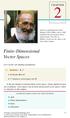 CHAPTER 2 American mathematician Paul Halmos (1916 2006), who in 1942 published the first modern linear algebra book. The title of Halmos s book was the same as the title of this chapter. Finite-Dimensional
MAT 200, Midterm Exam Solution. a. (5 points) Compute the determinant of the matrix A =
 MAT 200, Midterm Exam Solution. (0 points total) a. (5 points) Compute the determinant of the matrix 2 2 0 A = 0 3 0 3 0 Answer: det A = 3. The most efficient way is to develop the determinant along the
Chapter 3. Cartesian Products and Relations. 3.1 Cartesian Products
 Chapter 3 Cartesian Products and Relations The material in this chapter is the first real encounter with abstraction. Relations are very general thing they are a special type of subset. After introducing
Systems of Linear Equations
 Systems of Linear Equations Beifang Chen Systems of linear equations Linear systems A linear equation in variables x, x,, x n is an equation of the form a x + a x + + a n x n = b, where a, a,, a n and
Name: Section Registered In:
 Name: Section Registered In: Math 125 Exam 3 Version 1 April 24, 2006 60 total points possible 1. (5pts) Use Cramer s Rule to solve 3x + 4y = 30 x 2y = 8. Be sure to show enough detail that shows you are
v w is orthogonal to both v and w. the three vectors v, w and v w form a right-handed set of vectors.
 3. Cross product Definition 3.1. Let v and w be two vectors in R 3. The cross product of v and w, denoted v w, is the vector defined as follows: the length of v w is the area of the parallelogram with
PUTNAM TRAINING POLYNOMIALS. Exercises 1. Find a polynomial with integral coefficients whose zeros include 2 + 5.
 PUTNAM TRAINING POLYNOMIALS (Last updated: November 17, 2015) Remark. This is a list of exercises on polynomials. Miguel A. Lerma Exercises 1. Find a polynomial with integral coefficients whose zeros include
Lecture Notes 2: Matrices as Systems of Linear Equations
 2: Matrices as Systems of Linear Equations 33A Linear Algebra, Puck Rombach Last updated: April 13, 2016 Systems of Linear Equations Systems of linear equations can represent many things You have probably
University of Lille I PC first year list of exercises n 7. Review
 University of Lille I PC first year list of exercises n 7 Review Exercise Solve the following systems in 4 different ways (by substitution, by the Gauss method, by inverting the matrix of coefficients
MATH10040 Chapter 2: Prime and relatively prime numbers
 MATH10040 Chapter 2: Prime and relatively prime numbers Recall the basic definition: 1. Prime numbers Definition 1.1. Recall that a positive integer is said to be prime if it has precisely two positive
9 MATRICES AND TRANSFORMATIONS
 9 MATRICES AND TRANSFORMATIONS Chapter 9 Matrices and Transformations Objectives After studying this chapter you should be able to handle matrix (and vector) algebra with confidence, and understand the
3. Mathematical Induction
 3. MATHEMATICAL INDUCTION 83 3. Mathematical Induction 3.1. First Principle of Mathematical Induction. Let P (n) be a predicate with domain of discourse (over) the natural numbers N = {0, 1,,...}. If (1)
5.1 Radical Notation and Rational Exponents
 Section 5.1 Radical Notation and Rational Exponents 1 5.1 Radical Notation and Rational Exponents We now review how exponents can be used to describe not only powers (such as 5 2 and 2 3 ), but also roots
1.3 Algebraic Expressions
 1.3 Algebraic Expressions A polynomial is an expression of the form: a n x n + a n 1 x n 1 +... + a 2 x 2 + a 1 x + a 0 The numbers a 1, a 2,..., a n are called coefficients. Each of the separate parts,
PYTHAGOREAN TRIPLES KEITH CONRAD
 PYTHAGOREAN TRIPLES KEITH CONRAD 1. Introduction A Pythagorean triple is a triple of positive integers (a, b, c) where a + b = c. Examples include (3, 4, 5), (5, 1, 13), and (8, 15, 17). Below is an ancient
Elements of Abstract Group Theory
 Chapter 2 Elements of Abstract Group Theory Mathematics is a game played according to certain simple rules with meaningless marks on paper. David Hilbert The importance of symmetry in physics, and for
Arkansas Tech University MATH 4033: Elementary Modern Algebra Dr. Marcel B. Finan
 Arkansas Tech University MATH 4033: Elementary Modern Algebra Dr. Marcel B. Finan 3 Binary Operations We are used to addition and multiplication of real numbers. These operations combine two real numbers
COMMUTATIVE RINGS. Definition: A domain is a commutative ring R that satisfies the cancellation law for multiplication:
 COMMUTATIVE RINGS Definition: A commutative ring R is a set with two operations, addition and multiplication, such that: (i) R is an abelian group under addition; (ii) ab = ba for all a, b R (commutative
Linear Algebra: Determinants, Inverses, Rank
 D Linear Algebra: Determinants, Inverses, Rank D 1 Appendix D: LINEAR ALGEBRA: DETERMINANTS, INVERSES, RANK TABLE OF CONTENTS Page D.1. Introduction D 3 D.2. Determinants D 3 D.2.1. Some Properties of
Lecture L3 - Vectors, Matrices and Coordinate Transformations
 S. Widnall 16.07 Dynamics Fall 2009 Lecture notes based on J. Peraire Version 2.0 Lecture L3 - Vectors, Matrices and Coordinate Transformations By using vectors and defining appropriate operations between
MATH 10034 Fundamental Mathematics IV
 MATH 0034 Fundamental Mathematics IV http://www.math.kent.edu/ebooks/0034/funmath4.pdf Department of Mathematical Sciences Kent State University January 2, 2009 ii Contents To the Instructor v Polynomials.
Regular Languages and Finite Automata
 Regular Languages and Finite Automata 1 Introduction Hing Leung Department of Computer Science New Mexico State University Sep 16, 2010 In 1943, McCulloch and Pitts [4] published a pioneering work on a
Chapter 11 Number Theory
 Chapter 11 Number Theory Number theory is one of the oldest branches of mathematics. For many years people who studied number theory delighted in its pure nature because there were few practical applications
Notes on Linear Algebra. Peter J. Cameron
 Notes on Linear Algebra Peter J. Cameron ii Preface Linear algebra has two aspects. Abstractly, it is the study of vector spaces over fields, and their linear maps and bilinear forms. Concretely, it is
Polynomial and Rational Functions
 Polynomial and Rational Functions Quadratic Functions Overview of Objectives, students should be able to: 1. Recognize the characteristics of parabolas. 2. Find the intercepts a. x intercepts by solving
Math Review. for the Quantitative Reasoning Measure of the GRE revised General Test
 Math Review for the Quantitative Reasoning Measure of the GRE revised General Test www.ets.org Overview This Math Review will familiarize you with the mathematical skills and concepts that are important
Elementary Number Theory and Methods of Proof. CSE 215, Foundations of Computer Science Stony Brook University http://www.cs.stonybrook.
 Elementary Number Theory and Methods of Proof CSE 215, Foundations of Computer Science Stony Brook University http://www.cs.stonybrook.edu/~cse215 1 Number theory Properties: 2 Properties of integers (whole
9.2 Summation Notation
 9. Summation Notation 66 9. Summation Notation In the previous section, we introduced sequences and now we shall present notation and theorems concerning the sum of terms of a sequence. We begin with a
MATH 551 - APPLIED MATRIX THEORY
 MATH 55 - APPLIED MATRIX THEORY FINAL TEST: SAMPLE with SOLUTIONS (25 points NAME: PROBLEM (3 points A web of 5 pages is described by a directed graph whose matrix is given by A Do the following ( points
MATH 304 Linear Algebra Lecture 18: Rank and nullity of a matrix.
 MATH 304 Linear Algebra Lecture 18: Rank and nullity of a matrix. Nullspace Let A = (a ij ) be an m n matrix. Definition. The nullspace of the matrix A, denoted N(A), is the set of all n-dimensional column
LINEAR ALGEBRA. September 23, 2010
 LINEAR ALGEBRA September 3, 00 Contents 0. LU-decomposition.................................... 0. Inverses and Transposes................................. 0.3 Column Spaces and NullSpaces.............................
Algebra Unpacked Content For the new Common Core standards that will be effective in all North Carolina schools in the 2012-13 school year.
 This document is designed to help North Carolina educators teach the Common Core (Standard Course of Study). NCDPI staff are continually updating and improving these tools to better serve teachers. Algebra
Mathematical Induction. Mary Barnes Sue Gordon
 Mathematics Learning Centre Mathematical Induction Mary Barnes Sue Gordon c 1987 University of Sydney Contents 1 Mathematical Induction 1 1.1 Why do we need proof by induction?.... 1 1. What is proof by
MATH 4330/5330, Fourier Analysis Section 11, The Discrete Fourier Transform
 MATH 433/533, Fourier Analysis Section 11, The Discrete Fourier Transform Now, instead of considering functions defined on a continuous domain, like the interval [, 1) or the whole real line R, we wish
1 Homework 1. [p 0 q i+j +... + p i 1 q j+1 ] + [p i q j ] + [p i+1 q j 1 +... + p i+j q 0 ]
![1 Homework 1. [p 0 q i+j +... + p i 1 q j+1 ] + [p i q j ] + [p i+1 q j 1 +... + p i+j q 0 ]](/thumbs/40/21231772.jpg "1 Homework 1. [p 0 q i+j +... + p i 1 q j+1 ] + [p i q j ] + [p i+1 q j 1 +... + p i+j q 0 ]") 1 Homework 1 (1) Prove the ideal (3,x) is a maximal ideal in Z[x]. SOLUTION: Suppose we expand this ideal by including another generator polynomial, P / (3, x). Write P = n + x Q with n an integer not
1 Homework 1 (1) Prove the ideal (3,x) is a maximal ideal in Z[x]. SOLUTION: Suppose we expand this ideal by including another generator polynomial, P / (3, x). Write P = n + x Q with n an integer not
Question 2: How do you solve a matrix equation using the matrix inverse?
 Question : How do you solve a matrix equation using the matrix inverse? In the previous question, we wrote systems of equations as a matrix equation AX B. In this format, the matrix A contains the coefficients
Arithmetic and Algebra of Matrices
 Arithmetic and Algebra of Matrices Math 572: Algebra for Middle School Teachers The University of Montana 1 The Real Numbers 2 Classroom Connection: Systems of Linear Equations 3 Rational Numbers 4 Irrational