
Answer Key for California State Standards: Algebra I
|
|
|
- Grace Adams
- 9 years ago
- Views:
Transcription
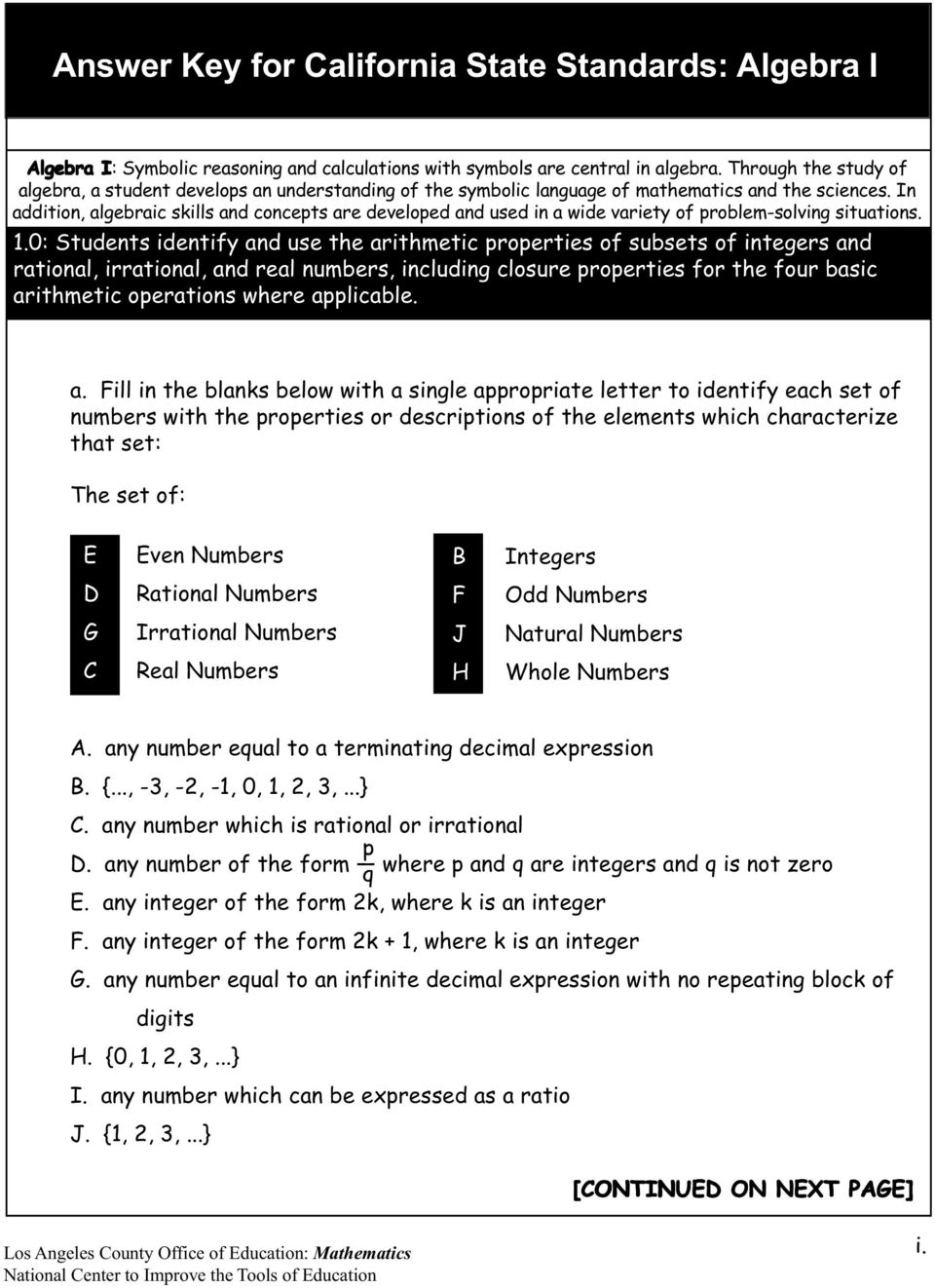
1 Algebra I: Symbolic reasoning and calculations with symbols are central in algebra. Through the study of algebra, a student develops an understanding of the symbolic language of mathematics and the sciences. In addition, algebraic skills and concepts are developed and used in a wide variety of problem-solving situations..0: Students identify and use the arithmetic properties of subsets of integers and rational, irrational, and real numbers, including closure properties for the four basic arithmetic operations where applicable. a. Fill in the blanks below with a single appropriate letter to identify each set of numbers with the properties or descriptions of the elements which characterize that set: The set of: E Even Numbers B Integers D Rational Numbers F Odd Numbers G Irrational Numbers J Natural Numbers C Real Numbers H Whole Numbers A. any number equal to a terminating decimal expression B. {..., -, -, -, 0,,,,...} C. any number which is rational or irrational p D. any number of the form q where p and q are integers and q is not zero E. any integer of the form k, where k is an integer F. any integer of the form k +, where k is an integer G. any number equal to an infinite decimal expression with no repeating block of digits H. {0,,,,...} I. any number which can be expressed as a ratio J. {,,,...} [CONTINUED ON NEXT PAGE] National Center to Improve the Tools of Education i.
2 .0: Students identify and use the arithmetic properties of subsets of integers and rational, irrational, and real numbers, including closure properties for the four basic arithmetic operations where applicable. b. [CONTINUED] Which of the following sets of numbers are not closed under addition? The set of real numbers The set of rational numbers X The set of irrational numbers The set of positive integers National Center for Improvement of the Tools of Education.

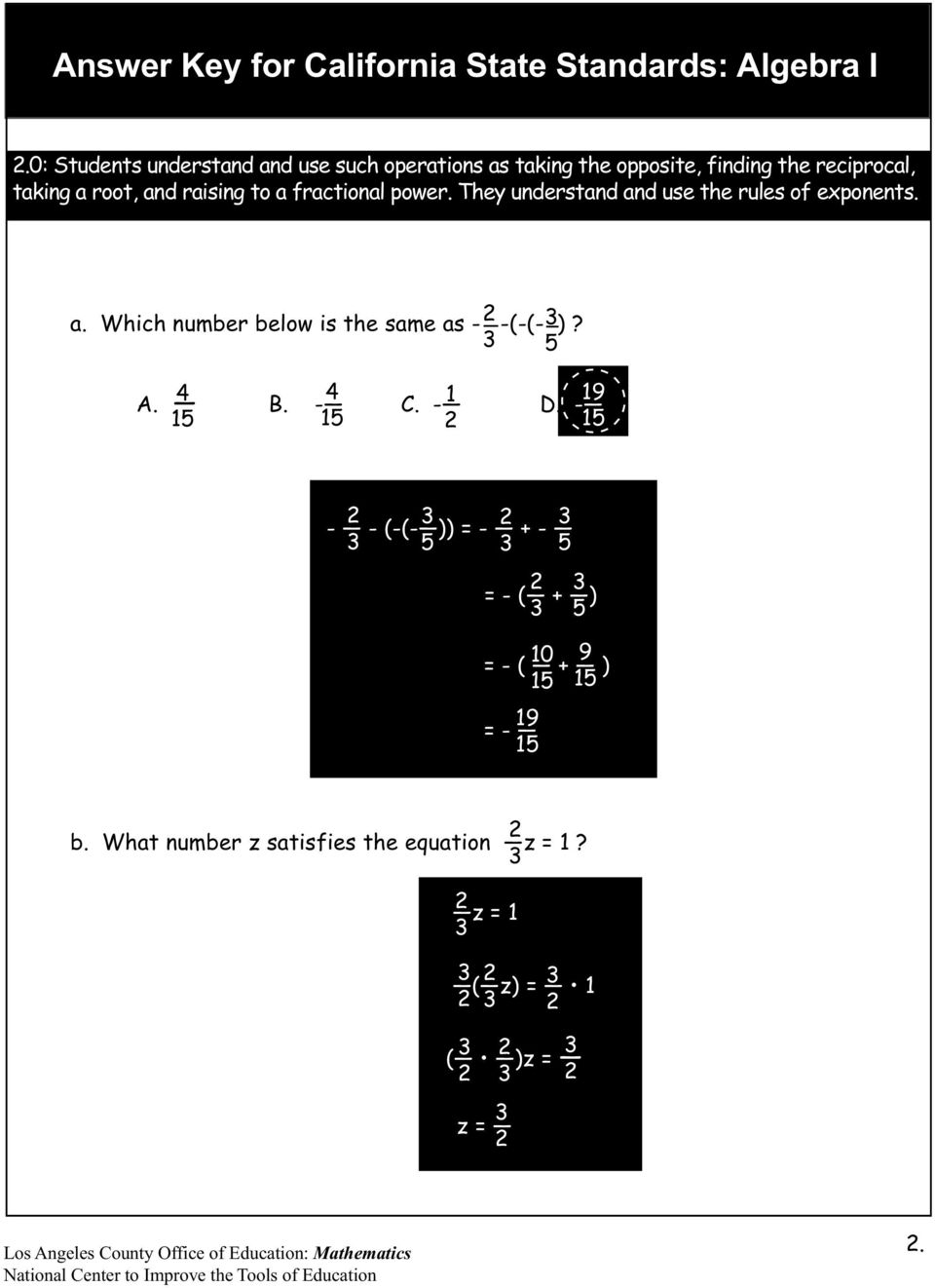
3 .0: Students understand and use such operations as taking the opposite, finding the reciprocal, taking a root, and raising to a fractional power. They understand and use the rules of exponents. a. Which number below is the same as - -(-(- )? 5 A. 4 4 B. - C. - 9 D (-(- )) = = - ( + ) 5 = - ( ) 5 5 = b. What number z satisfies the equation z =? z = ( z) = ( )z = z = National Center to Improve the Tools of Education.
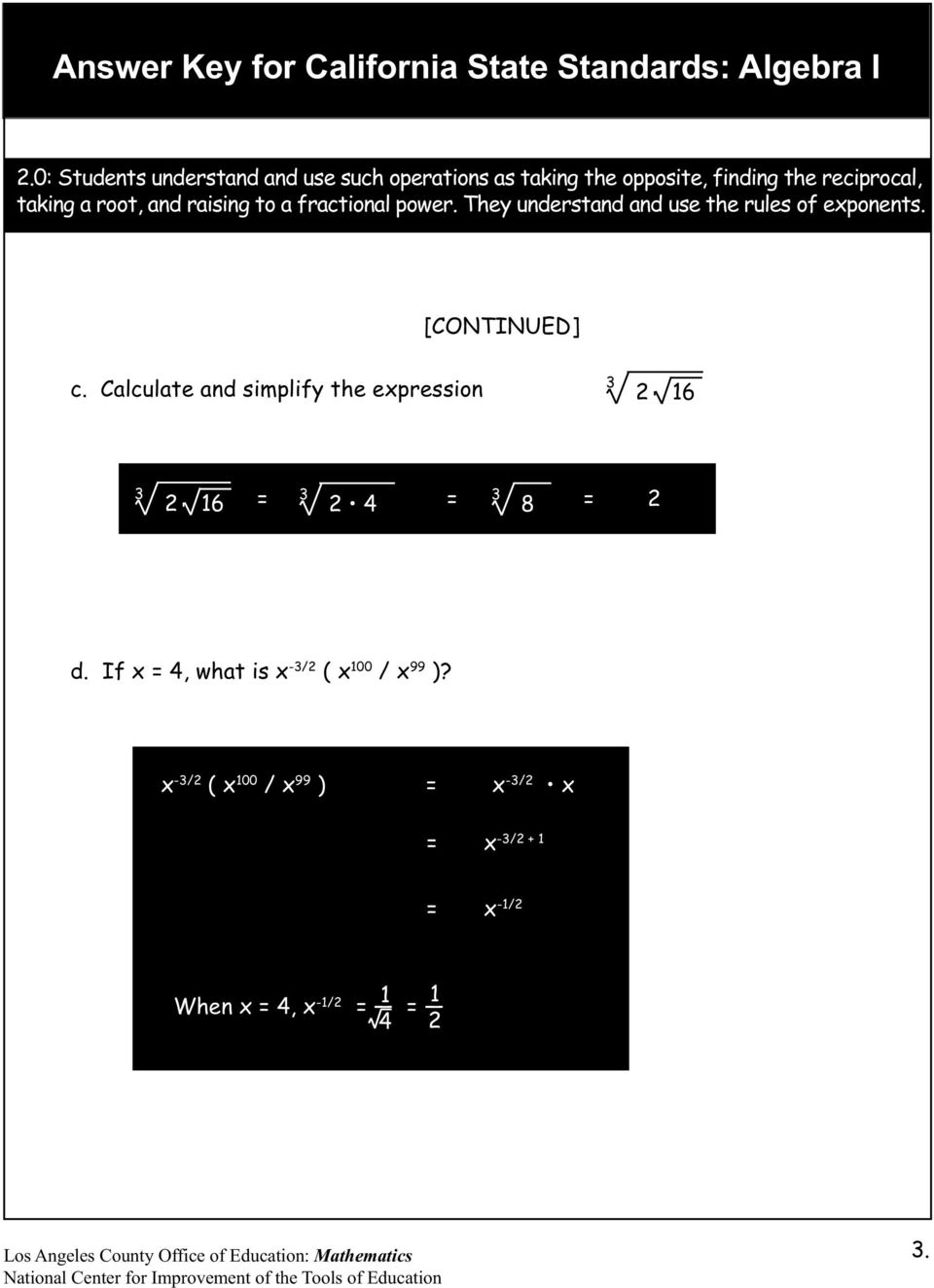
4 .0: Students understand and use such operations as taking the opposite, finding the reciprocal, taking a root, and raising to a fractional power. They understand and use the rules of exponents. [CONTINUED] c. Calculate and simplify the expression 6 6 = = 4 8 = d. If x = 4, what is x -/ ( x 00 / x 99 )? x -/ ( x 00 / x 99 ) = x -/ x = x -/ + = x -/ When x = 4, x -/ = = 4 National Center for Improvement of the Tools of Education.
5 .0: Students understand and use such operations as taking the opposite, finding the reciprocal, taking a root, and raising to a fractional power. They understand and use the rules of exponents. [CONTINUED] 4 e. Write ( x / ) 4/ x as x raised to a power x ( x / ) 4/ 4 x x x /4 = x / 4/ x = x x /4 - = x x -/4 = x -/4 = x 5/4 National Center to Improve the Tools of Education 4.
![They understand and use the rules of exponents. [CONTINUED] 4 e.](/docs-images/44/21522944/images/page_5.jpg "Write ( x / ) 4/ x as x raised to a power x ( x / ) 4/ 4 x x x /4 = x / 4/ x = x x /4 - = x x")
6 .0: Students solve equations and inequalities involving absolute values. a x - = 5 Find all values of x which make this equation true If x - = 5, then x - = 5 or x - = -5 Therefore x = or x = - b. - 5x + < 0 Find all values of x which make this inequality true - 5x + < 0-5x < 9-5x < - < - 5x < -5 < -5x < > x > - 5 Solution: All numbers greater than - and less than 5 5 c. 4 x - = 6 Find all values of x which make this equation true 4 x - = 6 x - = 4 x - = 4 or x - = -4 x = 5 or x = - National Center for Improvement of the Tools of Education 5.

7 .0: Students solve equations and inequalities involving absolute values. [CONTINUED] d. x- > 4 Find all values for x which make this inequality true Either x - > 4 or x - < - 4 Either x > 6 or x < - Solution: All numbers less than - or greater than 6 4.0: Students simplify expressions before solving linear equations and inequalities in one variable, such as (x-5) + 4 (x-) =. a. Simplify. ( x - 5 ) + 4 ( x - ) (x - 5) + 4(x - ) = 6x x - 8 = 6x + 4x = 0x -. ( 6 x + 4 ) - ( - 6x ) (6x + 4) - ( - 6x) = x x = x + x + - = 5x+ National Center to Improve the Tools of Education 6.

8 4.0: Students simplify expressions before solving linear equations and inequalities in one variable, such as (x-5) + 4 (x-) =. [CONTINUED] b. Solve for x. 8(x + ) + (x - ) = 44 8(x + ) + (x - ) = 44 8x x - 6 = 44 8x + 6x = 44 4x + = 44 4x = 4 4 x = 4 x =. ( x - 9 ) - ( x - 5 ) 7 ( x - 9 ) - ( x - 5 ) 7 4x - - x x x 0 x 5 National Center for Improvement of the Tools of Education 7.

9 5.0: Students solve multi-step problems, including word problems, involving linear equations and linear inequalities in one variable and provide justification for each step. a. Justify each step below for the solution for x from the equation ( x + ) + 4 ( x - 8 ) = Use the following list: A. Commutative Property of Addition B. Associative Property of Addition C. Commutative Property of Multiplication D. Associative Property of Multiplication E. Distributive Property F. adding the same quantity to both sides of an equation preserves equality G. multiplying both sides of an equation by the same number preserves equality H. 0 is the additive identity I. is the multiplicative identity To the right of each equation below (and on the following pages) where there is an empty space, write one of the letters A, B, C, D, E, F, G, H, or I to justify how that equation follows from the one above it. For example, the second equation below is justified by G and the third one by E. [CONTINUES ON NEXT PAGE] National Center to Improve the Tools of Education 8.

10 5.0: Students solve multi-step problems, including word problems, involving linear equations and linear inequalities in one variable and provide justification for each step. [CONTINUED] Step Justification ( x + ) + 4 ( x - 8 ) = The given equation [ ( x + ) + 4 ( x - 8 ) ] = ( ) G ( x + ) + 6 ( x - 8 ) = E ( x + ) + ( 6x - 48 ) = E [ ( x + ) + 6x ] - 48 = B [ x + ( + 6x ) ] - 48 = B [ x + ( 6x + ) ] - 48 = A [ ( x + 6x ) + ] - 48 = B [ ( + 6 ) x + ] - 48 = E ( 7x + ) - 48 = + 6 = 7 7x + ( - 48 ) = B National Center for Improvement of the Tools of Education 9.
![[CONTINUED] Step Justification ( x + ) + 4 ( x - 8 ) = The given equation [ ( x + ) + 4 ( x - 8 ) ] = ( ) G ( x + ) + 6 ( x - 8 ) = E ( x + )](/docs-images/44/21522944/images/page_10.jpg "+ ( 6x - 48 ) = E [ ( x + ) + 6x ] - 48 = B [ x + ( + 6x ) ] - 48 = B [ x + ( 6x + ) ] - 48 = A [ ( x + 6x ) + ] - 48 = B [ ( + 6 ) x + ] -")
11 5.0: Students solve multi-step problems, including word problems, involving linear equations and linear inequalities in one variable and provide justification for each step. [CONTINUED] Step Justification 7x - 45 = - 48 = -45 ( 7x - 45 ) + 45 = + 45 F 7x + ( ) = 48 B 7x + 0 = = 0 7x = 48 H 48 ( 7x ) = G 7 7 ( 7 ) x = 48 D 7 7 x = = 48 x = I 7 [CONTINUED ON NEXT PAGE] National Center to Improve the Tools of Education 0.
![[CONTINUED] Step Justification 7x - 45 = - 48 = -45 ( 7x - 45 ) + 45 = + 45 F 7x + ( -45 + 45 ) = 48 B 7x + 0 =](/docs-images/44/21522944/images/page_11.jpg "48-45 + 45 = 0 7x = 48 H 48 ( 7x ) = G 7 7 ( 7 ) x = 48 D 7 7 x = 48 7 7 7 = 48 x = I 7 [CONTINUED ON NEXT PAGE]")
12 5.0: Students solve multi-step problems, including word problems, involving linear equations and linear inequalities in one variable and provide justification for each step. b. The sum of three integers is 66. The second is more than the first, and the third is 4 more than twice the first. What are the integers? Let x be the first number. The the second number is x + and the third number is x + 4. x + (x + ) + (x + 4) = 66 4x + 6 = 66 4x = 60 x = 5 x + = 7 x + 4 = 4 The three numbers are 5, 7, and 4 c. During an illness, a patient s body temperature T satisfied the inequality T Find the lowest temperature the patient could have had during the illness. T T T T 00.6 The lowest temperature the patient could have had is 96.6 National Center for Improvement of the Tools of Education.

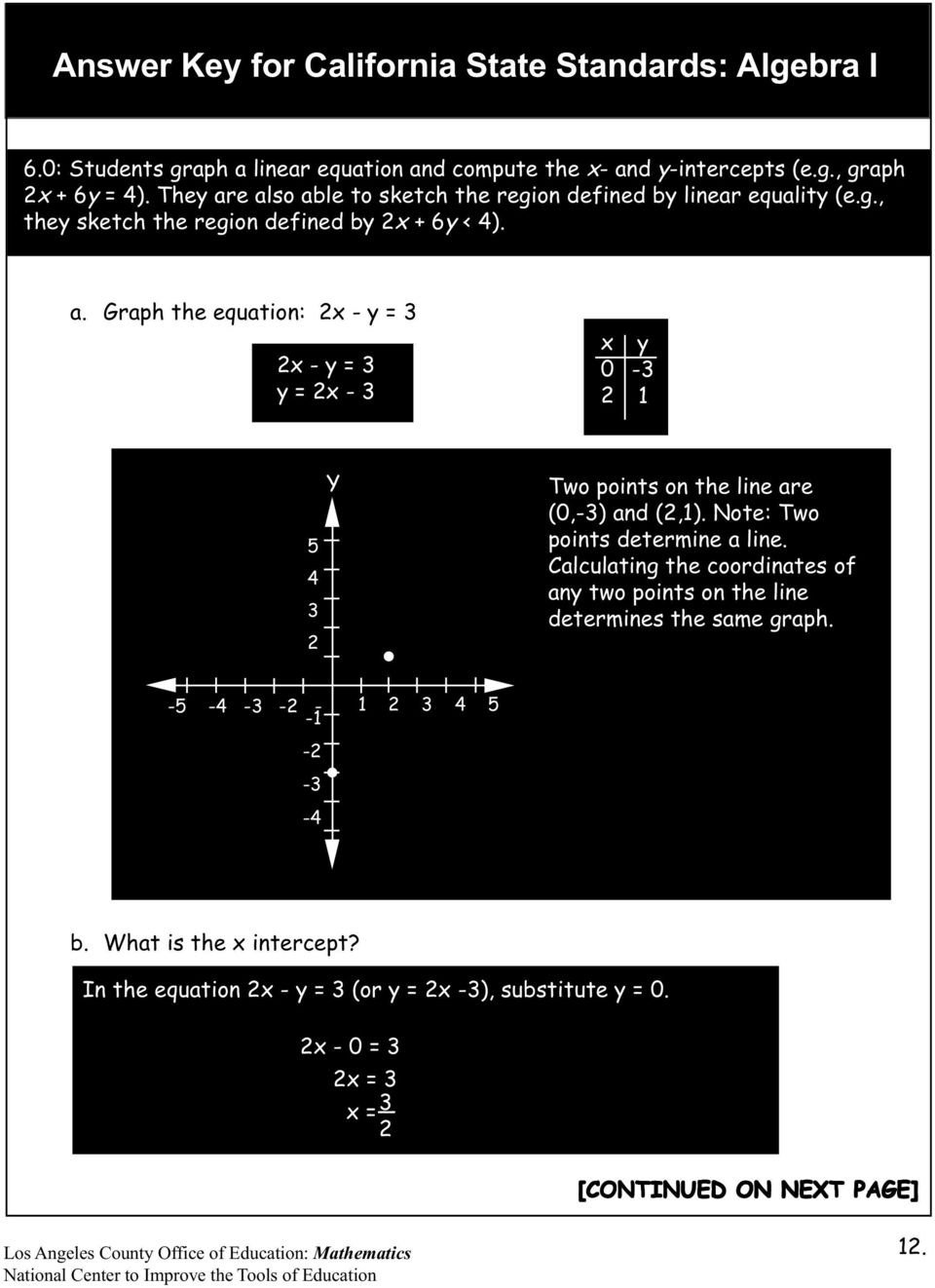
13 6.0: Students graph a linear equation and compute the x- and y-intercepts (e.g., graph x + 6y = 4). They are also able to sketch the region defined by linear equality (e.g., they sketch the region defined by x + 6y < 4). a. Graph the equation: x - y = x - y = y = x - x 0 y Y Two points on the line are (0,-) and (,). Note: Two points determine a line. Calculating the coordinates of any two points on the line determines the same graph b. What is the x intercept? In the equation x - y = (or y = x -), substitute y = 0. x - 0 = x = x = [CONTINUED ON NEXT PAGE] National Center to Improve the Tools of Education.
14 6.0: Students graph a linear equation and compute the x- and y-intercepts (e.g., graph x + 6y = 4). They are also able to sketch the region defined by linear equality (e.g., they sketch the region defined by x + 6y < 4). c. What is the y intercept? [CONTINUED] In the equation x - y =, substitute x = 0 to get y = -. Alternatively, since b is the y intercept for y = mx + b, it follows that - is the y intercept for y = x -. d. On your graph, mark the region showing x - < y Y X The shaded region shows x - < y National Center for Improvement of the Tools of Education.
![[CONTINUED] In the equation x - y =, substitute x = 0 to get y = -.](/docs-images/44/21522944/images/page_14.jpg "Alternatively, since b is the y intercept for y = mx + b, it follows that - is the y intercept for y = x -. d.")
15 7.0: Students verify that a point lies on a line, given an equation of the line. Students are able to derive linear equations by using the point-slope formula. a. Write an equation involving only numbers that shows that the point (, ) lies on the graph of the equation y = 6x - 5. = 6( ) - 5 or = 6( ) - 5 b. A line has a slope of and passes through the point (5, 8). What is the equation for the line? The equation of the line must be of the form y = mx + b. The slope m = is given. Therefore, y = x + b. To find the y intercept b, substitute the coordinates of the point (5,8) for x and y in the equation y = x + b. This gives: 8 = 5 + b 5 b = b = b = Therefore y = x + This result may also be obtained by using the point-slope formula for a nonvertical line: y - y o = m(x - x o ) and substituting m =, x o = 5, and y o = 8. National Center to Improve the Tools of Education 4.

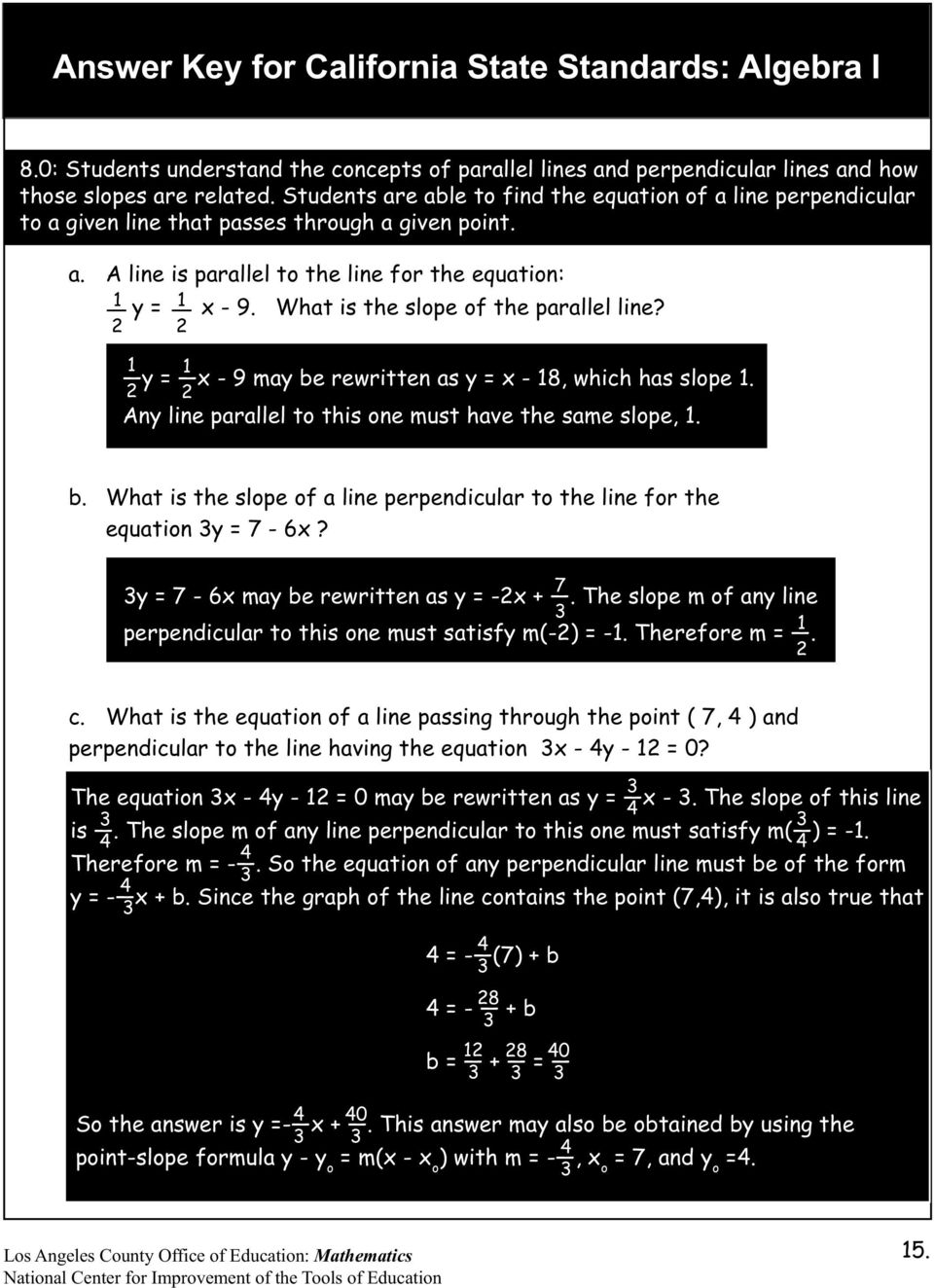
16 8.0: Students understand the concepts of parallel lines and perpendicular lines and how those slopes are related. Students are able to find the equation of a line perpendicular to a given line that passes through a given point. a. A line is parallel to the line for the equation: y = x - 9. What is the slope of the parallel line? y = x - 9 may be rewritten as y = x - 8, which has slope. Any line parallel to this one must have the same slope,. b. What is the slope of a line perpendicular to the line for the equation y = 7-6x? 7 y = 7-6x may be rewritten as y = -x +. The slope m of any line perpendicular to this one must satisfy m(-) = -. Therefore m =. c. What is the equation of a line passing through the point ( 7, 4 ) and perpendicular to the line having the equation x - 4y - = 0? The equation x - 4y - = 0 may be rewritten as y = x -. The slope of this line 4 is. The slope m of any line perpendicular to this one must satisfy m( ) = Therefore m = -. So the equation of any perpendicular line must be of the form 4 y = - x + b. Since the graph of the line contains the point (7,4), it is also true that 4 4 = - (7) + b 8 4 = - + b 8 40 b = + = 4 40 So the answer is y =- x +. This answer may also be obtained by using the 4 point-slope formula y - y o = m(x - x o ) with m = -, x o = 7, and y o =4. National Center for Improvement of the Tools of Education 5.
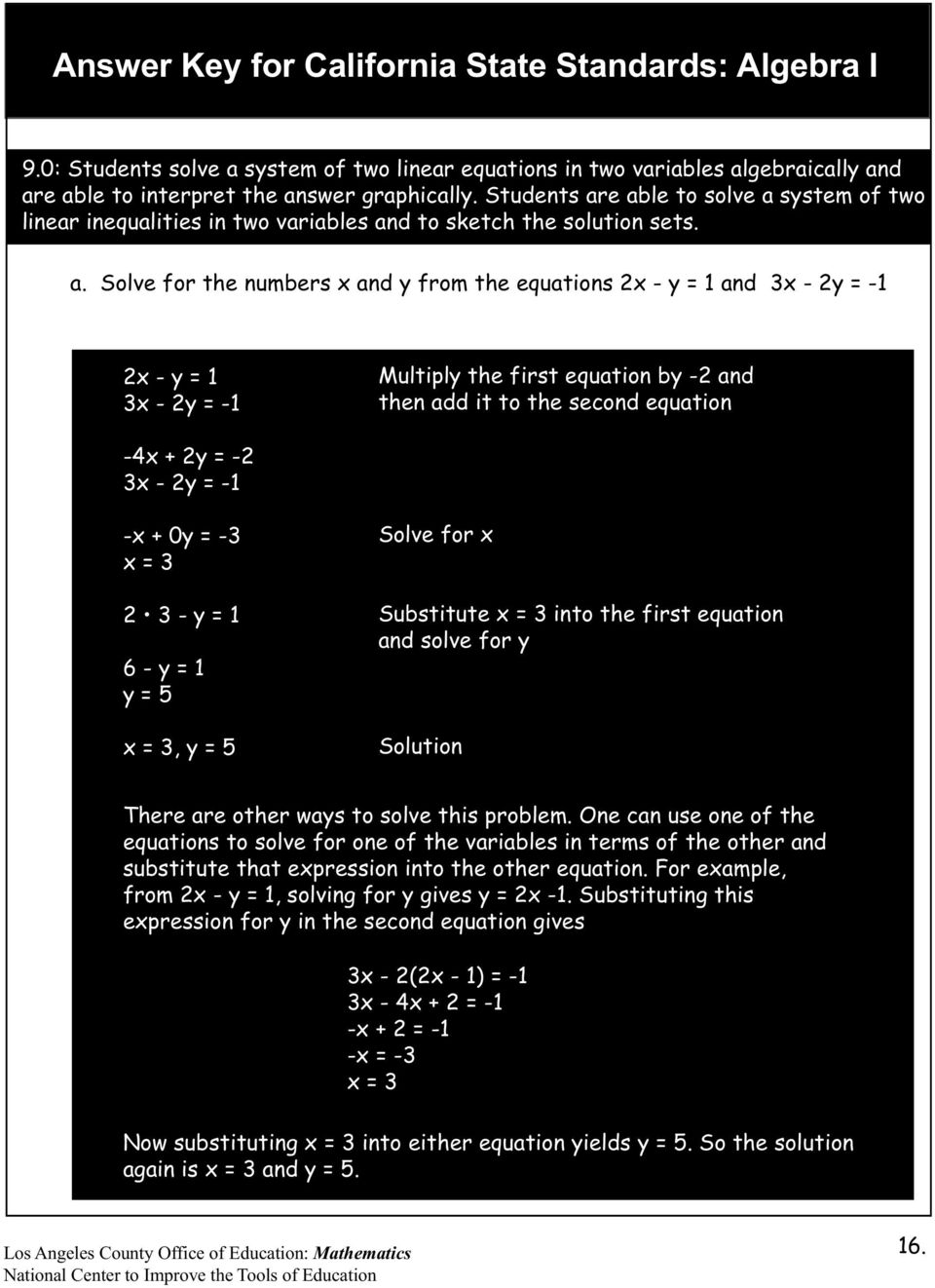
17 9.0: Students solve a system of two linear equations in two variables algebraically and are able to interpret the answer graphically. Students are able to solve a system of two linear inequalities in two variables and to sketch the solution sets. a. Solve for the numbers x and y from the equations x - y = and x - y = - x - y = x - y = - Multiply the first equation by - and then add it to the second equation -4x + y = - x - y = - -x + 0y = - x = - y = 6 - y = y = 5 x =, y = 5 Solve for x Substitute x = into the first equation and solve for y Solution There are other ways to solve this problem. One can use one of the equations to solve for one of the variables in terms of the other and substitute that expression into the other equation. For example, from x - y =, solving for y gives y = x -. Substituting this expression for y in the second equation gives x - (x - ) = - x - 4x + = - -x + = - -x = - x = Now substituting x = into either equation yields y = 5. So the solution again is x = and y = 5. National Center to Improve the Tools of Education 6.
18 9.0: Students solve a system of two linear equations in two variables algebraically and are able to interpret the answer graphically. Students are able to solve a system of two linear inequalities in two variables and to sketch the solution sets. [CONTINUED] b. Graph the equations x - y = and x - y = - and circle the portion of the graph which corresponds to the solution to the above problem on your graph. 5 4 (,5) c. Graph the solution to the linear inequalities x - y > and x - y < Solution is the shaded region National Center for Improvement of the Tools of Education 7.

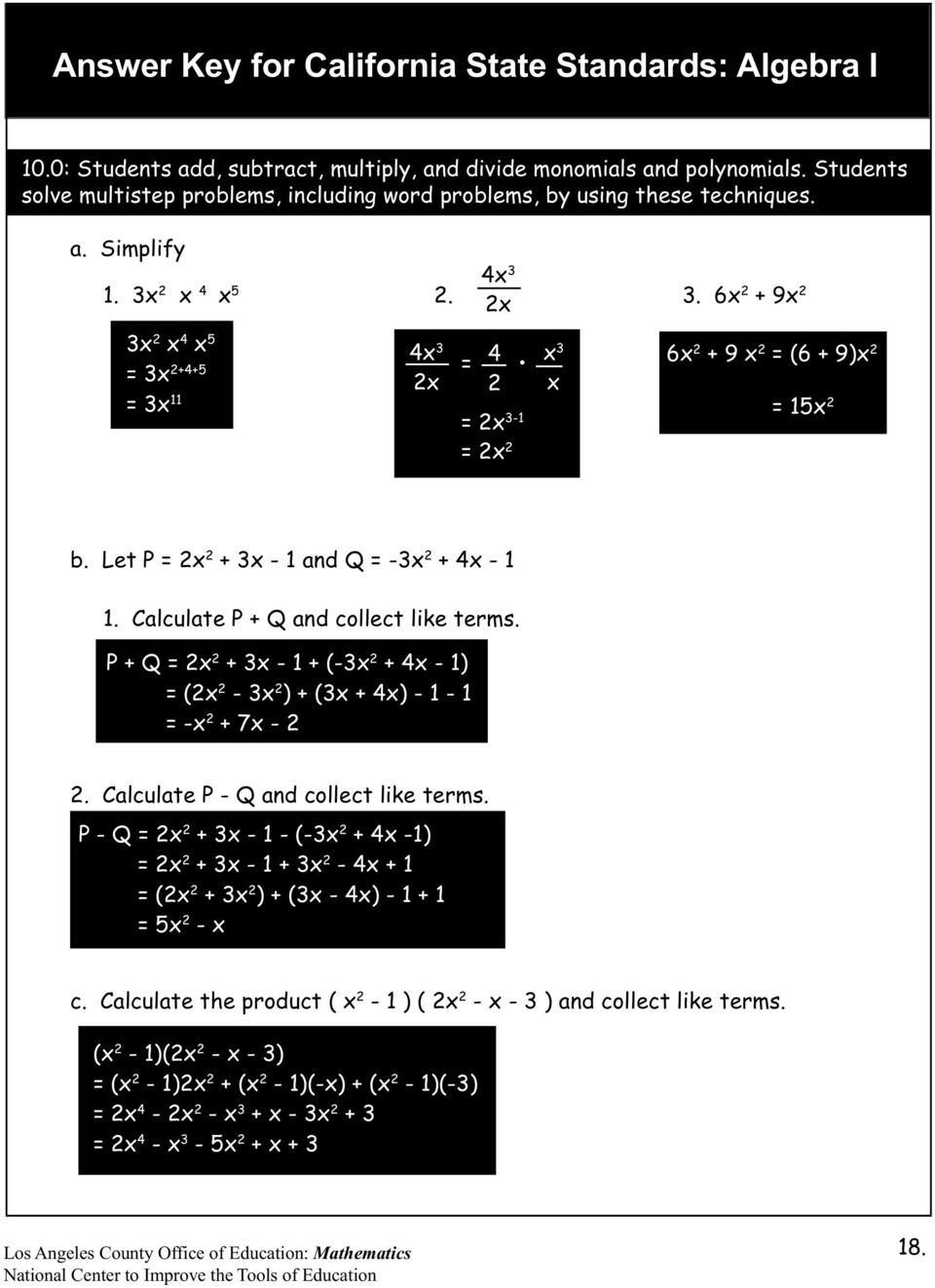
19 0.0: Students add, subtract, multiply, and divide monomials and polynomials. Students solve multistep problems, including word problems, by using these techniques. a. Simplify 4x. x x 4 x 5. x. 6x + 9x x x 4 x 5 = x +4+5 = x 4x x = 4 = x - = x x x 6x + 9 x = (6 + 9)x = 5x b. Let P = x + x - and Q = -x + 4x -. Calculate P + Q and collect like terms. P + Q = x + x - + (-x + 4x - ) = (x - x ) + (x + 4x) - - = -x + 7x -. Calculate P - Q and collect like terms. P - Q = x + x - - (-x + 4x -) = x + x - + x - 4x + = (x + x ) + (x - 4x) - + = 5x - x c. Calculate the product ( x - ) ( x - x - ) and collect like terms. (x - )(x - x - ) = (x - )x + (x - )(-x) + (x - )(-) = x 4 - x - x + x - x + = x 4 - x - 5x + x + National Center to Improve the Tools of Education 8.
20 0.0: Students add, subtract, multiply, and divide monomials and polynomials. Students solve multistep problems, including word problems, by using these techniques. [CONTINUED] d. The area of a rectangle is 6. The length of the rectangle is x + and the width is. What is x? x x 5 x + A = length times width 6 = x 5 x + x + x 6 = x 5 x 6 = x x = 4 National Center for Improvement of the Tools of Education 9.

21 .0: Students apply basic factoring techniques to second- and simple third-degree polynomials. These techniques include finding a common factor for all terms in a polynomial, recognizing the difference of two squares, and recognizing perfect squares of binomials. Factor the following expressions: a. x + 5x + 4 x + 5x + 4 = (x + 4)(x + ) b. x + 6x + 9x x + 6x + 9x = x(x + 6x +9) = x(x + ) c. (a + b) x + (a + b) y (a + b)x + (a + b)y = (a + b)(x + y) d. x + 7x + x + 7x + = (x + )(x + ) e. p - q p - q = (p - q)(p + q) f (calculate by performing only one multiplication) = (99-99)( ) = = 9,800 National Center to Improve the Tools of Education 0.
22 .0: Students simplify fractions with polynomials in the numerator and denominator by factoring both and reducing them to the lowest terms. Reduce to the lowest terms: x 5 - x x - x + x 5 - x x - x + = = x (x - ) (x - )(x - ) x (x + )(x - ) (x - )(x - ) = x (x + ) x - National Center for Improvement of the Tools of Education.
23 .0: Students add, subtract, multiply, and divide rational expressions and functions. Students solve both computationally and conceptually challenging problems by using these techniques. Express each of the following as a quotient of two polynomials reduced to lowest terms a. 4 x + x - x + 4 (x - ) 4(x + ) - = - = x - (x + )(x - ) (x + )(x - ) x - 6-4x - 4 (x + )(x - ) -(x + 0) -x - 0 x + 0 = or or etc. (x + )(x - ) x - x - x - x - b. x x - x + + x - x + 4x - x x - x - x x(x + ) (x - )(x - ) + + = + + x + 4x - (x - )(x + ) (x + )(x - ) x 4x - x + x x - x + = + + 4x - 4x - x 4x - = (x + x) + (x - x + ) + x = 4x - 4x + 4x - National Center to Improve the Tools of Education.
24 .0: Students add, subtract, multiply, and divide rational expressions and functions. Students solve both computationally and conceptually challenging problems by using these techniques. [CONTINUED] Express each of the following as a quotient of two polynomials reduced to lowest terms c. a - 4 4a X a + a a - a - 4 a + a 4a = (a - )(a + ) 4a = a - a(a + ) a - 4(a + ) a + d. t + t + t + t + t + 5t + 6 t + t + t + t + = t + t + t + 5t + 6 = t + 5t + 6 t + t + (t + ) t + (t + )(t + ) = t + (t + )(t + ) = t + 4t + provided t -, -, or - National Center for Improvement of the Tools of Education.
25 4.0: Students solve a quadratic equation by factoring or completing the square. a. Solve by factoring: x - x - 5 = 0 x - x - 5 = 0 (x + 5)(x - ) =0 Either x + 5 = 0 or x - = 0 5 Either x = - or x = b.. Complete the square of the polynomial x + 6x + 5 by finding numbers h and k such that x + 6x + 5 = (x + h) + k. h = k = -4 x + 6x + 5 = x 6 + 6x + ( ) 6 - ( ) + 5 = (x + 6x + 9) = (x + ) - 4. Solve for x if (x - ) - 5 = 0 (x - ) - 5 = 0 (x - ) = 5 (x - ) = x - = ± x = ± The two roots are + and National Center to Improve the Tools of Education 4.
26 5.0: Students apply algebraic techniques to solve rate problems, work problems, and percent mixture problems. a. What percent of $5 is $80? 80 5 n 4 = = n = 4 00 n = n n = 80 $80 is 80% of $5 b. The Smith family is traveling to a vacation destination in two cars. Mrs. Smith leaves home at noon with the children, traveling 40 miles per hour. Mr. Smith leaves hour later and travels at 55 miles per hour. At what time does Mr. Smith overtake Mrs. Smith? A car travelling for t hours at a rate of r miles per hour travels a distance of d miles where d = rt. Let d = distance traveled by Mrs Smith t hours past :00 p.m. Let d = distance traveled by Mr Smith t hours past :00 p.m. Then d = 40(t + ) and d = 55t To find the number of hours past :00 p.m. at which time they meet, set d = d d = d 40(t + ) = 55t 40t + 40 = 55t 5t = t = hours t = hours 5 t = hours and 40 minutes Mrs Smith and Mr Smith will meet at :40 p.m. National Center for Improvement of the Tools of Education 5.
27 5.0: Students apply algebraic techniques to solve rate problems, work problems, and percent mixture problems. [CONTINUED] c. A chemist has one solution of hydrochloric acid and water that is 5% acid and a second that is 75% acid. How many liters of each should be mixed together to get 50 liters of a solution that is 40% acid? Let x = the no. of liters needed of the 5% acid solution. Let y = the no. of liters needed of the 75% acid solution. The mixture must satisfy two equations: x + y = 50, and (.5)x + (.75)y = (.40)50. The second equation may be rewritten as x + y = (50) or x + y = 00. Multiplying both sides by 4 gives x + y = 400. Subtracting 4 4 the first equation from this last one gives: x + y = 400 x + y = 50 y = 50 So y = 75. Substituting y = 75 into either equation gives x = 75. The answer is that 75 liters of the 5% acid solution must be mixed with 75 liters of 75% acid solution to produce 50 liters of a 40% acid solution. d. Molly can deliver the papers on her route in hours. Tom can deliver the same route in hours. How long would it take them to deliver the papers if they worked together? If it takes Molly hours to complete the job, she does t jobs in t hours. If it takes Tom hours to complete the job, he can do t jobs in t hours. To find the number of hours it takes to complete the job with both of them working, solve the equation: t + t = ( + )t = 5 t = 6 6 t = or hour and minutes 5 National Center to Improve the Tools of Education 6.
28 6.0: Students understand the concepts of a relation and a function, determine whether a given relation defines a function, and give pertinent information about given relations and functions. 7.0: Students determine the domain of independent variables and the range of dependent variables defined by a graph, a set of ordered pairs, or a symbolic expression. 8.0: Students determine whether a relation defined by a graph, a set of ordered pairs, or a symbolic expression is a function and justify the conclusion. a. Which value of x would cause the relation below NOT to be a function? { (, ), ( x, 7 ), ( 6, 8 ) } A. B. C. 7 D. 8 A function is a relation satisfying the condition that for each element in the domain, there is one and only one element in the range. b. Which of the following graphs of relations is also the graph of a function? y A. B. y x x C. y D. y x x D. is the only graph satisfying the vertical line test National Center for Improvement of the Tools of Education 7.
29 6.0: Students understand the concepts of a relation and a function, determine whether a given relation defines a function, and give pertinent information about given relations and functions. 7.0: Students determine the domain of independent variables and the range of dependent variables defined by a graph, a set of ordered pairs, or a symbolic expression. 8.0: Students determine whether a relation defined by a graph, a set of ordered pairs, or a symbolic expression is a function and justify the conclusion. [CONTINUED] c. Determine the range and the domain of the relation { ( x, y ) : x + y = } Domain = [-, ] The graph of this relation is the unit circle. The x values range Range = [-, ] from - to and the y values - range from - to. - d. Find the natural domain of the function f(x) = x / + x The natural domain is the largest subset of the set of real numbers for which the formula is meaningful. In order to avoid dividing by zero or taking the square root of a negative number, we must require + x > 0 or x > -. The answer is {x : x > -} National Center to Improve the Tools of Education 8.
30 6.0: Students understand the concepts of a relation and a function, determine whether a given relation defines a function, and give pertinent information about given relations and functions. 7.0: Students determine the domain of independent variables and the range of dependent variables defined by a graph, a set of ordered pairs, or a symbolic expression. 8.0: Students determine whether a relation defined by a graph, a set of ordered pairs, or a symbolic expression is a function and justify the conclusion. e. Find the range of the function g(x) = 5x + The range of g(x) is the set of all values the function g(x) can take. The range of g(x) is the set of all numbers greater than or equal to, i.e. the range is {y : y }. This is because 5x 0 for any value of x and there is a value of x such that 5x is equal to any given non-negative number. f. Find the range of the relation { (, ), (, 4 ), (, 4 ), ( 5, 6 ), (7, 8 ) } The range of a relation is the set of all second coordinates, in this case, {, 4, 6, 8}. Notice that 4 is listed only once. National Center for Improvement of the Tools of Education 9.
31 9.0: Students know the quadratic formula and are familiar with its proof by completing the square. a. Given a quadratic equation of the form: ax + bx + c = 0, a 0 What is the formula for finding the solutions to the equation? x = -b ± b - 4ac a b. The equations below are part of a derivation of the quadratic formula by completing the square: ax + bx + c = 0 b c a ( x + x + ) = 0 a a x b c + x + = 0 a a b c x + a x = - a Which of the following is the best next step for the derivation of the quadratic formula? b c A. ax + bx = -c C. ( x + x ) = ( ) a a b b b B x + x + = c b c - D. x + x = - a 4a 4a a a a The derivation of the quadratic formula by completing the square is standard material in any good Algebra I textbook. National Center to Improve the Tools of Education 0.
32 0.0: Students use the quadratic formula to find the roots of a second-degree polynomial and to solve quadratic equations. Find all values of x which satisfy the equation 4x - 4x - = 0 4x - 4x - = 0 x = - -4 ± (-4) - 4 4(-).4 x = 4 ± x = 4 ± 8 x = 4 ± 4 8 x = ± The roots are + and - National Center for Improvement of the Tools of Education.
33 .0: Students graph quadratic functions and know that their roots are the x- intercepts. You may assume that the following equation is correct for all values of x: -x + x - = - (x - ) + a. For which values of x, if any, does the graph of the equation y = -x + x - cross the x axis? -(x - ) + = 0 x - = ± -(x -) = - x = ± = ± (x - ) = The graph of y = -x + x - crosses the x-axis at x = + and x = - b. Sketch the graph of the equation y = -x + x National Center to Improve the Tools of Education.
34 .0: Students use the quadratic formula or factoring techniques or both to determine whether the graph of quadratic function will intersect the x-axis in zero, one or two points. Use the quadratic formula or the method of factoring to determine whether the graphs of the following functions intersect the x axis in zero, one, or two points. (Do not graph the functions.) a. y = x + x + b. y = 4x + x + 5 c. y = 9x - x + 4 Each of these problems may be solved using the discriminant, D = b - 4ac, which appears under the radical sign in the quadratic formula. If D > 0, the graph has exactly two x-intercepts. If D = 0, the graph has exactly one x-intercept. If D < 0, the graph does not intersect the x-axis. a. D = b - 4ac = - 4 < 0 Therefore the graph of y = x + x + does not intersect the x-axis (equivalently x + x + = 0 has no real solutions). Answer: 0 b. D = b - 4ac = > 0. Therefore y = 4x + x + 5 has two x-intercepts. This may also be seen by factoring: 4x + x + 5 = (x + 5)(x + ) 5 So the intercepts are - and -. Answer: c. D = b - 4ac = (-) = - ( 4)( 4) = - = 0. Therefore y = 9x - x + 4 has exactly one x-intercept. This may also be seen by factoring: 9x - x + 4 = (x - ) Setting this expression equal to zero gives exactly one solution, x =. Answer: National Center for Improvement of the Tools of Education.
35 .0: Students apply quadratic equations to physical problems, such as the motion of an object under the force of gravity. a. If an object is thrown vertically with an initial velocity of v o from an initial height of h o feet, then neglecting air friction its height h(t) in feet above the ground t seconds after the ball was thrown is given by the formula h(t) = -6t + v o t + h o If a ball is thrown upward from the top of a 44 foot tower at 96 feet per second, how long will it take for the ball to reach the ground if there is no air friction and the path of the ball is unimpeded? Let h(t) be the height above the ground at time t measured in seconds. Then h(t) - 6t + 96t + 44 In order to find t such that h(t) is zero, set h(t) = 0 and solve for t. -6t + 96t + 44 = 0 t - 6t - 9 = 0 t = 6 ± 6-4(-9) t = 6 ± 6 t = 6 ± 6 = ± Since the object was thrown at t = 0 and time moves forward, the correct solution is t= + seconds. National Center to Improve the Tools of Education 4.
36 .0: Students apply quadratic equations to physical problems, such as the motion of an object under the force of gravity. [CONTINUED] b. The boiling point of water depends on air pressure and air pressure decreases with altitude. Suppose that the height H above the ground in meters can be deduced from the temperature T at which water boils in degress Celsius by the following formula: H = 000(00 - T) + 580(00 - T). If water on the top of a mountain boils at 99.5 degrees Celsius, how high is the mountain? H =,000( ) + 580( ) =,000( ) + 580( ) 4 H = = 645 meters. What is the approximate boiling point of water at sea-level (H=0 meters) according to this equation? Round your answers to the nearest 0 degrees. The temperature at which water boils at sea level according to the formula may be deduced by setting H = 0 and solving for T:,000(00 - T) + 580(00 - T) = 0 (00 - T) +.58(00 - T) = 0 (00 - T)( +.58(00 - T)) = 0 (00 - T)( T) = 0 (00 - T)( T) = So T = 00 or T = = + ~ The equation predicts the boiling point is approximately 00ºC National Center for Improvement of the Tools of Education 5.
37 4.0: Students use and know simple aspects of a logical argument: 4.: Students explain the difference between inductive and deductive reasoning and provide examples of each. 4.: Students identify the hypothesis and conclusion in a logical deducation. 4.: Students use counterexamples to show that an assertion is false and recognize that a single counterexample is sufficient to refute an assertion. a. Verify to your own satisfaction, by direct calculation, the correctness of the following equations (do not submit your calculations on this exam): = ( - ) + = ( - ) + + = ( - ) = ( 4 - ). Using inductive reasoning, propose a formula that gives the sum for n for any counting number n n = ( n - ). Does the sequence of formulas above prove that your answer to part is correct? Explain your answer. No, inductive reasoning is really a form of guessing based on previous observations. [Note to the reader: In this case the formula given in part is correct for any value of n. Inductive reasoning worked in this case, but it doesn t always give correct answers.] National Center to Improve the Tools of Education 6.
38 4.0: Students use and know simple aspects of a logical argument: 4.: Students explain the difference between inductive and deductive reasoning and provide examples of each. 4.: Students identify the hypothesis and conclusion in a logical deducation. 4.: Students use counterexamples to show that an assertion is false and recognize that a single counterexample is sufficient to refute an assertion. [CONTINUED] b. Consider the following mathematical statement: If y is a positive integer, then + 4y is not a perfect square.. Write the hypothesis of this statement. y is a positive integer. Write the conclusion of this statement. + 4y is not a perfect square. Use whole number arithmetic to prove that the conclusion is correct when y =. If y =, + 4y = 4. To show that 4 is not a perfect square, it suffices to show that 4 falls between the squares of two consecutive integers. = 089 < 4 < 56 = 4 Therefore the conclusion, + 4y is not a perfect square, is correct when y =. National Center for Improvement of the Tools of Education 7.
39 4.0: Students use and know simple aspects of a logical argument: 4.: Students explain the difference between inductive and deductive reasoning and provide examples of each. 4.: Students identify the hypothesis and conclusion in a logical deducation. 4.: Students use counterexamples to show that an assertion is false and recognize that a single counterexample is sufficient to refute an assertion. [CONTINUED] 4. It has been shown by mathematicians that the conclusion is correct for each positive integer y up to and including 0,69,85,,765,657,97,97,07. However, if this number is increased by so that y = 0,69,85,,765,657,97,97,08 then the positive square root of + 4y is,06,78,94,57,,96,7,5,5 Is the statement, If y is a positive integer, then + 4y is not a perfect square correct? Explain your answer. No, the statement is incorrect because the conclusion is false for at least one positive integer value of y. [Note that inductive reasoning for this problem would most likely lead to a faulty conclusion.] National Center to Improve the Tools of Education 8.
40 5.0: Students use properties of the number system to judge the validity of results, to justify each step of a procedure, and to prove or disprove statements: 5.: Students use properties of numbers to construct simple, valid arguments (direct and indirect) for, or formulate counterexamples to, claimed assertions. 5.: Students judge the validity of an argument according to whether the properties of the real number system and the order of operations have been applied correctly at each step. 5.: Given a specific algebraic statement involving linear, quadratic, or absolute value expressions or equations or inequalities, students determine whether the statement is true sometimes, always, or never. a. Prove, using basic properties of algebra, or disprove by finding a counterexample, each of the following statements:. The set of even numbers is closed under addition. A number m is even if and only if m = k for some integer k. Let m and n be even and let m = k and m = j for integers k and j. Then: m + n = k + j = (k + j) Therefore m + n has a factor of so it is even. This proves that the sum of any two even numbers is even and therefore the set of even numbers is closed under addition.. The sum of any two odd numbers is even. A number m is odd if and only if m = k + for some integer k. Let m and n be odd and let m = k + and n = j + for integers k and j. Then: m + n = (k + ) + (j + ) = k + j + = (k + j + ) Therefore m + n has a factor of so it is even. This proves that the sum of any two odd numbers is odd. National Center for Improvement of the Tools of Education 9.
41 4.0: Students use and know simple aspects of a logical argument: 4.: Students explain the difference between inductive and deductive reasoning and provide examples of each. 4.: Students identify the hypothesis and conclusion in a logical deducation. 4.: Students use counterexamples to show that an assertion is false and recognize that a single counterexample is sufficient to refute an assertion. [CONTINUED] a.. For any positive real number x, x < x This statement is false. x = gives a counterexample because: 4 = > 4 4 b. Find all possible pairs of numbers a and b which satisfy the equation a + b = (a + b). Explain your reasoning. Suppose a + b = (a + b) Then a + b = a + ab + b Therefore 0 = ab Therefore ab = 0 Therefore a = 0 or b = 0. If a = 0 or b = 0 then a + b = (a + b). We conclude that a + b = (a + b) if and only if a = 0 or b = 0 National Center to Improve the Tools of Education 40.
42 4.0: Students use and know simple aspects of a logical argument: 4.: Students explain the difference between inductive and deductive reasoning and provide examples of each. 4.: Students identify the hypothesis and conclusion in a logical deducation. 4.: Students use counterexamples to show that an assertion is false and recognize that a single counterexample is sufficient to refute an assertion. c. Identify the step below in which a fallacy occurs: Step : Let a = b = Step : a = ab Step : a - b = ab - b Step 4: (a - b)(a + b) = b(a - b) Step 5: a + b = b Step 6: = [CONTINUED] Answer: Step 5 Explain why the step you have chosen as the fallacy is incorrect. Step 5 results from dividing both sides of the previous equation by zero because a - b = 0. d. Is the following equation true for some values of x, no values of x or all values of x? 6 ( x - ) - = 6x - 8x 4 The equation is true for all values of x because for any value of x: 6(x - ) - = 6(x - x + ) = 6x - 8x + - = 6x - 8x National Center for Improvement of the Tools of Education 4.
LAKE ELSINORE UNIFIED SCHOOL DISTRICT
 LAKE ELSINORE UNIFIED SCHOOL DISTRICT Title: PLATO Algebra 1-Semester 2 Grade Level: 10-12 Department: Mathematics Credit: 5 Prerequisite: Letter grade of F and/or N/C in Algebra 1, Semester 2 Course Description:
Prentice Hall. California Edition of Algebra 1 - Classics Edition (Smith/Charles) 2008. Grade 8
 Prentice Hall Grade 8 California Edition of Algebra 1 - Classics Edition (Smith/Charles) 2008 C O R R E L A T E D T O California s Map for a Basic Grade Level Program Grade 8 PROGRAM DESCRIPTION Prentice
Vocabulary Words and Definitions for Algebra
 Name: Period: Vocabulary Words and s for Algebra Absolute Value Additive Inverse Algebraic Expression Ascending Order Associative Property Axis of Symmetry Base Binomial Coefficient Combine Like Terms
McDougal Littell California:
 McDougal Littell California: Pre-Algebra Algebra 1 correlated to the California Math Content s Grades 7 8 McDougal Littell California Pre-Algebra Components: Pupil Edition (PE), Teacher s Edition (TE),
Indiana State Core Curriculum Standards updated 2009 Algebra I
 Indiana State Core Curriculum Standards updated 2009 Algebra I Strand Description Boardworks High School Algebra presentations Operations With Real Numbers Linear Equations and A1.1 Students simplify and
Algebra I Vocabulary Cards
 Algebra I Vocabulary Cards Table of Contents Expressions and Operations Natural Numbers Whole Numbers Integers Rational Numbers Irrational Numbers Real Numbers Absolute Value Order of Operations Expression
Algebra I. In this technological age, mathematics is more important than ever. When students
 In this technological age, mathematics is more important than ever. When students leave school, they are more and more likely to use mathematics in their work and everyday lives operating computer equipment,
Math 0980 Chapter Objectives. Chapter 1: Introduction to Algebra: The Integers.
 Math 0980 Chapter Objectives Chapter 1: Introduction to Algebra: The Integers. 1. Identify the place value of a digit. 2. Write a number in words or digits. 3. Write positive and negative numbers used
Solving Quadratic Equations
 9.3 Solving Quadratic Equations by Using the Quadratic Formula 9.3 OBJECTIVES 1. Solve a quadratic equation by using the quadratic formula 2. Determine the nature of the solutions of a quadratic equation
What are the place values to the left of the decimal point and their associated powers of ten?
 The verbal answers to all of the following questions should be memorized before completion of algebra. Answers that are not memorized will hinder your ability to succeed in geometry and algebra. (Everything
Florida Algebra 1 End-of-Course Assessment Item Bank, Polk County School District
 Benchmark: MA.912.A.2.3; Describe the concept of a function, use function notation, determine whether a given relation is a function, and link equations to functions. Also assesses MA.912.A.2.13; Solve
MATH 60 NOTEBOOK CERTIFICATIONS
 MATH 60 NOTEBOOK CERTIFICATIONS Chapter #1: Integers and Real Numbers 1.1a 1.1b 1.2 1.3 1.4 1.8 Chapter #2: Algebraic Expressions, Linear Equations, and Applications 2.1a 2.1b 2.1c 2.2 2.3a 2.3b 2.4 2.5
The program also provides supplemental modules on topics in geometry and probability and statistics.
 Algebra 1 Course Overview Students develop algebraic fluency by learning the skills needed to solve equations and perform important manipulations with numbers, variables, equations, and inequalities. Students
Higher Education Math Placement
 Higher Education Math Placement Placement Assessment Problem Types 1. Whole Numbers, Fractions, and Decimals 1.1 Operations with Whole Numbers Addition with carry Subtraction with borrowing Multiplication
MATH 095, College Prep Mathematics: Unit Coverage Pre-algebra topics (arithmetic skills) offered through BSE (Basic Skills Education)
 MATH 095, College Prep Mathematics: Unit Coverage Pre-algebra topics (arithmetic skills) offered through BSE (Basic Skills Education) Accurately add, subtract, multiply, and divide whole numbers, integers,
Successful completion of Math 7 or Algebra Readiness along with teacher recommendation.
 MODESTO CITY SCHOOLS COURSE OUTLINE COURSE TITLE:... Basic Algebra COURSE NUMBER:... RECOMMENDED GRADE LEVEL:... 8-11 ABILITY LEVEL:... Basic DURATION:... 1 year CREDIT:... 5.0 per semester MEETS GRADUATION
1.3 Algebraic Expressions
 1.3 Algebraic Expressions A polynomial is an expression of the form: a n x n + a n 1 x n 1 +... + a 2 x 2 + a 1 x + a 0 The numbers a 1, a 2,..., a n are called coefficients. Each of the separate parts,
Florida Math 0028. Correlation of the ALEKS course Florida Math 0028 to the Florida Mathematics Competencies - Upper
 Florida Math 0028 Correlation of the ALEKS course Florida Math 0028 to the Florida Mathematics Competencies - Upper Exponents & Polynomials MDECU1: Applies the order of operations to evaluate algebraic
ALGEBRA 2: 4.1 Graph Quadratic Functions in Standard Form
 ALGEBRA 2: 4.1 Graph Quadratic Functions in Standard Form Goal Graph quadratic functions. VOCABULARY Quadratic function A function that can be written in the standard form y = ax 2 + bx+ c where a 0 Parabola
Review of Intermediate Algebra Content
 Review of Intermediate Algebra Content Table of Contents Page Factoring GCF and Trinomials of the Form + b + c... Factoring Trinomials of the Form a + b + c... Factoring Perfect Square Trinomials... 6
IV. ALGEBRAIC CONCEPTS
 IV. ALGEBRAIC CONCEPTS Algebra is the language of mathematics. Much of the observable world can be characterized as having patterned regularity where a change in one quantity results in changes in other
MTH124: Honors Algebra I
 MTH124: Honors Algebra I This course prepares students for more advanced courses while they develop algebraic fluency, learn the skills needed to solve equations, and perform manipulations with numbers,
1.1 Practice Worksheet
 Math 1 MPS Instructor: Cheryl Jaeger Balm 1 1.1 Practice Worksheet 1. Write each English phrase as a mathematical expression. (a) Three less than twice a number (b) Four more than half of a number (c)
MATH 10034 Fundamental Mathematics IV
 MATH 0034 Fundamental Mathematics IV http://www.math.kent.edu/ebooks/0034/funmath4.pdf Department of Mathematical Sciences Kent State University January 2, 2009 ii Contents To the Instructor v Polynomials.
Copy in your notebook: Add an example of each term with the symbols used in algebra 2 if there are any.
 Algebra 2 - Chapter Prerequisites Vocabulary Copy in your notebook: Add an example of each term with the symbols used in algebra 2 if there are any. P1 p. 1 1. counting(natural) numbers - {1,2,3,4,...}
Algebra Cheat Sheets
 Sheets Algebra Cheat Sheets provide you with a tool for teaching your students note-taking, problem-solving, and organizational skills in the context of algebra lessons. These sheets teach the concepts
Math Review. for the Quantitative Reasoning Measure of the GRE revised General Test
 Math Review for the Quantitative Reasoning Measure of the GRE revised General Test www.ets.org Overview This Math Review will familiarize you with the mathematical skills and concepts that are important
Algebra 1 Course Information
 Course Information Course Description: Students will study patterns, relations, and functions, and focus on the use of mathematical models to understand and analyze quantitative relationships. Through
Florida Math for College Readiness
 Core Florida Math for College Readiness Florida Math for College Readiness provides a fourth-year math curriculum focused on developing the mastery of skills identified as critical to postsecondary readiness
HIBBING COMMUNITY COLLEGE COURSE OUTLINE
 HIBBING COMMUNITY COLLEGE COURSE OUTLINE COURSE NUMBER & TITLE: - Beginning Algebra CREDITS: 4 (Lec 4 / Lab 0) PREREQUISITES: MATH 0920: Fundamental Mathematics with a grade of C or better, Placement Exam,
MA107 Precalculus Algebra Exam 2 Review Solutions
 MA107 Precalculus Algebra Exam 2 Review Solutions February 24, 2008 1. The following demand equation models the number of units sold, x, of a product as a function of price, p. x = 4p + 200 a. Please write
Algebra II End of Course Exam Answer Key Segment I. Scientific Calculator Only
 Algebra II End of Course Exam Answer Key Segment I Scientific Calculator Only Question 1 Reporting Category: Algebraic Concepts & Procedures Common Core Standard: A-APR.3: Identify zeros of polynomials
Students will be able to simplify and evaluate numerical and variable expressions using appropriate properties and order of operations.
 Outcome 1: (Introduction to Algebra) Skills/Content 1. Simplify numerical expressions: a). Use order of operations b). Use exponents Students will be able to simplify and evaluate numerical and variable
Mathematics Online Instructional Materials Correlation to the 2009 Algebra I Standards of Learning and Curriculum Framework
 Provider York County School Division Course Syllabus URL http://yorkcountyschools.org/virtuallearning/coursecatalog.aspx Course Title Algebra I AB Last Updated 2010 - A.1 The student will represent verbal
Mathematics Placement
 Mathematics Placement The ACT COMPASS math test is a self-adaptive test, which potentially tests students within four different levels of math including pre-algebra, algebra, college algebra, and trigonometry.
Algebra 1 End-of-Course Exam Practice Test with Solutions
 Algebra 1 End-of-Course Exam Practice Test with Solutions For Multiple Choice Items, circle the correct response. For Fill-in Response Items, write your answer in the box provided, placing one digit in
Section 1.1 Linear Equations: Slope and Equations of Lines
 Section. Linear Equations: Slope and Equations of Lines Slope The measure of the steepness of a line is called the slope of the line. It is the amount of change in y, the rise, divided by the amount of
Algebra 1 Course Title
 Algebra 1 Course Title Course- wide 1. What patterns and methods are being used? Course- wide 1. Students will be adept at solving and graphing linear and quadratic equations 2. Students will be adept
MTH 100 College Algebra Essex County College Division of Mathematics Sample Review Questions 1 Created June 6, 2011
 MTH 00 College Algebra Essex County College Division of Mathematics Sample Review Questions Created June 6, 0 Math 00, Introductory College Mathematics, covers the mathematical content listed below. In
MATH 0110 Developmental Math Skills Review, 1 Credit, 3 hours lab
 MATH 0110 Developmental Math Skills Review, 1 Credit, 3 hours lab MATH 0110 is established to accommodate students desiring non-course based remediation in developmental mathematics. This structure will
ALGEBRA I (Created 2014) Amherst County Public Schools
 ALGEBRA I (Created 2014) Amherst County Public Schools The 2009 Mathematics Standards of Learning Curriculum Framework is a companion document to the 2009 Mathematics Standards of Learning and amplifies
EQUATIONS and INEQUALITIES
 EQUATIONS and INEQUALITIES Linear Equations and Slope 1. Slope a. Calculate the slope of a line given two points b. Calculate the slope of a line parallel to a given line. c. Calculate the slope of a line
Algebra Unpacked Content For the new Common Core standards that will be effective in all North Carolina schools in the 2012-13 school year.
 This document is designed to help North Carolina educators teach the Common Core (Standard Course of Study). NCDPI staff are continually updating and improving these tools to better serve teachers. Algebra
Algebra 1. Curriculum Map
 Algebra 1 Curriculum Map Table of Contents Unit 1: Expressions and Unit 2: Linear Unit 3: Representing Linear Unit 4: Linear Inequalities Unit 5: Systems of Linear Unit 6: Polynomials Unit 7: Factoring
CORRELATED TO THE SOUTH CAROLINA COLLEGE AND CAREER-READY FOUNDATIONS IN ALGEBRA
 We Can Early Learning Curriculum PreK Grades 8 12 INSIDE ALGEBRA, GRADES 8 12 CORRELATED TO THE SOUTH CAROLINA COLLEGE AND CAREER-READY FOUNDATIONS IN ALGEBRA April 2016 www.voyagersopris.com Mathematical
Definition 8.1 Two inequalities are equivalent if they have the same solution set. Add or Subtract the same value on both sides of the inequality.
 8 Inequalities Concepts: Equivalent Inequalities Linear and Nonlinear Inequalities Absolute Value Inequalities (Sections 4.6 and 1.1) 8.1 Equivalent Inequalities Definition 8.1 Two inequalities are equivalent
DRAFT. Algebra 1 EOC Item Specifications
 DRAFT Algebra 1 EOC Item Specifications The draft Florida Standards Assessment (FSA) Test Item Specifications (Specifications) are based upon the Florida Standards and the Florida Course Descriptions as
MTH 092 College Algebra Essex County College Division of Mathematics Sample Review Questions 1 Created January 17, 2006
 MTH 092 College Algebra Essex County College Division of Mathematics Sample Review Questions Created January 7, 2006 Math 092, Elementary Algebra, covers the mathematical content listed below. In order
Algebra and Geometry Review (61 topics, no due date)
 Course Name: Math 112 Credit Exam LA Tech University Course Code: ALEKS Course: Trigonometry Instructor: Course Dates: Course Content: 159 topics Algebra and Geometry Review (61 topics, no due date) Properties
Lesson 9.1 Solving Quadratic Equations
 Lesson 9.1 Solving Quadratic Equations 1. Sketch the graph of a quadratic equation with a. One -intercept and all nonnegative y-values. b. The verte in the third quadrant and no -intercepts. c. The verte
Algebra 1 2008. Academic Content Standards Grade Eight and Grade Nine Ohio. Grade Eight. Number, Number Sense and Operations Standard
 Academic Content Standards Grade Eight and Grade Nine Ohio Algebra 1 2008 Grade Eight STANDARDS Number, Number Sense and Operations Standard Number and Number Systems 1. Use scientific notation to express
1.3 LINEAR EQUATIONS IN TWO VARIABLES. Copyright Cengage Learning. All rights reserved.
 1.3 LINEAR EQUATIONS IN TWO VARIABLES Copyright Cengage Learning. All rights reserved. What You Should Learn Use slope to graph linear equations in two variables. Find the slope of a line given two points
SUNY ECC. ACCUPLACER Preparation Workshop. Algebra Skills
 SUNY ECC ACCUPLACER Preparation Workshop Algebra Skills Gail A. Butler Ph.D. Evaluating Algebraic Epressions Substitute the value (#) in place of the letter (variable). Follow order of operations!!! E)
Algebra 2 Chapter 1 Vocabulary. identity - A statement that equates two equivalent expressions.
 Chapter 1 Vocabulary identity - A statement that equates two equivalent expressions. verbal model- A word equation that represents a real-life problem. algebraic expression - An expression with variables.
South Carolina College- and Career-Ready (SCCCR) Algebra 1
 South Carolina College- and Career-Ready (SCCCR) Algebra 1 South Carolina College- and Career-Ready Mathematical Process Standards The South Carolina College- and Career-Ready (SCCCR) Mathematical Process
A Second Course in Mathematics Concepts for Elementary Teachers: Theory, Problems, and Solutions
 A Second Course in Mathematics Concepts for Elementary Teachers: Theory, Problems, and Solutions Marcel B. Finan Arkansas Tech University c All Rights Reserved First Draft February 8, 2006 1 Contents 25
FACTORING QUADRATICS 8.1.1 and 8.1.2
 FACTORING QUADRATICS 8.1.1 and 8.1.2 Chapter 8 introduces students to quadratic equations. These equations can be written in the form of y = ax 2 + bx + c and, when graphed, produce a curve called a parabola.
Algebra 2 Year-at-a-Glance Leander ISD 2007-08. 1st Six Weeks 2nd Six Weeks 3rd Six Weeks 4th Six Weeks 5th Six Weeks 6th Six Weeks
 Algebra 2 Year-at-a-Glance Leander ISD 2007-08 1st Six Weeks 2nd Six Weeks 3rd Six Weeks 4th Six Weeks 5th Six Weeks 6th Six Weeks Essential Unit of Study 6 weeks 3 weeks 3 weeks 6 weeks 3 weeks 3 weeks
MATH 21. College Algebra 1 Lecture Notes
 MATH 21 College Algebra 1 Lecture Notes MATH 21 3.6 Factoring Review College Algebra 1 Factoring and Foiling 1. (a + b) 2 = a 2 + 2ab + b 2. 2. (a b) 2 = a 2 2ab + b 2. 3. (a + b)(a b) = a 2 b 2. 4. (a
Factoring Polynomials
 UNIT 11 Factoring Polynomials You can use polynomials to describe framing for art. 396 Unit 11 factoring polynomials A polynomial is an expression that has variables that represent numbers. A number can
7.2 Quadratic Equations
 476 CHAPTER 7 Graphs, Equations, and Inequalities 7. Quadratic Equations Now Work the Are You Prepared? problems on page 48. OBJECTIVES 1 Solve Quadratic Equations by Factoring (p. 476) Solve Quadratic
This unit will lay the groundwork for later units where the students will extend this knowledge to quadratic and exponential functions.
 Algebra I Overview View unit yearlong overview here Many of the concepts presented in Algebra I are progressions of concepts that were introduced in grades 6 through 8. The content presented in this course
SECTION 1-6 Quadratic Equations and Applications
 58 Equations and Inequalities Supply the reasons in the proofs for the theorems stated in Problems 65 and 66. 65. Theorem: The complex numbers are commutative under addition. Proof: Let a bi and c di be
Week 1: Functions and Equations
 Week 1: Functions and Equations Goals: Review functions Introduce modeling using linear and quadratic functions Solving equations and systems Suggested Textbook Readings: Chapter 2: 2.1-2.2, and Chapter
6 EXTENDING ALGEBRA. 6.0 Introduction. 6.1 The cubic equation. Objectives
 6 EXTENDING ALGEBRA Chapter 6 Extending Algebra Objectives After studying this chapter you should understand techniques whereby equations of cubic degree and higher can be solved; be able to factorise
Solve addition and subtraction word problems, and add and subtract within 10, e.g., by using objects or drawings to represent the problem.
 Solve addition and subtraction word problems, and add and subtract within 10, e.g., by using objects or drawings to represent the problem. Solve word problems that call for addition of three whole numbers
Understanding Basic Calculus
 Understanding Basic Calculus S.K. Chung Dedicated to all the people who have helped me in my life. i Preface This book is a revised and expanded version of the lecture notes for Basic Calculus and other
Algebraic expressions are a combination of numbers and variables. Here are examples of some basic algebraic expressions.
 Page 1 of 13 Review of Linear Expressions and Equations Skills involving linear equations can be divided into the following groups: Simplifying algebraic expressions. Linear expressions. Solving linear
BookTOC.txt. 1. Functions, Graphs, and Models. Algebra Toolbox. Sets. The Real Numbers. Inequalities and Intervals on the Real Number Line
 College Algebra in Context with Applications for the Managerial, Life, and Social Sciences, 3rd Edition Ronald J. Harshbarger, University of South Carolina - Beaufort Lisa S. Yocco, Georgia Southern University
PYTHAGOREAN TRIPLES KEITH CONRAD
 PYTHAGOREAN TRIPLES KEITH CONRAD 1. Introduction A Pythagorean triple is a triple of positive integers (a, b, c) where a + b = c. Examples include (3, 4, 5), (5, 1, 13), and (8, 15, 17). Below is an ancient
What does the number m in y = mx + b measure? To find out, suppose (x 1, y 1 ) and (x 2, y 2 ) are two points on the graph of y = mx + b.
 PRIMARY CONTENT MODULE Algebra - Linear Equations & Inequalities T-37/H-37 What does the number m in y = mx + b measure? To find out, suppose (x 1, y 1 ) and (x 2, y 2 ) are two points on the graph of
PRE-CALCULUS GRADE 12
 PRE-CALCULUS GRADE 12 [C] Communication Trigonometry General Outcome: Develop trigonometric reasoning. A1. Demonstrate an understanding of angles in standard position, expressed in degrees and radians.
Prentice Hall MyMathLab Algebra 1, 2011
 Prentice Hall MyMathLab Algebra 1, 2011 C O R R E L A T E D T O Tennessee Mathematics Standards, 2009-2010 Implementation, Algebra I Tennessee Mathematics Standards 2009-2010 Implementation Algebra I 3102
3.3. Solving Polynomial Equations. Introduction. Prerequisites. Learning Outcomes
 Solving Polynomial Equations 3.3 Introduction Linear and quadratic equations, dealt within Sections 3.1 and 3.2, are members of a class of equations, called polynomial equations. These have the general
Course Outlines. 1. Name of the Course: Algebra I (Standard, College Prep, Honors) Course Description: ALGEBRA I STANDARD (1 Credit)
 Course Outlines 1. Name of the Course: Algebra I (Standard, College Prep, Honors) Course Description: ALGEBRA I STANDARD (1 Credit) This course will cover Algebra I concepts such as algebra as a language,
PRIMARY CONTENT MODULE Algebra I -Linear Equations & Inequalities T-71. Applications. F = mc + b.
 PRIMARY CONTENT MODULE Algebra I -Linear Equations & Inequalities T-71 Applications The formula y = mx + b sometimes appears with different symbols. For example, instead of x, we could use the letter C.
SUFFOLK COMMUNITY COLLEGE MATHEMATICS AND COMPUTER SCIENCE DEPARTMENT STUDENT COURSE OUTLINE Fall 2011
 SUFFOLK COMMUNITY COLLEGE MATHEMATICS AND COMPUTER SCIENCE DEPARTMENT STUDENT COURSE OUTLINE Fall 2011 INSTRUCTOR: Professor Emeritus Donald R. Coscia OFFICE: Online COURSE: MAT111-Algebra II SECTION &
10.1. Solving Quadratic Equations. Investigation: Rocket Science CONDENSED
 CONDENSED L E S S O N 10.1 Solving Quadratic Equations In this lesson you will look at quadratic functions that model projectile motion use tables and graphs to approimate solutions to quadratic equations
Answers to Basic Algebra Review
 Answers to Basic Algebra Review 1. -1.1 Follow the sign rules when adding and subtracting: If the numbers have the same sign, add them together and keep the sign. If the numbers have different signs, subtract
Properties of Real Numbers
 16 Chapter P Prerequisites P.2 Properties of Real Numbers What you should learn: Identify and use the basic properties of real numbers Develop and use additional properties of real numbers Why you should
A.2. Exponents and Radicals. Integer Exponents. What you should learn. Exponential Notation. Why you should learn it. Properties of Exponents
 Appendix A. Exponents and Radicals A11 A. Exponents and Radicals What you should learn Use properties of exponents. Use scientific notation to represent real numbers. Use properties of radicals. Simplify
a. all of the above b. none of the above c. B, C, D, and F d. C, D, F e. C only f. C and F
 FINAL REVIEW WORKSHEET COLLEGE ALGEBRA Chapter 1. 1. Given the following equations, which are functions? (A) y 2 = 1 x 2 (B) y = 9 (C) y = x 3 5x (D) 5x + 2y = 10 (E) y = ± 1 2x (F) y = 3 x + 5 a. all
Pre-Algebra 2008. Academic Content Standards Grade Eight Ohio. Number, Number Sense and Operations Standard. Number and Number Systems
 Academic Content Standards Grade Eight Ohio Pre-Algebra 2008 STANDARDS Number, Number Sense and Operations Standard Number and Number Systems 1. Use scientific notation to express large numbers and small
Algebra I Credit Recovery
 Algebra I Credit Recovery COURSE DESCRIPTION: The purpose of this course is to allow the student to gain mastery in working with and evaluating mathematical expressions, equations, graphs, and other topics,
7.1 Graphs of Quadratic Functions in Vertex Form
 7.1 Graphs of Quadratic Functions in Vertex Form Quadratic Function in Vertex Form A quadratic function in vertex form is a function that can be written in the form f (x) = a(x! h) 2 + k where a is called
The Point-Slope Form
 7. The Point-Slope Form 7. OBJECTIVES 1. Given a point and a slope, find the graph of a line. Given a point and the slope, find the equation of a line. Given two points, find the equation of a line y Slope
12) 13) 14) (5x)2/3. 16) x5/8 x3/8. 19) (r1/7 s1/7) 2
 DMA 080 WORKSHEET # (8.-8.2) Name Find the square root. Assume that all variables represent positive real numbers. ) 6 2) 8 / 2) 9x8 ) -00 ) 8 27 2/ Use a calculator to approximate the square root to decimal
Linear Equations. Find the domain and the range of the following set. {(4,5), (7,8), (-1,3), (3,3), (2,-3)}
 Linear Equations Domain and Range Domain refers to the set of possible values of the x-component of a point in the form (x,y). Range refers to the set of possible values of the y-component of a point in
CRLS Mathematics Department Algebra I Curriculum Map/Pacing Guide
 Curriculum Map/Pacing Guide page 1 of 14 Quarter I start (CP & HN) 170 96 Unit 1: Number Sense and Operations 24 11 Totals Always Include 2 blocks for Review & Test Operating with Real Numbers: How are
SECTION 0.6: POLYNOMIAL, RATIONAL, AND ALGEBRAIC EXPRESSIONS
 (Section 0.6: Polynomial, Rational, and Algebraic Expressions) 0.6.1 SECTION 0.6: POLYNOMIAL, RATIONAL, AND ALGEBRAIC EXPRESSIONS LEARNING OBJECTIVES Be able to identify polynomial, rational, and algebraic
Algebra 2: Q1 & Q2 Review
 Name: Class: Date: ID: A Algebra 2: Q1 & Q2 Review Multiple Choice Identify the choice that best completes the statement or answers the question. 1. Which is the graph of y = 2(x 2) 2 4? a. c. b. d. Short
North Carolina Math 2
 Standards for Mathematical Practice 1. Make sense of problems and persevere in solving them. 2. Reason abstractly and quantitatively 3. Construct viable arguments and critique the reasoning of others 4.
Big Bend Community College. Beginning Algebra MPC 095. Lab Notebook
 Big Bend Community College Beginning Algebra MPC 095 Lab Notebook Beginning Algebra Lab Notebook by Tyler Wallace is licensed under a Creative Commons Attribution 3.0 Unported License. Permissions beyond
SOLVING EQUATIONS WITH RADICALS AND EXPONENTS 9.5. section ( 3 5 3 2 )( 3 25 3 10 3 4 ). The Odd-Root Property
 498 (9 3) Chapter 9 Radicals and Rational Exponents Replace the question mark by an expression that makes the equation correct. Equations involving variables are to be identities. 75. 6 76. 3?? 1 77. 1
http://www.aleks.com Access Code: RVAE4-EGKVN Financial Aid Code: 6A9DB-DEE3B-74F51-57304
 MATH 1340.04 College Algebra Location: MAGC 2.202 Meeting day(s): TR 7:45a 9:00a, Instructor Information Name: Virgil Pierce Email: [email protected] Phone: 665.3535 Teaching Assistant Name: Indalecio
Mathematics Georgia Performance Standards
 Mathematics Georgia Performance Standards K-12 Mathematics Introduction The Georgia Mathematics Curriculum focuses on actively engaging the students in the development of mathematical understanding by
How To Understand And Solve Algebraic Equations
 College Algebra Course Text Barnett, Raymond A., Michael R. Ziegler, and Karl E. Byleen. College Algebra, 8th edition, McGraw-Hill, 2008, ISBN: 978-0-07-286738-1 Course Description This course provides
Mathematics Pre-Test Sample Questions A. { 11, 7} B. { 7,0,7} C. { 7, 7} D. { 11, 11}
 Mathematics Pre-Test Sample Questions 1. Which of the following sets is closed under division? I. {½, 1,, 4} II. {-1, 1} III. {-1, 0, 1} A. I only B. II only C. III only D. I and II. Which of the following
Polynomial Operations and Factoring
 Algebra 1, Quarter 4, Unit 4.1 Polynomial Operations and Factoring Overview Number of instructional days: 15 (1 day = 45 60 minutes) Content to be learned Identify terms, coefficients, and degree of polynomials.
Quick Reference ebook
 This file is distributed FREE OF CHARGE by the publisher Quick Reference Handbooks and the author. Quick Reference ebook Click on Contents or Index in the left panel to locate a topic. The math facts listed