
Section 4.2: The Division Algorithm and Greatest Common Divisors
|
|
|
- Brenda Norman
- 9 years ago
- Views:
Transcription
1 Section 4.2: The Division Algorithm and Greatest Common Divisors The Division Algorithm The Division Algorithm is merely long division restated as an equation. For example, the division 29 r can be rewritten in equation form as 948 = 32(29) More generally, if m (the dividend) and d (the divisor) are positive integers then division of m by d yields quotient q and remainder r as follows: ( ) Furthermore, we know that 0 r < d. We can express ( ) in equation form as: d q m rem r m = dq + r where 0 r < d. Theorem 1 (The Division Algorithm for Integers): Let m be any integer and let d be a positive integer. Then there exist unique integers q and r such that 0 r < d and m = dq + r. Comment: Note that in the Division Algorithm, m, the dividend, is an arbitrary integer. From long division, we are familiar only with the case where m d. The other cases are easily handled as follows. Case 1: Assume 0 m < d. Then set q = 0 and r = m; that is, m = d(0) + m. Case 2: Assume the dividend is m, where m is positive. Since m is positive, we can use long division to find integers q and r such that m = dq + r. Then m = d( q) r = d( q 1) + (d r). Since 0 r < d, it follows that 0 d r < d. Exercise 1: In each of (a) (d) you are given values for m and d. In each case find (using the notation of the Division Algorithm) the quotient q and the remainder r. (a) m = 6, d = 10 (b) m = 6, d = 10 (c) m = 15153, d = 83 (d) m = 15153, d = 83 87

2 Greatest Common Divisors Definition 1: Let a and b be integers. A positive integer d is called the greatest common divisor of a and b, written d = gcd(a, b), provided: (a) d divides a and d divides b; and (b) if c is an integer such that c divides a and c divides b, then c divides d. Comment: In words, the definition states that d = gcd(a, b) provided d is a common divisor of a and b and d is divisible by all other common divisors of a and b. Example 1: The common divisors of 18 and 30 are ±1, ±2, ±3, and ±6. Clearly, 6 = gcd(18, 30) and note that all other common divisors of 18 and 30 divide 6. Uniqueness of the GCD Lemma 1: Let d 1 and d 2 be positive integers such that d 1 divides d 2 and d 2 divides d 1. Then d 1 = d 2. Proof: Let d 1 and d 2 be positive integers such that d 1 divides d 2 and d 2 divides d 1. Then there exist positive integers q 1 and q 2 such that d 1 = q 1 d 2 and d 2 = q 2 d 1. Thus, d 1 = q 1 d 2 = q 1 (q 2 d 1 ) = (q 1 q 2 )d 1. Since d 1 = (q 1 q 2 )d 1, it follows that 1 = q 1 q 2. Recall that q 1 and q 2 are both positive, so it follows that q 1 = q 2 = 1. (The only other possibility, q 1 = q 2 = 1, is eliminated.) Thus, d 1 = q 1 d 2 = d 2. Theorem 2: Let a and b be integers. If gcd(a, b) exists, it is unique. Proof: Let a and b be integers and assume that gcd(a, b) exists. Suppose that d 1 = gcd(a, b) and suppose also that d 2 = gcd(a, b). Let s first view d 1 as gcd(a, b). Since d 2 is, by (a) of Definition 1, a common divisor of a and b, it follows from (b) of Definition 1 that d 2 divides d 1. Similarly, viewing d 2 as gcd(a, b), we see that d 1 divides d 2. It now follows from Lemma 1 that d 1 = d 2, so gcd(a, b) is unique when it exists. 88

3 Existence of the GCD Special Cases: Let a and b be integers. gcd(0, 0) does not exist. If a 0 then gcd(a, 0) = a. If a divides b then gcd(a, b) = a. If a 0 and b 0 then gcd(a, b) = gcd( a, b ). Thus, in the algorithm given as the proof of Theorem 3 below, we may always assume that a and b are positive integers. The next Lemma gives an essential reduction step for calculating gcd(a, b). Lemma 2: Let a, b, q, and r be integers such that a = qb + r. (cf. The Division Algorithm) Then gcd(a, b) = gcd(b, r). Proof: The proof of Lemma 2 is Exercise Theorem 3: If a and b are integers, not both zero, then gcd(a, b) exists. Proof: The special cases were considered above. We give here an algorithm for finding gcd(a, b) when a b > 0. Apply the Division Algorithm, with b as the divisor, to obtain a = q 1 b + r 1 where 0 r 1 < b. If r 1 0, apply the Division Algorithm to b and r 1, with r 1 as the divisor, to obtain b = q 2 r 1 + r 2 where 0 r 2 < r 1. If r 2 0, apply the Division Algorithm to r 1 and r 2, with r 2 as the divisor, to obtain r 1 = q 3 r 2 + r 3 where 0 r 2 < r 1. Since the remainders r 1, r 2, r 3, etc. form a sequence of positive integers with r 1 > r 2 > r 3 0. It follows that there is an integer k such that r k 0 but r k+1 = 0. Following is the algorithm for calculating gcd(a, b): 89
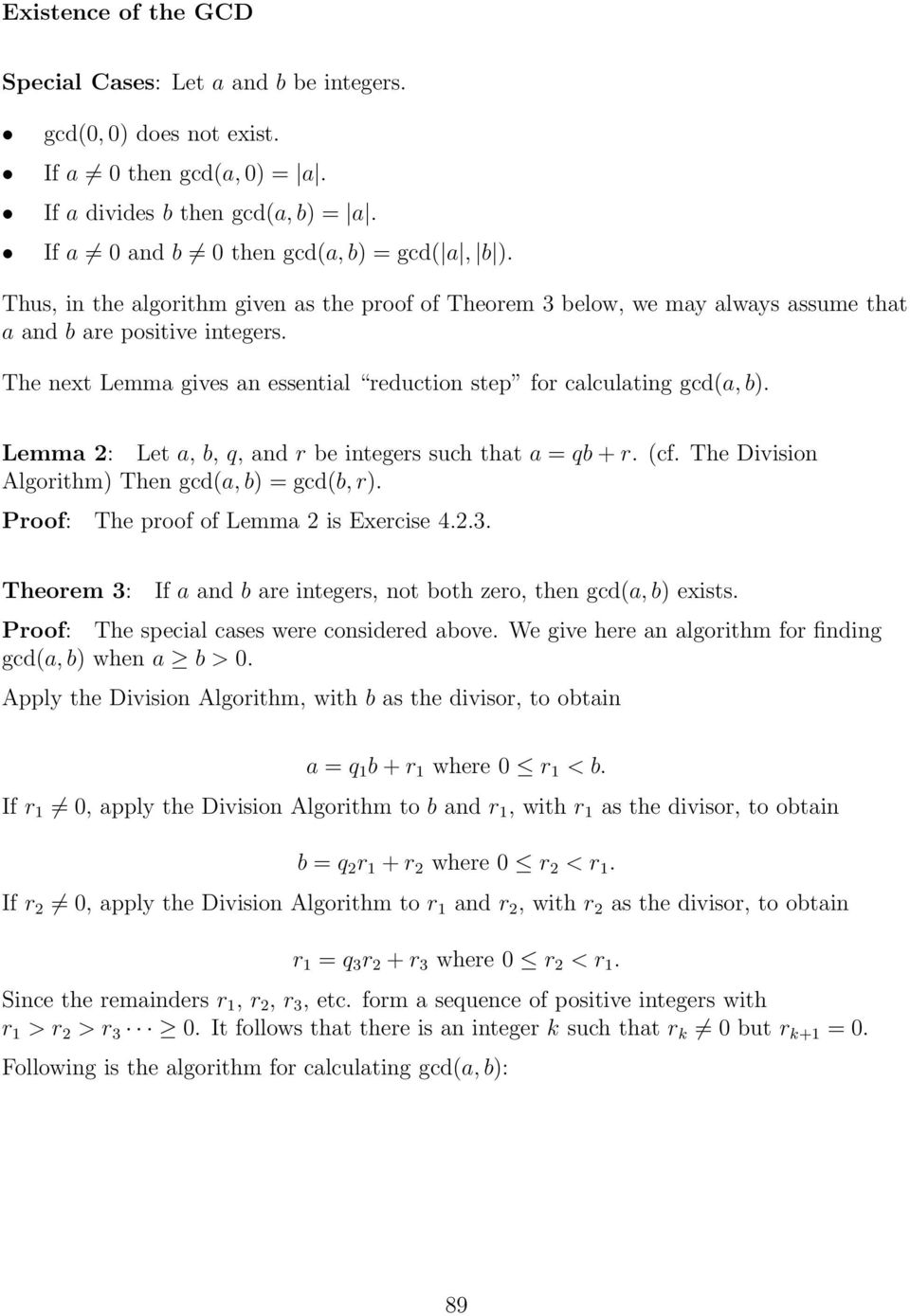
4 Algorithm 1: Finding the GCD: Then r k = gcd(a, b). a = q 1 b + r 1 where 0 r 1 < b b = q 2 r 1 + r 2 where 0 r 2 < r 1 r 1 = q 3 r 2 + r 3 where 0 r 2 < r 1. r k 3 = q k 1 r k 2 + r k 1 where 0 r k 1 < r k 2 r k 2 = q k r k 1 + r k where 0 r k < r k 1 r k 1 = q k+1 r k To see that r k = gcd(a, b), repeatedly apply Lemma 2 to get gcd(a, b) = gcd(b, r 1 ) = gcd(r 1, r 2 ) = = gcd(r k 1, r k ). But, by the last equation in Algorithm 1, r k divides r k 1. Thus, r k = gcd(r k 1, r k ) = gcd(a, b). Example 2: Find gcd(216, 80). Solution: Repeated use of long division gives: or, in equation form: r r r r = (2) = (1) = (2) = (3)8. Therefore, 8 = gcd(216, 80). Exercise 2: In each of (a) (d), find gcd(a, b). (a) a = 44, b = 0 (b) a = 22, b = 660 (c) a = 715, b = 208 (d) a = 715, b = 208 Further Theorems Theorem 4: Let a and b be integers and suppose d = gcd(a, b). Then there exist integers m and n such that d = ma + nb. Comment: Note that 6 = gcd(18, 30) and we may write 6 = (2)18 + ( 1)30 = ( 3)18 + (2)30 = (7)18 + ( 4)30, so, in the notation of Theorem 4, m and n are not unique. 90
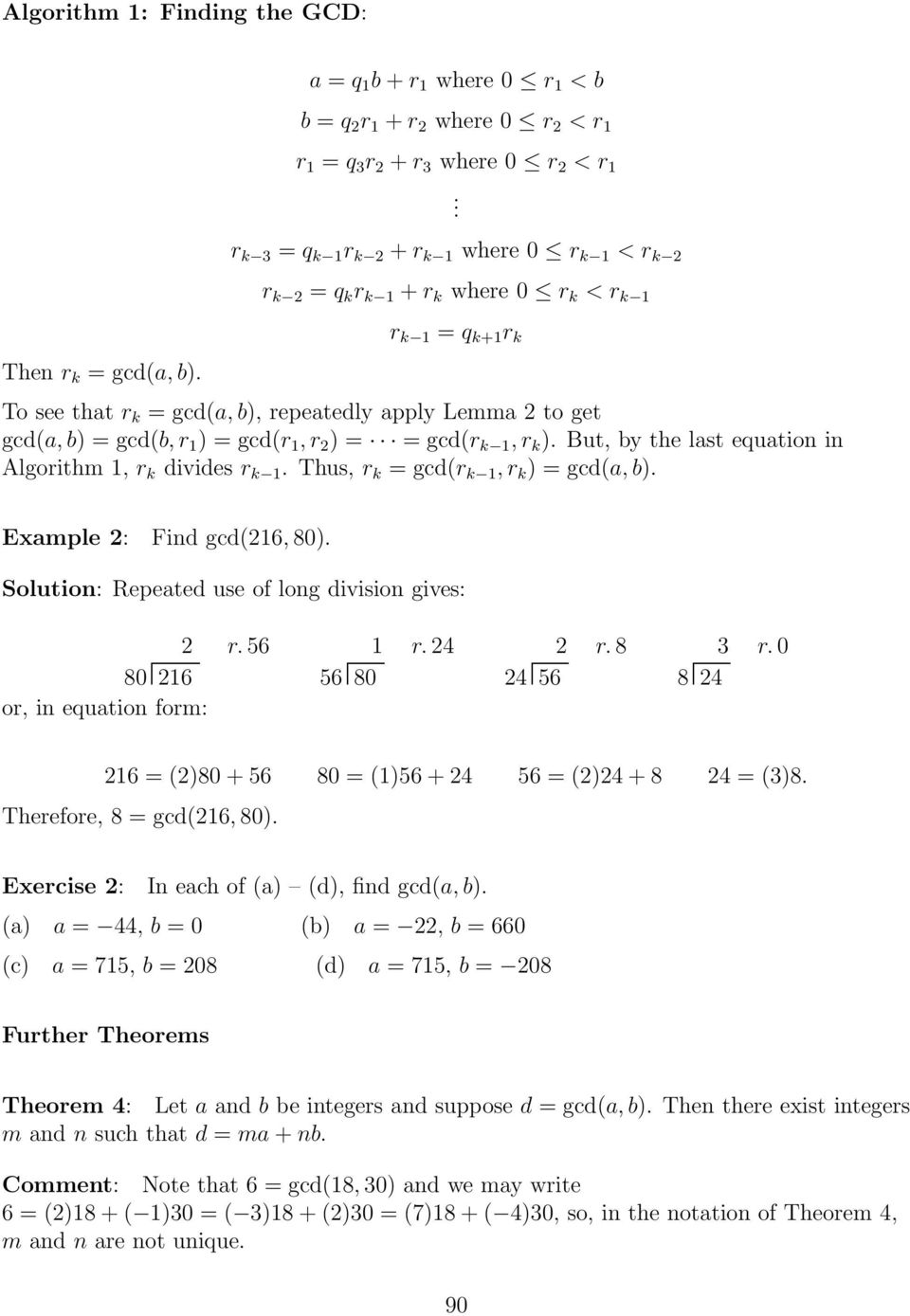
5 The following algorithm for finding one choice for m and n is a continuation of Algorithm 1 for find gcd(a, b). Algorithm 2: Writing gcd(a, b) = ma + nb Beginning with the second to last equation of Algorithm 1 and working up, we solve each equation for the remainder. This gives: Recall that r k = gcd(a, b). r k = r k 2 q k r k 1 r k 1 = r k 3 q k 1 r k 2. r 3 = r 1 q 3 r 2 r 2 = b q 2 r 1 r 1 = a q 1 b In the equation for r k, substitute for r k 1, using the second equation. This gives r k = r k 2 q k r k 1 = r k 2 q k (r k 3 q k 1 r k 2 ) = (1 + q k 1 )r k 2 + ( q k )r k 3. In the resulting equation, we next substitute for r k 2 and simplify. Then substitute for r k 3 and simplify. Continuing, we eventually substitute for r 1 and simplify. This will yield r k = ma + nb. Example 3: We have seen in Example 2 that 8 = gcd(216, 80). Find integers m and n such that 8 = 216m + 80n. Solution: In the solution to Example 3 we obtained several equations representing the repeated applications of the Division Algorithm. In reverse order, we solve each those equations for the remainder. This gives: 8 = 56 (2)24 24 = 80 (1)56 56 = 216 (2)80. Now in 8 = 56 (2)24 substitute 24 = 80 (1)56 to obtain 8 = 56 2 ( 80 (1)56 ) = ( 2)80 + (3)56. Next, substitute 56 = 216 (2)80 to obtain: 8 = ( 2)80 + (3)56 = ( 2) ( 216 (2)80 ) = (3)216 (8)80. Thus, 8 = (3)216 (8)80. 91
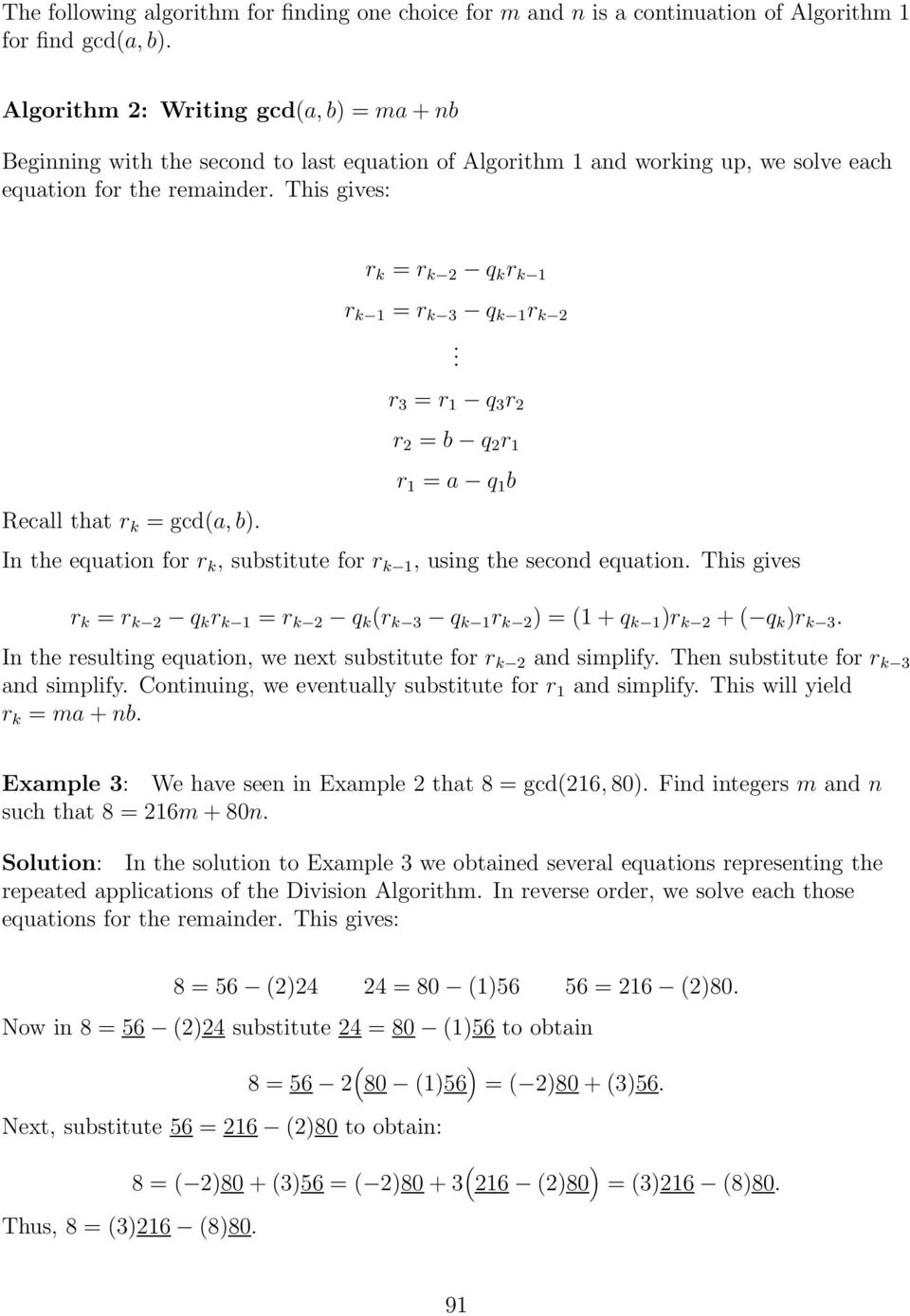
6 Exercise 3: Find d = gcd(4977, 405) and find integers m and n such that d = 4977m + 405n. Theorem 5: Let a, and b be integers, where a and b are not both zero. Then gcd(a, b) exists so let d = gcd(a, b). For an integer c there exist integers m and n such that c = ma + nb if and only if c is a multiple of d. Proof: Note that this is an equivalence, so two proofs are required. First, let c be an integer and assume that there exist integers m and n such that c = ma + nb. Let d = gcd(a, b). Then d divides both a and b, so there exist integers a 1 and b 1 such that a = a 1 d and b = b 1 d. Thus, c = ma + nb = ma 1 d + nb 1 d = (ma 1 + nb 1 )d. Consequently, c = qd, where q = ma 1 + nb 1, and so d divides c. In the opposite direction, set d = gcd(a, b), let c be an integer, and assume that d divides c. Then there exists an integer k such that c = kd. By Theorem 4, there exist integers m 1 and n 1 such that d = m 1 a + n 1 b. Therefore, c = kd = k(m 1 a + n 1 b) = km 1 a + kn 1 b. Thus, c = ma + nb, where m = km 1 and n = kn 1. Exercise 4: Suppose 11 = ma + nb, where a, b, m, and n are integers. List all possible choices for d = gcd(a, b). 92
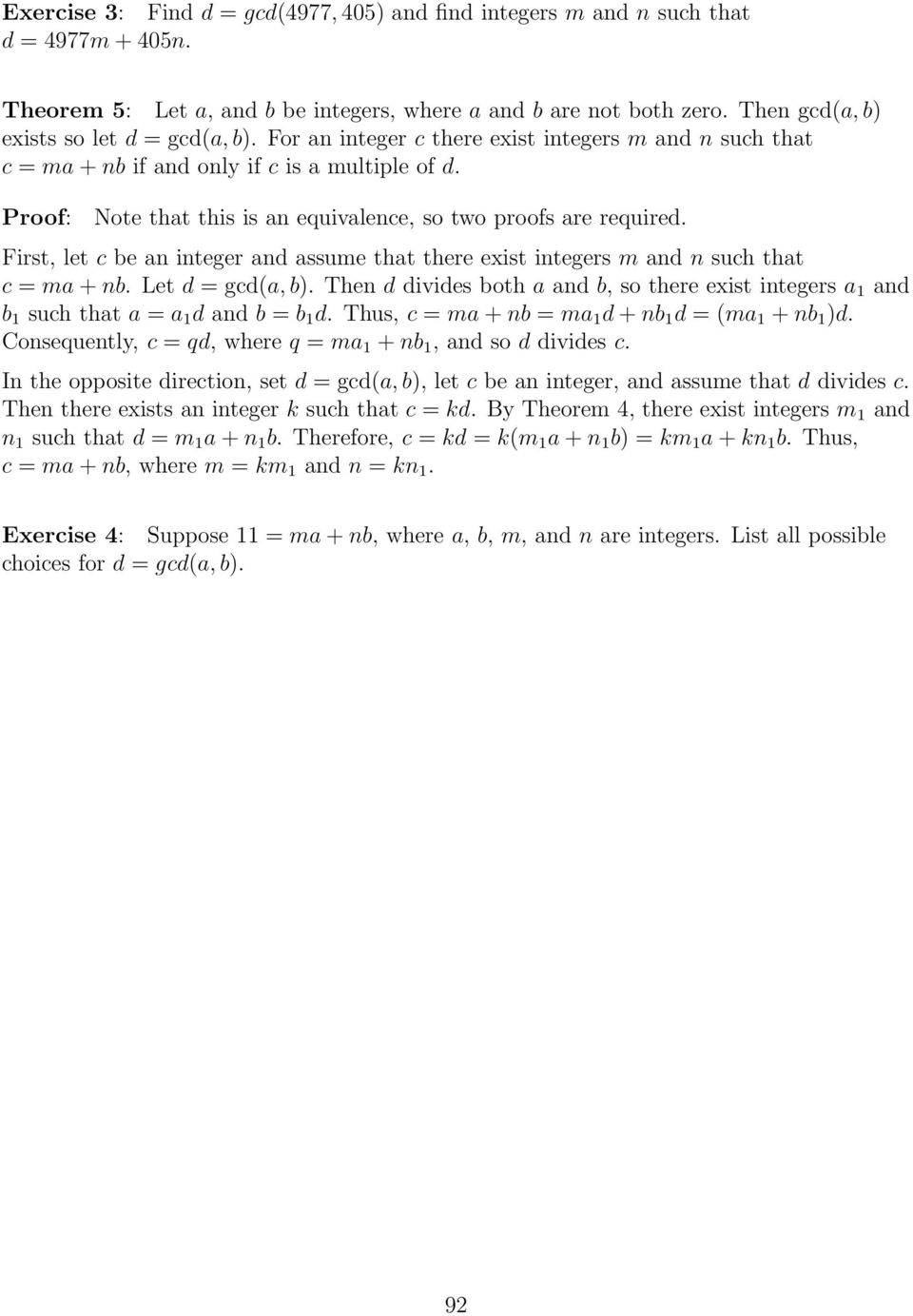
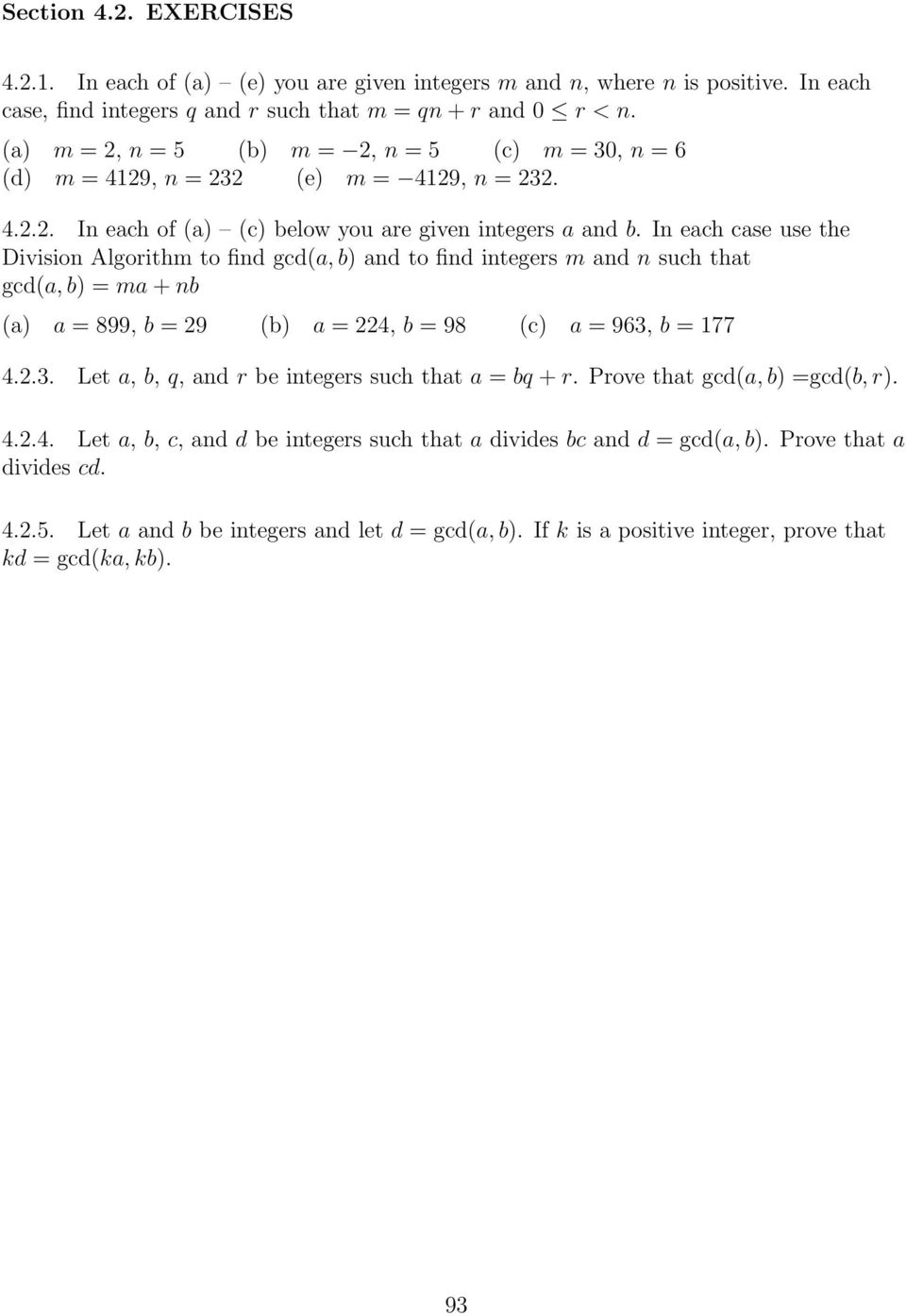
7 Section 4.2. EXERCISES In each of (a) (e) you are given integers m and n, where n is positive. In each case, find integers q and r such that m = qn + r and 0 r < n. (a) m = 2, n = 5 (b) m = 2, n = 5 (c) m = 30, n = 6 (d) m = 4129, n = 232 (e) m = 4129, n = In each of (a) (c) below you are given integers a and b. In each case use the Division Algorithm to find gcd(a, b) and to find integers m and n such that gcd(a, b) = ma + nb (a) a = 899, b = 29 (b) a = 224, b = 98 (c) a = 963, b = Let a, b, q, and r be integers such that a = bq + r. Prove that gcd(a, b) =gcd(b, r) Let a, b, c, and d be integers such that a divides bc and d = gcd(a, b). Prove that a divides cd Let a and b be integers and let d = gcd(a, b). If k is a positive integer, prove that kd = gcd(ka, kb). 93
8 Divisibility and prime numbers
 8 Divisibility and prime numbers 8.1 Divisibility In this short section we extend the concept of a multiple from the natural numbers to the integers. We also summarize several other terms that express
Kevin James. MTHSC 412 Section 2.4 Prime Factors and Greatest Comm
 MTHSC 412 Section 2.4 Prime Factors and Greatest Common Divisor Greatest Common Divisor Definition Suppose that a, b Z. Then we say that d Z is a greatest common divisor (gcd) of a and b if the following
CS 103X: Discrete Structures Homework Assignment 3 Solutions
 CS 103X: Discrete Structures Homework Assignment 3 s Exercise 1 (20 points). On well-ordering and induction: (a) Prove the induction principle from the well-ordering principle. (b) Prove the well-ordering
CHAPTER 5. Number Theory. 1. Integers and Division. Discussion
 CHAPTER 5 Number Theory 1. Integers and Division 1.1. Divisibility. Definition 1.1.1. Given two integers a and b we say a divides b if there is an integer c such that b = ac. If a divides b, we write a
8 Primes and Modular Arithmetic
 8 Primes and Modular Arithmetic 8.1 Primes and Factors Over two millennia ago already, people all over the world were considering the properties of numbers. One of the simplest concepts is prime numbers.
Elementary Number Theory and Methods of Proof. CSE 215, Foundations of Computer Science Stony Brook University http://www.cs.stonybrook.
 Elementary Number Theory and Methods of Proof CSE 215, Foundations of Computer Science Stony Brook University http://www.cs.stonybrook.edu/~cse215 1 Number theory Properties: 2 Properties of integers (whole
Today s Topics. Primes & Greatest Common Divisors
 Today s Topics Primes & Greatest Common Divisors Prime representations Important theorems about primality Greatest Common Divisors Least Common Multiples Euclid s algorithm Once and for all, what are prime
The Euclidean Algorithm
 The Euclidean Algorithm A METHOD FOR FINDING THE GREATEST COMMON DIVISOR FOR TWO LARGE NUMBERS To be successful using this method you have got to know how to divide. If this is something that you have
Intermediate Math Circles March 7, 2012 Linear Diophantine Equations II
 Intermediate Math Circles March 7, 2012 Linear Diophantine Equations II Last week: How to find one solution to a linear Diophantine equation This week: How to find all solutions to a linear Diophantine
GREATEST COMMON DIVISOR
 DEFINITION: GREATEST COMMON DIVISOR The greatest common divisor (gcd) of a and b, denoted by (a, b), is the largest common divisor of integers a and b. THEOREM: If a and b are nonzero integers, then their
MATH 289 PROBLEM SET 4: NUMBER THEORY
 MATH 289 PROBLEM SET 4: NUMBER THEORY 1. The greatest common divisor If d and n are integers, then we say that d divides n if and only if there exists an integer q such that n = qd. Notice that if d divides
The last three chapters introduced three major proof techniques: direct,
 CHAPTER 7 Proving Non-Conditional Statements The last three chapters introduced three major proof techniques: direct, contrapositive and contradiction. These three techniques are used to prove statements
I. GROUPS: BASIC DEFINITIONS AND EXAMPLES
 I GROUPS: BASIC DEFINITIONS AND EXAMPLES Definition 1: An operation on a set G is a function : G G G Definition 2: A group is a set G which is equipped with an operation and a special element e G, called
Factoring Algorithms
 Factoring Algorithms The p 1 Method and Quadratic Sieve November 17, 2008 () Factoring Algorithms November 17, 2008 1 / 12 Fermat s factoring method Fermat made the observation that if n has two factors
GCDs and Relatively Prime Numbers! CSCI 2824, Fall 2014!
 GCDs and Relatively Prime Numbers! CSCI 2824, Fall 2014!!! Challenge Problem 2 (Mastermind) due Fri. 9/26 Find a fourth guess whose scoring will allow you to determine the secret code (repetitions are
Homework until Test #2
 MATH31: Number Theory Homework until Test # Philipp BRAUN Section 3.1 page 43, 1. It has been conjectured that there are infinitely many primes of the form n. Exhibit five such primes. Solution. Five such
Discrete Mathematics, Chapter 4: Number Theory and Cryptography
 Discrete Mathematics, Chapter 4: Number Theory and Cryptography Richard Mayr University of Edinburgh, UK Richard Mayr (University of Edinburgh, UK) Discrete Mathematics. Chapter 4 1 / 35 Outline 1 Divisibility
Fibonacci Numbers and Greatest Common Divisors. The Finonacci numbers are the numbers in the sequence 1, 1, 2, 3, 5, 8, 13, 21, 34, 55, 89, 144,...
 Fibonacci Numbers and Greatest Common Divisors The Finonacci numbers are the numbers in the sequence 1, 1, 2, 3, 5, 8, 13, 21, 34, 55, 89, 144,.... After starting with two 1s, we get each Fibonacci number
Quotient Rings and Field Extensions
 Chapter 5 Quotient Rings and Field Extensions In this chapter we describe a method for producing field extension of a given field. If F is a field, then a field extension is a field K that contains F.
Continued Fractions and the Euclidean Algorithm
 Continued Fractions and the Euclidean Algorithm Lecture notes prepared for MATH 326, Spring 997 Department of Mathematics and Statistics University at Albany William F Hammond Table of Contents Introduction
MATH 22. THE FUNDAMENTAL THEOREM of ARITHMETIC. Lecture R: 10/30/2003
 MATH 22 Lecture R: 10/30/2003 THE FUNDAMENTAL THEOREM of ARITHMETIC You must remember this, A kiss is still a kiss, A sigh is just a sigh; The fundamental things apply, As time goes by. Herman Hupfeld
Settling a Question about Pythagorean Triples
 Settling a Question about Pythagorean Triples TOM VERHOEFF Department of Mathematics and Computing Science Eindhoven University of Technology P.O. Box 513, 5600 MB Eindhoven, The Netherlands E-Mail address:
Handout NUMBER THEORY
 Handout of NUMBER THEORY by Kus Prihantoso Krisnawan MATHEMATICS DEPARTMENT FACULTY OF MATHEMATICS AND NATURAL SCIENCES YOGYAKARTA STATE UNIVERSITY 2012 Contents Contents i 1 Some Preliminary Considerations
Chapter 4. Polynomial and Rational Functions. 4.1 Polynomial Functions and Their Graphs
 Chapter 4. Polynomial and Rational Functions 4.1 Polynomial Functions and Their Graphs A polynomial function of degree n is a function of the form P = a n n + a n 1 n 1 + + a 2 2 + a 1 + a 0 Where a s
Page 331, 38.4 Suppose a is a positive integer and p is a prime. Prove that p a if and only if the prime factorization of a contains p.
 Page 331, 38.2 Assignment #11 Solutions Factor the following positive integers into primes. a. 25 = 5 2. b. 4200 = 2 3 3 5 2 7. c. 10 10 = 2 10 5 10. d. 19 = 19. e. 1 = 1. Page 331, 38.4 Suppose a is a
MATH10040 Chapter 2: Prime and relatively prime numbers
 MATH10040 Chapter 2: Prime and relatively prime numbers Recall the basic definition: 1. Prime numbers Definition 1.1. Recall that a positive integer is said to be prime if it has precisely two positive
a 11 x 1 + a 12 x 2 + + a 1n x n = b 1 a 21 x 1 + a 22 x 2 + + a 2n x n = b 2.
 Chapter 1 LINEAR EQUATIONS 1.1 Introduction to linear equations A linear equation in n unknowns x 1, x,, x n is an equation of the form a 1 x 1 + a x + + a n x n = b, where a 1, a,..., a n, b are given
RSA and Primality Testing
 and Primality Testing Joan Boyar, IMADA, University of Southern Denmark Studieretningsprojekter 2010 1 / 81 Correctness of cryptography cryptography Introduction to number theory Correctness of with 2
MATH 537 (Number Theory) FALL 2016 TENTATIVE SYLLABUS
 MATH 537 (Number Theory) FALL 2016 TENTATIVE SYLLABUS Class Meetings: MW 2:00-3:15 pm in Physics 144, September 7 to December 14 [Thanksgiving break November 23 27; final exam December 21] Instructor:
DIVISIBILITY AND GREATEST COMMON DIVISORS
 DIVISIBILITY AND GREATEST COMMON DIVISORS KEITH CONRAD 1 Introduction We will begin with a review of divisibility among integers, mostly to set some notation and to indicate its properties Then we will
6.2 Permutations continued
 6.2 Permutations continued Theorem A permutation on a finite set A is either a cycle or can be expressed as a product (composition of disjoint cycles. Proof is by (strong induction on the number, r, of
The Division Algorithm for Polynomials Handout Monday March 5, 2012
 The Division Algorithm for Polynomials Handout Monday March 5, 0 Let F be a field (such as R, Q, C, or F p for some prime p. This will allow us to divide by any nonzero scalar. (For some of the following,
Elementary Number Theory
 Elementary Number Theory A revision by Jim Hefferon, St Michael s College, 2003-Dec of notes by W. Edwin Clark, University of South Florida, 2002-Dec L A TEX source compiled on January 5, 2004 by Jim Hefferon,
26 Integers: Multiplication, Division, and Order
 26 Integers: Multiplication, Division, and Order Integer multiplication and division are extensions of whole number multiplication and division. In multiplying and dividing integers, the one new issue
MATH10212 Linear Algebra. Systems of Linear Equations. Definition. An n-dimensional vector is a row or a column of n numbers (or letters): a 1.
 MATH10212 Linear Algebra Textbook: D. Poole, Linear Algebra: A Modern Introduction. Thompson, 2006. ISBN 0-534-40596-7. Systems of Linear Equations Definition. An n-dimensional vector is a row or a column
15 Prime and Composite Numbers
 15 Prime and Composite Numbers Divides, Divisors, Factors, Multiples In section 13, we considered the division algorithm: If a and b are whole numbers with b 0 then there exist unique numbers q and r such
Math 319 Problem Set #3 Solution 21 February 2002
 Math 319 Problem Set #3 Solution 21 February 2002 1. ( 2.1, problem 15) Find integers a 1, a 2, a 3, a 4, a 5 such that every integer x satisfies at least one of the congruences x a 1 (mod 2), x a 2 (mod
Math 115 Spring 2011 Written Homework 5 Solutions
 . Evaluate each series. a) 4 7 0... 55 Math 5 Spring 0 Written Homework 5 Solutions Solution: We note that the associated sequence, 4, 7, 0,..., 55 appears to be an arithmetic sequence. If the sequence
11 Ideals. 11.1 Revisiting Z
 11 Ideals The presentation here is somewhat different than the text. In particular, the sections do not match up. We have seen issues with the failure of unique factorization already, e.g., Z[ 5] = O Q(
SUM OF TWO SQUARES JAHNAVI BHASKAR
 SUM OF TWO SQUARES JAHNAVI BHASKAR Abstract. I will investigate which numbers can be written as the sum of two squares and in how many ways, providing enough basic number theory so even the unacquainted
Gröbner Bases and their Applications
 Gröbner Bases and their Applications Kaitlyn Moran July 30, 2008 1 Introduction We know from the Hilbert Basis Theorem that any ideal in a polynomial ring over a field is finitely generated [3]. However,
z 0 and y even had the form
 Gaussian Integers The concepts of divisibility, primality and factoring are actually more general than the discussion so far. For the moment, we have been working in the integers, which we denote by Z
NUMBER SYSTEMS. William Stallings
 NUMBER SYSTEMS William Stallings The Decimal System... The Binary System...3 Converting between Binary and Decimal...3 Integers...4 Fractions...5 Hexadecimal Notation...6 This document available at WilliamStallings.com/StudentSupport.html
JUST THE MATHS UNIT NUMBER 1.8. ALGEBRA 8 (Polynomials) A.J.Hobson
 JUST THE MATHS UNIT NUMBER 1.8 ALGEBRA 8 (Polynomials) by A.J.Hobson 1.8.1 The factor theorem 1.8.2 Application to quadratic and cubic expressions 1.8.3 Cubic equations 1.8.4 Long division of polynomials
Number Theory. Proof. Suppose otherwise. Then there would be a finite number n of primes, which we may
 Number Theory Divisibility and Primes Definition. If a and b are integers and there is some integer c such that a = b c, then we say that b divides a or is a factor or divisor of a and write b a. Definition
Real Roots of Univariate Polynomials with Real Coefficients
 Real Roots of Univariate Polynomials with Real Coefficients mostly written by Christina Hewitt March 22, 2012 1 Introduction Polynomial equations are used throughout mathematics. When solving polynomials
The Fundamental Theorem of Arithmetic
 The Fundamental Theorem of Arithmetic 1 Introduction: Why this theorem? Why this proof? One of the purposes of this course 1 is to train you in the methods mathematicians use to prove mathematical statements,
Binary Number System. 16. Binary Numbers. Base 10 digits: 0 1 2 3 4 5 6 7 8 9. Base 2 digits: 0 1
 Binary Number System 1 Base 10 digits: 0 1 2 3 4 5 6 7 8 9 Base 2 digits: 0 1 Recall that in base 10, the digits of a number are just coefficients of powers of the base (10): 417 = 4 * 10 2 + 1 * 10 1
Winter Camp 2011 Polynomials Alexander Remorov. Polynomials. Alexander Remorov [email protected]
 Polynomials Alexander Remorov [email protected] Warm-up Problem 1: Let f(x) be a quadratic polynomial. Prove that there exist quadratic polynomials g(x) and h(x) such that f(x)f(x + 1) = g(h(x)).
Chapter 4, Arithmetic in F [x] Polynomial arithmetic and the division algorithm.
![Chapter 4, Arithmetic in F [x] Polynomial arithmetic and the division algorithm.](/thumbs/26/8276997.jpg "Chapter 4, Arithmetic in F [x] Polynomial arithmetic and the division algorithm.") Chapter 4, Arithmetic in F [x] Polynomial arithmetic and the division algorithm. We begin by defining the ring of polynomials with coefficients in a ring R. After some preliminary results, we specialize
Chapter 4, Arithmetic in F [x] Polynomial arithmetic and the division algorithm. We begin by defining the ring of polynomials with coefficients in a ring R. After some preliminary results, we specialize
3.2 The Factor Theorem and The Remainder Theorem
 3. The Factor Theorem and The Remainder Theorem 57 3. The Factor Theorem and The Remainder Theorem Suppose we wish to find the zeros of f(x) = x 3 + 4x 5x 4. Setting f(x) = 0 results in the polynomial
Pre-Calculus II Factoring and Operations on Polynomials
 Factoring... 1 Polynomials...1 Addition of Polynomials... 1 Subtraction of Polynomials...1 Multiplication of Polynomials... Multiplying a monomial by a monomial... Multiplying a monomial by a polynomial...
CONTINUED FRACTIONS AND PELL S EQUATION. Contents 1. Continued Fractions 1 2. Solution to Pell s Equation 9 References 12
 CONTINUED FRACTIONS AND PELL S EQUATION SEUNG HYUN YANG Abstract. In this REU paper, I will use some important characteristics of continued fractions to give the complete set of solutions to Pell s equation.
Number Theory Hungarian Style. Cameron Byerley s interpretation of Csaba Szabó s lectures
 Number Theory Hungarian Style Cameron Byerley s interpretation of Csaba Szabó s lectures August 20, 2005 2 0.1 introduction Number theory is a beautiful subject and even cooler when you learn about it
a 1 x + a 0 =0. (3) ax 2 + bx + c =0. (4)
 ROOTS OF POLYNOMIAL EQUATIONS In this unit we discuss polynomial equations. A polynomial in x of degree n, where n 0 is an integer, is an expression of the form P n (x) =a n x n + a n 1 x n 1 + + a 1 x
The Prime Numbers. Definition. A prime number is a positive integer with exactly two positive divisors.
 The Prime Numbers Before starting our study of primes, we record the following important lemma. Recall that integers a, b are said to be relatively prime if gcd(a, b) = 1. Lemma (Euclid s Lemma). If gcd(a,
Number Theory: A Mathemythical Approach. Student Resources. Printed Version
 Number Theory: A Mathemythical Approach Student Resources Printed Version ii Contents 1 Appendix 1 2 Hints to Problems 3 Chapter 1 Hints......................................... 3 Chapter 2 Hints.........................................
Some facts about polynomials modulo m (Full proof of the Fingerprinting Theorem)
 Some facts about polynomials modulo m (Full proof of the Fingerprinting Theorem) In order to understand the details of the Fingerprinting Theorem on fingerprints of different texts from Chapter 19 of the
Polynomial and Synthetic Division. Long Division of Polynomials. Example 1. 6x 2 7x 2 x 2) 19x 2 16x 4 6x3 12x 2 7x 2 16x 7x 2 14x. 2x 4.
 _.qd /7/5 9: AM Page 5 Section.. Polynomial and Synthetic Division 5 Polynomial and Synthetic Division What you should learn Use long division to divide polynomials by other polynomials. Use synthetic
U.C. Berkeley CS276: Cryptography Handout 0.1 Luca Trevisan January, 2009. Notes on Algebra
 U.C. Berkeley CS276: Cryptography Handout 0.1 Luca Trevisan January, 2009 Notes on Algebra These notes contain as little theory as possible, and most results are stated without proof. Any introductory
We can express this in decimal notation (in contrast to the underline notation we have been using) as follows: 9081 + 900b + 90c = 9001 + 100c + 10b
 In this session, we ll learn how to solve problems related to place value. This is one of the fundamental concepts in arithmetic, something every elementary and middle school mathematics teacher should
Lecture Notes on Polynomials
 Lecture Notes on Polynomials Arne Jensen Department of Mathematical Sciences Aalborg University c 008 Introduction These lecture notes give a very short introduction to polynomials with real and complex
Zero: If P is a polynomial and if c is a number such that P (c) = 0 then c is a zero of P.
 MATH 11011 FINDING REAL ZEROS KSU OF A POLYNOMIAL Definitions: Polynomial: is a function of the form P (x) = a n x n + a n 1 x n 1 + + a x + a 1 x + a 0. The numbers a n, a n 1,..., a 1, a 0 are called
ABSTRACT ALGEBRA: A STUDY GUIDE FOR BEGINNERS
 ABSTRACT ALGEBRA: A STUDY GUIDE FOR BEGINNERS John A. Beachy Northern Illinois University 2014 ii J.A.Beachy This is a supplement to Abstract Algebra, Third Edition by John A. Beachy and William D. Blair
SYSTEMS OF PYTHAGOREAN TRIPLES. Acknowledgements. I would like to thank Professor Laura Schueller for advising and guiding me
 SYSTEMS OF PYTHAGOREAN TRIPLES CHRISTOPHER TOBIN-CAMPBELL Abstract. This paper explores systems of Pythagorean triples. It describes the generating formulas for primitive Pythagorean triples, determines
HOMEWORK 5 SOLUTIONS. n!f n (1) lim. ln x n! + xn x. 1 = G n 1 (x). (2) k + 1 n. (n 1)!
 Math 7 Fall 205 HOMEWORK 5 SOLUTIONS Problem. 2008 B2 Let F 0 x = ln x. For n 0 and x > 0, let F n+ x = 0 F ntdt. Evaluate n!f n lim n ln n. By directly computing F n x for small n s, we obtain the following
Recall the process used for adding decimal numbers. 1. Place the numbers to be added in vertical format, aligning the decimal points.
 2 MODULE 4. DECIMALS 4a Decimal Arithmetic Adding Decimals Recall the process used for adding decimal numbers. Adding Decimals. To add decimal numbers, proceed as follows: 1. Place the numbers to be added
Math Workshop October 2010 Fractions and Repeating Decimals
 Math Workshop October 2010 Fractions and Repeating Decimals This evening we will investigate the patterns that arise when converting fractions to decimals. As an example of what we will be looking at,
PYTHAGOREAN TRIPLES KEITH CONRAD
 PYTHAGOREAN TRIPLES KEITH CONRAD 1. Introduction A Pythagorean triple is a triple of positive integers (a, b, c) where a + b = c. Examples include (3, 4, 5), (5, 1, 13), and (8, 15, 17). Below is an ancient
Stanford Math Circle: Sunday, May 9, 2010 Square-Triangular Numbers, Pell s Equation, and Continued Fractions
 Stanford Math Circle: Sunday, May 9, 00 Square-Triangular Numbers, Pell s Equation, and Continued Fractions Recall that triangular numbers are numbers of the form T m = numbers that can be arranged in
Section 1.1 Real Numbers
 . Natural numbers (N):. Integer numbers (Z): Section. Real Numbers Types of Real Numbers,, 3, 4,,... 0, ±, ±, ±3, ±4, ±,... REMARK: Any natural number is an integer number, but not any integer number is
Grade 6 Math Circles March 10/11, 2015 Prime Time Solutions
 Faculty of Mathematics Waterloo, Ontario N2L 3G1 Centre for Education in Mathematics and Computing Lights, Camera, Primes! Grade 6 Math Circles March 10/11, 2015 Prime Time Solutions Today, we re going
On the generation of elliptic curves with 16 rational torsion points by Pythagorean triples
 On the generation of elliptic curves with 16 rational torsion points by Pythagorean triples Brian Hilley Boston College MT695 Honors Seminar March 3, 2006 1 Introduction 1.1 Mazur s Theorem Let C be a
PROPERTIES OF ELLIPTIC CURVES AND THEIR USE IN FACTORING LARGE NUMBERS
 PROPERTIES OF ELLIPTIC CURVES AND THEIR USE IN FACTORING LARGE NUMBERS A ver important set of curves which has received considerabl attention in recent ears in connection with the factoring of large numbers
Math Review. for the Quantitative Reasoning Measure of the GRE revised General Test
 Math Review for the Quantitative Reasoning Measure of the GRE revised General Test www.ets.org Overview This Math Review will familiarize you with the mathematical skills and concepts that are important
Factoring & Primality
 Factoring & Primality Lecturer: Dimitris Papadopoulos In this lecture we will discuss the problem of integer factorization and primality testing, two problems that have been the focus of a great amount
Zeros of a Polynomial Function
 Zeros of a Polynomial Function An important consequence of the Factor Theorem is that finding the zeros of a polynomial is really the same thing as factoring it into linear factors. In this section we
CONTENTS 1. Peter Kahn. Spring 2007
 CONTENTS 1 MATH 304: CONSTRUCTING THE REAL NUMBERS Peter Kahn Spring 2007 Contents 2 The Integers 1 2.1 The basic construction.......................... 1 2.2 Adding integers..............................
DEGREES OF ORDERS ON TORSION-FREE ABELIAN GROUPS
 DEGREES OF ORDERS ON TORSION-FREE ABELIAN GROUPS ASHER M. KACH, KAREN LANGE, AND REED SOLOMON Abstract. We construct two computable presentations of computable torsion-free abelian groups, one of isomorphism
Mathematics for Computer Science/Software Engineering. Notes for the course MSM1F3 Dr. R. A. Wilson
 Mathematics for Computer Science/Software Engineering Notes for the course MSM1F3 Dr. R. A. Wilson October 1996 Chapter 1 Logic Lecture no. 1. We introduce the concept of a proposition, which is a statement
Continued Fractions. Darren C. Collins
 Continued Fractions Darren C Collins Abstract In this paper, we discuss continued fractions First, we discuss the definition and notation Second, we discuss the development of the subject throughout history
Contents. 6 Continued Fractions and Diophantine Equations. 6.1 Linear Diophantine Equations
 Number Theory (part 6): Continued Fractions and Diophantine Equations (by Evan Dummit, 04, v 00) Contents 6 Continued Fractions and Diophantine Equations 6 Linear Diophantine Equations 6 The Frobenius
Practice with Proofs
 Practice with Proofs October 6, 2014 Recall the following Definition 0.1. A function f is increasing if for every x, y in the domain of f, x < y = f(x) < f(y) 1. Prove that h(x) = x 3 is increasing, using
Basic Algorithms In Computer Algebra
 Basic Algorithms In Computer Algebra Kaiserslautern SS 2011 Prof. Dr. Wolfram Decker 2. Mai 2011 References Cohen, H.: A Course in Computational Algebraic Number Theory. Springer, 1993. Cox, D.; Little,
Factoring Polynomials
 Factoring Polynomials Sue Geller June 19, 2006 Factoring polynomials over the rational numbers, real numbers, and complex numbers has long been a standard topic of high school algebra. With the advent
An Introductory Course in Elementary Number Theory. Wissam Raji
 An Introductory Course in Elementary Number Theory Wissam Raji 2 Preface These notes serve as course notes for an undergraduate course in number theory. Most if not all universities worldwide offer introductory
Every Positive Integer is the Sum of Four Squares! (and other exciting problems)
 Every Positive Integer is the Sum of Four Squares! (and other exciting problems) Sophex University of Texas at Austin October 18th, 00 Matilde N. Lalín 1. Lagrange s Theorem Theorem 1 Every positive integer
Lecture 13 - Basic Number Theory.
 Lecture 13 - Basic Number Theory. Boaz Barak March 22, 2010 Divisibility and primes Unless mentioned otherwise throughout this lecture all numbers are non-negative integers. We say that A divides B, denoted
Playing with Numbers
 PLAYING WITH NUMBERS 249 Playing with Numbers CHAPTER 16 16.1 Introduction You have studied various types of numbers such as natural numbers, whole numbers, integers and rational numbers. You have also
SOLVING POLYNOMIAL EQUATIONS
 C SOLVING POLYNOMIAL EQUATIONS We will assume in this appendix that you know how to divide polynomials using long division and synthetic division. If you need to review those techniques, refer to an algebra
Discrete Structures. Lecture Notes
 Discrete Structures Lecture Notes Vladlen Koltun 1 Winter 2008 1 Computer Science Department, 353 Serra Mall, Gates 374, Stanford University, Stanford, CA 94305, USA; [email protected]. Contents 1
Integer Factorization using the Quadratic Sieve
 Integer Factorization using the Quadratic Sieve Chad Seibert* Division of Science and Mathematics University of Minnesota, Morris Morris, MN 56567 [email protected] March 16, 2011 Abstract We give
Lecture 3: Finding integer solutions to systems of linear equations
 Lecture 3: Finding integer solutions to systems of linear equations Algorithmic Number Theory (Fall 2014) Rutgers University Swastik Kopparty Scribe: Abhishek Bhrushundi 1 Overview The goal of this lecture
1. Let P be the space of all polynomials (of one real variable and with real coefficients) with the norm
 Uppsala Universitet Matematiska Institutionen Andreas Strömbergsson Prov i matematik Funktionalanalys Kurs: F3B, F4Sy, NVP 005-06-15 Skrivtid: 9 14 Tillåtna hjälpmedel: Manuella skrivdon, Kreyszigs bok
Division of whole numbers is defined in terms of multiplication using the idea of a missing factor.
 32 CHAPTER 1. PLACE VALUE AND MODELS FOR ARITHMETIC 1.6 Division Division of whole numbers is defined in terms of multiplication using the idea of a missing factor. Definition 6.1. Division is defined
Core Maths C1. Revision Notes
 Core Maths C Revision Notes November 0 Core Maths C Algebra... Indices... Rules of indices... Surds... 4 Simplifying surds... 4 Rationalising the denominator... 4 Quadratic functions... 4 Completing the
SOLUTIONS FOR PROBLEM SET 2
 SOLUTIONS FOR PROBLEM SET 2 A: There exist primes p such that p+6k is also prime for k = 1,2 and 3. One such prime is p = 11. Another such prime is p = 41. Prove that there exists exactly one prime p such
Test1. Due Friday, March 13, 2015.
 1 Abstract Algebra Professor M. Zuker Test1. Due Friday, March 13, 2015. 1. Euclidean algorithm and related. (a) Suppose that a and b are two positive integers and that gcd(a, b) = d. Find all solutions
minimal polyonomial Example
 Minimal Polynomials Definition Let α be an element in GF(p e ). We call the monic polynomial of smallest degree which has coefficients in GF(p) and α as a root, the minimal polyonomial of α. Example: We
DigitalCommons@University of Nebraska - Lincoln
 University of Nebraska - Lincoln DigitalCommons@University of Nebraska - Lincoln MAT Exam Expository Papers Math in the Middle Institute Partnership 7-1-007 Pythagorean Triples Diane Swartzlander University