
MATH Fundamental Mathematics IV
|
|
|
- Brendan Eaton
- 9 years ago
- Views:
Transcription
1 MATH 0034 Fundamental Mathematics IV Department of Mathematical Sciences Kent State University January 2, 2009
2 ii

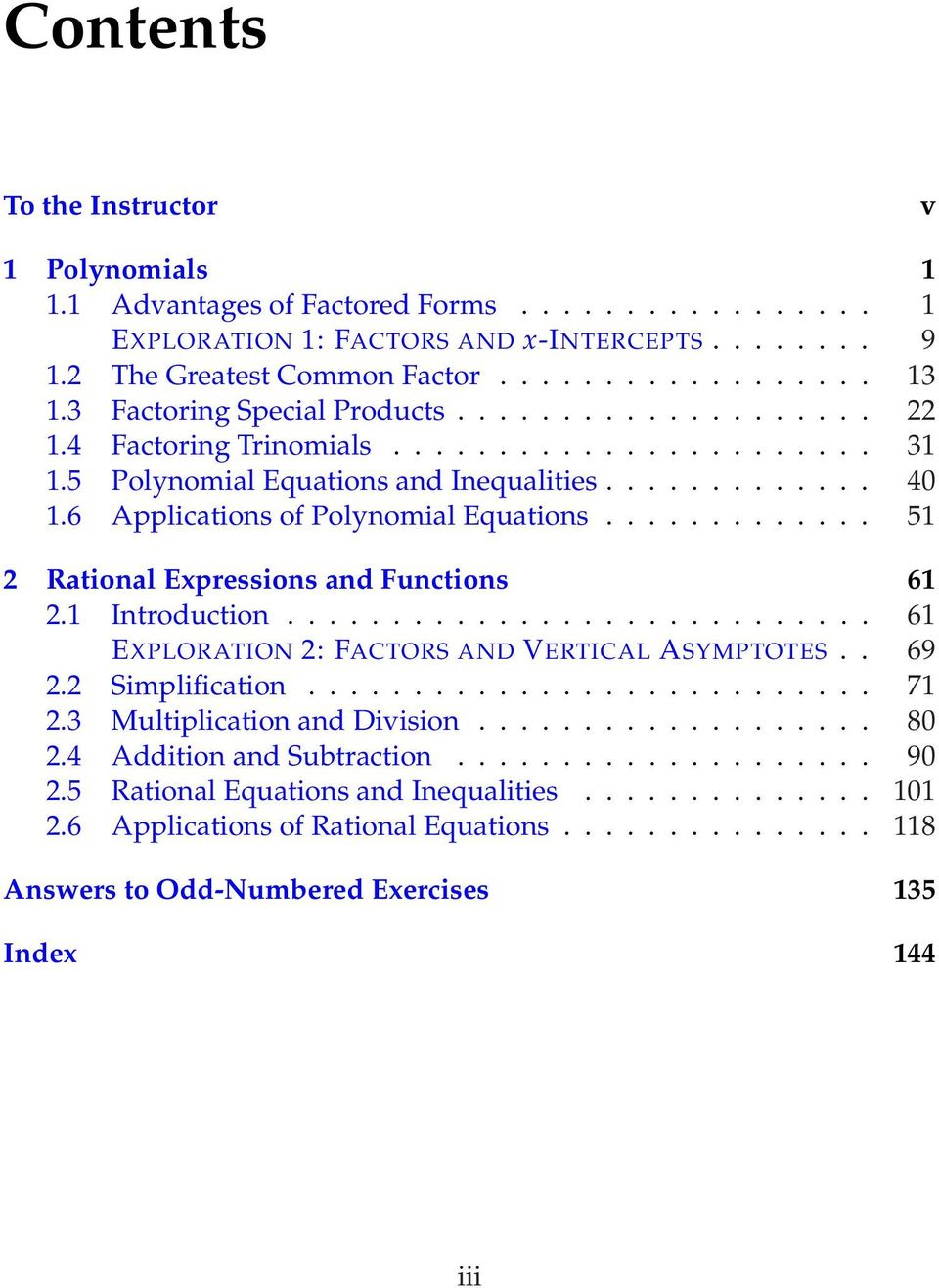
3 Contents To the Instructor v Polynomials. Advantages of Factored Forms EXPLORATION : FACTORS AND x-intercepts The Greatest Common Factor Factoring Special Products Factoring Trinomials Polynomial Equations and Inequalities Applications of Polynomial Equations Rational Expressions and Functions 6 2. Introduction EXPLORATION 2: FACTORS AND VERTICAL ASYMPTOTES Simplification Multiplication and Division Addition and Subtraction Rational Equations and Inequalities Applications of Rational Equations Answers to Odd-Numbered Exercises 35 Index 44 iii
4 iv CONTENTS

5 To the Instructor The mathematics content of this text is delivered in two ways. The numbered sections contain traditional exposition with ample worked examples and exercises. This forms the bulk of the text. Each example is followed immediately by similar practice problems whose answers are given at the end of the section. Each numbered section also has a large exercise set. The answers to the odd-numbered problems are found at the end of the book. Generally, the even-numbered exercises are similar to adjacent oddnumbered problems. This is to give instructors flexibility in assigning exercises. In each chapter, there is also an un-numbered section called an exploration. These are essentially worksheets for discovery activities and are intended for use in a laboratory setting. The explorations can be covered at different points in the course, since different classes have labs on different days of the week. Students will need a simple graphing device with zoom and trace functionality for the explorations. This could be a graphing calculator or a graphing application on the Web such as gcalc.net. Instructors will need to spend a few minutes demonstrating to the class how to graph functions and how to zoom and trace on the graph. You might wish to have students work together in pairs or small groups. Because the explorations are discovery activities, no answers are provided in the text. Also, no formal definitions or statements of results are given. Therefore, it is crucial for the instructor to provide ample assistance during the activity and summary and analysis afterward. The topics covered in the explorations are part of the required syllabus for this course. Instructors who do not wish to use these particular labs should cover these topics in some other way. v
6 vi CONTENTS

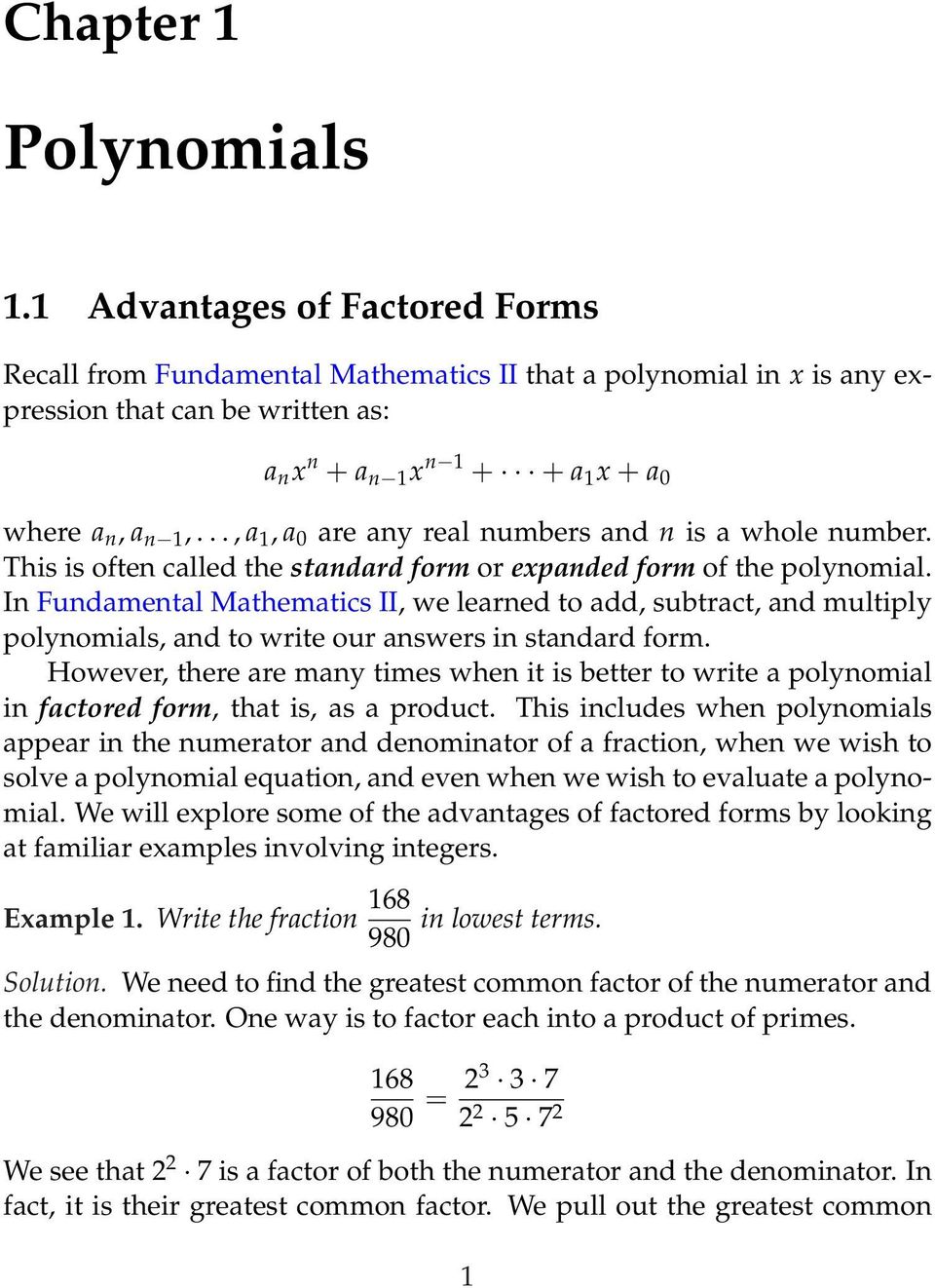
7 Chapter Polynomials. Advantages of Factored Forms Recall from Fundamental Mathematics II that a polynomial in x is any expression that can be written as: a n x n + a n x n + + a x + a 0 where a n, a n,..., a, a 0 are any real numbers and n is a whole number. This is often called the standard form or expanded form of the polynomial. In Fundamental Mathematics II, we learned to add, subtract, and multiply polynomials, and to write our answers in standard form. However, there are many times when it is better to write a polynomial in factored form, that is, as a product. This includes when polynomials appear in the numerator and denominator of a fraction, when we wish to solve a polynomial equation, and even when we wish to evaluate a polynomial. We will explore some of the advantages of factored forms by looking at familiar examples involving integers. Example. Write the fraction 68 in lowest terms. 980 Solution. We need to find the greatest common factor of the numerator and the denominator. One way is to factor each into a product of primes = We see that is a factor of both the numerator and the denominator. In fact, it is their greatest common factor. We pull out the greatest common
8 2 CHAPTER. POLYNOMIALS factor and write the fraction in lowest terms as follows = (22 7) (2 3) (2 2 7) (5 7) = = 6 35 = 6 35 Look at the solution more carefully. Our claim is that and 6 35 are equivalent fractions. That is, they represent the same number. Do you believe this? Can you explain why it s true? (Hint: The key idea is that 22 7 = and 22 7 multiplying a number by does not change its value.) Practice. (Answers on page 6.) Write each of the following fractions in lowest terms. a b Example 2. Find the sum: Solution. To add fractions, they must have a common denominator. (Why?) We first factor each denominator to find the least common denominator of the two fractions. 90 = = 2 3 5
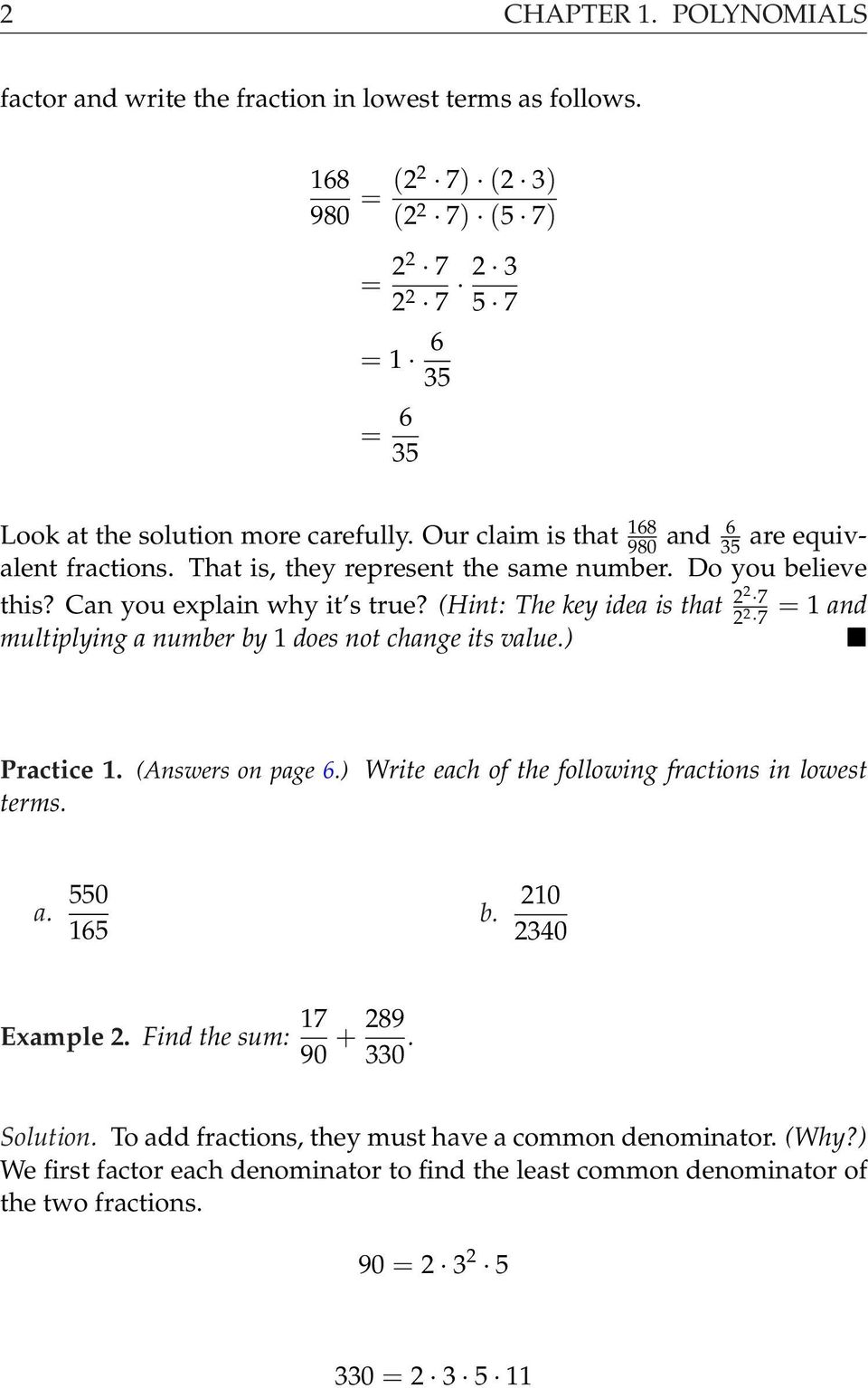
9 .. ADVANTAGES OF FACTORED FORMS 3 Thus, the least common denominator is = 990. We obtain: = = = = = = = It wasn t necessary to use the least common denominator; any common denominator will do. Try the above example again, but use as your common denominator the product of the denominators of the two fractions: = Is this solution easier or harder than the solution using the least common denominator? (Did you write your answer in lowest terms?) What are the advantages and disadvantages of using the least common denominator? Practice 2. (Answers on page 6.) Find the following sums and differences. Use the least common denominator. Then write your answer in lowest terms. a Example 3. Simplify the radical 50. b Solution. Since this is a square root, we must find the largest perfect square that is a factor of = 25 6 = 25 6 = 5 6.
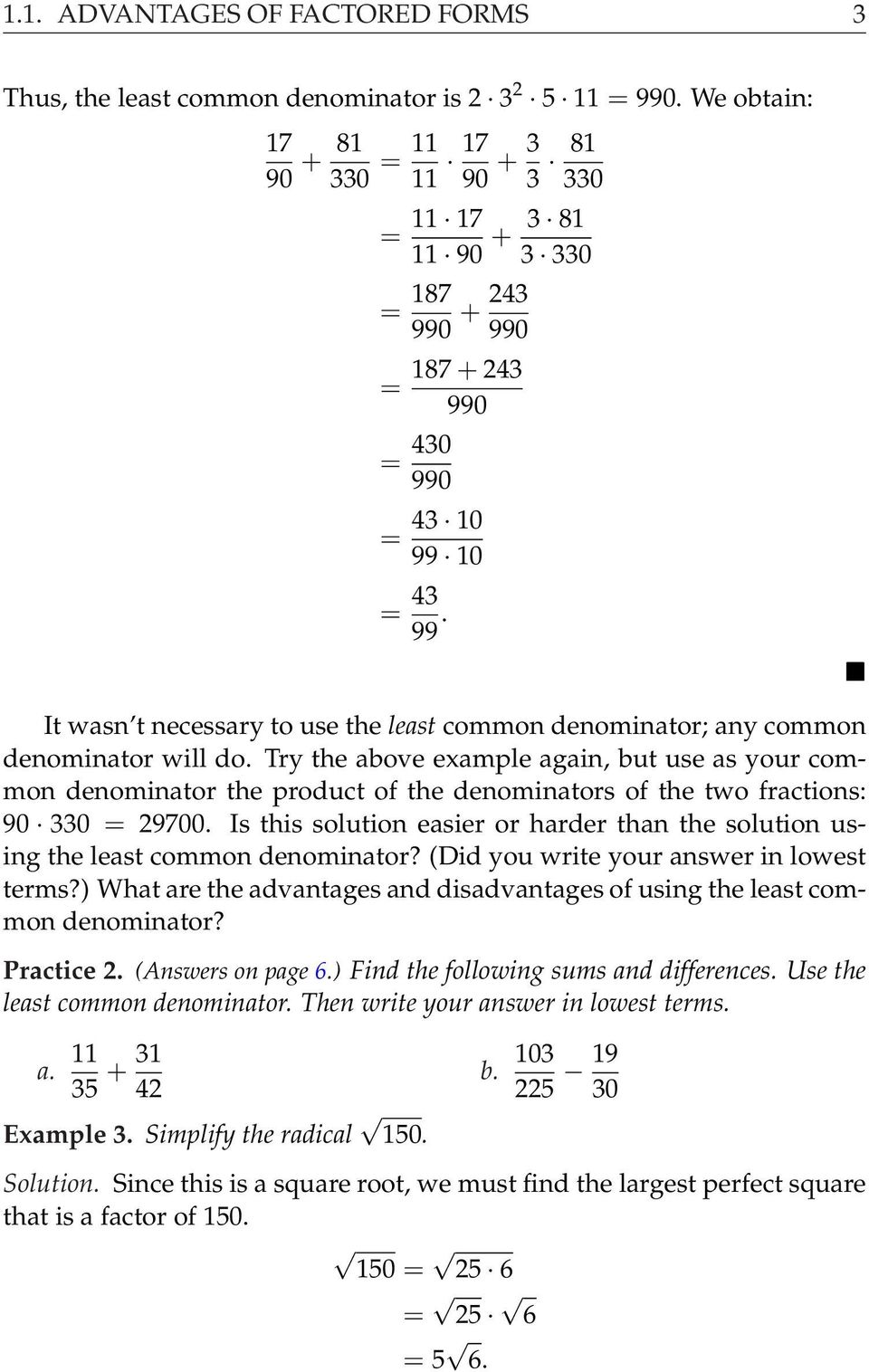
10 4 CHAPTER. POLYNOMIALS Practice 3. (Answers on page 6.) Simplify the following radicals. a. 980 b Hint: To simplify a cube root, we find the largest perfect cube that is a factor of the radicand. In both of the examples above, we have to factor integers. Now consider the following analogous examples involving algebraic expressions. Assume throughout that variables appearing as factors of the denominator of a fraction represent nonzero numbers and that variables appearing as factors of the radicand of an even-index radical are nonnegative numbers. (Can you explain why each of these assumptions is important?) Example 4. Write the fraction 2a2 b 3 c 30ab 5 in lowest terms. c3 Solution. We see that 6, a, b 3, and c are factors of both the numerator and the denominator. In fact, their greatest common factor is 6ab 3 c. We can write the fraction in lowest terms as follows. 2a 2 b 3 c 30ab 5 c 3 = 6 2 a a b3 c 6 5 a b 3 b 2 c c 2 = 6ab3 c 2a 6ab 3 c 5b 2 c 2 = 6ab3 c 6ab 3 c 2a 5b 2 c 2 = 2a 5b 2 c 2 = 2a 5b 2 c 2. Here again, we rely on our ability to factor. This time we are factoring monomials rather than integers.
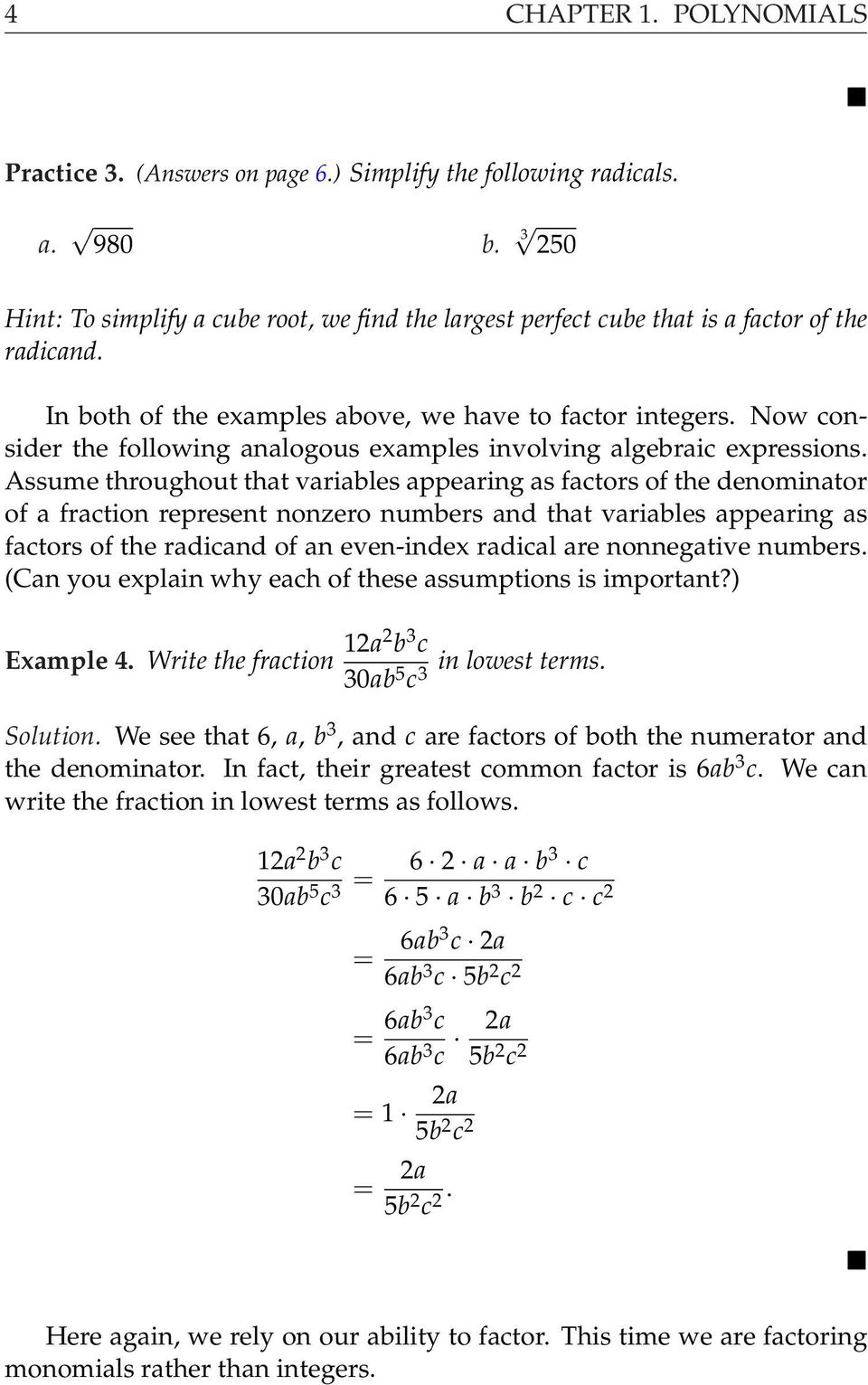
11 .. ADVANTAGES OF FACTORED FORMS 5 Practice 4. (Answers on the next page.) terms. Write the following fractions in lowest a. 0x 4 y 3 2xy 2 b. 363x 5 y 0 z 3. Assume that all variables repre- Example 5. Simplify the radical sent nonnegative real numbers. p 5 q 9 pq 2 Solution. We must find the largest perfect square that is a factor of the radicand. 363x 5 y 0 z 3 = 2 3 x 4 x y 0 z 2 z = 2 x 4 y 0 z 2 3xz = 2 x 4 y 0 z 2 3xz = x 2 y 5 z 3xz. Practice 5. (Answers on the following page.) Simplify the following radicals. For even-index radicals, assume that all variables represent nonnegative real numbers. a. 50a 4 b 7 u 5 3 c. 6x 5 y 6 b. 27w 3 The previous examples showed some of the advantages of factored forms. However, one of the most important uses of factored forms is in solving equations. In Fundamental Mathematics II, we learned to solve linear equations by isolating the variable. This method does not usually work with higher degree polynomial equations. We will illustrate by tossing some things off buildings. Example 6. A student throws his calculator off the top of a 96-foot tall building with a downward velocity of 6 feet per second. When does the calculator hit the ground? Solution. Physicists will tell us that, ignoring air resistance, the height of the calculator above the ground, in feet, after t seconds is given by the equation h(t) = 6t 2 6t + 96.

12 6 CHAPTER. POLYNOMIALS Now we ask the question: when will the calculator hit the ground? Since we are asking when, we wish to find a time t. A calculator on the ground has height 0. So now we are asking to find the value(s) of t for which h(t) = 0. Using our equation for h(t), we see that we need to solve the equation 6t 2 6t + 96 = 0 for t. Unfortunately, the technique that we used to solve linear equations does not apply directly to this situation. It is impossible to isolate the variable t since it appears in two terms which cannot be combined (being of different degrees). We will need to develop new techniques to solve quadratic equations like this. That will be our goal for the next several sections. ANSWERS TO SECTION. PRACTICE PROBLEMS. (a) 0 3 (b) (a) (b) (a) 4 5 (b) (a) 5x 3 y (b) p 4 q 7 5. (a) 5a 2 b 3 6b (b) u 2 u 3w 3w (c) 2xy 2 3 2x 2 SECTION. EXERCISES: (Answers are found on on page 35.) Write in lowest terms. Do not use a calculator

13 .. ADVANTAGES OF FACTORED FORMS 7 Find the following sums and differences. Do not use a calculator Simplify. Do not use a calculator Write the fraction in lowest terms. (You may assume all variables are non-zero.) Do not use a calculator x 3 24x 2 6xy 2 8x 3 y 5a 6 b 5 0a 4 b x 2 y 7 z 5 9x 3 y 3 z 3 4a 6 c 7 2a 6 b 7 39ab 8 52ab 8 c w 5 y 5 200w 20 y 2 96m 4 n 3 40m 6 n p 4 q 4 7p 5 q x 7 y 3 z 80y 7 z 5 x 3 Simplify. (You may assume the variables are positive when necessary.) Do not use a calculator x 3 50a u 3 v 3 00x 4 y 7 z m 6 n 9 3 6p 4 q 5 r 7
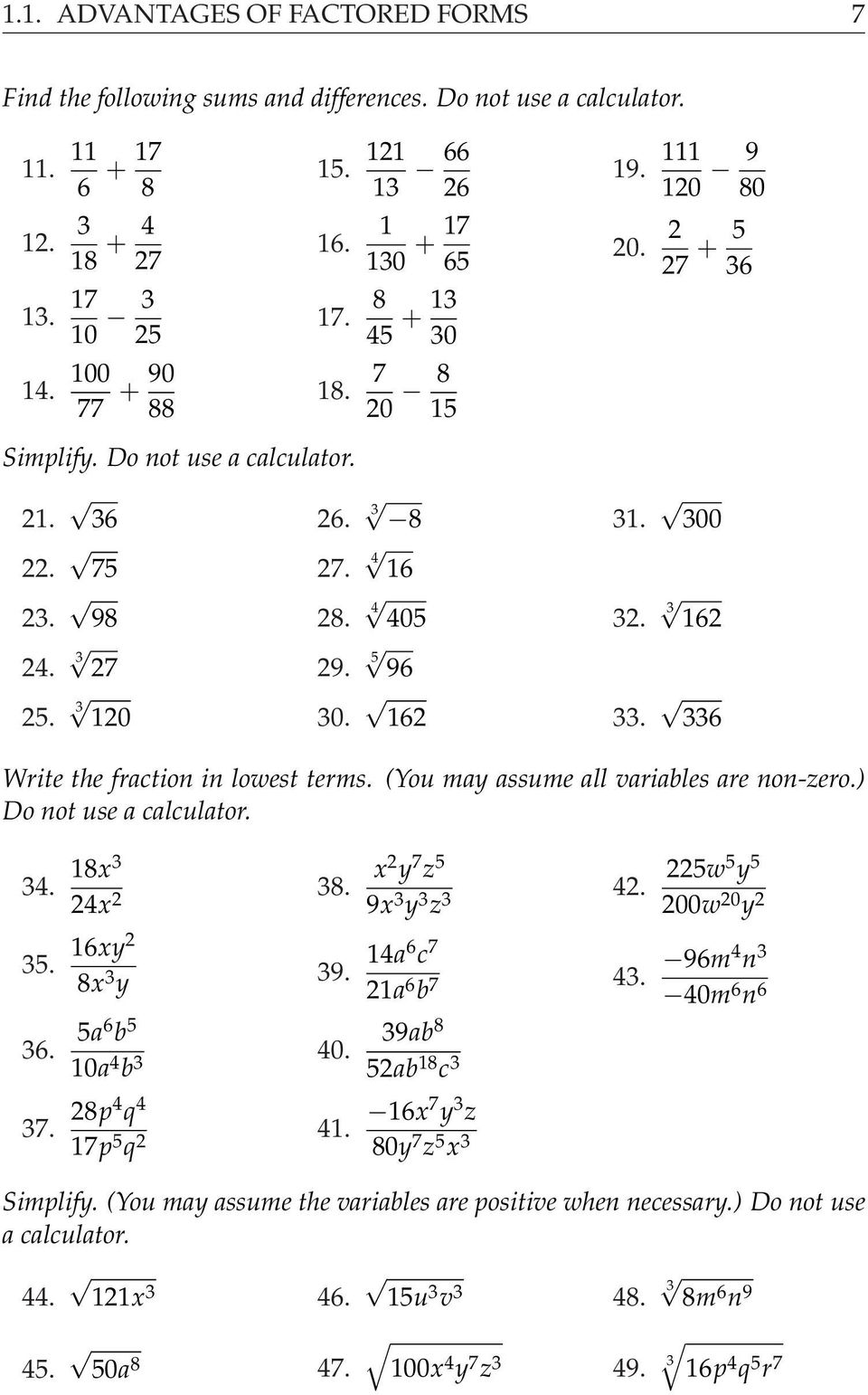
14 8 CHAPTER. POLYNOMIALS x 3 9y x 5 36y x 4 y 6 60x 4 y 5 98a x a 3

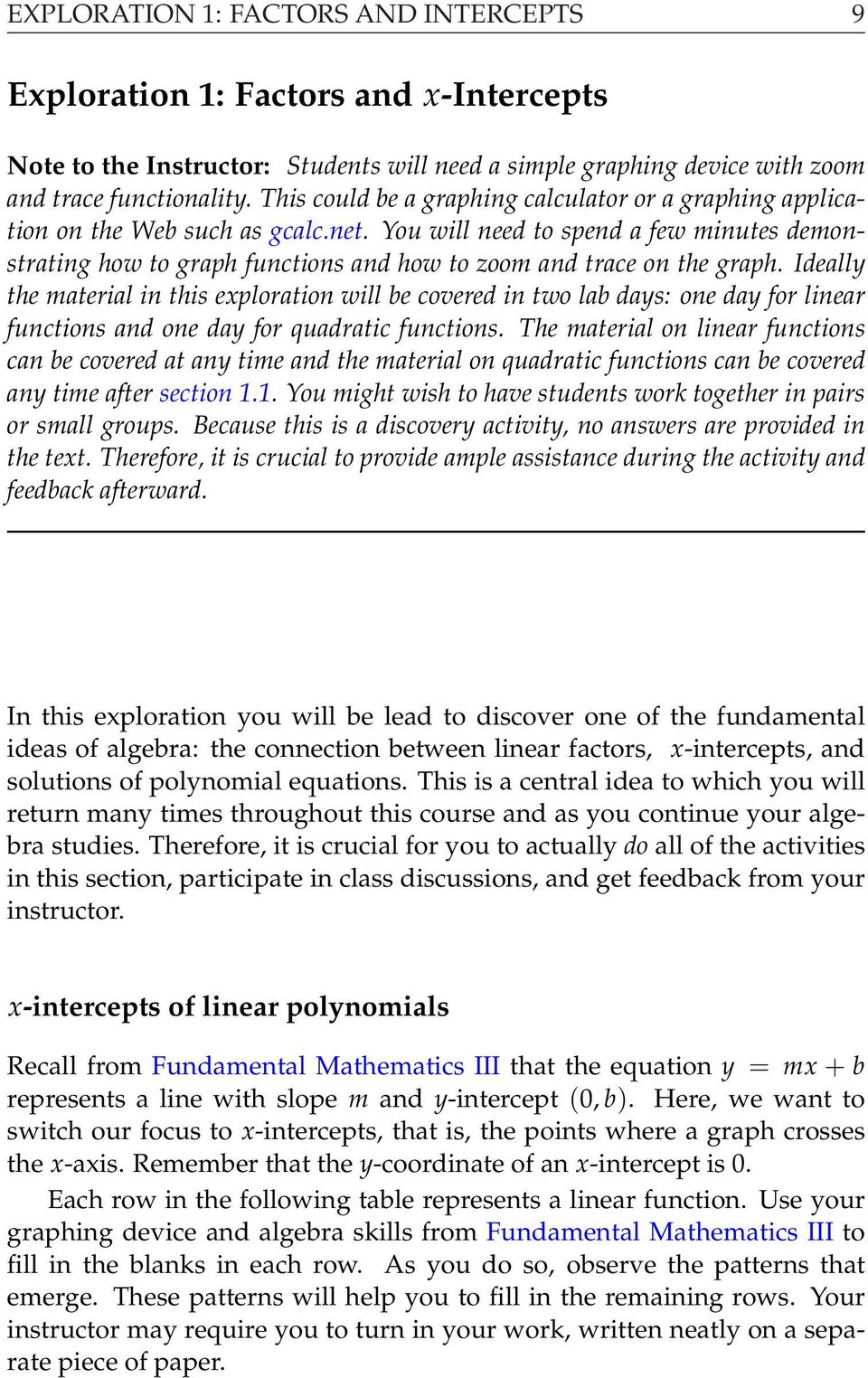
15 EXPLORATION : FACTORS AND INTERCEPTS 9 Exploration : Factors and x-intercepts Note to the Instructor: Students will need a simple graphing device with zoom and trace functionality. This could be a graphing calculator or a graphing application on the Web such as gcalc.net. You will need to spend a few minutes demonstrating how to graph functions and how to zoom and trace on the graph. Ideally the material in this exploration will be covered in two lab days: one day for linear functions and one day for quadratic functions. The material on linear functions can be covered at any time and the material on quadratic functions can be covered any time after section.. You might wish to have students work together in pairs or small groups. Because this is a discovery activity, no answers are provided in the text. Therefore, it is crucial to provide ample assistance during the activity and feedback afterward. In this exploration you will be lead to discover one of the fundamental ideas of algebra: the connection between linear factors, x-intercepts, and solutions of polynomial equations. This is a central idea to which you will return many times throughout this course and as you continue your algebra studies. Therefore, it is crucial for you to actually do all of the activities in this section, participate in class discussions, and get feedback from your instructor. x-intercepts of linear polynomials Recall from Fundamental Mathematics III that the equation y = mx + b represents a line with slope m and y-intercept (0, b). Here, we want to switch our focus to x-intercepts, that is, the points where a graph crosses the x-axis. Remember that the y-coordinate of an x-intercept is 0. Each row in the following table represents a linear function. Use your graphing device and algebra skills from Fundamental Mathematics III to fill in the blanks in each row. As you do so, observe the patterns that emerge. These patterns will help you to fill in the remaining rows. Your instructor may require you to turn in your work, written neatly on a separate piece of paper.
16 0 CHAPTER. POLYNOMIALS y = mx + b form y = m(x c) form Slope x-intercept Solution of equation y = 0 y = x 2 y = (x 2) 2 y = x 3 y = (x 3) 3 (35, 0) 4 x = 7 5 y = x + 8 y = (x ( 8)) 6 y = x ( 2, 0) 8 x = 0 9 y = 3x 8 y = 3(x 6) 0 y = 2x 5 (2, 0) 2 x = 3 y = 4x + 2 y = 4(x ( 3)) 4 y = 7x ( 0, 0) 6 9 x = 3 7 m x = c

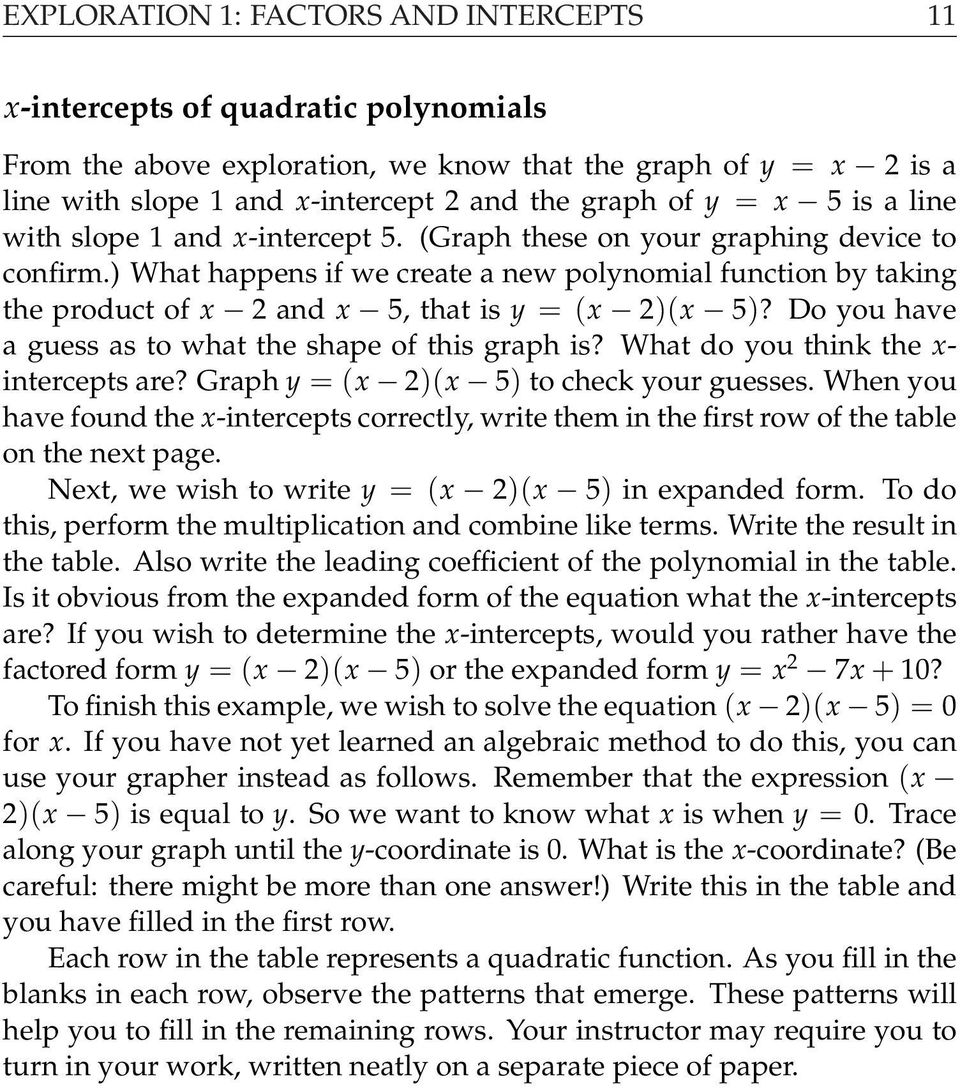
17 EXPLORATION : FACTORS AND INTERCEPTS x-intercepts of quadratic polynomials From the above exploration, we know that the graph of y = x 2 is a line with slope and x-intercept 2 and the graph of y = x 5 is a line with slope and x-intercept 5. (Graph these on your graphing device to confirm.) What happens if we create a new polynomial function by taking the product of x 2 and x 5, that is y = (x 2)(x 5)? Do you have a guess as to what the shape of this graph is? What do you think the x- intercepts are? Graph y = (x 2)(x 5) to check your guesses. When you have found the x-intercepts correctly, write them in the first row of the table on the next page. Next, we wish to write y = (x 2)(x 5) in expanded form. To do this, perform the multiplication and combine like terms. Write the result in the table. Also write the leading coefficient of the polynomial in the table. Is it obvious from the expanded form of the equation what the x-intercepts are? If you wish to determine the x-intercepts, would you rather have the factored form y = (x 2)(x 5) or the expanded form y = x 2 7x + 0? To finish this example, we wish to solve the equation (x 2)(x 5) = 0 for x. If you have not yet learned an algebraic method to do this, you can use your grapher instead as follows. Remember that the expression (x 2)(x 5) is equal to y. So we want to know what x is when y = 0. Trace along your graph until the y-coordinate is 0. What is the x-coordinate? (Be careful: there might be more than one answer!) Write this in the table and you have filled in the first row. Each row in the table represents a quadratic function. As you fill in the blanks in each row, observe the patterns that emerge. These patterns will help you to fill in the remaining rows. Your instructor may require you to turn in your work, written neatly on a separate piece of paper.
18 2 CHAPTER. POLYNOMIALS Expanded Form Factored Form Lead Coeff x-int(s) Solutions of equation y = 0 y = (x 2)(x 5) 2 y = x 2 3x + 2 y = (x 2)(x ) 3 (5, 0), (3, 0) 4 x = 7, 2 5 y = x 2 + 5x 24 y = (x + 8)(x 3) 6 y = x 2 + 2x ( 20, 0), (4, 0) 8 x = 5, 4 9 y = 2x 2 2x 4 y = 2(x + )(x 7) 0 y = 5x x (, 0), (, 0) 2 0 x = 2, 2 3 y = 2x 2 + 5x 3 y = 2(x 2 )(x + 3) 4 y = 5x 2 + 2x ( 2, 0), ( 2 3, 0) 6 2 x = 7 2, 7 may omit a x = d, d 2

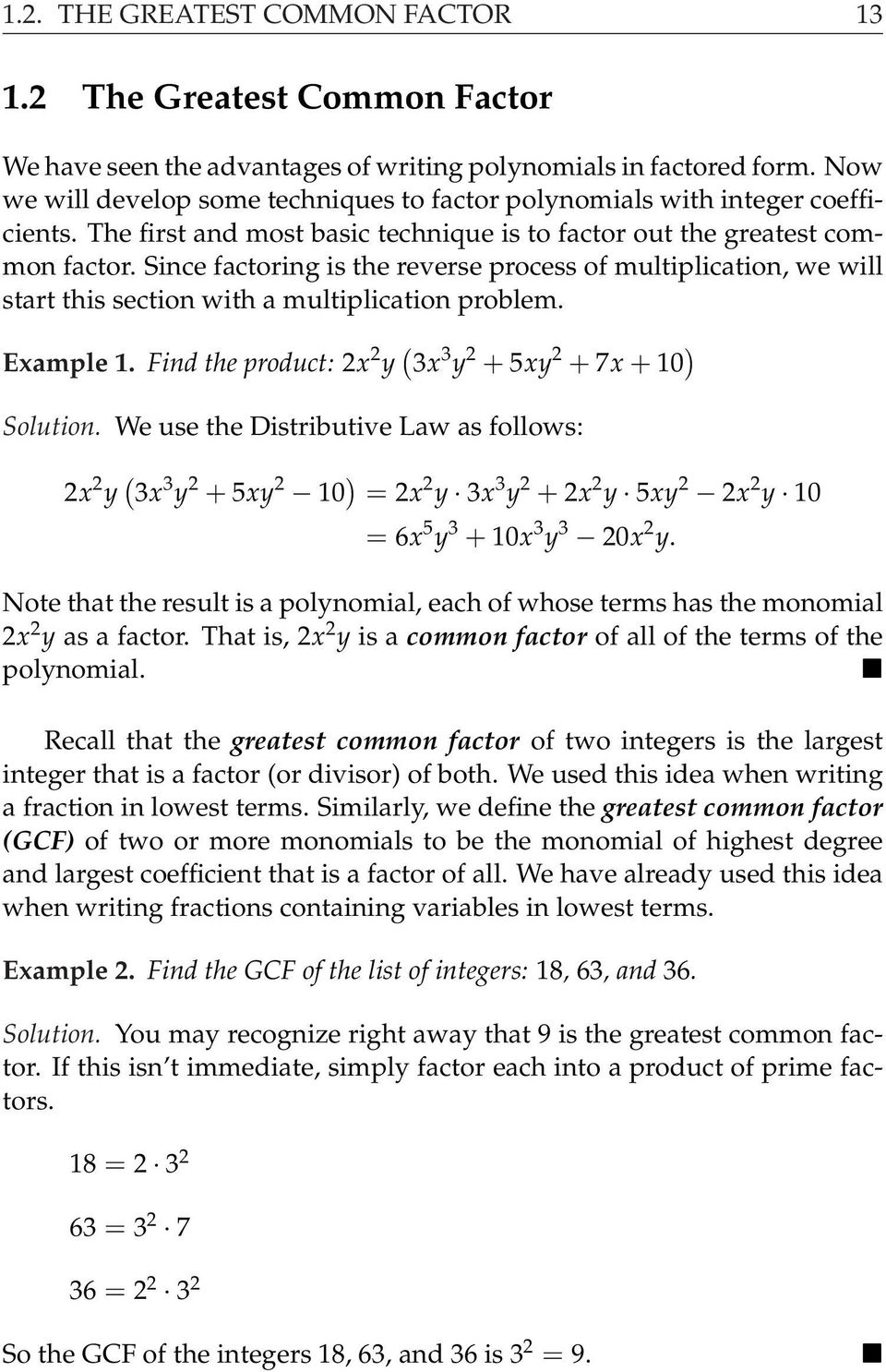
19 .2. THE GREATEST COMMON FACTOR 3.2 The Greatest Common Factor We have seen the advantages of writing polynomials in factored form. Now we will develop some techniques to factor polynomials with integer coefficients. The first and most basic technique is to factor out the greatest common factor. Since factoring is the reverse process of multiplication, we will start this section with a multiplication problem. Example. Find the product: 2x 2 y ( 3x 3 y 2 + 5xy 2 + 7x + 0 ) Solution. We use the Distributive Law as follows: 2x 2 y ( 3x 3 y 2 + 5xy 2 0 ) = 2x 2 y 3x 3 y 2 + 2x 2 y 5xy 2 2x 2 y 0 = 6x 5 y 3 + 0x 3 y 3 20x 2 y. Note that the result is a polynomial, each of whose terms has the monomial 2x 2 y as a factor. That is, 2x 2 y is a common factor of all of the terms of the polynomial. Recall that the greatest common factor of two integers is the largest integer that is a factor (or divisor) of both. We used this idea when writing a fraction in lowest terms. Similarly, we define the greatest common factor (GCF) of two or more monomials to be the monomial of highest degree and largest coefficient that is a factor of all. We have already used this idea when writing fractions containing variables in lowest terms. Example 2. Find the GCF of the list of integers: 8, 63, and 36. Solution. You may recognize right away that 9 is the greatest common factor. If this isn t immediate, simply factor each into a product of prime factors. 8 = = = So the GCF of the integers 8, 63, and 36 is 3 2 = 9.
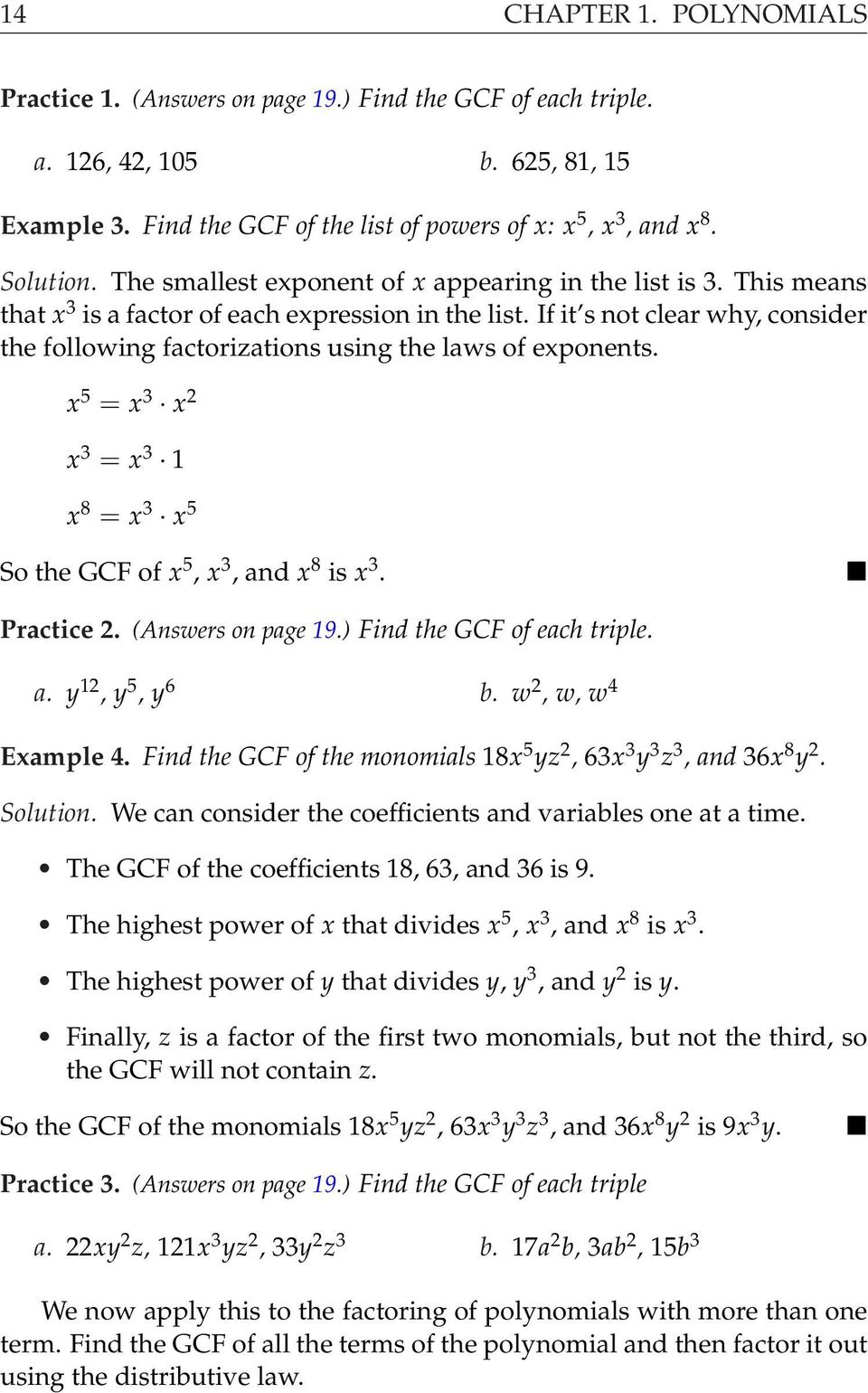
20 4 CHAPTER. POLYNOMIALS Practice. (Answers on page 9.) Find the GCF of each triple. a. 26, 42, 05 b. 625, 8, 5 Example 3. Find the GCF of the list of powers of x: x 5, x 3, and x 8. Solution. The smallest exponent of x appearing in the list is 3. This means that x 3 is a factor of each expression in the list. If it s not clear why, consider the following factorizations using the laws of exponents. x 5 = x 3 x 2 x 3 = x 3 x 8 = x 3 x 5 So the GCF of x 5, x 3, and x 8 is x 3. Practice 2. (Answers on page 9.) Find the GCF of each triple. a. y 2, y 5, y 6 b. w 2, w, w 4 Example 4. Find the GCF of the monomials 8x 5 yz 2, 63x 3 y 3 z 3, and 36x 8 y 2. Solution. We can consider the coefficients and variables one at a time. The GCF of the coefficients 8, 63, and 36 is 9. The highest power of x that divides x 5, x 3, and x 8 is x 3. The highest power of y that divides y, y 3, and y 2 is y. Finally, z is a factor of the first two monomials, but not the third, so the GCF will not contain z. So the GCF of the monomials 8x 5 yz 2, 63x 3 y 3 z 3, and 36x 8 y 2 is 9x 3 y. Practice 3. (Answers on page 9.) Find the GCF of each triple a. 22xy 2 z, 2x 3 yz 2, 33y 2 z 3 b. 7a 2 b, 3ab 2, 5b 3 We now apply this to the factoring of polynomials with more than one term. Find the GCF of all the terms of the polynomial and then factor it out using the distributive law.
21 .2. THE GREATEST COMMON FACTOR 5 Example 5. Factor out the GCF of each of the following polynomials. a. P(x) = 8x + 4 b. P(x) = 9x 3 2x 2 + 5x c. P(x, y, z) = 8x 5 yz x 3 y 3 z x 8 y 2 Solution. a. The GCF of the terms 8x and 4 is 4. Thus, we obtain P(x) = 8x + 4 = 4 2x + 4 = 4 (2x + ). b. The GCF of the terms 9x 3, 2x 2, and 5x is 3x. Thus, we obtain P(x) = 9x 3 2x 2 + 5x = 3x 3x 2 3x 4x + 3x 5 = 3x ( 3x 2 4x + 5 ). c. We saw in the example above that the GCF of the terms of this polynomial is 9x 3 y. Thus, we obtain P(x, y, z) = 8x 5 yz x 3 y 3 z x 8 y 2 = 9x 3 y 2x 2 z 2 + 9x 3 y 7y 2 z 3 + 9x 3 y 4x 5 y = 9x 3 y ( 2x 2 z 2 + 7y 2 z 3 + 4x 5 y ). Practice 4. (Answers on page 9.) Factor the GCF out of each polynomial. a. P(x) = x 2 x c. P(x, y) = 8x 2 y 2 36xy xy 5 b. P(y) = 5y 2 + 0y 5 If the leading coefficient of the polynomial is negative, it is customary to factor out the negative. It is important to factor out of each term. Example 6. Factor out the GCF of P(t) = 00t t 3 25t 2 25t.
22 6 CHAPTER. POLYNOMIALS Solution. The GCF of the terms of this polynomial is 25t. Since the leading coefficient, 00, is negative, we will factor out 25t. Thus, we obtain P(t) = 00t t 3 25t 2 25t ( = ( 25t) 4t 4) + ( 25t) ( 3t 2) + ( 25t) (5t) + ( 25t) () ( ) = 25t 4t 4 3t 2 + 5t +. Don t forget the last term of the second factor! Since the expression being factored out is one of the terms of the polynomial, we are left with a factor of for that term when the GCF is factored out. Practice 5. (Answers on page 9.) Factor the GCF out of each polynomial. a. P(x) = 9x 5 + 2x 4 5x 3 + 3x 2 b. P(s, t) = s 4 t 2 + 5s 3 t 3 s 2 t 4 In the previous examples, the GCF has been a monomial. However, it is also possible to have a binomial as a common factor. Example 7. Factor out the GCF of P(x) = 3x(x + 2) 5(x + 2). Solution. The GCF of the terms of this polynomial is the binomial (x + 2). Thus, we obtain P(x) = 3x(x + 2) 5(x + 2) = (x + 2)[3x 5]. Practice 6. Factor the GCF out of the polynomial: P(y) = 2y 2 (3y ) + 7(3y ) (Answers on page 9.) Application: Compound Interest In Fundamental Mathematics II, we developed the formula for simple interest I = Prt where I is the amount of interest earned; P is the principal (amount invested); r is the interest rate; and t is the length of time of the investment. In practice, interest in a savings account is usually compounded. That is, the interest earned is deposited back into the account and so, for the next compounding period, the investor earns interest on the interest as well as
23 .2. THE GREATEST COMMON FACTOR 7 on the principal. We will now develop a formula for computing the value of an investment when interest is compounded annually. Suppose $00 is invested in an account earning 5% annual interest. At the end of the first year (after the first compounding), the total amount in the account is the original $00 plus the interest earned on $00, which is 5% of $00, or 0.05 $00 = $5. If A(t) represents the amount in the account after t years, then we can write this as A() = = 00( ) = 00(.05) = 05. At the end of the second year (after the second compounding), the total in the account is the $05 from the beginning of the second year plus the interest earned on $05 which is 5% of $05 or So we have A(2) = = 05( ) = 05(.05) = [00(.05)] (.05) = 00(.05) 2. Here we have used the fact that 05 was obtained as 00(.05) in the first computation. Next, at the end of the third year (after the third compounding), the total in the account is the $00(.05) 2 from the beginning of the third year plus the interest earned on $00(.05) 2. This time we have A(3) = 00(.05) (.05) 2 = 00(.05) 2 ( ) = 00(.05) 2 (.05) = 00(.05) 3. Have you detected a pattern yet? Let s try one more compounding. At the end of the fourth year (after the fourth compounding), the total in the account is the $00(.05) 3 from the beginning of the fourth year plus the
24 8 CHAPTER. POLYNOMIALS interest earned on $00(.05) 3. This time we have A(4) = 00(.05) (.05) 3 = 00(.05) 3 ( ) = 00(.05) 3 (.05) = 00(.05) 4. Now it s your turn to continue this pattern. Practice 7. (Answers on the facing page.) Show that after 5 years, the amount in the account is 00(.05) 5. We will now generalize this to develop a formula. Let A(t) be the amount after t years when P is invested at the annual interest rate r. After year, the account holds P plus the interest earned on P, which is Pr. A() = P + Pr = P( + r). After 2 years, the account holds A() (= P( + r)) plus the interest earned on A(), which is A()r. A(2) = A() + A()r = A()[ + r] = P( + r)[ + r] = P( + r) 2. After 3 years, the account holds A(2) (= P( + r) 2 ) plus the interest earned on A(2), which is A(2)r. A(3) = A(2) + A(2)r = A(2)[ + r] = P( + r) 2 [ + r] = P( + r) 3. Have you observed a pattern here? Practice 8. (Answers on the next page.) a. Show that after 4 years, the amount in the account is P( + r) 4.
25 .2. THE GREATEST COMMON FACTOR 9 b. Find an expression for the amount in the account after 5 years and prove that this formula is correct. Continuing in this manner we see that the amount A(t) in an account after t years where P is invested at the annual interest rate r, compounded annually is given by the formula A(t) = P( + r) t. Example 8. Find the amount in an account after 0 years if $500 is invested at an annual rate of 3.45%, compounded annually. Solution. We wish to find A(0) if P = 500 and r = Note that we must write the interest rate as a decimal. By our formula, A(0) = 500( ) 0 = 500(.0345) where we have rounded to the nearest penny. Practice 9. (Answers below.) Find the amount in an account after 25 years if $2000 is invested at an annual rate of 2.5%, compounded annually. Round your answer to the nearest penny. ANSWERS TO SECTION.2 PRACTICE PROBLEMS. (a) 2 (b) 8. (a) Proof: 2. (a) y 5 (b) w 3. (a) yz (b) b A(4) = A(3) + A(3)r = A(3)[ + r] = P( + r) 3 [ + r] = P( + r) (a) x(x ) (b) 5(y 2 + 2y 3) (c) 6xy 2 (3x 6y + 0y 3 ) (b) Proof: 5. (a) 3x 2 (3x 3 7x 2 + 5x ) (b) s 2 t 2 (s 2 5st + t 2 ) 6. (3y )(2y 2 + 7) 7. Proof: A(5) = 00(.05) (.05) 4 A(5) = A(4) + A(4)r = A(4)[ + r] = P( + r) 4 [ + r] = P( + r) 5. = 00(.05) 4 ( ) = 00(.05) 4 (.05) 9. $ = 00(.05) 5.
26 20 CHAPTER. POLYNOMIALS SECTION.2 EXERCISES: (Answers are found on page 35.) Find GCF of the following pairs and triples.. 52 and and and and , 9, and , 40, and , 8, and , 36, and , 40, and , 60, and 8 Find GCF of the following pairs and triples.. x 4, x 8, and x 7 2. y 2, y 5, and 3. x 3 y 2, xy 5, and x 6 y 3 4. x 5 y 3, x 3 y 2, and x 5 y 4 5. x 3 y 2 z, x 5 y 2 z 3, and x 2 y 4 z 2 6. xy 2, y 3 z 2, and x 4 z x 2 y and 36x 5 y x 5 yz 2, 5x 2 y 2 z 3, and 24x 3 y 2 z x 3 y 3 z 2, 0x 4 y 2 z, and 8x 3 y 4 z x 2 y 2, 25x 2 z 3, and 35x 3 z 3 Factor out the GCF of the following polynomials. 2. 5x x 3 39x 23. 0x 2 + 5x x 3 + 6x 2 7x 25. 8x 6 + 8x 4 + 8x x 3 + 2x 2 + 3x a 8 8a 6 30a x 4 y x 2 y 8 32x 3 y x 2 y 2 + 4x 2 y 6xy x 3 y 2 z 2 + 3x 2 y 3 z 2 2x 2 y 2 z 3 Factor out the GCF of the following polynomials. 3. 3(x + 2) x(x + 2) 32. 3x 2 (x 2 x) + 2x(x 2 x) 33. x(y 3) + 5(y 3) 34. 5x(x + y) + 4y(x + y) 35. 3x 2 (x + 6) 5x(x + 6) + 7(x + 6) 36. 7x(x 2 5x 4) + 8(x 2 5x 4)
27 .2. THE GREATEST COMMON FACTOR y(xy + ) + 3x(xy + ) 38. x 2 y(x 2 y 2 ) xy 2 (x 2 y 2 ) 39. 5x 2 (5x 2 6) 6(5x 2 6) 40. 3x(x 2 + 9x ) (x 2 + 9x ) Factor out the GCF of the following polynomials. 4. x 2 (x 2 + 2x + 3) 0x(x 2 + 2x + 3) 2(x 2 + 2x + 3) 42. xy(2x 2 + 3xy + y) 4x(2x 2 + 3xy + y) + 5y(2x 2 + 3xy + y) 43. (x 2 3x)(x 2 + 4x + 5) + (6x + 2)(x 2 + 4x + 5) 44. (2x + 3y)(6x 5y) + 6(6x 5y) 45. 3x 2 (x 2 + xy + y) 26(x 2 + xy + y) 46. 5(x + 3)(3x 2 5) + 25(3x 2 5) Solve each problem, showing all work. 47. We are investing $000 in an account which has an annual rate of 5% compounded annually. Round your answers to the nearest penny. (a) How much is in the account after year? (b) How much is in the account after 2 years? (c) How much is in the account after 5 years? (d) How much is in the account after 0 years? (e) How much is in the account after 20 years? (f) What function describes the amount in the account after t years? 48. We are investing $750 in an account which has an annual rate of 3.75% compounded annually. Round your answers to the nearest penny. (a) How much is in the account after year? (b) How much is in the account after 2 years? (c) How much is in the account after 7 years? (d) How much is in the account after 2 years? (e) How much is in the account after 25 years? (f) What function describes the amount in the account after t years?
28 22 CHAPTER. POLYNOMIALS.3 Factoring Special Products In this section, we will learn to recognize and factor polynomials which follow certain patterns. Perfect square of a binomial First, we will factor trinomials which are the square of a binomial. Remembering that factoring is the reverse process of multiplication, we will first see how these patterns arise by squaring binomials. Example. Find each square; simplify the result. a. (x + 5) 2 b. (2x 3) 2 Solution. a. We may use the Distributive Law as follows. (x + 5) 2 = (x + 5) (x + 5) = x (x + 5) + 5 (x + 5) = x 2 + 5x + 5x = x 2 + 2(5x) = x 2 + 0x b. This time we will use the rectangular array approach that was introduced in Fundamental Mathematics II. The set-up is: 2x 3 2x 3 Multiplying each row entry by each column entry, we obtain: 2x 3 2x (2x) 2 6x 3 6x ( 3) 2
29 .3. FACTORING SPECIAL PRODUCTS 23 Thus,we obtain: (2x 3) 2 = (2x) 2 + 2( 6x) + ( 3) 2 = 4x 2 2x + 9 In each of these examples, we observe that the product of the binomial has three terms. The first term of the product is the square of the first term of the binomial; the third term of the product is the square of the last term of the binomial; and the middle term of the product is twice the product of the two terms of the binomial. This leads us to the following special product forms. Example 2. Factor: a. P(x) = x 2 + 4x + 49 b. P(y) = 9y 2 2y + 4 c. P(x, y) = 2x 2 + 0xy + 25y 2 Solution. a 2 + 2ab + b 2 = (a + b) 2 a 2 2ab + b 2 = (a b) 2 a. The first term of P(x) is x 2 and the last term is 7 2. Now we must check if the middle term follows either of our patterns above. Twice the product of x and 7 is 2 x 7 = 4x, which is what we have. Thus, P(x) = x 2 + 4x + 49 = (x + 7) 2. b. The first term of P(y) is (3y) 2 and the last term is 2 2. Now we must check if the middle term follows either of our patterns above. Twice the product of 3y and 2 is 2 3y 2 = 2y. Since the middle term of P(y) is 2y, we have the square of a difference. Thus, P(y) = 9y 2 2y + 4 = (3y 2) 2.
30 24 CHAPTER. POLYNOMIALS c. The first term of P(x, y) is (x) 2 and the last term is (5y) 2. Now we must check if the middle term follows either of our patterns above. Twice the product of x and 5y is 2 x 5y = 0xy, which is the middle term of P(x, y). Thus, P(x, y) = 2x 2 + 0xy + 25y 2 = (x + 5y) 2. Practice. (Answers on page 27.) Factor: a. P(x) = x 2 4x + 4 b. P(t) = 49t t + 25 c. P(x, y) = x 2 6xy + 9y 2 Sometimes we will have to use more than one factoring technique for the same polynomial. Always check first if the terms have a GCF which can be factored out. Example 3. Factor: P(t) = t 3 + 2t t. Solution. We see that t is the GCF of the three terms of P(t) and so we first factor out t. P(t) = t 3 + 2t t = t ( t 2 + 2t + 36 ) Now we try to factor the polynomial that remains. The first term of ( t 2 + 2t + 36 ) is t 2 and the last term is 6 2. Twice the product of t and 6 is 2 t 6 = 2t, which is what we have. Thus, Practice 2. (Answers on page 27.) Factor: a. P(x) = x x x 2 b. P(u, v) = 2u 2 v 4uv + 2v Difference of two squares P(t) = t(t + 6) 2. In the previous section we studied perfect squares of binomials, that is, polynomials of the form (a + b) 2 and (a b) 2. But what happens if we multiply (a + b) by (a b)? Example 4. Multiply; simplify the result.
31 .3. FACTORING SPECIAL PRODUCTS 25 a. (x 2)(x + 2) b. (3x + )(3x ) Solution. a. We may use the Distributive Law as follows. (x 2) (x + 2) = x (x + 2) 2 (x + 2) = x 2 + 2x 2x 2 2 = x 2 + 0x 2 2 = x 2 4. There are two important observations to make. First, the two x terms in the product are additive inverses of one another, so the result when simplified has just two terms. Second, the resulting binomial is the difference of two perfect squares. b. This time we will use the rectangular array approach. The set-up is: 3x 3x Performing the multiplication, we have: Thus,we obtain, 3x 3x (3x) 2 3x 3x ()( ) (3x + ) (3x ) = (3x) 2 3x + 3x = (3x) 2 + 0x 2 = 9x 2 Once again, two of the four terms of the product are additive inverses of one another. Thus, the simplified form is a binomial. Also, the result is the difference of two squares.
32 26 CHAPTER. POLYNOMIALS In fact, if we multiply any factors of the form (a b)(a + b), we obtain (a b) (a + b) = a (a b) b (a + b) = a a + ab ba b b = a b 2 = a 2 b 2 We can interpret this as a factoring formula for the difference of two squares. Example 5. Factor. a 2 b 2 = (a b)(a + b) a. P(t) = 4t 2 2 b. P(x) = x 3 x c. P(y) = y 4 8 Solution. a. We observe that 4t 2 = (2t) 2 and 2 = 2. Thus, P(t) is the difference of two squares. P(t) = 4t 2 2 = (2t) 2 2 = (2t )(2t + ). b. First we factor out the greatest common factor. P(x) = x 3 x c. Here we observe that y 4 = (y 2 ) 2. = x(x 2 ) P(y) = y 4 8 = x(x 2 2 ) = x(x )(x + ). = (y 2 ) = (y 2 9)(y 2 + 9) = (y 3)(y + 3)(y 2 + 9). Note that y is the sum of two squares and does not factor further under the real numbers.
33 .3. FACTORING SPECIAL PRODUCTS 27 We say that a polynomial such as y in Example 5c is prime (or irreducible) over the real numbers since it cannot be factored as a product of nonconstant factors with real coefficients. In fact, the sum of two squares is always prime over the real numbers. Practice 3. (Answers below.) Factor. a. P(x) = 25 49x 2 b. P(y) = y 5 36y 3 c. P(t) = 625t 4 Example 6. Factor P(x) = x 2 3. Solution. This would appear to be the difference of two squares, except that 3 is not a perfect square. That is, 3 is not the square of an integer. In fact, P(x) = x 2 3 is prime over the integers. That is, it cannot be written as a product of two polynomials with integer coefficients neither of which is or. However, if we allow real numbers other than integers as coefficients, P(x) = x 2 3 ( ) 2 = x 2 3 ( = x ) ( 3 x + ) 3 which is a perfectly good factorization over the real numbers. Practice 4. (Answers below.) Factor each of the following over the real numbers. a. P(x) = x 2 7 b. P(y) = 5y 2 c. P(t) = 4t 4 2 ANSWERS TO SECTION.3 PRACTICE PROBLEMS. (a) (x 2) 2 (b) (7t + 5) 2 (c) (x 3y) 2 2. (a) x 2 (x + 0) 2 (b) 2v(u ) 2 3. (a) (5 7x)(5 + 7x) 4. (a) (b) y 3 (y 6)(y + 6) (c) (5t )(5t + )(25t 2 + ) ( x ) ( 7 x + ) 7
34 28 CHAPTER. POLYNOMIALS (b) ( 5y ) ( 5y + ) (c) ( ) ( ) ( ) 2t 2t + 2t 2 + Multiply; simplify your answers. SECTION.3 EXERCISES: (Answers are found on page 36.). (x + 4) 2 2. (x 4) 2 3. (x + 4)(x 4) 4. (x 0) 2 5. (x + 0)(x + 0) 6. (x + 0)(x 0) 7. (2x )(2x ) 8. (2x + )(2x ) 9. (2x + )(2x + ) 0. (4x 3)(4x + 3). (3x + 7) 2 2. (4x 5)(4x 5) 3. (2x + 3y) 2 4. (3x + 5y)(3x 5y) 5. (4x 2z) 2 Factor each of the following polynomials. 6. x x x x x x x 2 + 6x x 2 8x x 2 + 4x x 2 4x x x x x + 20 Find the value(s) of b which make each of the following polynomials a square. 28. x 2 + 2x + b 29. x 2 6x + b 30. x 2 4x + b 3. x 2 + 8x + b 32. 4x 2 4x + b 33. 9x 2 + 6x + b
35 .3. FACTORING SPECIAL PRODUCTS x 2 + 2x + b x 2 30x + b 36. bx 2 + 2x bx 2 6x bx 2 + 0x bx 2 + 2x x 2 + bx + 4. x 2 + bx x 2 + bx x 2 + bx x 2 + bx x 2 + bx x 2 + bxy + y x 2 + bxy + 9y x 2 + bxy + y 2 Determine which of the following polynomials is a difference of squares. Factor those polynomials that are differences of squares. 49. x x x x x x Determine which of the following polynomials is a square. Factor those polynomials that are squares. 55. x x 2 4x x 2 + 7x x 2 + 6x x 2 2x x 2 + 6x x x x 2 4x 63. 4x 2 2x + 9 Factor the following differences of squares. 64. x y x y2 64 x x2 6
36 30 CHAPTER. POLYNOMIALS x x Factor each of the following squares. 74. x x y 2 + 4y x 2 22x w 2 36w x 2 y 2 + 4xy (xy) 2 + 0xy x x x 2 x x 2 7 (For this you need to use square roots.) 73. 5x y y z z x2 2 9 x + 6 r2 3 2 r x2 + 3 x x x x x + 4 9
37 .4. FACTORING TRINOMIALS 3.4 Factoring Trinomials In this section, we will factor trinomials which are not perfect squares. As usual, we will begin with some multiplication problems. Example. Find each product; simplify the result. a. (x + 3) (x 5) b. (2x + ) (x + 8) Solution. a. We may use the Distributive Law as follows. (x + 3) (x 5) = x (x 5) + 3 (x 5) = x 2 5x + 3x + 3( 5) = x 2 + ( 5 + 3)x 5 = x 2 + 2x 5 b. This time we will use the rectangular array approach. The set-up is: 2x x 8 Performing the multiplication, we have: x 8 2x 2x 2 6x x 8 Thus,we obtain, (2x + ) (x + 8) = 2x 2 + 6x + x + 8 = 2x 2 + (6 + )x + 8 = 2x 2 + 7x + 8 Practice. Find each product; simplify the result. (Answers on page 37.)
38 32 CHAPTER. POLYNOMIALS a. (x 7) (x 2) b. (3x 2) (2x + 6) In each of these examples, the product of the binomials has three terms after like terms have been combined. A polynomial with three terms is called a trinomial. Now we wish to factor trinomials into products of two binomials. We will restrict our attention to factorizations over the integers; that is, factorizations where the coefficients of the factors are all integers. Example 2. Factor P(x) = x 2 + x + 30 over the integers. Solution. Since the leading coefficient is, we are looking for a factorization of the form P(x) = (x + a)(x + b) where a and b are integers and the product ab = 30 and the sum a + b =. If such a factorization does not come to mind immediately, we can systematically consider all factorizations of 30 into a product of two positive integers. Thus, we claim that ab a + b = = = = P(x) = x 2 + x + 30 = (x + 5)(x + 6). We will check our factorization by multiplying. Thus, x 6 x x 2 6x 5 5x 30 (x + 5)(x + 6) = x 2 + 6x + 5x + 30 = x 2 + x + 30, which is what we claimed. Practice 2. Factor P(x) = x 2 + 5x + 6 over the integers. (Answers on page 37.)
39 .4. FACTORING TRINOMIALS 33 Example 3. Factor P(x) = x 2 x 2 over the integers. Solution. We will first list all pairs of integer factors of 2 and their sums. ab a + b = 2 2 = = = = = We are hoping to find a pair of factors of 2 whose sum is, since this is the coefficient of x. We see that the last pair in the table satisfies this condition. Therefore, P(x) = x 2 x 2 = (x + 3)(x 4). It s a good idea to check this by multiplying. Thus, x 4 x x 2 4x 3 3x 2 (x + 3)(x 4) = x 2 4x + 3x 2 = x 2 x 2, which is what we claimed. We could have reduced our work by half in the previous example by observing that, since the middle coefficient was negative, it must be the negative factor of 2 which is largest in absolute value. Practice 3. Factor P(x) = x 2 2x 35 over the integers. (Answers on page 37.) Example 4. Factor P(y) = y 2 6y + 28 over the integers. Solution. This time the constant term is positive, but the coefficient of y is negative. This means we should consider pairs of negative factors of 28.
40 34 CHAPTER. POLYNOMIALS Thus, ab a + b 28 = = = P(y) = y 2 6y + 28 = (y 2)(y 4). We leave it to the reader to check this by multiplying. Practice 4. Factor P(w) = w 2 4w + 48 over the integers. (Answers on page 37.) Example 5. Factor P(t) = 2t 5 + 2t 4 4t 3 over the integers. Solution. We begin by factoring out the GCF which is 2t 3. P(t) = 2t 5 + 2t 4 4t 3 = 2t 3 (t 2 + 6t 7) Next, we consider pairs of integer factors of 7 for which the largest factor in absolute value is positive. (Why?) No need to make a chart; since 7 is prime, the only possibility is 7. Thus, P(t) = 2t 3 (t 2 + 6t 7) = 2t 3 (t )(t + 7). The reader should check this by multiplying. Practice 5. Factor P(x) = 3x 4 + 3x 3 330x 2 over the integers. page 37.) (Answers on Example 6. Factor P(x) = x 2 + 8x + 24 over the integers, if possible. Solution. Let us consider pairs of integer factors of 24. Since both the constant term (24) and the coefficient of x (8) are positive, it suffices to consider pairs of positive integers, ab a + b = = = = 0
41 .4. FACTORING TRINOMIALS 35 This is a complete list of all pairs of positive integers whose product is 24. However, no pair in the list has a sum of 8. We conclude that P(x) is prime over the integers. Practice 6. Factor P(x) = x 2 0x + 30 over the integers, or else show that it is prime over the integers. (Answers on page 37.) Example 7. Find all values of k so that the polynomial P(x) = x 2 + kx 0 will factor into a product of linear factors over the integers. Solution. We wish to write P(x) = x 2 + kx 0 as a product of the form (x + a)(x + b) where a and b are integers. This means that ab = 0 and a + b = k. We will make a complete list of all pairs of integer factors of 0. ab a + b = k 0 0 = = = = 3 Therefore, if k is 9, 9, 3, or 3, then P(x) = x 2 + kx 0 will factor over the integers. Practice 7. (Answers on page 37.) a. Write down the four polynomials that arise in Example 7 and factor each. b. Find all values of k so that the polynomial P(x) = x 2 + kx 55 will factor into a product of linear factors over the integers. Then factor each of the resulting polynomials. Example 8. Factor P(x) = 4x 2 + 9x + over the integers, if possible. Solution. In this example, the leading coefficient is not, but the constant term is. Also, the coefficient of x is positive. Therefore our factorization will be of the form (ax + )(bx + ) for some integers a and b for which ab = 4 and a + b = 9. Let us consider pairs of (positive) integer factors of 4. ab a + b = = 9
42 36 CHAPTER. POLYNOMIALS Hence, Thus, P(x) = 4x 2 + 9x + P(x) = (2x + )(7x + ). We will check our factorization by multiplying. 7x 2x 4x 2 2x 7x (2x + )(7x + ) = 4x 2 + 2x + 7x + = 4x 2 + 9x +, which is what we claimed. Practice 8. Factor P(x) = 5x 2 8x + over the integers, if possible. (Answers on the facing page.) Example 9. Factor P(t) = 5t 2 + 4t 3 over the integers, if possible. Solution. In this example, neither the leading coefficient nor the constant term is. Our factorization will be of the form (ax + c)(bx + d) for some integers a, b, c and d for which ab = 5, cd = 3, and ad + bc = 4. That s an awful lot to keep track of! Fortunately, 5 and 3 are both prime, so there are not that many possibilities. We will use the factorization 5 = 5 for the coefficients of x in the factors. Then we need to consider four factorizations (counting order) of 3: 3 = 3 ( ), 3 = 3, 3 = ( 3), and 3 = 3. We will try all of the combinations to see which one (if any) works. (5x + 3)(x ) = 5x 2 2x 3 (5x 3)(x + ) = 5x 2 + 2x 3 (5x + )(x 3) = 5x 2 4x 3 (5x )(x + 3) = 5x 2 + 4x 3
43 .4. FACTORING TRINOMIALS 37 Hence, P(x) = 5x 2 + 4x 3 P(x) = (5x )(x + 3). Practice 9. Factor P(x) = 7x 2 + 5x 2 over the integers, if possible. below.) (Answers Example 0. Factor P(x, y) = 4x xy + y 2 over the integers, if possible. Solution. In this example, neither the leading coefficient nor the constant term is, and we have two variables. This time our factorization will be of the form (ax + cy)(bx + dy) for some integers a, b, c and d for which ab = 4, cd =, and ad + bc = 24. Note that a, b, c and d will all be positive. We have two factorizations of 4 and just one of. However, order matters when the lead coefficients of the binomials are different, so we actually have 3 possibilities to try. (4x + y)(x + y) = 4x 2 + 5xy + y 2 (4x + y)(x + y) = 4x xy + y 2 (2x + y)(2x + y) = 4x xy + y 2 Hence, P(x, y) = 4x xy + y 2 P(x) = (2x + y)(2x + y). Practice 0. Factor P(x) = 6x 2 + 3xy + 5y 2 over the integers, if possible. (Answers below.) ANSWERS TO SECTION.4 PRACTICE PROBLEMS. (a) x 2 9x + 84 (b) 6x 2 + 4x 2 2. (x + 2)(x + 3) 3. (x + 5)(x 7) 4. (w 6)(w 8) 5. 3x 2 (x 0)(x + )
44 38 CHAPTER. POLYNOMIALS 6. prime over the integers 7. (a) P(x) = x 2 9x 0 = (x + )(x 0) P(x) = x 2 + 9x 0 = (x )(x + 0) P(x) = x 2 3x 0 = (x + 2)(x 5) P(x) = x 2 + 3x 0 = (x 2)(x + 5) (b) k = 54, 54, 6, 6 P(x) = x 2 54x 55 = (x + )(x 55) 8. (3x )(5x ) 9. (7x 2)(x + ) 0. (2x + y)(3x + 5y) P(x) = x x 55 = (x )(x + 55) P(x) = x 2 6x 55 = (x + 5)(x ) P(x) = x 2 + 6x 55 = (x 5)(x + ) SECTION.4 EXERCISES: (Answers are found on page 37.) Factor the following trinomials (over the integers).. x 2 + 3x x 2 x 2 3. x 2 + 2x 3 4. x 2 + 6x 7 5. x 2 2x + 6. x 2 0x 7. x 2 + 5x x 2 2x 8 9. x 2 7x x 2 + 9x 4. 2x 2 3x x 2 + 6x x 2 4x x x x 2 + 8x x 2 + 4xy + 4y 2 7. x 2 7xy + 2y x 2 + xy + 2y 2 Determine which of the following trinomials can be factored into a product of linear factors (over the integers) and which are prime (over the integers). 9. x 2 + 4x x 2 + 9x x 2 + x x 2 + x x 2 + x x 2 + 3x x 2 + 4x x 2 + 9x x 2 + 5x x 2 + 7x x 2 + 9x x x + 0
45 .4. FACTORING TRINOMIALS x 2 + 5xy + 7y x 2 + 2xy 5y x 2 9xy + 8y 2 For each of the following polynomials, find all the values for b so that the polynomial will factor into a product of linear factors (over the integers). 34. x 2 + bx x 2 + bx x 2 + bx x 2 + bx x 2 + bx x 2 + bx x 2 + bx x 2 + bx 42. x 2 + bx x 2 + bx x 2 + bx x 2 + bx x 2 + bxy + 9y x 2 + bxy 8y x 2 + bxy 2y 2 Factor the following polynomials (over the integers) x x x 3 45x 5. 6x 2 40xy + 6y x x x 3 63x y t y 4 26y x 0 98x a 5a n 3 300n 2 375n 60. 6x 3 + 2x 2 2x
46 40 CHAPTER. POLYNOMIALS.5 Polynomial Equations and Inequalities Now that we have learned many techniques for factoring polynomials, we will return to one of the examples that motivated our discussion of factors in the first place. Example. A student throws his calculator off the top of a 96-foot tall building with a downward velocity of 6 feet per second. When does the calculator hit the ground? Solution. Recall that if we ignore air resistance, the height of the calculator above the ground, in feet, after t seconds is given by the formula h(t) = 6t 2 6t Since a calculator on the ground has height 0, we are asked to find the value(s) of t for which h(t) = 0. Using our formula for h(t), we see that we need to solve the equation 6t 2 6t + 96 = 0 for t. Factoring the left-hand side, we obtain: 6 ( t 2 + t 6 ) = 0 6(t + 3)(t 2) = 0 So the solutions to this equation are precisely the values of t for which the product of 6, t + 3, and t 2 is equal to zero. However, zero has a special property. It is impossible to multiply two nonzero numbers to obtain a product of zero. In other words, if a product is zero, then at least one of the factors must be zero. Thus, we conclude that 6 = 0 or t + 3 = 0 or t 2 = 0. Since 6 = 0, we must have That is, t + 3 = 0 or t 2 = 0. t = 3 or t = 2. As usual, we should check our answers in the original equation. Check t = 3: 6( 3) 2 6( 3) + 96 = 6(9) = = 0.
47 .5. POLYNOMIAL EQUATIONS AND INEQUALITIES 4 Check t = 2: 6(2) 2 6(2) + 96 = 6(4) = = 0. Both solutions are mathematically correct. However, only one makes sense in the context of the original problem. It doesn t make sense for the calculator to hit the ground 3 seconds before it is actually thrown, so we discard the solution t = 3. We conclude that the calculator hits the ground 2 seconds after it is thrown. The key idea in the solution to an equation by factoring is the Zero Product Property. Let a and b be real numbers. If ab = 0, then a = 0 or b = 0 (or both). Example 2. Solve: (x 3) (x + 2) = 0 Solution. We have a product equal to zero. By the Zero Product Property, at least one of the factors must be zero. That is, x 3 = 0 or x + 2 = 0. Solving each of the resulting linear equations for x, we obtain: x = 3 or x = 2. We leave it to the reader to check each solution in the original equation. Practice. Solve for the variable: (2x )(x + 4) = 0 (Answers on page 49.) Example 3. Solve each of the following equations for the variable. a. x 2 3x = 0 b. x(x 3) = 30 c. 3t(t + 2) + 4 = t + 6
48 42 CHAPTER. POLYNOMIALS Solution. a. Since the right-hand side is 0, we start by factoring the left-hand side. x 2 3x = 0 x(x 3) = 0 Using the Zero Product Property, we obtain: x = 0 or x 3 = 0, and so x = 0 or x = 3. b. Although the left-hand side is factored, we cannot conclude that x = 30 or x 3 = 30. This is because there is no 30 Product Property analogous to the Zero Product Property! It is quite possible to have a product of two numbers equal to 30 even though neither number is itself 30. (Consider 5 6, for example.) Thus, we must first do a little algebra to get 0 on one side of the equation. x(x 3) = 30 x 2 3x = 30 x 2 3x + 30 = x 2 3x + 30 = 0 (x 3)(x 0) = 0 Now using the Zero Product Property, we obtain: x 3 = 0 or x 0 = 0, and so x = 3 or x = 0. c. Again, we have a bit of algebra to do before we can factor. 3t(t + 2) + 4 = t + 6 3t 2 + 6t + 4 = t + 6 3t 2 + 6t + 4 t 6 = t + 6 t 6 3t 2 + 5t 2 = 0 (3t )(t + 2) = 0
49 .5. POLYNOMIAL EQUATIONS AND INEQUALITIES 43 Using the Zero Product Property, we obtain: 3t = 0 or t + 2 = 0, and so 3t = or t = 2, and so t = 3 or t = 2. Practice 2. Solve for the variable: 2x(x + 3) = 4 (Answers on page 49.) Example 4. Solve: 25y y + 4 = 0 Solution. We note that the right-hand side is 0 and the left-hand side is a perfect square. 25y y + 4 = 0 (5y) y = 0 (5y + 2) 2 = 0 Using the Zero Product Property, we obtain: 5y + 2 = 0 5y = 2 y = 2 5 In this example, we had just one solution since the quadratic polynomial was the square of a binomial. Practice 3. Solve for the variable by factoring: 9t 2 42t + 49 = 0 (Answers on page 49.) Example 5. Solve for the variable by factoring: 4x 2 = 9 Solution. We will solve this equation in two ways. a. We can solve by factoring, as in the preceding examples in this section. 4x 2 = 9 4x 2 9 = 0 (2x) = 0 (2x 3)(2x + 3) = 0
50 44 CHAPTER. POLYNOMIALS Using the Zero Product Property, we obtain: 2x 3 = 0 or 2x + 3 = 0, and so 2x = 3 or 2x = 3, and so x = 3 2 or x = 3 2. b. Since there is no linear term, we can solve this by taking square roots. Recall that x2 = x. Thus, 4x 2 = 9 4x2 = 9 4 x2 = 9 2 x = 3 2x = ±3 x = ± 3 2. Note that we get the same two solutions when taking square roots. Practice 4. (Answers on page 49.) a. Solve for the variable by factoring: 6w 2 = b. Solve for the variable by taking square roots: 8t 2 49 = 0 Example 6. Solve for the variable. a. (x 7) ( 2x 2 + 5x + 3 ) = 0 b. u 3 7u 2 = 2u Solution. We will solve each of these by factoring. a. This polynomial is already partially factored. (x 7)(2x 2 + 5x + 3) = 0 (x 7)(2x + 3)(x + ) = 0
51 .5. POLYNOMIAL EQUATIONS AND INEQUALITIES 45 And so by Zero Product Property, x 7 = 0 or 2x + 3 = 0 or x + = 0 and so x = 7 or 2x = 3 or x = and so x = 7 or x = 3 2 or x =. b. Here we will first factor out the GCF. u 3 7u 2 = 2u u 3 7u 2 + 2u = 0 u(u 2 7u + 2) = 0 u(u 3)(u 4) = 0 And so by Zero Product Property, u = 0 or u 3 = 0 or u 4 = 0 and so u = 0 or u = 3 or u = 4. Practice 5. Solve for the variable. (Answers on page 49.) a. (4t )(t 2 + 6t 6) = 0 b. 5y 4 = 7y 3 2y 2 Polynomial inequalities We have seen that the factored form of a polynomial is useful for solving equations because of the Zero Product Property. Now we will see how these ideas can be applied to the solution of inequalities. Recall that the product of two positive factors is positive, the product of two negative factors is positive, and the product of one positive with one negative factor is negative. Example 7. Find all x for which (x + )(x 4) > 0.
52 46 CHAPTER. POLYNOMIALS Solution. We need to find all values of x for which the factors x + and x 4 are either both positive or both negative. We will first find where each of these linear factors is equal to zero, since that is where it will change sign. x + = 0 x 4 = 0 x = x = 4. Thus, and 4 are the boundary points where the value of the product (x + )(x 4) can change sign. These two boundary points divide the real line into three intervals (reading from left to right on the real line): (, ), (, 4), and (4, ). We will first determine the sign of each linear factor on each of these three intervals. We construct a sign chart. This is a table with the intervals determined by the roots of the linear factors labeling the columns (from left to right on the real line) and the linear factors labeling the first two rows, while the product itself labels the last row. x + x 4 (x + )(x 4) (, ) (, 4) (4, ) Each cell in the body of the sign chart will be filled with + or, depending on the sign of the corresponding expression for x in the corresponding interval. Note that if x is in (, ), then x is less than and so x + is less than 0. If x is greater than, then x + is greater than 0. (If this is not apparent, the reader can test values of x from each interval in the linear factor.) Thus, we fill in the first row of the sign chart. The second row is filled in similarly. (, ) (, 4) (4, ) x x 4 + (x + )(x 4)
53 .5. POLYNOMIAL EQUATIONS AND INEQUALITIES 47 Next, we wish to find the sign of the product (x + )(x 4) on each of the three intervals. To do this, we may simply multiply down the signs in each column. For example, for x (, ), both x + and x 4 are negative, so their product is positive. We complete the rest of the third row in the same way to obtain: (, ) (, 4) (4, ) x x 4 + (x + )(x 4) + + Now the problem was to find the values of x for which (x + )(x 4) > 0. From the sign chart, we see that the product is positive for x in the first and third interval in our sign chart. Since it is a strict inequality, the boundary points are not included in the solution set. Thus, the solution set consists of the union of these intervals, that is, (, ) (4, ). Practice 6. Solve for the variable: (2x )(x + 4) < 0 Express your solution set in interval notation. (Answers on page 49.) Example 8. Solve for t: t(t + 5) 50. Solution. Our method enables us to find where a factored expression is positive or negative, that is, greater than or less than 0. Therefore, we must perform some algebra to get 0 on one side and a factored polynomial on the other side. t(t + 5) 50 t 2 + 5t 50 t 2 + 5t 50 0 (t + 0)(t 5) 0 We want the product of t + 0 and t 5 to be negative or equal to 0, so we need to find all values of t for which one the factors is negative and the other is positive or where one of these factors is equal to zero. We first determine where each is 0. t + 0 = 0 t 5 = 0 t = 0 t = 5.
54 48 CHAPTER. POLYNOMIALS Thus, 0 and 5 are the boundary points where the value of the product (t + 0)(t 5) can change sign. These two boundary points divide the real line into three intervals (reading from left to right on the real line): (, 0), ( 0, 5), and (5, ). Next, we construct a sign chart. The labels are as follows: t + 0 t 5 (t + 0)(t 5) (, 0) ( 0, 5) (5, ) Now we fill in the body of the sign chart. If t is in (, 0), then t is less than 0 and so t + 0 is less than 0. If t is greater than 0, then t + 0 is greater than 0. (Again, the reader can test values of t from each interval in the linear factor.) Thus, we fill in the first row of the sign chart. The second row is filled in similarly. (, 0) ( 0, 5) (5, ) t t 5 + (t + 0)(t 5) Next, we multiply down each column to find the sign of the product (t + 0)(t 5) on each of the three intervals. (, 0) ( 0, 5) (5, ) t t 5 + (t + 0)(t 5) + + Now the problem was to find the values of t for which (t + 0)(t 5) 0. From the sign chart, we see that the product is negative for t in the middle interval in our sign chart. The product is 0 at the boundary points. Thus, the solution set is [ 0, 5].
55 .5. POLYNOMIAL EQUATIONS AND INEQUALITIES 49 Practice 7. Solve for the variable: t(t 2) 2t 3 Express your solution set in interval notation. (Answers below.) ANSWERS TO SECTION.5 PRACTICE PROBLEMS. x = 4, 2 4. (a) w = ± 4 (b) y = 0, 2 5, 2. x = 2, (b) t = ± ( 4, ) 2 3. t = (a) t = 8, 4, 2 7. (, ] [3, ) SECTION.5 EXERCISES: (Answers are found on page 38.) Solve the following equations.. (x 3)(x + 2) = 0 2. (x 7)(x 2) = 0 3. (x + 3)(x + 4) = 0 4. x(x 6) = 0 5. (x + 4)(x + 4) = (x + )(x 4) = 0 7. (2x + )(x + 6) = 0 8. (3x 2)(4x ) = (0x + )(7x 2) = 0 0. x 2 + 3x 4 = 0. x 2 7x + 2 = 0 2. x 2 + 0x + 25 = x 2 + 8x + 27 = x 2 + 6x + = x 2 8x + 3 = 0 6. x(x 3) = 4 7. (x + )(x + 2) = 2 8. x 2 + 0x = x 2 + 5x = x x 2 + 5x = 2x 2 3x 2. 5x 2 + 3x + 9 = 4x 2 + 3x x 3 2x 2 2x = x 3 8x x = x 4 8 = x 4 4x = 0
56 50 CHAPTER. POLYNOMIALS Find the value(s) for b so that the following equations have integer solutions. 26. x 2 + bx + 5 = x 2 + bx 5 = x 2 + bx + 9 = x 2 + bx 9 = x 2 + bx + 2 = 0 3. x 2 + bx 8 = x(x + b) = y 2 + by = y 2 + by = 8 Find the value(s) for b so that the given value a is a solution of the the equation. 35. x 2 + bx + 6 = 0; a = x 2 + bx + 6 = 0; a = x 2 + bx 6 = 0; a = 38. x 2 + bx 6 = 0; a = 4 Find the value(s) of x which satisfy each of the following inequalities. Express your solution in interval notation. 39. x (x + 6)(x 2) 0 4. (x 3)(x + 7) (3 x)(x + 4) (5 x)(x ) (2x + 3)(x 3) < (3x 4)(x + 2) < (x + ) (x 2) x 2 + x x 2 + 3x + 2 > x 2 6x x x 2 5x < x 2 3x x 2 + x x 2 8 > 2x 56. x 2 + 7x + 4 > x 2 + 4x + < x 2 + 4x x 2 6x x 2 x 6x 6. 0x 2 + 4x + 6x 2
57 .6. APPLICATIONS OF POLYNOMIAL EQUATIONS 5.6 Applications of Polynomial Equations In this section, we consider a variety of applications of quadratic equations. Example. Find all numbers whose square is 6 more than the number. Solution. We must first introduce some notation. We choose a name for the variable and tell the reader of our solution what that name is and what it represents with a Let statement. Let x be the number. Next, we translate the statement of the problem from English to an algebraic equation involving our variable. The square of the number is x 2 and 6 more than the number is x + 6. The problem states that these are equal. Thus, we have x 2 = x + 6. Now it is a matter of solving this equation for x using the techniques of SECTION.5. x 2 = x + 6 x 2 x 6 = 0 (x 3)(x + 2) = 0 Using the Zero Product Property, we obtain x 3 = 0 or x + 2 = 0, and so x = 3 or x = 2. Therefore, 2 and 3 are the numbers whose square is 6 more than the number. Practice. Find all numbers whose square is 24 more than twice the number. (Answers on page 57.) Example 2. The longer leg of a right triangle is one inch longer than the shorter leg and one inch shorter than the hypotenuse. Find the dimensions of the triangle. Solution. This is a geometric problem, so we should begin by drawing a diagram. (See below.) We next introduce our variable. (There are three natural choices here.) Let x be the length, in feet, of the long leg.
58 52 CHAPTER. POLYNOMIALS Once we have made that choice, we will express the length of each of the other two sides of the triangle in terms of x. Since the long leg is one inch longer than the short leg, the short leg is one inch shorter than the long leg. Then, the length of the short leg is x inches. Next, the hypotenuse is one inch longer than the long leg. The length of the hypotenuse is x + inches. Here is our diagram with the length of each side labeled. x x+ x Now we need to express a relationship between these lengths in the form of an equation. The crucial relationship is the Pythagorean Theorem, which with our notation becomes We solve this for x. x 2 + (x ) 2 = (x + ) 2. x 2 + (x ) 2 = (x + ) 2 x 2 + x 2 2x + = x 2 + 2x + 2x 2 2x + x 2 2x = 0 x 2 4x = 0 x(x 4) = 0 Using the Zero Product Property, we obtain x = 0 or x 4 = 0, and so x = 0 or x = 4. We came up with two solutions. However, x = 0 doesn t make sense in the context of the problem, because all lengths must be positive. Therefore,
59 .6. APPLICATIONS OF POLYNOMIAL EQUATIONS 53 our only meaningful solution is x = 4 which we use to compute the lengths of the other sides. length of long leg: x = 4 inches, length of short leg: x = 4 = 3 inches, and length of hypotenuse: x + = 4 + = 5 inches. Finally, we write our conclusion in a complete (English) sentence. The lengths of the legs of the right triangle are 3 and 4 inches, and the length of the hypotenuse is 5 inches. We now summarize the steps for solving an application problem.. Read the problem carefully to understand it. 2. Draw a diagram, if applicable. 3. Introduce your variable with a Let statement. 4. Express the other quantities in terms of the variable. (Label these on your diagram, if applicable.) 5. Express the relationship between the quantities as an equation. 6. Solve the equation. 7. Interpret your solutions in terms of the context of the original problem and discard any that don t make sense. 8. State your final answer in a complete sentence. Practice 2. The longer leg of a right triangle is three inches longer than the shorter leg. The hypotenuse is three inches longer than the longer leg. Find the dimensions of the triangle. (Answers on page 57.) Example 3. The length of a rectangular rug is one foot shorter than three times the width. If the area is 0 square feet, find the dimensions of the rug. Solution. Let w be the width of the rug, in feet. Then the length is 3w feet. We label these on our diagram. w 3w
60 54 CHAPTER. POLYNOMIALS The area is the product of the length and the width and so (3w )w = 0 3w 2 w = 0 3w 2 w 0 = 0 (3w + 5)(w 2) = 0 Using the Zero Product Property, we obtain 3w + 5 = 0 or w 2 = 0, and so 3w = 5 or w = 2, and so w = 5 3 or w = 2. Since a negative width is not possible, the width must be 2 feet. This makes the length 3(2) = 5 feet. Thus, the rug is 2 feet by 5 feet. Practice 3. The length of a rectangular vegetable garden is five feet longer than twice the width. If the area is 250 square feet, find the dimensions of the garden. (Answers on page 57.) Example 4. If the lengths of the sides of a square are doubled, the area is increased by 08 square cm. What was the length of a side of the original square? Solution. Let x be the length of a side of the original square, in cm. Then the length of the side of the new square is 2x cm, as illustrated. 2x x
61 .6. APPLICATIONS OF POLYNOMIAL EQUATIONS 55 The area of the first square is x 2 cm 2 and the area of the second square is (2x) 2 cm 2. This second area is 08 cm 2 greater than the first. That is, (2x) 2 08 = x 2 4x 2 08 = x 2 4x 2 08 x 2 = 0 3x 2 08 = 0 We may solve this by extracting square roots. 3x 2 = 08 x 2 = 08 3 x 2 = 36 x2 = 36 x = 6 x = ±6. Here again, only the positive solution is meaningful in context. The length of a side of the original square is 6 cm. Practice 4. If the lengths of the sides of a square are tripled, the area is increased by 200 square cm. What was the length of a side of the original square? (Answers on page 57.) Example 5. Chuck is in the market for a flat-panel TV. The wall where he plans to put it is 45 inches wide. After extensive research, he decides on a certain LCD TV, but he s not sure whether it will fit on his wall. The TV in question is a rectangle with a diagonal of 50 inches and a height of 25 inches. Will the TV fit on his wall? Solution. Let x be the width of the TV. We label our diagram as follows x
62 56 CHAPTER. POLYNOMIALS The diagonal of the TV is the hypotenuse of a right triangle. Therefore, by the Pythagorean Theorem, x = 50 2 x = 2500 x 2 = x 2 = 875 x2 = 875 x = x = ±25 3 x ±43.3. Of course, only the positive solution makes sense, so the width of the TV is approximately 43.3 inches. Therefore, the TV will (barely) fit on Chuck s wall. Practice 5. A rectangular television has diagonal 32 inches and width 28 inches. Find the height of the television. Give both an exact answer and an approximation rounded to the nearest tenth of an inch. (Answers on the facing page.) Example 6. Remember the student throwing the calculator off the 96-foot building? Another student at the base of the building shoots an arrow upward at a rate of 80 feet per second. When does the arrow reach the level of the roof? Solution. From physics, we know that the height h, in feet, of the arrow at time t seconds is given by the function h(t) = 6t t. We wish to find when the height of the arrow is 96 feet. That is, we wish to solve the equation h(t) = 96 for t. h(t) = 96 6t t = 96 6t t 96 = 0 6(t 2 5t + 6) = 0 6(t 2)(t 3) = 0
63 .6. APPLICATIONS OF POLYNOMIAL EQUATIONS 57 and so by the Zero Product Property, t 2 = 0 or t 3 = 0 t = 2 or t = 3. Both solutions are positive, and so both make sense in the context of the original problem. We conclude that the arrow passes the roof at t = 2 seconds on its way up and again at t = 3 seconds on its way back down. Practice 6. A ball is thrown upward with a velocity of 40 feet per second. Its height after t seconds is given by the function h(t) = 6t t feet. When the does the ball reach the level of a balcony 24 feet above the ground? (Answers below.) ANSWERS TO SECTION.6 PRACTICE PROBLEMS. The numbers are 4 and The lengths of the legs of the right triangle are 9 and 2 inches, and the length of the hypotenuse is 5 inches. 3. The garden is 0 feet by 25 feet. 4. The length of a side of the original square is 5 cm. 5. The height of the TV is 4 5 or approximately 5.5 inches. 6. The ball passes the balcony at t = seconds on its way up and again at t =.5 seconds on its way back down. SECTION.6 EXERCISES: (Answers are found on page 38.) Solve each application problem, following the steps on page 53.. Find all numbers whose square is 2 more than the number. 2. Find all numbers whose square is 8 more than twice the number. 3. Find all numbers whose square is 0 more than 3 times the number. 4. Find all numbers such that when you add to the number and then square it, you get 4 times the number. 5. Find all numbers such that when you add 2 to the number and then square it, you get 9 times the number.
64 58 CHAPTER. POLYNOMIALS 6. If the product of two consecutive integers is divided by 0, the result is Find the numbers. 7. The product of two consecutive even integers is twice the larger number. Find the numbers. 8. The product of a number and half that number is equal to the number increased by 4. Find the number. 9. A number increased by 6 is squared. The result is 9 times the number squared. Find the number. 0. A right triangle has a longer leg that is 7 units longer than the shorter leg and unit shorter than the hypotenuse. What are the lengths of the sides of this triangle?. A right triangle has area 7. If the longer leg is 5 units longer than the shorter leg, what are the lengths of the legs? 2. A right triangle has area 0. If the longer leg is 8 units longer than the shorter leg, what are the lengths of the legs? 3. The lengths of the legs of a right triangle differ by 3. The hypotenuse is 6 units longer than the shorter leg. Find the lengths of the sides of this triangle. 4. The area of a triangle is 2.5 square feet. Its base is 5 feet more than twice its height. Determine the base and the height of the triangle. 5. The perimeter of a rectangle is 00 yards. Its area is 400 square yards. Find the dimensions of the rectangle. 6. A rectangle with diagonal 20 inches has a perimeter of 56 inches. Find the length and width of this rectangle. 7. Find the length of the side of a square whose area equals its perimeter. 8. A rectangle has that its longer sides are unit longer than its shorter sides and its area equals its perimeter. What are the lengths of the sides of the rectangle? 9. A square is made into a larger square by adding 3 units to the length of each side. If the area of the larger square is 2 square units more than twice the area of the smaller square, what is the length of a side in the smaller square?
65 .6. APPLICATIONS OF POLYNOMIAL EQUATIONS A farmer has a rectangular pasture whose area is 300 square meters. If one side of the pasture is 5 meters longer than the other side, what are the lengths of the sides of the pasture? 2. A rectangular room has length that is 2 meters less than twice its width. If the area of the room is 24 square meters, what are the dimensions of the room? 22. A rectangular picture frame has height that is 0 inches less than twice its width. If the area of the frame is 300 square inches, what are the dimensions of the frame? 23. A professor throws his grade book out of his office window, 60 feet above the ground, a downward velocity of 6 feet per second. The height of the grade book after t seconds is given by the function h(t) = 6t 2 6t + 60 feet. When does the grade book hit the ground? 24. A student throws her cell phone off a 448-foot cliff with a downward velocity of 48 feet per second. The height of the cell phone after t seconds is given by the function h(t) = 6t 2 48t feet. When does the phone hit the ground? 25. A rock is hurled down from a 256-foot cliff with a downward velocity of 32 feet per second. The height of the rock is given by h(t) = 6t 2 32t feet. After how many seconds will the rock be halfway down the cliff? 26. A toy rocket is launched straight upward. The height of the rocket is given by h(t) = 6t t feet. After how many seconds will the rocket land? 27. A model rocket is shot upward with a velocity of 28 feet per second. Its height after t seconds is given by the function h(t) = 6t t feet. When the does the rocket reach the level of the roof of a nearby building, 240 feet above the ground?
66 60 CHAPTER. POLYNOMIALS
67 Chapter 2 Rational Expressions and Functions 2. Introduction Integer analogy We began our discussion of factored forms in chapter with examples involving integers. The set of integers and the set of polynomials share many mathematical properties, so it is useful to consider integer analogs of the polynomial properties and operations that we are discussing. For example, the set of integers is closed under the operations of addition, subtraction, and multiplication. This means that the sum, difference, or product of any two integers is again an integer. Similarly, as we saw in Fundamental Mathematics II, the sum, difference, or product of any two polynomials is again a polynomial. Thus, we say that the set of polynomials is closed under addition, subtraction, and multiplication. Division is another story. The quotient of two integers might turn out to be an integer, but it might not. For example, is an integer, while 6 3 = = 6 4 = 3 2 is not an integer. The set of rational numbers is defined as the set of numbers that can be written as quotients of two integers. This set includes all The term rational in this context comes from the word ratio, meaning quotient, and has nothing to do with how reasonable these numbers might be! 6
68 62 CHAPTER 2. RATIONAL EXPRESSIONS AND FUNCTIONS integers since any integer can be written as itself divided by one. Unlike the set of integers, the set of rational numbers is closed under all four basic operations: addition, subtraction, multiplication, and division. In a similar way, the quotient of two polynomials might be a polynomial, but it might not. Consider the following examples involving monomials. We see that x 2 yz 4 xz 2 = x2 yz 4 xz 2 = xyz 2 is a polynomial, while x 2 yz 4 x 3 z 2 = x2 yz 4 x 3 z 2 = yz2 x is not a polynomial. Here again we will define a new set of mathematical objects to include all polynomials and all possible quotients of polynomials. We will call this the set of rational expressions. Unlike the set of polynomials, the set of rational expressions is closed under all four basic operations: addition, subtraction, multiplication, and division. In this chapter we will study the set of rational expressions and the rational functions defined by them. We will first look at examples of expressions that are rational expressions and others that are not. Example. Determine which of the following are rational expressions. a. 4x 3 6x 2 5x 2 + b. x2 + 3 x 2 c. 8t 0 5t Solution. a. The expression 4x3 6x 2 is a quotient of two polynomials. Therefore it 5x 2 + is a rational expression. x2 +3 b. In the expression x 2 the variable appears under a radical (square root). Therefore, this is not a rational expression. c. The expression 8t 0 5t 5 + 7t is a polynomial. Since the set of rational expressions includes the set of polynomials, this is a rational expression.
69 2.. INTRODUCTION 63 Practice. Determine which of the following are rational expressions. (Answers on page 66.) a. 3 x x b. x 2 + 2xy + y 2 c. x Division involving zero We have seen previously that zero has some special properties. In section.5, we exploited the Zero Product Property to solve polynomial equations by factoring. Back in Fundamental Mathematics I, we learned that 0 is the additive identity element of the set of real numbers. A consequence of this is the Multiplication Property of Zero: If a is any real number, then a 0 = 0. Remember that multiplication and division are closely connected. We can regard a division problem as a missing factor multiplication problem. For example, solving 0 5 =? is equivalent to solving 5? = 0. That is, precisely because 0 5 = = 0. What happens if we attempt to divide 0 by 0? We know that the division problem 0 0 =? is equivalent to the multiplication problem 0? = 0. However, the multiplication problem has no solution since 0 times any real number equals 0 by the Multiplication Property of Zero. Thus, we say that is undefined. 0 0
70 64 CHAPTER 2. RATIONAL EXPRESSIONS AND FUNCTIONS There was nothing special about 0 here we could replace 0 with any nonzero real number and draw the same conclusion. But what if we divide 0 by 0? Now the division problem 0 0 =? is equivalent to the multiplication problem 0? = 0. In this case, every real number is a solution to the multiplication problem. For this reason, we say that 0 0 is indeterminate, and so it is also undefined. In summary: Division by zero is undefined. Practice 2. Convert each of the following division problems into an equivalent multiplication problem, then solve or else explain why no solution exists. (Answers on page 66.) a =? b =? c. 0 4 =? d. 6 0 =? Rational functions We now turn our attention to functions whose rules are given by rational expressions. These functions are called rational functions. We wish to evaluate rational functions for various values of the variable and to determine their domains. Since the domain of any polynomial function is the set of all real numbers, the domain of a rational expression will consist of all real numbers that do not make the denominator zero. Example 2. Let r(x) = 2x 5 x 2 Evaluate each of the following, or indicate undefined. a. r(3) b. r( 0) c. r() Solution. We substitute the number indicated for the variable, provided this will not produce 0 in the denominator (since division by zero is undefined).
71 2.. INTRODUCTION 65 a. Substituting 3 for x will not produce 0 in the denominator. Thus, r(3) = 2(3) 5 (3) 2 = = 8. b. Substituting 0 for x will not produce 0 in the denominator. Thus, r( 0) = 2( 0) 5 ( 0) 2 = = = c. Substituting for x in the denominator, we obtain Thus, r() is undefined. () 2 = = 0. Practice 3. Let r(x) = x2 + 4x Evaluate each of the following, or indicate x 6 undefined. (Answers on the following page.) a. r( 2) b. r(3) c. r(6) Example 3. Let r(x) = x2 + 9 x 2. Find all values of x for which r(x) is undefined. 9 Then express the domain of r in interval notation. Solution. Since a rational expression is undefined for any value(s) of x which make the denominator zero, we set the denominator equal to zero and solve for x. x 2 9 = 0 (x 3)(x + 3) = 0
72 66 CHAPTER 2. RATIONAL EXPRESSIONS AND FUNCTIONS By the Zero Product Property, x 3 = 0 x = 3 or x + 3 = 0 x = 3 Now ±3 are the only real numbers for which this rational expression is undefined, so the domain of r consists of all real numbers except ±3. In interval notation, dom(r) = (, 3) ( 3, 3) (3, ). Practice 4. Let r(t) = 6t 5 t 3 t 2. Find all values of t for which r(t) is undefined. Then express the domain of r in interval notation. (Answers 2t below.) ANSWERS TO SECTION 2. PRACTICE PROBLEMS. (a) not a rational expression (b) rational expression (c) rational expression 2. (a) 4? = 24;? = 6 (b) 0? = 24; no solution (c) 4? = 0;? = 0 (d) 0? = 6; no solution 3. (a) r( 2) = 5 8 (b) r(3) = 20 3 (c) r(6) is undefined 4. r is undefined for t =, 0, 2 dom(r) = (, ) (, 0) (0, 2) (2, ) SECTION 2. EXERCISES: (Answers are found on page 39.) Determine which of the following are rational expressions t t 2 y 0 + 7y 5 5y 3 x 2 8x + 3 t + t 2 7. x 2 + x x 4x x 2 (x 3 4x) 4x x 3 + x 2 0.8x 2 2 x 3 x x 2x 2 7x + 5
73 2.. INTRODUCTION 67 Convert each of the following division problems into an equivalent multiplication problem, then solve or else explain why no solution exists =? =? 8. 0 π =? =? 8 0 =? =? =? =? =? =? Evaluate each of the following, or indicate undefined. 2. For r(y) = y2, evaluate r( ), r(0), and r(2). 2y 22. For r(x) = x x 2, evaluate r( 2), r(0), and r() For r(x) = x + 5, evaluate r( 5), r(0), and r(5). x For r(t) = t3 + t t 2, evaluate r( ), r(0), and r() For r(t) = 5t, evaluate r( 4), r(0), and r(2). 6 t2 26. For r(x) = x + x 2, evaluate r( 4), r(0), and r(3) For r(x) = x, evaluate r( 2), r(0), and r(3). 3x For r(y) = y + 4 2y 2, evaluate r( 4), r(0), and r(2). 4y 29. For r(t) = 6t t 2, evaluate r( ), r(0), and r(). 3t For r(s) = s4 4s 2 + s 3, evaluate r( 2), r(0), and r().
74 68 CHAPTER 2. RATIONAL EXPRESSIONS AND FUNCTIONS Find all values of the variable for which the given rational function is undefined. Then express the domain in interval notation. 3. r(x) = x x r(t) = t2 t t r(x) = 5x 3 x 3 + 2x r(x) = 35. r(t) = 4 x 2 + 4x t t 2 3t r(x) = x3 8 x 37. r(y) = 3y + 5y 2 4y 38. r(t) = 2t 7 3t 2 + t r(x) = 3x 2 2x r(x) = 5x3 2x 2 + 3x 2 27
75 EXPLORATION 2: VERTICAL ASYMPTOTES 69 Exploration 2: Factors of the Denominator and Vertical Asymptotes Note to the Instructor: Students will need a simple graphing device with zoom and trace functionality. While this could be a graphing calculator, a graphing application on the Web such as gcalc.net will give better results here. You will need to spend a few minutes demonstrating how to read the vertical asymptote from the graph. The material in this exploration can be covered any time after section 2.. You might wish to have students work together in pairs or small groups. Because this is a discovery activity, no answers are provided in the text. Therefore, it is crucial to provide ample assistance during the activity and feedback afterward. In the exploration in chapter, we examined functions that can be written as a product of two linear polynomials. We discovered the connection between the linear factors of such functions and the x-intercepts of their graphs. Here we will consider functions that can be written as a quotient of two linear polynomials. It will be important to distinguish between the linear factor in the numerator and the linear factor in the denominator. Let us start by considering the quotient of x 2 and x 5, that is, the rational function given by y = x 2 x 5. First, try to guess the x-intercept(s). Plot y = x 2 x 5 on your graphing device to check your answer. Were there any surprises? Notice that the factor x 5 appearing in the denominator does not correspond to an x-intercept. This factor equals 0 when x = 5. We know that division by zero is undefined. That means that there cannot be a point on this graph with an x-coordinate of 5. However, the function has very interesting behavior for x close to, but not equal to 5. If put the cursor on the graph somewhere to the left of x = 5 and trace to the right, we observe that the y-coordinates decrease without bound. On the other hand, if put the cursor on the graph somewhere to the right of x = 5 and trace to the left, we observe that the y-coordinates increase without bound. While the graph never crosses the vertical line x = 5, it appears to hug this line for values of x close to 5. We call the line x = 5 a vertical asymptote of the function y = x 2 x 5. Each row in the table represents a rational function. As you fill in the blanks in each row, observe the patterns that emerge. These patterns will help you to fill in the remaining rows.
76 70 CHAPTER 2. RATIONAL EXPRESSIONS AND FUNCTIONS Rational function Numerator x-intercept Denominator Vertical asymptote r(x) = x 2 x 5 2 r(x) = x 3 r(x) = x + x 2 4 r(x) = x x r(x) = x 7 x 6 r(x) = x + 5 x 6 7 x + 9 x 4 8 x 4 x x + x = 2 0 ( 3, 0) x 8 (8, 0) x = 5 2 (6, 0) x = 0 3 (0, 0) x = 0
77 2.2. SIMPLIFICATION Simplification of Rational Expressions Recall that the fractions 3 6, 50 00, and 2 are all equivalent they all represent the same rational number. However, we usually prefer the form 2 because it is in lowest terms. That is, the only common factors of the numerator and denominator are ±. Similarly, the rational expressions 2x 2y and x y are equivalent. They represent the same real number for all permissible values of the variables x and y. Here again, we usually prefer x y since this is in lowest terms. We will write rational expressions in lowest terms in the same way that we write number fractions in lowest terms by factoring the numerator and denominator and then dividing out the greatest common factor of the numerator and denominator. There is one slight twist: the domain of the original rational expression and the domain of the simplified expression might not be the same. Example. Simplify by writing in lowest terms. 8x 3 y 2 30xy 5 Solution. The numerator and denominator are both in factored form, so we pull out the greatest common factor and simplify. 8x 3 y 2 30xy 5 = 6xy2 3x 2 6xy 2 5y 3 = 6xy2 6xy 2 3x2 5y 3 = 3x2 5y 3 = 3x2 5y 3 where x, y = 0 since these would make the denominator of the original expression zero. Practice. Simplify by writing in lowest terms. (Answers on page 77.) Example 2. Simplify by writing in lowest terms. 49a 5 bc 2 56a 3 b 5 c 7y 7 y 5 y 4
78 72 CHAPTER 2. RATIONAL EXPRESSIONS AND FUNCTIONS Solution. Here we must first factor the numerator and denominator fully. 7y 7 7(y ) y 5 = y4 y 4 (y ) = 7 (y ) y4 (y ) = 7 y 4 = 7 y 4 where y = 0, since these would make the denominator of the original expression zero. Practice 2. Simplify by writing in lowest terms. (Answers on page 77.) 2t 3 + 3t 2 0t 5 Example 3. Simplify by writing in lowest terms. t 2 25 t 2 + 2t 5 Solution. Again, we begin by factoring the numerator and denominator fully using techniques from Chapter. t 2 25 (t 5)(t + 5) t 2 = + 2t 5 (t + 5)(t 3) = (t + 5) (t 5) (t + 5) (t 3) = = t 5 t 3 (t 5) (t 3) where t = 5, 3 since these would make the denominator of the original expression zero. Practice 3. Simplify by writing in lowest terms. (Answers on page 77.) 2x 2 + 5x 3 x 2 + 6x + 9
79 2.2. SIMPLIFICATION 73 Example 4. Simplify by writing in lowest terms. a. Solution. x 2 2 x b. 5t 2 5t t 2 a. The numerator and denominator of this expression are additive inverses of one another. We can factor out of the denominator and then simplify. x 2 2 x = x 2 ( 2 + x) = x 2 (x 2) = x 2 x 2 = = where x = 2. Note that we could have factored out of the numerator instead. b. We begin by factoring the numerator and denominator fully. We will watch for factors that are additive inverses of one another. where x = ± t 2 5t t 2 = 5(3t2 t 4) (4 3t)(4 + 3t) = = 5(3t 4)(t + ) (4 3t)(4 + 3t) 5(3t 4)(t + ) ( )(3t 4)(3t + 4) = 3t 4 3t 4 5(t + ) ( )(3t + 4) 5(t + ) = ( )(3t + 4) 5(t + ) = 3t + 4
80 74 CHAPTER 2. RATIONAL EXPRESSIONS AND FUNCTIONS Practice 4. Simplify by writing in lowest terms. (Answers on page 77.) a. a b b a b. 49 4y 2 2y 2 + 3y 35 Compound rational expressions We next consider compound (or complex) rational expressions which are rational expressions whose numerators and/or denominators contain fractions. We wish to write these as simple rational expressions in lowest terms. One way to do this is to clear the denominators of the minor fractions by multiplying the numerator and denominator of the main fraction by the least common denominator (LCD) of all of the minor fractions. Example 5. Simplify Solution. The minor fractions in this compound rational expression are 2 3 and 2. Their least common denominator is 3 2 = 6. Therefore, we multiply the main fraction by 6 6. Since 6 6 =, this does not change the value of the main expression = = ( 6 2 ) 3 = ( ) =
81 2.2. SIMPLIFICATION 75 = = Practice 5. Simplify (Answers on page 77.) Example 6. Simplify. a. Solution. x + 5 x 5 b. + x 2y x y a. The minor fractions are x and 5 and their LCD is 5x. x + 5 x 5 = 5x 5x x + 5 x 5 ( 5x x + ) 5 = ( 5x x ) 5 = = 5x x 5x x + 5x 5 5x 5 x x x x x x = 5 + x 5 x
82 76 CHAPTER 2. RATIONAL EXPRESSIONS AND FUNCTIONS where x = 0, 5 since these would make denominators in the original expression zero. b. The minor fractions are x x 2y and y and their LCD is 2y. + x 2y x y = 2y 2y + x 2y x y ( 2y + x ) 2y = ( ) x 2y y = = 2y + 2y x 2y 2y (x ) y 2y + 2y 2y x y 2 (x ) y = 2y + x 2(x ) where y = 0 and x =. Note that 2 is a factor of the denominator, but not of the entire numerator, so no further simplification is possible. Practice 6. Simplify. (Answers on the facing page.) a. 3 y + 4 y + 2 b. t + 2 t 3 5t
83 2.2. SIMPLIFICATION 77 ANSWERS TO SECTION 2.2 PRACTICE PROBLEMS. 7a 2 c 8b x x (a) 6. (a) y + 2 2(y + 2) 2. t2 5 (= 5 t2 ) (b) 2y + 7 y + 5 (b) 5(t + 2) 5t SECTION 2.2 EXERCISES: (Answers are found on page 39.) Simplify by writing in lowest terms.. 32x 3 y 2 8xy 5 2. a 2 20a + 00 a a 6 b 5 0a 6 b m 2 + 7m 4 2m 3. 3(x 2)(x + 8) 6(x 2) 4. 25y 2 5y 2 + 4y 4. x(2x + ) (2x + )(x 3) 5. 4 x 2 x 2 2x 5. 3t 3t 6. x 2 0x 2 x x 0 2 x 7. 3y 2 + 3y + 4 3y 2 + 7y y 5 y 2 0y + 25 x 2 + 2x + 36 x t 2 + 9t 5 4t 2 4t + x ( x ) 4 ( x ) x t 2 0t t 3 7t t 20. 7(3x + 2) + x(3x + 2) 3x 2 + 5x x x x a 3b 6b 0a. x 2 8 x 2 + 8x x 3 x 2 + 2x
84 78 CHAPTER 2. RATIONAL EXPRESSIONS AND FUNCTIONS 23. x 2 + 5x 6 x 2 + 6x 27. 5y y 2 + 0y t 3 4t 2 3t 2 x 3 x x 3 2x 2 + x 4a 2 4ab 3b 2 3ab Simplify each compound rational expression a 2 b 6 8a 4 b 2 2a 2 b 2 4a 2 + 2a + 9 4a 2 9 x 2 + 6x + 5 x 2 x h 5 h x 3 x + 3 y y t + t 2 t 3 3 x 9 x 2 a b a 2 b 2 x 7 x 7 2 y 2 3 y 3 x 4 x a a + a 44. x 2 9 x 3
85 2.2. SIMPLIFICATION w 2 4 w 2 x 2 y 2 x y 4 x 2 y 2 2 x + y y 2 49 y x 4 x x x 2
86 80 CHAPTER 2. RATIONAL EXPRESSIONS AND FUNCTIONS 2.3 Multiplication and Division of Rational Expressions Since rational expressions represent numbers, the rules for multiplying and dividing rational expressions are the same as the rules for multiplying and dividing number fractions. Multiplication of rational expressions If P Q and R S are rational expressions, then P Q R S = PR QS. Example. Find the product and simplify. Solution. 5x2 2y 4 5x2 2y 4 4y3 25x 5 = 5x2 4y 3 2y 4 25x 5 Practice. Find the product and simplify. (Answers on page 86.) = 5 2x2 y x 2 y 3 5x 3 y = 0x2 y 3 0x 2 y 3 2 5x 3 y 2 = 5x 3 y = 2 5x 3 y 4y3 25x 5 66a 3 b 2 c 6 b5 c 3 2a We usually want to express our answers in lowest terms. Therefore, we write the numerators and denominators in factored form and simplify whenever possible. Example 2. Find the product and simplify. 2y 2 + y 3 6y 4y 2
87 2.3. MULTIPLICATION AND DIVISION 8 Solution. 2y 2 + y 3 ( 6y 2y 2 4y 2 = + y ) 6y 3 (4y 2 ) = = = y (2y + ) 3 2y 3 (2y ) (2y + ) 3 (2y + ) 2y2 3 (2y + ) (2y ) 3 (2y + ) 3 (2y + ) 2y 2 2y = 2y 2 2y = 2y2 2y Practice 2. Find the product and simplify. (Answers on page 86.) 5x x 2 9 2x 6 x Example 3. Find the product and simplify. Solution. t 2 + t 2 3t 2 4t 5 6t 2 + 2t t 2 + 4t + 4 t 2 + t 2 3t 2 4t 5 6t 2 + 2t (t + 2)(t ) 2t(3t + ) t 2 = + 4t + 4 (3t + )(t 5) (t + 2) 2 = = = = (t + 2)(t ) 2t(3t + ) (3t + )(t 5) (t + 2) 2 (t + 2)(3t + ) 2t(t ) (t + 2)(3t + ) (t 5)(t + 2) (t + 2)(3t + ) (t + 2)(3t + ) 2t(t ) (t 5)(t + 2) 2t(t ) (t 5)(t + 2)
88 82 CHAPTER 2. RATIONAL EXPRESSIONS AND FUNCTIONS Practice 3. Find the product and simplify. (Answers on page 86.) (y + 5) 2 6y y + 6 y 2 + 6y + 5 Multiplicative inverses Recall from Fundamental Mathematics I that the multiplicative inverse (or reciprocal) of a nonzero number a is the number whose product with a is. The multiplicative inverse of a can be written a or a since a a = a a = and a a = a +( ) = a 0 =. For example, the multiplicative inverse of 5 is 5 (= 5 ) since 5 5 = 5 5 = and 5 5 = 5 +( ) = 5 0 =. Suppose a = 0 and b = 0. Then the multiplicative inverse of a b is b a since a b b a = ab ba = ab ab =. Note that 0 does not have a multiplicative inverse because the product of 0 with any number is 0 by the Multiplication Property of Zero. Example 4. Find the multiplicative inverse of each of the following. a. 3 c. 2 5 e. 8a 7b b. x d. y 2 f. x 2y + 5 Solution. a. The multiplicative inverse of 3 is 3 since 3 3 = 3 3 = 3 3 =. b. The multiplicative inverse of x is x, since x x = x x = x x =.
89 2.3. MULTIPLICATION AND DIVISION 83 c. The multiplicative inverse of 2 5 is 5 2 since = 0 0 =. d. The multiplicative inverse of y 2 is y 2, provided y = 0, since e. The multiplicative inverse of 8a 7b f. The multiplicative inverse of x 2y+5 y 2 y 2 = y2 y 2 = y2 y 2 =. 7b is 8a, provided a = 0, since 8a 7b 7b 8a = 56ab 56ab =. 2y+5 is x, provided x =, since x 2y + 5 2y + 5 (x )(2y + 5) = x (2y + 5)(x ) =. Practice 4. Find the multiplicative inverse of each of the following. page 86.) (Answers on a. 0 c. 2 e. 5x y b. a d. x 3 f. a + b a b Division of rational expressions Dividing by a nonzero number a is equivalent to multiplying by its multiplicative inverse a. This is true for whole numbers, as in as well as for fractions, as in 0 2 = 0 2 = 0 2 = 5, = = 2 6 = =
90 84 CHAPTER 2. RATIONAL EXPRESSIONS AND FUNCTIONS Thus, it is true for rational expressions, too. Let P Q and R S be rational expressions with R S P Q R S = P Q S R = PS QR. Example 5. Find the quotient and simplify. = 0. Then a. 5 6 x 0 b. 6 y 2 3 y c. x 3 6y 22x2 3y 4 Solution. a. 5 6 x 0 = x = x = x = x = 25 3x b. 6 y 2 3 y = 6 y 2 y 3 = 6 y y 2 3 = 2 3 y 3 y y = 3y 3y 2 y = 2 y
91 2.3. MULTIPLICATION AND DIVISION 85 c. x 3 6y 22x2 3y 4 = x3 6y 3y 4 22x 2 = x 3 3y y 2 x 2 = 33x2 y xy 3 33x 2 y 4 = 33x2 y 33x 2 y xy3 4 = xy3 4 Practice 5. Find the quotient and simplify. (Answers on the following page.) a. a 2 b 4 Example 6. Find the quotient and simplify. Solution. b. 5 t 20 t 3 c. a y 2 49x 8y 7x 3 4a a a = a a + 28 = = (a 7)(a + 7) (a + 7) (a + 7) 5(a 7) (a + 7) 32 = a + 7 5(a 7) a = 5(a 7) 32 = 5 32 (a 7)
92 86 CHAPTER 2. RATIONAL EXPRESSIONS AND FUNCTIONS Practice 6. Find the quotient and simplify. (Answers below.) Example 7. Find the quotient and simplify. 6t t2 0 2x 2 + 3x 5 x 2 + 5x + 6 x2 x 2 + 3x Solution. 2x 2 + 3x 5 x 2 + 5x + 6 x2 x 2 + 3x = 2x2 + 3x 5 x 2 + 5x + 6 x2 + 3x x 2 = = = = (2x + 5)(x ) x(x + 3) (x + 2)(x + 3) (x )(x + ) (x + 3)(x ) x(2x + 5) (x + 3)(x ) (x + 2)(x + ) (x + 3)(x ) (x + 3)(x ) x(2x + 5) (x + 2)(x + ) x(2x + 5) (x + 2)(x + ) Practice 7. Find the quotient and simplify. (Answers below.) 5x 2 + 6x + x 2 9 5x3 + x 2 x 2 + 4x 2 ANSWERS TO SECTION 2.3 PRACTICE PROBLEMS a 2 b 7 c 3 0 x + 3 y + 5 2(y 2)(y + ) 4. (a) 0 (b) a (c) 2 (d) x 3 (e) y 5x (f) 5. (a) (b) a b a + b 2a b 3t (c) 4 5(3t ) 5x 2 y 2 (x + )(x + 7) x 2 (x + 3)
93 2.3. MULTIPLICATION AND DIVISION 87 SECTION 2.3 EXERCISES: (Answers are found on page 40.) Find the product and simplify x y 2 5y 2x 2 69ab 3 5a 2 b a 3 b 2 30ab 5 t 2 + t 0 20 t + x 3 x x 5x 5 x 3x + 3y x + y 5x 2 + 5x 2y 3y 8 y2 2y y 2 m 2 + 6m + 9 m 2 25 m 5 9 m 2 y 2 y 2 + 2y y a 4 b a 2 + b 2 x 4 + 6x x 4 2x 8 x + 2 x 2 4 t 2 4 t t2 + 8 t 3 4t 5t t 4x 2 x x + x 2 2 x x2 5x 2a 6 4a 2 6a 8 9a 2 + 6a 24 x + y x y x2 2xy + y 2 x 2 y 2 x 6 2x2 + 2 x 2 y 2 y 6 y 2 3y y3 + y 2 y + 2 6a 2 7a 3 a 2 2a + a 6a 2 + 2a x 2 9 x 3 + 4x 2 + 4x 2x 2 + 4x x 2 + 2x 5
94 88 CHAPTER 2. RATIONAL EXPRESSIONS AND FUNCTIONS Find the multiplicative inverse y z x 6 t 2 2a 3b x x + 3x 2 x y 2 y + 9 5y + 7 x + y xy Find the quotient and simplify x 3 5 x 4 0 t 8 35 t a 2 b 25ab x 5 y 4 x2 y x 2 5 x 3 a 3 b 3 a b t 7 5 4t2 6 x 5 2x x 2 44 x t 2 + 2t y 2 9 y 2 y y 3 3x + 36 x t2 0 x 2 y 2 x 2 + 2xy + y 2 x y x + y 5 8t t y 8 6 a b a2 ab ab + b 2 2 3y 2 x 2 + x x2 x x 2 + 2x
95 2.3. MULTIPLICATION AND DIVISION x 2 3x + 3 x2 + 2x x x 2 + 4x x 2 4x 2 x3 4x 2 + 4x x 3 6x (x + ) 2 x 2 6x + 9 3x + 3 x x 2 2x 8 3x 2 + 4x + 8 3x + 4 3x y 2 9 4y + 2 y 2 y 20 2y z 2 + 3z + 2 z 2 + 4z + 3 z2 + z 2 z 2 + 3z 4
96 90 CHAPTER 2. RATIONAL EXPRESSIONS AND FUNCTIONS 2.4 Addition and Subtraction of Rational Expressions Fractions to be added or subtracted must first be written with the same denominator. The same is true for rational expressions. We will start by adding and subtracting rational expressions with like denominators. Adding and subtracting rational expressions with like denominators If P Q and R Q are rational expressions, then P Q + R Q = P + R Q and P Q R Q = P R Q. Example. Perform the indicated operations and simplify. a. 3x 5 + x 5 b. 4a b 7 b + 6a b c. 5t + 7 3t 2t + 3t Solution. a. We note that both fractions have the denominator 5. 3x 5 + x 5 = 3x + x 5 = 4x 5. b. All fractions have the denominator b. 4a b 7 b + 6a 4a 7 + 6a = b b = 0a 7. b
97 2.4. ADDITION AND SUBTRACTION 9 c. Both fractions have the denominator 3t. 5t + 7 3t 2t + 3t = = (5t + 7) (2t + ) 3t 5t + 7 2t 3t = 3t + 6 3t = 3(t + 2) 3t = 3 3 t + 2 t = t + 2. t Be careful when subtracting a fraction whose numerator has more than one term. As in this example, we must change the sign of every term in the numerator of the fraction being subtracted. Practice. Perform the indicated operations and simplify. (Answers on page 98.) a. t t 2 b. x 2y 5x 2y 3x 2y + x 2y c. 5n + 4 n 4 n n Example 2. Perform the indicated operations and simplify. a. b. 6 x 6 x x 6 3a a 2 + 2a + a + a 2 + 2a c. (x + ) 2 x 2 (x 0) 3 2x + x 2 (x 0) 3
98 92 CHAPTER 2. RATIONAL EXPRESSIONS AND FUNCTIONS Solution. a. Both fractions have the denominator x 6. 6 x 6 x x 6 = 6 x x 6 = (x 6) x 6 = x 6 x 6 =. b. Both fractions have the denominator a 2 + 2a. 3a a 2 + 2a + a + (3a ) + (a + ) a 2 = + 2a a 2 + 2a = 3a + a + a 2 + 2a = 4a a(a + 2) = a a 4 a + 2 = 4 a + 2.
99 2.4. ADDITION AND SUBTRACTION 93 c. Both fractions have the denominator x 2 (x 0) 3. (x + ) 2 x 2 (x 0) 3 2x + x 2 (x 0) 3 = (x2 + 2x + ) (2x + ) x 2 (x 0) 3 = x2 + 2x + 2x x 2 (x 0) 3 = x2 0x x 2 (x 0) 3 = = = x(x 0) x 2 (x 0) 3 x(x 0) x(x 0) x(x 0) 2 x(x 0) 2. Note that it was necessary to expand the expressions in the numerator in order to subtract them. However, the denominator was left in factored form. Practice 2. Perform the indicated operations and simplify. (Answers on page 98.) a. 4 y y y + 3 b. (x 5) 2 3x + 55 x 3 5x2 x 3 5x 2 Adding and subtracting rational expressions with unlike denominators When we wish to add or subtract fractions with unlike denominators, we must first rewrite them with the same denominator. To keep things as simple as possible, it is best to use the least common denominator. Recall that the least common denominator of a collection of simplified number fractions is the smallest positive number that is a multiple of all of the denominators of the fractions. Similarly, a least common denominator (LCD) of a collection of simplified rational expressions is a polynomial of lowest degree and with smallest coefficients that is a multiple of all of the denominators of the rational expressions. We used least common denominators in Section 2.2 to simplify compound rational expressions. Let us practice
100 94 CHAPTER 2. RATIONAL EXPRESSIONS AND FUNCTIONS finding LCDs of collections of rational expressions with somewhat more complicated denominators than we considered there. Example 3. Find the least common denominator of each pair. Then rewrite each rational expression as an equivalent expression with the common denominator. a. x x 5, 3 x + 5 b. 3y y 2 4, y y 2 y 2 Solution. a. The greatest common factor of these denominators is, so the LCD of the fractions is the product of the denominators: (x 5)(x + 5). Rewriting each with this common denominator, we obtain, x x 5 = = x x 5 x + 5 x + 5 x(x + 5) (x 5)(x + 5) and 3 x + 5 = 3 x + 5 x 5 x 5 = 3(x 5) (x 5)(x + 5). b. We must first factor each denominator fully. 3y y 2 4 = 3y (y 2)(y + 2) and y y 2 y 2 = y (y 2)(y + ). The LCD of these fractions is (y 2)(y + 2)(y + ). Rewriting each with this common denominator, we obtain, and 3y (y 2)(y + 2) = 3y (y 2)(y + 2) y + y + = (3y )(y + ) (y 2)(y + 2)(y + ) y (y 2)(y + ) = y (y 2)(y + ) y + 2 y + 2 = y(y + 2) (y 2)(y + 2)(y + ).
101 2.4. ADDITION AND SUBTRACTION 95 Practice 3. Find the least common denominator of each pair and then rewrite each rational expression as an equivalent expression with the common denominator. (Answers on page 98.) a. y 2y +, 5 y 3 b. m 2 m 2 + 4m + 49, 5m + m 2 m 56 Now we are ready to put these skills together to add and subtract fractions with unlike denominators. Example 4. Perform the indicated operations and simplify. a. 2 5 x + 3 x 2 b. 4 x + x + 2 Solution. a. The LCD is 5x 2. b. The LCD is (x )(x + 2). 2 5 x + 3 x 2 = 2 5 x2 x 2 x 5x 5x + 3 x = 2x2 5x 2 5x 5x x 2 = 2x2 5x + 5 5x 2. 4 x + x + 2 = 4 x x + 2 x x + 2 x x = = 4(x + 2) (x )(x + 2) + x (x )(x + 2) 4x + 8 (x )(x + 2) + x (x )(x + 2) = (4x + 8) + (x ) (x )(x + 2) = 4x x (x )(x + 2)
102 96 CHAPTER 2. RATIONAL EXPRESSIONS AND FUNCTIONS = 5x + 7 (x )(x + 2) Practice 4. Perform the indicated operations and simplify. (Answers on page 98.) a. 3 y 3 2y b. 2 x 4 2 x + 5 Example 5. Perform the indicated operations and simplify. a. Solution. x 3 x x 2 3x b. 6t 36 t t t 2 t 30 a. We will start by factoring the denominators. x 3 x x 2 3x = x 3 x x(x 3) so the LCD is x 2 (x 3); = x 3 x2 x 2 x 2 x 3 x x(x 3) x x = x 2 x 2 (x 3) x 3 x 2 (x 3) + 5x x 2 (x 3) = x2 (x 3) + 5x x 2 (x 3) = x2 x x x 2 (x 3) = x2 + 4x + 3 x 2 (x 3) = (x + )(x + 3) x 2 (x 3)
103 2.4. ADDITION AND SUBTRACTION 97 b. Again, we factor the denominators first. 6t 36 t t t 2 t 30 = = 6t (6 t)(6 + t) + 2 5t (t 6)(t + 5) 6t ( )(t 6)(t + 6) + 2 5t (t 6)(t + 5) = ( )( 6t) (t 6)(t + 6) + 2 5t (t 6)(t + 5) so the LCD is (t 6)(t + 6)(t + 5); = = = 6t (t 6)(t + 6) t + 5 t t (t 6)(t + 5) t + 6 t + 6 6t(t + 5) (2 5t)(t + 6) + (t 6)(t + 6)(t + 5) (t 6)(t + 6)(t + 5) 6t t (t 6)(t + 6)(t + 5) + 5t2 88t + 2 (t 6)(t + 6)(t + 5) = (6t2 + 80t) + ( 5t 2 88t + 2) (t 6)(t + 6)(t + 5) = 6t2 + 80t 5t 2 88t + 2 (t 6)(t + 6)(t + 5) = = = t 2 8t + 2 (t 6)(t + 6)(t + 5) (t 6)(t 2) (t 6)(t + 6)(t + 5) (t 6) (t 6) t 2 (t + 6)(t + 5)
104 98 CHAPTER 2. RATIONAL EXPRESSIONS AND FUNCTIONS = t 2 (t + 6)(t + 5). Practice 5. Perform the indicated operations and simplify. (Answers below.) x + x 2 + x x 2 ANSWERS TO SECTION 2.4 PRACTICE PROBLEMS. (a) (b) (c) 6 2. (a) (b) 20 t 2 3x y x + 2 x 2 3. (a) the LCD is (2y + )(y 3) y(y 3) (2y + )(y 3), 5(2y + ) (2y + )(y 3) 4. (a) 5. (b) the LCD is (m + 7) 2 (m 8) (b) m 2 (m 8) (5m + )(m + 7) (m + 7) 2, (m 8) (m + 7) 2 (m 8) 3y 3 4y y 3 8 (x 4)(x + 5) x 2 + 5x + 7 (x + 2)(x )(x + ) SECTION 2.4 EXERCISES: (Answers are found on page 4.) Perform the indicated operations and simplify.. 5 x 3 4 x y 5 y 0 5 y 2. a b + 3a b 8. 2m 2m 2m t 2 5t t t 5 t 2 3t + 2 t t 2 3t x 7 3x 3x 0. 6x + x 3 + x 2 x 6 x 3 + x 2 5. y + y 2y + y. (2x + ) 2 x 3 (7x + ) 2 + 3x 4x2 x 3 (7x + ) x x x x 2. y 2 + 2y + y 2 (y + 2) 4 + 3y + 5 y 2 (y + 2) 4
105 2.4. ADDITION AND SUBTRACTION y y 2y 5 y a a a x 2 2x 8 (x 3) 2 (x 3) 2 4x x 2 x x 2 x 2 x 2 3x x2 3x x x + 3 4x 2 8x 5 x + 6 4x 2 8x 5 x + 2 4x 2 8x 5 7x 2 x 2 2xy + y 2 2y 2 x 2 2xy + y 2 + y2 6x 2 x 2 2xy + y 2 4b a 2 a + 6b a 2 a + 2b a 2 a 5x x 2 9 2x x x t t + 3 3t + 7 5t 3t + 7 Find the least common denominator of each pair or triple. Then rewrite each rational expression as an equivalent expression with the common denominator x +, x x y, 5(y + ) 24. 2y, y 2y x + 2 6x, x 6(x 2) 25. x + 0 x, 6 x y 2, 2y 5, 3 8y t t + 8, t + 3 2t 32. 3x x, x x 2, 2 3x m m 2 4, 7 5m 2 + 3m a, 2a 3a + 6, a + a x x 2 9x 0, 5 x 2 + 2x t, t t 2, t + t 2 4 Perform the indicated operations and simplify x 2 + 3x y 2y x + x t 3t t + 5
106 00 CHAPTER 2. RATIONAL EXPRESSIONS AND FUNCTIONS 39. x + 2 4x 2x 40. y + 3y + 2 y t 3 t t 25 3x x + 5 x x + 4 x 2 + 4x + x 2 y 2 + y y 2 y 2 x 2 4 x + x 2 5x + 6 x + 3 x 2 + 3x x 2 x 2 4a 2 a 2 + a + 2a a + 6x + 6 2x 2 x + 2 2x + 2 n 2 + 4n + 4 n x + 2 x + 6 (a b)2 (a + b) 2 t t t t 2 4 3y 3 2y 3y + 3 2y 2 y x x x x 6x 3 6 x 2 6 x x + 2 y 5 y + 5 y y 2y y t 3 t t t 2 + 6t y y + 3y 6 y 2 + y 2 2 y + 2 2z z 2 3z + 2 z z 2 + 2z z
107 2.5. RATIONAL EQUATIONS AND INEQUALITIES Rational Equations and Inequalities In this section we will solve equations and inequalities involving rational expressions. We will use many skills that we have developed over the past several courses including combining and simplifying rational expressions, solving linear and quadratic equations, and solving inequalities using sign charts. Rational equations There are many approaches to solving rational equations. Here we will discuss two methods and the advantages and disadvantages of each. Method This method is similar to the method that we used to solve quadratic and higher degree equations in Section.5. We rewrite the equation so that one side is zero and the other side is a single rational expression in lowest terms. Example. Solve for the variable. x 2 x 5 = 25 x 5 Solution. Once we have both expressions on the same side of the equation, combining them is a simple matter, since they have the same denominator. x 2 x 5 = 25 x 5 x 2 x 5 25 x 5 = 25 x 5 25 x 5 x 2 25 x 5 = 0 (x 5)(x + 5) x 5 x + 5 = 0 = 0 x + 5 = 0 x = 5
108 02 CHAPTER 2. RATIONAL EXPRESSIONS AND FUNCTIONS We will check this solution by substituting 5 for x in the left-hand side (LHS) and in the right-hand side (RHS) of the original equation. LHS = ( 5)2 ( 5) 5 = 25 0 = 5 2 and RHS = 25 ( 5) 5 = 25 0 = 5 2. Since the left-hand side and the right-hand side are equal, x = 5 is the solution to the original rational equation. Practice. Solve for the variable using Method. Check your solutions. (Answer on page 5.) y y 4 = 9 y 4. Example 2. Solve for the variable. Check your solutions. a. 2 + t = t b. 3 x + = x x Solution. a. First we must rewrite the equation so that one side is zero. Then to combine the fractions on the other side, we must find a common
109 2.5. RATIONAL EQUATIONS AND INEQUALITIES 03 denominator. We see that the LCD of all of the fractions is 4t. 2 + t = t 2 + t 4 3 t = t 4 3 t 2 + t 4 3 t = 0 2 2t 2t + t t t 3 t 4 4 = 0 2t 4t + 4 4t t 4t 2 4t = 0 2t + 4 t 2 4t t 8 4t = 0 = 0 A fraction in lowest terms equals 0 if and only if the numerator equals 0, so we obtain t 8 = 0 t = 8. We check 8 in the original equation. LHS = RHS = = and = = 5 8 = 5 8 Since LHS = RHS, 8 is the solution of the original equation.
110 04 CHAPTER 2. RATIONAL EXPRESSIONS AND FUNCTIONS b. Here the LCD of all of the fractions is (x + )(x ). 3 x + 3 x + = x x + = 3 x + x x + = 0 3 x + x x x x x + (x + )(x ) + x + (x + )(x ) = 0 3(x ) (x + )(x ) x(x + ) (x + )(x ) + (x )(x + ) (x + )(x ) = 0 3x 3 (x + )(x ) x 2 + x (x )(x + ) + (x 2 ) (x + )(x ) = 0 x x x x x x + (3x 3) (x 2 + x) + (x 2 ) (x + )(x ) 3x 3 x 2 x + x 2 (x + )(x ) = 0 = 0 2x 4 (x + )(x ) = 0 2(x 2) (x + )(x ) = 0 Since the expression is in lowest terms, this is equivalent to 2(x 2) = 0 x 2 = 0 x = 2.
111 2.5. RATIONAL EQUATIONS AND INEQUALITIES 05 We check our solution in the original equation. LHS = = 3 3 = and RHS = 2 2 = 2 = 2 =. Since LHS = RHS, 2 is the solution of the original equation. Practice 2. Solve for the variable using Method. Check your solutions. (Answer on page 5.) 5 t t = 2t + 3 t 2 + 2t Example 3. Solve for the variable. Check your solutions. a. Solution. 3 x x 2 = 4x x 2 + 3x 0 b. x + x 3 x = x 2 3x a. The LCD of all of the fractions in the equation is (x + 5)(x 2) = x 2 + 3x 0. 3 x x 2 = 4x x 2 + 3x 0 3 x x 2 4x (x + 5)(x 2) = 0 3 x + 5 x 2 x 2 + x 2 x + 5 x + 5 4x (x + 5)(x 2) = 0 3(x 2) + (x + 5) (4x ) (x + 5)(x 2) 3x 6 + x + 5 4x + (x + 5)(x 2) = 0 = 0 0 (x + 5)(x 2) = 0.
112 06 CHAPTER 2. RATIONAL EXPRESSIONS AND FUNCTIONS This equation is true for all permissible values of the variable. Looking back at the original equation, we see that the domain is the set of all real numbers except 5 and 2. Thus, the solution set is the set of all real numbers except 5 and 2. In interval notation, the solution set is (, 5) ( 5, 2) (2, ). b. The LCD is x(x 3) = x 2 3x. x + x 3 x = x 2 3x x + x 3 x x(x 3) = 0 x + x 3 x x x x 3 x 3 x(x 3) = 0 x 2 + x x(x 3) x 3 x(x 3) x(x 3) = 0 (x 2 + x) (x 3) x(x 3) x 2 + x x + 3 x(x 3) = 0 = 0 x x(x 3) = 0 Since the fraction is in lowest terms, this is equivalent to x = 0 x 2 = 2. However, the square of a real number cannot be negative. Therefore, this equation has no real solutions.
113 2.5. RATIONAL EQUATIONS AND INEQUALITIES 07 Practice 3. Solve for the variable using Method. (Answers on page 5.) a. y y = y b. 3a 8 3a 2 2a 4 a = 3a 2 The primary disadvantage of Method is that it entails a great deal of writing. Our next method is more concise. Method 2 This method is similar to one of the methods that we used to solve linear equations with fractional coefficients in Fundamental Mathematics II. We eliminate the denominators by multiplying both sides of the equation by the LCD of all of the rational expressions involved. Unfortunately, the resulting polynomial equation might not be equivalent to the original rational equation; it might have more solutions. Therefore, we must be very careful to check each proposed solution in the original rational equation. We will revisit each of the examples we solved by Method, this time using Method 2. Example 4. Solve for the variable. x 2 x 5 = 25 x 5 Solution. The LCD is x 5. (x 5) x 2 x 5 = 25 x 5 x 2 x 5 = (x 5) 25 x 5 x 2 = 25 x2 = 25 x = 5 x = ±5 Thus, we would appear to have two solutions. However, note that 5 is not in the domain of the original rational expressions (since it would make the denominators 0). Therefore, the only solution to the equation is x = 5. We should check this solution by substituting 5 for x in the lefthand side (LHS) and in the right-hand side (RHS) of the original equation.
114 08 CHAPTER 2. RATIONAL EXPRESSIONS AND FUNCTIONS However, we already performed this check when we solved this equation using Method, so we will dispense with it here. The number 5 in the previous example is what is known as an extraneous solution to the equation. That is, it is a solution to the polynomial equation obtained when the denominators are cleared, but not a solution to the original rational equation. This is because 5 was not in the domain of the original rational expressions, making their denominator zero. We must always check for extraneous solutions when solving rational equations by this method. Practice 4. Solve for the variable using Method 2. Check for extraneous solutions. (Answer on page 5.) y y 4 = 9 y 4. Example 5. Solve for the variable. Check your solutions. a. 2 + t = t b. 3 x + = x x Solution. a. The LCD of all of the fractions is 4t. ( 4t 2 + t 2 + t = t ) = 4t ( t ) 4t 2 + 4t t = 4t 4 + 4t 3 t 2t + 4 = t + 2 2t t = 2 4 t = 8. We would check 8 in the original equation if we hadn t done it when we solved the equation by Method.
115 2.5. RATIONAL EQUATIONS AND INEQUALITIES 09 b. Here the LCD of all of the fractions is (x + )(x ). (x + )(x ) (x + )(x ) 3 x + = x x 3 = (x + )(x ) x + ( x ) x 3 x = (x + )(x ) (x + )(x ) x + x (x ) 3 = (x + ) x (x + )(x ) 3x 3 = x 2 + x (x 2 ) 3x 3 = x 2 + x x 2 + 3x 3 = x + 3x x = + 3 2x = 4 x = 2. Again, we would check our solution in the original equation if we hadn t done so before. Practice 5. Solve for the variable using Method 2. Check your solutions. (Answer on page 5.) 5 t t = 2t + 3 t 2 + 2t Example 6. Solve for the variable. Check your solutions. a. 3 x x 2 = 4x x 2 + 3x 0 b. x + x 3 x = x 2 3x Solution. a. The LCD of all of the fractions in the equation is (x + 5)(x 2) =
116 0 CHAPTER 2. RATIONAL EXPRESSIONS AND FUNCTIONS x 2 + 3x 0. (x + 5)(x 2) 3 x x 2 = 4x x 2 + 3x 0 ( 3 (x + 5)(x 2) x ) 4x = (x + 5)(x 2) x 2 (x + 5)(x 2) 3 x (x + 5)(x 2) x 2 = (x + 5)(x 2) 4x (x + 5)(x 2) (x 2) 3 + (x + 5) = 4x 3x 6 + x + 5 = 4x 4x = 4x. This is an identity, so the solution set is the set of all real numbers in the domain of the original rational equation. Since the original rational equation is undefined for x = 5 and for x = 2, the solution set is (, 5) ( 5, 2) (2, ). b. The LCD is x(x 3) = x 2 3x. x + x 3 x = x 2 3x ( x + x(x 3) x 3 ) = x(x 3) x x 2 3x x(x 3) x + x(x 3) x 3 x = x(x 3) x(x 3) x (x + ) (x 3) = x 2 + x x + 3 = x 2 = 3 x 2 = 2. We see again that this equation has no real solutions (since the square of a real number cannot be negative).
117 2.5. RATIONAL EQUATIONS AND INEQUALITIES Practice 6. Solve for the variable using Method 2. (Answers on page 5.) a. y y = y b. 3a 8 3a 2 2a 4 a = 3a 2 Comparing the solutions using Method 2 to the solutions using Method, we see that Method 2 yields shorter solutions. However, we must always be careful with Method 2 to check for extraneous solutions. Rational inequalities Next we wish to solve inequalities involving rational expressions. We will use sign charts as we did when solving quadratic inequalities in Section.5. Recall that the quotient of two positive numbers is positive, the quotient of two negative numbers is positive, and the quotient of one positive and one negative number is negative. Example 7. Solve for the variable. x x Solution. We wish to find where the quotient x x+3 is negative or zero. First note that the domain of this rational expression is the set of all real numbers except for 3. We find the boundary points by setting each factor of the numerator and denominator equal to zero. x = 0 x = and x + 3 = 0 x = 3 and so our boundary points are 3 and. These two numbers divide the real line into three intervals: (, 3), ( 3, ), and (, ). We make a sign chart with the intervals (in order, from left to right) labeling the columns, the factors of the numerator or denominator labeling the first two rows, and the quotient itself labeling the last row. x x + 3 x x + 3 (, 3) ( 3, ) (, )
118 2 CHAPTER 2. RATIONAL EXPRESSIONS AND FUNCTIONS Next we determine the sign of each linear factor on each interval. The factor x is negative if x is less than and positive if x is greater than. The factor x + 3 is negative if x is less than 3 and positive if x is greater than 3. (The reader can test values of x in each interval to check this.) (, 3) ( 3, ) (, ) x + x x x + 3 Now we can fill in the last row of the sign chart by dividing down each column. For example, for x less than 3, the expression x x+3 is a quotient of a negative number divided by a negative number. Thus, x x+3 is positive on (, 3). (, 3) ( 3, ) (, ) x + x x x We know that x x+3 is equal to zero when its numerator is zero, so x = is included in the solution. We also know that x x+3 is undefined when its denominator is zero, so x = 3 is not included in the solution. Thus the solution set of the inequality is ( 3, ]. x x Practice 7. Solve for the variable. Express your solution set in interval notation. (Answers on page 5.) 2x x 8 0
119 2.5. RATIONAL EQUATIONS AND INEQUALITIES 3 x Example 8. Solve for the variable. x Solution. We must first rewrite this equation so that it has a single fraction on one side (with numerator and denominator fully factored) and zero on the other side. x x x x x x x + 3 x (x ) 2(x + 3) x + 3 x 2x 6 x x 7 x (x + 7) x + 3 Next, we find the boundary points by setting each linear factor of the numerator and denominator equal to zero and solving for x. Note that the constant factor does not contribute a boundary point. x + 7 = 0 x = 7 and 0 x + 3 = 0 x = 3 and so our boundary points are 7 and 3. These two numbers divide the real line into three intervals: (, 7), ( 7, 3), and ( 3, ). We make a sign chart with the intervals (in order, from left to right) labeling the columns, the factors of the numerator or denominator labeling the first three rows, and the quotient itself labeling the last row. We must include the constant factor in the sign chart since it certainly influences the sign of the quotient. Of course, is negative no matter what x is, so every entry in the first row is negative. For the second row, note that x + 7 is negative if x is less than 7 and positive if x is greater than 7. The third row is filled in similarly.
120 4 CHAPTER 2. RATIONAL EXPRESSIONS AND FUNCTIONS (, 7) ( 7, 3) ( 3, ) x x (x + 7) x + 3 We fill in the final row column by column using the signs in the first three rows. If a there is an odd number of negative factors, then the expression will be negative; if there is an even number of negative factors, the expression will be positive. (, 7) ( 7, 3) ( 3, ) x x (x + 7) x Finally, the expression (x+7) x+3 is equal to zero when its numerator is zero, so x = 7 is included in the solution. We also know that the expression (x+7) x+3 is undefined when its denominator is zero, so x = 3 is not included in the solution. Thus, the solution set of the inequality is (, 7] ( 3, ). (x + 7) x Practice 8. Solve for the variable. Express your solution set in interval notation. (Answers on the next page.) 2x x 8
121 2.5. RATIONAL EQUATIONS AND INEQUALITIES 5 ANSWERS TO SECTION 2.5 PRACTICE PROBLEMS. y = 4 2. t = 7 3. (a) no real solutions ( (b) (, 0) 0, 2 3 ) ( ) 2 3, 4. y = 4 5. t = 7 6. (a) no real solutions ( (b) (, 0) 0, 2 3 ) ( ) 2 3, 7. (, 0] (8, ) 8. (, 8] (8, ) SECTION 2.5 EXERCISES: (Answers are found on page 42.) Solve for the variable using Method. Be sure to check your solution(s) in the original equation t 2 + t + 2 = t t + 2 x 2 + 5x x 3 4x + 3 5x = t + 2 3t = 6 = 5x + 8 x x 2 6 2x 4 = 4 x x + 2 3x x + 7 = x x + = 3x x 2 + x 6 x 2 + 2x + 3 x + 2 = 3 x x 5. 2x + 5 x + 3x x 2 + x = x x 6 = x 8 x 2 36 Solve for the variable using Method 2. Be sure to check your solution(s) in the original equation x 3 = x y + 3 = 2 3y 5 4 x 3 x + = 3 x + 3 4x 2 = 3x2 4x 5 2x 2 7x + 3 x 2 x + 3 x x + 4 = x x x x 2 + 7x y 5 = 5 y 3 2 x = x 2 x 2 x 2 + = 2 2x x x + + x + 8 x 2 = 3x + 4 x 2 x 2
122 6 CHAPTER 2. RATIONAL EXPRESSIONS AND FUNCTIONS x 2 3x 2 x + 2 2x + = 2x 0 5x Solve for the variable using any method approved by your instructor. Be sure to check your solution(s) in the original equation x x 4 = 2 x x + 5 x + 3 = x x 3 y y + 4 = 6 y x x 3 = 3 x + 3 t t 6 = t 6 2 t 2 x x 3 = 5 3x z + z 4 z = 2 z 2 z 20 x x 5 = 4 x y y 5 2y 2 y 6 = y 2 x 2 0 x 2 x 20 = 5 x x = 2 x + 3 a a 3 4 = 3 4a a 2 m 2 = 6 m x 2 4 = x 2 t t + 3 = t 3 + t2 4t 3 t 2 9 t 2 t 2 + 5t 4 = t 2 + t t + 7 y 2y 2 + 5y 3 = 5 3x x x + = x 2 4x x 2 6x + 5 = x 2 + 0x + 5x 2 + x Solve for the variable. Express your solution set in interval notation. y 2y y + 3 3x 2 + 5x + 2 x x 5 3 x = 2 x + x 5x x 5 x < x 5 x y y x x t + 7 t x x < 0
123 2.5. RATIONAL EQUATIONS AND INEQUALITIES x 6 > x + 4 2x + 5 > 2x 2 2x x x 5x + 0 > t 4 t + > x x 50. 9x 9 3x m m y y x + 3x w w < 0 7n 3n 6 3n + 3 3n x 8 x + 5 < 2 y + 6 y + 2 >
124 8 CHAPTER 2. RATIONAL EXPRESSIONS AND FUNCTIONS 2.6 Applications of Rational Equations In this section we solve application problems using rational equations. Example. Four times the reciprocal of a number equals one-ninth the number. Find the number. Solution. Let x be the number. Four times the reciprocal of a number can be written 4 x, while oneninth the number is 9 x. We set these equal to one another and solve for x. 4 x = 9 x 4 x = x 9 4 x 9 9 = x 9 x x 36 9x = x2 9x Since the denominators are equal, this implies 36 = x 2 ±6 = x. Therefore, the number is 6 or 6. Practice. A number added to twice the reciprocal of the number equals 3. Find the number. (Answers on page 29.) Example 2. Claire is standing near a twelve-foot-tall street light. Her distance from the base of the light post is two feet more than her height. The length of her shadow on the ground is one foot less than her height. How tall is Claire? Solution. Let h be Claire s height, in feet. Then her distance from the base of the post is h + 2 feet and the length of her shadow is h feet. This situation can be modeled geometrically by two right triangles, as shown in the diagram. These triangles are similar since their angles are equal. Hence, their sides are proportional. In particular, the ratio of the height to the base of the small triangle is equal to the
125 2.6. APPLICATIONS OF RATIONAL EQUATIONS 9 ratio of the height to the base of the large triangle. The base of the large triangle is (h + 2) + (h ) = h h = 2h +. light 2 Claire h Claire s shadow Thus, by similar triangles, h+2 h h h = 2 2h + h h 2h + 2h + = 2 2h + h h h(2h + ) (h )(2h + ) = 2(h ) (h )(2h + ) Since the denominators are the same, this implies h(2h + ) = 2(h ) 2h 2 + h = 2h 2 2h 2 + h 2h + 2 = 2h 2 2h + 2 2h 2 h + 2 = 0 (2h 3)(h 4) = 0 By the Zero Product Property, 2h 3 = 0 2h = 3 2h 2 = 3 2 or h 4 = 0 h = 4 h = 3 2
126 20 CHAPTER 2. RATIONAL EXPRESSIONS AND FUNCTIONS Both proposed solutions are in the domain of the original expressions and the reader can check that both are indeed solutions to the original problem. So Claire is either 4 feet or 3 2 feet (8 inches) tall. Practice 2. Michael is standing near a fifteen-foot-tall street light. His distance from the base of the light post is double his height. The length of his shadow on the ground is two feet more than his height. How tall is Michael? (Answers on page 29.) Rates One of the most important ideas in mathematics and the sciences is the concept of rate. We may define rate to be a ratio of two measurements. For example, if Ken makes $05 for working 20 hours, he is paid at a rate of $05 20 hours. If we write a rate with in the denominator, we get the equivalent unit rate. Unit rates are often easier to conceptualize than other rates. Ken s pay rate is converted to the equivalent unit rate as follows. $05 $ = 20 hours 20 hours = $5.25 = $5.25 per hour. hour Note that the division sign in a rate is often read per. Example 3. Convert each of the following to the equivalent unit rate (unless otherwise specified). a. The pop cost 84 cents for 2 ounces. b. The nurse counted 6 heartbeats in /4 minute. c. There is a rise of 5 units for a run of 2 units. d. There are 80 minutes in 3 hours. e. The account pays $0.06 in interest for each $.00 invested. (Convert to a percentage.) Solution. a oz = oz = 7 = 7 per oz. oz
127 2.6. APPLICATIONS OF RATIONAL EQUATIONS 2 b. c. d. 6 beats 6 4 beats = = 64 beats per min. /4 min min 5 units 2 units = 5 2 units = 5 unit 2. This is an example of the slope of a line, as we studied in Fundamental Mathematics III. In this case, the units of the measurement in the numerator are the same as the units of measurement in the denominator, so the rate itself has no units. 80 minutes 3 hours = 3 60 minutes 3 hours = 60 minutes hour = 60 minutes per hour. This is an example of a conversion factor (also studied in Fundamental Mathematics III) which converts from one unit of measurement to another for the same quantity. e. This is already given as a unit rate. However, it is customary to express interest rates as percentages rather than as unit rates. The term percent means per 00, so a percentage is really a rate with a denominator of 00 (where the cent is the 00). Here again, the units of the numerator are the same as the units of the denominator, so the rate has no units of measurement. $ = $ = 6 00 = 6%. Practice 3. Convert each of the following to the equivalent unit rate (unless otherwise specified). (Answers on page 29.) a. There are 2 girl scouts sleeping in 3 tents. b. The car went 20 miles on 0 gallons. c. The sprinkler used 300 gallons in 5 minutes. d. There are 2640 feet in /2 mile. e. The student earned 450 points out of 500 points. (Convert to a percentage.) Applications where rates are additive Example 4. Carol can grade her class s exams in five hours. It takes her assistant seven hours. How long will it take them to grade the exams working together?
128 22 CHAPTER 2. RATIONAL EXPRESSIONS AND FUNCTIONS Solution. Let us first think carefully about the situation and find a rough estimate of the answer. If both graders worked at Carol s rate, together they would complete the task in half Carol s time, or in two and a half hours. On the other hand, if both worked at the assistant s rate, together they could grade the exams in three and a half hours. Therefore, we should expect it to take between two and a half and three and a half hours. We model this situation with a rational equation to find a more precise answer to the question. We are given the amount of time that different people can complete the same task. Let us find the rate at which each person works, writing each as a unit rate. Since Carol completes the task in five hours, she works at the rate of task 5 hours = task per hour. 5 Carol s assistant completes the task in seven hours, so he works at the rate of task 7 hours = task per hour. 7 Let t denote the amount of time, in hours, that it takes for Carol and her assistant to grade the exams together. Then the rate that they work together is task t hours = task per hour. t Assuming that the people don t slow each other down when they work together (which is entirely possible!), the rate that they work together will be the sum of their individual rates. Thus we obtain = t 5 7t 7t + 7 5t 5t = t t 35t + 5t 35t = 35 35t 7t + 5t 35t = 35 35t 2t 35t = 35 35t
129 2.6. APPLICATIONS OF RATIONAL EQUATIONS 23 Since both fractions have the same denominator, this implies 2t = 35 t = 35 2 t = 2 2 hours. Converting the fractional part of the hour to minutes, we have: 60 minutes hour = hour = 5 minutes = 55 minutes. 2 2 hour Thus, working together, Carol and her assistant can grade the exams in 2 hours 55 minutes. Note that this falls in the range that we expected from our rough analysis of the problem. Practice 4. Meredith can weed the garden in two hours. It takes Tim four hours. How long will it take them to weed the garden working together? (Answers on page 29.) Example 5. A tub with a leak fills in twenty minutes. The water will all leak out of the full tub in one hour. How long would it take to fill the tub if the leak is plugged? Solution. Let t be the amount of time, in minutes, for the spigot to fill the tub if the leak is plugged. If the leak is plugged, the tub will fill faster, taking less than twenty minutes to fill. Thus, we expect t to be less than twenty. Once again, we find the corresponding rates. The rate at which the tub is leaking is tub hour = tub 60 minutes = tub per minute. 60 The rate at which the tub can be filled while leaking is tub 20 minutes = tub per minute. 20 The rate at which the spigot fills the tub after the leak is plugged is tub t minutes = t tub per minute.
130 24 CHAPTER 2. RATIONAL EXPRESSIONS AND FUNCTIONS Here the spigot and the leak are working against each other, so their rates should be subtracted to get the rate at which the tub fills while leaking. t 60 = 20 t t t = 20 3t 3t 60 60t t 60t = 3t 60t 60 t 60t = 3t 60t Since the denominators are equal, this implies 60 t = 3t 60 t + t = 3t + t 60 = 4t 60 4 = 4t 4 5 = t. Leaving it to the reader to check the answer in the original equation, we conclude that the spigot would fill the tub in fifteen minutes if the leak were plugged. Note that this is less than twenty minutes, as expected. Practice 5. A tub with a leak fills in fifty minutes. If the leak were plugged, it would fill in thirty minutes. How long would it take the water to leak out of the full tub? (Answers on page 29.) Example 6. It took Lynne ten minutes to walk from the ticket counter to her gate at the airport. If she walked on the moving walkway, it would take her six minutes. How long would it take her if she stood on the moving walkway? Solution. This is a distance/rate/time problem. However, we are not given the distance in conventional units such as miles or feet. We use the length of Lynne s walk to the gate as our unit, and find expressions for the rates involved just as we did in the previous rate problems. Let t be the time, in minutes, it would take Lynne to get to her gate if she stood on the moving walkway. The the walkway is moving at a rate of distance to the gate t minutes = distance to gate per minute. t
131 2.6. APPLICATIONS OF RATIONAL EQUATIONS 25 Lynne can walk at a rate of distance to the gate 0 minutes = distance to gate per minute. 0 On the moving walkway, Lynne travels at a rate of distance to the gate 6 minutes = distance to gate per minute. 6 Since Lynne and the walkway are moving in the same direction, their rates can be added. t + 0 = 6 t t 3t = 6 5t 5t 30 30t + 3t 30t = 5t 30t t 30t = 5t 30t Since the denominators are equal, this implies t = 5t t 3t = 5t 3t 30 = 2t 5 = t. Lynne would take fifteen minutes to get to her gate if she stood on the moving walkway. Practice 6. Ginny can walk from the ticket counter to his gate at the airport in thirty-six minutes. If she stands on the moving walkway, it takes eighteen minutes. How long would it take her if she walked on the moving walkway? (Answers on page 29.) Applications where rates are not additive Example 7. A car travels thirty miles in the time it takes a bicycle to go ten. The car s speed is forty miles per hour faster than the bike s. Find the speed of each.
132 26 CHAPTER 2. RATIONAL EXPRESSIONS AND FUNCTIONS Solution. In this problem, we are given the relationship between the rates of the two vehicles. Let r be the rate (speed) of the bicycle, in miles per hour. Then the rate of the car is r + 40 miles per hour. We can organize the given information in a table. distance rate time bike 0 miles r miles hour car 30 miles (r + 40) miles hour We know that rate is defined to be the distance traveled over the time elapsed. In symbols, We can solve this for time, t. r = d t. r = d t r t = d t t r t = d r t r = d r t = d r. We fill in the last column of our table using the formula for time that we just derived. distance rate time bike 0 miles r miles hour car 30 miles (r + 40) miles hour 0 r hours 30 r + 40 hours Recall that the time it takes the bike to go ten miles equals the time it takes
133 2.6. APPLICATIONS OF RATIONAL EQUATIONS 27 the car to go thirty miles. This gives us an equation to solve. 0 r = 30 r r r + 40 r + 40 = 30 r + 40 r r 0(r + 40) r(r + 40) = Since the denominators are equal, this implies and so 0(r + 40) = 30r 0r = 30r 30r r(r + 40) 0r r = 30r 0r 400 = 20r = 20r = r r + 40 = 60. Hence, the bicycle is traveling 20 miles per hour and the car is traveling 60 miles per hour. Practice 7. A car travels fifty miles in the time it takes a bicycle to go twenty. The car s speed is fifteen miles per hour faster than the bike s. Find the speed of each. (Answers on page 29.) Example 8. Nuts are twice as expensive per pound as raisins. To make seven pounds of trail mix, $5 worth of nuts is combined with $0 worth of raisins. What is the price per pound of each? Solution. This is a rate problem where the rate is the quotient of cost and weight (measured in dollars per pound). In symbols, r = c w. Let r be the rate (cost per pound) of the raisins. Then the cost per pound of the nuts is 2r. We organize our data in a table.
134 28 CHAPTER 2. RATIONAL EXPRESSIONS AND FUNCTIONS raisins nuts rate total cost weight $ r pound $ 2r pound $0 $5 To find an expression for the weight of each, we solve r = c w for w. r = c w r w = c w w r w = c r w r = c r w = c r. We use this formula to complete the table. raisins nuts rate total cost weight $ r pound $ 2r pound $0 $5 0 r pounds 5 2r pounds We use the fact that the total weight of the trail mix is seven pounds to write an equation. 0 r + 5 2r = 7 0 r r = 7 2r 2r 20 2r + 5 2r = 4r 2r r = 4r 2r 35 2r = 4r 2r
135 2.6. APPLICATIONS OF RATIONAL EQUATIONS 29 Since the denominators are equal, this implies and so 35 = 4r 35 4 = 4r = r r = $2.50 per pound 2r = $5.00 per pound. Thus, raisins cost $2.50 per pound and nuts cost $5 per pound. Practice 8. Nuts are three times as expensive per pound as raisins. To make four pounds of trail mix, $9 worth of nuts is combined with $5 worth of raisins. What is the price per pound of each? (Answers below.) ANSWERS TO SECTION 2.6 PRACTICE PROBLEMS. The number is 2 or. 2. Michael is 6 feet tall. ( 5 3 is not in the domain.) 3. (a) 4 girls per tent (b) 2 miles per gallon (c) 20 gallons per minute (d) 5280 feet per mile (e) 90% 4. It would take them hour 20 minutes working together. 5. The water would leak out in 75 minutes. 6. It would take her 2 minutes. 7. The bicycle is traveling 0 miles per hour and the car is traveling 25 miles per hour. 8. Raisins cost $2 per pound and nuts cost $6 per pound. Solve each problem. Be sure to: SECTION 2.6 EXERCISES: (Answers are found on page 42.) Introduce your variable with a Let statement. Set up and solve an equation. State your answer in a complete sentence in the context of the original problem.
136 30 CHAPTER 2. RATIONAL EXPRESSIONS AND FUNCTIONS. Twice the reciprocal of a number equals one-eighth the number. Find the number. 2. Five times the reciprocal of a number equals one-fifth the number. Find the number. 3. Twice a number plus its reciprocal equals 3. Find the number. 4. Three times a number minus its reciprocal equals 2. Find the number. 5. Six times the reciprocal of a number is four times the number, plus two. Find the number. 6. The sum of the reciprocals of 3 and a number is 2. Find the number. 7. Ten divided by the difference of a number and one equals the quotient of the number and two. Find the number. 8. A number minus twice its reciprocal is the same as the reciprocal of four times the number. Find the number. 9. The ratio of six and a number squared, reduced by one, is equal to the reciprocal of the number. Find the number. 0. The product of the reciprocal of a number and the sum of the number plus four is the same as the ratio of the number and the sum of the number plus four. Find the number.. Solve the similar triangles for the indicated sides. x 3 x Solve the similar triangles for the indicated sides x/3 x+ 3. Solve for the three indicated sides. 24 3x x 2x+3
137 2.6. APPLICATIONS OF RATIONAL EQUATIONS 3 4. Solve for the three indicated sides. x+ x 2x 5 5. Thelma is standing near a seven-foot-tall street lamp. Her distance from the base of the lamp post is one foot less than her height. The length of her shadow on the ground is five feet more than her height. How tall is Thelma? 6. Billy is standing near a nine-foot-tall street lamp. His shadow is one foot longer than his height. His distance to the base of the lamp post is twice the length of his shadow. How tall is Billy? 7. A 20-foot tree casts a shadow that is four times as long as the shadow of the man. The man s shadow is 2 feet more than his height. What is his height? 8. A fence casts a shadow that is 3 feet more than the height of the fence. The shadow of a nearby 20-foot tree is six feet less than four times the fence s shadow. How high is the fence? Convert each of the following to the equivalent unit rate. 9. Linda earns $225 for working 30 hours. 20. It takes 40 gallons of sap to make 8 pints of maple syrup. 2. A total of 70 boxes of cookies were sold by the 9 girl scouts in the troop. 22. There are 20 boxes of cookies in 0 cases. 23. There are 300 feet in 00 yards. 24. There are 0 cm in 00 mm. 25. There is a rise of 7 units for a run of 28 units. 26. There is a rise of 0 units for a run of 2 units.
138 32 CHAPTER 2. RATIONAL EXPRESSIONS AND FUNCTIONS Convert each of the following to the equivalent percentage. 27. The account pays $7 in interest for each $200 invested. 28. The credit card company charges $40 in interest for each $000 charged on the card. 29. Brock earned 47 out of 50 points on the exam. 30. Kendra earned 9 out of 20 points on the quiz. Solve each problem. Be sure to: Introduce your variable with a Let statement. Set up and solve an equation. State your answer in a complete sentence in the context of the original problem. 3. Dan can shovel the driveway in 90 minutes. It takes Jim 60 minutes. How long will it take them to shovel the driveway working together? 32. Lisa can paint the dining room in 4 hours. It takes Clive 6 hours. How long will it take them to paint the dining room working together? 33. Two student workers pick up trash after a home game. Jim alone can clear the field in two hours. With Todd helping, the two can finish the job in hour 0 minutes. How long would it take Todd alone? 34. Maggie can mow the school lawn in 4 hours. Seth can mow the same lawn in 3 hours. How long would it take them to mow the school lawn if they work together? 35. It takes Craig twice as long to clean out the garage as his father. Working together, father and son can clean the garage in 3 hours. How long would it take Craig alone? 36. Bob can wash the truck in 45 minutes. With Janet working alongside, the two can wash the car in 30 minutes. How long would it take Janet to wash the car by herself? 37. A train travels fifty miles in the time it takes a truck to go thirty. The train s speed is forty miles per hour faster than the truck s. Find the speed of each.
139 2.6. APPLICATIONS OF RATIONAL EQUATIONS A tub with a leak fills in fifty minutes. If the leak were plugged, it would fill in thirty minutes. How long would it take the water to leak out of the full tub? 39. A tub takes three times as long to fill now that it has sprung a leak than it did before. All of the water will leak out of the full tub in hour. How long does it take to fill the tub with and without the leak? 40. Bryan took a 4-mile walk. The second half of his walk he averaged mile per hour less than the first half, and it took him 3 hour longer. What rate did he average the first half of the walk? 4. A fisherman puts a small trolling motor on his boat. He can travel downstream 27 miles in the same time he can travel upstream 9 miles. The speed of the current is 6 miles per hour. How fast is the boat in still water? 42. A train travels 35 miles across the plains in the same time it travels 75 miles in the mountains. If the rate of the train is 40 miles per hour slower in the mountains, find the rate in both the plains and the mountains. 43. A boat travels 5 miles with a 5 mile-per-hour current in the same time it can travel 0 miles against the 5 mile-per-hour current. Find the speed of the boat in still water. 44. A motorized raft can travel 6 miles per hour in still water. If the raft can travel 2 miles downstream in the same time it can travel 6 miles upstream, what is the speed of the current? 45. A plane flies 460 miles with a tail wind of 30 miles per hour. Flying against the wind, it flies 340 miles in the same amount of time. How fast would the plane fly in still air? 46. Ron can walk from the ticket counter to his gate at the airport in three minutes. If he walks on the moving walkway, it takes two minutes. How long would it take him if he stood on the moving walkway? 47. Cashews cost $8 more per pound than peanuts. To make one and one-half pounds of nut mix, $5 worth of cashews is combined with $2 worth of peanuts. What is the price per pound of each?
140 34 CHAPTER 2. RATIONAL EXPRESSIONS AND FUNCTIONS 48. A 20-pound bag of grass seed mixture consists of $8 worth of annual rye grass seed and $20 worth of perennial bluegrass seed. What is the price per pound of each type of seed if bluegrass seed costs one dollar more per pound than the rye grass seed?
141 Answers to Odd-Numbered Exercises Chapter Section. (Exercises on page 6.) y x 2 28q 2 7p 39. 2c 7 3b 7 4. x4 5y 4 z m 2 n a x 2 y 3 z yz 49. 2pqr 2 3 2pq 2 r y 2 x y 3 7a 2 2a 5 Section.2 (Exercises on page 20.)
142 36 APPENDIX. ANSWERS TO ODD-NUMBERED EXERCISES x 4 3. xy 2 5. x 2 y 2 z 7. 2x 2 y 9. 2x 3 y 2 z 2. 5(3x 2 2) 23. 5(2x 2 + 3x 9) 25. 8(x 6 x 4 x 2 + ) 27. 2a 5 (8a 3 9a 5) 29. 2xy(8xy + 2x 3y) 3. (x + 2)(3 x) 33. (y 3)(x + 5) 35. (x + 6)(3x 2 5x + 7) 37. (xy + )(2y + 3x) 39. (5x 2 6) 2 4. (x 2 + 2x + 3)(x 2 0x 2) 43. (x 2 + 4x + 5)(x 2 + 3x + 2) 45. 3(x 2 2)(x 2 + xy + y) 47. (a) A() = $ (b) A(2) = $02.50 (c) A(5) $ (d) A(0) $ (e) A(20) $ (f) A(t) = $000(.05) t Section.3 (Exercises on page 28.). x 2 + 8x x x x x 2 4x x 2 + 4x +. 9x x x 2 + 2xy + 9y x 2 6xz + 4z 2 7. (x 9)(x + 9) 9. 5(x 2)(x + 2) 2. 7(2x 3)(2x + 3) 23. (x 4) (x ) (x + 2) b = 9 3. b = b = 35. b = b = b = 9 4. b = b = 0
143 b = b = Yes: (x 7)(x + 7) 5. No 53. Yes: (4x 5)(4x + 5) 55. No 57. No 59. No 6. Yes: (5x + 2) Yes: (2x 3) (y 2 3 )(y ) 67. ( 5 4 y )( 5 4 y + ) 69. ( 3 7 x 4)( 3 7 x + 4) 7. ( x 7 0 )( x ) 73. ( 5 x 2)( 5 x + 2) 75. (y + 7) (2w 9) (xy + 5) 2 8. (x 2 )2 83. (y )2 85. ( 9 x )2 87. ( 2 3 x + 4 )2 Section.4 (Exercises on page 38.). (x + 2)(x + ) 3. (x + 3)(x ) 5. (x )(x ) 7. (x + 2)(x + 3) 9. (x 3)(x 4). (2x + )(x 2) 3. 2(x ) (3x + )(x + ) 7. (x 3y)(x 4y) 9. (x + 2) 2 2. (x + 2)(x ) 23. prime over the integers 25. (3x + )(x + ) 27. (3x + 2)(x + ) 29. 3(x 2 + 3x + ) 3. prime over the integers 33. (7x 5y)(x + y) 35. b = ±2 37. b = ±8 39. b = ±, ±5 4. b = ± 43. b = ±6, ±0 45. b = ±, ±3, ±7, ±3 47. b = ±2, ± (3x )(x + 2) 5. 8(2x y)(x 2y)
144 38 APPENDIX. ANSWERS TO ODD-NUMBERED EXERCISES 53. 7x 2 (2x 3) (9t 2 + 6)(3t + 4)(3t 4) 57. 2x 4 (2x 3 7)(2x 3 + 7) 59. 5n(2n + 5) 2 Section.5 (Exercises on page 49.). x = 2, 3 3. x = 4, 3 5. x = 4 7. x = 6, 2 9. x = 0, 2 7. x = 3, 4 3. x = 3 5. x = 2, x = 5, 2 9. no integer solutions 2. no integer solutions 23. x = 0, 3, x = ±, ± b = ±4 29. b = 0, ±8 3. b = ±2, ±7 33. b = ±6 35. b = b = [ 4, ) 4. (, 7] [3, ) 43. (, ] [5, ) 45. ( 2, 4 3 ) 47. x = (, 2) (, ) 5. [ 3, 3] 53. (, ] [4, ) 55. (, 2) (4, ) 57. no solutions 59. x = 6. (, ) Section.6 (Exercises on page 57.). The numbers are 3, The numbers are 2, The numbers are, The numbers are 2, 4 or else 2, The numbers are 3, The lengths of the legs are 2 and 7 units. 3. The lengths of the sides are 9, 2 and 5 units. 5. The rectangle is 0 yds by 40 yds. 7. The length of a side is 4 units.
145 39 9. The length of a side of the smaller square is 7 units. 2. The room is 4 m by 6 m. 23. The grade book hits the ground in.5 seconds. 25. The rock will be halfway down the cliff after 2 seconds. 27. The rocket reaches the level of the roof at 3 seconds and at 5 seconds. Chapter 2 Section 2. (Exercises on page 66.). rational expression 3. NOT a rational expression 5. rational expression 7. NOT a rational expression 9. rational expression. 5? = 05, so? = ? = 8; no solution 5. 8? = 0, so? = ? = 0, so indeterminate 9. 3? = 8, so? = (a) r( ) = 0 (b) r(0) is undefined (c) r(2) = (a) r( 5) = 0 (b) r(0) = (c) r(5) is undefined 25. (a) r( 4) is undefined (b) r(0) = 0 (c) r(2) = (a) r( 2) = 2 (b) r(0) = 0 (c) r(3) = (a) r( ) = (b) r(0) = 0 (c) r() is undefined 3. defined for all real numbers dom(r) = (, ) 33. undefined for x = 2, 0 dom(r) = (, 2) ( 2, 0) (0, ) 35. undefined for t = 2, 5 dom(r) = (, 2) ( 2, 5) (5, ) 37. undefined for y = 0, 4 5 dom(r) = (, 0) (0, 4 5 ) ( 4 5, ) 39. defined for all real numbers dom(r) = (, ) Section 2.2 (Exercises on page 77.)
146 40 APPENDIX. ANSWERS TO ODD-NUMBERED EXERCISES. 4x2 y y x xy 3. x y 5 9. t 7. x 9 x+9 3. m x+2 x 7. y+4 y+2 9. x 4 (x 2)(x+2) x x 25. x+ x 27. y+2 2(y+3) 29. 2a+3 2a x 3+x x 3x+ 4. 7x 43. 4x w 2w 49. 2x 4 8 3x Section 2.3 (Exercises on page 87.) xy 7. 2t (x+). m+3 (3 m)(m+5) 3. 2(a b)(a + b) a+2 2. x 2 + 3(x+) 23. 2a 3 2a(a ) none 33. x b 2a 37. x+ x y+7 y 2 y+9
147 x a 5b 49. x 5 5. t x y y a+b a b 6. x 2 3x(x+) 63. y 3 2(y+4) 65. x 2 x+4 Section 2.4 (Exercises on page 98.). x 3 3. t t. x 3 (7x+) x a x x+ 23. LCD: (x + )(x 2) 5(x 2) (x+)(x 2), 25. LCD: x(6 x) x(x+) (x+)(x 2) (x+0)(6 x) x(6 x), x x(6 x) 27. LCD: (5m 2)(5m + 2)(m + ) (m+2)(m+) (5m 2)(5m+2)(m+), 7(5m+2) (5m 2)(5m+2)(m+) 29. LCD: 5y(y + ) y+ 5y(y+), y 5y(y+) 3. LCD: 24y 5 30y 3 24y 5, 22 24y 5, 9y2 24y LCD: 9a(a + 2) 7a+4 9a(a+2), 6a 2 9a(a+2), 9a 2 +9a 9a(a+2) 35. x 2 +3x+8 9x y+4 (y )(2y+) 39. 2x 2 + 2x 4. 4t 45 5(t+5)(t 5) (x 2 +2) x 2 (x+4) (x 2 +x+8) (x 2)(x+2)(x 3) 47. 6a a+ 49. n (n+2) ab (a+b) y 4 2y x 2 +4x 4 84x 3
148 42 APPENDIX. ANSWERS TO ODD-NUMBERED EXERCISES y y+4 y+2 Section 2.5 (Exercises on page 5.). t = 2 3. x = 3 5. all real numbers except 0, 7. x = no solution. x = no solution 5. y = 8 7. all real numbers 9. x = 2. x = ±2 23. y = t = 4, z = no solution 3. x = ± m = 5, all real numbers except ±3 37. y = 39. no solution ( ) 4. 0, (, 7] (0, ) 45. (, 8) [, ) 47. (2, ) 49. (, ) 5. [ 2, 3) 53. [, 2) 55. (. 3) ( 2, ) 57. (, 4) [4, ) ( ) 59. 5, 2 3 Section 2.6 (Exercises on page 29.). The number is ±4. 3. The number is 2 or. 5. The number is 3 2 or. 7. The number is 5 or The number is 3 or 2.. The lengths of the indicated sides are x = 2 and x + 8 = The lengths of the indicated sides are x = 2 2, 2x + 3 = 8, and 3x = Thelma is 5 feet tall. 7. The man is 5 feet tall. 9. $7.50 per hour boxes per girl feet per yard 25. The slope is 4.
149 % % 3. It will take them 36 minutes to shovel the driveway together. 33. It would take Todd 2 hrs. 48 min. working alone. 35. It would take Craig 9 hours working alone. 37. The train is traveling at 00 miles per hour and the truck at 60 miles per hour. 39. The tub fills in 2 hours with the leak and in 40 min. without it. 4. The boat travels at 2 mph in still water. 43. The boat travels at 25 mph in still air. 45. The plane would fly at 200 miles per hour in still air. 47. Cashews cost $0 per pound and peanuts cost $2 per pound.
150 Index 30 Product Property nonexistence of, 42 asymptote vertical, 69 boundary points, 46, calculator graphing, v, 9, 69 mistreatment of, 5, 40 common factor, 3 compound interest, see interest, compound compound rational expression, see rational expression, compound conversion factor, 2 denominator clearing, 74 least common, see least common denominator difference of squares, 26 distance/rate/time, 24, 25 Distributive Law, 3 domain of a polynomial, 64 of a rational function, 64 fractions, see fraction, equivalent rational expressions, see rational expression, equivalent extraneous solution, 08 factor linear, 9 fraction equivalent, 7 lowest terms,, 7 minor, 74 function rational, see rational function gcalc.net, v, 9, 69 GCF, see greatest common factor graphing device, v, 9, 69 greatest common factor,, 3 9 inequality polynomial, rational, 4 intercept x-intercept, 9 interest compound, 6 9 simple, 6 irreducible, 27 equation polynomial, rational, 0 equivalent LCD, see least common denominator least common denominator, 74 Let statement, 5 linear factor, 9 44
151 INDEX 45 lowest terms,, 7 mixture, 27 Multiplication Property of Zero, 63 multiplicative inverse, percentage, 2 polynomial, 60 domain, 64 equation, expanded form, inequality, irreducible, 27 prime, 27 quotient, 62 standard form, prime, 27 Pythagorean Theorem, 52 quotient of integers, 6 of polynomials, 62 rate, conversion factor, 2 distance/rate/time, 24, 25 mixture, 27 percentage, 2 slope, 2 unit, 20 work, 2, 23 rational equations, 0 rational expression, 6 35 addition, complex, 74 compound, division, domain, 7 equivalent, 7 examples, 62 multiplication, subtraction, rational function, domain, 64 rational inequality, 4 rational number, 6 reciprocal, 82, 8 shadowy figure, 8, 20 sign chart, 46, similar triangles, 9 simple interest, see interest, simple slope, 2 solution extraneous, see extraneous solution sum of squares, 26 trinomial, 32 unit rate, 20 vertical asymptote, 69 work, 2, 23 zero division involving, lack of multiplicative inverse, 82 Multiplication Property, 63 Product Property, 4, 63 Zero Product Property, 4, 63
1.3 Algebraic Expressions
 1.3 Algebraic Expressions A polynomial is an expression of the form: a n x n + a n 1 x n 1 +... + a 2 x 2 + a 1 x + a 0 The numbers a 1, a 2,..., a n are called coefficients. Each of the separate parts,
1.3 Polynomials and Factoring
 1.3 Polynomials and Factoring Polynomials Constant: a number, such as 5 or 27 Variable: a letter or symbol that represents a value. Term: a constant, variable, or the product or a constant and variable.
Answer Key for California State Standards: Algebra I
 Algebra I: Symbolic reasoning and calculations with symbols are central in algebra. Through the study of algebra, a student develops an understanding of the symbolic language of mathematics and the sciences.
SECTION 0.6: POLYNOMIAL, RATIONAL, AND ALGEBRAIC EXPRESSIONS
 (Section 0.6: Polynomial, Rational, and Algebraic Expressions) 0.6.1 SECTION 0.6: POLYNOMIAL, RATIONAL, AND ALGEBRAIC EXPRESSIONS LEARNING OBJECTIVES Be able to identify polynomial, rational, and algebraic
Factoring Polynomials
 UNIT 11 Factoring Polynomials You can use polynomials to describe framing for art. 396 Unit 11 factoring polynomials A polynomial is an expression that has variables that represent numbers. A number can
Algebra I Vocabulary Cards
 Algebra I Vocabulary Cards Table of Contents Expressions and Operations Natural Numbers Whole Numbers Integers Rational Numbers Irrational Numbers Real Numbers Absolute Value Order of Operations Expression
ALGEBRA 2: 4.1 Graph Quadratic Functions in Standard Form
 ALGEBRA 2: 4.1 Graph Quadratic Functions in Standard Form Goal Graph quadratic functions. VOCABULARY Quadratic function A function that can be written in the standard form y = ax 2 + bx+ c where a 0 Parabola
Solving Quadratic Equations
 9.3 Solving Quadratic Equations by Using the Quadratic Formula 9.3 OBJECTIVES 1. Solve a quadratic equation by using the quadratic formula 2. Determine the nature of the solutions of a quadratic equation
NSM100 Introduction to Algebra Chapter 5 Notes Factoring
 Section 5.1 Greatest Common Factor (GCF) and Factoring by Grouping Greatest Common Factor for a polynomial is the largest monomial that divides (is a factor of) each term of the polynomial. GCF is the
0.8 Rational Expressions and Equations
 96 Prerequisites 0.8 Rational Expressions and Equations We now turn our attention to rational expressions - that is, algebraic fractions - and equations which contain them. The reader is encouraged to
POLYNOMIALS and FACTORING
 POLYNOMIALS and FACTORING Exponents ( days); 1. Evaluate exponential expressions. Use the product rule for exponents, 1. How do you remember the rules for exponents?. How do you decide which rule to use
Mathematics Placement
 Mathematics Placement The ACT COMPASS math test is a self-adaptive test, which potentially tests students within four different levels of math including pre-algebra, algebra, college algebra, and trigonometry.
Copy in your notebook: Add an example of each term with the symbols used in algebra 2 if there are any.
 Algebra 2 - Chapter Prerequisites Vocabulary Copy in your notebook: Add an example of each term with the symbols used in algebra 2 if there are any. P1 p. 1 1. counting(natural) numbers - {1,2,3,4,...}
SPECIAL PRODUCTS AND FACTORS
 CHAPTER 442 11 CHAPTER TABLE OF CONTENTS 11-1 Factors and Factoring 11-2 Common Monomial Factors 11-3 The Square of a Monomial 11-4 Multiplying the Sum and the Difference of Two Terms 11-5 Factoring the
Section 1.1 Linear Equations: Slope and Equations of Lines
 Section. Linear Equations: Slope and Equations of Lines Slope The measure of the steepness of a line is called the slope of the line. It is the amount of change in y, the rise, divided by the amount of
MATH 60 NOTEBOOK CERTIFICATIONS
 MATH 60 NOTEBOOK CERTIFICATIONS Chapter #1: Integers and Real Numbers 1.1a 1.1b 1.2 1.3 1.4 1.8 Chapter #2: Algebraic Expressions, Linear Equations, and Applications 2.1a 2.1b 2.1c 2.2 2.3a 2.3b 2.4 2.5
6.1 Add & Subtract Polynomial Expression & Functions
 6.1 Add & Subtract Polynomial Expression & Functions Objectives 1. Know the meaning of the words term, monomial, binomial, trinomial, polynomial, degree, coefficient, like terms, polynomial funciton, quardrtic
Tool 1. Greatest Common Factor (GCF)
 Chapter 4: Factoring Review Tool 1 Greatest Common Factor (GCF) This is a very important tool. You must try to factor out the GCF first in every problem. Some problems do not have a GCF but many do. When
Review of Intermediate Algebra Content
 Review of Intermediate Algebra Content Table of Contents Page Factoring GCF and Trinomials of the Form + b + c... Factoring Trinomials of the Form a + b + c... Factoring Perfect Square Trinomials... 6
Florida Math 0028. Correlation of the ALEKS course Florida Math 0028 to the Florida Mathematics Competencies - Upper
 Florida Math 0028 Correlation of the ALEKS course Florida Math 0028 to the Florida Mathematics Competencies - Upper Exponents & Polynomials MDECU1: Applies the order of operations to evaluate algebraic
expression is written horizontally. The Last terms ((2)( 4)) because they are the last terms of the two polynomials. This is called the FOIL method.
 A polynomial of degree n (in one variable, with real coefficients) is an expression of the form: a n x n + a n 1 x n 1 + a n 2 x n 2 + + a 2 x 2 + a 1 x + a 0 where a n, a n 1, a n 2, a 2, a 1, a 0 are
Polynomials. Key Terms. quadratic equation parabola conjugates trinomial. polynomial coefficient degree monomial binomial GCF
 Polynomials 5 5.1 Addition and Subtraction of Polynomials and Polynomial Functions 5.2 Multiplication of Polynomials 5.3 Division of Polynomials Problem Recognition Exercises Operations on Polynomials
Definitions 1. A factor of integer is an integer that will divide the given integer evenly (with no remainder).
 Math 50, Chapter 8 (Page 1 of 20) 8.1 Common Factors Definitions 1. A factor of integer is an integer that will divide the given integer evenly (with no remainder). Find all the factors of a. 44 b. 32
Algebra Cheat Sheets
 Sheets Algebra Cheat Sheets provide you with a tool for teaching your students note-taking, problem-solving, and organizational skills in the context of algebra lessons. These sheets teach the concepts
5.1 Radical Notation and Rational Exponents
 Section 5.1 Radical Notation and Rational Exponents 1 5.1 Radical Notation and Rational Exponents We now review how exponents can be used to describe not only powers (such as 5 2 and 2 3 ), but also roots
Factoring and Applications
 Factoring and Applications What is a factor? The Greatest Common Factor (GCF) To factor a number means to write it as a product (multiplication). Therefore, in the problem 48 3, 4 and 8 are called the
POLYNOMIAL FUNCTIONS
 POLYNOMIAL FUNCTIONS Polynomial Division.. 314 The Rational Zero Test.....317 Descarte s Rule of Signs... 319 The Remainder Theorem.....31 Finding all Zeros of a Polynomial Function.......33 Writing a
Alum Rock Elementary Union School District Algebra I Study Guide for Benchmark III
 Alum Rock Elementary Union School District Algebra I Study Guide for Benchmark III Name Date Adding and Subtracting Polynomials Algebra Standard 10.0 A polynomial is a sum of one ore more monomials. Polynomial
1.1 Practice Worksheet
 Math 1 MPS Instructor: Cheryl Jaeger Balm 1 1.1 Practice Worksheet 1. Write each English phrase as a mathematical expression. (a) Three less than twice a number (b) Four more than half of a number (c)
What are the place values to the left of the decimal point and their associated powers of ten?
 The verbal answers to all of the following questions should be memorized before completion of algebra. Answers that are not memorized will hinder your ability to succeed in geometry and algebra. (Everything
Copyrighted Material. Chapter 1 DEGREE OF A CURVE
 Chapter 1 DEGREE OF A CURVE Road Map The idea of degree is a fundamental concept, which will take us several chapters to explore in depth. We begin by explaining what an algebraic curve is, and offer two
Vocabulary Words and Definitions for Algebra
 Name: Period: Vocabulary Words and s for Algebra Absolute Value Additive Inverse Algebraic Expression Ascending Order Associative Property Axis of Symmetry Base Binomial Coefficient Combine Like Terms
3.1. RATIONAL EXPRESSIONS
 3.1. RATIONAL EXPRESSIONS RATIONAL NUMBERS In previous courses you have learned how to operate (do addition, subtraction, multiplication, and division) on rational numbers (fractions). Rational numbers
Factoring Trinomials of the Form x 2 bx c
 4.2 Factoring Trinomials of the Form x 2 bx c 4.2 OBJECTIVES 1. Factor a trinomial of the form x 2 bx c 2. Factor a trinomial containing a common factor NOTE The process used to factor here is frequently
FACTORING OUT COMMON FACTORS
 278 (6 2) Chapter 6 Factoring 6.1 FACTORING OUT COMMON FACTORS In this section Prime Factorization of Integers Greatest Common Factor Finding the Greatest Common Factor for Monomials Factoring Out the
Math 0980 Chapter Objectives. Chapter 1: Introduction to Algebra: The Integers.
 Math 0980 Chapter Objectives Chapter 1: Introduction to Algebra: The Integers. 1. Identify the place value of a digit. 2. Write a number in words or digits. 3. Write positive and negative numbers used
This is Factoring and Solving by Factoring, chapter 6 from the book Beginning Algebra (index.html) (v. 1.0).
 This is Factoring and Solving by Factoring, chapter 6 from the book Beginning Algebra (index.html) (v. 1.0). This book is licensed under a Creative Commons by-nc-sa 3.0 (http://creativecommons.org/licenses/by-nc-sa/
This is a square root. The number under the radical is 9. (An asterisk * means multiply.)
 Page of Review of Radical Expressions and Equations Skills involving radicals can be divided into the following groups: Evaluate square roots or higher order roots. Simplify radical expressions. Rationalize
SECTION 2.5: FINDING ZEROS OF POLYNOMIAL FUNCTIONS
 SECTION 2.5: FINDING ZEROS OF POLYNOMIAL FUNCTIONS Assume f ( x) is a nonconstant polynomial with real coefficients written in standard form. PART A: TECHNIQUES WE HAVE ALREADY SEEN Refer to: Notes 1.31
By reversing the rules for multiplication of binomials from Section 4.6, we get rules for factoring polynomials in certain forms.
 SECTION 5.4 Special Factoring Techniques 317 5.4 Special Factoring Techniques OBJECTIVES 1 Factor a difference of squares. 2 Factor a perfect square trinomial. 3 Factor a difference of cubes. 4 Factor
Chapter 7 - Roots, Radicals, and Complex Numbers
 Math 233 - Spring 2009 Chapter 7 - Roots, Radicals, and Complex Numbers 7.1 Roots and Radicals 7.1.1 Notation and Terminology In the expression x the is called the radical sign. The expression under the
Veterans Upward Bound Algebra I Concepts - Honors
 Veterans Upward Bound Algebra I Concepts - Honors Brenda Meery Kaitlyn Spong Say Thanks to the Authors Click http://www.ck12.org/saythanks (No sign in required) www.ck12.org Chapter 6. Factoring CHAPTER
10.1. Solving Quadratic Equations. Investigation: Rocket Science CONDENSED
 CONDENSED L E S S O N 10.1 Solving Quadratic Equations In this lesson you will look at quadratic functions that model projectile motion use tables and graphs to approimate solutions to quadratic equations
Section 6.1 Factoring Expressions
 Section 6.1 Factoring Expressions The first method we will discuss, in solving polynomial equations, is the method of FACTORING. Before we jump into this process, you need to have some concept of what
Algebraic expressions are a combination of numbers and variables. Here are examples of some basic algebraic expressions.
 Page 1 of 13 Review of Linear Expressions and Equations Skills involving linear equations can be divided into the following groups: Simplifying algebraic expressions. Linear expressions. Solving linear
PYTHAGOREAN TRIPLES KEITH CONRAD
 PYTHAGOREAN TRIPLES KEITH CONRAD 1. Introduction A Pythagorean triple is a triple of positive integers (a, b, c) where a + b = c. Examples include (3, 4, 5), (5, 1, 13), and (8, 15, 17). Below is an ancient
Factoring Polynomials
 Factoring Polynomials Factoring Factoring is the process of writing a polynomial as the product of two or more polynomials. The factors of 6x 2 x 2 are 2x + 1 and 3x 2. In this section, we will be factoring
Math 10C. Course: Polynomial Products and Factors. Unit of Study: Step 1: Identify the Outcomes to Address. Guiding Questions:
 Course: Unit of Study: Math 10C Polynomial Products and Factors Step 1: Identify the Outcomes to Address Guiding Questions: What do I want my students to learn? What can they currently understand and do?
Zeros of a Polynomial Function
 Zeros of a Polynomial Function An important consequence of the Factor Theorem is that finding the zeros of a polynomial is really the same thing as factoring it into linear factors. In this section we
MATH 095, College Prep Mathematics: Unit Coverage Pre-algebra topics (arithmetic skills) offered through BSE (Basic Skills Education)
 MATH 095, College Prep Mathematics: Unit Coverage Pre-algebra topics (arithmetic skills) offered through BSE (Basic Skills Education) Accurately add, subtract, multiply, and divide whole numbers, integers,
Factoring Polynomials and Solving Quadratic Equations
 Factoring Polynomials and Solving Quadratic Equations Math Tutorial Lab Special Topic Factoring Factoring Binomials Remember that a binomial is just a polynomial with two terms. Some examples include 2x+3
Algebra 2 Chapter 1 Vocabulary. identity - A statement that equates two equivalent expressions.
 Chapter 1 Vocabulary identity - A statement that equates two equivalent expressions. verbal model- A word equation that represents a real-life problem. algebraic expression - An expression with variables.
Exponents and Radicals
 Exponents and Radicals (a + b) 10 Exponents are a very important part of algebra. An exponent is just a convenient way of writing repeated multiplications of the same number. Radicals involve the use of
The majority of college students hold credit cards. According to the Nellie May
 CHAPTER 6 Factoring Polynomials 6.1 The Greatest Common Factor and Factoring by Grouping 6. Factoring Trinomials of the Form b c 6.3 Factoring Trinomials of the Form a b c and Perfect Square Trinomials
Brunswick High School has reinstated a summer math curriculum for students Algebra 1, Geometry, and Algebra 2 for the 2014-2015 school year.
 Brunswick High School has reinstated a summer math curriculum for students Algebra 1, Geometry, and Algebra 2 for the 2014-2015 school year. Goal The goal of the summer math program is to help students
A Systematic Approach to Factoring
 A Systematic Approach to Factoring Step 1 Count the number of terms. (Remember****Knowing the number of terms will allow you to eliminate unnecessary tools.) Step 2 Is there a greatest common factor? Tool
5.1 FACTORING OUT COMMON FACTORS
 C H A P T E R 5 Factoring he sport of skydiving was born in the 1930s soon after the military began using parachutes as a means of deploying troops. T Today, skydiving is a popular sport around the world.
FACTORING POLYNOMIALS
 296 (5-40) Chapter 5 Exponents and Polynomials where a 2 is the area of the square base, b 2 is the area of the square top, and H is the distance from the base to the top. Find the volume of a truncated
LAKE ELSINORE UNIFIED SCHOOL DISTRICT
 LAKE ELSINORE UNIFIED SCHOOL DISTRICT Title: PLATO Algebra 1-Semester 2 Grade Level: 10-12 Department: Mathematics Credit: 5 Prerequisite: Letter grade of F and/or N/C in Algebra 1, Semester 2 Course Description:
Algebra 2 PreAP. Name Period
 Algebra 2 PreAP Name Period IMPORTANT INSTRUCTIONS FOR STUDENTS!!! We understand that students come to Algebra II with different strengths and needs. For this reason, students have options for completing
Big Bend Community College. Beginning Algebra MPC 095. Lab Notebook
 Big Bend Community College Beginning Algebra MPC 095 Lab Notebook Beginning Algebra Lab Notebook by Tyler Wallace is licensed under a Creative Commons Attribution 3.0 Unported License. Permissions beyond
7.1 Graphs of Quadratic Functions in Vertex Form
 7.1 Graphs of Quadratic Functions in Vertex Form Quadratic Function in Vertex Form A quadratic function in vertex form is a function that can be written in the form f (x) = a(x! h) 2 + k where a is called
ALGEBRA REVIEW LEARNING SKILLS CENTER. Exponents & Radicals
 ALGEBRA REVIEW LEARNING SKILLS CENTER The "Review Series in Algebra" is taught at the beginning of each quarter by the staff of the Learning Skills Center at UC Davis. This workshop is intended to be an
Factoring Special Polynomials
 6.6 Factoring Special Polynomials 6.6 OBJECTIVES 1. Factor the difference of two squares 2. Factor the sum or difference of two cubes In this section, we will look at several special polynomials. These
Algebra 1 Course Title
 Algebra 1 Course Title Course- wide 1. What patterns and methods are being used? Course- wide 1. Students will be adept at solving and graphing linear and quadratic equations 2. Students will be adept
This unit has primarily been about quadratics, and parabolas. Answer the following questions to aid yourselves in creating your own study guide.
 COLLEGE ALGEBRA UNIT 2 WRITING ASSIGNMENT This unit has primarily been about quadratics, and parabolas. Answer the following questions to aid yourselves in creating your own study guide. 1) What is the
Factoring. Factoring Monomials Monomials can often be factored in more than one way.
 Factoring Factoring is the reverse of multiplying. When we multiplied monomials or polynomials together, we got a new monomial or a string of monomials that were added (or subtracted) together. For example,
Sect 6.7 - Solving Equations Using the Zero Product Rule
 Sect 6.7 - Solving Equations Using the Zero Product Rule 116 Concept #1: Definition of a Quadratic Equation A quadratic equation is an equation that can be written in the form ax 2 + bx + c = 0 (referred
Algebra 1. Curriculum Map
 Algebra 1 Curriculum Map Table of Contents Unit 1: Expressions and Unit 2: Linear Unit 3: Representing Linear Unit 4: Linear Inequalities Unit 5: Systems of Linear Unit 6: Polynomials Unit 7: Factoring
MA107 Precalculus Algebra Exam 2 Review Solutions
 MA107 Precalculus Algebra Exam 2 Review Solutions February 24, 2008 1. The following demand equation models the number of units sold, x, of a product as a function of price, p. x = 4p + 200 a. Please write
Algebra II End of Course Exam Answer Key Segment I. Scientific Calculator Only
 Algebra II End of Course Exam Answer Key Segment I Scientific Calculator Only Question 1 Reporting Category: Algebraic Concepts & Procedures Common Core Standard: A-APR.3: Identify zeros of polynomials
In this section, you will develop a method to change a quadratic equation written as a sum into its product form (also called its factored form).
 CHAPTER 8 In Chapter 4, you used a web to organize the connections you found between each of the different representations of lines. These connections enabled you to use any representation (such as a graph,
COWLEY COUNTY COMMUNITY COLLEGE REVIEW GUIDE Compass Algebra Level 2
 COWLEY COUNTY COMMUNITY COLLEGE REVIEW GUIDE Compass Algebra Level This study guide is for students trying to test into College Algebra. There are three levels of math study guides. 1. If x and y 1, what
AIP Factoring Practice/Help
 The following pages include many problems to practice factoring skills. There are also several activities with examples to help you with factoring if you feel like you are not proficient with it. There
Chapter R.4 Factoring Polynomials
 Chapter R.4 Factoring Polynomials Introduction to Factoring To factor an expression means to write the expression as a product of two or more factors. Sample Problem: Factor each expression. a. 15 b. x
Name Intro to Algebra 2. Unit 1: Polynomials and Factoring
 Name Intro to Algebra 2 Unit 1: Polynomials and Factoring Date Page Topic Homework 9/3 2 Polynomial Vocabulary No Homework 9/4 x In Class assignment None 9/5 3 Adding and Subtracting Polynomials Pg. 332
Florida Math for College Readiness
 Core Florida Math for College Readiness Florida Math for College Readiness provides a fourth-year math curriculum focused on developing the mastery of skills identified as critical to postsecondary readiness
Higher Education Math Placement
 Higher Education Math Placement Placement Assessment Problem Types 1. Whole Numbers, Fractions, and Decimals 1.1 Operations with Whole Numbers Addition with carry Subtraction with borrowing Multiplication
Greatest Common Factor (GCF) Factoring
 Section 4 4: Greatest Common Factor (GCF) Factoring The last chapter introduced the distributive process. The distributive process takes a product of a monomial and a polynomial and changes the multiplication
COLLEGE ALGEBRA. Paul Dawkins
 COLLEGE ALGEBRA Paul Dawkins Table of Contents Preface... iii Outline... iv Preliminaries... Introduction... Integer Exponents... Rational Exponents... 9 Real Exponents...5 Radicals...6 Polynomials...5
CAHSEE on Target UC Davis, School and University Partnerships
 UC Davis, School and University Partnerships CAHSEE on Target Mathematics Curriculum Published by The University of California, Davis, School/University Partnerships Program 006 Director Sarah R. Martinez,
How To Solve Factoring Problems
 05-W4801-AM1.qxd 8/19/08 8:45 PM Page 241 Factoring, Solving Equations, and Problem Solving 5 5.1 Factoring by Using the Distributive Property 5.2 Factoring the Difference of Two Squares 5.3 Factoring
Factoring Trinomials: The ac Method
 6.7 Factoring Trinomials: The ac Method 6.7 OBJECTIVES 1. Use the ac test to determine whether a trinomial is factorable over the integers 2. Use the results of the ac test to factor a trinomial 3. For
Polynomial and Rational Functions
 Polynomial and Rational Functions Quadratic Functions Overview of Objectives, students should be able to: 1. Recognize the characteristics of parabolas. 2. Find the intercepts a. x intercepts by solving
2.3. Finding polynomial functions. An Introduction:
 2.3. Finding polynomial functions. An Introduction: As is usually the case when learning a new concept in mathematics, the new concept is the reverse of the previous one. Remember how you first learned
MATH 21. College Algebra 1 Lecture Notes
 MATH 21 College Algebra 1 Lecture Notes MATH 21 3.6 Factoring Review College Algebra 1 Factoring and Foiling 1. (a + b) 2 = a 2 + 2ab + b 2. 2. (a b) 2 = a 2 2ab + b 2. 3. (a + b)(a b) = a 2 b 2. 4. (a
Factoring (pp. 1 of 4)
 Factoring (pp. 1 of 4) Algebra Review Try these items from middle school math. A) What numbers are the factors of 4? B) Write down the prime factorization of 7. C) 6 Simplify 48 using the greatest common
MTH 092 College Algebra Essex County College Division of Mathematics Sample Review Questions 1 Created January 17, 2006
 MTH 092 College Algebra Essex County College Division of Mathematics Sample Review Questions Created January 7, 2006 Math 092, Elementary Algebra, covers the mathematical content listed below. In order
Using the ac Method to Factor
 4.6 Using the ac Method to Factor 4.6 OBJECTIVES 1. Use the ac test to determine factorability 2. Use the results of the ac test 3. Completely factor a trinomial In Sections 4.2 and 4.3 we used the trial-and-error
Factoring Flow Chart
 Factoring Flow Chart greatest common factor? YES NO factor out GCF leaving GCF(quotient) how many terms? 4+ factor by grouping 2 3 difference of squares? perfect square trinomial? YES YES NO NO a 2 -b
SUNY ECC. ACCUPLACER Preparation Workshop. Algebra Skills
 SUNY ECC ACCUPLACER Preparation Workshop Algebra Skills Gail A. Butler Ph.D. Evaluating Algebraic Epressions Substitute the value (#) in place of the letter (variable). Follow order of operations!!! E)
HIBBING COMMUNITY COLLEGE COURSE OUTLINE
 HIBBING COMMUNITY COLLEGE COURSE OUTLINE COURSE NUMBER & TITLE: - Beginning Algebra CREDITS: 4 (Lec 4 / Lab 0) PREREQUISITES: MATH 0920: Fundamental Mathematics with a grade of C or better, Placement Exam,
Polynomial Degree and Finite Differences
 CONDENSED LESSON 7.1 Polynomial Degree and Finite Differences In this lesson you will learn the terminology associated with polynomials use the finite differences method to determine the degree of a polynomial
Integrals of Rational Functions
 Integrals of Rational Functions Scott R. Fulton Overview A rational function has the form where p and q are polynomials. For example, r(x) = p(x) q(x) f(x) = x2 3 x 4 + 3, g(t) = t6 + 4t 2 3, 7t 5 + 3t
3.2. Solving quadratic equations. Introduction. Prerequisites. Learning Outcomes. Learning Style
 Solving quadratic equations 3.2 Introduction A quadratic equation is one which can be written in the form ax 2 + bx + c = 0 where a, b and c are numbers and x is the unknown whose value(s) we wish to find.
( ) FACTORING. x In this polynomial the only variable in common to all is x.
 FACTORING Factoring is similar to breaking up a number into its multiples. For example, 10=5*. The multiples are 5 and. In a polynomial it is the same way, however, the procedure is somewhat more complicated
MSLC Workshop Series Math 1148 1150 Workshop: Polynomial & Rational Functions
 MSLC Workshop Series Math 1148 1150 Workshop: Polynomial & Rational Functions The goal of this workshop is to familiarize you with similarities and differences in both the graphing and expression of polynomial
MATH 90 CHAPTER 6 Name:.
 MATH 90 CHAPTER 6 Name:. 6.1 GCF and Factoring by Groups Need To Know Definitions How to factor by GCF How to factor by groups The Greatest Common Factor Factoring means to write a number as product. a