
Homework until Test #2
|
|
|
- Cory Jasper Johnston
- 9 years ago
- Views:
Transcription
1 MATH31: Number Theory Homework until Test # Philipp BRAUN Section 3.1 page 43, 1. It has been conjectured that there are infinitely many primes of the form n. Exhibit five such primes. Solution. Five such primes are e.g. = 4 =, 7 = 9 = 3, 3 = 5 = 5, 47 = 49 = 7 and 79 = 81 = 9.. Give an example to show that the following conjecture is not true: Every positive integer can be written in the form p + a, where p is either a prime or 1, and a 0. Counterexample: 5. Since none of the numbers 5, 5 1 = 4, 5 = 1, 5 3 = 16, 5 4 = 9 are primes and a has to be less than 5 since 5 = 5 which forced p to be zero, there is neither a prime p such that there is a such that p + a = 5, nor there is a such that 1 + a = Prove each of the assertions below: (a) Any prime of the form 3n + 1 is of the form 6m + 1 (b) Each integer of the form 3n + has a prime factor of this form. (c) The only prime of the form n 3 1 is 7. (d) The only prime p for which 3p + 1 is a perfect square is p = 5. (e) The only prime of the form n 4 is 5. Proof. (a) Let p = 3n + 1 be any prime. Since p is a prime by assumption, 3n has to be even (since otherwise 3n + 1 would be even and therefore divisible by, which contradicts the assumption that p is prime), i.e. 3n. Since 3, n by Theorem 3.1 (since is a prime). That means that there is an integer m such that n = m. Therefore 3n + 1 = 3(m) + 1 = 6m + 1, as we wanted to show. (b) Let m = 3n + be any integer. If m is prime, we are done. Assume m is not a prime. Therefore there are integers a, b such that a, b > 1 and ab = 3n +. Consider the following cases: Case I : a = 3k, b = 3l for integers k, l. Then ab = 3k 3l = 3(3kl), which is of the form 3z and therefore cannot equal 3n +. Case II : a = 3k, b = 3l + 1 (or vice versa) for integers k, l. Then ab = 3k(3l + 1) = 3(3kl + k), which is also of the form 3z. Case III : a = 3k + 1, b = 3l + 1 for integers k, l. Then ab = (3k + 1)(3l + 1) = 3(3kl + k + l) + 1, which is of the form 3z
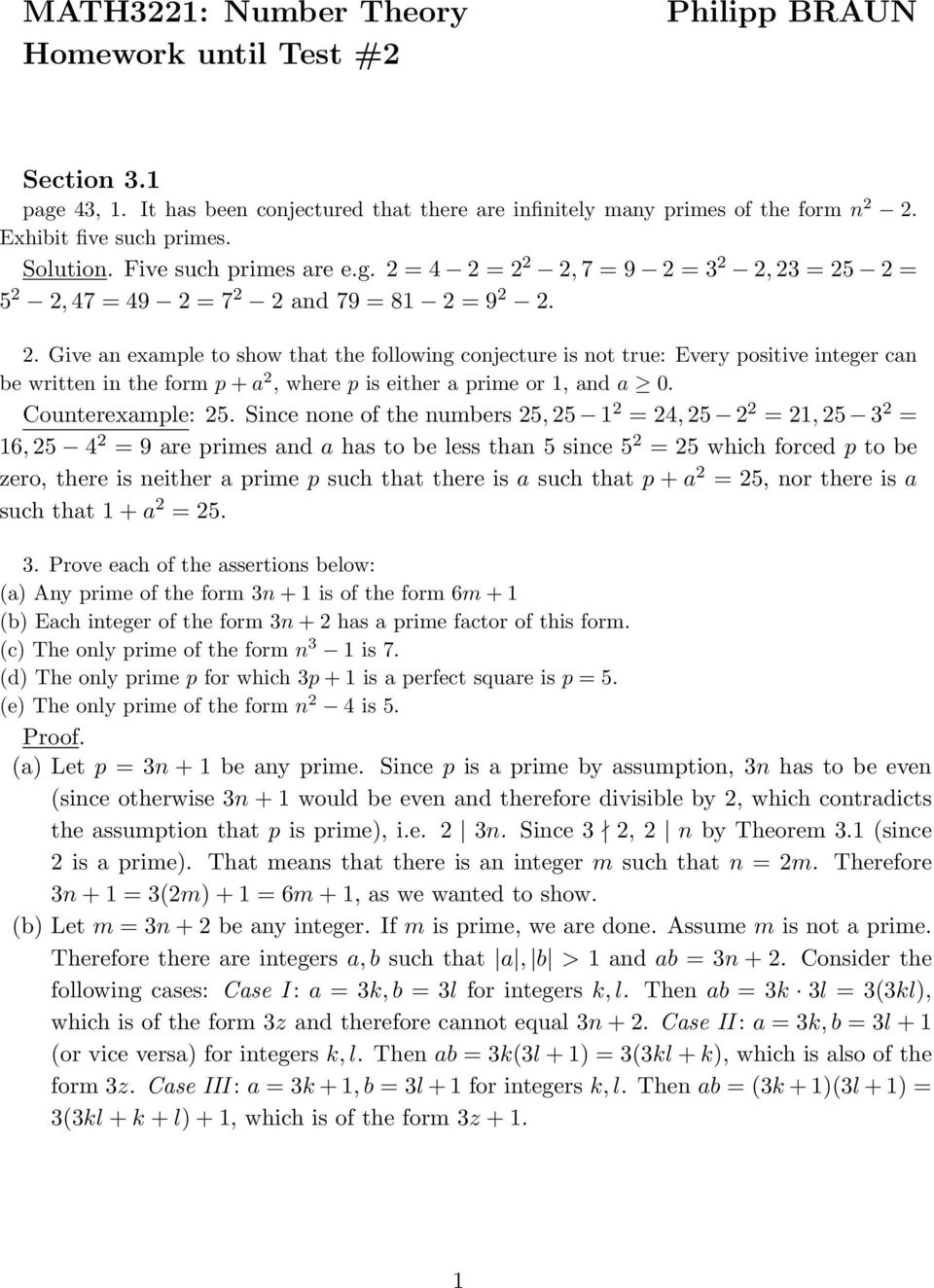
2 So none of these cases can occur, so at least one of the factors a, b has to be 3z + for an integer z. Either this factor is a prime, or we can use the same argument to show that 3z + = (3x + )y with integers x, y. Since a, b > 1, 3z + < 3n +. Thus in every step the absolute value of the factor of the form 3a + will be smaller, so the method has to terminate with a prime of that form. (c) Since n 3 1 = (n + n + 1)(n 1), (n 1) (n 3 1). So n must be less than or equal to. For n = 1 we have = 0, which is not the prime. So the only prime of the form n 3 1 is 3 1 = 7. (d) Assume (3p+1) = n for a prime p and an integer n. Then p = 1 3 (n 1) = 1 3 (n+1)(n 1). Since p is a prime, 1 3 (n 1) = 1, which implies n = 4 and therefore p = = 5. (e) Since n 4 = (n + )(n ), n has to equal 1 (because otherwise n 4 is no prime since (n ) (n 4)), i.e. n = 3, so the only prime of that form is 3 4 = If p 5 is a prime number, show that p + is composite. Proof. p + = (p + 1)(p 1) + 3. Since p is a prime bigger than 3, p is not divisible by 3. But since one of three consecutive numbers is divisible by three, so is either (p 1) or (p + 1). Since 3 3, by Theorem. (vii) 3 (p + 1)(p 1) + 3, so p + is divisible by 3 and therefore composite. 6. Establish each of the following statements: (a) Every integer of the form n 4 + 4, with n > 1, is composite. (b) If n > 4 is composite, then n divides (n 1)!. (c) Any integer of the form 8 n + 1, where n 1, is composite. (d) Each integer n > 11 can be written as the sum of two composite numbers. Proof. (a) n = (n + n + )(n n + ), and for n > 1, each of these factors is bigger than 1, hence n is composite. (b) If n > 4 is composite, then it is a square number (then n < n since n > 4, and therefore n 1... n... n... (n 1) = (n 1)!) or it can be written as a product of a prime 1 < p < n and an integer n < m < n. Since (n 1)! = 1 p... m... (n 1), pm (n 1)!, i.e. n (n 1)!. (c) 8 n + 1=( n ) = ( n + 1)(( n ) ( n ) + 1). Since both factors are bigger than 1 for n 1, 8 n + 1 is not prime and therefore composite. (d) In case n > 11 is even, there is k > 5 such that n = k. Therefore n = 6 + (k 3), where 6 = 3 is a composite number and (k 3) is a composite number (since k 3 > 1 since k > 5). In case n is odd, there is k > 5 such that n = k + 1. Therefore n = 9 + (k 4), where 9 = 3 3 and (k 4) are composite numbers (since k 4 > 1 because k > 5).
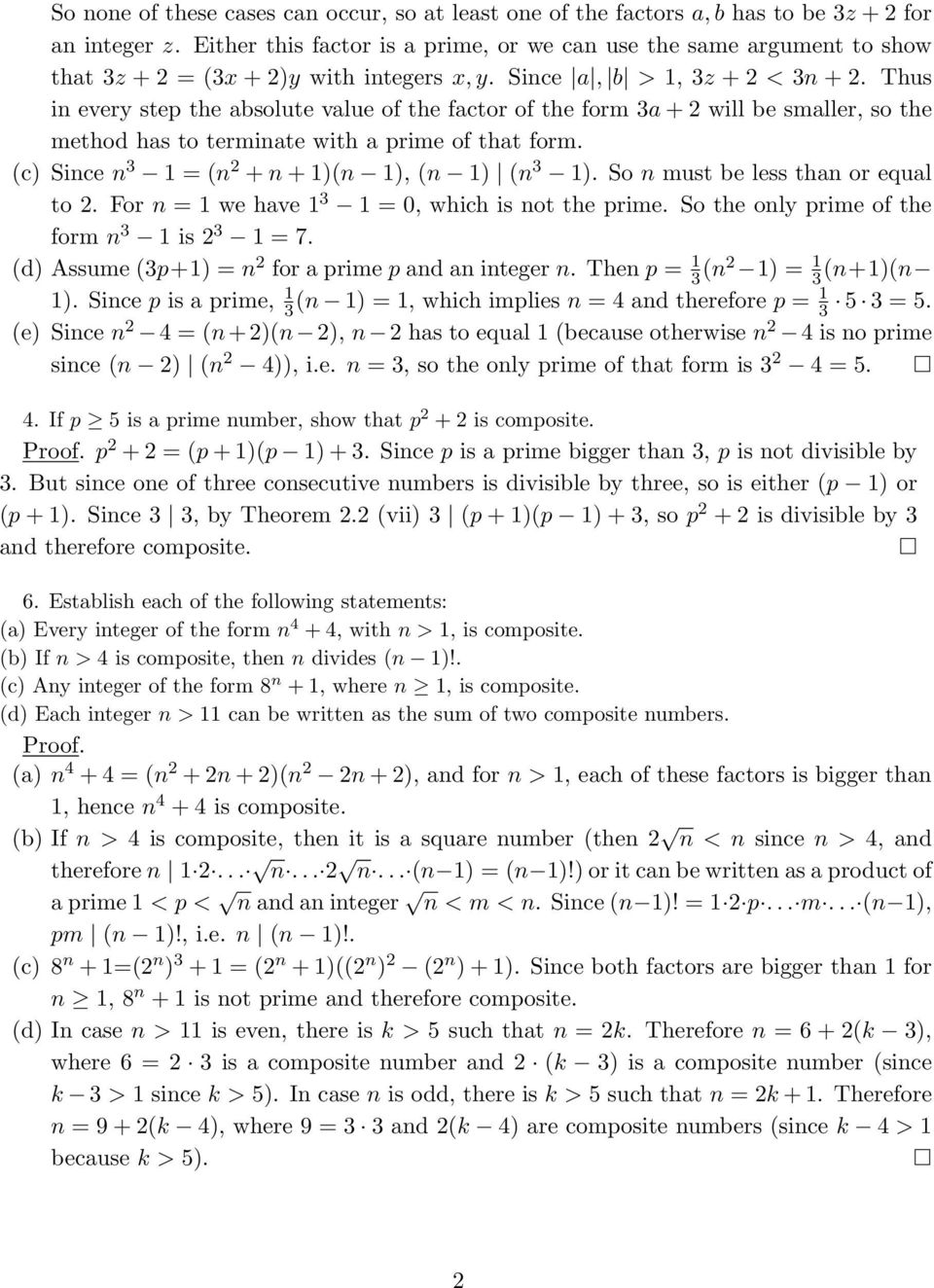
3 Section 3. page 49, 1. Determine whether the integer 701 is prime by testing all primes p 701 as possible divisors. Do the same for integer Solution , i.e. we have to test the primes, 3, 5, 7, 11, 13, 17, 19 and 3 as possible divisors of 701: 701/ = / Z /3 = 33.6 / Z /5 = 140. / Z / / Z /11 = 63.7 / Z / / Z / / Z / / Z / / Z Hence 701 is a prime. Since , we have to test the primes, 3, 5, 7, 11, 13, 17, 19, 3, 9 and 31 as possible divisors of 1009: 1009/ = / Z /3 = / Z /5 = 01.8 / Z / / Z /11 = 91.7 / Z / / Z / / Z / / Z / / Z / / Z / / Z Hence 1009 is a prime.. Employing the Sieve of Eratosthenes, obtain all the primes between 100 and 00. Solution H 119 H 10 H 11 H H 133 H H 143 H H 161 H H 169 H
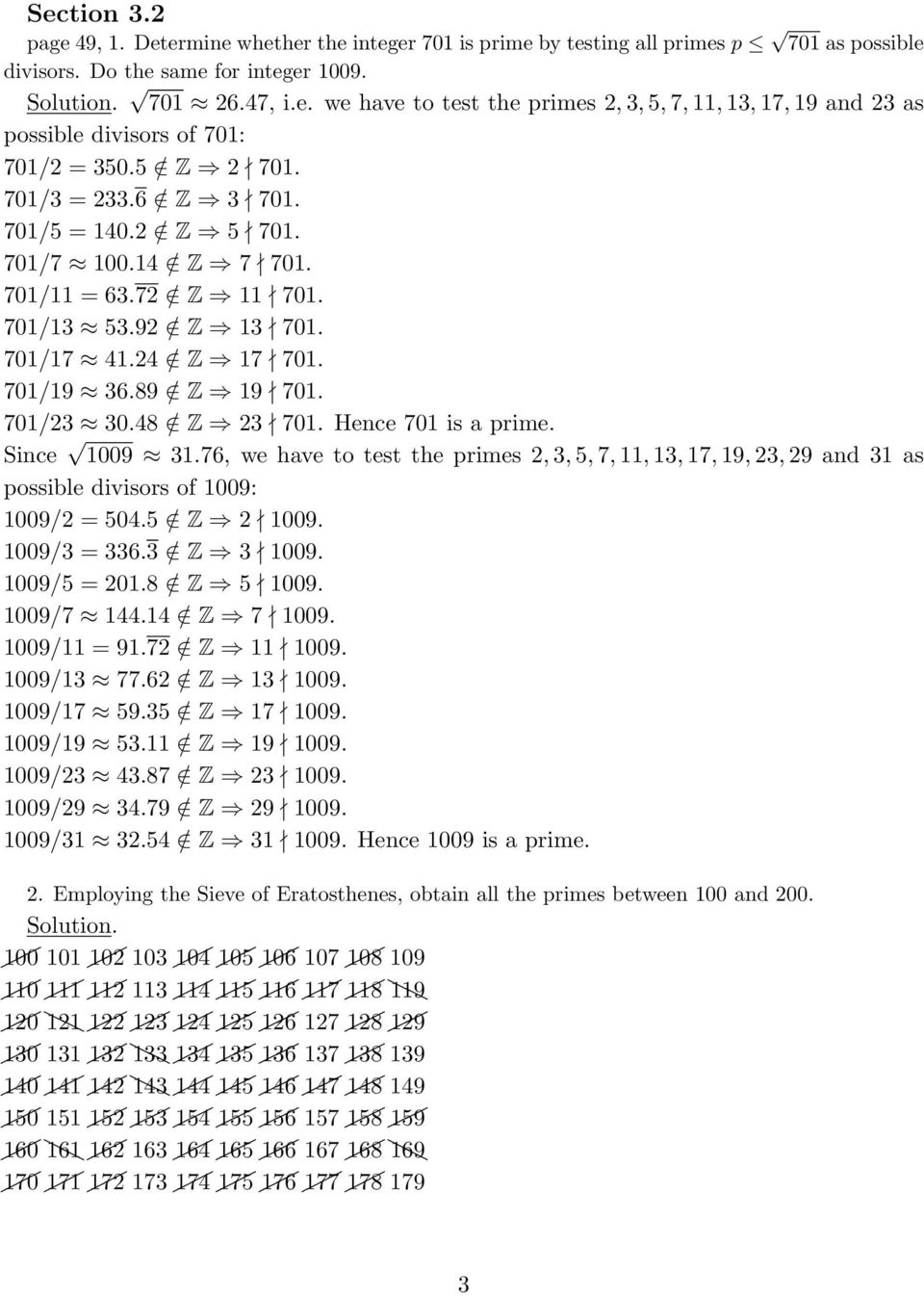
4 H 187 H ( x means x is divisible by, 3, or 5, x A means that x is divisible by 7, 11, or 13.) Thus the primes between 100 and 00 are 101, 103, 107, 109, 113, 17, 131, 137, 139, 149, 151, 157, 163, 167, 173, 179, 181, 191, 193, 197 and Given that p n for all primes p 3 n, show that n > 1 is either a prime or the product of two primes. Proof. If n was the product of three or more primes, at least one of them had to be less than or equal to 3 n. Since by assumption none of the primes p 3 n divides n, this is a contradiction. Hence n is a prime or a product of two primes. 4. Establish the following facts: (a) p is irrational for any prime p. (b) If a > 0 and n a is rational, then n a must be an integer. n (c) For n, n is irrational. Proof. (a) Assume p is rational. Then there are integers a, b with p = a b and gcd(a, b) = 1. Square the equation and multiply both sides with b to get b p = a. That means p a and since p is a prime p a by Theorem 3.1. Therefore there is an integer c such that a = cp. Applying that to our first equation, we have b p = (cp) = c p, or b = c p. That means p b, and again by Theorem 3.1 p b, so p gcd(a, b), a contradiction. (b) Assume n n a is rational, i.e. a = p pn q for relatively prime integers p, q. Then a = q. n Since p and q are relatively prime, p n and q n are relatively prime, too. That a is an integer forces q n n to be 1, so q = 1, i.e. a = p, an integer. (c) Since n > n for n, n n > n n. But n n =, so n n <. On the other hand n n > 1 since 1 n n = 1 < n. By part (b), n is either an integer or irrational, so n n has to be irrational as there is no integer between 1 and. 5. Show that any composite three-digit number must have a prime factor less than or equal to 31. Proof. Let c be any composite three-digit number. Since c is composite, there are integers a, b such that c = ab. Assume a and b are both greater than 31, i.e. at least 3. Then ab 3 3 = 5 5 = 10 = 104, which contradicts to the fact that c is a three-digit number by assumption. 4

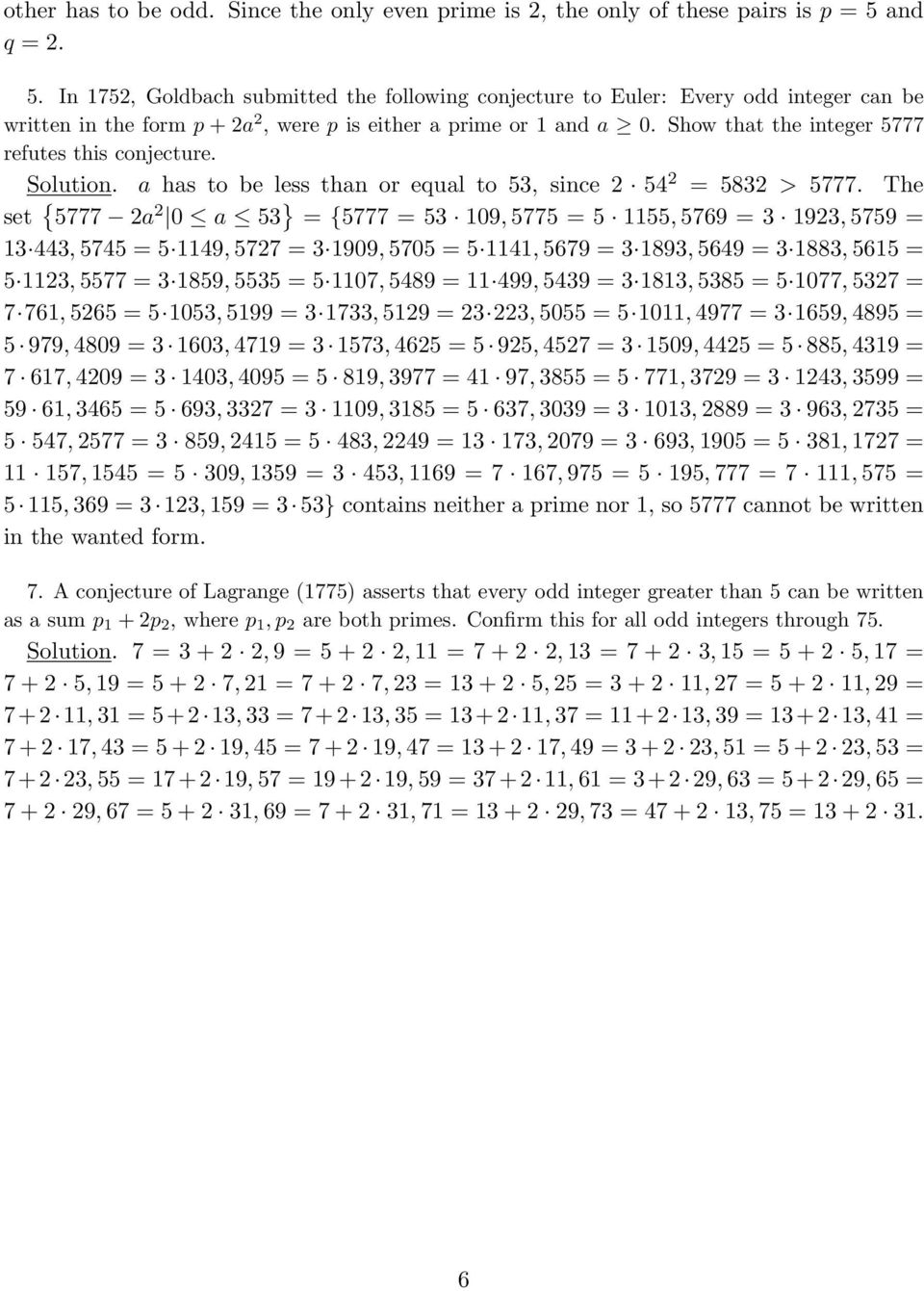
5 Section 3.3 page 57, 1. Verify that the integers 1949 and 1951 are twin primes. Solution. Since , we have to check if 1949 or 1951 are divisible by, 3, 5, 7, 11, 13, 17, 19, 3, 9, 31, 37, 41, or 43. Obviously, both numbers are odd and therefore not divisible by. Since the sum of the digits of 1949, =3 and the sum of the digits of 1951, =16 are both not divisible by 3, both numbers are not divisible by 3. Since both numbers do not end with 0 or 5, they are not divisible by 5. Using the same method as in exercise 1 on page 49, we have 1949/ / Z , 1951/ / Z /11 = / Z , 1951/11 = / Z / / Z , 1951/ / Z / / Z , 1951/ / Z / / Z , 1951/ / Z / / Z , 1951/ / Z / / Z , 1951/ / Z / / Z , 1951/ / Z /37 = / Z , 1951/37 = 5.79 / Z /41 = / Z , 1951/41 = / Z / / Z , 1951/ / Z Therefore 1949 and 1951 both are prime. Since =, they are twin primes.. (a) If 1 is added to a product of twin primes, prove that a perfect square is always obtained. (b) Show that the sum of twin primes p and p + is divisible by 1, provided that p > 3. Proof. (a) Assume p and p + are twin primes. Then their product is p(p + ) = p + p. If we add 1, we have p + p + 1, which is equal to (p + 1), which obviously is a perfect square. (b) The sum of the twin primes p and p + is p + (p + ) = p +. Since p is a prime greater than 3, p is of the form 3k + for an integer k (if it was of the form 3k, it would be divisible by 3, which contradicts the assumption that p is a prime, and if it was of the form 3k + 1, p + = 3k = 3(k + 1) would not be a prime). So p + is of the form (3k + ) + = 6k = 6k + 6 = 6k + 6 = 6(k + 1). Since p is a prime, k is odd (because if k is even, then so is 3k +, which contradicts that p is a prime greater than 3). Hence k + 1 is even, i.e. there is an integer n such that k + 1 = n. That means that p + = 6(k + 1) = 6 n = 1n, so the sum of the primes p and p + is divisible by Find all pairs of primes p and q satisfying p q = 3. Solution. Since the difference should be 3, one of the primes has to be even and the 5
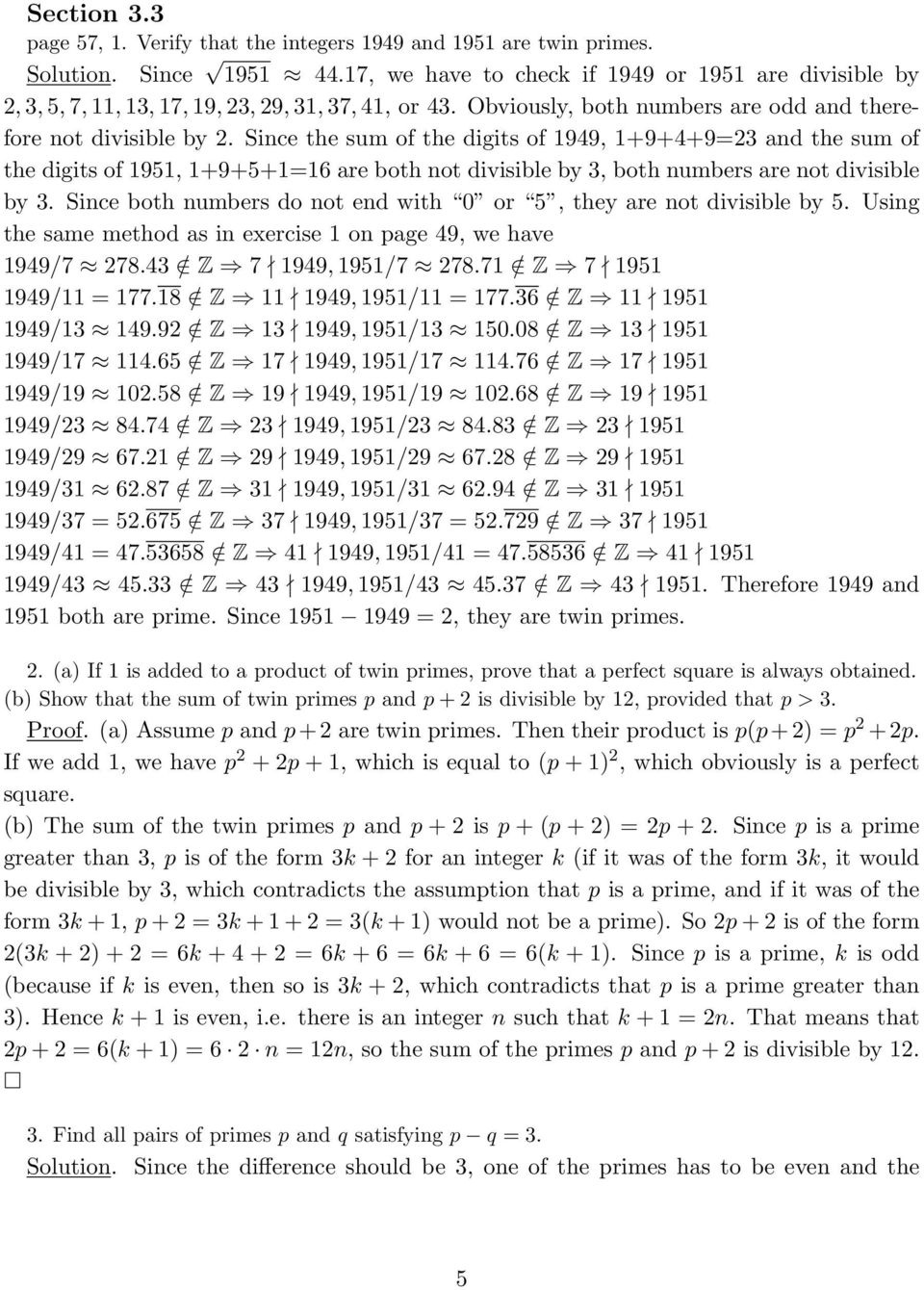
6 other has to be odd. Since the only even prime is, the only of these pairs is p = 5 and q =. 5. In 175, Goldbach submitted the following conjecture to Euler: Every odd integer can be written in the form p + a, were p is either a prime or 1 and a 0. Show that the integer 5777 refutes this conjecture. Solution. a has to be less than or equal to 53, since 54 = 583 > The set { 5777 a 0 a 53 } = {5777 = , 5775 = , 5769 = 3 193, 5759 = , 5745 = , 577 = , 5705 = , 5679 = , 5649 = , 5615 = 5 113, 5577 = , 5535 = , 5489 = , 5439 = , 5385 = , 537 = 7 761, 565 = , 5199 = , 519 = 3 3, 5055 = , 4977 = , 4895 = 5 979, 4809 = , 4719 = , 465 = 5 95, 457 = , 445 = 5 885, 4319 = 7 617, 409 = , 4095 = 5 819, 3977 = 41 97, 3855 = 5 771, 379 = 3 143, 3599 = 59 61, 3465 = 5 693, 337 = , 3185 = 5 637, 3039 = , 889 = 3 963, 735 = 5 547, 577 = 3 859, 415 = 5 483, 49 = , 079 = 3 693, 1905 = 5 381, 177 = , 1545 = 5 309, 1359 = 3 453, 1169 = 7 167, 975 = 5 195, 777 = 7 111, 575 = 5 115, 369 = 3 13, 159 = 3 53} contains neither a prime nor 1, so 5777 cannot be written in the wanted form. 7. A conjecture of Lagrange (1775) asserts that every odd integer greater than 5 can be written as a sum p 1 + p, where p 1, p are both primes. Confirm this for all odd integers through 75. Solution. 7 = 3 +, 9 = 5 +, 11 = 7 +, 13 = 7 + 3, 15 = 5 + 5, 17 = 7 + 5, 19 = 5 + 7, 1 = 7 + 7, 3 = , 5 = , 7 = , 9 = , 31 = , 33 = , 35 = , 37 = , 39 = , 41 = , 43 = , 45 = , 47 = , 49 = 3 + 3, 51 = 5 + 3, 53 = 7 + 3, 55 = , 57 = , 59 = , 61 = 3 + 9, 63 = 5 + 9, 65 = 7 + 9, 67 = , 69 = , 71 = , 73 = , 75 =
7 Sections 4.1 & 4. page 67, 1. Prove each of the following assertions: (a) If a b (mod n) and m n, then a b (mod m) (b) If a b (mod n) and c > 0, then ca cb (mod cn) (c) If a b (mod n) and the integers a, b, n are all divisible by d > 0, then a/d b/d (mod n/d) Proof. (a) a b (mod n) n (a b). Since m n, by Theorem. (iv) m (a b), or in other words a b (mod m). (b) a b (mod n) n (a b). Thus there is an integer d such that nd = a b. Multiply both sides with c to get cnd = c(a b) = ca cb. Since c > 0 and n > 0, cn > 0, and since cn (ca cb), ca cb (mod cn). (c) a b (mod n) n (a b). Therefore there is an integer c such that cn = a b. If a, b and n all are divisible by d, then cn/d = (a b)/d = a/d b/d, where cn/d, a/d, b/d all are integers. So n/d (a/d b/d). Since d > 0, n/d > 0 and therefore a/d b/d (mod n/d).. Give an example to show that a b (mod n) need not imply a b (mod n). Solution. Let a =, b = 3, n = 5. Then a = 4, b = 9, and 4 9 (mod 5) (because 9 4 = 5, where 5 is obviously a multiple of 5), but 3 (mod 5) (because 3 = 1, and 1 is not a multiple of 5). 3. If a b (mod n), prove that gcd(a, n) = gcd(b, n). Proof. a b (mod n) n (a b) there is an integer c such that cn = a b. Let d be any divisor of both a and n. Then there are integers k, l such that dk = a and dl = n, which means cdl = dk b, or in other words b = dk cdl = d(k cl), so d divides b. Especially gcd(a, n) gcd(b, n). Similarly we can show that gcd(b, n) gcd(a, n), which forces the gcd s to be equal. 4. (a) Find the remainders when 50 and are divided by 7. (b) What is the remainder when the following sum is divided by 4? Solution. (a) 50 = ( 5) 10, and (mod 7). By Theorem 4. (f), (mod 7) = ( 5 ) 5, and (mod 7). Again by Theorem 4. (f), (mod 7). 4 5 = ( 5 ), and 5 5 (mod 7), as we already saw. Hence (mod 7), i.e. the remainder when dividing 50 by 7 is 4. Since 41 ( 1) (mod 7), ( 1) 65 (mod 7) by Theorem 4. (f). Since ( 1) 65 = 1, (mod 7), so the remainder when dividing by 7 is 6. (b) The even numbers to the fifth power have a factor 5 and therefore are divisible by 4 (i.e. congruent 0 (mod 4)). The other numbers are alternating either congruent 1 or congruent -1, and so are their fifth powers. Since the sum of numbers is congruent to the sum of any numbers their summands are congruent to by Theorem 4. (d),
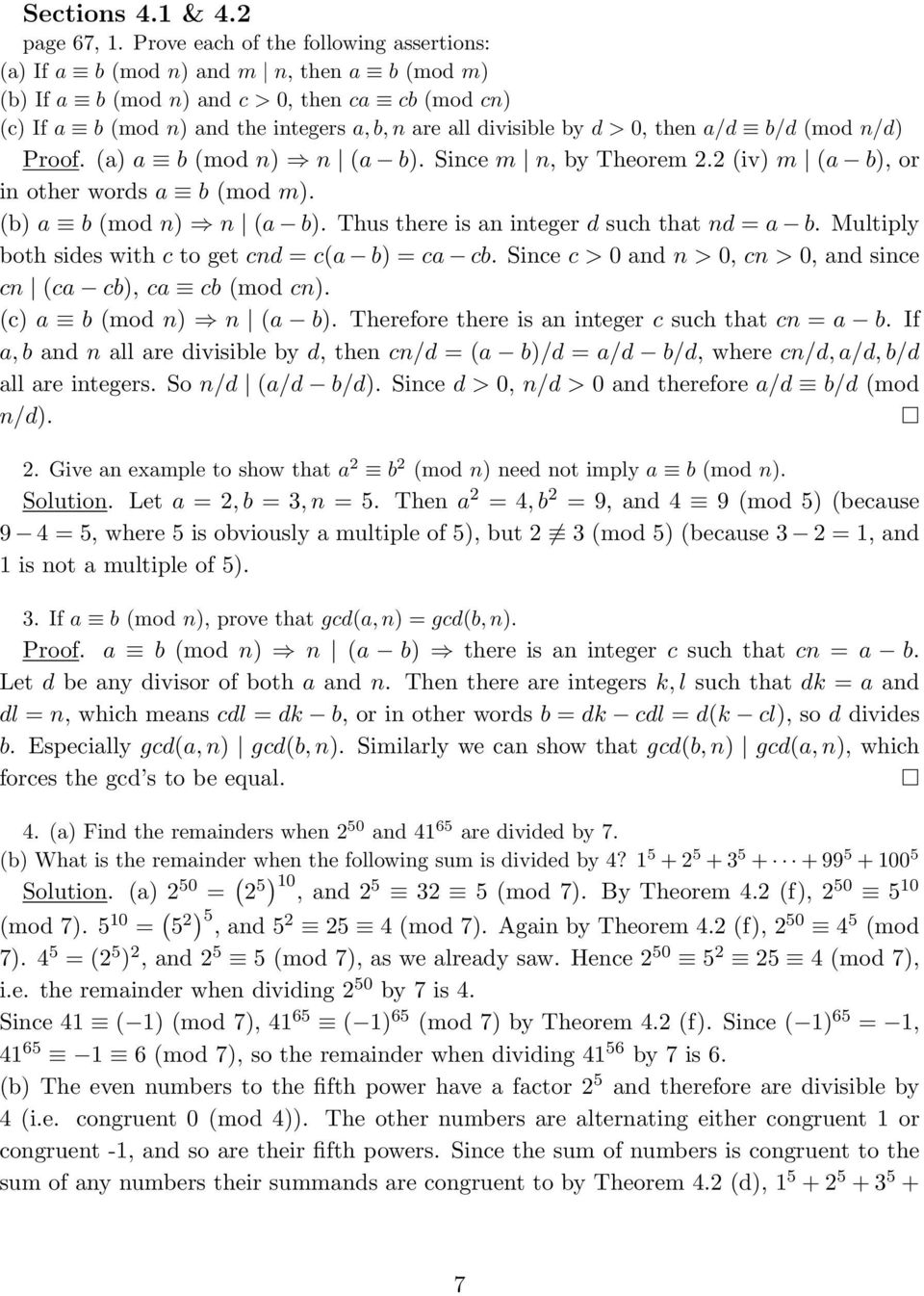
8 (mod 4), i.e. the remainder when dividing the sum by 4 is Prove that the integer is divisible by 39, and that is divisible by 7. Proof ( 1) (mod 3) (by Theorem 4. (f)), and ( 1) 53 (mod 13), so both 3 and 13 divide Since 3 and 13 are relatively prime (in fact, they are both prime numbers), the fist statement is true by Collary of Theorem.4. For the second statement, note that ( 1) (4 3 ) (64) 37 = (mod 7). 6. For n 1, use congruence theory to establish each of the following divisibility statements: (a) 7 5 n + 3 5n. (b) 13 3 n+ + 4 n+1. (c) 7 5n n+. (d) 43 6 n+ + 7 n+1. Proof. (a) For n = 1, the statement is true since 7 49 = = = Assume the statement is true for n = k. Then 5 k + 3 5k 0 (mod 7). 5 (k+1) + 3 5(k+1) 5 5 k k 5 5 k k 5(5 k + 3 5k ) k (mod 7). Since 5 k + 3 5k 0 (mod 7), 5(5 k + 3 5k ) 0 (mod 7) by Theorem 4. (e). Since 7 is a factor, 7 3 5k 0 (mod 7). Therefore the statement is true for n = k + 1 by Theorem 4. (d). (b) For n = 1, we have = = , which is true since 13 7 = 91. Assume the statement is true for n = k. Then 3 (k+1)+ + 4 (k+1) k k+1 3(3 k+ + 4 k+1 ) k+1 (mod 13). By induction assumption, 3 k+ + 4 k+1 0 (mod 13), so 3(3 k+ + 4 k+1 ) 0 (mod 13) by Theorem 4.(e). Since 13 is a factor of 13 4 k+1, 13 4 k+1 0 (mod 13). By Theorem 4. (d), the statement is true for n = k + 1. (c) For n = 1, it is stated that = = , which is true since 7 7 = 189. Assume the statement is true for n = k. Then 5(k+1) (k+1)+ 5 5k k+ 3 5k k+ 5( 5k k+ ) + 7 5k+1 (mod 7). By assumption and since 7 is a factor of the second summand, for the same reasons as in parts (a) and (b), 5( 5k k+ ) + 7 5k+1 0 (mod 7), hence the statement is true for n = k + 1. (d) Since = = because = 559, the statement is true for n = 1. Assume the statement is true for n = k. Similar to parts (a), (b) and (c), 6 (k+1)+ +7 (k+1) k k k k+1 6( 6 k+ +7 k+1 )+43 7 k (mod 43), thus the statement is true for n = k
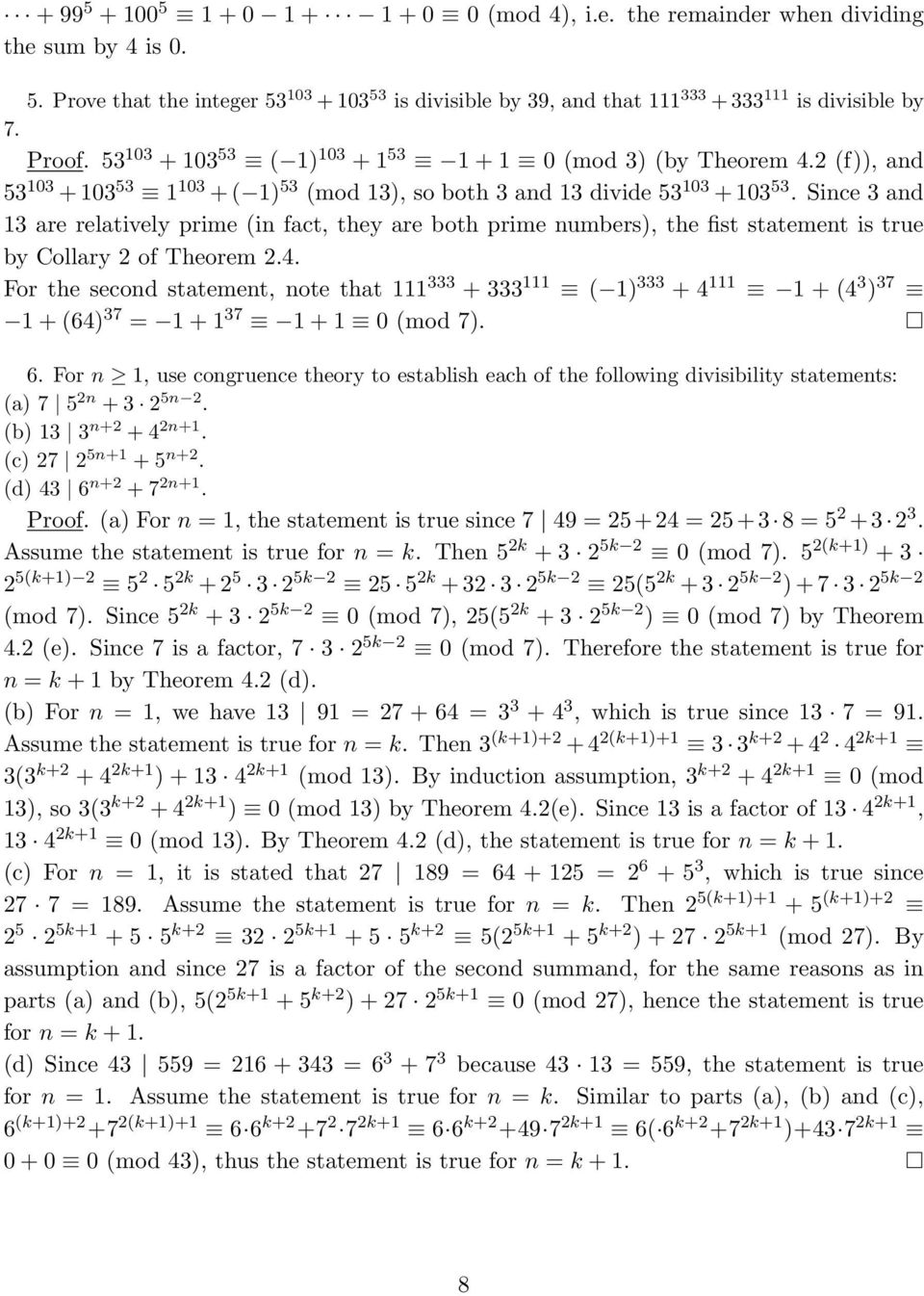
9 7. For n 1, show that ( 13) n+1 ( 13) n + ( 13) n 1 (mod 181). Proof. For n = 1, the statement is true because ( 13) ( 13) 0 (mod 181). Assume the statement is true for n = k. Then ( 13) (k+1)+1 ( 13) [ ( 13) k + ( 13) k 1] ( 13) k+1 + ( 13) (k+1) 1 (mod 181). 9

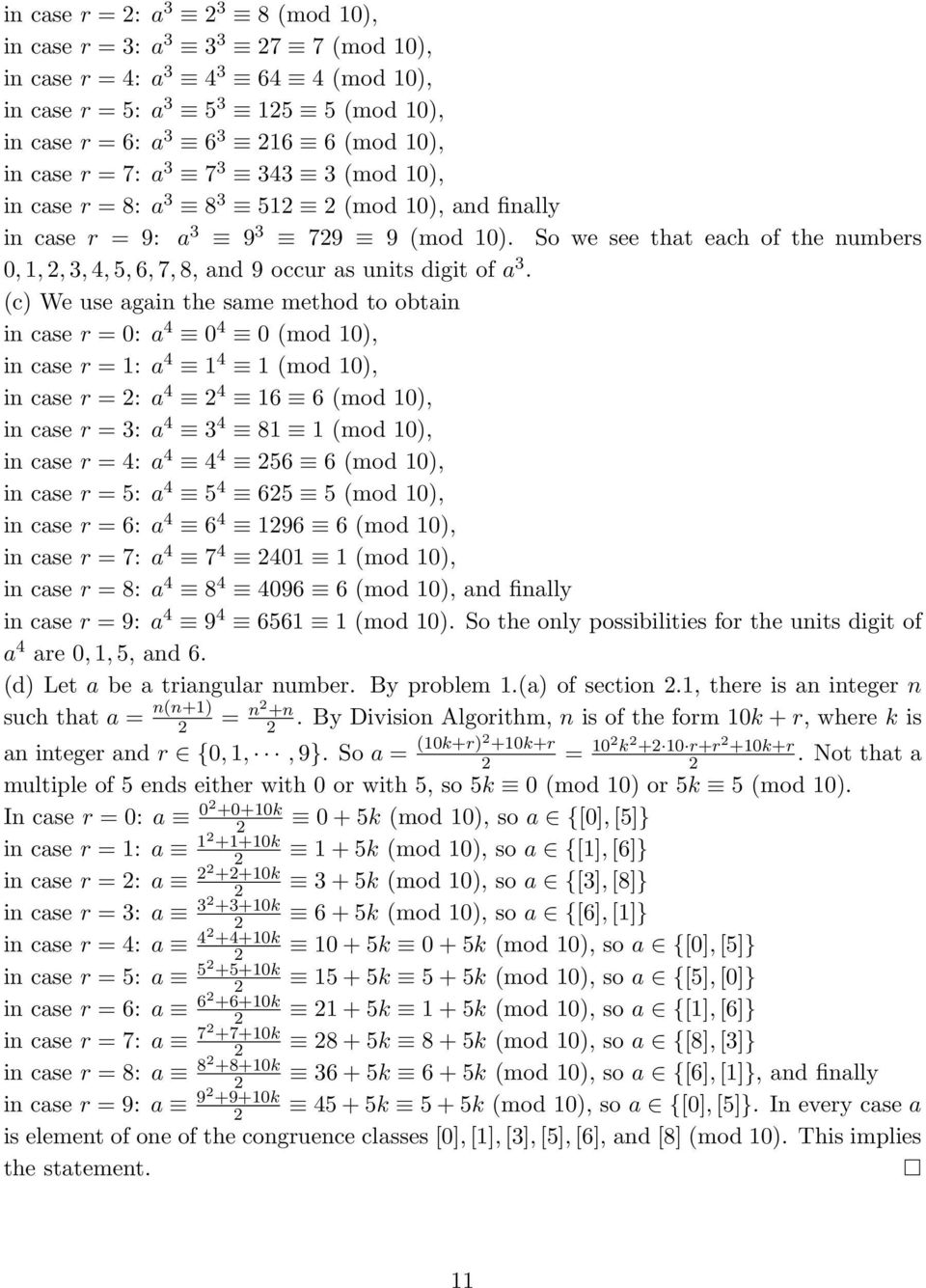
10 Section 4.3 page 73, 1. Use the binary exponentiation algorithm to compute both (mod 503) and (mod 1537). Solution = , so (194 ) (44) , 748, (19 16 ) (198 43) (44 19) (mod 503) = , so (141 ) (1437) (141 4 ), 064, (778) (141 8 ) (143) (1, 545, 049) ( ) ( ) , 117, (mod 1537).. Prove the following statements: (a) For any integer a, the units digit of a is 0, 1, 4, 5, 6, or 9. (b) Any one of the integers 0, 1,, 3, 4, 5, 6, 7, 8, 9 can occur as units digit of a 3. (c) For any integer a, the units digit of a 4 is 0, 1, 5, or 6. (d) The units digit of a triangular number is 0, 1, 3, 5, 6, or 8. Proof. Let a be an integer. (a) By Division Algorithm, a is of the form 10k + r, where k is an integer and r {0, 1,, 9}. a = (10k + r) = 10 k + 10 r + r, and since 10 is a factor of both 10 k and 10 r, a r (mod 10). Considering the values r can have, we get: in case r = 0: a 0 0 (mod 10), in case r = 1: a 1 1 (mod 10), in case r = : a 4 (mod 10), in case r = 3: a 3 9 (mod 10), in case r = 4: a (mod 10), in case r = 5: a (mod 10), in case r = 6: a (mod 10), in case r = 7: a (mod 10), in case r = 8: a (mod 10), and finally in case r = 9: a (mod 10). So we see that in each case a is congruent to either 0, 1, 4, 5, 6, or 9 (mod 10), which means that one of these is the units digit of a. (b) Using the same method as in (a), we have a 3 r 3 (mod 10), because by Binomial Theorem the other summands of the binomial extension of (10k + r) 3 have a factor 10. Considering the cases, we see that in case r = 0: a (mod 10), in case r = 1: a (mod 10), 10

11 in case r = : a (mod 10), in case r = 3: a (mod 10), in case r = 4: a (mod 10), in case r = 5: a (mod 10), in case r = 6: a (mod 10), in case r = 7: a (mod 10), in case r = 8: a (mod 10), and finally in case r = 9: a (mod 10). So we see that each of the numbers 0, 1,, 3, 4, 5, 6, 7, 8, and 9 occur as units digit of a 3. (c) We use again the same method to obtain in case r = 0: a (mod 10), in case r = 1: a (mod 10), in case r = : a (mod 10), in case r = 3: a (mod 10), in case r = 4: a (mod 10), in case r = 5: a (mod 10), in case r = 6: a (mod 10), in case r = 7: a (mod 10), in case r = 8: a (mod 10), and finally in case r = 9: a (mod 10). So the only possibilities for the units digit of a 4 are 0, 1, 5, and 6. (d) Let a be a triangular number. By problem 1.(a) of section.1, there is an integer n such that a = n(n+1) = n +n. By Division Algorithm, n is of the form 10k + r, where k is an integer and r {0, 1,, 9}. So a = (10k+r) +10k+r = 10 k + 10 r+r +10k+r. Not that a multiple of 5 ends either with 0 or with 5, so 5k 0 (mod 10) or 5k 5 (mod 10). In case r = 0: a k 0 + 5k (mod 10), so a {[0], [5]} in case r = 1: a k 1 + 5k (mod 10), so a {[1], [6]} in case r = : a ++10k 3 + 5k (mod 10), so a {[3], [8]} in case r = 3: a k 6 + 5k (mod 10), so a {[6], [1]} in case r = 4: a k k 0 + 5k (mod 10), so a {[0], [5]} in case r = 5: a k k 5 + 5k (mod 10), so a {[5], [0]} in case r = 6: a k 1 + 5k 1 + 5k (mod 10), so a {[1], [6]} in case r = 7: a k 8 + 5k 8 + 5k (mod 10), so a {[8], [3]} in case r = 8: a k k 6 + 5k (mod 10), so a {[6], [1]}, and finally in case r = 9: a k k 5 + 5k (mod 10), so a {[0], [5]}. In every case a is element of one of the congruence classes [0], [1], [3], [5], [6], and [8] (mod 10). This implies the statement. 11
12 3. Find the last two digits of the number Solution. 9 9 (9 ) (mod 10), i.e. 9 9 = 10k + 9 for an integer k, and therefore = 9 10k+9. So k k 9 9 (9 10 ) k 9 9 (9 9 9) k 9 9 (mod 100). Since (mod 100), (9 9 9) k 9 9 (89 9) k 89 (801) k 89 1 k (mod 100). Therefore the last two digits of are Without performing the divisions, determine whether the integers 176,51,1 and 149,35,678 are divisible by 9 or 11. Solution. Using Theorem 4.5, we only have to check if the sum of the digits of the numbers are divisible by 9 to check divisibility by = 7, which is divisible by 9, so 176,51,1 is divisible by = 45, which is also divisible by 9, so 149,35,678 is divisible by 9, as well. To check divisibility by 11, we use Theorem 4.6: = 3, which is not divisible by 11, so 176,51,1 is not divisible by = 9, which is also not divisible by 11, so 149,35,678 is not divisible by Establish the following divisibility criteria: (a) An integer is divisible by if and only if its units digit is 0,, 4, 6, or 8. (b) An integer is divisible by 3 if and only if the sum of its digits is divisible by 3. (c) An integer is divisible by 4 if and only if the number formed by its tens and units digits is divisible by 4. (d) An integer is divisible by 5 if and only if its units digit is 0 or 5. Proof. (a) An integer n is divisible by if and only if there is an integer k such that n = k. Let l be that number out of k, k 1, k, k 3, and k 4 that is divisible by 5. Since l is divisible by 10, it is congruent 0 (mod 10). k is equal to one of the numbers l, l + 1, l +, l + 3, and l + 4. In case k = l, n k l 0 (mod 10), in case k = l + 1, n k (l + 1) l + (mod 10), in case k = l +, n k (l + ) l (mod 10), in case k = l + 3, n k (l + 3) l (mod 10), and finally in case k = l + 4, n k (l + 4) l (mod 10), so the units digit of n is one of the numbers 0,, 4, 6, and 8. Trivially, if n ends with 0,, 4, 6, or 8, it is even and therefore divisible by. (b) Let n be an integer. There are m Z, a 0, a 1,..., a m {0, 1,..., 9} such that n = 10 m a m a 1 + a 0. Let P (x) = m a k x k. Then P (10) = n and P (1) = m a m, the k=0 sum of the digits of n. Since 1 10 (mod 3), P (1) P (10) (mod 3) by Theorem 4.4, which implies the statement. (c) Let n be an integer. There are m Z, a 0, a 1,..., a m {0, 1,..., 9} such that n = 10 m a m a 1 + a 0. Since 100 = 4 5, (mod 4). Therefore k=0 1
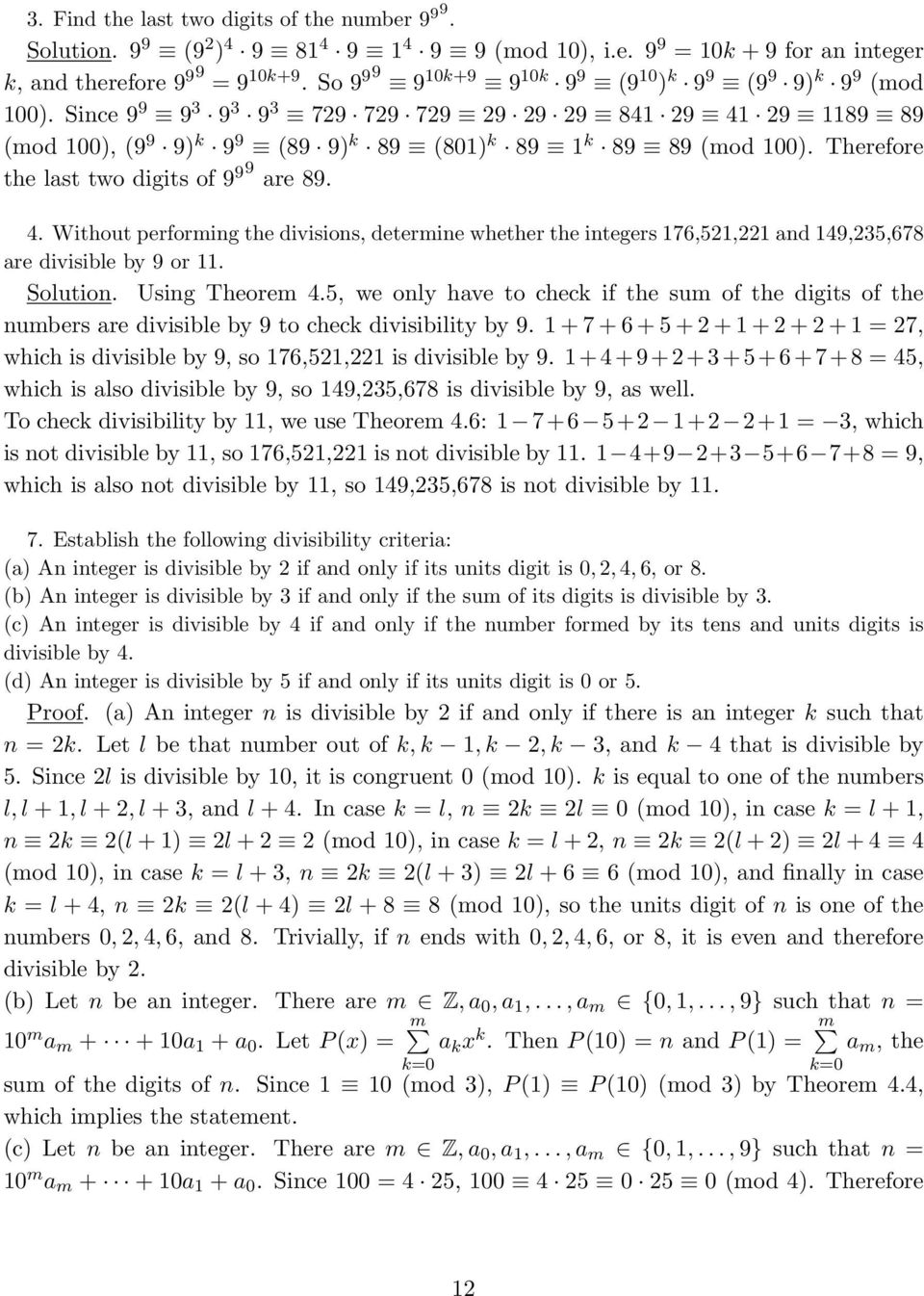
13 m 0 10 m 0 (mod 4) for any m 0; in other words 10 k 0 (mod 4), for k = m +. Therefore 10 m a m a 1 + a 0 10a 1 + a 0 (mod 4). That is why n 0 (mod 4) 10a 1 + a 0 0 (mod 4). Note that 10a 1 + a 0 is the number formed by the tens and units digits of n to obtain the statement. (d) Let n be an integer. There are m Z, a 0, a 1,..., a m {0, 1,..., 9} such that n = 10 m a m a 1 + a 0. Since 10 = 5, 10 k k 5 k 0 (mod 5), if k > 0. Hence 10 m a m a 1 + a 0 a 0 (mod 5). The statement is true since a 0 0 (mod 5) if and only if a 0 = 0 or a 0 = For any integer a, show that a a + 7 ends in one of the digits 3, 7, or 9. Proof. By Division Algorithm, a = 10k + r, where k is an integer and r {0, 1,..., 9}. Therefore a a + 7 = 10 k + 10 r + r 10k r + 7, which is congruent r r + 7 (mod 10). Consider the following cases: in case r = 0: a a (mod 10), in case r = 1: a a (mod 10), in case r = : a a (mod 10), in case r = 3: a a (mod 10), in case r = 4: a a (mod 10), in case r = 5: a a (mod 10), in case r = 6: a a (mod 10), in case r = 7: a a (mod 10), in case r = 8: a a (mod 10), and finally in case r = 9: a a (mod 10). So we see that in each case a a + 7 is in one of the congruence classes [3], [7], [9] (mod 10), and therefore ends in 3, 7, or 9. 13

14 Section Solve the following linear congruences: (a) 5x 15 (mod 9). (b) 5x (mod 6). (c) 6x 15 (mod 1). (d) 36x 8 (mod 10). (e) 34x 60 (mod 98). (f) 140x 133 (mod 301). Solution. (a) By Theorem 4.7, 5x 15 (mod 9) has a solution since gcd(5, 9) = The solution is [18] (mod 9), since (mod 9). The solution is unique by Theorem 4.7. (b) Since gcd(5, 6) = 1, 5x (mod 6) has a unique solution, namely [0] (mod 6). (c) Since gcd(6, 1) = 3 15, 6x 15 (mod 1) has three solutions. By trial-and-error we get [6] (mod 1) as a solution, so by Theorem 4.7 the others are [13] (mod 1) and [0] (mod 1). (d) Since gcd(36, 10) = 6, which does not divide 8, there are no solutions. (e) Since gcd(34, 98) =, 34x 60 (mod 98) has two solutions. By trial-and-error we find [45] (mod 98) (because (mod 60)), so the other one is [94] (mod 98). (f) Since gcd(140, 301) = 7 by the hint, which divides 133, there are seven congruence classes which elements solve 140x 133 (mod 301). By trial-and-error, we find [16] (mod 301), because (mod 301). By Theorem 4.7, the other solutions are [59] (mod 301), [10] (mod 301), [145] (mod 301), [188] (mod 301), [31] (mod 301), and [74] (mod 301).. Using congruences, solve the following Diophantine equations below: (a) 4x + 51y = 9. (b) 1x + 5y = 331. (c) 5x 53y = 17. Solution. (a) 4x + 51y = 9 4x 9 (mod 51). The solution of this linear congruence is [15] (mod 51), and with x = 15, we have y = = 1 we have a solution of 4x+51y = 9. The general solution therefore is x = t, y = 1 4t, where t is any integer. (b) 1x + 5y = 331 1x (mod 5). The solution of this linear congruence is [13] (mod 5). For x = 13, we have y = = 7, so the general solution is x = t, y = 7 1t for any integer t. (c) 5x 53y = 17 5x 17 (mod 53). The solution of this linear congruence is (by trial-and-error) [14] (mod 53). With x = 14, we get y = = 1, which leads to the general solution x = t, y = 1 + 5t, where t is an arbitrary integer. 14
![(c) Since gcd(6, 1) = 3 15, 6x 15 (mod 1) has three solutions. By trial-and-error we get [6] (mod 1) as a solution, so by Theorem 4.7 the others are [13] (mod 1) and [0] (mod 1).](/docs-images/47/20909458/images/page_14.jpg "(d) Since gcd(36, 10) = 6, which does not divide 8, there are no solutions. (e) Since gcd(34, 98) =, 34x 60 (mod 98) has two solutions.")
15 4. Solve each of the following sets of simultaneous congruences: (a) x 1 (mod 3), x (mod 5), x 3 (mod 7). (b) x 5 (mod 11), x 14 (mod 9), x 15 (mod 31). (c) x 5 (mod 6), x 4 (mod 11), x 3 (mod 17). (d) x 1 (mod 5), 3x 9 (mod 6), 4x 1 (mod 7), 5x 9 (mod 11). Solution. (a) By Chinese Remainder Theorem, we have to solve 35x 1 1 (mod 3), 1x 1 (mod 5), 15x 3 1 (mod 7). Trial-and-error gives us x 1 =, x = 1, x 3 = 1, therefore x = = 157 is a solution, so the solution is [5] (mod 105). (b) Solving 899x 1 1 (mod 11), 341x 1 (mod 9), 319x 3 1 (mod 31), we get x 1 = 7, x = 4, x 3 = 7, so we have x = = = 84056, so the solution is [4944] (mod 9889). (c) Solving 187x 1 1 (mod 6), 10x 1 (mod 11), 66x 3 1 (mod 17), we get x 1 = 1, x = 4, x 3 = 8, so we have x = = = 4151, so the general solution is [785] (mod 11) (d) Solving 46x 1 1 (mod 5), 385x 1 (mod 6), 330x 3 1 (mod 7), 10x 4 1 (mod 11), we get x 1 = 3, x = 1, x 3 = 1, x 4 = 1, considering that x 1 must be a multiple of, we have x 1 = 8, considering that x 3 must be a multiple of 4, we have x 3 = 8, considering that x 4 must be a multiple of 5, we have x 4 = 45, so we have x = = = 0673, so the solution is [193] (mod 310). 5. Solve the linear congruence 17x 3 (mod 3 5 7) by solving the system 17x 3 (mod ), 17x 3 (mod 3), 17x 3 (mod 5), 17x 3 (mod 7). Solution. By Chinese Remainder Theorem, we have to solve 105x 1 1 (mod ), 70x 1 (mod 3), 4x 3 1 (mod 5), and 30x 1 1 (mod 7). By trial-and-error, one solution is x 1 = 1, x = 1, x 3 = 3, x 4 = 4. Considering that x i has to be divisible by 17, we get x 1 = 17, x = 34, x 3 = 68, x 4 = 10, from which we get x = = 1 173( ) = Hence the solution is [99] (mod 10). 6. Find the smallest integer a > such that a, 3 a + 1, 4 a +, 5 a + 3, 6 a + 4. Solution. Since 4 a + implies a and 6 a + 4 implies 3 a + 1, we do not need these conditions. So we only have the conditions a (mod 4), a (mod 5), a (mod 6). Since 4 and 6 are not relatively prime, we cannot use the Chinese Remainder Theorem. But by trial-and-error, we get 6 as a solution. This is the smallest solution, because a (mod 6) implies that if < a < 6, a {8, 14, 0, 6, 3, 38, 44, 50, 56}, but 8 (mod 5), 14 (mod 5), 0 (mod 5), 6 (mod 5), 3 (mod 4), 38 (mod 5), 44 (mod 5), 50 (mod 5), and 56 (mod 5). 15
![Trial-and-error gives us x 1 =, x = 1, x 3 = 1, therefore x = 1 35 + 1 1 + 3 15 1 = 157 is a solution, so the solution is [5] (mod 105).](/docs-images/47/20909458/images/page_15.jpg "(b) Solving 899x 1 1 (mod 11), 341x 1 (mod 9), 319x 3 1 (mod 31), we get x 1 = 7, x = 4, x 3 = 7, so we have x = 5 899 7 + 14 341 4 + 15 319 7 = 31465 + 19096 + 33495 = 84056, so the solution is")
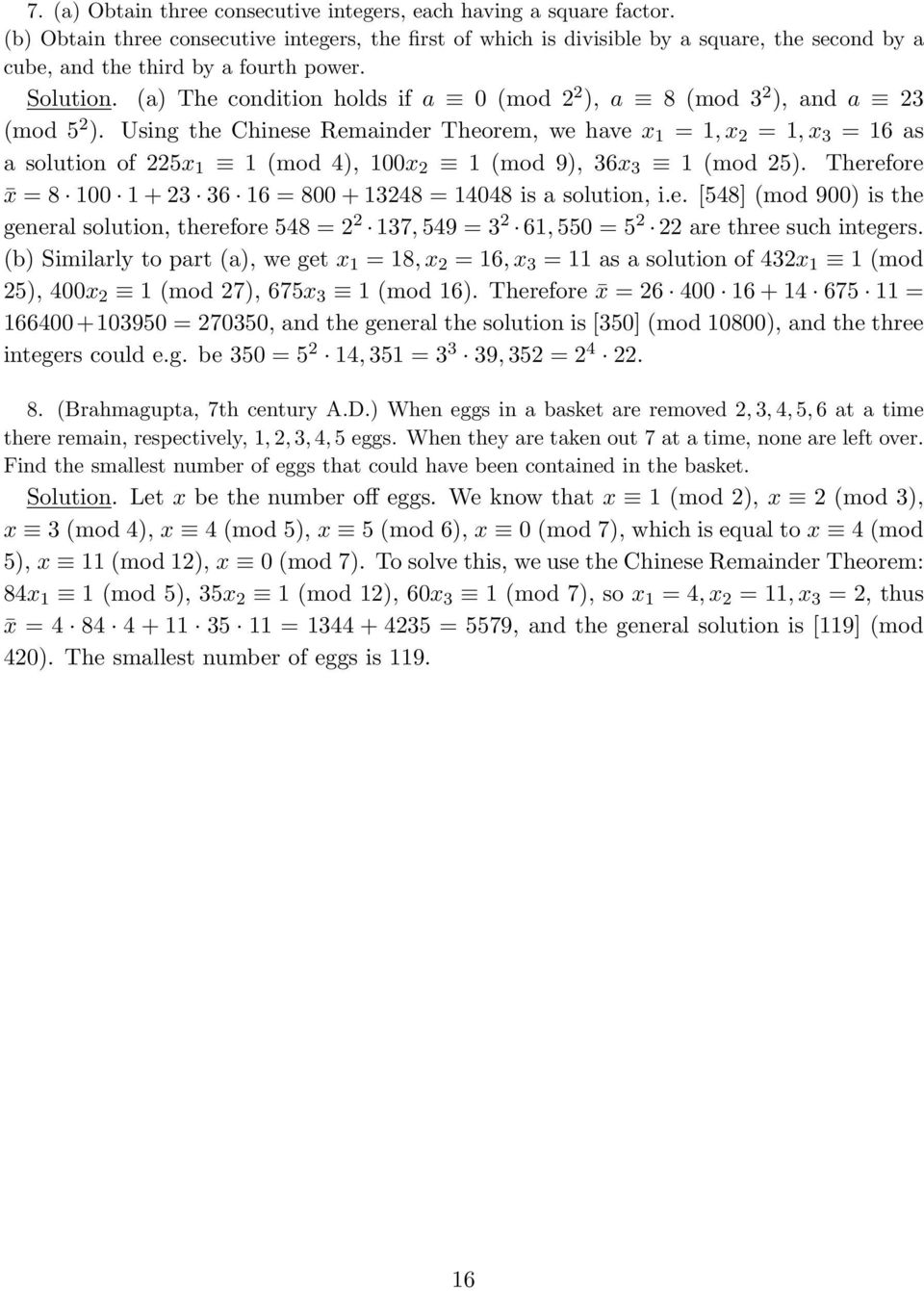
16 7. (a) Obtain three consecutive integers, each having a square factor. (b) Obtain three consecutive integers, the first of which is divisible by a square, the second by a cube, and the third by a fourth power. Solution. (a) The condition holds if a 0 (mod ), a 8 (mod 3 ), and a 3 (mod 5 ). Using the Chinese Remainder Theorem, we have x 1 = 1, x = 1, x 3 = 16 as a solution of 5x 1 1 (mod 4), 100x 1 (mod 9), 36x 3 1 (mod 5). Therefore x = = = is a solution, i.e. [548] (mod 900) is the general solution, therefore 548 = 137, 549 = 3 61, 550 = 5 are three such integers. (b) Similarly to part (a), we get x 1 = 18, x = 16, x 3 = 11 as a solution of 43x 1 1 (mod 5), 400x 1 (mod 7), 675x 3 1 (mod 16). Therefore x = = = 70350, and the general the solution is [350] (mod 10800), and the three integers could e.g. be 350 = 5 14, 351 = , 35 = (Brahmagupta, 7th century A.D.) When eggs in a basket are removed, 3, 4, 5, 6 at a time there remain, respectively, 1,, 3, 4, 5 eggs. When they are taken out 7 at a time, none are left over. Find the smallest number of eggs that could have been contained in the basket. Solution. Let x be the number off eggs. We know that x 1 (mod ), x (mod 3), x 3 (mod 4), x 4 (mod 5), x 5 (mod 6), x 0 (mod 7), which is equal to x 4 (mod 5), x 11 (mod 1), x 0 (mod 7). To solve this, we use the Chinese Remainder Theorem: 84x 1 1 (mod 5), 35x 1 (mod 1), 60x 3 1 (mod 7), so x 1 = 4, x = 11, x 3 =, thus x = = = 5579, and the general solution is [119] (mod 40). The smallest number of eggs is
CS 103X: Discrete Structures Homework Assignment 3 Solutions
 CS 103X: Discrete Structures Homework Assignment 3 s Exercise 1 (20 points). On well-ordering and induction: (a) Prove the induction principle from the well-ordering principle. (b) Prove the well-ordering
Elementary Number Theory and Methods of Proof. CSE 215, Foundations of Computer Science Stony Brook University http://www.cs.stonybrook.
 Elementary Number Theory and Methods of Proof CSE 215, Foundations of Computer Science Stony Brook University http://www.cs.stonybrook.edu/~cse215 1 Number theory Properties: 2 Properties of integers (whole
The last three chapters introduced three major proof techniques: direct,
 CHAPTER 7 Proving Non-Conditional Statements The last three chapters introduced three major proof techniques: direct, contrapositive and contradiction. These three techniques are used to prove statements
CHAPTER 5. Number Theory. 1. Integers and Division. Discussion
 CHAPTER 5 Number Theory 1. Integers and Division 1.1. Divisibility. Definition 1.1.1. Given two integers a and b we say a divides b if there is an integer c such that b = ac. If a divides b, we write a
Today s Topics. Primes & Greatest Common Divisors
 Today s Topics Primes & Greatest Common Divisors Prime representations Important theorems about primality Greatest Common Divisors Least Common Multiples Euclid s algorithm Once and for all, what are prime
The Prime Numbers. Definition. A prime number is a positive integer with exactly two positive divisors.
 The Prime Numbers Before starting our study of primes, we record the following important lemma. Recall that integers a, b are said to be relatively prime if gcd(a, b) = 1. Lemma (Euclid s Lemma). If gcd(a,
8 Primes and Modular Arithmetic
 8 Primes and Modular Arithmetic 8.1 Primes and Factors Over two millennia ago already, people all over the world were considering the properties of numbers. One of the simplest concepts is prime numbers.
k, then n = p2α 1 1 pα k
 Powers of Integers An integer n is a perfect square if n = m for some integer m. Taking into account the prime factorization, if m = p α 1 1 pα k k, then n = pα 1 1 p α k k. That is, n is a perfect square
Number Theory. Proof. Suppose otherwise. Then there would be a finite number n of primes, which we may
 Number Theory Divisibility and Primes Definition. If a and b are integers and there is some integer c such that a = b c, then we say that b divides a or is a factor or divisor of a and write b a. Definition
Every Positive Integer is the Sum of Four Squares! (and other exciting problems)
 Every Positive Integer is the Sum of Four Squares! (and other exciting problems) Sophex University of Texas at Austin October 18th, 00 Matilde N. Lalín 1. Lagrange s Theorem Theorem 1 Every positive integer
= 2 + 1 2 2 = 3 4, Now assume that P (k) is true for some fixed k 2. This means that
 Instructions. Answer each of the questions on your own paper, and be sure to show your work so that partial credit can be adequately assessed. Credit will not be given for answers (even correct ones) without
Math 319 Problem Set #3 Solution 21 February 2002
 Math 319 Problem Set #3 Solution 21 February 2002 1. ( 2.1, problem 15) Find integers a 1, a 2, a 3, a 4, a 5 such that every integer x satisfies at least one of the congruences x a 1 (mod 2), x a 2 (mod
15 Prime and Composite Numbers
 15 Prime and Composite Numbers Divides, Divisors, Factors, Multiples In section 13, we considered the division algorithm: If a and b are whole numbers with b 0 then there exist unique numbers q and r such
SECTION 10-2 Mathematical Induction
 73 0 Sequences and Series 6. Approximate e 0. using the first five terms of the series. Compare this approximation with your calculator evaluation of e 0.. 6. Approximate e 0.5 using the first five terms
Intermediate Math Circles March 7, 2012 Linear Diophantine Equations II
 Intermediate Math Circles March 7, 2012 Linear Diophantine Equations II Last week: How to find one solution to a linear Diophantine equation This week: How to find all solutions to a linear Diophantine
Theorem3.1.1 Thedivisionalgorithm;theorem2.2.1insection2.2 If m, n Z and n is a positive
 Chapter 3 Number Theory 159 3.1 Prime Numbers Prime numbers serve as the basic building blocs in the multiplicative structure of the integers. As you may recall, an integer n greater than one is prime
Elementary Number Theory
 Elementary Number Theory A revision by Jim Hefferon, St Michael s College, 2003-Dec of notes by W. Edwin Clark, University of South Florida, 2002-Dec L A TEX source compiled on January 5, 2004 by Jim Hefferon,
Applications of Fermat s Little Theorem and Congruences
 Applications of Fermat s Little Theorem and Congruences Definition: Let m be a positive integer. Then integers a and b are congruent modulo m, denoted by a b mod m, if m (a b). Example: 3 1 mod 2, 6 4
TEXAS A&M UNIVERSITY. Prime Factorization. A History and Discussion. Jason R. Prince. April 4, 2011
 TEXAS A&M UNIVERSITY Prime Factorization A History and Discussion Jason R. Prince April 4, 2011 Introduction In this paper we will discuss prime factorization, in particular we will look at some of the
8 Divisibility and prime numbers
 8 Divisibility and prime numbers 8.1 Divisibility In this short section we extend the concept of a multiple from the natural numbers to the integers. We also summarize several other terms that express
SOLUTIONS FOR PROBLEM SET 2
 SOLUTIONS FOR PROBLEM SET 2 A: There exist primes p such that p+6k is also prime for k = 1,2 and 3. One such prime is p = 11. Another such prime is p = 41. Prove that there exists exactly one prime p such
I. GROUPS: BASIC DEFINITIONS AND EXAMPLES
 I GROUPS: BASIC DEFINITIONS AND EXAMPLES Definition 1: An operation on a set G is a function : G G G Definition 2: A group is a set G which is equipped with an operation and a special element e G, called
SUM OF TWO SQUARES JAHNAVI BHASKAR
 SUM OF TWO SQUARES JAHNAVI BHASKAR Abstract. I will investigate which numbers can be written as the sum of two squares and in how many ways, providing enough basic number theory so even the unacquainted
MATH10040 Chapter 2: Prime and relatively prime numbers
 MATH10040 Chapter 2: Prime and relatively prime numbers Recall the basic definition: 1. Prime numbers Definition 1.1. Recall that a positive integer is said to be prime if it has precisely two positive
Test1. Due Friday, March 13, 2015.
 1 Abstract Algebra Professor M. Zuker Test1. Due Friday, March 13, 2015. 1. Euclidean algorithm and related. (a) Suppose that a and b are two positive integers and that gcd(a, b) = d. Find all solutions
Number Theory: A Mathemythical Approach. Student Resources. Printed Version
 Number Theory: A Mathemythical Approach Student Resources Printed Version ii Contents 1 Appendix 1 2 Hints to Problems 3 Chapter 1 Hints......................................... 3 Chapter 2 Hints.........................................
U.C. Berkeley CS276: Cryptography Handout 0.1 Luca Trevisan January, 2009. Notes on Algebra
 U.C. Berkeley CS276: Cryptography Handout 0.1 Luca Trevisan January, 2009 Notes on Algebra These notes contain as little theory as possible, and most results are stated without proof. Any introductory
MATHEMATICAL INDUCTION. Mathematical Induction. This is a powerful method to prove properties of positive integers.
 MATHEMATICAL INDUCTION MIGUEL A LERMA (Last updated: February 8, 003) Mathematical Induction This is a powerful method to prove properties of positive integers Principle of Mathematical Induction Let P
Lecture 13 - Basic Number Theory.
 Lecture 13 - Basic Number Theory. Boaz Barak March 22, 2010 Divisibility and primes Unless mentioned otherwise throughout this lecture all numbers are non-negative integers. We say that A divides B, denoted
Handout NUMBER THEORY
 Handout of NUMBER THEORY by Kus Prihantoso Krisnawan MATHEMATICS DEPARTMENT FACULTY OF MATHEMATICS AND NATURAL SCIENCES YOGYAKARTA STATE UNIVERSITY 2012 Contents Contents i 1 Some Preliminary Considerations
SYSTEMS OF PYTHAGOREAN TRIPLES. Acknowledgements. I would like to thank Professor Laura Schueller for advising and guiding me
 SYSTEMS OF PYTHAGOREAN TRIPLES CHRISTOPHER TOBIN-CAMPBELL Abstract. This paper explores systems of Pythagorean triples. It describes the generating formulas for primitive Pythagorean triples, determines
Revised Version of Chapter 23. We learned long ago how to solve linear congruences. ax c (mod m)
 Chapter 23 Squares Modulo p Revised Version of Chapter 23 We learned long ago how to solve linear congruences ax c (mod m) (see Chapter 8). It s now time to take the plunge and move on to quadratic equations.
3 0 + 4 + 3 1 + 1 + 3 9 + 6 + 3 0 + 1 + 3 0 + 1 + 3 2 mod 10 = 4 + 3 + 1 + 27 + 6 + 1 + 1 + 6 mod 10 = 49 mod 10 = 9.
 SOLUTIONS TO HOMEWORK 2 - MATH 170, SUMMER SESSION I (2012) (1) (Exercise 11, Page 107) Which of the following is the correct UPC for Progresso minestrone soup? Show why the other numbers are not valid
CONTINUED FRACTIONS AND PELL S EQUATION. Contents 1. Continued Fractions 1 2. Solution to Pell s Equation 9 References 12
 CONTINUED FRACTIONS AND PELL S EQUATION SEUNG HYUN YANG Abstract. In this REU paper, I will use some important characteristics of continued fractions to give the complete set of solutions to Pell s equation.
Math 55: Discrete Mathematics
 Math 55: Discrete Mathematics UC Berkeley, Fall 2011 Homework # 5, due Wednesday, February 22 5.1.4 Let P (n) be the statement that 1 3 + 2 3 + + n 3 = (n(n + 1)/2) 2 for the positive integer n. a) What
Section 4.2: The Division Algorithm and Greatest Common Divisors
 Section 4.2: The Division Algorithm and Greatest Common Divisors The Division Algorithm The Division Algorithm is merely long division restated as an equation. For example, the division 29 r. 20 32 948
MATH 537 (Number Theory) FALL 2016 TENTATIVE SYLLABUS
 MATH 537 (Number Theory) FALL 2016 TENTATIVE SYLLABUS Class Meetings: MW 2:00-3:15 pm in Physics 144, September 7 to December 14 [Thanksgiving break November 23 27; final exam December 21] Instructor:
Chapter 11 Number Theory
 Chapter 11 Number Theory Number theory is one of the oldest branches of mathematics. For many years people who studied number theory delighted in its pure nature because there were few practical applications
Primality - Factorization
 Primality - Factorization Christophe Ritzenthaler November 9, 2009 1 Prime and factorization Definition 1.1. An integer p > 1 is called a prime number (nombre premier) if it has only 1 and p as divisors.
MATH 289 PROBLEM SET 4: NUMBER THEORY
 MATH 289 PROBLEM SET 4: NUMBER THEORY 1. The greatest common divisor If d and n are integers, then we say that d divides n if and only if there exists an integer q such that n = qd. Notice that if d divides
Factoring Algorithms
 Factoring Algorithms The p 1 Method and Quadratic Sieve November 17, 2008 () Factoring Algorithms November 17, 2008 1 / 12 Fermat s factoring method Fermat made the observation that if n has two factors
Discrete Mathematics, Chapter 4: Number Theory and Cryptography
 Discrete Mathematics, Chapter 4: Number Theory and Cryptography Richard Mayr University of Edinburgh, UK Richard Mayr (University of Edinburgh, UK) Discrete Mathematics. Chapter 4 1 / 35 Outline 1 Divisibility
Chapter 3. if 2 a i then location: = i. Page 40
 Chapter 3 1. Describe an algorithm that takes a list of n integers a 1,a 2,,a n and finds the number of integers each greater than five in the list. Ans: procedure greaterthanfive(a 1,,a n : integers)
V55.0106 Quantitative Reasoning: Computers, Number Theory and Cryptography
 V55.0106 Quantitative Reasoning: Computers, Number Theory and Cryptography 3 Congruence Congruences are an important and useful tool for the study of divisibility. As we shall see, they are also critical
GCDs and Relatively Prime Numbers! CSCI 2824, Fall 2014!
 GCDs and Relatively Prime Numbers! CSCI 2824, Fall 2014!!! Challenge Problem 2 (Mastermind) due Fri. 9/26 Find a fourth guess whose scoring will allow you to determine the secret code (repetitions are
GREATEST COMMON DIVISOR
 DEFINITION: GREATEST COMMON DIVISOR The greatest common divisor (gcd) of a and b, denoted by (a, b), is the largest common divisor of integers a and b. THEOREM: If a and b are nonzero integers, then their
CHAPTER SIX IRREDUCIBILITY AND FACTORIZATION 1. BASIC DIVISIBILITY THEORY
 January 10, 2010 CHAPTER SIX IRREDUCIBILITY AND FACTORIZATION 1. BASIC DIVISIBILITY THEORY The set of polynomials over a field F is a ring, whose structure shares with the ring of integers many characteristics.
RSA and Primality Testing
 and Primality Testing Joan Boyar, IMADA, University of Southern Denmark Studieretningsprojekter 2010 1 / 81 Correctness of cryptography cryptography Introduction to number theory Correctness of with 2
5544 = 2 2772 = 2 2 1386 = 2 2 2 693. Now we have to find a divisor of 693. We can try 3, and 693 = 3 231,and we keep dividing by 3 to get: 1
 MATH 13150: Freshman Seminar Unit 8 1. Prime numbers 1.1. Primes. A number bigger than 1 is called prime if its only divisors are 1 and itself. For example, 3 is prime because the only numbers dividing
Solutions for Practice problems on proofs
 Solutions for Practice problems on proofs Definition: (even) An integer n Z is even if and only if n = 2m for some number m Z. Definition: (odd) An integer n Z is odd if and only if n = 2m + 1 for some
a 11 x 1 + a 12 x 2 + + a 1n x n = b 1 a 21 x 1 + a 22 x 2 + + a 2n x n = b 2.
 Chapter 1 LINEAR EQUATIONS 1.1 Introduction to linear equations A linear equation in n unknowns x 1, x,, x n is an equation of the form a 1 x 1 + a x + + a n x n = b, where a 1, a,..., a n, b are given
Settling a Question about Pythagorean Triples
 Settling a Question about Pythagorean Triples TOM VERHOEFF Department of Mathematics and Computing Science Eindhoven University of Technology P.O. Box 513, 5600 MB Eindhoven, The Netherlands E-Mail address:
Number Theory Hungarian Style. Cameron Byerley s interpretation of Csaba Szabó s lectures
 Number Theory Hungarian Style Cameron Byerley s interpretation of Csaba Szabó s lectures August 20, 2005 2 0.1 introduction Number theory is a beautiful subject and even cooler when you learn about it
Notes on Factoring. MA 206 Kurt Bryan
 The General Approach Notes on Factoring MA 26 Kurt Bryan Suppose I hand you n, a 2 digit integer and tell you that n is composite, with smallest prime factor around 5 digits. Finding a nontrivial factor
Kevin James. MTHSC 412 Section 2.4 Prime Factors and Greatest Comm
 MTHSC 412 Section 2.4 Prime Factors and Greatest Common Divisor Greatest Common Divisor Definition Suppose that a, b Z. Then we say that d Z is a greatest common divisor (gcd) of a and b if the following
MATH 22. THE FUNDAMENTAL THEOREM of ARITHMETIC. Lecture R: 10/30/2003
 MATH 22 Lecture R: 10/30/2003 THE FUNDAMENTAL THEOREM of ARITHMETIC You must remember this, A kiss is still a kiss, A sigh is just a sigh; The fundamental things apply, As time goes by. Herman Hupfeld
Grade 6 Math Circles March 10/11, 2015 Prime Time Solutions
 Faculty of Mathematics Waterloo, Ontario N2L 3G1 Centre for Education in Mathematics and Computing Lights, Camera, Primes! Grade 6 Math Circles March 10/11, 2015 Prime Time Solutions Today, we re going
Continued Fractions and the Euclidean Algorithm
 Continued Fractions and the Euclidean Algorithm Lecture notes prepared for MATH 326, Spring 997 Department of Mathematics and Statistics University at Albany William F Hammond Table of Contents Introduction
Solution to Exercise 2.2. Both m and n are divisible by d, som = dk and n = dk. Thus m ± n = dk ± dk = d(k ± k ),som + n and m n are divisible by d.
 [Chap. ] Pythagorean Triples 6 (b) The table suggests that in every primitive Pythagorean triple, exactly one of a, b,orc is a multiple of 5. To verify this, we use the Pythagorean Triples Theorem to write
Lectures on Number Theory. Lars-Åke Lindahl
 Lectures on Number Theory Lars-Åke Lindahl 2002 Contents 1 Divisibility 1 2 Prime Numbers 7 3 The Linear Diophantine Equation ax+by=c 12 4 Congruences 15 5 Linear Congruences 19 6 The Chinese Remainder
Some facts about polynomials modulo m (Full proof of the Fingerprinting Theorem)
 Some facts about polynomials modulo m (Full proof of the Fingerprinting Theorem) In order to understand the details of the Fingerprinting Theorem on fingerprints of different texts from Chapter 19 of the
Category 3 Number Theory Meet #1, October, 2000
 Category 3 Meet #1, October, 2000 1. For how many positive integral values of n will 168 n be a whole number? 2. What is the greatest integer that will always divide the product of four consecutive integers?
Five fundamental operations. mathematics: addition, subtraction, multiplication, division, and modular forms
 The five fundamental operations of mathematics: addition, subtraction, multiplication, division, and modular forms UC Berkeley Trinity University March 31, 2008 This talk is about counting, and it s about
Introduction. Appendix D Mathematical Induction D1
 Appendix D Mathematical Induction D D Mathematical Induction Use mathematical induction to prove a formula. Find a sum of powers of integers. Find a formula for a finite sum. Use finite differences to
Grade 7/8 Math Circles Fall 2012 Factors and Primes
 1 University of Waterloo Faculty of Mathematics Centre for Education in Mathematics and Computing Grade 7/8 Math Circles Fall 2012 Factors and Primes Factors Definition: A factor of a number is a whole
An Introductory Course in Elementary Number Theory. Wissam Raji
 An Introductory Course in Elementary Number Theory Wissam Raji 2 Preface These notes serve as course notes for an undergraduate course in number theory. Most if not all universities worldwide offer introductory
Chapter 7 - Roots, Radicals, and Complex Numbers
 Math 233 - Spring 2009 Chapter 7 - Roots, Radicals, and Complex Numbers 7.1 Roots and Radicals 7.1.1 Notation and Terminology In the expression x the is called the radical sign. The expression under the
Continued Fractions. Darren C. Collins
 Continued Fractions Darren C Collins Abstract In this paper, we discuss continued fractions First, we discuss the definition and notation Second, we discuss the development of the subject throughout history
A Study on the Necessary Conditions for Odd Perfect Numbers
 A Study on the Necessary Conditions for Odd Perfect Numbers Ben Stevens U63750064 Abstract A collection of all of the known necessary conditions for an odd perfect number to exist, along with brief descriptions
Math 3000 Section 003 Intro to Abstract Math Homework 2
 Math 3000 Section 003 Intro to Abstract Math Homework 2 Department of Mathematical and Statistical Sciences University of Colorado Denver, Spring 2012 Solutions (February 13, 2012) Please note that these
Discrete Mathematics and Probability Theory Fall 2009 Satish Rao, David Tse Note 2
 CS 70 Discrete Mathematics and Probability Theory Fall 2009 Satish Rao, David Tse Note 2 Proofs Intuitively, the concept of proof should already be familiar We all like to assert things, and few of us
Winter Camp 2011 Polynomials Alexander Remorov. Polynomials. Alexander Remorov [email protected]
 Polynomials Alexander Remorov [email protected] Warm-up Problem 1: Let f(x) be a quadratic polynomial. Prove that there exist quadratic polynomials g(x) and h(x) such that f(x)f(x + 1) = g(h(x)).
PYTHAGOREAN TRIPLES KEITH CONRAD
 PYTHAGOREAN TRIPLES KEITH CONRAD 1. Introduction A Pythagorean triple is a triple of positive integers (a, b, c) where a + b = c. Examples include (3, 4, 5), (5, 1, 13), and (8, 15, 17). Below is an ancient
Factoring. Factoring 1
 Factoring Factoring 1 Factoring Security of RSA algorithm depends on (presumed) difficulty of factoring o Given N = pq, find p or q and RSA is broken o Rabin cipher also based on factoring Factoring like
Some practice problems for midterm 2
 Some practice problems for midterm 2 Kiumars Kaveh November 15, 2011 Problem: What is the remainder of 6 2000 when divided by 11? Solution: This is a long-winded way of asking for the value of 6 2000 mod
DigitalCommons@University of Nebraska - Lincoln
 University of Nebraska - Lincoln DigitalCommons@University of Nebraska - Lincoln MAT Exam Expository Papers Math in the Middle Institute Partnership 7-1-007 Pythagorean Triples Diane Swartzlander University
On the generation of elliptic curves with 16 rational torsion points by Pythagorean triples
 On the generation of elliptic curves with 16 rational torsion points by Pythagorean triples Brian Hilley Boston College MT695 Honors Seminar March 3, 2006 1 Introduction 1.1 Mazur s Theorem Let C be a
Math Workshop October 2010 Fractions and Repeating Decimals
 Math Workshop October 2010 Fractions and Repeating Decimals This evening we will investigate the patterns that arise when converting fractions to decimals. As an example of what we will be looking at,
MATH 13150: Freshman Seminar Unit 10
 MATH 13150: Freshman Seminar Unit 10 1. Relatively prime numbers and Euler s function In this chapter, we are going to discuss when two numbers are relatively prime, and learn how to count the numbers
Prime Factorization 0.1. Overcoming Math Anxiety
 0.1 Prime Factorization 0.1 OBJECTIVES 1. Find the factors of a natural number 2. Determine whether a number is prime, composite, or neither 3. Find the prime factorization for a number 4. Find the GCF
2 When is a 2-Digit Number the Sum of the Squares of its Digits?
 When Does a Number Equal the Sum of the Squares or Cubes of its Digits? An Exposition and a Call for a More elegant Proof 1 Introduction We will look at theorems of the following form: by William Gasarch
Just the Factors, Ma am
 1 Introduction Just the Factors, Ma am The purpose of this note is to find and study a method for determining and counting all the positive integer divisors of a positive integer Let N be a given positive
HOMEWORK 5 SOLUTIONS. n!f n (1) lim. ln x n! + xn x. 1 = G n 1 (x). (2) k + 1 n. (n 1)!
 Math 7 Fall 205 HOMEWORK 5 SOLUTIONS Problem. 2008 B2 Let F 0 x = ln x. For n 0 and x > 0, let F n+ x = 0 F ntdt. Evaluate n!f n lim n ln n. By directly computing F n x for small n s, we obtain the following
ALGEBRAIC APPROACH TO COMPOSITE INTEGER FACTORIZATION
 ALGEBRAIC APPROACH TO COMPOSITE INTEGER FACTORIZATION Aldrin W. Wanambisi 1* School of Pure and Applied Science, Mount Kenya University, P.O box 553-50100, Kakamega, Kenya. Shem Aywa 2 Department of Mathematics,
Math Review. for the Quantitative Reasoning Measure of the GRE revised General Test
 Math Review for the Quantitative Reasoning Measure of the GRE revised General Test www.ets.org Overview This Math Review will familiarize you with the mathematical skills and concepts that are important
Session 6 Number Theory
 Key Terms in This Session Session 6 Number Theory Previously Introduced counting numbers factor factor tree prime number New in This Session composite number greatest common factor least common multiple
The Fundamental Theorem of Arithmetic
 The Fundamental Theorem of Arithmetic 1 Introduction: Why this theorem? Why this proof? One of the purposes of this course 1 is to train you in the methods mathematicians use to prove mathematical statements,
3. Mathematical Induction
 3. MATHEMATICAL INDUCTION 83 3. Mathematical Induction 3.1. First Principle of Mathematical Induction. Let P (n) be a predicate with domain of discourse (over) the natural numbers N = {0, 1,,...}. If (1)
Quotient Rings and Field Extensions
 Chapter 5 Quotient Rings and Field Extensions In this chapter we describe a method for producing field extension of a given field. If F is a field, then a field extension is a field K that contains F.
minimal polyonomial Example
 Minimal Polynomials Definition Let α be an element in GF(p e ). We call the monic polynomial of smallest degree which has coefficients in GF(p) and α as a root, the minimal polyonomial of α. Example: We
Integer roots of quadratic and cubic polynomials with integer coefficients
 Integer roots of quadratic and cubic polynomials with integer coefficients Konstantine Zelator Mathematics, Computer Science and Statistics 212 Ben Franklin Hall Bloomsburg University 400 East Second Street
Integer Factorization using the Quadratic Sieve
 Integer Factorization using the Quadratic Sieve Chad Seibert* Division of Science and Mathematics University of Minnesota, Morris Morris, MN 56567 [email protected] March 16, 2011 Abstract We give
WRITING PROOFS. Christopher Heil Georgia Institute of Technology
 WRITING PROOFS Christopher Heil Georgia Institute of Technology A theorem is just a statement of fact A proof of the theorem is a logical explanation of why the theorem is true Many theorems have this
DIVISIBILITY AND GREATEST COMMON DIVISORS
 DIVISIBILITY AND GREATEST COMMON DIVISORS KEITH CONRAD 1 Introduction We will begin with a review of divisibility among integers, mostly to set some notation and to indicate its properties Then we will
6.2 Permutations continued
 6.2 Permutations continued Theorem A permutation on a finite set A is either a cycle or can be expressed as a product (composition of disjoint cycles. Proof is by (strong induction on the number, r, of
Overview of Number Theory Basics. Divisibility
 Overview of Number Theory Basics Murat Kantarcioglu Based on Prof. Ninghui Li s Slides Divisibility Definition Given integers a and b, b 0, b divides a (denoted b a) if integer c, s.t. a = cb. b is called
11 Ideals. 11.1 Revisiting Z
 11 Ideals The presentation here is somewhat different than the text. In particular, the sections do not match up. We have seen issues with the failure of unique factorization already, e.g., Z[ 5] = O Q(
LAKE ELSINORE UNIFIED SCHOOL DISTRICT
 LAKE ELSINORE UNIFIED SCHOOL DISTRICT Title: PLATO Algebra 1-Semester 2 Grade Level: 10-12 Department: Mathematics Credit: 5 Prerequisite: Letter grade of F and/or N/C in Algebra 1, Semester 2 Course Description:
Stanford Math Circle: Sunday, May 9, 2010 Square-Triangular Numbers, Pell s Equation, and Continued Fractions
 Stanford Math Circle: Sunday, May 9, 00 Square-Triangular Numbers, Pell s Equation, and Continued Fractions Recall that triangular numbers are numbers of the form T m = numbers that can be arranged in
THE CONGRUENT NUMBER PROBLEM
 THE CONGRUENT NUMBER PROBLEM KEITH CONRAD 1. Introduction A right triangle is called rational when its legs and hypotenuse are all rational numbers. Examples of rational right triangles include Pythagorean