
GCDs and Relatively Prime Numbers! CSCI 2824, Fall 2014!
|
|
|
- Clementine Hoover
- 9 years ago
- Views:
Transcription
1 GCDs and Relatively Prime Numbers! CSCI 2824, Fall 2014!!!

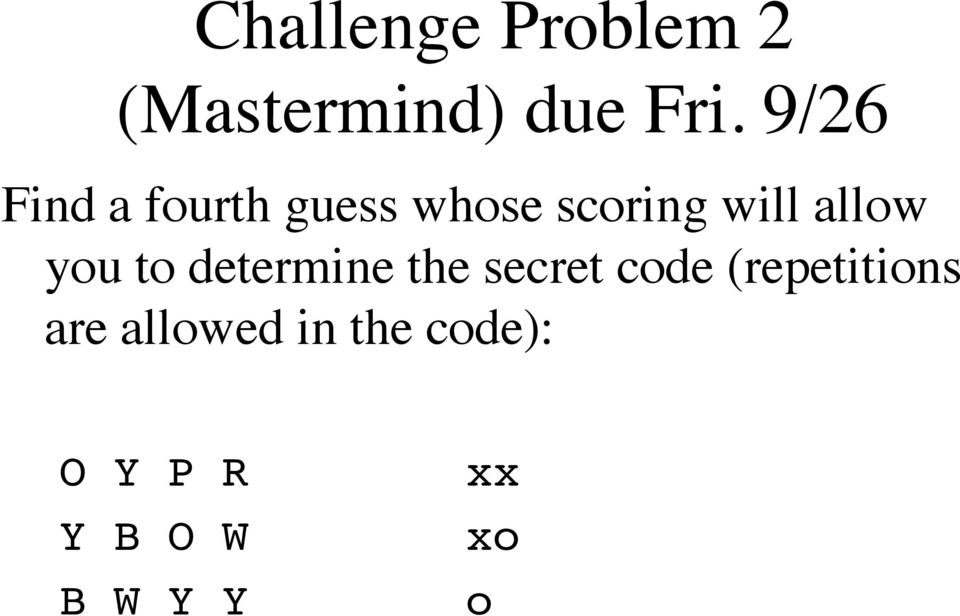
2 Challenge Problem 2 (Mastermind) due Fri. 9/26 Find a fourth guess whose scoring will allow you to determine the secret code (repetitions are allowed in the code): O Y P R!!xx! Y B O W!!xo! B W Y Y!!o!
3 Divisors The set of divisors of a positive integer n are all those integers d whose absolute value is less than or equal to n and that have the property: d n So, for example, the divisors of 18 are: +/- 1, +/- 2, +/- 3, +/- 6, +/- 9, +/- 18 The divisors of 42 are: +/- 1, +/- 2, +/- 3, +/- 6, +/- 7, +/- 14, +/- 21, +/- 42

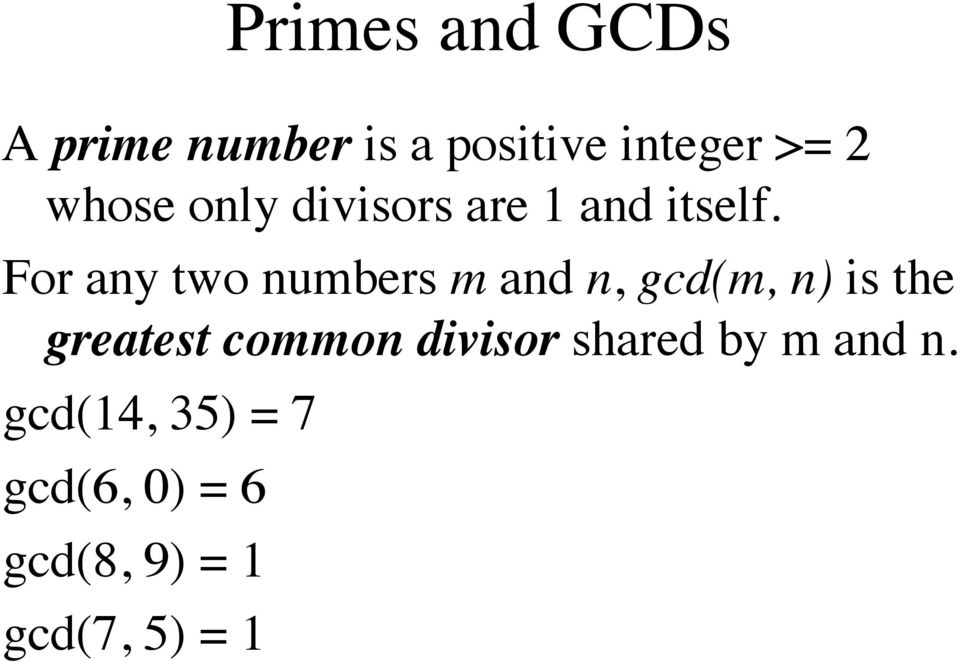
4 Primes and GCDs A prime number is a positive integer >= 2 whose only divisors are 1 and itself. For any two numbers m and n, gcd(m, n) is the greatest common divisor shared by m and n. gcd(14, 35) = 7 gcd(6, 0) = 6 gcd(8, 9) = 1 gcd(7, 5) = 1
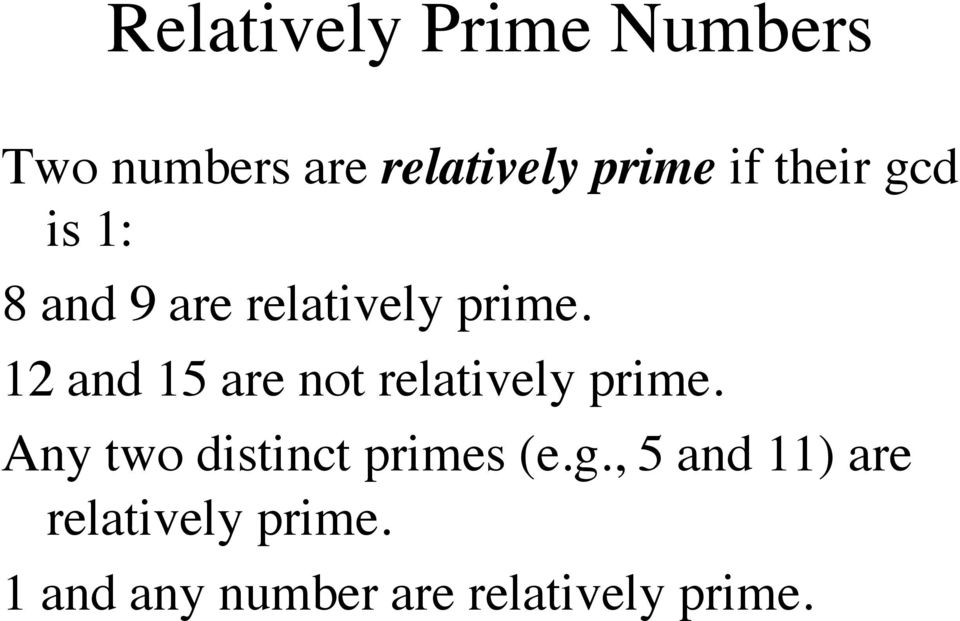
5 Relatively Prime Numbers Two numbers are relatively prime if their gcd is 1: 8 and 9 are relatively prime. 12 and 15 are not relatively prime. Any two distinct primes (e.g., 5 and 11) are relatively prime. 1 and any number are relatively prime.
6 A couple of questions What numbers can be expressed in the form: 12 x + 27 y where x and y are integers?

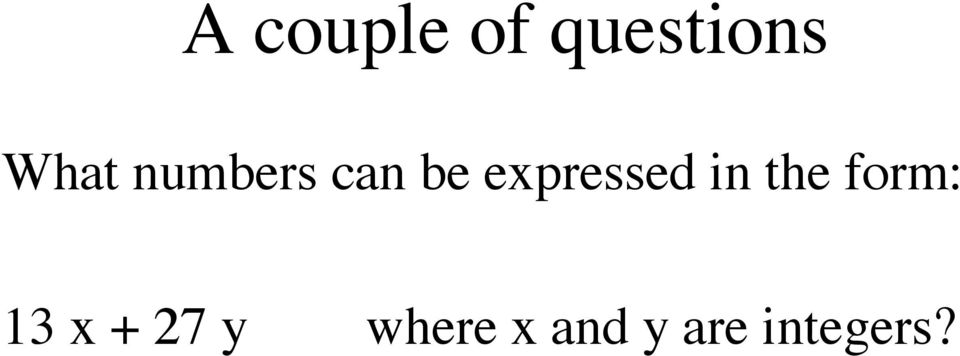
7 A couple of questions What numbers can be expressed in the form: 13 x + 27 y where x and y are integers?
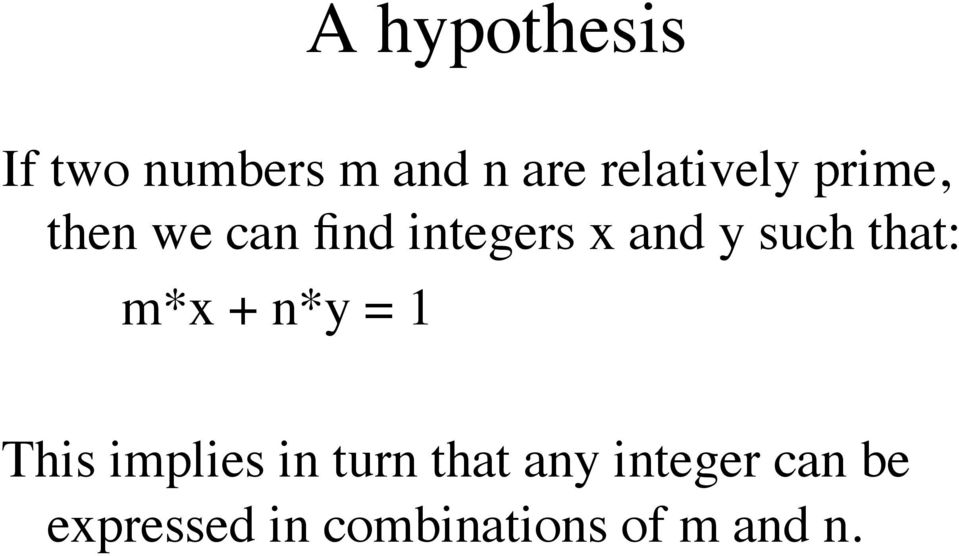
8 A hypothesis If two numbers m and n are relatively prime, then we can find integers x and y such that: m*x + n*y = 1 This implies in turn that any integer can be expressed in combinations of m and n.
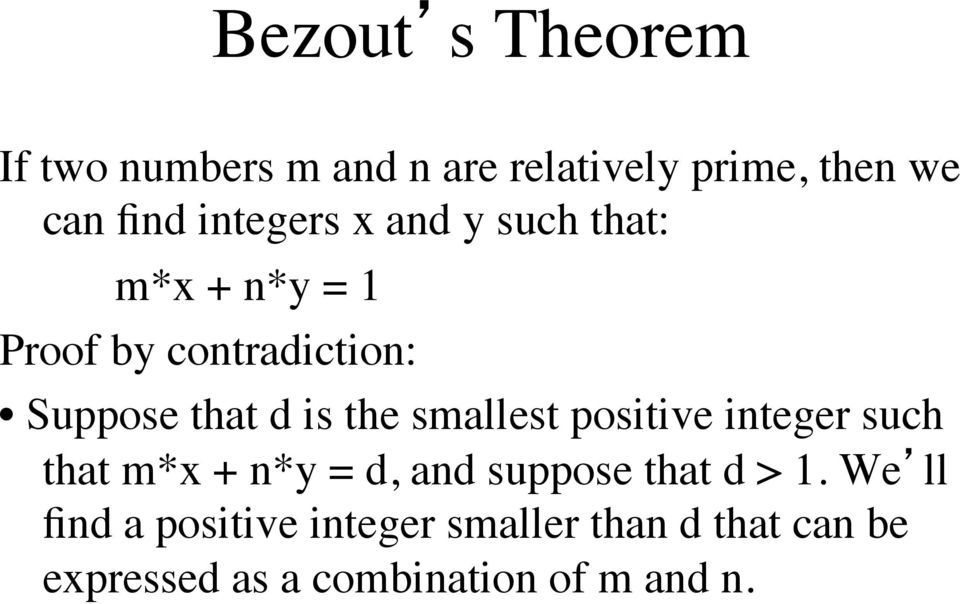
9 Bezout s Theorem If two numbers m and n are relatively prime, then we can find integers x and y such that: m*x + n*y = 1 Proof by contradiction: Suppose that d is the smallest positive integer such that m*x + n*y = d, and suppose that d > 1. We ll find a positive integer smaller than d that can be expressed as a combination of m and n.
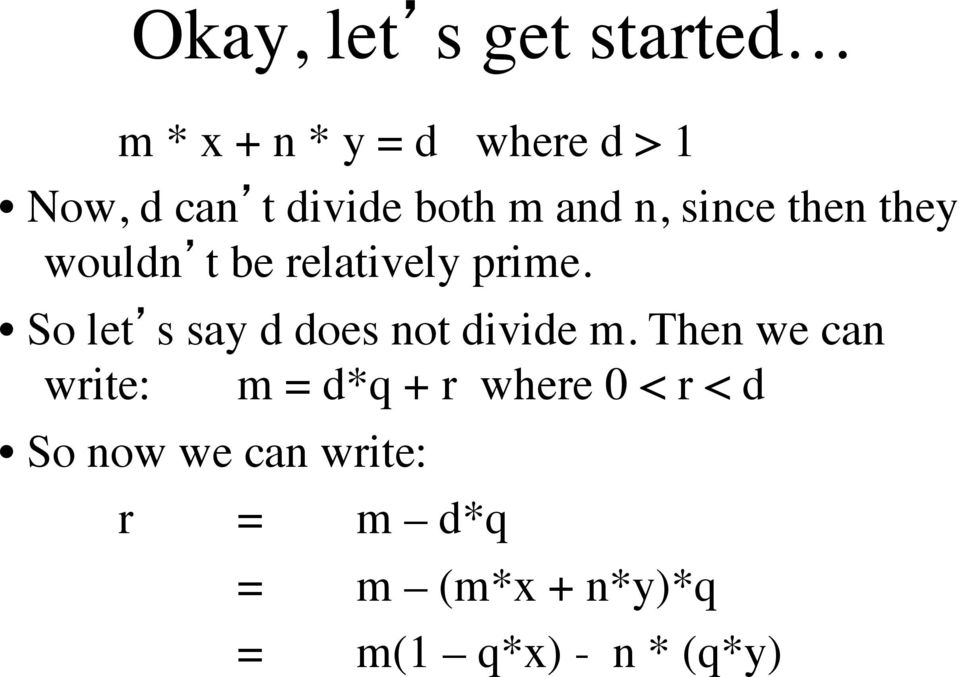
10 Okay, let s get started m * x + n * y = d where d > 1 Now, d can t divide both m and n, since then they wouldn t be relatively prime. So let s say d does not divide m. Then we can write: m = d*q + r where 0 < r < d So now we can write: r = m d*q = m (m*x + n*y)*q = m(1 q*x) - n * (q*y)
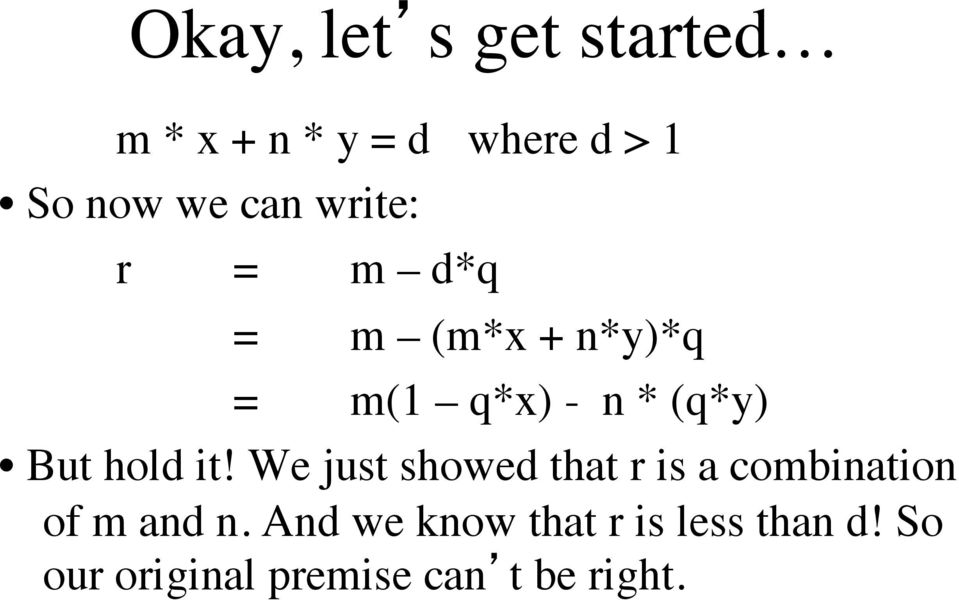
11 Okay, let s get started m * x + n * y = d where d > 1 So now we can write: r = m d*q = m (m*x + n*y)*q = m(1 q*x) - n * (q*y) But hold it! We just showed that r is a combination of m and n. And we know that r is less than d! So our original premise can t be right.
12 Bezout s Theorem, Again If two numbers m and n are relatively prime, then we can find x and y such that: m*x + n*y = 1 Try it for any two relatively prime numbers: 7 and 26 9 and 11

13 A Corollary to Bezout s Theorem If gcd(m, n) = d where d > 1, then we can find an integer combination of m and n that sums to d: m * x + n * y = d Why? Note that gcd(m/d, n/d) = 1, and then we can find a combination such that: (m/d) * x + (n/d) * y = 1
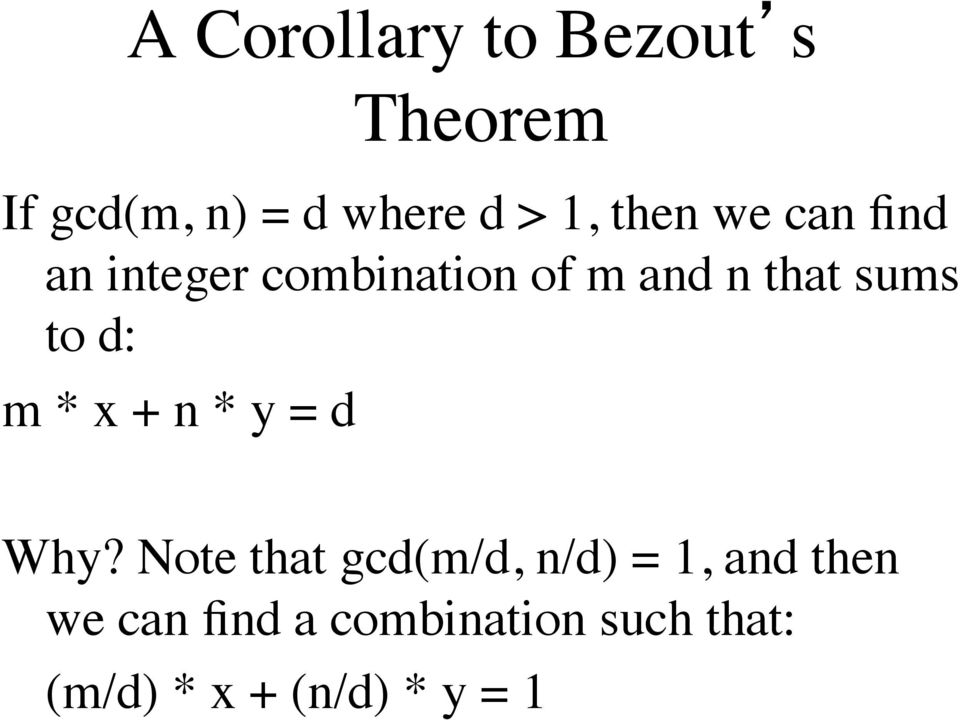
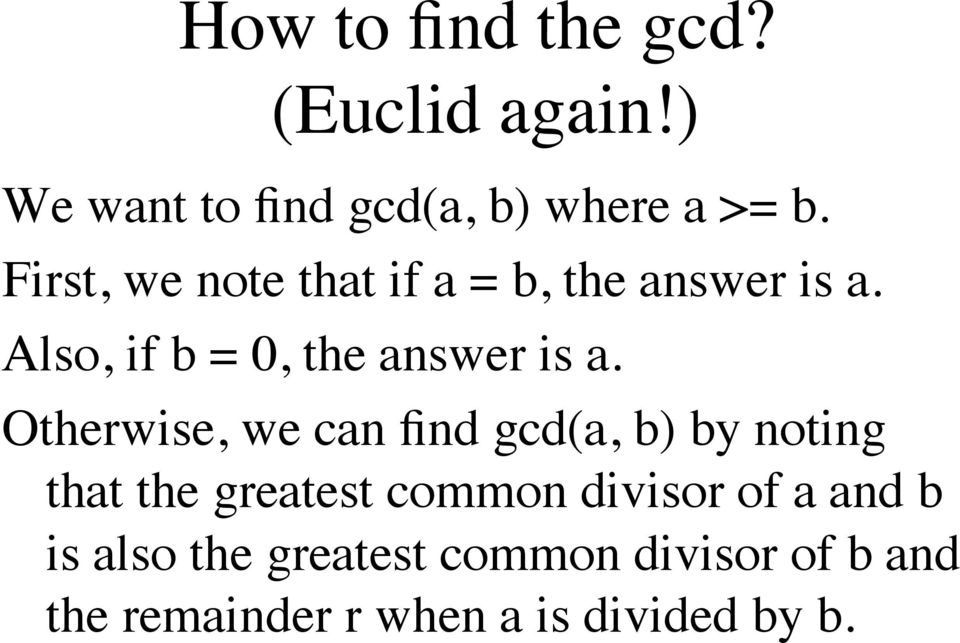
14 How to find the gcd? (Euclid again!) We want to find gcd(a, b) where a >= b. First, we note that if a = b, the answer is a. Also, if b = 0, the answer is a. Otherwise, we can find gcd(a, b) by noting that the greatest common divisor of a and b is also the greatest common divisor of b and the remainder r when a is divided by b.
15 Why does this work? Suppose d a and d b. (In prose, d goes into both a and b.) And suppose a = b*q + r. Then d b and d (a b*q).

16 gcd (99, 18) = gcd(18, 9) = gcd(9, 0) = 9 Two examples: gcd(70, 49) = gcd(49, 21) = gcd(21, 7) = gcd(7, 0) = 7

17 Scheme version of the algorithm! for finding the GCD (define (gcd a b)! (if!(= b 0)!!!!a!!!!(gcd b (remainder a b))))!!

18 Not only is this idea super-fast, but it s also useful: (18, 7) = (7, 4) = (4, 3) = (3, 1) = (1, 0) = 1 18 = (2 * 7) = (1* 4) = (1 * 3) + 1 Now, unwind those statements: 1 = 4 (1 * 3) = 4 - (1 * (7 (1 * 4))) = 4 (7 4) = (2 * 4) - 7 = ((2 * (18 (2 * 7))) 7 = (2 * 18) (5 * 7)

19 The Structure of Divisors Let s try to break down a number s divisors as far as we can: 84 = 2 * 42 = 2 * 2 * 21 = 2 * 2 * 3 * 7 We can t go any further than this, since we have only prime factors.

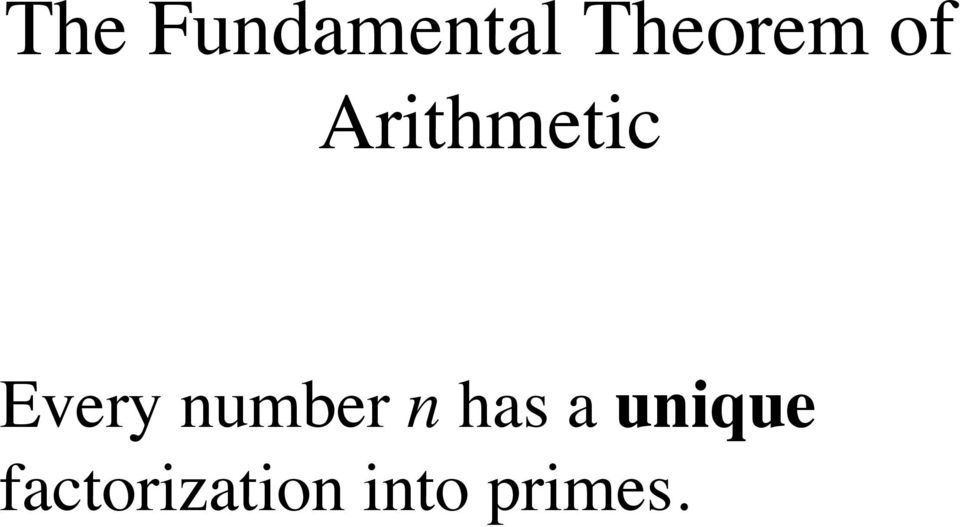
20 The Fundamental Theorem of Arithmetic Every number n has a unique factorization into primes.
21 A Lemma Suppose d (ab) and gcd(d,a) = 1 In prose: d goes into the product of a and b, but d and a are relatively prime. Then d b
22 Let s prove the lemma. Since d ab We can write: ab = dq And since gcd(d, a) = 1 We can find x and y such that: dx + ay = 1 So: dbx + aby = b dbx + dqy = b d(bx + qy) = b
23 Lemma 2 (a corollary to Lemma 1) We now know that if d (ab) and gcd(d,a) = 1, then d b. Suppose d is a prime number (let s call it p for prime). Then if p (ab), we know that either p a or p b. Proof: Suppose p doesn t go into a. Then by the definition of greatest common divisor (and the definition of a prime number ), gcd(p,a) = 1. Which means, from our previous lemma, that p b.
24 More generally, we have the following: p q 1 q 2 q 3 q n means that p must go into at least one factor in the product.
25 Now we re ready to prove the Fundamental Theorem of Arithmetic First we show that every number can be factored into primes. (We ll leave uniqueness for the next step.) Step 1. We know that 2 can be factored into primes (i.e., 2 itself). Step 2. Suppose that all numbers from 2 n can be factored into primes. Consider n+1. If it s prime, we re done. Step 3. Suppose it isn t prime. Then it must have some factor q. So qx = (n+1). But we know that both q and x are smaller than n+1, so they can be factored into primes. A note: this technique (step 2) is called strong induction.
26 The factorization is unique (proof by contradiction). Suppose the factorization weren t unique. Let m be the smallest number with two distinct prime factorizations, with factors ordered low to high: p 1 p 2 p 3..p j = m = q1q2q3 qk If p is equal to q, then we can divide both factorizations by that number, and we have a smaller value with two distinct factorizations (contrary to our assumption). So choose the smaller of p, q: let s say it s p. Then by our earlier lemma 2, p must go into one of the q factors, contrary to our assumption that they re all prime! Either way, we have a contradiction.
Kevin James. MTHSC 412 Section 2.4 Prime Factors and Greatest Comm
 MTHSC 412 Section 2.4 Prime Factors and Greatest Common Divisor Greatest Common Divisor Definition Suppose that a, b Z. Then we say that d Z is a greatest common divisor (gcd) of a and b if the following
GREATEST COMMON DIVISOR
 DEFINITION: GREATEST COMMON DIVISOR The greatest common divisor (gcd) of a and b, denoted by (a, b), is the largest common divisor of integers a and b. THEOREM: If a and b are nonzero integers, then their
Today s Topics. Primes & Greatest Common Divisors
 Today s Topics Primes & Greatest Common Divisors Prime representations Important theorems about primality Greatest Common Divisors Least Common Multiples Euclid s algorithm Once and for all, what are prime
The Prime Numbers. Definition. A prime number is a positive integer with exactly two positive divisors.
 The Prime Numbers Before starting our study of primes, we record the following important lemma. Recall that integers a, b are said to be relatively prime if gcd(a, b) = 1. Lemma (Euclid s Lemma). If gcd(a,
MATH 289 PROBLEM SET 4: NUMBER THEORY
 MATH 289 PROBLEM SET 4: NUMBER THEORY 1. The greatest common divisor If d and n are integers, then we say that d divides n if and only if there exists an integer q such that n = qd. Notice that if d divides
CS 103X: Discrete Structures Homework Assignment 3 Solutions
 CS 103X: Discrete Structures Homework Assignment 3 s Exercise 1 (20 points). On well-ordering and induction: (a) Prove the induction principle from the well-ordering principle. (b) Prove the well-ordering
CHAPTER 5. Number Theory. 1. Integers and Division. Discussion
 CHAPTER 5 Number Theory 1. Integers and Division 1.1. Divisibility. Definition 1.1.1. Given two integers a and b we say a divides b if there is an integer c such that b = ac. If a divides b, we write a
DIVISIBILITY AND GREATEST COMMON DIVISORS
 DIVISIBILITY AND GREATEST COMMON DIVISORS KEITH CONRAD 1 Introduction We will begin with a review of divisibility among integers, mostly to set some notation and to indicate its properties Then we will
Elementary Number Theory and Methods of Proof. CSE 215, Foundations of Computer Science Stony Brook University http://www.cs.stonybrook.
 Elementary Number Theory and Methods of Proof CSE 215, Foundations of Computer Science Stony Brook University http://www.cs.stonybrook.edu/~cse215 1 Number theory Properties: 2 Properties of integers (whole
Section 4.2: The Division Algorithm and Greatest Common Divisors
 Section 4.2: The Division Algorithm and Greatest Common Divisors The Division Algorithm The Division Algorithm is merely long division restated as an equation. For example, the division 29 r. 20 32 948
8 Divisibility and prime numbers
 8 Divisibility and prime numbers 8.1 Divisibility In this short section we extend the concept of a multiple from the natural numbers to the integers. We also summarize several other terms that express
6.2 Permutations continued
 6.2 Permutations continued Theorem A permutation on a finite set A is either a cycle or can be expressed as a product (composition of disjoint cycles. Proof is by (strong induction on the number, r, of
8 Primes and Modular Arithmetic
 8 Primes and Modular Arithmetic 8.1 Primes and Factors Over two millennia ago already, people all over the world were considering the properties of numbers. One of the simplest concepts is prime numbers.
Homework until Test #2
 MATH31: Number Theory Homework until Test # Philipp BRAUN Section 3.1 page 43, 1. It has been conjectured that there are infinitely many primes of the form n. Exhibit five such primes. Solution. Five such
MATH 22. THE FUNDAMENTAL THEOREM of ARITHMETIC. Lecture R: 10/30/2003
 MATH 22 Lecture R: 10/30/2003 THE FUNDAMENTAL THEOREM of ARITHMETIC You must remember this, A kiss is still a kiss, A sigh is just a sigh; The fundamental things apply, As time goes by. Herman Hupfeld
MATH10040 Chapter 2: Prime and relatively prime numbers
 MATH10040 Chapter 2: Prime and relatively prime numbers Recall the basic definition: 1. Prime numbers Definition 1.1. Recall that a positive integer is said to be prime if it has precisely two positive
The Euclidean Algorithm
 The Euclidean Algorithm A METHOD FOR FINDING THE GREATEST COMMON DIVISOR FOR TWO LARGE NUMBERS To be successful using this method you have got to know how to divide. If this is something that you have
MATHEMATICAL INDUCTION. Mathematical Induction. This is a powerful method to prove properties of positive integers.
 MATHEMATICAL INDUCTION MIGUEL A LERMA (Last updated: February 8, 003) Mathematical Induction This is a powerful method to prove properties of positive integers Principle of Mathematical Induction Let P
Discrete Mathematics, Chapter 4: Number Theory and Cryptography
 Discrete Mathematics, Chapter 4: Number Theory and Cryptography Richard Mayr University of Edinburgh, UK Richard Mayr (University of Edinburgh, UK) Discrete Mathematics. Chapter 4 1 / 35 Outline 1 Divisibility
The last three chapters introduced three major proof techniques: direct,
 CHAPTER 7 Proving Non-Conditional Statements The last three chapters introduced three major proof techniques: direct, contrapositive and contradiction. These three techniques are used to prove statements
z 0 and y even had the form
 Gaussian Integers The concepts of divisibility, primality and factoring are actually more general than the discussion so far. For the moment, we have been working in the integers, which we denote by Z
15 Prime and Composite Numbers
 15 Prime and Composite Numbers Divides, Divisors, Factors, Multiples In section 13, we considered the division algorithm: If a and b are whole numbers with b 0 then there exist unique numbers q and r such
COMMUTATIVE RINGS. Definition: A domain is a commutative ring R that satisfies the cancellation law for multiplication:
 COMMUTATIVE RINGS Definition: A commutative ring R is a set with two operations, addition and multiplication, such that: (i) R is an abelian group under addition; (ii) ab = ba for all a, b R (commutative
Number Theory. Proof. Suppose otherwise. Then there would be a finite number n of primes, which we may
 Number Theory Divisibility and Primes Definition. If a and b are integers and there is some integer c such that a = b c, then we say that b divides a or is a factor or divisor of a and write b a. Definition
Page 331, 38.4 Suppose a is a positive integer and p is a prime. Prove that p a if and only if the prime factorization of a contains p.
 Page 331, 38.2 Assignment #11 Solutions Factor the following positive integers into primes. a. 25 = 5 2. b. 4200 = 2 3 3 5 2 7. c. 10 10 = 2 10 5 10. d. 19 = 19. e. 1 = 1. Page 331, 38.4 Suppose a is a
Math 319 Problem Set #3 Solution 21 February 2002
 Math 319 Problem Set #3 Solution 21 February 2002 1. ( 2.1, problem 15) Find integers a 1, a 2, a 3, a 4, a 5 such that every integer x satisfies at least one of the congruences x a 1 (mod 2), x a 2 (mod
Quotient Rings and Field Extensions
 Chapter 5 Quotient Rings and Field Extensions In this chapter we describe a method for producing field extension of a given field. If F is a field, then a field extension is a field K that contains F.
The Division Algorithm for Polynomials Handout Monday March 5, 2012
 The Division Algorithm for Polynomials Handout Monday March 5, 0 Let F be a field (such as R, Q, C, or F p for some prime p. This will allow us to divide by any nonzero scalar. (For some of the following,
RSA and Primality Testing
 and Primality Testing Joan Boyar, IMADA, University of Southern Denmark Studieretningsprojekter 2010 1 / 81 Correctness of cryptography cryptography Introduction to number theory Correctness of with 2
SUM OF TWO SQUARES JAHNAVI BHASKAR
 SUM OF TWO SQUARES JAHNAVI BHASKAR Abstract. I will investigate which numbers can be written as the sum of two squares and in how many ways, providing enough basic number theory so even the unacquainted
MATH 13150: Freshman Seminar Unit 10
 MATH 13150: Freshman Seminar Unit 10 1. Relatively prime numbers and Euler s function In this chapter, we are going to discuss when two numbers are relatively prime, and learn how to count the numbers
The Chinese Remainder Theorem
 The Chinese Remainder Theorem Evan Chen [email protected] February 3, 2015 The Chinese Remainder Theorem is a theorem only in that it is useful and requires proof. When you ask a capable 15-year-old why
WRITING PROOFS. Christopher Heil Georgia Institute of Technology
 WRITING PROOFS Christopher Heil Georgia Institute of Technology A theorem is just a statement of fact A proof of the theorem is a logical explanation of why the theorem is true Many theorems have this
U.C. Berkeley CS276: Cryptography Handout 0.1 Luca Trevisan January, 2009. Notes on Algebra
 U.C. Berkeley CS276: Cryptography Handout 0.1 Luca Trevisan January, 2009 Notes on Algebra These notes contain as little theory as possible, and most results are stated without proof. Any introductory
Elementary Number Theory
 Elementary Number Theory A revision by Jim Hefferon, St Michael s College, 2003-Dec of notes by W. Edwin Clark, University of South Florida, 2002-Dec L A TEX source compiled on January 5, 2004 by Jim Hefferon,
I. GROUPS: BASIC DEFINITIONS AND EXAMPLES
 I GROUPS: BASIC DEFINITIONS AND EXAMPLES Definition 1: An operation on a set G is a function : G G G Definition 2: A group is a set G which is equipped with an operation and a special element e G, called
POLYNOMIAL RINGS AND UNIQUE FACTORIZATION DOMAINS
 POLYNOMIAL RINGS AND UNIQUE FACTORIZATION DOMAINS RUSS WOODROOFE 1. Unique Factorization Domains Throughout the following, we think of R as sitting inside R[x] as the constant polynomials (of degree 0).
3. Mathematical Induction
 3. MATHEMATICAL INDUCTION 83 3. Mathematical Induction 3.1. First Principle of Mathematical Induction. Let P (n) be a predicate with domain of discourse (over) the natural numbers N = {0, 1,,...}. If (1)
TEXAS A&M UNIVERSITY. Prime Factorization. A History and Discussion. Jason R. Prince. April 4, 2011
 TEXAS A&M UNIVERSITY Prime Factorization A History and Discussion Jason R. Prince April 4, 2011 Introduction In this paper we will discuss prime factorization, in particular we will look at some of the
On the generation of elliptic curves with 16 rational torsion points by Pythagorean triples
 On the generation of elliptic curves with 16 rational torsion points by Pythagorean triples Brian Hilley Boston College MT695 Honors Seminar March 3, 2006 1 Introduction 1.1 Mazur s Theorem Let C be a
Continued Fractions and the Euclidean Algorithm
 Continued Fractions and the Euclidean Algorithm Lecture notes prepared for MATH 326, Spring 997 Department of Mathematics and Statistics University at Albany William F Hammond Table of Contents Introduction
PROBLEM SET 6: POLYNOMIALS
 PROBLEM SET 6: POLYNOMIALS 1. introduction In this problem set we will consider polynomials with coefficients in K, where K is the real numbers R, the complex numbers C, the rational numbers Q or any other
Discrete Mathematics and Probability Theory Fall 2009 Satish Rao, David Tse Note 2
 CS 70 Discrete Mathematics and Probability Theory Fall 2009 Satish Rao, David Tse Note 2 Proofs Intuitively, the concept of proof should already be familiar We all like to assert things, and few of us
k, then n = p2α 1 1 pα k
 Powers of Integers An integer n is a perfect square if n = m for some integer m. Taking into account the prime factorization, if m = p α 1 1 pα k k, then n = pα 1 1 p α k k. That is, n is a perfect square
Chapter 4, Arithmetic in F [x] Polynomial arithmetic and the division algorithm.
![Chapter 4, Arithmetic in F [x] Polynomial arithmetic and the division algorithm.](/thumbs/26/8276997.jpg "Chapter 4, Arithmetic in F [x] Polynomial arithmetic and the division algorithm.") Chapter 4, Arithmetic in F [x] Polynomial arithmetic and the division algorithm. We begin by defining the ring of polynomials with coefficients in a ring R. After some preliminary results, we specialize
Chapter 4, Arithmetic in F [x] Polynomial arithmetic and the division algorithm. We begin by defining the ring of polynomials with coefficients in a ring R. After some preliminary results, we specialize
11 Ideals. 11.1 Revisiting Z
 11 Ideals The presentation here is somewhat different than the text. In particular, the sections do not match up. We have seen issues with the failure of unique factorization already, e.g., Z[ 5] = O Q(
Handout #1: Mathematical Reasoning
 Math 101 Rumbos Spring 2010 1 Handout #1: Mathematical Reasoning 1 Propositional Logic A proposition is a mathematical statement that it is either true or false; that is, a statement whose certainty or
WOLLONGONG COLLEGE AUSTRALIA. Diploma in Information Technology
 First Name: Family Name: Student Number: Class/Tutorial: WOLLONGONG COLLEGE AUSTRALIA A College of the University of Wollongong Diploma in Information Technology Mid-Session Test Summer Session 008-00
V55.0106 Quantitative Reasoning: Computers, Number Theory and Cryptography
 V55.0106 Quantitative Reasoning: Computers, Number Theory and Cryptography 3 Congruence Congruences are an important and useful tool for the study of divisibility. As we shall see, they are also critical
Handout NUMBER THEORY
 Handout of NUMBER THEORY by Kus Prihantoso Krisnawan MATHEMATICS DEPARTMENT FACULTY OF MATHEMATICS AND NATURAL SCIENCES YOGYAKARTA STATE UNIVERSITY 2012 Contents Contents i 1 Some Preliminary Considerations
MATH 537 (Number Theory) FALL 2016 TENTATIVE SYLLABUS
 MATH 537 (Number Theory) FALL 2016 TENTATIVE SYLLABUS Class Meetings: MW 2:00-3:15 pm in Physics 144, September 7 to December 14 [Thanksgiving break November 23 27; final exam December 21] Instructor:
5544 = 2 2772 = 2 2 1386 = 2 2 2 693. Now we have to find a divisor of 693. We can try 3, and 693 = 3 231,and we keep dividing by 3 to get: 1
 MATH 13150: Freshman Seminar Unit 8 1. Prime numbers 1.1. Primes. A number bigger than 1 is called prime if its only divisors are 1 and itself. For example, 3 is prime because the only numbers dividing
DigitalCommons@University of Nebraska - Lincoln
 University of Nebraska - Lincoln DigitalCommons@University of Nebraska - Lincoln MAT Exam Expository Papers Math in the Middle Institute Partnership 7-1-007 Pythagorean Triples Diane Swartzlander University
Intermediate Math Circles March 7, 2012 Linear Diophantine Equations II
 Intermediate Math Circles March 7, 2012 Linear Diophantine Equations II Last week: How to find one solution to a linear Diophantine equation This week: How to find all solutions to a linear Diophantine
Lecture Notes on Discrete Mathematics
 Lecture Notes on Discrete Mathematics A. K. Lal September 26, 2012 2 Contents 1 Preliminaries 5 1.1 Basic Set Theory.................................... 5 1.2 Properties of Integers.................................
Fibonacci Numbers and Greatest Common Divisors. The Finonacci numbers are the numbers in the sequence 1, 1, 2, 3, 5, 8, 13, 21, 34, 55, 89, 144,...
 Fibonacci Numbers and Greatest Common Divisors The Finonacci numbers are the numbers in the sequence 1, 1, 2, 3, 5, 8, 13, 21, 34, 55, 89, 144,.... After starting with two 1s, we get each Fibonacci number
An Innocent Investigation
 An Innocent Investigation D. Joyce, Clark University January 2006 The beginning. Have you ever wondered why every number is either even or odd? I don t mean to ask if you ever wondered whether every number
Winter Camp 2011 Polynomials Alexander Remorov. Polynomials. Alexander Remorov [email protected]
 Polynomials Alexander Remorov [email protected] Warm-up Problem 1: Let f(x) be a quadratic polynomial. Prove that there exist quadratic polynomials g(x) and h(x) such that f(x)f(x + 1) = g(h(x)).
ALGEBRAIC APPROACH TO COMPOSITE INTEGER FACTORIZATION
 ALGEBRAIC APPROACH TO COMPOSITE INTEGER FACTORIZATION Aldrin W. Wanambisi 1* School of Pure and Applied Science, Mount Kenya University, P.O box 553-50100, Kakamega, Kenya. Shem Aywa 2 Department of Mathematics,
CHAPTER 3. Methods of Proofs. 1. Logical Arguments and Formal Proofs
 CHAPTER 3 Methods of Proofs 1. Logical Arguments and Formal Proofs 1.1. Basic Terminology. An axiom is a statement that is given to be true. A rule of inference is a logical rule that is used to deduce
Grade 6 Math Circles March 10/11, 2015 Prime Time Solutions
 Faculty of Mathematics Waterloo, Ontario N2L 3G1 Centre for Education in Mathematics and Computing Lights, Camera, Primes! Grade 6 Math Circles March 10/11, 2015 Prime Time Solutions Today, we re going
Math 345-60 Abstract Algebra I Questions for Section 23: Factoring Polynomials over a Field
 Math 345-60 Abstract Algebra I Questions for Section 23: Factoring Polynomials over a Field 1. Throughout this section, F is a field and F [x] is the ring of polynomials with coefficients in F. We will
SYSTEMS OF PYTHAGOREAN TRIPLES. Acknowledgements. I would like to thank Professor Laura Schueller for advising and guiding me
 SYSTEMS OF PYTHAGOREAN TRIPLES CHRISTOPHER TOBIN-CAMPBELL Abstract. This paper explores systems of Pythagorean triples. It describes the generating formulas for primitive Pythagorean triples, determines
SUBGROUPS OF CYCLIC GROUPS. 1. Introduction In a group G, we denote the (cyclic) group of powers of some g G by
 SUBGROUPS OF CYCLIC GROUPS KEITH CONRAD 1. Introduction In a group G, we denote the (cyclic) group of powers of some g G by g = {g k : k Z}. If G = g, then G itself is cyclic, with g as a generator. Examples
Mathematical Induction
 Mathematical Induction (Handout March 8, 01) The Principle of Mathematical Induction provides a means to prove infinitely many statements all at once The principle is logical rather than strictly mathematical,
Computing exponents modulo a number: Repeated squaring
 Computing exponents modulo a number: Repeated squaring How do you compute (1415) 13 mod 2537 = 2182 using just a calculator? Or how do you check that 2 340 mod 341 = 1? You can do this using the method
Breaking The Code. Ryan Lowe. Ryan Lowe is currently a Ball State senior with a double major in Computer Science and Mathematics and
 Breaking The Code Ryan Lowe Ryan Lowe is currently a Ball State senior with a double major in Computer Science and Mathematics and a minor in Applied Physics. As a sophomore, he took an independent study
The Fundamental Theorem of Arithmetic
 The Fundamental Theorem of Arithmetic 1 Introduction: Why this theorem? Why this proof? One of the purposes of this course 1 is to train you in the methods mathematicians use to prove mathematical statements,
CONTINUED FRACTIONS AND PELL S EQUATION. Contents 1. Continued Fractions 1 2. Solution to Pell s Equation 9 References 12
 CONTINUED FRACTIONS AND PELL S EQUATION SEUNG HYUN YANG Abstract. In this REU paper, I will use some important characteristics of continued fractions to give the complete set of solutions to Pell s equation.
Introduction to Programming (in C++) Loops. Jordi Cortadella, Ricard Gavaldà, Fernando Orejas Dept. of Computer Science, UPC
 Introduction to Programming (in C++) Loops Jordi Cortadella, Ricard Gavaldà, Fernando Orejas Dept. of Computer Science, UPC Example Assume the following specification: Input: read a number N > 0 Output:
Example. Introduction to Programming (in C++) Loops. The while statement. Write the numbers 1 N. Assume the following specification:
 Example Introduction to Programming (in C++) Loops Assume the following specification: Input: read a number N > 0 Output: write the sequence 1 2 3 N (one number per line) Jordi Cortadella, Ricard Gavaldà,
Factoring Algorithms
 Factoring Algorithms The p 1 Method and Quadratic Sieve November 17, 2008 () Factoring Algorithms November 17, 2008 1 / 12 Fermat s factoring method Fermat made the observation that if n has two factors
1. MATHEMATICAL INDUCTION
 1. MATHEMATICAL INDUCTION EXAMPLE 1: Prove that for ay iteger 1. Proof: 1 + 2 + 3 +... + ( + 1 2 (1.1 STEP 1: For 1 (1.1 is true, sice 1 1(1 + 1. 2 STEP 2: Suppose (1.1 is true for some k 1, that is 1
Modern Algebra Lecture Notes: Rings and fields set 4 (Revision 2)
 Modern Algebra Lecture Notes: Rings and fields set 4 (Revision 2) Kevin Broughan University of Waikato, Hamilton, New Zealand May 13, 2010 Remainder and Factor Theorem 15 Definition of factor If f (x)
Settling a Question about Pythagorean Triples
 Settling a Question about Pythagorean Triples TOM VERHOEFF Department of Mathematics and Computing Science Eindhoven University of Technology P.O. Box 513, 5600 MB Eindhoven, The Netherlands E-Mail address:
Overview of Number Theory Basics. Divisibility
 Overview of Number Theory Basics Murat Kantarcioglu Based on Prof. Ninghui Li s Slides Divisibility Definition Given integers a and b, b 0, b divides a (denoted b a) if integer c, s.t. a = cb. b is called
Theorem3.1.1 Thedivisionalgorithm;theorem2.2.1insection2.2 If m, n Z and n is a positive
 Chapter 3 Number Theory 159 3.1 Prime Numbers Prime numbers serve as the basic building blocs in the multiplicative structure of the integers. As you may recall, an integer n greater than one is prime
Factoring Whole Numbers
 2.2 Factoring Whole Numbers 2.2 OBJECTIVES 1. Find the factors of a whole number 2. Find the prime factorization for any number 3. Find the greatest common factor (GCF) of two numbers 4. Find the GCF for
9. POLYNOMIALS. Example 1: The expression a(x) = x 3 4x 2 + 7x 11 is a polynomial in x. The coefficients of a(x) are the numbers 1, 4, 7, 11.
 9. POLYNOMIALS 9.1. Definition of a Polynomial A polynomial is an expression of the form: a(x) = a n x n + a n-1 x n-1 +... + a 1 x + a 0. The symbol x is called an indeterminate and simply plays the role
Public Key Cryptography: RSA and Lots of Number Theory
 Public Key Cryptography: RSA and Lots of Number Theory Public vs. Private-Key Cryptography We have just discussed traditional symmetric cryptography: Uses a single key shared between sender and receiver
A Study on the Necessary Conditions for Odd Perfect Numbers
 A Study on the Necessary Conditions for Odd Perfect Numbers Ben Stevens U63750064 Abstract A collection of all of the known necessary conditions for an odd perfect number to exist, along with brief descriptions
Math Circle Beginners Group October 18, 2015
 Math Circle Beginners Group October 18, 2015 Warm-up problem 1. Let n be a (positive) integer. Prove that if n 2 is odd, then n is also odd. (Hint: Use a proof by contradiction.) Suppose that n 2 is odd
s = 1 + 2 +... + 49 + 50 s = 50 + 49 +... + 2 + 1 2s = 51 + 51 +... + 51 + 51 50 51. 2
 1. Use Euler s trick to find the sum 1 + 2 + 3 + 4 + + 49 + 50. s = 1 + 2 +... + 49 + 50 s = 50 + 49 +... + 2 + 1 2s = 51 + 51 +... + 51 + 51 Thus, 2s = 50 51. Therefore, s = 50 51. 2 2. Consider the sequence
How To Know If A Domain Is Unique In An Octempo (Euclidean) Or Not (Ecl)
 Subsets of Euclidean domains possessing a unique division algorithm Andrew D. Lewis 2009/03/16 Abstract Subsets of a Euclidean domain are characterised with the following objectives: (1) ensuring uniqueness
PYTHAGOREAN TRIPLES KEITH CONRAD
 PYTHAGOREAN TRIPLES KEITH CONRAD 1. Introduction A Pythagorean triple is a triple of positive integers (a, b, c) where a + b = c. Examples include (3, 4, 5), (5, 1, 13), and (8, 15, 17). Below is an ancient
SOLUTIONS FOR PROBLEM SET 2
 SOLUTIONS FOR PROBLEM SET 2 A: There exist primes p such that p+6k is also prime for k = 1,2 and 3. One such prime is p = 11. Another such prime is p = 41. Prove that there exists exactly one prime p such
Some Polynomial Theorems. John Kennedy Mathematics Department Santa Monica College 1900 Pico Blvd. Santa Monica, CA 90405 [email protected].
 Some Polynomial Theorems by John Kennedy Mathematics Department Santa Monica College 1900 Pico Blvd. Santa Monica, CA 90405 [email protected] This paper contains a collection of 31 theorems, lemmas,
CISC - Curriculum & Instruction Steering Committee. California County Superintendents Educational Services Association
 CISC - Curriculum & Instruction Steering Committee California County Superintendents Educational Services Association Primary Content Module IV The Winning EQUATION NUMBER SENSE: Factors of Whole Numbers
Solutions for Practice problems on proofs
 Solutions for Practice problems on proofs Definition: (even) An integer n Z is even if and only if n = 2m for some number m Z. Definition: (odd) An integer n Z is odd if and only if n = 2m + 1 for some
Math Workshop October 2010 Fractions and Repeating Decimals
 Math Workshop October 2010 Fractions and Repeating Decimals This evening we will investigate the patterns that arise when converting fractions to decimals. As an example of what we will be looking at,
Lecture 3: Finding integer solutions to systems of linear equations
 Lecture 3: Finding integer solutions to systems of linear equations Algorithmic Number Theory (Fall 2014) Rutgers University Swastik Kopparty Scribe: Abhishek Bhrushundi 1 Overview The goal of this lecture
Lecture 13 - Basic Number Theory.
 Lecture 13 - Basic Number Theory. Boaz Barak March 22, 2010 Divisibility and primes Unless mentioned otherwise throughout this lecture all numbers are non-negative integers. We say that A divides B, denoted
Number Theory: A Mathemythical Approach. Student Resources. Printed Version
 Number Theory: A Mathemythical Approach Student Resources Printed Version ii Contents 1 Appendix 1 2 Hints to Problems 3 Chapter 1 Hints......................................... 3 Chapter 2 Hints.........................................
Lemma 5.2. Let S be a set. (1) Let f and g be two permutations of S. Then the composition of f and g is a permutation of S.
 Definition 51 Let S be a set bijection f : S S 5 Permutation groups A permutation of S is simply a Lemma 52 Let S be a set (1) Let f and g be two permutations of S Then the composition of f and g is a
Test1. Due Friday, March 13, 2015.
 1 Abstract Algebra Professor M. Zuker Test1. Due Friday, March 13, 2015. 1. Euclidean algorithm and related. (a) Suppose that a and b are two positive integers and that gcd(a, b) = d. Find all solutions
The Mean Value Theorem
 The Mean Value Theorem THEOREM (The Extreme Value Theorem): If f is continuous on a closed interval [a, b], then f attains an absolute maximum value f(c) and an absolute minimum value f(d) at some numbers
2.2 Derivative as a Function
 2.2 Derivative as a Function Recall that we defined the derivative as f (a) = lim h 0 f(a + h) f(a) h But since a is really just an arbitrary number that represents an x-value, why don t we just use x
Notes on Factoring. MA 206 Kurt Bryan
 The General Approach Notes on Factoring MA 26 Kurt Bryan Suppose I hand you n, a 2 digit integer and tell you that n is composite, with smallest prime factor around 5 digits. Finding a nontrivial factor
Session 6 Number Theory
 Key Terms in This Session Session 6 Number Theory Previously Introduced counting numbers factor factor tree prime number New in This Session composite number greatest common factor least common multiple