
Definitions 1. A factor of integer is an integer that will divide the given integer evenly (with no remainder).
|
|
|
- Georgia Lang
- 10 years ago
- Views:
Transcription
1 Math 50, Chapter 8 (Page 1 of 20) 8.1 Common Factors Definitions 1. A factor of integer is an integer that will divide the given integer evenly (with no remainder). Find all the factors of a. 44 b. 32 c A factor of a polynomial is a polynomial that will divide the given polynomial evenly (with no remainder). a. The factors of a 3 are 1, a, a 2, and a 3 b. Since 3x(xy 3 ) = 3x 2 y 3, both 3x and xy 3 are factors of 3x 2 y 3. c. Given 2x(3x - 4y) = 6x 2-8xy i. The monomial factor of 6x 2-8xy is ii. The binomial factor of 6x 2-8xy is 3. The greatest common factor (GCF) of two or more integers is the largest integer that is a factor of all of the given integers. Find the GCF of a. 24 an 60 b. 16, 8, and 12

2 Math 50, Chapter 8 (Page 2 of 20) 4. The greatest common factor (GCF) of two or more monomials is the product of the GCF of the coefficients and all common variable factors. Find the GCF of a. 12a 4 b and 18a 2 b 2 c b. 14a 3 and 49a 7 c. 4x 6 y and 18x 2 y 5 z d. 2xy 2, 4xy and 8x e. 2xy 2 (y - 4) and 10xy(y - 4) 2 5. The Distributive Property states a(b + c) = ab + ac, where the product a(b + c) is called the factored form of the expression and ab + ac is called the expanded form of the expression. To expand an expression means to apply the distributive property and write the expression as terms (addends). To factor an expression means to apply the distributive property and write the expression as a product. The Factored form of the expression is written as a product. Expanding / Multiplying a(b+c) = ab+ ac The Expanded form of the expression is written as a sum. Factoring The monomial factor is The binomial factor is

3 Math 50, Chapter 8 (Page 3 of 20) Steps to factor a monomial from a multi-term polynomial 1. Find the GCF of all the terms. 2. Rewrite each term of the polynomial as a product of monomials where one of the factors is the GCF. 3. Factor out the GCF. Write the polynomial in factored form where one of the factors is the GCF. a. Factor 5x 3-35x 2 +10x b. Factor 16x 2 y + 8x 4 y 2-12x 4 y 5 c. Factor 14a 2 x - 21a 4 b d. Factor 6x 4 y 2-9x 3 y x 2 y 4

4 Math 50, Chapter 8 (Page 4 of 20) Note The common factor may be a binomial. e. Factor x(y - 3)+ 4(y - 3) f. Factor a(b- 7) -b(b - 7) Fact a - b = -1(b - a) = -(b - a) Factoring out -1 Factor out -1 from each binomial. a. a - 2b = b. 3x - 2y = c. 4a - 3b = Factor each expression into the product of two binomials. a. a(a - b) + 5(b - a) b. 2x(x - 5) + y(5 - x) b. 3y(5x - 2) - 4(2-5x) c. 5a(x - 4) - (4 - x)

5 Math 50, Chapter 8 (Page 5 of 20) Factor by Grouping - Factoring Expressions with Four Terms 1. Group the first 2 terms and the last two terms. 2. Factor out the GCF from each group. 3. Write the expression as the product of two binomials. Factor. a. 2x 3-3x 2 + 4x - 6 b. 3x 3-4x 2-6x + 8 c. y 5-5y 3 + 4y 2-20 d. 10xy 2-15xy + 6y - 9

6 Math 50, Chapter 8 (Page 6 of 20) 8.2 Factor Trinomials of the form x 2 + bx + c x 2 + bx + c b c Factored form x 2 + 9x +14 (x + 2)(x + 7) x 2 - x -12 (x - 4)(x + 3) x 2-2x -15 (x - 5)(x + 3) Note The leading coefficient (the coefficient on the x 2 term) is one. Factor a Trinomial in the Form x 2 + bx + c To factor a trinomial of the form x 2 + bx + c means to express the trinomial as the product of two binomials. a. (x + 6)(x + 2) = x2 + 8x +12 b. (x - 4)(x - 5) = x2-9x + 20 c. (x - 6)(x + 2) = x2-4x -12 d. (x + 7)(x - 4) = x2 + 3x - 28 Observations 1. The sum of the constant binomial terms equals the linear coefficient in the trinomial. 2. The product of the binomial constant terms is the constant term of the trinomial.

7 Math 50, Chapter 8 (Page 7 of 20) To Factor Trinomials in the form x 2 + bx + c 1. Find two numbers that have a product of c and a sum of b. 2. Write the trinomial as a product of two binomials. That is, use the two numbers from step 1 to fill in the following blanks, x 2 + bx + c = (x + )(x + ) Factor each trinomial a. x 2-2x - 24 b. x x + 32 c. x 2-8x + 15 d. x 2-6x -16 e. x 2 + 3x -18 f. x 2-6x - 8

8 Math 50, Chapter 8 (Page 8 of 20) g. Factor x 2 +17x - 60 h. Factor x 2-21x Factor Completely 1. Factor out any monomial factor that is common to all terms. 2. Factor the trinomial into the product of two binomials. a. Factor 3x x x b. Factor 3a 2 b -18ab - 81b c. Factor x 2 + 9xy + 20y 2 d. Factor x 2-19xy + 84y 2

9 Math 50, Chapter 8 (Page 9 of 20) Example Determine the integer values for b so that the trinomial can be factored. a. x 2 + bx + 30 b. x 2 -bx +18

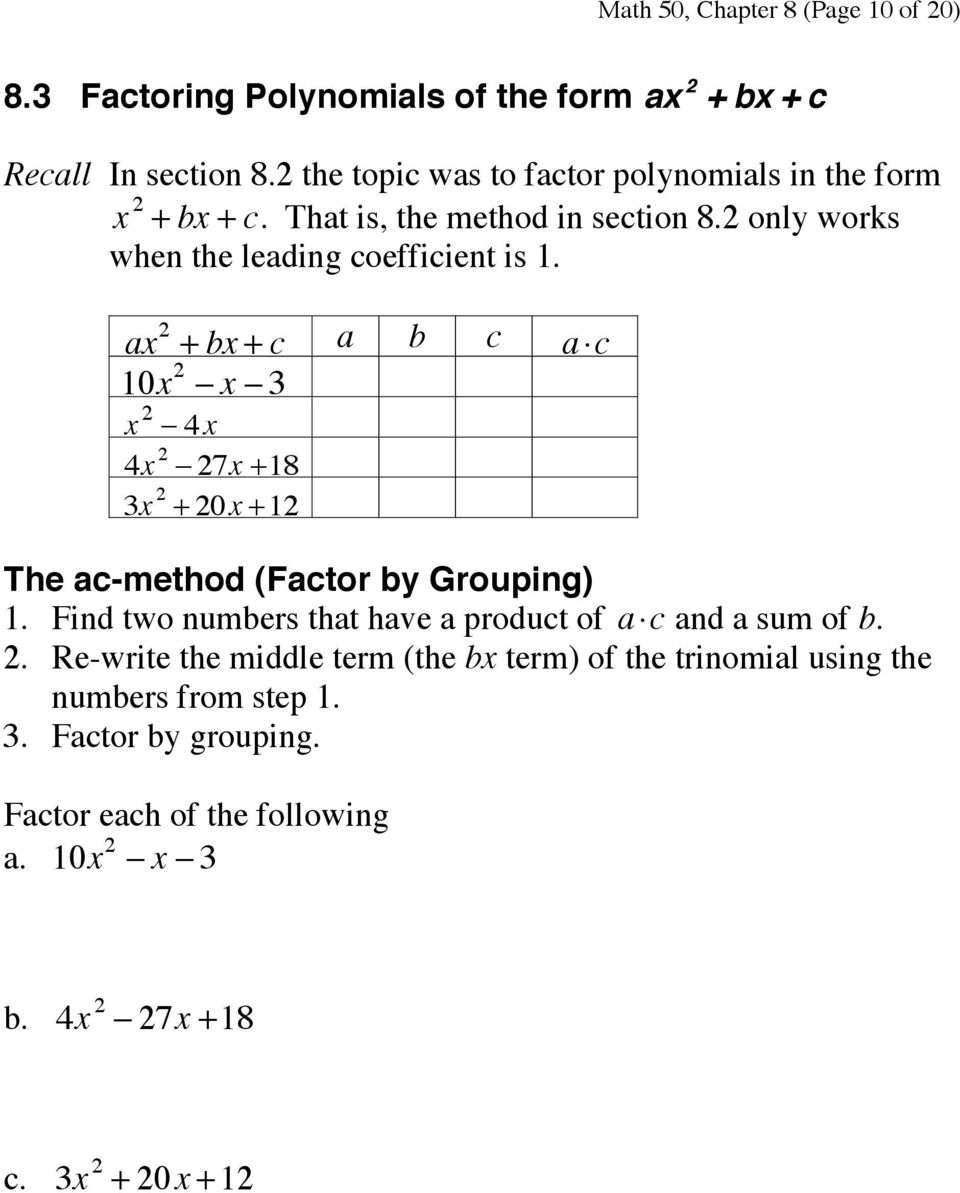
10 Math 50, Chapter 8 (Page 10 of 20) 8.3 Factoring Polynomials of the form ax 2 + bx + c Recall In section 8.2 the topic was to factor polynomials in the form x 2 + bx + c. That is, the method in section 8.2 only works when the leading coefficient is 1. ax 2 + bx + c a b c a c 10x 2 - x - 3 x 2-4 x 4x 2-27x +18 3x x + 12 The ac-method (Factor by Grouping) 1. Find two numbers that have a product of a c and a sum of b. 2. Re-write the middle term (the bx term) of the trinomial using the numbers from step Factor by grouping. Factor each of the following a. 10x 2 - x - 3 b. 4x 2-27x +18 c. 3x x + 12
11 Math 50, Chapter 8 (Page 11 of 20) The ac-method (Factor by Grouping) 1. Find two numbers that have a product of a c and a sum of b. 2. Rewrite the middle term (the bx term) of the trinomial using the numbers from step Factor by grouping. Factor each of the following d. 6x 2-5x - 6 e. 8x x -15 f. 15-2x - x 2 g. y 2 + 2y - 24

12 Math 50, Chapter 8 (Page 12 of 20) When factoring, always factor completely. 1. Factor out any monomial factor common to all terms. 2. Find two numbers that have a product of a c and a sum of b. 3. Rewrite the middle term (the bx term) of the trinomial using the numbers from step Factor by grouping. Factor a. 3x 3-23x x b. 4a 2 b 2-30a 2 b + 14a 2 c. 9a 3 b - 9a 2 b 2-10ab 3 d. 45a 3 b - 78a 2 b ab 3

13 Math 50, Chapter 8 (Page 13 of 20) 8.4 Factoring The Difference of Two Squares, a 2 - b 2 Factoring the Difference of Two Squares The binomial a + b is the sum of two terms and a - b is the difference of two terms. The difference of two squares, a 2 - b 2 factors into the product of the sum and difference of two terms. That is, a 2 - b 2 = (a + b)(a - b) e.g. x 2-9 = (x) 2 - (3) 2 = (x + 3)(x - 3) 1-64y 2 = (1) 2 - (8y) 2 = (1+ 8y)(1-8y) Factor a. x 2-16 = (x) 2 - (4) 2 = (x + 4)(x - 4) b. a 2-25 = ( ) 2 - ( ) 2 = c. z 4-49 d. c 6-36 e. x 4-10 f. 25c 2 - d 2 g. 6x 2-1

14 Math 50, Chapter 8 (Page 14 of 20) a. Factor x b. Factor 4z 6 +16a 2 When asked to factor, always factor completely. a. Factor p 8-16 b. Factor n 4-81 c. Factor m 4-256

15 Math 50, Chapter 8 (Page 15 of 20) Factoring Perfect-Square Trinomials Definition The square of a binomial is a perfect-square trinomial. Thus a perfect-square trinomial factors into a binomial squared. ( binomial) 2 = Perfect -Square Trinomial 1. (a + b) 2 = a 2 + 2ab + b 2 2. (a - b) 2 = a 2-2ab + b 2 Fact A trinomial is a perfect-square trinomial if 1. The first and last terms are perfect squares, and 2. The middle term is twice the product of the un-squared first and last terms. Determine if each trinomial is a perfect-square trinomial. Then factor each trinomial. a. Factor 9x x +16 = (3x) x + (4) 2 = b. Factor 9x 2-30x + 25 c. Factor 16y 2 + 8y +1

16 Math 50, Chapter 8 (Page 16 of 20) d. Factor 4x x + 9 e. Factor x x + 6

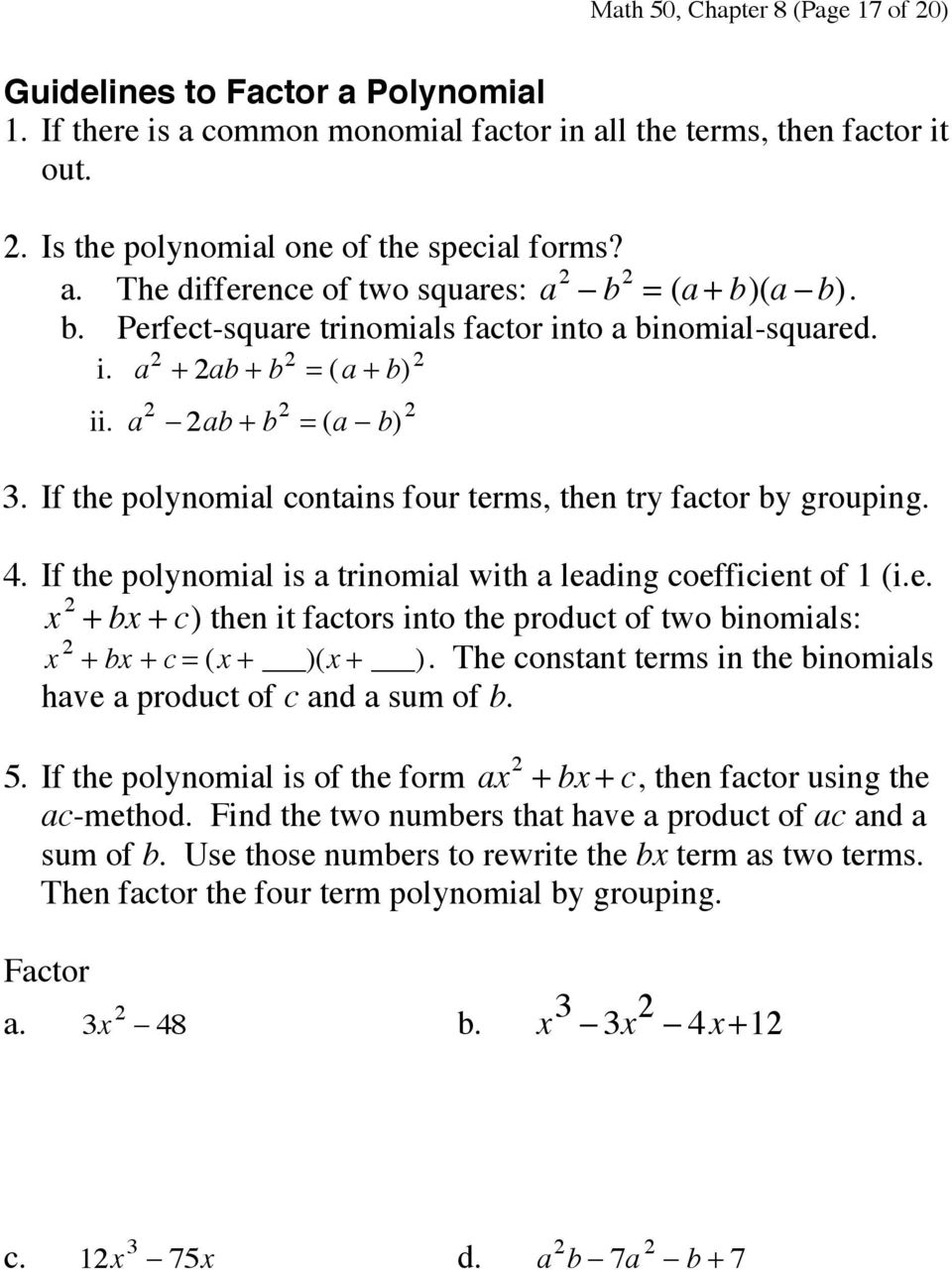
17 Math 50, Chapter 8 (Page 17 of 20) Guidelines to Factor a Polynomial 1. If there is a common monomial factor in all the terms, then factor it out. 2. Is the polynomial one of the special forms? a. The difference of two squares: a 2 - b 2 = (a + b)(a - b). b. Perfect-square trinomials factor into a binomial-squared. i. a 2 + 2ab + b 2 = (a + b) 2 ii. a 2-2ab + b 2 = (a - b) 2 3. If the polynomial contains four terms, then try factor by grouping. 4. If the polynomial is a trinomial with a leading coefficient of 1 (i.e. x 2 + bx + c) then it factors into the product of two binomials: x 2 + bx + c = (x + )(x + ). The constant terms in the binomials have a product of c and a sum of b. 5. If the polynomial is of the form ax 2 + bx + c, then factor using the ac-method. Find the two numbers that have a product of ac and a sum of b. Use those numbers to rewrite the bx term as two terms. Then factor the four term polynomial by grouping. Factor a. 3x 2-48 b. x 3-3x 2-4x+12 c. 12x 3-75x d. a 2 b - 7a 2 - b + 7
18 Math 50, Chapter 8 (Page 18 of 20) 8.5 Solving Equations Definitions A second degree polynomial equation of the form ax 2 + bx + c = 0 is called a quadratic equation in standard form. Furthermore, the ax 2 term is called the quadratic term. The linear term is bx. The constant term is c. Principle of Zero Products If the product of two factors is zero, then at least one of the factors must be zero. If a b = 0, then a = 0 or b = 0.. Solve a. (x - 2)(x - 11) = 0 b. (x - 12)(x + 6) = 0 c. (2x + 3)(4 x - 1)(5x + 11) = 0 d. (3x - 4)(2x + 1)(6x - 7) = 0 Note To solve equations using the principle of zero products both of the following conditions must be met. 1. One side of the equation must be zero. 2. The other side of the equation must be in factored form.

19 Math 50, Chapter 8 (Page 19 of 20) Solve a. 2x 2 + x = 6 b. 2y 2 - y = 1 c. 2x 2 = 50 d. 16a 2-49 = 0 e. x 2-8x = 0 f. 3a 2 = a g. (x - 3)(x - 10) = -10 h. (x + 2)(x - 7) = 52

20 Math 50, Chapter 8 (Page 20 of 20) Application Problems Example 1 The sum of the squares of two consecutive positive odd integers is equal to 130. Find the two integers. Example 2 A stone is thrown into a well with an initial velocity of 8 ft/s. The well is 440 ft deep. How many seconds later will the stone hit the bottom of the well? Use the equation d = vt +16t 2, where d is the distance in feet, v is the initial velocity in feet per second, and t is the time in seconds. Problem 3 The length of a rectangle is 3 m more than twice the width. The area of the rectangle is 90 m 2. Find the length and width of the rectangle.

Factoring and Applications
 Factoring and Applications What is a factor? The Greatest Common Factor (GCF) To factor a number means to write it as a product (multiplication). Therefore, in the problem 48 3, 4 and 8 are called the
NSM100 Introduction to Algebra Chapter 5 Notes Factoring
 Section 5.1 Greatest Common Factor (GCF) and Factoring by Grouping Greatest Common Factor for a polynomial is the largest monomial that divides (is a factor of) each term of the polynomial. GCF is the
expression is written horizontally. The Last terms ((2)( 4)) because they are the last terms of the two polynomials. This is called the FOIL method.
 A polynomial of degree n (in one variable, with real coefficients) is an expression of the form: a n x n + a n 1 x n 1 + a n 2 x n 2 + + a 2 x 2 + a 1 x + a 0 where a n, a n 1, a n 2, a 2, a 1, a 0 are
MATH 90 CHAPTER 6 Name:.
 MATH 90 CHAPTER 6 Name:. 6.1 GCF and Factoring by Groups Need To Know Definitions How to factor by GCF How to factor by groups The Greatest Common Factor Factoring means to write a number as product. a
Factoring Polynomials
 Factoring Polynomials Factoring Factoring is the process of writing a polynomial as the product of two or more polynomials. The factors of 6x 2 x 2 are 2x + 1 and 3x 2. In this section, we will be factoring
1.3 Polynomials and Factoring
 1.3 Polynomials and Factoring Polynomials Constant: a number, such as 5 or 27 Variable: a letter or symbol that represents a value. Term: a constant, variable, or the product or a constant and variable.
Chapter R.4 Factoring Polynomials
 Chapter R.4 Factoring Polynomials Introduction to Factoring To factor an expression means to write the expression as a product of two or more factors. Sample Problem: Factor each expression. a. 15 b. x
FACTORING POLYNOMIALS
 296 (5-40) Chapter 5 Exponents and Polynomials where a 2 is the area of the square base, b 2 is the area of the square top, and H is the distance from the base to the top. Find the volume of a truncated
6.1 Add & Subtract Polynomial Expression & Functions
 6.1 Add & Subtract Polynomial Expression & Functions Objectives 1. Know the meaning of the words term, monomial, binomial, trinomial, polynomial, degree, coefficient, like terms, polynomial funciton, quardrtic
Greatest Common Factor (GCF) Factoring
 Section 4 4: Greatest Common Factor (GCF) Factoring The last chapter introduced the distributive process. The distributive process takes a product of a monomial and a polynomial and changes the multiplication
Sect 6.7 - Solving Equations Using the Zero Product Rule
 Sect 6.7 - Solving Equations Using the Zero Product Rule 116 Concept #1: Definition of a Quadratic Equation A quadratic equation is an equation that can be written in the form ax 2 + bx + c = 0 (referred
15.1 Factoring Polynomials
 LESSON 15.1 Factoring Polynomials Use the structure of an expression to identify ways to rewrite it. Also A.SSE.3? ESSENTIAL QUESTION How can you use the greatest common factor to factor polynomials? EXPLORE
How To Factor By Gcf In Algebra 1.5
 7-2 Factoring by GCF Warm Up Lesson Presentation Lesson Quiz Algebra 1 Warm Up Simplify. 1. 2(w + 1) 2. 3x(x 2 4) 2w + 2 3x 3 12x Find the GCF of each pair of monomials. 3. 4h 2 and 6h 2h 4. 13p and 26p
6.3 FACTORING ax 2 bx c WITH a 1
 290 (6 14) Chapter 6 Factoring e) What is the approximate maximum revenue? f) Use the accompanying graph to estimate the price at which the revenue is zero. y Revenue (thousands of dollars) 300 200 100
1.3 Algebraic Expressions
 1.3 Algebraic Expressions A polynomial is an expression of the form: a n x n + a n 1 x n 1 +... + a 2 x 2 + a 1 x + a 0 The numbers a 1, a 2,..., a n are called coefficients. Each of the separate parts,
Factoring Quadratic Expressions
 Factoring the trinomial ax 2 + bx + c when a = 1 A trinomial in the form x 2 + bx + c can be factored to equal (x + m)(x + n) when the product of m x n equals c and the sum of m + n equals b. (Note: the
FACTORING ax 2 bx c. Factoring Trinomials with Leading Coefficient 1
 5.7 Factoring ax 2 bx c (5-49) 305 5.7 FACTORING ax 2 bx c In this section In Section 5.5 you learned to factor certain special polynomials. In this section you will learn to factor general quadratic polynomials.
Factoring Trinomials: The ac Method
 6.7 Factoring Trinomials: The ac Method 6.7 OBJECTIVES 1. Use the ac test to determine whether a trinomial is factorable over the integers 2. Use the results of the ac test to factor a trinomial 3. For
Veterans Upward Bound Algebra I Concepts - Honors
 Veterans Upward Bound Algebra I Concepts - Honors Brenda Meery Kaitlyn Spong Say Thanks to the Authors Click http://www.ck12.org/saythanks (No sign in required) www.ck12.org Chapter 6. Factoring CHAPTER
How To Solve Factoring Problems
 05-W4801-AM1.qxd 8/19/08 8:45 PM Page 241 Factoring, Solving Equations, and Problem Solving 5 5.1 Factoring by Using the Distributive Property 5.2 Factoring the Difference of Two Squares 5.3 Factoring
In algebra, factor by rewriting a polynomial as a product of lower-degree polynomials
 Algebra 2 Notes SOL AII.1 Factoring Polynomials Mrs. Grieser Name: Date: Block: Factoring Review Factor: rewrite a number or expression as a product of primes; e.g. 6 = 2 3 In algebra, factor by rewriting
Algebra 1 Chapter 08 review
 Name: Class: Date: ID: A Algebra 1 Chapter 08 review Multiple Choice Identify the choice that best completes the statement or answers the question. Simplify the difference. 1. (4w 2 4w 8) (2w 2 + 3w 6)
( ) FACTORING. x In this polynomial the only variable in common to all is x.
 FACTORING Factoring is similar to breaking up a number into its multiples. For example, 10=5*. The multiples are 5 and. In a polynomial it is the same way, however, the procedure is somewhat more complicated
Factoring Guidelines. Greatest Common Factor Two Terms Three Terms Four Terms. 2008 Shirley Radai
 Factoring Guidelines Greatest Common Factor Two Terms Three Terms Four Terms 008 Shirley Radai Greatest Common Factor 008 Shirley Radai Factoring by Finding the Greatest Common Factor Always check for
Tool 1. Greatest Common Factor (GCF)
 Chapter 4: Factoring Review Tool 1 Greatest Common Factor (GCF) This is a very important tool. You must try to factor out the GCF first in every problem. Some problems do not have a GCF but many do. When
Section 6.1 Factoring Expressions
 Section 6.1 Factoring Expressions The first method we will discuss, in solving polynomial equations, is the method of FACTORING. Before we jump into this process, you need to have some concept of what
Factoring Polynomials
 Factoring a Polynomial Expression Factoring a polynomial is expressing the polynomial as a product of two or more factors. Simply stated, it is somewhat the reverse process of multiplying. To factor polynomials,
Factoring a Difference of Two Squares. Factoring a Difference of Two Squares
 284 (6 8) Chapter 6 Factoring 87. Tomato soup. The amount of metal S (in square inches) that it takes to make a can for tomato soup is a function of the radius r and height h: S 2 r 2 2 rh a) Rewrite this
Using the ac Method to Factor
 4.6 Using the ac Method to Factor 4.6 OBJECTIVES 1. Use the ac test to determine factorability 2. Use the results of the ac test 3. Completely factor a trinomial In Sections 4.2 and 4.3 we used the trial-and-error
2x 2x 2 8x. Now, let s work backwards to FACTOR. We begin by placing the terms of the polynomial inside the cells of the box. 2x 2
 Activity 23 Math 40 Factoring using the BOX Team Name (optional): Your Name: Partner(s): 1. (2.) Task 1: Factoring out the greatest common factor Mini Lecture: Factoring polynomials is our focus now. Factoring
Factoring Polynomials and Solving Quadratic Equations
 Factoring Polynomials and Solving Quadratic Equations Math Tutorial Lab Special Topic Factoring Factoring Binomials Remember that a binomial is just a polynomial with two terms. Some examples include 2x+3
Factoring Methods. Example 1: 2x + 2 2 * x + 2 * 1 2(x + 1)
 Factoring Methods When you are trying to factor a polynomial, there are three general steps you want to follow: 1. See if there is a Greatest Common Factor 2. See if you can Factor by Grouping 3. See if
FACTORING OUT COMMON FACTORS
 278 (6 2) Chapter 6 Factoring 6.1 FACTORING OUT COMMON FACTORS In this section Prime Factorization of Integers Greatest Common Factor Finding the Greatest Common Factor for Monomials Factoring Out the
Name Intro to Algebra 2. Unit 1: Polynomials and Factoring
 Name Intro to Algebra 2 Unit 1: Polynomials and Factoring Date Page Topic Homework 9/3 2 Polynomial Vocabulary No Homework 9/4 x In Class assignment None 9/5 3 Adding and Subtracting Polynomials Pg. 332
POLYNOMIALS and FACTORING
 POLYNOMIALS and FACTORING Exponents ( days); 1. Evaluate exponential expressions. Use the product rule for exponents, 1. How do you remember the rules for exponents?. How do you decide which rule to use
In the above, the number 19 is an example of a number because its only positive factors are one and itself.
 Math 100 Greatest Common Factor and Factoring by Grouping (Review) Factoring Definition: A factor is a number, variable, monomial, or polynomial which is multiplied by another number, variable, monomial,
Factor Polynomials Completely
 9.8 Factor Polynomials Completely Before You factored polynomials. Now You will factor polynomials completely. Why? So you can model the height of a projectile, as in Ex. 71. Key Vocabulary factor by grouping
This is Factoring and Solving by Factoring, chapter 6 from the book Beginning Algebra (index.html) (v. 1.0).
 This is Factoring and Solving by Factoring, chapter 6 from the book Beginning Algebra (index.html) (v. 1.0). This book is licensed under a Creative Commons by-nc-sa 3.0 (http://creativecommons.org/licenses/by-nc-sa/
Mathematics Placement
 Mathematics Placement The ACT COMPASS math test is a self-adaptive test, which potentially tests students within four different levels of math including pre-algebra, algebra, college algebra, and trigonometry.
AIP Factoring Practice/Help
 The following pages include many problems to practice factoring skills. There are also several activities with examples to help you with factoring if you feel like you are not proficient with it. There
Factoring Algebra- Chapter 8B Assignment Sheet
 Name: Factoring Algebra- Chapter 8B Assignment Sheet Date Section Learning Targets Assignment Tues 2/17 Find the prime factorization of an integer Find the greatest common factor (GCF) for a set of monomials.
Polynomials. Key Terms. quadratic equation parabola conjugates trinomial. polynomial coefficient degree monomial binomial GCF
 Polynomials 5 5.1 Addition and Subtraction of Polynomials and Polynomial Functions 5.2 Multiplication of Polynomials 5.3 Division of Polynomials Problem Recognition Exercises Operations on Polynomials
Factoring (pp. 1 of 4)
 Factoring (pp. 1 of 4) Algebra Review Try these items from middle school math. A) What numbers are the factors of 4? B) Write down the prime factorization of 7. C) 6 Simplify 48 using the greatest common
By reversing the rules for multiplication of binomials from Section 4.6, we get rules for factoring polynomials in certain forms.
 SECTION 5.4 Special Factoring Techniques 317 5.4 Special Factoring Techniques OBJECTIVES 1 Factor a difference of squares. 2 Factor a perfect square trinomial. 3 Factor a difference of cubes. 4 Factor
6.1 The Greatest Common Factor; Factoring by Grouping
 386 CHAPTER 6 Factoring and Applications 6.1 The Greatest Common Factor; Factoring by Grouping OBJECTIVES 1 Find the greatest common factor of a list of terms. 2 Factor out the greatest common factor.
SPECIAL PRODUCTS AND FACTORS
 CHAPTER 442 11 CHAPTER TABLE OF CONTENTS 11-1 Factors and Factoring 11-2 Common Monomial Factors 11-3 The Square of a Monomial 11-4 Multiplying the Sum and the Difference of Two Terms 11-5 Factoring the
Factoring Polynomials
 UNIT 11 Factoring Polynomials You can use polynomials to describe framing for art. 396 Unit 11 factoring polynomials A polynomial is an expression that has variables that represent numbers. A number can
A Systematic Approach to Factoring
 A Systematic Approach to Factoring Step 1 Count the number of terms. (Remember****Knowing the number of terms will allow you to eliminate unnecessary tools.) Step 2 Is there a greatest common factor? Tool
Factoring Polynomials
 Factoring Polynomials 4-1-2014 The opposite of multiplying polynomials is factoring. Why would you want to factor a polynomial? Let p(x) be a polynomial. p(c) = 0 is equivalent to x c dividing p(x). Recall
Sect 6.1 - Greatest Common Factor and Factoring by Grouping
 Sect 6.1 - Greatest Common Factor and Factoring by Grouping Our goal in this chapter is to solve non-linear equations by breaking them down into a series of linear equations that we can solve. To do this,
Copy in your notebook: Add an example of each term with the symbols used in algebra 2 if there are any.
 Algebra 2 - Chapter Prerequisites Vocabulary Copy in your notebook: Add an example of each term with the symbols used in algebra 2 if there are any. P1 p. 1 1. counting(natural) numbers - {1,2,3,4,...}
FACTORING TRINOMIALS IN THE FORM OF ax 2 + bx + c
 Tallahassee Community College 55 FACTORING TRINOMIALS IN THE FORM OF ax 2 + bx + c This kind of trinomial differs from the previous kind we have factored because the coefficient of x is no longer "1".
Operations with Algebraic Expressions: Multiplication of Polynomials
 Operations with Algebraic Expressions: Multiplication of Polynomials The product of a monomial x monomial To multiply a monomial times a monomial, multiply the coefficients and add the on powers with the
Math 25 Activity 6: Factoring Advanced
 Instructor! Math 25 Activity 6: Factoring Advanced Last week we looked at greatest common factors and the basics of factoring out the GCF. In this second activity, we will discuss factoring more difficult
7-6. Choosing a Factoring Model. Extension: Factoring Polynomials with More Than One Variable IN T RO DUC E T EACH. Standards for Mathematical Content
 7-6 Choosing a Factoring Model Extension: Factoring Polynomials with More Than One Variable Essential question: How can you factor polynomials with more than one variable? What is the connection between
Algebra 2 PreAP. Name Period
 Algebra 2 PreAP Name Period IMPORTANT INSTRUCTIONS FOR STUDENTS!!! We understand that students come to Algebra II with different strengths and needs. For this reason, students have options for completing
BEGINNING ALGEBRA ACKNOWLEDMENTS
 BEGINNING ALGEBRA The Nursing Department of Labouré College requested the Department of Academic Planning and Support Services to help with mathematics preparatory materials for its Bachelor of Science
The majority of college students hold credit cards. According to the Nellie May
 CHAPTER 6 Factoring Polynomials 6.1 The Greatest Common Factor and Factoring by Grouping 6. Factoring Trinomials of the Form b c 6.3 Factoring Trinomials of the Form a b c and Perfect Square Trinomials
Alum Rock Elementary Union School District Algebra I Study Guide for Benchmark III
 Alum Rock Elementary Union School District Algebra I Study Guide for Benchmark III Name Date Adding and Subtracting Polynomials Algebra Standard 10.0 A polynomial is a sum of one ore more monomials. Polynomial
5.1 FACTORING OUT COMMON FACTORS
 C H A P T E R 5 Factoring he sport of skydiving was born in the 1930s soon after the military began using parachutes as a means of deploying troops. T Today, skydiving is a popular sport around the world.
Factoring. Factoring Polynomial Equations. Special Factoring Patterns. Factoring. Special Factoring Patterns. Special Factoring Patterns
 Factoring Factoring Polynomial Equations Ms. Laster Earlier, you learned to factor several types of quadratic expressions: General trinomial - 2x 2-5x-12 = (2x + 3)(x - 4) Perfect Square Trinomial - x
6.6 Factoring Strategy
 456 CHAPTER 6. FACTORING 6.6 Factoring Strategy When you are concentrating on factoring problems of a single type, after doing a few you tend to get into a rhythm, and the remainder of the exercises, because
When factoring, we look for greatest common factor of each term and reverse the distributive property and take out the GCF.
 Factoring: reversing the distributive property. The distributive property allows us to do the following: When factoring, we look for greatest common factor of each term and reverse the distributive property
Factoring. Factoring Monomials Monomials can often be factored in more than one way.
 Factoring Factoring is the reverse of multiplying. When we multiplied monomials or polynomials together, we got a new monomial or a string of monomials that were added (or subtracted) together. For example,
A. Factoring out the Greatest Common Factor.
 DETAILED SOLUTIONS AND CONCEPTS - FACTORING POLYNOMIAL EXPRESSIONS Prepared by Ingrid Stewart, Ph.D., College of Southern Nevada Please Send Questions and Comments to [email protected]. Thank you!
Florida Math 0028. Correlation of the ALEKS course Florida Math 0028 to the Florida Mathematics Competencies - Upper
 Florida Math 0028 Correlation of the ALEKS course Florida Math 0028 to the Florida Mathematics Competencies - Upper Exponents & Polynomials MDECU1: Applies the order of operations to evaluate algebraic
How To Factor By Grouping
 Lecture Notes Factoring by the AC-method page 1 Sample Problems 1. Completely factor each of the following. a) 4a 2 mn 15abm 2 6abmn + 10a 2 m 2 c) 162a + 162b 2ax 4 2bx 4 e) 3a 2 5a 2 b) a 2 x 3 b 2 x
6.4 Special Factoring Rules
 6.4 Special Factoring Rules OBJECTIVES 1 Factor a difference of squares. 2 Factor a perfect square trinomial. 3 Factor a difference of cubes. 4 Factor a sum of cubes. By reversing the rules for multiplication
Introduction Assignment
 PRE-CALCULUS 11 Introduction Assignment Welcome to PREC 11! This assignment will help you review some topics from a previous math course and introduce you to some of the topics that you ll be studying
Factoring Special Polynomials
 6.6 Factoring Special Polynomials 6.6 OBJECTIVES 1. Factor the difference of two squares 2. Factor the sum or difference of two cubes In this section, we will look at several special polynomials. These
x 4-1 = (x²)² - (1)² = (x² + 1) (x² - 1) = (x² + 1) (x - 1) (x + 1)
 Factoring Polynomials EXAMPLES STEP 1 : Greatest Common Factor GCF Factor out the greatest common factor. 6x³ + 12x²y = 6x² (x + 2y) 5x - 5 = 5 (x - 1) 7x² + 2y² = 1 (7x² + 2y²) 2x (x - 3) - (x - 3) =
MATH 10034 Fundamental Mathematics IV
 MATH 0034 Fundamental Mathematics IV http://www.math.kent.edu/ebooks/0034/funmath4.pdf Department of Mathematical Sciences Kent State University January 2, 2009 ii Contents To the Instructor v Polynomials.
10 7, 8. 2. 6x + 30x + 36 SOLUTION: 8-9 Perfect Squares. The first term is not a perfect square. So, 6x + 30x + 36 is not a perfect square trinomial.
 Squares Determine whether each trinomial is a perfect square trinomial. Write yes or no. If so, factor it. 1.5x + 60x + 36 SOLUTION: The first term is a perfect square. 5x = (5x) The last term is a perfect
Pre-Calculus II Factoring and Operations on Polynomials
 Factoring... 1 Polynomials...1 Addition of Polynomials... 1 Subtraction of Polynomials...1 Multiplication of Polynomials... Multiplying a monomial by a monomial... Multiplying a monomial by a polynomial...
Factoring Polynomials
 Factoring Polynomials 8A Factoring Methods 8-1 Factors and Greatest Common Factors Lab Model Factoring 8-2 Factoring by GCF Lab Model Factorization of Trinomials 8-3 Factoring x 2 + bx + c 8-4 Factoring
Factoring Flow Chart
 Factoring Flow Chart greatest common factor? YES NO factor out GCF leaving GCF(quotient) how many terms? 4+ factor by grouping 2 3 difference of squares? perfect square trinomial? YES YES NO NO a 2 -b
Solving Quadratic Equations
 9.3 Solving Quadratic Equations by Using the Quadratic Formula 9.3 OBJECTIVES 1. Solve a quadratic equation by using the quadratic formula 2. Determine the nature of the solutions of a quadratic equation
Factors and Products
 CHAPTER 3 Factors and Products What You ll Learn use different strategies to find factors and multiples of whole numbers identify prime factors and write the prime factorization of a number find square
Polynomial Equations and Factoring
 7 Polynomial Equations and Factoring 7.1 Adding and Subtracting Polynomials 7.2 Multiplying Polynomials 7.3 Special Products of Polynomials 7.4 Dividing Polynomials 7.5 Solving Polynomial Equations in
In this section, you will develop a method to change a quadratic equation written as a sum into its product form (also called its factored form).
 CHAPTER 8 In Chapter 4, you used a web to organize the connections you found between each of the different representations of lines. These connections enabled you to use any representation (such as a graph,
ESSENTIAL QUESTION How can you factor expressions of the form ax 2 + bx + c?
 LESSON 15.3 Factoring ax 2 + bx + c A.SSE.2 Use the structure of an expression to identify ways to rewrite it. Also A.SSE.3? ESSENTIAL QUESTION How can you factor expressions of the form ax 2 + bx + c?
Lagrange Interpolation is a method of fitting an equation to a set of points that functions well when there are few points given.
 Polynomials (Ch.1) Study Guide by BS, JL, AZ, CC, SH, HL Lagrange Interpolation is a method of fitting an equation to a set of points that functions well when there are few points given. Sasha s method
Algebra Cheat Sheets
 Sheets Algebra Cheat Sheets provide you with a tool for teaching your students note-taking, problem-solving, and organizational skills in the context of algebra lessons. These sheets teach the concepts
Factoring Trinomials of the Form x 2 bx c
 4.2 Factoring Trinomials of the Form x 2 bx c 4.2 OBJECTIVES 1. Factor a trinomial of the form x 2 bx c 2. Factor a trinomial containing a common factor NOTE The process used to factor here is frequently
Factor and Solve Polynomial Equations. In Chapter 4, you learned how to factor the following types of quadratic expressions.
 5.4 Factor and Solve Polynomial Equations Before You factored and solved quadratic equations. Now You will factor and solve other polynomial equations. Why? So you can find dimensions of archaeological
Wentzville School District Algebra 1: Unit 8 Stage 1 Desired Results
 Wentzville School District Algebra 1: Unit 8 Stage 1 Desired Results Unit Title: Quadratic Expressions & Equations Course: Algebra I Unit 8 - Quadratic Expressions & Equations Brief Summary of Unit: At
Sample Problems. Practice Problems
 Lecture Notes Quadratic Word Problems page 1 Sample Problems 1. The sum of two numbers is 31, their di erence is 41. Find these numbers.. The product of two numbers is 640. Their di erence is 1. Find these
Polynomial Degree and Finite Differences
 CONDENSED LESSON 7.1 Polynomial Degree and Finite Differences In this lesson you will learn the terminology associated with polynomials use the finite differences method to determine the degree of a polynomial
PERFECT SQUARES AND FACTORING EXAMPLES
 PERFECT SQUARES AND FACTORING EXAMPLES 1. Ask the students what is meant by identical. Get their responses and then explain that when we have two factors that are identical, we call them perfect squares.
The Greatest Common Factor; Factoring by Grouping
 296 CHAPTER 5 Factoring and Applications 5.1 The Greatest Common Factor; Factoring by Grouping OBJECTIVES 1 Find the greatest common factor of a list of terms. 2 Factor out the greatest common factor.
FACTORING QUADRATICS 8.1.1 and 8.1.2
 FACTORING QUADRATICS 8.1.1 and 8.1.2 Chapter 8 introduces students to quadratic equations. These equations can be written in the form of y = ax 2 + bx + c and, when graphed, produce a curve called a parabola.
Algebra I Vocabulary Cards
 Algebra I Vocabulary Cards Table of Contents Expressions and Operations Natural Numbers Whole Numbers Integers Rational Numbers Irrational Numbers Real Numbers Absolute Value Order of Operations Expression
Factoring - Grouping
 6.2 Factoring - Grouping Objective: Factor polynomials with four terms using grouping. The first thing we will always do when factoring is try to factor out a GCF. This GCF is often a monomial like in
SECTION 0.6: POLYNOMIAL, RATIONAL, AND ALGEBRAIC EXPRESSIONS
 (Section 0.6: Polynomial, Rational, and Algebraic Expressions) 0.6.1 SECTION 0.6: POLYNOMIAL, RATIONAL, AND ALGEBRAIC EXPRESSIONS LEARNING OBJECTIVES Be able to identify polynomial, rational, and algebraic
POLYNOMIAL FUNCTIONS
 POLYNOMIAL FUNCTIONS Polynomial Division.. 314 The Rational Zero Test.....317 Descarte s Rule of Signs... 319 The Remainder Theorem.....31 Finding all Zeros of a Polynomial Function.......33 Writing a
MTH 092 College Algebra Essex County College Division of Mathematics Sample Review Questions 1 Created January 17, 2006
 MTH 092 College Algebra Essex County College Division of Mathematics Sample Review Questions Created January 7, 2006 Math 092, Elementary Algebra, covers the mathematical content listed below. In order
CM2202: Scientific Computing and Multimedia Applications General Maths: 2. Algebra - Factorisation
 CM2202: Scientific Computing and Multimedia Applications General Maths: 2. Algebra - Factorisation Prof. David Marshall School of Computer Science & Informatics Factorisation Factorisation is a way of