
Enzymes Enzyme Mechanism
|
|
|
- Cordelia Ryan
- 9 years ago
- Views:
Transcription
1 BCMB 3100 Chapters 6, 7, 8 Enzymes Enzyme Mechanism 1 Mechanisms of Enzymes Energy diagrams Binding modes of enzyme catalysis Chemical modes of enzyme catalysis Acid-Base catalysis Covalent catalysis Binding modes of enzyme catalysis Proximity effect Transition state stabilization Transition state analogs Induced fit Serine Proteases 2 1
2 Energy diagrams show the progress of a reaction : high energy, unstable state in which a molecule is best suited to undergo a chemical reaction; state in which chemical bonds are being broken and formed. Lifetime ~ to sec Energy diagram for a single-step reaction 3 Energy diagram for reaction with intermediate occurs in the trough between the two transition states Lifetime > ~10-14 to sec In this case, the rate determining step in the forward direction is formation of the first transition state 4 2
3 Enzymatic catalysis of the reaction A+B A-B Proximity effect: proper positioning of substrates Transition state stabilization: lowers activation energy Binding modes for enzymatic catalysis What is the enzyme active site? A few polar residues and H 2 O molecules are found at the otherwise hydrophobic active site of an enzyme : polar amino acids that undergo changes during enzymatic catalysis Ionic side chains are involved in two types of chemical catalysis:
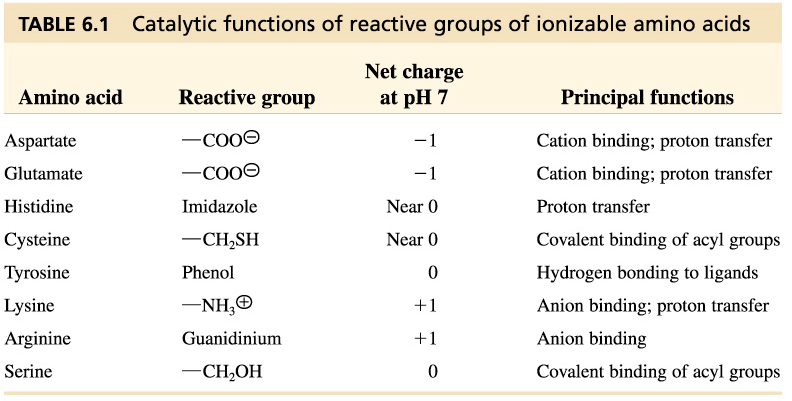
4 Note: pka of ionizable groups of amino acids in proteins vary from pka of free amino acids (compare Table 3.2 to Table 6.2) 7 pka Values of amino acid ionizable groups in proteins Group pk a Terminal -carboxyl 3-4 Side-chain carboxyl 4-5 Imidazole 6-7 Terminal -amino Thiol Phenol Amino ~10 Guanidine ~12 Hydroxymethyl ~16 8 4
5 Mechanisms of Enzymes Energy diagrams Chemical modes of enzyme catalysis Acid-Base catalysis Covalent catalysis Binding modes of enzyme catalysis Proximity effect Transition state stabilization Transition state analogs Induced fit Serine Proteases 9 Chemical modes of enzyme catalysis Acid-Base catalysis Covalent catalysis 10 5
6 : acceleration of a reaction by transfer of a proton B: = base (proton acceptor) BH+ = conjugate acid (proton donor) A general base (B:) can act as a proton acceptor to remove protons from OH, NH, CH or other XH This produces a stronger nucleophilic reactant (X: - ) General base catalysis reactions (continued) A (B:) can remove a proton from water and thereby generate the equivalent of OH - in neutral solution 6
7 Proton donors can also catalyze reactions A (BH + ) can donate protons A covalent bond may break more easily if one of its atoms is protonated (below) : part or entirety of S forms covalent bond with E and then with second S All or part of a substrate is bound to the enzyme to form a Group X can be transferred from A-X to B in two steps via the covalent ES complex X-E A-X + E X-E + B X-E + A B-X + E 7
8 Sucrose phosphorylase exhibits covalent catalysis (Sucrose = glucose-fructose) Step one: a glucosyl residue is transferred to enzyme *Sucrose + Enz Glucosyl-Enz + Fructose Step two: Glucose is donated to phosphate Glucosyl-Enz + P i Glucose 1-phosphate + Enz ph-rate profile for papain of an enzyme can give information about ionic residues at the active site. A simple bell-shaped curve can result from two overlapping titrations of active site amino acids. The two inflection points approximate the pk a values of the two ionizable residues Cys pka in papain = 3.4! His pka in papain = 8.3! 8
9 Papain s activity depends upon ionizable residues: His-159 and Cys-25 (a) Ribbon model (b) Active site residues (N blue, S yellow) 17 Three ionic forms of papain. Only the upper tautomer of the middle pair is active pka of Cys in papain = 3.4! pka or His in papain = 8.3! 18 9
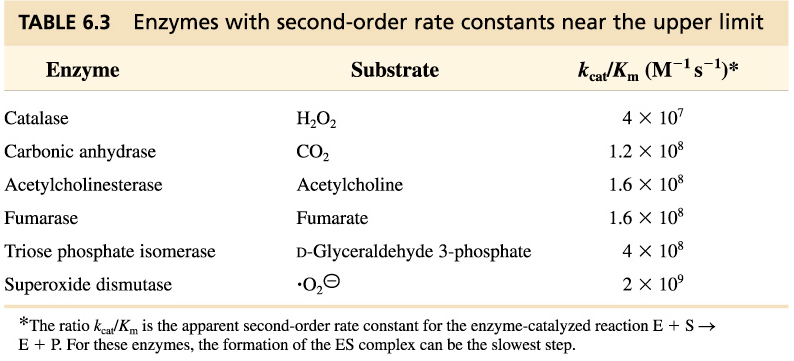
10 Different enyzmes have different ph curves Fig Fastest Reactions are Diffusion-Controlled Reactions: rates approach rate of diffusion: 10 8 to 10 9 M -1s-1 ; speed of binding of substrates to the enzyme
11 A. Triose Phosphate Isomerase (TPI) TPI catalyzes a rapid aldehyde-ketone interconversion 21 Proposed mechanism for TPI General acid-base catalysis mechanism (4 slides) 22 11
12 TPI mechanism (continued) 23 TPI mechanism (continued) 24 12
13 TPI mechanism (continued) Intermediate 3 25 Energy diagram for the TPI reaction Enzyme with E D mutation; 1000x slower, Km same Wild type enzyme Enodiolate intermediate Enodiolate intermediate 26 13
14 Proximity effect: in rate of a reaction due to binding of substrates at binding sites in the enzyme, results in an effective concentration of reactants, results in more frequent formation of the 27 Excessive ES stabilization would create a thermodynamic pit and give little or no catalysis if E binds S too tightly (dashed profile), the activation barrier (2) could be similar to that of the uncatalyzed reaction (1) most Km values (substrate dissociation constants) indicate weak binding to enzymes 28 14
15 Transition-State (TS) Stabilization increased interaction of E with S in transition-state (ES ) E distorts S, forcing it toward the transition state E must be complementary to transition-state in shape and chemical character E binds transition states to times more tightly than S 29 Basis for enzymatic catalysis 1. (e.g. acid-base & covalent catalysis) : "weak" binding ( ~0.1 M) of S to active site raises the effective concentration of S and favors more frequent transition states effective molarity: enhanced relative concentration of reactants due to binding to E : greater binding of transition states than S or P to E lower activation energy Enzyme rate accelerations ~
16 Mechanisms of Enzymes Energy diagrams Chemical modes of enzyme catalysis Acid-Base catalysis Covalent catalysis Binding modes of enzyme catalysis Proximity effect Transition state stabilization Transition state analogs Induced fit Serine Proteases 31 Wolfenden & Lienhard (1970s): showed that chemical analogs of are enzyme inhibitors In Emil Fisher s lock-and-key model for SE binding, the. Binding of S to E distorts S to transition state. The transition state must be stabilized for catalysis to occur. Transition state analogs can catalytic antibodies Substrate Transition State Product Enzyme ES complex Enzyme 32 16
17 Transition-state (TS) analogs Transition-state analogs are stable compounds whose structures resemble unstable transition states 2-Phosphoglycolate, a TS analog for the enzyme triose phosphate isomerase binds E 100X more tightly than either S does 33 REMINDER: Triose Phosphate Isomerase (TPI) (required for glycolysis) TPI catalyzes a rapid aldehyde-ketone interconversion 17
18 Inhibition of adenosine deaminase by a TS analog Ki = 3 x M!! Ki = 5 x 10⁻⁶ M 35 Chapter 6 Mechanisms of Enzymes Energy diagrams Chemical modes of enzyme catalysis Acid-Base catalysis Covalent catalysis Binding modes of enzyme catalysis Proximity effect Transition state stabilization Transition state analogs Induced fit Serine Proteases 36 18

19 Induced Fit: substrate induced cleft closing (Daniel Koshland, 1950s) activates an enzyme by substrateinitiated conformation effect Induced fit is a substrate specificity effect, not a catalytic mode Hexokinase mechanism requires sugar-induced closure of the active site Other examples: pyruvate kinase, phosphoglycerate kinase, phosphofructokinase 37 Stereo views of yeast hexokinase Yeast hexokinase contains 2 domains connected by a hinge region. Domains close on glucose binding. (a) Open conformation (b) Closed conformation Glucose + ATP Glucose 6-phosphate + ADP 38 19

20 Chapter 6 Mechanisms of Enzymes Energy diagrams Chemical modes of enzyme catalysis Acid-Base catalysis Covalent catalysis Binding modes of enzyme catalysis Proximity effect Transition state stabilization Transition state analogs Induced fit Serine Proteases 39 What did you have for breakfast today? In the stomach gastric acid ph 2; pepsin hydrolyzes proteins to peptides The serine proteases are synthesized as zymogens in the pancreas, transported to the small intestine and activated by selective proteolysis 20
21 Properties of Serine Proteases Digestive serine proteases including,, and are synthesized and stored in the pancreas as zymogens are inactive enzyme precursors that must be covalently modified to become active Storage of hydrolytic enzymes as prevents damage to cell proteins Pancreatic zymogens are activated by The pancreatic zymogens are also regulated by enzyme inhibitors (e.g. trypsin inhibitor, Kd = M!!) 41 Activation of some pancreatic zymogens Enzyme cascades rapid signal amplification The protease zymogens are synthesized in the pancreas and activated in the duodenum Elastase cleaves on the carbonyl side of aa with small, uncharged side chains 42 21

22 The backbones of chymotrypsin (blue), trypsin (yellow), and elastase (green) Backbone conformations and active-site residues (red) are similar in these three enzymes 43 Chymotrypsin Chymotrypsinogen Crucial difference between structures is absence of substrate binding pocket in the zymogen. Residues in yellow are ones that develop the pocket. Ile16 has just become the new N-terminal, producing an NH 3+ that turns inward and interacts with the sidechain carboxyl of Asp194, forming an ion pair. This opens up the binding pocket. The three residues shown in red are the catalytic triad. 22
23 Chymotrypsin Chymotrypsinogen chemistry.umeche.maine.edu/chy431/peptidase2/html The effect of cleavage [of chymotrypsin at between residues 13&14; 15 &16, and 146 & 147] is to turn Asp194 outward, opening up the binding pocket. The catalytic site is essentially unchanged. Binding sites of chymotrypsin, trypsin, and elastase Substrate specificities are due to relatively small structural differences in active-site binding cavities Ser Uncharged 46 23
24 of chymotrypsin Imidazole ring (His-57) removes H from Ser-195 hydroxyl to make it a strong nucleophile (-CH 2 O - ) Buried carboxylate (Asp-102) stabilizes the positivelycharged His-57 to facilitate serine ionization Catalytic triad of serine proteases = Asp, His, Ser 47 -Chymotrypsin mechanism (8 slides; 1) Step (1): E + S Scissile peptide bond Specificity pocket 48 24
25 (E-S) (2) 49 (E-TI 1 ) (3) Tetrahedral intermediate 50 25
26 (Acyl E + P 1 ) (4) Acid-base & covalent catalysis 51 (Acyl E + H 2 O) (5) (4) Hydrolysis 52 26
27 (E-TI 2 ) (6) (5) Tetrahedral intermediate 53 (E-P 2 ) (7) (6) 54 27
28 (E + P 2 ) (8) 55 Additional material to aid in learning the material covered in the chapter 56 28
29 Review of Chemical Mechanisms 1. Nucleophilic Substitution Reactions: ionic reaction where both electrons stay with one atom ionic intermediate + leaving group ionic reactions have nucleophile + electrophile Formation of tetrahedral intermediate Direct displacement: two molecules react to form a five group transition state Two types of nucleophilic substitution reactions Formation of a tetrahedral intermediate Direct displacement 58 29
30 2. Cleavage reactions : most common when both electrons stay with one atom * formation of a carbanion (C retains both e-) * formation of carbocation ion (C loses both e-) Carbanion formation Carbocation formation Cleavage reactions : less common when one electron remains with each product two free radicals Free radical formation 60 30
31 4. Oxidation-reduction reactions Oxidation * addition of oxygen * removal of hydrogen * removal of electrons Electrons are transferred between two species Oxidizing agent gains electrons (is reduced) Reducing agent donates electrons (is oxidized) 61 (1) Substrate binding Enzymes lower the activation energy of a reaction Enzymes properly position substrates for reaction (makes the formation of the transition state more frequent and lowers the energy of activation) (2) Transition state binding Transition states are bound more tightly than substrates (this also lowers the activation energy) 31
32 Binding Modes of Enzymatic Catalysis Proper binding of reactants in enzyme active sites provides substrate specificity and catalytic power Two catalytic modes based on binding properties can each increase reaction rates over 10,000-fold : (1) Proximity effect - collecting and positioning substrate molecules in the active site (2) Transition-state (TS) stabilization - transition states bind more tightly than substrates Binding forces utilized for catalysis 1. Charge-charge interactions 2. Hydrogen bonds 3. Hydrophobic interactions 4. Van der Waals forces 64 32
33 A. The Proximity Effect Correct positioning of two reacting groups (in model reactions or at enzyme active sites): (1) Reduces their degrees of freedom (2) Results in a large loss of entropy (3) The relative enhanced concentration of substrates ( effective molarity ) predicts the rate acceleration expected due to this effect Reactions of carboxylates with phenyl esters Increased rates are seen when the reactants are held more rigidly in proximity (continued next slide) 66 33
34 (continued) 67 B. Weak Binding of Substrates to Enzymes Energy is required to reach the transition state from the ES complex Excessive ES stabilization would create a thermodynamic pit and mean little or no catalysis Most K m values (substrate dissociation constants) indicate weak binding to enzymes 34

35 Catalytic triad of serine proteases = Asp, His, Ser Active-site Asp-102, His-57, Ser-195 are arrayed in a hydrogen-bonded network (O red, N blue) Stereo view of the catalytic site of chymotrypsin 69 35
Enzymes Enzyme Mechanism
 Mechanisms of Enzymes BCMB 3100 Chapters 6, 7, 8 Enzymes Enzyme Mechanism 1 Energy diagrams Binding modes of enzyme catalysis Chemical modes of enzyme catalysis Acid-Base catalysis Covalent catalysis Binding
Lecture 15: Enzymes & Kinetics Mechanisms
 ROLE OF THE TRANSITION STATE Lecture 15: Enzymes & Kinetics Mechanisms Consider the reaction: H-O-H + Cl - H-O δ- H Cl δ- HO - + H-Cl Reactants Transition state Products Margaret A. Daugherty Fall 2004
Previous lecture: Today:
 Previous lecture: The energy requiring step from substrate to transition state is an energy barrier called the free energy of activation G Transition state is the unstable (10-13 seconds) highest energy
How To Understand The Chemistry Of An Enzyme
 Chapt. 8 Enzymes as catalysts Ch. 8 Enzymes as catalysts Student Learning Outcomes: Explain general features of enzymes as catalysts: Substrate -> Product Describe nature of catalytic sites general mechanisms
CHM333 LECTURE 13 14: 2/13 15/12 SPRING 2012 Professor Christine Hrycyna
 INTRODUCTION TO ENZYMES Enzymes are usually proteins (some RNA) In general, names end with suffix ase Enzymes are catalysts increase the rate of a reaction not consumed by the reaction act repeatedly to
Chemistry 20 Chapters 15 Enzymes
 Chemistry 20 Chapters 15 Enzymes Enzymes: as a catalyst, an enzyme increases the rate of a reaction by changing the way a reaction takes place, but is itself not changed at the end of the reaction. An
CHM333 LECTURE 13 14: 2/13 15/13 SPRING 2013 Professor Christine Hrycyna
 INTRODUCTION TO ENZYMES Enzymes are usually proteins (some RNA) In general, names end with suffix ase Enzymes are catalysts increase the rate of a reaction not consumed by the reaction act repeatedly to
CHAPTER 6 AN INTRODUCTION TO METABOLISM. Section B: Enzymes
 CHAPTER 6 AN INTRODUCTION TO METABOLISM Section B: Enzymes 1. Enzymes speed up metabolic reactions by lowering energy barriers 2. Enzymes are substrate specific 3. The active site in an enzyme s catalytic
Enzymes reduce the activation energy
 Enzymes reduce the activation energy Transition state is an unstable transitory combination of reactant molecules which occurs at the potential energy maximum (free energy maximum). Note - the ΔG of the
Energy & Enzymes. Life requires energy for maintenance of order, growth, and reproduction. The energy living things use is chemical energy.
 Energy & Enzymes Life requires energy for maintenance of order, growth, and reproduction. The energy living things use is chemical energy. 1 Energy exists in two forms - potential and kinetic. Potential
Biochemistry - I. Prof. S. Dasgupta Department of Chemistry Indian Institute of Technology, Kharagpur Lecture-11 Enzyme Mechanisms II
 Biochemistry - I Prof. S. Dasgupta Department of Chemistry Indian Institute of Technology, Kharagpur Lecture-11 Enzyme Mechanisms II In the last class we studied the enzyme mechanisms of ribonuclease A
Lecture 11 Enzymes: Kinetics
 Lecture 11 Enzymes: Kinetics Reading: Berg, Tymoczko & Stryer, 6th ed., Chapter 8, pp. 216-225 Key Concepts Kinetics is the study of reaction rates (velocities). Study of enzyme kinetics is useful for
ENZYME SCIENCE AND ENGINEERING PROF. SUBHASH CHAND DEPARTMENT OF BIOCHEMICAL ENGINEERING AND BIOTECHNOLOGY IIT DELHI LECTURE 4 ENZYMATIC CATALYSIS
 ENZYME SCIENCE AND ENGINEERING PROF. SUBHASH CHAND DEPARTMENT OF BIOCHEMICAL ENGINEERING AND BIOTECHNOLOGY IIT DELHI LECTURE 4 ENZYMATIC CATALYSIS We will continue today our discussion on enzymatic catalysis
green B 1 ) into a single unit to model the substrate in this reaction. enzyme
 Teacher Key Objectives You will use the model pieces in the kit to: Simulate enzymatic actions. Explain enzymatic specificity. Investigate two types of enzyme inhibitors used in regulating enzymatic activity.
CHAPTER 4: Enzyme Structure ENZYMES
 CHAPTER 4: ENZYMES Enzymes are biological catalysts. There are about 40,000 different enzymes in human cells, each controlling a different chemical reaction. They increase the rate of reactions by a factor
A. A peptide with 12 amino acids has the following amino acid composition: 2 Met, 1 Tyr, 1 Trp, 2 Glu, 1 Lys, 1 Arg, 1 Thr, 1 Asn, 1 Ile, 1 Cys
 Questions- Proteins & Enzymes A. A peptide with 12 amino acids has the following amino acid composition: 2 Met, 1 Tyr, 1 Trp, 2 Glu, 1 Lys, 1 Arg, 1 Thr, 1 Asn, 1 Ile, 1 Cys Reaction of the intact peptide
ENZYMES. Serine Proteases Chymotrypsin, Trypsin, Elastase, Subtisisin. Principle of Enzyme Catalysis
 ENZYMES Serine Proteases Chymotrypsin, Trypsin, Elastase, Subtisisin Principle of Enzyme Catalysis Linus Pauling (1946) formulated the first basic principle of enzyme catalysis Enzyme increase the rate
Lecture 4 Enzymes Catalytic proteins. Enzymes. Enzymes 10/21/10. What enzymes do therefore is:
 Lecture 4 Catalytic proteins Are a type of protein that acts as a catalyst-speeding up chemical reactions A catalyst is defined as a chemical agent that changes the rate of a reaction without being consumed
Enzymes and Metabolic Pathways
 Enzymes and Metabolic Pathways Enzyme characteristics Made of protein Catalysts: reactions occur 1,000,000 times faster with enzymes Not part of reaction Not changed or affected by reaction Used over and
Enzymes: Introduction
 Enzymes: Introduction Firefly bioluminescence is produced by an oxidation reaction catalyzed by the enzyme firefly luciferase. The oxidized substrate (product of the reaction) is in an electronically excited
Enzymes. Enzymes are characterized by: Specificity - highly specific for substrates
 Enzymes Enzymes are characterized by: Catalytic Power - rates are 10 6-10 12 greater than corresponding uncatalyzed reactions Specificity - highly specific for substrates Regulation - acheived in many
Ionization of amino acids
 Amino Acids 20 common amino acids there are others found naturally but much less frequently Common structure for amino acid COOH, -NH 2, H and R functional groups all attached to the a carbon Ionization
8/20/2012 H C OH H R. Proteins
 Proteins Rubisco monomer = amino acids 20 different amino acids polymer = polypeptide protein can be one or more polypeptide chains folded & bonded together large & complex 3-D shape hemoglobin Amino acids
H H N - C - C 2 R. Three possible forms (not counting R group) depending on ph
 Amino acids - 0 common amino acids there are others found naturally but much less frequently - Common structure for amino acid - C, -N, and functional groups all attached to the alpha carbon N - C - C
Preliminary MFM Quiz
 Preliminary MFM Quiz 1. The major carrier of chemical energy in all cells is: A) adenosine monophosphate B) adenosine diphosphate C) adenosine trisphosphate D) guanosine trisphosphate E) carbamoyl phosphate
Chapter 8: Energy and Metabolism
 Chapter 8: Energy and Metabolism 1. Discuss energy conversions and the 1 st and 2 nd law of thermodynamics. Be sure to use the terms work, potential energy, kinetic energy, and entropy. 2. What are Joules
1. A covalent bond between two atoms represents what kind of energy? a. Kinetic energy b. Potential energy c. Mechanical energy d.
 1. A covalent bond between two atoms represents what kind of energy? a. Kinetic energy b. Potential energy c. Mechanical energy d. Solar energy A. Answer a is incorrect. Kinetic energy is the energy of
4/18/2011. 9.8 Substituent Effects in Electrophilic Substitutions. Substituent Effects in Electrophilic Substitutions
 9.8 Substituent effects in the electrophilic substitution of an aromatic ring Substituents affect the reactivity of the aromatic ring Some substituents activate the ring, making it more reactive than benzene
Enzymes. Enzyme Structure. Enzyme Classification. CHEM464/Medh, J.D. Reaction Rate and Enzyme Activity
 Enzymes Enzymes are biological catalysts They are not consumed or altered during the reaction They do not change the equilibrium, just reduce the time required to reach equilibrium. They increase the rate
Regulation of enzyme activity
 1 Regulation of enzyme activity Regulation of enzyme activity is important to coordinate the different metabolic processes. It is also important for homeostasis i.e. to maintain the internal environment
Chapter 8: An Introduction to Metabolism
 Chapter 8: An Introduction to Metabolism Name Period Concept 8.1 An organism s metabolism transforms matter and energy, subject to the laws of thermodynamics 1. Define metabolism. The totality of an organism
Copyright The McGraw-Hill Companies, Inc. Permission required for reproduction or display. Two Forms of Energy
 Module 2D - Energy and Metabolism Objective # 19 All living organisms require energy for survival. In this module we will examine some general principles about chemical reactions and energy usage within
What affects an enzyme s activity? General environmental factors, such as temperature and ph. Chemicals that specifically influence the enzyme.
 CH s 8-9 Respiration & Metabolism Metabolism A catalyst is a chemical agent that speeds up a reaction without being consumed by the reaction. An enzyme is a catalytic protein. Hydrolysis of sucrose by
Lecture 10 Enzymes: Introduction
 Lecture 10 Enzymes: Introduction Reading: Berg, Tymoczko & Stryer, 6th ed., Chapter 8, pp. 205-217 (These pages in textbook are very important -- concepts of thermodynamics are fundamental to all of biochemistry.)
Chapter 2 Polar Covalent Bonds; Acids and Bases
 John E. McMurry http://www.cengage.com/chemistry/mcmurry Chapter 2 Polar Covalent Bonds; Acids and Bases Javier E. Horta, M.D., Ph.D. University of Massachusetts Lowell Polar Covalent Bonds: Electronegativity
IV. -Amino Acids: carboxyl and amino groups bonded to -Carbon. V. Polypeptides and Proteins
 IV. -Amino Acids: carboxyl and amino groups bonded to -Carbon A. Acid/Base properties 1. carboxyl group is proton donor! weak acid 2. amino group is proton acceptor! weak base 3. At physiological ph: H
Figure 5. Energy of activation with and without an enzyme.
 Biology 20 Laboratory ENZYMES & CELLULAR RESPIRATION OBJECTIVE To be able to list the general characteristics of enzymes. To study the effects of enzymes on the rate of chemical reactions. To demonstrate
Transmembrane proteins span the bilayer. α-helix transmembrane domain. Multiple transmembrane helices in one polypeptide
 Transmembrane proteins span the bilayer α-helix transmembrane domain Hydrophobic R groups of a.a. interact with fatty acid chains Multiple transmembrane helices in one polypeptide Polar a.a. Hydrophilic
Amino Acids as Acids, Bases and Buffers:
 Amino Acids as Acids, Bases and Buffers: - Amino acids are weak acids - All have at least 2 titratable protons (shown below as fully protonated species) and therefore have 2 pka s o α-carboxyl (-COOH)
Organic Functional Groups Chapter 7. Alcohols, Ethers and More
 Organic Functional Groups Chapter 7 Alcohols, Ethers and More 1 What do you do when you are in Pain? What do you do when you are in a lot of pain? 2 Functional Groups A functional group is an atom, groups
Helices From Readily in Biological Structures
 The α Helix and the β Sheet Are Common Folding Patterns Although the overall conformation each protein is unique, there are only two different folding patterns are present in all proteins, which are α
1. The diagram below represents a biological process
 1. The diagram below represents a biological process 5. The chart below indicates the elements contained in four different molecules and the number of atoms of each element in those molecules. Which set
Amino Acids. Amino acids are the building blocks of proteins. All AA s have the same basic structure: Side Chain. Alpha Carbon. Carboxyl. Group.
 Protein Structure Amino Acids Amino acids are the building blocks of proteins. All AA s have the same basic structure: Side Chain Alpha Carbon Amino Group Carboxyl Group Amino Acid Properties There are
pencil. Vocabulary: 1. Reactant 2. Product 3. Activation energy 4. Catalyst 5. substrate 6. Chemical reaction Keep your textbooks when you are done
 Objectives Students will explore the importance of chemical reactions in biology Students will discuss the role of enzymes as catalysts in biological reactions. Students will analyze graphs showing how
ENZYMES - EXTRA QUESTIONS
 ENZYMES - EXTRA QUESTIONS 1. A chemical reaction has a G o = -60 kj/mol. If this were an enzyme-catalyzed reaction what can you predict about the kinetics? A. It will exhibit very rapid kinetics. B. It
Nafith Abu Tarboush DDS, MSc, PhD [email protected] www.facebook.com/natarboush
 Nafith Abu Tarboush DDS, MSc, PhD [email protected] www.facebook.com/natarboush α-keratins, bundles of α- helices Contain polypeptide chains organized approximately parallel along a single axis: Consist
What happens to the food we eat? It gets broken down!
 Enzymes Essential Questions: What is an enzyme? How do enzymes work? What are the properties of enzymes? How do they maintain homeostasis for the body? What happens to the food we eat? It gets broken down!
Carbohydrates, proteins and lipids
 Carbohydrates, proteins and lipids Chapter 3 MACROMOLECULES Macromolecules: polymers with molecular weights >1,000 Functional groups THE FOUR MACROMOLECULES IN LIFE Molecules in living organisms: proteins,
Lecture Overview. Hydrogen Bonds. Special Properties of Water Molecules. Universal Solvent. ph Scale Illustrated. special properties of water
 Lecture Overview special properties of water > water as a solvent > ph molecules of the cell > properties of carbon > carbohydrates > lipids > proteins > nucleic acids Hydrogen Bonds polarity of water
Recognizing Organic Molecules: Carbohydrates, Lipids and Proteins
 Recognizing Organic Molecules: Carbohydrates, Lipids and Proteins Oct 15 8:05 PM What is an Organic Molecule? An Organic Molecule is a molecule that contains carbon and hydrogen and oxygen Carbon is found
The Citric Acid Cycle
 The itric Acid ycle February 14, 2003 Bryant Miles I. itrate Synthase + 3 SoA The first reaction of the citric acid cycle is the condensation of acetyloa and oxaloacetate to form citrate and oas. The enzyme
Chemical Bonds and Groups - Part 1
 hemical Bonds and Groups - Part 1 ARB SKELETS arbon has a unique role in the cell because of its ability to form strong covalent bonds with other carbon atoms. Thus carbon atoms can join to form chains.
Proteases: Hydrolysis of Peptide Bonds: Specificity and Mechanism
 Proteases: Hydrolysis of Peptide Bonds: Specificity and Mechanism C. Walsh Proteases (protein hydrolases) catalyze amide (peptide) bond hydrolysis in protein or peptide substrates: Cellular and physiologic
MULTIPLE CHOICE QUESTIONS
 MULTIPLE CHOICE QUESTIONS 1. Most components of energy conversion systems evolved very early; thus, the most fundamental aspects of energy metabolism tend to be: A. quite different among a diverse group
Introduction, Noncovalent Bonds, and Properties of Water
 Lecture 1 Introduction, Noncovalent Bonds, and Properties of Water Reading: Berg, Tymoczko & Stryer: Chapter 1 problems in textbook: chapter 1, pp. 23-24, #1,2,3,6,7,8,9, 10,11; practice problems at end
Amino Acids, Peptides, Proteins
 Amino Acids, Peptides, Proteins Functions of proteins: Enzymes Transport and Storage Motion, muscle contraction Hormones Mechanical support Immune protection (Antibodies) Generate and transmit nerve impulses
Chapter 3 Molecules of Cells
 Bio 100 Molecules of cells 1 Chapter 3 Molecules of Cells Compounds containing carbon are called organic compounds Molecules such as methane that are only composed of carbon and hydrogen are called hydrocarbons
Disaccharides consist of two monosaccharide monomers covalently linked by a glycosidic bond. They function in sugar transport.
 1. The fundamental life processes of plants and animals depend on a variety of chemical reactions that occur in specialized areas of the organism s cells. As a basis for understanding this concept: 1.
Computational Systems Biology. Lecture 2: Enzymes
 Computational Systems Biology Lecture 2: Enzymes 1 Images from: David L. Nelson, Lehninger Principles of Biochemistry, IV Edition, Freeman ed. or under creative commons license (search for images at http://search.creativecommons.org/)
2007 7.013 Problem Set 1 KEY
 2007 7.013 Problem Set 1 KEY Due before 5 PM on FRIDAY, February 16, 2007. Turn answers in to the box outside of 68-120. PLEASE WRITE YOUR ANSWERS ON THIS PRINTOUT. 1. Where in a eukaryotic cell do you
LAB 3: DIGESTION OF ORGANIC MACROMOLECULES
 LAB 3: DIGESTION OF ORGANIC MACROMOLECULES INTRODUCTION Enzymes are a special class of proteins that lower the activation energy of biological reactions. These biological catalysts change the rate of chemical
 INTDUCTIN T LEWIS ACID-BASE CEMISTY DEINITINS Lewis acids and bases are defined in terms of electron pair transfers. A Lewis base is an electron pair donor, and a Lewis acid is an electron pair acceptor.
Copyright 2000-2003 Mark Brandt, Ph.D. 54
 Pyruvate Oxidation Overview of pyruvate metabolism Pyruvate can be produced in a variety of ways. It is an end product of glycolysis, and can be derived from lactate taken up from the environment (or,
I N V E S T I C E D O R O Z V O J E V Z D Ě L Á V Á N Í ENZYMES
 = substances that... biological reactions 1. Provide an alternative reaction route which has a lower... energy 2. Reactions catalysed by enzymes occur under mild conditions + good yield + fast 3. Enzymes
Paper: 6 Chemistry 2.130 University I Chemistry: Models Page: 2 of 7. 4. Which of the following weak acids would make the best buffer at ph = 5.0?
 Paper: 6 Chemistry 2.130 University I Chemistry: Models Page: 2 of 7 4. Which of the following weak acids would make the best buffer at ph = 5.0? A) Acetic acid (Ka = 1.74 x 10⁻⁵ ) B) H 2 PO - 4 (Ka =
Invariant residue-a residue that is always conserved. It is assumed that these residues are essential to the structure or function of the protein.
 Chapter 6 The amino acid side chains have polar and nonpolar properties, and the relative hydrophobicity of the amino acid side chains is critical for the folding and stability of a protein. The more hydrophobic
AP BIOLOGY 2008 SCORING GUIDELINES
 AP BIOLOGY 2008 SCORING GUIDELINES Question 1 1. The physical structure of a protein often reflects and affects its function. (a) Describe THREE types of chemical bonds/interactions found in proteins.
The Organic Chemistry of Amino Acids, Peptides, and Proteins
 Essential rganic Chemistry Chapter 16 The rganic Chemistry of Amino Acids, Peptides, and Proteins Amino Acids a-amino carboxylic acids. The building blocks from which proteins are made. H 2 N C 2 H Note:
Chapter 6 An Overview of Organic Reactions
 John E. McMurry www.cengage.com/chemistry/mcmurry Chapter 6 An Overview of Organic Reactions Why this chapter? To understand organic and/or biochemistry, it is necessary to know: -What occurs -Why and
1. Enzymes. Biochemical Reactions. Chapter 5: Microbial Metabolism. 1. Enzymes. 2. ATP Production. 3. Autotrophic Processes
 Chapter 5: Microbial Metabolism 1. Enzymes 2. ATP Production 3. Autotrophic Processes 1. Enzymes Biochemical Reactions All living cells depend on biochemical reactions to maintain homeostasis. All of the
Chapter 16 Amino Acids, Proteins, and Enzymes
 Chapter 16 Amino Acids, Proteins, and Enzymes 1 Functions of Proteins Proteins in the body are polymers made from 20 different amino acids differ in characteristics and functions that depend on the order
Enzymes: Practice Questions #1
 Enzymes: Practice Questions #1 1. Compound X increases the rate of the reaction below. Compound X is most likely A. an enzyme B. a lipid molecule C. an indicator D. an ADP molecule 2. The equation below
How To Understand The Chemistry Of Organic Molecules
 CHAPTER 3 THE CHEMISTRY OF ORGANIC MOLECULES 3.1 Organic Molecules The chemistry of carbon accounts for the diversity of organic molecules found in living things. Carbon has six electrons, four of which
AP Bio Photosynthesis & Respiration
 AP Bio Photosynthesis & Respiration Multiple Choice Identify the letter of the choice that best completes the statement or answers the question. 1. What is the term used for the metabolic pathway in which
Catalysis by Enzymes. Enzyme A protein that acts as a catalyst for a biochemical reaction.
 Catalysis by Enzymes Enzyme A protein that acts as a catalyst for a biochemical reaction. Enzymatic Reaction Specificity Enzyme Cofactors Many enzymes are conjugated proteins that require nonprotein portions
Summary of Metabolism. Mechanism of Enzyme Action
 Summary of Metabolism Mechanism of Enzyme Action 1. The substrate contacts the active site 2. The enzyme-substrate complex is formed. 3. The substrate molecule is altered (atoms are rearranged, or the
SOME Important Points About Cellular Energetics by Dr. Ty C.M. Hoffman
 SOME Important Points About Cellular Energetics by Dr. Ty C.M. Hoffman An Introduction to Metabolism Most biochemical processes occur as biochemical pathways, each individual reaction of which is catalyzed
http://faculty.sau.edu.sa/h.alshehri
 http://faculty.sau.edu.sa/h.alshehri Definition: Proteins are macromolecules with a backbone formed by polymerization of amino acids. Proteins carry out a number of functions in living organisms: - They
Enzymes. A. a lipid B. a protein C. a carbohydrate D. a mineral
 Enzymes 1. All cells in multicellular organisms contain thousands of different kinds of enzymes that are specialized to catalyze different chemical reactions. Given this information, which of the following
21.8 The Citric Acid Cycle
 21.8 The Citric Acid Cycle The carbon atoms from the first two stages of catabolism are carried into the third stage as acetyl groups bonded to coenzyme A. Like the phosphoryl groups in ATP molecules,
Name Date Period. Keystone Review Enzymes
 Name Date Period Keystone Review Enzymes 1. In order for cells to function properly, the enzymes that they contain must also function properly. What can be inferred using the above information? A. Cells
Experiment 10 Enzymes
 Experiment 10 Enzymes Enzymes are proteins that act as catalysts for biological reactions. Enzymes, like all catalysts, speed up reactions without being used up themselves. They do this by lowering the
Keystone Review Practice Test Module A Cells and Cell Processes. 1. Which characteristic is shared by all prokaryotes and eukaryotes?
 Keystone Review Practice Test Module A Cells and Cell Processes 1. Which characteristic is shared by all prokaryotes and eukaryotes? a. Ability to store hereditary information b. Use of organelles to control
Chapter 7 Active Reading Guide Cellular Respiration and Fermentation
 Name: AP Biology Mr. Croft Chapter 7 Active Reading Guide Cellular Respiration and Fermentation Overview: Before getting involved with the details of cellular respiration and photosynthesis, take a second
BCOR 011 Exam 2, 2004
 BCOR 011 Exam 2, 2004 Name: Section: MULTIPLE CHOICE. Choose the one alternative that best completes the statement or answers the question. 1. According to the first law of thermodynamics, A. the universe
Overview of Glycolysis Under anaerobic conditions, the glycolytic pathway present in most species results in a balanced reaction:
 Glycolysis Glucose is a valuable molecule. It can be used to generate energy (in red blood cells and in brain under normal conditions, glucose is the sole energy source), and it can be used to generate
CHAPTER 11 Mechanism of Enzyme Action
 CHAPTER 11 Mechanism of Enzyme Action 1. General properties of enzymes 2. Activation energy and the reaction coordinate 3. Catalytic mechanism 4. Lysozyme 5. Serine proteases Enzyme act with great speed
Enzymes. Enzyme Classification
 Enzyme Classification Simple Enzymes: composed of whole proteins Complex Enzymes: composed of protein plus a relatively small organic molecule holoenzyme = apoenzyme + prosthetic group / coenzyme A prosthetic
Chem101: General Chemistry Lecture 9 Acids and Bases
 : General Chemistry Lecture 9 Acids and Bases I. Introduction A. In chemistry, and particularly biochemistry, water is the most common solvent 1. In studying acids and bases we are going to see that water
Anabolic and Catabolic Reactions are Linked by ATP in Living Organisms
 Chapter 5: Microbial Metabolism Microbial Metabolism Metabolism refers to all chemical reactions that occur within a living a living organism. These chemical reactions are generally of two types: Catabolic:
NO CALCULATORS OR CELL PHONES ALLOWED
 Biol 205 Exam 1 TEST FORM A Spring 2008 NAME Fill out both sides of the Scantron Sheet. On Side 2 be sure to indicate that you have TEST FORM A The answers to Part I should be placed on the SCANTRON SHEET.
Absorption and Transport of Nutrients
 Page1 Digestion Food travels from mouth esophagus stomach small intestine colon rectum anus. Food mixes with digestive juices, moving it through the digestive tract Large molecules of food are broken into
The correct answer is d C. Answer c is incorrect. Reliance on the energy produced by others is a characteristic of heterotrophs.
 1. An autotroph is an organism that a. extracts energy from organic sources b. converts energy from sunlight into chemical energy c. relies on the energy produced by other organisms as an energy source
Carbon Hydrogen Oxygen Nitrogen
 Concept 1 - Thinking Practice 1. If the following molecules were to undergo a dehydration synthesis reaction, what molecules would result? Circle the parts of each amino acid that will interact and draw
Combinatorial Biochemistry and Phage Display
 Combinatorial Biochemistry and Phage Display Prof. Valery A. Petrenko Director - Valery Petrenko Instructors Galina Kouzmitcheva and I-Hsuan Chen Auburn 2006, Spring semester COMBINATORIAL BIOCHEMISTRY
Carboxylic Acid Structure and Chemistry: Part 2
 Principles of Drug Action 1, pring 2005, Carboxylic Acids Part 2 Carboxylic Acid tructure and Chemistry: Part 2 Jack Deuiter IV. eactions of the Carboxylic Acid eactions Depending on their overall structure,
The diagram below summarizes the effects of the compounds that cells use to regulate their own metabolism.
 Regulation of carbohydrate metabolism Intracellular metabolic regulators Each of the control point steps in the carbohydrate metabolic pathways in effect regulates itself by responding to molecules that
Enzymes and Metabolism
 Enzymes and Metabolism Enzymes and Metabolism Metabolism: Exergonic and Endergonic Reactions Chemical Reactions: Activation Every chemical reaction involves bond breaking and bond forming A chemical reaction
18.2 Protein Structure and Function: An Overview
 18.2 Protein Structure and Function: An Overview Protein: A large biological molecule made of many amino acids linked together through peptide bonds. Alpha-amino acid: Compound with an amino group bonded