
SOLAR ELECTRICITY 2008 A TECHNICAL AND ECONOMIC OVERVIEW
|
|
|
- Laurence Wheeler
- 10 years ago
- Views:
Transcription
1 Ecofys Netherlands BV P.O. Box 8408 NL-3503 RK Utrecht Kanaalweg 16-G NL-3526 KL Utrecht The Netherlands W: T: +31 (0) F: +31 (0) E: SOLAR ELECTRICITY 2008 A TECHNICAL AND ECONOMIC OVERVIEW Authors: J.C. Jol, M.M. Mandoc, E.C. Molenbroek October 2008 PDCSNL Copyright Ecofys 2008 By the order of: SenterNovem

2

3 Summary The first modern solar cell was made in a laboratory in The solar market has since developed into a billion -market with double digit growth and a variety of products and applications. This report gives an overview of the status of photovoltaics in 2008, internationally and nationally. Objective is to give a market overview and sketch the market developments that give people outside the world of energy and photovoltaic professional s insight into the global PV-market and the Dutch market in an international perspective. International market The solar market is booming. The solar market has shown average growth rate of more than 35% over the last ten years. The market value was estimated to be 13 billion Euros in 2007 and over 100,000 people have found employment in the solar business. The cost of solar panels continues to drop as well. Since the early years of solar panels, panel prices have dropped by 20% for each doubling in cumulative production. Important countries for the solar market are Germany, Japan, the US and not the least far Asian countries with China as a strong centre point. The renewable energy market is no longer a niche market. It was almost a $150 billion market in Almost 60% of this was spent on renewable power generation projects in asset finance, which accounts for 23% of all new power generation capacity worldwide in Solar investment really took off in 2007, when $ 28.6 billion of new investment flowed into solar, of which $ 18 billion (approx. 13 billion) was spent on newly installed PV power. The annual growth is at an average rate of 254% since It is seen now as a mature market by financial institutions. The market share of the mainstay of the solar industry, crystalline PV modules, has still a market share of about 90% but the thin film modules are catching up. A lot of production facilities are coming into production the coming years. The Netherlands For 2007 the share of solar electricity is estimated to be 0.03% of the Dutch electricity consumption. Wind counts for 3%. The total production of renewable electricity was 6%. The Netherlands has a long history of support for the installation of PV (demonstration) and R&D. With the new SDE support schema a new impulse is given to the solar industry and PV installation the Netherlands. SOLAR ELECTRICITY OCTOBER 2008 III

4 Research and development on solar cells and solar photovoltaic systems in the Netherlands is diverse and continuously growing. From significant innovations regarding the more traditional crystalline Si technology, to the development of thirdgeneration (organic) solar cells, the Dutch R&D has approached many fields, such as materials and processes, devices and systems. R&D is conducted at universities (Utrecht, Groningen, Eindhoven, Nijmegen, Delft) and research institutes (ECN, TNO, Holst Centre), but also within companies commercializing the PV technology, such as Solland, Scheuten Solar and Nuon. Conclusions In an international perspective, it is expected that the solar market will continue its high growth rates (~30-40% per year) in the coming years. The coming years will show an expansion in the thin film production capacity. However, crystalline silicon will stay an important mainstay of the solar industry. Production is showing a shift toward Asia (China, Taiwan, Philippines). Nevertheless production capacity is also being built in Europe. In the short term, an oversupply situation could arise. In the longer term the market will be able to catch up with the expansion in production capacity that will materialize in the coming few years. From the financial market perspective solar is now seen as a mature market which is safe to invest in. International and also Dutch related investments funds and venture capitalists are investing more and more capital in solar companies and projects. Large investments are needed in the sector to allow for high growth rates in the coming years. In the Dutch perspective: groups like the branch association Holland Solar and the working group PV of the Platform Duurzame Elektriciteitsvoorziening advocate for a balance between cost reduction through market stimulation and technology development. On the technology side, the Netherlands is doing quite well, with a substantial R&D effort in institutions as well as private companies. The local availability of high level knowledge on PV, is beneficial for non-specialist parties, like investors, that become active in the solar market. For increasing their throughput and turnover however, companies in the Netherlands have been relying completely on international (especially German) market developments rather than national developments. In an international context, the relationship between a strong industry and a strong home market is well visible. The market in Japan collapsed after subsidies were terminated and Japan lost its international top position in production. At this mo- IV 17 OCTOBER 2008 ZONNESTROOM 2008

5 ment, nowhere in the world can be found so many thin film start-up companies as in Germany, where currently the most PV modules are sold. A strong internal market also creates jobs in the installation sector. In terms of job creation, the Netherlands could do a lot better, stimulating the home market. For example: Germany has 40,000 jobs in PV, the Netherlands an estimated Grid parity may be reached in the Netherlands in 2015 or even earlier as well. It should be realized though that the volumes necessary to reach this low PV kwhprice will have to be realized and it will not happen if everybody starts waiting for grid parity. Also, it is not expected that the PV-consumer market will directly take off as soon as grid parity is reached. Grid parity is in fact already reached in South Italy by now, but the market is still small. However, a sufficiently interesting pay back time, awareness of the possibilities and willingness to pay up front for households and an infrastructure able to offer cost-effective rooftop PV-systems will have to be in place for this to happen. Last but not least, a lot will depend on the development of the conventional electricity prices in the years to come. SOLAR ELECTRICITY OCTOBER 2008 V

6

7 Content 1 Introduction 2 2 International Market development PV cell production Investments The future Outlook electricity generation Grid parity Future production Production developments and bottlenecks Employment 13 3 National Market development Research & Development Companies The future 17 4 Conclusions 19 SOLAR ELECTRICITY OCTOBER
8 1 Introduction The first modern solar cell was made in a laboratory in A lot has happened since. From this initial several mm thick slice of silicon, with an efficiency of 6%, we have moved to a billion -market with double digit growth and a variety of products and applications. In the sixties, solar cells found their way in space applications. Terrestrial applications followed in the seventies. Solar cells were still very expensive at that time and applications were limited to off-grid, small scale applications in remote area s (telecom, buoys, watches). However, two oil crises and growing concerns on environmental problems with fossil fuels spurred governments in many countries to look into solar as a possible alterative for large scale electricity production. The sun radiates 10,000 times more energy to earth each day than global energy consumption. Because solar energy is available everywhere, is has the potential to play a very important role in the global energy supply. It has the promise of abundant, clean and quiet electricity supply. Clean and efficient technologies are needed to convert the solar radiated energy into a form we can use. Since the first solar cell was produced, the solar technological development is aimed at increasing efficiency and reducing cost price of photovoltaic (PV) technologies. Steady development in R&D of solar cells continued, reducing cost and increasing efficiency, combined with applications stimulated by government programs on an increasingly larger scale. Solar photovoltaic electricity is now on its way to become a serious candidate for large scale grid-connected electricity, living up to that promise that was already recognized in This report gives an overview of the status of photovoltaics in 2008, internationally and nationally. It gives insight into the global PV-market and the Dutch market in an international perspective OCTOBER 2008 ZONNESTROOM 2008


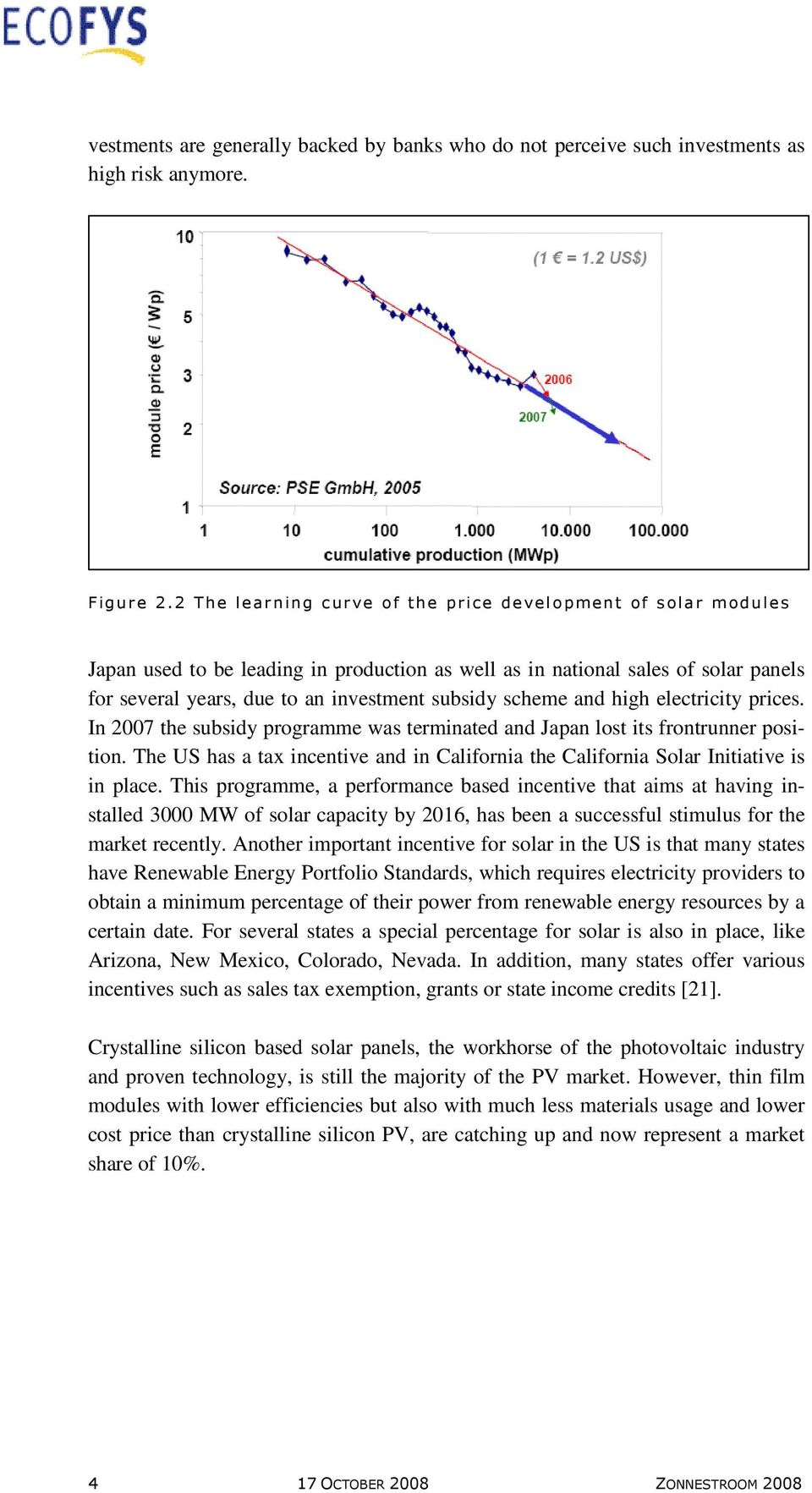
9 2 International 2.1 Market development The solar market is booming. The solar market has shown average growth rate of more than 35% over the last ten years. The solar PV-market is usually expressed in terms of MegaWatt (MW) or GigaWatt (GW) of installed solar module power. From figure 1, by the end of 2007 the total installed PV power was estimated to be 9.2 GW, compared to the 6.8 GW in The market value was estimated to be 13 billion Euros in 2007 and over 100,000 people have found employment in the solar business. The cost of solar panels continues to drop as well. Since the early years of solar panels, panel prices have dropped by 20% for each doubling in cumulative production. In the last few years however, the prices has not dropped because of a shortage of panels in the market. Figure 2.1 Cumulative installed PV power worldwide (Source: Greenpeace/EPIA 2008) The market for PV installations and applications in 2007 was dominated by Germany (46% in 2007), followed by Spain (21%), Japan (10%) and the USA (8%). Recent strong growth is seen in countries like Italy and France. In Germany and Spain, the market is stimulated by feed-in tariff incentive schemes at rates significantly higher than the retail electricity rate. For Spain the feed-in system has been prolonged by a new law approved in September In both countries, private investors have made large scale investments in photovoltaic power plants. These in- SOLAR ELECTRICITY OCTOBER

10 vestments are generally backed by banks who do not perceive such investments as high risk anymore. Figure 2.2 The learning curve of the price development of solar modules Japan used to be leading in production as well as in national sales of solar panels for several years, due to an investment subsidy scheme and high electricity prices. In 2007 the subsidy programme was terminated and Japan lost its frontrunner position. The US has a tax incentive and in California the California Solar Initiative is in place. This programme, a performance based incentive that aims at having installed 3000 MW of solar capacity by 2016, has been a successful stimulus for the market recently. Another important incentive for solar in the US is that many states have Renewable Energy Portfolio Standards, which requires electricity providers to obtain a minimum percentage of their power from renewable energy resources by a certain date. For several states a special percentage for solar is also in place, like Arizona, New Mexico, Colorado, Nevada. In addition, many states offer various incentives such as sales tax exemption, grants or state income credits [21]. Crystalline silicon based solar panels, the workhorse of the photovoltaic industry and proven technology, is still the majority of the PV market. However, thin film modules with lower efficiencies but also with much less materials usage and lower cost price than crystalline silicon PV, are catching up and now represent a market share of 10% OCTOBER 2008 ZONNESTROOM 2008


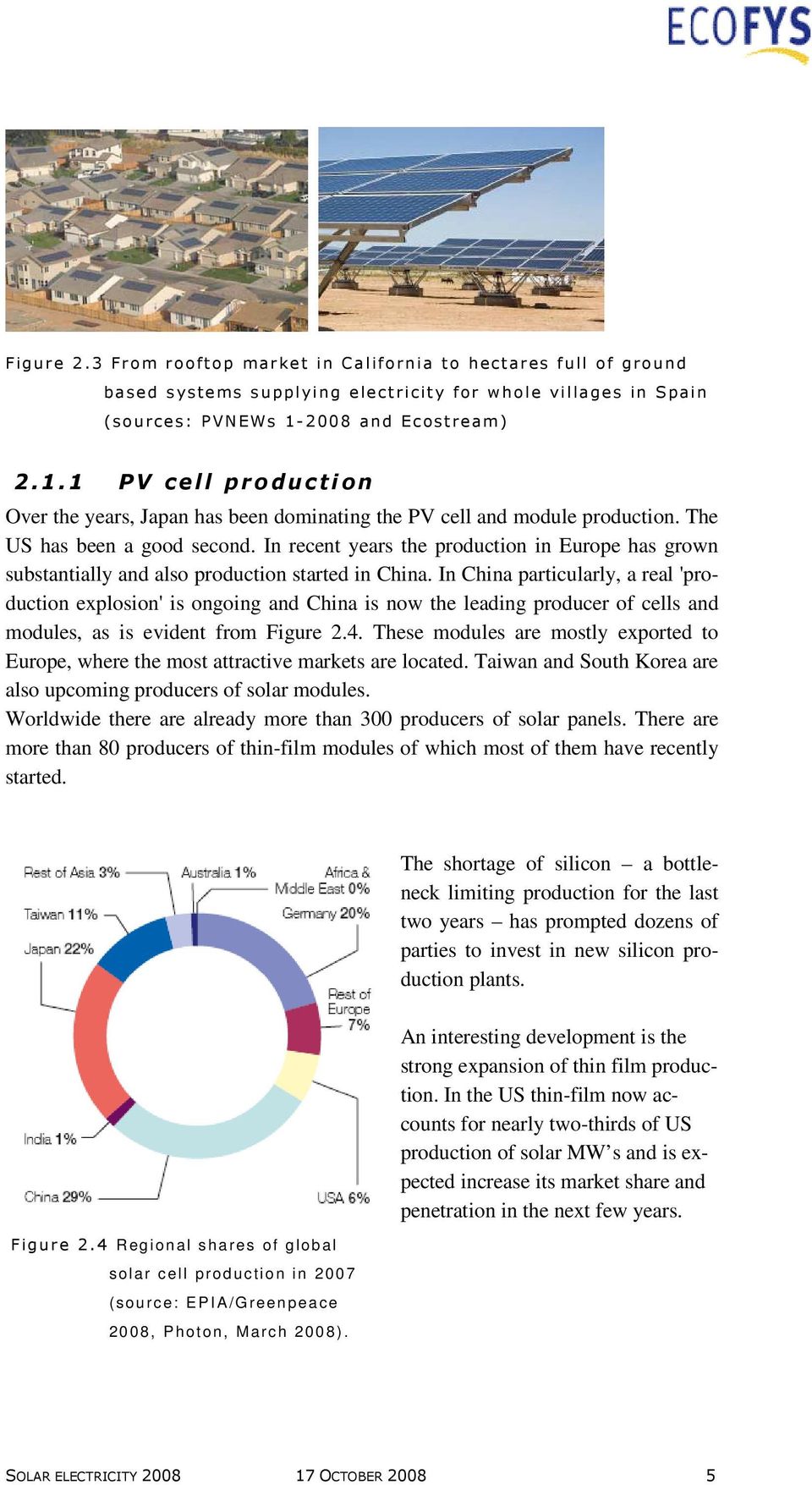
11 Figure 2.3 From rooftop market in California to hectares full of ground based systems supplying electricity for whole villages in Spain (sources: PVNEWs and Ecostream) PV cell production Over the years, Japan has been dominating the PV cell and module production. The US has been a good second. In recent years the production in Europe has grown substantially and also production started in China. In China particularly, a real 'production explosion' is ongoing and China is now the leading producer of cells and modules, as is evident from Figure 2.4. These modules are mostly exported to Europe, where the most attractive markets are located. Taiwan and South Korea are also upcoming producers of solar modules. Worldwide there are already more than 300 producers of solar panels. There are more than 80 producers of thin-film modules of which most of them have recently started. Figure 2.4 Region al shares of global solar cell production in 2007 (source: EPIA/Green peace 2008, Photon, March 200 8). The shortage of silicon a bottleneck limiting production for the last two years has prompted dozens of parties to invest in new silicon production plants. An interesting development is the strong expansion of thin film production. In the US thin-film now accounts for nearly two-thirds of US production of solar MW s and is expected increase its market share and penetration in the next few years. SOLAR ELECTRICITY OCTOBER

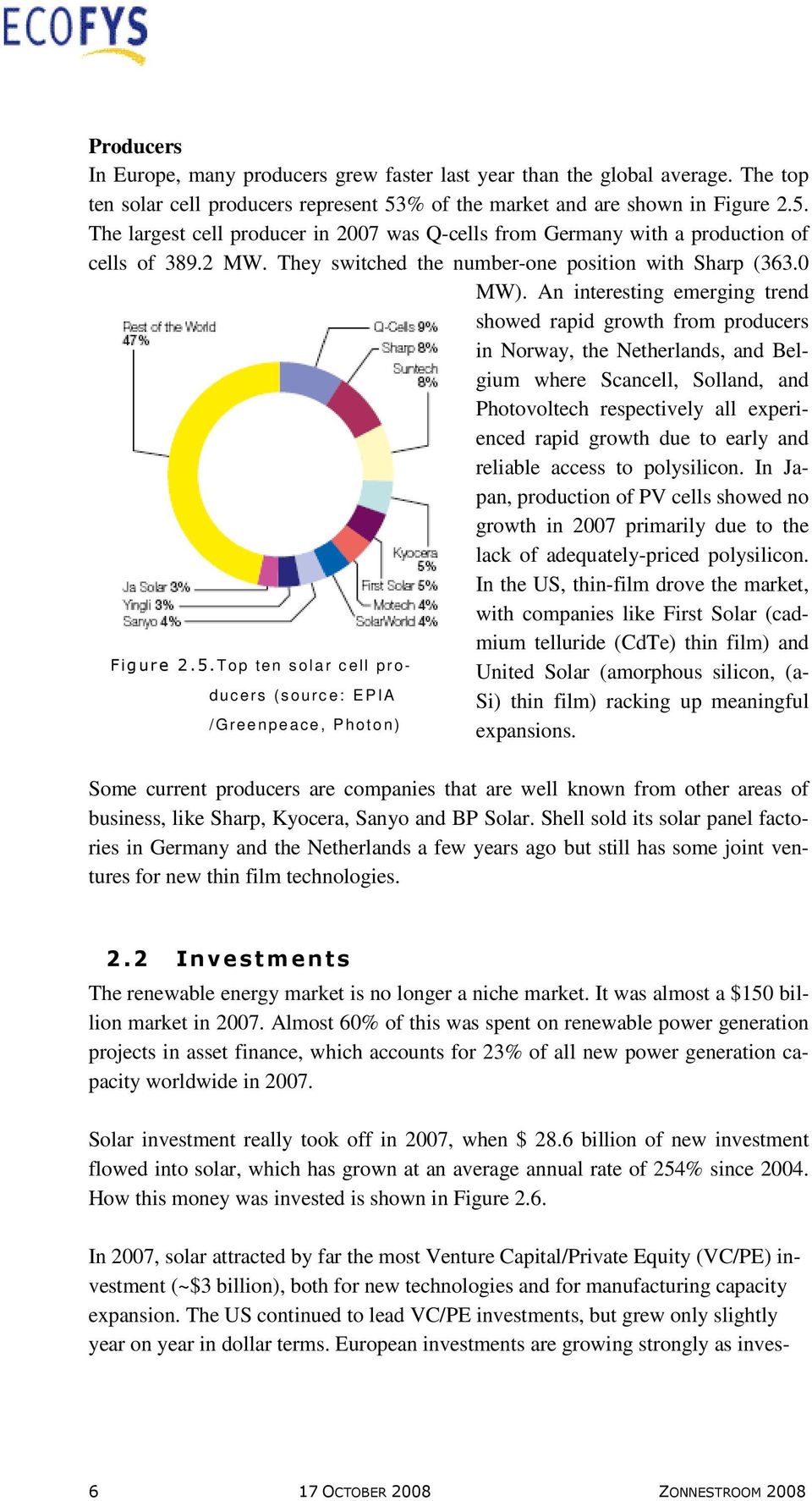
12 Producers In Europe, many producers grew faster last year than the global average. The top ten solar cell producers represent 53% of the market and are shown in Figure 2.5. The largest cell producer in 2007 was Q-cells from Germany with a production of cells of MW. They switched the number-one position with Sharp (363.0 MW). An interesting emerging trend showed rapid growth from producers in Norway, the Netherlands, and Belgium where Scancell, Solland, and Photovoltech respectively all experienced rapid growth due to early and reliable access to polysilicon. In Japan, production of PV cells showed no growth in 2007 primarily due to the lack of adequately-priced polysilicon. In the US, thin-film drove the market, with companies like First Solar (cadmium telluride (CdTe) thin film) and Figure 2.5.Top ten solar c ell producers (sourc e: EPIA United Solar (amorphous silicon, (a- Si) thin film) racking up meaningful /Greenpeace, Photon) expansions. Some current producers are companies that are well known from other areas of business, like Sharp, Kyocera, Sanyo and BP Solar. Shell sold its solar panel factories in Germany and the Netherlands a few years ago but still has some joint ventures for new thin film technologies. 2.2 Investments The renewable energy market is no longer a niche market. It was almost a $150 billion market in Almost 60% of this was spent on renewable power generation projects in asset finance, which accounts for 23% of all new power generation capacity worldwide in Solar investment really took off in 2007, when $ 28.6 billion of new investment flowed into solar, which has grown at an average annual rate of 254% since How this money was invested is shown in Figure 2.6. In 2007, solar attracted by far the most Venture Capital/Private Equity (VC/PE) investment (~$3 billion), both for new technologies and for manufacturing capacity expansion. The US continued to lead VC/PE investments, but grew only slightly year on year in dollar terms. European investments are growing strongly as inves OCTOBER 2008 ZONNESTROOM 2008
13 tors become more willing to take early-stage risk. Examples of these in Europe are Good Energies, Low Carbon Accelerator, Virgin Green fund and Tendris. Also an international investment and specialised fund and asset management group like Babcock & Brown has started to invest is solar (deal with First Solar end 2007). 10% 27% 63% asset finance public market private equity/venture capital Figure 2.6 Global new investments in 2007, division into asset class (total = $ 28.6 billion). Source: Global Trends in Sustainable Energy Investment Investors like Ecoventures (part of the Econcern group [23]) see a danger in this boom as well. Even though the future is bright for solar energy, it is considered to be a hype at the moment, with very high prices being paid for some solar stocks and enormous investments going into new companies with new technologies that remain yet to be proven. This has given rise to fears for a bubble. Also, the indepth knowledge of the traditional financial institutions and investments funds on photovoltaics is limited. This makes risk assessment especially difficult for those parties. Some venture capital firms with prime focus on clean energy have specialists in house. However, there is also ample opportunity for lower risk investments in asset finance. The long term compensation provided by the feed-in schemes in Spain and Germany give investment security. Here, private investors put in equity, supplemented by loans from banks. On the other hand, it should be noted that funding for the solar sector is not unmoved by the financial (credit) crisis in the financial sector, making funding for solar projects more difficult and more expensive than before [24]. 2.3 The future One thing can be said for sure about the near future of photovoltaics: it will keep on growing strongly. We describe expectations for this in the next paragraph on electricity generation. Based on the expected growth figures, we also have an idea of how the cost will come down and when grid parity might be reached. This is described in paragraph grid parity. However, any questions on production will be extremely difficult to answer, given the incredible dynamics of the photovoltaic industry at this moment. Which production technologies, which countries, which companies will dominate? This is all unknown territory. We describe some of the developments in paragraph future production. SOLAR ELECTRICITY OCTOBER


14 2.3.1 Outlook electricity generation Despite output growth of about 50 percent in 2007, solar energy still represents well below 1 percent of the world's generation capacity. More specifically, it contributes to around 0.05% of the world's electricity needs. However, depending on the growth scenario, PV has the potential of generating 4 to 14 % of the global electricity consumption by In fact, PV installations in 4 percent of the deserts would meet global energy needs. The European photovoltaic industry association, EPIA, estimates the global cumulative installed power to be GW in Figure 2.7 World energy consumption. Source: WBGU, German Advisory Council on Global Change (2006) By 2050, solar energy is expected to account for more than 20% of the total energy consumption, as shown in Figure 2.7. This is including concentrating solar power (CSP) and concentrated PV (CPV), both only for very sunny regions Grid parity The price of solar energy will be on parity (meaning same price) with power provided by the grid much sooner than previously thought. Rising prices for fossil fuels and falling prices for solar panels mean that the once large gap between the prices of electricity produced from photovoltaic cells and from oil, gas and coal, is closing rapidly. The market segments with the highest electricity prices will reach grid parity first. These are those of consumers and of peak power. This is shown in Figure 2.8, 8 17 OCTOBER 2008 ZONNESTROOM 2008
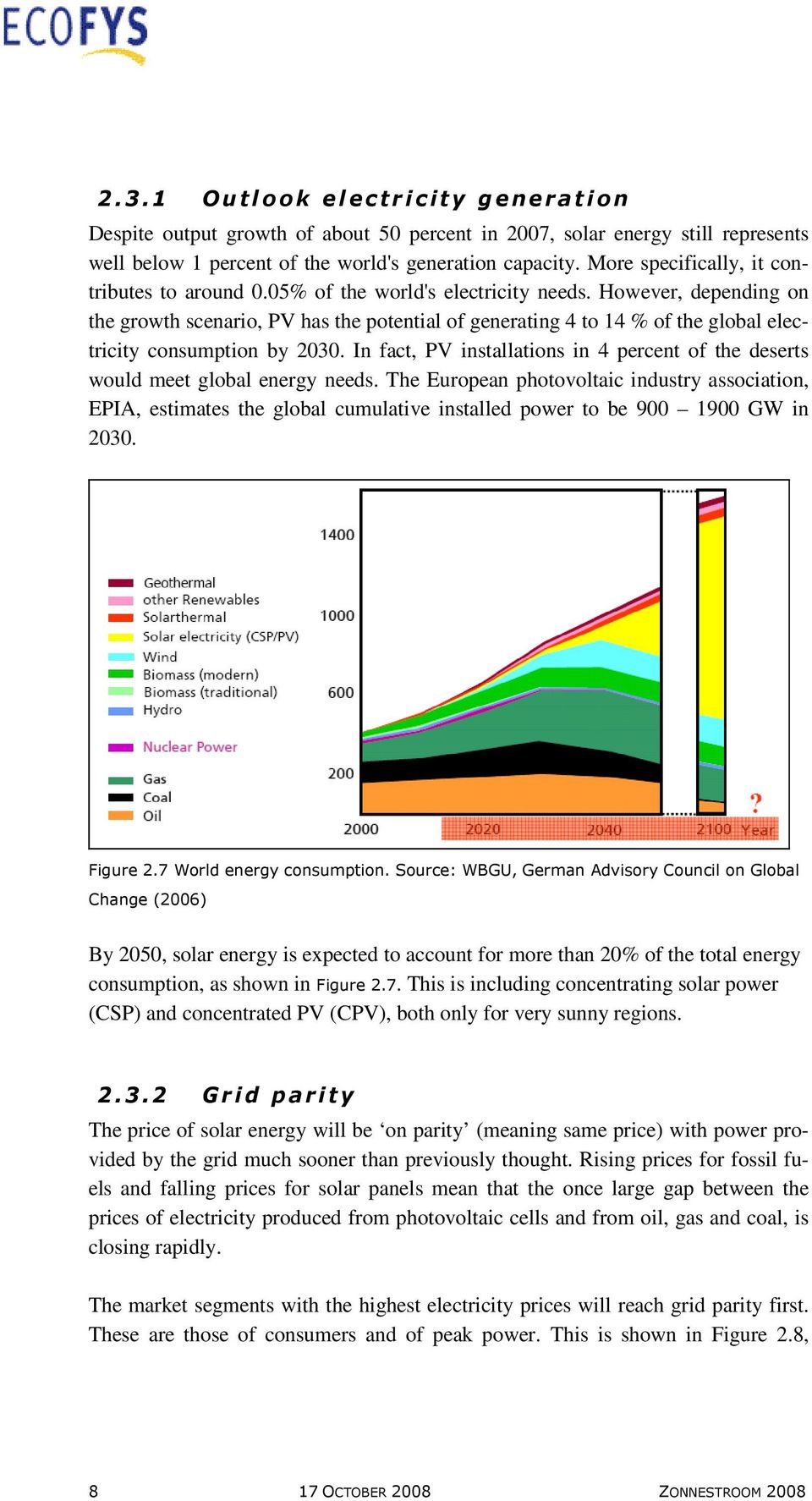

15 where the historical and expected future development solar electricity cost is given and compared with historical and expected future conventional electricity prices. Figure 2.8 Development of utility prices and PV generation costs (Greenpeace/EPIA, 2008). The range for the solar electricity is caused by the variation in electricity output in going from Northern Europe to Southern Europe. General predictions today are that standard rooftop PV systems which output correlates with peak demand are to reach grid parity by 2015 in large parts of the US, Japan and Southern Europe. In the more temperate part of Europe, this grid parity is expected to happen around Some analysts say for Germany, because of cheap PV prices and high national electricity prices (source: EPIA, Valencia 2008). Grid parity for base-load power in this area is only to be expected around Future production In the near future, we expect to see an increasing share of thin film photovoltaics in the market from all main thin film technologies. These are: amorphous silicon (a- Si), Cadmium Telluride (CdTe) en Copper Indium(/Gallium) diselenide or CIS (or CIGS), as they finally manage to live up to their long lived promise of being SOLAR ELECTRICITY OCTOBER

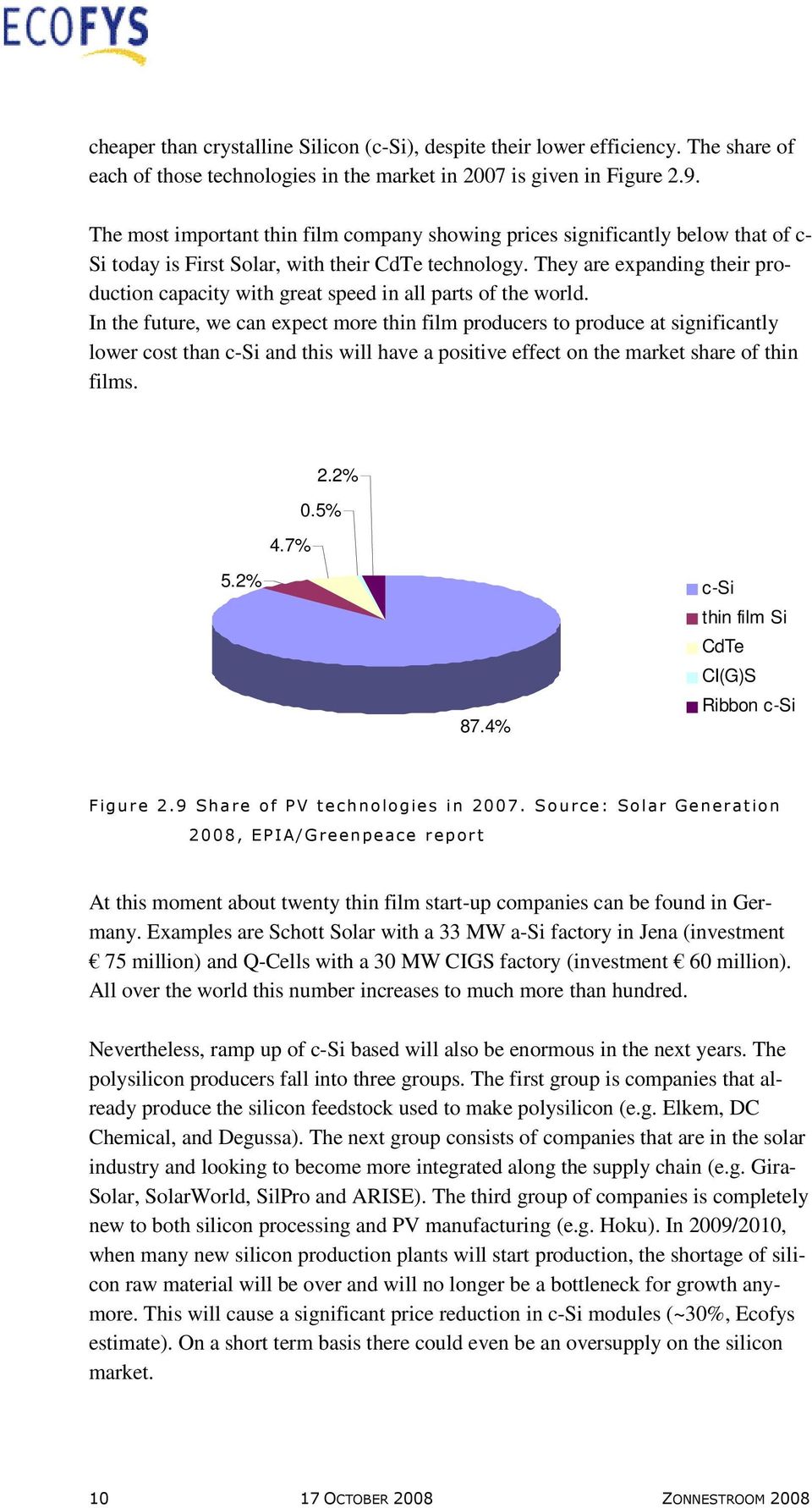
16 cheaper than crystalline Silicon (c-si), despite their lower efficiency. The share of each of those technologies in the market in 2007 is given in Figure 2.9. The most important thin film company showing prices significantly below that of c- Si today is First Solar, with their CdTe technology. They are expanding their production capacity with great speed in all parts of the world. In the future, we can expect more thin film producers to produce at significantly lower cost than c-si and this will have a positive effect on the market share of thin films. 4.7% 2.2% 0.5% 5.2% 87.4% c-si thin film Si CdTe CI(G)S Ribbon c-si Figure 2.9 Share of PV technologies in Source: Solar Generation 2008, EPIA/Greenpeace report At this moment about twenty thin film start-up companies can be found in Germany. Examples are Schott Solar with a 33 MW a-si factory in Jena (investment 75 million) and Q-Cells with a 30 MW CIGS factory (investment 60 million). All over the world this number increases to much more than hundred. Nevertheless, ramp up of c-si based will also be enormous in the next years. The polysilicon producers fall into three groups. The first group is companies that already produce the silicon feedstock used to make polysilicon (e.g. Elkem, DC Chemical, and Degussa). The next group consists of companies that are in the solar industry and looking to become more integrated along the supply chain (e.g. Gira- Solar, SolarWorld, SilPro and ARISE). The third group of companies is completely new to both silicon processing and PV manufacturing (e.g. Hoku). In 2009/2010, when many new silicon production plants will start production, the shortage of silicon raw material will be over and will no longer be a bottleneck for growth anymore. This will cause a significant price reduction in c-si modules (~30%, Ecofys estimate). On a short term basis there could even be an oversupply on the silicon market OCTOBER 2008 ZONNESTROOM 2008
17 The bright prospects of photovoltaics are also attracting existing companies with other core business. The joint venture Heliatek of BASF and Bosch will develop organic photovoltaics and will benefit from the close cooperation with materials and process technology divisions of its investors. Making solar movement even more obvious as a definite trend is the entrance into the solar market of computer technology giants such as IBM and Intel. This year Intel Corp. has invested a double digit million figure in a German solar company, while IBM has announced its own joint venture to develop new solar technologies. Equipment manufacturers for the semiconductor industry have already started this trend a couple of years ago, with Oerlikon and Applied Materials going for the development of solar manufacturing lines. Earlier this year, semiconductor equipment maker Tokyo Electron Ltd., has teamed up with Sharp Corp. to start developing new tools for solar cell manufacturing. This year IKEA has announced that it will soon start selling solar panels, as part of its $50 million investment in clean tech products. Another interesting development is the interest of typical oil producing countries in taking stakes in production facilities. Abu Dhabi, in the United Arab Emirates, announced to invest in two a-si thin film facilities in Erfurt (DE) and Abu Dhabi city which will start production in 2009 and This will be funded by Masdar Clean Tech Fund that is a $250 million diversified venture capital investment fund. The fund is made-up of commitments from the following: (i) Abu Dhabi Future Energy Company ("ADFEC"), (ii) Consensus Business Group ("CBG"), (iii) Credit Suisse ("CS") and (iv) Siemens AG. The fund is part of a bigger plan called the Masdar initiative. This initiative is a response to the need for a global focus on resource conservation and the alternative energy sector and is designed to ensure in the long-term that Abu Dhabi retains, and even grows, its share of the global energy market [22] Production developments and bottlenecks The PV industry is continuously putting effort towards cost reduction so that PV could become a self-sustained industry without the need for subsidies. Characteristic developments in solar industry are the following: Strong investment in thin-film industry. Companies based on Si, such as Q- Cells are investing in subsidiaries based on thin-film technology. Also LCD equipment manufacturers are developing equipment for solar industry and even complete lines for thin-film production (such as Oerlikon or Applied Materials); a diversity of technological innovations. Reaching stability and device reliability for cheaper technologies, such as dye-sensitised cells. SOLAR ELECTRICITY OCTOBER

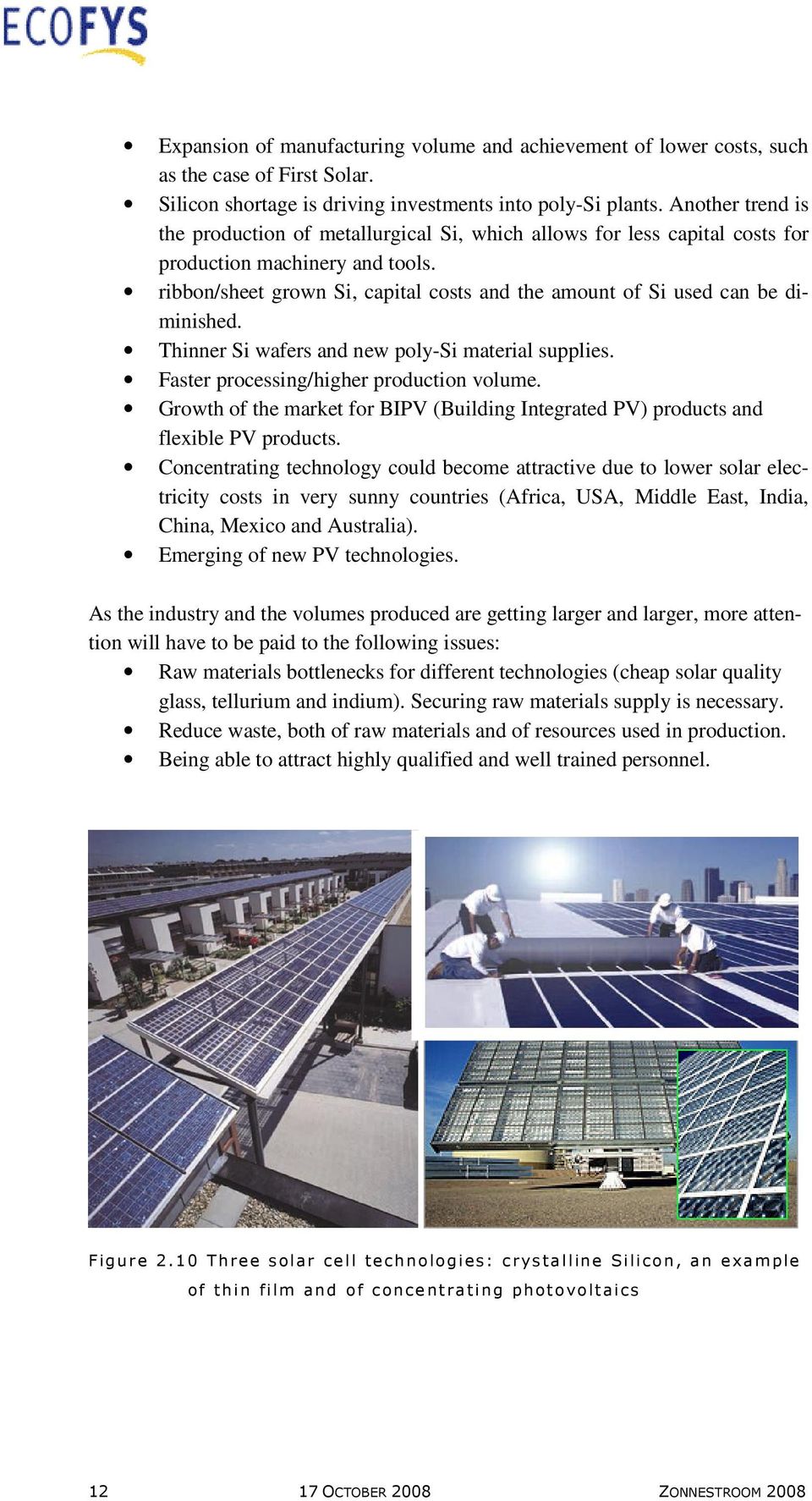
18 Expansion of manufacturing volume and achievement of lower costs, such as the case of First Solar. Silicon shortage is driving investments into poly-si plants. Another trend is the production of metallurgical Si, which allows for less capital costs for production machinery and tools. ribbon/sheet grown Si, capital costs and the amount of Si used can be diminished. Thinner Si wafers and new poly-si material supplies. Faster processing/higher production volume. Growth of the market for BIPV (Building Integrated PV) products and flexible PV products. Concentrating technology could become attractive due to lower solar electricity costs in very sunny countries (Africa, USA, Middle East, India, China, Mexico and Australia). Emerging of new PV technologies. As the industry and the volumes produced are getting larger and larger, more attention will have to be paid to the following issues: Raw materials bottlenecks for different technologies (cheap solar quality glass, tellurium and indium). Securing raw materials supply is necessary. Reduce waste, both of raw materials and of resources used in production. Being able to attract highly qualified and well trained personnel. Figure 2.10 Three solar cell technologies: crystalline Silicon, an example of thin film and of concentrating photovoltaics OCTOBER 2008 ZONNESTROOM 2008
19 2.3.5 Employment The PV market offers important social benefits in terms of job creation. Significantly, much of the employment creation is at the point of installation (installers, retailers and service engineers), giving a boost to local economies. In Germany alone approximately 40,000 people work in 2007 in the solar branch (source: Bundesverband Solarwirtschaft). Based on information provided by the industry, it has been assumed that the total jobs created are 47 to 50 per MW. Over the coming decades these numbers will decrease as the use of automated machines will increase (especially production process). In the most optimistic scenario, almost 2 million people will work in PV industry by 2020, and more than 10 million by 2030 (source EPIA [8]). SOLAR ELECTRICITY OCTOBER
20 3 National 3.1 Market development In the Netherlands, the first house with a roof of PV panels was built in 1989 in Castricum. In the nineties, more demonstration projects followed suit, with increasing size. The largest project was the 1 MW PV project in Nieuwland, Amersfoort, totalling 1.3 MW (12,300 m 2 ) on 500 homes and a few public buildings. In 1998, private consumers were able to buy solar panels in the Greenpeace project Solaris. These demonstration projects were all partially funded by the programme from the ministry of Economic Affairs. In the years 2000, buying of solar panels by private consumers was stimulated by the EnergiePremieRegeling (EPR). This ended at the end of From 2004 through 2007 there were non worthy of mentioning stimulation measures at all. The only regulations in place were some by local municipalities or provinces. In April 2008, the so-called SDE regeling ( Stimulating Duurzame Energieproductie ) has started, which comprises in essence a feed-in tariff of 0.56/kWh, consisting of a 0.33/kWh feed-in tariff from the government added to the consumer price for electricity, which is determined to be 0.23/kWh. A total of 18 MW of applications have been filed, which is more than the 15MW foreseen in the 2008 budget (83 million euro). Whether this will all be installed in 2008 is quite uncertain, due to the bureaucratic hurdles to be taken by private consumers in the process, due to the time it takes for the subsidy approval process and the simple fact that it is allowed to install a PV-system within four years after approval of an application. These developments, described in a nutshell, are depicted graphically in Figure 3.1. An estimated total for 2008 is made, based on the autonomous growth in the few years after the EPR scheme ended together with the maximum possible expected systems installed through the SDE scheme (15 MW, dark blue, on top) OCTOBER 2008 ZONNESTROOM 2008

21 80 totaal geinstalleerd (MW) Figure 3.1 Total installed solar power in the Netherlands, including an estimate for 2008 (with maximum SDE realization). Estimated cumulative installed volume will then be 71 MW. The yearly electricity produced will be suitable for 16,000 households, during the next years. In the unlikely event that all 15 MW of the SDE would be installed in 2008, this would amount to a growth percentage of 36%, which would be quite in line with international growth percentages. Most likely however, this percentage will be less. It is estimated that in 2007, 0.03% of the Dutch electricity consumption came from PV. Wind counts for 3%. The total production of renewable electricity was 6% (source: CBS [13,14]). 3.2 Research & Development Research and development on solar cells and solar photovoltaic systems in the Netherlands is diverse and continuously growing. From significant innovations regarding the more traditional crystalline Si technology, to the development of thirdgeneration (organic) solar cells, the Dutch R&D has approached many fields, such as materials and processes, devices and systems. R&D is conducted at universities (Utrecht, Groningen, Eindhoven, Nijmegen, Delft) and research institutes (ECN, TNO, Holst Centre), but also within companies commercializing the PV technology, such as Solland and Scheuten Solar. Among Dutch research institutes, ECN is by far the largest in the field, with 85 people working on PV technology and a turnover of 15 million this year. To put this number in perspective: public R&D spent on PV in 2007 was 44 million in Germany and 101 million for the USA (source: IEA PVPS 2007 [25]). International recognition not only of ECN, but also of other research institutions in their particular area of research has shown the potential of Dutch R&D regarding the PV technology. This can be seen as well in the participation of the Netherlands SOLAR ELECTRICITY OCTOBER
22 in four big European projects: Crystal Clear (headed by ECN), Full Spectrum, ATHLET and PV Performance. Technology spin-offs are another result of a fruitful collaboration among the research institutions or simply the results of a successful technology. Notable examples are Solland Solar, with the back-contacted cell technology developed at ECN to be implemented this fall. Helianthos, with flexible amorphous Si technology developed previously by Akzo Nobel in co-operation with Utrecht and Delft Universities and now owned by Nuon. TTA-Eurotron, cell production line in collaboration with ECN. RGS, a pilot factory for ribbon growth Si-wafer production. At the company level, the research is growing as well, with new start-ups (such as APA Solar developing CIS modules) or the introduction of new technologies (such as the silicon module producer Scheuten Solar developing CIS technology). Well established equipment manufacturers such as OTB and Tempress systems are another example of continuous innovations in a fast moving PV market. New research agreements like the recent one between ECN and Holst Centre (joint research institute of TNO and IMEC) to develop roll-to-roll production of organic photovoltaics are signals that in the future more development and growth of the industry is to be seen on the Dutch PV market. 3.3 Companies There are several tens of companies (30-40) working already or now becoming active in photovoltaics. Most of them small, but there are some bigger ones as well. They are active in different fields from sales to research reflecting the coming up of new technologies such as thin-film for example. The larger ones and some startups, especially in the solar cell and module field, are listed below. Solland Solar, started in 2004, was able to get the required silicon feedstock in the market to be able to quickly scale up. They have reached 60 MW capacity, currently employ 400 people and plan to have 500 MW production by With this volume they are expected to be able to compete internationally. Main investor is Delta multi-utility company. Scheuten Solar has 85 MW of crystalline silicon module capacity in Germany and 30 MW in a joint venture in Taiwan. In addition, they have built a pilot CIGS-based thin film factory near Venlo, which is expected to be commercially operational in At full capacity it will be able to produce 30 MW. Scheuten Solar is part of the Scheuten Glass group OCTOBER 2008 ZONNESTROOM 2008
23 Ubbink Solar makes solar panels and support structures for flat and sloped roofs. Investors are CentroSolar and Econcern. Nuon bought over the flexible thin film panel technology from Akzo Nobel. They are installing a pilot line and plan to start producing in 2010 with a capacity of 30 MW. They intend to reach a cost level of less than 1/W, which would certainly be very competitive. Econcern is active in renewable energy and energy savings, of which photovoltaic system sales and project development all over Europe is an important part. They have installed 60 MW of photovoltaic installations. They are stakeholder in the Silpro Silicon factory that is currently being built in France. Production is expected to start in 2010/2011 with 4,500 ton capacity. Main investors are: SHV, Rabobank and Delta Lloyd. Oskomera Solar Power Solutions sells photovoltaic systems, mostly for the built environment. Oskomera SPS is part of the Oskomera Group B.V. OTB Solar is a manufacturer of production equipment for solar cells. They export their products worldwide. OTB Solar is member of the OTB Group and might go public in the next 1-2 years. OTB is partially owned by John de Mol. Tempress Systems develops and manufactures furnaces for the semiconductor and the photovoltaic industry. TSM, The Silicon Mine, is the plan for the first solar grade silicon wafer plant in the Netherlands, a 400 million project to be built at the DSM Chemelot site in Sittard/Geleen. The overall employment in the solar branch in the Netherlands is estimated to be roughly 1200 people (R&D, production and retail) The future The present Dutch goals for renewable energy are 20% renewable energy of the total energy use by No specific goals for PV are given. However, in the transition towards a sustainable energy supply, solar is one of the renewable energy technologies within the formulated areas for renewable electricity (next to wind and biomass). Within the transition path renewable electricity, strategic goals are formulated, by the working group PV of the Platform Duurzame Elektriciteitsvoorziening (Platform Sustainable Electricity Supply). This working group is not a government body, but an assembly of industry officials and researchers with participation of the ministry. The goals are given in Table 1. 1 Estimation Ecofys based on own inquiry and the number of 800 jobs in 2003 (Holland Solar) SOLAR ELECTRICITY OCTOBER
24 When comparing the goal for installed capacity in 2015 with the expected total installed capacity in 2008, it can be concluded that a yearly growth of 32 37% will be necessary to reach this goal of 500 MW in These are not unrealistic growth figures and even lower than current international growth figures. If all the 15 MW from the SDE is installed in 2008, this would mean a growth of 36% from 2007, well on track. However, to maintain this growth, 26 MW would have to be installed in 2009 and 36 MW in The SDE as it is known at present does not foresee in such growth figures. Table 1 Strategic goals of the working group PV of the Platform Sustainable Electricity Supply and the Roadmap Holland Solar Price reduction 0.25 /kwh 0.10 /kwh 0.06 /kwh Integration 15,000 roofs a year, some hundreds of facades, jobs 0.50 GWp installed power Equal to the electricity demand of households 100,000 roofs a year, other applications buildings on a limited scale, 10,000 jobs 200,000 roofs a year, other locations on large scale, 60,000 jobs 6 GWp installed power 75 GWp installed power 3% of the total electricity demand 25% of the total electricity demand The figures in Table 1 (and the figures in the international chapter) also show that the consumer market will not have to be subsidized forever. Grid parity may already be reached in the Netherlands in 2015 as well. It should be realized though that the volumes necessary to reach this low PV kwh-price will have to be realized and it will not happen if everybody starts waiting for grid parity. Also, it is not expected that the PV-consumer market will directly take off as soon as grid parity is reached. Grid parity is in fact already reached in South Italy by now, but the market is still small. However, a sufficiently interesting pay back time, awareness of the possibilities and willingness to pay up front for households and an infrastructure able to offer cost-effective rooftop PV-systems will have to be in place for this to happen OCTOBER 2008 ZONNESTROOM 2008
25 4 Conclusions In an international perspective, it is expected that the solar market will continue its high growth rates (~30-40% per year) in the coming years. The coming years will show an expansion in the thin film production capacity. However, crystalline silicon will stay an important mainstay of the solar industry. Production is showing a shift toward Asia (China, Taiwan, Philippines). Nevertheless production capacity is also being built in Europe. In the short term, an oversupply situation could arise. In the longer term the market will be able to catch up with the expansion in production capacity that will materialize in the coming few years. From the financial market perspective solar is now seen as a mature market which is safe to invest in. International and also Dutch related investments funds and venture capitalists are investing more and more capital in solar companies and projects. Large investments are needed in the sector to allow for high growth rates in the coming years. In the Dutch perspective: groups like the branch association Holland Solar and the working group PV of the Platform Duurzame Elektriciteitsvoorziening advocate for a balance between cost reduction through market stimulation and technology development. On the technology side, the Netherlands is doing quite well, with a substantial R&D effort in institutions as well as private companies. The local availability of high level knowledge on PV, is beneficial for non-specialist parties, like investors, that become active in the solar market. For increasing their throughput and turnover however, companies in the Netherlands have been relying completely on international (especially German) market developments rather than national developments. In an international context, the relationship between a strong industry and a strong home market is well visible. The market in Japan collapsed after subsidies were terminated and Japan lost it s international top position in production. At this moment, nowhere in the world can be found so many thin film start-up companies as in Germany, where currently the most PV modules are sold. A strong internal market also creates jobs in the installation sector. In terms of job creation, the Netherlands could do a lot better, stimulating the home market. For example: Germany has jobs in PV, the Netherlands an estimated SOLAR ELECTRICITY OCTOBER
26 Grid parity may be reached in the Netherlands in 2015 or even earlier as well. It should be realized though that the volumes necessary to reach this low PV kwhprice will have to be realized and it will not happen if everybody starts waiting for grid parity. Also, it is not expected that the PV-consumer market will directly take off as soon as grid parity is reached. Grid parity is in fact already reached in South Italy by now, but the market is still small. However, a sufficiently interesting pay back time, awareness of the possibilities and willingness to pay up front for households and an infrastructure able to offer cost-effective rooftop PV-systems will have to be in place for this to happen. Last but not least, a lot will depend on the development of the conventional electricity prices in the years to come OCTOBER 2008 ZONNESTROOM 2008
27 References 1. PV News, Vol. 27, Nr. 3, March PV News, Vol.27, Nr. 4, April E. Koot, The global PV market: fasten your seatbelts, SolarPlaza 2008 report. 4. Gerhard Stryi-Hipp (BSW-Solar), Top 10 PV market outlook, presentation at PV Industry Forum, Intersolar CNN Ecosolutions, November International Herald Tribune, January Solar Thin Films at Data source: Shell. 8. Solar Generation 2007, EPIA/Greenpeace report. 9. Global Trends in Sustainable Energy Investment 2008, United Nations Environment Programme and New Energy Finance Ltd., Grid parity for photovoltaic energy, article on Blogactive EU at April Solar prices nearing grid parity, article on Carbonpositive, at June Private communications ECN, Solland, Sept Duurzame energie in Nederland 2006, CBS, Voorburg/Heerlen, Productie duurzame elektriciteit gedaald in 2007, Webmagazine 20 februari CBS, Voorburg/Heerlen. 15. PV status report 2007, A. Jäger-Waldau, EC/JRC, EUR EN, A Vision for Photovoltaic Technology, Photovoltaic Technology Research Advisory Council (PV-TRAC), Improving the European and National Support Systems for Photovoltaics, PV Policy Group, May Transitiepad zonnestroom. De roadmap van Holland Solar, Holland Solar, PV-Notitie: Zonnestroom en de Transitie naar een Duurzame Elektriciteitsvoorziening, Platform Duurzame Elektriciteit, werkgroep PV, Sept Naar een duurzame elektriciteitsvoorziening. Transitiepad fotovoltaïsche zonne-energie, Platform Duurzame Elektriciteit, werkgroep PV SOLAR ELECTRICITY OCTOBER
28 21. Solar incentives in USA: Masdar solar initiative: Investments: communication with J. Meinders from Ecoventures, September Ad van Wijk, CEO Econcern, Financiëel Dagblad, 9 September Photovoltaic Power Systems Programme Annual report 2007, IEA PVPS, OCTOBER 2008 ZONNESTROOM 2008
29 Glossary of terms PV cell PV module c-si a-si thin film CdTe CIGS feed-in tariff grid parity EPIA CSP CPV smallest photovoltaic element that converts light into electricity, also called solar cell basis element of a PV system consisting of series connected PV cells, also called solar panel crystalline silicon, semiconductor material for solar cells. This can be mono or poly crystalline, silicon with a regular crystal structure amorphous silicon, semiconductor material for solar cells. Silicon without regular crystal structure solar cell made of a thin layer of semiconducting material these are a-si, CdTe and CIGS cadmium telluride, semiconductor material for solar cells copper indium (gallium) diselenide, semiconductor material for solar cells means that the electricity produced with a solar panel can be delivered to the national electricity grid at a fixed price per kwh. the situation were the cost of solar electricity are equal to the cost of electricity from the public grid European Photovoltaic Industry Association Concentrating Solar Power. Sunlight is concentrated and the heat is used to drive a steam generator which produces electricity concentrating PV, sunlight is concentrated onto photovoltaic cells to produce electricity SOLAR ELECTRICITY OCTOBER
30 LCD Dye sensitised solar cells Si-wafer SDE liquid crystal display solar cell made of organic material (dyes) a thin slice of Si material, the basis of a solar cell Stimulering Duurzame Energieproductie Renewable Energy portfolio standard A renewable portfolio standard is a state policy that requires electricity providers to obtain a minimum percentage of their power from renewable energy resources by a certain date OCTOBER 2008 ZONNESTROOM 2008
Solar energy: prepare for impact. Wim Sinke ECN Solar Energy, Utrecht University & European Photovoltaic Technology Platform
 Solar energy: prepare for impact Wim Sinke ECN Solar Energy, Utrecht University & European Photovoltaic Technology Platform Content Solar energy for heat, electricity and fuels Solar electricity: what
SOLAR ELECTRICITY: PROBLEM, CONSTRAINTS AND SOLUTIONS
 SOLAR ELECTRICITY: PROBLEM, CONSTRAINTS AND SOLUTIONS The United States generates over 4,110 TWh of electricity each year, costing $400 billion and emitting 2.5 billion metric tons of carbon dioxide (Yildiz,
Regulation by the Feed-in Tariff: Experiences from Germany
 Solar Power International 08 Panel Technology & Regulation: How to do it Right 16th October 2008, San Diego, California, USA Regulation by the Feed-in Tariff: Experiences from Germany Gerhard Stryi-Hipp
THE SOLAR ENERGY INDUSTRY: CURRENT STATUS AND FUTURE CHALLENGES
 THE SOLAR ENERGY INDUSTRY: CURRENT STATUS AND FUTURE CHALLENGES Gerald I. Susman Smeal College of Business Pennsylvania State University Sustainability Conference Washington, DC October 13, 2009 SUPPLY/DEMAND
Global Market Outlook for Photovoltaics until 2012 Facing a sunny future
 > Competitiveness Global Market Outlook for Photovoltaics until 1 Facing a sunny future 1 Global Market Outlook for Photovoltaics until 1 Facing a sunny future Demand side The solar PV market has been
TRENDS 2015 IN PHOTOVOLTAIC APPLICATIONS EXECUTIVE SUMMARY
 TRENDS 2015 IN PHOTOVOLTAIC APPLICATIONS EXECUTIVE SUMMARY Report IEA-PVPS T1-27:2015 FOREWORD.... The IEA PVPS Programme is proud to provide you with its 20 th edition of the international survey report
FRAUNHOFER INSTITUTE FOR SOLAR ENERGY SYSTEMS ISE
 FRAUNHOFER INSTITUTE FOR SOLAR ENERGY SYSTEMS ISE Photovoltaics Report Freiburg, December 11, 2012 www.ise.fraunhofer.de CONTENT Introduction Executive Summary PV Market Solar Cells / Modules / System
Global market outlook for photovoltaics until 2013
 2013 Global market outlook for photovoltaics until 2013 2005 2006 2007 2008 2009 2010 2011 2012 2013 TABLE OF CONTENTs 1 Executive Summary p 2 2 Global Historical PV Market Development p 3 3 Global PV
Solar energy is available as long as the sun shines, but its intensity depends on weather conditions and geographic
 Solar Energy What is Solar Energy? The radiation from the sun gives our planet heat and light. All living things need energy from the sun to survive. More energy from sunlight strikes the earth in one
The Current status of Korean silicon photovoltaic industry and market. 2011. 3.17 Sangwook Park LG Electronics Inc.
 The Current status of Korean silicon photovoltaic industry and market 2011. 3.17 Sangwook Park LG Electronics Inc. contents 1.Introduction (World PV Market) 2.Korean PV market 3.Photovoltaics in LG Electronics
- SOLAR ENERGY WHITE PAPER - WHERE WE ARE NOW AND WHAT S AHEAD
 u - SOLAR ENERGY WHITE PAPER - WHERE WE ARE NOW AND WHAT S AHEAD A summary provided by Platinum Sponsor Natcore Technology, Inc. Dr. Dennis J. Flood, CTO Presented at New Orleans Investment Conference
PHOTOVOLTAICS REPORT. Prepared by. Fraunhofer Institute for Solar Energy Systems, ISE with support of PSE AG
 PHOTOVOLTAICS REPORT Prepared by Fraunhofer Institute for Solar Energy Systems, ISE with support of PSE AG Freiburg, 4 November 2015 www.ise.fraunhofer.de CONTENT Introduction Executive Summary Topics:
Photovoltaik und globale Energieversorgung
 11/05/2011 EKZ Elektrizitätswerke des Kantons Zürich 1 Photovoltaik und globale Energieversorgung Arnulf Jäger-Waldau European Commission, DG JRC, Ispra Institute for Energy Renewable Energies Disclaimer
Photovoltaics and Solar Thermal Energy in Germany: Market Development, Applications, Industry and Technology
 Photovoltaics and Solar Thermal Energy in Germany: Market Development, Applications, Industry and Technology Gerhard Stryi-Hipp Managing Director BSW - Bundesverband Solarwirtschaft e.v. German Solar Industry
Solar Technology and the Future
 Solar Technology and the Future Sustainable Cities Network First Solar Workshop George Maracas Professor Electrical Engineering & Sustainability COO Solar Power Laboratory AZ Institute for Renewable Energy
The Prospects for Cost Competitive Solar PV Power
 The Prospects for Cost Competitive Solar PV Power Stefan Reichelstein Graduate School of Business Stanford University September 2012 Introduction Rapid Growth of Solar PV Installations 17 GW of solar PV
Photovoltaic Power: Science and Technology Fundamentals
 Photovoltaic Power: Science and Technology Fundamentals Bob Clark-Phelps, Ph.D. Evergreen Solar, Inc. Renewable Energy Seminar, Nov. 2, 2006 Photovoltaic Principle Energy Conduction Band electron Energy
Wind Energy in Texas: Developments & Trends
 Wind Energy in Texas: Developments & Trends German American Chamber of Commerce of the Southern United States, Inc. Silke Miehlke Director, Consulting Services 2011, Hannover Messe Agenda Market Overview
Perspectives on Global Competitiveness in Solar Energy at the U.S Department of Energy
 Perspectives on Global Competitiveness in Solar Energy at the U.S Department of Energy 1 Minimum Take-Aways from This Talk Q: How do you pronounce photovoltaic? A: fō-tō-vōlt-a-ic Q: Why is Germany leading
Prospects and Incentives for Use of Alternative Energy Technologies in the Arab Electric Power Generation Sector
 Prospects and Incentives for Use of Alternative Energy Technologies in the Arab Electric Power Generation Sector Samir AlKotob Arab Fund for Economic and Social Development Objectives To overview the Arab
Renewable energy technology forecast: what can we expect from the technology evolution?
 Renewable energy technology forecast: what can we expect from the technology evolution? Wolfram Krewitt DLR Institute of Technical Thermodynamics Systems Analysis and Technology Assessment Stuttgart NEEDS
What is Solar? The word solar is derived from the Latin word sol (the sun, the Roman sun god) and refers to things and methods that relate to the sun.
 What is Solar? The word solar is derived from the Latin word sol (the sun, the Roman sun god) and refers to things and methods that relate to the sun. What is the solar industry? The solar industry is
Solar Photovoltaic (PV) Cells
 Solar Photovoltaic (PV) Cells A supplement topic to: Mi ti l S Micro-optical Sensors - A MEMS for electric power generation Science of Silicon PV Cells Scientific base for solar PV electric power generation
Bright Prospects for Solar Energy
 Industry Analysis Bright Prospects for Solar Energy Marcial Nava Solar generating electricity will grow faster than other renewables However, fiscal incentives may still be needed in order to support the
27th European Photovoltaic Solar Energy Conference and Exhibition ENERGY PAYBACK TIME AND CARBON FOOTPRINT OF ELKEM SOLAR SILICON
 ENERGY PAYBACK TIME AND CARBON FOOTPRINT OF ELKEM SOLAR SILICON Ronny Glöckner Elkem Solar AS, Fiskaaveien 100, N-4675 Kristiansand, Norway [email protected] Mariska de Wild-Scholten SmartGreenScans,
How is policy shaping market developments: The successful story of Germany
 2nd International Conference on PV Investments EPIA, Frankfurt/Germany, February 19th, 2008 How is policy shaping market developments: The successful story of Germany Gerhard Stryi-Hipp Managing Director
CHANGING THE WORLD WITH COMPELLING IDEAS. German Indian Renewable Energy Dialogue 1st of October 2008
 Titel: IBC SOLAR mit starken Ideen die Welt verändern Autor: Ort, 00. Monat 2008 CHANGING THE WORLD WITH COMPELLING IDEAS German Indian Renewable Energy Dialogue 1st of October 2008 2008 IBC SOLAR Agenda
Summary of the Impact assessment for a 2030 climate and energy policy framework
 Summary of the Impact assessment for a 2030 climate and energy policy framework Contents Overview a. Drivers of electricity prices b. Jobs and growth c. Trade d. Energy dependence A. Impact assessment
The Status and Outlook for the Photovoltaics Industry. David E. Carlson March 14, 2006
 The Status and Outlook for the Photovoltaics Industry David E. Carlson March 14, 2006 Outline of the Talk The PV Market The Major Players Different Types of Solar Cells Field Installations Performance
Solar Power in China. By Zhou Fengqing
 Solar Power in China By Zhou Fengqing Overview Adjust Chinese power structure Feasibility of solar power in China Solar energy as national policies Legislations of solar energy Adjust Chinese Power Structure
CHILE LEVELISED COST OF ENERGY
 CHILE LEVELISED COST OF ENERGY PRESENTED TO NRDC TYLER TRINGAS, ENERGY ECONOMICS APRIL 2011 Chile Levelised Cost of Energy, April 2011 1 CONTENTS Introduction Objectives Levelised Cost of Energy Model
Solar Energy Commercial Applications. Agenda. Venture Catalyst Inc. Intro. Opportunity. Applications. Financing. How to start
 Solar Energy Commercial Applications Valerie Rauluk Venture Catalyst Inc. [email protected] Solar America Cities Briefing June 23, 2009 Agenda Intro Opportunity Applications Financing How to start 2
Using the sun to generate electricity
 Using the sun to generate electricity Image source: http://www.globalsolarcenter.com/files/2009/04/commercial-solar.jpg Solar panels information sheet What are the benefits? How does it work? What is the
Clean, Sustainable Energy from the Sun Now, and for Our Children s Future
 Clean, Sustainable Energy from the Sun Now, and for Our Children s Future An Industry Leader NovaSolar is an industry leader in manufacturing thin-film silicon based solar panels and constructing large
New and Renewable Energy Policy in Republic of Korea
 New and Renewable Energy Policy in Republic of Korea April 26th, 2010 Sanghoon Lee Research Fellow Climate Change Research Center Sejong University, Korea UTLINE Ⅰ. Energy Situation and NRE Status in Korea
VGB Congress Power Plants 2001 Brussels October 10 to 12, 2001. Solar Power Photovoltaics or Solar Thermal Power Plants?
 VGB Congress Power Plants 2001 Brussels October 10 to 12, 2001 Solar Power Photovoltaics or Solar Thermal Power Plants? Volker Quaschning 1), Manuel Blanco Muriel 2) 1) DLR, Plataforma Solar de Almería,
Thin Is In, But Not Too Thin!
 Thin Is In, But Not Too Thin! K.V. Ravi Crystal Solar, Inc. Abstract The trade-off between thick (~170 microns) silicon-based PV and thin (a few microns) film non-silicon and amorphous silicon PV is addressed
EMERGING POTENTIAL FOR SOLAR ENERGY
 EMERGING POTENTIAL FOR SOLAR ENERGY Wacker Chemie AG, February, 2012 CREATING TOMORROW'S SOLUTIONS DISCLAIMER The information contained in this presentation is for background purposes only and is subject
Imagine a company that has shipped solar panels equivalent to the capacity of 8 nuclear plants. This is Suntech.
 that has shipped solar panels equivalent to the capacity of 8 nuclear plants. Our Headquarters: 80% of our electricity is drawn from renewable energy sources. Our facade is the largest grid-connected building
Financing Energy Efficiency and Renewable Energy through the India Renewable Energy Development Agency
 RENEWABLE ENERGY INDUSTRIAL ENERGY EFFICIENCY BUILDING ENERGY EFFICIENCY Financing Energy Efficiency and Renewable Energy through the India Renewable Energy Development Agency A RANGE OF FINANCIAL SUPPORT
Commercial Outlook for Solar Power Generation
 Commercial Outlook for Solar Power Generation International Conference on Alternative Energy 2010 March 27, 2010 Karachi Expo Center Nadeem Haque Nadeem Haque Energy Potential Inc. Topics 1. Market Scenario
EPIA ROADMAP EUROPEAN PHOTOVOLTAIC INDUSTRY ASSOCIATION
 EPIA ROADMAP EUROPEAN PHOTOVOLTAIC INDUSTRY ASSOCIATION FOREWORD The favourable conditions created recently by the White Paper and the RES Directive will help Photovoltaic (PV) Solar Electricity to accelerate
Light management for photovoltaics. Ando Kuypers, TNO Program manager Solar
 Light management for photovoltaics Ando Kuypers, TNO Program manager Solar Global energy consumption: 500 ExaJoule/Year Solar irradiation on earth sphere: 5.000.000 ExaJoule/year 2 Capturing 0,01% covers
SECTION 1. PREAMBLE 3 SECTION 2. EXECUTIVE SUMMARY 4 ABOUT US 6
 CONTENTS SECTION 1. PREAMBLE 3 SECTION 2. EXECUTIVE SUMMARY 4 ABOUT US 6 Disclaimer notice on page 8 applies throughout. Page 2 SECTION 1. PREAMBLE The New Energy Outlook (NEO) is Bloomberg New Energy
Carbon footprint assessment of photovoltaic modules manufacture scenario
 20 th European Symposium on Computer Aided Process Engineering ESCAPE20 S. Pierucci and G. Buzzi Ferraris (Editors) 2010 Elsevier B.V. All rights reserved. Carbon footprint assessment of photovoltaic modules
Netherlands National Energy Outlook 2014
 Netherlands National Energy Outlook 2014 Summary Michiel Hekkenberg (ECN) Martijn Verdonk (PBL) (project coordinators) February 2015 ECN-E --15-005 Netherlands National Energy Outlook 2014 Summary 2 The
Trade in Environmental Goods & Services Solar Energy in Kenya
 Trade in Environmental Goods & Services Solar Energy in Kenya Dr. Moses Ikiara Kenya Institute for Public Policy Research and Analysis WTO Workshop, Geneva, Switzerland September 23 25, 2009 Outline Introduction
New materials for PV Mirjam Theelen
 New materials for Mirjam Theelen 2 A little bit about myself Born in Eindhoven 2001-2007 Study chemistry in Nijmegen Solid State Chemistry Physical Chemistry 2007-present Scientist at TNO (Eindhoven) Research
International Solar Energy Arena January 23rd, 2009, Istanbul STEAM (Strategic Technical Economic Research Center)
 International Solar Energy Arena January 23rd, 2009, Istanbul STEAM (Strategic Technical Economic Research Center) Good morning. Sayin Bakanım. Members of Parliament. Ladies and Gentlemen. Slide 1: Opening
Global growth rates Macroeconomic indicators CEDIGAZ Reference Scenario
 Medium and Long Term Natural Gas Outlook CEDIGAZ February 215 Global growth rates Macroeconomic indicators CEDIGAZ Reference Scenario 4 3 %/year 199-213 213-235 6 Main consuming markets - %/year (213-235)
Enough Solar Energy falls on New York in ONE DAY to power the state for ONE YEAR
 Enough Solar Energy falls on New York in ONE DAY to power the state for ONE YEAR Dr., physicist 1/19/2006 Solar Power to the People 1 3% of the State of New York s land area is covered with buildings and
welcome! Turkish Renewable Energy Market Rome 29 th April 2015 Levent Çelepçi
 welcome! Turkish Renewable Energy Market Rome 29 th April 2015 Levent Çelepçi Turkish Map 65,000,000,000 Dollars Current Deficit Overview Turkish Electricity Market-Growth Potential Turkey s importance
Clean Energy Jobs Plan
 Clean Energy Jobs Plan Introduction When I was governor, California was the world leader in renewable energy and it led the nation in efficiency standards. Our programs saved California consumers billions
Fundamentals of Photovoltaic Materials
 Fundamentals of Photovoltaic Materials National Solar Power Reasearch Institute, Inc. 12/21/98-1 - 12/21/98 Introduction Photovoltaics (PV) comprises the technology to convert sunlight directly into electricity.
Electricity from PV systems how does it work?
 Electricity from photovoltaic systems Bosch Solar Energy 2 Electricity from PV systems Electricity from PV systems how does it work? Photovoltaics: This is the name given to direct conversion of radiant
SOLAR EUROPE INDUSTRY INITIATIVE (SEII) DRAFT SUMMARY IMPLEMENTATION PLAN 2010-2012
 SOLAR EUROPE INDUSTRY INITIATIVE (SEII) DRAFT SUMMARY IMPLEMENTATION PLAN 2010-2012 JANUARY 2010 Table of contents 1. Introduction 2. PV Technology Roadmap 2.1 State of the art and 2020 objectives 2.2
Solar systems provide a range of flexible heating
 f a c t s h e e t 7 Solar Power Production photo by Alex Nikada Why solar? Solar systems provide a range of flexible heating and electricity options and are particularly wellsuited to remote or off-grid
CONCENTRATED PHOTOVOLTAIC AND SOLAR PHOTOVOLTAIC GLOBAL MARKET (2009-2014)
 CONCENTRATED PHOTOVOLTAIC AND SOLAR PHOTOVOLTAIC GLOBAL MARKET (2009-2014) R e p o r t D e s c r i p t i o n T a b l e o f C o n t e n t s L i s t o f T a b l e s S a m p l e T a b l e s R e l a t e d
Executive Summary: Distributed Solar Energy Generation
 RESEARCH REPORT Executive Summary: Distributed Solar Energy Generation Market Drivers and Barriers, Technology Trends, and Global Market Forecasts NOTE: This document is a free excerpt of a larger report.
China Solar Market Analysis
 China Solar Market Analysis Eilat-Eilot Renewable Energy 5 th International Conference & Exhibition Nov. 2012 Anna Wang - Sales Manager (Southern Europe & LaTam) Outline China Overview -About China -Chinese
Solar Photovoltaics Jobs & Value Added in Europe
 Solar Photovoltaics Jobs & Value Added in Europe November 2015 1 This study is commissioned by SolarPower Europe. 2 1. Introduction 4 2. A Summary of Key Findings 8 3. Total job creation 10 4. Forces shaping
Solar Energy Engineering
 Online Training Modules in Photovoltaics Solar Energy Engineering Starting June 2, 2014 the University of Freiburg in cooperation with Fraunhofer will be offering free special training modules in Solar
INTRODUCTION TO PHOTOVOLTAIC SOLAR ENERGY
 Chapter 1. INTRODUCTION TO PHOTOVOLTAIC SOLAR ENERGY Miro Zeman Delft University of Technology 1.1 Introduction to energy consumption and production Any change that takes place in the universe is accompanied
DYESOL: PATHWAY TO MASS MANUFACTURE. Annual General Meeting Investor Presentation - 28 November 2013
 DYESOL: PATHWAY TO MASS MANUFACTURE Annual General Meeting Investor Presentation - 28 November 2013 Pathway To Mass Manufacture Contents 1. Company Description 2. About DSC & ssdsc PV Solutions 3. Value
Irradiance. Solar Fundamentals Solar power investment decision making
 Solar Fundamentals Solar power investment decision making Chilean Solar Resource Assessment Antofagasta and Santiago December 2010 Edward C. Kern, Jr., Ph.D., Inc. Global Solar Radiation Solar Power is
APO COE on GP Model: Green Energy. Dr. Jyh-Shing Yang Senior Supervisor Industrial Technology Research Institute
 APO COE on GP Model: Green Energy Dr. Jyh-Shing Yang Senior Supervisor Industrial Technology Research Institute Presentation Outline Taiwan Green Energy Achievements Green Energy Technical Services Future
ENERGY PRODUCING SYSTEMS
 ENERGY PRODUCING SYSTEMS SOLAR POWER INTRODUCTION Energy from the sun falls on our planet on a daily basis. The warmth of the sun creates conditions on earth conducive to life. The weather patterns that
Solar Energy. Solar Energy range. NSG TEC Pilkington Microwhite Pilkington Optiwhite Pilkington Sunplus
 Solar Energy Solar Energy range NSG TEC Pilkington Microwhite Pilkington Optiwhite Pilkington Sunplus Moving from hydrocarbon dependency to renewable energy The use of solar energy glass and the NSG Group
SMA Solar Technology AG Analyst / Investor Presentation Quarterly Financial Report January to September 2008
 SMA Solar Technology AG Analyst / Investor Presentation Quarterly Financial Report January to September 2008 November 14, 2008 2 Disclaimer IMPORTANT LEGAL NOTICE This presentation does not constitute
H1 2014 LEVELISED COST OF ELECTRICITY - PV
 H1 2014 LEVELISED COST OF ELECTRICITY - PV JENNY CHASE 4 FEBRUARY 2014 LCOE OF PV, FEBRUARY 2014 1 PV EXPERIENCE CURVE, 1976-2013 (2013 $/W) 100 Cost per W (2013 $) 1976 10 1985 2003 2006 1 2012 2013 Q3
Solar Solutions and Large PV Power Plants. Oscar Araujo Business Development Director - Americas
 Solar Solutions and Large PV Power Plants Oscar Araujo Business Development Director - Americas Solar Business of Schneider Electric The Solar Business of Schneider Electric is focused on designing and
Photovoltaic Industry Technologies, Markets & Trends
 Photovoltaic Industry Technologies, Markets & Trends AIAA Los Angeles Enterprise Chapter Joel Davidson Solutions in Solar Electricity Presentation Outline The Big Picture Brief History of PV Solar Array
The Energy Transition in Germany Past, Present and Future
 The Energy Transition in Germany Past, Present and Future smart energy Paraná, Conferência International 2014 9 May 2014 Dr. Carsten Tschamber A Brief History of the Energiewende 1973 - oil crisis, Federal
REN21 2014 Global Status Report Renewable energy in the MENA region. Presented by the UAE Ministry of Foreign Affairs 3 July 2014
 REN21 2014 Global Status Report Renewable energy in the MENA region Presented by the UAE Ministry of Foreign Affairs 3 July 2014 News of 2013 and early 2014 200 MW of wind completed and 160 MW of CSP under
Photovoltaic Roofing in Mediterranean Climate Countries
 1 Photovoltaic Roofing in Mediterranean Climate Countries Pere Alavedra¹, Amado Guzmán ², Mauricio Torres ³, Samantha Gallowayº, Daniel Alavedra" Department of Construction Engineering, Catalonia Polytechnic
PV Energy Payback. by Justine Sanchez. Single-Crystalline
 Single-Crystalline PV Energy Payback by Justine Sanchez Photovoltaic technology is a fantastic miracle of science that silently converts sunlight into streaming electrons that can be used to do work. While
VC Investment into Thin Film Solar Photovoltaics where is it going and why?
 VC Investment into Thin Film Solar Photovoltaics where is it going and why? Nicholas Querques*, Pradeep Haldar**, Unnikrishnan Pillai*** College of Nanoscale Science and Engineering, University at Albany
2. The German energy transition is driven by citizens and communities.
 8 Key Finfings Energy Transition The German Energiewende By Craig Morris, Martin Pehnt An initiative of the Heinrich Böll Foundation Released on 28 November 2012 Revised July 2015 www. 8 Key Findings German
Energy [R]evolution vs. IEA World Energy Outlook scenario
![Energy [R]evolution vs. IEA World Energy Outlook scenario](/thumbs/35/17229912.jpg "Energy [R]evolution vs. IEA World Energy Outlook scenario") Energy [R]evolution vs. IEA World Energy Outlook scenario New set of scenarios takes climate crisis into account World Energy Outlook (WEO) 2008 for the first time takes the climate crisis really into
Energy [R]evolution vs. IEA World Energy Outlook scenario New set of scenarios takes climate crisis into account World Energy Outlook (WEO) 2008 for the first time takes the climate crisis really into
Energy Megatrends 2020
 Energy Megatrends 2020 Esa Vakkilainen 1 NOTE The data included in the following is mainly based on International Energy Agency's (IEA) World Energy Outlook 2007 IEA is considered the most reliable source
Today s Topic. Plano Solar Advocates. www.planosolar.org Non-profit grassroots volunteer group. North Texas Renewable Energy Group
 Today s Topic Rooftop Solar in Texas Right Place, Right Time! Plano Solar Advocates www.planosolar.org Non-profit grassroots volunteer group North Texas Renewable Energy Group www.ntreg.org Non-profit
Training Systems for Renewable Energies. Acquiring Practical Skills and Project-oriented Expertise
 Training Systems for Renewable Energies Acquiring Practical Skills and Project-oriented Expertise Qualifications through Quality Inexhaustible, sustainable, real the future is green The move away from
Technology Fact Sheet for Mitigation
 Technology Fact Sheet for Mitigation Solar PV systems (>1MW) i Technology: Solar PV systems (>1MW) Sector : Energy Subsector : Technology characteristics Introduction Solar photovoltaic, or simply photovoltaic
GLOBAL RENEWABLE ENERGY MARKET OUTLOOK 2013
 GLOBAL RENEWABLE ENERGY MARKET OUTLOOK 213 FACT PACK GUY TURNER HEAD OF ECONOMICS AND COMMODITIES APRIL 26, 213 GLOBAL RENEWABLE ENERGY MARKET OUTLOOK, 26 APRIL 213 1 INTRODUCTION This year s Global Renewable
United States Department of Commerce International Trade Administration
 Japan Type: Large Market; Small Market Share Overall Rank: 17 The introduction of a feed-in-tariff (FIT) has attracted significant investment in the Japanese renewable energy market, particularly in the
Finding a green engine for economic growth China s renewable energy policies
 Low Carbon Green Growth Roadmap for Asia and the Pacific CASE STUDY Finding a green engine for economic growth China s renewable energy policies Key points China s renewable energy industry has been elevated
Perspectives of the German PV Market after Recent Changes in the Renewable Energy Act
 6 th Germany California Solar Day, September 14 th, 2010 Perspectives of the German PV Market after Recent Changes in the Renewable Energy Act Gerhard Stryi-Hipp Head Energy Policy Fraunhofer Institut
Thin Film Solar Cells based on CIS
 Thin Film Solar Cells based on CIS Research for production of cheap and efficient solar modules Marika Edoff, Ångström Solar Center, Uppsala University, Sweden Email: [email protected] 1 partners