
UNIT 9 Evolution Part 1. Microevolution: Unique Gene Pools and Changing Allele Frequencies
|
|
|
- Elfrieda Ferguson
- 9 years ago
- Views:
Transcription
1 UNIT 9 Evolution Part 1 Microevolution: Unique Gene Pools and Changing Allele Frequencies

2 Adaptations and Fitness An adaptation is a genetically controlled trait that is favored by natural selection and gives the organism a reproductive advantage ensuring the trait is passed on to its descendants. This trait may also allow the individual to survive longer thus increasing the reproductive rate of that individual. 2

3 Adaptations and Fitness The antelope hare lives in the desert, and the snowshoe hare lives in the mountains. Explain how the differences in their traits enhance their ability to survive in their respective environments. Evolutionary success or fitness refers to the contribution of genes to the gene pool and NOT how long an organism lives. 3

4 The Effect of Environmental Change Earth s environment is NOT STATIC, but rather ever changing. As a consequence, traits or adaptations that were favorable may become unfavorable. The peppered moth, Biston betularia is native to England and exists in two forms, one is dark and the other light with a peppered appearance. Birds are its main predator. Prior to the industrial revolution, only 2% of the moths were dark. The industrial revolution produced vast amounts of sulfur dioxide and soot from the burning of coal which altered the environment. Fifty years later 95% of the moths were dark. Propose an explanation! 4

5 Industrial Melanism England has since regulated the burning of coal and as a result, the trees are returning to their original state (A). Consequently, the coloring among the population of moths in Britain has shifted back so that the peppered moths are once again favored. 5


6 Evolution Defined Evolution is defined as a change in the inherited characteristics of biological populations over successive generations. Evolutionary processes give rise to diversity at every level of biological organization, from the molecular to the macroscopic. As a result diversity is prevalent among molecules such as DNA as well as individual organisms and species of organisms. 6

7 Microevolution Microevolution is simply a change in gene frequency within a population. Evolution at this scale can be observed over short periods of time such as from one generation to the next. Example: The frequency of a gene for pesticide resistance in a population of crop pests increases. Such a change might come about because natural selection favored the gene the population received new immigrants carrying the gene (gene flow) nonresistant genes mutated into a resistant version of the gene of random genetic drift from one generation to the next 7

8 Microevolution A gene is a sequence of DNA nucleotides that specify a particular polypeptide chain. Genes code for proteins. An allele is a particular form of a gene. For example: B represents the allele for black coat color and b for white coat color. Selection acts on phenotype because differential reproduction and survivorship depend on phenotype not genotype. Natural selection acts on individuals, but only populations evolve. 8

9 Macroevolution Macroevolution is evolution on a scale of separated gene pools (not individuals). Think of it as an accumulation of changes which result in speciation (forming a new species). Macroevolutionary studies focus on change that occurs at or above the level of species, in contrast with microevolution, which refers to smaller evolutionary changes (typically described as changes in allele frequencies) within a species or population. The process of speciation may fall within the purview of either, depending on the forces thought to drive it. 9

10 More Evolution Terms Species-a group of interbreeding organisms that produce viable and fertile offspring in nature Gene pool-sum total of all the genes in a given species Allelic frequency-is the percent occurrence for a given allele 10


11 Sources of Genetic Variation How does variation in a population or gene pool arise? 1. Mutations, gene duplication and chromosome fusion provide the raw material for evolution. 2. Meiosis and sexual reproduction produce new recombinants of phenotypes upon which natural selection operates. The wisteria pictured on the right has a mutation causing it to produce white flowers instead of purple flowers. 11

12 Types of Mutations MOST mutations are deleterious as well as recessive. Obviously, mutations occurring in somatic cells do not affect future generations. Only mutations occurring in gametes affect future generations. Mutations can occur at either the gene or chromosomal level. Mutations may cause a sheep to have a 5th leg. But this is not evolution! 12

13 Neutral Mutations Naturally evolving proteins gradually accumulate mutations while continuing to fold into stable structures. This process of neutral evolution is an important mode of genetic change and forms the basis for the molecular clock. Cytochrome c is a small protein found on the mitochondrial membrane. Between mammals and reptiles there are 15 different amino acids or mutations. 13


14 Neutral Mutations Mammals and reptiles diverged 265 million years ago. That means on average cytochrome c mutated every 17 million years. In comparing the evolution of other organisms and their cytochrome c one mutation every 17 million years holds true. 14

15 Cytochrome c Comparison Molecular homology of cytochrome c (see three-letter code of amino acids) Human Gly Asp Val Glu Lys Gly Lys Lys Ile Phe Ile Met Lys Cys Ser Gln Cys His Thr Val Glu Lys Pig Val Gln - - Ala Chicken - - Ile Val Gln Dogfish Val - Val Gln - - Ala Asn Drosophila <<< Leu Val Gln Arg Ala Ala Wheat <<< - Asn Pro Asp Ala - Ala Lys Thr - - Ala Asp Ala Yeast <<< - Ser Ala Lys - - Ala Thr Leu - Lys Thr Arg - Glu Leu A dash indicates that the amino acid is the same one found at that position in the human molecule. All the vertebrate cytochromes (the first four) start with glycine (Gly). The Drosophila, wheat, and yeast cytochromes have several amino acids that precede the sequence shown here (indicated by <<<). In every case, the heme group of the cytochrome is attached to Cys-14 and Cys-17 (human numbering). 15

16 Hemoglobin Comparison 16

17 Human Impact on Gene Pools It is well documented that humans have had an impact on certain gene pools. For example, humans have selected for certain desirable traits within the mustard family and cultivated different agricultural products for human consumption. 17

18 Artificial Selection When humans manipulate a gene pool it is called artificial selection. There are often consequences involved in such manipulations. For example in agriculture, farmers try to increase crop production, which may lead to many farmers growing only one variety of a particular crop such as corn. This leads to a loss of genetic diversity. If a disease attacks that particular variety of corn, the farmers growing that variety lose their entire crop. 18

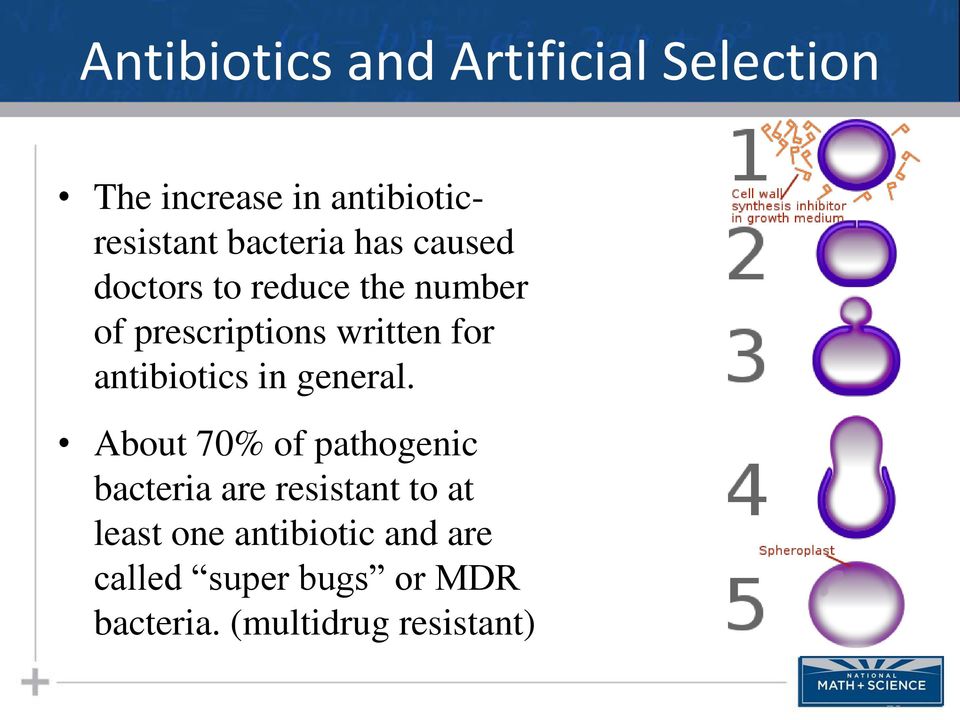
19 Antibiotics and Artificial Selection When antibiotics are applied to a population of microorganisms to treat an infection, some of the microorganisms may be naturally immune to the drug. Why? A random mutation occurred in the genetic code of the microorganism conferring its resistance. These resistant microorganisms continue to flourish and cause disease. The only remaining option a physician has is to treat the infection with a different antibiotic and hope that none of the surviving microorganisms possess a different random mutation that makes them resistant to the second antibiotic as well. 19


20 Antibiotics and Artificial Selection The increase in antibioticresistant bacteria has caused doctors to reduce the number of prescriptions written for antibiotics in general. About 70% of pathogenic bacteria are resistant to at least one antibiotic and are called super bugs or MDR bacteria. (multidrug resistant) 20
21 MRSA or Methicillin-resistant MDR bacteria do not respond to first line of defense antibiotics. These types of bacteria are most commonly found in hospitals. Skin boils or similar lesions that do not heal often result. Staphylococcus aureus MDR bacteria can attack internal organs upon gaining entry into the body. 21

22 Effect of Sexual Reproduction Sexual reproduction recombines genes in new ways. This results in unique offspring that differ from either parent or sibling. Humans make 2 23 different kinds of gametes. Fertilization means that the uniqueness of an individual is Or the probability that two siblings will be genetically identical (excluding identical twins) is Sexual reproduction is like shuffling a deck of cards and every time getting a new and unique hand dealt. It is the major driving force of evolution. 22
23 Genetic Drift Small populations can experience changes in allele frequencies more dramatically than large populations. In very large populations the effect can be insignificant. Also in small populations genes can be lost more easily. When there is only one allele left for a particular gene in a gene pool, that gene is said to be fixed, thus there is no genetic diversity. 23
24 Genetic Drift Genetic drift can be most profound in populations that are dramatically reduced (bottle neck populations) usually due to some environmental catastrophe. Also genetic drift occurs when a small population arrives at a new habitat such as an island. 24
25 Bottleneck Example In 1900, the population of prairie chickens in Illinois was 100 million but by 1995, the population was reduced to around 50 in Jasper County due to over hunting and habitat destruction which caused the bottleneck to occur. A comparison of the DNA from the 1995 bird population indicated the birds had lost most of their genetic diversity. 25
26 Bottleneck Example Additionally, less than 50% of the eggs laid actually hatched in Populations outside IL do not experience the egg hatching problem. Bottleneck populations generally experience a severe reduction in genetic diversity within the population. 26
27 Founder Effect The founder effect is the loss of genetic variation that occurs when a new population is established by a very small number of individuals from a larger population and is a special case of genetic drift. Founder effects are very hard to study! 27
28 Founder Effect Biologist got their chance after a hurricane wiped out all the lizard species on certain islands in the Bahamas, scientists repopulated the small islands with two lizard pairs, one having long limbs and one having short limbs. 28
29 Founder Effect Before the hurricane, these islands supported populations of a Caribbean lizard, the brown anole, Anolis sagrei. After the hurricane, seven of the islands were thoroughly searched. No lizards were found. 29
30 Founder Effect In May 2005, the researchers randomly selected one male and one female brown anole from lizards collected on a nearby larger island to found new anole populations on seven small islands. They then sat back and watched how those lizards evolved to get an up-close look at the Founder Effect. 30
31 Founder Effect During the next four years, the researchers repeatedly sampled lizards from the source island, from the seven experimental founder islands, and from 12 nearby islands that served as a control. The team found that all lizard populations adapted to their environment, yet retained characteristics from their founders. 31
32 A Human Founder Effect Example The Amish community was founded by a small number of colonist. The founding group possessed the gene for polydactyly (extra toes or fingers). The Amish population has increased in size but has remained genetically isolated as few outsiders become a part of the population. As a result polydactyly is much more frequent in the Amish community than it is in other communities. 32
33 Impact of Nonrandom Mating Nonrandom mating also changes allele frequency. Nonrandom mating implies a choice of mates which is more prevalent in animals. Random mating is less common. Time and space also factors into non-random mating. For example, pollen from Ohio is more likely to crosspollinate a nearby tree in Ohio, rather than Oregon. 33
34 Sexual Selection Sexual selection of mates also affects allele frequency. The peacock provides a particularly well known example of intersexual selection, where ornate males compete to be chosen by females. The result is a stunning feathered display, which is large and unwieldy enough to pose a significant survival disadvantage. 34
35 Sexual Selection Female birds of many species choose the male. Males that are showier will better attract females. These males have a selective advantage even though they are more susceptible to predators. 35
36 Sexual Selection Females that are drab, blend in to their surroundings and as a result, avoid predators which giving females a survival advantage. This illustrates that the importance of mating with the correct male outweighs the importance of being preyed upon. Sexual selection can lead to sexual dimorphism where there is a distinct difference between males and females. 36
37 Natural Selection Natural Selection is the only mechanism that consistently causes adaptive evolution. Evolution by natural selection is a blend of chance and sorting. Chance in the context of mutations causing new genetic variations Sorting in the context of natural selection favoring some alleles over others This favoring process causes the outcome of natural selection to be anything but random! Natural Selection consistently increases the frequencies of alleles that provide reproductive advantage and thus leads to adaptive evolution.
38 Three Modes of Natural Selection Natural selection can alter the frequency distribution of heritable traits in three ways depending on which phenotype is favored: Directional Selection Disruptive Selection Stabilizing Selection
39 Directional Selection Directional selection occurs when conditions favor individuals exhibiting one extreme of a phenotypic range. Commonly occurs when the population s environment changes or when members of a population migrate to a new (and different) habitat.
40 Frequency Frequency Frequency Possible Effect of Continual Directional Selection If continued, the variance may decrease. before after before after before after Phenotype (trait) Phenotype (trait) Phenotype (trait) 40
41 Disruptive or Diversifying Selection Disruptive selection occurs when conditions favor individuals at both extremes of a phenotypic range over individuals with intermediate phenotypes. The intermediates in the population have lower relative fitness. 41
42 Disruptive or Diversifying Selection Disruptive selection occurs when conditions favor individuals at both extremes of a phenotypic range over individuals with intermediate phenotypes. The intermediates in the population have lower relative fitness. 42
43 Stabilizing Selection Stabilizing selection removes extreme variants from the population and preserves intermediate types. This reduces variation and tends to maintain the status quo for a particular phenotypic character. 43
44 Diploidy In diploid eukaryotes each organism has two copies of every gene and a considerable amount of genetic variation is hidden from selection in the form of recessive alleles. Often alleles are recessive and less favorable than their dominant counterparts. By contrast, haploid organisms express every gene that is in their genome. What you see is what you get. It reduces genetic variability. 44
45 Diploidy Recessive alleles persist by propagation in heterozygous individuals. This latent variation is exposed to natural selection only when both parents carry the same recessive allele and two copies end up in the same zygote. As you might expect, this happens rarely if the allelic frequency of the recessive allele is very low. Why is heterozygote protection of potentially negative recessive alleles important to species survival? 45
46 Balancing Selection Balancing selection occurs when natural selection maintains two or more forms in a population. This type of selection includes heterozygote advantage and frequency-dependent selection. Heterozygote advantage involves an individual who is heterozygous at a particular gene locus thus has a greater fitness than a homozygous individual. 46
47 Heterozygote Advantage A well-studied case is that of sickle cell anemia in humans, a hereditary disease that damages red blood cells. Sickle cell anemia is caused by the inheritance of a variant hemoglobin gene (HgbS) from both parents. In these individuals, hemoglobin in red blood cells is extremely sensitive to oxygen deprivation, and this causes shorter life expectancy. 47
48 Heterozygote Advantage A person who inherits the sickle cell gene from one parent, and a normal hemoglobin gene (HgbA) from the other, has a normal life expectancy. However, these heterozygote individuals, known as carriers of the sickle cell trait, may suffer problems from time to time. 48
49 Heterozygote Advantage The heterozygote is resistant to the malarial parasite which kills a large number of people each year in Africa. There exists a balancing selection between fierce selection against homozygous sickle-cell sufferers, and selection against the standard HgbA homozygotes by malaria. The heterozygote has a permanent advantage (a higher fitness) wherever malaria exists. 49
50 Heterozygote Advantage 50
51 Frequency-Dependent Selection The fitness of a phenotype depends on how common it is in the population. In positive frequency-dependent selection the fitness of a phenotype increases as it becomes more common. In negative frequency-dependent selection the fitness of a phenotype increases as it becomes less common. For example in prey switching, rare morphs of prey are actually fitter due to predators concentrating on the more frequent morphs. 51
Biology 1406 - Notes for exam 5 - Population genetics Ch 13, 14, 15
 Biology 1406 - Notes for exam 5 - Population genetics Ch 13, 14, 15 Species - group of individuals that are capable of interbreeding and producing fertile offspring; genetically similar 13.7, 14.2 Population
Evolution (18%) 11 Items Sample Test Prep Questions
 Evolution (18%) 11 Items Sample Test Prep Questions Grade 7 (Evolution) 3.a Students know both genetic variation and environmental factors are causes of evolution and diversity of organisms. (pg. 109 Science
Summary. 16 1 Genes and Variation. 16 2 Evolution as Genetic Change. Name Class Date
 Chapter 16 Summary Evolution of Populations 16 1 Genes and Variation Darwin s original ideas can now be understood in genetic terms. Beginning with variation, we now know that traits are controlled by
Continuous and discontinuous variation
 Continuous and discontinuous variation Variation, the small differences that exist between individuals, can be described as being either discontinuous or continuous. Discontinuous variation This is where
Principles of Evolution - Origin of Species
 Theories of Organic Evolution X Multiple Centers of Creation (de Buffon) developed the concept of "centers of creation throughout the world organisms had arisen, which other species had evolved from X
Genetics Lecture Notes 7.03 2005. Lectures 1 2
 Genetics Lecture Notes 7.03 2005 Lectures 1 2 Lecture 1 We will begin this course with the question: What is a gene? This question will take us four lectures to answer because there are actually several
Chapter 3. Chapter Outline. Chapter Outline 9/11/10. Heredity and Evolu4on
 Chapter 3 Heredity and Evolu4on Chapter Outline The Cell DNA Structure and Function Cell Division: Mitosis and Meiosis The Genetic Principles Discovered by Mendel Mendelian Inheritance in Humans Misconceptions
Name: Date: Problem How do amino acid sequences provide evidence for evolution? Procedure Part A: Comparing Amino Acid Sequences
 Name: Date: Amino Acid Sequences and Evolutionary Relationships Introduction Homologous structures those structures thought to have a common origin but not necessarily a common function provide some of
AP BIOLOGY 2010 SCORING GUIDELINES (Form B)
 AP BIOLOGY 2010 SCORING GUIDELINES (Form B) Question 2 Certain human genetic conditions, such as sickle cell anemia, result from single base-pair mutations in DNA. (a) Explain how a single base-pair mutation
Chapter 9 Patterns of Inheritance
 Bio 100 Patterns of Inheritance 1 Chapter 9 Patterns of Inheritance Modern genetics began with Gregor Mendel s quantitative experiments with pea plants History of Heredity Blending theory of heredity -
Genetics 1. Defective enzyme that does not make melanin. Very pale skin and hair color (albino)
 Genetics 1 We all know that children tend to resemble their parents. Parents and their children tend to have similar appearance because children inherit genes from their parents and these genes influence
Heredity. Sarah crosses a homozygous white flower and a homozygous purple flower. The cross results in all purple flowers.
 Heredity 1. Sarah is doing an experiment on pea plants. She is studying the color of the pea plants. Sarah has noticed that many pea plants have purple flowers and many have white flowers. Sarah crosses
1 Mutation and Genetic Change
 CHAPTER 14 1 Mutation and Genetic Change SECTION Genes in Action KEY IDEAS As you read this section, keep these questions in mind: What is the origin of genetic differences among organisms? What kinds
Bio EOC Topics for Cell Reproduction: Bio EOC Questions for Cell Reproduction:
 Bio EOC Topics for Cell Reproduction: Asexual vs. sexual reproduction Mitosis steps, diagrams, purpose o Interphase, Prophase, Metaphase, Anaphase, Telophase, Cytokinesis Meiosis steps, diagrams, purpose
Chapter 13: Meiosis and Sexual Life Cycles
 Name Period Chapter 13: Meiosis and Sexual Life Cycles Concept 13.1 Offspring acquire genes from parents by inheriting chromosomes 1. Let s begin with a review of several terms that you may already know.
Name: 4. A typical phenotypic ratio for a dihybrid cross is a) 9:1 b) 3:4 c) 9:3:3:1 d) 1:2:1:2:1 e) 6:3:3:6
 Name: Multiple-choice section Choose the answer which best completes each of the following statements or answers the following questions and so make your tutor happy! 1. Which of the following conclusions
LECTURE 6 Gene Mutation (Chapter 16.1-16.2)
 LECTURE 6 Gene Mutation (Chapter 16.1-16.2) 1 Mutation: A permanent change in the genetic material that can be passed from parent to offspring. Mutant (genotype): An organism whose DNA differs from the
Hardy-Weinberg Equilibrium Problems
 Hardy-Weinberg Equilibrium Problems 1. The frequency of two alleles in a gene pool is 0.19 (A) and 0.81(a). Assume that the population is in Hardy-Weinberg equilibrium. (a) Calculate the percentage of
Lecture 10 Friday, March 20, 2009
 Lecture 10 Friday, March 20, 2009 Reproductive isolating mechanisms Prezygotic barriers: Anything that prevents mating and fertilization is a prezygotic mechanism. Habitat isolation, behavioral isolation,
Cystic Fibrosis Webquest Sarah Follenweider, The English High School 2009 Summer Research Internship Program
 Cystic Fibrosis Webquest Sarah Follenweider, The English High School 2009 Summer Research Internship Program Introduction: Cystic fibrosis (CF) is an inherited chronic disease that affects the lungs and
Biology Final Exam Study Guide: Semester 2
 Biology Final Exam Study Guide: Semester 2 Questions 1. Scientific method: What does each of these entail? Investigation and Experimentation Problem Hypothesis Methods Results/Data Discussion/Conclusion
Name: Class: Date: ID: A
 Name: Class: _ Date: _ Meiosis Quiz 1. (1 point) A kidney cell is an example of which type of cell? a. sex cell b. germ cell c. somatic cell d. haploid cell 2. (1 point) How many chromosomes are in a human
Genetics Module B, Anchor 3
 Genetics Module B, Anchor 3 Key Concepts: - An individual s characteristics are determines by factors that are passed from one parental generation to the next. - During gamete formation, the alleles for
Chapter 13: Meiosis and Sexual Life Cycles
 Name Period Concept 13.1 Offspring acquire genes from parents by inheriting chromosomes 1. Let s begin with a review of several terms that you may already know. Define: gene locus gamete male gamete female
AP Biology Essential Knowledge Student Diagnostic
 AP Biology Essential Knowledge Student Diagnostic Background The Essential Knowledge statements provided in the AP Biology Curriculum Framework are scientific claims describing phenomenon occurring in
Chromosomes, Mapping, and the Meiosis Inheritance Connection
 Chromosomes, Mapping, and the Meiosis Inheritance Connection Carl Correns 1900 Chapter 13 First suggests central role for chromosomes Rediscovery of Mendel s work Walter Sutton 1902 Chromosomal theory
Mechanisms of Evolution
 page 2 page 3 Teacher's Notes Mechanisms of Evolution Grades: 11-12 Duration: 28 mins Summary of Program Evolution is the gradual change that can be seen in a population s genetic composition, from one
Evolution, Natural Selection, and Adaptation
 Evolution, Natural Selection, and Adaptation Nothing in biology makes sense except in the light of evolution. (Theodosius Dobzhansky) Charles Darwin (1809-1882) Voyage of HMS Beagle (1831-1836) Thinking
MCB41: Second Midterm Spring 2009
 MCB41: Second Midterm Spring 2009 Before you start, print your name and student identification number (S.I.D) at the top of each page. There are 7 pages including this page. You will have 50 minutes for
Terms: The following terms are presented in this lesson (shown in bold italics and on PowerPoint Slides 2 and 3):
 Unit B: Understanding Animal Reproduction Lesson 4: Understanding Genetics Student Learning Objectives: Instruction in this lesson should result in students achieving the following objectives: 1. Explain
Genetics 301 Sample Final Examination Spring 2003
 Genetics 301 Sample Final Examination Spring 2003 50 Multiple Choice Questions-(Choose the best answer) 1. A cross between two true breeding lines one with dark blue flowers and one with bright white flowers
Genomes and SNPs in Malaria and Sickle Cell Anemia
 Genomes and SNPs in Malaria and Sickle Cell Anemia Introduction to Genome Browsing with Ensembl Ensembl The vast amount of information in biological databases today demands a way of organising and accessing
Introduction. What is Ecological Genetics?
 1 Introduction What is Ecological enetics? Ecological genetics is at the interface of ecology, evolution, and genetics, and thus includes important elements from each of these fields. We can use two closely
Heredity - Patterns of Inheritance
 Heredity - Patterns of Inheritance Genes and Alleles A. Genes 1. A sequence of nucleotides that codes for a special functional product a. Transfer RNA b. Enzyme c. Structural protein d. Pigments 2. Genes
Population Genetics and Multifactorial Inheritance 2002
 Population Genetics and Multifactorial Inheritance 2002 Consanguinity Genetic drift Founder effect Selection Mutation rate Polymorphism Balanced polymorphism Hardy-Weinberg Equilibrium Hardy-Weinberg Equilibrium
Chapter 4 Pedigree Analysis in Human Genetics. Chapter 4 Human Heredity by Michael Cummings 2006 Brooks/Cole-Thomson Learning
 Chapter 4 Pedigree Analysis in Human Genetics Mendelian Inheritance in Humans Pigmentation Gene and Albinism Fig. 3.14 Two Genes Fig. 3.15 The Inheritance of Human Traits Difficulties Long generation time
The correct answer is c A. Answer a is incorrect. The white-eye gene must be recessive since heterozygous females have red eyes.
 1. Why is the white-eye phenotype always observed in males carrying the white-eye allele? a. Because the trait is dominant b. Because the trait is recessive c. Because the allele is located on the X chromosome
12.1 The Role of DNA in Heredity
 12.1 The Role of DNA in Heredity Only in the last 50 years have scientists understood the role of DNA in heredity. That understanding began with the discovery of DNA s structure. In 1952, Rosalind Franklin
Human Blood Types: Codominance and Multiple Alleles. Codominance: both alleles in the heterozygous genotype express themselves fully
 Human Blood Types: Codominance and Multiple Alleles Codominance: both alleles in the heterozygous genotype express themselves fully Multiple alleles: three or more alleles for a trait are found in the
Biology 1406 Exam 4 Notes Cell Division and Genetics Ch. 8, 9
 Biology 1406 Exam 4 Notes Cell Division and Genetics Ch. 8, 9 Ch. 8 Cell Division Cells divide to produce new cells must pass genetic information to new cells - What process of DNA allows this? Two types
A trait is a variation of a particular character (e.g. color, height). Traits are passed from parents to offspring through genes.
 1 Biology Chapter 10 Study Guide Trait A trait is a variation of a particular character (e.g. color, height). Traits are passed from parents to offspring through genes. Genes Genes are located on chromosomes
A and B are not absolutely linked. They could be far enough apart on the chromosome that they assort independently.
 Name Section 7.014 Problem Set 5 Please print out this problem set and record your answers on the printed copy. Answers to this problem set are to be turned in to the box outside 68-120 by 5:00pm on Friday
Mendelian and Non-Mendelian Heredity Grade Ten
 Ohio Standards Connection: Life Sciences Benchmark C Explain the genetic mechanisms and molecular basis of inheritance. Indicator 6 Explain that a unit of hereditary information is called a gene, and genes
Problem Set 5 BILD10 / Winter 2014 Chapters 8, 10-12
 Chapter 8: Evolution and Natural Selection 1) A population is: a) a group of species that shares the same habitat. b) a group of individuals of the same species that lives in the same general location
Practice Questions 1: Evolution
 Practice Questions 1: Evolution 1. Which concept is best illustrated in the flowchart below? A. natural selection B. genetic manipulation C. dynamic equilibrium D. material cycles 2. The diagram below
AS Biology Unit 2 Key Terms and Definitions. Make sure you use these terms when answering exam questions!
 AS Biology Unit 2 Key Terms and Definitions Make sure you use these terms when answering exam questions! Chapter 7 Variation 7.1 Random Sampling Sampling a population to eliminate bias e.g. grid square
Basic Principles of Forensic Molecular Biology and Genetics. Population Genetics
 Basic Principles of Forensic Molecular Biology and Genetics Population Genetics Significance of a Match What is the significance of: a fiber match? a hair match? a glass match? a DNA match? Meaning of
Genetics for the Novice
 Genetics for the Novice by Carol Barbee Wait! Don't leave yet. I know that for many breeders any article with the word genetics in the title causes an immediate negative reaction. Either they quickly turn
7 POPULATION GENETICS
 7 POPULATION GENETICS 7.1 INTRODUCTION Most humans are susceptible to HIV infection. However, some people seem to be able to avoid infection despite repeated exposure. Some resistance is due to a rare
7A The Origin of Modern Genetics
 Life Science Chapter 7 Genetics of Organisms 7A The Origin of Modern Genetics Genetics the study of inheritance (the study of how traits are inherited through the interactions of alleles) Heredity: the
Campbell Biology in Focus Correlation for AP Biology Curriculum Framework
 Campbell Biology in Focus Correlation for AP Biology Curriculum Framework Chapters/ Graphical analysis of allele frequencies in a population 5 Application of the Hardy-Weinberg equilibrium equation 1,
BioBoot Camp Genetics
 BioBoot Camp Genetics BIO.B.1.2.1 Describe how the process of DNA replication results in the transmission and/or conservation of genetic information DNA Replication is the process of DNA being copied before
Chapter 4 The role of mutation in evolution
 Chapter 4 The role of mutation in evolution Objective Darwin pointed out the importance of variation in evolution. Without variation, there would be nothing for natural selection to act upon. Any change
MCAS Biology. Review Packet
 MCAS Biology Review Packet 1 Name Class Date 1. Define organic. THE CHEMISTRY OF LIFE 2. All living things are made up of 6 essential elements: SPONCH. Name the six elements of life. S N P C O H 3. Elements
The Developing Person Through the Life Span 8e by Kathleen Stassen Berger
 The Developing Person Through the Life Span 8e by Kathleen Stassen Berger Chapter 3 Heredity and Environment PowerPoint Slides developed by Martin Wolfger and Michael James Ivy Tech Community College-Bloomington
The Making of the Fittest: Natural Selection in Humans
 OVERVIEW MENDELIN GENETIC, PROBBILITY, PEDIGREE, ND CHI-QURE TTITIC This classroom lesson uses the information presented in the short film The Making of the Fittest: Natural election in Humans (http://www.hhmi.org/biointeractive/making-fittest-natural-selection-humans)
Science 10-Biology Activity 14 Worksheet on Sexual Reproduction
 Science 10-Biology Activity 14 Worksheet on Sexual Reproduction 10 Name Due Date Show Me NOTE: This worksheet is based on material from pages 367-372 in Science Probe. 1. Sexual reproduction requires parents,
Tuesday 14 May 2013 Morning
 THIS IS A NEW SPECIFICATION H Tuesday 14 May 2013 Morning GCSE TWENTY FIRST CENTURY SCIENCE BIOLOGY A A161/02 Modules B1 B2 B3 (Higher Tier) *A137150613* Candidates answer on the Question Paper. A calculator
CCR Biology - Chapter 9 Practice Test - Summer 2012
 Name: Class: Date: CCR Biology - Chapter 9 Practice Test - Summer 2012 Multiple Choice Identify the choice that best completes the statement or answers the question. 1. Genetic engineering is possible
Pipe Cleaner Proteins. Essential question: How does the structure of proteins relate to their function in the cell?
 Pipe Cleaner Proteins GPS: SB1 Students will analyze the nature of the relationships between structures and functions in living cells. Essential question: How does the structure of proteins relate to their
AP: LAB 8: THE CHI-SQUARE TEST. Probability, Random Chance, and Genetics
 Ms. Foglia Date AP: LAB 8: THE CHI-SQUARE TEST Probability, Random Chance, and Genetics Why do we study random chance and probability at the beginning of a unit on genetics? Genetics is the study of inheritance,
17. A testcross A.is used to determine if an organism that is displaying a recessive trait is heterozygous or homozygous for that trait. B.
 ch04 Student: 1. Which of the following does not inactivate an X chromosome? A. Mammals B. Drosophila C. C. elegans D. Humans 2. Who originally identified a highly condensed structure in the interphase
Actual Quiz 1 (closed book) will be given Monday10/4 at 10:00 am
 MIT Biology Department 7.012: Introductory Biology Fall 2004 Instructors: Professor Eric Lander, Professor Robert A. Weinberg, Dr. laudette Gardel 7.012 Practice Quiz 1 Actual Quiz 1 (closed book) will
Mendelian Genetics in Drosophila
 Mendelian Genetics in Drosophila Lab objectives: 1) To familiarize you with an important research model organism,! Drosophila melanogaster. 2) Introduce you to normal "wild type" and various mutant phenotypes.
Process 3.5. A Pour it down the sink. B Pour it back into its original container. C Dispose of it as directed by his teacher.
 Process 3.5 Biology EOI sample test questions Objective numbers correspond to the State Priority Academic Student Skills (PASS) standards and objectives. This number is also referenced with the local objective
Genetic Mutations. Indicator 4.8: Compare the consequences of mutations in body cells with those in gametes.
 Genetic Mutations Indicator 4.8: Compare the consequences of mutations in body cells with those in gametes. Agenda Warm UP: What is a mutation? Body cell? Gamete? Notes on Mutations Karyotype Web Activity
Scheme of work Cambridge IGCSE Biology (0610)
 Scheme of work Cambridge IGCSE Biology (0610) Unit 8: Inheritance and evolution Recommended prior knowledge Basic knowledge of Unit 1 cell structure is required, and also an understanding of the processes
CHAPTER 15 THE CHROMOSOMAL BASIS OF INHERITANCE. Section B: Sex Chromosomes
 CHAPTER 15 THE CHROMOSOMAL BASIS OF INHERITANCE Section B: Sex Chromosomes 1. The chromosomal basis of sex varies with the organism 2. Sex-linked genes have unique patterns of inheritance 1. The chromosomal
Worksheet: The theory of natural selection
 Worksheet: The theory of natural selection Senior Phase Grade 7-9 Learning area: Natural Science Strand: Life and living Theme: Biodiversity, change and continuity Specific Aim 1: Acquiring knowledge of
1. Biodiversity & Distribution of Life
 National 5 Biology Unit 3 Life on Earth Summary notes 1. Biodiversity & Distribution of Life Perhaps the best place to start in this topic is with Biomes. Biomes are regions of our planet which have a
The Evolution of Populations
 23 he Evolution of Populations Key oncepts 23.1 enetic variation makes evolution possible 23.2 he Hardy-Weinberg equation can be used to test whether a population is evolving 23.3 Natural selection, genetic
A Hands-On Exercise To Demonstrate Evolution
 HOW-TO-DO-IT A Hands-On Exercise To Demonstrate Evolution by Natural Selection & Genetic Drift H ELEN J. YOUNG T RUMAN P. Y OUNG Although students learn (i.e., hear about) the components of evolution by
ENVIRONMENTAL CHANGES
 reflect How do you respond to environmental changes? Maybe you wear different types of clothes in different seasons. Maybe you only ride your bike during certain times of the year. What if you moved to
LAB : THE CHI-SQUARE TEST. Probability, Random Chance, and Genetics
 Period Date LAB : THE CHI-SQUARE TEST Probability, Random Chance, and Genetics Why do we study random chance and probability at the beginning of a unit on genetics? Genetics is the study of inheritance,
Evolution by Natural Selection 1
 Evolution by Natural Selection 1 I. Mice Living in a Desert These drawings show how a population of mice on a beach changed over time. 1. Describe how the population of mice is different in figure 3 compared
Lesson Overview. Biodiversity. Lesson Overview. 6.3 Biodiversity
 Lesson Overview 6.3 6.3 Objectives Define biodiversity and explain its value. Identify current threats to biodiversity. Describe how biodiversity can be preserved. THINK ABOUT IT From multicolored coral
1. Why is mitosis alone insufficient for the life cycle of sexually reproducing eukaryotes?
 Chapter 13: Meiosis and Sexual Life Cycles 1. Why is mitosis alone insufficient for the life cycle of sexually reproducing eukaryotes? 2. Define: gamete zygote meiosis homologous chromosomes diploid haploid
Biological Sciences Initiative. Human Genome
 Biological Sciences Initiative HHMI Human Genome Introduction In 2000, researchers from around the world published a draft sequence of the entire genome. 20 labs from 6 countries worked on the sequence.
Answer Key Problem Set 5
 7.03 Fall 2003 1 of 6 1. a) Genetic properties of gln2- and gln 3-: Answer Key Problem Set 5 Both are uninducible, as they give decreased glutamine synthetase (GS) activity. Both are recessive, as mating
Biology Behind the Crime Scene Week 4: Lab #4 Genetics Exercise (Meiosis) and RFLP Analysis of DNA
 Page 1 of 5 Biology Behind the Crime Scene Week 4: Lab #4 Genetics Exercise (Meiosis) and RFLP Analysis of DNA Genetics Exercise: Understanding how meiosis affects genetic inheritance and DNA patterns
Reproductive System & Development: Practice Questions #1
 Reproductive System & Development: Practice Questions #1 1. Which two glands in the diagram produce gametes? A. glands A and B B. glands B and E C. glands C and F D. glands E and F 2. Base your answer
Gene Mapping Techniques
 Gene Mapping Techniques OBJECTIVES By the end of this session the student should be able to: Define genetic linkage and recombinant frequency State how genetic distance may be estimated State how restriction
Academic Nucleic Acids and Protein Synthesis Test
 Academic Nucleic Acids and Protein Synthesis Test Multiple Choice Identify the letter of the choice that best completes the statement or answers the question. 1. Each organism has a unique combination
B2 5 Inheritrance Genetic Crosses
 B2 5 Inheritrance Genetic Crosses 65 minutes 65 marks Page of 55 Q. A woman gives birth to triplets. Two of the triplets are boys and the third is a girl. The triplets developed from two egg cells released
WEEK 6 EOC Review Evolution, Human Body, Biotechnology
 WEEK 6 EOC Review Evolution, Human Body, Biotechnology Benchmarks: SC.912.L.15.13 Describe the conditions required for natural selection, including: overproduction of offspring, inherited variation, and
CHROMOSOMES AND INHERITANCE
 SECTION 12-1 REVIEW CHROMOSOMES AND INHERITANCE VOCABULARY REVIEW Distinguish between the terms in each of the following pairs of terms. 1. sex chromosome, autosome 2. germ-cell mutation, somatic-cell
Meiosis is a special form of cell division.
 Page 1 of 6 KEY CONCEPT Meiosis is a special form of cell division. BEFORE, you learned Mitosis produces two genetically identical cells In sexual reproduction, offspring inherit traits from both parents
Practice Problems 4. (a) 19. (b) 36. (c) 17
 Chapter 10 Practice Problems Practice Problems 4 1. The diploid chromosome number in a variety of chrysanthemum is 18. What would you call varieties with the following chromosome numbers? (a) 19 (b) 36
PRINCIPLES OF POPULATION GENETICS
 PRINCIPLES OF POPULATION GENETICS FOURTH EDITION Daniel L. Hartl Harvard University Andrew G. Clark Cornell University UniversitSts- und Landesbibliothek Darmstadt Bibliothek Biologie Sinauer Associates,
Basics of Marker Assisted Selection
 asics of Marker ssisted Selection Chapter 15 asics of Marker ssisted Selection Julius van der Werf, Department of nimal Science rian Kinghorn, Twynam Chair of nimal reeding Technologies University of New
Okami Study Guide: Chapter 3 1
 Okami Study Guide: Chapter 3 1 Chapter in Review 1. Heredity is the tendency of offspring to resemble their parents in various ways. Genes are units of heredity. They are functional strands of DNA grouped
Sexual Reproduction. The specialized cells that are required for sexual reproduction are known as. And come from the process of: GAMETES
 Sexual Reproduction Sexual Reproduction We know all about asexual reproduction 1. Only one parent required. 2. Offspring are identical to parents. 3. The cells that produce the offspring are not usually
LAB : PAPER PET GENETICS. male (hat) female (hair bow) Skin color green or orange Eyes round or square Nose triangle or oval Teeth pointed or square
 Period Date LAB : PAPER PET GENETICS 1. Given the list of characteristics below, you will create an imaginary pet and then breed it to review the concepts of genetics. Your pet will have the following
Name Date Period. 2. When a molecule of double-stranded DNA undergoes replication, it results in
 DNA, RNA, Protein Synthesis Keystone 1. During the process shown above, the two strands of one DNA molecule are unwound. Then, DNA polymerases add complementary nucleotides to each strand which results
ISTEP+: Biology I End-of-Course Assessment Released Items and Scoring Notes
 ISTEP+: Biology I End-of-Course Assessment Released Items and Scoring Notes Page 1 of 22 Introduction Indiana students enrolled in Biology I participated in the ISTEP+: Biology I Graduation Examination
Sickle cell anemia: Altered beta chain Single AA change (#6 Glu to Val) Consequence: Protein polymerizes Change in RBC shape ---> phenotypes
 Protein Structure Polypeptide: Protein: Therefore: Example: Single chain of amino acids 1 or more polypeptide chains All polypeptides are proteins Some proteins contain >1 polypeptide Hemoglobin (O 2 binding
Evidence for evolution factsheet
 The theory of evolution by natural selection is supported by a great deal of evidence. Fossils Fossils are formed when organisms become buried in sediments, causing little decomposition of the organism.
www.njctl.org PSI Biology Mitosis & Meiosis
 Mitosis and Meiosis Mitosis Classwork 1. Identify two differences between meiosis and mitosis. 2. Provide an example of a type of cell in the human body that would undergo mitosis. 3. Does cell division
Cell Growth and Reproduction Module B, Anchor 1
 Cell Growth and Reproduction Module B, Anchor 1 Key Concepts: - The larger a cell becomes, the more demands the cell places on its DNA. In addition, a larger cell is less efficient in moving nutrients
PLANT EVOLUTION DISPLAY Handout
 PLANT EVOLUTION DISPLAY Handout Name: TA and Section time Welcome to UCSC Greenhouses. This sheet explains a few botanical facts about plant reproduction that will help you through the display and handout.