
Environment and Energy in Bavaria PROFILES
|
|
|
- Augustus Rodgers
- 10 years ago
- Views:
Transcription
1 Environment and Energy in Bavaria PROFILES PORTRAITS PERSPECTIVES WITH SPECIAL GEOTHERMAL ENERGY

2 Pictures: Allianz Arena, istockphoto/mad Circles, Fotolia/Tryfonov, Fotolia/Yuri Arcurs, Siemens AG, Imagepoint, Audi AG, E.ON AG, Fraunhofer... encountering the future. Bayern Innovativ GmbH Gewerbemuseumsplatz Nuremberg Germany Phone Fax [email protected] Today ' s knowledge for tomorrow ' s innovations

3 Editorial More certain than uncertainty that is how the invention process in the search for renewable energy could be rewritten in a figurative sense. The energy turnaround, with regard to limited resources such as coal, natural gas and oil, as well as the ecological and economic challenge presented, is currently at the top of the world s agenda. The approaches and system solutions offered under the banner of climate change, associated with the possibilities of resource efficiency, can be discovered in the following articles. Why is electricity from geothermal energy so successful all over the world? How are geothermal plants put into operation and run safely? Find out about new environmental and energy technologies! Can Bavaria make a contribution to global sustainable water management? Walter Fürst, Managing Director What support is there for innovative environmental and energy projects? How does the Energy Atlas Bavaria support the potential of future plants and their planning framework with information? Which promising perspectives are offered by small and medium-sized enterprises with regard to energy efficiency? What form does base-loadable hydroelectric power of the future take? Masthead: Publisher: Managing director: Design + DTP: Prepress: Responsible editor: media mind GmbH & Co. KG Hans-Bunte-Str Munich/Germany Phone: +49(0)89 / Telefax: +49(0)89 / ISDN (MAC): +49(0)89 / [email protected] Walter Fürst, Jürgen Bauernschmitt Jürgen Bauernschmitt media mind GmbH & Co. KG Ilse Schallwegg Which role is played by the Geothermal German Federal Association and Economic Forum in interdisciplinary experience sharing? Published annually: Printed by: 1 x annually Druckerei Frischmann, Amberg 2014/2015 by media mind GmbH & Co. KG No part of this magazine may be stored, copied or reproduced without the written consent of the editorial office

4 Advert Bayern Innovativ 2. CP Editorial 3 Advert BAYERN INTERNATIONAL 6 A Word of Welcome Dr. Marcel Huber MdL 7 Bavarian Research Alliance (BayFOR) 8 European Funding of Innovative Environmental and Energy Research Projects Contact: Dr. Thomas Ammerl Bavarian Research Alliance (BayFOR) Table of contents Substainable Water Management 13 Metropolitan Nuremberg 14 The Nuremberg Metropolitan Area Energy and Environmental Technology for the Global Market Authors: Dr.-Ing. Robert Schmidt, Dr. rer. nat. Ronald Künneth, IHK Nürnberg für Mittelfranken Energy efficiency 17 Energy efficiency in small and medium-sized businesses Contact: Wolf GmbH STEAG New Energies GmbH 19 A fresh breeze for your power generation Kontakt: STEAG New Energies GmbH

5 NETZSCH Pumpen & Systeme 20 IBC SOLAR AG 21 SPECIAL Geothermal energy in Bavaria 23 Foreword Dr. Erwin Knapek Economic forum Geothermal Energy e.v. 24 Framework 26 Geoscientific Framework for Geothermal Projekts in Bavaria Authors: Dr. Rüdiger Schulz, Dr. Michael Dussel Leibnitz-Institut für Angewandte Geophysik (LIAG) Pump manufactures 31 Powerful Production Pumps to lift the Economy of Deep Geothermal Projects Authors: Dr. Hartwig Schröder, Dr. Jochen Schneider ENERCHANGE, agency for renewable energies Advert media mind GmbH & Co. KG 35 H. Anger s Söhne Production pump tests 36 Geothermal projekt Unterschleißheim 38 Gersthofen Industrial Park 40

6 EASY ACCESS TO ECONOMIC PARTNERS IN BAVARIA YOUR KEY TO BAVARIA Exclusively available at Bayern International, the database Key Technologies in Bavaria comes free of charge and offers valuable insights into more than companies. Visit to obtain the regularly updated information of all 22 industries. Questions? KeyTech Hotline*: +49 (0) Mon to Thu 9 am to 5 pm, Fri 9 am to 3 pm * (14 cents per min. for calls from Germany; fees for international calls subject to your local provider) Bavarian Ministry of Economic Affairs and Media, Energy and Technology

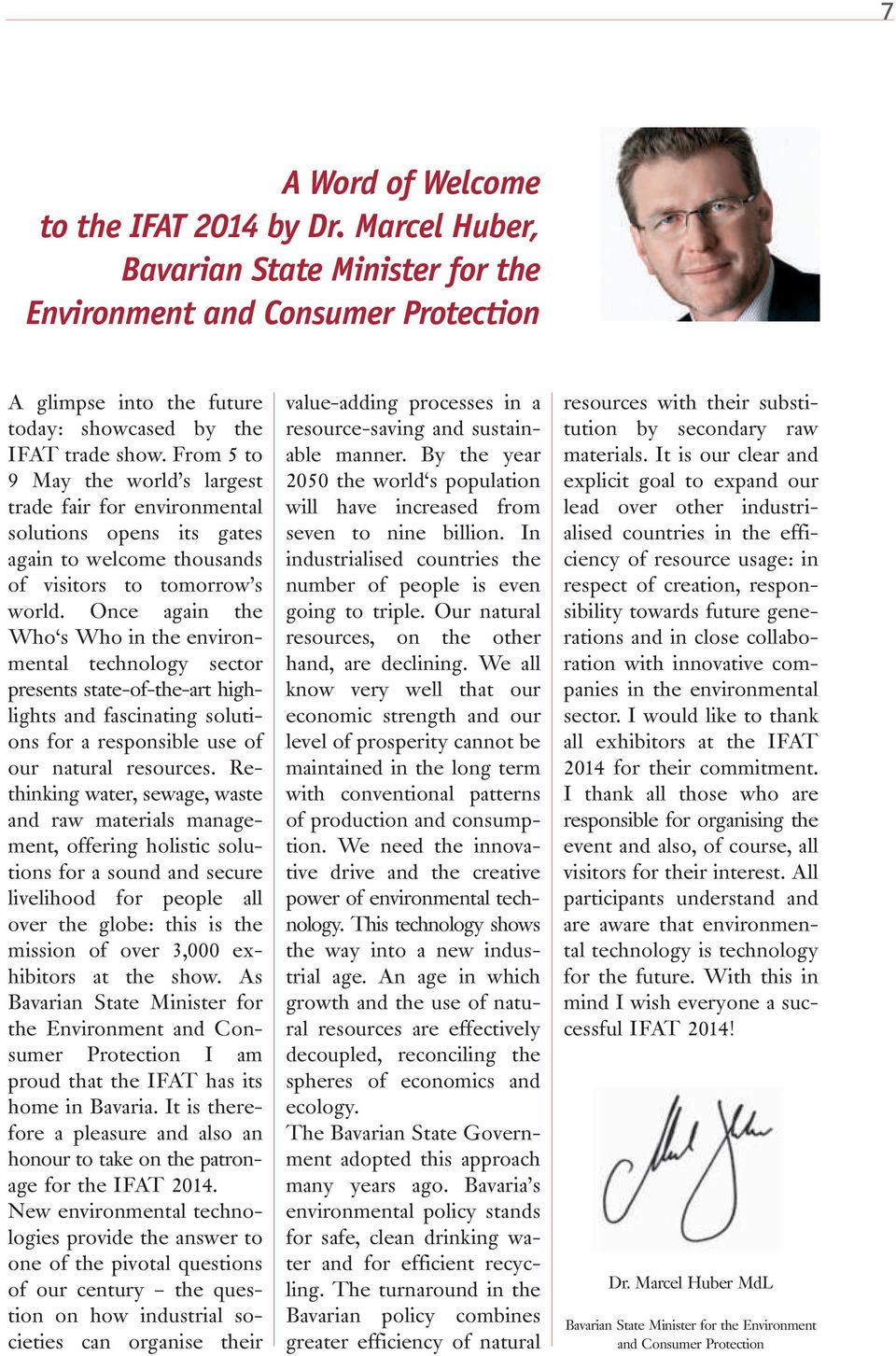
7 7 A Word of Welcome to the IFAT 2014 by Dr. Marcel Huber, Bavarian State Minister for the Environment and Consumer Protection A glimpse into the future today: showcased by the IFAT trade show. From 5 to 9 May the world s largest trade fair for environmental solutions opens its gates again to welcome thousands of visitors to tomorrow s world. Once again the Who s Who in the environmental technology sector presents state-of-the-art highlights and fascinating solutions for a responsible use of our natural resources. Rethinking water, sewage, waste and raw materials management, offering holistic solutions for a sound and secure livelihood for people all over the globe: this is the mission of over 3,000 exhibitors at the show. As Bavarian State Minister for the Environment and Consumer Protection I am proud that the IFAT has its home in Bavaria. It is therefore a pleasure and also an honour to take on the patronage for the IFAT New environmental technologies provide the answer to one of the pivotal questions of our century the question on how industrial societies can organise their value-adding processes in a resource-saving and sustainable manner. By the year 2050 the world s population will have increased from seven to nine billion. In industrialised countries the number of people is even going to triple. Our natural resources, on the other hand, are declining. We all know very well that our economic strength and our level of prosperity cannot be maintained in the long term with conventional patterns of production and consumption. We need the innovative drive and the creative power of environmental technology. This technology shows the way into a new industrial age. An age in which growth and the use of natural resources are effectively decoupled, reconciling the spheres of economics and ecology. The Bavarian State Government adopted this approach many years ago. Bavaria s environmental policy stands for safe, clean drinking water and for efficient recycling. The turnaround in the Bavarian policy combines greater efficiency of natural resources with their substitution by secondary raw materials. It is our clear and explicit goal to expand our lead over other industrialised countries in the efficiency of resource usage: in respect of creation, responsibility towards future generations and in close collaboration with innovative companies in the environmental sector. I would like to thank all exhibitors at the IFAT 2014 for their commitment. I thank all those who are responsible for organising the event and also, of course, all visitors for their interest. All participants understand and are aware that environmental technology is technology for the future. With this in mind I wish everyone a successful IFAT 2014! Dr. Marcel Huber MdL Bavarian State Minister for the Environment and Consumer Protection
8 8 European Funding of Innovative Environmental and Energy Research Projects Climate change and a rapidly growing demand for energy are some of the greatest challenges worldwide of our era. They can only be addressed through further research and the development of innovative technologies. As part of Horizon 2020, its Framework Programme for Research and Innovation, which was recently launched, the European Union has shown its commitment to financially support promising projects. The Bavarian Research Alliance (BayFOR) helps interested scientists and companies to identify possible funding options that are optimal for their project and assists them during the application process. Bavarian Research Alliance (BayFOR) The new European Framework Programme for Research and Innovation, Horizon 2020, was launched on January 1, It replaces the Seventh Framework Programme for Research (FP7), which supported European research and development projects with approximately EUR 53 billion over the past seven years. Horizon 2020 has earmarked approximately EUR 80 billion a substantial part of which is allocated for the fields environment and energy across Europe. That means scientists and enterprises from the Free State of Bavaria will also have new, promising opportunities, for instance, to develop innovative products. Based on the experience gained from FP7, the European Commission has optimized the new funding programme: Horizon 2020 is simpler, financially more attractive and closer to the market. It covers the entire innovation chain, extending from fundamental research through to market launch. The goal is to promote promising projects, excellent research work and the development of innovative products. The new Framework Programme is part of the Europe 2020 growth and jobs strategy. The EU has started this flagship initiative that aims to promote intelligent, sustainable and integrative growth over a ten-year period in order to strengthen and expand Europe s position in terms of international competition. Three Pillars as Base of the new EU Funding Programme Horizon 2020 is built on three pillars: excellent science (1), industrial leadership (2) and societal challenges (3). The first pillar encompasses measures that are aimed to increase excellence in science. That includes both promoting individual scientists and furthering mobility as well as infrastructural measures to develop transnational cooperation and exchange programmes. Even visionary, riskier projects, which explore new technology concepts, fall into this category. The second pillar should strengthen the leading role that the EU s industry plays in six key areas: information and communication technologies, nanotechnology, biotechnology, new materials, innovative processing and space research. These areas call for techniques and disciplines that are part of environment and/or energy research. Paying close attention to the appropriate tenders is very advisable. Another component of this pillar includes a specific support instrument for small to medium-sized enterprises ( SME instrument ). The societal challenges that exist nowadays form the third pillar and include demographic changes, food safety and sustainable agriculture, clean efficient energy, intelligent transport systems, sustainable use of raw materials and secure societies. The new work programmes for environment and energy issues among other things fall in this category. Important

9 Bavarian Research Alliance (BayFOR) 9 focal points in the environment segment encompass waste recovery (recycling and reuse of raw materials, among other things), market-driven innovations in the water sector (drinking water, wastewater), raw materials, earth observation techniques, climate research, biodiversity and ecosystem research. The energy work programme focuses on tenders in the following areas: energy efficiency (buildings and consumers, heating and cooling, industry and products), technologies with low CO emissions (electricity, grids, storage systems, biofuels) as well as intelligent cities and communities of the future. Focus on Small to Mediumsized Enterprises Many amendments make Horizon 2020 more attractive compared to its predecessors. They minimize the administrative expenses and should help to transform more project results into marketable applications. Besides pure research, Horizon 2020 also focuses on pilot projects and demonstration activities. Emphasis is placed on consolidating transdisciplinary expertise, since innovations frequently evolve at interdisciplinary interfaces. Many work programmes have a deliberate focus on various disciplines in order to leverage this wealth. The European Commission sees SMEs as an innovation driver which can swiftly turn research results into marketable products and by doing so create new jobs. This is reflected in the layout of the funding programme and the higher rate of funding: Twenty percent of all funding is earmarked for SMEs in the aforementioned pillars 2 and 3 (industrial leadership and/or societal challenges). Seven percent is tied to an area that can only be utilized by SMEs. The new SME instrument that has been established as Close-to-market innovations in the water sector play an important role for the EU (Karin Schmidt/pixelio.de) part of Horizon 2020 envisages funding throughout the entire innovation cycle: Phase 1 supports feasibility studies, phase 2 research and development projects as well as demonstration and market launch activities. In phase 3, the EU supports the marketing of products and/or innovative services. Even individual enterprises that do not have cooperation partners will be eligible to apply in the future. In addition to that, the EU Commission does demand that there is a substantial involvement of SMEs in joint research projects. Moreover, Horizon 2020 makes it easier for SMEs to obtain risk capital: For instance, the European Investment Bank and European Investment Fund offer direct financing options. Both work together with partner institutions in the respective countries, i.e. with the Bayerische Landesbank or LfA Förderbank Bayern in Bavaria. Companies can receive further support from the largest advisory network for SMEs in Europe, the Enterprise Europe Network (EEN). In cooperation with business and innovation advisors, the EEN provides com- panies with free support by analyzing market potential and drawing up business plans. As EEN partner, BayFOR supports Bavarian SMEs in their efforts to successfully obtain EU funding and advises them during the entire application phase. Simplification and Specialization At the same time, the EU Commission has also simplified and accelerated administrative processes in Horizon All steps including formal handling now take place on a uniform IT platform. Processing time should be further reduced thanks to fewer evaluations and optimized procedures. Once a project receives a positive evaluation, applicants no longer have to wait as long as they had to in the past until the contract is signed. The grant agreement should be ready by the EU Commission at the latest eight months after the closing date for a project application. Of these eight months, the evaluation process should require a maximum of five months. In addition to that, the EU aims to help individual regions in their technical specialization efforts. The objective is to promote structural change and enable excellent, innovative research and development and improve Europe s ability to compete. The EU intends to promote projects with non-european partners more than in the past and thus profit from the know-how and technology transfer. Current EU-funded Energy and Environment Projects with Bavarian Participants Horizon 2020 offers promising opportunities for enterprises and research institutes to implement their innovative product ideas. The following current projects, which have been receiving funding via a variety of European funding programmes for several

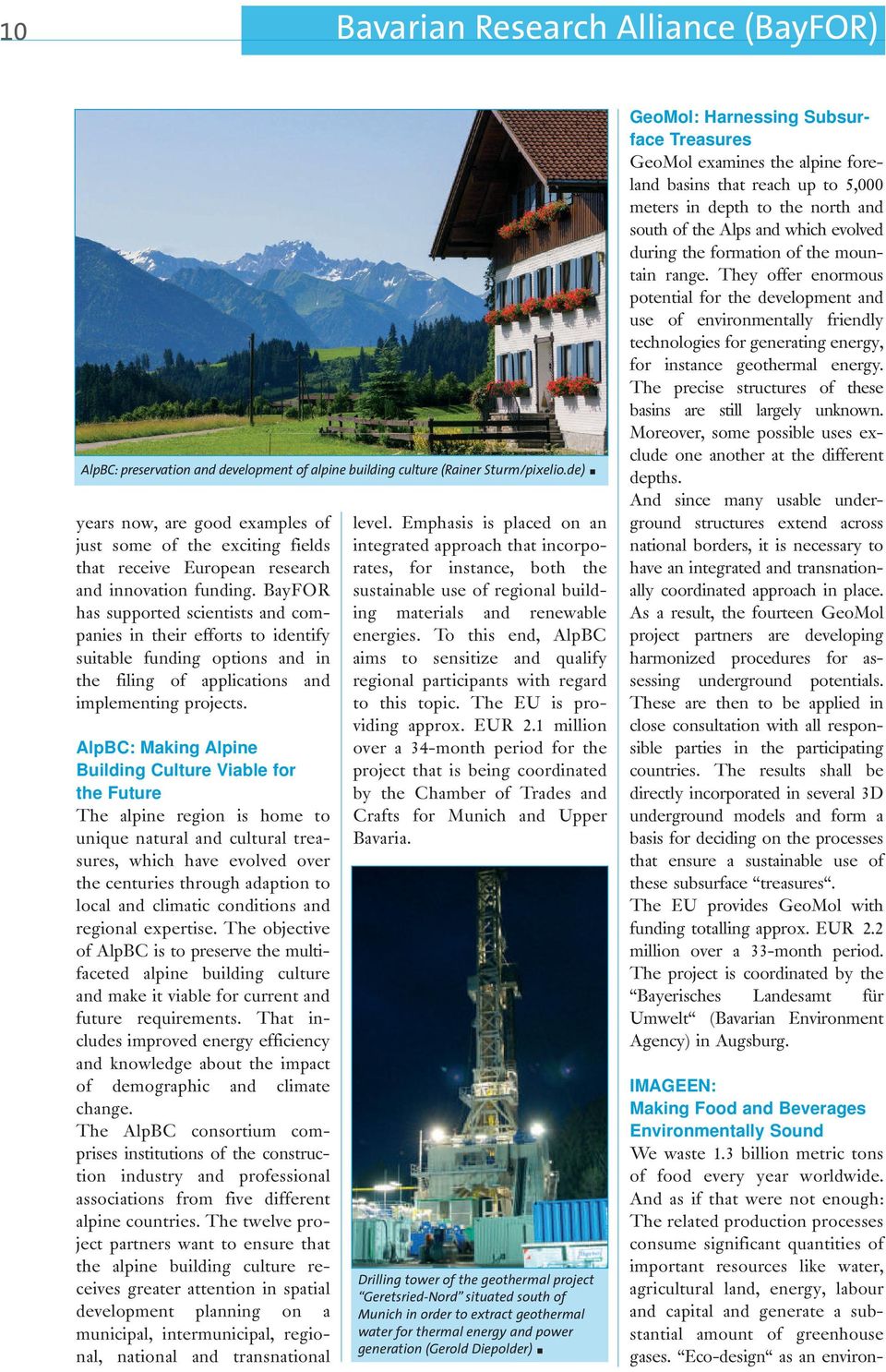
10 10 Bavarian Research Alliance (BayFOR) AlpBC: preservation and development of alpine building culture (Rainer Sturm/pixelio.de) years now, are good examples of just some of the exciting fields that receive European research and innovation funding. BayFOR has supported scientists and companies in their efforts to identify suitable funding options and in the filing of applications and implementing projects. AlpBC: Making Alpine Building Culture Viable for the Future The alpine region is home to unique natural and cultural treasures, which have evolved over the centuries through adaption to local and climatic conditions and regional expertise. The objective of AlpBC is to preserve the multifaceted alpine building culture and make it viable for current and future requirements. That includes improved energy efficiency and knowledge about the impact of demographic and climate change. The AlpBC consortium comprises institutions of the construction industry and professional associations from five different alpine countries. The twelve project partners want to ensure that the alpine building culture receives greater attention in spatial development planning on a municipal, intermunicipal, regional, national and transnational level. Emphasis is placed on an integrated approach that incorporates, for instance, both the sustainable use of regional building materials and renewable energies. To this end, AlpBC aims to sensitize and qualify regional participants with regard to this topic. The EU is providing approx. EUR 2.1 million over a 34-month period for the project that is being coordinated by the Chamber of Trades and Crafts for Munich and Upper Bavaria. Drilling tower of the geothermal project Geretsried-Nord situated south of Munich in order to extract geothermal water for thermal energy and power generation (Gerold Diepolder) GeoMol: Harnessing Subsurface Treasures GeoMol examines the alpine foreland basins that reach up to 5,000 meters in depth to the north and south of the Alps and which evolved during the formation of the mountain range. They offer enormous potential for the development and use of environmentally friendly technologies for generating energy, for instance geothermal energy. The precise structures of these basins are still largely unknown. Moreover, some possible uses exclude one another at the different depths. And since many usable underground structures extend across national borders, it is necessary to have an integrated and transnationally coordinated approach in place. As a result, the fourteen GeoMol project partners are developing harmonized procedures for assessing underground potentials. These are then to be applied in close consultation with all responsible parties in the participating countries. The results shall be directly incorporated in several 3D underground models and form a basis for deciding on the processes that ensure a sustainable use of these subsurface treasures. The EU provides GeoMol with funding totalling approx. EUR 2.2 million over a 33-month period. The project is coordinated by the Bayerisches Landesamt für Umwelt (Bavarian Environment Agency) in Augsburg. IMAGEEN: Making Food and Beverages Environmentally Sound We waste 1.3 billion metric tons of food every year worldwide. And as if that were not enough: The related production processes consume significant quantities of important resources like water, agricultural land, energy, labour and capital and generate a substantial amount of greenhouse gases. Eco-design as an environ-
11 Bavarian Research Alliance (BayFOR) 11 mentally sound approach to design products can make an important contribution to reducing the ecological footprint left by food production processes. The objective of the IMAGEEN knowledge transfer initiative is to motivate with workshops and awareness-raising events SMEs operating within the food and beverage manufacturing value chain to make their products more environmentally compatible. At the same time, IMAGEEN aims to help these SMEs to maintain their competitive edge, since they are facing everincreasing environmental protection requirements in Europe. The environmentally compatible design of their products is essential for these companies to remain competitive on international markets and to satisfy the demands of major customers. In addition to that, SMEs may also save money if they are able to decrease their consumption of resources and create more sustainable packaging solutions. They also improve their public image by voluntarily reducing their CO 2 emissions. The European Commission supports the project with approx. EUR 552,000 over a 21-month period. SIMWOOD: Sustainably Tapping Unused Reserves of Timber in Forests Europe has 159 million hectares of forests and woodland. Timber as a natural resource is frequently not used optimally especially in privately owned woods, and at the same time the ever-increasing demand for wood for material and energy applications is becoming more and more difficult to meet. The EU project SIMWOOD aims to contribute to a more efficient use of the available supply of wood and thus bolster Europe s forestry and wood industry as well as improve wood mobilization by utilizing an integrative approach. Besides topics SIMWOOD: mobilization of untapped reserves of timber (Jürgen Acker/pixelio.de) like forest ownership, forestry and harvesting technology, the project partners attach particular importance to the impact on a forest s capacity to carry out other functions and the participation of existing local interest groups. There are altogether 28 project partners coming from Germany, Belgium, Finland, France, Great Britain, Ireland, Netherlands, Portugal, Sweden, Slovenia and Spain. The project also includes two European institutions (Joint Research Centre and European Forest Institute), 14 national research institutes and 12 small or mediumsized enterprises. They are investigating optimum forest use in 14 European model regions. The EU supports the project with approx. EUR 6 million over a 4-year period. Coordinator is the Bayerische Landesanstalt für Wald und Forstwirtschaft (Bavarian State Agency for Forestry, LWF). Identifying and Utilizing Funding Options The EU offers a wide variety of funding options. The sheer diversity poses a major obstacle for potential applicants: Identifying an appropriate tender and submitting a successful application requires extensive know-how and expertise. To this end, BayFOR provides its experience and expertise to Bavarian scientists and entrepreneurs. The enterprise, which is funded by Bavaria s State Ministry of Education, Science and the Arts, among others, provides information about support options, conducts continuing education measures and offers active support during the project initiation phase, the setup of international consortia and the application process. After successful evaluation, BayFOR also supports participants while negotiating the contract with the European Commission or the responsible project administrators and, if necessary, even assumes administrative project management and public relations activities. BayFOR has also been commissioned by Bavaria s State Ministry of Education, Science and the Arts to look after the federal state's Funding Programme for the Initiation of International Projects (BayIntAn).

12 12 Bavarian Research Alliance (BayFOR) With this form of assistance, Bavarian universities and universities of applied sciences should be able to visit research and cooperation partners in other countries in order to initiate or strengthen transnational collaboration in research projects. Networking as Success Factor BayFOR has an outstanding network on a regional, national and international level. Its liaison office in Brussels represents the interests of the Bavarian universities, promoting their visibility and acting as an intermediary with the European institutions. Moreover, BayFOR coordinates the joint activities of the Bavarian Research Associations and supports their networking activities at the European level. The scientific coordination office Bayern-Québec/Alberta/ International finances bilateral research projects in the partner regions. As partner in the Enterprise Europe Network (EEN), BayFOR also offers targeted advisory services for SMEs that are interested in participating in EU research projects or want to cooperate with other SMEs on a transnational level. The EEN is a European network, which promotes cooperation, technology transfer and strategic partnerships between small and medium-sized enterprises. Especially when it comes to research and development, the German partners in the EEN help to establish contact with partners in business and science. As partner in the Bavarian Haus der Forschung (House of Research), BayFOR also works closely together with Bayern Innovativ, the Innovations- und Technologiezentrum Bayern (Bavarian Centre for Innovation and Technology, ITZB) and the Bayerische Forschungsstiftung (Bavarian Research Foundation). The cooperation between the four partners in the Haus der Forschung has resulted in the formation of a central location for European, national and Bavarian research and technology funding programmes. Contact: Dr. Thomas Ammerl Head of Unit Environment, Energy & Bioeconomy Bavarian Research Alliance GmbH (BayFOR) Phone: [email protected]

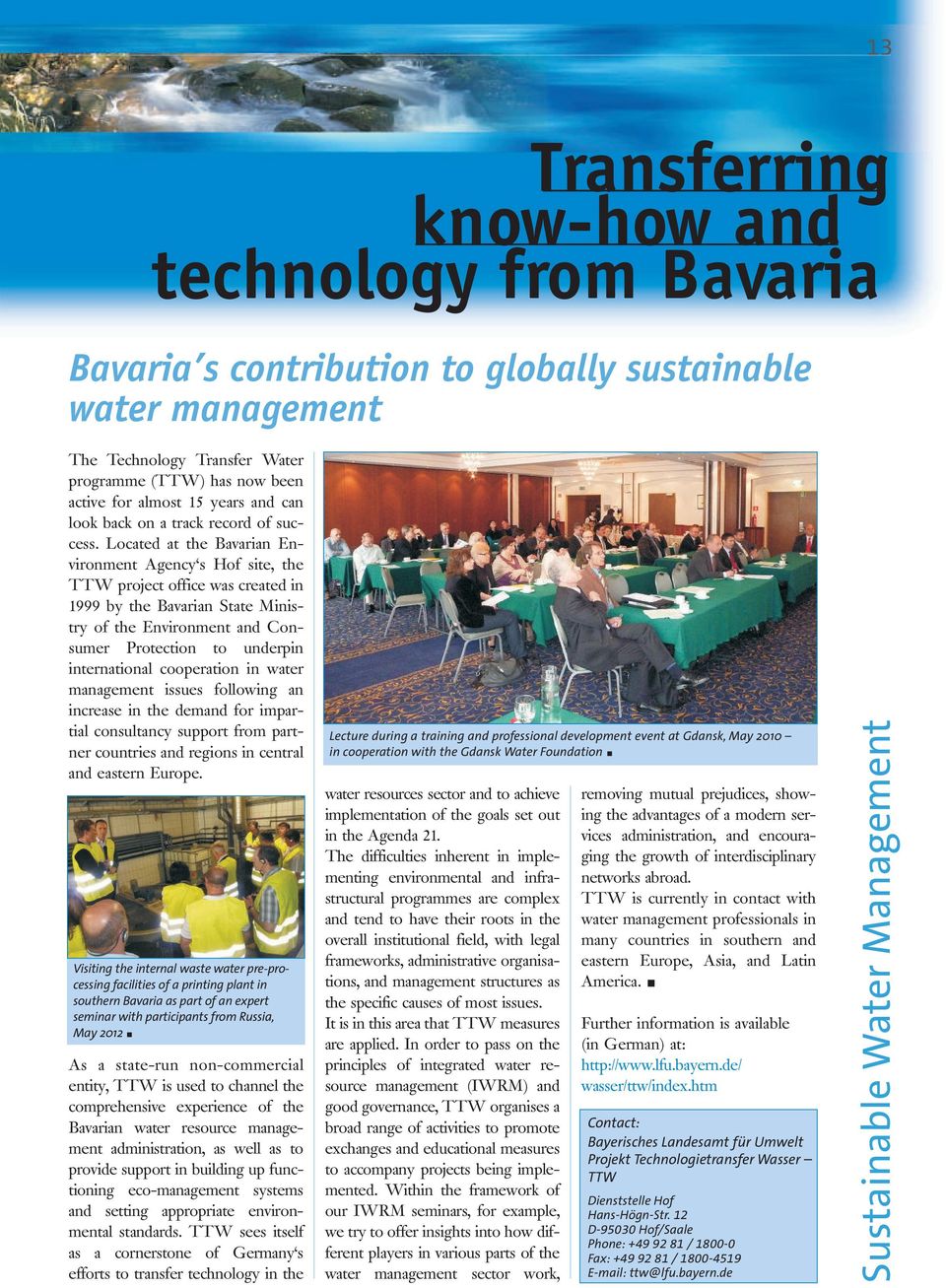
13 13 Transferring know-how and technology from Bavaria Bavaria s contribution to globally sustainable water management The Technology Transfer Water programme (TTW) has now been active for almost 15 years and can look back on a track record of success. Located at the Bavarian Environment Agency s Hof site, the TTW project office was created in 1999 by the Bavarian State Ministry of the Environment and Consumer Protection to underpin international cooperation in water management issues following an increase in the demand for impartial consultancy support from partner countries and regions in central and eastern Europe. Visiting the internal waste water pre-processing facilities of a printing plant in southern Bavaria as part of an expert seminar with participants from Russia, May 2012 As a state-run non-commercial entity, TTW is used to channel the comprehensive experience of the Bavarian water resource management administration, as well as to provide support in building up functioning eco-management systems and setting appropriate environmental standards. TTW sees itself as a cornerstone of Germany s efforts to transfer technology in the Lecture during a training and professional development event at Gdansk, May 2010 in cooperation with the Gdansk Water Foundation water resources sector and to achieve implementation of the goals set out in the Agenda 21. The difficulties inherent in implementing environmental and infrastructural programmes are complex and tend to have their roots in the overall institutional field, with legal frameworks, administrative organisations, and management structures as the specific causes of most issues. It is in this area that TTW measures are applied. In order to pass on the principles of integrated water resource management (IWRM) and good governance, TTW organises a broad range of activities to promote exchanges and educational measures to accompany projects being implemented. Within the framework of our IWRM seminars, for example, we try to offer insights into how different players in various parts of the water management sector work, removing mutual prejudices, showing the advantages of a modern services administration, and encouraging the growth of interdisciplinary networks abroad. TTW is currently in contact with water management professionals in many countries in southern and eastern Europe, Asia, and Latin America. Further information is available (in German) at: wasser/ttw/index.htm Contact: Bayerisches Landesamt für Umwelt Projekt Technologietransfer Wasser TTW Dienststelle Hof Hans-Högn-Str. 12 D Hof/Saale Phone: / Fax: / [email protected] Sustainable Water Management
14 14 The Nuremberg Metropolitan Area Energy and Environmental Technology for the Global Market With a population of 3.5 million and a gross domestic product of more than 100 billion euros, the Nuremberg metropolitan area is one of Germany s ten largest economic regions. It offers great potential for business and science in Information and Communications, Automotive, Transportation and Logistics, Medicine and Healthcare, Automation and Production Engineering, and particularly in Energy and Environment. Metropolitan Nuremberg The power industry has long been one of the biggest employers in the core of the Nuremberg metropolitan area and occupies a top position in Europe, with approximately 500 companies and over 50,000 jobs. With a long tradition of technologies for thermal power plants, this region covers the entire value chain, ranging from planning and development to engineering and manufacturing, all the way down to commissioning, monitoring, maintenance, modernization and dismantling. The equipment manufactured in the region includes steamraising units, turbines, generators and waste gas purification systems. The Siemens site in Erlangen, with roughly 5,500 employees, acts as the global headquarters of the sector Siemens Energy where all decisions are made and where projects around the globe are managed. Erlangen is also the location of the German headquarters of Areva NP, a global market leader in nuclear power utilization. Companies based in the Nuremberg metropolitan area equip the energy Under the motto "Future Solar Factory" in the framework of the Energy Campus Nuremberg (EnCN) ZAE Bayern and partners are currently developing a worldwide unique research platform for printed solar cells which are suitable for mass production. The research tasks spans over the development of new technologies for photovoltaic cells with the objective of efficiency increase, over printable photovoltaic and over solvent-free production technologies industry worldwide with state-ofthe-art technologies for efficient network infrastructures. Examples include high-voltage direct-current transmission systems as well as smart grid and smart metering systems. The world s largest highpower transformers are also manufactured in Nuremberg by Siemens. In the wind power industry, companies in the region supply key components for plant engineering and construction. The metropolitan area employs several thousand people in the production of large gearboxes, large rolling bearings, azimuth and pitch drives and power inverters. Expertise in the utilization of bio-

15 Metropolitan Nuremberg 15 mass is concentrated in the rural areas of our region, such as the Upper Palatinate and Western Central Franconia, which has Germany s greatest density of biogas facilities. Experts in this field include leading technology suppliers, such as Schmack Biogas AG, as well as the Weihenstephan-Triesdorf University of Applied Sciences and the Renewable Energies Network of Western Central Franconia. In the near-surface geothermal energy field, the heat pumps and related equipment manufactured in Upper Franconia have a European market share of around 30 per cent. In June 2009, Germany s largest geothermal power plant, with systems engineering supplied by Siemens (Erlangen / Nuremberg) went into operation in Unterhaching near Munich. Printable photovoltaic are among those future-oriented technologies for solar energy supply, that will lead to radical cost svings. Under the motto Future Solar Factory, in the framework of the Energy Campus Nuremberg (EnCN) ZAE Bayern and partners are currently developing a worldwide unique research platform for printed solar cells which are suitable for mass production. The portfolio include both organic and inorganic printing technologies. The Nuremberg metropolitan area is a European leader in the development and manufacture of power electronic systems. Examples include power inverters for photovoltaic or wind power plants, frequency converters to regulate electric drives in industrial applications or in electric vehicles, as well as efficient power supply units. Siemens AG, Semikron GmbH and Baumüller GmbH are important companies in this field. Fraunhofer IISB, with its Centre for Vehicle Power Electronics and Mechatronics (ZLKM), is a world leader in application-based research. The Nuremberg Energy Campus is currently being developed as a new R&D beacon to help Following a successful final inspection at the Siemens transformer plant in Nuremberg, the world s first 800-kilovolt ultrahigh-voltage power converter transformer is ready for delivery. The transformer will be used in the Yunnan-Guangdong high-voltage DC transmission system in China, currently one of the two HVDC systems with the highest rated capacity in the world. (Siemens press photo) meet the challenges posed by the change in Germany s energy policy. Important higher education institutions include the Institute for Electronic Systems (ELSYS) and the engineering faculty (EFI) of the Georg Simon Ohm University of Applied Sciences in Nuremberg. With its European Centre for Power Electronics (ECPE e.v.) and the Bavarian Power Electronics Cluster, the metropolitan area has some excellent networks linking companies and research institutions that work in this field. The technologies and markets for the energy and environmental sectors are closely linked. More than 1,000 companies and institutions in the Nuremberg metropolitan area provide approximately 25,000 jobs, primarily in water technology, air pollution control and recycling, as well as in product and productionintegrated environmental protection. Examples include Siemens AG in Erlangen as a word leading provider of automation solutions for the water industry and Huber SE, an important international system supplier for water technology, in Berching. Energie Campus Nürnberg is committed to putting into practice the vision of a sustainable power society based on renewable energy. To this end, expertise within the regional industry and science sectors will systematically developed with the objective of putting bavaria and Germany in a noticeable leadership position in selected fields of energy research. Most of the research on energy and the environment is conducted at the universities of Erlangen-Nuremberg, Bayreuth and Würzburg, the universities of applied sciences of Ansbach, Amberg-Weiden, Coburg, Hof, Nuremberg and Weihenstephan-Triesdorf and the Fraunhofer Institutes IIS (Integrated Circuits), IISB (Integrated Systems and Device Technology), both located in Erlangen, and ISC (Silicates Research) in Würzburg. In addition, A large number of key components for wind turbines are manufactured in the Nuremberg metropolitan area. (Siemens press photo)

16 16 Metropolitan Nuremberg there are numerous other technology-oriented institutions, such as ZAE Bayern whose sites in Würzburg and Erlangen focus on thermal insulation, photovoltaics and thermal sensor systems, the Institute Branch Sulzbach-Rosenberg of the Fraunhofer Institute for Environmental, Safety, and Energy Technology UMSICHT, EBA in Triesdorf (with a focus on biomass energy utilization), the plastics institute SKZ in Würzburg (energy efficiency in plastics processing), the energy technology centre etz in Nuremberg, the Georg Simon Ohm University of Applied Sciences environmental institute in Neumarkt and its energy and environmental technology centre in Schwabach and the Northern Bavarian Energy Agency. In view of the double-digit growth rates in the renewable energy sector in particular, it is important to secure a supply of specialists for the region. The Nuremberg metropolitan area offers a unique density of relevant university degree programmes and vocational training courses. The university degree programmes include Energy and Environmental Systems Engineering (Ansbach), Networking event in Nuremberg The combustion technology lab at the Institute Branch Sulzbach-Rosenberg of the Fraunhofer Institute for Environmental, Safety, and Energy Technology UMSICHT for examining the combustion and emission behaviour of different biomass fuels ( Environmental Engineering, Hydro Engineering and Renewable Energy Engineering (Weihenstephan-Triesdorf) and Mechanical Engineering / Environmental Engineering (Amberg- Weiden). The Nuremberg Chamber of Commerce and Industry for Central Franconia has developed the European Energy Manager qualification programme that provides practical training and networking opportunities in a total of 13 countries of the European Union and is now also used in China, Mercosur, Moldova and Egypt. The city of Nuremberg provides effective platforms for international marketing activities, such as Chillventa, an international trade fair for refrigeration, air conditioning, ventilation and heat pumps, BioFach, an international organic food products fair, as well as the world s leading power electronics fair PCIM. The process of innovation in energy and environmental technologies is often based on interdisciplinary cooperation between manufacturers, users and research institutions. This is reflected in an unrivalled density of regional networks, some of which work very closely together. Examples include the Bavarian Environmental Cluster ( the Bavarian Energy Technology Cluster and the Bavarian Power Electronics Cluster (both based in Nuremberg), the energy industry network ENERGIEregion Nürnberg, the Northern Bavarian environment sector initiative ( the European Center for Power Electronics (ECPE), the user clubs and energy and environmental committees of Northern Bavaria s CCIs, the international Energy Manager Network of the Nuremberg CCI for Central Franconia as well as the Renewable Energy Network for Western Central Franconia. Authors: Nuremberg Chamber of Commerce and Industry for Central Franconia Innovation & Environmental Affairs Division Ulmenstraße Nürnberg (Germany) [email protected] Dr.-Ing. Robert Schmidt Dr. rer. nat. Ronald Künneth

17 17 Energy efficiency in small and medium-sized businesses A business segment with exciting prospects German companies spent 50,000 on average on improving their energy efficiency in the last two years, according to a survey of industrial and manufacturing enterprises carried out by the German Energy Agency (dena). In this survey, around two thirds of respondents said it was either probable or very probable that they would invest in further energy efficiency measures in the near future. For companies in the HVAC industry, this scenario is opening up business opportunities with exciting prospects, but in many cases these opportunities need to be actively pursued. This is because only a few companies in the industrial and manufacturing sectors are really facing up to this challenge systematically at present: the dena survey revealed that 85 percent of these companies do not yet have either a certified or an uncertified energy management system. Energy efficiency Conditions are highly favourable at present for specialist building services contractors to expand their operations by approaching small and medium-sized businesses (SMBs) directly. On the one hand, awareness of efficiency as a competitive factor is growing among decision makers, and on the other, good funding opportunities are currently available, the existence of which some companies are clearly not even aware of. The KfW banking group is offering grants for both initial consultation and detailed followup consultation, which usually involves developing proposals for improvements over the course of several days, as part of its SMB Energy Efficiency Advice programme ( And in order to ensure that energy effi- System example: Wolf MGK medium-sized gas condensing boilers in a cascade not only supply plenty of heat but also save a great deal of energy compared to an old heating system

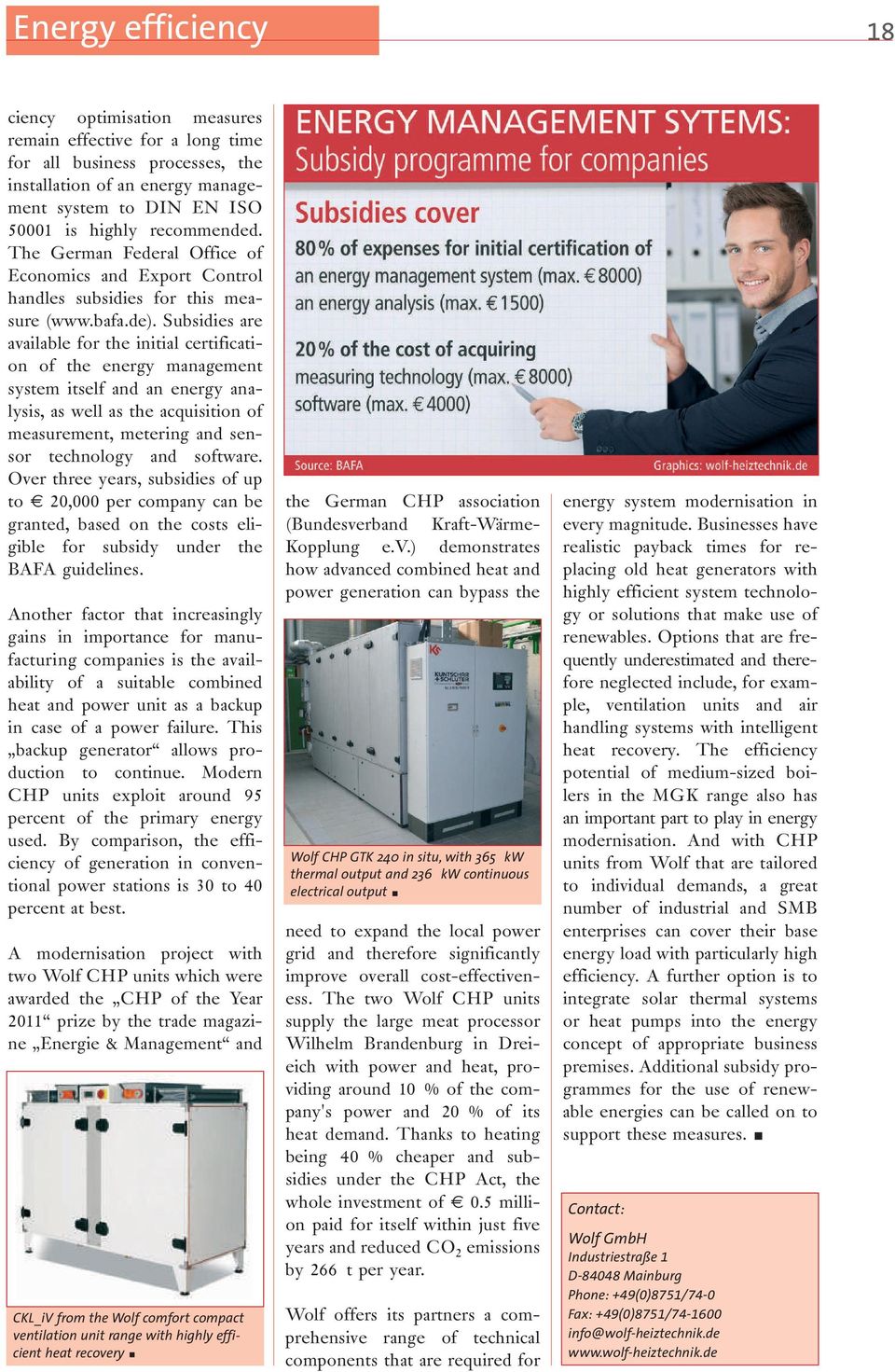
18 Energy efficiency 18 ciency optimisation measures remain effective for a long time for all business processes, the installation of an energy management system to DIN EN ISO is highly recommended. The German Federal Office of Economics and Export Control handles subsidies for this measure ( Subsidies are available for the initial certification of the energy management system itself and an energy analysis, as well as the acquisition of measurement, metering and sensor technology and software. Over three years, subsidies of up to 20,000 per company can be granted, based on the costs eligible for subsidy under the BAFA guidelines. Another factor that increasingly gains in importance for manufacturing companies is the availability of a suitable combined heat and power unit as a backup in case of a power failure. This backup generator allows production to continue. Modern CHP units exploit around 95 percent of the primary energy used. By comparison, the efficiency of generation in conventional power stations is 30 to 40 percent at best. A modernisation project with two Wolf CHP units which were awarded the CHP of the Year 2011 prize by the trade magazine Energie & Management and CKL_iV from the Wolf comfort compact ventilation unit range with highly efficient heat recovery the German CHP association (Bundesverband Kraft-Wärme- Kopplung e.v.) demonstrates how advanced combined heat and power generation can bypass the Wolf CHP GTK 240 in situ, with 365 kw thermal output and 236 kw continuous electrical output need to expand the local power grid and therefore significantly improve overall cost-effectiveness. The two Wolf CHP units supply the large meat processor Wilhelm Brandenburg in Dreieich with power and heat, providing around 10 % of the company's power and 20 % of its heat demand. Thanks to heating being 40 % cheaper and subsidies under the CHP Act, the whole investment of 0.5 million paid for itself within just five years and reduced CO 2 emissions by 266 t per year. Wolf offers its partners a comprehensive range of technical components that are required for energy system modernisation in every magnitude. Businesses have realistic payback times for replacing old heat generators with highly efficient system technology or solutions that make use of renewables. Options that are frequently underestimated and therefore neglected include, for example, ventilation units and air handling systems with intelligent heat recovery. The efficiency potential of medium-sized boilers in the MGK range also has an important part to play in energy modernisation. And with CHP units from Wolf that are tailored to individual demands, a great number of industrial and SMB enterprises can cover their base energy load with particularly high efficiency. A further option is to integrate solar thermal systems or heat pumps into the energy concept of appropriate business premises. Additional subsidy programmes for the use of renewable energies can be called on to support these measures. Contact: Wolf GmbH Industriestraße 1 D Mainburg Phone: +49(0)8751/74-0 Fax: +49(0)8751/ [email protected]
19 19 A fresh breeze for your power generation Neufahrn-Eching biomass CHP plant Geothermal heating plant 2 in Erding, Upper Bavaria STEAG New Energies (SNE) is a subsidiary of STEAG GmbH, Essen. Established in 1961, the company is active in the energy market. SNE has its origins in distributed energy supply and has been operating in Germany in the area of power supply from renewable primary energy sources for over 15 years. The company has been active on foreign markets (Poland, France) since Climate-efficient cogeneration of heat and power is one of the main focuses of the customised sustainable energy solutions SNE develops for and in close consultation with its municipal and industry customers, as well as for other project partners. The renewable primary energy sources drawn on range from wind and biomass, to biomethane and geothermal energy. Over 300 megawatts (total: 1,276 MW) of the heat and around 250 megawatts (total: 342 MW) of the generated power output is from renewables-based plants. For its marketing SNE leverages the possibilities offered by the STEAG Group to place attractive energy products such as balancing energy or direct marketing forms on the market. In 2012, SNE generated revenue in the region of EUR 268 million with a staff of 780 (incl. associates and abroad). As well as several plants of its own (e.g. Werl, Dresden), SNE operates plants for municipal associations (e.g. Erding, Neufahrn) or in joint ventures with municipal partners. For example, SNE is a shareholder and long-standing partner in more than ten local utility holdings (e.g. in Ilmenau, Rochlitz). The objective in all cases is to secure and develop an efficient and independent energy supply tailored to the needs of the market. However diverse the projects may be from industry contracting, via the development of district heating supply lines, to bespoke energy solutions for large facilities: the focus is not on quick returns, but on loyalty to the location and close collaboration with our customers. Furthermore, SNE consistently develops its locations to enable it to respond to changes in the legal and regulatory environment, new customer demands and new technical and operational requirements. In Bavaria, SNE is involved in three geothermal energy projects: in Erding, Simbach-Braunau and Unterschleißheim. In Traunreut, Großaitingen and Neufahrn- Eching SNE operates biomass CHP plants based on residual and waste wood. It has further locations in Munich (building supply) and Nuremberg (local heat supply systems). Contact: STEAG New Energies GmbH St. Johanner Straße Saarbrücken Phone: Fax: [email protected] STEAG New Energies GmbH

20 20 Full range of pumps, accessories and services for the wastewater and environmental sector NETZSCH Pumpen & Systeme Grinding, pumping, dosing, mixing there are a multitude of tasks associated with conveying liquid media, especially in the wastewater and environmental sector. Smooth processes are essential here, just as they are in biogas production. NETZSCH has for many years attached the greatest importance to both energy efficiency in operation and environmental compatibility in manufacturing, processing and even in the disposal of wearing parts when developing new pumps, accessories and other products. NETZSCH Pumpen & Systeme GmbH therefore offers a great variety of perfectly coordinated pump solutions, accessories and services for these sectors from a single source. These range from various types of pump, such as those with flange mountings, a wide variety of designs of the hopper pump, mixing pumps, immersion The robustness and the durable belt drive of the TORNADO T2 rotary lobe pump ensures high operational reliability pumps and TORNADO rotary lobe pumps, through to the overhaul of ageing pumps, and also include NETZSCH macerators and accessories, such as the abp module for preventing bridging and the dry running protector. NETZSCH has been designing and manufacturing pumps and macerators in Waldkraiburg, Bavaria for more than 60 years. At first the company specialised in progressing cavity pumps, but over time it has also developed into an expert in rotary lobe pumps. NEMO progressing cavity pumps are particularly suitable for pressures up to 48 bar (higher pressures on request) and for media with a high dry matter content Customers are provided with comprehensive advice that is tailored to their requirements in terms of choosing the appropriate pump for a specific application. NEMO progressing cavity pumps are particularly suitable for pressures up to 48 bar (higher pressures on request) and for media with a high dry matter content. The compact, robust TORNADO rotary lobe pump is available for areas with confined spaces or for For more than 60 years, NETZSCH Pumps & Systems has served markets worldwide with NEMO progressing cavity pumps, TORNADO rotary lobe pumps, grinding machines, dosing systems and accessories, providing customised, sophisticated solutions for applications in every type of industry. With a workforce of over 1,900 and a turnover of more than 240 million euros (2013 financial year), NETZSCH Pumps & Systems is the largest business unit with the highest turnover in the NETZSCH Group, alongside NETZSCH Analysing & Testing and NETZSCH Grinding & Dispersi mobile applications. Its large free ball passage means it can also handle lumpy media without any risk of clogging. With a pumping capacity of up to 1,000 m 3 /h, the TORNADO even deals with large quantities of wastewater. Both types of pump have in common that they are in each case tailored to the characteristics of the media and the conveying tasks in terms of the design and selection of materials. This means long, lowwear operation is ensured. In addition, the direction of rotation can be reversed on NEMO and TORNADO pumps and their conveyance volumes are proportional to the speed. The latter feature gives high dosing accuracy. NETZSCH Pumpen & Systeme GmbH Geretsrieder Straße Waldkraiburg Deutschland/Germany Phone: Fax: [email protected]

21 21 Self-consumption for commercial businesses in 2014: permanently reduce energy costs with solar energy Based on the considerably lower system prices nowadays, photovoltaic plants (PV plants) are able to provide electricity at a much more competitive price than energy suppliers. As a result, commercial businesses are given the opportunity to benefit from stable prices for electricity by consuming their own, locally produced, solar energy. In this article, IBC SOLAR AG, a PV system integrator, based in the Franconian town of Bad Staffelstein, describes how such systems are planned to ensure they are profitable. IBC SOLAR AG Nowadays, PV plants produce environmentally friendly energy at levelised costs between 11 and 13 euro cents per kilowatt hour (kwh). This rate lies about one third below energy suppliers electricity prices for commercial consumers. As a consequence, a PV plant shows economic feasibility even without a fixed feedin tariff according to the German Renewable Energy Act (EEG). They may be used to supply onsite energy and therefore become economical feasible. For commercial businesses, solar selfconsumption can be an economically viable option to reduce the long-term energy costs and supplement traditional energy procurement from energy suppliers. However, this requires tailormade planning to safeguard maximum profitability of the PV plant. Practical example of selfconsumption:office building IBC SOLAR s employee car park in the northern Bavarian town of Bad Staffelstein was covered with carports that were roofed with PV modules. Consequently, this represents a good example of a highly efficient commercial self-consumption plant. The system costs for the IBC SOLAR s employee car park with PV roofed carports eight carports and the roof-top PV plant with an output of 125 kwp ( 231,250) including maintenance and operating costs ( 38,756) amount to a total of 270,006. The entire company annually requires 410,000 kwh of electricity and the selfconsumption system covers said consumption by 22.7 percent (ratio of independence). At IBC SOLAR AG, employees work in traditional offices. A comparison of the load profile and the solar power production profile shows that the majority of the company s energy consumption corresponds to the solar plant s daily electricity production periods. During these periods the self-consumption ratio is at 84.6 percent. Any energy that is not used within the company is fed into the grid at a fixed feed-in tariff around 13 euro cents per kwh. Over a period of 20 years, the system can potentially save 252,508 compared with energy supplier rates after having deducted the overall investment costs and taking into account maintenance and operating costs for the PV system (amounting to one percent of the investment costs and an inflation rate of two percent). Vital determining factors for a profitable PV plant The example demonstrates the practical flexibility of commercial self-consumption plants. It also illustrates that all influential criteria must be carefully and professionally assessed to guarantee a maximum self-consumption ratio for the company and profitability of the PV
22 IBC SOLAR AG 22 Self-consumption diagram of IBC SOLAR s PV carports plant. For plant planners, the load profile is an important, initial indicator. A load profile shows the energy consumption of a company across a longer period of time. It is available as an individual measured load profile from energy suppliers or, for small companies within Germany, from the Bundesverband der Energieund Wasserwirtschaft e. V. (BDEW, federal German association of energy and water supply companies) as a so-called standard load profile (SLP). The following applies to all load profiles: the more the PV production profile corresponds to the load profile, the higher the percentage of self-consumption. Additionally, there are several determining factors planners must take into account: Proper dimensioning In times of high feed-in tariffs, PV plants on companies' roofs were designed to feed as much energy into the grid as possible. If self-consumption moves into the focus, plants are adapted to the individual demands and they inevitably become smaller. As a rule, plants that have been adapted to the demands boast high selfconsumption ratios and hence they are also more profitable. Plant orientation Instead of a classic orientation towards the south, an east-west orientation is suitable for energy consumption peaks in the mornings and afternoons. Intelligent load management Energy demands should be moved into daytime periods in which the PV plant is producing electricity. Thus it is possible to self-consume as much of the produced solar energy. Intelligent energy management systems may help in this process. Storing energy Battery storage systems or thermal storage systems may increase the self-consumption ratio by covering energy demands outside the production profile. Since May, 1st, 2013, battery storage systems for PV plants up to 30 kwp are eligible for a governmental funding programme in Germany. Dedicated software solutions, such as the IBC SOLAR PV Manager help to run simulations with different system configurations. They take into account general geographical and technical calculations, but also disturbing objects that may cause shading. They also provide detailed assembly and connection plans. Some programs also integrate additional, individual profitability calcula- About IBC SOLAR: tions. As a result, planners can simply illustrate the self-consumption ratio, grid feed-in and economic feasibility. Outlook Individually planned systems designed for self-consumption will make PV plants smaller, achieve higher self-consumption ratios and ensure a particularly high degree of profitability. Company owners regardless of whether in trade, building or agriculture secure a low electricity price for many years, which gives them planning safety, cuts the operating costs and consequently creates leeway for other investments that may give their company a crucial advantage compared with competitors. IBC SOLAR is a leading global specialist in photovoltaic systems, offering complete solutions for power production from solar energy. The family-owned and operated company covers the entire spectrum, from planning to the turnkey handover of photovoltaic installations. Globally, IBC SOLAR has already implemented more than 150,000 photovoltaic systems with a total capacity of more than 2.5 gigawatts (GWp). The scale of these installations ranges from photovoltaic power plants and solar parks, which feed electricity into the grid, to systems for commercial self-consumption and off-grid systems. IBC SOLAR sells its photovoltaic components and systems over an extensive network of local installers. As project developer, IBC SOLAR plans, implements and offer large scale solar projects worldwide. Through maintenance and monitoring, IBC SOLAR ensures an optimal performance of the solar parks. IBC SOLAR was founded in 1982 in Bad Staffelstein, Germany, by CEO Udo Möhrstedt. IBC SOLAR is represented by several subsidiaries around the world and is directed from its headquarters in Bad Staffelstein. Statement by Udo Möhrstedt, founder and CEO of IBC SOLAR: Contact: "Nowadays, we are able to provide customers with customised PV plants that produce energy at levelised costs of between 11 and 13 euro cents/kwh. Even without taking special measures, companies can achieve a self-consumption ratio of 30 to 35 percent and in conjunction with a battery storage unit, this may even increase to as much as 70 percent. In addition to the reduction in CO2 emissions, this also makes a great contribution to relieving the load on grids!" IBC SOLAR AG Am Hochgericht Bad Staffelstein/Germany Phone: +49 (9573) Fax: +49 (9573) [email protected]
23 Geothermal Energy in Bavaria PROFILES PORTRAITS PERSPECTIVES GLOBAL PARTNER
24 24 Economic forum Geothermal Energy e. V. Foreword Dr. Erwin Knapek President of the German Geothermal Energy Association and the economic forum Geothermal Energy e. V. Economic forum Geothermal Energy e. V. This new magazine, Geothermal Energy in Bavaria, is being compiled at a time when investors in deep geothermal energy have lost confidence in the proper and legal implementation of the Renewable Energy Sources Act (EEG) due to ill-judged written political pronouncements by the old Federal Government. Despite a number of verbal declarations from notable figures in Federal and State politics, since February 2013 no new projects have been tackled involving the conversion into electricity of geothermal energy from deep geothermal energy in Bavaria or indeed in Germany as a whole. Even projects approved by the authorities are subject to a moratorium by investors. This means that currently, in Upper Bavaria alone, approximately 750 million euros in investment funds are being withheld. The current public discussion and statements by notable holders of public office, who are now providing advice on the amendment of the EEG, can likewise not be described as a confidence-building measure. At the same time, until 2013 the use of deep geothermal energy, particularly in Bavaria, had been showing very positive growth. Altogether in Germany, 26 plants (21 in Bavaria) are in operation, of which seven (four in Bavaria) are supplying electricity with a total electrical output of approximately 32 MW. For heat supply purposes in Bavaria, especially in the Munich region, a usable thermal output of just under 280 MW is already being provided. Over 70 projects are at the planning stage, 30% of them in Bavaria. Among these are 15 electricity-generation projects, of which another four Bavarian projects launched before 2012 are now being extended. If one examines the plans, this would have been a very good starting point to be able to break through the level of 100 MW of electrical output within the next four years. The industry is waiting for a clear, confidencebuilding signal from a policy that demonstrates the will to continue to facilitate the commercial launch of deep geothermal energy as a renewable energy through the EEG. The decision of the Federal Government taken in June 2011 and the commitment of the Federal States to the transition from nuclear and fossil fuel energy is a challenge to our society, to not only improve energy efficiency and demonstrate its firm intention to save energy, but in particular to develop a sustainable energy supply based on low-carbon energy sources by networking all available renewable energies. In this context, it is precisely the ever-available and flexibly controllable resource of deep geothermal energy in combination with the volatile renewable energies such as wind power and solar energy together with the other controllable, base-loadable renewable energies such as bio energy and water power that can contribute in an optimum way, in regional distribution networks, to a steady supply of electrical power and thereby reduce the expansion of nationwide transmission networks and, in addition, provide substantial supplies of renewable heat energy. The plants completed to date, be they heating plants, power plants or cogeneration plants, prove that this is possible. The removal of geothermal energy from the EEG in the context of the amendment of the 2014 EEG, as demanded by influential political forces, would be the end of further developments, damaging for the German technology for converting low enthalpy geothermal energy into useful energy
25 Economic forum Geothermal Energy e. V. 25 highly prized as an export commodity and a significant setback as regards the replacement of hydrocarbons currently in use in the provision of regional renewable heat energy a basic prerequisite for reducing imports and, as a consequence of this, independence from political developments abroad. Moreover this would, in particular, put at risk Bavaria s plan of building up a capacity of 300 MW of electrical output using deep geothermal energy over the next few years in the southern Bavarian Molasse Basin and, with it, of also creating conditions for pressing ahead with the use of petrothermal deep geothermal energy in Bavaria. Deep geothermal energy means electricity and heat for the future. So far, the EEG has proved its worth as an ideal instrument for bringing renewable energies to the point of market maturity and competitiveness. For deep geothermal energy, as the latest renewable energy segment, the EEG is essential. As the amendment to the 2014 EEG currently stands, a continuation of what has been tried and tested to date is indeed assured at least until 2017, but this only applies to projects which had already begun before the discussion on the cap on electricity prices. For new projects, where capital expenditure has been deferred since February 2013, this is only an apparent safeguard. Based on previous experience, deep geothermal energy projects may require three to seven years from the beginning of drilling until the start of operation. Large sums have already been invested in them by the time drilling begins, and the job of securing a return on that is already beset with considerable risk. This is why it is necessary for a provision to be created in the new EEG for all upcoming projects whereby investment security can be guaran- teed for investors. In the industry s view, what we should be striving for here is that approval under mining law for the preliminary reconnaissance of reservoirs using new seismic technology or through the acquisition of seismic data should be the point in time at which security is guaranteed under law for the EEG payment applicable at that time. From this point in time, deep geothermal energy projects should also be recorded in a plant register with details of the planned electrical output, in order to maintain planning certainty for the expansion of electricity networks. To expedite this expansion in a predictable and rigorous manner, projects subject to major delay should subsequently be deleted from the plant register. Deep geothermal energy has only just grown to market maturity with a few plants. The number of market participants, however, is still small. A tendering mechanism contemplated in the new EEG would cause further uncertainty for investors and hamper the creation of a functioning market for deep geothermal energy. For this reason it would be desirable if the tendering mechanism were to apply only for projects upwards of an installed electrical output of 500 to 750 MW, to ensure that companies with sufficient experience in the medium and longterm operation of geothermal power plants emerge as successful in the tendering model. The expansion of geothermal power plants can be systematcally accompanied by the expansion of the heat supply to regional conurbations, in order also to make a substantial contribution to the hitherto neglected renewable heat supply. In the Munich region, due to the continuous expansion of geothermal cogeneration and heating plants, for a decade now it has been shown what is possible here if you exploit to best advantage the resource of geothermal energy as per the self-imposed targets of the grand coalition and the opportunity thereby remains open to be able to attain successfully the proportion of renewable energies within the overall energy spectrum as specified by the European Union. As a result of a revision of the Renewable Energies Heat Act to include a feed-in priority and practicable options for implementing the market incentive programme, there can also be a further stimulus for deep as well as shallow geothermal heat projects. Viewed as a whole, as things stand in Bavaria today we have come a considerable way in developing deep geothermal energy projects. Based on the experience from many successfully implemented projects in the Upper Bavaria region there are still a large number of scheduled geothermal energy projects pending, the completion of which, however, is dependent on a positive signal for the protection of legitimate expectation. If this is guaranteed, the companies and skilled workers of this State will promote the expansion of this always available, renewable and flexibly base-loadable energy which also preserves the countryside to provide a sustainable supply of electricity, heat and cooling energy. Good luck! Dr. Erwin Knapek President of the German Geothermal Energy Association and the economic forum Geothermal Energy e. V.
26 26 Geoscientific Framework for Geothermal Projects in Bavaria Power generation from geothermal energy successful world-wide for over 100 years Geothermal energy enjoys a special position amongst the renewable energy sources because it is available all year round and any time of the day, and can therefore be used for base load energy. Countries with favourable geothermal conditions, e.g. the circum-pacific countries, Iceland, or Italy, have used geothermal energy for many decades to produce power at competitive prices in Tuscany this has already been implemented for over a century. In 2012, geothermal energy in the order of 800 PJ (220 TWh) are used worldwide for heat and electricity production. The global installed capacity of geothermal power plants is currently around 11,650 MW; they produce 72,000 GWh of electricity per year (REN21). Modern conversion technologies, such as the ORC method and the Kalina cycle, make it possible to generate power today from temperatures as low as 100 C, also from lower temperature level but with a very low efficiency. Geothermal power generation is therefore also interesting when considering the exploitation of hot water aquifers. Geothermal energy in this temperature range was previously only used as a direct source of heat, e.g. for heating or process heat. Now, however, the power production potential of geothermal energy in Germany is enormous: the first comprehensive study estimated a potential of around 1021 J, although this can only be exploited in small steps. Hot water aquifers suitable for heat supplies and power generation Hot water aquifers are highly permeable rock sequences with thicknesses reaching from a few decametres to several hundred metres and with water temperatures exceeding 100 C. The aquifers are either in highly porous sandstones or other strongly fractured or karstified sedimentary rocks. In carbonate rocks, flow through fractures can be enhanced by dissolution to form karst cavities. If these cavities link up to create a continuous network, rock sequences of this type boast extremely high permeabilities which can extend over a regional scale. The aquifers are usually developed using a doublet system. A doublet consists of a production borehole from which hot water is produced often with the help of submersible pumps. The heat is extracted at the surface by a heat exchanger where it enters a Framework The Malm sequence dips to the south from the Danube River to the Alps: greater depths mean higher temperatures
27 Framework 27 Geothermal resources in the Malm in the central part of the South German Molasse Basin the area with temperatures exceeding 100 C is marked in yellow secondary cycle to generate the steam for power production or is used directly, or via co-generation systems, to produce heat for space heating, hot water or process heat. The cooled water in the primary cycle is then injected back into the aquifer by the second borehole in the doublet. It is also possible to exploit sources of geothermal energy with a single borehole, e.g. in the thermal boreholes in the Spa Triangle in Lower Bavaria (Füssing, Birnbach, Griesbach). In practise, however, no permits are issued nowadays for single borehole exploitation, because the high production rates appear to contradict the principles of sustainable use. Malm the geothermal reservoir in Bavaria The South-German Upper-Austrian Molasse Basin which geographically forms the area between the Danube and the Alps contains one of the most important geothermal energy reservoirs for the production of heat in Central Europe. The basin boasts favourable conditions for geothermal energy exploitation because the almost ubiquitous Malm (Upper Jurassic, Mesozoic) forms a highly productive aquifer which dips from north to south to increasing depths and therefore contains water at increasingly high temperatures. A detailed research project at the end of the 80ies estimated the resources and reserves of the Malm for heat generation to be approx J. Particularly high resources are found in the greater Munich area and in the area to the south-west of Landshut. Crucial factors for the economic efficiency of geothermal energy projects are the temperature and the production rate. The local variability in thermal water production can be expected in the Malm karst because one borehole could penetrate highly productive karstified or seamy rock whilst an adjacent borehole might penetrate dense rock with no karstification. There are also regional differences in the lithology attributable to changes in facies and tectonism. It is already known that the Helvetic facies in the Malm karst has much lower hydraulic transmissivities than the Swabian or the Franconian facies. The high density of tectonic faults in the eastern Molasse Basin can be considered to improve the probability of success of projects in this area. Detailed knowledge on the structural conditions and karstification of the Malm is therefore essential for optimal development and a reduction in exploration risk. Intensive seismic exploration therefore needs to be conducted before drilling a geothermal borehole. The seismic interpretations enable the structure (faults, facies, etc.) and the depths, and therefore the expected temperatures, to be determined. Whether or not a planned geothermal borehole is classified as successful or not depends strongly on the commercial plans developed by the operator. Thermal boreholes often only require temperatures of 30 C and a discharge rate of 3 l/s. Temperatures of C and flow rates of around 30 l/s are suitable for district heating systems, whilst geothermal power production requires temperatures of at least 100 C and production rates of around 100 l/s. The exploration Deep drilling rig risk therefore needs to be defined specifically for each geothermal borehole. Because of the requirement for a minimum temperature of 100 C, areas suitable for geothermal power production are only present in southern Upper Bavaria, and specifically to the south of Munich and around the Chiemsee Lake. The resources for geothermal power production are estimated at J. This corresponds to an installed electrical output of 500 MW which could be generated in a large number
28 28 Framework Exploration: special seismic trucks (vibrators) send seismic waves into the subsurface of decentralised power plants (3-6 MW). To the west of the Lech River, temperatures exceeding 100 C are generally only found within the Helvetic facies (hydraulically tight). This area can therefore be ignored for electrical power production at a regional scale. Temperatures above 100 C are not reached in the east Bavarian part of the Molasse Basin within the Malm even though very good reserves are present for geothermal energy production as already utilised in the Simbach-Braunau plant, also for power generation with temperature of 80 C but with a very low efficiency. The 100 C boundary is only exceeded in the southern part, i.e. in Upper Austria where it is used for power production in the Altheim plant. Geothermal power in Bavaria realised in Unterhaching which are received by a series of small seismographs ( geophones ) The first German geothermal power plant was built in Neustadt-Glewe/Mecklenburg-Vor- pommern. The first plant in the Molasse Basin is in Altheim/Upper Austria, where a and merged with the help of a computer to produce a section through the subsurface borehole doublet produces hot water at approx. 105 C from the Malm karst at a depth of 2,500 m. The ORC plant produces approx. 700 kw. A large number of the buildings in Altheim are also supplied with heat from this plant. The first geothermal power plant on the German side scheduled to harness the hot water from the Malm karst was built in Unterhaching near Munich. Both boreholes in this project were drilled successfully: Malm water at a temperature of C was penetrated at a depth of more than 3350 m and has a production rate of more than 100 l/s. The heat production started in 2007 and the geothermal power plant was online in The Munich region with its 13 geothermal heating and power plants has become an examplary region for the sustainable use of the enormous geothermal potential in a low-enthalpy region (thermal water temperatures < 150 C) in the last decade. With the deepening of the exploration wells to nearly 5 km depth, the demands on the projects are also rising. Specific requirements, for example advanced submersible pumps which have to overcome large flow rates and temperatures above 100 C, require great engineering efforts. A total of 16 plants in the Bavarian part of the molasse basin deliever heat (about 200 MW installed thermal power), four of them also produce electricity (20 MW installed electrical power); seven plants are under construction, five of them are expected to produce heat and electricity. An always actual overview is given by the internet portal of the geothermal information system for Germany ( Geothermal power production benefits from the many years of experience with direct thermal utilisation plants. Because the economic efficiency of geother-
29 Framework 29 Unterhaching Gt 1 geothermal borehole Drill bit for deep boreholes drilled down to 5 km Production test in a geothermal borehole mal energy is enhanced in multiple or cascade systems, most of the plants combine hydrothermal space heating, thermal baths, greenhouse heating and/or drinking water supplies. E. g., the district heating system of Unterhaching is supplied by the geothermal water; the power production is subordinated by the heating system. The direct heat utilisation plants have proven their reliability over many years and in some cases also decades of operation. Since every intervention in the geosphere has an impact, questions arise about the sustainability of the used technology. A numerical 3Dmodel of the Upper Jurassic thermal reservoir provides forecasts for the long-term development of temperatures and hydraulic potentials. Significant temperature decrease will be limited to the near surrounding of the reinjection wells for the next 50 years of operation. Changes of hydraulic head in adjacent wells will occur with less than 1 bar in the majority of cases. Geothermal energy in North Bavaria? The vision Can geothermal energy also be harnessed outside of the Forealps? The thermal water present in North Bavaria is hardly suitable for the production of energy. It is merely suitable for balneological purposes, such as in Bad Rodach. However, the geology in North Bavaria is characterised by crystalline basement that usually lies directly at the surface. The central and south German crystalline basement zone covers almost 40 % of the land area of Germany. Temperatures of around 100 C are found at depths of 3,000 4,000 m. This area therefore has the largest geothermal power potential in Germany, as reported in a study undertaken for the German parliament in 2003: this is around 1000 times more than the capacity of the Malm. The Hot-Dry-Rock (HDR) or Enhanced Geothermal Systems (EGS) method is designed to harness the geothermal potential of crystalline rock. Artificial fractures are opened up in the basement by injecting water under high pressure. This method is also used to expand existing cracks such as fractures or faults. The fractures are used as heat exchange surfaces: cold surface water is injected into one borehole, travels through the fracture system towards a second borehole, is heated up in the process and pumped out in the second borehole as hot water. This has been proven in principle in the European Soultz-sous-Forêts HDR project in the Alsace. The project succeeded some years ago in creating an artificial fracture system covering approx. 3 km at a depth of approx m. Two boreholes drilled 500 m apart were connected via this fracture network. Here, the first HDR power plant worldwide started its production in summer An international group of geoscientists is committed to transferring this technology to other locations and to reduce the development costs. An HDR plant is being developed in Australia to produce power under economic conditions. Actually, a first petrothermal demonstration power plant is projected in Saxony, why not also in North Bavaria in the future? References Bayerisches Staatsministerium für Wirtschaft, Infrastruktur, Verkehr und Technologie (Hrsg.) (2012): Bayerischer Geothermieatlas S., Digitale Karten (CD-Rom); München. Frisch, H., Schulz, R. & Werner, J. (1992): Hydrogeothermische Energiebilanz und Grundwasserhaushalt des Malmkarstes im süddeutschen Molassebecken. - In: Schulz, R., Werner, R., Ruhland, J. & Bußmann, W. (Hrsg.): Geothermische Energie, Forschung und Anwendung in Deutschland : ; Karlsruhe (C.F. Müller). Lüschen E. & Thomas, R. (2012): 3D-Seismik für die geothermische Exploration in Unterhaching. Geothermie in Bayern: 14-19; München (mediamind).
30 30 Framework Internet: Geothermal Information System for Germany (in English) Authors: Dr. Rüdiger Schulz Dir. and Prof. Leibniz-Institut für Angewandte Geophysik (LIAG) Geothermal heating and power plants in the Munich region (yellow: plants went in operation between 2011 and 2014) Stilleweg Hannover/Germany Phone: +49 (0) Fax: +49 (0) [email protected] Paschen, H., Oertel, D. & Grünwald, R. (2003): Möglichkeiten der geothermischen Stromerzeugung in Deutschland. - Büro für Technikfolgen-Abschätzung beim Deutschen Bundestag, Arbeitsbericht 84: 129 S.; Berlin (TAB). REN21 (2013): Renewables 2013 Global Status Report. - Paris (REN21 Secretariat). Schulz, R. & Thomas, R. (2012, Ed.) mit Beiträgen von Dussel, M., Lüschen, E. et al.: Geothermische Charakterisierung von karstig-klüftigen Aquiferen im Großraum München Endbericht. LIAG- Bericht, Archiv-Nr , 98 S; Hannover (LIAG)., Schulz, R., Thomas, R., Jung, R. & Schellschmidt, R. (2004): Geoscientific prospect evaluation for the Unterhaching geothermal power plant. - Z. Angew. Geol. 2/2004: 28-36; Hannover. Dr. Michael Dussel Leibniz-Institut für Angewandte Geophysik (LIAG) Stilleweg Hannover/Germany Phone: +49 (0) Fax: +49 (0) [email protected]
31 31 Powerful Production Pumps to lift the Economy of Deep Geothermal Projects Reliable and highly available production of hot thermal water from deep wells is an essential requirement for running geothermal projects economically. The characteristics of reservoir and wells as well as the availability of a technology to produce necessary amounts of water determine the performance of the power plant and the financial revenues that can be obtained. This is especially true in Germany, where the reservoirs for electricity power generation are deep located with temperatures rarely above 140 C. The production rate decides the economic feasibility of the projects. Pump manufacturers offer various technologies to produce different liquids out of deep wells. These applications are typically used for fresh water wells, the soil watering in agriculture and particularly for the hydrocarbon industry. Operating conditions within the hydrocarbon industry can be rather complicated and have stringent requirements on materials and techniques. However this means there is a pump manufacturing industry with decades of experiences and know-how to operate pumps at great depths and at high temperatures as well as under harsh well conditions. This industry seems to have solutions for any application or demand, Change of the ESPs at the geothermal power plant in Unterhaching. Due to separate pump garage with a new pump the delay time of the pump exchange was reduced sigificantly. (Source: Geothermie Unterhaching) regardless whether it is pumping fluids with high gas content, or containing corrosive substances like hydrogen sulfur or abrasive materials. The pump industry also has decades of experience worldwide in the production of hot thermal water. There are now hundreds of production pumps operating in geothermal wells producing hot water for district heating and power generation. Technical Principles There are several techniques for pumping liquids to the surface. The technology used in the geothermal energy sector differs for each manufacturer and application depending on the motor concept. It could use submersible pumps driven by a downhole motor or a surface motor with a long shaft that connects the motor to the pump. This distinguishes Electrical Submersible Pumps (ESP) from Line Shaft Pumps (LSP). In ESP, a subsurface motor running a submersible pump needs an elaborate sealing system to ensure no water enters the motor. The motor obtains electricity from a power cable and frequency converter installed above ground. In LSP, the motor is located on top of the wellhead and drives the pump stages with a continuous Pump manufacturers
32 32 Pump manufacturers shaft. Again, a frequency converter is usually used to power the pump. There are different limitations for applications in deep geothermal energy production depending on the motor concept. Pump speed In ESP, the downhole motor is cooled by the pumped medium. This means a minimum pump speed is required to adequately cool the pump motor. Under LSP, the speed can be driven continuously and be started with a low speed over ramps. There is no minimum pump speed. Installation Location and Depth Depending on the effectiveness of the motor seals, an ESP system can be operated in nearly any installation position or depth. Pumps can also be installed in strongly deviated wells and apart from cost, the size of the pump is the only limitation. LSP motors can only work in the upper undeviated part of the well. Its limitations are the long shaft, the shaft bearing and its lubrication. Dependent on the transferred input rating, there are also limitations on the installation depth of LSP pumps. Besides the increasing length of the shaft, there is also the hydraulic head and the power increase required, along with a varying water level in the well. The stability of the shaft has to be taken into account. To date, the deepest installation handled by an LSP pump (in a U.S. plant) is 760 meters. Well Temperature ESP motors are limited by the operating temperature of their deep location which can be considerably higher than surface temperatures. LSP motors on the other hand only have to cope with surface temperatures, even if downhole temperatures exceed 200 C. History of ESP and LSP Systems Armail Arutunoff developed ESP techniques in the 1920s, taking advantage of the early 20th century boom in hydrocarbon production. Since then, the technology of the ESPs has been continuously improved. LSP is much older and first introduced in the 1870s. However the development of oil lubrication at the turn of the 20th century helped LSPs to gain much wider acceptance. For example, LSPs were much used by farmers in dry regions to pump deep water for irrigation. Today in the U.S., about 95 % of geothermal plants produce deep thermal water using LSPs. Their reliability in high water temperatures is an important advantage in this market. Requirements Following an international workshop with geothermal experts and representatives of the pump industry, Molloy et al. (2009) published a pump specification defining boundary conditions for future petrothermal projects. The requirements were very ambitious, especially with respect to production temperatures and pump efficiency and availability. Nonetheless, the Molloy specification only partially met the general framework for geothermal utilization in the Bavarian Molasse Basin. A pump completely suitable for the high production rates and installation depth of geothermal wells in the Malm reservoir has yet to be developed. The fundamental problem is that EGS reservoirs need pumps capable of handling water at high temperatures, whereas water temperatures in the Bavarian Molasse Basin are relatively low. The Molloy specification requires pumps to be able to handle fluid temperatures of up to 230 C. In other regions with similar or higher capacity geothermal power plants e.g. the Binary ORC and Kalina plants several wells have been drilled. But these wells are relatively shallow none exceed 5,000 meters providing a reasonable and economic approach to achieve high availability. To extract water with temperatures higher than 120 C in the Bavarian Molasse Basin, much greater well depths are required. However this only produces a production rate of 70 liters per second, which is not economic given the high costs of deep drilling. Moreover, the hydraulic conditions of the wells demand a high subsidence of the dynamic water table. The conclusion is that pumps with a performance of more than 1 MW hydraulic power are required. These economic and technical requirements bring ESP and LSP-pump technologies to their performance limits and demand new innovations from the pump industry. LSPs which are not yet installed in the Bavarian Molasse Basin can meet requirements if well conditions and installation depths are right. Up to now primarily production depth was the limitation. However there is an LSP installed in the geothermal project in Insheim, Rhineland- Pfalz pumping to a depth of more than 600 meters. In the U.S., there are LSPs with installation depths of up to 760 meters achieving production rates of over 100 liters per second. Thomas (2013) published in the journal of the Association of German Engineers VDI Nachrichten the article Deep Geothermal Energy bring Pumps to its Performance Limits. This article by Mr. Thomas described experiences of various projects operating in Germany which concluded that pump technology has not yet achieved the required maturity. The article refers to discussions with manufacturers and operators of units installed in
33 Pump manufacturers 33 Table 1: Pump specification matrix with an overview about the most powerful submersible pumps for deep geothermal wells of different manufacturers. This matrix was compiled for a Workshop on pumps within the frame of the Praxisforum Geothermie.Bayern in Munich in October The matrix was updated for this publication and is based on manufacturer data.
34 34 Pump manufacturers wells with groundwater temperatures over 120 C and production rates exceeding 100 liters per second. However smaller pumps are running successfully at temperatures up to 100 C in geothermal projects in Germany. LSP pumps have operated geothermal projects in Insheim and Landau for many years very successfully. But their production rates are below 100 liters per second. The Manufacturers In October 2013 the manufacturers of pumps for deep geothermal applications were invited to present their most powerful systems within a given specification matrix at a workshop at the Praxisforums Geothermie in Bavaria. The aim was to get an overview about the applied technology and the performance. The boundary conditions for the specification matrix (Table 1) were: Production rate more than 150 liters per second Temperature of the produced medium above 150 C Installation depth of 600 meters The manufacturers showed three ESPs and one LSP system. These represented developments of technologies already used in geothermal energy production. The various systems showed clear technical differences. In the case of the LSP system, the performance has to be transferred by increasing shaft length. For ESP systems, motors have to be developed that can cope with high liquid temperatures, and improved seals to prevent water entering the motor and to provide volume for the expanding oil. The LSP system seems to have the advantage if installation depth LSP at the geothermal power plant in Insheim with the motor on top of the well. (Source: enerchange) is not an issue. In fact, the experiences with installation depth over 700 meters and production rates above 100 liters per second are limited to certain projects in the U.S. For ESPs in geothermal applications, there is experience with installation depths of up to 1,000 meters and production rates of over 100 liters per second. Indeed, the biggest pumps using this technology are installed in Bavaria. However, the lifetime for these installations remains too short and much longer lifetimes are required. The manufacturers said they were already working on improved lifetimes. Outlook The challenge to design a pump fulfilling the requirements of the Bavarian power plant projects is not yet solved completely. The pump specification matrix shown here shows the status of the technology that can be provided by the pump industry today. However continuous and long term performance of the technology has still to be proven. LSPs with installation depth up to 760 meters are an option for some Bavarian projects. But to use ESP, further improvements are needed. While the manufacturer is solving some problems, pump lifetime remains a big limiting factor. However it is likely that ESP technology will develop under demand from other industries such as hydrocarbons, and the geothermal industry should benefit from this. In conclusion, for the economic development of new geothermal projects, the base case requires a pump with references and a proven operational experience of more than one year. The operator needs to be able to run the plant and generate electricity with a standard pump economically. This means the base case has to fit to standard pump technology and not to a prototype. Literature Molloy, L., Lindsay, M. und Maloney, M. (2009): The Lemelson Meeting: Scoping the Design Criteria for the Global Geothermal Challenge. GRC Transactions, 33. Thomas, T. (2013): Tiefe Geothermie bringt Pumpen an ihre Leistungsgrenzen. VDI NACH- RICHTEN, 46. Authors: enpros consulting GmbH ENERCHANGE Dr. Hartwig Schröder enpros consulting Bahnhofstraße Nürnberg/Germany Phone: +49 (0) [email protected] Dr. Jochen Schneider Enerchange Goethestr Freiburg/Germany Phone: +49 (0) [email protected]
35 Magazines Future Technologies in Bavaria Hans-Bunte-Str München Tel.: +49 (0) Fax: +49 (0) [email protected]
36 S Angers :41 Uhr Seite Production pump tests within the context of deep geothermal drilling for the generation of electricity Production pump tests The key element of a geothermal energy generation plant is the amount of bound energy in the hot water. That is why it is of the utmost importance to carry out precise production pump tests and to pay attention to the technical and safety design and implementation. This includes the controlling of flow rates of up to 150 l/s at temperatures of up to 150 C, considerable steam releases (Fig. 1) and discharge temperatures of only 35 C. In deep wells, airlift pumping tests are conducted for these purposes, in order to analyse and evaluate the productivity of aquifers. Furthermore, these tests are applied to clean the completed geothermal well by removing residues of cuttings and mud. Apart from that, the results of the tests can provide essential data for subsequent long-term pumping tests, regarding both the construction of the pump for the later design of the power station and a possible investment decision. H Anger s Söhne has completed many geothermal projects in the past years, and has successfully applied the airlift procedure for the test execution. In addition, Anger has always been able to combine the necessary components, like stackable bins, cooling towers, pipelines and distributory pumps, with the digital surveying in such a way as to achieve the best results possible. General aspects and principles The fundamental principle of today's airlift pump procedure Fig.1: Drilling rig during testing goes back to the 1797 invention by Carl Emmanuel Löscher. The hydro-pneumatic operating principle used is extremely robust, environmentally friendly and space -saving. Due to the simple construction of the production system, the construction requires little maintenance and significantly smaller staff. Given the fact that it is a solely pressure-based method, no cavitation occurs and there are no wear parts. Great advantages in contrast to the use of an electro submersible pump (ESP) are, firstly, the simple control of the production flow within a larger range during testing and secondly the temperature resistance. The pump is driven by compressed gas, mainly air or nitrogen. For the application in the field of geothermal energy, the construction was adapted to borehole conditions. Using the airlift procedure, H Anger Söhne was able to lift solids from a geothermal well at a depth o approximately 3400 m and there fore successfully restore and guar antee the flow paths of that par ticular well. A lot of experience and fine fee ing is essential for an optimum adjustment of the air volume given that the system does no react instantly and likewise all th pump systems and aggregate used need to be readjusted. It to be noticed that the system run under the so-called steady-stat condition, ie measured against th at-rest water level, the drawdow is constant at a constant produc tion flow. This steady-state con dition is supposed to be the resu of testing; however it would als be a mandatory prerequisite for prior construction or calculatio of the system. An optimal dimen sioning of the diameter of th production casing is of particula importance with regard to th maximum achievable productio rate in relation to the amount o air injection. Given the aquifer sufficiently developed, it woul therefore be necessary to use lar ger diameters of production cas ing in connection with higher a volume flows, if required, in orde to achieve higher yield. So far, th systems used have been able t prove a production volume flow of 130 l/s. Attempts to achiev higher production rates over longer period of time have no been successful due to the existenc
37 S Angers :41 Uhr Seite 57 Production pump tests 3 of restricted flow rates towards the bore hole. However, as seen from the perspective of the author, production rates of > 150 l/s are possible with the airlift system that has been employed so far. Execution of Tests The aim of initial tests is to clean the well from solids and particles causing turbidity. Furthermore, it is aimed at evaluating the borehole as precisely as possible with regard to the parameter drawdown in connection with the production rate incl temperature development. In general, production rates to be proven are predetermined by the test geologist of the client. Mostly, these are step programmes which are suitable for the mammoth pump procedure, for example 30 l/s; 60 l/s and 80 7/s or 80 l/s, 120 l/s and 150 l/s. As a rule, preventer equipment shall be kept available and in working order during testing according to the conditions of mining authorities. A pipeline system connects the well head with the separator. The separator splits air and water; however, some water drops are still included in and carried along by the steams. Therefore, the separator should be designed in such a way that as few of these water drops as possible are blown out with the vapour directed upwards. H Anger s Söhne has at its disposal the equipment to meet such high demands. Following the separation unit, the water is passed on to large containers which are hydraulically linked to one another so that it can cool down as quickly as possible. Furthermore, this container system also serves as a buffer volume for the first, normally violent outbreak at the beginning of the production as well as for the adjustment of the entire system to the given production rate. Pile volumes of up to 600 m 3 supplied by means of containers have proven feasible. After the water has cooled down to approx 80 C inside these containers, it can be conducted via cooling towers that H Anger s Söhne and their partners specially designed for this purpose. The cooling towers are shown in Fig. 2. During this process, they are able to cool down the water from 85 C to 35 C with a production rate of 133 m 3 /hr per tower. Fig.2: Cooling towers for the cooling of thermal water The amount of towers to be provided depends on the expected production rate. In this regard, it is also recommended to install further cooling towers as backup. Subsequently, the water either can be stored in another pond (e.g. earth reservoir), or it can be discharged partly or entirely into the sewage system or another suitable surface water disposal system. Unfortunately, the maximum discharging quantity into canals of drainage utilities can be very limited sometimes, a fact that can considerably restrict production times of pump tests. In this context, authorisations shall be obtained from the competent authorities, special-purpose associations and owners in due time. The execution of the pump tests should always be conducted with experienced staff. Special safety requirements must be observed in dealing with hot water and the compressor technology applied. All of the parts which are exposed to water, for example seals or paint, have to be tested in advance with regard to their temperature resistance. Furthermore, special attention has to be paid to the professional and safety training of all supervising personnel. A lot of important survey data are necessary for a successful interpretation of the pump test. Summary Short-term pump tests using the airlift procedure are of utmost importance for the evaluation of performance and the best possible cleaning of a completed geothermal well. Based on the received results, further decisions can be made regarding investments and technical planning of the upcoming continuous pump tests (production and injection tests). Thus, the dimensioning of the ESP can be determined. Due to an improvement of exploration strategies of the flow horizon, it will become necessary to implement production rates of 200 l/s at higher temperatures in the future. This ambitious goal can be reached by developing special calculation programmes for simulation and the optimal design of the testing device, as well as by determinedly making use of results and their evaluation of test that have already been carried out. Author: H. Anger s Söhne Bohr- und Brunnenbauges. mbh Dipl. Engineer Berthold Kibellus Gutenbergstraße Hessisch Lichtenau/Germany Phone: / Fax /
38 38 The Geothermal project in Unterschleißheim A successful pioneer project managed by the GTU AG in the region of Munich Geothermal project Unterschleißheim In the Year 2013 the geothermal project in Unterschleißheim which is managed by the company GTU Geothermie Unterschleißheim AG has been in operation for 10 Years. Since 2003 the geothermal heating plant provides safe and ecologically beneficial generated heat to the city Unterschleißheim. The Project has been realized as the first pioneer project that uses geothermal energy from deep heat sources for heating generation in the area of Munich. Nowadays in Bavaria there are 16 projects in operation which are generating heat and / or electricity by using geothermal energy from deep heat sources. The Project in Unterschleißheim uses heat from deep geothermal sources only for heating purposes, respectively for district heating. There is no additional generation of electric energy, like e. g. in Unterhaching. Having temperatures at about 80 degrees Celsius on the top of the production well and a flow rate of about 90 liter per second the geological conditions are very good for a generation of heat in combination with a district heating system in Unterschleißheim. The main preconditions for every project which is generating heat and / or electricity by using deep geothermal sources is a successful drilling. Concerning this matter the production well named TH1 has been finalized in a period of 24 weeks with a Drilling works for the production well in detail final depth of meters. The start of the drilling work for that production well was in January The reinjection borehole has been completed in a period of 80 days with a final depth of 2002 meters. By the completion of the borehole an important milestone was reached for a successful project realization. After building the district heating system and the construction of the plant engineering the geothermal project in Unterschleißheim started to operate in July 2003 with the supply of heat for the indoor swimming pool in Unterschleißheim. The heat which is generated by using deep geothermal heat sources is in several aspects better for climat and landscape compared to other renewable as well as conventional technologies of heating generation. On the one side, by using a heating system based on geothermal sources there are much less emissions of greenhouse gases (e. g. carbon dioxide) compared to an alternative generation of heat by using fossil fuels. For that reason every Year about tons of carbon dioxide can be saved by the geothermal heating plant in Unterschleißheim. On the other side by using geothermal energy there is less area needed compared to other technologies that uses renewable energy resources for heat or electricity generation. The part of the geothermal project in Unterschleißheim which is
39 Geothermal project Unterschleißheim 39 located above the surface consists of the plant engineering where the gas and oil fired boilers to cover peak load as well as the heat exchangers are installed. The following Photo shows the building in which the described system engineering is installed. Furthermore, the generation of heat in Unterschleißheim by the geothermal heating plant does not depend on weather conditions. The heat can be produced all over the Year, e. g. in 2013 the plant was in operation for almost 8700 hours. To realize such a complex project, the city Unterschleißheim has founded an own project company named GTU Geothermie Unterschleißheim AG which has been able to find project partners with specific know how in the area of geothermal energy. That includes the project phases planning, construction, operation of two gas and oil fired boilers installed with a thermal capacity of 9,5 MW and 6.5 MW. In that context the term geothermal doublet system consists of a production borehole and an injection borehole. Furthermore, the term geothermal heating plant includes the geothermal doublet system as wells as the described gas and oil fired boilers for covering peak load. Typical site where a new district heating pipeline is built for the district heating the geothermal heating system as wells as the acquisition of new customers and maintenance and service. In that context, the main project partners are the Steag New Energies GmbH and Südwärme AG as the plant operators and the company ITW GmbH as the project partner for customer service in Unterschleißheim. The geothermal project with the district heating system is in operation since 2003 and supplies nearly a quarter of the city with environmentally sound generated heat. The installed capacity of the geothermal doublet system is about 8 MW (thermal). With that geothermal doublet system base load energy can be supplied. To supply peak load there are Building for the plant engineering with gas and oil fired boilers as well as heat exchangers Today the geothermal heating plant provides heat for 226 residential buildings with about 3000 flats as wells as 10 commerce buildings and 14 municipal buildings. In fact, about 25 % percent of the city Unterschleißheim are supplied by the geothermal heating plant. The connected volume is about 30.8 MW and the aim is to reach a connected load of about 40 MW in the long term. The next Photo shows a typical site where a new district heating pipeline is built. The geothermal heating plant is characterized by a large part of heat which is generated directly by the geothermal doublet: In the Year 2013 nearly 80 % of the total produced heat was generated by the geothermal doublet and 20 % of the heat was produced by the gas and oil fired boilers. In an energetic point of view the geothermal project in Unterschleißheim is very efficient: to produce thermal power of about MWh per Year with the geothermal doublet an input of about MWh of electrical power per Year is needed to run the pumps in the geothermal production borehole. For that reason the energetic efficiency of the geothermal doublet, also called annual performance factor, is about 9. In an energetic consideration that is much better than a heating system which uses geothermal energy from shallow heat sources in combination with a heat pump: in the latter system the annual performance factor is about 4.5 if there are good geological conditions. As another option to use the geothermal water the city plans to build a bath which will be supplied by geothermal water in That will be another attraction for the people and visitors in Unterschleißheim. Author: GTU Geothermie Unterschleißheim AG Volker Seifert Project-Leader Rathausplatz Unterschleißheim Phone Nr.: 089/ Fax Nr.: 089/ Mobil: [email protected]
40 40 Environmental Protection and Energy Efficiency Go Hand in Hand Given the rising energy and commodity prices, production companies are facing increasing pressure to utilize resources more efficiently and to reduce material usage as well as associated costs. As a result, resource conservation and energy efficiency will be among the key topics of the future. In the Gersthofen Industrial Park, refuse-derived fuels have provided companies with favorable energy prices and greater competitiveness for the last two years while conserving natural (scarce) resources at the same time. Gersthofen Industrial Park Economy and ecology in harmony is the motto of the Gersthofen Industrial Park The focus of industrial activities in the Gersthofen Industrial Park is on the production of chemicals. Five of the world s leading chemical companies are located here and produce, among other things, base substances for detergents and cleaning agents, specialty polyester products, pigments for the printing ink and paint industry, and additives for the tire industry. Energy costs are a significant production factor for these companies because running the process equipment requires process steam to be supplied in a reliable, ecologically sensible, and economically advantageous manner. A new combined heat and power plant was put into operation by site operator MVV Enamic IGS in the middle of 2009, making the steam supply in the industrial park more economical for its consumers. The fuels used here are refuse-derived fuels (RDF), which are solid materials with medium energy content. They consist of the combustible parts of household and industrial waste such as paper, textiles, wood, and plastics. Approximately half of it is of biological origin. Since the middle of 2005, these materials are no longer allowed to decay unused in German landfills. As they contain more energy compared to normal household garbage, they are extremely well suited for producing electricity and steam. The flue gas treatment system with cooling tower is part of the state-of-theart RDF power plant
41 Gersthofen Industrial Park 41 Info box / Industrial Park: The operating company MVV Enamic IGS provides infrastructure, supply, and disposal services from one source for the 12 companies located in the Gersthofen Industrial Park. This also includes energies and media brought to the production facilities of the specialty chemicals manufacturers here via an extensive pipeline network. IGS is a wholly owned subsidiary of one of Germany s largest and most successful energy service providers, MVV Enamic in Mannheim. Steam users in the Gersthofen Industrial Park have benefited from efficient energy supply at low prices for two years now Small Mountains of Garbage, Significantly Less CO 2 Emissions RDF power plants are not just an important part of the recycling cycle. By simultaneously producing electricity and steam through power-heat cogeneration, the fuel s energy content is realized in the best way possible. What ended up unused in landfills in the past now replaces valuable crude oil and natural gas. IGS exclusively uses refuse-derived fuels specifically prepared for energy generation. This means that the fuel is subject to strict classification and already underwent sorting, chopping, screening, and scrap metal separation before being delivered. Using refuse-derived fuels in a modern plant tailored to the specific needs of the site allows environmental protection and economic needs to be optimally harmonized. As a result, this waste can be utilized in a highly efficient manner, which, in turn, is in keeping with the political goals of the Bavarian waste management system. Moreover, it prevents approximately 20,000 metric tons of CO 2 emissions per year. Technical data of the RDF power plant: Amount invested: approx. 30 million euros Thermal output: 35 MW Electrical power: 7 MW Fuel quantity: approx. 90,000 metric tons per year CO 2 reduction: > 20,000 metric tons per year Author: MVV Enamic IGS Dr. Joachim Lucas Phone: [email protected]
Smart Grids initiative. Electrical Engineering Institute of Renewable Energies Dipl.-Wirtsch.-Ing. Alexander von Scheven 1
 - Smart Grids initiative Electrical Engineering Institute of Renewable Energies Dipl.-Wirtsch.-Ing. Alexander von Scheven 1 Agenda in Germany - the German Smart Grids initiative 4. First - 5. Outlook and
Preparatory Paper on Focal Areas to Support a Sustainable Energy System in the Electricity Sector
 Preparatory Paper on Focal Areas to Support a Sustainable Energy System in the Electricity Sector C. Agert, Th. Vogt EWE Research Centre NEXT ENERGY, Oldenburg, Germany corresponding author: [email protected]
Vitocaldens 222-F Compact Gas-Hybrid appliance
 Vitocaldens 222-F Compact Gas-Hybrid appliance Heating systems Industrial systems Refrigeration systems 2/3 Vitocaldens 222-F: The future-proof energy-source mix in one appliance Choosing Vitocaldens
Top Technology for Industry, Agriculture, Business and Communities
 Top Technology for Industry, Agriculture, Business and Communities CHP The Technology with a Potential for Saving Energy Combined Heat and Power (CHP) is a highly efficient technology for the conversion
The Renewable Energy Sector in Cyprus
 Energie The Renewable Energy Sector in Cyprus Dr. Isabelle Riesenkampff, German Energy Agency (dena) Cologne, 29 November 2010 Conference Solar Industry in the Republic of Cyprus Outline: The Renewable
Germany's renewable energy sector in the context of energy transition.
 Oliver Frank Germany's renewable energy sector in the context of energy transition. May 11 th, Hong Kong 1 Agenda. About dena Energy transition / main trends in the German energy sector Renewable Energies
Photovoltaics and Solar Thermal Energy in Germany: Market Development, Applications, Industry and Technology
 Photovoltaics and Solar Thermal Energy in Germany: Market Development, Applications, Industry and Technology Gerhard Stryi-Hipp Managing Director BSW - Bundesverband Solarwirtschaft e.v. German Solar Industry
The Energy Transition in Germany Past, Present and Future
 The Energy Transition in Germany Past, Present and Future smart energy Paraná, Conferência International 2014 9 May 2014 Dr. Carsten Tschamber A Brief History of the Energiewende 1973 - oil crisis, Federal
ACCELERATING GREEN ENERGY TOWARDS 2020. The Danish Energy Agreement of March 2012
 ACCELERATING GREEN ENERGY TOWARDS The Danish Energy Agreement of March 2012 The most ambitious energy plan of the world In March 2012 a historic new Energy Agreement was reached in Denmark. The Agreement
Smart Cities. Smart partners in tomorrow s cities
 DNV KEMA serving the energy industry Smart Cities Smart partners in tomorrow s cities Experience, knowledge and advanced methods & tools for smart city planning and implementation 02 I DNV KEMA SERVING
Germany's energy transition: Status quo and Challenges.
 Ulrich Benterbusch Germany's energy transition: Status quo and Challenges. 2 nd Session Group of Experts on Renewable Energy, UNECE, Geneva 1 Agenda. Energy transition: Status quo and official goals. German
1. Measures to promote the use of biofuels or other renewable fuels for transport
 Important notice: this report has been submitted in the language of the Member State, which is the sole authentic version. Translation into the English language is being provided for information purposes
Executive Summary. The core energy policy is as follows:
 Executive Summary Energy management must become more sustainable and less dependent on increasingly scarce fossil fuels. Energy is a fundamental element of the economy, and the Netherlands must do more
Multiple sources of energy will be available, giving the consumer choices. A Higher Percentage of Energy will come from renewable energy sources
 Editor s comments: Numbers in parentheses indicate the number of duplicate or extremely similar comments made. The headings are editor s best attempt to draft vision statements reflecting the participants
Stationary Energy Storage Solutions 3. Stationary Energy Storage Solutions
 Stationary Energy Storage Solutions 3 Stationary Energy Storage Solutions 2 Stationary Energy Storage Solutions Stationary Storage: Key element of the future energy system Worldwide growing energy demand,
We turn sun energy into earning power. Solar power plants by and with Phoenix Solar
 We turn sun energy into earning power. Solar power plants by and with Phoenix Solar UNLEASHING THE FULL POTENTIAL OF PHO- TOVOLTAICS FOR EACH SOLAR PROJECT, PHOENIX SOLAR DELIVERS MINIMUM SYS- TEM COSTS
Electricity from PV systems how does it work?
 Electricity from photovoltaic systems Bosch Solar Energy 2 Electricity from PV systems Electricity from PV systems how does it work? Photovoltaics: This is the name given to direct conversion of radiant
HORIZON 2020. Competitive Low Carbon Energy 2014-2015 Call. Paul Verhoef DG RTD K03/Head of Unit
 THE EU FRAMEWORK PROGRAMME FOR RESEARCH AND INNOVATION HORIZON 2020 Competitive Low Carbon Energy 2014-2015 Call Paul Verhoef DG RTD K03/Head of Unit Thematic scope of the Energy Challenge (according to
High-performance steam boiler and hot water boiler plants for industry
 High-performance steam boiler and hot water boiler plants for industry Information 2/3 HKB leading manufacturer of industrial boiler plants in Europe and Asia Steam boilers with outputs up to 120 t/h and
SHELL HAUSWÄRME-STUDIE. Nachhaltige Wärmeerzeugung für Wohngebäude Fakten, Trends und Perspektiven
 1 Summary Shell Home Heating Study Shell has for decades now been using scenario techniques for research into the future. As a global energy company, Shell regularly publishes global longterm energy scenarios
State of the art of solid biomass technologies in Germany
 Energy State of the art of solid biomass technologies in Germany Jens Giersdorf Deutsches Biomasseforschungszentrum gemeinnützige GmbH (DBFZ) November 27, 2012, São Paulo, Brazil www.german-renewable-energy.com
Foreword. Dr. Martin Viessmann is the third generation of his family to lead the company.
 MF/1 Company Heat All life needs warmth. Human beings are no exception, and where we cannot find natural heat, we have to provide it ourselves through our ingenuity. Heat has been, and still is, necessary
Solar Power: Photovoltaic Systems for a Variety of Applications. Christian Hinsch Director Corporate Communications juwi Holding AG
 Solar Power: Photovoltaic Systems for a Variety of Applications Christian Hinsch Director Corporate Communications juwi Holding AG Contents 1. We make it happen 1.1 Our Vision & Our Services 1.2 juwi at
DANISH DISTRICT ENERGY PLANNING EXPERIENCE
 MOWAT ENERGY, A RESEARCH HUB AT THE MOWAT CENTRE, AT THE REQUEST OF THE ONTARIO MINISTRY OF ENERGY FUTURE INNOVATION IN ENERGY PLANNING: A SPECIAL SESSION TO ADVISE ON ONTARIO S LONG-TERM ENERGY FUTURE
A sustainable energy and climate policy for the environment, competitiveness and long-term stability
 2009-02-05 A sustainable energy and climate policy for the environment, competitiveness and long-term stability The party leaders of Alliance for Sweden entered into an agreement today on a long-term,
How To Increase Private Consumption
 ENERGY MANAGEMENT Many companies have been looking at the topic of energy management for a number of years, firstly to lower operating costs and secondly for ecological reasons. For companies with high
Your partner of choice for integrated energy solutions
 E.ON Connecting Energies Your partner of choice for integrated energy solutions Would you like to reduce your company s energy costs? Do you have ambitious environmental objectives? Are you concerned about
Avoided emissions from organic waste through alternative waste treatment processes
 FP6 T@W Project MUNICIPAL SOLID WASTE and BIOGAS WORKSHOP Avoided emissions from organic waste through alternative waste treatment processes LOTECOTEC (low temperature conversion technique) project MUNICIPAL
RENEWABLE SELF- CONSUMPTION. Cheap and clean power at your doorstep
 RENEWABLE SELF- CONSUMPTION Cheap and clean power at your doorstep Key messages Self-consumption helps European consumers and businesses to control their energy bill. In a context of increasing energy
Development of Renewable Energy Sources in Germany 2014
 Development of Renewable Energy Sources in Germany 2014 Charts and figures based on statistical data from the Working Group on Renewable Energy-Statistics (AGEE-Stat), as at December 2015 Contents 1. Development
Natural geothermal energy.
 ROTEX ground source heat pump Natural geothermal energy. ROTEX HPU ground the ground source heat pump that heats with free geothermal energy. Compact, environmentally responsible and uniquely efficient.
New business segments for the energy saving industry Energy efficiency and decentralised energy systems in the building & housing sector
 New business segments for the energy saving industry Energy efficiency and decentralised energy systems in the building & housing sector Workshop on ESCOs Energy Service Companies March 28-29, 2012, Ramat
NEW NUCLEAR POWER PLANT UNIT IN FINLAND ACCEPTED BY THE FINNISH PARLIAMENT
 International Conference Nuclear Energy for New Europe 2002 Kranjska Gora, Slovenia, September 9-12, 2002 www.drustvo-js.si/gora2002 NEW NUCLEAR POWER PLANT UNIT IN FINLAND ACCEPTED BY THE FINNISH PARLIAMENT
Impacts of large-scale solar and wind power production on the balance of the Swedish power system
 Impacts of large-scale solar and wind power production on the balance of the Swedish power system Joakim Widén 1,*, Magnus Åberg 1, Dag Henning 2 1 Department of Engineering Sciences, Uppsala University,
BIOENERGY IN GERMANY: STATUS QUO AND OUTLOOK
 fnr.de BIOENERGY IN GERMANY: STATUS QUO AND OUTLOOK Berlin 24 Oct 2014 Vincent Pelikan Outline Bioenergy in Germany The Agency for Renewable Resources (FNR) A Success Story Status quo o Bioenergy as a
Fleet Logistics and TÜV SÜD in strategic partnership
 Press release Fleet Logistics and TÜV SÜD in strategic partnership to create major international fleet business Leading pan European fleet management specialist, Fleet Logistics, has announced a strategic
EXCELLENCE AND DYNAMISM. University of Jyväskylä 2017
 EXCELLENCE AND DYNAMISM University of Jyväskylä 2017 Approved at the University Board Meeting of 25 March 2010 FOREWORD The compilation of a University Strategy extending until 2017 could hardly have
The European Sustainable Energy Accelerator
 www.kic-innoenergy.com The European Sustainable Energy Accelerator KIC InnoEnergy Highway KIC InnoEnergy Highway accelerates your business idea on its route to success 4 unique assets that give us a head
CHANGING THE WORLD WITH COMPELLING IDEAS. German Indian Renewable Energy Dialogue 1st of October 2008
 Titel: IBC SOLAR mit starken Ideen die Welt verändern Autor: Ort, 00. Monat 2008 CHANGING THE WORLD WITH COMPELLING IDEAS German Indian Renewable Energy Dialogue 1st of October 2008 2008 IBC SOLAR Agenda
GREEN ENERGY FOR THE BLUE PLANET.
 1 GREEN ENERGY FOR THE BLUE PLANET. ECOLOGY & ECONOMY SOLAR POWER HAS MANY SUNNY SIDES. THE SUN IS NOT ONLY THE SOURCE OF ALL LIFE ON EARTH, IT IS ALSO THE LARGEST SOURCE OF ENERGY. ITS OUTPUT IS UNLIMITED
Air Handling Technology. Air Conditioning, Ventilation and Refrigeration Technology Made in Germany Efficient, Safe, Innovative and of High Quality
 Air Handling Technology Air Conditioning, Ventilation and Refrigeration Technology Made in Germany Efficient, Safe, Innovative and of High Quality The VDMA (German Engineering Federation) Federation The
Business Policy of CEZ Group and ČEZ, a. s.
 Business Policy of CEZ Group and ČEZ, a. s. Contents: Introduction 1. CEZ Group mission and vision 2. Scope of business of CEZ Group 3. Business concept Guiding principles Trade Generation Electricity
Supporting healthy and reliable energysolutionsforvietnam!
 Supporting healthy and reliable energysolutionsforvietnam! October 6th, 2014 PROLiGNIS Energie Consulting GmbH Delegate of German Industry and Commerce in Vietnam AHK Business Week 2014 PROLiGNIS Group
De energievoorziening in 2040;
 De energievoorziening in 2040; decentraal, duurzaam en intelligent! Prof. Dr. Ad van Wijk 25-6-2012 20-06-2012 Delft University of Technology Challenge the future There is no energy crisis Energy efficiency
Good afternoon, and thanks to the Energy Dialogue for your kind invitation to speak today.
 Good afternoon, and thanks to the Energy Dialogue for your kind invitation to speak today. Europe is at the forefront of a global transition to a cleaner energy economy. At the same time globally energy
Energy efficiency is a priority for the Russian Federation in its energy policy
 Energy efficiency is a priority for the Russian Federation in its energy policy Mikhail Soloviev Geneva, 7-9 October 2009 Purpose and Principles of Government Energy Policy Purpose: most efficient use
Clean Energy Trends in North Carolina. www.energync.org
 Clean Energy Trends in North Carolina www.energync.org Agenda Background North Carolina Clean Energy Resources & Technologies North Carolina Clean Energy Policies North Carolina Clean Energy Trends Generation
The energy self-sufficient family home of the future
 The energy self-sufficient family home of the future Fluctuating energy levels, as is often the case with power obtained through photovoltaics (PV), result in only a partial correlation between generation
Prepared by the Commission on Environment & Energy
 Policy statement Energy efficiency: a world business perspective Prepared by the Commission on Environment & Energy Key messages Energy efficiency is a fundamental element in progress towards a sustainable
Biogas - Trends in Germany Biogas as a key in future energy systems
 Biogas - Trends in Germany Biogas as a key in future energy systems Clemens Findeisen Consultant Development Cooperation German Biogas Association 14 th of October 2013, Berlin Outline German Biogas Association
SAINSBURY S GREEN LOAN FRAMEWORK
 Under embargo until 00.01 BST on Sunday 20 July 2014 SAINSBURY S GREEN LOAN FRAMEWORK July 2014 Highlights: Innovative Green Loan aligned with the Green Bond Principles Strong alignment of Sainsbury s
Netherlands National Energy Outlook 2014
 Netherlands National Energy Outlook 2014 Summary Michiel Hekkenberg (ECN) Martijn Verdonk (PBL) (project coordinators) February 2015 ECN-E --15-005 Netherlands National Energy Outlook 2014 Summary 2 The
Comparison of Recent Trends in Sustainable Energy Development in Japan, U.K., Germany and France
 Comparison of Recent Trends in Sustainable Energy Development in Japan, U.K., Germany and France Japan - U.S. Workshop on Sustainable Energy Future June 26, 2012 Naoya Kaneko, Fellow Center for Research
Smart Cities. Integrated approach for innovative technologies. 2nd Annual Conference of the ETP on. Budapest, 6th May 2011
 Smart Cities Integrated approach for innovative technologies 2nd Annual Conference of the ETP on Renewable Heating and Cooling Budapest, 6th May 2011 Brigitte Bach, AIT Energy Department Low Carbon Economy
Economic Analysis of the Renewable Energy Policies in the European Union
 6th International Conference on Industrial Engineering and Industrial Management. XVI Congreso de Ingeniería de Organización. Vigo, July 18-20, 2012 Economic Analysis of the Renewable Energy Policies in
HORIZON 2020 EU Research and Innovation Programme
 HORIZON 2020 EU Research and Innovation Programme Opportunities and Challenges Vanya Simeonova Peter Jongebloed International Helpdesk 7 February, 2013 Horizon 2020 programme EC proposal for research and
Half the cost Half the carbon
 Half the cost Half the carbon the world s most efficient micro-chp What is BlueGEN? The most efficient small-scale electricity generator BlueGEN uses natural gas from the grid to generate electricity within
Saving Energy For Your Organisation. Top 10 energy saving tips
 Saving Energy For Your Organisation Top 10 energy saving tips How can you increase efficiency, reduce costs and cut your carbon emissions? The UK s Climate Change Act (2008) sets a legally-binding target
FIXED CHARGE: This is a cost that goes towards making the service available, including
 ELECTRICITY BILL COMPONENTS FIXED CHARGE: This is a cost that goes towards making the service available, including installation and maintenance of poles, power lines and equipment, and 24-hour customer
Energy Storage Systems. New solutions for a new energy environment
 Energy Storage Systems New solutions for a new energy environment Facilitating the integration of renewable energy The increase in the quantity of electricity produced by renewable sources is creating
California Energy Commission 2015 Accomplishments
 California Energy Commission 2015 Accomplishments Responding to California s Drought Responded to the state's historic drought and Governor Edmund G. Brown Jr. s Executive Order B-29-15 by approving new
How are energy companies adapting to the changing rules in the energy sector? Jaroslav Zlabek Country President Schneider Electric Polska
 How are energy companies adapting to the changing rules in the energy sector? Jaroslav Zlabek Country President Schneider Electric Polska Sopot November, 2011 the energy challenges today 2 The solution
Data Centers: Definitions, Concepts and Concerns
 Data Centers: Definitions, Concepts and Concerns Arash Mousavi DCC September 2013 Agenda 1. Introduction 2. Issues in Modern Data Centers: Siemens Integrated Data Center Solutions 3. Issues in Modern Data
Nearly-zero, Net zero and Plus Energy Buildings How definitions & regulations affect the solutions
 Nearly-zero, Net zero and Plus Energy Buildings How definitions & regulations affect the solutions The topic of Zero Energy Buildings (ZEBs) has received increasing attention in recent years, up to inclusion
ESBI Company Profile. ESB International. Bringing Energy Innovation to the World...
 ESBI Company Profile ESB International Bringing Energy Innovation to the World... ESB International ESBI is one of Europe s most progressive and commercially focused electricity consultancy firms with
Evolution of the smart grid in China
 18 Evolution of the smart grid in China Development of this enormous market could shape the future of the smart grid globally. David Xu, Michael Wang, Claudia Wu, and Kevin Chan China has become the world
FORTNIGHTLY. Reliability Standards. PLUS A Role for Coal Falling Demand New York s Distributed Future
 FORTNIGHTLY PUBLIC UTILITIES Reliability Standards A fresh look at benefits, costs, and consequences. January 2015 ENERGY, MONEY, POWER PLUS A Role for Coal Falling Demand New York s Distributed Future
www.adaptcbe.co.uk Business Support
 www.adaptcbe.co.uk Business Support Events and Seminars The UEA Exemplar Low Carbon Building Project was awarded 6.2m from the European Regional Development Fund in October 2011. As a condition of this
Modern insurance solutions protect innovative technologies RENEWABLE ENERGY
 Modern insurance solutions protect innovative technologies RENEWABLE ENERGY Your projects secure the future we ensure they happen Focus on the renewable energy sector has never been higher. Due to the
Regulation by the Feed-in Tariff: Experiences from Germany
 Solar Power International 08 Panel Technology & Regulation: How to do it Right 16th October 2008, San Diego, California, USA Regulation by the Feed-in Tariff: Experiences from Germany Gerhard Stryi-Hipp
Post Graduate Diploma Program
 Post Graduate Diploma Program in ENERGY MANAGEMENT and AUDIT JADAVPUR UNIVERSITY KOLKATA INDIA Table of Contents Aim and Scope of the Program Course Structure Course Content Faculties & Facilities Admission
GREEN COMFORT FOR SUSTAINABLE CITIES. www.ecoheat4cities.eu
 GREEN COMFORT FOR SUSTAINABLE CITIES www.ecoheat4cities.eu 1 Isn t it time to talk about green heat for your community? We have a solution for you! More and more communities formulate climate protection,
International Solar Energy Arena January 23rd, 2009, Istanbul STEAM (Strategic Technical Economic Research Center)
 International Solar Energy Arena January 23rd, 2009, Istanbul STEAM (Strategic Technical Economic Research Center) Good morning. Sayin Bakanım. Members of Parliament. Ladies and Gentlemen. Slide 1: Opening
Comments of PU Europe on the Energy Efficiency Plan 2011 Commission Communication COM(2011) 109 final
 Comments of PU Europe on the Energy Efficiency Plan 2011 Commission Communication COM(2011) 109 final PU Europe is the European association representing the polyurethane insulation industry (PUR/PIR).
ESBI Carbon Solutions. Partnering with Countries to Achieve their Full Carbon Credit Potential
 ESBI Carbon Solutions Partnering with Countries to Achieve their Full Carbon Credit Potential ESB International ESB International (ESBI) is a growing international energy company and one of Europe s leading
European Distribution System Operators for Smart Grids
 European Distribution System Operators for Smart Grids Integrating electricity storage in distribution grids May 2016 Introduction Since the start of mass-electrification, the electricity industry has
A favorable investment in solar power
 A favorable investment in solar power Turnkey systems and solutions for photovoltaic power plants Answers for energy. Bright times for solar power Large-scale photovoltaic power plants: a promising future
Financing renewable energies. The role of the banking sector
 Financing renewable energies The role of the banking sector Milan, 20 June 2014 UniCredit at a glance Key figures (March 2014) UniCredit is a leading European commercial bank with an international network,
Background paper: Climate Action Programme 2020
 As at: 4 December 2014 Background paper: Climate Action Programme 2020 On 3 December 2014 the German cabinet adopted the Climate Action Programme 2020. This programme contains measures to be implemented
Examples for financing of biogas projects in Italy
 IEE Project BiogasIN Examples for financing of biogas projects in Italy D.3.2., WP3 - Henning Hahn, Dominik Rutz, Erik Ferber, Franz Kirchmayer - November 2010 Contents 1. Introduction... 3 2. Basics of
How to Earn the LEED Green Power Credit
 3D EG REES WH ITE PAPER How to Earn the LEED Green Power Credit Using on-site and off-site renewable energy to mitigate the impact of greenhouse gas emissions associated with a LEED project s energy use
The city of Malmö, Sweden
 The city of Malmö, Sweden 1. Introduction Malmö is a municipality of 280 000 inhabitants located in Southern Sweden. It is the third largest city in Sweden. It developed from a garrison town in the late
Alternative Energy. Terms and Concepts: Relative quantities of potential energy resources, Solar constant, Economies of scale
 Objectives Key Terms and Concepts Introduction Solar Wind Hydroelectric Power Geothermal Sources Biofuels Summary: Economies of Scale Questions for the video if time permits Alternative Energy Objectives:
Xantrex Acquisition. July 2008
 Xantrex Acquisition July 2008 Disclaimer All forward-looking statements are Schneider Electric management s present expectations of future events and are subject to a number of factors and uncertainties
Clean Energy Jobs Plan
 Clean Energy Jobs Plan Introduction When I was governor, California was the world leader in renewable energy and it led the nation in efficiency standards. Our programs saved California consumers billions
AE BIO SOLAR AE BIO SOLAR HYBRID PLANT SOLAR/BIOMASS ADESSO ENERGIA SRL HYBRID PLANT SOLAR/BIOMASS THE BEGINNING OF A NEW ENERGY PRESENTATION
 ADESSO ENERGIA SRL AE BIO SOLAR THE BEGINNING OF A NEW ENERGY PRESENTATION Tel.0918887364 14.05.2014 fax 0917480735 Pagina 1 INTRODUCTION Adesso Energia is an innovative startup based in Palermo created
Success story: Feed-In Tariffs Support renewable energy in Germany
 Success story: Feed-In Tariffs Support renewable energy in Germany This document will show how this success story has been brought about and is made up of the following sections: 1. What is a Feed-In Tariff?