
EDSMF2178IB.Li. L force Communication. Ä.Li ä. Communication Manual. CANopen EMF2178IB. Communication module
|
|
|
- Miles Houston
- 10 years ago
- Views:
Transcription
1 EDSMF2178IB.Li L force Communication Ä.Li ä Communication Manual CANopen EMF2178IB Communication module

2 i Contents 1 About this documentation Document history Conventions used Terminology used Notes used Safety instructions General safety information Device and application specific safety instructions Residual hazards Product description Application as directed Identification Product features Connections and interfaces Technical data General data and operating conditions Protective insulation Communication time Dimensions Installation Mechanical installation Electrical installation Wiring according to EMC (CE typical drive system) Wiring with a host (master) Wiring system bus (CAN) Specification of the transmission cable Bus cable length Voltage supply Commissioning Before switching on Installing EDS files Setting node address and baud rate Initial switch on Enable drive via the communication module

3 Contents i 7 Replacing the EMF2172IB communication module (CAN) Data transfer Structure of the CAN telegram CAN communication phases / network management (NMT) Process data transfer Available process data objects Configuring process data channel Cyclic process data objects Process data signals of Lenze controllers Mapping in CANopen objects (I 160x, I 1A0x) Parameter data transfer Access to the codes of the controller Lenze parameter sets Parameter sets for 8200 vector controller Parameter sets for controller 93XX Structure of the parameter data telegram Error codes Examples of parameter data telegram Special features for parameter setting of the drive controller vector controller Servo PLC / Drive PLC / ECS Monitoring Heartbeat Protocol Node Guarding Protocol Emergency telegram Diagnostics Measures in case of troubled communication LED status displays

4 i Contents 13 Implemented CANopen objects Reference between CANopen object and Lenze code Overview I 1000: Device type I 1001: Error register I 1003: Error history I 1005: COB ID SYNC message I 1006: Communication cycle period I 1008: Manufacturer s device name I 100A: Manufacturer software version I 100C: Guard time I 100D: Life time factor I 1010: Store parameters I 1011: Restore default parameters I 1014: COB ID emergency object I 1015: Emergency inhibit time I 1016: Consumer heartbeat time I 1017: Producer heartbeat time I 1018: Module device description I 1029: Error behaviour I 1200/I 1201: Server SDO parameters I I 1402: Receive PDO communication parameters I I 1602: Receive PDO mapping parameters I I 1802: Transmit PDO communication parameters I 1A00... I 1A02: Transmit PDO mapping parameters Codes Overview Communication relevant Lenze codes Important controller codes Index

5 About this documentation 1 0Fig. 0Tab. 0 1 About this documentation Contents This documentation exclusively contains descriptions of the EMF2178IB communication module (CANopen). Note! This documentation supplements the mounting instructions supplied with the function/communication module and the documentation of the used standard device. The mounting instructions contain safety instructions which must be observed! The features and functions of the communication module are described in detail. Examples illustrate typical applications. Furthermore this documentation contains the following: Safety instructions that must be observed. Key technical data relating to the communication module Information on versions of Lenze standard devices to be used. Notes on troubleshooting and fault elimination The theoretical correlations are only explained in so far as they are necessary for comprehending the function of the communication module. This documentation does not describe the software of an original equipment manufacturer. No responsibility is taken for corresponding information given in this manual. Information on how to use the software can be obtained from the documents of the host system (master). All brand names mentioned in this manual are trademarks of their respective companies. Tip! For further information visit the homepage of the CAN user organisation CiA (CAN in Automation): cia.org Lenze Drives GmbH, Postfach , D Hameln No part of this documentation may be reproduced or made accessible to third parties without written consent by Lenze Drives GmbH. All information given in this documentation has been selected carefully and complies with the hardware and software described. Nevertheless, discrepancies cannot be ruled out. We do not take any responsibility or liability for any damage that may occur. Necessary corrections will be included in subsequent editions. 5

6 1 About this documentation Target group This documentation is intended for all persons who plan, install, commission and maintain the networking and remote service of a machine. Tip! Information and auxiliary devices related to the Lenze products can be found in the download area at Validity information The information given in this documentation is valid for the following devices: EMF2178IB communication modules (CANopen) as of version 1x.2x. 6

7 About this documentation Document history Document history Material no. Version Description /2008 TD17 First edition /2011 TD17 General revision.li /2013 TD17 New chapter "Replacing communication module EMF2172IB (CAN)" ( 39) General updates Your opinion is important to us! These instructions were created to the best of our knowledge and belief to give you the best possible support for handling our product. If you have suggestions for improvement, please e mail us to: feedback [email protected] Thank you for your support. Your Lenze documentation team 7

8 1 About this documentation Conventions used 1.2 Conventions used This documentation uses the following conventions to distinguish between different types of information: Type of information Identification Examples/notes Spelling of numbers Decimal separator Point In general, the decimal point is used. For instance: Decimal Standard notation Example: 1234 Hexadecimal 0x[0... 9, A... F] Example: 0x60F4 Binary Nibble Text 0b[0, 1] Point Example: 0b0110 Example: 0b Program name» «PC software For example:»engineer«,»global Drive Control«(GDC) Icons Page reference Reference to another page with additional information For instance: 16 = see page 16 Documentation reference Reference to another documentation with additional information For example: EDKxxx = see documentation EDKxxx 8

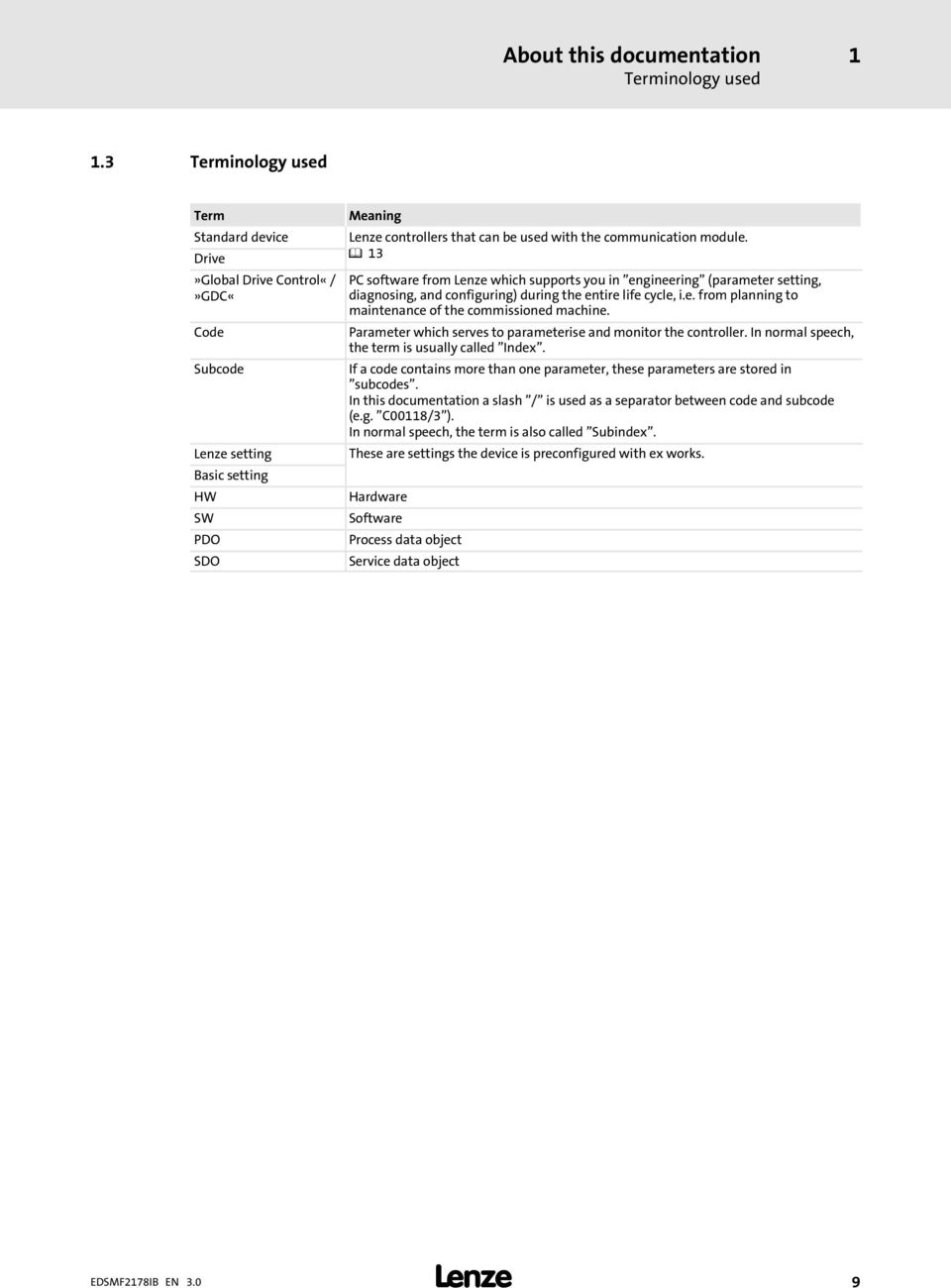
9 About this documentation Terminology used Terminology used Term Standard device Drive»Global Drive Control«/»GDC«Code Subcode Lenze setting Basic setting HW SW PDO SDO Meaning Lenze controllers that can be used with the communication module. 13 PC software from Lenze which supports you in "engineering" (parameter setting, diagnosing, and configuring) during the entire life cycle, i.e. from planning to maintenance of the commissioned machine. Parameter which serves to parameterise and monitor the controller. In normal speech, the term is usually called "Index". If a code contains more than one parameter, these parameters are stored in "subcodes". In this documentation a slash "/" is used as a separator between code and subcode (e.g. "C00118/3"). In normal speech, the term is also called "Subindex". These are settings the device is preconfigured with ex works. Hardware Software Process data object Service data object 9
10 1 About this documentation Notes used 1.4 Notes used The following pictographs and signal words are used in this documentation to indicate dangers and important information: Safety instructions Structure of safety instructions: Danger! (characterises the type and severity of danger) Note (describes the danger and gives information about how to prevent dangerous situations) Pictograph and signal word Danger! Danger! Stop! Meaning Danger of personal injury through dangerous electrical voltage. Reference to an imminent danger that may result in death or serious personal injury if the corresponding measures are not taken. Danger of personal injury through a general source of danger. Reference to an imminent danger that may result in death or serious personal injury if the corresponding measures are not taken. Danger of property damage. Reference to a possible danger that may result in property damage if the corresponding measures are not taken. Application notes Pictograph and signal word Note! Tip! Meaning Important note to ensure troublefree operation Useful tip for simple handling Reference to another documentation 10

11 Safety instructions General safety information 2 2 Safety instructions Note! It is absolutely vital that the stated safety measures are implemented in order to prevent serious injury to persons and damage to material assets. Always keep this documentation to hand in the vicinity of the product during operation. 2.1 General safety information Danger! Disregarding the following basic safety measures may lead to severe personal injury and damage to material assets! Lenze drive and automation components must only be used for the intended purpose.... must never be operated if damaged.... must never be subjected to technical modifications.... must never be operated unless completely assembled.... must never be operated without the covers/guards.... can depending on their degree of protection have live, movable or rotating parts during or after operation. Surfaces can be hot. For Lenze drive components only use permitted accessories.... only use original manufacturer spare parts. All specifications of the corresponding enclosed documentation must be observed. This is vital for a safe and trouble free operation and for achieving the specified product features. The procedural notes and circuit details provided in this document are proposals which the user must check for suitability for his application. The manufacturer does not accept any liability for the suitability of the specified procedures and circuit proposals. Only qualified skilled personnel are permitted to work with or on Lenze drive and automation components. According to IEC or CENELEC HD 384, these are persons who are familiar with the installation, assembly, commissioning and operation of the product,... possess the appropriate qualifications for their work,... and are acquainted with and can apply all the accident prevent regulations, directives and laws applicable at the place of use. 11

12 2 Safety instructions Device and application specific safety instructions 2.2 Device and application specific safety instructions During operation, the communication module must be securely connected to the standard device. With external voltage supply, always use a separate power supply unit, safely separated in accordance with EN in every control cabinet (SELV/PELV). Only use cables that meet the given specifications. ( 26) Documentation of the standard device, control system, and plant/machine All the other measures prescribed in this documentation must also be implemented. Observe the safety instructions and application notes contained in this manual. 2.3 Residual hazards Protection of persons If controllers are connected to phase earthed system with a rated mains voltage 400 V, external measures need to be implemented to provide reliable protection against accidental contact. (see chapter "4.2", 18) Device protection The communication module contains electronic components that can be damaged or destroyed by electrostatic discharge. 12

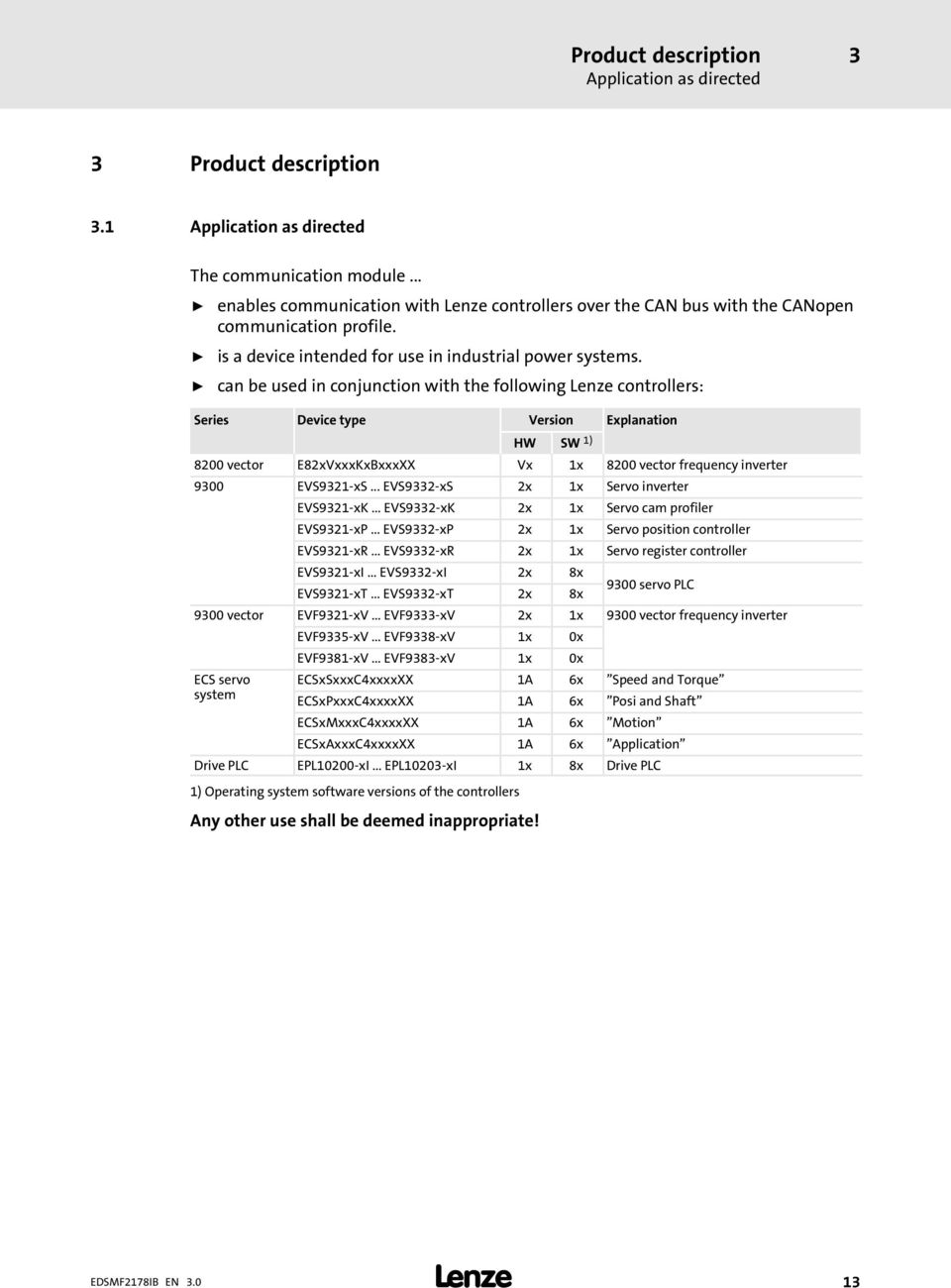
13 Product description Application as directed 3 3 Product description 3.1 Application as directed The communication module... enables communication with Lenze controllers over the CAN bus with the CANopen communication profile. is a device intended for use in industrial power systems. can be used in conjunction with the following Lenze controllers: Series Device type Version Explanation HW SW 1) 8200 vector E82xVxxxKxBxxxXX Vx 1x 8200 vector frequency inverter 9300 EVS9321 xs... EVS9332 xs 2x 1x Servo inverter EVS9321 xk... EVS9332 xk 2x 1x Servo cam profiler EVS9321 xp... EVS9332 xp 2x 1x Servo position controller EVS9321 xr... EVS9332 xr 2x 1x Servo register controller EVS9321 xi... EVS9332 xi 2x 8x EVS9321 xt... EVS9332 xt 2x 8x 9300 servo PLC 9300 vector EVF9321 xv... EVF9333 xv 2x 1x 9300 vector frequency inverter EVF9335 xv... EVF9338 xv 1x 0x EVF9381 xv... EVF9383 xv 1x 0x ECS servo ECSxSxxxC4xxxxXX 1A 6x "Speed and Torque" system ECSxPxxxC4xxxxXX 1A 6x "Posi and Shaft" ECSxMxxxC4xxxxXX 1A 6x "Motion" ECSxAxxxC4xxxxXX 1A 6x "Application" Drive PLC EPL10200 xi... EPL10203 xi 1x 8x Drive PLC 1) Operating system software versions of the controllers Any other use shall be deemed inappropriate! 13
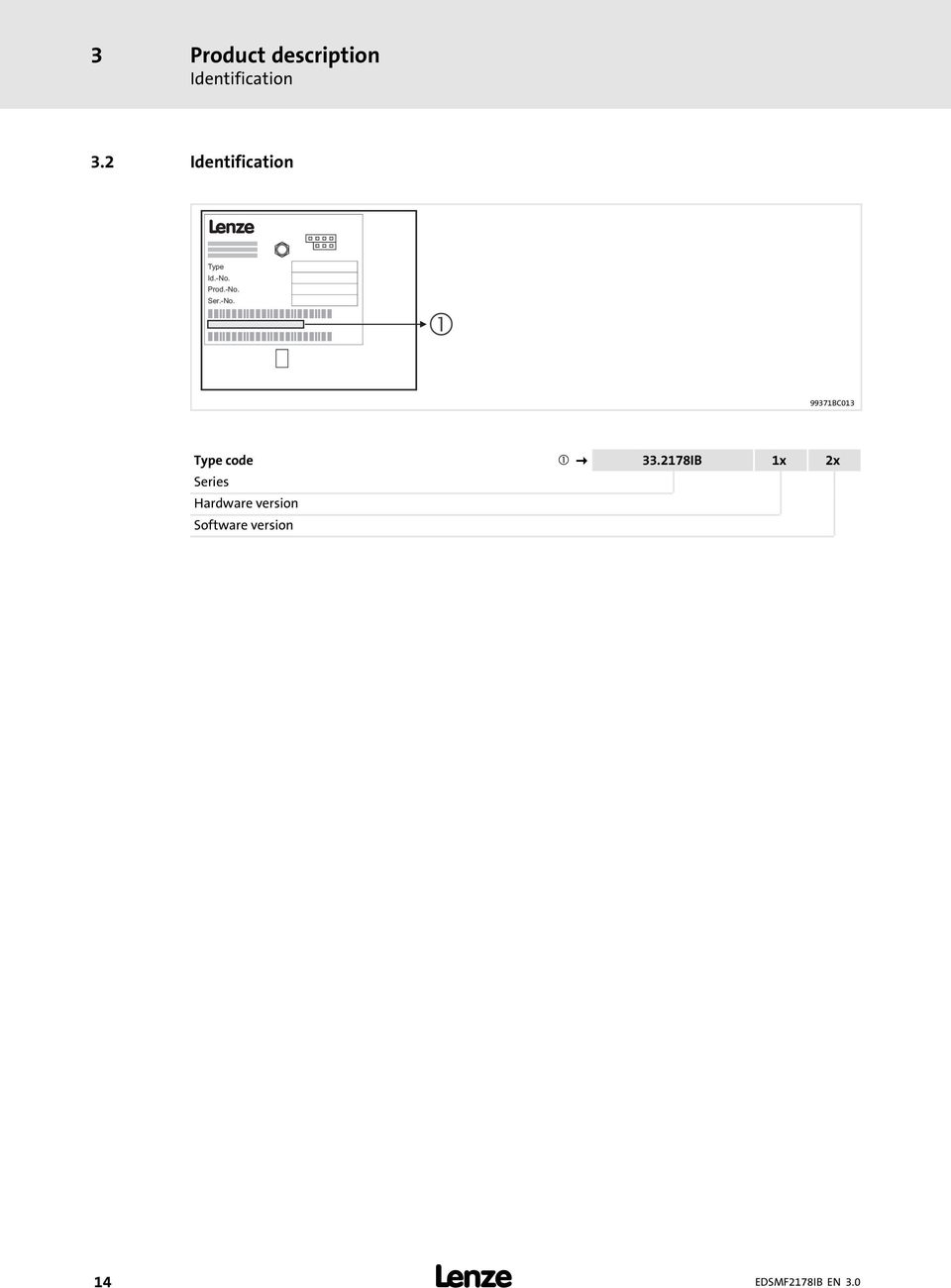
14 3 Product description Identification 3.2 Identification L Type Id.-No. Prod.-No. Ser.-No. E82AF000P0B201XX 99371BC013 Type code IB 1x 2x Series Hardware version Software version 14
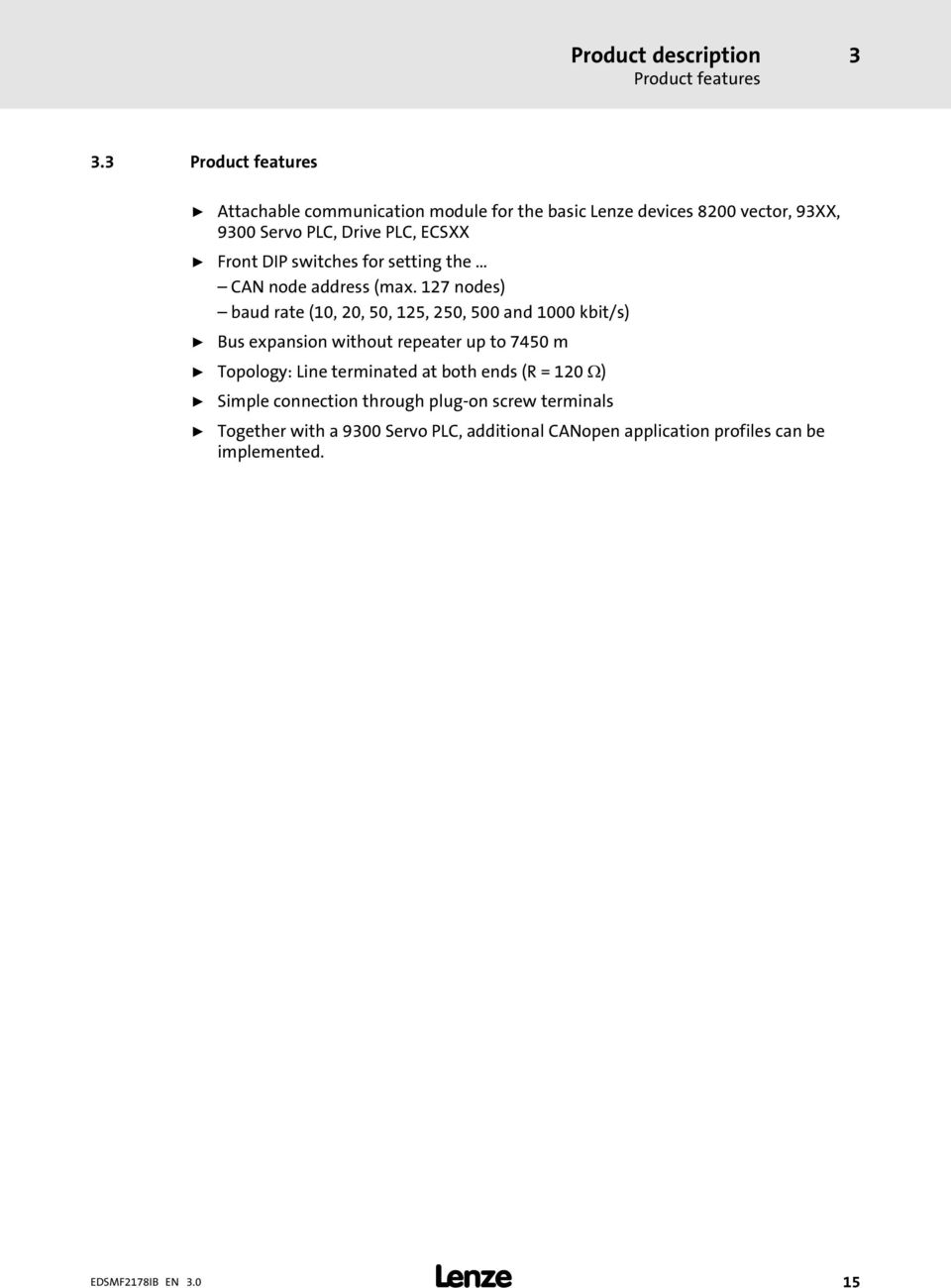
15 Product description Product features Product features Attachable communication module for the basic Lenze devices 8200 vector, 93XX, 9300 Servo PLC, Drive PLC, ECSXX Front DIP switches for setting the... CAN node address (max. 127 nodes) baud rate (10, 20, 50, 125, 250, 500 and 1000 kbit/s) Bus expansion without repeater up to 7450 m Topology: Line terminated at both ends (R = 120 ) Simple connection through plug on screw terminals Together with a 9300 Servo PLC, additional CANopen application profiles can be implemented. 15
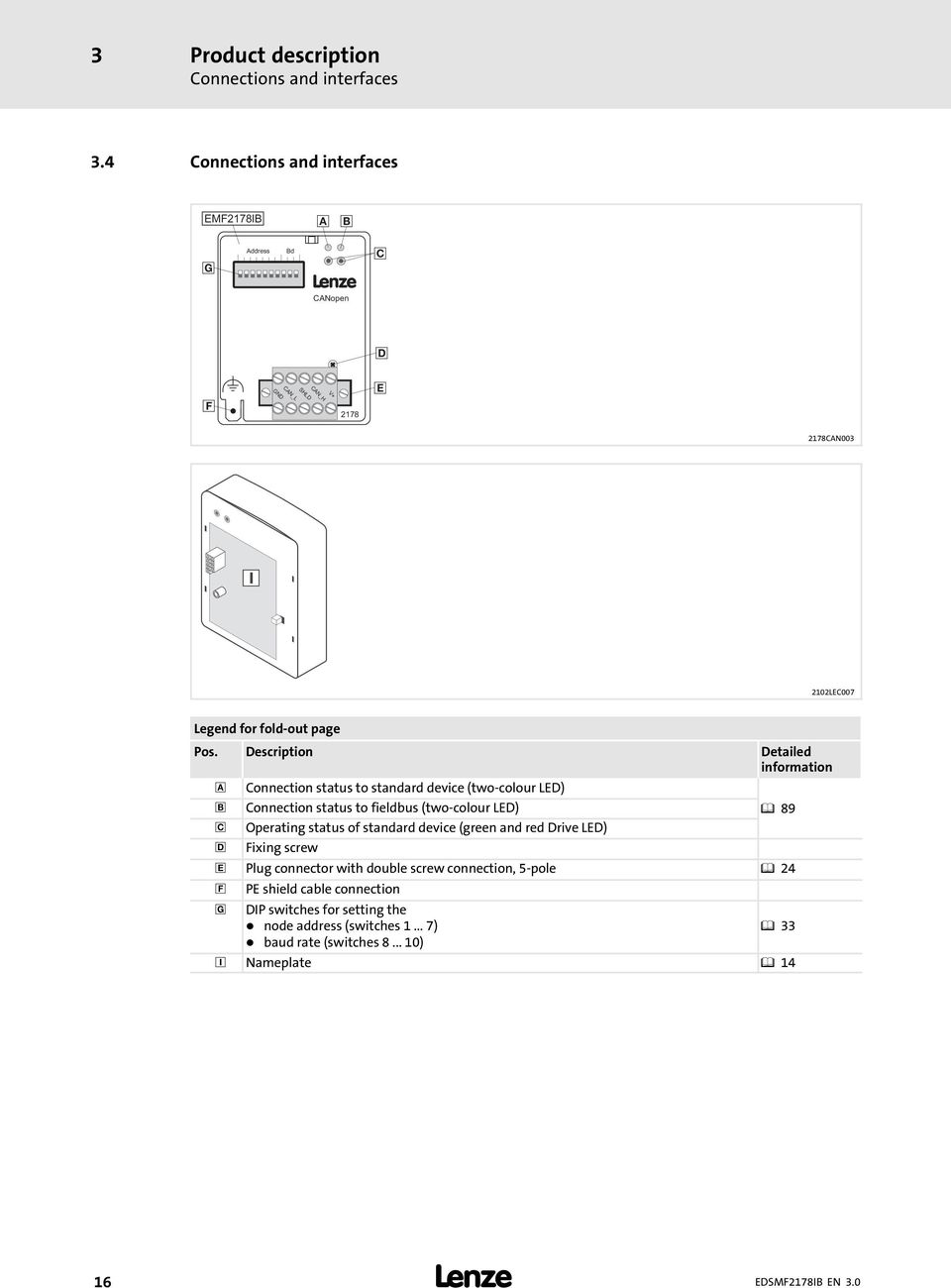
16 3 Product description Connections and interfaces 3.4 Connections and interfaces EMF2178IB Address Bd L CANopen SHLD CAN_L GND CAN_H V CAN LEC007 Legend for fold out page Pos. Description Detailed information Connection status to standard device (two colour LED) Connection status to fieldbus (two colour LED) Operating status of standard device (green and red Drive LED) Fixing screw 89 Plug connector with double screw connection, 5 pole 24 PE shield cable connection DIP switches for setting the node address (switches ) baud rate (switches ) 33 Nameplate 14 16
17 Technical data General data and operating conditions 4 4 Technical data 4.1 General data and operating conditions Field Order designation Values EMF2178IB Communication media DIN ISO Network topology Line terminated at both ends (R = 120 ) Communication profile CANopen, DS301 V4.01 Node addresses Max. 127 Cable length Max m (depending on the baud rate, 27) Baud rate [kbit/s] 10, 20, 50, 125, 250, 500, 1000 Voltage supply Internal or external supply possible for basic devices: 8200 vector / 93XX / 9300 Servo PLC / Drive PLC / ECSXX (also see 30) External supply via separate power supply unit: V+: V = 24 V DC 10 % I = 100 ma GND: Reference potential for external voltage supply Documentation for Lenze series of devices 8200 vector, 9300 and ECS Here you can find the ambient conditions and the electromagnetic compatibility (EMC) specifications applying to the communication module. 17

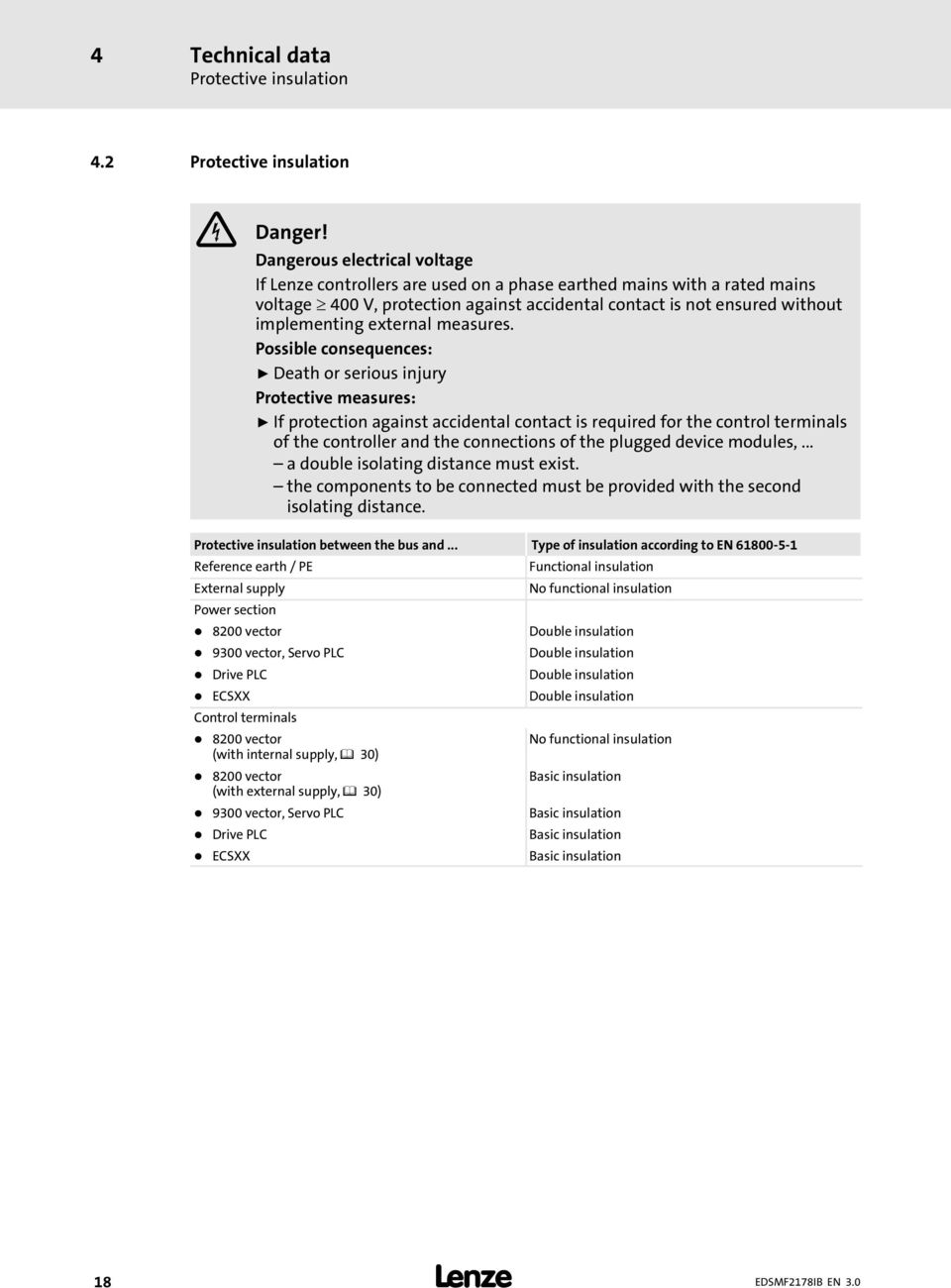
18 4 Technical data Protective insulation 4.2 Protective insulation Danger! Dangerous electrical voltage If Lenze controllers are used on a phase earthed mains with a rated mains voltage 400 V, protection against accidental contact is not ensured without implementing external measures. Possible consequences: Death or serious injury Protective measures: If protection against accidental contact is required for the control terminals of the controller and the connections of the plugged device modules,... a double isolating distance must exist. the components to be connected must be provided with the second isolating distance. Protective insulation between the bus and... Type of insulation according to EN Reference earth / PE Functional insulation External supply No functional insulation Power section 8200 vector Double insulation 9300 vector, Servo PLC Double insulation Drive PLC Double insulation ECSXX Double insulation Control terminals 8200 vector (with internal supply, 30) No functional insulation 8200 vector (with external supply, 30) Basic insulation 9300 vector, Servo PLC Basic insulation Drive PLC Basic insulation ECSXX Basic insulation 18
19 Technical data Communication time Communication time The communication time is the time between the start of a request and the arrival of the corresponding response. The CAN bus communication times depend on... the processing time in the controller (see documentation of the controller) Telegram runtime baud rate telegram length the data priority the bus load Processing time in the controller Documentation for the controller Here you can find information on the processing times in the controller. Telegram time The telegram times depend on the baud rate and the telegram length: Baud rate [kbit/s] Telegram runtime [ms] 0 bytes 2 bytes 8 bytes

20 4 Technical data Dimensions 4.4 Dimensions 62 Address Bd L CANopen 75 V+ CAN_H SHLD CAN_L GND Fig. 4 1 Dimensions of the communication module (all dimensions in mm) 2178CAN003 20

21 Installation 5 5 Installation Danger! Inappropriate handling of the communication module and the standard device can cause serious personal injury and material damage. Observe the safety instructions and residual hazards described in the documentation for the standard device. Stop! The device contains components that can be destroyed by electrostatic discharge! Before working on the device, the personnel must ensure that they are free of electrostatic charge by using appropriate measures. 21
22 5 Installation Mechanical installation 5.1 Mechanical installation Fig. 5 1 Attaching the communication module Plug the communication module onto the standard device (here: 8200 vector). 2102LEC014 Tighten the communication module to the standard device using the fixing screw in order to ensure a good PE connection. Note! For the internal supply of the communication module by the 8200 vector frequency inverter the jumper has to be adjusted within the interface opening (see illustration above). Observe the notes ( 30). 22
23 Installation Electrical installation Wiring according to EMC (CE typical drive system) Electrical installation Wiring according to EMC (CE typical drive system) For wiring according to EMC requirements observe the following points: Note! Separate control cables/data lines from motor cables. Connect the shields of control cables/data lines at both ends in the case of digital signals. Use an equalizing conductor with a cross section of at least 16 mm 2 (reference: PE) to avoid potential differences between the bus nodes. Observe the other notes concerning EMC compliant wiring given in the documentation for the standard device. Procedure for wiring 1. Observe the bus topology, i.e. do not use stubs. 2. Observe notes and wiring instructions in the documents for the control system. 3. Only use cables corresponding to the listed specifications ( 26). 4. Observe the permissible bus cable length ( 27). 5. Connect bus terminating resistors of 120 each (scope of supply): only to the physically first and last node between the terminals CAN LOW and CAN HIGH 23
24 5 Installation Electrical installation Wiring with a host (master) Wiring with a host (master) Danger! An additional electrical isolation is required if a safe electrical isolation (reinforced insulation) to EN is necessary. For this purpose for instance an interface module for the master computer with an additional electrical isolation can be used (see respective manufacturer information). For wiring observe the electrical isolation of the supply voltage. The supply voltage is on the same potential as the data bus. The 5 pole plug connector with double screw connection serves to connect the bus ( 25); effect the external voltage supply ( 30). V+ CAN_H SHLD CAN_L GND 120 Fig pole plug connector with double screw connection 2178CAN003 Designation GND CAN_L SHIELD CAN_H Explanation Reference potential for external voltage supply CAN GND connection Data line / input for terminating resistor 120 Shielding Data line / input for terminating resistor 120 V+ External voltage supply 24
25 Installation Electrical installation Wiring system bus (CAN) Wiring system bus (CAN) Structure of a CAN bus system (example) The CAN bus system is designed as a 2 conductor (twisted pair) shielded with additional mass and termination at both ends of the line. For sending and receiving data the following paths are available: Max. three process data channels (PDO = Process Data Object) Process data are sent via the process data channel and are used for high speed and high priority control tasks. Typical process data are, for instance, control words, status words, setpoints and actual values of a standard device. Two parameter data channels (SDO = Service Data Object) The parameters are transferred at lower priority than the process data and are set or changed e.g. during commissioning or product change. The parameters are accessed via the parameter data channels of the EMF2178IB communication module to the codes of the basic Lenze device or the corresponding CANopen objects. With both parameter data channels, two masters can be connected to a standard device. A PC (e.g. with the Lenze software "Global Drive Control") or an operator terminal serve to change parameters directly at the standard device during operation of a system connected to PLC. The second parameter data channel can be reached under the set address (via DIP switch or C0009) with an offset of "64". If, e.g., a PLC addresses the standard device with the address "1" and a second commanding device the address "65", always the same standard device is addressed. The second parameter channel is deactivated in the default state. Note! The last telegram determines the parameter when a parameter is accessed by two units (see CANopen objects 1200 and 1201 "Server SDO Parameters".( 107)). Please observe the notes in the chapter 6Commissioning ( 33), if you do not select the baud rate and address via the front DIP switches. 25
26 5 Installation Electrical installation Specification of the transmission cable CAN GND LOW HIGH GND CAN_L SHLD CAN_H V+ EMF2178IB GND Fig. 5 3 Connection to the plug connector 2178CAN Specification of the transmission cable We recommend the use of CAN cables in accordance with ISO : CAN cable in accordance with ISO Cable type Paired with shielding Impedance 120 ( ) Cable resistance/cross section Cable length 300 m 70 m /m / mm 2 (AWG22) Cable length m 40 m /m / 0.5 mm 2 (AWG20) Signal propagation delay 5 ns/m 26
27 Installation Electrical installation Bus cable length Bus cable length Note! It is absolutely necessary to comply with the permissible cable lengths. If the total cable lengths of the CAN nodes differ for the same baud rate, the smaller value must be used to determine the max. cable length. Observe the reduction of the total cable length due to the signal delay of the repeater Total cable length The baud rate determines the total cable length. Baud rate [kbps] Tab. 5 1 Total cable length Max. bus length [m] 27
28 5 Installation Electrical installation Bus cable length Segment cable length The segment cable length is determined by the cable cross section used and by the number of nodes. Repeaters divide the total cable length into segments. If no repeaters are used, the segment cable length is identical to the total cable length. Max. number of nodes per segment Cable cross section (can be interpolated) 0.25 mm 2 (AWG24) 0.5 mm 2 (AWG21) 0.75 mm 2 (AWG19) m 430 m 650 m 940 m m 420 m 640 m 920 m m 410 m 620 m 900 m m 390 m 580 m 850 m m 360 m 550 m 800 m m 310 m 470 m 690 m m 270 m 410 m 600 m Tab. 5 2 Segment cable length Example: Selection help Given Total cable length to be implemented 200 m Number of nodes mm 2 (AWG18) Results Max. possible baud rate Required cable cross section (interpolated) Cable cross section of standard CAN cable 250 kbps (derived from Tab. 5 1 Total cable length) 0.30 mm 2 (AWG23) (derived from Tab. 5 2 Segment cable length) 0.34 mm 2 (AWG22) (see specification of the transmission cable 26) 28
29 Installation Electrical installation Bus cable length Checking the use of repeaters Compare the values derived from Tab. 5 1 Total cable length ( 27) and Tab. 5 2 Segment cable length ( 28). If the sum of the segment cable lengths is smaller than the total cable length to be implemented, either repeaters must be used or the cable cross section must be increased. If the use of repeaters reduces the max. possible total cable length so much that it is smaller than the total cable length to be implemented, then the cable cross section must be increased or less repeaters must be used or the baud rate must be decreased. The use of a further repeater is recommended as... service interface Advantage: Trouble free connection during bus operation is possible. calibration interface Advantage: The calibration/programming unit remains electrically isolated. Example Given Total cable length to be implemented 450 m Number of nodes 32 Cable cross section 0.50 mm 2 (AWG 20) Baud rate 125 kbps Repeater used Lenze repeater EMF2176IB Reduction of the max. total cable length per 30 m repeater (EMF2176IB) Results Max. total cable length Max. segment cable length Comparison Conclusion 630 m (see Tab. 5 1 Total cable length ( 27)) 360 m (see Tab. 5 2 Segment cable length ( 28)) The max. segment cable length is smaller than the total cable length to be implemented. A repeater must be installed at the determined max. segment cable length of 360 m. Results with 1 repeater Max. total cable length Max. segment cable length 600 m (Reduction of the total cable length ( 27) by 30 m) 720 m Comparison Both the possible total cable length and the segment cable lengths are larger than the total cable length to be implemented. Conclusion 1 repeater is sufficient to implement the total cable length of 450 m. 29
30 5 Installation Electrical installation Voltage supply Voltage supply Internal voltage supply Note! Internal voltage supply has been selected in the case of standard devices with an extended AIF interface opening (e.g. front of 8200 vector). The area shown on a grey background in the graphic marks the jumper position. By default, this is not supplied internally in the standard device. For internal voltage supply place the jumper on the position indicated below. In the case of all other device series (9300, ECS), voltage is always supplied from the standard device. Lenze setting (Only external voltage supply possible.) Internal voltage supply External voltage supply Note! In the case of an external voltage supply and for greater distances between the control cabinets, always use a separate power supply unit (SELV/PELV) that is safely separated in accordance with EN in each control cabinet. The external voltage supply of the communication module... is required if communication via the fieldbus is to be continued in case the supply of the standard device fails. is carried out via the 2 pole plug connector with screw connection (24 V DC): Terminal Description V+ External voltage supply V = 24 V DC 10 % I = 100 ma GND Reference potential for external voltage supply The parameters of a basic device disconnected from the mains cannot be accessed. 30
31 Installation Electrical installation Voltage supply 5 Terminal data Area Electrical connection Possible connections Tightening torque Stripping length Values Plug connector with screw connection rigid: flexible: Nm ( lb in) 6 mm 1.5 mm 2 (AWG 16) without wire end ferrule 1.5 mm 2 (AWG 16) with wire end ferrule, without plastic sleeve 1.5 mm 2 (AWG 16) with wire end ferrule, with plastic sleeve 1.5 mm 2 (AWG 16) 31
32 6 Commissioning Before switching on 6 Commissioning During commissioning, system dependent data as e.g. motor parameters, operating parameters, responses and parameters for fieldbus communication are selected for the controller. In Lenze devices, this is done via codes. The codes are stored in numerically ascending order in the Lenze controllers and in the plugged in communication/function modules. In addition to these configuration codes, there are codes for diagnosing and monitoring the bus devices. 6.1 Before switching on Stop! Before you switch on the standard device with the communication module for the first time, check the entire wiring with regard to completeness, short circuit, and earth fault. whether the bus system is terminated by a bus terminating resistor at the physically first and last node. 6.2 Installing EDS files The EDS files serve to implement the Lenze communication modules for the AIF and FIF interfaces into the CANopen configuration software. The single EDS files describe the implemented CANopen functions of the respective communication module and the "on board" Lenze system bus (CAN). Tip! The current EDS file required for configuring the EMF2178IB (CANopen) communication module can be found in the download area on: 32
33 Commissioning Setting node address and baud rate Setting node address and baud rate The node address and the baud rate can be set via codes or via the DIP switches arranged at the front: Node address: Switches / code C1850/C2350 Baud rate: Switches / code C1851/C2351 The Lenze setting of all DIP switches is OFF. Note! Settings via codes In the Lenze setting Address switches = OFF, the values are accepted from the codes C1850/C2350 (node address) and C1851/C2351 (baud rate). Node addresses > 99 can only be set via DIP switch. The baud rates 10 kbps and 20 kbps can only be selected via DIP switch. Writing the codes (e.g. with GDC via CAN) has a direct effect on the standard device codes C0009 and C0126. Acceptance of code changes by: Switching off and then on again the voltage supply; "Reset node" with C0358 = 1; Network management command "Reset Communication"; Set C2120 (AIF control byte) = 1. The codes are inactive if at least one address switch (1... 7) has been set to ON position before a renewed mains connection. 33
34 6 Commissioning Setting node address and baud rate Node address setting Address Bd OPEN OFF ON Fig. 6 1 Address assignment via DIP switch If several devices are connected to the CAN network, the node addresses must differ from each other. The desired node address results from the sum of the values of switches (1... 7) in ON position. Example Switch Value Switch position 1 64 OFF 2 32 OFF 3 16 ON 4 8 OFF 5 4 ON 6 2 ON 7 1 ON Node address = 23 Note! Switch off the voltage supply of the communication module, and then switch it on again to activate the changed settings. 34
35 Commissioning Setting node address and baud rate 6 Baud rate setting Address Bd OPEN OFF ON Fig. 6 2 Baud rate setting The baud rate must be the same for all CAN nodes. The following baud rates can be set: Baud rate [kbps] Switch ON ON OFF 20 ON OFF ON 50 OFF ON ON 125 OFF ON OFF 250 OFF OFF ON 500 OFF OFF OFF 1000 ON OFF OFF Note! Switch off the voltage supply of the communication module, and then switch it on again to activate the changed settings. 35
36 6 Commissioning Initial switch on 6.4 Initial switch on Note! Do not change the setting sequence. 1. Switch on the standard device and, if necessary, the external voltage supply of the communication module. The green LED on the front of the communication module is lit. The status LED of the standard device (Drive LED) must be lit or blinking. The meaning of the signalling can be found in the standard device documentation. 2. You can now communicate with the drive, i. e. all parameters (SDO) can be read; all writable parameters (SDO) can be overwritten. 3. After a state change ("Operational") process data can be exchanged with the drive. Fig. 6 3 LEDs of the communication module 2172CAN000D 36
37 Commissioning Enable drive via the communication module Enable drive via the communication module Note! During operation, the plugging of the communication module onto a different controller may cause undefined operating states. Observe the information on the CAN configuration and controller enable in the documentation of the corresponding controller. Enable the 8200 vector via the communication module Step Procedure Comments 1. Set C0001 from "0" to "3" The Lenze parameter C0001 (operating mode) can be set with the GDC, keypad XT or directly via CANopen. Example for direct setting via CANopen: Write (C0001 = 3) Index = 0x5FFE (resulting from: 0x5FFF (C0001) hex ;) Subindex: 0 Value: (resulting from: C0001 = 3 x 10000) 2. Assign 28 to HIGH level The terminal 28 (controller enable) is always active and must be assigned to HIGH level during CANopen operation. Otherwise the controller cannot be enabled via CANopen. 3. Assign input terminal for QSP to HIGH level 4. The controller now accepts parameter data and process data. Enable 93XX via the communication module Step Procedure Comments 1. Set C0005 to th value "xxx3" The quick stop function (QSP) is always active. If QSP is configured to an input terminal (Lenze setting: Not assigned), it must be assigned to HIGH level during CANopen operation. The value "xxx3" of the Lenze parameter C0005 (control of the controller via CANopen) can be set with the GDC, keypad XT or directly via CANopen. Example for the first commissioning with the signal configuration "1013": Write (C0005 = 1013) Index = 0x5FFA (resulting from: 0x5FFF (C0005) hex ) Subindex: 0 Value: (resulting from: C0005 = 1013 x 10000) 2. Set C0142 = 0 See "Protection against uncontrolled restart" ( 38). 3. Assign 28 to HIGH level The terminal 28 (controller enable) is always active and must be assigned to HIGH level during CANopen operation. Otherwise the controller cannot be enabled via CANopen. 4. Assign terminal E1 to HIGH level 5. Connect terminal X5/A1 to X5/28 and If the signal configuration C0005 = 1013, the quick stop function (QSP) is assigned to the digital input terminals E1 and E2 in connection with the right/left change over and thus always active. Only affects the signal configuration C0005 = xx13 With this signal configuration the terminal A1 is switched as voltage output. X5/E1 6. The controller now accepts parameter data and process data. 37
38 6 Commissioning Enable drive via the communication module Enable ECSXX via the communication module Step Procedure Comments 1. Select control interface See documentation of the corresponding ECS controller. "AIF" via code. 2. Set C0142 = 0 See "Protection against uncontrolled restart" ( 38). 3. Assign terminals X6/SI1 and X6/SI2 to HIGH level 4. The controller now accepts parameter data and process data. Protection against uncontrolled restart The terminals X6/SI1 (controller enable/inhibit) and X6/SI2 (pulse enable/inhibit) are always active and must be assigned to HIGH level during CANopen operation. Otherwise, the controller cannot be enabled via CANopen. Note! Establishing communication If communication is to be established via an externally supplied communication module, initially the standard device must also be switched on. After communication has been established, the externally supplied module is independent of the power on/off state of the standard device. Protection against uncontrolled restart After a fault (e.g. short term mains failure), a restart of the drive is not always wanted and in some cases even not allowed. The restart behaviour of the controller can be set in C0142: C0142 = 0 (Lenze setting) The controller remains inhibited (even if the fault is no longer active). The drive starts up in a controlled manner by explicit controller enable: 93XX: Set terminal 28 to HIGH level. ECSXX: Set terminals X6/SI1 and X6/SI2 to HIGH level. C0142 = 1 An uncontrolled restart of the drive is possible. 38
39 Replacing the EMF2172IB communication module (CAN) 7 7 Replacing the EMF2172IB communication module (CAN) Observe the following information when replacing the EMF2172IB (CAN) communication module by EMF2178IB (CANopen): The communication modules feature different plug connectors for connecting the voltage supply and the system bus (CAN). The DIP switches of the communication modules feature different assignments for setting the CAN node address and the baud rate ( 40). Furthermore there are different adjustable CAN address ranges: Communication module CAN address range DIP switch EMF2172IB (CAN) S4... S9 EMF2178IB (CANopen) S1... S7 Depending on the standard device used, the 2. SDO channel is activated via code C1865/1 or C2365/1 ( 41). Changing the wiring The following illustration shows how you must carry out the previous wiring for the EMF2178IB communication module now. Address Bd 1-3 baud 4-9 address L CAN L CANopen 24 V DC + - GND 5Low High V+ CAN_H SHLD CAN_L GND CAN010 39
40 7 Replacing the EMF2172IB communication module (CAN) DIP switch settings Note! On the EMF2178IB communication module, the switch S1 = OFF(Lenze setting) must remain set. (An address setting > 63 was not possible for EMF2172IB.) Address Bd 1-3 baud ON 4-9 address L CAN OFF ON L CANopen OFF Address - - S1 = OFF S9 S2 S4 S7 Baudrate S3 S8 S1 S CAN011 Switch Value Example EMF2172IB EMF2178IB Switch position CAN node address S1 64 OFF S9 S2 32 OFF S8 S3 16 ON S7 S4 8 OFF = 23 S6 S5 4 ON S5 S6 2 ON S4 S7 1 ON 40
41 Replacing the EMF2172IB communication module (CAN) 7 Activate the 2. SDO channel Depending on the standard device used, set code C1865/1 or C2365/1 to activate the 2. SDO channel. Settings via the GDC/XT keypad for these standard devices: EVS 93xx ES EVS 93xx EP EVS 93xx EK EVS 93xx ER EVF 93xx EV E82EVxxx 1. Plug the EMF2178IB communication module onto the standard device. 2. Use the GDC to set code C1865/1 = 1. The setting is saved with mains failure protection directly in the communication module. When using the standard devices specified above, the setting can also be carried out beforehand. EVS 93xx EI EVS 93xx ET EPL ECSxS/P/M/A Use the GDC or XT keypad to set standard device code C2365/1 = 1 and save it with mains failure protection. After mains connection of one of the standard devices specified above, or after plugging on the EMF2178IB communication module, the contents of C2365 are written to the communication module. 41
42 8 Data transfer Structure of the CAN telegram 8 Data transfer Master and controller communicate with each other by exchanging data telegrams via the CAN bus. The user data area of the CAN telegram either contains network management data, process dataor parameter data ( 44). Different communication channels are assigned to parameter and process data in the controller: Process data are transferred via the process data channel. Parameter data are transferred via the parameter data channel. 8.1 Structure of the CAN telegram Control field CRC delimit. ACK delimit. Start RTR bit CRC sequence ACK slot End Identifier User data ( bytes) Network management Process data 1 bit 11 bits 1 bit 6 bits Parameter data 15 bits 1 bit 1 bit 1 bit 7 bits Fig. 8 1 Basic structure of the CAN telegram Tip! The identifier and the user data will be explained in more detail in this documentation. The other signals refer to the transfer characteristics of the CAN telegram which are not described in this documentation. For more information please refer to the homepage of the CAN user organisation CiA (CAN in Automation): cia.org 42
43 Data transfer Structure of the CAN telegram 8 Identifier (COB ID) The principle of the CAN communication is based on a message oriented data exchange between a transmitter and various receivers. Here, all nodes can quasi simultaneously transmit and receive messages. In case of CANopen, a node orientation is achieved by having only one transmitter for each message. The control which node is to receive a transmitted message is executed via the identifierin the CAN telegram, also called COB ID(Communication Object Identifier). In addition to the addressing, the identifier contains information on the priority of the message and the type of user data. With the exception of the network management and the sync telegram, the identifier consists of a basic identifier and the node address of the node to be addressed: Identifier (COB ID) = basic identifier + adjustable node address (Node ID) The identifier assignment is defined in the CANopen protocol. Basic identifier The basic identifier is preset as default with the following values according to the CANopen specification: Object Direction Basic identifier from the drive to the drive dec hex NMT 0 0x000 Sync 128 0x080 Emergency X 128 0x080 PDO1 TPDO1 X 384 0x180 (Process data channel 1) RPDO1 X 512 0x200 PDO2 TPDO2 X 640 0x280 (Process data channel 2) RPDO2 X 768 0x300 PDO3 TPDO3 X 896 0x380 (process data channel 3) RPDO3 X x400 SDO1 X x580 (Parameter data channel 1) X x600 SDO2 X x5C0 (parameter data channel 2) Lenze setting: not active. X x640 Node guarding / heartbeat X x700 Node address (node ID) Each node of the CAN network must be assigned with a node address (also called node ID) within the valid address range for unambiguous identification. A node address must not be assigned more than once within a network. The node address of the controller is configured under code C1850/C2350 or via DIP switch( 33). 43
44 8 Data transfer Structure of the CAN telegram User data The user data area of the CAN telegram either contains network management data, process dataor parameter data: Network management data (NMT data) Network management data contain information on the establishment of communication via the CAN network ( 45). Process data (PDO, Process Data Objects) Process data are transferred via the process data channel (see also chapter "Process data transfer", 48). Process data serve to control the controller (slave). Process data are transferred between the host and the controllers to ensure a continuous exchange of current input and output data. The host has direct access to process data. In the PLC, the data are, for instance, directly assigned to the I/O area. An exchange between host and controller is required as fast as possible. Small amounts of data can be transferred cyclically. Process data are not saved in the controller. Process data are, for instance, control words, status words, setpoints and actual values. Parameter data (SDO, Service Data Objects) Parameter data are transmitted as SDOs via the parameter data channel and acknowledged by the receiver, i.e.the sender gets a feedback about the transmission being successful or not (see also chapter "parameter data transfer", 69). The parameter data channel enables access to all Lenze codes and CANopen indices. The parameters for instance are set for the initial system set up during commissioning or when material is changed on the production machine. In general, the parameter data transfer is not time critical. Parameter changes are automatically stored in the controller. Parameter data for example are operating parameters, diagnostics information, and motor data. 44
45 Data transfer CAN communication phases / network management (NMT) CAN communication phases / network management (NMT) Regarding communication, the controller knows the following statuses: Status "Initialisation" "Pre Operational" "Operational" "Stopped" Description After the controller is switched on, the initialisation phase is run through. During this phase, the controller is not involved in the data exchange on the bus. A part of the initialisation or the complete initialisation can be run through again in every NMT status by transmitting different telegrams (see "state transition"). Here, all parameters are written with their set values. After completing the initialisation, the controller automatically adopts the "Pre Operational" status. The controller can receive parameter data. The process data are ignored. The controller can receive parameter data and process data. Only network management telegrams can be received. 45
46 8 Data transfer CAN communication phases / network management (NMT) Network management (NMT) The telegram structure used for the network management contains the identifier and the command included in the user data which consists of the command byte and the node address. Telegrams with the identifier "0" and 2 byte user data are used to change between the different communication phases. Identifier Value = 0 11 bits User data Only contains command 2 bytes Fig. 8 2 Telegram for switching over the communication phases A bus node, the network master, carries out the changes between the communication phases for the whole network. With code C1852 / C2352 ( 125) you can set up the communication module for master or slave operation. After an adjustable boot up time in C1856/1 / C2356/1 in master operation, ( 130) the NMT command Start_Remote_Node is transmitted, which puts all nodes into the "Operational" status. Note! Only a change to "Operational" status enables communication via the process data! Example: If all nodes connected to the bus are to be switched from the "Pre Operational" communication status to the "Operational" communication status via the CAN master, the identifier and the user data must have the following values in the transmission telegram: Identifier: 0x00 (broadcast telegram) User data: 0x
47 Data transfer CAN communication phases / network management (NMT) 8 State transitions (1) Initialisation (14) (2) (11) Pre-Operational (13) (4) (5) (7) (10) (3) (6) Stopped (12) Operational (8) (9) Fig. 8 3 State transitions in CAN network (NMT) E82ZAFU004 Status transition Command (hex) Network status after change (1) Initialisation (2) Pre operational Effects on process and parameter data after the status change Initialisation starts automatically when the mains is switched on. During initialisation, the drive does not take part in the data transfer. After initialisation has been completed, the node sends a boot up message with an individual identifier on the CAN bus and changes automatically to the status "Pre operational". In this phase, the master determines the way in which the controller takes part in the communication. From that moment on, the master changes the states for the whole network. A target address, which is part of the command, specifies the receiver(s). Network management telegrams, sync, emergency, process data (PDOs) and parameter data (SDOs) active (3), (6) 0x01yy Operational (like "Start remote node") Optional: When the status is changed, event and time controlled process data (PDOs) will be sent once. (4), (7) 0x80yy Pre operational Network management telegrams, sync, emergency and parameter data (SDOs) active (like "Enter pre operational state") (5), (8) 0x02yy Stopped Only network management telegrams can be received. (9) (10) (11) (12) (13) (14) 0x81yy 0x82yy Initialisation Initialises all parameters in the communication module with the stored values (corresponds to "Reset node") Initialises communication relevant parameters (CIA DS 301) in the communication module with the stored values (corresponds to "Reset communication") yy = 00 yy = node ID In case of this assignment, the telegram addresses all devices connected. The state of all devices can be changed at the same time. If a node address is given, only the state of the device with the corresponding address will be changed. 47
48 9 Process data transfer Available process data objects 9 Process data transfer Agreements Process data telegrams between host (master) and controller (slave) are distinguished as follows with regard to their direction: Process data telegrams to the controller Process data telegrams from the controller In CANopen, the process data objects are named from the node s view: RPDOx: A process data object received by a node TPDOx: A process data object transmitted by a node 9.1 Available process data objects Depending on the basic device used, up to 3 RPDOs and TPDOs can be available. Tip! From the masters s view, the following terms are used for process data transfer with the standard device and the plugged communication module: The master sends the process data output words (POWs) as process output data to the standard device The master receives the process data input words (PIWs) as process input data from the standard device. 48
49 Process data transfer Available process data objects 9 Process data telegram to the controller (RPDO) The identifier of the process data telegram includes the node address of the controller. The telegram has a maximum user data length of 8 bytes. This chapter describes which user data will be evaluated for the controllers. The CAN bus is connected to the automation interface X1 via the communication module. X1 is connected to the function block AIF IN. Here, the user data is transformed into corresponding signal types in order to use them for further function blocks. The control word is especially important for the controller. It contains the drive setpoint in user data bytes 1 and 2. Control word Byte 1, 2 = AIF IN Byte 3, 4 Identifier User data 8 bytes X1 X1 AIF X1 = AIF interface, e.g vector Fig. 9 1 Example: Process data telegram to controller Process data telegram from the controller (TPDO) For the cyclic process data telegrams from the controller, the function block to be used is called AIF OUT. The status word (bytes 1 and 2) included in the process data telegram is transmitted on the CAN bus to the master via this function block. 49
50 9 Process data transfer Configuring process data channel 9.2 Configuring process data channel Selection of the setpoint source Drive controller 8200 vector The selection of the setpoint source for these controllers is determined with code C0001 (index: 0x5FFE). For process data evaluation the code C0001 must be set to 3 when operating the controller with the communication module. The setpoint source is the process channel which overwrites the frequency setpoint (C0046) and the control word (C0135) (see documentation for 8200 vector). Note! Please observe that the setpoint source selection (C0001) must be set equally in all parameter sets. Drive controller 93XX The 9300 controllers do not offer a setpoint source selection which can be set by one code only. For this purpose, you only need to connect preconfigured function blocks in order to adapt the controller to the drive task without being an expert in programming. The user himself is able to carry out the interconnection. However, it is recommended to use the preconfigurations provided by Lenze, which are saved in the read only memory of the controller. The Lenze preconfigurations (code C0005) define which source (terminal, keyboard, communication module) overwrites the frequency setpoint and the control word. For operation via CAN bus, the value to be set under code C0005 must be set to "xxx3" (x = wildcard for selected preconfiguration) system manual Here, you can find more detailed information. PLC devices: 9300 Servo PLC / Drive PLC / ECSxA For communicating via a communication module (e.g. EMF2178IB), it is necessary that the system blocks AIF IN/OUT and, if required, the AIF management are integrated into the control configuration of the IEC61131 project. Axis modules of the ECS series Operating instructions for the axis modules of the ECS series Here you can find detailed information on the process data configuration. 50
51 Process data transfer Cyclic process data objects Cyclic process data objects Synchronisation of cyclic process data The "sync telegram" is used to ensure that the process data can be cyclically read by the controller and will be accepted by the controller. The sync telegram is the trigger point for accepting data in the controller and activates the sending process from the controller. For cyclic process data processing, the sync telegram must be generated accordingly. Sync telegram Sync telegram Process data from Controller Process data to Controller Cycle time Fig. 9 2 Sync telegram After the sync telegram has been received, the controllers send the cyclic process data to the master. The master reads them as process input data. When the sending process has been completed, the controllers receive the process output data (from the master). All other telegrams (e. g. parameters or event controlled process data) are acyclically accepted by the controllers after transmission has been completed. Acyclic data have not been taken into account for the above figure. When selecting the cycle time, they must be considered. 51
52 9 Process data transfer Cyclic process data objects Process data signals of Lenze controllers Process data signals of Lenze controllers Process data signals for 8200 vector frequency inverters A change of code C0001 to 3 preconfigures the process data words in the controller. Note! Frequency and speed values are normalised with Hz. Process data telegram to drive User data (up to 8 bytes) Byte 1 Byte 2 Byte 3 Byte 4 Byte 5 Byte 6 Byte 7 Byte 8 Control word Low byte Control word High byte Byte description: AIF IN.W1 Low byte AIF IN.W1 High byte AIF IN.W2 Low byte AIF IN.W2 High byte Byte Content Description 1 C0135 Bits of the control word under C0135 ( 145) are entered here. Control word, low byte 2 C0135 Control word, high byte 3 AIF IN.W1, low byte 4 AIF IN.W1, high byte 5 AIF IN.W2, low byte 6 AIF IN.W2, high byte Bits of the control word under C0135 ( 145) are entered here. AIF IN.Wx is parameterised under code C / 8 xx No evaluation of these data, any content possible Process data telegram from drive User data (up to 8 bytes) Byte 1 Byte 2 Byte 3 Byte 4 Byte 5 Byte 6 Byte 7 Byte 8 Status word Low byte Status word High byte Byte description: AIF OUT.W1 Low byte AIF OUT.W1 High byte AIF OUT.W2 Low byte AIF OUT.W2 High byte Byte Content Explanation 1 C0150 Bits of the status word are entered here under C0150 ( 145). Status word, low byte 2 C0150 Status word, high byte Bits of the status word are entered here under C0150 ( 145). 3 AIF OUT W1 Low byte 4 AIF OUT.W1 High byte 5 AIF OUT W2 AIF OUT.Wx is parameterised under code C0421. Low byte 6 AIF OUT.W2 High byte 7 / 8 xx No evaluation of these data, any content possible xx xx xx xx 52
53 Process data transfer Cyclic process data objects Process data signals of Lenze controllers 9 Device control word AIF CTRL for 8200 vector (C0135, index 0x5F78) Bit Assignment (Lenze setting) Set under C0001 = 3 with C C0001 = 3 with C0007 > 51 C0410/... 0 / 1 JOG values Freely configurable 1 Bit = C0046 active = NSET1 JOG1 (C0037) active = NSET1 JOG2 (C0038) active = NSET1 JOG3 (C0039) active 2 Current direction of rotation (DCTRL1 CW/CCW) Freely configurable Not active Active 3 Quick stop (QSP) (AIF CTRL QSP) Quick stop (QSP) (AIF CTRL QSP) Not active Active 0 1 Not active Active 4 Stop ramp function generator (NSET1 RFG1 STOP) Freely configurable Not active Active 5 Ramp function generator input = 0 Freely configurable 6 (NSET1 RFG1 0) 0 1 Not active Active 6 UP function motor potentiometer (MPOT1 UP) Freely configurable Not active Active 7 DOWN function motor potentiometer Freely configurable 8 (MPOT1 DOWN) 8 Freely configurable Freely configurable 9 9 Controller inhibit (AIF CTRL CINH) Controller inhibit (AIF CTRL CINH) Not active Active 0 1 Not active Active 10 External fault (AIF CTRL TRIP SET) External fault (AIF CTRL TRIP SET) Not active Active 11 Reset fault (AIF CTRL TRIP RESET) 0 1 Not active Active Reset fault (AIF CTRL TRIP RESET) 0 > 1 Edge from 0 to 1 0 > 1 Edge from 0 to 1 12 Change over parameter set (DCTRL1 PAR2/4) Freely configurable Not active Active 13 Change over parameter set (DCTRL1 PAR3/4) Freely configurable Not active Active 14 DC injection brake (MCTRL1 DCB) Freely configurable Not active Active 15 Freely configurable Freely configurable
54 9 Process data transfer Cyclic process data objects Process data signals of Lenze controllers.b0.b1.b2.b3 QSP DCTRL AIF-IN C0410/x = 10 C0410/x = 11 C0410/x = 12 AIF-CTRL 16 Bit.B B8.B9 CINH DCTRL.B10 TRIP-SET AIF.B11.B B15 TRIP-RESET C0410/x = 22 C0410/x = Bit AIF-IN.W1 C0412/x = Bit AIF-IN.W2 C0412/x = 11 Fig. 9 3 System block AIF IN in 8200 vector (freely configurable assignment) 2141LON011 54
55 Process data transfer Cyclic process data objects Process data signals of Lenze controllers 9 Device status word AIF STAT for 8200 vector (C0150, index 0x5F69) Bit Assignment (Lenze setting) Set under C0417/... 0 Current parameter set (DCTRL PAR B0) 1 1 Pulse inhibit (DCTRL1 IMP) 2 2 I max limit (MCTRL1 IMAX) 3 3 Output frequency = frequency setpoint (MCTRL1 RFG1=NOUT) 4 4 Ramp function generator input = ramp function generator output 1 5 (NSET1 RFG1 I=0) 5 Q min threshold (PCTRL1 QMIN) 6 6 Output frequency = 0 (DCTRL1 NOUT=0) 7 7 Controller inhibit (DCTRL1 CINH) Device status (DCTRL1 Stat*1... STAT*8) Reserved Bit Device initialisation Switch on inhibit Operation inhibited Flying restart circuit active DC injection brake active Operation enabled Message active Fault active Communication with basic device not possible 12 Overtemperature warning (DCTRL1 OH WARN) DC bus overvoltage (DCTRL1 OV) Direction of rotation (DCTRL1 CCW) Ready for operation (DCTRL1 RDY) 16 C0417/1 DCTRL1-IMP C0417/3 C0417/4 C0417/5 C0417/6 DCTRL1-NOUT=0 DCTRL1-CINH DCTRL1-STAT*1 DCTRL1-STAT*2 DCTRL1-STAT*4 DCTRL1-STAT*8 DCTRL1-OH-WARN DCTRL1-OV C0417/15 C0417/16 STAT1.B0.B1.B2.B3.B4.B5.B6.B7.B8.B9.B10.B11.B12.B13.B14.B15.B0.B1.B2.B3.B4.B5.B6.B7.B8 AIF-STAT.B9 16 Bit.B10.B11.B12.B13.B14.B15 AIF-OUT AIF C0421/1 AIF-OUT.W1 16 Bit C0421/2 AIF-OUT.W2 16 Bit Fig. 9 4 System block AIF OUT in 8200 vector (freely programmable assignment) 2141LON013 55
56 9 Process data transfer Cyclic process data objects Process data signals of Lenze controllers Process data signals for 9300 servo inverter The assignment of the process data for the 93XX controller can be changed by reconfiguring the function blocks AIF IN and AIF OUT system manuals Here you can find detailed information on the function blocks and signal configurations. Function block AIF IN The function block AIF IN determines the input data of the controller as data interface for the EMF2178IB communication module. Process data telegram to drive User data (up to 8 bytes ) Byte 1 2nd byte 3rd byte Byte 4 Byte 5 Byte 6 7th byte Byte 8 Control word Low byte 57 Control word High byte AIF IN.W1 Low byte AIF IN.W1 High byte AIF IN.W2 Low byte AIF IN.W2 High byte AIF IN.W3 Low byte AIF IN.W3 High byte AIF IN.W1 to AIF IN.W3 depend on the signal configuration selected under code C0005. Under code C0005 you can preconfigure the signals of the control word and the status word. In the controller, other signals can be assigned to AIF IN.W1 to AIF IN.W3. For this, the function block configuration described in the 93XX System Manual is used. Signal configuration AIF IN.W1 AIF IN.W2 AIF IN.W3 AIF IN.D1 (C0005) Speed control 1003 / 1013 / 1113 NSET N Speed setpoint 100 % = Torque control 4003 / 4013 / 4113 MCTRL MADD Torque setpoint Not assigned 100 % = LF master 5003 / 5013 / 5113 NSET N Speed setpoint 100 % = LF slave rail 6003 / 6013 / 6113 DFSET A TRIM Phase trimming LF slave cascade 7003 / 7013 / 7113 DFSET VP DIV LF factor cam profiler 1xxx3 YSET1 FACT Positioning 2xxx3 Not assigned vector control 1xx3 / 2xx3 / 3xx3 / NLIM IN1 5xx3 / 100x3 vector control 4xx3 NCTRL MADD DFSET N TRIM Speed trimming DFSET A TRIM Phase trimming Not assigned vector control 6xx3 DFSET A TRIM DFSET N TRIM vector control 7xx3 / 8xx3 / 9xx3 DFSET VP DIV DFSET A TRIM vector control 100x3 NLIM IN1 vector control 110x3 Not assigned Not assigned Not assigned Not assigned 56
57 Process data transfer Cyclic process data objects Process data signals of Lenze controllers 9 Control word for 93XX servo inverter 9300 position controller 9300 cam profiler 9300 vector C0005 1xx3 4xx3 5xx3 6xx3, 7xx3 2xx3 xxx3 1xxx, 2xxx, 4xx3 6xx3, 7xx3 3xxx, 5xxx, 10xxx, 11xxx 0 NSET JOG*1 Not assigned NSET JOG*1 Not assigned Not assigned CSEL1 CAM*1 NSET JOG*1 Not assigned Not assigned 1 NSET JOG*2 Not assigned NSET JOG*2 Not assigned Not assigned CSEL1 CAM*2 NSET JOG*2 Not assigned Not assigned 2 NSET N INV NSET N INV NSET N INV NSET N INV Not assigned CSEL1 CAM*4 NSET N INV Not assigned Not assigned 3 AIF CTRL.QSP AIF CTRL.QSP AIF CTRL.QSP AIF CTRL.QSP AIF CTRL.QSP AIF CTRL.QSP AIF CTRL.QSP AIF CTRL.QSP AIF CTRL.QSP 4 NSET RFG STO P NSET RFG STO P NSET RFG STO P NSET RFG STO P POS PRG START CSEL1 EVENT NSET RFG STO P NSET RFG STO P Not assigned 5 NSET RFG 0 NSET RFG 0 NSET RFG 0 NSET RFG 0 POS PRG STOP CDATA CYCLE NSET RFG 0 NSET RFG 0 Not assigned 6 Not assigned Not assigned Not assigned Not assigned Not assigned CSEL1 LOAD Not assigned Not assigned Not assigned 7 Not assigned Not assigned Not assigned Not assigned POS PRG RESET CSEL1 LOAD Not assigned Not assigned Not assigned 8 Not assigned Not assigned Not assigned Not assigned Not assigned Not assigned Not assigned Not assigned Not assigned 9 AIF CTRL.CINH AIF CTRL.CINH AIF CTRL.CINH AIF CTRL.CINH AIF CTRL.CINH AIF CTRL.CINH AIF CTRL.CINH AIF CTRL.CINH AIF CTRL.CINH 10 AIF CTRL.TRIP SET 11 AIF CTRL.TRIP RESET AIF CTRL.TRIP SET AIF CTRL.TRIP RESET AIF CTRL.TRIP SET AIF CTRL.TRIP RESET AIF CTRL.TRIP SET AIF CTRL.TRIP RESET AIF CTRL.TRIP SET AIF CTRL.TRIP SET AIF CTRL.TRIP SET AIF CTRL.TRIP RES ET AIF CTRL.TRIP RES ET AIF CTRL.TRIP RESET AIF CTRL.TRIP SET AIF CTRL.TRIP RESET AIF CTRL.TRIP SET AIF CTRL.TRIP RESET 12 DCTRL PAR*1 DCTRL PAR*1 DCTRL PAR*1 DCTRL PAR*1 POS PS CANCEL Not assigned DCTRL PAR*1 DCTRL PAR*1 DCTRL PAR*1 13 DCTLR PAR LO AD DCTLR PAR LO AD DCTLR PAR LO AD DCTLR PAR LO AD POS PARAM RD Not assigned DCTLR PAR LO AD DCTLR PAR LO AD DCTLR PAR LO AD 14 NSET Ti*1 NSET JOG*1 REF ON REF ON POS LOOP ONH Not assigned NSET Ti*1 NSET JOG*1 Not assigned 15 NSET Ti*2 NSET JOG*2 NSET Ti*1 Not assigned POS STBY STP Not assigned NSET Ti*2 NSET JOG*2 Not assigned Note! The individual bit control commands of the control word depend on other bit positions. 57
58 9 Process data transfer Cyclic process data objects Process data signals of Lenze controllers ) 1. 1 * EJ * EJ # 5 JA K A HM HJ $ * EJ ) & # $ : $ * EJ $ * EJ ) : + & # $ $ * EJ ) ! $ * EJ + & # $! ) 1. 1 * + & # # + & # # ) 1. 1 * $ * E H $ * E H I EC = A I EC = A ) 1. 1 * " ) 1. 1 * # * O JA! " * O JA # $ * O JA % & $ * EJ + & # # $ * E H I EC = A $ * EJ M 9 H@ $ * EJ 0 EC D 9 H@ ) *! ) * & ) * ' ) * ) * + & # % ) 1. 1, 15 ) * , ) * ) * ) * ) * " ) * # ) * $ ) * % ) * ) *! ) * " ) * # ) 1. 1 * $ ) 1. 1 * % ) 1. 1 *! ) 1. 1 *! ) 1. 1, * EJ * EJ # 5 JA K A HM HJ * O JA! " * O JA # $ * O JA % & $ * EJ +! $! $ * EJ + & # # $ * E H I EC = A $ * EJ M 9 H@ $ * EJ 0 EC D 9 H@ ) *! ) * & ) * ' ) * ) * $ * EJ M 9 H@ $ * EJ 0 EC D 9 H@ + & # $ + & # $! + & # % + & # $ + ' % 3 5 2, 15 ) * ) * ) * ) * ) * " ) * # ) * $ ) * % ) * ) *! ) * " ) * # ) ) ) ! ) 1. 1 *, ) 1. 1, ) 1. 1 * ) 1. 1 * " ) 1. 1 * # ) 1. 1 * $ ) 1. 1 * % ) 1. 1 *! ) 1. 1 *! ) 1. 1, 2111IBU003 Fig. 9 5 Function blocks AIF IN and AIF IN *) AIF IN *) is available for the 9300 technology variants servo inverter, positioning controller and cam profiler as of software version 2.0. AIF IN.D2 is new. 58
59 Process data transfer Cyclic process data objects Process data signals of Lenze controllers 9 Function block AIF OUT The function block AIF OUT determines the output data of the controller as data interface for the EMF2178IB communication module. Process data telegram from drive User data (up to 8 bytes ) Byte 1 Byte 2 Byte 3 Byte 4 Byte 5 Byte 6 Byte 7 Byte 8 Status word Low byte 60 Status word High byte AIF OUT.W1 Low byte AIF OUT.W1 High byte AIF OUT.W2 Low byte AIF OUT.W2 High byte AIF OUT.W3 Low byte AIF OUT.W3 High byte AIF OUT.W1 to AIF OUT.W3 depend on the signal configuration selected under code C0005. Under code C0005 you can preconfigure the signals of the control word and the status word. In the controller, other signals can be assigned to AIF OUT.W1 to AIF OUT.W3. For this, the function block configuration described in the 93XX System Manual is used. Signal configuration (C0005) AIF OUT.W1 AIF OUT.W2 AIF OUT.W3 AIF OUT.D1 Speed control 1003 / 1013 / 1113 Torque control 4003 / 4013 / 4113 LF master 5003 / 5013 / 5113 LF slave rail 6003 / 6013 / 6113 LF slave cascade 7003 / 7013 / 7113 Cam profiler Positioning vector control vector control 1xxx3 2xxx3 1xx3 / 4xx3 / 5xx3 / 10xx3 6xx3 / 7xx3 / 8xx3 / 9xx3 MCTRL NACT Actual speed value 100 % = MCTRL MSET2 Torque display 100 % = MCTRL NACT Actual speed value 100 % = MCTRL NACT Actual speed value 100 % = MCTRL NACT Actual speed value 100 % = MCTRL NACT Actual speed value 100 % = MCTRL NACT Actual speed value 100 % = MCTRL NACT Actual speed value 100 % = MCTRL NACT Actual speed value 100 % = MCTRL MSET2 Torque display 100 % = MCTRL NACT Actual speed in % 100 % = MCTRL MSET2 Torque display 100 % = MCTRL PHI ACT Angle actual value MCTRL PHI ACT Angle actual value Not assigned Not assigned MCTRL IACT MCTRL PHI ANA MCTRL NSET2 Speed controller input 100 % = MCTRL NSET2 Speed controller input 100 % = MCTRL NSET2 Speed controller input 100 % = MCTRL MSET2 Torque setpoint in % 100 % = MCTRL MSET2 Torque setpoint in % 100 % = Not assigned Not assigned MCTRL NSET2 Speed controller input 100 % = MCTRL MSET2 Torque setpoint in % 100 % = vector control 110x3 Not assigned Not assigned Not assigned Not assigned 59
60 9 Process data transfer Cyclic process data objects Process data signals of Lenze controllers Status word for 93XX servo inverter 9300 position controller 9300 cam profiler C0005 1xx3 4xx3 5xx3 6xx3, 7xx3 2xx3 1xx3 1xxx, 2xxx, 3xxx, 5xxx, 10xxx, 11xxx 9300 vector 4xxx 6xxx, 7xxx, 8xxx, 9xxx 0 DCTRL PAR1 0 DCTRL PAR1 0 DCTRL PAR1 0 DCTRL PAR1 0 Not assigned CERR1 ERR DCTRL PAR1 0 DCTRL PAR1 0 DCTRL PAR1 0 1 DCTRL IMP DCTRL IMP DCTRL IMP DCTRL IMP DCTRL IMP DCTRL IMP DCTRL IMP DCTRL IMP DCTRL IMP 2 MCTRL IMAX MCTRL IMAX REF OK REF OK POS REF OK MCTRL IMAX MCTRL IMAX MCTRL IMAX MCTRL IMAX 3 MCTRL MMAX Not assigned MCTRL MMAX Not assigned Not assigned MCTRL MMAX MCTRL MMAX MCTRL IMAX MCTRL MMAX negated 4 NSET RFG I=0 MCTRL IMAX NSET RFG I=0 MCTRL IMAX MCTRL MMAX DCTRL TRIP NSET RFG I=0 NSET RFG I=0 NSET QSP OUT negated negated negated 5 QMIN QMIN REF BUSY REF BUSY POS IN TARGET CDATA X0 QMIN QMIN QMIN 6 DCTRL NACT=0 DCTRL NACT=0 DCTRL NACT=0 DCTRL NACT=0 DCTRL NACT=0 DCTRL NACT=0 DCTRL NACT=0 DCTRL NACT=0 DCTRL NACT=0 7 DCTRL CINH DCTRL CINH DCTRL CINH DCTRL CINH DCTRL CINH DCTRL CINH DCTRL CINH DCTRL CINH DCTRL CINH Device status: 0b0000 = 0 0b0010 = 2 0b0011 = 3 0b0100 = 4 0b0101 = 5 0b0110 = 6 0b0111 = 7 0b1000 = 8 0b1010 = 10 Device initialisation Switch on inhibit Operation inhibited Flying restart circuit active DC injection brake active Operation enabled Message active Fault active Fail QSP (only 9300 servo position controller) 12 DCTRL WARN DCTRL WARN DCTRL WARN DCTRL WARN DCTRL WARN DCTRL WARN DCTRL WARN DCTRL WARN DCTRL WARN 13 DCTRL MESS DCTRL MESS DCTRL MESS DCTRL MESS DCTRL MESS DCTRL MESS DCTRL MESS DCTRL MESS DCTRL MESS 14 DCTRL CW/CC W DCTRL CW/CC W DCTRL CW/CC W Not assigned DCTRL AIFL QS P DCTRL CW/CC W DCTRL CW/CC W DCTRL CW/CC W DCTRL CW/CC W 15 DCTRL RDY DCTRL RDY DCTRL RDY DCTRL RDY DCTRL RDY DCTRL RDY DCTRL RDY DCTRL RDY DCTRL RDY ) ) ) ) 6 * + # $, & # & + & #! + & # &!.,., + $ 5 6 ) 6 * " + # $ $ 5 6 ) 6 * # + # $ % + & # + & # & + & # + $ $., # + $ %., $ + $!.,! ) , + & # + & # ' $ * EJ ) ) ) ! $ * EJ M 9 H@ $ * EJ 0 EC D 9 H@ $ * EJ M 9 H@ $ * EJ 0 EC D 9 H@ + & # + & #! * EJ * EJ # * EJ * EJ # * EJ * O JA % & * O JA # $ * O JA! " 5 J= JK I M H@ : 5 6 ) ) 6 * + # $, & # & + & #! + & # &!.,., + $ 5 6 ) 6 * " + # $ $ 5 6 ) 6 * # + # $ % ) , + ' # + ' $ ) & # + & # & + & # + $ $., # + $ %., $ + $!.,! ) , + & # + & # ' $ * EJ $ * EJ M 9 H@ $ * EJ 0 EC D 9 H@ ) ) ! $ * EJ M 9 H@ $ * EJ 0 EC D 9 H@ $ * EJ M 9 H@ $ * EJ 0 EC D 9 H@ + & # "! + & #! + & #! * EJ * EJ # * EJ * EJ # * EJ * O JA % & * O JA # $ * O JA! " 5 J= JK I M H@ : * EJ! * EJ! Fig. 9 6 Function blocks AIF OUT and AIF OUT *) AIF OUT *) is available for the 9300 technology variants servo inverter, positioning controller and cam profiler as of software version 2.0. AIF OUT.D2 is new. 2111IBU002 60
61 Process data transfer Cyclic process data objects Process data signals of Lenze controllers Process data signals for 9300 Servo PLC, Drive PLC, ECSxA For more information... please see the chapter "System blocks, AIF1_IO_AutomationInterface" in the Manuals and Operating Instructions for the 9300 Servo PLC, Drive PLC and ECSxA axis module. Note! Only 9300 Servo PLC & ECSxA: Perform the following linkings in the PLC program of the drive controller: AIF1_wDctrlCtrl DCTRL_wAIF1Ctrl DCTRL_wStat AIF1_wDctrlStat 61
62 9 Process data transfer Cyclic process data objects Process data signals of Lenze controllers Process data telegram to drive Inputs_AIF1 16 Bit AIF1_wDctrlCtrl Inputs_AIF2 AIF1_bCtrlB0_b AIF1_bCtrlB1_b AIF1_bCtrlB2_b AIF1_bCtrlQuickstop_b AIF1_bCtrlB4_b Byte 1 Byte 2 16 Bit 16 binary signals AIF2_nInW1_a AIF2_bInB0_b... AIF2_bInB15_b AIF1_bCtrlB5_b 16 binary signals AIF1_bCtrlB6_b AIF1_bCtrlB7_b AIF1_bCtrlDisable_b AIF1_bCtrlCInhibit_b AIF1_bCtrlTripSet_b Byte 3 Byte 4 16 Bit 16 binary signals AIF2_nInW2_a AIF2_bInB16_b... AIF2_bInB31_b Controlword Byte 1 Byte 2 AIF1_bCtrlTripReset_b AIF1_bCtrlB12_b AIF1_bCtrlB13_b AIF1_bCtrlB14_b AIF1_bCtrlB15_b Automation Interface Byte 5 Byte 6 16 Bit LowWord 16 Bit HighWord AIF2_dnInD1_p Automation Interface Byte 3 Byte 4 Byte 5 Byte 6 Byte 7 16 Bit 16 Bit C0855/1 16 binary signals 16 Bit C0855/2 C0856/1 C0856/2 C0856/3 AIF1_nInW1_a AIF1_nInW2_a AIF1_bInB0_b AIF1_bInB15_b AIF1_nInW3_a AIF1_bIn16_b Byte 7 Byte 8 Inputs_AIF3 Byte 1 Byte 2 16 Bit 16 Bit 16 Bit 16 binary signals AIF2_nInW3_a AIF2_nInW4_a AIF3_nInW1_a AIF3_bInB0_b... AIF3_bInB15_b Byte 8 16 binary signals 16 Bit LowWord 16 Bit HighWord C0857 AIF1_bIn31_b AIF1_dnInD1_p Automation Interface Byte 3 Byte 4 Byte 5 16 Bit 16 binary signals 16 Bit LowWord AIF3_nInW2_a AIF3_bInB16_b... AIF3_bInB31_b AIF3_dnInD1_p Byte 6 16 Bit HighWord 16 Bit AIF3_nInW3_a Byte 7 16 Bit AIF3_nInW4_a Byte 8 Fig. 9 7 Function blocks AIF1 IN, AIF2 IN and AIF3 IN 62
63 Process data transfer Cyclic process data objects Process data signals of Lenze controllers 9 Process data telegram from drive The following data can be assigned to the PIW data (TPDOs): Designation / variable name Explanation Device status word (AIF1_DctrlStat) AIF word 1 AIF_nOutW1_a AIF word 2 AIF_nOutW2_a AIF word 3 AIF_nOutW3_a AIF word 4 AIF2_nOutW1_a AIF word 5 AIF2_nOutW2_a AIF word 6 AIF2_nOutW3_a AIF word 7 AIF2_nOutW4_a AIF word 8 AIF3_nOutW1_a AIF word 9 AIF3_nOutW2_a AIF word 10 AIF3_nOutW3_a AIF word 11 AIF3_nOutW4_a AIF word 12 AIF1_dnOutD1_p AIF double word 1 63
64 9 Process data transfer Cyclic process data objects Process data signals of Lenze controllers Outputs_AIF1 Outputs_AIF2 AIF1_wDctrlStat 16 Bit Byte 1 Byte 2 AIF2_nOutW1_a AIF2_bFDO0_b... AIF2_bFDO15_b 16 Bit 16 binary signals Byte 1 Byte 2 AIF1_nOutW1_a AIF1_nOutW2 a AIF1_bFDO0_b AIF1_bFDO15_b C0858/1 C0858/2 16 Bit 16 Bit C0151/4 16 binary signals Byte 3 Byte 4 Byte 5 Byte 6 Automation Interface AIF2_nOutW2_a AIF2_bFDO16_b... AIF2_bFDO31_b AIF2_dnOutD1_p 16 Bit 16 binary signals 16 Bit LowWord 16 Bit HighWord Byte 3 Byte 4 Byte 5 Byte 6 Automation Interface AIF1_nOutW3_a AIF1_bFDO16_b AIF1_bFDO31_b C0858/3 16 Bit C0151/4 16 binary signals Byte 7 Byte 8 AIF2_nOutW3_a AIF2_nOutW4_a 16 Bit 16 Bit Byte 7 Byte 8 AIF1_dnOutD1_p 16 Bit LowWord C Bit HighWord Outputs_AIF3 AIF3_nOutW1_a AIF3_bFDO0_b... AIF3_bFDO15_b 16 Bit 16 binary signals Byte 1 Byte 2 AIF3_nOutW2_a AIF3_bFDO16_b... AIF3_bFDO31_b AIF3_dnOutD1_p 16 Bit 16 binary signals 16 Bit LowWord Byte 3 Byte 4 Byte 5 Automation Interface 16 Bit HighWord Byte 6 AIF3_nOutW3_a AIF3_nOutW4_a 16 Bit 16 Bit Byte 7 Byte 8 Fig. 9 8 Function blocks AIF1 OUT, AIF2 OUT and AIF3 OUT Axis modules of the ECS series Operating instructions for the axis modules of the ECS series Here you can find detailed information on the process data configuration. 64
65 Process data transfer Cyclic process data objects Mapping in CANopen objects (I 160x, I 1A0x) Mapping in CANopen objects (I 160x, I 1A0x) General Note! Mapping is not possible in communication modules used together with old devices of the 8200 series. The CANopen objects I 160x and I 1A0x are used to assign the CANopen process data to the internal data. In the EMF2178IB communication module an assignment to the process data of the internal AIF interface is possible. The process data volume and type depends on the standard device. The process data length depends on the AIF mode ( 68): Basic device AIF mode 8200 vector Mode 3: 3 process data words with variable assignment 93XX Mode 4: 4 process data words with variable assignment 9300 servo PLC Mode 5: 12 process data words with variable assignment ECSXX depends on the variant (mode 4 or 5) For mapping in the module, the master enters indices and data lengths. Mapping structure MSB LSB Index Subindex Object length DWord 0 = 0x20 Word = 0x10 The EDS file for the EMF2178IB communication module supports the mapping. Tip! The current EDS file required for configuring the EMF2178IB (CANopen) communication module can be found in the download area on: 65
66 9 Process data transfer Cyclic process data objects Mapping in CANopen objects (I 160x, I 1A0x) AIF data image in codes The AIF process data images are mapped to the following codes: AIF process data Code Index [hex] Process input data AIF IN as 16 bit values C1822/ x58E1 Process output data AIF OUT as 16 bit values C1823/ x58E0 Process input data AIF IN as 32 bit values C1824/ x58DF Process output data AIF OUT as 32 bit values C1825/ x58DE The codes represent the values at the AIF interface. Converted into indices, mapping refers to these codes. Process data AIF IN Byte 1 2nd byte 3rd byte Byte 4 Byte 5 Byte 6 7th byte Byte 8 Byte 9 Byte 10 Byte 11 Byte 12 Byte 13 Byte 14 Byte 15 Byte 16 Byte 17 Byte 18 Byte 19 Byte 20 Byte 21 Byte 22 Byte 23 Byte 24 Represented as AIF1 IN (bytes ) C1822/1 16 bit values 32 bit values 1) C1822/2 C1822/3 C1822/4 AIF2 IN (bytes ) C1822/5 C1822/6 C1822/7 C1822/8 AIF3 IN (bytes ) C1822/9 C1822/10 C1822/11 C1822/12 1) [Cxxx/y] = Codes not relevant for the AIF modes ( 68) [C1824/1] C1824/3 C1824/5 [C1824/7] C1824/9 [C1824/11] C1824/2 [C1824/4] [C1824/6] [C1824/8] [C1824/10] 66
67 Process data transfer Cyclic process data objects Mapping in CANopen objects (I 160x, I 1A0x) 9 Process data AIF OUT Byte 1 2nd byte 3rd byte Byte 4 Byte 5 Byte 6 7th byte Byte 8 Byte 9 Byte 10 Byte 11 Byte 12 Byte 13 Byte 14 Byte 15 Byte 16 Byte 17 Byte 18 Byte 19 Byte 20 Byte 21 Byte 22 Byte 23 Byte 24 AIF1 OUT (bytes ) C1823/1 Represented as 16 bit values 32 bit values 1) C1823/2 C1823/3 C1823/4 AIF2 OUT (bytes ) C1823/5 C1823/6 C1823/7 C1823/8 AIF3 OUT (bytes ) C1823/9 C1823/10 C1823/11 C1823/12 1) [Cxxx/y] = Codes not relevant for the AIF modes ( 68) [C1825/1] C1825/3 C1825/5 [C1825/7] C1825/9 [C1825/11] C1825/2 [C1825/4] [C1825/6] [C1825/8] [C1825/10] CANopen indices for mapping According to the CANopen specifications, the indices I 160x and I 1A0x are available for mapping the CAN PDOs. During mapping, the process output data of the master are mapped via the indices I 160x to the AIF input data of the basic device. The indices I 160x refer to codes C1822 and C1824. The entry contains the index of the corresponding code and the corresponding subindex for the assignment of a word or double word. The object length must be indicated accordingly. Under the indices I 1A0x, the indices of code C1823 must be entered for words or the indices of code C1825 for double words. Device internal mechanisms The user must know the AIF interface assignment to configure the mapping accordingly in the communication module. All data of the AIF interface can be placed on any position of the CAN PDOs. The maximum scope of the AIF interface is shown in the codes. The available values depend on the basic device and on the application in the basic device. 67
68 9 Process data transfer Cyclic process data objects Mapping in CANopen objects (I 160x, I 1A0x) AIF interface assignment / AIF modes Process data Mode 3 Mode 4 Mode 5 Byte 1 2nd byte 3rd byte Byte 4 Byte 5 Byte 6 7th byte Byte 8 Byte 9 Byte 10 Byte 11 Byte 12 Byte 13 Byte 14 Byte 15 Byte 16 Byte 17 Byte 18 Byte 19 Byte 20 Byte 21 Byte 22 Byte 23 Byte 24 AIF1 IN/OUT (bytes ) AIF2 IN/OUT (bytes ) AIF3 IN/OUT (bytes ) Control word / status word AIF IN.W1 / AIF OUT.W1 AIF IN.W2 / AIF OUT.W2 AIF CTRL / AIF STAT AIF IN.W1 / AIF OUT.W1 AIF IN.W2 / AIF OUT.W2 AIF IN.W3 / AIF OUT.W3 AIF IN.D1 / AIF OUT.D1 AIF IN.D2 / AIF OUT.D2 AIF_wDctrlCtrl / AIF_wDctrlStat AIF1_nInW1_a / AIF1_nOutW1_a AIF1_nInW2_a / AIF1_nOutW2_a AIF1_nInW3_a / AIF1_nOutW3_a AIF2_nInW1_a / AIF2_nOutW1_a AIF2_nInW2_a / AIF2_nOutW2_a AIF2_nInW3_a / AIF2_nOutW3_a AIF2_nInW4_a / AIF2_nOutW4_a AIF3_nInW1_a / AIF3_nOutW1_a AIF3_nInW2_a / AIF3_nOutW2_a AIF3_nInW3_a / AIF3_nOutW3_a AIF3_nInW4_a / AIF3_nOutW4_a AIF1_dnInD1_p / AIF1_dnOutD1_p AIF2_dnInD1_p / AIF2_dnOutD1_p AIF3_dnInD1_p / AIF3_dnOutD1_p For mode 3 (e.g. for the 8200 vector), an assignment of the first three words is useful. For the mapping, the index of code C1822 should accordingly be used with the subindices 1 to 3. For mode 4 (e.g. for the 93XX), an assignment of the first four words or the double words 2 and 3 is possible. Here, the representation of the double words differs from the text description in the basic device. For mode 5 (e.g. for the 9300 Servo PLC), all 12 words are possible and the use of double words 3, 5 and 9. The user is responsible for the corresponding assignment. The mapping is not checked once again during the entry. For a more detailed description of the entries, see indices I 160x ( 111) and I 1A0x ( 114). 68
69 Parameter data transfer Parameter data transfer Controller Parameter data channel 1 Read Parameter data channel 2 (activation with C1865/1 / C2365/1) Read Write Write Parameter (code) Parameter (code) Keypad PC Fig Parameters... Connection of devices for parameter setting via two parameter data channels are values which are stored under codes in Lenze controllers. are, for instance, used for one off plant settings or a change of material in a machine. are transferred with low priority. Parameter data are transmitted via the system bus as SDOs (Service Data Objects) and acknowledged by the receiver. The SDOs enable read and write access to the object directory. In the Lenze setting, one parameter data channel is available for parameter setting. A second parameter data channel can be activated via code C1865/1 / C2365/1 or the implemented CANopen object I 1201 in order to enable the simultaneous connection of various devices. The parameter data channel 2 is deactivated as default. Note! When the second parameter data channel is activated the possible number of bus nodes is reduced. 69
70 10 Parameter data transfer Access to the codes of the controller 10.1 Access to the codes of the controller When using Lenze communication modules, you can change the features and response characteristics of any controller connected to the network using a higher level host system(plc, master). In Lenze controllers, parameters to be changed are listed under codes. Controller codes are addressed via the index when accessing the code through the communication module. The index for Lenze code numbers is between (0x40C0) and (0x5FFF). Documentation for the controller Here you can find a detailed description of the codes. Indexing of Lenze codes Conversion formula Index (dec) Index (hex) Lenze code 0x5FFF (Lenze code) hex Example for C0001 (operating mode) Index (dec) Index (hex) = x5FFF 1 = 0x5FFE The parameter value is part of the telegram user data (see examples, 77). 70
71 Parameter data transfer Lenze parameter sets Parameter sets for 8200 vector controller Lenze parameter sets Parameter sets are used for separately storing codes based on the need for different configurations of application processes. Stop! 8200 vector with EMF2178IBcommunication module The cyclic writing of parameter data to the EEPROM is not permissible. If you still want to change parameter data, code C0003 must be set to "0" after every mains switching. The parameter data are not stored in the EEPROM but as volatile data Parameter sets for 8200 vector controller The 8200 vector controller has four parameter sets the parameters of which can be directly addressed via the INTERBUS. Addressing Addressing is carried out with a code offset: Offset "0" addresses the parameter set 1 with the codes C C1999. Offset "2000" addresses the parameter set 2 with the codes C C3999. Offset "4000" addresses the parameter set 3 with the codes C C5999. Offset "6000" addresses the parameter set 4 with the codes C C7999. If a parameter is only available once (see documentation of the controller), use the code offset "0". Example Addressing of the code C0011 (maximum field frequency) in different parameter sets: C0011 in parameter set 1: Code no. = 11 C0011 in parameter set 2: Code no. = 2011 C0011 in parameter set 3: Code no. = 4011 C0011 in parameter set 4: Code no. = 6011 Note! Automatic saving of the changed parameter data is activated (Lenze basic setting, can be switched off via C0003). 71
72 10 Parameter data transfer Lenze parameter sets Parameter sets for controller 93XX Parameter sets for controller 93XX The drive controllers 93XX feature up to four parameter sets for storage in the EEPROM for each technology variant. An additional parameter set is located in the main memory of the drive controller. This parameter set is referred to as "current" parameter set. Addressing Only the current parameter set can be directly addressed via the bus. After power on, parameter set 1 is automatically loaded into the current parameter set. Before changing the parameters of parameter sets , the parameter sets must be activated. Note! Changes in the current parameter set are lost after switching off the drive controller. Code C0003 is used to store the current parameter set (see documentation of the controller). 72
73 Parameter data transfer Structure of the parameter data telegram Structure of the parameter data telegram User data (up to 8 bytes) Byte 1 2nd byte 3rd byte Byte 4 Byte 5 Byte 6 7th byte Byte 8 Data 1 Data 2 Data 3 Data 4 Command Index Index Low word High word Subindex Low byte High byte Low byte High byte Low byte High byte Error code Note! User data are displayed in the left justified INTEL format. (Calculation examples: 77) Command The command contains the services for writing and reading parameters and information about the user data length. Structure of a command: Bit 7 MSB Bit 6 Bit 5 Bit 4 Bit 3 Bit 2 Bit 1 Bit 0 LSB Command Command Specifier (cs) 0 Length e s Note Write request x x 1 1 User data length coding Write response x x 0 0 in bits 2 and 3: 0b00 = 4 bytes Read request x x 0 0 0b01 = 3 bytes Read response x x 1 1 0b10 = 2 bytes Error response b11 = 1 byte The following information is contained/must be entered in the command. Command Write request (Send parameters to drive) Write response (Controller response to write request (acknowledgement)) Read request (Request to read a parameter from the controller) Read response (Response to the read request with an actual value) Error response (Controller indicates a communication error) 4 byte data (bytes ) 2 byte data (bytes 5 and 6) 1 byte data (byte 5) Block hex dec hex dec hex dec hex dec 0x x2B 43 0x2F 47 0x x x60 96 Writing not possible 0x x x x x x4B 75 0x4F 79 0x x x x x
74 10 Parameter data transfer Structure of the parameter data telegram Index low byte / Index high byte Parameters and Lenze codes are selected with these two bytes according to the following formula: Index = (Lenze code number (parameter set 1)) Example Calculation Low/high byteindex entries Code C0012 (acceleration time) in parameter set 1 is to be addressed. Code C0012 (acceleration time) in parameter set 2 is to be addressed = = 0x5FF3 Index low byte = 0xF3 Index high byte = 0x5F An offset of "2000" is to be added because of parameter set 2: = = 0x5823 Index low byte = 0x23 Index high byte = 0x58 Subindex Depending on the corresponding Lenze code, further subcodes may exist. For all array codes, the value of the highest subindex can be read out via subindex 0. Data (Data ) Parameter value length depending on the data format (Data format: See "table of attributes" in the documentation of the controller) Parameter value 0x00 0x00 0x00 (length: 1 byte) Parameter value (length: 2 bytes) 0x00 0x00 Low byte High byte Low word Parameter value (length: 4 bytes) High word Low byte High byte Low byte High byte Note! Lenze parameters are mainly represented as data type FIX32 (32 bit value with sign and four decimal positions). In order to obtain integer values, the desired parameter value must be multiplied by (See "Attribute table" in the documentation of the controller.) The parameters C0135 and C0150 are transferred as bit code and without factor. Documentation of the controllers Here you can find the descriptions of the codes (see there: "Code table") 74
75 Parameter data transfer Structure of the parameter data telegram 10 Error messages User data (up to 8 bytes) Byte 1 2nd byte 3rd byte Byte 4 Byte 5 Byte 6 7th byte Byte 8 Command Index Low byte Index High byte Subindex Error code Byte 1: Code 128 or 0x80 in the command byte indicates that an error has occurred. Bytes : These bytes contain the index (bytes 2 and 3) and the subindex (byte 4) of the code in which the error has occurred. Bytes : The data bytes contain the error code. The error code is described in reversed direction compared to the read direction. Example: Representation of the error code 0x in bytes Read direction of error code 0x41 0x00 0x04 0x06 Byte 5 Byte 6 7th byte Byte 8 Low word High word Low byte High byte Low byte High byte 75
76 10 Parameter data transfer Error codes 10.4 Error codes Error code [hex] 0x x x x x x x x x x x x x x x x x x x x x x x x x x x x x Description Toggle bit not changed SDO protocol expired Invalid or unknown client/server command specifier Invalid block size (only block mode) Invalid processing number (only block mode) CRC error (only block mode) Not enough memory Object access not supported Try to read writable object Try to write readable object Object not listed in object directory Object not mapped to PDO Number and length of objects to be transferred longer than PDO. General parameter incompatibility General internal controller incompatibility Access denied because of hardware error Inappropriate data type, service parameter length Inappropriate data type, service parameter length exceeded Inappropriate data type, service parameters not long enough Subindex does not exist Parameter value range exceeded Parameter values too high Parameter values too low Maximum value falls below minimum value General error Data cannot be transferred or stored for the application. Because of local control, data cannot be transferred or stored for the application. Because of current controller status, data cannot be transferred or stored for the application. Dynamic generation of object directory not successful or no object directory available (e.g. object directory generated from file, generation not possible because of a file error). 76
77 Parameter data transfer Examples of parameter data telegram Examples of parameter data telegram Reading parameters The heatsink temperature C0061 ( 43 C) is to be read from the controller with node address 5 via the parameter data channel 1. Identifier calculation Identifier from SDO1 to controller Calculation node address = 1541 Command "Read Request" (request to read a parameter from the controller) Command Read request Index calculation Value [hex] 0x40 Index Calculation code number = = 0x5FC2 Subindex: 0 Telegram to controller User data Command Index Index Subindex Data 1 Data 2 Data 3 Data 4 Identifier LOW byte HIGH byte x40 0xC2 0x5F 0x00 0x00 0x00 0x00 0x00 Telegram from controller User data Command Index Index Subindex Data 1 Data 2 Data 3 Data 4 Identifier LOW byte HIGH byte x43 0xC2 0x5F 0x00 0xB0 0x8F 0x06 0x00 Command: "Read Response" (response to the read request) = 0x43 Identifier: SDO1 from controller (1408) + node address (5) = 1413 Index of the read request: 0x5FC2 Subindex: 0 Data : 0x00068FB0 = : = 43 C 77
78 10 Parameter data transfer Examples of parameter data telegram Writing parameters The acceleration time C0012 (parameter set 1) of the controller with the node address 1 is to be changed to 20 seconds via the SDO1 (parameter data channel 1). Identifier calculation Identifier from SDO1 to controller Calculation node address = 1537 Command "Write Request" (transmit parameter to drive) Command Write request Index calculation Value [hex] 0x23 Index Calculation code number = = 0x5FF3 Subindex: 0 Calculation of the acceleration time Data Calculation Value for acceleration time 20 s = = 0x00030D40 Telegram to controller User data Command Index Index Subindex Data 1 Data 2 Data 3 Data 4 Identifier LOW byte HIGH byte x23 0xF3 0x5F 0x00 0x40 0x0D 0x03 0x00 Telegram from controller if executed faultlessly User data Command Index Index Subindex Data 1 Data 2 Data 3 Data 4 Identifier LOW byte HIGH byte x60 0xF3 0x5F 0x00 0x00 0x00 0x00 0x00 Command: "Write Response" (response of the controller (acknowledgement)) = 0x60 Identifier: SDO1 from controller (= 1408) + node address (= 1) =
79 Parameter data transfer Examples of parameter data telegram 10 Read block parameters The software product code (code C0200) of the Lenze 8200 vector is to be read from parameter set 1. The product code has 14 alphanumerical characters. They are transferred as block parameters. The transfer of block parameters uses the entire data width (2nd to 8th byte). During user data transfer, the command byte (1. Byte) contains the entry 0x40 or 0x41 to... be able to signalise the end of the block transfer; request the next block. C0200 request Command Index Low byte Index High byte Subindex Data 1 Data 2 Data 3 Data 4 0x40 0x37 0x5F 0x00 0x00 0x00 0x00 0x00 Byte 1: 0x40, "Read request" (requirement to read a parameter from the controller) Byte 2/3: Index low/high byte: = (0x5F37) Response including the block length (14 characters) Command Index Low byte Index High byte Subindex Data 1 Data 2 Data 3 Data 4 0x41 0x37 0x5F 0x00 0x0E 0x00 0x00 0x00 Byte 1: 0x41, "read response". The entry 0x41 implies that it is a block diagram. Byte 2/3: Index low/high byte: = (0x5F37) Byte 5: 0x0E = data length of 14 characters (ASCII format) First data block request Note! The single blocks are toggled*, i.e. at first it is requested with command 0x60 (0b ), then with command 0x70 (0b ), after his again with 0x6 etc. The response is sent accordingly. It is alternating because of a toggle bit. The process is completed by command 0x11 (bit 0 is set, see below). *Toggle Bit = bit 4 (starting with "0") Command Index Low byte Index High byte Subindex Data 1 Data 2 Data 3 Data 4 0x60 0x00 0x00 0x00 0x00 0x00 0x00 0x00 Byte 1: 0x60, "Write response" (acknowledgement) with access to bytes Response Command Index Low byte Index High byte Subindex Data 1 Data 2 Data 3 Data 4 0x00 0x38 0x32 0x53 0x38 0x32 0x31 0x32 Bytes , ASCII format: 8 2 S
80 10 Parameter data transfer Examples of parameter data telegram Second data block request Command Index Low byte Index High byte Subindex Data 1 Data 2 Data 3 Data 4 0x70 0x00 0x00 0x00 0x00 0x00 0x00 0x00 Byte 1: 0x70 (Toggle), "Write response" (acknowledgement) with access to all 4 data bytes Second data block response with over detection Command Index Low byte Index High byte Subindex Data 1 Data 2 Data 3 Data 4 0x11 0x56 0x5F 0x31 0x34 0x30 0x30 0x30 Byte 1: 0x11, last data block transfer Bytes , ASCII format: V _ Result of data block transfer: 82S8212V_
81 Parameter data transfer Special features for parameter setting of the drive controller 8200 vector controller Special features for parameter setting of the drive controller vector controller The digital and analog input and output signals are freely configurable (see System Manual 8200 vector; code C0410, C0412, C0417 and C0421) Servo PLC / Drive PLC / ECS AIF control byte (C2120)/AIF status byte (C2121) The controller and the EMF2178IB communication module are able to exchange control and status information. For this purpose, a control byte and a status byte are made available in the AIF protocol. C2120: AIF control byte Code Subcode Index Possible settings Data type C = 0x57B7 Possible settings Selection Description 0 No command 1 Update codes 23XX and CAN reinitialisation reset node 2 Update codes C23XX 10 Reread C2356/ Reread C Reread C Reread C C Reread C ) Update C7999 and C7998 including CAN reinitialisation 17 1) Update C7999, mapping table of profile indices 18 1) Update C7998, error list of emergency messages 32 1) Reset error source, activate emergency messages ) Error source , activate emergency messages 1) Value range is only valid for profile applications in a PLC Lenze Selection 0 See table below FIX32 With the AIF control byte it is possible to read the codes C23XX saved in the 9300 Servo PLC, Drive PLC and ECS into the communication module. Execute command How to accept the values in the communication module: Write the table value of the required command into the AIF control byte. Change the status of the MSB of the AIF control byte. The command is executed. 81
82 10 Parameter data transfer Special features for parameter setting of the drive controller 9300 Servo PLC / Drive PLC / ECS Example By writing the value "2" into the AIF control byte all codes C23XX are re read when the MSB changes its status. For some codes it is necessary to carry out a CAN reinitialisation so that new values and the functions derived from them will become effective. C2121: AIF status byte Code Subcode Index Possible settings Data type C = 0x57B6 Lenze Selection 0 0 [1] 255 U8 The AIF status byte provides the 9300 Servo PLC, Drive PLC and ECS with information of the communication module. With this information, the 9300 Servo PLC, Drive PLC and ECS can monitor the status of the communication module. Depending on the communication module states, it is possible for you to take corresponding countermeasures. AIF status byte Bit 0 Bit 1 Bit 2 Bit 3 Bit 4 Bit 5 Bit 6 Bit 7 Description CE11 error, CAN IN1 monitoring time exceeded CE12 error, CAN IN2 monitoring time exceeded CE13 error, CAN IN3 monitoring time exceeded CE14 error, communication module in BUS OFF status Operational status Pre operational state Warning status Internally assigned 82
83 Monitoring Heartbeat Protocol Monitoring 11.1 Heartbeat Protocol Note! Only one monitoring function can be active: Heartbeat or node guarding. Heartbeat has priority over node guarding: If both functions are configured, the heartbeat settings will be active. NMT-Master Request 8 t t=0... s 1 NMT-Slave Indication Indication Heartbeat Producer Time Indication Heartbeat Consumer Time Request 8 t... s 1 Indication t=0 Indication Indication EMERGENCY Heartbeat Event E82ZAFU009 CANopen CANopen objects for configuration Index Subindex Designation Code Subcode Description I Consumer heartbeat time and COB ID C1869 Consumer heartbeat COB ID C2369 C Consumer heartbeat time C2370 I Producer heartbeat time C1870 C Producer heartbeat time Lenze The "heartbeat producer" cyclically sends a heartbeat message to one or several "heartbeat consumers". 83
84 11 Monitoring Heartbeat Protocol Heartbeat transmission The heartbeat transmission is activated by entering a time under in the CANopen object I The monitoring is activated by setting a time and a node ID in the object I 1016/1. Telegram structure NMT identifier plus node ID and a data byte with status information: Data value (s) Status 4 Stopped 5 Operational 127 Pre operational Identifier Identifier = Basisadresse (1792) + configurable address ( ) Heartbeatmonitoring The consumer monitors whether the message is received within the "heartbeat consumer time". If this is not the case, an emergency telegram with a "heartbeat event" is sent. The controller response to a "heartbeat event" is set under subcode C1882/5 / C2382/5. If the "heartbeat event" occurs, the node changes from the "Operational" state to the "Pre operational" state (default setting). By means of the object I 1029 a different response can be set. The heartbeat monitoring only starts when the first heartbeat telegram of a node monitored has been successfully received and the "Pre operational" NMT state has been reached. Tip! Detailed information on the objects I 1016, I 1017 and I 1029 can be found in the chapter entitled "Implemented CANopen objects" ( 91). 84
85 Monitoring Node Guarding Protocol Node Guarding Protocol Note! Only one monitoring function can be active: Heartbeat or node guarding. Heartbeat has priority over node guarding: If both functions are configured, the heartbeat settings will be active. The "Node Guarding Protocol" serves to monitor the connection between the NMT master and the NMT slave(s) within a CAN network. Note! An NMT master can be a PLC with a CAN interface or a PC card. The NMT slave function of the "Node Guarding Protocols" (DS301, version 4.01) is supported by the EMF2178IB communication module. Fig Telegram transfer between NMT master and NMT slave 2175COB001 85
86 11 Monitoring Node Guarding Protocol CANopen CANopen objects for configuration Index Subindex Designation Code Subcode Description I 100C 0 Guard time C1827 Change of "guard time" C2327 I 100D 0 Life time factor C1828 C2328 Change of "life time factor" Lenze RTR telegram The NMT master cyclically ("node guard time", monitoring time) sends a data telegram called "Remote Transmit Request" (RTR) to the NMT slave. The RTR prompts the NMT slave to send its current data. Response telegram The NMT slave sends a response telegram with a user data width of 1 byte. The most significant bit of the response telegram is a toggle bit (t). The data value (s) of the other seven bits indicates the status of the NMT slave: Data value (s) Status 4 Stopped 5 Operational 127 Pre operational Identifier Identifier = basic address (1792) + configurable address ( ) Node life time The "node life time" is the product of "node guard time" (object I 100C) and "life time factor" (object I 100D). Life guarding event If the NMT slave does not receive an RTR telegram from the NMT master in the "node life time", the "life guarding event" triggers a fault signal in the NMT slave. An emergency telegram with a "life guarding event" is sent. The controller response to a "life guarding event" is set under subcode C1882/5 / C2382/5. If the "life guarding event" occurs, the node changes from the "Operational" state to the "Pre operational" state (default setting). By means of the object I 1029 a different response can be set. Node guarding event The "node guarding event" should occur in the NMT master if despite the request by the NMT master no response from the NMT slave is received in the "node life time" or the toggle bit has not changed in the "node life time". 86
87 Monitoring Emergency telegram Emergency telegram An emergency telegram is sent once to the master if the error status of the communication module changes, i.e. if an internal communication module error occurs. if an internal communication module error is eliminated. The emergency telegram sent via the CAN bus is structured as follows: Byte 1 + 2: Emergency error code Byte 3: Error register object I 1001 Bytes : Field for manufacturer specific error messages Contents: Emergency error code 0x1000: Lenze error number All other emergency error codes have the value "0". Emergency error codes [hex] Cause 0x0000 One of several errors eliminated xx Single error eliminated 00 (no more errors) 0x1000 Basic device in TRIP, message, warning, FAIL, QSP or persistent fault 01 0x3100 Supply voltage of basic device faulty or failed 01 0x6280 Fault in mapping table with operation with a profile implemented in 01 the PLC 0x8100 Communication error (warning) 11 0x8130 "Life guard error" or "heartbeat error" 11 0x8210 PDO length shorter than expected 11 0x8220 PDO length longer than expected 11 0x8700 Sync telegram monitoring 11 Error register entry (I 1001) 87
88 12 Diagnostics Measures in case of troubled communication 12 Diagnostics 12.1 Measures in case of troubled communication The following table shows error causes and remedy measures if there is no communication with the controller. Possible cause of error Is the controller switched on? Is the communication module supplied with voltage? Does the controller receive telegrams? Diagnostics One of the operating status LEDs of the basic device ( ) must be on. The green LED (connection status with controller) is on (remedy 1) or blinking (remedy 2). The green LED (connection status with bus) must be blinking when communicating with the host. Remedy Supply controller with voltage (see Operating Instructions/Manual for the basic device) In case of supply from the controller check the connection. With external supply check the 24 V voltage at terminals 39 and 59. A voltage of 24 V +10 % must be applied. The communication module has not been initialised with the controller yet. Remedy 1: Controller not switched on (see fault possibility 1). Remedy 2: Check the connection to the controller. Check whether the connection corresponds to the instructions given in the chapter "Electrical installation". Check whether host sends telegrams and uses the appropriate interface. Is the existing node address already assigned? 88
89 Diagnostics LED status displays LED status displays The LEDs on the front are provided to the communication module for the purpose of fault diagnostics. Fig LEDs of the communication module 2172CAN000D Pos. Status display (LED) Description Connection status to standard device, two colour LED (green/red) OFF The communication module is not supplied with voltage. The external voltage supply is switched off. GREEN Blinking The communication module is supplied with voltage, but has no connection to the standard device. Cause: The standard device is... switched off; in the initialisation phase; not available. Constantly ON The communication module is supplied with voltage and is connected to the standard device. RED Constantly ON CANopen operation impossible. Blinking Permanently: Parameters are reset to Lenze setting. CANopen operation possible. 1 x blinking: An error occurred while saving a value. 2 x blinking: CANopen operation possible. The node address/baud rate from C1850/C2350 or C1851/C2351 could not be accepted. 89
90 12 Diagnostics LED status displays Pos. Status display (LED) Description Connection status to fieldbus, two colour LED (green/red) OFF No connection to the master GREEN CANopen status ("Z") RED CANopen error ("F") RED constantly on Z: Bus off Blinking GREEN every 0.2 seconds Z: Pre operational, F: None GREEN every 0.2 seconds 1 x blinking RED, 1 s OFF Z: Pre operational, F: Warning limit reached Blinking GREEN every 0.2 seconds 2 x blinking RED, 1 s OFF GREEN constantly on Z: Pre operational, F: Node guard event Z: Operational, F: None GREEN constantly on 1 x blinking RED, 1 s OFF Z: Operational, F: Warning limit reached GREEN constantly on 2 x blinking RED, 1 s OFF Z: Operational, F: Node guard event GREEN constantly on 3 x blinking RED, 1 s OFF Z: Operational, F: Sync message error Blinking GREEN every second Z: Stopped, F: None Blinking GREEN every second 1 x blinking RED, 1 s OFF Z: Stopped, F: Warning limit reached Blinking GREEN every second 2 x blinking RED, 1 s OFF Z: Stopped, F: Node guard event Pos. Status display (LED) Description Green and red Drive LED Operating status of standard device (see standard device documentation) 90
91 Implemented CANopen objects Reference between CANopen object and Lenze code Implemented CANopen objects Lenze controllers can be parameterised with Lenze codes and manufacturer independent "CANopen objects". A completely CANopen conform communication can only be achieved by using CANopen objects for parameter setting. All CANopen objects described in these instructions are defined according to the "CiA Draft Standard 301/version 4.02". Note! Some of the terms used here derive from the CANopen protocol Reference between CANopen object and Lenze code CANopen objects and Lenze codes do not have the same functionalities. Some CANopen objects have a direct influence on the corresponding codes: If a new value is written within an object, the value is also adopted in the corresponding code C18xx or C23xx. When reading an object, the values stored under the corresponding code are displayed. Example The CANopen object I 1017 (producer heartbeat time) is mapped on the codes C1870/2 and C2370/2: Reading the object I 1017: Response: Value under code C1870/C2370, subcode 2. Writing a new value into the object I 1017: The new producer heartbeat time is also entered under C1870/2 and C2370/2. 91
92 13 Implemented CANopen objects Overview 13.2 Overview CANopen objects Lenze codes Index Subindex Designation Code Subcode Description I Device Type I Error register I Error history (depending on the error messages) I COB ID SYNC message C1867 Change of COB ID Rx C2367 C1868 C2368 Change of COB ID Tx C1856 C2356 C1857 C2357 I Communication cycle period C1856 C2356 C1857 C The time entered depends on bit 30 (sync sending). 6 5 Enter the value corresponding to bit 30 of I 1005 hex. 6 I Manufacturer s device name I 100A 0 Manufacturer s software version I 100C 0 Guard time C1827 Change of "guard time" C2327 I 100D 0 Life time factor C1828 Change of "life time factor" C2328 I Store parameters (U8) Store parameters (U32) I Restore default parameters I COB ID emergency object C1871 C2371 Change of "COB ID emergency" (setting bit 31 to deactivate the emergency is not directly depend.) I Emergency inhibit time C1872 Change of delay time C2372 I , 1 Consumer heartbeat time and COB ID C1869 C2369 Change of consumer heartbeat COB ID C1870 C2370 I Producer heartbeat time C1870 C2370 I Module device description I , 1 Error behaviour I Server SDO1 parameters 1 Identifier client server (rx) 2 Identifier server client (tx) I Server SDO2 parameters C Identifier client server (rx) C Identifier server client (tx) 1 Change of consumer heartbeat monitoring time 2 Change of cycle time for the producer heartbeat telegram 1 Change of validity of SDO 2 92
93 Implemented CANopen objects Overview 13 CANopen objects Index Subindex Designation Lenze codes Code Subcode I Number of entries 1 RPDO1 COB ID C1853 C2353 C1855 C2355 C1865 C RPDO1 transmission type C1873 C RPDO1 event timer C1857 C2357 I Number of entries 1 RPDO2 COB ID C1853 C2353 C1855 C2355 C1865 C RPDO2 transmission type C1873 C RPDO2 event timer C1857 C2357 I Number of entries 1 RPDO3 COB ID C1853 C2353 C1855 C2355 C1865 C RPDO3 transmission type C1873 C RPDO3 event timer C1857 C2357 I Number of mapped objects in RPDOs 1 RPDO mapping 1 2 RPDO mapping 2 3 RPDO mapping 3 4 RPDO mapping 4 I Number of mapped objects in RPDOs 1 RPDO mapping 1 2 RPDO mapping 2 3 RPDO mapping 3 4 RPDO mapping 4 I Number of mapped objects in PDOs 1 RPDO mapping 1 2 RPDO mapping 2 3 RPDO mapping 3 4 RPDO mapping 4 Description 1 Change of COB ID: Set code to CANopen addressing. 1 Enter the new ID under the code. 2 Change of validity of the PDOs 1 Change of transmission type 1 Change of monitoring time 2 Change of COB ID: Set code to CANopen addressing. 3 Enter the new ID under the code. 3 Change of validity of the PDOs 2 Change of transmission type 2 Change of monitoring time 3 Change of COB ID: Set code to CANopen addressing. 5 Enter the new ID under the code. 4 Change of validity of the PDOs 3 Change of transmission type 3 Change of monitoring time 93
94 13 Implemented CANopen objects Overview CANopen objects Index Subindex Designation Lenze codes Code Subcode I Number of entries 1 TPDO1 COB ID C1853 C2353 C1855 C2355 C1865 C TPDO1 transmission type C1874 C2374 C1875 C2375 Description 1 Change of COB ID: Set code to CANopen addressing. 2 Enter the new ID under the code. 2 Change of validity of the PDOs 1 Change of transmission type 1 Change of mode 3 Inhibit time 5 TPDO1 event timer C Change of cycle time C2356 I Number of entries 1 TPDO2 COB ID C1853 C2353 C1855 C2355 C1865 C TPDO2 transmission type C1874 C2374 C1875 C Change of COB ID: Set code to CANopen addressing. 4 Enter the new ID under the code. 3 Change of validity of the PDOs 2 Change of transmission type 2 Change of mode 3 Inhibit time 5 TPDO2 event timer C Change of cycle time C2356 I Number of entries 1 TPDO3 COB ID C Enter the new ID under the code. C2355 C Change of validity of the PDOs C TPDO3 transmission type C Change of transmission type C2374 C Change of mode C Inhibit time 5 TPDO3 event timer C Change of cycle time C2356 I 1A00 0 Number of mapped objects in TPDOs 1 TPDO mapping 1 2 TPDO mapping 2 3 TPDO mapping 3 4 TPDO mapping 4 I 1A01 0 Number of mapped objects in TPDOs 1 TPDO mapping 1 2 TPDO mapping 2 3 TPDO mapping 3 4 TPDO mapping 4 94
95 Implemented CANopen objects Overview 13 CANopen objects Lenze codes Index Subindex Designation Code Subcode Description I 1A02 0 Number of mapped objects in TPDOs 1 TPDO mapping 1 2 TPDO mapping 2 3 TPDO mapping 3 4 TPDO mapping 4 95
96 13 Implemented CANopen objects Overview I 1000: Device type I 1000: Device type Index (hex) 0x1000 Subindex Name Device Type Default setting Value range Access Data type ro U32 The object I 1000 indicates the device profile for this device. It is also possible to include additional information here that is defined in the device profile itself. If a specific device profile is not used, the content is "0x0000". Data telegram assignment Byte 8 7th byte Byte 6 Byte 5 U32 Device profile number Additional information I 1001: Error register Reading of the error register Index (hex) 0x1001 Subindex Name Error register Default setting Value range Access Data type ro U8 Bit assignment in the data byte (U8) for the individual error states Bit 7 Bit 6 Bit 5 Bit 4 Bit 3 Bit 2 Bit 1 Bit 0 Error status No fault Device error message Communication error 96
97 Implemented CANopen objects Overview I 1003: Error history I 1003: Error history Error history Index (hex) 0x1003 Subindex 0 Number of recorded errors Name Error history Default setting Value range Access Data type rw U8 1 Standard error field ro U This object shows that errors have occurred in the communication module and in the basic device: Subindex 0: Number of saved error messages. Subindex : Error list. The error messages consist of a 16 bit error code and a 16 bit manufacturer specific information field. Note! The values in the "standard error field" under subindex will be completely deleted if subindex 0 "number of recorded errors" is overwritten with "0". 97
98 13 Implemented CANopen objects Overview I 1005: COB ID SYNC message I 1005: COB ID SYNC message Index (hex) 0x1005 Subindex 0 0x80 or 0x Name COB ID SYNC message Default Value range Access Data type setting rw U32 This object ensures that sync telegrams can be created for the communication module and that the identifier value can be written. Creating sync telegrams Sync telegrams are created when bit 30 (see below) is set to "1". The time between the syn telegrams can be set using the object I Writing identifiers The default setting for receiving PDOs is "0x80" in the 11 bit identifier (also according to the CANopen specification). This means that all communication modules are default set to the same sync telegram. If sync telegrams are only to be received by certain communication modules, their identifiers can be entered with values up to "0xFF". The identifiers can only be changed when the communication module does not send sync telegrams (bit 30 = 0). Data telegram assignment Byte 8 7th byte Byte 6 Byte 5 MSB U32 LSB /1 0/1 0 Bit value: 0 11 bit identifier Bits Value Description X 11 bit identifier The extended identifier is not supported. Any of these bits must be "0" Device does not create sync telegrams. 1 Device creates sync telegrams. 31 X optional 98
99 Implemented CANopen objects Overview I 1006: Communication cycle period I 1006: Communication cycle period Index (hex) 0x1006 Subindex Name Communication cycle period Default Value range Access Data type setting rw U32 This object is used to set a sync telegram cycle time when sync sending is activated (bit 30 in object I 1005). If sync sending is deactivated and a cycle time is selected, the selected time is used for monitoring the sync telegrams received. With the default setting of "0", sync telegrams are not created or monitored. Cycle times can be entered as "1000" or an integer multiple of "1000". The unit of the entered time is s. The maximum value is s I 1008: Manufacturer s device name Index (hex) 0x1008 Subindex Name Manufacturer s device name Default Value range Access Data type setting 0 Module specific const VS (9 characters) Display of the manufacturer s device designation of controller and communication module. The manufacturer s device designation comprises a total of 9 characters: 1st... 4th character: The 4th to 7th character is read out of the software ID of the standard device (C0200). e.g. "8212" from the ID of the 8200 vector frequency inverter 5th character: Use of an underscore ("_") 6th... 9th character: The 4th to 7th character is read out of the software ID of the standard device (C1500). e.g. "AFU0" from the total "82ZAFU0B_20000" ID of the E82ZAFUC communication module (CANopen) 99
100 13 Implemented CANopen objects Overview I 100A: Manufacturer software version I 100A: Manufacturer software version Index (hex) 0x100A Subindex Name Manufacturer s software version Default Value range Access Data type setting 0 Module specific const VS (11 characters) Display of the manufacturer s software version of controller and communication module. The manufacturer s software version consists of a total of 11 characters: 1st... 5th character: The 10th to 14th character is read out of the software ID of the standard device (C0200). 10th character: Major software version 11. character: Minor software version 12th... 14th character: Power class of the standard device (see documentation of the standard device) 6th character: Use of an underscore ("_") 7th... 11th character: The 10th to 14th character is read out of the software ID of the standard device (C1500). e.g. "20000" from the total "82ZAFU0B_20000" ID of the E82ZAFUC communication module (CANopen) I 100C: Guard time Index (hex) 0x100C Subindex Name Guard time Default setting Value range Access Data type rw U16 The guard time is indicated in milliseconds. With the default setting of "0", "node guarding" is not supported. "Node guarding" in the slave is activated if a value > "0" is selected for the "guard time" and the "life time factor". The "guard time" indicates the time within which the RTRs from the master are awaited. 100
101 Implemented CANopen objects Overview I 100D: Life time factor I 100D: Life time factor Index (hex) 0x100D Subindex Name Life time factor Default Value range Access Data type setting rw U8 With the default setting of "0", "node guarding" is not supported. The product of "guard time" and "life time factor" is important for the monitoring process I 1010: Store parameters Parameter storage in the EEPROM Index (hex) 0x1010 Subindex Name Store parameters Default Value range Access Data type setting 0 Store parameters ro U8 1 U Subindices Subindex Authorisati on Description Write 0 ro While writing, the 0x error message occurs. 1 While writing, the 0x error message occurs. Read Supported subindex: 3 Reading of memory functions of all parameters 2 Reading of memory functions of object communication parameters 3 Reading of memory functions of manufacturer specific parameters (Index 0x x9FFF) Bit assignment (reading) U /1 0/1 The following functions are controller dependent. They are indicated by reading the bit states 0 and 1. Bits Value Meaning of the bit assignment 0 0 No automatic saving of parameters 1 Automatic saving of parameters 1 0 No saving of parameters on command Saving of parameters on command 101
102 13 Implemented CANopen objects Overview I 1011: Restore default parameters I 1011: Restore default parameters Loading of Lenze settings Note! For this function, the subindices to be used depend on the controller type. Index (hex) 0x1011 Subindex Name Restore default parameters Default Value range Access Data type setting ro U Restore default parameters rw U Subindices Subindex Authorisati Description on Write Read 0 ro While writing, the 0x error message occurs. Max. available subindex (depending on standard device): 93xx : 3 ECSXX: 3 82vector : 7 82xx: 5 1 rw All parameters can be loaded 2 This function is not supported. While writing, the 0x error message occurs. Only object communication parameters can be loaded 3 Only manufacturer specific parameters can be loaded (Index 0x x9FFF) 4 Parameter set 1 can be loaded 5 Parameter set 2 can be loaded 6 Parameter set 3 can be loaded 7 Parameter set 4 can be loaded 102
103 Implemented CANopen objects Overview I 1011: Restore default parameters 13 Bit assignment (reading) MSB U32 LSB /1 Bit states Bits Value Meaning of the bit assignment 0 0 Parameters cannot be loaded 1 Parameters can be loaded Bit assignment (writing) The telegram data must include the signature "load" to start the parameter download. Signature MSB LSB ISO 8859 (ASCII) d a o l Value (hex) 0x64 0x61 0x6F 0x6C 103
104 13 Implemented CANopen objects Overview I 1014: COB ID emergency object I 1014: COB ID emergency object Index (hex) 0x1014 Subindex 0 0x80 + Node ID Name COB ID emergency object Default Value range Access Data type setting rw U32 When communication errors occur, are reset or when internal errors occur in the communication module or controller (e.g. TRIP), the CAN bus sends an error message. The telegram is sent once for every fault. This function can be activated and deactivated with bit 31. Data telegram assignment Byte 8 7th byte Byte 6 Byte 5 MSB U32 LSB /1 0 0 Bit value: 0 11 bit identifier Bits Value Description /1 11 bit identifier The extended identifier is not supported. Any of these bits must be "0" Reserved 31 0 Emergency object is valid 1 Emergency object is invalid Note! The COB ID can only be changed in the "Emergency object invalid" status (bit 31 = 1). The emergency telegram sent via the CAN bus is structured as follows: Byte 1 + 2: Emergency error code Byte 3: Error register object I 1001 Bytes : Field for manufacturer specific error messages Contents: Emergency error code 0x1000: Lenze error number All other emergency error codes have the value "0". 104
105 Implemented CANopen objects Overview I 1015: Emergency inhibit time I 1015: Emergency inhibit time Index (hex) 0x1015 Subindex Name Emergency inhibit time Default Value range Access Data type setting rw U16 This object determines the time between two emergency telegrams. The value entered is multiplied by 0.1, the result is the delay time in milliseconds I 1016: Consumer heartbeat time Index (hex) 0x1016 Subindex Name Consumer heartbeat time Default Value range Access Data type setting 0 Consumer heartbeat time ro U32 1 rw U32 Subindices Subindex Explanation 0 Highest subindex 1 Node ID and "heartbeat time" of node Bit assignment, subindex 1 U Reserved, value 0 Node ID Heartbeat time [ms] The "consumer heartbeat time" is used to monitor a node. The "consumer heartbeat time" must be longer than the "producer heartbeat time" of the node to be monitored. If the selected time is exceeded, the communication module will send an emergency telegram including the "heartbeat error" 0x8130. Under code C1882/subcode 5, you can set the response of the basic device. 105
106 13 Implemented CANopen objects Overview I 1017: Producer heartbeat time I 1017: Producer heartbeat time Index (hex) 0x1017 Subindex Name Producer heartbeat time Default Value range Access Data type setting rw U32 The heartbeat telegram will be sent automatically if a value > "0" is entered in I The cycle time corresponds to the entered value in milliseconds. "Node guarding" is deactivated when the "heartbeat time" is active I 1018: Module device description Entry of vendor ID Index (hex) 0x1018 Subindex Name Module device description Default Value range Access Data type setting 0 Module device description Module specific ro Identity... 4 Subindices Subindex Meaning 0 Highest subindex 1 Vendor ID = ID assigned to Lenze by the organisation "CIA" 2 Product code 3 Revision number 4 Serial number I 1029: Error behaviour Index (hex) 0x1029 Subindex Name Error characteristics Default Value range Access Data type setting 0 No. of error classes ro U8 1 Communication error rw U8 Subindex 1 Value of Meaning subindex 1 0 Status change to "Pre operational" 1 No status change 2 Status change to "Stopped" Here, the response to communication errors (node guarding, heartbeat) can be set under subindex
107 Implemented CANopen objects Overview I 1200/I 1201: Server SDO parameters I 1200/I 1201: Server SDO parameters Server SDOs can be parameterised with two objects: I 1200 for the parameter data channel 1 (SDO1) I 1201 for the parameter data channel 2 (SDO2) With I 1201 the identifier can be written in sending and receiving direction, I 1200 has only got reading access. The server SDO parameters are only valid, if bit 31 = "0" in both transmission directions (subindex 1 and 2). Index Subindex Name Data type Value range Authorisatio n I Server SDO1 parameters U ro 1 Identifier U (2 32 1) ro Client server (rx) 2 Identifier U (2 32 1) ro Server client (tx) I Server SDO2 parameters U ro Subindices Subindex 1 Identifier Client server (rx) 2 Identifier Server client (tx) Description 0 Max. supported subindex = 3 1 Specification of the receive identifier 2 Specification of the transmit identifier Data telegram assignment for subindex 1 and 2 U (2 32 1) rw U (2 32 1) rw Byte 8 7th byte Byte 6 Byte 5 MSB U32 LSB /1 0 0 Bit value: 0 11 bit identifier Bits Value Description X 11 bit identifier The extended identifier is not supported. Any of these bits must be "0" Reserved 31 0 SDO valid 1 SDO invalid 107
108 13 Implemented CANopen objects Overview I 1200/I 1201: Server SDO parameters Example: Parameter data channel 2 (SDO2) of the controller with node address "4" is to be deactivated. The master must send this command to the communication module via parameter data channel 1 (SDO1). In sending direction, the basic identifier for SDO2 has the value "1600" (basic identifier for response: "1472"). Identifier = basic identifier + node address = 1604 (0x0644) For deactivating the parameter data channel (= invalid), set bit 31 in I 1201, subindices 1 and 2 to "1". After this, enter the following values under subindices 1 and 2: I 1201/1: 0x x644 = 0x I 1201/2: 0x x5C4 = 0x800005C4 User data assignment for I 1201/1: User data Byte 1 2nd byte 3rd byte Byte 4 Byte 5 Byte 6 7th byte Byte 8 Command 0x23 (write request) Index Low byte Index High byte Subindex 0x01 0x12 0x01 Client server (rx) User data assignment for I 1201/2: User data U32 0x44 0x06 0x00 0x80 Byte 1 2nd byte 3rd byte Byte 4 Byte 5 Byte 6 7th byte Byte 8 Command 0x23 (write request) Index Low byte Index High byte Subindex 0x01 0x12 0x02 Server client (tx) U32 0xC4 0x05 0x00 0x80 108
109 Implemented CANopen objects Overview I I 1402: Receive PDO communication parameters I I 1402: Receive PDO communication parameters Receipt of PDO communication parameters Note! The objects I 1401 and I 1402 are not available for 8200 vector and 93XX controllers. Index Subindex Name Data type Value range Authorisatio n I Number of entries U ro 1 RPDO1 COB ID U (2 32 1) rw 2 RPDO1 transmission type U , 254 rw 5 RPDO1 event timer U rw I Number of entries U ro 1 RPDO2 COB ID U (2 32 1) rw 2 RPDO2 transmission type U rw 5 RPDO2 event timer U rw I Number of entries U ro Subindices Subindex 1 RPDO3 COB ID U (2 32 1) rw 2 RPDO3 transmission type U rw 5 RPDO3 event timer U rw Description 0 Max. supported subindices = 5 1 Identifier setting: RPDO1: 200 hex + node ID RPDO2: 300 hex + node ID RPDO3: 400 hex + node ID 2 Transmission type setting (see table above) 5 Monitoring time setting (see table above) Description of subindex 1 Data telegram assignment Byte 8 7th byte Byte 6 Byte 5 MSB U32 LSB /1 0/1 0 Bit value: 0 11 bit identifier Bits Value Description X 11 bit identifier The extended identifier is not supported. Any of these bits must be "0" RTR to RPDO possible (Lenze) 1 RTR to RPDO not possible (cannot be set) 31 0 RPDO active 1 RPDO not active 109
110 13 Implemented CANopen objects Overview I I 1402: Receive PDO communication parameters Description of subindex 2 PDO transmission Transmission type Description cyclic synchronous event control led X X n = By entering value n, this RPDO will be accepted by every n th sync. X n = 254 Manufacturer specific, see code C1875 / C2375 Description of subindex 5 The "monitoring time" describes the period of time in which new process input data must arrive with the CAN IN identifiers. If the time entered is exceeded, it is possible to set a corresponding reaction under code C1882. Note! The monitoring time starts with the arrival of the first telegram. Subindex 5 = 0: Monitoring deactivated. 110
111 Implemented CANopen objects Overview I I 1602: Receive PDO mapping parameters I I 1602: Receive PDO mapping parameters With these objects, parameter data can be received as PDOs. Note! The objects I 1601 and I 1602 are not available for 8200 vector and 93XX controllers. Index Subindex Name Data type Value range Authorisatio n I Number of mapped objects U rw in RPDOs 1 RPDO mapping 1 U (2 32 1) 2 RPDO mapping 2 3 RPDO mapping 3 4 RPDO mapping 4 I Number of mapped objects U rw in RPDOs 1 RPDO mapping 1 U (2 32 1) 2 RPDO mapping 2 3 RPDO mapping 3 4 RPDO mapping 4 I Number of mapped objects U rw in RPDOs 1 RPDO mapping 1 U (2 32 1) 2 RPDO mapping 2 3 RPDO mapping 3 4 RPDO mapping 4 Subindices Subindex Description 0 Number of mapped objects in RPDOs This value will be returned in case of a read request for the object. For mapping in the module, the master enters indices and data lengths. Mapping structure MSB LSB Index Subindex Object length DWord 0 = 0x20 Word = 0x10 The EDS file for the EMF2178IB communication module supports the mapping. Tip! The current EDS file required for configuring the EMF2178IB (CANopen) communication module can be found in the download area on: 111
112 13 Implemented CANopen objects Overview I I 1802: Transmit PDO communication parameters I I 1802: Transmit PDO communication parameters Sending of PDO communication parameters Note! The objects I 1801 and I 1802 are not available for 8200 vector and 93XX controllers. Index Subindex Name Data type Value range Authorisatio n I Number of entries U ro 1 TPDO1 COB ID U (2 32 1) rw 2 TPDO1 transmission type U , 252,254 rw 3 TPDO1 inhibit time U rw 5 TPDO1 event timer U rw I Number of entries U ro 1 TPDO2 COB ID U (2 32 1) rw 2 TPDO2 transmission type U , 252, 254 rw 3 TPDO2 inhibit time U rw 5 TPDO2 event timer U rw I Number of entries U ro Subindices Subindex 1 TPDO3 COB ID U (2 32 1) rw 2 TPDO3 transmission type U , 252, 254 rw 3 TPDO3 inhibit time U rw 5 TPDO3 event timer U rw Description 0 Max. supported subindices = 5 1 Identifier setting: TPDO1: 0x180 + node ID TPDO2: 0x280 + node ID TPDO3: 0x380 + node ID 2 Transmission type setting (see table) 3 Inhibit time setting 5 Cycle time setting 112
113 Implemented CANopen objects Overview I I 1802: Transmit PDO communication parameters 13 Description of subindex 1 Data telegram assignment Byte 8 7th byte Byte 6 Byte 5 MSB U32 LSB /1 0/1 0 Bit value: 0 11 bit identifier Bits Value Description X 11 bit identifier The extended identifier is not supported. Any of these bits must be "0" RTR to TPDO possible (Lenze) 1 RTR to TPDO not possible (cannot be set) 31 0 TPDO active 1 TPDO not active Description of subindex 2 PDO transmission Transmission type Description cyclic synchronous event control led X X n = By entering value n, this TPDO will be accepted by every n th sync. X n = 252 By sync, TPDO will be filled with new data, but only sent on RTR. X n = 254 Manufacturer specific, see code C1875 / C2375 Description of subindex 3 Minimum time between two process data telegrams. Note! Subindex 3 = 0: Inhibit time deactivated. Description of subindex 5 With event controlled/cyclic operation, you can set the cycle time for sending PDOs via the CAN bus. Note! Subindex 5 = 0: Cyclic PDO sending deactivated. 113
114 13 Implemented CANopen objects Overview I 1A00... I 1A02: Transmit PDO mapping parameters I 1A00... I 1A02: Transmit PDO mapping parameters With these objects, parameter data can be sent as PDOs. Note! The objects I 1A01 and I 1A02 are not available for 8200 vector and 93XX controllers. Index Subindex Name Data type Value range Authorisatio n I 1A00 0 Number of mapped objects U rw in TPDOs 1 TPDO mapping 1 U (2 32 1) 2 TPDO mapping 2 3 TPDO mapping 3 4 TPDO mapping 4 I 1A01 0 Number of mapped objects U rw in TPDOs 1 TPDO mapping 1 U (2 32 1) 2 TPDO mapping 2 3 TPDO mapping 3 4 TPDO mapping 4 I 1A02 0 Number of mapped objects U rw in TPDOs 1 TPDO mapping 1 U (2 32 1) 2 TPDO mapping 2 3 TPDO mapping 3 4 TPDO mapping 4 Detailed information on mapping: ( 65) 114
115 Codes Overview Codes 14.1 Overview Note! Some CANopen objects have a direct influence on the corresponding codes. If a new value is written within an index, the value is also adopted in the corresponding code C18xx or C23xx. With the 9300 Servo PLC, Drive PLC and ECS, a change of code C23xx will only become effective after one of the following actions: Fresh power on of communication module. Sending the NMT command "Reset Node" / "Reset Communication". Entering the value "1" under code C2120 (AIF control byte). With all other controllers, changes will become effective immediately. Since the codes C18xx are in the module, the corresponding values are directly known. The codes C23xx are in the PLC and therefore must be read by the module first. Code Subcode Index (dec = hex) C = 0x5FFE C = 0x5FF6 C = 0x5FD1 C = 0x5F82 C = 0x5F81 C = 0x5F78 C = 0x5F69 C = 0x5F5E C = 0x5F5D C = 0x5F5C C = 0x5F5B C = 0x5F57 C = 0x58ED C = 0x58EC C = 0x58EB Designation Info Operating mode for 8200 vector 144 CAN node address 144 Display of frequency setpoint 144 Baud rate 145 Behaviour with communication error 145 Controller control word 145 Controller status word 145 Fault memory 8200 vector: Active fault 146 Fault memory 8200 vector: Last fault 146 Fault memory 8200 vector: Last but one fault 146 Fault memory 8200 vector: Last but two fault 146 Fault memory 9300 / ECSXX 146 Software identification code as string 120 Software creation date as string 120 Software identification code in subcodes
116 14 Codes Overview Code Subcode Index (dec = hex) C = 0x58EA C = 0x58E1 C = 0x58E0 C = 0x58DF C = 0x58DE C = 0x58DC C = 0x58DB C = 0x58C5 C = 0x58C4 C = 0x58C3 C = 0x58C2 C = 0x58C1 C = 0x58C0 C = 0x58BF C = 0x58BE C = 0x58BC C = 0x58BB C = 0x58BA C = 0x58B9 C = 0x58B7 C = 0x58B6 C = 0x58B4 C = 0x58B3 C = 0x58B2 C = 0x58B1 C = 0x58B0 C = 0x58AF Designation Info Software creation date in subcodes 120 AIF input words 121 AIF output words 121 AIF input double words 121 AIF output double words 121 Guard time 122 Life time factor 122 CAN node address 123 Baud rate 124 Master / slave operation 125 Addressing CAN INx/CAN OUTx 126 Individual addressing CAN INx / CAN OUTx 129 Display of resulting identifiers CAN IN / CAN OUT 129 Boot up and cycle times 130 Monitoring times 131 Display of the DIP switch position during initialisation 132 Display of the current DIP switch position 133 Display of the active CAN node address 133 Display of the active baud rate 133 PDO transmission with status change to "Operational" 134 Validity of SDO2 and PDOs 134 Sync Rx identifier 135 Sync Tx identifier 135 Consumer heartbeat ID 136 Heartbeat time (consumer, producer) 136 Emergency ID 137 Emergency inhibit time
117 Codes Overview 14 Code Subcode Index (dec = hex) C = 0x58AE C = 0x58AD C = 0x58AC C = 0x58AB C = 0x58AA C = 0x58A9 C = 0x58A5 C = 0x57B7 C = 0x57B6 C = 0x56E8 C = 0x56E7 C = 0x56D1 C = 0x56D0 C = 0x56CF C = 0x56CE C = 0x56CD C = 0x56CC C = 0x56CB C = 0x56CA C = 0x56C8 C = 0x56C3 C = 0x56C2 C = 0x56C0 C = 0x56BF C = 0x56BE C = 0x56BD C = 0x56BC Designation Info Sync rate CAN IN1... CAN IN3 138 Sync rate CAN OUT1... CAN OUT3 139 Tx mode CAN OUT1... CAN OUT3 140 Masks CAN OUT1 142 Masks CAN OUT2 143 Masks CAN OUT3 143 Monitoring responses 143 AIF control byte 147 AIF status byte 148 Guard time 122 Life time factor 122 CAN node address 123 Baud rate 124 Master / slave operation 125 Addressing CAN INx/CAN OUTx 126 Individual addressing CAN INx / CAN OUTx 129 Display of resulting identifiers CAN IN / CAN OUT 129 Boot up and cycle times 130 Monitoring time 131 Display of the DIP switch position during initialisation 132 PDO transmission with status change to "Operational" 134 Validity of SDO2 and PDOs 134 Sync Rx identifier 135 Sync Tx identifier 135 Consumer heartbeat ID 136 Heartbeat time (consumer, producer) 136 Emergency ID
118 14 Codes Overview Code Subcode Index (dec = hex) C = 0x56BB C = 0x56BA C = 0x56B9 C = 0x56B8 C = 0x56B7 C = 0x56B6 C = 0x56B5 C = 0x56B1 Designation Info Emergency inhibit time 137 Sync rate CAN IN1... CAN IN3 138 Sync rate CAN OUT1... CAN OUT3 139 Tx mode CAN OUT1... CAN OUT3 140 Masks CAN OUT1 142 Masks CAN OUT2 143 Masks CAN OUT3 143 Monitoring response
119 Codes Communication relevant Lenze codes Communication relevant Lenze codes The configuration of the entire system where the individual controller often only represents one of many components in general is defined or altered during the commissioning phase or during service. For configuring the Lenze controllers, parameters are provided which are stored as so called "codes" in a numerically ascending order in the memory of the controller. All codes can be accessed via the CAN bus. The following codes are available for communication via the CAN bus: Codes C C1825 and C C1862: For all devices. These codes are stored in the EMF2178IB communication module. Codes C C1882 For 8200 vector and 93XX controllers. These codes are stored in the EMF2178IB communication module. Codes C C2382: For 9300 Servo PLC, Drive PLC and ECS. These codes are stored in the controller. Communication with the drive requires that the system identifies the drive as node. The identification takes place in the initialisation phase of the communication module. How to read the tables Column Meaning Code (Lenze) code Subcode Subcode Index Information on the addressing of the code Lenze Lenze setting of code Display code Configuration of this code is not possible. Selection Minimum value [minimum increment/unit] maximum value For a display code, the displayed values are specified. Data type FIX32 32 bit value with sign; decimal with 4 decimal positions S8 8 bit value, with sign S16 16 bit value, with sign S32 32 bit value, with sign U8 8 bit value, without sign U16 16 bit value, without sign U32 32 bit value, without sign VS Visible string, character string with defined length 119
120 14 Codes Communication relevant Lenze codes C1810: Software ID Code Subcode Index Possible settings Data type C = 0x58ED Software identification code as string Only important in the event of service. Lenze Selection VS C1811: Software creation date Code Subcode Index Possible settings Data type C = 0x58EC Software creation date as string Mainly important in the event of service. Lenze Selection VS C1812: Software ID Code Subcode Index Possible settings Data type C1812 /1:... /4: = 0x58EB Software identification code in subcodes Lenze Selection U32 C1813: Software creation date Code Subcode Index Possible settings Data type C1813 /1:... /4: = 0x58EA Software creation date in subcodes Lenze Selection U32 120
121 Codes Communication relevant Lenze codes 14 C1822: AIF IN all words Code Subcode Index Possible settings Data type C1822 /1:... /12: All AIF IN words as 16 bit values = 0x58E1 Lenze Selection U16 C1823: AIF OUT all words Code Subcode Index Possible settings Data type C1823 /1:... /12: All AIF OUT words as 16 bit values = 0x58E0 Lenze Selection U16 C1824: AIF IN all double words Code Subcode Index Possible settings Data type C1824 /1:... /11: = 0x58DF Lenze Selection All AIF IN double words as 32 bit values, with an offset of 16 bits each. ( 66) U32 C1825: AIF OUT all double words Code Subcode Index Possible settings Data type C1825 /1:... /11: = 0x58DE Lenze Selection All AIF OUT double words as 32 bit values, with an offset of 16 bits each. ( 66) U32 121
122 14 Codes Communication relevant Lenze codes C1827/C2327: Guard Time Code Subcode Index Possible settings Data type C d = 0x58DC C d = 0x56E8 Lenze Selection 0 0 [1 ms] FIX32 It is possible to select a different "node life time" for each NMT slave. The "node life time" is the product of "guard time" (object I 100C) and the "life time factor" (object I 100D). The NMT master must know the two values. Relation to CANopen The object I 100C (guard time) has a direct influence on code C1827/C2327. A newly written value in the object is also transferred to code C1827/C2327. C1828/C2328: Life time factor Code Subcode Index Possible settings Data type C = 0x58DB C = 0x56E7 Lenze Selection 0 0 [1] 255 FIX32 It is possible to select a different "node life time" for each NMT slave. The "node life time" is the product of "guard time" (object I 100C) and the "life time factor" (object I 100D). The NMT master must know the two values. Relation to CANopen The object I 100D (life time factor) has a direct influence on code C1828/C2328. A newly written value in the object is also transferred to code C1828/C
123 Codes Communication relevant Lenze codes 14 C1850/C2350: CAN node address Code Subcode Index Possible settings Data type C = 0x58C5 C = 0x56D1 Lenze Selection 1 1 [1] 99 FIX32 This code serves to set the CAN node address of the communication module. Note! If several CAN nodes are interconnected, their node addresses must differ from each other. Node addresses > 99 can only be set via DIP switch( 33). All DIP switches = OFF (Lenze setting): When the device is switched on, the settings under code C1850/C2350 (node address) and C1851/C2351 (baud rate) are active. Code C1850/C2350 is an image of code C0009 of the basic device. Setting C1850/C2350 has a direct effect on C
124 14 Codes Communication relevant Lenze codes C1851/C2351: Baud rate Code Subcode Index Possible settings Data type C = 0x58C4 C = 0x56D0 Lenze Selection : 500 kbps 1: 250 kbps 2: 125 kbps 3: 50 kbps 4: 1000 kbit/s This code serves to set the baud rate of the communication module. The baud rate must be the same for all CAN nodes. The baud rates 10 kbps and 20 kbps can only be selected via DIP switch( 33). FIX32 Setting the code (e.g. with GDC via CAN) has a direct effect on the standard device code C0125. Note! The baud rate must be the same for all CAN nodes. The baud rates 10 kbps and 20 kbps can only be selected via DIP switch( 33). All DIP switches = OFF (Lenze setting): When the device is switched on, the settings under code C1850/C2350 (node address) and C1851/C2351 (baud rate) are active. Code C1851/C2351 is an image of code C0125 of the basic drive. Setting C1851/C2351 has a direct effect on C
125 Codes Communication relevant Lenze codes 14 C1852/C2352: Master/slave operation Code Subcode Index Possible settings Data type C = 0x58C3 C = 0x56CF Lenze Selection 0 0: 1: Slave operation Master operation After switch on the communication module has the state "Pre operational". In this state only an exchange of parameter data (SDOs) is possible. In slave operation, the communication module stays in this state until it is put by the NMT command "Start remote node" into the state "Operational". In the state "Operational" also process data (PDOs) are exchanged besides parameter data (SDOs). In master operation, the NMT command "Start remote node" is transmitted after an adjustable boot up time (C1856/1, C2356/1), which puts all CAN nodes into the state "Operational". FIX32 125
126 14 Codes Communication relevant Lenze codes C1853/C2353: Addressing CAN IN/OUT Code Subcode Index Possible settings Data type C1853 /1: CAN IN1/CAN OUT1 /2: CAN IN2/CAN OUT2 /3: CAN IN3/CAN OUT = 0x58C2 C = 0x56CE Possible settings Selection Description 0 Addressing to CANopen (default identifier) 1 Addressing to C1854/C2354 (selective addressing) 2 Addressing to Lenze system bus (CAN) 3 Addressing to CANopen objects I 140X/I 180X Lenze Selection 0 see table below FIX32 Via this code, the source for the resulting addresses of the CAN INx/OUTx process data objects (PDOs) on the CAN bus is selected. Relation to CANopen The addressing of the corresponding PDP pair or subcode in code C1853/C2353 is switched to the objects I 140X/I 180X (see above: Selection "3") if a new value is entered into the objects I I 1402 or I I Identifier for addressing to CANopen (default identifier) This is the Lenze setting of the EMF2178IB communication module. The calculation consists of the basic identifier and the node address. The basic identifier corresponds to the preset value according to DS301 V4.02. PDO Identifier C1853/C2353 = 0: Addressing following CANopen (basic identifier) CAN IN node address 0x200 + node address CAN IN node address 0x300 + node address CAN IN node address 0x400 + node address CAN OUT node address 0x180 + node address CAN OUT node address 0x280 + node address CAN OUT node address 0x380 + node address 126
127 Codes Communication relevant Lenze codes 14 Identifier for selective addressing via C1854/C2354 In case of this addressing, the identifier is the sum of a fixed basic identifier 384 (0x180) + the value of the corresponding subcode of C1854/C2354. Here, the node address has no influence anymore. This configuration has been created in accordance with 8200 vector controllers with E82ZAFCCxxx function module (system bus (CAN)) and the integrated system bus interface of the 93XX controllers (code C0353/C0354, selective addressing). PDO Identifier for addressing via C1854/C2354 C1853/C2353 = 1 C1853/C2353 = 1 (with Lenze setting) CAN IN C1854/1 or C2354/ x201 CAN IN C1854/3 or C2354/ x281 CAN IN C1854/5 or C2354/ x301 CAN OUT C1854/2 or C1854/ x181 CAN OUT C1854/4 or C1854/ x282 CAN OUT C1854/6 or C1854/ x302 Identifier for addressing to Lenze system bus This setting corresponds to the preset calculation of the identifiers for 8200 vector controllers in connection with an E82ZAFCCxxx function module (system bus (CAN)) and the integrated system bus interface of 93XX controllers. The identifier once again consists of a basic identifier and the node address. PDO Identifier for addressing via Lenze system bus (CAN) C1853/C2353 = 2 CAN IN node address 0x200 + node address (hex) CAN IN node address 0x280 + node address (hex) CAN IN node address 0x300 + node address (hex) CAN OUT node address 0x180 + node address (hex) CAN OUT node address 0x281 + node address (hex) CAN OUT node address 0x301 + node address (hex) 127
128 14 Codes Communication relevant Lenze codes Identifier for addressing to CANopen projects I 140X/I 180X If the subcode has the value "3", this indicates that the identifiers have been changed via the objects I 140X/I 180X. Now, the identifier is developed directly from the objects. A change of the codes C1854 / C2354 does not influence the current identifiers. PDO Identifier for addressing to CANopen projects I 140X/I 180X C1853/C2353 = 3 CAN IN1 Object I 1400, subindex 1 CAN IN2 Object I 1401, subindex 1 CAN IN3 Object I 1402, subindex 1 CAN OUT1 Object I 1800, subindex 1 CAN OUT2 Object I 1801, subindex 1 CAN OUT3 Object I 1802, subindex 1 128
129 Codes Communication relevant Lenze codes 14 C1854/C2354: Individual addressing CAN IN/OUT Code Subcode Index Possible settings Data type C1854 /1: CAN IN1 /2: CAN OUT1 /3*: CAN IN2 /4*: CAN OUT2 /5*: CAN IN3 /6*: CAN OUT = 0x58C1 C = 0x56CD Lenze /1: 129 /2: 1 /3: 257* /4: 258* /5: 385* /6: 386* Selection 0 [1] 1663 FIX32 *) not effective when using 8200 vector or 93XXcontrollers With this code it is possible to set the addresses of the input and output PDOs individually via six subcodes. The code becomes effective, if one of the subcodes of code C1853/C2353 contains the value "1" (selective addressing). C1855/C2355: Display of resulting identifiers CAN IN/OUT Code Subcode Index Possible settings Data type C1855 /1: CAN IN1 /2: CAN OUT1 /3*: CAN IN2 /4*: CAN OUT2 /5*: CAN IN3 /6*: CAN OUT = 0x58C0 C = 0x56CC Lenze Selection FIX32 *) not effective when using 8200 vector or 93XXcontrollers In the six subcodes of this code the resulting identifiers of the PDOs can be read out. Note! In case of 9300 Servo PLC, Drive PLC and ECS, the value will be transferred to the standard device when the communication module is initialised. 129
130 14 Codes Communication relevant Lenze codes C1856/C2356: Boot up and cycle times Code Subcode Index Possible settings Data type C1856 /1: Boot up time /2: Cycle time CAN OUT1 /3: Cycle time CAN OUT2 /4: Cycle time CAN OUT3 /5: Sync Tx cycle time = 0x58BF C = 0x56CB Lenze Selection 0 ms 0 [1 ms] FIX32 In the event controlled/cyclic operation it is possible to define the cycle times with which the single PDOs will be sent via the CAN bus (also see code C1875/C2375, "Tx mode" for CAN OUT1... 3). Note! The value "0" deactivates the cyclic sending of the PDO. "Sync Tx cycle time" (C1856/5, C2356/5) describes the interval time (in ms) that is required for sending a sync telegram to the CAN bus. Relation to CANopen The object I 1006 (communication cycle period) has a direct influence on subcode C1856/5 or C2356/5. As the data processing speed of the EMF2178IB communication module amounts to 1000 s, the entry via the object I 1006 is rounded to an integer multiple of 1000 s and stored under C1856/5 or C2356/5 (depending on the standard device). When the object I 1006 is read, the content of the corresponding subcode (in s) is returned as a response. When a value is entered under subcode C1856/5 or C2356/5, bit 30 of the object I 1005 (COB ID SYNC message) is set automatically and the communication module sends a sync telegram. The objects I 1800/5... I 1802/5 (TPDO Event Timer) have a direct influence on the subcodes C1856/ or C2356/ Newly entered values in the objects I 1800/5... I 1802/5 are also transferred to the subcodes C1856/ or C2356/
131 Codes Communication relevant Lenze codes 14 C1857/C2357: Monitoring time Code Subcode Index Possible settings Data type C1857 /1: CAN IN1 /2: CAN IN2 /3: CAN IN = 0x58BE C2357 /4: BUS OFF monitoring time = /5: AIF monitoring time 0x56CA /6: Sync Rx monitoring time Lenze /1... /5: 3000 ms /6: 0 ms Selection 0 [1 ms] FIX32 Note! The monitoring time starts with the arrival of the first telegram. C1857/x = 0: Monitoring deactivated. C2357/x = 0: Monitoring deactivated. CAN IN (C1857/1... 3, C2357/1... 3) The "monitoring time" describes the period of time in which new process input data must arrive with the CAN IN identifiers. If the time entered is exceeded, it is possible to set a corresponding reaction under code C1882/C2382. BUS OFF (C1857/4, C2357/4) Even if the node changes to the state BUS OFF, it is possible to set a time (in ms) in which a reaction can take place. A monitoring response can be set under code C1882/C2382. AIF monitoring time (C1857/5, C2357/5) Time during boot up for detecting a basic device. If no basic device is detected, an emergency telegram ( 87) will be sent on the CAN bus after this time. Sync monitoring time (C1857/6, C2357/6) Monitoring time for a received, cyclic sync telegram. Relation to CANopen The object I 1006 (Communication Cycle Period) has a direct influence on the subcodes C1857/6 or C2357/6. A new value in the code deletes bit 30 of the object I 1005 (COB ID SYNC message). The objects I 1400/5... I 1402/5 (TPDO Event Timer) have a direct influence on the subcodes C1857/ or C2357/ Newly entered values in the objects I 1400/5... I 1402/5 are also transferred to the subcodes C1857/ or C2357/
132 14 Codes Communication relevant Lenze codes C1859/C2359: Display of DIP switch position Code Subcode Index Possible settings Data type C = 0x58BC C d = 0x56C8 Lenze Selection The DIP switch position is indicated as a hexadecimal number with the initialisation of the communication module. U16 U32 Note! In case of 9300 Servo PLC, Drive PLC and ECS, the value will be transferred to the standard device when the communication module is initialised. DIP switch valencies for hexadecimal calculation Switch Value Bit Example for DIP switch position Switches 3, 5, 6, 7 = ON (address 23) Switches 8, 9, 10 = OFF (baud rate 500 kbit/s) The sum of the corresponding valencies "0xB8" (184) is displayed when code C1859/C2359 is read. 132
133 Codes Communication relevant Lenze codes 14 C1860: Display of the current DIP switch position Code Subcode Index Possible settings Data type C = 0x58BB Lenze Selection By displaying the current DIP switch position it is possible to find out if the switch position for node address and baud rate has changed since the last initialisation. DIP switch valencies Switch Value Bit Example for DIP switch position Switches 3, 5, 6, 7 = ON (address 23) Switches 8, 9, 10 = OFF (baud rate 500 kbit/s) The sum of the corresponding valencies "0xB8" (184) is displayed when code C1859/C2359 is read. C1861: Display of the active CAN node address Code Subcode Index Possible settings Data type C = 0x58BA Lenze Display of the CAN node address active on the CAN bus. Selection U16 FIX32 C1862: Display of the active baud rate Code Subcode Index Possible settings Data type C = 0x58B9 Display of the baud rate active on the CAN bus. Lenze Selection 0: 1: 2: 3: 4: 5: 6: 500 kbps 250 kbps 125 kbps 50 kbps 1000 kbps 20 kbps 10 kbit/s FIX32 133
134 14 Codes Communication relevant Lenze codes C1864/C2364: PDP transmission with status change to "Operational" Code Subcode Index Possible settings Data type C = 0x58B7 C = 0x56C3 Lenze Selection 0 0: Do not send PDOs FIX32 1: Send PDOs When the CAN status changes from "Pre Operational" to "Operational", all PDOs are sent once. C1865/C2365: Validity of SDO2 and PDOs Code Subcode Index Possible settings Data type C1865 C2365 /1: SDO2 /2: CAN IN/OUT1 /3*: CAN IN/OUT2 /4*: CAN IN/OUT3 /1: SDO2 /2: CAN IN/OUT1 /3*: CAN IN/OUT2 /4*: CAN IN/OUT = 0x58B = 0x56C2 Lenze /1: 0 /2: 1 /3: 1 /4: 1 /1: 0 /2: 1 /3: 1 /4: 1 *) not effective when using 8200 vector or 93XXcontrollers Validity of service data object 2 (SDO2) and of process data objects Possible selections C1865/C2365 Value Description 0 SDO/PDO invalid 1 SDO/PDO valid 2 Receiving direction valid 3 Sending direction valid Selection 0 [1] 3 FIX32 134
135 Codes Communication relevant Lenze codes 14 C1867/C2367: Sync Rx identifier Code Subcode Index Possible settings Data type C = 0x58B4 C = 0x56C0 Lenze Selection [1] 2047 FIX32 This code contains the identifier with which the sync telegram is received. Relation to CANopen The object I 1005 (COB ID SYNC message) has a direct influence on this code. Newly written values in the object are also transferred to code C1867/C2367. C1868/C2368: Sync Tx identifier Code Subcode Index Possible settings Data type C = 0x58B3 C = 0x56BF Lenze Selection [1] 2047 FIX32 This code contains the identifier with which the sync telegram is sent. Relation to CANopen The object I 1005 (COB ID SYNC message) has a direct influence on this code. Newly written values in the object are also transferred to code C1868/C
136 14 Codes Communication relevant Lenze codes C1869/C2369: Consumer heartbeat ID Code Subcode Index Possible settings Data type C = 0x58B2 C = 0x56BE Lenze Selection 0 0 [1] 255 FIX32 This code contains the identifier with which the heartbeat telegram for monitoring is received. Relation to CANopen The object I 1016, subindex 1 (consumer heartbeat) has a direct influence on this code. A value entered into subindex 1 of I 1016 is also transferred to code C1869/C2369. C1870/C2370: Heartbeat time (consumer, producer) Code Subcode Index Possible settings Data type Lenze Selection C1870 /1: Consumer = 0 0 [1 ms] FIX32 /2: Producer 0x58B1 0 C2370 /1: Consumer = 0 /2: Producer 0x56BD 0 Consumer heartbeat time Time intervals at which the heartbeat telegram to be monitored is awaited on the CAN bus. Producer heartbeat time Time intervals at which the module sends a heartbeat telegram including its status on the CAN bus. Relation to CANopen The object I 1016, subindex 1 (consumer heartbeat time) has a direct influence on this code. A value written into subindex 1 of I 1016 is also transferred to code C1870/1 C The object I 1017 (producer heartbeat time) has a direct influence on this code. A value written into the object is also transferred to code C1870/2 / C2370/2. 136
137 Codes Communication relevant Lenze codes 14 C1871/C2371: Emergency ID Code Subcode Index Possible settings Data type C = 0x58B0 C = 0x56BC Lenze Selection [1] 2047 FIX32 This code contains the identifier with which the emergency telegram is sent. Relation to CANopen The object I 1014 (COB ID Emergency Object) has a direct influence on this code. A value written into the object is also transferred to code C1871/C2371. C1872/C2372: Emergency inhibit time Code Subcode Index Possible settings Data type C = 0x58AF C = 0x56BB Lenze Selection 0 0 [1 ms] FIX32 This code contains the delay time for sending an emergency telegram. Relation to CANopen The object I 1015 (Inhibit Time EMCY) has a direct influence on this code. A value written into the object is also transferred to code C1872/C
138 14 Codes Communication relevant Lenze codes C1873/C2373: Sync rate CAN IN Code Subcode Index Possible settings Data type C1873 /1: CAN IN1 /2*: CAN IN2 /3*: CAN IN = 0x58AE C = 0x56BA Lenze Selection 1 0 [1] 240 FIX32 *) not effective when using 8200 vector or 93XXcontrollers The process input data (CAN INx) are only transferred to the controller after a certain number of sync telegrams have been received. The sync rate can be set individually for each input PDO. Note! Only sync telegrams are counted that have been received with the identifier set under code C1867/C2367 of the communication module. Example: Selection n = 23: Acceptance of input PDO (to CAN IN1... 3) into the controller after arrival of the 23rd sync telegram. Relation to CANopen The objects I I 1402 (Receive PDO Communication Parameters), subindex 2 each (transmission type), are mapped on the corresponding subcodes of C1873/C2373 in the value range Exception: Object I 140X, subindex 2 = "254" is mapped manufacturer specifically as value "0" on the corresponding subcodes of C1873/C2373. Object I 140X, subindex Mapping to code / subcode I 140X, subindex 2 = C1873, subcode X = I 140X, subindex 2 = 254 C1873, subcode X = 0 138
139 Codes Communication relevant Lenze codes 14 C1874/C2374: Sync rate CAN OUT1...3 Code Subcode Index Possible settings Data type C1874 /1: CAN OUT1 /2*: CAN OUT2 /3*: CAN OUT = 0x58AD C = 0x56B9 Lenze Selection 1 1 [1] 240 FIX32 *) not effective when using 8200 vector or 93XXcontrollers The process output data (CAN OUTx) are only transferred after a certain number of sync telegrams have been received. The sync rate can be set individually for each process output data object. Relation to CANopen The objects I I 1802 (Transmit PDO Communication Parameters), subindex 2 each (transmission type), are transferred to the corresponding subcodes of C1874/C2374 in the value range
140 14 Codes Communication relevant Lenze codes C1875/C2375: Tx mode CAN OUT1...3 Code Subcode Index Possible settings Data type C1875 /1: CAN OUT1 /2*: CAN OUT2 /3*: CAN OUT = 0x58AC C = 0x56B8 Lenze /1: 0 /2: 1 /3: 1 Selection 0 [1] 3 FIX32 *) not effective when using 8200 vector or 93XXcontrollers This code contains a selection which indicates at which event the TPDOs CAN OUT are to be sent. It is possible to make an individual selection for each TPDO by dividing the code in subcodes. Value = 0: The TPDOs are sent when a sync telegram has been received. Under code C1874/C2374 you can set that the TPDOs are only to be sent after the n th sync telegram (n = ). Value = 1: TPDOs are not sent. With this selection the transmission of TPDOs is deactivated. This is useful for 8200 vector and 9300 drives which are only able to exchange four words as a maximum of control and status information via the AIF. For this purpose, the use of one TPDO is sufficient, TPDOs 2 and 3 are deactivated (Lenze setting). This avoids an unnecessary load of the CAN bus. Value = 2: The corresponding TPDO is either transmitted event controlled or cyclically. The TPDO is transmitted cyclically if a cycle time is defined for the TPDO under code C1856/C2356. If the cycle time is zero, the TPDO is sent in case of an event, i.e. bit change within the TPDO. Value = 3: The TPDO is event controlled and cyclically transmitted. This means that the object is transmitted with the cycle time defined under code C1856/C2356. In addition, the object will be transmitted if one or several bits are changed within the TPDO. Note! If the transmission is event controlled (also with cyclic superimpositions) some bits can be hidden by masking the object using codes C C1878 or with the 9300 Servo PLC, Drive PLC and ECS C C2378. This means that the TPDO will not be sent when a bit is being changed. 140
141 Codes Communication relevant Lenze codes 14 C1875/C2375, subcodes = 0 The value of code C1874/C2374, subcode 1, 2 or 3 is displayed in the objects I I 1802 (subindex 2 each). C1875/C2375, subcodes = 1 The value "252" is displayed in the objects I I 1802hex. C1875/C2375, subcodes = 2 or 3 The value "254" is displayed in the objects I I 1802hex. When setting the objects I I 1802, the same relation prevails: Code C1875/C2375, subcode 1, 2 or Object I 180X, subindex Code C1874/C2374, subcode 1, 2 or 3 (value = ) or
142 14 Codes Communication relevant Lenze codes C1876/C2376: Masks CAN OUT1 This mask is used to skip one or several bits of the output PDO CAN OUT1. Code Subcode Index Possible settings Data type Lenze Selection C1876 /1: CAN OUT1.W = [1] FIX32 /2: CAN OUT1.W2 0x58AB C2376 /3: CAN OUT1.W = /4: CAN OUT1.W4 0x56B7 The event controlled transmission of the CAN OUT object can be e.g. dependent on one bit only. (See also code C1875/C2375, 140.) Example: The mask in word 3 of the process data object CAN OUT1 is set by code C1876/3 with the value "0x20". 1st cycle Result after 1st cycle: The PDO is sent. CAN OUT1.W3 MASK Data Result nd cycle Result after 2nd cycle: New data have been written into CAN OUT1. The PDO is sent due to the bit change. CAN OUT1.W3 MASK Data Result
143 Codes Communication relevant Lenze codes 14 C1877/C2377: Masks CAN OUT2 This mask is used to skip one or several bits of the output PDO CAN OUT2. Code Subcode Index Possible settings Data type Lenze Selection C1877 /1: CAN OUT2.W = [1] FIX32 /2: CAN OUT2.W2 0x58AA C2377 /3: CAN OUT2.W = /4: CAN OUT2.W4 0x56B6 For more information, please see the description of code C1876/C2376 ( 142). C1878/C2378: Masks CAN OUT3 This mask is used to skip one or several bits of the output PDO CAN OUT3. Code Subcode Index Possible settings Data type Lenze Selection C1878 /1: CAN OUT3.W = [1] FIX32 /2: CAN OUT3.W2 0x58A9 C2378 /3: CAN OUT3.W = /4: CAN OUT3.W4 0x56B5 For more information, please see the description of code C1876/C2376 ( 142). C1882/C2382: Monitoring response Code Subcode Index Possible settings Data type C1882 /1: response CAN IN1 /2: response CAN IN2 /3: response CAN IN3 /4: response BUS OFF = 0x58A5 C2382 /5: response life guarding event / heartbeat event /6: response Rx sync monitoring = 0x56B1 Lenze /1:0 /2:0 /3:0 /4:0 /5:0 /6: 0 Selection 0 [1] 2 FIX32 0: no response 1: Controller inhibit (CINH) 2: Quick stop (QSP) Setting the response in the controller if the monitoring times have been exceeded (see code C1857/C2357, 131.). 143
144 14 Codes Important controller codes 14.3 Important controller codes This section briefly describes the most important codes of the standard device for CAN communication. Documentation for the basic drive Here you can find detailed information on the codes of the standard device. C0001: Operating mode for 8200 vector Code Subcode Index Possible settings Data type C = 0x5FFE Lenze Selection 0 see System Manual for 8200 vector FIX32 The operating mode defines which source may currently write to which parameters. The operating unit and CAN are always authorised for parameter setting. Note! Please observe that the operating mode C0001 is contained in all parameter sets. Therefore C0001 must be set equally in all parameter sets. C0009: CAN node address Code Subcode Index Possible settings Data type C = 0x5FF6 Lenze Selection 1 1 [1] 99 FIX32 Node address for unambiguous addressing of the device in a CAN network. C0046: Display of frequency setpoint Code Subcode Index Possible settings Data type C = 0x5FD1 Lenze Selection see documentation of the standard device FIX32 144
145 Codes Important controller codes 14 C0125: Baud rate Code Subcode Index Possible settings Data type C = 0x5F82 Lenze Selection 0 see documentation of the standard device FIX32 C0126: Behaviour with communication error (extract) Code Subcode Index Possible settings Data type C = 0x5F81 Lenze Selection see documentation of the standard device Monitoring of the internal communication between communication module and standard device (controller). FIX32 C0135: Controller control word Code Subcode Index Possible settings Data type C = 0x5F78 Lenze Selection see documentation for the basic device I16 C0150: Controller status word Code Subcode Index Possible settings Data type C = 0x5F69 Lenze Selection see documentation of the standard device I16 145
146 14 Codes Important controller codes C C0164: Fault memory 8200 vector Code Subcode Index Possible settings Data type C = 0x5F5E C = 0x5F5D C = 0x5F5C C = 0x5F5B Lenze Selection active fault FIX32 last fault last but one fault last but two fault System Manual for 8200 vector Here you can find detailed information on the fault messages. C0168: Fault memory 9300 / ECSXX Code Subcode Index Possible settings Data type C = 0x5F57 Lenze Selection see documentation of the standard device FIX system manual / ECSXX operating instructions Here you can find detailed information on the fault messages. 146
147 Codes Important controller codes 14 C2120: AIF control byte Code Subcode Index Possible settings Data type C = 0x57B7 Possible settings Selection Description 0 No command 1 Update codes 23XX and CAN reinitialisation reset node 2 Update codes C23XX 10 Reread C2356/ Reread C Reread C Reread C C Reread C ) Update C7999 and C7998 including CAN reinitialisation 17 1) Update C7999, mapping table of profile indices 18 1) Update C7998, error list of emergency messages 32 1) Reset error source, activate emergency messages ) Error source , activate emergency messages 1) Value range is only valid for profile applications in a PLC Lenze Selection 0 See table below FIX32 With the AIF control byte it is possible to read the codes C23XX saved in the 9300 Servo PLC, Drive PLC and ECS into the communication module. Execute command How to accept the values in the communication module: Write the table value of the required command into the AIF control byte. Change the status of the MSB of the AIF control byte. The command is executed. Example By writing the value "2" into the AIF control byte all codes C23XX are re read when the MSB changes its status. For some codes it is necessary to carry out a CAN reinitialisation so that new values and the functions derived from them will become effective. 147
148 14 Codes Important controller codes C2121: AIF status byte Code Subcode Index Possible settings Data type C = 0x57B6 Lenze Selection 0 0 [1] 255 U8 The AIF status byte provides the 9300 Servo PLC, Drive PLC and ECS with information of the communication module. With this information, the 9300 Servo PLC, Drive PLC and ECS can monitor the status of the communication module. Depending on the communication module states, it is possible for you to take corresponding countermeasures. AIF status byte Bit 0 Bit 1 Bit 2 Bit 3 Bit 4 Bit 5 Bit 6 Bit 7 Description CE11 error, CAN IN1 monitoring time exceeded CE12 error, CAN IN2 monitoring time exceeded CE13 error, CAN IN3 monitoring time exceeded CE14 error, communication module in BUS OFF status Operational status Pre operational state Warning status Internally assigned 148
149 Index Index Zahlen 8200 vector control word, 53 status word, vector fault memory, vector operating mode (C0001), vector special features, control word, 57 status word, fault memory, Servo PLC special features, 81 A Address setting, 34 Addressing CAN IN/OUT, 126 individual, 129 AIF control byte (C2120), 81, 147 AIF status byte (C2121), 82, 148 AIF IN, function block, 58 AIF IN all double words, 121 AIF IN all words, 121 AIF OUT, function block, 60 AIF OUT all double words, 121 AIF OUT all words, 121 Application as directed, 13 B Basic identifier, 43 Basic insulation, 24 Baud rate, 17, 124 setting, 35 system bus (CAN). Siehe baud rate Baud rate (C0125), 145 Behaviour with communication error (C0126), 145 C C0001: Operating mode for 8200 vector, 144 C0009: CAN node address, 144 C0046: Display of frequency setpoint, 144 C0125: Baud rate, 145 C0126: Behaviour with communication error, 145 C0135: Controller control word, 145 C0150: Controller status word, 145 C C0164: Fault memory 8200 vector, 146 C0168: Fault memory 9300 / ECSXX, 146 C1810: Software ID, 120 C1811: Software creation date, 120 C1812: Software ID, 120 C1813: Software creation date, 120 C1822: AIF IN all words, 121 C1823: AIF OUT all words, 121 C1824: AIF IN all double words, 121 C1825: AIF OUT all double words, 121 C1827/C2327: Guard Time, 122 C1828/C2328: Life time factor, 122 C1850/C2350: CAN node address, 123 C1851/C2351: Baud rate, 124 C1852/C2352: Master/slave operation, 125 C1853/C2353: Addressing CAN IN/OUT, 126 C1854/C2354: Individual addressing CAN IN/OUT, 129 C1855/C2355: Display of resulting identifiers CAN IN/OUT, 129 C1856/C2356: Boot Up and cycle times, 130 C1857/C2357: Monitoring time, 131 C1859/C2359: Display DIP switch position, 132 C1860: Display of the current DIP switch position, 133 C1861: Display of the active CAN node address, 133 C1862: Display of the active baud rate, 133 C1864/C2364: PDO transmission with status change to "Operational", 134 C1865/C2365: Validity of SDO2 and PDOs, 134 C1867/C2367: Sync Rx identifier, 135 C1868/C2368: Sync Tx identifier, 135 C1869/C2369: Consumer heartbeat ID, 136 C1870/C2370: Heartbeat time (consumer, producer), 136 Boot up time, 130 Bus cable length,
150 15 Index C1871/C2371: Emergency ID, 137 C1872/C2372: Emergency inhibit time, 137 C1873/C2373: Sync rate CAN IN1... 3, 138 C1874/C2374: Sync rate CAN OUT1...3, 139 C1875/C2375: Tx mode CAN OUT1...3, 140 C1876/C2376: Masks CAN OUT1, 142 C1877/C2377: Masks CAN OUT2, 143 C1878/C2378: Masks CAN OUT3, 143 C1882/C2382: Monitoring response, 143 C2120: AIF control byte, 81, 147 C2121: AIF status byte, 82, 148 Cable specification, 26 CAN communication phases, 45 CAN data telegram, 42 CAN network, statuses, 45 CAN network management (NMT), 45, 46 CAN node address, 123 CAN node address (C0009), 144 CAN state transitions, 47 CANopen indices for mapping, 67 CANopen objects, 91 CE typical drive system, 23 Checking the use of repeaters, 29 COB ID, 43 COB ID emergency object (I 1014), 104 COB ID SYNC message (I 1005), 98 Code numbers / index, conversion, 70 Codes, 115 Command, 73 Commissioning, 32 enable drive, 37 Initial switch on, 36 Communication cycle period (I 1006), 99 Communication media, 17 Communication Object Identifier, 43 Communication phases, 45 Communication profile, 17 Communication time, 19 Communication relevant Lenze codes, 119 Connections, 16 Consumer heartbeat ID, 136 Consumer heartbeat time (I 1016), 105 Control word 8200 vector, , 57 Control word of controller, 145 Controller, Process data signals, 52 Controller codes, 144 Controller control word, 145 Controller status word, 145 Cycle times, 130 Cyclic process data objects (PDO), 51 D Data telegram, 42 Data transfer, 42 Definition of notes used, 10 Definitions, 9 Device protection, 12, 21 Device type (I 1000), 96 Diagnostics, 88 DIP switch position (current), display, 133 DIP switch position (during initialisation), display, 132 Display DIP switch position (current), 133 DIP switch position (during initialisation), 132 Display of frequency setpoint (C0046), 144 Display of resulting identifiers CAN IN/OUT, 129 Display of the active baud rate, 133 Display of the active CAN node address, 133 Drive PLC special features,
151 Index 15 E ECS fault memory, 146 ECS special features, 81 Electrical installation, 23 Electrical isolation, 24 Emergency error codes, 87 Emergency ID, 137 Emergency inhibit time, 137 Emergency inhibit time (I 1015), 105 Emergency telegram, 87 Enable drive, 37 Error behaviour (I 1029), 106 Error codes, 76 Emergency, 87 Error history (I 1003), 97 Error messages, 75 Error register (I 1001), 96 Examples Read block parameters, 79 reading parameters, 77 writing parameters, 78 External voltage supply, 30 F Fault memory 8200 vector, 146 Fault memory 9300 / ECSXX, 146 Frequency setpoint display (C0046), 144 G Guard Time, 122 Guard time (I 100C), 100 H Hardware version, type code, 14 Heartbeat Protocol, 83 Heartbeat time (consumer, producer), 136 I I 1000: Device type, 96 I 1001: Error register, 96 I 1008: Manufacturer s device name, 99 I 100A: Manufacturer software version, 100 I 100C: Guard time, 100 I 100D: Life time factor, 101 I 1010: Store parameters, 101 I 1011: Restore default parameters, 102 I 1014: COB ID emergency object, 104 I 1015: Emergency inhibit time, 105 I 1016: Consumer heartbeat time, 105 I 1017: Producer heartbeat time, 106 I 1018: Module device description, 106 I 1029: Error behaviour, 106 I 1200: Server SDO parameters, 107 I 1201: Server SDO parameters, 107 I 1400: Receive PDO communication parameters, 109 I 1401: Receive PDO communication parameters, 109 I 1402: Receive PDO communication parameters, 109 I 1600: Receive PDO mapping parameters, 111 I 1601: Receive PDO mapping parameters, 111 I 1602: Receive PDO mapping parameters, 111 I 1800: Transmit PDO communication parameters, 112 I 1801: Transmit PDO communication parameters, 112 I 1802: Transmit PDO communication parameters, 112 I 1A00: Transmit PDO mapping parameters, 114 I 1A01: Transmit PDO mapping parameters, 114 I 1A02: Transmit PDO mapping parameters, 114 Identification, 14 Identifier (COB ID), 43 Identifiers, Display of the resulting identifier, 129 Indexing of Lenze codes, 70 Individual addressing CAN IN/OUT, 129 Initial switch on, 36 Installation, 21 electrical, 23 mechanical, 22 system bus (CAN), 25 Installing EDS files, 32 Interfaces, 16 Internal voltage supply, 30 I 1003: Error history, 97 I 1005: COB ID SYNC message, 98 I 1006: Communication cycle period,
152 15 Index L LED status displays, 89 LEDs, 36, 89 Lenze codes, 115 Life time factor, 122 Life time factor (I 100D), 101 M Manufacturer software version (I 100A), 100 Manufacturer s device name (I 1008), 99 Mapping in CANopen objects, 65 AIF data image in codes, 66 AIF interface assignment, 68 AIF modes, 68 CANopen indices for mapping, 67 Device internal mechanisms, 67 Masks CAN OUT1, 142 Masks CAN OUT2, 143 Masks CAN OUT3, 143 Master/slave operation, 125 Mechanical installation, 22 Module device description (I 1018), 106 Monitoring, 83 Monitoring response, 143 Monitoring time, 131 N Nameplate, 14 Network management (NMT), 45, 46 Network topology, 17 Node address, 43, 123 Node address setting, 34 Node addresses, 17 Node Guarding Protocol, 85 Node ID, 43 O Operating mode for 8200 vector (C0001), 144 Order designation, 17 P Parameter, C0142 (restart protection), 38 Parameter channel, 25 Parameter data telegram, 73 Parameter data transfer, 69 parameter for 8200 vector, frequency setpoint (C0046), 50 Parameter sets 8200 vector, 71 93XX, 72 Lenze, 71 PDO transmission with "Operational", 134 Plug connector with double screw connection, 24 Process data channel, 25 configuring, 50 Process Data Objects (PDO), 44 Process data objects (PDO) available, 48 cyclic, 51 Process data signals, vector, Servo PLC, 61 93XX, 56 Drive PLC, 61 ECSxA, 61 Process data telegram RPDO, 49 TPDO, 49 Process data transfer, 48 Processing time, 19 in the controller, 19 Producer heartbeat time (I 1017), 106 Product description, 13 application as directed, 13 Product features, 15 Protection against restart, 38 Protection of persons, 12 Protective insulation, 18 Notes, definition,
153 Index 15 R Receive PDO communication parameters (I I 1402), 109 Receive PDO mapping parameters (I I 1602), 111 Replacing EMF2172IB (CAN), 39 Replacing the EMF2172IB communication module (CAN), 39 Residual hazards, 12 Restart protection, 38 Restore default parameters (I 1011), 102 S Safety instructions, 11 application as directed, 13 definition, 10 device and application specific, 12 layout, 10 Segment cable length, 28 Server SDO parameters (I 1200/I 1201), 107 Service Data Objects (SDO), 44 Setpoint source, selection, 50 Setting baud rate, 33 Setting node address, 33 Software creation date, 120 Software ID, 120 Software version, type code, 14 Specification of the transmission cable, 26 State transitions, 47 Status displays, 89 Status word, 9300, 60 status word, 8200 vector, 55 Status word of controller, 145 Statuses, CAN network, 45 Store parameters (I 1010), 101 Structure of the parameter data telegram, 73 Switch on, initial, 36 Sync rate CAN IN1...3, 138 Sync rate CAN OUT1...3, 139 Sync Rx identifier, 135 Sync telegram, 51 Sync Tx identifier, 135 Synchronisation of cyclic process data, 51 System bus (CAN), baud rate, 27 system bus (CAN), wiring, 25 T Technical data, 17 Telegram time, 19 Terminal data, 31 Total cable length, 27 Transmission cable checking the use of repeaters, 29 segment cable length, 28 specification, 26 total cable length, 27 Transmit PDO communication parameters (I I 1802), 112 Transmit PDO mapping parameters (I 1A00... I 1A02), 114 Tx mode CAN OUT1...3, 140 Type code, 14 finding, 14 Type of insulation, 18 U User data, 44, 52, 73, 75 process data telegram from drive, 59 process data telegram to the drive, 56 V Validity of SDO2 and PDOs, 134 Validity of the documentation, 6 Voltage supply, 17, 30 internal, 30 Voltage supply: external, 30 W Wiring according to EMC, 23 Wiring with a host (master),
154 06/2013 Lenze Drives GmbH Postfach D Hameln Germany Service Lenze Service GmbH Breslauer Straße 3 D Extertal Germany +49 (0)51 54 / / (24 h helpline) +49 (0)51 54 / (0)51 54 / [email protected] [email protected] EDSMF2178IB.Li EN 3.0 TD
EDS82ZAFPC010.IFJ. L force Communication. Ä.IFJä. Communication Manual PROFIBUS DP E82ZAFPC001 / E82ZAFPC010. Function module
 EDS82ZAFPC.IFJ L force Communication Ä.IFJä Communication Manual PROFIBUS DP E82ZAFPC / E82ZAFPC Function module i Contents About this documentation.................................................. 3.
Jena er Antriebstechnik. GmbH. 1. Introduction. 2. Properties. 3. Hardware. 4. Baud Rates. Brief Instructions - CANopen Interface
 Project : ECOSTEP 100/200 Application Note No. 23 Page 1 of 10 Prepared by: Henrik Bräutigam Operation of ECOSTEP at CANopen Bus Date: 05-01-05 Brief Instructions - CANopen Interface 1. Introduction The
2111 INTERBUS fieldbus module
 5 Contents 5.1 5 5.1 Contents 5.2 General information... 5.2-1 5.3 Technical data... 5.3-1 5.3.1 General data and application conditions... 5.3-1 5.3.2 Rated data... 5.3-1 5.3.3 Protocol data... 5.3-1
LENORD. +BAUER... automates motion. Fieldbus connection absolute encoders CANopen. Reference. Communication profile DS-301 Device profile DS-406
 Fieldbus connection absolute encoders CANopen Communication profile DS-30 Device profile DS-406 LENORD +BAUER... automates motion. Reference D-0R-xCO (.) Right to technical changes and errors reserved.
RPDO 1 TPDO 1 TPDO 5 TPDO 6 TPDO 7 TPDO 8
 EN ZC - 6DI8DO CANopen I/O Module 6 Digital Input 8 Digital Output Or 8 Counters (3 bit) 8 Digital input 8 Digital output User Manual Contents: Features PDOs PDO Type Emergency Message Functional Diagrams
Global Drive. Lenze INTERBUS. Communication manual
 INTERBUS Communication manual Lenze Global Drive 1 Preface Contents 1.1 1 Preface 1.1 Contents 1.2 Introduction... 1.2-1 1.3 Comparison of industrial fieldbus systems... 1.3-1 1.4 About this Communication
CANopen Fieldbus Documentation
 CANopen Fieldbus Documentation 5th generation of inverter FUNDAMENTALS COMMUNICATION PARAMETERS V 5.3 04/2007 GB MI BCI AM Fieldbus Applications POSI Switch CANopen 5th Generation of Inverters Table of
Brake module AX5021. Documentation. Please read this document carefully before installing and commissioning the brake module!
 Documentation Brake module AX5021 Please read this document carefully before installing and commissioning the brake module! Version : 1.2 : 2012.03.05 Date Article-no. : TDmlAX-5021-0000-0200 Page 2/8
CB15/CB155. PROFIBUS Module
 CB15/CB155 PROFIBUS Module Contents Warning and Caution Notes 1. OVERVIEW 1.1 Description and Features 1.2 Application on a PROFIBUS Link 2. INSTALLATION 2.1 Installing the Module 2.1.1 CB15 Installation
DeviceNet Communication Manual
 DeviceNet Communication Manual Soft-Starter Series: SSW-07/SSW-08 Language: English Document: 10000046963 / 00 03/2008 Summary ABOUT THIS MANUAL... 5 ABBREVIATIONS AND DEFINITIONS... 5 NUMERICAL REPRESENTATION...
DeviceNet Bus Software Help for Programming an Allen Bradley Control System
 FBP FieldBusPlug V7 DeviceNet Bus Software Help for Programming an Allen Bradley Control System DeviceNet Software Help for Programming an Allen Bradley Control System Contents Page General Purpose...
Positioning Controller
 Edition May 2008 Positioning Controller Application Note "CANopen Basic Information" Edition May 2008 EPOS 24/1, EPOS 24/5, EPOS 70/10, MCD EPOS 60W, EPOS2 50/5 Firmware version 2000h or higher Introduction
PCAN-B10011S Bus Converter High-speed CAN to Truck Trailer CAN. User Manual. Document version 2.1.0 (2013-11-15)
 PCAN-B10011S Bus Converter High-speed CAN to Truck Trailer CAN User Manual Document version 2.1.0 (2013-11-15) Products taken into account Product Name Model Part number PCAN-B10011S IPEH-002041 CANopen
EDSVS9332S EXT.FZ9. Global Drive. Ä.FZ9ä. System Manual. (Extension) 9300 0.37... 75 kw. EVS9321xS... EVS9332xS. Servo inverter
 EDSVS9332S EXT.FZ9 Global Drive Ä.FZ9ä System Manual (Extension) 9300 0.37... 75 kw EVS9321xS... EVS9332xS Servo inverter Contents 1 Preface.............................................................
Addendum to the Operating Instructions
 Drive Technology \ Drive Automation \ System Integration \ Services Addendum to the Operating Instructions MOVIMOT with AS-Interface and AC Motor DT/DV Unit Replacement MOVIMOT MM..C -> MM..D with MLK3A
Inwall 4 Input / 4 Output Module
 Inwall 4 Input / 4 Output Module IO44C02KNX Product Handbook Product: Inwall 4 Input / 4 Output Module Order Code: IO44C02KNX 1/27 INDEX 1. General Introduction... 3 2. Technical data... 3 2.1 Wiring Diagram...
ABB Drives. User s Manual. Pulse Encoder Interface Module RTAC-01
 ABB Drives User s Manual Pulse Encoder Interface Module RTAC-0 Pulse Encoder Interface Module RTAC-0 User s Manual 3AFE 64486853 REV A EN EFFECTIVE:.5.00 00 ABB Oy. All Rights Reserved. Safety instructions
DVPPF02-H2. PROFIBUS DP Slave Communication Module Application Manual
 DVPPF02-H2 PROFIBUS DP Slave Communication Module Application Manual Warning Please read this instruction carefully before use and follow this instruction to operate the device in order to prevent damages
Components for industrial communication. Lenze Global Drive Providing the connection
 Components for industrial communication Lenze Global Drive Providing the connection Modular Communication components 2 Modular machine and system engineering is becoming increasingly more important. It
Switch Actuator, 8-fold, 10 A, MDRC AT/S 8.10.1, GH Q631 0075 R0111
 , GH Q631 0075 R0111 The 8-fold switch actuator is a DIN rail mounted device for insertion in the distribution board. It is connected to the EIB via a bus terminal. In the event of bus voltage failure,
Belimo Gateway MP to Modbus RTU - UK24MOD
 Product information UK24MOD MODBUS RTU Belimo Gateway MP to Modbus RTU - UK24MOD Contents Complete overview 2 Technical data 3 Safety notes 4 Product features 4 Installation and commissioning 4 Electrical
GE Power Controls FIELDBUS APPENDIX PROFIBUS DP. Doc. No.: ASTAT Plus PB_Appendix-v0
 GE Power Controls = FIELDBUS APPENDIX PROFIBUS DP = Doc. No.: ASTAT Plus PB_Appendix-v0 Fieldbus Appendix: PROFIBUS DP 1 Fieldbus Introduction...... 2 1.1 Introduction to Profibus-DP... 2 1.2 Network Overview...
Product Manual. ABB i-bus KNX. Universal Dim Actuator, MDRC UD/S 2.300.2. Intelligent Installation Systems ABB
 Product Manual ABB i-bus KNX Universal Dim Actuator, MDRC UD/S 2.300.2 Intelligent Installation Systems ABB UD/S 2.300.2 Universal Dim Actuator, MDRC This manual describes the function of the Universal
ABB i-bus EIB / KNX Analogue Input AE/S 4.2
 Product Manual ABB i-bus EIB / KNX Analogue Input AE/S 4.2 Intelligent Installation Systems This manual describes the functionality of Analogue Input AE/S 4.2. Subject to changes and errors excepted. Exclusion
Engineering Tools. Backup & Restore. Data saving and restoring _ Software Manual EN. Ä.N""ä
 Engineering Tools Backup & Restore Data saving and restoring _ Software Manual EN Ä.N""ä 13450101 L Contents 1 About this documentation......................................................... 4 1.1 Document
Artisan Technology Group is your source for quality new and certified-used/pre-owned equipment
 Artisan Technology Group is your source for quality new and certified-used/pre-owned equipment FAST SHIPPING AND DELIVERY TENS OF THOUSANDS OF IN-STOCK ITEMS EQUIPMENT DEMOS HUNDREDS OF MANUFACTURERS SUPPORTED
ANTAL ELECTRONIC Field Bus and Communication Technology. Manual PDP2CAN. Version 3.08
 ANTAL ELECTRONIC Field Bus and Communication Technology Manual PDP2CAN Version 3.08 ANTAL ELECTRONIC Höfles 4 91322 Gräfenberg Telefon (+49) 09192/9256 0 Fax (+49) 09192/9256 78 Important Notice Antal
ZC-24DO CANopen I/O Module: 24 Digital Outputs
 Z-PC Line EN ZC-24DO CANopen I/O Module: 24 Digital Outputs Installation Manual Contents: - General Specifications - Technical Specifications - Installation Rules - Electrical connections - DIP-switches
Inwall Room Temperature Unit
 Inwall Room Temperature Unit TM11B01KNX TM11B11KNX TM11B21KNX Product Handbook Product: Inwall Room Temperature Unit Order Code: TM11B01KNX TM11B11KNX TM11B21KNX Application Program ETS: TM11B_1KNX Inwall
Install the DeviceNet Module using the following procedure:
 Installation INSTALLATION INSTRUCTIONS: MCD DEVICENET MODULE Order Code: 175G9002 1. Installation Install the DeviceNet Module using the following procedure: 1. Remove control power and mains supply from
SIMATIC S7-300. Getting Started for First Time Users. Order No.: 6ZB5310-0NC02-0BA0 04/2007 A5E01094750-01
 SIMATIC S7-300 Getting Started for First Time Users Order No.: 6ZB5310-0NC02-0BA0 04/2007 A5E01094750-01 Safety Guidelines This manual contains notices you have to observe in order to ensure your personal
Absolute rotary encoder GEL 235EC
 Absolute rotary encoder GEL 235EC EtherCAT fieldbus interface Reference D-02R-235EC (1.1) Right to technical changes and errors reserved. 2011-11 Device manufacturer and publisher: Lenord, Bauer & Co.
Digital input modules
 8 172 TX-I/O Digital input modules TXM1.8D TXM1.16D Two fully compatible versions: TXM1.8D: 8 inputs, each with a three-color LED (green, yellow or red) TXM1.16D: As TXM1.8X, but 16 inputs, each with a
SIMATIC NET. CP 243-2 AS-Interface Master B C. Preface Contents. Technical Description and Installation Instructions Interface to the User Program
 Preface Contents SIMATIC NET CP 243-2 AS-Interface Master Manual Technical Description and Installation Instructions Interface to the User Program 2 in the S7-200 CPU Access to the Data of the AS-i Slaves
Teleservice via RS232 interface XC100/XC200
 User Manual 10/10 MN0500005Z-EN replaces 07/04 AWB74-1490GB Teleservice via RS interface XC100/XC00 All brand and product names are trademarks or registered trademarks of the owner concerned. Emergency
How To Use A Power Supply On A Powerline 2.2 (Ai)
 KNX/EIB Product documentation Issue: 05.08.2010 629x1220 Push button sensor 3 comfort 1-gang Push button sensor 3 comfort 2-gang (1+1) Push button sensor 3 comfort 3-gang Push button sensor 3 comfort 4-gang
PCAN-ISA. CAN Interface for ISA. User Manual
 PCAN-ISA CAN Interface for ISA User Manual Products taken into account Product Name Model Item Number PCAN-ISA Single Channel One CAN channel IPEH-002074 PCAN-ISA Dual Channel Two CAN channels IPEH-002075
CMC-PD01 PROFIBUS DP Slave Communication Card Operation Manual
 CMC-PD01 PROFIBUS DP Slave Communication Card Operation Manual CMC-0205820-01 Table of Content 1 Introduction to CMC-PD01... 2 1.1 Product Introduction... 2 1.2 Features... 2 2 Product Profile and Outline...
Modular I/O System Analog and Digital Interface Modules
 OPERATING INSTRUCTIONS Modular I/O System Analog and Digital Interface Modules Installation Operation Maintenance Document Information Document ID Title: Operating Instructions Modular I/O System Part
ABB i-bus EIB / KNX EIB Monitoring Unit EUB/S 1.1
 Product Manual ABB i-bus EIB / KNX EIB Monitoring Unit EUB/S 1.1 Intelligent Installation Systems This manual describes the function of the EIB monitoring module EUB/S 1.1 with the Application program
PCAN-MicroMod Universal I/O Module with CAN Interface. User Manual. Document version 2.1.0 (2014-01-16)
 PCAN-MicroMod Universal I/O Module with CAN Interface User Manual Document version 2.1.0 (2014-01-16) Products taken into account Product Name Part number Model PCAN-MicroMod IPEH-002080 with firmware
Combi switchbox with integrated 3/2 way pilot valve
 H Combi switchbox with integrated 3/2 way pilot valve Construction The GEMÜ combi switchbox with integrated 3/2 way pilot valve for pneumatically operated quarter turn actuators has a micro-processor controlled
Original instructions. PLUTO Gateway. User Manual. PROFIBUS GATE-P1/P2 DeviceNet GATE-D1/D2 CANopen GATE-C1/C2 Ethernet GATE-E1/E2
 Original instructions PLUTO User Manual PROFIBUS GATE-P1/P2 DeviceNet GATE-D1/D2 CANopen GATE-C1/C2 Ethernet GATE-E1/E2 English v10e 2TLC172009M0210_E Revision history: Version Date Change 1A 2006-04-20
Hardware Manual RM CANview Ethernet
 Hardware Manual RM CANview Ethernet Table of Contents 1 Legal Regulations...3 2 About the Device...4 3 Disposal...4 4 Important Information for Using CANview Ethernet...5 4.1 How to Open the Protection
Type: DILM115(RAC240) Article No.: 239548 Sales text Contactor,55kW/400V,AC operated. Ordering information
 Type: DILM115(RAC240) Article No.: 239548 Sales text Contactor,55kW/400V,AC operated Ordering information Connection technique Description Description Rated operational current Screw terminals 3 pole AC
ABB Drives. User s Manual HTL Encoder Interface FEN-31
 ABB Drives User s Manual HTL Encoder Interface FEN-31 HTL Encoder Interface FEN-31 User s Manual 3AUA0000031044 Rev B EN EFFECTIVE: 2010-04-06 2010 ABB Oy. All Rights Reserved. 5 Safety instructions
User manual Compact Web PLC WP240 series IEC-line
 User manual Compact Web PLC WP240 series IEC-line update: 09-01-2014 IEC-line by OVERDIGIT overdigit.com 1. General description The WP240 device is a PLC, programmable in IEC61131-3 language using CoDeSys
Getting Started with CANopen Version 1.1 2008-05-29 Application Note AN-AON-1-1102
 Version 1.1 2008-05-29 Restrictions Abstract Public Document This application note explains items which need to be considered when creating a CANopen device or system. The Manager, Systems Engineer, and
ABB i-bus EIB / KNX Switch Actuator Modules for the Room Controller SA/M 2.6.1 ES/M 2.230.1, ES/M 2.24.1
 Product Manual ABB i-bus EIB / KNX Switch Actuator Modules for the Room Controller SA/M 2.6.1 ES/M 2.230.1, ES/M 2.24.1 Intelligent Installation Systems This manual describes the function of the Switch
Three-phase monitoring relay CM-PFE
 Data sheet Three-phase monitoring relay CM-PFE The CM-PFE is a three-phase monitoring relay that monitors the phase parameter phase sequence and phase failure in three-phase mains. 2CDC 251 005 S0012 Characteristics
T7560A,B,C Digital Wall Module
 T7560A,B,C Digital Wall Module HONEYWELL EXCEL 5000 OPEN SYSTEM BEFORE INSTALLATION All wiring must comply with local electrical codes and ordinances or as specified on installation wiring diagrams. Digital
E/P Regulator (DeviceNet TM type) ITV1000/2000/3000/2090-DE* Series
 Doc. No. ITV2-OM00095-B P R O D U C T N A M E E/P Regulator (DeviceNet TM type) MODEL/ Series/ Product Number ITV1000/2000/3000/2090-DE* Series Install and operate the product only after reading the Operation
L-force Controls SHPBCKNREST 13368969. .Ezf. Software Manual. PC-based Automation. Backup & Restore
 SHPBCKNREST 13368969 L-force Controls.Ezf Software Manual PC-based Automation Backup & Restore L Contents Contents 1 About this documentation......................................................... 4
Allen-Bradley/Rockwell
 MANUFACTURER DATA SHEET High Speed Counter Manufacturer: Allen-radley/Rockwell Model Number: 1746-HSCE See www.geomartin.com for additional PDF datasheets Martin Part Number: E-014901-03 VendorPartNumber:
xepi 2 Installation Guide Diagnostic Unit and Configuration Interface Doc. Version 4.0 English
 xepi 2 Diagnostic Unit and Configuration Interface Doc. Version 4.0 Installation Guide English Dear Customer, This "Installation Guide" will help you to install the hardware. If you have any further questions,
CMC-DN01 DeviceNet Slave Communication Card Operation Manual
 CMC-DN01 DeviceNet Slave Communication Card Operation Manual 2011-12-26-A Warning This operation manual provides introduction on the functions, specifications, installation, basic operation and settings
Product and functional description
 Product and functional description The KNX / DALI gateway N 141/02 is a 4 MU wide, DINrail mounted KNX device with one DALI interface to which up to 64 DALI actuators (e.g. DALI ballasts) can be connected
Product Manual. ABB i-bus KNX Data Logging Unit BDB/S 1.1. Intelligent Installation Systems ABB
 Product Manual ABB i-bus KNX Data Logging Unit BDB/S 1.1 Intelligent Installation Systems ABB This manual describes the function of the Data Logging Unit BDB/S 1.1. Subject to changes and errors excepted.
Busch-Watchdog Presence EIB Type: 6131-74-102-500
 Type: 6131-74-102-500 Contents Technical data 2-2 Application programs (List) 2-3 Circuit diagrams 2-3 in combination with Bus coupler FM (6120-102): Switch Value Cyclic Monitoring /3 2-4 Switch Value
UCC 1 USB-CAN CONVERTER
 Owner s Manual UCC 1 USB-CAN CONVERTER Contents 1. Description... 17 2. Controls and Connections... 18 3. Installation... 19 3.1 Unpacking... 19 3.2 Rack-Mounting... 19 4. Initial Operation... 20 4.1 PC
CIA405.lib. Contents. WAGO-I/O-PRO 32 Library
 Appendix A Additional Libraries WAGO-I/O-PRO 32 Library CIA405.lib Contents CIA405_GET_KERNEL_STATUS...3 CIA405_GET_LOCAL_NODE_ID...4 CIA405_RECV_EMY...5 CIA405_RECV_EMY_DEV...6 CIA405_GET_STATE...7 CIA405_SDO_READ21...8
TD-03011E. Identifier Usage in CANopen Networks
 Identifier Usage in CANopen Networks Author : U. Koppe Published : January 2003 This document describes the usage of identifiers in CANopen networks. The paper is intended for CANopen newcomers and system
TwinCAT NC Configuration
 TwinCAT NC Configuration NC Tasks The NC-System (Numeric Control) has 2 tasks 1 is the SVB task and the SAF task. The SVB task is the setpoint generator and generates the velocity and position control
I.S. 1 remote I/O system Redundant coupling via PROFIBUS DP
 I.S. 1 remote I/O system Redundant coupling via PROFIBUS DP 1. Functions An I. S. 1 fieldstation can be equipped with a primary and a redundant central unit (), whereby each has its own independent PROFIBUS
LDCDP 11999.GdW. L force Controls. Ä.GdWä. Software Manual. Industrial PC. WindowsR CE Thin Client. Operating system
 L force Controls Ä.GdWä LDCDP 11999.GdW Software Manual Industrial PC WindowsR CE Thin Client Operating system l Please read these instructions before you start working! Follow the enclosed safety instructions.
A1000 Cheat Sheet (Open Loop Vector)
 A1000 Cheat Sheet (Open Loop Vector) The following procedure is a supplement to supplied with this equipment and will guide the user in properly wiring the A1000 and. It will also show the user how to
R60 USB to CAN interface Manual (1.5 EN)
 R60 USB to CAN interface Manual (1.5 EN) General information R60 USB to CAN interface Manual Version 1.5 EN, 02/2010, DOC01586 Copyright 2010 by ; all rights reserved. Eugen-Adolff-Strasse 134, D-71522
Installation manual. Generator Paralleling Controller GPC multi-line 2 4189340225C
 Installation manual Generator Paralleling Controller GPC multi-line 2 Software ver. 1.3X Compact system in one unit - dynamic synchronisation - load sharing - generator protection DEIF A/S 3-phase AC RMS
Data sheet GIOD.1 Input/output module with CAN bus. ERP no.: 5204183. www.guentner.de. Data sheet GIOD.1 V_3.0
 Data sheet GIOD.1 Input/output module with CAN bus ERP no.: 5204183 www.guentner.de Page 2 / 10 Contents 1 GIOD.1... 3 1.1 Functional description...3 1.2 Connections... 5 1.3 Electrical properties of...
ABB i-bus KNX Security Terminals MT/U 2.12.2, MT/S 4.12.2M and 8.12.2M Product Manual
 ABB i-bus KNX Security Terminals MT/U 2.12.2, MT/S 4.12.2M and 8.12.2M Product Manual Contents Contents Page 1 General 3 1.1 Use of the product manual...3 1.1.1 Structure of the product manual...3 1.1.2
Analog signal converters CC-E I/I Current / current isolators
 ata sheet Analog signal converters CC-E I/I Current / current isolators The CC-E I/I is an isolator for the electrical isolation of current signals without auxiliary supply. It allows the isolation between
Solarcheck string monitoring. User manual
 Solarcheck string monitoring User manual User manual Solarcheck string monitoring 2013-06-14 Designation: Revision: UM EN Solarcheck String Monitoring 00 This user manual is valid for: Designation Order
ACS800. Master/Follower Application Guide Supplement to Firmware Manual for ACS800 Standard Application Program
 ACS800 Master/Follower Application Guide Supplement to Firmware Manual for ACS800 Standard Application Program Master/Follower Application Guide Supplement to Firmware Manual ACS800 Standard Application
Safety technique. Emergency stop module BO 5988 safemaster
 Safety technique Emergency stop module BO 5988 safemaster 0221562 Function diagram Pushbutton on Mains or emergencystop () K1 According to EC Directive for machines 98/37/EG According to IEC/E 60204-1
2354235 11/2008. Altivar 312. Variable speed drives for asynchronous motors. CANopen communication manual 09/2009 BBV52819. www.schneider-electric.
 2354235 11/2008 Altivar 312 Variable speed drives for asynchronous motors CANopen communication manual 09/2009 BBV52819 www.schneider-electric.com Contents Important Information 4 Before you begin 5 Documentation
Smart DeviceNet Remote I/O Terminals
 Smart DeviceNet Remote I/O Terminals ather and Use Information for Effective Preventive Maintenance et more useful data for preventive maintenance when you build cost-effective parallel information systems
PCAN-USB CAN Interface for USB. User Manual. Document version 2.3.2 (2015-09-03)
 PCAN-USB CAN Interface for USB User Manual Document version 2.3.2 (2015-09-03) Products taken into account Product Name Model Part Number PCAN-USB IPEH-002021 PCAN-USB opto-decoupled Galvanic isolation
User manual. magnetic absolute positioning drive AG03/1
 User manual magnetic absolute positioning drive AG03/1 1 GENERAL REMARKS... 3 1.1 DOCUMENTATION... 3 1.2 BLOCK DIAGRAM... 3 2 FUNCTIONAL DESCRIPTION... 4 2.1 SYSTEM STATUS WORD... 4 2.2 OPERATING MODES...
ABB i-bus EIB Logic Module LM/S 1.1
 Product Manual ABB i-bus EIB Logic Module LM/S 1.1 Intelligent Installation System Contents page 1 General... 3 1.1 About this manual... 3 1.2 Product and functional overview... 3 2 Device technology...
ABB i-bus KNX Switch Actuator, x-fold, 16/20 A, MDRC SA/S x.16.6.1, 2CDG 110 1xx R0011
 , 2CDG 110 1xx R0011 SA/S 8.16.6.1 2CDC 071 006 S0010 The 16/20 A Switch actuators are modular installation devices in Pro M Design for installation in the distribution board. The devices are especially
4 non-safe digital I/O channels 2 IO-Link Master V1.1 slots. Figure 1. Figure 2. Type code. TBPN-L1-FDIO1-2IOL Ident no. 6814053.
 PROFINET slave Integrated Ethernet switch 100 Mbps supported 2 x M12, 4-pin, D-coded, Ethernet fieldbus connection Glass-fiber reinforced housing Shock and vibration tested Potted module electronics Protection
Configuring PCAN-Explorer to Monitor Data Traffic on a CANopen Network
 Data Bulletin 8000DB1008 09/2010 Raleigh, NC, USA Configuring PCAN-Explorer to Monitor Data Traffic on a CANopen Network Retain for future use. Overview Presumption Requirements This data bulletin details
Multi-Protocol decoder 76 200 with Load regulation
 Multi-Protocol decoder 76 2 with Load regulation For locomotives with universal motors on digital layouts operating in the DCC and Motorola data format. Features 76 2 Load regulated multi-protocol decoder
Electronic timer CT-AHD.12 OFF-delayed with 1 c/o (SPDT) contact
 Data sheet Electronic timer CT-AHD.12 OFF-delayed with 1 c/o (SPDT) contact The CT-AHD.12 is an electronic time relay with OFF-delay. It is from the CT-D range. With their MDRC profile and a width of only
ABB i-bus EIB / KNX DALI-Gateway DG/S 8.1
 Product manual ABB i-bus EIB / KNX DALI-Gateway DG/S 8.1 Intelligent Installation Systems This manual describes the function of the DALI-Gateway DG/S 8.1 with the application program Dim Slave Lightscenes
Electronic Control Devices The European Product Catalogue 2007
 FX14 Field Controller (1/4) FX14 Field Controller The FX14 is an equipment field controller in the Facility Explorer range of products. The controller is designed specifically for commercial Heating, Ventilating,
L5354 ControlNet Communications Interface
 L5354 ControlNet Communications Interface Technical Manual HA470733 Issue 2 Copyright SSD Drives Inc 2005 All rights strictly reserved. No part of this document may be stored in a retrieval system, or
NX Series Inverters. HVAC Pocket Programming Guide
 NX Series Inverters HVAC Pocket Programming Guide HVAC Pocket Programming Guide HVAC Pocket Programming Guide / Contents This guide provides a single reference document for the user of NXL HVAC (product
Analog Servo Drive 25A8
 Description Power Range NOTE: This product has been replaced by the AxCent family of servo drives. Please visit our website at www.a-m-c.com or contact us for replacement model information and retrofit
Product and Applications Description. Application Programs. Example of Operation. GAMMA instabus Technical Product-Information.
 Product and Applications Description The power supply units N 125/x2 can supply DC 24 V power from an additional pair of terminals (yellowwhite). This DC 24 V output voltage can be used to power e.g. an
LENORD. +BAUER... automates motion. PowerDRIVE-Positioning GEL 6109 Compact positioning drive for installation situations with limited space
 PowerDRIVE-Positioning GEL 6109 Compact positioning drive for installation situations with limited space LENORD +BAUER... automates motion. Technical information Version 2014-09 General The PowerDRIVE-Positioning
FOSTCDR. Industrial Serial to Multimode Fiber Optic Converter PRODUCT INFORMATION B&B ELECTRONICS. Specifications Serial Technology
 FOSTCDR pn 8684R1 FOSTCDR-0812ds page 1/5 Industrial Serial to Multimode Fiber Optic Converter Data Rates up to 115.2 kbps 2.5 Mile (4 km) Range 10 to 30 VDC Input Voltage Wide Operating Temperature 2000V
Product Manual. ABB i-bus KNX IP Interface IPS/S 2.1. Intelligent Installation Systems ABB
 Product Manual ABB i-bus KNX IP Interface IPS/S 2.1 Intelligent Installation Systems ABB This manual describes the function of the IP Interface IPS/S 2.1 with the application program IP Interface. Subject
mecotron Safety relay ESTOP-2 For emergency stop monitoring
 E0006 000824 Safety relay E-2 For emergency stop monitoring Description The safety module E-2 for emergency stop monitoring is used for safety breaking one or more circuits and is designed to be incorporated
PCS0100en 02.2008. Persy Control Services B.V. Netherlands
 P-Bus Gateway PBGW2.128 Universal gateway between the P-bus protocol and open standard protocols. The variety of available electrical interfaces on the gateway offers a wide range of possibilities for
ABB Drives. Protocol Manual - Modbus/TCP Ethernet Adapter Module FENA-01
 ABB Drives Protocol Manual - Modbus/TCP Ethernet Adapter Module FENA-01 Ethernet Adapter Module - Modbus/TCP FENA-01 Protocol Manual 3AUA0000022989 REV B EN EFFECTIVE: 2009-11-01 2009 ABB Oy. All Rights
SV 210 Signal Splitter and Incremental Converter for Sine-Cosine Encoders
 control motion interface motrona GmbH Zwischen den Wegen 32 78239 Rielasingen - Germany Tel. +49 (0)7731-9332-0 Fax +49 (0)7731-9332-30 [email protected] www.motrona.com SV 210 Signal Splitter and Incremental
Installation instructions for Series NRX INCOM communications adapter module
 4000 NRX RF DRAWOUT SUBTITLE IMAGE (12/15/2010) Effective July 2015 Supersedes October 2010 IL01301033EH04 Installation instructions for Series NRX INCOM communications adapter module Instructions apply
Siemens AG 2011 SINAMICS V60. The perfect solution for basic servo applications. Brochure May 2011 SINAMICS. Answers for industry.
 The perfect solution for basic servo applications Brochure May 2011 SINAMICS Answers for industry. with 1FL5 servomotors The solution for basic servo applications There is a requirement to automate motion