
Biometry of Mandible in Tiger (Panthera tigris)
|
|
|
- Annabella Knight
- 9 years ago
- Views:
Transcription
1 Annual Review & Research in Biology 1(1): 14-21, 2011 SCIENCEDOMAIN international Biometry of Mandible in Tiger (Panthera tigris) Y. Tiwari 1*, J. S.Taluja 1 and R. Vaish 1 1 Department of Veterinary, Anatomy and Histology, College of Veterinary Science and Animal Husbandry, Jabalpur, M. P., India Research Article Received 12 th February 2011 Accepted 10 th March 2011 Online Ready 25 th March 2011 ABSTRACT The jaw of tiger (Panthera tigris) is derived for predation with powerful killing bites. They use large canine in a shearing bite to the throat of prey for severing nerves and blood vessels causing rapid collapse. The present study was proposed to keep on record the gross anatomical features of mandible of tiger. Gross anatomical study was conducted on mandibles of 3 adult tigers (age more than 8 years) of either sex. It was found that the mandible was the largest and thickest bone of the skull weighing 350.9gm. It forms the lower jaw in tiger. The mandible was formed of 2 halves which were symmetrical to each other and were fused rostrally by symphysis. Each half was consisted of one horizontal rod like part, it was flattened mediolaterally and thicker anteriorly. The other part was vertical, short plate like dorsal border of symphysis was bearing alveoli for teeth. The alveoli of each corner were larger for canine and medial to this 3 small alveoli were present on each side for incisors. The dorsal border of horizontal part of mandible was having 3 alveoli for only 3 cheek teeth on each side. The mandibular and mental foramina were large. It can be stated from the present study that the mandible of tiger can be differentiated on gross morphological and morphometrical parameters with leopard by presence of 3 incisor teeth and more prominent angle of mandible. Keywords: Panthera tigris, mandible, predation, symphysis, canine, cheek teeth; 1. INTRODUCTION The tiger is the national animal of India. It is necessary to know about tiger s anatomy, so that it can be applied as a tool for identification, as information in tiger for monitoring its treatment and protection to save our environment. Tiger forms the apex of the pyramid of food chain. As we all know that due to excessive poaching and lack of sufficient knowledge *Corresponding author: [email protected]

2 and proper monitoring system, the tiger became an endangered species. Tiger is the important component of environment and our ecosystem can get imbalance. Osteological studies were conducted on skeleton of leopard by Kale et al. (1999), Podhade (2007) and Kumar (2008). In feline, Evans (1964) and in canine Getty (1975) gave some morphological features of bones. Patil et al. (2000) and Pandey et al. (2004) reported some osteological features in panther and Asiatic lion, respectively. Walker et al. (2000) and Kirberger et al. (2005) reported radiographic features of bones in lion and Kunzel et al. (1999) in leopard and cheetah. Since systematic information on characteristic features of bones in tiger is meager, hence, it is difficult to distinguishing between the skeleton of a tiger and that of a lion; the two cats are so similar in size and shape that they are hard to tell apart. An understanding of the tiger's hunting habits and daily behaviors illuminates the striking features of its skeleton - that enables it to endure the vastly different rigors of both speed and strength. Hence the present study was proposed to keep on record the gross anatomical features of mandible of tiger (Panthera tigris). The information obtained in the present study would be useful for identification of bones of tiger and also as an aid in wildlife forensic. 2. MATERIALS AND METHODS 2.1 PLACE OF STUDY The work was conducted in the Department of Veterinary Anatomy and Histology, College of Veterinary Science and Animal Husbandry, M.P.P.C.V.V., Jabalpur, (M.P.), India. 2.2 STUDY ANIMALS Gross anatomical study was conducted on mandibles of 3 adult tigers (age more than 8 years) of either sex procured from Department of Anatomy / Wildlife Health and Management, College of veterinary science and animal husbandry. M.P.P.C.V.V., Jabalpur, (M.P.), India. 2.3 TECHNICAL PROGRAMME MENSURATION The various parameters of mandible of tiger were recorded with the help of Vernier caliper/ thread / scale in centimeter. Weight was taken with the help of electronic balance. The salient comparative anatomical features of the bone were also studied. 15

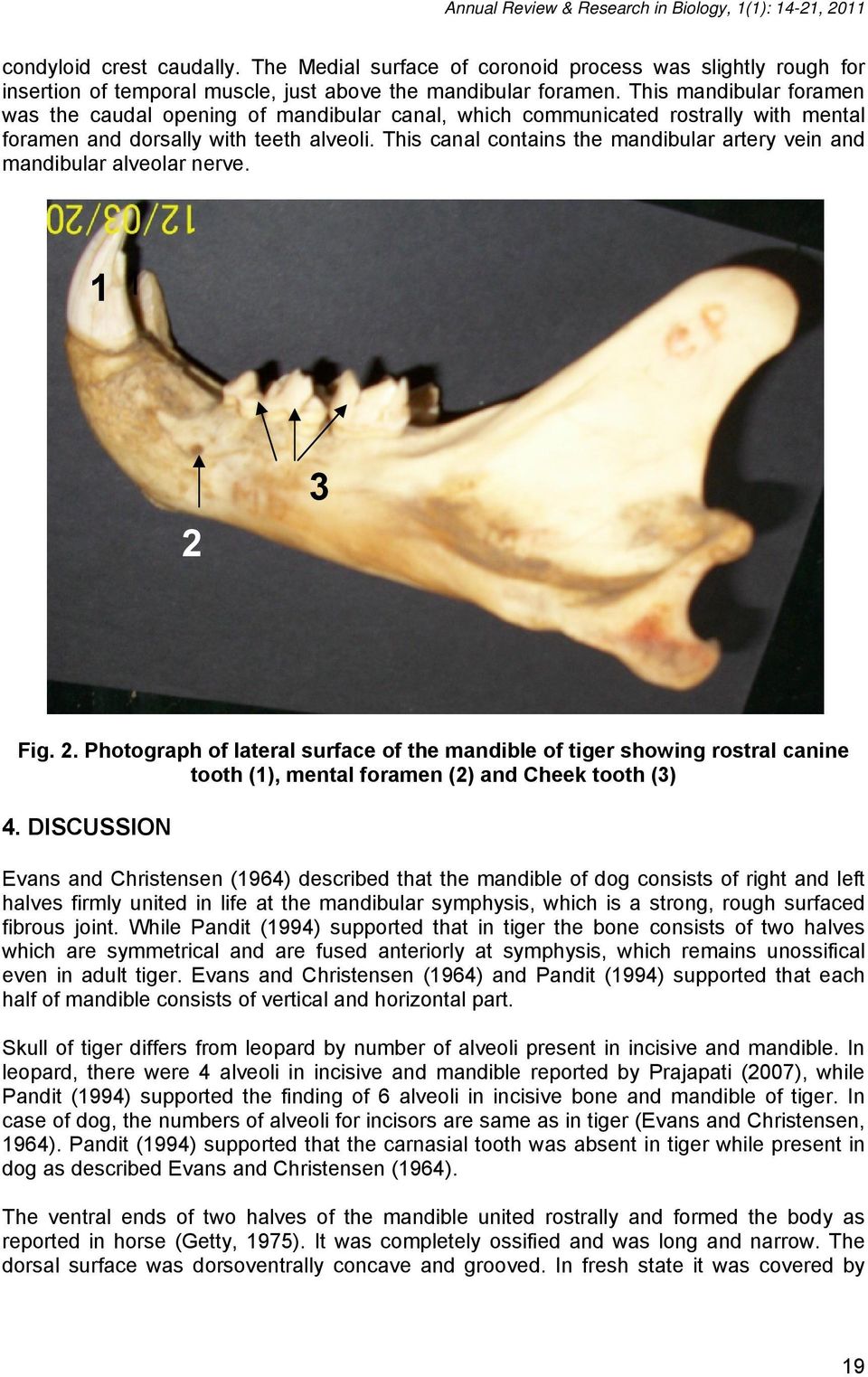
3 Table. 1. Different Parameters taken under study Sr. No. Parameters 1 Weight of the mandible by electronic balance. 3. RESULTS 2 Greatest linear length, width, thickness and height of the mandible. 3 Length, width and thickness of the body of mandible. 4 Height, width and thickness of vertical ramus. 5 Length and width of horizontal ramus. 6 Greatest length and width of mandibular space. 7 Height and width of coronoid process. 8 Rostrocaudal (longitudinal) and Transverse diameter of the mandibular condyle. The lower jaw of tiger was formed by only single bone that was the mandible. As described by evans and cristensen (1964) in dog and Pandit (1994) in tiger that the mandible of tiger was a single bone consisted of 2 halves the right and left. These two halves were attached by mandibular symphysis, which was a fibrous joint. It was not completely ossified in adult tiger. Each half was divided in to a body that was the horizontal part and a ramus that was the vertical part. As in ox and dog these do not fuse completely even in the adult/old age (Raghavan 1964). The mandible was the largest and heaviest (350 ± 2.5g) bone of the skull and was movably articulated with the same (Table 2). Raghavan (1964) and Getty (1975) described the mandible as largest bone of the skull and face respectively in ox. The greatest length, width and height of the mandible measured were 20.1± 1.833cm, ± 0.632cm and ± 0.769cm, respectively. It was thickest (3.50± cm) at its rostral border caudal to the last cheek tooth. The body or the horizontal part again divided into the rostral part that was bearing incisor teeth and the part that was containing molar teeth. The horizontal part of mandible of tiger was a thick rod like which was flattened mediolaterally. Anterior part was thicker (2.1cm) than posterior part because the messeteric fossa was present in posterior part. The anterior end of the bone was thick, blunt and curved upward. This part forms the mandibular symphysis, which was 6.4 cm wide. The dorsal surface of symphysis formed a wide flate area. Anterior part of the body was bearing alveolus for incisor teeth. The corner alveolus was largest measuring larger diameter of 2.1cm and small diameter of 1.5 cm. Lower canine tooth was shorter than upper. There were single alveoli for roots of three incisors teeth. The alveoli for three cheek teeth were having divisions for two roots of each cheek teeth and there were in increasing size (Figure 1). The lingual surface of body was smooth and flat except some rough lines anteroventrally known as myelohyoid lines. The cranial surface of the body of mandible was curved and ventral to incisor. It was flattened and had 2-4 small vascular foramens. On lingual surface in posterior 1/4 th there was a large foramen at the end of wide groove called mandibular foramen measuring diameter 1.1 cm. On the lateral surface of cranial 1/4 th of body there were 2-3 mental foramens out of which middle one was larger than other two (Figure 2). There was no carnasial tooth in the tiger. 16

4 The posterior half of the lateral surface was thin due to the depression known as Masseteric fossa. The ventral surface was thick convex smooth in middle but slightly roughened at both ends for muscle and soft tissue attachments. The dorsal border or the alveolar border between the canine and 1 st cheek tooth had free space called interalveolar margin measuring 2.90 cm similar but very narrow space was present between other adjacent cheek teeth called interalveolar septa measuring cm. The two halves of the mandible was arranged in a diverging manner from the symphysis providing space for tongue known as mandibular space measuring length ± and width11.5 ± (Table 2). The dorsal border behind the last cheek tooth runs backward and upward and continued with vertical ramus of the mandible (Figure 1). Table 2. Range, Mean and SE of weight (g) and linear parameters (cm) of mandible in tiger Parameter Mandible Weight Length Thickness Height Body of mandible Length Thickness Vertical ramus Height Thickness Mandibular space Length Coronoid process Height Mandibular condyle Rostrocaudal diameter Transverse diameter Mean ± SE 350 ± ± ± ± ± ± ± ± ± ± ± ± ± ± ± ± ± Mandibular foramen diameter 1.1± The vertical part of the mandible, ramus was non teeth bearing caudal part of the bone. It was having three processes. The dorsal border behind the last cheek tooth extended upward 17

5 forming flate, large, thin plate of bone with thick ended rostral border called coronoid process measuring height 5.50 ± 0.477cm caudoventral to this process there was a transverse elongated sagittally convex condyloid articular process to form articulation with zygomatic part of temporal bone in mandibular fossa. This articular condyle is known as Mandibular condyle measuring rostro caudal diameter 1.40 ± 0.334cm and transverse diameter 4.50 ± 0.316cm. It was a movable joint. There was a notch between the condyle and coronoid process known as mandibular notch. Caudoventral part of mandible extended caudally and formed a mediolaterally compressed prominent angular process known as angle of the mandible. C Cp Ca B I Fig. 1. Photograph of the dorsal view of mandible showing mandibular condyle (C), coronoid process (Cp), body of the mandible (B) and alveoli of incisor teeth (I) Rostral canine tooth (Ca). On the lateral surface of coronoid process there was masseteric fossa. It was triangular and gave insertion to masseter muscle which was limited by coronoid crest rostrally and by 18

6 condyloid crest caudally. The Medial surface of coronoid process was slightly rough for insertion of temporal muscle, just above the mandibular foramen. This mandibular foramen was the caudal opening of mandibular canal, which communicated rostrally with mental foramen and dorsally with teeth alveoli. This canal contains the mandibular artery vein and mandibular alveolar nerve Fig. 2. Photograph of lateral surface of the mandible of tiger showing rostral canine tooth (1), mental foramen (2) and Cheek tooth (3) 4. DISCUSSION Evans and Christensen (1964) described that the mandible of dog consists of right and left halves firmly united in life at the mandibular symphysis, which is a strong, rough surfaced fibrous joint. While Pandit (1994) supported that in tiger the bone consists of two halves which are symmetrical and are fused anteriorly at symphysis, which remains unossifical even in adult tiger. Evans and Christensen (1964) and Pandit (1994) supported that each half of mandible consists of vertical and horizontal part. Skull of tiger differs from leopard by number of alveoli present in incisive and mandible. In leopard, there were 4 alveoli in incisive and mandible reported by Prajapati (2007), while Pandit (1994) supported the finding of 6 alveoli in incisive bone and mandible of tiger. In case of dog, the numbers of alveoli for incisors are same as in tiger (Evans and Christensen, 1964). Pandit (1994) supported that the carnasial tooth was absent in tiger while present in dog as described Evans and Christensen (1964). The ventral ends of two halves of the mandible united rostrally and formed the body as reported in horse (Getty, 1975). It was completely ossified and was long and narrow. The dorsal surface was dorsoventrally concave and grooved. In fresh state it was covered by 19
7 buccal mucous membrane. The ventral surface was convex and more extensive than the lingual surface (Figure 1-2). The vertical part was expanded and served for the purpose of muscular attachment. Each ramus presented two surfaces, two borders and two extremities as has been described by Getty (1975). The lateral surface of horizontal ramus was smooth and convex from above downwards. At the junction with the body there was a fossa containing comparatively large mental foramen which is the external opening of the mandibular canal. The vertical part of the ramus of the mandible presented rough lines on the lateral surface for the attachment of masseteric muscles. The medial surface of the horizontal part was smooth and convex. Close to the alveolar border there was a faint rough myelohyoid line for the attachment of mylohyoid muscle. The medial surface of the vertical part of ramus was convexo concave from before backwards. It was marked by a prominence at the junction of the alveolar border and rostral border of the vertical part of ramus. The mandibular foramen was approximately in middle of the medial surface of vertical ramus of mandible as reported by Rashid and Kausar (2005) in ox and dog and it was further forward in the horse. The mandibular foramen marked the entrance of the mandibular canal which traversed through the bone and passed below the roots of lower cheek teeth and opened at mental foramen. The ventral extremity of the ramus was fused with the body. The articular extremity consisted of coronoid process, mandibular notch and mandibular condyle. The coronoid process was almost straight with blunt and thick caudal end. It projected upwards and backwards. It was flattened from side to side. In the articulated condition it projected into the temporal fossa and served for the attachment of the temporalis muscle as reported by Prajapati (2007) in leopard and by Pandit (1994) in tiger. In horse the coronoid process is reported as thin transversely and curved slightly medially and backward. In ox it curves backward (Getty, 1975). In dog it is very extensive and bent slightly outward and backward (Rashid and Kausar, 2005). 5. CONCLUSION The following conclusions were drawn out of the present study: 1. The gross morphological and morphometrical parameters were established. 2. The mandible of tiger can be differentiated on gross morphological and morphometrical parameters with leopard by presence of 3 incisor teeth and more prominent angle of mandible. 3. The information obtained by the study will be of academic importance. The data base of the present study will be helpful as an aid in wildlife forensic. 6. SUGGESTIONS FOR FURTHER WORK 1. Gross morphological features and measurements of major bones of animals belong to schedule-i of Wildlife Protection Act (1972) should be studied for preparation of a complete database for species identification. 2. Comparative osteological studies of major bones of threatened species should be carried out. 3. Radiological study of major bones of tiger may be carried out for identification and determination of age. 20

8 REFERENCES Evans, H.E., Christensen, G.C. (1964). Anatomy of the Dog. Publ., W.B. Saunders Co., Philadelphia, 147p. Getty, R. (1977). Sisson and Grossman s the Anatomy of the Domestic Animals-II. 5 th edn. Publ., the Macmillan Co. of India Ltd., pp Kirberger, R.M., du Plessis, W.M., Turner, P.H. (2005). Radiologic anatomy of the normal appendicular skeleton of the lion (Panthera leo). Part I: thoracic limb. J. Zoo Wildl. Med., 36, Kirberger, R.M., du Plessis, W.M., Turner, P.H. (2005). Radiologic anatomy of the normal appendicular skeleton of the lion (Panthera leo). Part 2: pelvic limb. J. Zoo Wildl. Med., 36, Kunzel, W., Probst, A. (1999). Anatomical features of the carpal joint of the cheetah (Acinonyx jabatus) compaired to domestic cat (Felis catus). Vet. Bull., 69(1), Kumar, R. (2008). Studies on characteristic features of axial skeleton of leopard as an aid in wildlife forensic. M.V.Sc. Thesis, JNKVV, Jabalpur. Pandit, R.V. (1994). Osteology of Indian tiger (Panthera tigris tigris). Tech. Bull. No. VI, Conservator of Forest and Director, Project Tiger, Melghat, Podhade, D.N. (2007). Studies on characteristic features of appendicular skeleton of leopard as an aid in wildlife forensic. M.V.Sc. Thesis, JNKVV, Jabalpur.Amravati, pp Podhade, D.N. (2007). Studies on characteristic features of appendicular skeleton of leopard as an aid in wildlife forensic. M.V.Sc. Thesis, JNKVV, Jabalpur. Raghavan D. (1964). Anatomy of Ox. Indian Council of Agricultural Research, New Delhi. Rashid, R.D., Kausar, R. (2005). Comparative gross anatomical studies of the skull of one humped camel (Camelus dromedarius). Pak. Vet. J., 25(4), Tewari et al.; This is an Open Access article distributed under the terms of the Creative Commons Attribution License ( which permits unrestricted use, distribution, and reproduction in any medium, provided the original work is properly cited. 21

DEVELOPMENT AND GROWTH OF THE MANDIBLE
 2012-2013 ORAL BIOLOGY DEVELOPMENT AND GROWTH OF THE MANDIBLE Ass. Prof. Dr. Heba M. Elsabaa Development and Growth of the Mandible DEVELOPMENT OF THE MANDIBLE The Mandible Is the largest and strongest
Classification of Malocclusion
 Classification of Malocclusion What s going on here? How would you describe this? Dr. Robert Gallois REFERENCE: Where Do We Begin? ESSENTIALS FOR ORTHODONTIC PRACTICE By Riolo and Avery Chapter 6 pages
Objectives AXIAL SKELETON. 1. Frontal Bone. 2. Parietal Bones. 3. Temporal Bones. CRANIAL BONES (8 total flat bones w/ 2 paired)
 Objectives AXIAL SKELETON SKULL 1. On a skull or diagram, identify and name the bones of the skull 2. Identify the structure and function of the bones of the skull 3. Describe how a fetal skull differs
Lectures of Human Anatomy
 Lectures of Human Anatomy Vertebral Column-I By DR. ABDEL-MONEM AWAD HEGAZY M.B. with honor 1983, Dipl."Gynecology and Obstetrics "1989, Master "Anatomy and Embryology" 1994, M.D. "Anatomy and Embryology"
Human, Male, White. Bone Clones Osteological Evaluation Report. Product Number: 1 intact mandible. General observations:
 Human, Male, White Product Number: Specimen Evaluated: Skeletal Inventory: BC-107 Bone Clones replica 1 intact cranium 1 intact mandible General observations: In general, the molding process has preserved
The Axial Skeleton Eighty bones segregated into three regions
 The Axial Skeleton Eighty bones segregated into three regions Skull Vertebral column Bony thorax Bones of the Axial Skeleton Figure 7.1 The Skull The skull, the body s most complex bony structure, is formed
Local Anesthesia in Oral Surgery. Animal Dental Care
 Local Anesthesia in Oral Surgery Presented by: Animal Dental Care Tony M. Woodward DVM, Dipl. AVDC 5520 N. Nevada Ave. Suite 150 Colorado Springs, CO 80918 (719) 536-9949 [email protected] www.wellpets.com
Human Anatomy & Physiology
 PowerPoint Lecture Slides prepared by Barbara Heard, Atlantic Cape Community College Ninth Edition Human Anatomy & Physiology C H A P T E R 7 The Skeleton: Part B Annie Leibovitz/Contact Press Images Vertebral
Introduction. I. Objectives. II. Introduction. A. To become familiar with the terms of direction and location.
 E X E R C I S E Introduction I. Objectives A. To become familiar with the terms of direction and location. B. To become familiar with different types of planes and sections. C. To learn the names and locations
Lab 5 Overview of the Skeleton: Classification and Structure of Bones and Cartilages Exercise 9 The Axial Skeleton Exercise 10
 Lab 5 Overview of the Skeleton: Classification and Structure of Bones and Cartilages Exercise 9 The Axial Skeleton Exercise 10 Overview of the Skeleton Locate the important cartilages in the human skeleton
Unit 4: Skeletal System Test Review Test Review
 Name: Period: Unit 4: Skeletal System Test Review Test Review 1. List four functions of the skeletal system: a. b. c. d. 2. Define ossification and identify the roles of the osteoblasts, osteocytes, and
Clarification of Terms
 Shoulder Girdle Clarification of Terms Shoulder girdle = scapula and clavicle Shoulder joint (glenohumeral joint) = scapula and humerus What is the purpose (or function) of the shoulder and entire upper
Simplified Positioning for Dental Radiology
 Simplified Positioning for Dental Radiology Prepared by: Animal Dental Care Tony M. Woodward DVM, Dipl. AVDC 5520 N. Nevada Ave. Suite 150 Colorado Springs, CO 80918 (719) 536-9949 [email protected] www.wellpets.com
Local Anesthesia in Veterinary Dentistry
 Local Anesthesia in Veterinary Dentistry There are two excellent articles (way better than this one) that you may also want to access. In fact, I highly recommend that you order the appropriate back-issues
Introduction to Dental Anatomy
 Introduction to Dental Anatomy Vickie P. Overman, RDH, MEd Continuing Education Units: N/A This continuing education course is intended for dental students and dental hygiene students. Maintaining the
Vertebral anatomy study guide. Human Structure Summer 2015. Prepared by Daniel Schmitt, Angel Zeininger, and Karyne Rabey.
 Vertebral anatomy study guide. Human Structure Summer 2015 Prepared by Daniel Schmitt, Angel Zeininger, and Karyne Rabey. 1. Plan of Action: In this guide you will learn to identify these structures: Cervical
Laerdal' Human Anatomy Manual The Skeleton
 Human Anatomy Manual The Skeleton Laerdal Texas P.O. Box 38.226 EM. 116 Gatesville,Texas U.S.A.76528 U.S.A.1-800-433-5539 IntemationaI1-254-865-7221 24 Hour Fax 254-865-8011 ~ Laerdal' TABLE OF CONTENTS
THE SKELETAL SYSTEM - THE AXIAL SKELETON
 THE SKELETAL SYSTEM - THE AXIAL SKELETON Chapter 7 Anatomy and Physiology Lecture 1 THE SKELETAL SYSTEM THE AXIAL SKELETON Skeletal System forms the framework of the body. TYPES OF BONES: FOUR PRINCIPAL
LESSON ASSIGNMENT. Topography of the Mouth and Tooth Structure. After completing this lesson, you should be able to:
 LESSON ASSIGNMENT LESSON 3 Topography of the Mouth and Tooth Structure. LESSON ASSIGNMENT Paragraphs 3-1 through 3-9. LESSON OBJECTIVES After completing this lesson, you should be able to: 3-1. Identify
specimen, a practically complete cranium, was found by the author's
 Article 56.9,33N XLI.- PRELIMINARY DIAGNOSIS OF AN APPARENTLY NEW FAMILY OF INSECTIVORES. BY H. E. ANTHONY. PLATE XXIII. In July, 1916, while searching for remains of fossil mammals in Porto Rico, in accordance
Headgear Appliances. Dentofacial Orthopedics and Orthodontics. A Common Misconception. What is Headgear? Ideal Orthodontic Treatment Sequence
 Ideal Orthodontic Treatment Sequence Headgear Appliances Natalie A. Capan, D.M.D. 580 Sylvan Avenue, Suite 1M Englewood Cliffs, New Jersey 07632 (201)569-9055 www.capanorthodontics.com [email protected]
LOCOMOTION AND MOVEMENT
 UNIT - HUMAN PHYSIOLOGY Chapter 18 LOCOMOTION AND MOVEMENT Movement is an important feature of living organism. Both the microbes and macrobes show wide range of movements. The movements results in change
Anatomy and Physiology 121: Muscles of the Human Body
 Epicranius Anatomy and Physiology 121: Muscles of the Human Body Covers upper cranium Raises eyebrows, surprise, headaches Parts Frontalis Occipitalis Epicranial aponeurosis Orbicularis oculi Ring (sphincter)
Anatomy PHL 212. By Dr Tajdar Husain Khan
 Anatomy PHL 212 By Dr Tajdar Husain Khan Overview of Anatomy Anatomy(from the Greek word anatome,"dissection") is a branch of natural science dealing with the structural organization of living things The
Skeletal System. Axial Skeleton: Vertebral Column and Ribs
 Skeletal System Axial Skeleton: Vertebral Column and Ribs Functions Regions Cervical Thoracic Lumbar Sacral Primary & secondary curvatures There are three major functions of the vertebral column. First,
its lifetime. The skeletal system is divided into: 1. Axial Division: bones of the body s axis (skulll, ribs, vertebrae)
 The Axial Skeleton The basic features of the human skeleton have been shaped by evolution, but the detailed characteristics of each bone reflect the stresses put on it. As a result, the skeleton changes
SURGICAL EXTRACTIONS: TECHNIQUE AND CAUTIONS By Tony M. Woodward, DVM, AVDC
 SURGICAL EXTRACTIONS: TECHNIQUE AND CAUTIONS By Tony M. Woodward, DVM, AVDC We continue describing the five basic dental services that all general practitioners should be able to provide for their patients.
Chapter 11. What are the functions of the skeletal system? More detail on bone
 Skeletal System Chapter 11 11.1 Overview of the skeletal system What are the functions of the skeletal system? 1. Supports the body 2. Protects the soft body parts 3. Produces blood cells 4. Stores minerals
Supported by. A seven part series exploring the fantastic world of science.
 Supported by A seven part series exploring the fantastic world of science. Find out about the different types of teeth in your mouth. Milk Teeth As a child you have 20 milk teeth. Your first tooth appears
dental nerve strong sensory stimuli anesthesia requirements
 Ban0108_022-033.qxd 2/1/08 2:45 PM Page 22 Dental nerve block techniques Proper training and practice can enhance the level of care you offer to Pets and clients. { Crown Gingival margin By Gary S. Goldstein,
Periapical radiography
 8 Periapical radiography Periapical radiography describes intraoral techniques designed to show individual teeth and the tissues around the apices. Each film usually shows two to four teeth and provides
porcelain fused to metal crown
 Lectur.5 Dr.Adel F.Ibraheem porcelain fused to metal crown the most widely used fixed restoration,it is full metal crown having facial surface (or all surfaces) covered by ceramic material. It consist
Definition: A joint or articulation is a place in the body where two bones come together.
 Definition: A joint or articulation is a place in the body where two bones come together. CLASSES OF JOINTS. 1. Joints are classified according to how the bones are held together. 2. The three types of
Anatomy and Pathomechanics of the Sacrum and Pelvis. Charles R. Thompson Head Athletic Trainer Princeton University
 Anatomy and Pathomechanics of the Sacrum and Pelvis Charles R. Thompson Head Athletic Trainer Princeton University Simplify Everything There are actually only three bones: Two innominates, one sacrum.
Dental Updates. Excerpted Article e-mail: [email protected]. Why Implant Screws Loosen Part 1. Richard Erickson, MS, DDS
 ¼ ½ ¾ µ mw/cm 2 Volume 17; 2007 Dental Updates "CUTTING EDGE INFORMATION FOR THE DENTAL PROFESSIONAL " 200 SEMINARS AND 30 JOURNALS REVIEWED YEARLY FOR THE LATEST, CUTTING EDGE INFORMATION Excerpted Article
Anatomy of Skeletal System
 Anatomy of Skeletal System two main subdivisions of skeletal system: axial : skull, vertebral column, rib cage appendicular: arms and legs and girdles Bone Markings: Foramen: opening in bone passageway
Complications Associated with Tooth Extraction
 1 Complications Associated with Tooth Extraction Mark M. Smith, VMD, DACVS, DAVDC Center for Veterinary Dentistry and Oral Surgery 9041 Gaither Road Gaithersburg, MD 20877 Introduction Tooth extraction
Upper Limb QUESTIONS UPPER LIMB: QUESTIONS
 1 Upper Limb QUESTIONS 1.1 Which of the following statements best describes the scapula? a. It usually overlies the 2nd to 9th ribs. b. The spine continues laterally as the coracoid process. c. The suprascapular
A MORPHOMETRIC STUDY OF THE PEDICLES IN DRY HUMAN TYPICAL THORACIC VERTEBRAE
 IJCRR Research Article A MORPHOMETRIC STUDY OF THE PEDICLES IN DRY HUMAN TYPICAL THORACIC VERTEBRAE Dhaval K. Patil, Pritha S. Bhuiyan Department of Anatomy, Seth G S Medical College, Parel, Mumbai-12,
Denture Trouble Shooting Guide
 Denture Trouble Shooting Guide Comfort Sore spot in vestibuleupper or lower denture 1. Overextended borders 2. Rough spot in base 1. Shorten borders and polish. 2. Refinish borders. Sore spot in upper
Full Crown Module: Learner Level 1
 Full Crown Module Restoration / Tooth # Full Gold Crown (FGC) / 30 Extensions: Porcelain Fused to Metal (PFM) / 12 All Ceramic / 8 Learner Level 1 Mastery of Tooth Preparation Estimated Set Up Time: 30
Handbook of radiographic positions and projections in the dog
 THE VETERINARY PUBLISHING COMPANY COMPANION ANIMALS Handbook of radiographic positions and projections in the dog Aimed at veterinary surgeons, students, teachers and other professionals in the veterinary
Maxillary Sinus. (Antrum of Higmore)
 Maxillary Sinus (Antrum of Higmore) The maxillary sinus is a pneumatic space. It is the largest bilateral air sinus located in the body of the maxilla and opens in the middle nasal meatus of the nasal
CHAPTER 8: JOINTS OF THE SKELETAL SYSTEM. 4. Name the three types of fibrous joints and give an example of each.
 OBJECTIVES: 1. Define the term articulation. 2. Distinguish between the functional and structural classification of joints, and relate the terms that are essentially synonymous. 3. Compare and contrast
Human Anatomy and Physiology II Laboratory
 Human Anatomy and Physiology II Laboratory The Circulation (Two Weeks) 1 This lab involves two weeks work studying the vasculature of the human body. Both weeks involve the exercise in the lab manual entitled
CHAPTER 10 RESTS AND PREPARATIONS. 4. Serve as a reference point for evaluating the fit of the framework to the teeth.
 CHAPTER 10 RESTS AND DEFINITIONS A REST is any rigid part of an RPD framework which contacts a properly prepared surface of a tooth. A REST PREPARATION or REST SEAT is any portion of a tooth or restoration
OCCLUSION IN COMPLETE DENTURES
 1 OCCLUSION IN COMPLETE DENTURES C P Owen Introduction Occlusion has been described as the most important subject in all the disciplines of dentistry, and for good reason, because the way the teeth come
LABORATORY EXERCISE 12 BONE STRUCTURE AND CLASSIFICATION
 LABORATORY EXERCISE 12 BONE STRUCTURE AND CLASSIFICATION FIG. 12.1 1. Articular cartilage (hyaline cartilage) 6. Periosteum 2. Spongy bone (red marrow) 7. Proximal epiphysis 3. Medullary cavity 8. Diaphysis
Resorptive Changes of Maxillary and Mandibular Bone Structures in Removable Denture Wearers
 Resorptive Changes of Maxillary and Mandibular Bone Structures in Removable Denture Wearers Dubravka KnezoviÊ-ZlatariÊ Asja»elebiÊ Biserka LaziÊ Department of Prosthodontics School of Dental Medicine University
Divisions of the Skeletal System
 OpenStax-CNX module: m46344 1 Divisions of the Skeletal System OpenStax College This work is produced by OpenStax-CNX and licensed under the Creative Commons Attribution License 3.0 By the end of this
Chapter 5 The Skeletal System
 Essentials of Human Anatomy & Physiology Elaine N. Marieb Seventh Edition Chapter 5 The Skeletal System The Skeletal System Parts of the skeletal system Bones (skeleton) Joints Cartilages Ligaments (bone
CHAPTER 9 BODY ORGANIZATION
 CHAPTER 9 BODY ORGANIZATION Objectives Identify the meaning of 10 or more terms relating to the organization of the body Describe the properties of life Describe the function for the structures of the
Anatomy and Terminology of the Spine. Bones of the Spine (Vertebrae)
 Anatomy and Terminology of the Spine The spine, also called the spinal column, vertebral column or backbone, consists of bones, intervertebral discs, ligaments, and joints. In addition, the spine serves
THE SKELETAL & ARTICULAR SYSTEMS. The Bones & Joints
 THE SKELETAL & ARTICULAR SYSTEMS The Bones & Joints CLOSE YOUR POWERPOINT HANDOUTS!! Think-Pair-Share: Why do we need bones? Try to think of 3 reasons. THE SKELETAL SYSTEM Is made up of numerous bones
Impression Technique for complete dentures
 Impression Technique for complete dentures Dr. M A Abdullah M.D.S. Associate Professor of Prosthodontics, College of Dentistry, King Saud University. Saudi Arabia. References. Heartwell C M, Rahn A O,Text
UNIT 4 - SKELETAL SYSTEM LECTURE NOTES
 UNIT 4 - SKELETAL SYSTEM LECTURE NOTES 4.01 FUNCTIONS OF THE SKELETAL SYSTEM A. Support 1. Provides a framework for the body. 2. Supports soft tissue. 3. Serves as a point of attachment for ligaments,
!Financial agreement COST / RISK / BENEFIT
 COMPLETE DENTURES 1 2 Oral Examination, Diagnosis and Treatment Planning Initial Appointment! Get to know your patient! Personally, experiences, expectations! Past medical history! Past dental history!
Welcome to Anatomy & Physiology
 Welcome to Anatomy & Physiology Chapter 1 -Human Organization What do you need to do to pass this class? MEMORIZE! The Scope of Human Anatomy Human anatomy is the study of the structure of the human body.
II. Axial Skeleton (Skull, Thoracic Cage, and Vertebral Column)
 THE SKELETAL SYSTEM Lab Objectives Students should be able to: 1. Recognize bones and bone markings for the axial and appendicular skeleton 2. Recognize bones disarticulated and/or articulated 3. Identify
Human Anatomy & Physiology General
 Human Anatomy & Physiology General Biology is the study of life but, what exactly is life? how are living things different from nonliving things eg. a human from a rock eg. a a human from a robot eg. a
Universal Crown and Bridge Preparation
 Universal Crown and Bridge Preparation The All-Ceramic Crown Preparation Technique for Predictable Success According to Dr. Ronald E. Goldstein Expect the Best. Buy Direct. The Universal * Crown and Bridge
Healing Abutment Selection. Perio Implant Part I. Implant Surface Characteristics. Single Tooth Restorations. Credit and Thanks for Lecture Material
 Healing Abutment Selection Perio Implant Part I Credit and Thanks for Lecture Material Implant Surface Characteristics!CAPT Robert Taft!CAPT Greg Waskewicz!Periodontal Residents NPDS and UMN!Machined Titanium!Tiunite!Osseotite
Republic Polytechnic. Continuing Education & Training. Course Structure: Anatomy & Physiology
 Republic Polytechnic Continuing Education & Training Course Structure: Anatomy & Physiology Module Anatomy and Physiology Description This module introduces the basic human anatomical organization, tissue
ATLANTIS abutments design guide CAD/CAM patient-specific abutments
 ATLANTIS abutments design guide CAD/CAM patient-specific abutments Contents Introduction 4 This manual helps you to explore all the benefits of ATLANTIS CAD/CAM patient-specific abutments. It gives you
An overview of the anatomy of the canine hindlimb
 An overview of the anatomy of the canine hindlimb Darren Kelly Artwork by Paddy Lennon Original photos courtesy of Mary Ferguson Students at University College Dublin, School of Veterinary Medicine. Video
UNIT 1 BODY PLAN AND ORGANIZATION LECTURE
 UNIT 1 BODY PLAN AND ORGANIZATION LECTURE 1.03 CONTRAST THE SCIENCES OF ANATOMY AND PHYSIOLOGY A. Anatomy Anatomy is the scientific study of structures and the relationship of.. structures to each other.
Lumbar Spine Anatomy. eorthopod.com 228 West Main St., Suite D Missoula, MT 59802-4345 Phone: 406-721-3072 Fax: 406-721-2619 info@eorthopod.
 A Patient s Guide to Lumbar Spine Anatomy 228 West Main St., Suite D Missoula, MT 59802-4345 Phone: 406-721-3072 Fax: 406-721-2619 [email protected] DISCLAIMER: The information in this booklet is compiled
SURGICAL MANUAL. Step By Step Techniques
 SURGICAL MANUAL Step By Step Techniques TABLE OF CONTENTS PRE-SURGICAL 1 8 MEASUREMENT OF BONE.......................... 2 BONE CLASSIFICATION........................... 3 IMPLANT SIZE SELECTION.........................
Computed Tomographic and Ultrasonographic Examination of Equine Dental Structures: Normal and Abnormal Findings
 Published in IVIS with the permission of the AAEP Close this window to return to IVIS Computed Tomographic and Ultrasonographic Examination of Equine Dental Structures: Normal and Abnormal Findings Sarah
Introduction to Veterinary Dental Radiology. Animal Dental Care
 Introduction to Veterinary Dental Radiology Presented by: Animal Dental Care Tony M. Woodward DVM, Dipl. AVDC 5520 N. Nevada Ave. Suite 150 Colorado Springs, CO 80918 (719) 536-9949 [email protected] www.wellpets.com
Chapter 9 Anatomy and Physiology Lecture
 Chapter 9 1 JOINTS Chapter 9 Anatomy and Physiology Lecture Chapter 9 2 JOINTS (Bones are too rigid to bend without causing damage.) (Bones are held together at joints by flexible connective tissue.) (Imagine
An Anatomical Comparison of the Human and Bovine Thoracolumbar Spine
 Journal of Orthopaedic Research 4:298-303, Raven Press, New York 0 1986 Orthopaedic Research Society An Anatomical Comparison of the Human and Bovine Thoracolumbar Spine Paul C. Cotterill, J. P. Kostuik,
TMMC&RC, Teerthanker Mahaveer University, Moradabad, Uttar Pradesh, India, 244001 Mobile No.: +91-9997605146, E Mail drnidhivarshney@gmail.
 SEXUAL DIMORPHISM IN CERVICAL VERTEBRAL CANAL MEASUREMENTS OF HUMAN FOETUSES Nidhi Sharma *, Farah Ghaus, Nafis Ahmad Faruqi, Raghuveer Singh Mandloi * Correspondence to: Dr. Nidhi Sharma, Assistant Professor,
Thoracic Spine Anatomy
 A Patient s Guide to Thoracic Spine Anatomy 228 West Main, Suite C Missoula, MT 59802 Phone: [email protected] DISCLAIMER: The information in this booklet is compiled from a variety of sources.
The Human Skeleton. Bone and Bone Growth
 The Human Skeleton Bone and Bone Growth Bone is living tissue, and, as such, can grow and remodel during a person s lifetime. The three types of bone cells are the osteoblasts, which are responsible for
ANATOMY & PHYSIOLOGY ONLINE COURSE - SESSION 2 ORGANIZATION OF THE BODY
 ANATOMY & PHYSIOLOGY ONLINE COURSE - SESSION 2 ORGANIZATION OF THE BODY Human beings are arguably the most complex organisms on this planet. Imagine billions of microscopic parts, each with its own identity,
NEW YORK CITY COLLEGE OF TECHNOLOGY
 NEW YORK CITY COLLEGE OF TECHNOLOGY THE CITY UNIVERSITY OF NEW YORK DEPARTMENT OF RESTORATIVE DENTISTRY DEPARTMENT: COURSE CODE: COURSE TITLE: COURSE DESCRIPTION: CLASS HOURS & CREDITS: NUMBER OF WEEKS:
IV. DEFINITION OF LYMPH NODE GROUPS (FIGURE 1) Level IA: Submental Group
 IV. DEFINITION OF LYMPH NODE GROUPS (FIGURE 1) Fig. 1 The level system is used for describing the location of lymph nodes in the neck: Level I, submental and submandibular group; Level II, upper jugular
Implants in your Laboratory: Abutment Design
 1/2 point CDT documented scientific credit. See Page 41. Implants in your Laboratory: Abutment Design By Leon Hermanides, CDT A patient s anatomical limitations have the greatest predictive value for successful
Bitewing Radiography B.E. DIXON. B.D.S., M.Sc., D.P.D.S.
 Bitewing Radiography B.E. DIXON B.D.S., M.Sc., D.P.D.S. Main Indications Detection of Dental Caries Monitoring progression of caries Assessment of existing restorations Assessment of Periodontal status
Skeletal system. 2012 Pearson Education, Inc.
 NURS1004 Week 6 Part I Prepared by Didy Button Skeletal system An Introduction to the Skeletal System The Skeletal System Includes: Bones of the skeleton Cartilages, ligaments, and connective tissues 6-1
Classification of bones Any bone may be classified into one of the following groups:
 Skeletal system This system is made up of hard tissues like bone and cartilages. This system gives form and shape to animal body The skeleton of a living animal is made up living structures of bones. The
Veterinary Dentistry Basics
 Veterinary Dentistry Basics Introduction This program will guide you, step by step, through the most important features of veterinary dentistry in current best practice. This chapter covers the basics
FCI-Standard N 105 / 29. 03. 2006 /GB FRENCH WATER DOG. (Barbet)
 FCI-Standard N 105 / 29. 03. 2006 /GB FRENCH WATER DOG (Barbet) 2 TRANSLATION : Jennifer Mulholland. ORIGIN : France DATE OF PUBLICATION OF ORIGINAL VALID STANDARD : 21.02.2006. UTILIZATION: Water dog
Prosthodontist s Perspective
 Unless otherwise noted, the content of this course material is licensed under a Creative Commons Attribution - Non-Commercial - Share Alike 3.0 License. Copyright 2008, Dr. Jeff Shotwell. The following
Dental Radiography. Introduction
 Dental Radiography Radiography of the mouth and associated structures can initially be very frustrating. However, once the techniques are mastered, it is possible to produce high quality diagnostic radiographs
The Gastrointestinal System It consists of: The digestive tract Mouth Pharynx Oesophagus Stomach Small intestine Large intestine
 The Gastrointestinal System It consists of: The digestive tract Mouth Pharynx Oesophagus Stomach Small intestine Large intestine The digestive organs Teeth Tongue Salivary glands Liver Gall bladder Pancreas
Removable appliances II. Functional jaw orthopedics
 Removable appliances II. Functional jaw orthopedics Melinda Madléna DMD, PhD Associate professor Department of Pedodontics and Orthodontics Faculty of Dentistry Semmelweis University Budapest Classification
Tooth preparation J. C. Davenport, 1 R. M. Basker, 2 J. R. Heath, 3 J. P. Ralph, 4 P-O. Glantz, 5 and P. Hammond, 6
 12 5 Tooth preparation J. C. Davenport, 1 R. M. Basker, 2 J. R. Heath, 3 J. P. Ralph, 4 P-O. Glantz, 5 and P. Hammond, 6 This final article in the series describes the modification of teeth to improve
Camelid Dentistry. Stephen R. Purdy, DVM Director of Camelid Studies UMass Amherst President Nunoa Project Peru
 Camelid Dentistry Stephen R. Purdy, DVM Director of Camelid Studies UMass Amherst President Nunoa Project Peru Learning objectives To describe the normal dentition of camelids To explain common corrective
CSE511 Brain & Memory Modeling. Lect04: Brain & Spine Neuroanatomy
 CSE511 Brain & Memory Modeling CSE511 Brain & Memory Modeling Lect02: BOSS Discrete Event Simulator Lect04: Brain & Spine Neuroanatomy Appendix of Purves et al., 4e Larry Wittie Computer Science, StonyBrook
Your Practice. Your Preference. Your Productivity Solution. USER MANUAL
 Your Practice. Your Preference. Your Productivity Solution. USER MANUAL 1 2 Table of Contents 1 Introduction... 4 Basic Keyboard Functionality 4 Image View Orientation 4 Annotation Customization. 5 2 General
IMPLANT DENTISTRY EXAM BANK
 IMPLANT DENTISTRY EXAM BANK 1. Define osseointegration. (4 points, 1/4 2. What are the critical components of an acceptable clinical trial? (10 points) 3. Compare the masticatory performance of individuals
9/3/2013 JOINTS. Joints. Axial Skeleton STRUCTURE AND FUNCTION:
 STRUCTURE AND FUNCTION: JOINTS Joints A connection between 2 or more bones A pivot point for bony motion The features of the joint help determine The ROM freedom Functional potential of the joint Axial
TMJ Dysfunction & Pain
 TMJ Dysfunction & Pain The temporomandibular joints (TMJs) are two of the most functionally important and frequently used joints in the body. It is with these joints that important processes such as chewing,
Skeletal Development Multiple Cellular Origins
 Skeletal Development Multiple Cellular Origins 1 - Paraxial Mesoderm Somite, Sclerotome Axial Skeleton (e.g. vertebra) 2 - Lateral Plate Mesoderm Appendicular Skeleton (e.g. limb) 3 - Neural Crest Head
Chapter 1 An Introduction to Anatomy and Physiology Lecture Outline
 Chapter 1 An Introduction to Anatomy and Physiology Lecture Outline Introduction Characteristics of Living Things 1. Organization 2. Responsiveness 3. Growth & Differentiation 4. Reproduction 5. Movement
ABSTRACT INTRODUCTION. Facial Esthetics. Dental Esthetics
 ABSTRACT The FACE philosophy is characterized by clearly defined treatment goals. This increases diagnostic ability and improves the quality and stability of the end result. The objective is to establish