
Lab 5 Overview of the Skeleton: Classification and Structure of Bones and Cartilages Exercise 9 The Axial Skeleton Exercise 10
|
|
|
- Jocelin Marshall
- 9 years ago
- Views:
Transcription
1 Lab 5 Overview of the Skeleton: Classification and Structure of Bones and Cartilages Exercise 9 The Axial Skeleton Exercise 10 Overview of the Skeleton Locate the important cartilages in the human skeleton (Figure 9.2) Read Classification of Bones on page 114 and then test yourself on the box of numbered bones at the front of the class. Answers are provided on a card in the box. No peeking until you've made your choices! Activity 1: Examining a Long Bone Activity 2: Examining the Effects of Heat and Hydrochloric Acid on Bones Activity 3: Examining the Microscopic Structure of Compact Bone Activity 4: Examining the Osteogenic Epiphyseal Plate The Axial Skeleton Activity 1: Identifying the Bones of the Skull You are responsible for all the bones and bone parts listed on the review sheet. a. Obtain a skull and some blunt probes. If it is a real bone skull, treat it with extreme care and put it on bubble wrap on the lab bench. b. Some structures have been destroyed by use over time on the real skulls and you may have to look at the plastic skulls and the Beauchene skull (photo, p. 129) for help. The lab manual and the atlas that is packaged with your book are both good resources. c. Return the skull to the correct box when you are finished. Activity 2: Palpating Skull Markings Activity 3: Examining Spinal Curvatures Activity 4: Examining Vertebral Structure
2 Name Lab Section Pre-Lab Activity - Turn in at the beginning of lab 1. Bones that surround the body s center of gravity form the (circle one) axial appendicular skeleton 2. The type of cartilage found in the knee joint and intervertebral discs is. a. elastic cartilage b. hyaline cartilage c. fibrocartilage 3. bone appears smooth and homogeneous to the eye. a. spongy b. compact 4. Thin bones with two layers of compact bone and a central layer of spongy bone are usually bones. a. flat b. long c. irregular d. short 5. A central canal and the surrounding lamellae are called an. 6. The three parts of the axial skeleton are the, the, and the. 7. The vertebrae articulate with the ribs. 8. The three parts of the sternum are the, the, and the. 9. True ribs are also called ribs. Floating ribs are also called ribs. Ribs that attach indirectly to the sternum through the costal cartilage of rib 7 are called ribs. 10. The four major parts of a rib are the, the, the, and the.

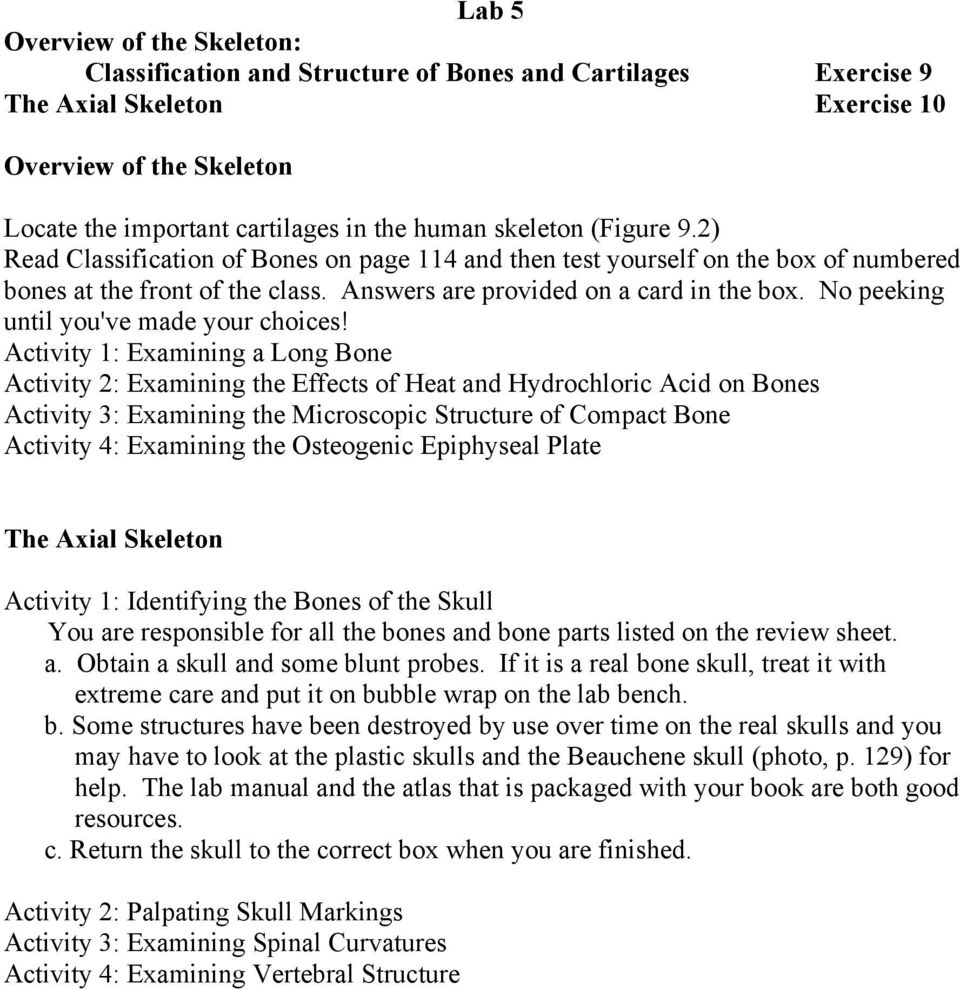
3 Label the skeleton. Print the labels in the margins, not on the lines.
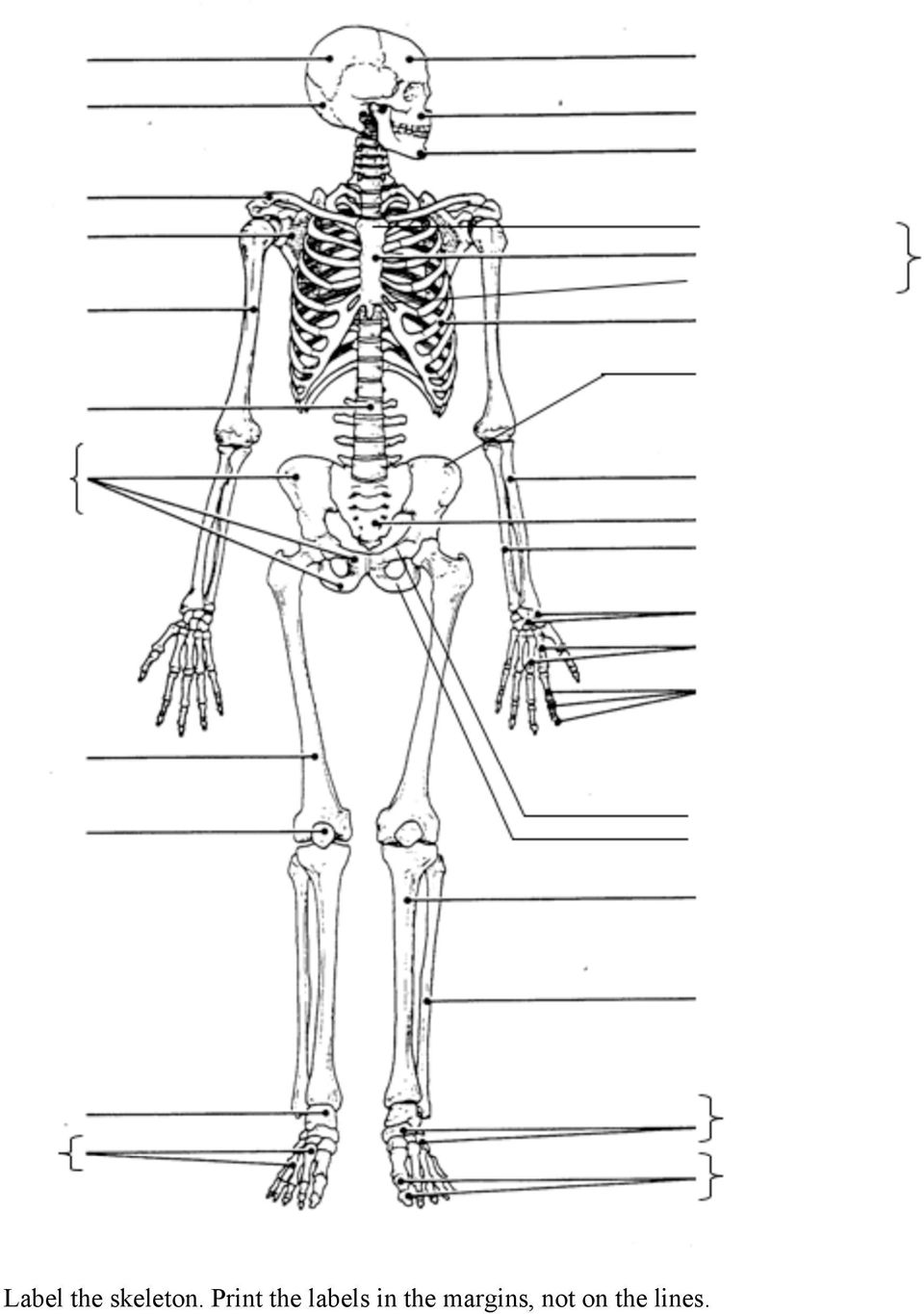
4 Name Lab Section Review Sheet Overview of the Skeleton 1. Terminology Matching. Match the description with the correct term. a. Condyle b. Crest c. Epicondyle d. Fissure e. Foramen f. Fossa g. Head h. Meatus i. Process j. Ramus k. Sinus l. Spine m. Trochanter n. Tubercle o. Tuberosity Projection or prominence Shallow depression Opening through a bone Large rounded projection Small rounded projection Rounded articular projection Canal-like structure Raised area above a condyle Arm-like projection or bar of bone Structure supported on a neck Narrow ridge of bone Very large, blunt irregularly shaped process Narrow slit-like opening Sharp, slender, often pointed projection Space within a bone, air-filled and lined with mucous membrane

5 2. a. What gives bone compressional strength (ability to resist compression)? b. What gives bone tensile strength? c. What is removed when bone is soaked in acid? d. What remains when bone is soaked in acid? e. Why is baked bone brittle? 3. List the four basic bone shapes and give one example of a bone for each. Shape Bone Example a. b. c. d. 4. Blood vessels travel horizontally in bone through canals and vertically in bone through canals. 5. What is the difference in the composition of the red marrow and the yellow marrow? 2 points. 6. Label on figure: matrix, central canal, lacuna, interstitial lamellae, osteon. PRINT the labels neatly in the margins.

6 A F G H E J I D B K L M C N 7. Match the letters on the figure to the terms below. articular cartilage nutrient arteries compact bone proximal epiphysis diaphysis periosteum distal epiphysis perforating fibers endosteum site of red marrow epiphyseal line trabeculae of spongy bone medullary cavity yellow marrow
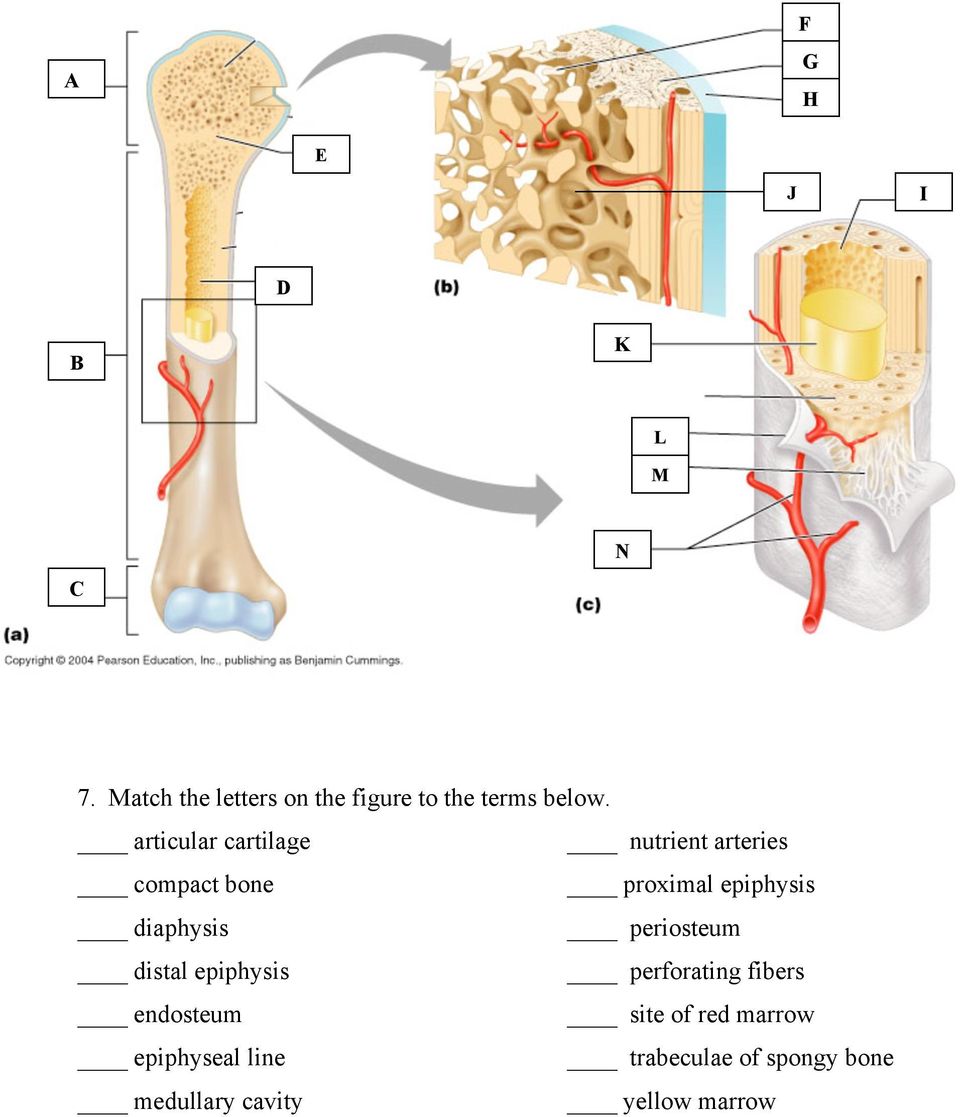
7 8. Match the labels on the figure with the terms below: canaliculus central canal lamella of compact bone lacuna with osteocyte osteon perforating canal periosteum spongy bone B A C D E F H D G

8 9. Trace the flow of nutrients from blood in blood vessels in the periosteum to an osteocyte in a lacuna using the following terms: canaliculus, capillary, central canal, lacuna, nutrient artery, perforating canal. This is an ordering question. Imagine yourself in a boat in a nutrient artery, trying to get to a lacuna. The Axial Skeleton 10. List the three components of the axial skeleton and the major function of each. Part of Axial Skeleton Function 11. List the eight bones of the cranium. Use the terms right and left if the bones are paired. 12. List the paired bones of the cranium. Use the terms right and left. 13. List the flat bones of the cranium. Use the terms right and left if the bones are paired.

9 14. List the bones that form the calvarium or cranial vault. Use the terms right and left if the bones are paired. 15. List the bones that form the floor of the cranium. Use the terms right and left if the bones are paired. 16. List the unpaired bones of the cranium. 17. Name the bone with openings for the optic nerves. 18. Name the bone with openings for the olfactory nerves. 19. Name the bone with an opening for the vestibulocochlear nerve. 20. Name the bone that has an opening for the spinal cord. 21. List the 7 bones of the orbit. XXXXXXXXXXX 22. What is the function of the orbit? 23. List the paired facial bones. Right and Left Right and Left Right and Left Right and Left Right and Left Right and Left 24. List the two unpaired facial bones.
10 25. a. Distinguish between the development of a primary and a secondary curvature of the vertebral column. b. Name the two primary curvatures of the vertebral column. c. Name the two secondary curvatures of the vertebral column. d. When does each of the secondary curvatures develop? 1.) 2.) e. An abnormal lateral curvature of the vertebral column is called f. An abnormal thoracic curvature is called g. An abnormal lumbar curvature is called Draw and label figures to illustrate e., f., and g. Be sure to indicate anterior and posterior or dorsal and ventral where relevant.
11 25. Match the letters on the figures with the terms below Bony thorax (ribs) Cervical vertebra Costal cartilage Coccyx Frontal bone Lumbar vertebra Occipital bone Parietal bone Sacrum Skull Sternum Thoracic vertebra Vertebrae Vertebral rib Vertebrochondral rib Vertebrosternal rib L A F M B N C D H G O P I J I E K

Unit 4: Skeletal System Test Review Test Review
 Name: Period: Unit 4: Skeletal System Test Review Test Review 1. List four functions of the skeletal system: a. b. c. d. 2. Define ossification and identify the roles of the osteoblasts, osteocytes, and
LABORATORY EXERCISE 12 BONE STRUCTURE AND CLASSIFICATION
 LABORATORY EXERCISE 12 BONE STRUCTURE AND CLASSIFICATION FIG. 12.1 1. Articular cartilage (hyaline cartilage) 6. Periosteum 2. Spongy bone (red marrow) 7. Proximal epiphysis 3. Medullary cavity 8. Diaphysis
7. Skeletal System: Bone Structure and Function
 7. Skeletal System: Bone Structure and Function For the next two chapters (7 and 9) we will study the skeletal system. Although the major feature of this system is the bones, the skeletal system also consists
Chapter 11. What are the functions of the skeletal system? More detail on bone
 Skeletal System Chapter 11 11.1 Overview of the skeletal system What are the functions of the skeletal system? 1. Supports the body 2. Protects the soft body parts 3. Produces blood cells 4. Stores minerals
UNIT 4 - SKELETAL SYSTEM LECTURE NOTES
 UNIT 4 - SKELETAL SYSTEM LECTURE NOTES 4.01 FUNCTIONS OF THE SKELETAL SYSTEM A. Support 1. Provides a framework for the body. 2. Supports soft tissue. 3. Serves as a point of attachment for ligaments,
1. outer fibrous layer contains fibroblasts that secrete collagen
 I. cartilage A. perichondrium 1. outer fibrous layer contains fibroblasts that secrete collagen 2. inner chondrogenic layer contains cells that can proliferate and turn into chondroblasts B. cartilage
Human Anatomy & Physiology
 PowerPoint Lecture Slides prepared by Barbara Heard, Atlantic Cape Community College Ninth Edition Human Anatomy & Physiology C H A P T E R 7 The Skeleton: Part B Annie Leibovitz/Contact Press Images Vertebral
Skeletal system. 2012 Pearson Education, Inc.
 NURS1004 Week 6 Part I Prepared by Didy Button Skeletal system An Introduction to the Skeletal System The Skeletal System Includes: Bones of the skeleton Cartilages, ligaments, and connective tissues 6-1
THE SKELETAL SYSTEM - THE AXIAL SKELETON
 THE SKELETAL SYSTEM - THE AXIAL SKELETON Chapter 7 Anatomy and Physiology Lecture 1 THE SKELETAL SYSTEM THE AXIAL SKELETON Skeletal System forms the framework of the body. TYPES OF BONES: FOUR PRINCIPAL
CHS 06-07 BONES AND SKELETAL TISSUES
 CHS 06-07 BONES AND SKELETAL TISSUES This chapter provides a review of bone and skeletal tissue. The human skeleton is composed primarily of two connective tissues: (1) cartilage and (2) bone. CHARACTERISTICS
Skeletal System. Axial Skeleton: Vertebral Column and Ribs
 Skeletal System Axial Skeleton: Vertebral Column and Ribs Functions Regions Cervical Thoracic Lumbar Sacral Primary & secondary curvatures There are three major functions of the vertebral column. First,
OBJECTIVE: List and describe the functions of the skeletal system. D. Storage depot for minerals and homeostasis
 Text Reference: Chapters 6 and 7 Pages 1-6 are mostly a review from lab Know this material before you come to lecture. Lecture will begin on page 7 Read text and complete packet before lecture. I. Introduction
Function of Bones. Bone Tissue and Bones BONE CLASSIFICATION. Long Bones Gross Anatomy. Lab Activity 1 - Gross Anatomy of a Long Bone
 Function of Bones Bone Tissue and Bones Bones form the framework of the skeleton. Anatomy and Physiology Text and Laboratory Workbook, Stephen G. Davenport, Copyright 2006, All Rights Reserved, no part
9/3/2013 JOINTS. Joints. Axial Skeleton STRUCTURE AND FUNCTION:
 STRUCTURE AND FUNCTION: JOINTS Joints A connection between 2 or more bones A pivot point for bony motion The features of the joint help determine The ROM freedom Functional potential of the joint Axial
Vertebral anatomy study guide. Human Structure Summer 2015. Prepared by Daniel Schmitt, Angel Zeininger, and Karyne Rabey.
 Vertebral anatomy study guide. Human Structure Summer 2015 Prepared by Daniel Schmitt, Angel Zeininger, and Karyne Rabey. 1. Plan of Action: In this guide you will learn to identify these structures: Cervical
Osseous Tissue & Structure. The skeletal system includes: Storage of minerals: calcium salts
 Chapter 15 Lecture The Skeletal System: Osseous Tissue & Skeletal Structure The Skeletal System The skeletal system includes: Bones, cartilages, ligaments Bone tissue = osseous tissue Includes living cells
Chapter 5 The Skeletal System
 Essentials of Human Anatomy & Physiology Elaine N. Marieb Seventh Edition Chapter 5 The Skeletal System The Skeletal System Parts of the skeletal system Bones (skeleton) Joints Cartilages Ligaments (bone
BIOL 4260 Human Evolu3onary Anatomy Lecture 5: Bone Development & Trunk Anatomy. Lecture 2: Fossil Record
 BIOL 4260 Human Evolu3onary Anatomy Lecture 5: Bone Development & Trunk Anatomy Lecture 2: Fossil Record Segmentation Cyclic genescreate segme ntation clock for somite production Final #s 4 occipital 8
8/25/2014 JOINTS. The Skeletal System. Axial Skeleton STRUCTURE AND FUNCTION:
 STRUCTURE AND FUNCTION: JOINTS The Skeletal System Made up of the numerous bones of the human body Gives support and framework to the body Protects vital organs Manufactures blood cells Storage of calcium
STRUCTURE AND FUNCTION: JOINTS
 STRUCTURE AND FUNCTION: JOINTS Joints A connection between 2 or more bones A pivot point for bony motion The features of the joint help determine The ROM Degrees of freedom Functional potential of the
BONES AND BONE TISSUE
 BIO 2401 BONES & BONE TISSUE page 1 BONES AND BONE TISSUE Organization of the Skeletal System components: 1) bone 2) skeletal cartilage: surrounded by dense irregular connective tissue which acts to girdle
10/12/2011. Classification of Bones Every adult skeleton contains 206 bones which can be arranged into six broad categories according to shape
 Primary Functions of Skeletal System 1. support 2. storage of minerals & lipids -calcium salts provide vital minerals -lipids are in stored yellow marrow 3. blood cell production -RBC s, WBC s, and other
Laerdal' Human Anatomy Manual The Skeleton
 Human Anatomy Manual The Skeleton Laerdal Texas P.O. Box 38.226 EM. 116 Gatesville,Texas U.S.A.76528 U.S.A.1-800-433-5539 IntemationaI1-254-865-7221 24 Hour Fax 254-865-8011 ~ Laerdal' TABLE OF CONTENTS
E. Blood cells production. Blood cells are produced within the cavities of bones.
 FUNCTIONS OF THE SKELETAL SYSTEM 1. The skeletal system consists of bone, cartilage, ligaments (attach bone to another bone), and tendons (attach muscle to bone). 2. Functions. A. Support. Bone helps to
Chapter 6: The Skeletal System: Bone Tissue
 Chapter 6: The Skeletal System: Bone Tissue Chapter Objectives FUNCTIONS OF THE SKELETAL SYSTEM 1. Discuss the functions of support, protection, assistance in movement, mineral homeostasis, blood cell
its lifetime. The skeletal system is divided into: 1. Axial Division: bones of the body s axis (skulll, ribs, vertebrae)
 The Axial Skeleton The basic features of the human skeleton have been shaped by evolution, but the detailed characteristics of each bone reflect the stresses put on it. As a result, the skeleton changes
Introduction. I. Objectives. II. Introduction. A. To become familiar with the terms of direction and location.
 E X E R C I S E Introduction I. Objectives A. To become familiar with the terms of direction and location. B. To become familiar with different types of planes and sections. C. To learn the names and locations
Skeletal System -Training Handout Karen L. Lancour National Rules Committee Chairman Life Science
 Skeletal System -Training Handout Karen L. Lancour National Rules Committee Chairman Life Science INTERACTION OF SKELETAL AND MUSCULAR SYSTEMS: Skeletal and Muscular systems works together to allow movement
Skeletal Development Multiple Cellular Origins
 Skeletal Development Multiple Cellular Origins 1 - Paraxial Mesoderm Somite, Sclerotome Axial Skeleton (e.g. vertebra) 2 - Lateral Plate Mesoderm Appendicular Skeleton (e.g. limb) 3 - Neural Crest Head
SKELETON AND JOINTS G.C.S.E. PHYSICAL EDUCATION. Unit 1. Factors Affecting Participation and Performance. G.C.S.E. P.E. Teacher:.
 G.C.S.E. PHYSICAL EDUCATION Unit 1 Factors Affecting Participation and Performance SKELETON AND JOINTS Name: G.C.S.E. P.E. Teacher:. By the end of this booklet you should be able to: Understand what the
Divisions of the Skeletal System
 OpenStax-CNX module: m46344 1 Divisions of the Skeletal System OpenStax College This work is produced by OpenStax-CNX and licensed under the Creative Commons Attribution License 3.0 By the end of this
THE SKELETAL & ARTICULAR SYSTEMS. The Bones & Joints
 THE SKELETAL & ARTICULAR SYSTEMS The Bones & Joints CLOSE YOUR POWERPOINT HANDOUTS!! Think-Pair-Share: Why do we need bones? Try to think of 3 reasons. THE SKELETAL SYSTEM Is made up of numerous bones
II. Axial Skeleton (Skull, Thoracic Cage, and Vertebral Column)
 THE SKELETAL SYSTEM Lab Objectives Students should be able to: 1. Recognize bones and bone markings for the axial and appendicular skeleton 2. Recognize bones disarticulated and/or articulated 3. Identify
Thoracic Spine Anatomy
 A Patient s Guide to Thoracic Spine Anatomy 228 West Main, Suite C Missoula, MT 59802 Phone: [email protected] DISCLAIMER: The information in this booklet is compiled from a variety of sources.
Objectives AXIAL SKELETON. 1. Frontal Bone. 2. Parietal Bones. 3. Temporal Bones. CRANIAL BONES (8 total flat bones w/ 2 paired)
 Objectives AXIAL SKELETON SKULL 1. On a skull or diagram, identify and name the bones of the skull 2. Identify the structure and function of the bones of the skull 3. Describe how a fetal skull differs
Classification of bones Any bone may be classified into one of the following groups:
 Skeletal system This system is made up of hard tissues like bone and cartilages. This system gives form and shape to animal body The skeleton of a living animal is made up living structures of bones. The
Lectures of Human Anatomy
 Lectures of Human Anatomy Vertebral Column-I By DR. ABDEL-MONEM AWAD HEGAZY M.B. with honor 1983, Dipl."Gynecology and Obstetrics "1989, Master "Anatomy and Embryology" 1994, M.D. "Anatomy and Embryology"
The Axial Skeleton Eighty bones segregated into three regions
 The Axial Skeleton Eighty bones segregated into three regions Skull Vertebral column Bony thorax Bones of the Axial Skeleton Figure 7.1 The Skull The skull, the body s most complex bony structure, is formed
Anatomy of Skeletal System
 Anatomy of Skeletal System two main subdivisions of skeletal system: axial : skull, vertebral column, rib cage appendicular: arms and legs and girdles Bone Markings: Foramen: opening in bone passageway
THE SKELETAL SYSTEM: BONE TISSUE. Chapter 6. Anatomy and Physiology Lecture
 Chapter 6 1 THE SKELETAL SYSTEM: BONE TISSUE Chapter 6 Anatomy and Physiology Lecture Chapter 6 2 THE SKELETAL SYSTEM: BONE TISSUE Bone (Osseous) Tissue forms most of the skeleton: Skeletal System - the
SAMPLE LECTURE EXAM 1 -- HUMAN ANATOMY
 SAMPLE LECTURE EXAM 1 -- HUMAN ANATOMY 1. The subcutaneous layer consists mostly of. a. smooth muscle c. areolar and adipose connective tissues d. melanin e. keratin 2. Which of the following statements
Lumbar Spine Anatomy. eorthopod.com 228 West Main St., Suite D Missoula, MT 59802-4345 Phone: 406-721-3072 Fax: 406-721-2619 info@eorthopod.
 A Patient s Guide to Lumbar Spine Anatomy 228 West Main St., Suite D Missoula, MT 59802-4345 Phone: 406-721-3072 Fax: 406-721-2619 [email protected] DISCLAIMER: The information in this booklet is compiled
THE SKELETAL SYSTEM FUNCTIONS OF THE SKELETAL SYSTEM
 THE SKELETAL SYSTEM The skeleton is the body s bony framework which consists of 206 bones. The bones are made up of water(45%), calcium and phosphorous(35%) and other organic materials(20%). The calcium
Human Anatomy & Physiology I with Dr. Hubley. Practice Exam #2
 Human Anatomy & Physiology I with Dr. Hubley Practice Exam #2 For questions 1 through 3, select your answers from the following responses: a. stratified squamous epithelium b. reticular connective tissue
Anatomy and Terminology of the Spine. Bones of the Spine (Vertebrae)
 Anatomy and Terminology of the Spine The spine, also called the spinal column, vertebral column or backbone, consists of bones, intervertebral discs, ligaments, and joints. In addition, the spine serves
Anatomy and Physiology of Domestic Animals
 Anatomy and Physiology of Domestic Animals 6 Bones and skeletal system Contents Bones Introduction Classification of Bones Bone Structure Gross Anatomy Microscopic Anatomy of Bone Chemical Composition
The Axial Skeleton. PowerPoint Lecture Presentations prepared by Jason LaPres. Lone Star College North Harris. 2012 Pearson Education, Inc.
 7 The Axial Skeleton PowerPoint Lecture Presentations prepared by Jason LaPres Lone Star College North Harris Skeletal System The skeleton forms the framework for the body Provides support: Attachment
LESSON ASSIGNMENT. After completing this lesson, you should be able to: 4-1. Define skeleton.
 LESSON ASSIGNMENT LESSON 4 The Human Skeletal System. TEXT ASSIGNMENT Paragraphs 4-1 through 4-14. LESSON OBJECTIVES After completing this lesson, you should be able to: 4-1. Define skeleton. 4-2. Name
6 BONE TISSUE AND THE SKELETAL SYSTEM
 CHAPTER 6 BONE TISSUE AND THE SKELETAL SYSTEM 203 6 BONE TISSUE AND THE SKELETAL SYSTEM Figure 6.1 Child Looking at Bones Bone is a living tissue. Unlike the bones of a fossil made inert by a process of
Problems. Knowing. back of the
 Introduction Welcome to BodyZone Physiotherapy patient resource about Cervical Spine Problems. Knowing the main parts of your neck and how these parts work is important as you learn to care for your neck
Anatomy and Physiology Warm up questions Fall 2013
 Anatomy and Physiology Warm up questions Fall 2013 QUESTION POSSIBLE ANSWERS : Chapter 1 Introduction and Regions Chapter 2 Chemistry I can name systems of the I can identify regions of the I can describe
Brunswick School Department: Grades 11-12. Essential Understandings
 Understandings Questions Knowledge Vocabulary Skills Bones provide invaluable structure and support for the body. There are a variety of bone shapes. Joints connect bones. The skeletal system is divided
If you or a loved one have suffered because of a negligent error during spinal surgery, you will be going through a difficult time.
 If you or a loved one have suffered because of a negligent error during spinal surgery, you will be going through a difficult time. You may be worried about your future, both in respect of finances and
UNIT 2 - CHAPTER 7: SKELETAL SYSTEM. 1. Classify bones according to their shapes, and name an example from each group. (p. 200)
 LEARNING OUTCOMES: 7.1 Bone Shape and Structure UNIT 2 - CHAPTER 7: SKELETAL SYSTEM 1. Classify bones according to their shapes, and name an example from each group. (p. 200) 2. Describe the macroscopic
Spine Anatomy and Spine General The purpose of the spine is to help us stand and sit straight, move, and provide protection to the spinal cord.
 Spine Anatomy and Spine General The purpose of the spine is to help us stand and sit straight, move, and provide protection to the spinal cord. Normal List Kyphosis The human spine has 7 Cervical vertebra
Spinal Anatomy. * MedX research contends that the lumbar region really starts at T-11, based upon the attributes of the vertebra.
 Spinal Anatomy Overview Neck and back pain, especially pain in the lower back, is one of the most common health problems in adults. Fortunately, most back and neck pain is temporary, resulting from short-term
Anatomical Terminology: Planes Axes Direction (Text Pg 2 3)
 Anatomical Terminology: Planes Axes Direction (Text Pg 2 3) Anatomy: The structure and organization of the body and its organs. From Greek Origin: Anatome dissection Physiology: The function of the body
LOCOMOTION AND MOVEMENT
 UNIT - HUMAN PHYSIOLOGY Chapter 18 LOCOMOTION AND MOVEMENT Movement is an important feature of living organism. Both the microbes and macrobes show wide range of movements. The movements results in change
The Vertebral Column, The Ribs and The Sternum. S. LAFCI FAHRİOĞLU, MD. PhD.
 The Vertebral Column, The Ribs and The Sternum S. LAFCI FAHRİOĞLU, MD. PhD. The Vertebral Column (Spine) The Vertebral Column-The spine (Columna vertebralis) forms the skeleton of the back is part of the
Patient Information. Anterior Cervical Discectomy and Fusion Surgery (ACDF).
 Patient Information. Anterior Cervical Discectomy and Fusion Surgery (ACDF). Understanding your spine Disc Between each pair of vertebrae there is a disc that acts as a cushion to protect the vertebra,
Welcome to Anatomy & Physiology
 Welcome to Anatomy & Physiology Chapter 1 -Human Organization What do you need to do to pass this class? MEMORIZE! The Scope of Human Anatomy Human anatomy is the study of the structure of the human body.
Bone Tissue Chapter 7
 Bone Tissue Chapter 7 Tissues and organs of the skeletal system Histology of osseous tissue Bone development Physiology of osseous tissue Bone disorders Bone Tissue Bone is alive and continuously changing.
THE SKELETAL AND MUSCULAR SYSTEMS
 i A Wealth of Information. A World of Ideas. Instructor s Guide The Human Body: How It Works Introduction This program is part of the nine-part series The Human Body: How It Works. The series uses physiologic
Ground substance is the component of connective tissue between the cells and the fibers
 Connective Tissues Directions: Insert and install your Interactions: Foundations CD. a. Click the "Contents" button. b. Open the Tissue Level of Organization file. c. Click on Anatomy Overviews. d. Work
Biology 141 Anatomy and Physiology I
 Fall 2016 Biology 141 Anatomy and Physiology I COURSE OUTLINE Faculty Name: Enter Faculty Name Here Program Head: Enter Program Head Here Dean s Review: Dean s Signature: Date Reviewed: / / Revised: Fall
The Petrylaw Lawsuits Settlements and Injury Settlement Report
 The Petrylaw Lawsuits Settlements and Injury Settlement Report BACK INJURIES How Minnesota Juries Decide the Value of Pain and Suffering in Back Injury Cases The Petrylaw Lawsuits Settlements and Injury
Anatomy of Bones and Joints
 C HAPTER 7 Learning Outcomes AFTER YOU COMPLETE THIS CHAPTER YOU SHOULD BE ABLE TO: Anatomy of Bones and Joints 7.1 General Considerations of Bones 150 1. Define the general anatomical terms for various
Anatomy of the Spine. Figure 1. (left) The spine has three natural curves that form an S-shape; strong muscles keep our spine in alignment.
 1 2 Anatomy of the Spine Overview The spine is made of 33 individual bony vertebrae stacked one on top of the other. This spinal column provides the main support for your body, allowing you to stand upright,
SPINE ANATOMY AND PROCEDURES. Tulsa Spine & Specialty Hospital 6901 S. Olympia Avenue Tulsa, Oklahoma 74132
 SPINE ANATOMY AND PROCEDURES Tulsa Spine & Specialty Hospital 6901 S. Olympia Avenue Tulsa, Oklahoma 74132 SPINE ANATOMY The spine consists of 33 bones called vertebrae. The top 7 are cervical, or neck
U.S. ARMY MEDICAL DEPARTMENT CENTER AND SCHOOL FORT SAM HOUSTON, TEXAS 78234-6100 ANATOMY FOR X-RAY SPECIALISTS SUBCOURSE MD0956 EDITION 200
 U.S. ARMY MEDICAL DEPARTMENT CENTER AND SCHOOL FORT SAM HOUSTON, TEXAS 78234-6100 ANATOMY FOR X-RAY SPECIALISTS SUBCOURSE MD0956 EDITION 200 DEVELOPMENT This subcourse is approved for resident and correspondence
Patient Information. Lateral Lumbar Interbody Fusion Surgery (LLIF).
 Patient Information. Lateral Lumbar Interbody Fusion Surgery (LLIF). Understanding your spine Disc Between each pair of vertebrae there is a disc that acts as a cushion to protect the vertebra, allows
CERVICAL PROCEDURES PHYSICIAN CODING
 CERVICAL PROCEDURES PHYSICIAN CODING Anterior Cervical Discectomy with Interbody Fusion (ACDF) Anterior interbody fusion, with discectomy and decompression; cervical below C2 22551 first interspace 22552
relating to head, neck, and trunk 206 bones organized into structural framework Skeleton relating to limbs and their attachments to the axis
 Axial relating to head, neck, and trunk Skeleton 206 bones organized into structural framework Appendicular relating to limbs and their attachments to the axis Function of Skeletal System 1. Movement 2.
Chapter 12 The Trunk and Spinal Column
 Chapter 12 The Trunk and Spinal Column Manual of Structural Kinesiology R.T. Floyd, EdD, ATC, CSCS Vertebral Abdominal 24 31 most column complex some intricate & complex articulating vertebrae do pairs
Biology 105 Human Biology PRACTICE MIDTERM EXAM 1. Essentials of Anatomy and Physiology, 5e (Martini/Nath) Chapter 6 The Skeletal System
 Essentials of Anatomy and Physiology, 5e (Martini/Nath) Chapter 6 The Skeletal System Multiple-Choice Questions 1) Functions of the skeletal system include A) support. B) storage. C) protection. D) blood
The Anatomy of Spinal Cord Injury (SCI)
 The Anatomy of Spinal Cord Injury (SCI) What is the Spinal Cord? The spinal cord is that part of your central nervous system that transmits messages between your brain and your body. The spinal cord has
ANATOMY & PHYSIOLOGY ONLINE COURSE - SESSION 2 ORGANIZATION OF THE BODY
 ANATOMY & PHYSIOLOGY ONLINE COURSE - SESSION 2 ORGANIZATION OF THE BODY Human beings are arguably the most complex organisms on this planet. Imagine billions of microscopic parts, each with its own identity,
Anatomy and Physiology 121: Muscles of the Human Body
 Epicranius Anatomy and Physiology 121: Muscles of the Human Body Covers upper cranium Raises eyebrows, surprise, headaches Parts Frontalis Occipitalis Epicranial aponeurosis Orbicularis oculi Ring (sphincter)
Clarification of Terms
 Shoulder Girdle Clarification of Terms Shoulder girdle = scapula and clavicle Shoulder joint (glenohumeral joint) = scapula and humerus What is the purpose (or function) of the shoulder and entire upper
Structure and Function of the Musculoskeletal System Professor Alan Hedge DEA 3250/6510
 Structure and Function of the Musculoskeletal System Professor Alan Hedge DEA 3250/6510 Functions of the Musculoskeletal System Support and protect the body and its organs. Provide motion. Musculoskeletal
The Skeleton. The word skeleton comes from the Greek word meaning dried-up THE AXIAL SKELETON THE APPENDICULAR SKELETON
 PART 1 THE AXIAL SKELETON The Skull (pp. 200 216) The Skeleton The Vertebral Column (pp. 216 223) The Thoracic Cage (pp. 223 225) PART 2 THE APPENDICULAR SKELETON The Pectoral (Shoulder) Girdle (pp. 225
Skeletal, Muscular, and Integumentary Systems
 Chapter 36 Skeletal, Muscular, and Integumentary Systems Section 36 1 The Skeletal System (pages 921 925) This section describes the skeletal system and its functions. Introduction (page 921) 1. What forms
A Patient s Guide to Diffuse Idiopathic Skeletal Hyperostosis (DISH)
 A Patient s Guide to Diffuse Idiopathic Skeletal Hyperostosis (DISH) Introduction Diffuse Idiopathic Skeletal Hyperostosis (DISH) is a phenomenon that more commonly affects older males. It is associated
Study on Structural Behaviour of Human Vertebral Column Using Staad.Pro
 Study on Structural Behaviour of Human Vertebral Column Using Staad.Pro Healtheephan alexis. S Post graduate student, Government College of Technology, Coimbatore 641 013 [email protected] ABSTRACT
CHAPTER 8: JOINTS OF THE SKELETAL SYSTEM. 4. Name the three types of fibrous joints and give an example of each.
 OBJECTIVES: 1. Define the term articulation. 2. Distinguish between the functional and structural classification of joints, and relate the terms that are essentially synonymous. 3. Compare and contrast
6 Bones and Skeletal Tissues
 6 Bones and Skeletal Tissues Cartilage Location and basic structure Found throughout adult body Ear and epiglottis Articular cartilages and costal cartilage Larynx, trachea, and nose Intervertebral discs,
Parts of the Brain. Chapter 1
 Chapter 1 Parts of the Brain Living creatures are made up of cells. Groups of cells, similar in appearance and with the same function, form tissue. The brain is a soft mass of supportive tissues and nerve
Definition: A joint or articulation is a place in the body where two bones come together.
 Definition: A joint or articulation is a place in the body where two bones come together. CLASSES OF JOINTS. 1. Joints are classified according to how the bones are held together. 2. The three types of
General A&P Nervous Tissues, Nerves, Spinal Cord and Reflexes Lab Exercises
 1 General A&P Nervous Tissues, Nerves, Spinal Cord and Reflexes Lab Exercises Have someone in your group read the following out loud, while the others read along: In this "Lab Guide", we will be looking
THE LANGUAGE OF ANATOMY
 THE LANGUAGE OF ANATOMY Know all the terms identified in these sections of this exercise: Correct anatomical position: When the body is erect, with feet only slightly apart, head and toes pointing forward,
Medical Terminology, Anatompy & Physiology
 1. Which of the following BEST describes the anatomical position? a. Supine with arms crossed over the chest and knees slightly bent b. Standing, facing forward, with arms raised above the head c. Standing,
ANATOMY 1 LEARNING TARGETS
 ANATOMY 1 LEARNING TARGETS ORGANIZATION OF THE BODY 1. Define "anatomy" and "physiology." 2. Describe homeostasis. 3. Identify examples of homeostasis 4. Describe the organization of the body according
Level 2 Certificate in Fitness Instructing Unit 1: Anatomy and Physiology
 Level 2 Certificate in Fitness Instructing Unit 1: Anatomy and Physiology These questions have been compiled based on the information available for the above qualification and unit. This mock should be
Spine Biomechanics, Intervertebral Disc &LBP
 Spine Biomechanics, Intervertebral Disc &LBP Spine Cervical Spine Seven vertebrae C 1-71 More flexible Supports the head Wide range of motion Rotation to left and right Flexion Up and down Peripheral
The Human Skeleton. Bone and Bone Growth
 The Human Skeleton Bone and Bone Growth Bone is living tissue, and, as such, can grow and remodel during a person s lifetime. The three types of bone cells are the osteoblasts, which are responsible for
North Bergen School District Benchmarks
 Grade: 10,11, and 12 Subject: Anatomy and Physiology First Marking Period Define anatomy and physiology, and describe various subspecialties of each discipline. Describe the five basic functions of living
Lower Back Pain An Educational Guide
 Lower Back Pain An Educational Guide A publication from the Center of Pain Medicine and Physiatric Rehabilitation 2002 Medical Parkway Ste 150 1630 Main St Ste 215 Annapolis, MD 21401 Chester, MD 21619
CHAPTER 11: NERVOUS SYSTEM II: DIVISIONS OF THE NERVOUS SYSTEM OBJECTIVES: 1. Outline the major divisions of the nervous system.
 CHAPTER 11: NERVOUS II: DIVISIONS OF THE NERVOUS OBJECTIVES: 1. Outline the major divisions of the nervous system. NERVOUS CENTRAL NERVOUS (BRAIN & SPINAL CORD) (INTERNEURONS) PERIPHERAL NERVOUS (CRANIAL
Skeletal System. Skeletal Anatomy. bones, cartilage and ligaments are tightly joined to form a strong, flexible framework
 Skeletal System bones, cartilage and ligaments are tightly joined to form a strong, flexible framework bone is active tissue:!5-7% bone mass/week Functions of Skeletal System: 1. Support strong and relatively