
Gross Anatomy and Functions of Skeletal Muscles
|
|
|
- Emerald Dean
- 9 years ago
- Views:
Transcription
1 tat78135_ch09_ indd Page /29/07 12:55:54 AM epg C H A P T E R /Volumes/ve401/MHIA044/mhtat1%0/tat1ch09 9 Gross Anatomy and Functions of Skeletal Muscles Introduction Mannequins are rigid, expressionless, immobile recreations of the human form. They cannot walk or talk. One of the major characteristics of living human beings is our ability to move about. Without muscles, humans would be little more than mannequins. We would not be able to hold this book or turn its pages. We would not be able to blink, so our eyes would dry out. None of these inconveniences would bother us for long because we would not be able to breathe, either. We use our skeletal muscles all the time. Postural muscles are constantly contracting to keep us sitting or standing upright. Respiratory muscles are constantly functioning to keep us breathing, even when we sleep. Communication of any kind requires skeletal muscles, whether we are writing, typing, or speaking. Even silent communication with hand signals or facial expression requires skeletal muscle function. This chapter explains the general principles (p. 228) of the muscular system and describes in detail the head and neck muscles (p. 232), trunk muscles (p. 239), scapular and upper limb muscles (p. 244), and hip and lower limb muscles (p. 253). The chapter concludes with a discussion of bodybuilding (p. 261). Colorized SEM of skeletal muscle. Tools for Success A virtual cadaver dissection experience Audio (MP3) and/or video (MP4) content, available at 227

2 228 Chapter 9 General Principles This chapter is devoted to the description of the major named skeletal muscles. The structure and function of cardiac and smooth muscle are considered in other chapters. Most skeletal muscles extend from one bone to another and cross at least one joint. Muscle contraction causes most body movements by pulling one bone toward another across a movable joint. The action of a muscle is the movement accomplished when it contracts. Some muscles are not attached to bone at both ends. For example, some facial muscles attach to the skin, which moves as the muscles contract. The two points of attachment of each muscle are its origin and insertion (figure 9.1 ). The origin, also called the fixed end or the head, is usually the most stationary end of a muscle. Some muscles have multiple heads; for example, the biceps brachii has two heads and the triceps brachii has three heads. The insertion, also called the mobile end, is usually the end of the muscle undergoing the greatest movement. A muscle can insert on more than one structure. Generally, the origin of a muscle is the proximal or medial end of a muscle, whereas the insertion is the distal or lateral end of a muscle. The part of the muscle between the origin and the insertion is the belly. Muscles are connected to bones and other structures by tendons. Tendons are long, cablelike structures; broad, sheetlike structures called aponeuroses (ap ō-noo-rō sēz, apo, from + neuron, sinew); or short, almost nonexistent structures. Muscles are typically grouped so that the action of one muscle or group of muscles is opposed by that of another muscle or group of muscles. For example, the biceps brachii flexes the elbow and the triceps brachii extends the elbow. A muscle that accomplishes a certain movement, such as flexion, is called the agonist (ag ō-nist, a contest). A muscle acting in opposition to Extension Ulna Radius Origins, fixed ends, or heads of biceps (two heads) brachii on scapula Biceps brachii (belly) Tendon Insertion, or mobile end, of biceps brachii on radial tuberosity Figure 9.1 Flexion Muscle Attachment Scapula Origins, fixed ends, or heads of triceps (three heads) brachii on scapula and humerus Humerus Insertion, or mobile end, of triceps brachii on olecranon process Muscles are attached to bones by tendons. The biceps brachii has two heads, which originate on the scapula. The triceps brachii has three heads, which originate on the scapula and humerus. The biceps brachii inserts onto the radial tuberosity and onto nearby connective tissue. The triceps brachii inserts onto the olecranon process of the ulna. an agonist is called an antagonist (an-tag ō-nist). The biceps brachii is the agonist in elbow flexion, whereas the triceps brachii is the antagonist, which extends the elbow. P R E D I C T 1 The triceps brachii is the agonist for extension of the elbow. What muscle is its antagonist? Muscles also tend to function in groups to accomplish specific movements. For example, the deltoid, biceps brachii, and pectoralis major all help flex the shoulder. Furthermore, many muscles are members of more than one group, depending on the type of movement being considered. For example, the anterior part of the deltoid muscle functions with the flexors of the shoulder, whereas the posterior part functions with the extensors of the shoulder. Members of a group of muscles working together to produce a movement are called synergists (sin er-jistz). For example, the biceps brachii and brachialis are synergists in elbow flexion. Among a group of synergists, if one muscle plays the major role in accomplishing the desired movement, it is the prime mover. The brachialis is the prime mover in flexing the elbow. Fixators are muscles that hold one bone in place relative to the body while a usually more distal bone is moved. Certain trunk muscles are fixators of the scapula. They hold the scapula in place while muscles attached to the scapula contract to move the humerus. 1. Define origin, insertion, and belly of a muscle; tendon and aponeurosis; agonist and antagonist; and synergist, prime mover, and fixator. Nomenclature Muscles are named according to their location, size, shape, orientation of fasciculi, origin and insertion, number of heads, and function. Recognizing the descriptive nature of muscle names makes learning those names much easier. 1. Location. A pectoralis (chest) muscle is located in the chest, a gluteus (buttock) muscle is located in the buttock, and a brachial (arm) muscle is located in the arm. 2. Size. The gluteus maximus (large) is the largest muscle of the buttock, and the gluteus minimus (small) is the smallest. The pectoralis major (larger of two muscles) is larger than the pectoralis minor (smaller of two muscles). A longus (long) muscle is longer than a brevis (short) muscle. 3. Shape. The deltoid (triangular) muscle is triangular, a quadratus (quadrate) muscle is rectangular, and a teres (round) muscle is round. 4. Orientation of fasciculi. A rectus (straight) muscle has muscle fasciculi running straight with the axis of the structure to which the muscle is associated, whereas the fasciculi of an oblique muscle lie oblique to the longitudinal axis of the structure. 5. Origin and insertion. The sternocleidomastoid originates on the sternum and clavicle and inserts onto the mastoid process of the temporal bone. The brachioradialis originates in the arm (brachium) and inserts onto the radius. 6. Number of heads. A biceps ( bi, two + ceps, head) muscle has two heads, and a triceps ( tri, three + ceps, head) muscle has three heads.

3 tat78135_ch09_ indd Page /28/07 11:38:51 PM epg /Volumes/ve401/MHIA044/mhtat1%0/tat1ch09 Gross Anatomy and Functions of Skeletal Muscles Function. An abductor moves a structure away from the midline, and an adductor moves a structure toward the midline. The masseter (a chewer) is a chewing muscle. to how much weight can be lifted and how high it can be lifted. For example, consider what happens when the child on one end of the seesaw is much larger than the child on the other end. 2. List the criteria used to name muscles, and give an example of each. Class II Lever In a class II lever system, the weight is located between the fulcrum and the pull (see figure 9.2b). An example is a wheelbarrow; the wheel is the fulcrum and the person lifting on the handles provides the pull. The weight, or load, carried in the wheelbarrow is placed between the wheel and the operator. In the body, an example of a class II lever is depression of the mandible (as in opening the mouth; in this case, the whole system, the wheelbarrow and the person lifting it, is upside down). Movements Accomplished by Muscles When muscles contract, the pull (P), or force, of muscle contraction is applied to levers, such as bones, resulting in movement of the levers (figure 9.2). A lever is a rigid shaft capable of turning about a hinge, or pivot point, called a fulcrum (F) and transferring a force applied at one point along the lever to a weight (W), or resistance, placed at another point along the lever. The joints function as fulcrums, the bones function as levers, and the muscles provide the pull to move the levers. Three classes of levers exist based on the relative positions of the levers, weights, fulcrums, and forces. Class III Lever In a class III lever system, the most common type in the body, the pull is located between the fulcrum and the weight (see figure 9.2c). An example is a person using a shovel. The hand placed on the part of the handle closest to the blade provides the pull to lift the weight, such as a shovelful of dirt, and the hand placed near the end of the handle acts as the fulcrum. In the body, the action of the biceps brachii muscle (force) pulling on the radius (lever) to flex the elbow (fulcrum) and elevate the hand (weight) is an example of a class III lever. This type of lever system does not allow as great a weight to be lifted, but the weight can be lifted a greater distance. Class I Lever In a class I lever system, the fulcrum is located between the pull and the weight (see figure 9.2a). A child s seesaw is an example of this type of lever. The children on the seesaw alternate between being the weight and the pull across a fulcrum in the center of the board. The head is an example of this type of lever in the body. The atlanto-occipital joint is the fulcrum, the posterior neck muscles provide the pull depressing the back of the head, and the face, which is elevated, is the weight. With the weight balanced over the fulcrum, only a small amount of pull is required to lift a weight. For example, only a very small shift in weight is needed for one child to lift the other on a seesaw. This system is quite limited, however, as W P 3. Using the terms fulcrum, lever, and force, explain how contraction of a muscle results in movement. Define the three classes of levers, and give an example of each in the body. Muscle Anatomy An overview of the superficial skeletal muscles is presented in figure 9.3. Muscles of the head, neck, trunk, and limbs are described in the following sections. Muscles often can cause more than one action. The discussion of muscle actions is sometimes simplified to emphasize the main actions. Consult the tables for more details. W F F Class III lever Class I lever P W P (a) F W P F Class II lever (c) W Figure 9.2 P P W F (b) F Lever Classes (a) Class I: The fulcrum (F ) is located between the weight (W ) and the pull (P), or force. The pull is directed downward, and the weight, on the opposite side of the fulcrum, is lifted. In the example in the body, the fulcrum extends through several cervical vertebrae. (b) Class II: The weight (W ) is located between the fulcrum (F ) and the pull (P ), or force. The upward pull lifts the weight. The movement of the mandible is easier to compare to a wheelbarrow if the head is considered upside down. (c) Class III: The pull (P ), or force, is located between the fulcrum (F ) and the weight (W ). The upward pull lifts the weight.

4 tat78135_ch09_ indd Page /28/07 11:38:57 PM epg /Volumes/ve401/MHIA044/mhtat1%0/tat1ch09 Chapter Facial muscles Sternocleidomastoid Trapezius Deltoid Pectoralis major Serratus anterior Biceps brachii Rectus abdominis Linea alba External abdominal oblique Brachioradialis Flexors of wrist and fingers Tensor fasciae latae Retinaculum Pectineus Adductor longus Vastus lateralis Rectus femoris Gracilis Vastus intermedius (deep to the rectus femoris and not visible in figure) Sartorius Quadriceps femoris Patella Vastus medialis Tibialis anterior Gastrocnemius Fibularis longus Soleus Fibularis brevis Extensor digitorum longus Retinaculum Figure 9.3 (a) Anterior view General Overview of the Superficial Body Musculature

5 tat78135_ch09_ indd Page /28/07 11:38:59 PM epg /Volumes/ve401/MHIA044/mhtat1%0/tat1ch09 Gross Anatomy and Functions of Skeletal Muscles 231 Sternocleidomastoid Splenius capitis Seventh cervical vertebra Trapezius Infraspinatus Deltoid Teres minor Teres major Triceps brachii Latissimus dorsi External abdominal oblique Extensors of the wrist and fingers Gluteus medius Gluteus maximus Adductor magnus Iliotibial tract Semitendinosus Hamstring muscles Gracilis Biceps femoris Semimembranosus Gastrocnemius Soleus Fibularis longus Fibularis brevis (b) Posterior view Figure 9.3 (continued) Calcaneal tendon (Achilles tendon)

6 232 Head and Neck Muscles The muscles of the head and neck involved in facial expression, mastication (chewing), movement of the tongue, and movement of the head and neck are emphasized in this chapter. Other head and neck muscles are considered in later chapters movement of the Chapter 9 eye and hearing in chapter 14, speech in chapter 20, and swallowing in chapter 21. Facial Expression The skeletal muscles of facial expression ( table 9.1 and figure 9.4 ) are cutaneous muscles, which attach to and move the skin. Many Table 9.1* Muscles of Facial Expression (See Figures 9.4 and 9.5) Muscle Origin Insertion Nerve Action Auricularis (aw-rik ū-lăr is) Aponeurosis over head Ear Facial Move ear superiorly, posteriorly, muscles and mastoid process and anteriorly Buccinator (buk sĭ-nā tōr) Mandible and maxilla Orbicularis oris at Facial Retracts angle of mouth; angle of mouth flattens cheek Corrugator supercilii Nasal bridge and Skin of eyebrow Facial Depresses medial portion of eyebrow; (kōr ŭ gā ter, soo per-sil ē-ī) orbicularis oculi draws eyebrows together, as in frowning Depressor anguli oris Lower border of Skin of lip near Facial Depresses angle of mouth, (dē-pres ŏr ang gū-līōr is) mandible angle of mouth as in frowning Depressor labii inferioris Lower border of Skin of lower lip and Facial Depresses lower lip, as in frowning (dē-pres ŏr lā bē-ī in-fēr ē-ōr-is) mandible orbicularis oris Levator anguli oris Maxilla Skin at angle of mouth Facial Elevates angle of mouth, as in smiling (lē-vā tor, le-vē ter ang gū-līōr is) and orbicularis oris Levator labii superioris (lē-vā tor, Maxilla Skin and orbicularis Facial Elevates upper lip, as in sneering le-vā ter lā bē-ī sū-pēr ē-ōr-is) oris of upper lip Levator labii superioris alaeque Maxilla Ala at nose and Facial Elevates lateral side of nostril nasi (lē-vā tor, le-vā ter lā bē-ī upper lip and upper lip sū-pēr ē-ōr-is ă-lak ā nā zī) Levator palpebrae superioris Lesser wing of Skin of eyelid Oculomotor Elevates upper eyelid (lē-vā tor, le-vā ter pal-pē brē sphenoid sū-pēr ē-ōr-is) (not illustrated) Mentalis (men-tā lis) Mandible Skin of chin Facial Elevates and wrinkles skin over chin; protrudes lower lip, as in pouting Nasalis (nā ză-lis) Maxilla Bridge and ala of nose Facial Dilates nostril Occipitofrontalis Occipital bone Skin of eyebrow Facial Moves scalp; elevates eyebrows (ok-sip i-tō-frŭn tā lis) and nose Orbicularis oculi Maxilla and frontal bones Circles orbit and Facial Closes eyelids (ōr-bik ū-lā ris ok ū-lī) inserts near origin Orbicularis oris Nasal septum, maxilla, Fascia and other Facial Closes lips (ōr-bik ū-lā ris ōr is) and mandible muscles of lips Platysma (plă-tiz mă) Fascia of deltoid and Skin over inferior Facial Depresses lower lip; wrinkles skin of pectoralis major border of mandible neck and upper chest Procerus (prō-sē rŭs) Bridge of nose Frontalis Facial Creates horizontal wrinkles between eyes, as in frowning Risorius (ri-sōr ē-ŭs) Platysma and Orbicularis oris and skin Facial Abducts angle of mouth, as in smiling masseter fascia at corner of mouth Zygomaticus major Zygomatic bone Angle of mouth Facial Elevates and abducts upper lip, (zī gō-mat i-kŭs) as in smiling Zygomaticus minor Zygomatic bone Orbicularis oris of Facial Elevates and abducts upper lip, (zī gō-mat i-kŭs) upper lip as in smiling *The tables in this chapter are to be used as references. As you study the muscular system, first locate the muscle on the figure, and then find its description in the corresponding table

7 tat78135_ch09_ indd Page /28/07 11:39:01 PM epg /Volumes/ve401/MHIA044/mhtat1%0/tat1ch09 Gross Anatomy and Functions of Skeletal Muscles 233 Epicranial aponeurosis (galea) Occipitofrontalis (frontal portion) Orbicularis oculi Temporalis Corrugator supercilii Occipitofrontalis (occipital portion) Procerus Auricularis muscles Levator labii superioris alaeque nasi Levator labii superioris Zygomaticus minor Masseter Zygomaticus major Splenius capitis Levator anguli oris Levator scapulae Orbicularis oris Sternocleidomastoid Mentalis Trapezius Depressor labii inferioris Scalene muscles Depressor anguli oris Risorius (cut) (a) Lateral view Buccinator Platysma (cut) Corrugator supercilii Occipitofrontalis (frontal portion) Temporalis Orbicularis oculi Procerus Nasalis Orbicularis oculi (palpebral portion) Zygomaticus minor and major (cut) Levator labii superioris alaegue nasi Levator labii superioris Zygomaticus minor Levator anguli oris (cut) Zygomaticus major Masseter Levator anguli oris Buccinator Risorius Orbicularis oris Depressor anguli oris Mentalis Depressor labii inferioris Platysma (b) Anterior view Figure 9.4 Muscle of the Head and Neck

8 234 Chapter 9 Frontal portion of occipitofrontalis Levator palpebrae superioris Zygomaticus major Levator anguli oris Mentalis Frontal portion of occipitofrontalis Zygomaticus minor Zygomaticus major Risorius (a) (b) Procerus Orbicularis oculi Nasalis Depressor anguli oris Corrugator supercilii Levator labii superioris alaeque nasi Levator labii superioris Depressor labii inferioris Nasalis Orbicularis oris Buccinator Platysma (c) Figure 9.5 Surface Anatomy, Muscles of Facial Expression (d) animals have cutaneous muscles over the trunk that allow the skin to twitch to remove irritants, such as insects. In humans, cutaneous muscles are confined primarily to the face and neck. Facial expressions resulting from contraction of these muscles are used for nonverbal communication ( figure 9.5 ). Several muscles act on the skin around the eyes and eyebrows. The occipitofrontalis (ok-sip i-tō-frŭn-tă lis) raises the eyebrows and furrows the skin of the forehead. The orbicularis oculi (ōr-bik ū-lā ris ok ū-lī, circular structure of the eye) closes the eyelids and causes crow's-feet wrinkles in the skin at the lateral corners of the eyes. The levator palpebrae (le-vā ter palpē brē, lifter of the eyelid) superioris raises the upper lids. A droopy eyelid on one side, called ptosis (tō sis), usually indicates that the nerve to the levator palpebrae superioris, or the part of the brain controlling that nerve, has been damaged. The corrugator supercilii (kōr ŭ-gā ter, kōr ŭ-gā tōr soo per-sil ē-ī, wrinkle above the eyelid) draws the eyebrows inferiorly and medially, producing vertical corrugations (furrows) in the skin between the eyes. Several muscles function in moving the lips and the skin surrounding the mouth (see figures 9.4 and 9.5 ). The orbicularis oris (ōr-bik ū-lā ris ōr is, circular structure of the mouth) closes the mouth and the buccinator (buk si-nā-tōr, trumpeter) flattens the cheek. They are called the kissing muscles because they pucker the lips. Smiling is accomplished by the zygomaticus (zī gōmat i-kŭs) major and minor, the levator anguli (ang gū-lī) oris, and the risorius (rī-sōr ē-ŭs, laughter). Sneering is accomplished by the levator labii (lā bē-ī, lip) superioris and frowning or pouting by the depressor anguli oris, the depressor labii inferioris, and the mentalis (men-tā lis, chin). If the mentalis muscles are well developed on each side of the chin, a chin dimple, where the skin is tightly attached to the underlying bone or other connective tissue, may appear between the two muscles. 4. What are cutaneous muscles? How are they used for communication? 5. What causes a dimple on the chin? P R E D I C T 2 Harry Wolf, a notorious flirt, on seeing Sally Gorgeous, raises his eyebrows, winks, whistles, and smiles. Name the facial muscles he uses to carry out this communication. Sally, thoroughly displeased with this exhibition, frowns and flares her nostrils in disgust. What muscles does she use (see table 9.1 )? Movement of the Mandible Movement of the mandible is complex and is accomplished by the muscles of mastication and the hyoid muscles. Mastication is chewing. The muscles of mastication are the temporalis (tem pŏrā lis), masseter (mă-sē ter, chewer), lateral pterygoid (ter ĭgoydz, wing-shaped) and medial pterygoid muscles ( table 9.2 and figure 9.6 ). The temporalis and masseter muscles are powerful elevators of the mandible; they close the mouth to crush food between the teeth. Clench your teeth and feel the temporalis on the side of the head and the masseter on the side of the cheek. The medial and lateral pterygoids cause lateral and medial excursion of the mandible, moving it from side to side.

9 tat78135_ch09_ indd Page /28/07 11:39:05 PM epg /Volumes/ve401/MHIA044/mhtat1%0/tat1ch09 Gross Anatomy and Functions of Skeletal Muscles 235 Table 9.2 Muscles of Mastication (See Figure 9.6) Muscle Origin Insertion Nerve Action Temporalis (tem-po -ra lis) Temporal fossa Anterior portion of mandibular ramus and coronoid process Mandibular division of trigeminal Elevates and retracts mandible; involved in excursion Masseter (ma se-ter) Zygomatic arch Lateral side of mandibular ramus Mandibular division of trigeminal Elevates and protracts mandible; involved in excursion Pterygoids (ter i-goydz) Lateral Lateral side of lateral pterygoid plate and greater wing of sphenoid Condylar process of mandible and articular disk Mandibular division of trigeminal Protracts and depresses mandible; involved in excursion Medial Medial side of lateral pterygoid plate and tuberosity of maxilla Medial surface of mandible Mandibular division of trigeminal Protracts and elevates mandible; involved in excursion Epicranial aponeurosis (galea) Occipitofrontalis (frontal portion) Temporalis fascia Temporalis Temporalis tendon Temporalis Zygomatic arch (cut) Zygomatic arch Orbicularis oris Orbicularis oris Buccinator Buccinator Masseter Masseter (cut) (b) Lateral view (a) Lateral view Sphenoid bone Temporalis tendon (cut) Lateral pterygoid Lateral pterygoid plate Temporal bone Superior head Inferior head Medial pterygoid plate Articular disk Head of mandible Lateral pterygoid Medial pterygoid Medial pterygoid Buccinator (c) Lateral view Figure 9.6 (d) Posterior view Muscles of Mastication (a) Temporalis is exposed. (b) Masseter and zygomatic arch are cut away to expose the temporalis. (c) Masseter and temporalis muscles are removed, and the zygomatic arch and part of the mandible are cut away to reveal the deeper muscles. (d) Frontal section of the head, showing the pterygoid muscles.

10 236 Chapter 9 Table 9.3 Hyoid Muscles (See Figure 9.7) Muscle Origin Insertion Nerve Action Suprahyoid Muscles Digastric (dī-gas trik) Geniohyoid (jĕ-nī-ō-hī oyd) (not illustrated) Mylohyoid (mī lō-hī oyd) Stylohyoid (stī-lō-hī oyd) Mastoid process (posterior belly) Mental protuberance of mandible Body of mandible Styloid process Mandible near midline (anterior belly) Body of hyoid Hyoid Hyoid Posterior belly facial; anterior belly mandibular division of trigeminal Fibers of C1 and C2 with hypoglossal Mandibular division of trigeminal Facial Depresses and retracts mandible; elevates hyoid Protracts hyoid; depresses mandible Elevates floor of mouth and tongue; depresses mandible when hyoid is fixed Elevates hyoid Infrahyoid Muscles Omohyoid (ō-mō-hī oyd) Sternohyoid (ster nō-hī oyd) Sternothyroid (ster nō-thī royd) Thyrohyoid (thī-rō-hī oyd) Superior border of scapula Manubrium and first costal cartilage Manubrium and first or second costal cartilage Thyroid cartilage Hyoid Hyoid Thyroid cartilage Hyoid Upper cervical through ansa cervicalis Upper cervical through ansa cervicalis Upper cervical through ansa cervicalis Upper cervical, passing with hypoglossal Depresses hyoid; fixes hyoid in mandibular depression Depresses hyoid; fixes hyoid in mandibular depression Depresses larynx; fixes hyoid in mandibular depression Depresses hyoid and elevates thyroid cartilage of larynx; fixes hyoid in mandibular depression The hyoid muscles attach to the hyoid bone ( table 9.3 and figure 9.7 ). The suprahyoid muscles are superior to the hyoid, whereas the infrahyoid muscles are inferior to it. Slight mandibular depression involves relaxation of the mandibular elevators and the pull of gravity. The digastric (two bellies) muscles are the most important muscles for opening the mouth. The hyoid muscles also move the hyoid or hold it in place. Along with other muscles, the hyoid muscle are involved with swallowing and movement of the larynx. To observe this movement, place your hand on your larynx (Adam s apple) and swallow. 6. Name the muscles primarily responsible for opening and closing the mandible and for lateral and medial excursion of the mandible. Mylohyoid Stylohyoid Hyoid bone Digastric (anterior belly) Digastric (posterior belly) Omohyoid (superior belly) Thyroid cartilage Sternohyoid Cricothyroid Sternocleidomastoid Trapezius Omohyoid (inferior belly) Thyrohyoid Thyroid gland Clavicle Sternothyroid Sternum Figure 9.7 Hyoid Muscles Anterior superficial view

11 Gross Anatomy and Functions of Skeletal Muscles 237 Table 9.4 Tongue Muscles (See Figure 9.8) Muscle Origin Insertion Nerve Action Intrinsic Muscles Longitudinal, transverse, and vertical (not illustrated) Within tongue Within tongue Hypoglossal Change tongue shape Extrinsic Muscles Genioglossus (jĕ nī-ō-glos ŭs) Mental protuberance of mandible Tongue Hypoglossal Depresses and protrudes tongue Hyoglossus (hī ō-glos ŭs) Hyoid Side of tongue Hypoglossal Retracts and depresses side of tongue Styloglossus (stī lō-glos ŭs) Styloid process of temporal bone Tongue (lateral and inferior) Hypoglossal Retracts tongue Palatoglossus (pal-ă-tō-glos ŭs) Soft palate Tongue Pharyngeal plexus Elevates posterior tongue Styloid process Palatoglossus Tongue Frenulum Stylohyoid Genioglossus Styloglossus Hyoglossus Mandible Geniohyoid Hyoid bone Figure 9.8 Tongue Muscles As seen from the right side. Lateral view Tongue Movements The tongue is very important in mastication and speech: (1) It moves food around in the mouth; (2) with the buccinator (see figure 9.6 a ), it holds food in place while the teeth grind it; (3) it pushes food up to the palate and back toward the pharynx to initiate swallowing; and (4) it changes shape to modify sound during speech. The tongue consists of intrinsic and extrinsic muscles ( table 9.4 and figure 9.8 ). The intrinsic muscles are entirely within the tongue and are named for their fiber orientation. They are involved in changing the shape of the tongue. The extrinsic muscles are outside of the tongue but attached to it. They are named for their origin and insertion. The extrinsic muscles move the tongue about as a unit and also help change its shape. Tongue Rolling Everyone can change the shape of the tongue, but not everyone can roll the tongue into the shape of a tube. This ability apparently is partially controlled genetically, but other factors are involved. In some cases, one of a pair of identical twins can roll the tongue but the other twin cannot. It is not known exactly what tongue muscles are involved in tongue rolling, and no anatomical differences are reported between tongue rollers and nonrollers. 7. Define the intrinsic and extrinsic tongue muscles and describe the movements they produce.

12 238 Chapter 9 Table 9.5 Muscles Moving the Head and Neck (See Figures 9.4a, 9.9, and 9.10) Muscle Origin Insertion Nerve Action Levator scapulae (lē-vā tor, le-vā ter skap ū-lē) Transverse processes of C1 C4 Superior angle of scapula Dorsal scapular laterally flexes neck; elevates, retracts, and rotates scapula Scalene (skā lēn) muscles C2 C6 First and second ribs Cervical and brachial plexuses Flex, laterally flex, and rotate neck Semispinalis capitis (sem ē-spī-nā lis ka pĭ-tis) C4 T6 Occipital bone Dorsal rami of cervical nerves Extends and rotates head Splenius capitis (splē nē-ŭs ka pĭ-tis) C4 T6 Superior nuchal line and mastoid process Dorsal rami of cervical nerves Extends, rotates, and laterally flexes head Splenius cervicis (splē nē-ŭs ser-vī sis) Spinous processes of C3 C5 Transverse processes of C1 C3 Dorsal rami of cervical nerves Rotates and extends neck Sternocleidomastoid (ster nō-klī dō-mas toyd) Manubrium and medial clavicle Mastoid process and superior nuchal line Accessory (cranial nerve XI) One contracting alone: rotates. flexes, and laterally flexes head and neck Both contracting together: flex neck and extend head Trapezius (tra-pē zē-ŭs) Occipital protuberance, nuchal ligament, spinous processes of C7 T12 Clavicle, acromion process, and scapular spine Accessory (cranial nerve XI) Extends and laterally flexes head and neck Semispinalis capitis Splenius capitis Sternocleidomastoid Trapezius Seventh cervical vertebra Figure 9.9 Posterior view Superficial Neck Muscles Splenius cervicis (Levator scapulae) Head and Neck Movements The head and neck are moved by posterior, lateral, and anterior neck muscles ( table 9.5 ). The trapezius (tra-pē zē-ŭs) and splenius capitis (splē nē-ŭs ka pĭ-tis) on the posterior neck are the major superficial muscles extending the head and neck ( figure 9.9 ). The lateral neck muscles are involved with rotation, flexion, and lateral flexion of the head and neck (see figure 9.4 a ). The sternocleidomastoid (ster nō-klī dō-mas toyd) muscle is the prime mover of the lateral muscle group. Contraction of only one sternocleidomastoid muscle causes rotation and lateral flexion of the head, as occurs with an upward sideways glance. Contraction of both sternocleidomastoids results in flexion of the neck or extension of the head, depending on what other neck muscles are doing. Deep neck muscle are located along the vertebral column. The deep posterior neck muscles ( figure 9.10 ) extend, rotate, and laterally flex the head and neck, whereas the deep anterior neck muscles (not illustrated) flex the head.

13 Gross Anatomy and Functions of Skeletal Muscles 239 Torticollis Torticollis (to r-ti-kol is, twisted neck), or wry neck, is an abnormal twisting or bending of the neck. It can be caused by damage to the sternocleidomastoid muscle, resulting in fibrous tissue formation and contracture of the muscle. Damage to an infant s neck muscles because of interuterine positioning or a difficult birth may cause torticollis. In most cases, the sternocleidomastoid fibrosis resolves spontaneously. Spasmodic torticollis can occur in adults and may have many causes. It is characterized by intermittent contraction of neck muscles, especially the sternocleidomastoid and trapezius, resulting in rotation, flexion, and extension of the neck and elevation of the shoulder. 8. Name the major movements of the head caused by contraction of the trapezius, splenius capitis, and sternocleidomastoid muscles. 9. What movements of the head and neck are produced by the lateral and deep neck muscles? P R E D I C T 3 The parallel ridges or grain on the surface of muscles in muscle drawings represent muscle fasciculi (bundles). Shortening of the right sternocleidomastoid muscle rotates the head in which direction? Trunk Muscles Back Muscles The muscles that extend, laterally flex, and rotate the vertebral column are divided into superficial and deep groups ( table 9.6 and see figure 9.10 ). The superficial muscles are collectively called the erector spinae (spī nē), which literally means the muscles that make the spine erect. The erector spine consists of three subgroups: the iliocostalis (il ē-ō-kos-tā lis), the longissimus (longis i-mŭs), and the spinalis (sp-ī-nā lis). The longissimus group accounts for most of the muscle mass in the lower back. In general, the muscles of the erector spinae extend from the vertebrae to the ribs or from rib to rib, whereas the muscles of the deep group attach between the transverse and spinous processes of individual vertebra. 10. List the actions of the group of back muscles that attaches to the vertebrae or ribs (or both). What is the name of the superficial group? Back Pain Low back pain can result from poor posture, from being overweight, or from having a poor fitness level. A few changes may help: sitting and standing up straight; using a low-back support when sitting; losing weight; exercising, especially the back and abdominal muscles; and sleeping on your side on a firm mattress. Sleeping on your side all night, however, may be difficult because most people change position over 40 times during the night. Abdominal Wall Muscles Muscles of the abdominal wall ( table 9.7 and figure 9.11 ) flex, laterally flex, and rotate the vertebral column. Contraction of the abdominal muscles when the vertebral column is fixed decreases the volume of the abdominal cavity and the thoracic cavity and can aid in such functions as forced expiration, vomiting, defecation, urination, and childbirth. The crossing pattern of the abdominal muscles creates a strong anterior wall, which holds in and protects the abdominal viscera. In a relatively muscular person with little fat, a vertical indentation extends from the xiphoid process of the sternum through the navel to the pubis. This tendinous area of the abdominal wall, called the linea alba (lin ē-ă al bă, white line), consists of white connective tissue rather than muscle. On each side of the linea alba is a rectus abdominis (rek tŭs ab-dom i-nis, rectus, straight) muscle, which flexes the vertebral column. Tendinous intersections cross the rectus abdominis at three or more locations, causing the abdominal wall of a well-muscled lean person to appear segmented. The linea semilunaris (sem-ē-loo-nar is, a crescent- or half-moon-shaped line) is a slight groove in the abdominal wall running parallel to the lateral edge of each rectus abdominis muscle. Lateral to each rectus abdominis is three layers of muscle. From superficial to deep, these muscles are the external abdominal oblique, internal abdominal oblique, and transversus abdominis (trans-ver sŭs ab-dom i-nis) muscles. The fasciculi of these three muscle layers are oriented in different directions to one another. When these muscles contract, they flex, laterally flex, and rotate the vertebral column or compress the abdominal contents. The lateral abdominal wall muscles connect to the linea alba by broad, thin tendons called aponeuroses. These aponeuroses pass anterior and posterior to the rectus abdominis, enveloping it in connective tissue collectively called the rectus sheath (see figure 9.11b ). 11. List the muscles of the anterior abdominal wall. What are their functions? 12. Define linea alba, tendinous intersection, linea semilunaris, and rectus sheath.

14 240 Chapter 9 Splenius capitis (cut) Third cervical vertebra Scalene muscles Deep back muscles Diaphragm Quadratus lumborum Semispinalis capitis Levator scapulae (cut) Longissimus Iliocostalis Longissimus Spinalis Longissimus Iliocostalis Iliocostalis Erector spinae muscles Transversus abdominis Figure 9.10 Deep Neck and Back Muscles On the right, the erector spinae group of muscles is shown. On the left, these muscles are removed to reveal the deeper back muscles. Posterior view Table 9.6 Muscles of the Back (See Figure 9.10) Muscle Origin Insertion Nerve Action Erector spinae (ē-rek tŏ r, ē-rek tōr spī nē; divides into three columns) Iliocostalis (il ē-ō-kos-tā lis) Sacrum, ilium, and angles of ribs Angles of ribs and transverse processes of vertebrae Cervical, thoracic, and lumbar spinal nerves Extends, laterally flexes, and rotates vertebral column; maintains posture Longissimus (lon-gis i-mŭs) Sacrum, transverse processes of lumbar, thoracic, and lower cervical vertebrae Transverse processes of vertebrae, angles of ribs, and mastoid process Cervical, thoracic, and lumbar spinal nerves Extends head, neck, and vertebral column; maintains posture Spinalis (spī-nā lis) Spinous processes of T11 L2 and C7 Spinous processes of upper thoracic vertebrae and axis Cervical and thoracic, spinal nerves Extends neck and vertebral column; maintains posture Deep back muscles Spinous and transverse processes of each vertebrae Next superior spinous or transverse process, ribs, and occipital bone Spinal nerves Extends back and neck, laterally flexes and rotates vertebral column Quadratus lumborum (kwah-drā tŭs lŭm-bōr ŭm) Iliac crest and lower lumbar vertebrae Twelfth rib and transverse processes of upper four lumbar vertebrae Twelfth thoracic and upper lumbar spinal nerves One acting alone: laterally flexes vertebral column and depresses twelfth rib Both contracting together: extend vertebral column

15 Gross Anatomy and Functions of Skeletal Muscles 241 Pectoralis major Latissimus dorsi Serratus anterior Rectus abdominis (covered by sheath) Linea alba Linea semilunaris Umbilicus External abdominal oblique Iliac crest Inguinal ligament Rectus abdominis (sheath removed) External abdominal oblique Internal abdominal oblique Transversus abdominis Tendinous intersection Inguinal canal (a) Anterior view Linea semilunaris Linea alba Rectus abdominis Skin Fat External abdominal oblique Internal abdominal oblique (b) Superior view Transversus abdominis Transversalis fascia Parietal peritoneum Figure 9.11 Anterior Abdominal Wall Muscles (a) Windows in the side reveal the various muscle layers. (b) Cross section superior to the umbilicus. Table 9.7 Muscles of the Abdominal Wall (See Figure 9.11) Muscle Origin Insertion Nerve Action Anterior Rectus abdominis (rek tŭs ab-dom i-nis) External abdominal oblique Internal abdominal oblique Transversus abdominis (trans-ver sŭs ab-dom i-nis) Pubic crest and symphysis pubis Fifth to twelfth ribs Iliac crest, inguinal ligament, and lumbar fascia Seventh to twelfth costal cartilages, lumbar fascia, iliac crest, and inguinal ligament Xiphoid process and inferior ribs Iliac crest, inguinal ligament, and rectus sheath Tenth to twelfth ribs and rectus sheath Xiphoid process, linea alba, and pubic tubercle Branches of lower thoracic Branches of lower thoracic Lower thoracic Lower thoracic Flexes vertebral column; compresses abdomen Flexes and rotates vertebral column; compresses abdomen; depresses thorax Flexes and rotates vertebral column; compresses abdomen; depresses thorax Compresses abdomen

16 tat78135_ch09_ indd Page /28/07 11:39:17 PM epg /Volumes/ve401/MHIA044/mhtat1%0/tat1ch09 Chapter Median raphe Urethra Ischiocavernosus Bulbospongiosus Central tendon of perineum Deep transverse perineal Superficial transverse perineal Levator ani Vagina Ischial tuberosity Anus External anal sphincter Gluteus maximus Coccyx (a) Male, inferior view Figure 9.12 (b) Female, inferior view Muscles of the Pelvic Floor and Perineum Table 9.8 Muscles of the Pelvic Floor and Perineum (See Figure 9.12) Muscle Origin Insertion Nerve Action Bulbospongiosus (bul bo -spu n je -o su s) Male central tendon of perineum and median raphe of penis Dorsal surface of penis and bulb of penis Pudendal Constricts urethra; erects penis Female central tendon of perineum Base of clitoris Pudendal Erects clitoris Coccygeus (kok-si je -u s) (not illustrated) Ischial spine Coccyx S3 and S4 Elevates and supports pelvic floor Ischiocavernosus (ish e -o -kav er-no su s) Ischial ramus Corpus cavernosum Perineal Compresses base of penis or clitoris Levator ani (le -va tor, le-va ter a nı ) Posterior pubis and ischial spine Sacrum and coccyx Fourth sacral Elevates anus; supports pelvic viscera External anal sphincter (a na l sfingk ter) Coccyx Central tendon of perineum Fourth sacral and pudenda Keeps orifice of anal canal closed External urethral sphincter (u -re thra l sfingk ter) (not illustrated) Pubic ramus Median raphe Pudendal Constricts urethra Deep Ischial ramus Median raphe Pudendal Supports pelvic floor Superficial Ischial ramus Central perineal Pudendal Fixes central tendon Transverse perinei (pe r i-ne ı ) Pelvic Floor and Perineum The pelvis is a ring of bone (see chapter 7) with an inferior opening that is closed by a muscular wall, the pelvic floor, through which the anus and the urogenital openings penetrate (table 9.8 and figure 9.12). Most of the pelvic floor is formed by the coccygeus (kok-si jē-ŭs) muscle and the levator ani (a nī) muscle, referred to jointly as the pelvic diaphragm. The area inferior to the pelvic floor is the perineum (per i-nē ŭm), which is somewhat diamond-shaped. The anterior half of the diamond is the urogenital triangle, and the posterior half is the anal triangle (see chapter 24). The urogenital triangle contains the external urethral sphincter, which allows voluntary control of urination, and the external anal sphincter, which allows voluntary control of defecation. During pregnancy or delivery, the muscles of the pelvic diaphragm and perineum may be stretched or torn, changing the position of the urinary bladder and urethra. As a result, stress urinary incontinence may develop, in which coughing or physical exertion can cause dribbling of urine. 13. What openings penetrate the pelvic floor muscles? Name the area inferior to the pelvic floor.

17 Gross Anatomy and Functions of Skeletal Muscles 243 Third cervical vertebra First thoracic vertebra Anterior scalene Middle scalene Posterior scalene Sternum External intercostals External intercostals 2 1 Internal intercostals 3 4 Diaphragm Central tendon Sternal part Costal part Lumbar part consisting of right and left crura Inferior vena cava Esophagus Aorta Internal intercostals (a) Anterior view (b) Lateral view Figure 9.13 Muscles of the Thorax Table 9.9 Muscles of the Thorax (See Figure 9.13) Muscle Origin Insertion Nerve Action Diaphragm Interior of ribs, sternum, Central tendon of Phrenic Inspiration; depresses and lumbar vertebrae diaphragm floor of thorax Intercostalis (in ter-kos-ta lis) External Inferior margin of each rib Superior border Intercostal Inspiration; elevates ribs of next rib below Internal Superior margin of each rib Inferior border Intercostal Expiration; depresses ribs of next rib above Scalene Transverse processes of C2 C6 First and second rib Cervical and Elevates first and second rib (skā-lēn) muscles brachial plexuses Thoracic Muscles The muscles of the thorax are involved mainly in the process of breathing ( table 9.9 and figure 9.13 ). Contraction and relaxation of these muscle results in changes in thoracic volume, which results in the movement of air into and out of the lungs (see chapter 20). The dome-shaped diaphragm (dī ă-fram, a partition wall) causes the major change in thoracic volume during quiet breathing. When it contracts, the top of the diaphragm moves inferiorly, causing the volume of the thoracic cavity to increase. If the diaphragm or the

18 244 Chapter 9 phrenic nerve supplying it is severely damaged, the amount of air moving into and out of the lungs may be so small that the individual is likely to die without the aid of an artificial respirator. Muscles associated with the ribs change thoracic volume by moving the ribs. The external intercostals (in ter-kos tŭlz, between ribs) increase thoracic volume by elevating the ribs during inspiration, whereas the internal intercostals decrease thoracic volume by depressing the ribs during forced expiration. When the vertebrae are fixed in position by neck muscles, the scalene (skā lēn) muscles elevate the first two ribs. This movement is important when taking a deep breath. When the ribs are fixed in position by the intercostals, the scalenes can cause flexion, lateral flexion, and rotation of the neck (see table 9.5 ). Thus, the ends of a muscle can cause different movements. 14. Describe how the diaphragm, intercostals, and scalenes change thoracic volume. Scapular and Upper Limb Muscles Scapular Movements Trunk muscles form the major connections of the scapula to the body ( table 9.10 and figure 9.14 ). Remember that the scapula is attached to the rest of the skeleton only by the clavicle (see chapter 7). The muscles attaching the scapula to thorax are the trapezius (tra-pē zē-ŭs, a four-side figure with no sides parallel), levator scapulae (lē-vā tor skap ū-lē, lifter of the scapula), rhomboideus (rom-bō-id ē-ŭs, rhomboid-shaped, an oblique parallelogram with unequal sides) major and minor, serratus (ser-ā tŭs, serrated, referring to its appearance on the thorax) anterior, and pectoralis (pek tō-ra lis, chest) m i n or. These muscles move the scapula, permitting a wide range of movements of the upper limb, or act as fixators to hold the scapula firmly in position when the arm muscles contract. The trapezius forms the upper line from each shoulder to the neck, and the origin of the serratus anterior from the first eight or nine ribs can be seen along the lateral thorax. The serratus anterior inserts onto the medial border of the scapula (see figure 9.14c ). 15. Name seven muscles that attach the scapula to the trunk. As a group, what is the function of these muscles? Table 9.10 Muscles Acting on the Scapula (See Figure 9.14) Muscle Origin Insertion Nerve Action Levator scapulae Transverse processes of Superior angle of scapula Dorsal scapular Elevates, retracts, and rotates (lē-vā tor, le-vā ter skap ū-lē) C1 C4 scapula; laterally flexes neck Pectoralis minor (pek tō-ra lis) Third to fifth ribs Coracoid process of scapula Medial pectoral Depresses scapula or elevates ribs Rhomboideus (rom-bō-id ē-ŭs) Major Spinous processes of T1 T4 Medial border of scapula Dorsal scapular Retracts, rotates, and fixes scapula Minor Spinous processes of C6 C7 Medial border of scapula Dorsal scapular Retracts, slightly elevates, rotates, and fixes scapula Serratus anterior First to eighth or ninth ribs Medial border of scapula Long thoracic Rotates and protracts scapula; (ser-ā tūs) elevates ribs Trapezius (tra-pē zē-ŭs) External occipital protuberance, Clavicle, acromion process, Accessory and Elevates, depresses, retracts, ligamentum nuchae, and and scapular spine cervical plexus rotates, and fixes scapula; spinous processes of C7 T12 extends neck

19 tat78135_ch09_ indd Page /28/07 11:39:20 PM epg /Volumes/ve401/MHIA044/mhtat1%0/tat1ch09 Levator scapulae Trapezius Rhomboideus minor Seventh cervical vertebra Rhomboideus major (a) Posterior view Pectoralis major (cut) Coracoid process Supraspinatus tendon Pectoralis minor (cut) Subscapularis Subscapularis Three of four rotator cuff muscles Teres minor Pectoralis major (cut) Teres major (cut) Biceps brachii Pectoralis minor Latissimus dorsi Latissimus dorsi (cut) External abdominal oblique Serratus anterior Ribs (b) Anterior view Scapula Serratus anterior Humerus Figure 9.14 Muscles Acting on the Scapula (a) The trapezius is removed on the right to reveal the deeper muscles. (b) The pectoralis major is removed on both sides. The pectoralis minor is also removed on the right side. (c) The serratus anterior. (c) Lateral view 245

20 246 Chapter 9 Table 9.11 Muscles Acting on the Arm (See Figures ) Muscle Origin Insertion Nerve Action Coracobrachialis Coracoid process Midshaft of humerus Musculocutaneous Adducts arm and flexes shoulder (kōr ă-kō-brā-kē-ā lis) of scapula Deltoid (del toyd) Clavicle, acromion process, Deltoid tuberosity Axillary Flexes and extends shoulder; abducts and scapular spine and medially and laterally rotates arm Latissimus dorsi Spinous processes of Medial crest of Thoracodorsal Adducts and medially rotates arm; (lă-tis i-mŭs dōr sī) T7 L5; sacrum and iliac intertubercular groove extends shoulder crest; inferior angle of scapula in some people Pectoralis major Clavicle, sternum, superior Lateral crest of Medial and lateral Flexes shoulder; adducts and (pek tō-rā lis) six costal cartilages, and intertubercular groove pectoral medially rotates arm; extends external abdominal shoulder from flexed position oblique aponeurosis Teres major Lateral border of Medial crest of Lower subscapular Extends shoulder; adducts and (ter ēz, tēr-ēz) scapula intertubercular groove C5 and C6 medially rotates arm Rotator Cuff Infraspinatus Infraspinous fossa Greater tubercle Suprascapular Laterally rotates arm; (in-fră-spī-nā tŭs) of scapula of humerus C5 and C6 holds head of humerus in place Subscapularis Subscapular fossa Lesser tubercle Upper and lower Medially rotates arm; holds (sŭb-skap-ū-lā ris) of humerus subscapular head of humerus in place C5 and C6 Supraspinatus Supraspinous fossa Greater tubercle Suprascapular Abducts arm; holds head of humerus (soo-pră-spī-nā tŭs) of humerus C5 and C6 in place Teres minor Lateral border of scapula Greater tubercle Axillary C5 and C6 Laterally rotates and adducts arm; (ter ēz, tēr-ēz) of humerus holds head of humerus in place Arm Movements The muscles moving the arm are involved in flexion, extension, abduction, adduction, rotation, and circumduction ( table 9.11 ). Muscles moving the arm have their origins on the trunk and scapula and insert on the arm. The trunk muscles moving the arm are the pectoralis major ( figure 9.15 ) and the latissimus dorsi (lă-tis i-mŭs dōr sī, wide back) muscles ( figure 9.16 ). Notice that the pectoralis major muscle is listed in table 9.11 as both a flexor and an extensor of the shoulder. It flexes the extended shoulder and extends the flexed shoulder. Try these movements and notice the position and action of the muscle. Deltoid (cut) Deltoid Pectoralis major Coracobrachialis Biceps brachii Serratus anterior Figure 9.15 Anterior Muscles Attaching the Upper Limb to the Body

21 tat78135_ch09_ indd Page /28/07 11:39:24 PM epg /Volumes/ve401/MHIA044/mhtat1%0/tat1ch09 Gross Anatomy and Functions of Skeletal Muscles Levator scapulae Trapezius Rhomboideus minor Rhomboideus major Infraspinatus Supraspinatus Infraspinatus Subscapularis (deep to scapula and not visible in figure) Rotator cuff 247 Deltoid Teres minor Teres major Triceps brachii Latissimus dorsi Teres minor Teres major Latissimus dorsi Twelfth thoracic vertebra (b) Posterior view External abdominal oblique Trapezius Deltoid Infraspinatus Teres minor Teres major (a) Posterior view Triceps brachii Figure 9.16 Posterior Muscles Attaching the Upper Limb to the Body (a) Posterior view of muscles. (b) Posterior view of the left shoulder and back of a cadaver. (c) Surface anatomy of the left shoulder and back. Muscles located in the shoulder move the arm: The deltoid (del toyd, resembling the Greek letter delta) muscle, teres (ter ēz, tēr-ēz, round) major, and rotator cuff muscles (see figures 9.15 and 9.16). The deltoid muscle is like three muscles in one: The anterior fibers flex the shoulder, the lateral fibers abduct the arm, and the posterior fibers extend the shoulder. The rotator cuff muscles are the supraspinatus (above the spine of the scapula), infraspinatus (below the spine of the scapula), teres major, and subscapularis (under the scapula). They can be remembered with the mnemonic SITS: Supraspinatus, Latissimus dorsi (c) Posterior view Infraspinatus, Teres minor, and Subscapularis. The rotator cuff muscles form a cuff or cap over the proximal humerus (figure 9.17). Although they can cause movement of the arm, the primary function of the rotator cuff muscles is holding the head of the humerus in the glenoid cavity. Muscles located in the arm move the arm: the coracobrachialis (kōr ă-kō-brā-kē-ā lis, attaches to the coracoid process and the arm), biceps (bī seps, two heads) brachii (brā kē-ī, arm), and the triceps brachii (trī seps, three heads). The actions of the trunk, shoulder, and arm muscles on the shoulder and arm are summarized in table Several muscles acting on the arm can be seen very clearly in the living individual. The pectoralis major forms the upper chest, and the deltoids are prominent over the shoulders. The deltoid is a common site for administering injections.
22 248 Chapter 9 Shoulder Pain A rotator cuff injury involves damage to one or more of the rotator cuff muscles or their tendons. Athletes, such as tennis players and baseball pitchers, may tear their rotator cuffs. Such tears result in pain in the anterosuperior part of the shoulder. Older people may also develop such pain because of degenerative tendonitis of the rotator cuff. The supraspinatus tendon is the most commonly affected part of the rotator cuff in either trauma or degeneration, probably because it has a relatively poor blood supply. Biceps tendinitis, inflammation of the biceps brachii long head tendon, can also cause shoulder pain. This inflammation is commonly caused by throwing a baseball or football. Pain in the shoulder can also result from subacromial bursitis, which is inflammation of the subacromial bursa. 16. Name the muscles located in the trunk, shoulder, and arm that move the arm. 17. List the muscles forming the rotator cuff, and describe their function. Acromion Infraspinatus Greater tubercle Teres minor Humerus Clavicle Coracoid process Supraspinatus Lesser tubercle Subscapularis P R E D I C T 4 A few muscles can act as their own antagonists because of the organization of their muscle fasciculi (bundles). For example, a muscle can cause both flexion and extension. Name three muscles acting on the arm and scapula that can be their own antagonist. Figure 9.17 Anterior view Right Rotator Cuff Muscles Forearm Movements Muscles of the arm and forearm produce flexion/extension of the elbow and pronation/supination of the forearm ( table 9.13 ). The biceps brachii and the brachialis (brā kē-al is) are the large muscles of the anterior arm, whereas the triceps brachii forms the posterior arm ( figure 9.18 ). When a person is called on to make a muscle, it is likely the biceps brachii will be used. The brachialis lies deep to the biceps brachii and can be seen only as a mass on the lateral and medial sides of the arm. The biceps brachii and brachialis are often mistakenly perceived to be one muscle when they are not well defined. The biceps brachii has two heads, the long and short heads, which attach to the scapula (see figure 9.18). The biceps brachii inserts on the radial tuberosity. The brachialis originates on the humerus and inserts on the ulnar tuberosity. Thus, the biceps brachii pulls on and moves the radius, whereas the brachialis pulls on and moves the ulna. The triceps brachii has three heads (see figure 9.18 ). The long head is attached to the scapula, whereas the medial and lateral heads are attached to the humerus Table 9.12 Summary of Muscle Actions on the Shoulder and Arm Flexion Extension Abduction Adduction Medial Rotation Lateral Rotation Deltoid Deltoid Deltoid Pectoralis major Pectoralis major Deltoid Pectoralis major Teres major Supraspinatus Latissimus dorsi Teres major Infraspinatus Coracobrachialis Latissimus dorsi Teres major Latissimus dorsi Teres minor Biceps brachii Pectoralis major Teres minor Deltoid Triceps brachii Triceps brachii Subscapularis Coracobrachialis
23 Gross Anatomy and Functions of Skeletal Muscles 249 Table 9.13 Muscles Acting on the Forearm (See Figure 9.18) Muscle Origin Insertion Nerve Action Arm Biceps brachii Long head supraglenoid Radial tuberosity and Musculocutaneous Flexes shoulder and elbow; (bī seps brā kē-ī) tubercle aponeurosis of biceps supinates forearm and hand Short head coracoid process brachii Brachialis Anterior surface of humerus Ulnar tuberosity and Musculocutaneous Flexes elbow (brā kē-al is) coronoid process and radial of ulna Triceps brachii Long head infraglenoid Olecranon process Radial Extends elbow; extends (trī seps brā kē-ī) tubercle on the lateral of ulna shoulder and adducts arm border of scapula Lateral head lateral and posterior surface of humerus Medial head posterior humerus Forearm Anconeus Lateral epicondyle Olecranon process and Radial Extends elbow (ang-kō nē-ŭs) of humerus posterior ulna Brachioradialis Lateral supracondylar Styloid process of radius Radial Flexes elbow (brā kē-ō-rā dē-al is) ridge of humerus Pronator quadratus Distal ulna Distal radius Anterior interosseous Pronates forearm (prō-nā-ter, prō-nā-tōr (and hand) kwah-drā tŭs) Pronator teres Medial epicondyle of Radius Median Pronates forearm (and hand) (prō-nā-tōr ter ēz, tēr-ēz) humerus and coronoid process of ulna Supinator (soo pi-nā-ter, Lateral epicondyle of Radius Radial Supinates forearm (and hand) soo pi-nā-tōr) humerus and ulna (see figure 9.1 ). All three heads insert on the olecranon process of the ulna. Muscles that cross two joints can affect movements of both joints. The biceps brachii and the triceps brachii (long head) cross the shoulder and elbow joints and can cause both shoulder and elbow movements. Their role in elbow movements is usually emphasized. Flexion of the elbow is accomplished by the brachialis, the biceps brachii, and the brachioradialis (brā kē-ō-rā dē-al is, connected to the arm and radius bone) (see figure 9.18 a ). The brachialis is the prime mover for flexion of the elbow. The brachioradialis forms a bulge on the anterolateral side of the forearm just distal to the elbow ( figure 9.19 ). If the elbow is forcefully flexed when the forearm is held midway between pronation and supination, the brachioradialis stands out clearly on the forearm. Extension of the elbow is accomplished primarily by the triceps brachii. Supination of the forearm is accomplished by the supinator and biceps brachii. Pronation is a function of the pronator quadratus (kwah-drā tŭs) and the pronator teres. The supinator and pronator muscles are located in the forearm (see figure 9.19 ). 18. List the muscles that cause flexion and extension of the elbow. Where are these muscles located? 19. Supination and pronation of the forearm are produced by what muscles? Where are these muscles located? P R E D I C T 5 It is easier to do a chin-up with the forearm supinated than when the forearm is pronated. Explain.
24 tat78135_ch09_ indd Page /28/07 11:39:30 PM epg /Volumes/ve401/MHIA044/mhtat1%0/tat1ch09 Chapter Acromion Serratus anterior (cut) Spine of scapula Clavicle Coracobrachialis Long head Short head Biceps brachii Deltoid Pectoralis major Teres major Tendon of latissimus dorsi (cut) Long head Triceps brachii Triceps brachii Long head Biceps brachii (long head) Lateral head Medial head Brachialis Brachialis Medial epicondyle of humerus Biceps brachii tendon Aponeurosis of biceps brachii Brachioradialis Pronator teres Ulna Radius (a) Lateral view Anteromedial view Deltoid Deltoid Triceps brachii (lateral head) Biceps brachii Long head Brachialis Triceps brachii Lateral head Biceps brachii Brachialis Brachioradialis (c) Lateral view (b) Lateral view Figure 9.18 Lateral Right Arm Muscles (a) The right shoulder and arm. (b) The right shoulder and arm muscles of a cadaver. (c) Surface anatomy of the right shoulder and arm.
25 Gross Anatomy and Functions of Skeletal Muscles 251 Table 9.14 Muscles of the Forearm Acting on the Wrist, Hand, and Fingers (See Figures 9.19 and 9.20) Muscle Origin Insertion Nerve Action Anterior Forearm Flexor carpi radialis Medial epicondyle Second and third Median Flexes and abducts wrist (kar pīrā-dē-ā lis) of humerus metacarpals Flexor carpi ulnaris Medial epicondyle Pisiform, hamate, and Ulnar Flexes and adducts wrist (kar pīŭl-nā ris) of humerus and ulna fifth metacarpal Flexor digitorum profundus Ulna Distal phalanges of Ulnar and Flexes fingers at (dij i-tōr ŭm prō-fŭn dŭs) digits 2 5 median metacarpophalangeal joints and interphalangeal joints and wrist Flexor digitorum superficialis Medial epicondyle Middle phalanges of Median Flexes fingers at interphalangeal (dij i-tōr ŭm soo per- of humerus, coronoid digits 2 5 joints and wrist fish-ē-ā lis) process, and radius Flexor pollicis longus Radius Distal phalanx of thumb Median Flexes thumb (pol i-sis lon gŭs) Palmaris longus Medial epicondyle Palmar fascia Median Tenses palmar fascia; flexes wrist (pawl-mār is lon gŭs) of humerus Posterior Forearm Abductor pollicis longus Posterior ulna and Base of first metacarpal Radial Abducts and extends thumb; (pol i-sis lon gŭs) radius and abducts wrist interosseous membrane Extensor carpi radialis brevis Lateral epicondyle Base of third metacarpal Radial Extends and abducts wrist (kar pī rā-dē-ā lis brev is) of humerus Extensor carpi radialis longus Lateral supracondylar Base of second metacarpal Radial Extends and abducts wrist (kar pī rā-dē-ā lis lon gus) ridge of humerus Extensor carpi ulnaris Lateral epicondyle of Base of fifth metacarpal Radial Extends and adducts wrist (kar pī ŭl-nā ris) humerus and ulna Extensor digiti minimi Lateral epicondyle Phalanges of fifth digit Radial Extends little finger and wrist (dij i-tī min i-mī) of humerus Extensor digitorum Lateral epicondyle Extensor tendon expansion Radial Extends fingers and wrist (dij i-tōr ŭm) of humerus over phalanges of digits 2 5 Extensor indicis (in di-sis) Ulna Extensor tendon expansion Radial Extends forefinger and wrist over second digit Extensor pollicis brevis Radius Proximal phalanx of thumb Radial Extends and abducts thumb; (pol i-sis brev is) abducts wrist Extensor pollicis longus Ulna Distal phalanx of thumb Radial Extends thumb (pol i-sis lon gŭs) Wrist, Hand, and Finger Movements Forearm muscles moving the wrist, hand, and fingers ( table 9.14 ) are divided into anterior (see figure 9.19 ) and posterior groups ( figure 9.20 ). The superficial anterior forearm muscles have their origin on the medial epicondyle of the humerus, whereas the superficial posterior forearm muscles have their origin on the lateral epicondyle. The deep muscles originate on the radius and ulna. The anterior forearm muscles are responsible for flexion of the wrist and fingers, whereas the posterior forearm muscles cause extension of the wrist and fingers. Both groups work together to cause abduction and adduction of the wrist. Tennis Elbow Forceful, repetitive use of the forearm extensor muscles can damage them where they attach to the lateral epicondyle. This condition is often called tennis elbow because it can result from playing tennis. It is also called lateral epicondylitis because it can result from other sports and activities, such as shoveling snow.
26 tat78135_ch09_ indd Page /28/07 11:39:38 PM epg /Volumes/ve401/MHIA044/mhtat1%0/tat1ch09 Chapter Lateral epicondyle of humerus Supinator Pronator teres Brachioradialis Flexor carpi ulnaris Radius Medial epicondyle of humerus Ulna Supinator Flexor carpi radialis Palmaris longus Flexor digitorum superficialis Flexor pollicis longus Pronator quadratus Pronator quadratus Retinaculum Midpalmar muscles Hypothenar muscles Thenar muscles Tendons of flexor digitorum superficialis (cut) Tendons of flexor digitorum superficialis (a) Anterior view Figure 9.19 Flexor digitorum profundus (b) Anterior view Anterior Right Forearm and Hand Muscles (a) Anterior view of right forearm and intrinsic hand muscles. The retinaculum (see figure 9.2) has been removed. (b) Deep muscles of the right anterior forearm. The brachioradialis, pronator teres, flexor carpi radialis and ulnaris, palmaris longus, and flexor digitorum superficialis muscles are removed. Brachioradialis Anconeus Flexor carpi ulnaris Extensor carpi radialis longus Supinator Extensor digitorum Extensor carpi ulnaris Medial epicondyle of humerus Anconeus Supinator (deep) Extensor digiti minimi (cut) Extensor carpi radialis longus Extensor carpi ulnaris (cut) Extensor indicis Retinaculum Intrinsic hand muscles Extensor digitorum (cut and reflected) Tendons of extensor digitorum Extensor carpi radialis brevis Abductor pollicis longus Extensor pollicis longus Extensor pollicis brevis Cut tendons of extensor digitorum (a) Posterior view Figure 9.20 (b) Posterior view Posterior Right Forearm Muscles (a) Posterior view. (b) Deep muscles of the right posterior forearm. The extensor digitorum, extensor digiti minimi, and extensor carpi ulnaris muscles are cut to reveal deeper muscles.
27 tat78135_ch09_ indd Page /28/07 11:39:39 PM epg /Volumes/ve401/MHIA044/mhtat1%0/tat1ch09 Gross Anatomy and Functions of Skeletal Muscles 253 Iliac crest Origin of gluteus medius Gluteus medius Posterior superior iliac spine Gluteus minimus Origin of gluteus maximus Gluteus maximus Sacrum Piriformis Superior gemellus Obturator internus Obturator externus Coccyx Quadratus femoris Inferior gemellus Ischial tuberosity (b) Posterior view (a) Posterior view Figure 9.21 Right Gluteal and Deep Hip Muscles (a) Right hip, superficial. (b) Gluteus maximus and medius are removed to reveal deeper muscles. The tendons of the wrist flexors can be seen on the anterior surface of the forearm proximal to the wrist when the wrist is flexed against resistance. The tendon of the flexor carpi radialis (kar pī-rā-dē-ā lis) is an important landmark because the radial pulse can be felt just lateral to the tendon. The extrinsic hand muscles are muscles located outside of the hand that control hand movements. These forearm muscles have tendons that extend into the hand. A strong band of fibrous connective tissue, the retinaculum (ret-i-nak ū-lŭm, bracelet), covers the flexor and extensor tendons and holds them in place around the wrist so that they do not bowstring during muscle contraction (see figures 9.19a and 20a). The tendons of extrinsic hand muscles are readily seen on the posterior surface of the hand. The intrinsic hand muscles are entirely within the hand and are divided into three groups. The thenar (thē nar, palm of hand) muscles form a fleshy prominence at the base of the thumb on the palm called the thenar eminence, and the hypothenar muscles form a fleshy mass on the medial side of the palm called the hypothenar eminence (see figure 9.19a). The midpalmar muscles are in the middle of the palm (see figure 9.19b). The extrinsic hand muscles are large and are responsible for powerful movement of the fingers, especially when grasping objects. They also assist the wrist flexors and extensors. The intrinsic hand movements are responsible for abduction/adduction of the fingers and control of the thumb and little finger, including opposition/reposition movements. They also assist the extrinsic hand muscles in flexion/extension. 20. Contrast the location and actions of the anterior and posterior forearm muscles. Where is the origin of most of the muscles of these groups? 21. Contrast the location and actions of the extrinsic and intrinsic hand muscles. What is the retinaculum? Hip and Lower Limb Muscles Thigh Movements Several hip muscles originate on the coxal bone and insert onto the femur (table 9.15 and figure 9.21). They are the gluteal muscles, deep hip muscles, and anterior hip muscles. The gluteus (glootē ŭs, buttock) maximus forms most of the buttock. The gluteus maximus functions at its maximum force in extension of the thigh when the hip is flexed at a 45-degree angle so that the muscle is optimally stretched, which accounts for both the sprinter s stance and the bicycle racing posture. The gluteus medius, a common site for injections, creates a smaller mass just superior and lateral
28 254 Chapter 9 Table 9.15 Muscles Acting on the Thigh (See Figures 9.21 and 9.22) Muscle Origin Insertion Nerve Action Gluteal Gluteus maximus Posterior surface of ilium, Gluteal tuberosity of femur Inferior gluteal Extends hip; abducts and (gloo-tē ŭs mak si-mŭs) sacrum, and coccyx and iliotibial tract laterally rotates thigh Gluteus medius Posterior surface of ilium Greater trochanter of femur Superior gluteal Abducts and medially (gloo-tē ŭs mē dē-ŭs) rotates thigh; tilts pelvis toward supported side Gluteus minimus Posterior surface of ilium Greater trochanter of femur Superior gluteal Abducts and medially (gloo-tē ŭs min-i-mŭs) rotates thigh; tilts pelvis toward supported side Deep Hip Gemellus (jĕ-mel ŭs) Inferior Ischial tuberosity Obturator internus tendon L5 and S1 Laterally rotates and abducts thigh Superior Ischial spine Obturator internus tendon L5 and S1 Laterally rotates and abducts thigh Obturator (ob too-rā-tŏr) Externus Inferior margin of Greater trochanter of femur Obturator Laterally rotates thigh (eks-ter nŭs) obturator foramen Internus (in-ter nŭs) Interior margin of Greater trochanter of femur L5 and S1 Laterally rotates thigh obturator foramen Piriformis (pir i-fōr mis) Sacrum and ilium Greater trochanter of femur S1 and S2 Laterally rotates and abducts thigh Quadratus femoris Ischial tuberosity Intertrochanteric ridge of femur L5 and S1 Laterally rotates thigh (kwah -drā tŭs fem ŏ-ris) Anterior Hip Iliopsoas (il ē-ō-sō as) Iliacus (il-ī ă-kŭs) Iliac fossa Lesser trochanter of femur Lumbar plexus Flexes hip and capsule of hip joint Psoas major (sō as) T12 L5 Lesser trochanter of femur Lumbar plexus Flexes hip to the gluteus maximus. The gluteus minimus is deep to the gluteus medius. All of the gluteal muscles can abduct the thigh. The gluteus medius and minimus muscles help tilt the pelvis and maintain the trunk in an upright posture during walking and running. As a foot is raised off of the ground, that side of the pelvis is no longer supported from below. The gluteus minimus and medius on the opposite contract, which prevents the hip from sagging on the unsupported side. The deep hip muscles and the gluteus maximus function as lateral thigh rotators. The gluteus medius and gluteus minimus are medial hip rotators (see table 9.15 ). The anterior hip muscles ( figure 9.22 ) are the iliacus (il-ī ăkŭs, related to the ilium) and the psoas (sō as, loin muscle) major. They often are referred to as the iliopsoas (il ē-ō-sō as) because they share an insertion and produce the same movement. Depending on which end of the muscle is fixed, flexion of the hip by the iliopsoas produces different movements. When the thigh is fixed, the trunk moves relative to the thigh. For example, the iliopsoas does most of the work when a person does sit-ups. When the trunk is fixed, the thigh moves, as when climbing stairs. Some of the muscles located in the thigh originate on the coxal bone and can cause movement of the thigh when the trunk is fixed. The thigh muscles are grouped as the anterior, medial, and posterior compartments. The anterior thigh muscles flex the hip, the posterior thigh muscles extend the hip, and the medial thigh muscles adduct the thigh (table 9.16 ). 22. Describe the movements produced by the gluteal muscles and the deep thigh rotators. 23. Name the muscle compartments of the thigh and state the hip movements produced by each compartment.
29 tat78135_ch09_ indd Page /28/07 11:39:41 PM epg /Volumes/ve401/MHIA044/mhtat1%0/tat1ch09 Gross Anatomy and Functions of Skeletal Muscles 255 Psoas minor Iliacus Anterior superior iliac spine Iliopsoas Psoas major Tensor fasciae latae T Pectineus Adductor longus Sartorius Gracilis Adductor magnus Iliotibial tract Rectus femoris Vastus intermedius (deep to rectus femoris and not visible in figure) Quadriceps femoris Vastus medialis V Vastus lateralis V Patellar tendon Patella Patellar ligament (a) Anterior view Tensor fasciae latae Iliopsoas Tensor fasc T latae Sartorius Pectineus Rectus femoris (quadriceps) Adductor longus Adductors Gracilis Sartorius Rectus femoris Vastus lateralis (quadriceps) Vastus lateralis Quadriceps femoris Vastus medialis (b) Anterior view Figure 9.22 (c) Anterior view Right Anterior Hip and Thigh Muscles (a) Right anterior hip and thigh. (b) Photograph of the right anterior thigh muscles in a cadaver. (c) Surface anatomy of the right anterior thigh. Vastus medialis (quadriceps)
30 256 Chapter 9 Table 9.16 Muscles of the Thigh (See Figures ) Muscle Origin Insertion Nerve Action Anterior Compartment Quadriceps femoris Rectus femoris Patella and onto tibial Femoral Extends knee; rectus (kwah dri-seps anterior inferior tuberosity through femoris also flexes hip fem ŏ-ris) iliac spine patellar ligament Vastus lateralis greater trochanter and linea aspera of femur Vastus intermedius body of femur Vastus medialis linea aspera of femur Sartorius (sar-tōr ē-ūs) Anterior superior Medial side of tibial tuberosity Femoral Flexes hip and knee; rotates iliac spine thigh laterally and leg medially Tensor fasciae latae Anterior superior iliac spine Through iliotibial tract to Superior gluteal Flexes hip; abducts and (ten sōr fash ē-ē lā tē) lateral condyle of tibia medially rotates thigh; stabilizes femur on tibia when standing Medial Compartment Adductor brevis Pubis Pectineal line and linea Obturator Adducts, laterally rotates (a-dŭk ter, a-dŭk tōr aspera of femur thigh; flexes hip brev is) Adductor longus Pubis Linea aspera of femur Obturator Adducts, laterally rotates thigh; (a-dŭk ter, a-dŭk tōr flexes hip lon gŭs) Adductor magnus Adductor part: Adductor part: Adductor part: Adductor part: adducts thigh (a-dŭk ter, a-dŭk tōr pubis and ischium linea aspera of femur obturator and flexes hip mag nŭs) Hamstring part: Hamstring part: Hamstring part : Hamstring part: extends hip ischial tuberosity adductor tubercle of femur tibial Gracilis (gras i-lis) Pubis near symphysis Tibia Obturator Adducts thigh; flexes knee Pectineus Pubic crest Pectineal line Femoral and (pek ti-nē ŭs) of femur obturator Adducts thigh; flexes hip Posterior Compartment Biceps femoris Long head ischial Head of fibula Long head tibial Flexes knee; laterally (bī seps fem ŏ-ris) tuberosity rotates leg; extends hip Short head femur Short head common fibular Semimembranosus Ischial tuberosity Medial condyle of tibia Tibial Flexes knee; medially rotates (sem ē-mem-bră-nō sŭs) and collateral ligament leg; tenses capsule of knee joint; extends hip Semitendinosus Ischial tuberosity Tibia Tibial Flexes knee; medially (sem ē-ten-di-nō sŭs) rotates leg; extends hip Leg Movements The anterior thigh muscles are the quadriceps (four heads) femoris (fem ŏ-ris), sartorius (sar-tōr ē-ūs, tailor), and tensor fasciae latae (fash ē-ē lā tē) (see table 9.16 and figure 9.22 ). The quadriceps femoris is actually four muscles: the rectus femoris, the vastus (huge) lateralis, the vastus medialis, and the vastus intermedius. The quadriceps group extends the knee. The rectus femoris also flexes the hip because it crosses the hip joint. The quadriceps femoris makes up the large mass on the anterior thigh (see figure 9.22 c ). The vastus lateralis sometimes is used as an injection site, especially in infants who may not have well-developed deltoid or gluteal muscles. The muscles of the
31 Gross Anatomy and Functions of Skeletal Muscles 257 Pectineus Gracilis Adductor brevis Adductor longus Adductors Ischial tuberosity Adductor magnus Semitendinosus Hamstrings Biceps femoris Semimembranosus Fibula Tibia Insertion of gracilis on tibia Figure 9.23 Anterior view Right Medial Thigh Muscles Figure 9.24 Right Posterior Thigh Muscles Hip muscles are removed. Tibia Fibula Posterior view quadriceps femoris have a common insertion, the patellar tendon, on and around the patella. The patellar ligament is an extension of the patellar tendon onto the tibial tuberosity. The patellar ligament is the point that is tapped with a rubber hammer when testing the knee-jerk reflex in a physical examination. The sartorius is the longest muscle of the body, crossing from the lateral side of the hip to the medial side of the knee (see figure 9.22 ). As the muscle contracts, it flexes the hip and knee and laterally rotates the thigh. This movement is the action required for crossing the legs. The term sartorius means tailor. The sartorius muscle is so-named because its action is to cross the legs, a common position traditionally preferred by tailors because they can hold their sewing in their lap as they sit and sew by hand. The tensor fasciae latae (fash ē-ē lā tē) extends from the lateral side of the hip to the lateral condyle of the tibia through a connective tissue band, called the iliotibial tract (see figure 9.22 a ). The iliotibial tract is a thickening of the fascia lata, which is muscular fascia (see chapter 8) surrounding the thigh muscles like a supportive stocking. The tensor fasciae latae flexes the hip and helps stabilize the femur on the tibia when standing. One of the medial thigh muscles, the gracilis (gras i-lis, slender), flexes the knee. The medial thigh muscles ( figure 9.23 ) are involved primarily in adduction of the thigh. Some of them cause flexion of the hip, extension of the hip, or lateral rotation of the thigh. An adductor strain, or pulled groin, involves one or more of the adductor muscles, the adductor longus being the most commonly damaged. The damage usually occurs at the musculotendon junction, near its origin. The posterior thigh muscles consist of the biceps femoris, semimembranosus (sem ē-mem-bră-nō sŭs), and semitendinosus (sem ē-ten-di-nō sŭs) ( figure 9.24 ). They flex the knee. Their tendons are easily seen or felt on the medial and lateral posterior aspect of a slightly bent knee. The posterior thigh muscles are collectively called the hamstrings because in pigs these tendons can be used to suspend hams during curing. Some animals, such as wolves, often bring down their prey by biting through the hamstrings; therefore, to hamstring someone is to render the person helpless. A hamstring strain, or pulled hamstring, results from tearing one or more of these muscles or their tendons. The biceps femoris is most commonly damaged.
32 258 Chapter 9 Table 9.17 Summary of Muscle Actions on the Hip and Thigh Flexion Extension Abduction Adduction Medial Rotation Lateral Rotation Iliopsoas Gluteus maximus Gluteus maximus Adductor magnus Gluteus medius Gluteus maximus Tensor fasciae latae Semitendinosus Gluteus medius Adductor longus Gluteus minimus Obturator internus Semimembranosus Gluteus minimus Adductor brevis Tensor fasciae latae Obturator externus Rectus femoris Biceps femoris Tensor fasciae Pectineus Superior gemellus Sartorius Adductor magnus latae Gracilis Inferior gemellus Adductor longus Obturator internus Quadratus femoris Adductor brevis Gemellus superior Piriformis and inferior Pectineus Piriformis Adductor magnus Adductor longus Adductor brevis Table 9.18 Muscles of the Leg Acting on the Leg, Ankle, and Foot (See Figures 9.25 and 9.26) Muscle Origin Insertion Nerve Action Anterior Compartment Extensor digitorum longus Lateral condyle of tibia Four tendons to phalanges Deep fibular* Extends four lateral toes; (dij i-tōr-ŭm lon gŭs) and fibula of four lateral toes dorsiflexes and everts foot Extensor hallucis longus Middle fibula and Distal phalanx of great toe Deep fibular* Extends great toe; dorsiflexes (hal i-sis lon gŭs) interosseous membrane and inverts foot Tibialis anterior (tib-ē-a lis) Proximal, lateral tibia and Medial cuneiform and interosseous membrane first metatarsal Deep fibular* Dorsiflexes and inverts foot Fibularis tertius Fibula and interosseous Fifth metatarsal Deep fibular* Dorsiflexes and everts foot (peroneus tertius) membrane (per ō-nē ŭs ter shē-ŭs) Lateral Compartment Fibularis brevis Inferior two-thirds of Fifth metatarsal Superficial Everts and plantar (peroneus brevis) lateral fibula fibular* flexes foot (fib-ū-lā ris brev is) Fibularis longus Superior two-thirds First metatarsal and Superficial Everts and plantar flexes foot (peroneus longus) of lateral fibula medial cuneiform fibular* (fib-ū-lā ris lon gŭs) Posterior Compartment Superficial Gastrocnemius Medial and lateral Through calcaneal (Achilles) Tibial Plantar flexes foot; (gas-trok-nē mē-ŭs) condyles of femur tendon to calcaneus flexes knee Plantaris (plan-tār is) Femur Through calcaneal Tibial Plantar flexes foot; tendon to calcaneus flexes knee Soleus (sō-lē ŭs) Fibula and tibia Through calcaneal Tibial Plantar flexes foot tendon to calcaneus Deep Flexor digitorum longus Tibia Four tendons to distal Tibial Flexes four lateral toes; flexes (dij i-tōr ŭm lon gŭs) phalanges of four lateral toes and inverts foot Flexor hallucis longus Fibula Distal phalanx of great toe Tibial Flexes great toe; plantar (hal i-sis lon gŭs) flexes and inverts foot Popliteus (pop-li-tē ŭs) Lateral femoral condyle Posterior tibia Tibial Flexes knee; medially rotates leg Tibialis posterior Tibia, interosseous Navicular, cuneiforms, Tibial Plantar flexes and (tib-ē-a lis) membrane, and fibula cuboid, and second through inverts foot fourth metatarsals *Also referred to as the peroneal nerve.
33 tat78135_ch09_ indd Page /28/07 11:40:01 PM epg /Volumes/ve401/MHIA044/mhtat1%0/tat1ch09 Gross Anatomy and Functions of Skeletal Muscles 259 Soleus Gastrocnemius Gastrocnemius Fibularis longus Soleus Soleus Tibialis anterior Anterior compartment muscles Extensor digitorum longus Fibularis (peroneus) longus (cut) Tibialis anterior Fibularis (peroneus) brevis Extensor hallucis longus Extensor digitorum longus Lateral compartment muscles Fibularis (peroneus) tertius Anterior compartment muscles Fibularis (peroneus) tertius Tendon of fibularis longus (cut) (a) Anterior view Figure 9.25 (b) Lateral view Right Anterior and Lateral Leg Muscles (a) Anterior view of the right leg. (b) Lateral view of the right leg. Table 9.17 summarizes muscle actions on the hip and thigh. Shin Splints 24. List the muscles of each thigh compartment and the individual action of each muscle. 25. How is it possible for thigh muscles to move both the thigh and the leg? Name six muscles that can do this. Ankle, Foot, and Toe Movements The extrinsic foot muscles are muscles located outside of the foot that control foot movements (table 9.18). These leg muscles are divided into three compartments: anterior, posterior, and lateral. The anterior leg muscles (figure 9.25a) are extensor muscles involved in dorsiflexion and eversion or inversion of the foot and extension of the toes. The tendons of these muscles lie along the dorsum (top) of the foot. Shin splints is a catchall term involving any one of the following four conditions associated with pain in the anterior portion of the leg: 1. Excessive stress on the tibialis anterior, resulting in pain along the origin of the muscle 2. Tibial periostitis, an inflammation of the tibial periosteum 3. Anterior compartment syndrome. During hard exercise, the anterior compartment muscles may swell with blood. The overlying fascia is very tough and does not expand; thus, the nerves and vessels are compressed, causing pain. 4. Stress fracture of the tibia 2 5 cm distal to the knee
34 tat78135_ch09_ indd Page /28/07 11:40:03 PM epg /Volumes/ve401/MHIA044/mhtat1%0/tat1ch09 Chapter Two heads of gastrocnemius (cut) Posterior superficial compartment muscles Plantaris Tibia Popliteus Tibia Fibula Gastrocnemius Soleus Flexor digitorum longus Tibialis posterior Soleus Flexor hallucis longus Tendon of gastrocnemius (cut) Calcaneal tendon (Achilles tendon) Calcaneal tendon (Achilles tendon) Lateral malleolus Medial malleolus (a) Figure 9.26 Deep posterior compartment muscles (b) (c) Right Posterior Leg Muscles (a) Superficial muscles. (b) Posterior view of the right calf, superficial. Gastrocnemius is removed. (c) Posterior view of the right calf, deep. Gastrocnemius, plantaris, and soleus muscles are removed. The lateral leg muscles (figure 9.25b) are primarily everters of the foot, but they also aid plantar flexion. The tendons of these two muscles passes posterior to the lateral malleolus to insert on the lateral side of the foot. The posterior compartment is divided into superficial and deep groups (figure 9.26). The superficial muscles of the posterior compartment are powerful plantar flexors the foot. The gastrocnemius (gas-trok-nē mē-ŭs, calf of the leg) and soleus (sō-lē ŭs, sole of foot) form the bulge of the calf of the leg. They join with the small plantaris muscle to form the common calcaneal (kalkā nē-al), or Achilles, tendon. The Achilles tendon derives its name from a hero of Greek mythology. When Achilles was a baby, his mother dipped him into magic water, which made him invulnerable to harm everywhere the water touched his skin. His mother, however, held him by the heel and failed to submerge this part of his body under the water. Consequently, his heel was vulnerable and proved to be his undoing; he was shot in the heel with an arrow at the battle of Troy and died. Thus, saying that someone has an Achilles heel means that the person has a weak spot that can be attacked. The tendons of the deep muscles of the posterior compartment pass posterior to the medial malleolus to insert on the plan- tar surface of foot bones. They plantar flex and invert the foot and flex the toes. Intrinsic foot muscles, located within the foot itself, flex, extend, abduct, and adduct the toes. They are arranged in a manner similar to that of the intrinsic muscles of the hand. Plantar Fasciitis The muscles in the plantar region of the foot are covered with thick fascia and the plantar aponeurosis. Running on a hard surface wearing poorly fitting or worn-out shoes can result in inflammation of the plantar aponeurosis. The pain resulting from plantar fasciitis occurs in the fascia over the heel and along the medial-inferior side of the foot. 26. What movements are produced by each of the three muscle compartments of the leg? 27. List the general actions performed by the intrinsic foot muscles.
35 tat78135_ch09_ indd Page /28/07 11:40:04 PM epg /Volumes/ve401/MHIA044/mhtat1%0/tat1ch09 Clinical Relevance Bodybuilding is a popular sport worldwide. Participants in this sport combine diet and specific weight training to develop maximum muscle mass and minimum body fat, with their major goal being a well-balanced, complete physique. An uninformed, untrained muscle builder can build some muscles and ignore others; the result is a disproportioned body. Skill, training, and concentration are required to build a wellproportioned, muscular body and to know which exercises build a large number of muscles and which are specialized to build certain parts of the body. Is the old adage no pain, no gain correct? Not really. Over exercising can cause small tears in muscles and soreness. Torn muscles are weaker, and it may take up to 3 weeks to repair the damage, even though the soreness may last only 5 10 days. Bodybuilders concentrate on increasing skeletal muscle mass. Endurance tests conducted years ago demonstrated that the cardiovascular and respiratory abilities of bodybuilders were similar to the abilities of normal, healthy persons untrained in a sport. More recent studies, however, indicate that the cardiorespiratory fitness of bodybuilders is similar to that of other well-trained athletes. The difference between the results of the new studies and those of the older ones is attributed to modern bodybuilding techniques that Lateral view Anterior view Figure 9.27 Bodybuilders Name as many muscles as you can in these photographs. include aerobic exercise and running, as well as pumping iron. Bodybuilding has its own language. Bodybuilders refer to the lats, traps, and delts rather than the latissimus dorsi, trapezius, and deltoids. The exercises also have special names, such as S General Principles Bodybuilding U M (p. 228) 1. The less movable end of a muscle attachment is the origin; the more movable end is the insertion. 2. An agonist causes a certain movement and an antagonist acts in opposition to the agonist. 3. Synergists are muscles that function together to produce movement. 4. Prime movers are mainly responsible for a movement. Fixators stabilize the action of prime movers. Nomenclature Muscles are named according to their location, size, shape, orientation of fasciculi, origin and insertion, number of heads, and function. M A R lat pulldowns, preacher curls, and triceps extensions. Photographs of bodybuilders are very useful in the study of anatomy because they enable the easy identification of the surface anatomy of muscles that cannot usually be seen in untrained people (figure 9.27). Y Muscle Anatomy Muscles of the head, neck, trunk and limbs are presented. Head and Neck Muscles Facial Expression (p. 232) Origins of facial muscles are on skull bones or fascia; insertions are into the skin, causing movement of the facial skin, lips, and eyelids. Mastication The temporalis and masseter muscles elevate the mandible; gravity opens the jaw. The digastric depresses the mandible. The pterygoids move the mandible from side to side. 261
36 262 Chapter 9 Tongue Movements Intrinsic tongue muscles change the shape of the tongue; extrinsic tongue muscles move the tongue. Head and Neck Muscles Movements Origins of these muscles are mainly on the cervical vertebrae (except for the sternocleidomastoid). They cause flexion, extension, rotation, and lateral flexion of the head and neck. Trunk Muscles (p. 239 ) Back Muscles 1. These muscles extend, laterally flex, and rotate the vertebral column. They also hold the vertebral column erect. 2. A superficial group of muscle, the erector spinae, runs from the pelvis to the skull, extending from the vertebrae to the ribs. 3. A deep group of muscles connects adjacent vertebrae. Thoracic Muscles 1. Most respiratory movement is caused by the diaphragm. 2. Muscles attached to the ribs aid in respiration. Pelvic Floor and Perineum These muscles support the abdominal organs inferiorly. Abdominal Wall Muscles Abdominal wall muscles hold and protect abdominal organs and cause flexion, rotation, and lateral flexion of the vertebral column. They also compress the abdomen. Scapular and Upper Limb Muscles (p. 244 ) Scapular Movements Six muscles attach the scapula to the trunk and enable the scapula to function as an anchor point for the muscles and bones of the arm. Arm Movements Nine muscles attach the humerus to the scapula. Two additional muscles attach the humerus to the trunk. These muscles cause flexion and extension of the shoulder and abduction, adduction, rotation, and circumduction of the arm. Forearm Movements 1. Flexion and extension of the elbow are accomplished by three muscles located in the arm and two in the forearm. 2. Supination and pronation are accomplished primarily by forearm muscles. Wrist, Hand, and Finger Movements 1. Forearm muscles that originate on the medial epicondyle are responsible for flexion of the wrist and fingers. Muscles extending the wrist and fingers originate on the lateral epicondyle. 2. Extrinsic hand muscles are in the forearm. Intrinsic hand muscles are in the hand. Hip and Lower Limb Muscles (p. 253 ) Thigh Movements 1. The gluteus maximus extends the hip. The gluteus medius and minimus help hold the hip level while walking or running. 2. Deep hip muscles laterally rotate the thigh. 3. Anterior hip muscles flex the hip. 4. The thigh can be divided into three compartments. The anterior compartment muscles flex the hip. The posterior compartment muscles extend the hip. The medial compartment muscles adduct the thigh. Leg Movements 1. Anterior thigh muscles extend the knee (quadriceps femoris), flex the knee (sartorius), and stabilize the knee (tensor fasciae latae). 2. Posterior thigh muscles flex the knee. 3. One medial thigh muscle flexes the knee (gracilis). Ankle, Foot, and Toe Movements 1. The leg is divided into three compartments. Muscles in the anterior compartment cause dorsiflexion, inversion, or eversion of the foot and extension of the toes. Muscles of the lateral compartment plantar flex and evert the foot. Muscles of the posterior compartment flex the leg, plantar flex and invert the foot, and flex the toes. 2. Intrinsic foot muscles flex or extend and abduct or adduct the toes. Bodybuilding (p. 261 ) Bodybuilders combine diet and specific weight training to develop maximum muscle mass and minimum body fat. R E V I E W A N D C O M P R E H E N S I O N 1. Muscles that oppose one another are a. synergists. c. hateful. e. fixators. b. levers. d. antagonists. 2. The most movable attachment of a muscle is its a. origin. c. fascia. b. insertion. d. belly. 3. The muscle whose name means it is larger and round is the a. gluteus maximus. b. vastus lateralis. c. teres major. d. latissimus dorsi. e. adductor magnus. 4. Harry Wolf has just picked up his date for the evening. She is wearing a stunning new outfit. Harry shows his appreciation by moving his eyebrows up and down, winking, smiling, and finally kissing her. Given the muscles listed: 1. zygomaticus 2. levator labii superioris 3. occipitofrontalis 4. orbicularis oris 5. orbicularis oculi In which order did Harry use these muscles? a. 2,3,4,1 c. 2,5,4,3 e. 3,5,2,4 b. 2,5,3,1 d. 3,5,1,4
37 Gross Anatomy and Functions of Skeletal Muscles An aerial circus performer who supports herself only by her teeth while spinning around should have strong a. temporalis muscles. b. masseter muscles. c. buccinator muscles. d. both a and b. e. all of the above. 6. The digastric muscles a. depress the mandible. b. move the mandible from side to side. c. move the larynx during swallowing. d. are infrahyoid muscles. 7. The tongue curls and folds primarily because of the action of the a. extrinsic tongue muscles. b. intrinsic tongue muscles. 8. A prominent lateral muscle of the neck that can cause rotation and lateral flexion of the head is the a. digastric. b. mylohyoid. c. sternocleidomastoid. d. buccinator. e. platysma. 9. Which of these movements is not caused by contraction of the erector spinae muscles? a. flexion of the vertebral column b. lateral flexion of the vertebral column c. extension of the vertebral column d. rotation of the vertebral column 10. Which of these muscles is (are) responsible for flexion of the vertebral column (below the neck)? a. deep back muscles b. scalene muscles c. rectus abdominis d. both a and b e. all of the above 11. Given these muscles: 1. external abdominal oblique 2. internal abdominal oblique 3. transversus abdominis Choose the arrangement that lists the muscles from most superficial to deepest. a. 1,2,3 c. 2,1,3 e. 3,1,2 b. 1,3,2 d. 2,3,1 12. The diaphragm a. moves inferiorly, increasing thoracic volume. b. moves the ribs inferiorly during forced expiration. c. raises the superior two ribs when taking a deep breath. d. a and b. 13. Tendinous intersections a. attach the rectus abdominis muscles to the xiphoid process. b. divide the rectus abdominis muscles into segments. c. separate the rectus abdominis from the lateral abdominal wall muscles. d. are the central point of attachment for all the abdominal muscles. 14. Which of these muscles moves the scapula? a. deltoid b. latissimus dorsi c. pectoralis major d. pectoralis minor 15. Which of these muscles does not adduct the arm (humerus)? a. latissimus dorsi b. deltoid c. teres major d. pectoralis major e. coracobrachialis 16. Which of these muscles is most directly involved in abduction of the arm (humerus)? a. supraspinatus c. teres minor e. subscapularis b. infraspinatus d. teres major 17. Which of these muscles would you expect to be especially well developed in a boxer known for his powerful jab (punching straight ahead)? a. biceps brachii b. brachialis c. trapezius d. triceps brachii e. supinator 18. Which of these muscles cause flexion of the elbow? a. biceps brachii b. brachialis c. brachioradialis d. a and b e. all of the above 19. The posterior group of forearm muscles is responsible for a. flexion of the wrist. b. flexion of the fingers. c. extension of the fingers. d. both a and b. e. all of the above. 20. The intrinsic hand muscles a. are divided into anterior and posterior groups. b. originate on the epicondyles of the humerus. c. cause abduction and adduction of the fingers. d. cause abduction and adduction of the wrist. e. all of the above 21. Which of these muscles can extend the hip? a. gluteus maximus b. gluteus medius c. gluteus minimus d. tensor fasciae latae e. sartorius 22. Given these muscles: 1. iliopsoas 2. rectus femoris 3. sartorius Which of the muscles flex the hip? a. 1 c. 1,3 e. 1,2,3 b. 1,2 d. 2,3 23. Which of these muscles is found in the medial compartment of the thigh? a. rectus femoris b. sartorius c. gracilis d. vastus medialis e. semitendinosus 24. Which of these is not a muscle that can flex the knee? a. biceps femoris b. gracilis c. sartorius d. vastus medialis 25. The evert the foot, whereas the plantar flex the foot. a. lateral leg muscles, gastrocnemius and soleus b. lateral leg muscles, anterior leg muscles c. gastrocnemius and soleus, lateral leg muscles d. gastrocnemius and soleus, anterior leg muscles Answers in Appendix E
38 264 Chapter 9 C R I T I C A L T H I N K I N G 1. For each of the following muscles, (1) describe the movement that the muscle produces and (2) name the muscles that act as synergists and antagonists for them: erector spinae and coracobrachialis. 2. Propose an exercise that would benefit each of the following muscles specifically: biceps brachii, triceps brachii, deltoid, rectus abdominis, quadriceps femoris, and gastrocnemius. 3. A patient was involved in an automobile accident in which the car was rear-ended, resulting in whiplash injury of the head (hyperextension). What neck muscles might be injured in this type of accident? What is the easiest way to prevent such injury in an automobile accident? 4. During surgery, a branch of a patient's facial nerve was accidentally cut on one side of the face. As a result, after the operation, the lower eyelid and the corner of the patient's mouth drooped on that side of the face. What muscles were apparently affected? 5. When a person becomes unconscious, the tongue muscles relax and the tongue tends to retract or fall back and obstruct the airway. Which tongue muscle is responsible? How can this be prevented or reversed? 6. The mechanical support of the head of the humerus in the glenoid cavity is weakest in the inferior direction. What muscles help prevent dislocation of the shoulder when a heavy weight, such as a suitcase, is carried? 7. How would paralysis of the quadriceps femoris of the left leg affect a person's ability to walk? 8. Speedy Sprinter started a 200 m dash and fell to the ground in pain. Examination of her right leg revealed the following symptoms: inability to plantar flex the foot against resistance, normal ability to evert the foot, dorsiflexion of the foot more than normal, and abnormal bulging of the calf muscles. Explain the nature of her injury. Answers in Appendix F For additional study tools, go to: Click on your course topic and then this textbook s author name/title. Register once for a semester s worth of interactive learning activities to help improve your grade!
Anatomy and Physiology 121: Muscles of the Human Body
 Epicranius Anatomy and Physiology 121: Muscles of the Human Body Covers upper cranium Raises eyebrows, surprise, headaches Parts Frontalis Occipitalis Epicranial aponeurosis Orbicularis oculi Ring (sphincter)
Anatomy of Human Muscles
 Anatomy of Human Muscles PURPOSE: To develop skill in identifying muscle names and locations relative to other regional structures. To determine origin, insertion and principle action of muscles through
Muscular System. Student Learning Objectives: Identify the major muscles of the body Identify the action of major muscles of the body
 Muscular System Student Learning Objectives: Identify the major muscles of the body Identify the action of major muscles of the body Structures to be identified: Muscle actions: Extension Flexion Abduction
Skin of eyebrows galea aponeurotica. Muscle and skin of mouth
 : SEE ALSO THE AP SITE FOR OTHER TABLES GROSS ANATOMY OF THE MUSCULAR SYSTEMM Muscles of the Head and Neck: Occipitofrontalis Frontalis Occipitalis Orbicularis oculi Orbicularis oris Buccinator Masseter
Buccinator Presses cheek against molar teeth Facial (CNVII) wrinkles forehead
 Muscles to Identify on the Cadaver and/or Models You are required to identify each of the following muscles or associated structures on the cadavers and/or models in lab. If the box is shaded in a particular
Chapter 10: The Muscular System
 Chapter 10: The Muscular System Objectives: 1. Describe the function of prime movers, antagonists, synergists, and fixators. 2. List the criteria used in naming muscles. Provide an example to illustrate
Chapter 8. Muscular System: Skeletal Muscles of the Body
 Chapter 8 Muscular System: Skeletal Muscles of the Body INTRODUCTION This chapter continues our study of the muscular system by examining the distribution of muscles throughout the body. We learned in
Anatomy & Physiology 120. Lab #7 Muscle Tissue and Skeletal Muscles
 Anatomy & Physiology 120 Lab #7 Muscle Tissue and Skeletal Muscles What you Need to Know Look briefly at the Structure of: 1) Skeletal, 2) Smooth & 3) Cardiac Muscle Naming, Identification, Functions You
Muscles of the Neck and Vertebral Column Sternocleidomastoid (anterior neck) Origin Insertion Action
 Muscular movements of the head (at the cervical spine/neck) and of the torso (thoracic and lumbar spine/upper, middle, and lower back): flexion, extension, lateral flexion, rotation. Muscles of the Neck
Chapter 11 The Muscular System. Muscle Attachment Sites: Origin and Insertion
 Chapter 11 The Muscular System Skeletal muscle major groupings How movements occur at specific joints Learn the origin, insertion, function and innervation of all major muscles Important to allied health
The Muscular System. PowerPoint Lecture Presentations prepared by Jason LaPres. Lone Star College North Harris. 2012 Pearson Education, Inc.
 11 The Muscular System PowerPoint Lecture Presentations prepared by Jason LaPres Lone Star College North Harris An Introduction to the Muscular System Learning Outcomes 11-1 Describe the arrangement of
Muscles of Mastication
 Muscles of Mastication Masseter Zygomatic Arch Mandibular angle Elevates mandible Mandibular ramus Temporalis Temporal fossa of the temporal bone Coronoid process of the mandible Elevates mandible Retracts
Muscles of the Spinal Column. Chapter 12
 Muscles of the Spinal Column Chapter 12 Cervical Muscles Splenius Splenius (capitis and cervicis) Origin: Cervicis spinous process of T3-T6 Capitis - lower half of ligmentum nuchea & spinous process of
Ken Ross BSc ST, Nat Dip ST
 Ken Ross BSc ST, Nat Dip ST Trunk Most people will suffer from back pain at some point in their lives. Good spinal posture places minimal strain on the muscles which maintain the natural curve of the spine
THE SHOULDER JOINT T H E G L E N O H U M E R A L ( G H ) J O I N T
 THE SHOULDER JOINT T H E G L E N O H U M E R A L ( G H ) J O I N T CLARIFICATION OF TERMS Shoulder girdle = scapula and clavicle Shoulder joint (glenohumeral joint) = scapula and humerus Lippert, p115
Name the muscle, A: (Action), O: (Origin), and I: (Insertion)
 FRONTALIS - A: (Action) Elevates eyebrows in glancing upward and expressions of surprise or fright; draws scalp forward and wrinkles skin of forehead; O: (Origin) Galea aponeurotica; I: Subcutaneous tissue
Muscle Name Origin Insertion Action Innervation Muscles of Upper Extremity Pectoralis Major Medial half of clavicle, front of sternum, costal
 Muscle Name Origin Insertion Action Innervation Muscles of Upper Extremity Pectoralis Major Medial half of clavicle, front of sternum, costal Crest of greater tubercle (Lateral lip of bicipital groove)
Muscle Organization and Function. Chapter 10: The Muscular System. Parallel (Fusiform) Muscles. Organization of Skeletal Muscle Fibers
 Muscle Organization and Function Chapter 10: The Muscular System Muscle organization affects power, range, and speed of muscle movement Muscle cells (fibers) are organized in bundles (fascicles) Fibers
Deltoid Trapezius. Identify the muscle pair(s) that work together to produce the movements listed above.
 Shoulder- the major muscles in this group are the infraspinatus, subscapularis, terems major, teres minor deltoid, and trapezius. These muscles work together to move the shoulder area, allowing you, for
Muscle Movements, Types, and Names
 Muscle Movements, Types, and Names A. Gross Skeletal Muscle Activity 1. With a few exceptions, all muscles cross at least one joint 2. Typically, the bulk of the muscle lies proximal to the joint it crossed
Chapter 6: The Muscular System
 Chapter 6: The Muscular System I. Overview of Muscle Tissues Objectives: Describe the similarities and differences in the structure and function of the three types of muscle tissue, and indicate where
Clarification of Terms
 Shoulder Girdle Clarification of Terms Shoulder girdle = scapula and clavicle Shoulder joint (glenohumeral joint) = scapula and humerus What is the purpose (or function) of the shoulder and entire upper
The Muscular System General & Anatomy
 The Muscular System General & Anatomy General Functions: 1. movement voluntary skeletal muscles 2. internal movement of substances through various tubes and passageways eg blood, food, urine heart pumps
Chapter 5. The Shoulder Joint. The Shoulder Joint. Bones. Bones. Bones
 Copyright The McGraw-Hill Companies, Inc. Reprinted by permission. Chapter 5 The Shoulder Joint Structural Kinesiology R.T. Floyd, Ed.D, ATC, CSCS Structural Kinesiology The Shoulder Joint 5-1 The Shoulder
PRIMARY HUMAN ANATOMY: BIOL20600 SPRING 2014
 PRIMARY HUMAN ANATOMY: BIOL20600 SPRING 2014 Instructors: Kit Muma, Rm. 158 CNS, (607) 274-3610, [email protected] Michelle Bamberger, Rm. 118A Williams Hall, [email protected] Mark Baustian, Rm. 118A
LABS 8 & 9: CAT MUSCULATURE
 ZOO 4377L - VERTEBRATE MORPHOLOGY LAB LABS 8 & 9: CAT MUSCULATURE Name: Name: SSN: SSN: ---------------------------------------------------------------------------------------------------------------------
10. The Muscular System Text The McGraw Hill Companies, 2003 CHAPTER
 CHAPTER 10 Muscles of the thigh to upper calf (MRI) The Muscular System CHAPTER OUTLINE The Structural and Functional Organization of Muscles 326 The Functions of Muscles 326 Connective Tissues of a Muscle
Chapter 8 - Muscular System 8.1 Introduction (p. 178 ) A. The three types of muscle in the body are skeletal, smooth, and cardiac muscle. B.
 Chapter 8 - Muscular System 8.1 Introduction (p. 178 ) A. The three types of muscle in the body are skeletal, smooth, and cardiac muscle. B. This chapter focuses on skeletal muscle. 8.2 Structure of a
MUSCULAR SYSTEM REVIEW. 1. Identify the general functions of the muscular system
 MUSCULAR SYSTEM REVIEW 1. Identify the general functions of the muscular system 2. Define the four characteristics of muscular tissue a. irritability (excitability) - b. extensibility- c. contractibility
Upper Limb QUESTIONS UPPER LIMB: QUESTIONS
 1 Upper Limb QUESTIONS 1.1 Which of the following statements best describes the scapula? a. It usually overlies the 2nd to 9th ribs. b. The spine continues laterally as the coracoid process. c. The suprascapular
Flexibility Assessment and Improvement Compiled and Adapted by Josh Thompson
 Flexibility Assessment and Improvement Compiled and Adapted by Josh Thompson Muscles must have a full and normal range of motion in order for joints and skeletal structure to function properly. Flexibility
Anatomy and Pathomechanics of the Sacrum and Pelvis. Charles R. Thompson Head Athletic Trainer Princeton University
 Anatomy and Pathomechanics of the Sacrum and Pelvis Charles R. Thompson Head Athletic Trainer Princeton University Simplify Everything There are actually only three bones: Two innominates, one sacrum.
SPORT AND PHYSICAL ACTIVITY
 2016 Suite Cambridge TECHNICALS LEVEL 3 SPORT AND PHYSICAL ACTIVITY Unit 1 Body systems and the effects of physical activity K/507/4452 Guided learning hours: 90 Version 2 - Revised content - March 2016
Chapter 9 The Hip Joint and Pelvic Girdle
 Copyright The McGraw-Hill Companies, Inc. Reprinted by permission. The Hip Joint and Pelvic Girdle Chapter 9 The Hip Joint and Pelvic Girdle Structural Kinesiology R.T. Floyd, Ed.D, ATC, CSCS Hip joint
Surgical Art. Formulaic Drawing Method. DRAWING WORKSHOP Learning to sketch for patient notes
 DRAWING WORKSHOP Learning to sketch for patient notes Surgical Art Formulaic Drawing Method Formulaic figure drawing systems involve using abstract rhythms and interlocking shapes to construct the human
Laerdal' Human Anatomy Manual The Skeleton
 Human Anatomy Manual The Skeleton Laerdal Texas P.O. Box 38.226 EM. 116 Gatesville,Texas U.S.A.76528 U.S.A.1-800-433-5539 IntemationaI1-254-865-7221 24 Hour Fax 254-865-8011 ~ Laerdal' TABLE OF CONTENTS
The Muscular System Interactions of Skeletal Muscles in the Body (p. 321)
 The Muscular System Interactions of Skeletal Muscles in the Body (p. 321) Naming Skeletal Muscles (pp. 321 322) Muscle Mechanics: Importance of Fascicle Arrangement and Leverage (pp. 322 324) Arrangement
Muscular System. Principles of Health Science Dr. Wood
 Muscular System Principles of Health Science Dr. Wood Characteristics of muscles Excitability: : irritability or ability to respond to stimulus Contractibility: : ability to contract (become short and
The Pilates Studio of Los Angeles / PilatesCertificationOnline.com
 Anatomy Review Part I Anatomical Terminology and Review Questions (through pg. 80) Define the following: 1. Sagittal Plane 2. Frontal or Coronal Plane 3. Horizontal Plane 4. Superior 5. Inferior 6. Anterior
DSM Spine+Sport - Mobility
 To set yourself up for success, practice keeping a neutral spine throughout all of these movements. This will ensure the tissue mobilization is being applied to the correct area, and make the techniques
TOTAL BODY: POWER/EXPLOSIVE EXERCISES
 Referring to Chapters 12-14 TOTAL BODY: POWER/EXPLOSIVE EXERCISES Power Snatch hip extension Muscle group/ gluteals gluteus maximis hamstrings semimembranosus semitendinosus biceps femoris knee extension
The Muscular System. Appendicular Musculature
 11 The Muscular System Appendicular Musculature CHAPTER OBJECTIVES 1. Describe the functions of the appendicular musculature. 2. Identify and locate the principal appendicular muscles of the body, together
Human Anatomy & Physiology
 PowerPoint Lecture Slides prepared by Barbara Heard, Atlantic Cape Community College Ninth Edition Human Anatomy & Physiology C H A P T E R 7 The Skeleton: Part B Annie Leibovitz/Contact Press Images Vertebral
Objectives continued- Answer each of the objectives on a separate sheet of paper to demonstrate content mastery. Attach answers to back of packet.
 Anatomy and Physiology Chapter 6: The Muscular System Name: Objectives- By the end of this chapter I will be able to: 1. Describe similarities and differences in the structure and function of the three
Chapter 4 The Shoulder Girdle
 Chapter 4 The Shoulder Girdle Key Manubrium Clavicle Coracoidprocess Acromionprocess bony landmarks Glenoid fossa Bones Lateral Inferior Medial border angle McGraw-Hill Higher Education. All rights reserved.
ANATOMY 1 LEARNING TARGETS
 ANATOMY 1 LEARNING TARGETS ORGANIZATION OF THE BODY 1. Define "anatomy" and "physiology." 2. Describe homeostasis. 3. Identify examples of homeostasis 4. Describe the organization of the body according
EXERCISE MANUAL PERSONALITY GYM
 EXERCISE MANUAL PERSONALITY GYM EXERCISE MANUAL PERSONALITY GYM legs. 1 calves raise Stand with the wide part of one foot on the seated row foot support. Start in a position with your calves stretched.
Soft Tissue Neck CT Anatomy
 Soft Tissue Neck CT Anatomy Kris Cummings, M.D. Axial CT Unlabeled Labeled Deep s/lymph Node Chains s/lymph Nodes Temporalis Muscle Occipitalis Muscle s/lymph Nodes s/lymph Nodes s/lymph Nodes s/lymph
Stretching the Major Muscle Groups of the Lower Limb
 2 Stretching the Major Muscle Groups of the Lower Limb In this chapter, we present appropriate stretching exercises for the major muscle groups of the lower limb. All four methods (3S, yoga, slow/static,
Elbow & Forearm H O W V I T A L I S T H E E L B O W T O O U R D A I L Y L I V E S?
 Elbow & Forearm H O W V I T A L I S T H E E L B O W T O O U R D A I L Y L I V E S? Clarification of Terms The elbow includes: 3 bones (humerus, radius, and ulna) 2 joints (humeroulnar and humeroradial)
II. Axial Skeleton (Skull, Thoracic Cage, and Vertebral Column)
 THE SKELETAL SYSTEM Lab Objectives Students should be able to: 1. Recognize bones and bone markings for the axial and appendicular skeleton 2. Recognize bones disarticulated and/or articulated 3. Identify
Diagnostic MSK Case Submission Requirements
 Diagnostic MSK Case Submission Requirements Note: MSK Ultrasound-Guided Interventional Procedures (USGIP) is considered a separate specialty. Corresponds with 4/21/16 Accred Newsletter* From the main site:
LABORATORY EXERCISE 12 BONE STRUCTURE AND CLASSIFICATION
 LABORATORY EXERCISE 12 BONE STRUCTURE AND CLASSIFICATION FIG. 12.1 1. Articular cartilage (hyaline cartilage) 6. Periosteum 2. Spongy bone (red marrow) 7. Proximal epiphysis 3. Medullary cavity 8. Diaphysis
by joseph e. muscolino, DO photography by yanik chauvin
 by joseph e. muscolino, DO photography by yanik chauvin body mechanics palpation of the anterior neck ESOUCES For more information go to www.medlineplus.gov and search under anterior neck. The anterior
UNIT 2 - CHAPTER 9: MUSCULAR SYSTEM
 LEARNING OUTCOMES: 9.1 Introduction UNIT 2 - CHAPTER 9: MUSCULAR SYSTEM 1. List various outcomes of muscle actions. 9.2 Structure of a Skeletal Muscle 2. Describe the structure of a skeletal muscle. 3.
Pilates to correct overactive upper trapezius muscles and prevent scapular elevation.
 Pilates to correct overactive upper trapezius muscles and prevent scapular elevation. Stephanie Blum July 13 th, 2014 Flow Studios, Chicago, IL Page 1 of 19 Abstract It s important to recognize where your
Thank You for Your Support!
 Thank You for Your Support! This PDF document has been placed on the Internet with the goal of providing quality learning material at a low price to cover web operating expenses. This document is shareware,
its lifetime. The skeletal system is divided into: 1. Axial Division: bones of the body s axis (skulll, ribs, vertebrae)
 The Axial Skeleton The basic features of the human skeleton have been shaped by evolution, but the detailed characteristics of each bone reflect the stresses put on it. As a result, the skeleton changes
Cranial Nerve I Name: Foramen: Fiber Type: Function: Branches: Embryo:
 Cranial Nerve I Olfactory nerve Cribiform plate Special sensory Olfactory bulbs, Smell Olfactory filaments CNS (ectoderm) cribiform plate sensory = Cranial Nerve II Other: Optic nerve Optic canal Special
An overview of the anatomy of the canine hindlimb
 An overview of the anatomy of the canine hindlimb Darren Kelly Artwork by Paddy Lennon Original photos courtesy of Mary Ferguson Students at University College Dublin, School of Veterinary Medicine. Video
Chapter 12 The Trunk and Spinal Column
 Chapter 12 The Trunk and Spinal Column Manual of Structural Kinesiology R.T. Floyd, EdD, ATC, CSCS Vertebral Abdominal 24 31 most column complex some intricate & complex articulating vertebrae do pairs
THE BENJAMIN INSTITUTE PRESENTS. Excerpt from Listen To Your Pain. Assessment & Treatment of. Low Back Pain. Ben E. Benjamin, Ph.D.
 THE BENJAMIN INSTITUTE PRESENTS Excerpt from Listen To Your Pain Assessment & Treatment of Low Back Pain A B E N J A M I N I N S T I T U T E E B O O K Ben E. Benjamin, Ph.D. 2 THERAPIST/CLIENT MANUAL The
Objectives AXIAL SKELETON. 1. Frontal Bone. 2. Parietal Bones. 3. Temporal Bones. CRANIAL BONES (8 total flat bones w/ 2 paired)
 Objectives AXIAL SKELETON SKULL 1. On a skull or diagram, identify and name the bones of the skull 2. Identify the structure and function of the bones of the skull 3. Describe how a fetal skull differs
NETWORK FITNESS FACTS THE HIP
 NETWORK FITNESS FACTS THE HIP The Hip Joint ANATOMY OF THE HIP The hip bones are divided into 5 areas, which are: Image: www.health.com/health/static/hw/media/medical/hw/ hwkb17_042.jpg The hip joint is
CHAPTER 9: THE MUSCULAR SYSTEM. 2. Describe three similarities among the three muscle tissues.
 OBJECTIVES: 1. Compare and contrast the types of muscle tissues in terms of structure, control, location, and type of contraction, and function. 2. Describe three similarities among the three muscle tissues.
International Standards for the Classification of Spinal Cord Injury Motor Exam Guide
 C5 Elbow Flexors Biceps Brachii, Brachialis Patient Position: The shoulder is in neutral rotation, neutral flexion/extension, and adducted. The elbow is fully extended, with the forearm in full supination.
Practice Chapter 6. Figure 6.3. Multiple Choice Identify the choice that best completes the statement or answers the question.
 Practice Chapter 6 Multiple Choice Identify the choice that best completes the statement or answers the question. 1. Voluntary muscle tissue is; a. smooth muscle b. skeletal muscle c. dense regular d.
Ex. 7-1: Skeletal Muscle Anatomy & Muscle Tissue, p. 161
 116 Lab 10: Muscle Tissue and Selected Muscles Unit 7: Muscle Tissue & Muscular System (p. 153-180) Ex. 7-1: Skeletal Muscle Anatomy & Muscle Tissue, p. 161 Muscle Tissue Sketch View of Muscle Tissue Under
Spinal Exercise Program/Core Stabilization Program Adapted from The Spine in Sports: Robert G. Watkins
 Spinal Exercise Program/Core Stabilization Program Adapted from The Spine in Sports: Robert G. Watkins Below is a description of a Core Stability Program, designed to improve the strength and coordination
How Muscles are Named
 How Muscles are Named There are over 600 muscles in the human body. Identifying these six hundred muscles is a daunting task. Furthermore, the names of these muscles seem foreign to most of us. Most of
Laboratory 1 Anatomical Planes and Regions
 Laboratory 1 Anatomical Planes and Regions Goals: Define the anatomical position, including the application of the terms right and left. List and correctly use the major directional terms used in anatomy.
McMaster Spikeyball Therapy Drills
 BODY BLOCKS In sequencing Breathing and Tempo Flexibility / Mobility and Proprioception (feel) Upper body segment Middle body segment Lower body segment Extension / Static Posture Office / Computer Travel
GROSS ANATOMY. Unit #4: Upper and Lower Limbs. Lecture Syllabus 2008
 GROSS ANATOMY Lecture Syllabus 2008 Unit #4: Upper and Lower Limbs ANAT 6010 - Gross Anatomy Department of Neurobiology and Anatomy University of Utah School of Medicine G24- Upper Limb Overview, Shoulder,
Skeletal System. Axial Skeleton: Vertebral Column and Ribs
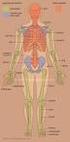 Skeletal System Axial Skeleton: Vertebral Column and Ribs Functions Regions Cervical Thoracic Lumbar Sacral Primary & secondary curvatures There are three major functions of the vertebral column. First,
The Nervous System: The Spinal Cord and Spinal Nerves
 14 The Nervous System: The Spinal Cord and Spinal Nerves PowerPoint Lecture Presentations prepared by Steven Bassett Southeast Community College Lincoln, Nebraska Introduction The Central Nervous System
Classification of bones Any bone may be classified into one of the following groups:
 Skeletal system This system is made up of hard tissues like bone and cartilages. This system gives form and shape to animal body The skeleton of a living animal is made up living structures of bones. The
Anterior Superior Iliac Spine. Anterior Inferior Iliac Spine. head neck greater trochanter intertrochanteric line lesser trochanter
 Ilium Bones The Skeleton Ischium Pubis Sacro-iliac Joint Iliac Crest Anterior Superior Superior Pubic Ramus Anterior Inferior Acetabulum Obturator Foramen Ischio-pubic ramus Ischial tuberosity Pubic Crest
The Abdominal Wall And Hernias. Stanley Kurek, DO, FACS Associate Professor of Surgery UTMCK
 The Abdominal Wall And Hernias Stanley Kurek, DO, FACS Associate Professor of Surgery UTMCK The Abdominal Wall The structure of the abdominal wall is similar in principle to the thoracic wall. There are
Sheet 1A. Treating short/tight muscles using MET. Pectorals. Upper trapezius. Levator scapula
 Sheet 1A Treating short/tight muscles using MET Pectorals Once daily lie at edge of bed holding a half-kilo can, arm out sideways. Raise arm and hold for 10 seconds, then allow arm to hang down, stretching
The Axial Skeleton Eighty bones segregated into three regions
 The Axial Skeleton Eighty bones segregated into three regions Skull Vertebral column Bony thorax Bones of the Axial Skeleton Figure 7.1 The Skull The skull, the body s most complex bony structure, is formed
Pilates for Kyphosis A BASI Pilates program designed to help correct thoracic kyphosis
 Pilates for Kyphosis A BASI Pilates program designed to help correct thoracic kyphosis 1 Lucy Penrose 19/01/2014 Wimbledon UK, April 2013 Abstract Kyphosis refers to an exaggerated curve in the thoracic
Definition: A joint or articulation is a place in the body where two bones come together.
 Definition: A joint or articulation is a place in the body where two bones come together. CLASSES OF JOINTS. 1. Joints are classified according to how the bones are held together. 2. The three types of
ANATOMY AND PHYSIOLOGY Date: Rating: Text pages: 58 95
 4 ANATOMY AND PHYSIOLOGY Date: Rating: Text pages: 58 95 TOPIC 1: CELLS 1 The study of the functions and activities performed by the body structures is (physiology) 2 The study of body structures that
Medical Terminology, Anatompy & Physiology
 1. Which of the following BEST describes the anatomical position? a. Supine with arms crossed over the chest and knees slightly bent b. Standing, facing forward, with arms raised above the head c. Standing,
Divisions of the Skeletal System
 OpenStax-CNX module: m46344 1 Divisions of the Skeletal System OpenStax College This work is produced by OpenStax-CNX and licensed under the Creative Commons Attribution License 3.0 By the end of this
Detailed Knowledge of Anatomy, Physiology, and Kinesiology
 Detailed Knowledge of Anatomy, Physiology, and Kinesiology 2 chapter CHAPTER OUTLINE Areas of Competence Anatomical Position Planes of Motion Cavities of the Body Body Movements Types of Contractions Muscle
Basic techniques of pulmonary physical therapy (I) 100/04/24
 Basic techniques of pulmonary physical therapy (I) 100/04/24 Evaluation of breathing function Chart review History Chest X ray Blood test Observation/palpation Chest mobility Shape of chest wall Accessory
Temporo-Mandibular Joint Complex Exercise Suggestions
 Temporo-Mandibular Joint Complex Exercise Suggestions I. Exercise Generalizations: A. Patients with post-traumatic TMJ problems or with recent-onset dysfunction that is largely posture-related will generally
MD 2016. Back Muscles & Movements Applied Anatomy. A/Prof Chris Briggs Anatomy & Neuroscience
 MD 2016 Back Muscles & Movements Applied Anatomy A/Prof Chris Briggs Anatomy & Neuroscience WARNING This material has been provided to you pursuant to section 49 of the Copyright Act 1968 (the Act) for
Lab 4: Shark Myology. Other Terms Muscle fiber Origin/Insertion
 Lab 4: Shark Myology Lab Objectives 1. To gain an understanding of the muscular system of the shark. 2. To learn the insertions, origins, and actions of key muscles you study. 3. To study how the muscles
Level 2 Certificate in Fitness Instructing Unit 1: Anatomy and Physiology
 Level 2 Certificate in Fitness Instructing Unit 1: Anatomy and Physiology These questions have been compiled based on the information available for the above qualification and unit. This mock should be
EHFA Assessment Strategy (EAD 03) Name of Training Organisation:
 EHFA Assessment Strategy (EAD 03) Name of Training Organisation: Introduction European Health and Fitness Association (EHFA) Standards The following EHFA standards are currently available: Fitness Instructor
SAMPLE WORKOUT Full Body
 SAMPLE WORKOUT Full Body Perform each exercise: 30 secs each x 2 rounds or 2-3 sets of 8-12 reps Monday & Wednesday or Tuesday & Thursday Standing Squat Muscles: glutes (butt), quadriceps (thigh) Stand
A Woman s Guide to Muscle & Strength
 A Woman s Guide to Muscle & Strength CORRESPONDENCE EDUCATION PROGRAM # 140. Check your receipt for course expiration date. After that date no credit will be awarded for this program. 2012 by Exercise
Biology 105 Human Biology PRACTICE MIDTERM EXAM 1. Essentials of Anatomy and Physiology, 5e (Martini/Nath) Chapter 7 The Muscular System
 Essentials of Anatomy and Physiology, 5e (Martini/Nath) Chapter 7 The Muscular System Multiple-Choice Questions 1) Which of the following is (are) a function of skeletal muscle? A) produce movement B)
THE SKELETAL SYSTEM - THE AXIAL SKELETON
 THE SKELETAL SYSTEM - THE AXIAL SKELETON Chapter 7 Anatomy and Physiology Lecture 1 THE SKELETAL SYSTEM THE AXIAL SKELETON Skeletal System forms the framework of the body. TYPES OF BONES: FOUR PRINCIPAL
Massage and Movement
 Massage and Movement Incorporating Movement into Massage Part One: Theory and Technique in Prone With Lee Stang, LMT NCBTMB #450217-06 1850 West Street Southington, CT 06489 860.747.6388 www.bridgestohealthseminars.com