
Name the muscle, A: (Action), O: (Origin), and I: (Insertion)
|
|
|
- Rosanna Price
- 9 years ago
- Views:
Transcription
1 FRONTALIS - A: (Action) Elevates eyebrows in glancing upward and expressions of surprise or fright; draws scalp forward and wrinkles skin of forehead; O: (Origin) Galea aponeurotica; I: Subcutaneous tissue of eyebrows OCCIPITALIS - A: (Action) Retracts scalp; fixes galea aponerotica so frantalis can act on eyebrows; O: (Origin) Superior nuchal line and temporal bone; I: Galea aponeurotica ORBICULARIS OCULI - A: (Action) Sphincter of eyelids; closes eye in blinking, squinting, and sleep; aids in flow of tears across eye; O: (Origin) Lacrimal bone; adjacent regions of frontal bone and maxilla; medial angle of eyelids; I: Upper and lower eyelids; skin around margin of orbit ORBICULARIS ORIS - A: (Action) Encircles mouth, closes lips, protrudes lips as in kissing; uniquely developed in humans for speech; O: (Origin) Modiolus of mouth; I: Submucosa and dermis of lips BUCCINATOR - A: (Action) Compresses cheek against teeth and gums; directs food between molars; retracts cheek from teeth when mouth is closing to prevent biting cheek; expels air and liquid; O: (Origin) Alveolar processes on lateral surfaces of mandible and maxilla; I: Orbicularis oris; submucosa of cheek and lips

2 PLATYSMA - A: (Action) Draws lower lip and angle of mouth downward in expressions of horror or surprise; may aid in opening mouth widely; O: (Origin) Fascia of deltoid and pectoralis major; I: Mandible; skin and subcutaneous tissue of lower face HYOGLOSSUS - A: (Action) Depresses tongue; O: (Origin) Body and greater horn of hyoid bone; I: Lateral and inferior surfaces of tongue TEMPORALIS - A: (Action) Elevation, retraction, and lateral and medial excursion of the mandible; O: (Origin) Temporal lines and temporal fossa of cranium; I: Coronoid process and anterior border of mandibular ramus MASSETER - Elevation of mandible, with smaller roles in protraction, retraction, and lateral and medial excursion; O: (Origin) Zygomatic arch; I: Lateral surface of mandibular ramus and angle MEDIL PTERYGOID - A: (Action) Elevation, protraction, and lateral and medial excursion of the mandible; O: (Origin) Medial surface of lateral pterygoid plate; palatine bone; lateral surface of maxilla near molar teeth; I: Medial surface of mandibular ramus and angle

3 LATERAL PTERYGOID - A: (Action) Depression (In wide opening of the mouth), protraction, and lateral and medial excursion of the mandible; O: (Origin) Lateral surfaces of lateral pterygoid plate; greater wing of sphenoid; I: Neck STERNOCLEIDOMASTOID of mandible (just below condyle); - A: (Action) articular Unilateral disc action and capsule tilts head ofslightly upward and temporomandibular toward the opposite joint side, as in looking over one's contralateral shoulder. The most common action is probably rotating the head to the left or right. Bilateral action draws the head straight forward and down, as when eating or reading. Aids in deep breathing when head is fixed.; O: (Origin) Manubrium of sternum; medial one third of clavicle; I: TRAPEZIUS Mastoid - A: (Action) process; lateral Extends half andof laterally flexes superior neck.; nuchal O: (Origin) line External occipital protuberance; medial one-third of superior nuchal line; nuchal ligament; spinous processor of vertebrae C7-T3 or T4; I: Acromion and spine of DIAPHRAGM scapula; lateral - A: one-third (Action) of Prime clavicle mover of inspiration (responsible for about two-thirds of air intake); contracts in preparation for sneezing, coughing, crying, laughing, and weight lifting; contraction compresses abdominal viscera and aids in childbirth and expulsion of urine and feces; O: (Origin) Xiphoid process of sternum; ribs and costal cartilages 7-12; lumbar vertebrae; EXTERNAL I: INTERCOSTALS Central tendon - A: of (Action) When diaphragm scalenes fix rib 1, external intercostals elevate and protract ribs 2-12, expanding the thoracic cavity and creating a partial vacuum causing inflow of air; exercise a braking action during expiration so that expiration is not overly abrupt.; O: (Origin) Inferior margins of ribs 1-11; I: Superior margin of next lower rib

4 INTERNAL INTERCOSTALS - A: (Action) In inspiration, the intercartilagous part aids in elevating the ribs and expanding the thoracic cavity; in expiration, the interosseous part depresses and retracts the ribs, compressing the thoracic cavity and expelling air; the latter occurs only in forceful expiration, not in EXTERNAL relaxed breathing.; ABDOMINAL O: (Origin) OBLIQUE Superior- margins A: (Action) and costal Supports cartilages abdominal of ribs viscera 2-12; against margin pull of sternum; of gravity; I: stabilizes vertebral Inferior column margin during of heavy next lifting; higher rib maintains posture; compresses abdominal organs, thus aiding in forceful expiration of breath and in expulsion of abdominopelvic contents during childbirth, urination, defecation, and vomiting; unilateral contraction causes contralateral rotation of waist; O: (Origin) Ribs 5-12; I: Anterior INTERNAL half ABDOMINAL of iliac crest; symphysis OBLIQUE and- A: (Action) superior Same margin as external of pubis oblique except that unilateral contraction causes ipsilateral rotation of waist; O: (Origin) Inguinal ligament; iliac crest; thoracolumbar fascia; I: Ribs 10-12; costal cartilages 7-10; pubis RECTUS ABDOMINIS - A: (Action) Flexes lumbar region of vertebral column, producing forward bending at the waist; O: (Origin) Pubic symphysis and superior margin of pubis; I: Xiphoid process; costal cartilages 5-7 ERECTOR SPINAE - A: (Action) Extension and lateral flexion of vertebral column; the longissimus capitis also produces ipsilateral rotation of the head; O: (Origin) Nuchal ligament; ribs 3-12; thoracic and lumbar vertebrae; median and lateral sacral crests; thoracolumbar fascia; I: Mastoid process; cervical and thoracic vertebrae; all ribs
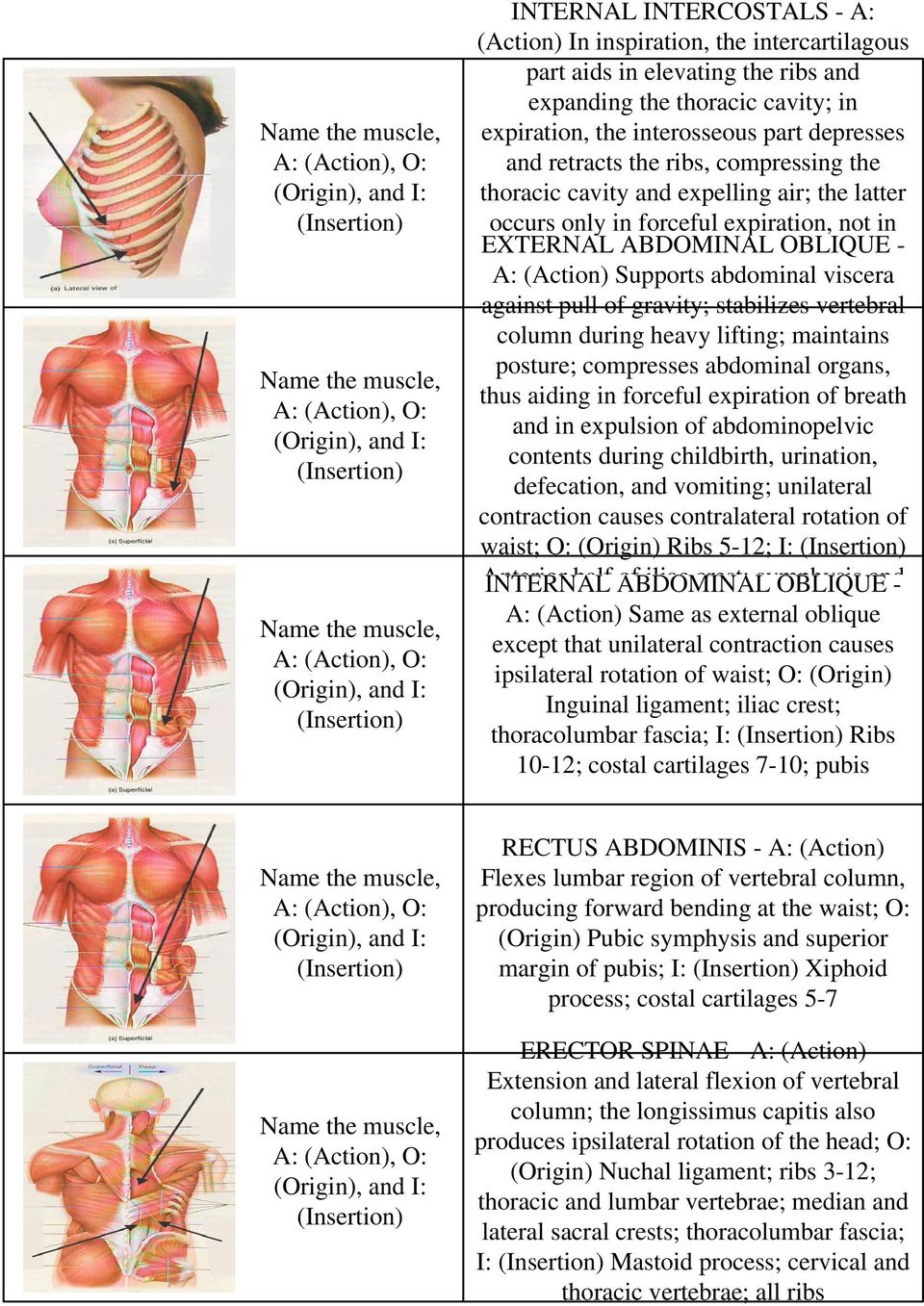
5 ERECTOR SPINAE: ILIOCOSTALIS - A: (Action) Extension and lateral flexion of vertebral column; the longissimus capitis also produces ipsilateral rotation of the head; O: (Origin) Nuchal ligament; ribs 3-12; thoracic and lumbar vertebrae; median and lateral sacral crests; thoracolumbar fascia; I: Mastoid ERECTOR process; cervical SPINAE: and thoracic LONGISSIMUS vertebrae; - all A: (Action) Extension ribs and lateral flexion of vertebral column; the longissimus capitis also produces ipsilateral rotation of the head; O: (Origin) Nuchal ligament; ribs 3-12; thoracic and lumbar vertebrae; median and lateral sacral crests; thoracolumbar fascia; I: Mastoid process; ERECTOR cervical SPINAE: and thoracic SPINALIS vertebrae; - A: all (Action) Extension ribs and lateral flexion of vertebral column; the longissimus capitis also produces ipsilateral rotation of the head; O: (Origin) Nuchal ligament; ribs 3-12; thoracic and lumbar vertebrae; median and lateral sacral crests; thoracolumbar fascia; I: Mastoid process; cervical and thoracic vertebrae; all QUADRATUS ribs LUMBORUM - A: (Action) Aids respiration by fixing rib 12 and stabilizing inferior attachments of diaphragm. Unilateral contraction causes ipsilateral flexion of lumbar vertebral column; bilateral contraction extends lumbar vertebral column.; O: (Origin) Iliac crest; iliolumbarligament; I: Rib 12, vertebrae L1-L4 EXTERNAL URETHRAL SPHINCTER - A: (Action) Retains urine in bladder until voluntarily voided; O: (Origin) Ischiopubic rami; I: Encircles urethral orifice

6 COMPRESSOR URETHRAE - A: (Action) Aids in urine retention; found in females only; O: (Origin) Ischiopubic rami; I: Right and left compressor urethrae meet as muscular sheet inferior to external urethral sphincter EXTERNAL ANAL SPHINCTER - A: (Action) Retains feces in rectum until voluntarily voided; O: (Origin) Coccyx; perineal body; I: Encircles anal canal and orifice PECTORALIS MINOR - A: (Action) With serratus anterior, draws scapula laterally and forward around chest wall; with other muscles, rotates scapula and depresses apex of shoulder, as in reaching down to pick up a suitcase; O: (Origin) Ribs 3-5 and overlying fascia; I: Coracoid process of scapula LEVATOR SCAPULAE - A: (Action) Elevates scapula if cervical vertebrae are fixed; flexes neck laterally if scapula is fixed; retracts scapula and braces shoulder; rotates scapula and depresses apex of shoulder; O: (Origin) Transverse processes of vertebrae C1-C4; I: Superior angle to medial border of scapula RHOMBOIDEUS MINOR - A: (Action) Retracts scapula and braces shoulder; fixes scapula during arm movements; O: (Origin) Spinous processes of vertebrae C7-T1; nuchal ligament; I: Medial border of scapula

7 RHOMBOIDEUS MAJOR - A: (Action) Same as rhomboideus minor; O: (Origin) Spinous processes of vertebrae T2-T5; I: Medial border of scapula PECTORALIS MAJOR - A: (Action) Flexes, adducts, and medially rotates humerus, as in climbing or hugging; aids in deep inspiration; O: (Origin) Medial half of clavicle; LATISSIMUS lateral margin DORSI of - sternum; A: (Action) costal Adducts cartilages and 1-7; medially aponeurosis rotates of humerus; external extends oblique; the shoulder I: joint Lateral as in pulling lip of on the oars intertubercular of a rowboat; sulcus produces of humerus backward swing of arm in such actions as walking and bowling; with hands grasping overhead objects, pulls body forward and upward, as in climbing; aids in deep inspiration, sudden expiration such as sneezing and coughing, and prolonged forceful expiration as in singing or blowing a sustained note on a wind instrument; O: (Origin) DELTOID Vertebrae - A: (Action) T7-L5; Anterior lower three fibers or four flex and ribs; medially iliac crest; rotate thoracolumbar arm; lateral fascia; fibers I: abduct arm; Floor posterior of intertubercular fibers extend sulcus and laterally rotate of arm; humerus involved in arm swinging during such actions as walking or bowling, and in adjustment of hand height for various manual tasks; O: (Origin) Acromion and spone of scapula; clavicle; I: Deltoid tuberosity of humerus SUPRASPINATUS - A: (Action) Aids deltoid in abductions of arm; resists downward slippage of humeral head when arm is relaxed or when carrying weight; O: (Origin) Supraspinous fossa of scapula; I: Greater tubercle of humerous

8 INFRASPINATUS - A: (Action) Modulates action of deltoid, preventing humeral head from sliding upward; rotates humerous laterally; O: (Origin) Infraspinous fossa of scapula; I: Greater tuberclue of humerus TERES MINOR - A: (Action) Modulates action of deltoid, preventing humeral head from sliding upward as arm is abducted; rotates humerous laterally; O: (Origin) Lateral border and adjacent posterior surface of scapula; I: Greater tubercle of humerus; posterior surface of joint capsule SUBSCAPULARIS - A: (Action) Modulates action of deltoid, preventing humeral head from sliding upward as arm is abducted; rotates humerus medially; O: (Origin) Subscapular fossa of scapula; I: Lesser tubercle of humerus; anterior surface of joint capsule BRACHIALIS - A: (Action) Prime mover of elbow flexion; O: (Origin) Anterior surface of distal half of humerus; I: Coronoid process and tuberosity of ulna BICEPS BRACHII - A: (Action) Rapid or forceful supination of forearm; synergist in elbow flexion; slight shoulder flexion; tendon of long head stabilizes shoulder by holding humeral head against glenoid cavity; O: (Origin) Long head-superior margin of glenoid cavity; Short head-coracoid process; I: Tuberosity of radius; fascia of forearm

9 TRICEPS BRACHII - A: (Action) Extends elbow; long head extends and adducts humerus; O: (Origin) Long head-inferior margin of glenoid cavity and joint capsule; Lateral head-posterior surface of proximal end of humerus; Medial head-posterior surface of entire humeral shaft; I: Olecranon; fascia of forearm BRACHIORADIALIS - A: (Action) Flexes elbow; O: (Origin) Lateral supracondylar ridge of humerus; I: Lateral surface of radius near styloid process ANCONEUS - A: (Action) Extends elbow; may help to control ulnar movement during pronation; O: (Origin) Lateral epicondyle of humerus; I: Olecranon and posterior surface of ulna PRONATOR QUADRATUS - A: (Action) Prime mover of forearm pronation; also resists separation of radius and ulna when force is applied to forearm through wrist, as in doing push-ups; O: (Origin) Anterior surface of distal ulna; I: Anterior surface of distal radius PRONATOR TERES - A: (Action) Assists pronator quadratus in pronation, but only in rapid or forceful action; weakly flexes elbow; O: (Origin) Humeral shaft near medial epicondyle; coronoid process of ulna; I: Lateral surface of radial shaft

10 SUPINATOR - A: (Action) Supinates forearm; O: (Origin) Lateral epicondyle of humerus; supinator crest and fossa of ulna just distal to radial notch; anular and radial collateral ligaments of elbow; I: Proximal one-third of radius FLEXOR CARPI RADIALIS - A: (Action) Flexes wrist anteriorly; aids in radial flexion of wrist; O: (Origin) Medial epicondyle of humerus; I: Base of metacarpals II-II FLEXOR CARPI ULNARIS - A: (Action) Flexes wrist anteriorly; aids in ulnar flexion of wrist; O: (Origin) Medial epicondyle of humerus; medial margin of olecranon; posterior surface of ulna; I: Pisiform; hamate; metacarpal V FLEXOR POLLICIS LONGUS - A: (Action) Flexes phalanges of thumb; O: (Origin) Radius; interosseous membrane; I: Distal phalanx I EXTENSOR CARPI RADIALIS LONGUS - A: (Action) Extends wrist; aids in radial flexion of wrist; O: (Origin) Lateral supracondylar ridge of humerus; I: Base of metacarpal II

11 EXTENSOR CARPI ULNARIS - A: (Action) Extends and fixes wrist when fist is clenched or hand grips an object; aids in ulnar flexion of wrist; O: (Origin) Lateral epicondyle of humerus; posterior; I: Base of metacarpal V surface of ulnar shaft EXTENSOR POLLICIS BREVIS - A: (Action) Extends metacarpal I and proximal phalanx of thumb; O: (Origin) Shaft of radius; interosseous membrane; I: proximal phalanx I EXTENSOR POLLICIS LONGUS - A: (Action) Extends distal phalanx I; aids in extending proximal phalanx I and metacarpal I; adducts and laterally rotates thumb; O: (Origin) Posterior surface of ulna; interosseous membrane; I: Distal phalanx I ILIACUS - A: (Action) Flexes thigh at hip when trunk is fixed; flexes trunk at hip when thigh is fixed, as in bending forward in a chair or setting up in bed; balances trunk during sitting; O: (Origin) Iliac crest and fossa; superolateral region of sacrum; anterior sacroiliac and iliolumbar ligaments; I: Lesser trochanter and nearby shaft of femur PSOAS MAJOR - A: (Action) Same as iliacus; O: (Origin) Bodies and intervertebral discs of vertebrae T12-L5; transverse processes of lumbar vertebrae; I: Lesser trochanter and nearby shaft of femur.

12 TENSOR FASCIAE LATAE - A: (Action) Extends knee, laterally rotates tibia, aids in abduction and medial rotation of femur; during standing, steadies pelvis on femoral head and steadies femoral condyles on tibia; O: (Origin) Iliac crest; anterior superior GLUTEUS spine; MAXIMUS deep surface - A: of fascia (Action) lata; I: Extends thigh Lateral hip as condyle in stair of climbing tibia via (rising to next step) iliotibial or running band and walking (backswing of limb); abducts thigh; elevates trunk after stooping; prevents trunk from pitching forward during walking and running; helps stabilize femur on tibia; O: (Origin) Posterior gluteal line of ilium, on posterior surface from iliac crest to posterior superior spine; coccyx; posterior surface of lower sacrum; aponeurosis of erector spinae; I: Gluteal GLUTEUS tuberosity MEDIUS of femur; - A: (Action) lateral condyle Abduct and medially of tibia rotate via iliotibial thigh; during bandwalking, shift weight of trunk toward limb with foot on the ground as other foot is lifted; O: (Origin) Most of lateral surface of ilium between crest and acetabulum; I: Greater trochanter of femur PIRIFORMIS - A: (Action) Laterally rotates extended thigh; abducts flexed thigh; O: (Origin) Anterior surface of sacrum; gluteal surface of ilium; capsule of sacroiliac joint; I: Greater trochanter of femur QUADRATUS FEMORIS - A: (Action) Laterally rotates thigh; O: (Origin) Ischial tuberosity; I: Intertrochanteric crest of femur

13 RECTUS FEMORIS - A: (Action) Extends knee; flexes thigh at hip; flexes trunk on hip if thigh is fixed; O: (Origin) Ilium at anterior inferior spine and superior margin of acetabulum; capsule of hip joint; I: See quadriceps femoris above BICEPS FEMORIS - A: (Action) Flexes knee; extends hip; elevates trunk from stooping posture; laterally rotates tibia on femur when knee is flexed; laterally rotates femur when hip is extended; counteracts forward bending at hips; O: (Origin) Long head-ischial tuberosity; Short head-linea aspera and lateral supracondylar line of femur; I: Head of fibula SEMITENDINOSUS - A: (Action) Flexes knee; medially rotates tibia on femur when knee is flexed; medially rotates femur when hip is extended; counteracts forward bending at hips; O: (Origin) Ischial tuberosity; I: Medial surface of upper tibia SEMIMEMBRANOSUS - A: (Action) Same as semitendinosus, O: (Origin) Ischial tuberosity; I: Medial condyle and nearby margin of tibia; intercondylar line and lateral condyle of femur; ligament of popliteal region POPLITEUS - A: (Action) Rotates tibia medially on femur if femur is fixed (as in sitting down), or rotates femur laterally on tibia if tibia is fixed (as in standing up); unlocks knee to allow flexion; may prevent forward dislocation of femur during crouching; O: (Origin) Lateral condyle of femur; lateral meniscus and joint capsule; I: Posterior surface of upper tibia

14 TIBIALIS ANTERIOR - A: (Action) Dorsiflexes and inverts foot; resists backward tipping of body (as when standing on a moving boat deck); helps support medial longitudinal arch of foot; O: (Origin) Lateral condyle and lateral margin of proximal half of tibia; interosseous membrane; I: Medial cuneiform, metatarsal I GASTROCNEMIUS - Plantar flexes foot, flexes knee; active in walking, running and jumping; O: (Origin) Condyles, popliteal surface, and lateral supracondylar line of femur; capsule of knee joint; I: Calcaneus SOLEUS - A: (Action) Plantar flexes foot; steadies leg on ankle during standing; O: (Origin) Posterior surface of head and proximal one-fourth of fibula; middle one-third of tibia; interosseous membrane; I: Calcaneus GLUTEUS MINIMUS - A: (Action) Abduct and medially rotate thigh; during walking, shift weight of trunk toward limb with foot on the ground as other foot is lifted; O: (Origin) Most of lateral surface of ilium between crest and acetabulum; I: Greater trochanter of femur

Skin of eyebrows galea aponeurotica. Muscle and skin of mouth
 : SEE ALSO THE AP SITE FOR OTHER TABLES GROSS ANATOMY OF THE MUSCULAR SYSTEMM Muscles of the Head and Neck: Occipitofrontalis Frontalis Occipitalis Orbicularis oculi Orbicularis oris Buccinator Masseter
Anatomy and Physiology 121: Muscles of the Human Body
 Epicranius Anatomy and Physiology 121: Muscles of the Human Body Covers upper cranium Raises eyebrows, surprise, headaches Parts Frontalis Occipitalis Epicranial aponeurosis Orbicularis oculi Ring (sphincter)
Muscles of the Neck and Vertebral Column Sternocleidomastoid (anterior neck) Origin Insertion Action
 Muscular movements of the head (at the cervical spine/neck) and of the torso (thoracic and lumbar spine/upper, middle, and lower back): flexion, extension, lateral flexion, rotation. Muscles of the Neck
Muscles of Mastication
 Muscles of Mastication Masseter Zygomatic Arch Mandibular angle Elevates mandible Mandibular ramus Temporalis Temporal fossa of the temporal bone Coronoid process of the mandible Elevates mandible Retracts
Chapter 8. Muscular System: Skeletal Muscles of the Body
 Chapter 8 Muscular System: Skeletal Muscles of the Body INTRODUCTION This chapter continues our study of the muscular system by examining the distribution of muscles throughout the body. We learned in
Buccinator Presses cheek against molar teeth Facial (CNVII) wrinkles forehead
 Muscles to Identify on the Cadaver and/or Models You are required to identify each of the following muscles or associated structures on the cadavers and/or models in lab. If the box is shaded in a particular
Muscle Name Origin Insertion Action Innervation Muscles of Upper Extremity Pectoralis Major Medial half of clavicle, front of sternum, costal
 Muscle Name Origin Insertion Action Innervation Muscles of Upper Extremity Pectoralis Major Medial half of clavicle, front of sternum, costal Crest of greater tubercle (Lateral lip of bicipital groove)
Muscular System. Student Learning Objectives: Identify the major muscles of the body Identify the action of major muscles of the body
 Muscular System Student Learning Objectives: Identify the major muscles of the body Identify the action of major muscles of the body Structures to be identified: Muscle actions: Extension Flexion Abduction
Anatomy & Physiology 120. Lab #7 Muscle Tissue and Skeletal Muscles
 Anatomy & Physiology 120 Lab #7 Muscle Tissue and Skeletal Muscles What you Need to Know Look briefly at the Structure of: 1) Skeletal, 2) Smooth & 3) Cardiac Muscle Naming, Identification, Functions You
Chapter 10: The Muscular System
 Chapter 10: The Muscular System Objectives: 1. Describe the function of prime movers, antagonists, synergists, and fixators. 2. List the criteria used in naming muscles. Provide an example to illustrate
Anatomy of Human Muscles
 Anatomy of Human Muscles PURPOSE: To develop skill in identifying muscle names and locations relative to other regional structures. To determine origin, insertion and principle action of muscles through
Chapter 11 The Muscular System. Muscle Attachment Sites: Origin and Insertion
 Chapter 11 The Muscular System Skeletal muscle major groupings How movements occur at specific joints Learn the origin, insertion, function and innervation of all major muscles Important to allied health
Ken Ross BSc ST, Nat Dip ST
 Ken Ross BSc ST, Nat Dip ST Trunk Most people will suffer from back pain at some point in their lives. Good spinal posture places minimal strain on the muscles which maintain the natural curve of the spine
II. Axial Skeleton (Skull, Thoracic Cage, and Vertebral Column)
 THE SKELETAL SYSTEM Lab Objectives Students should be able to: 1. Recognize bones and bone markings for the axial and appendicular skeleton 2. Recognize bones disarticulated and/or articulated 3. Identify
Muscles of the Spinal Column. Chapter 12
 Muscles of the Spinal Column Chapter 12 Cervical Muscles Splenius Splenius (capitis and cervicis) Origin: Cervicis spinous process of T3-T6 Capitis - lower half of ligmentum nuchea & spinous process of
Deltoid Trapezius. Identify the muscle pair(s) that work together to produce the movements listed above.
 Shoulder- the major muscles in this group are the infraspinatus, subscapularis, terems major, teres minor deltoid, and trapezius. These muscles work together to move the shoulder area, allowing you, for
LABORATORY EXERCISE 12 BONE STRUCTURE AND CLASSIFICATION
 LABORATORY EXERCISE 12 BONE STRUCTURE AND CLASSIFICATION FIG. 12.1 1. Articular cartilage (hyaline cartilage) 6. Periosteum 2. Spongy bone (red marrow) 7. Proximal epiphysis 3. Medullary cavity 8. Diaphysis
THE SHOULDER JOINT T H E G L E N O H U M E R A L ( G H ) J O I N T
 THE SHOULDER JOINT T H E G L E N O H U M E R A L ( G H ) J O I N T CLARIFICATION OF TERMS Shoulder girdle = scapula and clavicle Shoulder joint (glenohumeral joint) = scapula and humerus Lippert, p115
Anatomy and Pathomechanics of the Sacrum and Pelvis. Charles R. Thompson Head Athletic Trainer Princeton University
 Anatomy and Pathomechanics of the Sacrum and Pelvis Charles R. Thompson Head Athletic Trainer Princeton University Simplify Everything There are actually only three bones: Two innominates, one sacrum.
Muscle Movements, Types, and Names
 Muscle Movements, Types, and Names A. Gross Skeletal Muscle Activity 1. With a few exceptions, all muscles cross at least one joint 2. Typically, the bulk of the muscle lies proximal to the joint it crossed
Chapter 9 The Hip Joint and Pelvic Girdle
 Copyright The McGraw-Hill Companies, Inc. Reprinted by permission. The Hip Joint and Pelvic Girdle Chapter 9 The Hip Joint and Pelvic Girdle Structural Kinesiology R.T. Floyd, Ed.D, ATC, CSCS Hip joint
Anterior Superior Iliac Spine. Anterior Inferior Iliac Spine. head neck greater trochanter intertrochanteric line lesser trochanter
 Ilium Bones The Skeleton Ischium Pubis Sacro-iliac Joint Iliac Crest Anterior Superior Superior Pubic Ramus Anterior Inferior Acetabulum Obturator Foramen Ischio-pubic ramus Ischial tuberosity Pubic Crest
Laerdal' Human Anatomy Manual The Skeleton
 Human Anatomy Manual The Skeleton Laerdal Texas P.O. Box 38.226 EM. 116 Gatesville,Texas U.S.A.76528 U.S.A.1-800-433-5539 IntemationaI1-254-865-7221 24 Hour Fax 254-865-8011 ~ Laerdal' TABLE OF CONTENTS
International Standards for the Classification of Spinal Cord Injury Motor Exam Guide
 C5 Elbow Flexors Biceps Brachii, Brachialis Patient Position: The shoulder is in neutral rotation, neutral flexion/extension, and adducted. The elbow is fully extended, with the forearm in full supination.
Upper Limb QUESTIONS UPPER LIMB: QUESTIONS
 1 Upper Limb QUESTIONS 1.1 Which of the following statements best describes the scapula? a. It usually overlies the 2nd to 9th ribs. b. The spine continues laterally as the coracoid process. c. The suprascapular
The Muscular System. PowerPoint Lecture Presentations prepared by Jason LaPres. Lone Star College North Harris. 2012 Pearson Education, Inc.
 11 The Muscular System PowerPoint Lecture Presentations prepared by Jason LaPres Lone Star College North Harris An Introduction to the Muscular System Learning Outcomes 11-1 Describe the arrangement of
SPORT AND PHYSICAL ACTIVITY
 2016 Suite Cambridge TECHNICALS LEVEL 3 SPORT AND PHYSICAL ACTIVITY Unit 1 Body systems and the effects of physical activity K/507/4452 Guided learning hours: 90 Version 2 - Revised content - March 2016
The Muscular System. Appendicular Musculature
 11 The Muscular System Appendicular Musculature CHAPTER OBJECTIVES 1. Describe the functions of the appendicular musculature. 2. Identify and locate the principal appendicular muscles of the body, together
Diagnostic MSK Case Submission Requirements
 Diagnostic MSK Case Submission Requirements Note: MSK Ultrasound-Guided Interventional Procedures (USGIP) is considered a separate specialty. Corresponds with 4/21/16 Accred Newsletter* From the main site:
The Pilates Studio of Los Angeles / PilatesCertificationOnline.com
 Anatomy Review Part I Anatomical Terminology and Review Questions (through pg. 80) Define the following: 1. Sagittal Plane 2. Frontal or Coronal Plane 3. Horizontal Plane 4. Superior 5. Inferior 6. Anterior
Detailed Knowledge of Anatomy, Physiology, and Kinesiology
 Detailed Knowledge of Anatomy, Physiology, and Kinesiology 2 chapter CHAPTER OUTLINE Areas of Competence Anatomical Position Planes of Motion Cavities of the Body Body Movements Types of Contractions Muscle
GROSS ANATOMY. Unit #4: Upper and Lower Limbs. Lecture Syllabus 2008
 GROSS ANATOMY Lecture Syllabus 2008 Unit #4: Upper and Lower Limbs ANAT 6010 - Gross Anatomy Department of Neurobiology and Anatomy University of Utah School of Medicine G24- Upper Limb Overview, Shoulder,
Clarification of Terms
 Shoulder Girdle Clarification of Terms Shoulder girdle = scapula and clavicle Shoulder joint (glenohumeral joint) = scapula and humerus What is the purpose (or function) of the shoulder and entire upper
Elbow & Forearm H O W V I T A L I S T H E E L B O W T O O U R D A I L Y L I V E S?
 Elbow & Forearm H O W V I T A L I S T H E E L B O W T O O U R D A I L Y L I V E S? Clarification of Terms The elbow includes: 3 bones (humerus, radius, and ulna) 2 joints (humeroulnar and humeroradial)
ANATOMY 1 LEARNING TARGETS
 ANATOMY 1 LEARNING TARGETS ORGANIZATION OF THE BODY 1. Define "anatomy" and "physiology." 2. Describe homeostasis. 3. Identify examples of homeostasis 4. Describe the organization of the body according
Muscular System. Principles of Health Science Dr. Wood
 Muscular System Principles of Health Science Dr. Wood Characteristics of muscles Excitability: : irritability or ability to respond to stimulus Contractibility: : ability to contract (become short and
Stretching the Major Muscle Groups of the Lower Limb
 2 Stretching the Major Muscle Groups of the Lower Limb In this chapter, we present appropriate stretching exercises for the major muscle groups of the lower limb. All four methods (3S, yoga, slow/static,
Chapter 5. The Shoulder Joint. The Shoulder Joint. Bones. Bones. Bones
 Copyright The McGraw-Hill Companies, Inc. Reprinted by permission. Chapter 5 The Shoulder Joint Structural Kinesiology R.T. Floyd, Ed.D, ATC, CSCS Structural Kinesiology The Shoulder Joint 5-1 The Shoulder
Flexibility Assessment and Improvement Compiled and Adapted by Josh Thompson
 Flexibility Assessment and Improvement Compiled and Adapted by Josh Thompson Muscles must have a full and normal range of motion in order for joints and skeletal structure to function properly. Flexibility
The Muscular System General & Anatomy
 The Muscular System General & Anatomy General Functions: 1. movement voluntary skeletal muscles 2. internal movement of substances through various tubes and passageways eg blood, food, urine heart pumps
Chapter 6: The Muscular System
 Chapter 6: The Muscular System I. Overview of Muscle Tissues Objectives: Describe the similarities and differences in the structure and function of the three types of muscle tissue, and indicate where
Chapter 8 - Muscular System 8.1 Introduction (p. 178 ) A. The three types of muscle in the body are skeletal, smooth, and cardiac muscle. B.
 Chapter 8 - Muscular System 8.1 Introduction (p. 178 ) A. The three types of muscle in the body are skeletal, smooth, and cardiac muscle. B. This chapter focuses on skeletal muscle. 8.2 Structure of a
Surgical Art. Formulaic Drawing Method. DRAWING WORKSHOP Learning to sketch for patient notes
 DRAWING WORKSHOP Learning to sketch for patient notes Surgical Art Formulaic Drawing Method Formulaic figure drawing systems involve using abstract rhythms and interlocking shapes to construct the human
TOTAL BODY: POWER/EXPLOSIVE EXERCISES
 Referring to Chapters 12-14 TOTAL BODY: POWER/EXPLOSIVE EXERCISES Power Snatch hip extension Muscle group/ gluteals gluteus maximis hamstrings semimembranosus semitendinosus biceps femoris knee extension
EXERCISE MANUAL PERSONALITY GYM
 EXERCISE MANUAL PERSONALITY GYM EXERCISE MANUAL PERSONALITY GYM legs. 1 calves raise Stand with the wide part of one foot on the seated row foot support. Start in a position with your calves stretched.
Thank You for Your Support!
 Thank You for Your Support! This PDF document has been placed on the Internet with the goal of providing quality learning material at a low price to cover web operating expenses. This document is shareware,
DSM Spine+Sport - Mobility
 To set yourself up for success, practice keeping a neutral spine throughout all of these movements. This will ensure the tissue mobilization is being applied to the correct area, and make the techniques
MET: Posterior (backward) Rotation of the Innominate Bone.
 MET: Posterior (backward) Rotation of the Innominate Bone. Purpose: To reduce an anterior rotation of the innominate bone at the SI joint. To increase posterior (backward) rotation of the SI joint. Precautions:
Massage and Movement
 Massage and Movement Incorporating Movement into Massage Part One: Theory and Technique in Prone With Lee Stang, LMT NCBTMB #450217-06 1850 West Street Southington, CT 06489 860.747.6388 www.bridgestohealthseminars.com
Skeletal system. 2012 Pearson Education, Inc.
 NURS1004 Week 6 Part I Prepared by Didy Button Skeletal system An Introduction to the Skeletal System The Skeletal System Includes: Bones of the skeleton Cartilages, ligaments, and connective tissues 6-1
Principles of Functional Exercise
 Principles of Functional Exercise FOR PROFESSIONAL FITNESS TRAINERS FIRST EDITION Charles DeFrancesco, NASM, NFPT Dr. Robert Inesta, DC, CCSp, CSCS For more information vist us online at: www.nfpt.com
THE BENJAMIN INSTITUTE PRESENTS. Excerpt from Listen To Your Pain. Assessment & Treatment of. Low Back Pain. Ben E. Benjamin, Ph.D.
 THE BENJAMIN INSTITUTE PRESENTS Excerpt from Listen To Your Pain Assessment & Treatment of Low Back Pain A B E N J A M I N I N S T I T U T E E B O O K Ben E. Benjamin, Ph.D. 2 THERAPIST/CLIENT MANUAL The
PRIMARY HUMAN ANATOMY: BIOL20600 SPRING 2014
 PRIMARY HUMAN ANATOMY: BIOL20600 SPRING 2014 Instructors: Kit Muma, Rm. 158 CNS, (607) 274-3610, [email protected] Michelle Bamberger, Rm. 118A Williams Hall, [email protected] Mark Baustian, Rm. 118A
Anatomy of Skeletal System
 Anatomy of Skeletal System two main subdivisions of skeletal system: axial : skull, vertebral column, rib cage appendicular: arms and legs and girdles Bone Markings: Foramen: opening in bone passageway
Structure & Function of the Knee. One of the most complex simple structures in the human body. The middle child of the lower extremity.
 Structure & Function of the Knee One of the most complex simple structures in the human body. The middle child of the lower extremity. Osteology of the Knee Distal femur (ADDuctor tubercle) Right Femur
EHFA Assessment Strategy (EAD 03) Name of Training Organisation:
 EHFA Assessment Strategy (EAD 03) Name of Training Organisation: Introduction European Health and Fitness Association (EHFA) Standards The following EHFA standards are currently available: Fitness Instructor
Structure and Function of the Hip
 Structure and Function of the Hip Objectives Identify the bones and bony landmarks of the hip and pelvis Identify and describe the supporting structures of the hip joint Describe the kinematics of the
Chapter 4 The Shoulder Girdle
 Chapter 4 The Shoulder Girdle Key Manubrium Clavicle Coracoidprocess Acromionprocess bony landmarks Glenoid fossa Bones Lateral Inferior Medial border angle McGraw-Hill Higher Education. All rights reserved.
SECTION II General Osteopathic Techniques
 SECTION II General Osteopathic Techniques Chapter Four The Lower Extremities 40 Ligamentous Articular Strain The lower extremities are among the most important structures of the body and yet are often
Sheet 1A. Treating short/tight muscles using MET. Pectorals. Upper trapezius. Levator scapula
 Sheet 1A Treating short/tight muscles using MET Pectorals Once daily lie at edge of bed holding a half-kilo can, arm out sideways. Raise arm and hold for 10 seconds, then allow arm to hang down, stretching
Human Anatomy & Physiology
 PowerPoint Lecture Slides prepared by Barbara Heard, Atlantic Cape Community College Ninth Edition Human Anatomy & Physiology C H A P T E R 7 The Skeleton: Part B Annie Leibovitz/Contact Press Images Vertebral
Practice Chapter 6. Figure 6.3. Multiple Choice Identify the choice that best completes the statement or answers the question.
 Practice Chapter 6 Multiple Choice Identify the choice that best completes the statement or answers the question. 1. Voluntary muscle tissue is; a. smooth muscle b. skeletal muscle c. dense regular d.
Pilates to correct overactive upper trapezius muscles and prevent scapular elevation.
 Pilates to correct overactive upper trapezius muscles and prevent scapular elevation. Stephanie Blum July 13 th, 2014 Flow Studios, Chicago, IL Page 1 of 19 Abstract It s important to recognize where your
Hip and Trunk Exercise Program
 Hip and Trunk Exercise Program Hip and Pelvis Exercise Program Gluteus Medius and Minimus (Hip Abductors) Page 2 Lateral Hip Rotators Page 6 Tensor Fascia Lata (TFL) and Illiotibial Band (ITB) Page 7 Lower
UNIT 2 - CHAPTER 9: MUSCULAR SYSTEM
 LEARNING OUTCOMES: 9.1 Introduction UNIT 2 - CHAPTER 9: MUSCULAR SYSTEM 1. List various outcomes of muscle actions. 9.2 Structure of a Skeletal Muscle 2. Describe the structure of a skeletal muscle. 3.
Temporo-Mandibular Joint Complex Exercise Suggestions
 Temporo-Mandibular Joint Complex Exercise Suggestions I. Exercise Generalizations: A. Patients with post-traumatic TMJ problems or with recent-onset dysfunction that is largely posture-related will generally
Objectives continued- Answer each of the objectives on a separate sheet of paper to demonstrate content mastery. Attach answers to back of packet.
 Anatomy and Physiology Chapter 6: The Muscular System Name: Objectives- By the end of this chapter I will be able to: 1. Describe similarities and differences in the structure and function of the three
Chapter 9 The Hip Joint and Pelvic Girdle
 Chapter 9 The Hip Joint and Pelvic Girdle Manual of Structural Kinesiology R.T. Floyd, EdD, ATC, CSCS Hip relatively joint (acetabularfemoral) functions bony strong large stable due to The enhanced architecture
Classification of bones Any bone may be classified into one of the following groups:
 Skeletal system This system is made up of hard tissues like bone and cartilages. This system gives form and shape to animal body The skeleton of a living animal is made up living structures of bones. The
NETWORK FITNESS FACTS THE HIP
 NETWORK FITNESS FACTS THE HIP The Hip Joint ANATOMY OF THE HIP The hip bones are divided into 5 areas, which are: Image: www.health.com/health/static/hw/media/medical/hw/ hwkb17_042.jpg The hip joint is
THE SKELETAL SYSTEM - THE AXIAL SKELETON
 THE SKELETAL SYSTEM - THE AXIAL SKELETON Chapter 7 Anatomy and Physiology Lecture 1 THE SKELETAL SYSTEM THE AXIAL SKELETON Skeletal System forms the framework of the body. TYPES OF BONES: FOUR PRINCIPAL
Chapter 12 The Trunk and Spinal Column
 Chapter 12 The Trunk and Spinal Column Manual of Structural Kinesiology R.T. Floyd, EdD, ATC, CSCS Vertebral Abdominal 24 31 most column complex some intricate & complex articulating vertebrae do pairs
MUSCULAR SYSTEM REVIEW. 1. Identify the general functions of the muscular system
 MUSCULAR SYSTEM REVIEW 1. Identify the general functions of the muscular system 2. Define the four characteristics of muscular tissue a. irritability (excitability) - b. extensibility- c. contractibility
American Osteopathic Academy of Sports Medicine James McCrossin MS ATC, CSCS Philadelphia Flyers April 23 rd, 2015
 American Osteopathic Academy of Sports Medicine James McCrossin MS ATC, CSCS Philadelphia Flyers April 23 rd, 2015 Coming together is a beginning; keeping together is progress; working together is success.
Musculoskeletal Ultrasound Technical Guidelines. I. Shoulder
 European Society of MusculoSkeletal Radiology Musculoskeletal Ultrasound Technical Guidelines I. Shoulder Ian Beggs, UK Stefano Bianchi, Switzerland Angel Bueno, Spain Michel Cohen, France Michel Court-Payen,
Manual Therapy for the Upper and Lower Quadrant: What Do I Need to Know? Objectives
 Manual Therapy for the Upper and Lower Quadrant: What Do I Need to Know? Objectives 1. Describe the current best evidence for manual therapy in the management of a variety of disorders. 2. Recognize subgroups
SAMPLE WORKOUT Full Body
 SAMPLE WORKOUT Full Body Perform each exercise: 30 secs each x 2 rounds or 2-3 sets of 8-12 reps Monday & Wednesday or Tuesday & Thursday Standing Squat Muscles: glutes (butt), quadriceps (thigh) Stand
UltraSports. Sports Massage Certification Program. Information Packet. Massage Therapy, Inc.
 UltraSports Massage Therapy, Inc. Sports Massage Certification Program Information Packet Revised April 2009 Table of Contents Sports Massage Certification Program Introduction... Page 3 Program Requirements...
Lower Extremities. Posterior Compartment of Thighs Knee Flexors
 Lower Extremities Lower extremities are adjusted to provide locomotion but, at the same time, carry the full body weight. The lower limb movement is transferred through the hip joint and pelvis onto the
Rehabilitation with Pilates
 Rehabilitation with Pilates Flat Feet Pes Planus Naiké Durel January 2016 Montreal, Canada Table of contents Title Table of contents Abstract Anatomy of the foot p.1 p.2 p.3 p.4-5- 6-7 Case of study BASI
Muscle Organization and Function. Chapter 10: The Muscular System. Parallel (Fusiform) Muscles. Organization of Skeletal Muscle Fibers
 Muscle Organization and Function Chapter 10: The Muscular System Muscle organization affects power, range, and speed of muscle movement Muscle cells (fibers) are organized in bundles (fascicles) Fibers
Musculoskeletal Ultrasound Technical Guidelines. IV. Hip
 European Society of MusculoSkeletal Radiology Musculoskeletal Ultrasound Technical Guidelines IV. Ian Beggs, UK Stefano Bianchi, Switzerland Angel Bueno, Spain Michel Cohen, France Michel Court-Payen,
Evaluation and Treatment of Sacral Somatic Dysfunction
 Evaluation and Treatment of Sacral Somatic Dysfunction Diagnosis and Treatment of Sacral Somatic Dysfunction, with Indirect,Direct and HVLA Techniques (Counterstrain and Muscle Energy) F. P Wedel, D.O.
Definition: A joint or articulation is a place in the body where two bones come together.
 Definition: A joint or articulation is a place in the body where two bones come together. CLASSES OF JOINTS. 1. Joints are classified according to how the bones are held together. 2. The three types of
CHAPTER 9: THE MUSCULAR SYSTEM. 2. Describe three similarities among the three muscle tissues.
 OBJECTIVES: 1. Compare and contrast the types of muscle tissues in terms of structure, control, location, and type of contraction, and function. 2. Describe three similarities among the three muscle tissues.
MSK MRI PROTOCOL OVERVIEW
 TABLE OF CONTENTS UNSUPERVISED PROTOCOLS SHOULDER (ROUTINE)...2 SHOULDER + PROXIMAL BICEPS...6 ELBOW (ROUTINE)...10 ELBOW + DISTAL BICEPS TENDON...13 ELBOW + DISTAL TRICEPS TENDON...17 WRIST (ROUTINE)...20
LABS 8 & 9: CAT MUSCULATURE
 ZOO 4377L - VERTEBRATE MORPHOLOGY LAB LABS 8 & 9: CAT MUSCULATURE Name: Name: SSN: SSN: ---------------------------------------------------------------------------------------------------------------------
Medical Terminology, Anatompy & Physiology
 1. Which of the following BEST describes the anatomical position? a. Supine with arms crossed over the chest and knees slightly bent b. Standing, facing forward, with arms raised above the head c. Standing,
Biology 105 Human Biology PRACTICE MIDTERM EXAM 1. Essentials of Anatomy and Physiology, 5e (Martini/Nath) Chapter 7 The Muscular System
 Essentials of Anatomy and Physiology, 5e (Martini/Nath) Chapter 7 The Muscular System Multiple-Choice Questions 1) Which of the following is (are) a function of skeletal muscle? A) produce movement B)
Basic techniques of pulmonary physical therapy (I) 100/04/24
 Basic techniques of pulmonary physical therapy (I) 100/04/24 Evaluation of breathing function Chart review History Chest X ray Blood test Observation/palpation Chest mobility Shape of chest wall Accessory
relating to head, neck, and trunk 206 bones organized into structural framework Skeleton relating to limbs and their attachments to the axis
 Axial relating to head, neck, and trunk Skeleton 206 bones organized into structural framework Appendicular relating to limbs and their attachments to the axis Function of Skeletal System 1. Movement 2.
Ex. 7-1: Skeletal Muscle Anatomy & Muscle Tissue, p. 161
 116 Lab 10: Muscle Tissue and Selected Muscles Unit 7: Muscle Tissue & Muscular System (p. 153-180) Ex. 7-1: Skeletal Muscle Anatomy & Muscle Tissue, p. 161 Muscle Tissue Sketch View of Muscle Tissue Under
UNIT 4 - SKELETAL SYSTEM LECTURE NOTES
 UNIT 4 - SKELETAL SYSTEM LECTURE NOTES 4.01 FUNCTIONS OF THE SKELETAL SYSTEM A. Support 1. Provides a framework for the body. 2. Supports soft tissue. 3. Serves as a point of attachment for ligaments,
Unit 4: Skeletal System Test Review Test Review
 Name: Period: Unit 4: Skeletal System Test Review Test Review 1. List four functions of the skeletal system: a. b. c. d. 2. Define ossification and identify the roles of the osteoblasts, osteocytes, and
Upper Extremity Special Tests. Cervical Tests. TMJ Dysfunction
 Upper Extremity Special Tests Cervical Tests Vertebral Artery Test: used to test for vertebral artery occlusion or insufficiency. The subject lies supine on the plinth with the examiner seated behind with
Understanding back pain 1 The anatomy & physiology of back pain
 Understanding back pain 1 The anatomy & physiology of back pain Dr James Tang, MBA, BDS, LDS RCS General Dental Practitioner, Level 3 Personal Trainer (REP registration no R1045463), Sports Nutritionist
Chapter 9 Anatomy and Physiology Lecture
 Chapter 9 1 JOINTS Chapter 9 Anatomy and Physiology Lecture Chapter 9 2 JOINTS (Bones are too rigid to bend without causing damage.) (Bones are held together at joints by flexible connective tissue.) (Imagine
An overview of the anatomy of the canine hindlimb
 An overview of the anatomy of the canine hindlimb Darren Kelly Artwork by Paddy Lennon Original photos courtesy of Mary Ferguson Students at University College Dublin, School of Veterinary Medicine. Video
Spine Evaluation. Copyright 2004, Yoshiyuki Shiratori. All right reserved.
 Spine Evaluation 1. History Chief Complaint: A. What happened? B. Is it a sharp or dull pain? C. How long have you had the pain? D. Can you pinpoint the pain? E. Do you have any numbness or tingling? Mechanism: