
BASIC DESIGN PRINCIPLES FOR GAS TURBINE COMBUSTOR
|
|
|
- Monica Angelina Atkins
- 9 years ago
- Views:
Transcription
1 Proceedings of the 10o Brazilian Congress of Thermal Sciences and Engineering -- ENCIT 004 Braz. Soc. of Mechanical Sciences and Engineering -- BCM, Rio de Janeiro, Brazil, Nov Dec. 0, 004 BSIC DESIGN PRINCIPLES FOR GS TURBINE COMBUSTOR na Costa Conrado Instituto Tecnológico de eronáutica, Divisão de Engenharia Mecânica eronáutica Pça. Mal. Eduardo Gomes 50, São José dos Campos SP, [email protected] Pedro Teixeira Lacava Instituto Tecnológico de eronáutica, Departamento de Propulsão Pça. Mal. Eduardo Gomes 50, São José dos Campos SP, [email protected] lberto Carlos Pereira Filho Instituto Tecnológico de eronáutica, Departemento de Física Pça. Mal. Eduardo Gomes 50, São José dos Campos SP, [email protected] Milton de Souza Sanches Instituto Tecnológico de eronáutica, Departamento de Física Pça. Mal. Eduardo Gomes 50, São José dos Campos SP, bstract. The present work shows a methodology for gas turbine combustor basic design. The idea is to provide information for producing designs that require minimum development time. s such, the methodology emphasis is on the practical rather than theoretical aspects of combustor design. Criteria for selecting a suitable combustor configuration is examined followed by design calculations for the dimensions of the casing, the liner, the diffuser, and the swirler. Calculations of gas temperature in the various zones of the combustor and liner wall temperatures in the presence of film cooling are performed along with design calculations for the dimensions of the air admission loles. computacional program was developed based on the sequence of equations discussed in the paper, and an example of design is also presented. The sequence of calculations presented in the present paper does not represent the most advanced methodology possible to design a gas turbine combustion chamber; however, it is ablle to provide a combustor design that attends gas turbine operation conditions Keywords. gas turbine combustor, gas turbine. 1. Introduction Gas turbines must typically operate over a wide load range. Thus, the combustion chamber should be designed to operate stably over wide range of conditions. Some wanted aspects are: rapid and reliable ignition, operate over a wide range of mixtures without danger of blowoff, have minimum loss in pressure, have uniform exit temperature, be small in size and durable, and have low emission. These aspects are wanted for aircraft and industrial gas turbine combustors, but for aircraft combustors the requirements are more rigorous. Conventional gas turbines consist of an inlet diffuser, a fuel injector, a swirler, and three combustion zones, primary, secondary and dilution. The aim of the present work is to provide information for conventional combustors design methodology, which requires minimum development time. s such, the methodology emphasis is on the practical rather than theoretical aspects of combustor design. Some equations utilized in the calculation are based on empirical works available in the literature or in the accumulated experience of some decades of gas turbine utilization. The sequence of calculations presented in the present paper does not represent the most advanced methodology possible to design a gas turbine combustion chamber; there are recent articles in the specialized literature which present some new advances in this area. However, the idea of the present work is not to show the state of the art of combustion chamber design, but a methodology that does not require sophisticated computational calculations. So that, classical empirical results are used to obtain the combustor configuration and operational parameters. criterion for selecting a suitable combustor configuration is examined followed by design calculations for the dimensions of the casing, the liner, the diffuser, and the swirler. Calculations of gas temperature in the various zones of the combustor and liner wall temperatures in the presence of film cooling are performed along with design calculations for the dimensions of the air admission holes. computational program was developed based on the purposed preliminary design methodology, and a combustor chamber designed using this program is also presented here. Preliminary Design Procedure The procedure purposed by Melconian and Modak (1985) to design a combustor is described in Fig.1. The steps in dashed lines are not part the preliminary design procedure described in the present paper. In the next subsection, just part of the equations utilized in the design procedure is presented, due the limited space. But they are sufficient to the reader understand the design methodology idea. The cited erences might help the reader to complete the cast of

2 Proceedings of ENCIT BCM, Rio de Janeiro, Brazil, Nov Dec. 0, 004 equations, but the detailed methodology can be observed in the primary erence of the present article, Conrado (00). This erence is graduate final work, and it can be obtained directly to the authors..1. Combustor Dimensions The erence area ( ) is defined as the maximum cross sectional area of the casing in the absence of a liner; and it is selected by considering the possibility of either chemical or pressures loss limitations. Figure presents the erence length D for different combustor configurations. Figure 1. Preliminary Design Procedure (Melconian and Modak, 1985). multi-can annular can-annular Figure. Reference length D for different combustor configurations. The dimensions of a combustor might be determined either by aerodynamic or by chemical rate control. Generally, when the combustor is sized for a specific pressure loss, it will be sufficient to accommodate the chemical process too. However, it is necessary verify all possibilities before the final choice. So that it is recommended attention about the aerodynamic and chemical considerations. The is calculated by the Eq. s (1) or () (Fig. ). = π D /4 for multi-can combustor (1) = [π( D +D int ) ]/4 (πd int )/4, for annular and can-annular combustors ().1.1. erodynamic Considerations Table 1 presents representative values of pressure loss terms for different combustors, where P 4 is the combustor overall pressures loss, P is the total pressure at the combustor inlet, q is the dynamic pressure at the maximum crosssectional area, m is the total air mass flow rate and T is total temperature at the combustor inlet. nd the Eq. calculates the erence area.

3 Proceedings of ENCIT BCM, Rio de Janeiro, Brazil, Nov Dec. 0, 004 Table1. Representative values of pressure-loss terms for Combustors (Melconian and Modak, 1985). Combustor P /P (%) 4 P /q 4 mc T P Multi-can 5, 40, Can-annular 5,4 0, nnular 6,0 0 4, mc T = R a P P q 4 P 4 P 0,5, () where R a is 14,5 J.kg -1.K Combustion Considerations For any operation condition (fuel/air ratio), the combustion efficiency is a function of Ω, defined in Eq. 4 (Lefebvre and Halls, 1959). The empirical relation between combustion efficiency and the parameter Ω is presented in Lefebrve (1966) and in Melconian and Modak (1985). The major part of combustors has combustion efficiency close to 100% when Ω is 7x10⁻⁶ (SI units in Eq. 4) ( T b) P D exp Ω =. (4) md The parameter b in Eq. 4 is the temperature corrector factor, calculated by the empirical Eq. s 5 or 6 (Herbert, 196), depending the equivalence ratio in primary zone (defined in Eq. (7)). b = 45 (1.9 + ln φ PZ ) 0.6 < φ PZ < 1.0 (5) b = 170 (.00 ln φ PZ ) 1.0 < φ PZ < 1.4 (6) φglobal φ PZ = (7) mc mc ZP In Eq. 7, mc ZP is the air mass flow rate in primary zone and φ global is the overall combustor equivalence ratio. The primary zone equivalence ratio must be chosen into the flammability range. For most hydrocarbon combustion in air, examination of the determined flame limit temperatures for lean mixtures shows that they lie around 1600K (Melconian and Modak, 1985), and pressures has little effect upon this limit. Then, the lean mixture limiting equivalence ratio will be given by a mixture having a temperature rise of T = 1600 T. The corresponding rich extinction value is obtained in a similar way. The flammability limits might be determined by themochemistry calculations (chemical equilibrium). Equation 4 is solved with numerical methods to find D, replacing the erence area from Eq. 1 or and the temperature correction factor b from Eq. 5 or Eq Combustor rea and Diameter There will be two values of D and for each operating condition, one from aerodynamic consideration and other from combustions considerations. These values are used to calculate the combustor sectional area ( ft ) by the Eq. 8. ft = 0.7 (8) This simple relationship is quite satisfactory for single can, multi-can, and can-annular; but for annular combustor a value of about is more appropriated (Melconian and Modak, 1985). The sectional length D ft is obtained from the value ft and in agreement to the combustor geometry (see Fig. ). The values of D and D ft must be chosen such as it accommodates the aerodynamic and combustion considerations in every operating condition.

4 Proceedings of ENCIT BCM, Rio de Janeiro, Brazil, Nov Dec. 0, Preliminary Estimate of ir Distribution and the Size of Combustor Zones ccording to Odgers (1980), the amount of film cooling air is: Percent film cooling air (of the total air from the compressor) = 0.1T 0 (9) The air on the primary and secondary zone is defined considering the richest operating condition and replacing its equivalence ratio in Eq. 10 (Melconian and Modak, 1985), m sz is the air on secondary zone. ( φ ) m PZ + m SZ global + rich = (10) m 0,8 The length of the primary zone (L PZ ) is considered to be ¾ of D ft and the secondary zone is ½ of D ft (Melconian and Modak, 1985). The length of dilution zone is a function of Temperature Traverse Quality in the combustor exit (TQ) and Pressure Loss Factor ( P 4 /q, see Tab. 1). The TQ is defined as peak gas temperature minus mean gas temperature divided by mean temperature rise (TQ = (T max T 4 )/(T 4 T)), and the usual range is between 0.05 and 0.0. Typical values for Pressure Loss Factor are presented in Tab.1. Table shows the dilution zone length to sectional length ratio (L DZ /D ft ) as function of TQ for different values of Pressure Loss Factor. These results are based on the graphs presented by Melconian and Modak (1985). For values of P -4 /q different of those presented in Table, it is necessary an interpolation. For example, the typical value of P -4 /q for multi-can is 40 (as presented in Table 1), there is not a curve for this value of pressure loss in the TQ x L DZ /D ft diagram presented by Melconian and Modak. Table. Dilution zone length to combustor diameter ratio as function of TQ for different values of Pressure Loss Factor. P 4 /q L DZ /D ft 15,78 6.TQ 0,8 11,8.TQ + 1,4.TQ 0,96 9,86.TQ + 1,.TQ 50,718 1,64.TQ + 8,51.TQ.. Diffuser The Diffuser Geometry is represented in Fig. (a). The annular area, an, is the difference between e ft. The area is the compressor exit. The 0 is calculated assuming the air velocity in this sectional area is equal to an air velocity, then: 0 an md = (11) md an (a) (b) Figure. Diffuser geometry (a) and combustor front end (b) For conventional design, about half of primary zone air mass flow rate would be admitted through the swirler and as dome-cooling. Thus, the air admitted through s ( m s ) is m PZ /; and m an = m m s. The mass flow rate m s corresponds to the sum of the air admitted in primary zone through the swirl and the air admitted through domecooling slots. The angle ψ is obtained by Eq. 1, derived by Kretschmer (cited by Lefebvre, 198) based upon a formula cited in Perry (1950).

5 Proceedings of ENCIT BCM, Rio de Janeiro, Brazil, Nov Dec. 0, 004 P P dif m T = 1.75.R a P ( tanψ) 1. 1 o, (1) and 1.75.R a = 50.4 J.kg -1.K -1. The typical pressure loss in the diffuser P dif /P is 1%. The area s is calculated using Eq. 1 (Melconian and Modak, 1985): m 1 S S =, (1) 0 m Cd,S where, C d,s is the snout discharge coefficient, and for a uniform compressor delivery it should approach unit. The length of the diffuser L dif comes from Eq. 14. L dif = (R 0 R )/ tgψ, (14) where R 0 and R are D 0 / and D /, respectively (as represented in Figure a)..4. Swirler The turning angle of the air flow β SW lies between 45 and 70 (Melconian and Modak, 1985). The swirler area sw is calculated by the pressure-loss relationship purposed by Knight and Walker (1957). P q SW = K SW SW sec β SW ft md md SW, (15) The total pressure loss across the swirler is the total pressure loss across the combustor minus the total pressure loss inside the snout and minus the total pressure loss in the diffuser. The concordance factor K SW is 1.0 for thin straight blades and 1.15 for thin curved blades. Experiments have shown that the combustor will perform well for amounts ranging from % to 1% of the total air ( m ), and 8 to 10 blades..5. Recirculation Zone SW The length of the recirculation zone approximates two swirler diameters and must be smaller than the primary zone. Equations 16 and 17 calculate the angle and the length of the dome, respectively (see Fig. (b)). D ( ) ( ) ft Dft DSW Dft 4 L RZ Dft 4 D ftdsw + 4 DSW 8 DftL RZ + 16 L RZ θ = arc cos (16) D + + ft 4 DftDSW 4 DSW 8 DftL RZ 16 L RZ L dome D ft DSW =. (17) tan () θ.6. Temperature Calculations The combustor is divided into four zones: recirculation zone, primary zone, secondary zone and dilution zone. For each zone, the local temperature will be assumed to vary linearly between the zone inlet temperature (T in ) and zone outlet temperature (T out ). For every zone, the outlet temperature is calculated by the equation (18). T out = T + η. T (18).6.1. Recirculation Zone In this case, T in is assumed equal to T. T is the temperature rise from T to adiabatic flame temperature for equivalence ratio equal one, and η is the combustion efficiency in the recirculation zone, calculated by the Eq. (19) (Melconian and Modak, 1985).

6 Proceedings of ENCIT BCM, Rio de Janeiro, Brazil, Nov Dec. 0, 004 η = tanh[ (T ln p 186)] (19).6.. Primary Zone (without recirculation zone) Equation 0 gives the combustion efficiency in this zone, and Eq. 18 is utilized to calculate T out. T is the adiabatic flame temperature for the equivalence ratio φ PZ. η = 0,71 + 0,9 tanh[1, (T ln p 186)] (0).6.. Secondary and Dilution Zone The secondary zone inlet temperature is equal to the primary zone outlet temperature. To evaluate the efficiency in the secondary zone, first it is necessary to know if mixture is weak or rich (φ SZ ). In the case of weak mixtures, Eq. 1 calculates the combustion efficiency. log[ log (1/η)] = log ψ T + 8.0φ SZ D *, (1) where D * is a empirical constant determined by the equation (); ψ T is the kinetic fuel loading, and for T = 00K is defined as m D n f /(VPZ.P ), where md is fuel mass flow rate, V f PZ is the primary zone volume, Eq., and n is the reaction order given by Odgers and Carrier (197) as: n = 1,0 for φ SZ 0.5, n = φ SZ for 0.5 < φ SZ 1.0, n = /φ SZ for 1.0 < φ SZ.0, and n = 1.0 for φ SZ >.0. If T is different of 00K, then the correction equation (Eq. 4) is used for ψ T (Venneman, 1959). D* = 0,76 0,017(P / P -4 ) () V PZ = π.d ft [(L PZ L RZ )/4 + L RZ /1] () ψ ψ = y ( 10 ) T T 1.7y 00, (y = φ SZ for φ SZ 1; y = 1 for φ SZ > 1) (4) For rich mixtures, just the Eq. 5 is utilized to determine the combustion efficiency. η = 1/φ SZ (5) The inlet temperature at the dilution zone is equal to the outlet temperature of the secondary zone, and the combustion efficiency in the dilution zone is also calculated by the Eq.(1)..7. Wall Cooling For the heat transfer evaluation is necessary to select the slot height s, slot wall thickness t and liner wall thickness t w, the F dome distance from the dome slot to the injector, the number of slots N slot and after that their positions, apart from the selection of the casing material, steel or aluminum. With these values, the slot areas for multi-can chambers and can-annular chambers are obtained as: slot = π D ft ; and for annular chambers slot = π (D int + D an ) s + π (D int + D - D an ) s (6) In the section, the Figures 8 and 9 show clearly the differences between L dome and F dome, but they are represented in Portuguese, L cúpula and F cúpula, respectively. The airflow rate that enters each slot in a certain operating condition is: slot slot = m (5) an an m The following step is to determine ρ a U a, where ρ a and U a are the air density and the air flow velocity in an, respectively.
![] (0).6.. Secondary and Dilution Zone The secondary zone inlet temperature is equal to the primary zone outlet temperature.](/docs-images/46/21146646/images/page_6.jpg "To evaluate the efficiency in the secondary zone, first it is necessary to know if mixture is weak or rich (φ SZ ). In the case of weak mixtures, Eq. 1 calculates the combustion efficiency.")
7 Proceedings of ENCIT BCM, Rio de Janeiro, Brazil, Nov Dec. 0, 004 ρ a U a m slot = (6) slot For the dome slot, the mass flow rate, m, is slot, f 0.0m (Melconian and Modak, 1985). To evaluate the cooling, the temperature in the point just before the next slot air inlet (x) is calculated. In the case of the last slot, the temperature at the end of the combustion chamber is evaluated. To evaluate the film cooling effectiveness it is necessary to calculate the ρ g U g, where ρ g and U g are the hot gas density and the hot gas flow velocity in ft, respectively. ρ g U g = m, (7) g ft m& g is the hot gas mass flow rate into the combustor (into the liner region). To calculate the film cooling effectiveness, m must be calculated as the ρ a U a and ρ g U g ratio. With m, the film cooling effectiveness η is given by (Ballal e Lefebvre, 197): µ η c = 1.10 m 0.65 µ µ η c = 1.8 µ a g 0.15 a g 0.15 x s x s t s t s for 0.5 < m 1. (8) for 1. < m < 4.0 (9) where µ a and µ g are the air and the hot gas dynamic viscosities, respectively. To calculate µ a, the air temperature that goes through the slots, T a, is considered as T. The hot gas temperature, T g, is obtained from a linear relationship from the entrance to exit of zone. The gas temperature close to the wall is calculated by the equation and it will be utilized to calculate the heat transferred to inner flame tube. T ( T ) w, ad Tg ηc g T = (0) The calculation of temperatures at the flame tube wall T w1 (inner surface) and T w (outer surface) involves the following heat balance: Rad 1 + C 1 = Rad + C = k w (T w1 T w )/ t w = K 1, (1) where Rad 1 is the heat transferred by radiation and C1 is the heat transferred by convection to the inner flame tube; Rad is the heat transferred by radiation and C the heat transferred by convection from the outer flame tube surface; and k w is the wall thermal conductivity. The procedures to calculate R 1, C 1, R and C can be found in Lefebvre (198)..8. Holes Firstly it necessary verifies if there is enough air to enter through every combustion chamber zone holes. It is determined how much air enters through the primary zone, the secondary zone and the dilution zone from the difference between the total amount of air to enter each zone and the amount of air that enters through other means (for example, through the swirler or slots). fter the determination of the mass flow rate in each zone and the hole type, plain or plunged; then it is possible obtain the hole area for each zone. This is an interactive process that follows the related sequence. 1 Determination of the bleed ratio (B), which is the ratio between the hole mass flow rate ( m h ) and the annulus mass flow rate ( m an ). The hole discharge coefficient (C d,h ) in the beginning of the interactive process is esteemed as 0.5. Equation estimates the holes total area ( h ) for each row, and P h /P is approximately 6%. P P h D h T d,h h 14.5 m = () P C 4 Determination of the orifice area ratio (α = h / an ), and the bleed/orifice area ratio (µ = B/α).

8 Proceedings of ENCIT BCM, Rio de Janeiro, Brazil, Nov Dec. 0, Equation calculates the factor of pressures loss, K; and δ, the factor of momentum loss, varies between 0.75 and 0.9 (Kaddah, 1964). K = 1 + δ {µ + [4µ 4 + (µ / δ ) (4B - B )] 0.5 } () 6 The value of the discharge coefficient (C d,h ) is recovered in the Eq. 4 (Kaddah, 1964). C d,h = ( K 1) K( B) [ ] 0.5 δ 4K (4) If the value of C d,h calculated in the sixth step is close enough to the value estimated in the second step, then the right value has been found. If not, a new iteration is done. This process is repeated until a certain precision in the value of C d,h has been achieved or until a limit number of iterations. t the end of the process, the total area of the holes is obtained. The number of holes (N h ) of each combustion zone is a starting value in the program, which evaluates the holes diameter h d h = (5) πn h and verifies if the holes fit in the liner, that is, if the sum of the holes diameters is smaller than the liner. In the case of this condition is not satisfied, the program stops, because it is necessary to redefine the number of holes or to reconsider some parameter. When the holes are well dimensioned, the results of the jet penetration angles are presented using the recommendations of NREC Report 108 (1964).. The Computational Program Based on the methodology described before, a computational program in Delphi computational language was developed. This language was chosen due friendly interface with the user. Is not necessary to know the equations details to use the program, but it is necessary a basic knowledge about the operation conditions parameters and some aspects that must be assumed to combustor design. The starter values or the results are presented in a sequence of screens; the total is seventeen, including the first one, which is the program presentation. Here just six screens are shown here, due the space limitation. In the second screen, presented in Fig. 4, the user must inform the operation conditions. The program select four operation situations, because the aircraft gas turbines have four well defined operation situations: maximum thrust, maximum altitude, normal cruise, and idle. The program proceeds the calculation of D ft for these four situations, and the user must choose the best value to accommodate the combustion process for both. The data pointed in Fig correspond to a hypothetical case of multi-can combustor and they are presented in Malconian and Modak (1985), which permits to compare de program calculation with their results. Figure 4. Operation conditions (screen ). fter the initial data operation, the program calculates the flammability limits, and based on these values the user must define how much air enter in primary zone. In sequence, the program shows the results for the erence length D from the aerodynamics and combustion considerations, and for the four operation conditions (screen 5, Fig. 5).

9 Proceedings of ENCIT BCM, Rio de Janeiro, Brazil, Nov Dec. 0, 004 Then, the user must define what is the best value for D ; the higher value must be chosen because it accommodates all combustion situations and is also convenient for the aerodynamics considerations. Based on the considerations presented in items.1. and., the program calculates the air mass flow rate in each zone and for film-cooling, and the zones length. The next step is the diffuser geometry, according the item.. The user must specify the pressure loss across the diffuser and the discharge coefficient at primary air entrance, typical values are 0.01 and 1, respectively. The diffuser geometry is resumed in screen 7, Fig. 6. The sequence is to determine the swirler. The user must specify the blades angle, air mass flow rate across the swirler (normally between and 1% of total air), pressure loss factor ( 0.5), if the blades are straight or curved, number of blades, and some geometrics aspects, as presented in screen 9, Fig 7. In the screen 10, Fig. 8, the recirculation region is calculated. The program recommends a value to recirculation region length, based on previous considerations; but the user can change it. The next program step is temperature through the combustors zones, item.6. The program calculates the temperature for the four operation conditions. These values will be important to the film-cooling slots position, as commented in item.7. In the screen 1, Figure 9, the user must inform slot height s, slot wall thickness t and liner wall thickness t w, the F dome distance from the dome slot to the injector, the number of slots N slot and after that their positions, apart from the selection of the casing material, steel or aluminum. Then, the program calculates the temperatures at the flame tube wall T w1 (inner surface) and T w (outer surface), for each operation condition. Based on these results about surface temperature, the user must accept or not the slots position. Finally, the last program step is to calculate de holes of primary, secondary and dilution zones by the interactive process described in item.8. The user must specify the number of holes desired for each combustor zone. The final screen presented by the program is a combustor geometry resume, Fig 11. Figure 5. Values for ft and D ft (screen 5). 1 Figure 6. Diffuser geometry (screen 7).

10 Proceedings of ENCIT BCM, Rio de Janeiro, Brazil, Nov Dec. 0, 004 Figure 7. Swirler information (screen 9). Figure 8. Recirculation zone (screen 10). Figure 10. Film-cooling (screen 1).

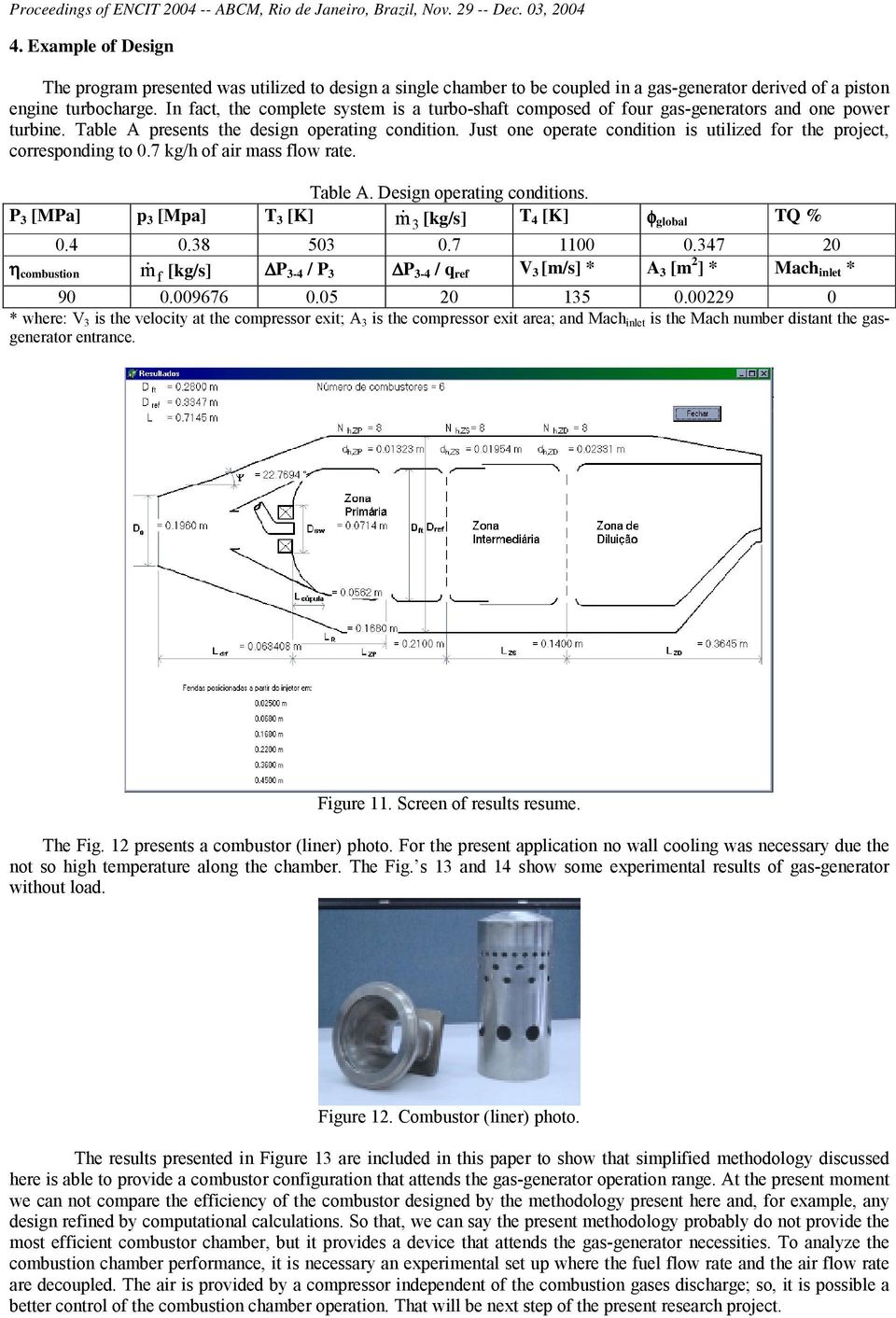
11 Proceedings of ENCIT BCM, Rio de Janeiro, Brazil, Nov Dec. 0, Example of Design The program presented was utilized to design a single chamber to be coupled in a gas-generator derived of a piston engine turbocharge. In fact, the complete system is a turbo-shaft composed of four gas-generators and one power turbine. Table presents the design operating condition. Just one operate condition is utilized for the project, corresponding to 0.7 kg/h of air mass flow rate. Table. Design operating conditions. P [MPa] p [Mpa] T [K] m [kg/s] T 4 [K] φ global TQ % η combustion m f [kg/s] P -4 / P P -4 / q V [m/s] * [m ] * Mach inlet * * where: V is the velocity at the compressor exit; is the compressor exit area; and Mach inlet is the Mach number distant the gasgenerator entrance. Figure 11. Screen of results resume. The Fig. 1 presents a combustor (liner) photo. For the present application no wall cooling was necessary due the not so high temperature along the chamber. The Fig. s 1 and 14 show some experimental results of gas-generator without load. Figure 1. Combustor (liner) photo. The results presented in Figure 1 are included in this paper to show that simplified methodology discussed here is able to provide a combustor configuration that attends the gas-generator operation range. t the present moment we can not compare the efficiency of the combustor designed by the methodology present here and, for example, any design ined by computational calculations. So that, we can say the present methodology probably do not provide the most efficient combustor chamber, but it provides a device that attends the gas-generator necessities. To analyze the combustion chamber performance, it is necessary an experimental set up where the fuel flow rate and the air flow rate are decoupled. The air is provided by a compressor independent of the combustion gases discharge; so, it is possible a better control of the combustion chamber operation. That will be next step of the present research project.
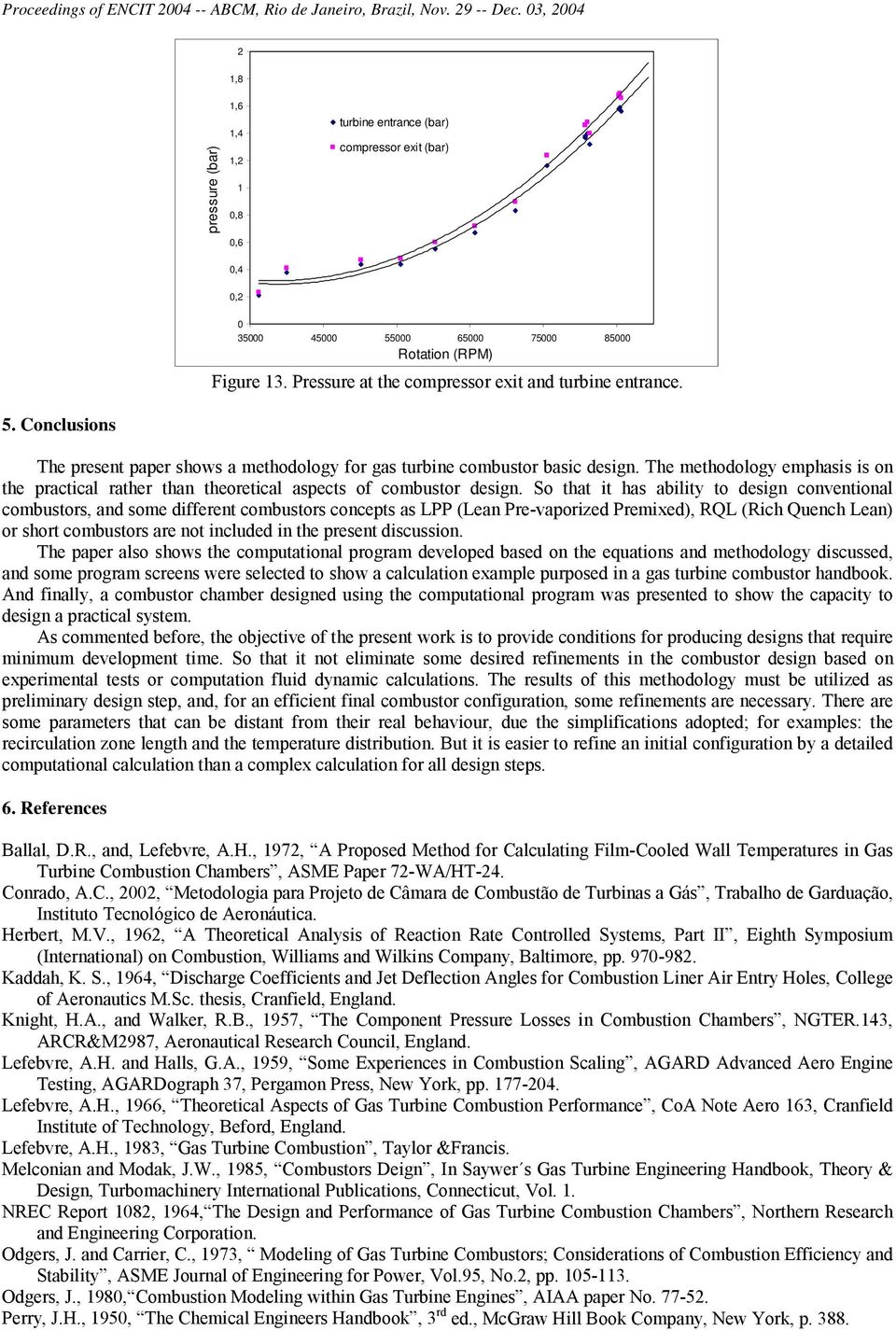
12 Proceedings of ENCIT BCM, Rio de Janeiro, Brazil, Nov Dec. 0, 004 1,8 pressure (bar) 1,6 1,4 1, 1 0,8 0,6 turbine entrance (bar) compressor exit (bar) 0,4 0, Rotation (RPM) Figure 1. Pressure at the compressor exit and turbine entrance. 5. Conclusions The present paper shows a methodology for gas turbine combustor basic design. The methodology emphasis is on the practical rather than theoretical aspects of combustor design. So that it has ability to design conventional combustors, and some different combustors concepts as LPP (Lean Pre-vaporized Premixed), RQL (Rich Quench Lean) or short combustors are not included in the present discussion. The paper also shows the computational program developed based on the equations and methodology discussed, and some program screens were selected to show a calculation example purposed in a gas turbine combustor handbook. nd finally, a combustor chamber designed using the computational program was presented to show the capacity to design a practical system. s commented before, the objective of the present work is to provide conditions for producing designs that require minimum development time. So that it not eliminate some desired inements in the combustor design based on experimental tests or computation fluid dynamic calculations. The results of this methodology must be utilized as preliminary design step, and, for an efficient final combustor configuration, some inements are necessary. There are some parameters that can be distant from their real behaviour, due the simplifications adopted; for examples: the recirculation zone length and the temperature distribution. But it is easier to ine an initial configuration by a detailed computational calculation than a complex calculation for all design steps. 6. References Ballal, D.R., and, Lefebvre,.H., 197, Proposed Method for Calculating Film-Cooled Wall Temperatures in Gas Turbine Combustion Chambers, SME Paper 7-W/HT-4. Conrado,.C., 00, Metodologia para Projeto de Câmara de Combustão de Turbinas a Gás, Trabalho de Garduação, Instituto Tecnológico de eronáutica. Herbert, M.V., 196, Theoretical nalysis of Reaction Rate Controlled Systems, Part II, Eighth Symposium (International) on Combustion, Williams and Wilkins Company, Baltimore, pp Kaddah, K. S., 1964, Discharge Coefficients and Jet Deflection ngles for Combustion Liner ir Entry Holes, College of eronautics M.Sc. thesis, Cranfield, England. Knight, H.., and Walker, R.B., 1957, The Component Pressure Losses in Combustion Chambers, NGTER.14, RCR&M987, eronautical Research Council, England. Lefebvre,.H. and Halls, G.., 1959, Some Experiences in Combustion Scaling, GRD dvanced ero Engine Testing, GRDograph 7, Pergamon Press, New York, pp Lefebvre,.H., 1966, Theoretical spects of Gas Turbine Combustion Performance, Co Note ero 16, Cranfield Institute of Technology, Beford, England. Lefebvre,.H., 198, Gas Turbine Combustion, Taylor &Francis. Melconian and Modak, J.W., 1985, Combustors Deign, In Saywer s Gas Turbine Engineering Handbook, Theory & Design, Turbomachinery International Publications, Connecticut, Vol. 1. NREC Report 108, 1964, The Design and Performance of Gas Turbine Combustion Chambers, Northern Research and Engineering Corporation. Odgers, J. and Carrier, C., 197, Modeling of Gas Turbine Combustors; Considerations of Combustion Efficiency and Stability, SME Journal of Engineering for Power, Vol.95, No., pp Odgers, J., 1980, Combustion Modeling within Gas Turbine Engines, I paper No Perry, J.H., 1950, The Chemical Engineers Handbook, rd ed., McGraw Hill Book Company, New York, p. 88.
COMBUSTION SYSTEMS - EXAMPLE Cap. 9 AIAA AIRCRAFT ENGINE DESIGN www.amazon.com
 CORSO DI LAUREA MAGISTRALE IN Ingegneria Aerospaziale PROPULSION AND COMBUSTION COMBUSTION SYSTEMS - EXAMPLE Cap. 9 AIAA AIRCRAFT ENGINE DESIGN www.amazon.com LA DISPENSA E DISPONIBILE SU www.ingindustriale.unisalento.it
PERFORMANCE EVALUATION OF A MICRO GAS TURBINE BASED ON AUTOMOTIVE TURBOCHARGER FUELLED WITH LPG
 PERFORMANCE EVALUATION OF A MICRO GAS TURBINE BASED ON AUTOMOTIVE TURBOCHARGER FUELLED WITH LPG Guenther Carlos Krieger Filho, [email protected] José Rigoni Junior Rafael Cavalcanti de Souza, [email protected]
Perspective on R&D Needs for Gas Turbine Power Generation
 Perspective on R&D Needs for Gas Turbine Power Generation Eli Razinsky Solar Turbine Incorporated 2010 UTSR Workshop October 26, 2011 1 Research Requirements Overview Specific Requirements 2 Society Requirements
FLUID FLOW Introduction General Description
 FLUID FLOW Introduction Fluid flow is an important part of many processes, including transporting materials from one point to another, mixing of materials, and chemical reactions. In this experiment, you
A MTR FUEL ELEMENT FLOW DISTRIBUTION MEASUREMENT PRELIMINARY RESULTS
 A MTR FUEL ELEMENT FLOW DISTRIBUTION MEASUREMENT PRELIMINARY RESULTS W. M. Torres, P. E. Umbehaun, D. A. Andrade and J. A. B. Souza Centro de Engenharia Nuclear Instituto de Pesquisas Energéticas e Nucleares
GT2011 46090 ANALYSIS OF A MICROGASTURBINE FED BY NATURAL GAS AND SYNTHESIS GAS: MGT TEST BENCH AND COMBUSTOR CFD ANALYSIS
 ASME Turbo Expo 2011 June 6 10, 2011 Vancouver, Canada GT 2011 46090 ANALYSIS OF A MICROGASTURBINE FED BY NATURAL GAS AND SYNTHESIS GAS: MGT TEST BENCH AND COMBUSTOR CFD ANALYSIS M. Cadorin 1,M. Pinelli
FEASIBILITY OF A BRAYTON CYCLE AUTOMOTIVE AIR CONDITIONING SYSTEM
 FEASIBILITY OF A BRAYTON CYCLE AUTOMOTIVE AIR CONDITIONING SYSTEM L. H. M. Beatrice a, and F. A. S. Fiorelli a a Universidade de São Paulo Escola Politécnica Departamento de Engenharia Mecânica Av. Prof.
Design of heat exchangers
 Design of heat exchangers Exchanger Design Methodology The problem of heat exchanger design is complex and multidisciplinary. The major design considerations for a new heat exchanger include: process/design
Machine Design II Prof. K.Gopinath & Prof. M.M.Mayuram. Module 2 - GEARS. Lecture 17 DESIGN OF GEARBOX
 Module 2 - GEARS Lecture 17 DESIGN OF GEARBOX Contents 17.1 Commercial gearboxes 17.2 Gearbox design. 17.1 COMMERCIAL GEARBOXES Various commercial gearbox designs are depicted in Fig. 17.1 to 17.10. These
COMBUSTION STUDIES OF NATURAL GAS AND SYN-GAS WITH HUMID AIR
 COMBUSTION STUDIES OF NATURAL GAS AND SYN-GAS WITH HUMID AIR Abstract Dr. Michael Nakhamkin Eric Swensen Hubert Paprotna Energy Storage and Power Consultants 200 Central Avenue Mountainside, New Jersey
Engine Heat Transfer. Engine Heat Transfer
 Engine Heat Transfer 1. Impact of heat transfer on engine operation 2. Heat transfer environment 3. Energy flow in an engine 4. Engine heat transfer Fundamentals Spark-ignition engine heat transfer Diesel
DEVELOPMENT OF HIGH SPEED RESPONSE LAMINAR FLOW METER FOR AIR CONDITIONING
 DEVELOPMENT OF HIGH SPEED RESPONSE LAMINAR FLOW METER FOR AIR CONDITIONING Toshiharu Kagawa 1, Yukako Saisu 2, Riki Nishimura 3 and Chongho Youn 4 ABSTRACT In this paper, we developed a new laminar flow
Theory of turbo machinery / Turbomaskinernas teori. Chapter 4
 Theory of turbo machinery / Turbomaskinernas teori Chapter 4 Axial-Flow Turbines: Mean-Line Analyses and Design Power is more certainly retained by wary measures than by daring counsels. (Tacitius, Annals)
STEAM TURBINE 1 CONTENT. Chapter Description Page. V. Steam Process in Steam Turbine 6. VI. Exhaust Steam Conditions, Extraction and Admission 7
 STEAM TURBINE 1 CONTENT Chapter Description Page I Purpose 2 II Steam Turbine Types 2 2.1. Impulse Turbine 2 2.2. Reaction Turbine 2 III Steam Turbine Operating Range 2 3.1. Curtis 2 3.2. Rateau 2 3.3.
A LAMINAR FLOW ELEMENT WITH A LINEAR PRESSURE DROP VERSUS VOLUMETRIC FLOW. 1998 ASME Fluids Engineering Division Summer Meeting
 TELEDYNE HASTINGS TECHNICAL PAPERS INSTRUMENTS A LAMINAR FLOW ELEMENT WITH A LINEAR PRESSURE DROP VERSUS VOLUMETRIC FLOW Proceedings of FEDSM 98: June -5, 998, Washington, DC FEDSM98 49 ABSTRACT The pressure
FLUID MECHANICS. TUTORIAL No.7 FLUID FORCES. When you have completed this tutorial you should be able to. Solve forces due to pressure difference.
 FLUID MECHANICS TUTORIAL No.7 FLUID FORCES When you have completed this tutorial you should be able to Solve forces due to pressure difference. Solve problems due to momentum changes. Solve problems involving
Chapters 7. Performance Comparison of CI and SI Engines. Performance Comparison of CI and SI Engines con t. SI vs CI Performance Comparison
 Chapters 7 SI vs CI Performance Comparison Performance Comparison of CI and SI Engines The CI engine cycle can be carried out in either 2 or 4 strokes of the piston, with the 4-cycle CI engine being more
The Behaviour Of Vertical Jet Fires Under Sonic And Subsonic Regimes
 The Behaviour Of Vertical Jet Fires Under Sonic And Subsonic Regimes Palacios A. and Casal J. Centre for Technological Risk Studies (CERTEC), Department of Chemical Engineering, Universitat Politècnica
Lecture 3 Fluid Dynamics and Balance Equa6ons for Reac6ng Flows
 Lecture 3 Fluid Dynamics and Balance Equa6ons for Reac6ng Flows 3.- 1 Basics: equations of continuum mechanics - balance equations for mass and momentum - balance equations for the energy and the chemical
A SILICON-BASED MICRO GAS TURBINE ENGINE FOR POWER GENERATION. Singapore Institute of Manufacturing Technology, Singapore 658075
 Stresa, Italy, 26-28 April 2006 A SILICON-BASED MICRO GAS TURBINE ENGINE FOR POWER GENERATION X. C. Shan 1, Z. F. Wang 1, R. Maeda 2, Y. F. Sun 1 M. Wu 3 and J. S. Hua 3 1 Singapore Institute of Manufacturing
Learning Module 4 - Thermal Fluid Analysis Note: LM4 is still in progress. This version contains only 3 tutorials.
 Learning Module 4 - Thermal Fluid Analysis Note: LM4 is still in progress. This version contains only 3 tutorials. Attachment C1. SolidWorks-Specific FEM Tutorial 1... 2 Attachment C2. SolidWorks-Specific
Diesel injection, ignition, and fuel air mixing
 Diesel injection, ignition, and fuel air mixing 1. Fuel spray phenomena. Spontaneous ignition 3. Effects of fuel jet and charge motion on mixingcontrolled combustion 4. Fuel injection hardware 5. Challenges
Exergy Analysis of a Water Heat Storage Tank
 Exergy Analysis of a Water Heat Storage Tank F. Dammel *1, J. Winterling 1, K.-J. Langeheinecke 3, and P. Stephan 1,2 1 Institute of Technical Thermodynamics, Technische Universität Darmstadt, 2 Center
Part IV. Conclusions
 Part IV Conclusions 189 Chapter 9 Conclusions and Future Work CFD studies of premixed laminar and turbulent combustion dynamics have been conducted. These studies were aimed at explaining physical phenomena
Fired Heater Design and Simulation
 Fired Heater Design and Simulation Mahesh N. Jethva 1, C. G. Bhagchandani 2 1 M.E. Chemical Engineering Department, L.D. College of Engineering, Ahmedabad-380 015 2 Associate Professor, Chemical Engineering
Department of Chemical Engineering, National Institute of Technology, Tiruchirappalli 620 015, Tamil Nadu, India
 Experimental Thermal and Fluid Science 32 (2007) 92 97 www.elsevier.com/locate/etfs Studies on heat transfer and friction factor characteristics of laminar flow through a circular tube fitted with right
Michael Montgomery Marketing Product Manager Rosemount Inc. Russ Evans Manager of Engineering and Design Rosemount Inc.
 ASGMT / Averaging Pitot Tube Flow Measurement Michael Montgomery Marketing Product Manager Rosemount Inc. Russ Evans Manager of Engineering and Design Rosemount Inc. Averaging Pitot Tube Meters Introduction
CFD SIMULATION OF SDHW STORAGE TANK WITH AND WITHOUT HEATER
 International Journal of Advancements in Research & Technology, Volume 1, Issue2, July-2012 1 CFD SIMULATION OF SDHW STORAGE TANK WITH AND WITHOUT HEATER ABSTRACT (1) Mr. Mainak Bhaumik M.E. (Thermal Engg.)
FUNDAMENTALS OF GAS TURBINE ENGINES
 FUNDAMENTALS OF GAS TURBINE ENGINES INTRODUCTION The gas turbine is an internal combustion engine that uses air as the working fluid. The engine extracts chemical energy from fuel and converts it to mechanical
Development of a Low-swirl Injector for Midsize Gas Turbines and Fuel Flexible Combustors
 Development of a Low-swirl Injector for Midsize Gas Turbines and Fuel Flexible Combustors Robert K. Cheng & David Littlejohn Lawrence Berkeley National Lab. Waseem Nazeer & Ken O. Smith Solar Turbines
CFD Simulation of HSDI Engine Combustion Using VECTIS
 CFD Simulation of HSDI Engine Combustion Using VECTIS G. Li, S.M. Sapsford Ricardo Consulting Engineer s Ltd., Shoreham-by-Sea, UK ABSTRACT As part of the VECTIS code validation programme, CFD simulations
LOW EMISSION COMBUSTION TECHNOLOGY FOR STATIONARY GAS TURBINE ENGINES
 LOW EMISSION COMBUSTION TECHNOLOGY FOR STATIONARY GAS TURBINE ENGINES by Stuart A. Greenwood Group Manager Solar Turbines Inc. San Diego, California Stuart A. Greenwood is the Group Manager of the Advanced
Solution Derivations for Capa #11
 Solution Derivations for Capa #11 1) A horizontal circular platform (M = 128.1 kg, r = 3.11 m) rotates about a frictionless vertical axle. A student (m = 68.3 kg) walks slowly from the rim of the platform
Gas Turbine Combustor Technology Contributing to Environmental Conservation
 6 Gas Turbine Combustor Technology Contributing to Environmental Conservation KATSUNORI TANAKA KOICHI NISHIDA WATARU AKIZUKI In order to combat global warming, the reduction of greenhouse-gas emissions
Solution for Homework #1
 Solution for Homework #1 Chapter 2: Multiple Choice Questions (2.5, 2.6, 2.8, 2.11) 2.5 Which of the following bond types are classified as primary bonds (more than one)? (a) covalent bonding, (b) hydrogen
ME 315 - Heat Transfer Laboratory. Experiment No. 7 ANALYSIS OF ENHANCED CONCENTRIC TUBE AND SHELL AND TUBE HEAT EXCHANGERS
 ME 315 - Heat Transfer Laboratory Nomenclature Experiment No. 7 ANALYSIS OF ENHANCED CONCENTRIC TUBE AND SHELL AND TUBE HEAT EXCHANGERS A heat exchange area, m 2 C max maximum specific heat rate, J/(s
Differential Relations for Fluid Flow. Acceleration field of a fluid. The differential equation of mass conservation
 Differential Relations for Fluid Flow In this approach, we apply our four basic conservation laws to an infinitesimally small control volume. The differential approach provides point by point details of
When the fluid velocity is zero, called the hydrostatic condition, the pressure variation is due only to the weight of the fluid.
 Fluid Statics When the fluid velocity is zero, called the hydrostatic condition, the pressure variation is due only to the weight of the fluid. Consider a small wedge of fluid at rest of size Δx, Δz, Δs
Pipe Flow-Friction Factor Calculations with Excel
 Pipe Flow-Friction Factor Calculations with Excel Course No: C03-022 Credit: 3 PDH Harlan H. Bengtson, PhD, P.E. Continuing Education and Development, Inc. 9 Greyridge Farm Court Stony Point, NY 10980
Transient Performance Prediction for Turbocharging Systems Incorporating Variable-geometry Turbochargers
 22 Special Issue Turbocharging Technologies Research Report Transient Performance Prediction for Turbocharging Systems Incorporating Variable-geometry Turbochargers Hiroshi Uchida Abstract Turbocharging
Fluid Mechanics: Static s Kinematics Dynamics Fluid
 Fluid Mechanics: Fluid mechanics may be defined as that branch of engineering science that deals with the behavior of fluid under the condition of rest and motion Fluid mechanics may be divided into three
ME 239: Rocket Propulsion. Over- and Under-expanded Nozzles and Nozzle Configurations. J. M. Meyers, PhD
 ME 239: Rocket Propulsion Over- and Under-expanded Nozzles and Nozzle Configurations J. M. Meyers, PhD 1 Over- and Underexpanded Nozzles Underexpanded Nozzle Discharges fluid at an exit pressure greater
Lecture 24 - Surface tension, viscous flow, thermodynamics
 Lecture 24 - Surface tension, viscous flow, thermodynamics Surface tension, surface energy The atoms at the surface of a solid or liquid are not happy. Their bonding is less ideal than the bonding of atoms
Boiler efficiency measurement. Department of Energy Engineering
 Boiler efficiency measurement Department of Energy Engineering Contents Heat balance on boilers Efficiency determination Loss categories Fluegas condensation principals Seasonal efficiency Emission evaluation
Engine Efficiency and Power Density: Distinguishing Limits from Limitations
 Engine Efficiency and Power Density: Distinguishing Limits from Limitations Chris F. Edwards Advanced Energy Systems Laboratory Department of Mechanical Engineering Stanford University Exergy to Engines
Battery Thermal Management System Design Modeling
 Battery Thermal Management System Design Modeling Gi-Heon Kim, Ph.D Ahmad Pesaran, Ph.D ([email protected]) National Renewable Energy Laboratory, Golden, Colorado, U.S.A. EVS October -8, 8, 006 Yokohama,
Comparative Analysis of Gas Turbine Blades with and without Turbulators
 Comparative Analysis of Gas Turbine Blades with and without Turbulators Sagar H T 1, Kishan Naik 2 1 PG Student, Dept. of Studies in Mechanical Engineering, University BDT College of Engineering, Davangere,
CO 2 41.2 MPa (abs) 20 C
 comp_02 A CO 2 cartridge is used to propel a small rocket cart. Compressed CO 2, stored at a pressure of 41.2 MPa (abs) and a temperature of 20 C, is expanded through a smoothly contoured converging nozzle
Chapter 10. Flow Rate. Flow Rate. Flow Measurements. The velocity of the flow is described at any
 Chapter 10 Flow Measurements Material from Theory and Design for Mechanical Measurements; Figliola, Third Edition Flow Rate Flow rate can be expressed in terms of volume flow rate (volume/time) or mass
Thermodynamics - Example Problems Problems and Solutions
 Thermodynamics - Example Problems Problems and Solutions 1 Examining a Power Plant Consider a power plant. At point 1 the working gas has a temperature of T = 25 C. The pressure is 1bar and the mass flow
INTERNAL COMBUSTION (IC) ENGINES
 INTERNAL COMBUSTION (IC) ENGINES An IC engine is one in which the heat transfer to the working fluid occurs within the engine itself, usually by the combustion of fuel with the oxygen of air. In external
A TEST RIG FOR TESTING HIGH PRESSURE CENTRIFUGAL COMPRESSORS MODEL STAGES AT HIGH REYNOLDS NUMBER
 A TEST RIG FOR TESTING HIGH PRESSURE CENTRIFUGAL COMPRESSORS MODEL STAGES AT HIGH REYNOLDS NUMBER P. NAVA, M.PROFETI, M. GIACHI, F.SARRI GE-NUOVO PIGNONE G.P.MANFRIDA UNIVERSITY OF FLORENCE Italia Presented
Understanding Plastics Engineering Calculations
 Natti S. Rao Nick R. Schott Understanding Plastics Engineering Calculations Hands-on Examples and Case Studies Sample Pages from Chapters 4 and 6 ISBNs 978--56990-509-8-56990-509-6 HANSER Hanser Publishers,
Mixing in the process industry: Chemicals Food Pharmaceuticals Paper Polymers Minerals Environmental. Chemical Industry:
 Mixing Notes: Chapter 19 Robert P. Hesketh Mixing in the process industry: Chemicals Food Pharmaceuticals Paper Polymers Minerals Environmental Chemical Industry: Paints and Coatings Synthetic Rubbers
Effect of Aspect Ratio on Laminar Natural Convection in Partially Heated Enclosure
 Universal Journal of Mechanical Engineering (1): 8-33, 014 DOI: 10.13189/ujme.014.00104 http://www.hrpub.org Effect of Aspect Ratio on Laminar Natural Convection in Partially Heated Enclosure Alireza Falahat
Explosion Hazards of Hydrogen-Air Mixtures. Professor John H.S. Lee McGill University, Montreal, Canada
 Explosion Hazards of Hydrogen-Air Mixtures Professor John H.S. Lee McGill University, Montreal, Canada Hydrogen Safety Issues Wide spread use of hydrogen requires significant efforts to resolve safety
International Journal of Latest Research in Science and Technology Volume 4, Issue 2: Page No.161-166, March-April 2015
 International Journal of Latest Research in Science and Technology Volume 4, Issue 2: Page No.161-166, March-April 2015 http://www.mnkjournals.com/ijlrst.htm ISSN (Online):2278-5299 EXPERIMENTAL STUDY
Heat Transfer Prof. Dr. Ale Kumar Ghosal Department of Chemical Engineering Indian Institute of Technology, Guwahati
 Heat Transfer Prof. Dr. Ale Kumar Ghosal Department of Chemical Engineering Indian Institute of Technology, Guwahati Module No. # 04 Convective Heat Transfer Lecture No. # 03 Heat Transfer Correlation
HEAT UNIT 1.1 KINETIC THEORY OF GASES. 1.1.1 Introduction. 1.1.2 Postulates of Kinetic Theory of Gases
 UNIT HEAT. KINETIC THEORY OF GASES.. Introduction Molecules have a diameter of the order of Å and the distance between them in a gas is 0 Å while the interaction distance in solids is very small. R. Clausius
Introduction of the Solar Turbines Titan 250 Gas Turbine System
 Introduction of the Solar Turbines Titan 250 Gas Turbine System Design, Development and Validation Testing a New 22.4 MW Gas Turbine VGB Fachtagung 24-JUN-2009 Mannheim, Germany Ulrich Stang Manager Turbine
Design and testing of a high flow coefficient mixed flow impeller
 Design and testing of a high flow coefficient mixed flow impeller H.R. Hazby PCA Engineers Ltd., UK M.V. Casey PCA Engineers Ltd., UK University of Stuttgart (ITSM), Germany R. Numakura and H. Tamaki IHI
POROUS BURNER - A New Approach to Infrared
 Page: 1 POROUS BURNER - A New Approach to Infrared 1. Preface There are several possibilities to produce infrared radiation in the technical sense. Regarding the source of energy you can distinguish between
Chapter 3. Table E-1. Equilibrium data for SO 2 at 1 atm and 20 o C. x 0.000564.000842.001403.001965.00279.00420 y 0.0112.01855.0342.0513.0775.
 Chapter 3 Example 3.2-5. ---------------------------------------------------------------------------------- Sulfur dioxide produced by the combustion of sulfur in air is absorbed in water. Pure SO 2 is
Rotation: Moment of Inertia and Torque
 Rotation: Moment of Inertia and Torque Every time we push a door open or tighten a bolt using a wrench, we apply a force that results in a rotational motion about a fixed axis. Through experience we learn
This paper is also taken for the relevant Examination for the Associateship. For Second Year Physics Students Wednesday, 4th June 2008: 14:00 to 16:00
 Imperial College London BSc/MSci EXAMINATION June 2008 This paper is also taken for the relevant Examination for the Associateship SUN, STARS, PLANETS For Second Year Physics Students Wednesday, 4th June
Lecture 9, Thermal Notes, 3.054
 Lecture 9, Thermal Notes, 3.054 Thermal Properties of Foams Closed cell foams widely used for thermal insulation Only materials with lower conductivity are aerogels (tend to be brittle and weak) and vacuum
Effect of Pressure Ratio on Film Cooling of Turbine Aerofoil Using CFD
 Universal Journal of Mechanical Engineering 1(4): 122-127, 2013 DOI: 10.13189/ujme.2013.010403 http://www.hrpub.org Effect of Pressure Ratio on Film Cooling of Turbine Aerofoil Using CFD Vibhor Baghel
Performance of the Boiler and To Improving the Boiler Efficiency Using Cfd Modeling
 IOSR Journal of Mechanical and Civil Engineering (IOSR-JMCE) e-issn: 2278-1684,p-ISSN: 2320-334X, Volume 8, Issue 6 (Sep. - Oct. 2013), PP 25-29 Performance of the Boiler and To Improving the Boiler Efficiency
Vacuum Technology. Kinetic Theory of Gas. Dr. Philip D. Rack
 Kinetic Theory of Gas Assistant Professor Department of Materials Science and Engineering University of Tennessee 603 Dougherty Engineering Building Knoxville, TN 3793-00 Phone: (865) 974-5344 Fax (865)
p atmospheric Statics : Pressure Hydrostatic Pressure: linear change in pressure with depth Measure depth, h, from free surface Pressure Head p gh
 IVE1400: n Introduction to Fluid Mechanics Statics : Pressure : Statics r P Sleigh: [email protected] r J Noakes:[email protected] January 008 Module web site: www.efm.leeds.ac.uk/ive/fluidslevel1
The soot and scale problems
 Dr. Albrecht Kaupp Page 1 The soot and scale problems Issue Soot and scale do not only increase energy consumption but are as well a major cause of tube failure. Learning Objectives Understanding the implications
Lecture 6 - Boundary Conditions. Applied Computational Fluid Dynamics
 Lecture 6 - Boundary Conditions Applied Computational Fluid Dynamics Instructor: André Bakker http://www.bakker.org André Bakker (2002-2006) Fluent Inc. (2002) 1 Outline Overview. Inlet and outlet boundaries.
Performance. 13. Climbing Flight
 Performance 13. Climbing Flight In order to increase altitude, we must add energy to the aircraft. We can do this by increasing the thrust or power available. If we do that, one of three things can happen:
Chapter 18 Temperature, Heat, and the First Law of Thermodynamics. Problems: 8, 11, 13, 17, 21, 27, 29, 37, 39, 41, 47, 51, 57
 Chapter 18 Temperature, Heat, and the First Law of Thermodynamics Problems: 8, 11, 13, 17, 21, 27, 29, 37, 39, 41, 47, 51, 57 Thermodynamics study and application of thermal energy temperature quantity
Steady Heat Conduction
 Steady Heat Conduction In thermodynamics, we considered the amount of heat transfer as a system undergoes a process from one equilibrium state to another. hermodynamics gives no indication of how long
Optimization algorithms for aeronautical engine components: CFD design applications
 Optimization algorithms for aeronautical engine components: CFD design applications 1 Outline CFD Optimization Research projects Combustor applications Injection system design à swirl number Cowl design
HYBRID ROCKET TECHNOLOGY IN THE FRAME OF THE ITALIAN HYPROB PROGRAM
 8 th European Symposium on Aerothermodynamics for space vehicles HYBRID ROCKET TECHNOLOGY IN THE FRAME OF THE ITALIAN HYPROB PROGRAM M. Di Clemente, R. Votta, G. Ranuzzi, F. Ferrigno March 4, 2015 Outline
measurement, but almost any pipe elbow can be calibrated Elbow meters are not as potentially accurate as venturi,
 Lecture 14 Flow Measurement in Pipes I. Elbow Meters An elbow in a pipe can be used as a flow measuring device much in the same way as a venturi or orifice plate The head differential across the elbow
Fluid Mechanics Prof. S. K. Som Department of Mechanical Engineering Indian Institute of Technology, Kharagpur
 Fluid Mechanics Prof. S. K. Som Department of Mechanical Engineering Indian Institute of Technology, Kharagpur Lecture - 20 Conservation Equations in Fluid Flow Part VIII Good morning. I welcome you all
SIMPLIFIED METHOD FOR ESTIMATING THE FLIGHT PERFORMANCE OF A HOBBY ROCKET
 SIMPLIFIED METHOD FOR ESTIMATING THE FLIGHT PERFORMANCE OF A HOBBY ROCKET WWW.NAKKA-ROCKETRY.NET February 007 Rev.1 March 007 1 Introduction As part of the design process for a hobby rocket, it is very
Minor losses include head losses through/past hydrants, couplers, valves,
 Lecture 10 Minor Losses & Pressure Requirements I. Minor Losses Minor (or fitting, or local ) hydraulic losses along pipes can often be estimated as a function of the velocity head of the water within
Forces on the Rocket. Rocket Dynamics. Equation of Motion: F = Ma
 Rocket Dynamics orces on the Rockets - Drag Rocket Stability Rocket Equation Specific Impulse Rocket otors Thrust orces on the Rocket Equation of otion: = a orces at through the Center of ass Center of
MacroFlo Opening Types User Guide <Virtual Environment> 6.0
 MacroFlo Opening Types User Guide 6.0 Page 1 of 18 Contents 1. Introduction...4 2. What Are Opening Types?...5 3. MacroFlo Opening Types Manager Interface...5 3.1. Add... 5 3.2. Reference
Chapter 8: Flow in Pipes
 Objectives 1. Have a deeper understanding of laminar and turbulent flow in pipes and the analysis of fully developed flow 2. Calculate the major and minor losses associated with pipe flow in piping networks
Valve Sizing. Te chnic al Bulletin. Flow Calculation Principles. Scope. Sizing Valves. Safe Product Selection. www.swagelok.com
 www.swagelok.com Valve Sizing Te chnic al Bulletin Scope Valve size often is described by the nominal size of the end connections, but a more important measure is the flow that the valve can provide. And
APPLIED THERMODYNAMICS TUTORIAL 1 REVISION OF ISENTROPIC EFFICIENCY ADVANCED STEAM CYCLES
 APPLIED THERMODYNAMICS TUTORIAL 1 REVISION OF ISENTROPIC EFFICIENCY ADVANCED STEAM CYCLES INTRODUCTION This tutorial is designed for students wishing to extend their knowledge of thermodynamics to a more
5.56 MM CERAMIC GUN BARREL THERMAL ANALYSES WITH CYCLED AMMUNITION
 23 RD INTERNATIONAL SYMPOSIUM ON BALLISTICS TARRAGONA, SPAIN 16-2 APRIL 27 5.56 MM CERAMIC GUN BARREL THERMAL ANALYSES WITH CYCLED AMMUNITION Xiaogang Huang 1, Paul Conroy 2 and Robert Carter 3 1 Aerodynamics
Copyright 1984 by ASME. NOx ABATEMENT VIA WATER INJECTION IN AIRCRAFT-DERIVATIVE TURBINE ENGINES. D. W. Bahr. and T. F. Lyon
 = THE AMERICAN SOCIETY OF MECHANICAL ENGINEERS 345 E. 47 St., New York, N.Y. 117 84-GT-13 [^^ The Society shall not be responsible for statements or opinions advanced in papers or In S discussion at meetings
www.mathsbox.org.uk Displacement (x) Velocity (v) Acceleration (a) x = f(t) differentiate v = dx Acceleration Velocity (v) Displacement x
 Mechanics 2 : Revision Notes 1. Kinematics and variable acceleration Displacement (x) Velocity (v) Acceleration (a) x = f(t) differentiate v = dx differentiate a = dv = d2 x dt dt dt 2 Acceleration Velocity
Practice Problems on Boundary Layers. Answer(s): D = 107 N D = 152 N. C. Wassgren, Purdue University Page 1 of 17 Last Updated: 2010 Nov 22
 BL_01 A thin flat plate 55 by 110 cm is immersed in a 6 m/s stream of SAE 10 oil at 20 C. Compute the total skin friction drag if the stream is parallel to (a) the long side and (b) the short side. D =
Chapter 5 Shock Absorber Design
 Chapter 5 Shock Absorber Design 5.1. Introduction The basic function of the shock absorber is to absorb and dissipate the impact kinetic energy to the extent that accelerations imposed upon the airframe
RESEARCH PROJECTS. For more information about our research projects please contact us at: [email protected]
 RESEARCH PROJECTS For more information about our research projects please contact us at: [email protected] Or visit our web site at: www.naisengineering.com 2 Setup of 1D Model for the Simulation
Technical Solutions for Emissions Reduction
 Genera 2015 Technical Solutions for Emissions Reduction Juan Nogales GE Power & Water Madrid, February 24, 2015 2015 General Electric Company. All rights reserved. This material may not be copied or distributed
Diffusion and Fluid Flow
 Diffusion and Fluid Flow What determines the diffusion coefficient? What determines fluid flow? 1. Diffusion: Diffusion refers to the transport of substance against a concentration gradient. ΔS>0 Mass
Piotr Tofiło a,*, Marek Konecki b, Jerzy Gałaj c, Waldemar Jaskółowski d, Norbert Tuśnio e, Marcin Cisek f
 Available online at www.sciencedirect.com Procedia Engineering 57 (2013 ) 1156 1165 11th International Conference on Modern Building Materials, Structures and Techniques, MBMST 2013 Expert System for Building
Head Loss in Pipe Flow ME 123: Mechanical Engineering Laboratory II: Fluids
 Head Loss in Pipe Flow ME 123: Mechanical Engineering Laboratory II: Fluids Dr. J. M. Meyers Dr. D. G. Fletcher Dr. Y. Dubief 1. Introduction Last lab you investigated flow loss in a pipe due to the roughness
Experimental Evaluation of the Discharge Coefficient of a Centre-Pivot Roof Window
 Experimental Evaluation of the Discharge Coefficient of a Centre-Pivot Roof Window Ahsan Iqbal #1, Alireza Afshari #2, Per Heiselberg *3, Anders Høj **4 # Energy and Environment, Danish Building Research
Physics of the Atmosphere I
 Physics of the Atmosphere I WS 2008/09 Ulrich Platt Institut f. Umweltphysik R. 424 [email protected] heidelberg.de Last week The conservation of mass implies the continuity equation:
PART VIII: ABSORPTIVE SILENCER DESIGN
 PART VIII: ABSORPTIVE SILENCER DESIGN Elden F. Ray June 10, 2013 TABLE OF CONTENTS Introduction 2 Silencer Performance 4 Flow Resistance and Resistivity 7 Flow Velocity 7 Baffle Attenuation Example 7 Silencer