
PART VIII: ABSORPTIVE SILENCER DESIGN
|
|
|
- Blaise Kelly
- 9 years ago
- Views:
Transcription
1 PART VIII: ABSORPTIVE SILENCER DESIGN Elden F. Ray June 10, 2013 TABLE OF CONTENTS Introduction 2 Silencer Performance 4 Flow Resistance and Resistivity 7 Flow Velocity 7 Baffle Attenuation Example 7 Silencer Design 8 Performance Criteria 9

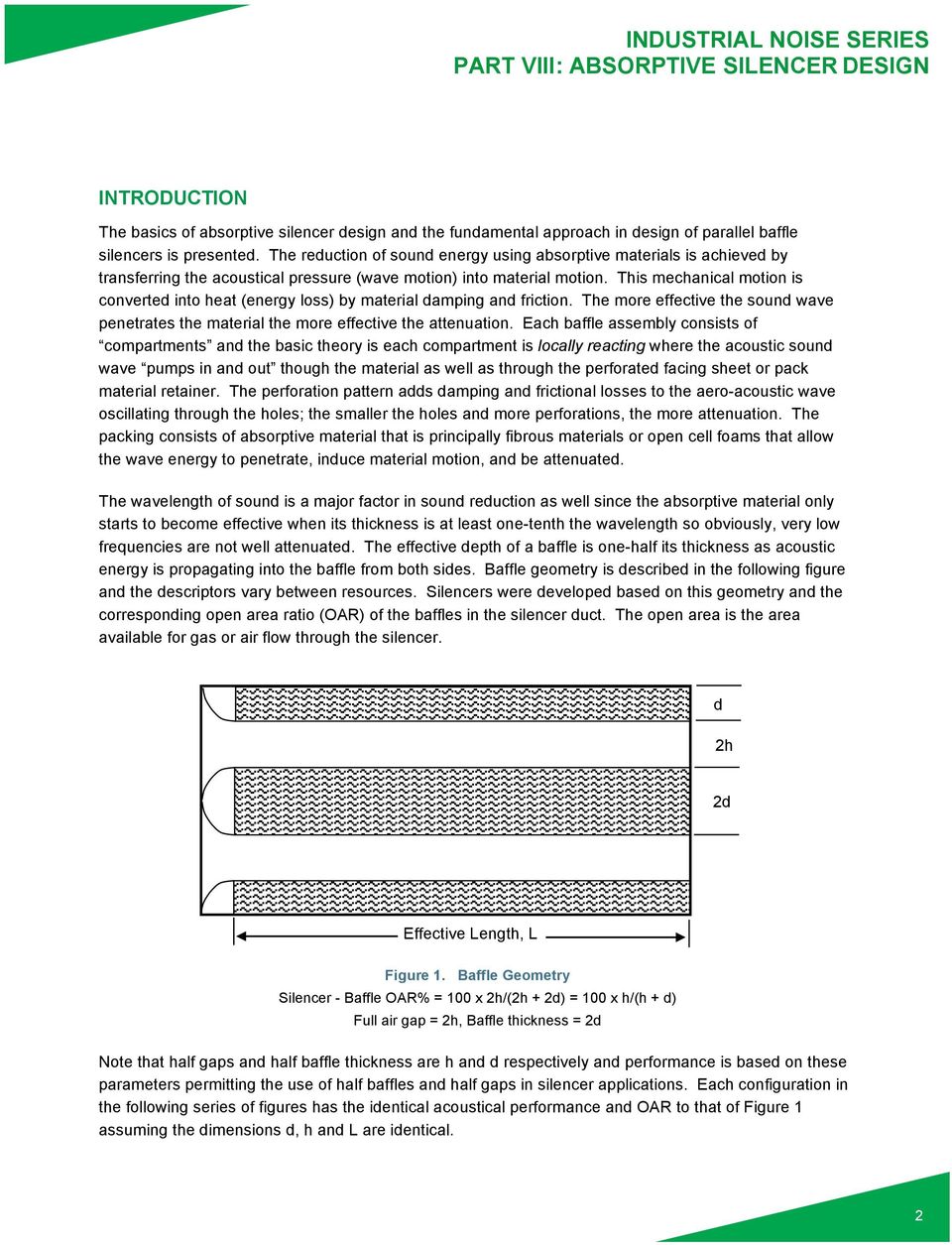
2 INTRODUCTION The basics of absorptive silencer design and the fundamental approach in design of parallel baffle silencers is presented. The reduction of sound energy using absorptive materials is achieved by transferring the acoustical pressure (wave motion) into material motion. This mechanical motion is converted into heat (energy loss) by material damping and friction. The more effective the sound wave penetrates the material the more effective the attenuation. Each baffle assembly consists of compartments and the basic theory is each compartment is locally reacting where the acoustic sound wave pumps in and out though the material as well as through the perforated facing sheet or pack material retainer. The perforation pattern adds damping and frictional losses to the aero-acoustic wave oscillating through the holes; the smaller the holes and more perforations, the more attenuation. The packing consists of absorptive material that is principally fibrous materials or open cell foams that allow the wave energy to penetrate, induce material motion, and be attenuated. The wavelength of sound is a major factor in sound reduction as well since the absorptive material only starts to become effective when its thickness is at least one-tenth the wavelength so obviously, very low frequencies are not well attenuated. The effective depth of a baffle is one-half its thickness as acoustic energy is propagating into the baffle from both sides. Baffle geometry is described in the following figure and the descriptors vary between resources. Silencers were developed based on this geometry and the corresponding open area ratio (OAR) of the baffles in the silencer duct. The open area is the area available for gas or air flow through the silencer. d 2h 2d Effective Length, L Figure 1. Baffle Geometry Silencer - Baffle OAR% = 100 x 2h/(2h + 2d) = 100 x h/(h + d) Full air gap = 2h, Baffle thickness = 2d Note that half gaps and half baffle thickness are h and d respectively and performance is based on these parameters permitting the use of half baffles and half gaps in silencer applications. Each configuration in the following series of figures has the identical acoustical performance and OAR to that of Figure 1 assuming the dimensions d, h and L are identical. 2
3 h 2d Effective Length, L h d 2h Effective Length, L d d Effective Length, L h Figure 2. Baffle Geometries having Identical Acoustical Performance The number of baffles and air gaps only affects flow area as does the height or span of the baffle; more baffles, more flow area, lower air gap velocity, lower pressure loss. The number of parallel baffles does not affect the acoustical performance whatsoever except in the case of self flow noise; a function of the gas or air velocity between the baffles and face area of the baffles. The face area is the total cross sectional area of the silencer occupied by baffles. There are two basic parallel baffle arrangements. The familiar flat, rectangular parallel baffles and the annular ring baffle used in cylindrical silencers. In general, the method used for calculating flat panel baffles can be used for annular silencers but there is some performance departure about the 2,000-3,000 Hz region that may cause a slight drop in performance and in other geometries the performance improves. The reason for using flat parallel baffle approach is cylindrical databases are not widely published and those that are only provide data in a limited range. A safety margin will cover these issues. 3

4 Key parameters that are used for baffle design are the dimensions cited above, the airflow resistivity of the pack material (rayls/m), the airflow resistance (rayls) of any thin layer retainer materials. More sophisticated analyses include the thickness and areal density of the perforated face sheet, perforation diameter and oar, the density of the pack material, and its material properties. These latter parameters are frequently missing from standard lookup curves. SILENCER PERFORMANCE The challenge in baffle design is determining the attenuation in a grazing flow environment; that is, the sound travels parallel to the surface (grazing) thus interaction of the sound wave with the baffle is not optimal at all. The direction of flow with respect to the direction of the sound wave also affects performance in that for an identical baffle and sound energy, the performance will be different for a positive traveling wave versus a negative traveling wave. The following figure illustrates the flow regimes; the curves represent the sound energy. Air Flow Figure 3a. Positive Flow Case Sound and Flow are Traveling Downstream; This Is Commonly Known as Exhaust or Supply Flow. Air Flow Figure 3b. Negative Flow Case Sound Travels Upstream and Flow Travels Downstream; This Is Commonly Known as Inlet or Return Flow. Calculating silencer performance was not developed when ventilation equipment started being installed in buildings and the only method was to build and test silencers. Later, the HVAC 1 industry developed standardized testing protocols to measure silencer performance. The national standard is ASTM E 477, Standard Test Method for Measuring Acoustical and Airflow Performance of Duct Liner Materials and Prefabricated Silencers. The ISO standard is, ISO 7235 Acoustics Laboratory measurement procedures for ducted silencers and air-terminal units Insertion loss, flow noise and total pressure loss. Also, there is a standard for measuring silencer performance in-situ or for very large silencers that cannot be measured in a laboratory; it is ISO Acoustics Measurements on silencers in situ. It provides guidelines for measuring both insertion loss (IL) and transmission loss (TL). 1 Heating, Ventilation and Air Conditioning (HVAC) 4

5 Although computational capabilities now exist, the complexity of the silencer required a significant amount of analysis that naturally had some uncertainty regarding performance thus most all HVAC silencer manufacturers just tested their products and cataloged them for easy selection. With over 50 years of testing, databases (performance curves based on OAR) have been developed. Figure 4 (Fig from Beranek and Ver) 2 shows normalized attenuation performance for a 66% open area silencer based on four acoustical materials under no-flow (static) conditions. The four materials have normalized flow resistances of 1, 2, 5 and 10. Figure 4. Normalized Attenuation versus Frequency for Parallel Baffles The abscissa is the full air gap (2h) divided by the wavelength (c/f). The ordinate shows the attenuation rate, L h in decibels per half gap (h); the baffle attenuation is L h multiplied by (L/h). Some resources show the attenuation rate per full gap (2h) so the ordinate values would be half that shown; so be careful when comparing databases. And also note, terminology and symbols may vary between resources. Parallel baffle performance is contingent upon the open area of the baffle arrangement (OAR) and a unique performance curve for each open area is required; thus, a family of curves covering 25%, 33%, 40%, 50%, and 66% are common in any design and analysis library and each family of curves will include performances based on the pack material s flow resistivity. If a baffle arrangement has some other OAR then the result is obtained by interpolation. 2 A.G. Galaitsis and I.L. Ver, Passive Silencers and Lined Ducts, Ch 10 in Noise and Vibration Control Engineering Principles and Applications, edited by Beranek, L.L. & Ver, I.L. (John Wiley & Sons Inc. NY 1992) 5

6 What is not shown in these normalized graphs is the perforated face sheet of the baffle. The open area of the perforated face sheet also affects performance; particularly above 1,000 Hz. Most all HVAC silencers use 40% open area thus it is seldom an issue in terms of application but for industrial applications where low percentage perforated sheeting may be used it does become important. In general, for typical engine applications 23% is acceptable but in the case of turbine exhausts that have high frequency content, then 32-35% should be considered. For turbine inlets, high-speed fans, and any devices that have significant tones above 1,000 Hz, use 40% as a minimum. The open area ratio (OAR) in percent of perforated sheeting may be calculated by, Square perforation pattern: P% = 78.5(d/b) 2 (1) Hex perforation pattern: P% = 90.7(d/b) 2 (2) Where d is the diameter of the hole and b is the center-to-center spacing of the holes. FLOW RESISTANCE AND RESISTIVITY Flow resistance or resistivity is a measure of the material s resistance to penetration by a sound wave; the lower the number the easier it is for penetration and better attenuation. Very low flow resistivity is good for high frequencies and very high flow resistivity is good for low frequencies so there are trade-offs. ASTM C 522-(year), Standard Test Method for Airflow Resistance of Acoustical Materials is the method used for performing the measurements. Very thin materials such as fill retainers (screens, cloth and needle-mats) are measured for their total resistance in rayls and thicker packing materials are measured for their flow resistivity in rayls/meter. The rayl in this application is an aerodynamic measure of the pressure differential across the material at a known volumetric air velocity. Although not a true acoustical measurement, it is used for rating the packing material. Testing occurs in a duct with a known cross area so the parameters for rayls/m are composed of the following units, Pa s/m 2 but Pa is N/m 2 so you may encounter, N s/m 4. In Figure 4 there are several curves showing flow resistivity. Note that the peak attenuation occurs where η is near unity when the air gap (2h) is equal to a wavelength. The curves shown on these types of figures are the normalized flow resistance of the material and dependent upon the thickness d. By selecting a particular or desired performance curve (R in Figure 4) and knowing the baffle thickness (d) the flow resistivity (R l ) of the needed material is then determined by employing the following equation, R = R l d/ρc dimensionless (3) where ρc is the acoustical impedance of the air (415 rayls) or that of the gas. The units of R l are rayls/meter or rayls/inch. It is very important to note that the flow resistance will change with the operating temperature (T) because of the change in the gas or air viscosity. It may be scaled by, R(T) = R 0 (T/T 0 ) 1.2 dimensionless (4) 6

7 R 0 = R l d/ρ 0 c 0 dimensionless (5) T is the absolute temperature in Kelvin (273 + C) and Equation (5) represents the measured laboratory flow resistance at ambient or laboratory temperature, T 0. FLOW VELOCITY The flow through baffles also affects the attenuation and longevity of the packing: The flow velocity in any application should never exceed Mach 0.3 (0.3 x speed of sound) because the gas or air will begin to compress changing its properties. The Mach number is simply the velocity of the gas/speed of sound (v/c) The velocity between the baffles produces self noise that can limit the attenuation of a silencer thus the velocity should not exceed Mach 0.1 as a general rule. The flow affects the sound energy interaction with the baffle by either making the acoustic interaction either shorter or longer based on the velocity and direction of noise relative to the flow. Downstream and upstream flow cases are shown in Figure 3. Flow is either positive or negative and is important in analyzing performance. If calculating baffle performance, by using published curves (at no flow), the attenuation rate is adjusted by (Bies & Hansen, Eq. (9.134) 3, D M = D 0 [1 1.5M + M 2 ] (6) Where, D 0 is the attenuation rate (without flow) and -0.3 < M < 0.3 where M is the Mach number of the velocity between the baffles. Be sure to use the correct sign (+/-) of the Mach number depending on the flow regime (Figure 3). Some resources use different approaches for adjusting for self noise but this is most conservative and easy to use. BAFFLE ATTENUATION EXAMPLE An example calculation of a silencer is demonstrated using the six middle bands. The silencer baffle is 200 mm thick (2d) separated by 400 mm air gap (2h) (66% OAR) that is 1200 mm long. The air temperature is 20 C with a positive velocity of 30 m/s through the baffles. The packing material of choice has an airflow resistivity, R l = 20,000 rayls/m; this results in a normalized value, R = 4.82 for d = 100 mm (see Eq. 8.4). The 5 curve in Figure 4 is used. The results are given in the following table as explained below: 3 Bies and Hansen, Engineering Noise Control, Theory and Practice, 4 th edition, David A. Bies and Colin H. Hanson,

8 Table 1 Example Calculation of Baffle Attenuation Freq = η = L h = D M = L/h = Atten Step 1 Calculate η (2hf/c) for each band or frequency for the air gap of 400 mm (2h). Step 2 Go to Figure 4 and at each value of η across the abscissa go up and intersect the R=5 curve (solid line). Step 3 Then traverse over to the ordinate and record the L h value. Step 4 Calculate the gap velocity and its Mach number (note sign for flow case), M = 30/344 = Step 5 Calculate D M using Equation (6); here, D 0 = L h The flow effect reduces the attenuation about 12%, D M = L h x 0.88 (this is very conservative) Step 6 The number of diameters of the gas path is L/h = 1200/200 = 6; Step 7 Multiply D M by 6 to obtain the silencer attenuation in decibels (round off). Using this method one can determine the required baffle design to achieve the attenuation needed and determine the flow resistivity of the packing material to be used however this is a tedious process especially when it comes to optimizing the material selection and sizing. Now, HVAC catalog data would show higher attenuation rates because measured data is used versus calculated. Had another material been used (R l ), one would interpolate between the curves. For a different temperature, calculate R(T) using Equation (4) and adjust for the speed of sound accordingly. Final baffle attenuation is further adjusted to account for baffle entrance and exit losses which are usually small. Keep in mind that virtually all text book and similar databases are generally conservative. SILENCER DESIGN Fortunately, the need to use graphical databases to perform lengthy calculation to size a silencer is no longer required. Now, the silencer per se is not designed but the baffles contained within the silencer are designed. The silencer itself is adjusted in size to incorporate the necessary baffles for attenuating the sound energy in balance with the volumetric flow rate and aerodynamic performance in balance with meeting size constraints. Just imagine the design challenges for all the different flow conditions, temperatures, configurations, applications, and materials. There are software packages available for sizing baffles that have the capability to rapidly develop silencers for a wide range of configurations and materials. Some specialized programs include the density and dynamic properties of the pack material in determining performance. These programs permit the rapid design and optimization of silencers. 8

9 PERFORMANCE CRITERIA It is critical to clearly state the requirements of the silencer to be supplied and understand what is being specified and how it will be measured for compliance. The following information should be provided as a minimum: a. Acoustical criterion or criteria. b. Flow rate, operating temperature and pressure loss limits. c. Machine data and operating conditions. d. Machine acoustical data must be frequency based. e. Connection data, orientation, and size limits including weight. f. All specifications and standards related to the performance requirements. g. All specifications and standards related to measurements [email protected] Universal AET. All rights reserved. About Universal AET Universal AET delivers on one simple yet powerful promise to provide the highest quality, complete air management solutions. With more than a half-century of industrial and power generation experience, we engineer solutions to our customers unique needs and back them with unparalleled support, across the entire energy generation lifecycle. Your comprehensive singlesourced solution not only meets environmental, regulatory and operational requirements, but also helps you reduce costs, improve the efficiency of your equipment and eliminate safety and compliance risk. We put our expertise to work solving problems for your specific needs. The result: Your world. Clean. Quiet. Safe. 9 NORTH AMERICA LATIN AMERICA EUROPE ASIA PACIFIC INDIA

3.0 Exhaust Muffler Design Principles. 3.1 Basic Concepts
 3.0 Exhaust Muffler Design Principles 3.1 Basic Concepts Internal combustion engines are typically equipped with an exhaust muffler to suppress the acoustic pulse generated by the combustion process. A
Acoustic Terms, Definitions and General Information
 Acoustic Terms, Definitions and General Information Authored by: Daniel Ziobroski Acoustic Engineer Environmental and Acoustic Engineering GE Energy Charles Powers Program Manager Environmental and Acoustic
Building Design for Advanced Technology Instruments Sensitive to Acoustical Noise
 Building Design for Advanced Technology Instruments Sensitive to Acoustic Noise Michael Gendreau Colin Gordon & Associates Presentation Outline! High technology research and manufacturing instruments respond
Fundamentals of Acoustics & Practical HVAC Design Considerations. Demir Doken Acoustic Engineer
 Fundamentals of Acoustics & Practical HVAC Design Considerations Demir Doken Acoustic Engineer What is sound? Sound is a mechanical wave that is an oscillation of pressure transmitted through some medium
Sound Power Measurement
 Sound Power Measurement A sound source will radiate different sound powers in different environments, especially at low frequencies when the wavelength is comparable to the size of the room 1. Fortunately
TOP 10 NOISE CONTROL TECHNIQUES
 TOP 10 NOISE CONTROL TECHNIQUES The following are 10 simple noise control techniques that have wide application across the whole of industry. In many cases, they will produce substantial noise reductions
Experiment 3 Pipe Friction
 EML 316L Experiment 3 Pipe Friction Laboratory Manual Mechanical and Materials Engineering Department College of Engineering FLORIDA INTERNATIONAL UNIVERSITY Nomenclature Symbol Description Unit A cross-sectional
Noise Control Solutions For Standby Power Generators
 Noise Control Solutions For Standby Power Generators by David Gries NVH Applications Engineer E-A-R Specialty Composites Indianapolis, Indiana Introduction Over the past several years, there has been
Noise. CIH Review PDC March 2012
 Noise CIH Review PDC March 2012 Learning Objectives Understand the concept of the decibel, decibel determination, decibel addition, and weighting Know the characteristics of frequency that are relevant
VariTrane Duct Designer An in depth look...
 VariTrane Duct Designer An in depth look... Introduction The VariTrane Duct Designer duct design program was written to help optimize design while obtaining a minimum pressure system. The program is based
HEAT TRANSFER AUGMENTATION THROUGH DIFFERENT PASSIVE INTENSIFIER METHODS
 HEAT TRANSFER AUGMENTATION THROUGH DIFFERENT PASSIVE INTENSIFIER METHODS P.R.Hatwar 1, Bhojraj N. Kale 2 1, 2 Department of Mechanical Engineering Dr. Babasaheb Ambedkar College of Engineering & Research,
Development and optimization of a hybrid passive/active liner for flow duct applications
 Development and optimization of a hybrid passive/active liner for flow duct applications 1 INTRODUCTION Design of an acoustic liner effective throughout the entire frequency range inherent in aeronautic
Chapter 3.5: Fans and Blowers
 Part I: Objective type questions and answers Chapter 3.5: Fans and Blowers 1. The parameter used by ASME to define fans, blowers and compressors is a) Fan ration b) Specific ratio c) Blade ratio d) Twist
Fan Performance By: Mark Stevens AMCA International Deputy Executive Director Technical Affairs
 Fan Performance By: Mark Stevens AMCA International Deputy Executive Director Technical Affairs Fan Performance (Paper I.D. 021) Mark Stevens Air Movement and Control Association International Abstract
Averaging Pitot Tubes; Fact and Fiction
 Averaging Pitot Tubes; Fact and Fiction Abstract An experimental investigation has been undertaken to elucidate effects of averaging stagnation pressures on estimated velocities for pressure averaging
A LAMINAR FLOW ELEMENT WITH A LINEAR PRESSURE DROP VERSUS VOLUMETRIC FLOW. 1998 ASME Fluids Engineering Division Summer Meeting
 TELEDYNE HASTINGS TECHNICAL PAPERS INSTRUMENTS A LAMINAR FLOW ELEMENT WITH A LINEAR PRESSURE DROP VERSUS VOLUMETRIC FLOW Proceedings of FEDSM 98: June -5, 998, Washington, DC FEDSM98 49 ABSTRACT The pressure
Battery Thermal Management System Design Modeling
 Battery Thermal Management System Design Modeling Gi-Heon Kim, Ph.D Ahmad Pesaran, Ph.D ([email protected]) National Renewable Energy Laboratory, Golden, Colorado, U.S.A. EVS October -8, 8, 006 Yokohama,
EFFECT OF OBSTRUCTION NEAR FAN INLET ON FAN HEAT SINK PERFORMANCE
 EFFECT OF OBSTRUCTION NEAR FAN INLET ON FAN HEAT SINK PERFORMANCE Vivek Khaire, Dr. Avijit Goswami Applied Thermal Technologies India 3rd Floor,C-Wing,Kapil Towers, Dr. Ambedkar Road, Pune- 411 1 Maharashtra,
The Effect of Forced Air Cooling on Heat Sink Thermal Ratings
 zpero 1 The Effect of Forced Air Cooling on Heat Sink Thermal Ratings By Paul Bachman, Fellow Engineer & Ronnie Haiduk, Applications Engineer, Crydom, Inc. ABSTRACT A heat sink s ability to dissipate thermal
Noise in the Classroom
 ASHRAE JOURNAL Copyright 2000, American Society of Heating, Refrigerating and Air-Conditioning Engineers, Inc. This posting is by permission of ASHRAE Journal. This article may not be copied nor distributed
Open Channel Flow Measurement Weirs and Flumes
 Open Channel Flow Measurement Weirs and Flumes by Harlan H. Bengtson, PhD, P.E. 1. Introduction Your Course Title Here Measuring the flow rate of water in an open channel typically involves some type of
Lecture 6 - Boundary Conditions. Applied Computational Fluid Dynamics
 Lecture 6 - Boundary Conditions Applied Computational Fluid Dynamics Instructor: André Bakker http://www.bakker.org André Bakker (2002-2006) Fluent Inc. (2002) 1 Outline Overview. Inlet and outlet boundaries.
How To Reduce Noise From A Test Screen
 Practical Approaches to Engineering Noise Controls Dave Yantek Mining Hearing Loss Prevention Workshop June 21-22, 22, 2005 Pittsburgh Research Laboratory Basics of sound Topics Measurement of sound Measurement
Section 5.0 : Horn Physics. By Martin J. King, 6/29/08 Copyright 2008 by Martin J. King. All Rights Reserved.
 Section 5. : Horn Physics Section 5. : Horn Physics By Martin J. King, 6/29/8 Copyright 28 by Martin J. King. All Rights Reserved. Before discussing the design of a horn loaded loudspeaker system, it is
inter.noise 2000 The 29th International Congress and Exhibition on Noise Control Engineering 27-30 August 2000, Nice, FRANCE
 Copyright SFA - InterNoise 2000 1 inter.noise 2000 The 29th International Congress and Exhibition on Noise Control Engineering 27-30 August 2000, Nice, FRANCE I-INCE Classification: 2.1 WHISTLING PHENOMENA
Aeroacoustic simulation based on linearized Euler equations and stochastic sound source modelling
 Aeroacoustic simulation based on linearized Euler equations and stochastic sound source modelling H. Dechipre a, M. Hartmann a, J. W Delfs b and R. Ewert b a Volkswagen AG, Brieffach 1777, 38436 Wolfsburg,
DSRQ - DSRSQ - DSRSQ-THERM
 DSRQ - DSRSQ - DSRSQ-THERM Specification item: Variable geometry diffuser on 597x597 mm panel developed for rooms with high ceilings where a long throw and a high induction ratio are required. Made up
INTERNATIONAL JOURNAL OF RESEARCH SCIENCE & MANAGEMENT
 PREDICTION OF TRANSMISSION LOSS FOR CYLINDRICAL EXPANSION CHAMBER HAVING CENTRAL-OUTLET AND SIDE-OUTLET CONFIGURATION BY TRANSFER MATRIX METHOD Amit Kumar Gupta 1*, Neha Mathur 2 1* Mechanical Engineering
ANSI/AHRI Standard 880 (I-P) with Addendum 1. 2011 Standard for Performance Rating of Air Terminals
 ANSI/AHRI Standard 880 (I-P) with Addendum 1 2011 Standard for Performance Rating of Air Terminals Approved by ANSI on October 27, 2011 WITH ADDENDUM 1, PERFORMANCE RATING OF AIR TERMILS June 2012 Note:
www.klmtechgroup.com TABLE OF CONTENT
 Page : 1 of 26 Project Engineering Standard www.klmtechgroup.com KLM Technology #03-12 Block Aronia, Jalan Sri Perkasa 2 Taman Tampoi Utama 81200 Johor Bahru Malaysia TABLE OF CONTENT SCOPE 2 REFERENCES
Optimal Design of an Enclosure for a Portable Generator
 Optimal Design of an Enclosure for a Portable Generator by Joseph E. Blanks Thesis submitted to the faculty of the Virginia Polytechnic Institute and State University in partial fulfillment of the requirements
Sound Attenuation INTRODUCTION
 INTRODUCTION In the broadest sense, a sound wave is any disturbance that is propagated in an elastic medium, which may be a gas, a liquid, or a solid. Noise is defined as any unwanted sound perceived by
The Role of Acoustics in Curtain Wall Design:
 The Role of Acoustics in Curtain Wall Design: Strategies to Achieve Desired Performance Criteria April 22, 2015 John LoVerde, Principal VENEKLASEN ASSOCIATES, INC. Goals Basics of Acoustics Ratings in
SUGGESTED SPECIFICATION EXHAUST SYSTEM SILENCER, FLEX CONNECTOR, INSULATION BLANKETS, WALL / ROOF THIMBLES
 SUGGESTED SPECIFICATION EXHAUST SYSTEM SILENCER, FLEX CONNECTOR, INSULATION BLANKETS, WALL / ROOF THIMBLES 4121 N.W. 37 th Street, Lincoln, NE 68524 Telephone (402) 470-2627 Fax (404) 470-2410 www.gtexhaust.com
Water hammering in fire fighting installation
 Water hammering in fire fighting installation Forward One of major problems raised in the fire fighting network installed at Pioneer company for pharmaceutical industry /Sulaymania was the high water hammering
A MTR FUEL ELEMENT FLOW DISTRIBUTION MEASUREMENT PRELIMINARY RESULTS
 A MTR FUEL ELEMENT FLOW DISTRIBUTION MEASUREMENT PRELIMINARY RESULTS W. M. Torres, P. E. Umbehaun, D. A. Andrade and J. A. B. Souza Centro de Engenharia Nuclear Instituto de Pesquisas Energéticas e Nucleares
Lecture 9, Thermal Notes, 3.054
 Lecture 9, Thermal Notes, 3.054 Thermal Properties of Foams Closed cell foams widely used for thermal insulation Only materials with lower conductivity are aerogels (tend to be brittle and weak) and vacuum
Acoustic Porous Materials and Their Characterisation
 Acoustic Porous Materials and Their Characterisation Kirill V. Horoshenkov School of Engineering, Design and Technology University of Bradford Bradford [email protected] 1 Yorkshire dales Where
Absorption mufflers in exhaust systems. Rolf Jebasinski. J. Eberspächer GmbH & Co. Abstract
 1 Absorption mufflers in exhaust systems Rolf Jebasinski J. Eberspächer GmbH & Co Abstract Absorption mufflers or combined absorption/reflection mufflers are an almost indispensable element of modern exhaust
Schedule of Accreditation issued by United Kingdom Accreditation Service 2 Pine Trees, Chertsey Lane, Staines-upon-Thames, TW18 3HR, UK
 2 Pine Trees, Chertsey Lane, Staines-upon-Thames, TW18 3HR, UK Unit 7 Contact: Mr S C Sparks Solent Industrial Estate Tel: +44 (0)1489 790296 Hedge End Fax: +44 (0)1489 790294 Southampton E-Mail: [email protected]
Journal bearings/sliding bearings
 Journal bearings/sliding bearings Operating conditions: Advantages: - Vibration damping, impact damping, noise damping - not sensitive for vibrations, low operating noise level - dust tight (if lubricated
ACOUSTIC CAVITIES DESIGN PROCEDURES
 ACOUSTIC CAVITIES DESIGN PROCEDURES A. Santana Jr. a, M. S. Silva b, P. T. Lacava. b, and L. C. S. Góes b a Instituto de Aeronáutica e Espaço Divisão de Sistemas Espaciais CP. 12228-94, São José Campos,
Solid shape molding is not desired in injection molding due to following reasons.
 PLASTICS PART DESIGN and MOULDABILITY Injection molding is popular manufacturing method because of its high-speed production capability. Performance of plastics part is limited by its properties which
Dimensional analysis is a method for reducing the number and complexity of experimental variables that affect a given physical phenomena.
 Dimensional Analysis and Similarity Dimensional analysis is very useful for planning, presentation, and interpretation of experimental data. As discussed previously, most practical fluid mechanics problems
du u U 0 U dy y b 0 b
 BASIC CONCEPTS/DEFINITIONS OF FLUID MECHANICS (by Marios M. Fyrillas) 1. Density (πυκνότητα) Symbol: 3 Units of measure: kg / m Equation: m ( m mass, V volume) V. Pressure (πίεση) Alternative definition:
Relationship between Sound Pressure and Sound Power Levels
 Relationship between Sound Pressure and Sound Power Levels 4 W. T. W. CORY Chairman of the Eurovent WG 1 Fans If we wish to know the sound power transmitted through a fan and ducting system, it is preferable
1) The time for one cycle of a periodic process is called the A) wavelength. B) period. C) frequency. D) amplitude.
 practice wave test.. Name Use the text to make use of any equations you might need (e.g., to determine the velocity of waves in a given material) MULTIPLE CHOICE. Choose the one alternative that best completes
Sound absorption and acoustic surface impedance
 Sound absorption and acoustic surface impedance CHRISTER HEED SD2165 Stockholm October 2008 Marcus Wallenberg Laboratoriet för Ljud- och Vibrationsforskning Sound absorption and acoustic surface impedance
Fluid Mechanics: Static s Kinematics Dynamics Fluid
 Fluid Mechanics: Fluid mechanics may be defined as that branch of engineering science that deals with the behavior of fluid under the condition of rest and motion Fluid mechanics may be divided into three
Principle of Thermal Imaging
 Section 8 All materials, which are above 0 degrees Kelvin (-273 degrees C), emit infrared energy. The infrared energy emitted from the measured object is converted into an electrical signal by the imaging
Optimum fin spacing for fan-cooled heat sinks
 Optimum fin spacing for fan-cooled heat sinks Keywords: optimum fin spacing fan-cooled heat sink heatsink optimal fin pitch parallel plate fin array optimization forced air cooling fan curve pressure drop
PAGE 2. Figure 1: Difference between PWL ins and SPL 1m
 PAGE 1 Pipe noise J.H. Granneman and R.P.M. Jansen, Peutz Consulting Engineers, The Netherlands, emphasise the need for an adequate pipe noise control procedure, with reference to the design phase, insulation
A TEST RIG FOR TESTING HIGH PRESSURE CENTRIFUGAL COMPRESSORS MODEL STAGES AT HIGH REYNOLDS NUMBER
 A TEST RIG FOR TESTING HIGH PRESSURE CENTRIFUGAL COMPRESSORS MODEL STAGES AT HIGH REYNOLDS NUMBER P. NAVA, M.PROFETI, M. GIACHI, F.SARRI GE-NUOVO PIGNONE G.P.MANFRIDA UNIVERSITY OF FLORENCE Italia Presented
Finite Element Analysis for Acoustic Behavior of a Refrigeration Compressor
 Finite Element Analysis for Acoustic Behavior of a Refrigeration Compressor Swapan Kumar Nandi Tata Consultancy Services GEDC, 185 LR, Chennai 600086, India Abstract When structures in contact with a fluid
Control ball valves for severe services. Author: Michele Ferrante, PARCOL S.p.A., Italy
 Control ball valves for severe services Author: Michele Ferrante, PARCOL S.p.A., Italy Control valves are primarily classified according to the type of their obturator motion which can be linear or rotary.
PULSATION REDUCTION BY ACOUSTIC FILTERS FOR METERING APPLICATIONS. Robert J. McKee Ray G. Durke
 PULSATION REDUCTION BY ACOUSTIC FILTERS FOR METERING APPLICATIONS Robert J. McKee Ray G. Durke Southwest Research Institute 6220 Culebra Road San Antonio, TX 78238 INTRODUCTION Because of the adverse effects
AMD-23-TD. Thermal Dispersion Air Measuring Station with VCD-23 Control Damper. Application and Design. Ratings. Features and Control Options.
 Application and esign Thermal ispersion Air Measuring Station with VC-23 Control amper The combines the functionality of a highly accurate thermal dispersion airflow measuring station and a low leakage
Mass Loaded Vinyl A review of the performance and cost in acoustical applications
 Mass Loaded Vinyl A review of the performance and cost in acoustical applications Overview Driven by building codes and occupants expectations, many rooms in commercial and residential construction require
4 SENSORS. Example. A force of 1 N is exerted on a PZT5A disc of diameter 10 mm and thickness 1 mm. The resulting mechanical stress is:
 4 SENSORS The modern technical world demands the availability of sensors to measure and convert a variety of physical quantities into electrical signals. These signals can then be fed into data processing
APPLICATION NOTE AP050830
 APPLICATION NOTE AP050830 Selection and use of Ultrasonic Ceramic Transducers Pro-Wave Electronics Corp. E-mail: [email protected] URL: http://www.prowave.com.tw The purpose of this application note
General Thoughts on Generator Set - Acoustic Solutions & Noise Control
 t: 023 81 290160 www.excelpowerltd.co.uk f: 023 81 290260 [email protected] General Thoughts on Generator Set - Acoustic Solutions & Noise Control Written By Steve Delaney A.M.I.O.A. of TAS Ltd
APPLICATION NOTE ULTRASONIC CERAMIC TRANSDUCERS
 APPLICATION NOTE ULTRASONIC CERAMIC TRANSDUCERS Selection and use of Ultrasonic Ceramic Transducers The purpose of this application note is to aid the user in the selection and application of the Ultrasonic
Head Loss in Pipe Flow ME 123: Mechanical Engineering Laboratory II: Fluids
 Head Loss in Pipe Flow ME 123: Mechanical Engineering Laboratory II: Fluids Dr. J. M. Meyers Dr. D. G. Fletcher Dr. Y. Dubief 1. Introduction Last lab you investigated flow loss in a pipe due to the roughness
Advancements in High Frequency, High Resolution Acoustic Micro Imaging for Thin Silicon Applications
 Advancements in High Frequency, High Resolution Acoustic Micro Imaging for Thin Silicon Applications Janet E. Semmens Sonoscan, Inc. 2149 E. Pratt Boulevard Elk Grove Village, IL 60007 USA Phone: (847)
How Noise is Generated by Wind Turbines The mechanisms of noise generation. Malcolm Hayes Hayes McKenzie Partnership Ltd Machynlleth & Salisbury
 How Noise is Generated by Wind Turbines The mechanisms of noise generation Malcolm Hayes Hayes McKenzie Partnership Ltd Machynlleth & Salisbury Overview Main sources of noise from wind turbines Causes
THE MODELING AND CALCULATION OF SOUND RADIATION FROM FACILITIES WITH GAS FLOWED PIPES INTRODUCTION
 THE MODELING AND CALCULATION OF SOUND ADIATION FOM FACILITIES WITH GAS FLOWED PIPES INTODUCTION Analysis o the emission caused by industrial acilities like chemical plants, reineries or other production
Pumps: Convert mechanical energy (often developed from electrical source) into hydraulic energy (position, pressure and kinetic energy).
 HYDRAULIC MACHINES Used to convert between hydraulic and mechanical energies. Pumps: Convert mechanical energy (often developed from electrical source) into hydraulic energy (position, pressure and kinetic
Transmission Line and Back Loaded Horn Physics
 Introduction By Martin J. King, 3/29/3 Copyright 23 by Martin J. King. All Rights Reserved. In order to differentiate between a transmission line and a back loaded horn, it is really important to understand
AMD-33 Air Measuring Station with VCD-33 Control Damper
 Application and esign Construction Standard Optional Frame Material Galvanized Steel - Frame Material Thickness 16 ga. (1.5mm) 12 ga. (2.7mm) Frame Type 5 in. x 1 in. hat channel - Blade Material Galvanized
HEAT TRANSFER ANALYSIS IN A 3D SQUARE CHANNEL LAMINAR FLOW WITH USING BAFFLES 1 Vikram Bishnoi
 HEAT TRANSFER ANALYSIS IN A 3D SQUARE CHANNEL LAMINAR FLOW WITH USING BAFFLES 1 Vikram Bishnoi 2 Rajesh Dudi 1 Scholar and 2 Assistant Professor,Department of Mechanical Engineering, OITM, Hisar (Haryana)
Practice Problems on Boundary Layers. Answer(s): D = 107 N D = 152 N. C. Wassgren, Purdue University Page 1 of 17 Last Updated: 2010 Nov 22
 BL_01 A thin flat plate 55 by 110 cm is immersed in a 6 m/s stream of SAE 10 oil at 20 C. Compute the total skin friction drag if the stream is parallel to (a) the long side and (b) the short side. D =
Heat Transfer Prof. Dr. Ale Kumar Ghosal Department of Chemical Engineering Indian Institute of Technology, Guwahati
 Heat Transfer Prof. Dr. Ale Kumar Ghosal Department of Chemical Engineering Indian Institute of Technology, Guwahati Module No. # 04 Convective Heat Transfer Lecture No. # 03 Heat Transfer Correlation
Michael Montgomery Marketing Product Manager Rosemount Inc. Russ Evans Manager of Engineering and Design Rosemount Inc.
 ASGMT / Averaging Pitot Tube Flow Measurement Michael Montgomery Marketing Product Manager Rosemount Inc. Russ Evans Manager of Engineering and Design Rosemount Inc. Averaging Pitot Tube Meters Introduction
Application and Design of the ebooster from BorgWarner
 Application and Design of the ebooster from BorgWarner Knowledge Library Knowledge Library Application and Design of the ebooster from BorgWarner With an electrically assisted compressor, the ebooster,
Lecture 5 Hemodynamics. Description of fluid flow. The equation of continuity
 1 Lecture 5 Hemodynamics Description of fluid flow Hydrodynamics is the part of physics, which studies the motion of fluids. It is based on the laws of mechanics. Hemodynamics studies the motion of blood
DUPONT PERFORMANCE POLYMERS Joint Design: A Critical Factor in Strong Bonds GENERAL GUIDELINES FOR ULTRASONIC, VIBRATION AND SPIN WELDING
 DUPONT PERFORMANCE POLYMERS Joint Design: A Critical Factor in Strong Bonds GENERAL GUIDELINES FOR ULTRASONIC, VIBRATION AND SPIN WELDING Introduction Welding techniques for assembling parts molded with
Lightweight Partition Design for Residential and Commercial Buildings
 Lightweight Partition Design for Residential and Commercial Buildings Stanley D. Gatland II, CertainTeed Corporation, Valley Forge, Pennsylvania Guidelines are presented for the design and proper installation
Section 2.0 : Construction and Measurement of a Simple Test Transmission Line
 Section 2.0 : Construction and Measurement of a Simple Test Transmission Line After deciding to use a Focal 8V 4412 mid-bass driver for my first transmission line design, I started looking for a simple
Edmund Li. Where is defined as the mutual inductance between and and has the SI units of Henries (H).
 INDUCTANCE MUTUAL INDUCTANCE If we consider two neighbouring closed loops and with bounding surfaces respectively then a current through will create a magnetic field which will link with as the flux passes
Swissmetro travels at high speeds through a tunnel at low pressure. It will therefore undergo friction that can be due to:
 I. OBJECTIVE OF THE EXPERIMENT. Swissmetro travels at high speeds through a tunnel at low pressure. It will therefore undergo friction that can be due to: 1) Viscosity of gas (cf. "Viscosity of gas" experiment)
Manual Analysis Software AFD 1201
 AFD 1200 - AcoustiTube Manual Analysis Software AFD 1201 Measurement of Transmission loss acc. to Song and Bolton 1 Table of Contents Introduction - Analysis Software AFD 1201... 3 AFD 1200 - AcoustiTube
STEAM TURBINE 1 CONTENT. Chapter Description Page. V. Steam Process in Steam Turbine 6. VI. Exhaust Steam Conditions, Extraction and Admission 7
 STEAM TURBINE 1 CONTENT Chapter Description Page I Purpose 2 II Steam Turbine Types 2 2.1. Impulse Turbine 2 2.2. Reaction Turbine 2 III Steam Turbine Operating Range 2 3.1. Curtis 2 3.2. Rateau 2 3.3.
Selecting Receiving Antennas for Radio Tracking
 Selecting Receiving Antennas for Radio Tracking Larry B Kuechle, Advanced Telemetry Systems, Inc. Isanti, Minnesota 55040 [email protected] The receiving antenna is an integral part of any radio location
PIEZOMETER AIRFLOW MEASURING RING
 PIEZOMETER AIRFLOW MEASURING RING M.K. Plastics is pleased to introduce The Piezometer Airflow Measuring Ring, now available as an accessory for our steel Axijet fans. The system consists of a Piezometer
Laboratory #3 Guide: Optical and Electrical Properties of Transparent Conductors -- September 23, 2014
 Laboratory #3 Guide: Optical and Electrical Properties of Transparent Conductors -- September 23, 2014 Introduction Following our previous lab exercises, you now have the skills and understanding to control
DEVELOPMENT OF HIGH SPEED RESPONSE LAMINAR FLOW METER FOR AIR CONDITIONING
 DEVELOPMENT OF HIGH SPEED RESPONSE LAMINAR FLOW METER FOR AIR CONDITIONING Toshiharu Kagawa 1, Yukako Saisu 2, Riki Nishimura 3 and Chongho Youn 4 ABSTRACT In this paper, we developed a new laminar flow
Aeration Air & Digester Gas Flow Metering Using Thermal Mass Technology. HWEA 2011 Conference Craig S. Johnson
 Aeration Air & Digester Gas Flow Metering Using Thermal Mass Technology HWEA 2011 Conference Craig S. Johnson Presentation Overview Introduction Aeration Air & Digester gas challenges Gas flow metering
1150 hp motor design, electromagnetic and thermal analysis
 115 hp motor design, electromagnetic and thermal analysis Qasim Al Akayshee 1, and David A Staton 2 1 Mawdsley s Ltd., The Perry Centre, Davey Close, Waterwells, Gloucester GL2 4AD phone: +44 1452 888311
Connectivity in a Wireless World. Cables Connectors 2014. A Special Supplement to
 Connectivity in a Wireless World Cables Connectors 204 A Special Supplement to Signal Launch Methods for RF/Microwave PCBs John Coonrod Rogers Corp., Chandler, AZ COAX CABLE MICROSTRIP TRANSMISSION LINE
7.3 Fit selection. Inner ring: Rotating. Outer ring: Stationary. Inner ring: Stationary. Outer ring: Rotating. Inner ring: Stationary
 7. Bearing Fits 7. Fitting For rolling s, inner and outer rings are fixed on the or in the housing so that relative movement does not occur between fitting surfaces during operation or under. This relative
Various Technics of Liquids and Solids Level Measurements. (Part 3)
 (Part 3) In part one of this series of articles, level measurement using a floating system was discusses and the instruments were recommended for each application. In the second part of these articles,
CEE 370 Fall 2015. Laboratory #3 Open Channel Flow
 CEE 70 Fall 015 Laboratory # Open Channel Flow Objective: The objective of this experiment is to measure the flow of fluid through open channels using a V-notch weir and a hydraulic jump. Introduction:
CHAPTER: 6 FLOW OF WATER THROUGH SOILS
 CHAPTER: 6 FLOW OF WATER THROUGH SOILS CONTENTS: Introduction, hydraulic head and water flow, Darcy s equation, laboratory determination of coefficient of permeability, field determination of coefficient
INTRODUCTION TO FLUID MECHANICS
 INTRODUCTION TO FLUID MECHANICS SIXTH EDITION ROBERT W. FOX Purdue University ALAN T. MCDONALD Purdue University PHILIP J. PRITCHARD Manhattan College JOHN WILEY & SONS, INC. CONTENTS CHAPTER 1 INTRODUCTION
AOE 3104 Aircraft Performance Problem Sheet 2 (ans) Find the Pressure ratio in a constant temperature atmosphere:
 AOE 3104 Aircraft Performance Problem Sheet 2 (ans) 6. The atmosphere of Jupiter is essentially made up of hydrogen, H 2. For Hydrogen, the specific gas constant is 4157 Joules/(kg)(K). The acceleration
Part H DIFFUSERS section 2 SEPT 2005. Publication. Air Diffusers. supply and exhaust ventilation systems. plenum boxes
 Publication Part H DIFFUSES section 2 SEPT 5 Air Diffusers supply and exhaust ventilation systems plenum boxes PLENUM BOXES introduction The general range of PB plenum boxes are manufactured with a return
RESPONSE TIME INDEX OF SPRINKLERS
 , Number l, p.1-6, 29 RESPONSE TIME INDEX OF SPRINKLERS C.K. Sze Department of Building Services Engineering, The Hong Kong Polytechnic University, Hong Kong, China ABSTRACT The Plunge test would be carried