
Just the Factors, Ma am
|
|
|
- Avis Richardson
- 9 years ago
- Views:
Transcription
1 1 Introduction Just the Factors, Ma am The purpose of this note is to find and study a method for determining and counting all the positive integer divisors of a positive integer Let N be a given positive integer We say d is a divisor of N and write d N if N/d is a positive integer Thus, for example, 2 6 Denote by D N the set of all positive integer divisors of N For example D 6 = {1, 2, 3, 6} There are four parts to this note In the first part, we count the divisors of a given positive integer N based on its prime factorization In the second part, we construct all the divisors, and in the third part we discuss the geometry of the D N In part four, we discuss applications to contest problems Study the figure above There are two things to work out One is how does the set of dots and segments represent a number, and the other is how do the digit strings just above the digits 1 through 9 represent those digits Take some time now before reading more to figure this out 2 Counting the divisors of N First consider the example N = 72 To find the number of divisors of 72, note that the prime factorization of 72 is given by 72 = Each divisor d of 72 must be of the form d = 2 i 3 j where 0 i 3 and 0 j 2 Otherwise, /d could not be an integer, by the Fundamental Theorem of Arithmetic (the theorem that guarantees the unique factorization into primes of each positive integer) So there Saylor URL : wwwsaylororg/courses/ma111 1 Saylororg This material may be copied, stored and distributed for non-commercial purposes only Any commercial use of this material is strictly forbidden

2 are 4 choices for the exponent i and 3 choices for j Hence there are 4 3 = 12 divisors of 72 Reasoning similarly, we can see that for any integer the number of divisors is N = p e 1 1 p e 2 2 p e k k, Π k i=1(e i + 1) = (e 1 + 1)(e 2 + 1) (e k + 1) 3 Constructing the divisors of N In part 1 we found the number of members of D N for any positive integer N In this part, we seek the list of divisors themselves Again we start with the prime factorization of N Suppose N = p e 1 1 p e 2 2 p e k k If k = 2 the listing is straightforward In this case, we build a table by first listing the powers of p 1 across the top of the table and the powers of p 2 down the side, thus obtaining an (e 1 + 1) (e 2 + 1) matrix of divisors Again we use N = 72 as an example Notice that each entry in the table is the product of its row label and its column label What do we do when the number of prime factors of N is more than 2? If k = 3 we can construct e matrices of divisors, one for each power of p 3 For example, if N = 360 = , we construct one 3 4 matrix for 5 0 and one for 5 1 The result is a matrix of divisors The two 3 4 matrices are shown below and For larger values of k we can create multiple copies of the matrix associated with the number N = p e 1 1 p e 2 2 p e k 1 k 1 4 The geometry of D N To investigate the geometry of D N, we first explore the relation divides Recall that a b means that a and b are positive integers for which b/a is an integer The relation has several important properties, three of which are crucial to our discussion Saylor URL : wwwsaylororg/courses/ma111 2 Saylororg This material may be copied, stored and distributed for non-commercial purposes only Any commercial use of this material is strictly forbidden
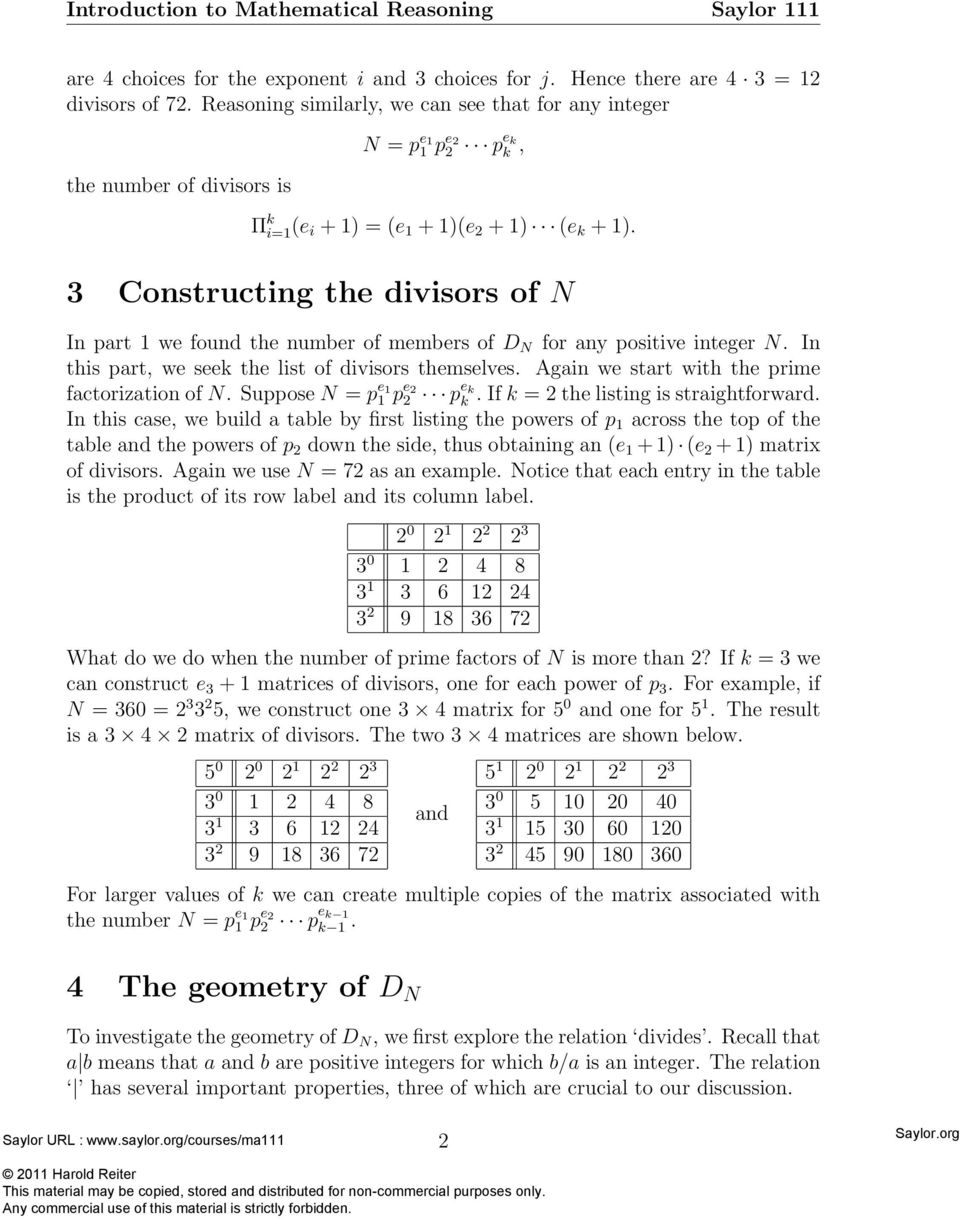
3 1 Reflexivity For any positive integer a, a a 2 Antisymmetry For any pair of positive integers a, b, if a b and b a, then a = b 3 Transitivity For any three positive integers, a, b, c, if a b and b c, then a c These properties are easy to prove The first says that each integer is a divisor of itself; that is, a/a is an integer The second says that no two different integers can be divisors of one another This is true since a larger integer can never be a divisor of a smaller one The third property follows from the arithmetic b/a c/b = c/a together with the property that the product of two positive integers is a positive integer Any set S with a relation defined on it that satisfies all three of the properties above is called a partially ordered set, or a poset A branch of discrete mathematics studies the properties of posets, (S, ) Each finite poset has a unique directed graph representation This pictorial representation is what we mean by the geometry of D N To construct the directed graph of a poset (S, ), draw a vertex (dot) for each member of S Then connect two vertices a and b with a directed edge (an arrow) if a b Of course, in our case D N this means we connect a to b if a b The case D 6 is easy to draw: Fig 1 The digraph of D 6 The circles at each of the four vertices are called loops They are included as directed edges because each number is a divisor of itself The reader should imagine that all the non-loop edges are upwardly directed The directed edge from 1 to 6 indicates that 1 6 But since we know that the vertices of D 6 satisfy all three properties required of a poset, we can leave off both (a) the loops, which are implied Saylor URL : wwwsaylororg/courses/ma111 3 Saylororg This material may be copied, stored and distributed for non-commercial purposes only Any commercial use of this material is strictly forbidden
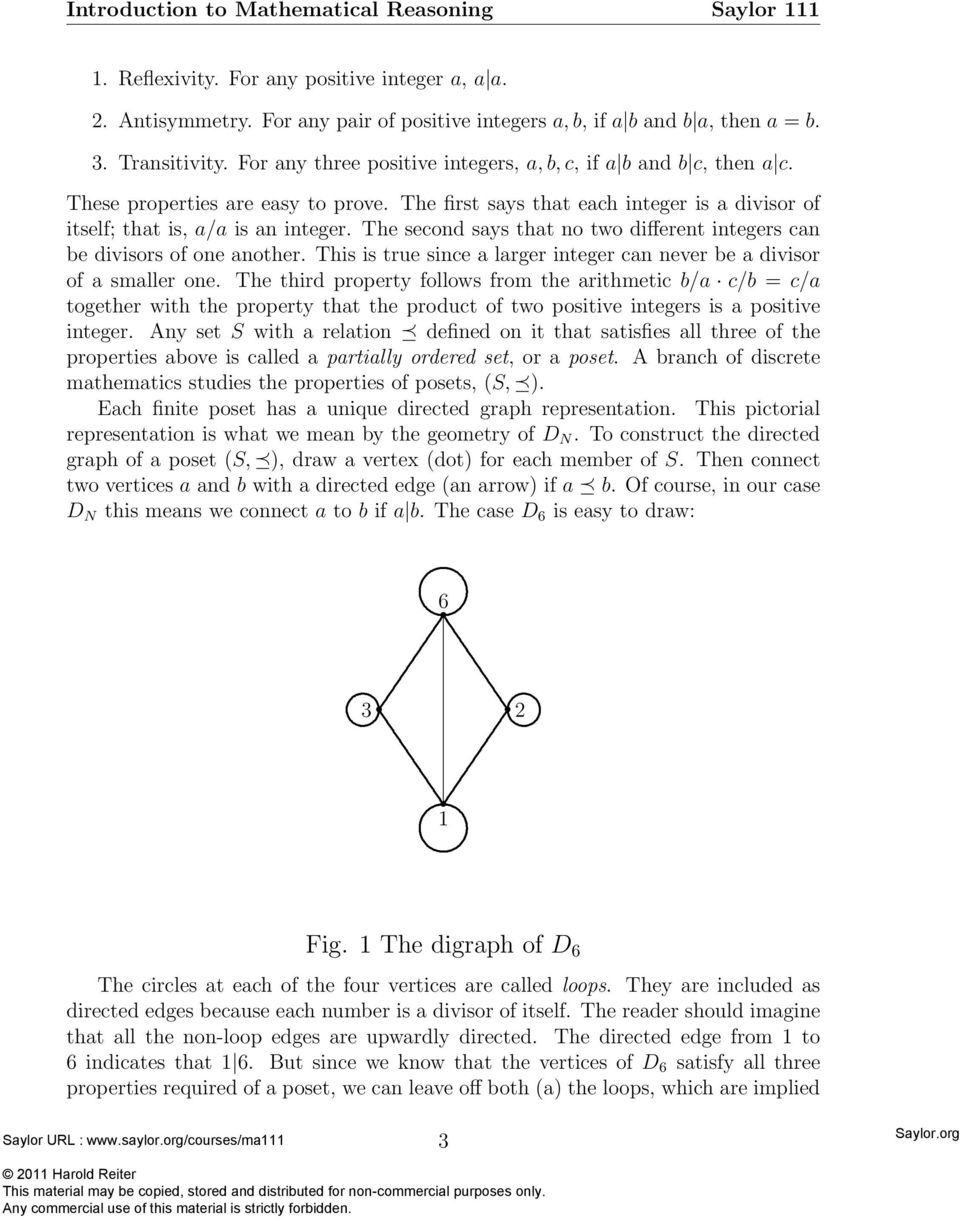
4 by the reflexive property, and (b) the edges that are implied by the transitivity condition The slimmed down representation, called the Hasse diagram, is much easier to understand It captures all the essential information without cluttering up the scene The Hasse diagram of D 6 is shown below Fig 2, the Hasse diagram of D 6 In general, the Hasse diagram for D N has only those non-loop edges which are not implied by transitivity, that is, those edges from a to b for which b is a prime number multiple of a The Hasse diagrams of D 72, D 30, and D 60 are shown below Fig 3 The Hasse diagram of D 72 Saylor URL : wwwsaylororg/courses/ma111 4 Saylororg This material may be copied, stored and distributed for non-commercial purposes only Any commercial use of this material is strictly forbidden
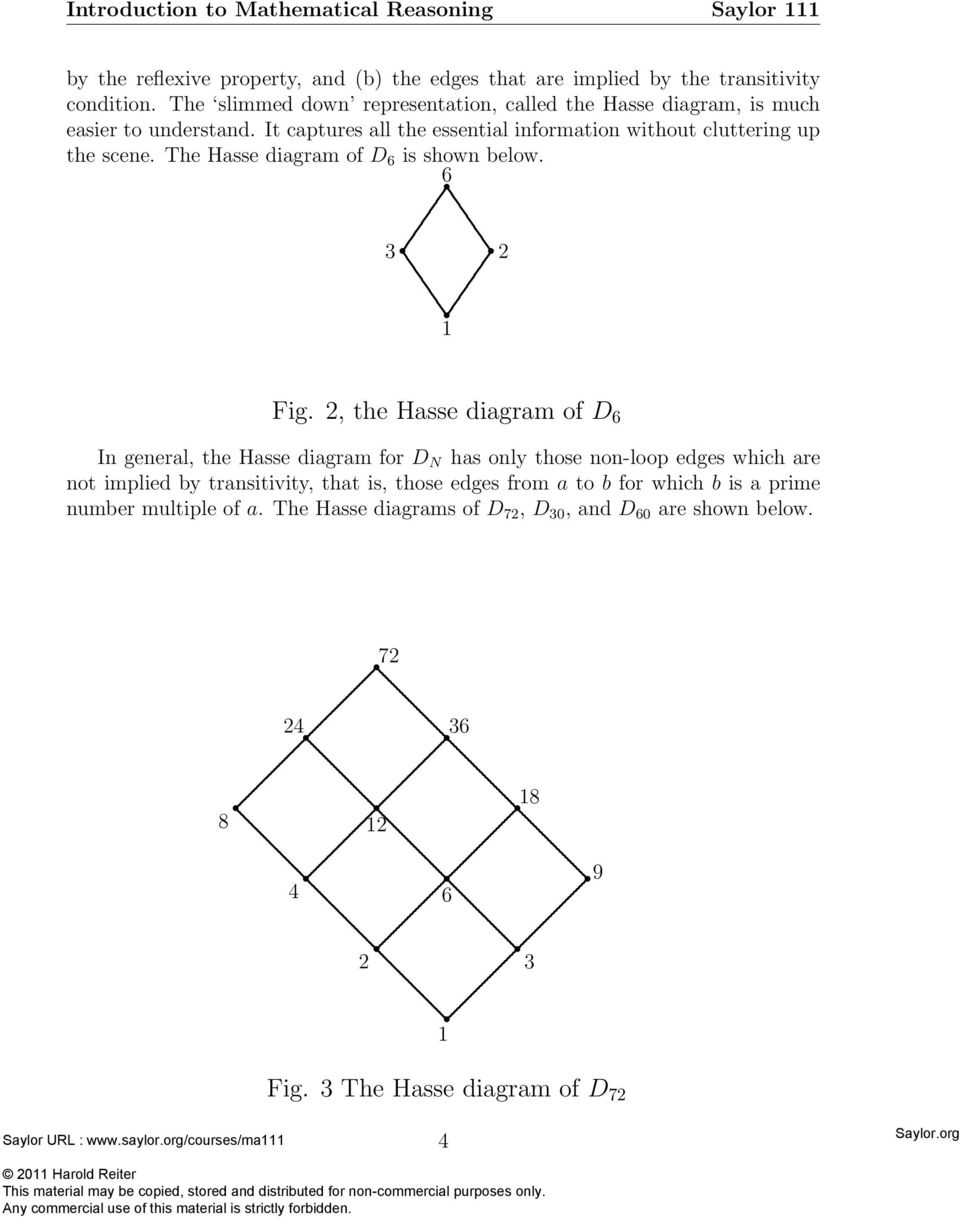
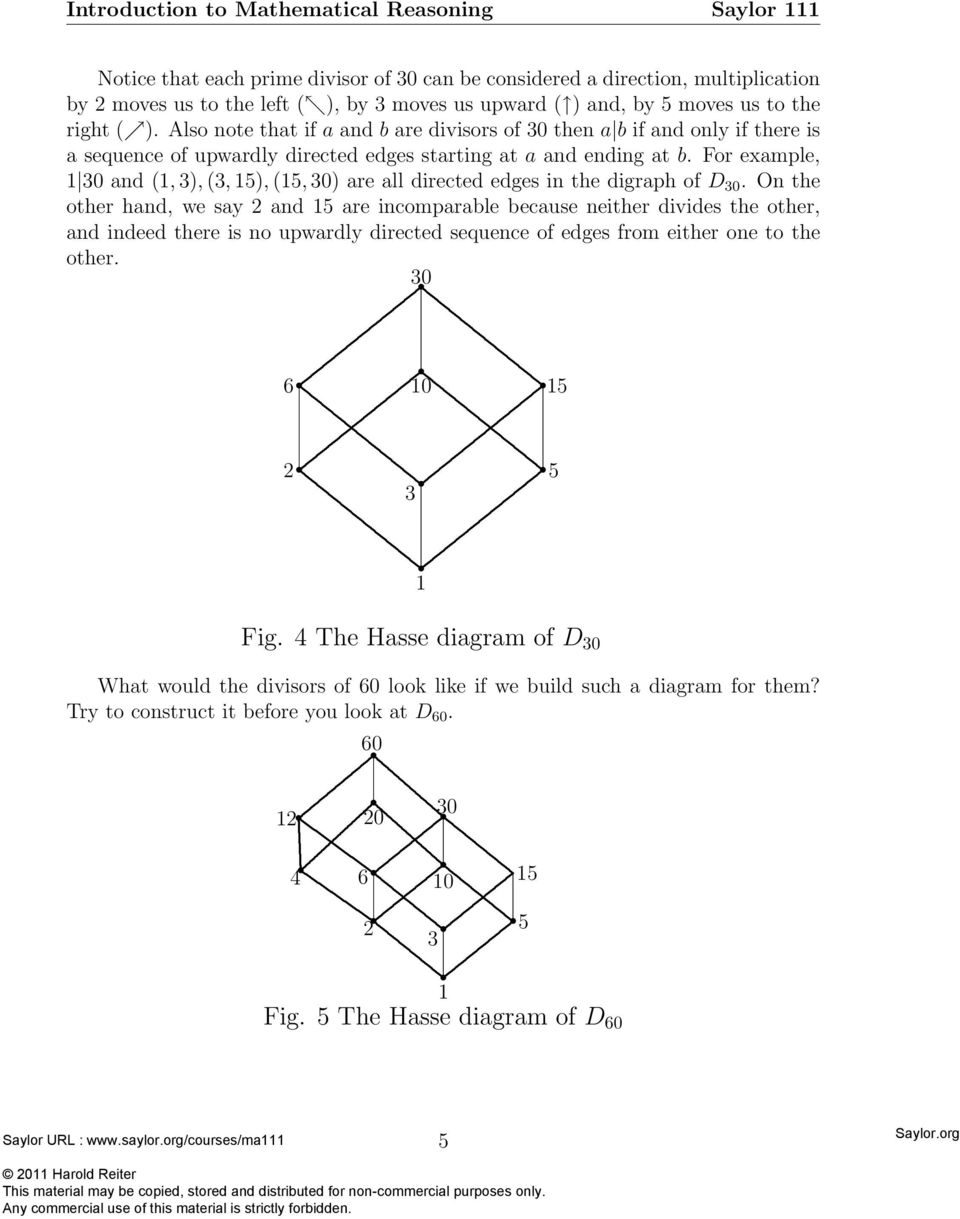
5 Notice that each prime divisor of 30 can be considered a direction, multiplication by 2 moves us to the left ( ), by 3 moves us upward ( ) and, by 5 moves us to the right ( ) Also note that if a and b are divisors of 30 then a b if and only if there is a sequence of upwardly directed edges starting at a and ending at b For example, 1 30 and (1, 3), (3, 15), (15, 30) are all directed edges in the digraph of D 30 On the other hand, we say 2 and 15 are incomparable because neither divides the other, and indeed there is no upwardly directed sequence of edges from either one to the other Fig 4 The Hasse diagram of D 30 What would the divisors of 60 look like if we build such a diagram for them? Try to construct it before you look at D Fig 5 The Hasse diagram of D 60 Saylor URL : wwwsaylororg/courses/ma111 5 Saylororg This material may be copied, stored and distributed for non-commercial purposes only Any commercial use of this material is strictly forbidden
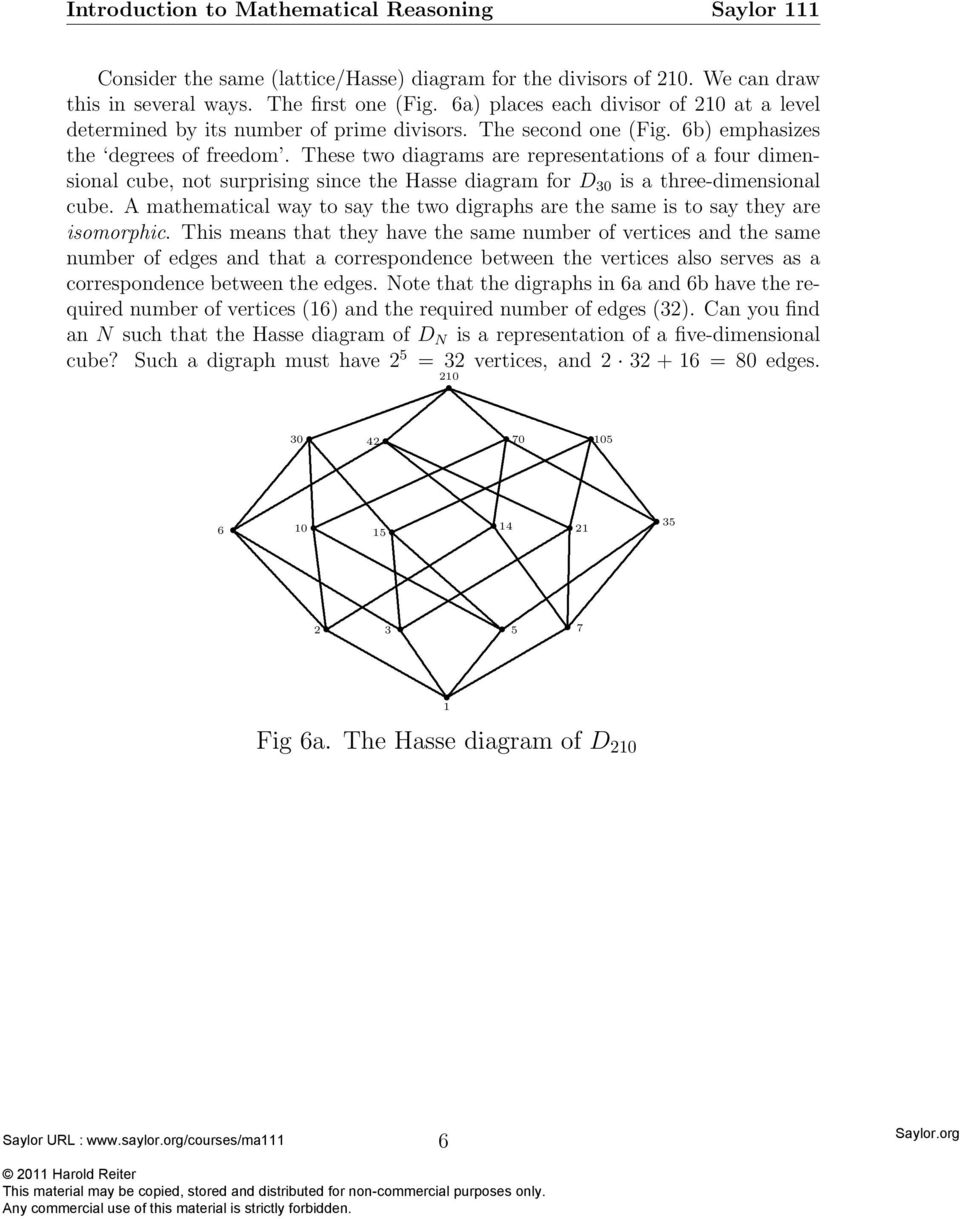
6 Consider the same (lattice/hasse) diagram for the divisors of 210 We can draw this in several ways The first one (Fig 6a) places each divisor of 210 at a level determined by its number of prime divisors The second one (Fig 6b) emphasizes the degrees of freedom These two diagrams are representations of a four dimensional cube, not surprising since the Hasse diagram for D 30 is a three-dimensional cube A mathematical way to say the two digraphs are the same is to say they are isomorphic This means that they have the same number of vertices and the same number of edges and that a correspondence between the vertices also serves as a correspondence between the edges Note that the digraphs in 6a and 6b have the required number of vertices (16) and the required number of edges (32) Can you find an N such that the Hasse diagram of D N is a representation of a five-dimensional cube? Such a digraph must have 2 5 = 32 vertices, and = 80 edges Fig 6a The Hasse diagram of D 210 Saylor URL : wwwsaylororg/courses/ma111 6 Saylororg This material may be copied, stored and distributed for non-commercial purposes only Any commercial use of this material is strictly forbidden
7 Fig 6b The Hasse diagram of D 210 How can the geometry help us do number theory? One way to use the geometry is in the calculation of the GCF and LCM of two members of D N Note that each element d of D N generates a downward cone of divisors and an upward cone of multiples We can denote these cones by F (d) and M(d) respectively Then the GCF (d, e) = max{f (d) F (e)} and LCM(d, e) = min{m(d) M(e)} Saylor URL : wwwsaylororg/courses/ma111 7 Saylororg This material may be copied, stored and distributed for non-commercial purposes only Any commercial use of this material is strictly forbidden

8 5 Problems On Divisors Some of the following problems come from MathCounts and the American Mathematics Competitions 1 Find the number of three digit divisors of 3600 Solution: 15 Construct three 3 5 matrices of divisors The first matrix has all the divisors of the form 2 i 3 j, the second all divisors of the form 2 i 3 j 5 1 and the third all the divisors of the form 2 i 3 j 5 2 There is one three digit divisor in the first matrix, 144, five in the second, and nine in the third for a total of = 15 2 How many positive integers less than 50 have an odd number of positive integer divisors? Solution: A number has an odd number of divisors if and only if it is a perfect square Therefore, there are exactly seven such numbers, 1, 4, 9, 16, 25, 36, and 49 3 (The Locker Problem) A high school with 1000 lockers and 1000 students tries the following experiment All lockers are initially closed Then student number 1 opens all the lockers Then student number 2 closes the even numbered lockers Then student number 3 changes the status of all the lockers numbered with multiples of 3 This continues with each student changing the status of all the lockers which are numbered by multiples of his or her number Which lockers are closed after all the 1000 students have done their jobs? Solution: Build a table for the first 20 lockers, and notice that the lockers that end up open are those numbered 1, 4, 9, and 16 This looks like the squares Think about what it takes to make a locker end up open It takes an odd number of changes, which means an odd number of divisors We know how to count the number of divisors of a number N = p e 1 1 p e 2 2 p en n N has D N = (e 1 + 1)(e 2 + 1) (e n + 1) divisors So the issue is how can this last number be odd It s odd if each factor e i + 1 is odd, which means all the e i have to be even This is true precisely when N is a perfect square So the lockers that are closed at the end are just the non-square numbered lockers 4 If N is the cube of a positive integer, which of the following could be the number of positive integer divisors of N? (A) 200 (B) 201 (C) 202 (D) 203 (E) 204 Solution: C The number N must be of the form N = p 3e q 3f So the number of divisors must be of the form D = (3e+1)(3f +1) Such a number Saylor URL : wwwsaylororg/courses/ma111 8 Saylororg This material may be copied, stored and distributed for non-commercial purposes only Any commercial use of this material is strictly forbidden

9 must be one greater than a multiple of 3 The number N = (2 67 ) 3 = has exactly 202 divisors 5 Let N = How many positive integers are factors of N? (A) 3 (B) 5 (C) 69 (D) 125 (E) 216 Solution: The expression given is the binomial expansion of N = (69 + 1) 5 = 70 5 = So N has (5 + 1)(5 + 1)(5 + 1) = 216 divisors 6 A teacher rolls four dice and announces both the sum S and the product P Students then try to determine the four dice values a, b, c, and d Find an ordered pair (S, P ) for which there is more than one set of possible values Solution: If (S, P ) = (12, 48), then {a, b, c, d} could be either {1, 3, 4, 4} or {2, 2, 2, 6} Note: strictly speaking, these are not sets, but multisets because multiple membership is allowed 7 How many of the positive integer divisors of N = have exactly 12 positive integer divisors? Solution: Let n be a divisor of N with 12 divisors Then n = p 3 q 2 where p and q belong to {2, 3, 5, 7, 11} or n = p 2 qr where p, q, r {2, 3, 5, 7, 11} There are 5 4 = 20 of the former and 5 (4) 2 = 30 of the later So the answer is = 50 8 How many ordered pairs (x, y) of positive integers satisfy xy + x + y = 199? Solution: Add one to both sides and factor to get (x+1)(y+1) = 200 = which has 4 3 factors, one of which is 1 Neither x + 1 not y + 1 can be 1, so there are 10 good choices for x + 1 Saylor URL : wwwsaylororg/courses/ma111 9 Saylororg This material may be copied, stored and distributed for non-commercial purposes only Any commercial use of this material is strictly forbidden
10 9 How many positive integers less than 400 have exactly 6 positive integer divisors? Solution: Having exactly 6 divisors means that the number N is of the form p 5 or p 2 q where p and q are different prime numbers Only 2 5 = 32 and 3 5 = 243 are of the first type If p = 2, then q could be any prime in the range 3, 5, 97 of which there are 24 primes If p = 3, then q could be 2 or any prime in the range 5, 43 and there are 13 of these If p = 5, then q could be 2 or 3 or any prime in the range 7, 13 If p = 7 then q = 2, 3, or 5 There are two values of q for p = 11 and one value of q for p = 13 Tally these to get = The product of four distinct positive integers, a, b, c, and d is 8! The numbers also satisfy What is d? Solution: Add 1 to both sides and factor to get Build a factor table for 392 ab + a + b = 391 (1) bc + b + c = 199 (2) (a + 1)(b + 1) = 392 = (3) (b + 1)(c + 1) = 200 = (4) Thus it follows that (a+1, b+1) is one of the following pairs: (1, 392), (2, 196), (4, 98), (8, 49), (7, 56), (14, 28), (392, 1), (196, 2), (98, 4), (49, 8), (56, 7), (28, 14) Each of these lead to dead ends except (49, 8) and (8, 49) For example, a+1 = 7, b + 1 = 56 leads to a = 6 and b = 55 = 5 11, which is not a factor of 8! Next note that b = 48 cannot work because b + 1 = 49 is not a factor of 200 Therefore a = 48 and b = 7 This implies that c + 1 = 200/(b + 1) = 25 and c = 24 Finally, d = 5 Thus, a = 48, b = 7, c = 24 and d = 5 11 How many multiples of 30 have exactly 30 divisors? Solution: I am grateful to Howard Groves (Uniter Kingdom) for this problem A number N = 2 i 3 j 5 k M is a multiple of 30 if each of i, j, k are at least 1 Saylor URL : wwwsaylororg/courses/ma Saylororg This material may be copied, stored and distributed for non-commercial purposes only Any commercial use of this material is strictly forbidden

11 Since 30 has exactly three different prime factors, it follows that M = 1, and that (i + 1)(j + 1)(k + 1) = 30 Thus, {i, j, k} = {1, 2, 4}, and there are exactly 6 ways to assign the values to the exponents The numbers are 720, 1200, 7500, 1620, 4050, and Find the number of odd divisors of 13! Solution: The prime factorization of 13! is Each odd factor of 13! is a product of odd prime factors, and there are = 144 ways to choose the five exponents 13 Find the smallest positive integer with exactly 60 divisors 14 (2008 Purple Comet) Find the smallest positive integer the product of whose digits is 9! 15 (1996 AHSME) If n is a positive integer such that 2n has 28 positive divisors and 3n has 30 positive divisors, then how many positive divisors does 6n have? Solution: 35 Let 2 e 1 3 e 2 5 e3 be the prime factorization of n Then the number of positive divisors of n is (e 1 + 1)(e 2 + 1)(e 3 + 1) In view of the given information, we have and 28 = (e 1 + 2)(e 2 + 1)P 30 = (e 1 + 1)(e 2 + 2)P, where P = (e 3 +1)(e 4 +1) Subtracting the first equation from the second, we obtain 2 = (e 1 e 2 )P, so either e 1 e 2 = 1 and P = 2, or e 1 e 2 = 2 and P = 1 The first case yields 14 = (e 1 + 2)e 1 and (e 1 + 1) 2 = 15; since e 1 is a nonnegative integer, this is impossible In the second case, e 2 = e 1 2 and 30 = (e 1 + 1)e 1, from which we find e 1 = 5 and e 2 = 3 Thus n = , so 6n = has (6 + 1)(4 + 1) = 35 positive divisors 16 Find the sum of all the divisors of N = Solution: Consider the product ( )( )( ) Notice that each divisor of N appears exactly once in this expanded product This sum can be thought of as the volume of a ( ) ( ) ( ) box The volume of the box is = (2010 Mathcounts Competition, Target 7) Find the product P of all the divisors of 6 3, and express your answer in the form 6 t, for some integer t Saylor URL : wwwsaylororg/courses/ma Saylororg This material may be copied, stored and distributed for non-commercial purposes only Any commercial use of this material is strictly forbidden

12 Solution: Build the 4 4 matrix of divisors of 6 3, and notice that they can be paired up so that each has 6 3 as their product There are 8 such pairs, so P = (6 3 ) 8 = 6 24 So t = Find the largest 10-digit number with distinct digits that is divisible by 11 Solution: We want to keep the digits in decreasing order as much as possible Trying 98765xyuvw works because we can arrange for y + v = 28, while x + u + w = 17 works More later 19 (This was problem 25 on the Sprint Round of the National MATHCOUNTS competition in 2011) Each number in the set {5, 9, 10, 13, 14, 18, 20, 21, 25, 29} was obtained by adding two number from the set {a, b, c, d, e} where a < b < c < d < e What is the value of c? Solution: c = 7 The sum of all 10 numbers is 4 times the sum a+b+c+d+e Why? Now a + b = 5 and d + e = 29, so c = (164 4) 29 5 = = 7 20 (This was problem 8 on the Target Round of the National MATHCOUNTS competition in 2011) How many positive integers less than 2011 cannot be expressed as the difference of the squares of two positive integers? Solution: The answer is 505 If n = a 2 b 2 = (a b)(a + b), then a b and a + b have the same parity, so n is either odd or a multiple of 4 So we want to count all the numbers of the form 4k + 1, k = 0, 1,, 502 together with two values 2 and 4, for a total of Consider the number N = = (a) How many divisors does N have? Solution: Use the formula developed here: τ = (3 + 1)(2 + 1)(3 + 1)(1 + 1) = 96 divisors (b) How many single digit divisors does N have? (c) How many two-digit divisors does N have? (d) How many three-digit divisors does N have? (e) How many four-digit divisors does N have? (f) How many five-digit divisors does N have? Solution: The answers are respectively 9, 25, 33, 23 and 6 You can get these numbers by building the six 4 4 matrices of divisors Use the basic matrix Saylor URL : wwwsaylororg/courses/ma Saylororg This material may be copied, stored and distributed for non-commercial purposes only Any commercial use of this material is strictly forbidden

13 of divisors of 1000 a model The other five matrices are obtained from this one by multiplying by 3, by 9, by 7, by 21, and by The integer N has both 12 and 15 as divisors Also, N has exactly 16 divisors What is N? Solution: In order to have both 12 and 15 as divisors, N must be of the form d for some positive integer d Since the number of divisors of N is 16, d must be even But has exactly 16 divisors, so d = 2 and N = How many multiples of 30 have exactly 3 prime factors and exactly 60 factors Solution: This requires some casework We re considering numbers of the form N = 2 i 3 j 5 k which satisfy (i + 1)(j + 1)(k + 1) = 60, i, j, k 1 There are 21 such numbers 24 How many whole numbers n satisfying 100 n 1000 have the same number of odd divisors as even divisors? Solution: Such a number is even but not a multiple of 4, so it follows that we want all the numbers that are congruent to 2 modulo 4, and there are 900/4 = 225 of them 25 What is the sum of the digits in the decimal representation of N = ? Solution: The number is N = = = , the sum of whose digits is What is the fewest number of factors in the product 27! that have to be removed so that the product of the remaining numbers is a perfect square? Solution: Factor 27! to get 27! = The largest square divisor of 27! is , so each of the primes 2, 3, 7, 17, 19, 23 must be removed It takes five factors to do this We must remove each of 17, 19, 23, and then we have 2, 3, 7 to remove We cannot do this with just one factor, so it takes two, either 6 and 7 or 21 and 2 Saylor URL : wwwsaylororg/courses/ma Saylororg This material may be copied, stored and distributed for non-commercial purposes only Any commercial use of this material is strictly forbidden

14 27 Euclid asks his friends to guess the value of a positive integer n that he has chosen Archimedes guesses that n is a multiple of 10 Euler guesses that n is a multiple of 12 Fermat guesses that n is a multiple of 15 Gauss guesses that n is a multiple of 18 Hilbert guesses that n is a multiple of 30 Exactly two of the guesses are correct Which persons guessed correctly? Solution: Hilbert must be wrong because if 30 n then so do 10 and 15, which would mean that three of them were right Now 2 n because all but on of the numbers are multiples of 2, and 3 n for the same reason But 5 does not divide n because, if it did, then 30 n which contradicts our first observation Thus Euler and Gauss are the two correct mathematicians Saylor URL : wwwsaylororg/courses/ma Saylororg This material may be copied, stored and distributed for non-commercial purposes only Any commercial use of this material is strictly forbidden
. 0 1 10 2 100 11 1000 3 20 1 2 3 4 5 6 7 8 9
 Introduction The purpose of this note is to find and study a method for determining and counting all the positive integer divisors of a positive integer Let N be a given positive integer We say d is a
k, then n = p2α 1 1 pα k
 Powers of Integers An integer n is a perfect square if n = m for some integer m. Taking into account the prime factorization, if m = p α 1 1 pα k k, then n = pα 1 1 p α k k. That is, n is a perfect square
We can express this in decimal notation (in contrast to the underline notation we have been using) as follows: 9081 + 900b + 90c = 9001 + 100c + 10b
 In this session, we ll learn how to solve problems related to place value. This is one of the fundamental concepts in arithmetic, something every elementary and middle school mathematics teacher should
4. How many integers between 2004 and 4002 are perfect squares?
 5 is 0% of what number? What is the value of + 3 4 + 99 00? (alternating signs) 3 A frog is at the bottom of a well 0 feet deep It climbs up 3 feet every day, but slides back feet each night If it started
Math 319 Problem Set #3 Solution 21 February 2002
 Math 319 Problem Set #3 Solution 21 February 2002 1. ( 2.1, problem 15) Find integers a 1, a 2, a 3, a 4, a 5 such that every integer x satisfies at least one of the congruences x a 1 (mod 2), x a 2 (mod
Primes. Name Period Number Theory
 Primes Name Period A Prime Number is a whole number whose only factors are 1 and itself. To find all of the prime numbers between 1 and 100, complete the following exercise: 1. Cross out 1 by Shading in
Chapter 11 Number Theory
 Chapter 11 Number Theory Number theory is one of the oldest branches of mathematics. For many years people who studied number theory delighted in its pure nature because there were few practical applications
8 Primes and Modular Arithmetic
 8 Primes and Modular Arithmetic 8.1 Primes and Factors Over two millennia ago already, people all over the world were considering the properties of numbers. One of the simplest concepts is prime numbers.
Some practice problems for midterm 2
 Some practice problems for midterm 2 Kiumars Kaveh November 15, 2011 Problem: What is the remainder of 6 2000 when divided by 11? Solution: This is a long-winded way of asking for the value of 6 2000 mod
MATH 10034 Fundamental Mathematics IV
 MATH 0034 Fundamental Mathematics IV http://www.math.kent.edu/ebooks/0034/funmath4.pdf Department of Mathematical Sciences Kent State University January 2, 2009 ii Contents To the Instructor v Polynomials.
SOLUTIONS FOR PROBLEM SET 2
 SOLUTIONS FOR PROBLEM SET 2 A: There exist primes p such that p+6k is also prime for k = 1,2 and 3. One such prime is p = 11. Another such prime is p = 41. Prove that there exists exactly one prime p such
CS 103X: Discrete Structures Homework Assignment 3 Solutions
 CS 103X: Discrete Structures Homework Assignment 3 s Exercise 1 (20 points). On well-ordering and induction: (a) Prove the induction principle from the well-ordering principle. (b) Prove the well-ordering
V55.0106 Quantitative Reasoning: Computers, Number Theory and Cryptography
 V55.0106 Quantitative Reasoning: Computers, Number Theory and Cryptography 3 Congruence Congruences are an important and useful tool for the study of divisibility. As we shall see, they are also critical
Discrete Mathematics and Probability Theory Fall 2009 Satish Rao, David Tse Note 2
 CS 70 Discrete Mathematics and Probability Theory Fall 2009 Satish Rao, David Tse Note 2 Proofs Intuitively, the concept of proof should already be familiar We all like to assert things, and few of us
Prime Time: Homework Examples from ACE
 Prime Time: Homework Examples from ACE Investigation 1: Building on Factors and Multiples, ACE #8, 28 Investigation 2: Common Multiples and Common Factors, ACE #11, 16, 17, 28 Investigation 3: Factorizations:
Every Positive Integer is the Sum of Four Squares! (and other exciting problems)
 Every Positive Integer is the Sum of Four Squares! (and other exciting problems) Sophex University of Texas at Austin October 18th, 00 Matilde N. Lalín 1. Lagrange s Theorem Theorem 1 Every positive integer
= 2 + 1 2 2 = 3 4, Now assume that P (k) is true for some fixed k 2. This means that
 Instructions. Answer each of the questions on your own paper, and be sure to show your work so that partial credit can be adequately assessed. Credit will not be given for answers (even correct ones) without
Homework until Test #2
 MATH31: Number Theory Homework until Test # Philipp BRAUN Section 3.1 page 43, 1. It has been conjectured that there are infinitely many primes of the form n. Exhibit five such primes. Solution. Five such
PYTHAGOREAN TRIPLES KEITH CONRAD
 PYTHAGOREAN TRIPLES KEITH CONRAD 1. Introduction A Pythagorean triple is a triple of positive integers (a, b, c) where a + b = c. Examples include (3, 4, 5), (5, 1, 13), and (8, 15, 17). Below is an ancient
Playing with Numbers
 PLAYING WITH NUMBERS 249 Playing with Numbers CHAPTER 16 16.1 Introduction You have studied various types of numbers such as natural numbers, whole numbers, integers and rational numbers. You have also
The last three chapters introduced three major proof techniques: direct,
 CHAPTER 7 Proving Non-Conditional Statements The last three chapters introduced three major proof techniques: direct, contrapositive and contradiction. These three techniques are used to prove statements
Math Workshop October 2010 Fractions and Repeating Decimals
 Math Workshop October 2010 Fractions and Repeating Decimals This evening we will investigate the patterns that arise when converting fractions to decimals. As an example of what we will be looking at,
Stanford Math Circle: Sunday, May 9, 2010 Square-Triangular Numbers, Pell s Equation, and Continued Fractions
 Stanford Math Circle: Sunday, May 9, 00 Square-Triangular Numbers, Pell s Equation, and Continued Fractions Recall that triangular numbers are numbers of the form T m = numbers that can be arranged in
Category 3 Number Theory Meet #1, October, 2000
 Category 3 Meet #1, October, 2000 1. For how many positive integral values of n will 168 n be a whole number? 2. What is the greatest integer that will always divide the product of four consecutive integers?
SYSTEMS OF PYTHAGOREAN TRIPLES. Acknowledgements. I would like to thank Professor Laura Schueller for advising and guiding me
 SYSTEMS OF PYTHAGOREAN TRIPLES CHRISTOPHER TOBIN-CAMPBELL Abstract. This paper explores systems of Pythagorean triples. It describes the generating formulas for primitive Pythagorean triples, determines
Applications of Fermat s Little Theorem and Congruences
 Applications of Fermat s Little Theorem and Congruences Definition: Let m be a positive integer. Then integers a and b are congruent modulo m, denoted by a b mod m, if m (a b). Example: 3 1 mod 2, 6 4
Session 6 Number Theory
 Key Terms in This Session Session 6 Number Theory Previously Introduced counting numbers factor factor tree prime number New in This Session composite number greatest common factor least common multiple
Notes on Factoring. MA 206 Kurt Bryan
 The General Approach Notes on Factoring MA 26 Kurt Bryan Suppose I hand you n, a 2 digit integer and tell you that n is composite, with smallest prime factor around 5 digits. Finding a nontrivial factor
December 4, 2013 MATH 171 BASIC LINEAR ALGEBRA B. KITCHENS
 December 4, 2013 MATH 171 BASIC LINEAR ALGEBRA B KITCHENS The equation 1 Lines in two-dimensional space (1) 2x y = 3 describes a line in two-dimensional space The coefficients of x and y in the equation
Continued Fractions and the Euclidean Algorithm
 Continued Fractions and the Euclidean Algorithm Lecture notes prepared for MATH 326, Spring 997 Department of Mathematics and Statistics University at Albany William F Hammond Table of Contents Introduction
SECTION 10-2 Mathematical Induction
 73 0 Sequences and Series 6. Approximate e 0. using the first five terms of the series. Compare this approximation with your calculator evaluation of e 0.. 6. Approximate e 0.5 using the first five terms
6.1 The Greatest Common Factor; Factoring by Grouping
 386 CHAPTER 6 Factoring and Applications 6.1 The Greatest Common Factor; Factoring by Grouping OBJECTIVES 1 Find the greatest common factor of a list of terms. 2 Factor out the greatest common factor.
I. GROUPS: BASIC DEFINITIONS AND EXAMPLES
 I GROUPS: BASIC DEFINITIONS AND EXAMPLES Definition 1: An operation on a set G is a function : G G G Definition 2: A group is a set G which is equipped with an operation and a special element e G, called
Math Review. for the Quantitative Reasoning Measure of the GRE revised General Test
 Math Review for the Quantitative Reasoning Measure of the GRE revised General Test www.ets.org Overview This Math Review will familiarize you with the mathematical skills and concepts that are important
SUM OF TWO SQUARES JAHNAVI BHASKAR
 SUM OF TWO SQUARES JAHNAVI BHASKAR Abstract. I will investigate which numbers can be written as the sum of two squares and in how many ways, providing enough basic number theory so even the unacquainted
CISC - Curriculum & Instruction Steering Committee. California County Superintendents Educational Services Association
 CISC - Curriculum & Instruction Steering Committee California County Superintendents Educational Services Association Primary Content Module IV The Winning EQUATION NUMBER SENSE: Factors of Whole Numbers
A permutation can also be represented by describing its cycles. What do you suppose is meant by this?
 Shuffling, Cycles, and Matrices Warm up problem. Eight people stand in a line. From left to right their positions are numbered,,,... 8. The eight people then change places according to THE RULE which directs
Five fundamental operations. mathematics: addition, subtraction, multiplication, division, and modular forms
 The five fundamental operations of mathematics: addition, subtraction, multiplication, division, and modular forms UC Berkeley Trinity University March 31, 2008 This talk is about counting, and it s about
The Prime Numbers. Definition. A prime number is a positive integer with exactly two positive divisors.
 The Prime Numbers Before starting our study of primes, we record the following important lemma. Recall that integers a, b are said to be relatively prime if gcd(a, b) = 1. Lemma (Euclid s Lemma). If gcd(a,
SYSTEMS OF EQUATIONS AND MATRICES WITH THE TI-89. by Joseph Collison
 SYSTEMS OF EQUATIONS AND MATRICES WITH THE TI-89 by Joseph Collison Copyright 2000 by Joseph Collison All rights reserved Reproduction or translation of any part of this work beyond that permitted by Sections
a 11 x 1 + a 12 x 2 + + a 1n x n = b 1 a 21 x 1 + a 22 x 2 + + a 2n x n = b 2.
 Chapter 1 LINEAR EQUATIONS 1.1 Introduction to linear equations A linear equation in n unknowns x 1, x,, x n is an equation of the form a 1 x 1 + a x + + a n x n = b, where a 1, a,..., a n, b are given
CHAPTER 5. Number Theory. 1. Integers and Division. Discussion
 CHAPTER 5 Number Theory 1. Integers and Division 1.1. Divisibility. Definition 1.1.1. Given two integers a and b we say a divides b if there is an integer c such that b = ac. If a divides b, we write a
Revised Version of Chapter 23. We learned long ago how to solve linear congruences. ax c (mod m)
 Chapter 23 Squares Modulo p Revised Version of Chapter 23 We learned long ago how to solve linear congruences ax c (mod m) (see Chapter 8). It s now time to take the plunge and move on to quadratic equations.
Cubes and Cube Roots
 CUBES AND CUBE ROOTS 109 Cubes and Cube Roots CHAPTER 7 7.1 Introduction This is a story about one of India s great mathematical geniuses, S. Ramanujan. Once another famous mathematician Prof. G.H. Hardy
Number Sense and Operations
 Number Sense and Operations representing as they: 6.N.1 6.N.2 6.N.3 6.N.4 6.N.5 6.N.6 6.N.7 6.N.8 6.N.9 6.N.10 6.N.11 6.N.12 6.N.13. 6.N.14 6.N.15 Demonstrate an understanding of positive integer exponents
By reversing the rules for multiplication of binomials from Section 4.6, we get rules for factoring polynomials in certain forms.
 SECTION 5.4 Special Factoring Techniques 317 5.4 Special Factoring Techniques OBJECTIVES 1 Factor a difference of squares. 2 Factor a perfect square trinomial. 3 Factor a difference of cubes. 4 Factor
Combinatorial Proofs
 Combinatorial Proofs Two Counting Principles Some proofs concerning finite sets involve counting the number of elements of the sets, so we will look at the basics of counting. Addition Principle: If A
1.2. Successive Differences
 1. An Application of Inductive Reasoning: Number Patterns In the previous section we introduced inductive reasoning, and we showed how it can be applied in predicting what comes next in a list of numbers
INCIDENCE-BETWEENNESS GEOMETRY
 INCIDENCE-BETWEENNESS GEOMETRY MATH 410, CSUSM. SPRING 2008. PROFESSOR AITKEN This document covers the geometry that can be developed with just the axioms related to incidence and betweenness. The full
Unit 1 Number Sense. In this unit, students will study repeating decimals, percents, fractions, decimals, and proportions.
 Unit 1 Number Sense In this unit, students will study repeating decimals, percents, fractions, decimals, and proportions. BLM Three Types of Percent Problems (p L-34) is a summary BLM for the material
5544 = 2 2772 = 2 2 1386 = 2 2 2 693. Now we have to find a divisor of 693. We can try 3, and 693 = 3 231,and we keep dividing by 3 to get: 1
 MATH 13150: Freshman Seminar Unit 8 1. Prime numbers 1.1. Primes. A number bigger than 1 is called prime if its only divisors are 1 and itself. For example, 3 is prime because the only numbers dividing
6.3 Conditional Probability and Independence
 222 CHAPTER 6. PROBABILITY 6.3 Conditional Probability and Independence Conditional Probability Two cubical dice each have a triangle painted on one side, a circle painted on two sides and a square painted
CONTENTS. Please note:
 CONTENTS Introduction...iv. Number Systems... 2. Algebraic Expressions.... Factorising...24 4. Solving Linear Equations...8. Solving Quadratic Equations...0 6. Simultaneous Equations.... Long Division
Handout NUMBER THEORY
 Handout of NUMBER THEORY by Kus Prihantoso Krisnawan MATHEMATICS DEPARTMENT FACULTY OF MATHEMATICS AND NATURAL SCIENCES YOGYAKARTA STATE UNIVERSITY 2012 Contents Contents i 1 Some Preliminary Considerations
Elementary Number Theory
 Elementary Number Theory A revision by Jim Hefferon, St Michael s College, 2003-Dec of notes by W. Edwin Clark, University of South Florida, 2002-Dec L A TEX source compiled on January 5, 2004 by Jim Hefferon,
SQUARE-SQUARE ROOT AND CUBE-CUBE ROOT
 UNIT 3 SQUAREQUARE AND CUBEUBE (A) Main Concepts and Results A natural number is called a perfect square if it is the square of some natural number. i.e., if m = n 2, then m is a perfect square where m
Number Theory. Proof. Suppose otherwise. Then there would be a finite number n of primes, which we may
 Number Theory Divisibility and Primes Definition. If a and b are integers and there is some integer c such that a = b c, then we say that b divides a or is a factor or divisor of a and write b a. Definition
An Introduction to Number Theory Prime Numbers and Their Applications.
 East Tennessee State University Digital Commons @ East Tennessee State University Electronic Theses and Dissertations 8-2006 An Introduction to Number Theory Prime Numbers and Their Applications. Crystal
15 Prime and Composite Numbers
 15 Prime and Composite Numbers Divides, Divisors, Factors, Multiples In section 13, we considered the division algorithm: If a and b are whole numbers with b 0 then there exist unique numbers q and r such
If A is divided by B the result is 2/3. If B is divided by C the result is 4/7. What is the result if A is divided by C?
 Problem 3 If A is divided by B the result is 2/3. If B is divided by C the result is 4/7. What is the result if A is divided by C? Suggested Questions to ask students about Problem 3 The key to this question
Paper 1. Calculator not allowed. Mathematics test. First name. Last name. School. Remember KEY STAGE 3 TIER 6 8
 Ma KEY STAGE 3 Mathematics test TIER 6 8 Paper 1 Calculator not allowed First name Last name School 2009 Remember The test is 1 hour long. You must not use a calculator for any question in this test. You
Lecture 13 - Basic Number Theory.
 Lecture 13 - Basic Number Theory. Boaz Barak March 22, 2010 Divisibility and primes Unless mentioned otherwise throughout this lecture all numbers are non-negative integers. We say that A divides B, denoted
MATH10040 Chapter 2: Prime and relatively prime numbers
 MATH10040 Chapter 2: Prime and relatively prime numbers Recall the basic definition: 1. Prime numbers Definition 1.1. Recall that a positive integer is said to be prime if it has precisely two positive
Lecture 17 : Equivalence and Order Relations DRAFT
 CS/Math 240: Introduction to Discrete Mathematics 3/31/2011 Lecture 17 : Equivalence and Order Relations Instructor: Dieter van Melkebeek Scribe: Dalibor Zelený DRAFT Last lecture we introduced the notion
MATHCOUNTS TOOLBOX Facts, Formulas and Tricks
 MATHCOUNTS TOOLBOX Facts, Formulas and Tricks MATHCOUNTS Coaching Kit 40 I. PRIME NUMBERS from 1 through 100 (1 is not prime!) 2 3 5 7 11 13 17 19 23 29 31 37 41 43 47 53 59 61 67 71 73 79 83 89 97 II.
DigitalCommons@University of Nebraska - Lincoln
 University of Nebraska - Lincoln DigitalCommons@University of Nebraska - Lincoln MAT Exam Expository Papers Math in the Middle Institute Partnership 7-1-007 Pythagorean Triples Diane Swartzlander University
Chapter 7 - Roots, Radicals, and Complex Numbers
 Math 233 - Spring 2009 Chapter 7 - Roots, Radicals, and Complex Numbers 7.1 Roots and Radicals 7.1.1 Notation and Terminology In the expression x the is called the radical sign. The expression under the
Solve addition and subtraction word problems, and add and subtract within 10, e.g., by using objects or drawings to represent the problem.
 Solve addition and subtraction word problems, and add and subtract within 10, e.g., by using objects or drawings to represent the problem. Solve word problems that call for addition of three whole numbers
Paper 1. Calculator not allowed. Mathematics test. First name. Last name. School. Remember KEY STAGE 3 TIER 5 7
 Ma KEY STAGE 3 Mathematics test TIER 5 7 Paper 1 Calculator not allowed First name Last name School 2009 Remember The test is 1 hour long. You must not use a calculator for any question in this test. You
U.C. Berkeley CS276: Cryptography Handout 0.1 Luca Trevisan January, 2009. Notes on Algebra
 U.C. Berkeley CS276: Cryptography Handout 0.1 Luca Trevisan January, 2009 Notes on Algebra These notes contain as little theory as possible, and most results are stated without proof. Any introductory
So let us begin our quest to find the holy grail of real analysis.
 1 Section 5.2 The Complete Ordered Field: Purpose of Section We present an axiomatic description of the real numbers as a complete ordered field. The axioms which describe the arithmetic of the real numbers
Prime Factorization 0.1. Overcoming Math Anxiety
 0.1 Prime Factorization 0.1 OBJECTIVES 1. Find the factors of a natural number 2. Determine whether a number is prime, composite, or neither 3. Find the prime factorization for a number 4. Find the GCF
Chapter 3. if 2 a i then location: = i. Page 40
 Chapter 3 1. Describe an algorithm that takes a list of n integers a 1,a 2,,a n and finds the number of integers each greater than five in the list. Ans: procedure greaterthanfive(a 1,,a n : integers)
GRADES 7, 8, AND 9 BIG IDEAS
 Table 1: Strand A: BIG IDEAS: MATH: NUMBER Introduce perfect squares, square roots, and all applications Introduce rational numbers (positive and negative) Introduce the meaning of negative exponents for
Solution to Homework 2
 Solution to Homework 2 Olena Bormashenko September 23, 2011 Section 1.4: 1(a)(b)(i)(k), 4, 5, 14; Section 1.5: 1(a)(b)(c)(d)(e)(n), 2(a)(c), 13, 16, 17, 18, 27 Section 1.4 1. Compute the following, if
n 2 + 4n + 3. The answer in decimal form (for the Blitz): 0, 75. Solution. (n + 1)(n + 3) = n + 3 2 lim m 2 1
 . Calculate the sum of the series Answer: 3 4. n 2 + 4n + 3. The answer in decimal form (for the Blitz):, 75. Solution. n 2 + 4n + 3 = (n + )(n + 3) = (n + 3) (n + ) = 2 (n + )(n + 3) ( 2 n + ) = m ( n
Handout #1: Mathematical Reasoning
 Math 101 Rumbos Spring 2010 1 Handout #1: Mathematical Reasoning 1 Propositional Logic A proposition is a mathematical statement that it is either true or false; that is, a statement whose certainty or
Factoring Algorithms
 Factoring Algorithms The p 1 Method and Quadratic Sieve November 17, 2008 () Factoring Algorithms November 17, 2008 1 / 12 Fermat s factoring method Fermat made the observation that if n has two factors
AMC 10 Solutions Pamphlet TUESDAY, FEBRUARY 13, 2001 Sponsored by Mathematical Association of America University of Nebraska
 OOOOOOOOOOOOOOOOOOOOOOOOOOOOOOOOOOOOOOOOOOOOOOOOOOO OOOOOOOOOOOOOOOOOOOOOOOOOOOOOOOO AMERICAN MATHEMATICS COMPETITIONS nd Annual Mathematics Contest 10 AMC 10 Solutions Pamphlet TUESDAY, FEBRUARY 1, 001
Answer: The relationship cannot be determined.
 Question 1 Test 2, Second QR Section (version 3) In City X, the range of the daily low temperatures during... QA: The range of the daily low temperatures in City X... QB: 30 Fahrenheit Arithmetic: Ranges
Answer Key for California State Standards: Algebra I
 Algebra I: Symbolic reasoning and calculations with symbols are central in algebra. Through the study of algebra, a student develops an understanding of the symbolic language of mathematics and the sciences.
4.2 Euclid s Classification of Pythagorean Triples
 178 4. Number Theory: Fermat s Last Theorem Exercise 4.7: A primitive Pythagorean triple is one in which any two of the three numbers are relatively prime. Show that every multiple of a Pythagorean triple
Class One: Degree Sequences
 Class One: Degree Sequences For our purposes a graph is a just a bunch of points, called vertices, together with lines or curves, called edges, joining certain pairs of vertices. Three small examples of
Greatest Common Factors and Least Common Multiples with Venn Diagrams
 Greatest Common Factors and Least Common Multiples with Venn Diagrams Stephanie Kolitsch and Louis Kolitsch The University of Tennessee at Martin Martin, TN 38238 Abstract: In this article the authors
9.2 Summation Notation
 9. Summation Notation 66 9. Summation Notation In the previous section, we introduced sequences and now we shall present notation and theorems concerning the sum of terms of a sequence. We begin with a
SAT Math Facts & Formulas Review Quiz
 Test your knowledge of SAT math facts, formulas, and vocabulary with the following quiz. Some questions are more challenging, just like a few of the questions that you ll encounter on the SAT; these questions
On the generation of elliptic curves with 16 rational torsion points by Pythagorean triples
 On the generation of elliptic curves with 16 rational torsion points by Pythagorean triples Brian Hilley Boston College MT695 Honors Seminar March 3, 2006 1 Introduction 1.1 Mazur s Theorem Let C be a
SPECIAL PRODUCTS AND FACTORS
 CHAPTER 442 11 CHAPTER TABLE OF CONTENTS 11-1 Factors and Factoring 11-2 Common Monomial Factors 11-3 The Square of a Monomial 11-4 Multiplying the Sum and the Difference of Two Terms 11-5 Factoring the
POLYNOMIAL FUNCTIONS
 POLYNOMIAL FUNCTIONS Polynomial Division.. 314 The Rational Zero Test.....317 Descarte s Rule of Signs... 319 The Remainder Theorem.....31 Finding all Zeros of a Polynomial Function.......33 Writing a
Chapter 3. Cartesian Products and Relations. 3.1 Cartesian Products
 Chapter 3 Cartesian Products and Relations The material in this chapter is the first real encounter with abstraction. Relations are very general thing they are a special type of subset. After introducing
Acquisition Lesson Planning Form Key Standards addressed in this Lesson: MM2A3d,e Time allotted for this Lesson: 4 Hours
 Acquisition Lesson Planning Form Key Standards addressed in this Lesson: MM2A3d,e Time allotted for this Lesson: 4 Hours Essential Question: LESSON 4 FINITE ARITHMETIC SERIES AND RELATIONSHIP TO QUADRATIC
3 Some Integer Functions
 3 Some Integer Functions A Pair of Fundamental Integer Functions The integer function that is the heart of this section is the modulo function. However, before getting to it, let us look at some very simple
2014 Chapter Competition Solutions
 2014 Chapter Competition Solutions Are you wondering how we could have possibly thought that a Mathlete would be able to answer a particular Sprint Round problem without a calculator? Are you wondering
MATRIX ALGEBRA AND SYSTEMS OF EQUATIONS. + + x 2. x n. a 11 a 12 a 1n b 1 a 21 a 22 a 2n b 2 a 31 a 32 a 3n b 3. a m1 a m2 a mn b m
 MATRIX ALGEBRA AND SYSTEMS OF EQUATIONS 1. SYSTEMS OF EQUATIONS AND MATRICES 1.1. Representation of a linear system. The general system of m equations in n unknowns can be written a 11 x 1 + a 12 x 2 +
Formal Languages and Automata Theory - Regular Expressions and Finite Automata -
 Formal Languages and Automata Theory - Regular Expressions and Finite Automata - Samarjit Chakraborty Computer Engineering and Networks Laboratory Swiss Federal Institute of Technology (ETH) Zürich March
Tom wants to find two real numbers, a and b, that have a sum of 10 and have a product of 10. He makes this table.
 Sum and Product This problem gives you the chance to: use arithmetic and algebra to represent and analyze a mathematical situation solve a quadratic equation by trial and improvement Tom wants to find
Advanced GMAT Math Questions
 Advanced GMAT Math Questions Version Quantitative Fractions and Ratios 1. The current ratio of boys to girls at a certain school is to 5. If 1 additional boys were added to the school, the new ratio of
8 Divisibility and prime numbers
 8 Divisibility and prime numbers 8.1 Divisibility In this short section we extend the concept of a multiple from the natural numbers to the integers. We also summarize several other terms that express
FACTORISATION YEARS. A guide for teachers - Years 9 10 June 2011. The Improving Mathematics Education in Schools (TIMES) Project
 9 10 YEARS The Improving Mathematics Education in Schools (TIMES) Project FACTORISATION NUMBER AND ALGEBRA Module 33 A guide for teachers - Years 9 10 June 2011 Factorisation (Number and Algebra : Module
Introduction. Appendix D Mathematical Induction D1
 Appendix D Mathematical Induction D D Mathematical Induction Use mathematical induction to prove a formula. Find a sum of powers of integers. Find a formula for a finite sum. Use finite differences to