
The Fundamental Theorem of Arithmetic
|
|
|
- Deborah Spencer
- 9 years ago
- Views:
Transcription
1 The Fundamental Theorem of Arithmetic 1 Introduction: Why this theorem? Why this proof? One of the purposes of this course 1 is to train you in the methods mathematicians use to prove mathematical statements, the proof techniques you have been studying learning to use are a large part of your training. Unfortunately, the examples you have so far encountered are toy examples, easy to deal with pretty much devoid of interest. In class, I compared the toy examples to finger exercises for the piano, boring in of themselves but necessary first steps on the road to much more interesting things. The analogy between finger exercises proof exercises is not perfect, however. A beginning piano student will already be familiar with real piano music, so the point of the finger exercises is clear to him or her. By contrast, it is difficult to expose beginning math students to real proofs of real theorems; as a consequence, many beginning math students may fail to see the point of what they are learning. This hout, which presents a proof of the the Fundamental Theorem of Arithmetic (or FTA, is intended to address this problem to some extent by introducing some real mathematics that beginning math students are already in a position to appreciate. The FTA, even though is is familiar to gradeschoolers, is actually by no means an obvious result: every proof of it is hard, as mentioned in class there are even mathematical environments in which the (suitably adapted FTA turns out to be false. 2 The FTA is a powerful theorem with many useful consequences; this hout will discuss one or two of them. The proof presented here is a very good example of a proof by contradiction. It is clever delicate in structure, it could even be termed an aesthetically pleasing wor of art. 3 A close reading of the proof will strengthen your ability to follow involved logical arguments to verify their correctness. Some of the exercises focus on subtle points in the argument. 2 The Theorem the Proof. 2.1 What the FTA says. In class, I mentioned the fact any integer n 2 has the following property: Unique factorization property for integers n 2: If two people factor n 2 into prime factors, they must get the same result; that is, if they both arrange the factors they get in nondecreasing order, the two sequences will match exactly. This fact is exactly what the FTA claims. Some notation will help me both to state the theorem precisely to explain the proof. 1 The other purpose is to introduce some basic, ubiquitous ideas, mostly from set theory. 2 The example mentioned in class turned on the equation (1 + i 5 (1 i 5 = 6 = I hasten to add that this proof is not original with me. I came across it in What is Mathematics? by Courant Robbins. 1

2 Let us say that any integer n 2 that has the unique factorization property above is a ufp integer. 4 Theorem 1 (The Fundamental Theorem of Arithmetic, or FTA. Every integer n 2 is a ufp integer. 2.2 A proof of the FTC. As indicated above, I will give a proof by contradiction. In order to mae the argument as clear as possible, I will separate out some pieces as claims; some small pieces will be left as exercises. Suppose, in order to get a contradiction, that Theorem 1 were 5 false. Then there would exist at least one integer n 2 that does not have the unique factorization property. Now, if you test all of the integers in order first 2, then 3, then 5, so on to see whether or not each one is a ufp integer, you would in this case eventually arrive at the first non-ufp integer n 0 ; since n 0 would be the first non-ufp integer you had found, it would also clearly be the smallest non-ufp integer. Furthermore, since n 0 would be a non-ufp integer, it would possess two nonidentical prime factorizations n 0 = p 1 p i p r n 0 = q 1 q j q s, where p 1 p i p r q 1 q j q s. The first step in the proof is to establish that the two factorizations in (1 would not only be nonidendical but in fact would have to be completely different, with no factors in common whatsoever: Claim 1.1 In (1, for every 1 i r 1 j s, p i q j ; that is, no p would be equal to any q. Proof (Claim 1.1. Observe first, that by (1, p 1 p r = q 1 q s. (2 Now if, say, p i0 = q j0, we could cancel it from both sides of (2 to get the equality (1 n 1 = p 1 p r p i0 = q 1 q s q j0. (3 Now, as is easy to show, 2 n 1 < n 0 (see Exercise 4. Since 2 n 1, (3 would give two different prime factorizations of n 1. On the other h, all integers in the interval [ 2, n 0 would be ufp integers, so that n 1 would not have two different prime factorizatioms. Since we have arrived at a contradiction, we can conclude that none of the p s could equal any of the q s. (Claim 1.1 We need one particular consequence of Claim 1.1, namely that p 1 q 1 could not be the same prime; 6 without loss of generality, let us say that that p 1 > q 1. Since p 1 > q 1, we can use the two factorizations in (1 to define the positive integer 7 x := ( p 1 p 2 p r ( q1 p 2 p r = (p1 q 1 p 2 p r (4 to ascertain some properties of x. The first property concerns how big or small x could be. 4 Of course, as the FTP says, all integers n 2 are ufp integers, but we cannot assume this fact before we prove it,, until we prove it, this special name will be useful. 5 I will eep the verbs contrary-to-fact to remind you that none of this is actually the case. Proofs by contradiction are not in general written this fastidiously! 6 This is the only consequence that it is safe to use at this point: we do not necessarily have more than one p-prime that is, we cannot rule out the possibility that r = 1 in (2. 7 This definition is the important idea at the center of this proof! 2

3 Claim 1.2 The integer x would have to satisfy the inequalities 2 x < n 0. (5 Proof (Claim 1.2. It follows easily from (4 that x would have to be less than n 0 (see Exercise (1. To prove the assertion that x 2, I will consider two cases. Case 1. If p 1 = 3 in (1, so that q 1 = 2 (why??, then in the factorization n 0 = p 1 p i p r, (6 the index r would need to be at least 2 (see Exercise 2; therefore, starting from Equation (4, we can calculate: x = (p 1 q 1 p 2 p r = (3 2p 2 p r = p 2 p r (because p 2 is really there 2. Case 2. If, on the other h, p 1 3 in (1, then necessarily (p 1 q 1 2 (see Exercise 3, so that x = (p 1 q 1 p 2 p r (2p 2 p r (even if (p 2, p 3,..., p r are not there 2. (Claim 1.2 Claim 1.3 The integer x would have to be a multiple of q 1 ; that is, Proof (Claim 1.3. From (4, we have that x would be the difference q 1 x. (7 x := (p 1 p 2 p r (q 1 p 2 p r. (8 } {{ } } {{ } (α (β Now, the integer (β above is already expressed as a multiple of q 1, while the integer (α by (1 would be n 0, which also would have factorization q 1 q s. Thus, (8 expresses x as the difference of two multiples of q 1 ; this guarantees that x would itself be a multiple of q 1. (Claim 1.3 I am now in a position to assemble the pieces finish the proof. Claim 1.3 says that q 1 x, so that x = q 1 l (9 for some integer l, (9 would be the beginning of a prime factorization of x. On the other h, the right side of (4 would also be the beginning of a prime factorization of x, since 2 x < n 0 (this is Claim 1.2, x would be a ufp integer so that these two factorizations would have to match. In particular: since q 1 : would appear in the prime factorization that started with (9, q 1 would appear in the prime factorization of (p 1 q 1 p 2 p r. (10 Furthermore, since q 1 p i for 2 i r, q 1 would have to show up in the prime factorization of the (p 1 q 1 part of (10. In other words, (p 1 q 1 = q 1 (other primes, 3

4 or, more simply, Finally, adding q 1 to both sides of (11 gives the equation (p 1 q 1 = q 1 (. (11 p 1 = q 1 ( + 1, which would display the prime number p 1 as a product of two integers each of which was 2, contradicting the assumption that p 1 is prime. Exercise 1 Use (4 to show that x would have to be strictly less than n 0. Exercise 2 In (6: show that if p 1 = 3, then r could not equal 1. Exercise 3 Let p 1 q 1 be primes, with p 1 > q 1 p 1 3. Show that (p 1 q 1 2. Exercise 4 Let n 1 be the integer defined in Equation (3. [a]: Show that n 1 < n 0. [b]: Show that 2 n 1. 3 Some Applications. Theorem 1 is called The Fundamental Theorem of Arithmetic because so many of the properties of N Z depend upon it. In this hout, I will discuss a few of the most accessible examples. 3.1 Prime factorizations written using prime powers. Many (most? of the applications of the FTA are most conveniently stated by expressing prime factorizations with multiple copies of the same prime gathered together. For example, instead of writing the prime factorization of 504 as 504 = , one generally writes 504 = or 504 = (12 For some purposes, the form on the left side of (12 is more convenient, while for other applications, 8 the form on the right side of (12 is essential. When two or more integers are being considered at one time, in order to facilitate comparisons among them, it is customary to write each prime factorization so as to have it include every prime that appears in any of the factorizations. For example, if the numbers being considered are , one would generally write 8 Including the famous so-called Gödel numbering. 189 = = , or 189 = =

5 3.2 Divisibility; the gcd; the lcm. The two most basic consequences of the FTA are contained in Exercise 5. Exercise 5 Let n = p a1 1 pa2 2 par r let = p b1 1 pb2 2 pbr r be integers 9 2 with the prime factorizations shown. [a]: Show that [b]: Show that n = p a1+b1 1 p a2+b2 2 p ar+br r. n a 1 b 1 a 2 b 2. a r b r Two further consequences of the FTA concern least common multiples greatest common divisors: Definition 1 Let n be positive integers. [a]: The greatest common divisor of n, denoted gcd(n,, is the largest integer that divides both n. [b]: If gcd(n, = 1, n are said to be relatively prime. [c]: The least common multiple of n, denoted lcm(n,, is the smallest integer that is a multiple of both n. Obviously, for any integer n 1, gcd(1, n = 1 lcm(1, n = n. If n 2 2, Theorem 2 shows how to use the prime factorizations of n 10 to find gcd(n, lcm(n,. In order to state Theorem 2, I find the following notation to be very helpful: for integers 11 a b, let max(a, b be the larger of the two integers let min(a, b be the smaller of the two integers. 12 Theorem 2 Let n = p a1 1 pa2 2 par r Then Proof of Equation (13. Let us put let = p b1 1 pb2 2 pbr r be integers 2 with the prime factorizations shown. lcm(n, = p max(a1,b1 1 p max(a2,b2 2 p max(ar,br r (13 gcd(n, = p min(a1,b1 1 p min(a2,b2 2 p min(ar,br r. (14 M := p max(a1,b1 1 p max(a2,b2 2 p max(ar,br r. To show that M = lcm(n,, I must show that M satisfies the conditions of Definition 1[c]. Step I: Show that n M M. Since a i max(a i, b i for all 1 i r, we can apply Exercise 5[b] to conclude that n M. Similarly, since b i max(a i, b i for all 1 r, we can apply Exercise 5[b] to conclude that M. 9 if one of the numbers equals 1 (say n = 1, the exercise still maes sense is still true. You just let a 1 = = a r = 0 in that case. 10 if the prime factorizations are available. For large integers, prime factorizations are very hard to find, but there is an efficient way to find gcd(n, directly, bypassing prime factorization. 11 They need not be integers; this notation maes sense for all real numbers. However, in this hout, I will be using it only for integers. 12 For the case a = b, obviously, max(a, a = min(a, a = a. 5

6 Step II: Show that M is the smallest among all the common multiples of n. I will actually prove a much stronger statement: I will show that every common multiple of n is a multiple of M. The argument runs as follows. Let C be any common multiple of n. Then, by Exercise 5[b], the prime factorization of C can be written C = p c1 1 pc2 2 pcr r q d1 1 qds s, where the q d1 1 qds s is there to represent whatever primes there are that divide C but do not divide a or b. Now, again by Exercise 5[b], n C = ai c i (1 i r, C = bi c i (1 i r. But then (for each 1 i r, since both a i c i a i c i, obviously max(a i, b i c i. With a final application of Exercise 5[b], we can then conclude that M C. (Equation (13 The proof of Equation (14 is left as Exercise 6. (Theorem 2 Exercise 6 Prove Equation (14. Exercise 7 Use Theorem 2 to prove, for any positive integers n, that 3.3 Recovering bypassed results. gcd(, n lcm(, n = n. As I mentioned in class: the usual way to prove the FTA is to use some preliminary results, which will have been established beforeh. This hout, though, begins by establishing the FTA. We therefore need to derive the results that we have bypassed they are important in their own right. Exercise 8 ass you to derive two of these. Exercise 8 Use the unique factorization property to prove the following important facts about N. [a]: Let n be relatively prime. Show, for any integer l, that if n l then n l. [b]: Let p be prime, let n be integers. Show that if p n, then either p n or p (or both. 3.4 Square roots of positive integers. In class ( in the homewor, we showed that 2 6 are not rational, but we did not answer the full question, Exactly which positive integers have rational square roots? With the FTA, we can now state prove the complete answer this question. I will brea off as a lemma the part of the proof that employs the FTA. 2. Lemma 3 Let n be positive integers. If is a non-whole-number fraction, then so is Proof: Since is a non-whole-number fraction, n is not a multiple of. Therefore, if their prime factorizations are given by n = p a1 1 pa2 2 par r = p b1 1 pb2 2 pbr r, (15 6
![Then, by Exercise 5[b], the prime factorization of C can be written C = p c1 1 pc2 2 pcr r q d1 1 qds s, where the q d1 1 qds s is there to represent whatever primes there are that divide C but do](/docs-images/46/21824716/images/page_6.jpg "not divide a or b. Now, again by Exercise 5[b], n C = ai c i (1 i r, C = bi c i (1 i r. But then (for each 1 i r, since both a i c i a i c i, obviously max(a i, b i c i.")
7 2: then necessarily b i > a i for at least one 1 i r. Let us suppose that b i0 > a i0. Consider 2 = n2 2 (Why?? = p2a1 1 p 2a2 2 p 2ai 0 i 0 p 2ar r p 2b1 1 p2b2 2 p 2bi 0 i 0 p 2br r 2 furthemore, since b i0 > a i0, obviously 2b i0 > 2a i0. Thus, n 2 is not a multiple of 2, so is not a whole number. Exercise 9 In the proof of Lemma 3: by passing to (15, I was tacitly assuming that n 2 2, this need not be the case. Plug this logical gap: consider the cases n = 1 = 1. Exercise 10 Prove that Lemma 3 remains true even if we drop the assumption that n are positive. Hint: Don t REPROVE Lemma 3; USE it! Theorem 4 A positive integer n has a rational square root if only if n is the square of an integer. Proof ( =: This is completely obvious: if n = 2 for some integer, then obviously n =, a rational number. Proof (= : I will prove the contrapositive statement: If n is not the square of an integer, then n is not rational. Proof of contrapositive: For any positive integer n, there are three logical possibilities for n: (a: n is an integer; (b: n is a non-whole-number fraction; or (c: n is an irrational number. Now, the we are given that n is not the square of an integer, so possibility (a is ruled out; Lemma 3 rules out possibility (b. Thus, possibility (c is the correct one: n is an irrational number. Exercise 11 In the proof of Theorem 4: how exactly does Lemma 3 rule out possibility (b? ; 7

Math 319 Problem Set #3 Solution 21 February 2002
 Math 319 Problem Set #3 Solution 21 February 2002 1. ( 2.1, problem 15) Find integers a 1, a 2, a 3, a 4, a 5 such that every integer x satisfies at least one of the congruences x a 1 (mod 2), x a 2 (mod
The last three chapters introduced three major proof techniques: direct,
 CHAPTER 7 Proving Non-Conditional Statements The last three chapters introduced three major proof techniques: direct, contrapositive and contradiction. These three techniques are used to prove statements
Today s Topics. Primes & Greatest Common Divisors
 Today s Topics Primes & Greatest Common Divisors Prime representations Important theorems about primality Greatest Common Divisors Least Common Multiples Euclid s algorithm Once and for all, what are prime
MATH10040 Chapter 2: Prime and relatively prime numbers
 MATH10040 Chapter 2: Prime and relatively prime numbers Recall the basic definition: 1. Prime numbers Definition 1.1. Recall that a positive integer is said to be prime if it has precisely two positive
6.2 Permutations continued
 6.2 Permutations continued Theorem A permutation on a finite set A is either a cycle or can be expressed as a product (composition of disjoint cycles. Proof is by (strong induction on the number, r, of
MATH 289 PROBLEM SET 4: NUMBER THEORY
 MATH 289 PROBLEM SET 4: NUMBER THEORY 1. The greatest common divisor If d and n are integers, then we say that d divides n if and only if there exists an integer q such that n = qd. Notice that if d divides
8 Divisibility and prime numbers
 8 Divisibility and prime numbers 8.1 Divisibility In this short section we extend the concept of a multiple from the natural numbers to the integers. We also summarize several other terms that express
MATH 22. THE FUNDAMENTAL THEOREM of ARITHMETIC. Lecture R: 10/30/2003
 MATH 22 Lecture R: 10/30/2003 THE FUNDAMENTAL THEOREM of ARITHMETIC You must remember this, A kiss is still a kiss, A sigh is just a sigh; The fundamental things apply, As time goes by. Herman Hupfeld
CS 103X: Discrete Structures Homework Assignment 3 Solutions
 CS 103X: Discrete Structures Homework Assignment 3 s Exercise 1 (20 points). On well-ordering and induction: (a) Prove the induction principle from the well-ordering principle. (b) Prove the well-ordering
8 Primes and Modular Arithmetic
 8 Primes and Modular Arithmetic 8.1 Primes and Factors Over two millennia ago already, people all over the world were considering the properties of numbers. One of the simplest concepts is prime numbers.
GREATEST COMMON DIVISOR
 DEFINITION: GREATEST COMMON DIVISOR The greatest common divisor (gcd) of a and b, denoted by (a, b), is the largest common divisor of integers a and b. THEOREM: If a and b are nonzero integers, then their
Handout #1: Mathematical Reasoning
 Math 101 Rumbos Spring 2010 1 Handout #1: Mathematical Reasoning 1 Propositional Logic A proposition is a mathematical statement that it is either true or false; that is, a statement whose certainty or
Discrete Mathematics and Probability Theory Fall 2009 Satish Rao, David Tse Note 2
 CS 70 Discrete Mathematics and Probability Theory Fall 2009 Satish Rao, David Tse Note 2 Proofs Intuitively, the concept of proof should already be familiar We all like to assert things, and few of us
CHAPTER 5. Number Theory. 1. Integers and Division. Discussion
 CHAPTER 5 Number Theory 1. Integers and Division 1.1. Divisibility. Definition 1.1.1. Given two integers a and b we say a divides b if there is an integer c such that b = ac. If a divides b, we write a
The Prime Numbers. Definition. A prime number is a positive integer with exactly two positive divisors.
 The Prime Numbers Before starting our study of primes, we record the following important lemma. Recall that integers a, b are said to be relatively prime if gcd(a, b) = 1. Lemma (Euclid s Lemma). If gcd(a,
Homework until Test #2
 MATH31: Number Theory Homework until Test # Philipp BRAUN Section 3.1 page 43, 1. It has been conjectured that there are infinitely many primes of the form n. Exhibit five such primes. Solution. Five such
Kevin James. MTHSC 412 Section 2.4 Prime Factors and Greatest Comm
 MTHSC 412 Section 2.4 Prime Factors and Greatest Common Divisor Greatest Common Divisor Definition Suppose that a, b Z. Then we say that d Z is a greatest common divisor (gcd) of a and b if the following
Section 4.2: The Division Algorithm and Greatest Common Divisors
 Section 4.2: The Division Algorithm and Greatest Common Divisors The Division Algorithm The Division Algorithm is merely long division restated as an equation. For example, the division 29 r. 20 32 948
Math Workshop October 2010 Fractions and Repeating Decimals
 Math Workshop October 2010 Fractions and Repeating Decimals This evening we will investigate the patterns that arise when converting fractions to decimals. As an example of what we will be looking at,
Quotient Rings and Field Extensions
 Chapter 5 Quotient Rings and Field Extensions In this chapter we describe a method for producing field extension of a given field. If F is a field, then a field extension is a field K that contains F.
MATHEMATICAL INDUCTION. Mathematical Induction. This is a powerful method to prove properties of positive integers.
 MATHEMATICAL INDUCTION MIGUEL A LERMA (Last updated: February 8, 003) Mathematical Induction This is a powerful method to prove properties of positive integers Principle of Mathematical Induction Let P
Mathematical Induction
 Mathematical Induction (Handout March 8, 01) The Principle of Mathematical Induction provides a means to prove infinitely many statements all at once The principle is logical rather than strictly mathematical,
Chapter 3. Cartesian Products and Relations. 3.1 Cartesian Products
 Chapter 3 Cartesian Products and Relations The material in this chapter is the first real encounter with abstraction. Relations are very general thing they are a special type of subset. After introducing
15 Prime and Composite Numbers
 15 Prime and Composite Numbers Divides, Divisors, Factors, Multiples In section 13, we considered the division algorithm: If a and b are whole numbers with b 0 then there exist unique numbers q and r such
CHAPTER II THE LIMIT OF A SEQUENCE OF NUMBERS DEFINITION OF THE NUMBER e.
 CHAPTER II THE LIMIT OF A SEQUENCE OF NUMBERS DEFINITION OF THE NUMBER e. This chapter contains the beginnings of the most important, and probably the most subtle, notion in mathematical analysis, i.e.,
Undergraduate Notes in Mathematics. Arkansas Tech University Department of Mathematics
 Undergraduate Notes in Mathematics Arkansas Tech University Department of Mathematics An Introductory Single Variable Real Analysis: A Learning Approach through Problem Solving Marcel B. Finan c All Rights
So let us begin our quest to find the holy grail of real analysis.
 1 Section 5.2 The Complete Ordered Field: Purpose of Section We present an axiomatic description of the real numbers as a complete ordered field. The axioms which describe the arithmetic of the real numbers
The Chinese Remainder Theorem
 The Chinese Remainder Theorem Evan Chen [email protected] February 3, 2015 The Chinese Remainder Theorem is a theorem only in that it is useful and requires proof. When you ask a capable 15-year-old why
26 Integers: Multiplication, Division, and Order
 26 Integers: Multiplication, Division, and Order Integer multiplication and division are extensions of whole number multiplication and division. In multiplying and dividing integers, the one new issue
Elementary Number Theory and Methods of Proof. CSE 215, Foundations of Computer Science Stony Brook University http://www.cs.stonybrook.
 Elementary Number Theory and Methods of Proof CSE 215, Foundations of Computer Science Stony Brook University http://www.cs.stonybrook.edu/~cse215 1 Number theory Properties: 2 Properties of integers (whole
k, then n = p2α 1 1 pα k
 Powers of Integers An integer n is a perfect square if n = m for some integer m. Taking into account the prime factorization, if m = p α 1 1 pα k k, then n = pα 1 1 p α k k. That is, n is a perfect square
Cartesian Products and Relations
 Cartesian Products and Relations Definition (Cartesian product) If A and B are sets, the Cartesian product of A and B is the set A B = {(a, b) :(a A) and (b B)}. The following points are worth special
CONTINUED FRACTIONS AND PELL S EQUATION. Contents 1. Continued Fractions 1 2. Solution to Pell s Equation 9 References 12
 CONTINUED FRACTIONS AND PELL S EQUATION SEUNG HYUN YANG Abstract. In this REU paper, I will use some important characteristics of continued fractions to give the complete set of solutions to Pell s equation.
Basic Proof Techniques
 Basic Proof Techniques David Ferry [email protected] September 13, 010 1 Four Fundamental Proof Techniques When one wishes to prove the statement P Q there are four fundamental approaches. This document
SYSTEMS OF PYTHAGOREAN TRIPLES. Acknowledgements. I would like to thank Professor Laura Schueller for advising and guiding me
 SYSTEMS OF PYTHAGOREAN TRIPLES CHRISTOPHER TOBIN-CAMPBELL Abstract. This paper explores systems of Pythagorean triples. It describes the generating formulas for primitive Pythagorean triples, determines
Math 55: Discrete Mathematics
 Math 55: Discrete Mathematics UC Berkeley, Fall 2011 Homework # 5, due Wednesday, February 22 5.1.4 Let P (n) be the statement that 1 3 + 2 3 + + n 3 = (n(n + 1)/2) 2 for the positive integer n. a) What
Solutions for Practice problems on proofs
 Solutions for Practice problems on proofs Definition: (even) An integer n Z is even if and only if n = 2m for some number m Z. Definition: (odd) An integer n Z is odd if and only if n = 2m + 1 for some
a 11 x 1 + a 12 x 2 + + a 1n x n = b 1 a 21 x 1 + a 22 x 2 + + a 2n x n = b 2.
 Chapter 1 LINEAR EQUATIONS 1.1 Introduction to linear equations A linear equation in n unknowns x 1, x,, x n is an equation of the form a 1 x 1 + a x + + a n x n = b, where a 1, a,..., a n, b are given
Continued Fractions and the Euclidean Algorithm
 Continued Fractions and the Euclidean Algorithm Lecture notes prepared for MATH 326, Spring 997 Department of Mathematics and Statistics University at Albany William F Hammond Table of Contents Introduction
Stupid Divisibility Tricks
 Stupid Divisibility Tricks 101 Ways to Stupefy Your Friends Appeared in Math Horizons November, 2006 Marc Renault Shippensburg University Mathematics Department 1871 Old Main Road Shippensburg, PA 17013
DIVISIBILITY AND GREATEST COMMON DIVISORS
 DIVISIBILITY AND GREATEST COMMON DIVISORS KEITH CONRAD 1 Introduction We will begin with a review of divisibility among integers, mostly to set some notation and to indicate its properties Then we will
Handout NUMBER THEORY
 Handout of NUMBER THEORY by Kus Prihantoso Krisnawan MATHEMATICS DEPARTMENT FACULTY OF MATHEMATICS AND NATURAL SCIENCES YOGYAKARTA STATE UNIVERSITY 2012 Contents Contents i 1 Some Preliminary Considerations
Chapter 11 Number Theory
 Chapter 11 Number Theory Number theory is one of the oldest branches of mathematics. For many years people who studied number theory delighted in its pure nature because there were few practical applications
Mathematical Induction. Mary Barnes Sue Gordon
 Mathematics Learning Centre Mathematical Induction Mary Barnes Sue Gordon c 1987 University of Sydney Contents 1 Mathematical Induction 1 1.1 Why do we need proof by induction?.... 1 1. What is proof by
Integer roots of quadratic and cubic polynomials with integer coefficients
 Integer roots of quadratic and cubic polynomials with integer coefficients Konstantine Zelator Mathematics, Computer Science and Statistics 212 Ben Franklin Hall Bloomsburg University 400 East Second Street
ALGEBRAIC APPROACH TO COMPOSITE INTEGER FACTORIZATION
 ALGEBRAIC APPROACH TO COMPOSITE INTEGER FACTORIZATION Aldrin W. Wanambisi 1* School of Pure and Applied Science, Mount Kenya University, P.O box 553-50100, Kakamega, Kenya. Shem Aywa 2 Department of Mathematics,
CHAPTER 5 Round-off errors
 CHAPTER 5 Round-off errors In the two previous chapters we have seen how numbers can be represented in the binary numeral system and how this is the basis for representing numbers in computers. Since any
3 0 + 4 + 3 1 + 1 + 3 9 + 6 + 3 0 + 1 + 3 0 + 1 + 3 2 mod 10 = 4 + 3 + 1 + 27 + 6 + 1 + 1 + 6 mod 10 = 49 mod 10 = 9.
 SOLUTIONS TO HOMEWORK 2 - MATH 170, SUMMER SESSION I (2012) (1) (Exercise 11, Page 107) Which of the following is the correct UPC for Progresso minestrone soup? Show why the other numbers are not valid
5544 = 2 2772 = 2 2 1386 = 2 2 2 693. Now we have to find a divisor of 693. We can try 3, and 693 = 3 231,and we keep dividing by 3 to get: 1
 MATH 13150: Freshman Seminar Unit 8 1. Prime numbers 1.1. Primes. A number bigger than 1 is called prime if its only divisors are 1 and itself. For example, 3 is prime because the only numbers dividing
Chapter 4. Polynomial and Rational Functions. 4.1 Polynomial Functions and Their Graphs
 Chapter 4. Polynomial and Rational Functions 4.1 Polynomial Functions and Their Graphs A polynomial function of degree n is a function of the form P = a n n + a n 1 n 1 + + a 2 2 + a 1 + a 0 Where a s
Introduction. Appendix D Mathematical Induction D1
 Appendix D Mathematical Induction D D Mathematical Induction Use mathematical induction to prove a formula. Find a sum of powers of integers. Find a formula for a finite sum. Use finite differences to
CONTENTS 1. Peter Kahn. Spring 2007
 CONTENTS 1 MATH 304: CONSTRUCTING THE REAL NUMBERS Peter Kahn Spring 2007 Contents 2 The Integers 1 2.1 The basic construction.......................... 1 2.2 Adding integers..............................
WRITING PROOFS. Christopher Heil Georgia Institute of Technology
 WRITING PROOFS Christopher Heil Georgia Institute of Technology A theorem is just a statement of fact A proof of the theorem is a logical explanation of why the theorem is true Many theorems have this
PYTHAGOREAN TRIPLES KEITH CONRAD
 PYTHAGOREAN TRIPLES KEITH CONRAD 1. Introduction A Pythagorean triple is a triple of positive integers (a, b, c) where a + b = c. Examples include (3, 4, 5), (5, 1, 13), and (8, 15, 17). Below is an ancient
Math 4310 Handout - Quotient Vector Spaces
 Math 4310 Handout - Quotient Vector Spaces Dan Collins The textbook defines a subspace of a vector space in Chapter 4, but it avoids ever discussing the notion of a quotient space. This is understandable
CHAPTER 3. Methods of Proofs. 1. Logical Arguments and Formal Proofs
 CHAPTER 3 Methods of Proofs 1. Logical Arguments and Formal Proofs 1.1. Basic Terminology. An axiom is a statement that is given to be true. A rule of inference is a logical rule that is used to deduce
Stanford Math Circle: Sunday, May 9, 2010 Square-Triangular Numbers, Pell s Equation, and Continued Fractions
 Stanford Math Circle: Sunday, May 9, 00 Square-Triangular Numbers, Pell s Equation, and Continued Fractions Recall that triangular numbers are numbers of the form T m = numbers that can be arranged in
Lecture 13 - Basic Number Theory.
 Lecture 13 - Basic Number Theory. Boaz Barak March 22, 2010 Divisibility and primes Unless mentioned otherwise throughout this lecture all numbers are non-negative integers. We say that A divides B, denoted
PRIME FACTORS OF CONSECUTIVE INTEGERS
 PRIME FACTORS OF CONSECUTIVE INTEGERS MARK BAUER AND MICHAEL A. BENNETT Abstract. This note contains a new algorithm for computing a function f(k) introduced by Erdős to measure the minimal gap size in
I. GROUPS: BASIC DEFINITIONS AND EXAMPLES
 I GROUPS: BASIC DEFINITIONS AND EXAMPLES Definition 1: An operation on a set G is a function : G G G Definition 2: A group is a set G which is equipped with an operation and a special element e G, called
Number Theory. Proof. Suppose otherwise. Then there would be a finite number n of primes, which we may
 Number Theory Divisibility and Primes Definition. If a and b are integers and there is some integer c such that a = b c, then we say that b divides a or is a factor or divisor of a and write b a. Definition
3. Mathematical Induction
 3. MATHEMATICAL INDUCTION 83 3. Mathematical Induction 3.1. First Principle of Mathematical Induction. Let P (n) be a predicate with domain of discourse (over) the natural numbers N = {0, 1,,...}. If (1)
Lecture 3: Finding integer solutions to systems of linear equations
 Lecture 3: Finding integer solutions to systems of linear equations Algorithmic Number Theory (Fall 2014) Rutgers University Swastik Kopparty Scribe: Abhishek Bhrushundi 1 Overview The goal of this lecture
Settling a Question about Pythagorean Triples
 Settling a Question about Pythagorean Triples TOM VERHOEFF Department of Mathematics and Computing Science Eindhoven University of Technology P.O. Box 513, 5600 MB Eindhoven, The Netherlands E-Mail address:
This unit will lay the groundwork for later units where the students will extend this knowledge to quadratic and exponential functions.
 Algebra I Overview View unit yearlong overview here Many of the concepts presented in Algebra I are progressions of concepts that were introduced in grades 6 through 8. The content presented in this course
GCDs and Relatively Prime Numbers! CSCI 2824, Fall 2014!
 GCDs and Relatively Prime Numbers! CSCI 2824, Fall 2014!!! Challenge Problem 2 (Mastermind) due Fri. 9/26 Find a fourth guess whose scoring will allow you to determine the secret code (repetitions are
5.1 Radical Notation and Rational Exponents
 Section 5.1 Radical Notation and Rational Exponents 1 5.1 Radical Notation and Rational Exponents We now review how exponents can be used to describe not only powers (such as 5 2 and 2 3 ), but also roots
Theorem3.1.1 Thedivisionalgorithm;theorem2.2.1insection2.2 If m, n Z and n is a positive
 Chapter 3 Number Theory 159 3.1 Prime Numbers Prime numbers serve as the basic building blocs in the multiplicative structure of the integers. As you may recall, an integer n greater than one is prime
Unit 1 Number Sense. In this unit, students will study repeating decimals, percents, fractions, decimals, and proportions.
 Unit 1 Number Sense In this unit, students will study repeating decimals, percents, fractions, decimals, and proportions. BLM Three Types of Percent Problems (p L-34) is a summary BLM for the material
3. Logical Reasoning in Mathematics
 3. Logical Reasoning in Mathematics Many state standards emphasize the importance of reasoning. We agree disciplined mathematical reasoning is crucial to understanding and to properly using mathematics.
U.C. Berkeley CS276: Cryptography Handout 0.1 Luca Trevisan January, 2009. Notes on Algebra
 U.C. Berkeley CS276: Cryptography Handout 0.1 Luca Trevisan January, 2009 Notes on Algebra These notes contain as little theory as possible, and most results are stated without proof. Any introductory
Winter Camp 2011 Polynomials Alexander Remorov. Polynomials. Alexander Remorov [email protected]
 Polynomials Alexander Remorov [email protected] Warm-up Problem 1: Let f(x) be a quadratic polynomial. Prove that there exist quadratic polynomials g(x) and h(x) such that f(x)f(x + 1) = g(h(x)).
Real Roots of Univariate Polynomials with Real Coefficients
 Real Roots of Univariate Polynomials with Real Coefficients mostly written by Christina Hewitt March 22, 2012 1 Introduction Polynomial equations are used throughout mathematics. When solving polynomials
Regular Languages and Finite Automata
 Regular Languages and Finite Automata 1 Introduction Hing Leung Department of Computer Science New Mexico State University Sep 16, 2010 In 1943, McCulloch and Pitts [4] published a pioneering work on a
Student Outcomes. Lesson Notes. Classwork. Discussion (10 minutes)
 NYS COMMON CORE MATHEMATICS CURRICULUM Lesson 5 8 Student Outcomes Students know the definition of a number raised to a negative exponent. Students simplify and write equivalent expressions that contain
CISC - Curriculum & Instruction Steering Committee. California County Superintendents Educational Services Association
 CISC - Curriculum & Instruction Steering Committee California County Superintendents Educational Services Association Primary Content Module IV The Winning EQUATION NUMBER SENSE: Factors of Whole Numbers
Math Circle Beginners Group October 18, 2015
 Math Circle Beginners Group October 18, 2015 Warm-up problem 1. Let n be a (positive) integer. Prove that if n 2 is odd, then n is also odd. (Hint: Use a proof by contradiction.) Suppose that n 2 is odd
SUM OF TWO SQUARES JAHNAVI BHASKAR
 SUM OF TWO SQUARES JAHNAVI BHASKAR Abstract. I will investigate which numbers can be written as the sum of two squares and in how many ways, providing enough basic number theory so even the unacquainted
March 29, 2011. 171S4.4 Theorems about Zeros of Polynomial Functions
 MAT 171 Precalculus Algebra Dr. Claude Moore Cape Fear Community College CHAPTER 4: Polynomial and Rational Functions 4.1 Polynomial Functions and Models 4.2 Graphing Polynomial Functions 4.3 Polynomial
Math 3000 Section 003 Intro to Abstract Math Homework 2
 Math 3000 Section 003 Intro to Abstract Math Homework 2 Department of Mathematical and Statistical Sciences University of Colorado Denver, Spring 2012 Solutions (February 13, 2012) Please note that these
MASSACHUSETTS INSTITUTE OF TECHNOLOGY 6.436J/15.085J Fall 2008 Lecture 5 9/17/2008 RANDOM VARIABLES
 MASSACHUSETTS INSTITUTE OF TECHNOLOGY 6.436J/15.085J Fall 2008 Lecture 5 9/17/2008 RANDOM VARIABLES Contents 1. Random variables and measurable functions 2. Cumulative distribution functions 3. Discrete
DigitalCommons@University of Nebraska - Lincoln
 University of Nebraska - Lincoln DigitalCommons@University of Nebraska - Lincoln MAT Exam Expository Papers Math in the Middle Institute Partnership 7-1-007 Pythagorean Triples Diane Swartzlander University
Applications of Fermat s Little Theorem and Congruences
 Applications of Fermat s Little Theorem and Congruences Definition: Let m be a positive integer. Then integers a and b are congruent modulo m, denoted by a b mod m, if m (a b). Example: 3 1 mod 2, 6 4
MATH 13150: Freshman Seminar Unit 10
 MATH 13150: Freshman Seminar Unit 10 1. Relatively prime numbers and Euler s function In this chapter, we are going to discuss when two numbers are relatively prime, and learn how to count the numbers
Practice with Proofs
 Practice with Proofs October 6, 2014 Recall the following Definition 0.1. A function f is increasing if for every x, y in the domain of f, x < y = f(x) < f(y) 1. Prove that h(x) = x 3 is increasing, using
Method To Solve Linear, Polynomial, or Absolute Value Inequalities:
 Solving Inequalities An inequality is the result of replacing the = sign in an equation with ,, or. For example, 3x 2 < 7 is a linear inequality. We call it linear because if the < were replaced with
Mathematical Induction
 Mathematical Induction In logic, we often want to prove that every member of an infinite set has some feature. E.g., we would like to show: N 1 : is a number 1 : has the feature Φ ( x)(n 1 x! 1 x) How
Page 331, 38.4 Suppose a is a positive integer and p is a prime. Prove that p a if and only if the prime factorization of a contains p.
 Page 331, 38.2 Assignment #11 Solutions Factor the following positive integers into primes. a. 25 = 5 2. b. 4200 = 2 3 3 5 2 7. c. 10 10 = 2 10 5 10. d. 19 = 19. e. 1 = 1. Page 331, 38.4 Suppose a is a
Discrete Mathematics, Chapter 4: Number Theory and Cryptography
 Discrete Mathematics, Chapter 4: Number Theory and Cryptography Richard Mayr University of Edinburgh, UK Richard Mayr (University of Edinburgh, UK) Discrete Mathematics. Chapter 4 1 / 35 Outline 1 Divisibility
Some practice problems for midterm 2
 Some practice problems for midterm 2 Kiumars Kaveh November 15, 2011 Problem: What is the remainder of 6 2000 when divided by 11? Solution: This is a long-winded way of asking for the value of 6 2000 mod
Zeros of a Polynomial Function
 Zeros of a Polynomial Function An important consequence of the Factor Theorem is that finding the zeros of a polynomial is really the same thing as factoring it into linear factors. In this section we
Continued Fractions. Darren C. Collins
 Continued Fractions Darren C Collins Abstract In this paper, we discuss continued fractions First, we discuss the definition and notation Second, we discuss the development of the subject throughout history
Indices and Surds. The Laws on Indices. 1. Multiplication: Mgr. ubomíra Tomková
 Indices and Surds The term indices refers to the power to which a number is raised. Thus x is a number with an index of. People prefer the phrase "x to the power of ". Term surds is not often used, instead
LEARNING OBJECTIVES FOR THIS CHAPTER
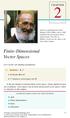 CHAPTER 2 American mathematician Paul Halmos (1916 2006), who in 1942 published the first modern linear algebra book. The title of Halmos s book was the same as the title of this chapter. Finite-Dimensional
On the generation of elliptic curves with 16 rational torsion points by Pythagorean triples
 On the generation of elliptic curves with 16 rational torsion points by Pythagorean triples Brian Hilley Boston College MT695 Honors Seminar March 3, 2006 1 Introduction 1.1 Mazur s Theorem Let C be a
Chapter 3. if 2 a i then location: = i. Page 40
 Chapter 3 1. Describe an algorithm that takes a list of n integers a 1,a 2,,a n and finds the number of integers each greater than five in the list. Ans: procedure greaterthanfive(a 1,,a n : integers)
3.3 Real Zeros of Polynomials
 3.3 Real Zeros of Polynomials 69 3.3 Real Zeros of Polynomials In Section 3., we found that we can use synthetic division to determine if a given real number is a zero of a polynomial function. This section
INCIDENCE-BETWEENNESS GEOMETRY
 INCIDENCE-BETWEENNESS GEOMETRY MATH 410, CSUSM. SPRING 2008. PROFESSOR AITKEN This document covers the geometry that can be developed with just the axioms related to incidence and betweenness. The full
Every Positive Integer is the Sum of Four Squares! (and other exciting problems)
 Every Positive Integer is the Sum of Four Squares! (and other exciting problems) Sophex University of Texas at Austin October 18th, 00 Matilde N. Lalín 1. Lagrange s Theorem Theorem 1 Every positive integer
MATH 537 (Number Theory) FALL 2016 TENTATIVE SYLLABUS
 MATH 537 (Number Theory) FALL 2016 TENTATIVE SYLLABUS Class Meetings: MW 2:00-3:15 pm in Physics 144, September 7 to December 14 [Thanksgiving break November 23 27; final exam December 21] Instructor: