
6 EXTENDING ALGEBRA. 6.0 Introduction. 6.1 The cubic equation. Objectives
|
|
|
- Brittney Jones
- 9 years ago
- Views:
Transcription
1 6 EXTENDING ALGEBRA Chapter 6 Extending Algebra Objectives After studying this chapter you should understand techniques whereby equations of cubic degree and higher can be solved; be able to factorise polynomials; be able to use the remainder theorem. 6.0 Introduction This chapter is different from the others in this book; although it begins with a realistic example, much of the rest does not have any immediate relevance to the outside world. Its purpose is to extend the algebra you already know. This does not make it a dull chapter. On the contrary, there are many people who enjoy abstract mathematics as being interesting in its own right. Over the centuries mathematical techniques have developed partly in response to problems that needed to be solved, but there have always been those who have pondered on the less applicable side of the subject purely out of interest and curiosity. 6.1 The cubic equation How can an open-topped box with volume 500 cm 3 be made from a square piece of card 20 cm by 20 cm? To make such a box, a net can be made by cutting off equal squares from each corner, as shown in the diagram. Suppose each smaller square has side x cm. The dimensions of the box will then be x by (20 2x) by (20 2x). For the volume to be 500 cm 3, x must satisfy the equation x x x x x(20 2x) 2 = 500, 0 x cm When the expression has been multiplied out, the highest power of x in this equation is x 3 ; accordingly this equation is called a cubic equation. x x 20 cm x x 97

2 As with a quadratic equation, it is good practice to reduce this equation to the form f (x) = 0. x(400 80x + 4x 2 ) = 500 4x 3 80x x 500 = 0 x 3 20x x 125 = 0, 0 x 10 Again by comparison with quadratic equations, the next thing you might want to do would be to try to factorise it. With a cubic function, however, this is not easy. Fortunately one solution to the problem can be seen 'by inspection'. A little experimentation reveals that x = 5 will fit the bill. Is this the only solution? Remember that for quadratic equations where there was one answer there was almost always another. One method of solution is to draw the graph of the cubic function x 3 20x x 125 and see where it crosses the x-axis. Activity 1 Using a graph Sketch the graph of the function f (x) = x 3 20x x 125 Verify that f (5) = 0 and find any other values of x where the curve crosses the horizontal axis. Bearing in mind the domain of x, solve the original problem to the nearest millimetre. y x The solutions of an equation are called the roots of an equation. Hence 5 is a root of x 3 20x x 125 = 0 and Activity 1 should have revealed that there are two other roots as well. Another way of saying the same thing is to refer to 5 and the two other solutions as being zeros of the function; in other words, these values make that function equal to zero. α is a root of f (x) = 0 f ( α)=0 How could the cubic equation have been solved without the need to draw the graph? Activity 2 gives a clue. 98

3 Activity 2 Zeros and factors You may find it useful to use a graphic calculator. (a) (b) (c) (d) (e) Sketch the graph of the function x 2 + 2x 143. What is the factorised form of this function? How can you tell by looking at the graph? Now sketch the graph of the cubic function (x + 4)(x 1)(x 3). How does the form of the function correspond to its zeros? Sketch the graph of the function x 3 79x Hence write this function as the product of three linear factors. Can you factorise x 3 5x 2 + 3x + 4 by looking at its graph? Suggest a possible equation for the curve on the right. y x Now look again at the equation x 3 20x x 125 = 0 x = 5 is known to be a zero of the function x 3 20x x 125 and so it can be deduced, from your work on Activity 2 that (x 5) is a factor. If (x 5) is a factor, how does the rest of the factorisation go? It is evident that x 3 20x x 125 = (x 5) (quadratic function). Moreover, the quadratic must be of the form x 2 + bx + 25 Finding b is not quite so obvious but can be done as follows : x 3 20x x 125 = (x 5)(x 2 + bx + 25) To make 20x 2 in the cubic equation: 20 = 5+b b= 15 To make +100x in the cubic equation: 100 = 25 5b b = 15 Hence x 3 20x x 125 = (x 5)(x 2 15x + 25) 99

4 The solution to the cubic equation is as follows x 3 20x x 125 = 0 (x 5)(x 2 15x + 25) = 0 either x 5 = 0 or x 2 15x + 25 = 0 x = 1.9, 5 or 13.1 to 1 d.p. Example Find all solutions of x 3 3x 2 33x + 35 = 0 Solution A bit of searching reveals that x = 1 is a root of this equation, since f ()=0. 1 Hence (x 1) must be a factor, and you can write x 3 3x 2 33x + 35 = (x 1)(x 2 + bx 35) To find b : the cubic equation contains 33x,so 33 = b 35 b = 2 x 3 3x 2 33x + 35 = (x 1)(x 2 2x 35) In this case, the quadratic factor itself factorises to so (x 7)(x + 5) x 3 3x 2 33x + 35 = (x 1)(x 7)(x + 5) The original equation can thus be re-written (x 1)(x 7)(x + 5) = 0 x = 5, 1 or 7 Example Solve x 3 14x 15 = 0 100

5 Solution x = 3 is a root of this equation. Hence (x + 3) is a factor. x 3 14x 15 = (x + 3)(x 2 + bx 5) To find b: cubic equation has 0x 2, so 0 = b + 3 b = 3 x 3 14x 15 = (x + 3)(x 2 3x 5) The original equation thus reads (x + 3)(x 2 3x 5) = 0 either x + 3 = 0 or x 2 3x 5 = 0 x = 3, 1.19, or 4.19, to 3 s.f. Activity 3 Missing roots (a) (b) Find a linear factor of x 3 4x 2 2x + 20 and the corresponding quadratic factor. Hence find all the solutions of x 3 4x 2 2x + 20 = 0. Illustrate your answer by means of a sketch graph. Exercise 6A 1. (a) Work out the missing quadratic factors (i) x 3 3x 2 6x + 8 = (x 4) ( ) (ii) x 3 + 8x 2 +12x 9 = (x + 3) ( ) (iii) 2x 3 x 2 117x 324 = (2x + 9) ( ) (b) Use your answers to (a) to find all the roots of (i) x 3 3x 2 6x + 8 = 0 (ii) x 3 + 8x 2 +12x 9 = 0 (iii) 2x 3 x 2 117x 324 = 0 2. Explain how you know that (a) (x 3) is a factor of x 3 2x 2 + x 12 (b) (x + 5) is a factor of 2x 3 + 6x 2 23x Find all the roots of these equations (a) x 3 5x 2 + 6x 2 = 0 (b) x 3 + 3x 2 46x = 48 (c) 2x 3 x 2 18x + 9 = 0 4. Four identical square corners are cut from a square piece of card measuring 10 cm by 10 cm. The resulting net will make an open topped box with volume 64 cm 3. Find the size of the squares that must be removed. 10 cm (c) (2x 1) is a factor of 4x 3 + 2x 2 + 8x cm 101

6 6.2 No simple solution You should by now have asked the question : "What happens if no simple solution can be found?" The process you have used depends crucially on first being able to find a root. You may wonder whether, as with quadratic equations that cannot be factorised, there is a formula that will give all the roots automatically. The answer is that a systematic method of finding roots of cubics does exist. The bad news, however, is that (a) (b) it is a long-winded method which is seldom used; it involves complicated maths. A practical solution is to use either a graphical method or trial and improvement. Both methods can be time-consuming and both depend on first knowing approximately where the roots are. For example, to solve the equation x 3 100x x 1500 = 0 it is a help to work out a few values of the function first. Let the function be labelled f (x). A table of values is shown on the right. The arrows show where f (x) changes from positive to negative or vice versa. Hence the zeros of f (x) must occur between 0 and 10 between 20 and 30 between 70 and 80 Trial and improvement, or graphs drawn in the correct regions, eventually give answers of 0.78, and to 2 d.p. x f(x) Exercise 6B 1. (a) Explain how you can tell that the function f (x) = x 3 + x 2 x + 5 has a zero between x = 3 and x = 2. (b) Find this value to 3 s.f. 2. Solve these cubic equations to 3 s.f. (a) 2x 3 150x = 0 (b) x 3 + 4x 2 32x 100 = 0 102

7 6.3 Factor theorem Quadratics and cubics are particular examples of polynomial functions : a quadratic function is a polynomial of degree 2 : a cubic has degree 3. In general a polynomial of degree n has the form a n x n + a n 1 x n a 2 x 2 + a 1 x + a 0 where a 0, a 1,... a n are real numbers, and a n 0. When solving cubic equations, the spotting of a root leads immediately to a simple linear factor : e.g. 3 is a zero of x 3 5x 2 +11x 15 (x 3) is a factor of x 3 5x 2 +11x 15 x 3 + 5x 2 +11x 15 = (x 3) (quadratic) The same technique can be applied to polynomials of any degree. For example, 2 is a zero of x 4 + 3x 2 17x + 6 (x 2) is a factor of x 4 + 3x 2 17x + 6 x 4 + 3x 2 17x + 6 = (x 2) (cubic) In general If P(x) is a polynomial of degree n and has a zero at x = α, that is P( α)=0, then (x α) is a factor of P(x) and P(x) = (x α)q(x) where Q(x) is a polynomial of degree (n 1) This is known as the factor theorem. Example Show that (x 5) is a factor of the polynomial x 5 4x 4 x 3 21x
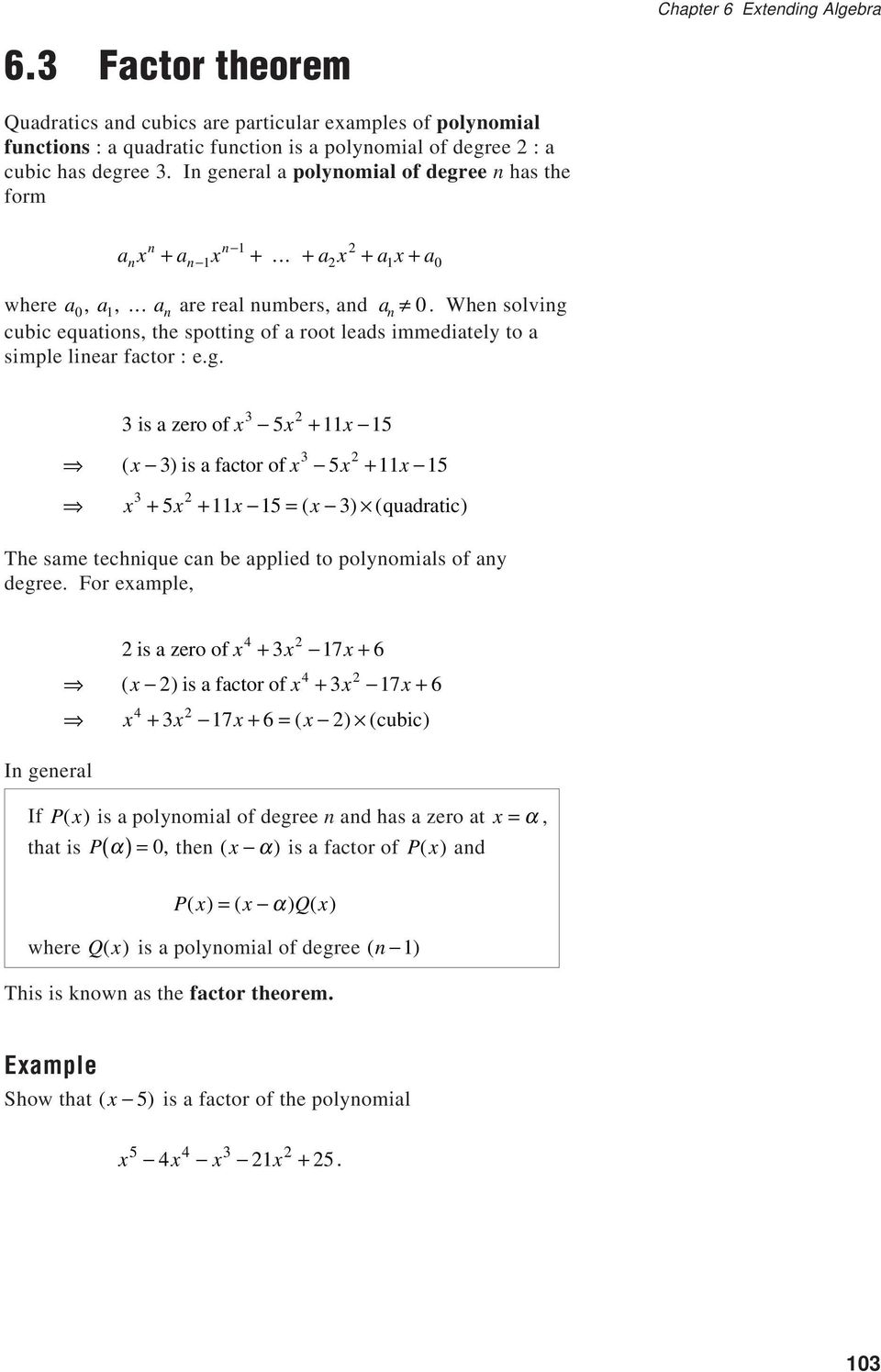
8 Solution Denote the polynomial by P(x). P(5) = = = 0 Hence 5 is a zero of P(x) and so by the factor theorem, (x 5) is a factor. Activity 4 Fractions as roots (a) Show that x = 1 2 is a zero of 2x3 3x 2 3x + 2. (b) 2x 3 3x 2 3x + 2 has two linear factors other than x = 1 2. Find them. Check that all three factors multiply together to give the original cubic. (c) Find the quadratic expression missing from this statement : 2x 3 3x 2 3x + 2 = (2x 1)( ) (d) Suppose the fraction p q is a root of a polynomial. What could the associated factor be? Activity 5 Tips for root-spotting (a) (b) Just by looking at the equation x 3 + 3x 2 + 3x + 2 = 0 it is possible to deduce that, if there is an integer root, it can only be ±1 or ± 2. Why? What is the root? If there is an integer root of x 4 + 3x 3 + x 2 + 2x 3 = 0 then what could it be? For example, how can you tell that neither +2 nor 2 could be a root? You have now met the main techniques to find factors, but you should always remember that some polynomials will not have any real roots, whilst others will have real roots, but they will not be integers or even rational numbers. 104

9 Exercise 6C 1. Show that (a) (x 1) is a factor of x 4 + 3x 3 2x 2 + 5x 7 (b) (x +1) is a factor of x 5 7x 4 8x 3 + 2x 2 + x 1 (c) (x 3) is a factor of x 4 2x 3 7x 6 (d) (x 2) is a factor of 2x 6 + 5x 4 27x (e) (f) (x +10) is a factor of 5x x 4 269x 3 90x +100 (x 8) is a factor of x 10 9x 9 + 8x 8 x 2 + x Three of the polynomials below have a linear factor from the list on the right. Match the factors to the polynomials. The 'odd one out' does have a simple linear factor, but not one in the list. Find the factor. 3. Find a linear factor for each of these polynomials. (a) x 3 + 4x 2 + x 6 (b) x 4 6x 4 (c) x 4 6x 3 8x 2 + 6x + 7 (d) 2x 4 + x 3 6x 2 x +1 (e) 3x 3 +10x 2 11x + 2 A: x 4 5x 2 + 3x 2 1: x+1 B: x 5 4 x x 3 8x 2 x + 4 2: x 2 C: x 3 4x 2 6x 1 3: x+3 D: x 3 +12x 2 43x Solving higher order equations The next activity shows how you can tackle higher order equations using the factor theorem. Activity 6 Solving a quartic equation The equation x 4 4x 3 13x 2 + 4x +12 = 0 is an example of a quartic equation, a polynomial equation of degree 4. Find a simple linear factor of the quartic, and use this factor to complete a statement of this type : x 4 4x 3 13x 2 + 4x +12 = (x α) (cubic) Hence find all the solutions of the quartic equation and sketch the graph of y = x 4 4x 3 13x 2 + 4x +12 without the help of a calculator or computer. 105

10 Activity 6 shows how the factor theorem can help solve higher order equations. However, it may have taken you some time! Probably the longest part was finding the cubic factor. When the same process is applied to, say, x 6 x 4 +17x 14 = (x + 2) (polynomial of degree 5) it will take longer still. Fortunately there are ways of finding the polynomial factor which are more efficient. Two methods will be introduced here. You may, later on, like to reflect on how they are essentially the same method expressed differently. The first method involves juggling with coefficients, and is best demonstrated by example. Consider the quartic x 4 + 5x 3 + 7x 2 + 6x + 8. x = 2 is a zero of this function and hence (x + 2) is a factor. The cubic factor can be found thus : x 4 + 5x 3 + 7x 2 + 6x + 8 = x 3 (x + 2) + 3x 3 + 7x 2 + 6x + 8 = x 3 (x + 2) + 3x 2 (x + 2) + x 2 + 6x + 8 = (x 3 + 3x 2 )(x + 2) + x(x + 2) + 4x + 8 = (x 3 + 3x 2 + x)(x + 2) + 4(x + 2) = (x 3 + 3x 2 + x + 4)(x + 2) Hence the cubic factor is x 3 + 3x 2 + x + 4. Example Find the missing expression here : x 4 3x 3 + 5x 2 + x 4 = (x 1)( ) Solution x 4 3x 3 + 5x 2 + x 4 = x 3 (x 1) 2x 3 + 5x 2 + x 4 = x 3 (x 1) 2x 2 (x 1) + 3x 2 + x 4 = (x 3 2x 2 )(x 1) + 3x(x 1) + 4x 4 = (x 3 2x 2 + 3x)(x 1) + 4(x 1) = (x 3 2x 2 + 3x + 4)(x 1) 106

11 so the missing expression is x 3 2x 2 + 3x + 4. The second method is sometimes called 'long division of polynomials'. The statement x 4 + 5x 3 + 7x 2 + 6x + 8 = (x + 2)(cubic) can be written instead in this form x 4 + 5x 3 + 7x 2 + 6x + 8 = cubic polynomial x + 2 The cubic polynomial is thus the result of dividing the quartic by (x + 2). This division can be accomplished in a manner very similar to long division of numbers. x 3 + 3x 2 + x + 4 x + 2) x 4 + 5x 3 + 7x 2 + 6x + 8 x 4 + 2x 3 3x 3 + 7x 2 3x 3 + 6x 2 x 2 + 6x x 2 + 2x 4x + 8 4x So x 4 + 5x 5 + 7x 2 + 6x + 8 = ( x + 2) ( x 3 +3x 2 + x+4), the same answer is obtained as on the previous page by the 'juggling' method. Activity 7 Long division When x = 10, the quotient x 4 + 5x 3 + 7x 2 + 6x + 8 becomes x + 2 the division sum Evaluate this by long division (not short division). Discuss the resemblance between your sum and the algebraic long division above. Try putting other values of x into the quotient (e.g. x = 9, x = 5). 107

12 Example Evaluate the quotient x4 5x 3 2x x 3. x 3 Solution x 3 2x 2 8x +1 x 3) x 4 5x 3 2x x 3 x 4 3x 3 2x 3 2x 2 2x 3 + 6x 2 8x x 8x x x 3 x 3 The quotient is therefore x 3 2x 2 8x Example Work out the missing cubic factor in this statement: 4x 4 11x 2 +15x 18 = (2x 3)(...) Solution Note that there are no terms in x 3. To simplify the division, a term 0x 3 is included. ) 2x 3 4x 4 +0x 3 11x 2 +15x 18 4x 4 6x 3 2x 3 + 3x 2 x + 6 6x 3 11 x 2 6x 3 9x 2 2x 2 +15x 2x 2 + 3x 12x 18 12x 18 The missing cubic factor is therefore 2x 3 + 3x 2 x

13 Exercise 6D 1. Find these quotients by long division (a) (b) (c) (d) Use the 'juggling' method to find the missing factors 3. Use long division to find the missing factors (a) x 4 + 6x 3 + 9x 2 + 5x +1 = (x +1)(...) (b) x 4 + 7x 3 39x 18 = (x + 6)(...) (c) 2x 3 4x 2 7x +14 = (x 2)(...) (d) 9x5 + 9x 4 16x 3 +11x + 2 = (3x + 2)(...) 4. Evaluate these quotients (a) x 4 + 8x 3 +17x 2 +12x +18 = (x + 3)(...) (b) x 4 5x 3 x = (x 5)(...) (c) x 3 + 4x 2 8 = (x + 2)(...) (a) (c) x 3 + 6x 2 6x + 7 x 2 x +1 x 4 6x 3 + 4x 2 6x + 3 x 2 +1 (b) 2x4 + 5x 3 5x 2 x 2 + 3x + 2 (d) x 4 + 2x 3 2x 4 x Factorising polynomials In the next examples, you will see how to factorise polynomials of degrees higher than two. Example Factorise the quartic x 4 4x 3 7x x 24 as fully as possible and hence solve the equation x 4 4x 3 7x x 24 = 0. Solution x = 1 is a zero of the quartic, so (x 1) is a factor. Long division yields x 4 4x 3 7x x 24 = (x 1)(x 3 3x 2 10x + 24) Now factorise the cubic; since x = 2 is a zero of the cubic, (x 2) is a factor. Long division gives x 3 3x 2 10x + 24 = (x 2)(x 2 x 12) The quadratic x 2 x 12 factorises easily to give (x 4)(x + 3) The full factorisation of the original quartic is therefore (x 1)(x 2)(x 4)(x + 3) and the solutions to the equation are thus x = 3,1, 2 and

14 Example Solve the equation x 4 + 3x 3 11x 2 19x 6 = 0. Solution First, factorise the quartic as far as possible. x = 1 is a zero so (x +1) is a factor. By long division x 4 + 3x 3 11x 2 19x 6=(x+1)(x 3 + 2x 2 13x 6) x = 3 is a zero of the cubic so (x 3) is a factor. x 3 + 2x 2 13x 6 = (x 3)(x 2 + 5x + 2) The quadratic x 2 + 5x + 2 has no straightforward linear factors, but the equation x 2 + 5x + 2 = 0 does have solutions, namely 4.56 and The quartic thus factorises to (x +1)(x 3)(x 2 + 5x + 2 ) yielding solutions x = 4.56, 1, and 3. Exercise 6E 1. Solve the following quartic equations : (a) x 4 + 8x 3 +14x 2 8x 15 = 0 2. Solve the quintic equation x 5 8x 3 + 6x 2 + 7x 6 = 0 (b) x 4 + 8x 3 13x 2 32x + 36 = Remainders In the previous section you saw how to divide a polynomial by a factor. These ideas will be extended now to cover division of a polynomial by an expression of the form ( x α). If ( x α) is not a factor, there will be a remainder. 110

15 Activity 8 (a) Carry out the long division x3 + 5x 2 2x +1 x +1 (b) If you substitute x = 9 in this quotient it becomes Carry out the division. Repeat with x = 10, 11, 12. Do not use a calculator. Comment on your answers and how they correspond to part (a). As with numbers, long divisions of polynomials often leave remainders. For example (x + 3) is not a factor of x 3 + 6x 2 + 7x 4, and so long division will yield a remainder. ) x 2 + 3x 2 x + 3 x 3 + 6x 2 + 7x 4 x 3 + 3x 2 3x 2 + 7x 3x 2 + 9x 2x 4 2x 6 2 One way of expressing this might be to write x 3 + 6x 2 + 7x 4 x + 3 but the normal method is to write either = x 2 + 3x 2, rem 2 x 3 + 6x 2 + 7x 4 = (x 2 + 3x 2)(x + 3) + 2 or x 3 + 6x 2 + 7x 4 x + 3 = x 2 + 3x x

16 Activity 9 Remainders (a) Substitute any positive integer for x in the quotient x 3 + 6x 2 + 7x 4. Verify by division that the remainder is 2. x + 3 Try some negative values of x (except 3 ) and comment. (b) Find the remainder when x 3 + 6x 2 + x 7 is divided by x +1. (c) Find the remainder for the division (x 3 + x 2 4x + 8) (x 2). Exercise 6F 1. Find the remainders (a) when x 2 15x +10 is divided by (x 5) (b) when x 3 + 4x 2 7x +10 is divided by (x + 3) 2. Use Question 1 to complete these statements (a) x 3 + 4x 2 7x +10 x + 3 = (...) +... x Extending the factor theorem (b) x 2 15x +10 = (...)(x 5)+... Activity 10 (a) How can you tell that (x 1) is not a factor of x 3 7x +10? (b) When the division is carried out a statement of the form x 3 7x +10 = (x 1)Q(x) + R (c) will result, where Q(x) is a quadratic function and R the remainder. Without doing the division, calculate R. (Hint : choose a suitable value of x to substitute in the equation above.) Without doing the division, calculate the remainder when x 4 + 3x 3 5x +10 is divided by x

17 Activity 10 illustrates the result known as the remainder theorem. If P(x) is a polynomial of degree n then P(x) = (x α)q(x) + R where Q(x) is a polynomial of degree n 1 and R = P(α). The useful fact that R = P(α) can be demonstrated simply by considering what happens to the equation P(x) = (x α)q(x) + R when x = α is substituted into it. Does this provide a proof of the remainder theorem? * Activity 11 Division by quadratics Carry out the algebraic division x 4 + 3x 3 10x 2 26x + 28 x 2 + 2x 3 Can you suggest a remainder theorem for division by quadratics? Can you generalise to division by any polynomial? Exercise 6G 1. Work out the remainder when (a) x 2 + 5x 7 is divided by (x 2); (b) x 4 3x is divided by (x + 3) ; (c) 5x 3 + 6x 2 + 2x 3 is divided by (x + 5). 3. x 2 + px + q divides exactly by (x 5) and leaves remainder 6 when divided by (x +1). Find p and q. 4. Find the linear expressions which yield a remainder of 6 when divided into x 2 +10x When the quadratic x 2 + px +1 is divided by (x 1) the remainder is 5. Find p. 113

18 6.8 Rationals and irrationals Until about the 5th century AD it was firmly believed that whole numbers and their ratios could be used to describe any quantity imaginable. In other words, that the set Q of rational numbers contained every number possible. Gradually, though, mathematicians became aware of 'incommensurable quantities', quantities that could not be expressed as the ratio of two integers. Such numbers are called irrational numbers. The origin of this concept is uncertain, but one of the simplest examples of an irrational number arises from Pythagoras' Theorem. This theorem gives the length of the diagonal of the unit square as 2. The proof that 2 is irrational is one of the most famous proofs in all mathematics. It employs a technique called 'reductio ad absurdum' (reduction to the absurd) the proof begins by assuming that 2 is rational and then shows that this assumption leads to something impossible (absurd). See if you can follow the reasoning: Suppose 2 is rational. This means that 2 = p, where p and q are integers with q no common factor, and q 0. 2 = p q p2 q 2 = 2 p2 = 2q 2 p2 is even p is even. Hence p can be written as 2r, where r is an integer. Since p is even, q must be odd as they have no common factors. p 2 = 2q 2 4r 2 = 2q 2 q 2 = 2r 2 q2 is even q is even. q is thus seen to be both odd and even, which is impossible. The original assumption that 2 is rational must therefore be false. Hence 2 is irrational. 114

19 Other examples of irrationals are π and any square root like 5. Still more examples can be constructed from these, e.g. 2 +1, 6π, etc. The set of rational and irrational numbers is called the set of real numbers, denoted by R. Activity 12 True or false? Decide whether these statements are true or false (a) (i) rational + rational = rational (ii) rational + irrational = irrational (iii) irrational + irrational = irrational (b) (i) rational rational = rational (ii) rational irrational = rational (iii) irrational irrational = rational (c) 'Between any two rational numbers there is another rational number'. (d) 'Between any two irrational numbers, there is another irrational number'. A different way of looking at rational and irrational numbers comes from considering equations. To solve any linear equation involving integer coefficients, the set of rationals is sufficient. e.g. 71x = 317 x = However, Q is not sufficient to solve every polynomial of degree 2 and higher. While some do have rational solutions, e.g. x2 7x +12 = 0 x = 3 or 4 in general, they do not. e.g. x 2 3x +1 = 0 x = 1 (3 ± 5). 2 In fact, there is still a further class of numbers; these are the transcendental numbers. If you are interested, find out what these are by consulting a mathematical dictionary. 115

20 Irrational expressions like 5 are called surds. Surds cannot be expressed as ratios of natural numbers. Activity 13 Handling surds (a) Use a calculator to verify that 8 = 2 2. Explain why this is true. (b) What surd can be written as 3 2? (c) Express 12 as a multiple of 3. Use a calculator to check your answer. A method of manipulating surds is used to 'rationalise' the denominators in expressions like To rationalise a denominator means literally to turn an irrational denominator into a rational one. Activity 14 How to rationalise a denominator (a) What is ( 5+1)( 5 1)? (b) Multiply the fraction 1 by (c) Explain why = (d) What is ( 10 2)( )? (e) Write 3 ( 10 2) as a fraction with a rational denominator. Example (a) 20 = 4 5 = 4 5 = 2 5 (b) 216 = 4 54 = 2 54 But 54 can itself be simplified : 2 54 =2 9 6 =2 9 6 =

21 Example (a) = = ( 6 + 1) 5 = (b) = = Activity 15 Fence posts The diagram shows a circular field cut in half by the diameter AB. The owner of the field wants to build two fences, one round the circumference of the circle, the other across the diameter. Fence posts are placed at A and B and further posts spaced equally along the diameter. Explain why the owner must use a different measure of equal spacing when fence posts are put around the circumference. ('Spacing' is to be taken to mean 'distance apart round the circumference'). A B Activity 16 3 Prove that 3 is irrational, using the same method of proof as was used for 2. Can the same method be used to 'prove' that 4 is irrational? Exercise 6H 1. Write down an irrational number (a) between 3 and 4; (b) between 26 and 27; (c) between 6 and Simplify the surds (a) 52 (b) 75 (c) 120 (d) Use a similar technique to simplify 3 (a) 16 3 (b) 54 4 (c) Rationalise the denominators in these expressions (a) (d) (b) (e) (c)
22 6.9 Miscellaneous Exercises 1. Find a linear factor for each of these polynomials : (a) x 4 3x 3 10x 2 x + 5 (b) x 5 + 3x 4 + x 3 + 5x 2 +12x 4 2. Solve these equations : (a) x 4 3x 3 10x 2 x + 5 = 0 (b) x 4 + 2x 3 67x 2 128x +192 = 0 3. Copy and complete these identities : (a) x 3 7x 2 x 6 = (x 7)( ) + ( ) (b) x 5 + 5x 4 3x 2 + 2x +1 = ( ) ( ) + x + 2 x What is the remainder when (a) x 4 5x 2 +12x 15 is divided by x + 3 ; (b) x 3 5x 2 21x + 7 is divided by x 10? 10. Find the remainder when px ( )=2x 3 x 2 2x+1 is divided by (a) x 2 (b) x +1 Factorise px ( ) completely. (AEB) 11. The polynomial px ( ) 2x 3 9x 2 +kx 13, when k is a constant, has ( 2x 1) as a factor. Determine the value of k. (AEB) 12. An equilateral triangle has sides of length a. Show that the area is a a a a 5. x 3 + ax 2 + 5x 10 leaves remainder 4 when divided by x + 2. Find a. 6. Find the linear expressions which leave remainder 14 when divided into x 2 5x A quadratic function is exactly divisible by x 2, leaves remainder 12 when divided by x +1 and remainder 8 when divided by x 3. What is the quadratic function? 8. Find the linear expressions which leave remainder 8 when divided into x 3 12x 2 +17x Simplify these, where possible x 2 1 (a) 2(x +1) (c) m2 4 2m (e) x 3 1 x 1 (b) (d) 6a 3 2a + a 2 3x 2 + 5x 2 3x (a) Show that (i) ( p + 4q) is a factor of p pq 8q 2 and find the other linear factor; (ii) (x 2y) is a factor of x 3 + x 2 y 7xy 2 + 2y 3 and find the quadratic factor; (iii) (a + 3b) is a factor of 2a 3 + 7a 2 b 9b 3 and find the two other linear factors. (b) Factorise these expressions completely (i) x 2 2ax 3a 2 (ii) p pq 24q 2 (iii) a 3 2a 2 b 11ab 2 +12b Factorise the expression 16x 5 81x as completely as possible. 118
JUST THE MATHS UNIT NUMBER 1.8. ALGEBRA 8 (Polynomials) A.J.Hobson
 JUST THE MATHS UNIT NUMBER 1.8 ALGEBRA 8 (Polynomials) by A.J.Hobson 1.8.1 The factor theorem 1.8.2 Application to quadratic and cubic expressions 1.8.3 Cubic equations 1.8.4 Long division of polynomials
3.3. Solving Polynomial Equations. Introduction. Prerequisites. Learning Outcomes
 Solving Polynomial Equations 3.3 Introduction Linear and quadratic equations, dealt within Sections 3.1 and 3.2, are members of a class of equations, called polynomial equations. These have the general
a 1 x + a 0 =0. (3) ax 2 + bx + c =0. (4)
 ROOTS OF POLYNOMIAL EQUATIONS In this unit we discuss polynomial equations. A polynomial in x of degree n, where n 0 is an integer, is an expression of the form P n (x) =a n x n + a n 1 x n 1 + + a 1 x
SOLVING POLYNOMIAL EQUATIONS
 C SOLVING POLYNOMIAL EQUATIONS We will assume in this appendix that you know how to divide polynomials using long division and synthetic division. If you need to review those techniques, refer to an algebra
MA107 Precalculus Algebra Exam 2 Review Solutions
 MA107 Precalculus Algebra Exam 2 Review Solutions February 24, 2008 1. The following demand equation models the number of units sold, x, of a product as a function of price, p. x = 4p + 200 a. Please write
UNCORRECTED PAGE PROOFS
 number and and algebra TopIC 17 Polynomials 17.1 Overview Why learn this? Just as number is learned in stages, so too are graphs. You have been building your knowledge of graphs and functions over time.
POLYNOMIAL FUNCTIONS
 POLYNOMIAL FUNCTIONS Polynomial Division.. 314 The Rational Zero Test.....317 Descarte s Rule of Signs... 319 The Remainder Theorem.....31 Finding all Zeros of a Polynomial Function.......33 Writing a
Biggar High School Mathematics Department. National 5 Learning Intentions & Success Criteria: Assessing My Progress
 Biggar High School Mathematics Department National 5 Learning Intentions & Success Criteria: Assessing My Progress Expressions & Formulae Topic Learning Intention Success Criteria I understand this Approximation
Zeros of Polynomial Functions
 Review: Synthetic Division Find (x 2-5x - 5x 3 + x 4 ) (5 + x). Factor Theorem Solve 2x 3-5x 2 + x + 2 =0 given that 2 is a zero of f(x) = 2x 3-5x 2 + x + 2. Zeros of Polynomial Functions Introduction
3.6. The factor theorem
 3.6. The factor theorem Example 1. At the right we have drawn the graph of the polynomial y = x 4 9x 3 + 8x 36x + 16. Your problem is to write the polynomial in factored form. Does the geometry of the
Zero: If P is a polynomial and if c is a number such that P (c) = 0 then c is a zero of P.
 MATH 11011 FINDING REAL ZEROS KSU OF A POLYNOMIAL Definitions: Polynomial: is a function of the form P (x) = a n x n + a n 1 x n 1 + + a x + a 1 x + a 0. The numbers a n, a n 1,..., a 1, a 0 are called
Answer Key for California State Standards: Algebra I
 Algebra I: Symbolic reasoning and calculations with symbols are central in algebra. Through the study of algebra, a student develops an understanding of the symbolic language of mathematics and the sciences.
Math Review. for the Quantitative Reasoning Measure of the GRE revised General Test
 Math Review for the Quantitative Reasoning Measure of the GRE revised General Test www.ets.org Overview This Math Review will familiarize you with the mathematical skills and concepts that are important
Zeros of a Polynomial Function
 Zeros of a Polynomial Function An important consequence of the Factor Theorem is that finding the zeros of a polynomial is really the same thing as factoring it into linear factors. In this section we
SECTION 0.6: POLYNOMIAL, RATIONAL, AND ALGEBRAIC EXPRESSIONS
 (Section 0.6: Polynomial, Rational, and Algebraic Expressions) 0.6.1 SECTION 0.6: POLYNOMIAL, RATIONAL, AND ALGEBRAIC EXPRESSIONS LEARNING OBJECTIVES Be able to identify polynomial, rational, and algebraic
Year 9 set 1 Mathematics notes, to accompany the 9H book.
 Part 1: Year 9 set 1 Mathematics notes, to accompany the 9H book. equations 1. (p.1), 1.6 (p. 44), 4.6 (p.196) sequences 3. (p.115) Pupils use the Elmwood Press Essential Maths book by David Raymer (9H
7.2 Quadratic Equations
 476 CHAPTER 7 Graphs, Equations, and Inequalities 7. Quadratic Equations Now Work the Are You Prepared? problems on page 48. OBJECTIVES 1 Solve Quadratic Equations by Factoring (p. 476) Solve Quadratic
9. POLYNOMIALS. Example 1: The expression a(x) = x 3 4x 2 + 7x 11 is a polynomial in x. The coefficients of a(x) are the numbers 1, 4, 7, 11.
 9. POLYNOMIALS 9.1. Definition of a Polynomial A polynomial is an expression of the form: a(x) = a n x n + a n-1 x n-1 +... + a 1 x + a 0. The symbol x is called an indeterminate and simply plays the role
Factoring Polynomials
 Factoring Polynomials Hoste, Miller, Murieka September 12, 2011 1 Factoring In the previous section, we discussed how to determine the product of two or more terms. Consider, for instance, the equations
expression is written horizontally. The Last terms ((2)( 4)) because they are the last terms of the two polynomials. This is called the FOIL method.
 A polynomial of degree n (in one variable, with real coefficients) is an expression of the form: a n x n + a n 1 x n 1 + a n 2 x n 2 + + a 2 x 2 + a 1 x + a 0 where a n, a n 1, a n 2, a 2, a 1, a 0 are
3.2. Solving quadratic equations. Introduction. Prerequisites. Learning Outcomes. Learning Style
 Solving quadratic equations 3.2 Introduction A quadratic equation is one which can be written in the form ax 2 + bx + c = 0 where a, b and c are numbers and x is the unknown whose value(s) we wish to find.
Tim Kerins. Leaving Certificate Honours Maths - Algebra. Tim Kerins. the date
 Leaving Certificate Honours Maths - Algebra the date Chapter 1 Algebra This is an important portion of the course. As well as generally accounting for 2 3 questions in examination it is the basis for many
What are the place values to the left of the decimal point and their associated powers of ten?
 The verbal answers to all of the following questions should be memorized before completion of algebra. Answers that are not memorized will hinder your ability to succeed in geometry and algebra. (Everything
Understanding Basic Calculus
 Understanding Basic Calculus S.K. Chung Dedicated to all the people who have helped me in my life. i Preface This book is a revised and expanded version of the lecture notes for Basic Calculus and other
Factoring Trinomials: The ac Method
 6.7 Factoring Trinomials: The ac Method 6.7 OBJECTIVES 1. Use the ac test to determine whether a trinomial is factorable over the integers 2. Use the results of the ac test to factor a trinomial 3. For
Algebra Unpacked Content For the new Common Core standards that will be effective in all North Carolina schools in the 2012-13 school year.
 This document is designed to help North Carolina educators teach the Common Core (Standard Course of Study). NCDPI staff are continually updating and improving these tools to better serve teachers. Algebra
Lagrange Interpolation is a method of fitting an equation to a set of points that functions well when there are few points given.
 Polynomials (Ch.1) Study Guide by BS, JL, AZ, CC, SH, HL Lagrange Interpolation is a method of fitting an equation to a set of points that functions well when there are few points given. Sasha s method
If A is divided by B the result is 2/3. If B is divided by C the result is 4/7. What is the result if A is divided by C?
 Problem 3 If A is divided by B the result is 2/3. If B is divided by C the result is 4/7. What is the result if A is divided by C? Suggested Questions to ask students about Problem 3 The key to this question
3.6 The Real Zeros of a Polynomial Function
 SECTION 3.6 The Real Zeros of a Polynomial Function 219 3.6 The Real Zeros of a Polynomial Function PREPARING FOR THIS SECTION Before getting started, review the following: Classification of Numbers (Appendix,
Core Maths C1. Revision Notes
 Core Maths C Revision Notes November 0 Core Maths C Algebra... Indices... Rules of indices... Surds... 4 Simplifying surds... 4 Rationalising the denominator... 4 Quadratic functions... 4 Completing the
Application. Outline. 3-1 Polynomial Functions 3-2 Finding Rational Zeros of. Polynomial. 3-3 Approximating Real Zeros of.
 Polynomial and Rational Functions Outline 3-1 Polynomial Functions 3-2 Finding Rational Zeros of Polynomials 3-3 Approximating Real Zeros of Polynomials 3-4 Rational Functions Chapter 3 Group Activity:
Equations, Inequalities & Partial Fractions
 Contents Equations, Inequalities & Partial Fractions.1 Solving Linear Equations 2.2 Solving Quadratic Equations 1. Solving Polynomial Equations 1.4 Solving Simultaneous Linear Equations 42.5 Solving Inequalities
0.4 FACTORING POLYNOMIALS
 36_.qxd /3/5 :9 AM Page -9 SECTION. Factoring Polynomials -9. FACTORING POLYNOMIALS Use special products and factorization techniques to factor polynomials. Find the domains of radical expressions. Use
FACTORISATION YEARS. A guide for teachers - Years 9 10 June 2011. The Improving Mathematics Education in Schools (TIMES) Project
 9 10 YEARS The Improving Mathematics Education in Schools (TIMES) Project FACTORISATION NUMBER AND ALGEBRA Module 33 A guide for teachers - Years 9 10 June 2011 Factorisation (Number and Algebra : Module
Factoring Polynomials
 UNIT 11 Factoring Polynomials You can use polynomials to describe framing for art. 396 Unit 11 factoring polynomials A polynomial is an expression that has variables that represent numbers. A number can
FACTORING QUADRATICS 8.1.1 and 8.1.2
 FACTORING QUADRATICS 8.1.1 and 8.1.2 Chapter 8 introduces students to quadratic equations. These equations can be written in the form of y = ax 2 + bx + c and, when graphed, produce a curve called a parabola.
ALGEBRA 2 CRA 2 REVIEW - Chapters 1-6 Answer Section
 ALGEBRA 2 CRA 2 REVIEW - Chapters 1-6 Answer Section MULTIPLE CHOICE 1. ANS: C 2. ANS: A 3. ANS: A OBJ: 5-3.1 Using Vertex Form SHORT ANSWER 4. ANS: (x + 6)(x 2 6x + 36) OBJ: 6-4.2 Solving Equations by
Solving Cubic Polynomials
 Solving Cubic Polynomials 1.1 The general solution to the quadratic equation There are four steps to finding the zeroes of a quadratic polynomial. 1. First divide by the leading term, making the polynomial
Algebra and Geometry Review (61 topics, no due date)
 Course Name: Math 112 Credit Exam LA Tech University Course Code: ALEKS Course: Trigonometry Instructor: Course Dates: Course Content: 159 topics Algebra and Geometry Review (61 topics, no due date) Properties
Solving Quadratic Equations
 9.3 Solving Quadratic Equations by Using the Quadratic Formula 9.3 OBJECTIVES 1. Solve a quadratic equation by using the quadratic formula 2. Determine the nature of the solutions of a quadratic equation
MATH 21. College Algebra 1 Lecture Notes
 MATH 21 College Algebra 1 Lecture Notes MATH 21 3.6 Factoring Review College Algebra 1 Factoring and Foiling 1. (a + b) 2 = a 2 + 2ab + b 2. 2. (a b) 2 = a 2 2ab + b 2. 3. (a + b)(a b) = a 2 b 2. 4. (a
Indiana State Core Curriculum Standards updated 2009 Algebra I
 Indiana State Core Curriculum Standards updated 2009 Algebra I Strand Description Boardworks High School Algebra presentations Operations With Real Numbers Linear Equations and A1.1 Students simplify and
CORRELATED TO THE SOUTH CAROLINA COLLEGE AND CAREER-READY FOUNDATIONS IN ALGEBRA
 We Can Early Learning Curriculum PreK Grades 8 12 INSIDE ALGEBRA, GRADES 8 12 CORRELATED TO THE SOUTH CAROLINA COLLEGE AND CAREER-READY FOUNDATIONS IN ALGEBRA April 2016 www.voyagersopris.com Mathematical
CM2202: Scientific Computing and Multimedia Applications General Maths: 2. Algebra - Factorisation
 CM2202: Scientific Computing and Multimedia Applications General Maths: 2. Algebra - Factorisation Prof. David Marshall School of Computer Science & Informatics Factorisation Factorisation is a way of
3.3 Real Zeros of Polynomials
 3.3 Real Zeros of Polynomials 69 3.3 Real Zeros of Polynomials In Section 3., we found that we can use synthetic division to determine if a given real number is a zero of a polynomial function. This section
The degree of a polynomial function is equal to the highest exponent found on the independent variables.
 DETAILED SOLUTIONS AND CONCEPTS - POLYNOMIAL FUNCTIONS Prepared by Ingrid Stewart, Ph.D., College of Southern Nevada Please Send Questions and Comments to [email protected]. Thank you! PLEASE NOTE
3 1. Note that all cubes solve it; therefore, there are no more
 Math 13 Problem set 5 Artin 11.4.7 Factor the following polynomials into irreducible factors in Q[x]: (a) x 3 3x (b) x 3 3x + (c) x 9 6x 6 + 9x 3 3 Solution: The first two polynomials are cubics, so if
Higher Education Math Placement
 Higher Education Math Placement Placement Assessment Problem Types 1. Whole Numbers, Fractions, and Decimals 1.1 Operations with Whole Numbers Addition with carry Subtraction with borrowing Multiplication
it is easy to see that α = a
 21. Polynomial rings Let us now turn out attention to determining the prime elements of a polynomial ring, where the coefficient ring is a field. We already know that such a polynomial ring is a UF. Therefore
PRE-CALCULUS GRADE 12
 PRE-CALCULUS GRADE 12 [C] Communication Trigonometry General Outcome: Develop trigonometric reasoning. A1. Demonstrate an understanding of angles in standard position, expressed in degrees and radians.
Polynomials. Dr. philippe B. laval Kennesaw State University. April 3, 2005
 Polynomials Dr. philippe B. laval Kennesaw State University April 3, 2005 Abstract Handout on polynomials. The following topics are covered: Polynomial Functions End behavior Extrema Polynomial Division
Algebra 1 Course Title
 Algebra 1 Course Title Course- wide 1. What patterns and methods are being used? Course- wide 1. Students will be adept at solving and graphing linear and quadratic equations 2. Students will be adept
Math 0980 Chapter Objectives. Chapter 1: Introduction to Algebra: The Integers.
 Math 0980 Chapter Objectives Chapter 1: Introduction to Algebra: The Integers. 1. Identify the place value of a digit. 2. Write a number in words or digits. 3. Write positive and negative numbers used
The Method of Partial Fractions Math 121 Calculus II Spring 2015
 Rational functions. as The Method of Partial Fractions Math 11 Calculus II Spring 015 Recall that a rational function is a quotient of two polynomials such f(x) g(x) = 3x5 + x 3 + 16x x 60. The method
Copyrighted Material. Chapter 1 DEGREE OF A CURVE
 Chapter 1 DEGREE OF A CURVE Road Map The idea of degree is a fundamental concept, which will take us several chapters to explore in depth. We begin by explaining what an algebraic curve is, and offer two
3.2 The Factor Theorem and The Remainder Theorem
 3. The Factor Theorem and The Remainder Theorem 57 3. The Factor Theorem and The Remainder Theorem Suppose we wish to find the zeros of f(x) = x 3 + 4x 5x 4. Setting f(x) = 0 results in the polynomial
March 29, 2011. 171S4.4 Theorems about Zeros of Polynomial Functions
 MAT 171 Precalculus Algebra Dr. Claude Moore Cape Fear Community College CHAPTER 4: Polynomial and Rational Functions 4.1 Polynomial Functions and Models 4.2 Graphing Polynomial Functions 4.3 Polynomial
Polynomial and Synthetic Division. Long Division of Polynomials. Example 1. 6x 2 7x 2 x 2) 19x 2 16x 4 6x3 12x 2 7x 2 16x 7x 2 14x. 2x 4.
 _.qd /7/5 9: AM Page 5 Section.. Polynomial and Synthetic Division 5 Polynomial and Synthetic Division What you should learn Use long division to divide polynomials by other polynomials. Use synthetic
1.3 Algebraic Expressions
 1.3 Algebraic Expressions A polynomial is an expression of the form: a n x n + a n 1 x n 1 +... + a 2 x 2 + a 1 x + a 0 The numbers a 1, a 2,..., a n are called coefficients. Each of the separate parts,
1 TRIGONOMETRY. 1.0 Introduction. 1.1 Sum and product formulae. Objectives
 TRIGONOMETRY Chapter Trigonometry Objectives After studying this chapter you should be able to handle with confidence a wide range of trigonometric identities; be able to express linear combinations of
Copy in your notebook: Add an example of each term with the symbols used in algebra 2 if there are any.
 Algebra 2 - Chapter Prerequisites Vocabulary Copy in your notebook: Add an example of each term with the symbols used in algebra 2 if there are any. P1 p. 1 1. counting(natural) numbers - {1,2,3,4,...}
In mathematics, there are four attainment targets: using and applying mathematics; number and algebra; shape, space and measures, and handling data.
 MATHEMATICS: THE LEVEL DESCRIPTIONS In mathematics, there are four attainment targets: using and applying mathematics; number and algebra; shape, space and measures, and handling data. Attainment target
2.3. Finding polynomial functions. An Introduction:
 2.3. Finding polynomial functions. An Introduction: As is usually the case when learning a new concept in mathematics, the new concept is the reverse of the previous one. Remember how you first learned
SECTION 2.5: FINDING ZEROS OF POLYNOMIAL FUNCTIONS
 SECTION 2.5: FINDING ZEROS OF POLYNOMIAL FUNCTIONS Assume f ( x) is a nonconstant polynomial with real coefficients written in standard form. PART A: TECHNIQUES WE HAVE ALREADY SEEN Refer to: Notes 1.31
This is a square root. The number under the radical is 9. (An asterisk * means multiply.)
 Page of Review of Radical Expressions and Equations Skills involving radicals can be divided into the following groups: Evaluate square roots or higher order roots. Simplify radical expressions. Rationalize
Polynomial Operations and Factoring
 Algebra 1, Quarter 4, Unit 4.1 Polynomial Operations and Factoring Overview Number of instructional days: 15 (1 day = 45 60 minutes) Content to be learned Identify terms, coefficients, and degree of polynomials.
8 Polynomials Worksheet
 8 Polynomials Worksheet Concepts: Quadratic Functions The Definition of a Quadratic Function Graphs of Quadratic Functions - Parabolas Vertex Absolute Maximum or Absolute Minimum Transforming the Graph
Factoring Polynomials and Solving Quadratic Equations
 Factoring Polynomials and Solving Quadratic Equations Math Tutorial Lab Special Topic Factoring Factoring Binomials Remember that a binomial is just a polynomial with two terms. Some examples include 2x+3
QUADRATIC EQUATIONS EXPECTED BACKGROUND KNOWLEDGE
 MODULE - 1 Quadratic Equations 6 QUADRATIC EQUATIONS In this lesson, you will study aout quadratic equations. You will learn to identify quadratic equations from a collection of given equations and write
Algebra I Vocabulary Cards
 Algebra I Vocabulary Cards Table of Contents Expressions and Operations Natural Numbers Whole Numbers Integers Rational Numbers Irrational Numbers Real Numbers Absolute Value Order of Operations Expression
Integer roots of quadratic and cubic polynomials with integer coefficients
 Integer roots of quadratic and cubic polynomials with integer coefficients Konstantine Zelator Mathematics, Computer Science and Statistics 212 Ben Franklin Hall Bloomsburg University 400 East Second Street
Unit 6: Polynomials. 1 Polynomial Functions and End Behavior. 2 Polynomials and Linear Factors. 3 Dividing Polynomials
 Date Period Unit 6: Polynomials DAY TOPIC 1 Polynomial Functions and End Behavior Polynomials and Linear Factors 3 Dividing Polynomials 4 Synthetic Division and the Remainder Theorem 5 Solving Polynomial
PUTNAM TRAINING POLYNOMIALS. Exercises 1. Find a polynomial with integral coefficients whose zeros include 2 + 5.
 PUTNAM TRAINING POLYNOMIALS (Last updated: November 17, 2015) Remark. This is a list of exercises on polynomials. Miguel A. Lerma Exercises 1. Find a polynomial with integral coefficients whose zeros include
MATHS LEVEL DESCRIPTORS
 MATHS LEVEL DESCRIPTORS Number Level 3 Understand the place value of numbers up to thousands. Order numbers up to 9999. Round numbers to the nearest 10 or 100. Understand the number line below zero, and
National 5 Mathematics Course Assessment Specification (C747 75)
 National 5 Mathematics Course Assessment Specification (C747 75) Valid from August 013 First edition: April 01 Revised: June 013, version 1.1 This specification may be reproduced in whole or in part for
MATHEMATICS FOR ENGINEERING BASIC ALGEBRA
 MATHEMATICS FOR ENGINEERING BASIC ALGEBRA TUTORIAL 3 EQUATIONS This is the one of a series of basic tutorials in mathematics aimed at beginners or anyone wanting to refresh themselves on fundamentals.
Zeros of Polynomial Functions
 Zeros of Polynomial Functions Objectives: 1.Use the Fundamental Theorem of Algebra to determine the number of zeros of polynomial functions 2.Find rational zeros of polynomial functions 3.Find conjugate
Section 3.2 Polynomial Functions and Their Graphs
 Section 3.2 Polynomial Functions and Their Graphs EXAMPLES: P(x) = 3, Q(x) = 4x 7, R(x) = x 2 +x, S(x) = 2x 3 6x 2 10 QUESTION: Which of the following are polynomial functions? (a) f(x) = x 3 +2x+4 (b)
2.4 Real Zeros of Polynomial Functions
 SECTION 2.4 Real Zeros of Polynomial Functions 197 What you ll learn about Long Division and the Division Algorithm Remainder and Factor Theorems Synthetic Division Rational Zeros Theorem Upper and Lower
1.5. Factorisation. Introduction. Prerequisites. Learning Outcomes. Learning Style
 Factorisation 1.5 Introduction In Block 4 we showed the way in which brackets were removed from algebraic expressions. Factorisation, which can be considered as the reverse of this process, is dealt with
Elementary Number Theory and Methods of Proof. CSE 215, Foundations of Computer Science Stony Brook University http://www.cs.stonybrook.
 Elementary Number Theory and Methods of Proof CSE 215, Foundations of Computer Science Stony Brook University http://www.cs.stonybrook.edu/~cse215 1 Number theory Properties: 2 Properties of integers (whole
2-5 Rational Functions
 -5 Rational Functions Find the domain of each function and the equations of the vertical or horizontal asymptotes, if any 1 f () = The function is undefined at the real zeros of the denominator b() = 4
Vocabulary Words and Definitions for Algebra
 Name: Period: Vocabulary Words and s for Algebra Absolute Value Additive Inverse Algebraic Expression Ascending Order Associative Property Axis of Symmetry Base Binomial Coefficient Combine Like Terms
Polynomial Expressions and Equations
 Polynomial Expressions and Equations This is a really close-up picture of rain. Really. The picture represents falling water broken down into molecules, each with two hydrogen atoms connected to one oxygen
Polynomials and Factoring
 Lesson 2 Polynomials and Factoring A polynomial function is a power function or the sum of two or more power functions, each of which has a nonnegative integer power. Because polynomial functions are built
LAKE ELSINORE UNIFIED SCHOOL DISTRICT
 LAKE ELSINORE UNIFIED SCHOOL DISTRICT Title: PLATO Algebra 1-Semester 2 Grade Level: 10-12 Department: Mathematics Credit: 5 Prerequisite: Letter grade of F and/or N/C in Algebra 1, Semester 2 Course Description:
Core Maths C2. Revision Notes
 Core Maths C Revision Notes November 0 Core Maths C Algebra... Polnomials: +,,,.... Factorising... Long division... Remainder theorem... Factor theorem... 4 Choosing a suitable factor... 5 Cubic equations...
MATH 095, College Prep Mathematics: Unit Coverage Pre-algebra topics (arithmetic skills) offered through BSE (Basic Skills Education)
 MATH 095, College Prep Mathematics: Unit Coverage Pre-algebra topics (arithmetic skills) offered through BSE (Basic Skills Education) Accurately add, subtract, multiply, and divide whole numbers, integers,
Partial Fractions Examples
 Partial Fractions Examples Partial fractions is the name given to a technique of integration that may be used to integrate any ratio of polynomials. A ratio of polynomials is called a rational function.
MATH 10034 Fundamental Mathematics IV
 MATH 0034 Fundamental Mathematics IV http://www.math.kent.edu/ebooks/0034/funmath4.pdf Department of Mathematical Sciences Kent State University January 2, 2009 ii Contents To the Instructor v Polynomials.
7. Some irreducible polynomials
 7. Some irreducible polynomials 7.1 Irreducibles over a finite field 7.2 Worked examples Linear factors x α of a polynomial P (x) with coefficients in a field k correspond precisely to roots α k [1] of
Review of Fundamental Mathematics
 Review of Fundamental Mathematics As explained in the Preface and in Chapter 1 of your textbook, managerial economics applies microeconomic theory to business decision making. The decision-making tools
Unit 3: Day 2: Factoring Polynomial Expressions
 Unit 3: Day : Factoring Polynomial Expressions Minds On: 0 Action: 45 Consolidate:10 Total =75 min Learning Goals: Extend knowledge of factoring to factor cubic and quartic expressions that can be factored
1.7. Partial Fractions. 1.7.1. Rational Functions and Partial Fractions. A rational function is a quotient of two polynomials: R(x) = P (x) Q(x).
 .7. PRTIL FRCTIONS 3.7. Partial Fractions.7.. Rational Functions and Partial Fractions. rational function is a quotient of two polynomials: R(x) = P (x) Q(x). Here we discuss how to integrate rational
Examples of Tasks from CCSS Edition Course 3, Unit 5
 Examples of Tasks from CCSS Edition Course 3, Unit 5 Getting Started The tasks below are selected with the intent of presenting key ideas and skills. Not every answer is complete, so that teachers can
1.7 Graphs of Functions
 64 Relations and Functions 1.7 Graphs of Functions In Section 1.4 we defined a function as a special type of relation; one in which each x-coordinate was matched with only one y-coordinate. We spent most
STRAND: ALGEBRA Unit 3 Solving Equations
 CMM Subject Support Strand: ALGEBRA Unit Solving Equations: Tet STRAND: ALGEBRA Unit Solving Equations TEXT Contents Section. Algebraic Fractions. Algebraic Fractions and Quadratic Equations. Algebraic
ALGEBRA 2: 4.1 Graph Quadratic Functions in Standard Form
 ALGEBRA 2: 4.1 Graph Quadratic Functions in Standard Form Goal Graph quadratic functions. VOCABULARY Quadratic function A function that can be written in the standard form y = ax 2 + bx+ c where a 0 Parabola
Algebra II A Final Exam
 Algebra II A Final Exam Multiple Choice Identify the choice that best completes the statement or answers the question. Evaluate the expression for the given value of the variable(s). 1. ; x = 4 a. 34 b.
Expression. Variable Equation Polynomial Monomial Add. Area. Volume Surface Space Length Width. Probability. Chance Random Likely Possibility Odds
 Isosceles Triangle Congruent Leg Side Expression Equation Polynomial Monomial Radical Square Root Check Times Itself Function Relation One Domain Range Area Volume Surface Space Length Width Quantitative