
Introduction to Quadratic Functions
|
|
|
- Ferdinand Fowler
- 10 years ago
- Views:
Transcription
1 Introduction to Quadratic Functions The St. Louis Gateway Arch was constructed from 1963 to It cost 13 million dollars to build..1 Up and Down or Down and Up Exploring Quadratic Functions Just U and I Comparing Linear and Quadratic Functions Walking the... Curve? Domain, Range, Zeros, and Intercepts Are You Afraid of Ghosts? Factored Form of a Quadratic Function Just Watch that Pumpkin Fly! Investigating the Vertex of a Quadratic Function The Form Is Key Vertex Form of a Quadratic Function More Than Meets the Eye Transformations of Quadratic Functions

2 Chapter Overview This chapter examines the graphical behavior of quadratic functions, including domain, range, increasing and decreasing, absolute maximum and absolute minimum, symmetry, and zeros. The relationship between the form of a quadratic function and the graph of a quadratic function is discussed, especially the key graphical characteristics identified from the form of the quadratic function. Transformations and dilations of quadratic functions are explored. Lesson CCSS Pacing Highlights Models Worked Examples Peer Analysis Talk the Talk Technology.1 Exploring Quadratic Functions A.CED.1 A.CED.2 F.IF.4 1 This lesson provides two real world situations for students to model quadratic functions and explore the graphical behavior. A graphing calculator is then used to determine the absolute maximum or absolute minimum. X X X X.2 Comparing Linear and Quadratic Functions A.SSE.1 A.CED.1 A.CED.2 F.IF.4 F.IF.6 F.LE.1.a 2 This lesson explores the first and second differences of linear and quadratic functions. Students will analyze tables and graphs of different functions to identify the function type. Questions focus students to examine the leading term of both functions to understand the affect the sign has on the graph of the function. X.3 Domain, Range, Zeros, and Intercepts A.SSE.1 A.CED.1 A.CED.2 F.IF.4 F.IF.5 F.IF.7a 1 This lesson provides a real world situation that models vertical motion. Questions ask students to identify the domain, range, zeros, and intervals of increase and decrease. X X.4 Factored Form of a Quadratic Function A.SSE.1.a A.SSE.3.a A.CED.1 A.CED.2 F.IF.4 F.IF.7a 2 This lesson provides opportunities for students to understand the significance of a quadratic function written in factored form. Questions focus students to graph a quadratic function to determine the zeros. They then compare the behaviors of the graph of the quadratic equation to the function written in factored form. X X X 615A Chapter Introduction to Quadratic Functions
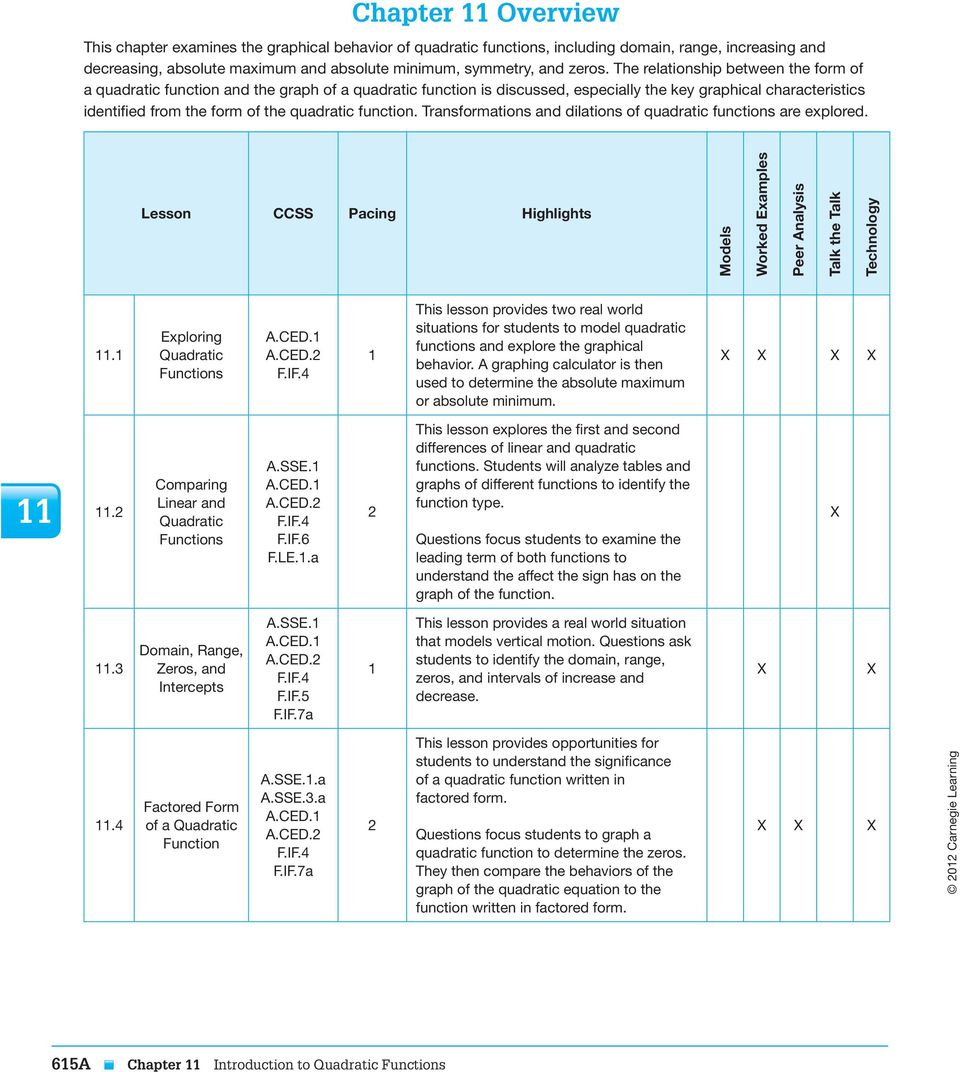
3 Lesson CCSS Pacing Highlights Models Worked Examples Peer Analysis Talk the Talk Technology.5 Investigating the Vertex of a Quadratic Function A.SSE.1.a F.IF.4 F.IF.7a 1 This lesson provides opportunities for students to understand the significance of the line of symmetry with respect to quadratic functions. Questions focus students to graph a quadratic function to determine the vertex and axis of symmetry. They then use the axis of symmetry to determine additional points on the parabola. X X.6 Vertex Form of a Quadratic Function A.SSE.1.a F.IF.4 F.IF.7.a 2 This lesson provides opportunities for students to identify and compare the key characteristics of a quadratic function written in standard form, factored form, and vertex form. Students are then given two functions written in standard form and will complete graphic organizers by writing the functions in factored form and vertex form, and then identifying the key features of each form. X X X.7 Transformations of Quadratic Functions F.BF.3 F.IF.7a 2 This lesson presents the basic quadratic function and investigates transformations and dilations of that function. Questions focus students to think about the transformations being performed on the function versus transformations performed on the argument of the function. X Chapter Introduction to Quadratic Functions 615B

4 Skills Practice Correlation for Chapter Lesson Problem Set Description Vocabulary.1 Exploring Quadratic Functions 1 6 Write quadratic functions in standard form 7 12 Write quadratic functions in standard form that represent area as a function of width Determine and describe absolute maximums of functions.2 Comparing Linear and Quadratic Functions Vocabulary 1 6 Graph tables of values then describe the function represented by the graph 7 12 Calculate first and second difference for tables of values then describe the function represented by the table Vocabulary.3 Domain, Range, Zeros, and Intercepts 1 6 Graph functions represented by problem situations then identify absolute maximums, zeros, domains, and ranges 7 12 Use interval notation to represent intervals described Identify intervals of increase and decrease for given graphs of functions Vocabulary 1 6 Factor expressions.4 Factored Form of a Quadratic Function 7 12 Determine x-intercepts of quadratic functions in factored form Write quadratic functions in factored form with given characteristics Determine x-intercepts for functions using a graphing calculator then write the function in factored form Determine x-intercepts for functions then write the function in factored form.5 Investigating the Vertex of a Quadratic Function Vocabulary 1 6 Write functions representing vertical motion problem situations 7 12 Identify vertexes and axes of symmetry for vertical motion problem situations Determine axes of symmetry of parabolas Determine vertexes of parabolas Determine other points on a parabola given information about the parabola 615C Chapter Introduction to Quadratic Functions

5 Lesson Problem Set Description Vocabulary 1 6 Determine vertexes of quadratic functions given in vertex form.6.7 Vertex Form of a Quadratic Function Transformations of Quadratic Functions 7 12 Determine vertexes of quadratic function given in standard form Determine x-intercepts of quadratic functions given in standard form Identify the form of quadratic functions as standard, factored, or vertex then describe key characteristics based on the equation Write equations for quadratic functions with given characteristics Vocabulary 1 6 Describe transformations performed on functions to create new functions 7 12 Describe transformations performed on functions to create new functions Describe transformations performed on functions to create new functions Represent functions as vertical dilations of other functions using coordinate notation Write equations in vertex form given characteristics then sketch the function Determine transformations necessary to translate the graph of a function into the graph of another function Chapter Introduction to Quadratic Functions 615D

6 616 Chapter Introduction to Quadratic Functions

7 Up and Down or Down and Up exploring Quadratic Functions.1 learning goals Key terms In this lesson, you will: Model real-world problems using quadratic functions. Analyze tables, graphs, and equations for quadratic functions. Use the Distributive Property to write a quadratic equation in standard form. Compare graphs of quadratic functions. Use a graphing calculator to determine the absolute minimum or absolute maximum of a quadratic function. standard form (general form) of a quadratic function parabola essential ideas Real world problems are modeled using quadratic functions. The graph of a quadratic function is a parabola. Quadratic functions are modeled using multiple representations such as equations, tables, and graphs. The Distributive Property is used to write a quadratic equation in standard form. The graphing calculator is used to determine the absolute minimum or absolute maximum of a quadratic function. When the coefficient of the x 2 term in a quadratic function is a positive number, the graph of the function, the parabola, opens upward. When the coefficient of the x 2 term in a quadratic function is a negative number, the graph of the function, the parabola, opens downward. MAtheMAtiCS COMMOn COre StAnDArDS A-CED Creating Equations Create equations that describe numbers or relationships 1. Create equations and inequalities in one variable and use them to solve problems 2. Create equations in two or more variables to represent relationships between quantities; graph equations on coordinate axes with labels and scales. F-IF Interpreting Functions Interpret functions that arise in applications in terms of the context 4. For a function that models a relationship between two quantities, interpret key features of graphs and tables in terms of the quantities, and sketch graphs showing key features given a verbal description of the relationship. 617A

8 Overview Scenarios are used that are represented by a quadratic function. The first scenario is an area problem and the second scenario is the classic handshake problem. Students will write the expressions associated with the scenarios and use the expressions to write a quadratic function for each situation. Using a graphing calculator they then graph the parabola and compute the absolute maximum or the absolute minimum relevant to the problem situation. In the last activity, students conclude that when the coefficient of the x 2 term is a positive number, the parabola opens upward, and when the coefficient of the x 2 term is a negative number, the parabola opens downward. 617B Chapter Introduction to Quadratic Functions

9 Warm Up Rewrite each expression using the distributive property and then simplify. 1. 4(3 1 6) 4(3) 1 4(6) ( x 1 7) 25(x) 2 5(7) 25x x(22 2 9) x(22) 2 x(9) 22x 2 9x 2x 4. x(8 1 x) x(8) 1 x(x) 8x 1 x 2.1 Exploring Quadratic Functions 617C

10 617D Chapter Introduction to Quadratic Functions

11 Up and Down or Down and Up Exploring Quadratic Functions.1 LEArnInG GoALs In this lesson, you will: Model real-world problems using quadratic functions. Analyze tables, graphs, and equations for quadratic functions. Use the Distributive Property to write a quadratic equation in standard form. Compare graphs of quadratic functions. Use a graphing calculator to determine the absolute minimum or absolute maximum of a quadratic function. KEY TErMs standard form (general form) of a quadratic function parabola Take a necklace and hold it at both ends with your fingers. What function would you say describes the shape of the necklace? Quadratic? Wrong. This shape is formed by a catenary function. From bridges to spider webs to architectural arches, catenaries are all around us and they look so much like parabolas, it s easy to be fooled. In future math classes distant future you ll learn about the differences between catenary functions and quadratic functions. For now, let s just focus on quadratics. 8067_Ch_ indd Exploring Quadratic Functions 617
12 Problem 1 A scenario is used to explore a quadratic function. Students will write expressions to represent the length, width, and area of a rectangular enclosure. The Distributive property is used to rewrite the expression for the area of the enclosure then the area function is rewritten in standard form. A series of diagrams show how the area of the enclosure changes as the width of the enclosure diminishes. Using a graphing calculator students then graph the quadratic function which is a parabola. Instructions are given to calculate the absolute maximum using the Maximum function on the graphing calculator. Finally, students will determine the dimensions of the enclosure that will provide the maximum area. Problem 1 Who Put the Dogs In? A dog trainer is fencing in an enclosure, represented by the shaded region in the diagram. The trainer will also have two square-shaped storage units on either side of the enclosure to store equipment and other materials. She can make the enclosure and storage units as wide as she wants, but she can t exceed 100 feet in total length. 100 ft s 1. Let s represent a side length, in feet, of one of the square storage units. a. Write an expression to represent the width of the enclosure. Label the width in the diagram. Explain your reasoning. The storage unit is a square, so all 4 sides are the same length. This means that the width of the enclosure can be represented by s. b. Write an expression to represent the length of the enclosure. Label the length in the diagram. Explain your reasoning. Since the entire length of the enclosure plus the two storage units is 100 feet, the length of the enclosure is s 2 s, or s. s grouping Ask a student to read the information. Discuss as a class. Have students complete Question 1 with a partner. Then share the responses as a class. guiding Questions for Share Phase, Question 1 What is the relationship between the length and width of a square? 618 Chapter Introduction to Quadratic Functions If the original length of the rectangular enclosure was 100 feet and a length of 2s is removed, what operation is used to represent this new length? What do you need to know to determine the area of a rectangle? How is the area of a rectangle determined? What is the length and width of the rectangular enclosure? What is s times 100? What is s times 22s? 8067_Ch_ indd 618 c. Write an expression to represent the area of the enclosure. Explain your reasoning. The area of the enclosure is the product of its width and length. So, the area is s( s). 618 Chapter Introduction to Quadratic Functions

13 grouping Ask a student to read the example and definitions and complete Question 2 as a class. Have students complete Questions 3 and 4 with a partner. Then share the responses as a class. guiding Questions for Share Phase, Questions 3 and 4 If there is no constant in the function written in standard form, what is the value of c? Does the length of the rectangle depend on the area, or does the area of the rectangle depend on the length of the side? You know that you can use the Distributive Property to rewrite a mathematical expression. For example, to rewrite 2(5 2 4), you can distribute the 2: 2(5 2 4) 5 2(5) 2 2(4) You can also distribute variables: n(4 2 3n) 5 n(4) 2 n(3n) 5 4n 2 3n 2 The expression n? 3n is equivalent to n? 3? n, which is the same as n? n? 3, or n 2? 3, or 3n Use the Distributive Property to rewrite the expression representing the area of the enclosure. Show your work. s( s) 5 s(100) 2 s(2s) 5 100s 2 2s 2 The expression you wrote is a quadratic expression. Recall that a quadratic function written in the form f(x) 5 ax 2 1 bx 1 c, where a fi 0, is in standard form, or general form. In this form, a and b represent numerical coefficients and c represents a constant. 8067_Ch_ indd Write the area of the enclosure as a function, A(s), in standard form. Then, identify a, b, and c for the function. A(s) 5 22s s 1 0 a 5 22, b 5 100, and c Identify the independent and dependent quantities and their units in this problem situation. The independent quantity is the side length, in feet, of each storage unit (or the width of the enclosure). The dependent quantity is the area of the enclosure in square feet..1 Exploring Quadratic Functions Exploring Quadratic Functions 619

14 grouping Have students complete Questions 5 through 7 with a partner. Then share the responses as a class. guiding Questions for Share Phase, Questions 5 through 7 Looking at the first and second diagram, does the area of the rectangular enclosure appear to increase or decrease? Looking at the second and third diagram, does the area of the rectangular enclosure appear to increase or decrease? Looking at the third and fourth diagram, does the area of the rectangular enclosure appear to increase or decrease? Looking at the fourth and fifth diagram, does the area of the rectangular enclosure appear to increase or decrease? Looking at the fifth and sixth diagram, does the area of the rectangular enclosure appear to increase or decrease? Looking at the sixth and seventh diagram, does the area of the rectangular enclosure appear to increase or decrease? Looking at the seventh and eighth diagram, does the area of the rectangular enclosure appear to increase or decrease? How will the increase in area followed by a decrease in area affect the graph of the area function? Area (square feet) 620 Chapter Introduction to Quadratic Functions Why do you think the graph of the parabola is upside down? Where on the graph do you think the area of the rectangular enclosure is the 8067_Ch_ indd 620 greatest? The progression of diagrams at the right shows how the area of the enclosure, A(s), changes as the side length s of each square storage unit increases Describe how the area of the enclosure changes. As s increases, the area of the enclosure first increases and then decreases. 6. Predict what the graph of the function will look like. Explain your reasoning. Answers will vary. The graph will be a smooth curve. It will be in the shape of an upside-down : because as the side length s increases, the area of the enclosure increases and then decreases. 7. Use a graphing calculator to graph the function you wrote in Question 3. Then sketch the graph and label the axes. How can you tell the graph is a quadratic function? 0 y Side Length of Storage Unit (feet) It is a quadratic function because the graph is a smooth curve that increases and then decreases in an upside-down : shape. Where on the graph do you think the area of the rectangular enclosure is the least? x 620 Chapter Introduction to Quadratic Functions

15 grouping Ask a student to read the definition and complete Question 8 as a class. Have students complete Questions 9 and 10 with a partner. Then share the responses as a class. The shape that a quadratic function forms when graphed is called a parabola. 8. Think about the possible areas of the enclosure. Is there a maximum area that the enclosure can contain? Explain your reasoning in terms of the graph and in terms of the problem situation. Yes. There is a point on the graph of the function that represents the greatest area that the enclosure can contain. Because the trainer can t exceed 100 feet in length, as the side length of the storage units increases, the area of the enclosure first increases but then must decrease to make room for the extra length of the storage units. guiding Questions for Share Phase, Questions 9 and 10 What is the difference between a maximum and an absolute maximum? Can the area of the rectangular enclosure ever be greater than 125 square feet? Why or why not? If the width of the rectangular enclosure is 25 feet, how do you determine the length of the rectangular enclosure? Is the length always longer than the width of a rectangular enclosure? 8067_Ch_ indd 621 You can use a graphing calculator to identify the absolute maximum of a quadratic function. Step 1: Enter the function and press GRAPH. Step 2: Press 2ND and then CALC. Select 4: maximum. Step 3: Move your cursor to any point on the curve where the graph is increasing and press ENTER. Step 4: Move your cursor to a point directly opposite the point in Step 3 on the curve where the graph is decreasing and press ENTER. Then press ENTER one more time. A graph is increasing when it is going up from left to right. It is decreasing when it is going down from left to right. 9. Use a graphing calculator to determine the absolute maximum of A(s). Then describe what the x- and y-coordinates of the absolute maximum represent in this problem situation. The absolute maximum of the function is at (25, 1250). The x-coordinate of 25 represents the side length in feet of each storage unit that produces the maximum area. The y-coordinate of 1250 represents the maximum area in square feet of the enclosure. 10. Determine the dimensions of the enclosure that will provide the maximum area. Show your work and explain your reasoning. I can substitute 25 for s in the expression for the length of the enclosure, s (25) The dimensions of 25 feet 3 50 feet provide the maximum area of the enclosure..1 Exploring Quadratic Functions Exploring Quadratic Functions 621

16 Problem 2 The scenario is represented by a quadratic function. Students will determine values of the function then organize the values in a table and write an expression for n handshakes. Using the expression from the table, students then write a quadratic function representing the situation. A graphing calculator is used to graph the function and students determine the absolute minimum of the function. grouping Ask a student to read the information. Discuss as a class. Have students complete Questions 1 through 6 with a partner. Then share the responses as a class. Problem 2 Handshake Problem Suppose that there is a monthly meeting at CIA headquarters for all employees. How many handshakes will it take for every employee at the meeting to shake the hand of every other employee at the meeting once? 1. Use the figures shown to determine the number of handshakes that will occur between 2 employees, 3 employees, and 4 employees. 2 employees 3 employees 4 employees 2 employees: 1 handshake; 3 employees: 3 handshakes; 4 employees: 6 handshakes 2. Draw figures to represent the number of handshakes that occur between 5 employees, 6 employees, and 7 employees and determine the number of handshakes that will occur in each situation. Sample figures shown. 5 employees 6 employees 7 employees guiding Questions for Share Phase, Questions 1 and 2 When the first person and second person shake hands, is this counted as one or two handshakes? How many points are used to represent 5 people shaking hands with each other? 622 Chapter Introduction to Quadratic Functions 8067_Ch_ indd employees: 10 handshakes; 6 employees: 15 handshakes; 7 employees: 21 handshakes 622 Chapter Introduction to Quadratic Functions

17 Guiding Questions for Share Phase, Questions 3 through 7 What is 2 times 3? What can you do to the product to determine the number of handshakes for 3 employees? What is 3 times 4? What can you do to the product to determine the number of handshakes for 4 employees? What is 4 times 5? What can you do to the product to determine the number of handshakes for 5 employees? What is 5 times 6? What can you do to the product to determine the number of handshakes for 6 employees? What is 6 times 7? What can you do to the product to determine the number of handshakes for 7 employees? If n represents a number of employees, how would you express one employee less than n? What is n21 times n? What can you do to the product to determine the number of handshakes for n employees? Is the graph of this quadratic function right side up or upside down? Why? 8067_Ch_ indd Complete the table to record your results. Number of Employees Number of Handshakes n n(n 2 1) 2 4. Write an expression in the table to represent the number of handshakes given any number of employees. 5. Rewrite the expression representing the handshake pattern as the quadratic function H(n) in standard form. Identify the independent and dependent quantities. H(n) n n The independent quantity is the number of employees. The dependent quantity is the number of handshakes. 6. Graph this function on a graphing calculator. Sketch the graph on the coordinate plane and label the axes. Number of Handshakes y Number of Employees 0.1 Exploring Quadratic Functions 623 How is a minimum different than an absolute minimum? When does the graph of a quadratic function have an absolute maximum? When does the graph of a quadratic function have an absolute minimum? Determine the absolute minimum of H(n). Then, describe what the x- and y-coordinates of this point represent in this problem situation. The absolute minimum is at ( 1 2, 21 8 ). This doesn t make sense, because you can t have 1 2 of an employee and handshake. The fewest number of handshakes occurs when there are 0 employees. So, in terms of this problem situation, the absolute minimum is at (0, 0) or (1, 0). x Look at the relationship between the number of consecutive employees and the number of handshakes. Hint: (2 3) 2 = 3. 01/04/14 2:12 PM.1 Exploring Quadratic Functions 623

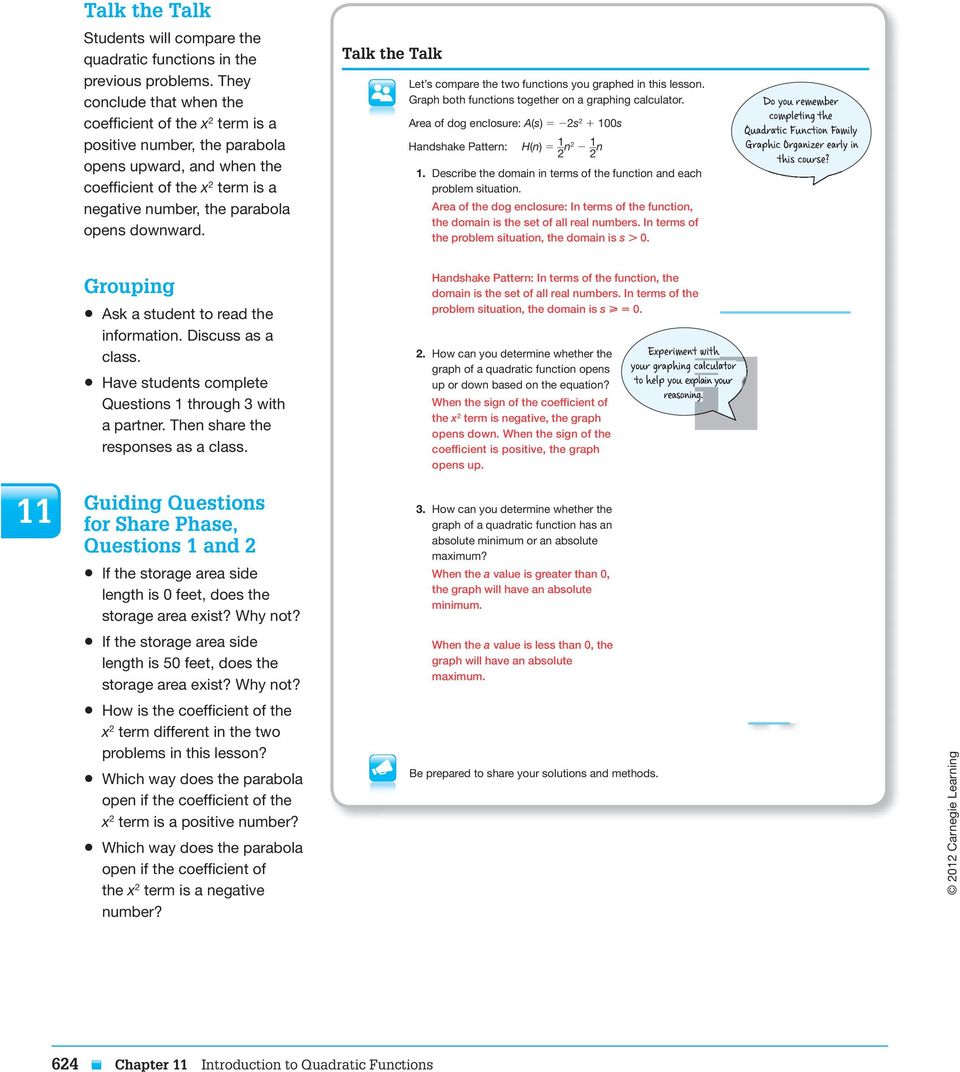
18 talk the talk Students will compare the quadratic functions in the previous problems. They conclude that when the coefficient of the x 2 term is a positive number, the parabola opens upward, and when the coefficient of the x 2 term is a negative number, the parabola opens downward. Talk the Talk Let s compare the two functions you graphed in this lesson. Graph both functions together on a graphing calculator. Area of dog enclosure: A(s) 5 22s s Handshake Pattern: H(n) n n 1. Describe the domain in terms of the function and each problem situation. Area of the dog enclosure: In terms of the function, the domain is the set of all real numbers. In terms of the problem situation, the domain is s. 0. Do you remember completing the Quadratic Function Family Graphic Organizer early in this course? grouping Ask a student to read the information. Discuss as a class. Have students complete Questions 1 through 3 with a partner. Then share the responses as a class. Handshake Pattern: In terms of the function, the domain is the set of all real numbers. In terms of the problem situation, the domain is s > How can you determine whether the graph of a quadratic function opens up or down based on the equation? When the sign of the coefficient of the x 2 term is negative, the graph opens down. When the sign of the coefficient is positive, the graph opens up. Experiment with your graphing calculator to help you explain your reasoning. guiding Questions for Share Phase, Questions 1 and 2 If the storage area side length is 0 feet, does the storage area exist? Why not? If the storage area side length is 50 feet, does the storage area exist? Why not? How is the coefficient of the x 2 term different in the two problems in this lesson? Which way does the parabola open if the coefficient of the x 2 term is a positive number? Which way does the parabola open if the coefficient of the x 2 term is a negative number? 3. How can you determine whether the graph of a quadratic function has an absolute minimum or an absolute maximum? When the a value is greater than 0, the graph will have an absolute minimum. When the a value is less than 0, the graph will have an absolute maximum. 624 Chapter Introduction to Quadratic Functions 8067_Ch_ indd 624 Be prepared to share your solutions and methods. 624 Chapter Introduction to Quadratic Functions
19 Check for Students Understanding The width of a rectangular painting is 5 inches shorter than its length. 1. Write algebraic expressions to represent the width and the length of the painting. w 5 width w length 2. Write an equation to model the area of the painting. a 5 w (w 1 5) a 5 w 2 1 5w 3. Create a table of values to include possible widths, lengths, and areas of the painting. Width (inches) Length (inches) Area (square inches) w w 1 5 w(w 1 5) Sketch a graph to model the area of the painting. y x Identify the x- and y-intercepts. The y-intercept is (0, 0) and the x-intercepts are (25, 0) and (0, 0)..1 Exploring Quadratic Functions 624A

20 6. What do the x- and y-intercepts mean with respect to this problem situation? The x- and y-intercept at (0, 0) means that if the width of the painting is 0, then the area of the painting is 0. The x-intercept at (25, 0) does not make sense in the problem situation, the width of the painting cannot be a negative measurement. 7. Does this problem have an absolute maximum or an absolute minimum? Is it relevant to this problem situation? This problem has an absolute minimum. It is negative so it is not relevant to the problem situation. 624B Chapter Introduction to Quadratic Functions

21 Just U and i Comparing linear and Quadratic Functions.2 learning goals Key terms In this lesson, you will: Identify linear and quadratic functions from multiple representations. Compare graphs, tables, and equations for linear and quadratic functions. Analyze graphs of linear and quadratic functions. Determine if a function is linear or quadratic by analyzing the first and second differences. leading coefficient second differences essential ideas Real world problems are modeled using linear and quadratic functions. The first differences are the differences between successive output values when successive input values have a difference of 1. The first differences of a linear function are a constant whereas the first differences of a quadratic function changes. The second differences are the differences between consecutive values of the first differences. The second differences of a linear function are 0 whereas the second differences of a quadratic function are a constant. The leading coefficient of a function is the numerical coefficient of the term with the greatest power. The sign of the leading coefficient of a quadratic function determines if the parabola opens upward or downward. MAtheMAtiCS COMMOn COre StAnDArDS A-SSE Seeing Structure in Expressions Interpret the structure of expressions. 1. Interpret expressions that represent a quantity in terms of its context. A-CED Creating Equations Create equations that describe numbers or relationships 1. Create equations and inequalities in one variable and use them to solve problems 2. Create equations in two or more variables to represent relationships between quantities; graph equations on coordinate axes with labels and scales. 625A
22 F-IF Interpreting Functions Interpret functions that arise in applications in terms of the context 4. For a function that models a relationship between two quantities, interpret key features of graphs and tables in terms of the quantities, and sketch graphs showing key features given a verbal description of the relationship. 6. Calculate and interpret the average rate of change of a function (presented symbolically or as a table) over a specified interval. Estimate the rate of change from a graph. F-LE Linear, Quadratic, and Exponential Models Construct and compare linear, quadratic, and exponential models and solve problems 1. Distinguish between situations that can be modeled with linear functions and with exponential functions. a. Prove that linear functions grow by equal differences over equal intervals, and that exponential functions grow by equal factors over equal intervals. Overview The first scenario used is represented by a linear function, the length as a function of the width and a quadratic function, the area as a function of the width. Students will complete a table of values and graph the functions. They compare the x- and y-intercepts of each type of graph. In the second activity tables of values for two functions are given and students determine the first differences to identify which table describes a liner function and which table describes a quadratic function. The rates of change of each type of function are compared. They are given the equations and graphs of both functions and will determine the x-intercept of the linear function algebraically and the x-intercepts of the quadratic function using a graphing calculator. Questions focus students on the leading term of both functions and affect the sign of the leading term has on the graph of the function. In the third activity, students then compute the first and second differences of four different functions and generalize about the first and second differences associated with linear and quadratic functions. They also sketch the graph of each function and compare the sign of the first and second differences to the graphic behavior of the function. 625B Chapter Introduction to Quadratic Functions
23 Warm Up Use a graphing calculator to sketch each graph and determine whether each quadratic function has an absolute minimum or an absolute maximum. 1. y 5 2x 2 1 3x y 5 22x 2 2 3x 1 1 This quadratic function has an absolute This quadratic function has an absolute maximum. minimum. y y x x Predict if this function will have an absolute minimum or an absolute maximum. Explain your reasoning. y x2 2 3x 1 1 This quadratic function has an absolute maximum because the x 2 term has a negative coefficient..2 Comparing Linear and Quadratic Functions 625C
24 625D Chapter Introduction to Quadratic Functions
25 Just U and I Comparing Linear and Quadratic Functions.2 LEArnInG GoALs In this lesson, you will: Identify linear and quadratic functions from multiple representations. Compare graphs, tables, and equations for linear and quadratic functions. Analyze graphs of linear and quadratic functions. Determine if a function is linear or quadratic by analyzing the first and second differences. KEY TErMs leading coefficient second differences here do we get the word parabola? Dictionaries tell us that the word comes W from Greek, and is related to the word parable. In Greek, para means beside or alongside. And bole means throwing. The actual meaning of the word parabola comes from slicing a cone exactly parallel to its side. A parabolic shape is often used in satellite receivers to focus incoming signals to a central point. This type of shape is also used to send a beam of energy outward from a central point like in a car s headlights. Where else have you seen parabolas? 8067_Ch_ indd Comparing Linear and Quadratic Functions 625
26 Problem 1 A scenario is used to explore a linear and quadratic function. Students will complete a table listing different widths, lengths, and areas using 16 yards of fencing. They then create a linear graph that shows the length as a function of the width. Next, they create a quadratic graph that shows the area as a function of the width. Students then compare the x- and y-intercepts of each type of graph. grouping Ask a student to read the information. Discuss as a class. Have students complete Questions 1 through 10 with a partner. Then share the responses as a class. Problem 1 Deciding on the Dimensions Two dog owners have 16 yards of fencing to build a dog run beside their house. The dog owners want the run to be in the shape of a rectangle, and they want to use the side of their house as one side of the dog run. A rough sketch of what they have in mind is shown. length width 1. Complete the table to show different widths, lengths, and areas that can occur with sixteen yards of fencing. Width Length Area yards yards square yards guiding Questions for Share Phase, Questions 1 through 3 If each length is 8 yards, is there enough fencing to build the width? Why not? If there is not enough fencing to build the width, is there a rectangular dog run? If the width of the dog run is 2 yards, how much fencing is left to build each length? What do you need to know to compute the area of the rectangular dog run? How do you determine the area of the rectangular dog run? 626 Chapter Introduction to Quadratic Functions Describe what happens to the length as the width of the dog run increases. Why do you think this happens? The length decreases as the width increases because the total amount of fencing available is constant. 3. Describe what happens to the area as the width of the dog run increases. The area increases and then decreases as the width increases. If each length of the dog run is 6 yards, how much fencing is left to build the width? If the width of the dog run is 16 yards, is there enough fencing to build the lengths? Why not? If there is not enough fencing to build the lengths, is there a rectangular dog run? 8067_Ch_ indd Chapter Introduction to Quadratic Functions
27 guiding Questions for Share Phase, Questions 4 through 7 How did you determine the lower and upper bounds to view a complete graph? If the graph displays the length as a function of the width, what label is associated with the x-axis? What label is associated with the y-axis? Is length and width considered linear? Why or why not? What unit of measure is associated with the length and width of the dog run? How do you know the function is a linear function? Is the slope of the function positive or negative? How do you know? What is the slope of the function? What is the y-intercept? Are negative values for x or y relevant to this problem situation? Why or why not? 8067_Ch_ indd Describe what happens to the length and area as the width of the dog run decreases. The length increases as the width decreases. The area increases and then decreases as the width decreases. 5. Describe what happens to the width and area as the length of the dog run increases. Describe what happens to the width and area as the length of the dog run decreases. The width decreases as the length increases. The area increases and then decreases as the length increases. The width increases as the length decreases. The area increases and then decreases as the length decreases. 6. Compare how the area changes as the width changes to how the area changes as the length changes. The changes are the same in that the area increases and then decreases when either measurement increases or decreases. Given a particular length and width, an increase of the width by two yards has the same effect on the area as an increase in the corresponding length by one yard. 7. Let L(w) represent the length of the dog run as a function of the width. Create a graph to show this relationship. First, choose your bounds and intervals. Be sure to label your graph clearly. Length (yards) y Variable Quantity Lower Bound Upper Bound Interval 2 Width Length Dog Run Dimensions y x Width (yards) x Be sure to name your graph..2 Comparing Linear and Quadratic Functions Comparing Linear and Quadratic Functions 627
28 guiding Questions for Share Phase, Questions 8 and 9 Is area a linear function? Why or why not? What unit of measure is associated with the area of the dog run? How do you know the area function is quadratic? Does the graph of the area in terms of the width have an absolute minimum or an absolute maximum? What is the absolute maximum of the quadratic function? What does it mean with respect to the problem situation? 8. Let A(w) represent the area of the dog run as a function of the width. Create a graph to show this relationship. First, choose your bounds and intervals. Be sure to label your axes and name your graph. Variable Quantity Lower Bound Upper Bound Interval Width Area Area (square yards) y 2 Dog Run Dimensions y 5 16x 2 x Width (yards) x 9. Let s compare and contrast the graphs of the two functions. L(w): The length of the dog run as a function of the width. A(w): The area of the dog run as a function of the width. a. Describe the type of function represented by each graph. Explain your reasoning. The graph of L(w) is a linear function because the graph is a straight line. The graph of A(w) is a quadratic function because the graph is a parabola. b. State the domain in terms of each function and the problem situation. The domain of L(w) is the set of all real numbers. In terms of the problem situation, the domain is 0, w, 16. The domain of A(w) is the set of all real numbers. In terms of the problem situation, the domain is 0, w, Chapter Introduction to Quadratic Functions 8067_Ch_ indd Chapter Introduction to Quadratic Functions
29 guiding Questions for Share Phase, Questions 9 and 10 Is it possible for a linear function to have no y-intercepts? Why not? Is it possible for a linear function to have an infinite number of y-intercepts? How? Is it possible for a quadratic function to have no y-intercepts? How? Is it possible for a quadratic function to have an infinite number of y-intercepts? Why not? Is it possible for a quadratic function to have exactly one y-intercept? How? c. Determine the y-intercepts of each graph and interpret the meaning of each in terms of the problem situation. The y-intercept of the graph of the linear function is 8. It indicates the length when the width is 0, which is not appropriate for the dog run. The y-intercept of the graph of the quadratic function is 0. The y-intercept indicates the area when the width is 0, which is not appropriate for the dog run. d. Describe the rates of change for each graph. The linear function has a constant negative rate of change and the quadratic function has a varying rate of change. 10. Determine the dimensions that provide the greatest area. Use the graphical representations to explain your reasoning. The greatest possible area is 32 square yards. The width would be 8 yards, and the length would be 4 yards. The coordinates of the absolute maximum of the quadratic function provide the width and the greatest area. I then used the linear graph to determine the corresponding length. 8067_Ch_ indd Comparing Linear and Quadratic Functions Comparing Linear and Quadratic Functions 629
30 Problem 2 Two tables of values are given. Students will determine which table describes a linear function and which table describes a quadratic function by computing the first differences. The equations and graphs of both functions are given and students identify the y-intercepts of each graph and describe the rate of change for each graph. Students then explore the sign of a leading term in a function and what affect the sign of the lead term has on the graph of the function. They also calculate the second differences. grouping Ask a student to read the information and complete Question 1 as a class. Have students complete Questions 2 through 7 with a partner. Then share the responses as a class. guiding Questions for Discuss Phase, Questions 1 and 2 Is there anything in either table of values that would suggest one the tables describe a quadratic equation? If one of the tables describes a quadratic function, why do all of the y-values appear to be associated to different x-values? To compute the first differences, the x-values need to be consecutive, are they consecutive in each table of values? Problem 2 U and I Tables A and B represent two different functions. One is a linear function, and one is a quadratic function. Table A x A(x) Which table do you think represents each type of function? Explain your reasoning. Answers will vary. I think that Table A represents a linear function because it always decreases by the same amount. I think that Table B represents a quadratic function because it decreases by less and less. 630 Chapter Introduction to Quadratic Functions Table B What is the difference between 7 and 6.75? What is the difference between 6.75 and 6.5? What is the difference between 215 and 27.25? What is the difference between and 0? Do these first differences support your prediction in Question 1? Why or why not? 8067_Ch_ indd Calculate the first differences for each function. What patterns do you notice? The first differences in Table A are all the same. For Table B, the first differences are changing. x B(x) Think about all your previous work with linear functions. How can first differences help you decide which table is linear? Recall that first differences are the differences between successive output values when successive input values have a difference of Chapter Introduction to Quadratic Functions
31 guiding Questions for Share Phase, Questions 3 through 5 Looking at the graph of the quadratic function, where on the graph are the values in the table? Does this explain why each y-value in the table was associated with only one x-value? Is the linear function an increasing function or a decreasing function? Why? Can the quadratic function be described as an increasing function or a decreasing function? Why or why not? What do the first differences tell you about the function? How do you determine the y-intercept of the linear function algebraically? How do you determine the y-intercepts of the quadratic function using a graphing calculator? The graphs of the two functions are shown. The two equations that represent the linear and quadratic graphs are: A(x) x y 0 B(x) x2 17x y x 1 7 y x2 1 7x x 3. Identify the graph that represents Table A and the graph that represents Table B. Then rewrite each equation as the function A(x) or B(x) and label the graph appropriately. Was your prediction in Question 1 correct? See graph. 4. Describe the rate of change for each graph. Explain your reasoning. The linear function has a constant negative rate of change. The quadratic function has a changing rate of change. 5. Determine the y-intercept of each function. Explain how you know. The y-intercept of the quadratic function is at (0, 0), and the y-intercept of the linear function is at (0, 7). For each function, the y-intercept is where the graph crosses the y-axis. I determined the y-intercept from the tables. It is the y-coordinate of the point where the x-value is 0. How does the form of the equation help you decide which is linear and which is quadratic? Can you use all the representations to determine the y-intercept? 8067_Ch_ indd Comparing Linear and Quadratic Functions Comparing Linear and Quadratic Functions 631
32 guiding Questions Share Phase, Questions 6 and 7 What is the leading coefficient in the linear function? What is the leading coefficient in the quadratic function? What does a negative leading coefficient in a linear function tell you about the graph of the function? What does a negative leading coefficient in a quadratic function tell you about the graph of the function? Why calculate the second difference? What additional information does it give you about the function? The leading coefficient of a function is the numerical coefficient of the term with the greatest power. Recall that a power has two elements: the base and the exponent. 6. Identify the leading coefficient of each function. Then, describe how the sign of the leading coefficient affects the behavior of each graph. The leading coefficient of the linear function is 2 1. Because this coefficient 4 is negative, the linear function decreases. The leading coefficient of the quadratic function is 2 1. Because this leading 4 coefficient is negative, the quadratic function opens downward. Let s explore the table of values one step further and analyze the second differences. Second differences are the differences between consecutive values of the first differences. 7. Calculate the second differences for each function. What do you notice? The second differences for the linear function are all 0. The second differences for the quadratic function are all the same number. They are constant. 632 Chapter Introduction to Quadratic Functions 8067_Ch_ indd Chapter Introduction to Quadratic Functions
33 Problem 3 Students are given 4 tables of values consisting of 2 linear functions and 2 quadratic functions. They will identify which tables are associated with linear functions and which tables are associated with quadratic functions. Next, they compute and compare the first and second differences in each table of values. They then conclude that linear functions have a constant first difference and a second difference of 0, whereas quadratic functions have a changing first difference and a constant second difference. Finally, they sketch each function and associate the graphic behaviors of the functions to the signs of the first and second differences. grouping Have students complete Questions 1 through 4 with a partner. Then share the responses as a class. guiding Questions for Share Phase, Question 1 How did you compute the first difference? How did you compute the second difference? What do the first differences in parts (a) and (c) have in common? What do the second differences in parts (a) and (c) have in common? 8067_Ch_ indd 633 Problem 3 second Differences 1. Analyze the form of each equation and determine if it is linear or quadratic. Then complete each table to calculate the first and second differences. a. y 5 2x linear b. y 5 2x 2 quadratic x y First Differences Second Differences x y First Differences Second Differences c. y 5 2x 1 4 linear d. y 5 2x quadratic x y 23 7 First Differences Second Differences x y First Differences Second Differences Comparing Linear and Quadratic Functions 633 What is the leading term in parts (a) and (c)? What is the degree of this function? What do the first differences in parts (b) and (d) have in common? What do the second differences in parts (b) and (d) have in common? What is the leading term in parts (b) and (d)? What is the degree of this function?.2 Comparing Linear and Quadratic Functions 633
34 guiding Questions for Share Phase, Questions 2 and 3 Did you use the points in the tables of values to graph each function? If not, how did you graph each function? Do the graphs in parts (a) and (c) support your previous conclusions about the functions? Do the graphs in parts (b) and (d) support your previous conclusions about the functions? 2. What do you notice about the first and second differences of the: a. linear functions. Linear functions have constant first differences and second differences of 0. b. quadratic functions. Quadratic functions have changing first differences and constant second differences. 3. Sketch the graphs represented by the equations in Question 1. a. y 5 2x b. y 5 2x y 8 6 y x x c. y 5 2x 1 4 d. y 5 2x y y x x Chapter Introduction to Quadratic Functions 8067_Ch_ indd Chapter Introduction to Quadratic Functions
35 guiding Questions for Share Phase, Question 4 Do the signs of the leading terms in each function support the graphic behavior of the function? Why or why not? Could a quadratic function be considered both increasing and decreasing? Why? 4. Compare the signs of the first and second differences for each function and its graph. a. How do the signs of the first differences for a linear function relate to the graph either increasing or decreasing? If the signs of the first differences are positive, the linear function is increasing. If the signs of the first differences are negative, the linear function is decreasing. b. How do the signs of the first differences and the signs of the second differences for quadratic functions relate to the graph of the quadratic either increasing or decreasing or opening upward or downward? When the first differences are negative, the quadratic is decreasing. When the first differences are positive, the quadratic is increasing. If the second differences are positive, the parabola opens upward. If the second differences are negative, then the parabola opens downward. Do you see any connections? talk the talk Students will compare the quadratic functions in the previous problems. Using a graphing calculator, they then determine the x- and y-intercepts and their relevance to the problem situation. Students conclude that when the coefficient of the x 2 term is a positive number, the parabola opens upward, and when the coefficient of the x 2 term is a negative number, the parabola opens downward. grouping Have students complete Questions 1 and 2 with a partner. Then share the responses as a class. 8067_Ch_ indd 635 Talk the Talk 1. Describe how to determine when an equation represents a: a. linear function. A linear function is always in the form f(x) 5 mx 1 b. guiding Questions for Share Phase, Questions 1 and 2 What is the standard form a linear equation? Can a linear equation be written a different way? How? b. quadratic function. A quadratic function is in the form f(x) 5 ax 2 1 bx 1 c, where a fi Describe how to determine when a table of values represents a: a. linear function. Linear functions have constant first differences and second differences of 0. b. quadratic function. Quadratic functions have either increasing or decreasing first differences and constant second differences..2 Comparing Linear and Quadratic Functions 635 What is the standard form of a quadratic equation? Can a quadratic equation be written a different way? How? Why would anyone want to compute a first difference? What is its importance? Why would anyone want to compute a second difference? What is its importance?.2 Comparing Linear and Quadratic Functions 635
36 3. Describe how the first and second differences describe the rate of change of a: a. linear function. The first differences of a linear function show that the function is increasing or decreasing at a constant rate. The second differences of 0 mean that the rate of change doesn t change over the domain. b. quadratic function. The first differences of a quadratic function show that the rate of change changes across the domain. The second differences show that the rate of change changes at a constant rate over the domain. 4. Describe how to determine when an equation represents a: a. linear function that increases. The rate of change is positive. b. linear function that decreases. The rate of change is negative. c. quadratic function that opens upward. The a value is positive. d. quadratic function that opens downward. The a value is negative. 5. Describe how to determine the y-intercept given any function. I can determine the y-intercept of any function by substituting x 5 0 into the function. When the function is written using function notation, the y-intercept is the constant. 636 Chapter Introduction to Quadratic Functions 8067_Ch_ indd 636 Be prepared to share your solutions and methods. 636 Chapter Introduction to Quadratic Functions
37 Check for Students Understanding The path of a diver in the water can be modeled by the function y x x, where x is the horizontal distance in feet that the diver travels and y is the depth in feet of the diver. 1. Complete the table of values to represent the depth as a function of the horizontal distance. Horizontal Distance feet Depth feet x 0.16x x Does this problem have an absolute maximum or an absolute minimum? Is it relevant to this problem situation? This problem has an absolute minimum. It has a negative y-value which represents the depth so it is relevant to the problem situation. 3. Does the graph of the function open upward or downward? Explain your reasoning. This graph of the function opens upward because the lead term has a positive coefficient. 4. Can the table of values be used to compute the first and second differences between successive output values? Why or why not? The table of values should not be used to compute the first or second differences between the successive output values because the successive input values do not have a difference of 1..2 Comparing Linear and Quadratic Functions 636A
38 5. Sketch a graph to model the path of the diver. y x B Chapter Introduction to Quadratic Functions
39 Walking the... Curve? Domain, range, Zeros, and intercepts.3 learning goals Key terms In this lesson, you will: Describe the domain and range of quadratic functions. Determine the x-intercept(s) of a graph of a quadratic function. Understand the relationship of the zeros of a quadratic function and the x-intercepts of its graph. Analyze quadratic functions to determine intervals of increase and decrease. Solve a quadratic function graphically. vertical motion model zeros interval open interval closed interval half-closed interval half-open interval essential ideas A vertical motion model is a quadratic equation that models the height of an object at a given time. The vertical motion equation is g(t) 5 216t 2 1 v 0 t 1 h 0, where g(t) represents the height of the object in feet, t represent s the time in seconds that the object has been moving, v 0 represents the initial velocity of the object in feet per second, and the h 0 represents the initial height of the object in feet. The zeros of a quadratic function are the x-intercepts. The roots of a quadratic function are the solutions to the quadratic equation. An interval is the set of real numbers between two given numbers. Interval notation is used to describe the interval of the domain in which the function is increasing and the interval of the domain in which the function is decreasing. An open interval (a, b) describes the set of all numbers between a and b, but not including a or b. A closed interval [a, b] describes the set of all numbers between a and b, including a and b. A half-closed or half-open interval (a, b] describes the set of all numbers between a and b, including b but not including a. Or [a, b) describes the set of all numbers between a and b, including a but not including b. MAtheMAtiCS COMMOn COre StAnDArDS A-SSE Seeing Structure in Expressions Interpret the structure of expressions. 1. Interpret expressions that represent a quantity in terms of its context. 637A
40 A-CED Creating Equations Create equations that describe numbers or relationships 1. Create equations and inequalities in one variable and use them to solve problems 2. Create equations in two or more variables to represent relationships between quantities; graph equations on coordinate axes with labels and scales. F-IF Interpreting Functions Interpret functions that arise in applications in terms of the context 4. For a function that models a relationship between two quantities, interpret key features of graphs and tables in terms of the quantities, and sketch graphs showing key features given a verbal description of the relationship. 5. Relate the domain of a function to its graph and, where applicable, to the quantitative relationship it describes. Analyze functions using different representations 7. Graph functions expressed symbolically and show key features of the graph, by hand in simple cases and using technology for more complicated cases. a. Graph linear and quadratic functions and show intercepts, maxima, and minima. Overview Students are given an equation for vertical motion. The scenario uses this quadratic function to describe a falling object. Students will write the function that describes the problem situation and use a graphing calculator to graph the function and answer related questions. The terms zeros, roots, are defined and students describe the domain and range of the quadratic function representing the problem situation. Next, intervals, and interval notation are introduced. Students use interval notation to describe the intervals at which the domain of the function increases and decreases. In the last activity, students are given various graphs of quadratic functions, and then identify the domain, range, zeros, and intervals of increase and decrease. 637B Chapter Introduction to Quadratic Functions
41 Warm Up Determine whether each quadratic function contains an absolute minimum or an absolute maximum. 1. f(x) x2 1 3x 2 1 This quadratic function has an absolute maximum. 2. f(x) 5 x 2 2 3x 1 1 This quadratic function has an absolute minimum. 3. f(x) 5 25x(2 2 x) This quadratic function has an absolute maximum. 4. f(x) 5 2x(1 2 x) This quadratic function has an absolute minimum..3 Domain, Range, Zeros, and Intercepts 637C
42 637D Chapter Introduction to Quadratic Functions
43 Walking the... Curve? Domain, range, Zeros, and Intercepts.3 LEArnInG GoALs In this lesson, you will: Describe the domain and range of quadratic functions. Determine the x-intercept(s) of a graph of a quadratic function. Understand the relationship of the zeros of a quadratic function and the x-intercepts of its graph. Analyze quadratic functions to determine intervals of increase and decrease. Solve a quadratic function graphically. KEY TErMs vertical motion model zeros interval open interval closed interval half-closed interval half-open interval he first liquid-fueled rocket in history was created by Robert Goddard, who was a T university professor and inventor, claiming more than 200 patents. Goddard led a team that launched more than two dozen rockets in a span of 15 years. He was ridiculed in the press for his research, and his efforts received little support. Yet, his invention paved the way for spaceflight, over 40 years later! 8067_Ch_ indd Domain, Range, Zeros, and Intercepts 637
44 Problem 1 A scenario is used to explore a vertical motion quadratic function. Students are given the vertical motion equation and use it to write a function that represents the scenario. They will use a graphing calculator to graph the function and answer questions related to the scenario. The definitions of zeros and roots of a quadratic function are given. Students then describe the domain and range of the function representing the scenario. Intervals and their symbolic notations are introduced. An open interval, a closed interval, and a halfclosed or half-open interval are described. Students will use interval notation to describe the domain of the problem situation. grouping Ask a student to read the information and complete Question 1 as a class. Have students complete Questions 2 and 3 with a partner. Then share the responses as a class. Problem 1 Model rocket Suppose you launch a model rocket from the ground. You can model the motion of the rocket using a vertical motion model. A vertical motion model is a quadratic equation that models the height of an object at a given time. The equation is of the form g(t) 5 216t 2 1 v 0 t 1 h 0, where g(t) represents the height of the object in feet, t represents the time in seconds that the object has been moving, v 0 represents the initial vertical velocity (speed) of the object in feet per second, and h 0 represents the initial height of the object in feet. 1. Why do you think it makes sense that this situation is modeled by a quadratic function? When a rocket is launched into the air, at first its height increases over time. Then, its height will decrease over time until it reaches the ground. That is, it goes up and then comes back down. So, it makes sense that this situation is modeled by a parabola. Suppose the model rocket has an initial velocity of 160 feet per second. 2. Write a function, g(t), to describe the height of the model rocket in terms of time t. v feet per second; h seconds g(t) 5 216t t What does the equation tell you about the shape of the parabola? 3. Describe the independent and dependent quantities. The independent quantity is time in seconds, and the dependent quantity is height in feet. guiding Questions for Discuss Phase, Question 1 Does a parabola resemble the path of a rocket? Why or why not? If you launched a model rocket, and graphed its height in terms of time, would the actual path of the rocket be parabolic in shape or would it look more linear? 638 Chapter Introduction to Quadratic Functions What is the difference between the actual path of the rocket and the graph representing the vertical motion of the rocket? 8067_Ch_ indd 638 guiding Questions for Share Phase, Questions 2 and 3 What does velocity mean in this situation? What did you substitute into the vertical motion equation for v 0? Does the height of the rocket depend on the time, or does the time depend on the height of the rocket? 638 Chapter Introduction to Quadratic Functions
45 grouping Have students complete Questions 4 through 6 with a partner. Then share the responses as a class. 4. Use a graphing calculator to graph the function. Sketch the graph and label the axes. y guiding Questions for Share Phase, Questions 4 through 6 What equation did you enter into the graphing calculator? If the graph of the function is a complete graph, what aspects of the graph should be viewable? What window allowed you to view a complete graph of the quadratic function? What in the equation helped you determine a reasonable viewing window? How did you determine the height of the rocket in 6 seconds? How did you determine when the height of the rocket was 200 feet? Where on the graph is the maximum height of the rocket? How did you determine the absolute maximum? 8067_Ch_ indd 639 How can you represent g(t) = 200 on your graphing calculator? Height (feet) Time (seconds) 5. Use a graphing calculator to answer each question. a. What is the height of the model rocket at 6 seconds? At 6 seconds, the model rocket is at a height of 384 feet. b. After approximately how many seconds is the model rocket at a height of 200 feet? The model rocket is at a height of 200 feet after approximately 1.5 seconds and again after approximately 8.5 seconds. c. What is the maximum height of the model rocket? When is the rocket at its maximum height? The absolute maximum is at (5, 400). This means that after 5 seconds, the rocket is at its maximum height of 400 feet. 6. You can use a graphing calculator and intersection points to determine the x-intercepts of a quadratic function. a. What linear function can you graph along with the quadratic function to determine the x-intercepts? Explain your reasoning. The x-intercepts of the quadratic function will be located where the graph crosses the y-axis. I can graph the line y 5 0 and determine where this line and the graph of the quadratic function intersect. x Experiment with your graphing calculator to help you explain your reasoning..3 Domain, Range, Zeros, and Intercepts Domain, Range, Zeros, and Intercepts 639
46 grouping Ask a student to read the definitions. Discuss as a class. Complete Questions 7 through 9 as a class. b. Determine the x-intercepts of g(t). Then, interpret the meaning in terms of this problem situation. The x-intercepts are at (0, 0) and (10, 0). The x-intercepts indicate the time when the rocket is launched and the time it lands. guiding Questions for Discuss Phase, Questions 7 through 9 Are the roots of a quadratic function and the zeros of a quadratic function the same thing? Why not? Can you use the word root and zero of a quadratic function interchangeably? Why not? Which quadrants of the coordinate plane are used to graph this quadratic function? Which, if any y-values are not associated with this quadratic function? Which, if any x-values are not associated with this quadratic function? How is the domain of this quadratic function different than the domain of the problem situation? How is the range of this quadratic function different than the range of the problem situation? Do negative values in the domain have meaning in this problem situation? Do negative values in the range have meaning in this problem situation? The x-intercepts of a graph of a quadratic function are also called the zeros of the quadratic function. 640 Chapter Introduction to Quadratic Functions 8067_Ch_ indd 640 You can use a graphing calculator to determine the zeros of a quadratic function. Step 1: Press 2ND and then CALC. Select 2: zero. Step 2: Determine the left and right bounds for each point that appears to be a zero. Then press ENTER. 7. Identify and describe the domain of the function in terms of the: a. mathematical function you graphed. The domain is all real numbers. b. contextual situation. In terms of the contextual situation, the domain is all real numbers greater than or equal to 0 and less than or equal to 10. The model rocket is launched at time 0, so anything before that doesn t make sense. It lands after 10 seconds, so times after that don t make sense. 8. Identify and describe the range of the function in terms of the: a. mathematical function you graphed. The range is all real numbers less than or equal to 400. Why do you think the x-intercepts are called zeros? b. contextual situation. The range in terms of the contextual situation is all real numbers less than or equal to 400 and greater than or equal to 0. Negative y-values don t make sense because the rocket cannot have negative height. 9. How is the range of a quadratic function related to its absolute maximum or minimum? The absolute maximum or minimum of a quadratic function limits its range. There are no y-values of the function above the maximum or below the minimum. 640 Chapter Introduction to Quadratic Functions
47 grouping Ask a student to read the definitions. Discuss as a class. Have students complete Questions 10 and with a partner. Then share the responses as a class. guiding Questions for Share Phase, Questions 10 through 12 How did you determine which interval notation to use when describing the interval of increase? How did you determine which interval notation to use when describing the interval of decrease? Does the absolute minimum or absolute maximum limit the x-values or limit the y-values of a quadratic function? Does the absolute minimum or absolute maximum limit the domain or limit the range of a quadratic function? An interval is defined as the set of real numbers between two given numbers. To describe an interval, use this notation: An open interval (a, b) describes the set of all numbers between a and b, but not including a or b. A closed interval [a, b] describes the set of all numbers between a and b, including a and b. A half-closed or half-open interval (a, b] describes the set of all numbers between a and b, including b but not including a. Or, [a, b) describes the set of all numbers between a and b, including a but not including b. Intervals that are unbounded are written using the symbol for infinity, `. The interval [a, `) means all numbers greater than or equal to a. The interval (a, `) means all numbers greater than a. 10. Use interval notation to describe the interval in which: a. all numbers are less than a. b. all numbers are less than or equal to a. (2`, a) (2`, a] c. a is any real number. (2`, `). Use interval notation to describe the interval of the domain in which the model rocket function is: a. increasing. b. decreasing. The function is increasing The function is from negative infinity to 5. decreasing from 5 (2`, 5) to positive infinity. (5, `) What was the maximum height of the model rocket? 12. How does the absolute maximum or absolute minimum help you determine each interval? The absolute maximum or absolute minimum is the turning point of a parabola. If the quadratic function has an absolute maximum, the x-value increases to the maximum and then decreases. If it has an absolute minimum, the x-value decreases to the minimum and then increases. 8067_Ch_ indd Domain, Range, Zeros, and Intercepts Domain, Range, Zeros, and Intercepts 641
48 Problem 2 The graphs of 4 quadratic functions are given. Students will identify the domain, range, zeros, and the intervals of increase and decrease for each function. grouping Have students complete Questions 1 through 4 with a partner. Then share the responses as a class. guiding Questions for Discuss Phase, Questions 1 through 4 What is the coefficient of the leading term in this quadratic equation? How did the sign of the leading term affect the graph of the quadratic equation? Is the domain or range of this quadratic function limited? How so? Do you think all quadratic functions have two zeros? Why or why not? What would a quadratic function that appears to have no real zeros look like? What would a quadratic function that appears to have one real zero look like? Is ` always used when describing the domain of a quadratic function? Why or why not? Is 2` always used when describing the domain of a quadratic function? Why or why not? Problem 2 Intervals of Increase and Decrease For each function shown, identify the domain, range, zeros, and the intervals of increase and decrease. 1. The graph shown represents the function f(x) 5 22x 2 1 4x. 642 Chapter Introduction to Quadratic Functions y 0 1 Is 2` always used to describe the range of a quadratic function? Why or why not? Is ` always used to describe the range of a quadratic function? Why or why not? 8067_Ch_ indd x Domain: All real numbers Range: All real numbers less than or equal to 2 y-intercept: (0, 0) Zeros: (0, 0), (2, 0) Interval of increase: (2`, 1) Interval of decrease: (1, `) 2. The graph shown represents the function f(x) 5 x 2 1 5x y 2 x Domain: All real numbers Range: All real numbers greater than or equal to y-intercept: (0, 6) Zeros: (22, 0), (23, 0) Interval of decrease: (2`, 22.5) Interval of increase: (22.5, `) 642 Chapter Introduction to Quadratic Functions
49 3. The graph shown represents the function f(x) 5 x 2 2 x 2 2. y 1.5 Domain: All real numbers Range: All real numbers greater than or equal to x y-intercept: (0, 22) 21.0 Zeros: (21, 0), (2, 0) Interval of decrease: (2`, 0.5) 22.5 Interval of increase: (0.5, `) 4. The graph shown represents the function f(x) 5 x 2 1 x y x Domain: All real numbers Range: All real numbers greater than or equal to y-intercept: (0, 30) Zeros: (26, 0), (25, 0) Interval of decrease: ( 2`, 2 2 ) Interval of increase: ( 2, ` ) 8067_Ch_ indd 643 Be prepared to share your solutions and methods..3 Domain, Range, Zeros, and Intercepts Domain, Range, Zeros, and Intercepts 643
50 Check for Students Understanding A coconut falls from a palm tree branch that is 25 feet above the ground. It can be modeled by the function f(t) 5 216t where f(t) is the height of the coconut in feet and t is the time in seconds. 1. Graph the quadratic function. y Height (feet) x Time (seconds) 2. After how many seconds does the coconut hit the ground? The coconut hits the ground in 1.25 seconds 3. What are the zeros of the quadratic function? The zeros or the x-intercepts are (21.25, 0) and (1.25, 0). 4. Use interval notation to describe the domain and range of the function. Domain: (2`, `) Range: (2`, 25] 5. Use interval notation to describe the domain and range of this problem situation. Domain: [0, 1.25] Range: [25, 0] 644 Chapter Introduction to Quadratic Functions
51 Are you Afraid of ghosts? Factored Form of a Quadratic Function.4 learning goals Key terms In this lesson, you will: Factor the greatest common factor from an expression. Write a quadratic function in factored form. Determine the x-intercepts from a quadratic function written in factored form. Determine an equation of a quadratic function given its x-intercepts. factor an expression factored form essential ideas To factor an expression is to use the Distributive Property in reverse to rewrite the expression as a product of factors. Factoring algebraic expressions requires factoring out the greatest common factor from all of the terms. When factoring an expression that contains a negative leading coefficient, it is convention to factor out the negative sign. A quadratic function written in factored form is in the form f(x) 5 a (x 2 b) (x 2 c), where a fi 0. MAtheMAtiCS COMMOn COre StAnDArDS A-SSE Seeing Structure in Expressions Interpret the structure of expressions. 1. Interpret expressions that represent a quantity in terms of its context. a. Interpret parts of an expression, such as terms, factors, and coefficients. Write expressions in equivalent forms to solve problems. 3. Choose and produce an equivalent form of an expression to reveal and explain properties of the quantity represented by the expression. a. Factor a quadratic expression to reveal the zeros of the function it defines. 645A
52 A-CED Creating Equations Create equations that describe numbers or relationships 1. Create equations and inequalities in one variable and use them to solve problems 2. Create equations in two or more variables to represent relationships between quantities; graph equations on coordinate axes with labels and scales. F-IF Interpreting Functions Interpret functions that arise in applications in terms of the context 4. For a function that models a relationship between two quantities, interpret key features of graphs and tables in terms of the quantities, and sketch graphs showing key features given a verbal description of the relationship. Analyze functions using different representations 7. Graph functions expressed symbolically and show key features of the graph, by hand in simple cases and using technology for more complicated cases. a. Graph linear and quadratic functions and show intercepts, maxima, and minima. Overview A scenario represented by a quadratic function is used to guide students through the process of writing a quadratic equation in factored form. An example provides a model for using the Distributive Property in reverse and students apply it to the problem situation. Using a graphing calculator, students will graph the quadratic function and determine key characteristics of the function. Next, they explore the importance of the intercepts and the absolute maximum with respect to the problem situation. Students then practice writing quadratic functions in factored form given key characteristics. They are also given quadratic functions written in factored form and will describe the key characteristics. 645B Chapter Introduction to Quadratic Functions
53 Warm Up Use the Distributive Property to simplify each expression. 1. f(x) 5 2x(x 1 10) f(x) 5 2x x 2. f(x) 5 28x( 2 x) f(x) 5 8x x 3. f(x) 5 26(x 2 4) f(x) 5 26x f(x) 5 7(x 1 1) f(x) 5 7x Factored Form of a Quadratic Function 645C
54 645D Chapter Introduction to Quadratic Functions
55 Are You Afraid of Ghosts? Factored Form of a Quadratic Function.4 LEArnInG GoALs In this lesson, you will: Factor the greatest common factor from an expression. Write a quadratic function in factored form. Determine the x-intercepts from a quadratic function written in factored form. Determine an equation of a quadratic function given its x-intercepts. KEY TErMs factor an expression factored form Touring allegedly haunted houses in the United States is a big business. Go to Tombstone, Arizona, where you re told that you can hear ghosts laughing and yelling. Or go to Hotel Jerome in Aspen, Colorado. This hotel is said to be haunted by a young boy. How about Bannack, Montana a ghost town where you might meet a ghost named Dorothy and hear babies crying? 8067_Ch_ indd Factored Form of a Quadratic Function 645
56 Problem 1 A scenario is used to explore a quadratic function written in factored form. Students will write expressions to represent aspects of the problem situation arranging the terms such that the variable term comes first. An example of factoring out the greatest common factor is given and students then use the example to model the same behavior with their expressions. The general equation of a quadratic function written in factored form is provided and students combine their expressions to rewrite the equation in this form. They will use a graphing calculator to graph the quadratic function and determine key characteristics such as the x-intercepts, the y-intercept, and the absolute maximum. They then compare the behaviors of the graph to the quadratic equation written in factored form. grouping Ask a student to read the information and example. Complete Questions 1 through 5 as a class. guiding Questions for Discuss Phase, Questions 1 and 2 If the Jacobson brothers charge $50 per tour, how many tours will they book? If the Jacobson brothers charge $49 per tour, how many tours do they estimate they will book? Problem 1 Making the Most of the Ghosts The Jacobson brothers own and operate their own ghost tour business. They take tour groups around town on a bus to visit the most notorious haunted spots throughout the city. They charge $50 per tour. Each summer, they book 100 tours at that price. The brothers are considering a decrease in the price per tour because they think it will help them book more tours. They estimate that they will gain 10 tours for every $1 decrease in the price per tour. Let s consider the revenue for the ghost tour business. In this situation, the revenue is the number of tours multiplied by the price per tour. 1. Let x represent the change in the price per tour. Write an expression to represent the number of tours booked if the decrease in price is x dollars per tour. Write the expression so that the variable term comes first. 10x Chapter Introduction to Quadratic Functions If the Jacobson brothers charge $48 per tour, how many tours do they estimate they will book? If the Jacobson brothers charge $47 per tour, how many tours do they estimate they will book? If the Jacobson brothers charge $46 per tour, how many tours do they estimate they will book? What is an example of using the Distributive Property? 8067_Ch_ indd Write an expression to represent the price per tour if the brothers decrease the price x dollars per tour. Write the expression so that the variable term comes first x 5 2x 1 50 To factor an expression means to use the Distributive Property in reverse to rewrite the expression as a product of factors. When factoring algebraic expressions, you can factor out the greatest common factor from all the terms. Consider the expression 12x The greatest common factor of 12x and 42 is 6. Therefore, you can use the Distributive Property in reverse to rewrite the expression. 12x (2x) 1 6(7) So, the factored expression is 6(2x 1 7). 5 6(2x 1 7) Revenue is simply an amount of money regularly coming into a business the source of income. 3. Rewrite the expression from Question 1 by factoring out the greatest common factor. 10x (x 1 10) 646 Chapter Introduction to Quadratic Functions
57 What is an example of using the Distributive Property in reverse? How do you determine the greatest common factor? How can you tell if the expression has been completely factored? When factoring an expression that contains a negative leading coefficient, it is a convention to factor out the negative sign. Remember that a coefficient is a number that is multiplied by a variable in an algebraic expression. 4. Rewrite the expression from Question 2 by factoring out 21. 2x (x 2 50) Think about it when you factor out a negative number, what happens to all the signs in the expression? guiding Questions for Share Phase, Questions 3 and 4 What is the greatest common factor the expression 10x 1 100? What is the prime factorization of 10? What is the prime factorization of 100? Does the x-term have a negative coefficient? How do you factor out a negative coefficient? What would happen if the value of a was equal to zero? Would the equation be a quadratic equation? Why not? If the value of b or c were equal to zero, would the equation be a quadratic equation? Why? You can write a quadratic function in factored form to represent the Jacobson brothers revenue, r(x), in terms of the decrease in price per tour, x. A quadratic function written in factored form is in the form f(x) 5 a(x 2 r 1 )(x 2 r 2 ), where a fi Use your expressions from Questions 3 and 4 to first represent the revenue, r(x), as the number of tours times the price per tour. Then write r(x) in factored form. Revenue 5 Number of Tours Price per Tour r(x) 5 10(x 1 10) 21(x 2 50) r(x) 5 210(x 1 10)(x 2 50) Notice that the steps you took in Questions 3 through 5 were done to get your function in factored form. 8067_Ch_ indd Factored Form of a Quadratic Function Factored Form of a Quadratic Function 647
58 grouping Have students complete Questions 6 through 8 with a partner. Then share the responses as a class. guiding Questions for Share Phase, Questions 5 through 8 Why do you think you need to use a number as large as 10,000 for an upper bound? Do the suggested bounds provide a view of a complete graph? Why or why not? Are negative x or y values relevant in this problem situation? Why not? If the price of each tour was reduced by $50, would the Jacobson brothers have any revenue? If the Jacobson brothers do not reduce the price of the tour, what will be their revenue? Does the absolute maximum in the graph describe the maximum reduction in the price of the tour or the maximum revenue the Jacobson brothers can earn? Is it possible to determine the x-intercepts from the factored form of a quadratic function? If so, how? Is it possible to determine the y-intercept from the factored form of a quadratic function? If so, how? Is it possible to determine the zeros from the factored form of a quadratic function? If so, how? 6. Graph r(x) on a graphing calculator using the bounds [210, 50] 3 [0, 10,000]. Sketch and label your graph. Revenue in Dollars 648 Chapter Introduction to Quadratic Functions 8067_Ch_ indd 648 Dollar Decrease in Price per Tour r(x) ( ) 5 210(x 0)(x 2 50) 7. Use a graphing calculator to determine each key characteristic. Then, interpret the meaning of each in terms of this problem situation. a. x-intercepts The x-intercepts are (210, 0) and (50, 0). Each represents the decrease in the price per tour for which the revenue is 0 dollars. b. y-intercept The y-intercept is (0, 5000). It represents the revenue when there is no decrease in the price per tour. c. absolute minimum or absolute maximum The function has a maximum at (20, 9000). This means that the brothers will receive a maximum revenue of $9000 if they decrease the price per tour by $20. Keep in mind, the factored form of a quadratic function is f(x) = a(x - r 1 )(x - r 2 ). 8. Compare your answers in Question 7 to the factored form of the function you wrote in Question 5. Which, if any, key characteristics do you think you can determine directly from the equation of the function when written in factored form? You can determine the x-intercepts from the factored form of the function. You can also determine whether the parabola opens upward or downward. 648 Chapter Introduction to Quadratic Functions
59 Problem 2 The graphs of 4 quadratic functions are given. Students will identify the domain, range, zeros, and the intervals of increase and decrease for each function. Problem 2 Exploring Factored Form 1. A group of students are working together on the problem shown. Write a quadratic function in factored form to represent a parabola that opens downward and has zeros at (4, 0) and (21, 0). grouping Ask a student to read the information and complete Question 1 as a class. Maureen My function is k(x) 5 2(x 2 4)(x 1 1). Micheal My function is d(x) 5 1_ (x 2 4)(x 1 1). 2 guiding Questions for Discuss Phase, Question 1 If the parabola opens downward, what should be the sign of the coefficient of the leading term? Is the coefficient of the leading term in each equation positive or negative? Should a have a value that is greater than zero or a value that is less than zero? Why? Tim My function is m(x) 5 2(x 2 4)(x 1 1). Dianne My function is t(x) (x 2 4)(x 1 1). Tom My function is k(x) 5 22(x 2 4)(x 1 1). Judy My function is f(x) 5 2(x 1 4)(x 2 1). a. Use your graphing calculator to graph each student s function. What are the similarities among all the graphs? What are the differences among the graphs. All graphs are parabolas. Tom, Dianne, Judy, and Maureen all have parabolas that open downward, while Tim s and Micheal s parabolas open upward. Tom s, Micheal s, and Tim s parabolas are the same width, while the others are wider, with Dianne s being the widest. b. How is it possible to have more than one correct function? In this case, the given characteristics only described the direction the parabola opened and the specific zeros of the function. The width of the parabola is not given. 8067_Ch_ indd Factored Form of a Quadratic Function Factored Form of a Quadratic Function 649
60 grouping Have students complete Question 2 on their own. Then share the responses as a class. Have students complete Question 3 with a partner. Then share the responses as a class. c. What would you tell Micheal, Tim, and Judy to correct their functions. Micheal had the correct zeros but her parabola is opening upward. So, she should choose a negative a value. Tim had the correct zeros but his parabola is opening upward. So, he should choose a negative a value. Judy s parabola opens downward, but her function shows zeros at (24, 0) and (1, 0). So, she should rewrite the function as f(x) 5 2(x 2 4)(x 1 1). guiding Questions for Share Phase, Question 2 If the parabola opens upward, what is the sign of the coefficient of the leading term in the equation? If the parabola opens downward, what is the sign of the coefficient of the leading term in the equation? If the x-intercept is (2, 0), should the factor be written as (x 2 2) or (x 1 2)? Why? If the x-intercept is (23, 0), should the factor be written as (x 2 3) or (x 1 3)? Why? Should a have a value that is greater than zero or a value that is less than zero? Why? If the values of either b or c have a value of zero, how does that affect the general form of the quadratic equation? If the values of both b and c have a value of zero, how does that affect the general form of the quadratic equation? guiding Questions for Share Phase, Question 3 If 4 is a zero of the quadratic function, how is this zero written as an x-intercept? 650 Chapter Introduction to Quadratic Functions If 4 is a zero of the quadratic function, how is this zero written as a factor? If 23 is a zero of the quadratic function, how is this zero written as an 8067_Ch_ indd 650 x-intercept? d. How many possible functions can you write to represent the given characteristics? Explain your reasoning. There are an infinite number of equations for the function because the coefficient a does not affect the x-intercepts when written in factored form. All possible equations are of the form f(x) 5 a(x 2 4)(x 1 1), where a, For a quadratic function written in factored form f(x) 5 a(x 2 r 1 )(x 2 r 2 ): a. what does the sign of the variable a tell you about the graph? The sign of a tells you whether the parabola opens upward (positive a) or downward (negative a). b. what do the variables r 1 and r 2 tell you about the graph? The variables r 1 and r 2 represent the x-coordinates of the x-intercepts. The x-intercepts are (r 1, 0) and (r 2, 0). 3. Use the given information to write a quadratic function in factored form, f(x) 5 a(x 2 r 1 )(x 2 r 2 ). Values for a will vary. a. The parabola opens upward and the zeros are (2, 0) and (4, 0). f(x) 5 a(x 2 2)(x 2 4) for a. 0 b. The parabola opens downward and the zeros are (23, 0) and (1, 0). f(x) 5 a(x 1 3)(x 2 1) for a, 0 c. The parabola opens downward and the zeros are (0, 0) and (5, 0). f(x) 5 ax(x 2 5) for a, 0 d. The parabola opens upward and the zeros are (22.5, 0) and (4.3, 0). f(x) 5 a(x 1 2.5)(x 2 4.3) for a. 0 If 23 is a zero of the quadratic function, how is this zero written as a factor? If 0 is a zero of the quadratic function, how is this zero written as an x-intercept? If 0 is a zero of the quadratic function, how is this zero written as a factor? 650 Chapter Introduction to Quadratic Functions
61 grouping Have students complete Question 5 with a partner. Then share the responses as a class. guiding Questions for Share Phase, Question 5 Is this function written in factored form? How do you know? Are any of the coefficients of the x-terms in the factors of the quadratic equation negative? How do you change the coefficient of the x-term to positive? If a factor in the quadratic equation is written as (x 2 2), how is it written as an x-intercept? If there is only one factor written in the quadratic equation, what does that tell you about one of the zeros of the function that does not appear? 4. Compare your quadratic functions with your classmates functions. How does the a value affect the shape of the graph? As compared to a 5 1, when the a value is less than 1, the graph is wider. As the a value gets closer to 0 the graph keeps getting wider. When the a value is greater than 1, the graph gets more narrow. 5. Use a graphing calculator to determine the zeros of each function. Sketch each graph using the zeros and y-intercept. Then, write the equation of the function in factored form. a. h(x) 5 x 2 2 8x 1 12 zeros: (6, 0) and (2, 0) factored form: h(x) 5 (x 2 6)(x 2 2) c. w(x) 5 2x 2 2 4x zeros: (24, 0) and (0, 0) factored form: w(x) ( ) 5 2(x ( 2 0)(x 1 4) or w(x) ( ) 5 2x(x ( 1 4) Remember, a function written in standard form is f (x) = ax 2 + bx + c. b. r(x) 5 22x 2 1 6x 1 20 zeros: (22, 0) and (5, 0) factored form: r(x) 5 22(x 1 2)(x 2 5) d. c(x) 5 3x zeros: (21, 0) and (1, 0) factored form: v(x) ( ) 5 3(x 1 1)(x 2 1) 8067_Ch_ indd Factored Form of a Quadratic Function Factored Form of a Quadratic Function 651
62 6. Determine the zeros of the function. Write the function in factored form if it is not already in factored form. a. f(x) 5 (x 2 2)(x 2 7) The function is in factored form. The zeros are (2, 0) and (7, 0). You can use your graphing calculator to check your answers. b. v(x) 5 x(2x 1 6) The function in factored form is v(x) 5 2(x 2 0)(x 1 3) 5 2x(x 1 3). The zeros are (0, 0) and (23, 0). c. g(x) 5 (x 1 1)(5 2 x) The function in factored form is g(x) 5 21(x 1 1)(x 2 5) 5 2(x 1 1)(x 2 5). The zeros are (21, 0) and (5, 0). d. p(x) 5 (29 2 3x)(x 1 4) The function in factored form is p(x) 5 23(3 1 x)(x 1 4) 5 23(x 1 3)(x 1 4). The zeros are (23, 0) and (24, 0). 652 Chapter Introduction to Quadratic Functions 8067_Ch_ indd 652 Be prepared to share your solutions and methods. 652 Chapter Introduction to Quadratic Functions
63 Check for Students Understanding 1. Sketch a graph of each function. a. A quadratic function. b. A quadratic function that passes through the origin. y y x x c. A quadratic function that opens d. A quadratic function that opens downward downward. and has a x-intercepts at (22, 0) and (5, 0). y y x x What is a possible equation that describes the function you graphed in Question 5? Use interval notation to describe the domain and range of the function. One possible equation for the graph of the function is f(x) 5 2(x 1 2)(x 2 5). Domain: (2`, `) Range: (2`, 12.25] Factored Form of a Quadratic Function 652A
64 652B Chapter Introduction to Quadratic Functions
65 Just Watch that Pumpkin Fly! investigating the Vertex of a Quadratic Function.5 learning goals Key terms In this lesson, you will: Interpret parts of a quadratic function in terms of a problem situation. Use a calculator to determine the x-intercept(s), y-intercept, and absolute maximum or minumum of a quadratic function. Solve a quadratic function graphically. Determine the vertex of a quadratic function. Use symmetric points to determine the location of the vertex of a parabola. Use the vertex to determine symmetric points on a parabola. vertex axis of symmetry essential ideas The vertex of a parabola is the lowest or highest point on the curve. The axis of symmetry of a parabola is the vertical line that passes through the vertex and divides the parabola into two mirror images. MAtheMAtiCS COMMOn COre StAnDArDS A-SSE Seeing Structure in Expressions Interpret the structure of expressions. 1. Interpret expressions that represent a quantity in terms of its context. a. Interpret parts of an expression, such as terms, factors, and coefficients. 653A
66 F-IF Interpreting Functions Interpret functions that arise in applications in terms of the context 4. For a function that models a relationship between two quantities, interpret key features of graphs and tables in terms of the quantities, and sketch graphs showing key features given a verbal description of the relationship. Analyze functions using different representations 7. Graph functions expressed symbolically and show key features of the graph, by hand in simple cases and using technology for more complicated cases. a. Graph linear and quadratic functions and show intercepts, maxima, and minima. Overview Students are given the equation for vertical motion. The scenario uses this quadratic function to describe a catapulted object. Students will write the function that describes this problem situation and use a graphing calculator to graph the function and answer questions related to the key characteristics of the graph, and then interpret them with respect to this problem situation. The terms vertex of a parabola and axis of symmetry of a parabola are introduced. Students will use these terms to describe key characteristics of the equation used to describe the scenario. A graphing calculator is used to explore the coordinates of points that are symmetrically located on the parabola. They then practice determining the vertex and the equation of the axis of symmetry for various parabolas, given key information. 653B Chapter Introduction to Quadratic Functions
67 Warm Up 1. Determine the distance between points (26, 0) and (4, 0). The distance between the points is 10 units. 2. Determine the coordinates of the point that is located halfway between the points (26, 0) and (4, 0). The coordinates of the point that is located halfway between points (26, 0) and (4, 0) is (21, 0). 3. Determine the distance between points (24, 15) and (12, 15). The distance between the points is 16 units. 4. Determine the coordinates of the point that is located halfway between the points (24, 15) and (12, 15). The coordinates of the point that is located halfway between points (24, 15) and (12, 15) is (4, 15). 5. How did you determine the distance between the two points in Questions 1 and 3? To determine the distance between two points, subtract the x-coordinates of each point. 6. How did you determine the coordinates of the point located halfway between the two given points in Questions 2 and 4? To determine the coordinates of the point located halfway between the two given points, divide the distance between the two points by 2..5 Investigating the Vertex of a Quadratic Function 653C
68 653D Chapter Introduction to Quadratic Functions
69 Just Watch that Pumpkin Fly! Investigating the Vertex of a Quadratic Function.5 LEArnInG GoALs In this lesson, you will: Interpret parts of a quadratic function in terms of a problem situation. Use a calculator to determine the x-intercept(s), y-intercept, and absolute maximum or minumum of a quadratic function. Solve a quadratic function graphically. Determine the vertex of a quadratic function. Use symmetric points to determine the location of the vertex of a parabola. Use the vertex to determine symmetric points on a parabola. KEY TErMs vertex axis of symmetry Every year the county of Sussex, Delaware, holds a competition called the Punkin Chunkin World Championships, which is a pumpkin-throwing competition. Participants build machines that hurl pumpkins great distances. The winner is the person whose machine hurls the pumpkin the farthest. There are different divisions based on the type of machine used. The Air Cannon Division includes machines that use compressed air to fire pumpkins. In the Catapult Division, catapults are composed of cords, springs, rubber, weights, or other mechanisms that create and store energy. The Centrifugal Division includes machines that have devices that spin at least one revolution before firing pumpkins. There is also the Trebuchet Division. Trebuchets are machines that have swinging or fixed counterweights that can fling pumpkins up and through the air. 8067_Ch_ indd 653 What do you think the world-record distance is for hurling a pumpkin at the Punkin Chunkin World Championships? Which machine do you think was used? Investigating the Vertex of a Quadratic Function 653
70 Problem 1 A scenario is used to explore a vertical motion quadratic function. A model of the vertical motion equation is given. Students will write the function for the height in terms of the time relevant to this problem situation. They then use a graphing calculator to graph the function, determine the x- and y-intercepts, and identify the coordinates of the absolute maximum. Problem 1 Punkin Chunkin by Catapult! You can model the motion of a pumpkin released from a catapult using a vertical motion model. Remember, a vertical motion model is a quadratic equation that models the height of an object at a given time. The equation is of the form y 5 216t 2 1 v 0 t 1 h 0, where y represents the height of the object in feet, t represents the time in seconds that the object has been moving, v 0 represents the initial vertical velocity (speed) of the object in feet per second, and h 0 represents the initial height of the object in feet. 1. Why do you think it makes sense that this situation is modeled by a quadratic function? If a pumpkin is catapulted in the air, at first its height increases over time. Then, its height will decrease over time until it reaches the ground. That is, it goes up and then comes back down. So, it makes sense that this situation is modeled by a parabola. grouping Ask a student to read the information and complete Question 1 as a class. Have students complete Questions 2 through 7 with a partner. Then share the responses as a class. Suppose that a catapult hurls a pumpkin from a height of 68 feet at an initial vertical velocity of 128 feet per second. 2. Write a function for the height of the pumpkin h(t) in terms of time t. h(t) 5 216t t Does the function you wrote have an absolute minimum or an absolute maximum? How can you tell from the form of the function? The function has an absolute maximum. I can tell because the leading coefficient is negative. guiding Questions for Share Phase, Questions 2 and 3 What variable was used in the model equation when you substituted the value of 68? What variable was used in the model equation when you substituted the value of 128? What is the sign of the coefficient of the leading term? What did the sign of the coefficient of the leading term imply about the graph of the quadratic equation? 654 Chapter Introduction to Quadratic Functions If the sign of the coefficient of the leading term is negative, does the quadratic function have an absolute minimum or an absolute maximum? 8067_Ch_ indd Chapter Introduction to Quadratic Functions
71 guiding Questions for Share Phase, Questions 4 through 7 How did you use your graphing calculator to determine the x-intercepts? What is the height of the pumpkin at each x-intercept? What is the time in seconds at each x-intercept? Do negative x-values make sense in this problem situation? Why or why not? Do negative y-values make sense in this problem situation? Why or why not? How did you use your graphing calculator to determine the y-intercept? What is the height of the pumpkin at the y-intercept? What is the time in seconds at the y-intercept? 4. Graph the function on a graphing calculator using the bounds [21, 9] 3 [0, 500]. Sketch your graph and label the axes. Height (feet) Time (seconds) 5. Use a graphing calculator to determine the zeros of the function. Then explain what each means in terms of the problem situation. Do each make sense in terms of this problem situation? The zeros are (20.5, 0) and (8.5, 0). Each represents the time in seconds for which the height of the pumpkin is 0 feet. The zero (8.5, 0) means that the pumpkin was at a height of 0 feet (on the ground) 8.5 seconds after it was catapulted, which makes sense. The zero (20.5, 0) means that the pumpkin was at a height of 0 feet 0.5 second before it was catapulted, and there is no way to know that, so this does not make sense. 8067_Ch_ indd Determine the y-intercept and interpret its meaning in terms of this problem situation. The y-intercept is (0, 68). Students may use the equation of the function or a graphing calculator to determine the y-intercept. The initial height of the pumpkin at 0 seconds was 68 feet. 7. Use a graphing calculator to determine the absolute minimum or maximum. Then explain what it means in terms of this problem situation. The absolute maximum is (4, 324). It means that the pumpkin reaches a maximum height of 324 feet after 4 seconds..5 Investigating the Vertex of a Quadratic Function Investigating the Vertex of a Quadratic Function 655
72 Problem 2 The terms vertex of a parabola and axis of symmetry of a parabola are given. Students will identify the vertex and the equation of the axis of symmetry of the graph that models the situation in Problem 1. They then use a graphing calculator to answer questions related to the scenario and explore coordinates of symmetric points on the parabola. grouping Have students complete Questions 1 and 2 with a partner. Then share the responses as a class. Have students complete Questions 3 through 7 with a partner. Then share the responses as a class. guiding Questions for Share Phase, Questions 1 and 2 If you folded the graph of a parabola along a horizontal line that goes through the middle of the parabola, would it produce two mirror images? Why not? If you folded the graph of a parabola along a vertical line that did not go through the vertex of the parabola, would it produce two mirror images? Why not? Problem 2 The Vertex of a Parabola and symmetry The vertex of a parabola is the lowest or highest point on the curve. The axis of symmetry of a parabola is the vertical line that passes through the vertex and divides the parabola into two mirror images. Because the axis of symmetry always divides the parabola into two mirror images, you can say that a parabola is symmetric. 1. Because a parabola is symmetric, over which line would you fold it to show its symmetry? What is the equation of that line? You would fold the graph along the vertical line that goes through the minimum or maximum point, the vertex, to produce two mirror images. The equation of that line is x 5 the x-coordinate of the vertex. Remember the Punkin Chunkin scenario in Problem 1, in which you wrote the function h(t)5216t t 1 68 for the height of the pumpkin in terms of time. 2. Identify the coordinates of the vertex of the graph and the equation for the axis of symmetry. The vertex is at (4, 324). The equation for the axis of symmetry is x Use a graphing calculator to answer each question. a. When does the pumpkin reach a height of 128 feet? The pumpkin reaches a height of 128 feet after 0.5 second and after 7.5 seconds. b. When does the pumpkin reach a height of 180 feet? The pumpkin reaches a height of 180 feet after 1 second and after 7 seconds. c. When does the pumpkin reach a height of 308 feet? The pumpkin reaches a height of 308 feet after 3 seconds and after 5 seconds. 656 Chapter Introduction to Quadratic Functions You have been calling the lowest or highest point on a parabola an absolute minimum or maximum. Now you know that this point has a special name the vertex. Is a vertical line described by an equation that is written in the form x 5 a, or written in the form y 5 a, where a is a real number? What does the equation of the line of symmetry of a parabola have in common with the coordinates of the vertex of the parabola? If the vertex of the parabola has the coordinates (4, 324), is the equation for the line of symmetry x 5 4, or y 5 324? 8067_Ch_ indd Chapter Introduction to Quadratic Functions
73 guiding Questions for Share Phase, Questions 3 through 6 To determine when the pumpkin reaches a height of 128 feet, should the point on the graph have an x-value of 128, or a y-value of 128? Why? How did you use a graphing calculator to determine when the height of the pumpkin reaches 128 feet? What do the points (20.5, 0), and (8.5, 0) have in common? How are they different? What do the points (0.5, 128), and (7.5, 128) have in common? How are they different? What do the points (1, 180), and (7, 180) have in common? How are they different? What do the points (3, 308), and (5, 308) have in common? How are they different? What is the distance between point (20.5, 0) and the axis of symmetry? What is the distance between point (8.5, 0) and the axis of symmetry? What is the distance between point (0.5, 128) and the axis of symmetry? What is the distance between point (7.5, 128) and the axis of symmetry? What is the distance between point (1, 180) and the axis of symmetry? 8067_Ch_ indd Use the information from Questions 2 and 3 to construct a graph. a. Plot and label the vertex. Then draw and label the axis of symmetry. b. Plot and label the points that correspond to the answers from Question 3. c. Plot and label the points symmetric to the points from part (b). d. Plot and label the zeros. Height of Pumpkin (feet) y (3, 308) (1, 180) (0.5, 128) (4, 324) x 5 4 (5, 308) (7, 180) (7.5, 128) 50 (20.5, 0) (8.5, 0) Time (seconds) 5. Analyze the symmetric points. a. What do you notice about the y-coordinates? The y-coordinates of the symmetric points are the same. y y y x y 5 0 b. What do you notice about each point s horizontal distance from the axis of symmetry? Both symmetric points are the same distance from the axis of symmetry. 6. How does the x-coordinate of each symmetric point compare to the x-coordinate of the vertex. The x-coordinate of the vertex is halfway between the x-coordinates of the symmetric points. In other words, the x-coordinate of the vertex is the average, or midpoint, of the x-coordinates of symmetric points on the parabola with the same y-coordinates..5 Investigating the Vertex of a Quadratic Function 657 What is the distance between point (7, 180) and the axis of symmetry? What is the distance between point (3, 308) and the axis of symmetry? What is the distance between point (5, 308) and the axis of symmetry?.5 Investigating the Vertex of a Quadratic Function 657
74 talk the talk Students will determine the axis of symmetry of a parabola given the x-intercepts, and given the coordinates of 2 symmetric points. They then determine the vertex of a parabola given the equation and the axis of symmetry, the equation and the x-intercepts, and the coordinates of 2 symmetric points. grouping Have students complete Questions 1 through 3 with a partner. Then share the responses as a class. guiding Questions for Share Phase, Questions 1 through 3 What is the distance between points (1, 0) and (5, 0)? What are the coordinates of the point located halfway between points (1, 0) and (5, 0)? What is the distance between points (23.5, 0) and (4.1, 0)? What are the coordinates of the point located halfway between points (23.5, 0) and (4.1, 0)? Talk the Talk Use the given information to answer each question. Do not use a graphing calculator. Show your work. 1. Determine the axis of symmetry of each parabola. a. The x-intercepts of the parabola are (1, 0) and (5, 0). The axis of symmetry is x 5 3 because b. The x-intercepts of the parabola are (23.5, 0) and (4.1, 0). The axis of symmetry is x because c. Two symmetric points on the parabola are (27, 2) and (0, 2). The axis of symmetry is x because Chapter Introduction to Quadratic Functions 8067_Ch_ indd d. Describe how to determine the axis of symmetry given the x-intercepts of a parabola. Determine the average of the x-coordinates of the two x-intercepts, a. The equation for the axis of symmetry is x 5 a. 2. Determine the location of the vertex of each parabola. a. The function f(x) 5 x 2 1 4x 1 3 has the axis of symmetry x The axis of symmetry is x 5 22, so the x-coordinate of the vertex is 22. The y-coordinate when x 5 22 is: f(22) 5 (22) 2 1 4(22) The vertex is at (22, 21). Sketch a graph by hand if you need a model. 658 Chapter Introduction to Quadratic Functions
75 b. The equation of the parabola is y 5 x 2 2 4, and the x-intercepts are (22, 0) and (2, 0). The axis of symmetry is x 5 0 because So, the x-coordinate 2 2 of the vertex is 0. The y-coordinate when x 5 0 is: f(0) The vertex is at (0, 24). c. The function f(x) 5 x 2 1 6x 2 5 has two symmetric points (21, 210) and (25, 210) (25) The axis of symmetry is x 5 23 because So, the 2 x-coordinate of the vertex is 23. The y-coordinate when x 5 23 is: f(23) 5 (23) 2 1 6(23) (218) The vertex is at (23, 214). d. Describe how to determine the vertex of a parabola given the equation and the axis of symmetry. The axis of symmetry gives the x-coordinate of the vertex. Substitute this x-value into the equation for the parabola to determine the y-coordinate of the vertex. 3. Determine another point on each parabola. a. The axis of symmetry is x 5 2. A point on the parabola is (0, 5). Another point on the parabola: (4, 5) Answers may vary. Another point on the parabola is a symmetric point that has the same y-coordinate as (0, 5). The x-coordinate is: 0 1 a a 5 4 a 5 4 Another point on the parabola is (4, 5). 8067_Ch_ indd Investigating the Vertex of a Quadratic Function /04/14 12:40 PM.5 Investigating the Vertex of a Quadratic Function 659
76 b. The vertex is (0.5, 9). An x-intercept is (22.5, 0). Another point on the parabola: (3.5, 0) Answers may vary. The other x-intercept has a y-coordinate of 0. The x-coordinate is: a a 5 1 a Another point on the parabola is the other x-intercept, (3.5, 0). c. The vertex is (22, 28). A point on the parabola is (21, 27). Another point on the parabola: (23, 27) Answers may vary. Another point on the parabola is a symmetric point that has the same y-coordinate as (21, 27). The x-coordinate is: 21 1 a a 5 24 a 5 23 Another point on the parabola is (23, 27). d. Describe how to determine another point on a parabola if you are given one point and the axis of symmetry. Answers may vary. The axis of symmetry shows the average of the x-coordinates of two symmetric points on a parabola. Add the x-coordinate of one point to a variable, divide by 2, and set this equal to the axis of symmetry. Then, solve for the variable to determine the x-coordinate of the other point. The y-coordinate is the same as the y-coordinate for the given point. 660 Chapter Introduction to Quadratic Functions 8067_Ch_ indd 660 Be prepared to share your solutions and methods. 660 Chapter Introduction to Quadratic Functions
77 Check for Students Understanding 1. Sketch a quadratic function with a vertex at (0, 3). y x 2. How many possible parabolas have a vertex at (0, 3)? There are an infinite number of parabolas having a vertex at (0, 3). 3. Does your parabola open upward or downward? The parabola opens upward. 4. What is the equation of the axis of symmetry? The equation of the axis of symmetry is x Do all of the possible parabolas with a vertex at (0, 3) have the same axis of symmetry? Explain your reasoning. Yes, all possible parabolas with a vertex at (0, 3) have an axis of symmetry that has an equation x 5 0, because it is the x-coordinate of the vertex of the parabola that determines the equation of the axis of symmetry. 6. What are the x-intercepts? There are no x-intercepts. 7. Do all of the possible parabolas with a vertex at (0, 3) have the same x-intercepts? Explain your reasoning. No. All parabolas with a vertex at (0, 3) will not have the same x-intercepts. If the parabola opens downward, the x-intercepts will be a pair of symmetric points on the x-axis..5 Investigating the Vertex of a Quadratic Function 660A
78 8. What is a possible equation that describes the function you graphed in Question 1? One possible equation for the parabola is y 5 x Use interval notation to describe the domain and range of the function. Domain: (2`, `) Range: [3, `) 10. Do all of the possible parabolas with a vertex at (0, 3) have the same domain and range? Explain your reasoning. No. All parabolas with a vertex at (0, 3) will have the same domain, but not the same range. If the parabola we drawn opening downward, the range would be (2`, 3]. 660B Chapter Introduction to Quadratic Functions
79 the Form is Key Vertex Form of a Quadratic Function.6 learning goals Key term In this lesson, you will: Determine key characteristics of parabolas using a graphing calculator. Determine key characteristics of parabolas given their equations in standard form. Determine key characteristics of parabolas given their equations in factored form. Determine key characteristics of parabolas given their equations in vertex form. Write equations of parabolas given key characteristics of their graphs. vertex form essential ideas The standard form of a quadratic function is f(x) 5 ax 2 1 b x 1 c, where a fi 0. A quadratic function written in standard form shows which direction the parabola opens and the coordinates of the y-intercept. The factored form of a quadratic function is f(x) 5 a (x 2 b) (x 2 c), where a fi 0. A quadratic function written in factored form shows which direction the parabola opens and the coordinates of the x-intercepts. The vertex form of a quadratic function is f(x) 5 a (x 2 h) 2 1 k, where a fi 0, and (h, k) is the vertex. A quadratic function written in vertex form shows which direction the parabola opens and the coordinates of the vertex. MAtheMAtiCS COMMOn COre StAnDArDS A-SSE Seeing Structure in Expressions Interpret the structure of expressions. 1. Interpret expressions that represent a quantity in terms of its context. a. Interpret parts of an expression, such as terms, factors, and coefficients. 661A
80 F-IF Interpreting Functions Interpret functions that arise in applications in terms of the context 4. For a function that models a relationship between two quantities, interpret key features of graphs and tables in terms of the quantities, and sketch graphs showing key features given a verbal description of the relationship. Analyze functions using different representations 7. Graph functions expressed symbolically and show key features of the graph, by hand in simple cases and using technology for more complicated cases. a. Graph linear and quadratic functions and show intercepts, maxima, and minima. Overview The vertex form of a quadratic function is introduced. Students will explore which if any, key characteristics of a quadratic function can be determined if the function is written in standard form, factored form, and vertex form. They then practice using a graphing calculator to complete a table of values, sketch the graph, determine the coordinates of the vertex, and determine the coordinates of the y-intercept. They then rewrite quadratic functions in vertex form and factored form and identify which form a given quadratic function is written in. In the last activity, students complete a graphic organizer using the standard form of a quadratic function that opens upward, and then downward. 661B Chapter Introduction to Quadratic Functions
81 Warm Up Use the graphing calculator to write each quadratic function in factored form. 1. f(x) 5 x 2 1 x 1 30 f(x) 5 (x 1 5) (x 1 6) 2. f(x) 5 x 2 2 x 1 18 f(x) 5 (x 2 9) (x 2 2) Use the graphing calculator to write each quadratic function in standard form. 3. f(x) 5 (x 1 3) (x 2 5) f(x) 5 x 2 2 2x f(x) 5 (x 2 1) (x 2 8) f(x) 5 x 2 2 9x Vertex Form of a Quadratic Function 661C
82 661D Chapter Introduction to Quadratic Functions
83 The Form Is Key Vertex Form of a Quadratic Function.6 LEArnInG GoALs In this lesson, you will: Determine key characteristics of parabolas using a graphing calculator. Determine key characteristics of parabolas given their equations in standard form. Determine key characteristics of parabolas given their equations in factored form. Determine key characteristics of parabolas given their equations in vertex form. Write equations of parabolas given key characteristics of their graphs. KEY TErM vertex form nce upon a time, people believed that a god, named Atlas, held up all of the sky, O or the Celestial Sphere. And it was assumed that a deity made thunder and lightning and caused the Sun to shine and even crops to grow. Of course, now we know that nothing whatsoever holds up the sky, except for gravity and the laws of physics. We know what makes lightning and thunder, and we know what causes crops to flourish or not. And we even know what causes the Sun to shine and why it won t continue to shine forever. 8067_Ch_ indd Vertex Form of a Quadratic Function 661
84 Problem 1 Students will use a graphing calculator to complete a table of values, sketch a graph, tell whether the parabola opens up or down, determine the vertex, determine the x-intercepts, and determine the y-intercepts. They then determine which key characteristics can be determined directly from a function when it is written in standard form and when it is written in factored form. Problem 1 Analyzing Forms 1. For each function, use a graphing calculator to: complete the table of values. sketch the graph in the space shown using a window with the given bounds. tell whether the parabola opens up or down. determine the location of the vertex. determine the zero(s). determine the y-intercept. Before you pick up your calculator, think about each given function. What information does it give you? grouping Have students complete Questions 1 and 2 with a partner. Then share the responses as a class. guiding Questions for Share Phase, Questions 1 and 2 How did you use a graphing calculator to complete the table of values? How did you use a graphing calculator to determine the coordinates of the vertex? Does the parabola have an absolute maximum or an absolute minimum? How did you use a graphing calculator to determine the zeros? How did you use a graphing calculator to determine the y-intercept? Does the coefficient of the x term in the equation of the function tell you anything about any key characteristics of the function? a. f(x) 5 x 2 1 2x Chapter Introduction to Quadratic Functions x f(x) parabola opens: up vertex: (21, 24) zero(s): (23, 0) and (1, 0) y-intercept: (0, 23) [210, 10] 3 [210, 10] Does the constant in the equation tell you anything about any key characteristics of the function? Does the coefficient of the x 2 term in the equation of the function tell you anything about any key characteristics of the function? 8067_Ch_ indd Chapter Introduction to Quadratic Functions
85 b. f(x) 5 22x 2 1 6x 1 20 [210, 10] 3 [210, 30] x f(x) parabola opens: down vertex: (1.5, 24.5) zero(s): (22, 0) and (5, 0) y-intercept: (0, 20) The quadratic functions in Question 1 are written in standard form, f(x) 5 ax 2 1 bx 1 c. You learned about the standard form of a quadratic function earlier in this chapter. 2. In Question 1, you determined whether the parabola opens up or down, the location of the vertex, the zeros, and the y-intercept using a graphing calculator. Which, if any, of those key characteristics can you determine directly from a quadratic function when it is written in standard form? The sign of the a value tells me whether the parabola opens up or down. The c value tells me the y-intercept. 8067_Ch_ indd Vertex Form of a Quadratic Function Vertex Form of a Quadratic Function 663
86 grouping Have students complete Questions 3 through 5 with a partner. Then share the responses as a class. guiding Questions for Share Phase, Questions 3 through 5 Is this a quadratic function? How do you know? Where is the x 2 term in the equation of the function? How did you use a graphing calculator to complete the table of values? How did you use a graphing calculator to determine the coordinates of the vertex? Does the parabola have an absolute maximum or an absolute minimum? How did you use a graphing calculator to determine the x-intercepts? How did you use a graphing calculator to determine the y-intercept? Does the constant in the first set of parenthesis in the equation of the function tell you anything about any key characteristics of the function? Does the constant in the second set of parenthesis in the equation of the function tell you anything about any key characteristics of the function? 3. For each function, use a graphing calculator to: complete the table of values. sketch the graph in the space shown using a window with the given bounds. tell whether the parabola opens up or down. determine the location of the vertex. determine the zero(s). determine the y-intercept. a. f(x) 5 (x 2 1)(x 1 3) 664 Chapter Introduction to Quadratic Functions x f(x) parabola opens: up vertex: (21, 24) zero(s): (23, 0) and (1, 0) y-intercept: (0, 23) What information does a function in this form tell you? [210, 10] 3 [210, 10] Does the number outside the sets of parentheses in the equation of the function tell you anything about any key characteristics of the function? If there is no number written outside the sets of parentheses, what does this tell you about the direction of the parabola? How is factored form different than standard form? 8067_Ch_ indd Chapter Introduction to Quadratic Functions
87 b. f(x) 5 22(x 1 2)(x 2 5) [210, 10] 3 [210, 30] x f(x) parabola opens: down vertex: (1.5, 24.5) zero(s): (22, 0) and (5, 0) y-intercept: (0, 20) 4. Compare your answers in Question 1 with your answers in Question 3. What do you notice? The functions are the same. They are just written in different forms. The quadratic functions in Question 3 are written in factored form, f(x) 5 a(x 2 r 1 )(x 2 r 2 ). You learned about the factored form of a quadratic function earlier in this chapter. 5. What key characteristics can you determine directly from a quadratic function when it is written in factored form? The sign of the a value tells you whether the parabola opens up or down. The r 1 and r 2 values tell you the x-intercepts. 8067_Ch_ indd Vertex Form of a Quadratic Function Vertex Form of a Quadratic Function 665
88 guiding Questions for Share Phase, Question 6 How did you use a graphing calculator to complete the table of values? How did you use a graphing calculator to determine the coordinates of the vertex? Does the parabola have an absolute maximum or an absolute minimum? How did you use a graphing calculator to determine the zeros? How did you use a graphing calculator to determine the y-intercept? Does the constant in the in the equation of the function tell you anything about any key characteristics of the function? Does the constant in the set of parenthesis in the equation of the function tell you anything about any key characteristics of the function? 6. For each function, use a graphing calculator to: complete the table of values. sketch the graph in the space shown using a window with the given bounds. tell whether the parabola opens up or down. determine the location of the vertex. determine the zero(s). determine the y-intercept. a. f(x) 5 (x 1 1) [210, 10] 3 [210, 10] x f(x) parabola opens: up vertex: (21, 24) zero(s): (23, 0) and (1, 0) y-intercept: (0, 23) 666 Chapter Introduction to Quadratic Functions 8067_Ch_ indd Chapter Introduction to Quadratic Functions
89 b. f(x) 5 22(x 2 1.5) [210, 10] 3 [210, 30] x f(x) parabola opens: down vertex: (1.5, 24.5) zero(s): (22, 0) and (5, 0) y-intercept: (0, 20) 7. What do you notice when you compare the functions in Question 6 with the functions in Question 1? The functions are the same. They are just written in different forms. guiding Questions for Share Phase, Questions 8 through 10 What key characteristic of the quadratic function does the point (h, k) describe? How is vertex form different from standard form? How is vertex form different from factored form? 8067_Ch_ indd 667 The quadratic functions in Question 6 are written in vertex form. A quadratic function written in vertex form is in the form f(x) 5 a(x 2 h) 2 1 k, where a fi What does the variable h represent in the vertex form of a quadratic function? The variable h represents the x-coordinate of the vertex. 9. What does the variable k represent in the vertex form of a quadratic function? The variable k represents the y-coordinate of the vertex. Look back at the two quadratic functions. Do you see how this form of the function tells you about the vertex? 10. What key characteristics can you determine directly from the quadratic function when it is written in vertex form? You can determine whether the parabola opens up or down and the coordinates of the vertex from the vertex form of a quadratic function..6 Vertex Form of a Quadratic Function Vertex Form of a Quadratic Function 667
90 talk the talk Students will graph five different quadratic equations using a graphing calculator to determine which of the equations contains the given direction and vertex. They also rewrite several quadratic functions in vertex form and then in factored form. Next, students identify the form of several quadratic equations. They then use given information to write possible equations for quadratic functions. Finally, students will complete a graphic organizer using the standard form of a quadratic function. grouping Have students complete Question 1 with a partner. Then share the responses as a class. guiding Questions for Share Phase, Question 1 Are all of the students equations written in vertex form? Does each equation describe a parabola that opens upward? Does each equation describe the correct y-coordinate of the vertex? Does each equation describe the correct x-coordinate of the vertex? Talk the Talk 1. Simone, Teresa, Jesse, Leon, and David are working together on the problem shown. Write a quadratic function to represent a parabola that opens upward and has a vertex at (26, 24). simone My function is s(x) 5 3(x 1 6) Jesse My function is j(x) 5 23(x 1 6) Chapter Introduction to Quadratic Functions 8067_Ch_ indd 668 Leon My function is f(x) 5 2(x 2 6) Teresa My function is t(x) (x 1 6) David My function is d(x) 5 (x 1 6) a. Use a graphing calculator to graph each student s function. What are the similarities among all the graphs? What are the differences among the graphs? All graphs are parabolas. Simone, Teresa, Leon, and David all have parabolas that open upward, while Jesse s parabola opens downward. Simone s and Jesse s parabolas are the same width, while the others have wider graphs, with Teresa s being the widest. b. How is it possible to have more than one correct function? In this case, the given characteristics only described the direction the parabola opened and the vertex. The width of the parabola is not given. c. What would you tell Jesse and Leon to correct their functions. Jesse had the correct vertex but his parabola is opening downward. So, he should change the value of a to a positive number. Leon s parabola is opening upward but he reversed the signs of the vertex. So, he should rewrite his function f(x) 5 2(x 1 6) Chapter Introduction to Quadratic Functions
91 grouping Have students complete Questions 2 through 4 with a partner. Then share the responses as a class. guiding Questions for Share Phase, Question 2 Are any key characteristics obvious when the function is written in the given form? Does the parabola open upward or downward? How do you know? Is the y-intercept helpful in writing the function in vertex form? Is the y-intercept helpful in writing the function in factored form? How did you determine the zeros? d. How many possible functions can you write for the parabola described in this problem? Explain your reasoning. There are an infinite number of functions because the coefficient a does not affect the coordinates of the vertex when an equation is written in factored form. All possible equations are of the form f(x) 5 a(x 1 6) 2 2 4, where a Use a graphing calculator to rewrite each quadratic function. First, determine the vertex of each and write the function in vertex form. Then, determine the zero(s) of each and write the function in factored form. a. h(x) 5 x 2 2 8x 1 12 vertex: (4, 24) vertex form: h(x) ( ) 5 (x 2 4) zero(s): (6, 0) and (2, 0) factored form: h(x) ( ) 5 (x 2 6)(x 2 2) b. r(x) 5 22x 2 1 6x 1 20 vertex: (1.5, 24.5) vertex form: r(x) ( ) 5 22(x2(x 2 1.5) zero(s): (5, 0) and (22, 2, 0) factored form: r(x) ( ) 5 22(x 2(x 2 5)(x 1 2) c. w(x) 5 2x 2 2 4x vertex: (22, 2, 4) vertex form: w(x) ( ) 5 2(x ( 1 2) zero(s): (0, 0) and (4, 0) factored form: w(x) ( ) 5 2(x ( 2 0)(x 2 4) d. c(x) 5 3x vertex: (0, 23) vertex form: c(x) ( ) 5 3(x 2 0) or c(x) ( ) 5 3x x zero(s): (21, 0) and (1, 0) factored form: c(x) ( ) 5 3(x 2 1)(x 1 1) 8067_Ch_ indd Vertex Form of a Quadratic Function Vertex Form of a Quadratic Function 669
92 guiding Questions for Share Phase, Question 3 What form of the function gives you the most information about the key characteristics of the function? What form of the function gives you the least information about the key characteristics of the function? How do you know if a function is written in standard form? How do you know if a function is written in factored form? How do you know if a function is written in vertex form? 3. Identify the form(s) of each quadratic function as either standard form, factored form, or vertex form. Then state all you know about each quadratic function s key characteristics, based only on the given equation of the function. a. f(x) 5 2(x 2 1) vertex form The parabola opens down and the vertex is (1, 9). b. f(x) 5 x 2 1 4x standard form The parabola opens up and the y-intercept is (0, 0). c. f(x) (x 2 3)(x 1 2) 2 factored form The parabola opens down and the x-intercepts are (3, 0) and (22, 0). d. f(x) 5 x vertex form and standard form The parabola opens up, the y-intercept is (0, 25), and the vertex is (0, 25). 670 Chapter Introduction to Quadratic Functions 8067_Ch_ indd Chapter Introduction to Quadratic Functions
93 guiding Question for Share Phase, Question 4 How many possible equations will satisfy the key characteristics of this function? grouping Have students complete Question 5 with a partner. Then share the responses as a class. 4. Use the given information to write a possible equation for each quadratic function. Values for a will vary. a. The zeros are 24 and 6, and the parabola opens down. f(x) 5 a(x 1 4)(x 2 6) for a, 0 b. The vertex is (0, 3), and the parabola opens up. f(x) 5 a(x 2 0) ax for a. 0 You can use a graphing calculator to check to see if your functions satisfied the given conditions. guiding Questions for Share Phase, Question 5 What is the sign of the coefficient of the x 2 term? What key characteristic of the function does this identify? Is the y-intercept obvious in the equation of the function? Are the zeros obvious in the equation of the function? Are the coordinates of the vertex obvious in the equation of the function? c. The vertex is (21, 1), and the parabola opens down. f(x) 5 a(x 1 1) for a, 0 d. The zeros are 0 and 2, and the parabola opens up. f(x) 5 a(x 1 0)(x 2 2) 5 ax(x 2 2) 5 ax 2 2 2ax for a Complete the graphic organizers on the next two pages using the standard form of the function given. Check the appropriate boxes for each function form. 8067_Ch_ indd 671 Be prepared to share your solutions and methods..6 Vertex Form of a Quadratic Function Vertex Form of a Quadratic Function 671
94 standard Form Equation: f(x) 5 x 2 1 2x 2 3 Identify the key features from standard form: Factored Form Equation: f(x) ( ) 5 (x 2 1)(x 1 3) Identify the key features from factored form: parabola opens up/down parabola opens up/down location of vertex location of vertex zeros zeros y-intercept y-intercept Graph of the Quadratic Function Vertex Form Equation: f(x) ( ) 5 (x 1 1) Identify the key features from vertex form: parabola opens up/down location of vertex zeros y-intercept 672 Chapter Introduction to Quadratic Functions 8067_Ch_ indd Chapter Introduction to Quadratic Functions
95 standard Form Equation: f(x) 5 22x 2 1 6x 1 20 Identify the key features from standard form: Factored Form Equation: f(x) ( ) 5 22(x 2(x 1 2)(x 2 5) Identify the key features from factored form: parabola opens up/down parabola opens up/down location of vertex location of vertex zeros zeros y-intercept y-intercept Graph of the Quadratic Function Vertex Form Equation: f(x) ( ) 5 22(x 2(x 2 1.5) Identify the key features from vertex form: parabola opens up/down location of vertex zeros y-intercept 8067_Ch_ indd Vertex Form of a Quadratic Function Vertex Form of a Quadratic Function 673
96 Check for Students Understanding Identify any obvious key characteristics in each quadratic function. 1. f(x) 5 x 2 2 x 1 18 The parabola opens upward, and the y-intercept is (0, 18). 2. f(x) 5 22(x 1 ) (x 2 3) The parabola opens downward, and the s-intercept are (2, 0) and (3, 0). 3. f(x) 5 (x 1 6) The parabola opens upward, and the vertex is (26, 22) 674 Chapter Introduction to Quadratic Functions
97 More than Meets the eye transformations of Quadratic Functions.7 learning goals Key terms In this lesson, you will: Translate quadratic functions. Reflect quadratic functions. Dilate quadratic functions. Write equations of quadratic functions given multiple transformations. Graph quadratic functions given multiple transformations. Identify multiple transformations given equations of quadratic functions. vertical dilation dilation factor MAtheMAtiCS COMMOn COre StAnDArDS essential ideas A vertical translation of a function is a transformation in which a positive or negative constant is added to the basic function. A vertical translation shifts the graph of a function up or down. A horizontal translation of a function is a transformation in which a positive or negative constant is added to the argument of the basic function. A horizontal translation shifts the graph of the function to the left or to the right. A reflection of a function is a transformation in which the basic function is multiplied by 21. A reflection reflects the graph of the function over the x-axis. A vertical dilation of a function is a transformation in which the y-coordinate of every point on the graph of the function is multiplied by a common factor called the dilation factor. A vertical dilation stretches or shrinks the graph of a function. F-BF Building Functions Build new functions from existing functions 3. Identify the effect on the graph of replacing f(x) by f(x) 1 k, kf(x), f(kx), and f(x 1 k) for specific values of k (both positive and negative); find the value of k given the graphs. Experiment with cases and illustrate an explanation of the effects on the graph using technology. F-IF Interpreting Functions Analyze functions using different representations 7. Graph functions expressed symbolically and show key features of the graph, by hand in simple cases and using technology for more complicated cases. a. Graph linear and quadratic functions and show intercepts, maxima, and minima. 675A
98 Overview Basic quadratic functions and the argument of basic quadratic functions are transformed by operations such as addition, subtraction, and multiplication by 21. Students will use a graphing calculator to graph the basic function and the transformed function in each case and note the graphic behaviors of each type of transformation. Students then explore the effects of dilations by changing the coefficient of the leading term of a quadratic function. They will compare the graph of the basic function to the graph of the transformed function and note the shrinking or stretching that occurs and list ordered pairs in each situation. In the last activity, students use only equations of functions that have undergone transformations and describe each transformation without graphing the functions. 675B Chapter Introduction to Quadratic Functions
99 Warm Up Use a graphing calculator to graph the linear equation f(x) 5 x. 1. Graph the linear function f(x) 5 x and identify 2. Graph the linear function f(x) 5 x 1 4 and the y-intercept. identify the y-intercept. y y x x The y-intercept is (0, 0). The y-intercept is (0, 4). 3. Molly is comparing the graph in Question 1 to the graph in Question 2. She thinks the graph shifted up 4 units. Lily is also comparing the graphs and she thinks the graph shifted to the left 4 units. Who is correct? Both Molly and Lily are correct. 4. Without graphing the function, how do you think the graph of f(x) 5 x will compare to the graph of f(x) 5 x 2 5? It will appear that the graph of f(x) 5 x will have shifted down 5 units or to the right 5 units..7 Transformations of Quadratic Functions 675C
100 675D Chapter Introduction to Quadratic Functions
101 More Than Meets the Eye Transformations of Quadratic Functions.7 LEArnInG GoALs In this lesson, you will: Translate quadratic functions. Reflect quadratic functions. Dilate quadratic functions. Write equations of quadratic functions given multiple transformations. Graph quadratic functions given multiple transformations. Identify multiple transformations given equations of quadratic functions. KEY TErMs vertical dilation dilation factor In 1854, Ignazio Porro did some transformational geometry and invented the Porro Prism. When an image is gathered by a traditional lens, it is upside down. Using right triangular prisms, Porro was able to turn the image upright. There is a connection between Porro and binoculars too! 8067_Ch_ indd Transformations of Quadratic Functions 675
102 Problem 1 Students will use a graphing calculator to graph a basic quadratic function that has been vertically transformed, horizontally transformed, and reflected. They then compare the transformed graphs to the graph of the basic function and describe the graphic behavior in terms of shifts up or down, shifts to the left or right, and reflections over the x-axis. Students also rewrite the transformed equations in vertex form. Problem 1 Translations and reflections 1. Consider the three quadratic functions shown, where g(x) is the basic function. g(x) 5 x 2 c(x) 5 x d(x) 5 x a. Write the functions c(x) and d(x) in terms of the basic function g(x). For each, determine whether an operation is performed on the function g(x) or on the argument of the function g(x). Describe the operation. c(x) 5 g(x) ( ) 1 3 How do you think translating quadratics will be similar to translating exponential functions? For c(x), ( the operation of addition is performed on the function g(x). grouping Have students complete Question 1 with a partner. Then share the responses as a class. guiding Questions for Share Phase, Question 1 Where is the graph of c(x) in relation to the graph of the basic function? Where is the graph of d(x) in relation to the graph of the basic function? What is the location of the vertex of the basic function? Does performing addition on the basic function raise or lower the graph of the function? What is location of the vertex of the transformed function? d(x) 5 g(x) ( ) 2 3 For d(x), the operation of subtraction is performed on the function g(x). b. Use a graphing calculator to graph each function with the bounds [210, 10] 3 [210, 10]. Then, sketch the graph of each function on the coordinate plane provided. Label each graph. c(x) 5 x Chapter Introduction to Quadratic Functions g(x) 5 x 2 d(x) 5 x Does performing subtraction on the basic function raise or lower the graph of the function? What is location of the vertex of the transformed function? 8067_Ch_ indd 676 Stop! Before you press graph, predict the shape of c(x) and d(x). 676 Chapter Introduction to Quadratic Functions
103 guiding Questions for Share Phase, Question 1 If h(x) 5 x 2 1 n, would the basic function g(x) 5 x 2 be raised or lowered? How many units? If h(x) 5 x 2 1 n, where do you think the vertex would be located? If j(x) 5 x 2 2 n, would the basic function g(x) 5 x 2 be raised or lowered? How many units? If j(x) 5 x 2 2 n, where do you think the vertex would be located? c. Compare the graphs of c(x) and d(x) to the graph of the basic function. What do you notice? The graph of c(x) is 3 units up from the graph of the basic function. The graph of d(x) is 3 units down from the graph of the basic function. d. Describe the type of transformation performed on g(x) to result in: c(x) The graph of g(x) is translated up 3 units. d(x) The graph of g(x) is translated down 3 units. Vertical translations are performed on g(x) to result in c(x) and d(x). e. Use coordinate notation to represent the vertical translation of each function. c(x) 5 x (x, y) (x, y 1 3) d(x) 5 x (x, y) (x, y 2 3) grouping Have students complete Question 2 with a partner. Then share the responses as a class. guiding Questions for Share Phase, Question 2 Where is the graph of j(x) in relation to the graph of the basic function? Where is the graph of k(x) in relation to the graph of the basic function? What is the location of the vertex of the basic function? Does performing addition on the argument of the basic function move the graph of the function to the left or move the graph to the right? Why do you suppose this happens? 8067_Ch_ indd 677 f. Write c(x) ) and d(x) ) in vertex form, y 2 a(x 2 h) 2 1 k. c(x) 5 (x 2 0) d(x) 5 (x 2 0) Consider the three quadratic functions shown, where g(x) is the basic function. g(x) 5 x 2 j(x) 5 (x 1 3) 2 k(x) 5 (x 2 3) 2 a. Write the functions j(x) and k(x) in terms of the basic function g(x). For each, determine whether an operation is performed on the function g(x) or on the argument of the function g(x). Describe the operation. j(x) 5 g(x ( 1 3) For j(x), ( the operation of addition is performed on the argument of the function g(x). k(x) 5 g(x ( 2 3) For k(x), ( the operation of subtraction is performed on the argument of the function g(x). How about this time, is the transformation being performed inside or outside of the function?.7 Transformations of Quadratic Functions 677 What is the location of the vertex of the transformed function? Does performing subtraction on the argument of the basic function move the graph of the function to the left or move the graph to the right? Why do you suppose this happens? What is the location of the vertex of the transformed function?.7 Transformations of Quadratic Functions 677
104 guiding Questions for Share Phase, Question 2 If j(x) 5 (x 1 n) 2, would the basic function g(x) 5 x 2 move to the left or move to the right? How many units? If j(x) 5 (x 1 n) 2, where do you think the vertex would be located? If j(x) 5 (x 2 n) 2, would the basic function g(x) 5 x 2 move to the left or move to the right? How many units? If j(x) 5 (x 2 n) 2, where do you think the vertex would be located? grouping Have students complete Question 3 with a partner. Then share the responses as a class. b. Use a graphing calculator to graph each function with the bounds [210, 10] 3 [210, 10]. Then, sketch the graph of each function on the coordinate plane provided. Label each graph. g(x) 5 x 2 j(x) 5 (x 1 3) 2 k(x) 5 (x 2 3) 2 c. Compare the graphs of j(x) and k(x) to the graph of the basic function. What do you notice? The graph of j(x) 5 (x 1 3) 2 is 3 units to the left of the graph of the basic function. The graph of k(x) 5 (x 2 3) 2 is 3 units to the right of the graph of the basic function. d. Describe the type of transformation performed on g(x) to result in: j(x) The graph of g(x) is translated left 3 units. k(x) The graph of g(x) is translated right 3 units. Horizontal translations are performed on g(x) to result in both j(x) and k(x). e. Use coordinate notation to represent the horizontal translation of each function. j(x) 5 (x 1 3) 2 (x, y) (x 2 3, y) k(x) 5 (x 2 3) 2 (x, y) (x 1 3, y) f. Write j(x) and k(x) in vertex form. j(x) 5 (x 1 3) k(x) 5 (x 2 3) Consider the three quadratic functions shown, where g(x) is the basic function. g(x) 5 x 2 m(x) 5 2x 2 n(x) 5 (2x) Chapter Introduction to Quadratic Functions 8067_Ch_ indd Chapter Introduction to Quadratic Functions
105 guiding Questions for Share Phase, Question 3 Where is the graph of m(x) in relation to the graph of the basic function? Where is the graph of n(x) in relation to the graph of the basic function? What is the location of the vertex of the basic function? Does performing multiplication by 21 on the basic function reflect the graph over the x-axis or reflect the graph over the y-axis? What is the location of the vertex of the transformed function? Does performing multiplication by 21 on the argument of the basic function reflect the graph over the x-axis or reflect the graph over the y-axis? If the location of the basic function remains unaltered after the multiplication by 21 to the argument, is it considered a transformed function? a. Write the functions m(x) and n(x) in terms of the basic function g(x). For each, determine whether an operation is performed on the function g(x) or on the argument of the function g(x). Describe the operation. m(x) 5 2g(x) ( For m(x), ( the operation of multiplication by 21 is performed on the function g(x). n(x) ) 5 g(2x) For n(x), ( the operation of multiplication by 21 is performed on the argument of the function g(x). b. Use a graphing calculator to graph each function with the bounds [210, 10] 3 [210, 10]. Then, sketch the graph of each function on the coordinate plane provided. Label each graph. g(x) ( ) 5 x 2 n(x) ( ) 5 (2x) x 2 m(x) ( ) 5 2x 2 c. Compare the graphs of m(x) and n(x) to the graph of the basic function. What do you notice? The graph of m(x) 5 2x 2 is a mirror image of the graph of the basic function, flipped vertically over the line y 5 0. The graph of n(x) 5(2x) 2 is the same as the graph of the basic function. d. Describe the type of transformation performed on g(x) to result in: m(x) The graph of g(x) is reflected over the horizontal line y 5 0. Before you press graph on your calculator, predict the shape of each function. Remember, when you perform an operation on the function the y-values are affected. When you perform an operation on the argument of the function, the x-values are affected. 8067_Ch_ indd 679 n(x) The graph of g(x) is reflected over the vertical line x 5 0, which produces the same graph as g(x)..7 Transformations of Quadratic Functions Transformations of Quadratic Functions 679
106 grouping Have students complete Question 4 with a partner. Then share the responses as a class. guiding Questions for Share Phase, Question 4 What operation is used to transform the basic function? Was the operation performed on the basic function or the argument of the basic function? If b is a positive number, does the transformation raise or lower the basic function? If b is a negative number, does the transformation raise or lower the basic function? Was the operation performed on the basic function or the argument of the basic function? If b is a positive number, does the transformation move the basic function to the left or to the right? If b is a negative number, does the transformation move the basic function to the left or to the right? Was the operation performed on the basic function or the argument of the basic function? If the transformation is a result of multiplication by 21 of the basic function, is the graph reflected over the x-axis, or does the graph remain unaltered? Reflections are performed on g(x) to result in both m(x) and n(x). e. Use coordinate notation to represent the reflections of each function. m(x) 5 2x 2 (x, y) (x, 2y) y n(x) 5 (2x) x 2 (x, y) (2x, y) f. What is special about a reflection of g(x) ( ) over the vertical line x 5 0? Explain your reasoning. When g(x) is reflected over the vertical line x 5 0, the function does not change. Algebraically, this is because g(x) 5 x 2 produces the same values as g(2x) 5 (2x) 2, since squared values are always positive. Graphically, this is because the graph of g(x) 5 x 2 is symmetrical about the vertical line x 5 0. g. Write m(x) and n(x) in vertex form. m(x) 5 (x 1 0) n(x) 5 (2x 2 0) Describe each graph in relation to its basic function. a. Compare f(x) 5 x 2 1 b when b. 0 to the basic function g(x) 5 x 2. The graph of f(x) is translated b units up from the graph of g(x). b. Compare f(x) 5 x 2 1 b when b, 0 to the basic function g(x) 5 x 2. The graph of f(x) is translated b units down from the graph of g(x). c. Compare f(x) 5 (x 1 b) 2 when b. 0 to the basic function g(x) 5 x 2. The graph of f(x) is translated b units to the left of the graph of g(x). d. Compare f(x) 5 (x 1 b) 2 when b, 0 to the basic function g(x) 5 x 2. The graph of f(x) is translated b units to the right of the graph of g(x). e. Compare f(x) 5 2x 2 to the basic function g(x) 5 x 2. The graph of f(x) is a reflection of the graph of g(x) about the horizontal line y 5 0. f. Compare f(x) 5 (2x) 2 to the basic function g(x) 5 x 2. The graph of f(x) is a reflection of the graph of g(x) about the vertical line x 5 0, which is the same as the graph of g(x). 680 Chapter Introduction to Quadratic Functions If the transformation is a result of multiplication by 21 of the argument of the basic function, is the graph reflected over the x-axis, or does the graph remain unaltered? 8067_Ch_ indd Chapter Introduction to Quadratic Functions
107 Problem 2 Students will use a graphing calculator to graph basic quadratic functions that have been dilated. They then compare the transformed graphs to the graph of the basic function and describe the graphic behavior in terms of stretching and shrinking. The terms vertical dilation and dilation factor are introduced. Coordinate notation is used to indicate the vertical dilation. grouping Have students complete Question 1 parts (a) through (f) with a partner. Then share the responses as a class. guiding Questions for Discuss Phase, Question 1 parts (a) through (f) Which function appears to be stretched wider than the basic function? Which function appears to be shrunken smaller than the basic function? Does a multiplier that is greater than 1 appear to stretch or shrink the basic function? Does a multiplier that is less than 1 appear to stretch or shrink the basic function? Why does it appear that only the y-coordinate of every point on the basic function is multiplied by the coefficient of the leading term? 8067_Ch_ indd 681 Problem 2 Dilation station 1. Consider the three quadratic functions shown, where g(x) 5 x 2 is the basic function. g(x) 5 x 2 p(x) 5 3x 2 q(x) x2 a. Write the functions p(x) and q(x) in terms of the basic function g(x). For each, determine whether an operation is performed on the function g(x) or on the argument of the function g(x). Describe the operation. p(x) 5 3? g(x) ( ) The function g(x) is multiplied by 3 to result in the equation for p(x). q(x) ) 5 1? 3 g(x) ( ) The function g(x) is multiplied by 1 to result in the equation for q(x). 3 b. Use a graphing calculator to graph each function with the bounds [210, 10] 3 [210, 10]. Then, sketch the graph of each function on the coordinate plane provided. Label each graph. p(x) 5 3x 2 g(x) 5 x 2 q(x) x2 c. Compare the graphs of p(x) and q(x) to the graph of the basic function. What do you notice? The graph of p(x) has the same vertex as the graph of g(x), but it appears that g(x) has stretched up. The graph of q(x) has the same vertex as the graph of g(x), but it appears that g(x) has shrunk down. What's your prediction?.7 Transformations of Quadratic Functions Transformations of Quadratic Functions 681
108 d. Complete the table of ordered pairs for the three given functions. g(x) 5 x 2 p(x) 5 3x 2 q(x) x2 (22, 4) (22, 2, 12 ) ( 22, 4 3 ) (21, 1) (21, 3 ) ( 22, 1 3 ) (0, 0) (0, 0 ) (0, 0 ) (1, 1) (1, 3 ) ( 22, 1 3 ) (2, 4) (2, 12 ) ( 22, 4 3 ) e. Use your table to compare the ordered pairs of the graphs of p(x) and q(x) to the ordered pairs of the graph of the basic function g(x). What do you notice? For the same x-coordinate, the y-coordinate of p(x) is 3 times the y-coordinate of g(x). For the same x-coordinate, the y-coordinate of q(x) is one-third the y-coordinate of g(x). grouping Ask a student to read the definitions and example, then discuss as a class. Have students complete part (f) and Question 2 with a partner. Then share the responses as a class. A vertical dilation of a function is a transformation in which the y-coordinate of every point on the graph of the function is multiplied by a common factor called the dilation factor. A vertical dilation stretches or shrinks the graph of a function. You can use the coordinate notation shown to indicate a vertical dilation. (x, y) S (x, ay), where a is the dilation factor. f. Use coordinate notation to represent the vertical dilation of each function. p(x) 5 3x 2 (x, y) S (x, 3y) y q(x) x2 (x, y) S ( x, 1 3 y ) 682 Chapter Introduction to Quadratic Functions 8067_Ch_ indd Chapter Introduction to Quadratic Functions
109 guiding Questions for Discuss Phase, Question 2 Why do the fractional coefficients that are greater than 0 but less than 1 of the leading term stretch the basic function rather than shrink the function? Why do the coefficients of the leading term that are greater than 1 shrink the basic function rather than stretch the function? Which coordinate of every point on the basic function is multiplied by the coefficient of the leading term? Problem 3 Students are given key characteristics of quadratic functions. Using these characteristics, they will write an equation to describe each function and sketch a graph of the function. grouping Have students complete Questions 1 and 2 with a partner. Then share the responses as a class. 8067_Ch_ indd Describe each graph in relation to its basic function. a. Compare f(x) 5 ax 2 when a. 1 to the basic function g(x) 5 x 2. Each y-coordinate on the graph of f(x) is a times each y-coordinate on the graph of g(x), which stretches the graph vertically when a. 1. b. Compare f(x) 5 ax 2 when 0, a, 1 to the basic function g(x) 5 x 2. Each y-coordinate on the graph of f(x) is a times each y-coordinate on the graph of g(x), which shrinks the graph vertically when 0, a, 1. Problem 3 name That Parabola 1. Use the given characteristics to write a function and sketch a graph of f(x). a. Write a function in vertex form and sketch a graph that has these characteristics: The function is quadratic. The function is continuous. The parabola opens upward. The function is translated 5 units to the right of f(x) 5 x 2. Equation: f(x) 5 (x 2 5) Transformations of Quadratic Functions Transformations of Quadratic Functions 683
110 guiding Questions for Discuss Phase, Question 1 How would you describe the shape of a quadratic function? What is the difference between a continuous function and a noncontinuous function? If the parabola opens upward, what must be present in the equation of the function? If the parabola opens downward, what must be present in the equation of the function? If the parabola is translated to the right, what must be present in the equation of the transformed function? If the parabola is translated down, what must be present in the equation of the transformed function? If the parabola is vertically dilated by a factor of 2, what must be present in the equation of the transformed function? If the parabola is translated to the left, what must be present in the equation of the transformed function? If the parabola is translated up, what must be present in the equation of the transformed function? b. Write a function in vertex form and sketch a graph that has these characteristics: The function is quadratic. The function is continuous. The parabola opens downward. The function is translated 1 unit down from f(x) 5 2x 2 and is vertically dilated with a dilation factor of 2. Equation: f(x) 5 22(x 2(x 2 0) c. Write a function in vertex form and sketch a graph that has these characteristics: The function is quadratic. The function is continuous. The parabola opens upward. The function is translated 4 units down and 3 units to the left of f(x) 5 x 2. The function is vertically dilated with a dilation factor of 1 4. Equation: f(x) ) 5 1 3)2 4 (x Chapter Introduction to Quadratic Functions 8067_Ch_ indd Chapter Introduction to Quadratic Functions
111 guiding Questions for Share Phase, Question 2 Is the basic function associated with a transformation or the argument of the basic function? Which directional shifts occur when the basic function is associated with the transformation? Which directional shifts occur when the argument of the basic function is associated with the transformation? Using only the equation of the function, how do you determine the number of transformations the basic function has undergone? d. Write a function in vertex form and sketch a graph that has these characteristics: The function is quadratic. The function is continuous. The parabola opens downward. The function is translated 8 units up and 2 units to the right of f(x) 5 x 2. Equation: f(x) 5 2(x ( 2 2) Based on the equation of each function, describe how the graph of each function compares to the graph of g(x) 5 x 2. a. w(x) 5 (x 1 2) 2 The graph of w(x) is 2 units to the left of the graph of g(x). b. t(x) 5 3x Each y-coordinate of the graph of t(x) is 3 times the y-coordinate of the graph of g(x) (it is stretched vertically) and is 4 units up from the graph of g(x). c. z(x) 5 2(x 2 1) The vertex of z(x) is 1 unit to the right and 10 units down from the vertex of g(x), and z(x) opens downward. d. r(x) (x 1 6)2 1 7 Each y-coordinate of the graph of r(x) is 1 the y-coordinate of the graph of g(x) 2 (it is shrunk vertically) and is 6 units left and 7 units up from the graph of g(x). 8067_Ch_ indd 685 Be prepared to share your solutions and methods..7 Transformations of Quadratic Functions Transformations of Quadratic Functions 685
112 Check for Students Understanding Describe every transformation the function f(x) 5 x 2 has undergone in each. 1. f(x) 5 (x 1 10) The parabola was translated 10 units to the left and 3 units up. 2. f(x) 5 2(x 2 6) 2 The parabola was reflected over the x-axis and translated 6 units to the right. 3. f(x) 5 5(x 1 6) The parabola vertically shrunk by a dilation factor of 5 and is horizontally translated 6 units to the left and vertically translated 2 units down. 686 Chapter Introduction to Quadratic Functions
113 Chapter summary KEY TErMs standard form (general form) of a quadratic function (.1) parabola (.1) leading coefficient (.2) second differences (.2) vertical motion model (.3) zeros (.3) interval (.3) open interval (.3) closed interval (.3) half-closed interval (.3) half-open interval (.3) factor an expression (.4) factored form (.4) vertex (.5) axis of symmetry (.5) vertex form (.6) vertical dilation (.7) dilation factor (.7).1 Writing Quadratic Functions in standard Form A quadratic function written in standard form, or general form, is in the form f(x) 5 ax 2 1 bx 1 c, where a fi 0. In this form, a and b represent numerical coefficients and c represents a constant. Example Cara wants to make an herb garden with a rectangular area in the center and equal square sections on both sides. The entire length of the garden can be no longer than 20 feet. Let g represent the width of each square section. The length would be g. The area of the rectangular part of the garden will be g(20 2 2g). Use the Distributive Property to rewrite the expression: 20g 2 2g 2. Write the area as a function in standard form: A(g) 5 22g g 1 0. a 5 22; b 5 20; c
114 .1 Identifying Maximums and Minimums of Quadratic Graphs The shape that a quadratic function forms when graphed is called a parabola. A parabola is a smooth curve in a U-shape that is upside-down when a is negative and right-side-up when a is positive. You can use a graphing calculator to identify the absolute maximum or minimum of a quadratic function. Example The function A(g) 5 22g g has an absolute maximum of (5, 50). 40 y (5, 50) x Creating and Analyzing Linear and Quadratic Graphs 240 You have 20 feet of fencing with which to enclose an area. The table of possible lengths and widths represents a linear function. The table with possible lengths and areas represents a quadratic function. Length (ft) Width (ft) y Width (ft) y x Length (ft) 18 x The y-intercept of 10 indicates the width when the length is 0 feet. The x-intercept of 10 indicates the length when the width is 0 feet. Neither point is appropriate for an enclosed area. 688 Chapter Introduction to Quadratic Functions
115 Length (ft) Area (ft 2 ) y Area (sq ft) y 5 2x x Length (ft) 18 x The x-intercepts are 0 and 10, indicating the length when the area is 0 feet. Neither point is appropriate for an enclosed area. The y-intercept is 0, indicating the area when the length is 0..2 Identifying Linear and Quadratic Functions First differences are the differences between successive output values when successive input values have a difference of 1. Second differences are the differences between consecutive values of first differences. Linear functions have constant first differences and second differences of 0. Quadratic functions have changing first differences and constant second differences. Example Linear function: y 5 2x 1 2 Quadratic function: y 5 2x 2 2 3x x y First 0 2 Differences Second Differences x y First 0 0 Differences 2 Second Differences Chapter Summary 689
116 .3 Identifying and Describing the Domain and range of a Quadratic Function The domain of a function is all the possible x-values. The range of a function is all the possible y-values. The domain and range can be different for the same function when considering the mathematical function alone compared to considering the contextual situation. Example A tennis ball is hit into the air from 3 feet above ground with a vertical velocity of 65 feet per second. The function that describes the height of the ball in terms of time is g(t) 5 216t t 1 3. y Height (ft) x Time (s) The domain is all real numbers from negative infinity to positive infinity. In terms of the problem situation, the domain is all real numbers greater than or equal to 0 and less than or equal to about 4.1. The range is all real numbers less than or equal to about 69. In terms of the problem situation, the range is all real numbers less than or equal to about 69 and greater than or equal to Chapter Introduction to Quadratic Functions
117 .3 Identifying the Zeros of a Quadratic Function and the roots of a Quadratic Equation The x-intercepts of a graph of a quadratic function are also called the zeros of the quadratic function. The points where the graph crosses the x-axis are called the x-intercepts. Example A firework is launched into the air from the ground with a vertical velocity of 128 feet per second. The function that describes the height of the firework in terms of time is g(t) 5 216t t. The x-intercepts, or zeros are (0, 0) and (8, 0). y x Chapter Summary 691
118 .3 Determining Intervals of Increase and Decrease of a Quadratic Function The absolute maximum or absolute minimum is the turning point of a parabola. If the quadratic function has an absolute maximum, the x-value increases to the maximum and then decreases. If it has an absolute minimum, the x-value decreases to the minimum and then increases. You can use interval notation to describe the interval of the domain in which the function is increasing and the interval of the domain in which the function is decreasing. An interval is defined as the set of real numbers between two given numbers. An open interval (a, b) describes the set of all numbers between a and b, but not including a or b. A closed interval [a, b] describes the set of all numbers between a and b, including a and b. A half-closed or half-open interval (a, b] describes the set of all numbers between a and b, including b but not including a. Or, [a, b) describes the set of all numbers between a and b, including a but not including b. Intervals that are unbounded are written using the symbol for infinity, `. Example y x The graph represents the function f(x) 5 x 2 2 x Domain: All real numbers Range: All real numbers greater than or equal to y-intercept: (0, 212) Zeros: (23, 0), (4, 0) Interval of decrease: ( 2`, 1 2 ) Interval of increase: ( 1 2, ` ) 692 Chapter Introduction to Quadratic Functions
119 .4 Factoring the Greatest Common Factor from an Algebraic Expression To factor an expression means to use the Distributive Property in reverse to rewrite the expression as a product of factors. When factoring algebraic expressions, you can factor out the greatest common factor from all the terms. When factoring an expression that contains a negative leading coefficient, it is convention to factor out the negative sign. Example 25x (5x) 1 5(17) 23x (x) 1 (23)(29) 5 5(5x 1 17) 5 23(x 2 9).4 Writing Quadratic Functions in Factored Form A quadratic function written in factored form is in the form f(x) 5 a(x 2 r 1 )(x 2 r 2 ), where a fi 0. Example f(x) 5 x 2 1 9x (x 1 2)(x 1 7).4 Writing a Quadratic Function in Factored Form Given Its x-intercepts A quadratic function with x-intercepts (r 1, 0) and (r 2, 0), can be written in factored form as f(x) 5 a(x 2 r 1 )(x 2 r 2 ). The sign of a tells you whether the parabola opens upward (positive a) or downward (negative a). Example The quadratic function in factored form of a parabola that opens downward and has zeros at (3, 0) and (22, 0) is: f(x) 5 a(x 2 3)(x 1 2) for a, 0.4 Determining x-intercepts from Functions in Factored Form For a quadratic function written in factored form f(x) 5 a(x 2 r 1 )(x 2 r 2 ), the variables r 1 and r 2 represent the x-coordinates of the x-intercepts. The x-intercepts are (r 1, 0) and (r 2, 0). Example g(x) 5 (8 2 2x)(x 1 3) The function in factored form is g(x) 5 22(x 2 4)(x 1 3). The zeros are (4, 0) and (23, 0). Chapter Summary 693
120 .5 Determining the Axis of symmetry of Quadratic Functions The axis of symmetry of a parabola is the vertical line that passes through the vertex and divides the parabola into two mirror images. The equation of that line is x 5 the x-coordinate of the vertex. The value of the axis of symmetry is the average of the two x-intercepts. Example The x-intercepts of a parabola are (23, 0) and (7, 0). The axis of symmetry is x 5 2 because Determining the Vertex of Quadratic Functions The vertex of a parabola is the lowest or highest point on the curve. The equation of the axis of symmetry is x 5 the x-coordinate of the vertex. The y-coordinate of the vertex can be found by substituting the x-value into the equation and solving for y. Example The equation of a parabola is f(x) 5 2x 2 2 6x 1 7. The axis of symmetry is x 5 23, so the x-coordinate of the vertex is 23. The y-coordinate when x 5 23 is: f(23) 5 2(23) 2 2 6(23) The vertex is at (23, 16)..5 Determining the Axis of symmetry Using symmetric Points The x-coordinate of the vertex is halfway between the x-coordinates of symmetric points on a parabola. In other words, the x-coordinate of the vertex is the average, or midpoint, of the x-coordinates of points on the parabola with the same y-coordinates. Example The equation of a parabola is f(x) 5 x 2 1 3x 2 8 and two symmetric points on the parabola are (27, 20) and (4, 20). The axis of symmetry is x because Chapter Introduction to Quadratic Functions
121 .5 Determining symmetric Points on the Parabola Using a Vertex The y-coordinates of symmetric points on a parabola are the same. Symmetric points are the same distance from the axis of symmetry. So, the x-coordinate of the vertex is the average, or midpoint, of the x-coordinates of points on the parabola with the same y-coordinates. Example The vertex of a parabola is (3, 5). A point on the parabola is (0, 3). Another point on the parabola is (6, 3) because: 0 1 a a 5 6 a Identifying the Vertex of a Quadratic Function in Vertex Form A quadratic function written in vertex form is in the form f(x) 5 a(x 2 h) 2 1 k, where a fi 0. The variable h represents the x-coordinate of the vertex. The variable k represents the y-coordinate of the vertex. Example f(x) 5 x 2 2 8x 1 15 vertex: (4, 21) vertex form: f(x) 5 (x 2 4) zero(s): (3, 0) and (5, 0) factored form: f(x) 5 (x 2 3)(x 2 5) Chapter Summary 695
122 .6 Identifying Characteristics of a Parabola Given Its Equation in Different Forms In a quadratic function written in standard form, the sign of the a value tells you whether the parabola opens up or down. The c value tells you the y-intercept. In a quadratic function written in factored form, the sign of the a value tells you whether the parabola opens up or down. The r 1 and r 2 values tell you the x-intercepts. In a quadratic function written in vertex form, the sign of the a value tells you whether the parabola opens up or down. The variable h represents the x-coordinate of the vertex and the variable k represents the y-coordinate of the vertex..6 Example a. f(x) 5 (x 1 3) The function is in vertex form. The parabola opens up and the vertex is (23, 6). b. f(x) 5 2x 2 1 5x 1 1 The function is in standard form. The parabola opens down and the y-intercept is (0, 1). c. f(x) 5 (x 1 2)(x 2 5) The function is in factored form. The parabola opens up and the zeros are (22, 0) and (5, 0). Writing an Equation of a Parabola Given Information about Its Graph Given information about whether the parabola opens up or down, the y-intercept, x-intercepts, or vertex, you can write an equation in the appropriate form. Example a. The zeros are 3 and 7, and the parabola opens up. f(x) 5 a(x 2 3)(x 2 7) for a. 0 b. The vertex is (4, 2), and the parabola opens down. f(x) 5 a(x 2 4) for a, Chapter Introduction to Quadratic Functions
123 .7 Translating Quadratic Functions Vertical translations are performed on a basic quadratic function g(x) 5 x 2. Adding to the equation translates it up and subtracting translates it down. Horizontal translations are performed on the argument, x, of a basic quadratic function. Example g(x) 5 x 2 basic function c(x) 5 x g(x) translated 4 units up, so (x, y) (x, y 1 4). d(x) 5 x g(x) translated 4 units down, so (x, y) (x, y 2 4). y c(x) 5 x g(x) 5 x d(x) 5 x x g(x) 5 x 2 j(x) 5 (x 1 4) 2 k(x) 5 (x 2 4) 2 basic function g(x) translated 4 units left, so (x, y) (x 2 4, y). g(x) translated 4 units right, so (x, y) (x 1 4, y). y j(x) 5 (x 1 4) 2 22 k(x) 5 (x 2 4) 2 g(x) 5 x x 28 Chapter Summary 697
124 .7 reflecting Quadratic Functions Multiplying the basic quadratic function by 21 results in a reflection over the line y 5 0. Multiplying the argument of the basic quadratic function by 21 results in a reflection over the line x 5 0, which ends up being the same as the original function because squared values are always positive. Example g(x) 5 x 2 m(x) 5 2x 2 n(x) 5 (2x) 2 basic function g(x) is reflected over y 5 0, so (x, y) (x, 2y). g(x) is reflected over x 5 0, so (x, y) (2x, y). y g(x) 5 x 2 n(x) 5 (2x) m(x) 5 2x 2 x 698 Chapter Introduction to Quadratic Functions
125 .7 Dilating Quadratic Functions A vertical dilation of a function is a transformation in which the y-coordinate of every point on the graph of the function is multiplied by a common factor called the dilation factor. A vertical dilation stretches or shrinks the graph of a function. When the dilation factor, a, is greater than 1, the graph of the function appears to be stretched vertically. When 0, a, 1, the function appears to shrink vertically. You can use the coordinate notation shown to indicate a vertical dilation. (x, y) S (x, ay), where a is the dilation factor. Example g(x) 5 x 2 basic function v(x) 5 2x 2 g(x) stretched by a dilation factor of 2, so (x, y) S (x, 2y). w(x) x2 g(x) shrunk by a dilation factor of 1 2, so (x, y) S (x, 1 2 y). y 1 w(x) 5 x v(x) 5 2x 2 g(x) 5 x 2 8 x Chapter Summary 699
126 .7 Writing Equations Given Transformations Use given characteristics including a transformation done to a basic equation to write a quadratic equation in vertex form and sketch its graph. Example The function is quadratic. The function is continuous. The parabola opens upward. The function is translated 2 units to the left and 1 unit up from f(x) 5 x 2. The function is vertically dilated with a dilation factor of 3. Equation: f(x) 5 3(x 1 2) y x 700 Chapter Introduction to Quadratic Functions
Polynomials and Quadratics
 Polynomials and Quadratics Want to be an environmental scientist? Better be ready to get your hands dirty!.1 Controlling the Population Adding and Subtracting Polynomials............703.2 They re Multiplying
MA107 Precalculus Algebra Exam 2 Review Solutions
 MA107 Precalculus Algebra Exam 2 Review Solutions February 24, 2008 1. The following demand equation models the number of units sold, x, of a product as a function of price, p. x = 4p + 200 a. Please write
Polynomial Expressions and Equations
 Polynomial Expressions and Equations This is a really close-up picture of rain. Really. The picture represents falling water broken down into molecules, each with two hydrogen atoms connected to one oxygen
CORRELATED TO THE SOUTH CAROLINA COLLEGE AND CAREER-READY FOUNDATIONS IN ALGEBRA
 We Can Early Learning Curriculum PreK Grades 8 12 INSIDE ALGEBRA, GRADES 8 12 CORRELATED TO THE SOUTH CAROLINA COLLEGE AND CAREER-READY FOUNDATIONS IN ALGEBRA April 2016 www.voyagersopris.com Mathematical
Polynomial Operations and Factoring
 Algebra 1, Quarter 4, Unit 4.1 Polynomial Operations and Factoring Overview Number of instructional days: 15 (1 day = 45 60 minutes) Content to be learned Identify terms, coefficients, and degree of polynomials.
Unit 7 Quadratic Relations of the Form y = ax 2 + bx + c
 Unit 7 Quadratic Relations of the Form y = ax 2 + bx + c Lesson Outline BIG PICTURE Students will: manipulate algebraic expressions, as needed to understand quadratic relations; identify characteristics
Algebra I Vocabulary Cards
 Algebra I Vocabulary Cards Table of Contents Expressions and Operations Natural Numbers Whole Numbers Integers Rational Numbers Irrational Numbers Real Numbers Absolute Value Order of Operations Expression
Section 3.1 Quadratic Functions and Models
 Section 3.1 Quadratic Functions and Models DEFINITION: A quadratic function is a function f of the form fx) = ax 2 +bx+c where a,b, and c are real numbers and a 0. Graphing Quadratic Functions Using the
5-3 Polynomial Functions. not in one variable because there are two variables, x. and y
 y. 5-3 Polynomial Functions State the degree and leading coefficient of each polynomial in one variable. If it is not a polynomial in one variable, explain why. 1. 11x 6 5x 5 + 4x 2 coefficient of the
1.1 Practice Worksheet
 Math 1 MPS Instructor: Cheryl Jaeger Balm 1 1.1 Practice Worksheet 1. Write each English phrase as a mathematical expression. (a) Three less than twice a number (b) Four more than half of a number (c)
1.3. Maximum or Minimum of a Quadratic Function. Investigate A
 < P1-6 photo of a large arched bridge, similar to the one on page 292 or p 360-361of the fish book> Maximum or Minimum of a Quadratic Function 1.3 Some bridge arches are defined by quadratic functions.
FACTORING QUADRATICS 8.1.1 and 8.1.2
 FACTORING QUADRATICS 8.1.1 and 8.1.2 Chapter 8 introduces students to quadratic equations. These equations can be written in the form of y = ax 2 + bx + c and, when graphed, produce a curve called a parabola.
What are the place values to the left of the decimal point and their associated powers of ten?
 The verbal answers to all of the following questions should be memorized before completion of algebra. Answers that are not memorized will hinder your ability to succeed in geometry and algebra. (Everything
Algebra II End of Course Exam Answer Key Segment I. Scientific Calculator Only
 Algebra II End of Course Exam Answer Key Segment I Scientific Calculator Only Question 1 Reporting Category: Algebraic Concepts & Procedures Common Core Standard: A-APR.3: Identify zeros of polynomials
https://williamshartunionca.springboardonline.org/ebook/book/27e8f1b87a1c4555a1212b...
 of 19 9/2/2014 12:09 PM Answers Teacher Copy Plan Pacing: 1 class period Chunking the Lesson Example A #1 Example B Example C #2 Check Your Understanding Lesson Practice Teach Bell-Ringer Activity Students
Vocabulary Words and Definitions for Algebra
 Name: Period: Vocabulary Words and s for Algebra Absolute Value Additive Inverse Algebraic Expression Ascending Order Associative Property Axis of Symmetry Base Binomial Coefficient Combine Like Terms
MSLC Workshop Series Math 1148 1150 Workshop: Polynomial & Rational Functions
 MSLC Workshop Series Math 1148 1150 Workshop: Polynomial & Rational Functions The goal of this workshop is to familiarize you with similarities and differences in both the graphing and expression of polynomial
ALGEBRA 2: 4.1 Graph Quadratic Functions in Standard Form
 ALGEBRA 2: 4.1 Graph Quadratic Functions in Standard Form Goal Graph quadratic functions. VOCABULARY Quadratic function A function that can be written in the standard form y = ax 2 + bx+ c where a 0 Parabola
DRAFT. Algebra 1 EOC Item Specifications
 DRAFT Algebra 1 EOC Item Specifications The draft Florida Standards Assessment (FSA) Test Item Specifications (Specifications) are based upon the Florida Standards and the Florida Course Descriptions as
1.2 GRAPHS OF EQUATIONS. Copyright Cengage Learning. All rights reserved.
 1.2 GRAPHS OF EQUATIONS Copyright Cengage Learning. All rights reserved. What You Should Learn Sketch graphs of equations. Find x- and y-intercepts of graphs of equations. Use symmetry to sketch graphs
6.1 Add & Subtract Polynomial Expression & Functions
 6.1 Add & Subtract Polynomial Expression & Functions Objectives 1. Know the meaning of the words term, monomial, binomial, trinomial, polynomial, degree, coefficient, like terms, polynomial funciton, quardrtic
South Carolina College- and Career-Ready (SCCCR) Algebra 1
 South Carolina College- and Career-Ready (SCCCR) Algebra 1 South Carolina College- and Career-Ready Mathematical Process Standards The South Carolina College- and Career-Ready (SCCCR) Mathematical Process
CRLS Mathematics Department Algebra I Curriculum Map/Pacing Guide
 Curriculum Map/Pacing Guide page 1 of 14 Quarter I start (CP & HN) 170 96 Unit 1: Number Sense and Operations 24 11 Totals Always Include 2 blocks for Review & Test Operating with Real Numbers: How are
In the Herb Business, Part III Factoring and Quadratic Equations
 74 In the Herb Business, Part III Factoring and Quadratic Equations In the herbal medicine business, you and your partner sold 120 bottles of your best herbal medicine each week when you sold at your original
This unit will lay the groundwork for later units where the students will extend this knowledge to quadratic and exponential functions.
 Algebra I Overview View unit yearlong overview here Many of the concepts presented in Algebra I are progressions of concepts that were introduced in grades 6 through 8. The content presented in this course
Warm-Up Oct. 22. Daily Agenda:
 Evaluate y = 2x 3x + 5 when x = 1, 0, and 2. Daily Agenda: Grade Assignment Go over Ch 3 Test; Retakes must be done by next Tuesday 5.1 notes / assignment Graphing Quadratic Functions 5.2 notes / assignment
Equations. #1-10 Solve for the variable. Inequalities. 1. Solve the inequality: 2 5 7. 2. Solve the inequality: 4 0
 College Algebra Review Problems for Final Exam Equations #1-10 Solve for the variable 1. 2 1 4 = 0 6. 2 8 7 2. 2 5 3 7. = 3. 3 9 4 21 8. 3 6 9 18 4. 6 27 0 9. 1 + log 3 4 5. 10. 19 0 Inequalities 1. Solve
Algebra 2 Year-at-a-Glance Leander ISD 2007-08. 1st Six Weeks 2nd Six Weeks 3rd Six Weeks 4th Six Weeks 5th Six Weeks 6th Six Weeks
 Algebra 2 Year-at-a-Glance Leander ISD 2007-08 1st Six Weeks 2nd Six Weeks 3rd Six Weeks 4th Six Weeks 5th Six Weeks 6th Six Weeks Essential Unit of Study 6 weeks 3 weeks 3 weeks 6 weeks 3 weeks 3 weeks
Week 1: Functions and Equations
 Week 1: Functions and Equations Goals: Review functions Introduce modeling using linear and quadratic functions Solving equations and systems Suggested Textbook Readings: Chapter 2: 2.1-2.2, and Chapter
Algebra II A Final Exam
 Algebra II A Final Exam Multiple Choice Identify the choice that best completes the statement or answers the question. Evaluate the expression for the given value of the variable(s). 1. ; x = 4 a. 34 b.
2.5 Transformations of Functions
 2.5 Transformations of Functions Section 2.5 Notes Page 1 We will first look at the major graphs you should know how to sketch: Square Root Function Absolute Value Function Identity Function Domain: [
Answer Key for California State Standards: Algebra I
 Algebra I: Symbolic reasoning and calculations with symbols are central in algebra. Through the study of algebra, a student develops an understanding of the symbolic language of mathematics and the sciences.
Algebra Unpacked Content For the new Common Core standards that will be effective in all North Carolina schools in the 2012-13 school year.
 This document is designed to help North Carolina educators teach the Common Core (Standard Course of Study). NCDPI staff are continually updating and improving these tools to better serve teachers. Algebra
Algebra 2 Chapter 1 Vocabulary. identity - A statement that equates two equivalent expressions.
 Chapter 1 Vocabulary identity - A statement that equates two equivalent expressions. verbal model- A word equation that represents a real-life problem. algebraic expression - An expression with variables.
The degree of a polynomial function is equal to the highest exponent found on the independent variables.
 DETAILED SOLUTIONS AND CONCEPTS - POLYNOMIAL FUNCTIONS Prepared by Ingrid Stewart, Ph.D., College of Southern Nevada Please Send Questions and Comments to [email protected]. Thank you! PLEASE NOTE
Higher Education Math Placement
 Higher Education Math Placement Placement Assessment Problem Types 1. Whole Numbers, Fractions, and Decimals 1.1 Operations with Whole Numbers Addition with carry Subtraction with borrowing Multiplication
A synonym is a word that has the same or almost the same definition of
 Slope-Intercept Form Determining the Rate of Change and y-intercept Learning Goals In this lesson, you will: Graph lines using the slope and y-intercept. Calculate the y-intercept of a line when given
Graphing Linear Equations
 Graphing Linear Equations I. Graphing Linear Equations a. The graphs of first degree (linear) equations will always be straight lines. b. Graphs of lines can have Positive Slope Negative Slope Zero slope
Manhattan Center for Science and Math High School Mathematics Department Curriculum
 Content/Discipline Algebra 1 Semester 2: Marking Period 1 - Unit 8 Polynomials and Factoring Topic and Essential Question How do perform operations on polynomial functions How to factor different types
Graphic Designing with Transformed Functions
 Math Objectives Students will be able to identify a restricted domain interval and use function translations and dilations to choose and position a portion of the graph accurately in the plane to match
Examples of Tasks from CCSS Edition Course 3, Unit 5
 Examples of Tasks from CCSS Edition Course 3, Unit 5 Getting Started The tasks below are selected with the intent of presenting key ideas and skills. Not every answer is complete, so that teachers can
Mathematics Curriculum
 Common Core Mathematics Curriculum Table of Contents 1 Polynomial and Quadratic Expressions, Equations, and Functions MODULE 4 Module Overview... 3 Topic A: Quadratic Expressions, Equations, Functions,
7.1 Graphs of Quadratic Functions in Vertex Form
 7.1 Graphs of Quadratic Functions in Vertex Form Quadratic Function in Vertex Form A quadratic function in vertex form is a function that can be written in the form f (x) = a(x! h) 2 + k where a is called
PARABOLAS AND THEIR FEATURES
 STANDARD FORM PARABOLAS AND THEIR FEATURES If a! 0, the equation y = ax 2 + bx + c is the standard form of a quadratic function and its graph is a parabola. If a > 0, the parabola opens upward and the
Understanding Basic Calculus
 Understanding Basic Calculus S.K. Chung Dedicated to all the people who have helped me in my life. i Preface This book is a revised and expanded version of the lecture notes for Basic Calculus and other
Algebra 1 Course Title
 Algebra 1 Course Title Course- wide 1. What patterns and methods are being used? Course- wide 1. Students will be adept at solving and graphing linear and quadratic equations 2. Students will be adept
In this section, you will develop a method to change a quadratic equation written as a sum into its product form (also called its factored form).
 CHAPTER 8 In Chapter 4, you used a web to organize the connections you found between each of the different representations of lines. These connections enabled you to use any representation (such as a graph,
6.2 Solving Nonlinear Equations
 6.2. SOLVING NONLINEAR EQUATIONS 399 6.2 Solving Nonlinear Equations We begin by introducing a property that will be used extensively in this and future sections. The zero product property. If the product
A Quick Algebra Review
 1. Simplifying Epressions. Solving Equations 3. Problem Solving 4. Inequalities 5. Absolute Values 6. Linear Equations 7. Systems of Equations 8. Laws of Eponents 9. Quadratics 10. Rationals 11. Radicals
Creating, Solving, and Graphing Systems of Linear Equations and Linear Inequalities
 Algebra 1, Quarter 2, Unit 2.1 Creating, Solving, and Graphing Systems of Linear Equations and Linear Inequalities Overview Number of instructional days: 15 (1 day = 45 60 minutes) Content to be learned
8 Polynomials Worksheet
 8 Polynomials Worksheet Concepts: Quadratic Functions The Definition of a Quadratic Function Graphs of Quadratic Functions - Parabolas Vertex Absolute Maximum or Absolute Minimum Transforming the Graph
Elements of a graph. Click on the links below to jump directly to the relevant section
 Click on the links below to jump directly to the relevant section Elements of a graph Linear equations and their graphs What is slope? Slope and y-intercept in the equation of a line Comparing lines on
10.1. Solving Quadratic Equations. Investigation: Rocket Science CONDENSED
 CONDENSED L E S S O N 10.1 Solving Quadratic Equations In this lesson you will look at quadratic functions that model projectile motion use tables and graphs to approimate solutions to quadratic equations
ALGEBRA I (Created 2014) Amherst County Public Schools
 ALGEBRA I (Created 2014) Amherst County Public Schools The 2009 Mathematics Standards of Learning Curriculum Framework is a companion document to the 2009 Mathematics Standards of Learning and amplifies
Linear Equations. Find the domain and the range of the following set. {(4,5), (7,8), (-1,3), (3,3), (2,-3)}
 Linear Equations Domain and Range Domain refers to the set of possible values of the x-component of a point in the form (x,y). Range refers to the set of possible values of the y-component of a point in
http://www.aleks.com Access Code: RVAE4-EGKVN Financial Aid Code: 6A9DB-DEE3B-74F51-57304
 MATH 1340.04 College Algebra Location: MAGC 2.202 Meeting day(s): TR 7:45a 9:00a, Instructor Information Name: Virgil Pierce Email: [email protected] Phone: 665.3535 Teaching Assistant Name: Indalecio
Florida Algebra 1 End-of-Course Assessment Item Bank, Polk County School District
 Benchmark: MA.912.A.2.3; Describe the concept of a function, use function notation, determine whether a given relation is a function, and link equations to functions. Also assesses MA.912.A.2.13; Solve
Mathematics. Accelerated GSE Analytic Geometry B/Advanced Algebra Unit 7: Rational and Radical Relationships
 Georgia Standards of Excellence Frameworks Mathematics Accelerated GSE Analytic Geometry B/Advanced Algebra Unit 7: Rational and Radical Relationships These materials are for nonprofit educational purposes
BEST METHODS FOR SOLVING QUADRATIC INEQUALITIES.
 BEST METHODS FOR SOLVING QUADRATIC INEQUALITIES. I. GENERALITIES There are 3 common methods to solve quadratic inequalities. Therefore, students sometimes are confused to select the fastest and the best
Review of Fundamental Mathematics
 Review of Fundamental Mathematics As explained in the Preface and in Chapter 1 of your textbook, managerial economics applies microeconomic theory to business decision making. The decision-making tools
Common Core Standards Practice Week 8
 Common Core Standards Practice Week 8 Selected Response 1. Describe the end behavior of the polynomial f(x) 5 x 8 8x 1 6x. A down and down B down and up C up and down D up and up Constructed Response.
MATH 60 NOTEBOOK CERTIFICATIONS
 MATH 60 NOTEBOOK CERTIFICATIONS Chapter #1: Integers and Real Numbers 1.1a 1.1b 1.2 1.3 1.4 1.8 Chapter #2: Algebraic Expressions, Linear Equations, and Applications 2.1a 2.1b 2.1c 2.2 2.3a 2.3b 2.4 2.5
Section 3.2 Polynomial Functions and Their Graphs
 Section 3.2 Polynomial Functions and Their Graphs EXAMPLES: P(x) = 3, Q(x) = 4x 7, R(x) = x 2 +x, S(x) = 2x 3 6x 2 10 QUESTION: Which of the following are polynomial functions? (a) f(x) = x 3 +2x+4 (b)
EQUATIONS and INEQUALITIES
 EQUATIONS and INEQUALITIES Linear Equations and Slope 1. Slope a. Calculate the slope of a line given two points b. Calculate the slope of a line parallel to a given line. c. Calculate the slope of a line
Algebra and Geometry Review (61 topics, no due date)
 Course Name: Math 112 Credit Exam LA Tech University Course Code: ALEKS Course: Trigonometry Instructor: Course Dates: Course Content: 159 topics Algebra and Geometry Review (61 topics, no due date) Properties
Unit 4: Analyze and Graph Linear Equations, Functions, and Relations
 Unit 4 Table of Contents Unit 4: Analyze and Graph Linear Equations, Functions and Relations Video Overview Learning Objectives 4.2 Media Run Times 4.3 Instructor Notes 4.4 The Mathematics of Analyzing
Investigating Area Under a Curve
 Mathematics Investigating Area Under a Curve About this Lesson This lesson is an introduction to areas bounded by functions and the x-axis on a given interval. Since the functions in the beginning of the
Learning Objectives 9.2. Media Run Times 9.3
 Unit 9 Table of Contents Unit 9: Factoring Video Overview Learning Objectives 9.2 Media Run Times 9.3 Instructor Notes 9.4 The Mathematics of Factoring Polynomials Teaching Tips: Conceptual Challenges
Mathematics Placement
 Mathematics Placement The ACT COMPASS math test is a self-adaptive test, which potentially tests students within four different levels of math including pre-algebra, algebra, college algebra, and trigonometry.
Pearson Algebra 1 Common Core 2015
 A Correlation of Pearson Algebra 1 Common Core 2015 To the Common Core State Standards for Mathematics Traditional Pathways, Algebra 1 High School Copyright 2015 Pearson Education, Inc. or its affiliate(s).
What does the number m in y = mx + b measure? To find out, suppose (x 1, y 1 ) and (x 2, y 2 ) are two points on the graph of y = mx + b.
 PRIMARY CONTENT MODULE Algebra - Linear Equations & Inequalities T-37/H-37 What does the number m in y = mx + b measure? To find out, suppose (x 1, y 1 ) and (x 2, y 2 ) are two points on the graph of
1.6 A LIBRARY OF PARENT FUNCTIONS. Copyright Cengage Learning. All rights reserved.
 1.6 A LIBRARY OF PARENT FUNCTIONS Copyright Cengage Learning. All rights reserved. What You Should Learn Identify and graph linear and squaring functions. Identify and graph cubic, square root, and reciprocal
HIBBING COMMUNITY COLLEGE COURSE OUTLINE
 HIBBING COMMUNITY COLLEGE COURSE OUTLINE COURSE NUMBER & TITLE: - Beginning Algebra CREDITS: 4 (Lec 4 / Lab 0) PREREQUISITES: MATH 0920: Fundamental Mathematics with a grade of C or better, Placement Exam,
LAKE ELSINORE UNIFIED SCHOOL DISTRICT
 LAKE ELSINORE UNIFIED SCHOOL DISTRICT Title: PLATO Algebra 1-Semester 2 Grade Level: 10-12 Department: Mathematics Credit: 5 Prerequisite: Letter grade of F and/or N/C in Algebra 1, Semester 2 Course Description:
Review of Intermediate Algebra Content
 Review of Intermediate Algebra Content Table of Contents Page Factoring GCF and Trinomials of the Form + b + c... Factoring Trinomials of the Form a + b + c... Factoring Perfect Square Trinomials... 6
Math 120 Final Exam Practice Problems, Form: A
 Math 120 Final Exam Practice Problems, Form: A Name: While every attempt was made to be complete in the types of problems given below, we make no guarantees about the completeness of the problems. Specifically,
BookTOC.txt. 1. Functions, Graphs, and Models. Algebra Toolbox. Sets. The Real Numbers. Inequalities and Intervals on the Real Number Line
 College Algebra in Context with Applications for the Managerial, Life, and Social Sciences, 3rd Edition Ronald J. Harshbarger, University of South Carolina - Beaufort Lisa S. Yocco, Georgia Southern University
1.7 Graphs of Functions
 64 Relations and Functions 1.7 Graphs of Functions In Section 1.4 we defined a function as a special type of relation; one in which each x-coordinate was matched with only one y-coordinate. We spent most
Algebra I. In this technological age, mathematics is more important than ever. When students
 In this technological age, mathematics is more important than ever. When students leave school, they are more and more likely to use mathematics in their work and everyday lives operating computer equipment,
To represent mathematical relationships using graphs. 4-1 Activity: Relating Quantities See Department Chair for File 1 day A.REI.10, F.IF.
 CCSS for Mathematical Practice: 1. Make sense of problems and persevere in solving them 2. Reason abstractly and quantitatively 3. Construct viable arguments and critique the reasoning of others 4. Model
Lecture 8 : Coordinate Geometry. The coordinate plane The points on a line can be referenced if we choose an origin and a unit of 20
 Lecture 8 : Coordinate Geometry The coordinate plane The points on a line can be referenced if we choose an origin and a unit of 0 distance on the axis and give each point an identity on the corresponding
Unit 1 Equations, Inequalities, Functions
 Unit 1 Equations, Inequalities, Functions Algebra 2, Pages 1-100 Overview: This unit models real-world situations by using one- and two-variable linear equations. This unit will further expand upon pervious
QUADRATIC EQUATIONS AND FUNCTIONS
 Douglas College Learning Centre QUADRATIC EQUATIONS AND FUNCTIONS Quadratic equations and functions are very important in Business Math. Questions related to quadratic equations and functions cover a wide
Algebra 1 Course Information
 Course Information Course Description: Students will study patterns, relations, and functions, and focus on the use of mathematical models to understand and analyze quantitative relationships. Through
Blue Pelican Alg II First Semester
 Blue Pelican Alg II First Semester Teacher Version 1.01 Copyright 2009 by Charles E. Cook; Refugio, Tx (All rights reserved) Alg II Syllabus (First Semester) Unit 1: Solving linear equations and inequalities
Polynomials and Polynomial Functions
 Algebra II, Quarter 1, Unit 1.4 Polynomials and Polynomial Functions Overview Number of instruction days: 13-15 (1 day = 53 minutes) Content to Be Learned Mathematical Practices to Be Integrated Prove
Answers Teacher Copy. Systems of Linear Equations Monetary Systems Overload. Activity 3. Solving Systems of Two Equations in Two Variables
 of 26 8/20/2014 2:00 PM Answers Teacher Copy Activity 3 Lesson 3-1 Systems of Linear Equations Monetary Systems Overload Solving Systems of Two Equations in Two Variables Plan Pacing: 1 class period Chunking
Polynomial Degree and Finite Differences
 CONDENSED LESSON 7.1 Polynomial Degree and Finite Differences In this lesson you will learn the terminology associated with polynomials use the finite differences method to determine the degree of a polynomial
MATH 21. College Algebra 1 Lecture Notes
 MATH 21 College Algebra 1 Lecture Notes MATH 21 3.6 Factoring Review College Algebra 1 Factoring and Foiling 1. (a + b) 2 = a 2 + 2ab + b 2. 2. (a b) 2 = a 2 2ab + b 2. 3. (a + b)(a b) = a 2 b 2. 4. (a
MTH 100 College Algebra Essex County College Division of Mathematics Sample Review Questions 1 Created June 6, 2011
 MTH 00 College Algebra Essex County College Division of Mathematics Sample Review Questions Created June 6, 0 Math 00, Introductory College Mathematics, covers the mathematical content listed below. In
Middle School Course Acceleration
 Middle School Course Acceleration Some students may choose to take Algebra I in Grade 8 so they can take college-level mathematics in high school. Students who are capable of moving more quickly in their
Solving Quadratic Equations
 9.3 Solving Quadratic Equations by Using the Quadratic Formula 9.3 OBJECTIVES 1. Solve a quadratic equation by using the quadratic formula 2. Determine the nature of the solutions of a quadratic equation
Algebra 1. Curriculum Map
 Algebra 1 Curriculum Map Table of Contents Unit 1: Expressions and Unit 2: Linear Unit 3: Representing Linear Unit 4: Linear Inequalities Unit 5: Systems of Linear Unit 6: Polynomials Unit 7: Factoring
Linear Equations. 5- Day Lesson Plan Unit: Linear Equations Grade Level: Grade 9 Time Span: 50 minute class periods By: Richard Weber
 Linear Equations 5- Day Lesson Plan Unit: Linear Equations Grade Level: Grade 9 Time Span: 50 minute class periods By: Richard Weber Tools: Geometer s Sketchpad Software Overhead projector with TI- 83
IOWA End-of-Course Assessment Programs. Released Items ALGEBRA I. Copyright 2010 by The University of Iowa.
 IOWA End-of-Course Assessment Programs Released Items Copyright 2010 by The University of Iowa. ALGEBRA I 1 Sally works as a car salesperson and earns a monthly salary of $2,000. She also earns $500 for
Unit 3 - Lesson 3. MM3A2 - Logarithmic Functions and Inverses of exponential functions
 Math Instructional Framework Time Frame Unit Name Learning Task/Topics/ Themes Standards and Elements Lesson Essential Questions Activator Unit 3 - Lesson 3 MM3A2 - Logarithmic Functions and Inverses of
Graphing Quadratic Functions
 Problem 1 The Parabola Examine the data in L 1 and L to the right. Let L 1 be the x- value and L be the y-values for a graph. 1. How are the x and y-values related? What pattern do you see? To enter the
2.1 Increasing, Decreasing, and Piecewise Functions; Applications
 2.1 Increasing, Decreasing, and Piecewise Functions; Applications Graph functions, looking for intervals on which the function is increasing, decreasing, or constant, and estimate relative maxima and minima.
is the degree of the polynomial and is the leading coefficient.
 Property: T. Hrubik-Vulanovic e-mail: [email protected] Content (in order sections were covered from the book): Chapter 6 Higher-Degree Polynomial Functions... 1 Section 6.1 Higher-Degree Polynomial Functions...
2-2 Linear Relations and Functions. So the function is linear. State whether each function is a linear function. Write yes or no. Explain.
 1. 2. 3. 4. State whether each function is a linear function. Write yes or no. Explain. The function written as. is linear as it can be + b. cannot be written in the form f (x) = mx So the function is