
FACTORS AND MULTIPLES Answer Key
|
|
|
- Ethelbert Norman Charles
- 9 years ago
- Views:
Transcription
1 I. Find prime factors by factor tree method FACTORS AND MULTIPLES Answer Key a = 2*2*2*2*2*2*2*2 *3 b = 3*2*2*2*67 c = 5*3*163

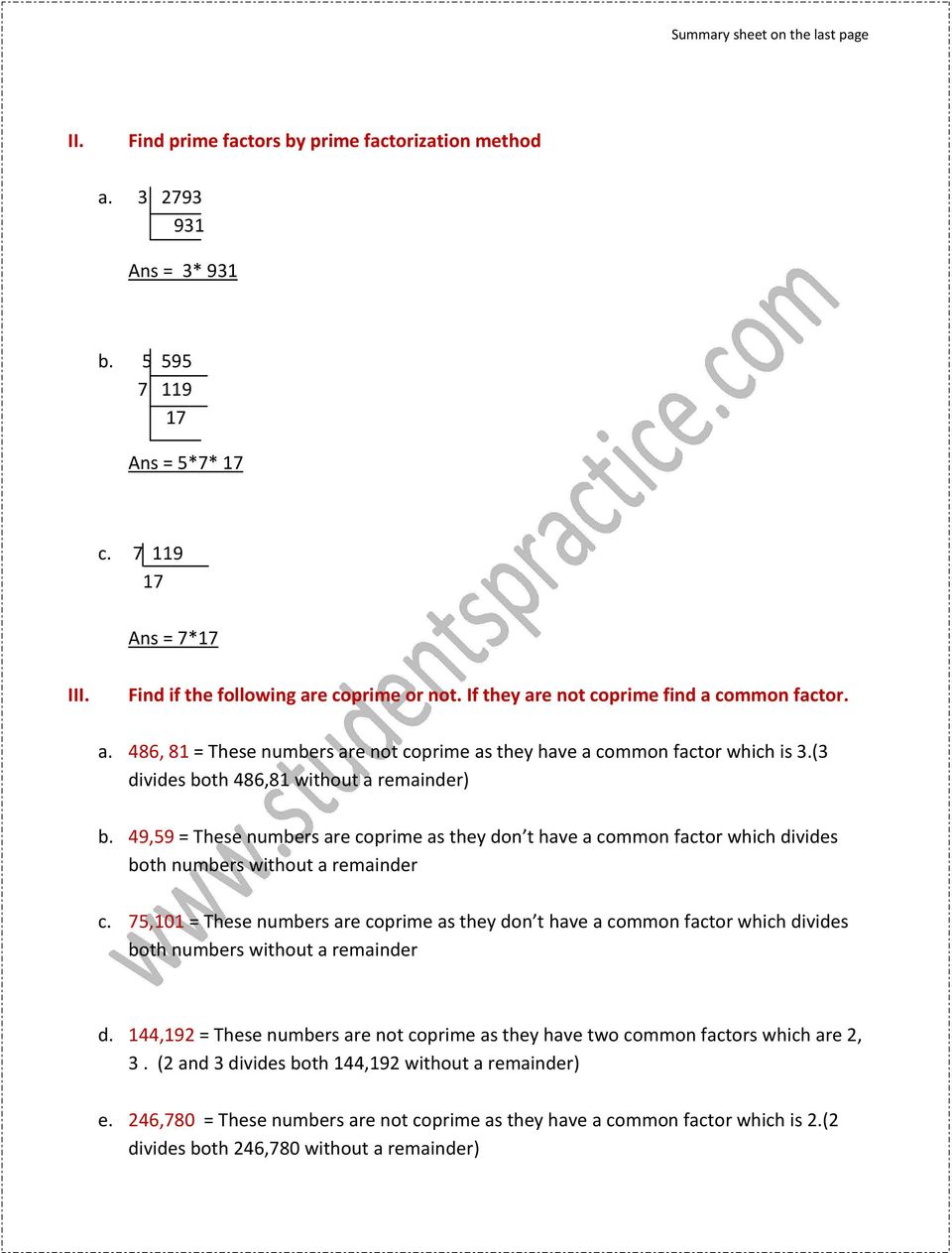
2 II. Find prime factors by prime factorization method a Ans = 3* 931 b Ans = 5*7* 17 c Ans = 7*17 III. Find if the following are coprime or not. If they are not coprime find a common factor. a. 486, 81 = These numbers are not coprime as they have a common factor which is 3.(3 divides both 486,81 without a remainder) b. 49,59 = These numbers are coprime as they don t have a common factor which divides both numbers without a remainder c. 75,101 = These numbers are coprime as they don t have a common factor which divides both numbers without a remainder d. 144,192 = These numbers are not coprime as they have two common factors which are 2, 3. (2 and 3 divides both 144,192 without a remainder) e. 246,780 = These numbers are not coprime as they have a common factor which is 2.(2 divides both 246,780 without a remainder)
3 f. 634,597 = These numbers are coprime as they don t have common factor which divides both numbers without a remainder IV. Find the LCM of a , 80, , 16, 5 2 7, 16, 1 2 7, 8, 1 2 7, 4, 1 * 7, 2, 1 Ans = 5*5*2*2*2*7*2 = 2800 b , 200, , 100, , 50, , 25, , 25, 4 3 9, 25, 2 5 3, 25, 2 3, 5, 2 * Ans = 2*2*2*2*2*3*5*3*5*2 = c , 48, , 48, 5 3 9, 16, 5 2 3, 16, 5 2 3, 8, 5 2 3, 4, 5 3, 2, 5 *

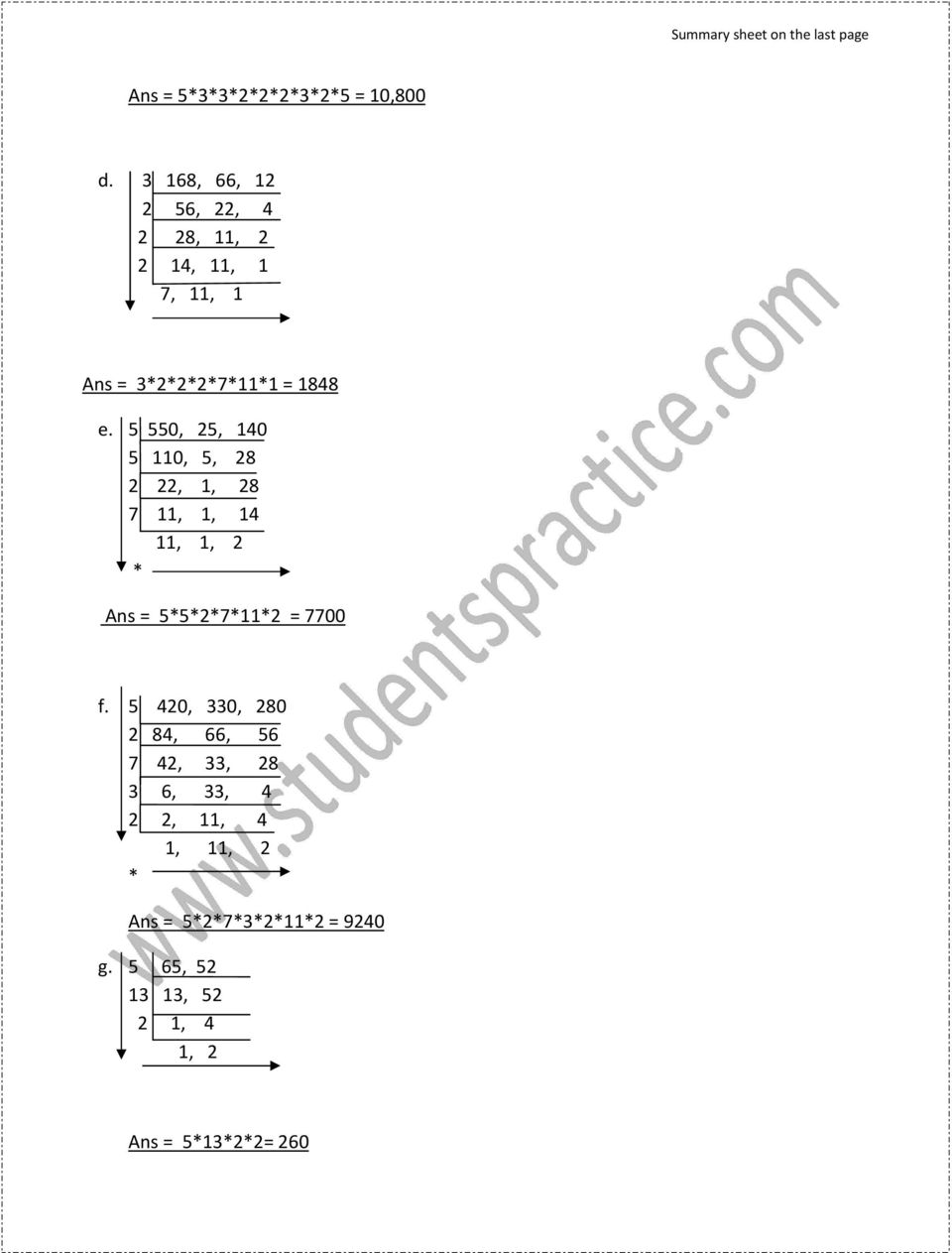
4 Ans = 5*3*3*2*2*2*3*2*5 = 10,800 d , 66, , 22, , 11, , 11, 1 7, 11, 1 Ans = 3*2*2*2*7*11*1 = 1848 e , 25, , 5, , 1, , 1, 14 11, 1, 2 * Ans = 5*5*2*7*11*2 = 7700 f , 330, , 66, , 33, , 33, 4 2 2, 11, 4 1, 11, 2 * Ans = 5*2*7*3*2*11*2 = 9240 g. 5 65, , , 4 1, 2 Ans = 5*13*2*2= 260
5 V. Find the HCF by prime factorization method a. 3 27, 36, , 12, 6 3, 4, 2 Ans = 3*3 = 9 b. 5 25, 95, , 19, 16 Ans = 5*5 = 25 c , 500, , 100, , 20, , 4, 2 3, 2, 1 Ans = 5*5*5*2 = 250 d , , , , 7 2, 1 Ans =2*3*3*7 = 126 e. 2 56, 144, , 72, 54 14, 36, 27

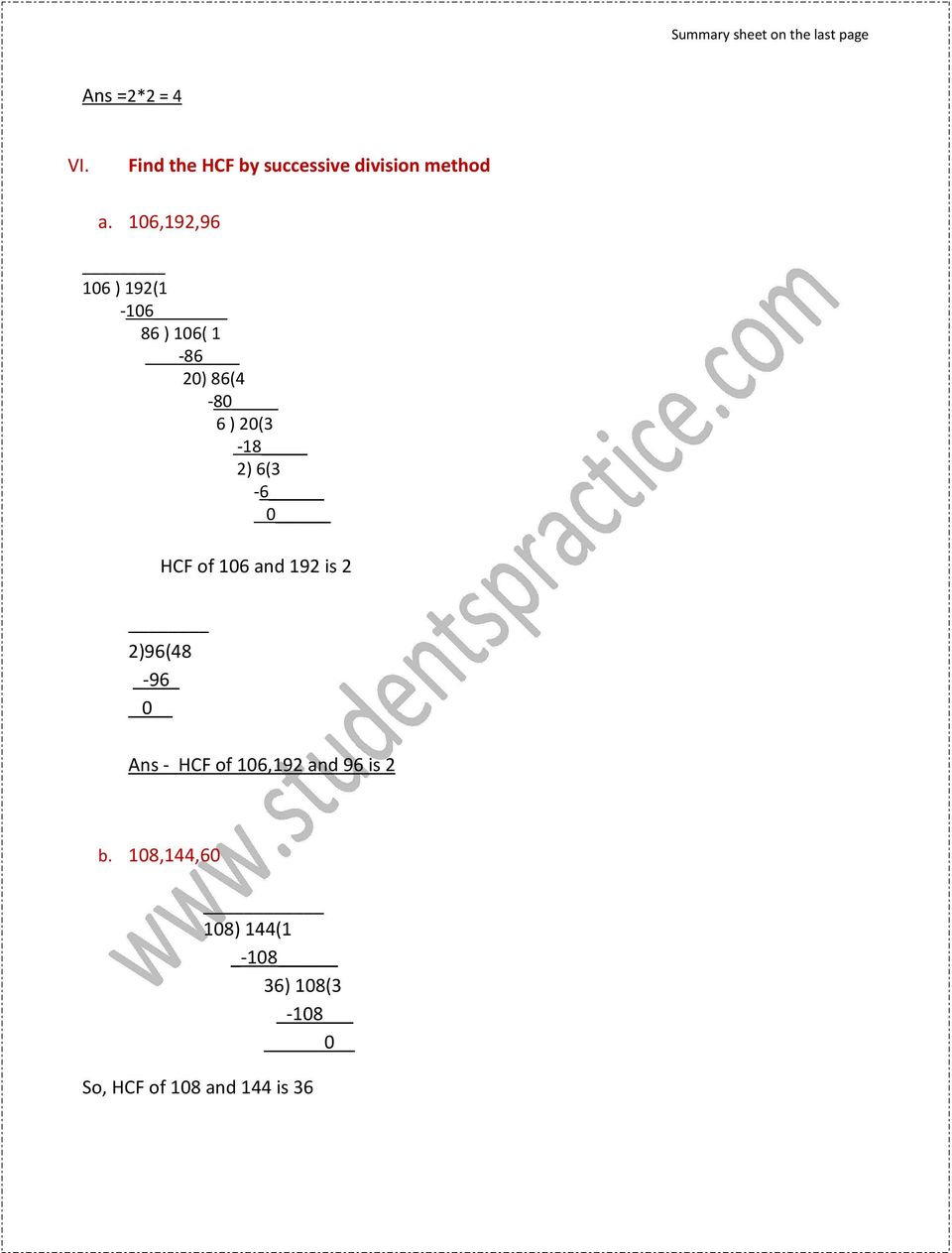
6 Ans =2*2 = 4 VI. Find the HCF by successive division method a. 106,192, ) 192( ) 106( ) 86( ) 20(3-18 2) 6(3-6 0 HCF of 106 and 192 is 2 2)96(48 _-96_ 0 Ans - HCF of 106,192 and 96 is 2 b. 108,144,60 108) 144(1 _ ) 108(3 _ So, HCF of 108 and 144 is 36
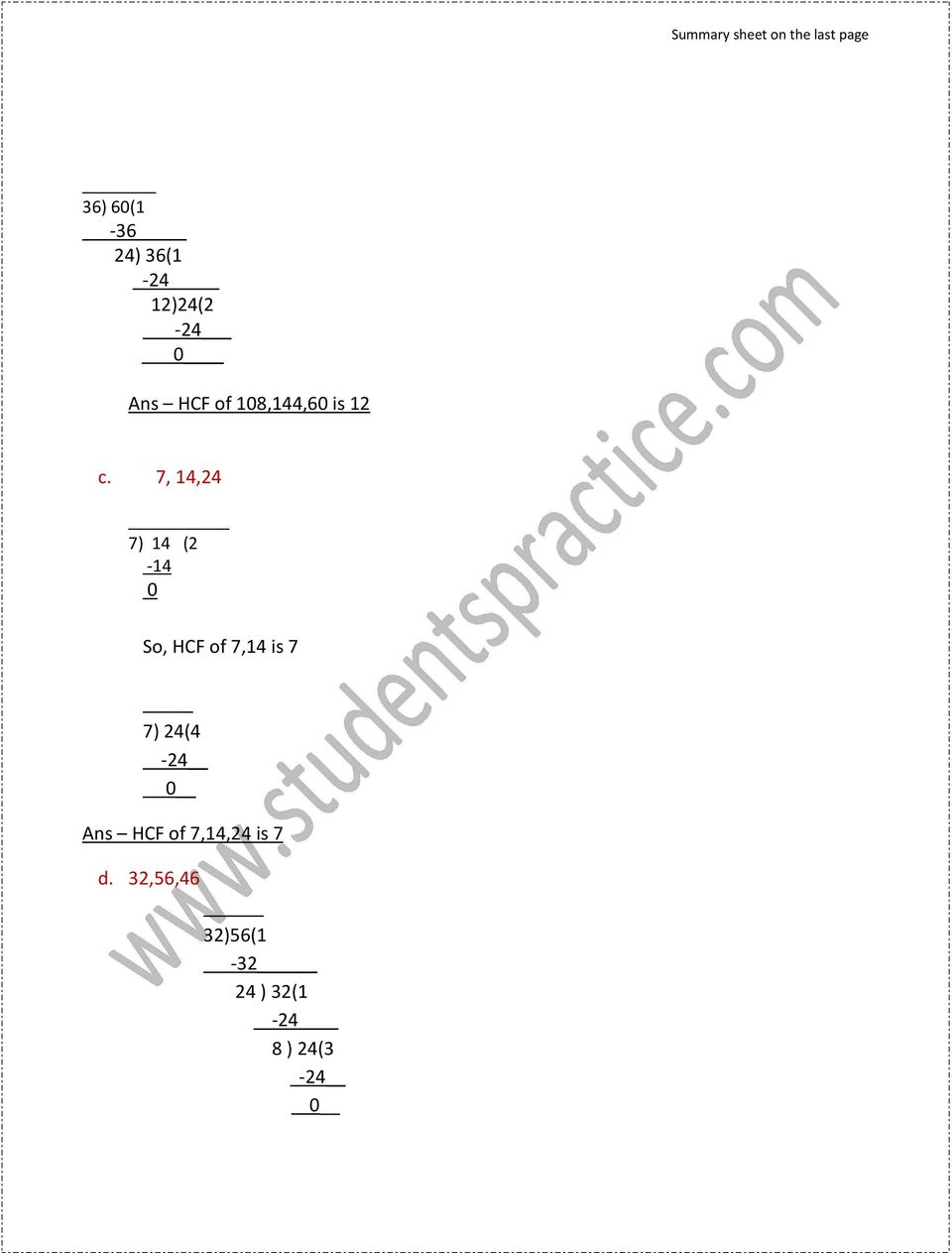
7 36) 60( ) 36(1 _-24 12)24( Ans HCF of 108,144,60 is 12 c. 7, 14,24 7) 14 ( So, HCF of 7,14 is 7 7) 24( Ans HCF of 7,14,24 is 7 d. 32,56,46 32)56( ) 32( ) 24(3-24 0
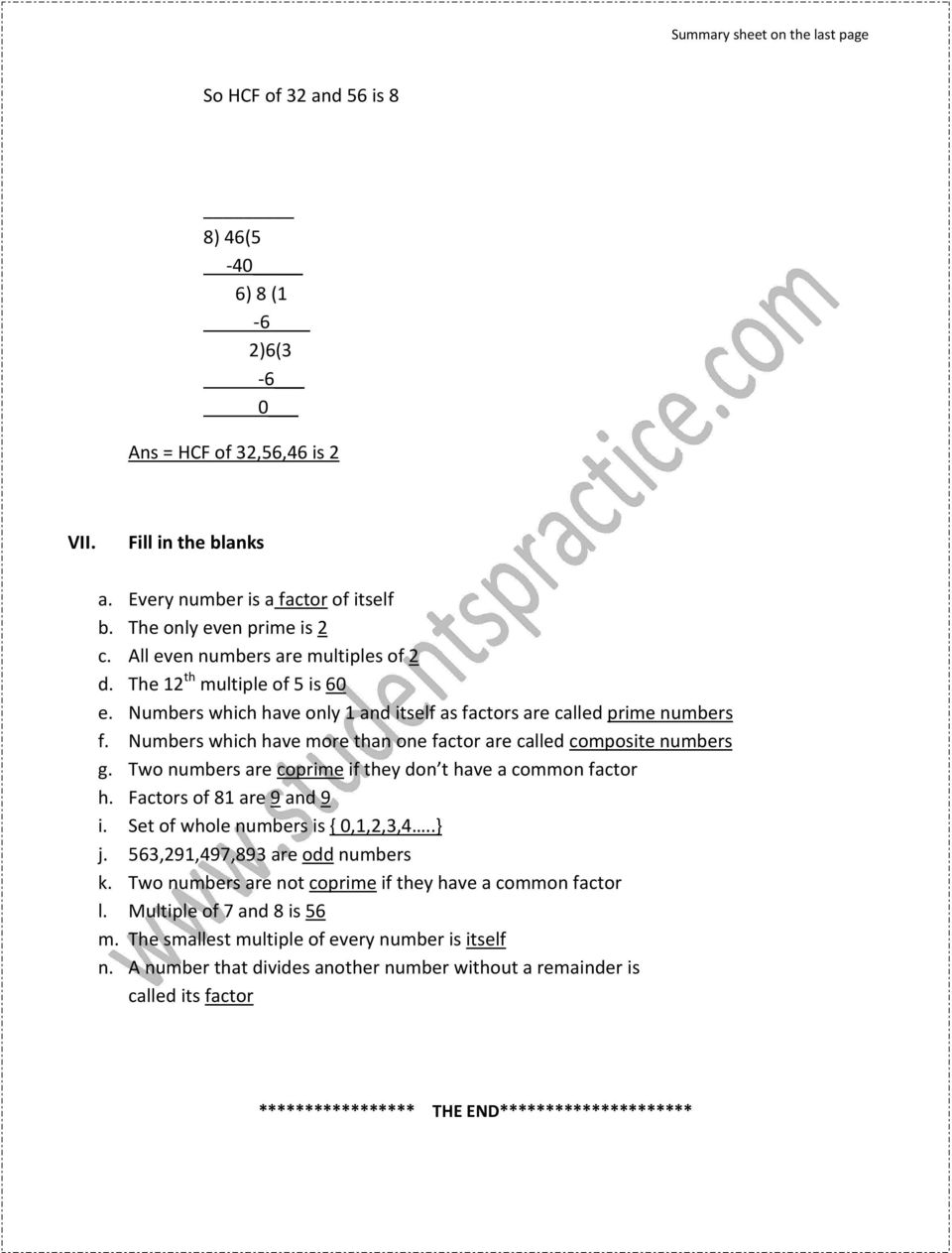
8 So HCF of 32 and 56 is 8 8) 46(5-40 6) 8 (1-6 2)6(3-6 0 Ans = HCF of 32,56,46 is 2 VII. Fill in the blanks a. Every number is a factor of itself b. The only even prime is 2 c. All even numbers are multiples of 2 d. The 12 th multiple of 5 is 60 e. Numbers which have only 1 and itself as factors are called prime numbers f. Numbers which have more than one factor are called composite numbers g. Two numbers are coprime if they don t have a common factor h. Factors of 81 are 9 and 9 i. Set of whole numbers is { 0,1,2,3,4..} j. 563,291,497,893 are odd numbers k. Two numbers are not coprime if they have a common factor l. Multiple of 7 and 8 is 56 m. The smallest multiple of every number is itself n. A number that divides another number without a remainder is called its factor ***************** THE END*********************
9 Summary Factors and Multiples A number which divides another number without leaving a remainder is called its factor. Eg. 3 divides 27 without a remainder. So 3 is a factor of 27 A number is a multiple of another number if it is divisible by it Set of Natural numbers { 1,2,3,4.} Set of Whole numbers { 0,1,2,3,4..} Set of Integers {-3,-2,-1,0,1,2,3 } Even numbers end with 0,2,4,6,8 and all even numbers are multiples of 2 Odd numbers end with 1,3,5,7,9 A number which had only one and itself as its factors is called prime numbers Numbers which have more than one factor is called composite 1 is unique and is neither prime nor composite Only even prime is 2 Two numbers which have no factors in common are called coprime Two numbers which have factors in common are not coprime

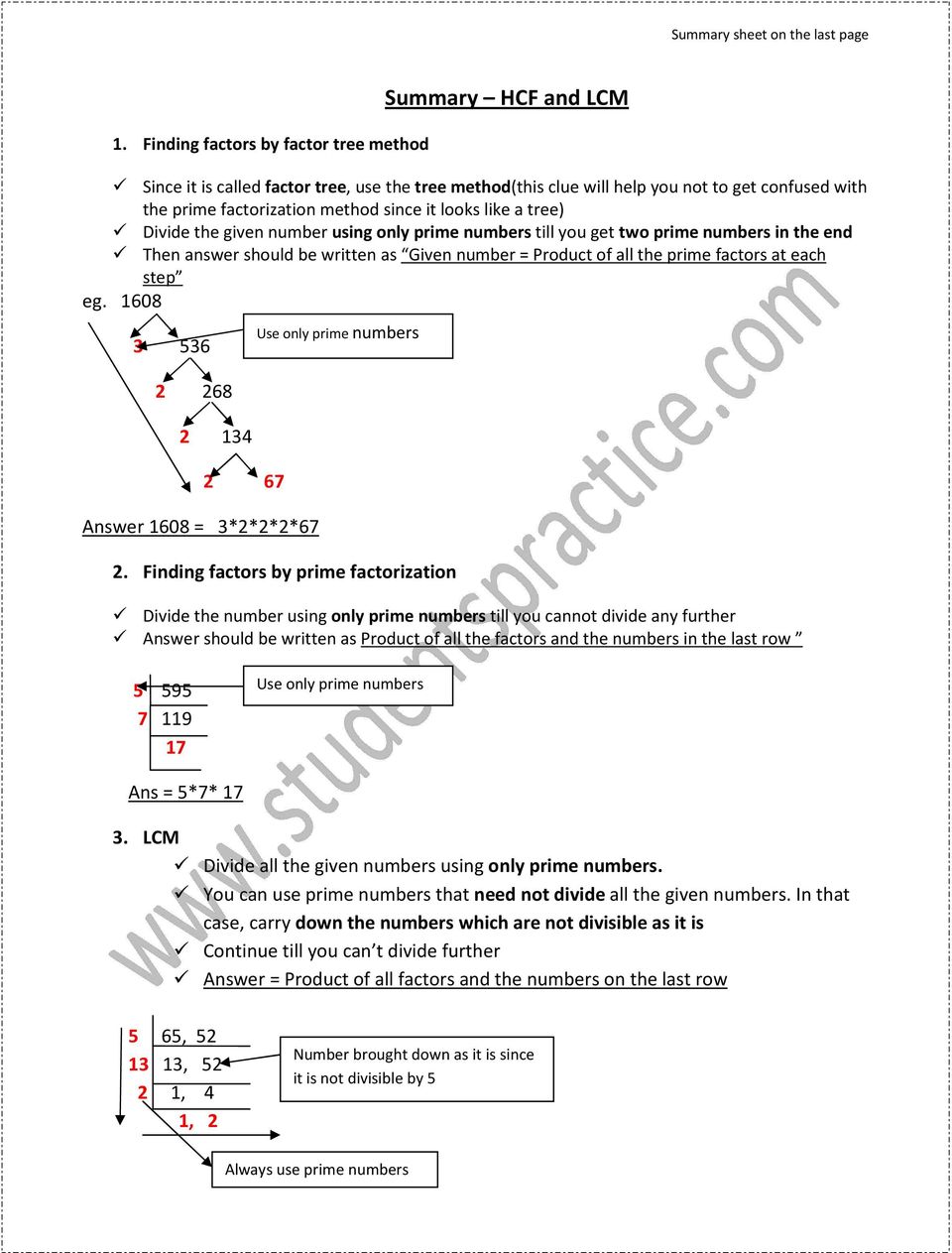
10 1. Finding factors by factor tree method Summary HCF and LCM Since it is called factor tree, use the tree method(this clue will help you not to get confused with the prime factorization method since it looks like a tree) Divide the given number using only prime numbers till you get two prime numbers in the end Then answer should be written as Given number = Product of all the prime factors at each step eg Answer 1608 = 3*2*2*2*67 Use only prime numbers 2. Finding factors by prime factorization Divide the number using only prime numbers till you cannot divide any further Answer should be written as Product of all the factors and the numbers in the last row Use only prime numbers Ans = 5*7* LCM Divide all the given numbers using only prime numbers. You can use prime numbers that need not divide all the given numbers. In that case, carry down the numbers which are not divisible as it is Continue till you can t divide further Answer = Product of all factors and the numbers on the last row 5 65, , , 4 1, 2 Number brought down as it is since it is not divisible by 5 Always use prime numbers
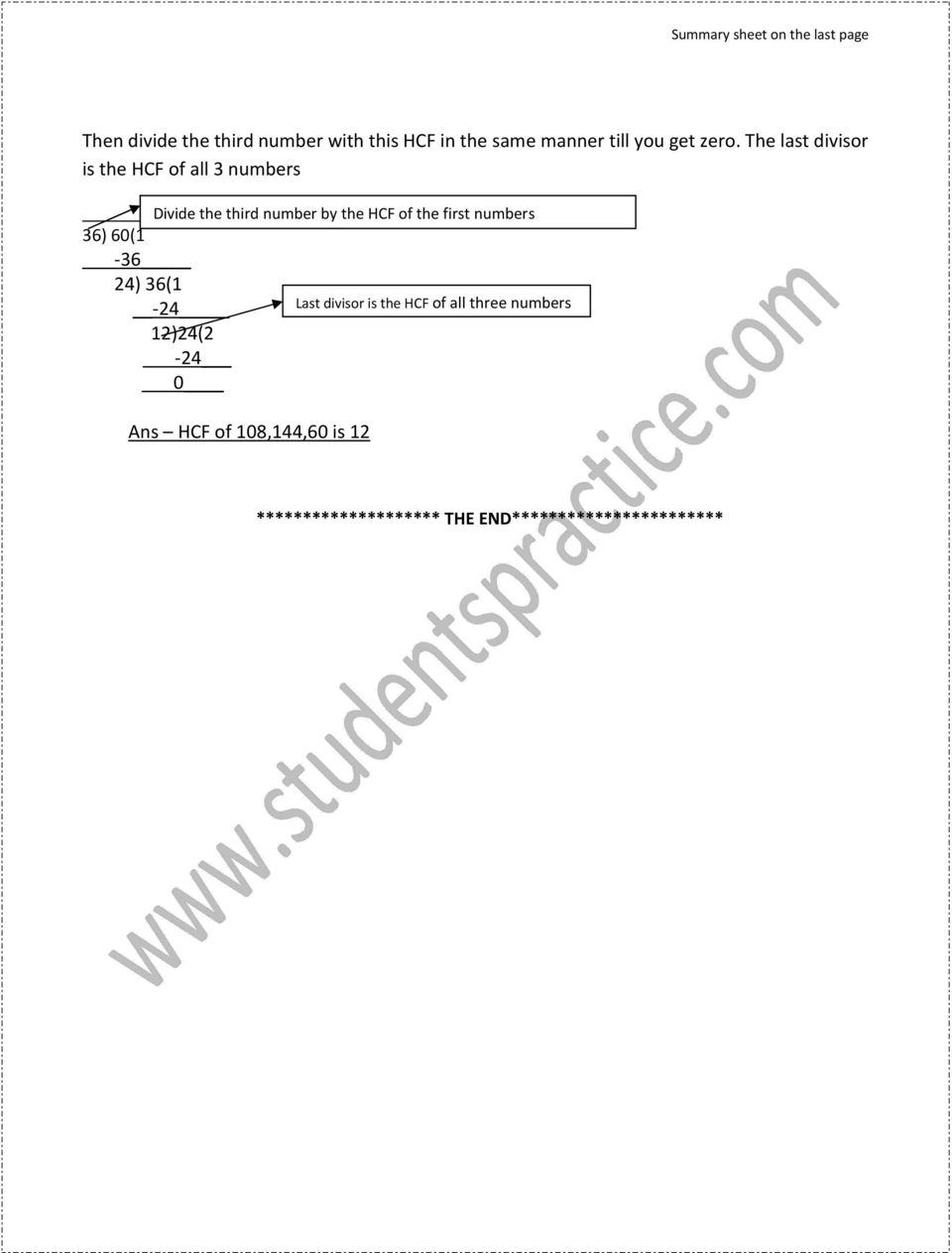
11 Ans = 5*13*2*2= HCF Prime Factorization method Divide all the given numbers using a prime number. Note that here the prime number must divide all the given numbers unlike LCM Continue till you can t find a prime number that will divide all the numbers Answer = Product of all factors 2 56, 144, , 72, 54 14, 36, 27 Stop division since there is no prime which divides all 3 numbers Ans =2*2 = 4 Note: In order to differentiate between LCM and HCF just remember In LCM take the factors on the vertical and horizontal (like in the letter L). L In HCF take only the factors in the vertical In LCM, prime numbers need not divide all given numbers but HCF it must divide all the numbers 5. HCF Successive division method Remainder becomes second divisor Eg HCF of 108,144 and ) 144(1 _ ) 108(3 _ Divide second number by the first This number becomes the second dividend Continue the same process till you get zero The last divisor is the HCF for the first two numbers

12 Then divide the third number with this HCF in the same manner till you get zero. The last divisor is the HCF of all 3 numbers Divide the third number by the HCF of the first numbers 36) 60( ) 36(1-24 Last divisor is the HCF of all three numbers 12)24( Ans HCF of 108,144,60 is 12 ******************** THE END***********************
Grade 7/8 Math Circles Fall 2012 Factors and Primes
 1 University of Waterloo Faculty of Mathematics Centre for Education in Mathematics and Computing Grade 7/8 Math Circles Fall 2012 Factors and Primes Factors Definition: A factor of a number is a whole
Previously, you learned the names of the parts of a multiplication problem. 1. a. 6 2 = 12 6 and 2 are the. b. 12 is the
 Tallahassee Community College 13 PRIME NUMBERS AND FACTORING (Use your math book with this lab) I. Divisors and Factors of a Number Previously, you learned the names of the parts of a multiplication problem.
Grade 6 Math Circles March 10/11, 2015 Prime Time Solutions
 Faculty of Mathematics Waterloo, Ontario N2L 3G1 Centre for Education in Mathematics and Computing Lights, Camera, Primes! Grade 6 Math Circles March 10/11, 2015 Prime Time Solutions Today, we re going
Greatest Common Factor and Least Common Multiple
 Greatest Common Factor and Least Common Multiple Intro In order to understand the concepts of Greatest Common Factor (GCF) and Least Common Multiple (LCM), we need to define two key terms: Multiple: Multiples
Prime Factorization 0.1. Overcoming Math Anxiety
 0.1 Prime Factorization 0.1 OBJECTIVES 1. Find the factors of a natural number 2. Determine whether a number is prime, composite, or neither 3. Find the prime factorization for a number 4. Find the GCF
Today s Topics. Primes & Greatest Common Divisors
 Today s Topics Primes & Greatest Common Divisors Prime representations Important theorems about primality Greatest Common Divisors Least Common Multiples Euclid s algorithm Once and for all, what are prime
Prime Factorization, Greatest Common Factor (GCF), and Least Common Multiple (LCM)
 Prime Factorization, Greatest Common Factor (GCF), and Least Common Multiple (LCM) Definition of a Prime Number A prime number is a whole number greater than 1 AND can only be divided evenly by 1 and itself.
Working with whole numbers
 1 CHAPTER 1 Working with whole numbers In this chapter you will revise earlier work on: addition and subtraction without a calculator multiplication and division without a calculator using positive and
Decimals Adding and Subtracting
 1 Decimals Adding and Subtracting Decimals are a group of digits, which express numbers or measurements in units, tens, and multiples of 10. The digits for units and multiples of 10 are followed by a decimal
Factoring Whole Numbers
 2.2 Factoring Whole Numbers 2.2 OBJECTIVES 1. Find the factors of a whole number 2. Find the prime factorization for any number 3. Find the greatest common factor (GCF) of two numbers 4. Find the GCF for
Lowest Common Multiple and Highest Common Factor
 Lowest Common Multiple and Highest Common Factor Multiple: The multiples of a number are its times table If you want to find out if a number is a multiple of another number you just need to divide the
Grade 7 & 8 Math Circles October 19, 2011 Prime Numbers
 1 University of Waterloo Faculty of Mathematics Centre for Education in Mathematics and Computing Grade 7 & 8 Math Circles October 19, 2011 Prime Numbers Factors Definition: A factor of a number is a whole
Calculate Highest Common Factors(HCFs) & Least Common Multiples(LCMs) NA1
 Calculate Highest Common Factors(HCFs) & Least Common Multiples(LCMs) NA1 What are the multiples of 5? The multiples are in the five times table What are the factors of 90? Each of these is a pair of factors.
International Indian School, Riyadh SA1 Worksheet 2015-2016 Class: VI Mathematics
 International Indian School, Riyadh SA1 Worksheet 2015-2016 Class: VI Mathematics CH KNOWING OUR NUMBERS I Fill In the blanks 1. 1km = mm 2. 1 gram = milligrams 3. The roman numeral M stands for the number
Multiplying and Dividing Fractions
 Multiplying and Dividing Fractions 1 Overview Fractions and Mixed Numbers Factors and Prime Factorization Simplest Form of a Fraction Multiplying Fractions and Mixed Numbers Dividing Fractions and Mixed
CONTENTS. Please note:
 CONTENTS Introduction...iv. Number Systems... 2. Algebraic Expressions.... Factorising...24 4. Solving Linear Equations...8. Solving Quadratic Equations...0 6. Simultaneous Equations.... Long Division
47 Numerator Denominator
 JH WEEKLIES ISSUE #22 2012-2013 Mathematics Fractions Mathematicians often have to deal with numbers that are not whole numbers (1, 2, 3 etc.). The preferred way to represent these partial numbers (rational
MATH-0910 Review Concepts (Haugen)
 Unit 1 Whole Numbers and Fractions MATH-0910 Review Concepts (Haugen) Exam 1 Sections 1.5, 1.6, 1.7, 1.8, 2.1, 2.2, 2.3, 2.4, and 2.5 Dividing Whole Numbers Equivalent ways of expressing division: a b,
CS 103X: Discrete Structures Homework Assignment 3 Solutions
 CS 103X: Discrete Structures Homework Assignment 3 s Exercise 1 (20 points). On well-ordering and induction: (a) Prove the induction principle from the well-ordering principle. (b) Prove the well-ordering
FACTORS, PRIME NUMBERS, H.C.F. AND L.C.M.
 Mathematics Revision Guides Factors, Prime Numbers, H.C.F. and L.C.M. Page 1 of 16 M.K. HOME TUITION Mathematics Revision Guides Level: GCSE Higher Tier FACTORS, PRIME NUMBERS, H.C.F. AND L.C.M. Version:
SOLUTIONS FOR PROBLEM SET 2
 SOLUTIONS FOR PROBLEM SET 2 A: There exist primes p such that p+6k is also prime for k = 1,2 and 3. One such prime is p = 11. Another such prime is p = 41. Prove that there exists exactly one prime p such
Playing with Numbers
 PLAYING WITH NUMBERS 249 Playing with Numbers CHAPTER 16 16.1 Introduction You have studied various types of numbers such as natural numbers, whole numbers, integers and rational numbers. You have also
Recall the process used for adding decimal numbers. 1. Place the numbers to be added in vertical format, aligning the decimal points.
 2 MODULE 4. DECIMALS 4a Decimal Arithmetic Adding Decimals Recall the process used for adding decimal numbers. Adding Decimals. To add decimal numbers, proceed as follows: 1. Place the numbers to be added
2) Based on the information in the table which choice BEST shows the answer to 1 906? 906 899 904 909
 0 0 0 0 0 0 0 0 0 0 0 0 0 0 0 ) Multiplying a number by results in what type of. even. 0. even.,0. odd..,0. even ) Based on the information in the table which choice BEST shows the answer to 0? 0 0 0 )
An Introduction to Number Theory Prime Numbers and Their Applications.
 East Tennessee State University Digital Commons @ East Tennessee State University Electronic Theses and Dissertations 8-2006 An Introduction to Number Theory Prime Numbers and Their Applications. Crystal
s = 1 + 2 +... + 49 + 50 s = 50 + 49 +... + 2 + 1 2s = 51 + 51 +... + 51 + 51 50 51. 2
 1. Use Euler s trick to find the sum 1 + 2 + 3 + 4 + + 49 + 50. s = 1 + 2 +... + 49 + 50 s = 50 + 49 +... + 2 + 1 2s = 51 + 51 +... + 51 + 51 Thus, 2s = 50 51. Therefore, s = 50 51. 2 2. Consider the sequence
Day One: Least Common Multiple
 Grade Level/Course: 5 th /6 th Grade Math Lesson/Unit Plan Name: Using Prime Factors to find LCM and GCF. Rationale/Lesson Abstract: The objective of this two- part lesson is to give students a clear understanding
Student Worksheet 1 TI-15 Explorer : Finding Patterns
 Student Worksheet 1 W1 3 and the remainder is always 0 Use a trail and error approach and 3 to make the TI-15 present the following output displays. When you get it to work, write down the dividends (starting
Session 6 Number Theory
 Key Terms in This Session Session 6 Number Theory Previously Introduced counting numbers factor factor tree prime number New in This Session composite number greatest common factor least common multiple
CISC - Curriculum & Instruction Steering Committee. California County Superintendents Educational Services Association
 CISC - Curriculum & Instruction Steering Committee California County Superintendents Educational Services Association Primary Content Module IV The Winning EQUATION NUMBER SENSE: Factors of Whole Numbers
Maths class 11 Chapter 7. Permutations and Combinations
 1 P a g e Maths class 11 Chapter 7. Permutations and Combinations Fundamental Principles of Counting 1. Multiplication Principle If first operation can be performed in m ways and then a second operation
MATHCOUNTS TOOLBOX Facts, Formulas and Tricks
 MATHCOUNTS TOOLBOX Facts, Formulas and Tricks MATHCOUNTS Coaching Kit 40 I. PRIME NUMBERS from 1 through 100 (1 is not prime!) 2 3 5 7 11 13 17 19 23 29 31 37 41 43 47 53 59 61 67 71 73 79 83 89 97 II.
Homework until Test #2
 MATH31: Number Theory Homework until Test # Philipp BRAUN Section 3.1 page 43, 1. It has been conjectured that there are infinitely many primes of the form n. Exhibit five such primes. Solution. Five such
MACM 101 Discrete Mathematics I
 MACM 101 Discrete Mathematics I Exercises on Combinatorics, Probability, Languages and Integers. Due: Tuesday, November 2th (at the beginning of the class) Reminder: the work you submit must be your own.
The Crescent Primary School Calculation Policy
 The Crescent Primary School Calculation Policy Examples of calculation methods for each year group and the progression between each method. January 2015 Our Calculation Policy This calculation policy has
Fraction Competency Packet
 Fraction Competency Packet Developed by: Nancy Tufo Revised 00: Sharyn Sweeney Student Support Center North Shore Community College To use this booklet, review the glossary, study the examples, then work
Tests for Divisibility, Theorems for Divisibility, the Prime Factor Test
 1 Tests for Divisibility, Theorems for Divisibility, the Prime Factor Test Definition: Prime numbers are numbers with only two factors, one and itself. For example: 2, 3, and 5. Definition: Composite numbers
Number of Divisors. Terms. Factors, prime factorization, exponents, Materials. Transparencies Activity Sheets Calculators
 of Divisors Purpose: Participants will investigate the relationship between the prime-factored form of a number and its total number of factors. Overview: In small groups, participants will generate the
Primes. Name Period Number Theory
 Primes Name Period A Prime Number is a whole number whose only factors are 1 and itself. To find all of the prime numbers between 1 and 100, complete the following exercise: 1. Cross out 1 by Shading in
Polynomial and Rational Functions
 Polynomial and Rational Functions Quadratic Functions Overview of Objectives, students should be able to: 1. Recognize the characteristics of parabolas. 2. Find the intercepts a. x intercepts by solving
Chapter 11 Number Theory
 Chapter 11 Number Theory Number theory is one of the oldest branches of mathematics. For many years people who studied number theory delighted in its pure nature because there were few practical applications
FRACTIONS MODULE Part I
 FRACTIONS MODULE Part I I. Basics of Fractions II. Rewriting Fractions in the Lowest Terms III. Change an Improper Fraction into a Mixed Number IV. Change a Mixed Number into an Improper Fraction BMR.Fractions
Lesson 3.1 Factors and Multiples of Whole Numbers Exercises (pages 140 141)
 Lesson 3.1 Factors and Multiples of Whole Numbers Exercises (pages 140 141) A 3. Multiply each number by 1, 2, 3, 4, 5, and 6. a) 6 1 = 6 6 2 = 12 6 3 = 18 6 4 = 24 6 5 = 30 6 6 = 36 So, the first 6 multiples
The Euclidean Algorithm
 The Euclidean Algorithm A METHOD FOR FINDING THE GREATEST COMMON DIVISOR FOR TWO LARGE NUMBERS To be successful using this method you have got to know how to divide. If this is something that you have
MATHEMATICS. Y5 Multiplication and Division 5330 Square numbers, prime numbers, factors and multiples. Equipment. MathSphere
 MATHEMATICS Y5 Multiplication and Division 5330 Square numbers, prime numbers, factors and multiples Paper, pencil, ruler. Equipment MathSphere 5330 Square numbers, prime numbers, factors and multiples
MATHEMATICAL NOTATION COMPARISONS BETWEEN U.S. AND LATIN AMERICAN COUNTRIES
 NUMERALS U. S. Latin American In many Latin American countries, the crosshatch is drawn 1 and 7 1 and 7 thru the 7 to distinguish it from the numeral 1. 8 8 The numeral 8 is often drawn from the bottom
15 Prime and Composite Numbers
 15 Prime and Composite Numbers Divides, Divisors, Factors, Multiples In section 13, we considered the division algorithm: If a and b are whole numbers with b 0 then there exist unique numbers q and r such
= 2 + 1 2 2 = 3 4, Now assume that P (k) is true for some fixed k 2. This means that
 Instructions. Answer each of the questions on your own paper, and be sure to show your work so that partial credit can be adequately assessed. Credit will not be given for answers (even correct ones) without
Category 3 Number Theory Meet #1, October, 2000
 Category 3 Meet #1, October, 2000 1. For how many positive integral values of n will 168 n be a whole number? 2. What is the greatest integer that will always divide the product of four consecutive integers?
Chapter 4. Polynomial and Rational Functions. 4.1 Polynomial Functions and Their Graphs
 Chapter 4. Polynomial and Rational Functions 4.1 Polynomial Functions and Their Graphs A polynomial function of degree n is a function of the form P = a n n + a n 1 n 1 + + a 2 2 + a 1 + a 0 Where a s
8 Primes and Modular Arithmetic
 8 Primes and Modular Arithmetic 8.1 Primes and Factors Over two millennia ago already, people all over the world were considering the properties of numbers. One of the simplest concepts is prime numbers.
Integers (pages 294 298)
 A Integers (pages 294 298) An integer is any number from this set of the whole numbers and their opposites: { 3, 2,, 0,, 2, 3, }. Integers that are greater than zero are positive integers. You can write
Section 1.1 Linear Equations: Slope and Equations of Lines
 Section. Linear Equations: Slope and Equations of Lines Slope The measure of the steepness of a line is called the slope of the line. It is the amount of change in y, the rise, divided by the amount of
Prime Numbers A prime number is a whole number, greater than 1, that has only 1 an itself as factors.
 Prime Numbers A prime number is a whole number, greater than 1, that has only 1 an itself as factors. Composite Numbers A composite number is a whole number, greater than 1, that are not prime. Prime Factorization
Kevin James. MTHSC 412 Section 2.4 Prime Factors and Greatest Comm
 MTHSC 412 Section 2.4 Prime Factors and Greatest Common Divisor Greatest Common Divisor Definition Suppose that a, b Z. Then we say that d Z is a greatest common divisor (gcd) of a and b if the following
1. When the least common multiple of 8 and 20 is multiplied by the greatest common factor of 8 and 20, what is the result?
 Black Equivalent Fractions and LCM 1. When the least common multiple of 8 and 20 is multiplied by the greatest common factor of 8 and 20, what is the result? 2. The sum of three consecutive integers is
. 0 1 10 2 100 11 1000 3 20 1 2 3 4 5 6 7 8 9
 Introduction The purpose of this note is to find and study a method for determining and counting all the positive integer divisors of a positive integer Let N be a given positive integer We say d is a
Adding and Subtracting Fractions. 1. The denominator of a fraction names the fraction. It tells you how many equal parts something is divided into.
 Tallahassee Community College Adding and Subtracting Fractions Important Ideas:. The denominator of a fraction names the fraction. It tells you how many equal parts something is divided into.. The numerator
NCERT. not to be republished NUMBER SYSTEM UNIT 1 MATHEMATICS. (A) Main Concepts and Results
 MATHEMATICS UNIT 1 NUMBER SYSTEM (A) Main Concepts and Results (i) Knowing our Numbers Large numbers upto one crore Reading and writing of large numbers Comparing large numbers Indian System of Numeration
FACTORING OUT COMMON FACTORS
 278 (6 2) Chapter 6 Factoring 6.1 FACTORING OUT COMMON FACTORS In this section Prime Factorization of Integers Greatest Common Factor Finding the Greatest Common Factor for Monomials Factoring Out the
6.1 The Greatest Common Factor; Factoring by Grouping
 386 CHAPTER 6 Factoring and Applications 6.1 The Greatest Common Factor; Factoring by Grouping OBJECTIVES 1 Find the greatest common factor of a list of terms. 2 Factor out the greatest common factor.
SQUARE-SQUARE ROOT AND CUBE-CUBE ROOT
 UNIT 3 SQUAREQUARE AND CUBEUBE (A) Main Concepts and Results A natural number is called a perfect square if it is the square of some natural number. i.e., if m = n 2, then m is a perfect square where m
TABLE OF CONTENTS. Multiplication. Division. Fractions. Decimals. Linear Measurement and Area. Surface Area and Volume. Graphs. Additional Lessons
 TABLE OF CONTENTS Multiplication Division Fractions Decimals Lesson 1 Multiply 3-Digit Numbers.................................... 4 Lesson 2 Divide Mentally............................................
Math 3000 Section 003 Intro to Abstract Math Homework 2
 Math 3000 Section 003 Intro to Abstract Math Homework 2 Department of Mathematical and Statistical Sciences University of Colorado Denver, Spring 2012 Solutions (February 13, 2012) Please note that these
Cubes and Cube Roots
 CUBES AND CUBE ROOTS 109 Cubes and Cube Roots CHAPTER 7 7.1 Introduction This is a story about one of India s great mathematical geniuses, S. Ramanujan. Once another famous mathematician Prof. G.H. Hardy
The Pointless Machine and Escape of the Clones
 MATH 64091 Jenya Soprunova, KSU The Pointless Machine and Escape of the Clones The Pointless Machine that operates on ordered pairs of positive integers (a, b) has three modes: In Mode 1 the machine adds
Prime Time: Homework Examples from ACE
 Prime Time: Homework Examples from ACE Investigation 1: Building on Factors and Multiples, ACE #8, 28 Investigation 2: Common Multiples and Common Factors, ACE #11, 16, 17, 28 Investigation 3: Factorizations:
Factor Trees. Objective To provide experiences with finding the greatest common factor and the least common multiple of two numbers.
 Factor Trees Objective To provide experiences with finding the greatest common factor and the least common multiple of two numbers. www.everydaymathonline.com epresentations etoolkit Algorithms Practice
Zero: If P is a polynomial and if c is a number such that P (c) = 0 then c is a zero of P.
 MATH 11011 FINDING REAL ZEROS KSU OF A POLYNOMIAL Definitions: Polynomial: is a function of the form P (x) = a n x n + a n 1 x n 1 + + a x + a 1 x + a 0. The numbers a n, a n 1,..., a 1, a 0 are called
Quick Reference ebook
 This file is distributed FREE OF CHARGE by the publisher Quick Reference Handbooks and the author. Quick Reference ebook Click on Contents or Index in the left panel to locate a topic. The math facts listed
VISUAL ALGEBRA FOR COLLEGE STUDENTS. Laurie J. Burton Western Oregon University
 VISUAL ALGEBRA FOR COLLEGE STUDENTS Laurie J. Burton Western Oregon University VISUAL ALGEBRA FOR COLLEGE STUDENTS TABLE OF CONTENTS Welcome and Introduction 1 Chapter 1: INTEGERS AND INTEGER OPERATIONS
Lesson 4. Factors and Multiples. Objectives
 Student Name: Date: Contact Person Name: Phone Number: Lesson 4 Factors and Multiples Objectives Understand what factors and multiples are Write a number as a product of its prime factors Find the greatest
Mental Math Tricks and More
 Mental Math Tricks and More Daryl Stephens, ETSU Students in grades 5 12 in Texas compete in a contest each spring known as Number Sense. It s governed by the University Interscholastic League (UIL) based
Groups in Cryptography
 Groups in Cryptography Çetin Kaya Koç http://cs.ucsb.edu/~koc/cs178 [email protected] Koç (http://cs.ucsb.edu/~koc) ucsb cs 178 intro to crypto winter 2013 1 / 13 Groups in Cryptography A set S and a binary
MEMORY WORK - MATH FACTS 1
 MEMORY WORK - MATH FACTS ADDITION BOARD (aka Strip Board) Addition with Golden Bead materials Addition with Colored Beads To memorize Addition Tables Linear structure of addition Addition Board MATERIALS:
CHAPTER 5. Number Theory. 1. Integers and Division. Discussion
 CHAPTER 5 Number Theory 1. Integers and Division 1.1. Divisibility. Definition 1.1.1. Given two integers a and b we say a divides b if there is an integer c such that b = ac. If a divides b, we write a
SPECIAL PRODUCTS AND FACTORS
 CHAPTER 442 11 CHAPTER TABLE OF CONTENTS 11-1 Factors and Factoring 11-2 Common Monomial Factors 11-3 The Square of a Monomial 11-4 Multiplying the Sum and the Difference of Two Terms 11-5 Factoring the
5-1 NUMBER THEORY: DIVISIBILITY; PRIME & COMPOSITE NUMBERS 210 f8
 5-1 NUMBER THEORY: DIVISIBILITY; PRIME & COMPOSITE NUMBERS 210 f8 Note: Integers are the w hole numbers and their negatives (additive inverses). While our text discusses only whole numbers, all these ideas
8 Divisibility and prime numbers
 8 Divisibility and prime numbers 8.1 Divisibility In this short section we extend the concept of a multiple from the natural numbers to the integers. We also summarize several other terms that express
Graphing Rational Functions
 Graphing Rational Functions A rational function is defined here as a function that is equal to a ratio of two polynomials p(x)/q(x) such that the degree of q(x) is at least 1. Examples: is a rational function
YOU MUST BE ABLE TO DO THE FOLLOWING PROBLEMS WITHOUT A CALCULATOR!
 DETAILED SOLUTIONS AND CONCEPTS - DECIMALS AND WHOLE NUMBERS Prepared by Ingrid Stewart, Ph.D., College of Southern Nevada Please Send Questions and Comments to [email protected]. Thank you! YOU MUST
Paramedic Program Pre-Admission Mathematics Test Study Guide
 Paramedic Program Pre-Admission Mathematics Test Study Guide 05/13 1 Table of Contents Page 1 Page 2 Page 3 Page 4 Page 5 Page 6 Page 7 Page 8 Page 9 Page 10 Page 11 Page 12 Page 13 Page 14 Page 15 Page
Written methods for addition of whole numbers
 Stage 1: The empty number line Mathematics written methods at the Spinney Written methods for addition of whole numbers The mental methods that lead to column addition generally involve partitioning, e.g.
Contents. Sample worksheet from www.mathmammoth.com
 Contents Introduction... 4 Warmup: Mental Math 1... 8 Warmup: Mental Math 2... 10 Review: Addition and Subtraction... 12 Review: Multiplication and Division... 15 Balance Problems and Equations... 19 More
Sect 3.2 - Least Common Multiple
 Let's start with an example: Sect 3.2 - Least Common Multiple Ex. 1 Suppose a family has two different pies. If they have 2 3 of one type of pie and 3 of another pie, is it possible to combine the pies
Math Content by Strand 1
 Math Content by Strand 1 Number and Operations with Whole Numbers Multiplication and Division Grade 3 In Grade 3, students investigate the properties of multiplication and division, including the inverse
MATH 10034 Fundamental Mathematics IV
 MATH 0034 Fundamental Mathematics IV http://www.math.kent.edu/ebooks/0034/funmath4.pdf Department of Mathematical Sciences Kent State University January 2, 2009 ii Contents To the Instructor v Polynomials.
Section 4.1 Rules of Exponents
 Section 4.1 Rules of Exponents THE MEANING OF THE EXPONENT The exponent is an abbreviation for repeated multiplication. The repeated number is called a factor. x n means n factors of x. The exponent tells
3-17 15-25 5 15-10 25 3-2 5 0. 1b) since the remainder is 0 I need to factor the numerator. Synthetic division tells me this is true
 Section 5.2 solutions #1-10: a) Perform the division using synthetic division. b) if the remainder is 0 use the result to completely factor the dividend (this is the numerator or the polynomial to the
Common Multiples. List the multiples of 3. The multiples of 3 are 3 1, 3 2, 3 3, 3 4,...
 .2 Common Multiples.2 OBJECTIVES 1. Find the least common multiple (LCM) of two numbers 2. Find the least common multiple (LCM) of a group of numbers. Compare the size of two fractions In this chapter,
5. FIXED ODDS BETS. 5.1 Fixed Odds Betting
 5. FIXED ODDS BETS 5.1 Fixed Odds Betting (c) (d) (e) (f) The Operator may decide from time to time to offer the types of Fixed Odds Bets in relation to any race, races or race meeting. The Operator may,
Section 4.2: The Division Algorithm and Greatest Common Divisors
 Section 4.2: The Division Algorithm and Greatest Common Divisors The Division Algorithm The Division Algorithm is merely long division restated as an equation. For example, the division 29 r. 20 32 948
Maths Refresher. Expanding and Factorising
 Maths Refresher Expanding and Factorising Expanding and Factorising Learning intentions. Recap Expanding equations Factorising equations Identity: perfect pairs Difference of two squares Introduction Algebra
Introduction to Finite Fields (cont.)
 Chapter 6 Introduction to Finite Fields (cont.) 6.1 Recall Theorem. Z m is a field m is a prime number. Theorem (Subfield Isomorphic to Z p ). Every finite field has the order of a power of a prime number
north seattle community college
 INTRODUCTION TO FRACTIONS If we divide a whole number into equal parts we get a fraction: For example, this circle is divided into quarters. Three quarters, or, of the circle is shaded. DEFINITIONS: The
Polynomial and Synthetic Division. Long Division of Polynomials. Example 1. 6x 2 7x 2 x 2) 19x 2 16x 4 6x3 12x 2 7x 2 16x 7x 2 14x. 2x 4.
 _.qd /7/5 9: AM Page 5 Section.. Polynomial and Synthetic Division 5 Polynomial and Synthetic Division What you should learn Use long division to divide polynomials by other polynomials. Use synthetic
The application of prime numbers to RSA encryption
 The application of prime numbers to RSA encryption Prime number definition: Let us begin with the definition of a prime number p The number p, which is a member of the set of natural numbers N, is considered
Algebraic Structures II
 MAS 305 Algebraic Structures II Notes 12 Autumn 2006 Factorization in integral domains Lemma If a, b, c are elements of an integral domain R and ab = ac then either a = 0 R or b = c. Proof ab = ac a(b
The GMAT Guru. Prime Factorization: Theory and Practice
 . Prime Factorization: Theory and Practice The following is an ecerpt from The GMAT Guru Guide, available eclusively to clients of The GMAT Guru. If you would like more information about GMAT Guru services,
THE NUMBER OF REPRESENTATIONS OF n OF THE FORM n = x 2 2 y, x > 0, y 0
 THE NUMBER OF REPRESENTATIONS OF n OF THE FORM n = x 2 2 y, x > 0, y 0 RICHARD J. MATHAR Abstract. We count solutions to the Ramanujan-Nagell equation 2 y +n = x 2 for fixed positive n. The computational